Korean Sociological Image #24: Childcare is Women’s Job

Oma(Source: 제동환 via Photo and Share CC)

For traveling parents, this is a godsend:

Asiana’s mother-friendly services have been gaining enthusiastic reviews from those who have been through the ordeals of traveling with infants.

Through the recent launch of “Happy Mom Services,” the airline has been providing exclusive check-in counters for mothers at the airport, breastfeeding covers and baby slings free of charge for travelers with babies.

It gets even better:

In response to the enthusiastic reception, Asiana will extend the “Happy Mom Services” to 66 airports internationally. Also, they will lengthen the age limit from 24 months to 36 months old…

….Passengers with infants will also receive a “Priority Tag” on their checked baggage. Arriving passengers with infants will now be able to quickly retrieve their baggage without the hassle of caring for their infant while waiting at baggage claim…

…For larger infants traveling on children tickets, Asiana is providing free installation of baby safety seats upon reservation. Asiana hopes the service will negate the need for passengers to bring along their own baby seats.

And considering the discriminatory hiring practices of its main rival Korean Air, which refuses to hire men for its cabin crew (see #2 here), then it seems somewhat picky, almost churlish to find any fault with Asiana’s initiative.

But still, “Happy Mom Services”?

(Source: Travel Story)

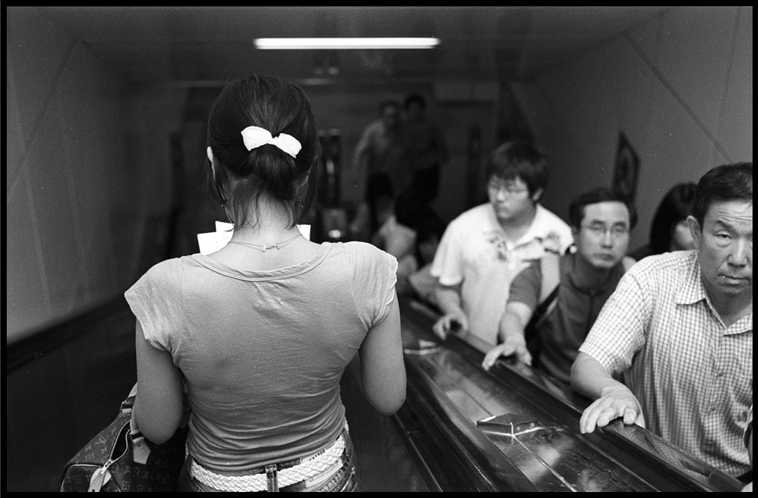
Yes, easy to overlook, unfortunately we are already barraged with signals that encourage and/or reinforce the notion that childcare is primarily women’s responsibility. For instance, wherever you are in the world, note the warning signs the next time you step on an escalator: only very rarely will you see child stick figures being protected by a male or gender-neutral one rather than a female one. Or, closer to home, consider Seoul Mayor Oh Se Hoon’s recent “Happy Women, Happy Seoul” plan involving the provision of such things as more women’s toilets and the now notorious pink parking spaces: as I point out here, providing larger spaces for those with children and pushchairs to unload is all well and good…but not if fathers are not allowed to use them. And I could go on with many similar examples.

Granted, probably none are confined only to Korea. But in the country with:

…then one suspects that greater attention should be paid to the grass-roots origins of those issues, which unfortunately Asiana’s choice of name only adds to.

Having said that, they’ll still easily be my first choice for traveling with my two young daughters from now on. And if it would be effective, I’d consider writing letters to both English and Korean-language newspapers to draw Asiana’s attention to the problem, hopefully persuading them to change the name to “Happy Parents’ Service.” What do you think?

(For more posts in the Korean Sociological Images Series, see here)

The Grand Narrative in TIME Magazine

Going Down David Smeaton(Going Down by David Smeaton; used with permission)

For the article in full, on Seoul Mayor Oh Se-hoon’s “Happy Women, Happy Seoul” plan involving more women’s toilets and the notorious pink parking spaces, see here. Meanwhile, for readers coming from there, see #2 here for the specific quote of Lee Myung-bak’s for which the blog was mentioned, and #2 here for more information on Korea’s disproportionately low Gender Empowerment Measure.

I would also add—with no offense to reporter Veronica Zaragovia, who necessarily had to omit most of what was said in our interview—that the argument that “the plan may end up reasserting South Korean women’s secondary status more than boosting it” is also one that I made in our phone conversation. I based it on the knowledge that the pink parking spaces were made wider in order to better accommodate loading and unloading pushchairs and so on (see #3 here), which had reminded me of this post from Sociological Images about the images in our daily lives that serve to subtly reaffirm the notion that childcare is primarily women’s responsibility. In that vein, while the extra space may well be appreciated by mothers, consider that if I were to park in one of those spaces myself, with just as pressing a need for the space to deal with my two young daughters in the back as my wife would have, then as a man I would be likely either be fined or shooed away.

I grant you, it sounds innocuous. But place that into the context of Korean women having the lowest workforce participation rate in the OECD, the result of a combination of a lack of childcare facilities and an enduring male-breadwinner mentality that forces a stark choice between motherhood or a career, then the underlying sexist logic becomes apparent. Moreover, with Korea in turn having the lowest birthrate in the world, the economic effects of which will be felt soon, then one might reasonably ask if the money could have been better spent.

p.s. Apologies in advance for some light blogging this week; I have a conference presentation to give this weekend.

Update, January 19 2010: See The JoongAng Daily here for all the ways in which programs like this have been considerably expanded since this post was written, now including pink spaces for women at bus stops, on buses, in parking lots and special pink taxis under the rubric of improving women’s safety (via: The Marmot’s Hole).

Bandhobi: The Most Interesting Korean Movie You’ll See This Year

Bandhobi

Well, it certainly sounds like it will be, although I admit I have some reservations about Bandhobi‘s (반두비) “crude political satire,” and especially of its portrayal of an American English teacher as an “occasional rotten apple.” Given that it otherwise aims to transcend and/or educate viewers about such issues as racism, illegal immigration, and possibly even teenage sexuality, then it would be both ironic and quite a pity if it resorted to gross stereotypes of foreign male English teachers in the process.

(In passing, as I probably won’t get to mention them otherwise then reviews of the book “The East, The West, and Sex” by Richard Bernstein here, here, here, and here may help to put those stereotypes in comparative perspective, and are interesting in their own rights)

Still, Korea Times’s movie critic Lee Hyo-won, whose excellent movie reviews I’ve sung the praises of before, has easily persuaded me to go and watch it this weekend. Here is her(?) full review below:

In “Bandhobi,” director Shin Dong-il translates to screen “uncomfortable” issues of illegal immigration, racism and social toadyism through the universal languages of ticklish humor, teenage angst and priceless friendship.

It’s a story about growing pains and the meeting point of different cultures _ the title “Bandohbi” roughly means “female friend” in Bengali. It’s an indie flick that, while comfortably feigning mainstream superficiality, is inlaid with some gem-like scenes that show why Shim was dubbed “the Korean Woody Allen” (Berlin International Film Festival, “Host & Guest,” 2005).

Teenage actress Bae Jin-hui portrays the cheeky 17-year-old Min-seo with sure-fire articulation. One of the thousands of girls who took part in political candlelit vigils, Min-seo relentlessly speaks her mind at home – “you’re just my mom’s sex partner,” she shouts at her single mother’s incompetent boyfriend (Here, the film could have made the man despicable and turned it into something more noir, but he truly wants to get a job and become part of the family).

But she isn’t entirely the hardball rebel she pretends be. Not wanting to be a burden, she even takes up an illicit part-time job to raise money for English lessons.

Bandhobi First Meeting( Source )

One day, she decides to treat herself to the spoils of a misplaced wallet, but is caught by the owner, a migrant worker from Bangladesh. Mahbub Alam, a migrant worker-turned-documentary filmmaker who played a minor part in Shin’s “My Friend & His Wife,” shows off his fluent Korean to play the 29-year-old intellectual struggling to support his family back home.

Update: It turns out that Matt at Gusts of Popular Feeling actually knows Mahbub Alam. See here for a little more on his work with the Migrant Workers’ Union and with Migrant Workers’ Television.

Min-seo tries to dissuade Karim from reporting her to the police by offering to grant him a favor, and reluctantly agrees to help track down his former boss that owes one year’s pay. As the unlikely pair pose as loan sharks, they find themselves transforming each other’s worlds in unexpected ways but Karim’s visa will not last forever.

American English Teacher in Bandhobi( Source )

The sometimes-shaky handheld camera keeps a rather ironic distance from the characters; for Min-seo, the world is a piece of cake while for Karim it is a cruel battlefield. They slowly form a mutual understanding, with the girl asking indiscreet questions and the gentleman preaching about problems in Korean society. Yet the most affecting scenes do not involve words, but rather the simple act of crying, listening and eating.

The blatant mockery of traditionally right-wing institutions including the President Lee Myung-bak administration and the daily Chosun Ilbo are actually funny, but at times are not limited to character portrayal as they ought to, and are rather vulgarly laid into the mise en scene. Another questionable aspect of the film, which aims to highlight the foreign community in Korea, is that the American teacher was not convincing as the occasional rotten apple he was supposed to represent, let alone his “atypical” American English accent.

The crude political satire will throw some into fits of laughter while offending others, and contrived narrative elements are bound to irritate picky viewers. But just as the film’s hero Karim says, “open your mind,” and discover the film’s redeeming – and inspiring – qualities.

Bandhobi Hmmm....( Source )

It is unfortunate that the film, which could nevertheless reach out to teenagers, was rated 19 and over for some candid depictions of a girl’s sexual awakening. In theaters June 25. Distributed by Indiestory.

Moviegoers can also look forward to the Migrant Worker Film Festival, of which Allum is festival director. It will be held in July in Seoul and through September in other parts of the country. Visit www.mwff.or.kr.

I’m assuming that that “sexual awakening” involves Min-seo becoming attracted to Karim, and if so it would be quite radical for a Korean movie, as I’m at a loss to think of any portrayals of romantic relationships between Korean women and Western men in Korean cinema, let alone with men from an ‘undesirable’ country like Bangladesh (can anyone fill me in please?). Given everything that I’ve written about teenage sexuality in Korea though – in short, that Korean teenagers are having sex, but the Korean public’s unwillingness to acknowledge this is severely restricting teenagers’ access to contraception and reliable information – then that rating is indeed a pity. But on the plus side, presumably Korean teenagers will be able to find a way to watch it nevertheless, and the restrictions will make them even more inclined to do so!

Share

Korean Sociological Image #6: How about a date with Lee Yeon-hee?

Lee Yeon-hee Oz Date

An otherwise innocuous, quick slice of Korean life…but which inadvertently prompted some soul-searching and a minor epiphany about Korean society on my part. Please bear with me!

If you’re reading this blog in Korea, then by virtue of its inane “We Live in OZ” catchphrase you’ve probably more aware of LG Telecom’s “OZ Generation” advertising campaign than most. But you may not have heard of its online virtual first person “date” with model and actress Lee Yeon-hee (이연희) that was launched about two weeks ago, and which deserves kudos for being the first of its kind in Korea (indeed, this post was originally intended to be #16 in my Creative Korean Advertisingseries). As Coolsmurf explains at allkpop here:

Users get to have a complete, enjoyable date with Lee Yeon Hee by completing 6 stages with varying difficulties, but all of which can be solved by using the LG mobile phone and your trusty keyboard. You get to hold the hands of Yeon Hee as you dash away from the crowd, ride a bus with her, have a meal, celebrate her birthday, etc.

And as of Saturday, 200,000 people had participated since it was released 10 days earlier, with 20,000 visitors daily. Unfortunately, and all too typically for Korea, the main site requires your national ID number to participate (I didn’t check if my “foreign” one worked or not sorry), but strangely this alternate entry site (in the screenshot below) doesn’t, which will hopefully give K-pop fans outside of Korea a chance to participate.

Lee Yeon-hee Oz Star Date Game

I confess, I did it myself for a little while: it’s like a surreal bubblegum version of Doom 3, with eye-candy as the target rather than demons. And my 3 year-old daughter sitting on my lap found it hilarious when I crashed into people and potholes while running to meet Yeon-hee in “Mission 1” (hint, use the cursors), but neither of us were sufficiently motivated to figure out how to rouse her after she fell asleep on the bus in Mission 2 though I’m afraid (but get on the bus using the mouse this time). Not for a fifth time at least…

But what epiphany about Korean society did this prompt on my part? Other than being reminded, say, of the penetration and pervasiveness of mobile phones into all elements of Korean life that is?

Well, consider the rather childish and platonic way the couple interacts on the “date” itself, replete with numerous uses of the word Oppa (오빠): to Western eyes it makes it appear more reminiscent of the sorts of dates we had – or perhaps, our parents liked to think we had? – back in our early teens, and certainly nothing like what most Western adults would consider worth showing up for. Lest you feel like that’s an exaggeration though, then by all means examine it for yourselves, but I’m sure that most people at all familiar with unmarried Koreans need no such assurances.

A Typical Korean Date

In the original version of this post, this prompted a lot of speculation on my part as to whether the date game was in fact primarily targeted towards teenagers, but that was misguided: as Charles points out in his comment that made me realize that, I myself went on “dates” like that with a 25 year-old Korean woman before I met my future wife, and although I haven’t dated in the 9 years since – and so by no means claim to be an expert on Korean dating culture – I’m confident that a sizable proportion of 20-something Koreans do have indeed have platonic dates like this. After all, the various cultural, social, and economic factors that lay behind the plethora of blind-dating systems in Korea certainly do still exist, although as Michael Hurt in this excellent practical guide to the cultural pitfalls of dating Korean women points out, the move from single-sex to mixed schooling is beginning to change those (see the KoreanClass101 Blog here also).

Lest I give the wrong impression though, I’m not against such dates per se. And while it’s true that I don’t personally consider dating without the ultimate aim of a sexual relationship as dating at all, that’s isn’t quite the same as thinking that, say, any woman that doesn’t sometimes put out on the first date (or guy that doesn’t want that) is a prude! And that so many Koreans go on such dates is – however patronizing it may sound – a very nice and endearing aspect of Korean society.

However, it is but one version of Korean dating culture. And yet while Koreans as a whole are certainly more sexually reserved than your generic Westerners, I doubt that any readers need convincing of the fact that over 50% of Koreans have sexual experiences before marriage. Yet- and herein lies the (belated) beginning of my epiphany – why is it only the platonic version of dating that is still overwhelmingly presented in the Korean media? And particularly when depictions of so many other aspects of sexuality in the Korean media are becoming increasingly bolder and more liberal over time?

Girls' Generation... Korean Teens are Sweet and Innocent

True, if you take issue with my description of the way dating is depicted in the Korean media, then I have no data to back that up: indeed, I don’t watch Korean dramas precisely because on the rare occasions I’ve naively wanted to spend more than 5 minutes with my wife on the sofa while she’s watching one, then I’ve soon been forced to leave the room at sheer disgust and incredulity with the surreal, Disneyland version of Korean life presented on the TV screen. Still, as commentators on this lengthy post on that subject pointed out, there are more realistic and palatable dramas out there if you’re prepared to look for them.

Also, granted: the ways dating and premarital sex are depicted in the Korean media are in many respects quite separate to, say, the censorship issues that I’ve been following closely in my weekly(ish) Korean Gender Readerposts. But still, rather than censorship being akin to some inexorable fact of nature (i.e. Korea is a conservative country…what else does one expect?), the numerous forward and backward steps in Korea just this year has provided me with a healthy reminder that what is considered suitable for Korean viewers is in reality a very mutable concept (and don’t get me started on Japanese censorship issues). Which begs the question of who is doing the defining, and why.

This brought to mind the following lesson I learned from An Introduction to Japanese Society by Yoshio Sugimoto (and easily the first book you should ever read on the subject):

Japanese culture, like the cultures of other complex societies, comprises a multitude of subcultures. Some are dominant, powerful, and controlling, and form core subcultures in given dimensions. Examples are the management subculture in the occupational dimension, the large corporation subculture in the firm size dimension, the male subculture in the gender dimension, and the Tokyo subculture in the regional dimension. Other subcultures are more subordinate, subservient, or marginal, and may be called the peripheral subcultures. Some examples are the part-time worker subculture, the small business subculture, the female subculture, and the rural subculture.

Core subcultures have ideological capital to define the normative framework of society. Even though the lifetime employment and the company-first dogma associated with the large corporation subculture apply to less than a quarter of the workforce, that part of the population has provided a role model which all workers are expected to follow, putting their companies ahead of their individual interests…. (p. 12).

yellow-salaryman

Yes, Japan, supposedly the land of the faceless salaryman…is anything but. And yes, the subject of salarymen may seem a little out of place at first glance, but I’m sure you’re seeing the connections already. Continuing in the same vein (although as a quick aside, it’s interesting to consider why Japan is so well-known for the salaryman system, when if fact it’s only Korea that ever had them as a majority of workers):

Dominating in the upper echelons of society, core subcultural groups are able to control the educational curriculum, influence the mass media, and prevail in the areas of publishing and publicity. They outshine their peripheral counterparts in establishing their modes of life and expectations in the national domain and presenting their subcultures as the national culture. The samurai spirit, the kamikaze vigor, and the soul of the Yamato race, which some male groups may have as part of the dominant subculture of men, are promoted as presenting Japan’s national culture….

More generally, the slanted views of Japan’s totality tend to reproduce because writers, readers, and editors of publications on the general characteristics of Japanese society belong to the core subcultural sphere. Sharing their subcultural base, they conceptualize and hypothesize in a similar way, confirm their portrayal of Japan between themselves, and rarely seek outside confirmation….(pp. 12-13).

As another aside, this last point highlights how Koreans are in many senses shooting themselves in the foot by alienating and demonizing a whole generation of English teachers in Korea (see here, here, and here):

Core subcultural groups overshadow those on the periphery in inter-cultural transactions too. Foreign visitors to Japan, who shape the images of Japan in their own countries, interact more intensely with core subcultural groups than with peripheral ones. In cultural exchange programs, Japanese who have houses, good salaries, and university educations predominate among the host families, language trainers, and introducers of Japanese culture…(p. 13)

(Update: See here for some quick recent examples of how different the Japanese are to the way they’re normally represented in the foreign media)

No, I’m not suggesting that there is a big conspiracy to keep premarital sex off Korean screens. Nor am I suggesting that the above is all that original or profound, and certainly my ultimate epiphany – merely to extend the above lesson to depictions of Korean dating and premarital sex in the Korean media also – is much less so.

But the point that I want you to take away from all this is that at the very least it provides an interesting and useful alternate framework with which to analyze the topic in future. For instance, the completely ineffectual Youth Protection Committee’s (of the Ministry for Health, Welfare and Family Affairs) recent banning of music group TVXQ’s latest songs from being played on TV and the radio because of “lewd content” and the need to “protect teenagers” (see #2 here), may be most explicable in terms of corporatist motivations, or in other words be the result of the Ministry’s struggle for relevance and definition under the hostile Lee Myung-bak Administration, which originally planned to disband the former Ministry of Gender Equality and Family altogether (now a separate Ministry of Gender Equality exists: see #4 here), and despite the compromise being opposed by all ministries involved. No, I’m not saying that that is the case necessarily, just that it’s a possibility that needs to be considered.

And on that note, I’d better end this post, which has admittedly somewhat evolved from its ostensible original topic. Which reminds me, presumably other male and female members of the “OZ Generation” in the advertisements will have similar dates set up for them, and it’ll be interesting seeing the different conventions for the former’s behavior and writing about that a later date. And probably this topic will be in IM AD (아이엠 애드) also (Korea’s only magazine devoted to online advertising), and I’ll make sure to buy it and translate the corresponding article also. In the meantime, I’m curious as to if this virtual date has already been done overseas, so if any readers know of foreign examples then please pass them on.

Image sources: first & second, third, fourth, last.

(For all posts in the “Korean Sociological Image” series, see here)

Share

Choi Jin-sil Sued For Being Beaten by Her Husband: Update

Choi Jin-sil holding back tearsWhen hearing last week about something as appalling as an actress being sued for daring to show her bruises and black eyes to the media, it’s only human nature to assume the worst of Korean society.

But while Korea certainly does have a great deal of work to do in combating domestic violence—and criminalizing spousal rape would be an essential first step (see #2 here)—it’s also true that police and legal attitudes towards it have considerably hardened in recent years, both cause and effect of a law change in 2007 that requires police to forward all cases of domestic violence to a prosecutor (the previous 1998 law just left it up to their own discretion). In addition, Korean women are now more likely than ever to divorce on the basis of verbal or physical abuse, rather than suffering silently as in past decades.

Indeed, what stands out more than anything else about the court decision is how much it goes against the grain of trends within Korean society, and certainly does not reflect the will of all Koreans. Some quick excerpts from today’s Korea Times for instance:

Women’s groups are angry over the top court’s ruling that ordered the late actress Choi Jin-sil (최진실) to compensate a builder for failing to maintain “dignity” as a model representing its products.

They censured the Supreme Court for not realizing the suffering of domestic violence victims, which included Choi.

Korean Womenlink, the Korea Women’s Hot Line, and the Korea Women’s Association United issued a joint statement Wednesday lambasting the ruling.

On June 4, the court reversed a high court ruling that decided in favor of Choi in a compensation suit filed by Shinhan Engineering and Construction in 2004 against the actress, who was the model for its apartments.

The advertiser claims she did not keep her contractual obligation to “maintain dignity,” because she disclosed to the public her bruised and swollen face which was caused by the violence of her then husband, former baseball player Cho Sung-min. They divorced soon afterward.

For the rest, see here. Also, see here for my original post on this issue and information about similar cases in the past, and here for a quick primer on the numerical rates of domestic violence in Korea (albeit in 2004), with many graphs and tables.

(By the way, although it was already common knowledge, it’s good that the Korean media is now naming the company. But I wonder if it was originally kept anonymous by a court order, or just by convention?)

Firm Sues Dead Actress For Being Beaten by Her Husband – And Wins

Choi Jin-sil holding back tearsA simply outrageous story, that couldn’t really wait for my “Korean Gender Reader” on Monday.

But, given the similar case of the singer Ivy (아이비), whose reputation was ruined by her ex-boyfriend threatening to release a sex-video of her to the media in late 2007, and who was later sued by advertisers for this despite the video never actually existing, then this latest case with Choi Jin-sil (최진실) is exceptional only in degree really.

However, in suing an actress that committed suicide, the unnamed construction company (Update: It’s Shinhan/신한건설) below may well have pushed the limits of public acceptability, and this will hopefully incur a backlash that will far outweigh the relatively small gains now to be provided by her estate.

To play Devil’s Advocate for the moment though, the appeal was probably submitted to the Supreme Court well before Choi Jin-sil’s death in October last year (Update: Indeed, it was submitted 5 years ago). But even so, of course it is deplorable that the company submitted the original suit in the first place, and I’m sure that it would have still been possible to withdraw it afterwards.

Models who failed to maintain appropriate dignity as representatives of the products they represent should compensate for the damages caused to their advertiser, the top court ruled.

The Supreme Court reversed the original ruling and ruled in favor of a construction company that filed a suit against the deceased actress Choi Jin-sil, who committed suicide last October.

The company, upon hiring the top actress as their representing model in March 2004, concluded a contract stating Choi’s duties to pay back 500 million won ($399,361), should she depreciate the company’s social reputation.

However, in August, Choi appeared on television and newspapers with her face full of bruises, allegedly caused by the violence of her then husband and retired baseball player Cho Sung-min.

Choi and Cho, who had been living apart since 2002, divorced soon after the incident.

The advertiser company thus filed a suit against the actress, requesting for 3 billion won as compensation. The amount included the 500 million won in damages as stated in the contract, additional compensation of 400 million won and 210 million won in advertising costs spent by the company.

“The purpose of the brand model contract is to use the model’s social reputation and images to draw the customers’ interest,” said the Supreme Court in the ruling. “The model’s failure to maintain an adequate image constitutes a breach of the hiring contract.”

The concept of the apartment Choi was supposed to advertise was dignity and happiness, and Choi, as its model, was under the obligation to act accordingly, said the court.

A lower court said in an earlier ruling that Choi could not be held responsible for depreciating the image of the apartment or the company as she had not been proven guilty of causing her former husband’s violence.

Choi’s mother presented herself at court, as legal representative of her two children who succeeded their mother’s duties and became defendants of the case.

The estimated value of Choi’s estate is about 5 billion won, including real estate and bank savings, according to her family.

(Source: Korea Herald)

See here for more information about domestic violence in Korea, and #2 here for more on a custody battle which Choi Jin-sil’s family also had to face in October 2008, but which her ex-husband was persuaded to give up (see here and here), and which in turn ushered in positive changes in the Korean legal system. Here’s hoping this latest case will similarly have a silver lining, and force Korean companies to rethink the ethics and long-term financial value of insisting on compensation for events beyond celebrities’ control.

Korean Women Are Not Alphabets!

kim-tae-hee-v-line-face-drink-advertisement

Update, February 2013: Please see here, here, and many other posts in my “Revealing the Korean Body Politic” series for my considerably updated, hopefully much more nuanced thoughts on Korea’s alphabetization trend, especially in light of what I’ve learned about historical Western precedents!

The original version of my article for today’s Korea Times:

Well known for donning corsets on stage since her comeback in May last year, few can deny that there is much to find cute in singer Son Dam-bi (손담비) tightening a miniature one around a bottle of ‘Today’s Tea’ in her latest commercial.

But while modern corsets lack the uncomfortable body-shaping functions of their Victorian counterparts, they remain an enduring symbol of the pressures women can be under to conform to often impossible ideals of appearance. And despite its lightheartedness, this commercial provides an excellent illustration of a distinctly Korean spin on this (source, right: kjutaeng3)

Beverage producer Lotte Chilsung invented the term ‘bellyline’ for use in this commercial, and it is this that the corset and supposedly the drink help with slimming. In itself, doing so is not at all worthy of any criticism, nor is the term dissimilar to, say, the English equivalent of ‘waistline,’ which would actually have been a much more appropriate choice here. But with that perfectly good term existing already, then why invent a new one?

The reason is that the term is merely the latest in a spate of naming particularly female body parts after English letters in recent years, a very curious fashion that seems unique to Korea so far. Consider the following best known examples of this:

  • M-line (abdominals, for men)
  • S-line (breasts and buttocks, viewed from the side)
  • U-line (exposed lower back)
  • V-line (one for face, and another for the line in-between breasts)
  • W-line (breasts)
  • X-line (long legs and arms, with a narrow waist)
A Woman and her lines(Source: Dark Roasted Blend)

And so integral to Korean pop culture are S-lines and V-lines in particular, that within five minutes of turning on a television you are likely to see either female celebrities strutting them on talk-shows, or prominent ‘S’s and ‘V’s displayed in commercials. Indeed, such is the current mania surrounding them that you can even come across examples completely unrelated to the original body parts involved, including in commercials for cell-phones, school uniforms, and even gas boilers!

Although this practice seems frivolous on the surface, says blogger Javabeans “it actually belies much more pernicious trends in society at large,” and something is surely seriously amiss when, rather than the media, you have a majority of female celebrities “vocally espousing their alphabet-lines and therefore actually objectifying themselves as a conglomeration of “perfect” body parts rather than as whole, genuine people.” But, why their alacrity in doing so? (source, left: 여자가 좋다. 남자는 필요없다.)

A clue is that this quote was made in the context of a breast cancer fund-raising party in October last year, the producers of which saw absolutely no irony in naming ‘Love Your W.’ And if nothing is viewed as untoward in doing so for an event supposedly about empowering women by encouraging them to respect more and take better care of their bodies, then you can imagine that there are few inhibitions for promoting the use of ‘lines’ to teenagers and young girls either.

Accordingly, there are even educational videos that promote healthy food such as fermented bean paste (dwenjang/된장) to elementary-school children that mention that eating it will be good for their S-lines and V-lines also. And one probably direct effect of this is the fact that many Korean middle-school girls have ‘face rollers,’ the repeated application of which is supposed to flatten one’s face towards a desired, angular, ‘V’ shape.

To be sure, the Korean media is not unique in placing undue emphasis on women’s appearances rather than their intelligence — the American media obsession with Michelle Obama’s fashion choices being a notorious recent example — nor is it in providing often unobtainable and unnatural role models and body ideals for women and girls. But the contexts in which those are received are important, and whereas videos like the above would rapidly be banned in schools in many other developed countries, and/or educators that criticized children because of their appearance rapidly fired, unfortunately both are par for the course in Korea.

(Han Ye-seul demonstrates yet another “V-line.” Source: Naver Photo Gallery)

To an extent, this lack of awareness and/or concern is understandable when a child’s entire life prospects are almost entirely determined by a single exam: parents have other priorities. But on the other hand, when a majority of netizens did not take pride in astronaut Yi Soyeon for being the first Korean to go into space last year, but instead criticized her for her appearance during the flight, then teenage girls will hardly be encouraged to study harder.

And on a wider scale, as Korea again faces an economic crisis, in order to recover it is worth pondering what lies behind Korea long having one of the lowest rates of working women in the OECD. Surely a good start to using this underutilized human resource, one of the best-educated in the world, would be to encourage both sexes to stop judging women, and women expecting to be judged, entirely on their appearance?

Quick Statistics on Child Sexual Abuse in Korea

Korean Children Stream(Source: Bridget CollaCC BY-SA 2.0)

The Ministry for Health, Welfare, and Family Affairs can certainly be misguided in the “protection” it provides to youngsters sometimes (see #2 here). But given Korean television’s propensity for highlighting dull, vacuous company-endorsed public “campaigns” in commercial breaks, then it deserves kudos for its simple but effective message in this one:

For those of you that are interested, here is the full text seen in the book (repeated by the voice over):

허루평균 2.7 명 아동성폭력 피해

On average, everyday 2.7 children suffer from sexual abuse.

성폭력 피해 아동 편균 연령 9.4세

The average age of victims is 9.4

2007년 아동 성폭력 1,081건 발생

In 2007, there were 1,081 cases of sexual abuse against children

아동 성폭력 ,  당신의 관심만이 사전에 막을 수 있습니다

Only your concern can prevent this

모든아이가 내아이입니다

All children are my children(?)

보건복지가족부

Ministry for Health, Welfare, and Family Affairs

And for further reading I highly recommend this semi-introduction to the topic by Gord Sellar, prompted by his witnessing a mother pouring water over her son’s head to punish him for not liking his food. Alternatively, for more statistics and analysis, then I recommend most of the posts in the “youth” section of Gusts of Popular Feeling here, and Brian in Jeollanam-do has also written a lot about specific cases.

And last but not least, there is also the English section of the Ministry’s website itself, which is actually not all that bad.

Korean Sociological Image #2: Son Dambi, The Perfect Woman

(Source: Paranzui)

Updated, October 2013

My previous commentary on this “Today’s Tea” commercial was woefully out of date, so it’s since been mercifully deleted(!). But many of the themes expressed remain just as potent in the Korean media today, including the encouraging of teenage girls and children to be dissatisfied with their bodies; the constant invention of new, often impossible, body shapes and “lines” for females of all ages to strive for; the over-reliance on celebrity endorsements, to the extent that the one chosen here, Son Dam-bi, is portrayed as somehow having a superior body and face to an equally-attractive, almost identical woman; and finally, albeit admittedly minor here, the reinforcement of gendered dieting roles by portraying the (single) male humorously—confirming that dieting is something only women need should be serious about.

Think I’m exaggerating? Just see for yourself:

Those problems aside, note that the “34-쏙/ssok-34” is a clever wordplay on women’s “vital statistics” (bust/waist/hip measurements), with one use of the word “ssok” being to stress how concave something is. In fairness, it’s quite apt for a slimming product.

(For more posts in the “Korean Sociological Image” series, see here)

Teenage Sexuality in Korean Pop Culture

원더걸스-wondergirls-in-short-skirts-doing-cute-faces

In Monday’s Korea Times, and it’s close enough to the original that I’ll forgo presenting my own version here this time. New readers, please see here for a video, screenshots,  and much wider discussion of the O’yu commercial mentioned and the issues it raises, and see here for more on the Sahmyook University study on condom use and premarital sex by Koreans referred to also. Old readers, apologies for the repetition this time, but fulfilling Brian’s request just proved too tempting in the end!

Share

Koreans’ Indoor Childhoods are Clouding Their Vision

girl-with-huge-glasses-in-libraryIn yesterday’s Korea Times. Long-term readers may recognize the topic from this brief report I gave on it back in January, but, as I’ll explain, I’m very glad I decided to take a second look at the science involved:

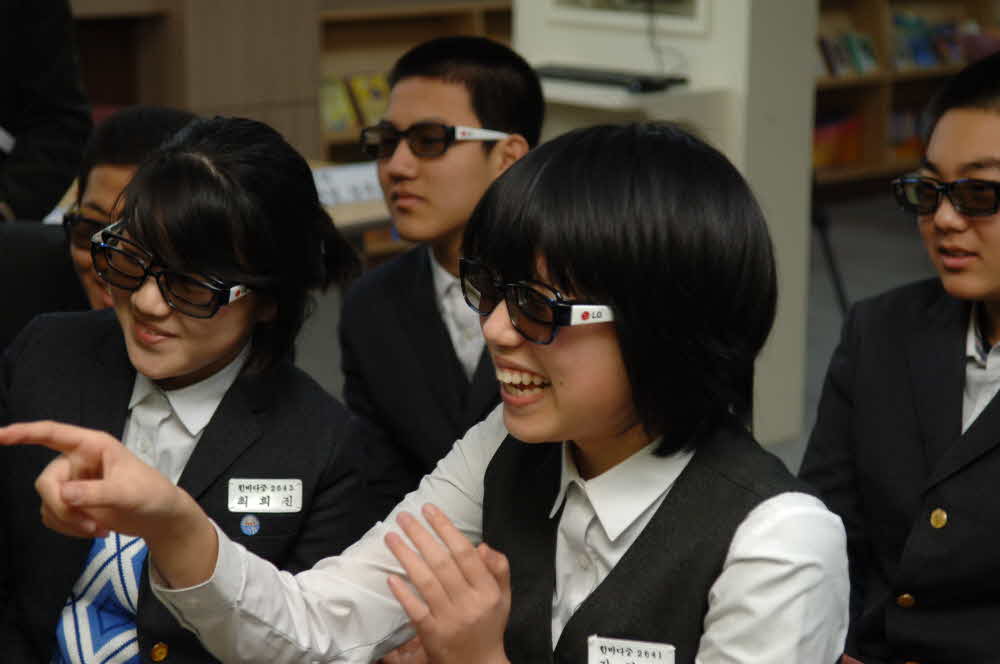
Why do so many East Asian children wear glasses? Because they don’t get enough exposure to sunlight, according to a study released by the Australian Research Council’s Centre of Excellence in Vision Science earlier this year. Which may well prove to be a damming indictment of education cultures that confine huge numbers of children to institutes when they’re not at school (source, left: unknown).

Rates of myopia (short-sightedness) have dramatically increased in East Asia over recent decades. To pick the best-known example, data on male conscripts in the Singaporean army shows that 40 years ago, roughly 25% of Singaporean children finishing high school had myopia, but now that figure is closer to 90%, despite students being healthier and taller overall. Similar rates are found in Hong Kong, Taiwan, and Guangzhou Province in China.

These general figures belie what is actually a very real threat to public health. Beyond simply consigning 9 in 10 students to eyewear, according to Dr. Ian Morgan of the Vision Centre, up to 20% of students in those regions are in the “high myopia” category, which translates into a roughly 50/50 chance of going completely blind by the time they are middle-aged. Governments across the region are expressing serious concern.

Previous popular explanations for the worsening vision included East Asian children spending more time at their desks and computers (“near work activity”, when the focus of vision is within a short range over an extended period) these days, or alternatively that there is a special East Asian genetic susceptibility. Both theories have been demolished by researchers at the Vision Centre, who compared myopia rates of 6 year-old children of Chinese origin in Singapore and Sydney.

In brief, only 3% of those in Sydney suffered from myopia, compared to 30% in Singapore. That there was any difference undermines a genetic explanation, but whereas most people might have expected it to be accounted for by the latter’s greater amount of near work activity, to researchers’ surprise in fact Sydney children did more, which suggested that the myopia must be triggered by some other environmental factor. Eliminating all other variables, the critical factor appeared to be that Sydney children were spending far more time outdoors. To be precise, 13-14 hours a week compared to 3 or 4.

While the exact mechanism between sunlight exposure and preventing myopia is still to be determined, the researchers believe that the neurotransmitter dopamine is responsible: known to inhibit eyeball growth, sunlight causes the retina to release more of it.

Evolved to literally keep an eye on the horizon, humans are naturally long-sighted (with short eyeballs), but our eyeballs lengthen as we grow and become more accustomed to near work activity. Myopia occurs when the eyeball has grown too long, meaning that the focus of light entering it falls short of the back of the eyeball, requiring corrective lenses to correct it.

That Singaporean children don’t get enough exposure to sunlight may sound counterintuitive, but in fact the hot and sticky climate makes children more inclined to spend time in air-conditioned environments indoors, and just like in many East Asian countries with more agreeable climates there is also a relative lack of parks and open spaces. Regardless, culture is undoubtedly the biggest factor. Australia is well known as a sporty outdoor country and after-school institutes are almost unheard of. In contrast, many East Asian children’s 6-day school and institute schedules deprive them of sleep to levels that would be considered borderline child abuse in Australia, sapping them of the time, energy or inclination to play outdoors in the sun.

There are additional medical problems associated with a lack of sunlight. Light skins are very popular among many East Asian women, evidenced by the plethora of “skin-whitening” pills, lotions and creams available in cosmetics stores, and in Korea it is already a common sight this spring to see women making sure to cover their faces with books and handbags as they cross a sunlit street, even if just for a few seconds.

While there is nothing at all wrong or unhealthy with this in itself – quite the opposite – the sun is avoided to excess by South Korean women. A 2004 endocrinology study by Severance Hospital in Seoul showed that the nation’s women are seriously deficient in Vitamin D, making them more likely to suffer osteoporosis later in life. In fact they posted the lowest Vitamin D levels of all 18 nations surveyed, with 88.2% of the women surveyed failing to reach a healthy threshold (source, right: the Korea Times).

sunlight-prevents-myopiaWhile it is possible to absorb Vitamin D through food, the surest way is through exposure to a few rays of sunlight every day, and Korean women would be well advised to ask themselves if ultra-pallid skin is really worth the price of full health. Just as Korean parents might wonder if higher TOEIC scores are really worth the price of their children’s long-term health (end).

I confess, I struggled with the science in this article. No, not because it was out of my field of expertise: as it so happens, not only do I have very bad eyesight myself (-7.5 for those of you who know what that means), and so am intimately familiar with diagrams of long and short eyeballs and so on from countless visits to opticians, but in fact my original major at university was astronomy too (no, really), and I learned so much about optics instead of actually looking at stars that I ended up dropping that major altogether!

More then, because the authors of the articles I linked to in my original post proved to be much less concerned with how sunlight prevents myopia as explaining that it had been discovered that it did, and so what proved to be the key information about the effect of dopamine on inhibiting the growth of the eyeball was missing from them. Fortunately though, I eventually found it in this press release by the Vision Center itself, and suddenly everything clicked. But without it, those articles and the dozen more I pored over while researching this post simply don’t make sense, and although it’s tempting to forgive those authors that lacked a science background especially, some advice from my (last) high school physics teacher seems apt here: if you can’t explain something to someone else, then odds are you don’t understand it yourself.

Words I’ve lived by for the past 16 years. Meanwhile, my frustrations with science reporting aside, see here for more information on the Severance Hospital study demonstrating Korean women’s severe Vitamin D deficiencies. And I’m too harsh really: this radio interview of Dr. Ian Morgan is still useful and interesting despite everything.

Update) Unfortunately, as parents’ angry complaints against this proposal for a 10pm curfew on hagwon teaching indicate, the norm of keeping children indoors studying until as late as 12:30am(!) five to six nights of the week isn’t going to change anytime soon.

A Small Victory for Independent-Minded Korean Students? (Updated)

Young Korean Woman on Busan Subway(Source: Jinho Jung; CC BY-SA 2.0)

Update: One more reason unfettered access to student loans is so important is because only 60 out of 400 Korean universities allow students to pay their tuition with credit cards. For more on why these odd rules exist, and on Korean student loan rates and information in general, see here.

Why do Koreans generally stay at home until marriage? With some figures on the numbers of different household types in Korea now at hand, then I’ve recently been re-examining that question, but still see no reason to change my view that the combination of high rents and low wages is primarily responsible, or at least much more so that universal panacea for inquisitive foreigners otherwise known as “Korean culture.” But there are other factors of course. Consider this from Monday’s Korea Times:

Student Loan Plan Shelved

By Bae Ji-sook, Staff Reporter

A plan to allow students to get loans without their parents acting as guarantors has been scrapped, the Ministry of Education, Science and Technology said Sunday.

The National Assembly recently withdrew the measure since Korean civil law does not allow adolescents to make legal decisions on their own, the ministry said.

The initial plan aimed to help students who were unable to get loans because their parents were divorced or were from single parent families.

”If necessary, we will seek a revision of respective civil laws. Since its purpose is to help poor students pursue higher education, student loans should be available to more students, without barriers,” a ministry spokesman said.

Why do I suggest that this might be a victory? Well, because while the scrapping of the plan is certainly a tactical defeat so to speak, given the ministry’s apparent attitude as revealed by that last statement of theirs,  then it does look like that university students will ultimately be given the opportunity to secure loans without the approval of their parents.

That students necessarily should take up the offers of loans is of course debatable, and I speak from bitter experience when I say that eighteen and nineteen year-olds of any country are not exactly well-known for their prudence and financial sophistication when given sudden access to lots of money, to be paid back in some distant future. But the only way for young adults to leave the family nest against the wishes of their parents, the move by implication meaning that they’d be – heaven forbid – openly engaging in premarital sex, as opposed to the present-day subterfuge in love-hotels that maintains their (and thus their family’s) reputations? That is of course by having the funds to do so, and sometimes an adult’s simply got to do what an adult’s go to do, debt, reputation or otherwise.

Personally, my father and I are very glad that student loans were available to me as a 19 year-old myself back in New Zealand, as we were literally very close to blows by that point, and it was simply essential for our relationship that I move when I did. Fourteen years later, both that and many other aspects of my life are much much better as a result, so much so that even if I could go back in time I’d still make the move, even with knowledge of my struggling with a mountain of debt today before me. But with no loans available, and so having to have had stayed at home instead? I shudder to think.

On a final note, I have a question for readers, particularly those with Korean partners and/or friends and/or students who are young enough to be university students themselves and/or remember how the Korean student loan system operates. Do all students currently require parental approval, regardless of their age? Obviously that would have quite an impact on their ability to leave home! Or is there a cut-off point, after which even the Korean state acknowledges them to be an adult, and responsible enough for his or her own financial decisions? My wife didn’t get loans herself, which I’m thankful for, but with that and her university days being so long ago then unfortunately she can’t remember how they operate exactly, so I’d be grateful for any information.

Sex and Gender in the Korean ESL Industry: Students on Top?

김사랑-kim-sa-rang-누가-그녀와-잤을끼-who-slept-with-her-sexy-korean-teacher-purple(Who Slept With Her?, 2006. Source: MBTeller)

Ready for a quick quiz? Name three of your high school teachers. Now. No, don’t think, just say the first names which come into your head.

Finished? Okay, assuming you had one, I’m going to wager at least one of them was a particularly attractive member of the opposite sex. And what’s more, that your memories of him or her are much more vivid than those of the others too. Or am I just projecting?

Being in my thirties myself, then most of my teachers are nothing but a complete blur, and only for a select few can I still remember both faces and names. But my memories of one particular female teacher? Sigh. I’ll wisely restrain myself here, but I could wax lyrical about both her and what I learned in her classes, and the contrast between the quality and quantity of those memories and those of the male teachers I remembered — also excellent teachers, and of majors I later took up at university too — is simply too great to pass off as being due to other, asexual factors. But jokes about blood being diverted from the brain aside, what impact did that have on my learning?

wet-dream-2-ebaabdeca095eab8b02-sexy-korean-teacher(Wet Dreams 2, 2005. Source: Naver)

According to this study in Thursday’s Korea Times, in fact it may well have hindered it. As author Thomas Dee demonstrates, based on test scores and self-reported perceptions by teachers and 25,000 eighth-grade students, simply having a teacher of the opposite sex harms a student’s academic progress, attractive or otherwise. In brief:

…having a female teacher instead of a male teacher raised the achievement of girls and lowered that of boys in science, social studies and English. Looked at the other way, when a man led the class, boys did better and girls did worse.

The study found switching up teachers actually could narrow achievement gaps between boys and girls, but one gender would gain at the expense of the other. Dee also contends that gender influences attitudes. For example, with a female teacher, boys were more likely to be seen as disruptive. Girls were less likely to be considered inattentive or disorderly.

In a class taught by a man, girls were more likely to say the subject was not useful for their future. They were less likely to look forward to the class or to ask questions. Dee said he isolated a teacher’s gender as an influence by accounting for several other factors that could affect student performance…

For the record, as there was no variable for a teacher’s attractiveness in the study then the jury remains out on the role of particularly attractive teachers, and Dee is also careful to point out that he is not advocating single-sex schooling, largely just passing on the correlations he noticed without really speculating as to the reasons. To buttress his point that “in a class taught by a man, girls were more likely to say that the subject was not useful for their future” though, I recommend reading this recent study from The Economist, which found the decidedly non-PC result that both men and women were prepared to take considerable cuts in pay at a first job provided that their boss was a man (although of course it wasn’t presented like that to test subjects!). But for some of the (naturally) many criticisms of Dee’s study then please read the article itself, and unfortunately those will have to do too, a suspicious absence of the article at the Korea Times website leading to me finding out that the article is in fact three years old, and so that link (to USA Today) above is the only one I could find that isn’t now dead. My misguided faith in the KT’s reliability as a timely and current news source aside, the subject does still have a certain timeless quality about it, and got me thinking about how the same dynamics operate for adult learners, my just so happening to be writing about marrying a former student of mine at about the same time as I first read that too. Surely they would be even stronger, given that students are more sexually experienced, and can and *cough* do sometimes consummate their relationships with their teachers?

Discussing the same subject here in 2007, Gord Sellar writes:

My first year in Korea, my roommate, a guy who spoke Korean pretty well, advised me that I needed to find a female teacher. Not a sleeping dictionary, mind you — his point was that the teacher didn’t need to be a girlfriend. All that was necessary was that I find an attractive female teacher, because having an attractive instructor of the opposite sex brings out approval-seeking behavior, and in the context of language study, if increased mastery of the language triggers praise from the teacher (as it should), then an autocatalytic cycle will be launched: you’ll study hard because your teacher will praise you, and that will make you study even harder.

lee-hyori-유고걸-you-go-girl-이효리-sexy-schoolteacherAnd having an attractive female Korean teacher myself for over a year, then I can personally vouch for the effects of this, even though I was engaged at the beginning of that period and married towards the end, and didn’t for a moment seriously entertain that there was any chance of us getting together even if we’d both been single. My mind did tend to wander, however, when her back was turned, and which I was inordinately pleased that year to discover sometimes happened with me and my own female (adult) students, one of them naively both passing on her and her classmates’ Cyworld addresses one day and assuming that my Korean was much worse than it was (source, right: akstn88님의블로그).

Fond memories of reading descriptions of my (then) firm, apparently delicious-looking buttocks aside though, you don’t need your wife to be an ex-recruiter to be aware of the blatant racial, sexual and ageist-discrimination that occurs within the ESL industry here, and young college graduates are definitely not only chosen for their relative naivety and willingness to accept bad conditions. Nor — with the proviso that I acknowledge that I’m indirectly justifying discrimination here, but will continue for the sake of argument — can university deans and institute owners be entirely blamed for what the majority of students (or their parents) seem to want, and I’ve personally been on the wrong end of that many times, most notoriously at a place at which students and management blatantly favored the short, shuffling Asterix-like figure among us four foreign teachers, simply on the basis that he drank with his students almost every night. That he: looked closer to fifty than his actual age of thirty-five; often came to class in the same clothes he’d slept in; was regularly to be found passed out on a dirty couch in the hallway next to the staffroom, where he’d be mistaken by students as a homeless guy who’d wandered in for the warmth; and that his lesson prep consisted of grabbing whatever random piece of paper with ten questions about some subject was closest to hand, hastily scribbled years ago in five minutes…all this could not dim his alcohol-fueled stardom. To put it mildly, it was just a tad demotivating to us other teachers to have our teaching ability, qualifications, experience, and hard work constantly thrown in our faces, and so no foreign teachers (but for Asterix) ever ended up renewing their contracts there.

But let’s return to my great buttocks, or more specifically the motivations of the Korean women that I’d wager make up at least 70% of adult language students, or at least of those with the ability and/or inclination to join native speaker’s classes. Speaking about Japanese women specifically, but with observations that could just as readily be applied here, Keiron Bailey notes in Marketing the eikaiwa wonderland: ideology, akogare, and gender alterity in English conversation school advertising in Japan (Environment and Planning D: Society and Space 2006, volume 24, pages 105-130) that:

…there has been a rapid growth in the private English conversation school (eikaiwa) industry in Japan since the 1970s. Inside these eikaiwa, the participants are predominantly women and, in terms of skill and enthusiasm, these women are better students than their male counterparts. Younger women are pursuing English-language learning for three major reasons. The first reason is to enhance their career prospects, either by working for one of the increasing number of foreign-owned companies in Japan, or by moving to an English-speaking country. This trend has been augmented by economic geographies of internationalization that involve a reconfiguration of the Japanese labor market and that have created a demand for more workers with English-language-skills and, simultaneously, by the continuing recalcitrance of domestic social, cultural, and economic institutions to change in ways that reflect the desires of these younger women. The second purpose is to engage in travel, either for vacation purposes or for ryugaku. The third motivation is to actualize what Kelsky calls ”eroticized discourses of new selfhood” by realizing romantic and/or sexual desires with Western males. (pp.105-6, my emphasis)

Before going on, as you can probably see where this is headed, I should point that I am not for a moment suggesting that any more than a very, very small minority of Korean women learning English are there merely for the sake of hooking up with their foreign male teachers. I have to admit though, that I am certainly guilty of suggesting things like that in my first few years in Korea, although in my defense (and I’m sure many male readers can relate) it was very easy and natural to do so given my, well, immediate and much greater dating successes among women here than back in New Zealand. But there is definitely something to the stereotype, my wife and Korean female friends — most of whom were former students of mine — confirming that many Korean women (and indeed some of them too) do indeed ask about the attractiveness and dating availability of the male teachers, and to point out that those aren’t usually their primary concerns about a male teacher doesn’t mean they’re completely irrelevant.

japanese-ecc-advertisement-romance-with-gajin-foreigner-males-spring-2002How might this be exploited by the ESL industry? Well in Japan, to return to Bailey’s journal article:

In this paper I examine the visual promotions of a range of eikaiwa. Through a semiological analysis I argue that these schools seek to create a social space, or a destination, that is designed to appeal to this younger generation of Japanese women with professional, relationship, marriage, or studying abroad aspirations. I argue that the eikaiwa market the activity of English conversation as an eroticized, consumptive practice. Through a complex and heterodoxical engagement with a set of gendered ideological formations, the eikaiwa seek to invoke desire, or yearning (akogare), on the part of these female consumers. They do so by embedding this activity into a logonomic system in which the visual pairing of Japanese women with white males invokes a set of social and professional properties that are radically differentiated from a hegemonic array of gender-stratifying ideologies. This metonymy relies on the properties of the white male signifier being defined in relation to a historical gendered Occidentalist imaginary as an ”agent of women’s professional, romantic and sexual liberation”. However, simultaneously, the symbolic power of the coupling of white male signifiers with Japanese women relies on compliance with a pervasive and highly heteronormative ideology of complementary incompetence.

This logonomic system is supported by an array of nonvisual aspects including the gendered meaning ascribed to English-language use in modern Japan, in which its user is positioned as cosmopolitan, mobile, and desirable. At the same time, the female agency depicted by the eikaiwa articulates with a growing consciousness of female consumer agency, manifested in domestic Japanese product and services advertising and in other social and cultural formations. This trend valorizes and celebrates female erotic subjectivity and positions the white male as an object of consumption for sophisticated, cosmopolitan female consumers. The eikaiwa promotions seek to recruit female clients by actualizing and deepening their akogare through the medium of English-language instruction and use and an associated symbology. (p. 106, my emphases)

Don’t be put off by the postmodernist jargon: I don’t like it either, but while a little heavy in places, the article is still readable (albeit for article in academic journals that is!), and overall a fascinating look at this particular aspect of the Japanese ESL industry. Unfortunately whatever link I downloaded if for free from months ago has since disappeared though, so please just email me if you’d like a copy.

japanese-gaba-advertisement-romance-with-gajin-foreigner-males-spring-2002But why do I quote that article, apart from it being interesting in its own right? Well, I do admit this post has considerably evolved in the telling, and so after making the jump from a study about the effects of a teacher’s gender on children (my only originally intended topic) to what effects both that and their attractiveness might have on adults, then looking at that article was a logical next step. But now having presented the gist of it, what to make of it?

Upon reflection then, for me it has served to highlight the stark differences between the two countries, for despite the same sexual dynamics also operating in the ESL industry here as I’ve demonstrated, with all the mania about maintaining pure “bloodlines,” and hence still grudging public tolerance rather than acceptance (let alone condoning) of foreign male – Korean female sexual relationships and marriages, then you simply won’t find any Korean advertisements like the above, anywhere. Ever. Like I explain and give examples of in a post on a related topic here, there’d likely to be a public outcry. My own personal lesson from writing this post then? A cynical reaffirmation of this pervasive xenophobic streak, and a telling visual sign of it. Or not, as the case happens to be!

But this is probably not news to readers familiar with Korea; perhaps more so to Japan-based readers, who thought they could make the same claims about interracial relationships there? Regardless, apologies if you were expecting more of an examination of the practical role the sex of a teacher plays in the internal dynamics of the ESL classroom here. But never fear, for that earlier post of Gord’s I linked to provides an excellent examination of that, and so one which I wisely decided not to try and improve on!

Why do so Many Korean Children Wear Glasses?

Korean Children Glasses TV(Source: LG전자; CC BY 2.0)

Update, April 2009: In hindsight, I didn’t cover this subject thoroughly enough here, leaving some questions unanswered. For a more comprehensive overview, see this article I wrote for the Korea Times.

Update 2, June 2013: And for a much more up-to-date overview, see this article I wrote for Busan Haps.

If I’d been asked this question yesterday, then I too would have answered that it was because they were always hunched over their books, or staring at computer screens. But the surprising result of this Australian study was that those are only correlated but not causative factors.

In fact, it’s because they don’t get enough exposure to sunlight.

I confess, before I read the details of the survey, I was very sympathetic to such a result: young Korean women, for instance, have among the lowest Vitamin D levels in the world because of avoiding the sun for the sake of light skins, and given how the required behavior and body images that lead to such extremes are inculcated very early in Korean children’s lives, then if a lack of sunlight does indeed lead to myopia (short-sightedness) I’d wager money on rates being higher among Korean teenage girls than boys. Not much higher, no, but I’d still expect a statistically significant difference between them.

But technically the study never looked at Korean children specifically. And while Korea certainly shares other developed East Asian countries’ skyrocketing rates of myopia among children — virtually all my middle-school students wear glasses or contact lenses, and I bet yours do too — I was confused when I heard that the study was primarily based on Singaporean children.

How on Earth do children that live on the equator not get enough sun?

Actually, partially it’s precisely because they live there. As head researcher Dr. Ian Morgan explains in an Australian radio interview, the heat meant that:

The children in Singapore were spending about three hours a week outside, so very, very limited periods of time outside, excluding the school hours. Basically they went to school, they went home, they did their homework and then they watched television and that was life.

But this issue of climate wouldn’t apply so much to children in other East Asian countries, where the same education culture of going to school during the day and then cram schools in the evenings prevails, although that does also mean that they’re not outdoors much of course. But how to tease apart the effects of that lifestyle from a lack of sunlight specifically? Things like diet, and, say, the not insignificant fact that Korean children get the least sleep in the world, would presumably have some effect too.

Here’s the key part of the radio interview that reveals how and why researchers did that. Without it, basic summaries of the study like this and this that are all over the news wires are good introductions, but raise more questions than answers really:

DR IAN MORGAN:….we have been able to compare the prevalence of myopia in Chinese kids in Singapore, as compared to kids of Chinese origin growing up in Sydney. And at the age of six, the kids in Singapore — the Chinese kids in Singapore are ten times more myopic than the kids of Chinese origin in Australia.

INTERVIWER: But did the Singaporean children spend more time in near-work activity than the Sydney children?

DR IAN MORGAN: If anything, they spent a little bit less and this is what led in part to us looking for what other factors could be important. And the striking difference that came across was that these kids — remember they’re matched for age and they’re matched for ethnicity, they’re all of Chinese origin. The kids of Chinese origin in Sydney were spending a lot more time outdoors than the kids of Chinese origin in Singapore.

For more details, including the debunking of alternative theories that there is some genetic susceptibility to myopia among East Asian populations, and why it is specifically light intensity that is important, then I highly recommend reading the radio interview in full.

I don’t have the time to translate anything myself unfortunately, but it’ll be interesting to see how the Korea media interprets the results of this study. While it would be just one of a very long list of serious social and health problems among young Koreans resulting from Korea’s after-school institute or hagwon (학원) culture, and so unlikely to lead to any huge changes overnight, all the various English-language articles on the study point out that governments across the region already do have serious concerns about the issue. So, this may well provide just enough of a shove for Korean schools to, say, provide more outdoor physical education and field trips for students. Granted that it’s rather cold at the moment though!

Semi-Nude Photos of 14-Year Old Draw Controversy

The 14-year old girl is Park Seo-jin, the controversial photoshoot from the Mnet reality show I Am A Model. It’s already covered in numerous “news” articles though, so let me just quickly highlight one element of it here: that for all the recent and historical mania about protecting underage girls against foreign pedophiles, the Korean police seem strangely reluctant to respect their own laws banning the nude photos of minors that would (presumably) encourage them. The most obvious examples being one of the promotion posters for—let alone various scenes in—Samaritan Girl/Samaria (2004), all shot when actress Kwak Ji-min was still in high school, and therefore legally a minor.

Like with those, no-one will ever be prosecuted for Park Seo-jin’s photos. Unlike those though, they do seem to be creating much more negative reaction. Most likely, simply because she is just sooo young.

What do you think?

Update: In case of any confusion, note that while she’s 16 according to the (strange) Korean age system, her birth date is actually 11 March 1994.

Korea’s “Lonely Geese” Families: More of them than you may think

Back in July, I wrote a lengthy post* on the reasons behind and implications for Korean society of the high numbers of “weekend couples” (주말부부) and “lonely geese fathers” (외기러기) here, the latter generally referring to fathers who remain in Korea to work while their families live overseas for the sake of the children’s eduction. Back then, no statistics on the numbers of either seemed to be Shy Korean Boyavailable, so I speculated that the combination of both meant that a total of perhaps one in fifteen to one in ten Korean teenagers lived in a different city to their father most of the time (source, left: James Kim; CC BY-SA 2.0).

But it turns out that perhaps I underestimated that number: according to this recent survey of single women, effectively teenagers in this particular sense, for Koreans tend to live at home until marriage (although this is more for economic rather than the cultural reasons usually cited: see here and here), as many as one in eight Korean families have “at least one immediate family member living apart from the rest”. True, on the one hand that figure will include also university students living away from home, but then they are not common as I explain in those two posts linked to above, and on the other it wouldn’t contain the “international” lonely goose fathers I mention above either, so ultimately I’d wager that 90% or more of those one in eight immediate family members referred to would indeed be fathers working in different cities during the week.

There are some other interesting points made in that survey, but as it doesn’t mention the numbers and methodology (par for the course for most Korean newspapers unfortunately), then I’d take them with a grain of salt. But I think that the figures for geese families would be pretty consistent whatever the sample size.

*Since deleted sorry.

How Korean Girls Learn to be Insecure About Their Bodies

Seriously, it’s great that the makers of this video are trying to encourage children to eat healthy foods with fermented bean paste (된장) rather than candy. But do they really need to be told that it’s good for their “S-lines” and “V-lines” too? For those few of you that don’t know what either are, this next commercial in particular makes the former pretty clear:

(Source: ¡Hoy mejor que ayer, mañana mejor que hoy!. The text reads “The S-line you want to have.”)

Note that Go Ara, the actress in the commercial, is actually much younger (16) than she may appear above. Meanwhile, here are some commercials for a tea-drink which supposedly gives you a V-line chin, which at least have actual grown women (BoA, 22; Kim Tae-Hee, 28) endorsing the product:

Not by coincidence, here are some “face rollers” which started to appear all over Korea not long after I first heard of V-lines. I’ve read that they’ve been used for many years in Japan and Taiwan too, so Korean women too may well have been using for a long time before they started worrying about their V-lines specifically. But then they weren’t popular enough for me to have noticed them at all until last year, and certainly sellers of them have been making explicit references to V-lines ever since the concept first appeared:

(Source: GMarket)

Alas, I’m not entirely certain why an ad explicitly for women opens with some not particularly flattering shots of men either (Lee Seung-gi and comedian Kang Ho-dong), but I guess I’m not the target market. That they do so humorously though, does help reinforce the notion that dieting (etc.) is only something for women to be serious about.

Or perhaps just girls, as I’ve never actually seen a woman using one. My 13 year-old students, however, use them every other break…(sigh).

Update: See here, here, here, and here for much more on the constant invention of new, often impossible body shapes and “lines” for Korean women to strive for, and for North American and European parallels.

Sex and Maths

(Source: Patrick Mannion, CC BY-SA 2.0)

Readers, I’m sure, are familiar with many of the biological and cultural explanations proffered for differences in mental abilities between the sexes. Here’s an an article in the Economist magazine with some strong evidence for, well…both sides to the debate, and with some surprising conclusions about Korea too:

Girls are becoming as good as boys at mathematics, and are still better at reading

TRADITION has it that boys are good at counting and girls are good at reading. So much so that Mattel once produced a talking Barbie doll whose stock of phrases included “Math class is tough!”

Although much is made of differences between the brains of adult males and females, the sources of these differences are a matter of controversy. Some people put forward cultural explanations and note, for example, that when girls are taught separately from boys they often do better in subjects such as maths than if classes are mixed. Others claim that the differences are rooted in biology, are there from birth, and exist because girls’ and boys’ brains have evolved to handle information in different ways.

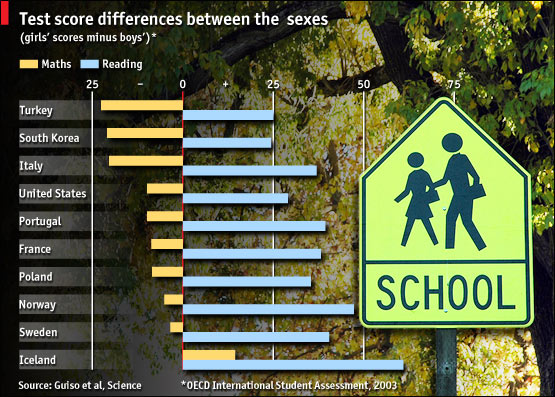
Luigi Guiso of the European University Institute in Florence and his colleagues have just published the results of a study which suggests that culture explains most of the difference in maths, at least. In this week’s Science, they show that the gap in mathematics scores between boys and girls virtually disappears in countries with high levels of sexual equality, though the reading gap remains.

Student with Math Formula on Her BackDr Guiso took data from the 2003 OECD Programme for International Student Assessment. Some 276,000 15-year-olds from 40 countries sat the same maths and reading tests. The researchers compared the results, by country, with each other and with a number of different measures of social sexual equality. One measure was the World Economic Forum’s gender-gap index, which reflects economic and political opportunities, education and well-being for women. Another was based on an index of cultural attitudes towards women. A third was the rate of female economic activity in a country, and the fourth measure looked at women’s political participation.

As long-term readers will know, I usually have problems with virtually anything the Economist says about international comparisons of education standards, its consistent praise of the high scores of South Korean students, for instance, undermined by South Koreans themselves finding their education system appalling (a fact which a whole five minutes of checking on the internet would reveal). There’s little scope for misinterpretations of correlations between reading and writing scores and measures of sexual equality though, but still, as you can see, the researchers were at pains to keep the variables down to a minimum (source, right: Tattoo Lover; CC BY-SA 2.0).

On average, girls’ maths scores were, as expected, lower than those of boys. However, the gap was largest in countries with the least equality between the sexes (by any score), such as Turkey. It vanished in countries such as Norway and Sweden, where the sexes are more or less on a par with one another. The researchers also did some additional statistical checks to ensure the correlation was material, and not generated by another, third variable that is correlated with sexual equality, such as GDP per person. They say their data therefore show that improvements in maths scores are related not to economic development, but directly to improvements in the social position of women.

And notice where Korea fits into that scale:

(Source: The Economist)

That was quite surprising, and confusing. For sure, in terms of its gender empowerment measure,   Korea is one of the most sexist countries in the world, and although it was less than a generation ago that girls’ university and even high-school educations were often sacrificed for the sake of their brothers’, I’ve heard from many different sources that the Korean education system today is relatively meritocratic. Indeed, Michael Seth in this must-read book on the subject, argues that it is one of its greatest strengths, albeit one unfortunately (and ironically) at odds with the great respect, status and deference given to high achievers also.

I’d imagined, then, that young Korean women confront sexism more once they enter the workforce, as despite their educations there remain strong societal expectations that they will be happy to work at non-advancing jobs in their twenties and then effectively retire upon marriage, not unlike the situation in Western countries in the 1950s and ’60s.

But then these tests were for 15 year-olds, so clearly there is some sex-based factor at work in the Korean education system that I wasn’t aware of. Why do Korean girls do so badly at math then? I’m open to suggestions.

The only clue I have is that Maths (and English) is considered a hard and difficult subject for students, which is why in its 19-year history the chain of institutes I work for didn’t hire any female teachers to teach it until literally last week, only men being considered authoritative enough to get students to study in class. Certainly, the institutes I work for are quite unique in that regard, and much more demanding of students than most, but still: I think it’s quite telling that the policy was in place. And if students of either sex disliked it so much, then I can’t imagine that girls with interest and/or ability in it would have been particularly encouraged to pursue it, given their relative absence in engineering and scientific fields in Korea. Perhaps Korean education isn’t quite as meritocratic as I thought?

(On a side note, it says a great deal about the sort of English taught at my institute that only men were considered capable of teaching that also, despite — I assume — a majority of English {and languge} teachers in Korea {and probably the world} being women)

The one mathematical gap that did not disappear was the differences between girls and boys in geometry. This seems to have no relation to sexual equality, and may allow men to cling on to their famed claim to be better at navigating than women are….

Again, surprising in a Korean context. I’ve been teaching 13 and 14 year-olds, on-and-off, for a good eight years now, and I’ve noticed that their math textbooks are always just full of geometry, far more than I ever had to do at their age. For sure, frantically copying each other’s answers in breaks between classes doesn’t equate to real learning, something they’re forced to do because they wouldn’t possibly have enough time to do all the homework required of them (let alone — heaven forbid — eat and sleep too). But still, if there’s one country where I’d thought girls would have been good at geometry, it would have been Korea. Something is clearly up (source, right: unknown).

The article gets more interesting (and controversial) after that:

….However, the gap in reading scores not only remained, but got bigger as the sexes became more equal. Average reading scores were higher for girls than for boys in all countries. But in more equal societies, not only were the girls as good at maths as the boys, their advantage in reading had increased.

This suggests an interesting paradox. At first sight, girls’ rise to mathematical equality suggests they should be invading maths-heavy professions such as engineering-and that if they are not, the implication might be that prejudice is keeping them out. However, as David Ricardo observed almost 200 years ago, economic optimisation is about comparative advantage. The rise in female reading scores alongside their maths scores suggests that female comparative advantage in this area has not changed. According to Paola Sapienza, a professor of finance at the Kellogg School of Management in Illinois who is one of the paper’s authors, that is just what has happened. Other studies of gifted girls, she says, show that even though the girls had the ability, fewer than expected ended up reading maths and sciences at university. Instead, they went on to be become successful in areas such as law.

In other words, girls may acquire an absolute advantage over boys as a result of equal treatment. This is something that society, more broadly, has not yet taken on board. Mattel may wish to take note that among Teen Talk Barbie’s 270 phrases concerning shopping, parties and clothes, at least one might usefully have been, “Dostoevsky rocks!”

(Source: Vaguely Artistic; CC BY-NC-ND 2.0)

I’m very much a proponent of the existence of some fundamental biological differences in aptitudes between the sexes myself, and do believe that even in a perfect world that there will always be, say more female nurses than male ones, and more male engineers then female ones and so forth. Not for a moment does that mean that I will ever stop or even not positively encourage my daughter to, say, be an engineer, or not take seriously a male nurse, but the above is yet another inconvenient truth against the argument that all difference is due to prejudice.

For more on that I recommend the book The New Sexual Revolution, by Robert Pool (1994), and especially “The Real Truth About The Female Body” in Time Magazine, March 8 1999. I especially recommend checking out the (naturally) numerous comments to the Economist article; as you have to be a subscriber to make a comment, then the dialogue is a lot more intelligent and civilized than you’ll find on most blogs and forums! I especially like this one of Tom West’s, a healthy cautionary message against what I’ve written above:

“Do all feminists rail against the idea that men and women might actually be inherently different?”

The trouble with acknowledging differences is that human beings tend to turn a generality into a specific rule. As soon as you say that it’s natural that men are over-represented in higher math, it becomes instantly harder for any woman to be even average at math. The meme is simplified into “women can’t do math”, and you soon end up with teacher’s wjho won’t work hard to teach girls math, boys and girls that reject those who are good at math as weird and different, and of course, dissuade many from putting in the effort to become good at math because they themselves believe they can’t do math.

As an aside, in my opinion, that was why Larry Summers deserved to lose his job for his remarks. Not that he was necessarily wrong. It was that by virtue of his widely circulated speech, he had legitimized “women can’t do math” in the minds of many, regardless of what he actually meant or believed. (And that people in authority have to be aware of not what their words say, but of what their words will do.)

(Note: Having my blog posts regularly copied and pasted by others myself, normally I’d be loathe to paste an entire article here. But it was of an annoying length that made simply giving excerpts difficult, yet pasting all of it too much. After much time and repeated links wasted on trying the former, I gave up and chose the latter!)

Paternity Leave in Korea from Next Year?

From page 3 of the September 12, 2007 Busan Focus:Paternity Leave, 1970s Swedish Poster

출산휴가가는男: 내년7월 배우자 3일 부여 ‘남녀고용평등법’등 의결

내년 7월부터 남성근로자도 배우자 출산휴가를 사용할 수 있으며, 육아휴직을 나눠 쓰거나 육아휴직대신 근로시간 단축방법도 사용할 수 있게 된다.

정부는 11일 오전 중앙청사에서 한덕수 총리 주재로 국무회의를 열어 일과 육아의 병행을 위해 이 같은 내용을 핵심으로 하는‘남녀고 용평등법’개정안 등 20여개 안건을 심의, 의결했다. 이 개정안은 그간 사업장별로 임의로 시행해 오던 남성근로자의 출산휴가를 3일간 부여하는 것으로 의무화했으며, 현행 전일제 육아휴직 대신 주 15~30시간 이내의 범위에서 근무하는 육아기 근로시간 단축을 신청할 수있도록 하고, 육아휴직이나 육아기근로시간 단축제를 1회에 한해 분할 사용할 수 있도록 하고 있다.

또 육아기 근로시간 단축을 이유로 해고나 불리한 처우를 하는 사업자의 경우 3년 이하의 징역이나  2천만원 이하의 벌금, 육아기 근로 시간 단축 종료 후 같은 업무에 복귀시키지 아니할 경우 500만원 이하의 벌금, 그리고 배우자 출산휴가를 주지 않을 경우 500만원 이하의 과태료를 부과하도록했다 (image source: On Being; CC BY-NC-SA 2.0).

또 국제화 시대를 맞아 ▲ 회사의 설립·운영 등에 사적 자치를 폭넓게인정하는 유한책임회사 등 새로운기업형태를 도입하고 ▲무액면주식 제도의 도입과 최저자본금제도의폐지 등 상법 개정안도 심의했다.

Men on Paternity Leave: To fulfill the requirements of the law on gender equality in the workplace, a 3 day paternity leave is to be available from next July

From next July, the spouses of women taking time off work to give birth can also take time off from work, either for the birth itself or by shortening their work hours by an equivalent amount.

On the Morning 11th of September, the prime minister Han Deok-Su, opened a session of Congress focusing on work and childcare. Congress members deliberated on a bills regarding the law on gender equality in the workplace and on 20 other matters, and passed a law that will require all workplaces to provide paternity leave to male employees. They will be given the option of either taking 3 days at the time of the birth of the child, or have their working hours reduced by 15-30 hours at alternate times when it is convenient to them. These 15-30 hours will not have to be taken all at once.

If employers use this reduction of work hours as a pretext to fire an employee or treat him unfairly, then the employer will be liable for a jail sentence of up to 3 years or a fine of 20 million won. Also, if an employee is not allowed to continue in the same position after returning from paternity leave, or if paternity leave isn’t granted at all, then the employer will be liable for a fine of up to 5 million won.

Since we are in a globalized age, Korean companies need to introduce more scope for employee’s personal autonomy in their establishment and operations. Also discussed at the congress was the introduction into commercial law of a no-par stock system and the discarding of a minimum capital stock system.

For the sake of comparison, see here for a table showing different countries’ parental leave provisions.

3 in 10 Korean Dating Sites are Used for Teenage Sex Work?

samaria-korean-teenage-prostitutionMovie poster for Samaritan Girl/Samaria (2004), a Korean movie about teenage prostitution; see here for my review. Source: Naver영화.

애인대행 사이트 10 3청소년도 받아요‘ (3 out of every 10 dating sites are being used by teenage prostitutes to find clients)

“전 17세 여. 경제적으로 큰 도움 주실 분 연락주세요”

애인 대행 사이트 10개 중 3개 이상은 청소년 가입이 가능하고 이중 아르바이트생을 구하는 의뢰인 50% 이상이 성매매(불건전 만남)를 요구하고 있는 것으로 나타났다.

“I am a 17 year old girl. If you can help me financially, please contact me.”

More than 3 out of 10 dating sites allow teenagers to register, and more than 50 percent of these registered teenagers are using the site immorally to solicit sexual services.

국가청소년위원회는 최근 대구YWCA에 의뢰, 인터넷 포털을 통해 접근 가능한 69개 애인 대행 사이트를 모니터링 한 결과 이같이 나타났다고 22일 밝혔다. 청소위는 “애인대행 사이트에서 성매매 유인행위가 많이 일어나고 있어 청소년의 접근을 차단할 필요성이 있다”며 “성매매 등 불법ㆍ불건전 만남을 조장하는 애인대행 사이트에 청소년이 접속할 수 없도록 청소년 유해 매체물 지정을 추진하겠다”고 밝혔다.

청소년위의 조사 결과에 따르면 애인대행 사이트의 청소년의 가입이 가능한 경우는 23개로 33.3%를 차지했다. 이어 청소년의 가입은 불가지만 청소년 유해매체물 표시가 없는 경우가 42개(60.9%)였다. 청소년 연령 확인 및 접근 제한 장치가 있는 경우는 4개(5.8%)에 불과했다.

Recently, the Government Youth Comission asked Daegu YWCA to investigate to what extent teenagers were using 69 adult dating sites that can be found through major internet portals, and today they reported their findings. According to the Commission, “Making money through prostitution via these sites is a very alluring and attractive proposition for teenagers,” and that “the government needs to make greater effort to ensure that teenagers are prevented from gaining access to these sites which promote illegal prostitution and ‘unconditional meetings’.”

According to the Commission, 23 sites of the 69 sites (33.3%) allowed teenagers to register. 42 (60.9%) did not allow teenagers to join, but lacked a special warning indicating this; in the end, only 4 (5.8%) both didn’t allow teenagers to join and had the required software to prevent them from doing so (James – does this mean that teenagers could still join those 42 or not?)

애인대행사이트에 게시된 내용은 ‘강남 지금 만나요’ ‘2:1 대행이요’ ‘경제적으로 큰 도움 주실 분’ ‘술 한잔 하실 분’ ‘밤새 놀려고 하는데 50만원 가지고 뭐하나’ 등 성매매 및 불건전 만남을 조장하는 내용이 대부분이었다.

또 대구YWCA가 2시간 동안 대화방을 개설한 결과 48명의 남성 이용자가 접근, 역할 대행을 의뢰했다. 이 중 성매매 요구가 25건(52%)으로 가장 많았고 홍보 및 대화가 19건(40%), 건전 대행 요구가 4건(8%) 등이었다.

Amongst the chat rooms and message boards of the 23 sites that did allow teenagers to register, you come across personal ads of teenagers, and men seeking them, with titles such as “Let’s meet in Gangnam now,” “2 for 1,” (James – your guess is as good as mine) “Seeking a sugar-daddy,” “Someone to have one drink with,” “I have 500,000 won, what am I going to do all night?,” and so forth, of which the vast majority are obviously for prostitution.

In addition, Daegu YWCA opened a chatroom on one site for 2 hours, and of 48 male users that entered, 25 were blatantly looked for teenage prostitutes, 19 chatted about sexual acts, and only 4 chatted about non-sexual subjects.

주요 포털사이트는 ‘애인대행’ 단어를 금칙어로 적용, 성인인증 및 연령확인을 요구하고 있으나 ‘대행 알바’ ‘애인 알바’ 등 변칙적인 방법으로 올라오는 애인 대행 사이트에 대해서는 개별적인 조치를 취하고 있다.

청소년위는 “69개 애인대행사이트에 대해 청소년 유해성 여부를 심의하도록 정보통신윤리위원회에 요청할 것”이라며 “포털사이트에 대해서도 애인대행 등 금칙어 적용 및 성인인증을 요구할 계획”이라고 밝혔다.

Major portal sites do not allow you to type in obvious search terms for teenage prostitutes, and require proof of your age. But both prostitutes and clients are adapting and choosing new terms to direct each other to their various chatrooms and sites instead.

The Commission concluded that they are going to request that the Korea Internet Safety Commission look more closely at these 69 sites for the sake of teenager’s welfare, and they will also ask the owners of the 69 sites studied to not allow the search terms used for prostitution that are already banned on internet portals to be used on their sites also (end).

(See Joins News for the original article, or here for the same at the author’s own site)