Gender Advertisements in the Korean Context: The Mile High Club

( Source )

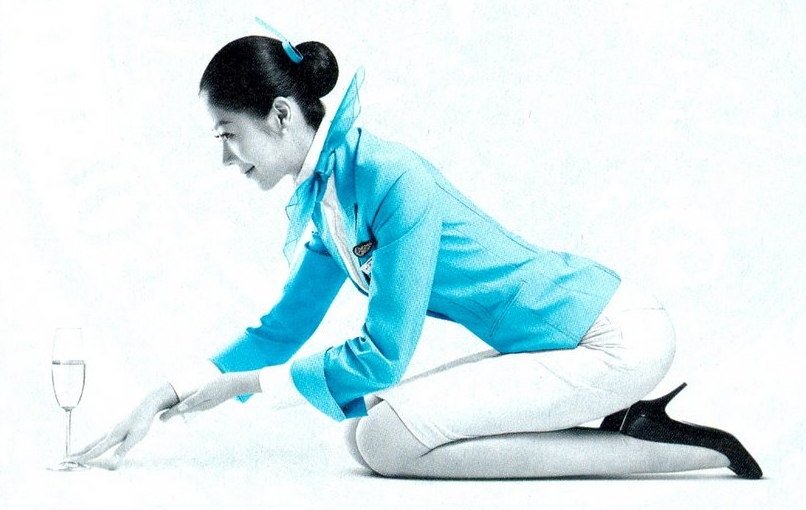
Quick question: for want of a better word, what vibe do you get from the above image? How does it make you feel?

Part of this Korean Air advertisement, how about with the caption:

From departure to arrival, only dignified services for our dignified guests.

Or with the fine print:

When you land, you should be in the same delicate condition as you were during take-off. That’s why our delicate service with a smile remains constant throughout the flight until you reach your destination.

In particular, do you find it demeaning to the steward in any way, or women in general?

Does the fact that only 11% of Korean Air stewards are men influence you in any way, Korean Air only hiring men from within its own ground staff since 1997, but women also from the general public?

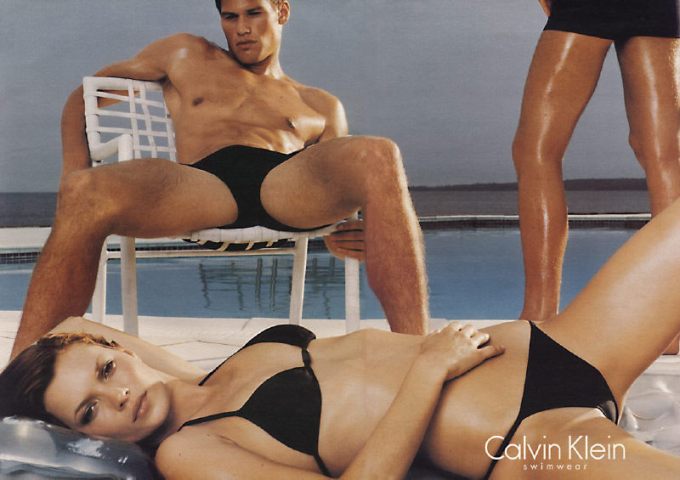
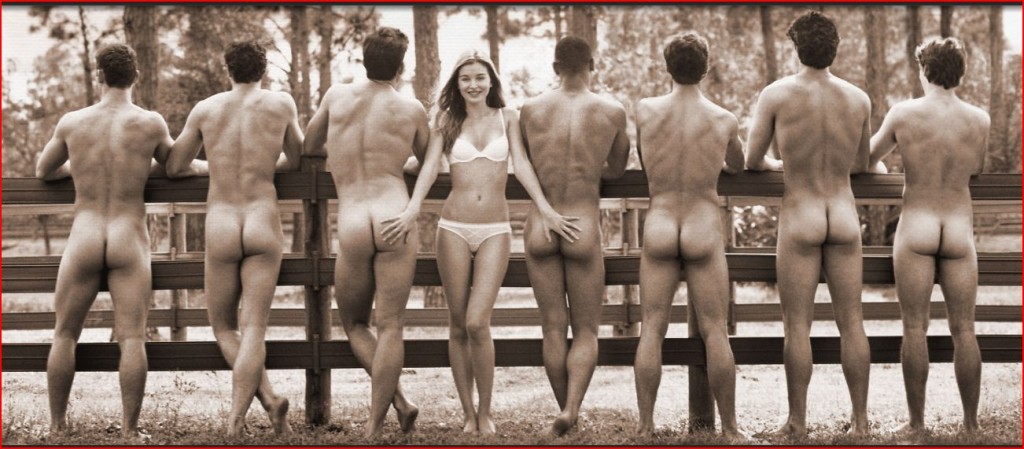
And finally, do you get the same vibe from this Gucci advertisement? Why or why not?

( Source: the Fashion Spot {NSFW})

Alas, I have no information about the Gucci advertisement unfortunately (I would be grateful if any readers could enlighten me), but the Korean Air advertisement at least ran in magazines and newspapers worldwide in March 2008, and I recall finding it vaguely disturbing when I saw it in the Asian edition of The Economist at the time, but not quite being able to put my finger on why exactly.

And as it turns out, I wasn’t the only one, commentators from Singapore to London either baffled by it, finding it “hilarious that Korean Air published it in a Western magazine,” thinking it demeaning to women, and/or hoping that in Korea itself “it’s some kind of image of empowerment.” But I didn’t personally see anything sexual in it however, and so – forgive my naivety – originally didn’t quite get this unspecified newspaper author who commented that they were “glad that she is wearing a scarf, which is part of her uniform, and not something else.” Moreover, I certainly didn’t think it looked like she was about to perform fellatio either, unlike the author of Copyranter:

KOREAN AIR: How May We Service You?

Korean Air: You think our turbines have suction power…

The ad copy (click image) reads, in part: “That’s why our delicate service (no teeth!) with a smile remains constant throughout the flight…” Now, the ad was scanned from the March 31st Asian edition of Newsweek. And as tipster Juditha wrote, there certainly is a cultural difference with how female flight attendants (and really, all females) are perceived in Asian culture. But. Still. If the airline keeps running ads in this vein (sorry!), their male passengers are not going to stop at unbuckling just their seat belts.

But hey, we all make mistakes, and it’s not like there weren’t some distinctly sexual overtones to the advertising campaign as a whole; with thanks to fellow blogger Logan Row for pointing it out, note the symbolism at 0:19 in the commercial below for instance (and quite a common theme in wine advertisements!):

What is the logic of the Korean Air advertisement then? Well, as commentators in those above links pointed out, what Korean Air is trying to say in it is:

…that their attendants will go the extra mile for their guests. The pose that the flight attendant is striking is how traditional Korean hostesses would serve guests in their own homes. It is a traditional Korean (and to an extent Japanese) form of humility and hospitality

And that it’s a reference to the:

…Korean (and Asian) custom of bowing in front of your elders, parents, to people you respect, or in general to show deference to someone and submission. (ie students serve their teachers drinks/food on their knees) Its a position of servitude not necessarily the same ‘on your knees’ sexual connotation we have in the US. Obviously all of this still is problematic as far as the the female subjugation at the will of the Korean Air clients and basically almost just as offensive. But I thought that cultural reference was probably really important as well, as Korean, and other Asian cultures would read it with that in mind.

And finally that:

it conjures up being treated like royalty – in the old days the servants of royalty had to kneel and bow at all times when presenting the king with food/drinks/documents and then scoot out the door, never showing their backs. it is a sign of respect. with that said, this should not run anywhere outside East Asia as it can be misconstrued by everyone else.

( Source: the Fashion Spot {NSFW})

However, unfortunately it was. And unlike in Korea where cultural factors mean that the advertisement is not necessarily demeaning to women, a person’s social status usually trumping factors like how (literally) highly they are placed in an advertisement (see here, here, and here), having any group regularly placed lower than another in advertisements tends to be problematic in Western culture, for reasons the late sociologist Erving Goffman outlined in Gender Advertisements (1979):

Although less so than in some, elevation seems to be employed indicatively in our society, high physical place symbolizing high social place. (Courtrooms provide an example) In contrived scenes in advertisements, men tend to be located higher than women, this allowing elevation to be exploited as a delineative resources. A certain amount of contortion may be required. Note, this arrangement is supported by the understanding in our society that courtesy obliges men to favor women with first claim on whatever is available by way of a seat. (p. 43)

And also:

Beds and floors provide places in social situations where incumbent persons will be lower than anyone sitting on a chair or standing. Floors are also associated with the less clean, less pure, less exalted parts of the room – for example, the place to keep dogs, baskets of soiled clothes, street footwear, and the like. And a recumbent position is one from which physical defense of oneself can least well be initiated and therefore one which renders very dependent on the benignness of the surround. (Of course, lying on the floor or on a sofa or bed seems also to be a conventionalized expression of sexual availability) The point here is that it appears that children and women are pictured on floors and beds more than men. (p. 41)

Granted, the Gucci and Calvin Klein examples of this above are particularly provocative, but you can see more normal ones in this “Ritualization of Subordination” category of Goffman’s framework at The Gender Ads Project if you’re interested. Moreover, in light of those, I’m no longer entirely convinced that the Korean Air advertisement isn’t still problematic despite its cultural context: after all, with the proviso that men usually look rather awkward in poses that are sexually appealing on women (as hilariously demonstrated here), I personally find it very difficult to imagine a man in place of a woman in the Korean Air advertisement, although I fully concede that that may be due to my own socialization process leading me to believe that it is more “natural” with a woman, or even simply my familiarity with the advertisement, that happened to feature a woman rather than a man. Or is it not just me?

( Source: WallyWorld )

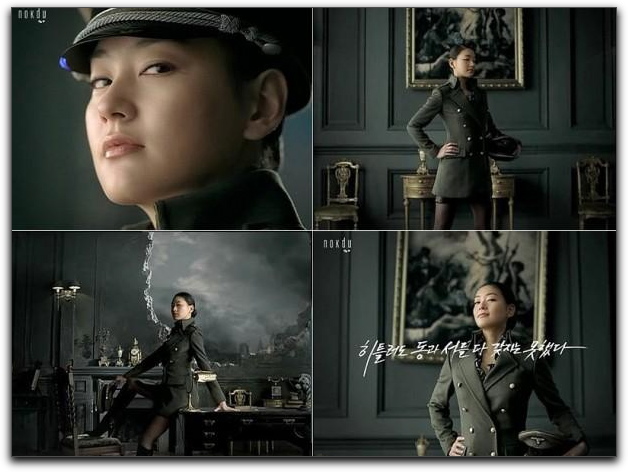
Regardless, this is by no means the first time that Korean advertisers or advertising agencies have produced advertisements that are appropriate for and/or logical to Koreans, but completely confusing and even offensive overseas. Not that only Korean companies are guilty of doing so of course, but they are the focus here, so let me leave you with 2 examples, the most notorious of which is probably Korean cosmetic maker Coreana’s (코리아나) use of Nazi imagery in 2008, about which you can read more at Brian in Jeollanam-do here, here, and then here (and the video is still available at Adland.TV).

Next, slightly more benign, there is that for the Samsung Sens notebook computer from September last year:

The logic of those with other, non-Sens notebooks having pig noses is that Korean 2-plug electrical sockets do indeed look a little similar, and I’ve heard that that’s traditionally what they were called too (but perhaps only by children?).  Regardless however, one wonders why they act like bafoons, and particularly why they’re all Caucasian when the commercial was filmed in a city as racially diverse as Sydney?

But a crucial difference between those and the Korean Air advertisement was that only the latter was intended for a global audience, and so the advertiser or advertising agency responsible should really should have known better. And now I’m curious: can anyone think of other cases where Korean advertisers or advertising agencies have made similar mistakes overseas? Alas, given the insular nature of the Korean advertising industry, probably not!

Update: Compare this advertisement for ANA airlines’ flights to Japan, from the February 2010 Hemisphere magazine (the in-flight United Airlines mag).

(For more posts in the “Gender Advertisements in the Korean Context” series, see here, here, here, here, and here)

Share

Western Metrosexuals & Korean Kkotminam: Inevitable?

( Adapted from Mobile Life, by geishaboy500 )

Alas, it’s no longer my planned thesis topic, but I’m still very interested in the origins of the kkotminam (꽃미남) phenomenon, and so naturally I”m intrigued by the notion that the physically healthier a society, the more women in it tend to prefer “feminine” men as mates. From The Economist:

A disease-free society helps effeminate men attract women

IT IS not just a sense of fairness that seems to be calibrated to social circumstances (see article). Mating preferences, too, vary with a society’s level of economic development. That, at least, is the conclusion of a study by Ben Jones and Lisa DeBruine [themselves a married couple] of Aberdeen University, in Scotland, published this week in the Proceedings of the Royal Society.

….In a man, the craggy physical characteristics associated with masculinity [James: because of testosterone] often indicate a strong immune system and thus a likelihood of his producing healthier offspring than his softer-featured confrères will. But such men are also more promiscuous and do not care as much about long-term relationships, leaving women to raise their kids alone.

Nowadays, sound parenting is often more important to the viability of a man’s offspring than Herculean strength. That, some researchers suspect, may be changing the physical traits that women look for in a mate, at least in some societies. A study carried out in 2004, for example, discovered that women in rural Jamaica found manly types more desirable than did women in Britain, which led to questions about whether those preferences were arbitrary or whether women in different parts of the world might be adapting to circumstances that place different emphasis on manliness in the competitive calculus.

Dr Jones and Dr DeBruine therefore looked to see if there is an inverse relationship between women’s preference for masculine features and national health. Sure enough, they found one…

With a nod towards copyright, see the article itself for the rest, and particularly for the methodology used, which did account for cultural and racial differences (image right: Hot Girl Remix by geishaboy500). Still, my first reaction was that this earlier study seemed to completely contradict those findings, as it demonstrated that for much of human history women had good reason to prefer skinny guys over muscled ones, the latter being less likely to survive in (frequent) times of scarcity, but that this no longer applied in the overabundance of modern times.

However, just like the kkotminam phenomenon itself forces many Westerners to reconsider their previously held notions of masculinity and femininity (not least myself), one should be very specific about what one means by those terms, and so note that this study was purely based on face shapes, which are heavily influenced by hormones. Accordingly,  it makes a great deal of sense that with good access to modern medicine, women would be more interested in other factors than simply passing on a good immune system to her children, as evidenced by a masculine jaw.

Hence, with the proviso that what makes “a great deal of sense” is very culturally and period specific however (evolutionary psychologists, for example, guilty of once thinking that all women in prehistoric tribes stayed in the camp to look after children and/or do some gathering while the men went off to hunt each day!), and that the specific timing of the popularity of the kkotminam and metrosexual phenomenons (and various permutations thereof) were/are/will be heavily dependent on a whole range of factors, not least the interests of the cosmetic industry, do you think that there’s a certain inevitability in them? Or are they merely passing fads? After all, given the above logic, then they’re here to stay.

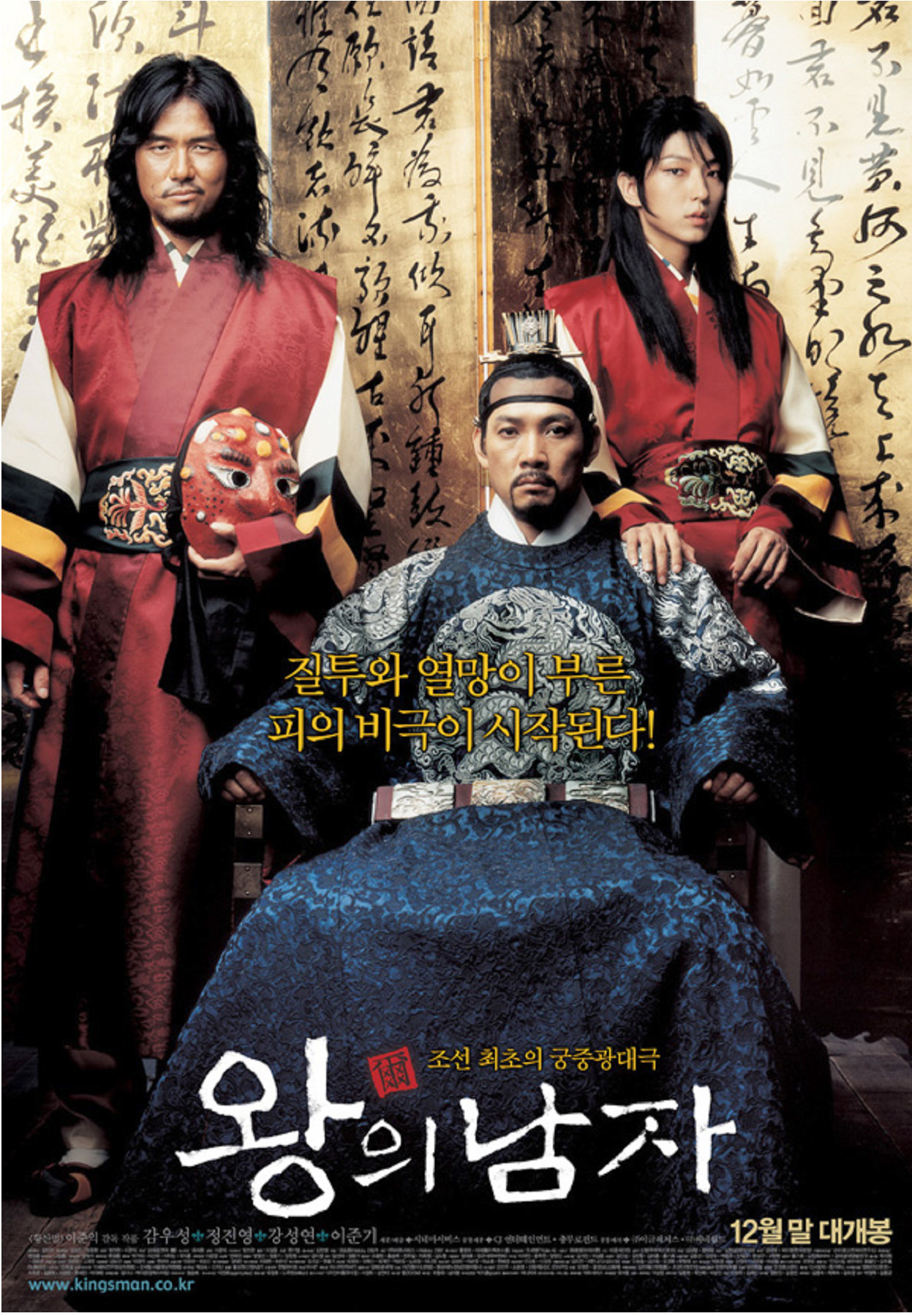
( The King and the Clown {2005}; source: unknown )

Regardless, if it were possible, it would be fascinating to see if women’s tastes in men in a various society varied over time according to the health of its members. Alas, isolating everything but preference in face shape is probably impossible, and while it’s fair to say that in all historical societies men’s (and women’s) clothing probably tended to become more flamboyant and colorful in times of prosperity, I can’t stress often enough that neither characteristic is “feminine” per se!

Share

Korean Sociological Image #37: Like a Virgin?

As they say, first impressions are everything. And so, with apologies to those of you unwise enough to read this blog at work, let me share mine of girl group T-ara (티아라) from their music video of Like the First Time (처음처럼) before proceeding: namely, that they were confident, sexy women, not at all embarrassed to perform risqué dance moves like the above in front of large audiences.

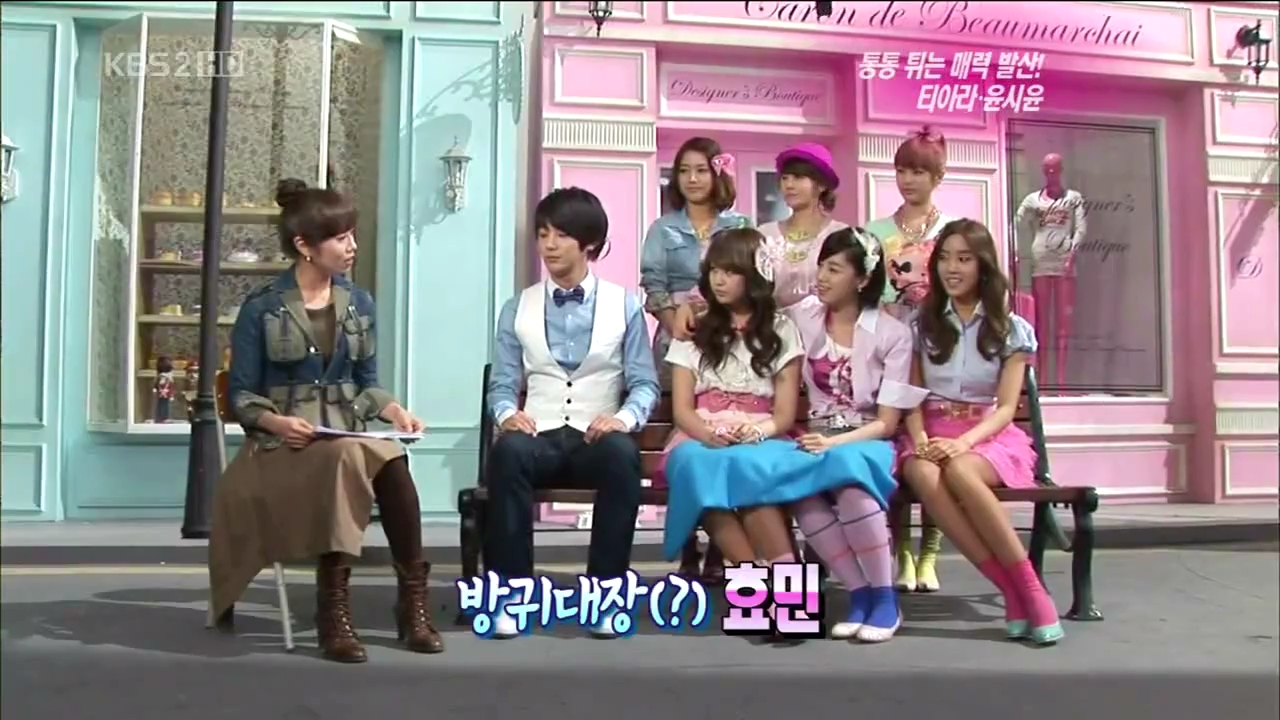
However, it was difficult to square that impression with their shyness in the following brief interview for Entertainment Tonight (연예가 중계) last month, conducted while making (rather bizarre) commercials for a mobile phone, and I would interested in hearing your thoughts on possible reasons for the differences, and how representative the interview is as whole of the way 20-something women especially are portrayed in Korean entertainment programs.

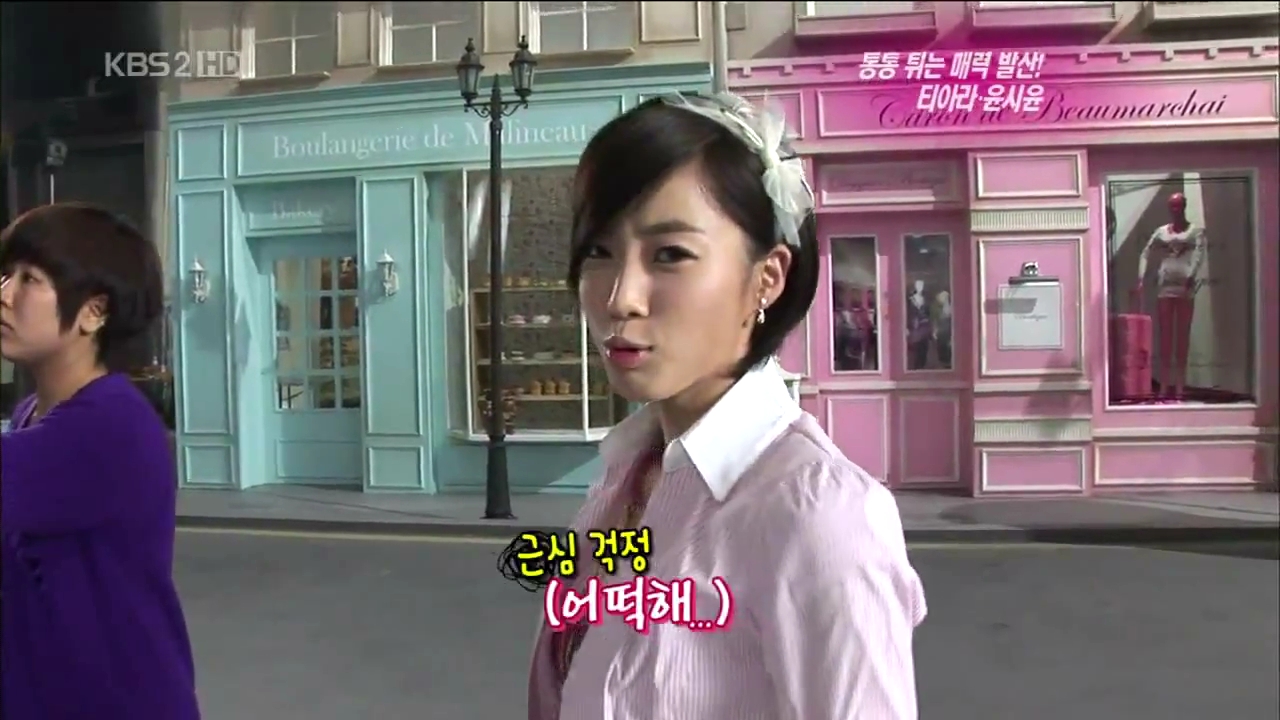
The most important point first: from roughly 1:00 t0 1:30, the interview focuses on group leader Ham Eun-jeong (함은정) feeling embarrassed about repeatedly hugging actor Yoon Si-yoon (윤시윤) for their commercial, despite having just met in the studio. In particular, at 1:10 below she says “어떡해”, or “How” as in “How can I do this?” while making an exaggerated expression of embarrassment, about which the reporter comments “굉장히 부끄러워하죠?”, or “She’s very shy, yes?”. Note also the addition of “근심” and “걱정” on the screen too for added context and atmosphere, (a habit of entertainment programs picked up from Japan), although rather confusedly they both mean anxiety, or worry.

Then at 1:25, she’s asked how she feels from hugging Si-yoon for so long, to which she replies “솔직히말해도…떨려요!”, or “To be honest…I’m shaking/trembling!”.

Natural feelings? Of course. But then recall her music video, in which she – not to put too fine a point on it – repeatedly bends over and thrusts out her bottom, jiggles her breasts, and runs her hands over her breasts and crotch while singing about how her body was on fire. Indeed, even the interviewer herself later (3:08) highlights the complete contrast:

Moreover, while I’ve never personally strutted my stuff on stage like Eun-jeong, I am actually quite comfortable – nay, somewhat notorious for – acting in front of large groups of adult students (I’m tempted to mention faking an orgasm in class once in my first year of teaching, but I’d better not), and doubt that I’d be embarrassed repeatedly hugging an attractive woman in front of others. Yes, I would be if I ended up having a large visible erection as a result, but that’s besides the point: if Eun-jeong was embarrassed, it wasn’t because she was visibly turned on.

And I stress “if”: my wife, for instance, also watched the interview, and at first told me her embarrassment was perfectly natural, but then readily conceded it was rather strange in light of her performances in music videos and on stage. Which leads me to my first question: do you think Eun-jeong was genuinely embarrassed?

One commentator at Omona! They Didn’t did at least:

…Eunjung lost her composure while filming a hugging scene with Yoon Si Yoon….It’s funny how Eunjung was so flustered and shy around a guy because she exudes such a powerful and charismatic presence on stage. I guess we are all prone to weakness in front of the opposite sex.

And I do remain open to the possibility. However, I’d argue that either subconsciously or deliberately, she’s much more likely to be playing to expectations and norms of the Korean media that she present herself as cute and innocent, regardless of her true personality; well illustrated, I think, by this 2007 commercial with Kim Tae-hee (김태희):

As PopSeoul! explains:

She acts all sugar and spice in wide-eyed innocence as she sips her drink carefully, but as soon as her date turns away, she lets loose her inner diva to strike a pose for the camera. Her date discovers the saved pictures on his Olympus and accuses her of being “nae-soong”.

Nae-soong (내숭) being the:

…inconsistency between a girl’s true personality (i.e. extroverted), and external (i.e. introverted, shy and innocent) personality. In other words, trying to hide your true intentions self by acting sweet and innocent.

And indeed the interview is full of demonstrations of how sweet and innocent they are. For instance, at 1:47 Park Ji-yeon (박지연) is embarrassed to learn that she is Si-yoon’s favorite of all the T-ara members (although you may be surprised to learn that she’s only 16, and hence her embarrassment arguably the most likely to be genuine):

And at 3:17, Eun-jeong feigns (I don’t think anyone would dispute this!) being upset at the other group members selecting her as looking the most different (read: uglier) before putting on make-up:

One music video and and one interview are by no means sufficient to get an idea of their true personalities however (to the extent that one sees any celebrities’ true personalities in front of a camera at all that is), and so I also briefly looked at some episodes of T-ara Dot Com (티아라닷컴), a quasi-reality show about them setting up an internet clothes shopping mall of that name. Here’s a brief segment of one episode, with English subtitles:

And in which their behavior is no different to that in the interview. Hence, while I do still feel that Eun-jeong’s embarrassment at hugging Si-yoon at least was completely feigned, I concede that T-ara’s cutesy behavior overall probably wasn’t an act, and not unrepresentative of Koreans their age either (for reasons explained here).

If that behavior is still a definite expectation or norm of Korean entertainment programs however, depends on such factors as how other women are portrayed in them; if there’s a large difference between men and women; and to what extent such programs offer opportunities for entertainers to present alternate, more serious sides of themselves if they wish to do so.

Unfortunately, I can’t personally say: even when I first arrived in Korea at the tender age of 24, I soon chose never to watch these sorts of programs because I had better things to do than seeing grown men and women acting like children on them. Now, at 34, I’m more concerned about the influence they will have on my own daughters, and to be frank would consider myself a failure as a father if they grew up to behave like members of T-ara do when they reach the same age.

However, in contrast to when I was 24, in fact there’s also some things I like about the Korean media which are on display in the interview, and which I’ll devote the remainder of the post to.

First, in a meta-sense, the practice of providing subtitles and/or commentary on them is simply great for studying Korean, especially considering the huge gap in real-life learning material for Korean learners, let alone intermediate level material. And if dramas aren’t your thing, then studying a 10 minute segment of an episode of T-ara Dot Com everyday is probably quite a tolerable alternative:

More to the point of this post however, there is the very human side of stars presented, a stark contrast to the pedestals Western medias tend to place their own celebrities on. For instance, not only does the interviewer ask at 3:39, which member of T-ara farts the most:

But at 3:49, we even get to watch the evidence:

And, lest he feel left out, Si-yoon is asked if he also farts, to which he replies at 3:57 that yes, he enjoys it:

Compared to that, watching him pick his nose and examine the contents at 2:30 was nothing. And hey, a guy’s got to do what a guy’s got to do, but in any other country I’d be surprised his agent didn’t want that cut out:

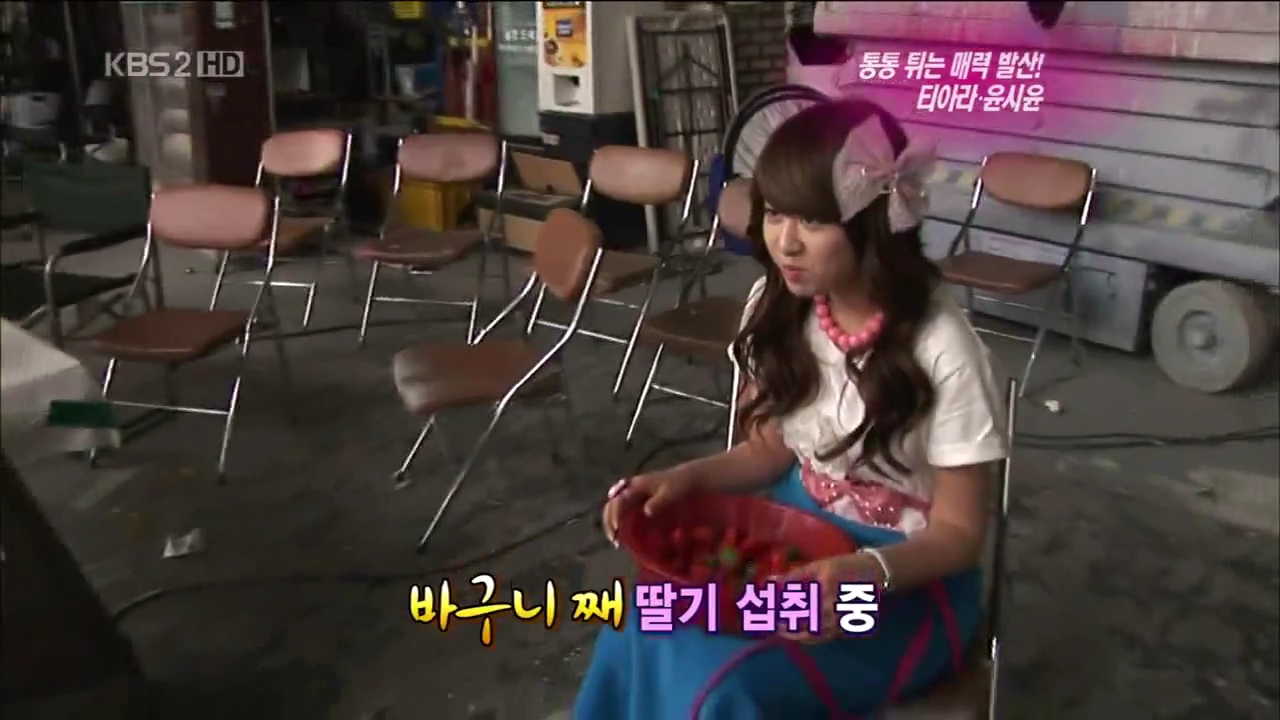
But not that showing that celebrities fart and pick their noses like the rest of us mere mortals are the only positives of course. I also love how the interview highlights Ji-yeon stuffing her face with strawberries at 2:57 for instance, and particularly from a basket that looks like it was bought from the back of a food truck, to be found in literally every Korean neighborhood at almost any time of day (for instance, selling salt at 5:30 in the morning). You see, something that looks like it could have been bought in my wife’s home village in 1970 is somewhat incongruous on the set of a commercial for probably one of the most technologically sophisticated products on the planet, and reminds me that constantly seeing such juxtapositions is one reason I love living here:

Finally, there’s the standard happy, bubbly ending of such shows, usually accompanied by cries of Hwaiting! (화이팅); if you’re not smiling yourself at least a little when you see one on TV, that’s probably because you’re being carried out of the room on a stretcher with blanket over your head:

To recap, I would love to hear: your own opinions on how genuine Eun-jeong’s embarrassment was; how representative of young women’s behavior on entertainment shows T-ara’s was; and whether they were simply being themselves or if they were fulfilling expectations and norms of how 20-something women should act on them (I realize that the last is a bit of a false dichotomy though, and should be considered more as a feedback loop). Are there any Korean entertainment shows where women don’t have to be cute? And how about 20-something men, or older women?

Alternatively, do you have any more pet peeves about Korean shows not covered here, or reasons that you really like them?

(For all posts in the Korean Sociological Images series, see here)

Share

Korean Sociological Image #36: Beauty and the Beast

( Sources – left; right: K-popped! )

A pair of brief but revealing juxtapositions to ponder this weekend.

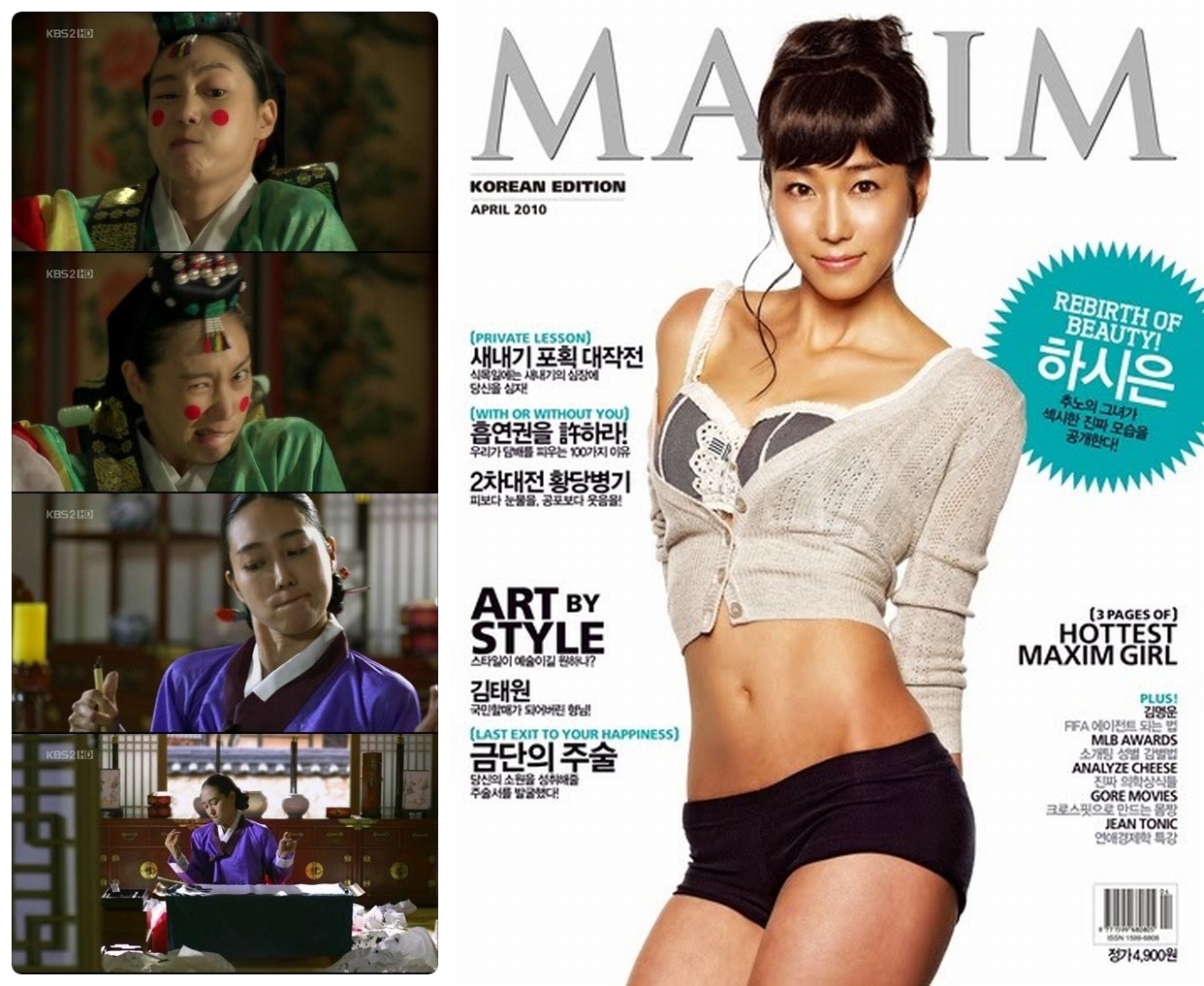
First, earlier in the week it was reported that Ha Si-eun’s (하시은) performance as a character with cerebral palsy in the popular historical drama Chuno (추노) was so convincing, it persuaded her representatives to arrange a photoshoot with Maxim, lest “it affect her career.”

My first reaction to this news? Naturally, that I’m never averse to seeing an attractive woman posing in her underwear…but heaven forbid that she become better known for her acting skills. To play devil’s advocate however, in my experience Korean actors do tend to be typecast by the public rather easily, and indeed a representative did express concerns that fans would be unable to dissociate Ha Si-eun’s image in the drama from real life:

하시은 측 한 관계자는 3월 29일 오전 뉴스엔과의 전화통화에서 “‘추노’의 뇌성마비 이미지가 너무 강했던 터라 하시은의 평소 모습과 작품 속 모습을 연결시키지 못하는 이들이 많았다”며 “부족한 점이 많지만 새로운 모습을 선보이고자 이번 화보를 촬영하게 됐다”고 밝혔다.

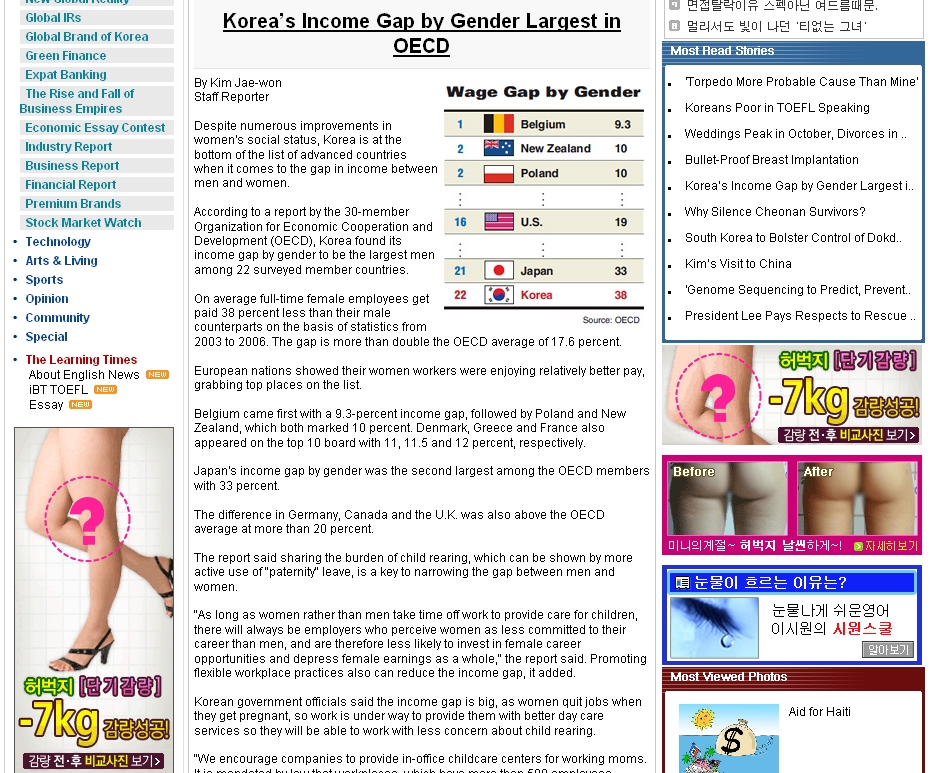
Given the frame of mind that put me in though, I couldn’t help but laugh at the irony of the advertisements accompanying this article in the Korea Times that I read 5 minutes later:

Part and parcel of the tabloidish tone of that newspaper in recent months, those advertisements are not confined to just that article of course. But still, it’s almost worthy of FAIL Blog, yes?

(For all posts in the Korean Sociological Image series, see here)

Share

Sex as Power in the South Korean Military

Source: anja_johnson

“All men are rapists,” I read on the back cover of Susan Brownmiller’s Against Our Will: Men, Women, and Rape in the student bookstore. Determined to impress women with my intellectual and feminist prowess by debunking that quote, I bought the book and doggedly read all 480 pages trying to find it. Twice.

Yes, I was rather naive about the whole dating game. Even worse, you can imagine how I felt years later, when I learned that she never actually said that. Rather, it was a big misinterpretation of her statement that rape “is nothing more or less than a conscious process of intimidation, by which all men keep all women in a state of fear” (p. 5), albeit an understandable one. Indeed, it’s probably what she’s become best known for, an enduring catch-phrase of pop-feminism that publishers would knowingly exploit to sell the book to me 2 decades later.

Which is a shame, because along with Menachem Amir, she was instrumental in overturning long-held conventions that rape was simply a spontaneous act of lust, instead demonstrating that it is more “a deliberate, hostile, violent act of degradation and possession on the part of a would-be conqueror, designed to intimidate and inspire fear…” (p. 439). Or in short, it’s due to her that surely all reading this are aware that sexual violence is all about power, and not surprised to hear this reaffirmed by the survey “Sexual Violence Among Men in the Military in South Korea” by Insook Kwon et. al., Journal of Interpersonal Violence, Vol. 22, No. 8, 1024-1042 (2007), the subject of today’s post.

The first comprehensive survey of its kind, in English or Korean, it was prompted by the suicide of a Korean soldier in July 2003, which received tremendous attention in the media because sexual violence by his superiors seemed to have played a role; after all, with 250,000 men forcibly conscripted each year, any implication that it wasn’t an isolated incident meant that there were far more victims. And in point of fact, with the proviso that the authors’ (undefined) notion of “sexual violence” appears to be much broader than a layperson’s as I’ll explain, they did indeed find that 15.8% of respondents experienced it during their time in the military, either as perpetrators or victims.

But before discussing the implications of that however, and especially what it says about the role of the military in the socialization of Korean men, let first provide an overview of the survey so you can make your minds (with a nod to copyright, I won’t upload the survey itself here sorry, but please feel free to email me if you’d like your own copy). And so, without any further ado:

The survey was conducted from November 2003 to February 2004, with researchers meeting 2 groups: 362 postconscripts, then students, at 6 different colleges; and 409 current conscripts, 115 at bus and train stations while they were on leave, and 294 in visits to their barracks with the official cooperation of the Ministry of Defense. From each group, there were 266, 111, and 294 valid samples respectively, giving a total of 671 valid samples out of 771 soldiers surveyed (the bulk excluded being postconscripts, and because more than 3 years had passed since their military service). They also conducted in-depth interviews of 8 perpetrators in army prison, and 3 victims.

Highlights of the results include (all emphases mine):

Of 671 valid respondents who participated in this survey of victimization, perpetration, and observation, a total of 103 people (15.4%) answered that they were directly victimized, 48 people (7.2%) answered that they had direct experience as perpetrators, and 166 people (24.7%) answered that they witnessed sexual violence in the military.

Excluding eyewitnesses, a total of 106 soldiers (15.8%) directly experienced physical sexual violence, either as perpetrators or victims in the military. A very high number of soldiers also indicated they experienced sexual violence as perpetrators and as victims: 59 soldiers (55.7%) were victims only, 39 soldiers (36.8%) were victims and perpetrators, and only 8 soldiers (7.5%) were exclusively perpetrators. Among perpetrators, 83% had experienced sexual violence in the military when they had been lower ranked soldiers. This feature of high number of perpetrators having previously experienced victimization themselves could be seen as the most unique feature of sexual violence among men in the military. (p. 1028)

(Source: anja_johnson)

And:

Victims named higher ranking soldiers (71.1%), junior officers (7%), and officers (3.1%) as their perpetrators, totaling 81.2% of victims who responded that someone of a higher rank forcibly imposed sexual contact….

Also, the eight perpetrators and three victims who agreed to be interviewed, as well as six cases recorded by the Korean Sexual Violence Relief Center and reports by military judiciary officers, confirmed that victims of sexual abuse were in lower ranks than their perpetrators. All victims had been victimized by higher ranking soldiers, and eyewitnesses reported likewise. In sum, sexual violence among men in the military in South Korea was committed primarily by a higher ranking solider against a lower ranking soldier. (p. 1029)

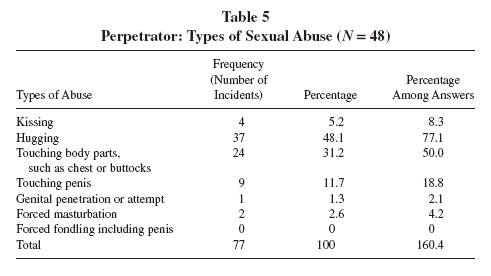
The types of abuse, as reported by victims and witnesses (p. 1031; multiple answers permitted):

As reported by the perpetrators (p. 1033):

Also note that 22.1% of victims (but only 7% of perpetrators) reported that physical violence accompanied the sexual violence, and that 71.8% of victims and 90.7% of perpetrators responded that the acts of sexual violence when others were watching (I’ll return to the latter point shortly).  And in particular, eyewitnesses reported that 22.5% of the sexual violence they saw involved touching genitals, and 5.1% involving anal penetration (or the attempt), nearly 2 and 5 times higher than victims reported respectively.

Reflecting on the discrepancies, Kwon et al. found that:

…people tended to feel more comfortable talking about what might be considered part of a general sexual culture—such as kissing, hugging, and telling sexually explicit jokes—but answers were less forthcoming when concerning sexual violence of a more serious degree. (p. 1032)

Which for a long time I simply didn’t understand: how on Earth was that the “general sexual culture” of the military? Well, first consider that:

When asked, “In the military, have you ever been forced to talk about sexual experiences, even when you did not want to?” almost one third (32.7%) of the 667 respondents answered affirmatively. To the question, “Have you ever experienced negative consequences either because you did not have any sexual experiences or because you refused to discuss your sexual experiences?” a total of 218 soldiers (32.7%) answered that they had been forced to talk about sexual experience. (p. 1028)

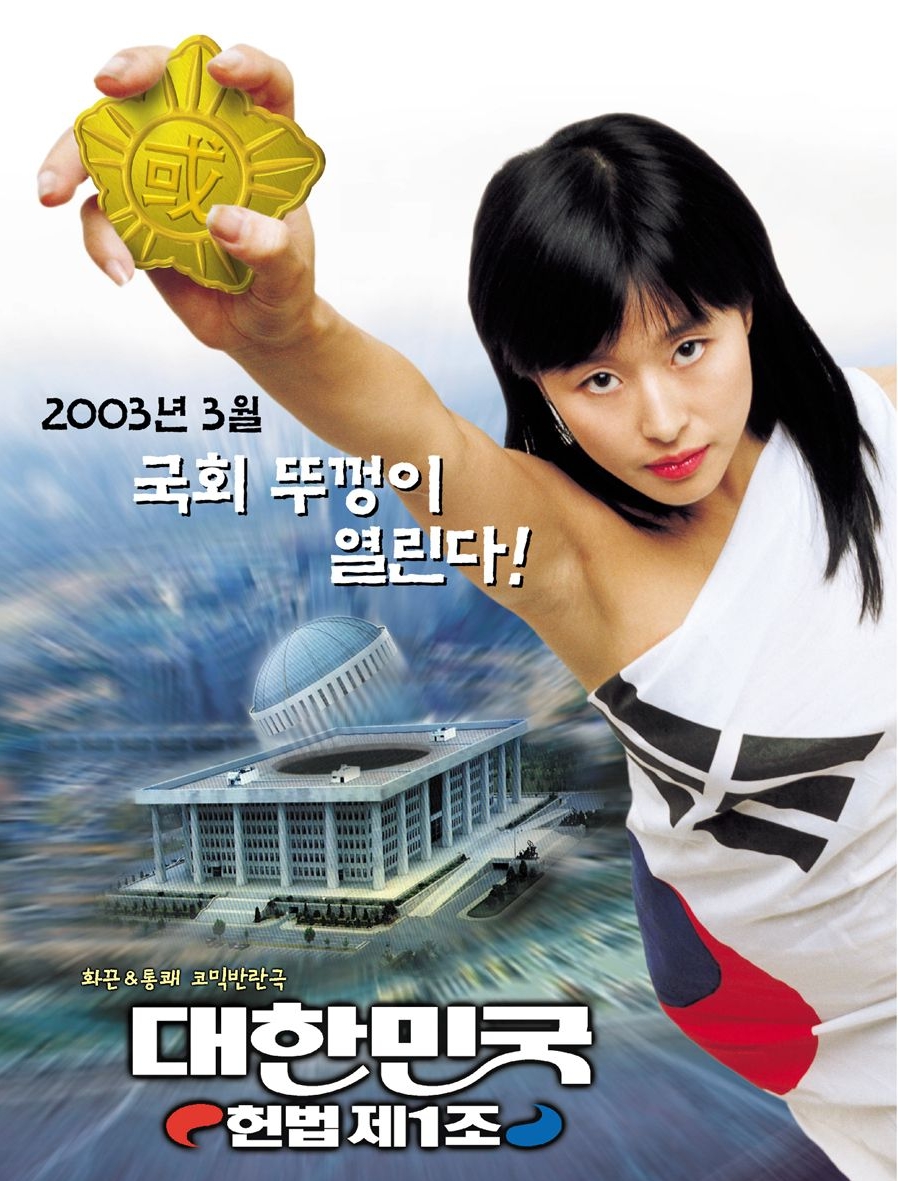
And that this mandatory disclosure of sexual experience has long been regarded as “an essential part of sexual culture in the military” is corroborated by numerous references in Korean movies to the practice of virgins visiting a prostitute before starting one’s military service, of which I highly recommend the satirical comedy The First Amendment of Korea below.

(Source)

Next, there is the fact that victims of sexual violence tended to interpret it as:

…intimacy or playfulness, because identification as a victim of sexual violence would imply one’s fragility and vulnerability. This tendency to minimize and trivialize injury was clear in cases where abuse continued for a long time, and in situations where a clear power dynamic between the perpetrator and the victim made resistance much more difficult for the victim. (p. 1033)

Moreover, perpetrators:

…did not force sexual contact on their peers with whom they had even closer relationships [than inferiors]. The intimacy in question was strictly an intimacy from the position of the higher ranking soldier.

Kwon et al. further discuss the natural difficulties victims had in refusing advances by a superior, and crucially, why the third most common form of sexual violence was touching a victim’s genitals. But why, particularly when only 5.4% of victims thought that their perpetrators were genuinely homosexual? Well, as one victim noted:

…unlike in the general society where one could not treat another person with complete disregard for age, educational level, or class, in the military, higher ranking soldiers could treat lower ranking soldiers as one pleased—including touching their genitals. (p. 1035)

And after a discussion of the right to control and abuse the body being a very useful method for militaries to reaffirm its hierarchical order, and of the role of the penis as a symbol of power and authority throughout history, they note that, hence:

…teasing or forceful contact with one’s penis becomes a way to prove the victim’s lack of power.

(Source: Journey to Perplexity)

Needless to say, the effects of this are amplified if done in public settings, and indeed 90.7% of perpetrators responded that people were watching when their sexual violence occurred, with the vast majority of witnesses either actively engaging in it in some way (23.7%), passively consenting by simply watching (57.9%), or pretending not to see (10.5%) rather than attempting to stop it: hence a “general sexual culture.”

But continuing with why:

…violence feminizes victims of sexual violence in two ways. The victim is reduced to a sexual object, like many women typically face in society, and as the powerless victim of violence, he is further feminized. Men who are victimized by sexual violence, then, become someone whose masculinity is lacking or damaged. Hierarchical order reasserts itself amid all this, and men collectively try to be on the offensive to affirm their aggressive masculinity. (pp. 1035-36)

And finally, the testimony of a perpetrator himself on why he did it, who said that he used sexual violence in lieu of physical violence sometimes, forcing sexual contact by “not hitting every time, and not joking around but harassing them”:

[Like harassing them…] Yes, I can’t hit them every time . . . and it’s not just joking around, but harassing them. . . . For instance, making them clean things repeatedly. Stuff like that. . . . If they were from wealthy families . . . or had a lot of education themselves . . . the superiors are ahead only because they came to the military before them . . . honestly . . . when you don’t have much to show for, and if they kiss ass to superiors who intimidate them . . . and if they think you’re not all that . . . well, you can’t beat them and so I kept thinking about ways to give them hell in the military, legal ways . . . and that’s how I ended up. (pp. 1036-37)

({2-365} Tick Tock by Dee’lite)

But what to make of all this?

At this point, it seems appropriate to point out my own complete lack of experience with the Korean military, as well as not even having any close relationships with any Korean men from whom I could learn about their military service, and so I would be very grateful to hear from those that have either. But then my own inexperience is essentially irrelevant here, as I’m largely passing on the results of renowned experts in the field (scroll down to note #32 here for more information on Kwon for instance); moreover, my own interest in on what is implied for Korean culture and sexuality as a whole, and so let me pass on the following description of military life provided by Ask a Korean, in his own excellent series on military service in Korea:

For some of today’s Korean young men, who have gone soft since the days of their fathers, military experience can be unbearable. Physical exercise is grueling, the superiors can be arbitrary and insulting, and your squad mates could shun you if you are responsible for putting the whole squad in trouble. Given that these guys, just like any other soldiers in Korea, can access guns and grenades, it should be no surprise that recently there has been a string of incidents in which a draftee shoots up his squad or toss a grenade in the squad room, killing many….

….[But there are definitely good life lessons to be learned from the experience, although it may be debatable whether learning those lessons is a good use of 2 to 3 years of young men in their prime. To put it bluntly, the military experience builds Korean men’s tolerance for all the life’s bullshit. As the Korean described so far, there is no shortage of bullshit – some of them perhaps the worst to be encountered in life – in the military. Exhausting physical training, insults and condescension from the superiors, and wasting time on arbitrary and trivial errands are all part of the experience. For young Korean men in the military, there is no choice but to simply grin and bear them. Once they finish bearing it, they know that most difficulties in life would be easier than what they already went through. The combination of such tolerance and insight, some may call it maturity – because, as anyone who has had a regular job can tell you, life as an adult has a lot of crap that we must simply grin and bear.

(Band of Brothers by The U.S. Army Photostream)

And in the next post in that series (my emphasis):

…one can argue that the military culture neatly coincides with traditional Korean culture – in both cultures, seniority automatically commands respect and loyalty. It is not surprising, then, that Korean workplaces are often run just like a squad in the military. You do what your boss tells you to do, and you are supposed to grin and bear it. Your time will come because Korea, like Japan, had automatic advancement by seniority at least until 1990s. Once you are the boss, you can order people around, much like the way you can order people around once you put in the time and became a sergeant.

I happened to work in such a place when I wrote the first post in my own series on gender and militarization in South Korea, and in which I noted that Korean corporate life often requires such a level of personal sacrifice for one’s superiors that, tellingly, even the Samsung Economic Research Institute acknowledges that “many workers…take it for granted that they have to tolerate anything in return for getting paid.” I should note however, that many readers thought my workplace was the exception rather than the rule, but be that as it may, the purpose of many of those things to be tolerated there boiled down to no more than the demonstration (and abuse) of superiors’ authority…and so too does sexual violence clearly emerge as one means – albeit, and I stress, only one, uncommon means – of doing so in the Korean military.

But I will further cover the effects on Korean gender relations and sexuality in great detail as I belatedly continue that series next month. In the meantime, let me leave you with the following passage from Shadows of Forgotten Ancestors: A Search For Who We Are (1993) by Carl Sagan and Ann Druyan to ponder, a book which had a great effect on my worldview and which frequently came to mind as I was writing this post (via Viraj’s Weblog):

(Source)

We go to great lengths to deny our animal heritage, and not just in scientific and philosophical discourse. You can glimpse the denial in the shaving of men’s faces; in clothing and other adornments; in the great lengths gone to in the preparation of meat to disguise the fact that an animal is being killed, flayed, and eaten. The common primate practice of pseudosexual mounting of males by males to express dominance is not widespread in humans, and some have taken comfort from this fact. But the most potent form of verbal abuse in English and many other languages is “Fuck you,” with the pronoun “I” implicit at the beginning. The speaker is vividly asserting his claim to higher status, and his contempt for those he considers subordinate. Characteristically, humans have converted a postural image into a linguistic one with barely a change in nuance. The phrase is uttered millions of times each day, all over the planet, with hardly anyone stopping to think what it means. Often, it escapes our lips unbidden. It is satisfying to say. It serves its purpose. It is a badge of the primate order, revealing something of our nature despite all our denials and pretensions.

Update 1, February 2013: See The Chosun Ilbo and ROK Drop for some more recent statistics on sexual assault in the Korean military.

Update 2, February 2013: See Sociological Images for more on sexualized insults.

“Gender Advertisements” in the Korean Context: A Request

( Source )

If you’d told me a week ago that I’d be spending much of my birthday looking for images of Korean men touching themselves, I’d probably have politely told you never to comment on my blog again.

Prompted by this analysis of Korean magazine advertisements that found that Korean men were significantly more likely to be shown doing so than Western men in them however, that’s precisely what I’ve been doing. But for all their supposed ubiquity, it’s proving surprisingly difficult to find examples, throwing off my schedule for the next posts in this series.

To be specific, I’m after advertisements like these, but featuring Korean men rather than women, and would really appreciate any help. Seriously, what search terms would you suggest, in English or Korean?^^

Of course I do have some examples, and will continue looking: my planned post will simply take longer than expected. In the meantime then, let me briefly offer some amusing and/or interesting advertisements that have cropped up recently instead, starting with that for Coca Cola Korea (한국 코카콜라) above featuring Thai-American Nichkhun (닉쿤) of the Korean band 2PM. I think its humor speaks for itself, but in the unlikely event that you feel I’m reading too much into it, please see those featuring other…er…members of the band here, of which Junho (준호) in particular seems to be enjoying holding his miniCoke bottle entirely too much!

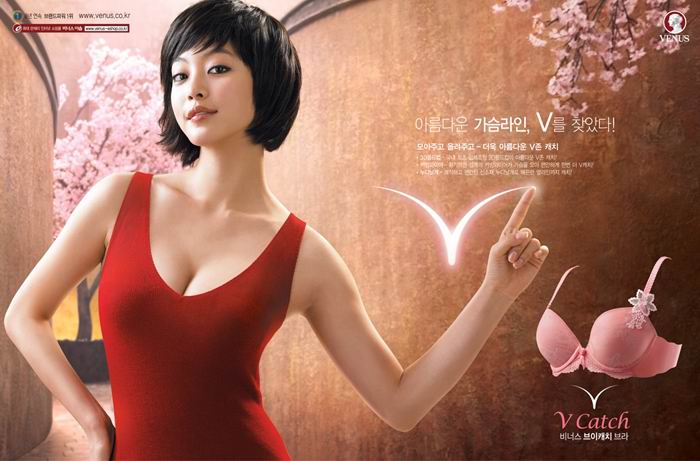
Next is this one for Venus lingerie (비너스) featuring Han Ye-seul (한예슬), featured on the front page of Korea’s main portal site Naver (네이버) as I type this. Why it’s interesting is because of the English name “Glam Up” for the bra featured, which, making little sense otherwise, supports the argument that the English word “glamor” has somehow come to mean “voluptuous” or “curvaceous” in Korean:

( Source )

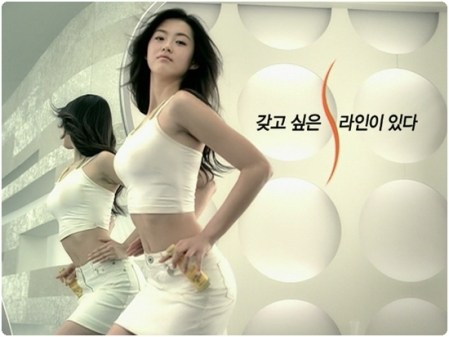
In turn, it demonstrates the ridiculousness of the new Korean phrase cheongsoon-gullaemor (청순글래머; or “innocent glamor”), but which is nevertheless very much in vogue in the Korean media at the moment. But that is no great surprise in view of the enduring popularity of older ones for women’s bodies like “S-line” (S라인) perhaps, and so, lest I begin to sound too serious here, let me move on to this advertisement for Nike Korea (나이키) featuring ice skater Kim Yu-na (김연아):

( Source: korean lovers photoblog )

One of the most endearing athletes I’ve ever seen (well before she won her gold medal), it’s difficult not to simply adore Yuna, but I confess I still had to to laugh at what Matt at Gusts of Popular Feeling wrote about this ad last month:

By the way, does anyone find Kim’s expression in this ad to be, uh, ecstatic?

Perhaps there’s a reason the left hand side was cut off where it was. Just do it, indeed.

Okay, perhaps that was reading too much into it, and I’m sure you can understand my reluctance in not posting it earlier, the image of her at #10 here alone receiving thousands of hits in the last week of February, presumably most of them from fans…

Either way, I hope you at least one of those advertisements made you smile and/or think. And again, if anyone can help find examples of the sorts of advertisements I’m looking for, I would very much appreciate it; even if it’s only because you feel guilty for forgetting my birthday!^^

Share

“Gender Advertisements” in the Korean Context: Part 1

(Source: SeoulBeats)

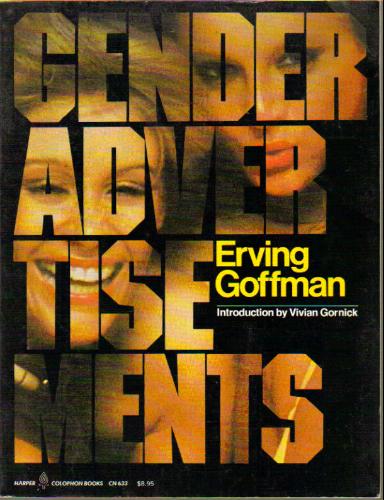
Be warned: Gender Advertisements, by the late sociologist Erving Goffman, is one of those books that changes your life forever.

Well, not life-changing like reading The Communist Manifesto inspired an Argentine ex-lecturer of mine to start shooting police officers. But you will pay much more attention to advertising messages, of which you already receive between 500 and 1000 every day. (Yes, it’s really that many.)

Of course, advertisements have changed considerably since the book was published in 1979, and are much less sexist overall. But indeed that’s precisely because of the attention given to them. Moreover, some elements have actually gotten worse, advertising to children for instance now an embarrassment compared to the relatively gender-neutral tone of the early-1980s (compare these to this, this, and this), and also there is now so much partial nudity in advertisements that several researchers argue that a new category has had to be added to Goffman’s framework to analyze it.

However, partial nudity isn’t objectifying or sexist per se: rather, it is the manner and context in which it is applied. And if that is the case, then you can imagine how problematic applying Goffman’s framework as a whole to Korean advertisements is, in which such different cultural codes operate.

Or do they? In at least one case, yes: social status usually trumps all other considerations in Korea, and so having one person (usually a man) elevated above another (usually a woman) in an advertisement, perhaps by him sitting and her reclining on the floor in front of him, by no means implies superiority, rendering that subcategory of Goffman’s “Ritualization of Subordination” category problematic (see here and here for examples). Still others, such as cute and/or childlike depictions of women, or having them staring off into the distance rather than directly back at the viewer (a subcategory of “Licensed Withdrawal”), are not necessarily sexist in light of East Asian notions of metrosexuality and politeness respectively, as helpfully pointed out by reader Melissa. And in point of fact the only analysis (Nam et al, 2007) that has looked at men as well as women in Korean magazine advertisements did find that Korean men were depicted much more childishly and “withdrawn” than Western men in them.

Still, while this point is easy to miss in posts that necessarily give only a few illustrative examples, surveys of depictions of men and women in advertisements using Goffman’s framework are made to determine if there are statistically significant differences between them as a whole. And, if those are found, then there are a number of different cultural and anthropological explanations that can be suggested in addition to feminist ones: Occidentalism, for instance, may have played a role in the above result, or the fact that it is quite acceptable for Korean 20-somethings of both sexes to behave in a manner that many Westerners might consider childish (see here for possible reasons for this). Alternatively, Nam et al (2007) found that Western women were much more likely than Korean women to be depicted in a lower physical position than men, such as by him standing and her reclining in a chair on on the floor, but while this could be interpreted positively (for Korean women), much more likely is the fact that status trumps all other considerations in Korea, and so to be physically lower than someone else by no means implies that one is the inferior. Accordingly, there were no statistical differences between Korean men and women in this regard.

Other differences however, like the fact that regardless of the social norms I’ve discussed, Korean women are still depicted childishly or withdrawn more often than Korean men for instance, are extremely difficult to account for other than in terms of their inferior social and economic status in Korea. Or in other words, while an individual advertisement depicting a woman like a child isn’t necessarily sexist in itself, that there’s more of them than there are of men is certainly evidence of sexism. Moreover, I fail to see how noticing discrepancies like this is somehow Eurocentric of me, or “looking at Korean society through Western eyes.” Which is not at all to say that Melissa argued that, but others have.

Update: Specifically, aegyo is often claimed as a form of empowerment that Westerners fail to appreciate. In which case, guilty as charged: when (usually) women act like children to manipulate (usually older, higher-ranked, and/or richer) men, how is that anything but wholly accommodating to a patriarchal system?

(Source: Unknown)

In response, in what was originally intended to be a single post here I wanted to discuss the problems Kang (1997), Hovland et al (2005), and Nam et al (2007) had with Goffman’s framework, the alterations they made to it, and the latter two’s discussion of how appropriate various categories of it were to the Korean context.

In particular, the last found that Western men and women were more likely to be depicted as partially nude than their Korean counterparts, but with allowances again for Occidentalism, and the fact that Korean female models will rarely appear in lingerie advertisements (of which the authors were unaware, and so didn’t account for), they argue that this is again evidence of sexism because in fact “many scantily garbed women [emit] a sense of independence and confidence.” While I’d be a bit more circumspect than that myself, fortunately having long since on moved on from the days when I automatically equated bikinis with feminist liberation, they do have a point, particularly in a society where the majority of women were too scared to wear them 5-10 years ago.

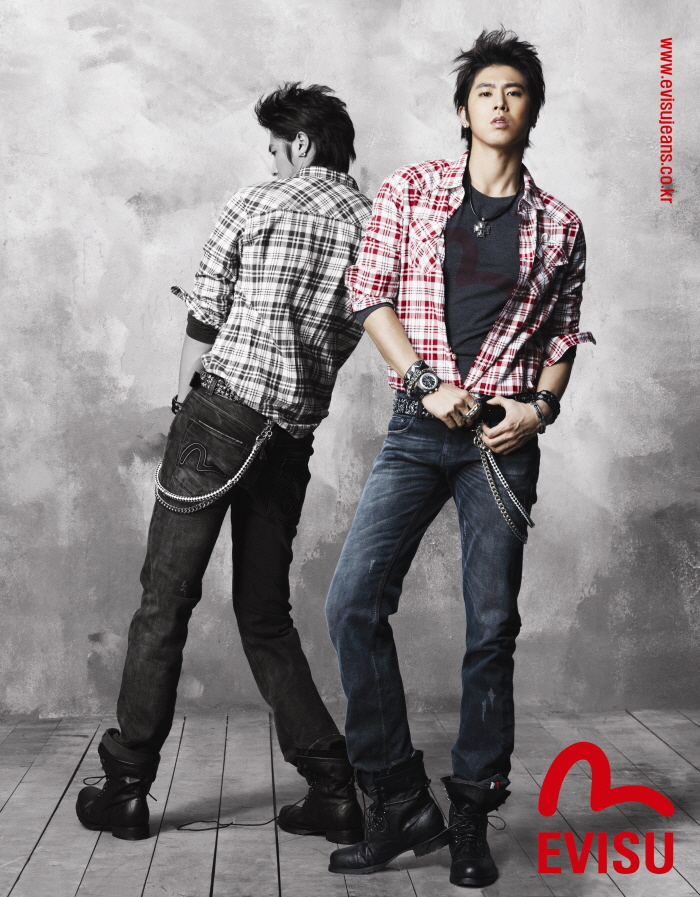
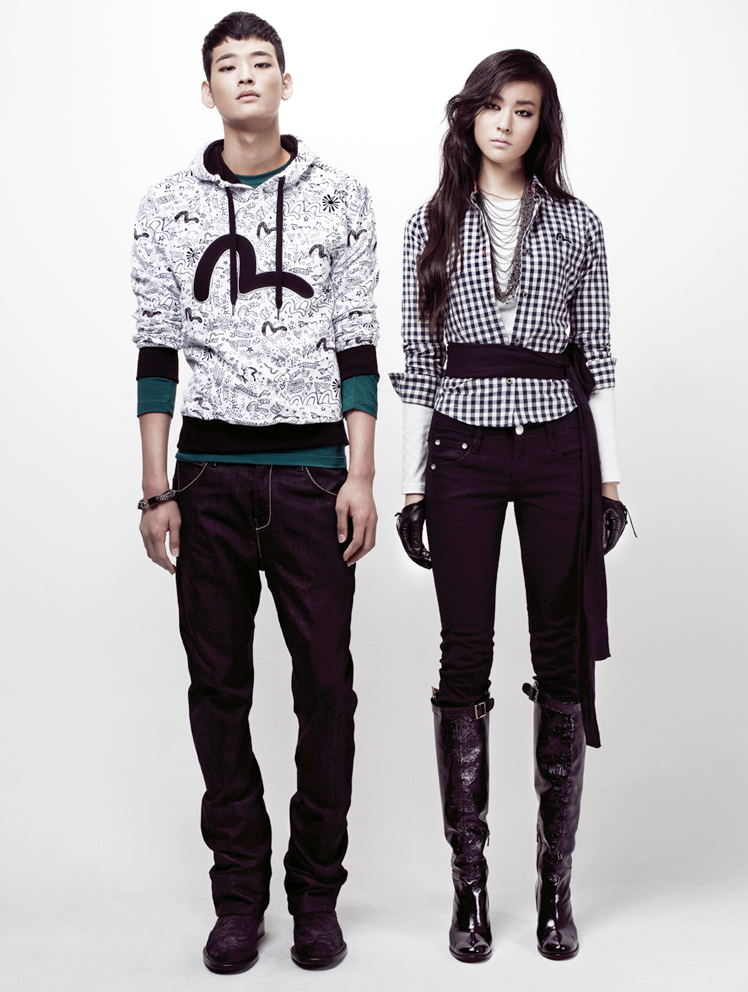
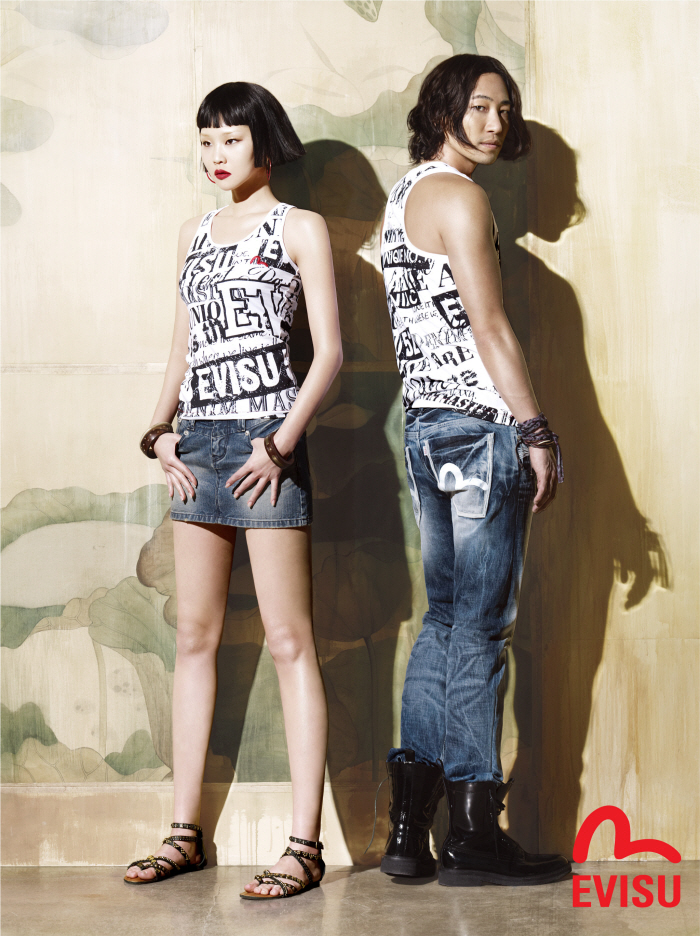
Also, I wanted to discuss the “female-stereotypical” depictions of Korean men in advertisements like Melissa identified, posing a challenge as they do to especially Western men’s notions of masculinity. Unfortunately however, for reasons of space and ease of reading those will have to wait for Part 2 and perhaps even a Part 3. Instead, having provided a grounding in this post, let me devote the rest of it to a practical example of another discrepancy in the ways men and women are portrayed in advertisements, one that I stumbled onto by accident in the process of investigating the Evisu (에비수) advertisement at the beginning of the post.

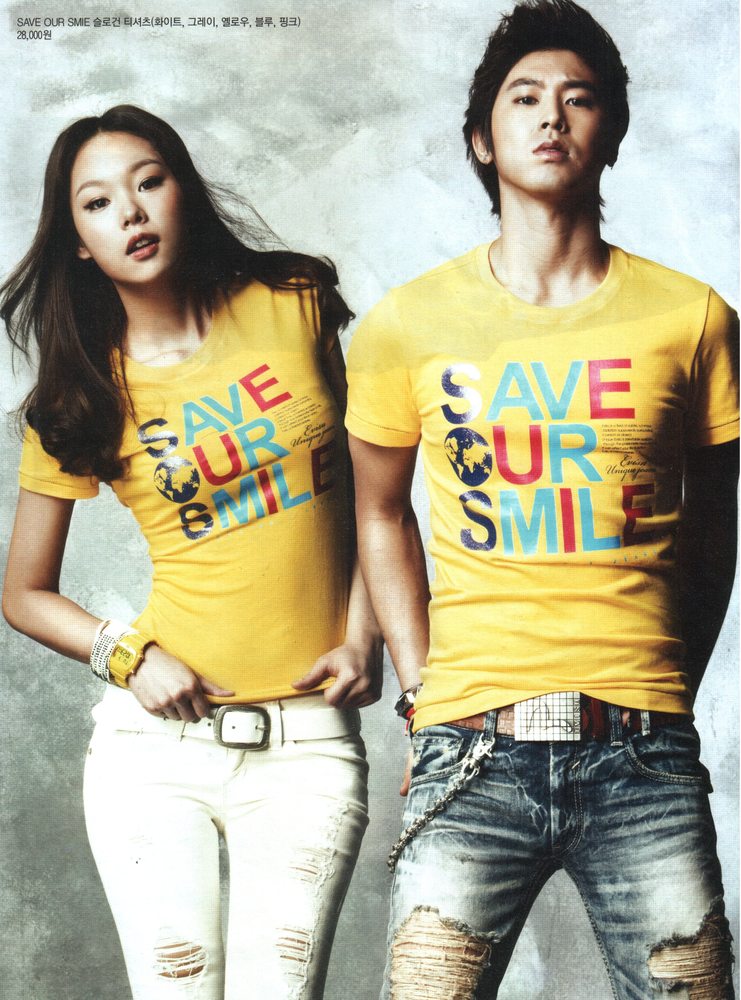
Featuring Jung Yun-ho (정윤호; also know as “U-know”) of the boy band TVXQ (I don’t know who the woman is sorry), the first thing it reminded me of was this:

(Source: Shine So Cold)

Of which I wrote this back in November 2008 (update: since edited out sorry):

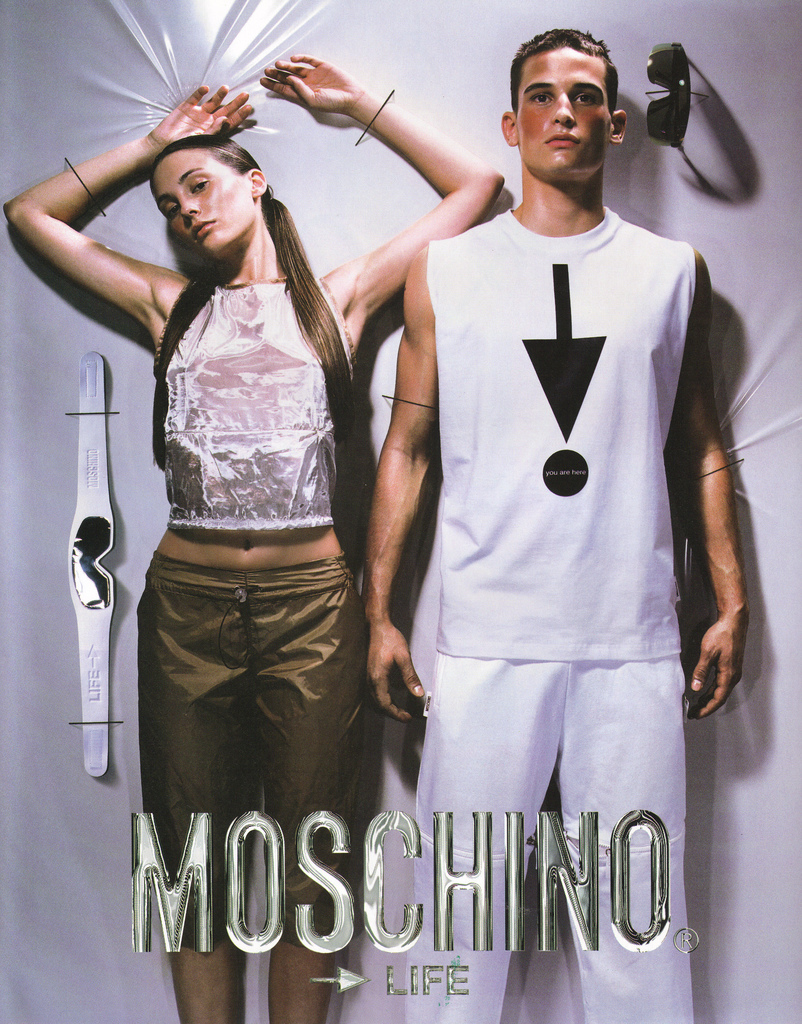
Personally, it took me a few moments to figure out what this advertisement is supposed to represent exactly: were the couple prisoners? No…why would their sunglasses be tied up too? How apart parts from a model kit then? No…then they’d be disassembled, and besides which the man appears to be raised from the white background a little, a rather awkward position for a model component. And then I realized that he’s actually standing, which would mean that the woman is too, although I can surely be forgiven for thinking that she’s lying down.

So probably they’re supposed to be like a Barbie and Ken doll set in a box, like you find in a toy store. But then why is the women tied down so helplessly, whereas the man, ostensibly also tied down, looks – as the photographer points out – firmly grounded and in control? I haven’t been looking (sorry!), but I dare say that Barbie and Ken dolls don’t leave the Mattel factory like that in real life. So why would the advertisers choose to depict them like that?

Granted, it’s a much more extreme example than the own with Yun-ho. But while I don’t mean to equate the two, that is indeed what it reminded me of, and the final question I pose is just as relevant.

But in terms of Goffman’s framework itself, probably this is more similar:

(Source: Tech Fatale)

And with that, let me add “participation shields,” a subcategory of Licensed Withdrawal, to add to all those others I’ve already elaborated on here, here, here, and here as well as those in this post. This is what Goffman (1979) had to say about it:

It is possible to look in on a social situation from a distance or from a one-way panel—a “participation shield”—and be little seen oneself, in which case one can, in effect, partake of the the events but not be exposed to scrutiny or address. A splitting up this results between some of the gains and some of the costs of face-to-face interaction. I might note that when one’s participation is thus shielded, simultaneous maintenance of dissociated side involvements would seem to be facilitated, since these could hardly intrude between oneself and one’s availability to the others in the situation – one not being available at all.

A ritualization of participation shielding occurs when one presents oneself as if on the edge of the situation or otherwise shielded from it physically, when in fact one is quite accessible to those in it. Still further ritualization is found in commercial posings. (p.70)

Then he gives examples of using walls as shields, then window frames, then various objects, then animals, and finally people:

…with the consequent opportunity to overlay distance with a differentiating expression, in the extreme, collusive betrayal of one’s shield. (p. 72)

Here are some examples he provides, from my scan of page 73:

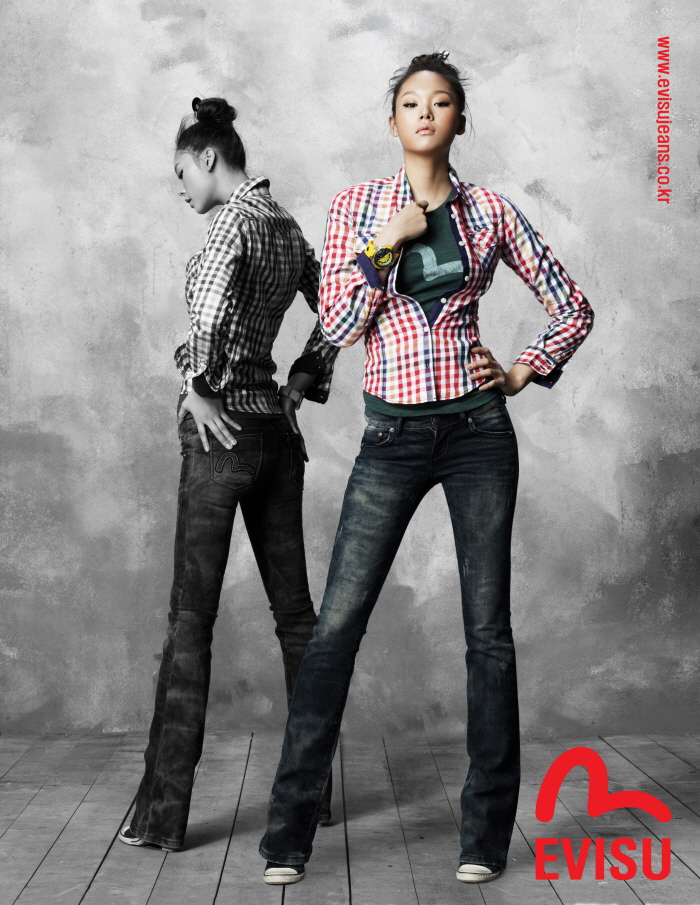
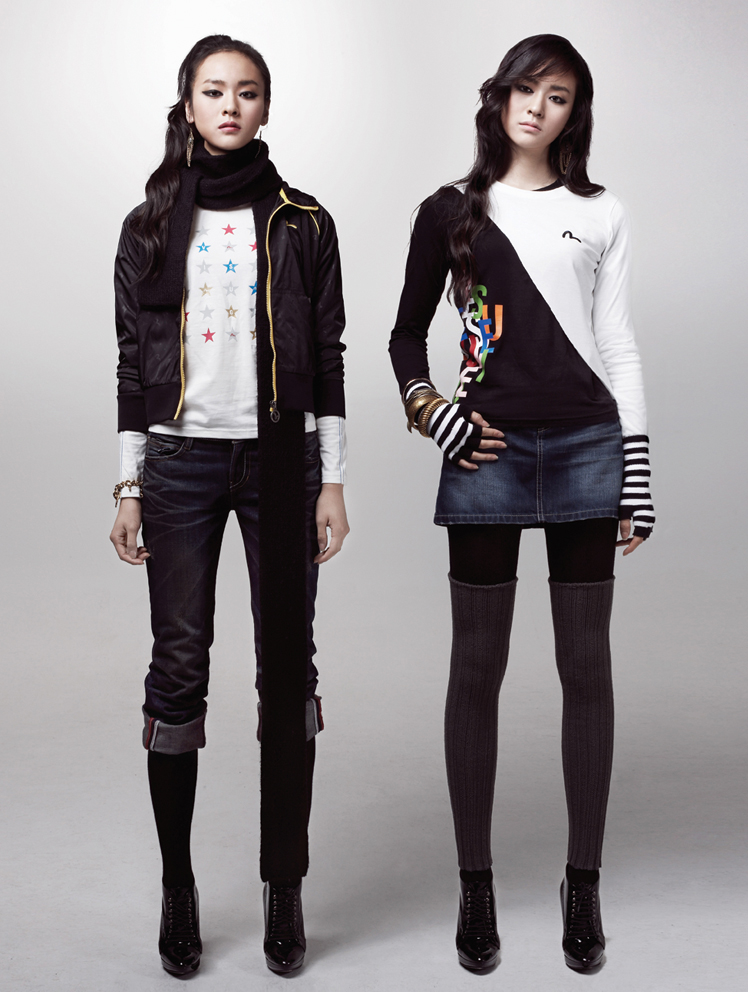
And I think the Evisu advertisement is a good example of that last point, as Jung Yun-ho’s aggressive, confrontational stance is betrayed by that of the inquisitive, unconcerned expression of the woman partially hiding behind him. But lest I contradict myself and read too much into one image (and I’ll grant that those above are deliberately much more extreme cases), again let’s consider the discrepancies among the advertisements currently on the Evisu website. In particular, when the woman and Jung Yun-ho are by themselves, both have strong, confident stances, good examples of the “Independence/Self-Assurance” category first suggested by Kang (1997) and expanded on Nam (2007) which I’ll be discussing in Part 2:

(Source, all remaining images: Evisu)

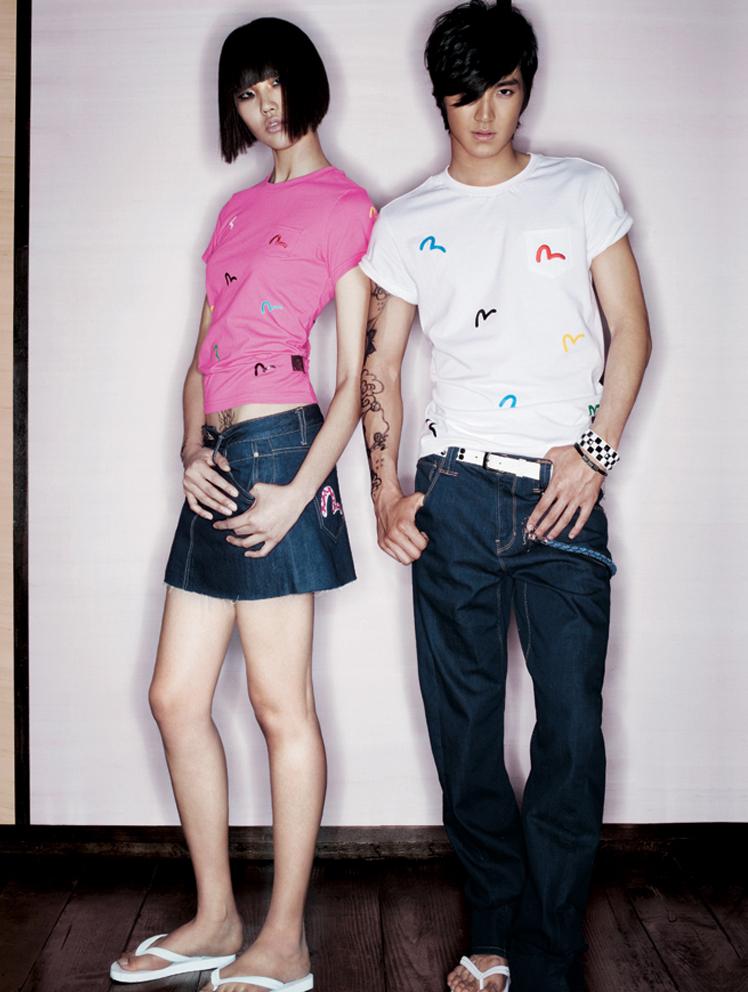
So why then, in most of the few Evisu advertisements that have a man and a woman together, are the women relegated so to speak? But don’t just take my word for it. Instead, see all of them for yourself, starting from the most glaring example to the least:

Note also that only the woman has the “head cant” in each, which I discuss here.

But here is one example that is the complete opposite to all the above:

And I include this one also as it’s the only other one with two people, although strictly speaking it shouldn’t be counted:

Personally I think that the woman on the right above is not quite as “out of it” as she in her advertisements with a man, but I’ll grant that that’s open to debate, as is how much she is using the man as a participation shield in that second advertisement in which she is wearing black gloves. But that’s precisely the point: again, those are all the advertisements with more than one person in them on the Evisu website as a I type this (please note that the first one with Jung Yun-ho isn’t on the website though), and so please make your own minds up about whether there is a discrepancy in the way the men and women are depicted in them. Naturally, I think it’s obvious that there is, but if you agree and yet have a non-feminist, culturally-based argument for its existence however, then I’m all ears.

Meanwhile, a note on the sources for this post: if they look very familiar to regular readers, then that’s because there have been so few surveys of Korean advertisements made using Goffman’s framework. Moreover, even Nam et al’s (2007) is based on magazines from 2002 and 2003, hopelessly out of date for a society as fast-changing as Korea, and so I’ve long wanted to conduct my own survey(s) to compensate. That would involve far too much work for just one person unfortunately, and so if any readers are interested in co-authoring a conference paper and/or journal article on the topic, please let me know!^^

Goffman, E. (1979), Gender Advertisements.

Hovland, R. et.al. (2005) ‘Gender Role Portrayals in American and Korean Advertisements’, Sex Roles: A Journal of Research December 2005, pp. 887-899 (although I have a physical copy, unfortunately this is no longer downloadable; I’d appreciate it if anyone with library access could email a PDF).

Kang, M. (1997) ‘The Portrayal of Women’s Images in Magazine Advertisements: Goffman’s Gender Analysis Revisited’, Sex Roles: A Journal of Research December 1997 (ditto on downloading)

Nam, K. et. al. (2007)  ‘Gender Role Stereotypes Depicted by Western and Korean Advertising Models in Korean Adolescent Girls’ Magazines‘, Paper presented at the annual meeting of the International Communication Association, TBA, San Francisco, CA Online (2007), pp. 1-31.

Update: If you’ve enjoyed this post, then you may also be interested in this one at Sociological Images that describes how even the “physiology and anatomy” theme of a university website also genders the stances of the physiological representation of both sexes, the man standing straight, looking ahead, and having even weight distribution, but the female form being “almost classically passive, hands held behind her back, weight distribution uneven” in contrast.

Beauties and the Beast? Understanding and Subverting the Male Gaze through Soju Advertisements

It’s not often that I laugh at soju advertisements.

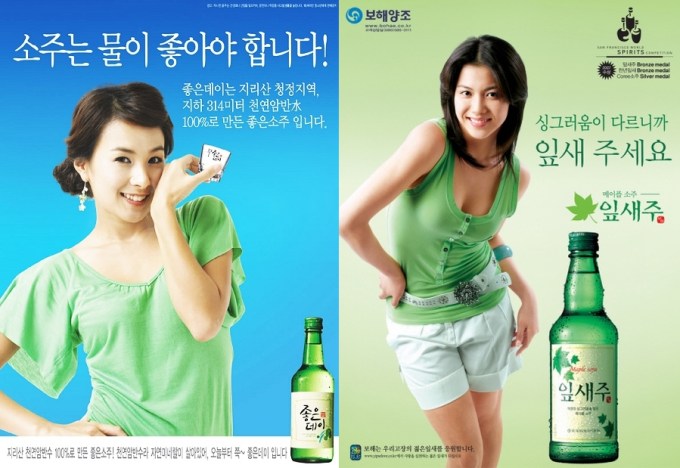
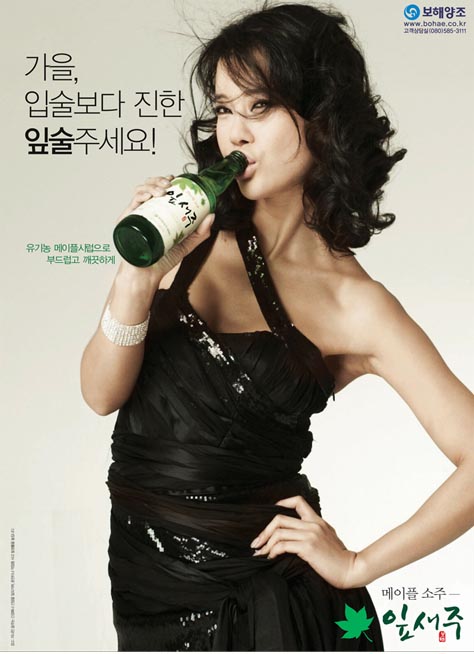
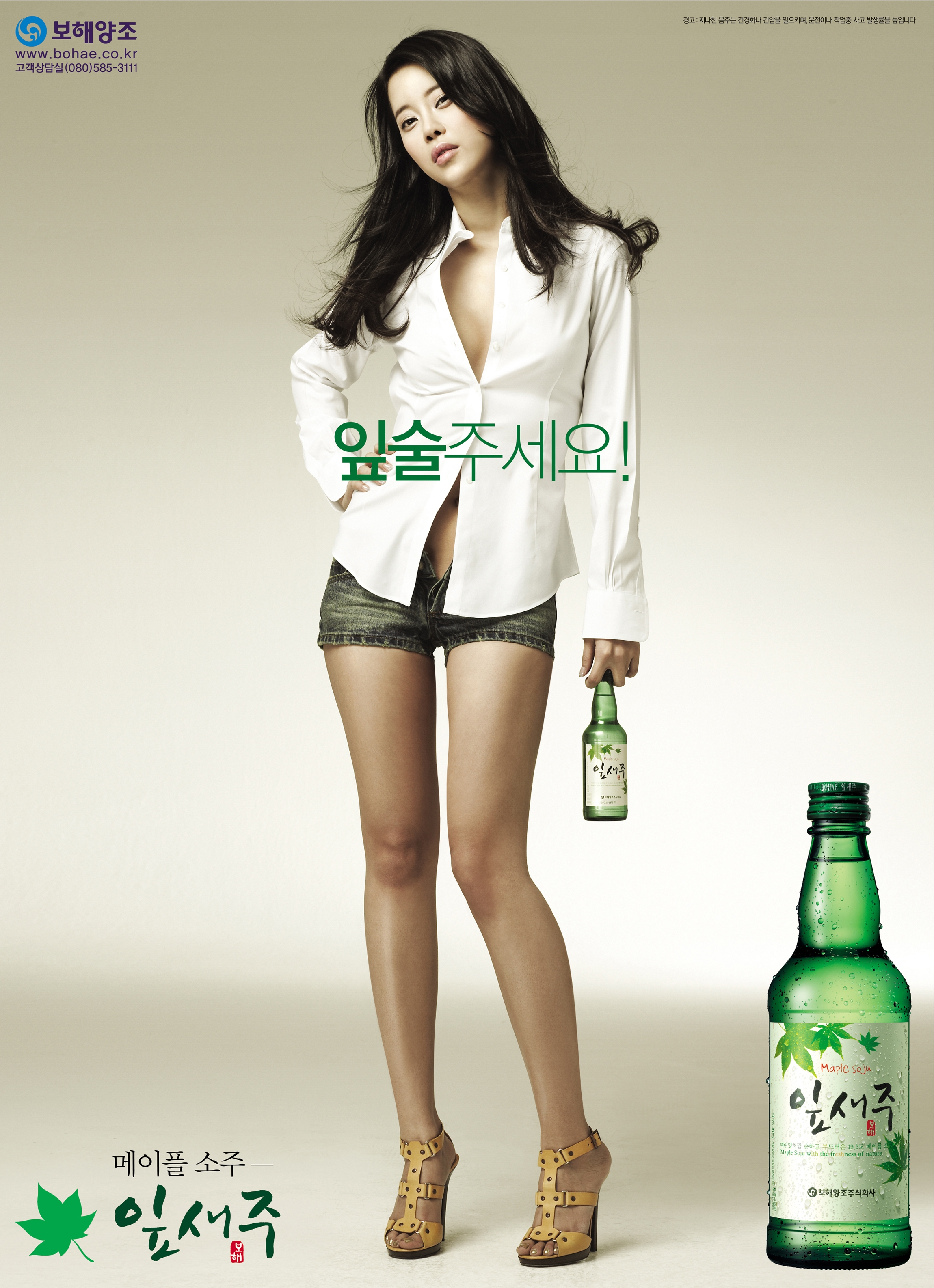
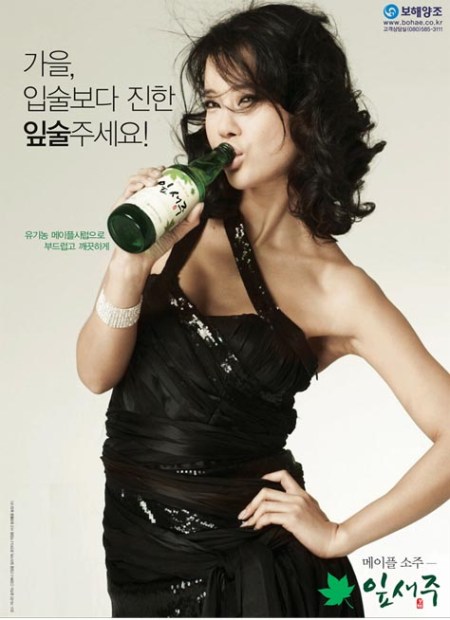
Flying in the face of decades-old traditions that they should feature demure and virginal-looking women though, this one with singer Baek Ji-young (백지영) for Yipsejoo (잎새주) literally had me in tears.

Indeed, if it’s not a deliberate satire, then it at least prompted me to reexamine those traditions, making me realize just how ridiculous many are. And being exclusively designed for a “male gaze” too, they also prove to be a very good guide to it, giving pointers to the ways in which a wide range of advertisements seem to be based on the assumption that their audience are entirely heterosexual men, especially by focusing on and sexualizing women’s bodies.

Even when the products are aimed at women.

But first, the humor of this one, which is on several levels. First there is the caption, which reads “In autumn, rather than your lips (kiss), please give me some strong-tasting Yipsejoo!,” (가을, 입술보다 진한 잎술주세요!), and is a pun based on the fact that yibsool (입술), or lips, sounds very similar to yipsool (잎술), shorthand for Yipsejoo.

And as an added inside-joke for fans, a popular song on Baek Ji-young’s 7th album Sensibility, released five months before she was hired by Yipsejoo’s parent company Bohae (보해양조), even had the name Give Me Your Lips (입술을 주고) too.

But context is everything.

Previously on a fast track to stardom, Baek Ji-young was the innocent victim of a sex-scandal in 2000, and had to fight hard against Korea’s double-standards in order to revive her career. But while this severely limited her advertising options, perhaps one silver lining was the ability to disregard the high moral standards Koreans usually apply to their celebrities (especially women), and indeed it is very difficult to imagine anyone else appearing in advertisements like those she has so far for Yipsejoo.

For instance, recall that when she was chosen in an online poll to model for Yipsejoo in March last year, I remarked that her first advertisement for the company below was:

…not to put too fine a point on it, literally the sluttiest soju ad I’ve ever seen….

With apologies for sounding crass (then), but I still can’t think of a better way to describe it:
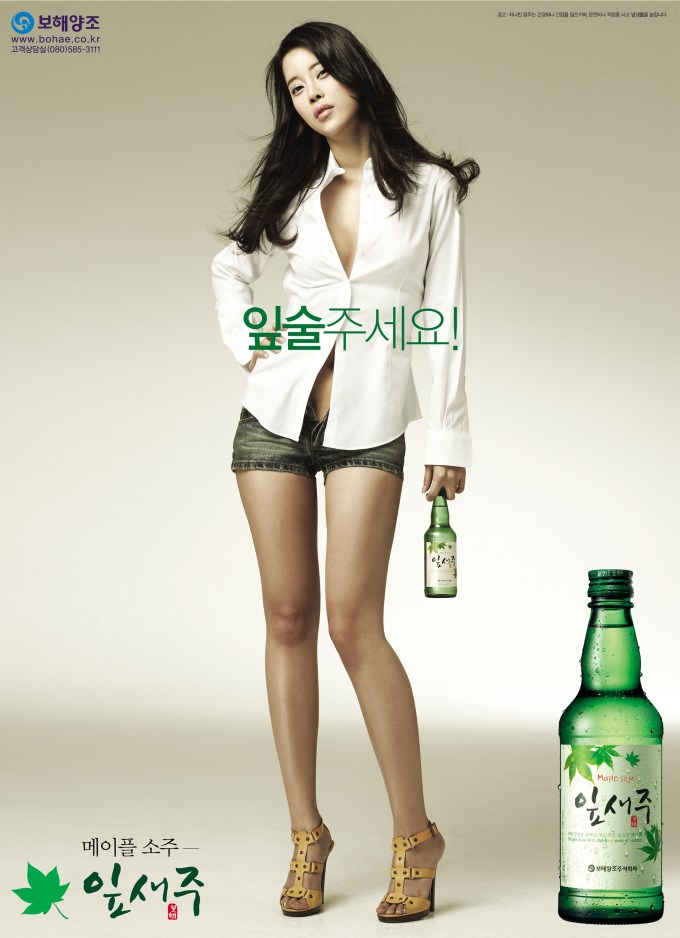
I also discussed the fact that while she did mention how happy she was to have been chosen to appear in soju advertisements like top stars Lee Hyori and Song Hye-gyo, one still sensed that they wouldn’t have consented to appearing bra-less and with an open zipper in them, which smacked of desperation. Judging by the soju advertisements that emerged that summer however, I was quite wrong, but then I’d already concluded of Beak Ji-young that:

however unfair or unwarranted, she’ll always be stuck with her promiscuous image, so she may as well play into it.

Still, I didn’t realize that she would take my advice quite so literally!

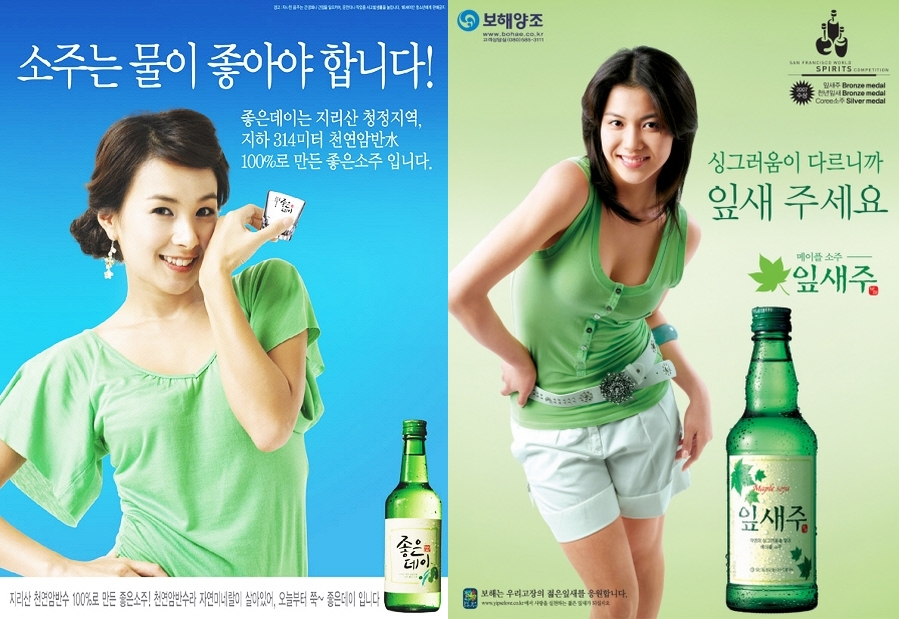
To be precise, I laughed so hard when I saw the opening image because I thought she looked like a prostitute who’d been plying her trade for rather too long now, and which were quite a contrast to, say, these earlier ones for Yipsejoo featuring Jeong Ryeo-won (정려원), for whom her evening of drinking soju with her male partner will be her first time in more ways than one:
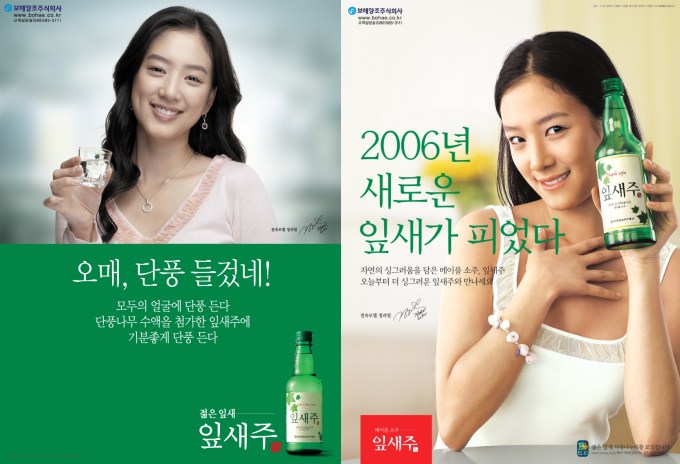
But this post is not about that shift, which I’ve more than adequately covered elsewhere, although I do want to stress 2 things about it here before moving on: that however impressed I was by the changes when I first noticed them back in 2007, it was still extremely naive of me to have ever equated it with (female) sexual liberation(!); and that while an empirical study would undoubtedly demonstrate an increase in soju advertisements with – in the sociological framework that I’ll be using below – “body display” – in recent years, there is by no means an linear progression of racier advertisements over time.

Even just Yipseejo itself for instance, makes both forms of advertisements with the same models, and/or seems to alternate which ones it primarily makes with them, such as traditional, virginal ones with Jeong Ryeo-won and Han Ji-min (한지민) in 2006 and 2008 respectively, but then racier ones with Kim Ok-bin in 2007 and Baek Ji-young in 2009.

Regardless, both types are still designed for the male gaze. In the interests of full disclosure however, I have never studied that formally, and so here I shall be quoting liberally from the excellent A Web Essay on the Male Gaze, Fashion Advertising, and the Pose, part of the Semiotics and Advertising Web Site of the University of Vermont, and I also highly recommend this post by Michael Hurt at the Scribblings of the Metropolitician after that for an analysis of Korean women’s body images using that perspective.

But it does dovetail nicely with the work done by the late sociologist Erving Goffman in his 1979 work Gender Advertisements, still very much the framework by which sociologists study how gender roles are perpetuated in advertising (and indeed referred to repeatedly in A Web Essay). In earlier posts, I’ve already analyzed Korean advertisements using one motif of that: “Relative Size”, or how and why it is extremely rare to see women taller than men in advertisements despite being women being taller than men in 1 out of 6 randomly matched pairs. It’s high time to start using others, beginning with “Ritualization of Subordination”:

Under this broad category, Goffman actually described a great number of symbolic ways in which the women’s behavior in advertisements displays the subordination of females to males, many of which involve women acting like children. Why this is more problematic than it may sound is because:

Given the subordinated and indulged position of children in regard to adults, it would appear that to present oneself in puckish styling is to encourage the corresponding treatment. How much of this guise is found in real life is an open question; but found it is in advertisements. (Goffman, p. 48)

And indeed Korean society strongly encourages grown women to act like children, so it is probably not surprising to hear that in Korean adolescent girl’s magazines for instance, Korean female models are portrayed in such ways much more often than Western ones. From Gender Role Stereotypes Depicted by Western and Korean Advertising Models in Korean Adolescent Girls’ Magazines by Nam, Kyoungtae., Lee, Guiohk. and Hwang, Jang-Sun (2007):

Korean women were more likely to be portrayed in smiling, pouting and childlike or cute expressions than Western women. This result is similar to the findings of [this 1999 study] in which many Japanese girls in magazine advertising were portrayed as happy, playful and childlike. Understanding that gender displays in advertising reflect cultural orientation in a society, these findings indicate that in Korea and Japan, cuteness is an important virtue for women. (p. 18)

And yet to complain about those advertisements with Yoo In-young (유인영) and Shin Min-a (신민아) above, especially when they’re aimed at men, might still seem a little excessive. But then consider the following images from A Web Essay, which poses the questions “What do they suggest to you about these men? Do they seem silly?”

“What about these images?”

And as you probably expected:

Most viewers find the images of the men odd or laughable. But the images of the women seem charming and attractive…Why should it seem funny to see a picture of adult men striking a pose when the same pose seems normal or charming to us in pictures of adult women?

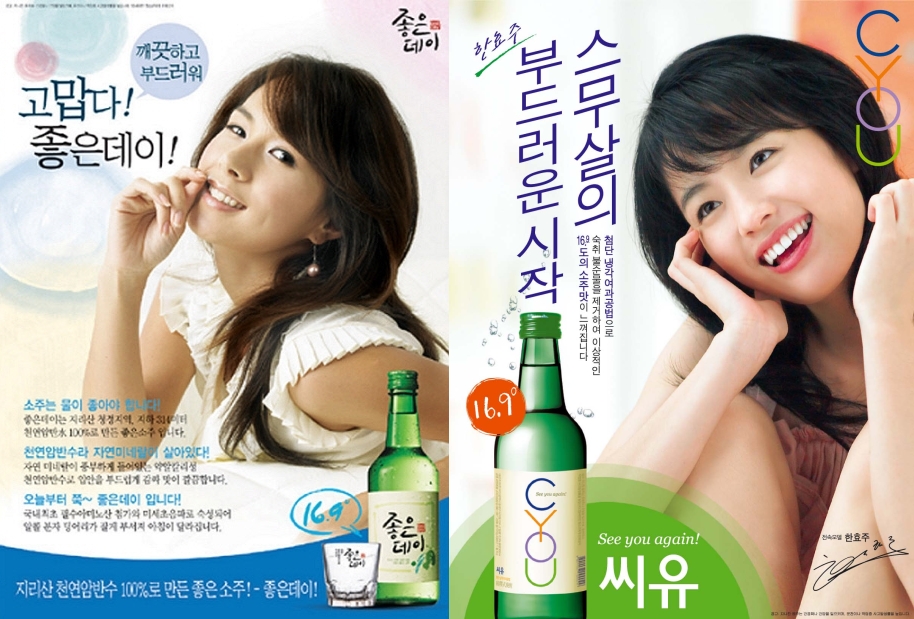
Not childlike per se, but as the next part points out, such expressions are often done with a head cant, for instance by Chae Yeon (채연) and Han Hyo-Joo (한효주) below:

The effect of the head cant is to lower the level of the head:

“…relative to that of others, including, indirectly, the viewer of the picture. The resulting configuration can be read as an acceptance of subordination, and expression of ingratiation, submissiveness, and appeasement.” (Goffman, p. 46)

And A Web Essay adds that it is often combined with putting a finger in the mouth or otherwise touching the face in a childlike way, and so common in advertising as to be barely noticed:

The difference between those and the soju advertisements however, is that they’re all from women’s magazines and presumably aimed at women, and so what is actually going on in those is:

…not that the viewer is looking at a woman who is actually subordinate or childish. Rather, the models are posed so as to show that they know that they are being looked at — belying the otherwise childlike pose — and they are controlling or mastering this act of being looked at. The childish, submissive postures are represented as strategic, as a sign of control of the gaze.

This mastery and control over the gaze might explain why the highly accomplished and wealthy women you see above would strike submissive, deferential poses for the camera that no accomplished man would strike. For in so doing:

…[they are] not at all signaling to others that [they are] actually subordinate; on the contrary, [they are] showing that [they], too, can be successful in this arena, the arena where the goal is to attract and control the power of the gaze by striking a subordinate pose. And were this an occasional event, if we regularly saw images of women that were of a different sort, the effect might be innocuous.

The problem is, however, that most women make less money and have less power than most men, and the message that goes out to women without power is that to get some, you need to gain control of a male view of women — which means to get power through male power, rather than on your own.

This is where the theory of the male gaze becomes important…

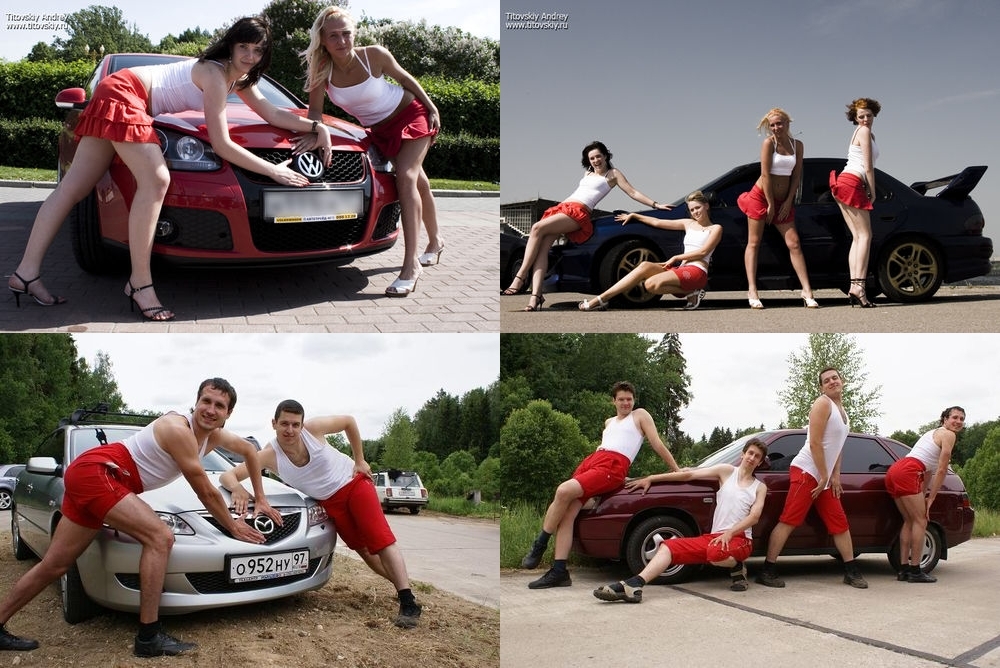
A Web Essay also briefly mentions women’s typical advertising poses in much the same vein. But I think that that’s a little misguided, as a distinction needs to be made between those that are sexually appealing to heterosexual men and others, the basic physiology of sexual reproduction ensuring that men will almost always look ridiculous in the former. Hilariously demonstrated by these pictures from English Russia for instance:
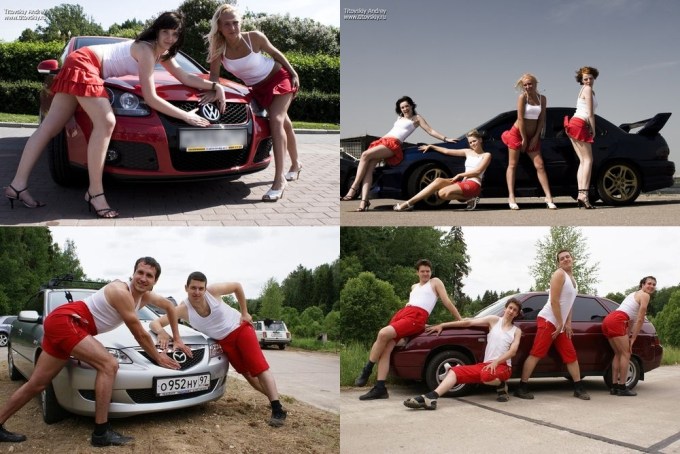
See Sociological Images for a wider discussion of those. Of course, by no means are women (or men) always placed in sexually appealing poses in advertisements, but for some reason women in particular frequently are placed in completely bizarre, often comical ones instead. Goffman notes of them that:

The note of unseriousness struck by a childlike guise is struck by another styling of the self, this one perhaps entirely restricted to advertisements, namely, the use of the entire body as a playful gesticulative device, a sort of body clowning. (Goffman p. 50)

With the possible exception of that with Kim Ok-bin, admittedly these following examples from soju advertisements can not really be described as “childlike.” But however natural they may appear though (again because of our frequent exposure to them), in fact some are extremely awkward to perform: just try them and see!

Starting with Kim Ah-joong (김아중) and Song Hye-gyo (송혜교):

Then Chae Yeon and Kim Ok-bin:

And finally Shin Min-a and Lee Hyori (이효리):
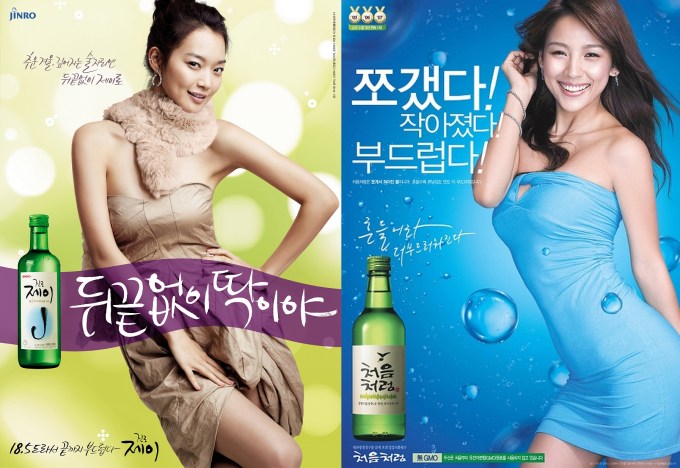
Those with Chae Yeon, Kim Ok-bin, and particularly Shin Min-a also display the “bashful knee bend,” which women frequently but men only infrequently are posed in a display of. Whatever else, it:

…can be read as a forgoing of full effort to be prepared and on the ready in the current social situation, for the position adds a moment to any effort to fight or flee. Once again one finds a posture that seems to presuppose the goodwill of anyone in the surround who could offer harm. (Goffman, p. 45)

But I’ll wisely move on to the second and last motif for this post, that of “Licensed Withdrawal.” In the words of Images of Women in Advertising:


[One] way in which women are disempowered is by displaying them as withdrawn from active participation in the social scene and therefore dependent on others.  This involvement with some inner emotional processing, whether anxiety, ecstasy or introspection, can be symbolized by turning the face away, looking dreamy and introverted, or by covering the face, particularly the mouth, with the hands….

….Rather than being portrayed as active, powerful and in charge, females are commonly shown in this licensed withdrawal mode, removed into internal involvements, overcome with emotions, or symbolically silenced with hand over the mouth….

….In another variation, females are frequently shown withdrawn inwards into some dreamy introverted state;  they pose, become things for others to gaze at and desire.  Males will stereotypically be shown active, engaged, and in charge of the situation.  They are not so much objects for others’ to gaze at, as actors with occupations and professions….

But I’d never given it much thought until I saw this composite of four soju advertisements with Jang Yun-jeong (장윤정), which I also laughed out loud at. What on Earth is she looking at?
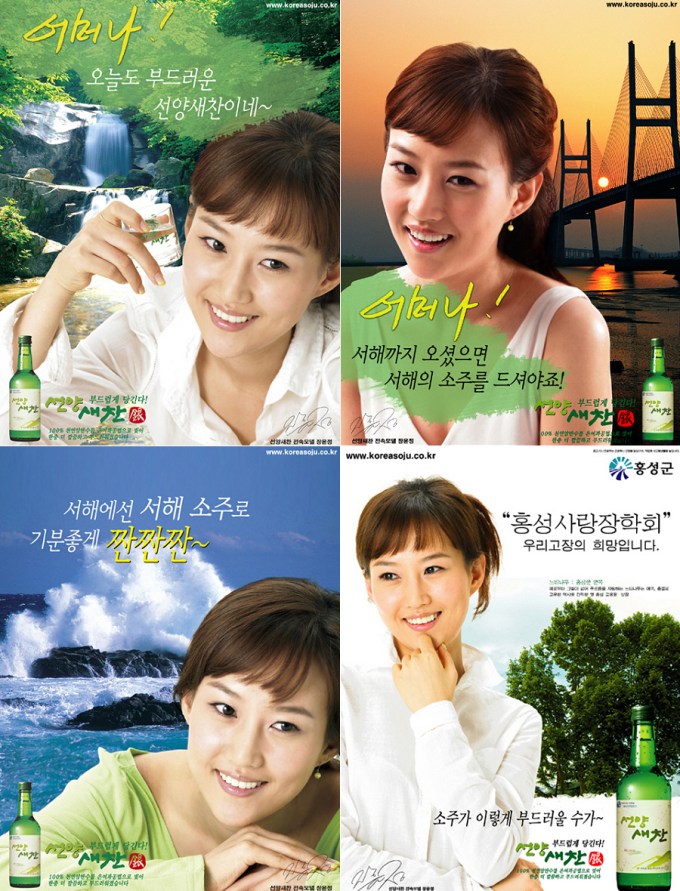
More examples with Kim Tae-hee (김태희), and Ku Hye-sun (구혜선):
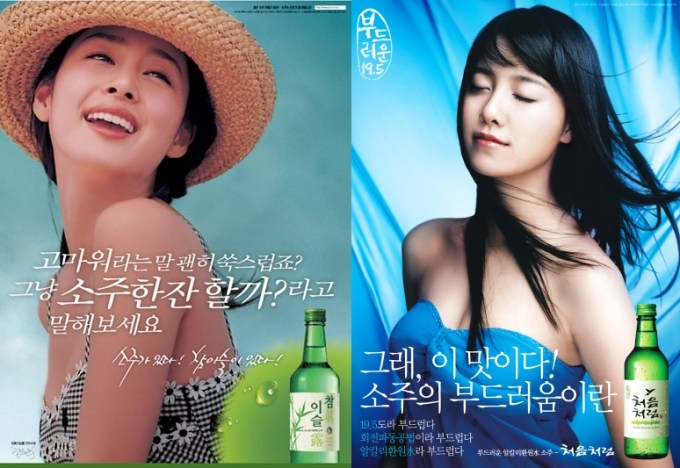
And to which can be added Han Hyo-joo’s from earlier. Arguably Ku Hye-sun is merely lost in her enjoyment of her drink though, and in that sense the advertisement could even be used to appeal to women(?). But then with the possible exception of the second one of Baek Ji-young’s, no advertisement featured here is particularly objectionable in itself; rather, this post has been about noting recurring features of soju advertisements that – if I may be so presumptuous – now that you’re more aware of, are likely to see across the entire Korean (and Western) media.

It is the pervasiveness of these features that is objectionable, and so rarely countered by alternative images of women.

But on that note, I should point out that I notice and pay attention to soju advertisements with skin just as much as the next guy; actually probably more so (call it an occupational hazard). Still, based on the opinions of the men and women in my classes at least, this one with Song Hye-gyo has the greatest universal appeal, although that is probably simply because of her attractiveness:

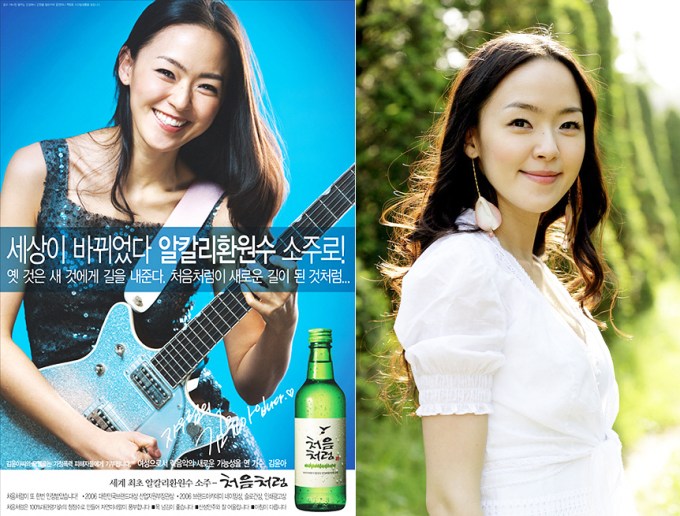
And after writing this post, in fact this one with Kim Yoon-ah (김윤아; not the skater) of the rock band Jaurim (자우림) is my favorite: it’s the only one I’ve seen in which the woman depicted is actually doing something of her own accord and enjoying herself, rather than waiting to be seduced by a man. Baek Ji-young’s does come close of course, but then it’s even more unflattering, and all she is doing is drinking!
Finally, while it’s technically out of place, I would be remiss in not providing the one which, well, literally had my female students squealing in delight when they saw it. Featuring Kang Dong-won (강동원) for Bom Bom (봄봄; “Spring Spring”), that will be music to the ears of manufacturer Daesun (대선주조), creators of one of the first ever soju brands aimed at women:

See here for more information on the consequences of that for soju advertisements so far; given all the above, it is perhaps no surprise that most soju advertisers still can’t restrain themselves from using womens’ bodies!

(Soju advertisement sources: Shootar.net, or directly from manufacturers’ websites)

Korean Sociological Image #31: Gender Roles & Korean Holidays

With apologies to teachers of Korean children everywhere, tired of their Korea Gender Lunar New Yearproclivity for repeating the nonsensical foreign words found in Korean advertisements, there is actually much to be admired in KT’s recent olleh (올레) campaign. For under the rubric da gu-rae-rul dwee-jeeb-ora (다 그래를 뒤집어라), or “turn the things that bug you on their heads,” it has a definite self-depreciating streak, poking fun at various groups of Koreans and their habits in a way that feels curiously similar to British humor (source, right: Paranzui).

Coming from a society notorious for always presenting itself in the best possible light, this is very refreshing.

Examples on TV so far have included: elderly women being encouraged not to all have the same boring, monotonous hairstyle; men to nap on travel rugs in parks with their children playing next to them rather than always lazing around at home on weekends; Koreans not to always say the same reflexive English phrases to foreigners that they learned at school; and employees to choose their own meals rather than meekly ordering whatever the boss is having.

And there are many more like it. But all pale in comparison to the directness of the latest in the series, which targets the disproportionate burden placed women during “holidays” like Seollal (설날), coming up this weekend:

Incidentally, it shows another interesting aspect of Korean society: their lack of embarrassment (some would say alacrity) in showing bodily functions. Already having rather too much of that sort of thing at home with 2 young daughters to look after though, then I’ll wisely refrain from further commentary on that here.

Instead, I’ll look forward to possibly seeing another that covers a second reason many women hate Seollal: if they’re in their late-20s or older, being pestered by their relatives to find a partner and get married, and indeed I have a 29 year-old friend and a 32 year-old sister-in-law that will be staying well away from home because of precisely that. A phenomenon hardly confined to Korea of course, as is women doing more domestic work than men, but then I’d wager that many foreign women at similar ages reading this can attest to the sheer amazement Koreans experience when they learn that they’re not married!

On that note, apologies if all this sounds familiar to many readers. But while the Korean media will be full of similar commentary this week, this is the first time I’ve seen something like it in a Korean advertisement, and as part of a particularly popular series at that. And as they say, a picture tells a thousand words…

Or perhaps there have been earlier ones that I missed, or alternatively others by different companies playing at the moment? Please let me know!

(For more posts in the Korean Sociological Image series, see here)

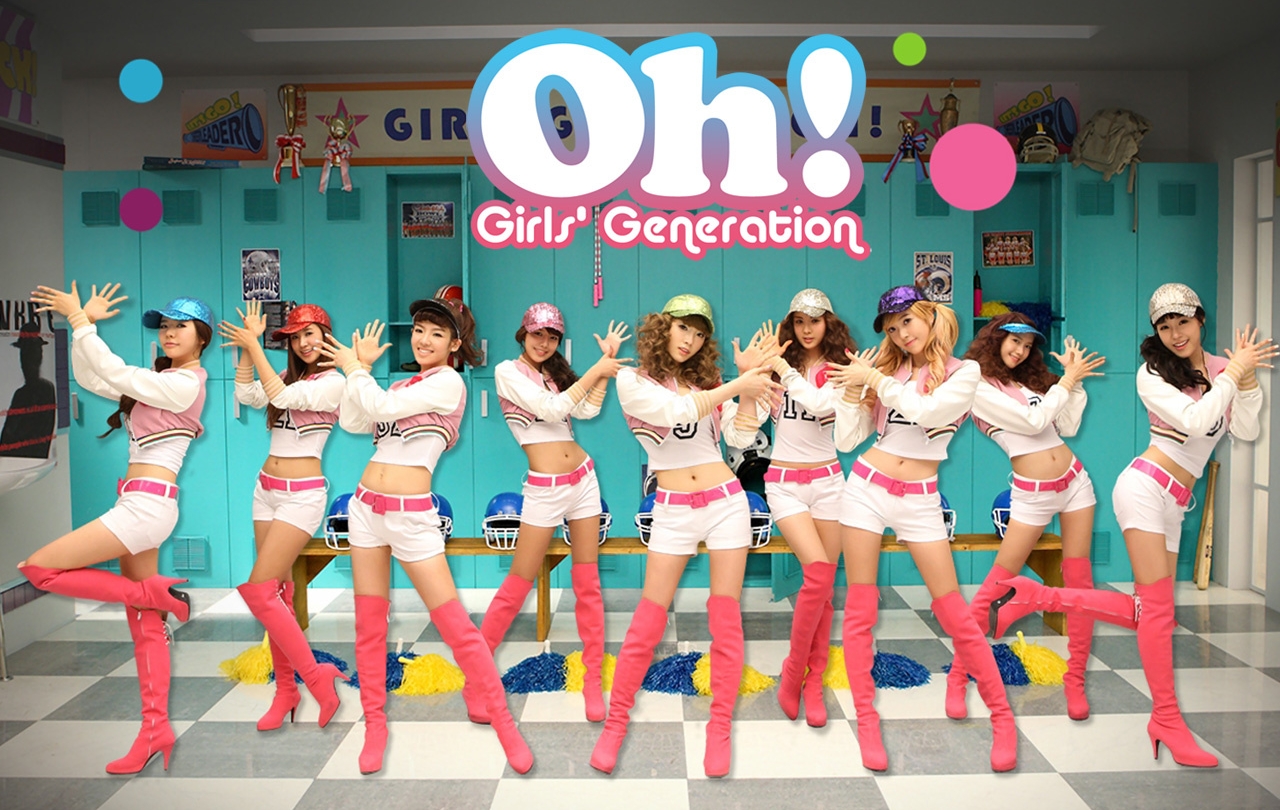
Oh? Oh…!

( Source )

Call me old-fashioned, but although music videos can have a huge effect on my enjoyment of songs, I still try to judge them on their own merits.

By that criteria, all of Girls’ Generation’s hits have fallen flat for me, no matter how photogenic the girls are. But then I found a remix of their latest hit Oh! by the Greek trance DJ “Areia”, and I immediately fell in love with it.

Like he says on his blog, he put a lot of work into it. And it shows.

True, it’s actually the only one of his K-pop remixes that I like, that of Abracadabra (아브라카다브라) by the Brown Eyed Girls being particularly disappointing. But I’ve only listened to a handful so far, and his abilities are definitely improving over time. To any other Korea-based trance fans out there, frequently lamenting at how something so popular in Japan could be so completely absent from the cultural radar here, I’m sure you’ll be just as happy as I was to have found him!

For the lyrics (and a translation) to the song, see Yeeun2Grace here, and if you’re interested and haven’t seen it already, then this video (via Extra! Korea) makes a pretty compelling case that the song has been plagiarized from U.S./Barbadian singer Rihanna’s Shut Up and Drive. If you’re disappointed in my not providing my usual critical analysis on this occasion though, then I apologize(!), and by all means read precisely that at Appears.

But if you’d still like to watch the original video, albeit now with the trance remix, then I do understand:

Click on the video itself to be taken to Ariea’s YouTube page, which has a playlist of his other K-pop remixes.

Update: There’s been a lot of speculation in the comments as to why the video’s concept is of cheerleaders hoping to get the attention of American footballers, simply bizarre considering that the sport has virtually no following here. So I posed the question to my two classes earlier today, and the combination of their explanations proves to be quite compelling.

First, my morning class mentioned the success of the movie Bring it On in 2000, particularly the song Hey Mickey from the soundtrack, and this struck a chord with me because men who would have been in their late-teens and early-twenties back then were precisely the demographic that SM Entertainment created Girls’ Generation for (indeed, Girls’ Generation has performed the song many times). While that may just be coincidence though, they also said that high school footballers dating cheerleaders have been a staple of American movies and dramas they’ve watched ever since, and they were at a loss for an equivalent in Korean pop culture.

My afternoon class disagreed that Bring It On was popular however, and this is borne out by the box office figures for that year. Instead, they pointed out that all Korean cheerleaders are adults, and so although the youngest members of the group are in fact turning 20 this year, to have presented them as Korean cheerleaders pining after Korean baseball or basketball players would have clashed with their image of being precocious teenagers. Recall that the song itself is about unrequited love for an older male too, which the exaggerated youth of the women singing it would help to emphasize.

In short, cheerleaders for high school American footballers were the only possibility because there are no teenage cheerleaders in Korea.

But my two classes’ explanations are not mutually exclusive of course, nor with some of the alternative explanations posted in the comments section here either. While I would like to corroborate them though, unfortunately analysis like that is severely lacking on the Korean internet, so that might have to wait until I investigate next month’s music magazines.

Meanwhile, I’m quite convinced personally, but what do you think? Please let me know, and perhaps I can get a dialogue going with my students!

Update 2: Despite 1 billion won (US$860,000) being spent on Girls’ Generations stage costumes last year, apparently there was little money available for making some props for this music video, so some store-bought ones with the Iowa Hawkeyes logo were used instead. You can just imagine the reaction of Hawkeyes fans

Share

Korean Sociological Image #29: JYP’s Objectification of Women

(Source)

What’s wrong with this advertisement?

When I first saw it, I couldn’t really put my finger on it, other than noting the similarity to some iconic but controversial music videos by Robert Palmer. Which was kind of ironic, considering what Park Jin-young (박진영) is putting his fingers on.

With thanks to an anonymous reader for passing it on, both these problematic elements and more are present in his new music video No Love, No More (노러브노모어), the main subject of this post. But first, a quick explanation of what was so controversial about those Robert Palmer videos exactly, for many of my younger readers may not even have heard of him.

As Alyx Vesey explains in Feminist Music Geek, the crucial one was “Addicted to Love” from 1986, and as a feminist she had trouble with it:

…for one big, obvious, highlighter-yellow reason. It’s so blatantly sexist. The models who comprise Palmer’s backing band are normatively beautiful, musically inept, interchangeable, ornamental, passive, and blankly spectacular. They’re kinda like a Busby Berkeley chorus line, only on sedatives and with visible nipples.

And while it’s a little off-topic for a post ostensibly about JYP, I think it’s worth quoting her a little more:

And yet. I can’t let this one go so easily. It’s an indelible image that is simple and yet iconic in design (it’s so effective that ”Simply Irresistible” and “I Didn’t Mean to Turn You On” only mildly revise the concept). Thus, it’s also easily replicable. When you put “Addicted to Love” alongside another lexicon 1980s video like, say, Michael Jackson’s “Thriller,” it’s much easier to match (many people, including Jackson, tried and failed to reach or exceed that video’s epic proportions).

It’s also an easy concept to subvert, which is my primary interest. I’d like to highlight a few instances where women take on “Addicted to Love” and, in the process of recasting and reconfiguration, potentially disrupt the original music video’s sexist aims.

Which I highly encourage you to check out. Meanwhile, let me also present the Simply Irresistible music video here, for I think that with the women dancing in the background, it is the most similar of the three to No Love No More:

Finally, No Love No More itself. Regardless of the criticisms in this post, it probably has the best picture quality of any music video I’ve ever watched on Youtube, so make sure to click on “HD”:

Clearly not a carbon copy of Robert Palmer’s videos then, and JYP, or whomever was responsible for them, might reasonably claim not to have been at all influenced by those. But whatever the origins, the women in the barn (and in the poster) are indeed extremely similar, and almost all are objectified.

And yet there are still more problematic elements in it, pointed out to me by the reader who passed the video on. Unfortunately, I didn’t have time to ask permission to quote her email before writing (apologies for my over-enthusiasm), so she’ll have to remain anonymous:

…the video infuriates me. Maybe it’s because I come from a country where explicit violence against women is not only extremely taboo but also illegal to portray in music videos. Still, given that domestic violence is such a formidable problem in this country, I find it mind-blowingly irresponsible that the most powerful man in Korean music at the moment puts out a video like this (source, right: unknown).

Shooting his girlfriend execution-style (apparently it’s okay to show her blood spraying out as her body crumples to the ground but it’s not okay to show an actual gun doing the shooting)… he then turns the “gun” on himself, and we’re expected to sympathize with him as a tear runs down his cheek as he takes his last breath. He executed his girlfriend, but the poor guy must have felt immense pain to have been driven to do such a thing. Break to the rest of the video, which simply consists of JYP dancing while dozens of women stand around or grope him as sexual props. JYP’s entire image seems to rely on the objectification of women, as demonstrated by [that poster], for one example…

…in which he is fingering a woman’s breasts, “playing her” as if she was a musical instrument. Now I’m definitely no fan of K-pop, and normally have nothing to do with it, but this video of his has been playing over and over on TV, and I can’t help but fear the message it sends young Koreans. JYP is, after all, immensely popular and influential in the K-music world, as he owns one of the most successful music labels in Korea and appears on countless TV shows and commercials. I find it surprising that no one seems to take offense to this video, which romanticizes violent “crimes of passion” (end).

(Source)

I agree, and as that reader is almost entirely responsible for this post, I encourage her to give me permission to print her name so that she can receive the credit for it!

But I would of course appreciate it if any other readers had more to add, on either the music video, the poster, and/or JYP’s marketing in general. And I confess, I know little about JYP’s music. So, to any fans of his in particular, would you say that that characterization of him is fair?

(For more posts in the Korean Sociological Image series, see here)

The Alphabetization of Korean Women’s Body Types: Origins

(Update, 2013: See here and here for much more up to date posts on this topic, and for similar cases in English-speaking countries in the 1910s-1930s and 1940s.)

That the female body has occupied a central place in the Western cultural imagination hardly comes as news, says comparative literature writer Susan Suleiman. And while I lack knowledge of Korean counterparts to the historical examples in the visual arts, literature, and religion that she mentions, I don’t doubt that they exist.

But what to make of the recent Korean trend towards categorizing the female body and/or body parts into a plethora of different romanized “lines”? Where do they fit in?

It’s been easy enough to prove that they have become a pervasive feature of Korean popular culture; so much so, that many have acquired a life of their own, bearing little resemblance to the (idealized) women’s bodies they were first used to describe. But those earlier observations of mine were devoid of context, something which began troubling me once I paused to consider the source of the above article on the most recent manifestations of the trend, about Korean cosmetic surgeons classifying woman’s buttocks into four types. To be precise, it raised two questions, which I would appreciate readers’ help with.

The first is that is this trend of categorization qualitatively and/or quantitatively different to that which occurs in the Western media? As to the former, probably not: I need hardly point out the similar obsession with women’s bodies there, or that it also provides often impossible ideals to live up to. And however much English speakers may find Koreans’ romanization habit in this particular case both curious and amusing (and thereby memorable), arguably it merely reflects Koreans’ general obsession with English, grafted on to an interest in women’s body forms that is not dissimilar to that of the West. Indeed, even some native English sources are beginning to describe women’s bodies in terms of letters (see below), and while that failed to catch on, are they really different to describing women’s bodies in terms of bananas and hourglasses and so forth?

(Image sources: top; bottom. The results are from this 2005 study)

Forgive me for stating the obvious perhaps, and I mention all that not to exonerate the Korean media for the ways in which it warps and distorts women’s body images. Rather, that if I still feel that it does so more than its Western counterparts nevertheless (and I do), then that something more than my gut feeling is necessary to convince skeptics. And perhaps the difference simply lies in the much greater extent to which S-lines and V-lines and so forth are mentioned? After all, not for nothing do I describe them as a “pervasive feature of Korean popular culture.”

Unfortunately however, providing empirical proof of that is rather difficult, at least for a humble blogger. But I can provide indirect evidence in the meantime, which I would very grateful if any readers could add to.

The first is the source of the article on women’s buttocks I’ve translated at the end of this post. While it may not be obvious from the opening image, it’s actually on the front page of Focus, a free daily newspaper: the image on its left, not coincidentally an advertisement for a chair which supposedly shapes one’s buttocks, part of an accompanying cover.

To your average Westerner, I’d wager that this choice would immediately single out the newspaper as a tabloid—”Women have four kinds of ass! Read all about it!”—but I’ve been asking my 20-something students’ opinions of Focus and other newspapers over the past week, and only a minority considered it such. And why would they, considering that the article was also covered by numerous other news sources (see here, here, and here), including the authoritative Hanguk Kyeongjae, a business newspaper, and which even had a helpful graphic?

Ergo, the bar for tabloid journalism is rather lower in Korea, and this extends to mainstream Korean portal sites, about which I wrote the following in my last post:

Unlike their English counterparts, you have roughly a 50% chance of opening Naver, Daum, Nate, Yahoo!Korea and kr.msn.com to be greeted with headlines and thumbnail pictures about sex scandals, accidental exposures (no-chool;노출) of female celebrities, and/or crazed nude Westerners.

To which I should have added—of course—numerous thumbnail pictures of female celebrities’ S-lines, and also a warning to never look at any of the otherwise innocuous images in the “image gallery” at the bottom of Yahoo!Korea in particular, for if you do you’ll frequently be greeted with advertisements for videos of celebrities’ nipple-slips and so on alongside those birds, flowers, and interesting landscapes.

What’s more, if portal sites are fair game, is it any wonder that children are also encouraged to be concerned about their S-lines and so on? And don’t get me started on ubiquitous narrator models.

Finally, consider what Javabeans wrote on the subject, a blogger on Korean dramas who is a much more authoritative source on Korean television than I will ever be:

…while this [romanization] practice is seemingly frivolous on the surface, it actually belies much more pernicious trends in society at large, when you have celebrities vocally espousing their alphabet-lines and therefore actually objectifying themselves as a conglomeration of “perfect” body parts rather than as whole, genuine people. (my emphasis)

With that combination, something has finally clicked for me: why it is so difficult to find Korean language sources on sexism in the media, and on advertisements in particular? I’ve been looking on and off for years now, and while I accept (and would be more than happy to learn) that perhaps I’ve simply been using the wrong search terms and/or looking in the wrong places, that it is so difficult in the first place is surely telling. A solution though, is perhaps provided by Daniel Jonah Goldhagen in Hitler’s Willing Executioners: Ordinary Germans and the Holocaust – no, really – who had this to say about anti-Semitism in Nazi Germany:

A general problem in uncovering lost cultural axioms and cognitive orientations of societies since gone or transformed is that they are often not articulated as clearly, frequently, or loudly as their importance for the life of a given society and its individual members might suggest. In the words of one student of German attitudes during the Nazi period, “to be an anti-Semite in Hitler’s Germany was so commonplace as to go practically unnoticed.” Notions fundamental to the dominant worldview and operation of a society, precisely because they are taken for granted, often are not expressed in a manner commensurate with their prominence and significance or, when uttered, seen as worthy by others to be noted and recorded. (Vintage Books Edition, Feb. 1997; p.32)

Not lost or transformed, but equally obtuse to someone from another culture perhaps, and which I’m still only just starting to make a dent in.

But a good grounding for that would be the origins of Koreans’ obsession with romanizing women’s bodies, the second question the article raised for me. Or to be honest, an element of the subject I realized I’d paid little attention to when, serendipitously, Korean reader Chorahan provided this extremely informative comment on the subject on another post. With permission, I am happy to now place readers in her more than capable hands:

…I think the specifics of the alphabetization of Korean women are best approached in the context of the classification of women into certain rigid subtypes (read: simplified stereotypes) of women. The S-line and V-line are part of the ‘formula’ for the ‘pretty girl’ here, as are humongous pupils in big double-lidded eyes, cosmetically unaided pallor, bone-tight ligaments, etc. I would suggest that people here perpetuate this mind-boggling state of sheeple-ness precisely because this ‘formula’ serves as helpful, socially constructed and ordained criteria – with which to deduce the type of woman being dealt with, and to adjust manners to suit.

Manners are adjusted according to the woman’s ‘type’ because it is widely taken as a given that certain things can/cannot be said/thought about women depending on how they look (value-judgment wise). The socially ‘accepted’ or ‘conceivable’ scenario that follows any such encounter is rigidly stratified into according variations. My take on this phenomenon is that this is directly derived from a warped and popularized Confucian principle popularized in the Chosun dynasty called 정명론 (正名論), or literally ‘right name idea’, in which the ‘father should be fatherlike and the son sonlike etc.’ A beauty should be treated as a beauty, or a ‘talking flower’; an ugly girl can be laughed at/with (hence the ‘ugly’—or, as I like to put it, ‘uglified’—comedian typification.)

I’m a Korean girl and I’ve lived in Seoul nearly all my life, going through the average Korean educational system to enter the undergraduate level here. Inferring from the numerous social contexts in which I’ve encountered such blunt references to conventionally ugly/pretty features, I would venture the possibility that in originally familial, communal societies where everyone had to stick together whether they liked it or not, the ‘insult’ was not only an insult per se, but also employed as a form of veiled endearment. This is widely considered the ideal sort of 부담없는 (easygoing) interaction between two close individuals—dialogue employing insult as endearment, or ‘constructively realistic advice to help you in the real world’—and is often the most commonly resorted-to excuse for horrific verbal abuse. (Coloring vacuous praise according to these featural types is also just such a form of ordained interaction, considered honest and respectful and completely normal.)

I do not, however, think that this should simply be chalked up to individual stupidity on the part of people that blindly follow this line of thought/action—quite the contrary. I think it’s very telling that the homogenizing retardation of the populace in this regard is and has always been spearheaded by *the commercial/entertainment media sector,* which is—big surprise— notoriously homogenized/stereotyped! It has even resorted to homogenizing certain snapshots of stereotyped ‘diversity’ or ‘unconventionality’ in the form of teen idols that are held up on pedestals as somehow being harbingers of Korea’s ‘openness’ and ‘creativity of the youth’.

As a twenty-something Korean woman towards whom those commercials are directly marketed, I find all this very sad and disgusting and lame, and I am very troubled by the thought that people actually think Korean society is improving/ has improved in its bridging of (sexual or gender-based, if that’s your cup of tea, though I don’t think that’s all) dichotomies (if dichotomies are indeed criteria on which to issue any normative judgment.)

I think it is not people being stupid, but the other way around (stupid being people, or stupidity donning the guise of specific individual avatars): the root of the problem (of not seeing people for the people they are, and adjusting social perception/performance according to formulas hammered in by peer pressure since birth) is a sort of warped ‘commodification of human beings’ + ‘Confucian backwash’ that is only being exacerbated as people constantly look to external/ international solutions to symptoms that stem from an overlooked, simplified, but inherently endogenous disease that must be addressed within its own context.

I definitely think something fundamental has to give. This isn’t just an odd cultural quirk to cluck tongues over – this S-line, this V-line trope, this alphabetization of women just as much as the stereotyping of men – it’s seriously symptomatic of some skewed rift in the goodness and saneness and kindness of people here vs. the expressed, contorted manifestations of such potential strengths.

Not exactly concise, but this is my very understandably strong opinion regarding the topic of this post. But I’m no sociologist, so I wouldn’t know.

p.s. In first paragraph—sorry, this could be misunderstood, i don’t propose any normative suggestion—I’m suggesting as an explanation that people ‘are perpetuating’ etc. (end)

Despite all that context however, one still shudders at the thought that the following was the first thing millions of Koreans read one November morning:

Korean Women Have 4 Types of Buttocks

The results of a survey about the different types of Korean women’s buttocks have just been released.

Baram (wind) Cosmetic Surgery Clinic, which focuses on operations on the body rather than the face, performed operations on the lower bodies of 137 female patients in 2008-2009. An analysis of their different types of buttocks was performed, and the results released on the 23rd of November. All in all, Korean women have 4 types: “A”, “ㅁ,” “Round,” and “Asymmetrical/Imbalanced.”

According to the team of doctors there, women with type A have a lot of accumulated fat in their thighs, making buttocks look big and their legs short, and those with type ㅁ, a lot of accumulated fat in their thighs and around their waists, making their hips look relatively narrow. Both comprise 47% of Korean women each. On the other hand, those with relatively smooth and curved hips and buttocks have a Round type, and those with an asymmetrical or imbalanced pelvis have an asymmetrical or imbalanced type, compromising 4% and 2% of Korean women respectively.

As the doctors explain, even though Korean women’s bodies are Westernizing, Korean women still have these 4 East-Asian types of buttocks.  According to the doctor in charge of this study, Hong Yun-gi, “because Korean women’s buttocks don’t have much volume at the top, but have a lot of accumulated fat at the bottom, they look a little droopy” and so overall “their buttocks look boring overall, and their legs short.” (end)

No, the extrapolation from 137 cosmetic surgery patients to all Korean women was not a mistranslation I’m afraid. And I beg to differ on Korean women’s buttocks looking boring also, but that discussion is probably best avoided. Instead consider, first, Jezebel’s take on “the ridiculousness of dressing for your shape,” many guides to which came up as I researched this post, especially this one from The Daily Mail, a UK tabloid. Next, another case of Korean romanization gone mad that I originally planned to look at alongside the above, albeit of women’s dresses rather than their bodies per se:

And finally, literally the very first thing that came to mind when I saw the Korean article on women’s buttocks: the following picture from a post on male objectification from Sociological Images, because I wondered if men’s buttocks would ever similarly be categorized. But given that a page exists on Wikipedia for “female body shape” for instance, but not on male’s, then I suspect not in the near future.

On a side note, and not that I want to repeat the experience anytime soon, but searching for images of Korean men’s buttocks instead proved impossible, at least on Korean portal sites. But perhaps again…*cough*…I’m not looking in the right places?

Korean Sociological Image #24: Childcare is Women’s Job

Oma(Source: 제동환 via Photo and Share CC)

For traveling parents, this is a godsend:

Asiana’s mother-friendly services have been gaining enthusiastic reviews from those who have been through the ordeals of traveling with infants.

Through the recent launch of “Happy Mom Services,” the airline has been providing exclusive check-in counters for mothers at the airport, breastfeeding covers and baby slings free of charge for travelers with babies.

It gets even better:

In response to the enthusiastic reception, Asiana will extend the “Happy Mom Services” to 66 airports internationally. Also, they will lengthen the age limit from 24 months to 36 months old…

….Passengers with infants will also receive a “Priority Tag” on their checked baggage. Arriving passengers with infants will now be able to quickly retrieve their baggage without the hassle of caring for their infant while waiting at baggage claim…

…For larger infants traveling on children tickets, Asiana is providing free installation of baby safety seats upon reservation. Asiana hopes the service will negate the need for passengers to bring along their own baby seats.

And considering the discriminatory hiring practices of its main rival Korean Air, which refuses to hire men for its cabin crew (see #2 here), then it seems somewhat picky, almost churlish to find any fault with Asiana’s initiative.

But still, “Happy Mom Services”?

(Source: Travel Story)

Yes, easy to overlook, unfortunately we are already barraged with signals that encourage and/or reinforce the notion that childcare is primarily women’s responsibility. For instance, wherever you are in the world, note the warning signs the next time you step on an escalator: only very rarely will you see child stick figures being protected by a male or gender-neutral one rather than a female one. Or, closer to home, consider Seoul Mayor Oh Se Hoon’s recent “Happy Women, Happy Seoul” plan involving the provision of such things as more women’s toilets and the now notorious pink parking spaces: as I point out here, providing larger spaces for those with children and pushchairs to unload is all well and good…but not if fathers are not allowed to use them. And I could go on with many similar examples.

Granted, probably none are confined only to Korea. But in the country with:

…then one suspects that greater attention should be paid to the grass-roots origins of those issues, which unfortunately Asiana’s choice of name only adds to.

Having said that, they’ll still easily be my first choice for traveling with my two young daughters from now on. And if it would be effective, I’d consider writing letters to both English and Korean-language newspapers to draw Asiana’s attention to the problem, hopefully persuading them to change the name to “Happy Parents’ Service.” What do you think?

(For more posts in the Korean Sociological Images Series, see here)

65% of Korean Couples Worry About Contraception?

The Sweet Sex and Love 2003( Source: realistic dreamer )

A quick survey on contraception use in Korea that was on the front page of Yahoo! Korea recently.

Unfortunately, not only is there no information about the methodology used, but the accompanying article is rather short, and states the obvious several times. One wonders what the point of it was.

I feel certain that it was not intended to be simply sensationalist though, as if it was then presumably it would have attracted more than 11 comments from Korea’s infamous netizens. And however dubious, its results are broadly similar to those of more reliable surveys, which is why I chose to highlight it here.

The notion that contraception is primarily men’s responsibility really does seem to be an ingrained part of Korean sexual culture then?

男·女 65% ‘피임 고민’ 08/10/09

미혼남녀들의 큰 고민 중 하나가 피임.

One big concern [Korean] men and women face is contraception.

20~39세의 미혼남녀 1,127명을 대상으로 ‘피임’에 대해 설문조사한 결과, 대부분의 미혼 남녀가 피임으로 고민해본 적이 있는 것으로 나타났다.

1, 127 single men and women aged between 20 and 39 were given a survey about contraception, and the vast majority replied that they have worried about it at some point. [Here are the questions and results].

피임으로 고민해본 경험?

Have you ever worried about contraception?

남자 59%, 여자 71%가 ‘고민해본 경험이 있다’고 답했다. 또한 남자보다 여자들이 피임으로 인한 고민이 많은 것으로 나타났다.

59% of men and 71% of women replied that that had. It emerged that more women than men had worried about it.

피임, 남자와 여자 중에 누가 더 신경 써야 하는가?

Who should be more concerned about contraception? Men, or women?

The Sweet Sex and Love

남자 79%, 여자 83%가 ‘당연히 남자가 더 신경 써줘야 한다’고 답했다.

79% of men and 83% of women replied that “Of course it is men that have to be more concerned.”

선호하는 피임 방법은?

What type of contraception do you prefer?

주로 쓰는 피임 방법으로 ‘콘돔’이 63%를 차지, 1위로 꼽혔다. 이어 ‘체외 사정’, ‘배란 주기법’, ‘먹는 피임약’ 사용 등이 뒤따랐다.

The most preferred choice was the condom, with 63% of respondents choosing that. That was followed by the withdrawal method, the rhythm method, and the oral contraceptive pill.

성관계시 피임이 중요한가?

Is contraception important in a sexual relationship?

남자 95.10% 여자 100%가 ‘중요하다’고 답해, 남녀 모두 피임의 중요성에 대해서 인식하고 있는 것으로 나타났다.

95.1% of men and 100% of women replied that it was important. Both men and women perceive it as being important.

이 번 설문조사 결과, 미혼남녀 모두 피임의 중요성에 대해 인식하면서도 정작 피임을 제대로 못해 고민하는 것으로 나타났다. 이는 감정이나 분위기에 휩쓸려 피임을 등한시하는 경우가 많기 때문. 피임도 사랑을 나누는 하나의 과정임을 인식하는 것이 무엇보다 중요할 것이다.

While this survey showed that both men and women perceived contraception as being important, in reality many had experienced difficulties with it. And many people neglected it because of the atmosphere or getting swept away in the heat of the moment also. But people need to acknowledge that using contraception is part of the process of making love (end).

Share

Korean Sociological Image #19: Gee, Gee, Gee…Girls’ Generations’ Latest Ad Speaks Volumes About Korean Gender Roles

Girls' Generation Shinhan Card Commercial(Source: unknown)

Forget the TED Talks. Instead, use this 16-second commercial for a great introduction to Korean gender roles.

By Girls’ Generation’s for Shinhan Card, it’s completely innocuous at first viewing. Take a second and third look though, and it’s extraordinary in how much it reveals:

First, because of the obvious: those legs. Then, because my students barely seemed to notice them when I asked what they thought of the commercial, let alone considered objectifying only the women to be problematic. Probably, because they’re already used to ubiquitous female “assistants” (doumi;도우미) and scantily-clad “narrator models” (나레이터 머델) being used to sell and promote all manner of products, services, and causes. And girl-groups, effectively, are performing very much the same roles.

Also, that indifference was probably because Girls’ Generation are notorious for wearing hot pants or jeans that are several sizes too small. Indeed, entertainment companies deliberately emphasize girl-group members’ legs to make K-pop more sexually-appealing in conservative East Asian markets, where people generally share Koreans’ taboos about breast exposure. So, it may seem disingenuous to single out this commercial in that regard.

(Source: ZZiixx)

But I’m not—I’m singling it out for what the differences between the men and the women reveal. Because my students would surely have noticed more if the men had also been wearing short-shorts, with the well-muscled legs to pull them off. Or, with more male-specific revealing costumes that showed off their abs.

With just women doing silly dances in revealing clothes though? That’s so normal in advertising that most people don’t think twice about it. See what I mean by looking at these images from A Web Essay on the Male Gaze, Fashion Advertising, and the Pose below. What are your gut reactions to them?

Men Childlike Expressions Ritualization of Subordinationwomen childlike expressions Ritualization of Subordination(“Most viewers find the images of the men odd or laughable. But the images of the women seem charming and attractive…Why should it seem funny to see a picture of adult men striking a pose when the same pose seems normal or charming to us in pictures of adult women?”)

Obviously, this speaks to gender role portrayals in the media worldwide, not just that of Korea. But, with the latter’s tendency towards cuteness and aegyo, it does seem quite extreme here. And, as if to rub that in, in this particular commercial the text and the song also emphasize that the women are very much just for decoration:

First, the text in blue box: “끝없이 ‘고객만족’을 생각하는 카드”.

“The card that unceasingly thinks about customer satisfaction”.

Then what the men are saying while that is visible: “생각, 생각, 생각, 생각”.

“Think, think, think, think.”

Next Girls’ Generation, dancing with their shoulders while sitting on a bench: “어떡하면, 원하는걸, 다 이뤄줄수 있으까?”.

“How shall [the card] achieve everything [the customer] wishes?”.

Girls' Generation Shinhan Card Screenshot(Source, above and below: Paranzui)

Then the men again, while the girls are do their leggy dance, then stand in a line with the men and supposedly sing along with them (but we only hear the men’s voices): “손잡고 힘을 모아 다 함께 생각 생각”.

“Let’s cooperate [with the customer] and collect our energy together and think about all that”.

Finally in the voiceover, with the men sitting in contemplative poses and the girls standing behind them clapping : “카드의 길을 생각하다”.

“What is a card’s purpose? Let’s think about that”.

With this text in the blue box above them: “끝없는 제휴혜택으로 더 큰 고객만족을”.Shinhan Bank Shinhan Credit Card Girl's Generation

“The card that can be used anywhere in order to increase customer satisfaction!”.

Easy to miss on a single viewing, it emerges that it is only the men that do the thinking in this commercial, and by default, for the bank also. Yes, really: even when they all say “How shall [the card] achieve everything [the customer] wishes?,” if you look closely at roughly 0:08 into the commercial when the girls actually finish saying that (see far above), they clearly turn to the men for an answer. Rest assured then, that if you invest your money in this bank, that it will be in the hands of smart people that will take your concerns very seriously. Those people just won’t be women, that’s all.

Exaggeration? Hardly. Consider the facts: according to a recent report in the Korea Times, there are no female CEOs in the entire financial industry here; there are only 2 women out of a total of 220 team managers in the Financial Supervisory Service (and no executives); there are no women with either position in the Bank of Korea. Moreover, one anonymous (male) government official in finance argued that this is somehow justified by “the country’s financial bureaucrats [having] been overwhelmed with too “serious tasks” to pay attention to gender equality” (as in ever since the early 1960’s, not just the recent crisis), and it’s telling that even Rep. Lee Sung-nam (이성남) of the Democratic Party, a woman and former worker at the FSS, feels that women’s weak point in finance is their “competitive edge.”

gender-advertisements-erving-goffmanGranted, given that Korea has one of the lowest women’s workforce participation rates in the OECD, and that Korea has a surprisingly low “Gender Empowerment Measure” relative to its level of development, which is based on “factors such as the number of female legislators, the percentage of women in senior official and managerial positions, the percentage of women in professional and technical positions, and the income differential between men and women,” then it might seem unfair to single out the financial sector for criticism in this regard. But then if I’d wanted to highlight the lack of women there in particular, then I couldn’t have selected a better commercial to illustrate why that might be so.

Nor for explaining “function ranking” either, a common sexist motif in advertisements. A quick summary (source):

Activities can also be expressive and symbolic—who is shown doing what in the image? For example which gender is most likely to shown caring for children? Very commonly when persons in the image have functions, these functions are ranked, with the male carrying out the senior functions, the female the junior functions. Men act, and women help men act. Males are more likely to be shown in the executive or leadership role, with females in the supportive, assistant, or decorative accessory role.

That and other motifs were first outlined by the late sociologist Erving Goffman in his 1979 work Gender Advertisements, and which is still very much the framework by which sociologists study how gender roles are perpetuated in advertising. Let me leave you with one more observation from it (see the sidebar for many more examinations of Korean advertisements using his framework), then another example from Korean banking:

In our society where a man and a woman collaborate face to face in an undertaking, the man—it would seem—is likely to perform the executive role, providing only that one can be fashioned. This arrangement seems widely represented in advertisements, in part, no doubt, to facilitate interpretability at a glance (p.32).

As indeed is the case with this advertisement for a bank I came across last November:

erving-goffman-relative-sizeTechnically, the man is a customer, the women clerks (the text reads: “The customer’s best life partner, with Busan bank”).  It is very telling though, how difficult it is to imagine an ad with the sexes reversed—let alone find an example in real life.

Thoughts?

Update: For comparison, see here for a Shinhan Card commercial with just the men.

(For all posts in the “Korean Sociological Images” series, see here)

Activities can also be expressive and symbolic – who is shown doing what in the image? For example which gender is most likely to shown caring for children? Very commonly when persons in the image have functions, these functions are ranked, with the male carrying out the senior functions, the female the junior functions. Men act, and women help men act. Males are more likely to be shown in the executive or leadership role, with females in the supportive, assistant, or decorative accessory role.

No Skin Required: Healthy Images of Couples in the Korean Media

Han Ji-hye So Ji-sub Bang BangMuch as I’d like to always present a sophisticated and hard-hitting persona on the blog, I’d have to admit that the following two commercials from Bang Bang (뱅뱅) are very sweet and endearing, and put big smiles on my wife’s and my faces.

More to the point though, they also provide a timely reminder that if presenting healthy images of couples is the deliberate intention, and (much needed) ones of romantically assertive women in particular, then you don’t need to have them lounging around in their underwear or “accidentally” falling into awkward sexual poses to do so. Ironically however, the first two commercials in this series with Han Ji-hye (한지혜) and So Ji-sub (소지섭) featured precisely that, which makes one wonder if Bang Bang mixed the order up.

Here’s what was said in the first video, a little stranger than it looks:

용감한 데님

[Her] Brave Denim Jeans

난 아직 그녀를 안아줄 용기가 없습니다.

Ji-sub: I haven’t had the courage to hug her yet.

이때 그녀의 데님이 내게 속삭입니다.

But this time, her denim jeans whispered to me.

대신 나를 살짝 잡는거예요.

Ji-hye’s jeans (to Ji-sub): Instead, [you should] softly grab me (the jeans).

그녀의 친구는 나보다 용감합니다.

Ji-sub: Her friend [the jeans] is braver than me!

Be my best, 뱅뱅

Be my best, Bang Bang.

And in the second one from Ji-hye’s perspective, which came out at the same time:

친절한 셔츠

[His] Friendly, Warm-hearted Shirt

이 남자, 아직 내 손도 잡지는 못해요.

Ji-Hye: This man, he hasn’t [even] been able to hold my hand yet...

이때 그의 셔츠가 내게 말합니다.

But then, his shirt spoke to me.

“먼저 내 소매를 잡아봐요.”

Ji-sub’s shirt: First, try grabbing his sleeve.

그의 친구는 내게 친절합니다.

Ji-hye: His friend [the shirt] is very friendly to me!

“Be my best, 뱅뱅”

Be my best, Bang Bang.

So Ji-sub Han Ji-hye Bang Bang(Image Sources: Paranzui)

All together now: awwwwwww! But seriously, are any readers aware of any earlier Korean commercials featuring couples in which the woman…or her clothes…took the lead in becoming (slightly) more intimate with her partner, like in the first one here? Not that it’s that radical of course, nor – even if it is the first of its kind – that by itself it will make serious dents in Korean social expectations of romantically meek and passive women. Hopefully it is the start of a trend though, and that would indeed make a difference.

Or am I projecting too much from Koreans’ sexual behavior onto their dating behavior? It is true that many Korean women are so concerned about maintaining virginal appearances as to make them feign lack of knowledge of contraception for instance, and so either not provide nor insist on their partners using it, so it seems reasonable to suppose that this passivity would also be the case at earlier stages in their relationships. But this is a generalization of course (which didn’t even apply to my own wife and former girlfriends), and I haven’t actually dated in 9 years either (sigh), so I may be a little out of touch. I’d appreciate it then, if more experienced readers could pass on their own impressions!

Korean Sociological Image #15: Gendered Health Drinks

Korean Gendered Advertising( Source: left, right )

What is the first thing that goes through your mind when you hear of a “power drink” for men?

If you live in Korea, then I’d wager some form of aphrodisiac, testament to the large number of drinks claiming to improve “men’s power” or “men’s stamina” that are available here. In the particular case of the advertisement on the left though, that would be quite wrong, as Huksaeng (흑생) is the name of a health drink from Hyundai Pharm (현대약품) made with huksam (흑삼), or black-red ginseng (흑삼), and it has no prior history of being marketed to men specifically. Here you can see a women’s taekwondo team extolling its virtues for instance, albeit that of a different company.

But compare that with Hyundai Pharm’s other product Miero Fiber (미에로화이바) on the right, which in its 20-year history has only ever been marketed towards women. Currently placed alongside each other at the Busan Ad Stars 2009 website, the accidental juxtaposition of the two advertisements provides an interesting contrast. And given Koreans’ overwhelming preference for health drinks over multivitamin pills also, then the insights to be gained have more relevance to Koreans’ body images than may at first appear to overseas observers.

My own first reaction was that I was at a loss to think of an Korean advertisement for a health drink aimed at women that uses the analogy of recharging one’s batteries. This is a minor point though, and by no means do I have an encyclopedic knowledge of Korean advertisements, so I would be grateful if readers could pass on any examples that I may have missed. But with the proviso that Huksaeng is supposed to provide more of a mental and general health boost rather than improving one’s body per se, both that and any counter-examples from readers would not detract from the obvious and correct inference that Korean advertisements for “men’s drinks” generally feature men as sporty, active participants in the process of achieving that perfect body and/or losing weight. With those for women however, it’s genuinely difficult to find any that don’t promote the idea that drinking the product is the only step required.

Girls' Generation Miero Beauty N Advertisement( Source )

Don’t just take my word for it though. Consider recent popular commercials with girl-group Girls’ Generation (소녀시대) for Miero Beauty N (미에로뷰티엔) here and here for instance, and more importantly the evidence provided by the journal article “Content Analysis of Diet Advertisements: A Cross-National Comparison of Korean and U.S. Women’s Magazines” (Clothing and Textiles Research Journal, October 2006), by Minjeong Kim and Sharron Lennon, which I discuss in great detail in parts One, Two, and Three of my series on Korean women’s body images from last year. More recently, I discuss it in passing in this post about an advertisement for a diet clinic and this one about the advertisement below for a slimming tea-drink also:

Unfortunately the article is no longer freely available at the link above, and I’ve long since lost my own copy of the original PDF file. I can scan my copy if anybody requests it though, but in the meantime hopefully the abstract will suffice:

Content analysis of diet advertisements was performed to examine how diet advertisements portray the Western ideal of feminine beauty and promote dieting in Korean women’s magazines in comparison with U.S. women’s magazines. Results showed that the Western cultural ideal of feminine beauty and dieting were prevalent in Korean women’s magazines. Diet advertisements in Korean magazines appear to promote more passive dieting methods (e.g., diet pills, aroma therapy, diet crème, or diet drinks) than active dieting methods (e.g., exercise). Results further indicated that women may be misled to believe that dieting is simple, easy, quick, and effective without pain, if they consume the advertised product. This study suggests that there is an urgent need to establish government regulations or policies about diet products and their claims in Korea. Magazine publishers also need to recognize their role in societal well-being and accept some responsibility for advertisements in their magazines.
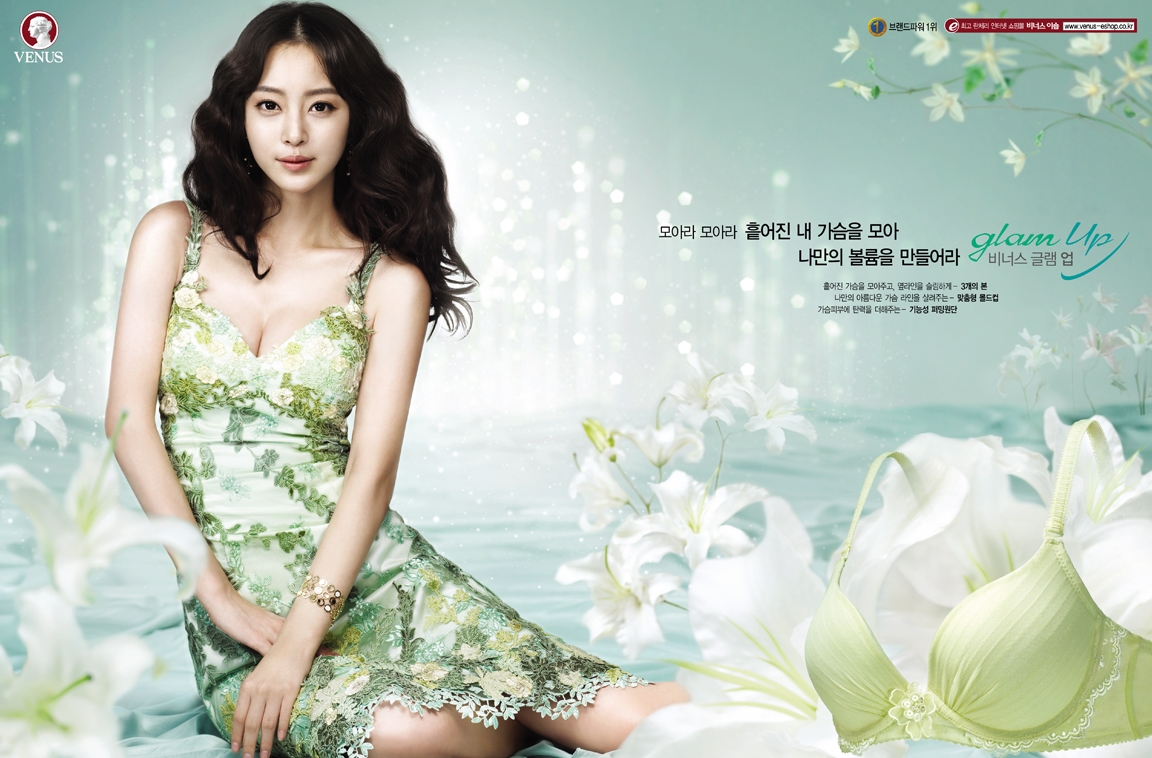
In especially part Two of that series above I discuss that passivity in more detail and extend it to Korean exercise culture, further continued in this recent post about a device that electrically massages breasts in order to make them grow bigger. No, really:

Korean Breast Massager Advertisement Caucasian

Let me also pass on this post at Sociological Images about the similar gendering of energy drinks in the US, with more of a focus on those targeted towards men, and this one at Feministing about the fact that laxatives there are almost exclusively marketed towards women, with the implicit purposes of losing weight. To which I’d add that their Korean equivalents are both ubiquitous and completely lacking of the usual euphemisms, instead providing computer graphics of bowel movements that leave little to the imagination. Rather than continuing in that vein though(!), let me close with a question prompted by the latter post: what is the reason that products like these are marketed specifically towards women?

(For all posts in the “Korean Sociological Image” series, see here)

Share

The Grand Narrative in TIME Magazine

Going Down David Smeaton(Going Down by David Smeaton; used with permission)

For the article in full, on Seoul Mayor Oh Se-hoon’s “Happy Women, Happy Seoul” plan involving more women’s toilets and the notorious pink parking spaces, see here. Meanwhile, for readers coming from there, see #2 here for the specific quote of Lee Myung-bak’s for which the blog was mentioned, and #2 here for more information on Korea’s disproportionately low Gender Empowerment Measure.

I would also add—with no offense to reporter Veronica Zaragovia, who necessarily had to omit most of what was said in our interview—that the argument that “the plan may end up reasserting South Korean women’s secondary status more than boosting it” is also one that I made in our phone conversation. I based it on the knowledge that the pink parking spaces were made wider in order to better accommodate loading and unloading pushchairs and so on (see #3 here), which had reminded me of this post from Sociological Images about the images in our daily lives that serve to subtly reaffirm the notion that childcare is primarily women’s responsibility. In that vein, while the extra space may well be appreciated by mothers, consider that if I were to park in one of those spaces myself, with just as pressing a need for the space to deal with my two young daughters in the back as my wife would have, then as a man I would be likely either be fined or shooed away.

I grant you, it sounds innocuous. But place that into the context of Korean women having the lowest workforce participation rate in the OECD, the result of a combination of a lack of childcare facilities and an enduring male-breadwinner mentality that forces a stark choice between motherhood or a career, then the underlying sexist logic becomes apparent. Moreover, with Korea in turn having the lowest birthrate in the world, the economic effects of which will be felt soon, then one might reasonably ask if the money could have been better spent.

p.s. Apologies in advance for some light blogging this week; I have a conference presentation to give this weekend.

Update, January 19 2010: See The JoongAng Daily here for all the ways in which programs like this have been considerably expanded since this post was written, now including pink spaces for women at bus stops, on buses, in parking lots and special pink taxis under the rubric of improving women’s safety (via: The Marmot’s Hole).

Korean Sociological Image #11: When you REALLY need a man…

Any Man Advertisement A recent report on Korea’s delivery cum odd-job men by Jane Han of the Korea Times, who unfortunately reinforces many gender stereotypes as she explains the interesting new service:

Is ‘Substitute Man’ Modern White Knight?

For 27-year-old Lim Ji-ae, battling cockroaches in her studio apartment has been a constant nightmare. At least one or two encounters with the insect per week put her on edge. That is, until she recently hired someone to be her personal pest control agent for 5,000 won per occasion.

He arrives at her house within 10 minutes of her call, and sometimes even picks up toilet paper, toothpaste and other urgent grocery items on his way. In fact, whatever Lim needs, he does―most of the time.

WonderWoman falls for her knight in shining armour“He’s my new best friend,” says Lim, who was actually referring to a plural group of service providers, the so-called substitute men, an emerging beck-and-call squad that evolved from the common “quick delivery service,” which simply shuttled goods from point A to point B. (Image source, right: Silver Age Comics.)

But the upgraded version exceeds far beyond expectations, as substitute men do everything from delivering food, moving heavy furniture, picking up laundry and walking dogs to escorting children to and from school.

For those of you that don’t live here and may be unaware, one of the good…nay, great things about Korea is that in addition to providing cheap and healthy food, many restaurants provide delivery for no extra charge too; suffice to say, I probably did more cooking in my last year in New Zealand than in the entire 9 years I’ve lived here. So while I am unaware of how long companies offering “quick delivery services” of other goods have been around, they’re obviously a natural extension of this service culture. If you live in an urban area and check your junk mail, then you’ll probably find that there’s at least 2 or 3 available in your area.

Delivery Man AdvertismentIn fairness then, it is good that the article mentioned this context. And, as the image available on AnyMan’s website above indicates, neither company mentioned disguises the fact that they are still mainly simple delivery companies. Continuing:

As long as nothing illegal and morally wrong is involved, almost everything is possible, says Yoon Joo-yeol, who runs Any Man, a service based in southern Seoul.

“We had someone calling for toilet paper while on the toilet,” he said, “while one man called from the U.S. to have porridge and medicine delivered to his girlfriend ill in bed.”

One picky customer, who couldn’t trust local seafood restaurants, even requested a substitute man to videotape himself catch a fish in the ocean before having the fresh catch prepared as sashimi, Yoon recounted.

“There is never a dull day,” he said, adding that services typically cost anywhere from 5,000 won to 300,000 won, considering the labor intensity of the task.

Hell, nothing wrong with any of that, nor in the list of people (e.g., single households, old people, workaholics, and so on) that Anyman’s website suggests would benefit from using their services. (Life Manager’s lists are basically the same.) It would be reading far too much into things to see fault in, say, the fact that Anyman suggests it can deliver food to sick girlfriends but not boyfriends. However, like the slave man who apparently arrives at a woman’s beck and call kills bugs however, it is very tempting to do so once you read the last part of the article:

Lee Jae-hong, the owner of Life Manager, another service provider, explains that the do-it-all service is picking up quick traction nationwide from men and women of all ages, but the best business is in the Gangnam, southern Seoul, district.

He said the large single female population in the area leads to high demand for frequent services such as food delivery, grocery shopping and simple repair work.

“The competition is becoming fierce as more and more customers are learning about the service,” said Lee said, who competes with almost 15 rivals in the area.

Experienced customers like Lim says the cost is “friendly,” but advised users to be cautious and not to expose too much personal information to the substitutes.

Sigh. Where to start?

First, the article instantly reminded me of a Sociological Images post about a New Orleans business called The Occasional Wife. Because as author Lisa explains there:

The Occasional Wife

…the business relies on and reproduces the very idea of “wife.”  As the website makes clear, wives are people who (a) make your life more pleasurable by taking care of details and daily life-maintenance (such as running errands), (b) organize special events in your life (such as holidays), and (c) deal with work-intensive home-related burdens (such as moving), all in while perfectly coiffed and in high heels!

Like commenters on that post mentioned, services that rely on and reinforce a stereotypical notion of appropriate gender roles texist throughout the Western world. Indeed, the first thing I thought of when I saw that post was the New Zealand Hire a Hubby service which started a few years before I left in 2000, and which I was curious to see if it was still in business. Apparently so:

Hire A Hubby Website ScreenshotBut, secondly, I think a crucial difference is that the services of these two companies at least are premised on sharply delineated notions of “wifes” and “hubbies,” whereas with the Korean “Deliveryman 2.0,” they’re so new that social conventions on typical clients and services offered seem very much in flux. Or are they? Take the videos of typical clients and services from the Life Manager and Anyman websites for instance (apologies for the poor quality):

Tellingly, neither video promotes the company as the purveyor of the services of big burley men to hapless single females, and the former especially portrays quite a range of clients, including—shock, horror—some men. Which raises questions as to why the author chose to portray them as such.

Korean Alpha GirlsOn the other hand, there is indeed a large population of singles in the Gangnam area (see this post on Seoul demographics as for why), and I grant that there is a possibility—but only a possibility—that there is something special about single women that live in Gangnam that means that they disproportionately use such services. After all, it is the most expensive and sought-after area to live in whole country, so presumably there would be a large number of rich single women there quite used to paying others for the basic services us mere mortals have to do our ourselves.

However, the same logic would also apply to the rich single men that live in the area.

That said, it has been suggested that all the single women are not rich but rather work in the numerous bars and brothels there, which may well have a grain of truth in it; if so, among singles at least, there may well be a disproportionate number of women in that area. (The report discussed in that earlier post of mine doesn’t provide that level of detail.) Not living in Seoul myself though, I’d be grateful if Seoul-based readers can confirm if there is something to that possibility or not.

For a moment then, I thought that discomfort with the article was unjustified. Perhaps the owner of Life Manager is an angel, who just so happens to have a great deal of business catering to single females in the Gangnam area— nothing wrong with that. But still, I’m unwilling to let him or perhaps author Jane Han entirely off the hook. In particular, although I shouldn’t jump to any conclusions without seeing the original Korean transcript of the interview, the former does say:

…the large single female population in the area leads to high demand for frequent services such as food delivery, grocery shopping and simple repair work.

Ergo, needs for help with those tasks—and, apparently, killing cockroaches—are inherent to the single female, regardless of where they live. Which reminds me of last year’s report on “Alpha Girls” by The Chosun Ilbo, which depicted single women living with their parents as both incapable of and unwilling to do housework, as well as being basically selfish and useless overall; whereas a discussion with virtually any 20-something Korean can confirm that the reality is that they are expected to, can, and generally do do a disproportionate amount of housework, unlike their brothers. Of course, we have all met single women like the article describes, but just as many single men too, and similarly there was no objective reason for Jane Han to give this article the passive, useless female/knight in shining armour tone to it that she did.

Why did she then? I’ll leave that up to the reader. But as blogger Gord Sellar points out in this excellent post on Korean consumerism here, there does seem to be quite a backlash among certain groups of Korean men against single, independent women, and it would be no surprise if this was increasingly reflected in the Korean media. It’ll certainly be something to keep an eye on in the future.

(Hat tip: Roboseyo. For more posts in the “Korean Sociological Image” series, see here.)

Korean Sociological Image #8: America…Fuck Yeah!

Korean Advertisement Sungshin Women's University Relative Size Racism Caucasian

An advertisement from today’s Korea Times, which immediately grabbed my attention for 3 reasons:

  • It’s for a women’s university, but not only does it feature men, it has more men than women.
  • It has a Caucasian man in it, whereas the target audience would overwhelmingly be Korean.
  • The Caucasian man is easily the most prominent feature in it, and is looking at the viewer rather than into the distance like the Korean students.

After just a few minutes thought though, obvious reasons emerge for all of those: men are and should be featured because the program is available to both men and women (well technically, the website doesn’t mention anything about the sex of applicants) for instance, and for all their ethnic diversity Caucasians are still an instant and logical signifier of Western countries. And dealing face to face with an American colleague at an American hospital – ie, having a job at one – is precisely the goal of students that will enter this program too, which in turn is well represented by the Koreans in the advertisement looking towards their futures as it were. As the male Korean is wearing a tie, then I’m a bit unsure as to whether the Koreans are supposed to be students in the program or graduates with jobs looking for better opportunities, but other than that slight confusion then the advertisement appears logical as a whole.

Still, despite myself it gives me misgivings.

One minor reason is because the doctor is male. Nothing wrong with that of course, but it seems strange to have a male role-model in an advertisement for a women’s university. Yes, I know I just said that the doctor is supposed to be a future colleague, yet in addition to representing both that and a life in America he does still have a job that students entering into the program would aspire to. If the primary target of the advertisement is women then, not choosing a female doctor seems like a wasted opportunity to kill three birds with one stone.

kim-tae-hee-kang-dong-won-cyon-phone-advertisement-relative-size-eab980ed839ced9dac-eab095eb8f99ec9b90( Source )

But dammit, why’d he have to be so big? As I discuss at great length here, relative size is one of the most powerful tools in advertising, not only making certain features more prominent than others but also – especially when it’s used to contrast two or more people of different sexes, ethnicities, jobs, ages, and so on – both determining and conforming to social norms of ranking, status, and appropriate social roles. For instance, if you take a random man and woman then in 1 in 6 cases the woman will be of equal height or taller, but in advertisements the figure is closer to 1 in 20 or even less. Not that that is evidence of sexism per se though, as women overwhelmingly prefer men that are taller than themselves, and it’s natural that many advertisements would reflect this. Moreover, if you’ve chosen specific celebrities with a significant height difference, say Kang Dong-won (강동원) and Kim Tae-hee (김태희) above, then it would be difficult to engineer a realistic-looking advertisement in which he somehow appears shorter than her.

kim-tae-hee-kang-dong-won-cyon-phone-advertisement-eab491eab3a0-relative-size-eab980ed839ced9dac-eab095eb8f99ec9b90But then consider this advertisement on the right with the exact same couple (source), in which the height difference has been significantly reduced. Sure, it’s not the only reason why the advertisement has a completely different, more egalitarian vibe than the first, but I’d argue that it’s the most important one. And to hammer that point home, consider how simply bizarre everyone would find the above, gangsterish one if Kim Tae-hee were just a little bigger, let alone if a woman taller than Kang Dong-won had been used.

Ergo, size matters, and so while my concern with Sunghin Women’s University’s advertisement may well only stem from the inherent angst of being a socially-aware Caucasian male, guilty at living in a country where being such undeniably confers certain advantages, it still leaves me feeling a little uncomfortable. I would have much preferred one that focused more on the Korean students themselves, and how the program empowered them, but while retaining the signifiers of America, the job, and so on. Not something that basically says:

Oooh, do this course, and you can talk to and work with White people! In America!!! What more could you ever want?

Okay, that specific vocalization may just be me. Or is it? That’s a rather indelicate way to put it above, but it is certainly true that living and working (and being educated) in America conveys a lot of status in Korean society, so far from me implying that any Korean is a passive dupe for responding positively to advertisements like this it is logical and intelligent for them to do so. Moreover, my wife, who is Korean, pointed out that most Koreans wouldn’t think twice about the Caucasian in this ad. Perhaps my concerns are misplaced then.

What do you think? Mere overanalysis and liberal-arts major angst on my part? Or a legitimate concern? Regardless, admit that the doctor is the first person you noticed too though!

(For all posts in the “Korean Sociological Image” series, see here)

Share