No Skin Required: Healthy Images of Couples in the Korean Media

Han Ji-hye So Ji-sub Bang BangMuch as I’d like to always present a sophisticated and hard-hitting persona on the blog, I’d have to admit that the following two commercials from Bang Bang (뱅뱅) are very sweet and endearing, and put big smiles on my wife’s and my faces.

More to the point though, they also provide a timely reminder that if presenting healthy images of couples is the deliberate intention, and (much needed) ones of romantically assertive women in particular, then you don’t need to have them lounging around in their underwear or “accidentally” falling into awkward sexual poses to do so. Ironically however, the first two commercials in this series with Han Ji-hye (한지혜) and So Ji-sub (소지섭) featured precisely that, which makes one wonder if Bang Bang mixed the order up.

Here’s what was said in the first video, a little stranger than it looks:

용감한 데님

[Her] Brave Denim Jeans

난 아직 그녀를 안아줄 용기가 없습니다.

Ji-sub: I haven’t had the courage to hug her yet.

이때 그녀의 데님이 내게 속삭입니다.

But this time, her denim jeans whispered to me.

대신 나를 살짝 잡는거예요.

Ji-hye’s jeans (to Ji-sub): Instead, [you should] softly grab me (the jeans).

그녀의 친구는 나보다 용감합니다.

Ji-sub: Her friend [the jeans] is braver than me!

Be my best, 뱅뱅

Be my best, Bang Bang.

And in the second one from Ji-hye’s perspective, which came out at the same time:

친절한 셔츠

[His] Friendly, Warm-hearted Shirt

이 남자, 아직 내 손도 잡지는 못해요.

Ji-Hye: This man, he hasn’t [even] been able to hold my hand yet...

이때 그의 셔츠가 내게 말합니다.

But then, his shirt spoke to me.

“먼저 내 소매를 잡아봐요.”

Ji-sub’s shirt: First, try grabbing his sleeve.

그의 친구는 내게 친절합니다.

Ji-hye: His friend [the shirt] is very friendly to me!

“Be my best, 뱅뱅”

Be my best, Bang Bang.

So Ji-sub Han Ji-hye Bang Bang(Image Sources: Paranzui)

All together now: awwwwwww! But seriously, are any readers aware of any earlier Korean commercials featuring couples in which the woman…or her clothes…took the lead in becoming (slightly) more intimate with her partner, like in the first one here? Not that it’s that radical of course, nor – even if it is the first of its kind – that by itself it will make serious dents in Korean social expectations of romantically meek and passive women. Hopefully it is the start of a trend though, and that would indeed make a difference.

Or am I projecting too much from Koreans’ sexual behavior onto their dating behavior? It is true that many Korean women are so concerned about maintaining virginal appearances as to make them feign lack of knowledge of contraception for instance, and so either not provide nor insist on their partners using it, so it seems reasonable to suppose that this passivity would also be the case at earlier stages in their relationships. But this is a generalization of course (which didn’t even apply to my own wife and former girlfriends), and I haven’t actually dated in 9 years either (sigh), so I may be a little out of touch. I’d appreciate it then, if more experienced readers could pass on their own impressions!

Korean Sociological Image #15: Gendered Health Drinks

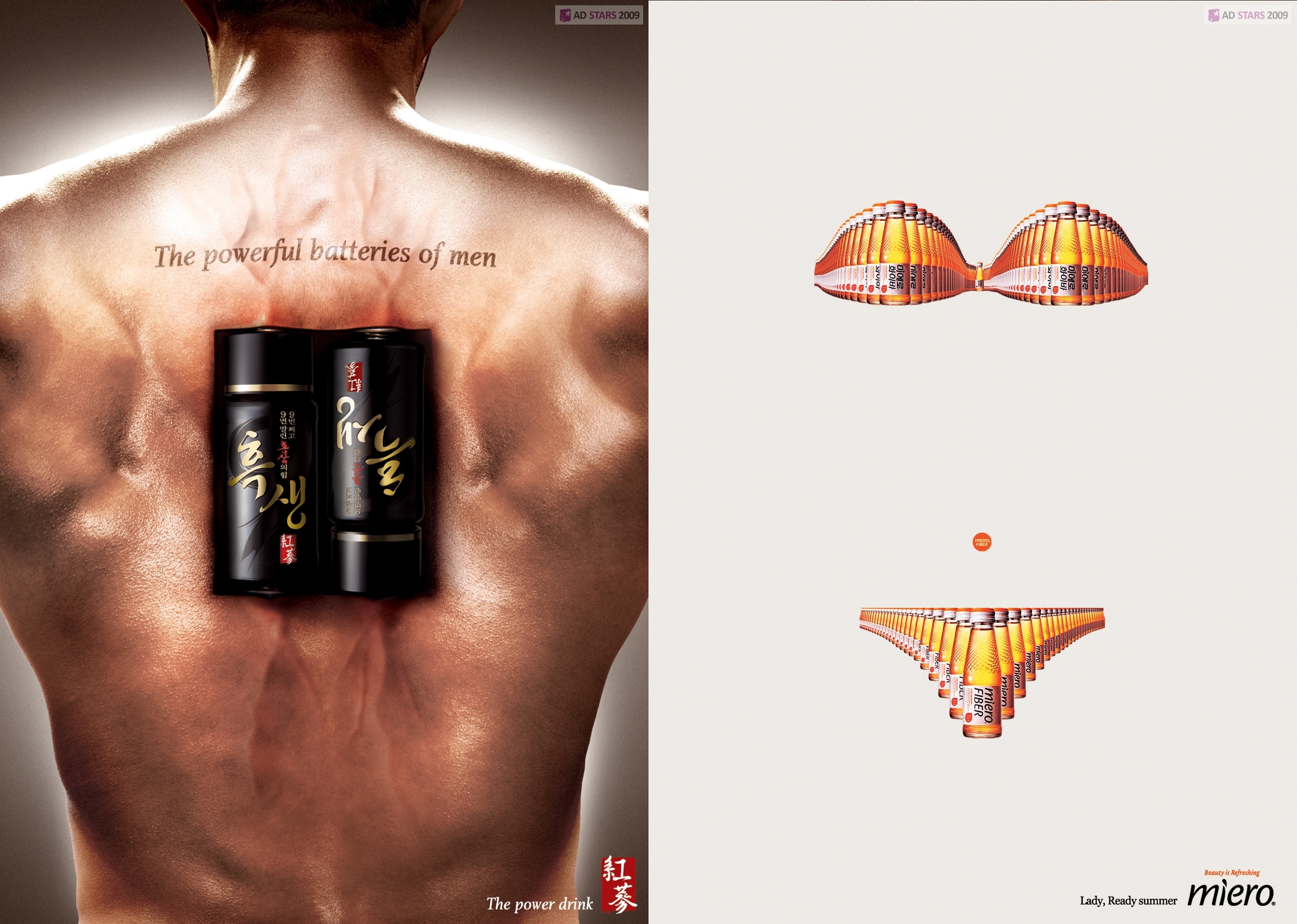
Korean Gendered Advertising( Source: left, right )

What is the first thing that goes through your mind when you hear of a “power drink” for men?

If you live in Korea, then I’d wager some form of aphrodisiac, testament to the large number of drinks claiming to improve “men’s power” or “men’s stamina” that are available here. In the particular case of the advertisement on the left though, that would be quite wrong, as Huksaeng (흑생) is the name of a health drink from Hyundai Pharm (현대약품) made with huksam (흑삼), or black-red ginseng (흑삼), and it has no prior history of being marketed to men specifically. Here you can see a women’s taekwondo team extolling its virtues for instance, albeit that of a different company.

But compare that with Hyundai Pharm’s other product Miero Fiber (미에로화이바) on the right, which in its 20-year history has only ever been marketed towards women. Currently placed alongside each other at the Busan Ad Stars 2009 website, the accidental juxtaposition of the two advertisements provides an interesting contrast. And given Koreans’ overwhelming preference for health drinks over multivitamin pills also, then the insights to be gained have more relevance to Koreans’ body images than may at first appear to overseas observers.

My own first reaction was that I was at a loss to think of an Korean advertisement for a health drink aimed at women that uses the analogy of recharging one’s batteries. This is a minor point though, and by no means do I have an encyclopedic knowledge of Korean advertisements, so I would be grateful if readers could pass on any examples that I may have missed. But with the proviso that Huksaeng is supposed to provide more of a mental and general health boost rather than improving one’s body per se, both that and any counter-examples from readers would not detract from the obvious and correct inference that Korean advertisements for “men’s drinks” generally feature men as sporty, active participants in the process of achieving that perfect body and/or losing weight. With those for women however, it’s genuinely difficult to find any that don’t promote the idea that drinking the product is the only step required.

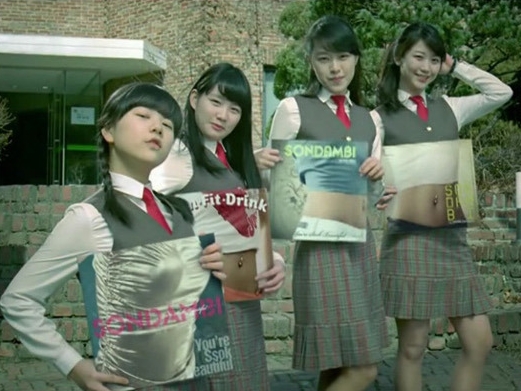
Girls' Generation Miero Beauty N Advertisement( Source )

Don’t just take my word for it though. Consider recent popular commercials with girl-group Girls’ Generation (소녀시대) for Miero Beauty N (미에로뷰티엔) here and here for instance, and more importantly the evidence provided by the journal article “Content Analysis of Diet Advertisements: A Cross-National Comparison of Korean and U.S. Women’s Magazines” (Clothing and Textiles Research Journal, October 2006), by Minjeong Kim and Sharron Lennon, which I discuss in great detail in parts One, Two, and Three of my series on Korean women’s body images from last year. More recently, I discuss it in passing in this post about an advertisement for a diet clinic and this one about the advertisement below for a slimming tea-drink also:

Unfortunately the article is no longer freely available at the link above, and I’ve long since lost my own copy of the original PDF file. I can scan my copy if anybody requests it though, but in the meantime hopefully the abstract will suffice:

Content analysis of diet advertisements was performed to examine how diet advertisements portray the Western ideal of feminine beauty and promote dieting in Korean women’s magazines in comparison with U.S. women’s magazines. Results showed that the Western cultural ideal of feminine beauty and dieting were prevalent in Korean women’s magazines. Diet advertisements in Korean magazines appear to promote more passive dieting methods (e.g., diet pills, aroma therapy, diet crème, or diet drinks) than active dieting methods (e.g., exercise). Results further indicated that women may be misled to believe that dieting is simple, easy, quick, and effective without pain, if they consume the advertised product. This study suggests that there is an urgent need to establish government regulations or policies about diet products and their claims in Korea. Magazine publishers also need to recognize their role in societal well-being and accept some responsibility for advertisements in their magazines.

In especially part Two of that series above I discuss that passivity in more detail and extend it to Korean exercise culture, further continued in this recent post about a device that electrically massages breasts in order to make them grow bigger. No, really:

Korean Breast Massager Advertisement Caucasian

Let me also pass on this post at Sociological Images about the similar gendering of energy drinks in the US, with more of a focus on those targeted towards men, and this one at Feministing about the fact that laxatives there are almost exclusively marketed towards women, with the implicit purposes of losing weight. To which I’d add that their Korean equivalents are both ubiquitous and completely lacking of the usual euphemisms, instead providing computer graphics of bowel movements that leave little to the imagination. Rather than continuing in that vein though(!), let me close with a question prompted by the latter post: what is the reason that products like these are marketed specifically towards women?

(For all posts in the “Korean Sociological Image” series, see here)

Share

Tamna: A Radical New Korean Drama?

Tamna, The Island

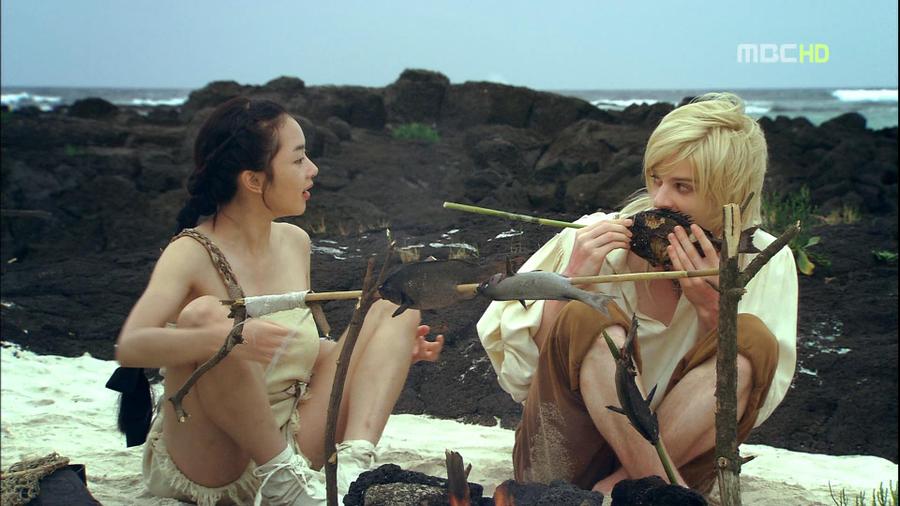
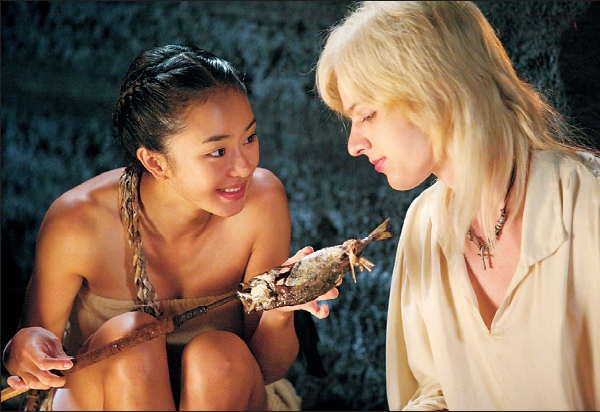
With thanks to reader Ezra de Leon for passing the news on, a new Korean drama called Tamna the Island (탐나는도다) appeared over the weekend, and for readers of this blog especially it is noteworthy in many important respects.

The most obvious is for having a foreigner in the lead role, a 24-year-old French model named Pierre Deporte, who has already appeared on Korean screens in the one-off male version of the Misuda (미녀들의 수다; Chatting With Beautiful Women) talk show. Here, he plays a 17th-Century Englishman who washes up on the shores of Jeju Island, and crucially he has some form of love relationship with the local female diver (haenyo/해녀) who finds him, played by teenager Jang Beo-jin (장버진). This is nothing short of revolutionary for Korean screens.

I haven’t found any confirmation of that relationship beyond this Korea Herald article unfortunately, but the first episode did feature an underwater kiss between them, albeit for the sake of giving him oxygen while hiding. But regardless of the ultimate form of their relationship though, Extra Korea! is correct in noting that it will probably be the first non-negative portrayal of a Western male on Korean television in a long time.* In addition, Javabeans, a rare non-tabloidish source on Korean dramas, also appreciates the drama’s reversal of gender roles:

…in Tamna, the women are hard-working and tough, at all ages from moms down to young girls. The men are painted a little more cartoonishly, but I think there’s potential for more than just comic relief in the setup that shows them as the weak ones in terms of the gender balance. They cower and defer to the ladies, who, while not quite Amazonian, have agency over their own lives and families. I hope the drama explores that dynamic a little more — they don’t have to make a big issue of it, but it’s a refreshing change.

Unfortunately I missed the first two episodes, which played on MBC at 7:55 on Saturday and Sunday night. But never fear, for in that above link a description of the first is provided that is so detailed it will surely take as long to read as it would have to have watched the episode itself!

Tamna The Island

Personally, I’ve been more than convinced to watch the 20-episode series in full, and I plan to download the first two episodes from the MBC website and watch them for myself before this Saturday. Admittedly, the descriptions of the “excruciating English” and “very silly, goofy” style of the drama would normally have put me off, but then I’ve recently learned that it’ s also true that “progressive” Korean directors have a habit of introducing radical social themes through comedy, and I’ve realized that I’ve probably been too dismissive of the genre previously. Certainly that may be reading too much into this particular drama though, so I’ll try to watch it with an open mind.

In the meantime, have any reader seen episodes 1 and 2 already? What did you think?

Update: My wife and I watched Episode 1, and we agreed that it was not without its charm: in particular Jang Beo-jin’s character was very cute, and difficult not to take an instant liking to. And I confess, it was difficult not to keep my eye off her lithe body also, which we got to see rather a lot of. Not to imply that the producers sexed her costume up by any means, but presumably a haenyo’s clothes would indeed have been more functional than modest, and so not without reason have generations of (male) Koreans grown up to images of scantily-clad Jeju divers!

Unfortunately though, the Jeju slang used in the drama was so thick and frequently used that explanations were given for mainland Korean speakers(!), and this rendered the drama very bad for studying Korean, which was my other main aim with watching it. I’ll still follow it via Javabeans then, but personally I’m going to switch to Brilliant Legacy (찬란한 유산) instead, which just finished with record ratings.

Update 2: Invariably a mere ploy to create interest in a drama, I usually never pay attention to rumors of its stars dating, but for what it’s worth Jang Beo-jin was rumored to be dating Im Joo-hwan (임주환) before Tamna aired. He’s the third member of its anticipated love-triangle with Pierre Deporte.

*See here for a positive portrayal of a Southeast Asian man on the big screen recently. Unfortunately those are equally rare, and ironically the movie also features the typical negative stereotypes of Western male English teachers.

(Image sources: Naver; Korea Herald)

Share

The Grand Narrative in TIME Magazine

Going Down David Smeaton(Going Down by David Smeaton; used with permission)

For the article in full, on Seoul Mayor Oh Se-hoon’s “Happy Women, Happy Seoul” plan involving more women’s toilets and the notorious pink parking spaces, see here. Meanwhile, for readers coming from there, see #2 here for the specific quote of Lee Myung-bak’s for which the blog was mentioned, and #2 here for more information on Korea’s disproportionately low Gender Empowerment Measure.

I would also add—with no offense to reporter Veronica Zaragovia, who necessarily had to omit most of what was said in our interview—that the argument that “the plan may end up reasserting South Korean women’s secondary status more than boosting it” is also one that I made in our phone conversation. I based it on the knowledge that the pink parking spaces were made wider in order to better accommodate loading and unloading pushchairs and so on (see #3 here), which had reminded me of this post from Sociological Images about the images in our daily lives that serve to subtly reaffirm the notion that childcare is primarily women’s responsibility. In that vein, while the extra space may well be appreciated by mothers, consider that if I were to park in one of those spaces myself, with just as pressing a need for the space to deal with my two young daughters in the back as my wife would have, then as a man I would be likely either be fined or shooed away.

I grant you, it sounds innocuous. But place that into the context of Korean women having the lowest workforce participation rate in the OECD, the result of a combination of a lack of childcare facilities and an enduring male-breadwinner mentality that forces a stark choice between motherhood or a career, then the underlying sexist logic becomes apparent. Moreover, with Korea in turn having the lowest birthrate in the world, the economic effects of which will be felt soon, then one might reasonably ask if the money could have been better spent.

p.s. Apologies in advance for some light blogging this week; I have a conference presentation to give this weekend.

Update, January 19 2010: See The JoongAng Daily here for all the ways in which programs like this have been considerably expanded since this post was written, now including pink spaces for women at bus stops, on buses, in parking lots and special pink taxis under the rubric of improving women’s safety (via: The Marmot’s Hole).

Unrequited Love…or Stalking? The Pitfalls of Dating in Korea

How to deal with a stalkerIn Korea, it is accepted practice for men to relentlessly pursue the objects of their heart’s desire, sometimes for many years, and despite if said objects clearly, repeatedly, and vehemently express their disinterest.

Far from being viewed as stalking however, it is generally viewed as both a sweet and noble sign of one’s love and dedication. There’s even a proverb specifically for this: “열번찍어 안넘이 가는 나무 없다,” which roughly translates as “There is no tree that can withstand being chopped 10 times.” (Image source, right.)

It’s not that I can’t see those sweet and noble elements, nor how many Korean women would surely exploit the practice, in a playing hard to get fashion (some more Korean that comes to mind is “희망고문하다,” literally to “hope-torture [someone],” or to repeatedly string someone along and then break their heart). But I think that the consensus of most Westerners is that if the woman says she’s not interested…then she’s not interested, and hence that the man’s behavior after being told is stalking, regardless of how sweet or noble his intentions. Unfortunately, in a society that already accepts women being physically dragged into nightclubs, then foreign or Korean, women can probably expect little sympathy when dealing a stalker.

This probably won’t be the first or last time you’ll read about this subject: navigating different expectations when it comes to dating are an integral part of the expat experience, and with my limited dating experience then I can’t add much that hasn’t already had gallons of virtual ink spilt on it. Two useful things I can do though: first, mentioning that of all the guides to navigating those dating minefields out there, that this one by Michael Hurt at Scribblings of the Metropolitician is by far the best, and with many things that informs even my marriage of 6 years; and second, and which was frankly the real inspiration for this post, that over at Sociological Images there is a post that discusses the fact that:

Various journalists and scholars have pointed out over the years that movies and TV shows often portray as romantic behavior that is fairly indistinguishable from stalking.

And then a video created by Jonathan McIntosh of Rebellious Pixels, who:

…edited together scenes from Buffy the Vampire Slayer with scenes of Edward Cullen from the movie Twilight to show how behavior that is depicted as protective and romantic in the film (and book) could also be seen as disturbing

For more, see the original post here. Not that I think that the humorous stalking in, say, There’s Something About Mary had much of an effect on my own opinions of it, nor that seeing it in pop-culture somehow renders real-life examples in any country okay, but still: the next time we feel a sense of righteousness and indignation about hearing Korean examples, it is certainly worth pondering the mixed messages that Western pop-culture provides.

Korean Sociological Image #11: When you REALLY need a man…

Any Man Advertisement A recent report on Korea’s delivery cum odd-job men by Jane Han of the Korea Times, who unfortunately reinforces many gender stereotypes as she explains the interesting new service:

Is ‘Substitute Man’ Modern White Knight?

For 27-year-old Lim Ji-ae, battling cockroaches in her studio apartment has been a constant nightmare. At least one or two encounters with the insect per week put her on edge. That is, until she recently hired someone to be her personal pest control agent for 5,000 won per occasion.

He arrives at her house within 10 minutes of her call, and sometimes even picks up toilet paper, toothpaste and other urgent grocery items on his way. In fact, whatever Lim needs, he does―most of the time.

WonderWoman falls for her knight in shining armour“He’s my new best friend,” says Lim, who was actually referring to a plural group of service providers, the so-called substitute men, an emerging beck-and-call squad that evolved from the common “quick delivery service,” which simply shuttled goods from point A to point B. (Image source, right: Silver Age Comics.)

But the upgraded version exceeds far beyond expectations, as substitute men do everything from delivering food, moving heavy furniture, picking up laundry and walking dogs to escorting children to and from school.

For those of you that don’t live here and may be unaware, one of the good…nay, great things about Korea is that in addition to providing cheap and healthy food, many restaurants provide delivery for no extra charge too; suffice to say, I probably did more cooking in my last year in New Zealand than in the entire 9 years I’ve lived here. So while I am unaware of how long companies offering “quick delivery services” of other goods have been around, they’re obviously a natural extension of this service culture. If you live in an urban area and check your junk mail, then you’ll probably find that there’s at least 2 or 3 available in your area.

Delivery Man AdvertismentIn fairness then, it is good that the article mentioned this context. And, as the image available on AnyMan’s website above indicates, neither company mentioned disguises the fact that they are still mainly simple delivery companies. Continuing:

As long as nothing illegal and morally wrong is involved, almost everything is possible, says Yoon Joo-yeol, who runs Any Man, a service based in southern Seoul.

“We had someone calling for toilet paper while on the toilet,” he said, “while one man called from the U.S. to have porridge and medicine delivered to his girlfriend ill in bed.”

One picky customer, who couldn’t trust local seafood restaurants, even requested a substitute man to videotape himself catch a fish in the ocean before having the fresh catch prepared as sashimi, Yoon recounted.

“There is never a dull day,” he said, adding that services typically cost anywhere from 5,000 won to 300,000 won, considering the labor intensity of the task.

Hell, nothing wrong with any of that, nor in the list of people (e.g., single households, old people, workaholics, and so on) that Anyman’s website suggests would benefit from using their services. (Life Manager’s lists are basically the same.) It would be reading far too much into things to see fault in, say, the fact that Anyman suggests it can deliver food to sick girlfriends but not boyfriends. However, like the slave man who apparently arrives at a woman’s beck and call kills bugs however, it is very tempting to do so once you read the last part of the article:

Lee Jae-hong, the owner of Life Manager, another service provider, explains that the do-it-all service is picking up quick traction nationwide from men and women of all ages, but the best business is in the Gangnam, southern Seoul, district.

He said the large single female population in the area leads to high demand for frequent services such as food delivery, grocery shopping and simple repair work.

“The competition is becoming fierce as more and more customers are learning about the service,” said Lee said, who competes with almost 15 rivals in the area.

Experienced customers like Lim says the cost is “friendly,” but advised users to be cautious and not to expose too much personal information to the substitutes.

Sigh. Where to start?

First, the article instantly reminded me of a Sociological Images post about a New Orleans business called The Occasional Wife. Because as author Lisa explains there:

The Occasional Wife

…the business relies on and reproduces the very idea of “wife.”  As the website makes clear, wives are people who (a) make your life more pleasurable by taking care of details and daily life-maintenance (such as running errands), (b) organize special events in your life (such as holidays), and (c) deal with work-intensive home-related burdens (such as moving), all in while perfectly coiffed and in high heels!

Like commenters on that post mentioned, services that rely on and reinforce a stereotypical notion of appropriate gender roles texist throughout the Western world. Indeed, the first thing I thought of when I saw that post was the New Zealand Hire a Hubby service which started a few years before I left in 2000, and which I was curious to see if it was still in business. Apparently so:

Hire A Hubby Website ScreenshotBut, secondly, I think a crucial difference is that the services of these two companies at least are premised on sharply delineated notions of “wifes” and “hubbies,” whereas with the Korean “Deliveryman 2.0,” they’re so new that social conventions on typical clients and services offered seem very much in flux. Or are they? Take the videos of typical clients and services from the Life Manager and Anyman websites for instance (apologies for the poor quality):

Tellingly, neither video promotes the company as the purveyor of the services of big burley men to hapless single females, and the former especially portrays quite a range of clients, including—shock, horror—some men. Which raises questions as to why the author chose to portray them as such.

Korean Alpha GirlsOn the other hand, there is indeed a large population of singles in the Gangnam area (see this post on Seoul demographics as for why), and I grant that there is a possibility—but only a possibility—that there is something special about single women that live in Gangnam that means that they disproportionately use such services. After all, it is the most expensive and sought-after area to live in whole country, so presumably there would be a large number of rich single women there quite used to paying others for the basic services us mere mortals have to do our ourselves.

However, the same logic would also apply to the rich single men that live in the area.

That said, it has been suggested that all the single women are not rich but rather work in the numerous bars and brothels there, which may well have a grain of truth in it; if so, among singles at least, there may well be a disproportionate number of women in that area. (The report discussed in that earlier post of mine doesn’t provide that level of detail.) Not living in Seoul myself though, I’d be grateful if Seoul-based readers can confirm if there is something to that possibility or not.

For a moment then, I thought that discomfort with the article was unjustified. Perhaps the owner of Life Manager is an angel, who just so happens to have a great deal of business catering to single females in the Gangnam area— nothing wrong with that. But still, I’m unwilling to let him or perhaps author Jane Han entirely off the hook. In particular, although I shouldn’t jump to any conclusions without seeing the original Korean transcript of the interview, the former does say:

…the large single female population in the area leads to high demand for frequent services such as food delivery, grocery shopping and simple repair work.

Ergo, needs for help with those tasks—and, apparently, killing cockroaches—are inherent to the single female, regardless of where they live. Which reminds me of last year’s report on “Alpha Girls” by The Chosun Ilbo, which depicted single women living with their parents as both incapable of and unwilling to do housework, as well as being basically selfish and useless overall; whereas a discussion with virtually any 20-something Korean can confirm that the reality is that they are expected to, can, and generally do do a disproportionate amount of housework, unlike their brothers. Of course, we have all met single women like the article describes, but just as many single men too, and similarly there was no objective reason for Jane Han to give this article the passive, useless female/knight in shining armour tone to it that she did.

Why did she then? I’ll leave that up to the reader. But as blogger Gord Sellar points out in this excellent post on Korean consumerism here, there does seem to be quite a backlash among certain groups of Korean men against single, independent women, and it would be no surprise if this was increasingly reflected in the Korean media. It’ll certainly be something to keep an eye on in the future.

(Hat tip: Roboseyo. For more posts in the “Korean Sociological Image” series, see here.)

Koreans, Westerners…and Sex (Again)

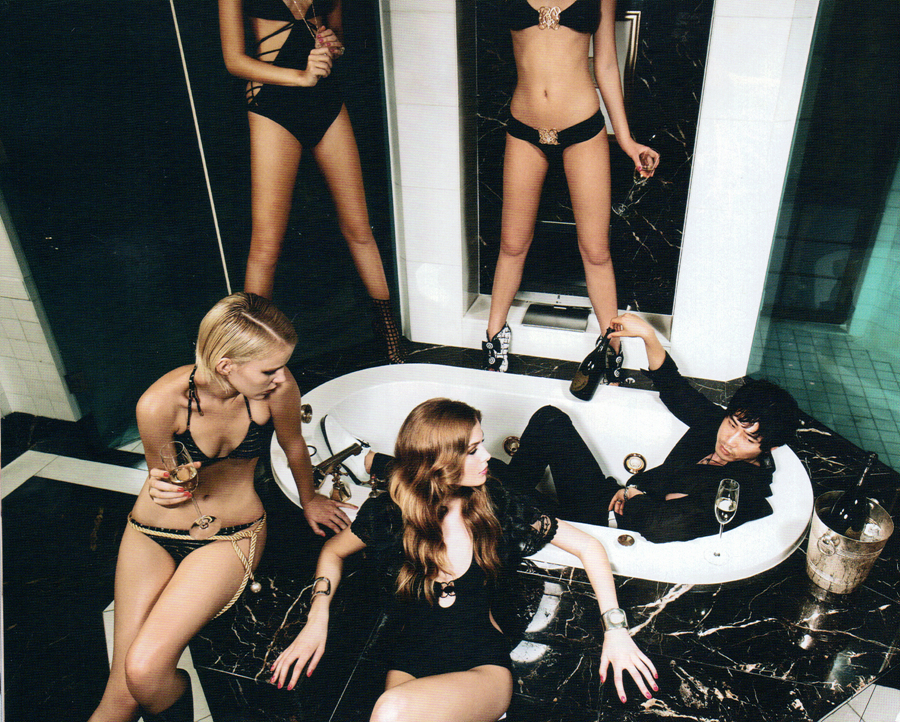
Kang Ji-hwan Esquire Korea July 2009 Bikinis

Apologies for the light posting and not responding to comments and emails, but my 50-hour weeks are having their toll. Fortunately, this is the last one, and as I type this I’ve just finished a long post that will be up by tomorrow.

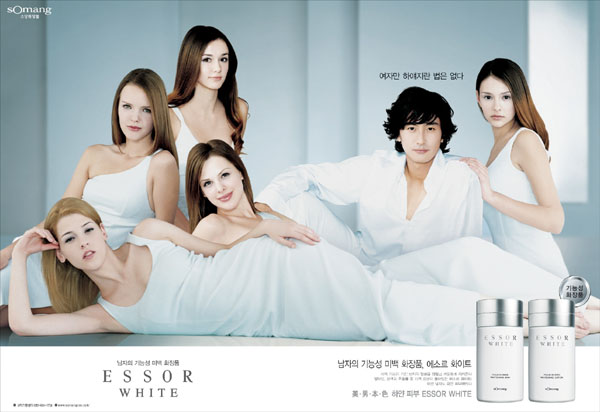
Until then, let me quickly mention this post over at The Marmot’s Hole about a short video cum picture-documentary on the hypocrisy of the Korean media’s stereotypes of Western men as sexual predators and – to the extent that they’re portrayed at all – very negative and sexist images of the Korean women who enter into relationships with them, but at the same time readily (and increasingly) presenting images of Korean men with Western (read: Caucasian) women, albeit with the latter also usually portrayed in an similarly sexist and degrading fashion. To which I present as Exhibit A actor Kang Ji-Hwan’s (강지환) latest photoshoot for Esquire Korea above, which you can see more of here, and as Exhibit B this Somang Cosmetics advertisement below (source) with Ahn Jung-hwan (안정환) from 2003 that it instantly reminded me of, which I discuss a little here. Naturally, I’d be the last person to be offended by women in bikinis in particular, but still, there are alternatives to depicting Korean male-Caucasian female relationships with the latter as something other than mere trophy girlfriends. Yet I can only think of a handful of examples.

essor-white-ahn-jung-hwan-advertisement-2003-somang

But being an understandably large and ongoing concern of the (overwhelmingly male-dominated) Korean blogosphere (see the links at the end of this post), then normally I choose to blog about other aspects of gender-relationships in Korea, but a) I confess that with this post I was *cough* glad to finally find an excuse to post the Esquire pictures sans lengthy analysis, and b) as the creator of the video took a dozen or so images from this blog to make it, then other readers may well find it interesting just for that reason. All the same, I link to the video rather than providing it here myself, as I’m more interested in the issues it raises rather than the video per se.  But if you are, then you can certainly depend on a lively discussion of it at The Marmot’s Hole.

With all due respect to the creator of the video though,  I would agree with critics there that: to a large extent it is preaching to the choir; it has a confusing message; the reference to the Virginia Tech massacre was completely unnecessary; and, above all, it needs to have Korean subtitles if it has to have any effect at all on most Koreans. But still, a picture does say a thousand words, and despite those handicaps it will probably get much more attention from them then this English-language blog has. Hmmm…

Update: A second, much better video has been made. See here for my post and many comments on it.

Share

Korean Sociological Image #10: “Blackface”

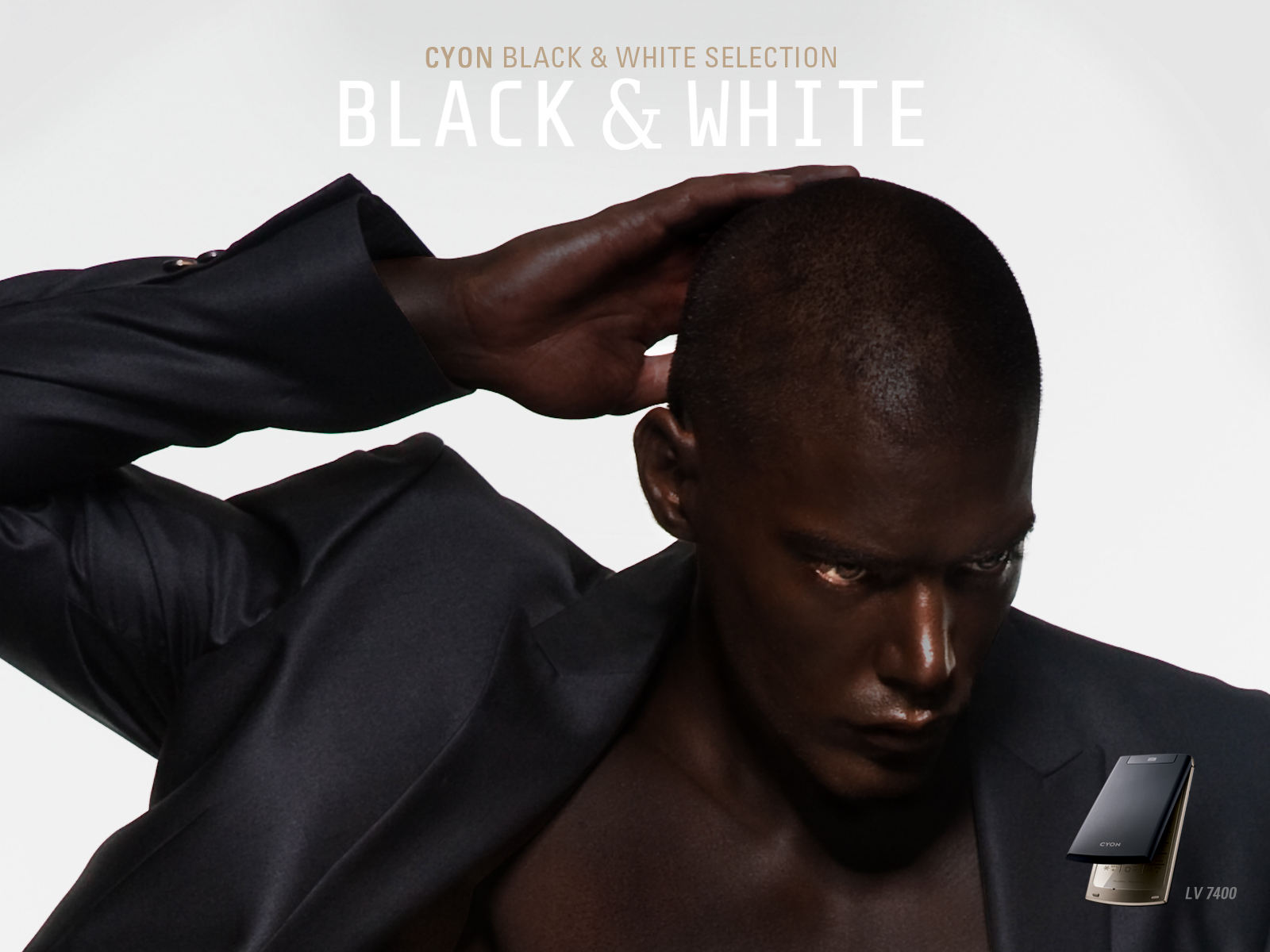
Cyon Black and White AdverisementSpare a thought for the hapless LG Cyon marketing department. Because after 12 years in the business, it must be really difficult to think of interesting names for new phones.

No, really: how else to explain the singularly uninspired choice of “Black and White” for the latest, well, black and white LV-7400 phones to come out? Sure, the likes of “Lollipop” and “Ice Cream” may hardly have been all that creative either, but at least they spawned quirky and memorable advertising campaigns, whereas this series of advertisements for the LV-7400 seems dull, uninspired, and above all too literal. In fairness though, they do provide an instant and dramatic representation of the product, and the commercial itself has a mild eroticism and sensuality to it that compels you to look more closely.

But of course, it’s not those that made me sit up and take notice:

Cyon Black and White Phone AdverisementCyon Black and White Adverisement Black Guy

Yes, that is indeed not a Black man, but a Caucasian man somehow painted black.

It’s so bizarre, and so difficult to rationalize. Because was it really so difficult to find a genuine Black guy? No of course not, and given the extra time and effort involved in painting a Caucasian one then it must have been a deliberate choice. But if so, wouldn’t it have been far more logical and consistent to have also included a Black woman painted white? If not, then what is the “coloring” supposed to signify? And why, oh why, weren’t these blatantly obvious questions  asked by LG Cyon?

Very flawed concept and execution aside though, could the advertisement be construed as racist in any sense?

To answer, my first thought was to turn to Michael Hurt post’s about other Korean examples of the “Blackface” phenomenon at the Scribblings of the Metropolitician, and I broadly agree that the examples he gives are indeed offensive. Moreover, a huge multinational company like LG (of which Cyon is just the name of its mobile phone arm) would almost certainly be aware of the reception they would receive in Western markets, and as such cannot claim ignorance of their racist connotations and history, a parallel of which is Coreana’s use of Nazi imagery in a cosmetics commercial (see Brian in Jeollanam-do here and here for more on that). Nor do I accept the argument that images that Westerners would find problematic are automatically rendered acceptable simply by virtue or being made by and for Koreans, a culturally-relativist Girls' Generation Original Album Coverargument that at the very least is highly patronizing to the latter.

But despite all that, my gut reaction to first offenses is to give the various Korean institutions, companies, and/or individuals behind them the benefit of the doubt, and to use them as an opportunity for education. In particular, because Korean society almost completely lacks any sense of political correctness (which can be as refreshing as it is annoying), and as, for instance, the recent controversy over the use of icons of its former Japanese colonizers for Girls’ Generation’s new album cover (see here and here) demonstrate, or the choice of a comfort woman theme for a series of erotic photos, many Korean companies can display a shocking ignorance of what might offend just fellow Koreans, let alone foreigners. Moreover, considering that: until as late as 2006 Korean social-science textbooks stated that Korea was a homogeneous society and that this was a source of national strength (see #1 here); that a great deal of manifestations of supposedly Western culture in the music industry especially are mere imitations of domestic acts that have come before them, sans non-Koreans’ cultural baggage and angst; and finally that, in Japan at least there are:

…teenagers who used to dress up, and maybe still do, in a fashion known as Ganguro (ガングロ), which literally means “black-face.”

According to a Western video report on this phenomenon, this look does not come from people of African descent; instead, its origins are traceable to a Japanese comic’s donning of blackface in order to clown around in a loincloth in the guise of an aboriginal Australian.

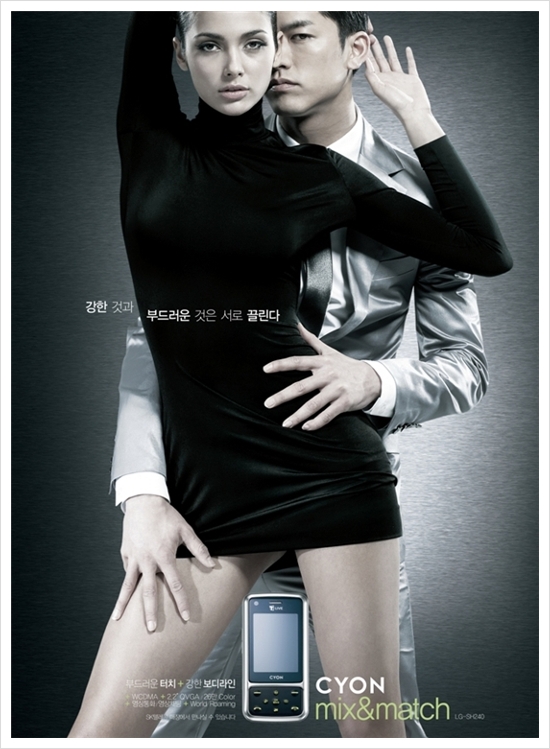
Mix&Match Cyon Korean Phone AdvertisementWith influences on Korea also (again, see Michael’s post), then it’s almost surprising that offensive advertisements and so on don’t crop up more often, and perhaps demonstrate that Korean society is improving in this regard, albeit more slowly than surely (see below).

Also, while intent is not the only consideration in judging such an advertisement, it is still probably the most important, and accordingly I’m at a loss as to how the Cyon advertisements could be construed as a deliberate attempt to demean Black people somehow, regardless of how much offense it may or may not generate: indeed, if that was the intention, then it could certainly have been done much more directly.

That said, I’m reluctant to let Cyon completely off the hook. For take its advertisement from last year for the “mix&match SH-240” series of phones on the right for instance (source). In isolation, then they’re not bad at all (sex sells after all), but again, consistent and logical would have been alternative advertisements with a Caucasian man and a Korean women getting it on also, let alone Koreans with partners of other ethnicities, and I see such a lack as both very deliberate and emblematic of the Korean media’s issues with such relationships even in 2009 (see here, here, here, and here). But that’s another blog post, albeit one which I have to write very soon as part of my preparation for this conference in August!

Update, October 17) See here for another controversial example of “contemporary blackface,” this time from the French version of Vogue magazine.

(For more posts in the “Korean Sociological Image” series, see here)

Korean Sociological Image #8: America…Fuck Yeah!

Korean Advertisement Sungshin Women's University Relative Size Racism Caucasian

An advertisement from today’s Korea Times, which immediately grabbed my attention for 3 reasons:

  • It’s for a women’s university, but not only does it feature men, it has more men than women.
  • It has a Caucasian man in it, whereas the target audience would overwhelmingly be Korean.
  • The Caucasian man is easily the most prominent feature in it, and is looking at the viewer rather than into the distance like the Korean students.

After just a few minutes thought though, obvious reasons emerge for all of those: men are and should be featured because the program is available to both men and women (well technically, the website doesn’t mention anything about the sex of applicants) for instance, and for all their ethnic diversity Caucasians are still an instant and logical signifier of Western countries. And dealing face to face with an American colleague at an American hospital – ie, having a job at one – is precisely the goal of students that will enter this program too, which in turn is well represented by the Koreans in the advertisement looking towards their futures as it were. As the male Korean is wearing a tie, then I’m a bit unsure as to whether the Koreans are supposed to be students in the program or graduates with jobs looking for better opportunities, but other than that slight confusion then the advertisement appears logical as a whole.

Still, despite myself it gives me misgivings.

One minor reason is because the doctor is male. Nothing wrong with that of course, but it seems strange to have a male role-model in an advertisement for a women’s university. Yes, I know I just said that the doctor is supposed to be a future colleague, yet in addition to representing both that and a life in America he does still have a job that students entering into the program would aspire to. If the primary target of the advertisement is women then, not choosing a female doctor seems like a wasted opportunity to kill three birds with one stone.

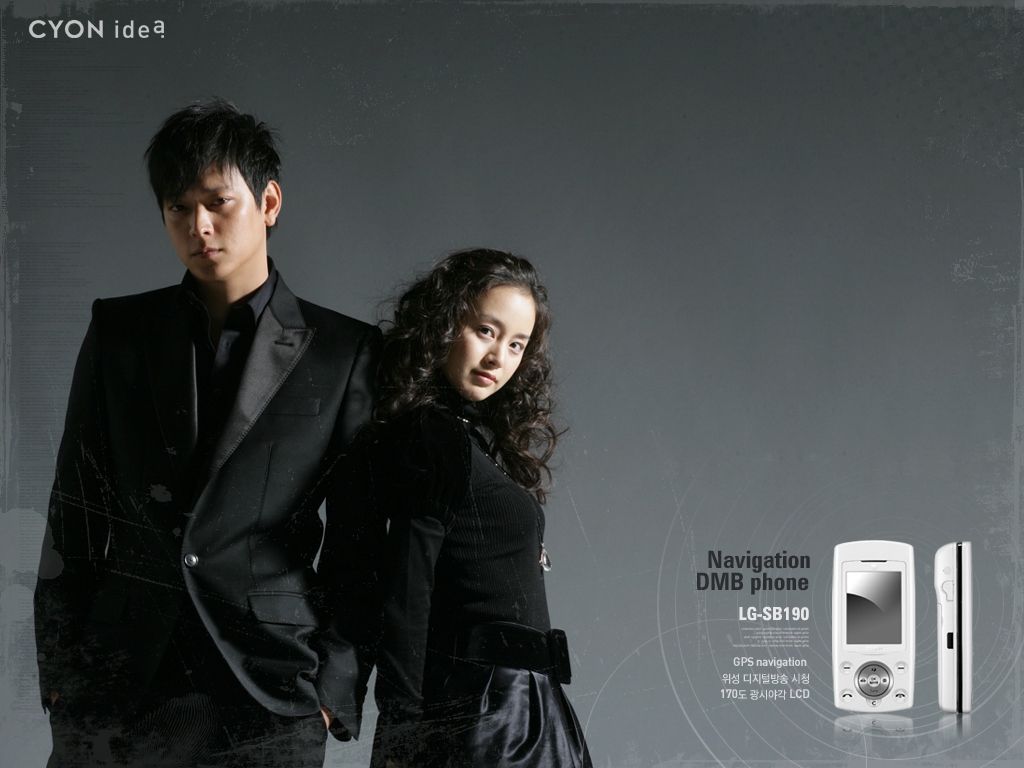
kim-tae-hee-kang-dong-won-cyon-phone-advertisement-relative-size-eab980ed839ced9dac-eab095eb8f99ec9b90( Source )

But dammit, why’d he have to be so big? As I discuss at great length here, relative size is one of the most powerful tools in advertising, not only making certain features more prominent than others but also – especially when it’s used to contrast two or more people of different sexes, ethnicities, jobs, ages, and so on – both determining and conforming to social norms of ranking, status, and appropriate social roles. For instance, if you take a random man and woman then in 1 in 6 cases the woman will be of equal height or taller, but in advertisements the figure is closer to 1 in 20 or even less. Not that that is evidence of sexism per se though, as women overwhelmingly prefer men that are taller than themselves, and it’s natural that many advertisements would reflect this. Moreover, if you’ve chosen specific celebrities with a significant height difference, say Kang Dong-won (강동원) and Kim Tae-hee (김태희) above, then it would be difficult to engineer a realistic-looking advertisement in which he somehow appears shorter than her.

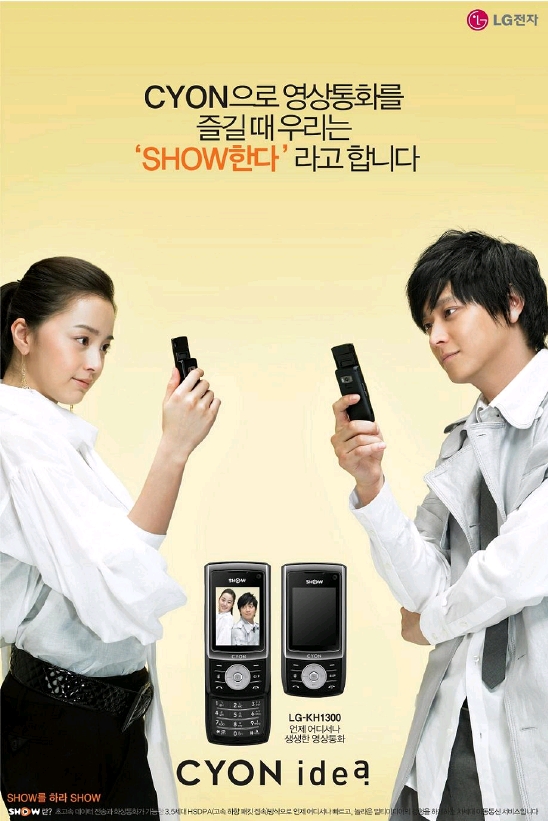
kim-tae-hee-kang-dong-won-cyon-phone-advertisement-eab491eab3a0-relative-size-eab980ed839ced9dac-eab095eb8f99ec9b90But then consider this advertisement on the right with the exact same couple (source), in which the height difference has been significantly reduced. Sure, it’s not the only reason why the advertisement has a completely different, more egalitarian vibe than the first, but I’d argue that it’s the most important one. And to hammer that point home, consider how simply bizarre everyone would find the above, gangsterish one if Kim Tae-hee were just a little bigger, let alone if a woman taller than Kang Dong-won had been used.

Ergo, size matters, and so while my concern with Sunghin Women’s University’s advertisement may well only stem from the inherent angst of being a socially-aware Caucasian male, guilty at living in a country where being such undeniably confers certain advantages, it still leaves me feeling a little uncomfortable. I would have much preferred one that focused more on the Korean students themselves, and how the program empowered them, but while retaining the signifiers of America, the job, and so on. Not something that basically says:

Oooh, do this course, and you can talk to and work with White people! In America!!! What more could you ever want?

Okay, that specific vocalization may just be me. Or is it? That’s a rather indelicate way to put it above, but it is certainly true that living and working (and being educated) in America conveys a lot of status in Korean society, so far from me implying that any Korean is a passive dupe for responding positively to advertisements like this it is logical and intelligent for them to do so. Moreover, my wife, who is Korean, pointed out that most Koreans wouldn’t think twice about the Caucasian in this ad. Perhaps my concerns are misplaced then.

What do you think? Mere overanalysis and liberal-arts major angst on my part? Or a legitimate concern? Regardless, admit that the doctor is the first person you noticed too though!

(For all posts in the “Korean Sociological Image” series, see here)

Share

Choi Jin-sil Sued For Being Beaten by Her Husband: Update

Choi Jin-sil holding back tearsWhen hearing last week about something as appalling as an actress being sued for daring to show her bruises and black eyes to the media, it’s only human nature to assume the worst of Korean society.

But while Korea certainly does have a great deal of work to do in combating domestic violence—and criminalizing spousal rape would be an essential first step (see #2 here)—it’s also true that police and legal attitudes towards it have considerably hardened in recent years, both cause and effect of a law change in 2007 that requires police to forward all cases of domestic violence to a prosecutor (the previous 1998 law just left it up to their own discretion). In addition, Korean women are now more likely than ever to divorce on the basis of verbal or physical abuse, rather than suffering silently as in past decades.

Indeed, what stands out more than anything else about the court decision is how much it goes against the grain of trends within Korean society, and certainly does not reflect the will of all Koreans. Some quick excerpts from today’s Korea Times for instance:

Women’s groups are angry over the top court’s ruling that ordered the late actress Choi Jin-sil (최진실) to compensate a builder for failing to maintain “dignity” as a model representing its products.

They censured the Supreme Court for not realizing the suffering of domestic violence victims, which included Choi.

Korean Womenlink, the Korea Women’s Hot Line, and the Korea Women’s Association United issued a joint statement Wednesday lambasting the ruling.

On June 4, the court reversed a high court ruling that decided in favor of Choi in a compensation suit filed by Shinhan Engineering and Construction in 2004 against the actress, who was the model for its apartments.

The advertiser claims she did not keep her contractual obligation to “maintain dignity,” because she disclosed to the public her bruised and swollen face which was caused by the violence of her then husband, former baseball player Cho Sung-min. They divorced soon afterward.

For the rest, see here. Also, see here for my original post on this issue and information about similar cases in the past, and here for a quick primer on the numerical rates of domestic violence in Korea (albeit in 2004), with many graphs and tables.

(By the way, although it was already common knowledge, it’s good that the Korean media is now naming the company. But I wonder if it was originally kept anonymous by a court order, or just by convention?)

Firm Sues Dead Actress For Being Beaten by Her Husband – And Wins

Choi Jin-sil holding back tearsA simply outrageous story, that couldn’t really wait for my “Korean Gender Reader” on Monday.

But, given the similar case of the singer Ivy (아이비), whose reputation was ruined by her ex-boyfriend threatening to release a sex-video of her to the media in late 2007, and who was later sued by advertisers for this despite the video never actually existing, then this latest case with Choi Jin-sil (최진실) is exceptional only in degree really.

However, in suing an actress that committed suicide, the unnamed construction company (Update: It’s Shinhan/신한건설) below may well have pushed the limits of public acceptability, and this will hopefully incur a backlash that will far outweigh the relatively small gains now to be provided by her estate.

To play Devil’s Advocate for the moment though, the appeal was probably submitted to the Supreme Court well before Choi Jin-sil’s death in October last year (Update: Indeed, it was submitted 5 years ago). But even so, of course it is deplorable that the company submitted the original suit in the first place, and I’m sure that it would have still been possible to withdraw it afterwards.

Models who failed to maintain appropriate dignity as representatives of the products they represent should compensate for the damages caused to their advertiser, the top court ruled.

The Supreme Court reversed the original ruling and ruled in favor of a construction company that filed a suit against the deceased actress Choi Jin-sil, who committed suicide last October.

The company, upon hiring the top actress as their representing model in March 2004, concluded a contract stating Choi’s duties to pay back 500 million won ($399,361), should she depreciate the company’s social reputation.

However, in August, Choi appeared on television and newspapers with her face full of bruises, allegedly caused by the violence of her then husband and retired baseball player Cho Sung-min.

Choi and Cho, who had been living apart since 2002, divorced soon after the incident.

The advertiser company thus filed a suit against the actress, requesting for 3 billion won as compensation. The amount included the 500 million won in damages as stated in the contract, additional compensation of 400 million won and 210 million won in advertising costs spent by the company.

“The purpose of the brand model contract is to use the model’s social reputation and images to draw the customers’ interest,” said the Supreme Court in the ruling. “The model’s failure to maintain an adequate image constitutes a breach of the hiring contract.”

The concept of the apartment Choi was supposed to advertise was dignity and happiness, and Choi, as its model, was under the obligation to act accordingly, said the court.

A lower court said in an earlier ruling that Choi could not be held responsible for depreciating the image of the apartment or the company as she had not been proven guilty of causing her former husband’s violence.

Choi’s mother presented herself at court, as legal representative of her two children who succeeded their mother’s duties and became defendants of the case.

The estimated value of Choi’s estate is about 5 billion won, including real estate and bank savings, according to her family.

(Source: Korea Herald)

See here for more information about domestic violence in Korea, and #2 here for more on a custody battle which Choi Jin-sil’s family also had to face in October 2008, but which her ex-husband was persuaded to give up (see here and here), and which in turn ushered in positive changes in the Korean legal system. Here’s hoping this latest case will similarly have a silver lining, and force Korean companies to rethink the ethics and long-term financial value of insisting on compensation for events beyond celebrities’ control.

Ladies: Stay Slim with Soju?

Shin Min-a Soju Advertisement Mirror

Faced with the unenviable task of somehow making soju cool, Jinro (진로) did a pretty good job with the launching of its new “J” (제이) brand back in October, but its latest efforts to associate the brand with losing weight may well require too big a suspension of disbelief from most consumers!

Or at least, that was my first gut reaction. But then if faced with a choice of two equally priced and similar brands of any strong alcohol, probably I would indeed choose the slightly weaker one: I am slightly overweight, and it’s not like 5 per cent less alcohol wouldn’t still have the desired effect on me. How about you?

As you’ll soon see though, it’s not that which made me first notice the ad:

Vodpod videos no longer available.

Look familiar? To put it mildly, commercials featuring female celebrities lounging around in their underwear aren’t exactly common on Korean television, and so I don’t think the similarities with this advertisement with Han Ji-hye (한지혜) from March – actually, the only other example – are any coincidence. Here, the actress and model featured is Shin Min-a (신민아), as it happens in the entertainment news a great deal as I write this for her first screen kiss with Won bin (원빈), and as you can probably tell, the idea is that a 1 per cent reduction in alcohol content (from 19.5 to 18.5) somehow results in the following:

Shin Min-a Soju Advertisement minus 1inch

Shin Min-a Soju Advertisement minus 1kg

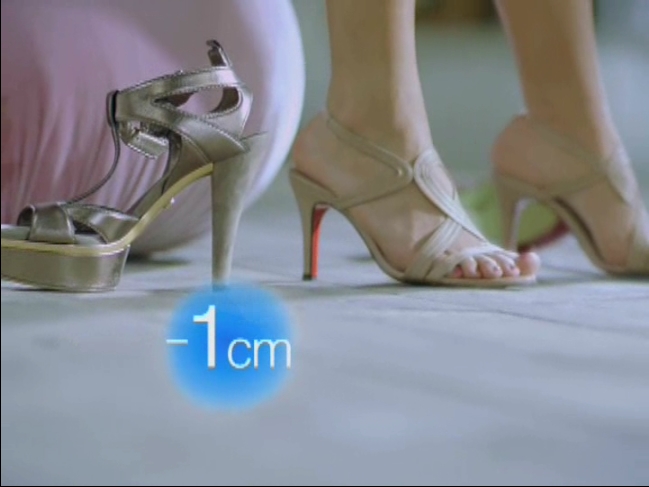
Shin Min-a Soju Advertisement minus 1cm

Admittedly I don’t like high heels in the first place, but that last is probably overdoing it, as I can’t see how drinking less alcohol than normal somehow makes you taller as well as thinner? Regardless, below is a accompanying poster for the new, weaker soju that you may have seen around, and for the sake of adding to my conversation with commentator Seamus about Koreans’ (relative) lack of awareness of the amount of photoshopping in everyday advertisements and magazine images, would be grateful if you could show it to your Korean friends, students, colleagues, and/or lovers and so on: among other things, do they think Min-a’s legs have been lengthened and made thinner in it or not?

Update: Sorry, but in hindsight it was sloppy and quite strange of me to write about this ad without translating the voiceover first, and if I had then what I wrote above would have been quite different:

1kg 빠져도, 다른데?

If you lose 1kg, are you different?

1인치만 줄어도, 좋은데

[Even] if you shorten your skirt by only one inch, it looks better.

1cm만 낮아도, 편한데

[Even] if you reduce the length of your high heels by only 1 cm, they’re more comfortable.

그리고 1도만 더 부드러워져도

처음보다 1도 더 부드럽다

And also if you soften [soju] by only one degree, it’s one degree softer from the first sip.

18.5도 진로제이

진로제이처럼 더 부드러워지세요

18.5% Alcohol Jinro J

Like Jinro, please make your life a little softer.

Shin Min-a Jinro Soju Advertisement

Placing the ad in a wider perspective, as much as 90 per cent of all alcohol consumed in Korea is soju, and Jinro sells 50 per cent of that, so this latest marketing drive may well reflect the saturation of the market more than anything else (no pun intended). In such circumstances, a company can either start selling in new markets or repackage its product in different varieties if it wants to increase profits (or to ensure that they don’t decrease: examples like this are how I learned about the Marxian “inevitable tendency of the rate of profit to fall” at university), a good example of which is the number of different Coca-cola drinks available and their (very very) rough correlation with an economy’s level of capitalistic development and competition, as evidenced by, say, the precisely two available in New Zealand when I entered university in the mid-1990s against the plethora available in the US decades earlier.

And so with equivalents in other Northeast-Asian countries, and little appeal outside of the region, diversification is probably the most logical path for soju producers. True, the above ads in particular reflect a desire to create a new market before reaching that stage – only 30 per cent of soju drinkers are women – but given that…

The word soju to most Korean women produces something approaching a mild panic – an explosive squeal of disgust, a deeply pained expression, head shaking, hand waving. That’s not to say they don’t drink it. It’s just they don’t seem particularly like it, even as they pour it down their throats (source).

…then I have my doubts as to whether that figure will ever go up to 50 per cent. Here’s hoping that the Korean alcohol industry is indeed on the verge of offering more choices and variety then!

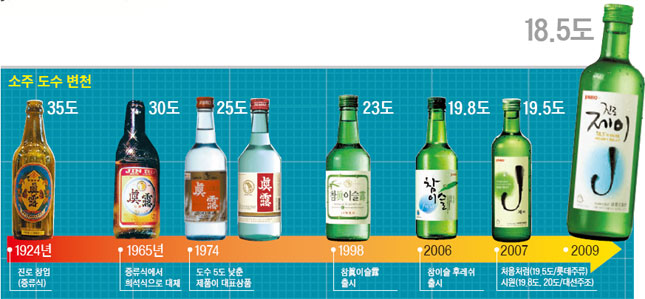
Update: Here is a related graphic showing decreases in soju’s alcohol strength over time. For more information (in Korean), see here.

Soju's Strength Decreasing Over Time

(Image Sources: first, second-fourth, fifth, last)

Share

Women Getting on Top: Korean Sexuality in Flux in the 1990s

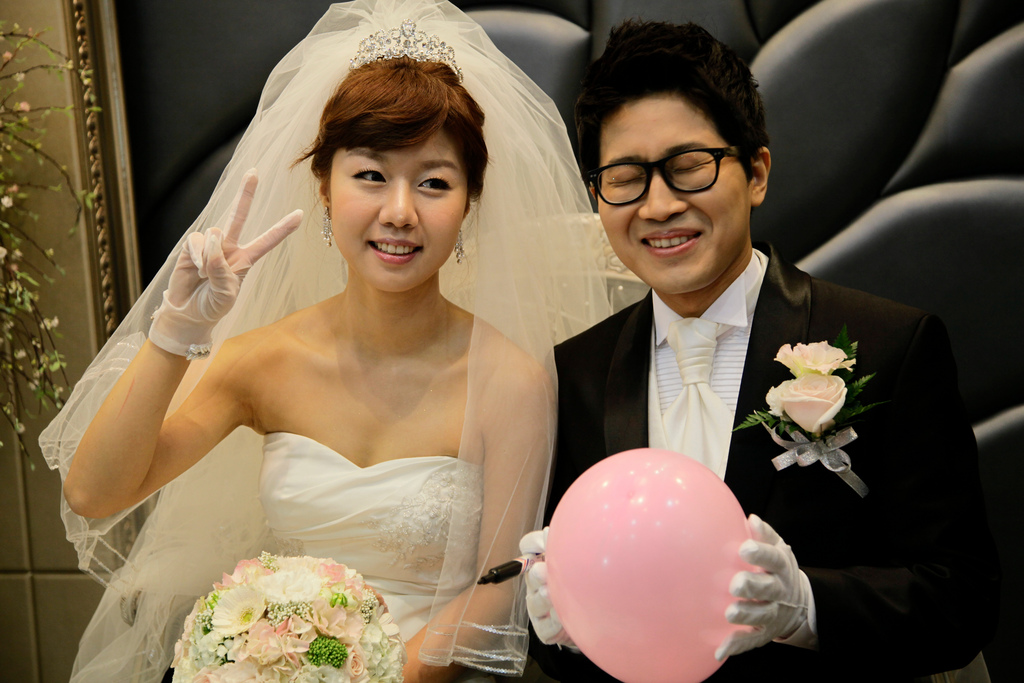
Jule Nav Wedding day(Source: Sunghwan Yoon; CC BY-SA 2.0)

Of course, a society’s accepted norms of sexuality are always in flux, and popular culture both reflections of and a huge catalyst for that. But while you and I will undoubtedly be able to name individual dramas, movies, novels, and so on that have been deeply influential in that regard (yes, Sex and the City was the first thing that came my mind too), it is probably much harder to think of a recent period which had many in rapid succession, fundamentally and forever changing a society as a result. But according to So-hee Lee, who wrote ‘The Concept of Female Sexuality in Korean Popular Culture’ (pp. 141-164) in Under Construction: The Gendering of Modernity, Class and Consumption in the Republic of Korea (ed. by Laruel Kendell, 2002) and the must-read text for Korean gender studies, this is precisely what occurred in Korea in the mid-1990s.

Which is not to say that equivalent periods in Western, English-speaking societies don’t exist: it’s just that with having spent most of my adult life in Korea, then none really spring to mind, although I am interested in learning about any that readers can think of. And there are certainly many instances of Western-Korean cultural transmission too, with Friends and (again) Sex and the City in particular arguably having surprising impacts on Korean consumerism and gender relations here despite – nay, because of – the much more sexually repressed and sexist context in which they were received. But these earlier works Lee discusses were definitely home-grown, and:

…should be considered not only as illustrations of contemporary concerns but also as generating social discourse on female sexuality….each publication and each media screening provoked intense discussions throughout Korea (p. 142).

But although this post is ostensibly about popular culture, even some of my friends in academia that specialize in it admit that the three novels, three films, two dramas, and one play Lee discusses would probably be too dated for them to enjoy watching, let alone worth going to the time and trouble to find. Moreover, my own aim in looking at this subject is primarily to demonstrate that on the eve of the Asian Financial Crisis of 1997-98, Korean women were already very open to challenging sexual stereotypes and their ideals of men, and that this partially explains their alacrity in doing so afterward, as I’ll be arguing in this conference presentation I’ll be giving in Daejeon in August (but which has evolved a lot since I first submitted that abstract many months ago: see here for my latest, hopefully much more nuanced thoughts on the subject, and to which I owe a great deal of credit to commenters on this blog). Hence, with apologies to culture buffs, this post is much more about those “intense discussions” than in the cultural works themselves.
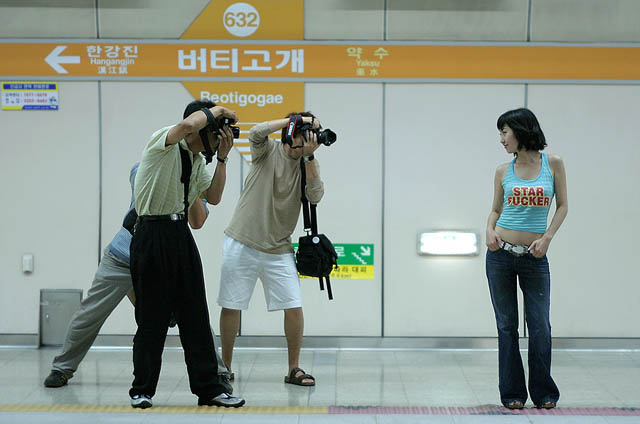
Korean woman wearing Star Fucker t-shirt(Source: Unknown)

Naturally enough, Lee starts with the context in which these cultural works were received, recalling her embarrassment and confusion when she attended some English literature lectures at Cambridge University in the mid-1980s:

My topic was “Women Characters in Victorian Novels”. During the lectures and seminars, I was acutely embarrassed by what I heard. Why was everyone talking about sexuality, masculinity, and femininity?…

In those days, Koreans did not have exact counterpart terms for “sex”, “sexuality”, “sexual intercourse”, and “gender”. I was very confused as I struggled to determine the appropriate meanings. In Korean, one very general term “seong” (성) could be used for these four concepts, its particular meaning dependent on the speaking and listening context….

It’s actually a little more complicated than that, “성” really being the chinese character that means “nature” and “life” as well as “sex”, but that probably adds to rather than detracts from her point.

….Korean society in the mid-1980s did not find it necessary to make sharp distinctions between these concepts. At the annual Korean Women’s Studies Association Conference in 1989, the issue of sex language was raised and discussed. More recently, the Korean counterpart of the term “sexual intercourse” (성교) has gained wide usage, accompanied by the frequent use of the a Korean counterpart for the term “sexual violence” (성폭행)….Sexual violence has now become a recognized issue in need of a discourse.

Korean concepts of sexuality have changed profoundly since the Democratic Revolution of 1987….In 1995, the most popular topics among university students were sexuality, sexual identity, and other sexual subjects. There are many reasons for this…In Korea, there is still no broad popular social discourse on female sexuality outside of marriage.

Which changed a great deal as a result of the 2002 World Cup, as I wrote here, but I’m getting ahead of myself. All of the above I originally typed from the book when I wrote this post about the (literal) Korean language of sex and sexuality, and in which based on my own largely unsuccessful attempts to find Korean-language internet sources on such issues as “sexist advertisements” and “sexual discrimination,” I argued that the change Lee noted was more apparent then real, and that Korean gender studies as an academic discipline clearly somewhat lagged its Western counterparts. Ironically however, that may well add to rather than detract from her arguments for the explosive impacts of the movies and so on that she discusses, for they would have been all the more exceptional and unprecedented at the time.

On top of that, something that can be said with some certainty was how exceptional Korean women (then) in their late-20s and early-30s were in themselves, as they were really the first ever Korean generation to have grown up going to school en masse, alongside their brothers, and while doing so to have learned as an abstract, academic concept the notions of democracy, liberty, and equality. Indeed, Lee is by no means the only author to note Korean military regimes’ curious desire for at least the trappings of democratic legitimacy through (tightly-controlled) elections, and a reflection of this in the education system, replete with references to Thomas Jefferson, the Magna Carta, the French Revolution, and so on. But, this meant that in the 1990s:

Looking at their mother’s lives, Korean women in their early thirties believed that their marriages would be different. Because the Korean standard of living and patterns of material life changed very quickly, they believed that Korean ways of thinking had been transformed with the same speed. This is where their tragedy begins….[this] generation experiences an enormous conflict between the real and the ideal. During sixteen years of schooling, they have learned that equality is an important democratic value, but nowhere have they been taught that women experience the institution of marriage as a condition of inequality. Many married women of this generation have [thus] experienced a process of self-awakening….(p. 144)

And another way in which that process is a novel one is because women of their mothers’ and grandmothers’ generation:

…would have had an entirely different concept of female sexuality. [They] accepted the sexual double-standard as a women’s fate and put their sexual energy into rearing children, identifying themselves as asexual, strong mother figures. [But] Korean women [of this] generation give priority to their identities as sexual beings, struggling to conceptualize a sense of individual selfhood while the mystified ideology of mothering and family obligation, which has repressed Korean women for so long, collapses. (p. 145)

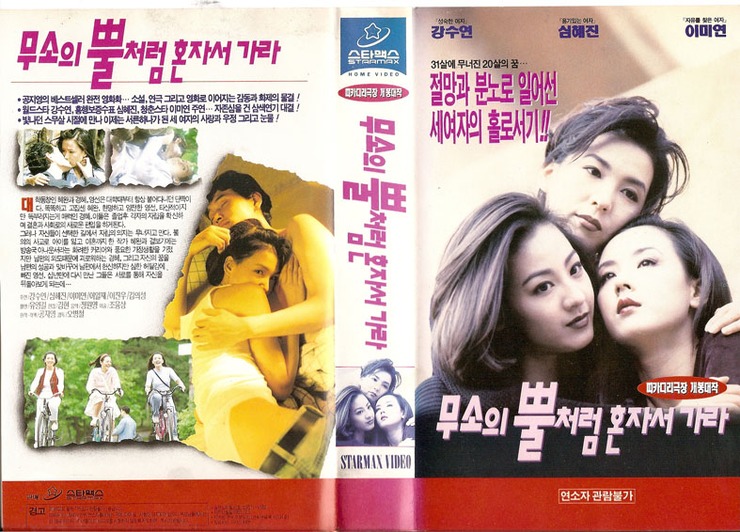
Go Alone Like the Rhinoceros's Horn(Source: Dreamday)

The novel Go Alone Like the Rhinoceros’s Horn (also know as Go Alone Like Musso’s Horn) (무소의 뿔처럼 혼자서 가라, 1993) by Gong Ji-Yeong (공지영) , produced as a play that performed for several months in 1994, and released as a film in 1995 (both adaptations were successful), is about the lives of three married women friends, all 31, and all of whom deal with that process in different ways. Another is the widely-read novel Marriage (결혼) by Kim Su-hyeon (김수현) in 1993, which was made into an even more successful television drama the following year, and about the marriages of three sisters (aged 25, 32, and 34) and their different perceptions of the institution based on their different ages, and indeed it is in Lee’s discussion of it that I first came across the quote that I’ve used repeatedly in this blog:

Generation is an important attribute of identity in Korea, like race in the United States. (p. 146)

But in this section of the chapter I think Lee disproportionately blames Korean husbands seeing their wives as asexual, unattractive ajumma (아주마) for their sexless marriages (and finding their own sexual relief with mistresses and prostitutes and so on), whereas in reality just as many Korean women share widely-held stereotypes and expectations of rarely having sex after getting married or having children, even in 2009 (I am not exaggerating: see here).

Sex is Zero 2 sex scene( Source: KoreanMovie)

Probably by coincidence, at about the time that these were making waves, the new term “Missy” (미시) was invented, which when Lee wrote (it’s not so common these days) was used widely as:

…an expression of the strong desire of young Korean wives in their late twenties for an alternative way of life. The term was first used…in the marketing advertisement of a grand department store in Seoul. As soon as it came out, it was adopted widely to indicate a particular kind of housewife, a married woman who still looks like a single woman. Even the copywriter was surprised at the speed with which this term took on social meaning and evoked specific images of women and femininity. “Missy” rapidly permeated the Korean language once the advertising industry recognized the consumerist implications of this target age group’s flamboyant desires (pp. 149-150).

I think Lee ascribes too much importance to the Missy concept, as both Cho Haejoang in the same book that Lee writes in, and Dennis Hart in this book on Korean consumerism, have written about a steady series of (mostly negative) terms invented in the 1980s and 1990s for different kinds of women that “Missy” is just one example of, culminating in this crass one used today and which in hindsight make Koreans’ recent predilection for naming women’s body-parts and shapes after letters of the alphabet a little more explicable (but still absurd). I also think she exaggerates its novelty, as the Korean advertising industry, buttressed as it was by Neo-Confucianism and associations of the development of a consumer industry with national security (see this series), had developed a profound and intimate relationship with Korean housewives well before 1994. But, regardless, I’m sure you can already see how well the Missy concept meshed with the provocative novels and films I’ve described. Moreover:

The essential condition of being a Missy is a preoccupation with being looked at….Film, as a visual medium, has provided the best representation of this kind of social desire, not confined to material possessions but inclusive of an active and blatant sexuality. While [some characters] in Go Alone Like the Rhinoceros’s Horn and…Marriage decide to have lovers in reaction to their husbands’ relationships with mistresses, the Missy jumps into affairs to satisfy her own needs and desires (p. 150).

And another fundamental condition of being a Missy is having a professional job, yet another reason why women being the first to be fired a few years later during the Asian Financial Crisis would have had a big psychological and cultural impact.

Women Like Men Only Cheaper(Source: Equal Writes)

The film Mommy Has a Lover (also known as Mom Has a New Boyfriend) (엄마에게 애인에 생겼어요, 1995), was about two Missys, and was exceptional in doing away with the previous film conventions of portraying women as reluctant and ashamed when they intentionally or unintentionally had a lover outside of marriage, nor of having a woman somehow punished for her “fall”. At its first screening, reactions were divided along gender lines, men complaining about the ending because it seemed to glorify wives having affairs, whereas no women expressed any complaints. Probably a more influential work involving the development of a late twenty-something’s sexual identity though (and not about a Missy per se, but in a similar vein), was the novel of the same year called The Pornography in my Mind (내마음의포르노), by then only 26 years-old Kim Byeol-ah (김별아), and whom:

…bravely deals with a previously forbidden theme. The novel rebels against the sexual double-standard, insisting on the existence of female sexual desire in contemporary Korea, where adultery is still illegal (p. 143).

Hence:

This novel [played] an important part in an emergent sexual politics by bringing the forbidden theme of sexuality into the public sphere via television talk shows and other media events. However, this public discussion has been confined to the experiences of married women (p. 151).

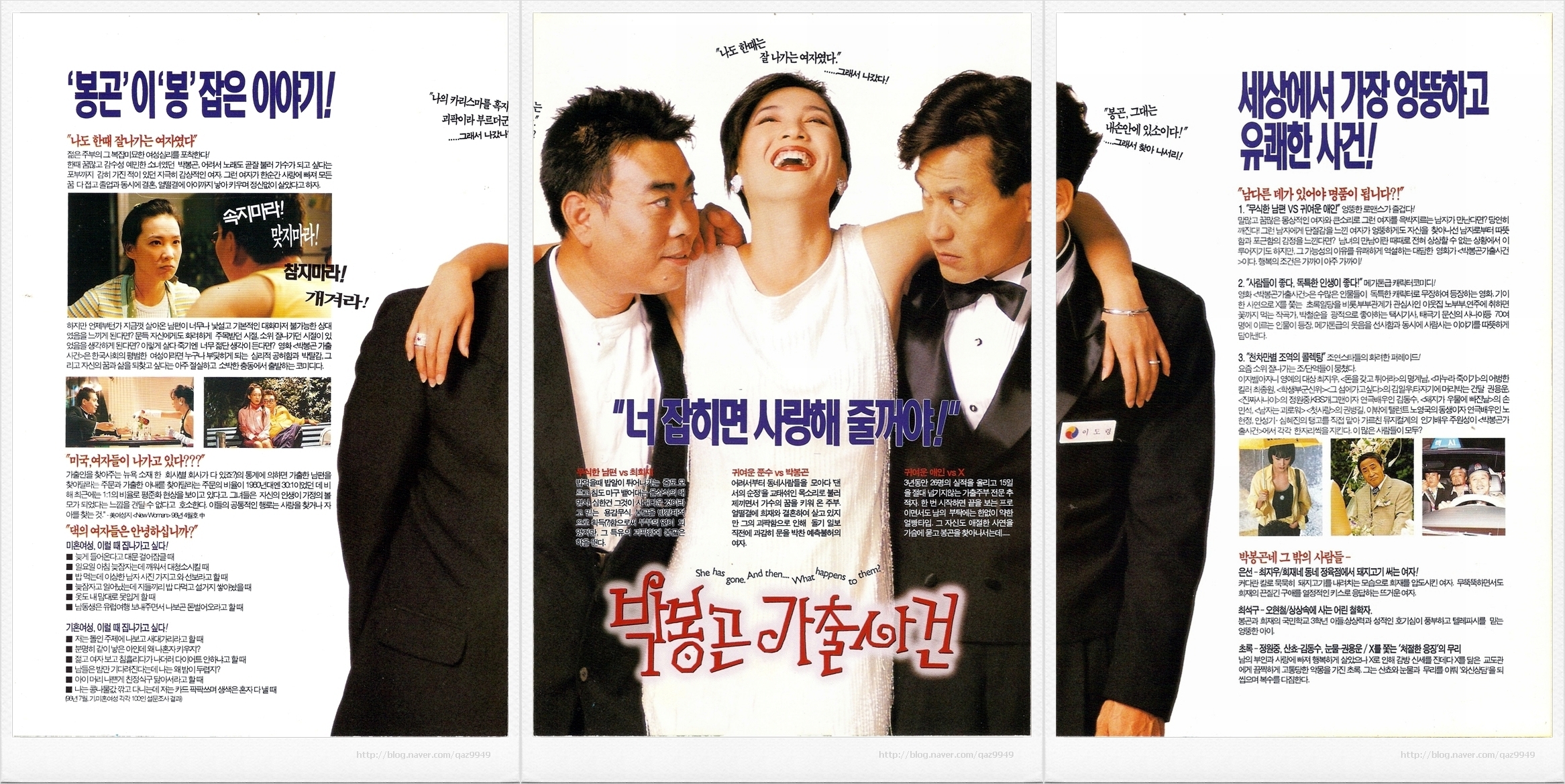
And which paved the way for the even more provocative and controversial drama The Lover (애인) and the film The Adventures of Miss Park (박봉곤 가출 사건), both of which came out in September the following year. In particular, the drama’s depiction of an extramarital love story between two highly successful professionals in their mid-30s hit Korean society like a bombshell, primarily because television tends to be conservative because of its wide audience of course, but also because both the ages of the characters meant that the drama had to confront the all-important issue of familial duties and roles. Indeed, by October it reached 36.3% of television viewers, and it:

…even was discussed in the National Assembly because of the social implications of its theme, a challenging portrayal of a married woman’s sexuality. This response reveals how powerful the television is in subverting the traditional ideology of female sexuality (p. 154).

my-wife-got-married-bed-scene-ec9584eb82b4eab080-eab2b0ed98bced9688eb8ba4-ecb9a8eb8c80-ec9ea5eba9b4-eb85b8ecb69c(Above: Screenshot from My Wife got Married)

An important point for me to remember, although I would have liked to have also learned more about the contents of that discussion in the National Assembly! There is, however, also a third possibility for its success that Lee does not really mention, and that is that in many senses both characters ostensibly had perfect and desirable lives, with no apparent reason to have affairs, and yet they did anyway: it must have been quite confounding to many, and which may also play a role in “many married men in their 40s and 50s  [calling] the broadcasting company to protest this drama, demanding ‘What is it trying to say?’ (p. 155).”

Rather then getting into details here, for a very thorough examination at The Lover see this lengthy presentation by Kim Sumi entitled “Popular Feminism and the Hegemonic Practice of Mass Media: A study of two South Korean TV dramas, Lovers [The Lover] and The Woman Next Door,” which was presented at the annual meeting of the International Communication Association in New York in May this year, and in passing let me note a point not unimportant to my presentation, which is that like in Mommy Has a Lover, the man that the lead female character has an affair with “has a soft, gentle, and sweet personality, reflecting the new masculinity of 1990s Korea” (p. 155). Meanwhile, Lee sees the drama as having:

…accomplished a great deal in bringing into public discourse the issue of a middle-aged wife’s sexuality. Until recently [which is 2002 at the latest, but I think she’s actually writing in early 1998 – James], the wife’s subjective sexuality has been elided by the web of obligations spun by the husband’s family or by the terms of a wife’s subordination to her husband, as in [one character’s] case in Go Alone like the Rhinoceros’s Horn. However, in the mid-1990s, as the wife’s subjective sexuality emerged through the weakening of Korean familism, a sympathetic rapport between a man and a woman became more important than the functional element of role obligations between a husband and wife, or of a father and mother to their children (pp. 155-156).

Coming out at the same time as The Lover, on the surface The Adventures of Mrs. Park is an average romantic comedy, albeit a very successful one, but Lee notes that unlike the convention of most films in the genre, this one ends with a women running away from a domineering husband, achieving her dream of becoming a singer, and finally entering into a happy second marriage, “thus subverting a traditional morality that expects the runaway wife to come back home to restore everyone’s happiness and family security (p. 156).”
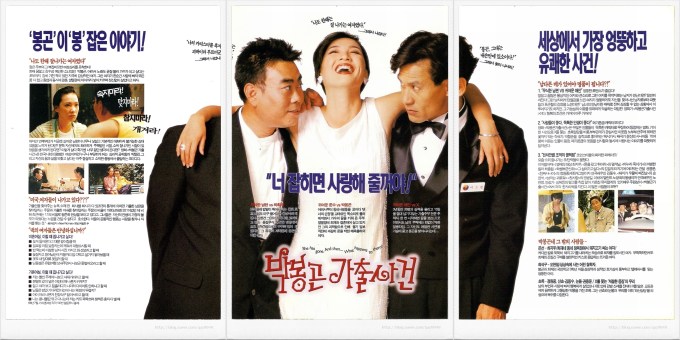
The Adventures of Mrs. Park(Source: Unknown)

As such, Lee notes the film director was concerned about how a conservative audience might respond to the uncommon story and its unexpected ending, and in many ways the movie presents a guerrilla attempt to sneak a serious social message into Korean cinema by presenting it as comedy. In the poster above for instance, it appears that the female character is in possession of two men simultaneously, and what’s more she is bursting into laughter while her soon to be ex-husband and the detective he hires to find her (who falls in love with her instead) stare fiercely at each other, whereas in reality women less wealthy than the Missys described earlier (and the characters in Mommy Has a Lover and The Lover) tended to be (and still are) very economically dependent on their husbands and therefore very submissive to them, and hence that is how they tended to be portrayed in previous Korean movies. Moreover, the happy ending made possible by the comedy genre here implicitly highlighted the grim reality that such an act would entail for most women in that position…and which probably explains much of its success, for it articulated their feelings.

And that marks the end of the works that Lee looks at. By way of conclusion, let me mention just two things that she mentions in her final section of the chapter, entitled “Prospects for the Social Concept of Sexuality in Twenty-First Century Korea”. First:

Looking at Korean culture with a certain detachment, I can imagine that the years 1995 and 1996 will be remembered as a critical period for the emergence of a social discourse on sexuality, particularly female sexuality (p. 160). The year 1995 was particularly remarkable in that housewives began, on their own initiative, to speak in public about wives’ subjective sexuality (p. 160).

Although the book this chapter is in was published in 2002, I strongly suspect that Lee actually wrote this in late-1997 at the latest, as only 2 out of 50 or so references are from sources later than 1996, and she writes in the next paragraph that “even with the economic downturn since November 1997, this tide is still in motion.” Unfortunately, when the true extent of Korea’s economic crisis became apparent just a few months later, and in particular its profoundly gendered nature (women, particularly married women, were overwhelmingly targeted for layoffs, under the explicit presumption that they would be provided for by their husbands or fathers), then this “tide” was to proved to be at best a mere ripple against new economic realities.

On the other hand, she proved to be remarkably prescient with the following:

…while this discussion of the changing process of female sexuality in the popular culture from 1993 to 1996 gives the impression that Korean women now are marching to demand their sexual subjectivity, in reality, most Korean women are marching only as the passive consumers of the sorts of cultural products described previously, not as their active cultural producers. When women are able to intervene in the process of cultural production as subjective consumers with a feminist point of view, the Korean concept of female sexuality can be transformed more rapidly than before (p. 159, my emphasis).

And as I explain here in great detail, such an opportunity was provided by the 2002 World Cup, and Korean women more than took advantage of it. That will be the focus of a follow-up post, hopefully to be written well before the conference!

Update) For those of you fluent in Korean, this short essay also discusses some of the movies mentioned here, and adds many more from the 2000s that in the same vein)

Women Bullying Women at Work

In today’s Korea Times, with links and and a little extra information that couldn’t be squeezed into the 800 word limit:

No Room for Sisterhood in Today’s Workplaces?

In U.S. workplaces, women are primarily bullied by other women rather than by men, the New York Times reported last week, and the news quickly went viral as it busted some long and deeply-held stereotypes about the women’s movement.

In total, 60 percent of bullies in U.S. workplaces are men, according to the Workplace Bullying Institute (WBI), a national advocacy group. But whereas they tend to target both sexes equally, their female counterparts choose other women as their targets over 70% of the time (source, right: A Muchness of Me).

These figures were surprising because they arrived in an environment where the glass ceiling remains quite strong: a 2008 census by the nonprofit research group Catalyst, for instance, found that only 15.7 percent of Fortune 500 officers and 15.2 percent of directors were women. On that basis, it had been natural to assume that many women workers identify themselves as members of a repressed group, and consequently are more supportive and nurturing of each other in their working lives than men are.

Yet in reality, as numerous examples provided by the WBI attest to, there is little sense of feminist solidarity in the workplace. Why?

One reason is the record number of working women in the U.S., who are now more numerous than working men for the first time in history, primarily because the recession has hit male-dominated industries. Yet reaching this point has long been predicted, and as women also make up more than 50 percent of management, professional, and related occupations, then the surge in their numbers isn’t the result of them taking low paid and/or irregular work to make ends meet during the recession either.

But ironically this may actually increase pressures on women, as with so many now going after top jobs, yet a variety of discriminatory practices still preventing most from acquiring them, then it is logical for women to perceive female coworkers as competitors rather than as possible allies. Add the stereotype shared by both sexes that women are less tough and less likely to complain about bullying than men also, and it’s a wonder that this gender dimension to bullying in the workplace wasn’t noticed much earlier.

Women bullying women(Source: fav.or.it)

If anything, this competition is likely to be more cut-throat in Korea, where it is primarily women that are losing their jobs. As this newspaper reported in March for instance, of the 166,000 of Korean 30-somethings had lost their jobs the previous month, only 9000 were men.

That was not necessarily due to discrimination in itself: in a recession, all companies fire their irregular and temporary workers first. But in Korea, a disproportionate number of these are 30-something women, largely due to this group being singled out for firing during the Asian Financial Crisis of 1997-98.

That was explicitly for discriminatory reasons, the logic being that fathers and husbands would provide for their families or wives respectively. Unfortunately, government and business sentiments have little changed since.

Lee Myung-bak cartoonIn January, President Lee Myung-bak was quoted as saying that “the most urgent issue on our hands is to create jobs for the heads of households” (see #2 here), and as reported in Wednesday’s Hankyoreh newspaper, many Korean companies are encouraging pregnant women to resign, or are making their working lives intolerable if they don’t.

Consequently, compared to other OECD member countries Korea comes dead last on many indicators of women’s position in economic life, and it was without exaggeration that a 2007 OECD report described the country as the worst to work in for women. For example, in addition to extremely long working hours, the wage gap between men and women, which showed slow but steady improvement in the two decades before the Asian Financial Crisis, has stagnated at women earning roughly 64% of what men do ever since (source, right: unknown).

In these circumstances, it is to be expected that Korea also has one of the lowest women’s workforce participation rates also: according to the Korea Labor and Society Institute, 41.9 percent of all women aged 25-54 were working in 2006, little changed from an average rate of 41.5 percent for 1995-99, or, indeed, of 38.2 percent in 1980. The corollary of this is one of the lowest birth rates in the world, for Korean women are naturally choosing to have one child or none at all in order to work. But at least two are required to maintain a population.

There is perhaps no greater indictment of a society than the unwillingness of its members to raise children in it. But with wages being cut, hours being raised, and stress levels rising for everybody during this recession, Korean women are even less likely to want to do so with having to compete so vigorously with other women just to keep their jobs, let alone break the glass ceiling.

Update) A brief but interesting discussion of the origins of the term “glass ceiling” and the reasons for its persistence is available at the Economist here.

Korean Women Are Not Alphabets!

kim-tae-hee-v-line-face-drink-advertisement

Update, February 2013: Please see here, here, and many other posts in my “Revealing the Korean Body Politic” series for my considerably updated, hopefully much more nuanced thoughts on Korea’s alphabetization trend, especially in light of what I’ve learned about historical Western precedents!

The original version of my article for today’s Korea Times:

Well known for donning corsets on stage since her comeback in May last year, few can deny that there is much to find cute in singer Son Dam-bi (손담비) tightening a miniature one around a bottle of ‘Today’s Tea’ in her latest commercial.

But while modern corsets lack the uncomfortable body-shaping functions of their Victorian counterparts, they remain an enduring symbol of the pressures women can be under to conform to often impossible ideals of appearance. And despite its lightheartedness, this commercial provides an excellent illustration of a distinctly Korean spin on this (source, right: kjutaeng3)

Beverage producer Lotte Chilsung invented the term ‘bellyline’ for use in this commercial, and it is this that the corset and supposedly the drink help with slimming. In itself, doing so is not at all worthy of any criticism, nor is the term dissimilar to, say, the English equivalent of ‘waistline,’ which would actually have been a much more appropriate choice here. But with that perfectly good term existing already, then why invent a new one?

The reason is that the term is merely the latest in a spate of naming particularly female body parts after English letters in recent years, a very curious fashion that seems unique to Korea so far. Consider the following best known examples of this:

  • M-line (abdominals, for men)
  • S-line (breasts and buttocks, viewed from the side)
  • U-line (exposed lower back)
  • V-line (one for face, and another for the line in-between breasts)
  • W-line (breasts)
  • X-line (long legs and arms, with a narrow waist)
A Woman and her lines(Source: Dark Roasted Blend)

And so integral to Korean pop culture are S-lines and V-lines in particular, that within five minutes of turning on a television you are likely to see either female celebrities strutting them on talk-shows, or prominent ‘S’s and ‘V’s displayed in commercials. Indeed, such is the current mania surrounding them that you can even come across examples completely unrelated to the original body parts involved, including in commercials for cell-phones, school uniforms, and even gas boilers!

Although this practice seems frivolous on the surface, says blogger Javabeans “it actually belies much more pernicious trends in society at large,” and something is surely seriously amiss when, rather than the media, you have a majority of female celebrities “vocally espousing their alphabet-lines and therefore actually objectifying themselves as a conglomeration of “perfect” body parts rather than as whole, genuine people.” But, why their alacrity in doing so? (source, left: 여자가 좋다. 남자는 필요없다.)

A clue is that this quote was made in the context of a breast cancer fund-raising party in October last year, the producers of which saw absolutely no irony in naming ‘Love Your W.’ And if nothing is viewed as untoward in doing so for an event supposedly about empowering women by encouraging them to respect more and take better care of their bodies, then you can imagine that there are few inhibitions for promoting the use of ‘lines’ to teenagers and young girls either.

Accordingly, there are even educational videos that promote healthy food such as fermented bean paste (dwenjang/된장) to elementary-school children that mention that eating it will be good for their S-lines and V-lines also. And one probably direct effect of this is the fact that many Korean middle-school girls have ‘face rollers,’ the repeated application of which is supposed to flatten one’s face towards a desired, angular, ‘V’ shape.

To be sure, the Korean media is not unique in placing undue emphasis on women’s appearances rather than their intelligence — the American media obsession with Michelle Obama’s fashion choices being a notorious recent example — nor is it in providing often unobtainable and unnatural role models and body ideals for women and girls. But the contexts in which those are received are important, and whereas videos like the above would rapidly be banned in schools in many other developed countries, and/or educators that criticized children because of their appearance rapidly fired, unfortunately both are par for the course in Korea.

(Han Ye-seul demonstrates yet another “V-line.” Source: Naver Photo Gallery)

To an extent, this lack of awareness and/or concern is understandable when a child’s entire life prospects are almost entirely determined by a single exam: parents have other priorities. But on the other hand, when a majority of netizens did not take pride in astronaut Yi Soyeon for being the first Korean to go into space last year, but instead criticized her for her appearance during the flight, then teenage girls will hardly be encouraged to study harder.

And on a wider scale, as Korea again faces an economic crisis, in order to recover it is worth pondering what lies behind Korea long having one of the lowest rates of working women in the OECD. Surely a good start to using this underutilized human resource, one of the best-educated in the world, would be to encourage both sexes to stop judging women, and women expecting to be judged, entirely on their appearance?

Korean Sociological Image #2: Son Dambi, The Perfect Woman

(Source: Paranzui)

Updated, October 2013

My previous commentary on this “Today’s Tea” commercial was woefully out of date, so it’s since been mercifully deleted(!). But many of the themes expressed remain just as potent in the Korean media today, including the encouraging of teenage girls and children to be dissatisfied with their bodies; the constant invention of new, often impossible, body shapes and “lines” for females of all ages to strive for; the over-reliance on celebrity endorsements, to the extent that the one chosen here, Son Dam-bi, is portrayed as somehow having a superior body and face to an equally-attractive, almost identical woman; and finally, albeit admittedly minor here, the reinforcement of gendered dieting roles by portraying the (single) male humorously—confirming that dieting is something only women need should be serious about.

Think I’m exaggerating? Just see for yourself:

Those problems aside, note that the “34-쏙/ssok-34” is a clever wordplay on women’s “vital statistics” (bust/waist/hip measurements), with one use of the word “ssok” being to stress how concave something is. In fairness, it’s quite apt for a slimming product.

(For more posts in the “Korean Sociological Image” series, see here)

An Introduction to Domestic Violence in Japan

For more detailed information, see Ken’s three part series on the 2006 survey on domestic violence by the Cabinet Office of Japan (Gender Equality Bureau) at What Japan Thinks here.

Alternatively, for those of you more interested in domestic violence in Korea, then see here for the first installment in my series on that. Further afield, see here for information on the dramatic decrease in spouse-to-spouse murders in the US over the last 30 years (extreme, but still related), which deserves to be much more widely known.

(Via: Feministing)

“Breathless”: A New Korean Movie on Domestic Violence

breathlessMy own series of posts on domestic violence in Korea is on temporary hiatus as I realize I should finish others first, but in the meantime the new movie “Breathless” (똥파리, or “shit fly” in typically earthy Korean) on that theme looks like something I should definitely take some time to watch. In the words of Korea Times reporter Lee Hyo-won, whose film reviews are of such high quality that I confess I cut out and keep most of them (source, left: KoreaFilm):

…”Breathless” explores the murky gray zone between compassion and cruelty, redemption and revenge, and the blessings and curses of family bonds. In a nutshell, it’s a family drama that’s inappropriate for children. While harrowingly violent, however, the multiple-award winning film by director-lead actor-producer Yang Ik-june seethes with warmth and humor.

The film is making headlines for entering almost 20 international film events and picking up top prizes, including, most recently, the SIGNIS Prize and the Audience Award, Wednesday, at the Buenos Aires International Independent Film Festival. And the movie does not disappoint, and establishes Yang as a name to watch out for.

Read here for the remainder, and here for an interview and short biography of producer, director and lead actor(!) Yang Ik-june (양익준), who sounds like a bit of maverick:

”I want to say ‘ – you’ to the world through my films,” he said. He also wants to show the male private parts onscreen someday. ”Koreans think it’s artistic when they see it in a foreign film, but here they censor it. We feel unstable in this world because we want things to be safe all the time, but we need to be courageous,” said the director, who respects cineastes like John Cameron Mitchell (”Shortbus”). ”Sex is part of life,” he said.

For more on the recent decision to allow Shortbus to be screened, see here. I definitely share his sentiments, and, as someone notorious among my friends for never shying away from sexual topics myself, I very much look forward to more films from him!

Angry Asian Men

frustrated-chinese-man( Source left: unknown; Source right: GR × HERMARK, CC BY-NC-SA 2.0)

Well, angry Chinese men to be precise, for in 2005 there were 32 million more Chinese boys under the age of 20 than girls, some of the oldest of which will already have been having problems finding sexual partners. And the the gap is set to get worse over the next twenty years as the demographic “wave” of China’s skewed sex ratio arrives.

That figure comes from this study released last week, according to the New York Times actually the first ever to provide hard data on the scale of the problems coming as a result of China’s “One Child Policy“, so it’s well worth a quick read (it’s only seven pages long).

Certainly the notion of hordes of sexually frustrated young men haunting Shanghai bars may sound facetious at first (aren’t they there already?), but the reality is that throughout history they’ve invariably proved very bad for social stability and security: much better to send them off fighting wars, so they don’t cause trouble back at home. Which, needless to say, is ultimately very ominous-sounding considering the ugly nationalist streak China has been displaying in recent years, particularly by its young people. For more on that, see this excellent article by Michael Ledeen (with thanks to Tom Coyner’s “Korean Economic Reader” mailing list), who argues partially on that basis that it is quite misleading and outdated to think of China as a communist regime, and that it is actually more a fascist one now. He’s very convincing.

garfield-minus-garfield-what-if-we-could-see-into-the-futureMeanwhile, see here for my take on Korea’s own sex-ratio problems, which – despite what you may read elsewhere – were actually acknowledged and largely taken care of back in the mid-1990s. Unfortunately however, that minor detail tends to get overlooked by the overseas media somehow (source, right: Garfield Minus Garfield).

Finally, not that it really has anything to do with this post, but I confess that it inspired the title: if you haven’t heard of the Angry Asian Man blog then be sure to check it out, as it offers an unorthodox (and much needed) perspective on American culture and politics.

Korea’s “Flower Men”: Where’s the Beef?

gong-yoo-공유-몸짱(Korean Actor Gong Yoo (공유). Source: Unknown)

A commentator on my recent post on the origins of Korea’s kkotminams (꽃미남), or “flower men”:

Is there anything to back up your assertions in this essay? I’m just curious, because I’ve never run into anything that would suggest such a mass reaction to the IMF crisis from the married women of korea. There very could have been, but I’ve never seen anything to suggest it and I’m curious as to how you developed this conclusion.

“in just a few short weeks forever changing standards of dress, discourses of sexuality, and cementing these new ideals of the Korean man.” – you’re kidding right? A few weeks? Unless you’re talking a bloody revolution, or something similiarly radical, I”m not aware of any social movements that can change societies that quickly. I highly doubt a soccer tourney ranks like that.

Your essay overall suggests something pivotal occured in the gender relations in South Korea due to the IMF crisis, but you just make some bald assertions without even giving examples. It’s a little tough to swallow, especially to people who are not in South Korea to see what you are talking about, if indeed there is anything to support your assertions.

I thought that last point was a little harsh, but still, those are some valid criticisms. Hence my lengthy response below, which I decided to make a post of rather than burying it in the comments section to a post that most people were unlikely to reread!

I do have evidence, but I admit that the charge that I “make some bald assertions without even giving examples” is fair. The lack is partially because I wrote this too much in the style of an opinion piece, and partially because regardless it would have been virtually impossible to provide satisfactory evidence in only 800 words. Like I said in that post, in hindsight this was a very bad choice of subject for a newspaper article.

But that doesn’t mean that what I wrote is somehow all just wild conjecture on my part.

I will be giving a presentation on this subject at a conference in a few months, for which I have to write an accompanying paper first, so if you can wait I will be beginning to present the evidence on the blog in a few weeks. But here’s the gist of what it will include below, and my problems with some of your criticisms.

To start, a discussion of a series of films, novels and plays of the mid-1990s that dealt with married women’s sex lives for the first time. Very controversial when they first appeared, they challenged the widely-accepted notions that women suddenly became asexual upon marriage and that they should simply acquiesce to husband’s affairs and frequent visits to prostitutes, and so many portrayed women (angrily) having affairs of their own as a form of revenge.

내마음의포르노-김별아-kim-byeol-ah-the-pornography-in-my-mind-1995Left: Kim Byeol-ah, author of the 1995 novel “The Pornography in my Mind” (내마음의포르노); interview in Korean here (source).

Well before the period of the Asian Financial Crisis (AFC) then, women’s frustrations with popular notions of Korean sexuality were already being articulated, and they were very receptive to new ideals of Korean Men. It is in this context that the Asian Financial Crisis occurred.

Next, that very rapidly after the AFC, there were many dramas indirectly criticizing the fact that married women were overwhelmingly targeted for layoffs (to the extent that they worked hard to keep their marital status a secret from their employers), and there was a sudden spate of movies depicting relationships between older Korean women and younger men. Thinking that there might be some connection is what got me started on this line on research.

Yes, correlation does not imply causation, and while logical, to claim that the changes were primarily a reflection of women’s anger does require a leap of faith to a certain extent. I am working on finding more concrete evidence for that, but unfortunately, occurring in (still) a largely pre-internet era, and with me having a family of four to provide for(!), then practically speaking that is proving quite difficult. So I have been concentrating my research on other aspects of the origins of flower men first.

But of course, even if I am fully correct, am I ever going to find bold, unequivocal statements saying “Fuck those previous ideals of strong provider types. I’m going to fantasize about weaker, effeminate ones to get back at them” to prove the link? And yet even subtler expressions of this sentiment are still going to be few and far between, and more open to (biased) interpretation. True, these days internet forums and so on are indeed full of bold expressions of anger at women, again, being the first to be laid off in the current crisis (see #1 here), but beyond these the reality is that Korean women are still under severe restrictions as to how explicitly they can challenge the current state of gender relations in more traditional forms of media, of which I can provide dozens of examples just off the top of my head (see here for one of the best examples). You can imagine how much more restricted they were in 1998.

Update) In hindsight, of course people don’t really change their tastes so willingly and knowingly like that, do they? Ultimately, it may be quite misguided and pointless of me to seek out explicit confirmations of the shift. Particular events can certainly make people more receptive to new things though, so long as those are available and/or fashionable already…hmmm…

Which begs the question of what would be “sufficient” evidence for my argument exactly? I’m at a loss as to what more evidence than a spate of indirect critiques in popular culture and increased popularity of other ideals there could be really. But then there is the important counter-argument that flower men ideals were primarily, say, the result of imported manga instead, which I will deal with next.

azuma-kiyohiko(Manga Illustrator: Kiyohiko Azuma. Source: Unknown)

For the record, although I did do this when I first started researching this subject a year ago, now I will never deny that manga did played a large role — hell, the primary role — in the fact that Korean women’s new ideals of men came to be flower men rather than, say metrosexuals, and indeed I was at pains to allude to that in the article in the last paragraph of the article. For that reason had the AFC not occurred, then I admit that it is entirely possible that some new forms of flower men or similar ideals would have eventually emerged in Korea regardless. But it did, and the timing is crucial, as it renders any claim that the teens that read it then were somehow responsible for the movies and dramas of the late-1990s I describe as naïve and anachronistic at best.

Only just now, in 2009, are there signs of a critical mass of Koreans that are prepared to admit that Koreans have pre- and extramarital sex, and lots of it, and that women’s sexual desires in particular are not just miraculously turned on like a light on their wedding night—nor just as quickly turned off after the birth of their first child. But still very much today, and sure as hell back in the late-1990s, what public discourses on women’s sexuality that existed were very much confined to married women and that it should and only occur within the confines of marriage. So in short, young unmarried women, very defensive of their virginal reputations, were in no great position to make demands of and/or have their sexual desires reflected in popular culture.

korean-red-devil-in-croptopFinally, enter the 2002 World Cup, which no, I’m definitely not kidding about: while people may not have noticed this particular aspect at the time, anyone that was actually here would readily agree that it was an amazing time to be young and in Korea, and was just as revolutionary in terms of expressions of women’s sexuality as I described. In all seriousness, consider what life was like for unmarried women literally just a week prior to the start of the games: they would often be criticized walking down the street for merely wearing short sleeves – remember that 19 out of 20 women would wear t-shirts over their bikinis at the beaches then – and it was quite taboo to discuss sexual feelings and preferred men’s bodies, even to close friends. Meanwhile, soccer was very much seen as a men’s game – who were originally rather taken aback by women’s sudden interest – and members of the national team(!) made less per year than I made then as an English teacher (source, right: unknown).

And yet four weeks later – yes really, just four weeks – literally millions of women had made soccer their own, often outnumbering men in attendance at games and mass viewings of them on big screens in city streets and then celebrations and rallies and, as it was done in the context of a national event, “allowed” and praised by the media to wear crop tops and so on too, just so long as it was in the context of being “Red Devils,” or supporters for the soccer players, and whose bodies they could now suddenly wax lyrical over (and whom were suddenly making millions in advertising deals). Lest you think that I’m exaggerating about how free women were to do either before though, note that women still came under harsh criticism for doing the same to any foreign players, and that the Korean media basically, well, laughed at Japanese women for doing so. Moreover, although it is not making too much of events to characterize all this as unmarried women taking rapid advantage of an outlet for their frustrations, none of it would have been possible without married women taking part in equal if nor more numbers.

It is certainly true that after the World Cup is when the flower men “wave” really started, spearheaded by attractive soccer player An Jung-hwan who sent Korean women’s hearts aflutter ever time he kissed his wedding ring upon scoring a goal and so on, but as I outline in that earlier post I mention (and which I go into these aspects of the  World Cup in much more detail), he’d already been appearing in male cosmetics commercials, for instance, years earlier. So the ground for the wave was paved, so to speak, by married women in the half-decade earlier, and that is why “in just a few short weeks” the World Cup ”forever chang[ed] standards of dress, discourses of sexuality…cementing these new ideals of the Korean man.”

korean-mother-and-daughter-red-devils(Source: Louis Theran)

To sum up then, if the AFC has not occurred then we probably still would have flower men today: like I say in the article, the tastes of teenage readers of manga in the late-1990s are now having a strong impact on popular culture.  But it did, and without five years of angry, frustrated, and disappointed married women expressing their displeasure in the only (indirect) ways that were permissible in Korea’s deeply patriarchal society to precede it, then flower men ideals for Korean men would not be as entrenched as they are now. And in particular, the 2002 World Cup would not have had the revolutionizing effect on expressions of women’s sexuality that it did, and today Korea as a whole would be a much less liberal place than it is.