Korean Sociological Image #90: Watch Out For Those Italian Men…

Two back-to-back YouTube commercials for SK Telecom’s “T Roaming” Service, which have a blatant double standard:

In the first, actor Son Ho-jun freaks out when his girlfriend tells him she’s going on an overseas trip with her old college friends. First, he asks if any men are coming with her, but relaxes when she reminds him that she went to a women’s college. Only to freak out again when he learns she’s going to Italy:

T Roaming Italian MenMy immediate reaction? Whatever your gender or sexuality, if your partner can’t trust you not to bang your friends or the natives when you’re more than a few days away from each other, then in my book that’s your excuse to move on and do precisely that.

But I’ll grant that it’s just a commercial, and that Son Ho-jun’s reactions are exaggerated for comedic effect. Also, provided you’re not too clingy, there’s nothing wrong at all with staying in touch while your partner’s away.

The double-standard lies in the huge contrast with the second commercial, which shows what Ho-jun would need the roaming service for when he’s overseas: access to a translation app, without which he doesn’t realize the local women are throwing themselves at him.

T Roaming French WomanOr, once he does realize that “With T Roaming, [he] can translate, take pictures, and do anything [he likes]”, that he can set up his own harem:

Foreign Women T RoamingAgain, it’s innocuous in itself, and I’m all for taking advantage of technology to make sure people don’t miss out on any potential liaisons. Given the selling point of the first commercial though, it’s a bizarre choice of follow-up.

Instead, I would have plumped for a more provocative, much more memorable version with his girlfriend and foreign men, showing Ho-jun exactly what she thinks of insecure boyfriends who want to keep electronic tabs on her.

Or, if that was indeed deemed too provocative, then simply two more commercials with the sexes reversed. As the only extra costs would have been the additional male actors and the extra shooting time, then you really have to wonder why not.

Because without those versions, these ones not only seem entirely aimed at men, but it’s very difficult not to contrast his Korean girlfriend’s childishness in the first—and lack of an angry response to his question about her male friends—with the boldness and confidence of the foreign women in the second. It’s also difficult not to place the commercials in the Korean media’s long history of depicting foreign women as sexual conquests, but foreign men as something to defend Korean women against. (Although this has been improving in recent years.)

What do you think?

(For more posts in the Korean Sociological Image Series, see here)

Two Must-Listens About Korean Popular Culture

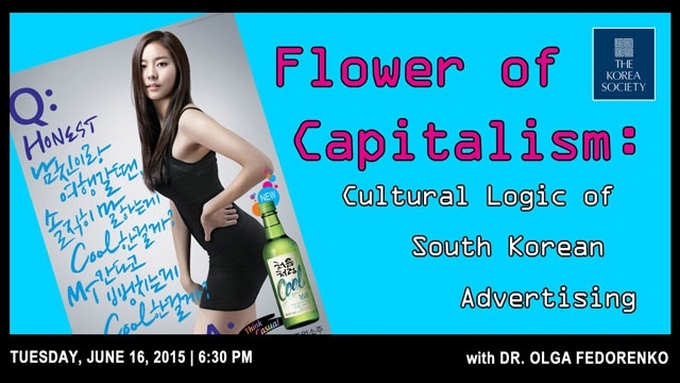
Flower of Capitalism Olga Fedorenko(Source: The Korea Society)

First up, I wouldn’t usually make an announcement about an event in far-off New York, but I have no hesitation in making an exception for friend and fellow Korean Popular Culture Reader contributor Dr. Olga Fedorenko, who’s lecturing at the Korea Society on Tuesday evening. As the FB event page and Korea Society website explain:

Advertising in South Korea is often referred to as a “flower of capitalism.” Rather than calling attention to the inherent links between commercial advertising and capitalism, this clichéd metaphor presents advertising as a wholesome, creative medium of public good and positive contribution to society. South Korean’s consume advertising as a product of popular culture and celebrate it for the humanist societal ideals it often promotes, instead of viewing it as an intrusive commercial message. Dr. Fedorenko explores the origins of such attitudes toward advertising through some notable contemporary examples, and considers challenges of using advertising for public good in the twenty-first century South Korea.

I owe a lot to Olga for much of what I’ve written about Korean advertising over the years, most recently referencing her work in my post “Sex, Self-Confidence, and Social Activism: When Women Made Soju Ads” about Korean femvertising, so you have my personal guarantee that her lecture will be very interesting. (You may also find this review of her dissertation interesting, let alone her dissertation itself.)

As I type this I’m unsure if her lecture will be recorded unfortunately, but it probably will—most Korea Society lectures are made into podcasts, and increasingly online videos are provided too. Either way, I’ll provide a link once her’s is/are ready later this week.

Update: Here is the video. It is also available as a podcast here or here.

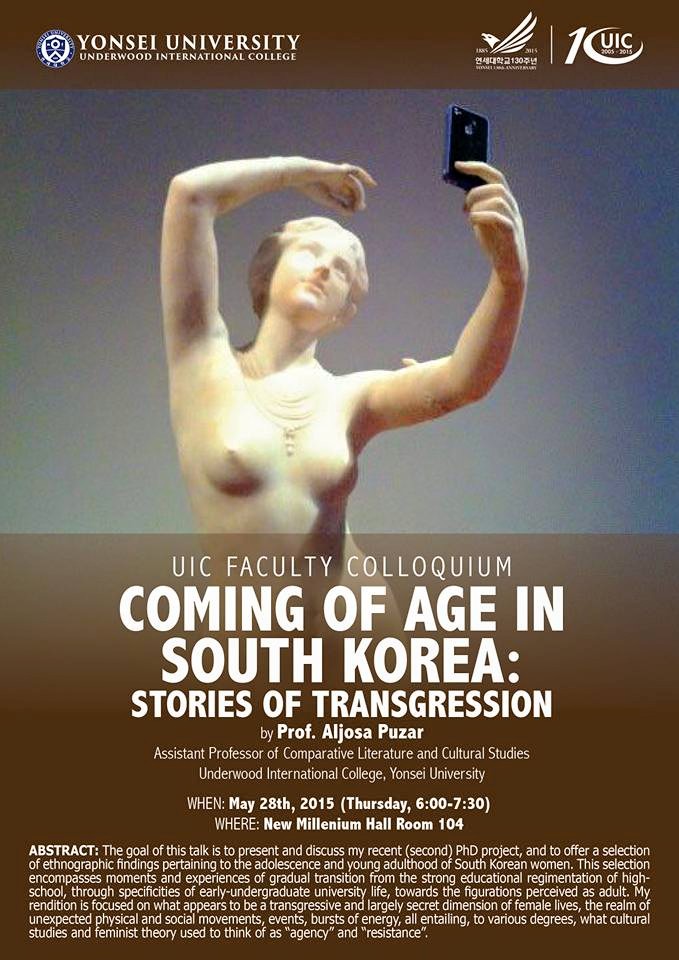
Next, for those of you who were unable to attend Aliosa Puzar’s lecture in Seoul last month, and frustrated that it wasn’t recorded, I’m very happy to announce that he has just been interviewed on the same topic(s) by the Korea and the World team. (Full disclosure: they’re the cool guys who also interviewed me back in November). Make sure to visit Beyond Hallyu for an excellent review of his podcast first, then you can listen to it directly on the Korea and the World website. (It’s also available on iTunes.)

Aljosa Puzar Coming of Age in South Korea(Source: Facebook)

Once again: what are you waiting for? ;)

Where Can You Find Spermicide and The Sponge in Korea??

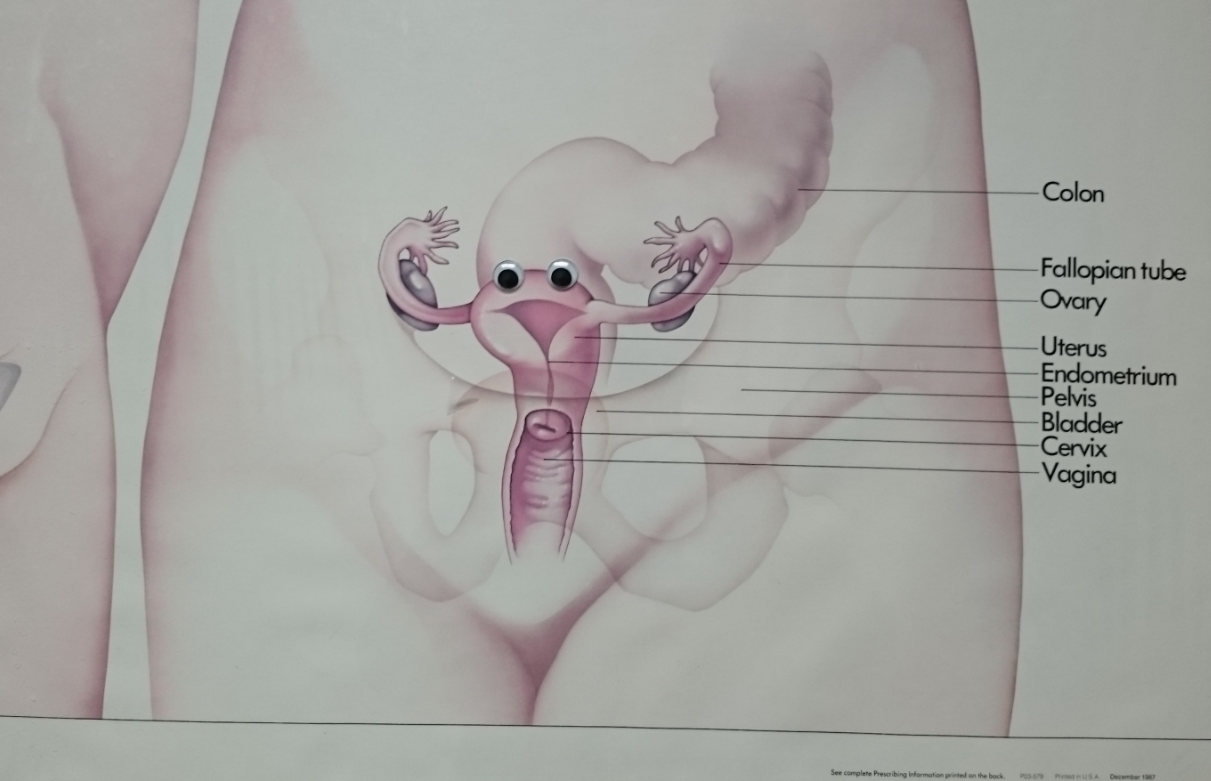
Thought I’d liven up one of the rooms at the OBGYN(“Thought I’d liven up one of the rooms at the OBGYN.” Source: Reddit)

A request for help from a reader, edited for anonymity. Thanks in advance to anyone that can give her any assistance:

******…I don’t want to ask my Korean co-worker for help and all my Korean friends are very religious—so it’s awkward.

Anyways, I don’t take birth control for a multitude of reasons including blood clots with the last time I tried. I also haven’t been sexually active for awhile so birth control hasn’t been a priority to me until now.

I’ve dug into pages on the Internet, but all birth control in Korea searches are about the pill or condom. I went to Dr. Sung’s clinic [in Itaewon], but they were only helpful in regarding IUDs and the pill. I wanted some information about spermicide or the sponge, which I’ve used successfully in the past.

Anyways, I’ve met an awesome guy. He’s great and understands my choice about birth control. He’s willing to try condoms and spermicide combination, which I’ve used in the past with a long term relationship.

He was able to find his western brand of condoms, but I’m at a lost as to how to obtain spermicide or the sponge. Can you get either in Korea…?

An update:

******…I live in the Gangnam area and went to all 4 pharmacies on my way to school and asked for spermicide using Google translate. [Saljeongje/살정제] is the word for it, but at each pharmacy it took about a minute to figure out what I was asking for and locate it.

The first pharmacy was only men and they looked it up on the computer and told me they didn’t have any. The second pharmacy (the one I usually go to) was a young female pharmacist who speaks English but she had to look it up on the computer and then asked me if it was for not getting pregnant and I said yes. All she had were depositories (which are not as good as gel or foam) and they were hidden behind the vitamins. She said she didn’t know if there was a gel or foam spermicide available. The third pharmacy (a large hospital one) all female pharmacists of different ages didn’t have any. The younger pharmacists didn’t know what I was talking about and asked the older one who was a bit confused so she asked an old lady customer who explained what it was. The fourth pharmacy was two older female pharmacists who had to discuss it and then asked why not go to the doctor for “not pregnant medicine” I said “make very sick”. She then digs around in a drawer pulls out a box looks at the ingredients and says “Yes. For no baby.” But this was also a depository.

All in all the pharmacists were very helpful and kind, but slightly confused as to what spermicide is. I am going to start walking into every pharmacy I see ~ maybe only depositories exist and only a limited supply. It’s strange. Back home I can get a huge box at CVS or Walmart!

Sex, Self-Confidence, and Social Activism: When Women Made Soju Ads

Korea’s first ‘femveritising’ campaign was a fun take on sexual double standards, and popular among women too.
uee heart(Source: Celebrity Republic)

A request from a reader:

      Hello Grand Narrative readers! I’m reaching out for some help for a research project I’m working on about female empowerment trends in Korea and opportunities for brands to play in that space.

I’m looking for recent examples of brands, organizations and entertainment personalities empowering girls and females through products, campaigns, messages or services in Korea, similar to Nike’s Seoul Women’s Race, Whisper’s #likeagirl campaign or femvertising campaigns abroad.

Unfortunately, these are hard to find as Korea hasn’t quite embraced the trend like other nations. As such, I’m also looking for the opposite — recent examples of who is doing it completely wrong and sending messages of conforming to male-informed and limiting traditional stereotypes?

Any help, examples, or opinions are greatly appreciated! Please email me at amynwilliams@gmail.com.

James: Alas, all the examples I can think of are quite old. Still, to get the ball rolling, and because I think its empowering aspects deserve to be much better known, let me take this opportunity to quickly mention the best, and possibly first and only well-executed one: Lotte Liquor’s ‘Think Casual’ campaign for Cheoum Cheoreom (“Like the First Time”) Cool soju, from back in Autumn 2009:

I admit, that hardly looked like a bra-burning moment. Nor even all that different to any other soju commercials before or since, for which a young woman dancing in revealing clothes is de rigueur. And Uee, then 21, was no fledgling feminist icon either, reveling in the increasing attention she gained through her objectification. (Albeit likely having little choice in the matter.)

Frankly, I completely dismissed it at the time.

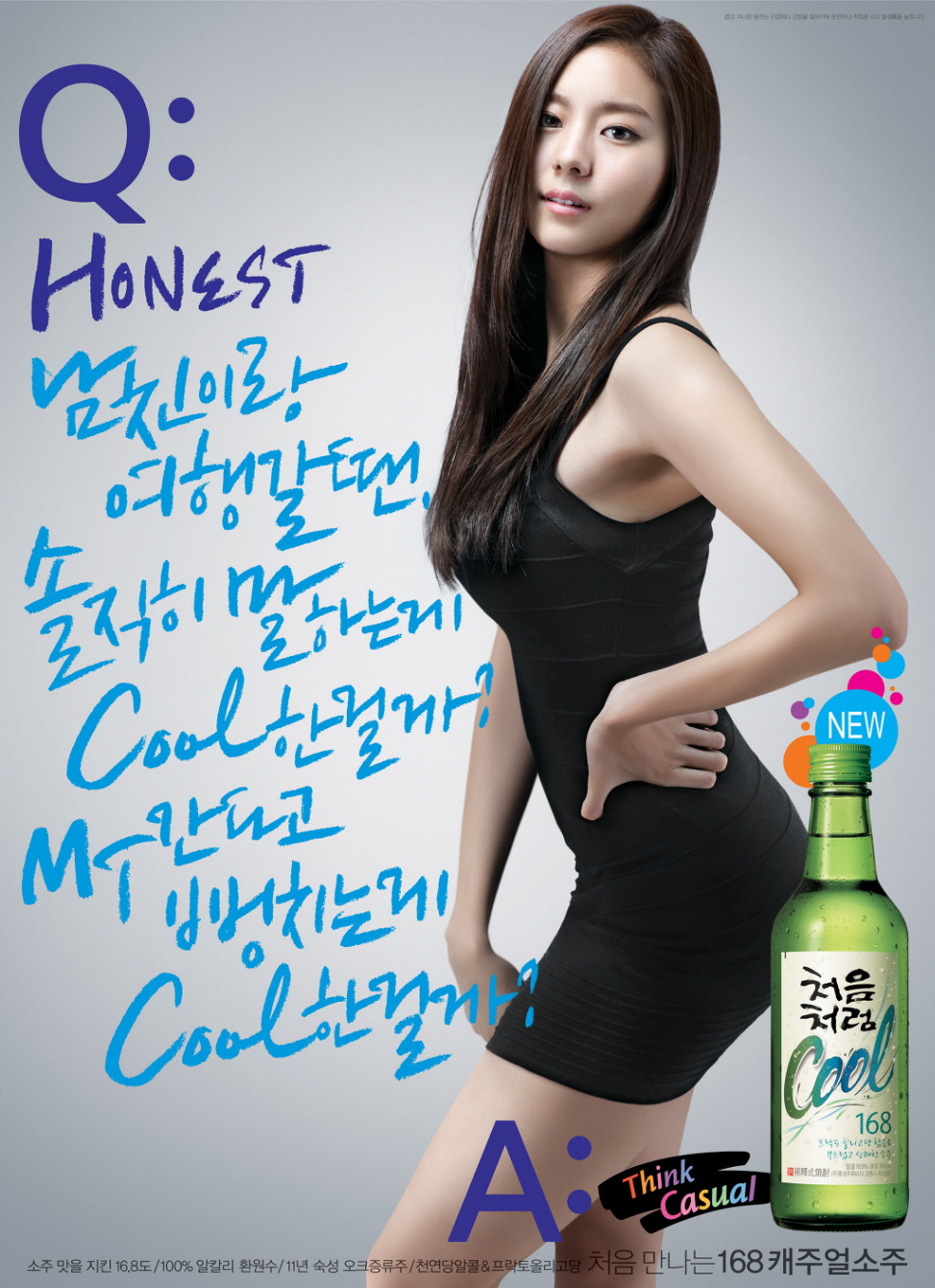
But it was different. That “Am I really your first?” question, and the men’s reactions? Those may seem pretty innocuous from a Western perspective, but they still got netizens riled-up. As did messages in posters like the one below, easy to reject as just another soju pin-up if you—ahem—didn’t take the time to read the text. Because ultimately, not only was the campaign breaking strong taboos on openly acknowledging this thing called sex, but it was directly challenging the double standards for women too.

UEE Soju Cool Honest(The text reads: “Q: When you travel with your boyfriend, which is cooler: admitting it to your parents, or lying and saying you’re going on a trip with your university friends? A: Think Casual”. Source: Naver blog, untitled.)

Rather than backtracking in the face of the ensuing negative publicity however, the advertisers were justifiably proud of what they were doing, as explained by Olga Fedorenko in her chapter “South Korean Advertising as Popular Culture” in The Korean Popular Culture Reader (2014, p. 356):

…[Uee’s] ‘cool shot dance’ achieved a viral popularity, young women recording their own versions and posting them online. Many other [netizens], however, were offended by what they saw as encouragement of promiscuity, noting that Uee looked “too easy,” that her coolness about sexual matters was inappropriate for her young age and “innocent face.” As I investigated the campaign, I was surprised to learn that the advertising team behind it included a few young and well-educated women who saw the ad as empowering and were hoping that young people, whom the ad targeted to broaden the traditional demographics of soju consumption, would perceive it the same way. In other words…they pushed for individual sexual freedom against oppressive norms, and the ‘Think Casual’ campaign became a site for negotiating parameters of female sexuality. The advertising agency took a leading a role in challenging patriarchal mores — reflecting the worldview of advertising workers, who saw themselves as representing the worldviews of the target consumers.

To put those patriarchal mores in some perspective, ironically just this February Uee would again be chastised for admitting to sexual experience and desires, this time in real life. (Note: she was just about to turn 27.) Also, it’s female celebrities that have received the brunt of fans’ anger for all the dating ‘scandals’ of the past year.

That said, things may have reached a tipping point. Because, given their overexposure in popular culture, Korean celebrities are very much considered role models, who are expected to follow high moral standards accordingly. With so many revealed to be in relationships now though, and getting caught spending their limited time together in hotels, it’s just getting too difficult to defend the notion that us mere mortals can’t or shouldn’t be able to do the same, or pretend that we haven’t always been doing so anyway.

But that’s a subject for another post. In the meantime, good or bad, please pass on more examples of femvertising to amynwilliams@gmail.com, and/or mention them here, even if you can’t remember all the details. (I’ll follow them up.) Also, if it emerges that there haven’t really been any femvertising campaigns in the last six years, or at least none as provocative as this one, then I’d be very interested in hearing your thoughts on why. Thanks!

Update: One more recent example of positive femvertising could be Zigbang’s campaign aimed at 20 and 30-somethings stuck living with their parents — something which again points to the need for evaluating empowerment in terms of its cultural context, and for preparing campaigns accordingly. But I still draw the line at anything that includes aegyo!

벅찬년 and Slut-Bitches: Feminization as a Slur in the Korean Gay Community

s(Source: Zeeto)

Like a lot of people, I don’t feel particularly comfortable being labelled. Once a label is stuck on you, separating it from your identity is like trying to scrape a price sticker from the bottom of a shoe — it takes ages and you can never seem to get rid of the damn thing entirely.

‘Feminist’ is one label I happen to like, partly because I chose to bear it…

(Gemma Varnom, The F Word)

Oh, but I do so love the label-makers. I love their audacity in insinuating that vaginas should be called ‘Y-lines’. I revel in their mysterious ability to see a women’s profile in that of a phone’s. I’m astounded at how they keep coming up with labels centered around critiquing women’s spending habits, but never around men’s. I relish discovering who has the chutzpah to homogenize the hobbies, spending habits, work ethics, and hopes and dreams of millions of women through their labeling of them, despite no more basis than the women’s shared academic and career success, ages, and/or income levels. I’m intrigued by how they come to possess the status and social capital to be taken seriously by marketers and the media.

I love the The Kimchi Queen too, for its excellent reporting on Korean LGBT issues, which is why I don’t cover them as much as I’d like to here sorry (I have to prioritize!). When The Kimchi Queen recently discussed the ‘벅찬년/bokchannyeon‘ label used in the gay community though, and linked to “an article that looks at the appropriateness of gays to use this word among themselves from the perspective of a female”, I took advantage of the opportunity to combine both interests.

But first, its definition. In itself, ‘벅차다/bokchada’ just means ‘too much’, as in ‘beyond one’s capacity’ and/or ‘overflowing’. As part of the slang-word discussed here though, The Kimichi Queen explains that:

According to the Korean gay dictionary, 벅차다 is used to describe gays who have many personal connections in the gay community. The first time I heard it, it was combined with 년 (bitch) to form 벅찬년…

[벅차다]…isn’t used really as a compliment. Rather, as the boundary between friendship and love can be ambiguous there are often worries about someone cheating on their lover. A 벅찬년 would often break up with a boyfriend soon after they started dating.

And now my translation of the article, from 너 나 우리 ‘랑’ — 동성애자인권연대 Web_Zine:

‘벅찬 년’, ‘보갈 년’에 대한 어느 레즈비언의 소고 / A Lesbian’s Thoughts on Using ‘bokchanyeon‘ and ‘Slut-bitch’

조나단(동성애자인권연대 웹진기획팀) / Jonathan [Yes, I’m a little confused by the male name too — James] (Gay Human Rights Association Webzine Team)

1 April 2014

모든 게이가 그런 것은 아니지만, 내가 만난 많은 게이들은 스스로를 여성화시켜 지칭한다. 트랜스가 아닌 시스젠더 게이임에도 섹스 포지션에 관계없이 자신뿐 아니라 친밀한 상대방을 ‘벅찬 년’, ‘웃기는 년’, ‘보갈 년’이라고 부른다. 그럴 때마다 시스젠더 레즈비언으로서 많은 생각이 들었다. 그 말을 들었을 때, 어떤 태도를 취해야 하는지, 그 말들은 언어 사용에 있어서 정치적으로 올바르지 않은 경우에 해당하는지 구분이 되지 않았다. 어떻게 바라봐야 할 지 정리가 되지 않은 상태에서 불쾌하거나 당혹스러운 경우도 있었고 함께 깔깔거리며 웃을 때도 있었다. 그러면서도 답답했던 것 같다. 그래서 여성의 날을 맞아 준비한 특집호에서 게이들의 대화에서 흔히 들을 수 있는 여성화자적 언어 사용에 대해 생각을 정리해 보고자 한다. 내가 들어본 적 있는 언어 사용에 한해서 말이다.

Not all gays are like this, but many I have met describe themselves as feminized. Despite being cisgender and not transgender, and despite being bottoms or tops, they call their partners ‘bokchannyeon‘, funny-bitch’, and ‘slut-bitch’. As a cisgender lesbian, I got to thinking a lot whenever I heard these terms. I wondered if it was really okay to use them or not, and what my attitude towards them should be. Until I’d decided, I either felt uncomfortable and upset, or I just laughed them off. But still, I felt a little frustrated and uneasy. So, in celebration of Women’s Day, for this special feature I’m going to talk about this common, [derogatory] use of feminized terms in conversations between gays.

대부분의 경우, 게이들의 여성화자적 언어사용은 자기 희화화의 성격을 띤다. 자기 희화화란 자신의 외모나 성격, 또는 자신이 겪은 사건이 의도적으로 우스꽝스럽게 묘사되거나 풍자되도록 만드는 것이다. 풍자는 다른 것에 빗대어 비웃으면서 폭로하고 공격하는 것인데, 왜 게이들은 자신들을 여성에 빗대어 표현하게 된 것일까?

In most cases, gays’ use of feminized words is to make fun of themselves. It involves making fun of one’s body, one’s personality, and/or an incident one went through, and exaggerating it to make it seem more ridiculous and funny. This is satire: mocking or attacking something by comparing it with something else. But why do gays choose to compare themselves with [heterosexual] women?

흔히 듣는 가설은 사회적으로 남성보다 낮은 지위에 있는 여성과 게이 자신의 지위를 동질화 시켜 생각하기 때문이라는 것이다. 그렇다면 애교처럼 들리는 여러 종류의 ‘~년’은 물론이거니와 성매매 여성을 낮게 보고 이르는 말인 ‘갈보’에서 변화된 ‘보갈년’의 사용은 그렇게 ‘퀴어(Queer)’가 동성애자 자신을 지칭하게 된 것 같은 역사를 품고 있을 수도 있다. 퀴어(Queer)는 ‘이상한, 괴상한’을 의미하는 단어로, 이성애자들이 동성애자를 얕잡아보며 부르는 말이었다. 그러나 ‘정상적 기준’에 의문을 제기하며 우리 자신을 이상한 사람, 퀴어라고 적극적으로 수용한 것이다. 게이들의 이야기를 듣다 보면, 자신이 ‘여자’같다며 놀림을 받았다는 말을 자주 들을 수 있다. 그런 배경을 놓고 보면, 어쩌면 비슷한 맥락의 역사적 배경을 가지고 있다고 볼 수도 있겠다.

An often-heard explanation is that, in a patriarchal, heteronormative society, gays think of themselves as having the same inferior rank or status as heterosexual women. In this sense, not just several kinds of ‘bitch’ terms, albeit which can be cute sometimes (like when referring to the use of aegyo), but also the use of ‘slut-bitch’ (which came from ‘galbo‘, which means female prostitute) are used derogatively to describe something that deviates from the male, heterosexual ideal, just like ‘queer’, which means ‘strange’ and ‘weird’, has been historically used to refer to gays and lesbians. [Yet it is also true that] gays and lesbians have questioned that ideal by embracing the word. Also, many gays can recount being teased by being called women. Considering that background, such [positive, challenging] attitudes might also play a role in their use of bokchannyeon.

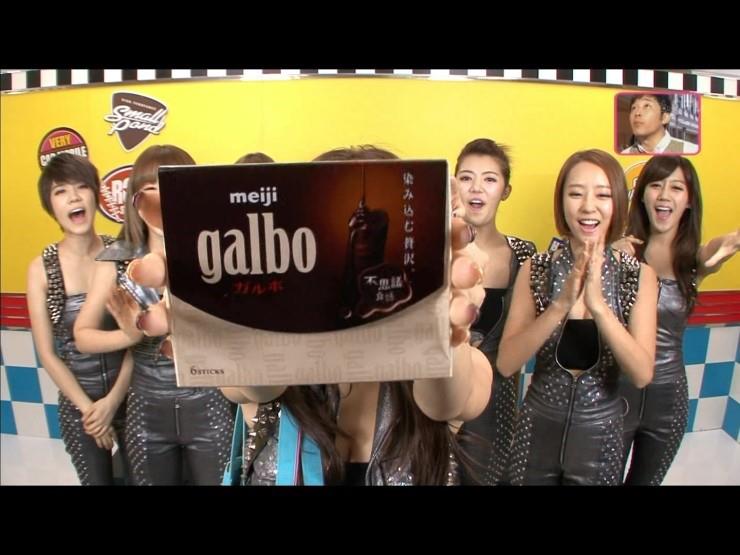
Rainbow japan galbo (Rainbow endorses Meiji Seika’s Galbo’ chocolate in Japan. Source: Hstereo)

그럼에도 불구하고 왜, 순간적으로 불쾌감이 들었을까? 두 가지 이유를 생각해보았다. 첫째는 남성이 발화했기 때문이다. 게이라도 남성으로서 교육받고 자연스럽게 남성으로서의 지위를 누려온 사람들이 여성비하적인 언어를 발화한 것이다. 둘째로 우스꽝스럽게 여겨지는 지위에 나 자신이 놓이고 싶지 않았기 때문이다. 희화화되어 유머를 위해 빗대어지는 대상이 내 정체성에 해당되는 것이 불쾌했기 때문이다. 비장애인 이성애자 사이에서 서로를 농담처럼 ‘호모’나 ‘애자’라고 부른다고 할 때, 동성애자들과 장애인이 불쾌감을 느끼듯이 말이다. 하지만, 불쾌감으로만 끝나지 않고 답답했던 것은 실제로 그들이 여성만큼이나 차별받고 있음을 알기 때문이다. 그리고 커뮤니티 문화에 정치적 잣대를 들이대는 것이 소위 먹물이 들어, 옳고 그름의 문제로만 현상을 바라보려고 하기 때문인가 싶어 망설여졌기 때문이다.

Despite that, why do I immediately feel bad whenever I hear the word? For two reasons I guess. First, because it originated with men. Although they are gay, they still grew up as men and enjoyed male privilege, and it’s in this context that they use such a misogynistic term. Second, because it puts me in an uncomfortable position, as the humor derives from disparaging a part of my identity [i.e., disparaging women]. Between non-disabled heterosexuals, when they call each other ‘homo’ or ‘aeja’ [a degrogatory term for disabled people], homosexuals and disabled people feel uncomfortable; I feel the same way about bokchannyeon and so on.

I don’t feel frustrated just because of these words; I also get frustrated because I know that gays get discriminated against just as much as women. But from what I know about the gay community in Korea, if I raise this with gay men I worry that they would misinterpret me, thinking that I see using the words as just a black and white issue.

글이 마무리로 향하고 있는데도, 역시 어떻게 결론을 내어야 할 지 조심스럽다. 되도록 사용을 자제하는 것을 부탁하는 것으로 마무리 지어야 할 지, 그럴 자격이 있는 것인지도 잘 모르겠다. 웅에게 같은 기획으로 글을 의뢰했는데, 웅의 결론이 궁금할 뿐이다. 화두는 던져놓고 무책임하게 마무리하는 것 같지만, 평소 같은 생각을 한 적이 있는 분이라면 댓글로 의견을 들어보고 싶다.

Now that I’m nearly finished, I’m hesitant about making a conclusion. I’m not sure if I have to ask gay men to stop using that term, and/or if I’m even in a position to ask them. So, I’ve asked Woong to also write about this, and I wonder what his conclusion will be. I’m going to finish here then, by just having raised the topic. Please let me know what you think in the comments (end).

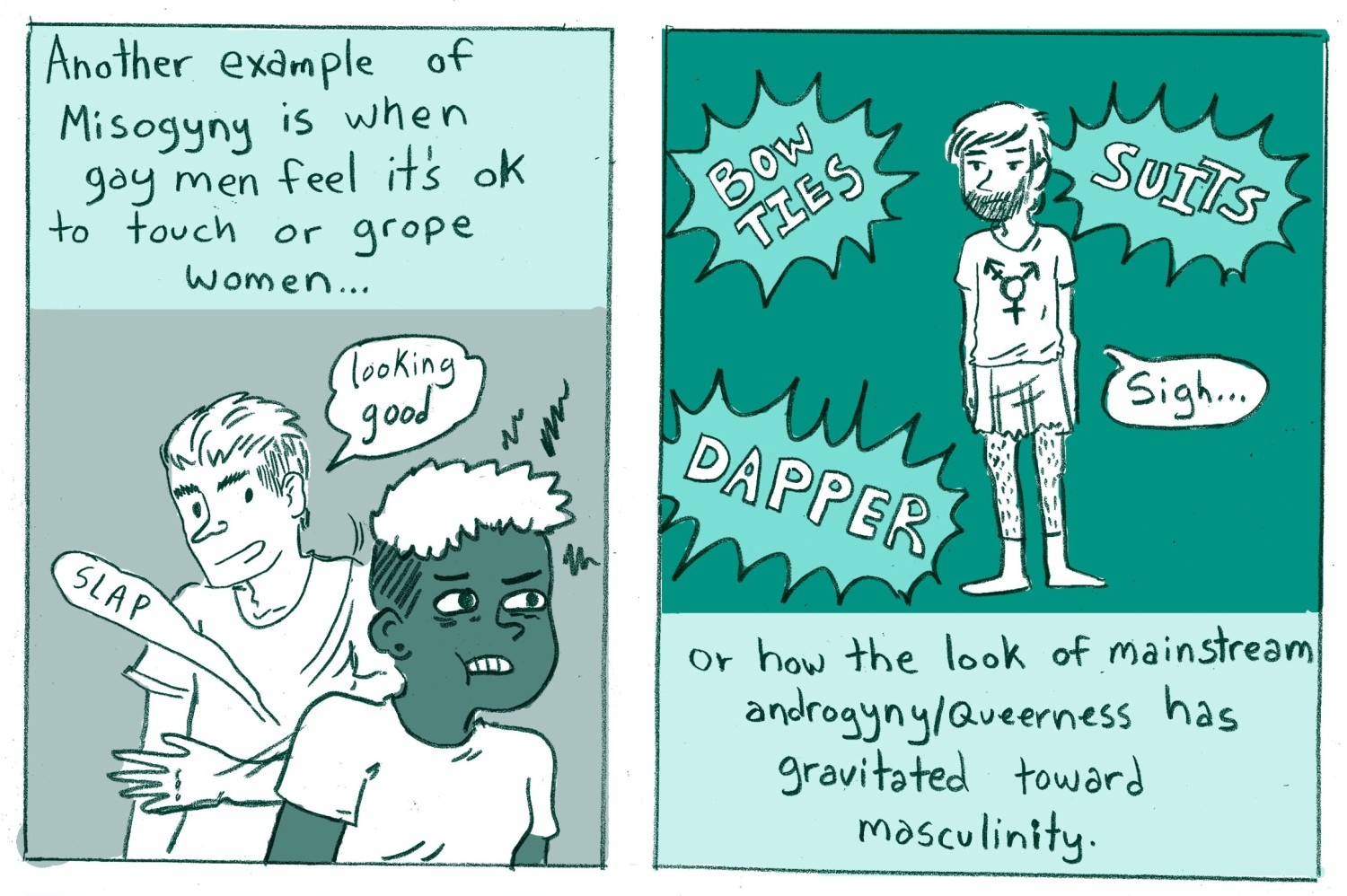
How Misogyny Shows Up in the Queer Community(Source: Everyday Feminism)

And she did indeed get a few brief comments; if people would like me to translate those, and/or Woong’s (much longer) article, please let me know. Either way, apologies as always for any mistakes in the translations, and thanks in advance for any corrections. Also, please note that, beyond the article I’ve translated, I have personal no knowledge of the terms described and how often and/or why they’re used in the Korean gay community (or not), so I’d very much appreciate being educated about the subject. Are things like in the “How Misogyny Shows Up in the Queer Community” cartoon that the above panel is from, posted just last week on Everyday Feminism? Or would that be an exaggeration? Thanks!

(Update) A friend on Facebook responded:

“I’ve also noted quite a bit of misogyny among gay male and mtf transgender message boards and anonymous forums made for Korean-speakers. I thought that might be what this blog post would be about, but this is more about language use. (That overt hatred towards straight cis-gender women was kind of fascinating, if depressing to observe >_< ) It’s been a while since I looked at those websites, but as best as I can recall such sentiments consisted of things like:

  • jealousy towards straight women for being able to express romantic interest towards or openly flirt with desirable males
  • annoyance at straight women for demanding attentions and considerations they (straight women) would expect from straight men
  • a great deal of annoyance towards a certain sector of straight women for romanticizing/straight-washing/sexualizing gay relationships for their own purposes
  • annoyance at straight women for conceptualizing gay men as accessories (blame sex and the city :P) and ignoring those who aren’t fabulous or good looking
  • annoyance and even anger at cis-women for having what they (mtf transgenders) do not

Of course, this is all filtered through my interpretations of the motivating forces behind the disparagement of and anger towards women expressed in thise forums.”

She admits though, that:

“I have some doubts as to how relevant my observations are…Like, at best they’re indications that gay men are not immune to the social cues/examples they are presented with in male-spaces of society at large. Cuz that’s what a lot of biased language really is, isn’t it? You are provided with some pre-made, mass-manufactured molds, and you get used to throwing everything that fits into that mold and in turn strenghthening your belief in it. Ish?”

Korean Sociological Image #89: On Getting Knocked up in South Korea

Korean Births Out of WedlockAs in, how many Korean women are pregnant when they walk down the aisle? How many get married after giving birth? How many mothers don’t get married at all? And how have public attitudes to all those groups changed over time?

I’ve spent the last two weeks trying to find out. It’s been surprisingly difficult, apropos of a subject many couples would prefer to keep under wraps.

It all started with this Arirang news report, thanks to the interesting way it framed Korea’s low birthrate problem:

An aging population and low birthrate — two problems that Korea and Japan have in common and are trying to solve.

And since having children out of wedlock is considered socially unacceptable in either country, the focus is on encouraging people to get married.

So the countries share similar problems, but do the people of Korea and Japan share similar views on marriage?

A report by the Korea Institute for Health and Social Affairs says NO…

(Arirang, December 4, 2014; my emphasis)

My first thought was that a focus on marriage made a lot of sense. From that chart alone, you can guess that there is considerable prejudice against single mothers and their children in South Korea, to the extent that Korea was (and is) notorious for overseas adoption. In 2008, Seoul National University Professor Eun Ki-Soo saw a direct relationship between such attitudes and Korea’s low birthrate problem:

According to the International Social Survey Program (2002) and Korean General Social Survey (2006), Korea “had one of the highest number of respondents who believed ‘people who want children ought to get married.’ The only countries that scored higher than Korea were the Philippines and the United States, but the differences in the scores were not statistically significant….In the face of such strong social norms regarding marriage and reproduction, young people who are unable to marry also may not feel like they can have children. Such a phenomenon is manifested in contemporary Korean society in the form of a low fertility rate”

(Eun, pp 154 & 155; see bibliography)

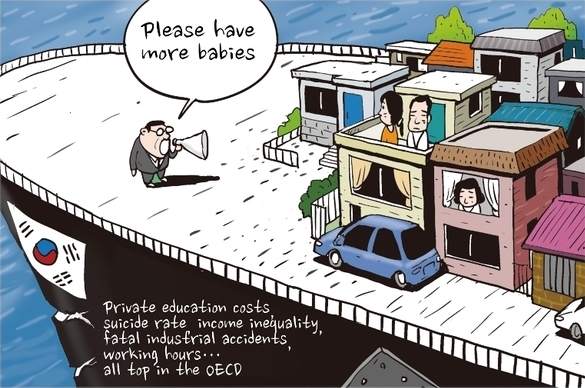
Likewise, two weeks ago the Park Geun-hye Administration pinpointed the cause of Korea’s low birthrate “to be the social tendency to marry late”, and announced that it aimed “to buck that trend by rectifying the high-cost marriage culture in Korea, increasing the supply of rental housing for newlyweds and expanding medical insurance benefits for couples with fertility problems.” (Note that the number of marriages in 2014 was estimated to be a record low, with 50% of 30-somethings seeing marriage as “dispensable”.) Last week, Korea Institute for Health and Social Affairs researcher Cho Sung-ho reaffirmed that “it is necessary to support young people so they can experience dating, marriage and childbirth without too many difficulties”, and that “In order to do that, creating quality jobs and support programs for job seekers must be introduced as part of measures to tackle the country’s low fertility rate” (source, below: The Hankyoreh).Please Have More Babies

Yet in saying young people need support, surely Cho is is just reiterating Korea’s — and other developed economies’ — biggest social problem of the 2010s (and likely 2020s)? And what use is there in making it easier for young Koreans to get married, when married couples aren’t having enough children in the first place?

Simply put, Park Geun-hye’s announcement feels disingenuous, distracting from the difficult reforms of Korea’s patriarchal work-culture needed.

But my second thought was on the Korean women that do get knocked up. Specifically, those that do so before or without ever getting married, the only two groups I’ve ever heard the term used for (quick question: does anyone use it for married women, except in a humorous sense?). First, because that 2.1% rate of out of wedlock births is actually the highest it’s been in decades, albeit by no means because attitudes have softened over time:

Available statistics [Korea Statistical Yearbook #55, 2008] indicate 6,141 illegitimate child births in 1990 and 8,411 in 2007, representing, respectively, 0.66% and 1.69% of the total child births; a percentage rise that seems mainly due to the general fall in child births from 1990 to 2007 (931,602 in 1990, and 497,188 in 2007).

(Payen p. 72, my emphasis; see bibliography)

(For comparison’s sake, there were 403,500 childbirths in the first 11 months of 2014, while a February 4 estimate put the yearly figure at 430,000. Update: a February 26 report put it at 435,300, the second lowest level ever.)

Second, because despite everything I’ve written above, I was surprised that the the rate wasn’t higher still. Why? Partially, because of personal experience, one of my wife’s cousins having a child before getting married, but no-one in her village treating that as unusual or something to be embarrassed about (she later married and had a second child). And mainly, because that lack of a reaction was already explained by the following comment left by @oranckay on my 2008 post, “Why Korean Girls Don’t Say No: Contraception Commercials, Condom Use, and Double Standards in South Korea.” While the post itself has long since been completely rewritten, and the comments deleted (sorry!) because that meant they no longer made sense, you’ll soon see why I decided to save his one:

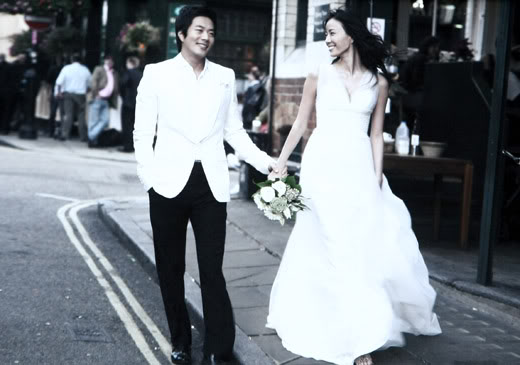
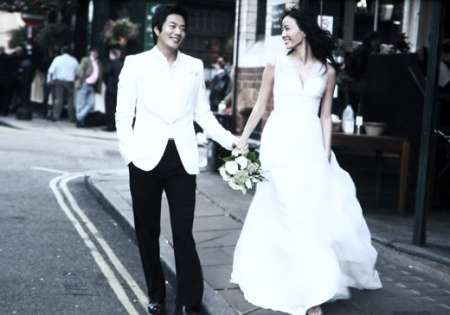
(Note that it was written in reaction to my surprise and confusion at public outrage at Korean female celebrities kwon sang woo son tae-young pregnancy marriagerevealed to be having premarital sex — how times have changed!(?) — but the lack of any negative reaction to regular announcements of celebrity pregnancies before marriage, one example mentioned in the post being Kwon Sang-woo’s and Sohn Tae-young’s that September {Source, right: Dramabeans}.)
…I think one needs to take into account that not all pre-marital sex is the same. There is a difference between just having sex and having sex with someone you are going to, or intend to, marry, and traditional/Joseon and even 20th Korea saw this as a big difference. Having sex on the premise of, and as consummation of, commitment, was the normal, socially acceptable way to have pre-marital sex. So valued was a woman’s virginity that a decent man could only sleep with her if he was ready to “take responsibility for her,” as the saying would go, and so on, because that’s what sleeping with her was supposed to imply. Fiction and non-fiction narratives (many known to me personally) are full of this kind of thinking. I know couples that decided not to have sex because they weren’t sure they were getting married, that didn’t have sex because he was going to the military and he wanted to be sure he’d come back alive before permanently “making her his,” as that would be too traumatic for her, and of couples that lived together (and obviously were having sex) before being married and it was acceptable because they were going to marry, had family approval, but couldn’t marry because maybe the girl’s elder sister wasn’t married off yet or they were both still in college but both sets of parents wanted to get them married after graduation, or one of those odd reasons. Maybe no money; whatever.

Anyway, the best example I can think of all this is classical Korean prose fiction (since that’s all I ever think about). There is plenty of premarital sex in traditional Korean prose fiction (“novels”), graphic in only a few exceptions I’m afraid, but we are at least told that it is happening. The reason this fiction wasn’t thrown into the flames at Confucian book burning parties (and there were Joseon poets who did indeed call for novels to be burned for their bad influence) was because whenever there is pre-marital sex the parties always end up married. In fact you know they’re going to marry before you get to the end because they slept together. The most readily available example would be “the most classic, all time” story Chunhyang Jeon. The most “대표적” Korean story of all time and it involves “happily ever after” pre-marital sex. So it’s one thing for a celebrity to have a bulging waistline at her wedding and another for a video to surface of her having a romp with one of her producers, for example, or even to shoot a fully nude bed scene in a feature film.

Update: Via KLawGuru, comes news that there used to be a law that was very much in the same vein, and which was only very recently repealed:

In 2009, a crime called “Sexual Intercourse under Pretense of Marriage” was ruled “unconstitutional.” It used to be a crime for a man to have sex with a woman by deliberately deceiving her into believing that he would later marry her. To learn more, click here.

But to reiterate, just how common are those bulging waistlines at weddings? And (how) have people’s attitudes changed over time? After seven years, it was high time to do a proper follow-up on oranckay’s comment. I hit the books.

Chung-hyan Versions(Sources: left, 나는 수풀 우거진 산에 갔더니; right, Opeloverz)

Unfortunately, I was unable to find much at all about premarital pregnancy and childbirth specifically. Instead, I spent much of the next two weeks collecting and typing up a lot of fascinating, related information about attitudes towards virginity, premarital sex, sexual experience, cohabitation, and contraceptive use, forced as I was to deconstruct and think about all aspects of the phenomenon (read: desperately search for any related topics whatsoever in indexes). Then I realized that I was going about things entirely the wrong way, and should: a) devote a separate post to those next month; and b) rely on someone who’s already done all the hard work for me instead. Sure enough, just a couple of pages of the right book would literally speak volumes:

…In the mid-1980s, cohabitation was not rare. [Yoon Hyungsook, pp. 18-24] writes that three out of ten marriages concerned cohabitating couples, and that all these couples even had children at the time of their wedding. Although these couples were not officially married, it was “only” legally, not in the eyes of the villagers. The important point to mention is the fact that all these cohabitations were approved by both spouses’ in-laws, with the wife fulfilling her role of daughter-in-law as if she was legally married. When the wedding ceremony comes later, delayed because of financial difficulties, it confirms a relationship, ascertains the position of the woman in her husband’s family, and makes the couple fully adults in the eyes of society.

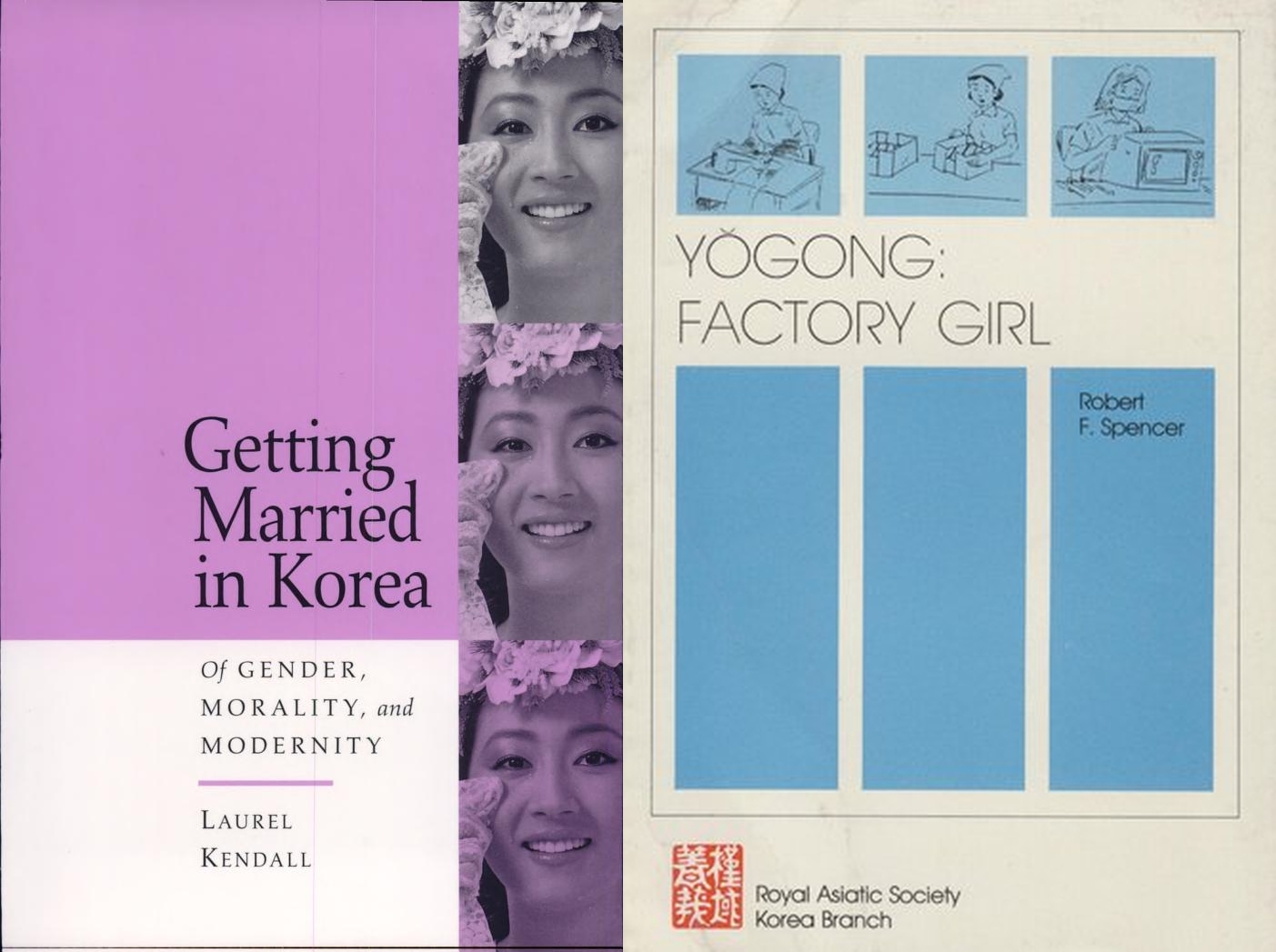
So, cohabitation did exist, was not rare, and was often a living arrangement used by people of poorer classes for whom marrying meant heavy expenses. Kendall (p. 123) writes that “by the 1970s cohabitation before marriage was common among village children who worked off the land and among rural migrants to the cities. It remains a common practice among urban workers.”

Spencer and Kim Eun-shil also delve on cohabitation in their studies about female migrant factory workers. But, while for women of Spencer’s research, this living arrangement was not the norm, it was most common in Kim’s research; a difference possibly related to the 20 years that have passed between the two studies and changes of attitudes and practices in relation to marriage and cohabitation (1970-1990).

(Payen, pp. 87-88. Kendall and Spencer books mentioned are below; see bibliography for Kim.)
Getting Married in Korea Cover Yogong Factory Girl Cover(Source, left: Google Books; right, Amazon)

Of course, I acknowledge that the above is just a indirect confirmation of oranckay’s comment really (although that is still valuable), and I can’t possibly do justice to Payen’s thesis on cohabitation in Korea here, nor on how and why it’s actually become less common since the 1990s. In the comments section below though, Gomushin Girl provides a good summary of one of the most important factors behind that shift:

[One] important aspect here is the socioeconomics of it all . . . earlier research like Kendall’s and Spencer is looking at a Korea that was either still relatively poor or just emerging as a major economy. They’re already reporting a very class-based variance in attitudes towards premarital sex and pregnancy [and cohabitation—James], with higher socioeconomic status associated with lower acceptance. I’m not surprised to see that as Korean wealth increased, people increasingly adopted attitudes associated with wealth.

Also, we shouldn’t be left with an overly sanguine, no nonsense image of attitudes to premarital pregnancy in the past either, as the opening to a Korea Herald article about adoption linked earlier attests:

In 1976, a 17-year-old Korean girl gave birth to her first child. A few months before the delivery, she had been forced to marry the man who raped and impregnated her.

“That was the norm at the time,” Noh Geum-ju told The Korea Herald.

“When you get pregnant as an unmarried woman, you have to marry the father of your baby. Other options were unthinkable.”

(The Korea Herald, 28 January, 2014)

Update: Here’s another example from a celebrity couple, currently involved in a domestic violence case:

Seo Jung-hee [a former model and actress] said her husband [comedian-turned-clergyman Seo Se-won] sexually assaulted her at the age of 19, so she had to marry him, and she had been his virtual prisoner for 32 years. She said she was too afraid of him to seek a divorce and had to endure because of the children.

(The Chosun Ilbo, 13 March 2015)

I also read that, traditionally, if a suitor was spurned by his intended bride, he could consider raping her to secure her family’s consent. Mostly, due to the shame involved, but of course the imperative was all the greater if she became pregnant. I can’t remember the exact reference sorry (I will add it if I do), but I did find the following:

…The “proper” women must remain chaste, and the requirements of being chaste are utterly crazy. As a rule, a traditional Korean woman carried a small silver knife. The knife is for self-defense, but not the kind of self-defense that you are thinking. The knife is there to kill yourself with if you are about to be “disgraced”. Realistically, “disgraced” means “raped”. However, technically “disgraced” meant any man other than your husband touching you.

One story during the Joseon Dynasty speaks of a virtuous woman who, because a boatman held her hand while helping her into the boat, either jumped out of the boat and drowned herself or cut off her own hand, depending on the version. It is unlikely that this story is true, but this was the moral code to which traditional Korean women were supposed to aspire. In a similar horrifying vein, rape-marriages – forced marriage to a man who raped you – happened regularly until late 1970s, since living with the rapist as a proper woman is better than living as a fallen woman.

(Ask a Korean!, December 3, 2008)

But we were talking about attitudes towards and rates of premarital pregnancy in the 2010s. Which, to conclude this post, naturally I would end up learning more about from the following Korea Times article than from my entire 20-year collection of Korean books(!). Some excerpts (my emphasis):

…premarital pregnancy is now humdrum, even among people who are not stars.

In a survey that consultancy Duo Wed conducted between June 1 and June 14, one-third of 374 newlyweds questioned said the bride was pregnant when they married.

Of these couples, 92.1 percent said their babies were unexpected…

Beautiful D-line…Changing perceptions on premarital pregnancy are also affecting other related industries: wedding dress rentals and tourism businesses.

A wedding dress shop director says she has recently noticed more pregnant brides-to-be.

“They look for dresses depending on the number of months they are pregnant,” says Seo Jung-wook, director of Pertelei, in Cheongdam-dong, southern Seoul.

“Women who are three to five months pregnant fit well into a bell-line dress, while those further into their pregnancy often look good in an empire-lined dress.”

Other dress shops have their own selections of “D-line dresses” in stock because of increased demand [which no longer have to be custom made and bought].

Sigh. I’d always assumed that D-lines were just a joke sideline (no pun intended) to Korea’s body-labeling and shaming craze. I should have known better.

Continuing:

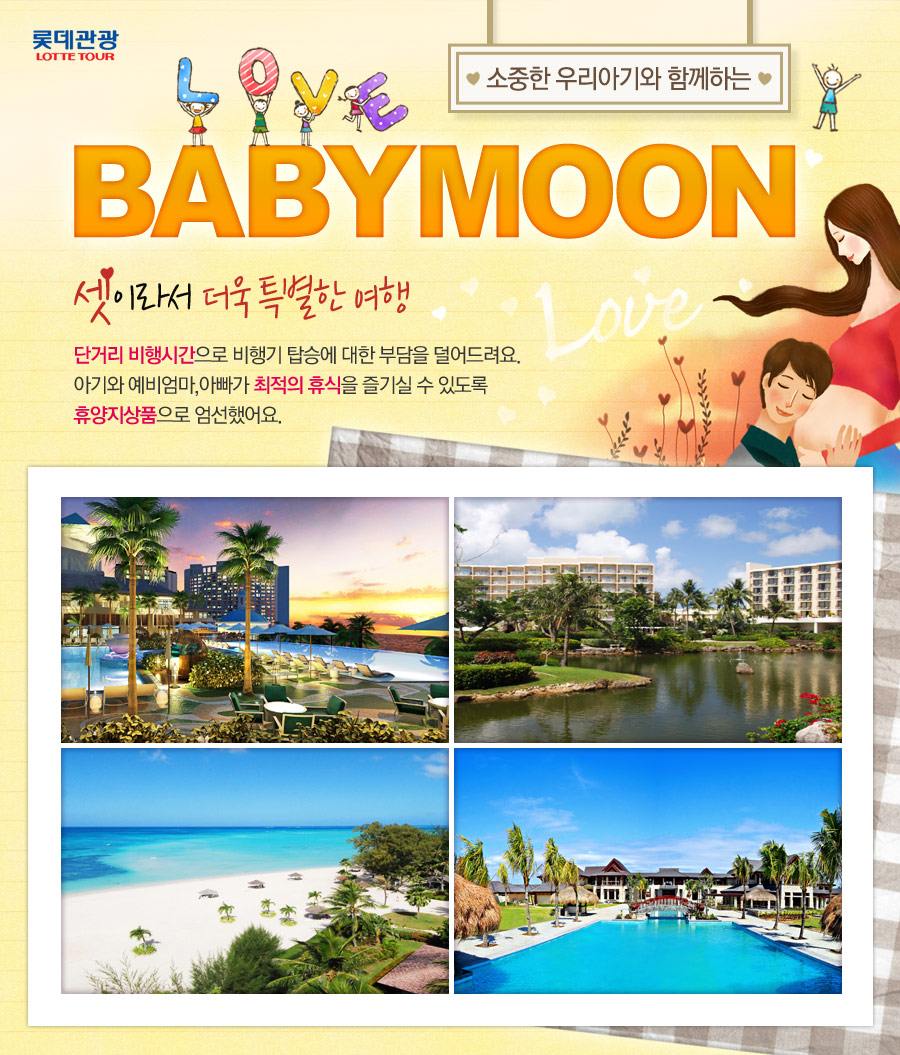
…The tourism industry is also catching up with the trend. Instead of honeymoons, travel operators promote “babymoon” programs for pregnant newlyweds.

These programs avoid placing any burden or stress on the baby or the mother.

Kim Jin-hak, representative director of Honey Island, a tourism agency specializing in services for newlyweds, says the agency’s “babymoon” program is popular with brides…

(The Korea Times, July 23, 2013. Source, above: WStar News)
Babymoon(Source: Lotte Tour)

As always, this is just a start. For many follow-up posts, I plan to look at journal articles (which will probably be more fruitful), Korean-language sources, plus blogs about or often covering marriage and pregnancy in Korea, such as the sadly now defunct On Becoming a Good Korean (Feminist) Wife. Plus, of course, any readers’ suggestions (for books also!), which will be much appreciated.

Please pass them on, and/or tell me in the comments about any of your own experiences and observations about premarital pregnancy (and so on) in Korea. Do you personally know any women who were pregnant at their weddings? (Or were you or your partner yourself/herself? By all means, please feel free to comment or email me anonymously!) What were their family’s and friends’ feelings and reactions? Was the couple effectively forced to get married, in a case of “사고 쳐서 결혼” (lit., “marriage by accident,” or a shotgun wedding)? How about those of you with Korean partners? Did your foreignness make a difference? Thanks!

(For more posts in the Korean Sociological Image Series, see here.)

Bibliography

— Ki-soo, Eun “Family values changing—but still conservative”. In Social Change in Korea, edited by Kim Kyong-dong and The Korea Herald, 146-156. Korea: Jimoondang, 2008.

— Kim, Eun-shil “The Making of the Modern Female Gender: the Politics of Gender in Reproductive Practices in Korea”, (PhD dissertation, University of California, 1993) [Referenced by Payen]

— Payen, Bruno “Cohabitation and Social Pressure in Urban Korea: Examining Korean Cohabitants’ Behavior from a Comparative Perspective with France” (MA thesis, The Academy of Korean Studies, Seongnam, 2009).

“Sexy Concepts with James Turnbull”

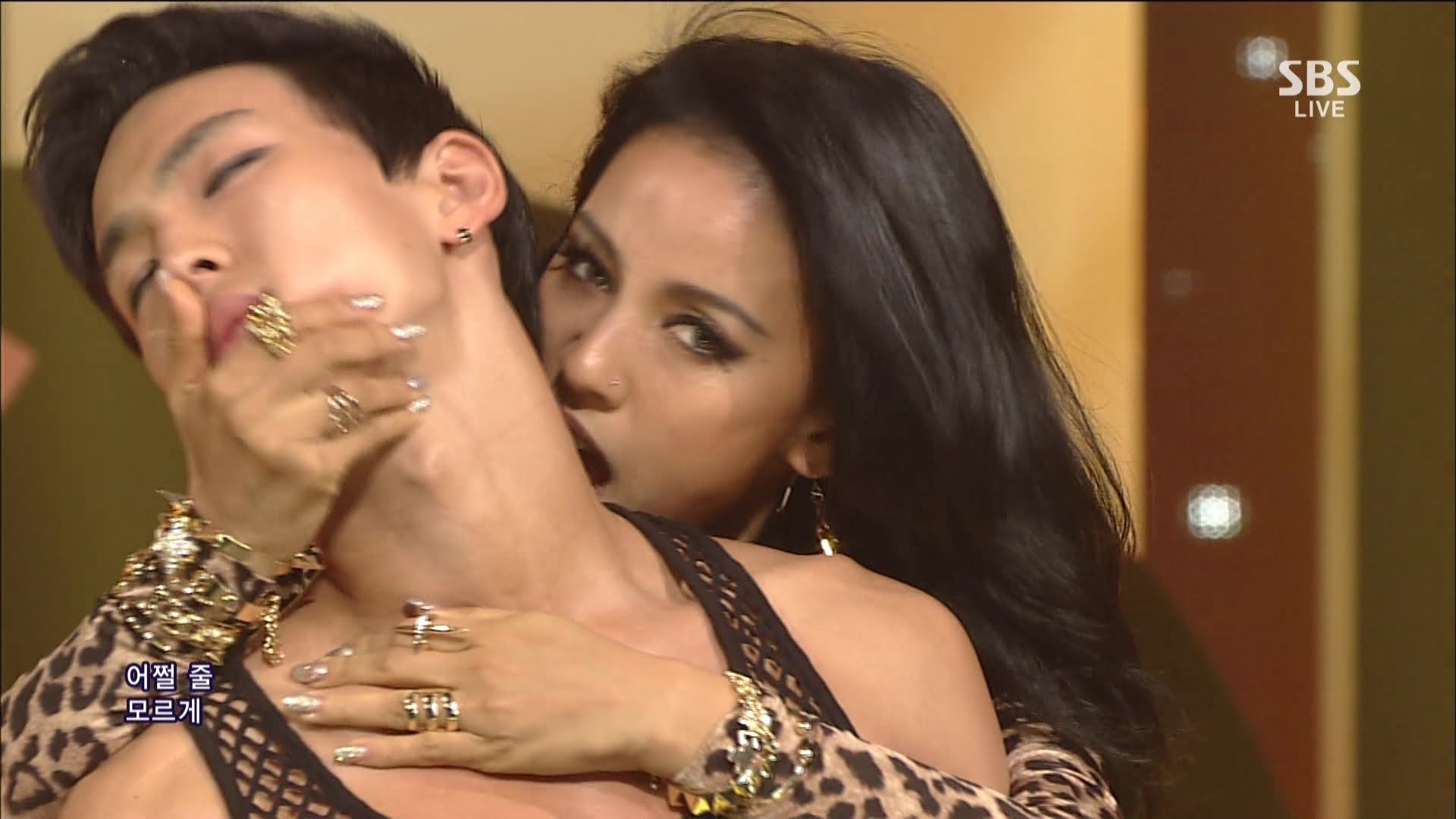
Lee Hyori Bad Girls SBS Inkigayo 인기가요 25 May 2013(Source)

Ahem. But really, they’re just a very small part of my July interview with Colin Marshall for the Notebook on Cities and Culture podcast, where we also discuss:

…what Westerners find so unappealing about Korean plastic surgery; the associations of the “double eyelids” so often surgically created; why he used to believe that Koreans “want to look white”; the meaning of such mystifying terms as “V-line,” “S-line,” and “small face”; the uncommon seriousness about the Western-invented concept of the “thigh gap”; how corn tea became publicly associated with the shape of the drinker’s jaw; Korea’s status as the only OECD country with young women getting thinner, not fatter; Korean advertising culture and the extent of its involvement with the “minefield” of Korean irony; the prominence of celebrities in Korean ads, and why the advertisers don’t like it; how long it takes to get tired of the pop industry’s increasingly provocative “sexy concepts”; the result of Korea’s lack of Western-style reality television; how making-of documentaries about 15-second commercials make the viewers feel closer to the celebrities acting in them; why he doesn’t want his daughters internalizing the Korean sense of hierarchy; why an expat hates Korea one day and loves it the next; how much homework his daughters do versus how much homework he did; the true role of private academies in Korea, and what he learned when he taught at one himself; the issues with English education in Korea and the oft-heard calls for its reform; the parallels between English test scores and cosmetic surgery procedures; the incomprehension that greets students of the Korean language introduced to the concept of “pretending to be pretty”; and how to describe the way Korean superficiality differs from the Western variety.

Apologies in advance for not being much more succinct when I spoke (I’m, well…er..uhm…working on that), and by all means please feel free to ask me to clarify or elaborate on any of those topics.

Also note that Colin has interviewed over 30(?) other expats and Koreans, men and women, and Korea and overseas-based speakers for the Korean component of his series, all most of whom are much more articulate and entertaining than myself, so I strongly encourage you to browse his site. I myself was blown away by Brian Myers’ interview yesterday, which was full of insights and observations that all long-term expats will be able to relate to (and will be very useful listening for those thinking they may become one), and Bernio Cho’s is essential if you want to understand the Korean music industry better. And those are just the two I’ve listened to so far!

Korea and the World: My Podcast Interview

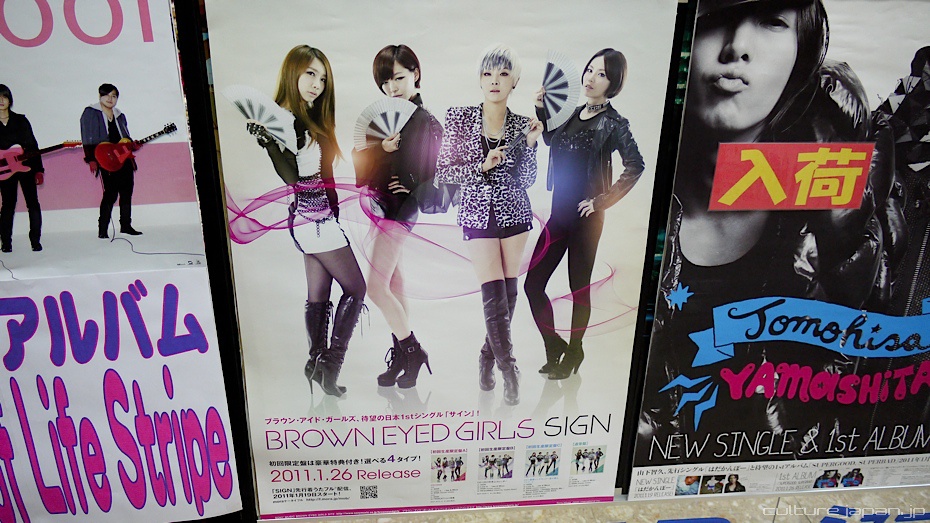
Brown Eyed Girls Japan(Source: Danny Choo; CC BY-SA 2.0)

“Korea’s entertainment industry has become extremely popular abroad and conveys the image of a modern and attractive country. Watch any K-Pop video and you see plenty of skin and sexiness; but look into Korean culture as a whole, and you witness the dominance of traditional values. Does the way women are depicted in Korean popular culture tell us something about gender politics in Korean society? How persistent are traditional gender roles? Does the entertainment industry empower women or does it merely represent the reality of gender patterns in Korea’s conservative society? To answer these questions and more, we sat down with media specialist James Turnbull in Busan.”

A big thank you to the good folks of Korea and the World, for being such pleasant podcast hosts back in November. Unfortunately though, frankly I had a terrible cold at the time, so apologies in advance if I sometimes sound a little incoherent during the interview!

Either way, make sure to also check out the interviews of Robert Kelly, Daniel Tudor, and Andrei Lankov, with many more to be added in coming weeks.

Update: If you’re interested in hearing more about K-pop specifically, also check out the first episode of Anonymous Said, a new podcast series in which the host aims to “talk to anonymous guests each week, and together…comment on recent events in Korea, and the experiences the guests have from behind-the-scenes of entertainment and life here.” This blog gets a brief mention at 21:50 (squee!).

Something Everybody Needs to Know About Yellow Fever

Yellow Fever Personal Zones(Source, left: Kevin Jaako, CC BY-NC 2.0. Source, right: Isabel Santos Pilot, CC BY-NC-SA 2.0, edited)

Now, I’d be the last person in the world to victim-blame anyone who’s ever been the target of Yellow Fever. And I don’t doubt for a moment that the media is overwhelmingly responsible for creating and perpetuating the stereotypes that come with it. But for those men who bring those stereotypes with them to East Asia, there is one aspect of life here that is likely to further convince them of local women’s attraction to them. What’s more, it’s something so fundamental, so visceral, that frankly it completely fooled me too—even though I never shared those stereotypes, and definitely continued to treat Korean women as individuals. 

See here to learn what it is, and why it has impacts that go well beyond mere dating. While it’s really quite simple, and I think most people who deal with people from a foreign country or live in one are already aware of it on some level, I think it’s enormously helpful to have it spelt out—especially if you’re having a bad experience. Also, although again I stress it only plays a minor role in perpetuating Yellow Fever stereotypes, I think it’s one that tends to get neglected in most (English) discussions of those, which tend to focus on Asian-Americans.

I’d be very interested to learn if readers have had any similar experiences, and what you did about them. (Or if your students have; if mine are going overseas, I make sure to photocopy the relevant pages of this book for them!) Also, how does it play out with the sexes reversed?

Continue reading “Something Everybody Needs to Know About Yellow Fever”

Presentation, Yonsei University, Friday 12th: “Give it to Me? The Impact of K-Pop’s Sexualization on Korean Advertising”

Sistar Rice Ad(Source: *cough* Ilbe)

The reason I’ve been so busy in recent weeks, and unable to properly reply to all your comments and tweets sorry. But, I’m happy to finally announce I’ll be presenting in the 2014 Situations International Conference, “Culture and Commerce in the Traditional, Modern and Contemporary Asian Music Industries” this Friday at 3pm, and I’d be delighted if any readers could make it.

If you can’t make Friday though, never fear, for there’s a host of much more interesting presentations than mine on Saturday, and I’m happy to meet up after the conference on Sunday too. Please just say hi there, or give me a buzz here or on Facebook or Twitter.

As for my topic, consider it a direct extension of this post. I look forward to your questions and comments!

Quick Hit: “Don’t Leave the Responsibility for Contraception to Men”

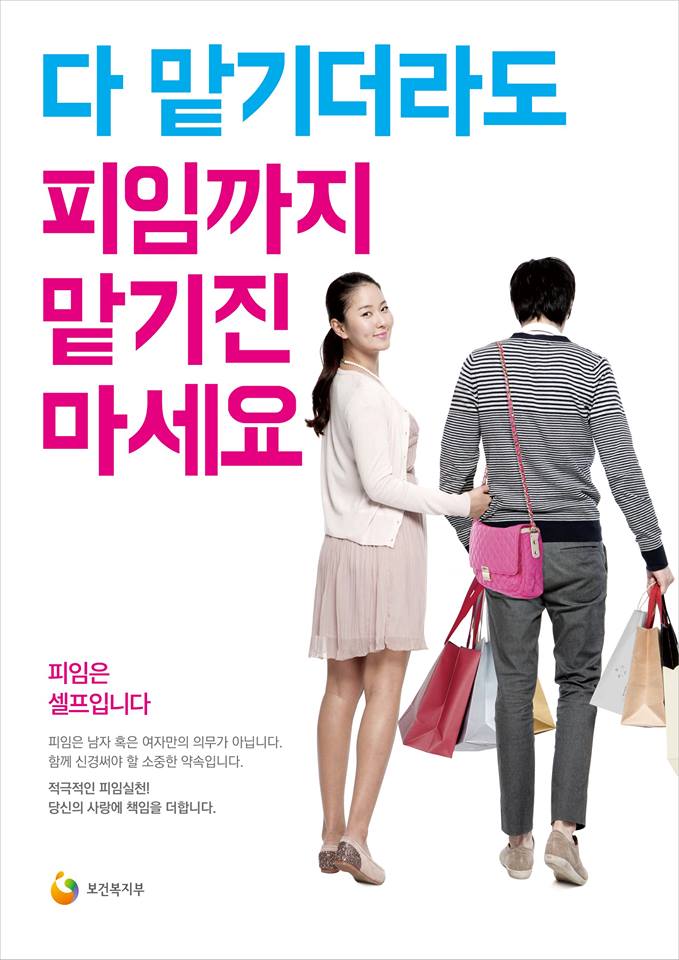
Korean Contraception Poster Not Men's Sole Responsibility(Source: Wikitree)

Let’s be clear: Korean women do, on the whole, leave contraception up to the men. So the Ministry of Health and Welfare, which issued this advertisement on Friday, does seem to have the best of intentions.

But, “Although you leave everything (to men), don’t leave the responsibility for contraception (to men)”? For something encouraging women to empower themselves in one aspect of their lives, it’s a bizarre assertion of traditional gender roles in others.

Frankly then, while I was happy to see the ad at first (what’s not to like about women being more assertive in the bedroom?) I came to understand the opposition to it. Especially Korean Womenlink’s criticism that “It is regrettable that the Ministry described contraception as a conflict between men and women while the poster was designed to promote contraception.”

Fortunately, it’s since since been withdrawn. But I do hope there’ll be another, more thoughtful attempt to get the message across soon. If so, I recommend the text focuses on shared responsibility, and replacing the image with something like this one. What do you think?

Update: See the Korea Herald for more information and context. It says new posters will be coming as soon as next week!

Planned Parenthood Birth Control(Source: Planned Parenthood)

Book Giveaway: Labyrinth of the Past by Zhang Yiwei (2014)

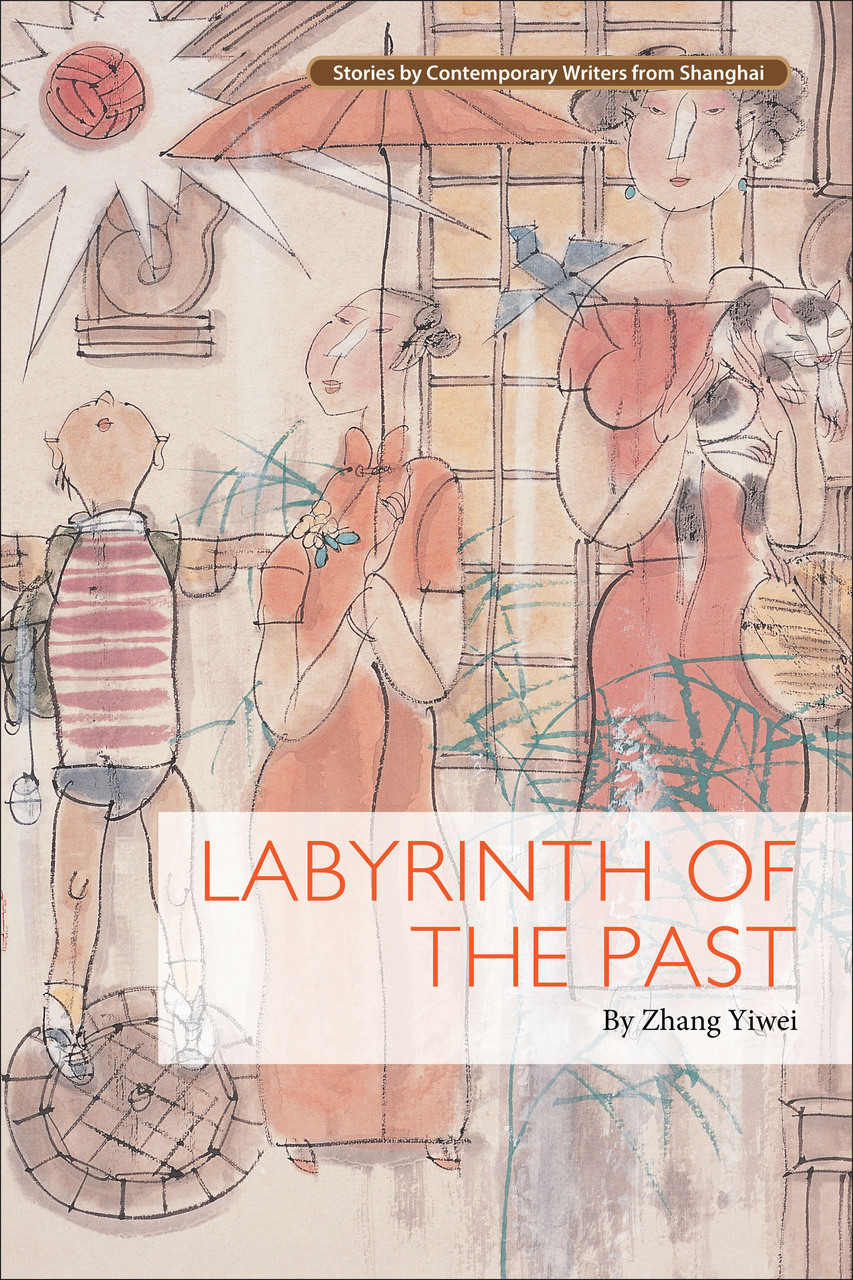
Labyrinth of the Past by Zhang Yiwei(Source: Tuttle)

Sorry that I haven’t posted for so long everyone. I was very busy with offline work for two weeks, then I caught a terrible cold which lasted another two weeks…which means now I’m busier than ever. But, I would like to get writing here again, and I can think of no better way to start than by offering a book giveaway!

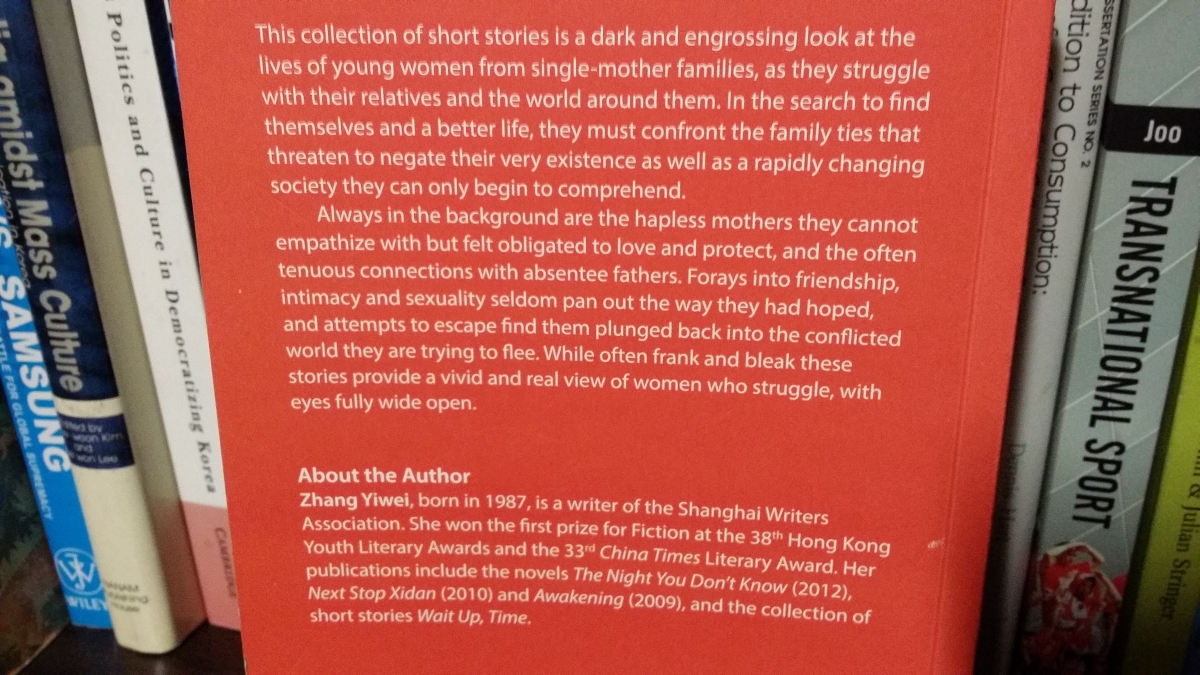
For this first one, I’ve selected Labyrinth of the Past by Zhang Yiwei. It’s a good book, but frankly it was a frustrating read for me personally, because the publisher’s website gave me the wrong impression of what to expect. Know what it’s really about though, and you’ll enjoy it from the get-go.

Here’s the offending description, which has two big problems:

Labyrinth of the Past is a collection of short stories that explore the lives of young women raised by single mothers in China, a country that is unforgiving to unmarried women and their children.

A dark, yet engrossing look at the lives of these girls, each story examines their personal struggles with family and the greater world around them. Coping with the stigma of being the daughter of a single mother, most of these women can’t seem to form anything but dysfunctional relationships, from mothers to friends to lovers.

While often frank and terribly bleak, these stories provide a vivid and real view of the women who struggle against a history they can’t change, in a culture that has difficulty accepting them.

That stigma surrounding unwed mothers is very real in Korea, so I partially chose the book to gain some insights into what it was like living with it. You can imagine my surprise and disappointment then, when it never even came up. Primarily, because none of the mothers are “unmarried” in the sense of never having married, but are all divorcees or widows instead. Which, given China’s skyrocketing divorce rates since Deng’s reforms, probably doesn’t carry any stigma at all:

The number of divorces has risen steadily in the new millennium, with one in five marriages now ending in separation. In 2006, the divorce rate was about 1.4 per one thousand people—twice what it was in 1990, and more than three times what it was in 1982….The number of divorces in the first three months of 2011 increased 17.1% year-on-year….Beijing leads the country with nearly 40 per cent of marriages ending in divorce, followed closely by Shanghai.

Behind the Red Door: Sex in China, Richard Burger (2012), p. 59

I’m happy to be corrected by any readers raised by female divorcees or widows, and/or with more knowledge of China, who may be able to read between the lines and see the influence of a stigma on the characters where I can’t. But if so, it’s still a very peripheral theme at best, and should really be removed from the description on the website (fortunately, it’s not mentioned on the back cover, which I wish I’d read instead).

Chinese Woman in Shanghai(Source: Matthijs Koster. CC BY 2.0)

The second problem is that the book is about the lives of young women, yet two of the seven stories—”Scab Addiction” and “No Choosing Today”—are entirely about the characters’ childhoods. In particular, in the former the character-narrator is revealed to be still in high school, making it a terrible choice for an opening story. Had I picked up the book in a store, expecting it to delve straight into the lives of adult Chinese women, I would have rejected it on the spot.

Again, this is not a criticism of the book per se, and of course all the remaining stories are indeed from women’s perspectives, with “A Good Year”, “Love,” and “Summer Days” all covering dating, marriage, and/or sex. “I Really Don’t Want to Come” too, covering the narrator’s increasing disdain for kowtowing to ancestors as she grows older, and frustration with what the ceremony means for her split family, is something many Koreans (and their foreign partners) will surely relate to. (“Memory is the Slowest” though, I just found confusing—I’m still not really sure what it’s about). But it’s also a real pity, because, once I got over the disappointment of reading something very different to what I’d been sold, and was able to take a fresh look at the book, ironically I came to find Zhang Yiwei’s depictions of childhood to be one of its biggest strengths. Her ability to evoke its timelessness, the sense of children’s whole worlds confined to just a few streets and fields, and our fuzzy, malleable memories of that phase of our lives is really quite remarkable (frankly, it immediately reminded me of the magic realism of 100 Years of Solitude), and that should be highlighted in its marketing.

Another strong point is showing how profoundly the issue of housing impacts ordinary Chinese citizens’ lives. That may sound rather boring at first, but it looms large in a country with such breakneck development, huge internal migration, and consequent vast urban/rural and home-owning/renting divides, and accordingly it’s a constant concern for many of the characters in the book, some of whom are stuck in limbo because their property is in an absentee husband or father’s name. Indeed, as if to rub that in, recently the government manipulated the ownership laws in a bid to thwart the divorce rate, taking a great leap backward for women’s rights in the process:

…the Chinese government has expressed alarm at the soaring number of divorces and its threat to the traditional Chinese family. In 2011, China took controversial steps to discourage divorce, reinterpreting the marriage law so that residential property is no longer regarded as jointly owned and divided equally after a divorce. Instead, it will belong exclusively to the spouse who bought it or whose name is on the deed, which is usually the husband, even if the wife helped pay for the property. This means that upon divorce many women might find themselves homeless.

At a time of soaring property prices, real estate is often a couple’s most valuable possession, and the revised law has caused many women to consider more carefully whether they really want to get married. Chinese media reported that marriage registrants plummeted as much as 30 percent in some cities weeks after the revised law was announced in 2011.

Behind the Red Door: Sex in China, Richard Burger (2012), p. 61

Update, August 2015: For more details, I highly recommend listening to this Office Hours podcast interview of journalist Leta Hong Fincher, author of Leftover Women: The Resurgence of Gender Inequality in China (2014).

Chinese Housing(Source: Anita. CC BY 2.0)

The verdict? I can’t lie—despite its strengths, the cover price of $13.95 is a little steep for such a slim book (160 pages), especially with some of the stories being so frustratingly short. But it’s definitely worth the $10-ish or even cheaper on various websites it’s selling for at the moment, especially if you know what you’re in for.

But first, remember I have two free copies to give away! Please just leave a comment below, and a week from now I’ll pretend to select two of you at random to receive them (make sure your email address is correct!). Really though, if you’d like to get to the head of the queue, please do bribe me with interesting comments about single mothers and/or something China-related!

What are you waiting for? ;)

Announcements: A Rare Film About LGBT Asian-Americans, Bras for a Cause, and a Survey on Street Harassment in Korea

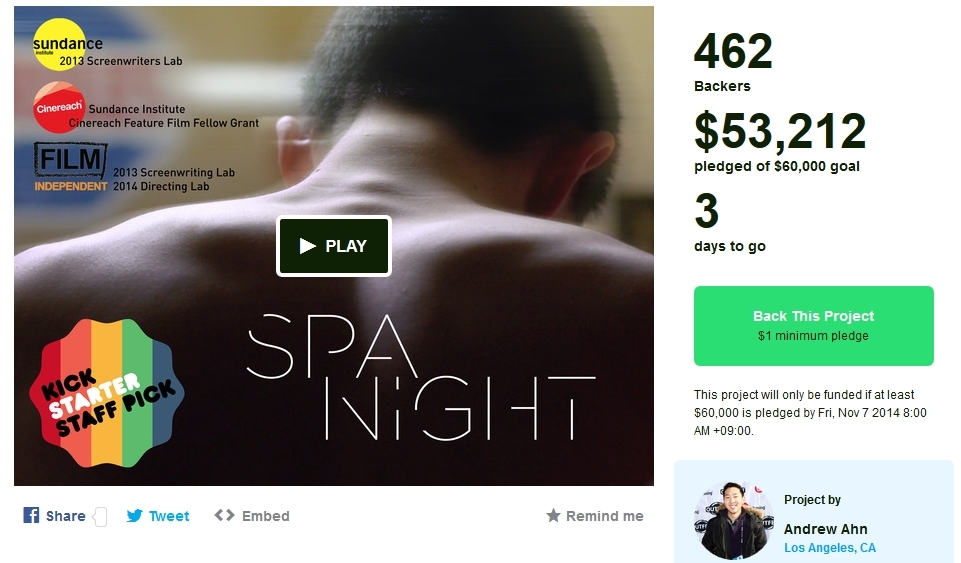
Spa Night(Source: Kickstarter)

Some worthy causes which would really benefit from just a little of your time or money this week:

Spa Night – A Korean-American Film about Coming Out

From the Kickstarter Page (my emphasis):

WHY THIS FILM IS IMPORTANT

I have always associated Korean spas with my childhood, my family, and my Korean identity. As a kid, I would go to the spa with my dad. It was a cultural ritual; we would clean ourselves.

A few years ago, I discovered that Korean spas in Los Angeles are used as a space for underground gay sex. As a gay Korean-American man, this discovery felt strange, thrilling, and very wrong! It’s very easy for me to separate my identities. I can either be Korean or gay. But here is this place where I have to deal with my identities at the same time. I’m forced to be whole.

I knew immediately that a Korean spa would be the perfect setting for a film about a gay Korean-American identity. There aren’t enough films out there about Asian-Americans, let alone LGBTQ Asian-Americans. It’s important to me that I share this story so that people understand that we exist and that our community holds a diversity of people, voices, and experiences.

If this sounds like something you’d like to support, please do so soon: as I post this on Tuesday morning Korean time, unfortunately it’s still $7000 short of its $60,000 goal, with only 3 days left to go. See Kickstarter for further information, or the Facebook page.

Bras for a Cause 2014Bras For a Cause

From the Facebook Event Page:

Bras for a Cause (Seoul) is a fun event in November that raises money for the Korea Breast Cancer Foundation while promoting breast cancer awareness. According to the KBCF, breast cancer is the leading cause of cancer affecting Korean women.

Please contact the Korea Breast Cancer Foundation if you are aware of a breast cancer sufferer in your community who has been unable to receive surgery or treatment due to financial hardships. They offer funding for breast cancer surgery anticancer and radiation treatment after a patient undergoes evaluation. The Korea Breast Cancer Foundation is dedicated to helping encourage patients with breast cancer to continue treatment despite financial difficulties and to helping them escape the pain of breast cancer.

Survey on Street Harassment in Korea

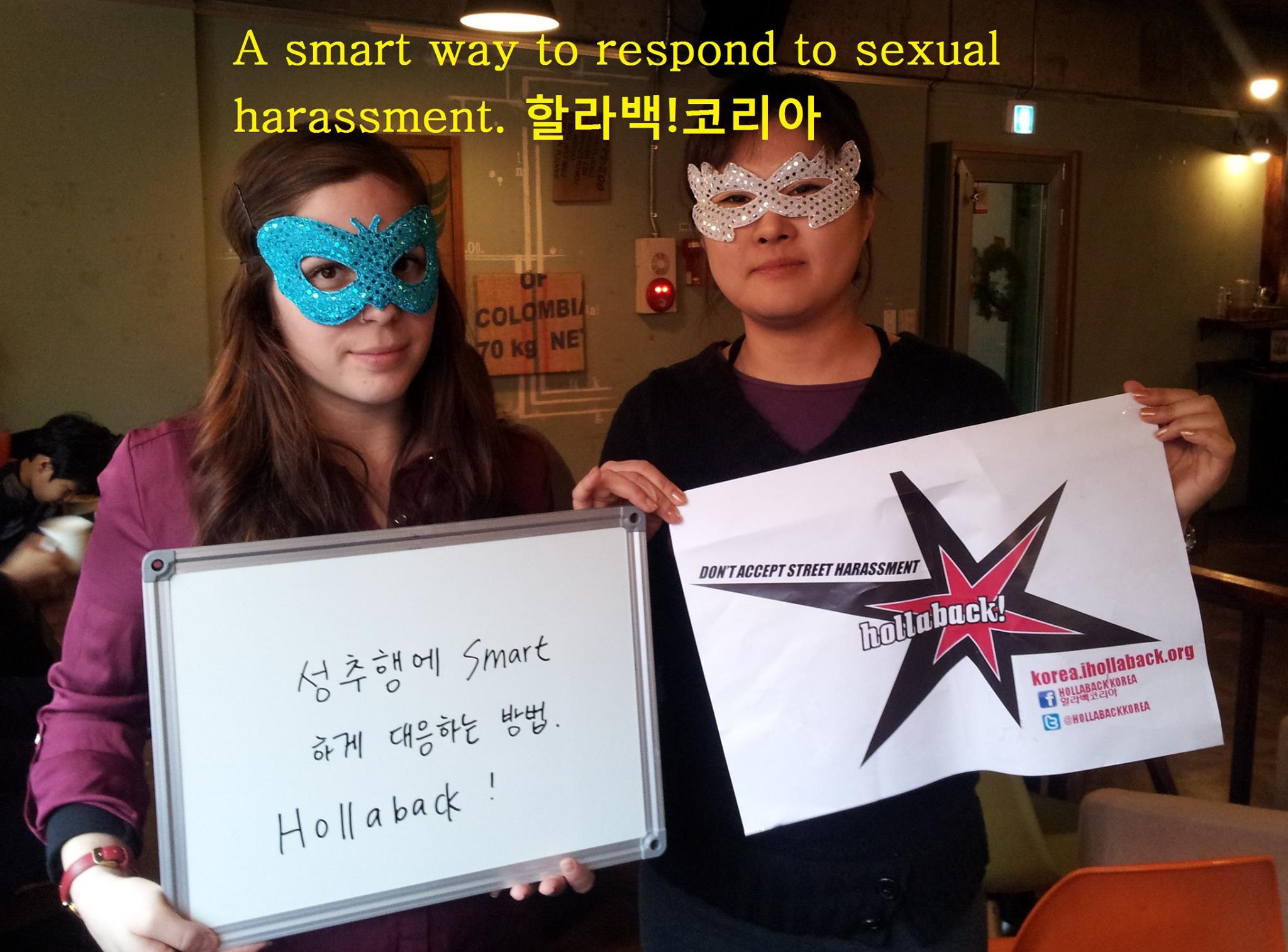
Via Hollaback! Korea:

Have you been to Korea in the last year? Please respond to this important global survey on street (sexual, gendered, racial, homophobic) harassment. It takes about 10 minutes but contributes in a very important way to spreading awareness of this issue. Please spread widely.

Please participate in our global study of street harassment by following [this link]. We appreciate your participation!

See the links for more information, or here for my February story about Hollaback! Korea itself.

Hollaback Korea(Source: Facebook Group Page)

As always, if any readers also have any event, worthy cause, video, or just about anything else they’d like to promote, please just shoot me an email (but please add as many pictures and details as possible!) and I’ll add it in a later post.

Korean Sociological Image #87: Normalizing Interracial Relationships

(Update: Sorry for the lack of English subtitles. Since writing this post, one of the show participants/actors in the commercial left Korea in disgrace due to a sex-scandal, and the original video was made private. You can still find a good English translation and explanation here though).

An extended commercial for Yoplait ‘Yopa’ yogurt, featuring five quick, humorous stories of foreign men in relationships with Korean women.

It’s unremarkable in itself, and frankly not all that funny, although I did love hearing the “Do you want to eat noodles at my place and go?” line again at 1:10. But that’s precisely the point: by making no big deal of the men’s ethnicities, and showing Korean women dating, living with, and even—heaven forbid—explicitly wanting to have sex with them, the commercial helps to normalize such relationships among the Korean public. Whereas just last year, one Korean television station effectively portrayed entering into a relationship with a foreign man as a sex crime—adding to the Korean media’s long history of depicting them as sexual deviants and rapists, from whom weak and gullible Korean women need protecting.

Starring five men from the Abnormal Summit show, who form part of “a panel of eleven non-Korean men, living in Korea, who debate [in Korean] on various topics and Korean culture, through the eyes of a foreigner,” this marks just the third commercial in the last ten years that has positively presented such relationships (that I’m aware of; see Korean Sociological Image #47 and #65 for the other two). In contrast, there have been numerous ones with positive depictions of Korean men in relationships with foreign women, especially during and after the Misuda show of 2006-2010 (in many ways a female equivalent of Abnormal Summit), although there’s also been a strong tendency to portray the women as sexual conquests (especially in K-pop).

Do any readers know of any more examples, whatever the sexes? Do you think we’ll have to wait another four years for another commercial like this one?

(For more posts in the Korean Sociological Image Series, see here)

Announcements

From Explorers and Missionaries to Vagabonds and Potential Criminals
(Source: Facebook Event Page)

Hello everyone. Just to quickly let you know about an upcoming presentation not to be missed, some worthy causes, and some Youtubers that deserve more promoting.

First up, next Saturday (the 25th), Matt VanVolkenburg will be giving a presentation in Seoul for the 10 Magazine Book Club titled “From Explorers and Missionaries to Vagabonds and Potential Criminals: Two Hundred Years of Teaching English in Korea.”

If you’re unfamiliar with the name, let me add that he’s the author of the Gusts of Popular Feeling blog…which I’m sure will have you scrambling to check out the Facebook Event Page before you even finish this sentence!

Next, via The Kimchi Queen:

99 Film‘s new queer movie “Butterfly” is being crowdfounded on GoodFunding aiming for 2 million won in donations (about 2 thousand dollars). 99 Film has used this method for other films (such as “20”) and they have been in general successful in getting their target funding goals.

About working in a (gay) host bar, see The Kimchi Queen for more (English) information, or go directly to GoodFunding for more information in Korean.

Next, via Hollaback Korea 할라백 코리아 comes Rainbow Teen Safe Spacesfourth letter to donors. It begins and ends:

Rainbow Teen Safe Space will soon be launched. The project has been focusing on fund-raising activities so far. Now it is time for a new round of dealing with organizational issues. On July 13, we had a meeting to talk about a new organizational structure for this project to be a common cause of the LGBT human rights movement. We decided to set up the secretariat and hire a full-time staff to set out the street counseling program in September. The secretariat will share the office with Solidarity for LGBT Human Rights of Korea. We are also in preparation to form an advisory committee of experts in various areas such as law, medical care, counseling and human rights…

…We haven’t reached our fundraising goal yet. For the street counseling activities to start on a solid foundation, please join our fundraising effort for Rainbow Teen Safe Space project. If you, donors’ help come together, it would be such a great strength to all of us.

See the link for much more information about its activities, the video above for a quick introduction (it’s in English), or here for its fundraising website.

Finally, I’ve been asked to promote a couple of video producers. First, a small, Daegu-based organization called Stompy Ruffers Cultural Fusion, which “takes Korean culture and blends it with American culture to create some fun and exciting products/events.” See here for more information about them, or here for a selection of their videos—including the “How to Order Food at a Korean Restaurant” one above, which I think would be better titled “But we’re speaking Korean!” after the Japanese version, and which I’m I sure all too many expats in both countries can relate to (Update: Actually, the Korean video came first sorry!).

Last but not least, from Stephanie Rosier (whom I have to thank for this post), also based in Daegu, who has been making video blogs about Korean culture:

I talk about everything you can imagine really. The blogs are an average of 20 minutes long and usually include various photographs and short videos of my adventures here. I can speak Korean at a conversational level (or Topik level 4 to be exact) so I have been able to talk to, and make friends with a wide range of Korean people, from hair dressers to grandmothers, and learn about Korea from an insider’s perspective.

See here for the blogs, or the above video for her “Spring Video Project: Asking Korean People 한국 사람한테 물어보자: 봄 동영상 계획”.

If any readers also have any event, worthy cause, video, or just about anything else they’d like to promote, please just shoot me an email (but please add as many pictures and details as possible!) and I’ll add it here or in a later post.

Sunday Fun: Bottoms!

Hidamari Sketch EscherGirlMy 8 year-old daughter Alice is really into comics these days, often hiding our home phone under her pillow to keep reading when she’s supposed to be asleep. To my chagrin, she couldn’t care less if the female characters have huge eyes though, and/or no noses. But yesterday, I noticed the above while she was watching the opening to the anime adaptation of Hidamari Sketch. It was a great opportunity to start teaching her about female characters’ typical poses too.

Cue 20 minutes of giggling at the bottoms in the Escher Girls blog, which ultimately had the whole family trying—and failing—to imitate some of the pictures (although I was pretty good myself actually). Naturally, we quickly skipped past some of the more inappropriate ones, and Alice still has no idea why female characters are so often drawn in a “boobs and butt” style. But at least she’s aware of the phenomenon now, and, with gentle prodding from me, will hopefully think more about it herself as she gets older.

For now though, she’s still very much a 8 year-old girl, and I can hardly fault her for that. Much of those 20 minutes were also spent by her and her 6 year-old sister Elizabeth saying “와! 예쁘다…” (Wow! They’re so pretty…), and today this post took a long time to write because she kept on stopping me to tell me all about the characters in Hidamari Sketch. Including Yoshinoya above, who’s supposedly a high school teacher (sigh)…

Korean Sociological Image #86: Sex and the Single Korean (Household)

ZigbangAs of last year, one in four Korean households had just one person. That was the same as Australia, and just shy of the US.

Yet just four years earlier, only Seoul was remotely close to that figure, with one in five. That wasn’t expected to rise to one in four until 2030, let alone the rest of country.

It’s a remarkable rise (one of the fastest in the world), and companies have been responding with such things as smaller food portions, more home-delivery services, and smaller appliances. And then there’s the start-up Zigbang (pron. jeekbang) founded in early-2012, which takes the hassle, legwork, and pitfalls (ㅋㅋㅋ) out of finding studio apartments through real estate agents by arranging everything online instead. If you’ve taken the subway recently, probably you’ve seen their ad above, featuring comedian Kim Ji-min (source: Platum).

Much more interesting though, are the ads you probably haven’t seen. Covering everything from the hassles of long commutes and living with one’s parents in your 20s and 30s, to gaining independence and sexual liberation, they provide an interesting look at some of the push and pull factors behind this singles trend. Most are amusing, and some are very, very Korean too. Here’s a small selection from Zigbang’s Facebook page:

zigbang nagging parents(Source: Zigbang Facebook)

Title: “I’m sick of this bloody nagging! I want the independence of my own place!”

Parents:

  • “When on Earth are you going to…”
  • “Because of you, your younger sister can’t get married…[she can’t get married before you do]…”
  • “Look at Mi-sun next door, she’s already had two children…”
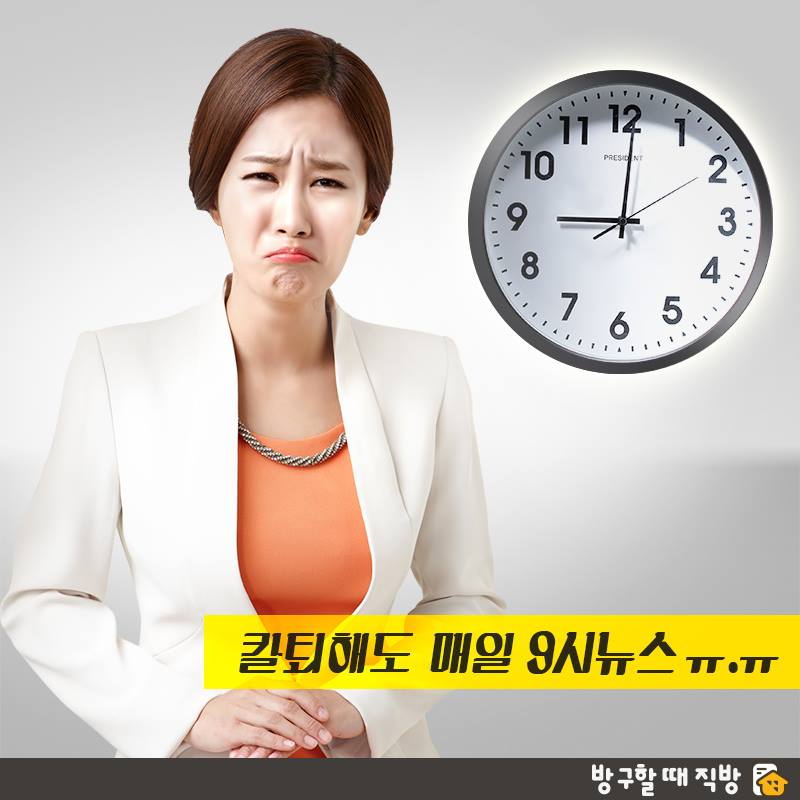
zigbang 9pm news(Source: Zigbang Facebook)

“Even if I finish exactly on time, I only ever get to see the 9pm news.”

In reality though, that’s not necessarily because of long commutes:

https://twitter.com/jetpack/status/517229353529118720

Continuing:

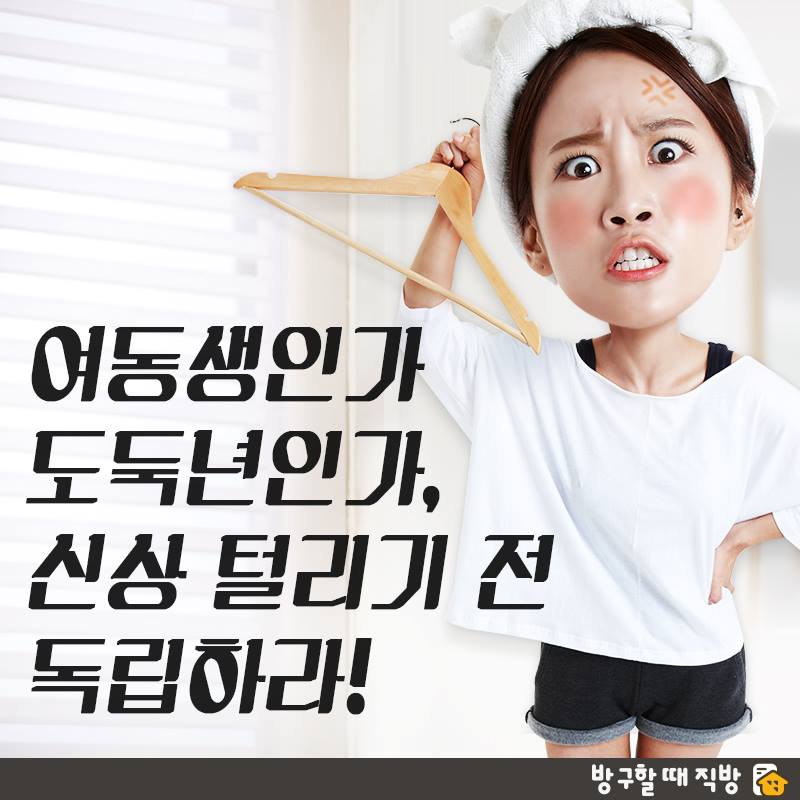
zigbang sister borrowing clothes(Source: Zigbang Facebook)

“Is she my sister or is she a thief? I have to get my independence before people find out…[how I live]!”

I'm 30, a curfew is unacceptable(Source: Zigbang Facebook)

“I’m 30! A curfew is too much!”

By coincidence, Kim Ji-min is 30 in Korea, or 29 in “Western age.” Apropos of that, these next two ads have a much more adult slant…

zigbang blind dates(Source: Zigbang Facebook; alternative version here)

“I have a 100% success rate on blind dates.” Presumably, because she has her own place to take them home to.

zigbang do you want something hot to eat(Source: Zikgbang Facebook; alternative version here)

I think the text is badly chosen: literally, it says,”Do you want to eat noodles and go?”, which would mean the object of her affections is already at her place, whereas “Do you want to go eat noodles at my place?” would make much more sense (update: actually, the line is from a movie—see below). But either way, the double-entendre is obvious, and if not then a helpful Korean “R18” symbol makes it clear.

Which is interesting in its own right, and a good counterexample to my recent post on Sookmyung Women’s University students being given a dresscode. Because whereas our natural reaction to such news may be to label Korean society as sexually conservative, or to shoehorn narratives of progression onto to it because of these ads, really there’s abundant evidence of both. Also, even if one does find some definitive, profoundly conservative aspect of Korean sexuality, it can be very modern in others—just like everywhere else.

Even more remarkable though, is that those last two yahan ads made it from the confines of Facebook to Seoul subway stations, all the better to corrupt Korean youth. Here’s two photos of them by reader Thibault Deckers, whom I have to thank for inspiring this post:

zigbang blind dates stationzigbang do you want something hot to eatAds don’t necessarily reflect a change in social attitudes of course, nor necessarily spark one, but I think the sheer numbers of single households are surely having effects. One recent article found that 70% of 30-somethings prefer their own company for instance, and I too have noticed that my students will no longer react in horror upon learning that I always go to the cinema alone (I prefer sitting in the front row).

What changes have readers noticed? I’d be especially interested to hear about knock-on changes in attitudes towards cohabitation, given how difficult it was to find a reader to find interviewees for his MA thesis on that just a few years ago (as in so scared of being found out that they would frequently cancel, not that they didn’t exist). Or do you think this is all exaggerated, not least by companies like Zigbang?

Update 1) I forget to mention that despite Zigbang’s focus on 20-30 somethings, most people living alone in Korea remain middle-aged professional men, and elderly women living in poverty. Likely, the latter don’t use Zigbang at all, but it would be interesting to know how much of its business comes from the former, despite being ignored in its marketing.

Update 2) With thanks, a clarification to that confusing line about noodles. It’s from the 2001 movie One Fine Spring Day:

https://twitter.com/jetpack/status/520760948961734657 https://twitter.com/jetpack/status/520766843053555712

Here’s a video with the scene, and an explanation:

(For more posts in the Korean Sociological Image Series, see here)

Korean Sociological Image #85: Just One 10 Minutes…to Improve Your Spouse’s Specs

Korea Gender Roles Marriage Specs(Source: Jinvas, left, right; edited)

Two notebook covers, found by reader Stephanie Rosier at her local Kyobo bookstore. As she explains on the blog’s Facebook page, the left reads, “If I study for ten more minutes, my [future] wife’s face will change,” and the right, “If I study for ten more minutes, my [future] husband’s job will change.”

Of course they’re just notebooks, and just for fun (although I do hope it’s adults they’re aimed at!). But they’re also a reflection of how deeply “specs” (스펙) like certain jobs and physical standards dominate matchmaking discussions among Koreans these days. Whereas back in the 1980s, it was older family members or family friends that would size up children’s potential spouses for arranged 선 (seon) matches like this, nowadays hard economic times mean that young people can be just as pragmatic and calculating as their grandparents were.

Meanwhile, what’s “Just One 10 Minutes?” you ask? :D

Related Posts:

(For more posts in the Korean Sociological Image Series, see here)

Policing the Student Body: Sookmyung Women’s University students told to cover up

Sookmyung Women's University Festival Dress Code(Source: TVChosun)

Watching a news report about the controversial new dress code for last week’s festival at Sookmyung Women’s University, I was surprised to hear that it was the student union that was responsible, and aghast to learn that it was under the assumption that wearing revealing clothes leads to more sex crimes against women.

Fortunately though, at least the report itself ended with a commentator from the Korean Institute for Gender Equality Promotion and Education, who pointed out the potential for victim-blaming from such misguided beliefs. As so few other reports mentioned that (I’ve only found one other), I thought it was worth highlighting here.

Alas, there were technical issues with the sound in the online video, and rather than fixing those MBN just decided to delete it. But the transcript is still available:

Anchor:

숙명여대 총학생회가 축제 기간에 입을 수 있는 복장 규정을 마련했는데, 치마 길이와 심한 노출 등을 규제하고 있습니다. 성 상품화에 젖은 대학문화를 자정하겠다는 취지인데 논란이 일고 있습니다.
주진희 기자입니다.

For the university festival period, the Sookmyung Women’s University student union has set rules for students’ dress, regulating the length of skirts and the amount of exposure. This attempt to regulate university culture, which is steeped in sexual objectification, has raised a lot of controversy.

Reporter, Ju Jin-hee:

친구 얼굴에 물풍선을 던지거나 인간 두더지 게임을 하며 학업 스트레스를 날립니다. 해가 지면 캠퍼스에 주점이 설치되고 축제 분위기는 무르익습니다. 주점마다 자극적인 문구와 공연으로 치열한 호객 행위가 벌어집니다. 여성 속옷인 가터벨트를 찬 가정부 그림을 이용한 홍보지부터 성적인 은유를 함축한 메뉴판까지. 노골적으로 성을 상품화한 축제로 변질될 우려가 일자, 축제 시작 전 숙명여대 학생회는 혹시 모를 불상사를 막자며 복장 규정을 강화했습니다. 허벅지의 절반을 드러내는 치마는 금지. 만일 입으려면 속바지를 착용하도록 했습니다. 가슴골이 보이거나 속살이 비치는 의상은 물론이고, 옆트임이 있는 치마도 금지했습니다. 만일 어겼다가 적발되면 벌금을 내도록 했습니다. 이해가 간다는 반응의 학생들도 많지만…

During the day, doing things like throwing water balloons at students’ faces and playing whack-a-mole with them is a way of relieving stress at festivals.

But once the sun goes down, the festival atmosphere takes a more adult turn, with students promoting their departments with eye-catching posters and performances and making money for them by selling alcohol [James: With flow-on benefits for their MTs and so on].

In this vein, [the Department of Art and Crafts] made a provocative poster with a maid wearing a garter belt, and a menu with suggestively-named foods.

Sookmyung Women's University Maid and Menu(Sources: Kookje; Goodbuyselly)

Because of worries about such increasing sexual objectification in festivals, the student union set rules about clothing in order to avert any incidents.* These include: only being allowed to show 50% of the thigh; having to wear shorts under a mini-skirt; and mesh tops, dresses showing cleavage, and those with side-slits [James: Is that the right term?] all banned, with offenders being fined.

Many students responded that they understood these rules, but…

(James: It’s this line — “노골적으로 성을 상품화한 축제로 변질될 우려가 일자, 축제 시작 전 숙명여대 학생회는 혹시 모를 불상사를 막자며 복장 규정을 강화했습니다” — that sounds like victim-blaming. If better Korean speakers than I feel that’s a little extreme though, or a misinterpretation, I’d be very happy to be proven wrong!)

Interview: Sookmyung Women’s University Student:

“여대로써 많은 불상사가 생기지 않도록 엄격한 규제를 한 것에 대해서 찬성을 하고요. 그렇게 다 가리고 있는 건 아니잖아요.”

“Because this is a women’s university, I agree that regulations had to be made before an incident occurred. Students have been pretty blatant [about wearing revealing clothing and so on].

반면 비판 여론도 만만치 않습니다.

On the other hand, there were a lot of criticisms.

Interview, Kim Han-min, University Student:

“저는 솔직히 문란하다고 생각 안 하거든요. 그런 거 하나하나도 패션에 대한 자유가 될 수 있는데, 규제가 조금 심했다고 생각하고 있어요.”

“To be honest, I don’t think it’s lewd at all. This is about fashion and personal freedom, so I think the regulations are too harsh.”

전문가들은 여성의 짧은 치마가 문제될 수 있다는 사고방식 자체가 더 문제라는 지적입니다.

Experts pointed out that it’s the notion that women’s short skirts are problematic that is more of an issue:

Interview: Seong In-ja, Korean Institute for Gender Equality Promotion and Education

“고육지책으로 마련된 걸로 보이긴 하지만 또 한편에서의 우려는 성범죄 안에서 피해자에게 원인이 있다는 ‘피해자 유발론’으로….”

“These rules appear to be a desperate measure, and there is a genuine worry that they shift the blame of sexual crimes onto the victims…”

축제 문화를 자정하려는 취지에서 만들었지만, 좀 더 현실성있고 고민이 담긴 규정이 마련돼야한다는 목소리도 나오고 있습니다.

These rules appear aimed at regulating [excessively sexual] festival culture, but some voices are saying a much more realistic and nuanced approach is needed (end).

sookmyung-womens-university-festival(Source: Extreme Movie; edited for brightness)

Of course, that only skims the surface of the issues raised by the dress code (see here, here, here, here, here, here, and here for the ensuing debate), and it would be good if it turned to be motivated less by supposed crime prevention than avoiding pictures of students later appearing on Ilbe and so on (although again, should that dictate what students are allowed to wear?). If anyone likes, I’d be happy do some more investigating and translating to learn more.

In the meantime, I wisely invested my time in interviewing Peter Daley instead, a professor at Sookmyung (and expert on Korean cults), to gauge the atmosphere and his students’ reactions. To his surprise, they felt it was a non-issue that had been blown all out of proportion:

“I only found out about the dress-code through the article in the Korea Times….[a female coworker of mine] felt it was a bit draconian. The students are adults, but weren’t being treated as such…she also mentioned that some students do have larger breasts…are they going to be penalized just because they can’t hide that part of their anatomy?

…Contrast that with what my students said, and that was a different reaction entirely…I expected that [raising it in class] would lead to some kind of debate and that students would be passionate about it, but they just kind of laughed it off…they said only guys were worried about the rules [because they’d see less]!

He hasn’t taught at Sookmyung long enough to attend previous festivals, but, whether because of the new dress-code or not, he didn’t see students wearing anything particularly risqué last Friday (“Certainly nothing too different from what young Korean women normally wear in the summer, or at other university festivals.”). Nor did the security guards seem to be tasked with measuring skirts with rulers, as if they were teachers at a high school.

But if someone had seen too much thigh? Sookymung isn’t a school, and the students are no longer children. The last time grown women were penalized for what they wore, it was by the fashion police of the 1970s, during the military dictatorship.

So yes, perhaps the students really should have been angrier.

busty girl problems korean fashion police(Sources: Busty Girl Comics, 추억의 편린들)

But I’m not one of them, and can’t presume to know their needs and feelings better than they do. Also, Daley concedes that without this year’s dress code, fashions at previous festivals may well have been more extreme, and indeed fashion photographer and blogger Michael Hurt said on Facebook that things at his own school’s festival are “getting insane,” although again that banning isn’t the solution (reprinted with permission):

But I think [the message it sends, that girls’ worth is all in their looks] is precisely the point that this culture is struggling with right now. One of the reasons they dress this way, and this is even hinted at in the quotes lifted from the students for the [Korea Times] article, is that they have really come to commodify value themselves in terms of their sexuality, the expressions of which are primarily guided by over sexualized images in the media. I think something needs to be done to counteract this tendency, but this culture is lacking in terms of concrete strategies to do so besides banning or making rules. I think the same is true in the US to a lesser extent, but both cultures seem to have a problem dealing with where the line should be without having to litigate it.

I’d be grateful if readers could supply any more details about events at Sookmyung; for instance, although the student union came up with it, I’m sure that the dress code was actually at the behest of the university administration. Also, I’ve never attended any Korean university festival myself (I always have two young kids to look after, and teach at a very Christian university far from home), so I’d be very interested to hear what they’re like. What are your experiences and impressions? Have you heard of dress codes elsewhere? Do you think, even if you don’t agree with the ban, that something like it was inevitable?
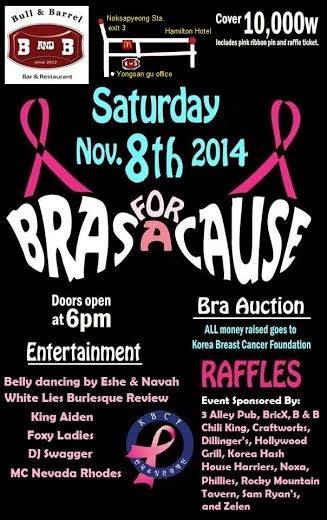
Update) Among many other relevant and interesting posts by Michael, make sure to check out “The Cultural Politics of Short Skirts in Korea.”

Update 2) I realize the irony of only quoting two middle-aged men for this article, but, well, you get what you pay for sorry(!) that can’t be helped with my family and day job down here in Busan unfortunately. Most of the links do include input from the students though, and if readers would like me to investigate further then I’m happy to focus on finding a student’s perspective to translate (here’s a good candidate).

Update 3) Some interesting related reading: “Dress Codes for Girls: Are Teachers the New Objectifiers?” at Ms. blog, and “Say Goodbye, Skimpy. Film Fest on the Alert for ‘Overexposed’ Actresses” at Busan Haps.

Update 4) Here, here, here, and here are some more Korean articles that look interesting.

Searching for Storytellers for Naughty Storytelling Event

bawdy storytelling(Sources, edited: Left, “Meet Again” by Kimiaki Yaegashi, available at Thumbtack Press; Right, This Danielle Brown Page)

I’ve been asked to pass on the following:

Searching for Storytellers for Naughty Storytelling Event

Are your friends always telling you how they look forward to hearing your crazy stories? Are you a fan of The Moth or Risk and have always wanted to get up on stage and tell a true story? Now’s your chance! In mid-October, I’m hosting a naughty storytelling event called The Naughty Yarn at HQ Bar in the Kyungsung area of Busan. I’m looking for people to tell true stories themed around sexuality or dating. Naughty storytelling is a sex-positive event and meant to embrace and playfully examine the ways we navigate our sexual lives. This show is not an open mic; I’m taking story pitches and am looking for eight to ten performers for the evening. If you’re interested, your story must:

*
  • Be true (this is storytelling, not erotica!)
  • Have a narrative arc (no rambling or anecdotes!)
  • Be eight minutes long at the maximum
If you think this is something you’d like to do, please send a short paragraph or two giving a summary of your story to thenaughtyyarn@gmail.com. Thanks!
*