Why Do Young Koreans Live With Their Parents?

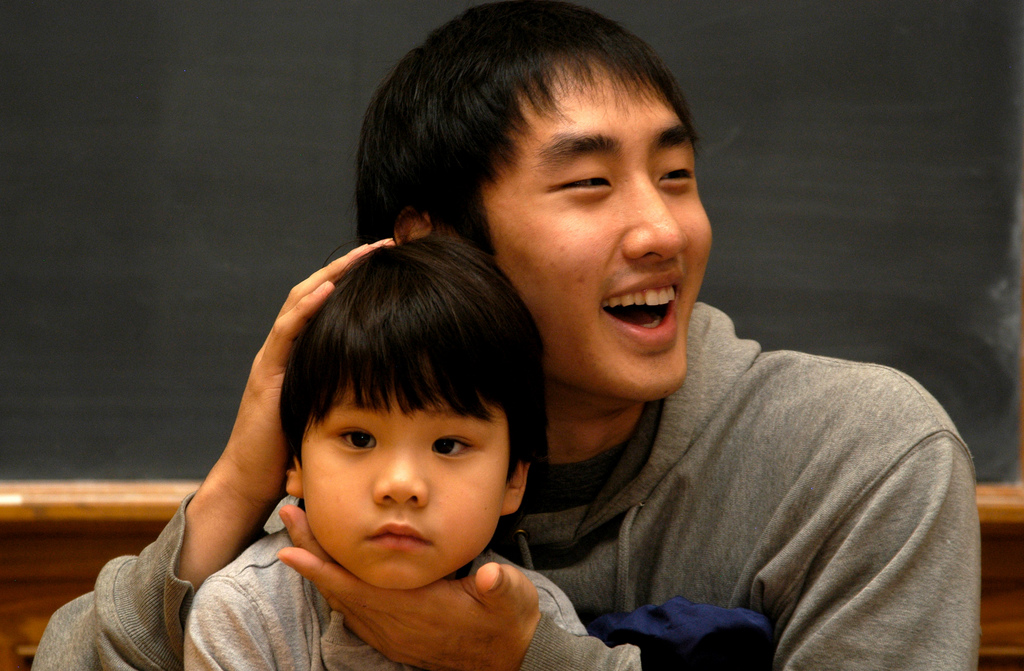
Young Korean Man (Source: Andrew Butts; CC BY 2.0)

(Update, 2 March 2016: Thanks for the link in today’s Guardian, but this Korea Times article of mine is a little out of date. I recommend this 2013 Busan Haps article instead.)

In Saturday’s Korea Times. As always, here’s the original version:

…Everyone knows the strong Korean custom of adult children living with their parents until marriage. Yet a report released earlier this year revealed that one-person households now account for a fifth of all households in Seoul.

This is lower than national figures for most other developed countries, the Seoul Development Institute report notes, and the number for Korea as a whole is likely to be lower still. But the rise puts Seoul on par with Australia, and the rate is predicted to grow to a quarter of all households by 2030.

How to interpret this? Does it signal that the Korean custom of staying in the family home until marriage is under threat?

That is unlikely. The figure includes single professionals, jobless youth, those separated from their spouses, divorcees, and senior citizens, with growth in every category. It does not imply a sudden glut of young Koreans leaving home.

While Korea has experienced many periods of great labor mobility in its recent history, particularly of young, single, working-class women moving to work in factories in cities in the 1960s and 1970s, there is definitely no tradition of young middle-class Korean university students leaving home to share private accommodation with fellow students, and there are still strong taboos against openly cohabiting with partners.

At the same time, young Westerners are adjusting their expectations for living arrangements, as the combination of rising university fees, stingier government allowances, and prospect of paying back student loans leads them to defer leaving home until graduating and/or getting their first job. This delay is often both parents’ and children’s least preferred option, but it is a trend likely to continue given the bleak job market for graduates worldwide.

This points to important economic reasons for the differences, and indeed there are big financial hurdles to overcome to live independently in Korea. For instance, at the moment Korean students cannot get student loans without their parents acting as guarantors (although the Ministry of Education, Science and Technology is working to change this). Nor do the vast majority of universities accept credit cards for payment of fees. In practice though, the combination of extremely high “key money” deposits required by landlords and the low wages afforded by part-time jobs favored by students are keeping even the most rebellious of youths at home until graduating and getting their first job. And then, he or she faces a dearth of rentals of appropriate size.

But familiarity breeds acceptance, and while cultural factors are still important, in practice they are often overstated, as for all the purported differences in how Koreans and Westerners view and value family life, many would behave in a similar fashion in similar circumstances.

For instance, with a child’s school being such an important consideration for entrance into a preferred university, and seniority-based promotion systems locking an employee into a specific company, then if a man is transferred to a different city it is very logical for his wife and children to remain in the family home rather than the children leaving the good school and/or him starting at a much lower wage and position in another company.

Also, as legions of unhappy mothers driving home every Sunday night can attest, Koreans generally don’t like to give their children to relatives to look after during the week, but with childcare facilities being so inadequate,  working parents usually have little choice.

Certainly there are some arrangements that Westerners would almost unanimously reject, such as sending one’s family overseas for years for the sake of the children’s education, but Koreans’ living arrangements do not mean that they are as cold, calculating, or dogmatic as they may at first appear. For instance, while they are not openly discussed, ubiquitous love hotels point to unmarried Koreans having romantic relationships much like Westerners, and as the spate of recent celebrity pregnancies can attest, engaged couples are usually given a great deal of freedom.

Moreover, Korean’s living arrangements may well become more liberal in the future.

A long-running debate within sociology rages over whether capitalism forces very different societies to “converge” and become more similar to each other over time or not, and as one of the only non-Western developed societies, Korea is an important element in that debate.

And as reported by the Economist in March, a decade ago Andrew Oswald of the University of Warwick observed that countries with high rates of home ownership have higher rates of unemployment: with few rental options, he argued, young people living with their parents find it harder to move out and get work, or are stuck in local jobs for which they are ill-suited, and earning less than they could.

korean-grown-children-living-with-parentsPerhaps given the dire state of today’s economy, such imperatives will force such a change in Korea? (End)

With apologies to long-term readers, for naturally my articles for the KT will tend to be about subjects that I’ve already covered and know well (source right: Korea Times).

As they’re for a newspaper rather than a blog though, then I’m being forced to make the subjects much more newsworthy, contemporary, and concise than in their original rambling manifestations here, which (presumably) can’t help but have positive effects on my writing style in the blog as a whole. At the very least then, my planned next blog post will be much shorter than it would have been had I posted it just a few months ago(!), but never fear, for I am still a geek, and so it will still be an in-depth one on an original subject (update: sorry, it’ll be next week, but I’m not sure what day now).

For anyone new to the blog and wanting to learn more about any of the issues raised in the article though, then please try the following links:

Enjoy!

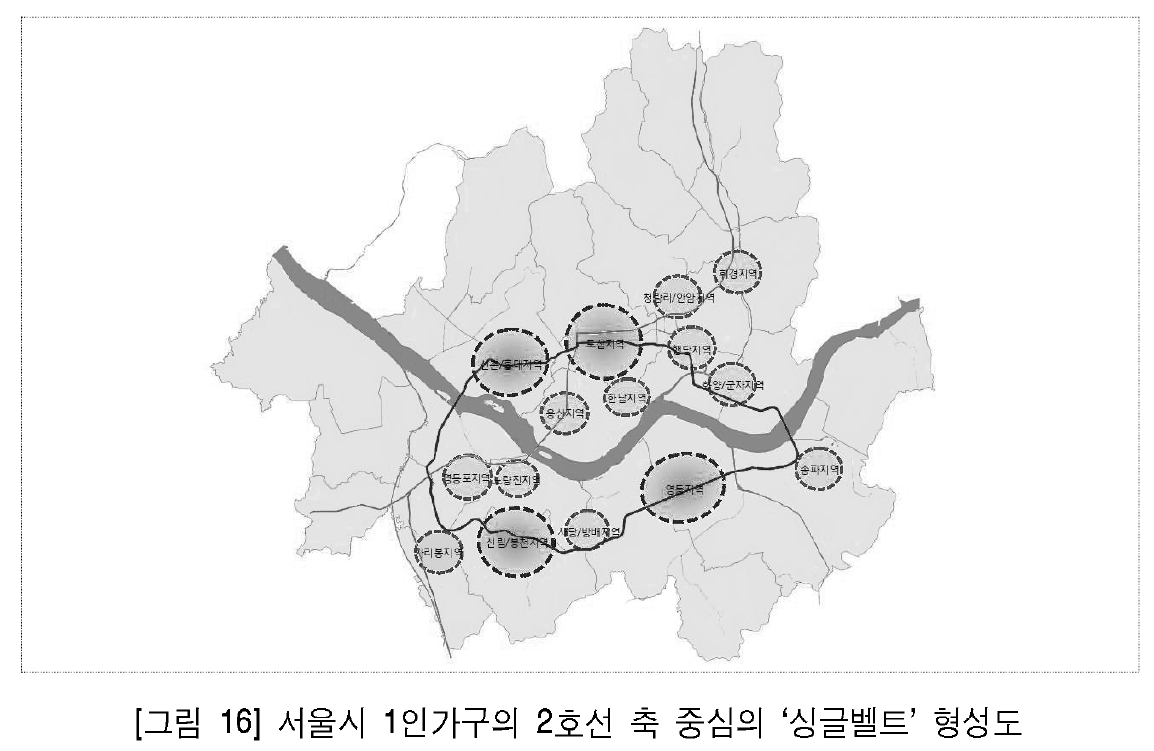
Update) The SDI’s report also mentioned that 51% of those people living alone in Seoul lived in the districts along subway line No. 2, a very small area relative to the vast conurbation that is the second most populous city in the world! It’s definitely no coincidence then, that those districts are dense with cafes, restaurants and retail shops, in total offering 21% of all the part-time jobs in Seoul.

Most of those pay 4000 won an hour, that article reports; the minimum wage is 3500.

Update 2) Here’s a graphic representation of the “single belt” around subway line No. 2, from p.15 of the SDI report.

the-single-belt-of-one-person-households-around-subway-line-no-2-in-seoul

Korea’s “Flower Men”: Where’s the Beef?

gong-yoo-공유-몸짱(Korean Actor Gong Yoo (공유). Source: Unknown)

A commentator on my recent post on the origins of Korea’s kkotminams (꽃미남), or “flower men”:

Is there anything to back up your assertions in this essay? I’m just curious, because I’ve never run into anything that would suggest such a mass reaction to the IMF crisis from the married women of korea. There very could have been, but I’ve never seen anything to suggest it and I’m curious as to how you developed this conclusion.

“in just a few short weeks forever changing standards of dress, discourses of sexuality, and cementing these new ideals of the Korean man.” – you’re kidding right? A few weeks? Unless you’re talking a bloody revolution, or something similiarly radical, I”m not aware of any social movements that can change societies that quickly. I highly doubt a soccer tourney ranks like that.

Your essay overall suggests something pivotal occured in the gender relations in South Korea due to the IMF crisis, but you just make some bald assertions without even giving examples. It’s a little tough to swallow, especially to people who are not in South Korea to see what you are talking about, if indeed there is anything to support your assertions.

I thought that last point was a little harsh, but still, those are some valid criticisms. Hence my lengthy response below, which I decided to make a post of rather than burying it in the comments section to a post that most people were unlikely to reread!

I do have evidence, but I admit that the charge that I “make some bald assertions without even giving examples” is fair. The lack is partially because I wrote this too much in the style of an opinion piece, and partially because regardless it would have been virtually impossible to provide satisfactory evidence in only 800 words. Like I said in that post, in hindsight this was a very bad choice of subject for a newspaper article.

But that doesn’t mean that what I wrote is somehow all just wild conjecture on my part.

I will be giving a presentation on this subject at a conference in a few months, for which I have to write an accompanying paper first, so if you can wait I will be beginning to present the evidence on the blog in a few weeks. But here’s the gist of what it will include below, and my problems with some of your criticisms.

To start, a discussion of a series of films, novels and plays of the mid-1990s that dealt with married women’s sex lives for the first time. Very controversial when they first appeared, they challenged the widely-accepted notions that women suddenly became asexual upon marriage and that they should simply acquiesce to husband’s affairs and frequent visits to prostitutes, and so many portrayed women (angrily) having affairs of their own as a form of revenge.

내마음의포르노-김별아-kim-byeol-ah-the-pornography-in-my-mind-1995Left: Kim Byeol-ah, author of the 1995 novel “The Pornography in my Mind” (내마음의포르노); interview in Korean here (source).

Well before the period of the Asian Financial Crisis (AFC) then, women’s frustrations with popular notions of Korean sexuality were already being articulated, and they were very receptive to new ideals of Korean Men. It is in this context that the Asian Financial Crisis occurred.

Next, that very rapidly after the AFC, there were many dramas indirectly criticizing the fact that married women were overwhelmingly targeted for layoffs (to the extent that they worked hard to keep their marital status a secret from their employers), and there was a sudden spate of movies depicting relationships between older Korean women and younger men. Thinking that there might be some connection is what got me started on this line on research.

Yes, correlation does not imply causation, and while logical, to claim that the changes were primarily a reflection of women’s anger does require a leap of faith to a certain extent. I am working on finding more concrete evidence for that, but unfortunately, occurring in (still) a largely pre-internet era, and with me having a family of four to provide for(!), then practically speaking that is proving quite difficult. So I have been concentrating my research on other aspects of the origins of flower men first.

But of course, even if I am fully correct, am I ever going to find bold, unequivocal statements saying “Fuck those previous ideals of strong provider types. I’m going to fantasize about weaker, effeminate ones to get back at them” to prove the link? And yet even subtler expressions of this sentiment are still going to be few and far between, and more open to (biased) interpretation. True, these days internet forums and so on are indeed full of bold expressions of anger at women, again, being the first to be laid off in the current crisis (see #1 here), but beyond these the reality is that Korean women are still under severe restrictions as to how explicitly they can challenge the current state of gender relations in more traditional forms of media, of which I can provide dozens of examples just off the top of my head (see here for one of the best examples). You can imagine how much more restricted they were in 1998.

Update) In hindsight, of course people don’t really change their tastes so willingly and knowingly like that, do they? Ultimately, it may be quite misguided and pointless of me to seek out explicit confirmations of the shift. Particular events can certainly make people more receptive to new things though, so long as those are available and/or fashionable already…hmmm…

Which begs the question of what would be “sufficient” evidence for my argument exactly? I’m at a loss as to what more evidence than a spate of indirect critiques in popular culture and increased popularity of other ideals there could be really. But then there is the important counter-argument that flower men ideals were primarily, say, the result of imported manga instead, which I will deal with next.

azuma-kiyohiko(Manga Illustrator: Kiyohiko Azuma. Source: Unknown)

For the record, although I did do this when I first started researching this subject a year ago, now I will never deny that manga did played a large role — hell, the primary role — in the fact that Korean women’s new ideals of men came to be flower men rather than, say metrosexuals, and indeed I was at pains to allude to that in the article in the last paragraph of the article. For that reason had the AFC not occurred, then I admit that it is entirely possible that some new forms of flower men or similar ideals would have eventually emerged in Korea regardless. But it did, and the timing is crucial, as it renders any claim that the teens that read it then were somehow responsible for the movies and dramas of the late-1990s I describe as naïve and anachronistic at best.

Only just now, in 2009, are there signs of a critical mass of Koreans that are prepared to admit that Koreans have pre- and extramarital sex, and lots of it, and that women’s sexual desires in particular are not just miraculously turned on like a light on their wedding night—nor just as quickly turned off after the birth of their first child. But still very much today, and sure as hell back in the late-1990s, what public discourses on women’s sexuality that existed were very much confined to married women and that it should and only occur within the confines of marriage. So in short, young unmarried women, very defensive of their virginal reputations, were in no great position to make demands of and/or have their sexual desires reflected in popular culture.

korean-red-devil-in-croptopFinally, enter the 2002 World Cup, which no, I’m definitely not kidding about: while people may not have noticed this particular aspect at the time, anyone that was actually here would readily agree that it was an amazing time to be young and in Korea, and was just as revolutionary in terms of expressions of women’s sexuality as I described. In all seriousness, consider what life was like for unmarried women literally just a week prior to the start of the games: they would often be criticized walking down the street for merely wearing short sleeves – remember that 19 out of 20 women would wear t-shirts over their bikinis at the beaches then – and it was quite taboo to discuss sexual feelings and preferred men’s bodies, even to close friends. Meanwhile, soccer was very much seen as a men’s game – who were originally rather taken aback by women’s sudden interest – and members of the national team(!) made less per year than I made then as an English teacher (source, right: unknown).

And yet four weeks later – yes really, just four weeks – literally millions of women had made soccer their own, often outnumbering men in attendance at games and mass viewings of them on big screens in city streets and then celebrations and rallies and, as it was done in the context of a national event, “allowed” and praised by the media to wear crop tops and so on too, just so long as it was in the context of being “Red Devils,” or supporters for the soccer players, and whose bodies they could now suddenly wax lyrical over (and whom were suddenly making millions in advertising deals). Lest you think that I’m exaggerating about how free women were to do either before though, note that women still came under harsh criticism for doing the same to any foreign players, and that the Korean media basically, well, laughed at Japanese women for doing so. Moreover, although it is not making too much of events to characterize all this as unmarried women taking rapid advantage of an outlet for their frustrations, none of it would have been possible without married women taking part in equal if nor more numbers.

It is certainly true that after the World Cup is when the flower men “wave” really started, spearheaded by attractive soccer player An Jung-hwan who sent Korean women’s hearts aflutter ever time he kissed his wedding ring upon scoring a goal and so on, but as I outline in that earlier post I mention (and which I go into these aspects of the  World Cup in much more detail), he’d already been appearing in male cosmetics commercials, for instance, years earlier. So the ground for the wave was paved, so to speak, by married women in the half-decade earlier, and that is why “in just a few short weeks” the World Cup ”forever chang[ed] standards of dress, discourses of sexuality…cementing these new ideals of the Korean man.”

korean-mother-and-daughter-red-devils(Source: Louis Theran)

To sum up then, if the AFC has not occurred then we probably still would have flower men today: like I say in the article, the tastes of teenage readers of manga in the late-1990s are now having a strong impact on popular culture.  But it did, and without five years of angry, frustrated, and disappointed married women expressing their displeasure in the only (indirect) ways that were permissible in Korea’s deeply patriarchal society to precede it, then flower men ideals for Korean men would not be as entrenched as they are now. And in particular, the 2002 World Cup would not have had the revolutionizing effect on expressions of women’s sexuality that it did, and today Korea as a whole would be a much less liberal place than it is.

Flower Men: The Hot Topic of 2009?

daniel-henny-cosmetics-advertisment(Source: SpaceHo)

Written at the request of the Korea Times editor yesterday, with the final edited version available online here.

Naturally I think the original is much the more pleasant to read, and so that is what I include below, but I have to concede that the editor both adapted it well to a news format and made it take much less time to get to the point; in hindsight, my thesis topic wasn’t exactly the best of choices for an 800 word article. Any new readers looking for the promised wider discussion of the issues raised in it though, please see here, here, here, and here (for starters!).

Still, one genuine quibble with the Korea Time’s article is the misleading title, as it was actually the last downturn — the Asian Financial Crisis — that was responsible for the “Flower Men Wind” as they put it. But that’s no big deal, and its obvious to anyone who goes on to read it.

On a final note, I suddenly have a newfound appreciation for Michael Breen’s sarcastic article about commentators to Korea Times articles. To wit: “this author is out to lunch and offers nothing to KT readers. men need to work and they should be first in line for jobs.”

Sigh.

Downturn Spawns ‘Flower Men’ Wind

Jo In-sung(Source: Dramabeans)

“Dynamic Korea” still graces many a Korean government website, and while that slogan has demonstrably failed to stimulate tourism in recent years, it remains a fitting one for such a rapidly changing society. Yet in the midst of such change, how to anchor oneself as a member of it?

In practice, the need for rootedness renders one’s generation in Korea as strong a marker of identity as, say, race is in the US, and one vivid demonstration of this is the sight of grown children alongside their parents: not only are the former often well over a foot taller because of better diets, but in particular the pastel colors of many sons’ clothes, their elaborate hairstyles, their attention to skincare, their “couple-clothes” and so on can be in sharp contrast to the staid appearance of their fathers, many of whom may well be quite perplexed and embarrassed at what they see as their sons’ effeminate looks.

Yet most would probably be surprised and offended to hear themselves being described as such, and, to be fair, such concepts do vary greatly between times and cultures. What their fathers regard as effeminate now were actually the norm in many earlier periods of Korean history for instance, as illustrated by the costumes in the 2005 movie “The King and the Clown,” and — however bizarre this may sound to Western readers — couple-clothes can in fact be worn by both sexes for the sake of rebellion, such visible affection being a stark rejection of their parents’ often arranged marriages, and all that those entailed.

As such, it is important to analyze the origins of current Korean fashions and lifestyle choices in Koreans’ own terms. Unfortunately, this has generally not been the case in English for Korean men’s current “kkotminam” ideals of appearance.

Possibly, this is because its literal translation — “flower men” — sounds awkward, and so the seemingly close equivalent of “metrosexual” is quickly used in its place. This conflation leads writers to attribute the rising popularity of flower men in Korea over the last decade to a mere importing of metrosexuality. This is a mistake.

jang-dong-gun-cosmetics-advertisementAmong other things, Korea completely lacked — nay, explicitly banned — the mainstreaming and then commodification of gay culture in the 1990s that led to the rise of metrosexuality. Even today there are implicit restrictions against positive portrayals of foreign male-Korean female relationships in the Korea media that have prevented metrosexual symbols like David Beckham from ever acquiring the popularity here that they did in, say, Japan during the 2002 World Cup. Moreover, when focusing on men, it can be easy to lose sight of the fact that it is actually women’s changing tastes in them that drive changes in their fashions and grooming habits, and accordingly it ultimately proves to be married Korean women in the late-1990s that are responsible for flower men’s origins (source, right: ruppy2009).

Why married women? Because it was they who bore the brunt of layoffs during the “IMF crisis,” the logic being that they could be provided for by their husbands instead. But coming after decades of the subservience of feminist goals to wider ones of democratization, and only so recently being given the opportunity to achieve those – not least of which was the right not to be fired upon marriage – they were greatly angered at the sudden loss of a long-awaited opportunity. Moreover, to add insult to injury, they were then encouraged by both government and business to support “Korea’s hardworking men” in order to overcome the crisis.

This shows that Korea remains a deeply patriarchal society, and even today women are heavily circumscribed in the extent to which they can publicly criticize Korean men. Indirect criticism, therefore, took the form of an outright rejection of traditional ideals of men as strong, provider types. A sudden glut of movies appeared featuring romances between older women and younger men, and that this was when the first, identifiable, flower men began appearing in advertising too. And then there was the World Cup of 2002: Korean women themselves were surprised at how as a mass they appropriated such a previously masculine event as their own, in just a few short weeks forever changing standards of dress, discourses of sexuality, and cementing these new ideals of the Korean man.

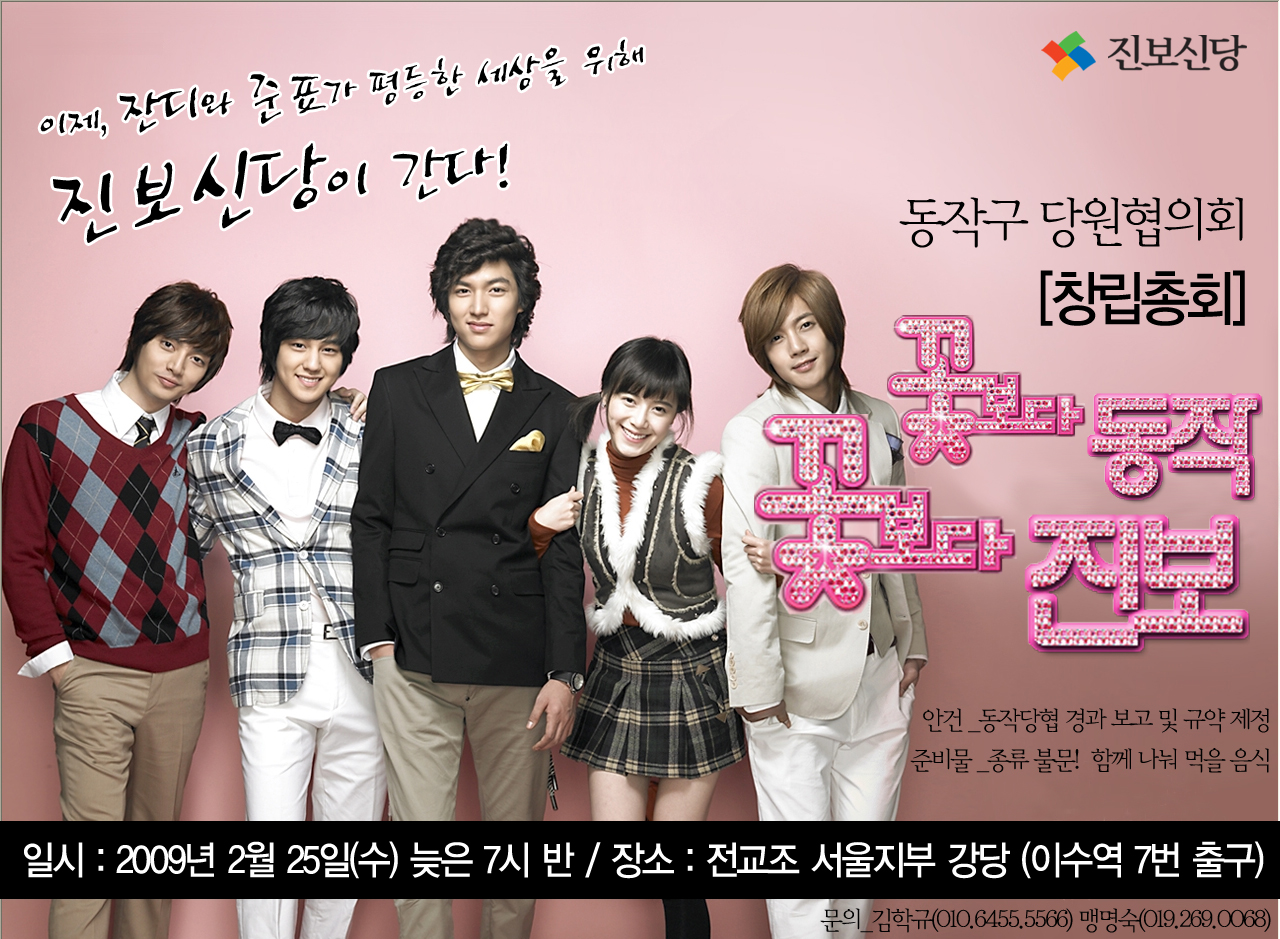
boys-over-flowers-korean-drama(Source: 동작신진보)

Certainly, there are many more elements to the story: the term “flower men” actually first appeared in 1999 in the context of imported Japanese manga for instance, and as the teenagers that read those grew up, manga-derived films and dramas have gone mainstream. But it is the supposedly asexual married women known as “ajumma” that deserve major credit as instigators of that process, showing that Korea was not a mere passive vessel for Western trends. It is surely telling that the first mention of the term “metrosexual” in Korean newspapers was not until 2003.

Update) “Mirror, Mirror…”, from TIME in October 2005, is a good example of an article that conflates kkotminam with metrosexuals, and in turn sees no essential differences between them and similar groups in East Asia such as, say, “aimei nanren” (love beauty men) in China. But although I (justifiably) criticize that journalistic tendency, there definitely is what my (likely) thesis supervisor has described as Japanese-inspired, “pan-Asian soft masculinity” out there: I just think that its national differences need more acknowledgement, and that at the very least it was very much through the lens of the IMF Crisis that that was imported it to Korea.

Other than that though, the article is not without its good points. For example:

But is the rise of the Asian Pretty Boy all that revolutionary? Not really, says Romit Dasgupta, who teaches Japanese studies at the University of Western Australia. “It’s not a result of David Beckham that suddenly Asian men are starting to look after themselves,” he says. “The tradition was already there.” During Japan’s peaceful Heian period between 794 and 1185, for example, both men and women powdered their faces white. Chinese University of Hong Kong professor Anthony Fung notes that in the West, maleness typically means “muscles, dark skin and strong bodies.” In Asia, by contrast, definitions of masculinity have traditionally been more flexible. During China’s Ming and Qing dynasties (1368-1911), men were depicted in paintings as ethereal, feminine creatures. That refined ideal is best found in the Chinese classic novel, The Dream of the Red Chamber, in which one of the main characters, Jia Baoyu, applies makeup and writes prose in his study instead of battling enemies. And he gets the girl! “Extreme androgyny is nothing particularly new,” says Fabienne Darling-Wolf, a professor of Japanese studies at Temple University in Pennsylvania. “The 50 or so post-war years during which Japanese men were not androgynous-due to Western influence and the desire to ‘catch up’ economically-is the glitch in history, not the other way around.”

Korea is a Conservative Country: Redux

(Source: 1023sheep)

Sorry for the delay, but my article for the Korea Times — my big news — is finally in today’s paper. The subject is loosely how Korea’s reputation as a conservative country is very outdated, that advertisements are a good reflection of its rapidly changing sexual mores, and that…well, there wasn’t too much else to say in the 800 word limit really. Nothing new in there for regular readers then, but the editor has hinted that the better the response it gets, the more likely I will get my own regular column, so *cough* please do go on to read it regardless.

One minor complaint with the KT’s editing is having all my italics replaced by quotation marks in it — they’re not quite the same — and I don’t find the choice of title particularly eye-catching either. But on the other hand, not a word was changed from the original, which is probably quite rare.

Seriously though, I won’t put my foot in my mouth again by giving a specific date for future articles, but naturally I’ll let you all know as soon as they’re up.

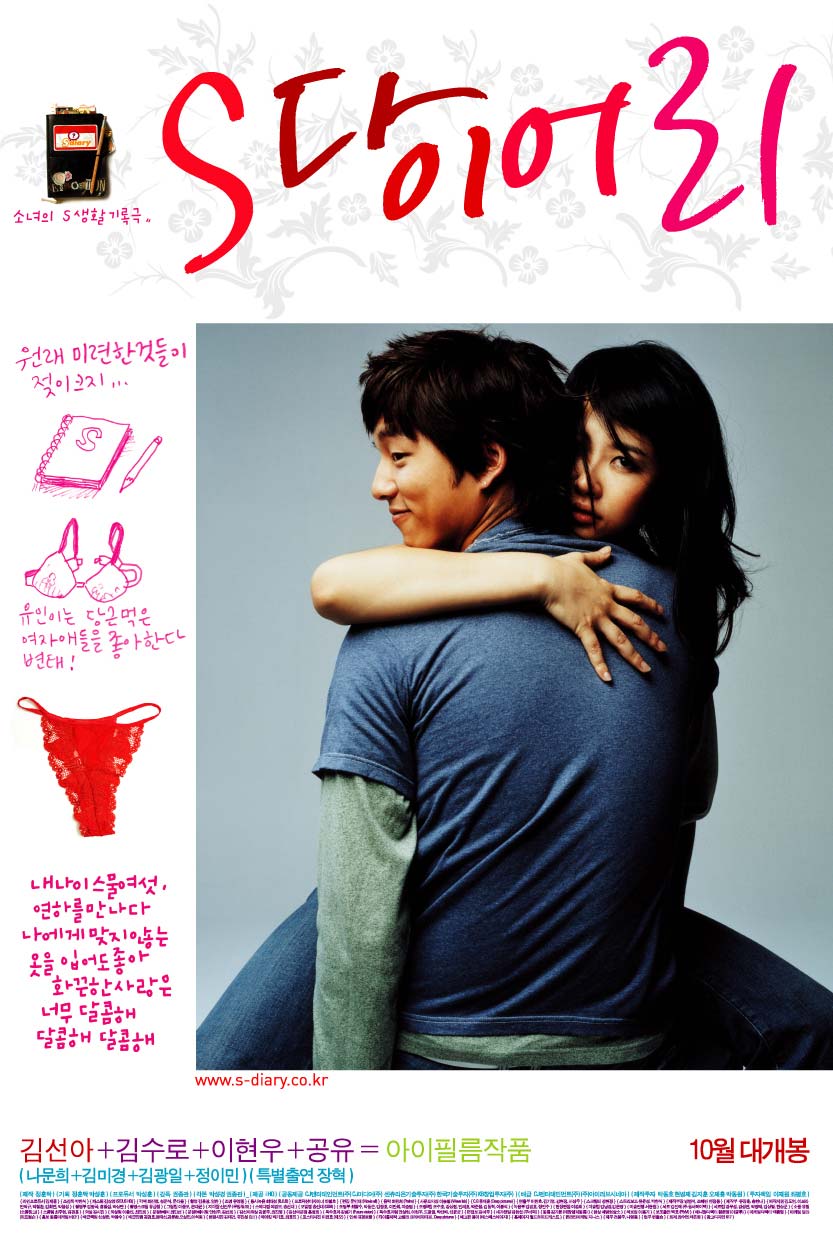
The poster, by the way, is for the 2004 Movie S-Diary (에스다이어리), which was considered pretty raunchy when it came it out, but would be very tame by today’s standards. Just like I mention in the article, things change very quickly in Korea, and at the risk of sounding like I’m merely ingratiating myself with new Korean readers, that is one of the fascinating things about the place. It’s good to remind oneself every now and then.

Update 1) Before I forget, I should give full credit to Sonagi for my point in the second last paragraph of the article, about revealing images of women being sexist by virtue of the sheer weight of them, and the same tired women-sexually submissive/men-dominant roles portrayed in most of them. I didn’t fully appreciate it at the time, but realize now that she had a point.

Update 2) Actually, I’ve just noticed that in the very first line(!) of my article the word “that” was removed from “…that such an impression can easily be forgiven”, ruining that sentence and hardly giving a great first impression of the remainder of the article either. Sigh. I don’t think I’ll read it again, lest I find any more editing mistakes…

Did Eve Have an S-line? Women as Walking Alphabets in South Korea

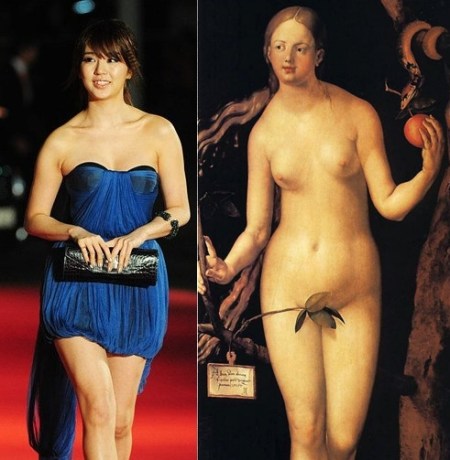
yoon-eun-hye-윤은혜-as-a-korean-eveUpdate, June 2014:

If you’ve followed a link to this post, thank you for your interest in Korean body-image and the alphabetization trend. Unfortunately though, my opinions of both have changed considerably since I wrote this post five years ago, so I’ve decided to delete my commentary (and the comments, which no longer made any sense). Instead, please see here, here, here, and here for much more up to date readings.

For future reference though, I’ll keep my translation of the original Yahoo! Korea article which prompted it, especially as the original is no longer available. I hope readers may still find it useful one day:

(Image: Korean actress Yoon Eun-hye (source) and detail from Albrecht Dürer’s Adam and Eve (1507))

스타매력 재발견, 고은아 ‘가슴’-윤은혜 ‘어깨’ 최고 The Rediscovery of Stars’ Beauty

Go Eun-ah’s Breasts and Yun Eun-hye’s Shoulders are the Best

각종 시상식장의 레드카펫은 여배우들에게 좀더 특별하다. 숨겨둔 자신만의 매력을 한껏 과시할 수 있는 기회가 되기 때문이다. 덕분에 팬들은 그녀들의 아름다움에 숨은 매력까지 엿볼 수 있다. 얼마 전 열린 제45회 백상예술대상 시상식에서 고정된 이미지를 깨고 새로운 매력을 보여준 여배우가 있었다. 바로 고은아와 윤은혜이다..두 배우 모두 귀엽고 상큼한 이미지로 그동안 팬들의 사랑을 받아왔다. 하지만 어린 나이임에도 성숙한 상체 라인을 가진 고은아는 지금껏 풋풋했던 이미지를 벗고 ‘제2의 김혜수’라는 찬사를 받았다. 또 윤은혜는 쉽게 찾아볼 수 없었던 둥근 어깨 라인을 드러내 여성스러운 면모를 부각시켰다.

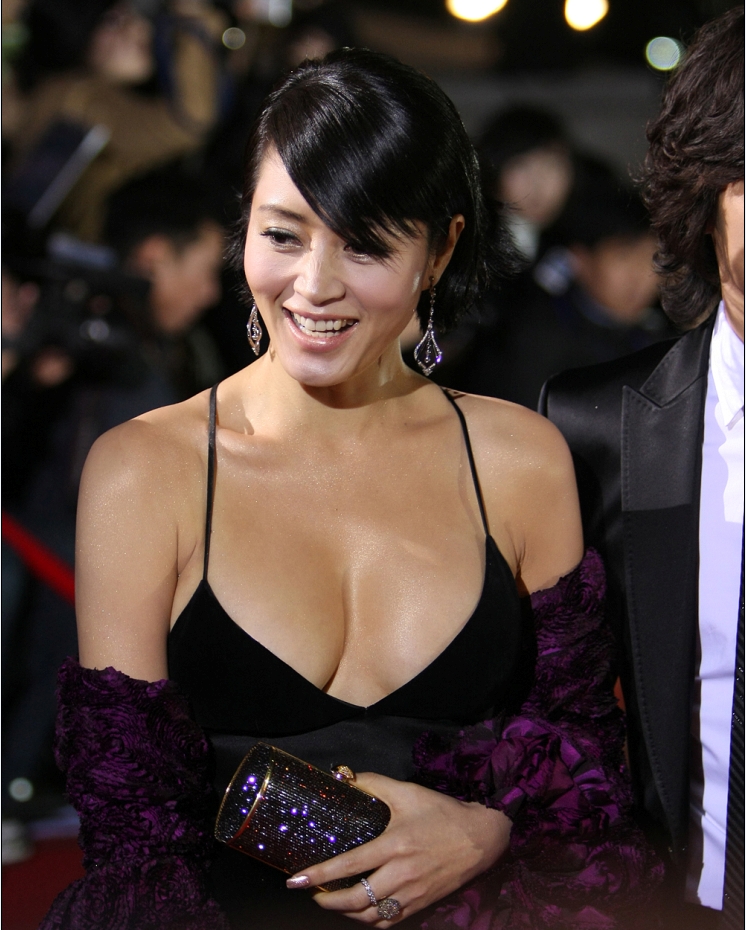
go-eun-ah-breasts-고은아-왕가슴As they are great opportunities to show off previously their previously hidden confidence and beauty, actresses look more and more glamorous on the red carpet at award ceremonies, and fans are eager to get a peek at their idols. A few days ago at the 45th Paeksang Arts Awards many actresses took the opportunity to throw off their old, established images and show off new sides to themselves, particularly Go Eun-ah (right, source) and Yoon Eun-hye. Both were previously well known and popular for their cute and sweet images, but despite her youth Go Eun-ah has become quite buxom, and has been described as the second Kim Hye-su. Also on this occasion, Yoon Eun-hye showed her new womanly side by revealing her round shoulders for the first time.

백상예술대상 레드카펫을 밟은 고은아는 가슴이 깊게 파인 옐로우 슬리브리스 드레스로 플래시 세레를 받았다. 산뜻한 컬러와 과감한 가슴 노출로 다소 쌀쌀한 날씨에도 불구하고 봄의 여신으로 매력을 뽐냈다. 무엇보다 기존 10대 이미지를 과감하게 벗어 던진 그녀는 이제 여성미와 섹시미를 겸비한 여배우로 신고식을 치른 셈이다.

Once Go Eun-ah stepped onto the red carpet she was seen to be wearing a very low-cut sleeveless dress, and was instantly bathed in the flashlights of hundreds of cameras. The bright dress and her boldness in wearing something so revealing, despite the slightly chilly weather, made her seem almost goddess-like. Moreover, she has completely lost her image of a teenager, and has made a big splash as a beautiful and sexy female actress.

고은아의 가장 큰 매력은 레드카펫의 여왕이라 불리며 늘 섹시하고 파격적인 의상으로 화제를 불러 일으킨 대한민국 대표 섹시스타 김혜수를 연상케 하는 상체 라인이다. C 컵 이상의 풍만한 가슴과 글래머러스한 몸매, 그럼에도 선명하게 도드라지는 쇄골이 김혜수와 매우 닮았다. 이는 한국에서 쉽게 찾아볼 수 없었던 우월한 가슴라인으로 ‘제2의 김혜수’라는 극찬이 아깝지 않을 정도. 게다가 고은아는 키 171cm로 170cm의 김혜수에 뒤지지 않는 신체조건을 가졌다. 압구정 에비뉴 성형외과 이백권 원장은 “김혜수와 고은아의 공통점은 넓은 어깨와 C컵 이상의 풍만한 가슴선 등 건강하고 서구적인 체형이다”며 “속옷의 종류에 따라 차이가 있겠지만 두 사람 모두 상부가 불룩한 속칭 윗볼록이 있는 가슴을 가지고 있다”고 말했다.

kim-hye-su 김혜수

Go Eun-ah’s most attractive point is her breasts, which remind people of Korean sex-symbol Kim Hye-su (left, source), who regularly wears very revealing clothes at awards ceremonies and is known as the “Queen of the Red Carpet.” Despite the large size of their busts, you can distinctly see both collarbones, and they’re even the same height too. Such a combination is not often found among Korean women, and so because this is so rare people are not embarrassed to regularly praise her as the second Kim Hye-soo. According to Apgujeong Avenue cosmetic surgeon Lee Baek-gwon, “Kim Hye-su and Go Eun-ah’s points in common are their high collarbones, their C-cup (or bigger) breasts, and their healthy Western body shape” and “although they may wear different brands of underwear, they will both be for women who are top-heavy.”

또 다른 화제의 인물 윤은혜는 그 동안 드라마 ‘커피프린스 1호점’과 ‘궁’ 등에서 보여준 중성적이고 발랄한 모습과 다르게 푸른 색 미니 튜브탑을 통해 어깨라인과 각선미를 드러내면서 보다 여성스러운 모습을 과시했다. 특히 윤은혜의 둥근 어깨라인은 16세기 유화 ‘아담과 이브'(알브레히트 뒤러)에 나오는 이브의 어깨라인과 닮아 고전적인 여성미를 보여주었다는 평이다. 이브 이외에 ‘비너스의 탄생'(산드로 보티첼리)에서 비너스의 어깨라인은 물론 15-16세기 명화 속에 등장하는 아름다운 여성들의 체형적 특징 중 하나인 어깨가 매우 흡사해 고전적인 여성의 아름다움을 느끼게 한다. 압구정 에비뉴 성형외과 이백권 원장은 “승모근이 발달한 윤은혜의 어깨는 약간 좁으면서 전체적으로 둥근 느낌을 주며 통통해 보여 여성스러운 느낌을 준다”며 “16세기 서구에서는 이런 곡선이 잘 살려진 몸매를 아름다운 여성의 표준으로 보았다”고 설명했다. 전체적으로 통통하면서 힙 등에 보기 좋게 살집이 있는 윤은혜의 몸매가 서양의 고전적인 아름다움에 가깝다는 것이다. 기존 드라마에서 보여주지 않았던 섹시하거나 우아한 여성스러운 몸매를 백상예술대상 레드카펫에서 공개한 고은아와 윤은혜의 다음 번 레드카펫이 사뭇 기대된다.

botticelli-the-birth-of-venusAn actress also getting attention recently is Yoon Eun-hye, who has been in the dramas “The First Shop of Coffee Prince” and “Princess Hours” but who looked rather androgynous and/or tomboyish in both,  showed off her shoulders and legs in a blue mini tube top. Especially, Yoon Eun-hye’s round shoulders were very similar to Eve’s in a 16th Century oil painting “Adam and Eve” by Albrecht Dürer, a well-known symbol with which to evaluate female beauty. Apart from Eve, other symbols used as such have been Venus in “The Birth of Venus” by Sandro Botticelli (1482, above), and she has a remarkable resemblance to the former. Lee Baek-gwon says “On the whole, while the muscle development around Yoon Eun-hye’s shoulders is a little narrow, its roundness give her a very feminine and woman-like appearance” and also that “in the West in the 16th Century, this type of well-developed curve was considered the beauty standard”. And so while a little chubby, her hips and so on are very close to that standard. These two women didn’t previously show this sexy side to themselves in the dramas they appeared in, but people now have high expectations for their next appearance on the red carpet! (end)

Korean Gender Reader

anorexic-jeong-ryeo-won-정려원-giordano-advertisement-지오다노-광고(Source: zziixx)

Old news in the K-pop blogosphere admittedly, but these advertisements of Jeong Ryeo-won’s do give me concerns about her health, although fortunately she’s gained a little weight since they were shot back in July.

Update: As this post at Allkpop makes clear, actually she lost the weight for a movie role. But, given that extreme weight loss, the question remains of if she was an appropriate choice of model.

On to this week’s stories:

1. The Politicization of Skin-Whitening Products

With thanks to reader Anne for passing it on, I’d agree that this is “an insightful recent look at beauty standards in N. America and Korea from the perspective of a Korean American woman,” and for anyone interested in my own take on the subjects raised there by Min Jin Lee, author of “Free Food for Millionaires”, please see here, here and here also.

2. How to Read Your Date’s Personality in 10 Minutes

A Korean blogger’s humorous guide for women here.

3. Couple Steal to Pay for Abortion

Do they cost that much money? Still, one can sympathize with the impoverished couple to a certain extent, and I wonder what punishment they’ll receive? Not that I’m advocating at all that they should get a mere slap on the wrist for holding four bar-owners up at knife point, but they do still present a bit of a dilemma, as obviously they can’t pay a fine, and jail time would mean that their five year-old daughter is sent into (woefully inadequate and under-resourced) state care.

By coincidence though, Wednesday’s English Chosun had a report saying that from September, destitute offenders would be allowed to do community service in lieu of paying fines. Currently, 32,000 people are in jail because they can’t afford to, although 94% of all fines are for less than 3 million won.

4. Government Buildings to Have ‘Refresh Zones’

Fiddling while Rome burns. As Brian rightly points out, a far more effective way to look after employees’ health would be to get rid of the mindset that hard workers don’t go home before the boss does, which means that while Koreans technically have among the longest working hours in the world, much of them are already spent napping and/or playing Minesweeper on their computers.

See here for my own take on the natural effects that has on Korean family life and the low birthrate.

5. Uzbekistani Woman Forced into Sex Slavery in Seoul

uzbekistani-women-forced-into-prostitutionI already mentioned some articles on this in story #22 last week, but if you’re further interested then here’s a translation of another Korean article on the same subject by Korea Beat, and it is always good to get as many different perspectives as possible (source, right: the Hankyoreh).

6. ‘Upskirting’ Gains Attention

Not that one article marks a trend, but this translation of this article from the Guardian on upskirting worldwide did briefly feature prominently on Yahoo Korea’s “front page” this week. And as this and this report make clear, it’s actually still quite a legal grey area in Korea.

7. Vice-Principal Who Ignored Sex Scandal Gets Chance at Promotion

As reported by Korea Beat, “controversy is brewing as a vice-principal in Yeosu, who may or may not have looked the other way as his principal was molesting little kids, is getting one final chance for a promotion.”

8. Resource on Sexual and/or Physical Abuse of Korean Children

Found via his recent post on The Hub of Sparkle here, blogger Roboseyo has been gathering links at news reports on these subjects since November last year, and I dare say I’ll be referring to it a lot from now on!

9. International Marriage in Korea Doubled in Last Six Years

That’s according to a broad statistical report just released by the Korean government, the outline of which are translated by Korea Beat here. Personally though, I find the myriad of other statistics more interesting, such as the fact that traffic fatalities have halved since 1990 for instance, and the ratio of boys to girls among newborns is well within natural ranges, although Korean’s supposed preference for sons is still invariably what tends to be reported by the foreign media.

Meanwhile, the English Chosun at least is convinced that Korea must embrace immigration and ethnic diversity simply for the sake of its long-term economic survival. Definitely laudable thoughts, but while progress is definitely slow, one suspects that most Koreans will find (albeit very very belatedly) that making it easier for Korean mothers to work will be a far more palatable option for them.

10. Gay Politics in Taiwan and Japan

An interesting comparison here, and given Japanese people’s reputation for their….well, let’s say “rather liberal” notions of sexuality, then I was quite surprised to learn that the Taiwanese are actually much more open and progressive when it comes to homosexuality (found via Global Voices).

11. Happy Ending to Adoption Story

While fellow blogger Javabeans is rightfully skeptical of the real benefits celebrity involvement provides to charity promotion and public campaigns of any stripe, she(?) was happy to report that it did have a big impact on this child’s life.

12. Controversy Over Design of New 50,000 won Bill Settled

Details here. For a much more interesting and in-depth look at the issues raised by that controversy though, see the discussion between Gomushin Girl and Bebel in the comments section to last week’s post, starting here.

13. “Boys Over Flowers” Actor Jang Ja-yeon Commits Suicide

jang-ja-yeon-commits-suicideFor the original Korea Times report see here, and the instant I heard of her death I thought of this excellent post by Micheal Hurt on suicide in Korea to place her death into some context, a sentiment echoed by Matt at The Hub of Sparkle here, and who also provides a list of the large number of Korean celebrities to have killed themselves in recent years.

For K-pop blogs’ takes on events and more information about her all-too-brief career also, see here, here and here (source, right).

14. Brothel Owners Pay Average of Nearly 3 Million won a Year in Bribes to Police

And naturally enough, to specifically those police officers in charge of cracking down on them too (prostitution is illegal in Korea, but widespread: for a primer and many links, see #3 here). See here for details of those and for the average sums of bribes paid to the police to overlook other crimes too, and while we’re on the subject of prostitution here is a report of a Korean man pimping foreign prostitutes from the fifth floor of a tourist hotel in Seoul too. Unfortunately though the report is unclear on whether the prostitutes, who are about to be deported, came to Korea with the intention of working in the sex industry or whether they were tricked and/or forced into it upon arrival (like #5 above).

15. Lawmakers Want Tougher Laws on Child Sex Crime

While little good if a lack of state care means that abusers are often the only ones able to provide for their victims, and which in practice means that often they’re not even prosecuted at all (see #3 above), at least these measures are a step in right direction.

16. Women First to be Laid-Off During Recession

Sigh. Again, it doesn’t exactly give me a warm and fuzzy feeling inside to be proved right (see #1 here, and #2 here), but the most recent statistics on phenomenon can be read at the English Chousn here.

Meanwhile, amongst Korean men that are laid-off, as many as 20 percent are opting not to tell their families. One suspects though, that surely they’ll still find out eventually?

17. Unmarried Women Refused Smear Test

Yes, really, and despite the fact that it is all sexually-active women that are most at risk and hence most in need of a regular test. For the lively discussion on that, see the thread at Dave’s ESL Cafe here, and personally I see this as further vindication of my view that the contraceptive pill should remain an over-the-counter option in Korea, rather than requiring a prescription from an almost invariably patronizing and moralistic Korean medical establishment, almost Victorian in its inability to acknowledge that Korean women are having sex before marriage.

18. Women’s Rights in Taiwan

On International Women’s Day, Letters from Taiwan notes the gap between government rhetoric and actual practice on women’s rights (found via Global Voices)

Korean Gender Reader

song-hye-gyo-panties-송혜교-판티스-곰세마리(Source: jinhwii)

I don’t quite know how I happened to come across this very old Korean underwear advertisement above, but I do know that I couldn’t resist using it sooner or later. See if you can guess who it is before you reach the end of this post, and I’m open as to suggestions as to what exactly the point of her gesture was (it’s not what you think!).

In the meantime, my apologies, but from now on my Korean Gender Reader posts will be a lot more minimalist I’m afraid. Partially because the weekends spent on them has been detracting from — nay, has been in lieu of —  time spent on all the longer, more in-depth posts that I’ve had planned, and partially because this last week especially seems to have been a particularly fruitful one for news. And here it is in strict chronological order too, primarily for the sake of breaking it into more manageable chunks for you to digest from on. Please let me know what you think of the new format.

Monday 23 February (And Earlier)

I write “and earlier” because some things I missed last week are still too good not to cover here. For instance:

close-up-of-man-from-korean-air-advertisement1. You’ve Had the Theory, Now the Practice: Finding Reliable and Affordable Childcare in Korea

While I’ve written a great deal on the problems of child care in Korea in the abstract (see here, here and here), two Fridays ago Melissa of Expatriate Games wrote a far more useful post about the ensuing practical difficulties of finding childcare for her 2 year-old daughter in Seoul. Make sure to read her follow-up post on the same issue from Saturday too.

2. Discrimination Against Men Within the Airline Industry

For some reason Google Reader only yesterday gave me the last seven of Aaron McKenzie’s posts at Idiot’s Collective, so earlier I missed his take on a lengthy feature in the JoongAng Daily about the discrimination against male flight attendants in the Korean airline industry, by coincidence the issue which prompted me to start these weekly posts in the first place. For my take on the issue from when it first arose in late December last year, see ROK Drop here.

The image on the right is a close-up from a Korean Air advertisement by the way, which doesn’t actually allow male stewards at all.

(Update: To be more precise, it does hire men, but only from within the company, and hasn’t directly hired any new male cabin staff since 1997)

And now for news from Monday itself:

3. Jun Ji-hyun Forgives and Forgets?

Despite the fact that Jeon ji-hyun’s (전지현) management company Sidus HQ spied on her using a “clone” phone for many years, giving them the ability to eavesdrop on all her phone calls (see story#6 here), not only have all those involved not been booked at her request, but she may well be renewing her contract with the company too! For the details, see Dramabeans here.

4. Less Marriages and Babies During This Recession

I’ve read repeatedly that condom sales go up during recessions, so not unsurprisingly Korean couples are both putting off getting married and having far fewer babies too, with  “government officials and scholars predicting that this year’s birthrate will barely exceed 1.0 child per woman, and will drop below that next year,” which I might add is the lowest of any developed country in modern history.

5. System ‘Failing Victims of Child Sex Crimes’

Self explanatory, although the statistics  provided by this English Chosun report are always useful. But for more information on actual cases and the attitudes and legal absurdities that lay behind those, such as a man being acquitted of groping his stepdaughter’s breasts because “it was a sign of affection,” see many examples mentioned by Brian in Jeollanam-do here.

disabled-korean-sex-abuse-victim-returned-to-care-of-her-abusers

(Source: SeoulPodcast)

Tuesday 24 February

6. Women’s Organizations Compile List of Bad Court Decisions

Far from living up to their stereotypes of passivity — which, to be fair, I might be guilty of perpetuating a little occasionally — women’s groups are doing something about the cases mentioned above.

7. French TV Personality tearfully ends marriage

Ida Daussy, a French woman popular and well-known in Korea (albeit primarily for her fluent Korean skills), is getting divorced from her Korean husband after 16 years of marriage. Interesting ensuing discussion at the Marmot’s Hole here about Western-Korean marriages.

8. Sex Tourism from Japan Increasing?

To be expected with the huge decrease in the exchange rate. Not that too many parallels should be made with the 1950s and 1960s, but the first thing that came to mind when I read the report was how many Korean women then were extorted to become prostitutes to Japanese tourists and US servicemen on US bases; primarily for the sake of obtaining much-needed foreign exchange of course, but those women were also provided to the latter for the sake of  helping to cement US-ROK relations.

 Wednesday 25 February

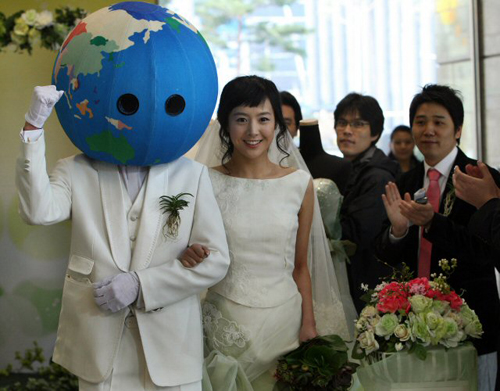
9. Eco-friendly weddings

korean-eco-friendly-weddings

“Lotte Department Store in downtown Seoul held a green wedding on February 23 to promote eco-friendly weddings. The bride’s wedding dress is made of natural fabric from the mulberry tree.” (Yonhap News, via ROK Drop)

10. DNA Evidence Fingers Suspect Three Years After Crime

More good news from Korea Beat. While the Korean Police have a (largely deserved) reputation for incompetence, and rape-kits aren’t even available at most Korean hospitals, in this case three year-old DNA evidence was used to convict a rapist of two mentally-disabled women.

Thursday 26 February

11. Support Network for Unwed Mothers Established

Although Korea is notorious for sending large numbers of children overseas for adoption, the statistics driving that are still shocking. Such is the stigma of having a child out of wedlock here, that even the structure of the miserly welfare parents to mothers encourages it. As explained by Richard Boas, a American physician who has recently established the ”Korean Unwed Mothers Support Network” explains:

…many single mothers struggle with poverty. The welfare ministry gives 50,000 won ($33) in monthly subsidies for childcare to single parent families. Those living below the poverty line can receive basic government subsidies, stay with foster families for up to two years and stay at 40 facilities nationwide for up to five years, far from enough to help mothers keep their children. ”The government gives 100,000 won a month for a domestic adoptive family. However, giving out just 50,000 won for unwed mothers surely gives the impression that the government encourages adoption,” he said.

For the rest of the report, see the Korea Times here. To place it into context, there were 140,000 single mothers in Korea as of 2005, a number which “is believed to have since risen,” and 1,250 children were adopted overseas last year.

12. Prostitution Answers Sexual Needs of Senior Citizens?

The first time I visited in Jongmyo Park in Seoul in 2000, naturally I remarked on the hundreds of mostly male retirees there to my friend visiting from Japan, who rightly pointed out that they “didn’t particularly have much to do nor anywhere in particular to do it,” so why not play Korean chess all day there? In hindsight though, many would much rather be doing something else, and it’s almost surprising that it took so long for prostitutes to encroach on this captive and — let’s call a spade a spade — somewhat desperate market, and the Korea Times reports here on the ensuing problems of unsafe sex, the sale of fake Viagra and “men’s stamina” products, and the general increasing seediness of the area. You can also read discussions at ROK Drop and The Marmot’s Hole here and here.

Personally, while I’m still a strong advocate of the legalization of prostitution, I’d still rather that it took place somewhere other than the former courtyards of Korean kings and queens(!), and that it is used as su h could easily be read as both a symbol and indictment of modern Korea society, much like “National Treasure #1” Namdaemun was unguarded and regularly urinated and vomited on by homeless people until one of them decided to burn it down in a fit of rage last year. Part of the problems, of course, are general attitudes of distaste and avoidance by the police and general public towards the sexuality of the aged, which the KT correctly notes (and brings to mind this comment about a movie on that theme that ended up being censored).

For those further interested, Matt of Gusts of Popular Feeling discusses a little about the history of the area here, and also notes that there is an essay entitled “Stigma, Lifestyle, and Self in Later Life: The Meaning and Paradox of Older Men’s Hang-Out Culture at Jongmyo Park” by Chung Gene-Woong in the latest issue of Korean Journal, which will be free to download here in six months. He mentions that that abstract doesn’t mention this particular aspect of that culture though, and by chance actually I happen to have a physical copy (as this essay is very relevant to my thesis), and so I can confirm that it’s not mentioned in the article itself either!

13. What Image of Korean Women is Presented by the New 50,000 Bill?

new-50000-won-bill-difference-in-face-shapesArriving roughly a decade(!) after it was needed, one report on the woman on it — Shin Saim-dang, a renowned female writer, calligraphist and mother of a noted Joseon Dynasty scholar — caught my eye, as it said that she is widely referred to as the symbol of a ”wise mother and good wife,” or “현모양처” in Korean.

Forgive me if similar sentiments were raised last year when plans for the new bill were first announced, but that phrase — still well known and aspired to by many Korean women today (just ask them) — instantly reminded me *cough* of the suffrage movement in New Zealand in the Nineteenth Century, women being the first in the world to get the vote naturally being a good thing, but which in fact was also a regression for women’s rights because that vote in 1893 was based on the premise that women would add a civilizing and moral element to politics that it lacked. Or am I making too much of it?

Jumping ahead a little though, the most recent controversy surroundson-tae-young-new-mother-shows-off-her-s-lineing the new bill has actually focused on the shape of her face (sigh), much taller and thinner and — dare I say it? — Western-looking than the original round shape of the portrait it was based on. Perhaps my eyes are tired and that is too much of a leap really, so without any further ado read about both controversies at ROK Drop here and decide for yourself.

14. New Mother Son Tae-young Shows-Off Her S-line

No, I don’t have a thing for her, and I’m not at all saying that she isn’t entitled to look good, nor that any mother can’t or shouldn’t either. On the other hand, not only was she the thinnest pregnant woman that I’ve ever seen (see #11 here), but showing off her great body one month after the birth does set hopelessly unrealistic standards for those mothers without wealth, personal trainers, beauticians and domestic helpers to follow, a complaint I remember regularly reading in Western newspapers in response to “Celebrity Moms” a few years ago too.

Friday 27th February

15. Home Buyers With Over 3 Kids May Be Subsidized

A story naturally linked to above reports on the plummeting birthrate, which, however dire, I still fail to see how, say, telling Strategy and Finance Minister Yoon Jeong-hyun and Land and Transport Minister Chung Jong-hwan to “check Seoul and surrounding areas from a helicopter to find places for new homes” is going to help exactly! True, also giving preference “to couples with three children or more when providing homes and leased apartments and lower house prices” is better than nothing of course, but – seriously – when on the Earth is the Korean government and business establishment going to realize that you can’t educate women to the level of men and then expect them to have kids when they have to give up their careers if they do so? Two hundred thousand won a month in subsidies is supposed to compensate for that?

16. Phones With Security Feature for Women, Children Becoming More Popular

Again, partially in response to serial murder suspect Kang Ho-soon (see #5 here). See the Korea Times article here, and Brian’s take on them here.

17. Sex, Videotape & Lies

In a scam he pulled off on four different women, a 26 year-old is arrested for having sex with his then girlfriends at love hotels and then allegedly claiming that the owners told him that they secretly recorded them, demanding money not to release the clips on the internet. Naturally, he had no money to pay “them”, and so his girlfriends gave him their own money to pass on, the latest ending up resorting to loan sharks to get it.

Saturday and Sunday 28 February and 1 March

19. The Coming Baby Bust

Noticing a theme here? At least the English-language dailies at least are beginning to draw attention to the issue. See here for an editorial in the Korea Times.

20. Study: Most Child Molesters Know Their Victims

Like Korea Beat says here, this is probably well-known to most readers of this post, but it may not be in Korea.

21. Human Trafficking in South Korea

Two excellent articles from the Hankyoreh: first, a story here about a Uzbekistani woman tricked into prostitution in Korea, but whom the police have charged for falsifying electronic records, and next an editorial placing that into some context.

22. Japanese Transgender Entertainer Named as new KNTO Spokesperson

Finally, I’m glad to end on a fun, positive story. But, alas, it’s not that big a deal really, as although Korea’s own transgender celebrity Harisu (하리수) also happens to enjoy a great deal of popularity herself, I seriously doubt that either will have had all that much impact on wider public acceptance of transgender people in both countries, in much the same way that Hines Ward’s sporting success has at least raised the issue of the poor treatment of biracial children in Korea (see here and here) but now the next rather more difficult step of actually doing something about it is needed.

kim-min-sun-jenny-lee-song-hye-gyo-panties

Oh, and the picture at the beginning of this post? Although I’d never have recognized her myself, my wife took one look and told me it’s Song Hye-gyo (송혜교) back from when she first started modeling. But from when exactly I can’t say sorry: the source of the photo is a blog entry from 2005, but obviously it is much older than that, although I did find the photo again alongside two others of Kim Min-sun (김민선) and Jenny Lee (이제니) here, both with the same gesture and advertising the same god-awful granny panties, unfortunately there was no further information on the date, company, nor the meaning of the gesture. Still, I’m dying to know now: what do you think the hand gesture means? Like I said, it’s probably not what it looks like, for can you image that ever being used to sell lingerie? Let alone in Korea, in the late-1990s? But what, then?

What a Lovely Big Shiny Purple One My Man Has!

whisen-air-conditioner-advertisement-han-ye-seul-song-seung-hun(Source: Korea Times, 25/02/2009, p. 20; see full advertisement here)

A classic case of sociologist Erving Goffman’s notion of “The Ritualization of Subordination” in depictions of the sexes together, although you don’t need to have heard of either to tell who’s the boss in this particular advertisement!

One slightly less obvious point of interest though, is Han Ye-seul’s (한예슬) use of the “bashful knee bend,” a common motif for women in advertisements, and which according to Goffman:

…can be read as a foregoing of full effort to be prepared and on the ready in the current social situation, for the position adds a moment to any effort to fight or flee. Once again one finds a posture that seems to presuppose the goodwill of anyone in the surround who could offer harm. Observe…that a sex-typed subject is not so much involved as a format for constructing a picture (Gender Advertisements, 1976, p. 45).

Which I read as it being used in advertisements to show women feeling safe and secure in the presence of their male protectors, in this case Song Seung-heon (송승헌). And why not? To claim that the depiction of that natural feeling is sexist in itself is absurd, but Goffman’s point was simply that the knee bend, and a host of other means of active/passive dichotomies in depictions of the sexes like that—such as men almost always being portrayed as taller than women, far more than in real life—were still overdone in advertising, and not exactly compensated by images of women as assertive, aggressive and/or as instructors, superiors and leaders either.

Or at least in 1976; as that last link explains and the advertisement on the right (source: popseoul) with Lee lee min ho levisMin-ho (이민호) makes clear, things have certainly changed a great deal since, having one person on a bed and/or lower than the other also being a common way of showing ranking. Which is not to say that—now that you have it in mind—you won’t still find many many examples of women with the knee bend in advertisements (or, indeed, in a bed).

But even more interesting though, is the fact that it is Song Seung-heon at all that is advertising the Whisen (휘센) air-conditioner, for actually I only noticed the ad because is the first Korean one for an air-conditioner that I’ve seen in which a man is the center of attention. Sure, that they’re dominated by women is no surprise, as it’s also true of their Western counterparts, albeit to a much lesser extent (but a difference one would expect given Korea’s deeply patriarchal society). But then bear in mind that the process of  modernization that electronics and electric appliances still epitomize—especially in a society as development-obsessed as Korea—has always involved “housewifization” and the nuclearization of the family, and so while it’s certainly true to say that owning one’s first washing machine in the 1960s in the UK, say, was also a definite signifier of status and upward mobility, Korean advertisements for the same should be placed in the context of a society where consumerism has been equated with national security, and in which the lowest numbers of women in the world work (for a developed society).  Hence not only are Korean examples almost hyperreal advertisements for modernity itself, but so far they’ve overwhelmingly featured female-centered narratives, Korean housewives’ need for the self-fulfillment that Betty Friedan saw that their purchase provided being all that more the greater here, and other manifestations of which would be an obsessive focus on real-estate speculation and on children’s educational achievements.

Which might sound a little to take in all at once, but I assure you, once you’ve seen a few examples like the one below then you’ll get a sense of how surreal they consistently are, and why this deserves explanation (and have also reminded me personally of how advertisements really are a reflection of the zeitgeist of an era). So, why the change in that particular advertisement?

My first thought was because it was for the “Luxury” (럭셔리) model, as the instant I learned that in fact a scene from science-fiction novel I read as a teenager came to mind, which opened with a conversation between a couple in which the woman explained to her fiance that, while women did the bulk of shopping, men still bought the important expensive things like houses and cars. As it happens, the couple were in a decidely backward parallel universe where, among other things, American women had never gained the vote(!), but obviously it still has echoes in real life, and indeed this logic does especially apply to Korea: for instance, while I’m not sure to what extent this tradition is followed, I’ve repeatedly heard that it is expected that before a wedding a new wife’s family must provide for the furniture for their new apartment, whereas the husband’s family must provide the apartment itself. Does the expense of this model then, draw it from the female realm to the male, thereby appealing more to the latter? Or is the advertisement still primarily aimed at women, this supposedly luxurious model possessing a male and/or sophisticated aura that other, cheaper ones lack? Or is there still some other factor that I’m missing?

Unfortunately, the K-pop blogs (see here, here and here) do little more than provide more pictures and links to related commercials, so I’d be happy to hear your own thoughts. And I’ll make sure to keep an eye out for mention of it in next month’s Korean advertising magazines.

Expect More Nudity During This Recession

Apparently, I wasn’t the only one to notice Duoback’s advertisement for its new “Alpha” chair a few days ago. Yes, that one:

korean-duoback-alpha-chair-advertisement-듀오백알파-광고(Source: Metro)

It’s always nice to be proved right. Even if it is true that my earlier observations about the advertisement were common-sense really, and that it just so happens to be a tabloid-style article from Yahoo Korea that provides the first confirmation of them:

Recessions Lead to Nude Advertisements…and Flustered Commuters

인 박인숙 (35세, 가명)씨는 출근 후 회사에 비치된 신문들을 훑어보며 깜짝 놀랐다.

After arriving at work one day, a 35 year-old woman that we’ll call Park In-sook (not her real name) was surprised at what she saw while browsing a newspaper provided by her company.

맨살을 훤히 드러낸 한 여성의 뒷모습이 담긴 광고가 눈에 띄었기 때문. 녹색의 투명한 타올이 엉덩이에 살짝 걸쳐 있을 뿐 전라에 가깝다. 신문에 실린 이 광고의 품목은 여성전용 제품이 아니었다. 기능성 의자 광고였다.

Her eyes were drawn to an advertisement which featured the back side *cough* of a woman, completely naked but for a green transparent towel lightly covering her buttocks. The advertisement wasn’t actually for any product specifically for women, but was for an expensive ergonomic chair instead.

‘인간의 몸을 기억하다’는 메시지를 담고 있는 이 광고는 여성 누드 사진을 이용해 독자들의 눈길을 끌고 있다.

The accompanying message in the advertisement was that “This chair remembers the human form,” and the nude woman was clearly placed in it simply to draw the attention of readers.

duoback-loves-your-body-듀오백또 다른 신문엔 여성의 상체 누드(뒷모습) 사진이 전면광고로 실렸다. 이 광고는 한 아울렛을 소개하는 것으로 역시 여성의 알몸이 등장할 만한 제품과 거리가 멀었다.

A different full-page advertisement for a outlet store featuring only a woman’s nude back has already been in another newspaper, and in that earlier advertisement too the product(s) advertised had little to do with nor required nude women (James: not the one on the right for another Duoback chair, although it seems a strange coincidence that it’s the only other Duoback chair featuring nudity, and that the “outlet store” is unnamed; I think the report made a mistake).

최근 이처럼 일간지에 여성의 누드 사진이 활용된 광고가 눈에 띄게 늘자 독자들은 낯 뜨겁다는 반응이다. 아침부터 신문에 누드 사진과 다름없는 광고를 보게 돼 불쾌하다는 설명이다.

Recently, there has been a spate of advertisements featuring nudity in daily newspapers, and these have been making many readers embarrassed and uncomfortable when they encounter them. But these days, it is almost impossible to escape them.

박인숙씨는 “신문광고에 누드사진이 실리면 시선을 집중시킬 순 있겠지만 너무 선정적인 광고로 인해 불쾌해지는 사람들도 많을 것”이라며 “상쾌한 기분으로 아침을 시작해야하는데 이런 광고는 달갑지 않다”고 토로했다.

According to Park In-sook, “Certainly advertisements featuring nudity will get many reader’s attentions, but sensational and shocking advertisements can also make many people uncomfortable. It is important to start every day with a fresh mind, and advertisements like these aren’t helping.”

한 편으론 독자의 시선을 한 번에 끌어당길 수 있다는 측면에서 광고효과가 극대화된다는 평가다. 특히 요즘같이 불황에는 사람들의 감각을 자극하는 광고기법이 먹힌다는 속설대로 제품을 하나라도 더 팔려고 하는 회사들이 이런 광고를 자주 하고 있다는 분석이 나온다.

On the other hand, advertisements like this are more effective because they attract consumers’ attentions with just one glance. And as both modern analysis and a traditional saying advise, during a recession companies should use dependable advertisement techniques which are well proven to do so.

한 광고회사 PD는 “통상적으로 경제가 어려울 땐 자신의 소득을 기준으로 이성적인 구매를 하기 마련인데 회사 입장에선 조금이라도 자극적인 광고를 통해 소비자를 유혹하려고 한다”며 “섹스어필처럼 감각에 호소하는 광고는 단기적으로 큰 효과가 있다”고 말했다.

According to a spokesperson for the advertisement company PD behind the Duoback advertisement, “People naturally spend rationally and frugally during a recession, so from a company’s perspective it is best to use stimulating and direct advertisements that appeal to basic human senses, and those with sex-appeal especially will certainly get a quick result.”

이어 “많은 돈을 들여 톱스타를 쓰지 못하는 중소기업에서 이런 광고를 선호한다”며 “경기 불황일수록 이런 광고를 더욱 많이 하게 될 것”이라고 덧붙였다.

Moreover, “Small and medium-sized that can’t afford top stars tend to prefer these kinds of advertisements, and as the economy gets worse we can expect to see more like these.”

Because a woman’s legs can NEVER be too thin…

After all, why settle for mere sausage legs when you can have drumsticks instead?

korean-diet-advertisement-for-legsFound in passing while flicking through a discarded copy of the Korean version of the Metro International, a free daily newspaper. While it’s obvious what it’s advertising, I was sufficiently curious to find out what it was saying exactly:

나는 원래 윤아보다 다리가 섹시했다

다만 쥬비스 관리를 몰랐을 뿐!

Originally my legs were sexier than Yoona’s, but the only problem was I didn’t know about the care that Juvis (the name of the diet clinic) could provide.

내 다리는 원레 백만불짜리 다리,

세월의 무게를 견디기위해

점점 두꺼워져 갔지

이제 쥬비스로 관리받아

예전의 각선미를 되찾을거야!

Originally my legs looked like a million dollars, but in order to get through life my legs got thicker and thicker. Now, through Juvis I am going to receive a service that will restore my legs to their former beauty!

더 즐거워진 쥬비스 체험 EVENT

A more enjoyable Juvis experience event

3월부터 쥬비스의 다양한, 관리시스템이 새롭게 시작됩니다! 이벤트 기간 동안 신규 패키지를 동록하시는 고객께 새로운 관리시스템 중 2개의 이벤트 프로그램을 무료로 체험할 수 있는 혜택을 드립니다.

From March, Juvis will introduce a more varied body care system. For those that register, you will receive the benefits of experiencing two event programs for no extra charge.

여자가 꿈꾸던 라인

쥬비스에서 관리하세요 몸이 즐겨운 다이어트

The line that women have dreamt about

Get the care and a diet enjoyable for your body at Juvis

쥬비스 다이어트가 즐거운 이유:

  • 몸이 힘들지 않아서 즐겁다
  • 요요를 완벽히 잡아서 즐겁다
  • 부작용이 없어서 즐겁다
  • 탄력까지 살려줘서 즐겁다
  • 원하는 부위가 빠져서 즐겁다
  • 추가 부담이 없어서 즐겁다

Reasons why a Juvis diet is enjoyable:

  • It is not tiring for the body
  • Your weight will not go up and down like a yoyo
  • There are no side-effects
  • You will revive your body’s elasticity and bounce
  • You can lose weight from the body parts you want to
  • There are no additional charges

Sigh…

Korean Gender Reader

blue-puzzled-pororo-and-pink-happy-loopy-waving(Sources: Unknown)

Sorry for the long delay since the last Korean Gender Reader: much as I like to write about the low Korean birth-rate and/or the lack of affordable and trustworthy childcare that effectively stops mothers from working in Korea, I’d rather not personally suffer the side effects of those for the sake of being a better writer. Nor can I see how my sleep-deprivation, lack of exercise, weight-gaining and coming down with regular colds would ever particularly help with that either!

Hence my wife and I have bitten the bullet and will be sending our (nearly) three year-old daughter Alice to a lovely kindergarten down the road come March, 9am-2pm Mon-Fri for 320,000 won a month. On the one hand it’ll naturally be strange and a little sad without her, but on the other it’ll be good to be able to grab some much-needed sleep at the same time that our six-month old baby Elizabeth does, and especially not to have Alice screaming about watching the Korean cartoon “Pororo the Little Penguin”  all day, and me constantly worrying that Loopy(!), the only female character in the first series, “likes cooking and the arts” at her home and always seems to be making gifts of food for the boys and/or watching them on the sidelines while they invent stuff and go on adventures. Fortunately the inclusion of active, sports-mad Petty (who thinks of their English names?) somewhat compensates in the next series (update: and it turns out I missed this new positive change too).

This post covers the period since the last one then, or *cough* just over three weeks, and with the stories roughly in chronological order (with the exception of some on domestic violence, which I’ll be covering in the next post or the next). Sorry in advance for 3000 words that that delay meant, and they’ll definitely be weekly from now on.

1. Females hardest hit by economic slump

Korean Female University Student(Source: UNC – CFC – USFK; CC BY 2.0)

As I predicted, female workers (and the self-employed) are being the hardest hit by the troubled economy:

According to the National Statistical Office (NSO), the ratio of economically active females recorded 48.8 percent in December, the lowest level since last February. The rate dropped by 1.6 percentage points from November, when it hovered above 50 percent.

Not that this is due to sexism per se, more because of:

…the high ratio of part-timers and contract workers among women, who are the first target when businesses decide to cut their workforce.

And here and here are two later reports on the number of temporary and daily workers falling. Interestingly, in America the huge layoffs in the male-dominated manufacturing and construction industries means that for the first time in history America may soon have more female than male workers, women tending to work in more stable sectors such as education and health-care instead (see here for a more in-depth look). This split is paralleled in Korea of course: women are disproportionately represented in the civil service for instance, as its exam-based system of entry renders it one of the few genuinely meritocratic employment sectors out there (by coincidence my sister-in-law just qualified, after four years of trying), but with women’s overall labor force participation still being the lowest in the world then men are likely to remain the primary breadwinners for many years to come.

Which is not to say that Korean men aren’t losing their jobs in droves, and many women taking over as the main or only earner: here is a short translation of one Korean man’s take on the resulting change of gender roles for his family, and here and here are two American pieces on the effects on men and women in general (update: and here is one on why the incidence of domestic violence tends to rise with unemployment).

2. Court to decide who will take custody of children

choi-jin-sil-최진실-suicide-자살Prompted by the custody battle between actor Choi Jin-sil’s (최진실) family and her ex-husband Cho Sung-min after her suicide in October last year (see here and here also), the Ministry of Justice has ruled that in the future family courts will decide who will take custody of children when a parent dies.

Under the current law, if a divorced mother or father with custodial rights dies, the surviving former spouse automatically gets the custody, regardless of how ”ill-prepared or inappropriate” a parent they are (source, left: unknown).

3. Economic slump drives more teenage girls into prostitution

Also depressingly predictable, although it’s good that Park Eun-jung, the head official within the Ministry for Health, Welfare and Family Affairs is keen to point out that “it’s not ”girls gone wild” who get involved in prostitution,” and that these days many teenagers have to sell sex simply  ”to make ends meet,” although on the other hand I very much doubt her assertion that “teenage prostitution stemmed mostly out of curiosity six months ago.”

For the full report see here, and for some context see here, here. and especially Matt’s posts on teenage prostitution and related subjects at Gusts of Popular Feeling here, here and here.

4. Speaking out against perverted teachers

Korea Beat translates a Hankyoreh columnist on the pervasive culture of sexual harassment and molestation of female teachers and students at Korean schools and the often complete impunity with which male teachers get away with such acts. For a much more in-depth look at the issue and how it pertains to (false) stereotypes of foreign teachers as perverts and molesters,  see Michael Hurt’s 2006 post at Scribblings of the Metropolitician here.

(Update: And Matt at Gusts of Popular Feeling has a related post here on a tabloid news documentary from 2005 that did a great deal in helping to shape and perpetuate “the image of English teachers as unqualified, pot-smoking child molesters”)

5. Korean women rush to buy self-defense weapons

The Korea Times reports that many women are rushing to buy self-defense weapons in the wake of the arrest of rapist and serial killer Kang Ho-soon, especially those compact enough to fit into a pocket or purse, and the sales of surveillance cameras, electronic door locks and other security gadgets has also correspondingly increased.

(Update: Korea Beat reports that the numbers of CCTV cameras is exploding in wealthier districts of Seoul especially, and all Seoul schools are also in the process of adding them and hiring security guards)

Much more interesting though, is a later report that women are also rushing home from work these days, fears for their own safety apparently outweighing the extremely wasteful but still deeply ingrained Korean work habit of being seen to be staying at work until the boss leaves, regardless of how much work there actually is – or usually isn’t – to do (see here for more, and here for what many workers are really doing during “work hours”). Hopefully, the reflection on women’s work/life priorities and especially personal safety will lead genuine shift in attitudes, the first target of which will I’d like to think would be the “bikkis” that physically drag young attractive women into nightclubs for the sake of attracting male spenders for instance, but against this optimistic interpretation of events that first Korea Times report mentions similar peaks of spending and interest in the wake of a the last serial killer arrested in 2006, presumably indicating that the change in habits was only temporary unfortunately.

6. Battered Cambodian woman stabs Korean husband

Read the report here. In related news, this report outlines the poor conditions under which many “import brides” live under, one indicator of which is a high rate of miscarriages due to malnutrition, doing heavy work on farms while pregnant,  and a lack of access to/and knowledge of public health services.

But in one positive symbolic move that I hope will become official policy,  a Japanese man has been banned from entering the Philippines for abusing his Filipino wife in Japan: “A foreigner who beats his wife is a menace to the society and who does not deserve our hospitality,” the Immigration commissioner said.

Korean Father and Son(Source: James Kim; CC BY-SA 2.0)

7. Fetus sex notification to be allowed

Although only after 28 weeks gestation, when ”no doctor would dare to perform an abortion”‘ a Korean Society of Obstetrics and Gynecology spokesman said.

But this is quite strange: presumably the cut-off date means that there are still strong concerns that younger fetuses would be aborted if they were discovered to be female for instance, but in fact the problems of the resulting gender imbalance were acknowledged and dealt with by Koreans over a decade ago, and Koreans have had a genuine positive shift in attitudes towards daughters since (unfortunately this is rarely reported in the foreign media, the Confucian penchant for sons being much more newsworthy apparently). Moreover, the current law banning notification at any age is completely ignored in practice (“Oh! The Baby looks strong/pretty”), so the practical and even symbolic effects of this law will be minimal.

Meanwhile, you (and many Koreans!) may be surprised to hear that abortion is actually technically illegal in Korea, despite Korea having one of the highest per capita rates of abortion in the world.

8. Lee Hyori swearing on TV

If you never watch Korean television then you will probably be unaware that Korean celebrity culture is very unlike its Western counterpart(s), starring in a variety of decidedly unglamorous and down-to-earth game and talkshows being an integral part of the process of acquiring and then maintaining popularity here for instance. While I can’t imagine the likes of Brad Pitt or Beyonce ever rolling around in mud or having trays dropped on their heads on national TV then, Korea’s number one sex symbol Lee Hyori is well-liked by many Koreans for not only appearing to enjoy herself while she does so, but for being so, well, normal too.

Hence personally I find it almost endearing that she said that (guest) “Chang Ui fucking loves women who can cook well” on national TV, although unfortunately many netizens don’t. For the details, see here, and no, she wasn’t advocating the joys of cooking for one’s husband!

True, at first glance this might not appear particularly meaningful in a feminist sense, but as I explain in that first link, the other (negative) difference with Western countries is that female celebrities especially are held to almost impossible moral standards by the Korean public, so any challenge to those attitudes is welcome, no matter how minor.

(Update: In hindsight, the explanation of what she said in that link above isn’t very accurate or even helpful, so after seeing the video here please read my own explanation here)

9. Naver, newspapers spat over lewd ads

In the last Korean Gender Reader I reported on the hypocrisy of Korean newspapers regularly criticizing prostitution in their print editions while having advertisements for and even guides to brothels on their online editions. Rather than removing them however, recent technical changes to Naver – as important to the Korean internet as, say, Google is to the American one – have resulted in some newspapers actually loading their web sites with more adult content and lewd advertisements in order to drive up traffic!

10. HIV cases top 6,000 for first time

From the The Korea Times:

The number of reported HIV cases in the nation topped 6,000 for the first time since 1985, when the country began to compile relevant data, the Korea Center for Disease Control and Prevention said.

The agency reported that the cumulative number of those with HIV had reached 6,120 at the end of December, 1,084 of whom had died.

A total of 797 new HIV cases were reported last year, up 7.1 percent from 744 the previous year.

It said the 99 percent of cases have resulted from sexual intercourse, with those in their 20s and 30s accounting for more than half of the total. Teenagers accounted for 2.5 percent, and those aged over 60 accounted for 7 percent. It said 743, or 94.2, percent were male

On the positive side though, despite the stereotypes it’s actually been a very long time since most Koreans thought that AIDS was a “gay disease” that they didn’t need to be concerned about because it “only affected foreigners.”

11. Son Tae-young has baby boy

Normally I’d pay very little attention to news of celebrity marriages and pregnancies, but after writing this post on Korean women’s concerns about their body image during pregnancy, some pregnant-son-tae-youngeven dieting to remain thin, then I couldn’t help but notice how thin actress and former Miss Korea runner-up Son Tae-young (손태영) looked during hers (see her at 7 months here, and at 8 months here); which is not to say at all that I think she’s dieting herself or that her being thin is her fault somehow(!), but I do cringe to think of any Korean women as whale-like as my wife was when she was pregnant thinking that Son Tae-young is the norm to aspire to rather the exception.
On the plus side, Son Tae-young is breastfeeding her son that was born on the 6th, and hopefully she may well prove to be the slim & beautiful celebrity mom to talk about the benefits of doing so that mother and fellow-blogger Melissa of Expatriate Games noted Korean women so desperately need (source, right: unknown).

12. What Koreans consider fat

You’ll just be amazed at which celebrities have been criticized by netizens for their fatness at some point. See here, here, and here (the last because of these pictures).

(Update: most of those links are from the pop culture blog allkpop, and freyja writes a follow-up post briefly summarizing some of the issues raised by them here)

13. Singles at disadvantage from social system

Not that, say, ending the extremely wasteful practice of staying at work until the boss the leaves (see #5) or actually enforcing existing legislation on maternity leave, the provision of childcare facilities and checking the standards of them (see here and here) wouldn’t be much more effective ways of increasing Korea’s birth rate (currently the lowest in the world) but it is true that the tax breaks for married couples and so forth are now so big as to make single people grumble at least.

Actually, the Korea Times article of that title above is more interesting for its statistics on the numbers of single person households and a brief discussion of some of the reasons that make it difficult to people to live alone in Korea, a recent pet project of mine, so I’ll return to it later this week.

14. Men eye nursing jobs

I think the Korea Herald’s above title was a little of an exaggeration considering that men still only account for 5% of those that passed last week’s national nursing exam, but it’s certainly true that their numbers Male Nurse Action Figurehave been increasing in recent years. In that exam there were 617 men out of the total of 11,717 successful applicants, and it was only in 2004 that the number exceeded 200 for the first time (source, right: Geoffrey Fairchild; CC BY 2.0).

One of the new male nurses interviewed says that he converted to medical nursing a few years ago as he foresaw problems in securing employment as a computer major, so I imagine there may well be a glut of new entrants in next year’s exam! And as for their impact, here are a few quick excerpts:

These qualified male nurses are highly demanded in hospitals and other medical fields.

“I am glad about the increase of male nurses,” said Han Sang-mal, a nursing supervisor in an orthopedic hospital in Cheongju. “Not only do we need their physical strength, but our male patients often prefer to be tended to by men.”

But the positives go beyond mere practicalities:

“People are dismissing the bias that the nursing job is submissive, a role to be filled mainly by women,” she said. “As the roles of nurses are expanding from hospital jobs to schools, public health centers, and private nursing homes, such wider spectrum of manpower is to be regarded as highly positive.”

The first official male nurse was Cho Sang-moon, who was licensed in 1962 and worked as a leading figure in the nursing field in the 1970s. Before Cho, only women could be qualified as nurses.

15. Divorce suit deals blow to Samsung’s father-to-son succession plan

The size and importance of Samsung to the Korean economy can not be understated, and hence there’s a lot riding on this particular divorce of Samsung’s heir apparent.

16. Four in ten telemarketers suffer sexual harassment

I very much doubt that Korea has a monopoly on this, and it’s probably true that most of the victims(?) of customers moaning or asking about their breast sizes can’t do any more than simply hanging up on them and flagging their number, but unfortunately:

…only 12 percent and 11 percent said they forwarded the calls to managers or took issue with the conversations, respectively. About 90 percent said their companies do not have a protocol for such circumstances, although 45 percent said the companies had preventive measures.

17. Court acknowledges rape of transsexual

It’s been quite an interesting period in Korea for laws regarding rape recently, last month seeing the first man convicted for spousal rape (still not a crime here) and then his suicide, and now this month a provincial court:

…for the first time found a man in his 20s guilty of ”raping” a transsexual, challenging the current law that defines rape to when a man has forcible sex with a woman born a female. The victim’s legal gender still remains man.

Not that presages a radical shift in legislation unfortunately, the judge stating that he based his decision on the facts that:

The victim has acted like woman since he was born. In 1974, when he turned 24, he underwent a gender reassignment program. He once also lived with a male partner for a decade. Given all of these, he can be seen as female.

And so:

Giving the unprecedented ruling, the judge set three criteria to define the precedent – whether the victim had sex change surgery; how long he/she has lived with appearance of the opposite sex; and if he/she has no problems having sexual relations.

I guess this means that homosexual rape (of either sex) isn’t a crime either? And what if a transgender person was raped only a week after his or her operation, or a month, or a year? Is those not long enough to count? To be frank, I don’t get more used or deadened to the sheer arbitrariness of the law the longer I stay in Korea, and it’s judgments like this and that below that prevent me from ever staying in Korea permanently, primarily out of concern for my kids.

18. Vietnamese mother denied custody of biological children

And in the same vein as my comment on the last piece, I’m almost scared at how the Seoul Family Court has virtually rewarded the Korean husband’s use of his unwitting Vietnamese wife as a baby factory for him and his former Korean wife. For all the details and issues involved with that, see Michael Breen’s excellent column here.

(Update: Not to be missed is Matt’s post placing the case in the wider context of Vietnamese brides and immigration to Korea here also, and there’s a substantial forum thread on the case over at Dave’s ESL Cafe here)

19.Women outnumber men amongst newly hired prosecuting attorneys
finding-your-career-path-with-sinfest

(Source: Sinfest, May 9 2004)

From Sonagi at the Marmot’s Hole:

An impressive 51% (58 out of 112) of newly hired prosecuting attorneys are women. These 58 new female prosecutors will join 316 women who comprise 18% of the 1716 prosecutors employed nationwide. The increasing number of women is expected to challenge the old boys’ network and change the way domestic violence cases are handled.

For some context to those numbers and the reality of being a female lawyer in Korea, see Korea Law Blog here.

Are Korea’s Women Boxers Good Enough for Adidas?

kim-ji-young-twoWriting earlier this month, I was very impressed by the rhetoric of the launch of Adidas Korea’s “Me, Myself” campaign, and especially by the healthy-looking models used. But one fair criticism by frequent commenter Sonagi was that while on the one hand they definitely weren’t “the gaunt-looking models of most fashion shows,” were all “healthy and glowing,” and may well have shown “that women could look stylish while working out at the gym, doing complicated yoga moves or swimming in the pool,” on the other hand they certainly didn’t appear to have anything at all like the physiques of actual athletes either, somewhat diluting the campaign’s supposed message (source, left: Yonhap News).

And it’s not hard to think of attractive athletes who could have—nay, should have—taken their place instead, a point which I was suddenly reminded of earlier today when I was flicking channels and happened to come across IFBA Bantamweight Champion Kim Ji-Young (김지영) in action, her—let’s face it—feminine appearance being so in contrast to the bulk of her counterparts (in both senses of the phrase!) that I immediately sat up and took notice. As it happens, she was in her hometown of Yeongdong City, successfully defending her title for the fourth time (against Dennapa Sukruaangrueng of Thailand).

(Update, September 2014: Reading over this post five years later, I’m cringing at—among other things—my implication that women with bulky physiques are any less feminine than Kim Ji-Young, and the notion that they could never be accepted as endorsement models for sports clothing companies).

Unfortunately, as images of female athletes tend to be unflattering, taken as they are at instants of extreme pain, anger, passion or even all three (not that those of male athletes aren’t kim-ji-young-oneeither) then in lieu of a video of the fight I saw then that photo of her above and this on the right from 2005 (source: Yonhap News) will have to do for my purpose, which is to ask you if she could realistically be a model for Adidas or any other clothing company? Why or why not? Yes, granted, she does has bigger arms than average (naturally), but although this is not to say that people of either sex can only find athletic role models in those of a similar (or desired) size to them, her diminutive height and weight  (“bantamweight” means 51-54 kg) and small bust do make her very similar physically to a lot of Korean women, albeit having muscle where they usually have fat. Moreover, given that the notions that models “have to” be tall and thin would supposedly be the very antithesis of the Me, Myself campaign, then I can’t think of any reason to reject her for something like that especially.

As it happens, there is already a Korean female boxer who makes a great deal of money through sponsorship, commercial and TV appearances: Choi Shin-hui (최신희), whom I found about via this slightly old but otherwise excellent introduction to female boxing in Korea over at Korea Beat, and it turns out that two years ago at least there was quite a boom in the sport, with Korea having several world champions. I’m almost a little reluctant to post any pictures of her however, as with the vast majority available being modeling shots (including this one below for Vogue magazine in 2004 for example; see here for the article), then they’re naturally going to present her in a much better light than the few and quite frankly rather hideous ones of Kim Ji-young in action out there. So I include a link to this and this other one (scroll down) of Choi Shin-hui from that period too, not to imply that she’s ugly in them—quite the opposite—but more to demonstrate that they’re certainly less flattering than those to be found in advertisements, which just again goes to show that however unglamorous they—or you and I for that matter—can appear in photos of them grunting away at their sport(s) can be, surely Kim Ji-young and/or other athletes like her should have been in consideration for even a one-off, token appearance at a launch for products that are supposedly aimed at athletic women? Even just the minimal consideration towards the campaign’s professed message that that would have demonstrated would have been much better than none at all.

choi-shin-hui-boxing-in-vogue-women-in-2004(Source: DBSD Boxing)

Or am I making too much of it? Do you think athletes weren’t used simply (and perhaps quite legitimately) because of their inexperience with a catwalk? Or is there another simple reason I’m overlooking?

Regardless, if you’ve read this far then you’ll probably also be quite interested in and inspired by this story of 18 year-old Choi Hyun-Mi, who defected with her family from North Korea in 2004 and on whose boxing success they now entirely rely on for financial support (Update: Sorry that the link has died; instead here’s a video below). And I have one final request too: somewhere on this list of expat blogs is one I used to read by a woman in Seoul who happens to be a female boxer and very active in the boxing scene, but I’ve completely forgotten both its and her name, it being a long time since this blog you’re reading turned my own reading of other blogs from pleasure into business (sigh). Writing this post has made me interested again though, and I may well want to pick her brains about some of the issues raised in it too, so if anyone knows who I’m talking about, please pass on her blog address!

A Penetrating New Look at Japanese and Korean Love Hotels

korean-movie-couple-in-passionate-embrace(Source: Unknown)

If you’ve been following my recent discussions on why Koreans generally live at home until marriage, then you’ll have noticed that one gap in those were the ubiquitous love-hotels (러브호텔) that were the obvious corollary of that arrangement, and which would probably have been more interesting topics than demographic data on Korean household types and student loans too. In my defense though, I already covered premarital sex and cohabitation and their relation to Korean capitalism (yes, really) in lengthy posts back in 2007, and besides which love hotels are not only or probably even primarily used by young unmarried couples. The numbers of hotels that are in the middle of the countryside for instance, relatively devoid of that age group, and accessible only after quite some driving, testify to the fact that they are also host to just as many adulterous trysts in practice.

But that the latter occurs doesn’t mean that grown children, parents and even grandparents all under one roof can’t both be faithful to their partners and spouses and still chafe at the lack of space and privacy, and so need to get away for a few hours occasionally. Which is why although I might still balk at opening one next to an elementary school myself, I’m all for love hotels, and see no reason to pretend that both the need and the demand don’t both exist in droves. Hence I’m very interested in reading about the development of both in Ed Jacob’s new book Love Hotels: An Inside Look at Japan’s Sexual Playgrounds, which editor-in-chief James provides a quick review of over at the ironically-titled Japan Probe blog. History-cum-practical guide, I’d be surprised if the general course of events described in the book wasn’t closely paralleled in Korea too, albeit perhaps with a gap of ten to fifteen years as it reached the same level of economic development.
love-hotels-an-inside-look-at-japans-sexual-playgrounds-ed-jacobUnfortunately there the similarities probably end, for in a social environment where women are so concerned about their virginal reputation that they rely on men for contraception (lest a proactive attitude reveal their experience), and in which one of the largest prostitution industries in the world exists and is openly advertised despite periodic crackdowns and extensive legislation banning it (see here also) too, then in Korea love hotels and what occurs in them are like dogs loudly mating in the corner of the garden: an inescapable but otherwise seedy, unspoken part of life that is preferably hidden away from polite society.

In other words, the polar opposite of their hygienic and matter-of-fact Japanese counterparts. The hotels that is, not the dogs.

But having said that, it’s (naturally) been many years since I’ve visited a hotel myself, my daughters and meager family budget preventing much traveling these days.  So, in lieu of more fieldwork on my part, I’d be interested to hear if Korean love hotels are really still as bad as my experience of them in before I was married, when I used to stay in them with my then-girlfriend now-wife while traveling all over Korea. Sigh…

Adidas’ “Me, Myself Campaign”: Refreshing Body Images for Korean Women?

아디다스의-2009-우먼스-캠페인-미, 마이셀프And here’s the other reason I have the focus on the blog that I do!

Seriously though, while I am never lacking for pictures of attractive Korean women in sportswear and bikinis to attract “readers” to the blog with if I do so choose, there is still reason to single out this week’s Korean launch of the global Adidas ”Me, Myself” (미,마이셀프) campaign here. Consider its claimed raison d’être, however perfunctory its sentiments may be in practice (source, right: Naver):

Impossible standards of beauty continue to be foisted on young women today. Flip through any fashion magazine, and you’ll find super skinny supermodels on almost every page. Not to mention on billboards, on television and movies and the Internet. Young women feel pressured to live up to this standard of beauty, often to the detriment of their mental and physical well being.

Instead of pressuring women to conform to this impossible standard of beauty, sportswear giant Adidas wants to inspire women to be themselves.

With its new campaign philosophy, ”Me, Myself,” women are encouraged to be healthy, happy, fit, full of life and be true to who they are. It celebrates women’s individuality, confidence and motivation.

To launch the ”Me, Myself” campaign in Korea, adidas staged a unique fashion show featuring its spring/summer women’s wear line at Kring, Daechi-dong, southern Seoul, Wednesday. Korean celebrities like singer Solbi and girl group Afterschool were spotted at the event.

And crucially (my emphasis):

Unlike in most fashion shows with gaunt-looking models, the Adidas models were healthy and glowing. They showed that women could look stylish while working out at the gym, doing complicated yoga moves or swimming in the pool.

Granted, it comes from a blatant advertorial, but that last is much more important than it may sound at first. As while on the surface modern Korean exercise culture is very similar to its Western counterpart(s), albeit naturally with more of an emphasis on hill-walking and, in turn, free open-air facilities in those hills for its rapidly aging population to use, in practice Korean women have generally interpreted the modern Western imports of gym culture and health consciousness through their preexisting notions of consumption and feminine passivity (see here, here and here), often with quite startling and absurd results.  Indeed, one could argue that their gym-going merely serves to allow many Korean women to feel a certain sweet self-satisfaction in the mere act of doing so, never actually having to face the challenge of exercising to the extent that, say, sweat interferes with the cosmetics that many wear while doing so, or that it burns off excess fat. Instead, a vast and unregulated industry of passive dieting methods (e.g. diet pills, aroma therapy, diet crème, and diet drinks) takes that place, overall giving the impression that dieting is simple, easy, quick, and effective without pain, so long as women consume various products.

아디다스의-2009-우먼스-캠페인-미,마이셀프-tracksuit-bikini

(Sources: 아이뉴스; Artsnews Paran)

Which is not to say that all Western women (or men) don’t also waste a lot of time at gyms, nor that the act of attending one isn’t also de rigeur for the trendy modern urban professional, and much less the quality of the exercise done there. But…well, as those links above make clear, these things — like so many other trappings of modernity here — are just so magnified here, almost like a hyperreal parody of the goals of modernity itself. In this particular case though, lacking an educational background of critical thinking, Korean women are to a certain extent its victims, which again renders any alternative message of self-agency and of being proactive in naturally achieving one’s desired body image worthy of getting out to as wide an audience as possible.

I dare say, however, that that message could have been done somewhat more effectively had anything at all about the campaign been included on Adidas’ Korean website (let alone in Korean), especially as news coverage seems to have concentrated rather more on the celebrities that attended instead. Being in the job-market myself soon though, then I’ll gladly take on that responsibility of ensuring that the site is regularly updated from now on (there’s my contact details in the top-left corner!), but until that point then I guess that this post and these Korean videos of the event will have to do.

Update: I’m afraid those videos didn’t embed very well: try watching here instead.

Update 2: Thanks to commenters, I now realize that the choice of models (specifically, their body types) should have been much more diverse, preferably with some real athletes included. See here for a follow-up post exploring precisely that, focusing on female boxers.

For Every Birth, a Korean Career Dies

pregnant warrior with one knee up(Source: Bonbon; CC BY 2.0)

Not technically Korean sorry, but it seemed an apt response to the following graph:

international-comparison-of-female-labour-force-participation-rates-in-oecd-2007

(Source: OECD)

Actually I’m surprised that that figure for Korea is so high, regularly hearing that Korea has the lowest rate in the OECD, and which given the high numbers of Koreans in tertiary education and the low wages in the types of jobs open to young women (and men), both of which will only be exacerbated by the current financial crisis, it may still well be if the age range is extended from 25-54 to 15-64. Regardless, it’s very low, and while I’ve written a great deal on the blog over the last two years as to the reasons why (see here and here for starters), a picture really does say a thousand words.

Or more graphs to be precise, the next one below clearly showing Korea’s sharp “M-shaped curve” of women’s labor force participation, the result of women entering the labor force after finishing their schooling, then leaving in droves as they find it impossible to juggle children and work, then returning gradually once the children reach school age, finally to leave again as they retire. This is in contrast to the “upside-down U-curve”  of – let’s face it – more enlightened countries (at least when it comes to the position of women), and the “n-curve” for men, which is usefully included as a comparison:

womens-labor-force-participation-rate-by-age-bracket-2002-south-korea-etc(Source: Gender Equality Bureau Cabinet Office)

Unfortunately I couldn’t find an online graph showing how Korea’s women’s labor force participation rate has changed over time, but I do have the figures below from page 24 of Working Korea 2007 published by the Korea Labor & Society Institute, which you can compare to the rates of some other countries through these graphs that I could find, luckily for the same age range of 15-64:

  • 1980: 38.2%
  • 1980-84: 38.6%
  • 1985-89: 40.0%
  • 1990-94: 40.%
  • 1995-99: 41.5%
the-rise-in-female-labor-force-participation-as-a-percentage-of-all-working-women-graphs(Source: Pages 36 & 37, Globalization, Uncertainty and Women’s Careers: An International Comparison
edited by Hans-Peter Blossfeld, Heather Anne Hofmeister, 2006)

In this case, Korea’s figures most resemble Mexico’s I guess. For the sake of future reference, here are some more recent, albeit depressingly similar figures:

  • 2005: 41.7%
  • 2006: 41.9%

Being so…er…ripe for it, then ideally this or a similar ad will also appear in Korea sometime soon; either way, I’m sorry if in the past I’ve sounded a little like a stuck record, so regularly lamenting the low position of women in Korea and all, but hopefully all of the above has provided a stark demonstration as to why I have the focus on the blog that I do!

A Small Victory for Independent-Minded Korean Students? (Updated)

Young Korean Woman on Busan Subway(Source: Jinho Jung; CC BY-SA 2.0)

Update: One more reason unfettered access to student loans is so important is because only 60 out of 400 Korean universities allow students to pay their tuition with credit cards. For more on why these odd rules exist, and on Korean student loan rates and information in general, see here.

Why do Koreans generally stay at home until marriage? With some figures on the numbers of different household types in Korea now at hand, then I’ve recently been re-examining that question, but still see no reason to change my view that the combination of high rents and low wages is primarily responsible, or at least much more so that universal panacea for inquisitive foreigners otherwise known as “Korean culture.” But there are other factors of course. Consider this from Monday’s Korea Times:

Student Loan Plan Shelved

By Bae Ji-sook, Staff Reporter

A plan to allow students to get loans without their parents acting as guarantors has been scrapped, the Ministry of Education, Science and Technology said Sunday.

The National Assembly recently withdrew the measure since Korean civil law does not allow adolescents to make legal decisions on their own, the ministry said.

The initial plan aimed to help students who were unable to get loans because their parents were divorced or were from single parent families.

”If necessary, we will seek a revision of respective civil laws. Since its purpose is to help poor students pursue higher education, student loans should be available to more students, without barriers,” a ministry spokesman said.

Why do I suggest that this might be a victory? Well, because while the scrapping of the plan is certainly a tactical defeat so to speak, given the ministry’s apparent attitude as revealed by that last statement of theirs,  then it does look like that university students will ultimately be given the opportunity to secure loans without the approval of their parents.

That students necessarily should take up the offers of loans is of course debatable, and I speak from bitter experience when I say that eighteen and nineteen year-olds of any country are not exactly well-known for their prudence and financial sophistication when given sudden access to lots of money, to be paid back in some distant future. But the only way for young adults to leave the family nest against the wishes of their parents, the move by implication meaning that they’d be – heaven forbid – openly engaging in premarital sex, as opposed to the present-day subterfuge in love-hotels that maintains their (and thus their family’s) reputations? That is of course by having the funds to do so, and sometimes an adult’s simply got to do what an adult’s go to do, debt, reputation or otherwise.

Personally, my father and I are very glad that student loans were available to me as a 19 year-old myself back in New Zealand, as we were literally very close to blows by that point, and it was simply essential for our relationship that I move when I did. Fourteen years later, both that and many other aspects of my life are much much better as a result, so much so that even if I could go back in time I’d still make the move, even with knowledge of my struggling with a mountain of debt today before me. But with no loans available, and so having to have had stayed at home instead? I shudder to think.

On a final note, I have a question for readers, particularly those with Korean partners and/or friends and/or students who are young enough to be university students themselves and/or remember how the Korean student loan system operates. Do all students currently require parental approval, regardless of their age? Obviously that would have quite an impact on their ability to leave home! Or is there a cut-off point, after which even the Korean state acknowledges them to be an adult, and responsible enough for his or her own financial decisions? My wife didn’t get loans herself, which I’m thankful for, but with that and her university days being so long ago then unfortunately she can’t remember how they operate exactly, so I’d be grateful for any information.

Sex and Gender in the Korean ESL Industry: Students on Top?

김사랑-kim-sa-rang-누가-그녀와-잤을끼-who-slept-with-her-sexy-korean-teacher-purple(Who Slept With Her?, 2006. Source: MBTeller)

Ready for a quick quiz? Name three of your high school teachers. Now. No, don’t think, just say the first names which come into your head.

Finished? Okay, assuming you had one, I’m going to wager at least one of them was a particularly attractive member of the opposite sex. And what’s more, that your memories of him or her are much more vivid than those of the others too. Or am I just projecting?

Being in my thirties myself, then most of my teachers are nothing but a complete blur, and only for a select few can I still remember both faces and names. But my memories of one particular female teacher? Sigh. I’ll wisely restrain myself here, but I could wax lyrical about both her and what I learned in her classes, and the contrast between the quality and quantity of those memories and those of the male teachers I remembered — also excellent teachers, and of majors I later took up at university too — is simply too great to pass off as being due to other, asexual factors. But jokes about blood being diverted from the brain aside, what impact did that have on my learning?

wet-dream-2-ebaabdeca095eab8b02-sexy-korean-teacher(Wet Dreams 2, 2005. Source: Naver)

According to this study in Thursday’s Korea Times, in fact it may well have hindered it. As author Thomas Dee demonstrates, based on test scores and self-reported perceptions by teachers and 25,000 eighth-grade students, simply having a teacher of the opposite sex harms a student’s academic progress, attractive or otherwise. In brief:

…having a female teacher instead of a male teacher raised the achievement of girls and lowered that of boys in science, social studies and English. Looked at the other way, when a man led the class, boys did better and girls did worse.

The study found switching up teachers actually could narrow achievement gaps between boys and girls, but one gender would gain at the expense of the other. Dee also contends that gender influences attitudes. For example, with a female teacher, boys were more likely to be seen as disruptive. Girls were less likely to be considered inattentive or disorderly.

In a class taught by a man, girls were more likely to say the subject was not useful for their future. They were less likely to look forward to the class or to ask questions. Dee said he isolated a teacher’s gender as an influence by accounting for several other factors that could affect student performance…

For the record, as there was no variable for a teacher’s attractiveness in the study then the jury remains out on the role of particularly attractive teachers, and Dee is also careful to point out that he is not advocating single-sex schooling, largely just passing on the correlations he noticed without really speculating as to the reasons. To buttress his point that “in a class taught by a man, girls were more likely to say that the subject was not useful for their future” though, I recommend reading this recent study from The Economist, which found the decidedly non-PC result that both men and women were prepared to take considerable cuts in pay at a first job provided that their boss was a man (although of course it wasn’t presented like that to test subjects!). But for some of the (naturally) many criticisms of Dee’s study then please read the article itself, and unfortunately those will have to do too, a suspicious absence of the article at the Korea Times website leading to me finding out that the article is in fact three years old, and so that link (to USA Today) above is the only one I could find that isn’t now dead. My misguided faith in the KT’s reliability as a timely and current news source aside, the subject does still have a certain timeless quality about it, and got me thinking about how the same dynamics operate for adult learners, my just so happening to be writing about marrying a former student of mine at about the same time as I first read that too. Surely they would be even stronger, given that students are more sexually experienced, and can and *cough* do sometimes consummate their relationships with their teachers?

Discussing the same subject here in 2007, Gord Sellar writes:

My first year in Korea, my roommate, a guy who spoke Korean pretty well, advised me that I needed to find a female teacher. Not a sleeping dictionary, mind you — his point was that the teacher didn’t need to be a girlfriend. All that was necessary was that I find an attractive female teacher, because having an attractive instructor of the opposite sex brings out approval-seeking behavior, and in the context of language study, if increased mastery of the language triggers praise from the teacher (as it should), then an autocatalytic cycle will be launched: you’ll study hard because your teacher will praise you, and that will make you study even harder.

lee-hyori-유고걸-you-go-girl-이효리-sexy-schoolteacherAnd having an attractive female Korean teacher myself for over a year, then I can personally vouch for the effects of this, even though I was engaged at the beginning of that period and married towards the end, and didn’t for a moment seriously entertain that there was any chance of us getting together even if we’d both been single. My mind did tend to wander, however, when her back was turned, and which I was inordinately pleased that year to discover sometimes happened with me and my own female (adult) students, one of them naively both passing on her and her classmates’ Cyworld addresses one day and assuming that my Korean was much worse than it was (source, right: akstn88님의블로그).

Fond memories of reading descriptions of my (then) firm, apparently delicious-looking buttocks aside though, you don’t need your wife to be an ex-recruiter to be aware of the blatant racial, sexual and ageist-discrimination that occurs within the ESL industry here, and young college graduates are definitely not only chosen for their relative naivety and willingness to accept bad conditions. Nor — with the proviso that I acknowledge that I’m indirectly justifying discrimination here, but will continue for the sake of argument — can university deans and institute owners be entirely blamed for what the majority of students (or their parents) seem to want, and I’ve personally been on the wrong end of that many times, most notoriously at a place at which students and management blatantly favored the short, shuffling Asterix-like figure among us four foreign teachers, simply on the basis that he drank with his students almost every night. That he: looked closer to fifty than his actual age of thirty-five; often came to class in the same clothes he’d slept in; was regularly to be found passed out on a dirty couch in the hallway next to the staffroom, where he’d be mistaken by students as a homeless guy who’d wandered in for the warmth; and that his lesson prep consisted of grabbing whatever random piece of paper with ten questions about some subject was closest to hand, hastily scribbled years ago in five minutes…all this could not dim his alcohol-fueled stardom. To put it mildly, it was just a tad demotivating to us other teachers to have our teaching ability, qualifications, experience, and hard work constantly thrown in our faces, and so no foreign teachers (but for Asterix) ever ended up renewing their contracts there.

But let’s return to my great buttocks, or more specifically the motivations of the Korean women that I’d wager make up at least 70% of adult language students, or at least of those with the ability and/or inclination to join native speaker’s classes. Speaking about Japanese women specifically, but with observations that could just as readily be applied here, Keiron Bailey notes in Marketing the eikaiwa wonderland: ideology, akogare, and gender alterity in English conversation school advertising in Japan (Environment and Planning D: Society and Space 2006, volume 24, pages 105-130) that:

…there has been a rapid growth in the private English conversation school (eikaiwa) industry in Japan since the 1970s. Inside these eikaiwa, the participants are predominantly women and, in terms of skill and enthusiasm, these women are better students than their male counterparts. Younger women are pursuing English-language learning for three major reasons. The first reason is to enhance their career prospects, either by working for one of the increasing number of foreign-owned companies in Japan, or by moving to an English-speaking country. This trend has been augmented by economic geographies of internationalization that involve a reconfiguration of the Japanese labor market and that have created a demand for more workers with English-language-skills and, simultaneously, by the continuing recalcitrance of domestic social, cultural, and economic institutions to change in ways that reflect the desires of these younger women. The second purpose is to engage in travel, either for vacation purposes or for ryugaku. The third motivation is to actualize what Kelsky calls ”eroticized discourses of new selfhood” by realizing romantic and/or sexual desires with Western males. (pp.105-6, my emphasis)

Before going on, as you can probably see where this is headed, I should point that I am not for a moment suggesting that any more than a very, very small minority of Korean women learning English are there merely for the sake of hooking up with their foreign male teachers. I have to admit though, that I am certainly guilty of suggesting things like that in my first few years in Korea, although in my defense (and I’m sure many male readers can relate) it was very easy and natural to do so given my, well, immediate and much greater dating successes among women here than back in New Zealand. But there is definitely something to the stereotype, my wife and Korean female friends — most of whom were former students of mine — confirming that many Korean women (and indeed some of them too) do indeed ask about the attractiveness and dating availability of the male teachers, and to point out that those aren’t usually their primary concerns about a male teacher doesn’t mean they’re completely irrelevant.

japanese-ecc-advertisement-romance-with-gajin-foreigner-males-spring-2002How might this be exploited by the ESL industry? Well in Japan, to return to Bailey’s journal article:

In this paper I examine the visual promotions of a range of eikaiwa. Through a semiological analysis I argue that these schools seek to create a social space, or a destination, that is designed to appeal to this younger generation of Japanese women with professional, relationship, marriage, or studying abroad aspirations. I argue that the eikaiwa market the activity of English conversation as an eroticized, consumptive practice. Through a complex and heterodoxical engagement with a set of gendered ideological formations, the eikaiwa seek to invoke desire, or yearning (akogare), on the part of these female consumers. They do so by embedding this activity into a logonomic system in which the visual pairing of Japanese women with white males invokes a set of social and professional properties that are radically differentiated from a hegemonic array of gender-stratifying ideologies. This metonymy relies on the properties of the white male signifier being defined in relation to a historical gendered Occidentalist imaginary as an ”agent of women’s professional, romantic and sexual liberation”. However, simultaneously, the symbolic power of the coupling of white male signifiers with Japanese women relies on compliance with a pervasive and highly heteronormative ideology of complementary incompetence.

This logonomic system is supported by an array of nonvisual aspects including the gendered meaning ascribed to English-language use in modern Japan, in which its user is positioned as cosmopolitan, mobile, and desirable. At the same time, the female agency depicted by the eikaiwa articulates with a growing consciousness of female consumer agency, manifested in domestic Japanese product and services advertising and in other social and cultural formations. This trend valorizes and celebrates female erotic subjectivity and positions the white male as an object of consumption for sophisticated, cosmopolitan female consumers. The eikaiwa promotions seek to recruit female clients by actualizing and deepening their akogare through the medium of English-language instruction and use and an associated symbology. (p. 106, my emphases)

Don’t be put off by the postmodernist jargon: I don’t like it either, but while a little heavy in places, the article is still readable (albeit for article in academic journals that is!), and overall a fascinating look at this particular aspect of the Japanese ESL industry. Unfortunately whatever link I downloaded if for free from months ago has since disappeared though, so please just email me if you’d like a copy.

japanese-gaba-advertisement-romance-with-gajin-foreigner-males-spring-2002But why do I quote that article, apart from it being interesting in its own right? Well, I do admit this post has considerably evolved in the telling, and so after making the jump from a study about the effects of a teacher’s gender on children (my only originally intended topic) to what effects both that and their attractiveness might have on adults, then looking at that article was a logical next step. But now having presented the gist of it, what to make of it?

Upon reflection then, for me it has served to highlight the stark differences between the two countries, for despite the same sexual dynamics also operating in the ESL industry here as I’ve demonstrated, with all the mania about maintaining pure “bloodlines,” and hence still grudging public tolerance rather than acceptance (let alone condoning) of foreign male – Korean female sexual relationships and marriages, then you simply won’t find any Korean advertisements like the above, anywhere. Ever. Like I explain and give examples of in a post on a related topic here, there’d likely to be a public outcry. My own personal lesson from writing this post then? A cynical reaffirmation of this pervasive xenophobic streak, and a telling visual sign of it. Or not, as the case happens to be!

But this is probably not news to readers familiar with Korea; perhaps more so to Japan-based readers, who thought they could make the same claims about interracial relationships there? Regardless, apologies if you were expecting more of an examination of the practical role the sex of a teacher plays in the internal dynamics of the ESL classroom here. But never fear, for that earlier post of Gord’s I linked to provides an excellent examination of that, and so one which I wisely decided not to try and improve on!

How Many Unmarried Koreans Live Away From Their Parents?

Korean couple(Source: Hojusaram; CC BY-SA 2.0)

Let me take that break this weekend by posing a couple of questions to readers for a change: if you have a Korean partner, but aren’t married, do you live with him or her? And if so, do his or her parents know about the arrangement? Or is it a secret, which is what I expect most of you to say?

I say that because it’s been nine years now since my then girlfriend moved in with me back in Jinju, and I remember how for the next four years until our marriage she was determined to keep it a secret from her parents, who still think she lived in a “one-room” (원룸) with her younger sister all that time. Fortunately, they and most of her relatives were farmers who lived an hour’s bus-ride out of town, so it was only on the very rare occasion when we were out together that her spotting one in the distance had me hurriedly climbing over walls and up trees to get out of sight. Literally and figuratively then, Koreans’ conservative attitudes to cohabitation was the first cultural difference I really grappled with, and truthfully it was what ultimately inspired to me to start this blog too, my bristling years ago at most Koreans’ blanket assertions that conveniently ill-defined—yet somehow also timeless and unchanging—”Korean culture” was responsible for them, and my wanting to dig deeper.

In reality though, it doesn’t take half an hour up a tree dwelling on the subject to demonstrate that extremely high security deposits demanded of tenants, combined with absurdly low wages provided by part-time jobs, would make living away from home next to impossible for most young people. Change either economic disincentive though, then despite cultural prohibitions, in my experience many young Koreans can, will, and do leave the stifling confines of their homes the instant they’re given the opportunity.

Those young Koreans that can’t live away from home though, must reconcile themselves to the fact, and so by their mid to late-20s — when they do have the means to leave — I find that (as a psychological coping mechanism?) they can ironically often end up being among the stoutest of defenders of living with their parents instead. Hearing it from men specifically though, I don’t need to invoke that notion, for there is plenty of truth to the stereotype that they have all the comforts of having their housework done for them and with none of the restrictions applied to their sisters; hell, in their case I’d probably stay at home too. But a defense of the arrangement from the latter? Of the curfews often applied on them, and parents’ expectations that after working hard studying and/or pursuing their careers during the day, that they still should have to do a load of housework once they arrive home at 11pm? That will never cease to amaze me, and if I know that a Korean woman has the means to leave home but still tolerates such living arrangements, then in all seriousness we could never be friends: I’ve just had too many experiences of feeling like I’m talking to a 27 year-old teenager, and/or of wanting to grab her and shake some sense into her, demanding that she stop moaning to me about her mother and take some control of her life.

(Update: I should probably add that I find it just as difficult to be friends with men living at home too though, my respect also not extending to anyone who expects to go through their entire life with their mothers and then their wives doing all their housework for them!)

To be fair though, the “That’s Korean culture” mantra is a useful device with which to silence know-it-all foreigners, often happy to provide Koreans with their profound insights into Korean society after *cough* less than two weeks in the country, and as an immigrant to both countries I’m familiar with similar responses in Australia and New Zealand too (I’m sure it’s a universal tendency really). And while most Koreans outside of sociology departments naturally haven’t spent all that much time thinking — up a tree or otherwise — about why adult Koreans tend to live with their parents, it has to be said that when the subject came up in conversation (as it had a tendency to do so with me), that actually they did usually agree with my arguments that economics had quite a bit to do with it.

People thinking I’m right because I’ve paid more attention to the subject than them isn’t quite as satisfying as having the evidence to prove I’m right however(!), so although I put that specific topic on the backburner long ago, my ears still always prick up at any mention of related statistical data, although as I discovered recently, there’s much less of that than you might think. Hence I got quite excited when I came across this in today’s Korea Herald:

Seoul TiltshiftOne-person homes rise to 20%

By Kim So-hyun (sophie@heraldm.com)

One-person households accounted for a fifth of all households in Seoul, according to a report released yesterday by a city-funded research institute (source, right: Jude Lee; CC BY 2.0).

Some 675,000, or 20.4 percent of the total households in the capital, were people living alone, according to the Seoul Development Institute.

The SDI categorized those who live alone into four groups of professional singles, jobless youth, people who got divorced or had separated families, and senior citizens aged 65 or more.

“The percentage of one-person households is expected to reach 25 percent by 2030,” said Byun Mi-ree, an SDI research fellow who wrote the report.

She noted that the city needs to come up with matching policies such as supplying a wide variety of small homes, creating more jobs for unemployed youth, helping unstable singles rebuild families and assisting senior citizens in poverty.

The number of white-collar, professional singles has constantly increased since the mid-1990s along with the changing views of marriage, social accomplishment and individualism, according to the report.

Others increased as well with the tight job market, the aging society and the rising number of children leaving home with their mothers to study abroad.

Forty-five percent of the one-person households earned less than a million won per month. Seventy-six percent made less than 2 million won per month.

More than half of the people who live alone had blue-collar jobs such as sales service (26 percent) or manual labor (10 percent).

Fifty-one percent said they mostly used the mass transportation systems and lived along the subway line No. 2.

Yes, I expected a breakdown of the numbers of those “four groups of professional singles, jobless youth, people who got divorced or had separated families, and senior citizens aged 65 or more” too, and have to wonder what the point of one-person households as a unit of analysis is, given how disparate the make-up and needs of each of those groups mentioned above are. At first I was very curious that there was no mention of middle-aged “lonely goose fathers” (외기러기) too, who live and work in different cities during the week and then return home to their families on the weekend, but then I realized that the concentration of wealth and educational opportunities in Seoul would mean that when those fathers that were already living there were, say, transferred to a branch office, it was logical for the family to remain behind. I couldn’t imagine a family not following a father’s new job in or transfer to Seoul though, so although many Seoulites will indeed be lonely geese fathers, while they’re actually there they wouldn’t count as one-person households (but see here for some information on their numbers that I did find).

So, I checked out the Korean report from the Seoul Development Institute itself , and although it’s quite comprehensive, unfortunately that doesn’t have any figures either! I’ll keep an eye out for them any new reports from the SDI though, which I’m glad that the Korea Herald made me aware of, but in the meantime…then I guess I should provide an apology for not providing an actual answer to the question I pose in the post title. But if you did want to know then I’d genuinely be surprised if you weren’t also interested in the above report too, so *ahem* please forgive the slight subterfuge on my part? And regardless, please do pass on your own experiences of cohabiting in Korea, for my own opinions on the issue, first forged up a tree over nine years now, may well be in some serious need of updating!

Korean Gender Reader

(Source: Soompi)

Sorry for the slight delay this week, but I thought that I’d delay publishing until most of my readers were back home from their New Year trips!

1. Korean Films to Get Racier

As reported by Robert Koehler here, the Supreme Court recently “ruled in favor of the import and distribution of U.S. film Shortbus, annulling the “restricted screening” rating imposed on the movie by the Korea Media Rating Board….Restricted screening virtually means a film cannot be screened in regular movie theaters. Thanks to the court’s ruling, Shortbus can be screened in cinemas.”

Given that “the controversial movie graphically portrays non-simulated sex scenes,” then I concur with the Chosun Ilbo’s opinion that “Korean films are likely to feature more vivid depictions of sex from after the ruling.” But while images or depictions of genitalia or pubic hair were previously illegal in Korea (outside of traditionally defined art that is), the internet has long rendered access to uncensored pornography a moot point. So how is this ruling at all significant, especially in a feminist sense?

Well, this may sound like a bit of a leap at this point, but despite their stereotype of consensus and passivity, Korean adults have actually long complained that the current restrictions leave them feeling as if OMGthey’re being treated as children. In the same vein, as you read about the events of the past week and a half below, please bear in mind that much of what I describe could have been considerably ameliorated or even prevented by Koreans acknowledging that sexuality, particularly female sexuality, is not suddenly turned on like a light upon one’s wedding night (nor just as suddenly turned off after a women’s first pregnancy either). This ruling then, if it’s too much to say is an indirect recognition of that, is at least a step in the right direction, potentially with a great impact on people’s mindsets (source, right: Jeff Kramer; CC BY 2.0).

2. First Korean Man Convicted of Spousal Rape Commits Suicide

This was big news at the beginning of last week of course, but as I’ve already provided commentary on the conviction and then on the suicide itself though, all I really have to add to the links in those posts are this one providing brief translations of Korean opinions on events, and Baltimoron’s analysis here, who notes that, unfortunately, the Korean Bar Association is still opposed to recognizing marital rape as a crime.

Having said that, I must admit that I was still quite shocked to learn that marital rape wasn’t even a crime here. In my defense though, neither did Michael Hurt either, who’s been blogging about similar issues for much longer than I have. But rather than rendering any previous observations of his on the subject moot however, in fact this new information strengthens them really: consider these two passages of his on the UN’s measurements of Korea’s Gender Empowerment Measure (GEM) in 2001, written in 2006 and 2004 respectively.

The countries were all ranked in a 2001 UN study according to standard of living (Human Development Index or HDI) and that GEM stat. Funny thing was, Korea was one of the countries that had a higher standard of living, but whose GEM was waaaaay off from that ranking. You see, most developed countries in that study had numbers that kind of made intuitive sense, with GEM rankings that kind of matched – not in a direct correlation, but generally – the overall economic and political development of the country

Not Korea.

Here are Korea’s peers in the 60’s to the end in the 2001 study. On the left is the HDI number, to the right of the country the GEM.

  • 75 Ukraine 61
  • 88 Georgia 62
  • 30 Korea 63
  • 130 Cambodia 64
  • 48 United Arab Emirates 65
  • 96 Turkey 66
  • 99 Sri Lanka 67
  • 120 Egypt 68
  • 139 Bangladesh 69
  • 148 Yemen 70.

And as he put it two years earlier, here’s what a HDI of 30 but a GEM of only 63 implies:

…the US is ranked 10th, Japan is ranked 44th, Thailand 55th, Russia 57th, and Pakistan 58th. The only other countries that actually managed to score behind Korea were all places in which women’s inequality is overtly and sometimes even brutally enforced; in ascending order of GEM rank: Cambodia, where domestic violence is not even legally a criminal offense, starts the slide down at 64th. The United Arab Emirates, where a man can still legally take up to four wives, is next, and Turkey, where “honor killings” of women who have had the audacity to be a victim of rape are still often murdered by male relatives, takes 66th place. Sri Lanka follows, with Egypt, Bangladesh, and Yemen bringing up the rear, last out of of the countries measured.

3. Protest Against Advertisements for Brothels in Major Korean Newspapers

I’ve been a big fan of utilitarianism ever since I was an undergraduate, and so regardless of the abstract ethical rights or wrongs of most issues, I do tend to weigh on the side of whichever provides “the greatest good for the greatest number.” So while their are many reasons I am pro-abortion, by far the main one is the simple fact is that if it is made illegal then a great many women will die at the hands of backyard abortionists. Similarly, Korea provides a compelling argument for the legalization of prostitution, for the women themselves are definitely the primary victims of the inconsistent and arbitrary ways in which prostitution laws are applied here. And what better symbol of those than advertisements for illegal brothels…from the website of a newspaper which often castigates prostitution on the front pages of its print edition no less? As KoreaBeat explains, who translated some examples:

Back in November a group of Korean feminist organizations came together to protest what they called “the practice of the top media outlets in Korean society of allowing illegal activities on their internet homepages,” specifically prostitution. Here’s a great example of what they were talking about: a couple of articles written about the new “full salon” system by prostitution aficionados and published in the adults-only online section of the Chosun Ilbo, which I will never tire of noting is the nation’s most conservative major newspaper. If you click through to the link you will find photos of men engaging in straight-up debauchery with Korean women.

Unfortunately, I can’t find a good online introduction to the whole convoluted history of Korean prostitution (something I should get on to writing then), but if you’d like a primer on the debacle of the current laws then I recommend scanning the numerous posts on the subject at The Marmot’s Hole, starting in 2005-6, and for good summaries of the colonial and postwar period I recommend this post at Occidentalism and especially this one written last week by Gord Sellar, who’s done the hard job of finding specific links and whose writing style is very accessible too.

(Update: Among other things, this 2005 Korea Journal article entitled “Intersectionality Revealed: Sexual Politics in Post-IMF Korea” by Cho Joo-hyun does provide a good primer on {relatively} recent prostitution laws)

baek-ji-young-백지영-cyworld-digital-awards4. Baek Ji-young Receives Award

A victim of a sex video secretly made of them by her former manager and boyfriend, I have a lot of respect for Baek Ji-young (백지영), who came out fighting against the double-standards applied to her when he rather vindictively released it publicly in 2000 (see here and here for the details, and here for her manager finally getting caught and jailed last year). But she has made a respectable comeback since then, and although her career will never reach the heights it could have without the scandal, for her sake and for the, hell,  sheer symbolism of it I’m very happy with any success that she does have. Hence I am inordinately pleased to report here that she won the “Song of the Month” award for her single Like Being Hit By A Bullet at the Cyworld Digital Awards on January 21st (source, right: One Asian World).

Unfortunately, regardless of all the above, I don’t think it would have been a good idea of any Korean celebrity to reveal two days later that:

At one point I was meeting 8 guys at once. Not necessarily dating, but comparing.

Oh well.

(Update: As Gomushin Girl rightfully points out (and I should have), it’s important to place the above comment in the appropriate context. For the reasons I explain here, as Koreans tend to be too scared to ask each other directly for a date then they engage in a whole host of blind dating arrangements instead, making them much more open to and likely to engage in them than most Westerners are (yes, regardless of the wide variation in that amorphous mass known as “Westerners” too). So while 8 guys at a time is probably on the high side, my distinct impression is that many Korean blind “dates” are often little more than coffees with the opposite sex: no big deal really, and quickly forgotten about. So really, the above in no way implies she was *cough* octuple-timing anyone, sexually or otherwise!)

5. Forced Prostitution of 16 Year-Old By Peers

Unfortunately just one of a string of similar cases in recent years involving teens as perpetrators and/or victims; for the details, see here. Naturally, a good first step towards preventing such incidents would be to provide sex education – to which I can thank personally, for instance, for learning that “no means no” and that what female porn stars profess to like on the screen isn’t *cough* usually what women tend to like in real life – but given that many Koreans seem reluctant to accept that even unmarried 20-somethings have sexuality – the case of #1 in this post being a rare and welcome exception like I said – then it will still be quite some time before they accept that Korean teenagers have sex too, despite the overwhelming evidence of it.

(Update: And again, this journal article provides a great deal of information on the first of that “string of cases”,  a gang rape case in the small rural town of Miryang (밀양) in 2004. By coincidence, I used to work there the year before)

6. Korean Star’s Cellphone Hacked By Own Agency

It turns out that actress and model Jun Ji-hyun’s (전지현) phone was “cloned” by her agency, allowing them to eavesdrop on all calls and text messages, and what’s more that this was the norm for the Korean entertainment industry rather than an exception! For the details of the case and for the slave-like contracts see here and here, and below I provide (some of) the Korea Herald’s editorial “Virtual Slaves” of the 23rd (otherwise you’d have to pay for access):

The alleged cloning of actress Jeon Ji-hyeon’s cell phone brought to light the serious breach of privacy suffered by many Korean celebrities.

The fact that her agency, Sidus HQ, may have had Jeon’s phone cloned to monitor her phone calls and text messages gives an insight into the darker side of the entertainment industry.

Markedly unequal contracts signed by entertainers and their agents are nothing new. They are labeled “slave contracts” because they relegate almost all authority to the agents at the expense of the entertainers’ rights.

Entertainers who hope to make it big find it hard to refuse such contracts because it is difficult to launch a career in the entertainment industry without powerful agencies behind them

Jeon signed up with Sidus HQ more than 10 years ago when she was in high school. There were rumors that she may not renew her contract, which expires next month, because she was unhappy with the agency for intruding on her personal life.

It is speculated that Sidus HQ may have eavesdropped on Jeon’s cell phone to check if she was in contact with other agencies.

The Seoul police said it was investigating whether Sidus HQ had cloned other stars’ phones. “We suspect this may have been the agents’ usual way of controlling celebrities.”

Celebrities complain that their agents control their lives excessively. One popular singer recently said that her agent constantly calls her to check her whereabouts. Of the 350 celebrities questioned by the Fair Trade Commission last year about “slave contracts,” some 200 said that they were forced to report on their whereabouts even when they were not working. More than 100 said they had virtually no private life.

To help you put that into some sort of perspective, recall that Korean celebrity culture is the polar opposite of that of most Western countries, with stars, particularly female stars, generally being held to much higher moral standards than the public as whole, and so any complaints about their slave-like contracts are not at all compensated by all the normal perks of fame. Moreover, I’d wouldn’t be surprised if the widespread sexual exploitation of female stars has little changed since Jackie Lim’s experiences back in the mid-1990s also.

7. Celebrities No Longer Allowed to Advertise School Uniforms

ec868ceb8580ec8b9ceb8c80-girls-generation-elite-advertisement-eab491eab3a0(Source: Unknown)

Even if you work at a public school here, you might be surprised to learn that Korean students don’t actually buy their uniforms directly from their school like I did in the UK, Australia and New Zealand (it’s a long story), but that in fact for any specific school there’s a range of companies competing to sell their brand of its uniforms to students, complete with their own individual stores and with sometimes marked differences in quality and price. It’s not an obvious point aspect of life here though – I only discovered it by chance after five years here – and other than the fact that having students spending extra to have better uniforms than their peers somewhat detracts from the whole point of them, I didn’t really know what to make of it. Even getting teenage girls to pay attention to their “S-line” like in the advertisement at the top of this post isn’t all that significant…or at least, not when children are encouraged to do the same thing.

So it was with interest that I read that under the orders(?) of the Ministry of Education, Science, and Technology (MEST), star endorsements of school uniforms – a natural niche for the members of teenage girl bands – were to be terminated come February when existing contracts expired, with the aim of lowering costs for consumers. Is it related to the economic climate, or would it have come regardless, someone at MEST coming to the same conclusions that I did? If anyone is interested then I’ll try to find more information in Korean, but in the meantime for the English blog with the most information on that, see CoolSmurf here, and if you’re into that sort of thing, there’s literally hundreds of comments on the move available on that blog and others here, here, and here too.

(Update: In the comments to the post at Coolsmurf, author Alvin Lim links to a good Korea Times article here that explains how the school uniform industry works, and the problems parents were beginning to have with the prices)

(Update 2: Paul of his “개 밥에 도토리 / An acorn in the dog’s food” blog provides a good potted history and round-up of links on the issue of Korean parents and the prices of school uniforms here)

8. Protests Against Disabled Teen Being Returned to her Sexual Abusers

Finally, as noted by KoreaBeat back on the 14th, a mentally-disabled teen was returned back to her abusers (who received light punishments), because there was literally no one else to care for her. I wonder what happens in similar cases in other countries? Here is the follow-up article on protests against the decision.

Why are Korean and Japanese Families so Similar? Part 2: Couples Living With Their Parents After Marriage

Korean Wedding Party(Source: myllissa; CC BY-SA 2.0)

To refresh your memories, last month I came across this study that showed that Japanese women living with their husbands and parents-in-law were more than three times more likely than their husbands to have a heart attack: interesting in its own right, it led me to wonder how likely a similar study of Korean women would have been to have come up with a similar result, and why I so readily assumed that it probably would. This brief series is the result, a personal combination of learning new things, a healthy airing of some of my intellectual baggage, and, finally, some much-needed hard statistics about Korean families with which to analyze them from now on; without them, then I’ve been as guilty of relying on gut-feelings and generalizing about Korea just as much as the next expat.

As I discussed in Part One, most of those gut feelings about Korean women being under similar stresses were because I knew of the practice of eldest sons living with their parents after marriage and the great potential for the subordination and/or exploitation of the new daughter-in-law within, ethically and legally buttressed by Neo-Confucianism in much the same way that Christianity also heavily informs Western, historically unequal notions of marriage and family life. But are the same living arrangements also common in Japan? And if so, what role does Neo-Confucianism play in their numbers, and in the ways they internally operated so to speak?

Possibly I got the order in which I should have looked at those various questions mixed up, but I confess that prior to writing that post I knew very little about Japanese religion, and given Japan society’s relative progressiveness, and some important, decidedly non-Confucian features of it (most notably sexuality), would previously have assumed the virtual irrelevance of Neo-Confucianism in Japanese society today. Part One was about me investigating that, and I was surprised to learn that Neo-Confucianism permeates daily life in Japan just as much as it does here. Having done that, then this post is (mostly) about the actual numbers of couples and parents living together in Korea and Japan, and given how much I conflate doing so with Neo-Confucianism – or at least, permanently and willingly doing so – then probably I shouldn’t have been surprised at the high rates of that living arrangement I found in Japan also. Ergo, there are many daughters-in-law living with their husbands’ families in both countries, and they are likely to face very similar, stressful social expectations of filial duty and subservience in both countries. But much higher rates in Japan?Why?

Well, before getting to the “why stage” though, you’d be surprised at how difficult it was to find even the most basic of demographic data on Korea in particular, even with the plethora of sources that a Korea Studies geek like myself has. And the only(!) book I have which does provide some of the answers: Marriage, Work and Family Life in Comparative Perspective: Japan, South Korea and the US (click on the image for a link to Amazon), I was originally very disappointed with when I first bought it over a year ago, for while it was published in 2004 most of its data actually comes from 1994 or even earlier, a flaw not exactly highlighted by the accompanying notes at online bookstores either. But forced out of desperation to reread it, I realized that I’d dismissed it too quickly: like a visiting UN demographer who lectured at my university once pointed out to me, demographics is all about waves, and as I’ll explain, 15 years later Korea is definitely still feeling the effects of the processes highlighted in this actually rather good book.

And, once I realized that, then I confess that I got a bit lost in it at that point, for the similarities and differences between the three countries are simply fascinating, and go well beyond mere numbers of extended families. In particular, after hearing it first on some old Korea Society podcast, I’ve often said that one’s generation in Korea is as important a marker of identity as, say, race is in the US, but I doubt that whoever I heard that phrase from meant it as anything more than an allusion to Korea’s extremely rapid rate of development (I know that I certainly haven’t!). But then I read this on page 61:

Korea tends to differ from the other two countries on a number of structural characteristics that are likely to [strongly] affect intergenerational relations.

But first, the basics. Seeing as they take up an entire chapter, then I won’t get into all the technical details and potential flaws of the methodologies of the surveys in the three countries sorry: suffice to say that, unless stated otherwise, all the statistics in the remainder of the post refer to married couples at the time of questioning, with both spouses between 30 and 59, and almost all for Korea, Japan and the US are from 1994, 1994, and 1988 respectively. Starting off then, the number of couples that were:

  • Living with the wife’s parents: Korea 4%, Japan 9%, and the US less than 1%
  • Living with the husband’s parents: Korea 24%, Japan 37%, and the US less than 1%

Yoshi Sugimoto, in his excellent book An Introduction to Japanese Society (2003), also notes that in 2000 “about a half of persons at or above the age of sixty-five live with their relatives, mainly with the family of one of their children” and that “this pattern is inconsistent with the prediction of modernization theory, that industrialization entails the overwhelming dominance of the nuclear family system” (p. 175). Far from being because immutable and deeply-held Neo-Confucian beliefs however, in reality:

…most two-generation families make [the] arrangement for pragmatic rather than altruistic reasons. Given the high cost of purchasing housing properties, young people are prepared to live with or close to their parents and provide them with home-based nursing care, in the expectation of acquiring their house after their death in exchange. Even if the two generations do not live together or close, aged parents often expect to receive living allowances from their children, with the tacit understanding that they will repay the “debt” by allowing the contributing children to inherit their property after death. This is why aged parents without inheritable assets find it more difficult  to live with their children or receive an allowance from them. (p. 176)

But why do more Japanese parents and married children live together than Korean ones? Rather than giving you the answer straight up, let me highlight the other differences, so that hopefully you might be able to work them out for yourself:

  • Korean parents are the least likely to be alive.
  • One half of Korean married couples surveyed grew up in rural areas and now live in urban areas, against a third for Japan and a figure “somewhat lower” in the US.
  • Naturally more US parents live further away from their children in either Japan or Korea (50% of both the wife’s and husband’s parents live more than 25 miles/40 km away), but there’s still a big difference between Japan and Korea: 28% of the wife’s parents and 24% of the husband’s parents live in a different district or municipality, against 45% and 38% respectively for Korea.
  • Only 46% of Korean husbands were eldest sons, against 56% in Japan.

And finally here are some more interesting facts, albeit more indicative and/or the cause of Korean women’s extremely low economic and political empowerment (possibly – make of them what you will) rather than why Japan has more extended families than Korean does:

  • Korea has the lowest number of couples in which both spouses are working: 22% against 57% in Japan, and 66% in the US. Undoubtedly these figures will have changed in the 15 years since then, but Korea is still exceptional in this regard, with the lowest number of working women in the OECD.
  • Korea has the lowest number of couples where the wife is older than the husband (4%), and the most where the husband is substantially older. In contrast, the figures for Japan and the US are 10% and 18% respectively.
  • Korean women don’t change their names when they get married, Japanese women do. The maintenance of “bloodlines” via male descendants continuing the family register known as hojuje (호주제) being more important in Korea then (at least until it was abolished last year),  until roughly a decade ago Korea had one of the most skewed sex-ratios in the world, and Koreans were notorious for refusing to adopt unwanted children, generally sending them overseas instead. The similar koseki (戸籍法) system in Japan does still continue, but there continuing the family name is important, leading families without a son to often adopt one for instance.

I confess, there appeared to be rather more noteworthy statistical differences and interesting tidbits when I began writing this post: I expected to have much more to say, and yet I find I’ve gotten through those in *cough* only 1470 words as I type this, half of which was an introduction/recap, albeit probably necessary. On the plus side though, I do see much of my role as a blogger as being to do condense (very) much larger pieces of work into their key points, thereby making them much more accessible to a wider audience, and so even if you can’t see the reasons for the differences in the numbers of extended families between Japan and Korea yet, if you just read the part of the authors’ summary below, then go back and look at the four points above the last (rather stylish) photo above, and then finally say something like “Ahh! Of course!” once you do…then I’ll know I’ve been doing the right thing!

…from a number of socioeconomic and demographic perspectives, Japan and the US are more like one another, and Korea is more distinctive. Korea’s mortality and fertility declines are more recent than either Japan’s or those the US. In Korea, the generation of middle-aged adults examined here has experienced all the dislocations and opportunities that go with a recent and rapid shift from an agricultural to a manufacturing and service economy, from a rural to an urban settlement pattern, and from a low level to a higher level of educational attainment. In the US and Japan, these transitions occurred somewhat earlier, and it is expected that the timing and nature of these transitions would affect patterns of intergenerational relations. (p.74, my emphases)

If you’re also interested in why so many unmarried Korean and Japanese children live with their parents, see here and here.