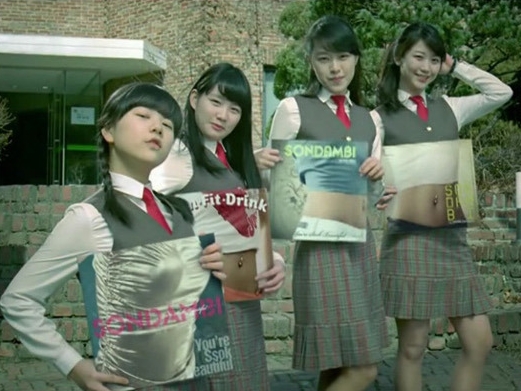
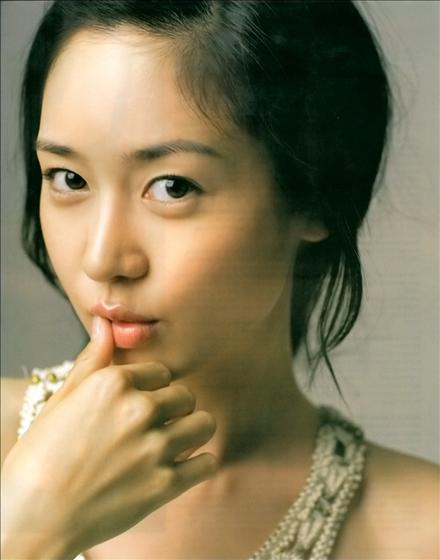
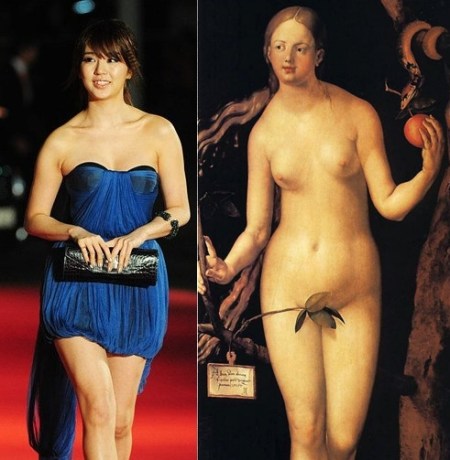
Korean Sociological Image #2: Son Dambi, The Perfect Woman

(Source: Paranzui)

Updated, October 2013

My previous commentary on this “Today’s Tea” commercial was woefully out of date, so it’s since been mercifully deleted(!). But many of the themes expressed remain just as potent in the Korean media today, including the encouraging of teenage girls and children to be dissatisfied with their bodies; the constant invention of new, often impossible, body shapes and “lines” for females of all ages to strive for; the over-reliance on celebrity endorsements, to the extent that the one chosen here, Son Dam-bi, is portrayed as somehow having a superior body and face to an equally-attractive, almost identical woman; and finally, albeit admittedly minor here, the reinforcement of gendered dieting roles by portraying the (single) male humorously—confirming that dieting is something only women need should be serious about.

Think I’m exaggerating? Just see for yourself:

Those problems aside, note that the “34-쏙/ssok-34” is a clever wordplay on women’s “vital statistics” (bust/waist/hip measurements), with one use of the word “ssok” being to stress how concave something is. In fairness, it’s quite apt for a slimming product.

(For more posts in the “Korean Sociological Image” series, see here)

Teenage Sexuality in Korean Pop Culture

원더걸스-wondergirls-in-short-skirts-doing-cute-faces

In Monday’s Korea Times, and it’s close enough to the original that I’ll forgo presenting my own version here this time. New readers, please see here for a video, screenshots,  and much wider discussion of the O’yu commercial mentioned and the issues it raises, and see here for more on the Sahmyook University study on condom use and premarital sex by Koreans referred to also. Old readers, apologies for the repetition this time, but fulfilling Brian’s request just proved too tempting in the end!

Share

An Introduction to Domestic Violence in Japan

For more detailed information, see Ken’s three part series on the 2006 survey on domestic violence by the Cabinet Office of Japan (Gender Equality Bureau) at What Japan Thinks here.

Alternatively, for those of you more interested in domestic violence in Korea, then see here for the first installment in my series on that. Further afield, see here for information on the dramatic decrease in spouse-to-spouse murders in the US over the last 30 years (extreme, but still related), which deserves to be much more widely known.

(Via: Feministing)

Korean Gender Reader

supposedly-fat-kim-yu-bin-김유빈(Source: 원더풀홀릭)

1. God Moves in Mysterious Ways

My opinions on the marketing of teenage girl groups like the Wondergirls (원더걸스) have become much more nuanced since I wrote controversial posts like this and this a year ago, although regardless of my criticisms I never had anything against any of the groups or the singers themselves. And good on Kim Yu-bin (김유빈) above for standing up to the netizens who can’t tell the difference between turning “fat” and turning into a woman.

2. Korea Drops from 64th to 68th in its Gender Empowerment Measure

Probably the most stunning indictment of Korea’s gender relations, it’s worth quoting this Hankyoreh report in full for those of you who haven’t heard of the GEM before:

South Korea fell further out of the mid-low range last year compared to other world nations in women’s rights, a report shows.

According to [2008 data] released Monday, calculated by the United Nations Development Programme for over 100 world nations, South Korea earned a score of 0.54, falling four spaces to 68th from its 2007 ranking of 64th.

The GEM is an indicator of women’s degree of participation in political and economic activity and the policy-making process, using for its evaluation factors such as the number of female legislators, the percentage of women in senior official and managerial positions, the percentage of women in professional and technical positions, and the income differential between men and women. A value closer to 1 indicates a higher level of empowerment.

In the first set of GEM calculations released in 1995, South Korea ranked 90th out of 116 countries, but its ranking gradually rose after that, reaching 68th in 2004, 59th in 2005 and 53rd in 2006. But its ranking fell once again in 2007, as it fell considerably compared to the overall average for nations assessed in areas such as percentage of female legislators and female professionals.

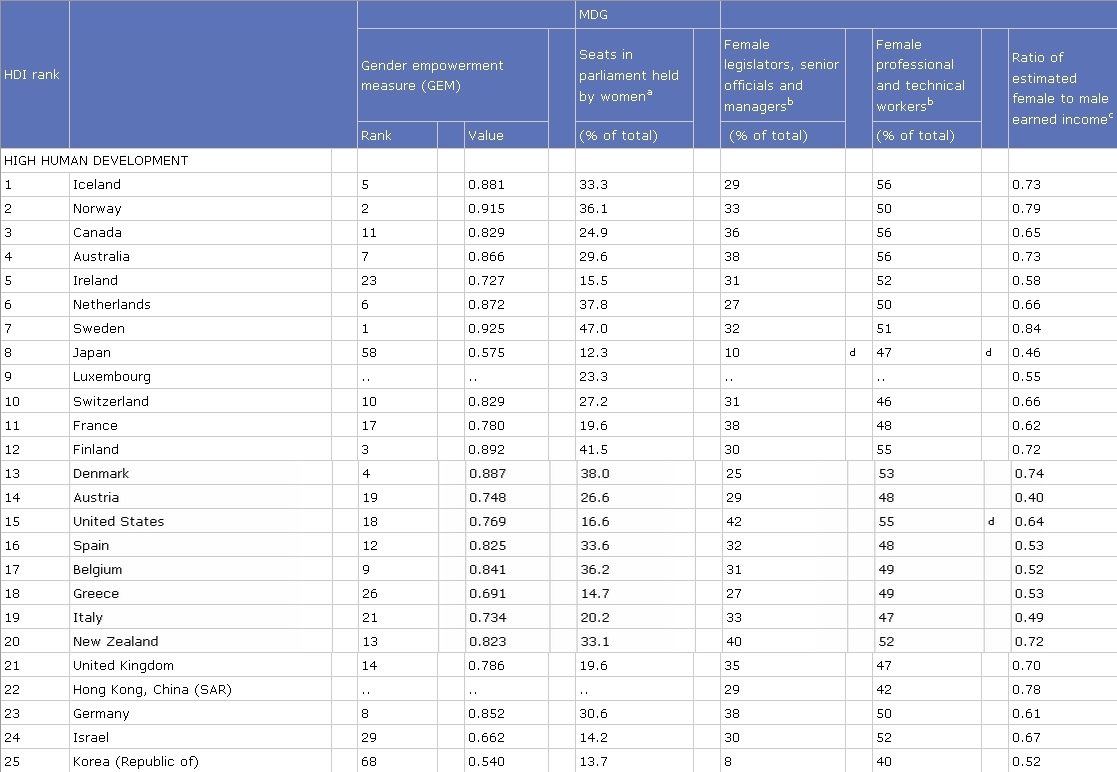
Like Michael Hurt pointed out back in 2006, these figures need to be placed in the context of Korea’s ranking in the Human Development Index (HDI), which combines things like life expectancy and education levels. Roughly speaking, the more developed and better a country is to live in the higher its HDI ranking will be, and usually its GEM will be pretty similar too. But then look at these (click for a much larger version):

south-korea-2008-gender-empowerment-measure-gem-ranking-by-human-development-index-hdi(Source: UNData)

In brief, of the best 25 countries in the world to live in, only 4 are not also among the best 25 countries in terms of women’s rights and levels of economic and political power: Greece on 26, Israel on 29, Japan on 58, and finally Korea on 68. Put another way, women will certainly have a good quality of life in Korea, but they have less chance of becoming a politician or even a middle-manager or computer programmer than in:

  • 59 Kyrgyzstan,
  • 60 the Dominican Republic,
  • 61 the Philippines,
  • 62 Vietnam,
  • 63 Moldova,
  • 64 Botswana,
  • 65 the Russian Federation,
  • 66 Uruguay,

and

  • 67 Nicaragua, the HDI of which was 120th(!) out of 179 countries surveyed.

In fairness though, Korea has actually improved in absolute if not relative terms:

In South Korea last year, women accounted for 13.7 percent of legislators, 8.0 percent of administrative and managerial positions and 40 percent of professional and technical positions, while the ratio of female to male income was 0.52.

The overall percentage improved from 2007, but South Korea was pushed down in the rankings through an overall improvement in gender empowerment among other nations examined. The overall average values for the nations studied were 19 percent for the percentage of female legislators, 29 percent for women in administrative and managerial positions, and 48 percent for women in professional and technical positions.

True, the gap between Japan’s HDI and GEM is also so high, and I can’t blame Korea’s low GEM ranking almost entirely on military conscription in this series but also regularly claim deep economic and social similarities between the two countries in other posts. While I do eventually plan to start covering gender issues in at least Japan and Taiwan though, until then I’d strongly caution against looking for easy explanations such as shared Neo-Confucianism, as Singapore’s HDI is 28 but it’s GEM 15(!), and China’s 94 and 72 respectively for instance (unfortunately there are no separate figures for Hong Kong, or for non-member state Taiwan). Moreover, China’s comparatively good GEM score is not due to the number of women in state-owned enterprises, as they almost always held lower, non-advancing positions within them and were the first to go when they were privatized, wound down, or restructured (but it may account for Vietnam’s relatively good one though).

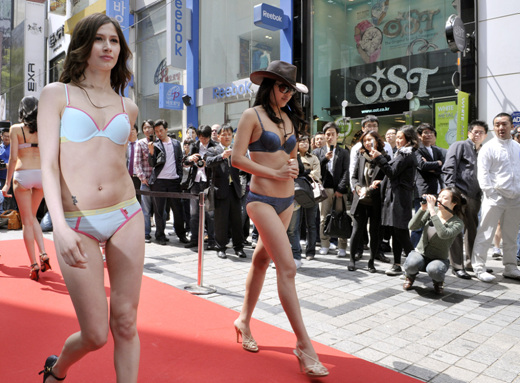
caucasian-and-korean-lingerie-models3. Korean Lingerie Models too Embarrassed to Show Their Faces?

As long-term readers of this blog will know, the main reason that there are so few Korean women in lingerie advertisements is because many Korean porn stars have done so in the past, giving the industry a dirty reputation, although stereotypes of Caucasians’ more liberal sexuality and their role as signifiers of “developed country status” certainly also play a part.

FeetmanSeoul argues that this accounts for Korean models’ virtual disguises(!) at Levi’s “Best Body” fashion show in Myeongdong last week (source, right), although it may well have been the choice of organizers rather than the models themselves.

4. Korea’s Double-Standards Still Devastating for Female Celebrities

As I explain here, it’s still open to debate whether singer Baek Ji-young (백지영) has successfully salvaged her reputation after a sex video scandal in 2000, but another case that deserves to be far better known is that of Ivy (아이비), for whom simply the threat of the release of a similar video was enough to derail her career in 2007. On top of that, despite the trivial fact that the video didn’t actually exist, and that her ex-boyfriend was ultimately sent to jail for making the threat, she was sued by various companies she modeled for and endorsed because of the “damage to their reputations.”

Unfortunately, she is still considered beyond the pale. As PopSeoul! explains, songs originally written for her are now being used by other singers instead.

5. Sexual Violence

  • It’s good that the drunken executives that harassed a 19 year-old student were arrested, but not that she accepted monetary compensation from them rather than pressing charges. As for why this is a feature of the Korean justice system, see here.
  • One of the five teenagers that drugged and raped a 16 year-old in Suncheon is a student at one of Brian in Jeollanamdo’s schools. Make sure to ask him for follow-up details.
  • The Supreme Court upheld a 10 year sentence on Jesus Morning Star cult leader Jung Myung-suk for the sexual abuse of five Korean followers between 2003 and 2006.
  • On Wednesday serial killer Kang Ho-soon was sentenced to death for the murder of a total of 10 women, including his wife and mother-in-law. See here and #5 here for more details.

6. That Movie Poster

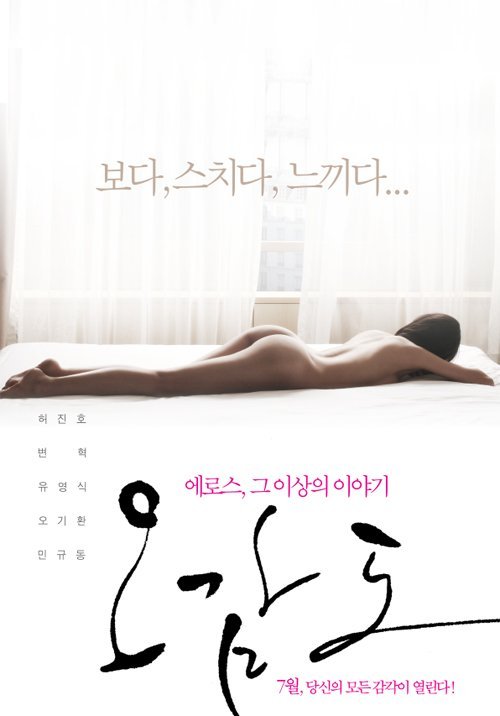
Yes, for the movie Ogamdo (오감도, source), apparently causing quite some controversy with it’s depiction of a women’s naked buttocks (a first?), but really quite predictable given things like this (see #1) and this. ogamdo-오감도For more on the movie itself see here (including details on the owner of said buttocks), and there’s a nice…er…meaty discussion at KoreaBeat too.

7. Anti-Miss Korea Festival

Held at Seoul University on Saturday, and now in its tenth year, bizarrely there appears to be a great deal of information on it available in English, particularly in Australian newspapers (maybe this has something to do with that?) but virtually none in Korean, at least for this year’s event! As Australian newspapers are unlikely to report on how it went though, then I’ll keep looking for “안티미스코리아대회” on Naver, but in the meantime you might find this journal article about the 2000-2001 Drama Viva Women (여자만세) that it inspired interesting.

8. The Differences Between How Koreans and Westerners Perceive and Discuss Appearance

What is said to you and about you by Koreans often shouldn’t be taken at face value, but on the other hand is invariably very blunt, and this habit can take a great deal of getting used to. For a big discussion on how to navigate this cultural minefield, see The Hub of Sparkle here.

9. Monsters-in-Law

A Korean take on domineering mothers-in-law. For the religious/ethical and demographic reasons for why it’s no generalization to say that they’re much worse than their Western counterparts, see here and here respectively.

10. Welcome, Brides, But…

A good recent summary of the problems faced by migrant brides, although I concur with J. Scott Burgeson’s criticism of the author as being unable to ‘transcend the “pure-blood” ideology she claims to critique.”

Koreans’ Indoor Childhoods are Clouding Their Vision

girl-with-huge-glasses-in-libraryIn yesterday’s Korea Times. Long-term readers may recognize the topic from this brief report I gave on it back in January, but, as I’ll explain, I’m very glad I decided to take a second look at the science involved:

Why do so many East Asian children wear glasses? Because they don’t get enough exposure to sunlight, according to a study released by the Australian Research Council’s Centre of Excellence in Vision Science earlier this year. Which may well prove to be a damming indictment of education cultures that confine huge numbers of children to institutes when they’re not at school (source, left: unknown).

Rates of myopia (short-sightedness) have dramatically increased in East Asia over recent decades. To pick the best-known example, data on male conscripts in the Singaporean army shows that 40 years ago, roughly 25% of Singaporean children finishing high school had myopia, but now that figure is closer to 90%, despite students being healthier and taller overall. Similar rates are found in Hong Kong, Taiwan, and Guangzhou Province in China.

These general figures belie what is actually a very real threat to public health. Beyond simply consigning 9 in 10 students to eyewear, according to Dr. Ian Morgan of the Vision Centre, up to 20% of students in those regions are in the “high myopia” category, which translates into a roughly 50/50 chance of going completely blind by the time they are middle-aged. Governments across the region are expressing serious concern.

Previous popular explanations for the worsening vision included East Asian children spending more time at their desks and computers (“near work activity”, when the focus of vision is within a short range over an extended period) these days, or alternatively that there is a special East Asian genetic susceptibility. Both theories have been demolished by researchers at the Vision Centre, who compared myopia rates of 6 year-old children of Chinese origin in Singapore and Sydney.

In brief, only 3% of those in Sydney suffered from myopia, compared to 30% in Singapore. That there was any difference undermines a genetic explanation, but whereas most people might have expected it to be accounted for by the latter’s greater amount of near work activity, to researchers’ surprise in fact Sydney children did more, which suggested that the myopia must be triggered by some other environmental factor. Eliminating all other variables, the critical factor appeared to be that Sydney children were spending far more time outdoors. To be precise, 13-14 hours a week compared to 3 or 4.

While the exact mechanism between sunlight exposure and preventing myopia is still to be determined, the researchers believe that the neurotransmitter dopamine is responsible: known to inhibit eyeball growth, sunlight causes the retina to release more of it.

Evolved to literally keep an eye on the horizon, humans are naturally long-sighted (with short eyeballs), but our eyeballs lengthen as we grow and become more accustomed to near work activity. Myopia occurs when the eyeball has grown too long, meaning that the focus of light entering it falls short of the back of the eyeball, requiring corrective lenses to correct it.

That Singaporean children don’t get enough exposure to sunlight may sound counterintuitive, but in fact the hot and sticky climate makes children more inclined to spend time in air-conditioned environments indoors, and just like in many East Asian countries with more agreeable climates there is also a relative lack of parks and open spaces. Regardless, culture is undoubtedly the biggest factor. Australia is well known as a sporty outdoor country and after-school institutes are almost unheard of. In contrast, many East Asian children’s 6-day school and institute schedules deprive them of sleep to levels that would be considered borderline child abuse in Australia, sapping them of the time, energy or inclination to play outdoors in the sun.

There are additional medical problems associated with a lack of sunlight. Light skins are very popular among many East Asian women, evidenced by the plethora of “skin-whitening” pills, lotions and creams available in cosmetics stores, and in Korea it is already a common sight this spring to see women making sure to cover their faces with books and handbags as they cross a sunlit street, even if just for a few seconds.

While there is nothing at all wrong or unhealthy with this in itself – quite the opposite – the sun is avoided to excess by South Korean women. A 2004 endocrinology study by Severance Hospital in Seoul showed that the nation’s women are seriously deficient in Vitamin D, making them more likely to suffer osteoporosis later in life. In fact they posted the lowest Vitamin D levels of all 18 nations surveyed, with 88.2% of the women surveyed failing to reach a healthy threshold (source, right: the Korea Times).

sunlight-prevents-myopiaWhile it is possible to absorb Vitamin D through food, the surest way is through exposure to a few rays of sunlight every day, and Korean women would be well advised to ask themselves if ultra-pallid skin is really worth the price of full health. Just as Korean parents might wonder if higher TOEIC scores are really worth the price of their children’s long-term health (end).

I confess, I struggled with the science in this article. No, not because it was out of my field of expertise: as it so happens, not only do I have very bad eyesight myself (-7.5 for those of you who know what that means), and so am intimately familiar with diagrams of long and short eyeballs and so on from countless visits to opticians, but in fact my original major at university was astronomy too (no, really), and I learned so much about optics instead of actually looking at stars that I ended up dropping that major altogether!

More then, because the authors of the articles I linked to in my original post proved to be much less concerned with how sunlight prevents myopia as explaining that it had been discovered that it did, and so what proved to be the key information about the effect of dopamine on inhibiting the growth of the eyeball was missing from them. Fortunately though, I eventually found it in this press release by the Vision Center itself, and suddenly everything clicked. But without it, those articles and the dozen more I pored over while researching this post simply don’t make sense, and although it’s tempting to forgive those authors that lacked a science background especially, some advice from my (last) high school physics teacher seems apt here: if you can’t explain something to someone else, then odds are you don’t understand it yourself.

Words I’ve lived by for the past 16 years. Meanwhile, my frustrations with science reporting aside, see here for more information on the Severance Hospital study demonstrating Korean women’s severe Vitamin D deficiencies. And I’m too harsh really: this radio interview of Dr. Ian Morgan is still useful and interesting despite everything.

Update) Unfortunately, as parents’ angry complaints against this proposal for a 10pm curfew on hagwon teaching indicate, the norm of keeping children indoors studying until as late as 12:30am(!) five to six nights of the week isn’t going to change anytime soon.

Where do Ajosshis Come From? Part 3: Manchukuo and The Militarization of Daily Life in South Korea

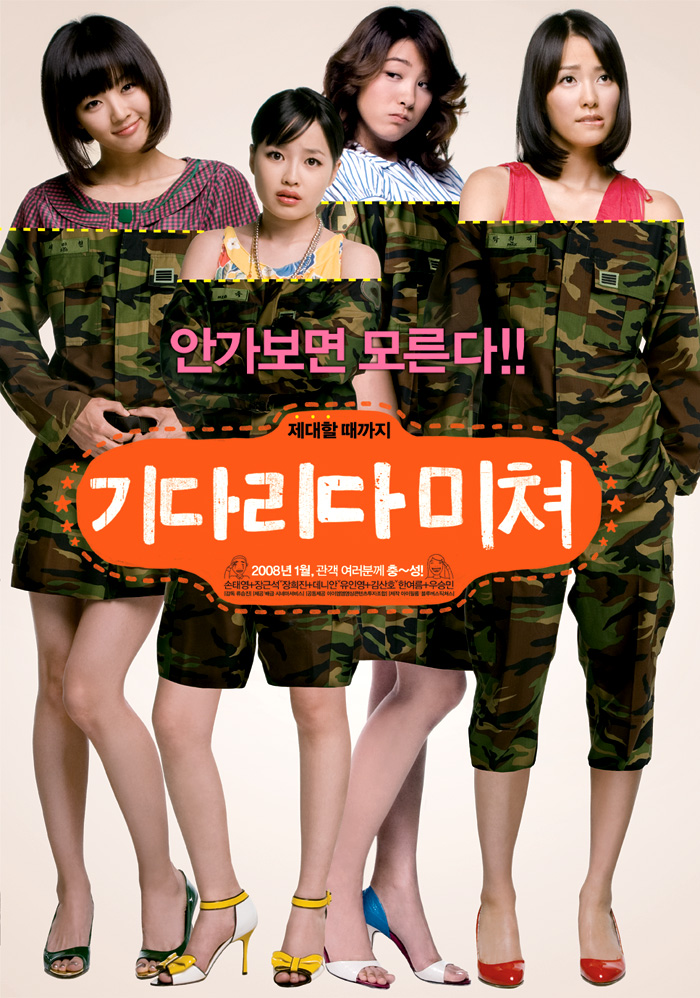
(Movie poster for “The Longest 24 Hours,” (기다리다미쳐, 2007), a lighthearted look at military service from the perspective of conscripts’ girlfriends; also known as “Crazy4wait.” Source: 여자도 모른는 여자이야기)

It’s been quite a while, so to remind readers, in Part One of this series I argued that a virtual gender apartheid existed in modern Korea, with women excluded from economic and political life here to an extent much more reminiscent of Middle Eastern countries than what one would expect in a modern liberal democracy. If that sounds like mere hyperbole to new readers, then sure, it probably would to me too(!), but by all means examine the evidence given there, to which I would now add that Korea has the lowest number of working women of all developed countries also, and that spousal rape isn’t even a crime here (see #2 here).

(Update, February 2014: Part One has since been deleted sorry)

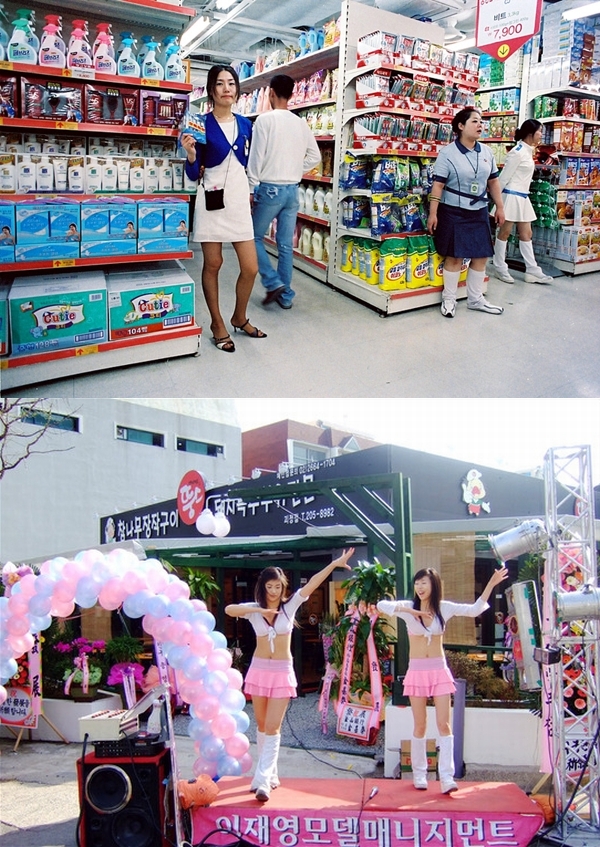
How to explain this? Well, naturally many specific elements of Korean women’s disadvantaged position in Korean society are no great mysteries: decades of salaryman male-breadwinner forms of employment for instance, explain a great deal about the lack of women in senior positions in companies (a parallel is how the Cultural Revolution four decades ago resulted in an “intellectual skills gap” that still affects the Chinese economy), and deeply hierarchical and sexist Neo-Confucianism has had a profound influence on Koreans’ worldviews, even extending to how men’s and women’s bodies are perceived and valued differently, and from which it is no great leap of the imagination to see echoes of in – amongst other things –  the widespread use of doumi (도우미) or female “assistants” and scantily-clad “narrator models” (나레이터 머델) here to sell mundane household items or open even the humblest of new stores and restaurants respectively.

korean-doumi-shop-assistants-and-narrator-models-도우미0-나레이터-모델(With apologies to Michael Hurt for the use of the top image, but like he says, despite their ubiquity most doumi are embarrassed by their jobs and very reluctant to have their photos taken; after half an hour of looking (in Korean!), this is the only similar one I could find. Bottom image taken from shytiny)

But both those and many other factors commonly cited are by no means confined to Korea, and while going into greater detail would undoubtedly tease out plausible reasons why Korean women are worse off than, say, their counterparts in Japan or even China (hardly well-known for gender equality in themselves), here I am more concerned with the systematic nature of women’s exclusion in Korea. Ergo, however cliched it sounds, this series is all about seeing the forest rather than the trees.

With that in mind, based on my readings of especially Kwon (2001) and Moon (2005) and on my own nine years’ experience of the militarism that is still inherent to many Korean institutions (especially schools) in particular, then I laid the blame for that exclusion squarely on the continuation of and widespread public acceptance of the universal male conscription system, and all that that entails: nothing else seems adequate to explain so widespread and pervasive a phenomenon.

Again, that may well sound somewhat exaggerated at first: after all, South Korea is by no means the only country in the world to have conscription, and while I’d venture that a cross-country comparison would undoubtedly demonstrate at least a tendency towards lower levels of women’s empowerment in those countries that had it, that the “feminist paradises” of Sweden and Norway also have it, for instance, shows that any link would by no means be clear-cut. But then for most of the brief history of South Korea the military has had a uniquely pervasive role in society, one not revealed by any casual comparisons with other military regimes, and this really needs to be fully appreciated and understood before some of my more outlandish sounding claims about the effects of conscription on gender roles here can be assessed objectively. Hence, while it will take us far in time and space from what would normally come under the rubric of “Korean gender issues” – and which explains the 9 month hiatus, for unfortunately my beginning to write the series coincided with my wanting to examine more “traditional” aspects of that subject – I realized that the Korean military itself needed to be studied first, and so Part Two was about its origins in the Japanese colonial state, again much greater in size, scope and ambitions than a simple conflation with its European and US counterparts would suggest.

This post continues where that left off, focusing on the short-lived Japanese colonial state of Manchukuo (Manchuria region, 1932-1945), which eventual nreturnees to Korea among the  720,000 Korean immigrants there (from 1932-1940) and a sizable proportion of the South Korean bureaucracy, armed forces, and police of the 1950s and 1960s had some first-hand experience of living in and working for. In particular, Manchukuo was where president Park Chung-hee (1963-1979) above (source) spent most of his formative years as an officer in the army (even going so far as to sign an oath of loyalty to it in his own blood), and, as we shall see, is what he would effectively recreate in South Korea in the 1960s and 70s.

Korea’s Wild Wild West?

(Source: 이것저것 연습장)

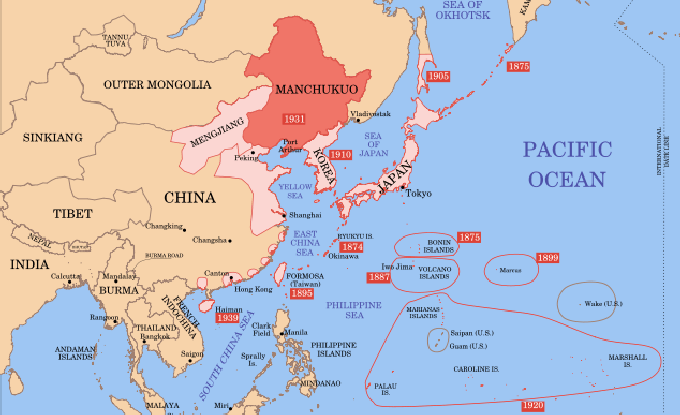
Okay, first the big picture:  what were Japanese motives in occupying what was to become Manchukuo? Well, primarily because it greatly expanded the Japanese imperial empire, still much smaller, weaker, and younger than its European and American counterparts as explained in Part Two. But more practically speaking, it also provided:

  • A bridgehead for the invasion of China, well connected by rail and road links to Korea even before the 1930s
  • A buffer-zone between the USSR and both the more developed and crucial colony of Korea, and indeed there would be several clashes between the two on the Machukuo border in the late 1930s
  • An important source of particularly mineral resources in its own right, without which the later invasion of Southeast Asia wouldn’t have been possible
  • And finally, an escape valve to ease Japanese (and Korean) domestic agrarian population pressures and poverty, exacerbated by the depression.
(The Prewar Expansion of the Japanese Empire. Source: Wikipedia)

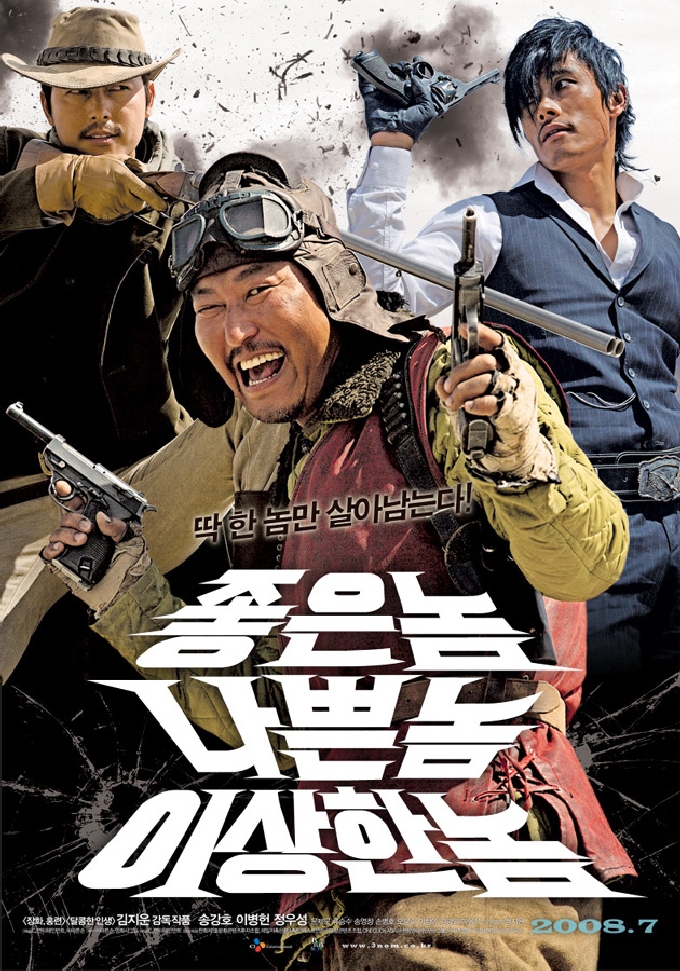
The 2008 movie The Good, The Bad, The Weird (좋은 놈, 나쁜 놈, 이상한 놈) in the poster above happens to be set there, and by all accounts it is fun to watch, but unfortunately its depiction of life there in the 1930s as Korea’s version of the Wild West is probably exaggerated at best. While it’s true that the Chinese Warlord Era as a whole is not exactly well known for the stability or internal coherence of its various regimes, and that things would have been quite chaotic around the period when warlord Zhang Xueliang withdrew his forces from the region and ceded it to the elite Kwangtung Japanese Imperial Army after the Mukden Incident of September 18 1931, that strategic retreat was largely dictated by forces beyond his control, such as Chiang Kai-Shek being unable to provide assistance. In fact, his regime was far more coherent than most of that era, being able to effectively wipe out opium-trafficking and internal corruption in the previous decade for instance. Moreover, much of the state bureaucracy was bequeathed to the new Japanese colonial state, and as soon as April of 1932, it was one of the most controlled, regimented regimes in Northeast Asian history.

Don’t worry if that was all above your head: suffice to say that Manchukuo state organs were in many senses grafted onto the preexisting ones of Zhang Xueliang’s regime, but with the crucial difference that recent events meant that there were no longer any substantial non-state actors like a business or landed class to impede them in instilling notions of loyalty and nationalism in their new pool of workers and soldiers.

And whom were by no means unwilling victims of the process either. For example, writing about the Korean “Truth Commission on Forced Mobilization under the Japanese Imperialism (sic)” in 2006, Michael Breen said:

The Truth Commission on Forced Mobilization under the Japanese Imperialism (sic) announced on Monday that 83 of the 148 Koreans convicted of war crimes were victims of Japan and should not be blamed….

[But they] were not tried as soldiers or POW camp guards who had done their jobs. They were tried for over-zealousness, for decisions and actions over and above the call of duty. They were the thugs, the brutes, the monsters, the most horrible of the ”horrible people”….By what authority does the Truth Commission have to remove their individual responsibility with its class act defense of nationality? Such skewed morality led to the crimes against the lowest class– ”prisoners” — in the first place. People who committed crimes against humanity are not innocent by virtue of being Korean any more than Japanese who brutalized Koreans are innocent by virtue of being Japanese.

….[the Truth Commission] should recognize that the idea that Koreans were all unhappy citizens of imperialism bar a few collaborators is a myth. Koreans were Japanese citizens, and it did not occur to many to support the allies against their own country. Ask anyone who lived in that period, and they will tell you that the political correctness of the post-colonial generation is distorted.

They will also tell you that from 1937-42, Koreans in the Japanese army were volunteers — who included King Kojong’s son, an army general — and that large-scale forced conscription only started in 1944. The Commission should know that those rounding up comfort women were Koreans and those torturing people in police stations were mostly Koreans. Koreans, in other words, were more ”horrible” to Koreans in many cases than the Japanese were. The solution to this dilemma is to accept the notion of individual responsibility.

And according to Suk-Jung Han in his July 2005 Japan Focus article “Imitating the Colonizers: The Legacy of the Disciplining State from Manchukuo to South Korea,”  similar senses of citizenship were instilled in new Manchukuo citizens by means of:

  • State-Sponsored Confucianism
  • Mourning Rituals and Ancestor Worship
  • State-foundation Gymnastics
  • Anti-Communist Rallies

A combination which will probably sound very familiar to those of you even with just the most basic of knowledge of South Korea’s history. Indeed, as Han’s article is only 14 pages long and very readable in its own right, rather than provide a detailed discussion of what you many of you will go on to read there regardless, it’s probably wiser if I just provide some excerpts here, starting with:

The legacy of Manchukuo can be seen in numerous “naturalized” events in South and North Korea. So-called “national ceremonies,” such as paying a one minute silent tribute to the war dead in front of monuments, marching, lectures on the “current emergency situation”, movie-showing, poster making, student speech contests, rallies, big athletic meetings, and so on- largely related to anti-communism, and all too familiar to South Koreans for several decades from the 1950s- were originally national events of Manchukuo in the 1930s.

For state-sponsored Confucianism, some crucial clues as for how South Korea has come to be known as “More Confucian than China”:

South Koreans grew accustomed to the Confucian ideology of loyalty and filiality (choong-hyo) stressed by Syngman Rhee’s regime (1948-1960) as well as Park Chung Hee’s (1961-1979). The post-liberation ideology was different from the Confucianism of the Chosun dynasty, which had been not only the official ideology but also the basis of ethics and cosmic philosophy. The former was less intense than the latter. But Confucianism was still influential in the post-liberation era. Important Confucian concepts, like loyalty to the nation, were instilled in students. It was Manchukuo that energetically patronized Confucianism. Manchukuo differed from mainland China where Confucianism was severely attacked by the May 4th intellectuals and their heirs. Also, Manchukuo differed from Japan in the 1930s when Shinto was deployed as the state religion.

About the importance of mourning rituals and ancestor worship, which might sound outlandish to many outside of Korea, but intimately familiar to anyone who’s ever experienced either of the two biggest occasions of the year Seollal or Chuseok in an actual Korean home, and learned first-hand just how morbid they can be, at least symbolically:

Although monuments for the war dead began to supplement Confucian shrines as the site of important ceremonies, the mourning ceremony, either for ancestors or soldiers, was long essential to Confucian practice inside and outside the home. In April, 1935, officials and army officers attended a great mourning ceremony (zhaohunji, shokonsai), held at the newly built monument in the capital. The assembly, opening ceremony, invocation of the spirits, enshrining of the dead, offering of food, and tributary speech solemnly proceeded. This was simply one example of numerous mourning ceremonies of subsequent years, particularly after the outbreak of the Sino-Japanese war.

The mourning ceremony for dead officials, policemen and soldiers was an important an event, next only to one worshipping Confucius. Although prewar Japanese society also had ceremonies for the war dead at Yasukuni shrine, they were not equal to those in Manchukuo. In Japan, all the war dead (except those who died in hospitals, rather than at the front) were enshrined at Yasukuni. Ceremonies for all were held there at fixed dates. In Manchukuo, by contrast, ceremonies were held at numerous places and at various times. Each ministry of the central government, central police board, army district, province, and county office organized a committee for constructing monuments. Monuments and plazas for the war dead were built across the nation.

seollal-shrine(Offerings of food and drink at a temporary mini-shrine devoted to the spirits of dead ancestors, to whom male members of the family must bow to in ceremonies on Seollal and Chuseok. Source: DiscoverKorea)

For state-foundation gymnastics:

Most middle-aged and older South Koreans remember Jaegun gymnastics from the 1960s. “Jaegun chejo shiijak (let’s start Jaegun gymnastics), one, two, three, four!” The song was broadcast in the early morning across the country in the 1960s following Park’s military coup. [9] Most family members woke up to this song-like command and practiced Jaegun gymnastics, still practically asleep. Jaegun, meaning reconstruction (of the state or nation), was the catch phrase of Park’s regime. Several other songs about Jaegun were written and propagated for citizens and students to memorize. The model for Jaegun gymnastics was the Jianguo (state foundation or construction of the nation) gymnastics of Manchukuo. Jianguo and Jaegun had the common Chinese character of foundation or construction (“jian” in Chinese, “gun” in Korean). Jianguo was the essential word in Manchukuo, from “Jianguo spirit”, “Jianguo celebration day” to “Jianguo University” and “Jianguo exercise.” Hence, construction and reconstruction were the key words for Manchukuo and South Korea.

And still as big a part of the collective Korean psyche that there are still many references to it in popular culture, even that explicitly catering to young people that would barely remember it, if at all. One recent example of which was in a commercial for an eyeliner, as I discuss here:

Also of note:

In Manchukuo, exercise and sanitation were important fields in which the regime invested. There were special weeks of exercise and street cleaning. During this time, the human body came under the jurisdiction of the state. One month after its foundation, the regime prepared an athletic meeting….Imitating the German fascists, the rulers of Manchukuo were interested in the physical training of citizens….Through sports, Manchukuo sought international approval, for which the regime was so thirsty.

This importance of this will become apparent in later posts when I discuss Korea’s population control policies of the 1960s and 1970s, only marginally less rigorously pursued and personally invasive than their Chinese counterparts, and a good illustration of which is the withdrawal troops from the DMZ at the height of tensions with North Korea in order to implant IUDs and perform (voluntary, but rather highly encouraged) sterilizations on citizens in remote rural areas and islands. No, really.

crimson-dawn-by-spargett(“Crimson Dawn” by Spargett. Source: A Muchness of Me)

And finally, for anti-Communist rallies:

South Koreans became sick and tired of anti-communist rallies (bangongdaehue) or “Great gathering for destroying communists” (myulgongdaehue) under Syngman Rhee’s and Park Chung Hee’s regimes. Old folks and housewives were led by officials of city districts and neighborhood districts, and students led by teachers gathered in great stadiums and shouted anti-communist phrases. Again, the model was Manchukuo. In prewar Japan, of course, there was mass mobilization (through such organizations as the Military reservist association and National youth association). After the Manchurian Incident, in particular, jingoism spread among news media, magazines, movies, and literature. According to Louise Young, however, neither government repression nor market pressures can entirely explain the enthusiasm in the 1930s. It was voluntary. Journalists of Asahi or Mainichi supported the army, because they had conviction (Young 1998: 79). Also, the main enemy in Japanese society was not necessarily communist Russia (although it may have been for the Japanese army). Hence, there were no anti-communist rallies in Japan. By contrast, there were myriad anti-communist rallies in Manchukuo. Also, Manchukuo had many more occasions for rallies. Manchukuo was a pioneering place of maximum mobilization, summoning people day and night. The fascist gatherings of Germany and Italy flowed to both North Korea and South Korea through Manchukuo.

Hell, for all its anti-Japanese rhetoric, even at least one of South Korea’s national holidays (until 2005) ultimately comes from Manchukuo too:

In 1936, “tree-planting day” was added. There were other celebrations such as, those for Japan’s withdrawal from the League of Nations, the entry of Japanese soldiers to Manchuria, the visit of Japanese royal family members, and the abolition of Japanese privilege, even one for the founding of the post office.

For a little more on the national-security mania of South Korean military regimes, see here, but that will be the main topic of *cough* a much bigger Part Four.

But let me stop this post here, for Han’s section on “Inheritors in the 1970s,” in which South Korea sounds like a carbon copy of all the above, really needs to be read in its entirety, and my amount of copying and pasting has already become a little excessive. Apologies for that, and I don’t like looking lazy either, but I confess that the question of how to summarize an article that most readers would go on to read regardless proved such a stumbling block for me that it’s taken me nine months to return to it. And that was despite the fact that the next post in the series will be about something I read in 1997 which – in no uncertain terms – was such a revelation to me that without having done so I literally wouldn’t be in Korea or even East Asia today too, let alone have started this blog (but hence its title). Better then, to be a little lazy in this one post then to procrastinate any longer!

democracy-park-monument-busan(Source: Brian Yap (葉); CC BY-NC 2.0)

Love Stinks: Why More Korean Women Wear Deodorant Than Men

성유리-sultry-sung-yuriIn today’s Korea Times. I’ll chime in here with links and extra information that I couldn’t provide in the 800 words allowed there (source, left: fotoya):

“Men can sweat up to 50% more than women,” or so says deodorant maker Rexona. Yet not only do very few Koreans ever wear deodorant, advertisements for it that have started appearing in recent years have almost exclusively been aimed at women.

Far from being counterintuitive however, a study published last Monday in the journal Flavor and Fragrance demonstrates that women have very good reasons to pay more attention to how they smell.

Researchers at the Monell Chemical Senses Center in Philadelphia asked male and female volunteers to rate the strength of 32 underarm sweat samples collected from both genders, and then 32 more that had been disguised by different fragrances typically used to control or mask underarm odor. While both men and women rated the unadulterated samples as equally strong, 19 fragrances successfully disguised the smell for men, while women were deceived by just two.

Investigating further using only female volunteers’, again the unadulterated samples were rated equally strong, but whereas six fragrances succeeded in disguising the men’s smells, as many as 16 worked on the women’s.

Yes, I also thought that it was strange to test only female volunteers in the second series of tests, and I’m confused about the composition of the sweat samples in the first series too: were they just random samples from men or women, were they mixed together into some form of asexual smell, or what? Unfortunately, the above is the best I could make out from 4 even more confusing and widely divergent reports on the study here, here, here, and here, and with what I’m being paid then my sense of journalistic integrity doesn’t quite extend to paying for access to the study itself I’m afraid!

In other words, while women’s noses are more sensitive than men’s, their own odors are more easily disguised, leading women to wear more deodorant or perfume than men.

Naturally there’s much more to it than men’s worse sense of smell, as I’d wager that — at the moment at least — in most cultures it is much more culturally acceptable for women than men to spend a great deal of time and money investing in how they smell, and express an interest in “smelly things” in general, although this study does at least point to a possible biological basis for that. One commentator on one of those other reports argues that the proportion of male to female chefs suggests otherwise, but others argue that that is more due to discrimination than anything else.

As an aside, in the mating game, this may not always be good strategy: other research has shown that the scent of a woman’s sweat is particularly attractive to men at the most fertile time of her monthly cycle.

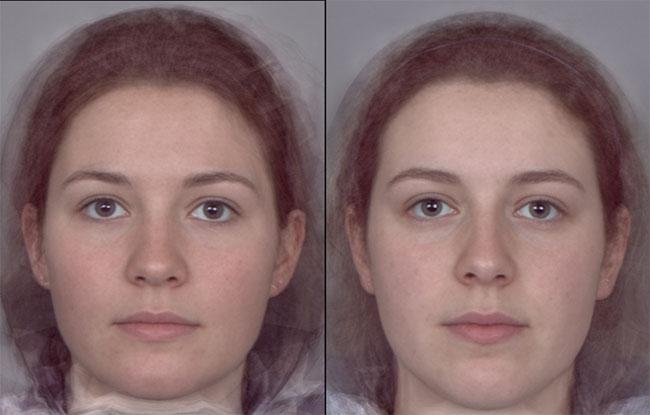
composite faces of the 10 women with highest and lowest levels of oestrogen(Composite images of women taken with the most (L) and least (R) amounts of estrogen when ovulating. Source: New Scientist)

I’ve lost the link behind that sorry, but with the proviso that what counts as “common sense” and “natural” in gender studies and behavioral science is very much dependent on its era (scroll down a little here for a classic demonstration of that), with so much else about women being the most attractive at the most fertile parts of their cycles then I don’t think that readers will be needing much convincing.

But there is much more than this behind the gender bias in the marketing of deodorant in Korea.

In their low deodorant uptake, Koreans are the exception rather than the rule. While it is true that the first aerosol deodorant was launched as recently as 1965, the first roll-on applicator tested in 1952, and Mum, the first ever commercial product for preventing body odor, only invented in 1888, every major civilization as far back as the ancient Egyptians has left a record of its efforts at disguising underarm body odor. So what makes Koreans so different?

Diet, weight, fitness and climate certainly all play a role in how much one sweats, how smelly it is, and one’s ability to smell others. While explanations involving ethnicity are fraught with danger, it is true that Northeast Asians have fewer of the apocrine sweat glands most associated with odor than average. Famous human behavioralist Desmond Morris (The Naked Woman, 2007) has argued that this makes them less susceptible to body odor. But while Northeast Asians on the whole may smell less than other groups, that does not mean that many individuals – particularly men – can relax about their personal hygiene.

That many do is probably at least partially due to a host of cultural and economic factors: for instance, during much of Korea’s recent history deodorant would have been considered a luxury that few needed and even fewer could afford; a notion that still lingers in the gifting of such basic items as spam and cooking oil for national holidays. Another is Korean men’s mandatory military service, a defining experience forcing youngsters to get used to going without many everyday basics.

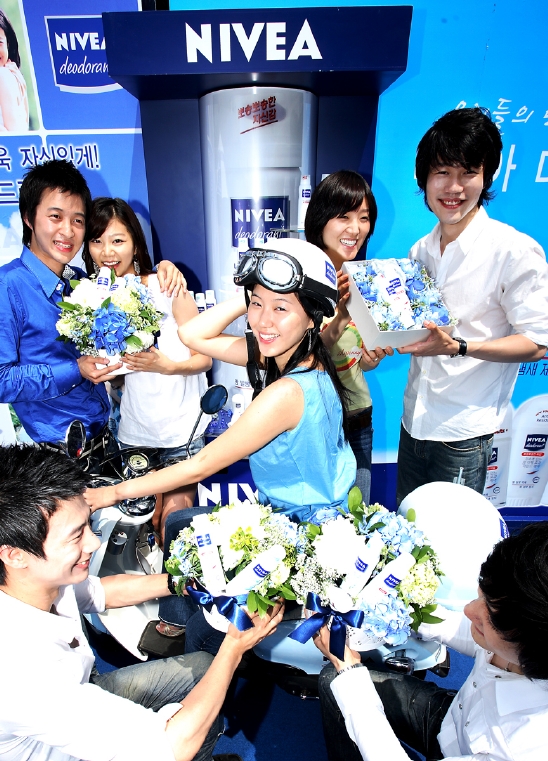
nivea-deodorant-korea-데오드란트With a nod to all the commentators on my earlier big post on deodorant use and its marketing in Korea (source, right)…

On the other hand, given women’s physiological advantages and their dominance of the “smelly industries” worldwide, the very word “perfume” has feminine overtones to many Western male ears. It is reasonable to assume that “deodorant” has similar connotations for most Korean men. Yet looking at the popularity of kkotminam or “flower men” in Korea, challenging traditional notions of masculinity and spending more time and money on their appearance, deodorant manufacturers should be keen to tap into a whole new market.

Unfortunately the timing is bad: while “look at this strange side of the recession!”-type stories are in vogue at the moment, with everything from skirt lengths, alcohol and tobacco consumption, number of breast enlargement surgeries, lipstick sales, and even vasectomies variously being described as going up or down with the economy, experience from the financial crisis of 1997-98 suggests that sales of men’s cosmetics are about to drop. After four years of 10-20% growth from 1992, sales dropped 28.6% the next year, and ad spending by 37%.

Those last figures come from p. 125 of “The Trend of Creating Atypical Male Images in Heterosexist Korean Society” by Lim In-Sook, Korea Journal, Vol. 4 No. 4 Winter 2008,  pp. 115-146, available online here. They put paid to any side-notions I had that flower men ideals for men partially came from the need to stand out in the suddenly very competitive job market after the Asian Financial Crisis (which just goes to show that women’s changing tastes probably had more to do with it!), but given their relative popularity now then that may not be what happens to sales of men’s cosmetics during this latest recession though.

When (if) things pick up though, forget about those Korean deodorant advertisements for women that emphasize mother figures and friendships. Expect those for men to associate the right deodorant with sexual success.

Another recent study from the International Journal of Cosmetic Science has demonstrated that how a deodorant makes a man feel is much more important than any changes to his scent. Lest that sound like exaggeration, researchers found that women looking at men through one-way mirrors rated those wearing certain deodorants more attractive than others, due simply to the confident swagger the act of wearing the deodorant had given them!

An annoying, tantalizing way to end an article? That must mean I’m learning the tools of the trade then! For that above study see here, and I discuss it in more detail in that earlier post of mine.

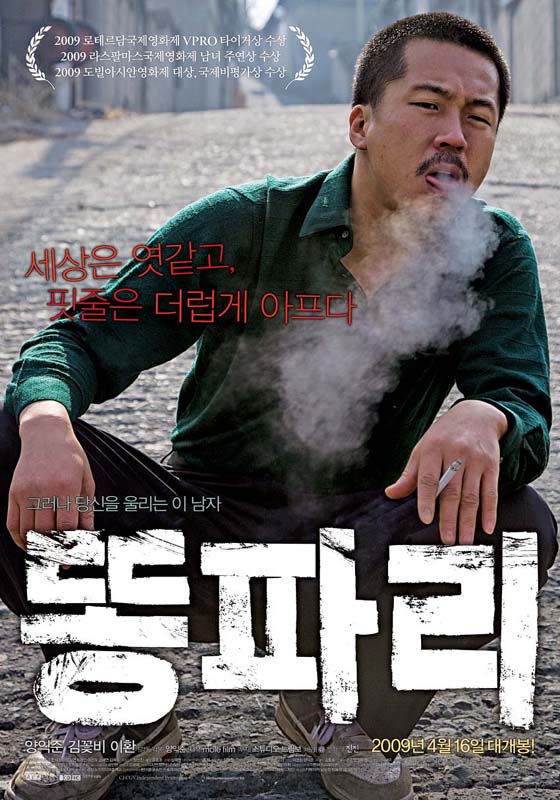
“Breathless”: A New Korean Movie on Domestic Violence

breathlessMy own series of posts on domestic violence in Korea is on temporary hiatus as I realize I should finish others first, but in the meantime the new movie “Breathless” (똥파리, or “shit fly” in typically earthy Korean) on that theme looks like something I should definitely take some time to watch. In the words of Korea Times reporter Lee Hyo-won, whose film reviews are of such high quality that I confess I cut out and keep most of them (source, left: KoreaFilm):

…”Breathless” explores the murky gray zone between compassion and cruelty, redemption and revenge, and the blessings and curses of family bonds. In a nutshell, it’s a family drama that’s inappropriate for children. While harrowingly violent, however, the multiple-award winning film by director-lead actor-producer Yang Ik-june seethes with warmth and humor.

The film is making headlines for entering almost 20 international film events and picking up top prizes, including, most recently, the SIGNIS Prize and the Audience Award, Wednesday, at the Buenos Aires International Independent Film Festival. And the movie does not disappoint, and establishes Yang as a name to watch out for.

Read here for the remainder, and here for an interview and short biography of producer, director and lead actor(!) Yang Ik-june (양익준), who sounds like a bit of maverick:

”I want to say ‘ – you’ to the world through my films,” he said. He also wants to show the male private parts onscreen someday. ”Koreans think it’s artistic when they see it in a foreign film, but here they censor it. We feel unstable in this world because we want things to be safe all the time, but we need to be courageous,” said the director, who respects cineastes like John Cameron Mitchell (”Shortbus”). ”Sex is part of life,” he said.

For more on the recent decision to allow Shortbus to be screened, see here. I definitely share his sentiments, and, as someone notorious among my friends for never shying away from sexual topics myself, I very much look forward to more films from him!

Angry Asian Men

frustrated-chinese-man( Source left: unknown; Source right: GR × HERMARK, CC BY-NC-SA 2.0)

Well, angry Chinese men to be precise, for in 2005 there were 32 million more Chinese boys under the age of 20 than girls, some of the oldest of which will already have been having problems finding sexual partners. And the the gap is set to get worse over the next twenty years as the demographic “wave” of China’s skewed sex ratio arrives.

That figure comes from this study released last week, according to the New York Times actually the first ever to provide hard data on the scale of the problems coming as a result of China’s “One Child Policy“, so it’s well worth a quick read (it’s only seven pages long).

Certainly the notion of hordes of sexually frustrated young men haunting Shanghai bars may sound facetious at first (aren’t they there already?), but the reality is that throughout history they’ve invariably proved very bad for social stability and security: much better to send them off fighting wars, so they don’t cause trouble back at home. Which, needless to say, is ultimately very ominous-sounding considering the ugly nationalist streak China has been displaying in recent years, particularly by its young people. For more on that, see this excellent article by Michael Ledeen (with thanks to Tom Coyner’s “Korean Economic Reader” mailing list), who argues partially on that basis that it is quite misleading and outdated to think of China as a communist regime, and that it is actually more a fascist one now. He’s very convincing.

garfield-minus-garfield-what-if-we-could-see-into-the-futureMeanwhile, see here for my take on Korea’s own sex-ratio problems, which – despite what you may read elsewhere – were actually acknowledged and largely taken care of back in the mid-1990s. Unfortunately however, that minor detail tends to get overlooked by the overseas media somehow (source, right: Garfield Minus Garfield).

Finally, not that it really has anything to do with this post, but I confess that it inspired the title: if you haven’t heard of the Angry Asian Man blog then be sure to check it out, as it offers an unorthodox (and much needed) perspective on American culture and politics.

Going All The Way…to Hong Kong?!

jung-il-woo-cha-su-yeon-vita500-commerical-정일우-차수연-비타500-광고-captureEstimated reading time: 2 minutes. Actors: Cha Su-yeon and Jung Il-woo. Source: Paranzui

How could I miss this? Probably the first Korean commercial ever to feature a woman literally moving up and down on top of her boyfriend?

Much more interesting though, is what is written and said. For not only does the background text read “You need Vitamin C for love too!” (사랑에도 비타민C가 필요하다!) for instance, but, like Chris explains at Dead Girl:

Boyfriend is trying to airplane girlfriend but he’s having trouble maintaining, if you know what I mean, and so he downs a bottle of 비타500. Immediately invigorated, dude now has no problem keeping her up, and at the end he asks her, “Where shall we go?” She replies, “Hong Kong!”, which I now know is a pretty popular euphemism here in Korea for an orgasm, its origins being the affluent image of Hong Kong that was held in the collective consciousness of Korea until not too long ago. So ladies, next time your man asks where you wanna go, demand he take you to Hong Kong, and don’t let him stop till you get there.

Noble sentiments indeed.

Although the slang was new to me, I did quickly learn when I arrived in Korea that the English equivalent of “coming” was “going” in Korean, so going somewhere does make some sense. Nine years later though, the Korean (and Japanese) for that seems to have been completely Anglicized. Which is a pity, as this phrase is possibly unique to the Korean language, and a genuine surprise to hear in a primetime television commercial.

What other surprises like this ad might be out there? If just a little bit of Korean ability completely transforms our understanding of otherwise innocuous-appearing cultural products, perhaps we should keep an open mind about how sexually conservative Korean society in general really is. Why do gatekeepers present it as such to overseas audiences, when it clearly is a lot more nuanced than that?

If you reside in South Korea, you can donate via wire transfer: Turnbull James Edward (Kookmin Bank/국민은행, 563401-01-214324)

Korean Gender Reader

baek-ji-young-soju-advertisements(Source: Bohae)

Apologies for the Korea Gender Reader’s one-month hiatus. Naturally even I can’t cover everything I missed(!), so today’s post will be a mish-mash of news from March and from last week.

1. Baek Ji-young Chosen as Soju Model

The innocent victim of a sex-scandal in 2000, singer Baek Ji-young (백지영) has had to fight hard against Korea’s double-standards to rehabilitate her career, and it’s both a reflection of that and how much Korea has changed since that she was recently chosen in an online-poll as the next model for “Ip-Saeju” (잎새주) soju, produced by Bohae (보해양조).

Of course, by now it’s quite rare to find Korean soju and beer advertisements that feature virginal-looking women, although they were the norm two years ago when both were almost exclusively marketed towards men. I wonder if Baek Ji-young would have been considered too risqué had a similar poll have been conducted then?

2. Statistics on the Effects of the Recession on Women

On many occasions I’ve pointed out that, like during the Asian Financial Crisis of 1997-98, women workers are again the biggest victims of the current recession. But finally, here are some actual figures:

According to the National Statistical Office (NSO), Sunday, the number of people employed in their 30s fell by 167,000 to 5.81 million in February from a year earlier, the lowest since the office began compiling data in June 1999.

In particular, the number of female workers in that age bracket dropped sharply by 157,000, while male workers declined by 9,000, indicating women are more severely affected than men by the unfolding corporate downsizing and the collapse of self-run businesses.

And why…

”A significant portion of 30-something female workers are employed on a non-permanent and temporary basis, without job security and other fringe benefits. Companies target them first when things go bad because it is easier to lay them off than regular workers,” the official said.

3. Another Knocked-up Korean Star Gets Married

An inelegant way to put it perhaps, but how else to convey just how routine this is becoming? Of course, in practice just like everyone else Koreans have long been more tolerant of premarital sex and pregnancy provided that the couple ultimately “did the right thing,” but it’s certainly been only recently that Korean celebrities, usually held to much higher moral standards than the public, could start being so blatant about it.

Or can they? In this particular case, minor celebrity Jung Sia (정시아) still felt compelled to deny pregnancy rumors until an wedding date was set, but despite that I’m quite confident that sooner or later not only will some female celebrity be unrepentant after being “exposed,” but will also be supported by most Koreans (albeit by indifference more than active censure).

4. The Continuing Korean Low Birth-Rate Saga

While it’s been one of my areas of interest for a long time (see here and here), even I tire of repeated articles that mention that Korea’s birth rate is one of the lowest in the world and…little much else really, so I’ll try to keep this section to a minimum:

— 4 in 10 Korean women report that they are delaying pregnancy due to the recession, but certainly not helping are management and colleagues’ changed perceptions of new mothers’ abilities and career ambitions once they return to work.

— Last year, the average marrying age was 31.4 for men and 28.3 for women, but the number of marriages is beginning to dwindle.

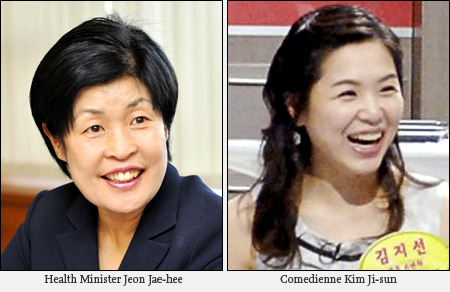
korean-health-minister-jeon-jae-hee-and-comedian-kim-ji-sun— Health, Welfare and Family Affairs Minister Jeon Jae-hee and comedian Kim Ji-sun (right, source) are currently holding radio campaigns to “boost the country’s birthrate,”  which totaled about 630,000 infants in 2000 but declined to 430,000 in 2005 (although there was a temporary increase in 2008 because Koreans rushed to get married before — and then have children during — the auspicious Year of the Pig).

Although that’s better than nothing, one gets the sense that it’s like rearranging deckchairs on the Titanic considering the wider problems with inadequate and expensive childcare facilities and workplace discrimination that are the real reasons Korean women are discouraged from having children: it’s not just a matter of feeling more maternal. But to be fair, John Jae-hee does acknowledge that the benefits of incremental improvements to policy are likely to be moot given the current recession (Note: rather confusingly, not least for the Ministries themselves, there is a seperate Gender Equality Minister by the name of Byun Do-yoon).

— Lawmaker Park Sun-young of the minor Liberty Forward Party (LFP) recommended that in order to increase birth rates Korea should adopt the French policy anonymous birth, under which pregnant women can visit a hospital, register anonymously, give birth and leave.

While commendable in itself, I doubt there’d be much effect on the birth rate  in a country with a strong stigma against raising children out of wedlock (see #3 above). More interesting in that report are statistics on the extremely high number of abortions in Korea, and the fact that only 1% of fathers take advantage of the *cough* generous 3-day paternity leave to which they are entitled, introduced last year. To be fair to Korean fathers though, as an undergraduate I read that even with the extremely generous provisions offered in  Scandinavian countries that few fathers took up the offers there either, and I’ve read on at least one blog here (although I’ve lost the address unfortunately) that many Korean employers are completely ignoring or effectively prohibiting male employees from taking paternity leave.

In today’s economic climate,  the maxim “Choose your battles” comes to mind, and 3 days hardly seems worth it.

— A strange report on a bill to reduce the term limit for abortions from 28 weeks to 24. Strange because first it notes that Korea has one of the highest abortion rates in the world, and then it states that:

Healthy women who undergo elective abortions can be imprisoned for up to one year or fined two million won. Doctors performing the abortion can be imprisoned for up to two years.

And yet doesn’t comment on the obvious contradiction .

If you’re interested in the debate about term limits, then you’ll probably be interested in last year’s decision in the UK to keep the abortion limit to 24 weeks (see here and here). In sum, that limit was set in 1990, and there was a move to reduce the limit to 20 weeks because of advances in medical technology since, but in fact despite those the rates of 24 week-old and younger premature babies surviving is virtually unchanged. Hence although it was made a conscience vote (not along party lines), it was overwhelmingly rejected.

— Finally, by 2020 probably up to 50% of teenagers in many rural areas will be biracial (see here also). But see here for a brief report on the verbal, physical, and sexual abuse faced by many of their immigrant mothers.

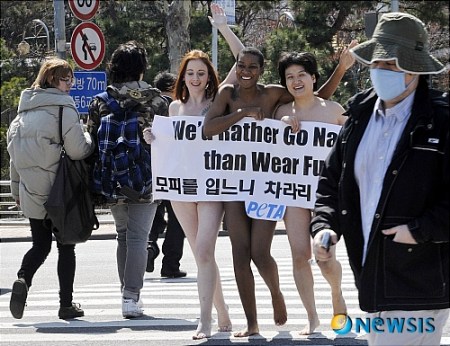
5. PETA Demonstration in Seoul

peta-protest-in-seoul-ed8e98ed8380-ec9ab8ec849cFor the story behind the jarring image on the right (source), see here.

I’m definitely anti-fur, always bought free-range eggs and chicken before moving to Korea (which lacks them), and was even vegetarian for the odd couple of months or so as a student, but despite all that I’m vehemently anti-PETA, and for so many reasons that I could write several posts just on that subject alone. Keeping on topic though, while I often disagree with much of what I read on the blog Feministing, its critique of PETA’s use of (attractive) naked women to advertise its cause is spot on:

…the thing I hate most about this particular PETA propaganda is that it takes what should be a message of empowerment, Love-Your-Body-style, and turns it into yet another affirmation of the female ideal. As [co-author] Renee puts it, “It seems that they respect the rights of animals far more than they respect women. Consider that they don’t use images of male nudes, nor do they use images of women with varying body sizes.”

As you’ll recall, PETA has defended this advertising strategy with the weak response that “sex sells.” It’s an excuse I expect from Axe and Maxim, but not from a movement that is supposedly about justice.

Granted, the Korean woman on the right isn’t your average model, but then she would have been included to add a token sense of local legitimacy: the modus operandi and the arguments against it remain the same.

As a guy I find the notion that naked women are the only way to get me interested in a cause very patronizing, and besides which I seriously doubt that men’s greater awareness of PETA via admiring notorious advertisements like this (second from the top) really translates into effective support.

If I happened to be Korean too then I also would annoyed at the audacity of foreigners thinking that: flying in from the US; walking around naked for 5 minutes; then flying out to do exactly the same thing in another country the next day would somehow be enough to influence my opinions, although I’m not for a moment saying that foreigners shouldn’t protest in Korea and/or that they can’t be effective, especially in situations where Koreans lack local expertise, aren’t interested (but should be), and/or are understandably too concerned about their own reputations to protest themselves.

6. Adidas Korea Finally Uses an Actual Athlete For Advertisements

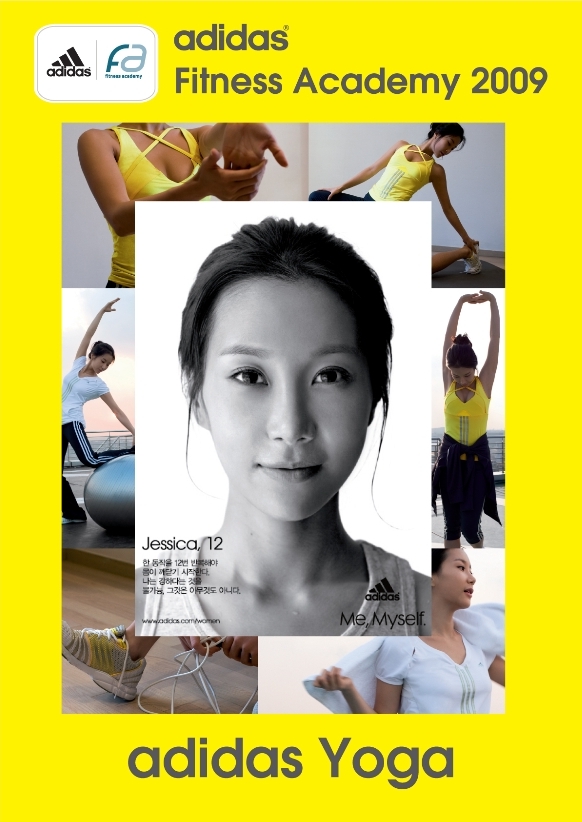
adidas-korea-me-myself-campaign-spokesperson-modelToo distracted by them to notice myself, commentator Sonagi was right to point out that the skinny, decidedly nonathletic models used to launch Adidas Korea’s “Me Myself Campaign” in February, supposedly all about rejecting the fashion industry’s impossible standards and promoting healthy and fit body images for women, achieved anything but in reality.

Suitably chagrined, I suggested that some kick-ass female boxers could be used instead, but Adidas ultimately plumped for a yoga instructor who goes by the name of Jessica (left, source). Meanwhile, rival Nike Korea is now has a side-contract with actress Park Shin-Hye (박신혜), but currently world-famous ice skater Kim Yu-na (김윤아) is their frontwoman, replacing BoA who was the year before.

I don’t mean to imply by the above that non-athletes are bad choices in themselves, and indeed BoA in particular is clearly very physically active, but as Korean women overwhelmingly prefer passive methods of losing weight (see here and here), then absolutely any link between losing weight and active exercise is to be strongly encouraged.

To illustrate the transformative effects attributed to merely drinking something, for instance, the music group Girls’ Generation (소녀시대) is currently promoting a skin-cleansing drink despite its members’ typical teenage acne, actress Song Hye-gyo (성혜교) is doing the same for one that makes you look White lightens your skin, and Kim Tae-hee (김태희) is still selling drinks that make your face more of a “V” shape.

Bear in mind that such obsessions exist despite Korean women still being the least obese in the OECD. On the plus-side though, limits are emerging as to how skinny a woman’s legs can be before even Korean netizens think twice about praising them.

7. More Bizarre Standards For Female Celebrities

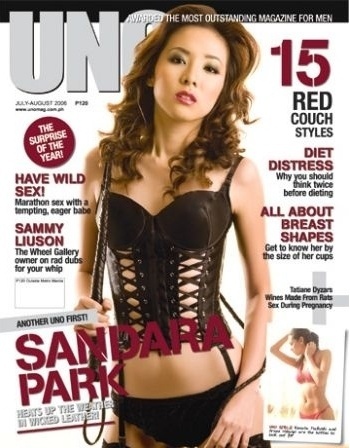
sandra-park-박산다라-magazine-coverLike this post explains, most Korean female celebrities start with a cute and innocent image and try a sexier and more mature one later, but actress and singer Sandara Park (박산다라), who had a modest career in the Philippines before becoming popular in Korea, is making news for her photoshoot for the “lads’ mag” on the right while she was there (source).

But while it’s true that Korean fans are often upset with real-life behavior out of character with actresses’ roles in dramas and TV (no, really), considering the number of Korean women that have appeared in Korean equivalents – a standard method for advancing one’s career – then I’m at a loss as to what all the fuss by netizens is about. Especially as it’s quite clear that it was a one-off and that it was done because her image in the Philippines then was simply too cute and innocent!

8. Family Who Raped Mentally-handicapped Relative Given Jail Time

Undoubtedly due to public pressure, the four men who repeatedly raped their mentally-handicapped relative over seven years, but whom were given suspended sentences because there was no-one else to look after her (see #8 here, then here), have been re-sentenced to prison time.

9. Sex Offenders Free to Teach In Korean Schools

One does have to wonder where the motives for stereotyping foreign male teachers as pedophiles comes from when you discover things like this:

Currently, criminal records of those sentenced to less than three years in prison are removed after five years. As such, schools can’t always ascertain the criminal record of would-be teachers.

Which meant that a Korean teacher with seven counts of “sexual assault and other crimes” against teens was able to get a job teaching them: for the details read Matt at Gusts of Popular Feeling here, KoreaBeat here, and Brian in Jeollanamdo here. Matt also rounds off with an excellently researched and comprehensive “State of Korean Youth”  post here, and don’t forget to also read this one describing how a teacher was only given a six-month sentence for sex with an 11 year-old, and how the maximum sentence is still only three years.

Why Do Young Koreans Live With Their Parents?

Young Korean Man (Source: Andrew Butts; CC BY 2.0)

(Update, 2 March 2016: Thanks for the link in today’s Guardian, but this Korea Times article of mine is a little out of date. I recommend this 2013 Busan Haps article instead.)

In Saturday’s Korea Times. As always, here’s the original version:

…Everyone knows the strong Korean custom of adult children living with their parents until marriage. Yet a report released earlier this year revealed that one-person households now account for a fifth of all households in Seoul.

This is lower than national figures for most other developed countries, the Seoul Development Institute report notes, and the number for Korea as a whole is likely to be lower still. But the rise puts Seoul on par with Australia, and the rate is predicted to grow to a quarter of all households by 2030.

How to interpret this? Does it signal that the Korean custom of staying in the family home until marriage is under threat?

That is unlikely. The figure includes single professionals, jobless youth, those separated from their spouses, divorcees, and senior citizens, with growth in every category. It does not imply a sudden glut of young Koreans leaving home.

While Korea has experienced many periods of great labor mobility in its recent history, particularly of young, single, working-class women moving to work in factories in cities in the 1960s and 1970s, there is definitely no tradition of young middle-class Korean university students leaving home to share private accommodation with fellow students, and there are still strong taboos against openly cohabiting with partners.

At the same time, young Westerners are adjusting their expectations for living arrangements, as the combination of rising university fees, stingier government allowances, and prospect of paying back student loans leads them to defer leaving home until graduating and/or getting their first job. This delay is often both parents’ and children’s least preferred option, but it is a trend likely to continue given the bleak job market for graduates worldwide.

This points to important economic reasons for the differences, and indeed there are big financial hurdles to overcome to live independently in Korea. For instance, at the moment Korean students cannot get student loans without their parents acting as guarantors (although the Ministry of Education, Science and Technology is working to change this). Nor do the vast majority of universities accept credit cards for payment of fees. In practice though, the combination of extremely high “key money” deposits required by landlords and the low wages afforded by part-time jobs favored by students are keeping even the most rebellious of youths at home until graduating and getting their first job. And then, he or she faces a dearth of rentals of appropriate size.

But familiarity breeds acceptance, and while cultural factors are still important, in practice they are often overstated, as for all the purported differences in how Koreans and Westerners view and value family life, many would behave in a similar fashion in similar circumstances.

For instance, with a child’s school being such an important consideration for entrance into a preferred university, and seniority-based promotion systems locking an employee into a specific company, then if a man is transferred to a different city it is very logical for his wife and children to remain in the family home rather than the children leaving the good school and/or him starting at a much lower wage and position in another company.

Also, as legions of unhappy mothers driving home every Sunday night can attest, Koreans generally don’t like to give their children to relatives to look after during the week, but with childcare facilities being so inadequate,  working parents usually have little choice.

Certainly there are some arrangements that Westerners would almost unanimously reject, such as sending one’s family overseas for years for the sake of the children’s education, but Koreans’ living arrangements do not mean that they are as cold, calculating, or dogmatic as they may at first appear. For instance, while they are not openly discussed, ubiquitous love hotels point to unmarried Koreans having romantic relationships much like Westerners, and as the spate of recent celebrity pregnancies can attest, engaged couples are usually given a great deal of freedom.

Moreover, Korean’s living arrangements may well become more liberal in the future.

A long-running debate within sociology rages over whether capitalism forces very different societies to “converge” and become more similar to each other over time or not, and as one of the only non-Western developed societies, Korea is an important element in that debate.

And as reported by the Economist in March, a decade ago Andrew Oswald of the University of Warwick observed that countries with high rates of home ownership have higher rates of unemployment: with few rental options, he argued, young people living with their parents find it harder to move out and get work, or are stuck in local jobs for which they are ill-suited, and earning less than they could.

korean-grown-children-living-with-parentsPerhaps given the dire state of today’s economy, such imperatives will force such a change in Korea? (End)

With apologies to long-term readers, for naturally my articles for the KT will tend to be about subjects that I’ve already covered and know well (source right: Korea Times).

As they’re for a newspaper rather than a blog though, then I’m being forced to make the subjects much more newsworthy, contemporary, and concise than in their original rambling manifestations here, which (presumably) can’t help but have positive effects on my writing style in the blog as a whole. At the very least then, my planned next blog post will be much shorter than it would have been had I posted it just a few months ago(!), but never fear, for I am still a geek, and so it will still be an in-depth one on an original subject (update: sorry, it’ll be next week, but I’m not sure what day now).

For anyone new to the blog and wanting to learn more about any of the issues raised in the article though, then please try the following links:

Enjoy!

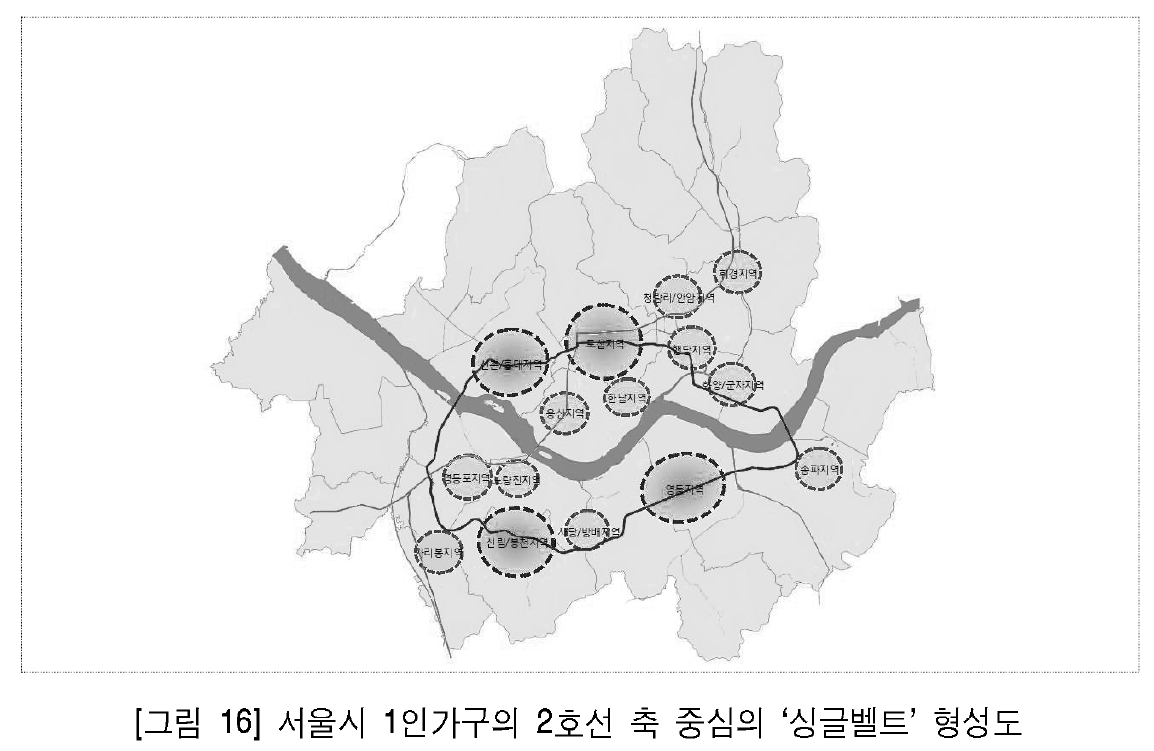
Update) The SDI’s report also mentioned that 51% of those people living alone in Seoul lived in the districts along subway line No. 2, a very small area relative to the vast conurbation that is the second most populous city in the world! It’s definitely no coincidence then, that those districts are dense with cafes, restaurants and retail shops, in total offering 21% of all the part-time jobs in Seoul.

Most of those pay 4000 won an hour, that article reports; the minimum wage is 3500.

Update 2) Here’s a graphic representation of the “single belt” around subway line No. 2, from p.15 of the SDI report.

the-single-belt-of-one-person-households-around-subway-line-no-2-in-seoul

Korea’s “Flower Men”: Where’s the Beef?

gong-yoo-공유-몸짱(Korean Actor Gong Yoo (공유). Source: Unknown)

A commentator on my recent post on the origins of Korea’s kkotminams (꽃미남), or “flower men”:

Is there anything to back up your assertions in this essay? I’m just curious, because I’ve never run into anything that would suggest such a mass reaction to the IMF crisis from the married women of korea. There very could have been, but I’ve never seen anything to suggest it and I’m curious as to how you developed this conclusion.

“in just a few short weeks forever changing standards of dress, discourses of sexuality, and cementing these new ideals of the Korean man.” – you’re kidding right? A few weeks? Unless you’re talking a bloody revolution, or something similiarly radical, I”m not aware of any social movements that can change societies that quickly. I highly doubt a soccer tourney ranks like that.

Your essay overall suggests something pivotal occured in the gender relations in South Korea due to the IMF crisis, but you just make some bald assertions without even giving examples. It’s a little tough to swallow, especially to people who are not in South Korea to see what you are talking about, if indeed there is anything to support your assertions.

I thought that last point was a little harsh, but still, those are some valid criticisms. Hence my lengthy response below, which I decided to make a post of rather than burying it in the comments section to a post that most people were unlikely to reread!

I do have evidence, but I admit that the charge that I “make some bald assertions without even giving examples” is fair. The lack is partially because I wrote this too much in the style of an opinion piece, and partially because regardless it would have been virtually impossible to provide satisfactory evidence in only 800 words. Like I said in that post, in hindsight this was a very bad choice of subject for a newspaper article.

But that doesn’t mean that what I wrote is somehow all just wild conjecture on my part.

I will be giving a presentation on this subject at a conference in a few months, for which I have to write an accompanying paper first, so if you can wait I will be beginning to present the evidence on the blog in a few weeks. But here’s the gist of what it will include below, and my problems with some of your criticisms.

To start, a discussion of a series of films, novels and plays of the mid-1990s that dealt with married women’s sex lives for the first time. Very controversial when they first appeared, they challenged the widely-accepted notions that women suddenly became asexual upon marriage and that they should simply acquiesce to husband’s affairs and frequent visits to prostitutes, and so many portrayed women (angrily) having affairs of their own as a form of revenge.

내마음의포르노-김별아-kim-byeol-ah-the-pornography-in-my-mind-1995Left: Kim Byeol-ah, author of the 1995 novel “The Pornography in my Mind” (내마음의포르노); interview in Korean here (source).

Well before the period of the Asian Financial Crisis (AFC) then, women’s frustrations with popular notions of Korean sexuality were already being articulated, and they were very receptive to new ideals of Korean Men. It is in this context that the Asian Financial Crisis occurred.

Next, that very rapidly after the AFC, there were many dramas indirectly criticizing the fact that married women were overwhelmingly targeted for layoffs (to the extent that they worked hard to keep their marital status a secret from their employers), and there was a sudden spate of movies depicting relationships between older Korean women and younger men. Thinking that there might be some connection is what got me started on this line on research.

Yes, correlation does not imply causation, and while logical, to claim that the changes were primarily a reflection of women’s anger does require a leap of faith to a certain extent. I am working on finding more concrete evidence for that, but unfortunately, occurring in (still) a largely pre-internet era, and with me having a family of four to provide for(!), then practically speaking that is proving quite difficult. So I have been concentrating my research on other aspects of the origins of flower men first.

But of course, even if I am fully correct, am I ever going to find bold, unequivocal statements saying “Fuck those previous ideals of strong provider types. I’m going to fantasize about weaker, effeminate ones to get back at them” to prove the link? And yet even subtler expressions of this sentiment are still going to be few and far between, and more open to (biased) interpretation. True, these days internet forums and so on are indeed full of bold expressions of anger at women, again, being the first to be laid off in the current crisis (see #1 here), but beyond these the reality is that Korean women are still under severe restrictions as to how explicitly they can challenge the current state of gender relations in more traditional forms of media, of which I can provide dozens of examples just off the top of my head (see here for one of the best examples). You can imagine how much more restricted they were in 1998.

Update) In hindsight, of course people don’t really change their tastes so willingly and knowingly like that, do they? Ultimately, it may be quite misguided and pointless of me to seek out explicit confirmations of the shift. Particular events can certainly make people more receptive to new things though, so long as those are available and/or fashionable already…hmmm…

Which begs the question of what would be “sufficient” evidence for my argument exactly? I’m at a loss as to what more evidence than a spate of indirect critiques in popular culture and increased popularity of other ideals there could be really. But then there is the important counter-argument that flower men ideals were primarily, say, the result of imported manga instead, which I will deal with next.

azuma-kiyohiko(Manga Illustrator: Kiyohiko Azuma. Source: Unknown)

For the record, although I did do this when I first started researching this subject a year ago, now I will never deny that manga did played a large role — hell, the primary role — in the fact that Korean women’s new ideals of men came to be flower men rather than, say metrosexuals, and indeed I was at pains to allude to that in the article in the last paragraph of the article. For that reason had the AFC not occurred, then I admit that it is entirely possible that some new forms of flower men or similar ideals would have eventually emerged in Korea regardless. But it did, and the timing is crucial, as it renders any claim that the teens that read it then were somehow responsible for the movies and dramas of the late-1990s I describe as naïve and anachronistic at best.

Only just now, in 2009, are there signs of a critical mass of Koreans that are prepared to admit that Koreans have pre- and extramarital sex, and lots of it, and that women’s sexual desires in particular are not just miraculously turned on like a light on their wedding night—nor just as quickly turned off after the birth of their first child. But still very much today, and sure as hell back in the late-1990s, what public discourses on women’s sexuality that existed were very much confined to married women and that it should and only occur within the confines of marriage. So in short, young unmarried women, very defensive of their virginal reputations, were in no great position to make demands of and/or have their sexual desires reflected in popular culture.

korean-red-devil-in-croptopFinally, enter the 2002 World Cup, which no, I’m definitely not kidding about: while people may not have noticed this particular aspect at the time, anyone that was actually here would readily agree that it was an amazing time to be young and in Korea, and was just as revolutionary in terms of expressions of women’s sexuality as I described. In all seriousness, consider what life was like for unmarried women literally just a week prior to the start of the games: they would often be criticized walking down the street for merely wearing short sleeves – remember that 19 out of 20 women would wear t-shirts over their bikinis at the beaches then – and it was quite taboo to discuss sexual feelings and preferred men’s bodies, even to close friends. Meanwhile, soccer was very much seen as a men’s game – who were originally rather taken aback by women’s sudden interest – and members of the national team(!) made less per year than I made then as an English teacher (source, right: unknown).

And yet four weeks later – yes really, just four weeks – literally millions of women had made soccer their own, often outnumbering men in attendance at games and mass viewings of them on big screens in city streets and then celebrations and rallies and, as it was done in the context of a national event, “allowed” and praised by the media to wear crop tops and so on too, just so long as it was in the context of being “Red Devils,” or supporters for the soccer players, and whose bodies they could now suddenly wax lyrical over (and whom were suddenly making millions in advertising deals). Lest you think that I’m exaggerating about how free women were to do either before though, note that women still came under harsh criticism for doing the same to any foreign players, and that the Korean media basically, well, laughed at Japanese women for doing so. Moreover, although it is not making too much of events to characterize all this as unmarried women taking rapid advantage of an outlet for their frustrations, none of it would have been possible without married women taking part in equal if nor more numbers.

It is certainly true that after the World Cup is when the flower men “wave” really started, spearheaded by attractive soccer player An Jung-hwan who sent Korean women’s hearts aflutter ever time he kissed his wedding ring upon scoring a goal and so on, but as I outline in that earlier post I mention (and which I go into these aspects of the  World Cup in much more detail), he’d already been appearing in male cosmetics commercials, for instance, years earlier. So the ground for the wave was paved, so to speak, by married women in the half-decade earlier, and that is why “in just a few short weeks” the World Cup ”forever chang[ed] standards of dress, discourses of sexuality…cementing these new ideals of the Korean man.”

korean-mother-and-daughter-red-devils(Source: Louis Theran)

To sum up then, if the AFC has not occurred then we probably still would have flower men today: like I say in the article, the tastes of teenage readers of manga in the late-1990s are now having a strong impact on popular culture.  But it did, and without five years of angry, frustrated, and disappointed married women expressing their displeasure in the only (indirect) ways that were permissible in Korea’s deeply patriarchal society to precede it, then flower men ideals for Korean men would not be as entrenched as they are now. And in particular, the 2002 World Cup would not have had the revolutionizing effect on expressions of women’s sexuality that it did, and today Korea as a whole would be a much less liberal place than it is.

Flower Men: The Hot Topic of 2009?

daniel-henny-cosmetics-advertisment(Source: SpaceHo)

Written at the request of the Korea Times editor yesterday, with the final edited version available online here.

Naturally I think the original is much the more pleasant to read, and so that is what I include below, but I have to concede that the editor both adapted it well to a news format and made it take much less time to get to the point; in hindsight, my thesis topic wasn’t exactly the best of choices for an 800 word article. Any new readers looking for the promised wider discussion of the issues raised in it though, please see here, here, here, and here (for starters!).

Still, one genuine quibble with the Korea Time’s article is the misleading title, as it was actually the last downturn — the Asian Financial Crisis — that was responsible for the “Flower Men Wind” as they put it. But that’s no big deal, and its obvious to anyone who goes on to read it.

On a final note, I suddenly have a newfound appreciation for Michael Breen’s sarcastic article about commentators to Korea Times articles. To wit: “this author is out to lunch and offers nothing to KT readers. men need to work and they should be first in line for jobs.”

Sigh.

Downturn Spawns ‘Flower Men’ Wind

Jo In-sung(Source: Dramabeans)

“Dynamic Korea” still graces many a Korean government website, and while that slogan has demonstrably failed to stimulate tourism in recent years, it remains a fitting one for such a rapidly changing society. Yet in the midst of such change, how to anchor oneself as a member of it?

In practice, the need for rootedness renders one’s generation in Korea as strong a marker of identity as, say, race is in the US, and one vivid demonstration of this is the sight of grown children alongside their parents: not only are the former often well over a foot taller because of better diets, but in particular the pastel colors of many sons’ clothes, their elaborate hairstyles, their attention to skincare, their “couple-clothes” and so on can be in sharp contrast to the staid appearance of their fathers, many of whom may well be quite perplexed and embarrassed at what they see as their sons’ effeminate looks.

Yet most would probably be surprised and offended to hear themselves being described as such, and, to be fair, such concepts do vary greatly between times and cultures. What their fathers regard as effeminate now were actually the norm in many earlier periods of Korean history for instance, as illustrated by the costumes in the 2005 movie “The King and the Clown,” and — however bizarre this may sound to Western readers — couple-clothes can in fact be worn by both sexes for the sake of rebellion, such visible affection being a stark rejection of their parents’ often arranged marriages, and all that those entailed.

As such, it is important to analyze the origins of current Korean fashions and lifestyle choices in Koreans’ own terms. Unfortunately, this has generally not been the case in English for Korean men’s current “kkotminam” ideals of appearance.

Possibly, this is because its literal translation — “flower men” — sounds awkward, and so the seemingly close equivalent of “metrosexual” is quickly used in its place. This conflation leads writers to attribute the rising popularity of flower men in Korea over the last decade to a mere importing of metrosexuality. This is a mistake.

jang-dong-gun-cosmetics-advertisementAmong other things, Korea completely lacked — nay, explicitly banned — the mainstreaming and then commodification of gay culture in the 1990s that led to the rise of metrosexuality. Even today there are implicit restrictions against positive portrayals of foreign male-Korean female relationships in the Korea media that have prevented metrosexual symbols like David Beckham from ever acquiring the popularity here that they did in, say, Japan during the 2002 World Cup. Moreover, when focusing on men, it can be easy to lose sight of the fact that it is actually women’s changing tastes in them that drive changes in their fashions and grooming habits, and accordingly it ultimately proves to be married Korean women in the late-1990s that are responsible for flower men’s origins (source, right: ruppy2009).

Why married women? Because it was they who bore the brunt of layoffs during the “IMF crisis,” the logic being that they could be provided for by their husbands instead. But coming after decades of the subservience of feminist goals to wider ones of democratization, and only so recently being given the opportunity to achieve those – not least of which was the right not to be fired upon marriage – they were greatly angered at the sudden loss of a long-awaited opportunity. Moreover, to add insult to injury, they were then encouraged by both government and business to support “Korea’s hardworking men” in order to overcome the crisis.

This shows that Korea remains a deeply patriarchal society, and even today women are heavily circumscribed in the extent to which they can publicly criticize Korean men. Indirect criticism, therefore, took the form of an outright rejection of traditional ideals of men as strong, provider types. A sudden glut of movies appeared featuring romances between older women and younger men, and that this was when the first, identifiable, flower men began appearing in advertising too. And then there was the World Cup of 2002: Korean women themselves were surprised at how as a mass they appropriated such a previously masculine event as their own, in just a few short weeks forever changing standards of dress, discourses of sexuality, and cementing these new ideals of the Korean man.

boys-over-flowers-korean-drama(Source: 동작신진보)

Certainly, there are many more elements to the story: the term “flower men” actually first appeared in 1999 in the context of imported Japanese manga for instance, and as the teenagers that read those grew up, manga-derived films and dramas have gone mainstream. But it is the supposedly asexual married women known as “ajumma” that deserve major credit as instigators of that process, showing that Korea was not a mere passive vessel for Western trends. It is surely telling that the first mention of the term “metrosexual” in Korean newspapers was not until 2003.

Update) “Mirror, Mirror…”, from TIME in October 2005, is a good example of an article that conflates kkotminam with metrosexuals, and in turn sees no essential differences between them and similar groups in East Asia such as, say, “aimei nanren” (love beauty men) in China. But although I (justifiably) criticize that journalistic tendency, there definitely is what my (likely) thesis supervisor has described as Japanese-inspired, “pan-Asian soft masculinity” out there: I just think that its national differences need more acknowledgement, and that at the very least it was very much through the lens of the IMF Crisis that that was imported it to Korea.

Other than that though, the article is not without its good points. For example:

But is the rise of the Asian Pretty Boy all that revolutionary? Not really, says Romit Dasgupta, who teaches Japanese studies at the University of Western Australia. “It’s not a result of David Beckham that suddenly Asian men are starting to look after themselves,” he says. “The tradition was already there.” During Japan’s peaceful Heian period between 794 and 1185, for example, both men and women powdered their faces white. Chinese University of Hong Kong professor Anthony Fung notes that in the West, maleness typically means “muscles, dark skin and strong bodies.” In Asia, by contrast, definitions of masculinity have traditionally been more flexible. During China’s Ming and Qing dynasties (1368-1911), men were depicted in paintings as ethereal, feminine creatures. That refined ideal is best found in the Chinese classic novel, The Dream of the Red Chamber, in which one of the main characters, Jia Baoyu, applies makeup and writes prose in his study instead of battling enemies. And he gets the girl! “Extreme androgyny is nothing particularly new,” says Fabienne Darling-Wolf, a professor of Japanese studies at Temple University in Pennsylvania. “The 50 or so post-war years during which Japanese men were not androgynous-due to Western influence and the desire to ‘catch up’ economically-is the glitch in history, not the other way around.”

Korea is a Conservative Country: Redux

(Source: 1023sheep)

Sorry for the delay, but my article for the Korea Times — my big news — is finally in today’s paper. The subject is loosely how Korea’s reputation as a conservative country is very outdated, that advertisements are a good reflection of its rapidly changing sexual mores, and that…well, there wasn’t too much else to say in the 800 word limit really. Nothing new in there for regular readers then, but the editor has hinted that the better the response it gets, the more likely I will get my own regular column, so *cough* please do go on to read it regardless.

One minor complaint with the KT’s editing is having all my italics replaced by quotation marks in it — they’re not quite the same — and I don’t find the choice of title particularly eye-catching either. But on the other hand, not a word was changed from the original, which is probably quite rare.

Seriously though, I won’t put my foot in my mouth again by giving a specific date for future articles, but naturally I’ll let you all know as soon as they’re up.

The poster, by the way, is for the 2004 Movie S-Diary (에스다이어리), which was considered pretty raunchy when it came it out, but would be very tame by today’s standards. Just like I mention in the article, things change very quickly in Korea, and at the risk of sounding like I’m merely ingratiating myself with new Korean readers, that is one of the fascinating things about the place. It’s good to remind oneself every now and then.

Update 1) Before I forget, I should give full credit to Sonagi for my point in the second last paragraph of the article, about revealing images of women being sexist by virtue of the sheer weight of them, and the same tired women-sexually submissive/men-dominant roles portrayed in most of them. I didn’t fully appreciate it at the time, but realize now that she had a point.

Update 2) Actually, I’ve just noticed that in the very first line(!) of my article the word “that” was removed from “…that such an impression can easily be forgiven”, ruining that sentence and hardly giving a great first impression of the remainder of the article either. Sigh. I don’t think I’ll read it again, lest I find any more editing mistakes…

Did Eve Have an S-line? Women as Walking Alphabets in South Korea

yoon-eun-hye-윤은혜-as-a-korean-eveUpdate, June 2014:

If you’ve followed a link to this post, thank you for your interest in Korean body-image and the alphabetization trend. Unfortunately though, my opinions of both have changed considerably since I wrote this post five years ago, so I’ve decided to delete my commentary (and the comments, which no longer made any sense). Instead, please see here, here, here, and here for much more up to date readings.

For future reference though, I’ll keep my translation of the original Yahoo! Korea article which prompted it, especially as the original is no longer available. I hope readers may still find it useful one day:

(Image: Korean actress Yoon Eun-hye (source) and detail from Albrecht Dürer’s Adam and Eve (1507))

스타매력 재발견, 고은아 ‘가슴’-윤은혜 ‘어깨’ 최고 The Rediscovery of Stars’ Beauty

Go Eun-ah’s Breasts and Yun Eun-hye’s Shoulders are the Best

각종 시상식장의 레드카펫은 여배우들에게 좀더 특별하다. 숨겨둔 자신만의 매력을 한껏 과시할 수 있는 기회가 되기 때문이다. 덕분에 팬들은 그녀들의 아름다움에 숨은 매력까지 엿볼 수 있다. 얼마 전 열린 제45회 백상예술대상 시상식에서 고정된 이미지를 깨고 새로운 매력을 보여준 여배우가 있었다. 바로 고은아와 윤은혜이다..두 배우 모두 귀엽고 상큼한 이미지로 그동안 팬들의 사랑을 받아왔다. 하지만 어린 나이임에도 성숙한 상체 라인을 가진 고은아는 지금껏 풋풋했던 이미지를 벗고 ‘제2의 김혜수’라는 찬사를 받았다. 또 윤은혜는 쉽게 찾아볼 수 없었던 둥근 어깨 라인을 드러내 여성스러운 면모를 부각시켰다.

go-eun-ah-breasts-고은아-왕가슴As they are great opportunities to show off previously their previously hidden confidence and beauty, actresses look more and more glamorous on the red carpet at award ceremonies, and fans are eager to get a peek at their idols. A few days ago at the 45th Paeksang Arts Awards many actresses took the opportunity to throw off their old, established images and show off new sides to themselves, particularly Go Eun-ah (right, source) and Yoon Eun-hye. Both were previously well known and popular for their cute and sweet images, but despite her youth Go Eun-ah has become quite buxom, and has been described as the second Kim Hye-su. Also on this occasion, Yoon Eun-hye showed her new womanly side by revealing her round shoulders for the first time.

백상예술대상 레드카펫을 밟은 고은아는 가슴이 깊게 파인 옐로우 슬리브리스 드레스로 플래시 세레를 받았다. 산뜻한 컬러와 과감한 가슴 노출로 다소 쌀쌀한 날씨에도 불구하고 봄의 여신으로 매력을 뽐냈다. 무엇보다 기존 10대 이미지를 과감하게 벗어 던진 그녀는 이제 여성미와 섹시미를 겸비한 여배우로 신고식을 치른 셈이다.

Once Go Eun-ah stepped onto the red carpet she was seen to be wearing a very low-cut sleeveless dress, and was instantly bathed in the flashlights of hundreds of cameras. The bright dress and her boldness in wearing something so revealing, despite the slightly chilly weather, made her seem almost goddess-like. Moreover, she has completely lost her image of a teenager, and has made a big splash as a beautiful and sexy female actress.

고은아의 가장 큰 매력은 레드카펫의 여왕이라 불리며 늘 섹시하고 파격적인 의상으로 화제를 불러 일으킨 대한민국 대표 섹시스타 김혜수를 연상케 하는 상체 라인이다. C 컵 이상의 풍만한 가슴과 글래머러스한 몸매, 그럼에도 선명하게 도드라지는 쇄골이 김혜수와 매우 닮았다. 이는 한국에서 쉽게 찾아볼 수 없었던 우월한 가슴라인으로 ‘제2의 김혜수’라는 극찬이 아깝지 않을 정도. 게다가 고은아는 키 171cm로 170cm의 김혜수에 뒤지지 않는 신체조건을 가졌다. 압구정 에비뉴 성형외과 이백권 원장은 “김혜수와 고은아의 공통점은 넓은 어깨와 C컵 이상의 풍만한 가슴선 등 건강하고 서구적인 체형이다”며 “속옷의 종류에 따라 차이가 있겠지만 두 사람 모두 상부가 불룩한 속칭 윗볼록이 있는 가슴을 가지고 있다”고 말했다.

kim-hye-su 김혜수

Go Eun-ah’s most attractive point is her breasts, which remind people of Korean sex-symbol Kim Hye-su (left, source), who regularly wears very revealing clothes at awards ceremonies and is known as the “Queen of the Red Carpet.” Despite the large size of their busts, you can distinctly see both collarbones, and they’re even the same height too. Such a combination is not often found among Korean women, and so because this is so rare people are not embarrassed to regularly praise her as the second Kim Hye-soo. According to Apgujeong Avenue cosmetic surgeon Lee Baek-gwon, “Kim Hye-su and Go Eun-ah’s points in common are their high collarbones, their C-cup (or bigger) breasts, and their healthy Western body shape” and “although they may wear different brands of underwear, they will both be for women who are top-heavy.”

또 다른 화제의 인물 윤은혜는 그 동안 드라마 ‘커피프린스 1호점’과 ‘궁’ 등에서 보여준 중성적이고 발랄한 모습과 다르게 푸른 색 미니 튜브탑을 통해 어깨라인과 각선미를 드러내면서 보다 여성스러운 모습을 과시했다. 특히 윤은혜의 둥근 어깨라인은 16세기 유화 ‘아담과 이브'(알브레히트 뒤러)에 나오는 이브의 어깨라인과 닮아 고전적인 여성미를 보여주었다는 평이다. 이브 이외에 ‘비너스의 탄생'(산드로 보티첼리)에서 비너스의 어깨라인은 물론 15-16세기 명화 속에 등장하는 아름다운 여성들의 체형적 특징 중 하나인 어깨가 매우 흡사해 고전적인 여성의 아름다움을 느끼게 한다. 압구정 에비뉴 성형외과 이백권 원장은 “승모근이 발달한 윤은혜의 어깨는 약간 좁으면서 전체적으로 둥근 느낌을 주며 통통해 보여 여성스러운 느낌을 준다”며 “16세기 서구에서는 이런 곡선이 잘 살려진 몸매를 아름다운 여성의 표준으로 보았다”고 설명했다. 전체적으로 통통하면서 힙 등에 보기 좋게 살집이 있는 윤은혜의 몸매가 서양의 고전적인 아름다움에 가깝다는 것이다. 기존 드라마에서 보여주지 않았던 섹시하거나 우아한 여성스러운 몸매를 백상예술대상 레드카펫에서 공개한 고은아와 윤은혜의 다음 번 레드카펫이 사뭇 기대된다.

botticelli-the-birth-of-venusAn actress also getting attention recently is Yoon Eun-hye, who has been in the dramas “The First Shop of Coffee Prince” and “Princess Hours” but who looked rather androgynous and/or tomboyish in both,  showed off her shoulders and legs in a blue mini tube top. Especially, Yoon Eun-hye’s round shoulders were very similar to Eve’s in a 16th Century oil painting “Adam and Eve” by Albrecht Dürer, a well-known symbol with which to evaluate female beauty. Apart from Eve, other symbols used as such have been Venus in “The Birth of Venus” by Sandro Botticelli (1482, above), and she has a remarkable resemblance to the former. Lee Baek-gwon says “On the whole, while the muscle development around Yoon Eun-hye’s shoulders is a little narrow, its roundness give her a very feminine and woman-like appearance” and also that “in the West in the 16th Century, this type of well-developed curve was considered the beauty standard”. And so while a little chubby, her hips and so on are very close to that standard. These two women didn’t previously show this sexy side to themselves in the dramas they appeared in, but people now have high expectations for their next appearance on the red carpet! (end)

Korean Gender Reader

anorexic-jeong-ryeo-won-정려원-giordano-advertisement-지오다노-광고(Source: zziixx)

Old news in the K-pop blogosphere admittedly, but these advertisements of Jeong Ryeo-won’s do give me concerns about her health, although fortunately she’s gained a little weight since they were shot back in July.

Update: As this post at Allkpop makes clear, actually she lost the weight for a movie role. But, given that extreme weight loss, the question remains of if she was an appropriate choice of model.

On to this week’s stories:

1. The Politicization of Skin-Whitening Products

With thanks to reader Anne for passing it on, I’d agree that this is “an insightful recent look at beauty standards in N. America and Korea from the perspective of a Korean American woman,” and for anyone interested in my own take on the subjects raised there by Min Jin Lee, author of “Free Food for Millionaires”, please see here, here and here also.

2. How to Read Your Date’s Personality in 10 Minutes

A Korean blogger’s humorous guide for women here.

3. Couple Steal to Pay for Abortion

Do they cost that much money? Still, one can sympathize with the impoverished couple to a certain extent, and I wonder what punishment they’ll receive? Not that I’m advocating at all that they should get a mere slap on the wrist for holding four bar-owners up at knife point, but they do still present a bit of a dilemma, as obviously they can’t pay a fine, and jail time would mean that their five year-old daughter is sent into (woefully inadequate and under-resourced) state care.

By coincidence though, Wednesday’s English Chosun had a report saying that from September, destitute offenders would be allowed to do community service in lieu of paying fines. Currently, 32,000 people are in jail because they can’t afford to, although 94% of all fines are for less than 3 million won.

4. Government Buildings to Have ‘Refresh Zones’

Fiddling while Rome burns. As Brian rightly points out, a far more effective way to look after employees’ health would be to get rid of the mindset that hard workers don’t go home before the boss does, which means that while Koreans technically have among the longest working hours in the world, much of them are already spent napping and/or playing Minesweeper on their computers.

See here for my own take on the natural effects that has on Korean family life and the low birthrate.

5. Uzbekistani Woman Forced into Sex Slavery in Seoul

uzbekistani-women-forced-into-prostitutionI already mentioned some articles on this in story #22 last week, but if you’re further interested then here’s a translation of another Korean article on the same subject by Korea Beat, and it is always good to get as many different perspectives as possible (source, right: the Hankyoreh).

6. ‘Upskirting’ Gains Attention

Not that one article marks a trend, but this translation of this article from the Guardian on upskirting worldwide did briefly feature prominently on Yahoo Korea’s “front page” this week. And as this and this report make clear, it’s actually still quite a legal grey area in Korea.

7. Vice-Principal Who Ignored Sex Scandal Gets Chance at Promotion

As reported by Korea Beat, “controversy is brewing as a vice-principal in Yeosu, who may or may not have looked the other way as his principal was molesting little kids, is getting one final chance for a promotion.”

8. Resource on Sexual and/or Physical Abuse of Korean Children

Found via his recent post on The Hub of Sparkle here, blogger Roboseyo has been gathering links at news reports on these subjects since November last year, and I dare say I’ll be referring to it a lot from now on!

9. International Marriage in Korea Doubled in Last Six Years

That’s according to a broad statistical report just released by the Korean government, the outline of which are translated by Korea Beat here. Personally though, I find the myriad of other statistics more interesting, such as the fact that traffic fatalities have halved since 1990 for instance, and the ratio of boys to girls among newborns is well within natural ranges, although Korean’s supposed preference for sons is still invariably what tends to be reported by the foreign media.

Meanwhile, the English Chosun at least is convinced that Korea must embrace immigration and ethnic diversity simply for the sake of its long-term economic survival. Definitely laudable thoughts, but while progress is definitely slow, one suspects that most Koreans will find (albeit very very belatedly) that making it easier for Korean mothers to work will be a far more palatable option for them.

10. Gay Politics in Taiwan and Japan

An interesting comparison here, and given Japanese people’s reputation for their….well, let’s say “rather liberal” notions of sexuality, then I was quite surprised to learn that the Taiwanese are actually much more open and progressive when it comes to homosexuality (found via Global Voices).

11. Happy Ending to Adoption Story

While fellow blogger Javabeans is rightfully skeptical of the real benefits celebrity involvement provides to charity promotion and public campaigns of any stripe, she(?) was happy to report that it did have a big impact on this child’s life.

12. Controversy Over Design of New 50,000 won Bill Settled

Details here. For a much more interesting and in-depth look at the issues raised by that controversy though, see the discussion between Gomushin Girl and Bebel in the comments section to last week’s post, starting here.

13. “Boys Over Flowers” Actor Jang Ja-yeon Commits Suicide

jang-ja-yeon-commits-suicideFor the original Korea Times report see here, and the instant I heard of her death I thought of this excellent post by Micheal Hurt on suicide in Korea to place her death into some context, a sentiment echoed by Matt at The Hub of Sparkle here, and who also provides a list of the large number of Korean celebrities to have killed themselves in recent years.

For K-pop blogs’ takes on events and more information about her all-too-brief career also, see here, here and here (source, right).

14. Brothel Owners Pay Average of Nearly 3 Million won a Year in Bribes to Police

And naturally enough, to specifically those police officers in charge of cracking down on them too (prostitution is illegal in Korea, but widespread: for a primer and many links, see #3 here). See here for details of those and for the average sums of bribes paid to the police to overlook other crimes too, and while we’re on the subject of prostitution here is a report of a Korean man pimping foreign prostitutes from the fifth floor of a tourist hotel in Seoul too. Unfortunately though the report is unclear on whether the prostitutes, who are about to be deported, came to Korea with the intention of working in the sex industry or whether they were tricked and/or forced into it upon arrival (like #5 above).

15. Lawmakers Want Tougher Laws on Child Sex Crime

While little good if a lack of state care means that abusers are often the only ones able to provide for their victims, and which in practice means that often they’re not even prosecuted at all (see #3 above), at least these measures are a step in right direction.

16. Women First to be Laid-Off During Recession

Sigh. Again, it doesn’t exactly give me a warm and fuzzy feeling inside to be proved right (see #1 here, and #2 here), but the most recent statistics on phenomenon can be read at the English Chousn here.

Meanwhile, amongst Korean men that are laid-off, as many as 20 percent are opting not to tell their families. One suspects though, that surely they’ll still find out eventually?

17. Unmarried Women Refused Smear Test

Yes, really, and despite the fact that it is all sexually-active women that are most at risk and hence most in need of a regular test. For the lively discussion on that, see the thread at Dave’s ESL Cafe here, and personally I see this as further vindication of my view that the contraceptive pill should remain an over-the-counter option in Korea, rather than requiring a prescription from an almost invariably patronizing and moralistic Korean medical establishment, almost Victorian in its inability to acknowledge that Korean women are having sex before marriage.

18. Women’s Rights in Taiwan

On International Women’s Day, Letters from Taiwan notes the gap between government rhetoric and actual practice on women’s rights (found via Global Voices)

Korean Gender Reader

song-hye-gyo-panties-송혜교-판티스-곰세마리(Source: jinhwii)

I don’t quite know how I happened to come across this very old Korean underwear advertisement above, but I do know that I couldn’t resist using it sooner or later. See if you can guess who it is before you reach the end of this post, and I’m open as to suggestions as to what exactly the point of her gesture was (it’s not what you think!).

In the meantime, my apologies, but from now on my Korean Gender Reader posts will be a lot more minimalist I’m afraid. Partially because the weekends spent on them has been detracting from — nay, has been in lieu of —  time spent on all the longer, more in-depth posts that I’ve had planned, and partially because this last week especially seems to have been a particularly fruitful one for news. And here it is in strict chronological order too, primarily for the sake of breaking it into more manageable chunks for you to digest from on. Please let me know what you think of the new format.

Monday 23 February (And Earlier)

I write “and earlier” because some things I missed last week are still too good not to cover here. For instance:

close-up-of-man-from-korean-air-advertisement1. You’ve Had the Theory, Now the Practice: Finding Reliable and Affordable Childcare in Korea

While I’ve written a great deal on the problems of child care in Korea in the abstract (see here, here and here), two Fridays ago Melissa of Expatriate Games wrote a far more useful post about the ensuing practical difficulties of finding childcare for her 2 year-old daughter in Seoul. Make sure to read her follow-up post on the same issue from Saturday too.

2. Discrimination Against Men Within the Airline Industry

For some reason Google Reader only yesterday gave me the last seven of Aaron McKenzie’s posts at Idiot’s Collective, so earlier I missed his take on a lengthy feature in the JoongAng Daily about the discrimination against male flight attendants in the Korean airline industry, by coincidence the issue which prompted me to start these weekly posts in the first place. For my take on the issue from when it first arose in late December last year, see ROK Drop here.

The image on the right is a close-up from a Korean Air advertisement by the way, which doesn’t actually allow male stewards at all.

(Update: To be more precise, it does hire men, but only from within the company, and hasn’t directly hired any new male cabin staff since 1997)

And now for news from Monday itself:

3. Jun Ji-hyun Forgives and Forgets?

Despite the fact that Jeon ji-hyun’s (전지현) management company Sidus HQ spied on her using a “clone” phone for many years, giving them the ability to eavesdrop on all her phone calls (see story#6 here), not only have all those involved not been booked at her request, but she may well be renewing her contract with the company too! For the details, see Dramabeans here.

4. Less Marriages and Babies During This Recession

I’ve read repeatedly that condom sales go up during recessions, so not unsurprisingly Korean couples are both putting off getting married and having far fewer babies too, with  “government officials and scholars predicting that this year’s birthrate will barely exceed 1.0 child per woman, and will drop below that next year,” which I might add is the lowest of any developed country in modern history.

5. System ‘Failing Victims of Child Sex Crimes’

Self explanatory, although the statistics  provided by this English Chosun report are always useful. But for more information on actual cases and the attitudes and legal absurdities that lay behind those, such as a man being acquitted of groping his stepdaughter’s breasts because “it was a sign of affection,” see many examples mentioned by Brian in Jeollanam-do here.
disabled-korean-sex-abuse-victim-returned-to-care-of-her-abusers

(Source: SeoulPodcast)

Tuesday 24 February

6. Women’s Organizations Compile List of Bad Court Decisions

Far from living up to their stereotypes of passivity — which, to be fair, I might be guilty of perpetuating a little occasionally — women’s groups are doing something about the cases mentioned above.

7. French TV Personality tearfully ends marriage

Ida Daussy, a French woman popular and well-known in Korea (albeit primarily for her fluent Korean skills), is getting divorced from her Korean husband after 16 years of marriage. Interesting ensuing discussion at the Marmot’s Hole here about Western-Korean marriages.

8. Sex Tourism from Japan Increasing?

To be expected with the huge decrease in the exchange rate. Not that too many parallels should be made with the 1950s and 1960s, but the first thing that came to mind when I read the report was how many Korean women then were extorted to become prostitutes to Japanese tourists and US servicemen on US bases; primarily for the sake of obtaining much-needed foreign exchange of course, but those women were also provided to the latter for the sake of  helping to cement US-ROK relations.

 Wednesday 25 February

9. Eco-friendly weddings
korean-eco-friendly-weddings

“Lotte Department Store in downtown Seoul held a green wedding on February 23 to promote eco-friendly weddings. The bride’s wedding dress is made of natural fabric from the mulberry tree.” (Yonhap News, via ROK Drop)

10. DNA Evidence Fingers Suspect Three Years After Crime

More good news from Korea Beat. While the Korean Police have a (largely deserved) reputation for incompetence, and rape-kits aren’t even available at most Korean hospitals, in this case three year-old DNA evidence was used to convict a rapist of two mentally-disabled women.

Thursday 26 February

11. Support Network for Unwed Mothers Established

Although Korea is notorious for sending large numbers of children overseas for adoption, the statistics driving that are still shocking. Such is the stigma of having a child out of wedlock here, that even the structure of the miserly welfare parents to mothers encourages it. As explained by Richard Boas, a American physician who has recently established the ”Korean Unwed Mothers Support Network” explains:

…many single mothers struggle with poverty. The welfare ministry gives 50,000 won ($33) in monthly subsidies for childcare to single parent families. Those living below the poverty line can receive basic government subsidies, stay with foster families for up to two years and stay at 40 facilities nationwide for up to five years, far from enough to help mothers keep their children. ”The government gives 100,000 won a month for a domestic adoptive family. However, giving out just 50,000 won for unwed mothers surely gives the impression that the government encourages adoption,” he said.

For the rest of the report, see the Korea Times here. To place it into context, there were 140,000 single mothers in Korea as of 2005, a number which “is believed to have since risen,” and 1,250 children were adopted overseas last year.

12. Prostitution Answers Sexual Needs of Senior Citizens?

The first time I visited in Jongmyo Park in Seoul in 2000, naturally I remarked on the hundreds of mostly male retirees there to my friend visiting from Japan, who rightly pointed out that they “didn’t particularly have much to do nor anywhere in particular to do it,” so why not play Korean chess all day there? In hindsight though, many would much rather be doing something else, and it’s almost surprising that it took so long for prostitutes to encroach on this captive and — let’s call a spade a spade — somewhat desperate market, and the Korea Times reports here on the ensuing problems of unsafe sex, the sale of fake Viagra and “men’s stamina” products, and the general increasing seediness of the area. You can also read discussions at ROK Drop and The Marmot’s Hole here and here.

Personally, while I’m still a strong advocate of the legalization of prostitution, I’d still rather that it took place somewhere other than the former courtyards of Korean kings and queens(!), and that it is used as su h could easily be read as both a symbol and indictment of modern Korea society, much like “National Treasure #1” Namdaemun was unguarded and regularly urinated and vomited on by homeless people until one of them decided to burn it down in a fit of rage last year. Part of the problems, of course, are general attitudes of distaste and avoidance by the police and general public towards the sexuality of the aged, which the KT correctly notes (and brings to mind this comment about a movie on that theme that ended up being censored).

For those further interested, Matt of Gusts of Popular Feeling discusses a little about the history of the area here, and also notes that there is an essay entitled “Stigma, Lifestyle, and Self in Later Life: The Meaning and Paradox of Older Men’s Hang-Out Culture at Jongmyo Park” by Chung Gene-Woong in the latest issue of Korean Journal, which will be free to download here in six months. He mentions that that abstract doesn’t mention this particular aspect of that culture though, and by chance actually I happen to have a physical copy (as this essay is very relevant to my thesis), and so I can confirm that it’s not mentioned in the article itself either!

13. What Image of Korean Women is Presented by the New 50,000 Bill?

new-50000-won-bill-difference-in-face-shapesArriving roughly a decade(!) after it was needed, one report on the woman on it — Shin Saim-dang, a renowned female writer, calligraphist and mother of a noted Joseon Dynasty scholar — caught my eye, as it said that she is widely referred to as the symbol of a ”wise mother and good wife,” or “현모양처” in Korean.

Forgive me if similar sentiments were raised last year when plans for the new bill were first announced, but that phrase — still well known and aspired to by many Korean women today (just ask them) — instantly reminded me *cough* of the suffrage movement in New Zealand in the Nineteenth Century, women being the first in the world to get the vote naturally being a good thing, but which in fact was also a regression for women’s rights because that vote in 1893 was based on the premise that women would add a civilizing and moral element to politics that it lacked. Or am I making too much of it?

Jumping ahead a little though, the most recent controversy surroundson-tae-young-new-mother-shows-off-her-s-lineing the new bill has actually focused on the shape of her face (sigh), much taller and thinner and — dare I say it? — Western-looking than the original round shape of the portrait it was based on. Perhaps my eyes are tired and that is too much of a leap really, so without any further ado read about both controversies at ROK Drop here and decide for yourself.

14. New Mother Son Tae-young Shows-Off Her S-line

No, I don’t have a thing for her, and I’m not at all saying that she isn’t entitled to look good, nor that any mother can’t or shouldn’t either. On the other hand, not only was she the thinnest pregnant woman that I’ve ever seen (see #11 here), but showing off her great body one month after the birth does set hopelessly unrealistic standards for those mothers without wealth, personal trainers, beauticians and domestic helpers to follow, a complaint I remember regularly reading in Western newspapers in response to “Celebrity Moms” a few years ago too.

Friday 27th February

15. Home Buyers With Over 3 Kids May Be Subsidized

A story naturally linked to above reports on the plummeting birthrate, which, however dire, I still fail to see how, say, telling Strategy and Finance Minister Yoon Jeong-hyun and Land and Transport Minister Chung Jong-hwan to “check Seoul and surrounding areas from a helicopter to find places for new homes” is going to help exactly! True, also giving preference “to couples with three children or more when providing homes and leased apartments and lower house prices” is better than nothing of course, but – seriously – when on the Earth is the Korean government and business establishment going to realize that you can’t educate women to the level of men and then expect them to have kids when they have to give up their careers if they do so? Two hundred thousand won a month in subsidies is supposed to compensate for that?

16. Phones With Security Feature for Women, Children Becoming More Popular

Again, partially in response to serial murder suspect Kang Ho-soon (see #5 here). See the Korea Times article here, and Brian’s take on them here.

17. Sex, Videotape & Lies

In a scam he pulled off on four different women, a 26 year-old is arrested for having sex with his then girlfriends at love hotels and then allegedly claiming that the owners told him that they secretly recorded them, demanding money not to release the clips on the internet. Naturally, he had no money to pay “them”, and so his girlfriends gave him their own money to pass on, the latest ending up resorting to loan sharks to get it.

Saturday and Sunday 28 February and 1 March

19. The Coming Baby Bust

Noticing a theme here? At least the English-language dailies at least are beginning to draw attention to the issue. See here for an editorial in the Korea Times.

20. Study: Most Child Molesters Know Their Victims

Like Korea Beat says here, this is probably well-known to most readers of this post, but it may not be in Korea.

21. Human Trafficking in South Korea

Two excellent articles from the Hankyoreh: first, a story here about a Uzbekistani woman tricked into prostitution in Korea, but whom the police have charged for falsifying electronic records, and next an editorial placing that into some context.

22. Japanese Transgender Entertainer Named as new KNTO Spokesperson

Finally, I’m glad to end on a fun, positive story. But, alas, it’s not that big a deal really, as although Korea’s own transgender celebrity Harisu (하리수) also happens to enjoy a great deal of popularity herself, I seriously doubt that either will have had all that much impact on wider public acceptance of transgender people in both countries, in much the same way that Hines Ward’s sporting success has at least raised the issue of the poor treatment of biracial children in Korea (see here and here) but now the next rather more difficult step of actually doing something about it is needed.

kim-min-sun-jenny-lee-song-hye-gyo-panties

Oh, and the picture at the beginning of this post? Although I’d never have recognized her myself, my wife took one look and told me it’s Song Hye-gyo (송혜교) back from when she first started modeling. But from when exactly I can’t say sorry: the source of the photo is a blog entry from 2005, but obviously it is much older than that, although I did find the photo again alongside two others of Kim Min-sun (김민선) and Jenny Lee (이제니) here, both with the same gesture and advertising the same god-awful granny panties, unfortunately there was no further information on the date, company, nor the meaning of the gesture. Still, I’m dying to know now: what do you think the hand gesture means? Like I said, it’s probably not what it looks like, for can you image that ever being used to sell lingerie? Let alone in Korea, in the late-1990s? But what, then?

What a Lovely Big Shiny Purple One My Man Has!

whisen-air-conditioner-advertisement-han-ye-seul-song-seung-hun(Source: Korea Times, 25/02/2009, p. 20; see full advertisement here)

A classic case of sociologist Erving Goffman’s notion of “The Ritualization of Subordination” in depictions of the sexes together, although you don’t need to have heard of either to tell who’s the boss in this particular advertisement!

One slightly less obvious point of interest though, is Han Ye-seul’s (한예슬) use of the “bashful knee bend,” a common motif for women in advertisements, and which according to Goffman:

…can be read as a foregoing of full effort to be prepared and on the ready in the current social situation, for the position adds a moment to any effort to fight or flee. Once again one finds a posture that seems to presuppose the goodwill of anyone in the surround who could offer harm. Observe…that a sex-typed subject is not so much involved as a format for constructing a picture (Gender Advertisements, 1976, p. 45).

Which I read as it being used in advertisements to show women feeling safe and secure in the presence of their male protectors, in this case Song Seung-heon (송승헌). And why not? To claim that the depiction of that natural feeling is sexist in itself is absurd, but Goffman’s point was simply that the knee bend, and a host of other means of active/passive dichotomies in depictions of the sexes like that—such as men almost always being portrayed as taller than women, far more than in real life—were still overdone in advertising, and not exactly compensated by images of women as assertive, aggressive and/or as instructors, superiors and leaders either.

Or at least in 1976; as that last link explains and the advertisement on the right (source: popseoul) with Lee lee min ho levisMin-ho (이민호) makes clear, things have certainly changed a great deal since, having one person on a bed and/or lower than the other also being a common way of showing ranking. Which is not to say that—now that you have it in mind—you won’t still find many many examples of women with the knee bend in advertisements (or, indeed, in a bed).

But even more interesting though, is the fact that it is Song Seung-heon at all that is advertising the Whisen (휘센) air-conditioner, for actually I only noticed the ad because is the first Korean one for an air-conditioner that I’ve seen in which a man is the center of attention. Sure, that they’re dominated by women is no surprise, as it’s also true of their Western counterparts, albeit to a much lesser extent (but a difference one would expect given Korea’s deeply patriarchal society). But then bear in mind that the process of  modernization that electronics and electric appliances still epitomize—especially in a society as development-obsessed as Korea—has always involved “housewifization” and the nuclearization of the family, and so while it’s certainly true to say that owning one’s first washing machine in the 1960s in the UK, say, was also a definite signifier of status and upward mobility, Korean advertisements for the same should be placed in the context of a society where consumerism has been equated with national security, and in which the lowest numbers of women in the world work (for a developed society).  Hence not only are Korean examples almost hyperreal advertisements for modernity itself, but so far they’ve overwhelmingly featured female-centered narratives, Korean housewives’ need for the self-fulfillment that Betty Friedan saw that their purchase provided being all that more the greater here, and other manifestations of which would be an obsessive focus on real-estate speculation and on children’s educational achievements.

Which might sound a little to take in all at once, but I assure you, once you’ve seen a few examples like the one below then you’ll get a sense of how surreal they consistently are, and why this deserves explanation (and have also reminded me personally of how advertisements really are a reflection of the zeitgeist of an era). So, why the change in that particular advertisement?

My first thought was because it was for the “Luxury” (럭셔리) model, as the instant I learned that in fact a scene from science-fiction novel I read as a teenager came to mind, which opened with a conversation between a couple in which the woman explained to her fiance that, while women did the bulk of shopping, men still bought the important expensive things like houses and cars. As it happens, the couple were in a decidely backward parallel universe where, among other things, American women had never gained the vote(!), but obviously it still has echoes in real life, and indeed this logic does especially apply to Korea: for instance, while I’m not sure to what extent this tradition is followed, I’ve repeatedly heard that it is expected that before a wedding a new wife’s family must provide for the furniture for their new apartment, whereas the husband’s family must provide the apartment itself. Does the expense of this model then, draw it from the female realm to the male, thereby appealing more to the latter? Or is the advertisement still primarily aimed at women, this supposedly luxurious model possessing a male and/or sophisticated aura that other, cheaper ones lack? Or is there still some other factor that I’m missing?

Unfortunately, the K-pop blogs (see here, here and here) do little more than provide more pictures and links to related commercials, so I’d be happy to hear your own thoughts. And I’ll make sure to keep an eye out for mention of it in next month’s Korean advertising magazines.

Expect More Nudity During This Recession

Apparently, I wasn’t the only one to notice Duoback’s advertisement for its new “Alpha” chair a few days ago. Yes, that one:

korean-duoback-alpha-chair-advertisement-듀오백알파-광고(Source: Metro)

It’s always nice to be proved right. Even if it is true that my earlier observations about the advertisement were common-sense really, and that it just so happens to be a tabloid-style article from Yahoo Korea that provides the first confirmation of them:

Recessions Lead to Nude Advertisements…and Flustered Commuters

인 박인숙 (35세, 가명)씨는 출근 후 회사에 비치된 신문들을 훑어보며 깜짝 놀랐다.

After arriving at work one day, a 35 year-old woman that we’ll call Park In-sook (not her real name) was surprised at what she saw while browsing a newspaper provided by her company.

맨살을 훤히 드러낸 한 여성의 뒷모습이 담긴 광고가 눈에 띄었기 때문. 녹색의 투명한 타올이 엉덩이에 살짝 걸쳐 있을 뿐 전라에 가깝다. 신문에 실린 이 광고의 품목은 여성전용 제품이 아니었다. 기능성 의자 광고였다.

Her eyes were drawn to an advertisement which featured the back side *cough* of a woman, completely naked but for a green transparent towel lightly covering her buttocks. The advertisement wasn’t actually for any product specifically for women, but was for an expensive ergonomic chair instead.

‘인간의 몸을 기억하다’는 메시지를 담고 있는 이 광고는 여성 누드 사진을 이용해 독자들의 눈길을 끌고 있다.

The accompanying message in the advertisement was that “This chair remembers the human form,” and the nude woman was clearly placed in it simply to draw the attention of readers.

duoback-loves-your-body-듀오백또 다른 신문엔 여성의 상체 누드(뒷모습) 사진이 전면광고로 실렸다. 이 광고는 한 아울렛을 소개하는 것으로 역시 여성의 알몸이 등장할 만한 제품과 거리가 멀었다.

A different full-page advertisement for a outlet store featuring only a woman’s nude back has already been in another newspaper, and in that earlier advertisement too the product(s) advertised had little to do with nor required nude women (James: not the one on the right for another Duoback chair, although it seems a strange coincidence that it’s the only other Duoback chair featuring nudity, and that the “outlet store” is unnamed; I think the report made a mistake).

최근 이처럼 일간지에 여성의 누드 사진이 활용된 광고가 눈에 띄게 늘자 독자들은 낯 뜨겁다는 반응이다. 아침부터 신문에 누드 사진과 다름없는 광고를 보게 돼 불쾌하다는 설명이다.

Recently, there has been a spate of advertisements featuring nudity in daily newspapers, and these have been making many readers embarrassed and uncomfortable when they encounter them. But these days, it is almost impossible to escape them.

박인숙씨는 “신문광고에 누드사진이 실리면 시선을 집중시킬 순 있겠지만 너무 선정적인 광고로 인해 불쾌해지는 사람들도 많을 것”이라며 “상쾌한 기분으로 아침을 시작해야하는데 이런 광고는 달갑지 않다”고 토로했다.

According to Park In-sook, “Certainly advertisements featuring nudity will get many reader’s attentions, but sensational and shocking advertisements can also make many people uncomfortable. It is important to start every day with a fresh mind, and advertisements like these aren’t helping.”

한 편으론 독자의 시선을 한 번에 끌어당길 수 있다는 측면에서 광고효과가 극대화된다는 평가다. 특히 요즘같이 불황에는 사람들의 감각을 자극하는 광고기법이 먹힌다는 속설대로 제품을 하나라도 더 팔려고 하는 회사들이 이런 광고를 자주 하고 있다는 분석이 나온다.

On the other hand, advertisements like this are more effective because they attract consumers’ attentions with just one glance. And as both modern analysis and a traditional saying advise, during a recession companies should use dependable advertisement techniques which are well proven to do so.

한 광고회사 PD는 “통상적으로 경제가 어려울 땐 자신의 소득을 기준으로 이성적인 구매를 하기 마련인데 회사 입장에선 조금이라도 자극적인 광고를 통해 소비자를 유혹하려고 한다”며 “섹스어필처럼 감각에 호소하는 광고는 단기적으로 큰 효과가 있다”고 말했다.

According to a spokesperson for the advertisement company PD behind the Duoback advertisement, “People naturally spend rationally and frugally during a recession, so from a company’s perspective it is best to use stimulating and direct advertisements that appeal to basic human senses, and those with sex-appeal especially will certainly get a quick result.”

이어 “많은 돈을 들여 톱스타를 쓰지 못하는 중소기업에서 이런 광고를 선호한다”며 “경기 불황일수록 이런 광고를 더욱 많이 하게 될 것”이라고 덧붙였다.

Moreover, “Small and medium-sized that can’t afford top stars tend to prefer these kinds of advertisements, and as the economy gets worse we can expect to see more like these.”