Finding the Queer Female Gaze, and What it Says About Anda’s Touch (COMING MAY 4)

It’s a dirty job, publicly shaming yourself into finally writing about a subject that you’re passionate about and have been working on for years. But someone has to do it!

Estimated reading time: 2 minutes. Source: YouTube.

The MV for Touch by Anda, released in 2015, is as queer and objectifying as they come. Naturally, I fell in love at first sight, and just had to review it.

I’m not a woman though—neither a lesbian, a heterosexual, nor any other on the glorious spectrum. So, before I got started, I needed to hit the books. But no sweat, I reasoned. The concept of the male gaze has been around since 1975. It’s well-known enough that no-one who’s already woke has to explain it to another. Surely over forty years later, I thought, there would be just as extensive a literature on what women want? With helpful lists of clear criteria to guide even the most hapless of cishet male reviewers?

You can already guess the answers. But, absorbing what was out there proved addictive. And, as some of you may recall, I did eventually feel that I had enough of a handle on it to write a review.

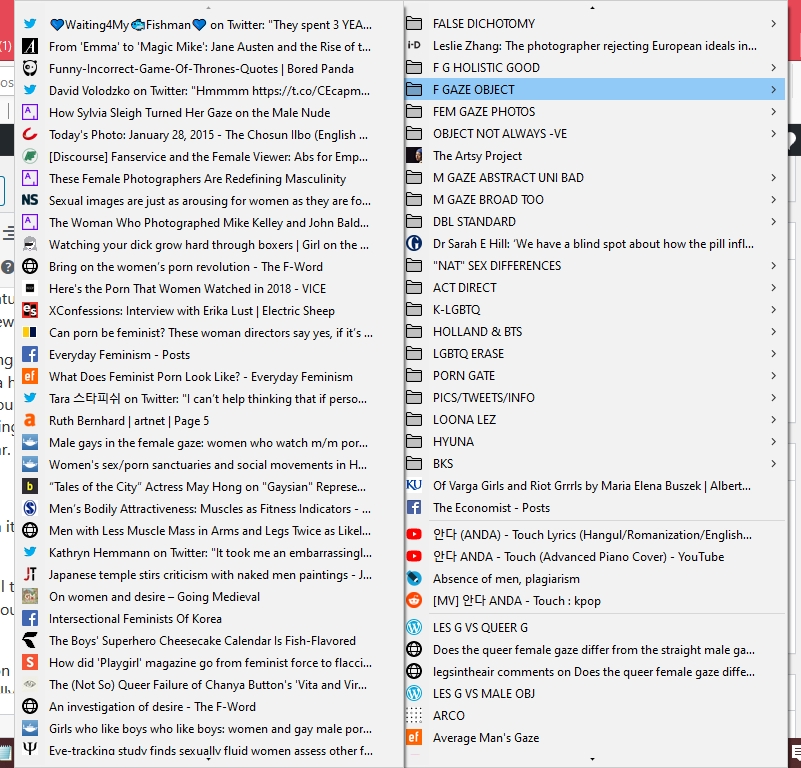
Only to delete it in consternation as I realized the queer female gaze was a much broader, much more contentious subject than I’d first imagined. In fact, one requiring an epic series to do it justice. Humbled, I resolved to keep researching and gathering all the information that would be necessary, not putting pen to paper again until I was absolutely certain I’d covered all my bases. I duly created a second “Anda + Queer Female Gaze” folder on my Firefox toolbar, and set to work.

That was over two years ago.

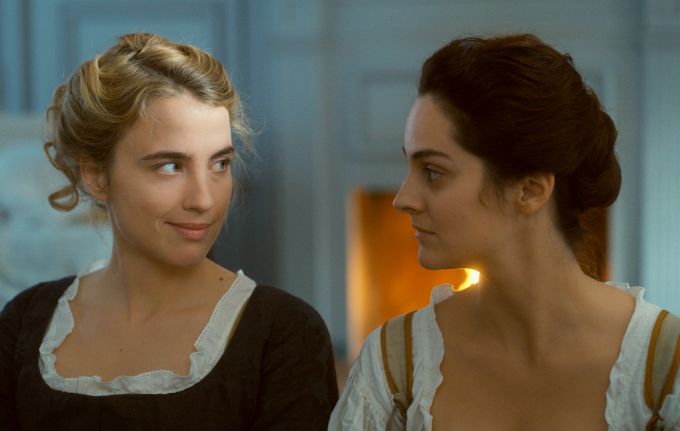
That folder now has three hundred bookmarks in it, with thirty more bookmarks added today in the wake of the recent release of Portrait of a Lady on Fire.

All of a sudden, adding to that morass finally made me realize what a fool I’ve been. All this time, the effortless collecting and reading of articles has been an albatross around my neck, providing an easy out from the harder work of actually writing.

And, if I wasn’t going to start just as soon as I had that epiphany, then when? And if making such a public commitment wasn’t motivation enough to actually see it through too, then what would be?

Source: YouTube.

I admit, a strange post. But if it gets the job done. I also felt it would be more helpful to explain than just ghosting you until the 27th, chosen for when I’ll hopefully no longer be teaching from home.

Thank you very much for indulging me then, and I’ll be back here soon. And please stay safe!

(p.s. If you can’t wait, you can still catch me on Twitter or Facebook!)

Update 1, Monday, April 27: All completed, but it needs some ruthless editing after a good night’s sleep, so I’ve postponed publication until Wednesday. Sorry for the slight delay!

Update 2, Wednesday, April 29: Arrrgh! Sorry *again*, but real life has intervened in the form of sudden urgent editing projects from my boss, and my post still needs a *lot* more work than I thought it did on Monday.

TBH, I think it’s going to be controversial—I really want to challenge people’s assumptions about the male & female gazes—so I really want to make sure I get it right. Let me just call it for *next* Mon then, with my promise to do my best to make it worth the wait. Thanks!

If you reside in South Korea, you can donate via wire transfer: Turnbull James Edward (Kookmin Bank/국민은행, 563401-01-214324)

Urgent—Your Quick Help is Needed to Unblock my Blog Please! (FIXED)

Estimated reading time: 3 minutes. Photo by Andrea Piacquadio from Pexels

FIXED!

Thank you SO MUCH for your help everyone, I don’t think I could have done it without you.

And honestly, being blocked has kind of had a silver lining too. I’ve been really touched and surprised by how quickly everyone has responded, and for all your kind messages about how much my blog means to you. All this time, I’ve really had no idea at all!

The least I can do in return is to endeavor to keep writing and posting, and more consistently 😉

Thanks again then, and for being such awesome readers over the last 13 years.

Stay safe everyone!
Love,
James 😍

(Original post below.)

Sorry to ask, but I really need 3 minutes of your help please.

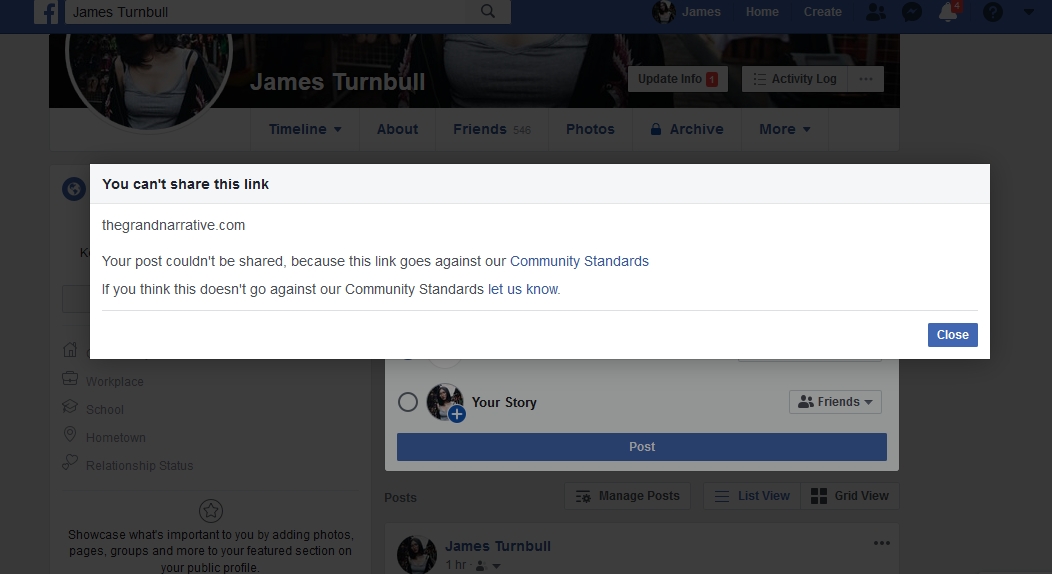
I need you to go to Facebook, copy and post this link to my blog—https://thegrandnarrative.com/—and when a message pops up saying “Your post couldn’t be shared, because this link goes against our Community Standards,” to click on the “If you think this doesn’t go against our Community Standards let us know,” and then leave a brief message explaining there’s clearly been a mistake, and for Facebook to please review the problem. Please make sure to post the link to my blog again in the message too.

Thanks. I know it doesn’t seem much, but you’ve no idea how helpful this is to me!

The reason is, trolls have gotten my blog blocked on Facebook.

Yesterday, I was unable to publish my last blog post on Facebook, as it went “against community standards.” That was annoying, but no biggie—I figured probably the algorithm mistakenly flagged the opening image as nudity or something. This sort of thing often happens to feminism and sexuality blogs (sigh), and normally all that is required to remove the block on the post is choosing a different image, and/or then reposting under a different url.

That didn’t work this time. In fact, my whole blog is blocked. All 800 posts and 13 years’ worth of work. Even all the links already on Facebook are blocked.

As you can imagine, people not being able to share your work on Facebook is a nightmare for a writer.

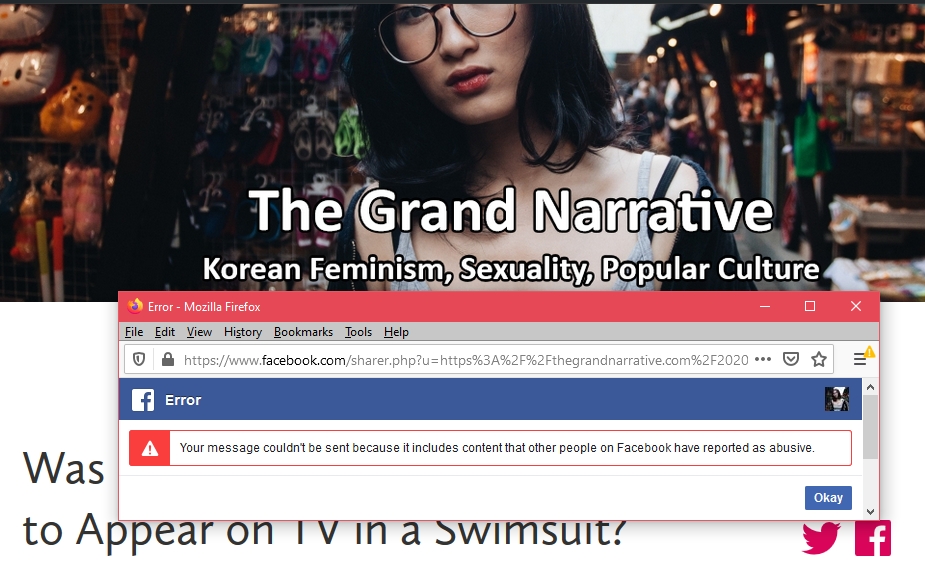
Frustratingly, Facebook gave no warning, and never gives any specific information about any alleged offense. The only clue I was able to receive at all was when I tried using the Facebook sharing button at the bottom of my posts:

There you have it. Given the timing, possibly those responsible are the same trolls on Twitter who recently targeted me for the heinous crime of simply linking to the awesome Unseen Japan site (I had to block more people on Twitter in the next 24 hours than in the previous 12 years!).

But whoever turns out to be responsible, they’re taking advantage of an all-too-common tactic used against feminists. All they have to do is report a site they don’t like, whereas the only thing you, I, or anyone can do in response is filling out the same “let us know” form above. (I’m very open to other ideas though!)

To add insult to injury, even at the best of times Facebook is notoriously unreliable in responding to those messages, let alone by a human. But right now, Facebook has cut its human support staff due to the Corona virus.

In other words, the worst possible thing has happened to my blog, at the worst possible time. There’s every possibility my blog may be banned from Facebook for months or even forever, all because of a few trolls.

That’s where you come in. With all your messages about my blog going through too though, there’s a much, much better chance that an actual human will receive one of them, give my blog a glance, and instantly realize the block was a mistake.

Thank you very much again then, for taking the time to send a quick message, and for being such awesome readers over all these years. With your help, hopefully this will all be resolved soon! :)

(Update: if you’re having difficulties, please just try typing in www thegrandnarrative dot com instead, and/or posting it in a comment on Facebook rather than in a new post. Those alternatives have been working for some people.)

If you reside in South Korea, you can donate via wire transfer: Turnbull James Edward (Kookmin Bank/국민은행, 563401-01-214324)

Finding the Mother Lode

Hi everyone. How’s your December been? Mine’s been full of testing, grading, breaking my toe, acquiring two homeless kittens, and finally doing some last-minute Christmas shopping…for myself. Which means that shortly after this goes up, I’ll have to hobble out of the door and actually start looking for presents for my poor daughters.

No, really. Ahem.

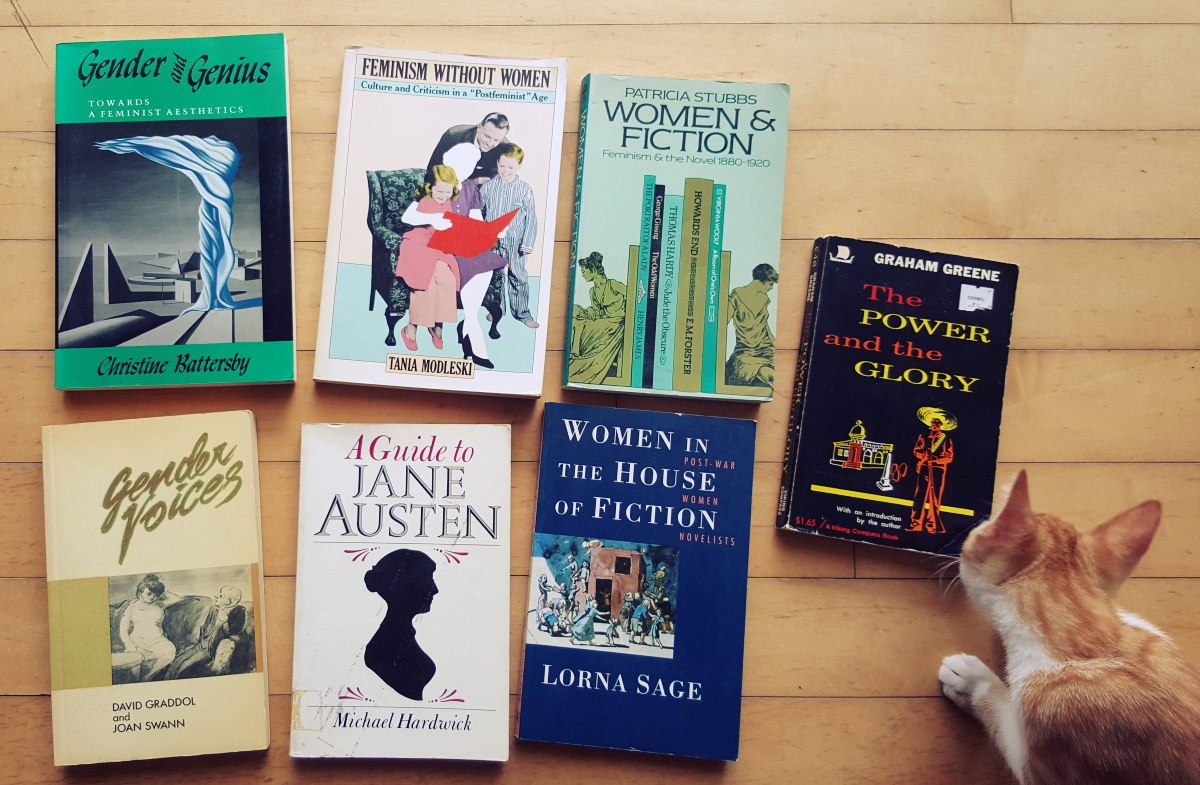
But back to me. I did discover quite the mother lode in Busan Book Alley yesterday, yes? Yet even I balked at the various readers on Lacan and Gender and Critical Theory available though, and reluctantly put down such tomes as examinations of the works of various Australian woman authors, which I’d be unlikely to ever read myself. So you’re more than welcome to pick those up yourself!

Meanwhile, I’m also happy to say I do finally have various long posts actually written for you. But, curiously, Christmas and New Year’s don’t seem to be the best times to post anything you’d like to actually get read. So, I’ll just keep writing more instead—I shouldn’t be walking much on this toe after all—and will delay posting them until late next week.

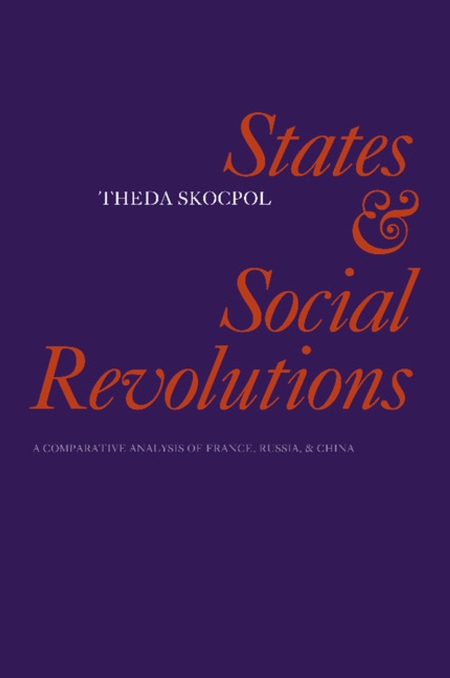
Until, I hope you enjoy the holidays. And, given that you’re still reading this probably means that you too get excited about 30+ year-old books, I’d be happy to chat with you about any of my picks above. Probably, I’ll start with Gender Voices by David Graddol and Joan Swann (1989), in which the authors “explore in a clear and comprehensive manner the idea that language shapes individual lives—that through our speech we all help recreate gender divisions in society,” as that’s a subject there’s been many Korean articles about in the last few months. First though, I’m going to finish the classic States and Social Revolutions: A Comparative Analysis of France, Russia and China by Theda Skocpol (1979), which I wish I’d actually read when I studied it in a course on revolutions as an undergraduate. After that, I’ll try to finish Good Booty: Love and Sex, Black and White, Body and Soul in American Music by Ann Powers (2017), a rare new book which I bought because I listened to an excellent podcast interview of the author. I had to put it down a third of the way in however, as I just wasn’t enjoying the overly evocative writing style, through which every other humdrum dance-hall meeting and church service described somehow becomes rendered into a hotbed of hidden desires, frustrated lust, secret liaisons, and opportunities for forbidden miscegenation. This “pregnant with possibility” style as I like to call it, prominent in Clive Barker’s fantasy novels which I learnt the term and from especially in The Price of Salt (a.k.a. Carol) by Patricia Highsmith (1952), I usually enjoy immensely. But not in this first encounter in non-fiction. Perhaps after 293 pages of Scokpol’s “structural functionalism sociological paradigm comparative historical analysis” though, I’ll enjoy the contrast, especially more once I begin the post-1950 chapters about music I know?

Happy reading everyone!

If you reside in South Korea, you can donate via wire transfer: Turnbull James Edward (Kookmin Bank/국민은행, 563401-01-214324)

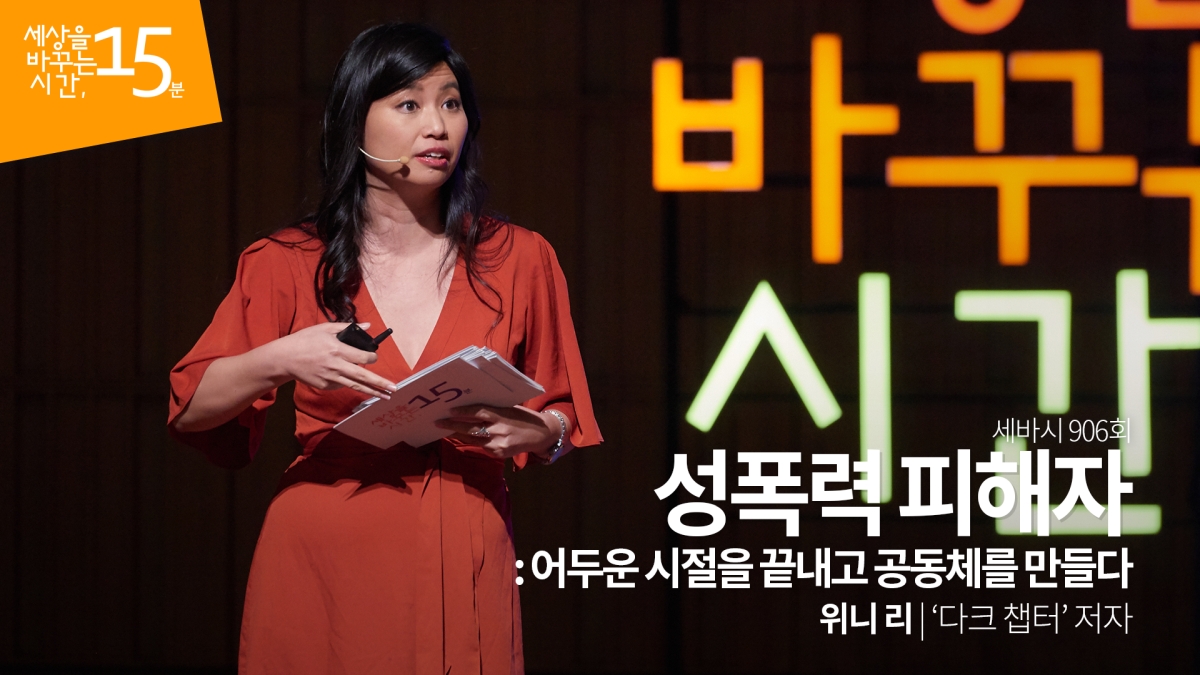
MUST SEE: “Reclaiming our Dark Chapters and Building a Community” Sebasi Talk by Winnie M. Li, Author of Dark Chapter

Estimated reading (and viewing) time: 3 (+17) minutes. Image source: YouTube.

Long time no see everyone, and sorry for the wait.

We’re all busy these days, so I won’t waste your time with explaining why. Suffice to say I no longer have long blocks of time free to really delve into a subject like I used to. Don’t worry: that doesn’t mean I won’t be writing marathon, heavily-researched posts anymore, or never finishing the—ahem—half-dozen series I have ongoing. Just that I can’t spend Herculean, lunch to dinner sessions on posts like I used to. Instead, I have to take advantage of a free half an hour here, an hour there, and…TBH, I’ve been struggling to make the transition. But I’ll get there.

In the meantime, there’s one more change I’m going to have to make, which has been a long time coming. The issue is I’m always reading, listening, and watching Korean feminism, sexuality, and pop-culture-related things, but I don’t share them because, time aside, I usually just don’t have much to add to them. That compulsion is such a 2007 blogging mindset though. (Yeah, that’s how long I’ve been doing this.) Also, that I’ve been spending an hour per day posting to Twitter and Facebook for many years has blinded me to the fact that many readers of mine aren’t actually on either (sorry). So, from now I’ll making lots of short posts, drawing your attention to the interesting and useful, with only minimal commentary from me if necessary. Meanwhile, I’ll still be working on the marathon posts in the background.

That said, most of those things I’m reading, listening, and watching these days are—yay me?—all in Korean, which, sans translating everything, are not necessarily the easiest things to pass on to non-Korean speakers. But again, I’ll see what I can do.

Which brings me to the video of the title, an April 2018 talk in Seoul for Sebasi (like a Korean TED) by sexual assault victim and now education and rights activist Winnie Li, author of Dark Chapter.

Frankly, I’d never heard of her before this Saturday, when I had to attend a TEFL conference at my university. But at that conference, attendees were told there was a mandatory viewing session of a video about preventing sexual harassment.

You can imagine most people’s reactions: in Korea, such videos are typically cringeworthy, patronizing, and terribly-translated cartoons. Instead, we got the presentation below…which by no means is about sexual harassment prevention.

What exactly it is about though, I’ll have to frustrate you by not saying, because I want you to be as shocked and amazed as I was. But I do promise that no matter how busy you are, it will easily the best use of 17 minutes you’ll make this week.

After you’ve watched, please let me know what you think in the comments. And make sure to check out Winnie Lee’s own blog too!

(Note that the talk is all in English, with Korean subtitles.)

If you reside in South Korea, you can donate via wire transfer: Turnbull James Edward (Kookmin Bank/국민은행, 563401-01-214324)

(TRANSLATION) On Blogging about Feminism in South Korea

Estimated reading time: 15 minutes. Photo by bruce mars from Pexels.

Many thanks to Menelik Lee (@LiMing6859), for all their hard work translating a long interview of me by Yiyi Zhang for Qdaily last year.

As you’ll see, unfortunately a lot of nuance is lost when going from English to Chinese to English again. The misunderstandings and factual mistakes multiply too, which crop up even when interviewers and interviewees share the same native language. Most are very, very minor though, which is a real testament to Menelik’s skills, so I’ve only corrected or clarified the most glaring ones [indicated in brackets]. Please pass on your rants or raves, or let me know if you’d like any further information about anything mentioned in the interview. Thanks!

An Englishman Who Writes a Feminist Blog in South Korea: Sex, Gender, and the Elephants in the Room.

Yiyi Zhang, Qdaily, 22/11/2018

Almost 20 years ago, Englishman James Turnbull was just starting his life in Korea. [W]hile traveling through the wild open countryside in his boss’s car [during one of his first jobs there], “I don’t know where it sprang from, but suddenly a hotel appeared in the middle of this vast emptiness.”

Just like every person that harbors a sense of wonderment for the culture of a foreign land, Turnbull immediately blurted out, “What’s that? [What tourist would come here, in the middle of nowhere?]” He learned from his boss that the establishment [actually] functioned like the much-fabled love hotels of Japan.

He soon discovered that in Korea such establishments are actually [common in rural areas, not just the cities]. These unassuming structures facilitate both the sex trade and the secret trysts of [lovers]. They have arisen because premarital sex is still heavily stigmatized in Korean society. However, unlike Japan, Korea’s “love hotels” lack neon signs and themed playrooms. If asked about such things the proprietors will simply evade the question.

“Everyone pretends they don’t exist, but you can tell they have a bad reputation. Anyway, it’s always been something that [just] shouldn’t be discussed.”

After having lived in Korea for 18 years, with a family and two kids of his own now, Turnbull looks back and realizes that the problems surrounding sex and gender in this culture are just like that little hotel in the wilderness. They’re arresting, painfully obvious, yet everyone turns a blind eye and carries on regardless.

In his 7th year in Korea, Turnbull launched The Grand Narrative, a blog sharing and analyzing Korea’s sex, gender and pop culture from the viewpoint of an English author.

Besides blogging, he also holds down a full-time job at Busan’s Dongseo University. He spends so much of his spare time and energy maintaining and updating his blog, it’s almost a kind of volunteer work at this point. Over time, his blog has gained the approval of the mainstream—[most recently, he was quoted for several stories for CNN in 2018]—and Turnbull became something of an authority on Korean feminism and pop culture in Western media. Occasionally, he has even been invited to give guest lectures at Seoul National University and other higher education institutions.
But most of the time he stays in his own wheelhouse, silently typing away under the glow of his computer monitor. Over the past 11 years, he has written hundreds of articles on topics ranging from sex and K-pop, to the politics of body image, from gender in advertising, to abortion and contraception. In the world beyond his writings, the transformations wrought by the Korean women’s rights movement have moved with breath-taking speed.

“This has been the product of the last decade or so of painstaking labor, maybe it’s time to talk about it a little.” Turnbull tells Qdaily.

The first [post] about women’s issues on The Grand Narrative was posted in 2007. [From his Korean female friends, Turnbull learned that when they] graduated and entered the job market the problems they ran into came thick and fast. One of the most prominent issues was the fact that as soon as they fell pregnant they were laid off.

“As soon as a woman has a child she is forced to leave work; after a year it’s basically impossible to go back. The hierarchy in Korean companies is very strict, those who have worked there the longest always have the final say and the most opportunities for advancement. When a Korean woman is married with kids, she simply can’t keep up professionally.” Turnbull also speaks about the low birth rate. Because all women have to face this decision, many women from this generation have decided to simply forego having children.

The BBC reports that because of this, Korea has developed a new social phenomenon: the Sampo Generation. “Sampo” means to abandon three things: relationships, marriage, and children.

Before graduating and coming to Korea, Turnbull [had already had some experience of fitting into] different cultures. Thanks to his parents, he moved from the UK to New Zealand, then to Australia, and from there back to the UK again. [In just three years], he attended six different secondary schools in three separate countries, “it was pretty crazy.”

One may say that the cultural differences between these three countries are small when compared to Korea, but they each have unique values and lifestyles. [When he was a teenager,] every time Turnbull questioned an [adult in New Zealand and Australia about some aspect of their countries, and even in the UK if they knew he’d lived overseas], the answer was always the same: “This is just the local culture.” This answer was rolled out like a panacea. No matter what the situation, no matter the problem, it could be used to explain it away. But when he seriously thought about it, he realized that adults were simply using this because they had nothing else to say. “I’d had enough,” he recalls.

So by the time he got to Korea, he simply couldn’t [let “culture” be used] to explain everything away. “It’s not [unlike] a fish in water, unable to sense the water. Some things are [genuinely unusual and noteworthy, only considered normal by people who’ve known nothing else].”

In his conversations, Turnbull found that many Koreans harbored a strong sense of nationalism [too], and so talking about the negative aspects of the country [with a foreigner met a lot of resistance]. However, this did not mean that they [themselves] were satisfied with everything that was going on.

“If there’s something in Korea that you don’t like, there’s a very good chance a lot of Koreans aren’t happy with it either.” And this is something the [English-language media often chooses not to cover]. Many debates [are to be found on the Korean internet and social media platforms], and the English-language media has trouble [relaying] these trends, so they [can give versions] of Korean sexual culture that are extremely superficial.

“When reporting on cultures outside of Asia, readers generally won’t afford you much credibility or value as a reference if you don’t understand the local language. But when it comes to Asia—China, Japan and Korea—the majority of the [Western experts or reporters] have a very limited understanding of the local languages and cultures, yet the audience is really forgiving—it’s a very strange double standard.”

Turnbull provides an example. In 2013, the South Korean Ministry for the Interior introduced “Pink Female Parking Spaces,” with extra room for the exclusive use of women. In no time, this news was plastered over mainstream media pages around the world. Almost all of them claimed that the policy demonstrated prejudice against female drivers because the spaces implied that the women wouldn’t be able to park properly without them.

“[To be more specific, one report quoted an anonymous source that claimed that the larger spaces were necessary for ‘unskilled women drivers.‘ However, ultimately that source appeared to have been made up.”] Turnbull says that, in actual fact, the spaces were created because the vast majority of child care duties are born by women, and the policy provided larger spaces for them to use prams when they go shopping—[as most of the Korean media accurately reported.]

“There’s obviously [still] a problem here: the idea that the role of primary carer is naturally filled by women. But it’s a completely separate issue to what the [overseas] media were saying. [Had overseas media outlets just taken a little more time to investigate, or, you know, spoken to someone who actually spoke Korean, then this ‘crazy Korea’ news story, which just plays to Orientalist stereotypes, would never have gotten off the ground.”]

Between the cracks of cultural misunderstanding, Turnbull saw his chance. Having been an English teacher for far too long, he was anxious to prove himself and open up further professional opportunities. As a result, when he first began writing about Korean culture, it soon transformed into writings about sex and feminism.

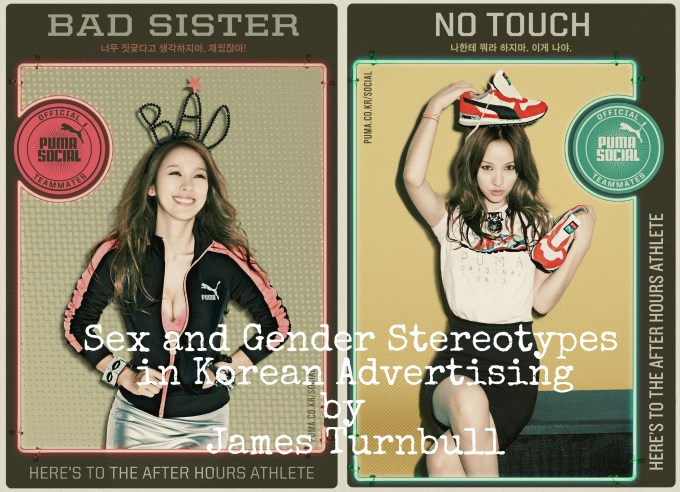
“Turnbull’s blog has continued to focus on female representation in Korean popular culture, including advertisements, soap operas, music videos, and more.” Source, right.

Turnbull’s blog was in its infancy ten years ago, but even just five to six years ago there was [almost] no one else doing the same thing. [“That doesn’t necessarily mean I was writing well, or that I was particularly knowledgeable—just that I was the only one writing about these specific topics. I’m quite serious when I say that, for a long time, I really was pretty much the only person on Earth writing about Korean feminism IN ENGLISH on the INTERNET.”] For the longest time, when opening Google’s search engine, Turnbull’s blog was the first thing listed under “Korea” and “feminism.”

According to Turnbull, he grew up in a very left-wing family, among piles of his father’s psychology and sociology textbooks. At university, he also spent his time on feminist research and sociology projects.

His foreign identity also opens the door for dialogue to some degree. “The reality is, if someone is truly interested in your culture, you’ll also be curious to find out where that interest comes from.”

Furthermore, in a Korean society that has always considered [open discussions of] sex to be taboo, Turnbull exists like a wanderer, beyond the normal customs and social networks of everyday Korean life. Thus, those around him [tend to be] happier to share their views on this topic [compared to how open they would be sharing them with a native Korean], disregarding his age and social position, they can trust him to be discrete. “It’s precisely because you’re a foreigner, people don’t have the same kinds of psychological barriers—they can pour their hearts out.”

This makes everything sound free and easy, but the reason he focused his gaze on women’s issues is because the urgency of the problems they still face simply cannot be overlooked.

“One day, a colleague rushed over to ask me a question: can abortions affect your health?” Upon further inquiry, he found out that this woman had had eight previous abortions, because she had never used—[and wasn’t even aware of]—any contraceptive methods. “I was totally shocked. To this very day, the lack of [adequate sex education in Korea] is astounding.”

Source: YouTube

As a non-academic, much of Turnbull’s understanding of social phenomena comes from his personal experience. His blog articles are written from the first-person perspective, but when compared to other news articles about the same events, he’s [often] much quicker than they are to cite authoritative sources.

From his perspective, feminism has never existed in isolation, and sex and gender issues are important because they are intimately connected to the everyday lives of all people.

Before becoming an English teacher at a university, Turnbull worked in a regular [Korean] company for almost two years. The hierarchical culture of humiliation in Korean workplaces really took him by surprise. “Every week our department head would make everyone stand up, and castigate each and every [employee] about every aspect of their work [regardless of how good it was]. On some level he had no choice, [because] angry or not, this was [just] how things were done.”

The sense of hierarchical oppression permeates most of everyday life, and in such a stratified society, standing up for oneself can make things even more difficult.

Despite himself, after coming to Korea, Turnbull says he can’t help pondering social stratification and rebellion. This is especially reflected around issues of sexual misconduct. “In Korea, if an older family member wants to hug you, you can’t refuse even if you want to. As a child or a young person, there are many people who can order you to do something even if you don’t like it.”

Once you’re a little older, this evolves into a power disparity between the sexes, “If a boy likes you, you just have to accept it, you can’t complain about it. Because of this, men don’t understand what constitutes “consent,” and women who reject others feel guilty.”

This attitude engenders deep seated emotional resentment, and Korean society is thus plagued by gendered violence and frequent sex crimes by spurned lovers. According to survey results released in 2017 by the Korean Institute of Criminology, 80% of males surveyed admitted to having previously abused a romantic partner.

“This is why I feel so surprised and proud that in the space of just a few years so many young women have come out to demonstrate. Because in Korea just doing that can be incredibly difficult.” He says that many demonstrators have to cover their faces, but the effects are deep and far reaching. Korea is undergoing a dramatic change towards gender equality and sexual minorities.

According to QZ, the watershed moment for the Korean women’s movement came in 2016. A woman was brutally murdered in a public bathhouse not far from the entrance to Gangnam Metro Station, one of Seoul’s busiest transport hubs. Following the incident, women came out onto the streets to protest sexual violence, and women’s rights groups stepped up their online activism. With the global acceleration of the #MeToo movement this year, Korea’s feminist wave has also picked up pace.

While this was happening, Turnbull was observing the heating up of what may be called a “gender war.” As all of society’s feelings of discontent and dismay were foisted off on the shoulders of women.

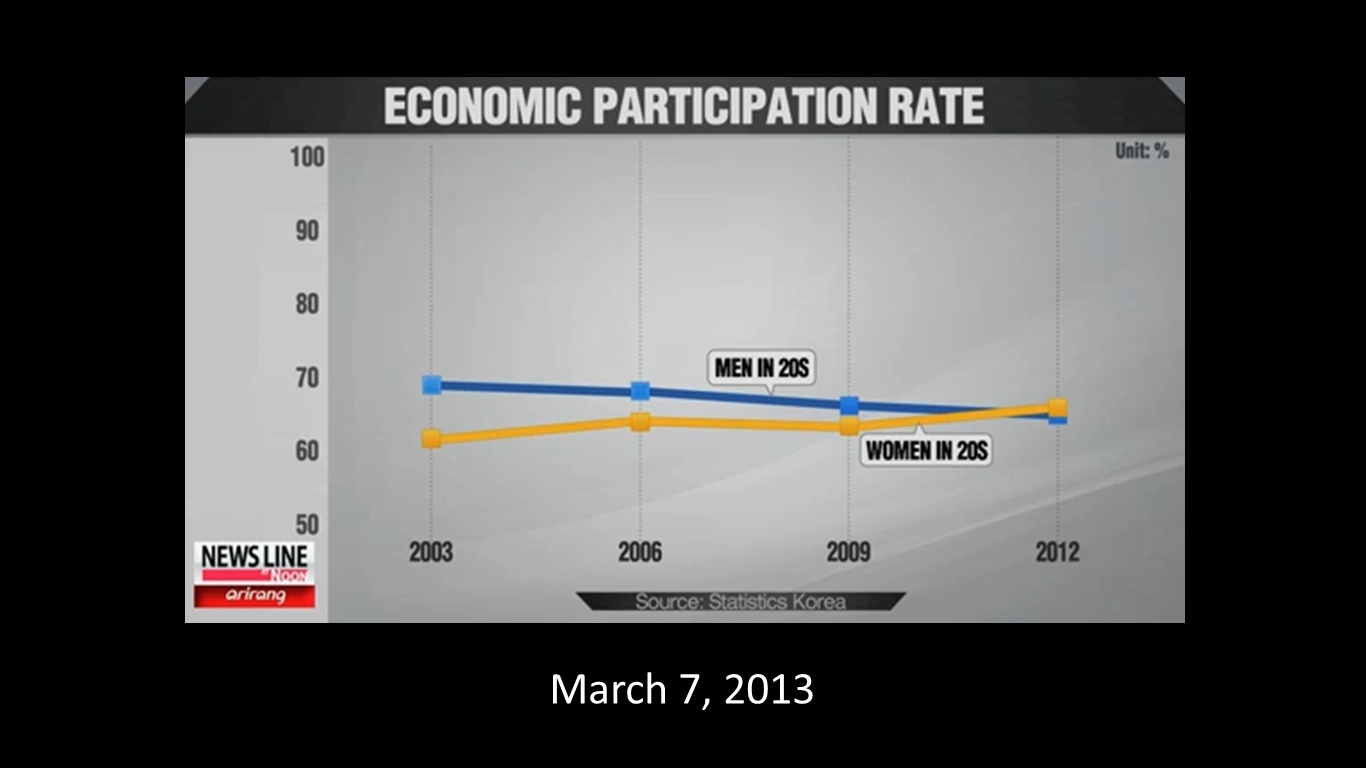
Source: Arirang News.

South Korea has one of the highest rates of tertiary education in the world, meaning that most young people will attend university. However, without a proportional level of demand in the job market, the youth unemployment rate is almost 10%—that’s three times higher than the global average. After graduating, most people can only find work in convenience stores and coffee shops, relying on the lowest paid positions to make a living. Still others choose to delay graduation despite the fact that there are no more classes for them to take.

Against this backdrop, [a vocal minority of] young men are blaming young women for having stolen all their opportunities. What’s more, some are beginning to question [compulsory] military service, claiming that it is unfair on men and are now seeking compensation.

In 2014, according to a South Korean National Statistical Office report, in the last four years there was a historic reversal in employment rates of males and females aged 20 or older. The female employment rate exceeded that of males for the first time since records began. “A female tornado” is one of the terms being used to describe what has become the latest hot topic.

Turnbull believes it is a term deliberately employed to cause agitation—the disparity in male and female employment rates is actually only 2.1%. However, the male groups of society have reacted swiftly and with mortal urgency in a massive backlash. Some men’s rights organizations have even called for the abolition of the Ministry of Gender Equality and Family. In fact, according to a World Economic Forum 2015 report on Global Gender Inequality, South Korea still ranks 115th out of 145 countries. In the “economic participation and opportunities” categories, South Korea is 125th.

Issues of gender equality are always fiercely debated, and the ongoing economic stagnation throws that much more fuel upon the fire. But lines are not only being drawn between the gender camps. In a universally anxious social atmosphere, people will always seek to set up a common adversary to set off against their own in-groups. Turnbull provides an example: this year, over 500 Yemeni refugees were detained on Korea’s Jeju Island, sparking mass public protests. Unlike trends seen before in most other countries, where opposition to refugees is strongest among older generations, in Korea the exact opposite is the case. Against all expectations, younger people are the heart of the movement.

“In April, female MBC news anchor Lim Hyeon-ju caused a stir by becoming the first Korean anchor-woman to wear glasses while on-air. Shortly after this, Korean media released the results of two studies on gender bias.” Image source: YouTube.
“Female idols are frequently depicted in advertisements for the Korean military conscription service.” Source: MMA Facebook page; left, right)

“Middle-aged, white, male, heterosexual; I’m pretty much a member of the most hated group on the planet.” Turnbull jokes during the interview.

Upon first finding Turnbull’s blog, not all readers are supportive. “The main reason they hate me is because of my identity.”

“No one wants to hear about Korean feminism from a middle-aged white dude.” And Turnbull admits that this wariness is not without good reason [James—I put it much more strongly during the interview: when studying and writing about what—who—I do, there are many conceptual and practical issues stemming from my privileged background; I can only always be aware of them and strive to overcome them as best as I can, most notably by relying on as many native Korean sources as possible, and especially on Korean women themselves]. In his first few years in Korea, he [admits he naively and arrogantly] thought that he’d already come to understand everything about the country [partially because, unlike most expats, he’d already studied Korean history and society at university], and was more than ready to lecture others about it. But soon enough, he came to realize that he had been very wrong about this. “I’ve probably deleted about half of my previous articles, just because they no longer reflect my current opinions [and/or later proved to be completely wrong, as often pointed out by my female readers—many of the most vocal of whom would become my best friends later!].”

But the internet has a long memory. A little over a month ago, he received an email, a 3000-word polemic referencing a 10-year-old piece he had already deleted [9 years ago!].

[A significant proportion of those that take] issue with his work are [Asian-American women]. Turnbull mentions a slang term, “yellow fever,” used to describe white men with a [fetishistic] preference for [East] Asian women. [Because of it], many Asian-American women [regularly] have to face [sexual stereotyping and harassment from white men] in their everyday lives, and so talking about sex in Korea as he does often brings him under [immediate] suspicion [of being no different to those men]. [The vast majority of those that actually read his work soon see that he is not, but] some have penned vicious attacks against him, and still others have posted fake pictures of him online. [James—I feel compelled to add that a significant proportion of my fans are Asian-American women too! :) But the actual question was about my trolls, and I wasn’t going to lie. It just is how it is.]

Turnbull’s blog used to provide a popular space for discussion. In the comments section people would air their views, and readers from all over the world would have lively debates with one another. But with the sudden onset of the social media age, people had a great many more ways of accessing news, and the number of hits and comments his blog received decreased significantly—[although] thankfully, the number of attacks decreased accordingly as well.

Nowadays, Turnbull seems to occupy an awkward position. He occasionally attends LGBTQ marches or feminist demonstrations [in Korea], but only rarely. “As a middle-aged white guy [who sticks out like a sore thumb at these], I don’t really want to [draw people’s attention away from the issues the activists are demonstrating about].”

Even today, he can’t envision things as he did when he was starting out. That he could, through his blog, make the outside world believe that a foreigner could be more than just an English teacher.

He even laughingly tells us that these days a decent number [MOST!] of the hits on his blog come from people searching for porn. Unfortunately, most rarely stick around to read the articles!

If you reside in South Korea, you can donate via wire transfer: Turnbull James Edward (Kookmin Bank/국민은행, 563401-01-214324)


Event Announcement: #FEMALEPLEASURE Screening, Hankuk University of Foreign Studies, 1pm Saturday June 1

Sorry for the long break everyone, which was because of reasons. But I’m happy to say I do have an epic post in the works. And, while you’re waiting for that, I’m delighted to help a former student publicize this event in Seoul this weekend (하단으 보세요):

#FEMALEPLEASURE

– 5 cultures, 5 women, 1 story

A documentary about female sexuality and autonomy in the 21st century – film screening and discussion

An event organized through: Lecturing Program of the Robert Bosch Foundation in Asia (German Foundation)

(Sign up here)

#FEMALEPLEASURE portrays five courageous and smart women, breaking the silence imposed by their archaic-patriarch societies and religious communities. With incredible strength and positive energy, Deborah Feldman, Leyla Hussein, Rokudenashiko, Doris Wagner, and Vithika Yadav are fighting for sexual liberation and autonomy for women, beyond religious rules and cultural barriers.

#FEMALEPLEASURE shows the universal mechanisms at work that determine the position of women until today, spanning cultures, religions and continents: from Japan and India and the Somali muslim diaspora to the Hasidic community in New York and the Catholic clergy in Europe.

What can we learn from them? What do we have to talk about in Korea? How can men and women establish fruitful understanding and mutual respect?

On this day we will gather to see the movie and share a safe space to talk about important questions and feelings related to the topic in Korea. Everyone interested is welcome! 😊

When? Saturday, 1st June, 1pm – 4.30pm

Where? Hankuk University of Foreign Studies, Main Building, Room 329

Language: Korean & English

Contribution: 3000WON – we organize Pizza & Drinks 😊

UPDATE: A Facebook event page has just been created!

본 이벤트는 Robert Bosch Foundation in Asia(독일 재단)의 교육프로그램을 기반으로 제작되었습니다.

21세기 여성의 성적 자기결정권에 관한 다큐멘터리 영화를 감상한 후 토의의 시간이 마련되어 있습니다. (5개의 각기 다른 문화에서 자란 여성들이 하나의 이야기를 하는 내용입니다.)

(여기서 등록하세요)

#FEMALEPLEASURE는 구시대적인 가부장 사회와 종교 커뮤니티들에 의해 강요되는 침묵을 깨뜨린 용감하고 똑똑한 다섯 명의 여성을 보여줍니다: Deborah Feldman, Leyla Hussein, Rokudenashiko, Doris Wagner, and Vithika Yadav. 이들은 놀라울 만큼 강인한 모습과 긍정적인 에너지를 통해 종교 율법이나 문화 장벽을 뛰어넘어 여성의 성적 자율성을 위해 싸우는 중입니다.

#FEMALEPLEASURE는 또한 일본, 인도, 소말리아 이슬람 디아스포라 에서 뉴욕의 하시디즘 커뮤니티와 유럽의 카톨릭 성직자들에 이르기까지 문화, 종교, 대륙 전반에 걸쳐 여성의 지위를 결정해 온 보편적인 메커니즘이 무엇인지 보여줍니다.

우리는 이들에게서 무엇을 배울 수 있을까요? 한국과 관련해서는 어떤 이야기들을 해야 할까요? 또 남성과 여성은 어떻게 해야 유익한 이해관계를 확립하고 서로를 존중할 수 있을까요?

함께 모여 영화를 감상한 후에 이 주제와 관련된 한국의 중요한 이슈, 궁금증 혹은 감정을 편하게 공유하는 시간을 가질 예정입니다. 관심 있는 사람은 모두 환영입니다! 😊

언제? 6월 1일 토요일, 1:00 – 4:30 (오후)

어디서? 한국외국어대학교 본관 329호

language: 한국어 & 영어

참가비: 3000원 – 피자와 음료 제공에 사용됩니다 😊

If you reside in South Korea, you can donate via wire transfer: Turnbull James Edward (Kookmin Bank/국민은행, 563401-01-214324)

Update

Source: Burst@Pexels; CC0

Just a quick update to apologize for the ongoing lack of posts, and to explain.

Basically, I’ve been too busy. The same week my wife’s father died, she started a new job as an interpreter and translator at a rapidly-expanding medical technology company. Every other week since then, she’s been jet-setting to places like Andorra, India, the US, and Indonesia. Also, when she is in Korea, her workplace is across town, meaning she has to leave home at 7:30am, and doesn’t come back until 8pm, after which she’s straight back on her computer. It’s all very glamorous and exciting from my perspective (only glamorous and exciting-sounding, she insists), and I’m very proud of her, but practically-speaking I’ve been a single parent for the last two months. It’s been tough!

Every cloud has a silver-lining though, and it’s been a real eye-opener being forced by the lack of free-time to break down how I’ve been spending my days, and trying to eliminate time-wasting habits. I’m still very, very far from becoming a paragon of discipline of course, but one important change I have made recently is going to bed at 10pm and getting up at 6am, to get in that fabled hour of writing every day. True, so far those hours have more been spent only thinking about writing, while luxuriating in a second cup of coffee and watching the sunrise over the ocean (still totally worth it, IMHO), but the actual writing will surely come soon.

See you next week? ;)

Announcement

Source: Sebastian Voortman@Pexels; CC0 license

Just a very quick update to let everyone know that, tragically, my father-in-law died in an accident earlier today. Which means I’m very busy and stressed right now sorry, so I’ll just quickly say that my planned comeback on Monday will have to be delayed a few more weeks unfortunately.

Until then, thank you very much for your condolences and for your patience, and I promise to be overanalyzing pop-culture with you all again soon (*hugs*). Take care!

Thanks for Reading for 10 Years Everybody! Please Help Me Keep Writing for Another 10!

Source: Pakutaso

It’s the blog’s 10 year anniversary this month. But I’m just too busy to celebrate!

Classes only finished at my university a few days ago. My Gender in South Korea course starts at HUFS in less than 3 weeks. Then I’ll be in Seoul teaching that for 4 weeks, then I’m going on a quick holiday to the UK for 2 weeks (our family’s first overseas trip in 9 years!), then it will be the next semester already, and then my mother will be staying with me for 2 weeks.

So, if there was ever a good time to take a break from blogging, now would be it. And I deserve one after 10 years too!

Don’t worry though, I’ll still be very much around, posting links on Twitter and on the blog’s Facebook page as per usual, and responding to comments. But the next post won’t be up until mid-September.

Until then, thanks very much for reading and for all of your comments over the years, and I hope you all have a great summer. Also, please consider helping me keep the blog going for another 10 years, by clicking on the button below and making a small donation. I do hate to ask, but then keeping the blog going at all costs me $78 a year, and—well, I only received $5 in donations last year, and in the year before that too. So not asking doesn’t seem to be working much! :D

Thanks again!

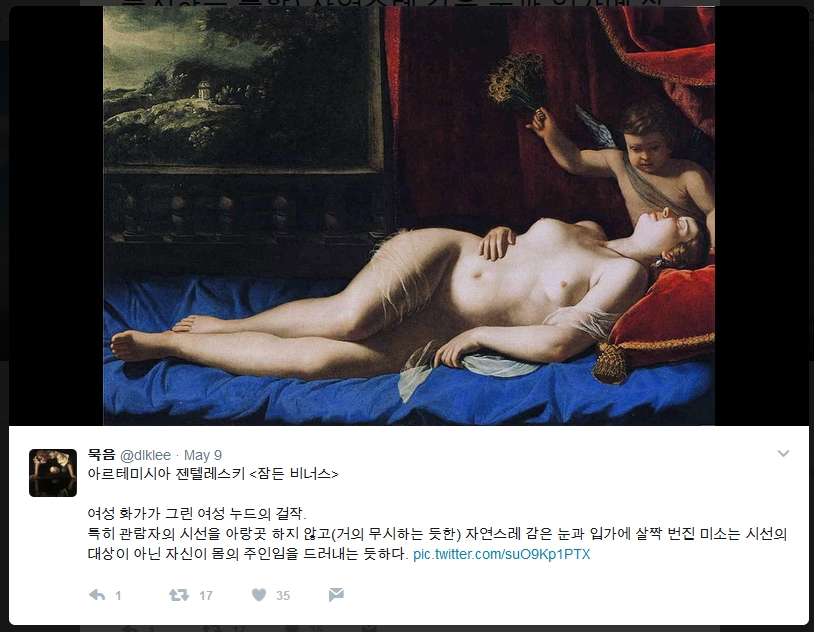
Quick Hit: Feminist Artist Artemisia Gentileschi

(Source: 묵음‏ @dlklee)

Have I told you how awesome Korean Twitter is?

Trick question: I’ve raved about it many times. Who wouldn’t, when after years spent looking for quality, accessible Korean-language commentary on feminism and sexuality, now they’re inundated with it?

It feels so energizing to discover all the fresh perspectives, events, trends, and activists that I’ve been overlooking these past 17 years in Korea. And to think about where learning about them will take me (and this blog) in the future.

It also explains why I haven’t been writing much recently sorry: when you have so much material to work with, it’s difficult to settle on just one thing at a time. Other reasons include preparing my upcoming Gender in South Korea course this summer, my wife starting an exciting and glamorous new job which keeps taking her on long business trips overseas, and my angst over my blog’s 10 year anniversary coming up in a couple of weeks.

But more on that in an upcoming anniversary post. Until then, let me pass on how I stumbled upon feminist icon Artemisia Gentileschi, who’s inspired me to revisit the—for want of a better phrase—subjectivity vs. objectivity debate in K-pop, to seek out more examples of sassy Korean pin-up grrrls, and to learn more about Western art history.

Which, in my book, makes for one pretty damn awesome tweet:

Sleeping Venus (a.k.a. Venus and Cupid), by Artemisia Gentileschi.

This female artist painted a masterpiece of female nudity.

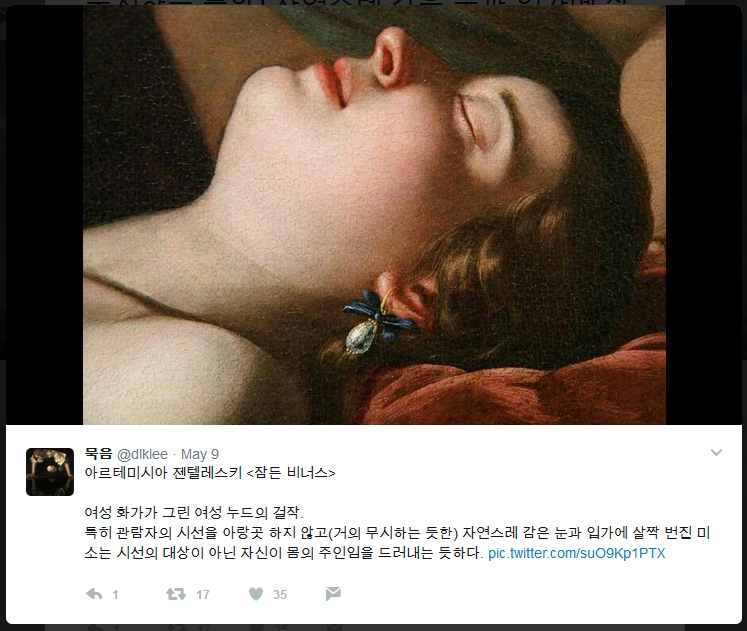
In particular, the model has no interest whatsoever in the viewer’s gaze—indeed, she seems to be ignoring it almost entirely. Instead, she has an unaffected air about her, her eyes closed and sporting an ever so slight smile with her lips turned up. Rather than simply being the object of the gaze, she’s revealed to be the master of her own body.

(Source: 묵음‏ @dlklee)

I know, right?

Any more old or newfound fans of Gentileschi out there, please say hi in the comments. Also, does anyone know of any paintings with similar motifs by different artists, especially Korean ones? Thanks!

Critical Korea Studies Meetup This Saturday!

Source: YouTube

Just between you and me, I’m having some great hair days at the moment. So, to take advantage, I’m coming up to Seoul out of my own pocket this weekend, to meet as many readers as possible. I’m just that good-looking.

Technically though, I’m going to be a moderator at the first Critical Korea Studies Meetup/Mini-conference, to be held from 3-6pm at Yonsei University on Saturday the 29th. And it’s important that I’ll just be a moderator, because I absolutely wouldn’t pay to go somewhere if I thought *I* was going to be the most interesting person in the room.

To be certain though, I need you to come, and your friends too. So, please check out and share this link or the Facebook Event Page for the details and more information, and feel free to join us for the dinner afterwards if you’re unavailable in the afternoon.

See you there!

(BTW, I’ll also be giving a presentation at Seoul National University on Monday the 1st. That’s private unfortunately, but it does explain the slow blogging sorry!)

한국인이세요? 한국인이랑 데이트 해봤어요? 이 연구가를 도와주세요!

Source: Pakutaso

Grand Narrative 독자분들께,

안녕하세요! 제 이름은 Edward Glayzer입니다. 저는 미시간주립대학교 인류학과의 박사과정생이고, Grand Narrative의 오래된 독자이기도 합니다. James Turnbull씨는 제가 서울에 와서 한국의 성불평등에 대한 학위논문 연구를 시작할 때부터 많은 도움을 주셨고, 또한 이렇게 연구대상자 모집을 공고할 수 있게 해주셨기에 감사하다는 말씀 전하고 싶습니다.

제 연구는 한국 사회의 성불평등에 관한 광범위한 주제들을 더 잘 이해하기 위한 것이며, 이를 위해 한국인들의 데이트와 결혼 의식에서 일어나는 물질적 교환을 살펴봅니다. 제 연구는 또한 남성과 여성의 소득 불평등이 어떻게 상품 소비를 통한 친밀함의 표현에 영향을 미치는지를 다룹니다. 이 연구의 유일한 참여조건은 “다른 한국인과 데이트를 해본 대한민국 국적의 성인”입니다.

독자 여러분의 의향이나 내주실 수 있는 시간에 따라 두 가지 참여방법이 있습니다. 이 중 하나 혹은 둘 다 자원해주신다면 매우 감사할 것입니다.

하나는 보통 10-15분이 걸리는 간단한 온라인 설문을 해주시는 것입니다. 서베이의 링크는 다음과 같습니다: https://msu.co1.qualtrics.com/jfe/form/SV_57kvB7gFyJihklD

다른 하나는 1:1 대면 인터뷰이며, 보통 한 시간에서 한 시간 반 정도 걸립니다. 저는 현재 약혼녀와 서울 강남구에서 거주 중이지만, 독자 분을 만나기 위해서 기꺼이 다른 곳도 방문할 의사가 있습니다! 시간 내주시기 어렵다면 스카이프 인터뷰 역시 가능합니다.

혹시 제 연구에 대해 질문이 있으시거나 인터뷰 일정을 잡고 싶으시다면, eglayzer@gmail.com로 메일 주시기 바랍니다. 카카오톡도 가능하며, 아이디는 eglayzer입니다.

Hello Grand Narrative Readers,

My name is Edward Glayzer. I am Doctoral Candidate from the department of Anthropology at Michigan State University and a longtime reader of The Grand Narrative. Since moving to Seoul to begin my dissertation research on Korean gender inequality, James Turnbull has been extremely helpful and kind enough to post this call for research subjects.

My research looks at gift-giving practices that take place during dating and marriage rituals among native South Koreans as a way of better understanding larger issues on gender inequality in South Korean society. My research will also address how the unequal access to income between men and women affects the expression of intimacy through the consumption of commodities. The only requirement for participation in this study is to be an adult of Korean nationality and have spent time dating other Koreans. (To clarify, any sexuality is welcome—James)

There are two possible levels of involvement that you may have depending on your availability and inclination. Volunteering for either one, or both, is extremely helpful to me and I would be in your debt.

The first is to fill out a brief online survey that usually takes between 10 and 15 minutes to complete. This survey can be accessed here: https://msu.co1.qualtrics.com/jfe/form/SV_57kvB7gFyJihklD

The second involves a one-on-one interview that usually takes 1 hour to a 1 ½ hours. I am currently living with my fiancé in Gangnam, Seoul, but am more than willing to travel throughout Korea in order to meet with you! If your time is very limited, a Skype interview would also be possible.

If you have any questions about my research or if you would like to schedule an interview, please email me at eglayzer@gmail.com. You can also find me on Kakao by searching for eglayzer.

Thank you for your help,

Edward Glayzer M.A., Doctoral Candidate, Michigan State University, Department of Anthropology.

YOU WILL Take My “Gender in South Korea” Course This Summer!

“And you will tell all your friends about it too!” (Source: Pakutaso)

As excuses for not posting go, they don’t get much better than this!

In short, I’m very happy and honored to announce that I’ll be teaching the “Gender in South Korea” course at Hankuk University of Foreign Studies’ International Summer Session this year, which lasts from Thursday July 13 to Thursday August 10.

Alas, it’s all very sudden. Which means I’m still preparing a syllabus sorry, along with many of the other professors for their own courses. But I expect to finish that and have it added to the ISS website later this week, and the deadline for applications from exchange students is less than 3 weeks away too (international and Korean students’ deadlines are later). So why not make the announcement sooner rather than later, when I’m still so excited I can’t sleep for thinking about all the exciting possibilities for my classes? :)

If you’re interested in hearing the fruits of my labors this summer then, but with no tests(!), a focus on a presentation and discussions, some awesome field trips to go on, and—last but not least—many other great Korea and Asia-related courses also available, then please check out the website for further details. And please make sure to tell all your friends too!

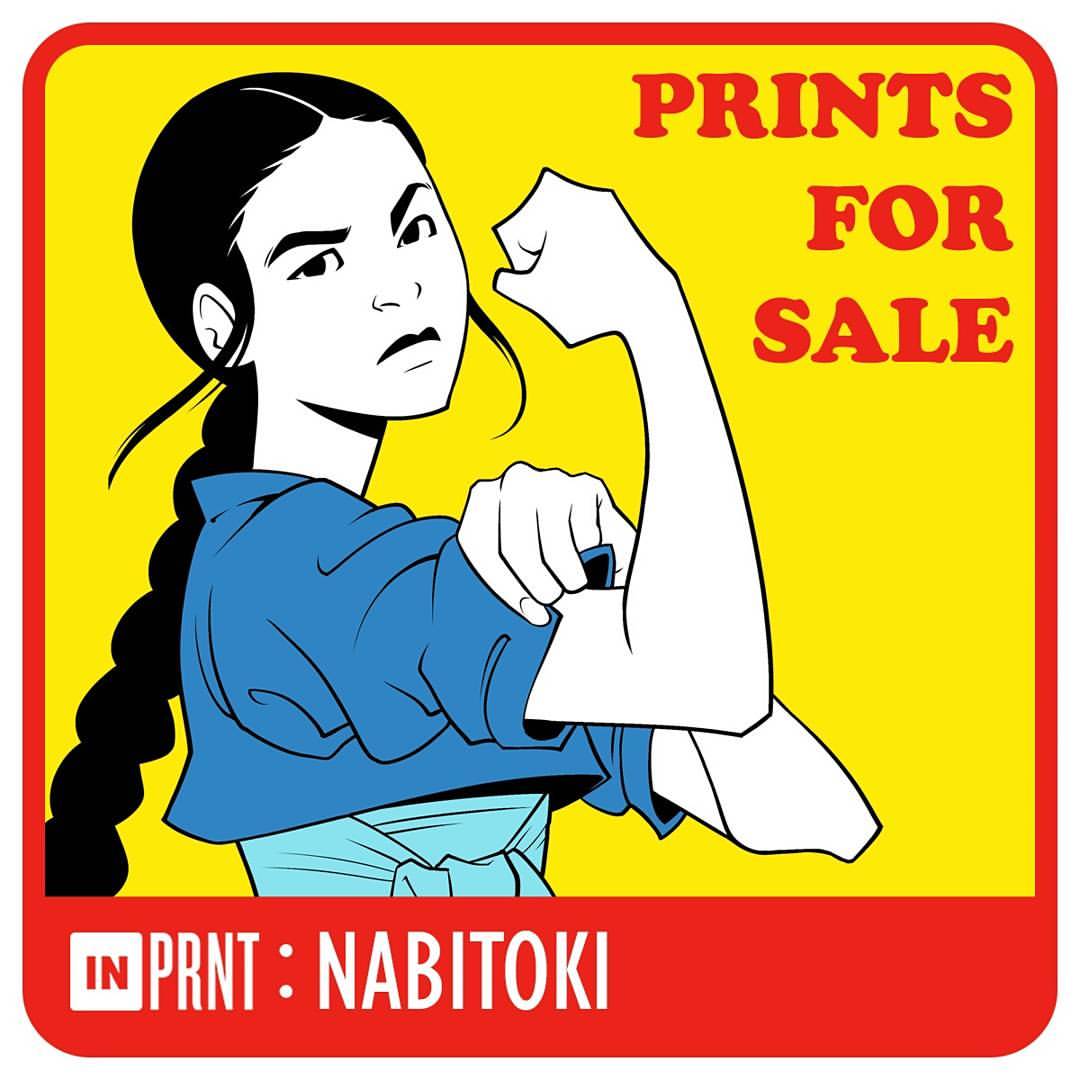
“우리는 할수 있다!”

With permission, allow me to present Jen Lee’s Korean version of the iconic “We Can Do It!” poster:

(Source: nabichan@instagram)

I know: you’ve just got to have one, right? Unfortunately though, Jen, whom many of you will already know and love as the author of the Dear Korea webcomic, doesn’t offer it as a poster yet. But I’m hoping that so many of you will join me on her Facebook page in demanding one, that she’ll just have no choice but to find a way to print and sell them online ;)

Meanwhile, I hope you all had a great International Women’s Day (which is also my birthday BTW!), and sorry for not having a post up on Monday—I’ve just been very busy with the start of the new semester, and my wife has just started a new job too. But I’ll be back to my normal posting schedule next week.

See you then!

Update: In case you can’t get access to Jen’s personal Facebook page, please try her at her Dear Korea one or at her Instagram instead.

Update 2: It’s working! To help Jen work out the logistics, please click on this one-minute poll to give her an idea of what size you’d prefer, and if you’re inside or outside of Korea.

Update 3: Success!

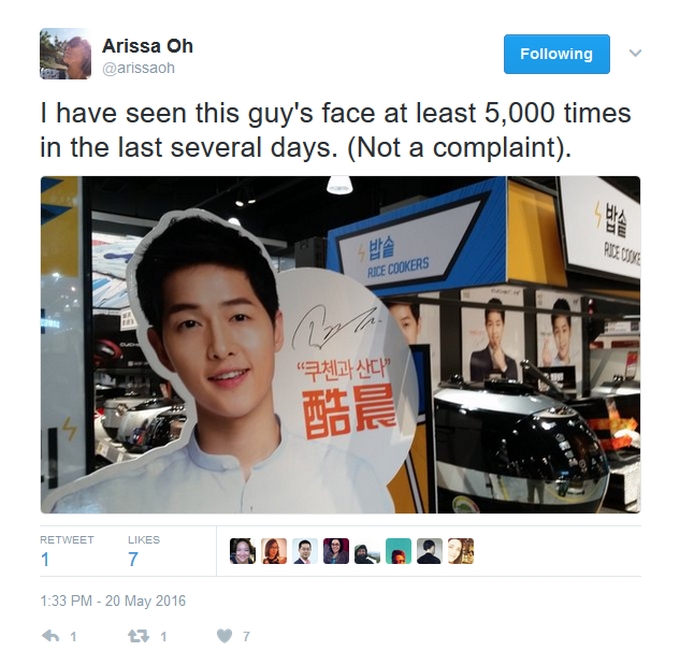
Why Korea Has so Many Celebrity Endorsements, and Why That’s so Important for Understanding Korean Pop-Culture

korean-celebrity-endorsement(Source)

To find out, please check out my journal article “Just beautiful people holding a bottle: the driving forces behind South Korea’s love of celebrity endorsement”, which has just been published in Celebrity Studies. There’s only a very limited number of e-copies available unfortunately, so please get in touch if you have any problems accessing it.

Part of a special cultural report on (South and North) Korean celebrity, it’s only 4000 words long, which, alas, makes it at least 4000 words too short for the topic. I’m especially gutted that I had to cut out a paragraph about the “Metal Tray Karaoke Room” segment of the first season of Happy Together. So, let me mention it here instead. For if you really want to understand the strong humanizing streak in Korean celebrity culture I discuss, which underlies why there’s just sooo many ads featuring them, then there’s no greater example than that of a variety show which:

  • regularly featured A-list celebrities and/or sex symbols (e.g. Cha Tae-hyeon, Son Yae-jin, and host Lee Hyo-ri below)…
  • wearing traditional high-school uniforms…
  • in a set made of egg cartons…
  • singing obscure children’s songs…
  • and getting metal trays dropped on their heads if they made mistakes.

It also just happens to exemplify just about everything I love about Korea:

All that said, only having 4000 words to work with (actually supposed to be only 3500, but my long-suffering editor gave up on me) does force you to—ahem—get to the point, and to only cover the bare essentials. If you have any questions about the article then, and/or would just like to know more about anything covered in it, please let know in the comments, and I’d be very happy to get into greater detail.

korean-variety-shows-scripted(Source)

Related Posts:

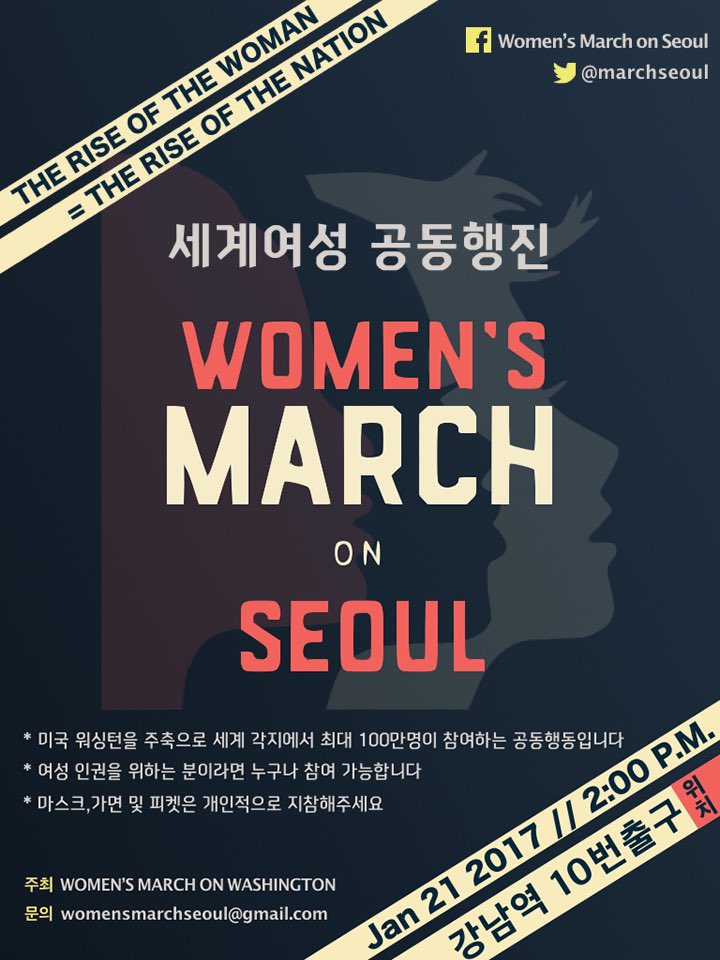
Women’s March on Seoul, Saturday January 21

I’ve been asked to share the following:

womens-march-on-seoul-1Here is information about it in English (click to expand):

womens-march-on-seoul-english-informationAnd here’s those links:

Note that all of those links (but the last) are in Korean, so you’ll need to either speak Korean or get a Korean friend to help navigate them. But I’m sure the organizers will be happy to help if you contact them :)

Merry Christmas, Powergirls! And Powerboys Too!

Merry Christmas PowergirlsAs promised, I’ve gotten the writing bug again, and am just putting the finishing touches to some long posts. I’ve even decided to start publishing every Monday too! :D

Apropos of New Year’s resolutions though, starting this coming Monday sounds a little premature. By the same token, the next Monday as well, which will still be New Year’s Day in much of the world. But hey, you’ve got to start sometime.

So, Monday the 2nd it is. Until then, let me leave you with my favorite Christmas card again, found in Daiso while looking for some stocking fillers for my daughters. It reads: “Like a powergirl, always be confident! Spread/Brace your shoulders, be strong/cheer up! Yay!”

And on that note, Merry Christmas, Powergirls everywhere! And Powerboys too! :)

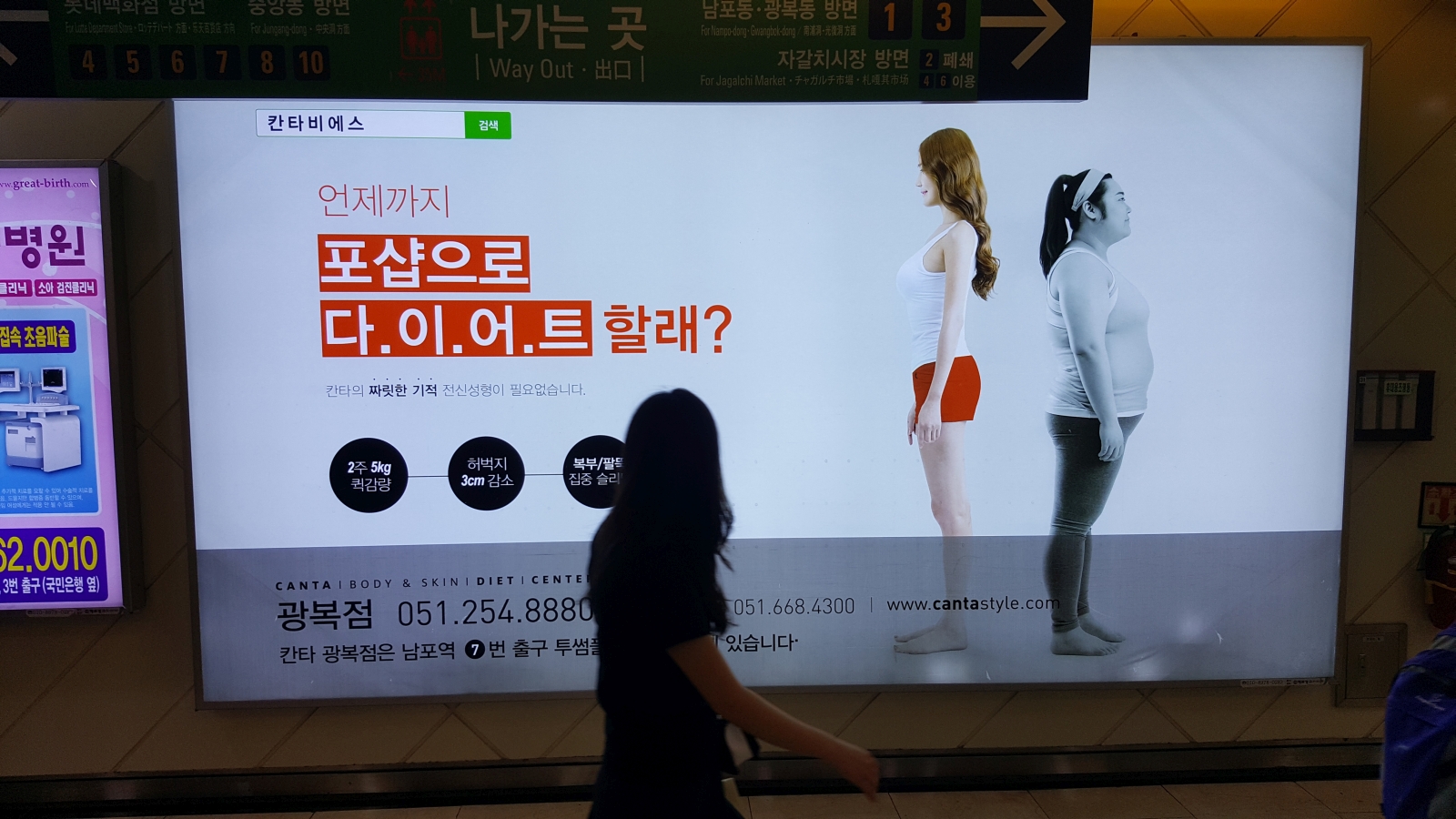
Roundtable Discussion: “Anthropology, Feminism, Korea.” Busan National University, Friday, 2-3:30pm.

korean-diet-clinic-advertisement-nampo-dong-busan-august-7-2016(Nampo-dong, Busan, August 2016)

Sorry for the slow posting everyone. It’s been a tough semester, I’ve had many colds, and my daughters have been demanding to play Stardew Valley on my computer most evenings. But my students did their final exams today, which means I just have grading and some paperwork to complete now. So, I’m about to get stuck-in to a backlog of roughly 20-30 blogposts.

First though, I absolutely have to attend Friday’s workshop at Busan National University, with special guests Olga Fedorenko and Bonnie Tilland. Frankly I’m unfamiliar with Bonnie’s work, but I intend to remedy that before the event, and am looking forward to meeting her, as well as many other Korea-Studies figures I’ve only ever met online. Olga probably needs no introduction to readers of this blog however, and you may also recognize her as the writer of the recent “Open Letter to the Student Who Harassed Me” too.

Please see the Facebook event page for further details. And say Hi if you see me on Friday! :)

An Introduction to Japanese Subcultures: Free online course, starting Oct. 31

boys-order-goro-memo(Source: goro memo; CC BY-SA 2.0)

Sorry for the lack of posts everyone: I’ve been insanely busy, and still am in fact. Naturally then, I’ve just decided to make myself busier still, by signing up for the free online course “An Introduction to Japanese Subcultures” provided by FutureLearn and Keio University. Here’s a description from their welcome page, which also has an introduction video:

Subcultures have existed for a long time: the greasers of 1950s America, the mods and rockers of the 1960s and 70s in England, the grunge of the 1980s and 90s, to name a few. Each subculture sits within a broader ‘parent’ culture and can often give us an insight into cultural fears and hopes, especially in the youth of the population.

On this course you will get an introduction to Japanese subcultures that have developed since the 1970s.

Explore different aspects of Japanese subcultures

Japanese subculture has been long considered as ephemeral youth culture compared to authentic traditional culture. It contains, however, subversive power which encourages younger generations to re-create the world they live in. We mainly focus on the significance of immaturity and vulnerability of youth which eventually give permission to younger people (in other words, minorities) to stay as they are.

In this course, together with three other specialists, Professor Niijima, Professor Takahashi and Professor Ohwada, we will explore girls comics, boys comics, the Hatsune Miku vocaloid, cosplay, and J-pop idols, focusing on the themes such as Love, Battle, Technology and Fan culture, in which you’ll learn about the different cultural creations that underpin Japanese subcultures. With materials for cultural analysis, you’ll develop a basic knowledge of key Japanese subcultures, learning the recognisable traits of each.

Understand the historic context of Japanese subcultures

On the course you’ll discover historic background of youth culture in Japan, and understand the enormous impact of World War II.

Learn about Japanese subcultures and the youth of Japan

Finally, this course will give you a new perspective on the young people of Japan, exploring how they can be seen to elaborate the world of “immaturity” and “vulnerability.” You will see the reason these characteristics of Japanese subculture attracts “global” attentions.

This post isn’t an endorsement of course, but the course does sound interesting, and hardly demanding at 3 hours a week for 4 weeks. Please let me know if you sign up too (we can be buddies!), and/or if you’ve done any other FutureLearn courses and what you thought of them.

Meanwhile, seeing as we’re on the subject of Japan, I do very much want to give an endorsement of Cecilia D’Anastasio’s interview of Amelia Cook, about her new site Anime Feminist. Frankly, Cook’s answers really spoke to me about the work I do in Korea, and especially most recently on the male gaze, which just goes to show how universal some of the pop culture issues she addresses are—so I’m sure you’ll have lots to take away from the interview too. Make sure to check it out over at Kotaku.

Radio Interview on Korean Feminism and the Media, Tonight at 7:30

The Year of the PenisAt 7:30 tonight, I’ll be briefly appearing on Inside Out Busan at Busan e-FM, to talk about Korean feminism and the media. Please tune in if you can, and feel free to ask me here to expand upon or clarify anything I mention in the interview. I’ll also post a link to a download once it becomes available.

(Update: Voilà!)