


 (Source: Unknown)
Whenever one group suddenly starts competing with another for jobs, there’s going to be a backlash. That’s just human nature.
Especially if one group has any real or perceived advantages in that competition.
In Korea, the targets are young women, who are exempt from doing two years of military service. They are often made scapegoats for young men’s inability to get work, rather than blaming the government which just reaffirmed that it’s only men that must spend so much time out of the workforce, and/or lose opportunities for further education and gaining extra qualifications. Previously, former conscripts were compensated with extra points when applying for jobs with the government or public organizations, but that policy was ruled unconstitutional in 1999, on the grounds that it was discriminatory. Repeated attempts to reintroduce it have failed.
(To clarify, I’d prefer an end to conscription and the creation of professional armed forces instead, despite the difficulties Taiwan is currently having with that.)
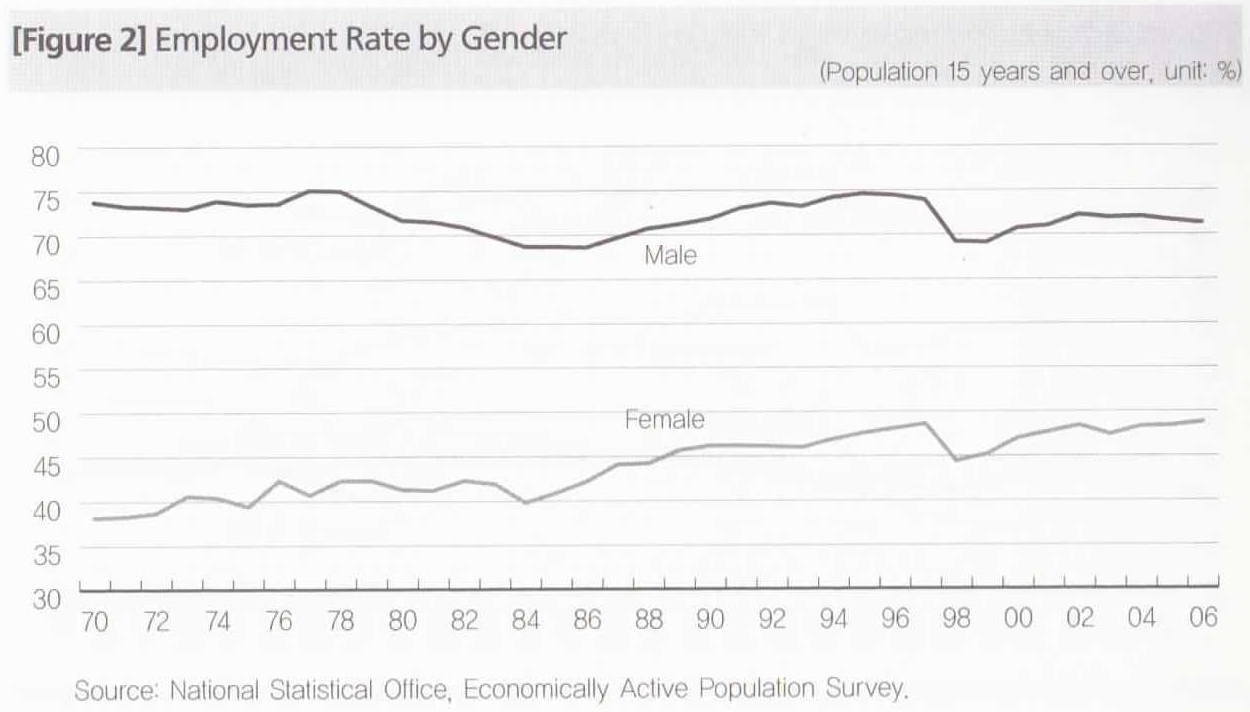
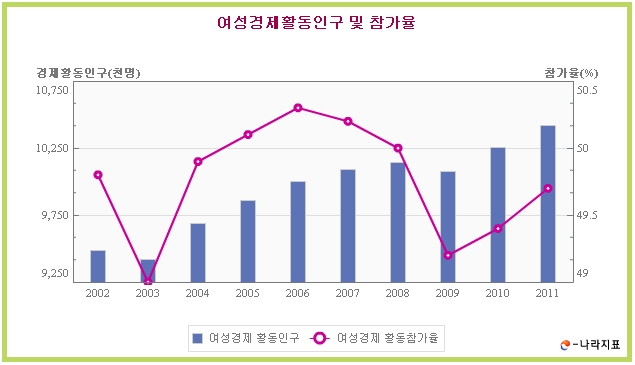
Ironically though, the backlash in much of the 2000s was not due to women taking over “men’s jobs”. In fact, it was the other way round, with a significant number of men losing better paid, advancing, more secure, regular work and being forced to compete for the irregular jobs that were—and still are—primarily done by women. You can see this in following slides I used in my last presentation (see here for the source and a more detailed explanation).
First, here are graphs showing the percentage rates and numbers of all workers (both men and women) doing regular and irregular work over time:
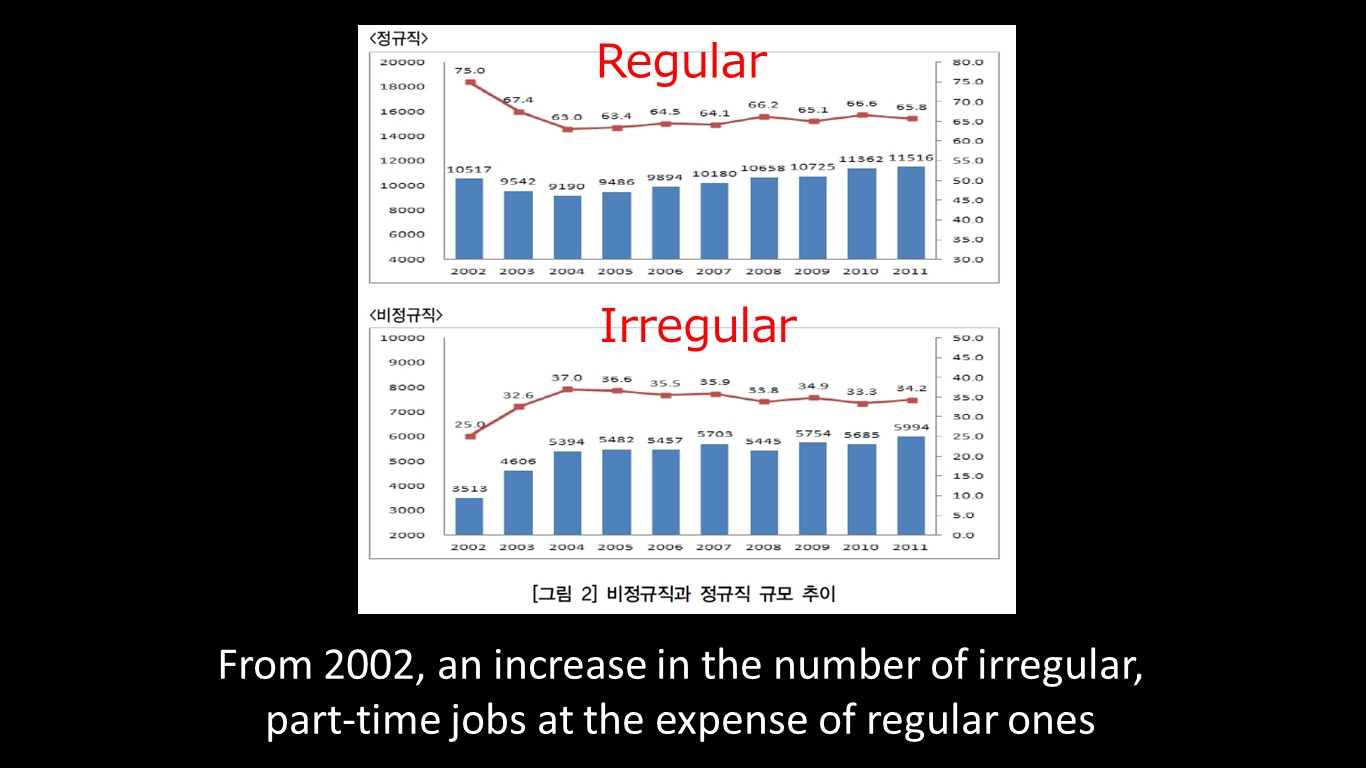 To be clear, the above graphs give no indication that it was primarily men that lost those regular jobs, and were forced to take up irregular ones instead. However, unstated is the fact that women with regular work were already targeted for layoffs in the aftermath of the 1997 Asian Financial Crisis, with the result that they took up irregular work in droves before 2002. So it’s a safe assumption.
What’s more, there’s the next graph, which shows the the percentage rates and numbers of men and women doing irregular work. As women’s rates barely changed, the implication is that the regular jobs men lost weren’t taken over by women:
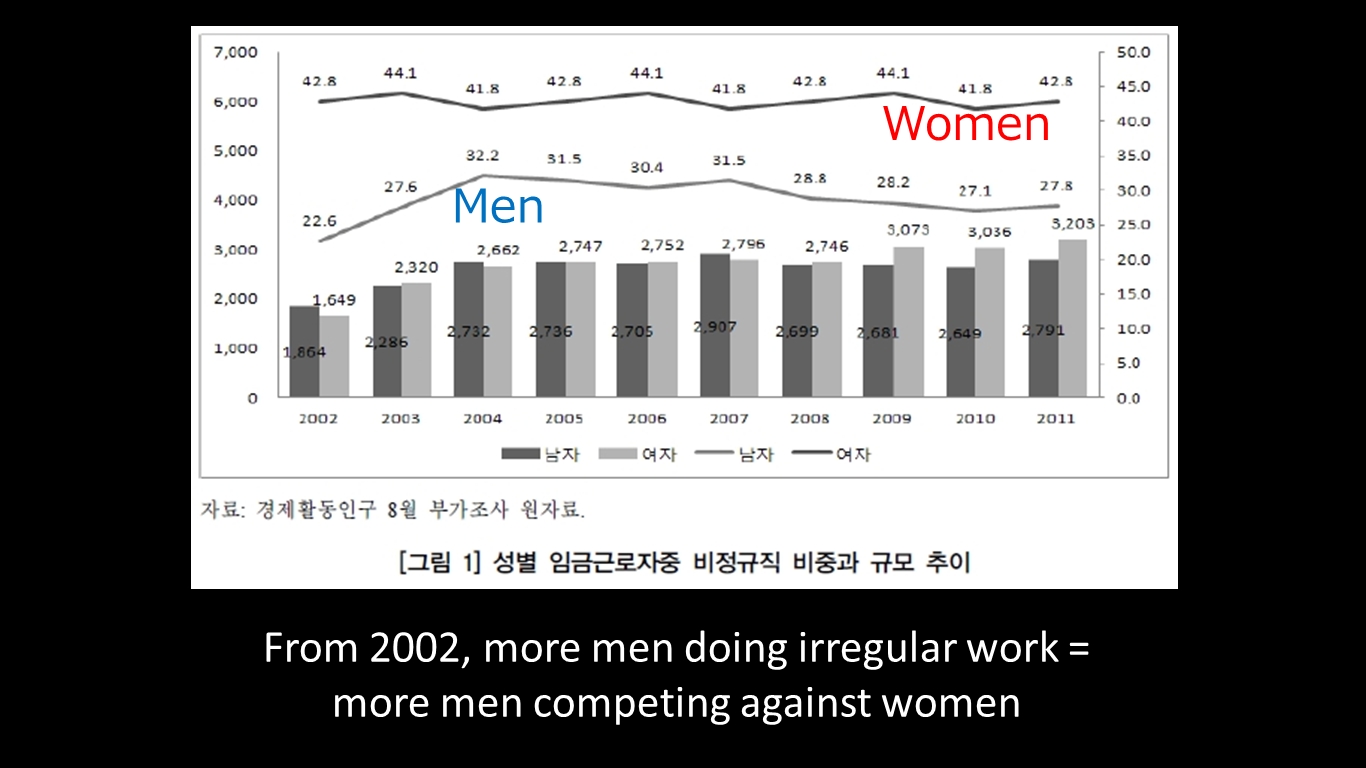 With rates settling in 2004 though, it’s a bit of a stretch to blame the ongoing backlash in 2014 on the shift (although it certainly echoes in popular culture, with today’s freshmen—of both sexes—espousing the negative stereotypes). Today’s generation of young, job-seeking men are much more used to the difficulties of finding regular work, and certainly have no objective reason to fear or resent working women.
Or do they? See my next slide, a screenshot from this Arirang news video:
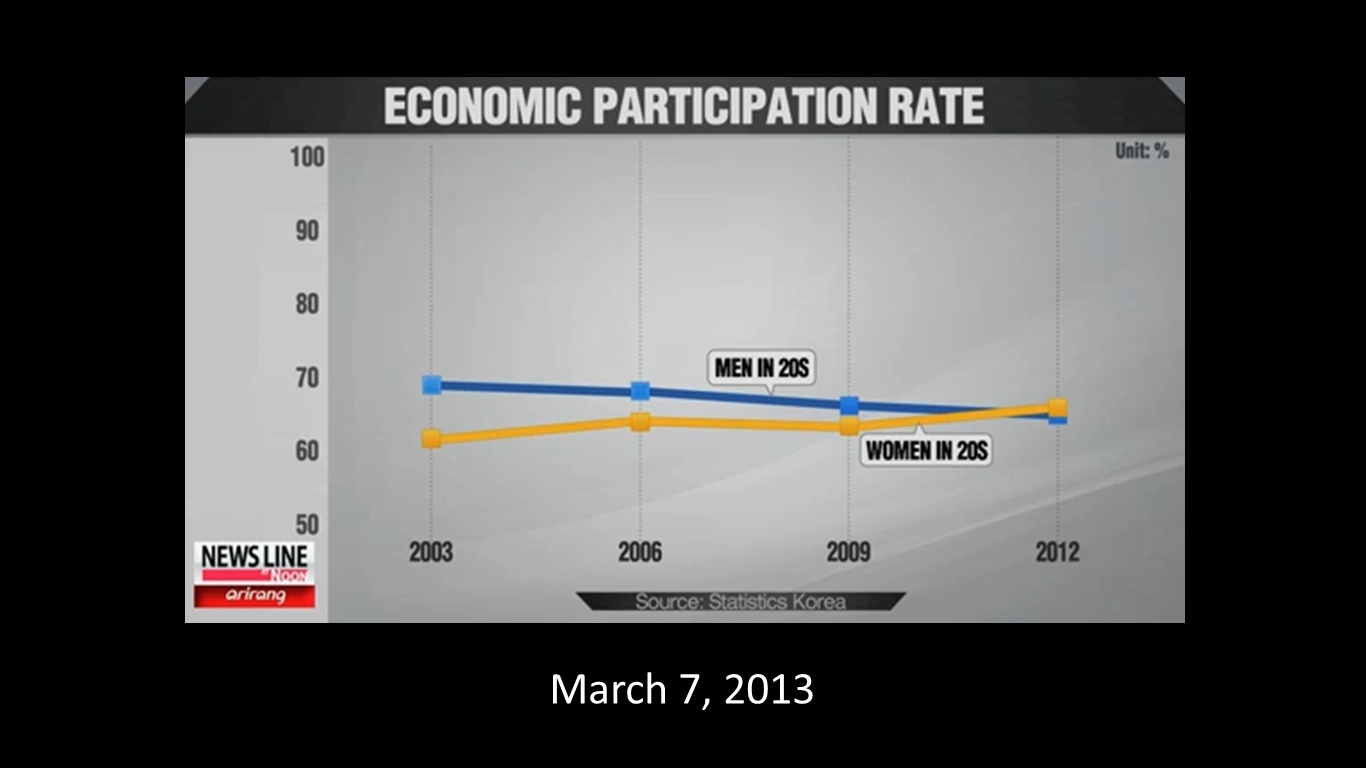 What’s more, Yonhap just reported that the gap has continued to widen—in fact, that the crossover occurred as early as 2010. As translated by koreaBANG (my emphases):
The trend in the employment rate of female to male workers in their twenties over the last 4 years has made a historic reversal. Due to so-called ‘female power’, the gap is getting larger.
According to the National Statistics Office’s statements on the 19th, the employment rate of 20-something female workers last year was 57.8%. This is 2.1 percentage points higher than their male counterparts(56.8%)…
…Since 2010, the employment rate of female workers in their twenties has been higher than their male counterparts.
In 2010, the employment rate of female 20-something workers, at 58.3%, surpassed the rate of males by 0.1%. In 2011, the lead increased to 0.4%, and in 2012, as women lead by 1.5%, the gap continues to widen.
The rate of economic participation of female 20-somethings was 62.5% in 2011, then rose to 62.9% in 2012. Conversely, the men went from 64% down to 62.6%, being surpassed by the women for the first time by 0.3%.
The labor market is changing little by little as women obtain higher levels of education and more positions in the workplace.
In every part of society, the female tornado is blowing strong even in specialized careers, and women are making considerable advances.
A gap of 2.1% hardly sounds like a “tornado” of “female power” to me, and much more like natural variation. But I can understand how news of women’s “considerable advances” might rankle, especially in the context of Korea’s lowest twenty-something employment rates since 2000, and the numbers of students deferring graduation nearly doubling in the last two years. It’s not at all difficult to empathize with a male graduate stuck working at (say) a convenience store, frustrated at how some women he went to university have regular jobs because they gained skills and qualifications during the two years he was stuck in the military.
Still, likely that’s not the only reason he’s angry:
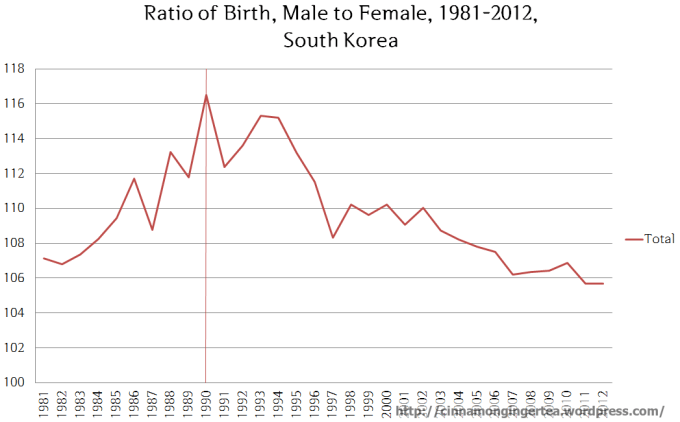 (Source: Cinnamon Ginger Tea; reprinted with permission)
Put simply, most of Korea’s extra boys are now men, and many of them can’t find girlfriends and wives. Most likely, precisely those who lack the steady jobs and money to be considered good partners.
Yes, I know what you’re all thinking, so let’s not mince words. I mean they can’t get laid.
That may sound facetious, and/or that I’m laughing at them. I’m not. Because fourteen years ago, frankly I was in a very similar situation myself. After graduating, I too couldn’t find a good job, and had to work three part-time ones just to scrape by (when my Doc Martins got holes in them, I had to put cardboard in them every day until I could afford new ones; yes, really). Needless to say, I didn’t have much time for dating, and wouldn’t have been very successful if I did.
I felt trapped.
Fortunately, I had the privilege of being able to take up a well-paying job (for a 24 year-old) in Korea, and, desperate in more ways than one, I took advantage of that just six months after graduating. So, while I can definitely empathize with how my students must feel today, on the other hand I can only imagine what it must feel like to never have the option to escape that I had, with no prospect of a partner or steady job for your entire twenties or beyond.
Still, I wasn’t spewing hatred about New Zealand women back in 2000, and likewise most of Korea’s angry young men (or indeed, China and India’s) aren’t destined to be misogynists in 2014 either. Most do direct their anger at the government and chaebol that deserve it.
Unfortunately though, all too many seem to firmly believe in such charming stereotypes as ‘kimchi bitches‘ instead. Moreover, China and India’s own “angry young males” are already considered huge sources of instability, crime, and sexual violence in those countries. Why would Korea’s be any different?
Also, the data raises a simple but important question: do the statistics about twenty-something men and women’s economic participation rates take into account the fact that there’s actually far more twenty-something men than women out there? That while a greater proportion of women than men are working now, that more men than women may still be working overall?
If not, then that “tornado” of “female power” may prove to be nothing more than hot air. Which makes you wonder why the media seems so full of it…
 (Source: GR × HERMARK, CC BY-NC-SA 2.0)

Either way, of course I’m grossly overgeneralizing in this post, so please feel free to call me out on that, and add any important information I’ve overlooked (I acknowledge I’m no great statistician too, and would appreciate any additional sources of data). But I think these demographic realities do significantly add to the many, often quite legitimate reasons for many young Korean men’s sense of anxiety in post-crisis Korea (which is not to say that things are any rosier for young Korean women), and it’s also fair to say that anxiety seems to be manifesting itself in excessive, distorted, and/or caricatured critiques and stereotypes of women. So at the very least, I hope knowing about all the extra men out there provides some much-needed context to current employment statistics and women-blaming. In hindsight, it’s extraordinary that any discussions of either wouldn’t take them into account.
What have I missed?
Update: Meanwhile, note that Korean women’s overall employment rate remains one of the lowest in the OECD, and that this is one of the main reasons for its equally dismal birthrate. However, as reported by Asian Correspondent yesterday, the Korean government is not about to upset gender norms by making life any easier for working parents. Lest that sound like an exaggeration, recall that the previous Lee Myung-bak Administration also (re)criminalized abortion in order to raise the birthrate, a policy continued by Park Geun-hye (my emphases):
In a nationwide survey conducted by the Federation of Korean Industries in 2010, marriage was the leading cause for South Korean women to quit their jobs – not childrearing. According to the poll, females in general have a 37.8 percent higher chance to give up work after getting married than if they were single – a percentage that shoots up to 58.2 for those in their 20s. The likelihood, however, of married mothers to leave their jobs was only 2.9 percent higher than married women without children. The federation explains these statistics by saying it is due to the foundational social belief that females should be full-time homemakers…
…Despite these numbers, measures to change cultural expectations – that it is not only the woman’s responsibility to care for children – are being opposed. In January, the Ministry of Labor and the Ministry of Strategy and Finance rejected one of President Park’s campaign promises: mandatory paid paternity leave, or “Father’s Month.” Ministry officials quoted potential financial problems such as the depletion of employment reserve funding for the opposition against the bill. They added that they will work towards a resolution but are unsure how they will initiate it.
The Revealing the Korean Body Politic Series:
- Revealing the Korean Body Politic Part 12: If You Don’t Have Kim Yuna’s Vital Statistics, Your Body Sucks and You Will Totally Die Alone
- Revealing the Korean Body Politic, Part 11: 노출이 강간 유혹?…허튼소리 말라 Wearing Revealing Clothes Leads to Rape? Don’t Be Absurd
- Revealing the Korean Body Politic, Part 10: “An epic battle between feminism and deep-seated misogyny is under way in South Korea”
- Revealing the Korean Body Politic, Part 9: To Understand Modern Korean Misogyny, Look to the Modern Girls of the 1930s
- Revealing the Korean Body Politic, Part 8: The Bare-leg Bars of 1942
- Revealing the Korean Body Politic, Part 7: Keeping abreast of Korean bodylines
- Revealing the Korean Body Politic, Part 6: What is the REAL reason for the backlash?
- Revealing the Korean Body Politic, Part 5: Links
- Revealing the Korean Body Politic, Part 4: Girls are different from boys
- Revealing the Korean Body Politic, Part 3: Historical precedents for Korea’s modern beauty myth
- Revealing the Korean Body Politic, Part 2: Kwak Hyun-hwa (곽현화), Pin-up Grrrls, and The Banality of Sex and Nudity in the Media
- Bikinis, Breasts, and Backlash: Revealing the Korean Body Politic in 2012
































 The Grand Narrative