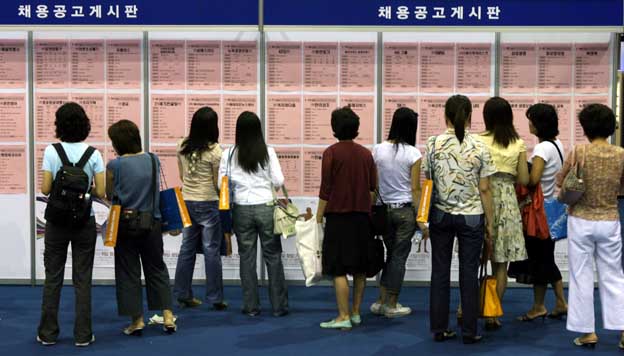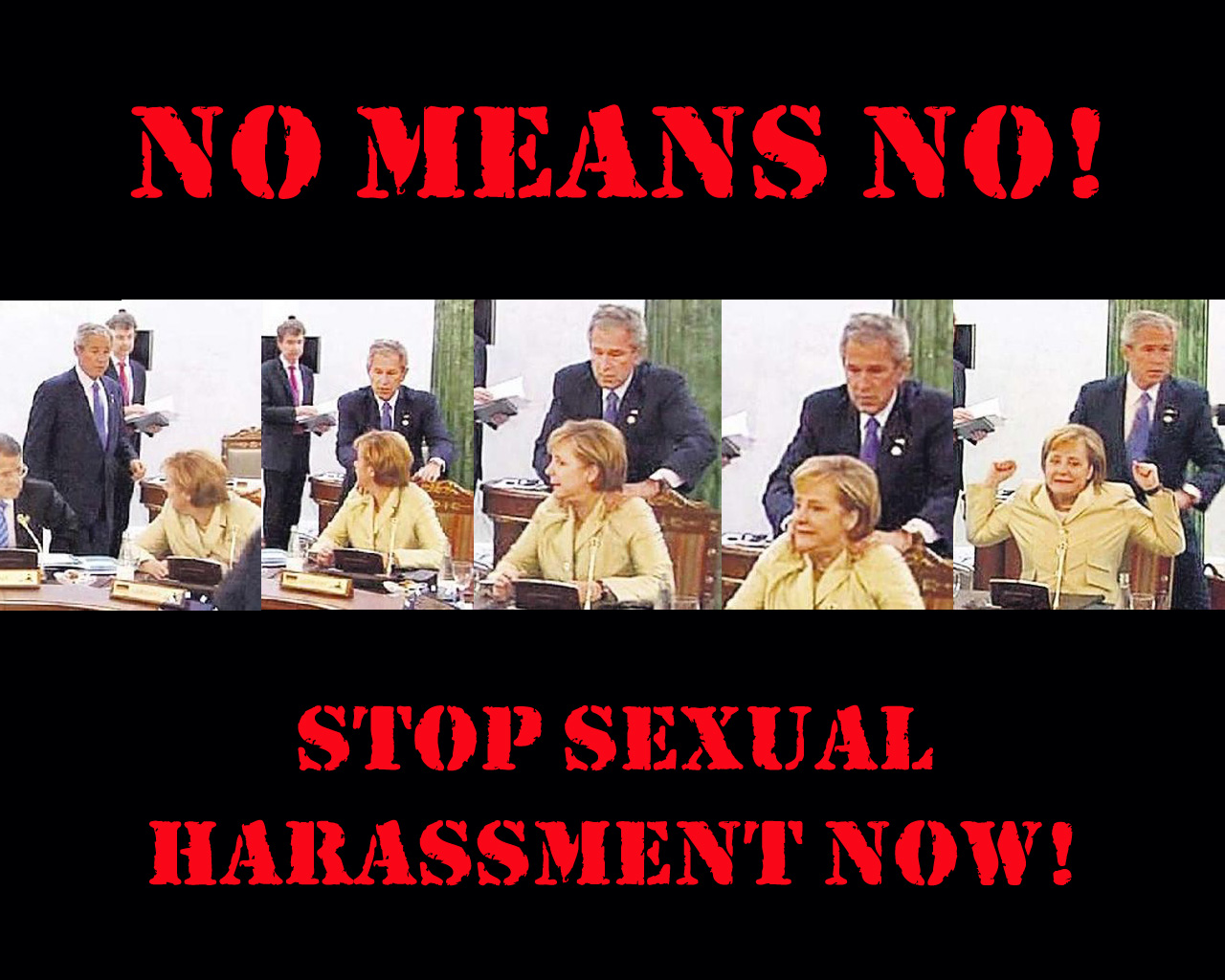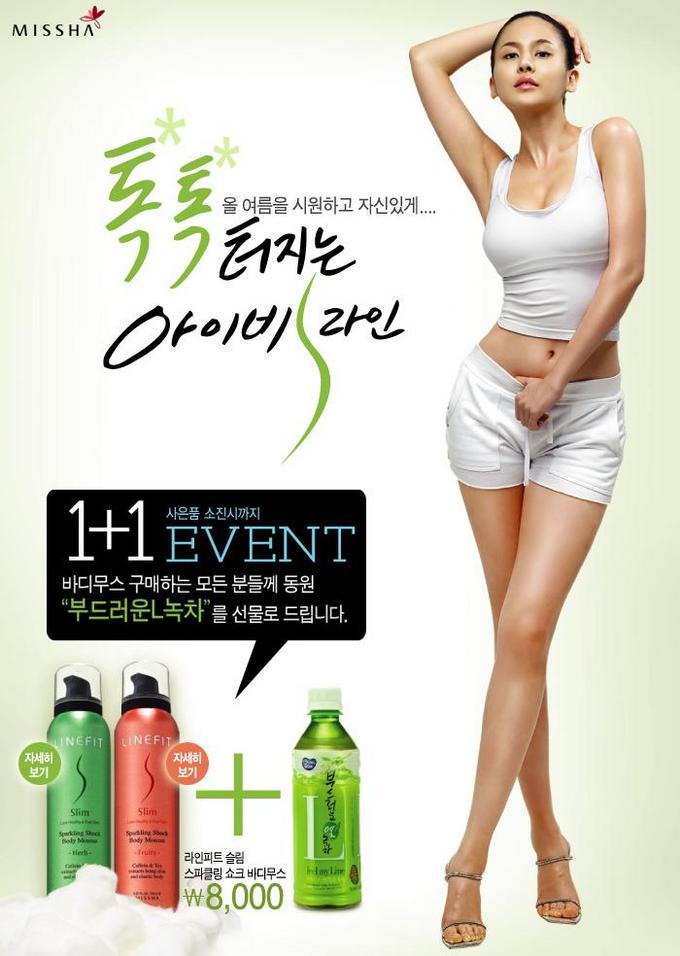
Advice to Women Looking for Work: “Say you like to sing and dance”

(Source)

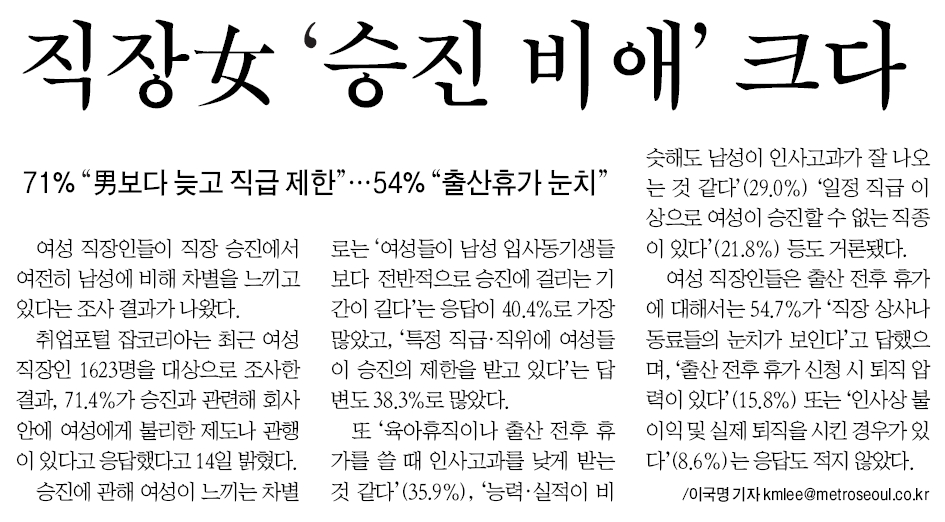
Last week, I posted a translation of an article about sexual discrimination in the hiring practices of several major Korean companies, some only hiring one woman for every four men. As a follow-up, here’s a recent interview of a young woman looking for work, to give readers a better sense of what that discrimination means from job-seekers’ perspective. Naturally, the focus is on women, but much of what the interviewee describes applies to men too:

여자 신입사원들은 지들이 공주인줄 알아” / “New female employees all think of themselves as princesses

“엄마가 없는 형편에 정장 사주면서 꼭 취업하라고 했는데… 엄마 목소리 들으니까 눈물이 나.”

“My mom bought me a suit in our poor circumstances and told me I must get a job…hearing her voice makes me cry.”

13일 저녁 중곡동의 한 포장마차에서 혼자 술을 마시던 김선희(가명?24)씨는 전화기를 부여잡고 울고 있었다. 포장마차 테이블 넘어로 들려오는 그녀의 울음 섞인 대화에 가슴이 저릿해 몰래 엿들었다.

On the evening of the 13th at a food stand in Junggok-dong, Kim Sun-hee (false name, 24), drinking alone, was clutching a phone and crying. Her tearful conversation, audible beyond the food stand table, moved me so I secretly eavesdropped.

김해에서 서울로 상경해 수도권에 있는 사범대를 다니는 김씨는 대학졸업반이다. 그녀의 서울 생활만큼 취업은 녹록지 않았다. 전화 통화를 끝낸 그녀에게 말을 붙여 혼자 술을 마시게 된 사연을 들을 수 있었다.

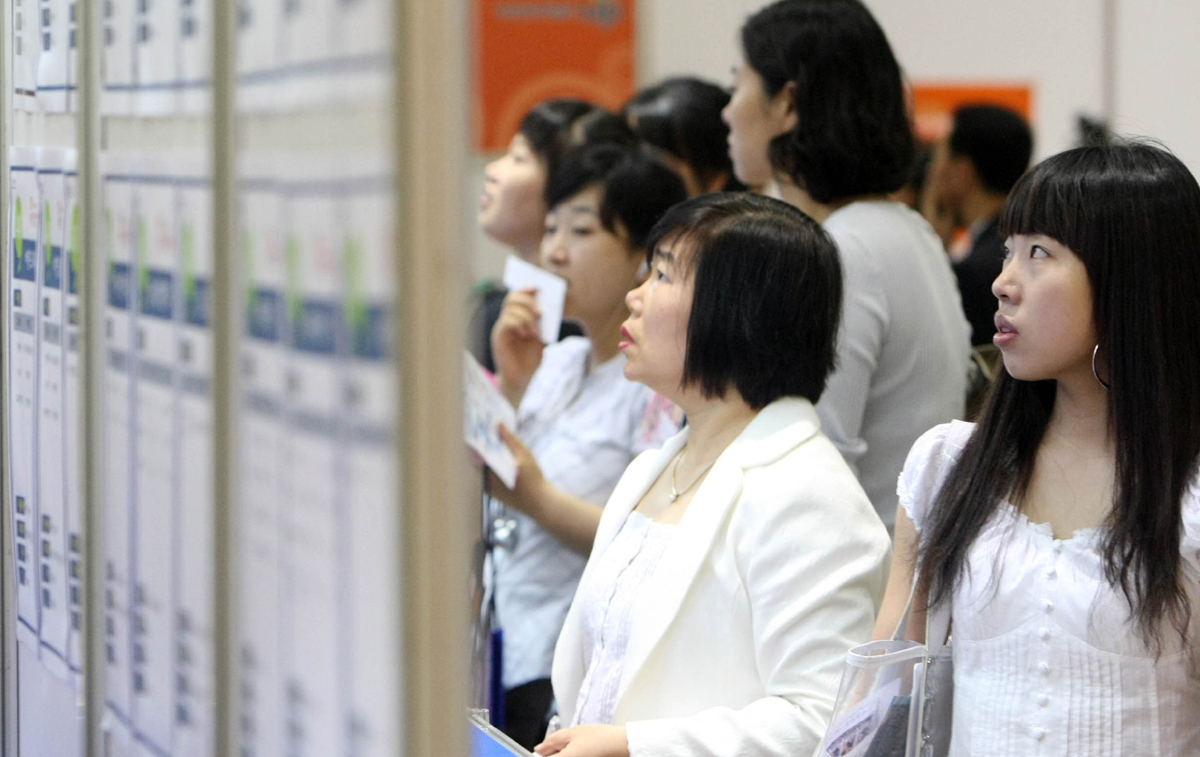
(Sources: left, right)

Kim, who had moved from Gimhae to Seoul and who attends a college of education in the capital area, is a senior. Getting a job is not as easy as her life in Seoul. After she finished her conversation I approached her and heard the story of how she had come to be drinking alone.

 “좀 청승맞죠? 근처에 사는데 오늘은 정말 너무 힘들어서 술이라도 안 마시면 화병 날 것 같았어요. 오늘 면접을 5군데 봤어요. 서울 남쪽, 북쪽 할 것 없이 면접보러 다녔어요. 긴장을 풀었다 놓으니까 정말 미치겠더라고요. 나중에는 (면접보면서) 헛소리까지 했어요. 제가 너무 긴장을 해서 눈을 못 마주치니까, 면접관이 사시냐고 물어보더라고요. 아마 떨어지겠죠.”

“Pitiful, aren’t I?  I live in the area, and today was so hard, if I don’t at least drink alcohol I think I’ll get sick from repressing anger [hwabyeong].  Today I had 5 interviews. I went around north Seoul, south Seoul, everywhere, to interview. I kept going from nervous to calm, so I thought I’d go crazy. Later (as I was being interviewed) I was even talking nonsense. I was so nervous that I couldn’t make eye contact, so the interviewer asked if I was cross-eyed. I must have failed the interview.”
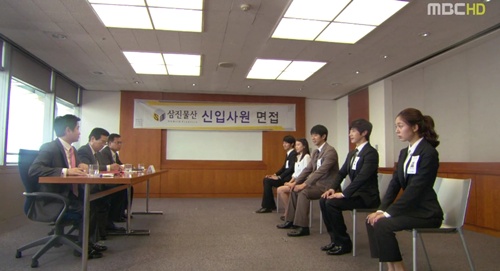
Image Caption: “하이킥 짧은 다리의 역습” 미 래의 88만원 세대 백진희가 인턴으로 취직을 하기 위해 면접을 보고 있다 /Future 880,000 won generation member Baek Jin-hee is interviewed for an internship in comedy program “High Kick: Short Legs’ Counterattack.”

취업하기 위해 춤과 노래를 권유하는 사회/ A society that urges singing and dancing to get hired

대기업 인턴, 자격증, 교생실습, 알바까지 그녀의 대학 생활은 ‘낭만’이 아닌 ‘알바와 스펙쌓기’로 채워졌다. 1년의 휴학 기간 조차 그녀에겐 휴식이 아닌 이력서에 채울 경험을 쌓으면서 보냈다. 그렇게 열심히 대학 생활을 한 그녀였지만, 면접에서 쏟아지는 질문들은 그녀를 난처하게 만들었다.

Her university life, with its internship at a large company, certificates, teaching practice, and even part-time work, was filled with “accumulating part-time work and qualifications”, an activity which lacked romance. Even the one-year break she took from university was not a rest, and was spent gaining experiences to fill her resume. Though she had worked so hard during university, the hailstorm of questions at the interview landed her in difficulties.

“오늘 면접 본 회사에서는 대놓고 이런 말을 했어요. 회사는 일을 배우려고 하는 사람을 뽑는 곳이 아니고, 일을 잘 해서 성과를 낼 수 있는 사람을 뽑는다. 당신 같은 사람보다는 잘하는 사람 뽑고 싶다고… 기업은 이윤을 창출하는 곳이니까 안타깝지만 어쩔 수 없죠.”

(Source)

“At the company where I interviewed today, they said this to my face: this company is not a place that hires people who intend to learn the work, it hires people who do this work well and so get results. We want to hire people who do better than someone like you. A business is a place that creates profit, so though it’s regrettable, it can’t be helped.”

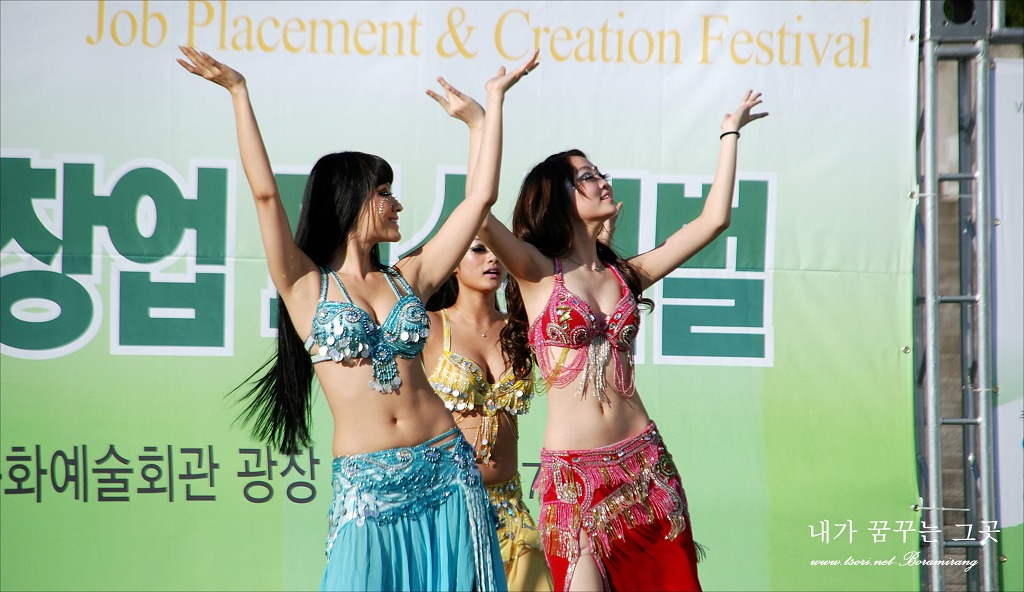
그녀가 면접을 본 외국계 회사 중 한 곳은 면접에 들어가자마자 영어로 질문을 했다고 한다. 자기 소개를 하기 전부터 쏟아지는 영어 질문에 그녀는 적잖게 당황했다고 한다. 심지어 취업상담센터에서는 그녀가 쓴 이력서의 취미란을 ‘춤추기와 노래하기’로 고치라고 권유했다.

She said that at one of the foreign companies at which she interviewed, they started asking her questions in English as soon as she entered the interview [room]. This rain of English questions that came before she introduced herself flustered her more than a little. Furthermore, an employment counseling center urged her to amend her hobbies to “dancing and singing” on the resume she had made.

“지루한 사람으로 보일 수 있겠지만, 제 취미는 진짜 독서랑 요리예요. 그런데 취업상담센터에서는 회사 레크리에이션과 회식자리에서 잘 놀 수 있는 사람을 뽑을 수 있으니까 춤추기, 노래하기로 취미를 바꾸래요. 취업하는데 춤추고 노래까지 불러야 해요?”

“It might make me look boring, but my hobbies really are reading and cooking. But the employment counseling center said companies can choose people who can have fun during company recreation activities and office dinners so I should change my hobbies to dancing and singing. I’m [just] looking for a job – I even have to dance and sing?”

취업준비생들에게 이력서 취미란은 고민되는 항목이다. 평범하게 적으면 불이익을 받을 수도 있고, 막상 돋보이게 적으려고 해도 ‘색다른 취미’란 것이 없기 때문이다. 그래서 남자 취업준비생들 가운데 대부분은 취미란에는 축구와 등산을 적는 이들이 많다.
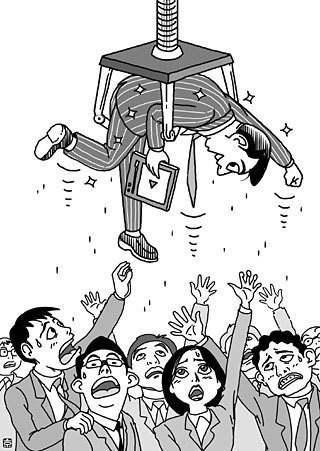
What they write down as hobbies on their resume is a cause for worry for job-seekers. That’s because if they write it in an average way, they could be at a disadvantage, but even if they try to write it so that they stand out, they don’t actually have an “unusual hobby.” So among male job-seekers, there are many who write down soccer and hiking as their hobbies. (source, right)

대놓고 신입사원에 대한 험담을 하는 회사도 있었다.

There are companies that badmouth new employees in their presence

“한 회사는 ‘요즘 여자 신입사원들은 뽑아 놓으면 지들이 공주인줄 알아. 밑바닥부터 시작할 생각을 해야지. 어디서 공주 행세야’라고 말하는 회사도 있었어요. 전 공주 소리 들어본 적도 없는데… 그래서 저는 (사장님께) 30분 먼저 출근해서 책상을 닦아 드린다고 말했어요. 책상이 깨끗하면 그 날 하루를 기분 좋게 시작할 수 있으니까요. 은근히 그런 거 바란다니까요. 기업 문화도 문제지만, 이 정도는 각오해야죠.”

“One company said, ‘These days, we hire new female employees and they think of themselves as princesses. They should expect to start at the bottom. Why are they acting like princesses?’ No one’s ever called me a princess … so I said (to the company president) that I would arrive at work 30 minutes early and clean his desk.  Because if your desk is clean, you can start the day in a good mood. Because inwardly, that’s what they want. Business culture is also a problem, but you have to be prepared to do that much.”

눈물을 훔치는 그녀의 말 끝에서 안타까운 한숨이 흘러 나왔다. 기자와 김씨의 대화를 듣고 있던 4년차 직장인인 기자의 지인은 “회사는 외국계인데, 사장은 한국 사람이구나”라고 말했다.

As she finished speaking, wiping away tears, she sighed pitifully. An office worker in her 4th-year and acquaintance of this reporter who had been listening to our conversation said, “Ah, so it’s a foreign company, but the boss is Korean.”

화제 전환을 위해 그녀에게 선생님이 될 생각은 없냐고 물었다. 그녀는 실제로 교생실습을 하기도 했으며, 이번 학기를 마치면 교원자격증을 취득한다. 하지만 그녀가 선생님이 되는 길은 멀고도 험한 길이었다.

(Source)

To change the subject, I asked her if she had thought of becoming a teacher. She had had actual teaching practice, and when she finished this semester she would acquire her teaching certificate [with which she can teach at some private schools and is eligible to take the test to work at public schools]. However, she said the path to becoming a teacher was long and rough.

“선생님 되고 싶죠. 과정이 힘든 것은 견딜 수 있어요. 하지만 대학 졸업 후에도 임용시험 준비한다고 부모님께 손 벌릴 수는 없잖아요. 그리고 사립학교 교사라도 되려면 몇 천만원을 내야 돼요. 저희 집에는 그렇게 큰 돈 없어요. 공립 학교는 준비하는데 몇 년 걸리고, 합격하기 어려워요. 만약 임용 시험에 실패하면 나이 27살에 이력서에 ‘임용 준비’ 이렇게 쓸 수 없잖아요. 그래서 선생님이 되는 것 포기하고, 일반 기업에 취업하려고 하는데 잘 안 되네요.”

“Yeah, I want to be a teacher. I can endure that the process is difficult. But even after graduating university, if I prepare for the [public school] teaching certification test, my parents can’t afford to pay for that. And if I want to become even a private-school teacher, I have to pay tens of millions of won [tens of thousands of dollars]. My family doesn’t have that much money. Preparing for a public school takes a few years, and it’s difficult to pass the test. If I fail the teaching certification test, I can’t put “teaching certification test preparation” on a resume when I’m 27, you know. So I gave up on becoming a teacher and intended to get a job in a regular business, but it’s not going well.”

(Source)

그녀의 유일한 소망은직장인 / Her only wish is [to be] an ‘office worker’

“정치권에서 청년들이 취업을 못하는 이유는 열정과 창의력이 없기 때문이래요. 저는 한 직장에서 뼈를 묻을 만큼 열심히 할 자신 있어요. 열정도 있고, 창의력도 있어요. 그런데 취업을 못해요. 돈도 없어요. 이명박 대통령, 나경원 서울시장 후보가 청년들 일자리 만들어 준다고 하잖아요. 그 사람들이 어떻게 청년들 현실을 알아요. 돈 많고, 배부른 사람들인데…(이번 서울시장 재보궐 선거도)말이 아닌 진심으로 청년실업 문제 해결한다고 하면 청년들이 뽑아주겠죠. “

“Political circles say that the reason that young people can’t get jobs is because they have no passion or creativity. I’m confident that I can work hard enough to die at an office.  I have passion and creativity. But I can’t get a job. I don’t have money, either. President Lee Myung-bak, the Seoul mayoral candidate Na Gyeong-won, you know they said they would create jobs for young people. How do those people know young people’s reality? They are people who have a lot of money, and whose stomachs are full but… (in this Seoul mayoral re-election too) if they sincerely say that they will solve the youth employment problem, young people will vote for them.”

그녀는 소위 말하는 ‘개념 찬 대학생’이다. 2008년 미국산 쇠고기 수입에 반대하는 촛불집회에 참여하기도 했고,  노무현 전 대통령의 추모식 때 자원봉사를 하기도 했다. 정치에 대한 얘기가 나오자 그녀는 한층 격앙된 목소리로 말을 이어갔다.
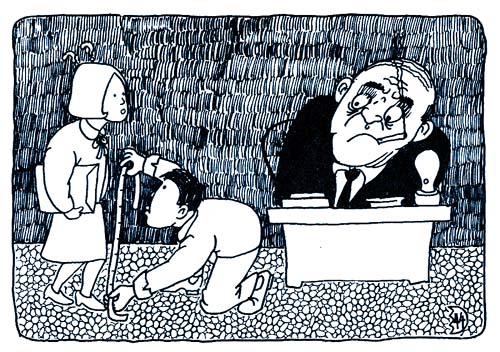
She is a so-called “thoughtful university student” [lit. “full of concepts,” but has more to do with being aware of your world and taking care of it].” She participated in the candlelight rallies against importing beef from the United States in 2008, and did volunteer work at former president Roh Moo-hyun’s memorial service. As the topic turned to politics, she went on in an increasingly agitated voice. (source, right)

“(이번 선거는) 꼭 투표할 거예요. 대학생들 중에서 투표 안 하고, 정치에 무관심한 것이 쿨한 줄 착각하는 학생들이 있어요. 사실 정치는 우리 삶과 연관되어 있기 때문에 정치에 무관심하면 나중에 자신한테 돌아와요. 부메랑처럼.”

“(In this election) I will definitely vote. There are some university students who don’t vote, and mistakenly think that not being interested in politics is cool. Actually, because politics is connected to our lives, if you are not interested in that, it will come back on you. Like a boomerang.

“서울에서 살기 너무 힘들어요. 전세금, 물가 비싸잖아요. 전 학교 다니면서 생활비를 다 벌어서 썼어요. 아르바이트를 쉰 적이 없었어요. 뭘 하려고 하면 돈이 필요하니까요. 정말 닥치는 대로 일했어요. 사실 대기업 가려는 이유도 돈 때문이잖아요. 연봉은 물론이고, 퇴직금도 두둑하잖아요. 대기업다니는 직장인들은 월급이 스쳐지나간다고 하잖아요. 통장에 찍힌 월급 명세서를 볼 때 유일하게 행복하대요. 제 희망연봉은 2200만 원이에요. 이 정도 (연봉) 못 받으면 서울에서 살기 힘들어요. 근데 대기업은 매번 떨어지니까, 눈을 낮춰서 일반 중소기업이라도 감사하게 생각하고 들어가려고 해요”

Living in Seoul is really hard. Prices and key-money leases are expensive. While going to school I made and spent all of my money for living expenses. I haven’t had a break from doing part time work. Because if I want to do something, I need money. I’ve really done any work I could. Actually, the reason I want to work at a major company is also because of money. Because of the salary, of course, and the pension is also generous. They say that the monthly pay of employees at major companies flashes by [comes regularly]. Their only pleasure is seeing their monthly pay statement stamped in their bankbook. The salary I would like is 22 million won [about 19,800 USD]. If I can’t get that much, living in Seoul will be hard. But because I keep failing to get into a major company, I plan to lower my standards and be thankful for and work at even an average mid-size company.

그녀는 면접관에게 “이 회사에서 뼈를 묻겠다고 말했다”고 했다. 한 직장에서 뼈를 묻을 정도로 오래 일하는 것이 가능하지도 않지만, 안타까운 것은 ‘뼈를 묻는다’는 절박한 표현을 써야하는 우리 사회의 암울한 취업 현실이었다. 안타까운 마음이 들어 그녀에게 ‘꿈’에 대해서 물었다.

She said she told an interviewer, “I will work until I die at this company.” It’s not possible to work at one office so long that you die, but the regrettable thing was the grim employment situation of our society, that must use the desperate expression “die [lit. “bury bones”].” Feeling pity, I asked her about her “dreams.” (source, right)

“취직해서 시집갈 수 있을 정도로 적금 들고, 집에 많지는 않지만 생활비 보내드릴 수 있을 정도로 사는 거예요. 소박하죠. 근데 이 꿈조차 이룰 수 없게 우리 사회가 막막해요. 취업을 하는 것도, 직장에서 안 잘리고 버티는 것도 어렵잖아요. 원래는 꿈이 거창했는데, 사회의 쓴 맛을 보니 소박한 꿈도 쉽지 않은 것을 알게 됐어요.”

“Getting a job so I can save enough money to get married, and living so that I can send money home – not a lot, but living expenses. Simple, aren’t they? But our society, that can’t let me realize even these dreams, puts me at a loss. Getting a job, and then not getting fired and enduring at a workplace are hard. Originally, my dreams were grandiose, but after being taught a bitter lesson by society, I found out that even simple dreams are not easy.

그녀는 1%가 아닌 99%다. 소위 ‘SKY’라는 일류 대학을 졸업하지 않았고, 자녀에게 수십억의 자산을 물려줄 수 있는 부유한 부모님 밑에서 자라지도 않았다. 또한 취업을 통해 ‘신분상승’이 이루어질 것이란 꿈도 꾸지 않는다. 그녀가 유일하게 소망하는 것이 있다면 ‘직장인’이 되는 것이다.

She’s one of the 99%, not the 1%. She didn’t graduate from one of the top-tier “SKY” universities, and she didn’t grow up with wealthy parents who could leave their children inheritances of billions [millions in USD]. Also, she doesn’t dream that, through getting a job, she can become “upwardly mobile.” If there’s one thing she wishes for, it’s becoming an “office worker.”

4년의 서울 생활이 그녀에게 안겨준 것은 학자금의 빚과 사회의 높은 문턱이었다. 한 시간이 조금 넘도록 얘기하면서 그녀는 틈틈이 눈물을 닦았고, 틈틈이 소주 반 잔을 입속에 털어 넣었다. 그리고 혼자 술을 마시던 그녀를 걱정해 한 걸음에 달려온 그녀의 친구 앞에 다시 눈물을 흘렸다.

What four years of life in Seoul have given her are student loan debts and society’s high threshold. While talking for a little over an hour, she wiped away tears from time to time and poured a half-glass of soju past her lips from time to time. Also, she cried again in front of her friend, who had come running without hesitation because of worry over her friend drinking alone.
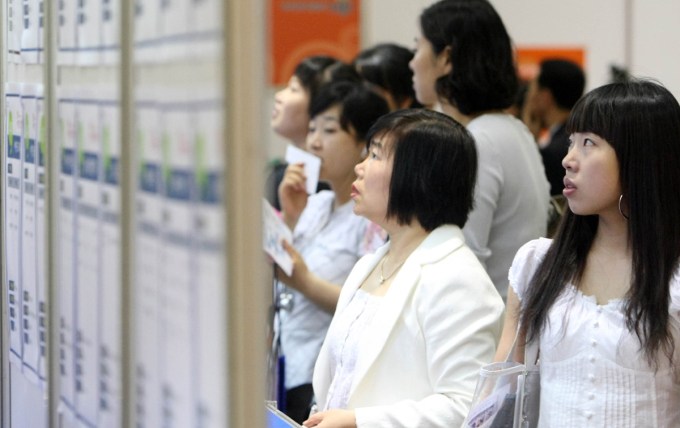
(Source)

‘아프니까 청춘이다’라는 말이 있다. 기왕이면 안 아픈 청춘이면 좋으련만, 우리 시대의 청춘 가운데 99%는 현실의 높은 벽에 부딪혀 아프고 절망한다. 20대라면 누구나 잠시 거쳐가는 성장통일까? 아니면 경쟁을 강권하는 우리 사회가 만들어 낸 어쩔 수 없는 아픔일까? 후자라면 ‘어디’를 점령해야 해결될 문제인지 고민해 볼 필요가 있지 않을까? 이런 저런 생각을 하는 동안 그녀는 “다음에 여기서 검은 정장을 입고 혼자서 술을 마시고 있으면 또 면접 떨어진 줄 아세요”라고 말하며 떠났다.

There is a saying [from the title of a recent book]: “Youth is pain [Lit: “it hurts so you are young”].” That said, a youth without pain would be nice, but 99% of our era’s youth are running into the high wall of reality and feeling pain and despair. Is it the fleeting growing pains that anyone in their 20s feels? Is it the unavoidable pain created by a society that compels competition? If it’s the latter, isn’t it necessary to think about where we need to take control of in order to fix this problem? While I was thinking about that, she said, “Next time, if I’m wearing a suit and drinking alone, know that I’ve failed an interview again,” and left. (end)

Update: See I’m no Picassso for an interesting follow-on post.

(Thanks to Marilyn for the translation)

University Graduates: One Woman Hired for every Four Men

(Source, adapted)

Women – not men – were fired in droves at the start of the 2008 financial crisis. But was that as outrageously sexist as it sounds?

After all, they were the bulk of irregular workers back then, when Korea had a greater percentage of them than any other OECD country. Insecurity was a given, which is why the status and rights of irregular workers was a big political issue years before the crisis.

Also, bear in mind that most single people live with their parents until marriage. So, however patriarchal it was, there was a certain logic in the government concentrating on securing jobs for (overwhelmingly male) heads of households, as husbands would provide for their wives, and fathers for their daughters.

In such strained circumstances, it sounds almost churlish of women to complain about that arrangement.

But women were also the first to be fired during the the 1997 Asian Financial Crisis, back when Korea had the smallest number of irregular workers in the OECD. Indeed, it was generally only this newly emerging irregular work that was made available to women – especially mothers – once the Korean economy began to recover, and accordingly the Korean female workforce participation rate has stagnated at the lowest or near-lowest rate in the OECD ever since, and Korea has by far and away the largest gender wage gap.

Considering this, mere economic rationales of why women have again been treated so differently – badly – by employers in the latest financial crisis should be treated with a great deal of suspicion. In particular, they can’t explain why Korean companies are currently hiring roughly only one female graduate for every four male ones, as the following MK article makes clear:

취업 성차별여대생들의 눈물 / “Sexual discrimination in hiring” [causes] female university students’ tears

31 October 2011

서울 소재 중상위권 대학 졸업반인 이 모씨(25ㆍ여)는 금융권 취업이 목표다. 그는 지난 7월부터 2개월간 한 증권회사 지점에서 인턴사원으로 일하며 우수한 평가를 받아 정규직 전환 1순위로 꼽혔다. 하지만 결과는 실패였다.

The goal of one Ms. Lee (25), member of the graduating class of an upper-mid-level Seoul university, is to get a job in finance.  Starting last July, she did a two-month internship at a branch of a securities company, where her superb evaluations caused her to be considered the top choice to be given a permanent position.  However, she was unsuccessful.

며 칠 후 이씨는 상사에게서 충격적인 말까지 들었다. “미안하지만 본부에서 남자만 뽑으라는 지시가 내려와 어쩔 수 없었다”는 것. 이씨는 “각 지점에서 매긴 인턴 성적은 여성이 훨씬 높았는데도 당시 정규직으로 입사한 여성은 단 한 명도 없었다”며 “다른 이유도 아니고 ‘여자’라서 꿈이 무너졌다고 생각하니 억울하다”고 토로했다.

A few days later, Ms. Lee even heard these shocking words from her superior:  “I’m sorry, but we got instructions from headquarters to only hire men, so there’s nothing I could do.”  Ms. Lee revealed, “Though at each branch, the ranked interns’ marks were much higher for women, at that time there was not a single woman among those hired as permanent employees.  I think my dream was crushed for no other reason than that I’m a woman, and it’s not fair.” (source, right)

극심한 취업난 속에서 여대생들이 취업 문턱에서 좌절하며 눈물 짓고 있다. 여성 고학력화로 곳곳에서 여풍(女風)이 불고 있지만 채용시장에선 남성 지원자를 선호하는 성(性) 차별이 심각한 것으로 확인됐다.

Amid severe unemployment, female university students at the threshold of getting jobs are being frustrated and shedding tears.  Through women’s increased high levels of education, “female wind” is blowing [female influence is making an impact] everywhere, but it has been confirmed that, in the job market, sexual discrimination in favor of male applicants is serious.

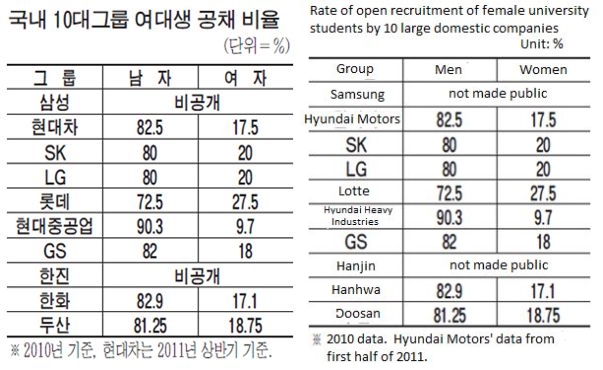
지 난달 31일 매일경제신문이 국내 10대 기업을 대상으로 지난해 대졸 신입 공채 합격자 남녀 비율을 조사한 결과 여성은 신입사원 10명 중 1~2명꼴로 나타났다. 여성 신입사원 비율을 평균 내보니 18.5%로 20%를 채 넘지 않았다.

On Oct. 31, the results of an investigation by the Maeil Kyungjae newspaper into the gender ratios of new university graduates hired by 10 major domestic companies last year found that women made up 1 or 2 of every 10 hires.   They averaged the percentages of new female employees and found it was 18.5%, not even 20%.

(Source)

기업별로 보면 롯데그룹이 27.5%로 가장 높았고, LG와 SK는 20%, GS는 18%, 한화는 17.1%였다. 현대ㆍ기아차는 10% 후반대로 나타났으며 현대중공업이 9.7%로 대졸 여성 신입직원 비율이 낮았다.

Broken down by company, Lotte Group was the highest at 27.5%, LG and SK were at 20%, GS was at 18%, and Hanhwa was at 17.1%.  Hyundai Kia Motors was in the high teens, and Hyundai Heavy Industries had the lowest percentage of women among the recent university graduates they hired, at 9.7%.

최 근 대학생들 사이에 큰 인기를 끌고 있는 두산그룹 기업 이미지 광고 ‘사람이 미래다’에는 취업을 준비하는 여대생이 자주 등장하지만 해당 기업에 여자 신입사원 비중은 18.8%로 매우 낮은 것으로 알려졌다. 두산 관계자는 “업무 특성상 남자 비율이 압도적으로 높아 여성 신입사원 비중이 낮은 편”이라고 말했다. 한진은 대한항공 등 일부 계열사로 공개 범위를 제한했고, 삼성은 공개 자체를 거부했다.

Female college students looking for employment often appear in the corporate image advertisements of Doosan Group, which is gaining popularity among current university students, but it has become known that the ratio of female new employees at this company, at 18.8%, is very low.  A Doosan official said, “The nature of this business is [requires] an overwhelmingly high percentage of men and so a pretty low ratio of women.”  Hanjin limited the range [of information] made public to some subsidiaries like Korean Air, and Samsung refused to release any information.

통계청에 따르면 지난해 여성 대졸자는 27만1773명으로 남성 대졸자(26만8223명)를 10년 만에 처음 앞질렀다. 하지만 대졸 여성 실업자 수는 14만2000명으로 관련 통계 조사를 시작한 후 사상 최고치를 기록했다.

(Source)

According to the National Statistical Office, the number of female university graduates last year, at 271,773, outstripped that of male graduates (268,223) for the first time in 10 years.  However, the number of female graduates who were unemployed was 142,000, the highest on record.

결국 기업들이 여성 인재를 적극 채용할 수 있는 제도적 기반 마련에 미흡하다는 지적이 나오고 있다. 전문가들은 섬세함과 부드러움, 배려심, 소통 능력 등 여성만이 가진 강점에 주목해 기업이 경영전략 차원에서 인식을 바꿔야 한다고 강조했다. 김왕배 연세대 사회학과 교수는 “후기 산업사회로 넘어오면서 남성성을 상징하는 ‘하드웨어 소사이어티’보다 섬세함으로 대변되는 ‘소프트웨어 소사이어티’가 부각되고 있다”며 “소비자 욕구를 잘 잡아내는 기업이 살아남기 때문에 여성 인력 장점을 극대화할 필요가 있다”고 설명했다.

In the end, it is being noted that there is a lack of arrangements for institutional groundwork from which businesses can actively hire talented women.  Experts have emphasized that businesses need to take notice of strengths that only women possess, like delicacy, softness, thoughtfulness, and communicative ability and so change their perceptions at the level of corporate strategy.  Kim Wang-bae, a sociology professor at Yonsei University, explained, “As we become a post-industrial society, ‘software society,’ which represents delicacy, is becoming emphasized over ‘hardware society,’ which symbolizes masculinity.  Because businesses that excel at capturing consumer demands survive, it is necessary to maximize the strengths of female personnel.” (end)

As always, news like this strongly challenges narratives of a glorious future of Korean grrrl power that pervade the English language media about Korea (see here for a discussion of the above video for instance).  But I confess that I was still shocked at the figures above, although perhaps I shouldn’t have been when even an implicit advocate of women’s rights like Professor Kim Wang-bae above subscribes to the same delicate women / tough men worldview that Doosan Group does!

(Thanks to Marilyn for the translation).

Share

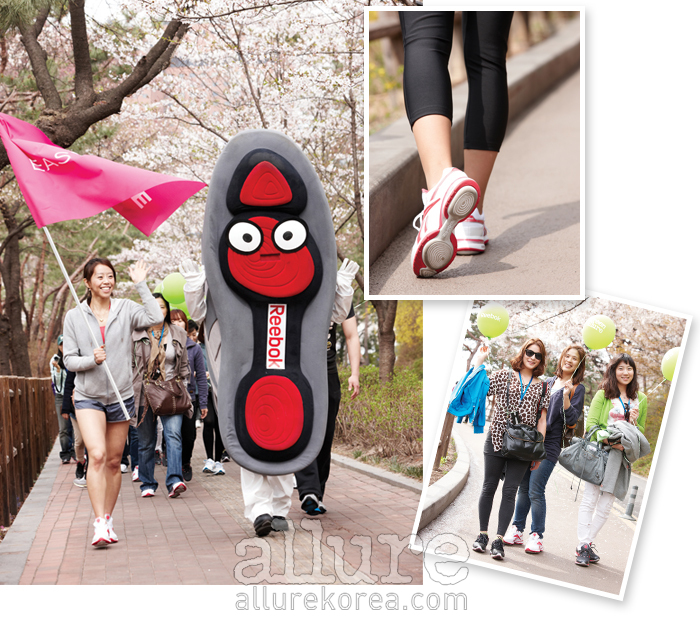
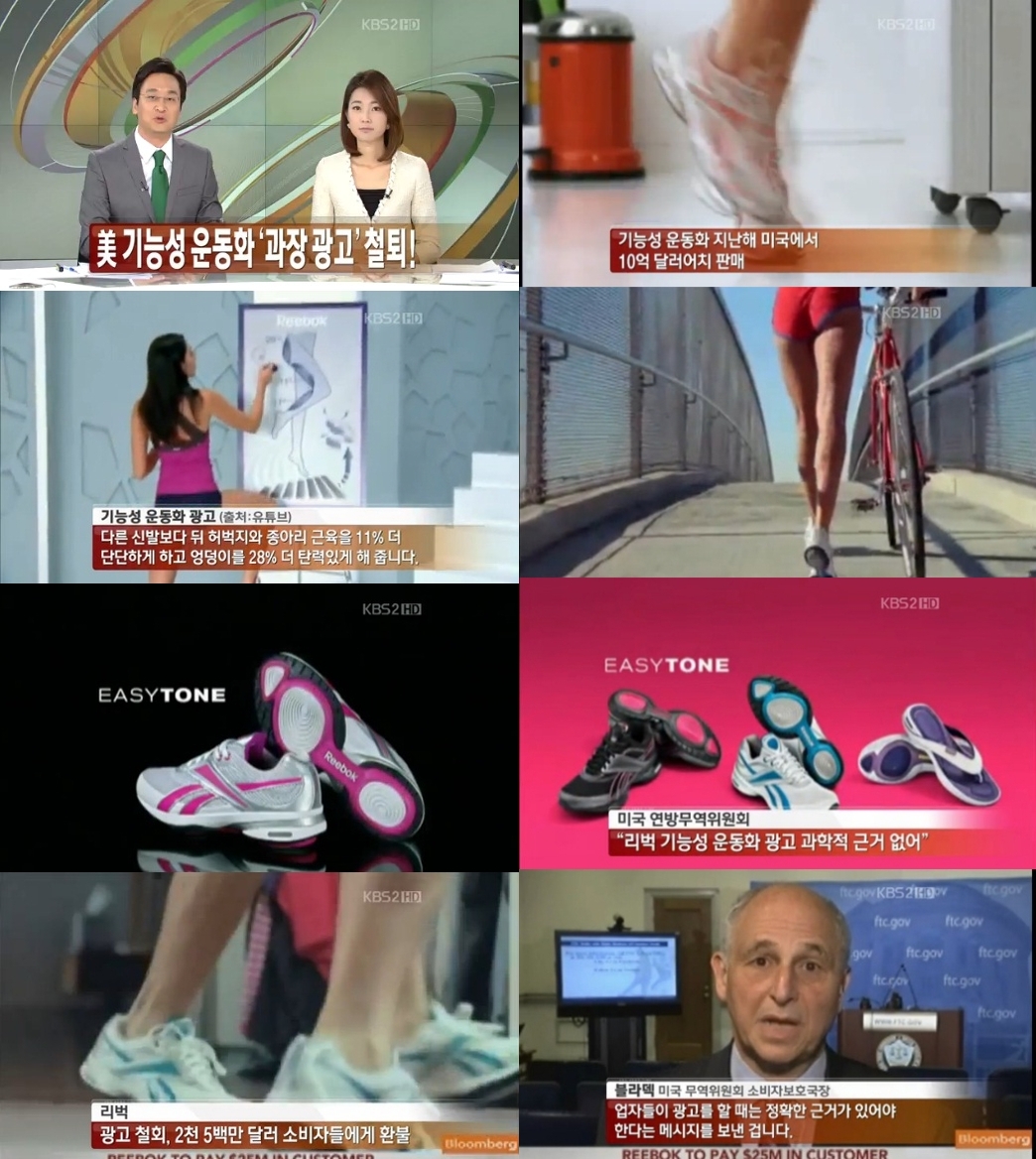
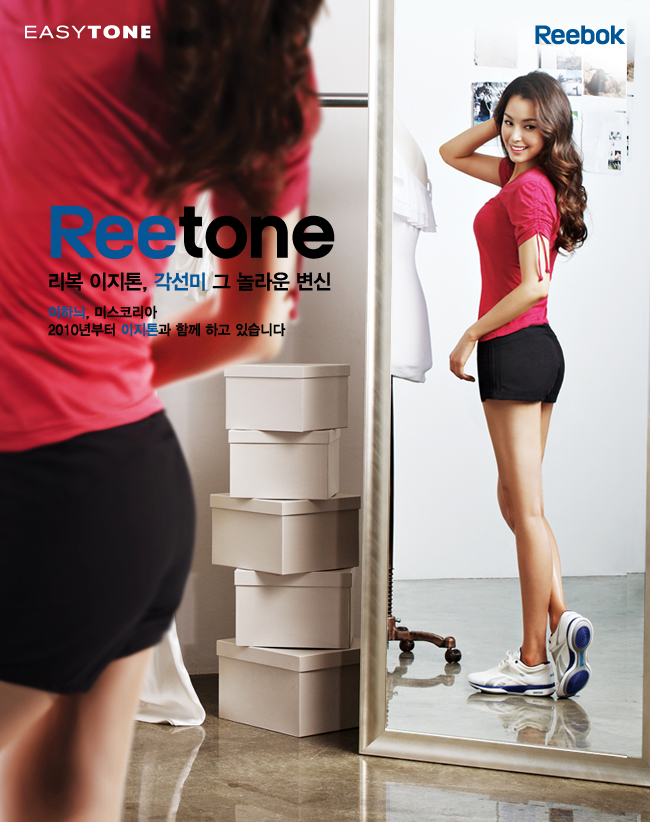
Reebok Assvertising Full of Hot Air: Korean Reactions

(Sources: left, right)

“Speed”, as the New York Times recently intoned, is an “obsession” of Koreans. It’s a cliche, like most labels the foreign media applies to them, but it’s one of the few I’d generally agree with.

Another is that they’re hardworking. While they don’t work quite as many hours as foreign observers tend to think, nobody can deny that they’re always prepared to roll their sleeves up when the boss demands it.

Perhaps then, their boss should consider reviving the 1980s custom of having employees doing traditional national gymnastics together (googminchaejo; 국민체조) before the start of work? For when it comes to losing weight by themselves, Koreans’ obsession with speed easily trumps the resolve they have when they’re on the job.

In short, Korea is simply bursting at the seams with ads promising quick fixes.

To be fair though, I haven’t lived outside of Korea for 11 years, so I can’t reliably claim there’s any more of them here than in, say, the US. The one study I’m aware of that did compare diet ads in both countries however, found that US ones tended to promote more active ways of losing weight, whereas Korean ones tended to promote the idea that if one simply ate, drank, applied, or even sat on the advertised product or service, then that perfect body was simply guaranteed.

That isn’t mere hyperbole. Technically neither foods nor medicines, dieting-related products are a little-regulated, legal gray area in Korea, essentially allowing manufacturers to pretty much make up any claims about them that they like.

It is no wonder then, that Koreans consume them in droves. And I can empathize: once a former gym addict concerned with bulking up, ironically now I have a good 10kg to lose. But with two children, I lack the time, energy, and enthusiasm I had for exercising in my twenties. If only I could just drink something like “Fat-Down” instead, or even this beer (well, actually I have started drinking that). Or sit in this special seat all day. Or use this when I shower. Or, indeed, wear shoes that automatically toned my fat ass just by my walking to and from the subway station each day…

(Source)

Alas, the online Reebok store lists only 5 male versions to 47 female ones, and they’re all a little pricey for me. Perhaps, just like Coke Zero (which has replaced Pepsi in my Black Russians) was so named because men associate the word “diet” with women too much, the disparity is because Reebok felt that men would ultimately reject the idea. And who can blame them? For as just those examples above (and especially these ones) demonstrate, all aimed at women, to say that US advertisements tend to promote active methods of losing weight, Koreans passive ones, is a little simplistic. Instead, it would be much more accurate to say that in both countries, it’s the active methods that get promoted to men, the passive ones to women.

Despite half the population not buying them though, toning shoes are the fastest growing shoe market in Korea at the moment, with ReeTones alone making up half of Reebok’s total sales.

It was with great interest then, that I recently read that the US Federal Trade Commission (FTC) had ordered Reebok to refund 25 million dollars to (gullible) US purchasers of its EasyTone (이지톤) sneakers, finding that its notorious assvertising claims were nothing more than hot air. Would Reebok Korea also be providing refunds? What about other Korean companies offering similar products? Would this be a wake-up call for Korean consumers? What do they think about the news? Read on to find out.

First, from Money Today (머니토다에), taking up from when it starts talking about the effect on Korea:

우리나라에서도 리복은 지난 5월 이지톤 토닝화의 몸매 보정 효과를 대대적으로 홍보하며 판매에 들어갔다. 때문에 업계에서는 공정거래위원회가 어떤 조치를 취할지 주목하고 있다.

In Korea too, there has been an immense marketing drive for EasyTone shoes since May, so the industry has taken a great deal of interest in what measures the FTC would enact.

국내시장에서는 리복 뿐 아니라 뉴발란스, 르까프, 스케쳐스, 휠라, 머렐 등에서 몸매 보정기능을 강조한 토닝화를 시판중이며 시장도 매년 급성장 중이다. 업계 추산에 따르면 국내 신발시장의 전체 규모는 약 4조원. 그중 워킹화와 토닝화 시장 규모는 연간 6000억~7000억원, 브랜드만 총 20여 개다. 매년 40~50%대의 폭발적인 성장세를 보이고 있다.

In the domestic market, it is not just Reebok that sells toning shoes, but also New Balance, Sketchers, Fila, and Merrel, and this market is rapidly growing. According to industry estimates, the size of the entire Korean shoe market is 4 trillion won (US$3.37 billion), of which walking shoes and toning shoes make up 6-7 billion won. More than 20 brands sell them, and each year the market for them has seen explosive growth of 40-50%.

업계 관계자는 “걷기열풍과 함께 워킹화와 토닝화 수요가 2~3년 전부터 급격히 증가하기 시작했다”며 “최근 들어 기능성 운동화는 브랜드별 전체 신발 매출의 70% 이상을 차지할 정도로 잘 나간다”라고 말했다. 그는 이어 “그간 업체들의 광고가 국내 소비자들의 구매의욕을 자극해왔기 때문에 이번 미국 공정위의 조치는 국내시장에도 상당한 영향을 미칠 것”이라고 내다봤다.

An industry insider said “With the new walking craze, the demand for walking and toning shoes started dramatically increasing from 2 to 3 years ago”, and that “these days, sales of  ‘functional shoes’ make up over 70% of the total sales of those companies that sell them”. Accordingly, “because [Korean] shoe advertisements [likewise] stimulate Korean consumers’ desire to purchase them, the FTC’s decision is expected to have a considerable effect [on the Korean market]”.

(Source)

Next, from the Kyunghyang Shinmun (경향신문):

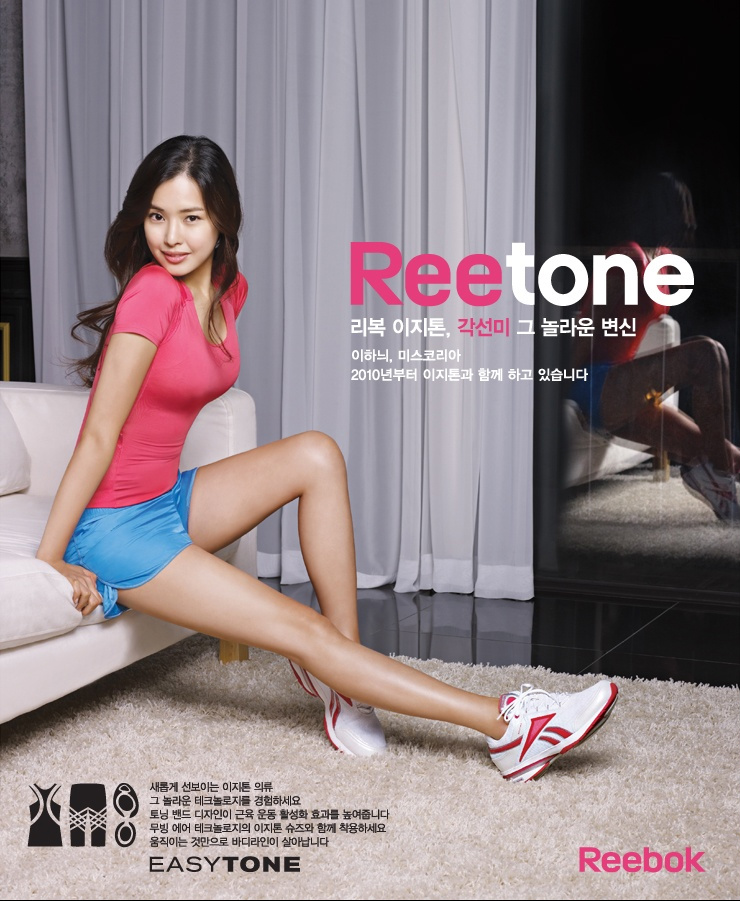
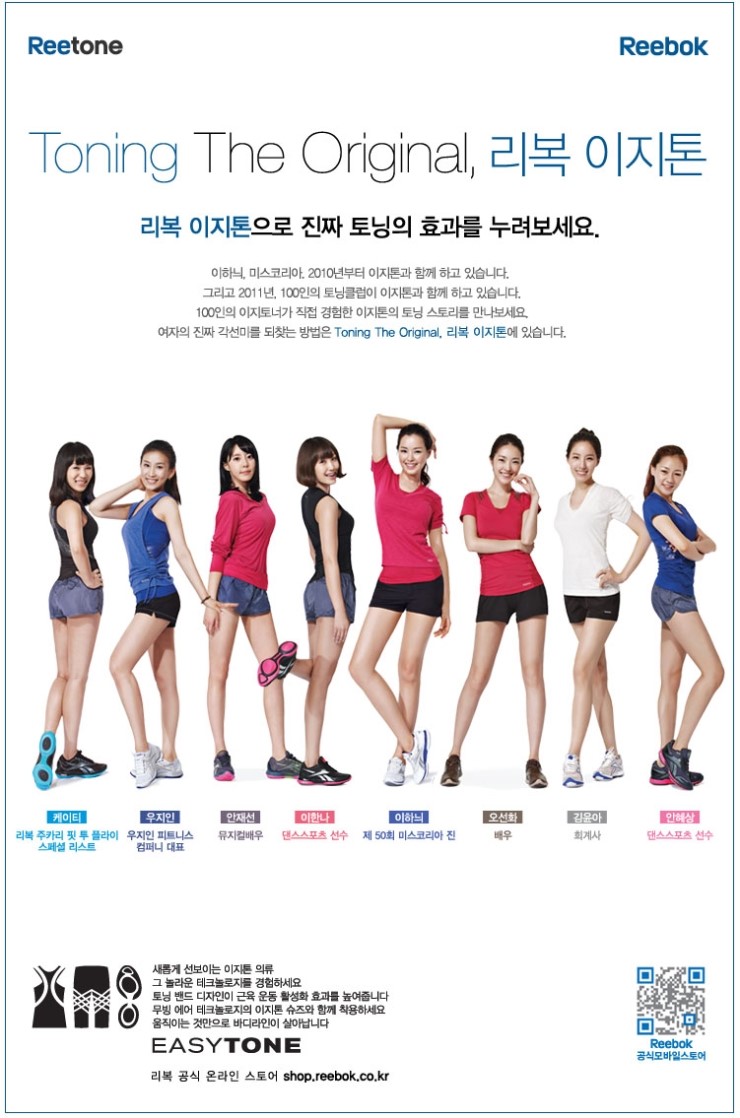
리복 코리아는 미국에서 문제가 된 광고를 그대로 가져와 쓰지는 않았으나 토닝화의 몸매 보정 효과를 홍보해왔기 때문에 국내 광고도 논란이 일 것으로 예상된다. 리복 코리아는 미스코리아 출신 이하늬씨를 광고모델로 기용하고 “움직이는 것만으로 바디라인이 살아납니다”라는 홍보문구를 내걸며 몸매 보정 효과를 강조해왔다.

While the problematic US advertisements were not used in Korea, as the marketing here has likewise emphasized the toning effects of the shoes, Reebok Korea is expected to come under a lot of criticism. [Specifically], Rebook Korea hired former Miss Korea (2006) Lee Ha-nui to emphasize their [claimed] toning effects, using the catchphrase “Just by moving, you’ll get a bodyline”.

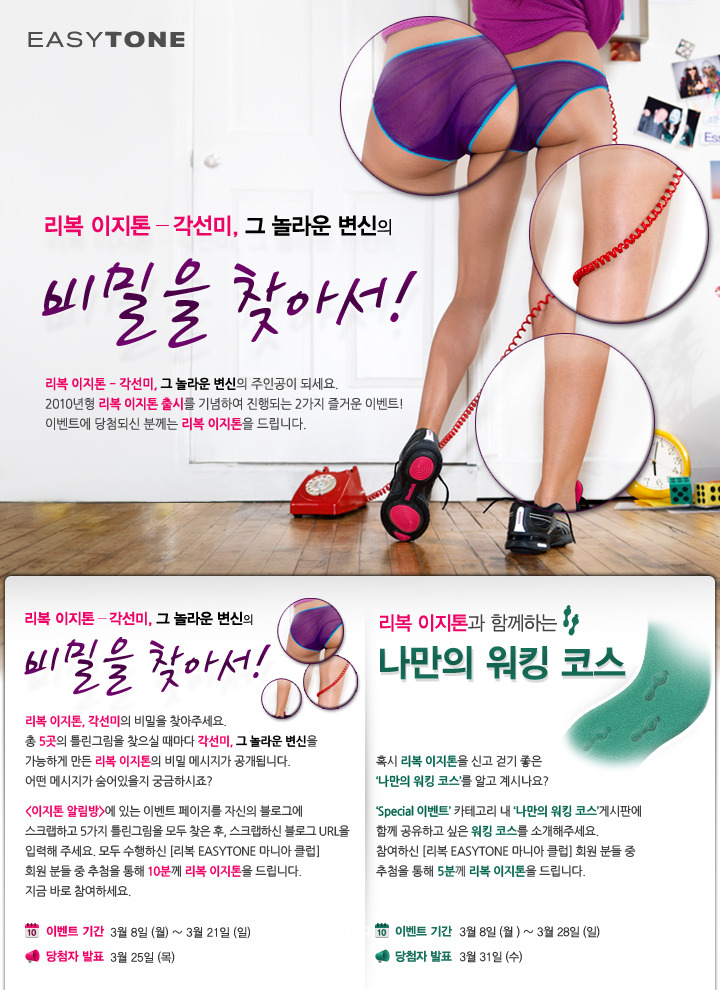
(James – I’m not so sure that the US advertisements weren’t used in Korea. Not only were untranslated versions widely available on the Korean internet from the outset, but many – like the example below – were indeed translated [albeit not literally: “S-line” isn’t English], including the notorious one of a [faceless] women’s breasts griping about all the attention her newly toned buttocks were getting)

(Source)

국내에서는 2~3년 전부터 걷기 열풍이 불면서 리복, 프로스펙스, 뉴발란스, 르까프, 휠라 등이 기능성 신발을 내놨다. 이 시장은 2005년 500억원에서 지난해 6000억원(삼성경제연구소 추정치)으로 5년 만에 10배 이상 커졌다. 이 가운데 대표적인 기능성 신발이 토닝화다. 토닝화는 올들어 워킹화와 러닝화에 밀리기는 했지만 기능화 시장의 성장을 주도했다.

As a walking craze has developed over the last 2-3 years, a number of companies have started producing functional shoes, including Reebok, Prospecs, New Balance, LeCaf, and Fila. According to estimates by the Samsung Economic Research Institute (SERI), the market has grown from 50 billion won in 2005 to 600 billion won in 2010, more than a ten-fold increase in only 5 years.

Of these functional shoes, toning shoes are representative [most popular?], their sales still trailing those of walking and running shoes but leading the growth of the functional shoe market.

국내 한 백화점에서 12만9000~16만9000원에 팔리고 있는 리복 이지톤 시리즈는 지난해 리복 매출의 50%를 차지했다. 리복의 과장광고가 미국 당국의 제재를 받았다는 사실이 알려진 뒤 온라인상에서는 “미국에서 허위광고로 거액을 물게 됐다는데 국내에서는 환불을 해주지 않느냐”는 소비자들의 주문이 이어지고 있다. 리복 코리아 측은 국내 광고 중단이나 환불에 대한 공식 입장을 내놓지 않은 채 “아직 내부적으로 대응방안을 논의하는 중”이라고만 밝혔다. 미국의 유명한 기능화인 스케쳐스도 FTC 조사를 받고 있는 것으로 알려졌다.

In Korean department stores, EasyTone sell for between 129,000 and 169,000 won, and last year made up 50% of Reebok’s total sales. Online, Korean consumers have been asking “In America, Reebok had to pay back a lot of money for its false advertising. Will we receive refunds too?”. But as of yet, Reebok Korea has made no official announcement as to whether its Korean advertisements will be suspended, other than to say “We are still formulating a plan on how to deal with this domestically”.

[Meanwhile], in the US the FTC is also investigating the famous functional shoe manufacturer Sketchers.

스케쳐스 국내 판매업체인 LS네트웍스 관계자는 “미국 스케쳐스에 대한 FTC 조사는 아직 진행 중인 것으로 알고 있다”며 “올해부터 본사 차원에서 토닝화보다는 워킹·러닝 겸용화를 주력 상품으로 밀고 있다”고 말했다.

Sketchers are sold in Korea via LS Networks. A person in the industry said they were aware of the FTC investigation, and that “from last year, Sketchers head office has focused its efforts more on combination walking and running shoes than on toning shoes”.

(KBS Report, September 30 2011. Source)

Finally, from blogger tuesbelle:

과장 광고했다는 이유로 한국 돈으로 3백억원을 환불하고 광고를 중단하기로 했다네요.

아래는 CBS 방송입니다. ㅎㅎㅎ괜히 비싼 거였네요……음…

리복은 지금 한국에서도 몸매 보정 효과를 스타를 앞세워 홍보하며 판매에 들어갔기 때문에 공정거래위원회가 소비자 보호를 위해서 미국처럼 어떤  조치를 취할 지 궁금해지네요. 지금 엄청 잘 팔리고 있잖아요.

Because of exaggerated advertisements, Rebook has had to refund 30 billion won in Korean money, and suspend such advertisements for them. Look at the CBS report below [available on the blog], LOL. The expensive price of the shoes was unnecessary. Um…

In Korea too, because Reebok has used stars to wax lyrical about the toning effects of the shoes, I wonder what measures will be taken here. They’ve been selling unbelievably well these days.

사실 리복 뿐인가요?

벌써 여러 브랜드에서 난리가 났죠. 이런 토닝화는 뉴 밸런스 및 스케처스, 아식스,프로스펙스 등 많은 업체에서 생산되고 있으며 켤레당  좀 비싼 편에 속하죠.

Is it just Reebok? No, already many brands are involved in the boom, like New Balance, Sketcher, Asics, Prospecs, and so on. All of their toning shoes are really expensive too, yes?

(Source)

미국에서 는  FTC 발표에 대해서 뉴 밸런스는 아무 말도 없었고 논평 요청에 응하지 않았지만 스케처스는 지난 8월 미 증권관리위원회(SEC)에 대한 보고에서 FTC가 ‘쉐이크 업’ 등 자사 토닝화 광고를 조사하고 있다고 밝 혔다네요.

과학적 기능이 아주 조금 들어갔다가 뻥튀기고 되어 나온 걸까요?

저도 스케쳐스 이전 버젼이 있는 데요. 꽤 편하거든요. 어떤 효과가 있는 지는 아직도 못느끼고 있지만 ㅎㅎ :)

암튼 과대 광고로 돈 벌 생각만 한 기업주들은 이번에 제대로 사과하셔야 할 듯하네요. 소비자들도 너무 믿으면 안될 것 같아요.

 In America, New Balance made no statement about the FTC’s decision, but Sketchers said that toning shoe advertisements were [already?] under investigation in the August report of the Securities and Exchange Commission (SEC), in a shake-up of the industry.

Have the scientific functions of the shoes been completely exaggerated?

I have an old version of Sketchers toning shoes. They’re actually really comfortable. [Although] I haven’t noticed any benefit from them yet… LOL :)

Anyway, if companies make exaggerated claims in ads, only thinking about making money, then they should properly apologize. And consumers shouldn’t be so gullible.

(Source)

근데,,,민사소송도 진행중이라던데,,,한국도 하려는 분들이 계실 것 같은데,,,,음….

일단 돈 조금 더 벌려다가 기업 이미지 나빠지고 고객들에게 미움 받고 돈도 돌려줘야 할 판이 되어 버렸네요.

토닝화 중에서 리복이랑 아식스가 제일 이쁘던데,,,,,음…..그게 과학의 값이 아니라 스타 광고와 디자인 값이었나봐요. 일반 운동화와 별 차이가 없다면 가격을 더 내려야 할 듯…한국 리복은 여전히 광고하고 온라인 샵 할인판매 하던데요?

By the way, I heard a civil suit is in progress [in America?]. In Korea too, there will be many people planning to do the same…um…

For starters, the shoe companies were making a little more money, but are now getting a bad image and receiving a lot of hatred from consumers, so they have to pay the consumers back.

Out of toning shoes, I think Reebok’s and Asics’ are the prettiest…um…but I guess the high prices were not for anything scientific in them, but their star ads and their design. If there’s no difference with normal exercise shoes though, then their price should be lowered. How on Earth can Reebok Korea still have ads for them and sell them on their online shop?

앞으로~~~~

한국은 어찌 처리 하려나?? 궁금해집니다.

아식스스포츠, 리복, 나이키, 뉴발란스, 푸마, 프로스펙스, 르까프, 스케쳐스 등등 너무 많은 브랜드의 기능화들,,,,

소비자에게 양심을 지키고 있을 지 기대됩니다.

From now on…

What will happen in Korea? I’m curious.

Asics, Reebok, Nike, New Balance, Puma, Prospecs, LeCaf, Sketchers…there’s so many brands selling functional shoes…I look forward to them keeping their conscience towards consumers

(Source)

환불 보상 TIP: 현재 리복 코리아는 말이 없지만  리복 본사 사이트에 가셔서 구입한 영수증 등의 자료를 영어로 문서화해서

구입을 증명할 경우 보상 받을 수 있다고 합니다. *^_^* 아래 동영상 < sbs 5분 경제 >맨 마지막부분에서 언급합니다.

동영상 03분 50초 정도 맞추세요.

“일단 우리 소비자들도 리복 본사 홈페이지에 들어가면, 인터넷을 통해서 환불 접수를 할 수 있습니다.

다만 영어로 구매를 증명해야하고, 또 번거로운 절차를 밟아야 하는데, 리복 코리아측.

소비자들의 궁금증에 대해서 제품을 판매할 때처럼 적극적으로 책임있는 답변 내놔야 하겠습니다.”

Here’s a tip for getting a refund: at the moment, Reebok Korea hasn’t said anything about it, but if you go the main [English] Reebok site, and convert your proof of purchase documents into English, then you can receive one. *^_^* See the “SBS 5 Minute Economy” news video here [like the last one, stubbornly resisting embedding or recording sorry!] at about 3:50 for more information. As it says:

“First, Korean consumers have to go to the English Reebok site [James – or via the FTC itself here]. From there, they can apply to receive a refund. However, this is a troubling and annoying procedure, as it has to be done entirely in English.

Producers that so aggressively sold such shoes, should be equally proactive and aggressive in fulfilling their responsibilities to consumers”. (end)

(Source)

As I type this a week after the news first broke, unfortunately both the Korean media and consumers seem relatively aloof, with only a handful of stories about it, and fewer still going beyond simply stating the facts of the US case: those 3 above cover pretty much everything I’ve been able to find about the impact on Korea. While that was disheartening, I do think the FTC’s shake-up of the industry means toning shoes’ days are numbered. And that if manufacturers continue to pretend US rulings didn’t occur, then ultimately Korean consumers will express their displeasure with their wallets.

On the other hand, I also find the blogger’s (and SBS news reporters’) sentiments a little naive: with 2/3rds of EasyTones sold outside of the US (and I’d wager a good many of those in Korea), as explained in The Consumerist here and here, then, ironically, Reebok may be just as concerned about the Korean government’s reaction as it was the FTC’s. In which case, it’s no wonder that Reebok Korea hasn’t even acknowledged the FTC ruling, and I certainly don’t expect them to do even that unless Korean consumers force them!

What do you think will happen next? Anybody have EasyTone shoes (hey, we’ve all bought stupid things!), or know somebody that does?

Share

Gender, Consumerism, & Advertising: The Sociological Rabbit Hole

(Source)

Opening my “Gender Advertisements in the Korean Context” lecture these days by talking about erections, I’m loath to end it on something as deflating as domestic savings rates. But then so often am I asked questions afterwards like…

Why are there such sharp distinctions in the ways men and women are presented in ads?

Why are women portrayed passively, weakly, dependent, childishly, and in awkward, unnatural poses to a much greater extent than men?

Why, despite being written about North American advertisements in the 1970s, does Gender Advertisements have such resonance in Korean advertisements today?

…that in my latest version for the 4th Korea-America Student Conference at Pukyeong National University (a highly-recommended 4-week exchange program by the way!), I decided to address the last by providing the data to backup my argument that it was largely because of a shared experience of housewifization. In the actual event though, the students wisely decided that they’d much rather get lunch than ask any more questions, so let me give a brief overview of that argument here instead:

(Source)

In short, housewifization is the process of creating a labor division between male workers and female housewives that every advanced capitalist economy has experienced as it developed, essential and fundamental to which is the creation of a female underclass that acquiesces in this state of affairs, finding self-identity and empowerment in its consumer choices rather than in employment. Lest that sound like a gross and – for the purposes of my lecture – rather convenient generalization however, then let me refer you to someone who puts it much better than I could. From page 60-61 of this edition of The Feminine Mystique (my emphases):

(Source)

The suburban housewife – she was the dream image of the young American woman and the envy, it was said, of all woman all over the world. The American housewife – freed by science and labor-saving appliances from the drudgery, the dangers of childbirth and the illnesses of her grandmother. She was healthy, beautiful, educated, concerned only about her husband, her children, her home. She had found true feminine fulfillment. As a housewife and mother, she was respected as a full and equal partner to man in his world. She was free to choose automobiles, clothes, appliances, supermarkets; she had everything that women ever dreamed of.

In the fifteen years after World War 2, this mystique of feminine fulfillment became the cherished and self-perpetuating core of contemporary culture.

And then this from page 197 of the 1963 edition:

Why is it never said that the really crucial function…that women serve as housewives is to buy more things for the house… somehow, somewhere, someone must have figured out that women will buy more things if they are kept in the underused, nameless-yearning, energy-to-get-rid-of state of being housewives…it would take a pretty clever economist to figure out what would keep our affluent economy going if the housewife market began to fall off.

Ironically, by 2009 more women would actually be working in the US than men. But rather than the result of enlightened attitudes, this was primarily because layoffs were concentrated in largely male industries like construction, and I am unconvinced that the above dynamic no longer applies there.

In Korea however, the exact opposite happened. Moreover, while by no means are modern Korean notions of appropriate gender roles a carbon-copy of those in the United States in the 1960s and 1970s, even if Korean women themselves are saying that the parallels between Mad Men and Korean workplaces are uncanny(!), the fact remains that in a society where consumerism was once explicitly equated with national-security, there also happens to be the highest number of non-working women in the OECD. It would be strange if the gender ideologies that underscore this decades-old combination were not heavily reflected in – nay, propagated by – advertising.

(Source)

This is a simplification of course, one caveat amongst many being that the Korean advertising industry is actually heavily influenced by the Westernized global advertising industry (see this post on the impact of foreign women’s magazines in Korea for a good practical example of that). But, also raising the sociological issues of Convergence vs. Divergence, and the role of Base and Superstructure, the main purpose of my finishing my lecture with that explanation is to leave audiences with encouraging them to think for themselves, by giving them just a tantalizing hint of how deep the sociological rabbit hole goes.

Yes: it’s a cliche, but Gender Advertisements is very much a red pill. In particular, consider what greeted me at work just two days after giving the lecture:

I don’t know their names sorry (anyone?), but I was struck by the different impressions left by the man and the woman’s poses. Whereas he seems to be engaging the viewer’s gaze, the finger on his chin implying that he is actively thinking about him or her, in contrast the woman’s “bashful knee bend” and “head cant” make her appear to be merely the passive object of that gaze instead.

For more about those advertising poses, see here and here, especially on how they arguably make the person performing them subordinate in many senses, and – regardless of those arguments – the empirical evidence that women do them in advertisements much more than men. Indeed, while that advertisement was perfectly benign in itself of course, and you possibly nonplussed at my even mentioning it, just a little later that week I saw this similar image with Han Ye-seul (한예슬) and Song Seung-heon (송승헌) in a Caffe Bene advertisement, outside a branch opening close to my apartment:

A close-up:

Granted, the head cant helps frame the couple, and the ensuing contrast between the two models makes for a more interesting picture. But neither explains why it’s more often found on women than on men. Moreover, primed to look for more examples from then on, for the rest of July I saw plenty of advertisements featuring women by themselves doing a head-cant, and a few with men by themselves doing one. But when a man and woman were together?

Call it confirmation bias, but it became a slightly surreal experience constantly only ever seeing the woman doing it (it’s one thing to know about something like that in an abstract sense from academic papers, quite another to experience it for yourself). Here’s an example from a recent trip to Seoul:

A close-up:

Another with Lee Min-jeong (이민정) and Gong-yoo (공유) in Seomyeon subway in Busan:

One more with Wang Ji-won (왕지원) and Won-bin (원빈), commercials of which are playing on Korean TV screens at the moment:

(Source)

Finally, with Jeong Woo-seong (정우성) and Kim Tae-hee (김태희):

(Source: unknown)

Only after 4 weeks(!) of looking, did I finally find a possible example of the opposite in Gwanganli Beach last Saturday (with Song Seung-heon {송승헌} and “Special-K girl” Lee Soo-kyeong {이수경}):

Having told you about the difficulty I had in finding such an ad though, then Murphy’s law dictates that you’ll probably see one yourself very soon; if so, please take a picture send it on, and I’ll buy you a beer next time we’re both in the same city. But it wouldn’t surprise me if I don’t actually hear from anyone until September!

Update 1: Literally just as I typed that last, the headline that “Women till stereotyped in TV ads” appeared in my Google Reader. I should feel vindicated, but I actually find the study described quite superficial, the conclusions meaningless without reference to that fact that roughly 75% of Korean advertisements feature celebrities. Still, I’ll give the National Human Rights Commission the benefit of the doubt until I see Korean language sources.

Update 2: The Korea Herald also has an article on the study, but it’s virtually identical.

Share

It’s Official: UNDP Says Korea Now Feminist Paradise (NOT April 1 Joke!)

(Source: unknown)

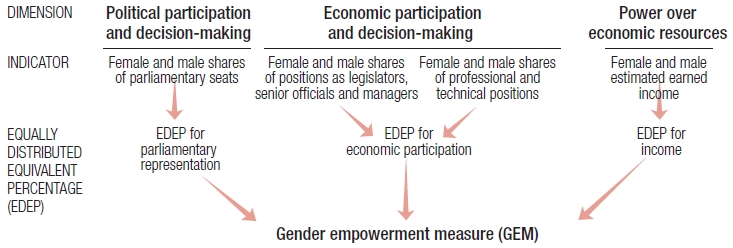
If there was only one statistic that best sums up contemporary Korean society, then that would be its “Gender Empowerment Measure” (GEM). Calculated by the UNDP, it is:

…an indicator of women’s degree of participation in political and economic activity and the policy-making process, using for its evaluation factors such as the number of female legislators, the percentage of women in senior official and managerial positions, the percentage of women in professional and technical positions, and the income differential between men and women (source).

Or, to put it graphically (see here for more details):

And why Korea’s GEM is so revealing is not just because of its abysmal ranking, which, at 68th out of 179 countries surveyed, is bested even by developing countries such as Kyrgyzstan, the Dominican Republic, the Philippines, Vietnam, Moldova, Botswana, and Nicaragua. Rather, it’s because that rank is so out of sync with its other rank of 25 in the Human Development Index (HDI), which measures a country’s  standard of living. Surely, as I explained two years ago, there is no greater testament to the palpable gender apartheid here, than the fact that Korea does such a good job of educating and taking care of the health its citizens, only then to effectively exclude fully half of them from political and economic power?

(Source: unknown)

Mentioning this in a conference paper I’m writing on Korean girl groups however, as one does, earlier today my coauthor quite reasonably asked me if a more up to date ranking wasn’t available?

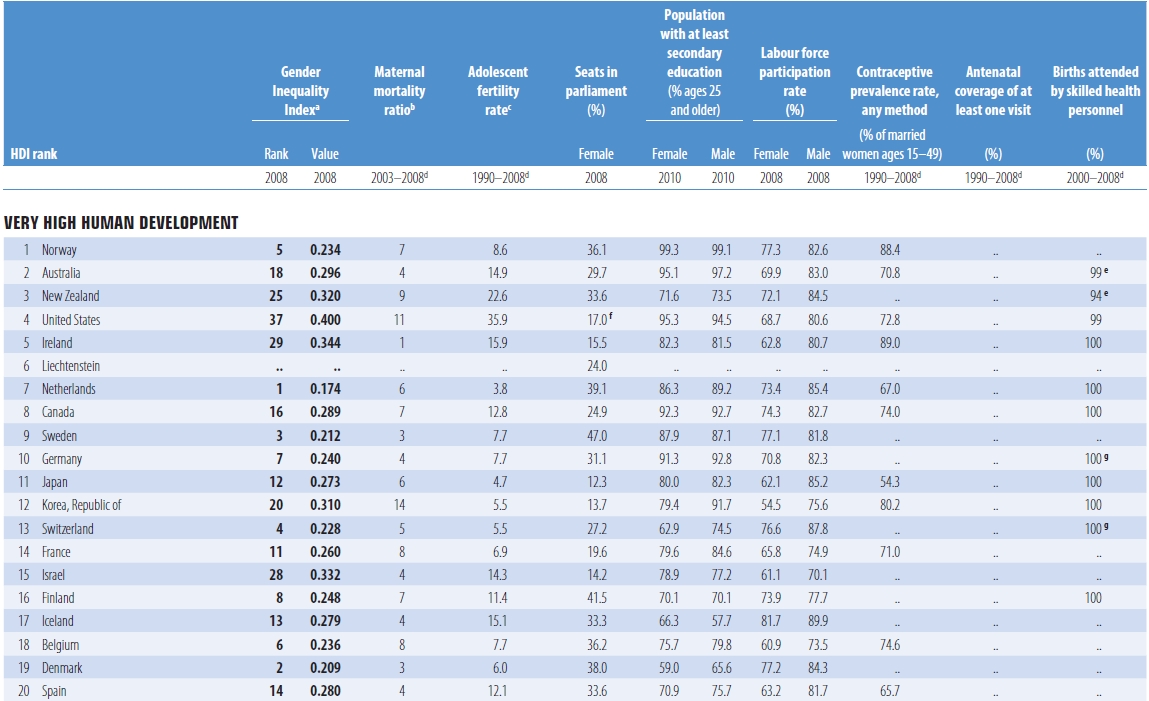
Alas, no. But there did appear to have been some recalculating of the 2008 figures done, with the first thing I saw from my search giving Korea a new ranking of, well, 20th best in the world:

Needless to say, I did a double-take. And indeed, as most of you have probably already guessed, actually the GEM has been abolished. Instead, Korea now has a ranking of 20 in what’s called the “Gender Inequality Index” (GII), calculated according to the following criteria:

What to take away from this? Well first, if I do say so myself, that it’s a pretty interesting thing to end up with, having originated from a paragraph that just one line earlier discusses Girls’ Generation’s signature hot pants.

But more seriously, I do want to stress the incredible achievements that Korea has made in terms of affordable, quality healthcare, well-illustrated by a recent anecdote from Ask a Korean! on a Korean stroke victim in New York, who quite rationally choose to fly 13 hours back to Korea rather than be treated in a hospital there. And it’s also indicative of how dangerous it can still be for women to give birth in many parts of the world, with 1 in 16 new mothers dying in Sub-Saharan Africa for instance, that the UNDP has good reason to think that the Maternal Mortality Ratio needs to be considered in any worldwide measure of gender inequality.

Nevertheless, while budding Canadian politicians, for example, are already taking advantage of their country’s new ranking behind Japan (yet another new paragon of feminist virtue) to say it’s all the government’s fault, it’s probably Korea jumping from 68th to 20th that should be getting the most attention. After all, albeit with apologies to long-term readers for the frequent mention, it does have: among the lowest female workforce participation rates in the OECD; the lowest rate of employment for educated women in the OECD (in fact, Korea is the only country in the OECD where the more educated the woman, the less likely she is to be employed); the largest gender wage gap in the OECD; only 13.7% of its legislators women; and a President that encouraged the mass firing of women to get over the latest financial crisis.

(Source)

At the very least then, Korea’s example seriously questions the applicability of the GII to developed countries. But can readers can think of any other issues raised?

Share

Is Divorce in Korea Finally Socially Acceptable?

(Source)

Sorry for the lack of posts recently, and the very short notice with this one, but in an hour from now (7:45pm Korean time) I’ll briefly be on 101.3 TBS eFM’s evening show, talking about the title topic. For the details, see here, and note that unfortunately you can only listen live on Internet Explorer sorry.

Update – Well, that was a little embarrassing: because of a miscommunication, technical problem, and/or a last minute editorial decision, I didn’t actually get called in the end!

But for anyone still interested in the subject though, then I was going to mention that while on the one hand the stigma surrounding divorce is certainly disappearing over time, with 1 in 4 marriages now involving a divorcee and in particular both the numbers of women remarrying and their rate of increase outstripping those of men, on the other hand the profoundly gendered effects of the recent economic crisis here have left Korean women more financially reliant on their husbands than ever, as explained at #2 here, here, and #15 here.

Meanwhile, see here for more information on both the high rates and the practicalities of getting a divorce in Korea, and here for more on the hoju or family-registry system (호주), which had a huge role in drawing attention to people’s marital status (or parents’ status) and consequently being able to discriminate against them on that basis. Moreover, although that has recently been abolished, one final point I was going to make was that unfortunately that’s just one of many superfluous things corporations take into account in their hiring practices, as demonstrated here, at #8 here, here, here, and here, and so it’s probably going to take a while before Korean business culture catches up with the social reality.

Share

Sexual Harassment in the Workplace & the 2001 Equal Employment Opportunity Law: What Still Needs to be Done

(Source)

With thanks very much to Marilyn for the translation of the following article from Ildaro (일다), I’ll quickly let it speak for itself:

고용불안 속, 직장내 성희롱 위협 커져

In the midst of employment instability, the threat of workplace sexual harassment increases

고용평등상담실 10년, 여성노동의 현실과 미래를 말한다(2)

10th year of the Equal Employment Counseling Office, discussing female employees’ present and future

[편집자 주] 2001년 남녀고용평등법 4차 개정으로 고용평등상담실 지원제도가 도입된 지 10년이 되었습니다. 민간단체들의 고용평등상담실은 그동안 여성노동자들의 실질적 보호장치로 기능해왔으며, 여성노동자들이 처한 현실을 사회에 고발하는 창구역할을 해왔습니다. 일다는 여성노동자회와 함께 고용평등상담실에 접수된 상담사례를 통해 IMF 경제 위기 이후 후퇴 일로를 걷고 있는 여성노동의 현실과 과제를 살펴보고자 합니다. 필자 황현숙님은 현재 서울여성노동자회 회장을 맡고 있습니다.

우 리 사회의 성폭력 문제는 온 국민이 알게 된 끔찍한 아동 성폭행, 유명 정치인의 성희롱 등으로 자주 언론에 오르내리는 이슈가 되었다. 직장내 성희롱으로 고용평등상담실의 문을 두드리는 여성들의 호소 또한 가벼운 성적 농담이나 접촉을 넘어서 심지어는 강간에 이르는 경우조차 발생되고 있다. 직장내 성희롱은 그 자체가 미치는 정신적․신체적 악영향, 노동환경의 악화뿐만 아니라 일자리 자체까지 위협받게 된다는 데에 그 심각성이 있다.

[Editor’s note] It’s been 10 years since the Equal Employment Counseling Office support system was introduced through the 4th Amendment to the 2001 Equal Employment Opportunity Law.  During that time, the Equal Employment Counseling Offices of private organizations have been functioning as female workers’ practical safeguards and have acted as liaisons that report to society the realities that female workers encounter. Through the case consultations received in the Equal Employment Counseling Office, Ilda and the Women Workers Association intend to look at the realities and problems of women workers, who are losing ground after the 1997 Asian Financial Crisis.   Author Hwang Hyun-sook  is the current head of the Seoul Women Workers Association.

Through incidents of horrible child molestation, a famous politician’s sexual harassment, and others of which the entire nation is aware, our society’s problem with sexual violence has become an issue that often comes up in the press.  According to the complaints of women workers who’ve knocked on the Equal Employment Counseling Office’s door because of sexual harassment, there are also cases occurring that surpass light sexual jokes or touching to go as far as rape.  Workplace sexual harassment itself not only has bad mental and physical effects and worsens work environments, but is even of such a magnitude that jobs themselves [of victims] may be threatened.

(Source)

일자리 위협으로 이어지는 직장내 성희롱

“과장이 ‘피곤하지?’라며 손, 팔을 주물러 너무 불쾌하여 늘 가슴을 조이며 지냈어요. 어느 날 허벅지를 만지기도 하여 우울증에 시달리다가 문제제기를 하였더니 그 후 재계약을 하지 않겠다는 통보를 받았어요. 성희롱으로 실직하게 된 것 같아 너무 억울해요.”(2009년 상담사례, 계약직)

“사 장님이 자꾸 만나자고 하면서 ‘옆에 오면 가슴이 떨린다. 만나면 안고 싶고 무릎을 베고 누워 얘기도 하고 싶고 즐기고 싶다. 나를 받아 줄 수 없냐.”고 하더라고요. 남자에 대해 관심이 없다고 거절했더니, 부장을 통해 퇴사하라는 통보를 받았는데……“(2009년 상담사례, 2개월 근무)

성희롱 가해자가 사업주, 상사 인 상담은 매년 75~85% 가량이다. 가해자가 인사권을 직접 가지고 있는 경우가 많아 성희롱을 거부하거나 문제제기했을 경우에는 직. 간접적인 괴롭힘으로 스스로 그만두게 하거나 권고사직, 심지어 다른 사유를 들어 해고하는 사례들도 나타난다. 그래서 성희롱이 발생해도 공론화하기 어렵고 이를 은폐하도록 가해자가 권력을 행사하기도 한다.

Workplace sexual harassment extending to job threats

“My manager would ask, ‘Are you tired?’ and massage my hands and feet; it was so uncomfortable and I always went around feeling anxious.  One day he even touched my thigh and so while suffering from depression, I made a complaint; because of that I received notice that my contract wouldn’t be renewed.  I became unemployed because of sexual harassment – it’s so unfair.” (2009 counseling case, contract worker)

“The president of the company often asked me out and said ‘When you come near me my heart pounds.  If we go out I want to hold you, put my head in your lap and talk, and have fun.  Can’t you accept me?’  I refused, telling him I wasn’t interested in men, and through the general manager I received notice that I was to resign…” (2009 case consultation, working for 2 months)

Every year, about 75-85% of the consultations are ones in which the perpetrator of sexual harassment is the business’ owner or victim’s boss.  There are many cases in which the perpetrator is directly in charge of the company’s human resources.  Because of this, when the victim has rejected the perpetrator’s advances or made an official complaint, there have been cases in which the perpetrator may cause her to quit though direct or indirect harassment, urge her to resign, or even find grounds to fire her.  Therefore, even though sexual harassment occurs, making it public is difficult and the perpetrator often exerts his authority to conceal it.

(Source: unknown)

성희롱의 온상, 회식자리 남성중심 문화

“입 사한지 1주일 만에 본사 간부급 직원들과 회식자리가 있었어요. 간부들이 버릇인양 손잡기, 어깨동무하기, 허리 감싸기, 끌어안기, 볼 부비기……. 마치 간부들을 위해 여직원들이 대접하는 자리 같았는데 어렵게 입사하여 그만둘 수도 없고 어찌해야 할지……” (2007년 상담사례, 정규직)

“회 식 2차로 노래방에 끌려가다시피 갔어요. 술 마신 남직원들이 안으려고 해서 피했는데, 갑자기 뒤에서 끌어안더니 들었다놓았다하는데 과장, 계장 모두 묵인하고, 계장은 블루스를 추자고 하더라고요. 그래서 울면서 집에 왔는데 동기들도 다른 구청이나 동사무소 근무하면서 회식자리 성희롱 때문에 너무 힘들어 해요. 블루스를 춘 여직원한테는 잘해주고, 안 추면 욕하고 못살게 군다고 하더라고요.” (2007년 상담사례, 공무원)

회 식문화가 변하는 곳도 생겨나고 있지만, 회식자리에서의 성희롱은 지금도 일상적으로 일어나고 있다. 회식자리는 직장내 위계적 관계의 연속으로 상사의 기호에 맞추어야 하고 그의 요구에 따라야 하는 업무의 연속처럼 진행된다. 우리 사회의 남성 중심적인 문화, 위계질서가 이어지는 회식 문화는 여성들의 고용환경을 악화시키는데 일조하고 있다.

The hotbed of sexual harassment, office dinner male-centric culture

“I was at an office dinner with head office management-level employees only a week after joining the company.  The executives had habits of holding my hand, putting their arms around my shoulders and waist, hugging me, pressing their cheeks against mine…   It was like a place for the female employees to serve executives; it was hard to get a job here so I can’t quit and [don’t know] what to do…”  (2007 case consultation, regular employee)

“I went to the second [drinking-heavy] part of our office dinner like I was being dragged.  Male employees who were drinking were trying to hug me so I avoided them; suddenly I was embraced from behind and picked up and put down.  The manager and section chief overlooked everything, and the section chief asked me to slow-dance with him.  So I came home crying; also my peers who work at other district offices or dong offices have a really hard time because of sexual harassment at office dinners.  They say the female employees who slow-danced are treated well, and if you don’t dance they curse and treat you badly.” (2007 case consultation, government employee)

There are places where office dinner culture is changing, but sexual harassment at office dinners happens regularly even now. Office dinners progress similar to the  business itself, in which one must adjust to the preferences of a superior ahead of one in the workplace’s hierarchical relationships, and follow his demands.  Our society’s male-centric culture and hierarchy-connected office dinner culture lead to the worsening of women’s working conditions.

(Source)

친밀한 관계가 질곡인 영세소규모사업장 성희롱

“5 명도 안 되는 회사에서 근무한지 2개월인데 사장이 아침부터 술을 먹자고 하고, 남자친구랑 몇 번 하냐고 묻고 ‘나랑 애인 같은 거 하자’는 소리를 자꾸 해요. ‘이런 소리 들으려고 일하는 거 아니다’라고 말하면 무릎 꿇고 안한다고 하면서도 술만 마시면 또 그러니 일자리가 아니라 고문받는 자리 같아요.”(2008년 상담사례)

“연 말에 사장이 송년회를 가자고 해서 부담스러웠지만 가게 되었어요. 결국 2차까지 가게 되었는데 노래방에서 강제로 키스를 하고 옷 속으로 손을 넣어 몸을 만졌어요. 거부하면서 강하게 밀쳤더니 “난 사장이고, 넌 경리야”, “너 내일부터 나오지 마.”라는데, 다시 직장을 알아보면서 화도 나고 얼굴 보는 것도 두렵고 생각할수록 화가 나고 억울해요.“(2008년 상담사례, 사업주와 2명 근무)

영세소규모사업장의 성희롱은 가해자가 사업주인 경우가 많아 실질적인 법적 조치가 어려운 점, 성희롱 예방교육 특례조항 적용 사업장이라 예방교육이 실시되지 않는다는 문제점이 있다.

업 무적으로 둘만이 접촉하는 경우가 많아 사업주의 부당한 성적 요구나 사적인 친밀감을 성적 언행으로 표시하는 경우도 잦다. 성희롱을 거부하면 바로 그만두라는 통보를 받는 노동권 위협의 문제도 크지만, 매일 가까운 곳에서 얼굴을 마주쳐야 하니 버티고 싶어도 버티기 어렵다는 어려움이 있다.

Sexual harassment in a small business bound by close relationships

“I’ve been working for 2 months at an office that doesn’t even have 5 people in it; from the morning on the president suggests drinking together, asks me how many times I do it with my boyfriend, and keeps saying ‘Let’s date or something’. When I say, ‘I don’t work in order to listen to this kind of noise’, even though he gets on his knees and says he won’t do it [anymore], when he drinks, he gets like that again, so it’s like a torture chamber, not a workplace.” (2008 case consultation)

“At the end of the year, the president wanted to have an end-of-the-year party, so I went though it was annoying.  I ended up going to the second part and at a karaoke room he forcibly kissed me and put his hands under my clothes and touched me.  I refused him and pushed him hard so he said ‘I’m the president and you’re the bookkeeper’ and ‘From tomorrow, don’t come in [to work] anymore.’  I’m looking for another job and I feel angry and afraid of seeing his face, and the more I think about it, the angrier I get and the more unfair it feels.”  (2008 case consultation, office with company president and two people)

There are many cases in which the perpetrator of sexual harassment in a small business workplace is the business owner, so real legal measures are a challenge, and they are workplaces to which the Sexual Harassment Prevention Education Exception Clause applies, so there is the problem of prevention education not being implemented.

There are many cases in business in which two people only have contact with each other, so cases in which the business’ owner expresses his unjustified sexual demands or personal feelings of intimacy through sexual speech and behavior also frequently occur.  If victims rebuff the sexual harassment, the labor rights-threatening problem of immediately receiving notice to quit is serious, but there is also the drawback that because they have to see the other person’s face nearby every day, even though they want to endure it [keep working], enduring it is difficult.

(Source)

늘어나는 서비스직, 늘어나는 고객에 의한 성희롱

“고객센터에서 근무하고 있는데 외주업체 소속 강사가 메신저로 ‘만나자, 남자친구와 몇 번 했냐는 등의 말과 스킨십을 하는데 법적으로 어떻게 처리할 수 있을까요?” (2009년 상담사례, 텔레마케터)

“노 인돌보미 일을 하고 있는데, 고객이 70세인데 전직 교장이래요. 첫날부터 자꾸 몸을 밀착해오고 ‘젊은 사람이 곁에 있으니 내가 다시 남성이 되는 느낌이다’, 어제는 노골적으로 ‘아랫도리가 되살아난다’며 치근대 괴로워요. 어떻게 해야 할지…….“(2009년 상담사례, 45세)

고 용형태와 업무 방식이 다양해지면서 업무상 맺는 관계의 폭도 다양하고 복잡해졌다. 협력업체나 거래처 직원, 대인서비스직의 성희롱도 다양하게 나타난다. 그리고 간병이나 노인돌봄 같은 사회서비스 일자리가 늘어남에 따라 재가 돌봄서비스에 종사하는 여성들의 성희롱 피해상담도 늘어나고 있다.

Increasing service-industry workers, increasing sexual harassment by customers

“I work in a customer service center.  A supervisor [actually she uses the word for “lecturer” but I think that’s a mistake] affiliated with our subcontractor says things on Messenger like ‘Let’s go out’, ‘How many times have you done it with a boyfriend?’ and so on, and does skinship [touching like they’re in a relationship].  How can I deal with this using the law?” (2009 case consultation, telemarketer)

“I work in elder care.  My patient is 70 years old and says he used to be a school principal. From the first day he has often pressed up against me and said ‘Because there’s a young person at my side I feel like I’m becoming a man again’ and yesterday, saying bluntly, ‘My lower body is coming back to life”, he made pass at me; I’m really upset.  [I don’t know] what to do…” (2009 case consultation, 45-year-old)

As types of employment and ways of conducting business are diversifying, the range of relationships formed through business is also diversifying and becoming complicated. Sexual harassment of employees of subcontractors or clients, and personal service workers also presents itself in various ways.  Also, in line with the increase in social service positions like nursing or elder care, sexual harassment victim counseling for women working in in-home care is also increasing.

(Source)

성희롱은 사적인 일?

“남자 동료가 수시로 농담을 하면서 뽀뽀하자, 너도 밤일 할 줄 아냐는 등 수치심을 갖도록 하여 회사에 제기하였는데, 개인의 일이라고 개인적으로 대응하라고만 하는데……”(2009년 상담사례)

직 장내 성희롱은 안전한 환경에서 일할 노동권과 직접 관련이 있다. 그래서 남녀고용평등법에서도 직장내 성희롱을 금지하고 있을 뿐만 아니라, 사업주의 의무로 △직장 내 성희롱의 예방을 위한 교육 실시△성희롱 행위자에 대하여 징계나 이에 준하는 조치를 취할 것△피해자에게 해고나 다른 불이익 조치를 하지 말 것을 규정하고 있다. 그런데도 성희롱이 발생하여 이를 사측에 문제제기하면 위의 상담사례처럼 개인적인 일로 치부해 버리는 문제들이 여전히 일어나고 있다.

Sexual harassment is personal business?

“A male coworker often makes jokes and says, ‘Let’s kiss’, ‘Do you too know how to do night work [sex]?’ and other things to humiliate me so I made a complaint to the company.  They said it was personal business and just told me to deal with it privately…” (2009 case consultation)
Workplace sexual harassment is directly related to the employee’s right to work in a safe environment.  Therefore, the Equal Employment Opportunity Law not only prohibits workplace sexual harassment, it also stipulates, as the business owner’s duty, 1) implementation of education for the prevention of sexual harassment in the workplace, 2) disciplinary action, or taking steps in accordance with disciplinary action, against the perpetrators of sexual harassment, 3) not firing or taking other disadvantageous action against victims.  However, when sexual harassment occurs and is reported to the management, problems with it just being regarded as personal business, as in the case consultation above, are still coming up.

(Source)

고용평등상담실 통해 가해자의 공식사과와 징계 등 확보하기도

“부 원장님이 간호사들에게 안마를 해달라고 하거나 성적인 얘기도 잦아 힘들었어요. 며칠 전에는 맨발로 제 다리를 쓰다듬었는데 징그럽고 수치스러운 느낌 때문에 정신과 상담까지 받았어요. 그런데 고용평등상담실에서 도와주셔서 부원장은 공개사과와 감봉처분에, 병원 전체에 성희롱예방교육까지 실시하게 되었답니다!”

“과장님 성희롱 때문에 괴로웠는데 상담실에서 도와주셔서 공개사과도 받고 가해자는 다른 근무지로 전출되어 얼굴보지 않고 근무할 수 있게 되었어요!”

직 장내 성희롱 자체가 노동환경을 악화시키고, 이를 문제제기하면 해고나 불이익이 따르기도 한다. 그러나 다른 여직원들을 위해서라도 그냥 있을 수 없다며 이에 맞서 문제를 제기하는 여성들 또한 늘어나고 있다. 이렇듯 권리를 확보하게 되는 사례도 많았지만, 일자리 자체의 불안정이 갈수록 커지면서 적극적인 대응을 주저하는 경우도 많은 안타까움이 있다.

Securing perpetrators’ public apology, disciplinary action, etc., through the Equal Employment Counseling Office

“The vice director frequently asked the nurses to give him massages or talked about sex, so it was difficult.  A few days ago he stroked my leg with his left foot; because of the nasty and shameful feeling, I even got psychiatric counseling.   But the Equal Employment Counseling Office helped me so the vice director’s public apology and pay docking measure, and even sexual harassment prevention education for the whole hospital were implemented!”

“I suffered because of my manager’s sexual harassment, but the Equal Employment Counseling Office helped me so I received a public apology and the perpetrator was transferred to a different workplace so I don’t see his face and I’ve become able to work!”

Workplace sexual harassment itself has a negative effect on a work environment, and if one reports it, dismissal or disadvantages often follow.  However, the number of women saying that, for the sake of other women workers, they can’t just [let it] be and accordingly, making complaints, is rising.  In this way there have been many cases that secured rights, but regrettably, as the instability of jobs themselves increases, there are many cases in which [victims] hesitate to take assertive action.

(Source)

직장내 성희롱 문화? 이젠 바뀌어야

직장내 성희롱을 겪으면 그만두라고 할까봐 참고 견디거나, 문제제기하면 결국 피해자가 그만두게 되는 상황이 더 이상 반복되지 않도록 해야 한다. 지난 해 여성노동자회 고용평등상담실에 접수된 성희롱 발생 사업장의 78%가 성희롱예방교육을 실시하지 않은 것으로 파악되었다. 그러므로 사업장에서는 형식적이지 않은 예방교육 실시해야 하고 사내에서 발생하는 성희롱에 대하여 조사와 조치, 재발방지 대책 등을 마련하여 실시해야 한다.

그 리고 정부는 이런 사항들이 실질적으로 이루어지도록 적극적인 행정지도·감독을 해야 한다. 또한 남성 중심적이 아닌 성인지적 관점의 성희롱 인정, 영세사업장장의 성희롱 예방교육 지원 확대, 돌봄서비스노동의 성희롱 실태조사와 예방교육 및 대책 등을 마련해야 한다. 이를 통해 우리 사회와 직장 전반의 남성 중심적인 문화가 변화될 때 직장내 성희롱에 대한 인식과 대책의 변화 또한 이끌어낼 수 있을 것이다.

Workplace sexual harassment culture?  Needs to change now

We need to make it so that situations in which, if one experiences workplace sexual harassment, they hold back and endure it because they’re afraid of being told to quit, or in which if they report it, they end up quitting, are no longer repeated. Last year, 78% of the workplaces reported to the Women Worker’s Association’s Equal Employment Counseling Center for sexual harassment were places where sexual harassment prevention education had not been implemented.  Therefore, in the workplace, prevention education that is not cursory needs to be implemented, and for sexual harassment that occurs in-house, research, action, recurrence prevention measures, etc., need to be arranged and implemented.

The government needs to use assertive administrative guidance and supervision to make these remedies become reality.  Also, recognition of sexual harassment from a gender-sensitive perspective that is not male-centric, securing support for sexual harassment prevention education for the owners of small businesses, research, prevention education, and measures regarding the sexual harassment of care-industry workers, etc., have to be arranged. When, through these, both our society’s and all workplaces’ male-centric culture changes, they will also be able to lead to changes in the understanding of and countermeasures for workplace sexual harassment.

Share

The Gender Politics of Smoking in South Korea: Part 4

Estimated reading time: 12 minutes. Source: cutilove.

“Smoking Among Men Drops to Record Low” reads a recent headline in The Chosunilbo, with only 39.6% of Korean men over 19 now doing so: a drop of 3.5% from a year earlier, and of 17.1% from 2003. Which is something to be celebrated for sure, but, strangely, the even more amazing news that almost half of women smokers also quit last year barely gets a mention. Why not?

Of course, it may just be an oversight. But there is some context to consider: overemphasizing reductions in the male smoking rate is intrinsic to the Ministry of Health and Welfare’s (보건복지부) tobacco control policies for instance, and it also has a long track record of exaggerating its successes. Possibly then, the report just reflects the Ministry’s own emphases in its press release.

Alternatively, readers too may not have been interested in a paltry reduction of 4% to 2.2%. The rate has always been low, they may have said. And with a 2007 Gallup Korea study finding that 83.4% of Koreans thought that women shouldn’t smoke too, with some even slapping them in the street if they do, then apparently the consensus is that so it should be too.

But given that background, then as you’d expect there is chronic under-reporting of smoking by women, best estimates of their real numbers being closer to 20%. Add the absence of any dramatic social or economic changes to prompt women to give up the habit in droves in just the past year too, then it’s difficult not to conclude that these latest figures are essentially meaningless.

Was a line or two to that effect really too much to expect from a newspaper?

Source: Naver Movies.

But I’ve already discussed both statistical issues and taboos against women smoking in great depth in Parts One, Two, and Three (and in a newsflash), and, with the benefit of *cough* 6 months’ hindsight (sorry), then there’s little more to add on those topics really. Instead, let me continue this series by looking at the ways in which transnational tobacco companies (TTCs) have successfully targeted Korean women ever since the cigarette market was liberalized in the late-1980s, despite legislation specifically designed to prevent that. Fortunately, the journal article I’ll be relying on – Kelley Lee, Carrie Carpenter, Chaitanya Challa, Sungkyu Lee, Gregory N Connolly, and Howard K Koh in “The strategic targeting of females by transnational tobacco companies in South Korea following trade liberalisation”, Globalization and Health 2009, Volume 5, Issue 2 – is freely available for online-viewing or as a PDF download, and is short and very readable, so I’ll just summarize the main points here.

First, some historical context: this is not the first time tobacco companies have encountered strong taboos against women smoking, with attitudes towards it in the U.S. in the 1920s sounding not unlike those of Korea today (in 1922, a woman was even arrested for smoking on the street). The solution was to get women to associate smoking with equality and female emancipation, as ably described in the following segment of The Century of the Self (2009):

If that gives you a taste for watching the full documentary, as I suspect it might, then see here for links to all episodes. If you’d rather just read an explanation though, then let me refer you to towards the end of this short interview of producer, writer, and director Adam Curtis. Or for something even shorter, then this alternative explanation also gives the gist:

Edward Bernays, the man who supposedly invented most modern PR techniques, in the 1920s convinced women to start smoking. Supposedly at the time smoking was considered gross and basically for men only so very few women smoked. The show claims he hired a bunch of women to march in the New York Thanksgiving Day Parade (a big yearly parade) and had them put a pack of cigarettes in their garters. On cue they were all to lift their dresses and light one up. He then told the press to come to the parade because there was going to be a protest for women’s equality. On cue the women light up, the press took photos and reported lighting up a cigarette as the symbol for women’s equality and like over night it was now seen as if you supported equality for women you should be smoking.

And internal TTC documents demonstrate that that same logic has also been applied to emerging markets across Asia since the early-1990s. Focusing more specifically on Korea here though, crucial is the 1989 National Health Promotion Law Enforcement Ordinance, which bans all tobacco advertising, marketing and sponsorship aimed at women and children (yes really, and for more on this enduring paternalistic attitude, see Part 1). This has been circumvented by TTCs in 4 main ways:

Source: Naver Movies

First, if not blatantly targeted at them, then advertising of each cigarette brand remains permitted up to 60 times a year in print media, and “tobacco companies are also allowed to sponsor social, cultural, music, and sporting events (other than events for women and children) using company names but not product names” (pp. 4-5). Consequently, sometimes TTCs have simply used ostensibly “gender-neutral” advertisements to target women, in the mid-1990s the former Brown & Williamson promoting the Finesse brand (sold as Capri outside of Korea) by using romantic imagery of couples for instance.

Next, in the 1990s at least there was a focus on retail distribution in venues which tended to be frequented by young women, such as coffee shops, restaurants, event lunches, bars, nightclubs, and so on. Especially the first, and which is worth expanding on here, as it might sound strange in an era of ubiquitous, smoke-free, multinational chain-stores. But then it wasn’t so long ago that they were the place to hang out for young people, a rare oasis from school, work, and/or extended families living under the one, cramped roof. As described in Yogong: Factory Girl for instance (published in 1988, but really about the 1970s):

Often [18 year-old Sun-hi] goes to the home of a friend from her work. Three or four girls, all from the same factory, may walk together, stopping in at a tea room (다방/dabang) for coffee or cola and to listen to music. Or, if they have less money, they may stop to buy a packaged ice cream confection at the local grocer’s. But whether on the street corner or at the tea room, where, for the price of a drink, one may sit without interruption, there is ample opportunity to see and be seen by boys of the same age. (p. 140)

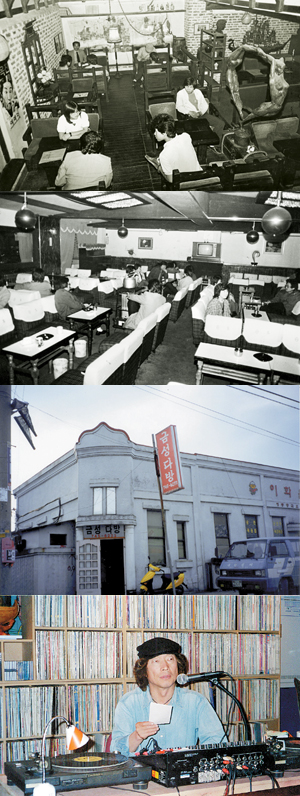
And in particular, in The Joongang Daily (image sourced from article)”

In the 1970s, cafes…became more commercialized, and owners sought to sell an image rather than a drink. “The dabang was a place for socializing. People didn’t care much about the taste of coffee ― and it tasted terrible,” said Mr. Lee.

The hugely popular “music dabangs” were associated with long hair, blue jeans and folk guitarists. Dabang deejays became the idols of teenage girls. When that trend faded, “ticket dabangs” emerged, where sexy hostesses would do more than just pour your coffee.

After half a century of popularity, dabangs started giving way to modern and chic cafes in the 1980s. Specialty cafes such as Jardin and Waltz House ― imitations of Japanese versions of European style cafes ― spread everywhere. This type of cafe, however, had its limits. Despite expensive interiors and espresso machines, the coffee quality was still poor. “Neither cafe owners nor coffee drinkers knew what a cup of good coffee tasted like,” said Mr. Lee.

But in the 1990s, the mantle of coolness suddenly passed away from dabangs:

During my first week in Korea back in 1990, I started going to a small coffeehouse Jardin, just down the street from the language institute where I taught. It was one of these upscale gourmet-type coffeehouses that, according to an article I had read in one of the English-language newspapers, had suddenly started springing up everywhere in the city….Now almost over night, people could choose a variety of coffee concoctions and flocked to these coffeehouses.

This was a big change in the early 90s in Korea. It might have seemed subtle to some people who just wanted to enjoy their coffee, but what was really happening was a break from tradition.

Young Koreans wanted something new and modern. They did not want to hang out in the dank, dark dabangs that were more often than not frequented by middle-aged Korean men and women. Likewise, the tea houses and cafés their parents had gone to in the 70s and 80s were not hip enough for the urban chic beginning to appear.

And as for what happened after 1999, when the first Starbucks opened, then I recommend this recent article in 10 Magazine. But then *cough* this post is actually about gender and smoking rather than coffee per se, so let me just highlight two aspects of that most recent development here.

First, that these new, Western establishments have been more heavily patronized by women than men, as explained by Gord Sellar back in 2008 (and recently expanded upon by him here):

The interesting thing to look at is the emergent young women’s consumer society. I’ve been trawling about online, trying to piece together the story of the Soybean Paste Girl archetype (or, dwenjang nyeo{된장녀}, as she’s called in Korean), and what I’ve found is that almost all of the criticism of this young woman is focused on her female-consumerism. That is: when she buys a coffee from Starbucks for W4,000 (usually about $4, though the won is doing badly these days) coffee, she gets criticized, but when a young man of the same age consumes two bottles of eminently acceptable (read: Korean) soju, nobody thinks to criticize it. The soju, that’s normal, but the Starbucks… that’s all foreign, all “expensive,” and more disturbingly, it’s “girly.” Girls can go there and have fun without men. (Which is doubly threatening to young men who frustratedly already see such women as “out of their league.”) As in, you see women in Starbucks with women, you see women in Starbucks with men. You almost never see men in Starbucks with men. Starbucks, like Gucci and Prada and Luis Vuitton before it, and like Outback and other “Western” restaurants since, are distinctly of appeal to women.

Sources: left, right.

And second, that women are puffing away in droves in them, as I’m no Picasso explained in a comment on Part 3:

It would be interesting to look into the correlation between the development of coffee shop culture in Korean and that of the growth rate of female smokers. I’ve seen maybe five women smoking on the street in my nearly two years in Korea, and at least three of those were ducked into telephone booths or alleys. However. When I sit in the smoking rooms of cafes (which I do quite often), they are often (particularly in the afternoon, when the coffee shops are full almost exclusively of women, with no male audience around to balk) overflowing with groups of young women smoking. A commenter above mentioned the lack of public space available for such behavior. The coffee shop seems to have become a safe haven for women smoking openly in public. I would say the growth of the popularity of coffee shops have encouraged women to be seen, at least here, smoking in public. Which has probably had an influence on the acceptance of the behavior in general, which has no doubt increased its popularity.

Meanwhile, for cigarette advertising at nightclubs then I highly recommend the 2003 Tokyo Inc. article “The Night is Still Young” about a similar strategy in Japan, and which was quite a shock to someone who used to attend dance parties naively thinking they were more about peace, love, unity, and respect:

Liquor and cigarette companies initially started to push their products to Japan’s club generation about five years ago, when new legislation banned them from advertising to people under 20. Since you have to be over 20 to legally enter a club in Japan, clubs become the perfect forum for legitimate advertising to young people. (Advertisers know, of course, that many people under 20 are habitual clubbers who can easily get into the venues). Ishihara calls it a “closed world,” a guaranteed market of self-selected consumers. Indeed, the rapid rise of tobacco sponsorship in clubs and bars since the 1990s globally has been well documented. Corporate sponsorship started conspicuously in Japan in 1996, notes Ishihara, when Grammy award-winning producer and DJ Little Louis Vega received an unprecedented [yen] 3 million from Gordon’s Gin to spin his magic in a Tokyo club.

And, getting back on track now, then a third strategy to circumvent legislation by TTCs has been “trademark diversification”, also known as “brand stretching”. In short, it means to extend a well-known brand to things with which it isn’t traditionally associated, and the article notes that in 1996, Brown & Williamson took great interest in the fact that leading Korean tobacco company KT&G:

…had advertised its brand Simple in numerous magazines aimed at female readers. Strategies included the coupling of cigarettes with bottles of Chanel perfume, and the placement of advertisements in foreign language women’s magazines available in South Korea. (p. 5)

And which as I explain here, are much more popular among young women than Korean magazines. But finally, and semi-related to the last, TTCs also used—again—ostensibly gender-neutral sports sponsorship to discreetly target females, in 1991 British American Tobacco creating “a Kent Golf Sponsorship program targeted at higher-educated, male and females aged 25 years or older with above average incomes” for instance.

But that was 20 years ago. And indeed, one big criticism of this otherwise excellent journal article (and as far as I know, the only one of its kind), is that despite the authors’ searches of internal TTC document searches being conducted between May 2006 and March 2008, literally all the practical examples of TTC strategies to target Korean women they provide are from the 1990s. Why?

Granted, there may be legal reasons and/or questions of access to consider, but these are not mentioned. But regardless, as I type this I’m suddenly left wondering as to if and/or how much they still apply in 2011, and it seems inopportune to continue as intended with more prosaic matters, like, well, how TTCs determined the appropriate cigarette circumference size for the Korean female market.

Source: kkwang.

Instead then, let me reserve that for a new, final Part 5, and I’ll finish here by opening that above question to the floor: what evidence have you yourself noticed of any of the strategies being used by TTCs described here? Or are they a little passé in 2011? And if so, then what else explains why so many young Korean women and teenagers are taking up the habit these days, as explained in previous posts?

(Other posts in the series: Part 1, Part 2, Part 3, Newsflash, Korea’s Hidden Smokers; Living as a female smoker in Korea)

If you reside in South Korea, you can donate via wire transfer: Turnbull James Edward (Kookmin Bank/국민은행, 563401-01-214324)

Korean Sociological Image #50: The Depths of the Red Ginseng Craze

Vodpod videos no longer available.

Are commercials for this product really the same the world over? Put that to the test by quickly trying to guess what is being advertised above, before all is revealed at o:10.

For non-Korean speakers, the powder shown is a combination of ganghwa-yagssoog (강화약쑥), or “medicinally strengthening” mugwort, and hongsam-paoodeo (홍삼파우더), or red ginseng powder. And surely there is no greater testament to believing in its health benefits than by being prepared to use it in the most intimate of places?

Lest my bashful euphemism for VAGINAS detract from that point however, do recall that during the 2008 protests against US beef imports for instance, many Koreans genuinely believed baseless rumors that Mad Cow Disease could be caught via the gelatin used in sanitary napkins. So it makes perfect sense for aptly-named manufacturer Body Fit (바디피트) to capitalize on the belief that what’s inside sanitary napkins can have direct effects on the wearer’s health.

Indeed, red ginseng in particular is even rumored to be an aphrodisiac too.

Still, you could also argue that it actually smacks of desperation by ginseng producers. For – with apologies for the inadvertent pun – one of the first things the commercial reminded me of was the fact that:

…once a market is saturated, I learned at university in New Zealand, there is a inherent tendency for a company’s rate of profit to fall. But this can be offset by re-marketing and/or making new varieties of the original product, and accordingly my lecturer posited the plethora of varieties of Coca-Cola available in the U.S. as a reflection of the greater capitalistic development of its economy (read: saturation of its domestic market) compared to New Zealand’s, which then only had two. Indeed, advertising culture in New Zealand in the late-1990s, he suggested, was only akin to that of the US in the 1950s in its scale and intensity, no matter how brash and “American” New Zealanders regarded it.

( Source: unknown )

And the second was either a Metro or Focus newspaper cartoon I remember from 2005, a satire of the “well being” (웰빙) craze that showed that simply adding a sprinkle of green tea powder to a product seemed to give it health benefits in consumers’ minds, and for which they were prepared to pay a premium for. In particular, the last panel had me laughing out loud on a crowded subway car, for its ads for extremely expensive “Well Being Apartments” built with green tea concrete really hit the spot.

And which just goes to show that not all Korean consumers are gullible as the mad cow disease connection above suggests. And – seeing as we’re talking about vaginas after all – then the latest Western craze for “labiaplasties” for instance, sounds far far worse (see a NSFW video here too).

But hey, if a misguided belief in the health benefits of a product exists, then you can guarantee that companies will exploit it and/or encourage it. And so it seems very strange then, that actually neither sexual potency or health benefits are the stated logic of the commercial, which is rather that the combination of mugwort and red ginseng would eliminate odor. And which my wife assures me is a genuine concern for women, and not an invented concern as I first thought.

But still, would they really be the most appropriate substances for doing so? How about green tea powder, which – you guessed it – is also found in feminine hygiene products in Korea?

Let’s just say I have my doubts. Meanwhile, can anyone also think of any red ginseng (or green tea) products specifically aimed at men? Or, aphrodisiac-wise, is red ginseng actually only supposed to work on men anyway?

Update: Here’s a collection of amusing and/or bizarre “care down there” ads from around the world. Enjoy!

(For all posts in the Korean Sociological Images series, see here)

Share

Conformity and Celebrity in Korean Advertising: Some Quick Thoughts

( Source )

What? Belgian surrealist art on a blog about Korean sociology? Yes indeed; but never fear, for I’ll be criticizing something Korea-related soon enough!^^

The painting in question is Golconda (1953) by René Magritte, and I’m sure many of you have seen it before. But what did you think it was about?

Personally, I’d always assumed it was a critique of conformism. But Charly Herscovici, who was bequeathed copyright on Magritte’s works, commented that (via Wikipedia):

Magritte was fascinated by the seductiveness of images. Ordinarily, you see a picture of something and you believe in it, you are seduced by it; you take its honesty for granted. But Magritte knew that representations of things can lie. These images of men aren’t men, just pictures of them, so they don’t have to follow any rules. This painting is fun, but it also makes us aware of the falsity of representation.

So although our interpretations aren’t mutually exclusive, the painting may not be quite as drab and negative as I thought. Still, does that make the concept suitable for a phone commercial?

Not really:

Vodpod videos no longer available.

No, I can’t really think of any relationship between the artistic concept and the voiceover droning on through the “U” section of the dictionary either. And ironically, the result probably emphasizes conformism and/or uniformity more than Golconda does too; particularly by starting with the word “unique”, only then to visually demonstrate how owning a Galaxy S phone will make you anything but.

Explicitly stating the opposite however, Rain’s (비) recent commercial for the SK-W Phone provides an interesting contrast:

And at least the copywriting does match the video this time (translation from the uploader):

– Do you want to be in the spotlight as just one of all dressed in the same form?

– You can be a real star only when there is an aura about you.

– (Rain’s voice): Your desire to want someone’s attention is one good enough reason to want ‘W’.

– ‘W’ which is really quite something with its own shining aura (repeated two times)

Or in other words, if you’re just the same as everyone else, then owning a special SK-W phone will compensate for your lacking any special qualities, thereby helping you get the girl.

Or will you? It takes no great leap of the imagination to see that if I can get a shining aura of sexual magnetism to rub off on me by purchasing the phone, then so can you too. Indeed, you can argue that the explicitness of the above message actually only serves to highlight that mundane, self-defeating reality of consumerism.

So why then, were over 100,000 sold in the month after its release?

Alas, I know nothing about the merits of the phone itself. But some advertorials have directly linked its success to Rain’s dancing in the commercial, and I can disagree with that at least, finding the first part of his dance more reminiscent of an imitation of Robocop than anything else (source, right). Instead, I would attribute it more to the fact that it simply features one of Korea’s biggest celebrities, an unfortunate mainstay of Korean advertising. As Londoner Bruce Haines puts it, currently head of Korea’s largest ad agency Cheil Worldwide (제일기획):

Q) What’s one big difference between advertising in Korea and the UK?

A) Celebrity endorsement – a huge proportion of Korean ads depend on famous people. Of course, it’s not uncommon in the West for stars to endorse a product, but generally the ad has a core idea and makes use of the celebrity endorsement to enhance the original concept. Not so in Korea. In its crudest form, Korean advertising degenerates to beautiful people holding a bottle. This is one of the things holding back the reputation of Korean advertising worldwide.  (10 Magazine)

And on top of that, perhaps I’m really quite misguided in assuming that the messages of conformity wouldn’t find a receptive audience among Korean consumers too. After all, however much of a gross generalization it sounds at first, in fact emphasizing both have been strong political and economic prerogatives of the South Korean state for much of its short history, and with profoundly gendered consequences.

What do you think? Either way, if this collection of my thoughts on the 2 commercials must(?) have a conclusion, then it would be that I’d like to see more alternatives to the dominate narrative of simply throwing expensive celebrities and/or their bodies at consumers. And I don’t mean simply throwing art at them instead!^^

In the case of smart phones specifically, perhaps we could have ones that emphasized how they can be genuinely helpful and empowering for ordinary people?

At first, I thought this one qualified:

Vodpod videos no longer available.

But in hindsight, a demonstration of how phones can help you be like everyone else isn’t quite what I had in mind. If you know of any then, please pass on any better ones, for phones or anything else!

Share

Fighting Sexual Harassment at Samsung: Part 3

( Source )

This post, about Lee Eun-eui’s successful suit against Samsung Electronics for sexual harassment by her boss and then being punished for reporting it, follows directly from Part 1 and Part 2. If you haven’t already, please read those before continuing:

소송과정에서 가장 힘들었던 점은?

What has been the most difficult thing in the whole legal process for you?

회사에서는 내가 거짓말 한다고 했다. 인권위에서나 법원에서 회사의 주 변론이 ‘원하는 부서에 배치 받으려고 있지도 않은 성희롱을 했다고 주장한다’라는 거였다. 그럴 때마다 수치스러웠다. 주로 남자들이 있는 자리에서 내가 당했던 일을 말하는 게 쉬운 일도 아니었고.

처음 성희롱이 몸의 수치였다면, 사내에서 가해진 왕따는 영혼의 수치였고, 그 이후 회사의 반응들은 영혼과 몸을 다 부정당한 기분이었다. 내가 나의 성을 팔아야 할 만큼 부서배치나 승진이 대단한가? 매번 그런 사실을 법원에서 인권위에서 해명할 때마다 느꼈던 좌절감이 오늘의 나를 만들어 준 것 같다. 분노로 담금질 됐다. 회사는 나를 괴물같이 보겠지. 퇴사하지도 않고 심지어 (소송에서) 이기기까지 했으니. 그렇지만 나는 이런 ‘괴물’을 만든 건 회사라고 본다. 나는 원래 그런 존재가 아니었는데, 나를 자꾸 흔들어서 내가 살기 위해 움직이다 보니까 이 자리까지 온 거다.

잠시 숨을 고르던 이씨는 신입사원 시절, 연수원에서 배웠던 ‘도덕성ㆍ에티켓ㆍ인간미’를 이야기 했다. 그는 “유치하고 뻔 한 말이지만, 그 세 가지가 지켜졌다면 없었을 일이 황유미ㆍ박지연(삼성전자에서 일하던 중 백혈병으로 사망)씨였고 나였다”라고 말했다.

Samsung Electronics saying that I was lying. Their response to the Human Rights Commission and the Court was that I was simply accusing my boss of sexual harassment in order to get the position I wanted within the department. I felt really ashamed and humiliated whenever I heard that. And it was especially difficult to talk about it when there were men around (source, right).

At first, the sexual harassment made me feel ashamed and humiliated bodily, but then when I was ostracized within the company my spirit felt that way too, and because of the company’s reaction I felt such a sense of injustice and frustration both mentally and physically. Was being promoted within the company so important that I had to sell myself sexually? Whenever I had to explain the fact of what happened to the Human Rights Commission or in the Court, I felt such a sense of frustration and discouragement, and that’s made me what I’m like today. But my anger was sated, and the company will look at me as a monster from now on. However, I wasn’t originally like that, it’s what the company made me; because they kept pressing so hard, I had to hold my ground just to survive and get on with my life.

Reporter Jang Il-ho: Catching her breath, Lee talks about back when she was a new employee, and how at the training center she learned about ethics, etiquette, and humanity through stories. “They were childish, and I always knew what the endings were going to be, but if the company itself had just borne them in mind then cases like Hwang Yu-mi’s, Park Ji-yeon’s (who both allegedly died of Leukemia from working at Samsung Electronics assembly lines), and mine would never have happened” she said.

회사를 그만 두지 않은 이유는?

What is the reason you haven’t quit working for Samsung Electronics?

(그만둘까)많이 생각했다. 편하게 갈 수 있는 길도 있었고 후회와 고민도 있었다. 그렇지만 나는 회사가 이건희 회장이나 사장의 것이라고 생각하지 않는다. 직원과 주주 것이라고 생각한다. 내가 들어오고 싶었던 회사, 자랑스럽게 생각했던 회사, 꿈에 그리던 회사…열심히 다녔고… 결국 내 꿈에 대해 실망했었다.

그렇지만 이 회사는 나의 빛나던 20대와 뜨거웠던 30대가 녹아 있는 곳이다. 불이익을 당했을 때, 회사를 바르게 사랑하는 방식은 바로잡기 위한 노력을 하는 거라고 생각했고, 그걸 실천에 옮겼을 뿐이다. 사실 나는 황유미씨나 박지연씨만큼 중요한 사람은 아니다. 그런 의미에서 부채감도 있다. 그들은 생명권의 문제, 타협이 불가능한 문제다. 그러나 애초에 나는 타협도 조율도 가능했다. 그런데 그걸 해주는 사람이 회사 내에 아무도 없었기 때문에 싸워야 했다.

Quitting…I thought about it a lot. It would have been very easy, and in some ways I regret not doing so. But then I don’t think this company belongs to its chairman Lee Kun-hee, or the bosses of its many subsidiaries, but rather to its employees and stockholders. It’s a company I also wanted to work in, I was proud to work in, it was my dream to work in…I worked hard here…although in the end, my dream was crushed (source, left).

However, my shining (with potential) 20s and energetic, passionate 30s just melted into this company. I thought that whenever something was wrong, the way to show your love to the company was to do what was right to fix it, and indeed in reality that’s all I did. I’m not as important as Hwang Yu-mi or Park Ji-yeon, who had problems with their very lives, which were impossible to negotiate with. With me though, it was possible to do something about my problem from the outset, although because no-one within the company would help me I had no choice but to fight.

삼성은 노조가 없어도 노사협의회로 노동자의 권리를 보호해준다고 하는데, 도움이 됐나.

Samsung doesn’t have a union, but it does have a labor-management arbitration committee to help protect workers’ rights. Did they help?

단적으로 노조가 있었다면 소송할 때 변호사비도 들지 않았을 거고, 회사 내에서도 중재가 가능했을 것이다. 노사협의회에 도움을 요청했더니, 회사와 개인의 문제에 끼어들 수 없다고 하더라. 이 문제에서 노사 협의회는 전혀 도움이 안 됐다. 오죽하면 노사협의회에 근로자위원으로 입후보하려고 했는데, 우연의 일치인지 입후보 기간에 맞춰 출장을 보냈다. 이번 민사 판결이 의미 있는 이유 중 하나는 노조가 없는 회사에서 그동안 ‘회사와 싸우면 깨진다’라는 본보기를 깨트린 점이다.

Putting it simply, if there had been a union then they would have provided money for a lawyer and/or mediated with the company for me. In contrast, the labor-management arbitration committee told me that if was a personal issue between myself and the company and so they couldn’t get involved: they weren’t any help whatsoever. Indeed, I applied for a position on that committee, but by a [supposed] coincidence I was sent away on a business trip and was unable to. The judgment of the lawsuit means [though], that unlike what everyone thinks, you can win if you fight against a company which has no union.

(James – I’m a little confused by her application: she was immediately moved from her department after reporting being sexual harassed by her boss, she was then completely ostracized at work – indeed, later put on extended leave for 7 months – , but somehow still expected to get on to a committee that had already refused to help her? My wife suggests she may have been so desperate though, that she literally tried anything)

가족들의 반응은 어떤가.

What was the reaction of your family?

물정 모르고 자란 막내딸이 이런 소송에 휘말릴 것이라고 생각지도 않으셨다. 아직도 어머니가 매일 아침 머리를 말려 출근 시켜주신다. 그런 어머니에게 차마 말을 할 수 없었다. 알고 나서 무척 싫어하셨지. 그렇지만 나중에는 제대로 싸우라고 응원해줬다. 이왕 얼굴 내놓고 싸울 거면 예쁜 모습으로 싸워야 한다고, 옷 같은 것도 참견하시고(웃음). 종내 항상 힘을 보태주고 지지해주는 건 가족인 것 같다.

4시간 가까이 쉼 없이 말을 쏟아놓던 이은의씨에게 카메라를 들이댔다. 이씨는 “이왕이면 예쁘게 찍어 달라”라고 요구했다. 그는 “여자로서의 욕망이 아니라 ‘파이터’로서의 옵션이다”라고 덧붙였다. 불쌍하게 보이고 싶지 않다고 했다. 질 수 없었던 싸움, 희망의 언표가 되고 싶다는 이유였다. ‘언니를 지지할 수는 있지만, 언니처럼 될 수 없어서…’라며 성희롱 피해를 당하고도 싸우지 못하는 많은 여직원들을 보며 그는 ‘파이터’의 감수성을 키워왔다.

앞으로의 계획을 물었다. “지난 5년은 힘들면 맥주 한 잔 하고 풀 수 있는 평범한 일상이 사라진 시간들이었어요. 이제 그 시간들을 회복해가야죠”

My parents never imagined that their youngest child, who knows so little about life, could ever get involved in such an unsavory thing. But still, my mother dries my hair everyday as I prepare to go to work. At first, I couldn’t tell her anything about it. And once I did, she really really hated it. However, later she said that if I was going to fight then I had to do it properly, and that she would support me. And that because my face was already out there, I had to do it prettily, so (laughing) she was always telling me what to wear! And in the end, whenever my strength and resolve were lagging, my family always made up for it (source, above).

Reporter Jang Il-ho: After talking without a break for 4 hours, I started taking pictures of Lee. She said “please try to make me look nice I guess”, but added that she “didn’t want people to think of her as a desirable woman, but rather as a fighter”. And she doesn’t want people to take pity on her, but instead think of her as someone who couldn’t lose, who is a symbol of hope, as she heard from so many women who’d also suffered sexual harassment that they could help her, but they couldn’t be like her, so she developed a real sense of herself as a fighter.

I asked about her plans for the future.  She said that “For the last 5 years, I’ve had no opportunities for a normal life, even just having a simple glass of beer. Now, I have to recover, and make up for lost time”. (end)

( Source )

Personally, I was a little disappointed with that conclusion to the interview: there were many further questions raised about the incidents of sexual harassment, the reaction of the company, and the lawsuit and so on in Part 1 and Part 2 (and indeed even here too), but unfortunately we were given a rather repetitive look at the emotional side of the case rather than any real answers to those. Not that her own feelings are trivial or uninteresting of course, but I am left feeling a little frustrated.

Anyone else feel the same way? There are a few more Korean-language sources available, so if you have any further questions yourself about the case, then I’ll endeavor to find the answers myself if they’re available, albeit only translating the relevant sections of the articles this time!^^

Share

Fighting Sexual Harassment at Samsung: Part 2

(“What? Sexual Harassment at Samsung Electronics?? Heaven Forbid!”. Source.)

This post, about Lee Eun-eui’s successful suit against Samsung Electronics for sexual harassment by her boss and then being punished for reporting it, follows directly from Part 1. If you haven’t already, please read that before continuing:

블로그에 “1 레이싱이 얼추 막이 내렸다라고 썼더라. 1 레이싱을 뛰고 소감이 어떤가.

On your blog, you wrote that”The First Round is almost over”. How do feel about that?

아직 실감이 잘 안 난다. 꿈꾸는 것 같다. 회사가 항소를 할 건지 안 할 건지에 따라 바뀌겠지만, 지금은 해묵은 숙제를 끝내고 조금 쉴 수 있는 시간이다(삼성은 “내부적으로 법률적인 판단을 거친 뒤 항소 여부를 결정할 것이다”라고 밝혔다). 판결 뒤 며칠 편하게 잠을 잤다. 사건을 겪으면서 죽고 싶다는 생각도 많이 했다. 내가 일하는 건물(수원 삼성전기 본사)에서 죽을까, 삼성 본관이 있는 강남이나 태평로로 갈까…생각하면서. 그런데서 죽었으면 신문에 한 줄이라도 날까? 결국 살아서 싸우니까 좋은 결과를 본다고 판단했다. 삼성 사건 치고는 기사도 많이 나왔다(웃음).

It doesn’t feel like it’s real yet. It’s like a dream. Of course, Samsung may yet decide to file an appeal, but for now at least I am finally able to finish all my work related to the case and take a rest (Samsung stated that it will “decide whether or not to file an appeal after discussing the legal judgment within the company”), and I’ve slept soundly in the few days since the judgment was handed down. While the case was going on, I often thought of killing myself, but wondered whether to do it at my workplace (Suwon Samsung Electronics branch), at Samsung’s headquarters in Gangnam, or on Taepyeong Road [in front of Seoul City Hall – James]…but if I did, would it even get one line in a newspaper? So, I decided to carry on and fight, and in the end I was able to see a good result. And now (laughing) there are many articles about Samsung electronics in the news!

5억을 제기했었는데, 판결은 4천만 원을 배상하라고 나왔다.

You sued Samsung for 500 million won (US$422, 305), but were only awarded 40 (US$33,784)…?

따 지자면 5억을 받아도 성에 차지 않지만, 금액이 중요한 게 아니라 내용이 중요하다. 판사도 용기 있는 결단을 했다고 생각한다. 판결문 보고 엉엉 울었다. 판사에게 너무 고마웠다. 억울했던 것들에 대해서 인정을 받았으니까. 판사는 수많은 재판 중에 한 건이겠지만, 이건 굉장히 많은 여성 직장인들에게 큰 영향을 미칠 거라고 생각한다. ‘네가 이겨줘서 고맙다’ ‘뜨거운 마음으로 박수를 보낸다’ 등 연락도 많이 받았다. 회사에서 어려움을 겪는 분들, 특히 여직원들이 상담을 해오기도 한다. 아주 많은 숫자는 아니지만, 중요하다고 생각한다. 4천만 원을 배상하라는 것과는 비교할 수 없는 일이다. 회사가 항소하지 않으면 나도 안 할 생각이다. 이 판결을 그대로 유지하고 싶다.

이은의씨는 “미안한다는 말이 그렇게 어려웠을까”라고 기자에게 되물었다. 그녀는 가해자나 회사가 ‘미안하다’라며 사과를 했다면 소송까지도 가지 않았을 것이라고 했다.

Even if I’d received the full 500 million won, that wouldn’t have been enough to satisfy my anger, but then the amount isn’t the important thing anyway. I thought that the judge was very brave with his final decision, and I wept as it was read out, I was so thankful to him for showing everyone that what I’d said was true. And while to him this was surely just one case out of many, I think it will have a huge effect on women workers. I have received many messages like “Thank you for your victory” and “I applaud you with a warm heart” and so on, and have also been asked for advice from other women experiencing similar problems at their own companies. While their numbers aren’t great, I think that it is very important, and 40 million won can’t compare to that. And if Samsung doesn’t appeal, then I won’t either: I want this judgment to stick. (Source, above)

“Was it really so difficult for them to say sorry”? Lee Eun-eui asked. And she adds that if the offender or the company had simply apologized, then she probably wouldn’t have gone so far as to file a lawsuit against them.

2005 5 이후, 판결이 나기까지 5년이 걸렸다. 싸움이 쉽지 않았을 같다.

It has been 5 years since the first incident in May 2005 to the final judgment. It can’t have been easy.

사내에서 받아들여지지 않아 2007년 인권위에 진정했다. 인권위가 삼성전기에 재발방지 대책 수립 권고를 내렸지만, 회사는 권고를 취하해 달라며 행정소송을 제기했다. 그리고 2008년 내가 제기한 민사소송(손해배상)까지 내면서 ‘전문가’가 됐다. ‘삼성’이라고 하면 어느 곳도 싸워주겠다고 제대로 덤비는 곳이 없었다. 어렵게 도와주시는 변호사를 만났지만, 그런 과정을 거치다 보니 시간이 길어졌다.

회사가 ‘미안하다’라고만 했어도 일이 이렇게까지 안 됐을 거다. 사과는 커녕 ‘외부에 이런 사실을 알리면 민형사상 소송을 진행하겠다’라는 회사의 메일을 받을 때마다 처음엔 무서웠다. 인권위에 진정하기 전까지 2년 동안 병이 났다. 아버지가 갑자기 돌아가시고, 부서에서는 내쳐지고…배신감과 누적된 정신적 피로감이 폭발해서 실어증이 왔다. 당시에는 말만 시작하면 계속 울었다. 회사가 ‘성희롱 없었다’ ‘대기발령도 사실이 아니다’ ‘왕따도 없었다’라며 전면적으로 부정하는 데 정말 할 말을 잃었다. 결국 인권위에서 권고가 나왔고, 회사가 인권위에 제기한 행정소송에서도 인권위의 손을 들어줬다. 이번 민사소송도 승소했고. 주위에서는 ‘기적’이라고 한다.

As nothing was done within the company about my accusations, in 2007 I informed the Human Rights Commission, and they made an official recommendation to Samsung that the company needed to institute measures to prevent such sexual harassment from occurring again. Rather than following that recommendation however, Samsung sued the Human Rights Commission to have that recommendation withdrawn! Then in 2008 I filed my own civil suit against Samsung for personal damages, and in the process became quite the legal expert, as there were no lawyers prepared to take up my case and defy Samsung. In the end I did find a lawyer to help though, but that was just the start of a long and arduous legal process. (Source, above)

If only Samsung had said sorry, things would never have gone this far. But rather than apologize, instead they sent me emails saying they would sue me if I informed anyone outside the company of it, which was very scary at first. And in the 2 years before I informed the Human Rights Commission, I got very sick. My father suddenly passed away, I was completely cut out of the department I’d worked in…I felt such a sense of betrayal, and the mental stress and fatigue just kept accumulating and accumulating to the extent that I even developed aphasia. Whenever I started speaking, I would just keep crying. But the company completely lied and said that there was no sexual harassment, that I was not placed on extended leave, and that I was not ostracized at work, which just left me speechless anyway! In the end, once the Human Right Commission’s recommendation came, the company sued them but lost, and this time I won too. People around me say it’s a miracle.

(Source)

And, daughters permitting, Part 3 of the interview will be up on Monday!

Fighting Sexual Harassment at Samsung: Part 1

( Source )

Extremely important for its ramifications for Korean workplaces, frankly I’m amazed that I’ve been unable to google any English-language sources on the following sexual-harassment case at Samsung. Perhaps the Korean English-language media still feels intimated by the company, let alone the Korean-language one?

Either way, it deserves to be much more widely known, and if I’d realized that when commenter “previouslyafter” first passed it on, I certainly wouldn’t have had a month’s break from blogging immediately thereafter! My apologies for the delay then, and to make the long article from Sisain more readable, I’ve decided to split it into 3 parts, especially as there are some important questions raised by the first. Which for the sake of accuracy and context, I would really appreciate readers’ help with answering before continuing translating Part 2:

삼성에 맞선 ‘만년 이 대리’의 기적 같은 승리

A Miracle-like Victory in a Long-time Deputy Section Chief Lee’s Stand Against Samsung

by Jang Il-ho (장일호), 28/04/10

뒷목과 머리카락으로 부서장의 손이 오고갔다. 브래지어 끈을 만지작거리는 날도 있었다. 해외 출장을 갔던 2005년의 어느 날, 부서장 박아무개씨는 엉덩이를 치면서 “상사를 잘 모시라”는 말을 하기도 했다. 삼성전기 전자영업팀에 근무하던 이은의 대리(36)는 지금도 그날의 수치를 잊지 못한다.

2005년 6월, 이은의씨는 더 이상 견딜 수 없어 부서장 박아무개씨한테 당한 성희롱 피해를 회사 인사팀에 알렸다. 그러나 돌아온 것은 부서장이 아닌 자신의 대기발령이었고, 부서전환, 그리고 왕따였다.

Park, the department head, would quickly touch the hair on her back of her neck with his hand. One day, he fondled the strap of her bra. And once while on a business trip in 2005, he stroked her buttocks while telling her “You should obey your superiors”. Deputy Section Chief Lee Eun-eui (36), who worked for Samsung’s electronic appliances’ sales team, still can’t lose the sense of shame and disgrace she felt on that day.

In June 2005, she decided she could stand no more from Park, and so informed the personnel department. Rather than Park being punished however, instead Lee was put on extended leave. Eventually she was brought back to work and transferred to a different department, but was generally ostracized in the company (source, right).

지 루한 법적공방이 이어졌다. 골리앗 삼성을 상대로 싸운 다는 게 어떤 것인지 그녀는 온몸으로 깨달았다. 실어증과 우울증을 앓았다. 자살까지 생각했다. 그러나 지난 4월15일 수원지방법원 성남지원 민사합의1부(재판장 황현찬)는 이씨의 손을 들어줬다. 회사 내에서 발생한 성희롱 사건과 관련해 가해자는 물론 회사도 책임이 있다는 판결이었다. 재판부는 판결문에서 “삼성전기는 원고가 직장 내 성희롱 피해를 당하였음에도 불구하고 그에 대한 적절한 조치를 취하지 않았고, 오히려 불이익한 조치까지 취하였으며 이로 인하여 원고가 정신적 고통을 입게 되었음은 경험칙상 명백하다. 가해자 박씨는 250만원, 삼성전기 3750만원, 모두 4천만원을 이씨에게 배상하라”고 밝혔다. 이씨는 판결문을 읽고 또 읽으면서 “엉엉 울었다”라고 말했다.

A tedious legal battle ensued, and Lee realized just how much of her it would take to fight a goliath like Samsung, eventually suffering from aphasia, depression, and even considering suicide. However, in a civil trial in the Songnam branch of the Suwon district court, Judge Hwang Hyeon-chan awarded damages to Lee on the 15th of April, and it was ruled that in addition to the perpetrator, clearly Samsung also had a responsibility for sexual harassment within the company. According to the judge’s ruling, “Despite the incidents, Samsung Electronics did not take measures to deal with the problem of sexual harassment within the company, but rather decided to disadvantage Lee instead, which clearly caused her great mental anguish”. Accordingly, perpetrator Park was ordered to pay her 2.5 million won in damages, while Samsung Electronics was ordered to pay 37.5 million won, for a total of 40 million won.  The judge also noted that Lee wept loudly as the ruling was being read.

지난 4월22일 서울 강남에서 이은의씨를 만났다. 이씨는 지금도 삼성에서 일하고 있다. 지난 1998년 삼성전기 경영지원팀 입사해 2003년부터 전자영업팀 해외 업무를 담당해 왔다. 성희롱 피해 사실을 알린 이후 7개월간 대기발령을 받았고, 기획팀을 거쳐 2007년부터는 인사팀 총무보안그룹 사회봉사단에서 결연후원을 모집하는 일을 하고 있다.

이씨는 “남미와 유렵 등에 부품을 판매하는 해외 영업을 해왔는데 성희롱 덕분에 졸지에 좋은 일 하는 부서로 옮겨졌다…벌써 8년째 대리다. 내 이름은 이은의가 아니라 ‘이 대리’다”라며 웃었다. 사건 이후 그의 인사고과는 늘 ‘C-‘, 그의 동료들은 벌써 과장 직함을 달았다.

( Source )

I met Ms. Lee Eun-eui on the 22nd of April in Gangnam in Seoul. She is still working for Samsung. She originally joined the company in 1998, first working for the management and support team. In 2003, she joined the electrical appliances’ sales team, where she focused on overseas affairs. And informing the personnel department of the sexual harassment, she was placed on 7 months leave, first joining the planning team and then from 2007 working the social welfare service group within the personnel department itself, helping to collect funds to be donated to charities.

Lee says “I used to deal with selling parts to overseas companies in South America and Europe and so on, but because of the sexual harassment I was very suddenly transferred to the social welfare service group…I’ve already been a deputy section chief for 8 years. My name isn’t ‘Lee Eun-eui,’ but ‘Deputy Section Chief Lee'” she laughed. And after she told the personnel department about the sexual harassment, they gave her an evaluation of ‘C-‘, whereas most of her colleagues have already been promoted to section chiefs.

And Jang Il-ho’s interview will continue in Part 2. But first, there is the question of the exact English meaning of 대기발령 mentioned in paragraph 2, and then 대기발령을받다 mentioned in paragraph 5, as after a great deal of debate with my (Korean) wife…we realized that we really had no idea. According to my cheap electronic dictionary however, 대기하다 means to “wait for a chance; be on alert; be on standby”, whereas according to Naver 대기발령 means to “be placed on the waiting list”, and 대기발령을받다 to “wait to be assigned or placed in”. Hence we plumped for to “be put on extended leave” in the end, but I would appreciate it if any readers could confirm that, and regardless it raises the additional questions of if it was unpaid, how common it is at Korean workplaces, and/or if it is only ever done to punish employees?

My original second question was much more important, but I’ve since been able to answer it through a report on the judge’s ruling on SBS News on the 21st of April, which unfortunately I’ve been unable to embed nor to download. If you fast-forward to 1:40 however, you’ll see that it leads with the headline above that “Companies also have responsibility for sexual harassment” and indeed the newscaster says that this is actually the very first time that such a judgment has been made; a notion I find simply bizarre on the one hand, and yet all too explicable in light of Korea having the “most unfriendly work conditions for women in OECD” on the other.

But am I misguided though, in believing that in cases of sexual harassment in the workplace in Western countries, it is generally employers rather than individual perpetrators that are considered liable?

Regardless, I’m sure you’ll agree that an important precedent has been set, and now I’m really looking forward to learning more about it in Part 2, which you can expect to be be up on Thursday Friday!

Share

The Gender Politics of Smoking in South Korea: Part 3

( Korea is 4th from right; source )

Apparently, Korea is pretty unique in its huge difference in smoking rates between the sexes: up to 10 times more Korean men smoke than women. Or do they?

In short, probably not: considering that a 2007 Gallup Korea study found that 83.4% of Koreans thought that women should not smoke, then the accuracy of almost all figures are undermined by chronic underreporting by women. Moreover, it is misguided to speak of male or female smoking rates in the first place when those within each gender differ so widely by age, socioeconomic position, and/or marital status. Even unhelpful too, as low perceived rates for women overall have encouraged Korean medical authorities to almost exclusively focus on reducing smoking rates among men instead, overlooking rapidly rising rates among young women especially.

But for all their flaws, it is only natural to want to have some numbers to work with. And so, when I wrote Part 1, my original intention here was to pass on all those provided by 3 recent journal articles on the subject, hopefully providing readers with enough information to get at least a rough idea of the true numbers in the process. Numerous failed drafts later however, I now realize that that approach was a mistake, and should have paid much more attention to the following points by Lee et .al. (2009):

…the limited data available on female smoking prevalence and behaviour in South Korea must be urgently addressed. Data from the Korean National Health and Nutrition Survey (Table 2) suggests female smoking rates have fluctuated significantly between 1980 and 2003, with variations within age groups by year that are difficult to explain. There are also inconsistencies across different data sources which prevent clear understanding of smoking behaviour within specific cohorts by age, location, socio-economic group and other variables.

Instead then, let me do my best to point out broad themes within the various data sources instead, starting with those revealed by the following graph provided by Young-Ho Khang and Hong-Jun Cho, “Socioeconomic inequality in cigarette smoking: Trends by gender, age, and socioeconomic position in South Korea, 1989-2003“, Preventive Medicine Volume 42, Issue 6, June 2006, Pages 415-422:

Based on a huge sample population from 5 Social Statistical Surveys from the Korea National Statistical Office, it does at least provide a good illustration of overall smoking trends for both sexes over the period covered. A quick summary:

Results show that for men, smoking rates decreased in all age groups…For women aged 45+, smoking rates decreased…while those for younger age groups either remained stable (25-44) or increased (20-24). In addition, the decreasing pattern of smoking among women aged 45+ was not the same as that of men. For women aged 45+… reductions began earlier than for men. (p. 418, paraphrased)

And they believe that the decreases were primarily due to legislation; in particular, the 1995 Health Promotion Act, which restricted smoking in public buildings and places. Unfortunately however, it was not very effective on young women, nor on the inverse relationship between educational level and rates of smoking, which was generally true in all age groups and both genders. They speculate that that was partially because:

…most policy efforts have been aimed at the dissemination of information about the hazardous health impacts of smoking while policy efforts on work site smoking cessation programs or economic measures (i.e., taxation) to discourage smoking were minimal. (p. 421)

( Source )

Khang and Cho do provide further details of how women’s smoking rates differ by their socioeconomic position, but to be frank I found that jargon-filled part of the article rather poorly written, and don’t understand it despite several rereadings. Whether that’s my fault or theirs, I’ll have to skip covering that topic here regardless, and instead will focus on the following point that you may already have noticed yourself:

Unlike many developed Western countries, this study showed greater smoking rates in older women compared to younger women. This is consistent with studies conducted in Asian countries such as China, Vietnam, and India….Age differences in power relations by gender and social pressure toward young women may explain the difference in female smoking prevalence between Western countries and less developed Asian countries. However, further studies are needed to elucidate the causes of the difference. (p. 420, my emphasis)

And probably not by coincidence, in Hong-Jun Cho, Young-Ho Khang, Hee-Jin Jun, and Ichiro Kawachi, “Marital status and smoking in Korea: The influence of gender and age“, Social Science & Medicine, Volume 66, Issue 3, February 2008, Pages 609-619, they provided exactly that, from which an intriguing finding was:

…that the difference in the effect of marital status on smoking rate varied according to gender….smoking rates for unmarried women compared with married women were generally much greater than comparable [rates] for men across all age groups, and were particularly high in younger women. This finding differs from many previous Western studies that reported either no gender difference in the influence of marriage on smoking, or greater difference between married versus unmarried rates in married men compared to married women. (pp. 613-14, my emphasis)

Some details:

The smoking rate for unmarried women was approximately 2-8 times higher than for married women depending upon the age group. In contrast, the smoking rate for unmarried men was not higher than the married men for the 25-34 and 65-74 year-old age groups…

…In the 35-54 year-old age range, the smoking rate in divorced women was more than twice that of the widowed women. This difference was smaller for men…

…the present study found that the smoking rate was higher in unmarried compared to married people. This finding is consistent with those of many Western studies of both men and women…(p. 613)

( Businesswoman by the_toe_stubber )

And crucially:

Women’s smoking can be underreported in societies where there is a strong social norm against young women adopting such behavior. Such a reporting bias may have affected the findings of this study. Nonetheless, it is not clear whether reporting bias would have produced the differential patterns of smoking rate according to marital status

…a definite casual relationship between marital status and smoking could not be established [in this study]. Selection is also possible. The divorce rate for smokers is twice that for non-smokers, and men who continue smoking have a lower probability of getting married. But, because the effect of marital status on smoking is stronger in men than women, this cannot explain the gender-related difference in the present study. (p. 616 & 617, my emphases)

And they identify many reasons why unmarried Korean women may smoke more than married ones, and particularly divorced or widowed ones. Some are positive:

…smoking by women, and especially married women, can be restricted by social pressure applied from both inside and outside the family. In such cases, becoming divorced or widowed may release women from the force of sanctions and expectations. (p. 611).

And see here and here for more on those social pressures married women face. Unfortunately however, newly-single women are much more likely to smoke from stress rather than a feeling of liberation:

Higher smoking rates in the unmarried may be a reflection of coping in response to stress brought on my marital disruption. Marital disruption can create two types of stress – that which is directly associated with the disruption, and that which is indirectly associated, such as role change, financial difficulties, and child caring responsibilities. Women suffer greater financial hardship following marital disruption compared to men, especially in societies where the gender age gap is high [James – and Korea’s is among the highest the world; see #10 here]….[in 2002], the income of a woman-headed single-parent family was 83% of a man-headed single-parent family.

Above: “A Woman Smoking” (여자가 담배피는게) by Im Su-bin (임수빈), which according to allkpop “tells of a sad story of how a woman resorts to smoking and drinking after being heartbroken and why there’s nothing wrong with that”.

On a final note however, it is also true that widowed or divorced women also tend to older than average, and in Korea particularly the effects of that are difficult to separate from their marital status because:

…older women may find it easier to smoke due to less social pressure on this age group stemming from the general respect shown for the elderly in Confucian traditions. (p. 611)

With a nod to copyright, if any readers interested in reading the articles for themselves, please email me if you like me to send copies (and thanks again to the reader who sent them to me in the first place!). Meanwhile, as those turned out to be much more closely linked than I first realized (indeed, they even use the same data), then I’ve decided to discuss the third article – Kelley Lee, Carrie Carpenter, Chaitanya Challa, Sungkyu Lee, Gregory N Connolly, and Howard K Koh, “The strategic targeting of females by transnational tobacco companies in South Korea following trade liberalisation”, Globalization and Health 2009, Volume 5, Issue 2) – in a separate post (Part 4) rather than carry on here. The final Part 5 though, will still be a “discussion on the ways in which tobacco companies have (largely successfully) targeted Korean girls and women over the last two decades” from that however!^^

Update 1 – For anyone interested, a recent survey found that Seoul residents endure 50 minutes of passive smoking a day.

Update 2 – A picture that I was reminded of by I’m no picasso’s comment on the connections between coffee-shop culture and female smoking. From Getting Married in Korea: Of Gender, Morality, and Modernity by Laurel Kendall (1996):

(Other posts in the series as they appear: Part 1, Part 2, Newsflash, Part 4, Korea’s Hidden Smokers; Living as a female smoker in Korea)

Korean Sociological Image #40: As Pretty as a Picture?

(Source)

As any visitor to the country can tell you, Korea is a society obsessed with appearance.

After all, cosmetic-surgery clinics are everywhere. And where else can you hear of people bothering to photoshop passport photos, or even that it’s completely legal to do so?

But if we accept that obsession as a given, then, whatever its pernicious effects on women (and, of course, it does primarily affect women), it doesn’t mean that Korean consumers are simply dupes. A woman who decides to get breast-enlargement surgery, for instance, isn’t necessarily suffering from something like gong-ju byeong (공주병), or “princess disease.” More likely, she’s making a very rational, informed choice that has a dramatic positive effect on her career opportunities and confidence, more than paying back the initial investment.

And indeed, short of becoming some form of activist, and a poor and frustrated one at that, what exactly can people do when prospective employers require photos with resumes?

Still, as regular commenter Gomushin Girl pointed out in an earlier post:

You can say that an individual’s decision to participate in a socially normative activity may be rational, but that doesn’t make it either healthy for the individual or a rational norm for society to perpetuate. Female genital mutilation makes rational sense to the parents who inflict it on their daughters, who thereby ensure their daughter’s ability to participate as a normative member of society. However, few people would argue that submitting a child or young woman to a painful, permanently physically debilitating, possibly lethal, and medically unnecessary surgery is a healthy decision for either the individual and the society, no matter how established.

Add to this that the decision to get plastic surgery is not an uncoerced one and focused almost entirely on policing the looks of a single gender, and you have a deeply problematic social custom. It’s also a social custom under considerable debate among Koreans themselves, so it’s not like the big bad Westerners are coming by just to tsk tsk at the silly Asian custom. (My emphasis.)

With those negatives in mind, I’m glad to pass on the news that at least one politician is trying to do something about resume photographs:

(Source: Focus Busan, June 9 2010, p. 6.)

Will Photos Be Removed From Resumes?

On the 8th, Grand National Party (한나라당) National Assembly member Jeong Ok-im (photo) pushed for a revision to existing anti-sexual discrimination legislation for it to also prohibit the attachment of photographs to resumes and/or application forms.

According to existing legislation, if employers ask female applicants for details of their looks, height, weight, and other bodily-related facts, and also such things as their marital status, then they can face of a fine of 5 million won.

Jeong aims to add two extra clauses to this. First, that it should not be confined only to “female workers” but should be instead be made applicable to all “workers”; and also, that employers can not demand photos with applications. The reason is that such questions are not just a problem for women, but in fact affect both sexes.

(Source)

Moreover, Jeong explained that this requirement for photos, reflecting a long-seated overemphasis  on appearance, is not to be found in developed countries like the U.K., U.S., Australia, and Canada. In fact, in the O.E.C.D., only Korea and Japan follow this practice.

Indeed, from the outset employers in those other countries do not request information about such things as your sex, age, body size, weight, and so on, as these are irrelvent to your ability.

Jeong says that “this ‘Perfect Face Culture’ has deep roots in tradition and our patriarchal culture, and it continually distorts the employment market. Hence I have proposed these changes to the legislation to put a stop to it.”

What do you think? Have any readers, and perhaps particularly Gyopo readers, had any negative experiences of being asked questions like the above in interviews, which they would be much less likely to by Western employers?

Of course, I’m not so naive or biased to assume that Western employers don’t sometimes ask inappropriate and/or illegal questions either, but then I doubt they would ever ask details of applicants’ family histories and parents’ jobs for instance, and I imagine that I would be very uncomfortable working for an employer for whom the answers to such questions were important. Indeed, it behooves me to remember how my own work-life as foreign English teacher is really quite isolated from the rest of Korean society in that regard.

But regardless, even if the legislation is revised, it remains to be seen if it is actually enforced: women are still regularly fired for getting pregnant or requesting their legally mandated maternity leave for instance, despite already comprehensive anti-sexual discrimination legislation. But hey: at least it’s a start!

(Source: SOCIALisBETTER)

Note: This post is not intended as:

  • An indirect commentary on the attractiveness of the random Korean woman and man above
  • An invitation to question their intelligence and/or mock their decision to have their photos photoshopped
  • Nor an invitation to criticize the random photo studio for providing such a service (with my apologies for using its pictures).

Please: no comments along those lines.

Update: With apologies for overlooking it, Brian in Jeollanam-do also discussed this topic a little last June.

(For all posts in the Korean Sociological Images series, see here)

The Gender Politics of Smoking in South Korea: Part 1

( Park Soo-ae {박수에} in A Family {가족; 2004}; source )

As numerous expats can attest to, coming to live in Korea can be quite a jarring experience sometimes. But probably not as much as you’d expect, for Korea too is a modern, developed country, with institutions and services that match – nay, are often better – than equivalents in your home country. Comparatively speaking, the transition is really rather smooth.

Scratch below the surface however, and decidedly archaic twists to many aspects of daily life do soon emerge, many of which are profoundly gendered too. For example, after a few months here I began teaching a group of highly intelligent women already fluent in English, who attended my class merely as a hobby. All housewives, later I learned that they likely did so because while Korea has been providing an equal education to both sexes for decades now, and indeed as many as 82% of high-school graduates go on to university, just a few years after graduating women are routinely fired and/or are pressured to resign upon getting married or becoming pregnant. Which makes one wonder what the point of women’s higher education was exactly, and accordingly a study conducted just a few years earlier (Women’s education, work, and marriage in Korea: women’s lives under institutional conflicts by Mijeong Lee, 1998, pp. 161-163) found that, à la Jane Austen, it was largely to secure higher-earning husbands.

It is true though, that modernization the world over has invariably entailed such “housewifization” and nuclearization of the family, so in that sense at least Korea is arguably simply repeating the experience of societies that developed earlier.  One way in which Korea does stand out then, is the case of smoking, and you’re probably well aware that it once had the highest male smoking rate in the world, whereas that for women has historically been extremely low. But unless you are already living in the country, then you may not have realized that this is not necessarily by choice, but rather because women can still get slapped for simply smoking in the street, even in 2010. And as testament to the strength of this taboo, it has influenced the smoking habits of at least one female blogger here too for instance, even though most Koreans excuse expats from the vast majority of Korean social norms (source, right).

This brief four-part series is about that gender politics of smoking in Korea, starting in this post with how such an artificial gender binary emerged in the first place; a later one will provide detailed statistics on the number of smokers in Korea, followed by a discussion on the ways in which tobacco companies have (largely successfully) targeted Korean girls and women over the last two decades. As you’ll soon see, it is really a little naive to speak of a “Korean smoking rate” or even “Korean male” or “Korean female” smoking rate when the results differ so widely by age, gender, class, and/or marital status, and the widely perceived notion that Korean women don’t and/or shouldn’t smoke is obscuring the fact that in reality more and more are over time (very roughly 1 in 5), and that success in reducing the number of male smokers comes in the midst of a looming health crisis among female ones.

But first, perhaps “taboo” is not strong enough a word. Consider why the Seoul Metropolitan Council recently proposed banning smoking in public spaces for instance:

“I suggested the bill to protect pregnant women and children from second-hand smoke on streets and at other public spaces” Park Hee-sung, a city councilor, said. “It also secures the right to smoke by designating smoking areas.”

No mere slip of the tongue, this is really a bizarre rationale for banning public smoking: don’t men and non-pregnant women also suffer from passive smoking? But place it in the context of decades-old legislation that posits both children and all women alike as in need of protection however, as mentioned in Kelley Lee et. al. in “The strategic targeting of females by transnational tobacco companies in South Korea following trade liberalisation”, Globalization and Health 2009; 5: 2 (download here), then it does begin to make some sense:

The National Health Promotion Law Enforcement Ordinance, adopted in 1989, bans all tobacco advertising, marketing and sponsorship aimed at women and children including both print and broadcast media.

Although as I’ll explain in Part 4, cigarette companies have largely managed to circumvent this restriction. In the meantime, how did the gender ideology behind the law come about?

( Source: iMorpheus )

Well, consider the thoughts of C. Paul Dredge in “Smoking in Korea” published in the Korea Journal back in April 1980, (downloadable here), which are worth quoting at some length. From page 28:

With a clear logic rooted in Neo-confucianism, this explanation intuitively makes sense, and I feel confident that I speak for almost everyone when I say that if that excerpt was all of Dredge’s article that was still available, then we’d be more than satisfied with it.

You can imagine how I felt then, when I read on and learned that that was actually bullshit. From pages 28-29:

A good lesson to remember when trying to understand any society better, and indeed I’ve previously made a similar point in the context of how authority and/or hierarchical relationships are portrayed differently in Korean and Western advertisements, so I should have given it a little more thought myself.

With a newfound respect for Dredge then (does anyone know more about him?), I highly recommend reading his article for yourself to learn more (it’s only 11 pages long), in which he goes on to discuss how the above affected Korean women’s smoking habits (at least in 1980). Also analyzing how they differed in the context of the aforementioned divisions of age, class, and marital status however, then I’ll leave that discussion for Part 3 next week.

For now, I’d be more interested in hearing about your own experiences and opinions of smoking in Korea. Alas, although I’ve never lectured anyone about smoking, I confess that I’m an anti-smoking Nazi myself, and possibly for that reason I only have 2 very occasional smokers among my friends to ask. So I would really appreciate it!^^

Update 1: For those interested in smoking culture in North Korea also, see here.

Update 2: An interesting response to this post by a Korean blogger (in English) is available here.

(Other posts in the series: Part 2, Part 3, Newsflash, Part 4, Korea’s Hidden Smokers, Quick Hit: Living as a female smoker in Korea)

Korean Sociological Image #39: Why are Koreans so into their Looks?

Arirang TV (아리랑 TV) has a deserved reputation for presenting an overly positive image of Korea to the world, so I was pleasantly surprised by this segment from Monday’s Arirang Today that acknowledges the huge pressures Korean women face to have unnecessary cosmetic surgery for job interviews and marriage prospects, and without presenting them as mere mindless followers of fashions in the process. Only 7 minutes long, it’s a good short introduction to the topic (via: pompeiigranate).

(For all posts in the Korean Sociological Images series, see here)


Share

The Grand Narrative in The Washington Post

Photo by Dương Nhân from Pexels

While the background will be very familiar to regular readers, I confess I was still intrigued when Washington Post reporter Blaine Harden emailed me about this last month:

With pressures high, South Korean women put off marriage and childbirth

SEOUL — In a full-page newspaper advertisement headlined “I Am a Bad Woman,” Hwang Myoung-eun (황명은) explained the trauma of being a working mom in South Korea.

“I may be a good employee, but to my family I am a failure,” wrote Hwang, a marketing executive and mother of a 6-year-old son. “In their eyes, I am a bad daughter-in-law, bad wife and bad mother.”

The highly unusual ad gave voice to the resentment and repressed anger that are common to working women across South Korea…

With thanks to Blaine Harden for asking for my input, see here for the full report, and further details are included in this similar report from the JoongAng Daily last week also.

New readers further interested in any of the issues mentioned in either, please see: #2 here for more on Korea’s extremely low score in the UNDP’s “Gender Empowerment Measure” on which I based my email statement “….despite Korean women having good health and excellent education, they still have a much greater chance of becoming a politician or even a middle manager or computer programmer in countries like Kyrgyzstan, the Dominican Republic, Botswana or Nicaragua” that Blaine Harden quoted, and here for a recent survey on the discrimination expectant mothers face in Korean workplaces, which mentions that nearly 25% of them either got fired or were forced to quit once their pregnancies were revealed. For all others, please see the list of links I provided when I was involved in a report on a very similar topic for TIME Magazine last year, and another in a more recent post on childcare and socialization.

Unfortunately, judging by the handful of news articles available on the internet, then this story seemed to get little attention in the Korean-language media, although as I type this the Washington Post article itself has prompted a couple more. But see here for the original text of the advertisements, and here, here and here for some of the original reports from October and November last year, and I’d be very grateful to hear from anybody who saw her television interviews!

If you reside in South Korea, you can donate via wire transfer: Turnbull James Edward (Kookmin Bank/국민은행, 563401-01-214324)

Sex, Marriage, and Sex Work in South Korea

Korean Wedding Sidelong Glance(Source: Matt Scott; CC BY 2.0)

With my considerable gratitude to its author for passing it on, I’ll let the following email speak for itself:

…As a foreign woman married to a Korean man, myself and my husband face a unique set of cultural obstacles in our marriage. It can be trying at times, but we are usually able to work out our differences through a serious commitment to communication. However, there is one aspect of being married to a Korean man that I continually struggle with. From what I have observed throughout my time in Korea (and please correct me if I’m wrong), it seems that frequenting prostitutes is an accepted part of life for Korean married men. In fact, it is often required of businessmen if they want to be successful and accepted among their coworkers. For example, I have a friend who was offered a highly coveted position with a certain large corporation. While working there, he was required to regularly go out drinking and visiting prostitutes with his team. Given the strong hierarchical nature of Korean society, he felt unable to say no to his superiors, yet his religious beliefs compelled him to reject this lifestyle. As a result, he had no other choice but to quit and try to find another line of work.

I am told by Korean friends that going out drinking and womanizing with coworkers is an integral part of business in Korea (and, I imagine, another way that female employees are excluded and held back in business). Although this was shocking to me at first, it wasn’t hard to believe once I became more familiar with the language and more observant of my surroundings. It’s impossible to go anywhere in this country without being faced with a constant barrage of prostitution venues. Of course, they often masquerade as something else- massage parlors, karaoke rooms, barber shops, tea shops, PC rooms, bars, rest houses, etc., but they all offer at least the possibility of sex. It’s not exactly comforting to walk around in the middle of the day and see middle-aged men in business suits going into cheap motels on their lunch breaks or after work before returning home to their families. Although I know my husband is a good man and he has assured me that he’ll never engage in that type of behavior, I find it hard to trust him completely when every man in his life, including his father, his friends, and his mentors, sets this kind of example.

When I ask my female friends how Korean women put up with this from their husbands, they tell me that it’s what the men must do if they are to be successful. One said that even though the husbands stay out all night with prostitutes, drink with them, touch their bodies, etc., it is their choice whether or not they go all Korean Tomato Couplethe way. I simply can’t wrap my head around this rationalization. Where I come from, if a spouse cheats, it is expected that the couple will either get divorced or go into some serious marriage counseling. It is not simply tolerated, or at least not by those who have any self-respect. As I love my husband deeply, my greatest fear is that he will give in to his peers and join them some time, resulting in the end of our marriage. I can’t conceive of how Korean men can not only hurt and disrespect their wives like this, but also spend all their time fraternizing with coworkers and women rather than spending it with their children. This aspect of Korean culture is toxic to families, and is one of the reasons I don’t believe I could raise a family in Korea. I am truly interested to hear how other married women – both Korean and foreigners – deal with this problem. Have they experienced the same fears that I have, or have their experiences been different? Do they tolerate their husbands going out with coworkers and meeting women, and if so, why? Finally, for those like me who are greatly disturbed by this aspect of the culture, how do they overcome these anxieties and learn to trust their husbands? (end)

Korean Businessman Playing Guitar(Source: Simon Helle Nielsen; source above: Shawn Perez. Both CC BY 2.0)

As I too would soon quit any job that required regularly drinking with colleagues, let alone visiting prostitutes, then I don’t have anything to add to the email I’m afraid. But I can point you towards my discussion of the effects on married couples’ sex lives, based around my review of Goodbye Madame Butterfly: Sex, Marriage and the Modern Japanese Woman by Sumie Kawakami (2007); as I explain there, the experiences and attitudes described there are very relevant to Korean couples, largely because both countries share the same salaryman working culture, with husbands (and indeed wives) working late most evenings.

Also, by coincidence Michael Hurt at the Scribblings of the Metropolitician has just written a post on Korean society’s denial of the pervasiveness, ubiquity, and above all systematic nature of prostitution that is highly relevant to the discussion here. A snippet:

…I posit that the resistance to what every outsider observes as KOREAN SOCIAL REALITY in terms of the commodification and subjugation of women in this society, especially as embodied in the rampant institutionalized prostitution that is as observable in terms of the sheer numbers and types of such places of business (room salons, business clubs, barber shops, massage parlors, handjob rooms, juicy bars, miin-chon, 단란주점, 도우미 노래방, which goes without even mentioning the vast numbers of red-light districts in every part of Seoul and every city in Korea) NARY REQUIRES statistics, either.

What I see as the frequent resistance of people to believe something that is OBVIOUS in observed reality if one simply COUNTS the number of houses of prostitution on a single city block in any part of this city — Kangnam Station to Shinchon to City Hall to Apkujeong to Chungdam to nearly any neighborhood after midnight, when the plastic balloons, mini-trucks, and neon signs come on that aren’t on during the day — is partially a denial of obvious reality, coupled with the urge to throw out the many statistics that bolster easy observation because they make one very uncomfortable.

But I’m a human being. I understand emotions. But what makes it so easy for me to recognize that the US brutally kidnapped, displaced, and murdered MILLIONS of human beings for the sake of material gain, which has resulted in creating some negative aspects to my culture, i.e. discrimination and institutionalized racism? But when I mention institutionalized prostitution as a legacy of compressed and authoritarian development in the Korean context, people instantly start equivocating and dismissing my argument, while holding it to such an abnormally high bar of scrutiny, one would be hard-pressed to assert ANYTHING particular about Korean society….(end)

Read the rest there.

Related Posts:

Korean Women Angry at Being Promoted Less Than Men

Gender Gap Angry Woman(Source: TheDailyEnglishShow.com,via studio tdes)

A snapshot of some of the different forms of sexual discrimination experienced at Korean workplaces, from the January 15 edition of Metro Busan:

Women Workers’ “Promotion Grief” is Big

71% Say “Compared to Men, Promotions Come Late and with Limits”…54% Say “We Feel Inhibited From Asking for Maternity Leave”

A survey of women workers has revealed that when it comes to promotion, they still feel that they suffer from sexual discrimination.

The results of a survey of 1623 women workers by job portal site JobKorea, released on the 14th, showed that 71.4% believed that the promotion systems at their companies placed women at a disadvantage.

Asked for more information about this discrimination, 40.4% [of the 1623 women] said that “compared to men that enter the company at the same time, women have to wait longer to get promoted,” and 38.3% added that “women are excluded from some higher positions.”

In addition, 35.9% mentioned that “if we take maternity leave or time off before and after giving birth, we get lower scores on our evaluations by the personnel department,” 29% that “even if we have the same ability and practical know-how as men, we get lower scores,” and 21.8% that women simply are excluded from certain kinds of jobs.

Also, 54.7% replied that they found it very difficult to ask their superiors or coworkers for time off for childbirth, 15.8% said that they felt pressure to quit their jobs after having a baby, and finally 8.6% were aware of cases where recent mothers were indeed forced to quit. (end)

With no information given about the methodology used, then all those results should be taken with a grain of salt unfortunately.

In particular, considering that it is still common practice to fire women upon marriage, then that last figure sounds rather low to me. Also, consider that before the current economic crisis, not only did Korea already have one of the lowest women’s workforce participation rates (and the highest wage gap) in the OECD, but that those few that did work formed a disproportionate number of irregular workers. This ensured that they would be laid-off en masse last year (see #15 here also), and they are unlikely to return to work soon given Korea’s jobless recovery.

(In stark contrast, the decline in the construction industry in the US, for instance, means that for the first time in history actually more women work than men there now.)

Meanwhile, the effects of all the above on Korea’s low birthrate have also been somewhat predictable, now the world’s lowest for the third year running. But never fear, for the Korean Broadcasting Advertising Corporation (KOBACO) is on the case:

(See here {Korean} for more on the making of the campaign)

In KOBACO’s defense, the first women featured does actually have a job. Is it churlish of me to point out that she still goes home early to cook while her husband burns the midnight oil…?

Update 1: Lest the commercial not succeed though, then the Ministry for Health, Welfare and Family Affairs (보건복지가족부), in charge of raising the country’s birthrate, is insisting that its employees go home at 7:30 pm on the third Wednesday of each month, all the better to have sex with their partners and have more babies.

No, unfortunately I’m not making that up.

Update 2: This satire of that is so good, it’s difficult not to believe that it’s the real thing!