Newsflash: Korean Doctor Sent to Jail for Performing Abortion, Korean Woman Fined for Planning to Have One

( Source: Dramabeans )

Yes, those really did happen in the last couple of months.

Perhaps it was naive of me to be so shocked and surprised however? After all, according to the Korea Herald, “about 30 [doctors] have been brought to the court over the past 5 years, mostly resulting in probation or fines”, so presumably this latest case technically isn’t the first time a Korean doctor has been incarcerated for performing an abortion (for 1 year, with probation for 2 years). And then the Lee Myung-bak Administration did signal it would begin enforcing Korea’s long-ignored abortion laws over a year ago too, in a vain and wholly misguided effort to increase the record-low birthrate, so prosecutions had to emerge sooner or later.

Still, I’d be surprised if this wasn’t the first time a pregnant woman has been fined for just planning an abortion, and according to the law she could even face having her baby in jail herself if she tries again. And the fact that she was charged as a result of her husband informing the police? It sounds positively Dickensian.

Seriously, is he physically confining her to their home as I type this? Is she still allowed to divorce him, or has she been stripped of that right too?

My second surprise was that, yet again, I didn’t actually learn of this important news via any English-language media, but rather via the following humble-looking video passed on to me by a Facebook friend, who in turn found it via her friend Heejung Paik of Gwangju Womenlink (광주여성민우회). Simply a very brief overview of Korean’s draconian abortion laws in the global context rather than a discussion of the cases themselves though, I’ve just translated those parts relevant to Korea below:

From 0:21-0:39:

2010년 3월, 멕시코 165명의 여성 낙태로 수감중

멕시코 구아나후아토주 여성, 최대 35년형 낙태로 선고

2010년 9월, 한국의사 낙태시술로 징역 1년 선고

In March of 2010, in Mexico 165 women were incarcerated for having abortions.

One of those women, in the state of Guanajuato, got the maximum sentence of 35 years.

In September of 2010, a Korean doctor was sentenced to 1 year in jail for performing an abortion.

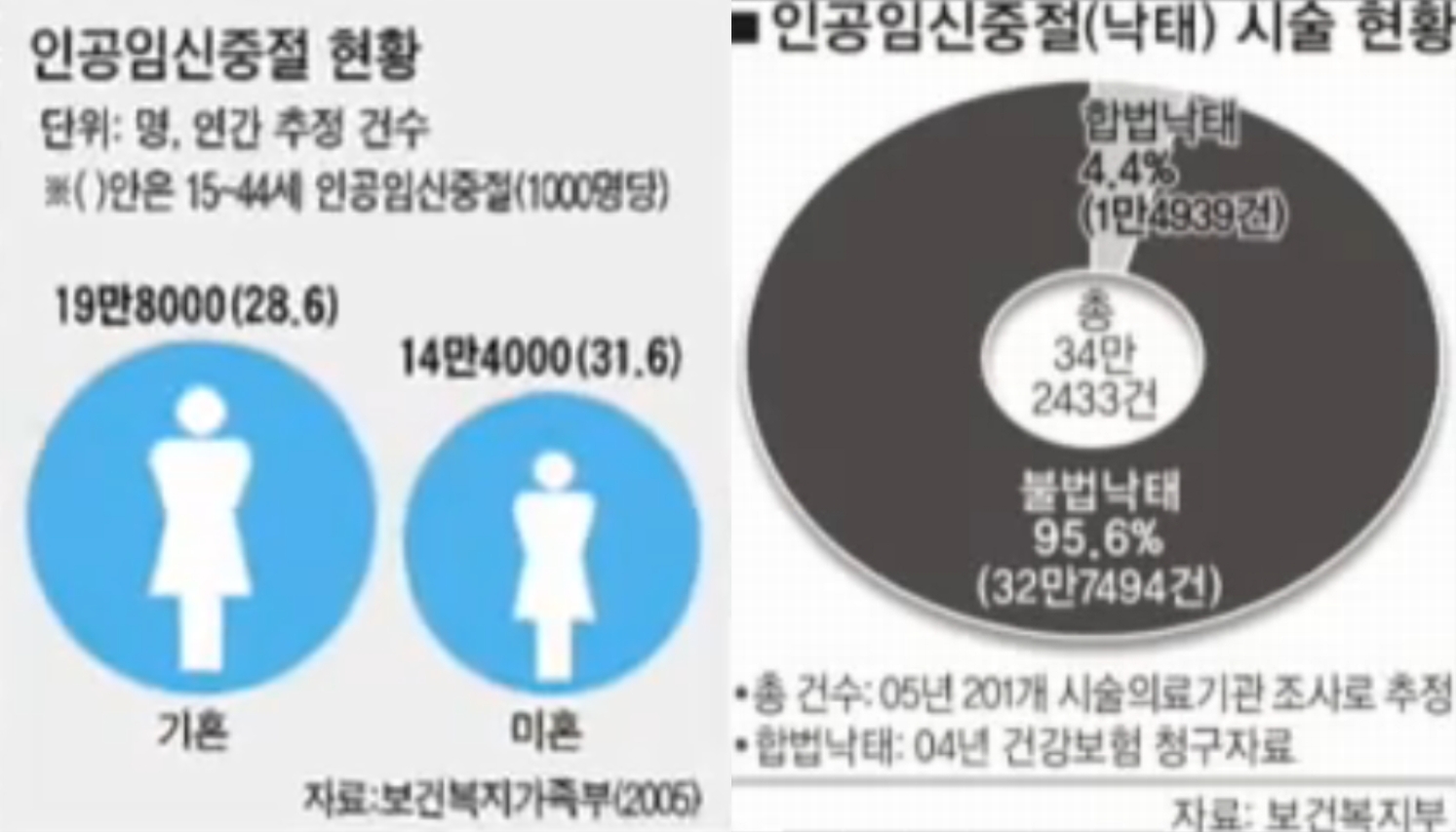
Next, two visuals from 1:04-1:20 (apologies for the poor quality):

On the left:

Estimated number of abortions performed annually (in brackets, the number of 15-44 year-old women out of 1000 that had abortions)

Married: 198,000 (28.6/1000)

Unmarried: 144,000 (31.6/1000)

Source: Ministry of Welfare and Family Affairs (2005; now defunct)

On the right:

Out of 342,433 abortions,  4.4% (or 14,939) were legal, and 95.6% (or 327,494) were illegal.

Estimation based on 2005 survey of 201 abortion clinics, and 2004 health insurance records of legal abortions.

Source: Ministry of Social Welfare

From 1:50-1:58:

유교적인 조선시대에서조차 낙태한 여성이 처벌받은 기록이 없다

Even in the Confucian Joseon Dynasty there is no record of any punishment for abortion

( Source )

From 2:17-2:35:

강간, 근친 상간 또는 임부의 건강 보호를 이유로만 낙태가 가능한 나라 (멕시코, 브라질, 수단, 대한민국 등 17개국)

한국보다 낮은 등급의 국가는 전체의 약 27%에 불과하며,

이란, 아프가니스탄, 리비아 등의 국가가 속해있다.

현재 OECD 국가 20개 중 한국보다 낙태시술이 어려운 나라는 단  2개국뿐이다.

There are 17 countries that allow abortion only in the case of rape, incest and if the health of mother is threatened (Mexico, Brazil, Sudan, South Korea, and so on)

Altogether, only 27% of countries provide less abortion rights than Korea, including Iran, Afghanistan, and Libya.

At present, out of the 20 countries in the OECD, there are only 2 in which it is more difficult to obtain an abortion than Korea.

Finally, from 3:09-3:16:

2010년 10월, 한국에서는 낙태를 한 여성이 남편의 고발로 검찰에 기소되어 벌금형을 선고 받았다.

In October 2010, a Korean woman was fined after her husband informed the police of her intention to have an abortion.

( Source )

And on that note, apologies for not providing details about the cases myself in this post, but as I finishing typing this at 1:30am (albeit with a final edit over a coffee 9 hours later) then my translations of Korean articles on those will have to wait until later this weekend sometime next week I’m afraid. Hence the “newsflash” in the title!

Until then though, is anyone aware of any English-language articles on them that I may have missed? And how do you personally feel about the news?

Share

Countering Sexual Violence in Korea (Updated)

Once again, Korea has gotten the lowest score of all high-income countries in a recent survey of gender-equality worldwide. And, at 104th out of 131 countries surveyed, it was bested by numerous much poorer countries at that.

Given that record, then it’s very easy to focus on Korea’s shortcomings when talking about gender issues. But that can mean that we can easily miss the positive developments that are occurring though, and sometimes right in front of our very noses.

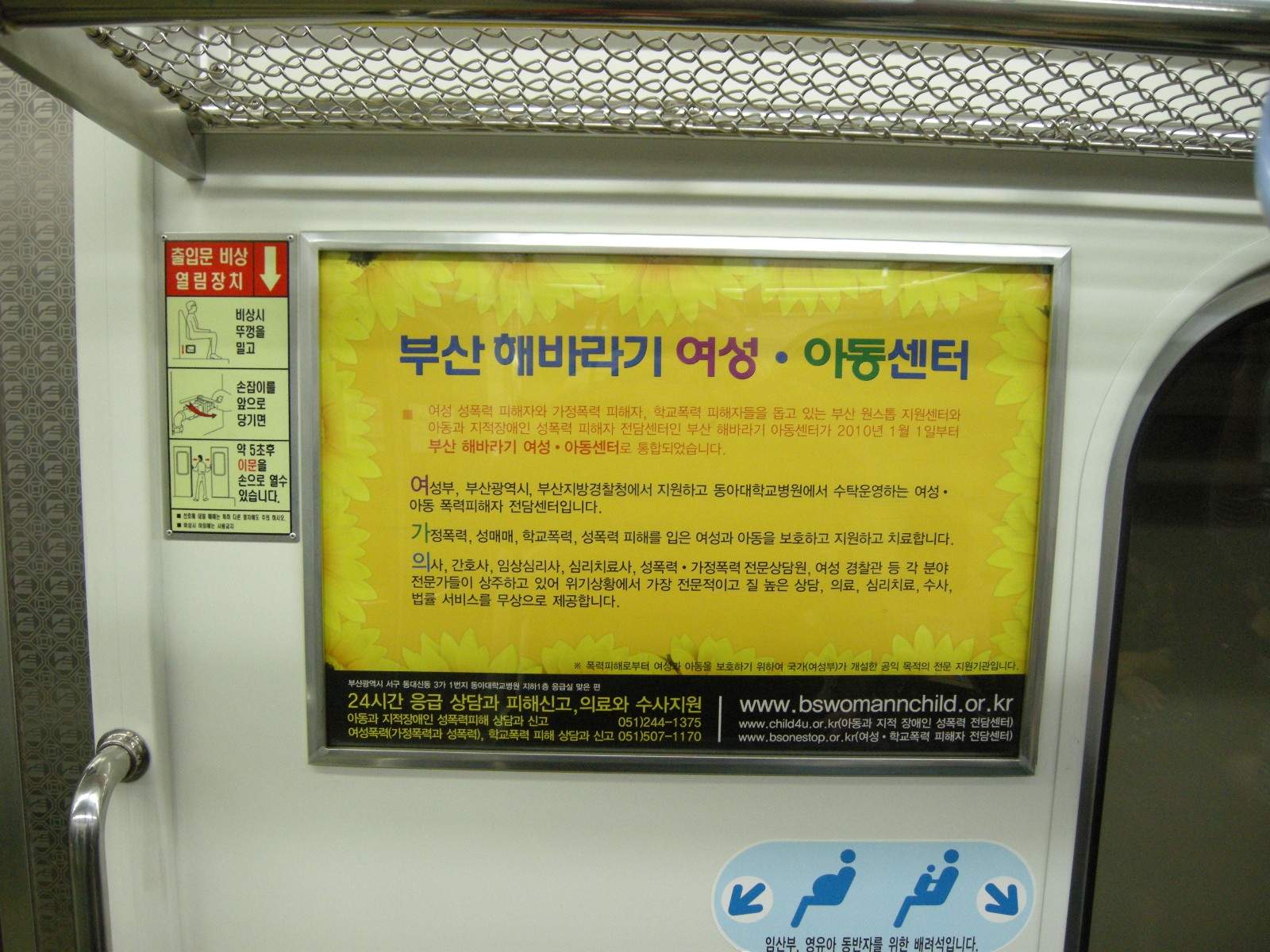
Take what this humble-looking subway ad for instance, and what it ultimately represents. First, a translation:

부산 해바라기 여성 • 아동센터

Busan Sunflower Women & Children’s Center

여성 성폭력 피해자와 가정폭력 피해자, 학교폭력 피해자들을 돕고 있는 부산 원스톱 지원센터와 아동과 지적장애인 성폭력 피해자 전담센터인 부산 해바라기 아동센터가 2010년 1월 1일부터 부산 해바라기 여성 • 아동센터로 통합되었습니다.

From January 1, the Busan One-Stop Support Center, which helps female victims of sexual abuse, victims of family abuse, and victims of physical abuse at schools, and the Busan Sunflower Children’s Center, which helps children and mentally handicapped victims of sexual abuse, have joined together and become the Busan Sunflower Women & Children’s Center.

(Source)

여성부, 부산광역시, 부산지방경찰청에서 지원하고 동아대학교병원에서 수탁운영하는 여성 • 아동 폭력피해자 전담센터입니다.

With support from the Ministry of Gender Equality, the Busan Metropolitan City Council, and the Busan Metropolitan Police Agency, Dong-a University Hospital has been given the responsibility of operating the center, which provides consultations for female and child victims of abuse.

가족폭력, 성매매, 학교폭력, 성폭력 피해를 입은 여성과 아동을 보호하고 지원하고 치료합니다.

Women and children who are the victims of family violence, sex trafficking, school violence, and sexual abuse can receive protection and treatment at the center.

의사, 간호사, 임상심리사, 심리치료사, 성폭력 • 가정폭력 전문상담원, 여성 경찰관 등 각 분야 전문가들이 상주하고 있어 위기상황에서 가장 전문적이고 질 높은 상담, 의료, 심리치료, 수사, 법률 서비스를 무상으로 제공합니다.

Experts in many fields such as doctors, nurses, clinical psychologists, psychological therapists, family and sexual violence consultants, and female police officers and so on will be permanently stationed at the center, and when you are in a crisis you can receive the best professional and highest quality consultations, medical treatment, psychological counseling, legal advice, and assistance with launching criminal investigations. All these services are provided free of charge. (end)

(Source)

In my experience, usually the amalgamation of two government institutions in any country is in response to cost-cutting. Fortunately however, there’s a great deal of indirect evidence to suggest that that isn’t the case here.

First, note that the ad is actually quite dated, mentioning that the amalgamation was effective from January the 1st for instance (although the center didn’t officially open until February the 9th), and in particular that the Ministry of Gender Equality has a supporting role in it, whereas the Ministry actually reconverted back to the Ministry of Gender Equality and Family Affairs (여성가족부/MOGEF) back in March. Presumably then, the ad has already been posted on Busan subway trains once before, probably late last year or early this one.

Why suddenly post the same ones again in late September then? What has changed to prompt that?

As Matt at Gusts of Popular Feeling has well-documented, what has changed is the public perception that there has been a sudden and dramatic increase in the numbers of sex crimes against children, whereas in fact they have remained steady (but appallingly high) for years:

There is not a “recent series” of such sexual crimes – this is always happening. It’s just that the media has decided – as it does whenever a particular case angers people – to highlight these cases, which would usually either not be covered or covered by perhaps only one or two media outlets, and which are now linked together in articles in order to point to a great problem that exists. To be sure, there have been several laws passed since the murder of Lee Yu-ri in March (and the Yeongdeungpo case in June), and it’s great that the issue has finally gotten enough attention to get things moving (see here for a brief history of the slow pace of change since 2006). I’m not entirely sure that the solutions being offered are always the best ideas, however, and public fury (and worry) whipped up by this media coverage may be putting pressure on politicians to act first and think later.

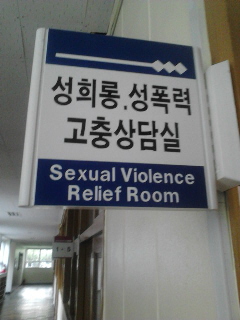
And see past Korean Gender Reader posts for more details of those and other sexual crimes. By coincidence, one of the most notorious of those – the murder of Lee Yu-ri – also occurred in Busan, and several of my coworkers here have reported seeing rooms like that on the right pop up in Busan public schools they teach at in the months since, although unfortunately they have no information on the quality of their staffing or how often they are utilized. Have any readers also noticed them, in Busan or elsewhere?

(Note that the English translation on it may be a little misleading though: a better one would be “Consultation Room [for] Mental Anguish [caused by] Sexual Harassment or Sexual Violence”)

Regardless, the point is that given the current climate then it would be wise for the government to highlight all it is doing to prevent sexual violence, let alone to continue or even increase funding to women and children’s centers. And however cynical and reactionary the motives, this is to be applauded.

Granted, the amalgamation was decided and instituted well before the public outcry over the supposed recent spate of sexual crimes against children. But that doesn’t necessarily imply it was the result of a reduction of funding: although it may receive little if any funding from MOGEF for instance, I find it significant that the Ministry’s assumption of old responsibilities came with a big increase in staff and 4 times larger budget (albeit from a base of 0.03% of the government total), so when the plans for the change were announced late last year there was already a political climate conducive to more funding for feminist causes.  Signs of a change of heart from President Lee Myung-bak also perhaps, who originally promised to abolish it before his election, only to back down and merely considerably downsize it in response to protests afterwards?

Alas, quite the opposite: in fact, he is using MOGEF to raise the dire birth rate by – wait for it – criminalizing abortion, as I explain in detail here. But to play devils’ advocate however, perhaps this blinds us to some of the positives that it has achieved?

One is its survey of teenage entertainers in August, which – among other things – revealed that many were pressured by their managers to wear revealing costumes, and which ultimately resulted in the National Assembly’s setting up of a committee (albeit under a different ministry) to further investigate MOGEF’s findings. And which after hearing evidence from entertainment company CEOs has just laid down new regulations for the treatment of minors in the entertainment industry (see here and here also for more background).

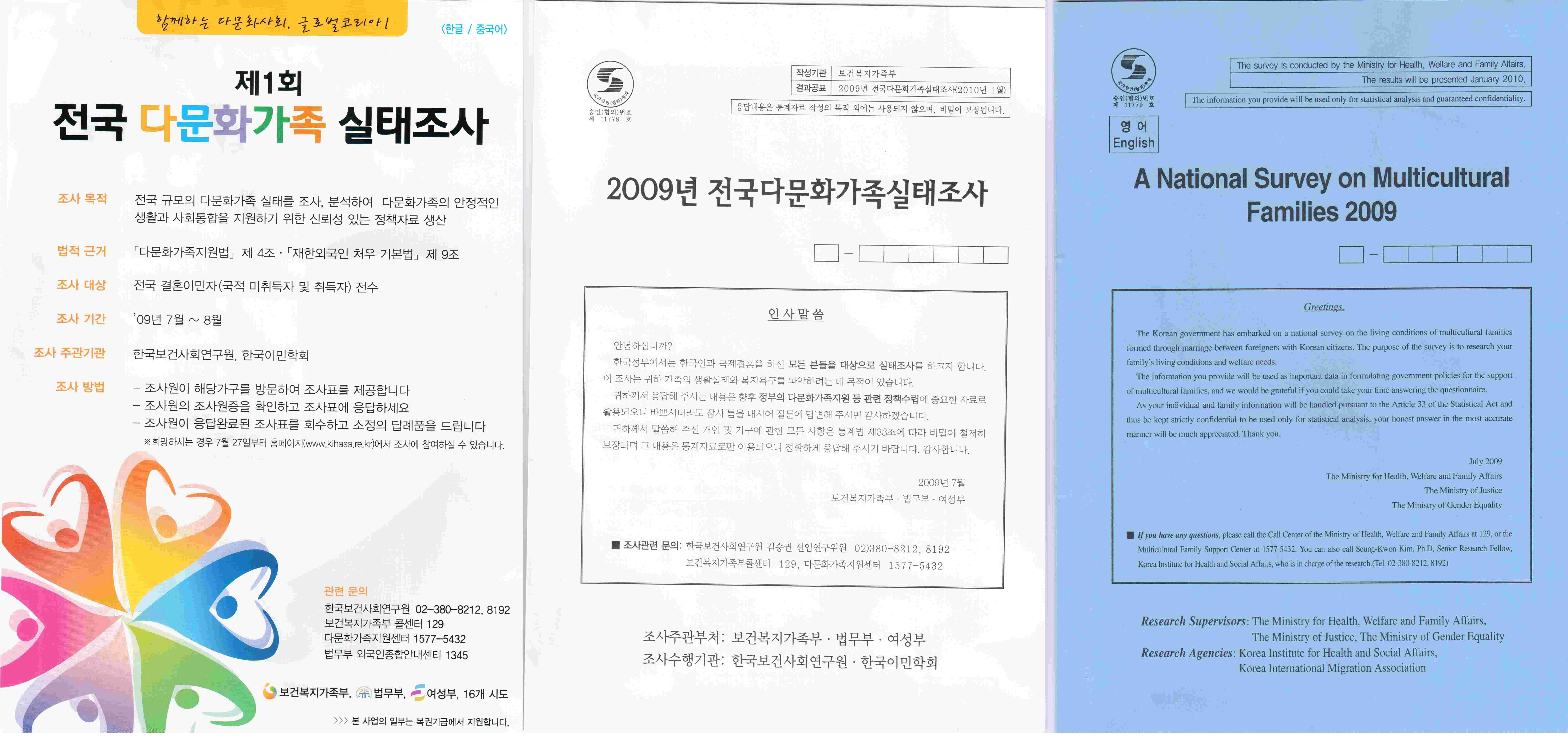
And finally, take the recent video produced by MOGEF below, which encourages people to pay more attention to the needs of immigrant women. Granted, it’s just a video, and again it may be just be in response to the recent murder of a Vietnamese bride by her husband after only 8 days in the country (see #13 here), but then it’s not like such efforts started only recently. One thing that instantly comes to mind for instance, is the above survey that was sent to all foreign spouses in Korea in August last year (see #3 here), in an attempt to better find out their specific needs.

Vodpod videos no longer available.

Any other positives readers can think of, however minor, then please pass them on!^^

Update: As per request, here is what the voiceover in the video is saying (and I’ve put the additional text in brackets as it came up):

이주여성들을 힘들게 하는건 (부부갈등 상담 8, 452건)

The things that make it difficult for migrant women… (8, 452 consultations for married couples having difficulties)

어려운 한국어와 (가정폭력 상담 4205 건 [2009년 이주여성 긴급지원센터 상담통계)

…are difficult Korean… (4205 consultations over family violence/abuse [2009 Statistics from Migrant Urgent Help & Consultation Centers])

낯선 환경, 다른 문화

…the strange environment, the different culture…

그리고 우리의 무관심입니다. (국제결혼 이주여성 16만여명)

…and our indifference. (lit. international marriage migrant women 160,000 women [James: just in 2009?])

이주여성들에게 작은 관심은 큰 힘이 됩니다.

Just a little help and support helps migrant women a great deal (same in the text)

이주여성들의 힘이 되어주세요.

Please be strong and supportive to them.

이캠폐인은 여성가족부와 복권위원회가 함께 합니다. (이주여성긴급지원센터, 1577-1336)

This campaign is brought to you by MOGEF and The Lottery Commission. (Migrant Women’s Urgent Help & Consultation Centers: 1577-1366)

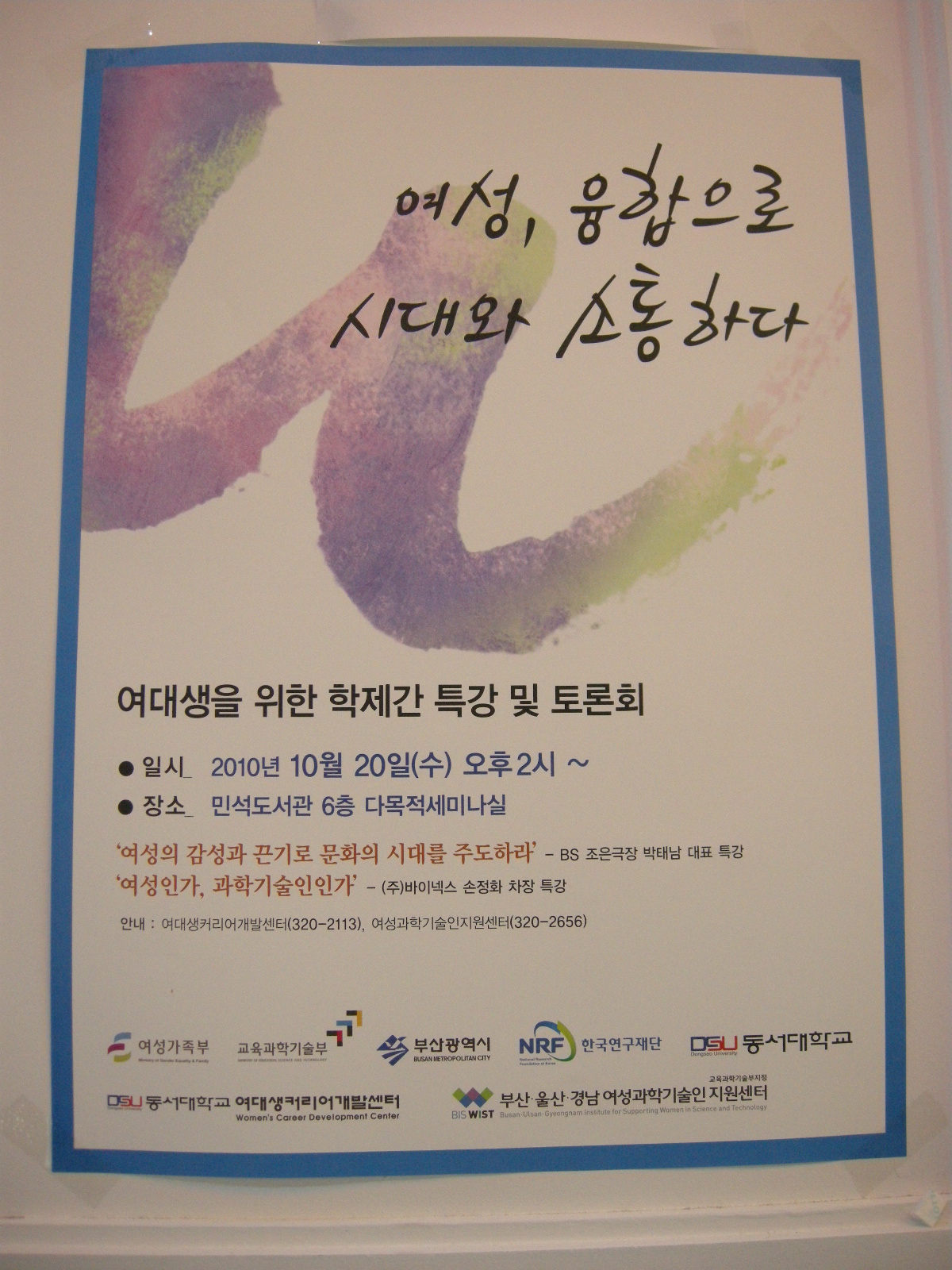
And by coincidence, something else positive that MOGEF has some role in: a seminar about women’s career development at my university tomorrow (stalkers, take note of which one). Things like this seem to go on there at least once a month or so.

Maybe this has something to do with that, which I only just noticed today:

Please let me know if anyone would like a translation of the first poster. Meanwhile, do any other Korea-based readers have anything similar at their own universities?

Groping in Korea: Just How Bad Is It?

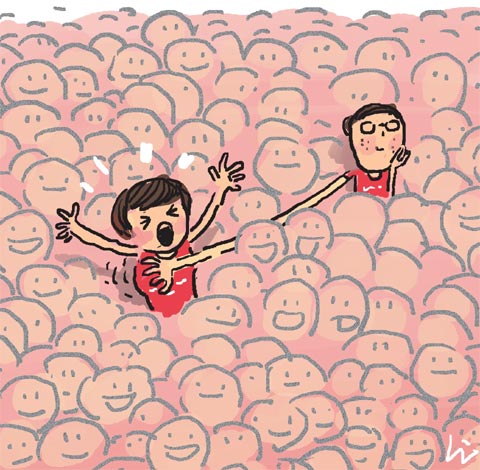
(Source: leftycartoons)

I never did think that women should consider street harassment as flattering of course. But still, this cartoon is eerily effective in getting that message across. It’s no wonder that’s it’s received nearly 300 comments over at Sociological Images.

Most of those dealing with the US though, now I’m curious as to how bad street harassment is in Korea in comparison. And in hindsight I realize that I’ve largely overlooked that in favor of covering workplace discrimination previously, most recently the landmark sexual harassment lawsuit against Samsung.

I did know about bbikkie (삐끼) though, or men that literally drag attractive women into nightclubs to encourage men to spend their money there (see here also); that Korean dating culture actually condones stalking; that this sometimes affects foreign women (see #12 here); and that Caucasian women especially are hypersexualized by the Korean media and/or often get confused for Russian prostitutes; and so on.

But groping? I’d never really thought about it, except in passing. After all, what guy does?

Hence my surprise and naivety at discovering that it’s not a problem confined to subways, and in fact was a pervasive problem among crowds during the World Cup, as the following report I’ve translated makes clear. And, even in broad daylight today too, as Krista of Salt City Girl wrote in her email to me that I’ve posted after that.

(Source: Sinfest)

“골인” 환호 순간에 웬 남자 손이…/ In the Moment of the “Goal in!” Cheer, Some Man’s Hand…

Kim Shi-hyeon, The Chosun Ilbo, June 26 2010

서울의 한 고교 2학년 최모(17)양은 지난 17일 강남구 삼성동 코엑스 앞 영동대로에 월드컵 길거리 응원을 나갔다가 봉변을 당했다. 아르헨티나 에 0 대 2로 뒤지던 전반 막판 이청용의 만회골이 터지자 시민들은 일제히 소리를 지르며 서로를 부둥켜 안았다. 최양도 친구와 손을 붙잡고 팔짝팔짝 뛰었다. 소리를 지르며 정신없이 뛰고 있던 중 갑자기 뒤에서 한 남자가 어깨동무를 하며 다른 손으로 가슴과 엉덩이를 더듬었다. 놀란 최양이 뒤를 돌아보자 20대로 보이는 남자 1명이 순식간에 군중 속으로 사라졌다. 최양은 “남자 얼굴을 제대로 보지 못했고 사람들 속으로 숨어 버려 경찰에 신고도 못했다”면서 “월드컵이라 부모님이 특별히 밤 외출을 허락했는데, 완전히 기분을 망쳤다. 앞으론 절대 길거리 응원은 안 나갈 것”이라고 했다.

Choi Mo-XXX, a 16 year-old (western age) second year high school student in Seoul, had a bad experience on the 17th after she arrived at Yeongdong Road in front of COEX in Samseong-dong, Gangnam-gu to cheer [the Korean team] during the World Cup.

Korea was losing 2-nil, but then at the end of the first half Lee Cheong-yong suddenly exploded back into the game with a goal, and everyone in the crowd cheered in unison and hugged each other, with Choi Mo-XXX too holding tight onto her friend’s hand and jumping up and down. But while she was doing this and not thinking about anything else, a man who was behind her placed one hand on her shoulders and with the other groped her breasts and buttocks.

She turned around, and saw a man who appeared to be in his 20s, who disappeared into the crowd in an instant. She said “I didn’t really see his face, and he disappeared into the crowd so quickly, that there’s really no point in telling the police,” and added that “because this was the World Cup, my parents gave me special permission to come out and cheer with everyone, but now my feelings have been completely ruined. From now on, I’m never going to attend any cheering events like this again.” (Source, right)

월드컵 기간 길거리 응원을 나가는 여성들에게 ‘성추행 경보’가 켜졌다. 남아공 월드컵은 시차 때문에 저녁 8시나 11시, 새벽 3시 30분 등 어두울 때 경기가 열려 성추행 범죄가 일어나기 쉬운 상황이다. 특히 위기대처 능력이 부족한 여자 중·고생들은 성추행을 당하고도 무서워서 가만히 있거나 수치심 때문에 주위에 도움을 청하지도 못하고 있다.

A big “Groping Alert” to women has been issued to women going to the streets to cheer during the World Cup period. Because of the time difference with South Africa, games are played at 8pm, 11pm, 3:30 in the morning, and so on, providing easy opportunities for gropers to strike. Especially women least able to deal with such a situation, such as middle or high school students, may be so scared as to quietly accept the groping and/or through a feeling of shame or disgrace be unable to ask for help.

인터넷 게시판에는 길거리 응원전에 나갔다가 성추행을 당했다는 제보가 끊이지 않고 있다. 네이버 한 카페에서 ID ‘바람’은 “사촌동생이 거리응원 나갔다가 성추행당했다고 그러더라. (이겨서) 너무 좋고 정신없어서 당시엔 잘 몰랐는데 가슴을 대놓고 만졌다고 했다”고 썼다. ID ‘단탈리안’도 “친구가 길거리 응원 나갔는데 계속 가슴에 어떤 남자의 손이 부딪혔다고 했다”는 글을 올렸다.

On internet cafes, there is an unceasing stream of information from women who have been groped during World Cup cheering events. On one Naver cafe, a commenter with the ID “Baram” wrote “My younger cousin said she was groped at a cheering event. Without her realizing at first, while she was concentrating on cheering her breasts were roughly grabbed, with no attempt by the groper to conceal what he was doing”. Another with the ID “Dantallian” posted the message that “When my friend went to a cheering event, a man kept feeling her breasts when she was crushed up against him.”

한 인터넷 커뮤니티에는 “거리응원 가서 생각지도 못하게 여자 가슴 만져서 레알(진짜) 기분좋음 ㅋㅋ” 등 성추행을 한 사실을 밝히는 글도 올라 있다.

(Source)

[But] On another internet community site, there have been messages like “At a cheering event I touched accidentally touched a women’s breasts. But it (really) felt good LOL”, clearly stating that the writers have groped women.

인터넷에는 16강 진출이 확정된 24일 아침 서울의 한 거리에서 남성 5~6명이 핫팬츠를 입은 여성을 자동차 보닛 위에 올려놓고 성추행을 하는 사진이 떠돌고 있다. 지난 21일 경기도 파주에서는 한국과 아르헨티나전 경기 응원 현장에서 여중생 김모(16)양을 성추행한 40대가 경찰에 입건되기도 했다.

And on the 24th, when it was confirmed that the Korea team had made it through to the first round, a picture of 5 or 6 men lifting a woman in hot pants onto the bonnet of car and groping her was posted around on the internet. Also, on the 21st, when Korea was playing against Argentina, a 40 year-old man was booked in the town of Paju for groping 15 year-old Kim Mo-XXX at a cheering event.

26일 열리는 우루과이 전 길거리 응원에서도 여성들의 각별한 주의가 필요하다. 경찰은 우루과이전에 서울광장 15만명, 영동대로에 12만명, 한강공원 반포지구에 12만명 등 전국에서 182만여명이 응원에 참가할 것이라고 예상했다. 서울경찰청 고평기 여성청소년계장은 “월드컵 길거리 응원을 나갈 때는 혼자 가지 말고 어른들이나 여러 일행과 함께 가는 게 좋다”며 “성추행을 당하면 큰 소리로 ‘싫다’고 소리치고 주변 응원객들에게 알려 붙잡도록 하는 것도 방법”이라고 조언했다.

Women need to take special care on the 26th, when Korea plays Uruguay. The police expect 150,000 people to participate in the cheering event at Seoul Plaza, 120,000 at Yeongdong Road, 120,000 at the Han River Banpo Baseball Stadium, and roughly 1.82 million people nationwide. Seoul City Police Women & Adolescent Crime Division Chief Go Pyeong-gi said that “it is better if you don’t go to the cheering events with older people or in groups rather than going alone,” and recommended that “if you get groped, the best method to deal with it is to scream “I hate this!” to the surrounding crowd to make sure they know what is going on and can help catch the groper.”

And now Krista’s experience, whom I’ll let speak for herself. And thanks again to her for giving me permission to print this part of her email (Source, right):

It seems to me that sex, sexuality, gender and race are somehow at more extremes in Korea.

I have never been as groped or inappropriately grabbed at in my life until coming to South Korea. Just a few days ago, I was assaulted by a man in the rainy streets of Chungju in the middle of the day in front of other men. He had no problem at all with putting his hand in my shirt and grabbing my breast. I have resorted to wearing high-necked tops at all times because of the experience. When I shared this experience with a Korean man, he seemed to suggest this was surprising and unlikely to happen because I am “foreign” but then went on to suggest I may be to blame for wearing a low-cut top. I cannot believe either of these instances happened. I did not make that man grab my breast and my low-cut shirt more than covered my breasts. And I certainly expected a more sympathetic ear. But the fact that anyone anywhere thinks it’s okay to grope anyone else is absurd. (I wish I could also explain how demeaning the blatant staring, pointing and discussing of any waygukin woman in the area is.) This hypersexualization of Caucasian women allows an attitude which makes it easier to discriminate against Caucasian women and the people who are willing to help them, work with them, talk to them or have anything to do with them. Obviously the objectification of women everywhere has lead to and continues to allow for misogyny, albeit often in a more subtle form in the US.

It would be a lie to say I haven’t been groped or otherwise harassed in America, but again, it does not compare to South Korea. The behavior is more extreme, bizarre and accepted.  Quite frankly I do not even begin to understand how Korean women tolerate it and I believe it goes a long way towards explaining why it is so rare to find a Caucasian woman who has been in Korea for more than five years. It is something that gives me pause when considering whether or not Korea is a place worth living.

I hope that gives you some insight into how at least one Caucasian woman sees hypersexualization in Korea.

Not to downplay Krista’s experiences in any way, but I had no idea that things were so bad here that many foreign women were persuaded to leave. Do readers agree that it is a big problem here, or has Krista merely been extremely unlucky?

Update: Read about a slightly bizarre 2-hour long case of groping on a train here and here.

Men Can’t Get Raped in Korea? (Updated)

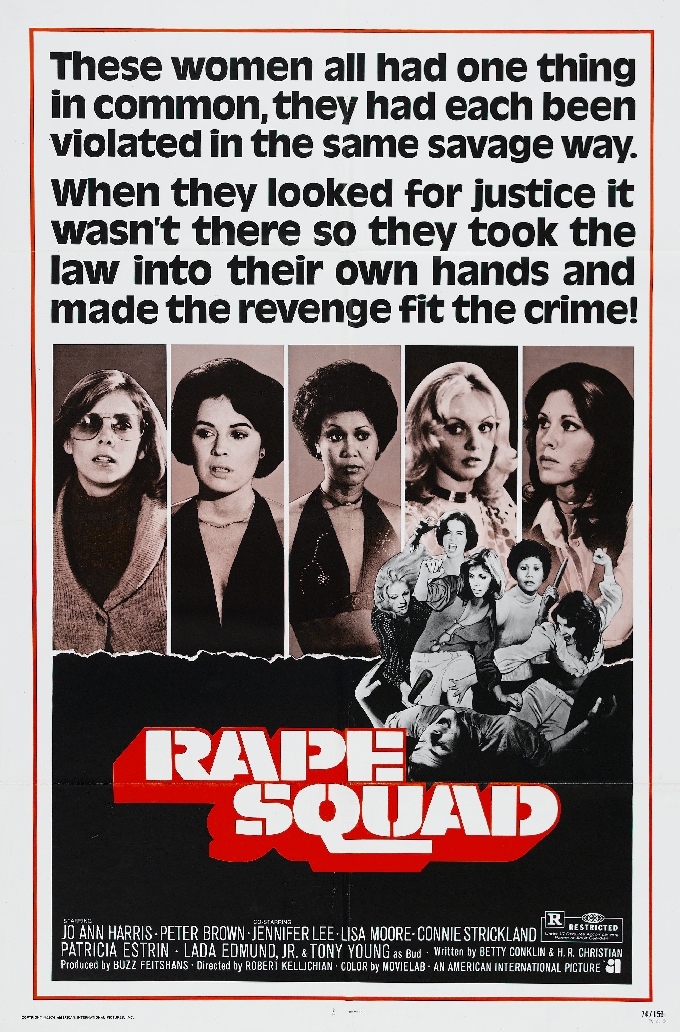
( Source )

But in Korea at least, perhaps the most appropriate revenge would have been to inflict the same back on the rapists? For I’ve just been shocked to learn that legally speaking, men can’t actually be the victims of rape here.

In fairness however, Korea is by no means the only jurisdiction that strictly defines rape as non-consensual penile penetration of the vagina, so perhaps my reaction was quite naive. But still, recall that not only is spousal rape not a crime, and that the Korean Bar Association remains opposed to its criminalization, but that there is also endemic sexual violence within the military.  So it’s not like some decidedly archaic notions of sexual identity and rape don’t still exist both in theory and in practice in Korea.

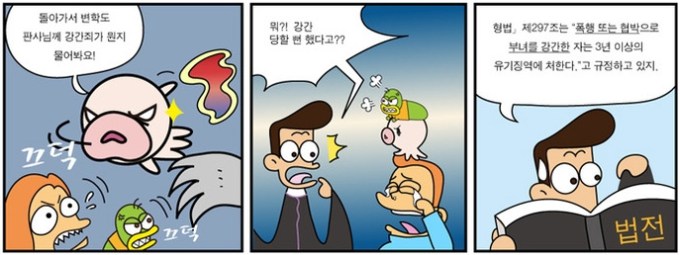
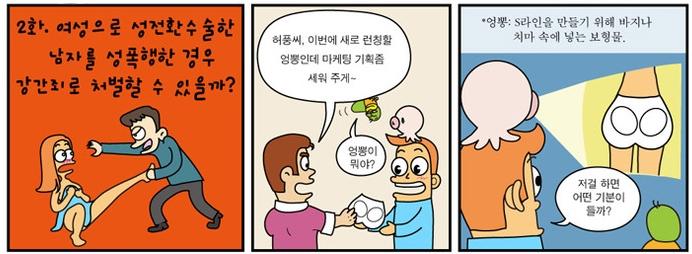
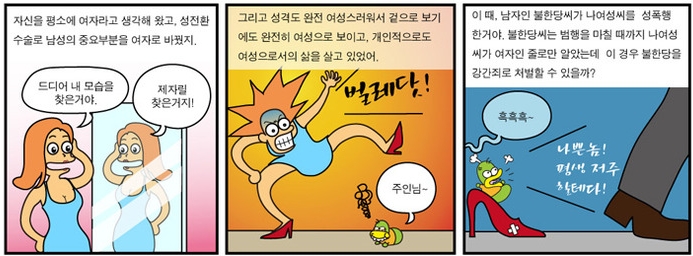
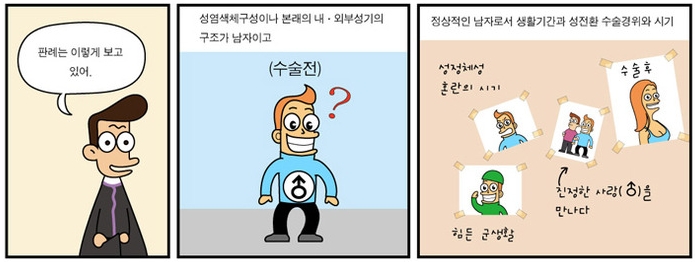
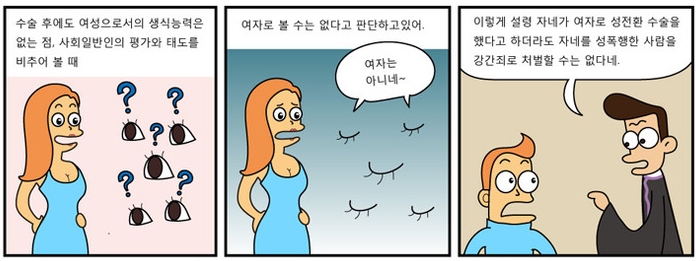
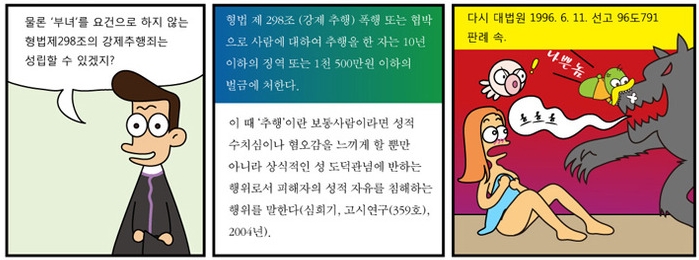
Accordingly, the fact that males can’t be raped is not so much highlighted as taken for granted in the webtoon Judge Byeon Hak-do’s Puzzling Law Questions (알쏭달쏭 변학도 판사의 법률이야기) below, instead focusing on the question of if a rapist of a male to female transsexual would be charged with rape or indecent assault instead, concluding that as the victims are not considered women in Korean society then it would be the latter. And indeed as of 2006, only 25 transsexuals had been successful (and 26 denied) in their applications to change their legal gender, easily the most famous being entertainer Harisu (하리수) and model Choi Han-bit (최한빛) below:

( Sources: T-L, T-R, B-L, B-R )

That figure was taken from “Hallyoo, Ballyhoo, and Harisu: Marketing and Representing the Transgendered in South Korea” in Complicated Currents: Media Flows, Soft Power, and East Asia (2010), which I highly recommend for those of you more interested in the current state of transgender and transexual rights in Korea (full disclosure: this blog is mentioned in it!). As for the webtoon itself, unfortunately it raises more questions than answers, and the last 2 panels in particular make little sense, and I think are supposed to be a joke. But I’m not going to write it off because of the medium (quite the opposite), and unlike the pig-ignorant, racist, and anti-Semitic comic history books that some of you may recall from 2007, the webtoon series as a whole does at least seem to be written by someone who knows the subject, probably even by a judge himself.

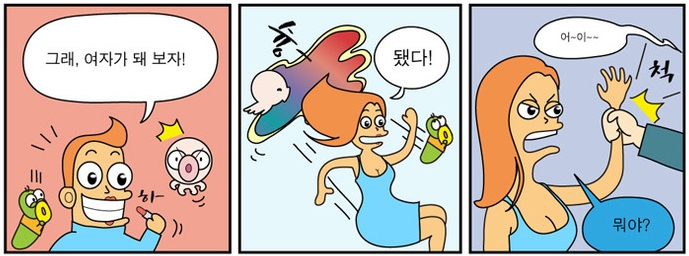
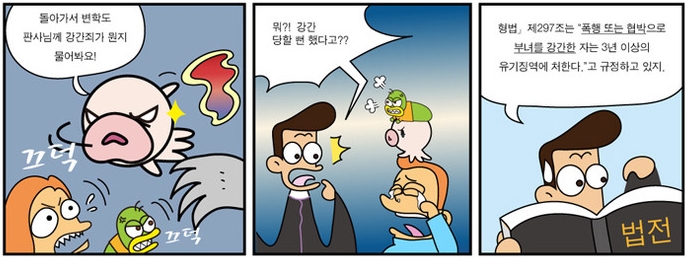
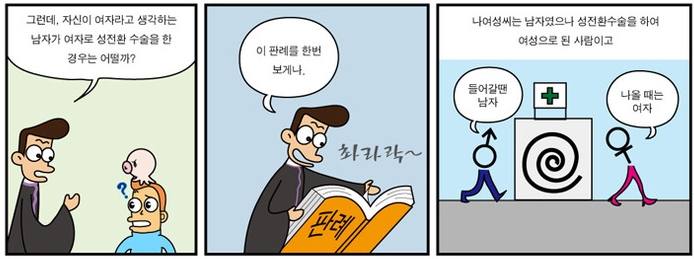
Below, I’ve literally translated all of it (including all the sounds!), adding notes where necessary. But as always, I welcome and appreciate any corrections:
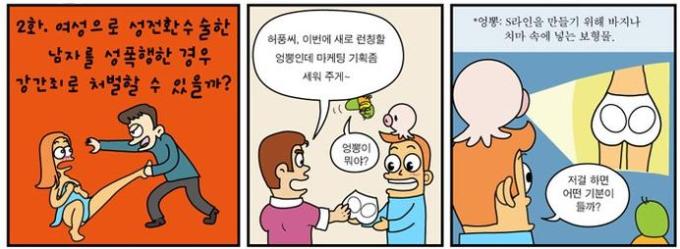
Comic #2. In the case of the rape of a man who has had a sex change operation to become a woman, does that [actually] carry the charge of rape?

Heo-poong, we are going to launch a product called “Eong-bbong”, and want you to come up with a marketing plan.

What’s an Eong-bbong?

Eong-bbong: a device to create an S-line by putting it under a skirt or pants.

How would wearing that feel?

“Eong-bbong” is actually quite a good name: it comes from a combination of the “eong” in eongdeongee (엉덩이), or bottom, and “bbong” (뽕), not unlike “boing” in English.

Meanwhile, when Heo-poong asks how wearing that would feel, he means literally or physically, not in the psychological sense of what it would be like to be a woman having her S-line ogled.

Okay then, let’s try becoming a woman!

Hee (Your guess is as good as mine)

Done/Changed!

Syoong! (a quick moving sound, in this case through a magic portal used in all the other stories)

Oh~Oh~~

Cheok! (a grabbing sound?)

What’s this?
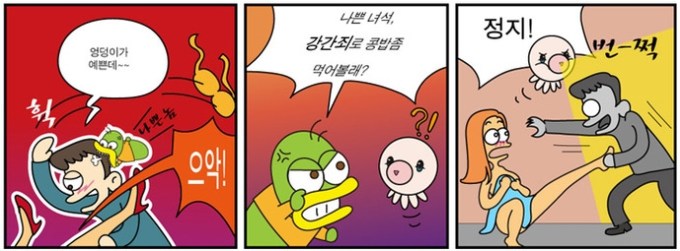
Your bottom is so pretty…

Hweik! (used for something sudden and abrupt)

Jerk!

Yaaargh!

You bastard, you want to eat rice and beans (prison food) by raping someone?

Stop!

Beonjjok (Flash)

Go back to Judge Byeon Hag-do and try asking about what the crime of rape is!

GGudeok, ggdeok (Nod, Nod)

What? You say you almost got raped??

According to article 297 of the criminal code, a person who rapes a woman by violence or threat of violence gets a jail term of at least 3 years.

So in other words, the only people that can be raped are women?

Woman, then Syak! (quick swishing sound?)

If so, what are women?

Here in article 297, all females are referred to: adult women, teenagers and girls, married women, and unmarried women.

Who doesn’t know that?!! (lit. Where is someone that doesn’t know that?!!)

A man who dresses as a woman is only a woman on the surface. But for someone to be called [really be] a woman, they need to have the heart, mind, and body of a woman.

The Korean maum (마음) is often translated just as “mind” in English, but if you just ask Koreans where it is located then they’ll usually say the chest, let alone often use it in a “heart” sense. I don’t think there is any real distinction between them in Korean.
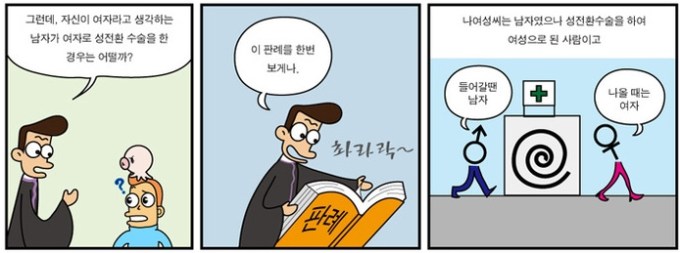
However, what about the case of a man who has had a sex change operation and thinks of himself as a woman?

Let’s have a look for any precedents.

Chwa-ra-rak~ (the sound of flicking through pages?)

If Miss “I am a woman” was a man and has a sex change operation…

When I go in I’m a man

When I come out I’m a woman
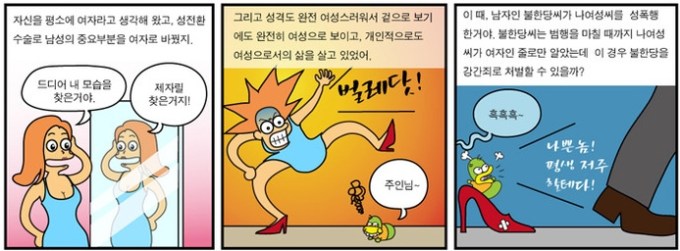
…through having her male “important parts” changed to a woman’s, she comes to think of herself as a woman.

Finally, I’ve found myself.

I’ve found where I belong!

And her personality is completely like a woman’s, and she also completely looks like a woman, and has lived as a woman…

A cockroach!

My master/mistress~

Then Mr. Evil rapes Miss “I am a woman”, all the while thinking she was born a woman, will he be charged with rape?

Sob sob sob~

You bastard! I will curse you forever!

“Mr Evil” may sound facetious, but actually boolhandang (불한당) is the usual term for a bad person, a little like the bogeyman in English (but more specifically a criminal of some sort). Meanwhile, jooinnim (주인님) is gender neutral, so I don’t know if the caterpillar(?) thinks of Heo-poong as a man or a woman sorry.
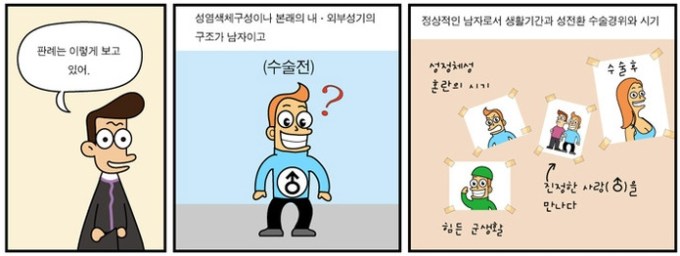
There is a precedent for this.

The sex chromosomes, internal physiology and external genitalia were all male…

(Before the operation)

He lived as normal man, but a time came when he wanted to have a sex change operation…

Feelings of confusion about if he was a man or woman.

A hard time doing his military service.

He met his true love, a man.

After the operation.

After the operation, she had no reproductive ability as a woman, so in the case of average people on the street’s assessments of and attitudes towards her…

They would decide that she couldn’t be called  a woman.

– Not a woman~

This way, even if you had had a sex change operation, someone who rapes you would not be charged with rape.
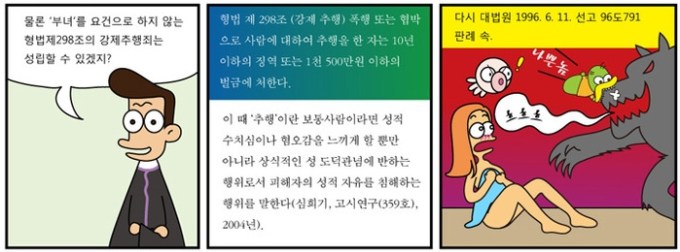
Of course, being a woman is not a prerequisite for charging the perpetrator with indecent assault under article 298 of the criminal code, yes?

According to article 298 of the criminal code (indecent assault), if someone assaults another through the threat of violence then he or she can go to jail for a maximum of 10 years or pay a maximum penalty of 15 million won.

In this case, “assault” means not just something which infringes on the victims’ sexual freedom and is in contradiction to normal sexual ethics, but also leaves them with a sense of sexual shame and disgust (Shim Hwae-gee, Official Law Studies (#359), 2004)

This was also established by the Supreme Court in their judgment on case 96.791 on June 11, 1996.
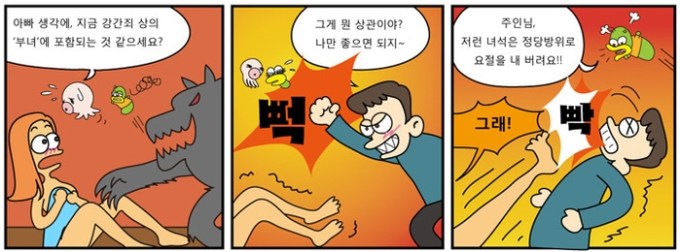
Your honor, do you think that Miss “I am a woman” is also included in the definition of woman for the charge of rape to apply?

What’s that got to do with anything? I just want to do whatever feels good~

Bbok (Bash?)

Master/Mistress, kill this bastard in self-defence!!

Sure!

Bbak! (Bash?)

That’s strange?? The contents of the Supreme Court’s judgment on case 96.791 on June 11, 1996 have been changed!!

Clearly, it was about rape, but here…

Gyaoodoong (??)

Now it’s about how far one is justified in inflicted violence in self-defense??

Save me~

Oodangtang (Thump! Stamp!)

Update: I completely forgot this article from The Korea Times, which I covered back in February last year (see#17 here):

A provincial court for the first time found a man in his 20s guilty of “raping” a transexual, Wednesday, challenging the current law that defines rape to when a man has forcible sex with a woman born a female. The victim’s legal gender still remains man.

The Busan District Court sentenced the man to three years in prison suspended for four years on charges of raping the 59-year-old transsexual. He was also ordered to participate in 120 hours of community service.

Judge Ko Jong-joo said in the ruling, “The victim has acted like woman since he was born. In 1974, when he turned 24, he underwent a gender reassignment program. He once also lived with a male partner for a decade. Given all of these, he can be seen as female.”

The judge added that although the victim was legally a man, but this did not take into account his sexual identity. “Thus, his sex in legal documents cannot be seen as his `ultimate’ gender,” he said.

The rapist invaded the victim’s home last August and raped her using a blunt weapon. The prosecution initially indicted the man on a “molestation” charge but changed it to “rape” later after considering the victim’s personal history. It sought a five-year prison term, Feb. 11.

Giving the unprecedented ruling, the judge set three criteria to define the precedent ― whether the victim had sex change surgery; how long he/she has lived with appearance of the opposite sex; and if he/she has no problems having sexual relations.

In a similar case in 1996, the Supreme Court did not acknowledge rape charge, citing the victim’s sexual chromosome identity as a male.

I wonder if that 1996 case is the one referred to in the cartoon?

judgment on case 96.791 on June 11, 1996.


Sex as Power in the South Korean Military: A Follow-up

( Source )

As I discussed back in March, the first ever survey on the issue of sexual violence in the Korean military discovered endemic levels of abuse, with roughly 15% of 250,000 conscripts each year experiencing it as either victims or perpetrators. A hugely important socialization experience for Korean men, this had grave implications for Korean society.

On a slight positive note however, I was happy to also read that much of the researchers’ data was obtained by interviews with soldiers in their barracks with the official cooperation of the Ministry of Defense. A sign of changing attitudes towards acknowledging and dealing with the problem?

Alas, I’ve just discovered that that was far too optimistic, as the military still remains one of the least transparent institutions in Korea:

When the Cheonan sank [in March], the initial reaction was shock and sadness, which quickly gave way to rage: with a government accused of dragging its feet, but also with a military that seemed unprepared for a North Korean attack.

But anger with the military runs deeper than over a single event. Mistrust of the institution is widespread because it has failed to open itself up, using the excuse of national security, while the rest of the country has embraced democracy.

South Korea’s military dictatorship may be a thing of the past, but the North’s constant saber rattling in the form of nuclear tests, missile launches, spy incidents and the occasional skirmish continue to give Korea’s men at arms an immediate relevance – and an excuse to conceal things from the public. That right to secrecy is enshrined in the National Security Law, which places restrictions even on regular citizens’ freedom of speech for the sake of preventing enemy subversion, but is even more of a cloak for the armed forces. It’s the legal manifestation of the bubble in which the military operates, isolating it from the massive changes the rest of Korean society has undergone. To date, for example, no civilian has ever been named defense minister.

Every year, a report is quietly released titled, “Military deaths caused by accidents.” In 2008, there were 134 names on that list, including 75 suicides. The suicides are usually explained by a “failure to adjust to military life.”

That explanation is unacceptable for Joo Jong-woo, whose son, Pvt. Joo Jung-wook, committed suicide in 2001 at age 22…

Read the rest at The JoongAng Ilbo, including about “its emphasis on tight ideological control of its conscripts” resulting in its banning of left-wing books like the works of Noam Chomsky, and the expulsion of military legal officers for “arguing that the military’s regulations are unconstitutional”. Meanwhile, the Korean military still refuses to recognize conscientious objectors and so imprisons them (see here also for a podcast on the development of the concept of conscientious objection in the West), the National Human Rights Commission is ineffective, and the maintenance of the conscription system as a whole is one reason why the Korean Military remains  “a 1970-vintage force structure, designed around a 1970-vintage threat, equipped with 1970-vintage weapons.”

( Source: anja_johnson )

As for the images of mascots, please note that I post them not to be facetious though(!), but rather to show how facile such attempts to soften the image of institutions like the police and military are in light of reports like this. But nothing against the mascots themselves of course, and see here, here, and here for more information about Podori (포도리) in the riot gear!^^

Update, October 2010: Unfortunately, this recent incident demonstrates that little progress has been made since this post was written.

Share

Sex as Power in the South Korean Military

Source: anja_johnson

“All men are rapists,” I read on the back cover of Susan Brownmiller’s Against Our Will: Men, Women, and Rape in the student bookstore. Determined to impress women with my intellectual and feminist prowess by debunking that quote, I bought the book and doggedly read all 480 pages trying to find it. Twice.

Yes, I was rather naive about the whole dating game. Even worse, you can imagine how I felt years later, when I learned that she never actually said that. Rather, it was a big misinterpretation of her statement that rape “is nothing more or less than a conscious process of intimidation, by which all men keep all women in a state of fear” (p. 5), albeit an understandable one. Indeed, it’s probably what she’s become best known for, an enduring catch-phrase of pop-feminism that publishers would knowingly exploit to sell the book to me 2 decades later.

Which is a shame, because along with Menachem Amir, she was instrumental in overturning long-held conventions that rape was simply a spontaneous act of lust, instead demonstrating that it is more “a deliberate, hostile, violent act of degradation and possession on the part of a would-be conqueror, designed to intimidate and inspire fear…” (p. 439). Or in short, it’s due to her that surely all reading this are aware that sexual violence is all about power, and not surprised to hear this reaffirmed by the survey “Sexual Violence Among Men in the Military in South Korea” by Insook Kwon et. al., Journal of Interpersonal Violence, Vol. 22, No. 8, 1024-1042 (2007), the subject of today’s post.

The first comprehensive survey of its kind, in English or Korean, it was prompted by the suicide of a Korean soldier in July 2003, which received tremendous attention in the media because sexual violence by his superiors seemed to have played a role; after all, with 250,000 men forcibly conscripted each year, any implication that it wasn’t an isolated incident meant that there were far more victims. And in point of fact, with the proviso that the authors’ (undefined) notion of “sexual violence” appears to be much broader than a layperson’s as I’ll explain, they did indeed find that 15.8% of respondents experienced it during their time in the military, either as perpetrators or victims.

But before discussing the implications of that however, and especially what it says about the role of the military in the socialization of Korean men, let first provide an overview of the survey so you can make your minds (with a nod to copyright, I won’t upload the survey itself here sorry, but please feel free to email me if you’d like your own copy). And so, without any further ado:

The survey was conducted from November 2003 to February 2004, with researchers meeting 2 groups: 362 postconscripts, then students, at 6 different colleges; and 409 current conscripts, 115 at bus and train stations while they were on leave, and 294 in visits to their barracks with the official cooperation of the Ministry of Defense. From each group, there were 266, 111, and 294 valid samples respectively, giving a total of 671 valid samples out of 771 soldiers surveyed (the bulk excluded being postconscripts, and because more than 3 years had passed since their military service). They also conducted in-depth interviews of 8 perpetrators in army prison, and 3 victims.

Highlights of the results include (all emphases mine):

Of 671 valid respondents who participated in this survey of victimization, perpetration, and observation, a total of 103 people (15.4%) answered that they were directly victimized, 48 people (7.2%) answered that they had direct experience as perpetrators, and 166 people (24.7%) answered that they witnessed sexual violence in the military.

Excluding eyewitnesses, a total of 106 soldiers (15.8%) directly experienced physical sexual violence, either as perpetrators or victims in the military. A very high number of soldiers also indicated they experienced sexual violence as perpetrators and as victims: 59 soldiers (55.7%) were victims only, 39 soldiers (36.8%) were victims and perpetrators, and only 8 soldiers (7.5%) were exclusively perpetrators. Among perpetrators, 83% had experienced sexual violence in the military when they had been lower ranked soldiers. This feature of high number of perpetrators having previously experienced victimization themselves could be seen as the most unique feature of sexual violence among men in the military. (p. 1028)

(Source: anja_johnson)

And:

Victims named higher ranking soldiers (71.1%), junior officers (7%), and officers (3.1%) as their perpetrators, totaling 81.2% of victims who responded that someone of a higher rank forcibly imposed sexual contact….

Also, the eight perpetrators and three victims who agreed to be interviewed, as well as six cases recorded by the Korean Sexual Violence Relief Center and reports by military judiciary officers, confirmed that victims of sexual abuse were in lower ranks than their perpetrators. All victims had been victimized by higher ranking soldiers, and eyewitnesses reported likewise. In sum, sexual violence among men in the military in South Korea was committed primarily by a higher ranking solider against a lower ranking soldier. (p. 1029)

The types of abuse, as reported by victims and witnesses (p. 1031; multiple answers permitted):

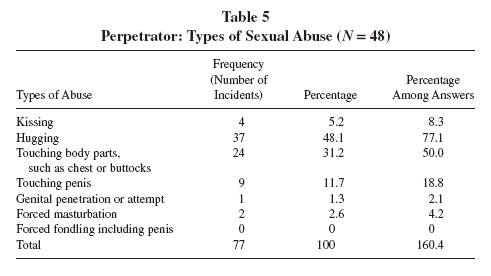
As reported by the perpetrators (p. 1033):

Also note that 22.1% of victims (but only 7% of perpetrators) reported that physical violence accompanied the sexual violence, and that 71.8% of victims and 90.7% of perpetrators responded that the acts of sexual violence when others were watching (I’ll return to the latter point shortly).  And in particular, eyewitnesses reported that 22.5% of the sexual violence they saw involved touching genitals, and 5.1% involving anal penetration (or the attempt), nearly 2 and 5 times higher than victims reported respectively.

Reflecting on the discrepancies, Kwon et al. found that:

…people tended to feel more comfortable talking about what might be considered part of a general sexual culture—such as kissing, hugging, and telling sexually explicit jokes—but answers were less forthcoming when concerning sexual violence of a more serious degree. (p. 1032)

Which for a long time I simply didn’t understand: how on Earth was that the “general sexual culture” of the military? Well, first consider that:

When asked, “In the military, have you ever been forced to talk about sexual experiences, even when you did not want to?” almost one third (32.7%) of the 667 respondents answered affirmatively. To the question, “Have you ever experienced negative consequences either because you did not have any sexual experiences or because you refused to discuss your sexual experiences?” a total of 218 soldiers (32.7%) answered that they had been forced to talk about sexual experience. (p. 1028)

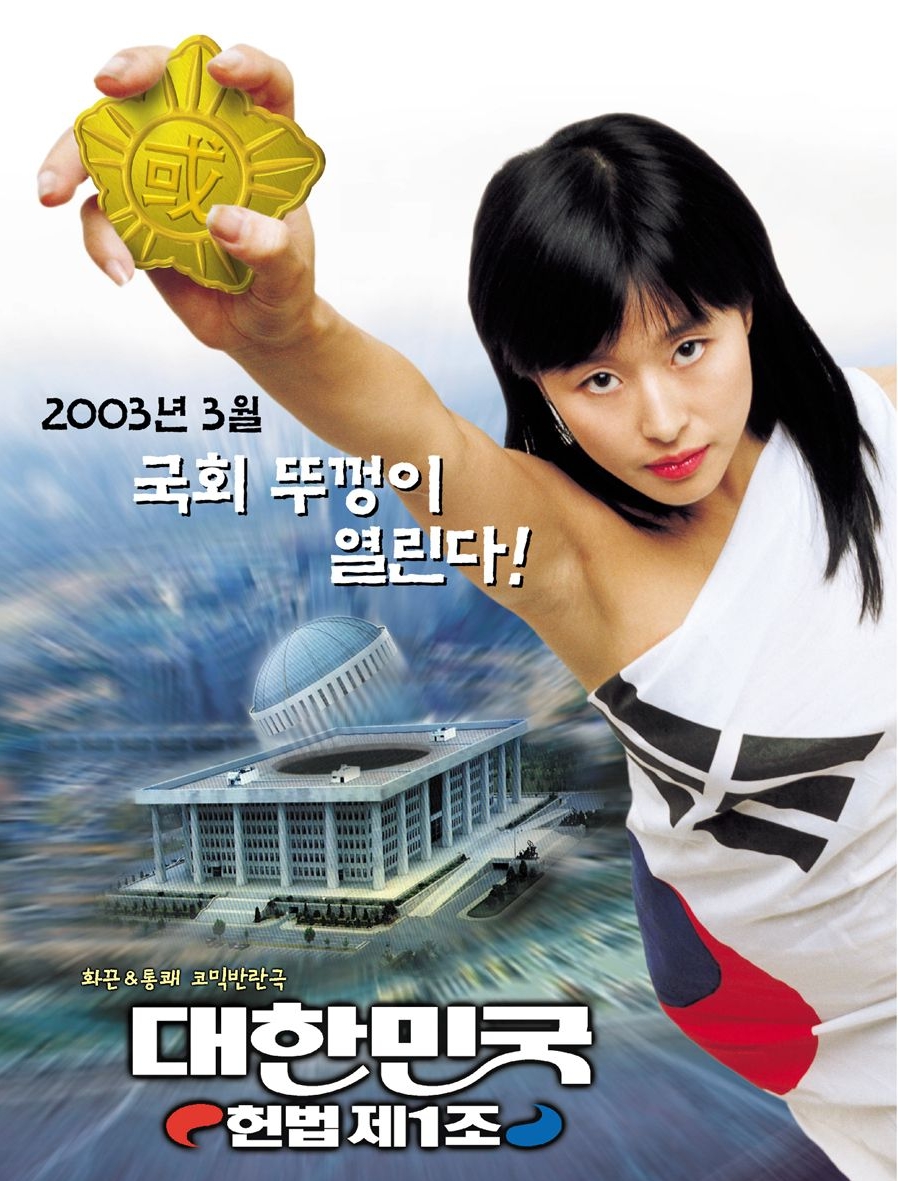
And that this mandatory disclosure of sexual experience has long been regarded as “an essential part of sexual culture in the military” is corroborated by numerous references in Korean movies to the practice of virgins visiting a prostitute before starting one’s military service, of which I highly recommend the satirical comedy The First Amendment of Korea below.

(Source)

Next, there is the fact that victims of sexual violence tended to interpret it as:

…intimacy or playfulness, because identification as a victim of sexual violence would imply one’s fragility and vulnerability. This tendency to minimize and trivialize injury was clear in cases where abuse continued for a long time, and in situations where a clear power dynamic between the perpetrator and the victim made resistance much more difficult for the victim. (p. 1033)

Moreover, perpetrators:

…did not force sexual contact on their peers with whom they had even closer relationships [than inferiors]. The intimacy in question was strictly an intimacy from the position of the higher ranking soldier.

Kwon et al. further discuss the natural difficulties victims had in refusing advances by a superior, and crucially, why the third most common form of sexual violence was touching a victim’s genitals. But why, particularly when only 5.4% of victims thought that their perpetrators were genuinely homosexual? Well, as one victim noted:

…unlike in the general society where one could not treat another person with complete disregard for age, educational level, or class, in the military, higher ranking soldiers could treat lower ranking soldiers as one pleased—including touching their genitals. (p. 1035)

And after a discussion of the right to control and abuse the body being a very useful method for militaries to reaffirm its hierarchical order, and of the role of the penis as a symbol of power and authority throughout history, they note that, hence:

…teasing or forceful contact with one’s penis becomes a way to prove the victim’s lack of power.

(Source: Journey to Perplexity)

Needless to say, the effects of this are amplified if done in public settings, and indeed 90.7% of perpetrators responded that people were watching when their sexual violence occurred, with the vast majority of witnesses either actively engaging in it in some way (23.7%), passively consenting by simply watching (57.9%), or pretending not to see (10.5%) rather than attempting to stop it: hence a “general sexual culture.”

But continuing with why:

…violence feminizes victims of sexual violence in two ways. The victim is reduced to a sexual object, like many women typically face in society, and as the powerless victim of violence, he is further feminized. Men who are victimized by sexual violence, then, become someone whose masculinity is lacking or damaged. Hierarchical order reasserts itself amid all this, and men collectively try to be on the offensive to affirm their aggressive masculinity. (pp. 1035-36)

And finally, the testimony of a perpetrator himself on why he did it, who said that he used sexual violence in lieu of physical violence sometimes, forcing sexual contact by “not hitting every time, and not joking around but harassing them”:

[Like harassing them…] Yes, I can’t hit them every time . . . and it’s not just joking around, but harassing them. . . . For instance, making them clean things repeatedly. Stuff like that. . . . If they were from wealthy families . . . or had a lot of education themselves . . . the superiors are ahead only because they came to the military before them . . . honestly . . . when you don’t have much to show for, and if they kiss ass to superiors who intimidate them . . . and if they think you’re not all that . . . well, you can’t beat them and so I kept thinking about ways to give them hell in the military, legal ways . . . and that’s how I ended up. (pp. 1036-37)

({2-365} Tick Tock by Dee’lite)

But what to make of all this?

At this point, it seems appropriate to point out my own complete lack of experience with the Korean military, as well as not even having any close relationships with any Korean men from whom I could learn about their military service, and so I would be very grateful to hear from those that have either. But then my own inexperience is essentially irrelevant here, as I’m largely passing on the results of renowned experts in the field (scroll down to note #32 here for more information on Kwon for instance); moreover, my own interest in on what is implied for Korean culture and sexuality as a whole, and so let me pass on the following description of military life provided by Ask a Korean, in his own excellent series on military service in Korea:

For some of today’s Korean young men, who have gone soft since the days of their fathers, military experience can be unbearable. Physical exercise is grueling, the superiors can be arbitrary and insulting, and your squad mates could shun you if you are responsible for putting the whole squad in trouble. Given that these guys, just like any other soldiers in Korea, can access guns and grenades, it should be no surprise that recently there has been a string of incidents in which a draftee shoots up his squad or toss a grenade in the squad room, killing many….

….[But there are definitely good life lessons to be learned from the experience, although it may be debatable whether learning those lessons is a good use of 2 to 3 years of young men in their prime. To put it bluntly, the military experience builds Korean men’s tolerance for all the life’s bullshit. As the Korean described so far, there is no shortage of bullshit – some of them perhaps the worst to be encountered in life – in the military. Exhausting physical training, insults and condescension from the superiors, and wasting time on arbitrary and trivial errands are all part of the experience. For young Korean men in the military, there is no choice but to simply grin and bear them. Once they finish bearing it, they know that most difficulties in life would be easier than what they already went through. The combination of such tolerance and insight, some may call it maturity – because, as anyone who has had a regular job can tell you, life as an adult has a lot of crap that we must simply grin and bear.

(Band of Brothers by The U.S. Army Photostream)

And in the next post in that series (my emphasis):

…one can argue that the military culture neatly coincides with traditional Korean culture – in both cultures, seniority automatically commands respect and loyalty. It is not surprising, then, that Korean workplaces are often run just like a squad in the military. You do what your boss tells you to do, and you are supposed to grin and bear it. Your time will come because Korea, like Japan, had automatic advancement by seniority at least until 1990s. Once you are the boss, you can order people around, much like the way you can order people around once you put in the time and became a sergeant.

I happened to work in such a place when I wrote the first post in my own series on gender and militarization in South Korea, and in which I noted that Korean corporate life often requires such a level of personal sacrifice for one’s superiors that, tellingly, even the Samsung Economic Research Institute acknowledges that “many workers…take it for granted that they have to tolerate anything in return for getting paid.” I should note however, that many readers thought my workplace was the exception rather than the rule, but be that as it may, the purpose of many of those things to be tolerated there boiled down to no more than the demonstration (and abuse) of superiors’ authority…and so too does sexual violence clearly emerge as one means – albeit, and I stress, only one, uncommon means – of doing so in the Korean military.

But I will further cover the effects on Korean gender relations and sexuality in great detail as I belatedly continue that series next month. In the meantime, let me leave you with the following passage from Shadows of Forgotten Ancestors: A Search For Who We Are (1993) by Carl Sagan and Ann Druyan to ponder, a book which had a great effect on my worldview and which frequently came to mind as I was writing this post (via Viraj’s Weblog):

(Source)

We go to great lengths to deny our animal heritage, and not just in scientific and philosophical discourse. You can glimpse the denial in the shaving of men’s faces; in clothing and other adornments; in the great lengths gone to in the preparation of meat to disguise the fact that an animal is being killed, flayed, and eaten. The common primate practice of pseudosexual mounting of males by males to express dominance is not widespread in humans, and some have taken comfort from this fact. But the most potent form of verbal abuse in English and many other languages is “Fuck you,” with the pronoun “I” implicit at the beginning. The speaker is vividly asserting his claim to higher status, and his contempt for those he considers subordinate. Characteristically, humans have converted a postural image into a linguistic one with barely a change in nuance. The phrase is uttered millions of times each day, all over the planet, with hardly anyone stopping to think what it means. Often, it escapes our lips unbidden. It is satisfying to say. It serves its purpose. It is a badge of the primate order, revealing something of our nature despite all our denials and pretensions.

Update 1, February 2013: See The Chosun Ilbo and ROK Drop for some more recent statistics on sexual assault in the Korean military.

Update 2, February 2013: See Sociological Images for more on sexualized insults.

Korean Sociological Image #34: Child Sex Offender Kim Kil-tae Caught

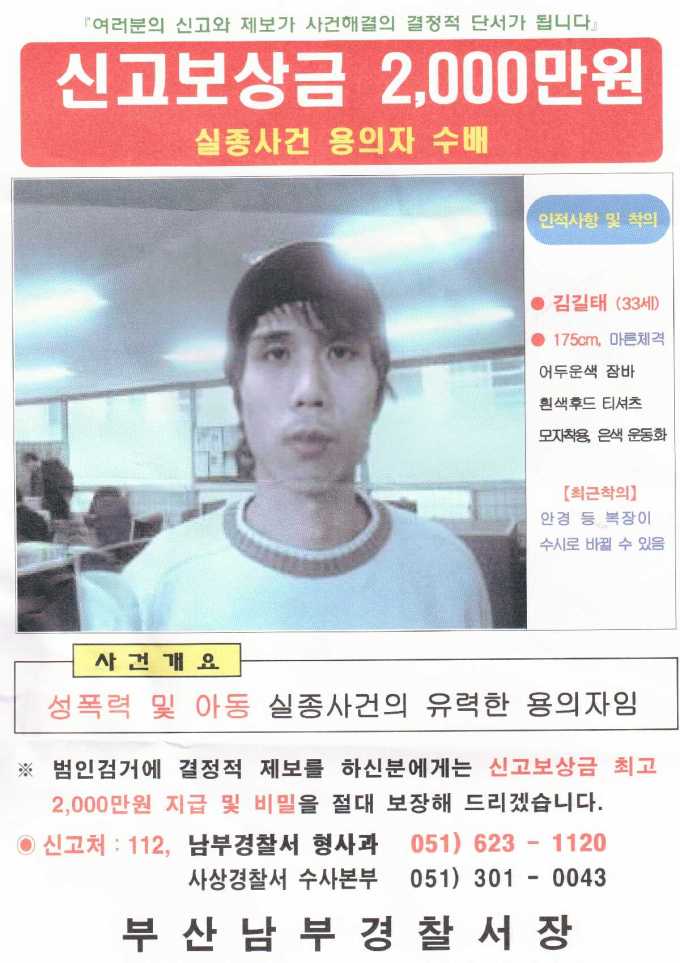
Whether in response to intense criticism of the government’s policies towards sex offenders or of their own accord, I was still very impressed with the police for sending this wanted notice for Kim Kil-tae (김길태) to all Busan households yesterday, the main suspect in the rape and murder of 13 year-old Lee Yu-ri (이유리) last month. The first time I’d ever received a wanted notice in the mail in 10 years in Korea, let alone for a crime that occurred last Saturday at the other side of a city of 3.6 million, I thought it was significant enough to warrant a post in its own right, but I’m happy to report that literally as I began typing that the news came through that he has been caught.

I’ll update this post as more information becomes available. The reward, by the way, was for 20,000,000 won, or roughly 17,700 US dollars.

Update 1 – I’ll let this news speak for itself:

Rival parties agreed Wednesday to convene a one-day parliamentary session this month to act on a series of bills calling for tougher punishment for sex crimes, an unusual bipartisan move reflecting nationwide outrage over the recent rape and murder of a teenage girl.

Read the rest here. On a more reflective note, see Extra! Korea for a brief discussion on the possible role of absentee parents in this and similar crimes.

Update 2 – The Korea Times has a report about his apprehension here.

Update 3 – The Hankyoreh’s take on it is here. Earlier, it used the original crime itself to criticize unrelated policies of the Lee Myung-bak administration in a cartoon, and while I’m generally sympathetic to the newspaper (it’s the only Korean newspaper which doesn’t caricature and/or deliberately misrepresent foreign English teachers for instance), it does seem to have a habit of that sort of thing.

Update 4 – Via ROK Drop, here are the latest developments in the case:

The police investigation of a recent rape and murder case of a teenage girl in Busan is facing difficulties due to lack of evidence.

The 33-year-old, Kim Gil-tae, caught Wednesday, has denied the charges and remained silent during interrogation, said officials.

He only admitted stealing money and keys in a nearby hair shop while he was hiding from police.

Investigators requested an arrest warrant on Thursday, based on genetic evidence such as Kim’s DNA found in the body of the 13-year-old victim, Lee Yu-ri.

The police, however, have so far failed to collect definitive evidence linking him to the murder.

Read the rest at the Korea Herald here. Personally, I’m a bit confused and surprised though, as how on Earth can the fact that his DNA was found inside the body not be the “definitive evidence” required?

Update 5: Initially denying it, the news has just come in that Kim Kil-tae has now confessed to the crime.

(For all posts in the Korean Sociological Images series, see here)

Share

Unrequited Love…or Stalking? The Pitfalls of Dating in Korea

How to deal with a stalkerIn Korea, it is accepted practice for men to relentlessly pursue the objects of their heart’s desire, sometimes for many years, and despite if said objects clearly, repeatedly, and vehemently express their disinterest.

Far from being viewed as stalking however, it is generally viewed as both a sweet and noble sign of one’s love and dedication. There’s even a proverb specifically for this: “열번찍어 안넘이 가는 나무 없다,” which roughly translates as “There is no tree that can withstand being chopped 10 times.” (Image source, right.)

It’s not that I can’t see those sweet and noble elements, nor how many Korean women would surely exploit the practice, in a playing hard to get fashion (some more Korean that comes to mind is “희망고문하다,” literally to “hope-torture [someone],” or to repeatedly string someone along and then break their heart). But I think that the consensus of most Westerners is that if the woman says she’s not interested…then she’s not interested, and hence that the man’s behavior after being told is stalking, regardless of how sweet or noble his intentions. Unfortunately, in a society that already accepts women being physically dragged into nightclubs, then foreign or Korean, women can probably expect little sympathy when dealing a stalker.

This probably won’t be the first or last time you’ll read about this subject: navigating different expectations when it comes to dating are an integral part of the expat experience, and with my limited dating experience then I can’t add much that hasn’t already had gallons of virtual ink spilt on it. Two useful things I can do though: first, mentioning that of all the guides to navigating those dating minefields out there, that this one by Michael Hurt at Scribblings of the Metropolitician is by far the best, and with many things that informs even my marriage of 6 years; and second, and which was frankly the real inspiration for this post, that over at Sociological Images there is a post that discusses the fact that:

Various journalists and scholars have pointed out over the years that movies and TV shows often portray as romantic behavior that is fairly indistinguishable from stalking.

And then a video created by Jonathan McIntosh of Rebellious Pixels, who:

…edited together scenes from Buffy the Vampire Slayer with scenes of Edward Cullen from the movie Twilight to show how behavior that is depicted as protective and romantic in the film (and book) could also be seen as disturbing

For more, see the original post here. Not that I think that the humorous stalking in, say, There’s Something About Mary had much of an effect on my own opinions of it, nor that seeing it in pop-culture somehow renders real-life examples in any country okay, but still: the next time we feel a sense of righteousness and indignation about hearing Korean examples, it is certainly worth pondering the mixed messages that Western pop-culture provides.

First Korean Man Convicted of Spousal Rape Found Dead

korea suicide(Source: danle; CC BY 2.0)

Not the outcome I expected when I first wrote about this on Sunday. From Yonhap news:

BUSAN, Jan. 20 (Yonhap) — A South Korean man, the first to be convicted of spousal rape in the country, was found dead Tuesday in an apparent suicide, police officials said.

The 43-year-old man, identified by his surname Lim, was found by his mother hanged at his home in southern Busan around 2:40 p.m., according to the police.

This is just breaking news, so I’ll add more tomorrow once more than just the bare details become available. In the meantime, here is a brief Korean news video with a transcript for those of you that speak Korean.

Update: Rather than simply repeating what he mentions, for more information let me direct you to Robert Koehler’s post on the subject here.

Update 2: See also #2 here.

Semi-Nude Photos of 14-Year Old Draw Controversy

The 14-year old girl is Park Seo-jin, the controversial photoshoot from the Mnet reality show I Am A Model. It’s already covered in numerous “news” articles though, so let me just quickly highlight one element of it here: that for all the recent and historical mania about protecting underage girls against foreign pedophiles, the Korean police seem strangely reluctant to respect their own laws banning the nude photos of minors that would (presumably) encourage them. The most obvious examples being one of the promotion posters for—let alone various scenes in—Samaritan Girl/Samaria (2004), all shot when actress Kwak Ji-min was still in high school, and therefore legally a minor.

Like with those, no-one will ever be prosecuted for Park Seo-jin’s photos. Unlike those though, they do seem to be creating much more negative reaction. Most likely, simply because she is just sooo young.

What do you think?

Update: In case of any confusion, note that while she’s 16 according to the (strange) Korean age system, her birth date is actually 11 March 1994.

Jackie Lim and The Pimping of Korean Entertainers, 1995

(Source: ITH)

Update, December 2013: A very old post, which I’ve long since removed the original commentary to (and consequently the comments also). But hopefully someone may still find the translation useful!

해외동포 연예인 붐을 일으킨 재키림의 10년 전 사진 / Jackie Lim, The Creator of an Overseas Korean Entertainer Boom

삼성은 하이버네이션 기능 때문에 안정성에 문제가 많은 그린컴퓨터를 얼른 단종시키고 매직스테이션이라는 새로운 브랜드를 선보였는데, 매직스테이션은 꽤 오래 출시되면서 장수 브랜드로 자리 잡았다.

Because the “hibernation” function was causing many problems with stability, Samsung quickly stopped producing “Green computers” in 1995 and launched a new brand called “Magic Station” instead, which became a very successful brand over the next ten years.

매직스테이션III의 광고모델은 당시 새롭게 떠오르던 해외동포 연예인인 재키림이다. 몇 개 국어를 자유자재로 구사할 수 있었던 재키림은 재원이라고 칭찬받으며 화려하게 연예계에 데뷔했다. 재키림은 SBS ‘생방송 TV 가요 20’, KMTV ‘동방특급 비디오자키’ 등을 뛰면서 가수와 비디오자키로 활동했다. 재키림은 비디오자키의 열풍을 일으켰을 뿐만 아니라 오늘날의 해외동포 연예인 붐을 일으킨 불씨가 되었지만, 정작 본인은 한국 연예계에 적응하지 못하고 방황으로 얼룩진 비운의 운명을 걷게 된다.

Jackie Lim was a new and upcoming star when she appeared in the “Magic Station 3” advertisement in 1995. As she was fluent in many languages she received a lot of attention and praise when she made her original debut, both starring as a singer and working as “video jockey” on the SBS program “20 Songs On Air” and KMTV’s “High-Class Eastern Video Jockey”. Ultimately she proved so popular she provided the spark for a boom in interest in overseas Korean entertainers. But she soon found it difficult to adapt to the Korean entertainment industry, and became a bit lost for which direction to take herself and her career.

재키림은 마약을 비롯한 좋지 않은 사건에 휘말리는데, 그녀가 이런 사건에 빠진 이유는 ‘한국에서 실력으로 활동하려 했지만 자신을 성적대상으로만 보면서 높은 사람 자리에 불려나가야 하고, 동료연예인들로부터 왕따당하면서 외로워서 약을 하게 되었다.’고 밝혔다. 재원이라고 떠들었던 뒷편에는 여성 연예인에 대한 여전한 성차별과 고위권의 압력, 동료 연예인의 텃세가 있었던 것이다.

Later, she became disgusted and further disheartened by trying to succeed as a singer in Korea through her own abilities but while facing the virtual prostitution of female entertainers that goes on behind the scenes. Not only was she regularly pressured to entertain and provide sexual services for politicians and business leaders, who saw her merely as yet another trophy girlfriend to be used, but on top of that she was also ostracized by other entertainers too, angered by whom they saw as an uppity overseas Korean whom they intended to put in her place. In the end she became very lonely and depressed and got involved with drugs.

이미지: 1995년 삼성 매직스테이션3 광고에서 밝게 웃는 재키림. 하지만 이 웃음 뒤에는 잘못된 연예게 관행으로 인한 외로움과 고통이 숨어있다.

Photo caption: Jackie Lim smiling brightly in Samsung’s advertisement for the Magic Station 3. But hidden behind the smile there was a great deal of loneliness and pain caused by the Korean entertainment industry’s bad practices (source).