Rubber Soul 2010

( Sources: left, unknown; right, Rubber Soul 2010 )

Apologies for the late notice, and also to Roboseyo for swiping his own post on the event:

December 4 is World AIDS Day.  Starting at 9PM, in Hongdae, at Ting Tings, Club TA, Club FF and DGBD, you can attend parties at all four spots for a 15000 won cover.  All the cover fees go to Hillcrest AIDS center in South Africa.

You can learn more at the Facebook event page, or at the Rubber Soul Blog.

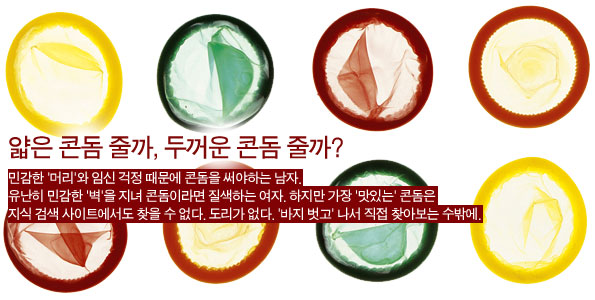
And don’t forget that there’s a prize for the best condom costume!^^

Sex and the University: Part 1

(Source)

Well, sex and Yonsei University to be precise, with 4 articles on that theme being published in the latest Yonsei Chunchu (연세춘추) campus newspaper, providing valuable insights into modern Korean students’ sexual experience and attitudes.

Unfortunately for the authors though, Yonsei happens to be a notoriously Christian university. And so according to my anonymous informer, they were actually punished for them in some way.

Details are sketchy at the moment, but the main problem appears to have been a sex survey sent to all students, with the first article below discussing the results. Perhaps the board of trustees was shocked and embarrassed that 1 in 3 Yonsei students are quite happy having one-night stands or something?

연세인, 당신의성의식은어떤가요? 대학생성의식은개방으로황새걸음, 사회적인식은아직도뱁새걸음

Yonsei students, how is your awareness of sexual issues? While university students’ awareness is progressing by leaps and bounds, Korean society is still only making baby steps

가장 기본적이고 보편적인 욕구인 동시에 가장 은밀하기도 한 것, 바로 ‘성(性)’이다. 아직 성적인 이야기를 스스럼 없이 털어 놓을 수 없는 한국 사회에서 연세인들은 성에 대해 어떠한 생각을 갖고 있는지 「연세춘추」에서 알아봤다. 설문조사는 이메일을 통해 지난 9월 13일에서 10월 4일까지 약 3주간 진행됐으며 1천287명의 학생들이 이에 답했다.

Sex is the most basic, universal desire, but at the same time it’s also the most private one. And in a society in which people still feel unable to speak frankly and openly about sexual matters, how to find out Yonsei students’ thoughts on them? So, the Yonsei Chunchu conducted an email survey for 3 weeks between the 13th of September and the 4th of October, and received 1,287 replies from students.

(Source)

연세인 2 1, “나는성경험이있다

1 in 2 Yonsei students have sexual experience

성경험의 유무를 묻는 질문에 거의 절반에 해당하는 49.5%의 학생들이 “있다”고 답했다. 또한 “있다”고 답한 응답자 중 72.5%가 08학번 이상이라고 답해 고학번이 높은 비중을 차지한 것을 볼 수 있었다. 이에 대해 ‘행복한 성문화센터’ 배정원 소장은 “사회적 분위기 자체가 달라져 성관계를 맺는다는 것이 쉽게 받아들여지고 있다”며 “예전에는 공개적으로 등장하지 않았던 혼전 성관계가 대중매체에서 자연스럽게 나오면서 사람들이 이에 대해 대수롭지 않게 생각하게 됐다”고 말했다.

또한 우리대학교 성희롱·성폭력 상담실 이정화 교수는 “실제로 성경험이 있는 학생들의 숫자도 늘어났지만 그 사실을 드러내놓고 이야기 할 수 있게 여건이 변한 탓도 있다”고 말했다. 이러한 사실은 “성경험이 있음에도 주변사람들에게 거짓말을 한 적이 있다면 그 이유는 무엇인가”라는 문항에서도 찾을 수 있다. “주변의 인식 때문에”라는 답변을 33.0%의 학생들이 선택한 반면 “사생활에 대해 말하기 싫어서”를 택한 학생은 40.8%로 가장 많았다. 이 교수는 이 결과에 대해 “성관계를 가졌다고 해서 안 좋은 낙인이 찍히거나 이상하게 보는 분위기가 아니기 때문에 주변의 인식의 문제보다 ‘이건 내 사생활’이라는 의식이 더 크게 작용한 것”이라고 분석했다.

On the question of it they had sexual experience, almost half of students (49.5%) replied that they had, of whom 72.5% entered Yonsei University in 2008 or earlier. About this, Bae Jeong-won, head of the Happy Sex Culture Center said “the social atmosphere is changing, and nowadays people are becoming much more accepting of [premarital] sexual relationships”, and that “in the past, you never saw premarital sexual relationships depicted in the mass media. But as they’ve naturally started appearing, people have come to think that they’re nothing to really get concerned about.”

(Source: Extreme Movie)

Also, Professor Lee Jeong-hwa of the university sexual harassment and sexual violence consultation center said “because society is changing, the number of people who openly admit to having sexual experience is increasing”. And about that, one of the questions in the survey was “have you ever lied about your sexual experience, and if so, what was the reason?” [James – I think “have you ever pretended you didn’t have sexual experience when you did?” is more accurate], and 33% of those that replied that they had did so because of what others would think of them, whereas 40.8% replied that they did because they didn’t want to talk about their private life. About those results, Professor Lee said “respondents were more concerned about keeping their private life private than being stigmatized and/or branded by those around them”.

사회는보수지만나는개방

Society is conservative, but I am liberal

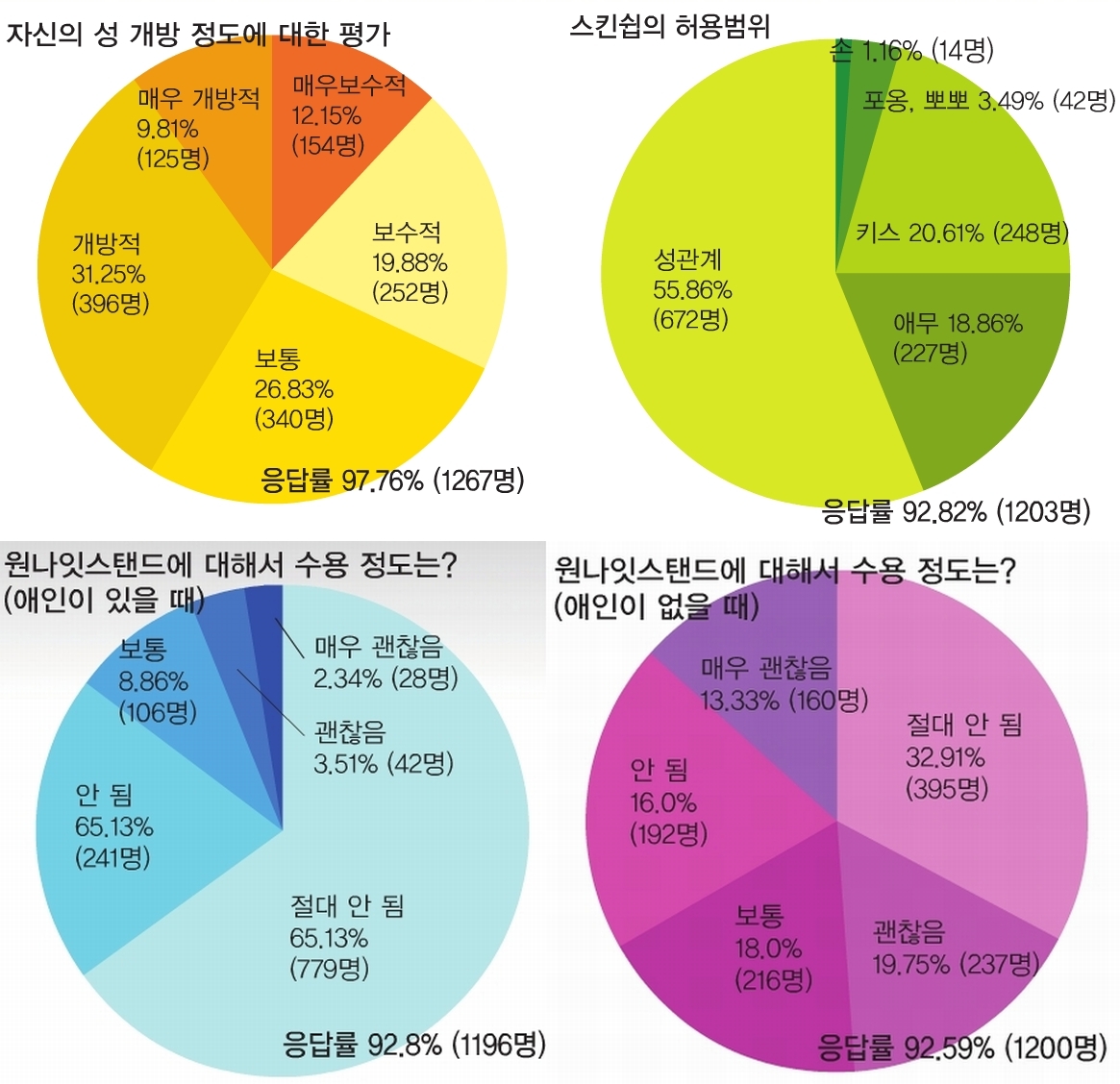
이런 분위기에도 불구하고 학생들은 한국 사회를 보수적이라고 평가했다. 전체 응답자의 67.0%가 한국 사회의 성개방 정도에 대해 보수적이라고 답해 아직 사회 전체적으로는 개방적이지 않다고 생각하고 있었다. 이에 비해 자신의 성개방 정도에 대한 평가는 개방적이라는 답변이 41.1%로 보통이라고 답한 26.8%와 보수적이라고 답한 32.0%보다 많은 비중을 차지했다.

Despite this [changing] atmosphere, students think Korean society is still conservative, and on the question of sex in particular, 67% of the total replies that is was conservative and not yet liberal. Of themselves in contrast, 41.1% considered themselves to have liberal attitudes towards sex, 26.8% were middle of the road, and 32.0% considered themselves conservative.

(Source)

스킨십은성관계까지, 원나잇은애인이없을?

As for skinship [James – Basically, physical affection towards a boyfriend or girlfriend], does that go all the way to sex? Are one-night stands only for when you don’t have a boyfriend or girlfriend?

자신은 개방적이라는 연세인의 생각은 다른 문항에서도 나타났다. 스킨십의 허용 범위를 묻는 질문에서 “성관계”라고 답한 응답자가 55.9%로 가장 많았고 “키스까지 가능하다”는 응답이 20.6%로 그 뒤를 이었다. 지난 2004년 7월 「연세춘추」 연애에 관한 설문조사에서 스킨십의 허용범위를 묻는 질문에 “키스까지 가능하다”는 응답이 54.3%로 가장 많았던 것과도 달라진 결과다. 또한 연애를 함에 있어서 성관계의 중요도를 묻는 질문에는 “꼭 필요한 것”이라는 응답이 37.0%를 차지한 데 비해 “절대 안된다”고 답한 연세인은 13.2%에 불과했다.

연세인들은 이성친구가 과거 성경험이 있는 것에 대해서도 높은 관용도를 보였다. 이성친구의 성경험에 대한 관용도를 묻는 설문 문항에서 “괜찮다”는 응답이 49.4%로 “안된다”고 답한 26.8%보다 월등히 많았다.

모텔에 가는 것에 대한 수용 수준은 “괜찮다”는 응답이 45.9%를 차지해 “안된다”고 답한 32.1%보다 많았다. 또한 원나잇스탠드에 대해서도 애인이 있는 경우에는 “절대 안된다”는 응답이 65.1%, “괜찮다”는 응답이 5.8%에 불과했지만, 애인이 없는 경우에는 “절대 안된다”가 32.9%, “괜찮다”가 33.1%로 큰 차이를 보였다.

The fact that Yonsei students are now quite liberal about sex also emerged from a different question. To the question of how much physical affection they permitted, most (55.9%) said “all the way to sex”, while 20.6% only limited it to kissing. In a similar survey given by the Yonsei Chunchu in July 2004 though, as many 54.3% said they would limit it to kissing, and on the additional question of how important sex is for a relationship, 37.0% replied that it was essential, whereas 13.2% said they would absolutely not have sex [James – presumably before marriage that is]. (source, right)

On the question of how they would react if they discovered their boyfriend or girlfriend had sexual experience prior to meeting them, Yonsei students also showed a high level of acceptance: 49.4% saying it was okay, with 26.8% saying it wasn’t.

As for if they were happy to go to a love motel to have sex, 45.9% said that was fine, with 32.1% disagreeing. And if they had a partner already, 65.1% would never have a one-night stand with someone else, whereas 5.8% replied that it was okay. If they were single though, 32.9% would still never have a one night stand, but 33.1% were fine with it.

학생들 따라가지 못하는 성교육

Sex education is not keeping pace with students’ needs

이렇듯 젊은 대학생들은 점점 개방적으로 변화하고 있지만 성교육은 이를 쫓아가지 못하고 있다. “지금까지 받아온 공식적인 성교육이 충분했다고 생각한다”는 문항에 과반수를 훌쩍 넘는 85.6%의 연세인이 “아니다”라고 답했다. 또한 가장 실용적이고 도움이 되는 성지식의 출처를 묻는 질문에 “공식적인 성교육”이라고 답한 응답자는 13.4%로 대중매체와 관련 책 항목에 밀려 세 번째를 차지했다. 이에 도지연(생명공학·09)씨는 “문화가 개방적으로 빠르게 변하는데 비해 성교육은 제자리걸음인 것 같다”며 “성교육 자체가 보수적이라 실생활에서 활용이 불가능하다는 것이 문제”라고 결과에 동의했다.

이 같은 결과에 배 소장은 “상담을 받아 보면 학생들의 성지식이 턱없이 부족하다는 것을 느낀다”며 “학생들은 성에 관한 정보를 점점 더 많이 접하고 있는데 그에 비해 성교육은 충분하지 않아 잘못된 지식을 갖게 될 위험성이 매우 큰 것이 문제”라고 비판했다. 나아가 이 교수는 “사실 성관계를 맺는 과정에 대해서는 인터넷 같은 데에 충분히 개방돼 있고 접하기가 쉽지만 중요한 것은 의사소통인데 이것이 공식적인 성교육에서 매우 부족하다”고 말했다.

(Source)

In light of all this, as university students become more liberal about sex, then sex education is not really following suit. In response to the question of “has the sex education you have received up until now been satisfactory”, 85.6% replied that it hadn’t, and only 13.4% replied that it was the most practical and helpful source of information for them, well behind the mass media and sex-related books. Second-year biotechnology student Do Ji-hyeon agreed, and said that “even though culture is changing and rapidly liberalizing, sex education remains the same,” and that “as it is taught conservatively, it doesn’t really meet students’ practical needs”.

Similarly, Happy Sex Culture Center head Bae said “from consultations we’ve had with students, we get the feeling that their knowledge about sexual matters is woefully inadequate”, and that “because sex education is also  inadequate, and because students are getting information for themselves instead, then there is a danger that they will be misinformed.” Professor Lee Jeong-hwa of the university consultation center agrees, and says that “it’s easy enough to find information on the internet about the process of sex [James – does she mean the basic biology of it?]. But the important thing is communication, and in this sense public sex-education is severely lacking”. (end)

(Source)

To play Devil’s advocate for Yonsei punishing the authors for giving the survey to students, of course we don’t know how severe that punishment was as of yet; Yonsei’s religiosity is by no means uncommon for Korean universities (my own has similar requirements for Chapel attendance in order to graduate, regardless of one’s religion); the punishment probably pales in comparison to effectively expelling a student for being gay like this one is; it has the oldest LGBT group of any Korean university; and, as Part 3 will reveal (see here for a sneak peek), it even has mandatory sex education classes. Indeed, in the light of the last in particular, then the fact that there was any punishment at all is very surprising and confusing, and I’d be very grateful if any Seoul-based readers can send me any further information about that (and please feel free do so anonymously if you prefer).

Meanwhile, what did you think of the survey? Do you think the results are actually of any use, given that only 1,287 students out of nearly 30,000 replied? Has anyone heard of similar surveys and/or mandatory sex education classes at other Korean universities?

Regardless, thanks again to the person who sent me all the articles, and – writing this next week now – here is Part 2!

Yes, Old Korean People Have Sex Too…

( Source )

But perhaps as you’d expect, they’re generally not using protection. A quick report from The Daily Focus on Wednesday:

Number of STD Cases Among Old People Rising

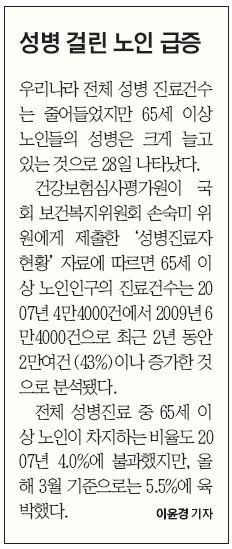
While the national total number of STD cases has dropped overall, the numbers of people aged 65 and over contracting STDs has risen sharply, it emerged on the 28th.

The Health Insurance Review and Assessment Service presented its “Current Situation Regarded STD Treatment Recipients” report to Assemblywoman Son Sook-mee of the National Assembly Health Welfare Committee, according to the data of which the number of cases of people aged 65 and older receiving treatment for STDs was 44,000 in 2007 and 64,000 in 2009, a rise of 43% in just 2 years.

In 2007, people 65 years and older accounted for 4.0% of all cases of people treated for STDs, but this has risen to 5.5% as of March this year.

Little information to go on unfortunately, but Seoul residents may be interested in placing that into the context of the prostitution culture around Jongmyo Park in Jongno, which caters to the thousands of male retirees that spend their days there. From story #13 in a “Korean Gender Reader” post from March last year:

Prostitution Answers Sexual Needs of Senior Citizens?

The first time I visited in Jongmyo Park in Seoul in 2000, naturally I remarked on the hundreds of mostly male retirees there to my friend visiting from Japan, who rightly pointed out that they “didn’t particularly have much to do nor anywhere in particular to do it,” so why not play Korean chess all day there? In hindsight though, many would much rather be doing something else, and it’s almost surprising that it took so long for prostitutes to encroach on this captive and – let’s call a spade a spade – somewhat desperate market.

Here, the Korea Times reports on the ensuing problems of unsafe sex, the sale of fake Viagra and “men’s stamina” products, and the general increasing seediness of the area. You can also read discussions about it at ROK Drop and The Marmot’s Hole.

One surprising omission in the Korea Times article though, was the fact that the area between Jongmyo and Tapgol Park is also “packed full with gay bars and hotels catering to gay clients”, as noted by regular commenter Gomushin Girl.  Still it does end with the pertinent point that:

…the social atmosphere of viewing senior citizen’s sexual desire as a nasty matter has worsened the situation. “Sexual desire is a desire not only shared among young people but also old people. But our society is sill stuck in the obsolete Confucian-based perception that labels desire as an undesirable state, playing a major hurdle in setting a sound sexual culture for the aged,” said Prof. Lim Choon-sik at Hannam University’s social welfare department.

( Source )

And accordingly, probably the most notable if not the only “recent” Korean film to depict the sexuality of the aged – Too Young to Die (죽어도 좋아; 2002) – was heavily censored. As noted at KoreanFilm.org:

The filmic career of this independent digital feature about an elderly couple in love has followed an unusual arc. It began at the pinnacle of respectability, being selected to screen in the Critics’ Week section at the 2002 Cannes International Film Festival. After receiving a number of very positive reviews, it went on to be selected for the Toronto International Film Festival’s showcase of Korean cinema, and then received a special grant from the government-supported Korean Film Commission to help finance the film’s transfer to 35mm film for a release in Korea. Then, alas, the film was submitted to the nation’s Media Ratings Board, where it was judged unfit for public viewing and banned from release in ordinary theaters.

Too Young To Die is based on the true story of Park Chi-gyu and Lee Soon-ye, a man and woman in their early seventies who met, fell in love, and then rediscovered sex. The couple, who play themselves in the movie, seem little different from a couple in their twenties. They tease each other, fret about their hair, take snapshots of themselves, argue over trifles, and leap into bed with unabashed frequency. Indeed, watching them forces you to rethink all your stereotypes of what it is to be old.

In particular, as Gomushin Girl mentioned in the context of the excessive censorship of women’s sexuality in general:

…the key scene of fellatio was darkened and shortened significantly before it could be released. I would suggest that it was not just the fact that the couple was elderly that made the sex scenes so controversial, but the gusto and relish that the woman took in the acts.

Which raises the question of if there have been any other depictions of aged sexuality in Korean popular culture in the past 8 years (positive or otherwise), as perhaps that experience put directors off? If you know of any, then please let know, but regardless I’d wager that we’re likely to see more soon; after all, with Korea rapidly becoming the most aged society in the world, then audiences (and rating boards) can only become more sympathetic to the subject over time.

In the meantime, can anyone think of any areas in other Korean cities where retirees and prostitutes regularly meet?

Share

The Vagina Monologues in Busan: Sunday, April 25th

( Source )

Very surprised to hear that this will be not only be playing in Busan, but just 10 minutes away in my local drinking district of Kyungsung and Pukyong university, I’m glad to finally get a chance to see this. With all proceeds going to shelters that help victims of sex trafficking in Korea, check out the Facebook page for the details, including about the after party: am looking forward to meeting some readers there!

Update 1: Lest the poster above give you the wrong impression however, which is actually for a Korean performance in Bucheon, please note that the performance is in English, and you can hear an interview of the cast on Koreabridge here if you like.

Update 2: You need to be logged on to see the Facebook page, so alternatively you can see here for the details instead, and I’ve also added a map below.

Update 3: See here for an article in Busan Haps.

Share

The Dire Need for Sex Education in South Korea

(Source)

As you probably suspected, only a very small percentage of Korean teenagers are having sex. The average age that they started though, was as young as 14, and that doesn’t just affect them academically.

Or at least, that’s the take-away message of the news article below, which I was pleasantly surprised to see on the front page of Yahoo! Korea last week. Unfortunately it is rather sloppily written, raises more questions than answers, seems to ignore teenage prostitution and – in a typical irony – required age verification to search for it again the next day, but I’m cautiously optimistic that the information will lead to more calls for improved sex education at Korean schools. After all, it can hardly get any worse.

이른 성관계가 아이들에게 미치는 영향 – The Effects of Having Sex at an Early Age

“어린나이에 갖는 성관계는 아이들에게 어떤 영향을 끼칠까?”

얼마 전 청소년들이 성관계를 시작하는 평균 연령이 14.2세며 피임율은 38%에 불과하다는 조사결과가 발표되면서 우리나라 청소년들의 성 노출 연령이 점차 낮아지고 있음이 드러나면서 청소년의 성 문제가 다시 한 번 대두되고 있다.

대한산부인과학회지에 실린 ‘한국 청소년들을 대상으로 한 성행태 조사’에 따르면 2006년 9월 13~18세 중·고등학생 7만1404명 (남 3만7420명, 여 3만4200명) 을 조사한 결과 청소년의 성관계 시작 연령은 중학교 2학년인 14.2세(남 14.0세, 여 14.5세)였다고 밝혔다.

이들의 성관계 경험률은 5.1% (남 6.7%, 여 3.4%) 였으며 성경험자의 피임률은 38%에 불과했다. 또한 성관계 경험 여학생의 14%는 임신 경험이 있었으며 이 중 85%가 임신중절수술 경험을 했다.

청소년의 생식기는 생물학적으로 완전히 성숙된 단계가 아니기 때문에 바이러스가 침투하면 대항할 힘이 부족해 이른 성경험은 자칫 자궁과 생식기의 건강을 위협할 수 있고 여자의 경우 자궁경부암의 발병확률이 급증 할 수 있음을 전문가들은 충고했다.

“What are the effects of having sex at an early age?”

The results of a survey on adolescent sexuality released some time ago shows that the average age that adolescents are exposed to sex is gradually lowering over time. Of adolescents that have already had sex, the average age that they lost their virginity was 14.2, and only 38% of them used contraception. This is making teenage sexuality become a pressing social issue again.

According to the “Survey of Korean Adolescents’ Sexual Activity” published in The Korean Gynecological Journal, of the 71,404 13~18 year-old middle and high school students surveyed in September 2006 (37, 420 boys and 34,200 girls), the average age that they lost their virginity was 14.2, which is the second year of middle school (boys at 14.0, and girls at 14.5).

Of those students surveyed, 5.1% had sexual experience (boys: 6.7%, girls 3.4%), but only 38% of them had used contraception. Also, 14.1% of those girls had gotten pregnant, 85% of whom had an abortion.

Having sex before the genitals are fully developed means that the body’s ability to fight off viruses and repair damage to them is insufficient, and in particular girls have a much greater chance of developing cervical cancer.

이른 나이에 성관계 갖은 아이들, 대학 못간다 – Adolescents That Have Sex Don’t Want to go to University

완벽하게 몸이 성장하지 못한 상태에서 갖는 성관계는 신체적인 악영향을 끼치기도 하지만 더 심각한 것은 심리적인 부작용이다.

영국 글래스고대학이 지난 6년 동안 5000명의 학생들을 대상으로 성관계와 학업성취도의 상관관계를 조사한 결과 남녀 청소년 모두 이른 성경험이 자신을 어른처럼 느끼게 만들어 학업 등에 소홀해지는 경향을 보였다는 연구결과를 사춘기저널(Journal of Adolescence)에 발표했다.

연구는 14~18세 사이의 청소년들에게 성관계를 가진 그룹과 그렇지 않은 그룹을 나누어 계속 학교를 다닐 의향과 장래희망의 변화여부 등에 대해 묻는 방식으로 진행됐다.

연구결과 16세 이전에 이미 섹스를 경험한 청소년 중 39%가 대학 진학 등 학업을 더 연장하고 싶은 생각이 없다고 대답했으며 성경험이 없는 학생들은 24%만이 학업연장에 대한 뜻이 없는 것으로 나타났다.

앨리슨 파크스는 “청소년기에 성경험을 가지게 되면 더욱 이성과 함께 있는 시간을 원하는 것으로 나타났다”며 “일찍 성을 경험한 남녀 모두 마치 자신이 선구자인 것처럼 행동하는 경향을 보였다”고 말했다.

(Source)

While having sex before one’s body is fully developed is bad physically, the mental side effects are far greater.

A study of the sexual experiences and academic accomplishments of 5000 adolescent boys and girls conducted for the last 6 years by the University of Glasgow, published in the Journal of Adolescence, shows a negative relationship between the two. In short, adolescents with sexual experience tended to feel that they were already adults, and so paid less attention to their studies.

The study’s method involved dividing 14~18 year-olds into two groups: those with sexual experiences and those without, and asking each about their plans for the future. Of the 16 year-olds that had already had sex, 39% said that they had had enough of schooling and did not plan to go on to university, but only 24% of virgins felt the same way. According to Alison Parkson, this was partially because “those adolescents that first had sex at an early age wanted to spend more and more time with members of the opposite sex,” and that they “felt that they were pioneers.”

성관계 그 후, 밀려오는 불안감 – Anxiety and Depression After Having Sex

충동 에 이끌려 성관계를 맺은 후 정신적으로 미성숙한 아이들에게는 그제 서야 불안감이 물밀 듯이 밀려온다.

우리나라에서 청소년 시절에 성관계는 물론 이성교제 역시 불건전하고 몰래해야한다는 인식이 사회전반에 깔려 있다.

즉 아이들에게 이성과의 관계는 일종의 ‘죄’라는 이미지가 강하기 때문에 이성교제나 성관계가 이뤄지는 것은 단연 어른들의 눈을 피한 탈선의 상황에서가 주를 이루게 된다.

게다가 신체적으로는 임신이 충분히 가능한 나이고 또 그것을 본인들도 인지하고 있기 때문에 심한 불안감을 겪게 되는 것이다.

상담21성건강연구소 유외숙 박사는 “아이들은 무방비하게 인터넷에 노출되다보니 실제적인 것이 어떤 느낌을 줄까 하는 호기심과 욕구에 사로잡히게 된다”며 “그러나 섹스를 하고 돌아서자 마자 ‘임신했을까, 만족을 못시켰을까, 부모님에게 알려질까’ 등의 불안감이 찾아오기 때문에 자기평가가 상당히 낮아지게 된다”고 설명했다.

유 박사는 이어 “게다가 이런 고민들을 해결 할 곳이 필요한데 실제 청소년들이 문제를 들고 찾아갈 만한 곳이 없어 혼자 앓게 되는 경우가 많다”며 “이런 불안감이 심해지면 대인기피증이 생기거나 정말 성관계가 필요한 시기가 됐을 때 제대로 된 성생활을 못하게 되는 경우도 있다”고 덧붙였다.

(Source)

Adolescents that act on their urges to have sex before they are mentally ready for it tend to have feelings of anxiety, uneasiness and depression afterward.

In Korean society, there is almost a universal taboo against adolescents dating, meaning that they have to do it secretly. Indeed, having sexual relationships or even dating the opposite sex is virtually considered a crime by adolescents here, and hence that that which does occur is in places far from the eyes of adults.

In addition, as the girls are aware that there is a chance that they might get pregnant, then they in particular suffer a great deal of anxiety and depression.

According to Dr. Yu Wae-sook at Consult 21 Sexual Health Research Institute, “adolescents are defenseless against what they see on the internet, and naturally get caught up in and want to physically experience those things for themselves,” but also that once they do, “they worry about such things as if they are pregnant, if they were good enough and if their parents will somehow find out. This causes them a great deal of anxiety, and lowers their self-worth and confidence.”

Moreover, “adolescents don’t really have anywhere or anyone to go to for answers, and so have to continue worrying about them alone” and “that these worries can become so serious that they become reclusive. This can have grave consequences for their future sex lives once they reach an age when they would normally be physically and emotionally mature enough to start one.” (end)

(Source: Unknown)

As always, please feel free to correct any mistakes above, which is by no means a literal translation.

For more information about the issues raised, see here for a related survey conducted in 2003 and my analysis, and Matt at Gusts of Popular Feeling here for his on similar surveys conducted in late 2008; you may also find this recent post of mine on the Korean age of consent interesting. Meanwhile, I will try to find out more information about the survey itself in the next few days, particularly the methodology used!

Korean-language Sources on Gender and Sexuality #1: PlayHolic

The Art of Seduction It’s official: from now on, I’ll be using Korean-language sources on gender and sexuality here just as much as English ones.

Partially, this is simply to maintain and improve my Korean ability, which I’ve sorely neglected since starting a new job back in July. But the main reason is that not only can foreign-language commentary on any subject quickly become out of date, it also makes one reliant on the views of those Koreans fluent in English, which are not necessarily reflective of Koreans as a whole.

Consider the following by sociologist Yoshio Sugimoto for instance. He is talking about Japan, but his points are equally relevant to Korea:

Dominating in the upper echelons of society, core subcultural groups are able to control the educational curriculum, influence the mass media, and prevail in the areas of publishing and publicity. They outshine their peripheral counterparts in establishing their modes of life and expectations in the national domain and presenting their subcultures as the national culture. The samurai spirit, the kamikaze vigor, and the soul of the Yamato race, which some male groups may have as part of the dominant subculture of men, are promoted as presenting Japan’s national culture….

More generally, the slanted views of Japan’s totality tend to reproduce because writers, readers, and editors of publications on the general characteristics of Japanese society belong to the core subcultural sphere. Sharing their subcultural base, they conceptualize and hypothesize in a similar way, confirm their portrayal of Japan between themselves, and rarely seek outside confirmation….(An Introduction to Japanese Society, pp. 12-13).

And in particular:

Core subcultural groups overshadow those on the periphery in inter-cultural transactions too. Foreign visitors to Japan, who shape the images of Japan in their own countries, interact more intensely with core subcultural groups than with peripheral ones. In cultural exchange programs, Japanese who have houses, good salaries, and university educations predominate among the host families, language trainers, and introducers of Japanese culture…(p. 13)

After two years of immersing myself in (limited) English-language sources on gender and sexuality then, it’s high time to make Korean language-ones my starting point instead.

MeinkampfTo that end, let me begin by recommending the blog PlayHolic (플레이홀릭) written by a Korean woman from Jeju called Im-ji (임지; probably not her full name). I’ve been following her on Twitter for several months now, but I confess it was only a few days ago that I first really read her tweets, my curiosity picqued by one that mentioned Talk on Sex (토크온섹스), which turned out to be a weekly podcast that she is the co-host of. At over an hour long and (not unreasonably) with no transcripts though, then those are well beyond my ability to keep up, but fortunately her blog entries aren’t. I’ve translated this recent one on Korean attitudes to contraception below.

Coming in addition to this recent post of mine on the subject, admittedly it probably provides no new information for readers of this blog, but it does at least demonstrate that reliable information about the contraceptive pill is available in Korea. Unfortunately Korean women are generally disinclined to seek that information out though, as like I explain here (and Im-ji briefly alludes to), many fear that being proactive and insistent on using contraception will make them appear sluttish to their partners, and in turn possibly their peer group.

For those reasons, I’ll be focusing in the next few weeks on finding any attempts that have been made to counter these stereotypes, and particularly by Korean celebrities and/or institutions. For the former, a good person for me to start might be former S.E.S. member Eugene (김유진), who advertised the contraceptive pill in 2006 (two examples are included below).

(I apologize in advance for any mistakes in the translation, and welcome any corrections if any readers feel it needs them)

피임에 대한 여성들의 고민 / Women’s Troubles With Contraception (20/10/2009)

피임은 인류에게 떼려야 뗄 수 없는 영원한 숙제나 마찬가지이다. 미혼은 미혼이기에, 기혼자들은 미리 세운 가족 계획에 따라 피임을 할 수밖에 없다.

Contraception is inseparable from being human: it is a perpetual problem. But while married women have to make plans about having children, unmarried women shouldn’t have children and so have no choice but to use it.

그 피임 방법이 누구나를 만족시키고, 쉽다면 행복하겠지만 안타깝게도 실제 피임은 그리 간단한 문제만은 아니다.

Everybody should use a contraceptive method that is satisfactory for them, and if it is easy to use then they will be happy. But unfortunately the reality is that choosing contraception is not a simple issue.

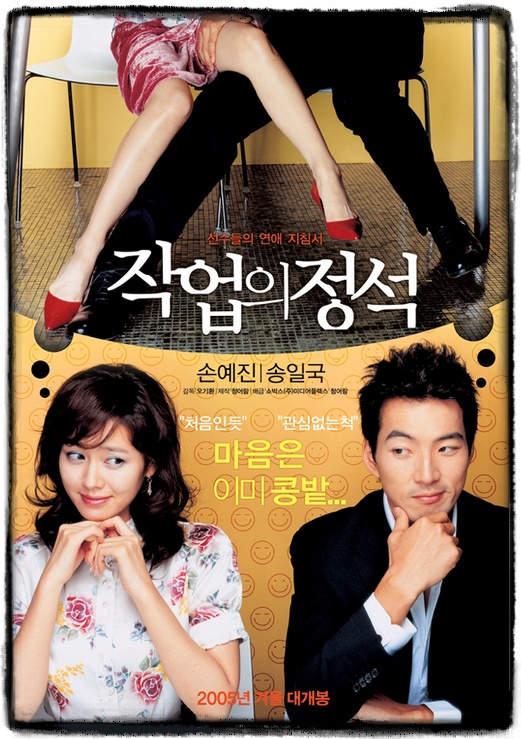
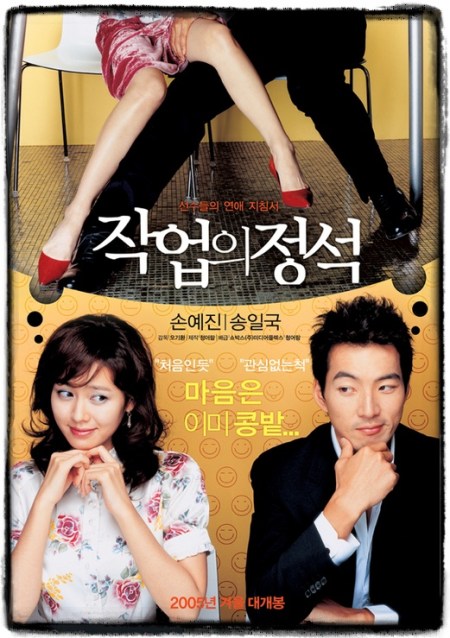
Son Ye-jin Song Il-gook The Art of Seduction( Source: Naver Movies )

남녀 모두 각자가 선호하는 피임법이 있기 마련이고, 제대로 피임을 하지 않으면 불안감과 초조감에 섹스를 즐길 수 없다.

Of course, all men and women should use the contraceptive method(s) they prefer, but if they are not used properly then this can make one feel ill at ease and nervous and unable to properly enjoy sex.

아무래도 임신은 여성의 몸을 빌어 나타나기 때문에 피임에 대한 부담감은 여성이 더 크기 마련이다.

However, as it is women’s bodies that are affected by pregnancy then of course women feel more of the burden for contraception.

피임이 제대로 되지 않을 경우, 여성들은 임신에 대한 불안감 때문에 섹스에 집중하지 못한다. 또섹스가 끝나고 나서도 임신 가능성에 대한 공포감에 시달린다. 인터넷 게시판에는 임신진단시약과 사후피임약에 대한 물음이 끊이질 않는다.

If contraception is not used correctly, then women become nervous about becoming pregnant and are unable to concentrate on enjoying having sex. They are very uneasy about this possibility after having sex also. Questions about pregnancy tests and morning-after pills never cease on internet cafes and message boards.

그렇다면 여성들은 과연 피임을 제대로 하고 있을까?

How can women use contraception properly then?

산부인과 전문의들로 구성된 피임연구회가 세계피임의 날을 맞아 19~34세 여성 1,000명을 대상으로 실시한 ‘한국 여성의 피임에 대한 인식과 행태 조사’에 따르면, 2,30대 여성의 44.5%가 ‘피임은 남성이 해야 옳다’고 답했다. 오직 4.8%만이 ‘피임은 여성이 해야 한다’고 대답했다. 이는 여성들이 남성들에게 피임을 의존하고 있다는 것으로 해석해도 무방할 듯 싶다.

Gynecologists and contraception-research centers recently welcomed World Contraception Day, and according to a survey of knowledge and attitudes to contraception of 1000 Korean women aged between 19 and 34, 44.5% replied that “contraception is men’s responsibility,” but only 4.8% replied that it is women’s responsibility. In short, Korean women rely on men to provide and use contraception.

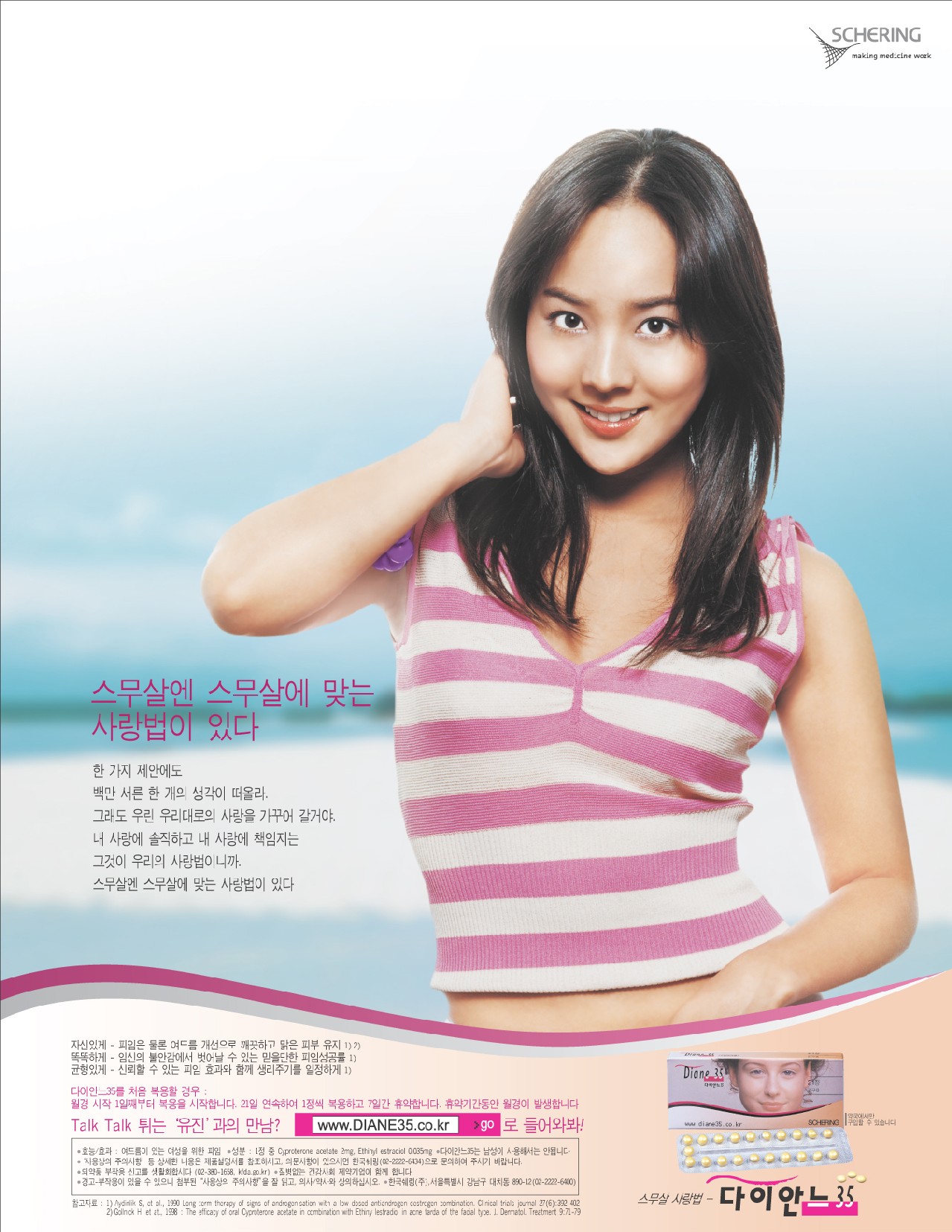
SES Eugene Contraceptive Pill Advertisement

( Source: cupitee )

피임을 하지 않은 상태에서 성관계 후의 대처 방법도 ‘임신진단시약으로 임신 여부를 확인’하는 비율이 62.4%, ‘응급피임약(사후피임약)을 복용하겠다’고 답한 비율이 30.7%로 나타났다.

When those women that don’t use contraception were asked how they dealt with the possibility of becoming pregnant, 62.4% replied that they used a pregnancy test, and 30.7% replied that they used emergency contraception.

피임을 남성의 몫으로 떠넘기는 경우, 콘돔을 사용한다면 그나마 다행이다. 문제는 질외사정법 등으로 피임을 떠넘기는 경우이다. 질외사정법은 엄밀히 이야기하면 올바른 피임 방법이라 할 수 없다. 질외사정은 질 내 사정에 비해 임신 가능성이 줄어들 순 있지만 사정 이전에 이미 정자가 일부 정액에 섞여 분비되므로 엄밀한 의미에서는 피임법이라 부를 수 없다.

In the case of men fulfilling their portion of a couple’s responsibility to use contraception, it is lucky [for women] if they use condoms. Those that use the withdrawal method will have problems though, as it is not a precise method. Of course, if the man does not ejaculate into the woman’s vagina then the possibility of becoming pregnant is lowered, but sperm and semen can still mix and be secreted before a man ejaculates.

가장 많은 연인들이 이용하는 피임법이 콘돔이다. 간편하고, 몸에 무리가 가지 않는 방법이기 때문이다. 그러나 그 이질감 때문에 남성들은 물론 여성들 중 일부도 콘돔 사용을 꺼려하기도 한다.

By far, Korean lovers’ preferred choice of contraception is the condom. It is convenient and does not place a burden on the body. However, because of the reduced feeling many men and also some women don’t like to use it.

그럴 때 선택할 수 있는 피임법이 먹는 피임약이다.

In  that case, one alternative is the contraceptive pill.

Korean Contraceptive Pill Advertisement( Source: Encyber )

그러나 우리나라에서 먹는 피임약은 유달리 그 편견의 정도가 심하다. 체중을 증가시키거나 불임에 이를 수 있다는 오해가 팽배하기 때문이다.

However, in Korea the contraceptive pill has an exceptionally bad reputation. Rumors and misunderstandings about it have spread easily, such as it increasing your weight and causing sterility.

먹는 피임약은 임신을 가능하게 하는 호르몬인 에스트로겐과 프로게스테론을 통해 여성의 배란 및 생리를 조절하는 약이다. 피임 실패율이 낮고 콘돔처럼 성감을 떨어뜨리지 않기 때문에 잦은 성관계를 갖는 연인이나 부부에게 적합한 피임법이다.

[But] through the hormones estrogen and progesterone, the contraceptive pill is a medicine that can control when you ovulate and have your period. It also has a lower failure rate than the condom, and doesn’t reduce sexual feeling. For these reasons, it is particularly appropriate for lovers who often have sex and for married couples.

살이 찌거나 여드름이 나는 등의 부작용 등은 초창기 피임약에서 나타났던 증상이나 최근 저용량 피임약들이 도입되면서 이런 부작용들을 해결하고 있다.

It is true that first generation contraceptive pills did have the side effects of causing women to gain weight and cause acne, but those have been resolved in more recent versions by lowering the dosages.

먹는 피임약은 다른 피임법과 마찬가지로 사용을 중단하면 바로 임신 능력이 회복된다. 장기 여행 등으로 피임약을 복용해 본 여성이라면 약을 먹지 않을 경우, 바로 생리가 찾아오는 것을 경험해봤을 것이다.

Like other contraceptive methods, as soon as you stop using the contraceptive pill your fertility recovers. Women who have gone on extended trips and stop taking the pill have reported that their period returned quickly.

또 먹는 피임약이 호르몬을 조절하기 때문에 막연하게 나쁘다는 이미지가 있는데, 먹는 피임약은 전부 용해되며, 복용하지 않을 땐 체내에 그 성분이 남아 있지 않기 때문에 영향을 미치지 않는 걸로 알려져 있다.
korean-movie-couple-in-passionate-embrace

Because the contraceptive pill works by controlling one’s hormones, then it has a vague, bad image in Korea. But as the contents of the pill are completely absorbed into the body when you take it, then there are no lingering effects if you decide to stop using it.

특히 국내에 최근 출시된 야즈는 기존 먹는 피임약이 21일간 복용하면, 7일간 쉬었던 데 비해 24일간 복용하고 4일은 위약을 복용하는 세계최초의 24/4 용법 방식으로 체내 호르몬 변화의 폭을 감소시켜 전체 생리주기 동안 더 안정된 호르몬 수준을 유지하는 것으로 나타났다.

In particular, a new contraceptive pill called Yaz has been released, and this is the first in the world which you can take for 24 days and have a 4 day break, unlike the standard 21 days and 7 days respectively. This change means that your hormone levels don’t fluctuate so much when you have your period.

임신은 비록 여자가 하는 것이지만 그 과정에 이르기까지에는 남녀 모두가 공동의 역할과 책임이 있다. 그렇기 때문에 피임은 남자의 몫이 아닌 여성과 남성이 함께 챙겨야 하는 당연한 책임이다. 여자가 적극적으로 피임을 하는 것에 대해 주변의 시선을 신경 쓸 필요가 없다는 이야기이다. 자기 몸의 주체는 자신이 되어야 하고, 여성이 먼저 나서서 자신의 몸에 맞는 피임법을 찾는 것이 그 주체가 되는 첫걸음이다.

Even if getting pregnant is only the lot of women, as that process involves both men and women then both have a responsibility to use contraception: not just men. And you should not care about what other people think of you for being proactive and responsible about it: your body is your own, and so the first step is to find the right birth control method for you.

피임을 상대 남성에게만 맡겨두는 것이 아니라 스스로 자신의 몸에 맞는 피임법을 찾고, 성생활 역시 불안감 없이 즐기는 것이 자기 몸을 사랑하는 방법이 될 것이다.

Contraception is not the sole responsibility of men, and finding what method is most appropriate for your bodies and best able to allow you to enjoy your sex life comfortably and safely is something both partners have to do for each other (End).

Eugene SES Contraceptive Pill Advertisement( Source: cupitee )

One very mild criticism I have of the above is that, like the Korean author of the last translation I provided, Im-ji is quite positive about a new form of contraceptive pill called Yaz (야즈), but which as a commenter here has pointed out, is increasingly viewed as too dangerous by Western consumers, and is the subject of numerous lawsuits. Perhaps this information is simply not available in Korean yet?

In line with my new modus operandi, I’ll try to find that out myself this weekend…starting by asking Im-ji directly!

(For all posts in the Korean Sources on Sexuality and Gender series, see here)

Share

“Korean Women are Sexually Conservative”

korean-etude-advertisement-song-hye-gyo(Source: Naver)

As they say, first impressions last, and my own first introduction to Korean sexual politics came with a bang when the scandal over the Baek Ji-young (백지영) sex tape erupted in late-2000. The way she was treated by the Korean media was hypocritical and shocking, and confirmed what I’d learned at university: Korea was a deeply patriarchal and sexually-conservative society.

Or at least, as the “Korean Gender Guy,”™ that’s what I’d like to pretend informed my first year in Korea. The truth is, I barely noticed at the time, being rather more concerned with getting into my Korean girlfriend’s pants. But they also say that the best way to learn a new culture is to sleep with the locals, and what I learned about sexual politics that way was no less important for being so base: the books were simply wrong about how prudish Koreans were. I’ve been poking fun at the huge gap between image and reality ever since.

But with a nod of appreciation to the advice of this regular commenter, it’s high time to move on from that extremely simplistic conception of the subject.

Just like it is misguided to think of, say, all American voters as mere “conservatives” or “liberals,” the reality is that Korean society is both profoundly sexually-liberal in some instances and sexually-conservative in others. For instance: most Koreans have sex before marriage; Korea has one of the largest prostitution industries in the world; Korean teenagers increasingly dance extremely provocatively on television; Korean women are increasingly objectified in advertisements; and, overall, censorship of sexual content in movies is rapidly easing.

And yet that combination by no means implies that Korean men and women are equally able to express and enjoy their sexuality in 2009, let alone that, like almost a decade ago, a female celebrity secretly filmed while having sex with her boyfriend wouldn’t again be ostracized by the Korean media. Indeed, one can argue that to describe Korean society as simply “sexual-conservative” is merely to gloss over its profound double-standards.

One such double-standard is the need for sexually-active women to appear inexperienced and virginal to their partners, and in that vein, this survey of condom use and sexual activity in Korea – probably the most comprehensive of its kind – found that a majority of them did so to the extent that they regarded contraception as entirely men’s responsibility, as I discussed last December. Either they didn’t provide it themselves, they didn’t insist on their partners using condoms, and/or they would even feign complete ignorance of all contraceptive methods.

Again, that’s to be expected from a “sexually-conservative” society. But bear in mind the fact that love hotels are ubiquitous here, and – as that survey demonstrates – are well used. So while this particular double-standard is hardly confined to Korea, it is particularly severe in its effects on Korean women.

In light of that, the fact that rates of oral contraceptive pill usage are extremely low in Korea (3%) shouldn’t have been a surprise to me when I learned it from this recent Korean blog post, which I’ve translated below. But while I was certainly aware of the scare-tactics used – for various reasons – by Japanese medical authorities to dissuade women from using the pill there for instance, and which meant that it was only legalized as late as 1999 (see here, here and here), in hindsight perhaps I was too optimistic about Korean women’s reaction to similar tactics used here in January. So I was taken aback:

피임에 보수적인 여자들 – When it Comes to Contraception, Korean Women Are Conservative

Korean Pill Cartoon 1Mr Kang, reporter: “As women are actively making advances in Korean society, so too are women becoming more open and assertive about sexual matters.”

Korean Pill Cartoon 2a

Mr Kang: “Today, we are going to meet Ms. Kim, a cool, forward-thinking woman with free and open attitudes to love.”

Ms Kim, caption: “I have 900 intimate male-friends…but that’s what happens if you’re as pretty as I. It’s not a crime!”

Korean Pill Cartoon 3Mr Kang: “I will ask about modern women’s opinions on sex and love…Nice to meet you Ms Kim. Ms Kim, I heard that you have very liberal and open attitudes to love. Is that true?”

Ms Kim: ” Yes. I don’t care about men that leave me, and I don’t say no to men that approach me…I’m so cool!”

Korean Pill Cartoon 4Mr Kang: “Since you are old enough, I assume that you have sex with your boyfriends. Do you take the initiative and/or insist on using contraception?”

Ms Kim: “Contraception? Surely that is men’s responsibility, yes?”

Mr Kang (gray text): “I’m surprised that you’re so conservative.”

Ms. Kim (gray text): “It is totally men’s responsibility!”

Granted, a bizarre cartoon, and probably one that detracts from rather than evinces the following points made by the blogger:

이전보다 자유로와진 미혼남녀의 성생활이나 성 담론에 비해 아직도 피임에 대한 인식은 무척 보수적이죠. 게다가 아직까지 수많은 여성들은 ‘피임=남자의 책임’이라는 구시대적 사고방식을 가지고 있는 듯 합니다. 한국 여성 피임 인식 조사에 따르면, 여성의 60%는 성관계 시 피임을 하지 않는 것으로 나타났는데 이는 ‘설마~’와 ‘막연함’ 때문이라고 합니다.

“Compared to the past, people are much more sexually active these days, and talk about sexual matters much more openly. But they are still surprisingly conservative when it comes to using contraception. In particular, many women stick to the traditional line that it is entirely men’s responsibility. According to a survey by the WHO, 60% of Korean women don’t use any contraception at all, maintaining an “it won’t happen to me” attitude.”

International Rates of Pill Usage Korea

물론, 남자에게도 책임은 있겠지만 여성들 역시 능동적일 필요가 있다고 보는데요, 통계에 따르면 남자들의 피임 방식인 “CONDOM”은 피임에 성공할 확률이 85%에 지나지 않는다고 합니다. 반면에 여성들이 준비할 수 있는 ‘먹는 피임약’인 경우, 성공 확률이 무려 99%에 이른다고 하네요.

“Of course men also have a responsibility to use contraception, but it seems that women are not fulfilling theirs. According to statistics, whereas condoms are 85% effective in preventing pregnancy, the use of the oral contraceptive pill is done entirely by women and is as much as 99% effective.”

Korean Pill vs Condom Cartoon

더치페이의 나라 네덜란드에서는 피임에 대해서도 서로를 배려하기 위해 CONDOM과 피임약을 모두 사용하는 이른바 ‘더치피임’이 널리 퍼지고 있다고 합니다. 또한 요즘 나오는 먹는 피임약(야즈)은 피임 뿐만 아니라 여드름 및 월경전불쾌장애(심한 형태의 월경전 증후군)에도 치료 효과를 인정받았다고 하니 여성 스스로를 위해서라도 꼭 한번 고려해볼 수 있길 바랍니다.

“In the Netherlands, when it comes to contraception people combine condoms with the use of the pill in order to be safer, and this is known as “Dutch [Style] Contraception.” In addition, a  new form of the pill called “Yaz” is coming onto the market, which combines a contraceptive function with helping to prevent skin problems and PMT. Women should consider this new product as an option.”

Men Women Gender 50 50And I’m afraid that that is all, although it attracted a great many commenters, most of whom agree that contraception is also women’s responsibility. But they take issue with the blogger’s description of women that don’t use the pill as “conservative,” citing concerns about side-effects, to which my response would be to direct them to this comment.

Meanwhile, if you haven’t already read my earlier post on condom use and rates of sexual activity in Korea then I strongly recommend you do so to place this new information in context, and you may also be interested in the recent appointment of a minor Korean-American celebrity being named “goodwill ambassador for the Korean Association of Obstetricians and Gynecologists to promote a campaign teaching young Korean women about sex and reduce abortions.” This has many positives of course, but I’d echo Brian in Jeollanam-do’s concerns that this may be “a product of, and will contribute to the perpetuation of, the belief that Americans and Westerners alone can be open about sex,” to which I’d add the stereotype that Westerners and especially Caucasians are overall much “more sexual” than Koreans. Finally, for a very frank discussion from the front-line as it were (an American woman dating Korean men), make sure to check out Doing it Korean Style!

Update: Apologies for not mentioning Dating in Korea also.

Unrequited Love…or Stalking? The Pitfalls of Dating in Korea

How to deal with a stalkerIn Korea, it is accepted practice for men to relentlessly pursue the objects of their heart’s desire, sometimes for many years, and despite if said objects clearly, repeatedly, and vehemently express their disinterest.

Far from being viewed as stalking however, it is generally viewed as both a sweet and noble sign of one’s love and dedication. There’s even a proverb specifically for this: “열번찍어 안넘이 가는 나무 없다,” which roughly translates as “There is no tree that can withstand being chopped 10 times.” (Image source, right.)

It’s not that I can’t see those sweet and noble elements, nor how many Korean women would surely exploit the practice, in a playing hard to get fashion (some more Korean that comes to mind is “희망고문하다,” literally to “hope-torture [someone],” or to repeatedly string someone along and then break their heart). But I think that the consensus of most Westerners is that if the woman says she’s not interested…then she’s not interested, and hence that the man’s behavior after being told is stalking, regardless of how sweet or noble his intentions. Unfortunately, in a society that already accepts women being physically dragged into nightclubs, then foreign or Korean, women can probably expect little sympathy when dealing a stalker.

This probably won’t be the first or last time you’ll read about this subject: navigating different expectations when it comes to dating are an integral part of the expat experience, and with my limited dating experience then I can’t add much that hasn’t already had gallons of virtual ink spilt on it. Two useful things I can do though: first, mentioning that of all the guides to navigating those dating minefields out there, that this one by Michael Hurt at Scribblings of the Metropolitician is by far the best, and with many things that informs even my marriage of 6 years; and second, and which was frankly the real inspiration for this post, that over at Sociological Images there is a post that discusses the fact that:

Various journalists and scholars have pointed out over the years that movies and TV shows often portray as romantic behavior that is fairly indistinguishable from stalking.

And then a video created by Jonathan McIntosh of Rebellious Pixels, who:

…edited together scenes from Buffy the Vampire Slayer with scenes of Edward Cullen from the movie Twilight to show how behavior that is depicted as protective and romantic in the film (and book) could also be seen as disturbing

For more, see the original post here. Not that I think that the humorous stalking in, say, There’s Something About Mary had much of an effect on my own opinions of it, nor that seeing it in pop-culture somehow renders real-life examples in any country okay, but still: the next time we feel a sense of righteousness and indignation about hearing Korean examples, it is certainly worth pondering the mixed messages that Western pop-culture provides.

Why Korean Girls Don’t Say No: Contraception Commercials, Condom Use, and Double Standards in South Korea

(Updated, January 2014)

Western journalists don’t often write about sex in South Korea. But when they do, they just love to mention how “conservative” it is. As if sexuality wasn’t really the immense concept it is. And, as if Korea, just like the journalists’ own societies, couldn’t actually be progressive in some aspects of it despite being conservative in others.

It frankly annoys then, that the advertising of contraception here does fit the stereotypes. As does what it reveals about attitudes towards its users, especially if they’re women.

The first frustration is that contraceptive commercials were banned from television until as late as January 2006. What’s more, it wouldn’t be until July 2013 that condoms actually graced Korean screens. This was especially ironic considering exceptions had already been made for the sake of HIV/AIDS prevention campaigns that played in October 2004.

The delay is interesting, and deserves further investigation; possibly, some de-facto restrictions against condom commercials remained. Either way, contraceptive pill manufacturers at least soon took advantage of the lifting of the ban, starting with this commercial by Mercilon four months later, and now nobody bats an eye seeing the pill on television or at the cinema. (Opening image source: The Hankyoreh.)

Originally, the first half of this post was devoted to that commercial, as public statements by the actress, 22 year-old SNU student Kim So-mi (김소미), appeared to indicate a false ignorance of the pill, as well as making sure to distance herself from the sexually-active women the commercial was aimed at:

하지만 정작 김씨는 광고를 찍으면서 피임약에 대해 처음으로 알게 됐다고 털어놨다

However, Kim said that she only learned about the pill for the first time while shooting the commercial.

피임약 광고로 자신의 얼굴이 알려지더라도 이중적 시각으로 자신을 보지 말기를 당부하는 것도 잊지 않았다. 어디까지나 광고모델일 뿐이라는 것이다.

Even if her face was known from the pill ad, she did not forget to ask her not to see herself in a double perspective. It’s just an advertising model.

Being slut-shamed by from someone actually endorsing contraceptives will always feel bizarre. Yet it spoke to my own anecdotal experience that all too many Korean women feigned ignorance of contraception for the sake of their reputations, the corollary of which was not insisting on condom use and relying wholly on their male partners to “take care of things.” Which, to many readers of the original post, sounded even more bizarre and outrageous than Kim So-mi did, not least because they were hearing it from a non-Korean man rather than from a Korean woman. But later I would confirm those uncomfortable truths through numerous Korean sources.

korean-unmarried-couple-thinking-about-sexSource, all screenshots: 여자도 모르는 여자이야기

In hindsight however, her statements may be open to interpretation, and only came from one source. Add that the commercial itself is unfortunately no longer available (alas, I didn’t know how to save videos in 2008) then I didn’t need to think twice about removing that commentary, and consequently the comments (sorry). But the second half of the post was my summary of this survey on “condom-related behaviors and attitudes among Korean youths”, at the time one of the most rigorous and recent available (albeit based on data collected in 2003), and as the PDF is again no longer publicly available then I’m happy to keep that summary below for the benefit of readers.

Here goes (with only a little editing of the original post):

  • 27% of men 7.8% of women had sex before the age of 18
  • “Contrary to the reported Korean situation, there are no significant gender differences in the rate of premarital sex and age at first intercourse compared to that in many other liberal, developed societies.”
  • “Compared to other [developed] societies, although there are fewer sexually experienced youths under 18 in Korea, there has nevertheless been an increase in premarital sex and a substantial lowering of the age at first sexual intercourse….the rate for females has risen more rapidly than that for males.”

For an excellent discussion of public attitudes to teenage sexuality in the 1990s that provide a backdrop to those results, I highly recommend reading this post at Gusts of Popular Feeling, and it’s clear that little has changed over a decade later. Moreover, it’s just a thought, but in the almost complete absence of any information or adults talking to them about sex (although I admit there have been some improvements since this post was first written), then I invite readers to speculate about just whom exactly might be providing young Koreans with most of their sexual role models instead:

Source: Textcube
  • In December 2005, there had been 3,829 cumulative reported cases of HIV/AIDS, of which males accounted for 90.7%. Of the new HIV infections among Korean women in 2004, all were attributed to heterosexual contact.

By August this year, the total had risen to 5717, with almost exactly the same proportions of men to women. The survey notes that with such relatively low numbers, if women “were able to ensure that their partners use condoms consistently and properly, [then] HIV/AIDS would be prevented effectively.” They’re not, as we shall see, but on the positive side it should be noted that the majority of Koreans no longer see HIV/AIDS as a mere foreign, gay disease that doesn’t affect them.

  • According to previous research, mostly conducted in the five years before this survey, “the percentage of consistent condom use among young people as well as in the general population was relatively lower than in other countries. It was found that only 18.6% of never married, sexually active young people aged 18-29 used condoms consistently…[and]…the reported condom use at first sexual intercourse was 18.7% for men and 13.4% for women. The reported condom use of high school students was much lower at 10%.”

Personally, I’m surprised that that last figure was even as high as 10%, given that vending machines in public toilets and from older friends would be about the only place high school students would obtain them. But of greater note already, albeit not a hugely significant statistical difference in this particular case, is the I think counter-intuitive finding (to Westerners) that more men than women reported using condoms the first time they had sex. Indeed, this disparity continued afterwards:

  • “More men (17.3%) than women (13.6%) reported having consistent condom use with a steady partner…for other partner types, consistent condom use was less reported by women than by men. For experience with condoms, more men than women reported having used condoms.”

Why? Partially it is because Korean men are much more sexually active:

  • 50.4% of the single 19-30 year-old subjects reported having had sexual intercourse, but this disguises huge differences between men and women (67.3% and 30% respectively).
  • “Men reported a higher proportion of sexual experiences with two or more multiple partners during the previous 12 months than women did (57.2% vs 41.0%).”
  • “Single men were four times more likely to be [sexually] experienced than women.”
  • “According to a recent study, the median age at first sexual intercourse for Korean men (21.0 years) was three years lower than that for Korean women, even though men marry, on average, later than women do….This difference may be interpreted as an indication that young men have sex with prostitutes or older experienced women. About 13% of young men age 20-29 reported that their sexual partners were prostitutes.”

And this in turn led to them being much more confident and knowledgeable about using them than Korean women:

korean-unmarried-couple-having-sex
  • “Men were more likely to agree somewhat or completely that condoms protected against HIV and other STDs.”
  • “Compared with women…men reported a higher level of self-efficacy in condom use when they were drunken.”

But this is of course only half the story, and somewhat of a chicken (sperm?) before the egg one at that. For if you haven’t guessed already, the survey concludes that:

…these gender differences in sexual initiation and experience can be explained by strong, gender-based, double standards and values in the traditional culture. Single women in Korea are still expected to be passive and virgins at marriage. Although Korean women’s level of education and participation in the labor force has rapidly risen (albeit the latter still at the lowest levels in the OECD – James), the imposed attitudes on their expected social roles have not dramatically changed yet. Korean society still places emphasis on women’s virginity at marriage and women are supposed to be initiated into sex by their husbands.

And thus:

Premarital sex may be a more serious concern to women because of their vulnerability….young sexually experienced females reported that they had been pressured by their boyfriends or other men to have sex as a proof of their love and been forced not to use a condom at first intercourse.

durex-condoms-er-penetrate-the-korean-marketWhich makes Durex’s depiction on the right of its…er…penetration of the Korean market in August this year (source, right: The Korea Times) not a particularly accurate reflection of current Korean sexual mores, and unfortunately the women in it are less likely to be supposed role models as chosen simply because every public event in Korea requires scantily-clad females known as “narrator models.” More seriously though, the survey clears up a great deal of almost instinctive confusion I and I think many readers would have had recently over newspaper headlines such as “Women Inactive in Preventing Unwanted Pregnancy,” and “Korean Women Say Birth Control is Men’s Responsibility“, although I must confess that I never expected to be so, well…true, especially as my female Korean friends have all stated that they have to contend with Korean men often refusing to wear condoms, which unfortunately probably says much more about my choice of Korean female friends than it does of Korean men and women as a whole.

But I’m not merely covering all my bases when I say that it’s not all doom and gloom for Korean men and (especially) women, for I have seen teenage sex education centers, for instance, pop up around Busan since I first moved here, and, just like so many other Korean issues on which Koreans only appear to be unanimous and monolithic in their opinions to non-Korean speakers, the notion that contraception is solely a man’s responsibility is hardly a universally accepted and uncontested notion among young Koreans especially, as this blog post (for one) demonstrates (again, let me know if you’d like a translation). Moreover, and to put this post and myself to bed, while I may occasionally sound like a broken record when I point out this next (but someone has to), I think I’ve more than adequately demonstrated that increasingly sexual images of women in commercials  and advertisements in recent years can and are having an effect on these double-standards also. Combined with knowledge that the English-language media and books on Korea especially tend to have a considerable lag behind trends in Korea then, it’s going to be very interesting to see the results of any similar survey in the future. Watch this space.

korean-unmarried-couple-having-sexor-notKorean women taking responsibility for contraception…only in the movies?

Back to 2014 now, if you’re after more recent surveys, there are many more translated and discussed in the “contraception“, “sexual relationships“, and “teenage sexuality” categories here (all of which come under the voluminous “Korean sexuality” one), but probably the most recent is this one conducted in 2012. Unfortunately though, no mention is made of its methodology, so the results must be taken with a grain of salt. But if any readers would like to help me rectify that by going through the original 260- page Korean report with me, I’d be very grateful!

If you reside in South Korea, you can donate via wire transfer: Turnbull James Edward (Kookmin Bank/국민은행, 563401-01-214324)