It’s not as simple as just increased childcare responsibilities—Korea already has a record-low birthrate, and women journalists the world over have less children than women in most other professions. So what gives?
It is a truth universally acknowledged, I like to think, that a single industry so possessed by one sex, must be in want of dramatic reform.
Okay, I did force that Austen-like opener somewhat.
But when you realize that the entry number of Korean women journalists has started to exceed that of men in recent years, only for most women to leave the industry in less than 10 years? Also, that the ensuing absence of women mentors, and continued domination of newsrooms by masculine culture are, ipso facto, some of the main causes of that?
Perhaps awkward forced changes, such as quotas for board members of news organizations, are precisely what the industry needs.
If your interest isn’t piqued just by the title alone, let me leave you with some telling quotes that demonstrate why it really should be,* and please get in touch if you don’t have access to a copy.
*Apologies for removing the numerous sources mentioned for the sake of readability. Please consult the original for those, many of which sound just as interesting and informative as this one!
First, on why I think quotas are absolutely necessary:
…in South Korea in 1996, JoongAng Daily, one of the largest South Korean newspapers, employed only 24 women journalists out of a total of 402 journalists. Soon after, the percentage of women journalists began to surge so that by 2020 women accounted for about 32.8% of the total number of journalists. However, most women journalists were younger and about 10% of women journalists were in top-management positions.
And:
In South Korea in recent years, although the entry number of women journalists has exceeded that of men journalists , there were only 7 women out of 138 (5.07%) board members among the 29 major news organizations.
Next, on why a gender balance in news media is so important:
The under-representation of women journalists in newsrooms is regarded as problematic based on findings of previous studies that the gender of journalists influences their reporting practices as well as the content of news coverage. For example, a recent study found that news organizations where women journalists occupy positions at editorial levels were more likely to have covered the “#Me Too Movement” than organizations without women editors in high positions. In fact, previous studies have repeatedly reported that with fewer women journalists, portrayals of women as well as marginalization of women’s concerns are themes often overlooked in news stories. Therefore, if women journalists consistently exit the news industry, their voices in covering newsworthy topics will likely disappear along with recommendations for improved newsroom policies and culture.
Moreover, in the absence of upper-level women journalists…
…several studies have shown that while the number of women journalists has increased, characteristics of newsrooms as masculine domains remain entrenched. In fact…“Young women journalists decided to resign because of men-centered culture and they felt they had less attention than men journalists from their organizations.” [Also], although there has been an increase in the number of Korean women journalists in recent decades, the traditional model of newsrooms based on a male model that expects strong work commitment and unusually long hours has not substantially changed. In addition, in South Korea, women journalists often face work-family conflicts after marriage due to society’s concepts of the traditional gender role of women, influenced by Korean cultural standards.
…the results of this study show that the three most important factors in women journalists’ leaving the newsroom are (1) the weakening of social status, (2) a newsroom dominated by masculine culture, and (3) additional online workloads.
…although more and more women journalists have entered the news industry, the masculine newsroom culture has not changed because most of high-level positions in news media organizations are still held by men journalists. Interestingly, in-depth interviews, conducted…with nine young women journalists who resigned with less than 10 years of experience, revealed they had voluntarily left because they were unable to “find a role model who overcame the male-centered culture of a journalist society and the organizational culture of newspaper companies.” Their responses indicate that women journalists in South Korea continue to be perceived as “often excluded from the internal networks established by men.” Also, they are less likely than men to have the benefit of mentors.
The word “sensual” has always been a favorite of mine, once I learnt it was brimming with sex. Even just to say it can feel like a carnal act, if you let it. Close your eyes, linger on the syllables as you would on the face of a lover, and the tip of your tongue teases you with memories of all the places it’s been—and hints at the pleasures still left to explore.
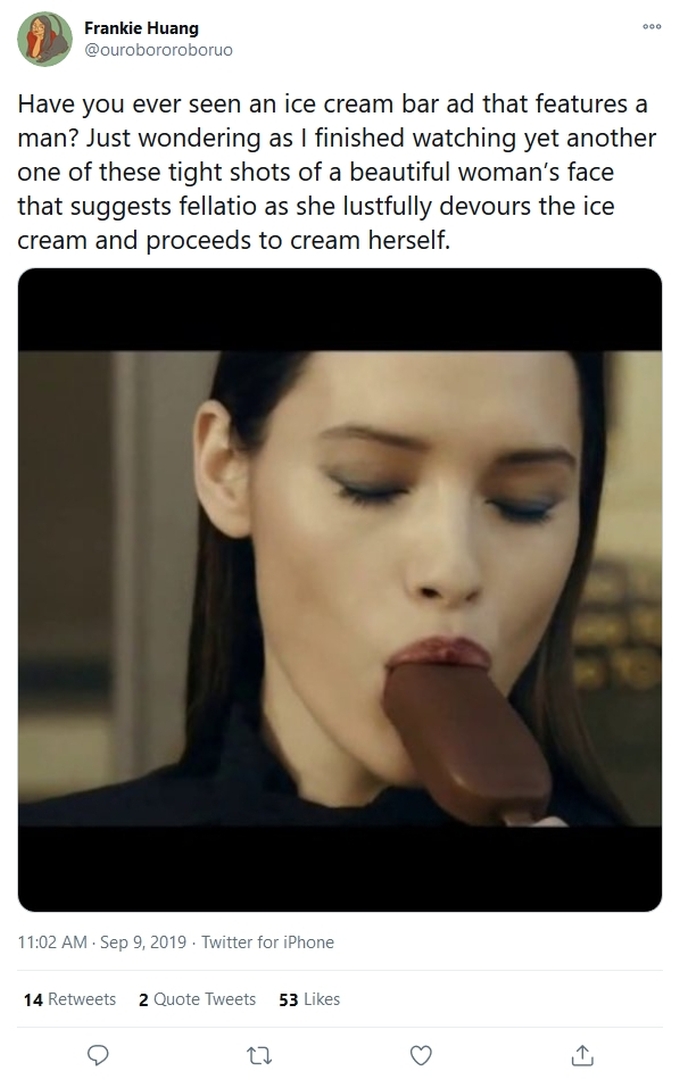
Foods that can similarly be luxuriated over then, lend themselves to sensual advertising. Take ice-cream. I don’t eat it like you see in the ads, and neither do you. But I get them. Being allergic to dairy, so not eating my first ice cream until I was seventeen, I really do relish the soy variety when it makes one of its rare appearances in supermarkets here.* I even have a bottle of Kahlua saved specially for just such occasions.
Not unlike Kahlua or even sex itself though, too much of the same thing can easily become boring and routine. That you and I can both roll our eyes at the notion of orgasming over ice cream, only points to how advertisers sexing it up is so routine as to be mindless cliché. Just so routine in fact, that by 2019 Baskin Robbins Korea seemed to have forgotten they were doing it at all, and were forced to withdrawandapologize for an ad where they’d replaced the usual woman with an 11-year-old girl wearing cosmetics.
[There is a] powerful, symbiotic relationship between women and carnality, as indicated by the preponderance of erotic narratives in advertising addressing women. This is particularly overt in the advertising of products that are depicted as being endowed with the power to enable women to experience intense quasi-sexual pleasure from their consumption. Examples of such product categories includechocolate, luxury ice cream, biscuits, and shampoo. This is a world that reflects a perception of women as ‘consummate consumers’ who are ruled by their bodies and, as such, are less able than men to resist the lure of carnal pleasures (Belk 1998; Belk and Costa 1998).
Source: Pauline Maclaran and Lorna Stevens (2004),”Special Session: Gender and the Erotics of Consumption”, in GCB – Gender and Consumer Behavior Volume 7, eds. Linda Scott and Craig Thompson, Madison, WI: Association for Consumer Research, Pages: 1 to 14. (Download)
But I sense EXID fans are getting a little frustrated by this point. Posting an infamous, bawdy, 2012 Japanese commercial for Gligo’s Dororich Creamy Cafe Jelly in a moment is hardly going to help either.
There is a method behind my madness. First, I needed to take advantage of my recent purchase of a book on Sappho to establish some cultural capital, in the hope I’d have at least a shred of credibility remaining by the end of this post. For what male feminist/feminist ally would ever admit to being utterly transfixed by this?
I hear and share your numerous objections. Accept it not so much as an ad though, but for the sort porn it is, complete with five gravure idols (NSFW), addictive Benny Hill-like music, and blatant masturbation and ejaculation symbolism, and it’s so over the top that I can’t help but revel in its hilarity.
The Korean media couldn’t make that concession however. Take one of the first reporters to cover it:
“CF 영상 자체가 에로틱하다는 것이 그 이유다. 밝은 조명에 우유와 젤리가 섞이는 장면, 청순한 외모의 여성들 뿐이지만 남성들의 마음을 자극하는 요소는 다분하다.” (Herald Economy)
The reason the CF [is gaining tremendous popularity among Japanese men] is because it’s erotic. The scene in which milk and jelly are mixed in bright light, and only women with pure and fresh appearance, all these are enough to stimulate men’s hearts.
Contradicting themselves, even more stimulating elements were listed; alas, those did not include the symbolism of the spurting cream. Later reporters (or their cautious editors), if they mentioned the cream at all, only caused themselves more embarrassment in their Kakfaesque refusal to acknowledge the completely obvious:
“게다가 우유를 상징하는 하얀 액체가 이 소녀들에게 날아들어 묘한 상상을 자극하게 하고 있어 일각에서는 비난이 쏟아지고 있다.” (The Chosunilbo)
“In addition, it is criticized because the scene in which white liquid that symbolizes milk is being poured over the girls is triggering strange imaginations.”
““And white liquid that seems to be milk is continuously being sprayed.”
I realize there may be official or unofficial rules in the Korean news media regarding acknowledging explicit content, even symbolism. Absence of evidence is not evidence of absence either, and it would remain a blessing to find an official news source that, in reporting on this commercial, hadn’t patronized its readers over something so trivial.
Be that as it may, the next reason, and finally, is because now you know exactly what went through my mind when I saw EXID’s commercial for Lotte’s Goo Goo ice-cream a few years later:
I only didn’t write about it at the time, because I expected the media and fans to immediately be all over it. Gligo’s Dororich Creamy Cafe Jelly commercial, after all, made quite the splash in social media when it came out. It took balls, I thought, for Lotte to be so brazen about the origins of its own very literal money shot.
But, crickets. Whereas some reporters did point out the new, sexualized direction for Goo Goo’s advertising, most merely gushed about the endorsement choices intheirtypicaladvertorials. Social media too, or at least in respect to this commercial, seemed surprisingly reticent on the subject of ejaculation, and to have completely forgotten about the Creamy Cafe Jelly. By the time I realized people just weren’t talking about it, the moment for laying a world exclusive claim to this cosmic connection had passed.
I was loathe to end without a conclusion too. Perhaps on such an indecorous subject though, in which the innuendos came thick and fast as I typed (believe me, it’s harder to avoid them easier to just go with the flowget them off your chest roll with them), there wasn’t one to be made?
Still, the sexy ads and commercials will continue regardless, symbols of orgasming will always be an indelible part of that, and sex and K-pop are synonymous. Indeed, after the 2012 Japanese inspiration, then EXID’s 2015 sequel, 2018 saw JooE of Momoland step up in her commercial for Baker 7. Or rather, her “mother” and gardener:
I invite readers to offer any more examples, and to come to their own conclusions about them. To prepare for the 2021 follow-up, what do you think needs to be said about sexualization in ads, and about the gender imbalance in those selling chocolate, ice cream, biscuits, and shampoo? Is it necessarily bad if they depict orgasms? Please let me know in the comments!
*If you too are desperate for soy milk ice-cream in Korea, try specialist cafes and CU convenience stores. Supermarkets in my area have sometimes stocked it over the years, but always discontinued it after just a few months.
If you reside in South Korea, you can donate via wire transfer: Turnbull James Edward (Kookmin Bank/국민은행, 563401-01-214324)
You know the media plays some role in perpetuating misogyny—let’s just take that as a given.
Let’s also take it as a given that the first step in dealing with a problem is determining how big it is. For a government that wants to show it’s serious about misogyny, that means setting up an organization tasked with monitoring it in the media, rather than simply relying on the public and NGOs. It means actually acting on what that organization finds too, challenging instances as they occur.
Unfortunately however, today’s story below is not so much about the heroic KIGEPE doing a sterling job under difficult circumstances, as about it not being given enough resources to do its job whatsoever. In short, the government just seems to be going through the motions, rather than really grappling with some of the underlying causes of misogyny.
Ministry of Gender Equality and Family Monitors Sexual Discrimination in Mass Media for 6 Years, But Makes Only 21 Requests to Challenge Cases in That Time
공감신문, 04.11.2016, 김송현 기자 By Kim Song-hyeon, GoKorea.
지난 2일 박주민 국회의원(더불어민주당/서울 은평갑)이 여성가족부로부터 제출받은 자료에 따르면 여가부는 2010년부터 “대중매체 양성평등 모니터링 사업”을 실시한 이후 6년 간 진행한 개선요청이 21건에 불과하다고 밝혔다. 이 가운데 권고 등 시정조치가 이루어진 경우는 4건에 그쳤다.
This November 2, Congressperson Park Ju-min (Seoul Unpyeong District, Democratic Party of Korea), claimed that, according to materials provided by the Ministry of Gender Equality and Family, its Mass Media Sexual Equality Monitoring Project has only made 21 requests to remove or adapt offending segments in over 6 years of operation. Out of these requests, only 4 resulted in action actually being taken.
한국양성평등교육진흥원은 여가부로부터 예산 지원을 받아 2010년부터 대중매체를 모니터링해 성차별·편견·비하를 드러낸 내용에 대해 개선을 요청하는 사업을 진행해왔다. 그러나 모니터링 기간은 짧았고 그 대상범위도 협소하였다.
The Korean Institute for Gender Equality Promotion and Education is responsible for the monitoring, under the auspices of the Ministry. From 2010 onwards, the institute has been monitoring mass media for cases of sexual discrimination, sexual prejudice, and sexual insults. But the actual monitoring period each year is very short.
지난해 대중매체 양성평등 모니터링은 방송의 경우 단 1-2주의 기간 동안 10개 방송사에 대해서 이루어졌으며, 인터넷 포털사이트 내의 언론기사의 경우 35개 매체에 대해 단 1주일만 모니터링이 이루어졌다. 신문의 경우 월마다 신문사를 지정하여 6개월 간 6개의 신문을 모니터링했다.
Last year, the institute’s monitoring period of the 10 main television channels was only 1-2 weeks long, and 1 week for 35 news portal websites. For newspapers, 1 newspaper is chosen to be examined per month, up to a total of 6 newspapers in 6 months.
2016년 9월 기준으로 언론중재법에 따라 등록된 언론사의 수는 지상파 48개, 종합유선(위성)방송 31개, 방송채널 241개, 신문 등 간행물 16,520개에 이르고 있다. 최근 인터넷을 통한 개인방송이 늘어나는 실정까지 감안하면 여성가족부의 사업 규모가 지나치게 작다는 지적이 나오는 이유이다.
However, as of September the number of mass media-related outlets includes 48 main TV channels, 31 satellite channels, 241 cable channels, and 16,520 print publications. Considering the recent rapid growth of personal broadcasting on the internet also, the institute’s monitoring of the media is clearly inadequate.
여가부는 모니터링 사업에 지난 2014년부터 매년 3,600만원의 예산을 지원해왔다. 최근 온라인상 각종 혐오 문제가 대두되면서 이 사업의 확대실시와 내실화를 위해 예산을 늘려야한다는 목소리가 정치권에서 제기되었음에도, 여성가족부는 2017년 예산안으로 전년도와 동일한 3,600만원을 편성하였다.
From 2014, each year the Ministry has provided 36 million won in funds to the institute. [James: To get a sense of how much that is, that’s the annual salary of a completely hypothetical lowly assistant professor.] This amount has continued at this level despite the increasing problems of misogyny in Korea society however, and the growing calls to expand the monitoring project and funds made available.
박주민 의원은 “대중매체에 실린 혐오 표현은 부지불식간에 확산되기 쉽기 때문에 성평등한 문화 조성을 방해하는 심각한 요인으로 작용할 수 있다”고 지적했다. 또한 “갈수록 늘어나는 온라인 매체를 고려하면 예산을 증액하여 사업을 내실화할 필요가 있다”이라고 지적했다.
Congressperson Park Ju-min pointed out that “Expressions of misogyny in the mass media can easily spread and negatively impact on efforts to achieve sexual equality.” Also, “Considering the increasing growth of the online mass media, a reorganization of the project and more funds are urgently needed.” (End.)
Another article gives a few more details about those 4 cases that were acted upon:
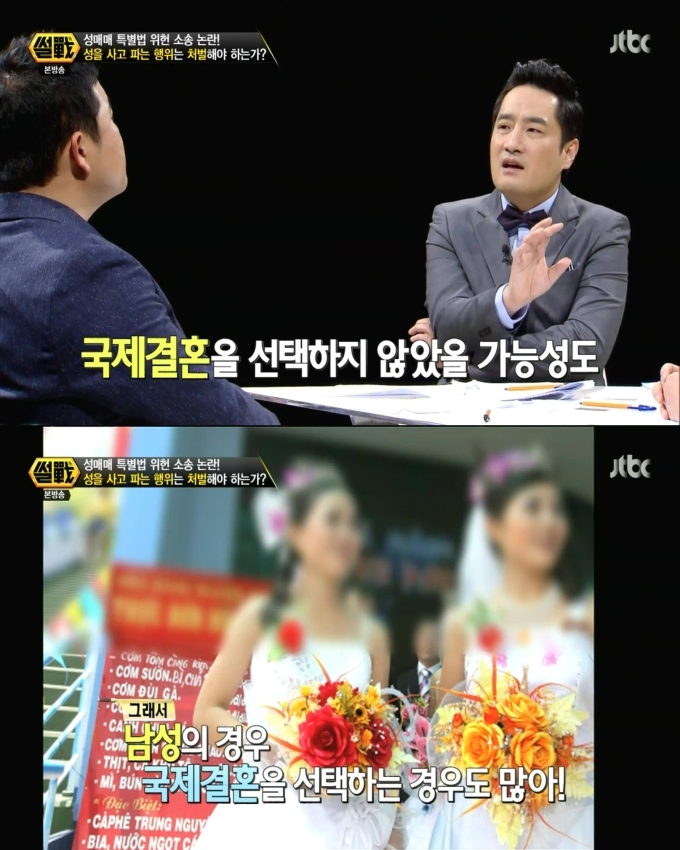
지난해 한 예능 프로그램에서 방송인 강용석 씨가 “외국신부를 데리고 와서 결혼하는 바람에 사회적인 문제로 번질 가능성이 굉장히 높다”는 내용의 발언을 하는 장면에 대해 방통심의위원회가 권고 조치를 내고, 한 음악 프로그램에서는 그룹가수 출신 위너 송민호가 “딸내미 저격 산부인과처럼 다 벌려”라는 가사로 랩을 해 방심위가 과징금을 부과했다.
Last year, on one entertainment program [above], the [controversial] panel-member Gang yong-seok said “The more marriages there are to foreign women, the more social problems Korea will have.” However, The Korea Communications Standards Commission simply let him off with a warning. Next, the singer Song Min-howas finedfor rapping, “I’m targeting your daughters; [they’ll] spread their legs like they’re at a gyno’s'” on a music program.
또 한 신문사는 특정 외국배우의 신체부위를 필요 이상으로 세밀하게 표현하고 선정적인 사진을 게시해 한국신문윤리위원회로부터 ‘주의’ 조치를 받았다.
한 드라마에서는 여성에게 술잔을 던지며 폭력을 행사하는 장면에 대해 방심위가 의견을 제시하는 등 2건의 조치가 이루어졌다.
Also, one newspaper received a warning for posting unnecessarily revealing pictures of a foreign actress. And finally, in one drama, they suggested alternatives to a scene in which a male character attacked a female one by throwing a glass of alcohol at her. (End.)
I’ve been unable to find out which newspaper and which drama sorry; if you do, please let me know thanks, and I’ll consider translating this (frankly) much more interesting related article, which provides some positive examples of combating sexual inequality and stereotypes too.
Update: Korea Bizwirereported back in September that the “The Korea Communications Standards Commission announced…[it] will be revising its regulations on broadcasting deliberation in an effort to promote gender equality on television programs and for online video content.” Given that it already said something similar in April however, as did the Ministry in January, then you can understand Park Ju-min for raising a fuss.
Wasting money on frivolous Western things, gaining financial independence, following their hearts instead of the wishes of their families, and not making enough babies.
All these criticisms of Korean “modern girls” in the 1930s sound eerily like those of “beanpaste girls” today. In so doing, they have much to teach us about the causes of misogyny, and why their stories resonate so deeply with its victims over 80 years later.
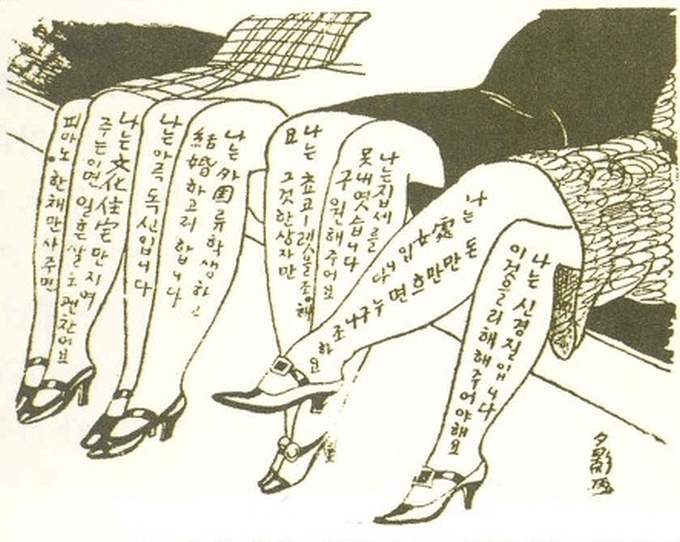
Take 강심바 (@kang_simba)* for instance, who begins describing the caricatures above as:
미친놈의 전통적 여혐국가. 1930년대 조선일보 만평. 나는 처녀입니다 돈만많으면 좋아요 나는외국유학생하고 결혼하고자합니다 나는문화주택만지어주는이면 일흔살도 괜찮아요 만평 제목은 ‘여성 선전시대가 오면’.
“Fucking asshole men’s traditional misogyny. A cartoon from The Chosun Ilbo in the 1930s…”
And then:
이 만평은 이미 화제였던 듯한데 반응은 대개 그시절에도 된장녀가 있었군요, 수십년후를 소름끼치게 예언헀네요 이다.
“Even back then, stereotypes like the ones in this cartoon were controversial. Wow, there were even labels like today’s “beanpaste girl.” It was prophetic.”
But what does it say exactly? Not recognizing some of the hanja characters, I consulted Lee Yeong-ah’s description in her 2011 book, Making Pretty Women (예쁜 여자 만들기). From left to right, the legs read:
Ahn Seok-yeong “If the Age of Woman Comes (2)”, The Chosun Ilbo, January 12, 1930.
1) Any guy is okay for me if he buys me a piano.
2) Any guy is okay for me if he builds me a house. Even a 70-year old.
3) I’m still single.
4) I want to marry a man who has been overseas to study.
5) I love chocolate. Only that one box.
6) I didn’t pay my rent. Please help me.
7) I am a virgin. [But] I like anyone who has lots of money.
8) I am hysterical. You have to understand this.
(p. 242)
Naturally, Lee finds the criticisms unfair, arguing that the cartoon says just as much about the cartoonist and the men who laugh at it as it does about the women so caricatured:
안석영의 이 만문만화는 “물질을 매개로 한 자유연애와 자유결혼의 속내를 ‘선전propaganda’이라는 상상의 장치를 통해 드러낸 작품이다. 만화 속 여성들은 자신의 몸을 내걸고 남성들에게 돈, 선물, 집, 사치품 등을 요구한다. 안석영은 이 만문만화에서 아마도 당시의 상품화한 연애와 결혼을 돈만 밝히는 허영심 강한 여성들의 책임으로 돌리고자 한 듯하다. 그러나 남성들은 어떤가? 위의 그림에서 여성은 다리만으로 표현되어 있다. 프레임 안은 남성들의 시선이 머문 지점이다. 즉 남성들은 여성들의 영혼이나 지성이 아니라 몸과 다리만을 보고 있었던 것이다. 그런 점에서 남성들 역시 왜곡된 연애나 결혼에서 ‘결백’을 주장하기 어려울 듯하다.
(p. 243)
In this cartoon, Ahn Seok-yeong uses an imaginary device called “propaganda” to criticize modern girls by showing their real, very materialistic feelings and motivations behind their embrace of free love and free marriage. The women in this cartoon are asking for money, gifts, presents, luxury items, and so on by using their bodies. It seems that Ahn criticizes the women for being greedy, blaming them for self-objectifying themselves for love and marriage. But what about the men? In the cartoon, the women are faceless. It only shows their legs, as the objects of the male gaze. In other words, men are only looking at women’s bodies, and are unconcerned with their personality and intelligence. In that regard, surely men are equally culpable for a distorted, perverted view of love and marriage?
Lee goes onto describe that, spearheaded by modern girls, the 1920s and 1930s were very much the period when Korea’s modern notions of free love, sexuality, and marriage were first formulated. (As well as the tendencies to judge women in terms of their appearance, and men in terms in their earning power.) Much closer to American flappers than their relatively conservative, usually less financially-independent Japanese counterparts, such notions were especially radical in Korea, where arranged marriages were the norm—and, alas, continued to be for many decades thereafter.
In the early 20th century, “love” and “love marriage” were new concepts in Korea. When arranged marriage—determined by one’s inherited class and financial status—was the only legitimate way to form a heterosexual union, women’s sexuality were confined in heterosexual relationships for procreation only, and love had no place in it. People of a lower class, who usually freely mingled with each other more than those in the upper class freely mingled with each other, no doubt fell in love and got married; however, middle and upper-class women had no right to assert their will in a matrimonial process. Therefore, the goal of new women’s contestation was not only to change the customary practice of marriage but also to bring a fundamental shift in people’s way of thinking about heterosexual unions. The women of the 1920s sought to overcome the prescriptive definition of women’s sexuality through writing publicly about their personal lives. Without a doubt, their demands were heavily criticized as immoral by elite male. Even today’s scholars criticize their demands as “too individualistic and extreme” and their approach to women’s liberation as “bourgeois feminism” that were said to turn blind eyes to class oppression operating within a gender structure.
(p. 2)
What fascinates the most though, are againthe uncanny parallels between the subsequent backlash and modern misogyny. For more on those specifically, see “How Women Are Represented within the Patriarchal Nationalism in (neo) Colonial Times” by Yewon Lee, who describes how critiques of modern girls first arose as a result of the increasing militarization of Korea’s Japanese colonizer:
Western thoughts such as the concept of natural rights of the individual and equality among man and woman were denied in the ’30s, and the so called “Old women” that stands in the opposite of the “New women” [신여성] that used to be criticized as old fashion, submissive, and dependent were reevaluated as those who retain the virtue of the past tradition. On the other hand, the “modern girls” who voiced their subjectivity on issues such as sexuality were blamed to be ‘selfish’ and ‘morally corrupted.’ This is not irrelevant with the fact that the Japanese colony was conducting a war that goes beyond their capacity and needed all the resources it can pull, thus, needed the women to become the ‘strong mothers’ to give birth and raise the ‘strong soldiers’ and be ideologically loyal enough to send their son’s willingly to war. This is the well known explanation of why the discourse of “New women” suddenly shifted to a conservative one in the 1930’s.
(pp. 9-10)
In particular, she argues that Korean men made them the scapegoats for forces over which neither sex had any control:
…not only did the discourse change due to the need of the Japanese colonialism but also it reflects the frustration of the colonized. Many of the Korean men were forced to join the army against their will. There was not much they can do when their mothers, sisters, wives, and lovers were harassed and mobilized as comfort women during the war. The sense of helplessness and powerless the colonized men had to put up with as the rule of the colonization harshens, made them in needs of a object, the women of the nation, to be kept under their control and for times to take out their anger. Thus, the women were safe from reproach as long as they were labeled as the ‘mother’ that gives birth and raise the child of the nation; however, once they insist on their rights as a woman they become an object of criticism. Thus discussions about women’s subjectivity on sexuality and gender equality almost disappear in the public scene by this time.
(pp. 10-11.)
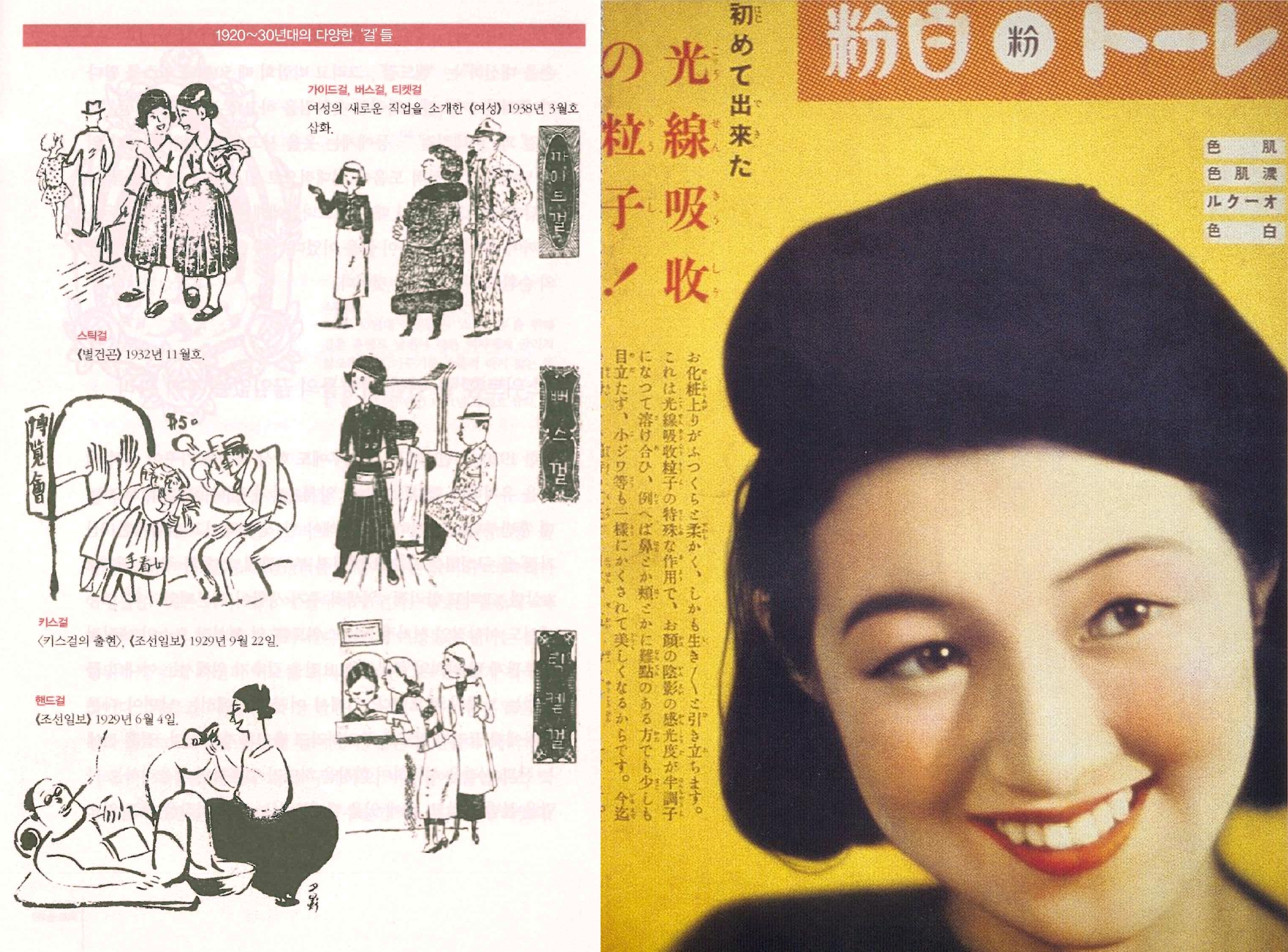
And with that criticism, came a host of body and/or lifestyle labels and ideals for women to aspire to, and/or stereotypes to be criticized for. For an instance of the latter, take the “stick girl” at the top left of the left image below, so-called because her much older partner uses her body as a walking cane. Whether she’s with him for love or money, I imagine that the cartoonist’s real issue is less with the age disparity than with the woman’s brazen freedom and sexual agency. Because would he have criticized a similar marital union arranged between two families of the same class, with the woman getting pregnant shortly thereafter?
Left: “The various types of ‘girls’ in the 1920s to 1930s”; scan, 예쁜 여자 만들기, p. 245. Right: Actor Hideko Takamine, Japanese White Powder Foundation advertisement, 1930s; via The Flapper Girl.
Either way, the parallels continue, for this label-making has been a strong trend in the last decade too. Also, whereas those feelings of helplessness and powerless are now because of “Hell Joseon” rather than colonial rule, nevertheless they still get channeled by the media into anger against young women, supposedly for taking over “men’s jobs” while the men suffer their mandatory military service. Writing in 2007 though, well before some important developments in Korea’s demographics (an excess of teenage boys turning into men) and labor market (more young women doing irregular and part-time work), instead Yewon Lee stresses the strong anti-Americancomponents to the misogyny she witnessed. Her paper is worth reading for that alone, and I’d be very interested in hearing readers’ opinions on how important that component remains nearly ten years later.
So, I encourage readers to check out both papers (actually conference presentations), which deserve to be much better known. Unfortunately PDFS are no longer available online, so please contact me if you’d like me to email them.
* Note: The twitter account @kang_simba was public at the time of publication; it has since been set to private.
Update) A must read is “Sweet Dream” at Gusts of Popular Feeling, about the strong critique of modern girls in the form of—sigh—Korea’s oldest surviving movie.
Slip up just once while you’re promoting your new album, and give me your honest opinion of your costumes, your choreography, or your lyrics. Tell me what input you had in them. Tell me if you ever rejected those that Starship Entertainment provided for you.
Or did you waive that right when you signed your contracts?
Because several things are going to happen in the next few weeks: some people are going to slut-shame you for the lewdness of your performances, and some people are going to raise concerns about your sexual objectification. Some people might even do both.
And whatever they say, the issue of your consent will be the elephant in the room.
First, because it’s both misogynistic and asinine to slut-shame you if you’re actually projecting a creation of your management company, rather than expressing your own sexuality and personality. Second, because as discussed back in April, there is both negative and positive (or benign) objectification, and the presence or absence of the consent of the person(s) involved is crucial for determining which is which:
According to Martha Nussbaum (1995; opens PDF) then: ‘In the matter of objectification context is everything. … in many if not all cases, the difference between an objectionable and a benign use of objectification will be made by the overall context of the human relationship (p. 271); ‘… objectification has features that may be either good or bad, depending upon the overall context’ (p. 251). Objectification is negative, when it takes place in a context where equality, respect and consent are absent.
On positive objectification, “dissident feminist” Camille Paglia is very much on point (my emphases in bold):
Early on, I was in love with beauty. I don’t feel less because I’m in the presence of a beautiful person. I don’t go [imitates crying and dabbing tears], “Oh, I’ll never be that beautiful!” What a ridiculous attitude to take!–the Naomi Wolf attitude. When men look at sports, when they look at football, they don’t go [crying], “Oh, I’ll never be that fast, I’ll never be that strong!” When people look at Michelangelo’s David, do they commit suicide? No. See what I mean? When you see a strong person, a fast person, you go, “Wow! That is fabulous.” When you see a beautiful person: “How beautiful.” That’s what I’m bringing back to feminism. You go, “What a beautiful person, what a beautiful man, what a beautiful woman, what beautiful hair, what beautiful boobs!” Okay, now I’ll be charged with sexual harassment, probably. I won’t even be able to get out of the room!
We should not have to apologize for reveling in beauty. It is not a trick invented by nasty men in a room someplace on Madison Avenue….It is so provincial, feminism’s problem with beauty. We have got to get over this.
Granted, Paglia is unfairly homogenizing and stereotyping feminism, as my own favorite feminist scholar explains:
Few issues have caused more debate within feminism’s history than the sexualized representation of women….Feminist activists and scholars have long tangled with the issue of whether images liberate women from or enforce traditional patriarchal notions of female sexuality. From Laura Mulvey’s psychoanalytical constructions of the “masculine gaze” to Andrea Dworkin and Catherine MacKinnon’s longstanding appeals to broaden both cultural and legal definitions of pornography, there is a wide and influential range of contemporary feminist discourse on the ways in which women are manipulated and victimized through various cultural representations. These have led to a popular stereotype of the “feminist view” (if there ever were such a monolith) of the sexualized woman as a consistently negative one. However, the history and evolution of the women’s movement problematizes this stereotype, as women have actively demanded the right to act as free and discerning sexual subjects even as they may be interpreted or serve as another’s object of desire.
Be that as it may, in my experience there are precious few commentators on K-pop that heed Paglia’s imperative, let alone make any consent-based distinctions between negative and positive objectification. I’m especially frustrated with Korean commentators who, caveats about my article-searching skills aside, tend to view increasing sexual objectification — and/or sexualization — as a blanket evil, SISTAR usually only getting a mention as one, interchangeable example in a roll-call of groups at the forefront of thesepernicioustrends. Certainly, I’ve yet to find someone who bothered to find out if equality, respect and consent are indeed absent in your relationship with Starship Entertainment.
Then I remembered that if you want something done properly, you have to do it yourself.
So, I became your biggest fanboy, spending the last two weeks poring over all your interviews and TV appearances. Whereas I used to think that they were just mindless trash, and that you weren’t free to speak openly, I finally — belatedly — realized I could no longer simply assume either.
But ten plus hours of videos, and numerous reading later? No offense SISTAR, but now I know they’re mindless trash.
I’ve learned, for instance, that: Bora has a mole on her left ear (32:37); Hyorin met her first love when she was in her second year of high school (7:10); all of them just love Las Vagas (7:00); there is an unofficial rule that band members can secretly start going out on dates once they approach 1000 days since their debut, but as of 973 days neither Hyorin nor Bora had (15:20); Hyorin has a pet snake; Soyou prepared for Christmas, 2011 by listening to a lot of carols (1:55); Dasom‘s mother is a big fan of the host of YHY’s Sketchbook (4:35); and so mindlessly on and on…
I would have watched more, but stopped paying much attention after watching one show that had you all spitting gum at a target for five minutes. Then I quit altogether when I came across another that opened with a pig shitting, as if to taunt me. Because suddenly I realized, what on Earth was I doing? How was that pig shit really any different to the contents of all those other programs? (Source, right).
But, most of all, I was giving up out of frustration at how many interviewers and TV show hosts would waste their precious time with you by almost always asking the same sort of inane questions, with the same predictable “Awww-we-love-you-[insert city/country/name of show]-guyz” type answers.
True: I am highlighting the most inane, the most vacuous, the most trivial parts of them. This may be patronizing and unfair: after all, some people are interested in such things, I’d probably bemore interested myself if they were about, say, Lee Hyori, and providing them is an integral part of creating and sustaining a fanbase. Also, the Sketchbook one is interesting in another way — albeit a negative one — for the disproportionate attention given to the handful of samchon (uncle) fans in the audience (5:50; that will have to be another post!). And I did learn one thing, albeit via the Soompi blog, rather than a video — that perhaps you’re forced to wear short skirts sometimes:
SISTAR’s Soyu recently revealed her dislike of short stage outfits.
On the June 1 episode of “Beatle’s Code: Season 2,” Soyu honestly talked about the late controversies behind the group’s outfits.
Soyu stated, “It is a little upsetting, it might be a good thing in a way. Even if we wear the same hot pants as other girl group members, when we wear them people call it racy. We think it’s because we have a healthy image so we try to think of it in a good way.”
When asked if she liked wearing short skirts/dresses, Soyu answered, “I really hate wearing short skirts/dresses. Sometimes there are rude people who take photos from below us. There are even people who touch us with their hands.”
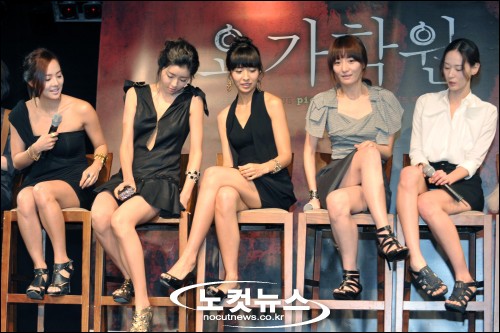
I’d add that sometimes PR people or press conference organizers will take advantage of this, only providing high stools for female celebrities to sit on (source, above-right). But Soyu, did you mean you would wear something different given the choice? Or that you just don’t like the perving? Why, oh why, didn’t the interviewer just ask?
And that was the best I got for ten hours work. (Readers will surely understand why I’ll refrain from the addressing the post to SISTAR from this point!) But in hindsight, perhaps it was naive of me to expect anything more than frequently tantalizing — but always unsatisfying — hints, for several reasons.
First, because I’ve already discussed the problem of Korean language sources in my ongoing Who arethe KoreanPin-up Grrrls? series. As always, I welcome readers’ suggestions for critical Korean commentary on K-pop; of course do know of, have read, and have translated some here; and acknowledge that my inability to find as much as I’d like doesn’t necessarily mean that there’s not more of it out there.
But frankly? As someone whose idea of a good time is to Google “성 상품화” after a couple of Black Russians, that caveat is sounding increasingly hollow and unnecessary.
Second, because for all the associations with the Korean idol and Japanese jumisho systems, as I’ll discuss in a moment, things are really little different for Western performers:
Women have always felt the pressure to look decorative or pleasing, but within pop and rock, when the star is the focus of a mass gaze, this expectation is increased tenfold. In the face of the pop orthodoxy that a woman is there first and foremost to look attractive, female artists have consistently had to negotiate the Image issue. “There’s always what we call the Cleavage Question,” said singer Suzanne Vega. “How much to show, when to show it, if at all.”
While Cleavage was the main sexual barometer of the 80s, when pop was in its infancy, with 20s vaudeville blueswomen and 40s jazz swingers, focus was on the Leg. With 50s dream babes the emphasis may have been on the Derriere, as opposed to the fetishizing of the Hair in the 60s. Whatever the focus, the acceptability of women in pop has rested on their ability to read and wear the codes, to promote whatever body part is fashionable at the time.
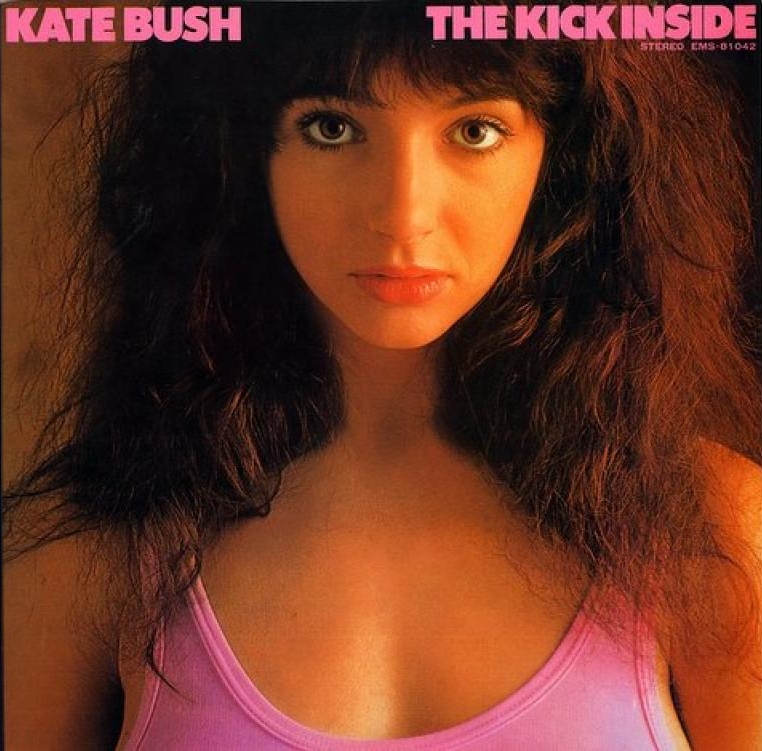
An early shot from Kate Bush’s 1978 publicity campaign has her looking full-lipped and big-eyed, wearing a clinging vest, her nipples showing through. When asked about her image at the time, Bush insisted that she didn’t feel exploited. “I suppose the poster is reasonably sexy just ’cause you can see my tits,” she continued matter-of-factly. “But I think the vibe from the face is there….Often you get pictures of females showing their legs with a very plastic face. I think that poster projects a mood….I’m going to have trouble because people tend to put the sexuality first. I hope they don’t. I want to be recognized as an artist.”
Some years later, at the time of her third or fourth album, the penny dropped. “I was very naive and I was very young,” she said of the early photo sessions which led to her being one of the most popular ‘wank’ images to grace student bedrooms. “It was all very new to me and, in the first year, I learned so many lessons about how people wanted to manipulate me.”
(Update: I really wanted to mention — but felt that the post already had more than enough quotes — “Selling an image: girl groups of the 1960s” by Cynthia J. Cyrus in Popular Music, May 2003, as the similarities between Korean girl-groups of today and US and UK girl-groups of the 1960s are simply astounding. Please email me if you’d like a copy, or of any of the other journal articles mentioned here.)
Third, because it’s by no means only Korean reporters and TV hosts that are restricted in what they can ask Korean stars. As John Seabrook revealed in “Factory Girls: Cultural technology and the making of K-pop” in last October’sNew Yorker, for instance:
Half an hour before the Anaheim show, I was backstage, on my way to meet Tiffany and Jessica, the two members of Girls’ Generation born and brought up in the U.S., who are both in their early twenties. An S.M. man was guiding me through the labyrinth of dressing rooms, where various idols, mainly guys, were having their hair fussed over and their outfits adjusted. There was a lot of nervous bowing. My minder hustled me along, telling me what questions not to ask the Girls. “Was it sad to say goodbye to your friends who didn’t make it?” he said. “Do you have a boyfriend?” He paused. “This is all going to Korea, and it’s a little different there,” he said. “So if we could stay away from the personal questions like boyfriends.”
(Update: Gag Halfrunt provides a second example in the comments)
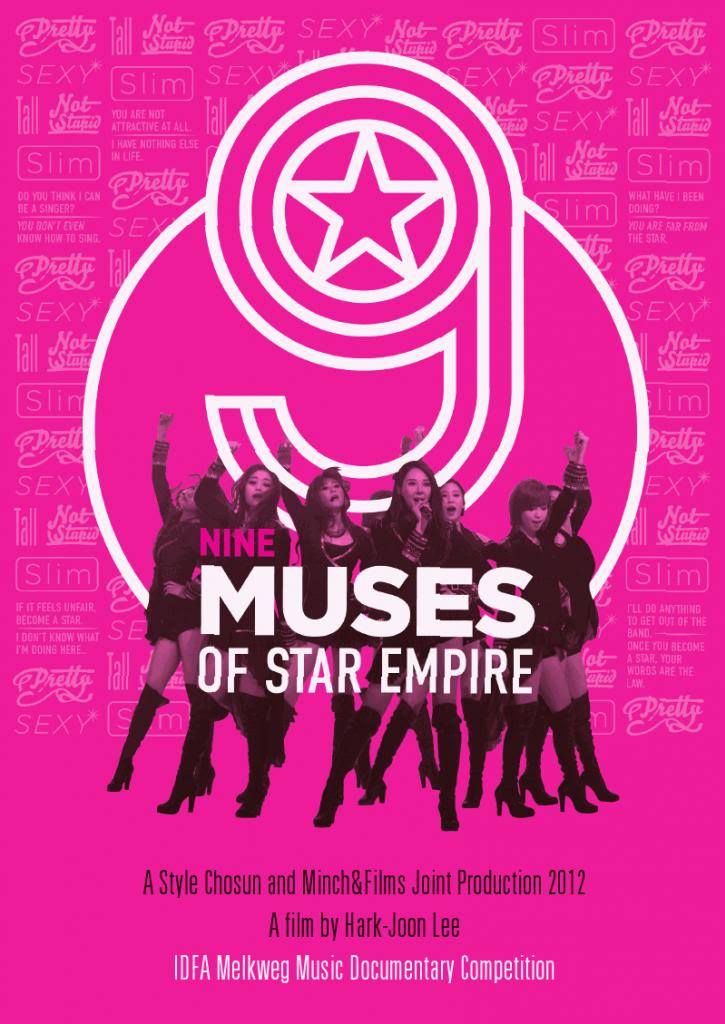
Finally, because I watched Nine Muses of Star Empire (2012), an 82 minute documentary about Nine Muses’ life and training under management company Star Empire Entertainment, directed by Lee Hark-joon.
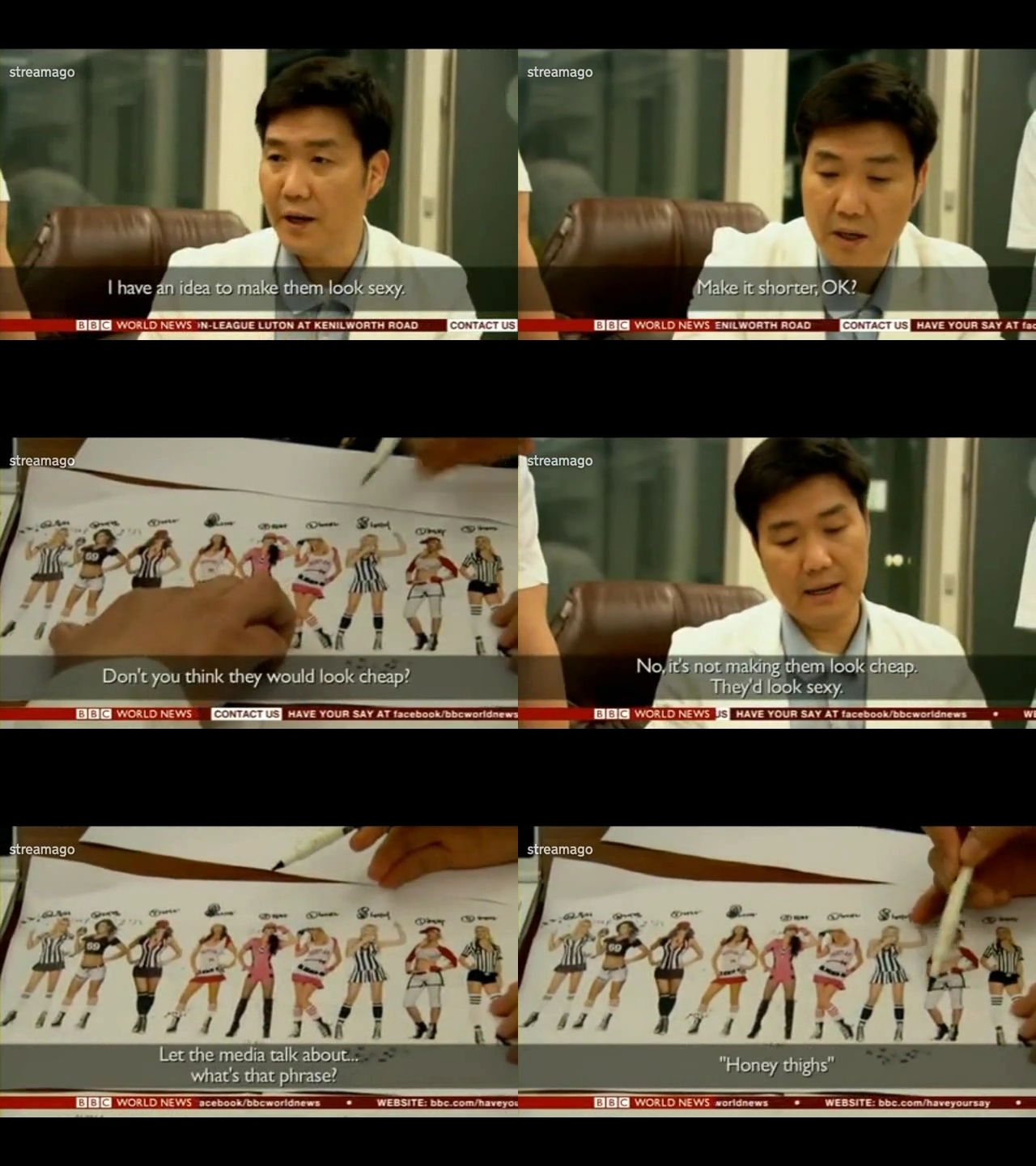
Or rather, I watched the 47 minute version that played on BBC World in mid-February (available here; it doesn’t embed well sorry), which byall accounts turned it into much more of a “journalistic exposé” than was originally intended, and certainly — deservedly — portrays Star Empire Entertainment in a very negative light. While SISTAR’s Starship Entertainment is of course a completely different company, I still probably wouldn’t even have bothered with their interviews if I’d first seen Nine Muses’ PR Manager (3:15) schooling them in exactly what to say at theirs, or their CEO (10:15) personally choosing — how empowering! — outfits that showed off their honeythighs:
That said, I do encourage readers to check out twointerviews of the director, particularly in the latter link where he says:
Q) In the documentary the managers can be seen deciding on the girls’ outfits, songs and choreography. Do the girls have any say in their group’s concept, or is everything decided on for them?
A) The girls’ and boys’ band concept is decided by the agency. However, not all successful bands are like that. As they adjust to the music industry, they start composing their own songs and have more of a voice in their concept. In the documentary, the girls are told by managers: “If you become a star, your opinion is law. If you think you are treated unfairly, become a star.” What the manger said is cruel but it shows a reality.
Next, I insist readers check out at least Part One of — and especially the much longer comments to — W. David Marx’s series at néojapanisme on the Japanese jumisho system that the Korean idol system is based on, and which it’s clearly still very similar to. (The introductory chapter to Idols and Celebrity in Japanese Media Culture{2012} is also helpful, as is Googling “idol” and “Seoulbeats“; here’s a good starting post). Assuming that you have, then it’s an opportune moment to stop and take stock here:
It’s difficult to find material on SISTAR specifically
There is great variation in different management companies’ relationships with their employees/groups/artists. Star Empire Entertainment, T-ara’s CoreContents Media, and KARA’s DSP Media would be at one end of the scale, and probably 2NE1’s YG Entertainment and The Brown Eyed Girls’ Nega Network at the other.
These relationships — i.e., level of groups’ freedom, autonomy, and involvement in their work — change over time, as indicated by director Lee Hark-joon above. To wit, SM Entertainment has reportedly improved in recent years, and just this week JYP announced that he no would no longer insist on having his name mentioned at the beginning of songs, and would allow his artists more freedom with composer choices
Not being able to ask artists tough questions doesn’t preclude us from making informed guesses about their relationships with their management companies. Moreover, unfiltered news and confessions does appear all the time, After School’s UEE admitting just last week that their CEO effectively forced them to do (painful) pole dances in their latest MV for example, and CL on the right (source; edited) mentioning back in March that she refused her company’s requests for her to get cosmetic surgery before her debut (something YG would later do a complete 180 on). Likewise, I hope SISTAR will be more — er — revealing in the future too.
But where does all that leave the question of how to determine sexual objectification in K-pop?
Recall that in the last post, I provided some criteria on sexual objectification devised by various feminist scholars, and concluded that most purported examples in K-pop (and specifically, SISTAR’s Gone Not Around Any LongerMV and TV performances) didn’t meet those. Commenter ‘dash’ however, to whom I’m eternally grateful, pointed out that because of the levels of coercion involved in the idol system, then most likely idols did meet those criteria, even if — the main thrust of my post — sexy dancing and showing skin aren’t necessarily sexually objectifying — or rather, negatively sexually objectifying — in themselves.
To refresh readers’ memories, here are the seven specific criteria devised by Nussbaum, plus three more provided by Rae Langton:
instrumentality: the treatment of a person as a tool for the objectifier’s purposes;
denial of autonomy: the treatment of a person as lacking in autonomy and self-determination;
inertness: the treatment of a person as lacking in agency, and perhaps also in activity;
fungibility: the treatment of a person as interchangeable with other objects;
violability: the treatment of a person as lacking in boundary-integrity;
ownership: the treatment of a person as something that is owned by another (can be bought or sold);
denial of subjectivity: the treatment of a person as something whose experiences and feelings (if any) need not be taken into account.
reduction to body: the treatment of a person as identified with their body, or body parts;
reduction to appearance: the treatment of a person primarily in terms of how they look, or how they appear to the senses;
silencing: the treatment of a person as if they are silent, lacking the capacity to speak.
Applying academic theories to the real world is often messy and unsatisfying, but to conclude that we just don’t know if SISTAR are coerced by Starship Entertainment, so we just don’t know if #3, #7, and #10 apply, so we just don’t know if they’re negatively sexually objectified or not? It just felt galling, as if the last two weeks had been a complete waste.
It also presented quite an impasse, which took another two weeks to overcome.
For a while, it was tempting to leave it just at that, as you could argue that objective definitions are actually unnecessary, and/or seeking them misguided. After all, you’d think devising some for pornography would be much easier, but my (layperson’s) impression is that despite laws distinguishing between its many forms, and despite various coda used by law enforcement agencies to police, say, child porn (for example, the COPINE scale), we’re actually no closer to having objective definitions of it than when Supreme Court Justice Potter Stewart famously said in 1964 that it was hard to define the hard-core stuff, but that he knew it when he saw it (note it was later regretted and retracted however).
Perhaps, that vagueness is partially because the world’s first peer-reviewed academic journal on pornography won’t even be launched until next year?
In contrast, Buszek’s quote in the introduction is a reminder that academic work on objectification has a long pedigree, and is indeed the primary means — and likely will remain the primary means — by which we discuss “the ways in which women are manipulated and victimized through various cultural representations.” And who could doubt it the necessity of doing so, after watching the following video?
Not what it may seem, Escher Girls describes it as:
A video about the straight cis male gaze in cinema (and video games), examples of it, and talking about how even when men are sexualized on screen, it’s still as active agents and not as a collection of body parts where the camera zooms in and cuts to various secondary sex characteristics. Not a new concept, but the video is still interesting, even as just food for thought.
I also think having it deconstructed visually like he does, helps one pay a little more attention to how the world around us is constructed via the media we consume, in even small subtle ways, like where the camera focuses, pans, and zooms in on, and the difference between cuts that show pieces of the body versus full face & body shots.
….Also, this doesn’t mean it’s NEVER a thing to do, sometimes it can be used very effectively, and increases the understanding of a scene…but it’s when it becomes the norm of depicting women in all situations…
So, after two weeks of banging my head against a brick wall, it finally occurred to me to Google PDF files with “sexual objectification” in the title. In just — ahem — five minutes of looking, I came across the solution in the form of “Sexual Objectification of Women: Advances to Theory and Research” in The Counseling Psychologist 39(1), 2011, pp. 6-38 by Dawn Szymanski, Lauren Moffitt, and Erika Carr, as I was immediately struck by how their five core — but very interrelated — criteria of a “sexually objectifying environment” were eerily similar to life in a management company:
A) Traditional gender roles exist
The first thing that came to mind upon reading this were the traditional gender roles perpetuated by a significant number — butbyno meansmajority — of songs and MVs by girl-groups, buttressed by the ridiculousdouble-standards of Korean censors. But, while that’s certainly something worth exploring, it’s more appropriate to focus on the environment in which management company employees work in.
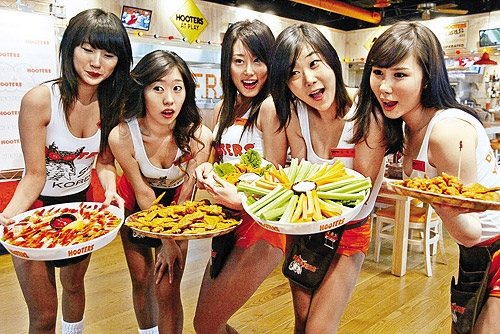
Especially as this is a concept originally devised for places like Hooters (pp. 21-22):
Specific to the workplace, [one researcher] used the term gender role spillover to refer to the carryover of these traditional gender roles into work environments where they are irrelevant or inappropriate. This phenomenon is more likely to occur when gender role is more salient than work role and/or gender ratios are highly skewed, because under many circumstances, individuals use gender role stereotypes to guide behavior, especially in male-female interactions. In particular, gender role spillover occurs when women (more than men in similar occupational roles) are expected to project their sexuality through behavior, appearance, or dress. When gender role spillover occurs, the effects may be magnified when women hold jobs where one aspect is reminiscent of a sex object (i.e., cocktail waitress). In this position, women are likely to be targets of unwanted sexual attention but may (inaccurately) attribute the way they are treated to their job rather than to their gender. A dynamic is then set up where men are expected to take the role of sexual initiator. One potential outcome is a sexualized work environment where sexual remarks, seductive clothing, and sexual advances are tolerated and encouraged.
(Update: See here for more on Hooters in Korea {source, above})
B) A high probability of male contact exists (physically speaking, a male-dominated environment)
Here, the authors’ meaning is the greater numbers of men compared to women in the environment in question; lacking that data, this cannot be confirmed or denied in the case of Korean management companies. But we can guess — and this is confirmed by Nine Muses of Star Empire — that the female idols do have considerable contact with the same few men, and…
…the extent of contact with men [is] a key predictor of incidence of harassment, number of different types of harassment, sexual comments, sexual categorical remarks, and sexual materials for women. Thus, contact with men may serve as a mediator between women and sexual objectification (SO). Frequent contact with men may create a more sexualized environment, which in turn allows for more SO experiences. (pp. 22-23)
Next, consider the disproportionate power of those men:
C) Women typically hold less power than men in that environment
This can be taken as a given. But Seabrook puts it well, and the combination he describes is covered well in the comments to Part One of the jumisho series at neojaponismé:
When you replicate the American entertainment business, and add the Confucian virtue of rigid respect for elders to the traditionally unequal relationship between artists and suits, the consequences can be nasty.
I’d also add that although men can and do write, direct, and/or produce — for want of a better word — feminist songs and MVs, and that although those intended for heterosexual men can be willingly embraced by women (of all sexualities) nevertheless, the example of lyricist Kim Eana (and others) points to the common-sense conclusion that the more women in the industry, the more feminist and/or positively-objectifying songs and MVs will likely be produced.
D) A high degree of attention is drawn to sexual/physical attributes of women’s bodies
Environments where women are required, often by specifications of a uniform, to reveal and emphasize their bodies are clearly sexually objectifying. Additionally, wearing tight or revealing clothing may facilitate self-objectification, as women constantly review their appearance and the fit of their clothing in the surrounding mirrors. Supporting this notion, [one study] found that women in fitness centers who wore tight and fitted exercise clothing (gym tops and gym pants) placed greater emphasis on their appearance attributes and engaged in more habitual body monitoring than women who wore looser clothing (T-shirts and sweatpants). Relatedly, [other researchers] found that the attention focused on women’s bodies in fitness centers leads women to self-objectify more. (p. 23)
E) The approval and acknowledgement of male gaze
…girl watching is a “targeted tactic of power” where men use gaze to demonstrate their right to physically and sexually evaluate women. The activity serves as a form of playing a game among some men; however, the targeted woman is generally understood to be an object, rather than a player, in the game. Thus, from a male point of view, “acts such as girl watching are simply games played with objects: women’s bodies”. The effects of male gaze on women may be intensified by the accompaniment of sexually evaluative commentary. (p. 24; source, right)
And with that, I could finally conclude my month-long inquiry. Which in short, is that I now more or less agree with dash(!), the commenter that started me on it. Or in full, that:
Given everything we know about the idol system, it is fair to assume that management companies are sexually objectifying environments
Consequently, it fair to assume that female performers do not always consent to the sexual objectification asked of them
Consequently, it is negative sexual objectification
And crucially, if the management companies and/or performers feel that these assumptions are incorrect and unfair, that the onus is on them to prove us feminist whiners wrong
Yes, you can argue that that’s a lot of assumptions. And/or that, because the first set ivory tower criteria from the last post didn’t work in the real world, that I’ve merely gone and replaced them with another. Both criticisms are fair. Also, I acknowledge the very very broad range of topics above, and am aware of the many exceptions, over-generalizations, and just plain simple mistakes involved in covering them all. I welcome and appreciate readers pointing them out to me, and look forward to discussing them in the comments.
Yet most of all, I’m happy that I now longer feel so stymied, so…inadequate when talking about objectification in K-pop because I feel I won’t ever been able to hear enough about it — or indeed, anything about it — from the singers themselves.
Of course, the drudgery of religiously scanning news reports and interviews for their voices — i.e. to make assumptions into facts — is still essential, and, having recognized that, motivated fanboying is something I definitely plan to continue doing in the future. But spending hours toiling over, say, all 114 pages of the SISTAR tag on allkrap allkpop for those slip-ups before you can feel you can even write? Really, us feminist whiners can do much better than that.
And SISTAR, so can you too. Give it to me indeed.
You know what I mean!
Update: The dynamics of guest-host interactions on Korean talk-shows are a little more subtle than I gave them credit for in this post. See “Goo Hara is Allegedly Rude because ‘MCs Gotta MC’” at Seoulbeats to learn more.
p.s. Like this post? Did it keep you occupied for half an hour? Please consider making a small donation, to help me write more of them — I’ve only had one two so far this year! ㅠㅠ
And using manhwa (만화), or Korean cartoons, is a good place to start. Sadly, my favorite “grown-up” comic-book poptoon (팝툰) sold its last edition back in March, but there’s lot’s more where that came from.
One possibility is Department Head Dal-ma (Dalmagwajang; 달마과장), available in the free Focus newspaper. Although it’s often very basic, requiring no Korean ability to get the gist of, you could do much worse than quickly translating it on your morning commute.
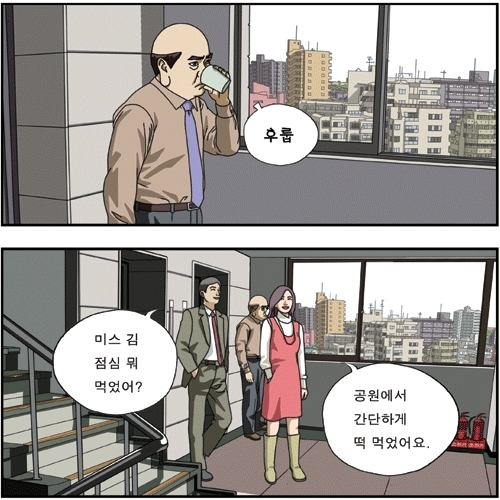
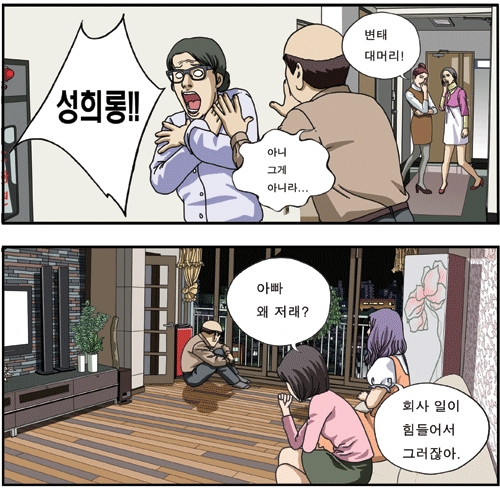
Take these two strips for instance, which kept cropping up in Naver searches while I was preparing a recent post on sexual harassment in Korea. First, number 21:
Dal-ma:Gulp.
Man:Miss Kim, what did you have for lunch?
Miss Kim:I simply had ricecake at the park.
Even from just these first panels, already one thing of interest is that the man uses banmal (반말), or informal speech to speak to Miss Kim, and she replies in nopimmal (높임말), formal speech. No big deal there you might say: he’s probably her superior in the company. And as this recent incident on a subway demonstrated, using the appropriate level of speech to others is considered extremely important in Korea, with even many of my university students using nopimmal to friends just a few months older.
But then the same happens in the second cartoon too, even though the man addresses the woman with the semi-formal shi (씨) at the end of her name. And while a brief survey of other Dalmagwajang cartoons does occasionally show men and women each using nopimmal to each other, I didn’t see any cases of a woman speaking to a man in banmal and he answering in nopimmal. Which is not to say that they don’t exist necessarily, but if there are any then I’d wager there’d be very few.
If so, then is that just a reflection of reality? After all, women do tend to have junior and/or non-advancing positions in Korean workplaces, as even in 2011 it considered perfectly normal for them to resign and/or be fired upon marriage or becoming pregnant (only 50% of Korean women work, the lowest rate in the OECD).
(Source: unknown)
But on the other hand, recall that even subtitles for foreign films and programs have this gender-dichotomy grafted onto them too, despite being absent in the original English:
A women’s group has issued a report on the “sexist” dubbing of foreign films and dramas, reports women’s newspaper Ilda The group took a look at some 27 English-language dramas shown on terrestrial broadcasting in September and October. It found that most of them employed sexist sexist practices when dubbed into Korean. Namely, male characters spoke in banmal, or “low language,” while female characters used jondaenmal, or “high/respectful” language, even though the original English dialogue made no such distinctions.
This tendency was most often seen in dialogue between husbands and wives or lovers. Besides dramas, foreign films showed the same tendency, with 12 of 15 films monitored by the group employing this dubbing practice.
Clearly then, for TV at least there is a compulsion to conform to it. Whether that’s just the industry convention, fear of negative public reaction, and/or the personal choices of the translators themselves, then that remains to be seen, but I’d be surprised if that didn’t apply to some extent to other forms of media. And either way, you’re left with a pretty pervasive socialization agent, and one easy to overlook for English speakers, and/or even easier to get used to for native Korean speakers.
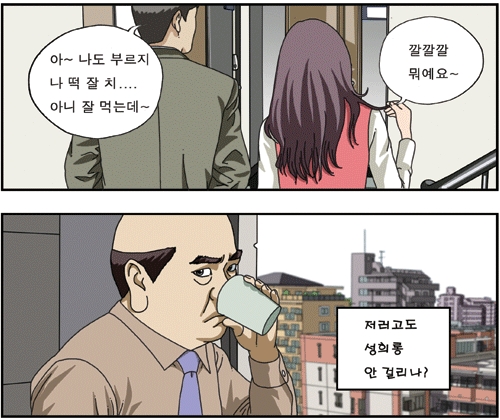
Man: Ah, why didn’t you invite me? I pound ricecakes really well…No, well, I eat them well…
Miss Kim: (Laughing) What do you mean?
Dal-ma: Even acting like that, he won’t get accused of sexual harassment?
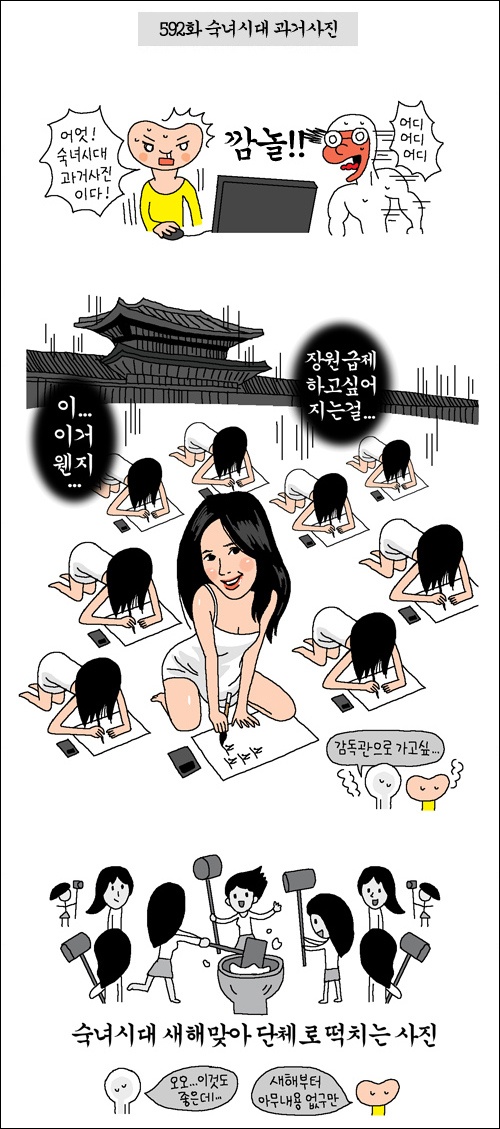
Next, despite its curious reputation for conservatism overseas, in fact the Korean media is simplyfull of sexual innuendo, and this cartoon read by millions every weekday is surely a classic case in point: “떡을 치다” is literally “pounding rice cake”, but is really slang for having sex. Which is why a year ago, a cartoonist was sued for sexual harassment by Girls’ Generation’s (소녀시대) management company SM Entertainment for this otherwise innocuous-looking cartoon:
This might sound strange, but personally I find that slang quite endearing. For not only does it seem quintessentially Korean (here’s another example), but with most Koreans living in the countryside until as recently as 1979, then it reminds me of the country’s strong agricultural roots too (no pun intended).
Ahem. Continuing:
Dal-ma: Still, if something is judged sexual harassment or not all depends on your face (how attractive you look)
Woman left: He really said that?
Woman middle: (Laughing) Really?
Dal-ma: Wow! Look at her chest!
Dal-ma: Jeez, how can’t they feel ashamed to wear clothes that emphasize their breasts like that…
Eek, I forgot! Staring is also sexual harassment.
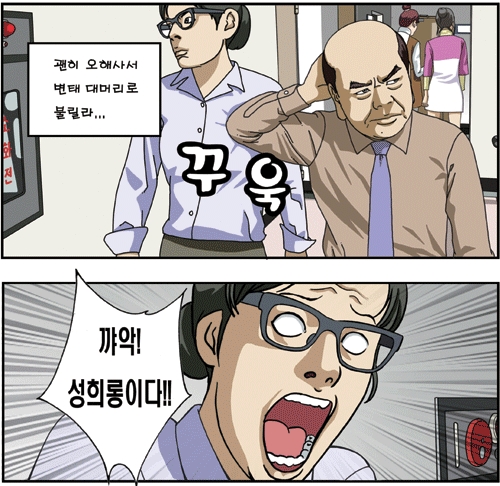
Dal-ma: (Worried) For no reason, because of a misunderstanding I’d be called a bald pervert.
Woman: Eek! It’s sexual harassment!
Having a shaved head myself, then I couldn’t help but chuckle at the unnecessary mention of his baldness here, as if that somehow makes his perversion all the worse. But with shaved heads being best known as a symbol of “prison, protest, or penance” in Korea, then unfortunately those negative connotations aren’t likely to go away any time soon.
Woman: Sexual harassment!
Dal-ma: No, it’s not that…
Women in background: Bald pervert!
Dal-ma’s daughter: What’s wrong with Dad?
Dal-ma’s wife: He’s like that because working at the office is tiring.
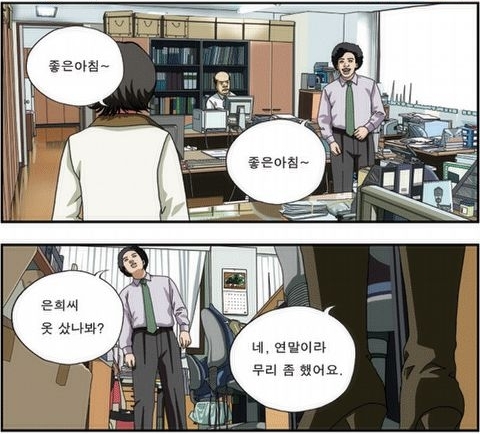
Next, number 57 (as I type this, the latest is number 327 by the way). Sorry for the poor image quality:
Woman (Eun-hee): Good morning!
Man: Good morning! Eun-hee, you bought new clothes?
Eun-hee: Yes, because it’s the end of the year I spent a lot on myself
Man: Wow, your back is a killer!
Eun-hee: Really?
Man: Yes, you’ve a perfect Honey-bottom!
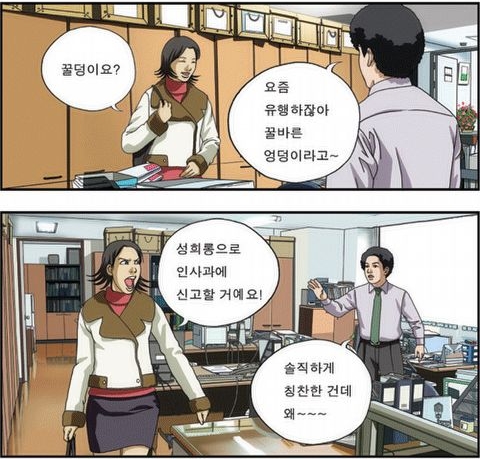
Despite what the man says in a moment, that’s the first time I’ve heard the term ggooldongi, a combination of ggol (꿀; honey) and ongdongee (엉덩이; bottom). But I have heard (and written about) ggoolbokji (꿀벅지) that it comes from though, which, as Matt at Gusts of Popular Feeling explained:
…apparently means, according to this article and allkpop, ‘sweet-as-honey thighs’ or “alluring as-if they-were-coated-with-honey thighs”, though a more creative, if incorrect, translation would be ‘alluring thighs that spread like honey.’ Ahem.
And in particular:
…a ‘high school girl living in Cheonan’ posted a petition on the Ministry of Gender Equality’s website claiming that the word ‘honey thighs’ actually means ‘thighs that you want to smear honey all over and lick off’, and represented the sexual commodification of a female body part, was sexual harassment, “induced a feeling of sexual shame” and said its use should be banned. She was also irritated that such a ‘sexually derogatory word’ was used by the media and asked that it stop. According to allkpop, “Even Korean portal site Daum has requested people to refrain from using this controversial term…”
Hence Eun-hee’s justified reaction:
Eun-hee: Honey bottom?
Man: These days it’s popular. It means honey applied to a bottom…
Eun-hee: I’m going to the Human Resources Department to complain about your sexual harassment!
Man: Honestly, it was just a compliment, why…
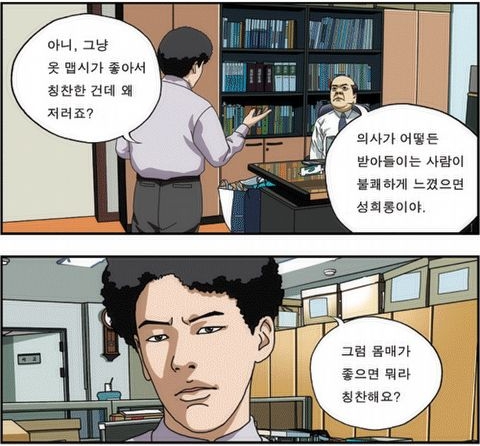
Man: Well, I was just complimenting her on how well her clothes fit. Why’s she acting like that?
Dal-ma: It doesn’t matter what your intention is, it depends on how the other person receives it. If they feel uncomfortable, then it’s sexual harassment.
Man: In that case, if someone has a good body, how can we give them a compliment?
Dal-ma: If you intend to compliment a certain part of a person’s body, then do it precisely. Then, the other person will take it well.
No, I didn’t find them funny either. What’s more, they give the impression that all it takes to deal with sexual harassment in Korean workplaces is a quick visit to the Human Resources Department, and consequently that male employees are very nervous about being accused of it. Unfortunately though, as this case at Samsung and these recent testimonies by victims demonstrate, the reality is anything but.
Why the discrepancy? That’s a good question, and it’s made me curious to see if its also found in other newspapers, and so on. Which is not bad for a couple of quick cartoons over a morning coffee, yes?^^
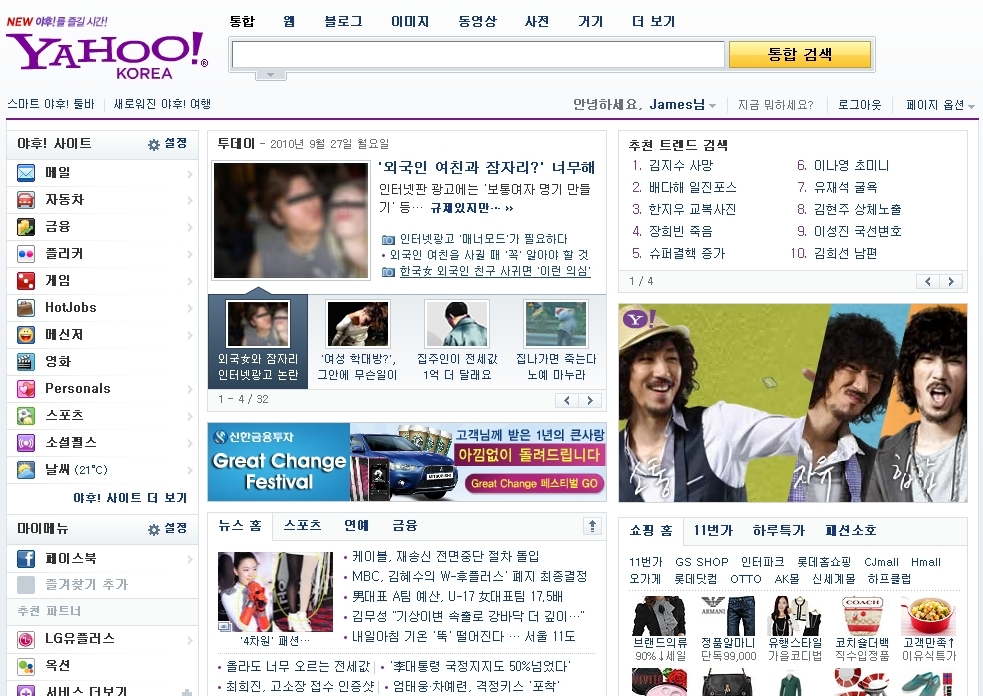
A provocative article title from Yahoo! Korea yesterday, yes?
Alas, actually it’s only about one lawmaker’s concern over the growing number of “lewd” internet advertisements these days, among which presumably that’s a common slogan. But that does underlie some of the street harassment and groping that many foreign women experience here, so it’s interesting in its own right.
As is the irony and hypocrisy of Yahoo! Korea posting such an article in the first place too. For Korean portal sites are virtually like The Sun newspaper in their content, tone, and adherence to journalistic ethics, like I said of them last year:
Unlike their English-language counterparts, you have roughly a 50% chance of opening Naver, Daum,Nate, Yahoo!Korea, and kr.msn.com to be greeted with headlines and thumbnail pictures about sex scandals, accidental exposures (no-chool;노출) of female celebrities, and/or crazed nude Westerners.
And indeed, scroll to the bottom of Yahoo! Korea as I type this, and just today’s “image galleries” below include lingerie photoshoots and “beautiful Russian news anchors”, let alone the links on the rest of the site.
Not that I mind those in themselves of course. But if they’re the standard for Korean portal sites, then you can just imagine what it’s like for the rest of the Korean internet.
Take those of “serious” newspaper websites for instance, the main focus of the orginal article, and which are already notorious for posting pictures of womenin bikinis or even middle-school girls in short skirts:
‘외국인 여친과 잠자리?’ “인터넷 음란광고 강제 퇴출해야”
‘Want to Sleep With a Foreign Woman?’ “Lewd Internet Advertisements Should be Forced to be Withdrawn”
[아시아경제 김성곤 기자]인터넷 광고시장이 급성장하고 있지만 법적 장치의 미비로 선정적인 내용의 음란광고로 홍수를 이루는 등 부작용이 심각한 것으로 나타났다.
While the internet advertising market is experiencing rapid growth, its legal oversight is imperfect, and there has been a flood of lewd advertisements with suggestive contents, with serious side effects.
김성동 한나라당 의원은 27일 방송통신심의위원회로부터 제출받은 자료를 분석한 결과, 인터넷 광고시장은 2004년 4800억원 규모에서, 2005년에는 6600억원, 2009년에는 1조2978억원 등으로 매년 크게 늘고 있지만 성적 호기심을 자극하는 광고가 난무하고 있다고 지적했다.
On the 27th, after analyzing data submitted by the Korean Communication Standards Commission, Kim Seong-dong, an assemblyman from the [ruling] Grand National Party, concluded that the Korean internet advertising market was worth [at today’s exchange rate] US$419 million in 2004, US$576 million in 2005, and US$1.132 billion in 2009, rapidly expanding every year. However, he pointed out that this is also true of advertisements stimulating sexual curiosity.
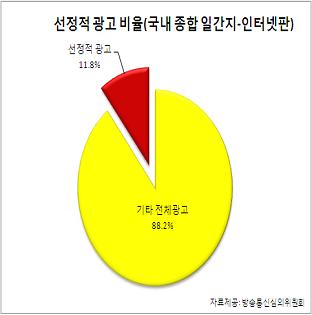
이 자료에 따르면 국내 종합 일간지의 인터넷판 광고에는 ▲ 외국인 여친과의 술자리에서 헉 ▲ 그녀가 원하는 건 크기·힘! ▲ 보통여자 명기 만들기 등 선정적 광고가 전체 광고의 11.8% 수준에 이르렀다. 특히 스포츠 연예지는 선정적 광고의 비율이 20.6%에 달해 전체광고 5개 중 1개는 음란 광고였다.
According to the data, if you look at all the internet advertisements of national newspapers, sexual advertisements with lines like “At a bar with a foreign girlfriend…Wow!”, “She wants size and power!”, “Make a normal woman a famous kisaeng (Korean geisha)”, and so on make up 11.8% of the total. In particular, the rate is 20.6% in sports newspapers, or 1 in 5.
문제는 이러한 인터넷 광고는 다른 광고에 비해 소비자 피해가 즉각적으로 발생하고, 피해 범위도 광범위하다는 것. 특히 피해가 발생해도 광고주의 이동과 은닉 등으로 피해구제가 어려운 것이 특징이다. 아울러 판별능력이 부족한 어린이, 청소년에 대한 무분별한 광고의 노출은 부작용이 심대하기 때문에 규제의 필요성이 절실한 형편이다.
The problem is that compared with other advertisements, consumers instantly suffer a wide range of damages from them. In particular, the producers of the ads can move and conceal themselves easily, making relief and help for the damages difficult (James – I think what these “damages” are exactly should have been made more specific). Accordingly, because the side effects of children and teenagers seeing sexual advertisements is serious, as their ability to understand them properly is lacking, then there is an urgent need for their regulation.
김 의원은 “이러한 현실이 인터넷 광고에 대한 내용 규제가 제도적 미비로 인해 제대로 작동하지 않은 것에서 기인하고 있다”며 “정부, 인터넷 사업자, 민간단체 등 모든 주체가 참여하는 공동자율규제 도입을 고려해야 할 때”라고 주장했다.
Assemblyman Kim claims that “This problem is caused by a lack of and/or poorly-functioning regulation of internet advertising at present,” and that “this issue of regulation needs to be considered by all participating and/or concerned parties, including the government, internet businesses, NGOs, and so on.”
한편, 현재 인터넷광고는 2007년 발족한 한국인터넷광고심의기구가 자율규제를 하고 있지만, 법적 구속력도 없고 비회원사의 참여를 강제할 수도 없는 구조적 모순 아래 놓여있는 형편이다.
There has actually been an organization to regulate Korean internet advertising since 2007, the Korean Internet Advertising Deliberation Organization, but its authority is insufficient as its decisions have no legal binding, nor can it force non-members to participate. This undermines its role as an advertising relief(?) organization. (end)
Meanwhile, observant readers will have noticed two other links in the original screenshot: the first, a Korean blogger’s opinion piece saying that if you’re a Korean woman and want a foreign [male] friend, then you’ll have to get over everyone’s suspicions that you’re with them just for the sake of English and/or sex.
Which may well be true, but unfortunately my wife says it reads like it was written by a 16 year-old.
The second however, another blogger’s advice about getting a foreign girlfriend, actually looks rather interesting, but unfortunately is several thousand words long. I’d still consider translating it though, probably as a 9-part series, but only if readers are interested. If so, please let me know!
Alas, I’m still taking a break from blogging for another week or so(!), so let me just quickly pass on a Korea Timesarticle on “X-lines” and women’s body images that I’m quoted in today. New readers who want to learn more about them, please see:
Here for a quick summary of all the various “lines” used to describe women’s bodies at the moment
Here for a much longer analysis and a discussion of how and why they’ve developed from being mere fads to become enduring parts of Korean media culture
Here for the ways in which even prepubescent girls are socialized to develop a concern for achieving such lines in the future
Here for the deep roots this Alphabetization craze has in various Korean philosophical and linguistic traditions, rendering it qualitatively different to similar sounding name-assigning in English.
And finally here, here, and here for more on the fact that Korean women are the slimmest in the OECD, but still consume the most diet drugs.
Meanwhile, I’m very grateful to author Cathy Rose A. Garcia for asking for my input, and for then including so much of what I wrote in our email exchange. It seems almost churlish of me to critique it so severely after that, but I’m afraid I must, for it seems rather naive, almost disingenuous to write an article about how popular X-lines are when the only evidence for that comes from a company that has a vested interest in making people think so:
Three out of four female college students consider X-line, a term referring to a slim waist with ample breasts and hips, to be the ideal body shape, according to a survey by Amore Pacific’s V=B Program. The survey covered 1,000 female college students from Ewha Woman’s University and Dongduk Women’s University from May 13 and 17.
Granted, Cathy does mention later:
Amore Pacific’s V=B Program, which sponsored the survey of college students, offers a line of herbal Oriental beauty supplements. It recently introduced the “S-line slim DX,” which claims to reduce body fat and abdominal fat.
But the conflict of interest should have been made more explicit, and indeed is rather ironic in light of one of my quotes:
“Companies do have a vested interest in creating new, artificial body ideals that purchasing their products can supposedly help you achieve. And given the media’s overwhelmingly uncritical reporting and active dissemination of these ideals, then it is difficult not to conclude that the media is at least passively colluding with its advertisers in this regard,” Turnbull said.
Moreover, as I explain here, the X-line is by no means a “new” obsession of Korean women, but is at least 2 years old, originally created by – you guessed it – Amore Pacific, who created the monstrosity on a computer when Yoon Eun-hye’s (윤은혜) actual body failed to deliver:
In fairness, Amore Pacific did use more human-like realistic images of her body in some of its advertisements for the V=B Program that year, but those in no way compensate for encouraging women to obtain a literally impossible body shape in the first place. And call me picky, but any news article on X-lines is severely remiss in not mentioning that.
What do you think? Are my critiques of the article fair?

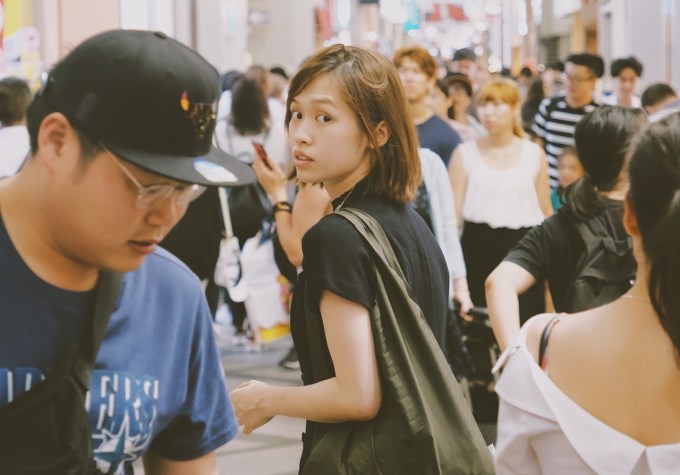 Estimated reading time: 5 minutes. Photo (cropped) by Dynamic Wang on Unsplash.
 Just four years, ago MBC anchorwoman Lim Hyeon-ju caused a sensation by defying the rule that female news anchors weren’t allowed to wear glasses on the job.
 Photo by Anh Tuan To on Unsplash.



























 Three out of four female college students consider X-line, a term referring to a slim waist with ample breasts and hips, to be the ideal body shape, according to a survey by
 The Grand Narrative