Korean Sociological Image #87: Normalizing Interracial Relationships

(Update: Sorry for the lack of English subtitles. Since writing this post, one of the show participants/actors in the commercial left Korea in disgrace due to a sex-scandal, and the original video was made private. You can still find a good English translation and explanation here though).

An extended commercial for Yoplait ‘Yopa’ yogurt, featuring five quick, humorous stories of foreign men in relationships with Korean women.

It’s unremarkable in itself, and frankly not all that funny, although I did love hearing the “Do you want to eat noodles at my place and go?” line again at 1:10. But that’s precisely the point: by making no big deal of the men’s ethnicities, and showing Korean women dating, living with, and even—heaven forbid—explicitly wanting to have sex with them, the commercial helps to normalize such relationships among the Korean public. Whereas just last year, one Korean television station effectively portrayed entering into a relationship with a foreign man as a sex crime—adding to the Korean media’s long history of depicting them as sexual deviants and rapists, from whom weak and gullible Korean women need protecting.

Starring five men from the Abnormal Summit show, who form part of “a panel of eleven non-Korean men, living in Korea, who debate [in Korean] on various topics and Korean culture, through the eyes of a foreigner,” this marks just the third commercial in the last ten years that has positively presented such relationships (that I’m aware of; see Korean Sociological Image #47 and #65 for the other two). In contrast, there have been numerous ones with positive depictions of Korean men in relationships with foreign women, especially during and after the Misuda show of 2006-2010 (in many ways a female equivalent of Abnormal Summit), although there’s also been a strong tendency to portray the women as sexual conquests (especially in K-pop).

Do any readers know of any more examples, whatever the sexes? Do you think we’ll have to wait another four years for another commercial like this one?

(For more posts in the Korean Sociological Image Series, see here)

Thinking About Getting Cosmetic Surgery in Korea? Make Sure You Read This First

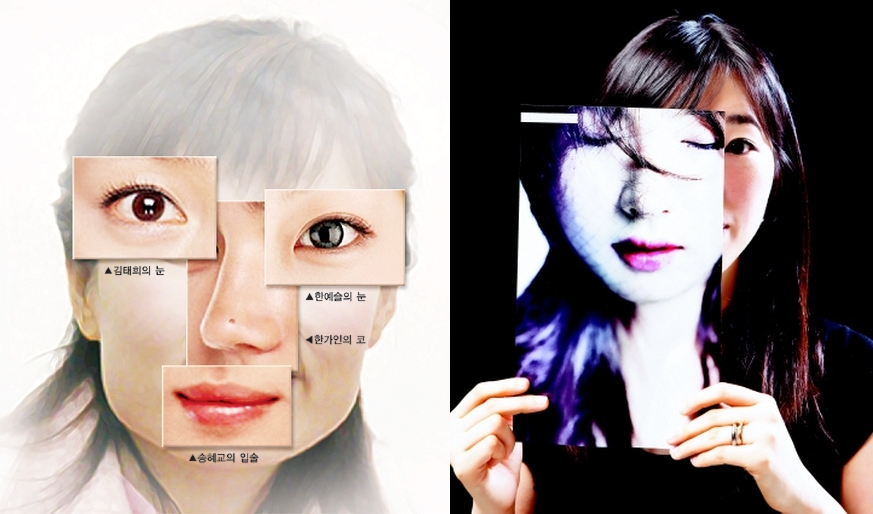
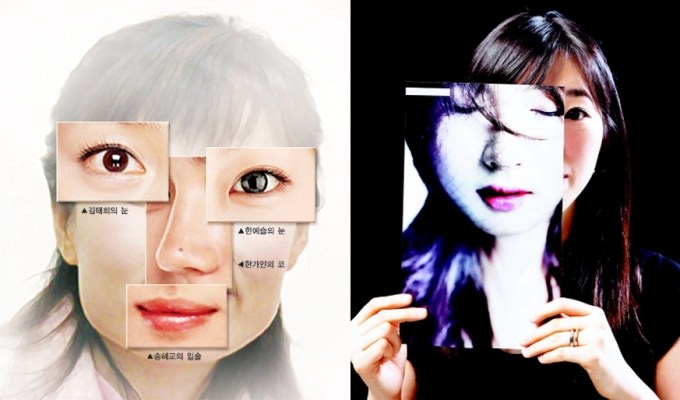
Korea Cosmetic SurgeryEstimated reading time: 11 minutes. Sources: left, dongA; right, The Kyunghyang Shinmun.

The more operations, the more possibilities for complications, mistakes, and patient deaths. So, with the highest per capita number of cosmetic surgery operations in the world, you’re always going to hear a lot of harrowing, even terrifying experiences of going under the knife in Korea. Korean cosmetic surgeons, who are no more unethical or incompetent than those from any other country, shouldn’t be singled out for horror stories that can happen anywhere.

But it’s more than just numbers. With so many clinics lacking even basic first-aid equipment; doctors clamoring to break into the lucrative cosmetic surgery market whatever their training and specialization; patients receiving little to no warnings of side-effects; little regulation by the Ministry of Health and Welfare; insufficient support staff because they’re too expensive; and patients doped-up to disguise the fact that the hot-shot surgeons they’ve hired have been replaced with cheaper ones, then the whole industry is well overdue for a makeover. In hindsight, it’s amazing that such an important growth market, and symbol of Korean skill and technological prowess, is really such a cowboy industry.

I learnt how bad things were from translating and following-up on the following article, but frankly it’s not the best source in itself. Feel free to skip through to the links at the end instead, which I hope provide a valuable resource for readers:

성괴 대신 내면미인 뜨는 세상 꿈꾼다 / I Dream of a World of Inside Beauty, Instead of Cosmetic Surgery Monsters

The Kyunghyang Shinmun, 22.05.13, by 이보람 / Lee Bo-ram (boram@k-health.com)

‘성형대한민국’에서 벗어나려면… / How to change this cosmetic surgery republic…

2013년 대한민국의 성형은 과열양상을 넘어 광(狂)적인 면까지 보이고 있다. 이를 잘 나타내는 말이 ‘성괴(성형괴물의 줄임말)’다. 최근 젊은 층에서 유행하는 말인데 똑같은 얼굴의 여성들이 강남거리를 활보하고 있다는 한 웹툰 작가의 만화에서 비롯됐다. 이러한 현상을 없애고 올바른 성형문화가 자리 잡기 위해 선행돼야 할 것은 무엇일까. 전문가들은 무엇보다 ‘내면의 아름다움이 평가받는 나라’가 돼야 한다고 입을 모은다. 특히 우리 사회에 만연된 외모지상주의가 먼저 타파돼야 한다는 지적이다.

In 2013, cosmetic surgery has just gotten crazy in Korea. This is shown in the arrival of a new term, ‘cosmetic surgery monster.’ Popular among young people, it originated from a webtoon about women on the streets of Gangnam all strutting about with the same face. What things have to be done in order to resolve this situation, and cultivate a proper cosmetic surgery culture? Experts say we have to be a country where inner beauty is also evaluated. In particular, we have to do away with the lookism that is deeply entrenched in Korean society.

SNL Korea Plastic Face 1Source: Roshiel. See also: “SNL 코리아 Satirizes Korea’s Cosmetic Surgery Craze.

외모 편견·차별 사라져야 사회정의 구현 / Social Justice Requires the End of Judging and Discrimination based on Appearance

미국 스탠퍼드대 데버러 로우드 법대교수는 저서 ‘아름다움이란 이름의 편견’에서 외모지상주의의 문제점을 꼬집었다. 그는 전반적으로 외모가 떨어지는 사람은 고용이나 승진가능성이 외모가 뛰어난 사람보다 낮았으며 매력적인 외모를 가진 정치인은 그렇지 않은 정치인보다 두 배 이상 많은 표를 얻었다고 말한다. 또 외모를 법적·정치적인 평등의 문제로 바라볼 때 비로소 외모로 인한 편견과 차별을 없애고 진정한 사회적 정의를 구현할 수 있다고 강조한다.

Stanford University Law professor Deborah Rhode pointed out the problems of lookism in her article “Prejudiced Toward Pretty” (2010). She said that, overall, chances of employment and promotion decrease with one’s appearance. Attractive politicians also receive twice as many votes as uglier opponents. Also, she emphasized that in order to realize social justice and end discrimination, it is necessary to think of differences of appearance as a legal and political issue.

건강과 대안 이상윤 책임연구원은 “요즘 우리 사회를 보면 외모에 의해 성과나 능력이 평가되는 것이 도를 넘어섰다”며 “중장기적으로 외모지상주의에 대한 국민적 인식전환이 필요하고 개인의 능력과 성과로 평가받을 수 있는 사회가 돼야겠지만 지금 상황에서는 성형에 대한 피해와 규제부분 등을 보다 정확하게 알리고 천편일률적이고 획일화된 아름다움의 기준이 변할 수 있도록 모두가 노력해야한다”고 지적했다. 전문가들은 이와 함께 성형수술에서 나타날 수 있는 의료분쟁은 물론 의료사고에 대한 인식수준을 높이는 것이 필요하다고 강조했다. 즉 수술을 원하는 이들이 수술에 대한 위험성과 후유증 등을 정확히 알 수 있게 하는 통로가 필요하다는 것이다.

Lee Sang-yoon, chief researcher at the Center for Health and Social Change, said that “When we look at our society these days, it’s ridiculous how much ability and achievements are based on appearance,” and pointed out that “In the mid to long-term, we need to change our attitudes to lookism. We have to become a society in which people are evaluated based on their own individual abilities and achievements. But for now, it is more important to make people aware of the dangers of cosmetic surgery, to regulate it more, and to promote the idea that there is more than just one, monotonous beauty standard to aspire to.”

Experts emphasize that people considering cosmetic surgery should educate themselves more about side-effects and their legal options should problems arise. Both should be made easier for prospective patients.

실제 의료분쟁조정 신청이 매년 증가하는 가운데 성형외과와 관련된 의료분쟁도 큰 축을 차지하고 있다. 한국소비자원 소비자분쟁조정위원회 의료분쟁조정 신청조사 결과 올해 1분기에 신청된 의료분쟁조정사건은 233건으로 전년 동기(73건) 대비 약 3배 이상 증가했다. 진료과목별로는 내과, 정형외과·성형외과, 치과, 신경외과 순이었다.

한국소비자원 관계자는 “치료방법의 장단점을 숙지하고 고령이나 수술병력이 있는 환자의 경우 치료방법에 따른 효과나 부작용, 비용 등을 충분히 고려한 후 수술은 최후에 신중하게 결정해야한다”고 말했다.

Medical malpractice suits are increasing every year, a large proportion of which are cosmetic surgery-related. According to a survey by the Korea Consumer Agency, in the first quarter of 2013 there were 233 suits, over three times those in the same period the year before (73). In order of ranking, most were internal medicine related, followed equally by orthopedic surgery and cosmetic surgery, then dental, and finally neurology.

A spokesperson [A guess—literally, the term is “person connected to”] from the Korea Consumer Agency said “People have to weigh the good points against the costs and possible side-effects of cosmetic surgery very carefully. Older patients and those with preexisting conditions and medical histories should really consider if it is necessary at all.”

성형수술피해자 ‘인권·구제’ 사각지대서 방황 / Cosmetic Surgery Victims Are at a Loss

또 성형에 대한 ‘정확하고 올바른 정보 제공’이 필요하다는 지적도 이어졌다. 사실 지금으로선 성형외과수술에 대한 정보는 일부 병원이나 업체에서 운영 중인 포털사이트 카페나 관련 블로그 글들이 대부분이다.

Accurate and unbiased information about cosmetic surgery is also required. At the moment, information is mostly available from portal sites and blogs run by hospitals and the medical industry.

한국환자단체연합회 안기종 대표는 “사실 성형수술피해자들은 인권이나 구제 부분에서 사각지대에 놓여있는 상태”라며 “아무래도 본인이 원한 수술이었기 때문에 수술 후 의사에게서도, 가족에게서도, 나아가 사회에서도 외면 받는 상태”라고 말했다. 안 대표는 “본인이 예뻐지고 외모적인 만족을 얻기 위해 수술을 했지만 수술 후 부작용이 생겼거나 의료사고가 발생했다면 당연히 그에 합당한 법적 보호를 받아야한다”며 “정부가 정확한 성형피해자 실태조사에 나서 적극적으로 보호받을 수 있는 통로가 마련돼야한다”고 주장했다.

An Gi-jong, a spokesperson for the Korea Alliance of Patients Organization, said “In fact, cosmetic surgery victims are in a bit of a blindspot in terms of their support and legal rights,” as “because the surgeries are voluntary, when things go wrong they receive little sympathy from society, their doctors, and even their families.” He insisted that “even if the victim underwent surgery to improve their appearance, if malpractice occurs they should still receive legal protection,” and “the government should look into the current status of cosmetic surgery malpractice cases and implement a more proactive way of safeguarding their rights.”

현장에선 성형진료 허용 놓고 ‘갑론을박’만…. / The Pros and Cons of Limiting Cosmetic Surgery Licenses

이처럼 성형수술이 과열양상이 보이면서 일각에서는 성형진료를 성형외과 전문의에게만 받을 수 있도록 한다든지 전문의와 비전문의를 보다 확실하게 구분할 수 있도록 하는 대안이 필요하다는 목소리도 나오고 있다.

As explained, cosmetic surgery is getting out of control. So, one school of thought holds that only specialists should be permitted to perform operations.

대한성형외과의사회 이상목 회장은 “성형외과가 난립하고 각종 성형과 관련된 의료사고가 빈번하게 발생하는 이유는 전문의가 아닌 이들이 성형관련 진료와 수술을 하기 때문”이라며 “정부는 보다 확실하게 성형 전문의와 비전문의를 차별화해 국민들이 제대로 선택할 수 있게 하는 방안을 강구해야한다”고 말했다.

Lee Sang-mok, chairperson of the Korean Society of Plastic and Reconstructive Surgeons, said “One reason there are so many clinics popping-up and the number of malpractice suits is increasing is because so many non-specialists are performing surgeries.” Consequently “The government should make a division between specialists and non-specialists and help patients to choose doctors appropriately.”

하지만 전문의와 비전문의를 차별화하고 전문의에 대한 정보만 제공할 경우 오히려 일부 전문의에게만 시장독점권이 부여돼 비용이 높아지는 문제가 생길 수 있다는 반론도 만만치 않다.

However, if such a division is made, and patients are directed only towards specialists, there is a danger of monopolization and increased costs for consumers.

보건복지부 보건의료정책과 관계자는 “현재 의료법상에서 의사면허를 취득한 이들은 성형이나 피부 등의 의료행위를 할 수 있다”며 “전문의와 비전문의를 나누는 등의 규제는 오히려 한쪽에 독점적인 권한을 주게 돼 가격심화현상이 빚어지게 될 것”이라고 말했다.

A spokesperson [Again, technically a person connected to] from the Ministry of Health and Welfare’s medical welfare department said “According to current laws, anybody with a medical license can perform cosmetic surgery or dermatological operations,” and agreed that “a division between specialists and non-specialists would result in monopolization and higher costs.”

여기에 과도한 병원광고나 마케팅 등을 규제하고 제지할 필요가 있다는 의견도 꾸준하게 제기되고 있다. 이에 정부는 과열된 미용성형수술 오·남용 사안을 점검하고 예방대책을 강구하기 위한 ‘보건의료안전관리대책협의회’를 꾸린 상태다. 정부는 협의회를 통해 무분별한 미용성형광고를 제지하고 이용을 부추기는 부분에 대한 규제를 검토 중인 것으로 알려졌다.

In addition, there are an increasing number of voices raised against excessive hospital advertising and marketing, and are calling for their regulation. In response, the government established the Health Safety and Prevention Association in order to investigate how to cool down the cosmetic surgery fever, its marketing, and to and prevent abuse and excesses within the industry (end).

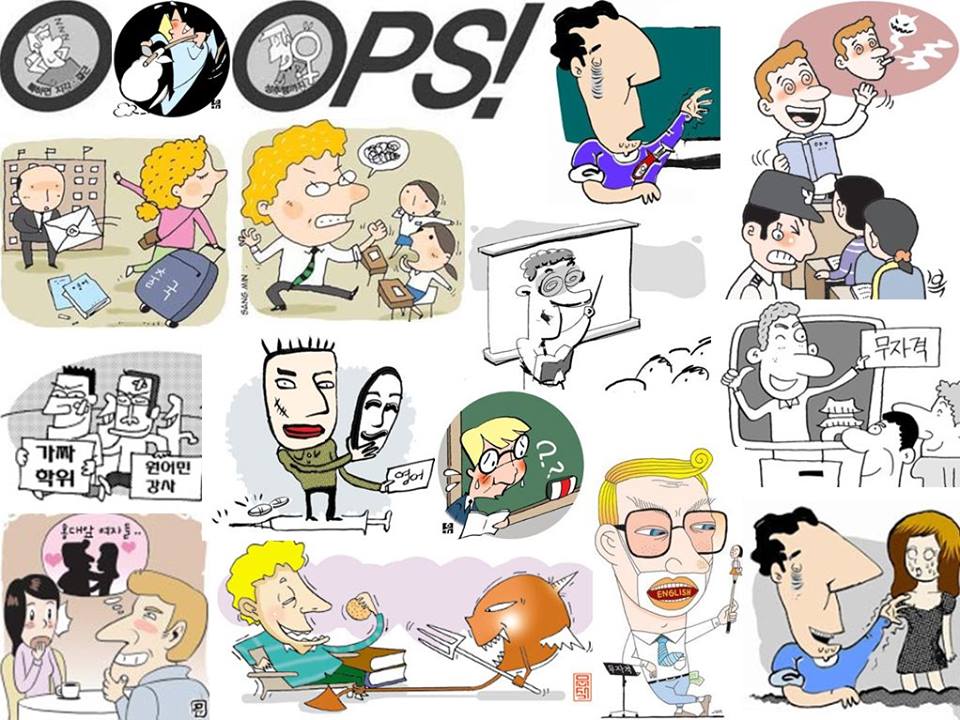
Korean Cosmetic Surgery CartoonHere are some links for further reading, in chronological order. Naturally, most cover much of the same material as each other, so for busy readers I’ve highlighted some of the most important points from them here (source, right: 헬스경향):

A very old article of course, but its description of the industry could easily pass for 2014.

Cut throat competition among the growing number of plastic surgeons has driven some to promote more radical procedures that others might not offer…

…A doctor with the Korean Society of Plastic and Reconstructive Surgeons said the procedure took off around four years ago when a Seoul dental clinic ran a major ad campaign promoting the cosmetic benefits.

As it became popular, plastic surgeons began offering the surgery, causing the price to fall and making it more affordable to more people.

“If we are seeing more complications, that’s largely because the sheer number of people getting the surgery has increased rapidly in such a short period of time,” said the doctor, who declined to be identified.

As the number of plastic surgeries has risen in Korea, so too has the risk for accidents. According to the International Society of Aesthetic Plastic Surgery, 650,000 plastic surgeries were performed in Korea in 2011. But experts also point to lax regulations and inadequate facilities as cause for concern.

About 839 out of 1,091 cosmetic surgery clinics nationwide lack proper emergency medical equipment, according to an assessment by the Health Insurance Review and Assessment Service. And many clinics go without hiring anesthesiologists or trained professionals to cut costs.

By law, any doctor with a medical license can perform a cosmetic surgery, even if he or she does not specialize in the field. The clinic in North Chungcheong, where one patient died in March, did not have a specialist.

Experts point out that clinics should be equipped with appropriate medical equipment to deal with emergencies that can occur during a surgery.

However, most do not have this or any other measures in place.

In data provided to Rep. Choi Dong-ik of the main opposition Democratic Party (DP), 77 percent out of 1,100 clinics performing cosmetic surgery were not equipped with defibrillators or ventilators, which are mandatory devices for first aid. Only 1.2 percent of such clinics in Gangnam have emergency equipment…

…Laws governing medical advertizing state that such billboards must have warnings included details of the potential side effects of surgery, but most have these in such small lettering that it is barely legible. An abundance of plastic surgery ads appeared after the government allowed medical institutions to set up promotions outside their premises in 2012.

…the Ministry of Health and Welfare has been taking a hands-off approach to plastic surgery because it is not covered by national health insurance.

“The Ministry of Health and Welfare does not guarantee the appropriateness of medical activity or the safety of new medical technology,” said Kim Jun-hyun, a member of the policy board for the Health Right Network. “The Ministry should at least assess the safety of operations offered by plastic surgery clinics through an official investigation.”

The number of complaints involving botched procedures almost tripled from 1,698 in 2008 to 4,806 last year, according to the Korea Consumer Agency. Among the 71 people who got help from the KCA in settling disputes over botched plastic surgery in the first half of 2013, only 15 percent said their surgeons warned them of the risks and potential side effects in advance.

Lee Sang-mok, the president of the association who also led the probe, said that his team had discovered instances of ghost surgery among doctors, which is the practice of substituting one surgeon for another without the patient’s knowledge.

The association also acknowledged that some doctors would administer to patients large doses of sleeping pills in order to conceal the fact that a different surgeon was performing the operation.

The president attributed such cases to excessive competition in the industry and low moral standards among surgeons.

Related Posts:

(Hat tip to Hong Kong Law Blog for some of the links)

If you reside in South Korea, you can donate via wire transfer: Turnbull James Edward (Kookmin Bank/국민은행, 563401-01-214324)

Announcements

From Explorers and Missionaries to Vagabonds and Potential Criminals
(Source: Facebook Event Page)
Hello everyone. Just to quickly let you know about an upcoming presentation not to be missed, some worthy causes, and some Youtubers that deserve more promoting.

First up, next Saturday (the 25th), Matt VanVolkenburg will be giving a presentation in Seoul for the 10 Magazine Book Club titled “From Explorers and Missionaries to Vagabonds and Potential Criminals: Two Hundred Years of Teaching English in Korea.”

If you’re unfamiliar with the name, let me add that he’s the author of the Gusts of Popular Feeling blog…which I’m sure will have you scrambling to check out the Facebook Event Page before you even finish this sentence!

Next, via The Kimchi Queen:

99 Film‘s new queer movie “Butterfly” is being crowdfounded on GoodFunding aiming for 2 million won in donations (about 2 thousand dollars). 99 Film has used this method for other films (such as “20”) and they have been in general successful in getting their target funding goals.

About working in a (gay) host bar, see The Kimchi Queen for more (English) information, or go directly to GoodFunding for more information in Korean.

Next, via Hollaback Korea 할라백 코리아 comes Rainbow Teen Safe Spacesfourth letter to donors. It begins and ends:

Rainbow Teen Safe Space will soon be launched. The project has been focusing on fund-raising activities so far. Now it is time for a new round of dealing with organizational issues. On July 13, we had a meeting to talk about a new organizational structure for this project to be a common cause of the LGBT human rights movement. We decided to set up the secretariat and hire a full-time staff to set out the street counseling program in September. The secretariat will share the office with Solidarity for LGBT Human Rights of Korea. We are also in preparation to form an advisory committee of experts in various areas such as law, medical care, counseling and human rights…

…We haven’t reached our fundraising goal yet. For the street counseling activities to start on a solid foundation, please join our fundraising effort for Rainbow Teen Safe Space project. If you, donors’ help come together, it would be such a great strength to all of us.

See the link for much more information about its activities, the video above for a quick introduction (it’s in English), or here for its fundraising website.

Finally, I’ve been asked to promote a couple of video producers. First, a small, Daegu-based organization called Stompy Ruffers Cultural Fusion, which “takes Korean culture and blends it with American culture to create some fun and exciting products/events.” See here for more information about them, or here for a selection of their videos—including the “How to Order Food at a Korean Restaurant” one above, which I think would be better titled “But we’re speaking Korean!” after the Japanese version, and which I’m I sure all too many expats in both countries can relate to (Update: Actually, the Korean video came first sorry!).

Last but not least, from Stephanie Rosier (whom I have to thank for this post), also based in Daegu, who has been making video blogs about Korean culture:

I talk about everything you can imagine really. The blogs are an average of 20 minutes long and usually include various photographs and short videos of my adventures here. I can speak Korean at a conversational level (or Topik level 4 to be exact) so I have been able to talk to, and make friends with a wide range of Korean people, from hair dressers to grandmothers, and learn about Korea from an insider’s perspective.

See here for the blogs, or the above video for her “Spring Video Project: Asking Korean People 한국 사람한테 물어보자: 봄 동영상 계획”.

If any readers also have any event, worthy cause, video, or just about anything else they’d like to promote, please just shoot me an email (but please add as many pictures and details as possible!) and I’ll add it here or in a later post.

Sunday Fun: Bottoms!

Hidamari Sketch EscherGirlMy 8 year-old daughter Alice is really into comics these days, often hiding our home phone under her pillow to keep reading when she’s supposed to be asleep. To my chagrin, she couldn’t care less if the female characters have huge eyes though, and/or no noses. But yesterday, I noticed the above while she was watching the opening to the anime adaptation of Hidamari Sketch. It was a great opportunity to start teaching her about female characters’ typical poses too.

Cue 20 minutes of giggling at the bottoms in the Escher Girls blog, which ultimately had the whole family trying—and failing—to imitate some of the pictures (although I was pretty good myself actually). Naturally, we quickly skipped past some of the more inappropriate ones, and Alice still has no idea why female characters are so often drawn in a “boobs and butt” style. But at least she’s aware of the phenomenon now, and, with gentle prodding from me, will hopefully think more about it herself as she gets older.

For now though, she’s still very much a 8 year-old girl, and I can hardly fault her for that. Much of those 20 minutes were also spent by her and her 6 year-old sister Elizabeth saying “와! 예쁘다…” (Wow! They’re so pretty…), and today this post took a long time to write because she kept on stopping me to tell me all about the characters in Hidamari Sketch. Including Yoshinoya above, who’s supposedly a high school teacher (sigh)…

Korean Sociological Image #86: Sex and the Single Korean (Household)

ZigbangAs of last year, one in four Korean households had just one person. That was the same as Australia, and just shy of the US.

Yet just four years earlier, only Seoul was remotely close to that figure, with one in five. That wasn’t expected to rise to one in four until 2030, let alone the rest of country.

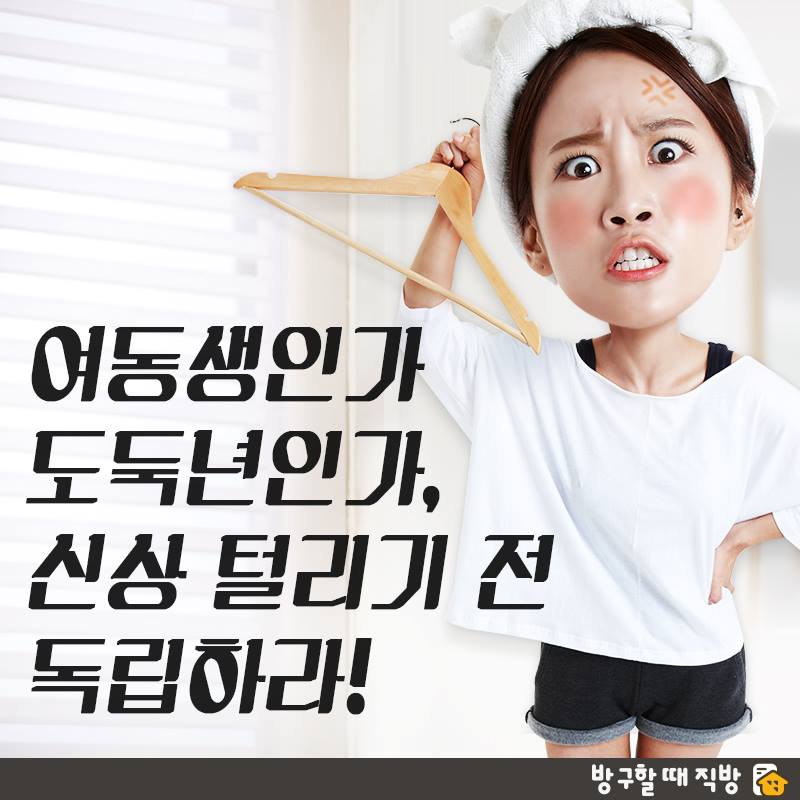
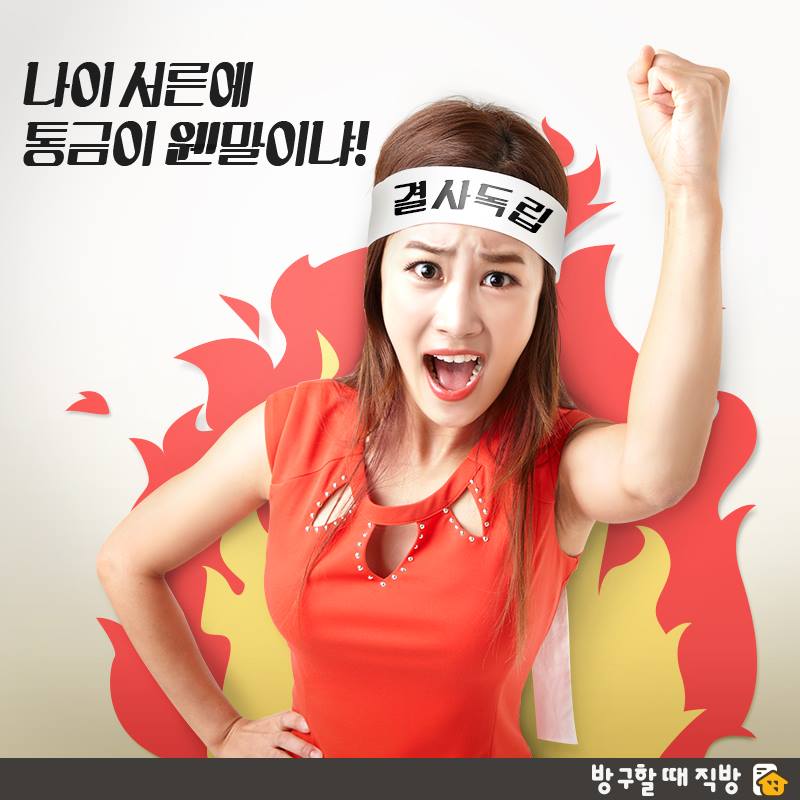
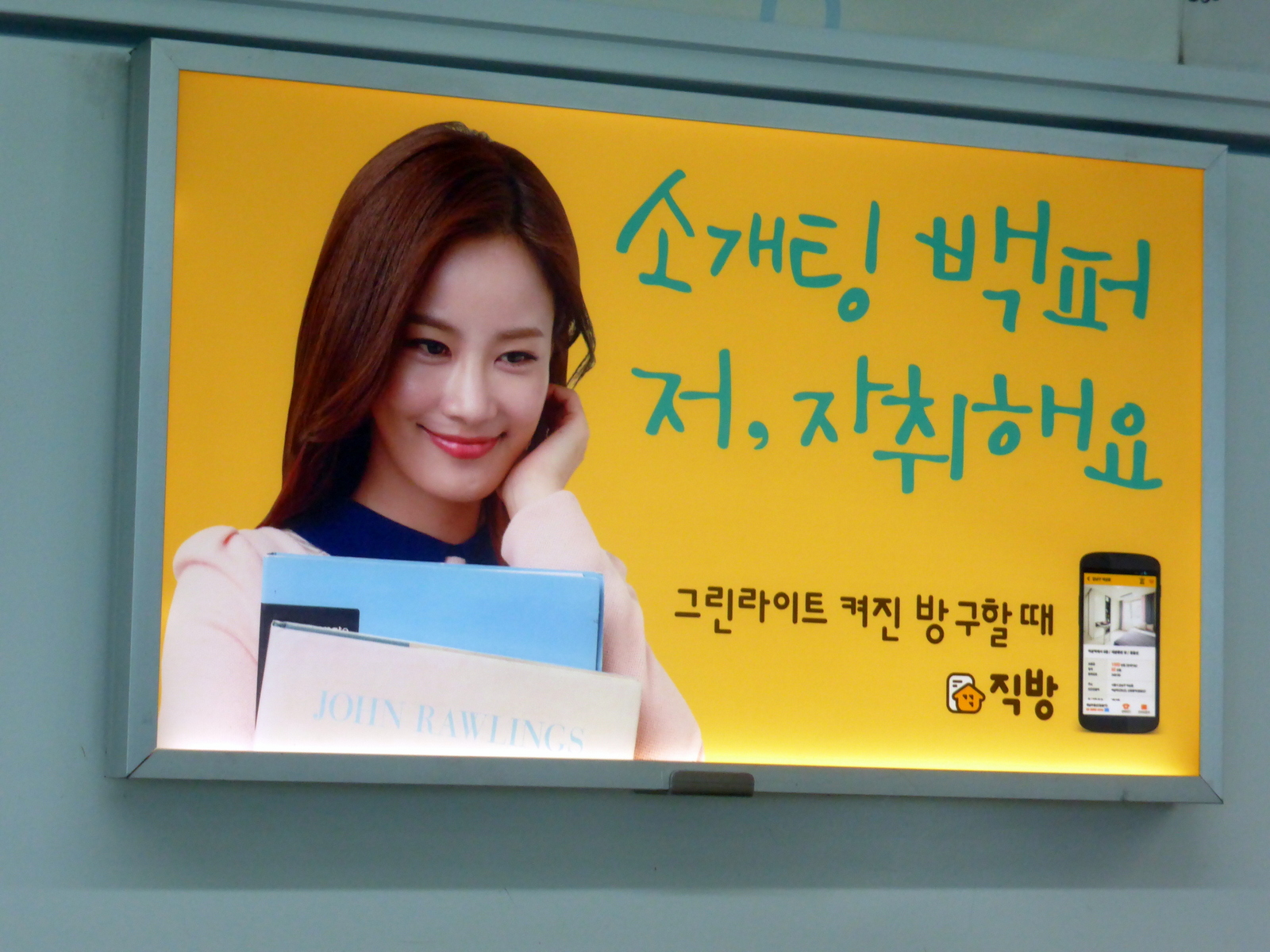
It’s a remarkable rise (one of the fastest in the world), and companies have been responding with such things as smaller food portions, more home-delivery services, and smaller appliances. And then there’s the start-up Zigbang (pron. jeekbang) founded in early-2012, which takes the hassle, legwork, and pitfalls (ㅋㅋㅋ) out of finding studio apartments through real estate agents by arranging everything online instead. If you’ve taken the subway recently, probably you’ve seen their ad above, featuring comedian Kim Ji-min (source: Platum).

Much more interesting though, are the ads you probably haven’t seen. Covering everything from the hassles of long commutes and living with one’s parents in your 20s and 30s, to gaining independence and sexual liberation, they provide an interesting look at some of the push and pull factors behind this singles trend. Most are amusing, and some are very, very Korean too. Here’s a small selection from Zigbang’s Facebook page:

zigbang nagging parents(Source: Zigbang Facebook)

Title: “I’m sick of this bloody nagging! I want the independence of my own place!”

Parents:

  • “When on Earth are you going to…”
  • “Because of you, your younger sister can’t get married…[she can’t get married before you do]…”
  • “Look at Mi-sun next door, she’s already had two children…”
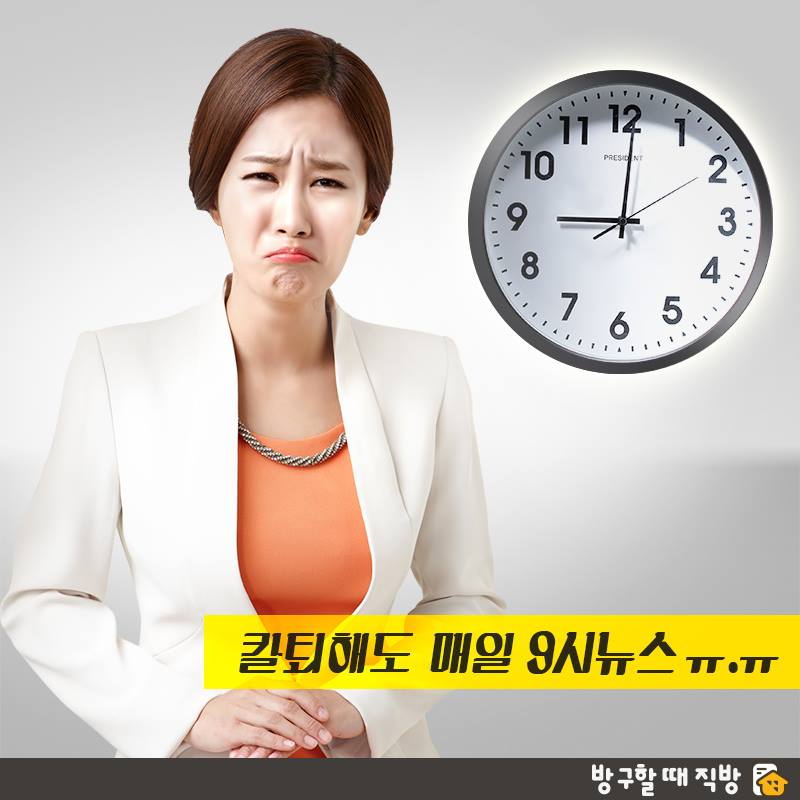
zigbang 9pm news(Source: Zigbang Facebook)

“Even if I finish exactly on time, I only ever get to see the 9pm news.”

In reality though, that’s not necessarily because of long commutes:

https://twitter.com/jetpack/status/517229353529118720

Continuing:

zigbang sister borrowing clothes(Source: Zigbang Facebook)

“Is she my sister or is she a thief? I have to get my independence before people find out…[how I live]!”

I'm 30, a curfew is unacceptable(Source: Zigbang Facebook)

“I’m 30! A curfew is too much!”

By coincidence, Kim Ji-min is 30 in Korea, or 29 in “Western age.” Apropos of that, these next two ads have a much more adult slant…

zigbang blind dates(Source: Zigbang Facebook; alternative version here)

“I have a 100% success rate on blind dates.” Presumably, because she has her own place to take them home to.

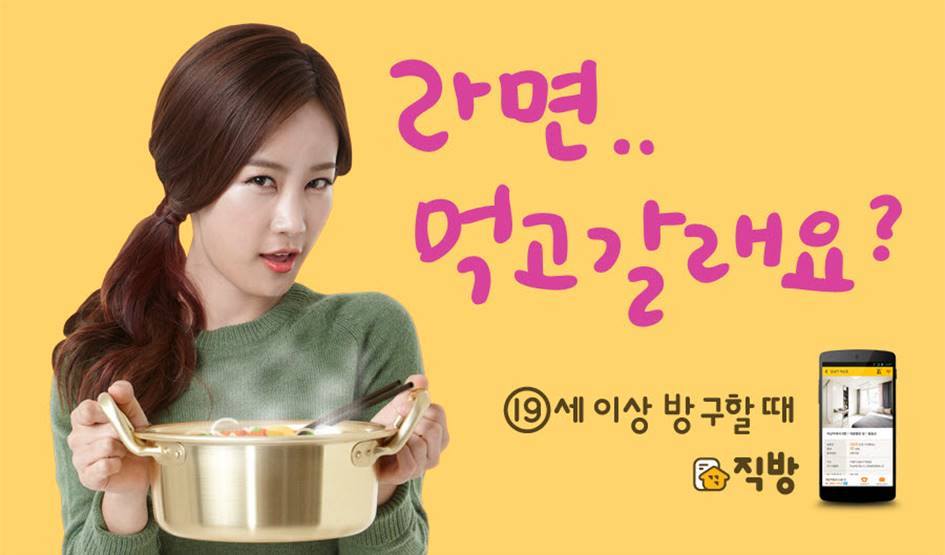
zigbang do you want something hot to eat(Source: Zikgbang Facebook; alternative version here)

I think the text is badly chosen: literally, it says,”Do you want to eat noodles and go?”, which would mean the object of her affections is already at her place, whereas “Do you want to go eat noodles at my place?” would make much more sense (update: actually, the line is from a movie—see below). But either way, the double-entendre is obvious, and if not then a helpful Korean “R18” symbol makes it clear.

Which is interesting in its own right, and a good counterexample to my recent post on Sookmyung Women’s University students being given a dresscode. Because whereas our natural reaction to such news may be to label Korean society as sexually conservative, or to shoehorn narratives of progression onto to it because of these ads, really there’s abundant evidence of both. Also, even if one does find some definitive, profoundly conservative aspect of Korean sexuality, it can be very modern in others—just like everywhere else.

Even more remarkable though, is that those last two yahan ads made it from the confines of Facebook to Seoul subway stations, all the better to corrupt Korean youth. Here’s two photos of them by reader Thibault Deckers, whom I have to thank for inspiring this post:

zigbang blind dates stationzigbang do you want something hot to eatAds don’t necessarily reflect a change in social attitudes of course, nor necessarily spark one, but I think the sheer numbers of single households are surely having effects. One recent article found that 70% of 30-somethings prefer their own company for instance, and I too have noticed that my students will no longer react in horror upon learning that I always go to the cinema alone (I prefer sitting in the front row).

What changes have readers noticed? I’d be especially interested to hear about knock-on changes in attitudes towards cohabitation, given how difficult it was to find a reader to find interviewees for his MA thesis on that just a few years ago (as in so scared of being found out that they would frequently cancel, not that they didn’t exist). Or do you think this is all exaggerated, not least by companies like Zigbang?

Update 1) I forget to mention that despite Zigbang’s focus on 20-30 somethings, most people living alone in Korea remain middle-aged professional men, and elderly women living in poverty. Likely, the latter don’t use Zigbang at all, but it would be interesting to know how much of its business comes from the former, despite being ignored in its marketing.

Update 2) With thanks, a clarification to that confusing line about noodles. It’s from the 2001 movie One Fine Spring Day:

https://twitter.com/jetpack/status/520760948961734657 https://twitter.com/jetpack/status/520766843053555712

Here’s a video with the scene, and an explanation:

(For more posts in the Korean Sociological Image Series, see here)

Korean Sociological Image #85: Just One 10 Minutes…to Improve Your Spouse’s Specs

Korea Gender Roles Marriage Specs(Source: Jinvas, left, right; edited)

Two notebook covers, found by reader Stephanie Rosier at her local Kyobo bookstore. As she explains on the blog’s Facebook page, the left reads, “If I study for ten more minutes, my [future] wife’s face will change,” and the right, “If I study for ten more minutes, my [future] husband’s job will change.”

Of course they’re just notebooks, and just for fun (although I do hope it’s adults they’re aimed at!). But they’re also a reflection of how deeply “specs” (스펙) like certain jobs and physical standards dominate matchmaking discussions among Koreans these days. Whereas back in the 1980s, it was older family members or family friends that would size up children’s potential spouses for arranged 선 (seon) matches like this, nowadays hard economic times mean that young people can be just as pragmatic and calculating as their grandparents were.

Meanwhile, what’s “Just One 10 Minutes?” you ask? :D

Related Posts:

(For more posts in the Korean Sociological Image Series, see here)

Policing the Student Body: Sookmyung Women’s University students told to cover up

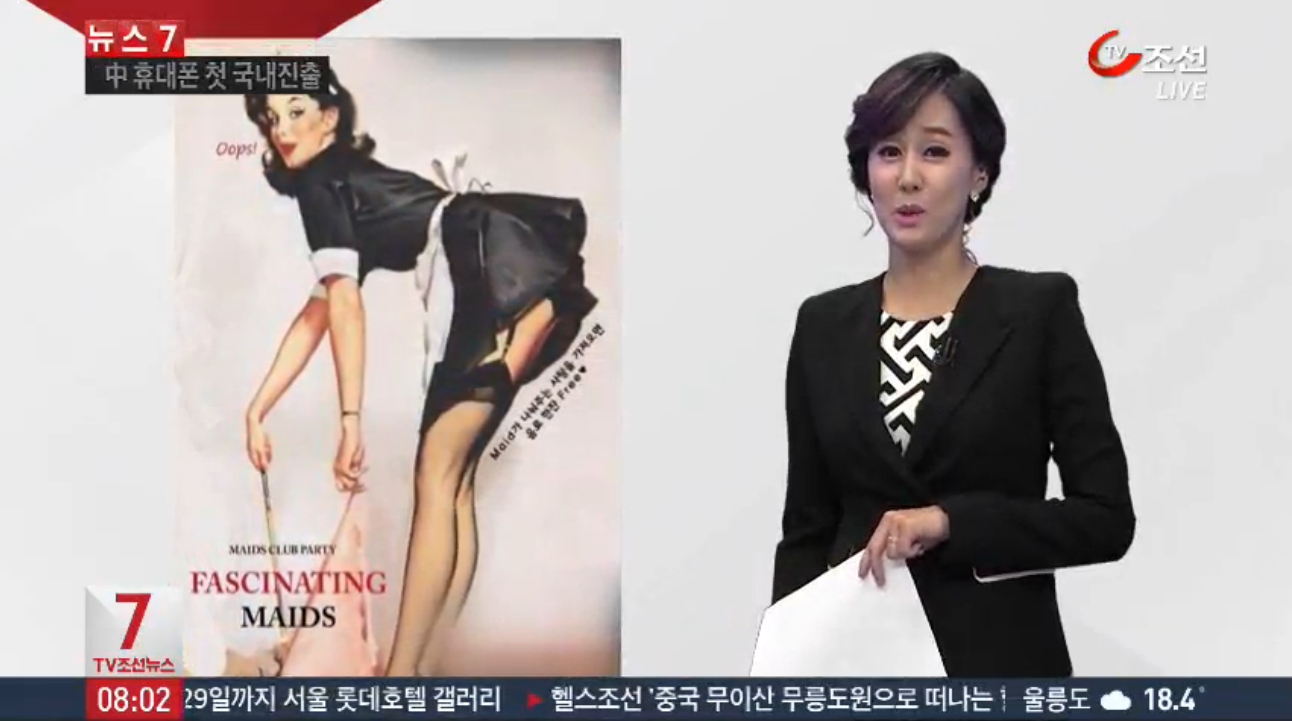
Sookmyung Women's University Festival Dress Code(Source: TVChosun)

Watching a news report about the controversial new dress code for last week’s festival at Sookmyung Women’s University, I was surprised to hear that it was the student union that was responsible, and aghast to learn that it was under the assumption that wearing revealing clothes leads to more sex crimes against women.

Fortunately though, at least the report itself ended with a commentator from the Korean Institute for Gender Equality Promotion and Education, who pointed out the potential for victim-blaming from such misguided beliefs. As so few other reports mentioned that (I’ve only found one other), I thought it was worth highlighting here.

Alas, there were technical issues with the sound in the online video, and rather than fixing those MBN just decided to delete it. But the transcript is still available:

Anchor:

숙명여대 총학생회가 축제 기간에 입을 수 있는 복장 규정을 마련했는데, 치마 길이와 심한 노출 등을 규제하고 있습니다. 성 상품화에 젖은 대학문화를 자정하겠다는 취지인데 논란이 일고 있습니다.
주진희 기자입니다.

For the university festival period, the Sookmyung Women’s University student union has set rules for students’ dress, regulating the length of skirts and the amount of exposure. This attempt to regulate university culture, which is steeped in sexual objectification, has raised a lot of controversy.

Reporter, Ju Jin-hee:

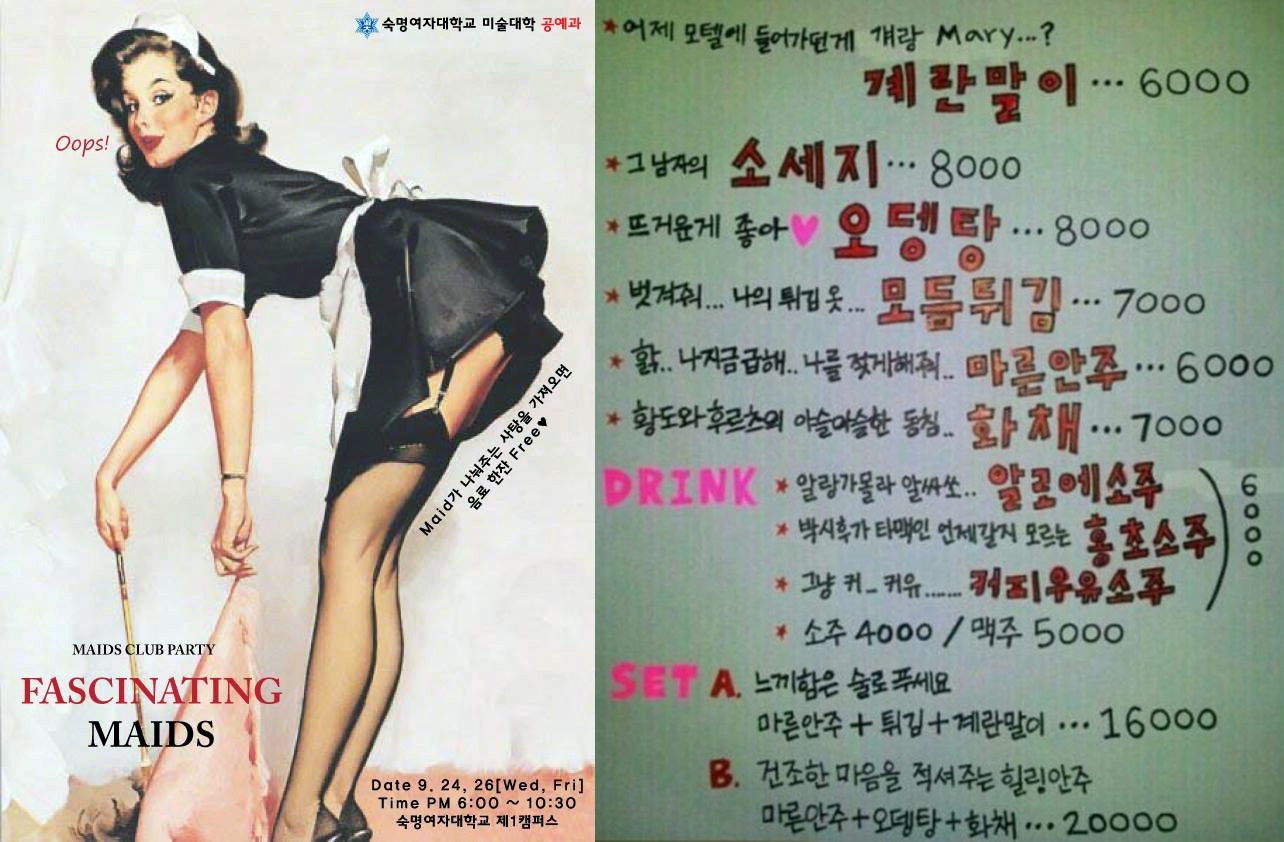
친구 얼굴에 물풍선을 던지거나 인간 두더지 게임을 하며 학업 스트레스를 날립니다. 해가 지면 캠퍼스에 주점이 설치되고 축제 분위기는 무르익습니다. 주점마다 자극적인 문구와 공연으로 치열한 호객 행위가 벌어집니다. 여성 속옷인 가터벨트를 찬 가정부 그림을 이용한 홍보지부터 성적인 은유를 함축한 메뉴판까지. 노골적으로 성을 상품화한 축제로 변질될 우려가 일자, 축제 시작 전 숙명여대 학생회는 혹시 모를 불상사를 막자며 복장 규정을 강화했습니다. 허벅지의 절반을 드러내는 치마는 금지. 만일 입으려면 속바지를 착용하도록 했습니다. 가슴골이 보이거나 속살이 비치는 의상은 물론이고, 옆트임이 있는 치마도 금지했습니다. 만일 어겼다가 적발되면 벌금을 내도록 했습니다. 이해가 간다는 반응의 학생들도 많지만…

During the day, doing things like throwing water balloons at students’ faces and playing whack-a-mole with them is a way of relieving stress at festivals.

But once the sun goes down, the festival atmosphere takes a more adult turn, with students promoting their departments with eye-catching posters and performances and making money for them by selling alcohol [James: With flow-on benefits for their MTs and so on].

In this vein, [the Department of Art and Crafts] made a provocative poster with a maid wearing a garter belt, and a menu with suggestively-named foods.

Sookmyung Women's University Maid and Menu(Sources: Kookje; Goodbuyselly)

Because of worries about such increasing sexual objectification in festivals, the student union set rules about clothing in order to avert any incidents.* These include: only being allowed to show 50% of the thigh; having to wear shorts under a mini-skirt; and mesh tops, dresses showing cleavage, and those with side-slits [James: Is that the right term?] all banned, with offenders being fined.

Many students responded that they understood these rules, but…

(James: It’s this line — “노골적으로 성을 상품화한 축제로 변질될 우려가 일자, 축제 시작 전 숙명여대 학생회는 혹시 모를 불상사를 막자며 복장 규정을 강화했습니다” — that sounds like victim-blaming. If better Korean speakers than I feel that’s a little extreme though, or a misinterpretation, I’d be very happy to be proven wrong!)

Interview: Sookmyung Women’s University Student:

“여대로써 많은 불상사가 생기지 않도록 엄격한 규제를 한 것에 대해서 찬성을 하고요. 그렇게 다 가리고 있는 건 아니잖아요.”

“Because this is a women’s university, I agree that regulations had to be made before an incident occurred. Students have been pretty blatant [about wearing revealing clothing and so on].

반면 비판 여론도 만만치 않습니다.

On the other hand, there were a lot of criticisms.

Interview, Kim Han-min, University Student:

“저는 솔직히 문란하다고 생각 안 하거든요. 그런 거 하나하나도 패션에 대한 자유가 될 수 있는데, 규제가 조금 심했다고 생각하고 있어요.”

“To be honest, I don’t think it’s lewd at all. This is about fashion and personal freedom, so I think the regulations are too harsh.”

전문가들은 여성의 짧은 치마가 문제될 수 있다는 사고방식 자체가 더 문제라는 지적입니다.

Experts pointed out that it’s the notion that women’s short skirts are problematic that is more of an issue:

Interview: Seong In-ja, Korean Institute for Gender Equality Promotion and Education

“고육지책으로 마련된 걸로 보이긴 하지만 또 한편에서의 우려는 성범죄 안에서 피해자에게 원인이 있다는 ‘피해자 유발론’으로….”

“These rules appear to be a desperate measure, and there is a genuine worry that they shift the blame of sexual crimes onto the victims…”

축제 문화를 자정하려는 취지에서 만들었지만, 좀 더 현실성있고 고민이 담긴 규정이 마련돼야한다는 목소리도 나오고 있습니다.

These rules appear aimed at regulating [excessively sexual] festival culture, but some voices are saying a much more realistic and nuanced approach is needed (end).

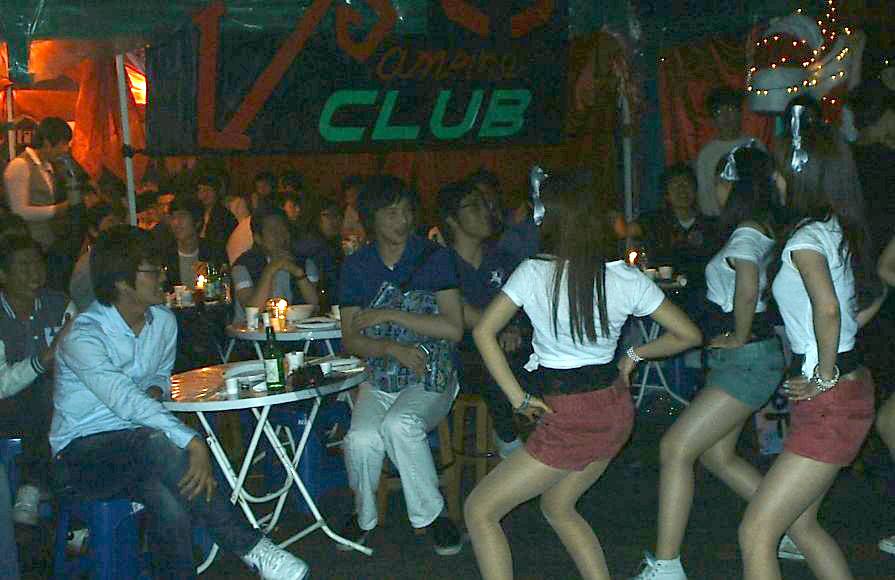
sookmyung-womens-university-festival(Source: Extreme Movie; edited for brightness)

Of course, that only skims the surface of the issues raised by the dress code (see here, here, here, here, here, here, and here for the ensuing debate), and it would be good if it turned to be motivated less by supposed crime prevention than avoiding pictures of students later appearing on Ilbe and so on (although again, should that dictate what students are allowed to wear?). If anyone likes, I’d be happy do some more investigating and translating to learn more.

In the meantime, I wisely invested my time in interviewing Peter Daley instead, a professor at Sookmyung (and expert on Korean cults), to gauge the atmosphere and his students’ reactions. To his surprise, they felt it was a non-issue that had been blown all out of proportion:

“I only found out about the dress-code through the article in the Korea Times….[a female coworker of mine] felt it was a bit draconian. The students are adults, but weren’t being treated as such…she also mentioned that some students do have larger breasts…are they going to be penalized just because they can’t hide that part of their anatomy?

…Contrast that with what my students said, and that was a different reaction entirely…I expected that [raising it in class] would lead to some kind of debate and that students would be passionate about it, but they just kind of laughed it off…they said only guys were worried about the rules [because they’d see less]!

He hasn’t taught at Sookmyung long enough to attend previous festivals, but, whether because of the new dress-code or not, he didn’t see students wearing anything particularly risqué last Friday (“Certainly nothing too different from what young Korean women normally wear in the summer, or at other university festivals.”). Nor did the security guards seem to be tasked with measuring skirts with rulers, as if they were teachers at a high school.

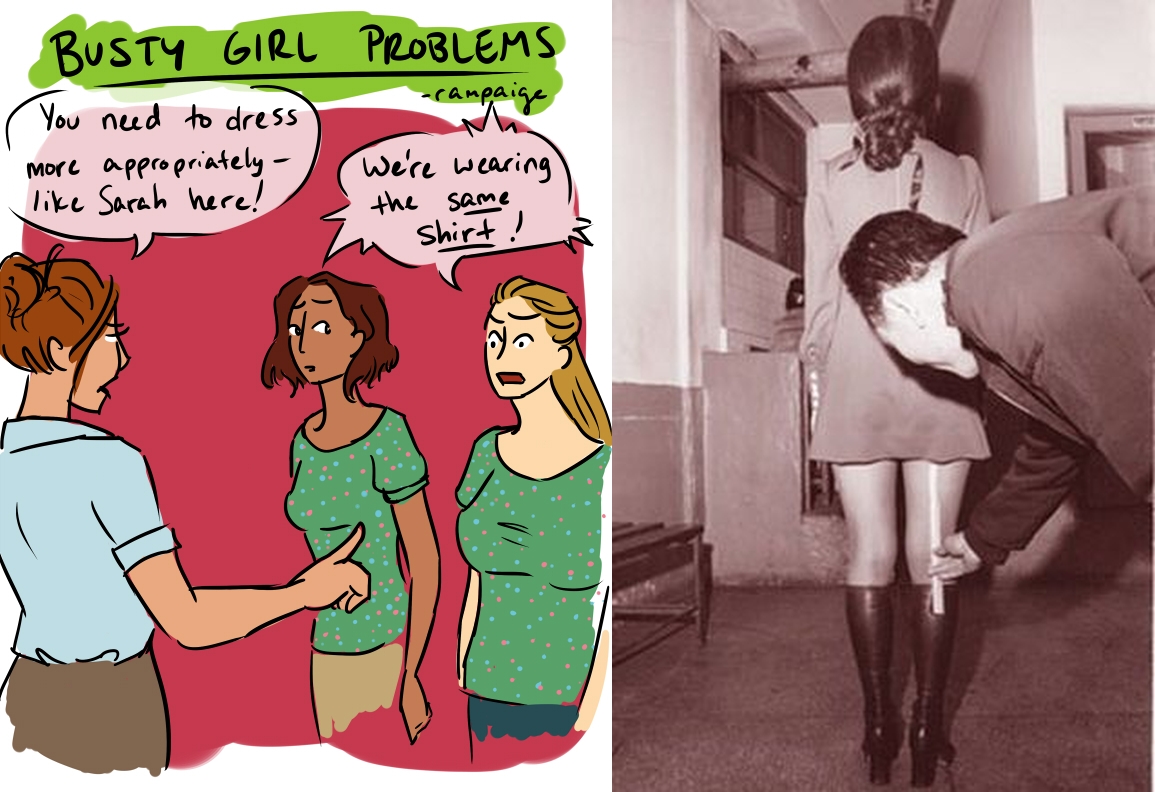
But if someone had seen too much thigh? Sookymung isn’t a school, and the students are no longer children. The last time grown women were penalized for what they wore, it was by the fashion police of the 1970s, during the military dictatorship.

So yes, perhaps the students really should have been angrier.

busty girl problems korean fashion police(Sources: Busty Girl Comics, 추억의 편린들)

But I’m not one of them, and can’t presume to know their needs and feelings better than they do. Also, Daley concedes that without this year’s dress code, fashions at previous festivals may well have been more extreme, and indeed fashion photographer and blogger Michael Hurt said on Facebook that things at his own school’s festival are “getting insane,” although again that banning isn’t the solution (reprinted with permission):

But I think [the message it sends, that girls’ worth is all in their looks] is precisely the point that this culture is struggling with right now. One of the reasons they dress this way, and this is even hinted at in the quotes lifted from the students for the [Korea Times] article, is that they have really come to commodify value themselves in terms of their sexuality, the expressions of which are primarily guided by over sexualized images in the media. I think something needs to be done to counteract this tendency, but this culture is lacking in terms of concrete strategies to do so besides banning or making rules. I think the same is true in the US to a lesser extent, but both cultures seem to have a problem dealing with where the line should be without having to litigate it.

I’d be grateful if readers could supply any more details about events at Sookmyung; for instance, although the student union came up with it, I’m sure that the dress code was actually at the behest of the university administration. Also, I’ve never attended any Korean university festival myself (I always have two young kids to look after, and teach at a very Christian university far from home), so I’d be very interested to hear what they’re like. What are your experiences and impressions? Have you heard of dress codes elsewhere? Do you think, even if you don’t agree with the ban, that something like it was inevitable?

Update) Among many other relevant and interesting posts by Michael, make sure to check out “The Cultural Politics of Short Skirts in Korea.”

Update 2) I realize the irony of only quoting two middle-aged men for this article, but, well, you get what you pay for sorry(!) that can’t be helped with my family and day job down here in Busan unfortunately. Most of the links do include input from the students though, and if readers would like me to investigate further then I’m happy to focus on finding a student’s perspective to translate (here’s a good candidate).

Update 3) Some interesting related reading: “Dress Codes for Girls: Are Teachers the New Objectifiers?” at Ms. blog, and “Say Goodbye, Skimpy. Film Fest on the Alert for ‘Overexposed’ Actresses” at Busan Haps.

Update 4) Here, here, here, and here are some more Korean articles that look interesting.

Quick Hit: Harassment Framed as Affection

Dummy Harassment(Dummy Harassment by gaelx; CC BY-SA 2.0)

Via The Korea Herald:

Former National Assembly Speaker Park Hee-tae is to be questioned over allegations of molesting a golf caddie, police said Saturday…

…Park admitted that there had been some physical contact, but maintained that he did not “cross a line.” He told a local daily that he poked the woman’s breasts with a finger once, adding that it was an act of adoration because she “felt like his granddaughter.” (My emphasis)

Read the link for more details, or The Korea Times. I mention it because a friend pointed out that they’ve heard that excuse on more than a few occasions in Korea, which rang a definite bell. Sure enough, a few years ago I translated an article by Ilda Women’s Journal writer Park Hee-jeong, who said exactly that in relation to the following commercial back in 2005:

“I touched her because she’s like my daughter”

여성들이 이 광고를 보면서 느끼는 불편함의 한 켠은 ‘몸을 만지는’ 행위에 있다. 우리 사회에서는 가족이라든가 친하다는 이유로 타인의 몸에 손을 대는 행위가 쉽게 용납이 되는 경향이 있다. 나이 지긋한 분이 성희롱 가해자로 지목되면 “딸 같아서 만진 건데 잘못이냐?”는 변명(?)이 나오는 것도 그런 이유다…

One reason women feel uncomfortable watching this ad is because of the act of the daughter’s body being touched. That is because our society approves of and/or grants permission to men touching them in a friendly manner, like they would their own family members. Indeed, when an older male is accused of sexual harassment, often he fastens on to the excuse that “Can’t I affectionately touch someone like my own daughter?”…

…“딸 같아서 만진다”는 말이 통용되는 사회에서 삼성생명의 광고는 많은 여성들에게 불편한 기억을 환기시킨다. 광고 속에서는 의도된 스킨십이 아니었지만, 불편해하는 딸의 모습을 아름답게 바라보는 시점 자체가 이미 여성들을 불편하게 만들고 있는 것이다.

…“I just touched her like I would my daughter” is an excuse used so much in Korean society, that this Samsung Life Insurance commercial evokes many uncomfortable memories in women. In particular, having something that would in reality be so uncomfortable for the daughter, to be just cutely dismissed instead, already makes women feel uncomfortable. Even though the father’s intention was not skinship. (My emphasis)

See my 2011 post for the full article and translation. Like I argued there, the prevalence of such attitudes in 2005 still goes a long way towards explaining the rise of “ajosshi-” or “uncle-fandom” just a few years later. Or, more specifically, why the media so quickly framed and celebrated middle-aged men’s interest in (then) underage female-performers as purely paternal or avuncular, despite the girls’ increasingly sexualized performances.

But that’s a very familiar topic with readers, so I’ll wisely stop there, and later this month I’ll make sure to write a follow-up post on the important challenges to those media narratives that have arisen since (suggestions as to what to add would be welcome). Also, boys’ performances have likewise become problematic, so it’ll be interesting to explore similar permissive media narratives about “ajumma-fandom“—or curious lack thereof.

Until then, what do you think? Do you feel older Korean men still have a palpable sense of entitlement to women’s bodies, however much it is rationalized as affection? Or is Park Hee-tae’s case an unfortunate exception?

Update: By coincidence, this issue has just been raised in a posting at Reddit’s TwoXChromosomes. An excerpt:

But [my Korean father] would act strangely at times. He commented in public and in private how large my breasts were, and how I could have grown up without him there, how the last time he’d seen me I was so small. He would often say teasingly that he wanted to feel my boobs and he would constantly try but I would be very self conscious and embarrassed and turn away.

I asked him to please stop and get angry. I even cried once because he was making me feel bad and humiliated. He also kept trying to sneak in when I was bathing and kept implying that he wanted to bathe me like when I was young. He would often try to see me when I was changing. I felt very conflicted and always refused. I felt revolted by the whole thing.

Anyway, I admitted to my grandmother that I had felt strange, and kind of traumatized by this behavior. She immediately responded with, “You’re wrong about this. This is normal behavior in South Korea, and you’re just seeing this in the wrong light because you’re American. Your father has a temper problem, but he’s a pure person. I’m one hundred percent sure that he just was being a loving father.”

Read the rest there, as well as the numerous comments. Again, there’s quite a debate as to how common such excuses and rationalizations are in Korea (or not).

Update 2: Clearing out my archives, I came across the following case from October 2007:

An appellate court gave the “not guilty” verdict to a father who had touched his 11-year-old stepdaughter’s breasts, saying it was a “sign of affection.”

Kim, 43, was married in 1996. He became the stepfather of his wife’s daughter, whom he treated as his own child. He had often showed her affection through touching, which the girl did not used to consider as unpleasant…

…However, the Seoul High Court only acknowledged the domestic abuse [of his wife]. He was given a two-year suspended jail term and 160 hours of community service. It ruled: “Kim’s act was a rather excessive sign of affection spurred by alcohol.”

The court made this decision based on the fact that the girl had not reached puberty yet and previously had not felt uncomfortable about such acts as sleeping next to her and touching her hips.

Read the full article at the Korea Times or Waygook.

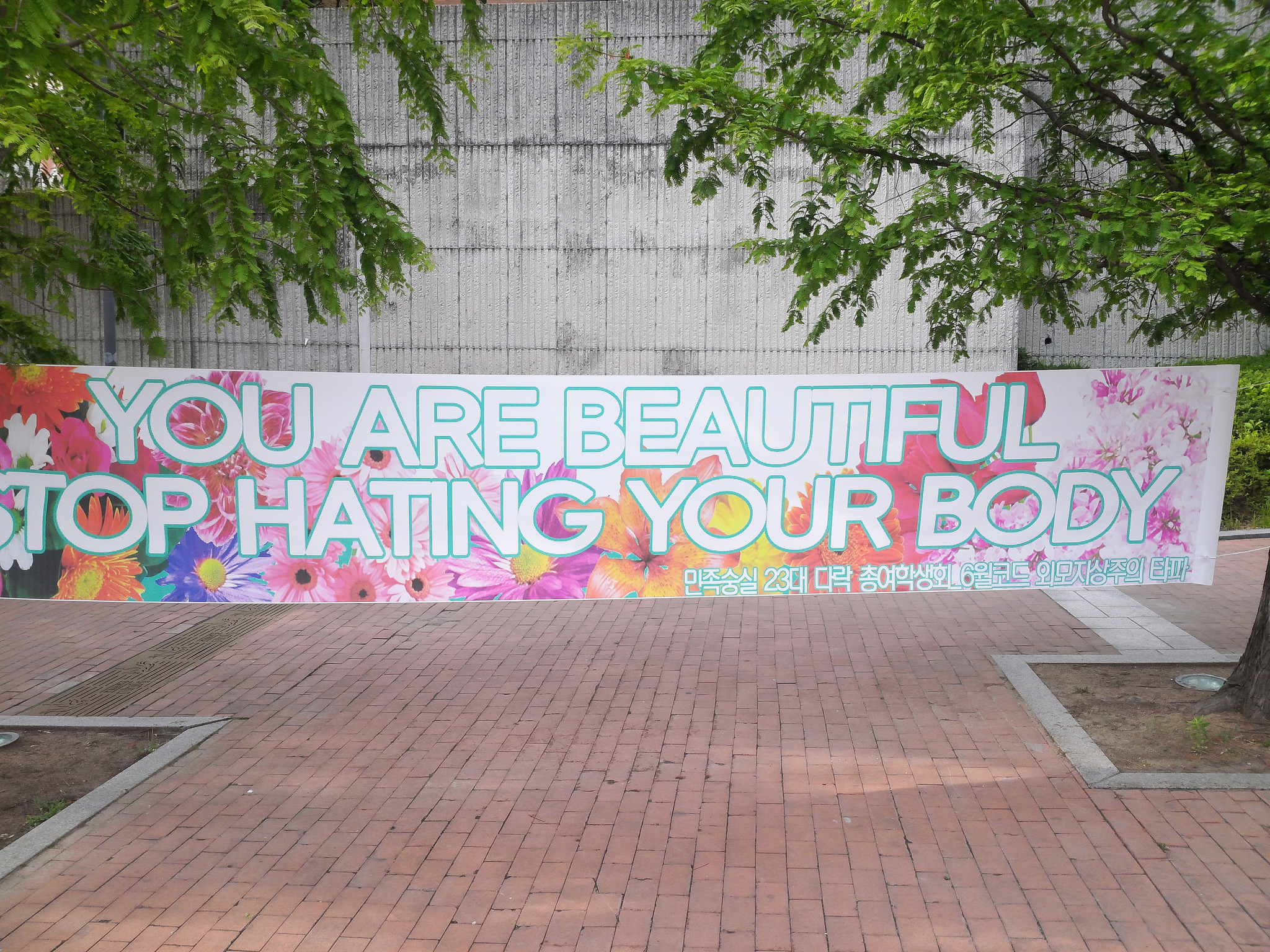
You are Beautiful, Stop Hating Your Body

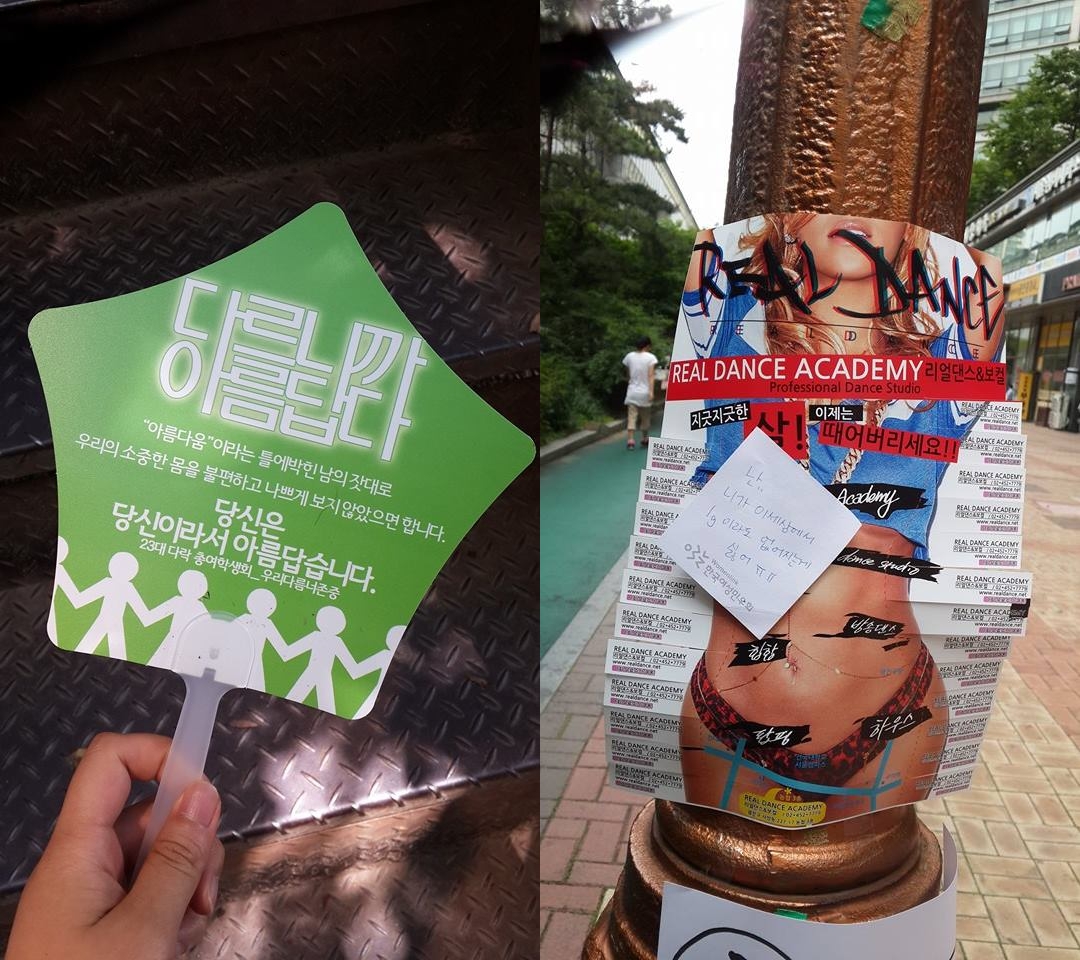
You are beautiful, stop hating your body(Source: 숭실 총여학생회 다락 Facebook Page)
Oops, I haven’t written in a while. Time to find something about body-image, the media, or popular culture to complain about then.

Seriously(?) though, there’s only so many times you can mention that young Korean women are chronically underweight, and the likely reasons for that. Better to highlight groups actually doing something about it instead.

One group is the Soongsil University Female Students’ Association, which recently encouraged women to stop excessive dieting by offering them free snacks, and passing on stickers and fans with messages like the one on the left above. It reads, “You’re different because you’re beautiful. Don’t feel bad or uncomfortable about your precious body based on other people’s stereotypes. Because you are you, you are beautiful. The 23rd Soongsil University Female Students’ Association: we are different, and we respect you.”

Those small efforts may seem futile in the face of the barrage of body-shaming messages women receive every day, but with three in five 19-24 year-old Korean women regularly skipping breakfast (nearly one in five, lunch and/or dinner too), then surely the growls in their stomachs at least got some questioning whether it was really worth it. As for the messages, body-image activist Minji Kim pointed out they’re surprisingly effective, and are now used by a number of organizations working on body-image issues:

“These messages create solidarity among people whose issues may have seemed daunting, because they were struggling alone. But when people share their stories and start talking about them? Then immediately they feel less lonely and empowered by knowing that there are other people like them out there and that they do have a support system.”

More specifically, Minji was talking about post-its like the one on the right, which reads “I would hate for you to lose even one gram in this world.” I’m unsure if it was placed there by the Soongsil students, by Korea Womenlink (remember their cool subway posters?), or if it was part of a collaborative effort, but the effect is the same!

You are Beautiful(Source: lunacharsky; used with permission)

Hat tip to the The Rootless Metropolitician, who led me to the group via the above photo.

Searching for Storytellers for Naughty Storytelling Event

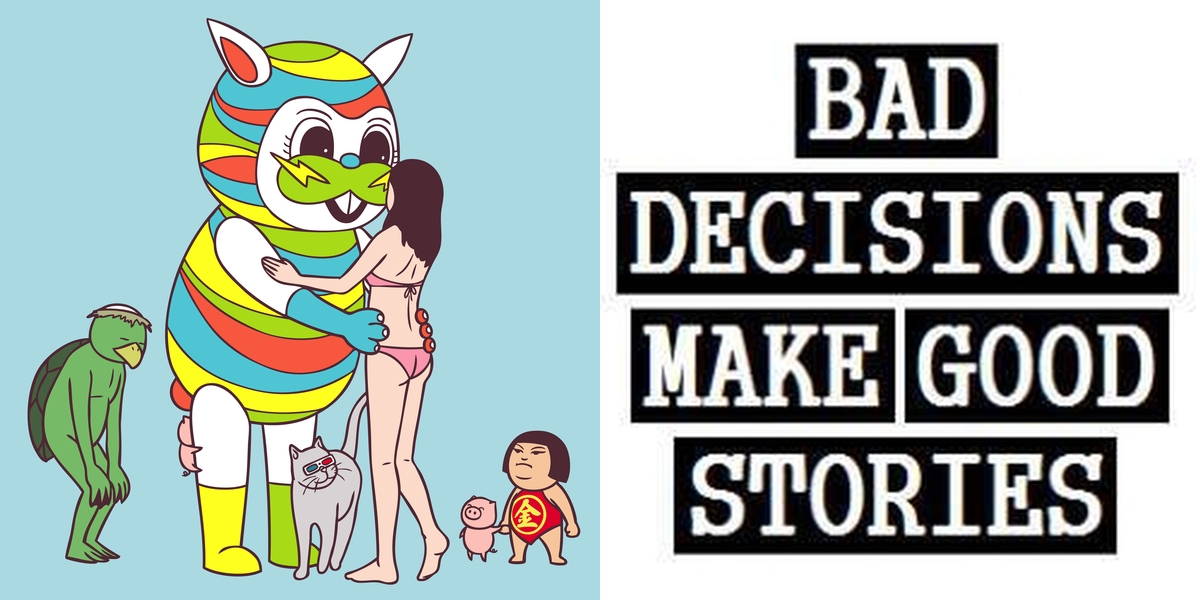
bawdy storytelling(Sources, edited: Left, “Meet Again” by Kimiaki Yaegashi, available at Thumbtack Press; Right, This Danielle Brown Page)
I’ve been asked to pass on the following:

Searching for Storytellers for Naughty Storytelling Event

Are your friends always telling you how they look forward to hearing your crazy stories? Are you a fan of The Moth or Risk and have always wanted to get up on stage and tell a true story? Now’s your chance! In mid-October, I’m hosting a naughty storytelling event called The Naughty Yarn at HQ Bar in the Kyungsung area of Busan. I’m looking for people to tell true stories themed around sexuality or dating. Naughty storytelling is a sex-positive event and meant to embrace and playfully examine the ways we navigate our sexual lives. This show is not an open mic; I’m taking story pitches and am looking for eight to ten performers for the evening. If you’re interested, your story must:
*
  • Be true (this is storytelling, not erotica!)
  • Have a narrative arc (no rambling or anecdotes!)
  • Be eight minutes long at the maximum
If you think this is something you’d like to do, please send a short paragraph or two giving a summary of your story to thenaughtyyarn@gmail.com. Thanks!
*

Revealing the Korean Body Politic, Part 8: The Bare-Leg Bars of 1942

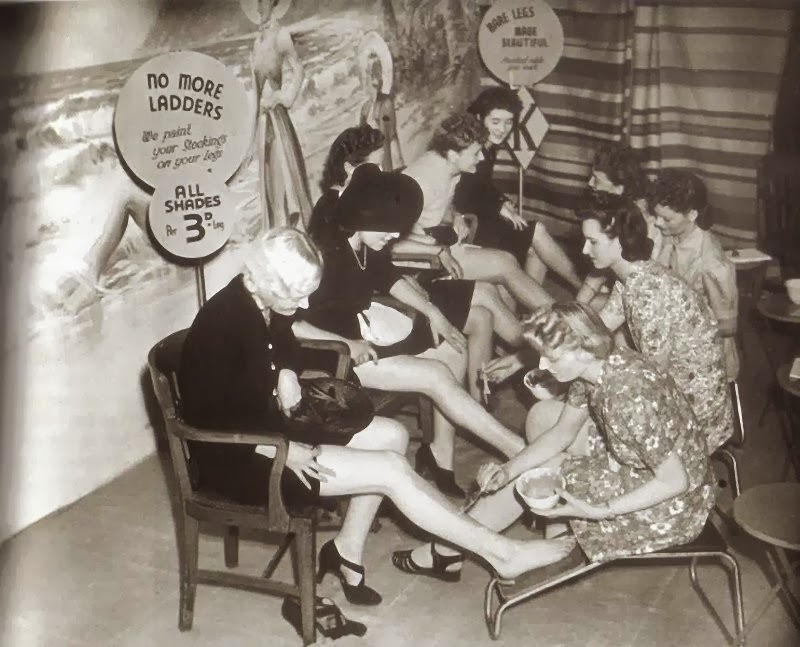
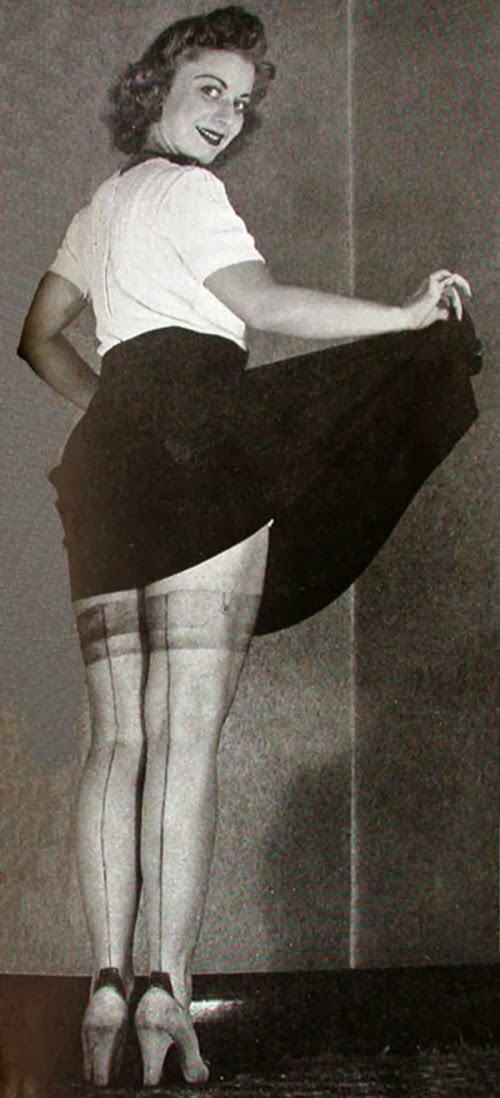
Liquid stockings nylon world war two(Source, above and below: Rare Historical Photos)

Back in the early-1940s, newly-invented nylon stockings were the must-have fashion item in the US. But supply could never meet up with demand, with 4 million pairs once selling in just 4 days.

Then the US entered the war, and all the nylon available was suddenly needed for parachutes, ropes, and bomber tires. Dupont, the sole manufacturer, retooled all its stocking machines.

Still desperate for the look though, women improvised with ‘liquid stockings’ instead, using foundation, black eyeliner, and eyebrow pencils to draw them on their legs. Stores soon began catering to the demand, adding more sophisticated lotions, creams, and sprays. Specialist ‘bare-leg bars’ followed.

So I read via this great book when I was 15, (although unfortunately that panel didn’t get scanned for the online version), and I’d like to pretend that I was taken aback by the lengths some would go to the sake of vanity, and precocious enough to realize that people were no different in 1991. In reality though, I simply thought that the women were crazy (hey, I was 15!), and didn’t understand how anyone could have been fooled by such a poor substitute.

More likely, women ‘wore’ them because liquid stockings became a pseudo-fashion in their own right—or at least until nylons became liquid stockingsavailable again (sparking the ‘nylon riots‘ of 1945). Either way, they’re another good example of the genuine concerns women had about maintaining a feminine appearance when they started working in factories in World War Two, as well as their cheap solutions (although this particular one would have been used off the factory floor). I’m glad to finally have a name for them, and a wealth of photographs to use in my presentations :D

Anybody know of any similar shortages and improvisations by women (or men!) in Korean fashion history though, which may resonate more with Korean audiences? Thanks!

The Revealing the Korean Body Politic Series:

“Fucking is Fun!”: Sexual Innuendos in Vintage Korean Advertising

Lee Hyori Vita500 따먹는 재미가 있다Estimated reading time: 6 minutes. Source: Loading… 100%

Once upon a time, decent, honest Koreans wouldn’t stand for sex and nudity in their media. Gratuitous bikini models sparked outrage. Women had to appear demure and virginal in soju posters. There were no such things as “chocolate abs” to show off, so young male celebrities could make money without ripping their shirts off. The Korean internet wasn’t inundated with ads for male enhancement pills. Only slutty Caucasian women were prepared to be lingerie models. And so on.

Instead, advertisers had to rely on sexual innuendo to manufacture outrage. Mirroring Korean entertainment management companies today, who regularly claim shock and surprise that pelvic thrusts could be considered anything but wholesome family entertainment, PR representatives would feign ignorance of double-entendres that every high school student already knew full well.

Then along came “sexy concepts,” advertisers relying on cheap, “sex sells” gimmicks during the financial crisis, and the relaxation of censorship in the Korean movie industry. And the rest, as they say, is history.

Eun Ji Won Worries That There Are Too Many Sexy Concept Girl Groups“Eun Ji-won Worries That There Are Too Many Sexy Concept Girl Groups.” Source: Soompi. Source below: The PR News.

Or is it? That’s certainly a convenient narrative, and probably has a grain of truth too. As I begin to examine the impact of K-pop on Korean advertising over the last eight years or so, I fully expect to confirm what everybody already knows: that there’s more sexual themes over time, and that K-pop stars, especially women, wear a lot less clothes than other celebrity endorsers.

But does that necessarily mean that sexual innuendo used to be much more common in Korean ads, when standards were stricter? It isn’t mutually exclusive with wearing revealing clothing, and you could easily argue that more liberal attitudes would actually lead to using it more often. Indeed, now it could make an otherwise boring and routine “sexy” ad stand out, as could the strategic use of Konglish too.

Just something to bear in mind as you enjoy the following examples from 2006 and earlier, which caused quite a stir as people began to notice more and more ads like them. Some are so obvious that anyone can get the message; others, you’d Feel the Climax Ocean Worldneed to be very familiar with Korean slang to notice them at all…which makes me wonder what examples may be right under my nose today. By all means, please let me know of any, and/or of some more older ones to add to this collection.

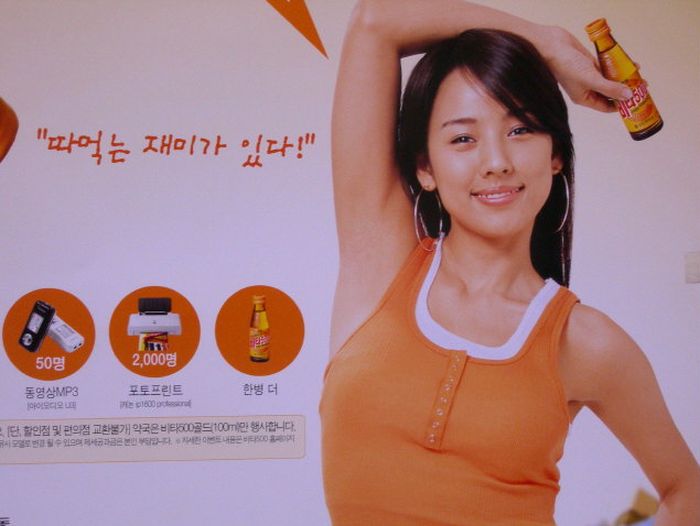
First then, the opening one by Lee Hyori for the vitamin C drink, Vita500 (as an aside, one of the few Korean vitamin C drinks which didn’t—doesn’t?—contain carcinogenic benzene; this being Korea, only foreign news outlets would name which ones were safe). As I explained when I first wrote about it, perhaps five years ago:

…notice the “따먹는 재미가 있다” line next to her face. Simply put, the first word (not to be confused with “다먹다,” or “eat all”) is a combination of “따다, ” which has many meanings but in this case “open; uncork” would be the most appropriate, and “먹다,” which is to eat; then the next word is “재미” meaning “fun, interest,” and a “가” which must attach to it because of the final word “있다,” or “to have.” So literally:

“The act of opening and eating [this] fun has”

Eating often means eating and drinking in Korean. Naturally, a better English translation would be:

“Opening and drinking [this] is fun.”

Still a little awkward, yes? But the point is, “따먹다” has another, entirely different meaning. For instance, a Lee Hyori Vita500 2006guy might say to his friends:

“그여자 봐? 난 따먹었어요”

Which means:

” You see that woman? I opened and ate her.”

“Eating” someone doesn’t have the same connotations in Korean, but you’re on the right track:  “I fucked her” would be the most accurate translation, and so apparently Lee Hyori is saying “Fucking is fun” in the ad (End. Source, right: Kwang-Dong Pharmaceutical Co., Ltd).

Back when I first wrote about the ad, I could see nothing but the humor in it. Now, I have mixed feelings: I appreciate that that phrase is (was?) usually used in a conquest-like, objectifying way, which is why so many women felt insulted:

“Too Lewd!” Lee Hyori’s Subway Advertisement is Surprisingly Suggestive

Kukinews, 15.03.2006

인기가수 이효리가 모델로 등장한 한 식음료 제품 광고의 문구가 지나치게 선정적이라는 지적이 일고 있다.

A food product advertisement with popular singer Lee Hyori has been getting a great deal of attention for the use of a certain phrase in it.

이 광고는 K제약이 지하철 주요노선과 지면에 사용하고 있는 광고다. 네티즌들은 이효리가 등장한 광고 속에 ‘따먹는 재미가 있다’는 문구가 불쾌Lee Hyori Vita500 shop window하다는 지적을 하고 있다. 해당 광고는 K제약이 지난 15일부터 병뚜껑을 따서 속을 확인하는 경품 행사를 홍보하기 위해 제작됐다 (source, left: dongA).

This advertisement by a medicine manufacturer* has been used on a major subway line in Seoul since the the 15th of March. Netizens have been indicating their displeasure with the phrase used by Lee Hyori in it to promote a competition that gives prizes to those who find marked bottletops.

(*Because of Korea’s draconian libel laws, the real name isn’t given, even though it’s blatantly obvious. This is standard practice for the Korean media.)

네 티즌 ‘구구콘’은 “난감한 지하철 광고”라는 제목으로 문제의 광고 사진을 한 인터넷 커뮤니티에 올렸다. 이에 네티즌 ‘sevenstarcider’는 “여자로서 정말 화가 나는 광고”라며 “광고 목적을 모르는 것은 아니지만 도가 지나쳤다”고 지적했다. 네티즌 ‘피부미인’도 “건강음료라는 생각보다 음란한 음료라는 생각이 먼저 든다”고 꼬집었다.

A netizen by the name of ‘Cuckoo-corn’ uploaded the above photo under the title “Strange, puzzling subway ad” to a community site about problem advertisements, and there ‘Sevenstarcider’ under the post title “An Ad That Really Makes Women Angry” wrote “it’s not that I don’t know the purpose of this ad, but that is just too much.” Also, netizen ‘Skinbeauty’ cynically wrote “my first thought is not that this is a health drink, but some kind of aphrodisiac instead.”

K 제약측은 이에 대해 “섹스 어필할 의도는 전혀 없었다”고 해명했다. 홍보팀의 한 관계자는 “광고대행사가 경품행사의 성격을 반영해 제안한 문구였다”며 “(성적으로) 이상하게 유추하는 사람들이 있지만 이효리씨의 건강미에 초점을 맞춘 것 뿐”이라고 설명했다.

About this advertisement, a representative of the PR company behind it explained that “there was absolutely no intention to use sex appeal in it,” that “the text is a simple reflection of advice about the promotion being advertised,” and finally that “while there are people who infer something sexual to it, Lee Hyori’s focus is only on the health and beauty benefits of the product.”

그동안 성적 연상효과를 노린 광고 문구들이 적지 않았던 탓에 ‘야한’ 광고가 다시 도마에 올랐다.

As there have been lot of advertisements with sexual innuendos in their text so far, this subject is again becoming controversial.

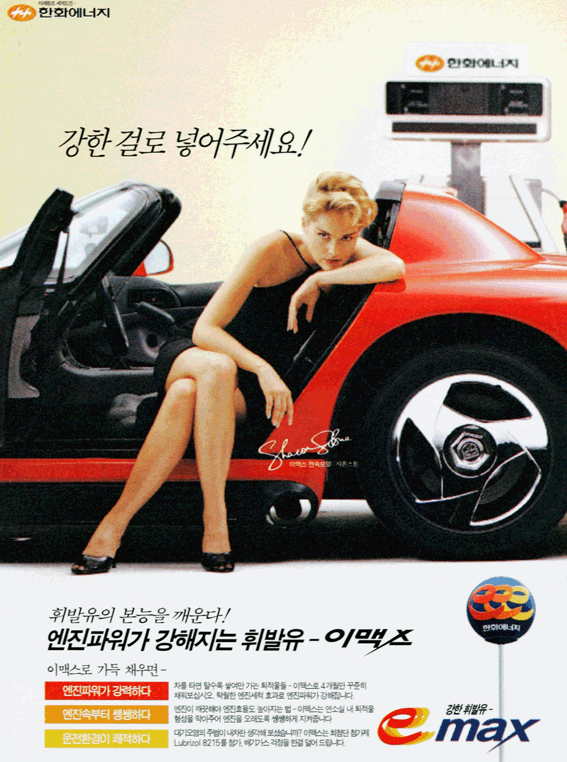
지 난해 배두나와 신하균이 모델로 나선 한 무선인터넷 광고는 “어,끈이 없네”, “밖에서 하니까 흥분되지” 등과 같은 대사로 시청자들의 비난을 샀다. 1990년대 모 아이스크림 광고에서는 여성 교관이 남성 훈련병에게 “줘도 못먹나”라고 말해 세간의 입방아에 오르내렸다. 90년대 후반에는 영화 ‘원초적 본능’의 여배우 샤론 스톤이 등장한 국내 정유회사 광고가 논란에 휩싸였다. 빨간 스포츠카에 올라탄 샤론 스톤이 “강한 걸로 넣어주세요”라고 말했기 때문.

For example, last year [2005], Bae Doo-na and Shin Ha-kyun appeared in an advertisement for a wireless Sharon Stone Korean Ad 1995internet company which included the line “Because [we] do [it] outside, [it’s] much more exciting!,” which generated a lot of complaints. Also, in the early 1990s, an advertisement for an ice cream company featured a female drill instructor saying to a new male recruit “I gave [it] to you to eat, but you can’t eat it [well]!,” and finally in the late-1990s a gasoline advertisement featuring Sharon Stone climbing into a red sports car had her saying  “only put strong [things] inside.” (James: See below for the latter two).

광고주들은 섹스어필 의도성을 강하게 부인해왔다. 그러나 한 광고업계 종사자는 “광고 문구를 지을 때 섹스어필한 표현을 찾기 마련”이라고 귀띔했다 (source, right: *cough* Ilbe).

While in public advertising companies strongly deny that they use sexual innuendos in advertisements, an industry insider, speaking on condition of anonymity, revealed that of course they do in reality.

K제약 측은 올해 이효리가 출연하는 3편의 광고를 더 제작할 계획이다. 이효리는 지난 1월 K제약과 1년동안 계약금 8억원에 광고모델 출연계약을 맺었다.

In January, the medicine manufacturer signed a contract with Lee Hyori to appear in three more advertisements for the company over the next year, for the fee of 800 million won (End).

Now for some more examples, found via a list compiled by this blogger. Predating Youtube though, and with very little information given, sorry that I was only able to find half of them. Also, sorry that I’m struggling to see anything even remotely sexual in some of them, let alone funny; again, they defy shoehorning into some narrative about Korean media liberalization, which is why I haven’t placed this post into my “Korean Sociological Image” series. Hopefully though, the tuna fish commercial alone will more than compensate…

(Update, January 2022: My apologies again that some videos have been removed from YouTube since I wrote this in 2014. I have copies of them and am happy to share, but am wary of uploading them myself and getting copyright strikes sorry!)

“벗겨도 벗겨도 변함없고, 먹어도 먹어도 깊은 그 맛…”

“Even if you take it off, it’s the same. Even you eat and eat, that deep taste…”

“줘도 못 먹나?”

“I’m offering it. How come you can’t eat it?”

Via The Paris Match, a related eclair ad that had my wife ROTFL at the repeated references to how long and sweet it was, with all its creamy goodness.

“따 먹고 합시다!!!”

Just in case you miss the symbolism of the shellfish for the women’s tuna, and the peppers for the men’s, at the end they all say “Let’s open [it] and eat [it] and do it!”.

“난, 샤론 스톤, 본능적으로 강한 게 좋아요. 강한 걸로 넣어주세요”

“I’m Sharon Stone, I instinctively like something strong. Please put something strong in.”

“오늘도 촉촉하게 젖었습니다.”

“Today too I am wet”

“사람들이 저보고 너구리래요.  너구리가 뭐가 어때? 통통하고 맛만 좋은데…”

“People call me ‘Raccoon.’ What’s wrong with being a raccoon? It’s chubby and tasty…”

No innuendo here: the blogger just notes that Song Yun-ah has her legs open as the car approaches. Even I thought that this was reading a bit much into it though (she’s hardly spread-eagled, and the car is approaching from the wrong direction!), even if it does have an exploding fire-hydrant straight after the shot of her.

(남자 엉덩이를 때리면서) “줄 때 받자….”

(While hitting men’s bottoms): “Receive it when I give it to you…”.

Not to detract from the very real sexual harassment which women face every day, or that its victims are overwhelmingly women. But still: it’s difficult to see anyone accepting this commercial if the sexes were reversed.

Finally, see here and here for some more examples from 2009, and probably many readers will find this list inadequate without the following, supposedly banned ads. I’m not sure that either actually went to air though:

Thoughts?

If you reside in South Korea, you can donate via wire transfer: Turnbull James Edward (Kookmin Bank/국민은행, 563401-01-214324)

Korean Sociological Image #84: What’s that old, fat, bald, white guy doing here?

S Diary Busan Play Audience(Sources, edited: Interpark, Miscellaneous Maddness)

GLASGOW (n.): The feeling of infinite sadness engendered when walking through a place filled with happy people fifteen years younger than yourself.

The Meaning of Liff, Douglas Adams and John Lloyd (1983)

Ever been tempted to watch S Diary, because of its eye-catching posters? Don’t. It’s decidedly less raunchy than it looks, even by 2004 standards, and it’s strangely serious for a romantic comedy. Instead, watch it for what it is: “a simple exploration of a woman’s past romantic relationships and how they influenced her,” and for the insights — and confidence in future relationships — that can be gained from doing so. (Also, for Kim Sun-a‘s suburb acting.)

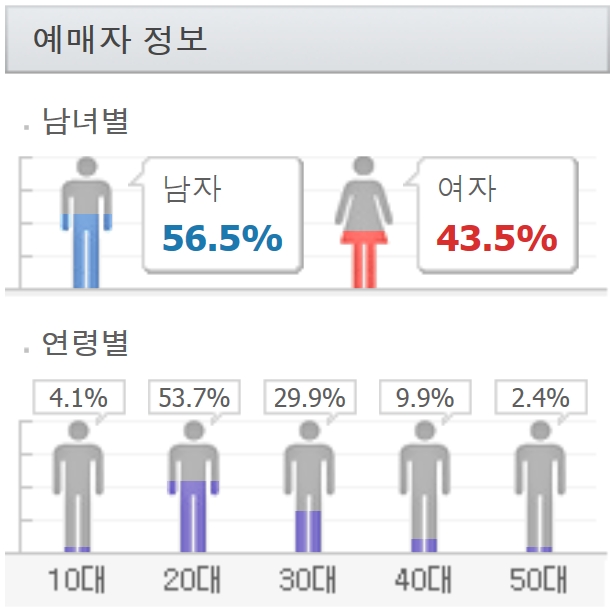
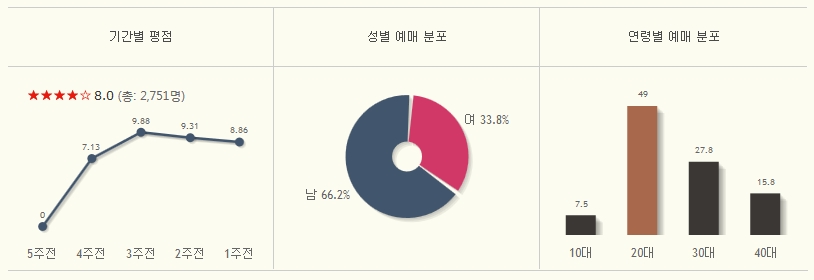
Customer Demographics BusanAs my first Korean play then, and the first night out my wife and I will have had together since we had kids, we could do much worse. But we noticed something strange when we went to check the dates and times: scroll down the page on the ticketing site, and you’ll notice an age and sex breakdown of those customers who’ve already bought tickets online, as seen on the right.

This one is for the Busan play; interestingly, the sex ratio is reversed for the Seoul one (click here if you are reading this after its run has ended). Also, the data may not be entirely accurate: when my wife does buy two tickets, will those be counted as two 35 year-old women in the data (which would make no sense), or will she be asked to—possibly even required to—provide more information about the other attendee?

We’ll let you know, once my sister-in-law tells us when she’s available to babysit(!). (Update: All booked. My wife wasn’t asked for information about the second ticket holder.) Either way, it turns out that providing these statistics may be standard for online booking sites in Korea, as indicated by a similar breakdown for online tickets to the The Fault in Our Stars movie on the CGV website. It gives the same results regardless of the cinema chosen, so I presume that they’re nationwide figures (again interestingly, the male to female ratio is the exact opposite of what you’d expect for a romance movie):

The Fault in Our Stars -- Customer Demographics(Source: CGV)

I’d appreciate it if readers can send any more examples, and/or let me know if they’re also available when booking tickets online in other countries. If not, and they turn out to be unique to Korea and/or (I suspect) the East Asian region, what significance do you think that has? Does it speak to any wider feature of Korean society or culture?

Of course, Koreans are not alone in tending to avoid events where they’re likely to be significantly older or younger than the majority of other participants or audience members. The main question is, why do Korean companies make this information available to them? Is it simply testament to the importance of age in Korean relationships? Is it because more people would go if they felt the audience matched their own demographic, than be dissuaded because it didn’t? Or it is just useful extra information given on a whim, which shouldn’t be overanalyzed? Please let me know your thoughts.

(For more posts in the Korean Sociological Image series, see here.)

Squee~!

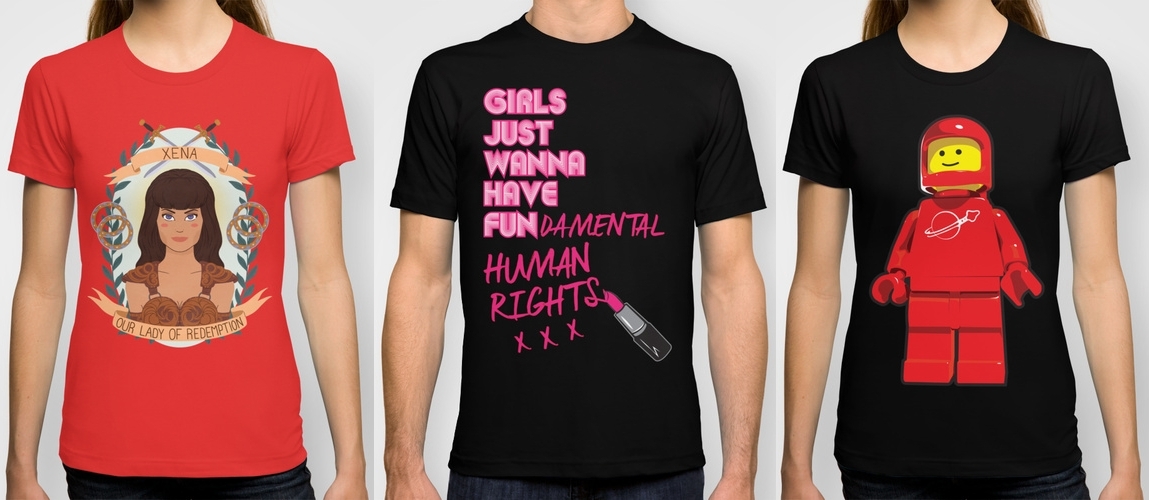
society6 t-shirtsAhem. But if you’ll please allow me to indulge myself after my last mammoth post, I’m inordinately happy that my t-shirts from the US arrived today…

From left to right: Xena by Heymonster; Fundamental by Sophiedoodle; and Vintage Lego Space Man Minifig by Greg Koenig, all $22. Normally they cost $10 each to send to Korea, but I took advantage of a free delivery special last month.

Seriously, it’s a hassle finding clothes which fit in Korea, and I’m not fond of the styles, so it’s good to have something that I actually want to wear for a change (the prices are comparable too, even with delivery). And I’ve been dancing to Girls Just Want to Have Fun for a good 30 years now too (my dad is a big Cyndi Lauper fan), so it was about time I paid tribute to that on a t-shirt.

See here to learn about just how revolutionary it was for the 1980s—you’ll be surprised!

Everything You Ever Wanted to Know About Korea’s Celebrity Obsession, Part 1: The numbers

Lee Hyori Soju Endorsement(Source: Jennifer Sundt, @Tomorrowland. Reproduced with permission)

You know there’s a lot of celebrities in Korean ads. It’s probably why you recognize so many of them, even if you hate K-pop and Korean dramas.

For something so integral to the Korean media-cultural landscape though, it’s surprising that no-one seems to have worked out just how many Korean ads do have celebrities. Months of googling and poring over the books, and still the most recent systematic surveys I’ve found were done over a decade ago.

Maybe there’s just too many to count these days?

But numbers matter. To me, because I’ve long contended that the financial imperatives of K-pop are driving its increasing sexualization and sexual objectification (although these are not necessarily negatives), with knock-on effects for the Korean media as a whole. Specifically, that because entertainment management companies make more money from groups’ endorsements than their music, that “noise marketing” and ever more shocking “sexy concepts” are required to make them stand out from other groups. But frankly, I don’t think I’ve done my due diligence in confirming all the assumptions contained in that, nor addressed all the questions they raise. For instance:

  • Do entertainment management companies indeed make more money from endorsements than music?
  • Over time, (how) has the number of celebrities in ads changed? Are K-pop stars making up more and more of them? If so, since when?
  • Does getting attention through sexy concepts invariably lead to more advertising contracts? Can it actually discourage them instead, companies concluding that overly sexualized groups don’t have the appropriate image for their family-friendly brands? Or are companies only concerned about securing the most popular, most talked-about K-pop stars, regardless of what consumers are actually saying about them?
  • If so, why? Why are K-pop stars (presumably) so effective at raising sales, even if they have no conceivable relationship to the product(s)?
  • Have all Korean ads become more sexualized and objectifying over time, or just theirs? Do sexy concepts on stage have any relationship to what we actually see in their ads?

All those questions and more will answered in this series, although, again frankly, some answers will take much longer than others (and from my perspective, I’d be much more interested in hearing your own!). Long story short, it looks like—dammit—I’m going to have to stop complaining and do a systematic survey myself, and how and when I do that will depend on if my proposed paper on precisely that gets accepted for a K-pop conference in December (I’ll keep you posted).

For now, in this post I’ll present a summary of what numbers I have found, for the sake of providing a quick and accessible resource for readers, which can be added to as more sources come up. Part 2 will be a similar, much shorter one on the economics of K-pop, and Parts 3, 4, and 5 (and so on) will discuss all the various explanations I’ve found of why Koreans are so enamored with celebrities. Which, as I’ll explain in those, turns out to be something that extends back decades, and is eerily similar to—nay, a virtual carbon copy of—what goes on in Japan.

Sorry that my first long post in a while ends up as nothing more than a glorified bibliography though, which definitely wasn’t my intention. But this is proving to be a mammoth project, much better suited to an ongoing series. And I hope that readers appreciate the need for the stats, and that some may find them useful.

B. Kliban, How to approach a book(B. Kliban. Source: Manger Paléo)

In order of when the surveys were conducted, or when the article was published:

— A study of advertisements from The Chosun-ilbo and The New York Times throughout 2000

— More Korean ads had people in them (47%) than US ones (31.9%)

— Korean ads had a greater number of celebrities (24.1%) than US ones (9.9%; both figures out of all ads surveyed)

— Of those ads with celebrities, US ones had more product-relevant celebrities (77.4%) than Korean ones did (38.3%).

  • Son, T. W. (2001). Success of advertising depends on the appropriateness of celebrity use.
    Advertising Information (Korean), November, 440-450.

— Paek, p. 136, explains of this: “Of the TV commercials screened, about 32% of the ads included celebrity endorsers, and 59% of primetime TV commercials used celebrities as endorsers.” But he doesn’t provide any more information sorry.

— A very comprehensive survey, of 7728 unduplicated television commercials in 25 countries between February 2001 and December 2003. The Korean ones examined were on MBC, between 18:30-21:30, May 18-19, 2001; and on MBC/SBS/KBS 2 between 18.00-24.00, on October 22-November 14, 2001.

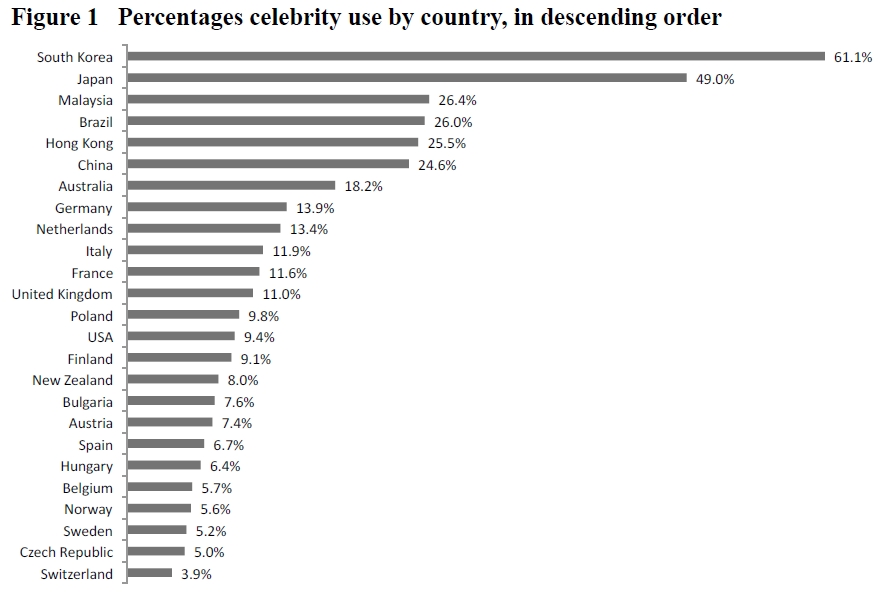
— This graph of the results (p. 10) is very revealing (click to make it larger):

Commercials with celebrities, cross-country comparison, 2001-2003The author, Carolus Praet of the Otaru University of Commerce, seems like the expert on celebrity advertising in this part of the world (see here for a list of his publications). Once I get a hold of his more recent “Korea As Number One: A Multi-country Study of Celebrity Advertising Around the World,” in Proceedings of the Korean Advertising Society (KAS) Far East International Conference in Advertising, pp. 367-375 (2012), I’ll add it here.

— Study based on Korean and US television from 29 July to 2 August 2002

— 57% of Korean commercials featured a celebrity, compared to 9% of US ones

— Of those Korean celebrities, 70% were actors, actresses, and singers; only 47% of the US ones were

These results come via page 50 of Roald Maliangkay, “Catering for the Female Gaze: The Semiotics of Masculinity in Korean Advertising,” in Situations: Cultural Studies in the Asian Context, Vol. 7, No. 1, Winter 2013/14, pp. 43-62.

  • Hong Tack-Kim, “Characteristics, History, and Forecasts of Creativity in Korea,” in Korean Advertising: Facts and Insights, 218-274 (Seoul, KOBACO, 2007). As I type this, the PDF download isn’t working; see here for a cached version instead. It says:

— From page 272-273: “Some 2,000 television commercials are produced in Korea every year.
Among those, commercials that use famous spokesmodels account for almost 70 percent. Most of these famous spokesmodels are celebrities.”

This reference comes via page 357 of Olga Federenko, “South Korean Advertising as Popular Culture,” in The Korean Popular Culture Reader, ed. by Kyung Hyun Kim and Youngmin Choe, Duke University Press 2014, pp. 341-362, who explains that “In the first decade of this century, 70-75% of Korean ads featured celebrities,” but adds in a footnote that—story of my life!—”Precise statistics are hard to find and most authors quote their estimates without providing sources.”

See also her 2012 PhD, “Tending to the ‘flower of capitalism:’ Consuming, producing and censoring advertising in South Korea of the ’00s” (download as a PDF here), in my view easily the best and most comprehensive guide to modern Korean advertising (albeit only just discovered while writing this sorry; I’ll return to it in a later post). She mentions endorsements and celebrities in passing throughout, but in footnote 22 of page 103 specifically she references Eom Nam-hyun, “FTC suggests guidelines to advertising in which celebrities appear,” Ad Starts 2009: 2009 Busan International Advertising Festival with Metro (English edition), page 10, as another example of one of those estimates. As its single, hard to find link makes me nervous, let me copy and paste it here just in case that is ever taken down:

Celebrity appearances in advertisements are a worldwide trend. It is said that 75% of Korean TV ads use celebrities as well as 70% of Japanese ads.

However, as for America, the percentage of commercials using celebrities or famous people in ads is only about 25%, which proves that in both Korea and Japan, using celebrities in ads is a general basis of the advertising creative strategy. Additionally, the celebrities’ high rate of TV commercial appearances leads into a prevailing trend in which the same celebrity shows up on several different commercials of different products.

For this, the FTC (Federal Trade Commission) re-established new guidelines for putting famous people and celebrities into ads which draw our attention.

According to the guidelines, celebrities in ads have to candidly convey their opinion on the products and their thoughts about their experience of using the product.  Advertisers also must fully communicate with the celebrities about the ads. The interesting thing is that FTC asked the celebrities to be cautious about choosing ads in which they promote products.

It also stated that if the celebrities convey wrong information about products or alluring contents to the general public, the responsibility rests on them. Because of these guidelines, it is expected that celebrities will have difficulties when appearing in ads of a similar category of business and in ads of competing brands.  / Nam-Hyun Eom, Doctorate Course of Advertising, Texas University.

— “Among the 2,000 commercials produced in Korea last year, 65 percent featured celebrities. In the U.S., United Kingdom and France, the rate is less than 10 percent.”

Korea Celebrity Endorsements Hyun-bin HiteI think that’s where I got those figures for the France and the UK in one of my presentations. But, years after I first prepared the slide, now *cough* I’ve no idea where I got those figures for China and Brazil, or why I didn’t say the US was also 10%…

Either way, being unsourced, obviously I can no longer use it. Also, no offense to Hyun-bin above (he’s hardly the only offender), but I do remember why I chose his picture last month: his classic, terrible example of simply being a “beautiful person holding a bottle“…

— “In 2012, the Seoul government urged advertisers to “exercise restraint” when a study found that idols were used in 72% of ads for alcoholic drinks.”

Specifically, it said:

“서울시는 특히 주류 광고를 통해 자주 노출되는 연예인 22명 중 17명(72%ㆍ중복 제외)이 아이돌이었고, 노출빈도 1위는 탤런트 김수현, 2위 공유, 3위 피겨 선수 김연아 순으로, 이들을 모델로 한 주류 광고가 청소년에게 상당한 영향을 미치고 있다고 분석했다.”

“In particular, Seoul city discovered that out of entertainers that frequently appear in alcohol advertisements, 17 out of 22 (72%; those that appeared in more than one advertisement were excluded) were idols. The most frequently appearing were talents Kim Soo-hyeon and Gong Yoo, and athlete Kim Yuna; having these people in alcohol advertisements has a huge influence on teenagers.”

I’m not sure how “idols” were defined by the authors though (I’ll discuss definitions in a later post), and the article confusedly begins by saying that only ads on free to air TV were studied, but then discusses results from cable TV too. Also, they lumped radio and TV commercials and newspaper ads all together, which are very different mediums.

However unreliable though, I was surprised that over 9 in 10 of those alcohol ads were for beer. I would have assumed that at least half would have been for soju?

— Finally, some very recent, but again unsourced statistics from a marketing company: “The use of celebrities in advertising varies enormously around the world. It’s highest in Japan and Korea, where over 40 percent of TV ads feature celebrities, and lowest in Ukraine, Sweden, and Canada, where the proportion is under 5 percent. It is 10 percent in the U.S., and 12 percent in the UK.”

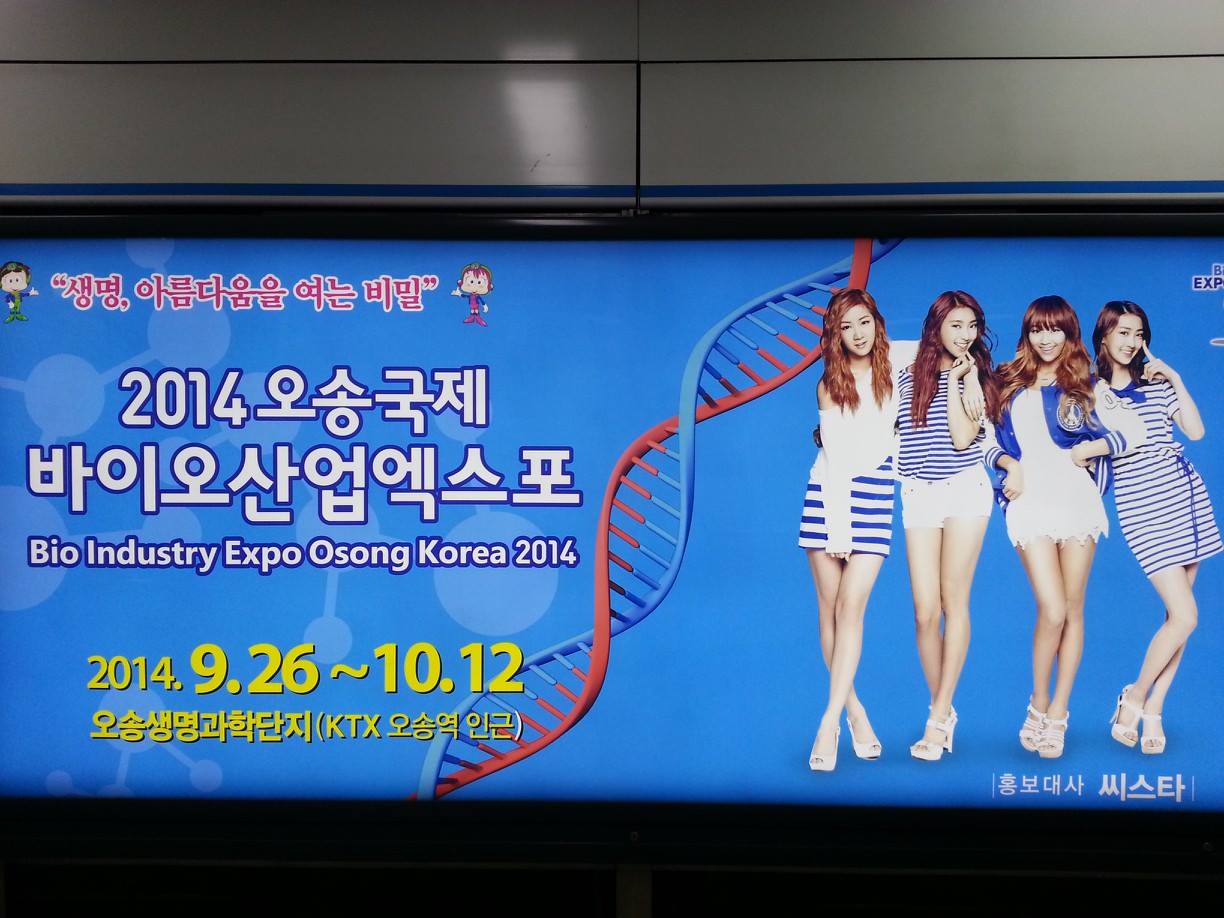
SISTAR, Bio Industy Expo Osong Korea 2014(Source: @John_F_Power. Used with permission.)

And on that note, thanks to those complete geeks amongst you still reading(!), and please feel free to ask me for PDFs of any of the sources I’ve mentioned (I have about half of them). And if any readers know of any more sources, by all means pass them on, with my heartfelt appreciation!

(KICKSTARTER) My Japanese Husband Thinks I’m Crazy: The Comic Book

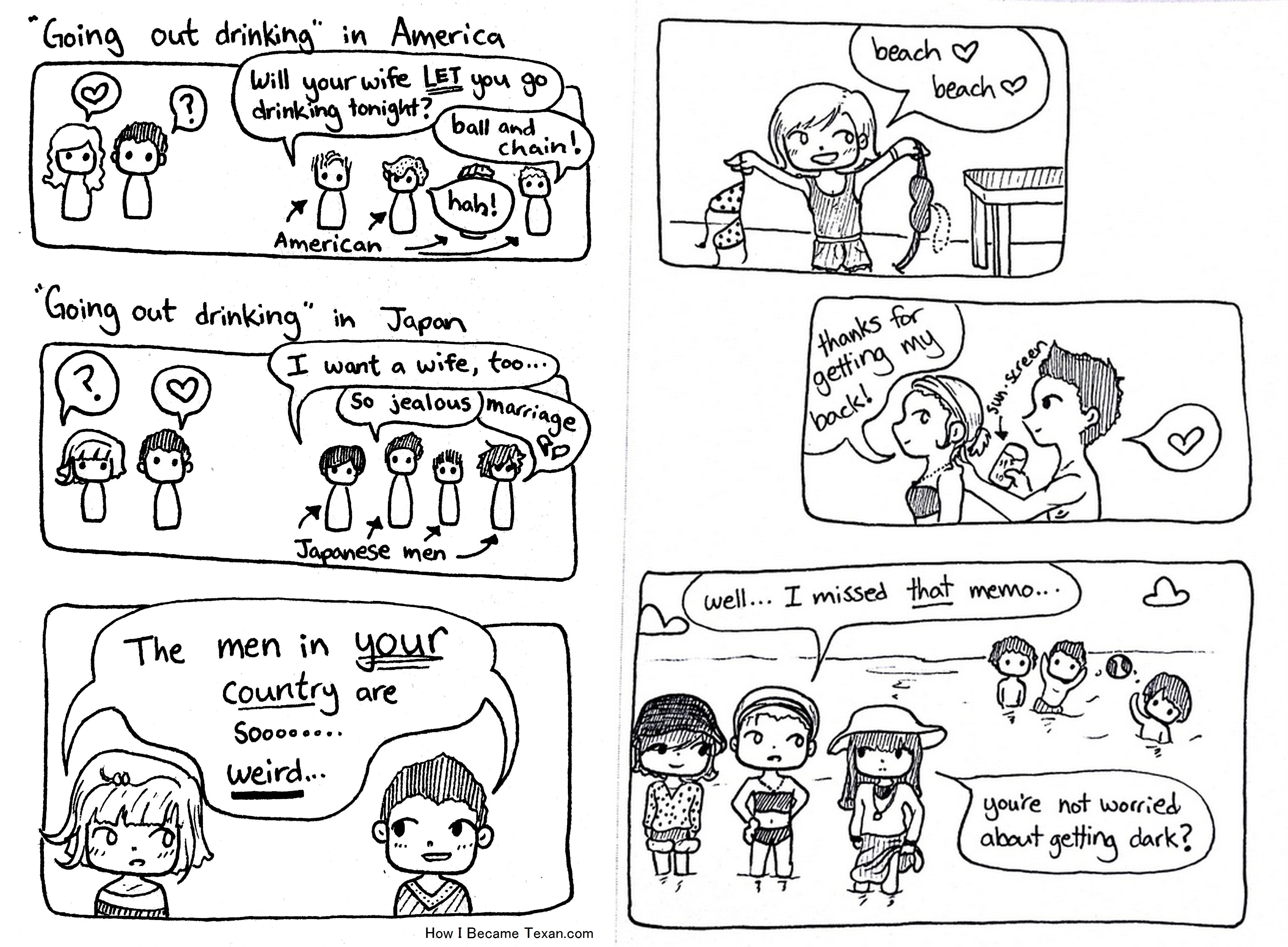
Texan in Tokyo(Source, all images: Texan in Tokyo)

I’ve been asked to pass on the following:

Deciding to move across the world for “love” is easy. People do it all the time. Thriving in that new country (without sabotaging your relationship), on the other hand, is a bit more difficult.

EnterMy Japanese Husband Thinks I’m Crazy: The Comic Book.”

My Japanese Husband Thinks I'm CrazyThis comic book is the autobiographical misadventures of a native Texan freelancer (Grace) and her Japanese “salaryman” husband (Ryosuke): in comic form. From earthquakes and crowded trains, to hilarious cultural faux pas, it explores the joys of living and working abroad, intercultural marriages, and trying to make a decent pot roast on Thanksgiving.
Grace Buchele Mineta Texan in TokyoMy Japanese Husband Thinks I’m Crazy: The Comic Book” is being funded on the popular crowd-funding website, kickstarter.com, from July 28th to August 30th.

In the first 24 hours online, the book has been funded 73%.

Grace Buchele Mineta is a native Texan, founder of the hit blog “Texan in Tokyo,” and author of the autobiographical comic book, “My Japanese Husband Thinks I’m Crazy.” She lives in Tokyo with her husband, Ryosuke, where she blogs and draws comics about their daily life.

I Read a Book: Susan Blumberg-Kason’s Good Chinese Wife: A Love Affair with China Gone Wrong (2014)
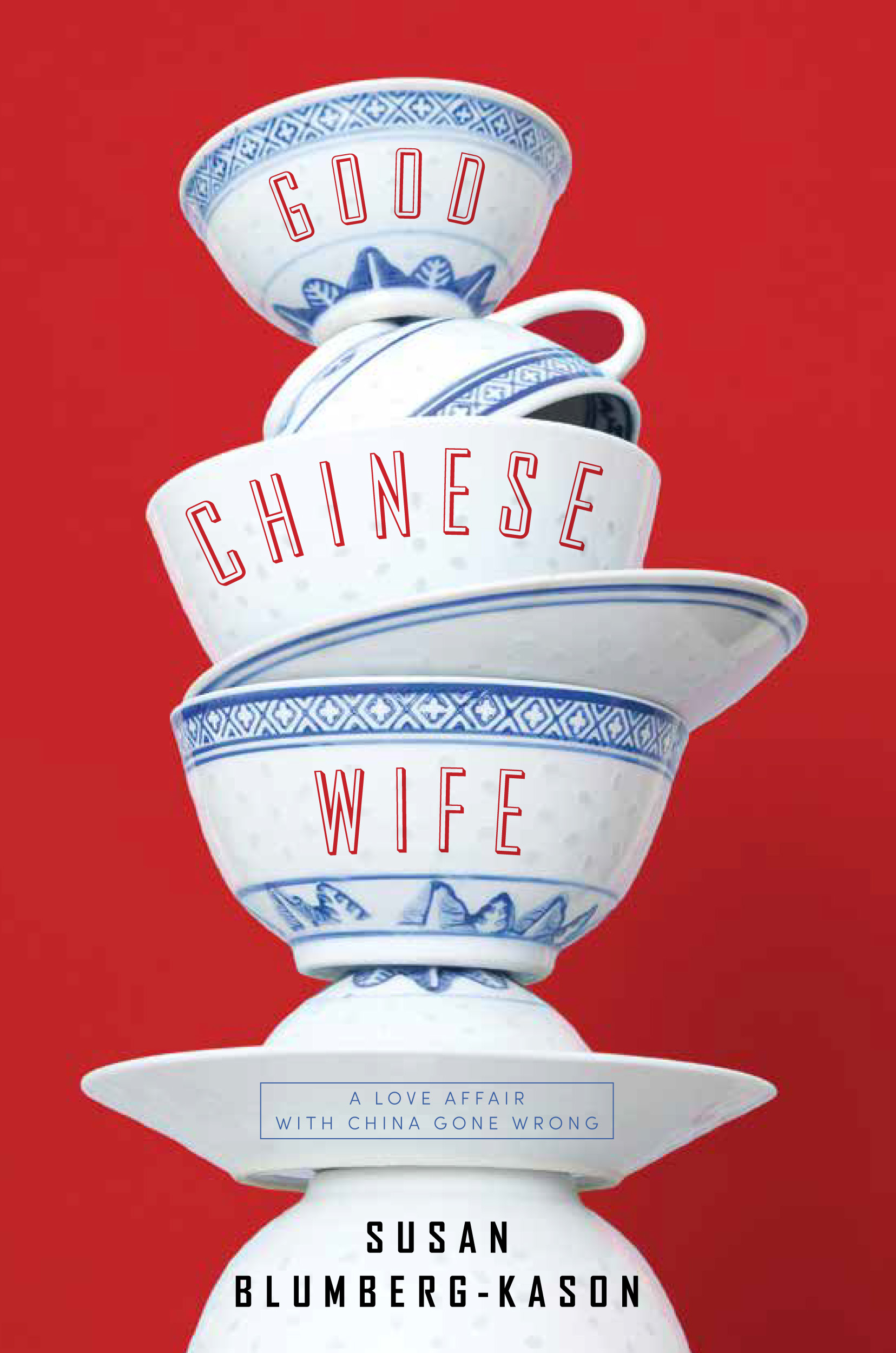
Good Chinese Wife CoverLet me be honest: Good Chinese Wife is not something I would normally read.

Susan’s ex-husband was Chinese; my wife is Korean. Susan’s relationship goes from friends to engaged in less than two minutes; we lived together for years, and had lots of wild sex before I proposed. Their marriage rapidly turned sour; we just celebrated our tenth anniversary. They married, had a child, and divorced way back in the 1990s; I’m really only interested in Chinese attitudes towards dating, sex, and marriage in the 2010s. And so on.

I’m still grateful for receiving a reviewer’s copy, organized by Jocelyn Eikenburg of the Speaking of China blog (see here for many more bloggers’ reviews). But first impressions? I expected it to be very outdated, and that it would have little to offer readers with Korean partners.

I was dead wrong, on both counts.

Good Chinese Wife begins in Hong Kong in the mid-1990s, where Susan is doing a graduate degree (she previously spent a year there as an exchange student in 1990). Then in her early-twenties, she soon becomes smitten with Cai, an older mainlander from Wuhan. She starts tutoring him English in her dorm room; unbeknownst to her, other students consider them already dating. This prompts him to open up and explain he’s already been married and has a child, revealing all as a prelude to showing he is now interested in dating Susan. Because in China, Cai explains, “couples traditionally only date if they plan to marry.”

This sounded very antiquated. But as it turns out, dating in China is still not at all like in the West, nor even Korea. In Behind the Red Door: Sex in China (2012), Richard Burger explains that even in the big cities, “serial dating” is frowned upon as immoral or promiscuous. Instead, “most Chinese women still believe it is best to date only man and to marry him. Once the man invites her on a second or third date, he is indicating that he’s serious, that he is hoping for an exclusive Behind the Red Door Sex in Chinarelationship, and that marriage might be on the cards.” Whereas for women, inviting her to meet her parents “means she expects to marry him, and Chinese men understand this arrangement.” What’s more, the average age of marriage for Chinese men was only 24 in 2010; for women, 22 (in Korea, 31.8 and 28.9 respectively).
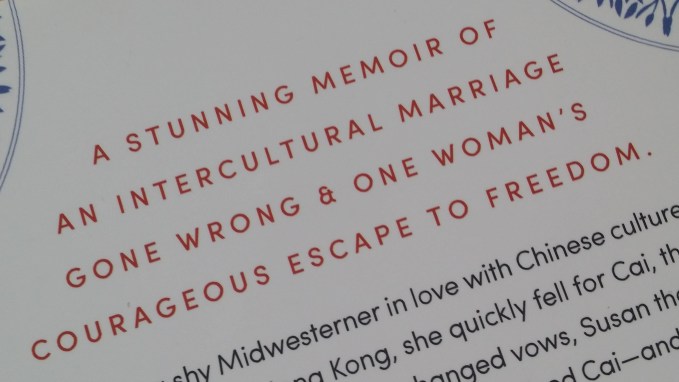
So, I understood Cai. And, being head-over-heels ever since they’d met, why Susan quickly accepted his proposal, before so much as a kiss—it sounded sweet. Her frankness about her feelings and mistakes is also a definite charm, especially for someone who likewise fell very easily in love at that age.

But that’s only 36 pages into the book. For the remaining 300, sympathy turns to constant frustration and exasperation with Susan’s rushing into marriage, then her frequent acquiescence towards her increasingly controlling and abusive husband. These feelings are only amplified by knowing that she’s doomed to fail.

In an interview, Susan says her problems were more because “He told me from the get-go that he had certain conditions for our marriage. Those are things I ignored or thought I could eventually get him to change. That should have been my red flag, not the [6 months] in which we became engaged and married.” (Likewise many happily-married Koreans, for whom such whirlwind courtships are also common, would surely bristle at the suggestion that they should have taken things slower.)

I disagree. From Cai’s belief that women are especially “dirty” in the summer, once all but physically forcing an exhausted Susan to bathe in a rat-infested bathroom, to his bizarre, surprisingly submissive relationship with eccentric professor friend ‘Japanese Father’ (“He thinks it’s not good [for us] to have sex relations more than once a week”), most of Susan’s later issues with Cai could have been discovered if they’d spent (much) more time together before the wedding day—and/or resolved if an expensive wedding wasn’t already looming over them.

Still, it does make for a good page turner. There is also merit in studying a bad relationship to learn what to avoid, and much about this one that will already be familiar to those with Korean, Japanese, and Taiwanese partners. New and expecting parents in Korea, for example, will sympathize with Susan’s expectations to conform to man yue, the belief that mothers shouldn’t bathe or go outdoors in their first month—it mirrors the Korean one of sanhoojori. Also, for those couples planning to move to a Western country, her discussion of Cai’s difficulties with adjusting to life in San Francisco will be very beneficial. Her avoidance of tiresome Orientalist stereotypes is especially welcome, with her ex-parents-in-law coming across as old-fashioned but lovely, and Chinese men portrayed no better or worse than Western ones.

That said, I am reminded of a book for couples I once flicked through, which encouraged them to discuss their expectations of marriage in great detail before committing. With checklists ranging from beliefs about circumcision and determining which cities were best for both partners’ careers, to dividing the housework and setting dating policies for potential teenage children, that approach would be much too calculating for most couples. Marriage, after all, is ultimately about making a scary but exciting leap of faith with someone. But when partners come from such wildly different backgrounds, and bring such different expectations into marriage? Susan’s experience teaches readers that for international couples in particular, perhaps they really should learn the answers to those questions sooner rather than later.

Good Chinese Wife back cover

One minor quibble was all the hyperbole. Not to diminish Susan’s genuine fears for herself and her son at times, but did it lead me to expect a story involving forged passports and bribed border guards(!). Also, I disliked the format of numerous short chapters, with so little happening in some that they felt like diary entries. But that is just a personal preference.

The verdict? Good Chinese Wife is well worth the US$14.99 cover price (16,410 won at What the Book), and a definite eye-opener about the value of reading more about relationships in this part of the world, especially with such limited options for reading about Korean ones specifically. Please do leave your suggestions (and reviewer copies!) for more like it, and/or for blogs.

A Heart-warming Korean Video

Via Korean friends, comes this hilarious call between a drunk guy and a woman working the phones for a “replacement-driver” company. He starts swearing at her from the get-go, but she, clearly used to this sort of thing, soon puts him in his place.

Frankly, it gives me a warm glow about living in Korea. The expats among you will surely understand.

Sorry that I won’t provide a translation this time (“You fucking crazy bitch!”, “What, that again? You only know two swear words??”), but if you speak just a little Korean you’ll get the gist, and every native speaker I’ve shown this to has been in tears. To every Korean-language teacher out there, may I humbly suggest incorporating this into your classes somehow, rather than yet another lecture about the joys of making kimchee…

Korean Women’s Sexual Histories: Still a slippery subject

Durex Korea Condom Ad December 2013(Source)

Remember last summer, when Korea’s first condom commercials came out?

Showing a woman bringing condoms to a date, I hailed Durex Korea for challenging popular, slut-shaming attitudes that women must feign sexual inexperience and naivety with new partners, with contraception widely considered only men’s responsibility.

But those would be the last condoms to grace Korean TV screens, by any company. Add Durex Korea’s recent, asinine marketing attempts, and that its Facebook page looks like it belongs to a lads’ mag, then the cynic in me lamented that last year’s efforts weren’t so much the start of a progressive, feminist campaign as simple, one-off copies of the original.

Then I discovered that there had been a similar, OMG-girls-like-sex-too commercial back in December, which played on various cable channels after 10pm:

Durex Korea Condom Ad December 2013 screenshotSounds awesome, right? Even if it was just a copy again.

My hopes raised, I began looking for more information, but was soon frustrated by the lack of mention on Durex Korea’s website, Facebook page, Twitter feed, and blog. What’s more, there proved to be only one low-res, IE-only version of it that is publicly available. (Another requires a paid subscription to this site.)

I began to suspect that some unspecified controversy spilling over from last year’s June commercials may have been responsible, as those videos are also no longer available on its FB page (although the posts are). But probably that’s just simple neglect; with a Facebook page, Twitter, and blog myself, I can confirm that it’s difficult finding the time or inclination to fix broken links in old, rarely-read posts. Better to create new content, and accordingly Korean companies rarely keep old ads on their websites, preferring that consumers focus on their recent most ones instead. Sure enough, Durex Korea’s reply to my tweet made me realize that it was actually private Youtube users that were originally responsible for (re)uploading and sharing their June commercials, without whom they too wouldn’t be publicly available today.

I guess the December commercial just wasn’t all that popular really—there was never any great patriarchal conspiracy to have it removed. But, popular or not, it shouldn’t have been such a struggle to find more information—any information—about a (relatively) groundbreaking campaign, let alone from the company responsible. So, again, I have to conclude that Durex Korea was never making any real effort to engage with female consumers and challenge double-standards. Sigh.

This summer then, it’s probably T-ara member Eun-jung’s recentconfession” to—shock! horror!—past sexual relationships that is most likely to have an impact on how the public views or discusses theirs. Or, alternatively, the news that matchmaking companies no longer assume that their female clients will pretend to be virgins before marriage…

Korean Couple Under the Co vers(Source)

That’s the takeaway message from this survey by two matchmaking companies, currently making the rounds of the Korean portals. Ostensibly, its message is actually that Korean women let men take the initiative when it comes to sexual relationships, and that previous experience with one partner makes a significant number of women—not men—much “more cautious” with their subsequent ones. Which does appear to confirm previous, more rigorous surveys, and hence the context about double-standards provided in the first half of this post.

But with no mention of the methodology, what exactly “more cautious” (etc.) means, and likely a self-selecting sample population? Then really, it confirms nothing at all. Please make of it what you will:

미혼女 34%, 애인과의 첫 성관계는 ‘술김에…’ 34% of unmarried woman need alcohol for their first time with a lover

이낙규 기자 (nak17@ajunews.com) 26.06.14

성(性)에 대한 의식이 개방적으로 바뀌고 있지만 미혼여성들은 아직도 10명 중 6명 이상이 애인과 첫 관계를 가질 때 술의 힘을 빌린다던가 억지로 끌려가는 듯한 수동적 자세인 반면, 남성은 10명 중 7명 정도가 성관계를 주도하거나 적극적인 자세로 임하는 것으로 나타났다.

Awareness of and attitudes towards sex are changing these days, [but still traditional gender roles remain]. With a new lover, six out of ten women admit that they take advantage of alcohol to overcome their shyness or reluctance when having sex for the first time, and/or passively accept it when their partner is insistent, whereas seven out of ten men believe they have to take the initiative and assume an active role.

결혼정보회사 비에나래가 결혼정보업체 온리-유와 공동으로 미혼남녀 544명을 대상으로 ‘애인과 첫 성관계를 가질 때 본인의 자세’에 대한 설문조사를 실시했다.

Marriage matchmaking companies Bien Aller and Only You surveyed 544 male and female customers, asking them about their thoughts and feelings the first time they had sex with previous partners.

그결과 남성과 여성의 반응이 판이하게 달랐는데, 남성은 37.1%가 ‘주도적’, 33.5%는 ‘적극적’으로 답해 나란히 1, 2위를 차지했다. 즉 70.6%가 능동적이라는 것을 알 수 있다.

Men and women differed quite widely in their replies. Out of the men, 37.1% said they took the lead, and 33.5% that they were active in initiating sex, the top two replies. Altogether, 70.6% said they took an active role.

Wait, I'm beginning to feel something(Source)

반면 여성은 34.2%가 ‘술의 힘을 빌린다’, 28.3%는 ‘억지로 끌려가듯 (응한다)’이라고 답해 상위 1, 2위에 올랐다. 성관계를 거부하지는 않지만 수동적인 자세가 62.5%이다.

In contrast, 34.2% of women said they need alcohol [to get over their shyness or reluctance], and 28.3% that their partner insisted, the top two replies. Altogether, 62.5% said they weren’t against a sexual relationship, but they assumed a passive role.

그 다음 세 번째로는 남녀 공히 4명 중 한 명꼴이 ‘자연스럽게 임한다'(남 26.1%, 여 24.6%)고 답했다.

With both men (26.1%) and women (24.6%), the third most common reply was that they “just behaved naturally.”

‘성 경험이 있는 상황에서 다른 애인과 성관계를 가질 때의 마음 상태’에 대해서도 남녀 간에 시각차를 보였다.

With the question of how previous their sexual experience impacted their feelings about sex with a new boyfriend or girlfriend, a big difference was visible in the replies from men and women.

남성은 ‘(마음이) 더 편해진다’가 54.7%로서 과반수를 차지했고, ‘변함없다'(33.5%)에 이어 ‘더 신중해 진다'(12.8%)가 뒤따랐으나, 여성은 ‘마음이 더 편해진다'(42.7%)는 대답이 가장 많기는 하나, 그 다음의 ‘더 신중해진다'(39.7%)와 큰 차이가 없었고(3.0%포인트), ‘변함없다’는 대답은 17.6%였다.

With men, more than half (54.7%) replied it would make them feel more comfortable; 33.5%, no change; and 12.6% that it would make them more cautious. While “more comfortable” was also 고준희 정진운the most popular reply with women (42.7%), 39.7% replied that it would make them more cautious, a gap of only 3%; 17.6% replied that it wouldn’t make any difference.

자세한 응답분포를 보면 남성은 ‘다소 편해진다'(37.5%) – ‘변함없다'(33.5%) – ‘훨씬 더 편해진다'(16.2%) – ‘다소 신중해진다'(12.8%) 등의 순이고, 여성은 ‘다소 편해진다'(31.3%) – ‘다소 신중해진다'(29.4%) – ‘변함없다'(17.6%) – ‘(훨씬 더 편해진다'(11.4%) – ‘훨씬 더 신중해 진다'(10.3%)의 순서이다 (source, right).

In detail, 37.5% of men replied that it would make them a little more comfortable; 33.5% no change; 16.2% a lot more comfortable; and 12.8% that it would make them a little more cautious. With women, 31.3% replied that it would make them a little more comfortable; 29.4% a little more cautious; 17.6%, no change; 11.4% a lot more comfortable; and 10.3% a lot more cautious. (END)

Thoughts?

Operation Beautiful: An Interview with Korean Body Image Activist Min-ji Kim

Minji Kim Busan HapsRemember this immensely popular guest post from last year? Click on the image for my interview of its hardworking and inspiring author, body-image activist Min-ji Kim. Frankly, it’s well overdue!