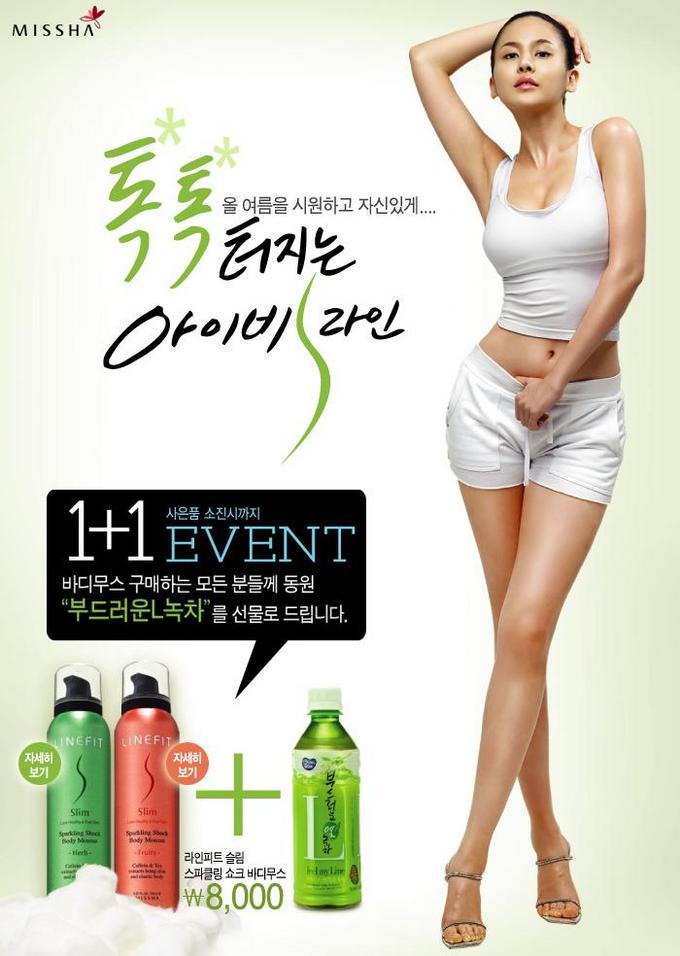
See here for the details. Alas, it’s not being given by me, but by Dr. Stephen Epstein, my far more capable and entertaining co-author (of this book chapter of the same name).
Unfortunately, work commitments mean I’ll be unable to attend personally. But if you’re in Seoul and free on Tuesday night yourself, then make sure you do!
Update: See here for a follow-up post at Gusts of Popular Feeling.
For readers’ sakes, wisely I’ve tended to avoid discussing my tastes in women’s body types on this blog. And don’t worry: I’m not going to start now.
But probably I’m deluding myself in thinking that they’re not already obvious from the images I use. Also, surely my occasional posts about hourglass figures are a dead giveaway. After all, why else would I argue that they’re universally-attractive, if not to feel smug about my own preferences?
Seriously though, while I do think there is solid evidence for that universal attraction, I’m always open to debating it, and would be the first to admit that such evidence is often misrepresented in the media. In turn, when it lacks any caveats and qualifications, at the very least it doesn’t challenge the public’s preexisting beliefs about body types. Say, those held by people in the fashion and clothing industries particularly, whose usual fashion advice for women with different body types is:
…”almost always aimed at getting women’s bodies, whatever shape they might be, to conform with the [ideal (skinny) hourglass figure]. The advice video below, sent in by Tara C. and aimed at women with “pear-shaped” bodies, does exactly this:
See Sociological Images for excerpts and commentary. And indeed, one additional way in which women are subtly(?) reminded that the hourglass figure is an ideal to be conformed to, is by altering the shape of the bottles of drinks aimed at them:
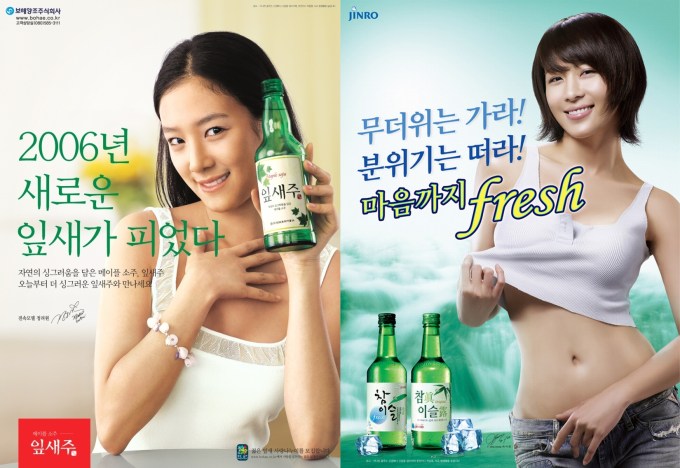
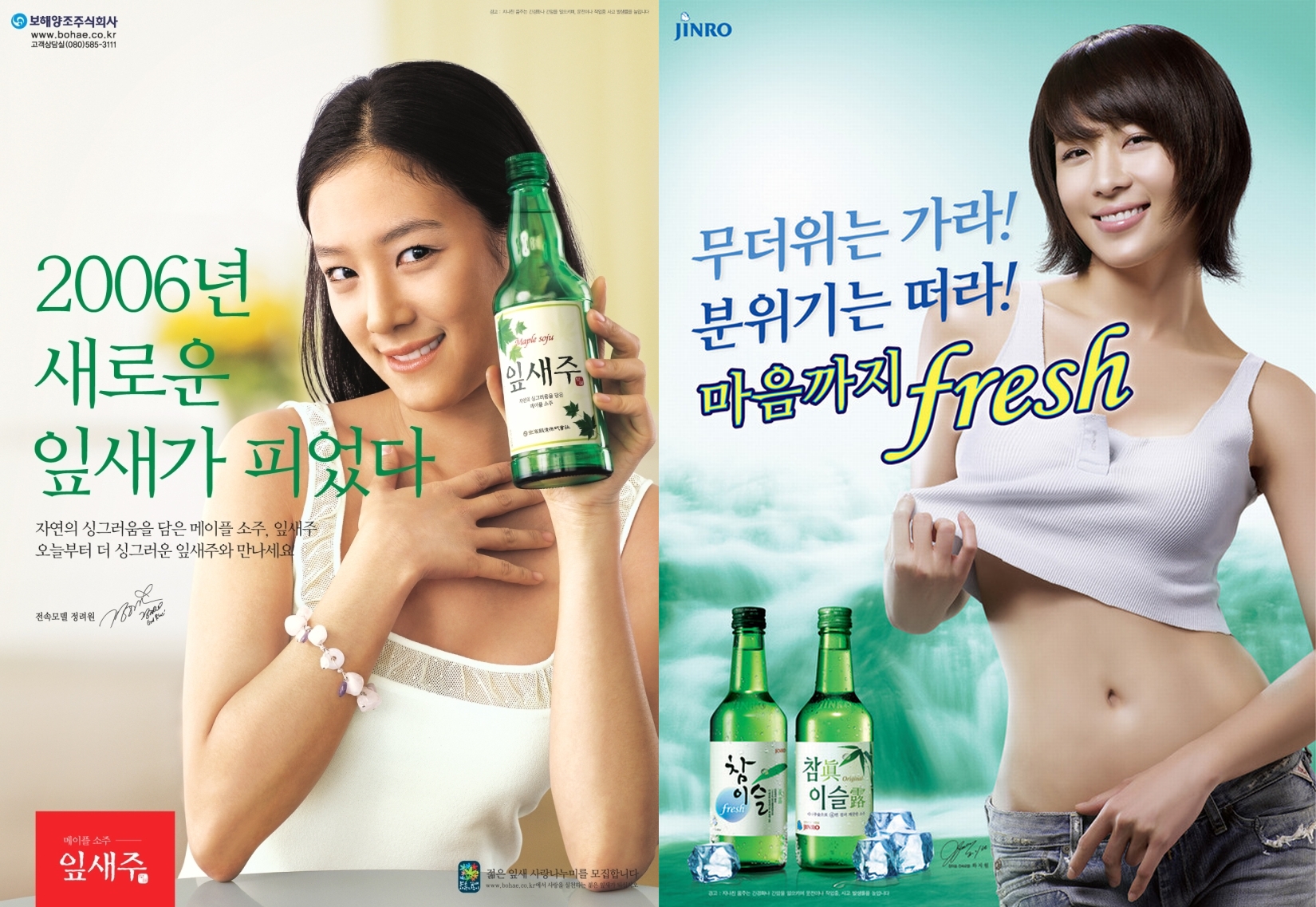
You’d think I would have noticed years ago, but then I’m afraid I don’t buy them. As for not noticing it in their advertisements however, I confess that possibly I was simply too fixated on the accompanying models’ navels to ever pay attention.
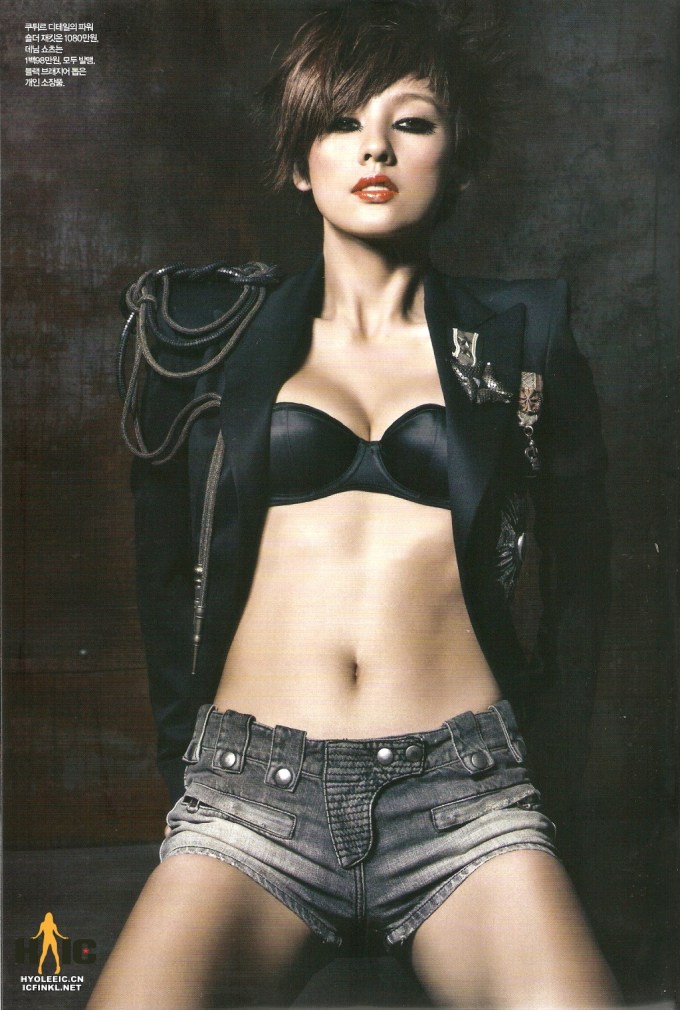
Apologies if that makes me sound crass. But unlike with Shin-se kyung (신세경) above, for some reason it genuinely took the less exposed example of f(x)’s Victoria (빅토리아) below for me to see the hourglass packaging for the first time:
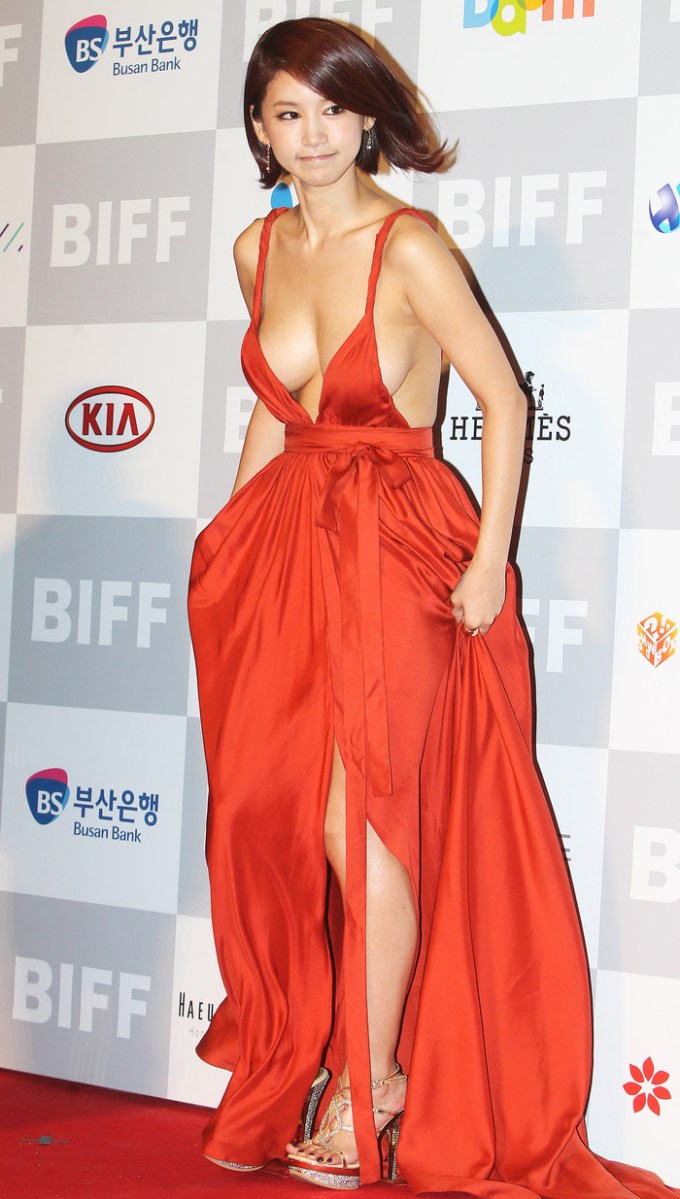
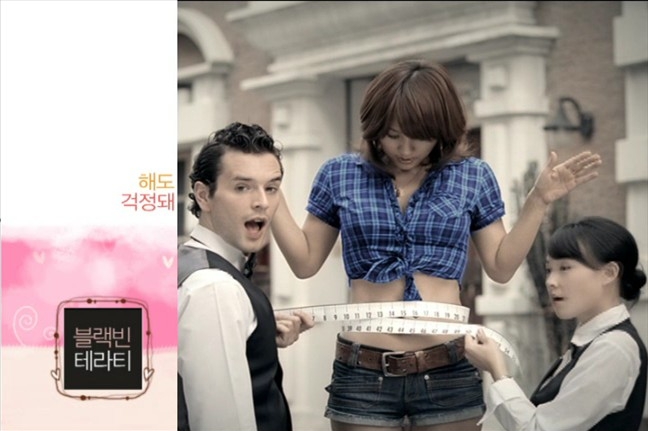
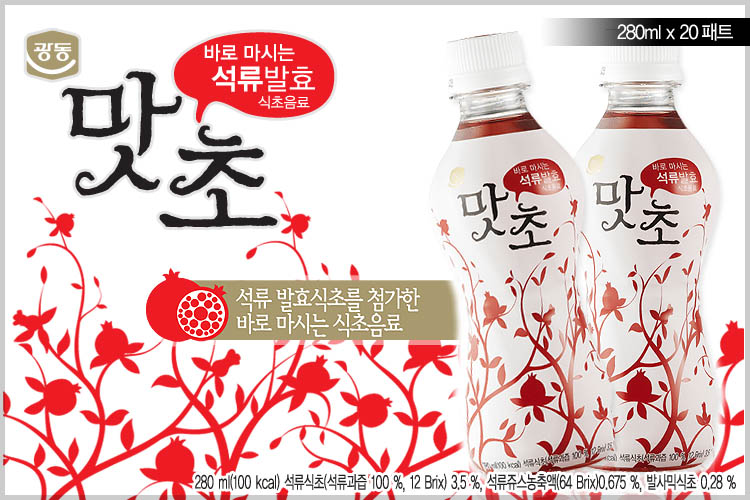
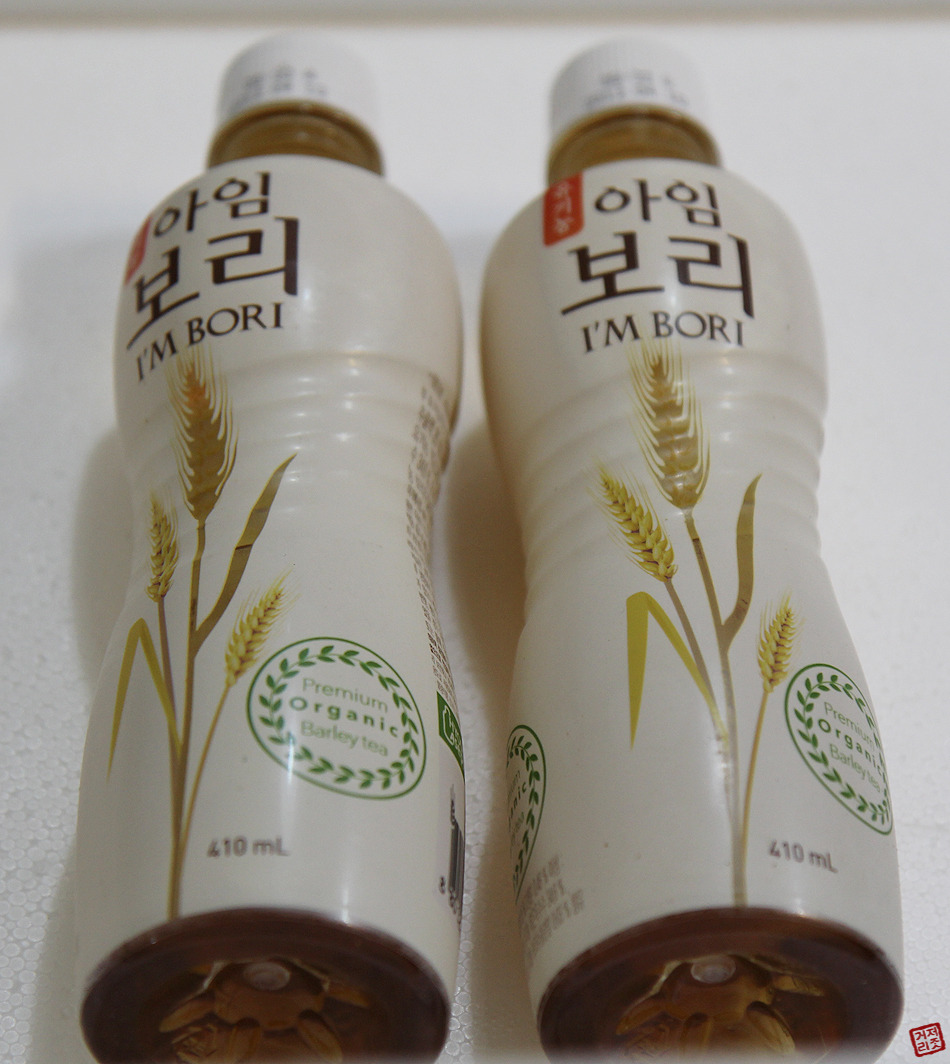
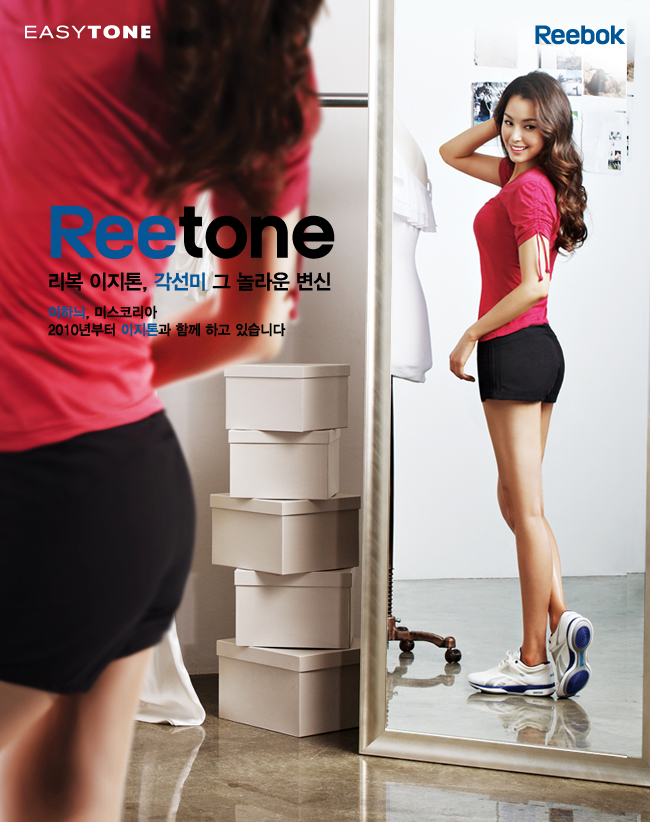
Yet once I did, then suddenly I realized that you saw it on a lot of drinks aimed at women, whether explicitly “diet” ones or otherwise. In addition to the “G2” and the grape juice for instance, to the right of Victoria there’s the “Black Bean Thera Tea” endorsed by Lee Hyori (이효리) in the opening image (discussed in detail here). Then below those: “Matcho”, “I’m Bori”, and finally “Today’s Tea”, discussed way back in Korean Sociological Image #2.


And I could certainly go on. But on the other hand, I don’t want to exaggerate the extent of the trend either.
For starters, by no means are all or even most drinks aimed at women hourglass-shaped, and indeed in this image of the drinks section of what looks like a small supermarket, actually only those aimed at children have anything that even remotely resembles an hourglass shape. Also, there is possibly just as strong or even stronger a trend to make women’s drink bottles skinny rather than any specific shape, as explained here. Finally, making bottles more masculine-shaped may make them quite impractical to hold,* whereas hourglass shapes lend themselves to it.
Given the context of how deeply gendered drink marketing is though, then I’m not entirely convinced that practical considerations provide sufficient explanation for the gender imbalance in those drinks that do have “body shaped” bottles. It seems entirely possible, for instance, to add the contours of a six-pack to drink bottles aimed at men. Yet even in the unlikely event that readers have actually come across that(?), or something like it, it would still be the exception that proves the rule.
But whatever the reasons, and whether it’s a skinny or hourglass bottle (or, indeed, a skinny hourglass bottle!), it’s definitely yet another way in which advertisers try to subtly influence our body type ideals.
Something to bear in mind next time you find yourself in the drinks section!
*It’s only tangentially related, but you may find it interesting. Back when I was doing freshman calculus (yes, I was an astronomy major before I switched to East Asian Studies), once we looked at the the problem of what shape of Coke can would use the least amount of aluminum for the greatest volume of Coke contained, which – if I remember correctly – turned out to be a can the same diameter as its height. As the lecturer explained though, cans the shape of toilet rolls don’t exactly look cool, let alone fit in the hand well!
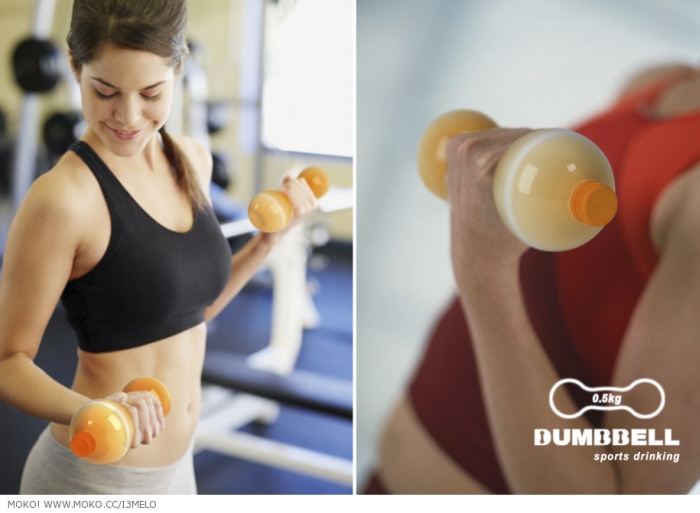
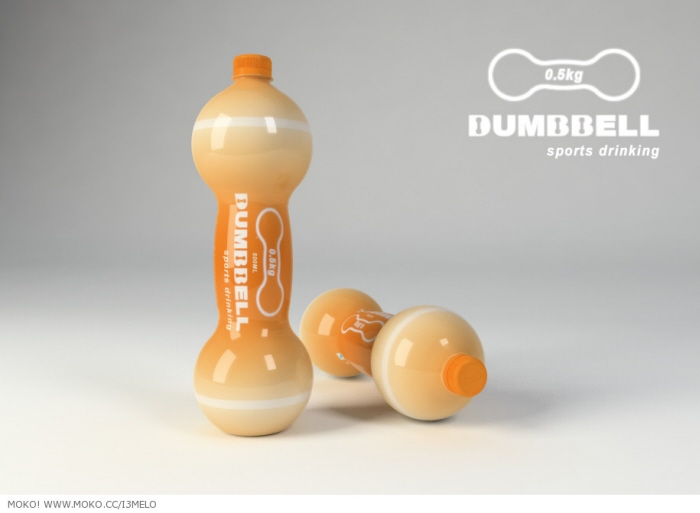
Update: Gotta love this alternative design by Chinese designer Le Jin!
“Speed”, as the New York Timesrecently intoned, is an “obsession” of Koreans. It’s a cliche, like most labels the foreign media applies to them, but it’s one of the few I’d generally agree with.
Another is that they’re hardworking. While they don’t work quite as many hours as foreign observers tend to think, nobody can deny that they’re always prepared to roll their sleeves up when the boss demands it.
Perhaps then, their boss should consider reviving the 1980s custom of having employees doing traditional national gymnastics together (googminchaejo; 국민체조) before the start of work? For when it comes to losing weight by themselves, Koreans’ obsession with speed easily trumps the resolve they have when they’re on the job.
In short, Korea is simply bursting at the seams with ads promising quick fixes.
To be fair though, I haven’t lived outside of Korea for 11 years, so I can’t reliably claim there’s any more of them here than in, say, the US. The one study I’m aware of that did compare diet ads in both countries however, found that US ones tended to promote more active ways of losing weight, whereas Korean ones tended to promote the idea that if one simply ate, drank, applied, or even sat on the advertised product or service, then that perfect body was simply guaranteed.
That isn’t mere hyperbole. Technically neither foods nor medicines, dieting-related products are a little-regulated, legal gray area in Korea, essentially allowing manufacturers to pretty much make up any claims about them that they like.
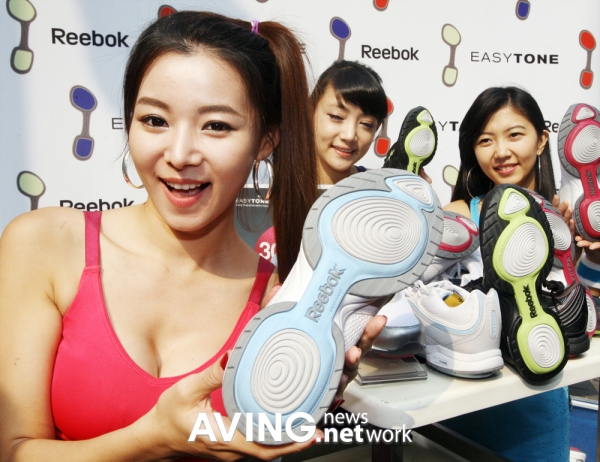
It is no wonder then, that Koreans consume them in droves. And I can empathize: once a former gym addict concerned with bulking up, ironically now I have a good 10kg to lose. But with two children, I lack the time, energy, and enthusiasm I had for exercising in my twenties. If only I could just drink something like “Fat-Down” instead, or even this beer (well, actually I have started drinking that). Or sit in this special seat all day. Or use this when I shower. Or, indeed, wear shoes that automatically toned my fat ass just by my walking to and from the subway station each day…
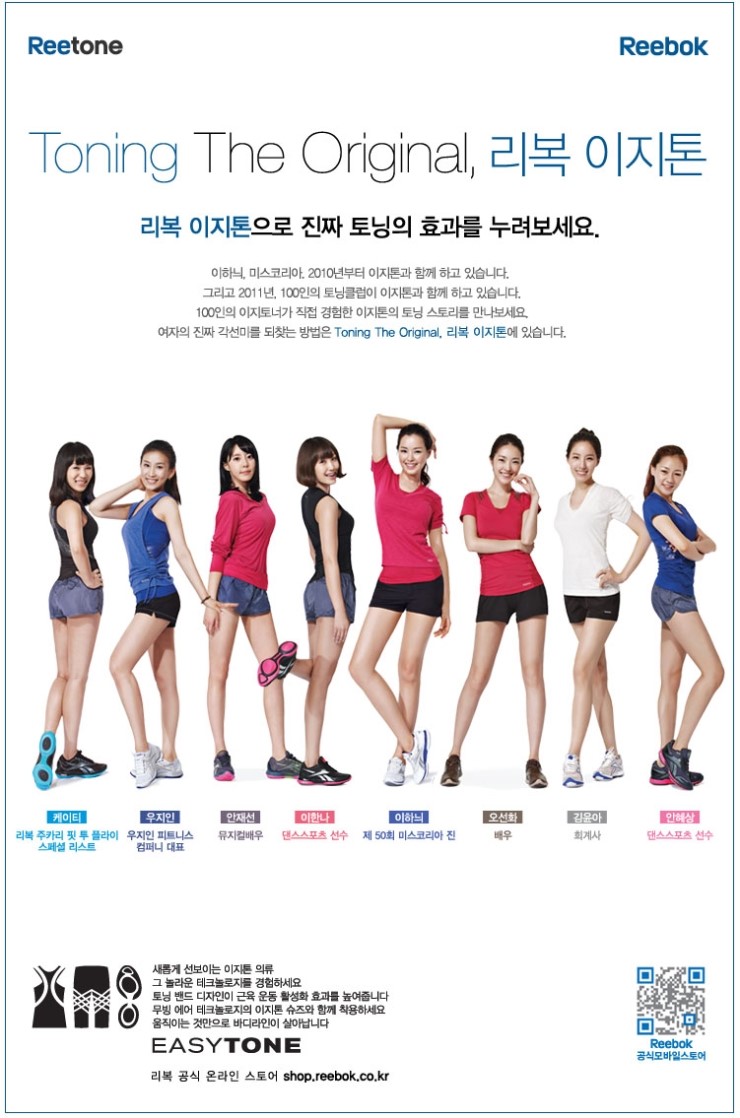
Alas, the online Reebok store lists only 5 male versions to 47 female ones, and they’re all a little pricey for me. Perhaps, just like Coke Zero (which has replaced Pepsi in my Black Russians) was so named because men associate the word “diet” with women too much, the disparity is because Reebok felt that men would ultimately reject the idea. And who can blame them? For as just those examples above (and especiallytheseones) demonstrate, all aimed at women, to say that US advertisements tend to promote active methods of losing weight, Koreans passive ones, is a little simplistic. Instead, it would be much more accurate to say that in both countries, it’s the active methods that get promoted to men, the passive ones to women.
Despite half the population not buying them though, toning shoes are the fastest growing shoe market in Korea at the moment, with ReeTones alone making up half of Reebok’s total sales.
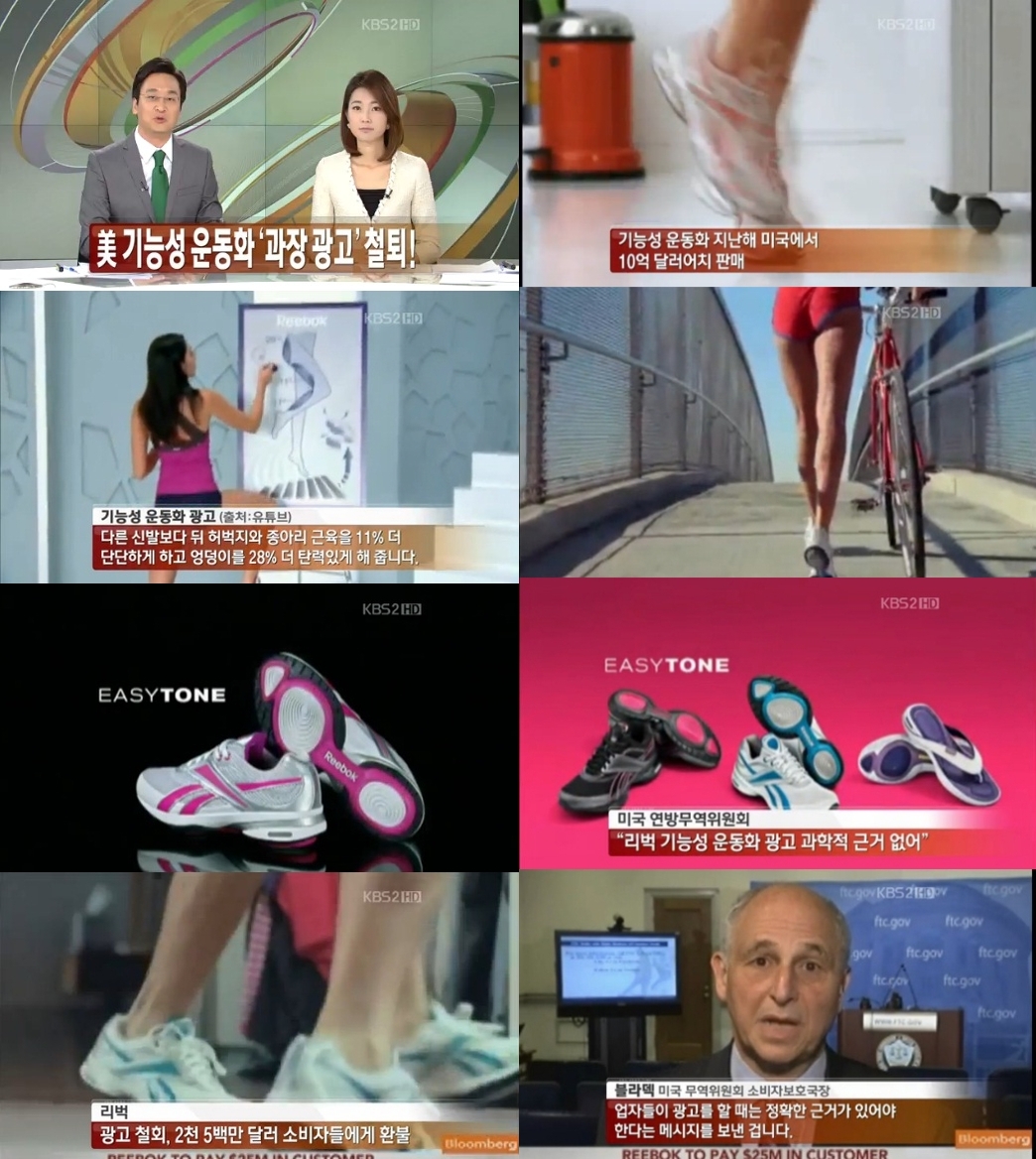
It was with great interest then, that I recently read that the US Federal Trade Commission (FTC) had ordered Reebok to refund 25 million dollars to (gullible) US purchasers of its EasyTone (이지톤) sneakers, finding that its notorious assvertising claims were nothing more than hot air. Would Reebok Korea also be providing refunds? What about other Korean companies offering similar products? Would this be a wake-up call for Korean consumers? What do they think about the news? Read on to find out.
First, from Money Today (머니토다에), taking up from when it starts talking about the effect on Korea:
우리나라에서도 리복은 지난 5월 이지톤 토닝화의 몸매 보정 효과를 대대적으로 홍보하며 판매에 들어갔다. 때문에 업계에서는 공정거래위원회가 어떤 조치를 취할지 주목하고 있다.
In Korea too, there has been an immense marketing drive for EasyTone shoes since May, so the industry has taken a great deal of interest in what measures the FTC would enact.
국내시장에서는 리복 뿐 아니라 뉴발란스, 르까프, 스케쳐스, 휠라, 머렐 등에서 몸매 보정기능을 강조한 토닝화를 시판중이며 시장도 매년 급성장 중이다. 업계 추산에 따르면 국내 신발시장의 전체 규모는 약 4조원. 그중 워킹화와 토닝화 시장 규모는 연간 6000억~7000억원, 브랜드만 총 20여 개다. 매년 40~50%대의 폭발적인 성장세를 보이고 있다.
In the domestic market, it is not just Reebok that sells toning shoes, but also New Balance, Sketchers, Fila, and Merrel, and this market is rapidly growing. According to industry estimates, the size of the entire Korean shoe market is 4 trillion won (US$3.37 billion), of which walking shoes and toning shoes make up 6-7 billion won. More than 20 brands sell them, and each year the market for them has seen explosive growth of 40-50%.
업계 관계자는 “걷기열풍과 함께 워킹화와 토닝화 수요가 2~3년 전부터 급격히 증가하기 시작했다”며 “최근 들어 기능성 운동화는 브랜드별 전체 신발 매출의 70% 이상을 차지할 정도로 잘 나간다”라고 말했다. 그는 이어 “그간 업체들의 광고가 국내 소비자들의 구매의욕을 자극해왔기 때문에 이번 미국 공정위의 조치는 국내시장에도 상당한 영향을 미칠 것”이라고 내다봤다.
An industry insider said “With the new walking craze, the demand for walking and toning shoes started dramatically increasing from 2 to 3 years ago”, and that “these days, sales of ‘functional shoes’ make up over 70% of the total sales of those companies that sell them”. Accordingly, “because [Korean] shoe advertisements [likewise] stimulate Korean consumers’ desire to purchase them, the FTC’s decision is expected to have a considerable effect [on the Korean market]”.
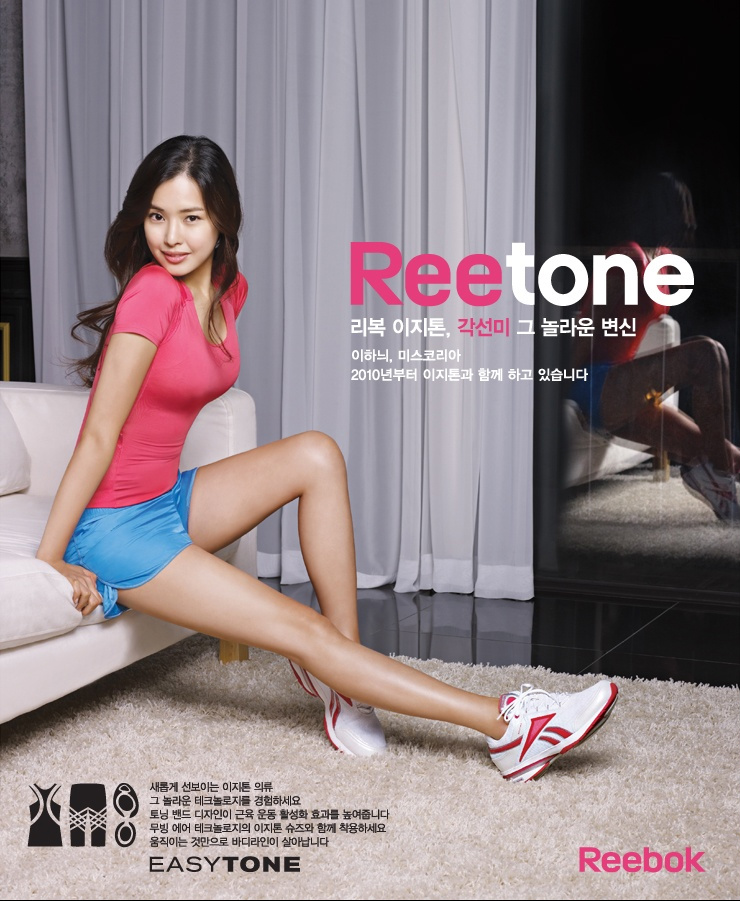
리복 코리아는 미국에서 문제가 된 광고를 그대로 가져와 쓰지는 않았으나 토닝화의 몸매 보정 효과를 홍보해왔기 때문에 국내 광고도 논란이 일 것으로 예상된다. 리복 코리아는 미스코리아 출신 이하늬씨를 광고모델로 기용하고 “움직이는 것만으로 바디라인이 살아납니다”라는 홍보문구를 내걸며 몸매 보정 효과를 강조해왔다.
While the problematic US advertisements were not used in Korea, as the marketing here has likewise emphasized the toning effects of the shoes, Reebok Korea is expected to come under a lot of criticism. [Specifically], Rebook Korea hired former Miss Korea (2006) Lee Ha-nui to emphasize their [claimed] toning effects, using the catchphrase “Just by moving, you’ll get a bodyline”.
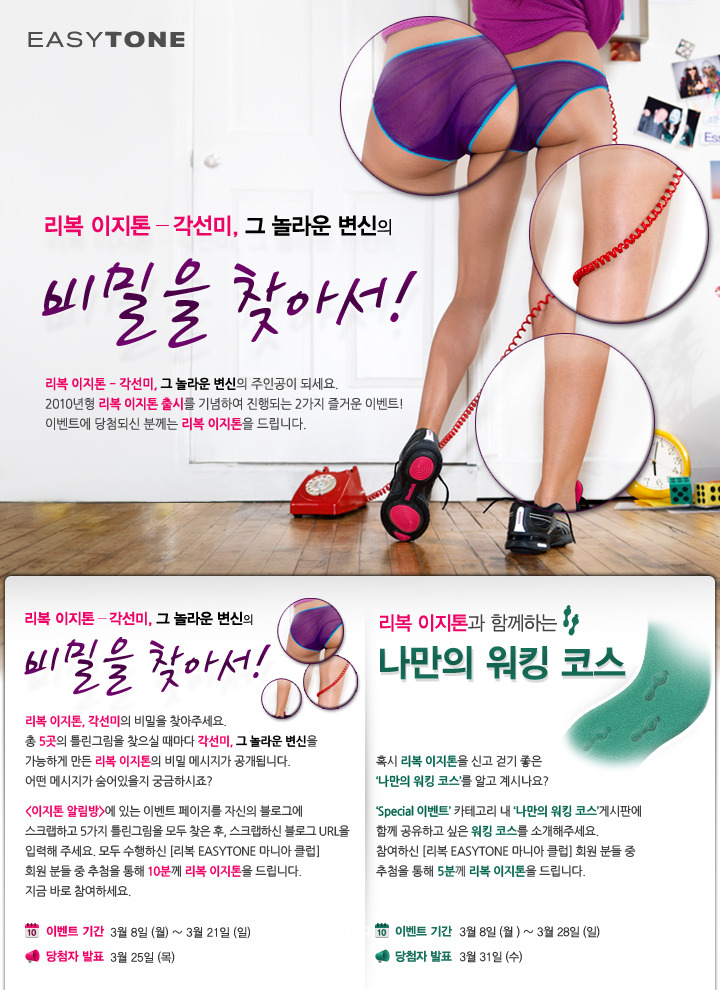
(James – I’m not so sure that the US advertisements weren’t used in Korea. Not only were untranslated versions widely available on the Korean internet from the outset, but many – like the example below – were indeed translated [albeit not literally: “S-line” isn’t English], including the notorious one of a [faceless] women’s breasts griping about all the attention her newly toned buttocks were getting)
국내에서는 2~3년 전부터 걷기 열풍이 불면서 리복, 프로스펙스, 뉴발란스, 르까프, 휠라 등이 기능성 신발을 내놨다. 이 시장은 2005년 500억원에서 지난해 6000억원(삼성경제연구소 추정치)으로 5년 만에 10배 이상 커졌다. 이 가운데 대표적인 기능성 신발이 토닝화다. 토닝화는 올들어 워킹화와 러닝화에 밀리기는 했지만 기능화 시장의 성장을 주도했다.
As a walking craze has developed over the last 2-3 years, a number of companies have started producing functional shoes, including Reebok, Prospecs, New Balance, LeCaf, and Fila. According to estimates by the Samsung Economic Research Institute (SERI), the market has grown from 50 billion won in 2005 to 600 billion won in 2010, more than a ten-fold increase in only 5 years.
Of these functional shoes, toning shoes are representative [most popular?], their sales still trailing those of walking and running shoes but leading the growth of the functional shoe market.
국내 한 백화점에서 12만9000~16만9000원에 팔리고 있는 리복 이지톤 시리즈는 지난해 리복 매출의 50%를 차지했다. 리복의 과장광고가 미국 당국의 제재를 받았다는 사실이 알려진 뒤 온라인상에서는 “미국에서 허위광고로 거액을 물게 됐다는데 국내에서는 환불을 해주지 않느냐”는 소비자들의 주문이 이어지고 있다. 리복 코리아 측은 국내 광고 중단이나 환불에 대한 공식 입장을 내놓지 않은 채 “아직 내부적으로 대응방안을 논의하는 중”이라고만 밝혔다. 미국의 유명한 기능화인 스케쳐스도 FTC 조사를 받고 있는 것으로 알려졌다.
In Korean department stores, EasyTone sell for between 129,000 and 169,000 won, and last year made up 50% of Reebok’s total sales. Online, Korean consumers have been asking “In America, Reebok had to pay back a lot of money for its false advertising. Will we receive refunds too?”. But as of yet, Reebok Korea has made no official announcement as to whether its Korean advertisements will be suspended, other than to say “We are still formulating a plan on how to deal with this domestically”.
[Meanwhile], in the US the FTC is also investigating the famous functional shoe manufacturer Sketchers.
스케쳐스 국내 판매업체인 LS네트웍스 관계자는 “미국 스케쳐스에 대한 FTC 조사는 아직 진행 중인 것으로 알고 있다”며 “올해부터 본사 차원에서 토닝화보다는 워킹·러닝 겸용화를 주력 상품으로 밀고 있다”고 말했다.
Sketchers are sold in Korea via LS Networks. A person in the industry said they were aware of the FTC investigation, and that “from last year, Sketchers head office has focused its efforts more on combination walking and running shoes than on toning shoes”.
리복은 지금 한국에서도 몸매 보정 효과를 스타를 앞세워 홍보하며 판매에 들어갔기 때문에 공정거래위원회가 소비자 보호를 위해서 미국처럼 어떤 조치를 취할 지 궁금해지네요. 지금 엄청 잘 팔리고 있잖아요.
Because of exaggerated advertisements, Rebook has had to refund 30 billion won in Korean money, and suspend such advertisements for them. Look at the CBS report below [available on the blog], LOL. The expensive price of the shoes was unnecessary. Um…
In Korea too, because Reebok has used stars to wax lyrical about the toning effects of the shoes, I wonder what measures will be taken here. They’ve been selling unbelievably well these days.
사실 리복 뿐인가요?
벌써 여러 브랜드에서 난리가 났죠. 이런 토닝화는 뉴 밸런스 및 스케처스, 아식스,프로스펙스 등 많은 업체에서 생산되고 있으며 켤레당 좀 비싼 편에 속하죠.
Is it just Reebok? No, already many brands are involved in the boom, like New Balance, Sketcher, Asics, Prospecs, and so on. All of their toning shoes are really expensive too, yes?
미국에서 는 FTC 발표에 대해서 뉴 밸런스는 아무 말도 없었고 논평 요청에 응하지 않았지만 스케처스는 지난 8월 미 증권관리위원회(SEC)에 대한 보고에서 FTC가 ‘쉐이크 업’ 등 자사 토닝화 광고를 조사하고 있다고 밝 혔다네요.
과학적 기능이 아주 조금 들어갔다가 뻥튀기고 되어 나온 걸까요?
저도 스케쳐스 이전 버젼이 있는 데요. 꽤 편하거든요. 어떤 효과가 있는 지는 아직도 못느끼고 있지만 ㅎㅎ :)
암튼 과대 광고로 돈 벌 생각만 한 기업주들은 이번에 제대로 사과하셔야 할 듯하네요. 소비자들도 너무 믿으면 안될 것 같아요.
In America, New Balance made no statement about the FTC’s decision, but Sketchers said that toning shoe advertisements were [already?] under investigation in the August report of the Securities and Exchange Commission (SEC), in a shake-up of the industry.
Have the scientific functions of the shoes been completely exaggerated?
I have an old version of Sketchers toning shoes. They’re actually really comfortable. [Although] I haven’t noticed any benefit from them yet… LOL :)
Anyway, if companies make exaggerated claims in ads, only thinking about making money, then they should properly apologize. And consumers shouldn’t be so gullible.
일단 돈 조금 더 벌려다가 기업 이미지 나빠지고 고객들에게 미움 받고 돈도 돌려줘야 할 판이 되어 버렸네요.
토닝화 중에서 리복이랑 아식스가 제일 이쁘던데,,,,,음…..그게 과학의 값이 아니라 스타 광고와 디자인 값이었나봐요. 일반 운동화와 별 차이가 없다면 가격을 더 내려야 할 듯…한국 리복은 여전히 광고하고 온라인 샵 할인판매 하던데요?
By the way, I heard a civil suit is in progress [in America?]. In Korea too, there will be many people planning to do the same…um…
For starters, the shoe companies were making a little more money, but are now getting a bad image and receiving a lot of hatred from consumers, so they have to pay the consumers back.
Out of toning shoes, I think Reebok’s and Asics’ are the prettiest…um…but I guess the high prices were not for anything scientific in them, but their star ads and their design. If there’s no difference with normal exercise shoes though, then their price should be lowered. How on Earth can Reebok Korea still have ads for them and sell them on their online shop?
앞으로~~~~
한국은 어찌 처리 하려나?? 궁금해집니다.
아식스스포츠, 리복, 나이키, 뉴발란스, 푸마, 프로스펙스, 르까프, 스케쳐스 등등 너무 많은 브랜드의 기능화들,,,,
소비자에게 양심을 지키고 있을 지 기대됩니다.
From now on…
What will happen in Korea? I’m curious.
Asics, Reebok, Nike, New Balance, Puma, Prospecs, LeCaf, Sketchers…there’s so many brands selling functional shoes…I look forward to them keeping their conscience towards consumers
환불 보상 TIP: 현재 리복 코리아는 말이 없지만 리복 본사 사이트에 가셔서 구입한 영수증 등의 자료를 영어로 문서화해서
구입을 증명할 경우 보상 받을 수 있다고 합니다. *^_^* 아래 동영상 < sbs 5분 경제 >맨 마지막부분에서 언급합니다.
동영상 03분 50초 정도 맞추세요.
“일단 우리 소비자들도 리복 본사 홈페이지에 들어가면, 인터넷을 통해서 환불 접수를 할 수 있습니다.
다만 영어로 구매를 증명해야하고, 또 번거로운 절차를 밟아야 하는데, 리복 코리아측.
소비자들의 궁금증에 대해서 제품을 판매할 때처럼 적극적으로 책임있는 답변 내놔야 하겠습니다.”
Here’s a tip for getting a refund: at the moment, Reebok Korea hasn’t said anything about it, but if you go the main [English] Reebok site, and convert your proof of purchase documents into English, then you can receive one. *^_^* See the “SBS 5 Minute Economy” news video here [like the last one, stubbornly resisting embedding or recording sorry!] at about 3:50 for more information. As it says:
“First, Korean consumers have to go to the English Reebok site [James – or via the FTC itself here]. From there, they can apply to receive a refund. However, this is a troubling and annoying procedure, as it has to be done entirely in English.
Producers that so aggressively sold such shoes, should be equally proactive and aggressive in fulfilling their responsibilities to consumers”. (end)
As I type this a week after the news first broke, unfortunately both the Korean media and consumers seem relatively aloof, with only a handful of stories about it, and fewer still going beyond simply stating the facts of the US case: those 3 above cover pretty much everything I’ve been able to find about the impact on Korea. While that was disheartening, I do think the FTC’s shake-up of the industry means toning shoes’ days are numbered. And that if manufacturers continue to pretend US rulings didn’t occur, then ultimately Korean consumers will express their displeasure with their wallets.
On the other hand, I also find the blogger’s (and SBS news reporters’) sentiments a little naive: with 2/3rds of EasyTones sold outside of the US (and I’d wager a good many of those in Korea), as explained in The Consumeristhere and here, then, ironically, Reebok may be just as concerned about the Korean government’s reaction as it was the FTC’s. In which case, it’s no wonder that Reebok Korea hasn’t even acknowledged the FTC ruling, and I certainly don’t expect them to do even that unless Korean consumers force them!
What do you think will happen next? Anybody have EasyTone shoes (hey, we’ve all bought stupid things!), or know somebody that does?
It’s a short article, with much that is already familiar to regular readers. But thanks to Grace Duggan of Bust Magazine for asking for my contribution, and I especially liked her insightful point about the artificial dichotomy the term imposes on young women. Indeed, if you extend it to behavior also, then that dichotomy pretty much describes the way they’re presented by the entire Korean media really:
Sexualizing young women for having childlike features sets off all kinds of alarms, regardless of whether or not they are over 18. The “bagel girl” label does more than infantilize women. It compartmentalizes them by applying two irreconcilable ideals: looking like a baby and a full-grown woman at the same time.
Read here for the rest, and here and here for some wider context. Also, here is my post about the “X-line” referred to in the article.
On a positive note, I was happy to read that actor and model Shin Se-kyung (신세경) at least rejects the term. But I’m not entirely convinced: just that single picture above, for instance, shows that she’s quite comfortable presenting herself as innocent-yet-sexy when it suits her. I’m unfamiliar with her career beyond noticing her numerous commercials and magazine photoshoots in passing though, so if people that do know her find that she’s, say, deliberately shedding her childlike image as she ages, then I’d be happy to change my mind!
I like to think that if I’d seen AKB48’s newest member Aimi Eguchi (江口 愛実) when she debuted, that I’d immediately have been able to tell that she was actually computer-generated. But I’m not so sure: whereas it’s pretty obvious in most of the shots here and here, I would never have noticed anything unusual about that ad above (all the members look quite fake!), nor that this and this picture weren’t of a real person.
It’s a little more obvious in the commercial itself though:
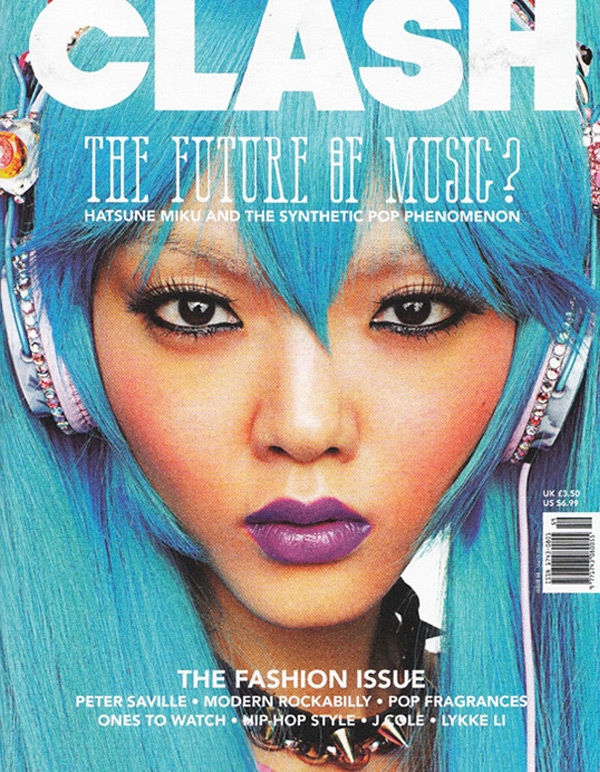
Thanks very much to @Septemberlena for letting me know about her. Unlike Hatsune Miku (初音ミク) that I wrote about two weeks ago, who very much resembles an anime character despite the impressive technology behind her, unfortunately such photorealistic idols clearly have a huge potential to insidiously affect teens’ body images. Especially when coming from a group as popular as ABK48.
This translation of part of this Korean article follows directly from Parts One, Two, Three, and Four. If you haven’t already, please read those first, as the author didn’t intend for any section to be a stand-alone post:
려한 조명과 환호 속의 착취 / Exploitation inside the bright lights and cheering
아이돌 시스템을 ‘착취’로 보는 데 모든 이가 동의하지는 않을 것이다. 이렇게 물을 사람도 있을 것이다. 고되고 불확실한 과정이라지만, 누가 강요한 것도 아니고 스스로 원해서 하는 일 아니냐고.
That the idol system is exploitative might not be a view that not everyone shares. There might also be people who ask this kind of question: though it is a difficult and uncertain process, isn’t it something they’re not forced to do and that they’re doing because they want to?
그렇다면 가혹한 입시제도도, 살인적 등록금도, 젊은이의 미래를 절망스럽게 만드는 비정규직도 별 문제가 아니다. 누가 대학 가라고, 누가 비정규직으로 일하라고 강요하던가. 선택이 제한된 사회에서 ‘자발적 선택’이란 얼마나 허망한 말인가. <한겨레신문>에 실린 한 아이돌 지망생의 말을 들어보자. 이 고등학생은 어렵사리 쌍꺼풀 수술을 한 후, 이제 코 성형을 목표로 편의점, 패스트푸드점, 주유소에서 아르바이트를 하고 있었다.
If so, then the rigorous university entrance exam system, murderous tuition fee, and the irregular work that fills a young person with despair aren’t really problems. Who forces them to go to university or do irregular work? In a society that has limited choices, how unreliable the expression ‘voluntary choice’ is! Let’s hear what one idol hopeful said, as reported in the Hankyoreh [newspaper]. After getting a double-eyelid surgery with [financial] difficulty, this high school student is now working part time at a convenience store, a fast food restaurant, and a gas station with the goal of getting nose surgery.
“어린 나이에 그토록 힘든 일을 감내해가며 연예인이 되고 싶은 이유가 뭐냐고, 이른바 ‘불공정 계약서’를 쓰고 젊음과 재능을 착취당하는 아이돌 얘기 못 들어봤느냐고 겁주는 소리를 했더니 그 친구가 말했다. ‘기자 언니, 솔직히 말해보세요. 나처럼 돈 없고 ‘빽’ 없고 성적도 그저 그런 애가 그럭저럭 대학 가면 그다음엔 뭐 있어요? 지금은 좀 힘들어도, 기획사에만 들어가면 나한테는 진짜 ‘기회’가 오는 거잖아요.” (<한겨레신문> “빽 없는 연예지망생 ‘성공시대’ 저무나” 2011. 6. 17)
“After I asked her scary things like what’s her reason for wanting to become a celebrity while enduring such difficulties at a young age, and hasn’t she heard of idols whose youth and talent were exploited after they signed so-called ‘unfair contracts,’ she answered me. ‘Reporter Onni, be honest. If a person like me, without money or connections, and whose grades are so-so, somehow goes to university, what is there after that? Even though it’s a little difficult now, you know that if I just get an agency, that is a real opportunity to me.'” (Hankyoreh, “End of the ‘Era of Success’ for would-be celebrities with no connections” June 17, 2011)
James – See “Teen Angst and the K-pop Machine” at SeoulBeats for more on the appeal of joining a talent agency
지난해 여성가족부는 청소년 연예인(지망생 포함)을 대상으로 설문조사를 했다. 그 결과를 보면, 미성년자 연예인들의 ‘자발적 선택’이 어떤 것인지 알 수 있다. 응답자의 36%가 하루 8시간 이상 초과근무를 하고, 41%가 야간과 휴일에도 일하고 있었다. 미성년자인 이들 중 10%가 신체 노출을 경험했다고 말했고, 그중 60%가 강요에 의해서라고 답했다.
Last year, the Ministry of Gender Equality and Family surveyed adolescent celebrities (including hopefuls). By looking at the results, we can see what kind of thing underage celebrities’ “voluntary choice” is. 36% of respondents worked more than 8 hours a day and 41% even worked on nights and weekends. Of these minors, 10% said they had experienced wearing revealing clothing, and of that group 60% answered that they did so under coercion.
앞의 <한겨레신문> 기사를 더 읽어 보면 이런 기회조차 평등하게 주어지지 않음을 알게 된다. “돈 없고 빽 없는” 아이들에게도 기회를 주는 듯했던 연예기획사들이 이제 돈과 배경을 갖춘 지망생을 선호하는 것이다.
If you read more of the Hankoryeh article mentioned above, you’ll learn that even this kind of opportunity is not given equally. Entertainment management agencies, which had seemed to give chances to children “without money or connections,” now choose hopefuls that combine money and background.
“‘형편이 어려운 아이들은 헝그리 정신 덕분에 빨리 성장하긴 하는데, 성공한 뒤에는 집안의 실질적 가장 노릇을 하기 때문에 계약서 관련 소송을 일으킬 확률이 높다’는 논리라고 한다. ‘반면 있는 집 아이들은 돈 문제에 민감하지 않고 ‘강남 키드’, ‘엄친아’ 이미지에 힘입어 광고계에서도 각광받는다’고 했다.”
“‘Though children in difficult circumstances develop quickly thanks to their hungry mentality, after succeeding, the chances of contract-related court cases arising is high, because they are effectively the heads of their household,’ is the reason a broadcast PD [Marilyn – I checked] gave. ‘On the other hand, children from homes that have money don’t care about money problems, and with their image as a “Kangnam kid” or “Mom’s friend’s son” [a perfect kid, to whom your mother is always unfavorably comparing you] they are in the spotlight in advertising too.’”
일부 아이돌 지망생이 일반인들은 상상하기 어려운 부를 얻는 것은 사실이다. 그렇다고 해서 아이돌 시스템이 정당화되는 것은 아니다. 이 체계는 피라미드 하층부 다수의 희생에 기초를 두고 있기 때문이다. 한국의 입시교육이 소수에게 혜택을 준다고 해서 절대 다수를 ‘들러리’로 희생시키는 행위가 정당화될 수 없듯 말이다.
It’s true that some idol-hopefuls make money that average people have difficulty imagining. That doesn’t mean that the idol system is justified. This is because it based on the sacrifices of the majority at the bottom of the pyramid. It is like how even though the Korean university entrance exam education benefits a minority, sacrificing the majority in supporting roles can never be justified.
당신이 아이돌의 팬이든 아니든 상관없다. 그들이 좇는 꿈이 칭찬할 만하다고 생각하면, 그 꿈이 행복한 결실을 맺도록 보살필 일이다. 만일 그 꿈이 철부지들의 몽상이라고 생각한다면, 입시와 오디션을 거치지 않아도 기쁘게 살 길을 마련해 주자. 그게 진정 ‘오빠’와 ‘누나’가 할 일이다.
It doesn’t matter if you are a fan of idols or not. If you think the dream that they are pursuing is worthy of praise, it is a matter of taking care of them so their dream has happy results. If you think that dream is a just a children’s fantasy, lets provide a way for them live joyfully even if they don’t pass the university entrance exam or audition. That is the duty of real “oppas” and “noonas.”
Image Caption 7: 아이돌 기획사는 창의적 재능을 갖춘 지망생을 원하지 않는다. 이상적인 후보는 정해 준 동작을 그대로 익혀 따르는 기계적 완벽성이다. 사진은 소녀시대의 ‘오!’ 뮤직비디오의 한 장면.
Image caption 7: Idol agencies don’t want hopefuls who possess creative talent. The ideal candidate is mechanical perfection at learning and copying the moves as they are given. In the picture, a scene from Girls Generation’s music video “Oh!”
(Thanks very much to Marilyn for translating Parts 4 and 5)
Update – See The Korea Herald for more on exploitation of minors in the Korean music industry.
Update 2 – The Marmot’s Holereports that “apparently there are hundreds of students from elementary to high school who are skipping class in favor of auditions in hopes of becoming a celebrity. National Assembly members are calling for measures that would ensure that these students receive the mandatory education like other students.”
This translation of part of this Korean article follows directly from Parts One, Two, and Three. If you haven’t already, please read those first, as the author didn’t intend for any section to be a stand-alone post:
아이돌: 꿈의비정규직? Idols: the irregularity [instability] of the dream?
오디션은 누구에게나 열린 평등한 기회가 아니다. 가장 중요한 것은 육체다. 기획된 노출 용도에 적합한, ‘규격’에 맞는 몸을 가져야 한다. 기획사는 창의적 재능을 갖춘 사람을 원하지 않는다. 가장 이상적인 자질은 기획사가 정한 동작을 완벽히, 기계적으로 따라하는 ‘길들이기 쉬운’ 신체다.
Auditions are not an equal opportunity open to everyone. The most important thing is [one’s] body. One must have a body that is suitable for the planned purpose of exposure and meets “the standard.” Agencies don’t want people who have creative abilities. The most ideal qualification is an “easy to tame” body that perfectly, mechanically copies the moves that the agency determines.
아이돌 지망생들은 1000대 1 가까운 경쟁을 뚫고 오디션을 통과해야 겨우 연습생 자격을 얻는다. 물론 다수가 교습소에서 춤과 동작을 배우고, 다이어트와 성형을 거치는 등 ‘선행 훈련’을 쌓는다. 그리고 이렇게 선발된 연습생 가운데 2~3%만이 그룹으로 활동할 기회를 얻는다.
Idol hopefuls have to beat nearly 1000-to-1 odds to pass the audition and just qualify as trainees. Of course, the majority study dance and movement at a [training] school, and pile up “prior training” like going through diets and surgery. Also, among trainees selected in this way, only 2-3% get the chance to be part of a [girl or boy] group.
연습생들이 고된 훈련과 불투명한 미래를 견디는 이유는 하나다. ‘내게도 기회가 올 수 있다’는 막연한 희망이 있기 때문이다. 그러나 이 ‘희망’은 대단히 잔인한 훈육 체계다. 연습생들에게 보상이 불확실한 노동을 지속하게 하고, 데뷔한 그룹에게는 ‘너를 대신할 사람은 널렸다’는 위협이 되기 때문이다. 아래 글은 이 점을 잘 지적하고 있다.
There is one reason that trainees endure intense training and an uncertain future. It is the vague hope that “I too can get an opportunity.” However, this “hope” brings with it a very cruel system of discipline. This is because trainees are made to continue to do work for which reward is uncertain, and they become a threat to groups that have made their debut, [who are told] “There are many people who can do this instead of you.” The excerpt below illustrates this.
“그룹을 꾸려 데뷔를 준비하는 것도 마음과 취향이 맞는 연습생끼리 어울려 이루는 것이 아니다. 소속사가 기획하는 그림에 따라 멤버가 추려지고, 그룹 안에서 맡아야 할 역할에 따라 지시된 이미지대로 움직여야 한다. 여기서 밉보이거나 엇나가면 이들을 자산으로 관리하는 기획사는 본보기로 멤버 가운데 하나를 탈락시킨다. 이런 으름장은 신인 연예인을 다스리는 효과적인 전략이다.” (이안, ‘원더걸스 선미 탈퇴로 비춰본 아이돌에 대한 허상’, <미디어오늘> 2010. 1. 26)
“The making and debut preparation of a group is also not something formed between like-minded trainees of similar tastes. Members are selected according to the image that the record company is planning. They must behave according to the image assigned to them as the role each must play in the group. If they anger [the agency] or go astray here, the agency that manages them like they are property can make an example of one of the members by eliminating him or her. This kind of threat is an effective strategy for controlling new celebrities.” (Lee Ahn, “Illusions about idols revealed by [Marilyn- in light of?] Wondergirls’ Sun-mi’s departure”, <Media Ohneul> 2010. 1. 26)
과거의 아이돌 그룹은 각 구성원이 뚜렷한 개성을 지니고 있었고, 서로 구분되는 역할을 했다. 그로 인해 한 명이라도 빠지게 되면 그룹 전체가 타격을 받곤 했다. 한 멤버의 탈퇴로 그룹이 해체되는 경우도 흔했다. 그러나 2000년대 후반에 나타난 아이돌 그룹은 비슷한 키에 비슷한 몸매를 갖고 있고, 그룹 내의 역할도 차별성을 갖지 않는다. 이제 구성원은 언제라도 대체될 수 있는 ‘규격부품’이 된 것이다.
In idol groups of the past, each member had a marked individuality and played a distinct role. As a result, if even one member left, the whole group was damaged. Groups often also broke up because of the withdrawal of one member. However, idol groups that appeared in the latter half of the 2000s have similar heights and figures, and their roles in the group are not distinct. Now, a member is a “standard part” that can be replaced at any time.
원더걸스의 경우, 현아와 선미가 탈퇴한 자리는 곧 다른 멤버로 채워졌고 아무 문제 없이 그룹이 운영되고 있다. 걸스데이 기획사 역시 지선과 지인의 탈퇴 발표 후 나흘 만에 새 멤버를 영입했다. 남성 아이돌 그룹 유키스 또한 기범과 알렉산더가 남긴 빈자리를 신인으로 보충해서 활동을 계속하고 있다. 결국 아이돌 시스템은 노동을 손쉽게 대체하기 위한 ‘연예계의 노동유연화’ 또는 ‘비정규직화’인 셈이다.
In the Wondergirls’ case, the openings left by HyunA’s and Sunmi’s departures were soon filled by other [new] members, and the group is operating with no problems. Girl’s Day’s agency also recruited new members within four days of the announcement of Ji Sun and Ji In’s departure. Male idol group U-KISS also filled open seats left by Kibum and Alexander with new faces and is continuing to work. Ultimately, the idol system is about “the flexibilization* of entertainment labor” or “irregularization” for the sake of easily replacing labor.
Caption: 아이돌 그룹의 특성은 몰개성과 획일화다. 표준화된 이미지와 역할분산은 멤버들을 ‘부품화’함으로써 언제라도 대체할 수 있게 만들어 준다. 원더걸스의 경우 다섯 명 가운데 두 명이 교체되었지만, 큰 타격 없이 활동을 계속하고 있다.
Caption: The standardization and lack of individuality of idol groups’ characteristics. Through componentization [making each member into a “part” that is responsible for a small aspect of the whole], a standardized image and the division of roles make members replaceable at anytime. In the Wondergirls’ case, two out of five members have been replaced, but the group is continuing to work without much damage. (end)
*Apologies for the long delay since Part Three, and thanks very much to Marilyn for helping me to catch up by translating this one. About some of the odd words in it, she adds that she:
…found a definition of “flexibilization” as leading to “a core group with unlimited full employment, and an increasingly larger group of short-term limited and or part-time employees who face severe employment risks, ultimately resulting in stress” and “componentization” is “not limited to software; through the use of subcontracting and outsourcing, it can also apply to business organizations and processes.”, but “irregularization” seems to not be a real word.
In fashion-crazy South Korea, so many young women refuse to trade their high heels for flip-flops at [Haeundae] beach that green Astroturf runways are installed so they won’t wobble and fall…
…[Kim Na-young, a 23-year-old fashionista in skyscraper spiked heels] “They’re a little uncomfortable,” she said. “But they make you look taller in your swimsuit.”
Like most overseas news about Korea, that’s surely an exaggeration: I jog along nearby Gwangalli Beach several times a week, but rarely see any women wearing high-heels on the sand itself, let alone while in a swimsuit. But I guess at least Kim Na-young does, and I’m curious as to how she came to believe that she had to dress – and presumably diet – like a model 24/7 in order to be attractive.
“It’s all diet advertisements’ fault!” I’m sure you expect to me to say, and indeed I do think they play a huge role. But let’s not forget HyunA’s latest MV not all of them are created equal, with Post’s latest ones for Light up (라이트업) cereal being especially egregious. For not only do they promote the idea that being tall and ultra-skinny is the only attractive body shape for women, but also that having one is absolutely necessary for one’s career:
Most of that is self-explanatory, but let me add the dialogue for completeness’s sake (note that it’s normal to address someone by their position in Korean workplaces):
(Average) Kim Sa-rang: 과장님, 오늘 회의 몇 시 예요? Department head, what time is the meeting today?
(Presumably slim) Woman in background: 안녕하세요 과장님! Hello Department head!
Department head: 하…. Haaa…
(Average) Kim Sa-rang: 과장님? Department head?
Department head: 몰라! 하… (Dismissively) I don’t know! Haaa….
Voiceover: 방심했었다면, light up! 통쌀로 칼로리는…Light 다이어트는 up! If you’ve been inattentive about your body, light up! Made with unpeeled rice, light up has few calories…light diet up!
Department head: 하…뭘 드셨길래? Light up? Light up? Haaa…what did you eat? Light up? Light up?
(New slim) Kim Sa-rang: 자신감 up! Confidence up!
To play Devil’s advocate, being attractive is always going to help one’s career, but that’s just about the only defense that can be made of this ad. In particular, note the women it (and others in the series) present as unattractive:
In the ad in the top left and bottom right, supposedly the unnamed model is much too fat to consider wearing a bikini, as is the woman in the background in the bottom left. And as for Kim Sa-rang, the entire ad concept relies on her being unattractive at the top right, but transformed after eating the cereal into what you see in the bottom-left, despite the inconvenient fact that she (presumably) had exactly the same body in both shots.
Other problems with the ad include the confusing insertion of a fox’s tail on the Department head (as far as I know, foxes have a female image in Korean culture), and how he’s portrayed as such a, well, complete dickhead. This is further stressed in a slightly longer version of the ad:
Department head (from where the original version ends):
여성여러분 다이어트는 뭘까요? Women, what’s a diet?
남친이 영화를 볼때 옆구리 살을 확 잡을때… When you’re watching a movie with your boyfriend and he grabs your waist…
하지마 너 하지마임마! 하지말라구! Don’t, you idiot! I said don’t! [James – in cutesy slang]
짜증나시죠? 릴랙스하세요… It’s annoying worrying about it, right? Please relax…
Light Up! 자신있게 권해 드립니다! I strongly recommend you Light up!
On a final note though, I should mention that of course is it not only the Korean media that promotes the notion that only tall and skinny is attractive. Indeed, in fact the very first thing the ad reminded me of was a New Zealand Listener review of the forgettable 1996 movie The Truth About Cats and Dogs, which pointed out that only in Hollywood would Janeane Garofalo ever be considered homely and unattractive (and which the whole movie was based on).
What’s the first thing that goes through your mind, when you hear that over 3000 people at a time are attending concerts performed by a hologram?
If you’re a fellow science-fiction fan, then possibly this scene from chapter sixty-nine of Snow Crash (1992), Neal Stephenson’s cyperpunk classic (and where we get the word “avatar” from):
…[the light show] begins to simplify itself and narrow into a single bright column of light. By this point, it is the music that is carrying the show: a pounding bass beat and a deep threatening ostinato that tells everyone to keep watching, the best is yet to come. And everyone does watch. Religiously.
The column of light begins to flow up and down and resolve itself into a human form. Actually, it is four human forms, female nudes standing shoulder to shoulder, facing outward, like caryatids. Each of them is carrying a something long and slender in her hands: a pair of tubes.
A third of a million hackers stare at the women, towering above the stage, as they raise their arms above their heads and unroll the four scrolls, turning each one them into a flat television screen the size of a football field…
The reality however, is rather different. But Hatsune Miku (初音ミク) is no less impressive for all that:
Or rather, the technology behind “her” is. As the notes to that video put it:
Japan’s newest singing sensation is a… Hologram. No, that’s not a typo! It’s amazing where technology is headed these days! Over in Japan Cryton Future Media is actually starting projector concerts using a actual live band to compliment their virtual vocaloid idols like Hatsune Miku. Regardless of being a Hatsune Miku fan or not, just seeing what technology can accomplish is just amazing. While this technically isn’t a ‘true’ hologram (one where light actually takes up volumetric space rather than just a planar surface) like the one we’ve all seen of in Star Wars, it is still nevertheless quite impressive how real this appears!
Still, as author of this blog(!), it behooves me to ponder some of the negative social consequences as the technology improves, especially once the virtual idols become photo-realistic. Indeed, Hatsune Miku aside, it’s already entirely possible that when my daughters are in their late-teens or early-twenties, they’ll feel compelled to compare their bodies with – and be compared to – impossibly perfect computer-generated body shapes. But if those happen belong to the hottest (virtual) girl-groups in K-pop too?
But wait a minute…women being encouraged to aspire to body-shapes that it’s physically impossible for human females to achieve? Hell, that’s already happening!
Update 1 –Edurne mentions that the movie S1m0ne explored these themes way back in 2002:
Update 2 – As it turns out, a photo-realistic member of a (Japanese) girl-group was actually created back in June!
In sixty short years, South Korea went from being one of the poorest countries in Asia to having the world’s 13th largest economy. Korean students have some of the highest test scores in the world, and a higher rate of acceptance into American Ivy Leagues than any other foreign country. But Korea also leads the world in two not quite so stunning ways- the highest rate of plastic surgery per capita, and a higher suicide rate than any other developed nation.
So. What’s life like for a Korean student? In one of the most competitive societies in the world, how does one find their place? What does it take to achieve your aspirations and goals? Our documentary will take a look at the lives of five Korean teenagers on the verge of either reaching- or losing- their dreams. The film will follow the students during the most stressful time of their lives- their last year of high school. After studying for roughly sixteen hours each day, their futures boil down to one last exam. On November 10th, 2011, thousands of high school seniors will take a nine hour test that for many, will determine their economic and social status for the rest of their lives.
For my own experiences with some of the issues raised in the video, please see here. And thanks very much to Gag Halfrunt for passing the video on.
Update 1: Also of interest is “Tackling Korean Education’s Faults” at Korea Real Time.
Noticed playing on the televisions on the KTX train, on my trip to Seoul on Wednesday.
Granted, technically it’s only one female athlete being described as a “beaut(iful) bird” (미녀새) here. And arguably that – or rather, beautiful soaring bird – is indeed an apt metaphor for any pole vaulter. Let alone Yelena Isinbayeva, “widely considered the greatest female pole-vaulter of all time”.
But still, can you imagine it actually being applied to a male pole vaulter? Or a male athlete of any sport ever, first and foremost, being described as “handsome”?
It’s said that the fashion industry has favored skinnier and skinnier female models over the years because it’s dominated by gay men, right?
But since when are all, or even most gay men attracted to such androgynous figures? In reality, their tastes are just as diverse as heterosexuals’, and you don’t need my own experience of living with gay prostitutes to know that. Or that one’s sexuality doesn’t preclude an aesthetic appreciation of healthy curves either.
On the other hand, it’s also true that there’s a price to be paid for challenging the waiflike norms for models in the fashion industry, the corollary of which would be that it attracts people who share those norms. But how did those norms arise in the first place? And again: why the trend towards thin?
Taking for granted a symbiotic relationship between fashion and consumerism, then a better explanation for both is the constant financial imperative of related cosmetics, clothing, and dieting companies to create false needs in the minds of consumers, all the better to sell new products to them that (supposedly) help them fulfill those needs.
I concede that that may sound simplistic, even conspiratorial. But take the classic Korean example of the “X-line” for instance: a body-shape completely impossible outside of Photoshop, but which creators Amore-Pacific will sell products to help you attain nevertheless, aided by articles like this from the Korea Times that cheerfully reported that the X-line was hugely popular among young Korean women.
Despite the only “evidence” for that coming from Amore-Pacific itself.
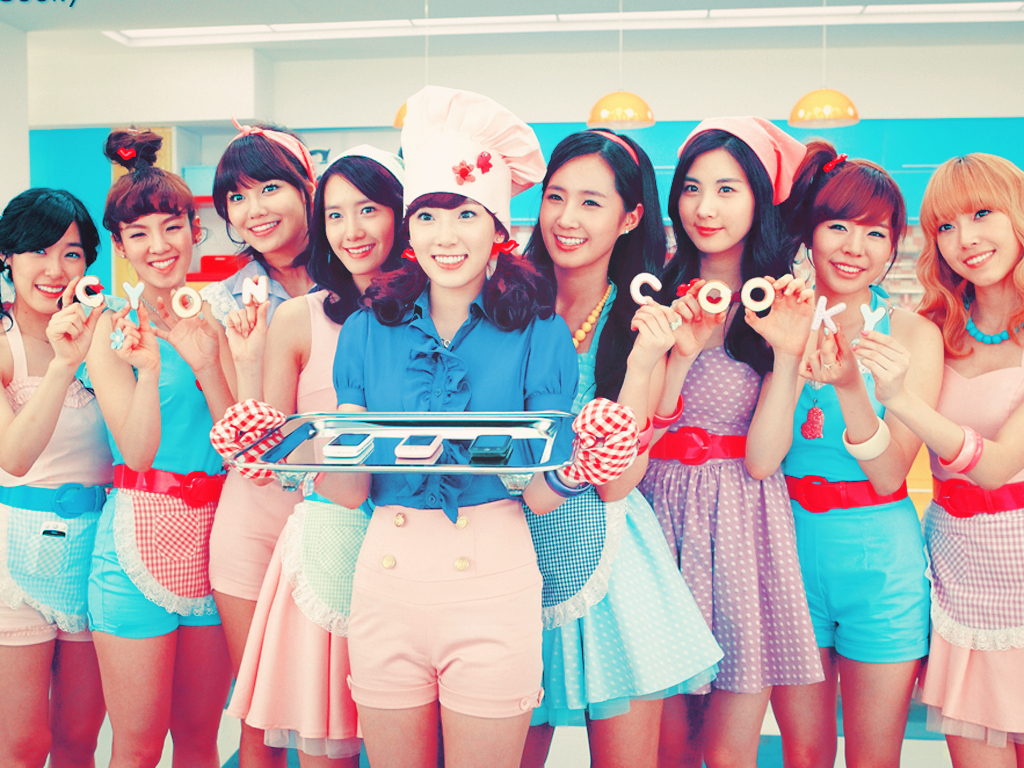
Are these women both personification and culmination of the trends mentioned above? It’s certainly tempting to think so (and just between you and me, I do). But it’s also true that while Girl’s Generation, for instance, have indeed endorsed beauty products, even going so far as to prominently display one in a music video, they’ve also endorsed pizzas and fried chicken. So if there is a relationship between those celebrities’ weights and consumerism, in Korea it’s clouded by management companies relying heavily on endorsements – any endorsements – to make profits.
Nor are they often challenged, let alone by celebrities themselves.
Which is why it was so exceptional last week for Uee of After School to not only reveal that she was eating enough, but to also pass on the common-sense that:
Many people starve themselves when they are on a diet, but that doesn’t help. You have to eat well in order to lose weight more easily.
And on that note, hopefully you can appreciate why I felt some context was necessary before passing on the news (UEE EATS FOOD! READ ALL ABOUT IT!). But is she indeed the first celebrity to speak out like that? Or can any readers think of any others? By all means, please prove me wrong!
Update 1 – While she’s not quite as well-known, I forgot about the example set by Koyote’sShin-ji last year (see #7 here).
Update 3 – And to Seri, for mentioning Hwang Jung-eum. She’s not exactly my favorite celebrity, as she’s endorsed Sketcher’s completely useless “Shape-ups”, but I suppose that’s no worse than UEE reveling in the attention given to her “honey thighs”.
Update 4 – YG Entertainment’s exclusive trainer, Hwang Sung Chan, briefly discusses Park Bom’s diet here. While it’s good that he mentions how the media often distorts information about celebrities’ diets, widely reporting that she only ate watermelon rather than a lot of watermelon for instance, unfortunately he doesn’t give any details about what she does eat.
(15 year-old f(x) band member Sulli {최설리} in February 2010 Oh! Boy Magazine; source)
In short, “yes, but…”(!), as I explain in this opinion piece I recently penned for the Korea Herald. It’s pretty faithful to the original, for which I’m grateful, but unfortunately two crucial sentences on boy-bands got edited out at the beginning of paragraph 4. It should read:
This is why this discussion is overwhelmingly about girls. However, owners of boy-bands too have been affected by the ensuing pressure to make them stand out from their competitors. Add in Korea’s notoriously high levels of illegal downloading, ensuring that profits in the Korean music industry are overwhelmingly from concerts and commercial endorsements (and which explains why 75% of Korean commercials feature celebrities), then courting controversy with ever more provocative performances is a no-brainer really.
This translation of part of this Korean article follows directly from Part 1 and Part 2. If you haven’t already, please read those first, as the author didn’t intend for any section to be a stand-alone post:
‘비정규직 세대’의 이중착취 / The Double-Exploitation of the“Irregular Generation”
아이돌 바람을 일으킨 기획사 대표들에게는 몇 가지 공통점이 있다. 스스로 연예계에서 활동하며 발을 넓힌, 중장년층의 남자들이라는 것이다. 이들은 경제위기 이전에 사회에 진출해 상당한 부를 축적한 기성세대면서도, ‘비정규직 세대’와 취향을 공유할 수 있을 만큼 젊은 경우가 대부분이다.
The representatives of management companies that gave rise to the idol boom have many points in common. First, they are middle-aged men who developed their careers within the entertainment world by themselves, before the Asian Financial Crisis. Also, while they are an old generation with accumulated wealth, most are still young enough to share the tastes of the “irregular generation”.
다시 말해, 아이돌 기획자들은 무력한 남성들의 욕망을 이해할 만큼 젊고 영악한 ‘동료 남자’들인 동시에, 이 수요를 가공해 상품으로 내놓을 수 있을 만한 돈과 연줄을 지닌 사람들이다. 반면에 대다수 젊은 세대가 지닌 건 욕망과 (아르바이트로 모았을) ‘미니앨범’을 겨우 살 주머니 푼돈뿐이다.
In other words, management company representatives are young and shrewd enough to understand powerless men’s tastes, and have the money and connections to produce manufactured goods (idols) on demand. On the other hand, the thing which most of the young generation have is desire, but only enough pocket money (or money gained from part-time jobs) to buy mini-albums.
한국의 현재 청소년들은 꿈을 꿀 수 없는 불우한 세대다. 유치원 시절부터 학교, 학원, 과외로 이어지는 가혹한 경쟁체제 속에서 고통 받지만, 이들에게 준비된 미래는 없다. 소수의 ‘좋은’ 대학을 갈 경쟁력은 돈으로 길러지고, 운 좋게 입학 기회를 얻는다 해도 돈 없이는 학교에 다닐 수도 없고, 살인적인 ‘스펙’ 경쟁도 불가능하다. 졸업생을 기다리고 있는 것은 차별, 실업, 비정규직으로 이어지는 잔인한 현실이다.
Korean teenagers now are an generation of misfortune, which can’t have dreams. From when they’re in kindergarten, to attending school, hagwons, and receiving private tutoring, they suffer greatly from the competitive system into which they’re placed, yet despite that have no future to prepare for. They can use money to increase their chances of getting into one of the very few “good” universities, but even if they [are indeed] lucky enough to gain a place to one they may be unable to afford the fees, and [besides which] it would still be impossible to get killer “specs” [James – a good background]. Graduating students now face a merciless reality in which they have nothing but discrimination, unemployment, and/or irregular, unstable work to look forward to.
아이돌 그룹은 이 가엾은 세대에게 두 가지 의미의 ‘위안’을 준다. 하나는 암울한 현실을 잠시 잊을 수 있는 오락이고, 다른 하나는 ‘나도 아이돌이 될 수 있다’는 꿈이다. 하지만 이 ‘위안’은 기획사가 비정규직 세대를 피라미드형 착취구조로 이끄는 미끼에 지나지 않는다. 젊은 세대는 아이돌 음악을 사는 소비자인 동시에, 오디션에 참여해 ‘아이돌 예비군’인 연습생 자리를 채워주는 ‘인력풀’이다.
Idol groups give comfort to this hapless generation in two ways. One, is through giving some pleasure that allows them to forget their miserable reality for a moment, why the other is through fostering the belief that they too can become idols. But this “comfort” is nothing but bait for a pyramidal exploitation structure of them. [As] while the young generation purchase music as consumers, at the same time they also audition to become a labor pool of “idol reserves”.
이들은 기획사에 수익과 인력을 댈 뿐 아니라, 열광과 환호로 아이돌에게 매력적인 지위도 부여한다. 결국 ‘아이돌의 꿈’을 구성하는 부, 인기, 명성은 모두 비정규직 세대 자신들이 공급하는 것이다. 하지만 꿈의 주인공이 되는 것은 오직 기획사를 통해서만 가능하다.
While these idol reserves represent profit and a labor pool to the management companies however, to them themselves they are given an attractive position through widespread public adulation and passion for them. In the end, everything that an idols’ dreams are composed of – wealth, popularity, fame – are things that they provide for themselves. But although they are the central character in their dreams, these are still only possible through management companies.
Caption: 걸그룹 기획사가 가장 중요하게 여기는 것은 의도된 노출에 적합하고 손쉽게 대체될 수 있는 획일화된 신체다.
Image Caption: [When it comes to idols], The most important thing for management companies to consider are standardized bodies suitable for skin exposure and easily replaced (end).
James – My apologies in advance for any mistakes in the translation, which I admit that I (and then my long-suffering wife) struggled with much more than I did the first two parts. Much of my confusion though, stemmed from – to my mind – Kang’s abrupt shift here from talking about the “irregular generation” in the first half of the article (i.e. the target audience of girl groups), to the “young generation” that the girl-group members belong(ed) to in the second half. However, it does serve as a good introduction to Part 4’s discussion of their exploitation with the Korean music industry, which you can find here.
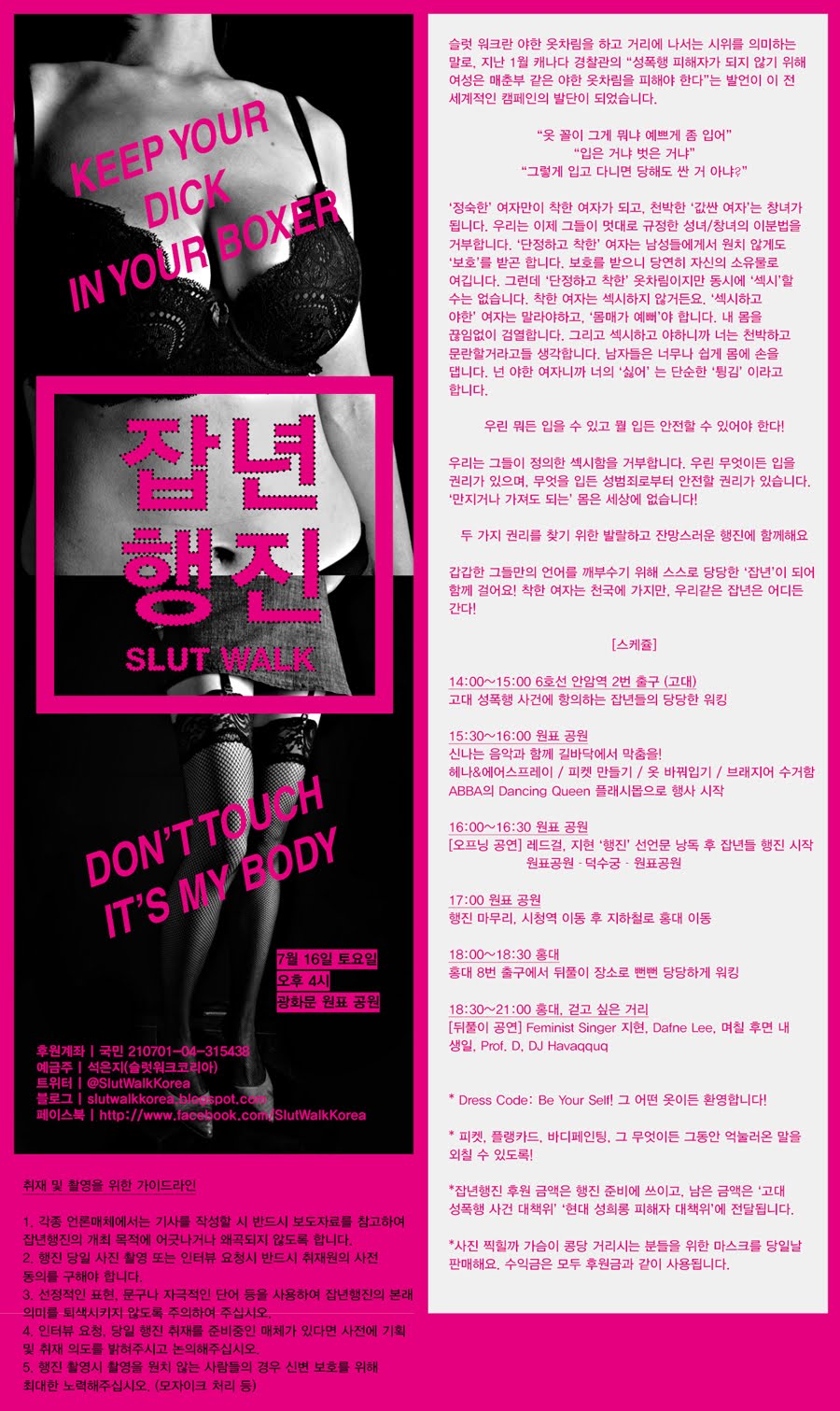
Sorry for the short notice, but I’ve only just found out about it. Still, that might actually be a good thing(!), as like Gomushin Girl put it:
…I’m sure part of the reason lots of expats haven’t heard about it is because the Facebook page and most of the planning has been done by and for Koreans, which is freakin’ awesome.
Indeed. But I’m sure the organizers would still be more than happy for any spectator support and/or even participation by expats, so please contact them via their blog, Facebook page, or Twitter feed if you’re interested (and here’s the Wikipedia page for more about Slutwalk in general). And, with it starting at 4pm in Gwanghwamun, I’m happy to report that I’m actually going to be able to see it myself, as by a great coincidence I’d already just booked KTX tickets to see a friend in Seoul at the very same time and place!^^
This translation of part of this Korean article follows directly from Part 1. If you haven’t already, please read that for the background:
An ‘Oppa Industry’ Founded on Powerless, Frustrated Men’s Desire / 무기력한 남자의 욕망에 기초한 ‘오빠 산업’
‘오빠’ 노래가 최근 처음 등장한 건 아니다. 하지만 여자 가수들이 약속이나 한 듯 동시에 ‘오빠’를 불러대는 모습은 과거에도 보기 드문 장면이었다. 대체 어떤 연유로 ‘오빠 강풍’이 불기 시작했을까?
This is not the first time that there have been Oppa songs. But, just as you’d expect, it was rare to find female singers [actually?] saying the word in past songs. [So] what on Earth was the origin of this Oppa Craze?
물론 ‘오빠’ 소리를 듣고 싶은 남자들이 많기 때문일 것이다. 걸그룹에 열광하는 남자팬들의 다수가 연애조차 하기 힘든 비정규직 세대라는 점을 기억할 필요가 있다. 이들이 걸그룹에 환호하는 이유는 소위 ‘초식남’이 만화주인공과 사랑에 빠지는 이유와 비슷하다. 그들에게 걸그룹은 ‘망가걸’의 실사판인 셈이다.
Of course, the reason is that there are many men that want to be called “Oppa”. We need to remember that the majority of enthusiastic male fans of girl-groups are a generation of men who work hard at irregular, [dead-end] jobs, and [so?] have difficulty even getting a date. The reason they cheer girl-groups is similar to the reason so-called “Herbivore Men” fall in love with the main characters in manhwa comic books: to them, girl groups members are like real-life versions of “Manga Girls”.
James: jumping ahead to a point I’ll make again in the conclusion, things like this mean we should be very wary of such sweeping statements about the demographics of K-pop fans, not least those made by myself. But I do find Kang’s arguments compelling overall.
한국 걸그룹이 외환위기 이후에 등장했다는 사실은 의미심장하다. 특히 한국 경제가 장기침체로 들어선 2000년대 후반 등장한 원더걸스나 소녀시대는 1990년대 후반의 에스이에스(S.E.S.)나 핑클 등의 ‘1세대 걸그룹’과 구별되는 특성을 보인다. 훨씬 어리고, 노출 정도가 크고, 몰개성적이며, ‘리드보컬’ 개념이 매우 약하거나 존재하지 않으며, 대규모 오디션과 ‘연습생’ 제도에 의존한다.
It is telling that Korean girl-groups first appeared after the Asian Financial Crisis of 1997-98. And [in turn] the Wondergirls and Girls’ Generation that appeared in the second half of the 2000s, after years of economic stagnation, can be distinguished from those “First Generation Girl-groups” such as S.E.S. and Fin.K.L. in several ways: they were way too young; they exposed their bodies a great deal more; they were de-indivualized, with the “lead vocal” concept not existing at all; and they depended on intensive audition-processes and practice and training-sessions.
James: Matt at Gusts of Popular Feeling has two great posts on the differences between the two generations of girl-groups here and here, and Mellowyel at Mixtapes and Liner Notes has an equally interesting post here that deals with those and other differences, including less stress on vocals by later groups. But while I certainly agree with all those differences, and would be the first to admit that many girl-group members are essentially faceless and interchangeable to all but their most ardent fans, nevertheless I think saying that they’re “de-individualized” puts it a little too strongly, masking an important point. Specifically, consider what Philip Vannini and Scott Myers wrote about manufactured Western bands a decade ago (in “Crazy About You: Reflections on the Meanings of Contemporary Teen Pop Music”, Electronic Journal of Sociology, available online here):
Producers’ control extends from songwriting to image-packaging and personality development. Any boy-band act is put together to appeal to various personalities and life outlooks of fans as each band includes a member portrayed as cute and sweet, one funny, one good-looking and mysterious, one creative and goofy, one talented and motivated, one dark and tough, and such. Bands are created with the consumers’ demand in mind…
Then compare what allkpop wrote about Korean girl-groups last year (the first source I could find sorry!):
Osen recently pointed out that cute members of female groups tend to generate widespread interest and bump up a group’s popularity singlehandedly. Every member has their own individual role in the group, and every group has a member in charge of being the ‘cute’ one. In Korea, fans call this certain member “Kui-yo-mi (귀요미),” meaning “the girl with the cute image (귀여운 이미지를 가진 이).” This member is in charge of garnering fanboy love with her cute/lovable/girly charm, which will result in a bigger fanbase for the group. In this report, Osen identified four girl group members that fit this role.
So sure, while many girl-groups are large, and some are getting larger all the time, who’s who in them does still have some relevance. (AKB48 they ain’t!)
Back to the article:
Caption: 한국 걸그룹은 ‘망가걸’의 실사판 이미지에 가깝다. 리본, 분홍, 천진한 표정이 드러내는 유아적 여성 이미지와 검은 눈썹에 금발을 한 인물의 탈국적성 등은 일본 만화캐릭터에서 보편적으로 발견되는 특성이다.
Caption: Korea girl-group members are close to being real-life Manga Girls. There’s the ribbon; the pink; and the naive, innocent expression, which combine to give an infantile image. Add black eyeliner and blond hair, and you’re left with an figure devoid of ethnicity, i.e. the universal Japanese manhwa character.
나머지는 ‘세대착취’ 부분에서 자세히 다루기로 하고, 우선 ‘어린 나이’와 ‘노출’에 대해 살펴보도록 하자. ‘롤리타 콤플렉스’라 불리는 소아성애는 약화된 남성성과 관련이 있다. 경제적 능력이 남성 권력의 토대인 가부장제 사회에서 경제력의 상실은 곧 남성성의 상실을 의미하게 된다.
I will talk more about the exploitation of this generation in detail later [in Parts 3-5]. First, let’s examine the issue of exposing the bodies of young people. [In short], there is a relationship between this pedophilia called the “Lolita Complex” and weakened male sexuality. And in a patriarchal society based on economic ability and male power, accordingly the loss of economic power equates with a weakening of male sexuality.
한국경제가 장기침체에 들어서며 어린 ‘2세대 걸그룹’이 등장했듯, 일본 역시 1980년대 경기침체를 겪으면서 ‘로리콘(ロリコン) 캐릭터’가 급부상했다. 한국 걸그룹과 일본의 ‘로리콘 캐릭터’의 속성은 동일하다. ‘어린 얼굴에 성인의 몸을 가진, 위협적이지 않은 성적 대상’이다. 약화된 남성들에게 성숙하고 당당한 여성은 감당할 수 없는 위협이기 때문이다.
When the Korean economy entered a period of long-term stagnation, the second generation of girl groups-appeared. Likewise, Japan also went through a period of long-term economic stagnation in the 1980s, and “Lolicon” characters quickly appeared. Korean girl-group [members] share many characteristics of these Lolicon characters. With childlike faces with adult bodies, they are non-threatening sex-objects. Because to weakened men, mature and confident women are too threatening.
<게으름뱅이 정신분석>의 저자 기시다 슈도 비슷한 맥락에서 성범죄를 분석한다. 그에 따르면, 성범죄자는 남성성이 넘치는 사람들이 아니다. 이들은 정상적인 교류상황에서는 성능력을 발휘할 수 없는 ‘고자’ 혹은 ‘불능남’이기 때문에, 여성을 위협해 무기력한 상태로 만들거나 아예 저항 능력이 없는 연소자나 장애인을 택해 범죄를 벌인다는 것이다.
Syu Kishida, author of “A Psychoanalysis of Lazy Bastards”, made similar lines of connection with sex-criminals. According to him [her?], sexual criminals are not [exactly] men overflowing with male sexuality. [Rather], because they are “eunuchs” or impotent men who can’t develop sexual ability through normal [life and] interaction, they prefer to threaten or make women powerless, or choose to commit sexual crimes against the young or disabled because those groups are unable to reject them.
스티븐 엡스타인과 제임스 턴블이 잘 정리했듯, 한국 걸그룹은 ‘순진’, ‘애교’, ‘수줍음’, ‘수동성’, ‘도발’ 등의 특성을 갖는다. 얼핏 보면 ‘순진’, ‘수줍음,’ ‘수동성’은 ‘(성적) 도발’과 대치되는 듯 보이지만, 사실은 모두 ‘도발’을 위한 장치일 뿐이다. 무기력한 남성을 도발하기 위해서는 순진하고, 여리고, 수동적인 여성 이미지가 필요하기 때문이다.
Stephen Epstein and James Turnbull summarized this well. Korean girl-groups’ shared characteristics are naivety, aegyo, shyness, passivity and sexual provocation. While at a glance those first personality traits seem to contradict the last, in fact all are simply a device for sexual provocation. To powerless men, a naive, weak, and passive image of women is required for this.
한국에 등장한 ‘꽃미남’, ‘화장하는 남자’, ‘초식남’은 일본이 앞서 경험한 현상이다. 그렇다면 한국 걸그룹이 해외에서 얻는 인기는 경기침체로 인한 ‘롤리타 콤플렉스’ 및 일본 ‘로리콘 캐릭터’의 보편화와 떼어 생각하기 어렵다.
Trends for men that have emerged in Korea, like “Flower-Beautiful-Men” (Kkotminam), “Cosmetics-wearing Men”, and “Herbivore Men” are all things that Japan has also experienced. On that basis, it’s very difficult not to think that there’s something in common with the popularity Korean girl-groups are gaining overseas [Japan surely?] and the popularity of the Lolita Complex and Lolicon characters there that arose with long-term economic stagnation (end).
James: I think Kang’s central point about the economic and consequent cultural parallels between Japan and Korea is valid, and that it’s certainly true that some Japanese men’s liking of the Lolita Complex and Lolicon characters would predispose them to also liking Korean girl-groups. But with this final paragraph, I think he extrapolates a little too much, for two or three reasons (source, right):
1) There are huge differences between Japanese Herbivore men and Korean Kkotminam (I’ve never heard of “Cosmetics-Wearing Men”), the latter of which would by no means be considered powerless. But I concede that Kang may simply have been pointing out yet more similarities with Japan here, rather than making a connection to those particular groups of men and male fans of Lolicon and Korean girl-groups per se.
2) More to the point then, has any actual research been done to confirm these alleged tastes in Lolicon and so on of Japanese male fans of Korean girl-groups? (While it does makes sense, like I said we should be very wary of taking it as a given, particularly considering the next point)
Which again demonstrates the need for more research into the demographics of Japanese K-pop fandom. Or perhaps it has already been done, and readers can point me in its direction? (Hint hint)^^ Meanwhile, see Part 3 on The “Irregular Generation’s” Double-Exploitation / ‘비정규직 세대’의 이중착취 to continue the discussion!
Caption: 일본 ‘로리콘’ 캐릭터. 1980년대 일본 경제침체가 심화되면서 ‘위협적이지 않은’ 어린 소녀를 성적 대상화하는 현상이 두드러졌다. ‘롤리타 콤플렉스’는 무기력한 남성의 정체성을 반영한다. 외환위기 이후 등장한 한국의 걸그룹 현상도 같은 맥락으로 볼 수 있다.
Caption: Japanese “Lolicon” characters. With the deepening economic stagnation in Japan in the 1980s [1990s?], the sexual objectification of unthreatening young girls became noticeable. This Lolita Complex reflected the identity of powerless men, as does the rise of Korean girl-groups.
Yes, the Korean title to the article does indeed say “depraved” oppas, with exactly the same sexual connotations in both languages. But if it’s news of some potential K-pop scandal that drew you here though, then I fear you’ll be disappointed!
Instead, it’s actually about the negatives of the girl-group phenomenon. And, rather than by some sleazy tabloid journalist, in fact it’s written by academic Kang In-kyu, who spoke on Korean internet culture at a recent Korea Pop Culture conference at UC Irvine, which also included Stephen Epstein’s and my own presentation on girl-groups. Sure enough, Kang later refers to — and is clearly heavily influenced by — our work, but he also very much builds upon it, and we’re very happy to learn that the issue is beginning to get an airing in the Korean media.
Practically speaking however, unfortunately the article is also a little long, so I’ve split it into five parts to be put up over the next week or so (please consider this one just the introduction). But for the odd addition of my own words here and here though (indicated by square brackets), I’m afraid that also means I don’t really have the time to work on the style of the translation!
음흉한 ‘오빠들’, 소녀시대에 무슨 짓 한 건가 / What did Depraved Oppas do to Girls’ Generation?
아이돌, 착취사회의 경쾌한 합리화. 강인규 기자
Idols, the light-hearted rationalization of an exploitative society. By Kang In-kyu.
(‘순진’, ‘애교’, ‘수줍음’, ‘여림’ 등은 걸그룹의 주된 이미지 전략이다. ‘오빠’로 대표되는 수동적 여성성의 회귀는 무기력해진 남성의 욕망을 드러낸다. 사진은 소녀시대의 ‘오!’ 뮤직비디오의 한 장면)
(Opening image caption: Naivety, aegyo, timidity, fragility, and so on are girl-groups’ main image strategy. This representative Oppa phenomenon reveals men’s desire for a passive, regressive, and powerless women’s sexuality. Photo: scene from music video to Oh!, by Girls’ Generation)
참 이상한 일이었다. 한국 성평등 지수가 세계 최하위 수준이라는 사실을 몰라서가 아니다. 2010년 세계성평등도 조사에서 한국은 134개국 가운데 104위를 했다. 20대 여성 자살률은 경제협력개발기구(OECD) 평균의 두 배가 넘고, 50대 여성 행복지수는 세계에서 가장 낮다. 한국에서 여자로 태어나는 순간 차별과 불행을 피할 수 없다.
Something a little strange happened [recently]. [I mean, it’s] not that I didn’t already know that Korea has one of the lowest scores in the world for sexual equality. In 2010 [for instance], a survey found that of 134 countries examined, Korea came in 104th. It also had over twice the OECD average for suicides of 20-something women, and its 50-something women were the unhappiest in the world. Indeed, surely to be born female in Korea means it is impossible to avoid discrimination and bad luck.
그래도 이해할 수 없었다. 별안간 ‘오빠’ 바람이라니. ‘오빠 나 좀 봐’, ‘너무 부끄러워’, ‘몰라몰라’, ‘처음이야’, ‘떨려와요’, ‘동생으로만 생각하진 말아’, ‘난 울지도 몰라’, ‘나는 바본가 봐요’, ‘난 다 믿었어’. 아니, 믿을 사람을 믿어야지, 가정에서는 폭력, 사회에서는 차별을 재생산해 온 오빠를 믿는다니. 이 척박한 야만의 땅에서 한국 여성들은 차별과 고정관념에 맞서 끈질기게 싸워오지 않았던가. 내가 보기에, 이 난데없는 ‘오빠 바람’은 명백한 퇴행이었다.
Still, I didn’t understand. But then suddenly there was this “Oppa craze”. “Oppa, look at me”, “I’m so embarrassed”, “I don’t know, I don’t know”, “This is my first time”, “I’m light-headed”, “Don’t just think of me as a little sister”, “I don’t know if I’ll cry”, “I think I’m so foolish”,”I believe everything”. No, how dare you believe those oppas, who perpetuate sexual discrimination and domestic violence. Haven’t women been struggling tenaciously [for a long time] against prejudice and discrimination in this barren, barbarous land? In my opinion, this sudden Oppa craze is a clear regression.
(James – With thanks to the reader that made it and passed it on to me, above is a collection of segments from various girl-groups’ songs that show just how common the phrase “I don’t know” really is. Also, he poses the interesting question of if it’s usually the groups’ designated cute and innocent members that actually sing it)
대체 언제부터 오빠가 이렇게 믿음직스런 존재가 됐을까? 한국여성의전화 2009년 조사에 따르면, 데이트를 해 본 젊은 여학생 중 78%가 정서적 폭력을 경험한다. 결혼 후에는 절반이 남편, 즉 ‘옛 오빠’가 휘두르는 폭력과 학대를 겪는다는 게 2011년 여성가족부 ‘가정폭력실태조사’ 결과다(한국 남성이 아내에게 폭력을 행사하는 비율은 영국이나 일본의 다섯 배가 넘는다). 직장에서도 남성에 비해 38%나 적은 보수를 받아, OECD 평균 임금격차의 두 배를 훌쩍 넘는다(‘언니’들이 이런 차별을 지지하는 경우는 많지 않다). 복고가 유행하더니, 젊은 여성세대가 전통적인 ‘의존형’으로 회귀하기라도 한 것일까?
Since when (and how on Earth) did oppas suddenly become so trustworthy? According to a telephone survey of Korean women in 2009, of young [university?] students who had dated 78% had experienced emotional abuse. Also, according to the results of a 2011 “Domestic Violence Status Survey” by the Ministry of Gender Equality and Family (MOGEF), half of husbands had inflicted violence or abuse [on their wives] (this rate is 5 times higher those of Japan or the United Kingdom). And in the workplace too, women receive 38% lower wages then men, a gap more than twice as large as the OECD average (there are not many “Onnis” that support this!).
This trend of going back to the past, isn’t it just a regression, making a whole generation of young women dependent?
착각하지 말자. ‘오빠’ 바람이 보여주는 건 아저씨들의 욕망일 뿐이다. 어린 소녀들을 고용해 ‘오빠’ 노래를 부르게 하는 기획사 대표들 대다수가 남자고, 이 노래를 쓴 사람들 역시 예외 없이 남자다. 원더걸스의 대표곡 ‘텔미’와 ‘노바디’는 박진영이 곡과 가사를 썼고, 소녀시대의 히트곡 ‘소원을 말해봐,’ ‘오!’, ‘지(GEE)’, ‘훗’의 가사를 쓴 것도 유영진, 김정배, 김영후, 안명원/김영득, 이현규 등 모두 남자다.
Let’s not have any illusions here: the oppa craze just shows men’s desire. And [indeed], most of the entertainment company representatives who hire young girls to sing these oppa songs are men, as are – without exception – the writers. For instance, the iconic Wondergirls’ songs Tell Me and Nobody were written by JYP, and Girls’ Genertation’s hits Tell Me Your Wish, Oh!, Gee, and Hoot were written by Yu Yeong-jin, Kim Jeong-bae, Kim Yeong-woo, An Myeong-won, Kim Yeong-duk, and Lee Hyeon-gyu, who are all men.
물론 남자들이 여자 가수의 곡을 쓰는 경우는 흔하다. 여기서 지적하고 싶은 것은, 걸그룹이 외치는 ‘오빠’가 ‘동생’들의 욕망과 아무런 관계가 없다는 것이다. 그들은 중년 남자들이 쓴 남성적 욕망을 립싱크하고 있을 뿐이다. 하긴, 오빠만큼 오빠의 욕망을 잘 아는 사람이 또 있겠는가. 머리만한 리본을 달고 손으로 하트를 그리는, 얼굴은 아이고 몸은 어른인 반인반수 아니, ‘애교 소녀’. 남자들의 욕망은 이렇게 단순하다.
[But] of course, it’s not uncommon for men to write the lyrics to female singers’ songs. What I want to point out is that when girl-group members cry out “Oppa”, it has nothing to do with being a little sister; it is simply lip-synching men’s desire, as written by middle-aged men. [After all], nobody knows oppas’ desire better than oppas. And when girl-group members wear ribbons as big as their head, draw hearts with their hands, and have childlike-faces but the bodies of women, they are not some half girl-half women creature but instead “Aegyo Girl”. Men’s desires are that simple.
(걸그룹 기획사는 어린 멤버들의 신체를 거리낌 없이 사물화한다. ‘지(GEE)’ 뮤직비디오에서 소녀시대 멤버들은 쇼윈도의 마네킹으로 등장한다. 남자 출연자는 이 ‘인형들’을 보고, 만지고, 원하는 방식으로 재배치한다)
(Image caption above: Girl-group entertainment companies have no scruples about objectifying members’ bodies. Here in the music video to Gee, the members appear as mannequins in a shop window, while a male performer looks at them as if they were dolls, and moves them around and touches them however he wishes)
James – And on that note, Part 2 on An ‘Oppa Industry’ Founded on Powerless, Frustrated Men’s Desire / 무기력한 남자의 욕망에 기초한 ‘오빠 산업’ can be found here.
Of the two, Ariel Levy’s Female Chauvinist Pigs (2005) is by far the easier to read, taking just the trip home to finish. Feeling much more like a expanded version of the New Yorker article it was based on than a real in-depth examination of the subject though, unfortunately it has little that wasn’t much more thoroughly covered later in The Lolita Effect (2008) and Guyland (2008), and is not readily applicable to Korea. However, it will still be – ahem – a goldmine for pithy quotes, and for 16,500 won (US$15.19) a good choice for those who’ve never read a feminist text before.
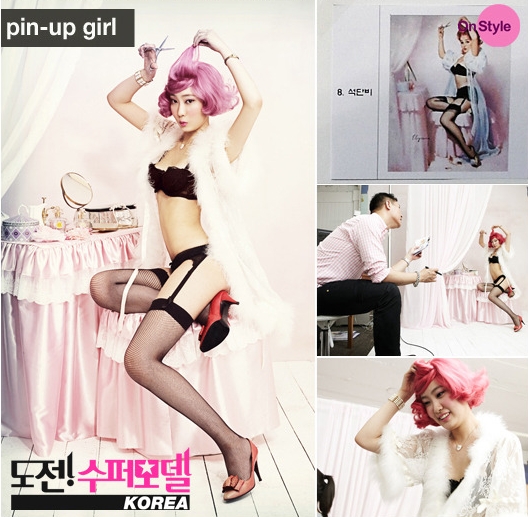
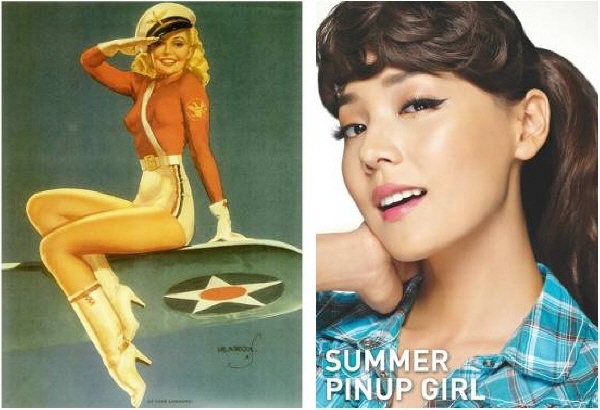
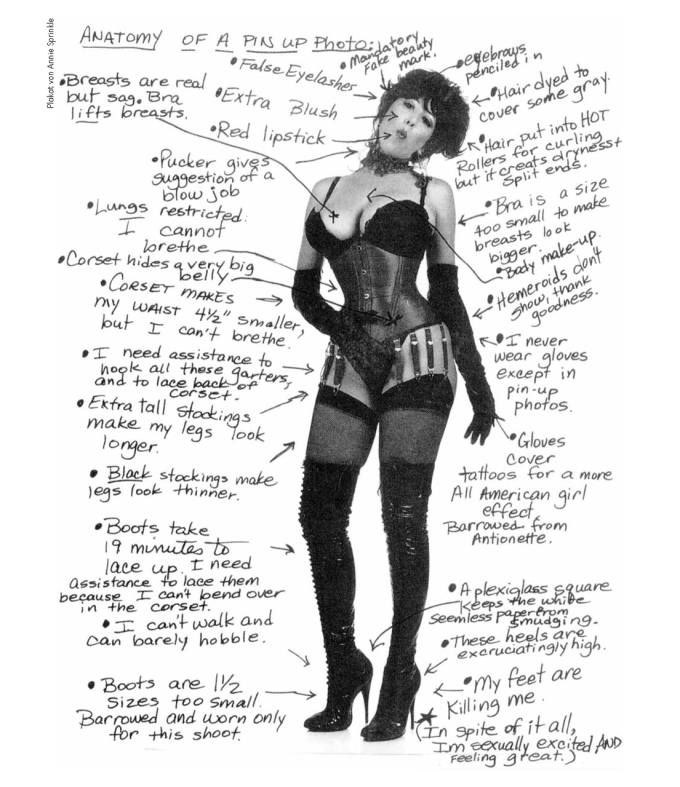
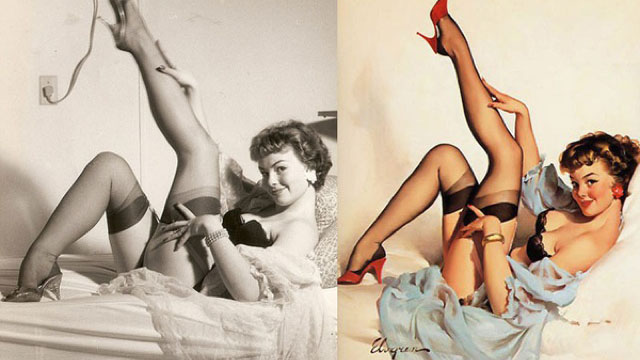
In contrast, Maria Buszek’s Pin-Up Grrrls (2006) is a daunting 444 page tome, which in hindsight I am not surprised to have found second-hand for a mere 15,500 won (US$14.27): the cover and frequent photographs belie its rigorous academic approach. Moreover, as Korea lacks a tradition of pin-up girls (although perhaps it does still have a “pin-up culture” nonetheless?), then you’d think that it would be even less helpful than Levy’s book for gaining insights into Korean gender issues and popular culture.
But, reading the introduction in the bookstore, I was already intrigued as soon as page 4:
Contrary to the popular belief – held by many within, outside of, and even against the movement – that a “feminist pin-up” is an oxymoron, it is no more so than “feminist painting” of “feminist sculpture,” or “feminist porn” for that matter” these are all media and genres historically used and appreciated primarily by men, about which nothing is inherently sexist, but which have all been both kept from women and used to create images that inscribe, normalize, or bolster notion of women as inferior to men. While this fact has been recognized by many feminist thinkers – indeed, many such media and genres have been avoided by certain feminist artists for these very reasons – few would deny that the same have been and may be strategically used by women to subvert the sexism with which they have historically been associated. Yet the pin-up – because of its simultaneous ubiquity and invisibility, prurient appeal and prudery, artistry and commercialism – has not been so readily granted a feminist interpretation. The genre is a slippery one: it doesn’t represent sex so much as suggest it, and these politely suggestive qualities have as a result always lent it to a commercial culture of which feminists have justifiably been wary for its need to cultivate the kind of desire and dissatisfaction that leads to consumption.
And on my way to the checkout by page 6:
Freuh has articulated this desire succinctly in her writing on the relevance of sexuality to the feminist movement: “As long as I am an erotic subject, I am not averse to being an erotic object.” The problem with this conflation of subject/object is in constructing and representing a feminist identity that is both subversive and alluring….As Bell Hooks puts this conundrum: “It is has been a simply task for women to describe and criticize negative aspects of sexuality as it has been socially constructed in sexist society; to expose male objectification and dehumanization of women; to denounce rape, pornography, sexualized violence, incest etc. It has been a far more difficult task for women to envision new sexual paradigms to change the norms of sexuality.”
While acknowledging that it may indeed be a false dichotomy, nevertheless I too have long maintained that women being sexual objects in the media doesn’t necessarily preclude the models concerned from also being sexual subjects. But still, I simply had no idea how subversive pin-ups could be, or how, often used by the models for their own ends, they could indeed include flaunting their own sexuality.
In that vein, as Korean society continues to grapple with the issue of the increasingsexualization of young women and especially teenage girls in the media, it’s going to be very helpful to have examples of genuinely sexually-empowering images of women to inform critiques of that trend, or at least the intellectual tools to help better understand what constitutes such. Because frankly, for me personally it’s high time to move beyond simply repeatedly pointing out that what is often touted as female empowerment is in fact frequently forced upon unwilling participants, but without ever actually elaborating on what would be a positive alternative.
Meanwhile, has anybody already read either book, or any others by the same authors? Or do you already have some of your own ideas for images of women you’d like to see more of in the Korean media? For a quick introduction to my own thoughts, please see from slide #97 onwards in the lecture!
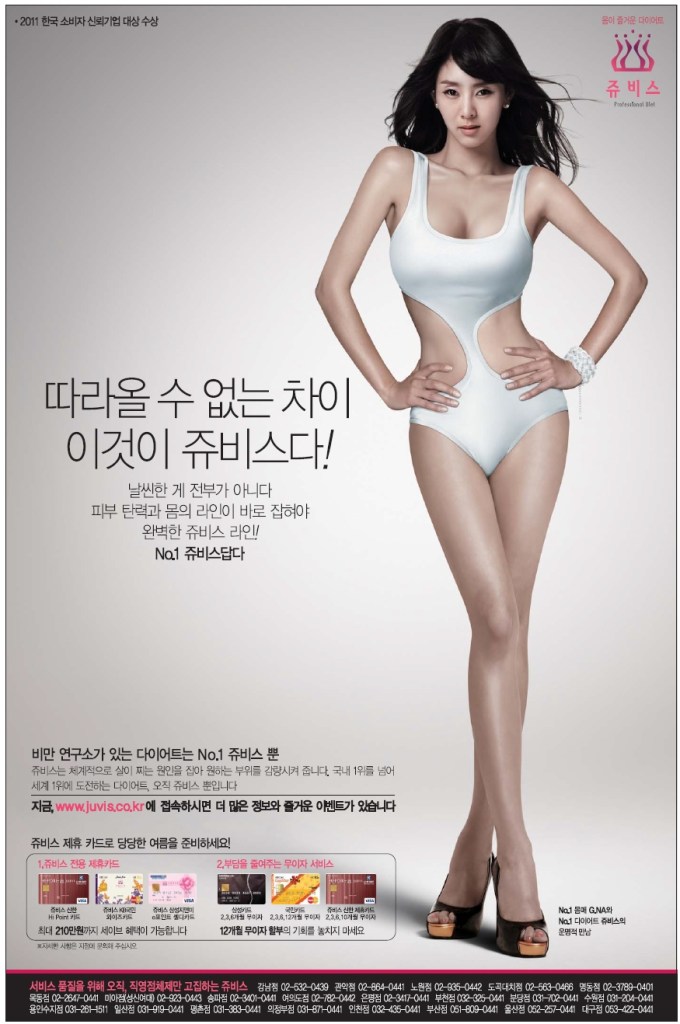
With apologies to the guinea pigs that were the first to receive it, but I’m constantly updating my public lecture on gender and Korean advertising as I get more practice with it—and indeed I’ve just realized I’ve been making a big oversight by not mentioning Koreans’ exceptionally tolerant attitudes towards photoshopping in it previously. Deciding to remedy that in the latest version then, naturally I decided to include one of the most notorious recent examples: singer G.Na‘s ubiquitous advertisements for “Juvis Professional Diet“, which I discussed here. Surely, I thought, there was no greater demonstration than making such an attractive woman look like a virtual alien (or at least her legs).
Then I opened today’s paper…
If you reside in South Korea, you can donate via wire transfer: Turnbull James Edward (Kookmin Bank/국민은행, 563401-01-214324)
Call me paranoid, but usually I quickly turn the page when I see newspaper ads like this on my commute. After all, as the only foreigner, I’ll already be the only guy on the subway carriage red-faced and sweating at this time of year. And I don’t want to fulfill stereotypes of oversexed Western males by blatantly staring at singer G.Na‘s legs either.
But, dammit, there’s something wrong with them here. Rather than hearing me harp on about unnecessary photoshopping though, it was with great relief that I found some rare critical Korean commentary on this ad. Or at least, so I thought before I began translating properly…
지나 신이내린 몸매, 포토샵을 거부한 아찔한 비주얼 G.Na’s God-given Body Doesn’t Need Photoshop
활발한 활동을 하고 있는 가수 지나가 하루가 다르게 예뻐지는 모습을 보이고 있습니다. 원조 베이글녀 이제니도 안 부러울 정도의 글래머스한 몸매를 가진 지나는 신세경에 이어 가장 매력적인 여성에 속하기도 한데요. 여기에 타고난 가창력은 더욱더 지나를 빛나게 하는 부분이 아닐까 합니다.
G.Na, a very active singer, is becoming prettier every day. Counted as one of the most attractive women [in Korea?] after Shin Se-kyung, with her glamorous body she has no need to be jealous of original Bagel Girl Jenny Lee. Add the singing ability she was born with too, and she shines all the more.
[James – for what a “Bagel Girl” is, see here. Also, bear in mind that “glamorous” actually means “voluptuous” in Korean. And say “Jeena”, not “Jee-en-ay” like I first did!]
현재는 인기를 끌었던 Black & White 활동을 마치고 자신의 가창력을 그대로 보여줄 수 있는 후속곡 ‘벌써 보고 싶어’로 활동 중인데요. 역시 댄스곡이나 발라드 곡 모두를 다 완벽히 소화해 내는 지나의 모습을 보면 정말 뛰어난 솔로 가스로서 능력을 타고난 가수가 아닐까 생각합니다. 그리고 이런 인기 덕분인지 지나는 프로농구 챔피언결정전 5차전에까지 초청받아 시구하는 등 나날이 달라지는 위상을 실감하고 있습니다.
Having just finished the song Black and White [above], which is gathering a lot of popularity, G.Na is continuing to demonstrate her singing ability with her next song, I Already Miss You. Able to adopt [new] styles like dance and ballad music perfectly, if you see [hear?] her you will have no doubt that she was destined to become a brilliant solo singer. Indeed, because of her popularity she was even invited to make the ceremonial opening pitch at a pro-baseball championship game [below], and her image is soaring.
그런데 이런 지나가 최근에 가장 완벽한 몸매를 드러낸 모습이 있어 화제가 되었죠. 그것도 무보정 몸매로 있는 그대로의 환상적인 모습을 보여줘 감탄사를 연발하게 만들었습니다. 이 사진은 일명 직찍 사진으로 광고촬영 중에 지나의 모습을 그대로 담아 낸 사진인데요. 지나의 완벽한 몸매에 정말 감탄사가 절로 나올 정도로 아찔함을 주는 모습이라고 할 수 있습니다.
By the way, showing her most perfect body has become a bit of an issue, right? So perfect that it needs no corrections, seeing her fantasy-like body makes people exclaim in rapid succession. And indeed in this everyday, unaltered picture of her doing her advertisement photoshoot, we just see her appearance how it is. But her body is so perfect and mesmerizing that she makes people automatically exclaim.
하지만, 이런 지나의 무보정 사진과 과연 정식으로 광고에 사용된 사진이 얼마나 다를까 궁금해지는데요. 최근에 지나의 모습이 공개되었는데 역시나 별반 다를 것 없는 모습에 또 한 번 놀라게 되고 말았습니다. 정말 포토샵을 거부한 몸매라고 받게 할 수 없는데요. 워낙 타고난 몸매 종결자이다 보니 실제로 쓰인 광고 사진과 별반 다를 게 없더군요.
But I was curious as to how much the photos used in the advertisement differed from the untouched ones. And again I was surprised at how they’re not particularly different…surely this can be called a body that rejects photoshop? As she was born with this “terminator” body, the final picture actually used in the advertisement doesn’t really have any differences.
[James – “Terminator”, as in a person, is some new Korean slang. I think by itself it means someone is so good that he or she is the final, “terminating” word on the issue. Update: with thanks to Milton at The Marmot’s Hole, a much better explanation is that “In slang, a 종결자 is some who is the absolute best at something. You can affix it to other words besides 몸매, like 색시종결자 In this case, it means that G.Na has the absolute best body.”]
일단 왼쪽 사진은 포토샵을 하지 않은 지나의 몸매 그대로 모습이고 오른쪽이 최종 사진 보정을 해서 공개된 사진 컷입니다. 보여지는 표정의 각도가 조금은 다른 스타일이지만 무보정 상태의 지나와 보정 상태의 지나가 별반 다를 게 없는 것을 확연히 느낄 수 있는데요. 왜 지나의 몸매가 찬사를 받는지 알 수 있는 부분이 아닐까 합니다.
On the right is a untouched picture of G.Na, on the left is the final one that was released, with photoshop corrections. The angle and her expression are a little different, but otherwise I get a definite feeling that there was little photoshopping done. Now we see why G.Na receives such praise for her body.
그러나 지나는 광고 촬영 외에는 주로 이런 스타일의 옷은 잘 입고 다니질 않죠. 몸매가 뛰어나지만, 사람들이 색안경을 끼고 몸으로만 승부한다는 비난을 하기 때문에 많은 상처를 받았기 때문인데요. 최근에 오락프로나 다른 방송에 나오는 지나의 모습을 보면 상체를 거의 노출한 적이 없을 정도입니다. 그래서 말이지만 지나가 글래머스한 몸매를 가지고 있다고 해서 왜 비난을 하는 일은 그만두었으면 하는데요. 이번 가창력도 어느 정도 인정받은 가수이기 때문에 이제는 실력으로 승부하는 지나의 모습으로 바라봐 주었으면 좋겠다는 생각입니다.
By the way, with the exception of this advertisement photoshoot, G.Na doesn’t really wear these kinds of clothes. Her body is amazing, but she has been hurt by many people having a prejudice about it, thinking that that is all she is good for. Because of this, whenever she appears on comedy shows or other programs, she always wears clothes that cover most of her upper body. So, I wish people would stop criticizing her for having a glamorous body, and think that as her singing abilities have been acknowledged, people should respect her as a singer (end).
Writing ability aside, the author does have a point about the Korean media’sobsession with G.Na’s breasts. Indeed, it strongly reminds me of journalist Amanda Hess’s classic article With Great Cleavage Comes Great Responsibility, in which she argues that ultimately it’s not really busty women’s clothes that people have a problem with. Rather, it’s large breasts themselves that are somehow considered “indecent”.
On the other hand, I beg to differ on the relative lack of photoshopping by Juvis (see here for a close-up of the last image if you’re still not convinced yourself). It speaks volumes about Koreans’ attitudes to photoshop, I’m tempted to say, that someone would consider that to be a sign of an attractive body, rather than simply one that required no photoshopping at all. Fortunately for such (over)generalizations however, actually many Korean netizens agree with me, or at least on G.Na and this particular photoshoot.
Meanwhile, does anybody else recall this ad from Juvis that I wrote about 2 years ago?
To those that still maintain I’m reading too much into things, I now rest my case!
Update: As a commenter on blogger Michael Hurt’s Facebook pointed out, the ad above is actually about:
…a special treatment program to fix bowed legs. The girl who endorses [it] was famous for her bowed legs as much as her pretty face, but seems ok now due to the treament. Many Korean girls are interested in this kind of program thank to the ‘girl group’ phenomenon since few years ago.
Technically speaking then, the ad isn’t advocating excessively skinny legs. On the other hand though, it’s hardly discouraging them either, and Juvis has a strong track record of doing so in other ads too. (Like the one with G.Na.)