An Introduction to Japanese Subcultures: Free online course, starting Oct. 31

boys-order-goro-memo(Source: goro memo; CC BY-SA 2.0)

Sorry for the lack of posts everyone: I’ve been insanely busy, and still am in fact. Naturally then, I’ve just decided to make myself busier still, by signing up for the free online course “An Introduction to Japanese Subcultures” provided by FutureLearn and Keio University. Here’s a description from their welcome page, which also has an introduction video:

Subcultures have existed for a long time: the greasers of 1950s America, the mods and rockers of the 1960s and 70s in England, the grunge of the 1980s and 90s, to name a few. Each subculture sits within a broader ‘parent’ culture and can often give us an insight into cultural fears and hopes, especially in the youth of the population.

On this course you will get an introduction to Japanese subcultures that have developed since the 1970s.

Explore different aspects of Japanese subcultures

Japanese subculture has been long considered as ephemeral youth culture compared to authentic traditional culture. It contains, however, subversive power which encourages younger generations to re-create the world they live in. We mainly focus on the significance of immaturity and vulnerability of youth which eventually give permission to younger people (in other words, minorities) to stay as they are.

In this course, together with three other specialists, Professor Niijima, Professor Takahashi and Professor Ohwada, we will explore girls comics, boys comics, the Hatsune Miku vocaloid, cosplay, and J-pop idols, focusing on the themes such as Love, Battle, Technology and Fan culture, in which you’ll learn about the different cultural creations that underpin Japanese subcultures. With materials for cultural analysis, you’ll develop a basic knowledge of key Japanese subcultures, learning the recognisable traits of each.

Understand the historic context of Japanese subcultures

On the course you’ll discover historic background of youth culture in Japan, and understand the enormous impact of World War II.

Learn about Japanese subcultures and the youth of Japan

Finally, this course will give you a new perspective on the young people of Japan, exploring how they can be seen to elaborate the world of “immaturity” and “vulnerability.” You will see the reason these characteristics of Japanese subculture attracts “global” attentions.

This post isn’t an endorsement of course, but the course does sound interesting, and hardly demanding at 3 hours a week for 4 weeks. Please let me know if you sign up too (we can be buddies!), and/or if you’ve done any other FutureLearn courses and what you thought of them.

Meanwhile, seeing as we’re on the subject of Japan, I do very much want to give an endorsement of Cecilia D’Anastasio’s interview of Amelia Cook, about her new site Anime Feminist. Frankly, Cook’s answers really spoke to me about the work I do in Korea, and especially most recently on the male gaze, which just goes to show how universal some of the pop culture issues she addresses are—so I’m sure you’ll have lots to take away from the interview too. Make sure to check it out over at Kotaku.

Something Everybody Needs to Know About Yellow Fever

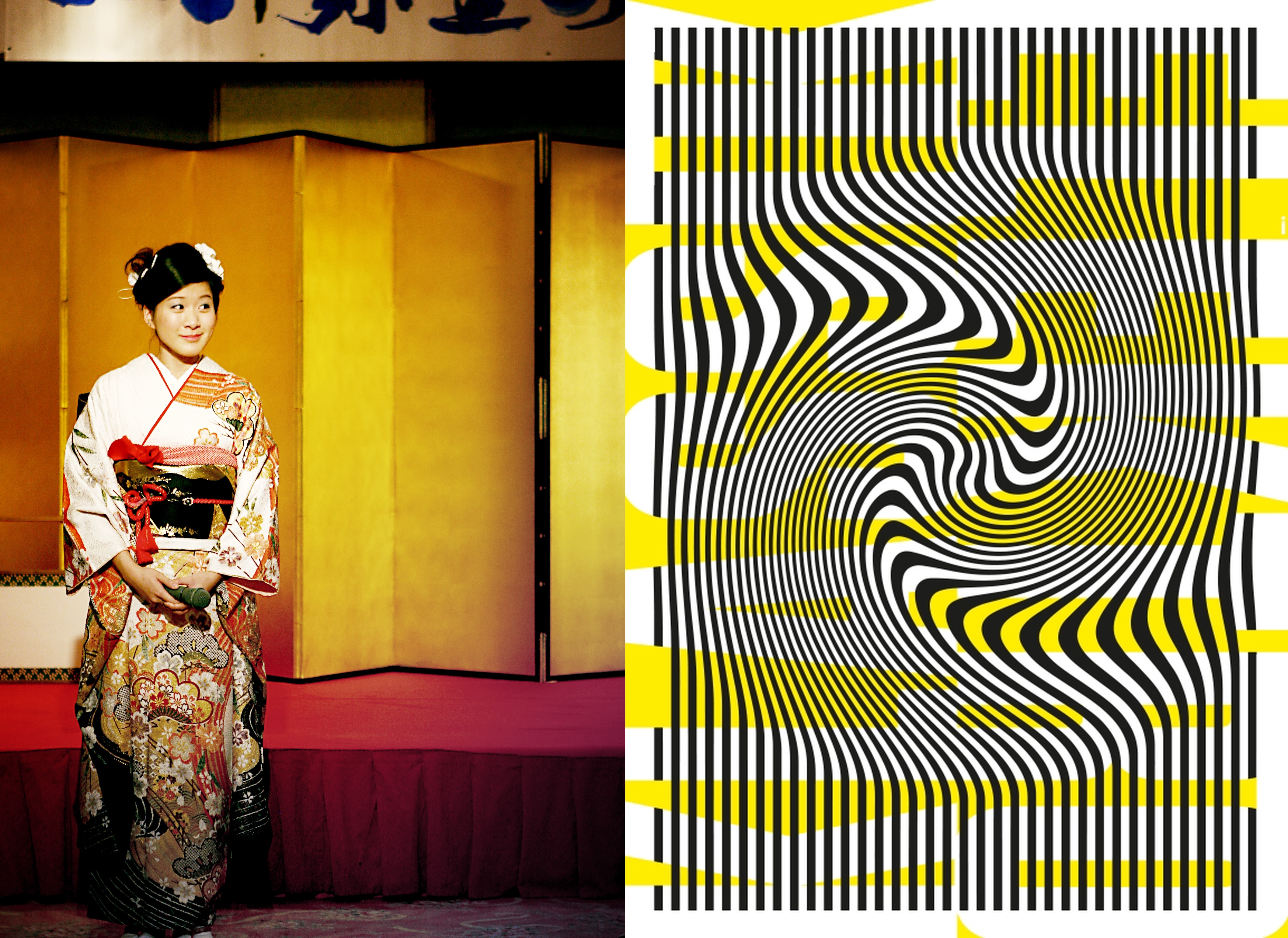
Yellow Fever Personal Zones(Source, left: Kevin Jaako, CC BY-NC 2.0. Source, right: Isabel Santos Pilot, CC BY-NC-SA 2.0, edited)

Now, I’d be the last person in the world to victim-blame anyone who’s ever been the target of Yellow Fever. And I don’t doubt for a moment that the media is overwhelmingly responsible for creating and perpetuating the stereotypes that come with it. But for those men who bring those stereotypes with them to East Asia, there is one aspect of life here that is likely to further convince them of local women’s attraction to them. What’s more, it’s something so fundamental, so visceral, that frankly it completely fooled me too—even though I never shared those stereotypes, and definitely continued to treat Korean women as individuals. 

See here to learn what it is, and why it has impacts that go well beyond mere dating. While it’s really quite simple, and I think most people who deal with people from a foreign country or live in one are already aware of it on some level, I think it’s enormously helpful to have it spelt out—especially if you’re having a bad experience. Also, although again I stress it only plays a minor role in perpetuating Yellow Fever stereotypes, I think it’s one that tends to get neglected in most (English) discussions of those, which tend to focus on Asian-Americans.

I’d be very interested to learn if readers have had any similar experiences, and what you did about them. (Or if your students have; if mine are going overseas, I make sure to photocopy the relevant pages of this book for them!) Also, how does it play out with the sexes reversed?

Continue reading “Something Everybody Needs to Know About Yellow Fever”

Book Giveaway: Labyrinth of the Past by Zhang Yiwei (2014)

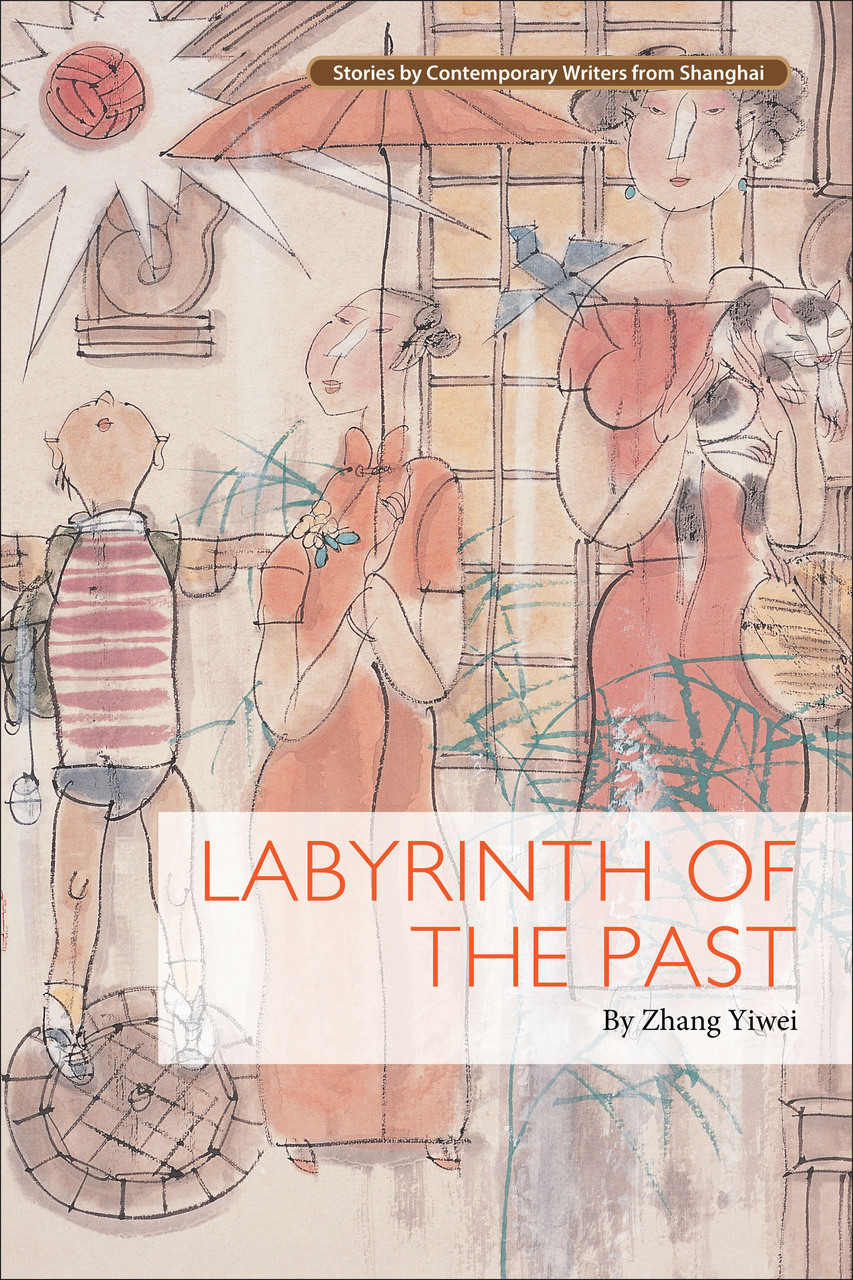
Labyrinth of the Past by Zhang Yiwei(Source: Tuttle)

Sorry that I haven’t posted for so long everyone. I was very busy with offline work for two weeks, then I caught a terrible cold which lasted another two weeks…which means now I’m busier than ever. But, I would like to get writing here again, and I can think of no better way to start than by offering a book giveaway!

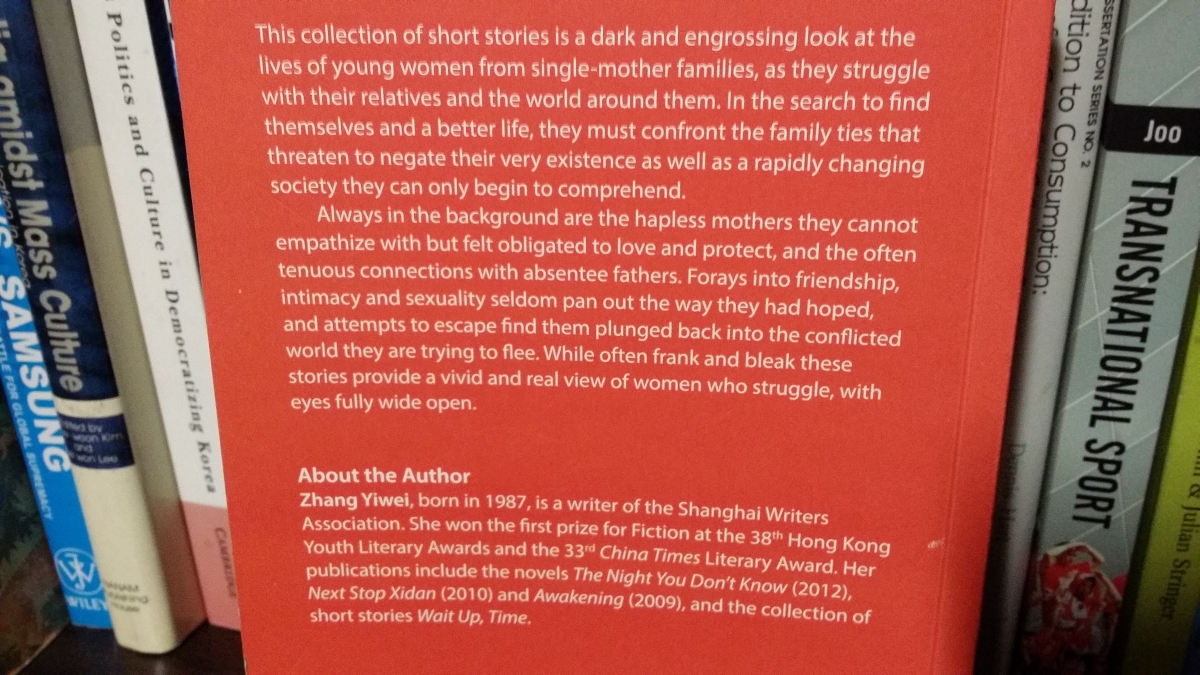
For this first one, I’ve selected Labyrinth of the Past by Zhang Yiwei. It’s a good book, but frankly it was a frustrating read for me personally, because the publisher’s website gave me the wrong impression of what to expect. Know what it’s really about though, and you’ll enjoy it from the get-go.

Here’s the offending description, which has two big problems:

Labyrinth of the Past is a collection of short stories that explore the lives of young women raised by single mothers in China, a country that is unforgiving to unmarried women and their children.

A dark, yet engrossing look at the lives of these girls, each story examines their personal struggles with family and the greater world around them. Coping with the stigma of being the daughter of a single mother, most of these women can’t seem to form anything but dysfunctional relationships, from mothers to friends to lovers.

While often frank and terribly bleak, these stories provide a vivid and real view of the women who struggle against a history they can’t change, in a culture that has difficulty accepting them.

That stigma surrounding unwed mothers is very real in Korea, so I partially chose the book to gain some insights into what it was like living with it. You can imagine my surprise and disappointment then, when it never even came up. Primarily, because none of the mothers are “unmarried” in the sense of never having married, but are all divorcees or widows instead. Which, given China’s skyrocketing divorce rates since Deng’s reforms, probably doesn’t carry any stigma at all:

The number of divorces has risen steadily in the new millennium, with one in five marriages now ending in separation. In 2006, the divorce rate was about 1.4 per one thousand people—twice what it was in 1990, and more than three times what it was in 1982….The number of divorces in the first three months of 2011 increased 17.1% year-on-year….Beijing leads the country with nearly 40 per cent of marriages ending in divorce, followed closely by Shanghai.

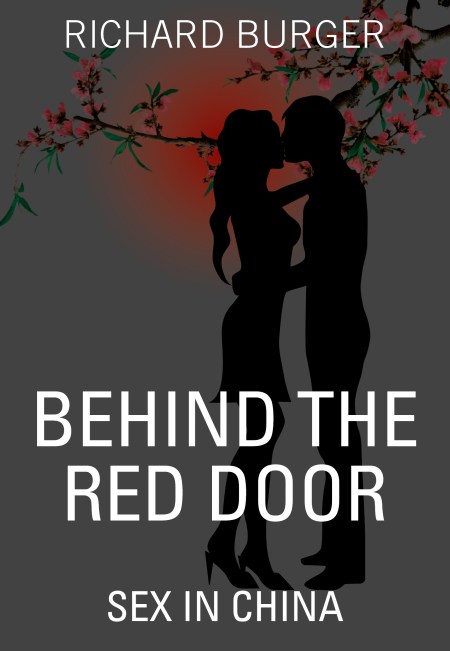
Behind the Red Door: Sex in China, Richard Burger (2012), p. 59

I’m happy to be corrected by any readers raised by female divorcees or widows, and/or with more knowledge of China, who may be able to read between the lines and see the influence of a stigma on the characters where I can’t. But if so, it’s still a very peripheral theme at best, and should really be removed from the description on the website (fortunately, it’s not mentioned on the back cover, which I wish I’d read instead).

Chinese Woman in Shanghai(Source: Matthijs Koster. CC BY 2.0)

The second problem is that the book is about the lives of young women, yet two of the seven stories—”Scab Addiction” and “No Choosing Today”—are entirely about the characters’ childhoods. In particular, in the former the character-narrator is revealed to be still in high school, making it a terrible choice for an opening story. Had I picked up the book in a store, expecting it to delve straight into the lives of adult Chinese women, I would have rejected it on the spot.

Again, this is not a criticism of the book per se, and of course all the remaining stories are indeed from women’s perspectives, with “A Good Year”, “Love,” and “Summer Days” all covering dating, marriage, and/or sex. “I Really Don’t Want to Come” too, covering the narrator’s increasing disdain for kowtowing to ancestors as she grows older, and frustration with what the ceremony means for her split family, is something many Koreans (and their foreign partners) will surely relate to. (“Memory is the Slowest” though, I just found confusing—I’m still not really sure what it’s about). But it’s also a real pity, because, once I got over the disappointment of reading something very different to what I’d been sold, and was able to take a fresh look at the book, ironically I came to find Zhang Yiwei’s depictions of childhood to be one of its biggest strengths. Her ability to evoke its timelessness, the sense of children’s whole worlds confined to just a few streets and fields, and our fuzzy, malleable memories of that phase of our lives is really quite remarkable (frankly, it immediately reminded me of the magic realism of 100 Years of Solitude), and that should be highlighted in its marketing.

Another strong point is showing how profoundly the issue of housing impacts ordinary Chinese citizens’ lives. That may sound rather boring at first, but it looms large in a country with such breakneck development, huge internal migration, and consequent vast urban/rural and home-owning/renting divides, and accordingly it’s a constant concern for many of the characters in the book, some of whom are stuck in limbo because their property is in an absentee husband or father’s name. Indeed, as if to rub that in, recently the government manipulated the ownership laws in a bid to thwart the divorce rate, taking a great leap backward for women’s rights in the process:

…the Chinese government has expressed alarm at the soaring number of divorces and its threat to the traditional Chinese family. In 2011, China took controversial steps to discourage divorce, reinterpreting the marriage law so that residential property is no longer regarded as jointly owned and divided equally after a divorce. Instead, it will belong exclusively to the spouse who bought it or whose name is on the deed, which is usually the husband, even if the wife helped pay for the property. This means that upon divorce many women might find themselves homeless.

At a time of soaring property prices, real estate is often a couple’s most valuable possession, and the revised law has caused many women to consider more carefully whether they really want to get married. Chinese media reported that marriage registrants plummeted as much as 30 percent in some cities weeks after the revised law was announced in 2011.

Behind the Red Door: Sex in China, Richard Burger (2012), p. 61

Update, August 2015: For more details, I highly recommend listening to this Office Hours podcast interview of journalist Leta Hong Fincher, author of Leftover Women: The Resurgence of Gender Inequality in China (2014).

Chinese Housing(Source: Anita. CC BY 2.0)

The verdict? I can’t lie—despite its strengths, the cover price of $13.95 is a little steep for such a slim book (160 pages), especially with some of the stories being so frustratingly short. But it’s definitely worth the $10-ish or even cheaper on various websites it’s selling for at the moment, especially if you know what you’re in for.

But first, remember I have two free copies to give away! Please just leave a comment below, and a week from now I’ll pretend to select two of you at random to receive them (make sure your email address is correct!). Really though, if you’d like to get to the head of the queue, please do bribe me with interesting comments about single mothers and/or something China-related!

What are you waiting for? ;)

Everything You Ever Wanted to Know About Korea’s Celebrity Obsession, Part 1: The numbers

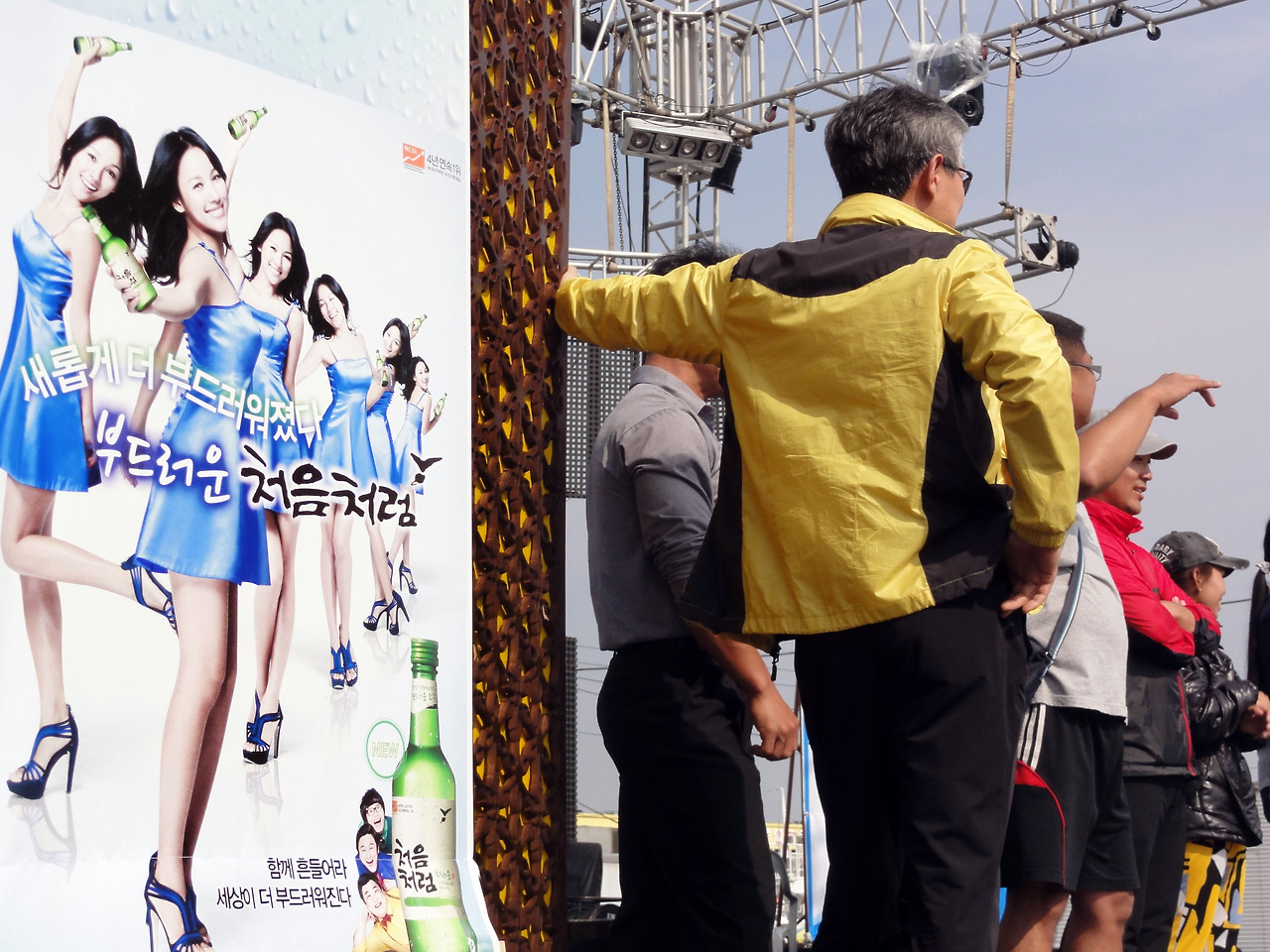
Lee Hyori Soju Endorsement(Source: Jennifer Sundt, @Tomorrowland. Reproduced with permission)

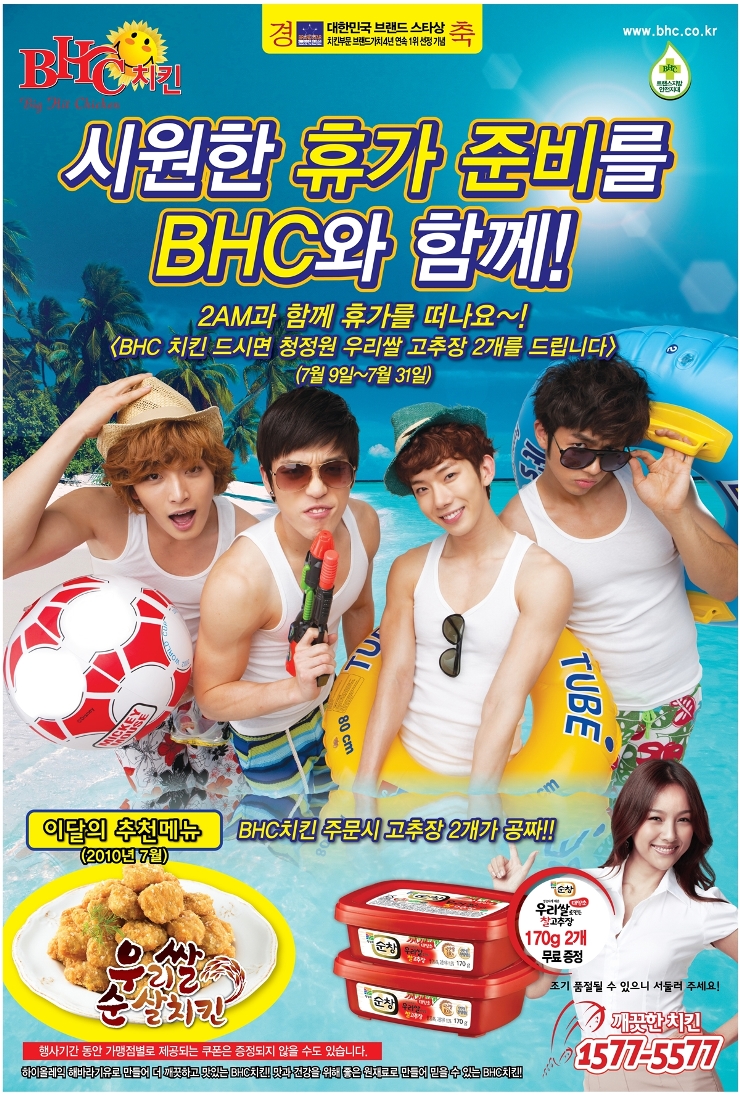
You know there’s a lot of celebrities in Korean ads. It’s probably why you recognize so many of them, even if you hate K-pop and Korean dramas.

For something so integral to the Korean media-cultural landscape though, it’s surprising that no-one seems to have worked out just how many Korean ads do have celebrities. Months of googling and poring over the books, and still the most recent systematic surveys I’ve found were done over a decade ago.

Maybe there’s just too many to count these days?

But numbers matter. To me, because I’ve long contended that the financial imperatives of K-pop are driving its increasing sexualization and sexual objectification (although these are not necessarily negatives), with knock-on effects for the Korean media as a whole. Specifically, that because entertainment management companies make more money from groups’ endorsements than their music, that “noise marketing” and ever more shocking “sexy concepts” are required to make them stand out from other groups. But frankly, I don’t think I’ve done my due diligence in confirming all the assumptions contained in that, nor addressed all the questions they raise. For instance:

  • Do entertainment management companies indeed make more money from endorsements than music?
  • Over time, (how) has the number of celebrities in ads changed? Are K-pop stars making up more and more of them? If so, since when?
  • Does getting attention through sexy concepts invariably lead to more advertising contracts? Can it actually discourage them instead, companies concluding that overly sexualized groups don’t have the appropriate image for their family-friendly brands? Or are companies only concerned about securing the most popular, most talked-about K-pop stars, regardless of what consumers are actually saying about them?
  • If so, why? Why are K-pop stars (presumably) so effective at raising sales, even if they have no conceivable relationship to the product(s)?
  • Have all Korean ads become more sexualized and objectifying over time, or just theirs? Do sexy concepts on stage have any relationship to what we actually see in their ads?

All those questions and more will answered in this series, although, again frankly, some answers will take much longer than others (and from my perspective, I’d be much more interested in hearing your own!). Long story short, it looks like—dammit—I’m going to have to stop complaining and do a systematic survey myself, and how and when I do that will depend on if my proposed paper on precisely that gets accepted for a K-pop conference in December (I’ll keep you posted).

For now, in this post I’ll present a summary of what numbers I have found, for the sake of providing a quick and accessible resource for readers, which can be added to as more sources come up. Part 2 will be a similar, much shorter one on the economics of K-pop, and Parts 3, 4, and 5 (and so on) will discuss all the various explanations I’ve found of why Koreans are so enamored with celebrities. Which, as I’ll explain in those, turns out to be something that extends back decades, and is eerily similar to—nay, a virtual carbon copy of—what goes on in Japan.

Sorry that my first long post in a while ends up as nothing more than a glorified bibliography though, which definitely wasn’t my intention. But this is proving to be a mammoth project, much better suited to an ongoing series. And I hope that readers appreciate the need for the stats, and that some may find them useful.

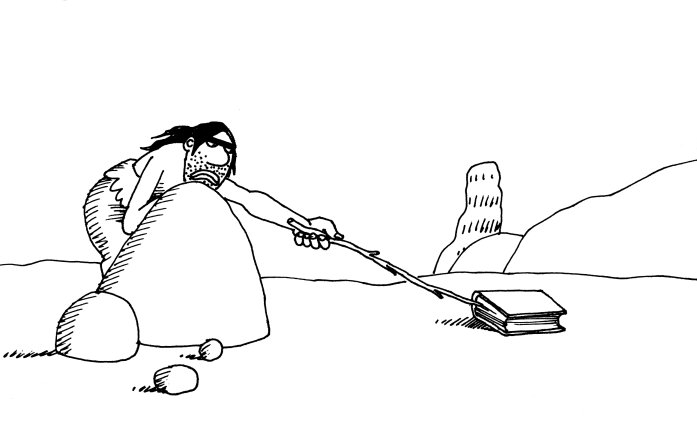
B. Kliban, How to approach a book(B. Kliban. Source: Manger Paléo)

In order of when the surveys were conducted, or when the article was published:

— A study of advertisements from The Chosun-ilbo and The New York Times throughout 2000

— More Korean ads had people in them (47%) than US ones (31.9%)

— Korean ads had a greater number of celebrities (24.1%) than US ones (9.9%; both figures out of all ads surveyed)

— Of those ads with celebrities, US ones had more product-relevant celebrities (77.4%) than Korean ones did (38.3%).

  • Son, T. W. (2001). Success of advertising depends on the appropriateness of celebrity use.
    Advertising Information (Korean), November, 440-450.

— Paek, p. 136, explains of this: “Of the TV commercials screened, about 32% of the ads included celebrity endorsers, and 59% of primetime TV commercials used celebrities as endorsers.” But he doesn’t provide any more information sorry.

— A very comprehensive survey, of 7728 unduplicated television commercials in 25 countries between February 2001 and December 2003. The Korean ones examined were on MBC, between 18:30-21:30, May 18-19, 2001; and on MBC/SBS/KBS 2 between 18.00-24.00, on October 22-November 14, 2001.

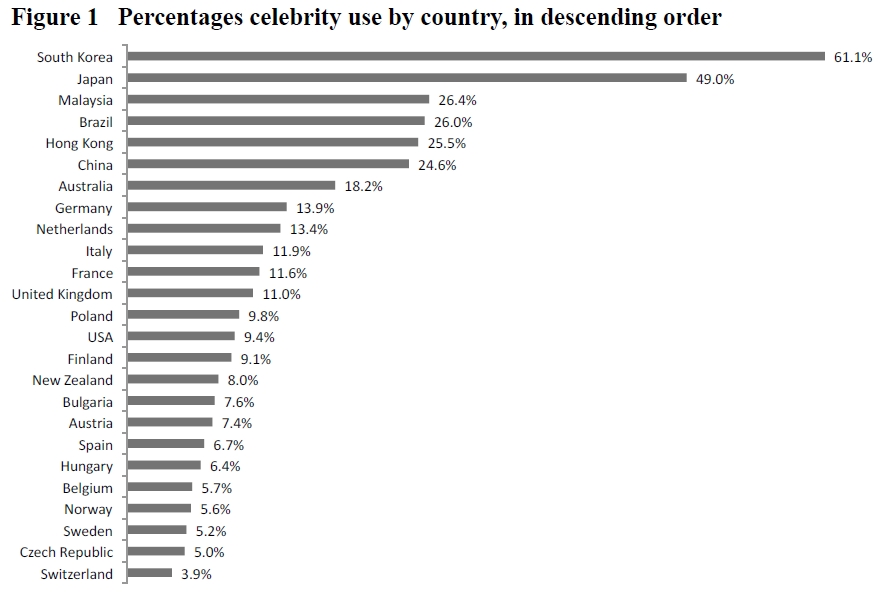
— This graph of the results (p. 10) is very revealing (click to make it larger):

Commercials with celebrities, cross-country comparison, 2001-2003The author, Carolus Praet of the Otaru University of Commerce, seems like the expert on celebrity advertising in this part of the world (see here for a list of his publications). Once I get a hold of his more recent “Korea As Number One: A Multi-country Study of Celebrity Advertising Around the World,” in Proceedings of the Korean Advertising Society (KAS) Far East International Conference in Advertising, pp. 367-375 (2012), I’ll add it here.

— Study based on Korean and US television from 29 July to 2 August 2002

— 57% of Korean commercials featured a celebrity, compared to 9% of US ones

— Of those Korean celebrities, 70% were actors, actresses, and singers; only 47% of the US ones were

These results come via page 50 of Roald Maliangkay, “Catering for the Female Gaze: The Semiotics of Masculinity in Korean Advertising,” in Situations: Cultural Studies in the Asian Context, Vol. 7, No. 1, Winter 2013/14, pp. 43-62.

  • Hong Tack-Kim, “Characteristics, History, and Forecasts of Creativity in Korea,” in Korean Advertising: Facts and Insights, 218-274 (Seoul, KOBACO, 2007). As I type this, the PDF download isn’t working; see here for a cached version instead. It says:

— From page 272-273: “Some 2,000 television commercials are produced in Korea every year.
Among those, commercials that use famous spokesmodels account for almost 70 percent. Most of these famous spokesmodels are celebrities.”

This reference comes via page 357 of Olga Federenko, “South Korean Advertising as Popular Culture,” in The Korean Popular Culture Reader, ed. by Kyung Hyun Kim and Youngmin Choe, Duke University Press 2014, pp. 341-362, who explains that “In the first decade of this century, 70-75% of Korean ads featured celebrities,” but adds in a footnote that—story of my life!—”Precise statistics are hard to find and most authors quote their estimates without providing sources.”

See also her 2012 PhD, “Tending to the ‘flower of capitalism:’ Consuming, producing and censoring advertising in South Korea of the ’00s” (download as a PDF here), in my view easily the best and most comprehensive guide to modern Korean advertising (albeit only just discovered while writing this sorry; I’ll return to it in a later post). She mentions endorsements and celebrities in passing throughout, but in footnote 22 of page 103 specifically she references Eom Nam-hyun, “FTC suggests guidelines to advertising in which celebrities appear,” Ad Starts 2009: 2009 Busan International Advertising Festival with Metro (English edition), page 10, as another example of one of those estimates. As its single, hard to find link makes me nervous, let me copy and paste it here just in case that is ever taken down:

Celebrity appearances in advertisements are a worldwide trend. It is said that 75% of Korean TV ads use celebrities as well as 70% of Japanese ads.

However, as for America, the percentage of commercials using celebrities or famous people in ads is only about 25%, which proves that in both Korea and Japan, using celebrities in ads is a general basis of the advertising creative strategy. Additionally, the celebrities’ high rate of TV commercial appearances leads into a prevailing trend in which the same celebrity shows up on several different commercials of different products.

For this, the FTC (Federal Trade Commission) re-established new guidelines for putting famous people and celebrities into ads which draw our attention.

According to the guidelines, celebrities in ads have to candidly convey their opinion on the products and their thoughts about their experience of using the product.  Advertisers also must fully communicate with the celebrities about the ads. The interesting thing is that FTC asked the celebrities to be cautious about choosing ads in which they promote products.

It also stated that if the celebrities convey wrong information about products or alluring contents to the general public, the responsibility rests on them. Because of these guidelines, it is expected that celebrities will have difficulties when appearing in ads of a similar category of business and in ads of competing brands.  / Nam-Hyun Eom, Doctorate Course of Advertising, Texas University.

— “Among the 2,000 commercials produced in Korea last year, 65 percent featured celebrities. In the U.S., United Kingdom and France, the rate is less than 10 percent.”

Korea Celebrity Endorsements Hyun-bin HiteI think that’s where I got those figures for the France and the UK in one of my presentations. But, years after I first prepared the slide, now *cough* I’ve no idea where I got those figures for China and Brazil, or why I didn’t say the US was also 10%…

Either way, being unsourced, obviously I can no longer use it. Also, no offense to Hyun-bin above (he’s hardly the only offender), but I do remember why I chose his picture last month: his classic, terrible example of simply being a “beautiful person holding a bottle“…

— “In 2012, the Seoul government urged advertisers to “exercise restraint” when a study found that idols were used in 72% of ads for alcoholic drinks.”

Specifically, it said:

“서울시는 특히 주류 광고를 통해 자주 노출되는 연예인 22명 중 17명(72%ㆍ중복 제외)이 아이돌이었고, 노출빈도 1위는 탤런트 김수현, 2위 공유, 3위 피겨 선수 김연아 순으로, 이들을 모델로 한 주류 광고가 청소년에게 상당한 영향을 미치고 있다고 분석했다.”

“In particular, Seoul city discovered that out of entertainers that frequently appear in alcohol advertisements, 17 out of 22 (72%; those that appeared in more than one advertisement were excluded) were idols. The most frequently appearing were talents Kim Soo-hyeon and Gong Yoo, and athlete Kim Yuna; having these people in alcohol advertisements has a huge influence on teenagers.”

I’m not sure how “idols” were defined by the authors though (I’ll discuss definitions in a later post), and the article confusedly begins by saying that only ads on free to air TV were studied, but then discusses results from cable TV too. Also, they lumped radio and TV commercials and newspaper ads all together, which are very different mediums.

However unreliable though, I was surprised that over 9 in 10 of those alcohol ads were for beer. I would have assumed that at least half would have been for soju?

— Finally, some very recent, but again unsourced statistics from a marketing company: “The use of celebrities in advertising varies enormously around the world. It’s highest in Japan and Korea, where over 40 percent of TV ads feature celebrities, and lowest in Ukraine, Sweden, and Canada, where the proportion is under 5 percent. It is 10 percent in the U.S., and 12 percent in the UK.”

SISTAR, Bio Industy Expo Osong Korea 2014(Source: @John_F_Power. Used with permission.)

And on that note, thanks to those complete geeks amongst you still reading(!), and please feel free to ask me for PDFs of any of the sources I’ve mentioned (I have about half of them). And if any readers know of any more sources, by all means pass them on, with my heartfelt appreciation!

(KICKSTARTER) My Japanese Husband Thinks I’m Crazy: The Comic Book

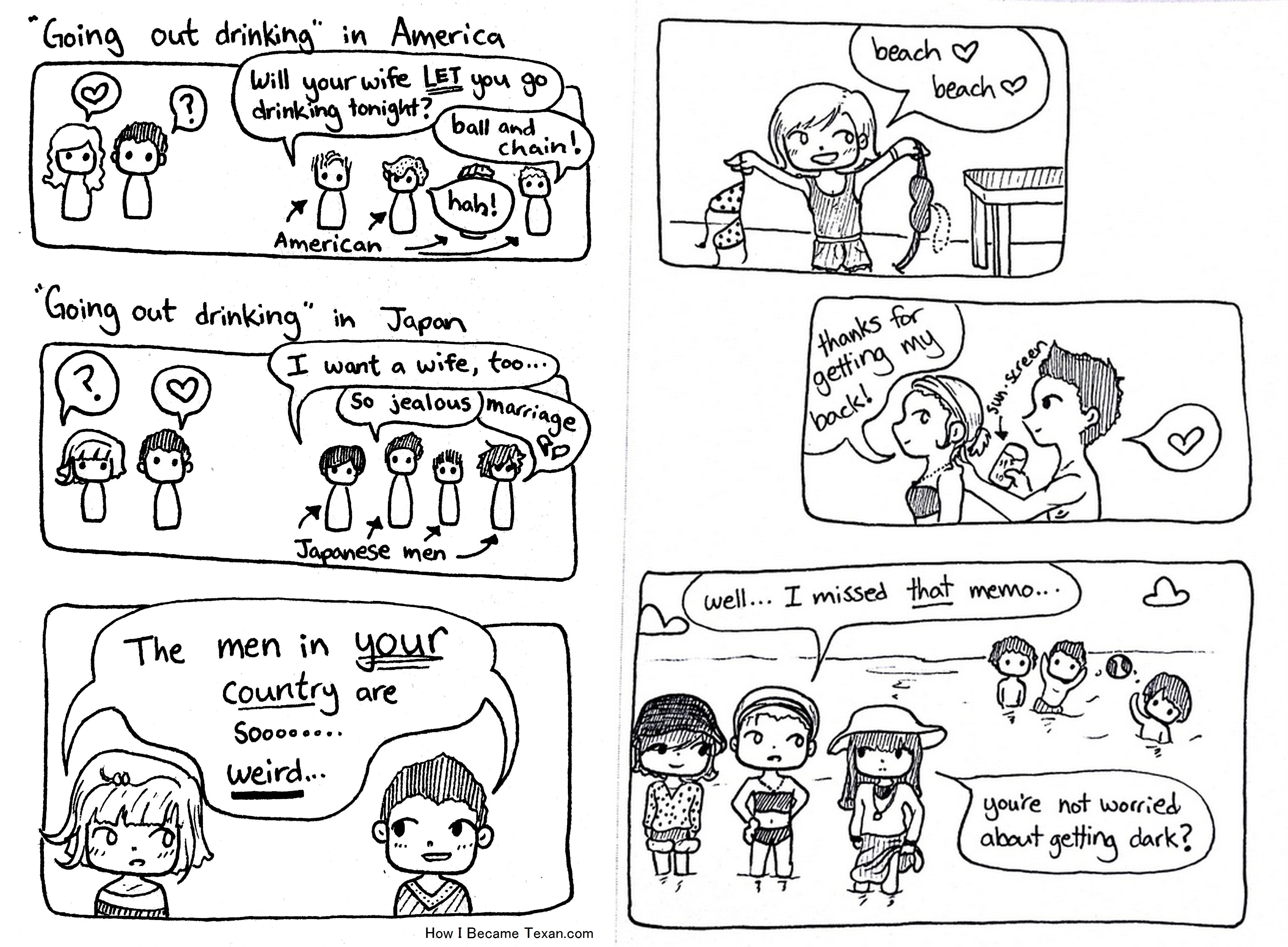
Texan in Tokyo(Source, all images: Texan in Tokyo)

I’ve been asked to pass on the following:

Deciding to move across the world for “love” is easy. People do it all the time. Thriving in that new country (without sabotaging your relationship), on the other hand, is a bit more difficult.

EnterMy Japanese Husband Thinks I’m Crazy: The Comic Book.”

My Japanese Husband Thinks I'm CrazyThis comic book is the autobiographical misadventures of a native Texan freelancer (Grace) and her Japanese “salaryman” husband (Ryosuke): in comic form. From earthquakes and crowded trains, to hilarious cultural faux pas, it explores the joys of living and working abroad, intercultural marriages, and trying to make a decent pot roast on Thanksgiving.

Grace Buchele Mineta Texan in TokyoMy Japanese Husband Thinks I’m Crazy: The Comic Book” is being funded on the popular crowd-funding website, kickstarter.com, from July 28th to August 30th.

In the first 24 hours online, the book has been funded 73%.

Grace Buchele Mineta is a native Texan, founder of the hit blog “Texan in Tokyo,” and author of the autobiographical comic book, “My Japanese Husband Thinks I’m Crazy.” She lives in Tokyo with her husband, Ryosuke, where she blogs and draws comics about their daily life.

I Read a Book: Susan Blumberg-Kason’s Good Chinese Wife: A Love Affair with China Gone Wrong (2014)

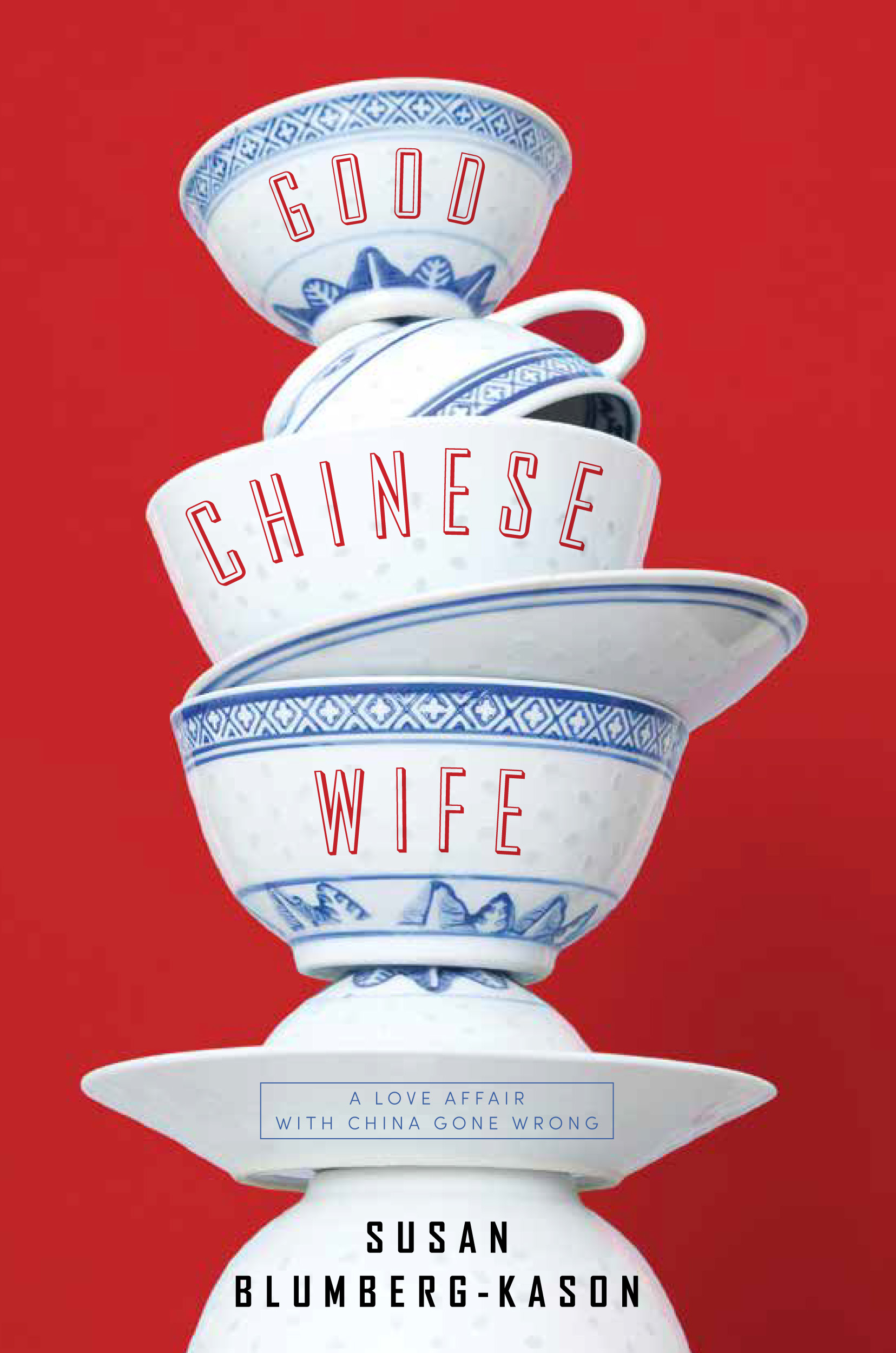
Good Chinese Wife CoverLet me be honest: Good Chinese Wife is not something I would normally read.

Susan’s ex-husband was Chinese; my wife is Korean. Susan’s relationship goes from friends to engaged in less than two minutes; we lived together for years, and had lots of wild sex before I proposed. Their marriage rapidly turned sour; we just celebrated our tenth anniversary. They married, had a child, and divorced way back in the 1990s; I’m really only interested in Chinese attitudes towards dating, sex, and marriage in the 2010s. And so on.

I’m still grateful for receiving a reviewer’s copy, organized by Jocelyn Eikenburg of the Speaking of China blog (see here for many more bloggers’ reviews). But first impressions? I expected it to be very outdated, and that it would have little to offer readers with Korean partners.

I was dead wrong, on both counts.

Good Chinese Wife begins in Hong Kong in the mid-1990s, where Susan is doing a graduate degree (she previously spent a year there as an exchange student in 1990). Then in her early-twenties, she soon becomes smitten with Cai, an older mainlander from Wuhan. She starts tutoring him English in her dorm room; unbeknownst to her, other students consider them already dating. This prompts him to open up and explain he’s already been married and has a child, revealing all as a prelude to showing he is now interested in dating Susan. Because in China, Cai explains, “couples traditionally only date if they plan to marry.”

This sounded very antiquated. But as it turns out, dating in China is still not at all like in the West, nor even Korea. In Behind the Red Door: Sex in China (2012), Richard Burger explains that even in the big cities, “serial dating” is frowned upon as immoral or promiscuous. Instead, “most Chinese women still believe it is best to date only man and to marry him. Once the man invites her on a second or third date, he is indicating that he’s serious, that he is hoping for an exclusive Behind the Red Door Sex in Chinarelationship, and that marriage might be on the cards.” Whereas for women, inviting her to meet her parents “means she expects to marry him, and Chinese men understand this arrangement.” What’s more, the average age of marriage for Chinese men was only 24 in 2010; for women, 22 (in Korea, 31.8 and 28.9 respectively).

So, I understood Cai. And, being head-over-heels ever since they’d met, why Susan quickly accepted his proposal, before so much as a kiss—it sounded sweet. Her frankness about her feelings and mistakes is also a definite charm, especially for someone who likewise fell very easily in love at that age.

But that’s only 36 pages into the book. For the remaining 300, sympathy turns to constant frustration and exasperation with Susan’s rushing into marriage, then her frequent acquiescence towards her increasingly controlling and abusive husband. These feelings are only amplified by knowing that she’s doomed to fail.

In an interview, Susan says her problems were more because “He told me from the get-go that he had certain conditions for our marriage. Those are things I ignored or thought I could eventually get him to change. That should have been my red flag, not the [6 months] in which we became engaged and married.” (Likewise many happily-married Koreans, for whom such whirlwind courtships are also common, would surely bristle at the suggestion that they should have taken things slower.)

I disagree. From Cai’s belief that women are especially “dirty” in the summer, once all but physically forcing an exhausted Susan to bathe in a rat-infested bathroom, to his bizarre, surprisingly submissive relationship with eccentric professor friend ‘Japanese Father’ (“He thinks it’s not good [for us] to have sex relations more than once a week”), most of Susan’s later issues with Cai could have been discovered if they’d spent (much) more time together before the wedding day—and/or resolved if an expensive wedding wasn’t already looming over them.

Still, it does make for a good page turner. There is also merit in studying a bad relationship to learn what to avoid, and much about this one that will already be familiar to those with Korean, Japanese, and Taiwanese partners. New and expecting parents in Korea, for example, will sympathize with Susan’s expectations to conform to man yue, the belief that mothers shouldn’t bathe or go outdoors in their first month—it mirrors the Korean one of sanhoojori. Also, for those couples planning to move to a Western country, her discussion of Cai’s difficulties with adjusting to life in San Francisco will be very beneficial. Her avoidance of tiresome Orientalist stereotypes is especially welcome, with her ex-parents-in-law coming across as old-fashioned but lovely, and Chinese men portrayed no better or worse than Western ones.

That said, I am reminded of a book for couples I once flicked through, which encouraged them to discuss their expectations of marriage in great detail before committing. With checklists ranging from beliefs about circumcision and determining which cities were best for both partners’ careers, to dividing the housework and setting dating policies for potential teenage children, that approach would be much too calculating for most couples. Marriage, after all, is ultimately about making a scary but exciting leap of faith with someone. But when partners come from such wildly different backgrounds, and bring such different expectations into marriage? Susan’s experience teaches readers that for international couples in particular, perhaps they really should learn the answers to those questions sooner rather than later.

Good Chinese Wife back cover

One minor quibble was all the hyperbole. Not to diminish Susan’s genuine fears for herself and her son at times, but did it lead me to expect a story involving forged passports and bribed border guards(!). Also, I disliked the format of numerous short chapters, with so little happening in some that they felt like diary entries. But that is just a personal preference.

The verdict? Good Chinese Wife is well worth the US$14.99 cover price (16,410 won at What the Book), and a definite eye-opener about the value of reading more about relationships in this part of the world, especially with such limited options for reading about Korean ones specifically. Please do leave your suggestions (and reviewer copies!) for more like it, and/or for blogs.

When K-pop Gets Under Your Skin…

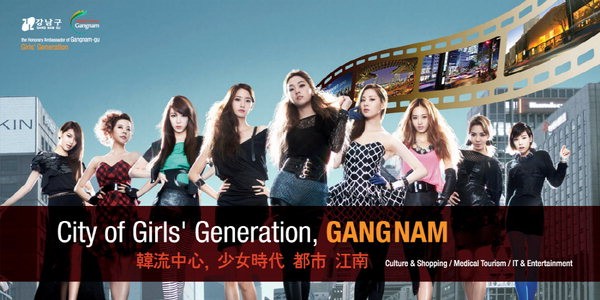
city of girls' generation gangnam(Source)

My latest piece for Busan Haps, on the contributions that K-pop has made to cosmetic surgery medical tourism.

I chose the topic because I’d always assumed that K-pop was easily Korea’s #1 cultural export. And, building on from that, that surely most medical tourists to Korea would be coming for cosmetic surgery. After all, what would this blog be without all the posts on dieting and body-image narratives in K-pop songs? On stars’ cosmetic, beauty, and dieting-related endorsements? Or, of course, on the ideals set by their bodies themselves?

I couldn’t have been more wrong.

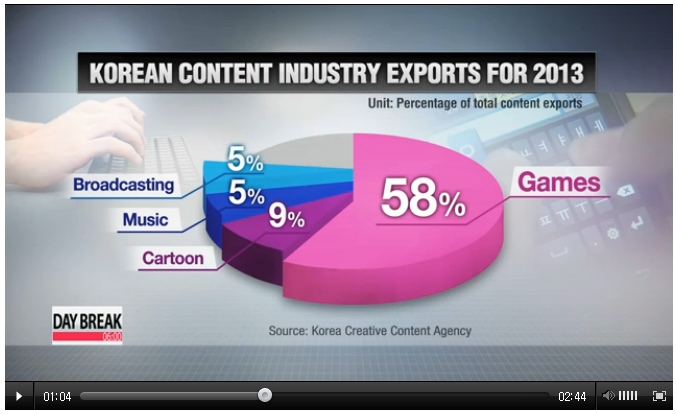
First, because K-pop only accounted for just five per cent of the revenues from cultural content exports in 2013, as demonstrated in this Arirang news report from January. That worked out to $255 million, out of a total of $5.1 billion.

Korean Content Industry Exports for 2013(Source)

Next, because cosmetic surgery tourists only comprised seven point six percent of medical tourists in 2012. Yes, really.

When I wrote the article, I mistook that for the 2013 percentage, which isn’t available yet. But, assuming it remained the same (although the trend is for rapid growth), that would have resulted in a paltry $7.6 million in revenues in the January to November 2013 period, based on these figures that incorporate revenues lost from Korea’s surprisingly high numbers of outgoing medical tourists (unlike the grossly inflated KTO figures).

No wonder “a renowned business professor” recently dismissed the economic benefits of K-pop.

Frankly, another reason I chose this topic was because I expected I’d quickly prove him wrong. Instead, I soon found myself chagrined, forced to concede that perhaps he had a point.

But the long-term benefits? He’s dead wrong about those. To find out why, please see the article!

Why the Japanese Don’t Illegally Download Music. Much.

Bodacious Space Pirates(Source)

For all their passion, home-grown fans are not paying enough for K-Pop.

The CD industry is stagnant, and digital music sites are seen as vastly underpriced, with some charging just a few cents a song.

Bernie Cho, head of music distribution label DFSB Kollective, says online music sellers have dropped their prices too low in a bid to compete with pirated music sites….

….With downward pressure on music prices at home, “Many top artists make more money from one week in Japan than they do in one year in Korea.”

(BBC, June 2011)

With many implications for the Korean music industry, and raising many questions about the curious preferential treatment given Korean fans over international ones, I’ve been quoting Bernie ever since. So too Sony Pictures chief Michael Lynton and Paramount Vice Chairman Rob Moore on movies, the latter of whom suggested that cultural differences are the main reason that Koreans illegally download so much more of them than the Japanese:

…governments around the world are subsidizing and promoting the ubiquity of high speed broadband to make their economies more efficient and competitive. With this increase in speed, content will travel that much more easily on the Internet. But without restraints, much of that content will be contraband.

I’ve already seen it happen in South Korea, which has one of the most highly developed broadband networks in the world. But piracy has also become so highly developed there that we and virtually every other studio has recently had to curtail or close down our home entertainment businesses. It’s hard to sell a legal DVD when it can be stolen without any repercussions.

(Michael Lynton, The Telegraph, May 2009; source, below)

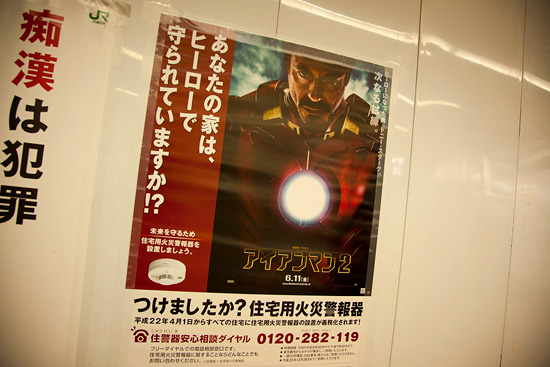
Iron Man 2 Japanese Poster…Paramount is holding back the release of “Iron Man 2” in Japan for several weeks, having little fear about the country being swamped with bootleg copies of the film.

However, when it comes to Korea, it’s a different story. “For better or worse, there are certain countries — notably like Korea — where it’s culturally acceptable to download movies online pretty much right away,” said Moore. “By the third week of a movie’s release, you’re starting to see a large part of the audience who will start consuming the film online. It’s why Korea has almost no home video business anymore.”

(Rob Moore, Los Angeles Times, May 2010; via The Marmot’s Hole)

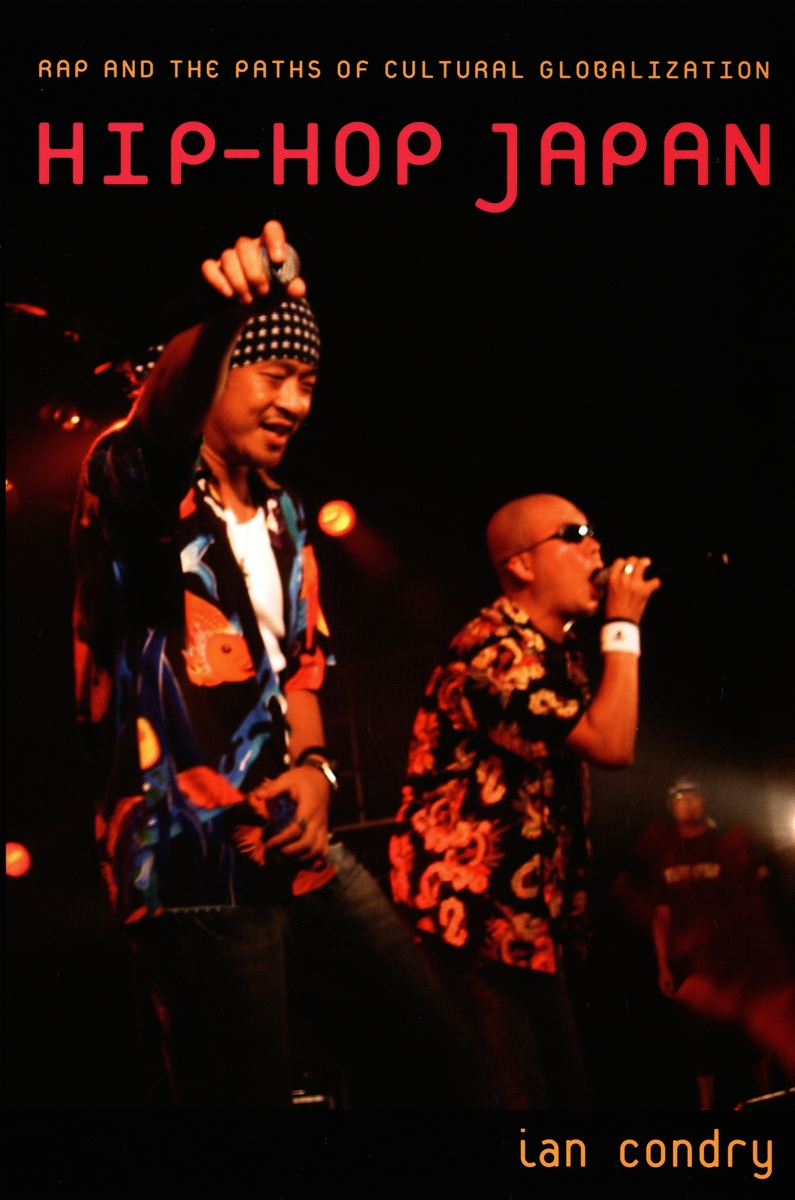
Given Lynton and Moore’s frustrations, readers — and myself — can be forgiven for accepting that culture must have something to do with it, and that this would necessarily apply to music too. However, I’ve just finished reading Ian Condry’s brilliant Hip-Hop Japan: Rap and the Paths of Cultural Globalization (2006), a must-read for all Japanese and — yes — Korean music fans (I’ll explain in a review later this month), who adds two crucial economic and technological reasons that few outsiders to Japan would be aware of:

Ian Condry Hip-Hop Japan(Source)

Two other aspects that distinguish Japan’s music market are rental CD shops and low rates of online piracy. These characteristics further demonstrate that abstract markets do not operate separately from their concrete settings. In Japan, recorded music sale rose steadily during the postwar period, peaked in 1998, and then began a sharp decline that continued through 2004. The start of the decline coincided with the emergence of Napster in 1999, but there are reason to think that online piracy offers only a partial explanation for the decline in sales. As I discuss elsewhere, online piracy is less prevalent in Japan than in the United States. In Japan, most young people access the Internet using cell phones, which as yet tend to have neither broadband connections not substantial hard drives. In addition, ubiquitous CD rental shops make it relatively easy and inexpensive to sample new music without relying on unauthorized downloads. CD prices are high in Japan, generally between ¥2,500 and ¥3000 (US $23-27), but renting a CD is very cheap, generally around ¥300 ($3). The widening availability of CD burners contributes to this “sneaker net” for passing around music and also limits the attractiveness of online file sharing. This suggests that the lack of online piracy arises less from a national respect for copyright than from the combination of a business setting in which rental shops make it easy for consumers to sample music cheaply and a technology environment dominated by Internet-ready cell phones that make downloading over peer-to-peer networks unfeasible.

(pages 190-191; my emphasis)

Written well before smartphones had made their debut, clearly that description is a little dated. Indeed, by 2012, the Recording Industry Association of Japan estimated that only 1 in 10 music downloads were legally purchased, prompting the Japanese government to introduce harsh fines and jail times* for — uniquely — the illegal downloading (rather than the more usual uploading) of content, which in turn provoked an attack on government websites by Anonymous.

However, the Japanese are notorious for stubbornly sticking to outdated technology. Common-sense dictates that looking only at digital downloads would give a very skewed impression of the Japanese music market, which is still the second biggest in the world.

Japan Smartphone(Source)

For just last week, Japan Realtime reported that CD sales are booming:

“The Japanese market is very different from the rest of the world,” said Mr. Minewaki [CEO of Tower Records Japan]…

….While global sales of physical CDs have been plunging under pressure from the digital download market, Japanese CD sales bucked this trend in 2012 with a 9% rise from a year earlier, according to the Recording Industry Association of Japan. Tower Records Japan is majority-owned by Japan’s largest wireless carrier NTT DoCoMo Inc.

Mr. Minewaki said CDs continue to do well in Japan because of legal constraints that curbs rapid discounting, a lag in consumers switching from feature phones to smartphones, and the popularity of rental CD shops where consumers can rent then copy music, a cheaper alternative than buying songs or albums online.

But the compact disc business isn’t completely immune to the marching popularity of digital downloads…

Meanwhile, here in Korea, I don’t think I’ve even touched a CD in the last year. Although I do have hundreds, being 37 years old and all…

How about yourself? Are CD rental stores also still around in Japan?

*Like most articles praising the rapid rise of the Korean digital music market and the supposed success of Korean anti-piracy efforts, this article completely fails to mention how absurdly cheap Korean digital tracks are, as noted by Bernie Cho in the opening quote.

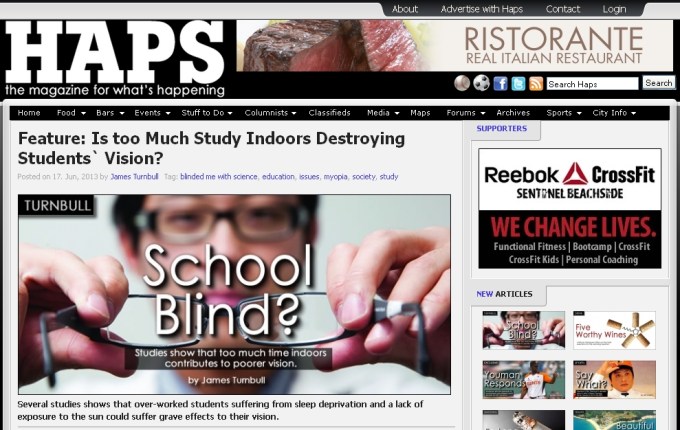
Is too Much Study Indoors Destroying Students’ Vision?

Busan Haps James TurnbullIn a word, yes.

To find out why 9 out of 10 Korean students require glasses, compared to only 2 out of 10 in the UK, check out my latest article for Busan Haps.

Revealing the Korean Body Politic, Part 5: Links

So Ji-sub Vivian(Source: Vivien)

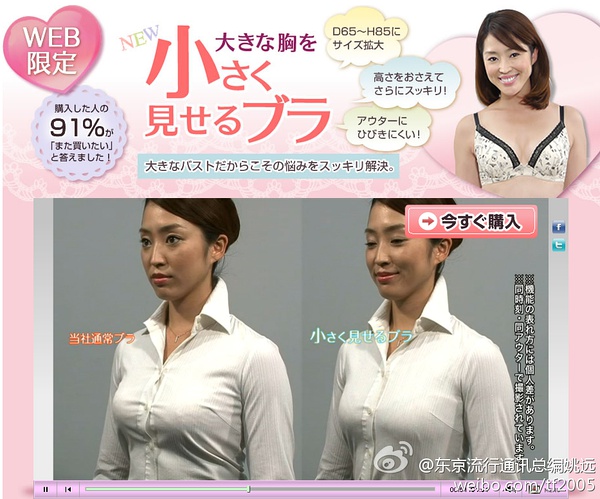
In Part 4 back in February, I mentioned that Korean women were getting less breast augmentation and more breast reduction procedures than their counterparts in the US and Brazil, despite having a genetic predisposition towards small(er) breasts. Add that North Koreans think busty women are “intentionally and lewdly stressing [their] femininity,” and that Wacoal’s ‘Bra That Makes Big Breasts Look Small’ would probably be just as popular in Korea as in Japan, then I wrote that all signs point to “a big disconnect between ordinary Koreans’ — and even models’ — attitudes to fashion, body image, and sexuality and what you may see on Korean TV.”

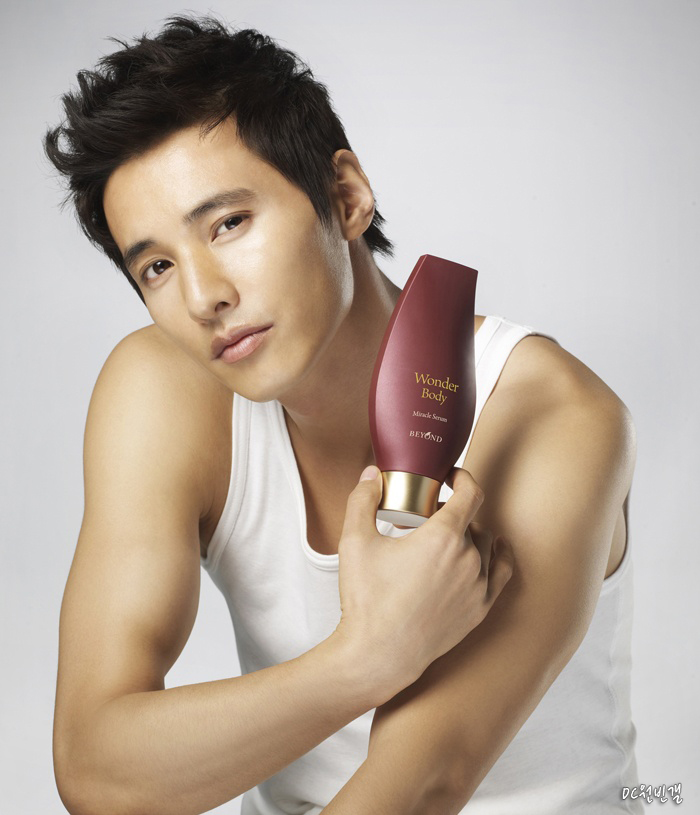
Won Bin Beyond 1As Dr. Roald Maliangkay at the Australian National University points out however, it’s very much the same with men:

….The majority of men appearing on posters and billboards are celebrities. Although the wide use of cosmetic surgery is making men look increasingly similar, they are often associated not merely with a product, but also with a popular drama, and in some cases, a steamy bed or bathroom scene. That is not something the average worker would ever seek to emulate, nor be able to, as the nation’s corporate dress code remains conservative.

See “The bra boys of South Korea” at World News Australia for more, which is mostly about the kkotminam (꽃미남) phenomenon, or here for more on the disproportionate role of celebrity endorsements in the Korean media (source, right: Wonbin Thailand).

Next, in Part 4 I also discussed how official North Korean attitudes to women’s clothing have been changing in response to women increasingly becoming breadwinners, generally becoming more restrictive. For more on this “Female Face of North Korean Capitalism,” see Andrei Lankov’s recent lecture at the Royal Asiatic Society in Seoul:

Third, via Lisa Wade at Sociological Images, here is:

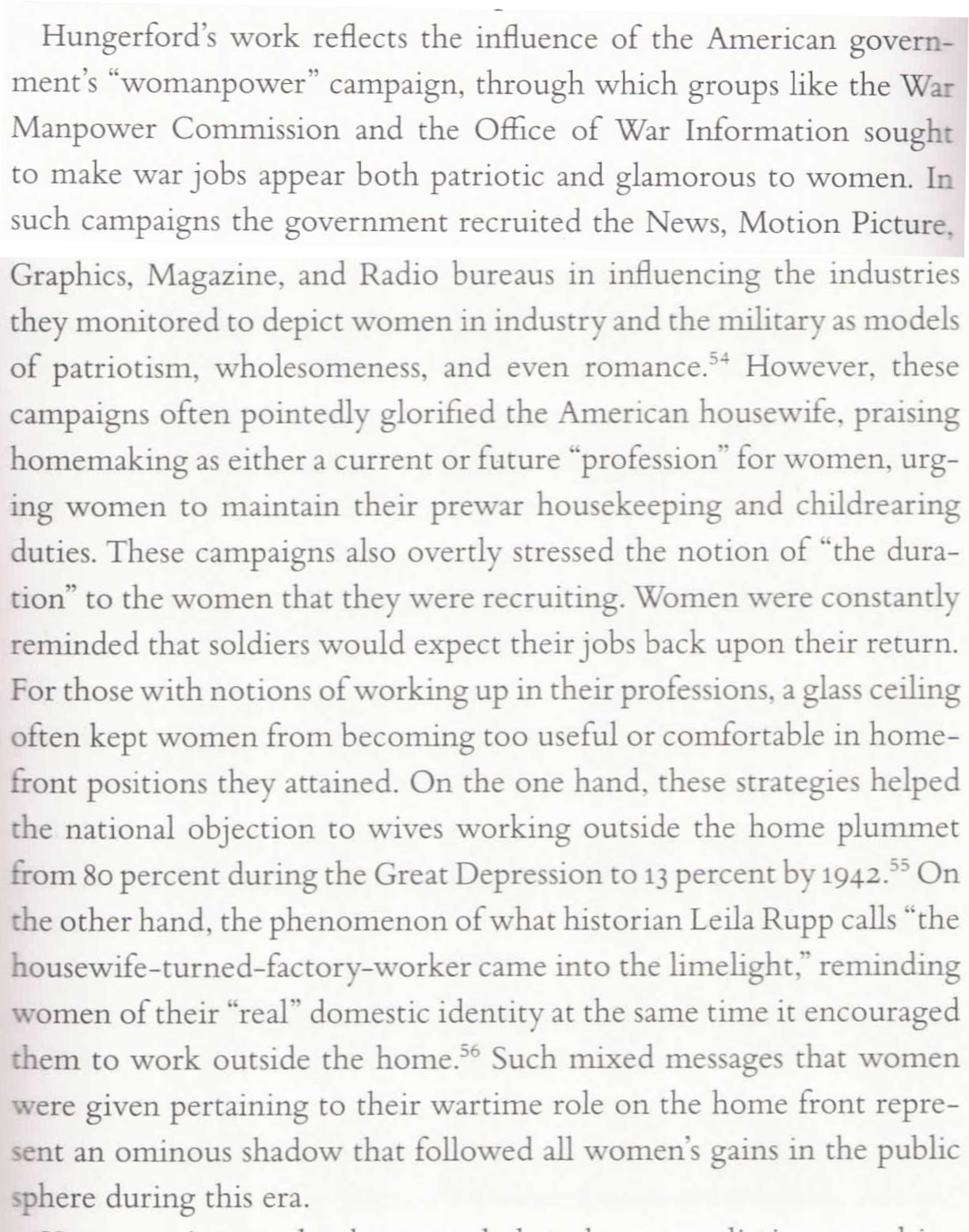
…a great short clip instructing women workers newly employed in industrial factories during World War II on how to do their hair to maximize safety. It assumes both ignorance and vanity on the part of women and speaks to the lack of efficiency caused by efforts to remain attractive on the line.

As I pointed out in — yes, again — Part 4, those assumptions about vanity need to be placed in the context of wartime shortages, when attention to beauty and fashion were viewed as extravagant and unpatriotic. But despite that, women’s anxieties about both were still explicitly encouraged, preyed upon, and/or encouraged by industry, and actually even by the government itself. The ensuing contradictions, double-standards, hypocrisy, and backlash are very similar to what has been occurring in South Korea since the 2000s with women’s rapid entrance into the (part-time) workforce, and make comparisons very useful and compelling.

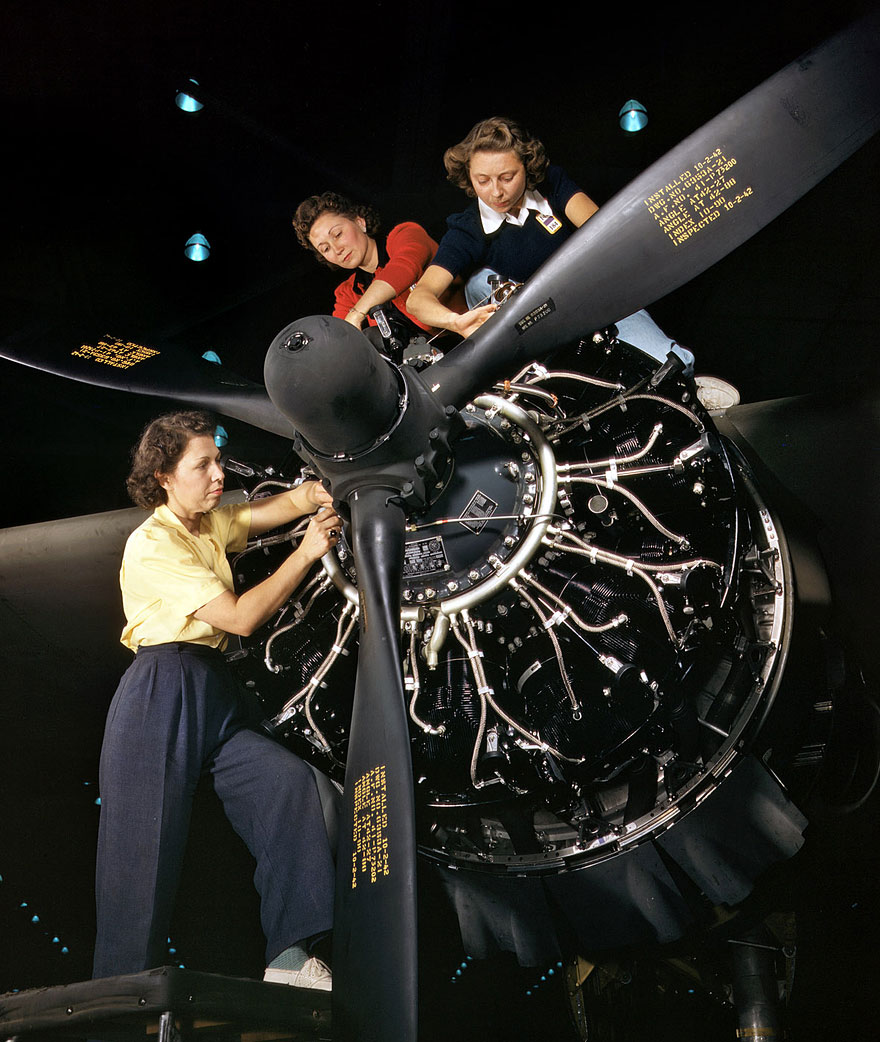
world war 2 women workersFor more on the backlash in Korea specifically, see “The hate underlying the ‘__ Girl series’ and criticism of women’s organizations” at ILDA (in addition to all the links in previous posts in the series). Finally, for more on the wartime US case, first see “The Impact of War on 1940′s Fashion in the USA” at Glamor Daze for a primer on women’s fashions in the period; then, see Bored Panda for rare color photographs of women working in aircraft manufacturing plants in World War Two, taken by:

“Alfred T. Palmer who worked for the Office of War Information (responsible for promoting patriotism, war news management and women recruitment)” whose photos “had to lure young women into the factories by showing women workers as glamorous and even fashionable.” (My emphasis; see example on right).

Update: also see Kathryn M. Brown’s 2010 MA thesis Patriotic Support: The Girdle Pin-up of World War 2 (it can’t be directly linked sorry—type the title into the searchbar) for more on how malleable and adaptable — and, as explained, ultimately hypocritical and contradictory — the language, prevailing standards for, and attitudes towards beauty and fashion proved to be for the needs of government and industry (see Part 3 for modern Korean and earlier US parallels also).

The Revealing the Korean Body Politic Series:

Revealing the Korean Body Politic, Part 4: Girls are different from boys

Ha Ji-won Breast Size Korean AttitudesEstimated reading time: 16 minutes. Image sources: left, right.

“The JoongAng Ilbo reports that having a full rack is seen as a disadvantage for women in North Korea.

This is in marked contrast to the South, where a thin figure and big breasts have become symbols of beauty.

According to defectors, if a woman appears well-endowed in the North, people think she is intentionally and lewdly stressing her femininity, and she can easily come to be regarded as a slut. You have an atmosphere that doesn’t allow women to wear revealing clothing, and the North is still a male-dominated society.

One defector from Hoeryong said she had a work friend with large breasts who often ate chives because she’d heard they make your boobs smaller. She added that she was surprised upon learning that women in the South actually have operations to make their breasts bigger.”

The Marmot’s Hole

Alas, The Joongang Ilbo provides nothing to verify those claims. But, I see no reason why the defectors would lie, and negative stereotypes of large-breasted women are by no means confined to North Korea. Also, who would ever question that “a thin figure and big breasts have become symbols of beauty” in the South?
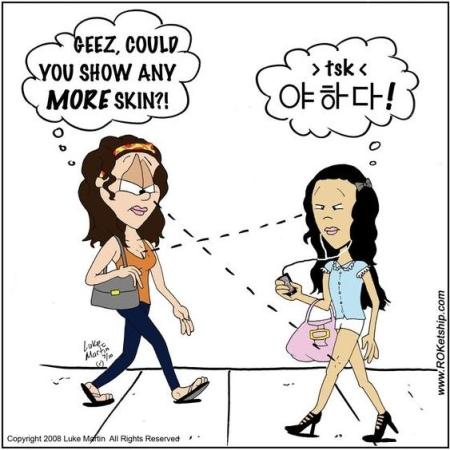
Korean Women Revealing Clothing AttitudesFortunately though, Liminality did, who in a must-read response shows that however much the Korean beauty industries and media promote such an ideal, and however much East Asian-women may have a genetic predisposition towards small breasts, cosmetic surgery patients at least hardly consider themselves lacking in that department. In fact, quite the opposite:

  • Per capita, far more breast surgery operations are performed in European and North and South American countries than in Korea (or Asia)
  • Despite having the highest per capita number of cosmetic surgery operations overall, Korea only came 22nd in the number of breast surgery operations performed per capita
  • Of those operations, Koreans had slightly less augmentation and lift operations than their counterparts in the US and Brazil, and slightly more reduction surgeries (source, above; reproduced with permission)

Similar attitudes may exist in Japan too, where even lingerie maker Wacoal was surprised by the number of women who told told them they wanted a bra that made their breasts look smaller, and then by the huge popularity of the—yes, really—’Bra That Makes Big Breasts Look Small’ design they developed in response. Also, Japanese mail order fashion magazine Bellemaison has developed a ‘Chest Line Cover’ (see second image below) that “promises to be a cool alternative to wearing a real camisole as Japan prepares for another hot summer made even hotter with another year of power rationing,” which I’m sure readers of both sexes can confirm would probably be just as big a hit in Korea.

Bra That Makes Big Breasts Look SmallSource: duoban

But readers don’t need me to tell them that showing cleavage is still a big taboo in Korea, or that there’s a big disconnect between ordinary Koreans’—and even models’—attitudes to fashion, body image, and sexuality and what you may see on Korean TV. And I can’t claim any special expertise on ordinary North Koreans’ attitudes either.
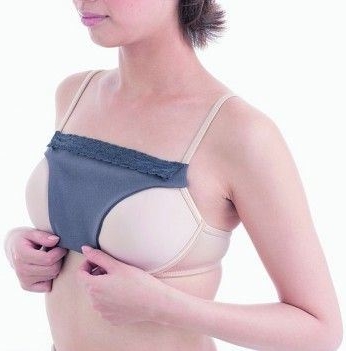
Chest Line CoverHowever, when I read that original post at The Marmot’s Hole, by coincidence I’d also just finished The Home Front and Beyond: American Women in the 1940s by Susan M. Hartmann (1983), in which she explains that the massive social dislocations of that decade—in particular, women suddenly entering the workforce in large numbers—were responsible for big changes in women’s fashion there, as well as preferred breast sizes. And, as it happens, North Korea is also going through a very turbulent period at the moment, with power relations between the sexes undergoing especially dramatic change:

Imagine going to work every day and not getting paid. Then, one day, you’re told there’s no work to do — so you must pay the company for the privilege of not working.

This is the daily reality facing Mrs. Kim, a petite 52-year-old North Korean. Her husband’s job in a state-run steel factory requires him to build roads. She can’t remember the last time he received a monthly salary. When there are no roads to build, he has to pay his company around 20 times his paltry monthly salary, she says.

“He had to pay not to work for about six months of last year,” Mrs. Kim told NPR, sighing. “You have to pay, even if you can’t afford to eat. It’s mandatory.”

So she is the one who must keep the family alive, as her husband wrestles with this state-sanctioned extortion.

Welcome to the Orwellian world of work in North Korea. In this reclusive country, profound social change is happening beyond the view of the outside world. The demands of politics have dramatically redrawn gender roles, forcing women to become the breadwinners.

National Public Radio, December 28; hat tip to Matt at Gusts of Popular Feeling.
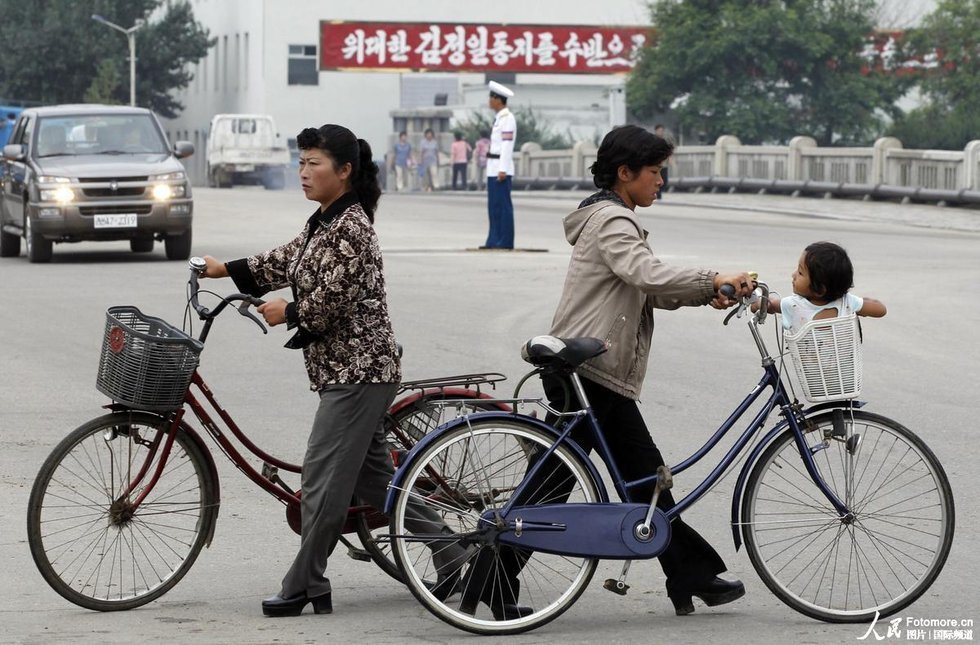
North Korean Women BikesSource: diandian

The NPR goes on to mention that one major consequence of that emasculation is skyrocketing domestic violence, against which speculating about ensuing changes in fashions can admittedly sound frivolous. But those have changed regardless—indeed, by government decree. First, in July last year:

Supreme leader Kim Jong-un appears to be loosening the government’s grip on how women dress by allowing them to wear pants, platform shoes and earrings, ABC News reported.

Previously, pants were only permitted as uniforms for females in the factories or the fields — and not for making a fashion statement.

“If caught, sometimes they would cut your pants right there in public to make it into a skirt,” Park Ye-Kyong, who defected to South Korea in 2004, told ABC News.

That doesn’t mean North Korean women don’t enjoy preening, Park added.

“Yes, we were hungry but desire to look beautiful lies in any woman,” she said.

North Korean Female IdealIn addition, the next month a 20 year-ban on women riding bicycles was lifted. Ostensibly imposed for women’s safety, numerous sources also mention its supposed incompatibility with juche, related educational television promoting “the idea of a woman wearing a skirt while riding a bicycle [being] contrary to socialist custom.” (See NK News {source, right} for more on North Korean ideals of women). Moreover, in 2009 Human Rights Watch also noted that:

…the ban on pants and bicycles for women is symptomatic of a range of other, often-overlooked, problems.

Across North Korea’s conservative, male-dominated society, there is discrimination against women, a knowing disregard for the consequences of such policies, and an opportunistic manipulation of power by police officers trying to make easy money by preying on an undervalued and underprivileged population.

In light of that, most likely the lifting of the bans was mainly simple populism on the part of a new leader, as well as — despite those state gender ideologies described above — a reluctant concession to the new realities of female breadwinners. Sure enough, in typical North Korean fashion (pun intended), just 5 months later the ban on women riding bicycles would actually be reinstated. Also, while technically they can still keep their pants on, in practice opportunities for women to beautify themselves remain limited, with both sexes punished for straying from officially-sanctioned hairstyles; sharp divisions in what is permissible for married and unmarried women; and a general lack of (beauty-related) resources overall, including such simple things as hairdryers.

Perhaps, things are not changing in North Korea as much as they first appear?

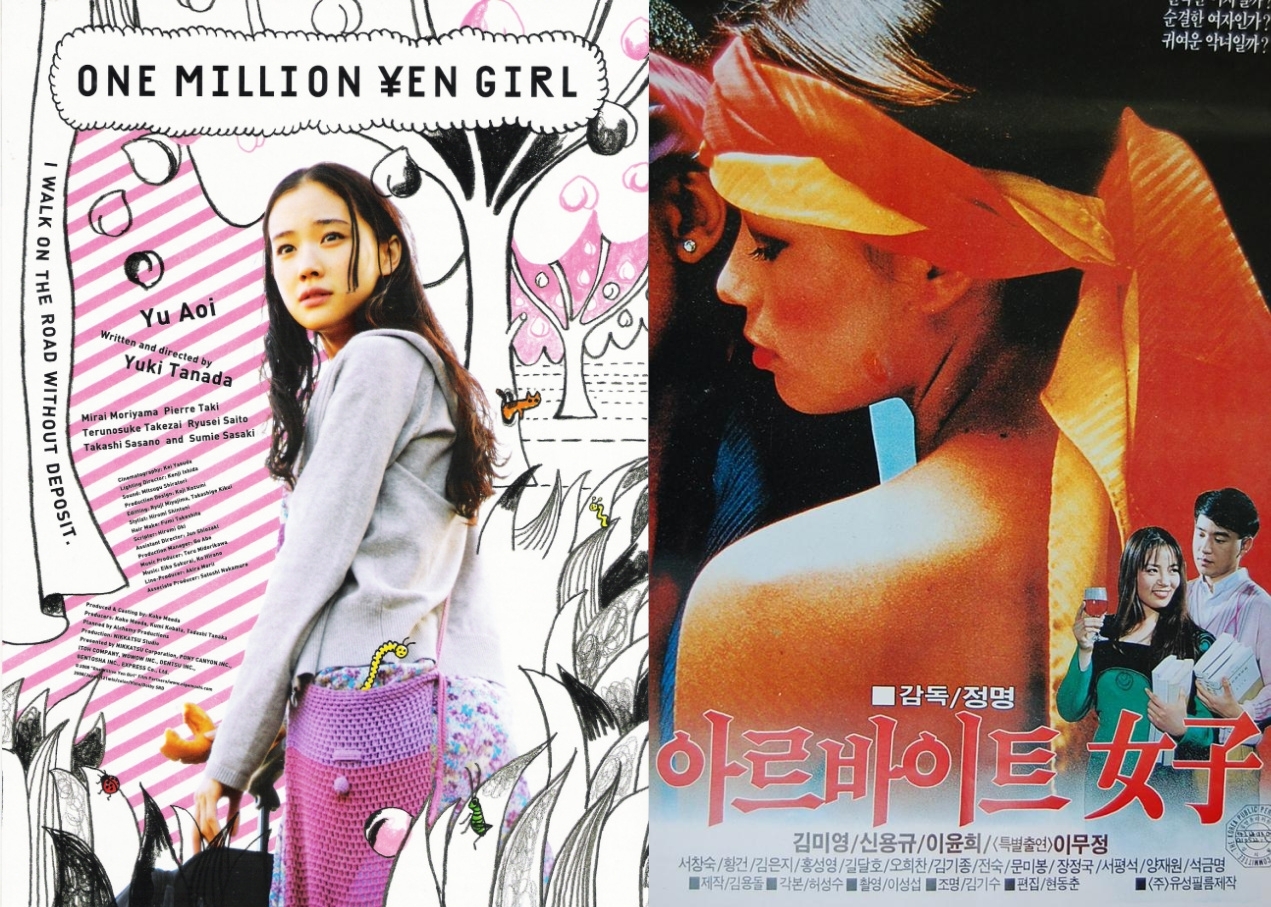
One Million Yen Girl Part Time WomanSources: left, right.

Yet in South Korea at least, it’s true that the last 15 years have seen a vast increase in the numbers of women competing with—and increasingly displacing—men for irregular and part-time work, despite the (extremely low) overall female workforce participation rate remaining unchanged. This has spawned quite a backlash, and—à la The Beauty Myth (1991)—a rapid increase in (overwhelmingly female) objectification in popular culture. So, while again I stress my ignorance and lack of knowledge with anything North-Korea related, it’s not unreasonable to suppose that, surely, the sudden large influx of women into the workforce may also be having some sort of impact there.

The Home Front and BeyondEither way, reading about similar experiences elsewhere can inform an understanding of what’s happening in both countries. So, with the obvious—but still necessary—caveat that of course both countries are very different to the US in the 1940s, for the remainder of this post let me try to pass on some of what I’ve learned about what happened there.

First, it’s important to get a sense of the numbers (pp. 77-8):

  • The female labor force grew by 6.5 million during the war
  • In 1944, 37% of all adult women were reported in the labor force, but nearly 50% of all women were actually employed at some time during that year
  • The greatest changes took place among married women
  • 1 in 10 married women entered the work force during the war, representing over 3 million of those 6.5 million new female workers (3.7 million, according to Marilyn Yalom in A History of the Wife {2002; p. 320})
  • 2.89 million were single, the rest widowed or divorced
  • So, for the first time in US history there were more married women than single women in the workforce.
  • Note however, that the war resulted in many more marriages than there would have been normally — approximately 1 million more, according to Yalom. Moreover, wives of absentee husbands were twice as likely to seek jobs, with half of all servicemen’s wives being in the labor force
  • The percentage of wives that worked grew from 13.9 in 1940 to 22.5 in 1944 (Yalom says 15 in 1940 to over 24 in 1945)
  • The percentage of women with children that worked grew from 7.8 in 1940 to 12.1 in 1944
  • By 1945, half of all working women were over 35; slightly more than 1 in 4 were 45 or older
  • The typical female worker had shifted from younger and single to older and married, a pattern which was maintained in the postwar years
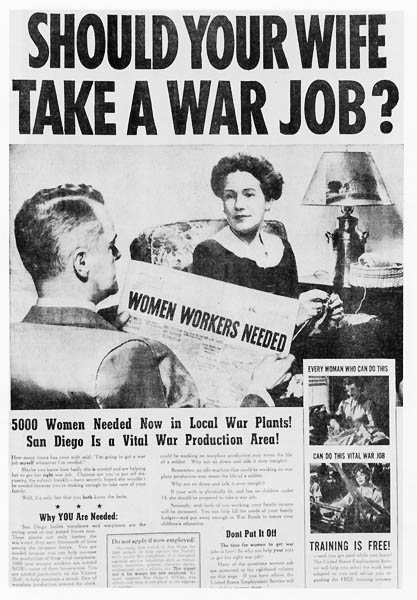
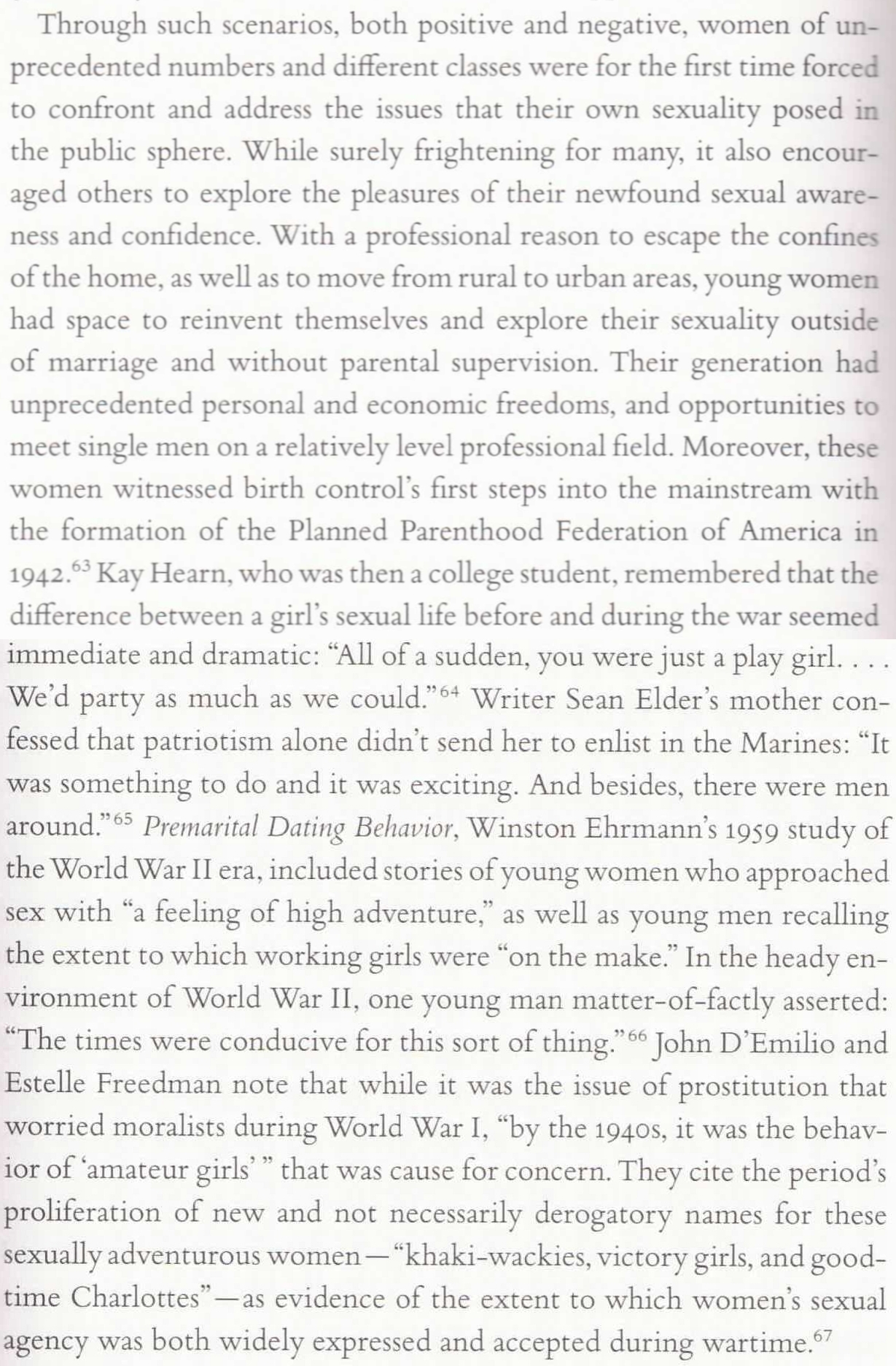
Should Your Wife Take a War JobAs Hartmann elaborates throughout her book, these figures represent an ensuing era of relative opportunity and freedom for many women (including sexual freedom; see Pin-Up Grrrls {2006} by Maria Busnek, pp. 213-224; see below also), even if it was usually simple economic necessity that compelled them to work in the first place (and usually at tedious, menial, and unfulfilling work at that). Accordingly, it definitely set the stage for second-wave feminism in the 1950s and ’60s, and deserves the place it’s gained in the Western historical imagination.

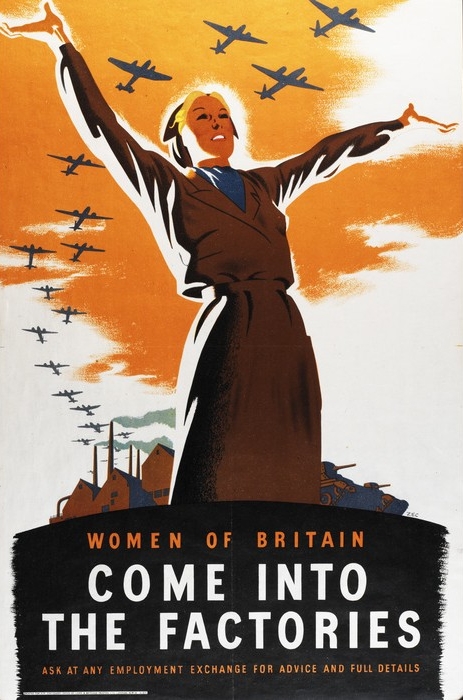
However, it’s also true that despite the huge public and private need for women to enter the workforce, that need was still considerably tempered by both sexes’ preexisting gender and racial ideologies, with both official propaganda and popular culture glamorizing women’s work and stressing its patriotic importance on the one hand, yet emphasizing its strictly temporary nature on the other. Not least, to nervous male workers and servicemen, who: lacked our knowledge that the war would lift the US out of the Depression (source, right); were very much judged by their ability to provide for their families, in an era where many simply couldn’t (note that one big difference between the Depression and the current financial crisis is that many people were literally starving during the former); and who sometimes had genuine difficulties with employment after demobilization, particularly in the shrinking war industries in which the women had been recruited (Hartmann, p. 63).

Buszek summarizes the contradictions of this era well (pp. 214-5):
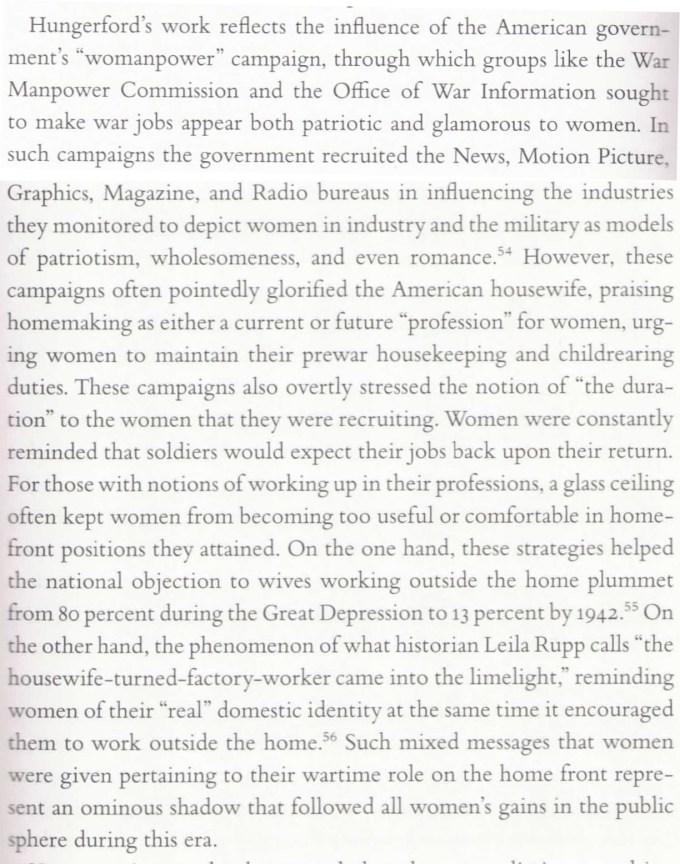
Pin-up Grrrls pp. 214-5And in particular:

  • Despite the huge demand for workers, and the ultimate, relative flexibility both employers and male employees would demonstrate in incorporating Caucasian women into their midst, African-American women remained largely unwelcome (e.g., 10 months after Pearl Harbor, there were fewer than 100 out of 3000 women in Detroit war industries). So, while the numbers of them working did increase from 1.5 million in 1940 to 2.1 million in 1944, their share of the female labor force actually dipped from 13.8 to 12.5. By 1950, their employment patterns were very similar to those of 10 years earlier, albeit partially because by then their husbands were making more money. (Hartmann, pp. 60, 78-9)
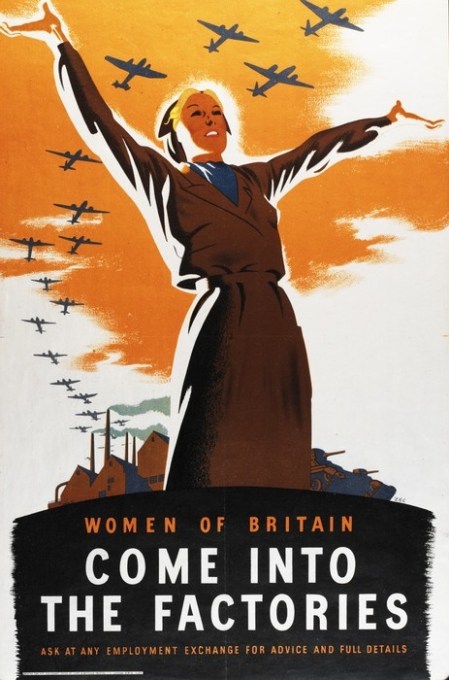
  • Women of Britain Come into the factoriesPartially, the huge numbers of wives that entered the workforce is because there were previously bans against them by many companies, let alone being against social convention; even schools discriminated against them. It’s amazing how quickly bans were dropped once the need for labor arose though, with some previously hostile managers coming to express a “preference for married women as more stable and conscientious than their single sisters” (pp. 59-60). And this provides encouraging news for Korea, which unfortunately still largely retains those conventions, and where as recently as 2009 I was working for a company that — yes, really — fired women upon marriage (source, right).
  • Nevertheless, there remained extreme public and private ambivalence about working mothers. Officially seen as more of a social problem than something to be encouraged, officials did recognize “that financial need compelled some mothers to work and that in localities with severe labor shortages production goals would requite the employment of mothers,” and urged employers not to discriminate against them (p.58). But on the other hand, the government would also constantly remind them that homestay mothers were essential for children’s development; popular culture was full of stories of child neglect; and daycare provision, while expanded, was ultimately completely inadequate, paling behind that which was provided in the UK, and prompting frustrated managers of some defense plants to set up their own (Yalom, pp. 324-6).
Ellen DeGeneres, Portia de Rossi Check Out Katy PerrySource: Celebuzz

But, lest we forget, this post is about breasts. And changes in women’s fashions which came with the contradictions involved with entering the workforce, with women having to confront rampant sexual harassment on the one hand, and often being blamed for the “distraction” they posed, but on the other relishing their newfound freedoms (Buszek, pp. 216-7):
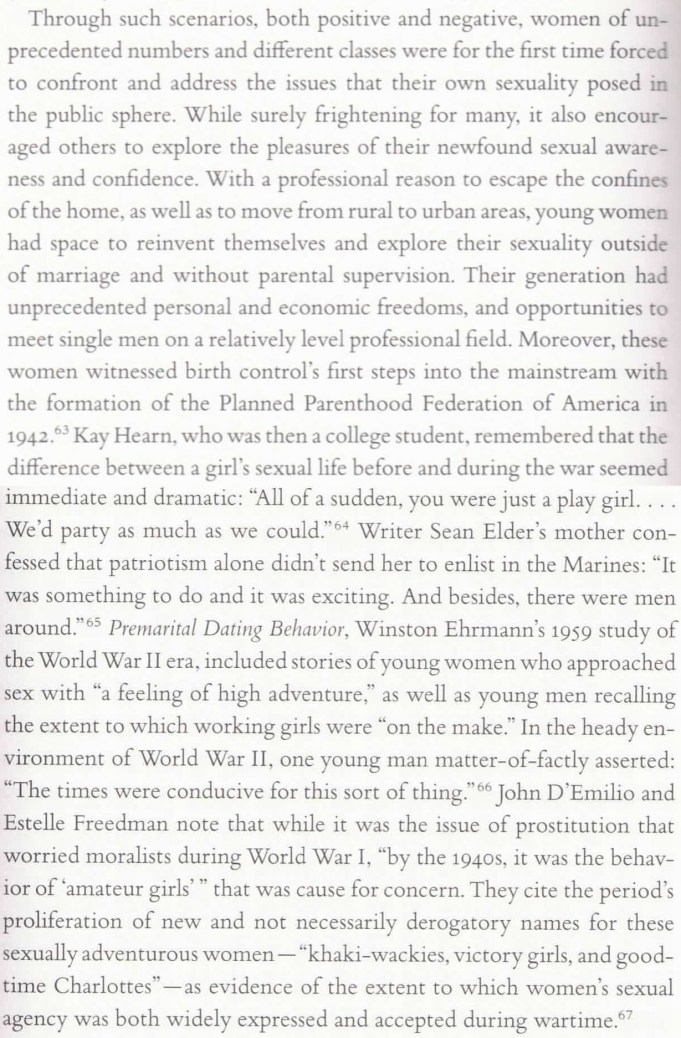
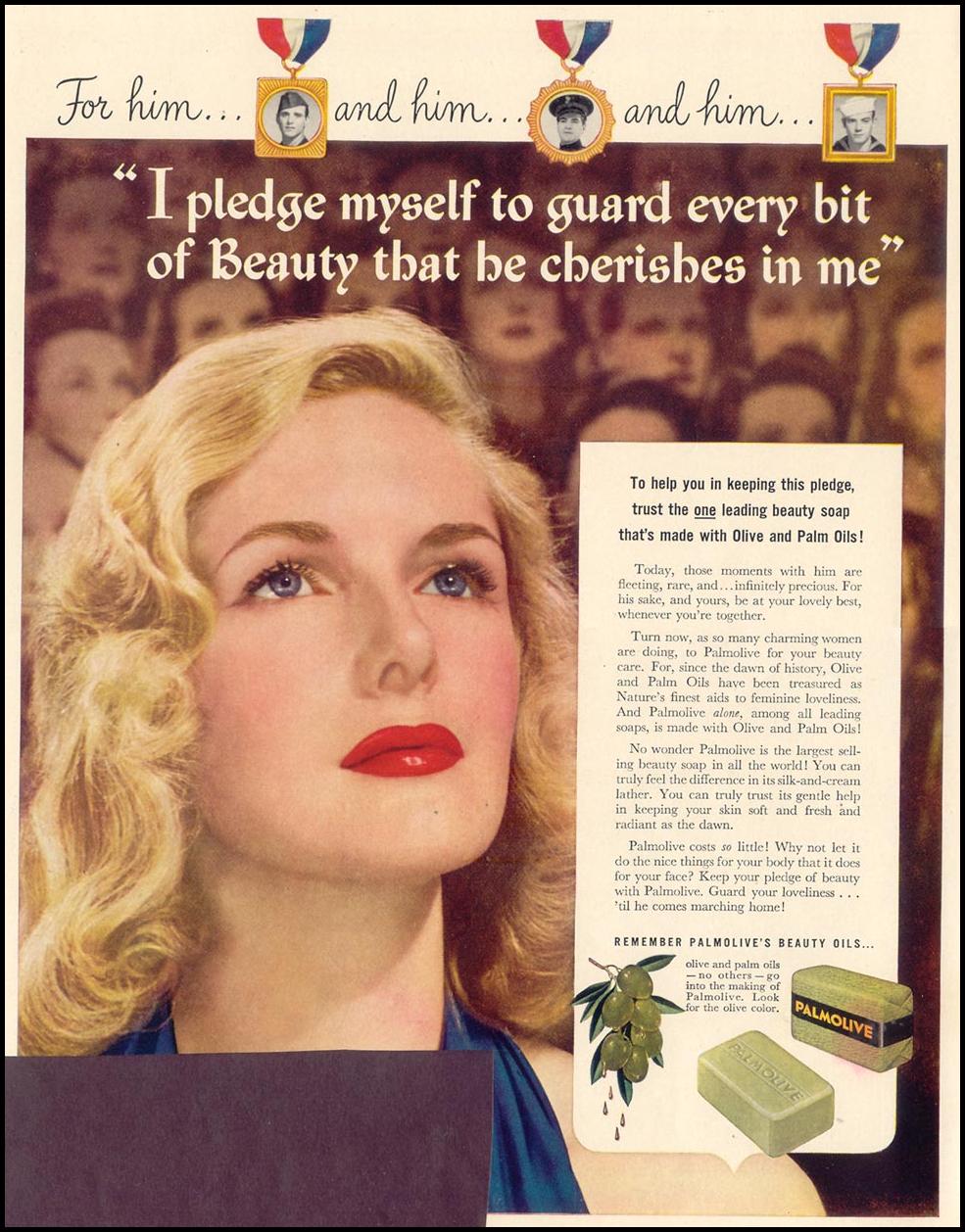
Pin-up Grrrls p216-7However, the combination of war-time shortages and women’s entrance into the workforce meant that people suddenly became used to women in functional, masculine clothing and with more practical hairstyles, and that women’s fashions became more simplified, comfortable, less overtly sexual, and changed less frequently than before. So, when you learn that popular culture stressed the exact opposite, for example…
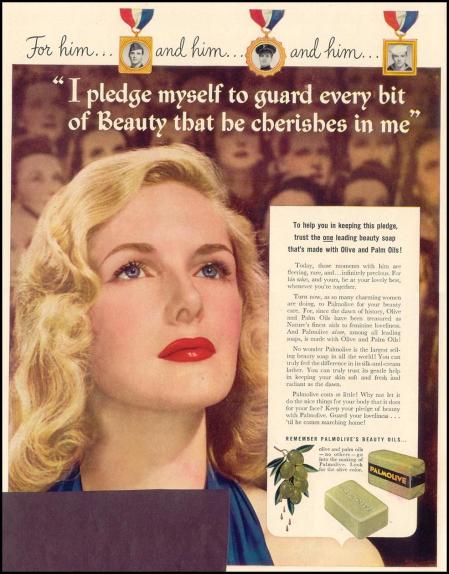
  • I pledge myself to guard every bit of beauty that he cherishes in meThat female workers were still “glamorous” and feminine despite their new roles (Hartmann, p. 199)
  • As were female sport stars, women’s sports enjoying a lot of popularity while their male counterparts were occupied (p. 194)
  • Lingerie manufacturers coped with wartime shortages and new demand by producing much practical bras, yet these coincided with pinup photographs that emphasized their subjects’ breasts (Jill Fields, An Intimate Affair: Women, Lingerie and Sexuality, 2007, p. 106). As explained in Part 3 of this series, this ultimately led to the fashion for large and uplifted breasts that remains to this day.

…then it is very easy and natural — indeed, this is my very strong impression from the books discussed here, although exact page references are suddenly proving maddeningly elusive(!) — to argue that this alternate ideal was imposed by, for want of a better word, the patriarchy, to encourage women to enter the workforce yet at the same time remind them that their place there was unnatural and temporary. And, to be clear, not for a moment am I arguing that this wasn’t very much the case (source, right).

However, as Hartmann explains on p. 198 below (echoed by the other sources), it’s also true that women themselves were just as passionate about preserving their femininity (indeed, they would understandably revel in impractical but much more feminine fashions once war rationing ended):
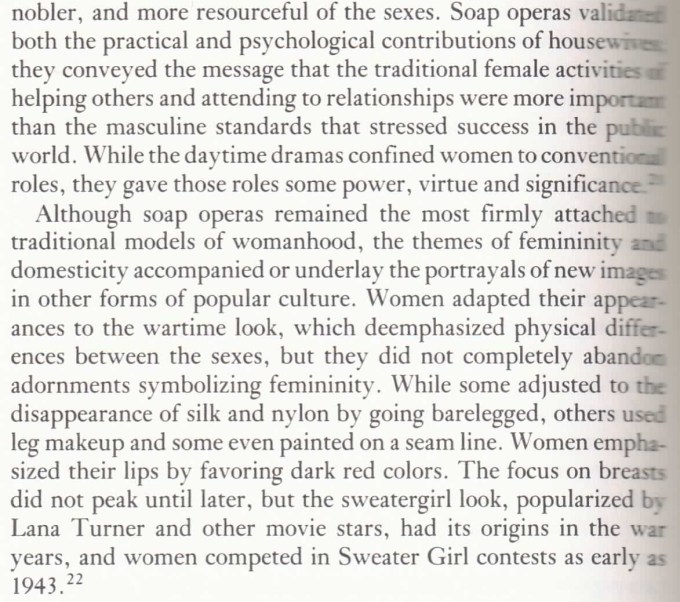
Hartmann, The Home Front, p.198In particular, and especially in light of the new opportunities open to them as mentioned, I think it’s both overly dogmatic and patronizing to dismiss choosing to use those feminine adornments as mere false consciousness and women’s own mindless incorporation of patriarchal values. Also, although it’s true that the period was rife with pop psychology theories (it was conveniently claimed that women like boring, monotonous work much more than men for instance) it’s very unlikely that men and women rationalized and articulated their choices and concerns in such patriarchal terms. Even if those did operate on a subconscious level, and patriarchy is still the only thread which can bring otherwise disparate developments in the period together, surely men did not think, for example, that if they saw more big-breasted women in popular culture, emphasizing the differences between the sexes as increased use of lipstick did in the workplace, that this would make them feel more secure in their jobs.

In addition, while changes in attitudes were certainly quick, they didn’t happen overnight, Jill Fields (p. 106) noting that “uplift” and “separation” trends in bras for instance, which accentuated the projection of the breast silhouette, had actually already started back in the 1930s. Finally, if you’re confused like I am, because I just noted above that bras actually became more practical during wartime, and am now stating that women could simultaneously be censured and praised for wearing distracting clothes, that’s because contradictory and competing trends coexisted simultaneously, the 1940s being just as messy, complicated, and contradictory as modern life.
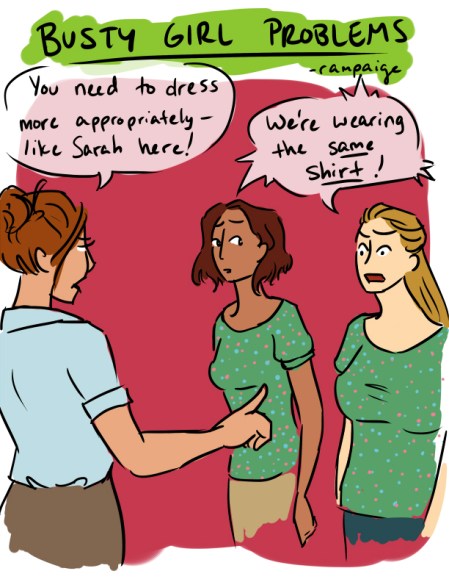
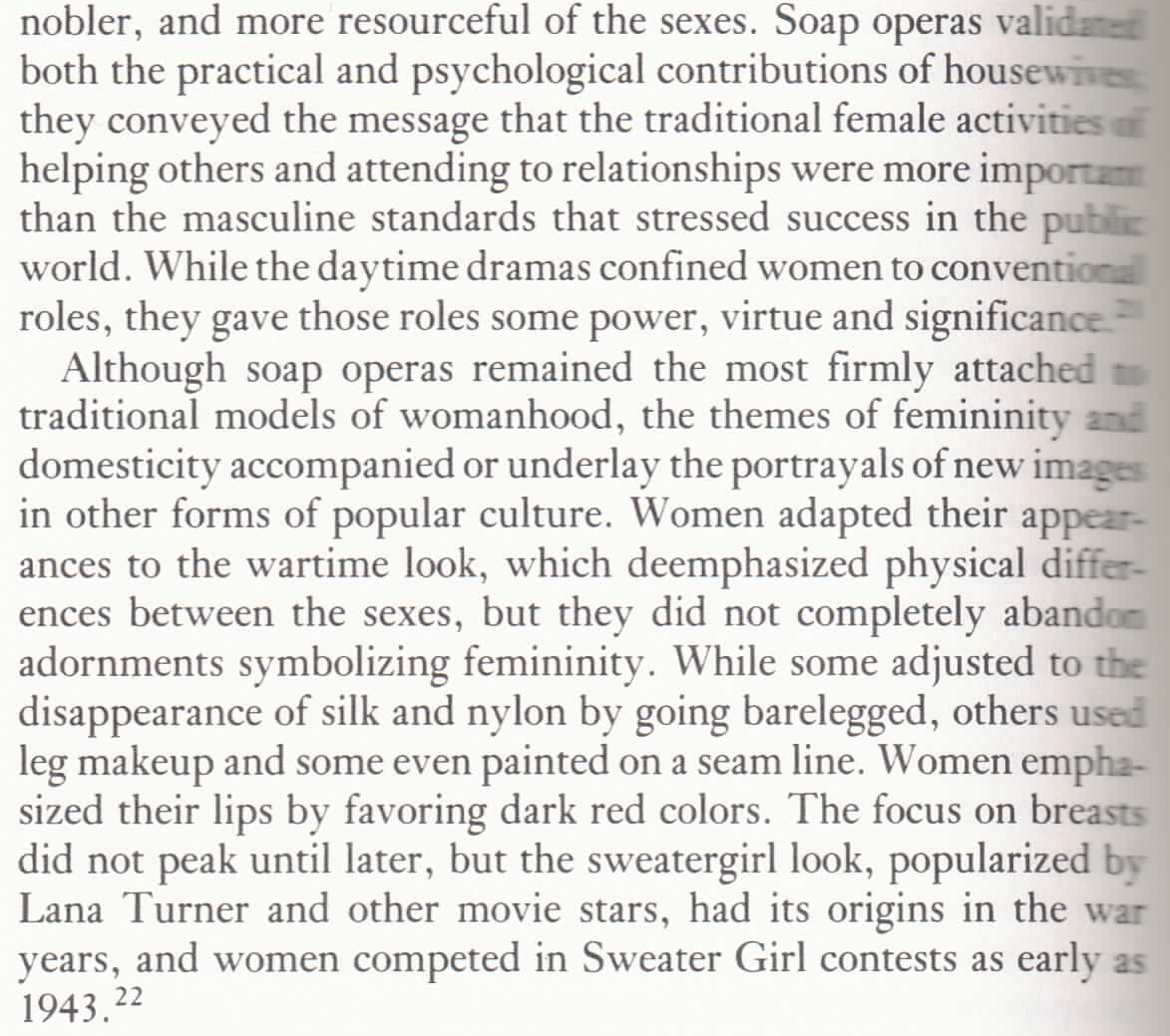
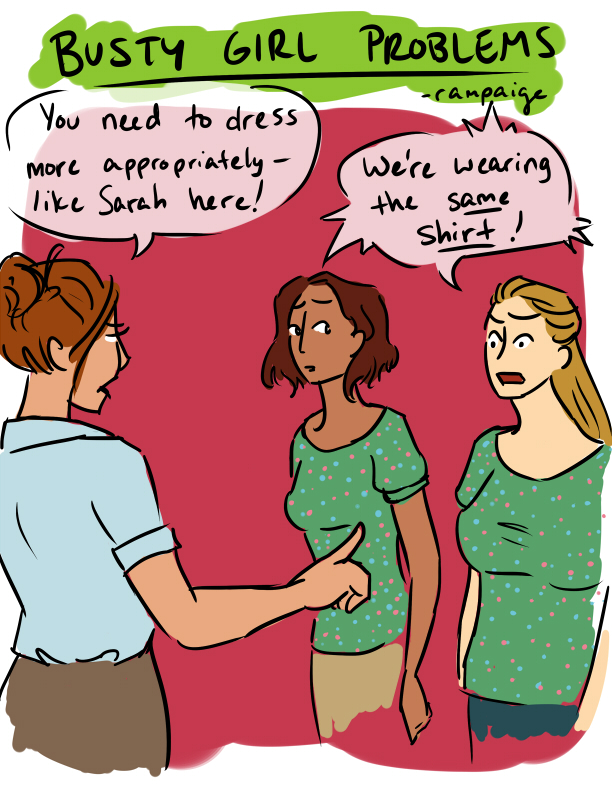
Busty Girl Comics Double StandardAnd on that note, thank you very much for bearing with me in this admittedly equally messy, complicated, and contradictory post, the result of me personally trying to understand what patriarchy means in practice as well as theory. And, with the proviso that my relief — and frankly joy — at discovering historic parallels (and especially English-language historiography!) to modern North and South Korean developments should make me wary of projecting too much, and not blind me to the significant differences, I’m very happy to have pointers towards further study, and very much welcome readers’ own suggestions! (source, right)

The Revealing the Korean Body Politic Series:

Update: See Fit, Feminist, and (almost) Fifty for “the medical condemnations of women’s cycling [which are] fascinating for what they tell us about what people thought (and maybe still think?) about women’s athletic capabilities and potential.”

Update 2: “Saudi daily al-Yawm cited an unnamed official as saying women can now ride bikes in parks and recreational areas. According to the official, the ruling stipulated that women must wear a full-body abaya, be accompanied by a male relative, and stay within certain areas. They are allowed to bike for recreational purposes only, not as a primary mode of transportation.” (Aljazeera)

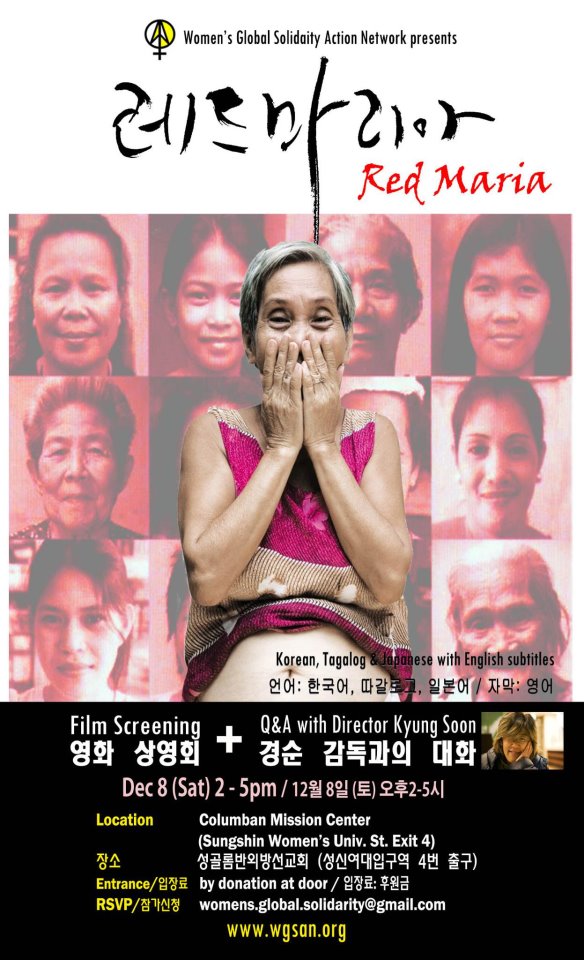
Announcement: Red Maria (레드마리아) Screening Saturday, December 8

I’ve been asked to pass on the following:

★ YOU MUST RSVP via Email: womens.global.solidarity@gmail.com ★

In Korea, Japan and The Philippines, there are many women with diverse jobs and her stories. Among them, this film focuses on women who are called housewives, sex workers, dispatched workers, migrant workers, comfort women, homeless and so on. The camera tracks them as they go about their everyday lives. These women have never met one another, and their lives look quite different from one another. However, their lives are connected across national borders by the one thing they have in common. That’s their bodies and labor. How can such different forms of labor be linked to the women’s bodies in such a similar way? As we search for answers to this question, we are forced to confront another question: ‘the meaning of labor’ as an ideology that is reproduced in society.

* Entrance Fee: by donation at the door

* Languages: Korean, Japanese, Tagalog and English with English subtitles

* Naver map: http://me2.do/GDOEbSP

Facebook: https://www.facebook.com/events/370272919729052/

The screening will be held at the Colombian Mission Center.
Please note the center is very close to exit 4, and not on the University’s campus.

To get to the center:
1) Take line 4 to the Sungshin Women’s University Entrance 성신여자대학교입구) stop.
2) Go out exit 4 and a building with a traditional Korean roof (hanok) will be in front of you.
3) Go into the building and up to the second floor.

★ Due to a limited number of seats, you must RSVP to womens.global.solidarity@gmail.com and you will receive confirmation when your seat has been reserved.

Permanent Revolution by World Order: Japanese Robot Salarymen for Peace!

(Source)

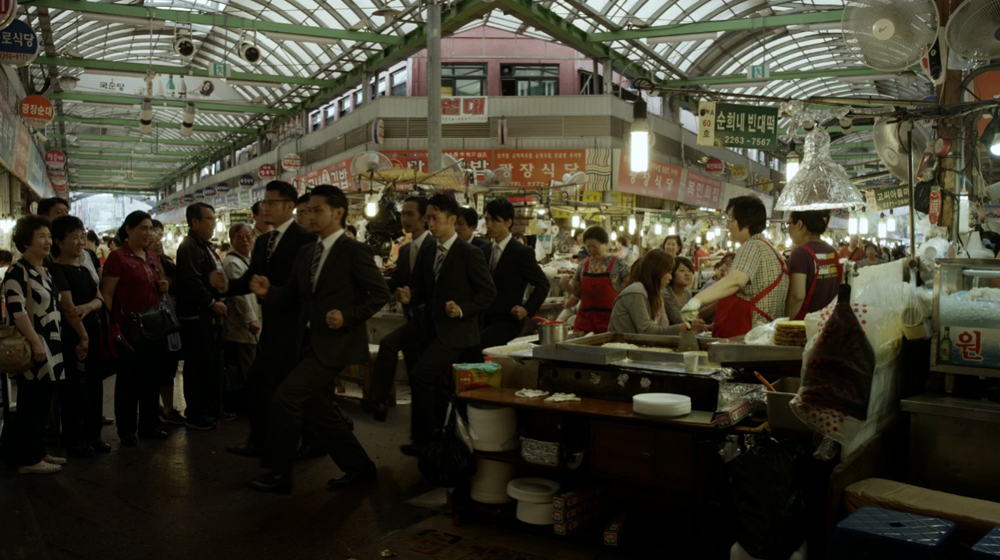
With island disputes between China, Taiwan, Korea, and Japan so dominating the news recently, it’s nice to see something that puts a positive, optimistic spin on those relationships. Let alone one that does so by having Japanese salarymen strutting like robots around the streets of Tokyo and Seoul:

The group is World Order, a Japanese band formed by Genki Sudo, who also directed and produced the video (with choreography by Ryo Noguchi). Just the latest in a series of similar videos performed all around the world, Tofugu, a Japanese pop-culture site, describes them as “the most innovative dance and music troupe in Japan,” and adds that their appeal is not just their dancing, but also:

…the people watching them dance. They just go out in public areas for the most part, do their thing, and then leave. People walk by, look at them all confused, take video/pictures, ignore them completely, and all kinds of other hilarious things if you pay close enough attention. Try to watch and you’ll see some entertaining reactions.

See Tofugo for many examples. Meanwhile, the very cool cartoonist Jen Lee (of Dear Korea fame), whom I’m very grateful to for finding the video, has managed to find a rare translation of the lyrics too:

(Source)

A blue shine on my fingertips

As I touch the side of your pensive face

When I look up to the gray sky

A blue sky spreads out over the east sky

Keep changing

Permanent Revolution

Without stopping

Keep walking

Permanent Revolution

To a single world

Gather the accumulated lies

Keep erasing them among the pluses, without making a sound

Keep believing

Permanent Revolution

Without wavering

Keep loving

Permanent Revolution

Open your heart

Keep changing

Permanent Revolution

Without stopping

Keep walking

To a single world

What’s Wrong With Marrying First-born Sons?

(Source; edited)

As every Korean woman looking for a husband knows, hapless first-born sons are best avoided. After all, customarily moving in with — or very close to — his parents, she would just have too many responsibilities for their care, let alone arguments with his overbearing mother:

The old lady often follows her daughter-in-law around, criticizing every bit of housework. They compete for the attention of their son/husband. In addition, because the old lady went through the same process when younger, she feels entitled to make her daughter-in-law’s life miserable. (Here is an old post touching upon this subject.)

Of course, not all eldest sons’ households would be so bad, let alone that of Ask a Korean’s who wrote that. Or would they? In Japan at least, with very similar living arrangements to Korea, they’re so stressful that married Japanese women living with in-laws are three times more likely to suffer a heart attack than those just living with their husbands.

(Source; edited)

Perhaps it’s no wonder then, that “not a first-born son” was one of the common “specs” (스펙) for a husband in this recent list I translated?

But, despite everything I’ve written above, I’d always thought that their extra responsibilities were simply a cultural preference, and one rapidly eroding at that. So, it came as a real surprise to learn they were so formalized as to be enshrined in the government’s social welfare policy, as explained in passing in this recent Hankyoreh article about an elderly woman who committed suicide after losing her eligibility for benefits (my emphasis):

…According to the Ministry of Health and Welfare and Geoje City Hall in South Gyeongsang province, Lee was stripped of her National Basic Living Security assistance qualification because a confirmation study of recipients conducted in June revealed that her son-in-law’s income had increased.

This is to say, the “sustenance allowance” in accordance with support obligation standards (lineal blood relatives or spouse) had been exceeded [James – by a grand total of 7000 won (US$6.18)]. The recently increased income of her daughter and son-in-law, who work for a subcontractor of a major corporation, was about 8 million won a month.

The “mandatory sustenance allowance” is computed by taking the income of the lineal blood relative or spouse, removing a total equal to 130% of the minimum cost of living for a family obligated to support a relative, and multiplying that by 15% in the case of a daughter (30% in the case of a son)…

…When beneficiaries lose their qualification, they also lose their housing assistance, stipend and medical benefits. The standards determining family members who must provide support is tied to a contrived system that dumps the state’s responsibility onto the family.

(Source)

If any readers familiar with the Korean social welfare system could elaborate on this, or any other gendered aspects of it, I would be very grateful. Unfortunately, all I can further bring to the discussion is my copy of The Politics of Social Welfare Policy in South Korea: Growth and Citizenship by Myungsook Woo (2004), a very top-down and theoretical overview that lacks mention of anything at the grass-roots level, let alone of gender. But of course it does still have some insights though, which I’ll pass on in a later post!

The Economist on K-Pop’s Role in Celebrity Endorsements

(Source)

Well, I covered it in passing in an opinion piece in The Korea Herald over a year ago, and many times on the blog (and on Busan Haps) since, but hey: I admit that The Economist is probably a more authoritative-sounding source. See here then, for a discussion of how the dynamics of the Korean digital music industry are forcing labels to financially rely on celebrity endorsements, and which is a big factor behind why 2 out of 3 Korean advertisements feature them, one of the highest rates in the world.

While frustratingly brief, it does have some money quotes:

…SM Entertainment’s boss complains that even 1m downloads cannot cover the cost of making a music video….

….SM Entertainment and other purveyors of K-pop cover this shortfall at home by having their stars hawk the latest phone, or appear on television variety shows. The biggest labels have become adept at squeezing cash out of their pop stars’ names, rather than their music. But only a handful of musicians are famous enough to benefit.

South Korea’s old business model, perfected by its carmakers, was to use a captive home market as a launch-pad from which to invade foreign shores. The country’s pop musicians have turned this model upside down: they have to export their tunes to make up for meagre pickings at home.

(Source)

See bloop69’s comment also, who contends that things are not as dire as they seem (for a similar discussion between abcfsk and myself, see here):

A huge chunk of the money is made in “collectable” CDs and DVDs, which can run north of $150 per shot and are constantly churned out. It’s not a case of INVADING other shores you clueless dolt. It’s a case of using Youtube and videos as LOSS LEADERS to capture a small number (tens to hundreds of thousands) of hardcore fans who spend $100s US EACH to support their “fandom”

You don’t even begin to perceive it but in fact the Koreans are using a very progressive model… similar to League of Legends or FarmVille to give customers a free “taste” of the music. Like Kpop free to play MMOs also rely heavily on “whales” and heavily invested customers to carry the rest of the customer base. It has nothing to do with “invading” other shores. This is the strategy they have been using in Korea and are using around the world.

Finally, a quick request: please ask your Korean partners, friends, colleagues and so on if they know what “celebrity endorsement” is in Korean. If they struggle to answer, as my wife did, then I think that will be testament to just how pervasive they are here! (Eventually, she came up with “유명인 보증”).

Essential Reading: “Multiple Exposures: Korean Bodies and the Transnational Imagination”

(Sources — left: unknown; right)

See The Asia-Pacific Journal for the article. Covering many of the themes discussed on the blog, and much more besides, expect to see me linking to it for many years to come!

Goodbye Madame Butterfly, Hello Sexless Marriage

See here for my latest Busan Haps article, a review of Sumie Kawakami’s Goodbye Madame Butterfly: Sex, Marriage and the Modern Japanese Woman. Any readers have similar horror stories about sexless Korean marriages to share?

“Cleavage out, Legs in” — The Key to Understanding Ajosshi Fandom?

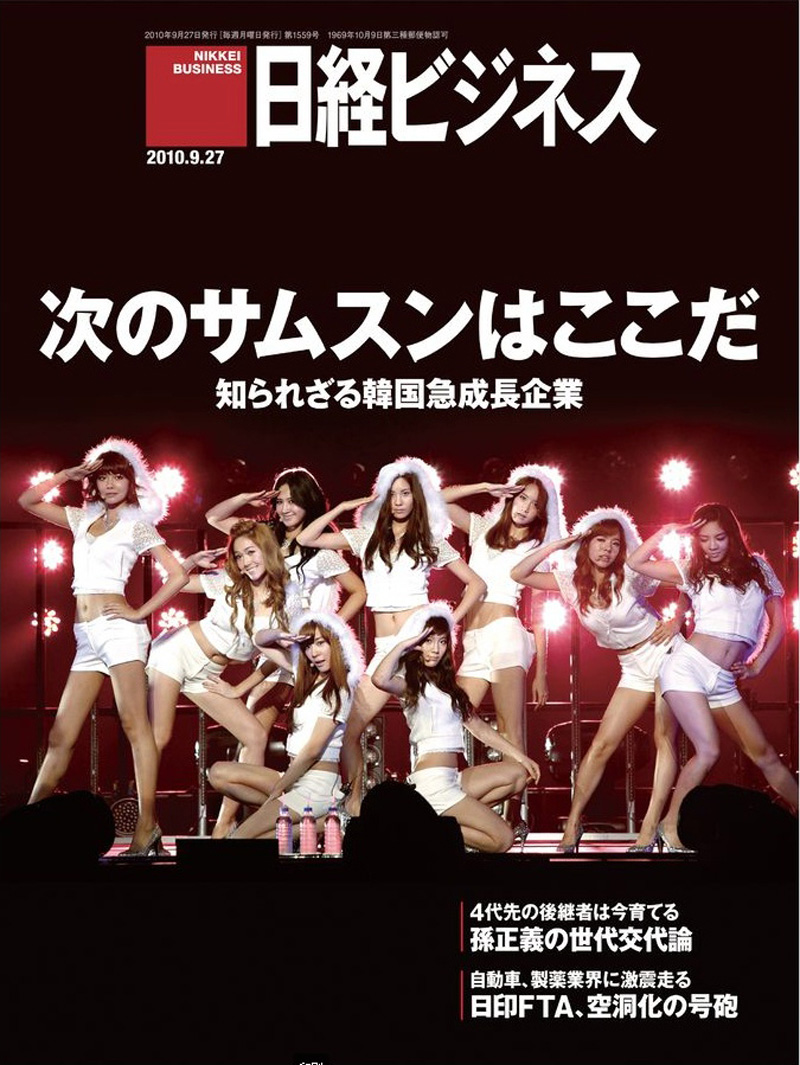
“Here is the next Samsung: fast growing Korean companies that you’d better know about.” Source.

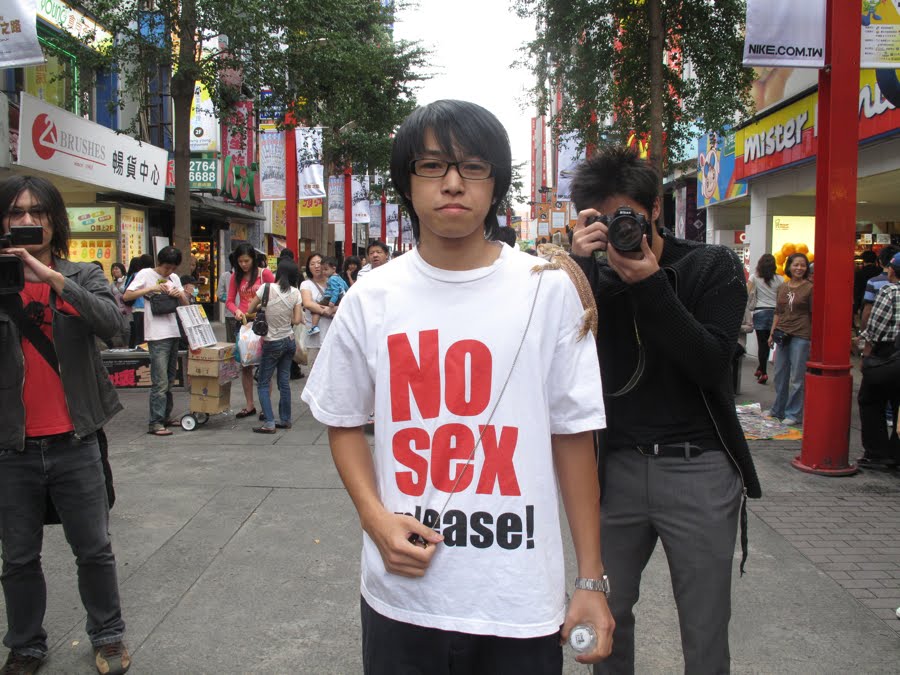
“Stop obsessing with sex.” (Fernando)

“If I went to New York and started pointing out how many skyscrapers there were, would you suggest that it was *me* that had the obsession with noticing skyscrapers, or New York for building them all?” (Norman Lewis; source)

And indeed if you went to Seoul instead, it’d be difficult not to notice all the exposed women’s legs. Even—or perhaps especially — in the winter.

It wasn’t until I saw this November 2010 video from the Singaporean RazorTV though, that I realized the fashion might not be so common there yet. Likewise, it was just starting in Thailand, where authorities were warning against the danger of dengue fever from the ensuing extra mosquito bites:

Unfortunately, only the narrator speaks English, while the hosts and interviewees chat away in Chinese (is that normal for Singaporean TV?), and no subtitles are available. However, I was able to find this related article from parent organization The Straits Times, and it had an intriguing conclusion:

Entertainment journalist Tan Chew Yen from the Chinese Central Integrated Newsroom reasoned that showing off legs allows these girl groups to maintain a healthier but nonetheless sexy image.

It invites less controversy and criticism from concerned citizens as compared to showing cleavage, for example, due to their young fan-base.

I beg to differ on the youth of their fan-bases these days. But still, those few words resonated on so many levels, potentially speaking volumes about how K-pop has developed over the last 5 years.

First, because it’s certainly true that Koreans regard legs as a much less sexual body part than cleavage. While that distinction is easy to overstate though, and is eroding precisely because so many Korean girl-groups are wearing hot-pants and mini-skirts these days, it’s confirmed by numerous expat women that have had to adjust to it (and of course cishet men like myself have noticed it too!).

Source

Next, because choreography, outfits, and music videos tailored for that distinction would be equally applicable to the more conservative—but still lucrative and influential—Chinese market, where for a long time Korean groups were considered much “safer” than their Japanese and Western counterparts:

In 2003, the Korean National Tourism Office [a major investor in the Korean wave] conducted a Hanliu tourism survey in China, Taiwan, and Hong Kong exploring attitudes to Korean culture, publishing the results online…

….It compared the impact of Korean culture with that of four “competitor” countries (the U.S., Japan, Taiwan, and Hong Kong), and in the process revealed much about Korea’s own political and nationalist concerns, particularly in relation to Japan and America. Six of the eleven options for respondents to the category “reasons I like Korean culture” reflect this preoccupation: “less sexual than Japanese culture,” “less sexual than American culture,” “less violent than Japanese popular culture,” “less violent than American popular culture,” “decreased interest in American culture,” and “decreased interest in Japanese culture.” One other echoes Straubhaar’s notion of cultural proximity: “similar in culture.” Certainly, Korea’s own music media censorship laws (which even in 1997 prohibited the displaying of body piercings, navels, tattoos, “outfits which might harm the sound emotional development of youth,” and banned violent or political lyrics), meant that Chinese TV stations could buy in Korean music videos and music TV shows knowing that they were unlikely to upset local censors. However, these questions also reflected a perception that Korea acts as a defender against excessive Westernization and as a guardian of Confucian values within East Asia. (Rowan Pease, 2009)

Of course, this assumes that the Chinese make the same distinction between legs and cleavage. But I’d wager they do—after all, Park Jin-young of JYP Entertainment especially has always had a firm eye on the Chinese market, with two members of Miss A being Chinese, and even the “A” in the name meaning “Asia.” And the group’s logo speaks for itself:

Source

Finally, likewise hot-pants would be a perfect fit with “Ajosshi” or “Samchon” fandom. Here’s a quick definition of that for new readers:

…what is extraordinary in girl idols’ fandom is that a large number of male fans in their 30s and 40s have constructed the unprecedented scale and mode of fandom called Samchon-fans, or uncle-fans. As Samchon in Korean refers to one’s parent’s brother, this name implies the middle-aged men’s care for their young nieces. Once this familial setting is built up, a relationship between male viewers or self-claimed Samchon fans is restructured in the complicit relationship between uncle and little nieces. Accordingly, the male’s gaze at young female bodies is legitimized and normalized as the voluntary support and pure love of uncles for their nieces. Under the identity of uncle, they can deny the sexual aspect of what they see and insist on appreciating merely the pure surface of pretty children. This double male psychology of interwoven denial and justification is pervasive in the constitution of the girl idols’ fandom. Thus, with the pretentious reformulation of the male gaze into an uncle’s familial support, the male consumption of the girl bodies becomes relieved of the predictable blame for pedophiliac abnormality. (Yeran Kim, 2011; see sources below)

Previously, most discussions about Samchon fandom have focused on pointing out its existence and/or its effects, both of which you can read about in depth here and here. But in hindsight, not enough attention has been give to the process of how it came about, which this cleavage/legs distinction now potentially helps to fill. For if entertainment companies subscribed to it, having their girl-groups members flaunting their legs while covering up their cleavage, then it’s easy to see why this would provide plausible deniability for all involved.

“Because of Sistar, uncles [feel like] teenagers again!!” Source.

Not that being a middle-aged male fan of a girl-group is wrong per se of course. But for a number of years the Korean media would indeed promote the deceitful “innocent until proven sexual” byline of Samchon fandom (and to a large extent still does—see here and here), providing a window for entertainment companies to sex up performances to their hearts’ content.

Was this the result of a deliberate, years-long strategy by entertainment companies? That’s unlikely: not only did Girls’ Generation at least actually wear “skinny jeans” well before hot-pants for instance (I believe they only started doing so with Tell Me Your Wish in July 2009), but it’s difficult to speak of grand plans by JYP, for instance, when he’s well known for his constant experimentation with groups, trying everything until one concept finally succeeds.

In short, I think entertainment companies lucked out. But like the video says, K-pop has been about legs, legs, and legs ever since they did, and with a palpable influence on Korean fashions. Moreover, whether they’re on the screen or on the streets, people will still make much the same claims about them:

…people maintain [Girls’ Generation are] pure, clean, and cute, and everyone tries to erase and deny the blatant fact of their sexualization in that curiously Korean way that college freshman can click-clack to class in 5-inch hooker heels and a leather skirt and when asked if that might not to be too risque for class, people get defensive and indignant and call the gazer the pervert, while letting the main parlayer in and of the male gaze (the women totally subjecting herself to it) off the hook. (Michael Hurt; source)

Granted, mini-skirts especially are just as — if not more — popular in Japan, so it’s entirely possible that the Korean trend actually comes from Japan, and predates the girl-group boom of the late-2000s. Yet I don’t personally recall seeing quite so many legs on the streets of Busan (which is much warmer than Seoul!) until just a few years ago, with the exception of World Cup summers (when standards are relaxed). And while I’m usually loathe to ascribe top-down origins to fashion trends, I’d be lying if I said Koreans don’t seem to be notoriously conformist in this regard (as this 2004 Prugio commercial with Kim Nam-ju used to be a good illustration of, before the video was taken down!):

And on that note, please let me know what you think, and by all means poke holes in it—my connection between girl-groups only showing their legs and the rise of Samchon Fandom is just the germ of an idea at the moment, which now needs fleshing out (not unlike many of the legs themselves). But if I do say so myself, it’s one of the biggest epiphanies about K-pop I’ve had in a while!

Update 1—See here, here, and here for the next 3 parts of the RazorTV video, about which idol has the best legs, problems with underage performers, and the increasing objectification of male idols respectively. Parts 2 & 3 also have more English

Update 2—Let me pass on Esther Hoeve’s illuminating comment from Facebook:

The difference in what constitutes as ‘sexy’ bodyparts is an interesting one. Back home (western Europe) I’m much quicker to reveal cleavage or shoulders, but I spent half a year in Thailand and had to adjust to wearing shorts, but tops with sleeves. The shorter my skirt or shorts, the longer my sleeves would be. I actually grew self conscious of how much upper body I was showing, but usually have the same feeling concerning my lower body here in Europe. It completely changes your perspective on what’s considering ‘revealing’.

Like I say there, this reminded me of some of my female students back in 2000 complaining of middle-aged and old women telling them to cover up their bare arms. This was in Jinju/진주 though, a university town but still quite small and conservative, so I don’t know if their counterparts in larger cities had the same problems.

Sources

  • Yeran Kim (2011): Idol republic: the global emergence of girl industries and the commercialization of girl bodies, Journal of Gender Studies, 20:4, 333-345.
  • Rowan Pease (2009): Korean Popular Music in China: Nationalism, Authenticity, and Gender, in Chris Berry, Nicola Liscutin, and Jonathan D. Mackintosh ed.s, Cultural Studies and Cultural Industries in Northeast Asia: What a Difference a Region Makes, 151-167.

(Hat tip to dogdyedblack)

“A Korean Nip and Tuck to Look Like a Film Star”

A recent short BBC video about Korean medical tourism, focusing on East Asians coming to Korea to look like their favorite Hallyu stars.

Fellow old-timers may be reminded of this similar story from 2004, about Korean women asking cosmetic surgeons to give them Lee Hyori’s butt, and so on.

Korean Gender Reader

(Source)

To make these Korean Gender Reader posts more timely and readable for you, from now on I’ll be reducing the number of links in them from 5 to 10, which will allow me to put new posts up more often. I hope you all like the change, and, sure enough, the next KGR will be up on Tuesday evening!

1) Korean Men’s Group Demands Ban of Movie You’re my Pet (너는 펫)

As translated at Soompi:

The Korean Men’s Association has filed a petition for an injunction against the film, “You’re My Pet.”

The Korean Men’s Association posted a link on their homepage to a legal petition that will force “You’re My Pet” to cease from playing in theaters. They voiced that the film is degrading to men and the concept of a female “owner” and a male “dog” is sexist and inhumane. They also emphasize their point by asking how people would react if the role was reversed and it was a male owner and a female dog. They ended the note by saying that these kinds of concepts should not be treaded upon, even if it is for entertainment.

Read the rest there.

What do you think? Hat tip to @suzyinseoul and @john_F_power on Twitter for the story, and you can see here, here, here, and here for their own thoughts on it. Also, see here, here, here, and here for some discussion of the differences in the way the male and female actors are portrayed in the posters, which relates to some sexual overtones to the movie that are absent in the original manga.

2) In Korea, Pregnancy Can be a Career-killer

Which I’m sure readers are well aware of (see here if not), but it’s very different hearing it first hand. Make sure to read Groove Korea magazine here then (quickly jump to the last page), for an article by John Lincoln about how an excessive workload forced upon his pregnant wife likely caused their baby’s premature(?) birth, and also about the tactics her company used to effectively force her to resign thereafter.

Update – A much easier to read version is now available on the Groove Korea website here.

(Source)

3) Slutwalk Korea Having an Impact on Korean Men?

Sure, technically they may not be related (and see here and here if you’ve never heard of Slutwalk), but regardless it’s still great to hear a Korean male celebrity saying that preventing rape is men’s responsibility. As BadMoonRise explains of the above image:

This really caught me as a surprise.

I was watching Strong Heart (a Korean variety talk show)

Dana was talking about her experience in almost being kidnapped as a middle schooler. At the end of the story, one of the other guests asked KHJ “How do you think someone(women) can prevent sexual predators?”

and he responds “Men need to get their act together (a long the lines of “Men need to think clearly” as in “Men need to stop”)”

With apologies, after 45 minutes I’ve been unable to find a clip of that scene itself, although I did find the one of Dana that preceded it:

Badmoonrise reports that the other guests laughed in response to Kim Hyun-joong’s (김현중) comment, which sounds disappointing and confusing: like many people have said, what’s funny about it? But to play Devil’s Advocate, that may more be just have been because of the style of the show, where laughter and overacting is pretty much constant (especially after something as serious as Dana’s story).

Hat tip to I’m No Picasso, and to everyone on Twitter who *ahem* told me who “KJH” was. Also, if anyone knows of any more Korean celebrities – male or female – speaking out against victim-blaming for rape, please let me know.

Update – See Thrive for a more exact translation of what KJH said.

4) “In South Korea, Plastic Surgery Comes Out of the Closet”

A good introductory article from the New York Times, although personally I’m a little skeptical of the claims it makes. While I’ll grant that HDTV and netizens’ sleuthing means that celebrities can no longer hide it, I’m still unaware of any Korean celebrities loudly and proudly admitting that they had any procedures done, at least beyond minimal ones like double-eyelid surgery (but please correct me if you do know of any). Also, the NYT makes a big omission in not mentioning that Korea is one of the only two countries in the OECD where it is legal to require photographs on resumes (the other is Japan), and indeed this leads me to believe that greater acceptance and acknowledgment of cosmetic surgery is probably much more of a bottom-up phenomenon than the NYT makes out.

Update – Make sure to see Johnnie and Angela for some examples of the ensuing numerous Before and After advertisements.

5) Taiwan Legalizes Prostitution

Which sounds great, but most Taiwanese women’s rights groups are opposed. Whether that’s because of genuine concerns with the specific legislation though, or because – like many Korean women’s groups – they have a blanket opposition to prostitution, I’m afraid I can’t say, but I’m sure it’s covered in this 25 minute documentary on it (please don’t be put off by the black screen below; it’s working):

I’ll update this post and let readers know later tonight, once I’ve had a chance to watch it myself!

Update – Fortunately, it’s more problems with the legislation than because of a blanket opposition. In brief, those problems include:

  • Prostitution is quite literally a mobile industry, and confining it to special zones ignores reality.
  • Brothels in Taiwan are actually quite spread out (often next to temples), and well integrated into their neighborhood economies. So zoning penalizes some and not others, and by no means just the prostitutes and pimps themselves.
  • Prostitutes and clients that give or receive sex services outside those zones will receive the same monetary fines. This not just ignores the huge income gap between them, but could be devastating for the prostitutes, who tend to be economically-disadvantaged.
  • Prostitutes themselves haven’t been consulted enough, and the legislation appears rushed.
  • While local governments will be charged with designating and running prostitution zones, all are opposed in a NIMBY sense (and echo the criticism that it’s rushed), and are widely considered much less capable and more vulnerable to corruption than the central government.
  • The legalization is not accompanied by an increase in welfare services and government resources available to deal with the side-effects of prostitution that would be brought to light (although that exposure would be a good thing in itself).
  • And finally, some groups worry that it would lead to an increase in trafficking and sex-tourism. But I’m a little doubtful of that myself, and indeed it’s also questioned by some people interviewed on the program, even though they’re still against the legislation as a whole.

Share