Manufacturing Outrage Against Korean Feminists: Could it GET any more obvious?

“It was there for literally 0.1 seconds! And drawn by a guy! And…and…WHY THE HELL DO YOU FEEL SO THREATENED BY IT ANYWAY??”

Estimated reading time: 12 minutes. Photo by Timur Weber @Pexels.

It’s always heartwarming when a columnist literally calls bullshit on the Korean manosphere.

For that sass alone, in a moment I’ll gladly pass on to you my full translation of Hankyoreh Gender Team Leader Jang Su-gyeong’s accusation, written in December 2023 about the MapleStory controversy of the previous month.

But for all her flair, I think it was a little misdirected.

“I am very interested and concerned about hatred and discrimination, which hang as prevalent and thick in Korean society as air.”

Basically, she criticizes the controversy for being only the latest example of the ‘feminist check’ tactic the Korean manosphere engages in these days. Whereby they: go bananas over any alleged instance of a small penis finger gesture; dig deep to find evidence that those responsible have even the slightest of feminist leanings; then shrilly demand the company responsible fire them and remove the offending gesture.

This is more pernicious and impactful than it may sound to outside observers. Emboldened by the term “feminism/페미니즘/女性主義” more accurately meaning radical feminism in Korean, to most men and women alike, virtually anyone even only indirectly advocating for sexual equality can get tarred with that brush. And when that happens, say, for wearing t-shirts incels don’t like, companies are only too eager to throw those real or alleged “femis/페미” under the bus, all for the sake of appeasing the manosphere.

Source: John Marcotte.

So I share her ire, and don’t want to get too hung up on semantics. It’s just that, precisely because the manosphere can be so loud and proud about what they doing, why they’re doing it, and who they’re hurting, with absolutely no subterfuge necessary, perhaps “bullshitting” isn’t the best way to describe the process.

Or, perhaps I only say that with the benefit of hindsight.

Because as if to prove her point, an even more bullshit controversy, over nonexistent government plans to switch the genders of emergency exit signs, is emerging as I type this a month later.

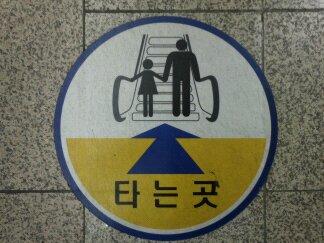
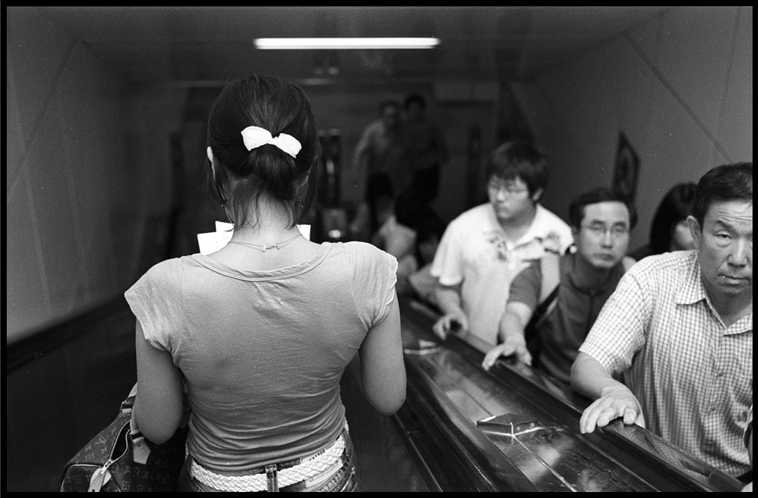
As you’ll see after her column, it’s a much more blatant example of what she describes. Especially when you contrast it with a real example, which there was a clear need for, made nationwide to the caregiver figures in subway escalator signs in the late-2000s. And which, to the best of my knowledge, did not result in any harm to anyone’s sense of manhood—no matter how deeply the Korean manosphere seems to feel threatened if the same ‘concessions’ were made today.

Left: the offending gesture, which is visible for precisely 0.1 second. Full screenshot source: 원정상 @YouTube. (For the record, I just thought it was too good a screenshot not to steal—I don’t know the YouTuber’s stance on the controversy.)

너 페미니? Are You a Femi?

장수경/Jang Su-gyeong, 2023-12-17 (flying710@hani.co.kr/@jsggija)

“너는 페미니스트야?”

“Are you a feminist?”

몇달 전 대학 때 친하게 지낸 남자 동기를 만나 들은 질문이다. 질문을 받은 뒤 처음 느낀 감정은 당황스러움이었다. 그동안 받아본 적 없는 질문이었기 때문이다. 페미니스트냐 아니냐를 따지는 게 무의미할 정도로, 나는 스스로 페미니스트가 아니라는 생각을 해본 적이 없던 터였다.

This is a question I was asked a few months ago, when I met a male classmate with whom I was close to in university. My first reaction was embarrassment. Because it was a question I’d never been asked before. I’d never thought of myself as *not* a feminist, to the point where it was meaningless to consider whether I was one or not.

“나는 페미니스트지.”

“Yea, I am a feminist.”

“왜 너 자신을 그렇게 규정해? 네가 생각하는 페미니즘이 뭐야?”

“Why do you define yourself like that? What do you think feminism is?”

“여성과 남성은 동등하고, 성별에서 오는 각종 차별을 없애야 한다는 거지.”

“I think it means women and men are equal, and so all kinds of sexual discrimination must be eliminated.”

“그건 인권 차원에서 당연한 거 아니야?”

“Isn’t that only natural from just from a human rights perspective though [So a feminist one isn’t necessary]?”

친구는 페미니즘의 방향에는 동의하면서도 페미니스트에 대해서는 부정적 생각을 가진 듯했다. 친구는 내게 “너의 정체성을 어느 하나로 규정하지 않길 바란다” “역차별당하고 있다고 주장하는 2030 남성들의 이야기도 귀담아들어달라”는 말을 남겼다.

Although my friend agreed with the general direction of feminism, he seemed to harbor negative thoughts about feminists themselves. He continued, “I hope you don’t define your identity as just this one thing,” and “Please listen to the stories of men in their 20s and 30s who claim they are being reverse discriminated.”

최근 게임 업계에서 일하는 여성 작가들을 향해 잇따르고 있는 ‘페미니즘 사상 검증’ 사태를 지켜보면서 당시 대화를 떠올린 건, 페미니스트를 옥죄는 사회 분위기가 전방위적이라는 생각 때문이었다. 친구의 질문 의도가 ‘사상 검증’일 것이라곤 생각하지 않는다. 다만, 이런 질문이 나와 동등한 위치에 선 사람의 ‘순수한 궁금증’에서 비롯된 것이 아니라 누군가를 검열하고, 억누르고, 일자리를 겨냥하고 있다면 말은 달라진다.

While watching the recent ‘feminist check’ [lit., ‘verification of feminist ideology’] that has been taking place against female writers working in the game industry, I remembered the conversation at that time because I thought that the social atmosphere that oppresses feminists is omnipresent. I don’t think the intention of my friend’s question [was malicious], to confirm that I was a feminist [and then target me on that basis]. However, if these questions do not arise from a place of genuine curiosity [and willingness to engage in dialogue] expressed by a person standing on equal footing with me, but instead is a form of sealioning aimed at censoring, suppressing, or targeting someone’s job, the story is different.

지난달 말 남초 사이트와 게임 업체 넥슨이 한 행동은 전형적인 ‘사상 검증’이었다. 남초 커뮤니티는 넥슨의 게임 ‘메이플스토리’ 홍보 영상에 등장하는 캐릭터의 손가락 모양을 두고 ‘남성 혐오’라고 주장했다. 근거는 빈약했다. 해당 영상을 작업한 하청 업체의 한 여성 직원이 자신의 사회관계망서비스 계정에 올린 페미니즘 옹호 발언이 전부였다. 전형적인 확증 편향이었지만 넥슨은 별다른 사실관계 확인 없이 해당 영상을 비공개하고 업체 쪽에 법적 대응을 예고했다.

At the end of last month, the actions taken by the manosphere sites and forums, and then the game company Nexon’s responses, were a typical example of the feminist check process. The manosphere claimed that the shape of the finger of the character appearing in the promotional video for Nexon’s game *MapleStory* was ‘man-hating.’ But the evidence was actually quite weak. A female employee of the subcontractor who worked on the video uploaded it to her social networking service account, and all she said was her defense of feminism. It was a typical confirmation bias, but Nexon made the video private without verifying the facts and announced legal action against the subcontractor she worked for?

이후 해당 작업물을 그린 이는 40대 남성 애니메이터라는 사실이 보도됐다. 주장의 근거가 사라졌으니, 남초 커뮤니티가 사과했을까. 아니다. 애초 사실 여부는 중요하지 않다는 듯, ‘언론의 보도가 거짓’이라거나 ‘남페미는 문제가 아니냐’며 방향을 틀었다. 그사이 해당 여성 직원은 개인 신상 정보가 털리고 온갖 욕설을 듣는 등 사이버불링을 당했다.

However, it was later reported that the person who drew the work was actually a male animator in his 40s. Now that the basis for the claim has disappeared, did the manosphere apologize? Not at all. In the first place, it seemed as if it didn’t matter whether it was true or not. And then they changed direction by saying, “The media’s reports were false,” or “Aren’t male feminists the real problem here?” Meanwhile, the female employee suffered cyberbullying, including having her personal information stolen and receiving all kinds of abusive language.

퓰리처상을 받은 영국의 저널리스트 제임스 볼은 책 ‘개소리는 어떻게 세상을 정복했는가’에서 ‘진실이든 거짓이든 신경 쓰지 않는 사람들이 만들어내는 그럴싸한 허구의 담론’을 ‘개소리’(bullshit)라고 말했다. 개소리꾼의 개소리는 거짓말과 달리 자신이 원하는 결과를 얻기 위해 최소한의 진실조차 중요하지 않기에 거짓말보다 해롭고, 팩트로 대응해도 힘을 잃지 않는다고 했다.

In his book Post-Truth: How Bullshit Conquered the World (2021), Pulitzer Prize-winning British journalist James Ball said that ‘bullshit’ is “a specious fictional discourse created by people who do not care whether it is true or false.” He said that unlike lies, this, the most bullshit of bullshits, is more harmful than lies because even the minimum amount of truth is not important to achieve the results one wants, and it does not lose its power even if it is responded to with facts.

“업장에서 왜 사회운동을 하냐”(허은아 국민의힘 의원), “악질적인 점은 실수가 아니라 의도적이라는 데 있다”(이상헌 더불어민주당 의원), “의도를 가지고 넣었다면 조롱”(류호정 정의당 의원)이라는 정치인들의 반응은 ‘개소리’ 기세를 더 강화할 뿐이었다. 정치권의 메시지는 ‘사상 검증을 하지 말라’ ‘페미니스트가 뭐가 문제냐’여야 했다. 기업은 개소리꾼의 개소리를 수용할 것이 아니라 무시해야 했다. 언론은 ‘집게손 논란’이라는 제목으로 개소리를 앞다퉈 보도하지 말아야 했다.

The politicians’ responses—“Why are you engaging in social movements at your workplace?” (People Power Party Rep. Heo Eun-ah), “The malicious point is not that it was a mistake, but that it was intentional” (Democratic Party Rep. Lee Sang-heon), “If it was put in with intention, it would be ridiculed” (Justice Party Rep. Ryu Ho-jeong)—only added to the bullshit’s momentum. Instead, the message from the political world should have been, “Don’t engage in a feminist check,” and “What’s the problem with feminists anyway?” Companies should have ignored this bullshit of bullshits, not blindly accepted it, and the media should not have rushed to report it under the title ‘Claw Hand Controversy.’

‘페미니스트는 남성 혐오론자이기 때문에 그런 집게손가락 모양을 넣었을 것’이라는 ‘개소리 담론’에 기업, 정치인, 언론 등이 동조한 결과는 ‘일터를 잃는 노동자’다. 2016년 ‘소녀에게 왕자는 필요 없다’는 글이 쓰인 티셔츠를 입었다는 이유로 교체된 성우처럼, 과거 에스엔에스에 페미니즘 관련 글을 올렸다는 이유로 2023년에 계약 해지된 게임 ‘림버스 컴퍼니’의 그림작가처럼 말이다.

Source: Twitter/@KNKNOKU via BBC.

The result of companies, politicians, media, and so on agreeing with the bullshit discourse, that “feminists must have put that index finger symbol because they are male haters,” is workers losing their jobs. Just like the voice actor who was replaced in 2016 for wearing a T-shirt with the words “Girls do not need a prince” written on it, the illustrator of the game Limbus Company whose contract was terminated in 2023 for [retweeting tweets that used derogatory terms for men].

개소리를 하며 ‘사상 검증’을 정당화하는 이들에게 말해주자. 너희 주장은 개소리라고. 페미니즘이 뭐가 문제냐고. 너희들이 페미니즘을 알긴 아느냐고.

Let’s tell those who spew bullshit in the name of feminist checks: Your arguments are bullshit. What’s the problem with feminism anyway? Do you guys even know *anything* about feminism? (END)

(For more information, in chronological order over November to December, including the response of the Nexon Union, please see the Korea JoongAng Daily, this Reddit thread, Korea Bizwire, the Korea Times, and again the Korea JoongAng Daily.)

Now fast forward to mid-January 2024, when multiple media outlets reported that in the name of gender equality, the government was immediately replacing the ‘male’ pictogram in some of the emergency exit signs nationwide with more obviously ‘female’ ones. Some outlets added that it was at the behest of women’s groups.

I’m sure I don’t need to outline the absurdities of such a plan. Nor that (most of) the multiple, eminently justifiable criticisms, did not necessarily stem from misogyny.

But more often than not, feminists became the target anyway.

Because at best, the new design was actually just one of many possibilities considered for updating the signs, to replace the existing ones only as per needed (so, no extra cost at all). Whereas at worst—and it’s unclear which applies, frankly—it was a complete fabrication of the media.

As were the supposed women’s groups that were demanding it:

직장인 A씨(29)는 “새 픽토그램을 보니 긴 머리에 치마를 입고 가슴 부분이 튀어나와 있었다”며 “여성 중에 이런 기호를 원하는 사람이 실제로 얼마나 되겠냐. 오히려 여성을 희화화한 듯하다”라고 말했다. 한 누리꾼은 “누군가 일부러 논란을 만들었다고 생각될 정도”라고 했다.

한 여성단체 관계자는 “어떤 기사에선 ‘여성단체 등이 요구해왔기 때문’이란 식으로 설명했던데, 그런 요구를 한 단체가 어디에 있나. 괴담 수준의 터무니없는 얘기”라며 “오히려 성 고정관념을 고착화하는 그림이다”라고 비판했다. (Kyunghyang Shinmun)

Office worker A (29) said, “When I looked at the new pictogram, I saw her with long hair and a skirt and her breasts sticking out,” adding, “How many women actually want this symbol? “In fact, it seems like a caricature of women.” One netizen said, “It almost makes you think someone created controversy on purpose.”

An official from a women’s group said, “In some articles, it was explained as ‘because women’s groups have been making demands,’ but where is the group that made such demands?” “It is an absurd story at the level of a ghost story,” he criticized, adding, “Rather, it is a picture that perpetuates gender stereotypes.”

And from the Dailian:

…”이런 것도 성별 갈라치기 소재로 쓰냐” 라는 등 비판 의견이 쏟아졌다.

…[Netizens] said “Is this just another thing that can be used to divide the sexes?”

Image sources: 스포츠하국, Pixabay (edited).

Now, you could rightfully argue that the media was responsible in that case, not technically the manosphere.

Only, there’s a great deal of synergy between the two.

Crucial context is that the notoriously clickbaity Korean media is one of the least trusted in the (developed) world, and that it is heavily male-dominated. Add that Korea is a deeply patriarchal country, currently in the midst of a polarizing “gender war,” then a constant backlash of ‘journalists’ scapegoating feminists for all Korea’s ills is all too predictable.

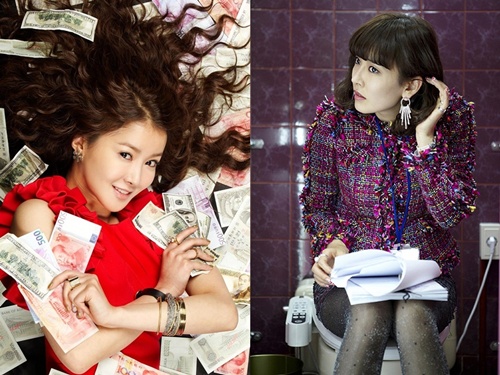
The deceit involved can be staggeringly blatant and obvious. I’ve even caught out with one bullshit story myself. When, after ‘reporting’ on a literally non-existent controversy over Berry Good member Johyun‘s cosplay above, then getting the sought-after inflamed response from the manosphere, the media added insult to injury by blaming the entire controversy on the reports of a single female reporter, who criticized Johyun for her overexposure despite praising male nudity in previous articles.

Only, her article on Johyun wasn’t published until several hours after news about about the controversy first appeared. (And ironically, her article wasn’t at all like it was described; in fact, they it was just as clickbaity as everyone else’s, and provided no basis to label her a feminist.)

Sources: MLBPark (1; since deleted); 2)

But still: these three cases alone are insufficient evidence of systematic misogyny by Korean journalists and the media. I do strongly suspect though, that a thorough investigation by academics, media-watchdogs, and/or feminist groups will undoubtedly reveal that such an agenda exists. Likely, many such investigations have already been conducted, so I’ll follow this post up with those at a later date.

In the meantime, Korean or otherwise, I will never, ever trust any news source that makes claims about unnamed women’s and feminist groups.

As part of my own 2024 agenda though, I try to highlight the positive where I can, and can’t end on that note.

So, with my apologies for the crappy quality of my digital camera back in the late-2000s, finally let me remind you of when, in a bid to challenge antiquated gender roles and encourage more equitable childcare between parents, subway-caregiver signs with a female figure were gradually replaced with an androgynous one. They were only replaced as per needed, so they didn’t cost extra money, leaving even the most vitriolic of incels struggling to oppose them without exposing their misogyny. Which is probably why I haven’t actually seen one with a female caregiver ever since.

Only, doing my due diligence, I’m sorry to report that today I learned my experience isn’t at all universal (let alone my nonexistent experience of female spaces). That the initiative stalled, and that as of 2019, many Seoul subway stations still have almost entirely female caregivers in their signs. Most ironically and symbolically perhaps, in Gangnam Station, where 100% of them are of women:

Source: Hankook Ilbo.

So, the fight continues, even over the little things. But it does continue.

Related Posts:

If you reside in South Korea, you can donate via wire transfer: Turnbull James Edward (Kookmin Bank/국민은행, 563401-01-214324)


Unpopular Opinion: “Kim Jiyoung: Born 1982” Didn’t Hit Hard Enough

Kim Jiyoung: Born 1982 scores points for its raising of numerous feminist issues, but its treatment of them is frequently quite superficial. Here’s how one scene should have been handled differently, shattering stereotypes and suggesting solutions in the process.

Estimated reading time: 8 minutes. Photo by Gabe Pierce on Unsplash.

I didn’t like the novel Kim Jiyoung: Born 1982 much at all. There, I said it.

It’s basically a Korean Feminism 101 compendium, which means it didn’t really teach me anything new. Its constant shoehorning of facts and statistics into the narrative ruined it as a work of fiction too. But the biggest flaw was Jiyoung’s constant, infuriating lack of agency, with its flipside that author Cho Nam-joo didn’t really offer any solutions to the numerous hardships she faces either.

That doesn’t mean those hardships aren’t well-described. Like I said in my earlier review, I don’t think it’s a bad book at all. If you personally learned a great deal from it, and/or laughed, cried, and seethed in anger alongside Jiyoung, then I’m hardly going to claim that my own disappointment and frustration mean I’m somehow a much better, more knowledgeable feminist than you.

But Jiyoung’s lack of agency, and Cho’s lack of solutions, are absolutely a hill I’m prepared to die on. One scene in the film set in a subway toilet, albeit not mentioned in the book, illustrates both very well.

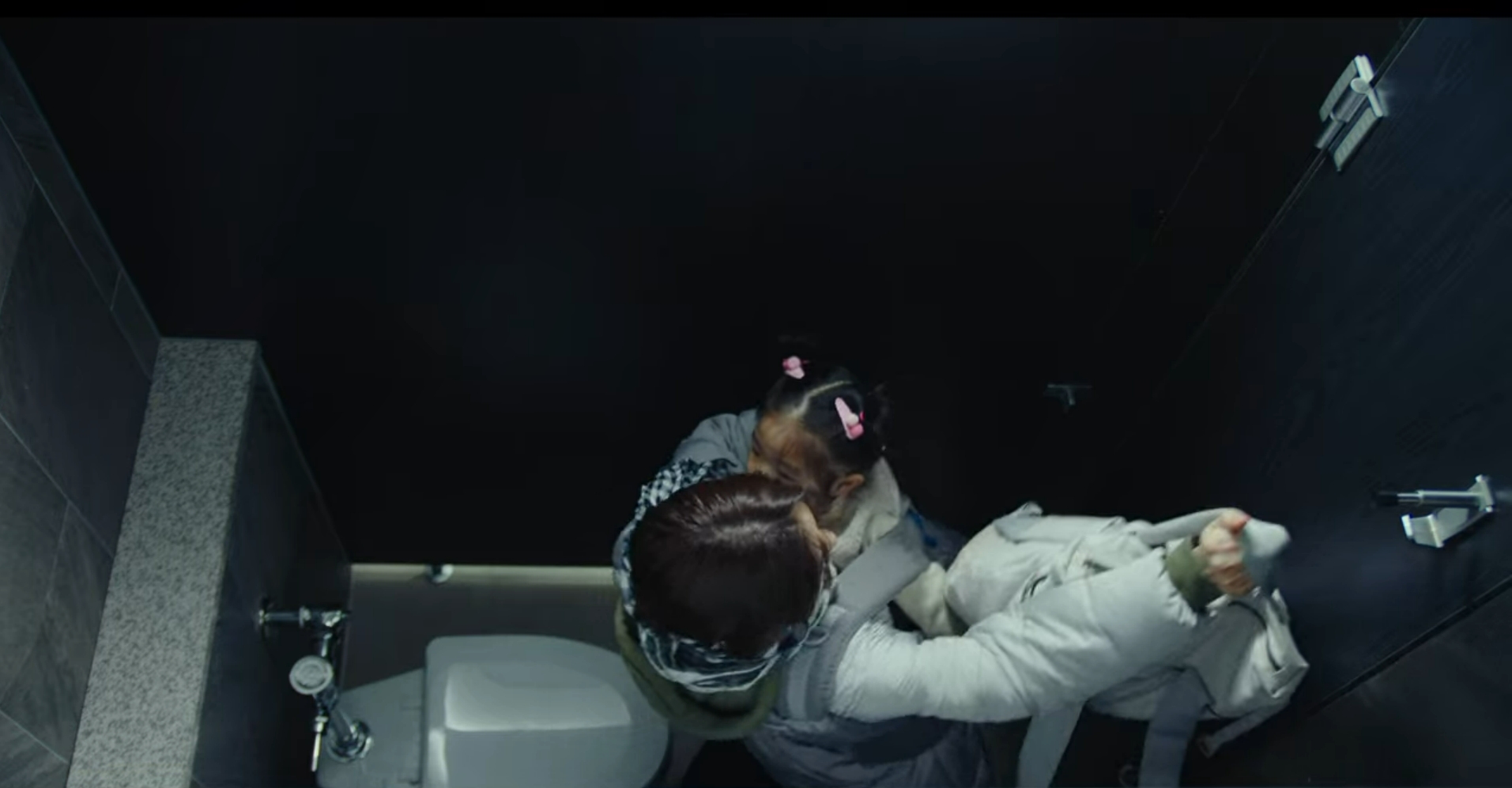
In it (55-56:00), Jiyoung (played by Jung Yu-mi) has to get off the subway to change her bawling infant daughter. Once that’s done, she realizes she needs to pee herself, but struggles in the narrow cubicle to hang up her heavy bag with her daughter strapped to her chest. Then, before she attempts again, she eyes the walls and lock nervously, remembering a recent molka (spycam) incident at the place she used to work. The scene then shifts to her home, implying she gave up and went there instead.

At first viewing, it’s difficult to find any fault here at all. Given that the burden of childcare falls overwhelmingly on women, then more men—or, indeed, more unsympathetic childless women—sometimes really do need to be literally shown just how much effort that actually involves. So too, do more men need to realize how stressful it is having to worry about being secretly filmed literally every single time you used any toilets outside of your home, as well as the potential health consequences if you understandably chose to avoid them.

Admittedly, that may seem like a lot to ask of a one-minute scene. Yet with just a little tweaking, it could have achieved those aims very effectively and forcefully. Instead, it largely fails, for three reasons.

The first is because, ironically, guys can relate to the practical difficulties. The indignity of using a cubicle while wearing a suit and carrying a backpack, desperately trying to prevent either from touching all the urine and smokers’ spittle on the floor, is absolutely no joke. As for childcare specifically, my ex-wife would naturally take our daughters with her to the female toilets when they were young, but it’s not like I wasn’t often in just as awkward and uncomfortable situations with them in other cramped locations.

Devoid of any wider context then, which I’ll provide myself in a moment, men’s own issues with using cubicles can mean women’s complaints fall on deaf ears, let alone calls to make women’s toilets bigger than men’s. (In fact, some men even consider the proposal to be reverse-sexism.) This lack of sympathy is misguided, of course, but I can understand it—unless men are flat out told or shown why not, it’s perfectly reasonable to assume that more cubicles in place of urinals suffice for women’s need to sit down. That women somehow still have to queue nonetheless, delaying everyone? Pop culture reveals that’s just their own fault, thanks to all the primping, preening, and gossiping that really goes on in there.

Next, the scene doesn’t do enough to convey the visceral fear of spy cameras. This is indeed much harder for men to relate to, because they never have to think about them when using public toilets. So, something much more forceful than Jiyoung’s brief nervous glances was required.

Best would have been a tweak to an earlier scene, which I’ll outline in a moment. But as an emphasis in this one, a more realistic cubicle should have been shown, with every nook, cranny, screw, bolt, and indent jammed with toilet paper and gum. Rather than the toilet the scene was actually shot in, which, complete with a rare heater, was easily the most pristine in Korea, seeing what it’s actually like in women’s toilets would surely have rammed home just how big of a problem spycams are in Korea—in a way that abstract news reports never could.

Image source: The Fact.

That earlier scene (44:30-47:30) is where Jiyoung’s former coworkers discover a spycam had been set up in one of the female toilets, and that their male coworkers had been sharing the videos, followed by meeting Jiyoung in a coffee shop to let her know. In hindsight, it’s all over surprisingly quickly. Whereas in the book, the incident is dealt with over three pages, and among the many grave consequences the coworkers reveal in those is that one victim overdosed on meds—possibly intentionally. This is omitted entirely in the film, but fits with the film’s much more kid-gloves, family-friendly tone overall (In particular, Jiyoung’s husband, played by Gong Yoo, is a vastly more sympathetic and likeable character than in the book. Perhaps a truer portrayal was rejected as harmful to his image?). In its place, the coworkers are not so much in tears as almost laugh off the affair, one joking about borrowing Jiyoung’s daughter’s diapers from now on.

Not only would I have absolutely kept that line about the coworker’s potential suicide instead, I would have devoted a minute to visiting her in hospital too. Was that not worth it to show that spycams have very real, devastating effects on people’s lives?

But if I only had an extra minute’s grace, I would use it to shift Jiyoung’s toilet scene to a few years earlier in her life, before she stopped working to have her daughter. She would be in her smart workclothes and high heels at a hweshik, an (effectively mandatory) after-work dinner with her boss and coworkers, and have to go to the toilet as everyone was preparing to leave to go to a second round at a bar. She would take longer than many of the men would like, because—and herein lies that context, as explained by Sora Chemaly in Time. Because, yes, it really does need explaining, as it’s not at all just about sitting vs. standing:

Women need to use bathrooms more often and for longer periods of time because: we sit to urinate (urinals effectively double the space in men’s rooms) [note also, “Women empty their bladders more frequently than men and take longer – an average start-to-finish time of 60 seconds for men, but 90 for women”—James], we menstruate, we are responsible for reproducing the species (which makes us pee more), we continue to have greater responsibility for children (who have to use bathrooms with us), and we breastfeed (frequently in grotty bathroom stalls). Additionally, women tend to wear more binding and cumbersome clothes, whereas men’s clothing provides significantly speedier access. But in a classic example of the difference between surface “equality” and genuine equity, many public restrooms continue to be facilities that are equal in physical space, while favoring men’s bodies, experiences, and needs.

So when Jiyoung did rejoin the group, one of those impatient men could have made an all too common complaint or joke about holding everyone up for the sake of putting on her lipstick. To which she could have angrily pointed out it wasn’t her fault, for any number of the above reasons she could have chosen to highlight (and/or by having to spend time ramming toilet paper into all those potential camera holes, would have killed two birds with one stone). She could have followed that the obvious solution of “potty parity”—mandating 2:1 or 3:1 female to male toilet size ratios in all new building plans, and/or building more shared toilets—wasn’t at all reverse-sexism, but would benefit both women and the men who had to wait for them.

Indeed, this scene would not be unlike the—MILD SPOILER—final scene in the film, in which Jiyoung actually does confront a guy who accuses her of being a “mom roach,” living the high life gossiping in coffee shops, a parasite on her rich husband and the hard workers who pay the taxes for her holiday of maternity leave. Which is a rare credit to the film, and certainly a better alternative to her just slinking away in shame like in the book, then getting gaslighted by her husband when she complains about it. However, as it’s the conclusion to what’s actually an extremely saccharine-feeling film overall as discussed, it’s somewhat underwhelming as a climax—SPOILER ENDS.

With an extra minute still, I would also add a scene of her as a teenager, suffering from bladder and dehydration problems that her much fawned-over brother avoided, because he could obviously better endure Korean schools’ notoriously dirty and outdated toilets. But I digress. The point is, Jiyoung in the subway toilet with her daughter is just one scene of many that could have been dramatically improved. I curse having read the book Feminist City: Claiming Space in a Man-made World by Leslie Kern (2020) in particular, which means I can just no longer unsee the flaws in the scenes in either the book or film. Although, given the former’s popularity, now I do appreciate the value of seeing one’s own lived experiences represented in print, even if Cho neither presents Jiyoung as a role model nor offers any potential solutions to what she faces.

Those responsible for the film however, could have and should have responded to the backlash by taking up that mantle, exploiting the potential of the new visual medium to shock and shame. Instead, they wasted the opportunity by making it as saccharine as possible, all for the sake of people who had probably never actually read the book and were even less likely to watch the film.

Related Posts:

If you reside in South Korea, you can donate via wire transfer: Turnbull James Edward (Kookmin Bank/국민은행, 563401-01-214324)
Recent Studies Show it’s Hands-On Fathers That Have More Children, NOT Fictitious Alpha Males. The Implications for Raising Birthrates are Clear.

One recent study demonstrates the more of their fair share of housework and childcare fathers do, the more children they’ll probably have; another, the many entrenched workplace and social welfare practices that prevent Korean men from doing so. Loudly challenging the stereotypes and gender norms that discourage them, however, should be a no-brainer for policymakers.

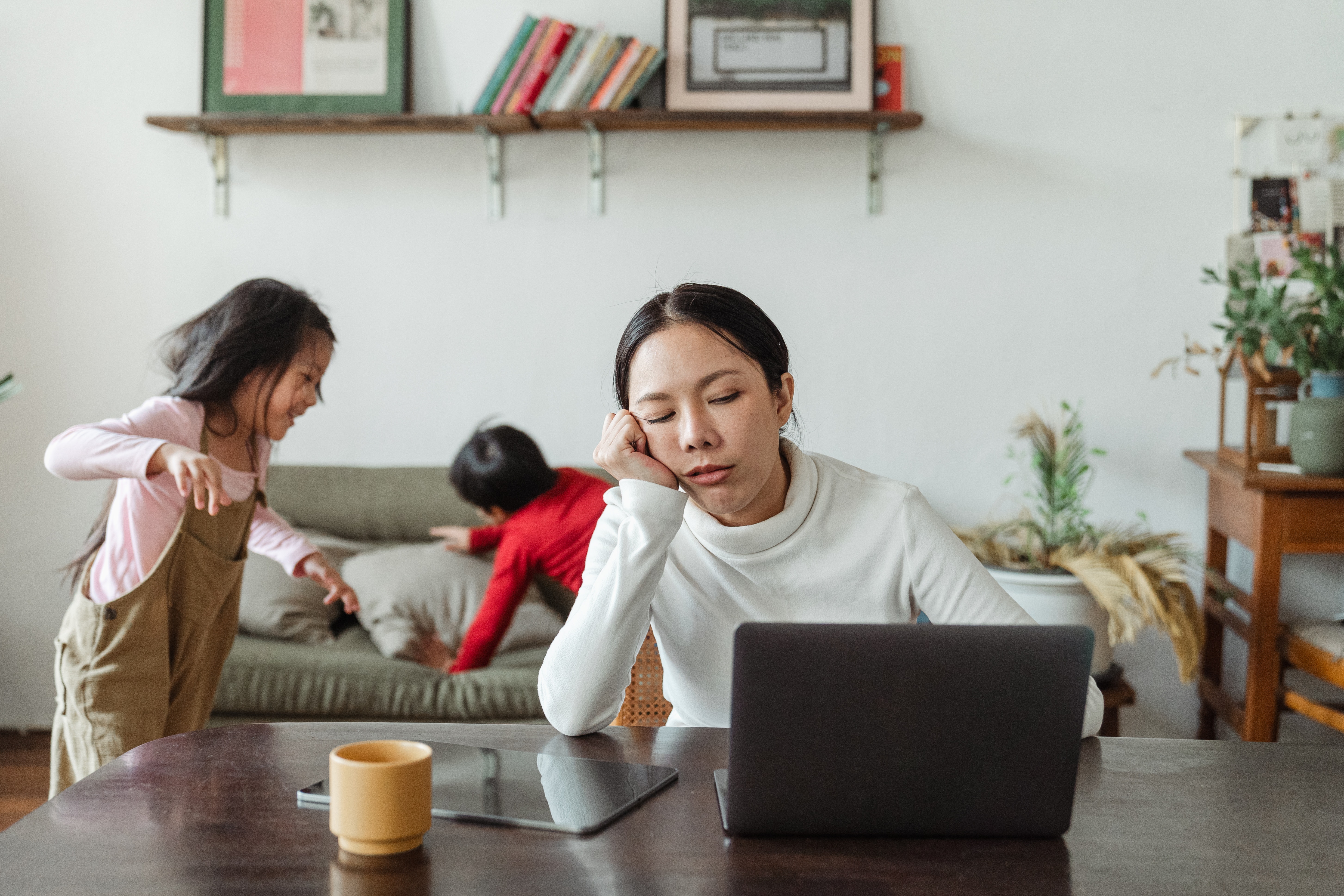
Estimated reading time: 11 minutes. Photo by Annushka Ahuja from Pexels.

A lot of things have to come together, for a successful dating, sex, or family life.

Sadly, those combinations elude most young South Koreans. Which is not to say you won’t still see plenty of couples out on dates in this warm weather, popping into love hotels, or families out for a stroll. But when you do, as @publiusterence points out in this insightful Twitter thread, notice also their expensive haircuts, clothes, smartphones, handbags, watches, strollers, and cars. Then you realize: some of the very best things about being human, which the vast majority of us deeply, instinctively aspire towards, are simply “becoming a privilege for the middle class and above.”

No wonder everyone else is so angry.

There are a host of familiar, intractable reasons for this increasing bifurcation of Korean life. Too familiar, really. Who amongst you hasn’t already read how the economy in Korea is so polarized for instance, that singles say they simply lack the time and money to go on dates or have sex, let alone ever getting married and owning a home? Or how heavily the importance and costs of education (PDF) weigh on the decision to have children? Which only married people can even ponder really, so daunting remain the stigmatization and legal problems suffered by single mothers, as well as the strong taboos against having children if the parents have no intention to marry?

Is it any surprise that on the day of writing, a poll revealed that over half of 20-somethings don’t plan to have children after marriage?

And so depressingly on.

Photo by Alex Green from Pexels

Yet some of those reasons may also feel familiar, and personally and painfully so, because you’re in a similar position yourself—only you’re not in Korea. Which further begs the questions: to what extent are Korea’s own cultural and gender norms responsible for Korea’s world-low birthrate? Or, are they simply due to late-stage capitalism? How to tease the effects of each apart?

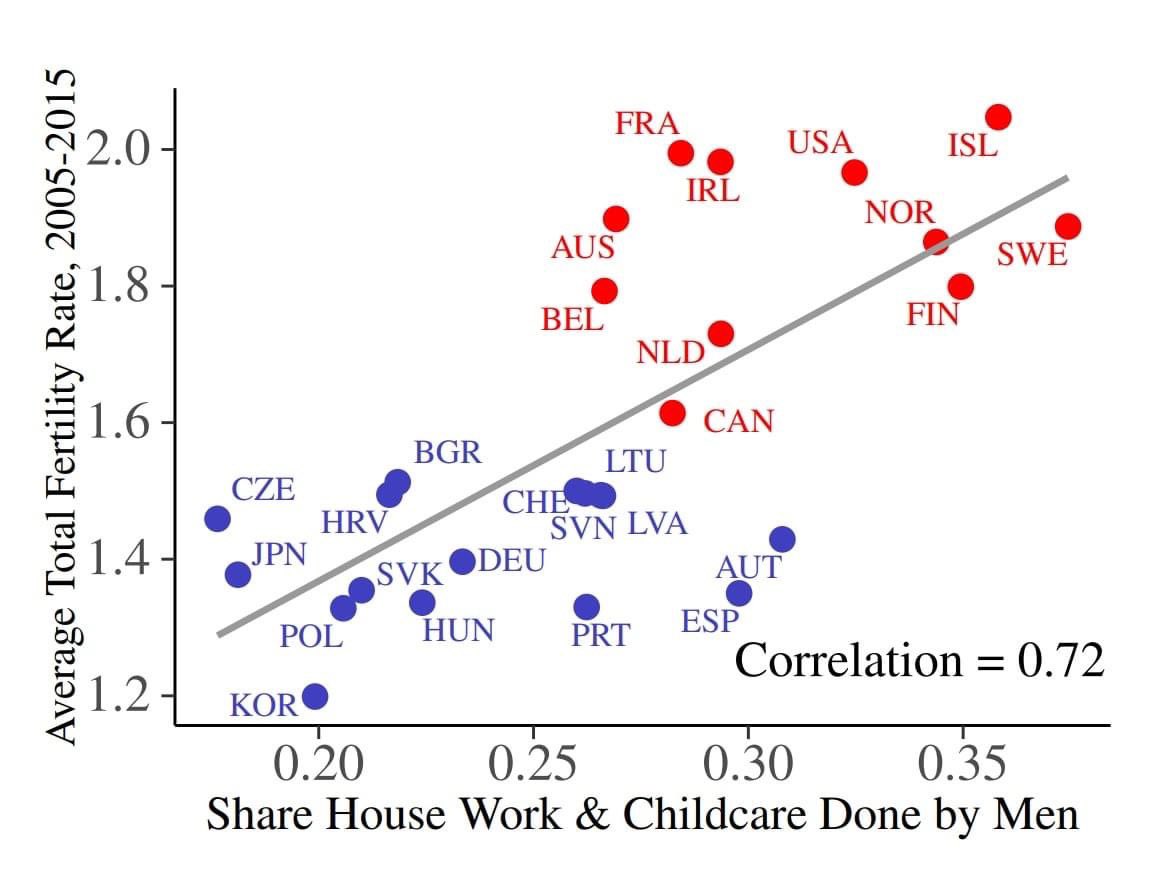
Such inquiries slide easily into a longstanding, ongoing sociological debate known as “convergence vs. divergence,” over whether the demands of capitalism force societies to adapt economically inefficient social, cultural, and gender norms as they develop, thereby making advanced capitalist societies resemble each other more over time, or whether some norms will endure regardless. Which is what makes the following graph, spreading rapidly on Korean Twitter, so interesting:

Source: Figure 16, “The Economics of Fertility: A New Era,” p. 32. Note that “Men” should more accurately say “Fathers.”

From the April 2022 “The Economics of Fertility: A New Era” by Matthias Doepke, Anne Hannusch, Fabian Kindermann, and Mich`ele Tertilt, a manuscript in preparation for the upcoming Handbook of Family Economics, unfortunately Korea is little mentioned specifically in the 129 page (but still fascinating) document. However, one of two potential takeaways is the seeming endurance and overwhelming influence of Korean cultural and gender norms. The dominant narrative projected by English-language commentators on Korean society after all, not least by myself, is that Korea remains a fundamentally sexist society. As BBC journalist Simon Maybin puts it in his August 2018 article, “Why I Never Want Babies,” with an iconic quote on this issue which I’ve often said myself (but am relieved to now have a much more reliable source for!):

A culture of hard work, long hours and dedication to one’s job are often credited for South Korea’s remarkable transformation over the last 50 years, from developing country to one of the world’s biggest economies.

But Yun-hwa says the role women played in this transformation often seems to be overlooked.

“The economic success of Korea also very much depended on the low-wage factory workers, which were mostly female,” she says.

“And also the care service that women had to provide in the family in order for men to go out and just focus on work.”

Now women are increasingly doing jobs previously done by men – in management and the professions. But despite these rapid social and economic changes, attitudes to gender have been slow to shift.

“In this country, women are expected to be the cheerleaders of the men,” says Yun-hwa.

Korean Sociological Image #92: Patriotic Marketing Through Sexual Objectification, Part 1

More than that, she says, there’s a tendency for married women to take the role of care-provider in the families they marry into.

“There’s a lot of instances when even if a woman has a job, when she marries and has children, the child-rearing part is almost completely her responsibility,” she says. “And she’s also asked to take care of her in-laws if they get sick.”

The average South Korean man spends 45 minutes a day on unpaid work like childcare, according to figures from the OECD, while women spend five times that.

“My personality isn’t fit for that sort of supportive role,” says Yun-hwa. “I’m busy with my own life.”

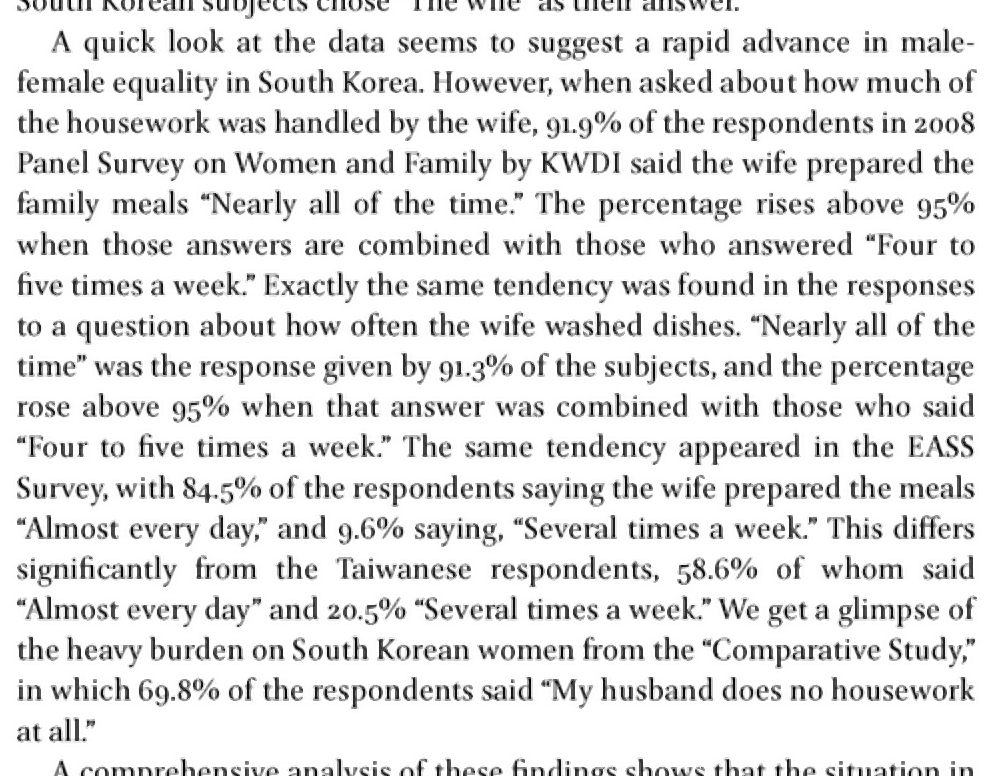
Also, for your interest, and because far more people need to be aware of Kaku Sechiyama’s excellent book, Patriarchy in East Asia: A Comparative Sociology of Gender (2015), here is his summary (p. 164) of Korean surveys from a decade earlier. As a reviewer noted, “it is in Korea (South and North) where motherhood is most pronounced, as is a household division of labor by gender”:

However, @publiusterence’s example also suggests looking beyond the headlines, as well as our preconceived stereotypes. For in addition to demonstrating that even in the progressive, supposed feminist utopias of Scandinavian countries, fathers still only do a third of the housework and childcare as mothers, a second, slightly contradictory potential takeaway is that regardless of the country, having fathers pull their weight more will invariably increase the fertility rate.

Source: Figure 16, “The Economics of Fertility: A New Era,” p. 32. Note that “Men” should more accurately say “Fathers.”

Does that make it also a potential point of convergence between capitalist societies? Admittedly, to posit it as such may seem misguided, as considering childcare and housework to be primarily mothers’ responsibilities is the very definition of a gender norm in itself. But the alternative, writing off all Korean fathers as simply lazy and sexist, is not exactly fair. Nor does it offer much in the way of solutions.

Instead, surely it is more helpful to point out the many structural factors that prevent Korean fathers from doing more work at home (whether they actually want to or not), as well as to point out practical steps that can overcome those.

Addressing the elephant in room first however, that last—let alone this post’s title—is not meant to imply that Korean policymakers aren’t already well aware of those many structural factors. Also, that they defy easy fixing, simply by virtue of not having already been done so. For an excellent summary of them, I recommend the second recent study, “Revisiting the Gender Revolution: Time on Paid Work, Domestic Work, and Total Work in East Asian and Western Societies 1985–2016” by Man-Yee Kan, Muzhi Zhou, Kamila Kolpashnikova, Ekaterina Hertog, Shohei Yoda, and Jiweon Jun in Gender & Society released just a month before that graph. Some highlights (my emphases):

Since the 2010s, the Korean government has introduced a series of family policies such as paid parental leaves, subsidized childcare services, and flexible working to help women and men to balance work and life. Public and social expenditure in Korea increased from five percent in 1990 to ten percent in 2012, but the figures were lower than the OECD average. Yet some scholars have classified the welfare regimes in Korea and Japan as [our “Conservative” type], given the fact that the governments in these countries work closely with businesses and corporations in providing social insurance and pension schemes; the result is a high degree of stratification among occupations and between the employed and the non-employed.

The reason for this was the Asian Financial Crisis of 1997, after which Korea underwent a revolutionary shift from having the most job for life, male breadwinner, “salarymen” in the world to having the most part-time and irregular workers in the OECD, as well as having one of the highest rates of self-employment. The important distinction is that those fortunate enough to secure “regular” jobs in large corporations make much more money and have far more fringe benefits than everyone else (hence all that money spent on children’s education; going to the right schools and universities is a must to secure such jobs). Also, as you can imagine, women make up most of the irregular workers.

Photo by Ketut Subiyanto from Pexels.

Continuing:

Our findings suggest that cultural norms interact with institutional contexts to affect the gender convergence in time use, and gender relations might settle at differing levels of egalitarianism. Furthermore, policies relying on family ties and women’s traditional gender responsibility for care provision, as in the case of Japan, Korea, and Southern European countries, will hinder progress in gender equality.

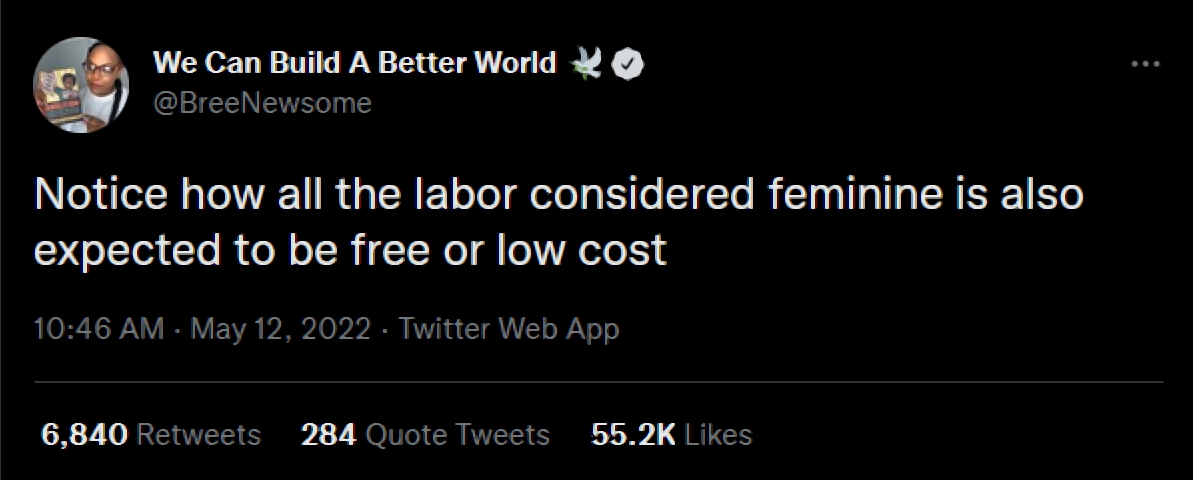
And today I learned:

In Japan and Korea, the gender gaps in paid and unpaid work time are large but the gap in total work time is relatively small; the gender convergence in paid and unpaid work time has been extremely slow and has even stalled.

Source: @BreeNewsome

Finally:

These findings reveal that policies relying on families as a key source of care provision, including those of Southern European countries, Japan, and Korea, prevent women from increasing labor market work and reducing their share of domestic labor. In addition, the persistently long work hours in Japan and Korea have created barriers for men to committing time in domestic work.

And yet, even if you can’t change the long working hours, the universal male military conscription, the general homosociality of Korean life, and so depressingly on overnight, something that can be put in motion is a clear, explicit, widespread government campaign at raising awareness about that graph, following by loud, well-publicized efforts at removing the outdated gender roles and stereotypes from our daily lives that sustain them.

This may sound somewhat naive, and certainly isn’t a magic bullet. Of course, various initiatives of this nature have already been going on for decades too. However, deepening them and enlarging their scope would be still relatively cheap, and uncontroversial. Moreover, given the direct correlation between fathers’ share of housework and childcare to the birthrate, what’s to lose for governments that have already spent billions on trying to raise the latter, to little effect?

Indeed, if as a selection of books recently reviewed in the Atlantic show, “social and political shifts are usually the result of sustained, unseen work,” then there is still far more that needs to be done before those shifts become visible:

Source: Wikitree via Naver.

For instance, when translating foreign language programs and films into Korean subtitles, government-television broadcasters shouldn’t be allowed to depict women usually using honorific speech (존댓말) to men and men usually informal language (반말) to women, an extremely common practice that is done regardless of the status of the characters and despite no such distinctions being made in the original language. (It was even done in The Return of Superman to BBC Dad and his wife here in Busan.) Likewise, private broadcasters who do should also be named and shamed.

In case it’s not immediately clear why, pop culture gatekeepers’ dogged determination in making sure that one sex is always portrayed as higher status than the other, is not exactly a good basis upon which to discuss a more egalitarian division of home responsibilities. A clear commitment by policymakers to do away with this practice then, would surely be helpful. Likewise, and finally, also a commitment to use gender neutral terms concerning childcare and housework standard practice for all government departments’ communications with the public. Because again, what possible harm could it do?

Source: YouTube.

I’ve written about this before, most recently in 2019 about a new term for stroller that removes the notion that it’s a mother that should be pushing it. Sadly however, I’ve yet to encounter that new term personally, as An Hyae-min also laments in their April 24 “Mabu News” column for SBS News. Some excerpts to finish with:

우리나라의 성차별 언어는 얼마나 될까요? 한국어는 독일어와 프랑스어처럼 성별이 박혀있는 언어보다는 상대적으로 성중립적이기 쉬운 언어 구조를 가지고 있습니다. 하지만 그럼에도 불구하고 한국어 곳곳에서 성차별적 언어를 어렵지 않게 발견할 수 있어요. 2018년 여성가족부가 조사한 <일상 속 성차별 언어 표현 현황 연구> 결과를 보면, 성차별 언어 표현을 한 번이라도 접해본 사람의 비율은 응답자의 90%가 넘는 수치를 기록했습니다. 특히 성역할에 관한 차별 표현이 91.1%로 가장 많았어요. 여성을 지칭할 때만 ‘여’ 자를 따로 붙이는 ‘여배우’, ‘여의사’, ‘여경’ 같은 단어들이 그런 예가 되겠죠.

“How sexist is the Korean language? Actually, Korean tends to be relatively gender-neutral compared to gender-studded languages ​​like German and French. Yet despite this, you can easily find many sexist terms in Korean. According to the results of a study conducted by the Ministry of Gender Equality and Family in 2018 on the status of sexist language expression in daily life, the proportion of people who have encountered sexist language at least once a day was recorded by more than 90% of the respondents. In particular, the expression of discrimination regarding gender roles was the highest at 91.1%. Examples of such words would be ‘actress’, ‘female doctor’, and ‘female police officer’, where the reference to the person’s sex is used only when referring to women who perform those roles [not the ‘default’ of men who do].” (Source, right: Geoffrey Fairchild; CC BY 2.0)

가족 호칭에서도 남편 쪽의 친척에게는 ‘도련님’, ‘아가씨’로 높여 부르지만 아내 쪽은 ‘처남’, ‘처제’로 부르고 있죠. 남성과 여성을 병렬적으로 배치할 경우에 ‘남녀노소’, ‘아들딸’, ‘남녀공학’ 등 남성이 먼저 위치하지만 비하하는 표현을 사용할 땐 ‘연놈’과 같이 여성을 지칭하는 말이 먼저 오기도 하고요. 심지어 여성이 앞에 와 있는 Ladies and Gentlemen을 ‘신사숙녀 여러분’으로 뒤바꿔 번역하기도 하죠.

“Even in family titles, relatives on the husband’s side are called ‘bachelor’ and ‘agassi/unmarried woman‘, but on the wife’s side they are called ‘brother-in-law’ and ‘sister-in-law’. Also, when men and women are placed in parallel in a neutral term, men are mentioned first, such as in ‘man and woman’, ‘son and daughter’, and ‘co-education’—even the English ‘Ladies and Gentlemen’ is reversed in Korean. But when using derogatory combined expressions, words referring to the women come first, such as in ‘Yeonnom.'”

● 유모차 → 유아차
: 여성(母)만 포함되어있는 단어로 평등육아 개념과 맞지 않음. 아이가 중심이 되는 유아차가 성중립 언어라고 할 수 있음.

● 스포츠맨십 → 스포츠정신
: 스포츠를 하는 누구나 가져야 하는 스포츠정신에 남성(man)만 포함되어있는 단어는 성평등에 어긋남.

● 자매결연 → 상호결연
: 상호 간의 관계 형성의 사회적 의미를 ‘자매’라는 여성적 관계로 표현. 여성에 대한 인격적 편향성을 높일 수 있다는 점에서 차별적 표현

● Stroller → Baby Car: A word that contains only women (母) does not fit the concept of equal parenting. A child-centered infant car can be said to be a gender-neutral language.

● Sportsmanship → Sports spirit : A word that contains only men in the spirit of sports that everyone who plays sports should have is against gender equality.

● Sisterhood relationship → Mutual relationship : Expressing the social meaning of mutual relationship formation as a feminine relationship called ‘sister’. Discriminatory expression in that it can increase personal bias toward women

이러한 성차별적 표현을 바꾸기 위한 노력은 곳곳에서 보입니다. 위에 정리해 둔 건 서울시 여성가족재단에서 2018년부터 진행하고 있는 성평등 언어 사전의 일부 내용들이에요. 서울시에선 시민들과 함께 성중립 언어 개선안을 만들어서 공표하고 있죠. 국립국어원에서는 가족 호칭에 대해서 아내 쪽 친척을 남편 쪽 친척의 호칭처럼 ~님으로 부르는 방식을 권고하기도 했어요.

“Efforts to change these sexist expressions are everywhere. Listed above are some of the contents of the Gender Equality Language Dictionary, which the Seoul Gender Equality and Family Foundation has been running since 2018. The Seoul Metropolitan Government is working with citizens to create and announce a gender-neutral language improvement plan. The National Institute of the Korean Language also recommended that relatives on the wife’s side be called with the honorific ‘nim’, just like relatives on the husband’s side.”

가장 보수적인 언어가 통용되는 법령 용어에서도 성차별적 언어 표현을 성중립 언어로 대체하고 있습니다. 법 조문에는 여전히 ‘미망인’과 같이 성차별적 표현이 있거든요. 이를 바꿔보려고 한국법제연구원이 법률을 전수 조사해서 차별 언어를 검토하기도 했습니다. 지난달엔 법무부 디지털 성범죄 전문위원회에서 ‘성적 수치심’이라는 단어를 성 중립적 용어로 변경하라고 권고한 일도 있었고요.

“Even in statutory terminology, which is used in the most conservative languages, sexist language is being replaced by gender-neutral language. There are still sexist expressions such as ‘widow’ in the law. To change this, the Korea Legislative Research Institute conducted a full investigation of the law to examine the language of discrimination. Last month, the Ministry of Justice’s Digital Sex Crimes Committee recommended that the word ‘sexual shame’ be changed to a gender-neutral term.”

Korean Sociological Image #61: Stereotypical Gender Roles in Pororo

RELATED POSTS

If you reside in South Korea, you can donate via wire transfer: Turnbull James Edward (Kookmin Bank/국민은행, 563401-01-214324)

The Korean Word for “Stroller” is Literally “Milk-MOTHER-Vehicle.” Let’s Start Using This New Term That Includes Fathers Too.

Like or loathe political correctness, many everyday Korean terms are ripe for modernization.

Estimated reading time: 5 minutes. Source, all screenshots: YouTube.

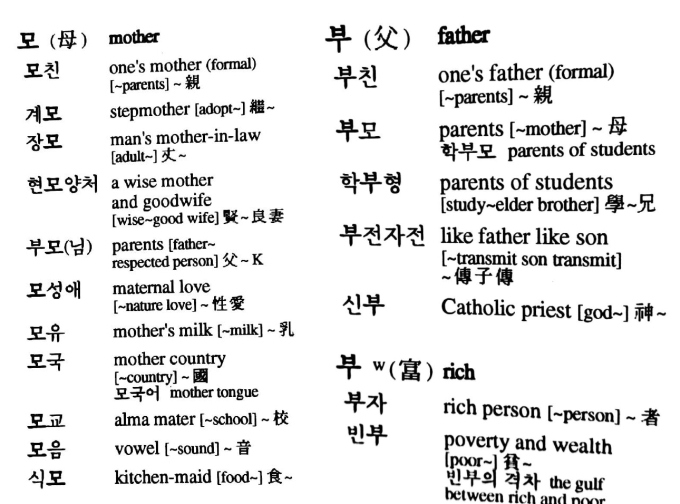
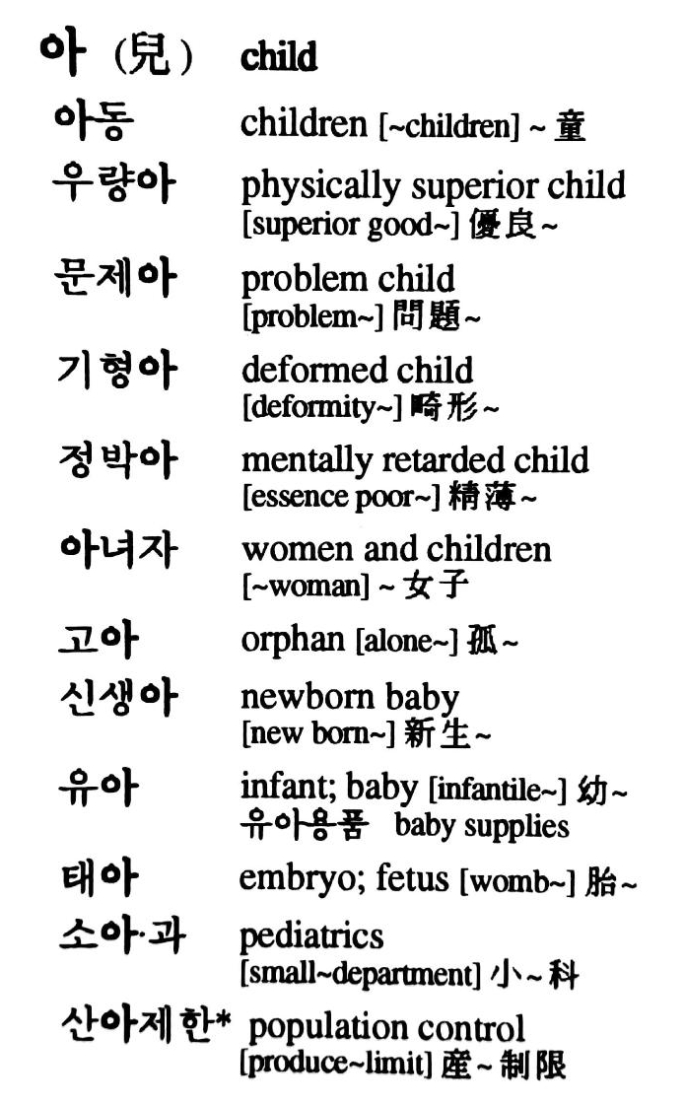
Similar to how over 60 percent of English words have Latin and Greek roots, over half of all Korean words are of Chinese origin. Once you realize this, learning Korean vocabulary becomes immeasurably easier. Buy this book in particular, which groups Korean words by their Chinese roots, and it’ll feel like all your Christmases have come at once:

From pages 78 & 102 of Miho Choo and William O’ Grady, Handbook of Korean Vocabulary: A Resource for Word Recognition and Comprehension, 1996.

You may become so grateful for all these new connections between words suddenly being revealed to you though, that it’s easy to overlook how problematic some of them may be. To many native speakers too, for whom the words are so familiar that they would have little cause to think twice about their origins.

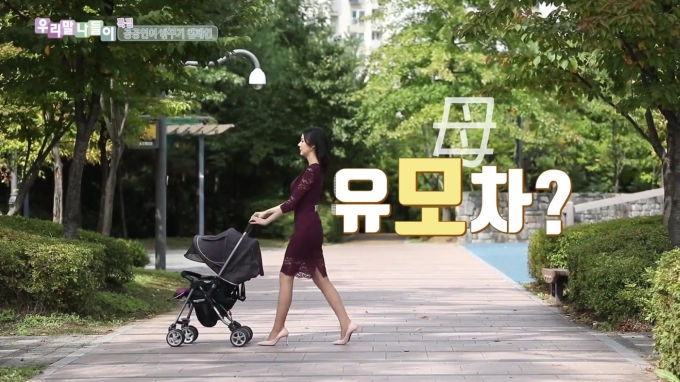
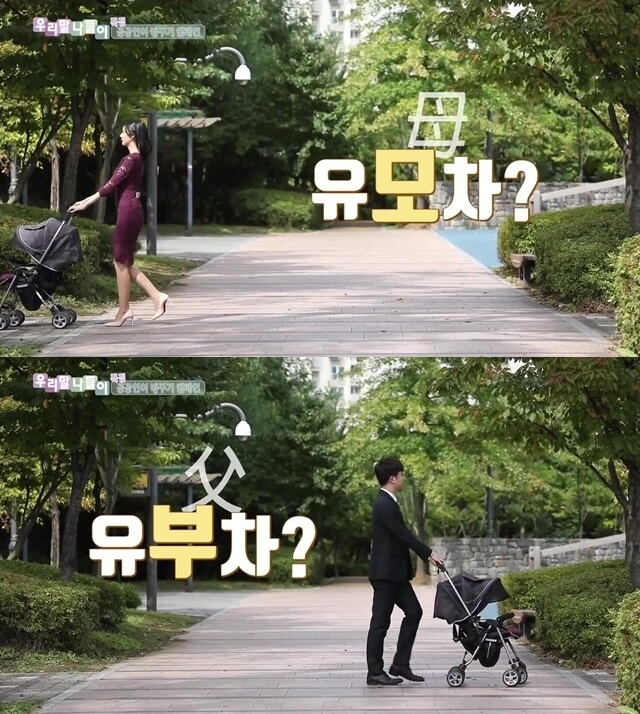
One such Chinese derivative is “모/母“,  as shown in my scan above-left. Clearly, it is apt for almost all of those examples of its usage given there, and a much better Korean-speaker than I points out that it even makes some sense for the seeming exception of “모음/vowel” too. Learn that it’s also contained in the absent “유모차” (pron. yoo-mo-cha) however, which means “stroller” (N. Am.) or “pushchair/buggy” (U.K.), and suddenly that ancient Chinese root really begins to feel its age.

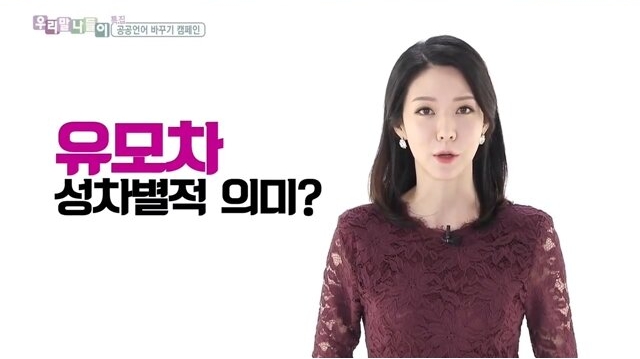
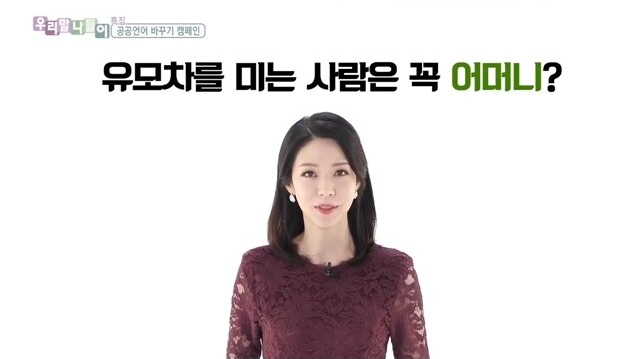
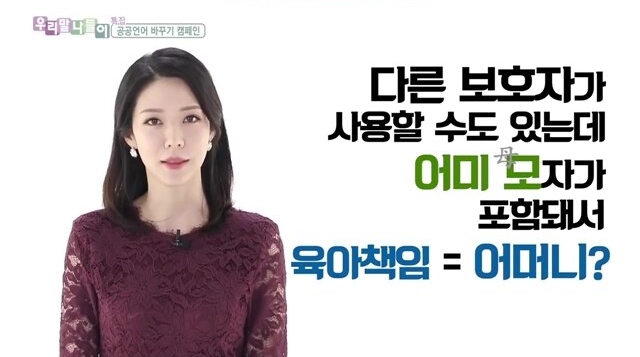
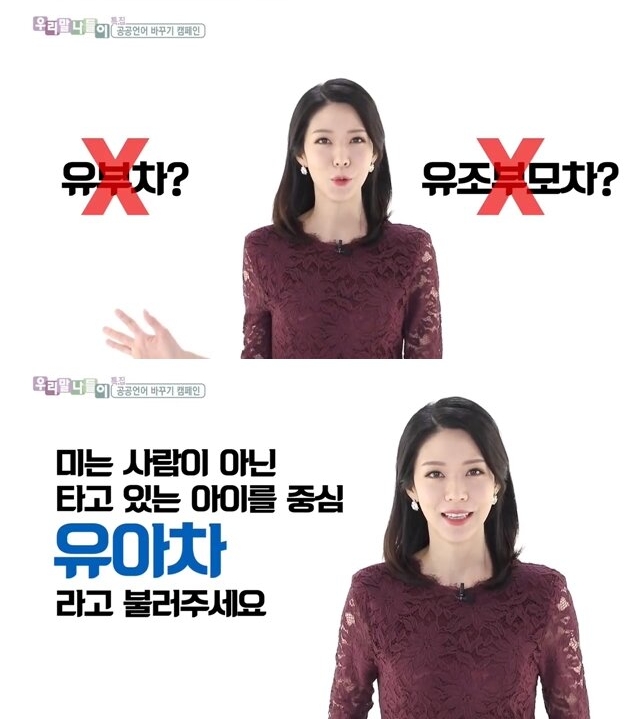
This video suggests adopting a much more inclusive alternative:

In the first screenshot below, the top line says “stroller,” followed by the corresponding Chinese characters for “milk,” “mother,” and “vehicle.” (Possibly, “breastmilk” may be more appropriate for the first character?) Below those, a definition: “A wagon for carrying a child after it is born.”

These next two are self-explanatory:

“[Because of this], does ‘stroller’ have a sexually discriminatory meaning?”

“Does the person who pushes the stroller absolutely have to be the mother?”

“Other caregivers can push it, yet the meaning of ‘mother’ is still contained within the word. Does this imply the person responsible for childcare is the mother?”

“Let’s not focus on the person pushing the stroller, and focus on the child instead. Please call it ‘유아차’ (pron. yoo-a-cha).”

And FYI, here’s that Chinese character for “child,” from page 149 of The Handbook:

Anyone reading this far needs no reminding of Korea’s plummeting birthrates, or of the gendered stereotypes surrounding childcare that work against remedying those—a mere new word is no solution. But it is logical, inoffensive, easy to remember, and can’t help but work at least a little against those stereotypes. So why not use it?

Naturally then, the YouTube video has many more dislikes than likes. Its origins are suprisingly opaque for a public campaign too (“공공언이 바꾸기 캠페인,” or the “Campaign to change how we speak to other members of the community”) and for a long time my searches only brought screenshots of that video and of various others’ in the campaign, on sites of the sort where things are generally only posted to be ridiculed. The video does end with a note that the campaign was done in conjunction with the Seoul City Government however (or possibly “by”; “함께” can vary according to context sorry), and eventually I realized I’d be able to find the video and others on non-gendered, but still problematic words in the campaign on their website itself, which indeed were posted there in October and September 2018 respectively. But there was still no news or further information available.

With such abysmal promotion, frankly you have to wonder why the Seoul City Government even bothered making them.

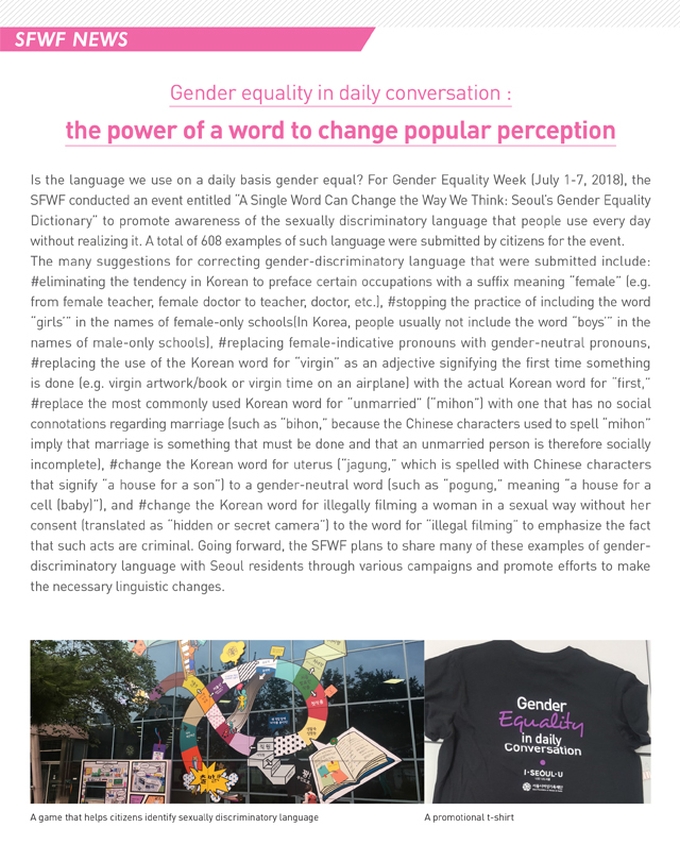
But in the process of looking, I was reminded of the Gender Equality Week conducted by the Seoul Foundation of Women and Family conducted that July:

Which I’m happy to say did receive a lot of press. Quite possibly, the the Seoul City Government’s campaign was actually one of those efforts alluded to at the end of the press release above (but which didn’t get any mention on the Seoul Foundation of Women and Family’s website either!):

Either way, it was added to by the Ministry of Gender Equality and Family’s awareness video in January this year. Possibly that explains the stroller video’s abrupt appearance on the MBC YouTube channel that same month (used in this post):

From my own experience, using gender-neutral words takes minimal effort, once you make the conscious decision to. That said, I do understand the laziness in not doing so, and the resistance against being told what to do. If you meet such a person then, perhaps start by asking them, say, why “uterus” should be “자궁” (pron. ja-goong) which literally means “子宮/house for a son,” instead of the suggested “포궁” (pron. po-goong), which means ” 細宮/house for a cell/baby.” Once they realize how much work defending that absurdity would be, then surely they’ll realize all the other sexist, archaic words aren’t really worth the effort either!

Related posts:

If you reside in South Korea, you can donate via wire transfer: Turnbull James Edward (Kookmin Bank/국민은행, 563401-01-214324)

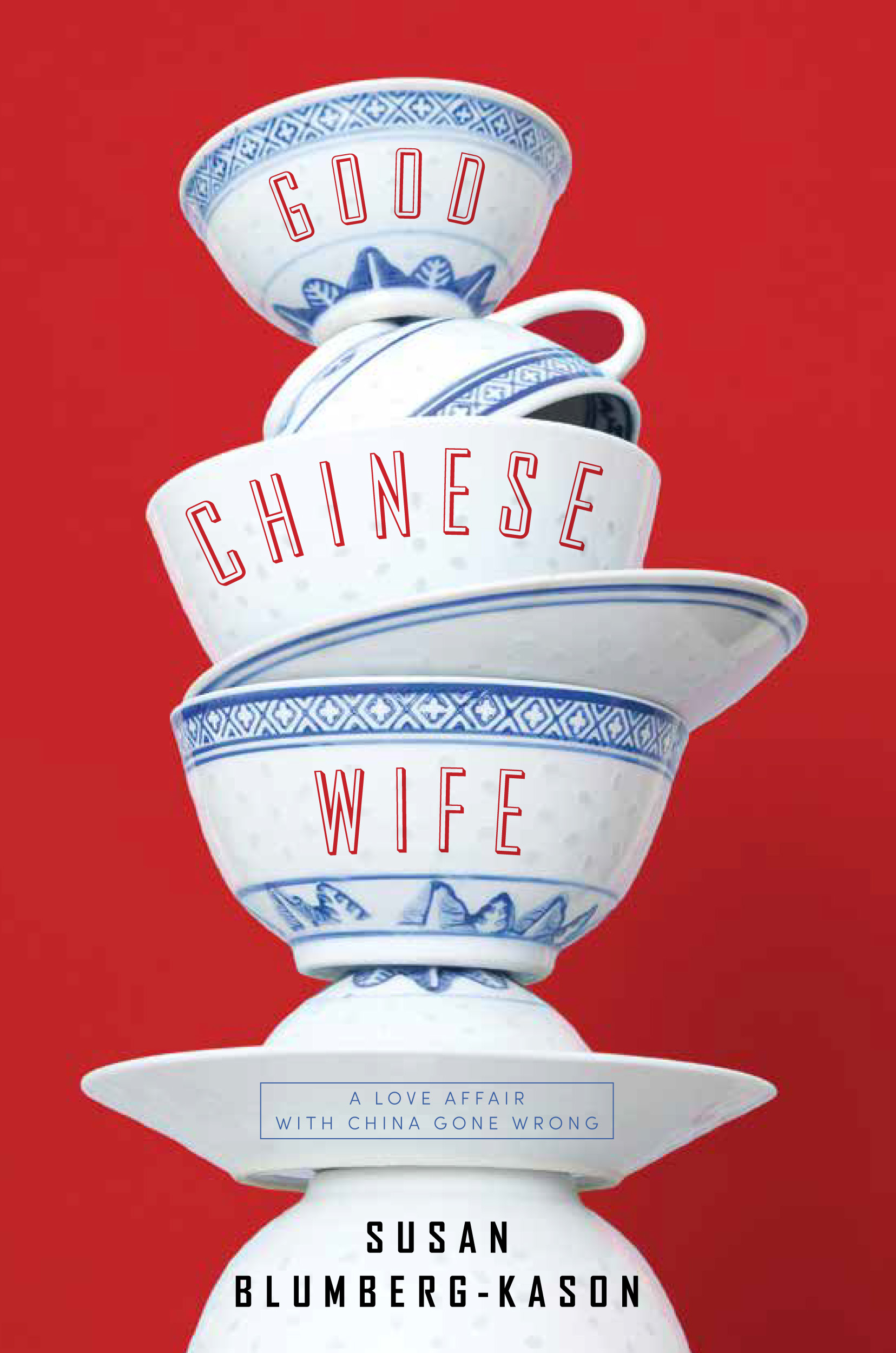
I Read a Book: Susan Blumberg-Kason’s Good Chinese Wife: A Love Affair with China Gone Wrong (2014)

Good Chinese Wife CoverLet me be honest: Good Chinese Wife is not something I would normally read.

Susan’s ex-husband was Chinese; my wife is Korean. Susan’s relationship goes from friends to engaged in less than two minutes; we lived together for years, and had lots of wild sex before I proposed. Their marriage rapidly turned sour; we just celebrated our tenth anniversary. They married, had a child, and divorced way back in the 1990s; I’m really only interested in Chinese attitudes towards dating, sex, and marriage in the 2010s. And so on.

I’m still grateful for receiving a reviewer’s copy, organized by Jocelyn Eikenburg of the Speaking of China blog (see here for many more bloggers’ reviews). But first impressions? I expected it to be very outdated, and that it would have little to offer readers with Korean partners.

I was dead wrong, on both counts.

Good Chinese Wife begins in Hong Kong in the mid-1990s, where Susan is doing a graduate degree (she previously spent a year there as an exchange student in 1990). Then in her early-twenties, she soon becomes smitten with Cai, an older mainlander from Wuhan. She starts tutoring him English in her dorm room; unbeknownst to her, other students consider them already dating. This prompts him to open up and explain he’s already been married and has a child, revealing all as a prelude to showing he is now interested in dating Susan. Because in China, Cai explains, “couples traditionally only date if they plan to marry.”

This sounded very antiquated. But as it turns out, dating in China is still not at all like in the West, nor even Korea. In Behind the Red Door: Sex in China (2012), Richard Burger explains that even in the big cities, “serial dating” is frowned upon as immoral or promiscuous. Instead, “most Chinese women still believe it is best to date only man and to marry him. Once the man invites her on a second or third date, he is indicating that he’s serious, that he is hoping for an exclusive Behind the Red Door Sex in Chinarelationship, and that marriage might be on the cards.” Whereas for women, inviting her to meet her parents “means she expects to marry him, and Chinese men understand this arrangement.” What’s more, the average age of marriage for Chinese men was only 24 in 2010; for women, 22 (in Korea, 31.8 and 28.9 respectively).

So, I understood Cai. And, being head-over-heels ever since they’d met, why Susan quickly accepted his proposal, before so much as a kiss—it sounded sweet. Her frankness about her feelings and mistakes is also a definite charm, especially for someone who likewise fell very easily in love at that age.

But that’s only 36 pages into the book. For the remaining 300, sympathy turns to constant frustration and exasperation with Susan’s rushing into marriage, then her frequent acquiescence towards her increasingly controlling and abusive husband. These feelings are only amplified by knowing that she’s doomed to fail.

In an interview, Susan says her problems were more because “He told me from the get-go that he had certain conditions for our marriage. Those are things I ignored or thought I could eventually get him to change. That should have been my red flag, not the [6 months] in which we became engaged and married.” (Likewise many happily-married Koreans, for whom such whirlwind courtships are also common, would surely bristle at the suggestion that they should have taken things slower.)

I disagree. From Cai’s belief that women are especially “dirty” in the summer, once all but physically forcing an exhausted Susan to bathe in a rat-infested bathroom, to his bizarre, surprisingly submissive relationship with eccentric professor friend ‘Japanese Father’ (“He thinks it’s not good [for us] to have sex relations more than once a week”), most of Susan’s later issues with Cai could have been discovered if they’d spent (much) more time together before the wedding day—and/or resolved if an expensive wedding wasn’t already looming over them.

Still, it does make for a good page turner. There is also merit in studying a bad relationship to learn what to avoid, and much about this one that will already be familiar to those with Korean, Japanese, and Taiwanese partners. New and expecting parents in Korea, for example, will sympathize with Susan’s expectations to conform to man yue, the belief that mothers shouldn’t bathe or go outdoors in their first month—it mirrors the Korean one of sanhoojori. Also, for those couples planning to move to a Western country, her discussion of Cai’s difficulties with adjusting to life in San Francisco will be very beneficial. Her avoidance of tiresome Orientalist stereotypes is especially welcome, with her ex-parents-in-law coming across as old-fashioned but lovely, and Chinese men portrayed no better or worse than Western ones.

That said, I am reminded of a book for couples I once flicked through, which encouraged them to discuss their expectations of marriage in great detail before committing. With checklists ranging from beliefs about circumcision and determining which cities were best for both partners’ careers, to dividing the housework and setting dating policies for potential teenage children, that approach would be much too calculating for most couples. Marriage, after all, is ultimately about making a scary but exciting leap of faith with someone. But when partners come from such wildly different backgrounds, and bring such different expectations into marriage? Susan’s experience teaches readers that for international couples in particular, perhaps they really should learn the answers to those questions sooner rather than later.

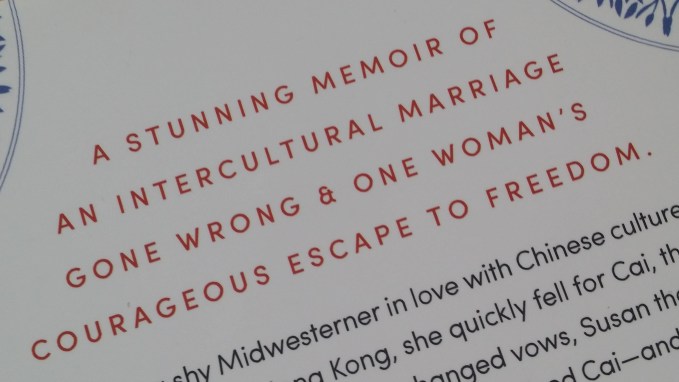
Good Chinese Wife back cover

One minor quibble was all the hyperbole. Not to diminish Susan’s genuine fears for herself and her son at times, but did it lead me to expect a story involving forged passports and bribed border guards(!). Also, I disliked the format of numerous short chapters, with so little happening in some that they felt like diary entries. But that is just a personal preference.

The verdict? Good Chinese Wife is well worth the US$14.99 cover price (16,410 won at What the Book), and a definite eye-opener about the value of reading more about relationships in this part of the world, especially with such limited options for reading about Korean ones specifically. Please do leave your suggestions (and reviewer copies!) for more like it, and/or for blogs.

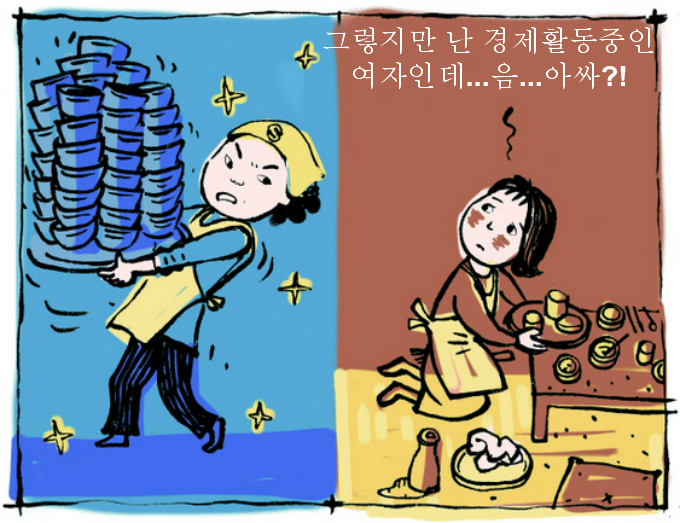
Korean Sociological Image #73: The True Numbers of Korean Working Women

(Source; edited)

If recent BBC coverage is anything to go by, marriage in South Korea is like a business. It’s also becoming a bit of an explosive topic as social mobility slows down and the traditional image of the male breadwinner becomes eroded by the increasing participation of females in the labour market. Some of the most widely publicised scandals and controversies on the Korean internet seem to have been, in some way or another, due to this intensifying gender friction.

(KoreaBANG; my emphasis)

My apologies for singling out Justin at KoreaBANG, whose post is still excellent overall. And as you’ll soon see, I often make mistakes too.

But that comment I’ve highlighted? Frankly, it just infuriated me. Because even though it’s completely wrong, I seem to hear it all the time these days.

In reality, the Korean female workforce participation rate has stagnated at one of the lowest rates in the OECD ever since 1997-98, when women were overwhelmingly targeted for layoffs during the Asian Financial Crisis. Back then, the logic was that wives would be provided for by their husbands, and 20-something daughters by their fathers. And 10 years later, in the latest crisis, to a large extent this logic was reapplied, although on this occasion there was a clearer economic – not just patriarchal – logic in that women formed the bulk of irregular workers (see here, here, and here for much more information).

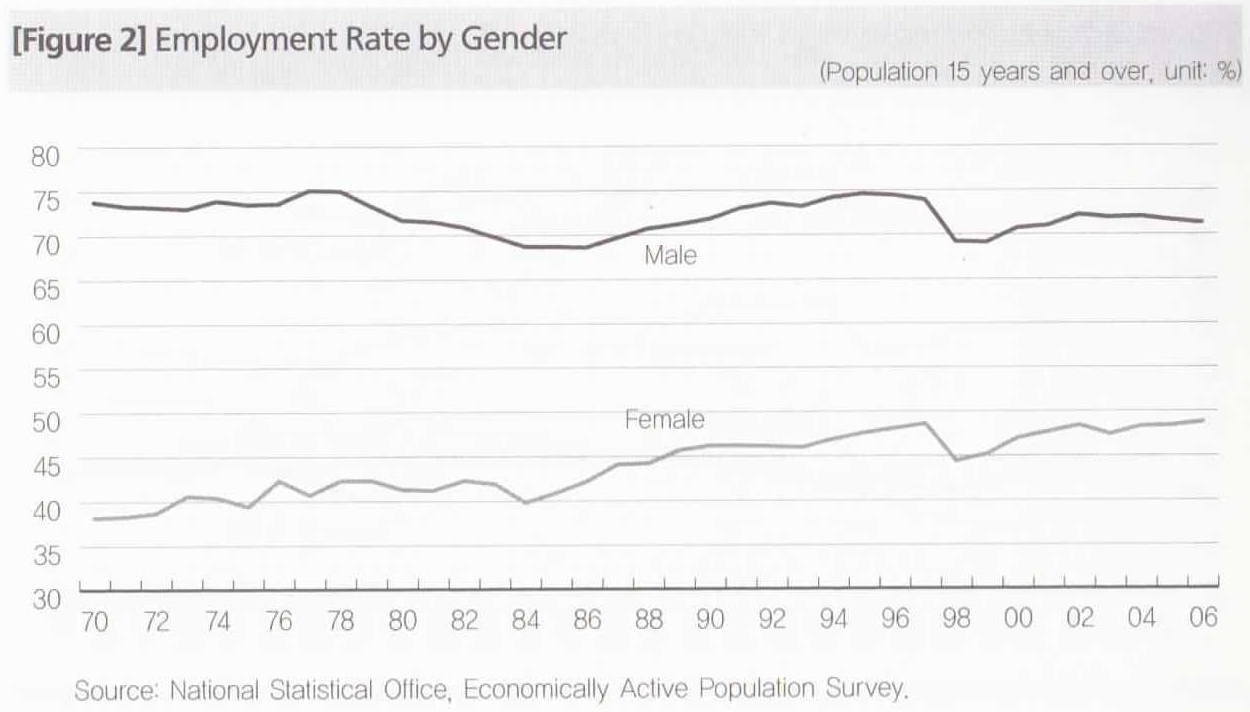
Or so I’ve often written. But naturally, it was difficult to find definitive statistics on that when I first reported on it three years ago. At that time, my most up to date source was my copy of Working Korea 2007, published by the Korea Labor & Society Institute. Here is my scan of page 19, which has a graph of the male and female workforce participation rate of 1970-2006:

In hindsight, although it does show a big drop in the female rate in 1997-98, it shows an equally large (even slightly larger?) drop in the male rate too. With my apologies, I’m very surprised I didn’t notice that earlier, and, although it does contradict most of the literature I’ve read about the Asian Financial Crisis, and is just from one source too, it still definitely bears further investigation.

That aside, a year later I found a source going up to 2008 (it shows a fall of 50.3% to 50.0% in 2006-2008; see below also). And today, spurred by Justin’s comment, I tried looking again, and found the following at the National Statistics Office’s website:

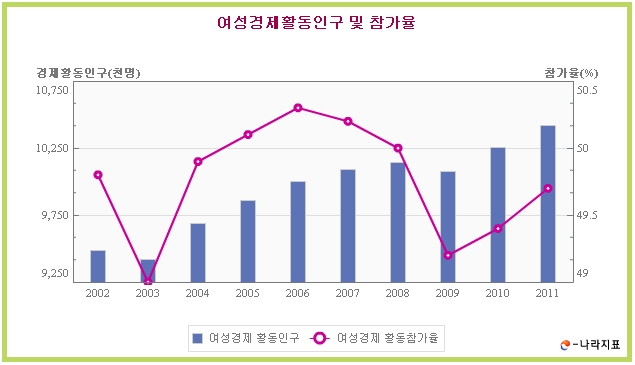
(Source)

The blue bars represent the economically active female population, in thousands (i.e., the first figure is 10.75 million), the pink line the female workforce participation rate. Although the choice of right scale gives the false visual impression that the rate has changed a great deal, as you can see from the numbers it has remained within a narrow band of 49% to 50.5%, last year’s rate being just lower than that of 2002. Also, clearly a 0.9% drop between 2008 and 2009 isn’t quite as big as I’ve been making out, and again is something that bears further exploration.

But still, one thing is clear: the number — well, percentage — of Korean women working has little changed in the last 15 years, and remains very very low by the standards of other developed countries. So it can not be the cause of increasing gender friction.

The perception that Korean women are making significant inroads into the Korean economy though? That’s entirely possible, and indeed I highly recommend KoreaBANG for much more on that (indeed, especially the remainder of Justin’s post), as well as many posts by Gord Sellar too (source, right).

(For more posts in the Korean Sociological Image series, see here)

From the Archives: Bagel Girls, Banking, and Babies!

(Source)

…[the character of] Chi-Yong’s mother sees marriage as a way to achieve social advancement and material prosperity, as it was in the Victorian era. These ambitions have come to the forefront in Korea since the 1970s, due to rapid economic development and consequent aspirations to class mobility and consolidation during the last thirty years. This novel [Marriage/결혼 by Kim Su-hyeon, 1993] is a good illustration of how, given the pace of change of change in Korea, everybody has a different point of view on marriage, depending on their gender, class, and generation. The issue of communication across generations has become a serious matter. Generation is an important attribute of identity in Korea, like race in the United States. (My emphases.)

(So-hee Lee, “The Concept of Female Sexuality in Popular Culture” in Under Construction: The gendering of modernity, class, and consumption in the Republic of Korea, ed. by Laurel Kendell, 2002; page 146 of 141-164)

With apologies to So-hee Lee for variously attributing that quote to either her editor, to Hyun-Mee Kim, or to Nancy Abelmann over the years, it still very much applies 10 years later. It’s also why studying and living in Korean society can be so exciting sometimes.

For someone who’s been writing about the place for over 5 years though, it means that many of my posts need updating. Let alone mercifully deleted as reader feedback, further research, and greater use of Korean sources have exposed gaping holes in my knowledge and confident preconceptions. And from a practical standpoint too, links will die, embedded videos will get deleted, and my theme will always highlight recent posts at the expense of older ones, no matter how good they may be after going through my culling process.

With all that in mind, once a month I’ll be highlighting posts from the corresponding month in previous years. Not all of them of course (hey, I’ll still like some material to work with in September 2013 and 2014), and to some there’s no new news to add; I include them just to draw attention to for new and old readers, especially as they’ve since been slightly edited for this post with the benefit of several year’s of hindsight. Others though, I’m adding a great deal of new news and commentary below, as you’ll see.

Please let me know what you think!

2011

Alas, not really my own article, but about Grace Duggan’s for Bust Magazine. While I’d often criticized the body-labeling craze in South Korea previously, I didn’t realize just how offensive this particular term was until she pointed it out (source, right):

Sexualizing young women for having childlike features sets off all kinds of alarms, regardless of whether or not they are over 18. The “bagel girl” label does more than infantilize women. It compartmentalizes them by applying two irreconcilable ideals: looking like a baby and a full-grown woman at the same time.

Granted, that may make it sound no more harmful than any other “line.” But, as I explain in a later comment, in the context of how it’s actually used it ends up sounding almost pedophilic:

…there’s nothing wrong with looking young per se.

But consider who the label is applied to: not, say, women in their 30s and 40s and older, for whom – let’s be real – wanting to look younger than they are is understandable (hell, for a 35 year-old guy like me too), but rather it’s women barely on the threshold of adulthood that are being praised for looking like children. And, not to put too fine a point on it, what the FUCK is great about a 21 year-old looking younger than she is? And when her body is simultaneously praised for being developed? That is a seriously flawed ideal to aspire to, and, moreover – as I hint at in the post – it’s no coincidence that it occurs in an environment with strong expectations of childish behavior from women too. Indeed, the end result strongly reminds me of child and teenage female manga characters, with personalities appropriate for their age, but somehow the sex drives and physiological development to act on them of women 10-15 years older.

(Source)

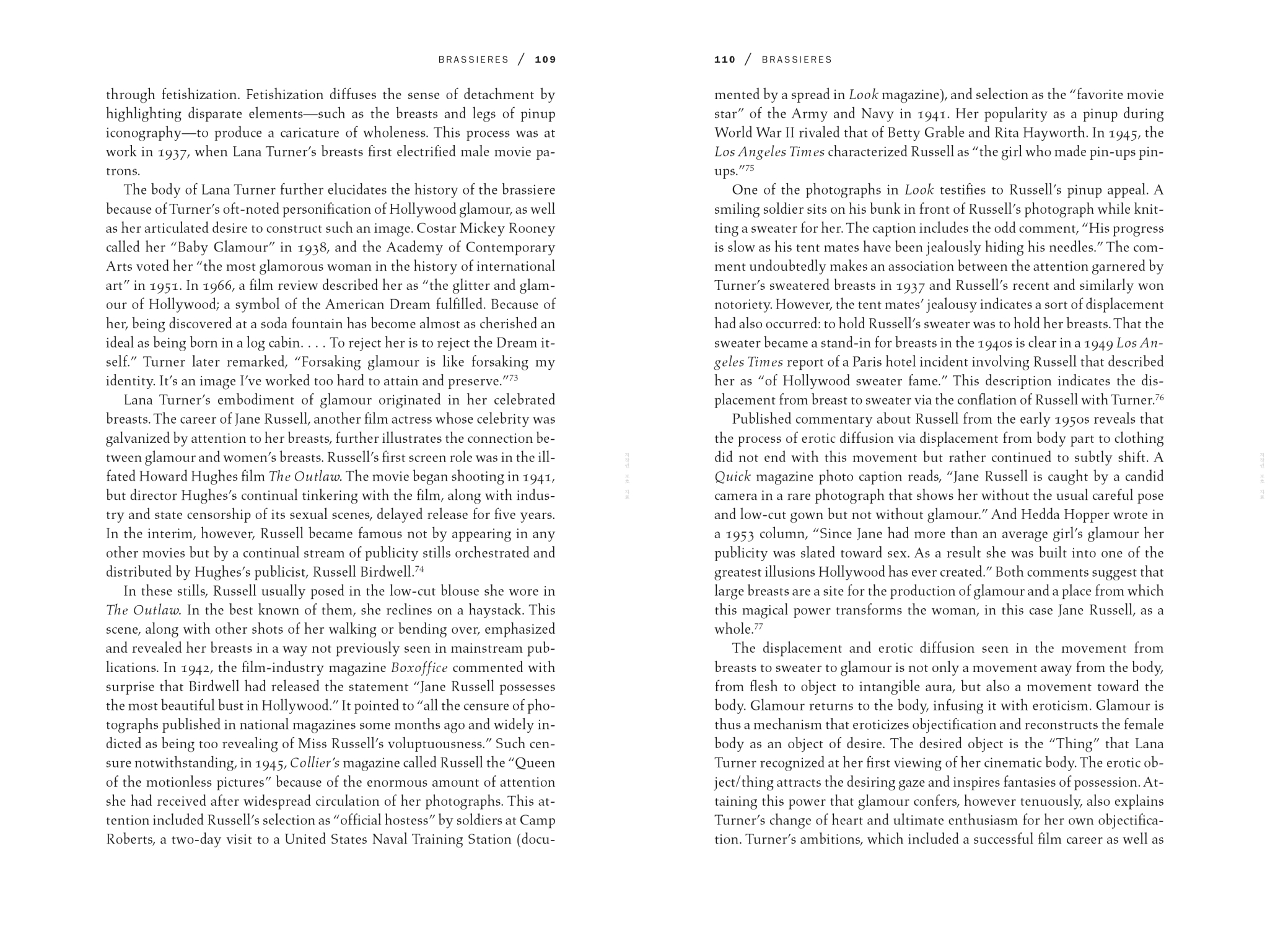
Meanwhile, by coincidence just yesterday I finished the excellent An Intimate Affair: Women, Lingerie, and Sexuality by Jill Fields (2007), which explains how the word “glamour” — where the “gul/글” in Bagel Girl comes from — came to be closely associated with large breasts by Hollywood in the 1930s to 1950s. Something I’d previously chalked up to a Japanese and then Korean mistranslation of the word, see the above pages for more on that, or all of Chapter 3 on brassieres at Google Books here.

If I do say so myself, I’m very proud of the way I describe my feelings when child singers do aegyo:

…cutesy aegyo is bad enough coming from a 21 year-old singer, but simply surreal when you see it done by a 14 year-old.

Yes, surreal, not merely awkward and inexperienced: essentially, you’re watching a child pretending to be an adult pretending to be a child.

Thank you very much.

Thanks again to the (necessarily anonymous) reader who wrote about her experiences, and I’ve had dozens of inquires about the Seoul clinic she used since. Please just email me if you ever need to know the details yourself.

(Source)

2010

Once someone points out the “head cant” to you, it just can’t be unseen. Usually inoffensive in itself though, and frequently done simply for photographic and stylistic reasons (which I’ve under-acknowledged in the past), it’s the fact that it’s overwhelmingly women it that makes it problematic. Just one of a number of typical poses for women in ads, ultimately it serves to reinforce gender stereotypes.

Probably, that’s why these recent Giordano ads stood out to me: in the example above for instance, Shin Min-a (신민아) is the one in control, staring at the viewer, while So Ji-sub (소지섭) is distracted (it’s usually the guys that are presented as more focused). And, desperately seeking examples of pro-feminist advertisements for a TED presentation I may be giving next month, in which I have to — grrr — conclude with a positive message rather than just criticize, this made me realize that feminists and advertisers don’t necessarily have to be at odds with each other. Just a sense of balance by the latter would be a huge step forward.

Really about “lewd” advertisements, 2 years later (this June) I translated another article about how their numbers had surged 3 times over the previous 12 months. With no apparent sense of irony, just about every news site that reported on that had so many examples themselves that the text was difficult to read.

One of my most popular posts, anybody (especially men) who thinks street harassment isn’t a problem should just reflect on the opening cartoon, let alone female readers’ comments about their own negative experiences.

(Source: unknown)

2009

A short, harmless commercial for Shinhan Bank at first glance. But, once you take the time to analyze it, it has a clear message that men do the thinking at Shinhan while the women simply look good. Indeed, it’s such a classic example of gender stereotyping that I’m still using it in presentations today.

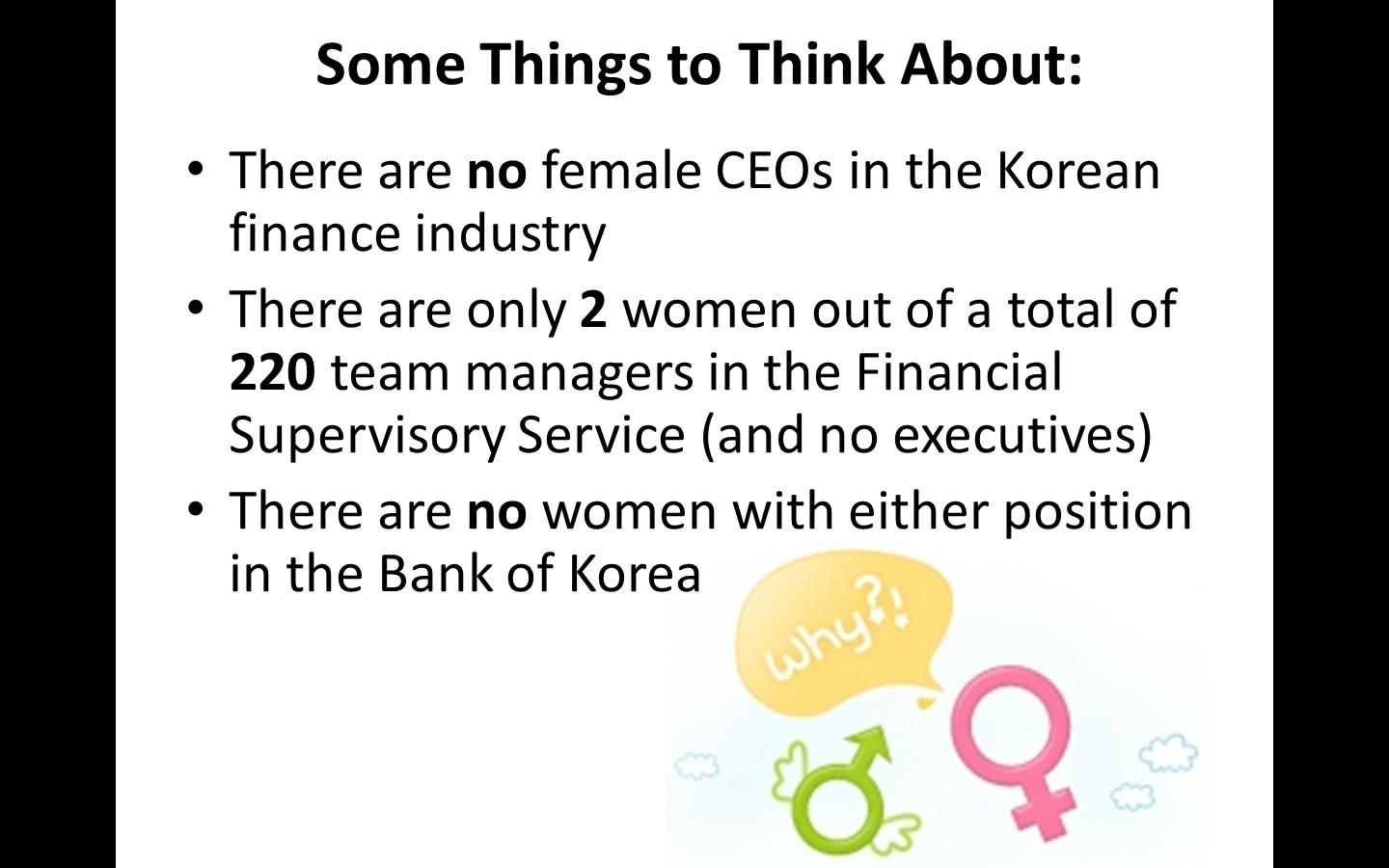
Here’s the slide I would present after providing that analysis:

But in the next presentation, I’ll be updating it with the recent news that the banking industry still has the largest gender pay gap in Korea, with women making an average of only 57% of what men make.

Not that I’m against skin by any means. But these remain very sweet ads!

Again one of my most popular posts, ironically soon after writing it trends in the Korean entertainment and music industries meant that Koreans would replace Caucasians in many of the modelling roles that sustained those Occidentalist stereotypes. Also, in my own (admittedly limited) experience, there’s far fewer Korean male – Western (invariably Caucasian) female pairings in popular culture now, after a spate of them in the years after Misuda first appeared. (There were never very many of the opposite.)

However, of course many of the stereotypes still do remain.

(Sources: left, right)

2008

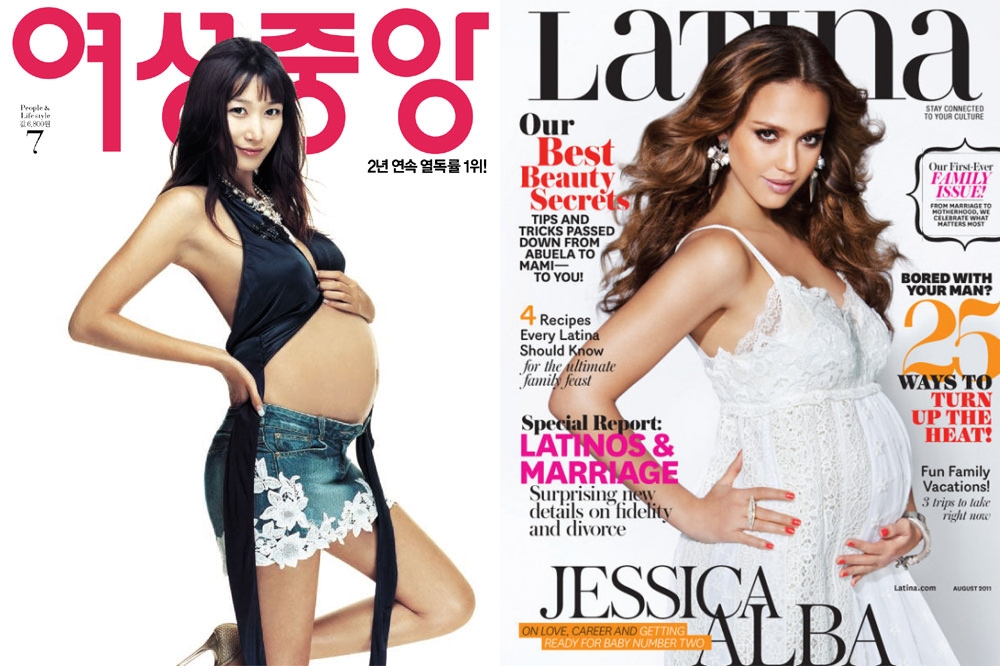
When I read on Yahoo! Korea this week about pregnant Hollywood star’s “D-lines”, for a moment I did try to hold my tongue about seeing the label.

After all, this, for example, is just an advertisement for an event for expecting mothers (albeit one where likely body-shaping products are promoted); these D-line fashion shows were surely perfectly harmless; many of those Hollywood stars were indeed glowing, as was pregnant Moon So-ri (문소리) in Cosmopolitan last year; and finally, yes, I can see the humorous side — it is often applied to extremely obese men.

But although the Western media too promotes pampered celebrity mothers-to-be as ideals to follow, and I can certainly accept that pregnant women overseas may likewise feel under some indirect pressure to watch their weight, that post is about how pregnant Korean women were dieting as early as the late-1990s. One can only shudder at what things are probably like now.

Suddenly, talk of D-lines sounds a lot less funny.

One of my first attempts to grapple with the origins of the kkotminam phenomenon (꽃미남; lit. flower-beauty-man), which culminated in this piece by friend and ANU professor Roald Maliangkay 2 years later.

By coincidence, both of us will be quoted in a related news article to be published next week. Watch this space! (Update: and here it is!)

2007

And indeed there was. Unfortunately however, attitudes didn’t change with it, so fathers feel compelled by management to either ignore it entirely or to come back to work early, despite it only being 3 days (source right: unknown).

Note though, that the “paternity leave” in the original article I translated was a bit of a misnomer, it really meaning time off for a child’s birth. “Real,” paid paternity leave has been available since 2001 (or possibly 1995), but sources vary on specifics. Sung So-young in the Korean Joongang Daily, for instance, wrote in April 2011 that:

According to Korean law, all employees with a child under the age of 3 are eligible to take a year off to care for their children. Up to 1 million won ($919) in salary is provided monthly.”

But that is contradicted by a slightly later report in the Chosun Ilbo, which states that:

…those on leave can get up to 40 percent of their salary, or a minimum of W500,000 and a maximum of W1 million, and parents can take leave until the child is 6 years old.

And both in turn are contradicted by Lee Hyo-sik’s earlier report in the March 4 2011 Korea Times, which says:

Regardless of income levels, both male and female salaried workers are currently given 500,000 won per month during parental leave. This is expected to go up to one million won next year.

As for the maximum age of the children in order to be eligible, the same article states that it was 6 rather than 3. This is confirmed by an earlier February 2010 article by Kwon Mee-yoo, again in the Korea Times, which stated:

The Ministry of Labor passed a revision on Wednesday to the Act on Equal Employment and Support for Work-Family Reconciliation, or the Employment Equity Act for short, which will expand the range of workers eligible for parental leave. Now parents with preschoolers under six years old can benefit.

The leave allows employees to take a certain number of paid days off from work to care for their children. The parents can also take unpaid leave if they use up all of their paid days. This includes maternity, paternity and adoption leave. Currently, at private firms only workers with children 3 years old or less qualify for the leave.

Surprisingly, parents with adopted children weren’t eligible before this revision, and still, “only those who gave birth to or adopted children after Jan. 1, 2008 [were to be allowed] parental leave,” despite those (then) 2 to 6 year-olds obviously being of age. Which all sounds very tight-fisted, although logical during the worst of the financial crisis.

Kwon Mee-yoo also notes that it was in 2008 that the government increased the age restriction for (only) public servants, allowing them “to take time off for parental purposes if their children were under 6 years old.” I’ll assume that it previously only applied if their children were under 3 years old, like Kwon notes was the case for employees at private firms.

Finally, quibbles over details aside, Sung So-young’s and Lee Hyo-sik’s articles in particular remain excellent discussions of why Korean fathers are forced to avoid taking paternity leave, despite wanting to spend much more time with their kids. Against that though, just like in most other countries there’s still a pervasive attitude that childcare is primarily women’s work, with insidious manifestations in our daily lives.

And on that note, have a good weekend, and the Korean Gender Reader post will be up on Sunday!

Korean Gender Reader

(Source)

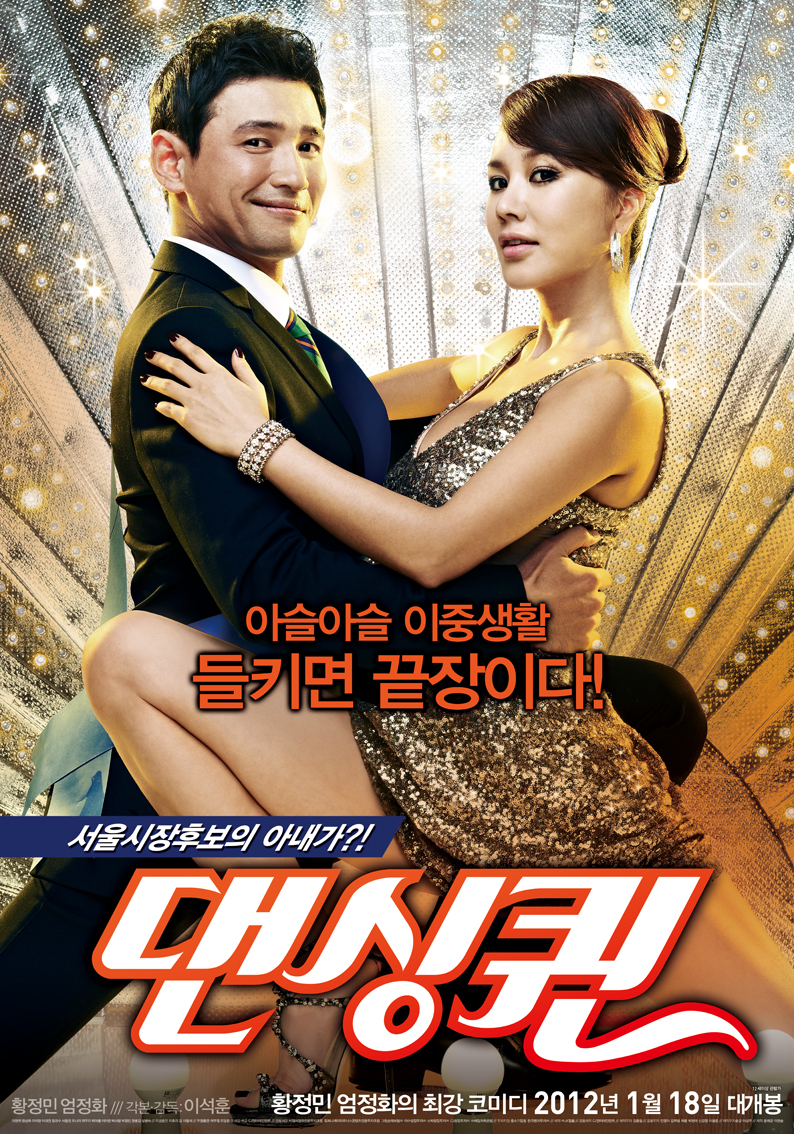
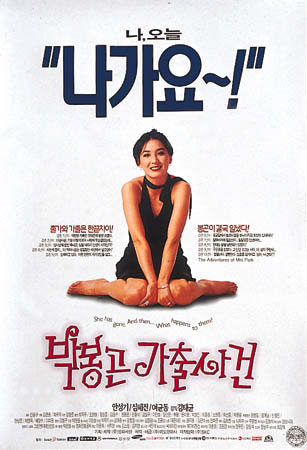
If you’ll please indulge an old Korean Studies geek for a moment, Girlfriday’s review of Dancing Queen (댄싱퀸) at Dramabeans this week instantly reminded me of The Adventures of Mrs. Park (박봉곤 가출사건), from way back in 1996. After all, both are about wives who blatantly defy their husbands to follow their dreams of becoming singers, both are comedies, and – I’ll take a wild guess about Dancing Queen – both wives are ultimately successful.

One likely difference though, is that Mrs. Park runs away from her husband. And in fact, The Adventures of Mrs. Park was the first Korean movie to ever show a wife getting away with such insubordination.

That may sound difficult to believe today, but director Kim Tae-kyun (김태균) would later confess to Cine 21 magazine that he was extremely concerned at how audiences might react to such “an unexpected ending”. As even comedies back then would invariably close with continued happy marriages, while more realistic movies would show a miserable and destitute wife returning home with her tail between her legs.

In contrast, I doubt director Lee Seok-hoon (이석훈) has any such qualms in 2012. And it’s always quite sobering, realizing how much Korea has changed in the time I’ve been here.

So, while I doubt I’ll ever make the effort to track down and watch The Adventures of Miss Park for myself (all of the above is based on this book chapter), I will watch Dancing Queen. For not only is Hwang Jung-min (황정민) my favorite actor ever (see here for my review of A Good Lawyer’s Wife {바람난 가족; 2003}, the first movie I saw him in), but I’ve always had a soft spot for Uhm Jung-hwa (엄정화) too, as she was very much the queen of K-pop when I came to Korea back in 2000. Here’s my favorite song of hers from back then (just give me the word, and I’ll translate it in a flash!^^):

And after all that reminiscing(!), finally here are this week’s links, in no particular order:

What K-pop can teach us about the ROK military (Seoulbeats)

Foreigners organize flash mob against prostitution (The Marmot’s Hole)

‘Dream High 2′ cast express the need for laws protecting minors in the industry (Allkpop)

Sexual harassment widespread in workplaces (Hankyoreh)

Did the Piggy Dolls ruin their credibility? (Mixtapes and Liner Notes)

Essential information for understanding divorce in Japan: there is no such thing as joint custody of children (Economist)

How Korean fashion is seen from an international perspective; opposed to how Koreans think it’s seen (Noona Blog: Seoul)

K-pop’s first lesbian love story? (Seoulbeats)

Congratulations on the Dragon baby! (On Becoming a Good Korean {Feminist} Wife)

290,000won bags for elementary kids – competition at the extreme? (Hangukdrama and Korean; also see my post on how pink and princessey the schoolbag ads for girls are, but sporty and full of space-shuttles and racing-cars for boys)

[Debate] Leave ancestral rites where they belong- in the past (Hankyoreh)

[Debate] Cultural rites provide key to understanding ourselves (Hankyoreh)

• “Holiday stress for an average married Korean woman is as bad as the pain of losing a close friend” (Arirang)

Statistics on social trends in Korea – a great resource (Korean Journal of Sociology; scroll down to the “research guide”s)

Roundtable: our friend, MOGEF (Seoulbeats)

Harsher punishment urged for pedophiles (Korea Times)

Monfemme: gender, feminist, and medical anthropology in the steppes and deserts of Mongolia (Blog recommendation)

“Single Mothers are Ignorant Whores”: Update

(Source)

As you’ll recall from last month’s article, about the Ministry of Health and Welfare (보건복지부; MOHW) once defining single mothers as having “low levels of education [and] impulsive sexual drives”, I promised to find out how recently that had been posted on the Ministry’s website, speculating that it was sometime within, say, the last decade or so.

You can imagine my surprise then, when Seunghee Han of the Korean Unwed Mothers Support Network (한국미혼모지원네트워크; KUMSN) informed me that wasn’t removed until as recently as May 2010. This was in response to Executive Director Heejung Kwon posting the definition on the Missmammamia (미스맘마미아) website, which prompted many mothers to write directly to the Ministry to complain.

Unfortunately however, the definition that has replaced it is also a little problematic, implying that most Korean single mothers are in their teens. Whereas that is certainly true of most Western countries though, and – if the 2008 Drama Little Mom Scandal (리틀맘 스캔들) above is any guide – may also be the Korean public’s perception, the reality is that most are in their late-twenties or early-thirties, as the following post on the KUMSN website makes clear:

(For a good introductory article to the plight of single mothers in Korea, see the New York Times here)

건강길라잡이사이트문제있습니다 / A Problem with the Health Guide Website

건강길라잡이는 보건복지가족부와 건강증진사업지원단에서 운영 중인 국민 모두의 건강증진을 위한 건강증진사업 홈페이지입니다. 그런데 여기에 쓰인 미혼모의 정의는 이상합니다.

The “Health Guide” is a website jointly run by the MOHW and the Management Center for Health Promotion for the public health of all citizens. However, the definition of single mothers on it is strange.

합법적이고 정당한 결혼절차 없이 임신중이거나 출산한 여자를 미혼모라고 정의내리고 있는데 마치 미혼 임신, 출산을 하면 모두 불법을 저지르고 있는 범죄인으로 여기고 있는 것 같습니다.

According to the definition, single mothers are women who are pregnant or who have given birth who have not gone through the legal and proper marriage procedures. Put this way, it sounds like all unmarried pregnant women or mothers have committed some sort of crime!

그리고 기본적으로 미혼모를 대부분 10대라 여기고 있습니다. 그러나 2010년 조사한 바로는 한 지역사회에 있는 미혼모의 경우, 평균 나이는 20대 후반 30대초반이라는 결과도 있었습니다.

Also, it basically says that most single mothers are in their teens, whereas according to the results of a survey of single mothers in one local area [James – unnamed] in 2010, most were in their late-twenties or early-thirties.

국민들의 건강을 증진하기 위해 유익한 정보를 제공하는 사이트에서도 이런 잘못된 정보를 제공하기 때문에 미혼모들에 대한 사회적인 인식이 더디게 바뀌고 있습니다. 잘못된 정보는 정정되어야 합니다.

Because there is wrong information even in a guide aimed at promoting citizens’ health, the public perception of single mothers is slow to change. This wrong information needs to be corrected.

(Source)

And here is the section of the guide/website referred to:

10임신과미혼모 / Teen Pregnancy and Single Mothers

미혼모 : 합법적이고 정당한 결혼절차 없이 임신중이거나 출산한 여자.

Single Mother: A pregnant woman or mother who has not gone through the correct and proper marriage procedures.

산업화 도시화 과정, 성에 대한 가치관이나 태도의 변화, 이성교재의 범위가 늘어남에 따라 미혼모의 수가 계속적으로 증가. 미혼모 중 약 25%는 10대.

Because of industrialization and urbanization, people’s sense of values about and attitudes towards sex are changing, and more people [James – I think it means unmarried people] are having sexual relationships. Accordingly, the number of single mothers is rising, and roughly 25% of those are in their teens.

(James – Before you quite rightly point out that 25% isn’t “most” single mothers, the guide contradicts itself just two lines further down)

미혼모에 대한 정확한 통계는 없으나 전국 출산력 조사결과 18~34세 미만의 미혼여성들 중 3.4%가 임신의 경험이 있는 것으로 추정.

While it is difficult to get accurate statistics about single mothers, based on the results of a national birthrate survey [James – unnamed] it is estimated that 3.4% of single women aged between 18 and under 34 have had the experience of being pregnant (source, right).

미혼모는 대부분 10대 임신으로 교육적 경제적 정도가 낮아 충분한 건강관리를 받을 수 없으며 부모로서의 발달과업을 달성할 수 없다.

As most single mothers are teenagers, with inadequate access to healthcare and low levels of education and earning ability, then they can not really succeed as parents.

신체적인 미숙과 영양부족으로 유산, 조산, 저체중아 출산 등 고위험 임산부와 고위험 태아 및 신생아가 된다.

Teenagers that are not fully physically developed, and/or are malnourished, are at high risk of having miscarriages, premature births, underweight children, and/or complications during their pregnancy.

미혼인 여성이 임신을 하면 임신한 결과를 인공유산과 분만 중 어느 쪽을 선택할 것인지를 결정해야 하고 분만을 할 경우는 자신이 키울 것인지 입양을 시킬 것인지를 결정해야 한다.

If a single woman becomes pregnant, her two options are having an abortion or delivering the baby. If she chooses the latter, then she has to decide if she will raise it herself or offer it for adoption.

우리나라의 경우 84.8%가 인공유산, 분만은 15.2%(김승권, 1992)

In Korea, 84.8% of women in such a situation choose to have an abortion, and 15.2% choose to deliver it. (Kim Sung-gwon, 1992)

(Source)

Apologies for not being able to find the title of the book referred to for the last figure, but I’m afraid I’ll have to recover from the shock of seeing a 19 year-old source used before I start looking. Moreover, combine that with the sloppily-written, contradictory, and incorrect information provided earlier, then frankly – and ironically – it’s only as I type this that I realize how bad things must be for single mothers here.

Sure, call me melodramatic, and/or reading too much into what is most likely simply a hastily-written piece of work, but recall that it comes from an organization presumably charged with supporting single mothers, promoting their rights, and trying to overcome stereotypes. Yet if that’s the best that it can do, then I shudder to think of how other organizations and segments of society treat them, with the sterling exception of the KUMSN.

But to end on a lighter note: has anybody seen Little Mom Scandal, and/or know how sympathetic it was to single mothers? Please let me know!

(Thanks to Seunghee Han of the KUMSN for the information. And also to Marilyn for putting me in touch with her, and again for translating October’s much longer article!)

Ministry of Health and Welfare: “Unwed Mothers are Ignorant Whores”

(Source)

What? It said that? In 2011??

No, hopefully not so recently, especially with the increasing criminalization of abortion since last year. But as you’ll soon see, the Ministry of Health and Welfare (보건복지부) certainly did once define unwed mothers as such, and I’d wager within at least the last decade.

It was just in 2008, for instance, that singer Ivy (아이비) was vilified in the media for the heinous crime of having sex with her boyfriend, so by those standards the Ministry’s comments were not particularly outlandish. And while Ivy did eventually rehabilitate her reputation, unfortunately Korean society is still far from accepting women being so sexually “open and impulsive”, let alone so blatantly so as to have a child out of wedlock.

Whatever the date though, when even the organization charged with helping unwed mothers once stigmatized them, then you can imagine how badly they fare in society today.

Despite that, abortion opponents seem to have quite a sanguine image of what it’s like to raise a child as a single mother. Which is what prompted this anonymous Korean woman, who kindly recently wrote on TGN about how and why she got an abortion, to post a link to this imomNews article outlining how the reality is anything but. With thanks to Marilyn for translating it, here it is in full:

(Update – To my shock and disappointment, the Ministry’s appalling definition was actually on its website until as recently as May 2010)

‘동성애자’ 다음으로 차별 받는 집단 ‘미혼모 / Unwed Mothers Most Discriminated Group after Homosexuals

인식 개선 선행…정부지원 확대 /[With] improvement in perception as precedent. . . expansion of government aid

Image Caption: 최근 정치권을 중심으로 ‘미혼모’ 지원방안이 활발히 이루어지고 있다. 지난 3일 서울 여의도 국회에서는 ‘미혼모 지원정책 개선방안’ 포럼이 개최됐다 /Currently, political methods for supporting unwed mothers are actively becoming reality.  On Aug. 3, at the National Assembly in Yeouido, Seoul, an “Unwed Mothers Support Measures Improvement” forum was held.

‘학력이 대체로 낮고, 불안정한 직업에 종사한다. 자취나 하숙을 하고, 성에 대한 가치관이 개방적이고 충동적이다. 사회경제적 상태가 낮고 부모와 떨어져 사는 사람’이라고 과거 보건복지부가 운영하는 웹사이트 건강길라잡이는 미혼모에 대한 정의를 이렇게 내렸다.

“Usually low levels of education, with an unstable job. Lives by herself or in a boarding house, has open and impulsive sexual values.  A person whose socioeconomic situation is low, and who lives apart from her parents,” is how a website health guide operated by the past Ministry of Health and Welfare defined unwed mothers.

이처럼 사회의 부정적인 시선 탓에 미혼모에 대한 관심과 지원은 일부 사회복지시설을 제외하곤 전무후무한 것이 사실이었다.

Because of society’s negative views like these, it was true that, as for interest in and support for unwed mothers, a few social welfare facilities were the first and seemed like they would be the last.

특히, 1990년대 이후 정부와 시민단체 등의 노력으로 조손가정, 다문화 가정, 한부모 가정 등은 상당부분 인식개선이 이루어 졌으나 미혼모 가족만은 사회의 편견 속에 여전히 ‘눈총’의 대상이 되고 있다.

In particular, through the efforts of the government and civic organizations since the 1990s, perception of grandparent-grandchild families, multicultural families, and single-parent families has improved; among society’s prejudices, only unwed-mother families continue to be the target of stares.

때문에 형편이 좋지 않아 자립이 힘든 미혼모들은 자연히 입양을 생각하거나 권유받게 되고, 우리사회도 ‘낳아 기르는 쪽’ 보다는 입양을 암묵적으로 유도했다.

(I Came From Busan, 2009. Source)

Because of that, unwed mothers, whose circumstances are not good and so have difficulty supporting themselves, think of adoption of their own accord or are induced to adopt, and our society also implicitly supports the “have and raise side” less than it does adoption.

사정이 이렇다 보니 지난해 우리나라의 해외입양아는 미혼모의 자녀가 90%를 차지한 것으로 나타났다. 그러나 최근 이들에 대한 지원방안이 정치권과 시민단체, 기업 등을 중심으로 활발하게 논의되면서 미혼모 가족에 대한 관심이 일고 있다.

Because of this situation, last year it emerged that 90% of internationally adopted children from our country were the children of unwed mothers.  However, as ways to support them are currently being actively discussed in political circles, civic organizations, and businesses, interest in unwed-mother families is rising.

Image Caption: 던킨도너츠는 미혼모 정소향(21세) 씨를 정규사원으로 채용하면서 미혼모 채용에 적극 나서기로 했다 /By hiring unwed mother Jeong So-Hyang (21) as a permanent employee, Dunkin Donuts is actively taking a stand for the hiring of unwed mothers.

미혼모 인식 개선이 우선 / Improvement of perception of unwed mothers the priority

미혼모에게 가장 필요한 부분은 부정적인 사회의 시선이 관심과 보호의 시선으로 바뀌어야 하는 것이라고 전문가들은 지적했다.

Experts indicate that the most important thing unwed mothers must do is change negative societal views into feelings of interest and protection.

실제 지난 2009년 한국미혼모지원네트워크와 한국여성정책연구원이 실시한 ‘미혼모ㆍ부에 대한 한국인의 태도와 인식’ 설문조사에 따르면 미혼모는 동성애자 다음으로 가장 많은 차별을 경험한 집단으로 조사됐다.

In fact, according to the survey “Koreans’ attitudes toward and perception of unwed mothers and fathers,” carried out in 2009 by the Korean Unwed Mothers Support Network and the Korean Women’s Development Institute, unwed mothers were found to be the group that experienced the most prejudice, after homosexuals.

또한 설문에 참가한 2,000명 중 60% 이상이 미혼모에 대해 ‘판단력과 책임감이 부족한 사람’이라고 답변했다.

Also, of the 2,000 people who participated in the survey, over 60% answered that unwed mothers “are people who lack judgment and a sense of responsibility.”

김혜영 한국여성정책연구원 연구위원은 “미혼모의 경우 일종의 일탈자로 낙인 받고 있다”며 “미혼 부모에 대한 과감한 지원정책이 필요하다”고 지적했다.

(Sources: left, top-right, bottom-right)

Kim Hye-young, a senior researcher at the Korean Women’s Development Institute, said, “An unwed mother is branded as a kind of deviant.  We need bold support policies for unwed parents.”

이영호 서울시 한부모가족지원센터장도 “우리사회는 다양한 가족이 있고 모든 가족은 행복할 권리가 있다”면서 “그러나 우리 사회에서 미혼모가 아기를 키우면서 자랑스럽게 또는 당당하게 양육의 경험을 공유하고 그 안에서 성장할 수 있을까란 의문이 들때가 많다”고 아쉬움을 드러냈다.

Lee Young-ho, head of the Seoul City Single Parent Family Support Center, also showed frustration:  “There are diverse families in our society, and all families have a right to be happy.  However, there are many times when I question whether unwed mothers, while raising their children, can proudly or confidently share their child-rearing experiences and develop in that [kind of environment], in our society.”

이에 최근 여성단체와 미혼모 보호 시설은 미혼모 인신 개선 사업을 적 극 펼치고 있다.

Accordingly, women’s organizations and unwed-mother shelters are currently actively engaging in a project to improve the perception of unwed mothers.

지난달 28일 서울시한부모가족지원센터와 20여 곳의 미혼모관련 단체들은 ‘미혼모지원단체협의체’를 발족하고 미혼모 인식 개선을 위한 다양한 논의를 시작했다.

On July 28, the Seoul City Single Parent Family Support Center and about twenty organizations for unwed mothers started the ‘Unwed Mother Support Organization Council” and began a variety of discussions designed to improve the perception of unwed mothers.

그 첫 번째 사업으로 사람들에게 부정적 이미지가 강했던 ‘미혼모’를 공모를 통해 ‘두리모’로 대체하기로 했다. 두리모란 ‘둥근’이라는 뜻과 둘이라는 숫자를 의미하는 방언 ‘둘레’가 조합된 것이다.

For their first project, they agreed through a public contest to replace “unwed mother”, which had a strong negative image, with “doo-ree mother.” “Doo-ree mother” combines the meaning “round” [doong-geun] with the regional dialect word dool-leh, which means “two people.”

(Source)

정치권ㆍ기업, 미혼모 자립위해 노력 / Efforts by political groups, business for unwed mothers’ independence [ability to support themselves]

정치권에선 ‘미혼모 자립’을 위해 관련법을 정비하고, 토론회를 통해 다양한 의견을 청취하고 있다. 기업들도 미혼모를 우선 채용하는 등 이들의 자립을 위해 힘을 쏟고 있다.

Political groups are modifying laws in order for ‘independence for unwed mothers,’ and through panels, they are listening to diverse opinions.  Through actions like prioritizing hiring unwed mothers, businesses are also devoting themselves to the cause of their independence.

특히 민주당 최영희 의원(국회 여성가족위원회)은 미혼모에 대한 지원을 확대하는 내용을 담은 ‘입양촉진 및 절차에 관한 특례법 전부개정안’ 등 관련법을 최근 국회에 제출하는 등 법 만들기에 앞장서고 있다.

Democratic Party Assemblywoman Choi Young-hee (National Assembly Gender Equality and Family Committee), in particular, is leading the way in making laws, some of which are currently submitted to the National Assembly, like “Overall Revision Bill for the Special Act Relating to Promotion and Procedure of Adoption,” the contents of which expand support for unwed mothers.

또한 지난 3일에는 한국미혼모가족협회·한국여성정책연구원와 공동주최로 ‘미혼모 지원정책 개선방안’ 포럼을 개최했다.

(Source)

Also, on June 3, the Korean Unwed Mother Families Association and the Korean Womens Development Institute co-hosted the “Unwed Mothers Support-Policy Improvement Measures” forum.

이날 최 의원은 “해외입양의 90%가 미혼모의  자녀라는 점은 우리 사회의 아픈 현실을 반영하는 것”이라며 “직접 양육하기를 원하는 미혼모가 늘어나고 있는 만큼 양육비 지원을 현실화 하고 지역사회에서 안정적인 생활을 할 수 있도록 정부의 적극적인 지원이 시급하다”고 지적했다.

On that day, Assemblywoman Choi said, “That 90% of international adoption is the children of unwed mothers reflects our society’s painful reality.  As the number of unwed mothers who want to raise their children themselves rises, the government’s active support is urgently needed to actualize aid for child-raising expenses for a stable life in a community.”

한편 이날 포럼에서 김혜영 한국여성정책연구원 박사는 ‘양육미혼모의 자립기반실태와 지원방안’에 대한 연구결과를 발표했다.

Also at this forum, Dr. Kim Hye-young, researcher at the Korean Women’s Development Institute, revealed the results of a study on the “Current State of Groundwork for Independence of and Ways to Support Unwed Mothers Raising Children.”

김 연구원은 “60%가 넘는 미혼모가 양육비와 교육비의 문제로 어려움을 겪고 있고, 80%이상은 월세와 같은 불안정적인 주거생활을 하는 것으로 나타났다”면서 “안정적인 자립기반 구축을 위해 미혼모 가족에 대한 조기 개입의 필요성과 함께 지원의 폭을 보다 확대할 필요가 있다”고 주장했다.

Dr. Kim said, “It showed that over 60% of unwed mothers are struggling because of the costs of child-rearing and education, and more than 80% live in unstable housing situations like [those requiring] monthly rent. In order to build stable foundations for independence, early intervention for unwed-mother families, together with an expansion of the range of support, is necessary.” (Source, right)

또 목경화 한국미혼모가족협회 대표도 “우리나라의 미혼모정책은 시설에만 초점이 맞춰져 있어 시설에서 벗어나 자립을 하려는 미혼모들은 빈곤 상황을 쉽게 개선하지 못하는 실정이다”고 지적했다.

Furthermore, Mok Gyeong-hwa, a representative from the Korean Unwed Mothers and Families Association, pointed out, “Policies regarding unwed mothers in our country only focus on facilities, so unwed mothers who want to break free from facilities and live independently can’t easily improve their state of poverty.”

최 의원은 이날 논의된 내용을 바탕으로 ‘한부모가족지원법 개정안’과 ‘국민기초생활보장법 개정안’을 제출할 예정이다.

Assemblywoman Choi will present the “Single-Parent Family Support Law Amendment” and “National Basic Living Security Law Amendment” based on the discussions of that day.

기업들도 미혼모 자립을 위해 적극적으로 나서고 있다. 던킨도너츠와 배스킨라빈스를 운영하는 비알코리아는 미혼모 시설인 사회복지법인 동방사회복지회와 함께 미혼모 고용지원 협약을 체결하고, 던킨도너츠 매장에서 파트타임으로 근무하던 미혼모 정소향(21세) 씨를 정식 사원을 채용했다

Businesses are also actively taking a stand for the independence of unwed mothers.  BR Korea, which operates Dunkin Donuts and Baskin Robbins, together with the  Eastern Social Welfare Society, a welfare corporation that is an unwed mother [support] facility, signed the Unwed Mothers Employment Support Agreement and recruited unwed mother Jeong So-hyang (21), who had been a part-time employee at a Dunkin Donuts shop,  as a permanent employee.

June 16, 2011.

Reporter: Cheon Won-gi (천원기, 000wonki@hanmail.net)

Korean Sociological Image #63: Childcare No Longer Only Women’s Job!

As any father can confirm, parenting is a grueling business. So much so, that it makes our testosterone levels drop like a stone for instance, a rather ironic outcome for the ultimate proof of ones’ virility. Also, not only do we gain weight by being too tired to exercise or eat properly after the birth, as you’d expect, but actually we gain weight even before it too, all the better to prepare for the rigors of carrying our offspring on our backs for the next few years.

Granted, that latter research actually comes from a few monkey species, rather than men per se. And reported weight gain in men may be due to a change of lifestyle rather than expectant fathers being biologically wired for it. But still, with serious concerns about future back problems from having to carrying my daughters in my right arm so much over the last few years (they cried if I put them in the left), then my money’s on it applying to humans too.

Why then, are our daily lives still saturated with images of only women caring after children while traveling on public transport and in public spaces?

In hindsight, this is just bizarre. Surely I’m not just projecting when I say that, as the stronger, taller, and faster parent, it usually makes much more sense for me to keep an eye on my hyperactive kids as they try to run literally everywhere, while my wife watches over our bags? And whereas I’m increasingly struggling to carry them as they get older, she’s already just about reached her limits with our five year-old (in more ways then one!).

Which makes these humble pictures such a breath of fresh air. They may not look like much, especially at their low resolution here (my wife is still figuring out her new smartphone – sorry), but they are actually the first example of an image of a male rather than a female caregiver that I’ve ever seen in a subway – well, anywhere –  in Korea. Taken in Daegu on my recent trip there, based on my impromptu survey over 2 weekends then I’d say a good 30-40% of signs for escalators had men rather than women (and in malls etc. also).

Can any Daegu-based readers confirm my estimate? Have any other readers seen any more with elsewhere in Korea? Either way, kudos to the Daegu Council and/or subway company for making an effort to ensure a mix of genders, and – to any readers not yet convinced – please see here for more on why this is genuinely such a big deal.

(For more posts in the Korean Sociological Images Series, see here)

Korean Sociological Image #61: Stereotypical Gender Roles in Pororo

Source

I know, I know: trust me to nitpick about something as universally popular and adorable as Pororo. However, just like the classic How to Read Donald Duck (1972) revealed a pervasive imperialist ideology then propagated by Disney in that universally popular and adorable cartoon, so too does Pororo begin reveal some issues once you’re prepared to look past the cuteness. In this case, because of the stereotypical gender roles contained therein.

Just ask any parent in Korea, one of whom *ahem* first noticed these problems with the show *cough* over two years ago. But, with thanks to Marilyn for translating this article at Ildaro Women’s Journal, it’s always good to have a reliable Korean source, especially when one critiques something that usually only attracts glowing reports about its success overseas:

Source

“뽀롱뽀롱 뽀로로”에서 루피의 역할은? 애니메이션 속 전형적인 남녀캐릭터 설정 아쉬워

Loopy’s role in “Pororo The Little Penguin”? The set-ups of typical male and female characters in the cartoon is a shame

모 방송사의 예능 프로그램에서 강호동씨가 미션으로 곰인형 100개의 눈을 붙이는 장면이 나왔다. 담당VJ는 그에게 집에서 아이들과 잘 놀아 주냐고 질문했다. “나보다 뽀통령을 더 좋아해. 뽀통령 있으면 아빠 아는 체도 안 해.” 강호동씨의 답변에서 알 수 있듯이 지금 아이들 사이에서는 뽀로로가 최고의 인기 캐릭터이다.

On X network’s entertainer program, there was a scene in which Kang Ho-dong had a mission to attach 100 bear dolls’ eyes.  The VJ asked if he was good about playing with his children at home.  “They like President Po more than me.  If President Po is there, they don’t even acknowledge Dad.”  What we can know from Kang Ho-dong’s answer is that Pororo is the most popular character among children now.

아이들 세계를 지배하는 뽀로로의 영향력 / The influence of Pororo, who rules the world of children

<뽀롱뽀롱 뽀로로>는 2003년 (주)아이코닉스 엔터테인먼트에서 탄생하여, 교육방송 EBS를 통해 아이들에게 알려지기 시작했다. 12개월부터 미취학 아동 대상으로 방영된다. 현재는 3탄까지 제작됐으며 앞으로 4탄이 방송을 탈 날을 기다리고 있다. 1탄부터 3탄까지 전 시리즈는 세계 82개국에 수출됐으며, 특히 프랑스에서는 시청률 57.2%라는 놀라운 기록을 세웠다고 한다.

“Pororo The Little Penguin” was born at Iconix Entertainment in 2003 and began to become known among children through the educational channel EBS.  It was broadcast to a target audience of preschoolers from the age of 12 months.  Currently, the third season has been produced [aired] and the day the fourth will be aired is awaited.  The first through third series have been exported to 82 countries around the world, and are said to have set a surprising record in France, especially, of 57.2% viewership.

Source

뽀로로 캐릭터 상품으로 연간 벌어들이는 수입은 추신수 선수의 3배, 박지성 선수의 2배에 달하며, 2010년까지 누적합계 8천3백억 원에 달하는 것으로 알려졌다. 현재 소녀시대를 누르고 음반판매율 1위를 지키고 있는 것도 뽀로로이다.

The yearly income of Pororo the character as a product is three times that of [baseball] player Choo Shin-soo and reaches twice that of Park Ji-Sung, and it has become known that his accumulated earnings as of 2010 come to 830 billion Won [about $790 mil.].  The one currently defeating Girls’ Generation to remain number one in album sales is also Pororo.

어린이가 다쳐서 울 때 뽀로로 밴드를 붙여주면 울음 끝, 치아 닦기 싫어하는 아이에겐 뽀로로 치약 한 번 올려주면 반짝반짝 이를 닦는다. 이렇게 유아들의 세계를 지배하는 뽀로로의 영향력은 대단하다.

If a child who is hurt and crying is given Pororo bandage, the crying stops, and if a child who hates brushing her teeth is given Pororo toothpaste, she will brush until her teeth sparkle.  The influence of Pororo, who rules the world of small children like this, is enormous.

성역할 고정관념 드러내는 등장인물들 / Characters who reveal gender-role stereotypes

하지만 <뽀롱뽀롱 뽀로로> 애니메이션 속에선 한 가지 아쉬운 점이 발견된다. 바로 만화에 등장하는 캐릭터의 특징이다.

However, there is one way in which the animated program “Pororo The Little Penguin” is discovered to be lacking.  It is the characteristics of the characters who appear in the cartoon.

연등회에 등장한 뽀로로 캐릭터들. 뽀로로의 국민적 인기를 실감케 한다.

Caption, right: Pororo characters who appeared in the Lantern Festival.  One can feel the national popularity of Pororo.

뽀로로, 에디, 포비, 크롱은 남성캐릭터이다. 루피와 패티는 여성캐릭터이다. 주인공 뽀로로는 궁금한 걸 못 참고, 도전과 모험에 앞장서는 호기심 많은 펭귄이다. 에디는 발명가를 꿈꾸는 꼬마여우이고, 포비는 마음 넓게 항상 다른 이를 도와주는 화가를 꿈꾸는 착한 곰이다. 패티는 명랑 활달하고 운동을 좋아하는 털털한 펭귄이며, 루피는 수줍은 많고 여성스럽고 요리 솜씨가 뛰어난 비버소녀이다.

Pororo, Eddy, Poby, and Crong are male characters.  Loopy and Petty are female characters.  The main character Pororo is a penguin who can’t stand not knowing something, who leads the way into challenges and adventures, and is very curious.  Eddy is a little boy fox who dreams of being an inventor, and Poby is a friendly bear who always generously helps others and dreams of being an artist.  Patty is an easy-going penguin who is bright, outgoing, and likes exercise, and Loopy is a very shy, feminine little beaver girl with excellent cooking skills.

<뽀롱뽀롱 뽀로로> 만화에 등장하는 남성캐릭터들은 ‘꿈꾸는 이상’이 있다. 모험가, 과학자, 화가를 꿈꾸며 노력하는 모습을 보인다. 타고 난 재능도 가지고 있다. 그러나 여성캐릭터인 루피와 패티는 앞치마를 두르고 맛있는 쿠키를 구워서 친구들에게 대접하는 꿈을 꾼다. 여성캐릭터를 꼭 ‘요리’와 연결시키는 이유는 무엇일까?

The male characters have “something more that they dream of.”  They present themselves as working hard [to achieve] their dreams of being adventurers, scientists, and artists.  They also have natural gifts.  However, the female characters Loopy and Patty dream of putting on aprons and making delicious cookies to serve to their friends.  Why must female characters be connected to “cooking”?

21세기의 여자아이들은 더 이상 부엌에서 요리하고, 다소곳이 앉아 바느질하는 것을 강요받는 사회에서 자라지 않는다. 남자아이와 동등한 자격으로 공부하고, 자신의 뜻을 펼칠 수 있다고 교육 받는다. 그러나 사회에서 요구하는 현실은 여전히 만화 속에 등장하는 전형적인 여성캐릭터인 것일까? 이런 애니메이션을 보고 자란 남자아이들은 당연히 여성이 요리를 해줄 거라고 기대할 것이고, 여자아이들은 그 모습에 자신의 모습을 비추어보며 살게 될 수도 있을 것이다.

Source

21st century girls no longer grow up in a society that forces them to cook in the kitchen or sit modestly and sew.  They study on equal terms with boys and are taught to speak their minds. But is the reality that is demanded by society still the one portrayed by the typical female characters in cartoons?  Boys who grow up watching this kind of animation will naturally expect females to cook for them, and girls might grow up to reflect that image.

이런 캐릭터 설정은 어린 시절부터 성역할 고정관념을 아이들에게 심어줄 수 있다. 특히 만화 속 패티와 루피는 서로에게 질투를 느끼거나 오해를 해서 감정싸움을 만들기도 한다. 물론 실제로 아이들이 그런 감정에 빠질 수도 있다. 그러나 어린이들이 보는 프로에서 꼭 여성캐릭터 간의 감정싸움을 부각시켜 보여주면서 어릴 때부터 성별에 관한 편견을 가지게 할 필요는 없지 않을까.

The settings [of characteristics] of this kind of character can indoctrinate children into gender role stereotypes from a young age.  In the cartoon, Patty and Loopy especially feel jealous of or misunderstand each other and so start emotional battles.  Of course, in reality children can have those feelings.  However, is there really a need for programs that children watch to make them have prejudices about gender from a young age by playing up and showing emotional battles between female characters?

미취학아동들은 그나마 사회시스템 속에서 길들여지는 고정관념으로부터 비교적 자유로운 시기이다. 그런데 만화에서 뽀로로는 항상 용감하게 도전하고, 에디는 우주선을 만들고 외계인을 만날 때, 루피는 예쁜 머리핀을 자랑하고 싶어 하고, 백설공주와 같이 되길 꿈꾸며 사과를 먹어야 할까?

Pre-schoolers are at least at an age that is relatively free from the taming stereotypes of the social system.  But in the cartoon, while Pororo is always bravely challenging and Eddy makes a spaceship and meets an alien, does Loopy have to want to boast about a pretty hairpin and dream of becoming like Snow White while eating an apple?

아이들이 TV 속 뽀로로에게 열광할 때 나는 한편으로 걱정이 된다. 내 딸에게서 “엄마, 난 뽀로로 같은 용기 있는 남자와 결혼해서 맛있는 쿠키를 구울 거야.” 라는 말을 듣게 될까봐.

Part of me is worried when I see kids going crazy over TV’s Pororo.  Worried that I may hear, “Mom, I’m going to marry a brave man like Pororo and make delicious cookies!” from my daughter. (end)

Source

After revealing in my introduction that there’s more to Pororo than meets the eye, it was extremely tempting at that point to go on to discuss how what is actually a multi-million dollar industry has some curious, if superficial, parallels to some elements of K-pop. Wisely I demurred, but if you’ll indulge me here instead for a moment, then, with it being exported to over 110 countries, it is arguably just as much a part of the “second Korean Wave” as say, KARA or Girls’ Generation. Moreover, just like those groups are redoing most of their songs into Japanese for the sake of better marketability, diluting what Koichi Iwabuchi deftly calls their products’ “cultural odor” in the process, so too does the creator of Pororo refuse to incorporate more Korean elements into the cartoon, lest foreign audiences be put off. On top of that, there are even glowing accounts of Pororo’s popularity amongst overseas Koreans too, which—correct me if I’m wrong—were often considered (or at least portrayed) as important precursors to and/or agents in K-pop’s subsequent popularity amongst non-ethnic Koreans.

And having raised all those tangents, then it behooves me to also mention Pororo’s North Korean connections for anyone interested, which you can read about here and here. Also, in the interests of full disclosure, I should point out that a friend’s friend’s wife provides the voice of Harry, the humming-bird sitting on the wing above. Apologies for the ensuing lack of objectivity in the post!

(For all posts in the Korean Sociological Image series, see here)

If you reside in South Korea, you can donate via wire transfer: Turnbull James Edward (Kookmin Bank/국민은행, 563401-01-214324)

Rough Weekend…

Once again, I’m very impressed with my daughter’s attention to detail!

Share

Cinderella Ate My Daughter (신데렐라가 내 딸을 먹었다)^^

(Source)

Apologies for the slow posting everyone: it’s been a very busy end to the semester, and then I caught a bad cold over the long weekend. Hopefully I should be writing again by tomorrow, but in the meantime I thought readers might be interested in a book I’ve just ordered: Cinderella Ate My Daughter, by Peggy Orenstein.

Like Reading the Lolita Effect by M. Gigi Durham, intellectually-speaking it’s going to very interesting applying it to the Korean context. But with my 5 year-old daughter expressing a desire to be a princess literally every day though, and having constant fights because she always wants to wear her most “princessy” clothes, then this time round I have much more practical and immediate concerns that I hope the book can help me with!

Anybody else read it, and/or have similar problems with their aspiring little princesses? So far, my wife and I have had the most success with persuading her to become a strong confident queen instead!

Share

Korean Sociological Image #59: Childcare is (Still) Women’s Job!

(Source)

Do crosswalk lights with only male-shaped figures really discriminative against females? That’s a hard sell on any occasion, let alone when it would cost 21 million dollars to replace them all with both male and female ones instead, and so netizens have rightfully “responded with merciless mockery” to the Seoul Metropolitan Government’s plan. As has the cartoonist Ju Ho-min too, whose humorous extension of the city’s logic needs no translation!

Instead, a much better candidate for signs to replace would be these ubiquitous reminders that it’s only women that should look after children:

Women do look after children of course, and so technically signs like these aren’t discriminatory in themselves. But as this photo and those below make clear, they’re not just not countered by equal numbers of signs showing men taking care of children, but in fact female figures are only used when a child is also involved:

Lest I sound like I’m singling Korea out for criticism however, note that such images are almost universal, and indeed the above ones look almost exactly the same as those in Dublin airport. Moreover, once you move away from signs to language instead, then, possibly following overseas examples, actually discriminatory English slogans are sometimes chosen rather than making Korean ones, such as with airline Asiana’s “Happy Mom Services”. Or alternatively, consider the 부산국제임신출산육아박람회 that I learned about today, which would simply be “The Busan International Pregnancy, Childbirth, and Childcare Exposition” in English, but which somehow got translated as “The 9th Busan Mom & Baby Fair” instead:

As it’s not just for moms and babies if you can read the Korean though, then accordingly there are many fathers and would-be fathers featured on the website, and actually I was one of them myself back in either 2005 or 2006 before my first daughter was born. I don’t recommend going though, as I recall finding some of the services being promoted there – stillbirth insurance for example – just a little cold and off-putting!

Finally, for some Korean takes on subway signs that I managed to find, see here and here. Unfortunately, they’re a little old (2004 and 2006 respectively), which suggests that no-one’s really thought about them in a while. But on the plus side, the Seoul Metropolitan Government’s misguided plans have at least brought national attention to the issue of (potential) sexual discrimination in signs, so now may well be the best opportunity ever to suggest that something be done about them. Ideally, by using the money earmarked to change the crosswalk ones to change the subway ones instead.

If anybody knows how to go about contacting them, then that would be much appreciated!

Update: On Becoming a Good Feminist Wife has more commentary on the planned new crosswalk signs here.

(For all posts in the Korean Sociological Image series, see here)

Share

Important News for Parents & Teachers in Korea

Admittedly not my usual sort of post, but then this news hit very close to home:

FAIL: Foam floor mats banned in France, Belgium. Shouldn’t we all know about this?

I actually love these mats. They were great to give some cushion to a crawling baby or unsteady toddler. I was even going to do a post on these being must-haves. Then a couple weeks ago I received news from family and friends in Europe that these were pulled off the market in Belgium and now France because they leached ammonia and formamide, a a toxic chemical. Other EU countries are expected to follow suit.  Not surprisingly, while this was headline news in Europe, it barely registered in the US other than on a couple of blogs.  I must say that I take all consumer petitions and outcries with a pinch of salt, but when you actually have a government entity admitting to it, then I take notice. So I did some additional research to see what this was all about before chucking them to the curb…

Suffice to say, the author found very good reason to indeed chuck them to the curb, as I have just done to my own daughters’ small hand-held ones.

Known as noliebang maetuh (놀이방매트; playroom mats) and/or  puhjul maetuh (퍼즐매트; puzzle mats) in Korean, after that my next thought was to see the reaction of Korean parents and the Korean government to the European ban. But while my wife was at pains to point out that the former are well aware of the dangers of the Ethylene-vinyl acetate (EVA; 에틸렌초산비닐수지) that they’re made of, that a quick browse of advertisements for them shows that they carried many warning labels about EVA accordingly, and indeed that she paid extra for our own floor mat because it wasn’t made out of it, unfortunately a search of Naver and Google for specifically formamide (포름아미드) plus 놀이방매트 or 퍼즐매트 produced no relevant hits whatsoever.  Like in the US, it seems it just didn’t register here.

Please help rectify this by passing on this news to anyone with children and/or in regular contact with them, although I admit I can just imagine the reaction of principals and kindergarten owners to the suggestion that they throw away all the mats in their buildings and invest in expensive non-EVA ones. Probably best then, would be for the news to be translated into Korean, but, well, frankly I’m much too busy myself for the next few weeks (and am much much better at doing it the other way round).

Any takers? Any other suggestions on how to publicize the news in Korea?

Share

Korean Sociological Image #45: Modernizing Traditional Korean Clothes

(Source)

For all my love of Korean culture, I’ve never really understood the appeal of modern hanbok (한복).

Primarily, because of their impracticality: after performing the ancestor worship rites known as cha-ryae (차례) in mine at my parents-in-laws’ house on various Korean holidays for instance, I find it very difficult to eat the traditional breakfasts that follow with such baggy sleeves getting in the way, especially at the low tables that most Koreans use. It also has no pockets, no zipper, and can get uncomfortably hot very easily, especially during Chuseok (추석) when the weather can still be quite warm. And my wife has similar problems with hers too, adding that women also seem to find their slightly more elaborate version more uncomfortable than men do theirs.

For those reasons, I fully expected the Wikipedia article on hanbok to mention that despite popular perceptions, only the small elite known as the yangban (양반) ever really wore them historically, who were notorious for being resolutely opposed to performing anything that smacked of physical labor. Was Koreans’ pride in their “national dress” a little misplaced then, and just another invented tradition like the kilt in Scotland?

Alas, it doesn’t say, although it does seem reasonable to suppose that practical considerations were undoubtedly more important for the bulk of the population. But what the article does demonstrate though, is that the hanbok has as rich and varied a history as, say, the Western suit (it was naive of me to be surprised at that), and the frequent changes in the various forms and usages of the garment over time indicate that its role as a signifier of class, status, and occupation was much more complicated than I first thought.

Still, I can’t think of a more unflattering garment for women.

No, I’m not so uncouth as to think that women can only be attractive in clothes that are form-fitting and/or show some skin. But then from the neck down, the hanbok is almost like a burqa in that it’s impossible to tell if there’s a man or woman under it, so I certainly can’t imagine anyone ever describing as a woman as sexy in it. Beautiful, yes. Pretty, cute, charming, handsome—sure, you name it. But sexy? Judge for yourselves at Flickr, or from the hanbok sections of recent Miss Korea pageants:

Of course, possibly I’m being too harsh, and by all means feel free to disagree with me: these two bloggers here and here certainly do for instance. (Update: in turn, I disagree with this blogger’s response that being “traditional” means that the clothes shouldn’t be sexy, and that only “a non-Korean male writer” would think they could be both. I’d also point out that they were once considered everyday clothes, with many different purposes. So why should how they now “honor [one’s] tradition and culture” be the only criteria we evaluate them on?). But regardless, hopefully now at least you can understand why I did a double-take when I saw the following new designs last week:

(Source)

Unfortunately, the only information about them are in clumsily-written advertorials from the company that makes them (see here, here, here, and here), but at least they do explain a little about the logic to the new designs. Here’s my rough translation of the first of them, which incidentally also has the best quality version of the image on the left(!):

아찔한 초미니 한복 / Giddy Ultra-miniskirt Hanbok 2010-07-07 12:09

한국의 아름다움을 오롯이 담고 있는 우리의 옷, 한복. 복을 부르고 화를 쫒는다는 뜻을 담고 있는 한복은, 인생의 중요한 순간마다 반드시 갖춰 입어야 하는 우리 생활의 일부이자 소중한 문화유산이다.

The hanbok is the item of clothing that completely and harmoniously shows Korea’s beauty. It has the meaning of bringing good luck and dispelling anger, and at every important event in your life you should wear this vital part of our cultural inheritance.

한복을 아름답게 입기 위해서는 속적삼과 속치마는 물론이고 긴 치마와 저고리까지 제대로 갖춰야 하지만, 시대가 변하고 젊은 층의 안목도 새로워지면서 한복은 어느새 고리타분하고 촌스러운 옷으로 전락하는 듯 했다. 그러나 명품 한복 브랜드들을 위시해 전통한복을 계승하고 퓨전한복과 한복 드레스를 내놓으며 젊은 층은 물론이고 나아가 세계인의 시선까지 사로잡는 상품을 개발함으로서, 한복은 다시금 아름다운 우리의 옷으로 발돋움하고 있다.

In order to beautifully wear the hanbok, of course you need to the undershirt, petticoat, long skirt, and top and to properly wear them, but as times change the hanbok is become old-fashioned and rustic in young people’s eyes.  However, the hanbok is currently taking a big step in becoming all Koreans’ beautiful clothing again by the entrance on the market of a new brand which has developed a fusion style of traditional hanbok and long skirts that will appeal to everyone from the young generation to globalized people.

(Source)

한복 알리기와 보급에 주력해 온 명품 브랜드 <안근배 한복 대여> 역시 초미니 한복 드레스와 퓨전 한복 등, 차별화된 디자인과 소재 개발로 고객들의 다양한 요구를 충족시키고 있다. 최근 2010/2011 신상품 70여개를 출시한 <안근배 한복 대여>는 높은 퀄리티의 전통 한복뿐만 아니라 파격적인 초미니 한복 드레스와 퓨전 한복등을 선보이며 화제를 모으는 한편, 우리 고유의 멋을 계승하며 신세대 고객들의 입맛까지 사로잡았다는 평가를 받고 있다. 특히 <안근배 한복 대여>는 전통 한복의 아름다움은 그대로 살리면서도, 더운 여름철에 쾌적하게 한복을 입고 싶어 하는 고객의 구미에 맞는 상품을 전략적으로 출시해 눈길을 끌었다.

Angunbae Hanbok Rentals (AHR) is a company that has concentrated on supplying and letting people know about this new style of hanbok, and in addition to having one fusion type with and ultra-short miniskirt, is differentiating its designs and materials in order to satisfy the varied demands and requirements of customers. Recently, AHR has launched 70 new designs for the 2010/2011 season, and these have been attracting lots of attention not just for their high quality traditional forms but also their fusion with unconventional ultra-short miniskirts, and have been gaining a lot of praise for their coolness that satisfies customers’ modern tastes. In particular, AHR has been noticed for strategically providing customers with hanbok that, while showing off the garments’ traditional beauty, are also a comfortable choice for their summer tastes.

<안근배 한복 대여>는 초미니 한복뿐만 아니라 전통 한복과 한복 드레스 등 다양한 상품으로 인기몰이중이며, 업계 1위의 브랜드답게 전문화된 콜센터 운영과 홈페이지 운영으로 고객들을 만족시키고 있다. 특히 공식홈페이지 http://www.hanbokrent.kr에서는 7월 한 달 간 진행되는 신랑 신부 커플 한복 20% 할인 행사 안내와 다양한 신상품들을 확인할 수 있다.

AHR doesn’t just provide hanbok with ultra-short mini-skirts, but is also popular for its traditional hanbok and hanbok dresses and so on, and provides a wide variety of products to rent; as the top brand in the business, it operates a call center staffed by experts and a homepage to make sure to fully satisfy customers’ needs. And please note: any couples about to get married, visit www.hanbokrent.kr to get a 20% discount on couple hanbok and/or a variety of new products.

(Sources: left, right)

Is 300,000 won reasonable to rent the first ones? Regardless, see many more examples at the “Fusion” section of AHR’s website, and I’m all for changes to any popular item of clothing that make it more comfortable, cooler to wear in the summer, and a little sexier and more elegant too.

But this post wasn’t intended to be only about hanbok. In fact, the humble podaegi (포대기), or traditional Korean baby sling, may ultimately be much more interesting:

(Source)

Quite simple to put on once you get the knack, it’s very easy to see why Korean mothers would use these while working in fields, or even just the kitchen (scroll down here a little for a picture). Hell, if I had to carry a baby for hours while doing manual labor, then I’d probably choose something that comfortable and tight too, and so I wasn’t surprised to hear from my father’s Nigerian colleagues that my wife’s was just like Nigerian ones, where, naturally enough, they’re called “wrappers,” and the act of wearing one “backing.” (Thanks to reader eccentricyoruba for the terms.)

Still, note that the shoulder straps are a recent adaptation carried over from Western baby harnesses, and there weren’t many versions with them available in 2006 when my first daughter was born; wearing a version like this without them then, my wife’s back got tired quickly, and she speculates that perhaps that would have been less of a problem had she been bending over in a field in it like her mother and grandmother did (she eventually got a Western-style baby harness). Also, as you can imagine they can get extremely hot in the summer, which is why these modern mesh types are now available (and I’m sure ones with shoulder-straps are available too):

(Source)
(Source)

Clearly then, podaegi manufacturers are also quite capable of adapting their products to modern tastes. But still, one big, possibly insurmountable problem with them remains.

Men usually refuse to wear them.

(Source: unknown)

At this point, I should probably mention that I don’t wear anything to carry either of my 2 daughters myself: when Alice was born in June 2006, I was working long hours and my wife became a housewife, so it was only natural that she carry her while I carried groceries and so on; when Elizabeth was born in August 2008, my wife carried her whereas I had Alice to either walk with me, chase after, and/or only briefly carry when crossing roads. Sometimes I wish I had used a Western style baby carrier though: both daughters refuse to sleep or be carried in my left arm, often crying until I put them in my right one, and I’m sure that I now have a slightly crooked spine as a result.

Still, of course I did wear my wife’s poedagi at home sometimes, especially when she was out and I had to put them to sleep in the way that they were used to. But in public? Never, for I think I’m safe in assuming that the vast majority of Koreans consider the podaegi as inappropriate on a men as a bra, and which is why you’ll only ever see pictures of them in podaegi if they’re posed in comical situations like the above.

Western-style harnesses however, you’ll see plenty of Korean men wearing them, which leads me to a question I’d like to throw open to readers: are podaegi then, in a sense an impediment to changing people’s beliefs that childcare is only a women’s job?

Yes, of course popular perceptions of clothes and senses of appropriate fashions are constantly changing, and of course there are also a myriad of reasons completely unrelated to clothing that explain why Korea has the highest number of housewives in the OECD. But recall that throughout our daily lives,  we are in fact constantly bombarded with subtle messages that reinforce the notion that parenting is women’s job, so it doesn’t seem unreasonable to suppose that this may also have an impact.

Alternatively, look at it this way: if you were a woman expecting a baby soon, which style would you buy if you wanted your male partner to take equal responsibility for carrying the baby after it arrived?^^

Update: See FeetManSeoul (or The Marmot’s Hole) for a post about upcoming fashion shows featuring Jung Jun Hong and Lee Young Hee, the latter of whom:

…is considered the greatest living hanbok designer. And her stuff is smoking, every season. It’s one of the classiest shows of the season, consistently. She really does hanboks like they should be done — who knew hanbok style was still evolving, and evolving quite stylishly? The former, designer Jung, has a more modern take on the hanboks and always has some of the most colorful shows out there.

ung Jun Hong and Lee Young Hee, the latter of whom is considered the greatest living hanbok designer. And her stuff is smoking, every season. It’s one of the classiest shows of the season, consistently. She really does hanboks like they should be done — who knew hanbok style was still evolving, and evolving quite stylishly? The former, designer Jung, has a more modern take on the hanboks and always has some of the most colorful shows out there.

The Gender Politics of Smoking in South Korea: Part 3

( Korea is 4th from right; source )
Apparently, Korea is pretty unique in its huge difference in smoking rates between the sexes: up to 10 times more Korean men smoke than women. Or do they?

In short, probably not: considering that a 2007 Gallup Korea study found that 83.4% of Koreans thought that women should not smoke, then the accuracy of almost all figures are undermined by chronic underreporting by women. Moreover, it is misguided to speak of male or female smoking rates in the first place when those within each gender differ so widely by age, socioeconomic position, and/or marital status. Even unhelpful too, as low perceived rates for women overall have encouraged Korean medical authorities to almost exclusively focus on reducing smoking rates among men instead, overlooking rapidly rising rates among young women especially.

But for all their flaws, it is only natural to want to have some numbers to work with. And so, when I wrote Part 1, my original intention here was to pass on all those provided by 3 recent journal articles on the subject, hopefully providing readers with enough information to get at least a rough idea of the true numbers in the process. Numerous failed drafts later however, I now realize that that approach was a mistake, and should have paid much more attention to the following points by Lee et .al. (2009):

…the limited data available on female smoking prevalence and behaviour in South Korea must be urgently addressed. Data from the Korean National Health and Nutrition Survey (Table 2) suggests female smoking rates have fluctuated significantly between 1980 and 2003, with variations within age groups by year that are difficult to explain. There are also inconsistencies across different data sources which prevent clear understanding of smoking behaviour within specific cohorts by age, location, socio-economic group and other variables.

Instead then, let me do my best to point out broad themes within the various data sources instead, starting with those revealed by the following graph provided by Young-Ho Khang and Hong-Jun Cho, “Socioeconomic inequality in cigarette smoking: Trends by gender, age, and socioeconomic position in South Korea, 1989-2003“, Preventive Medicine Volume 42, Issue 6, June 2006, Pages 415-422:

Based on a huge sample population from 5 Social Statistical Surveys from the Korea National Statistical Office, it does at least provide a good illustration of overall smoking trends for both sexes over the period covered. A quick summary:

Results show that for men, smoking rates decreased in all age groups…For women aged 45+, smoking rates decreased…while those for younger age groups either remained stable (25-44) or increased (20-24). In addition, the decreasing pattern of smoking among women aged 45+ was not the same as that of men. For women aged 45+… reductions began earlier than for men. (p. 418, paraphrased)

And they believe that the decreases were primarily due to legislation; in particular, the 1995 Health Promotion Act, which restricted smoking in public buildings and places. Unfortunately however, it was not very effective on young women, nor on the inverse relationship between educational level and rates of smoking, which was generally true in all age groups and both genders. They speculate that that was partially because:

…most policy efforts have been aimed at the dissemination of information about the hazardous health impacts of smoking while policy efforts on work site smoking cessation programs or economic measures (i.e., taxation) to discourage smoking were minimal. (p. 421)

( Source )

Khang and Cho do provide further details of how women’s smoking rates differ by their socioeconomic position, but to be frank I found that jargon-filled part of the article rather poorly written, and don’t understand it despite several rereadings. Whether that’s my fault or theirs, I’ll have to skip covering that topic here regardless, and instead will focus on the following point that you may already have noticed yourself:

Unlike many developed Western countries, this study showed greater smoking rates in older women compared to younger women. This is consistent with studies conducted in Asian countries such as China, Vietnam, and India….Age differences in power relations by gender and social pressure toward young women may explain the difference in female smoking prevalence between Western countries and less developed Asian countries. However, further studies are needed to elucidate the causes of the difference. (p. 420, my emphasis)

And probably not by coincidence, in Hong-Jun Cho, Young-Ho Khang, Hee-Jin Jun, and Ichiro Kawachi, “Marital status and smoking in Korea: The influence of gender and age“, Social Science & Medicine, Volume 66, Issue 3, February 2008, Pages 609-619, they provided exactly that, from which an intriguing finding was:

…that the difference in the effect of marital status on smoking rate varied according to gender….smoking rates for unmarried women compared with married women were generally much greater than comparable [rates] for men across all age groups, and were particularly high in younger women. This finding differs from many previous Western studies that reported either no gender difference in the influence of marriage on smoking, or greater difference between married versus unmarried rates in married men compared to married women. (pp. 613-14, my emphasis)

Some details:

The smoking rate for unmarried women was approximately 2-8 times higher than for married women depending upon the age group. In contrast, the smoking rate for unmarried men was not higher than the married men for the 25-34 and 65-74 year-old age groups…

…In the 35-54 year-old age range, the smoking rate in divorced women was more than twice that of the widowed women. This difference was smaller for men…

…the present study found that the smoking rate was higher in unmarried compared to married people. This finding is consistent with those of many Western studies of both men and women…(p. 613)

( Businesswoman by the_toe_stubber )

And crucially:

Women’s smoking can be underreported in societies where there is a strong social norm against young women adopting such behavior. Such a reporting bias may have affected the findings of this study. Nonetheless, it is not clear whether reporting bias would have produced the differential patterns of smoking rate according to marital status

…a definite casual relationship between marital status and smoking could not be established [in this study]. Selection is also possible. The divorce rate for smokers is twice that for non-smokers, and men who continue smoking have a lower probability of getting married. But, because the effect of marital status on smoking is stronger in men than women, this cannot explain the gender-related difference in the present study. (p. 616 & 617, my emphases)

And they identify many reasons why unmarried Korean women may smoke more than married ones, and particularly divorced or widowed ones. Some are positive:

…smoking by women, and especially married women, can be restricted by social pressure applied from both inside and outside the family. In such cases, becoming divorced or widowed may release women from the force of sanctions and expectations. (p. 611).

And see here and here for more on those social pressures married women face. Unfortunately however, newly-single women are much more likely to smoke from stress rather than a feeling of liberation:

Higher smoking rates in the unmarried may be a reflection of coping in response to stress brought on my marital disruption. Marital disruption can create two types of stress – that which is directly associated with the disruption, and that which is indirectly associated, such as role change, financial difficulties, and child caring responsibilities. Women suffer greater financial hardship following marital disruption compared to men, especially in societies where the gender age gap is high [James – and Korea’s is among the highest the world; see #10 here]….[in 2002], the income of a woman-headed single-parent family was 83% of a man-headed single-parent family.

Above: “A Woman Smoking” (여자가 담배피는게) by Im Su-bin (임수빈), which according to allkpop “tells of a sad story of how a woman resorts to smoking and drinking after being heartbroken and why there’s nothing wrong with that”.

On a final note however, it is also true that widowed or divorced women also tend to older than average, and in Korea particularly the effects of that are difficult to separate from their marital status because:

…older women may find it easier to smoke due to less social pressure on this age group stemming from the general respect shown for the elderly in Confucian traditions. (p. 611)

With a nod to copyright, if any readers interested in reading the articles for themselves, please email me if you like me to send copies (and thanks again to the reader who sent them to me in the first place!). Meanwhile, as those turned out to be much more closely linked than I first realized (indeed, they even use the same data), then I’ve decided to discuss the third article – Kelley Lee, Carrie Carpenter, Chaitanya Challa, Sungkyu Lee, Gregory N Connolly, and Howard K Koh, “The strategic targeting of females by transnational tobacco companies in South Korea following trade liberalisation”, Globalization and Health 2009, Volume 5, Issue 2) – in a separate post (Part 4) rather than carry on here. The final Part 5 though, will still be a “discussion on the ways in which tobacco companies have (largely successfully) targeted Korean girls and women over the last two decades” from that however!^^

Update 1 – For anyone interested, a recent survey found that Seoul residents endure 50 minutes of passive smoking a day.

Update 2 – A picture that I was reminded of by I’m no picasso’s comment on the connections between coffee-shop culture and female smoking. From Getting Married in Korea: Of Gender, Morality, and Modernity by Laurel Kendall (1996):

(Other posts in the series as they appear: Part 1, Part 2, Newsflash, Part 4, Korea’s Hidden Smokers; Living as a female smoker in Korea)

Korean Women Angry at Being Promoted Less Than Men

Gender Gap Angry Woman(Source: TheDailyEnglishShow.com,via studio tdes)

A snapshot of some of the different forms of sexual discrimination experienced at Korean workplaces, from the January 15 edition of Metro Busan:

Women Workers’ “Promotion Grief” is Big

71% Say “Compared to Men, Promotions Come Late and with Limits”…54% Say “We Feel Inhibited From Asking for Maternity Leave”

A survey of women workers has revealed that when it comes to promotion, they still feel that they suffer from sexual discrimination.

The results of a survey of 1623 women workers by job portal site JobKorea, released on the 14th, showed that 71.4% believed that the promotion systems at their companies placed women at a disadvantage.

Asked for more information about this discrimination, 40.4% [of the 1623 women] said that “compared to men that enter the company at the same time, women have to wait longer to get promoted,” and 38.3% added that “women are excluded from some higher positions.”

In addition, 35.9% mentioned that “if we take maternity leave or time off before and after giving birth, we get lower scores on our evaluations by the personnel department,” 29% that “even if we have the same ability and practical know-how as men, we get lower scores,” and 21.8% that women simply are excluded from certain kinds of jobs.

Also, 54.7% replied that they found it very difficult to ask their superiors or coworkers for time off for childbirth, 15.8% said that they felt pressure to quit their jobs after having a baby, and finally 8.6% were aware of cases where recent mothers were indeed forced to quit. (end)

With no information given about the methodology used, then all those results should be taken with a grain of salt unfortunately.

In particular, considering that it is still common practice to fire women upon marriage, then that last figure sounds rather low to me. Also, consider that before the current economic crisis, not only did Korea already have one of the lowest women’s workforce participation rates (and the highest wage gap) in the OECD, but that those few that did work formed a disproportionate number of irregular workers. This ensured that they would be laid-off en masse last year (see #15 here also), and they are unlikely to return to work soon given Korea’s jobless recovery.

(In stark contrast, the decline in the construction industry in the US, for instance, means that for the first time in history actually more women work than men there now.)

Meanwhile, the effects of all the above on Korea’s low birthrate have also been somewhat predictable, now the world’s lowest for the third year running. But never fear, for the Korean Broadcasting Advertising Corporation (KOBACO) is on the case:

(See here {Korean} for more on the making of the campaign)

In KOBACO’s defense, the first women featured does actually have a job. Is it churlish of me to point out that she still goes home early to cook while her husband burns the midnight oil…?

Update 1: Lest the commercial not succeed though, then the Ministry for Health, Welfare and Family Affairs (보건복지가족부), in charge of raising the country’s birthrate, is insisting that its employees go home at 7:30 pm on the third Wednesday of each month, all the better to have sex with their partners and have more babies.

No, unfortunately I’m not making that up.

Update 2: This satire of that is so good, it’s difficult not to believe that it’s the real thing!

The Grand Narrative in TIME Magazine

Going Down David Smeaton(Going Down by David Smeaton; used with permission)

For the article in full, on Seoul Mayor Oh Se-hoon’s “Happy Women, Happy Seoul” plan involving more women’s toilets and the notorious pink parking spaces, see here. Meanwhile, for readers coming from there, see #2 here for the specific quote of Lee Myung-bak’s for which the blog was mentioned, and #2 here for more information on Korea’s disproportionately low Gender Empowerment Measure.

I would also add—with no offense to reporter Veronica Zaragovia, who necessarily had to omit most of what was said in our interview—that the argument that “the plan may end up reasserting South Korean women’s secondary status more than boosting it” is also one that I made in our phone conversation. I based it on the knowledge that the pink parking spaces were made wider in order to better accommodate loading and unloading pushchairs and so on (see #3 here), which had reminded me of this post from Sociological Images about the images in our daily lives that serve to subtly reaffirm the notion that childcare is primarily women’s responsibility. In that vein, while the extra space may well be appreciated by mothers, consider that if I were to park in one of those spaces myself, with just as pressing a need for the space to deal with my two young daughters in the back as my wife would have, then as a man I would be likely either be fined or shooed away.

I grant you, it sounds innocuous. But place that into the context of Korean women having the lowest workforce participation rate in the OECD, the result of a combination of a lack of childcare facilities and an enduring male-breadwinner mentality that forces a stark choice between motherhood or a career, then the underlying sexist logic becomes apparent. Moreover, with Korea in turn having the lowest birthrate in the world, the economic effects of which will be felt soon, then one might reasonably ask if the money could have been better spent.

p.s. Apologies in advance for some light blogging this week; I have a conference presentation to give this weekend.

Update, January 19 2010: See The JoongAng Daily here for all the ways in which programs like this have been considerably expanded since this post was written, now including pink spaces for women at bus stops, on buses, in parking lots and special pink taxis under the rubric of improving women’s safety (via: The Marmot’s Hole).