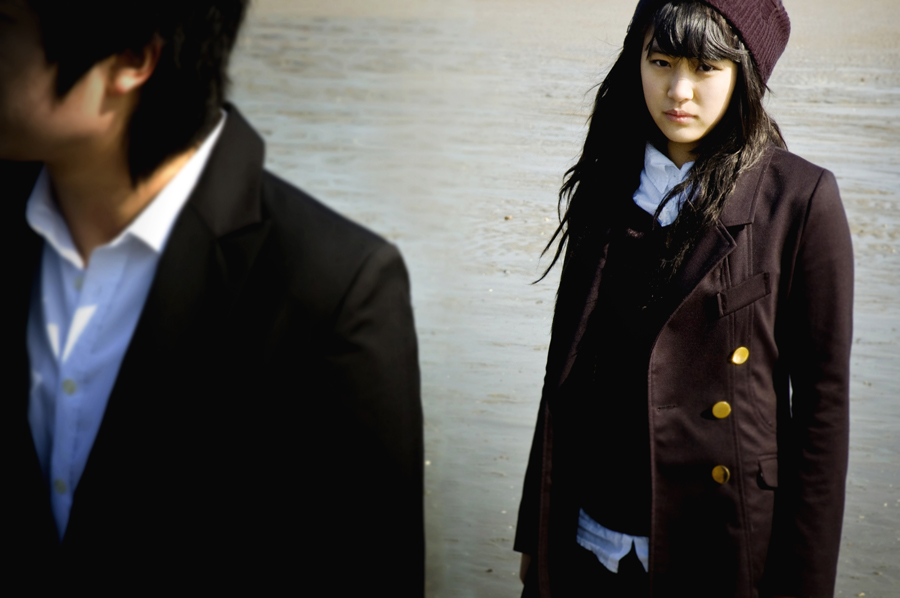
“Blogging ’bout Love in the ROK”

With apologies for not being able to mention more of you in the 800 word limit, here is my article in Busan Haps magazine based on your thoughts on the sudden increase in the number of bloggers discussing dating and marrying Korean men. Thanks again for your help!

Update: Ironically, just 2 days after that went up, Hot Yellow Fellows reports a lull in the number of new blogs on the subject, and most of the rest going “into dating hibernation, either due to leaving Korea (what’s up.), having gotten into relationships, or running into bad luck/apathy”!

(If you’d like to leave any comments, please do so on the Busan Haps website)

Share

The Gender Politics of Smoking in South Korea: Part 1

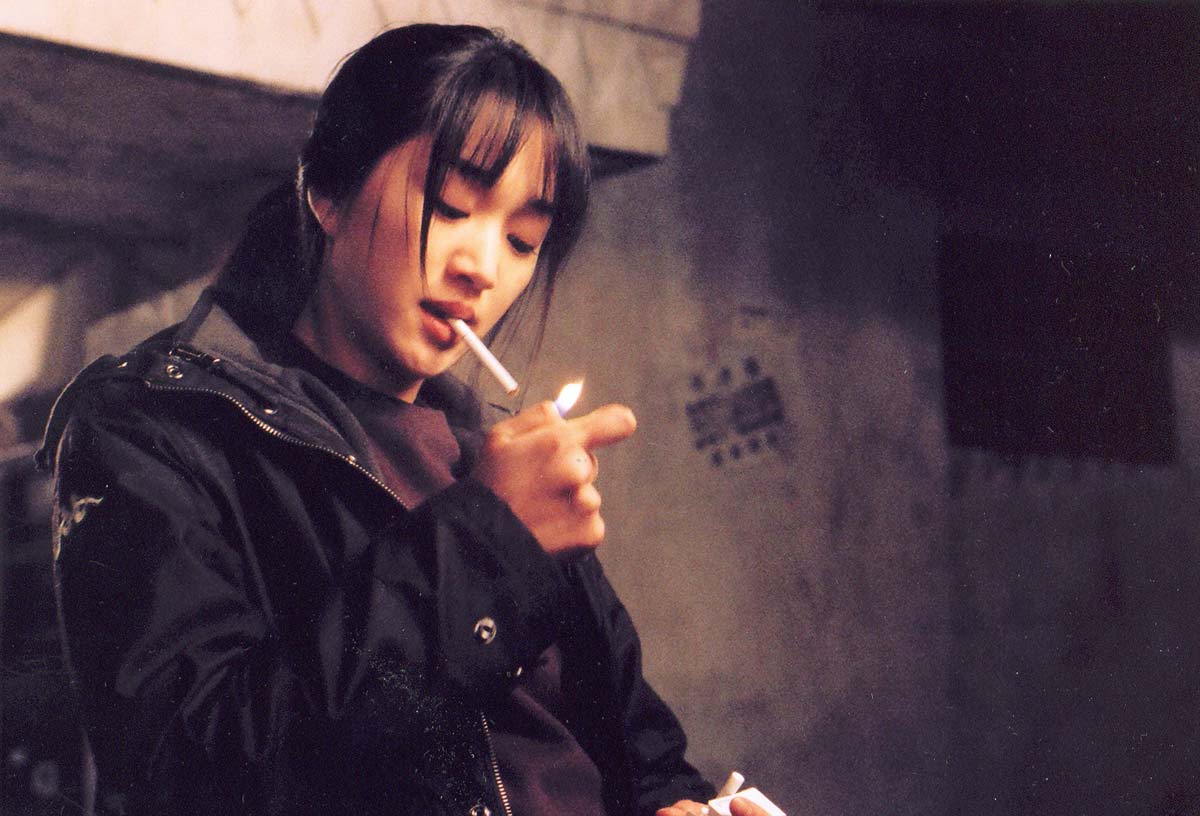
( Park Soo-ae {박수에} in A Family {가족; 2004}; source )

As numerous expats can attest to, coming to live in Korea can be quite a jarring experience sometimes. But probably not as much as you’d expect, for Korea too is a modern, developed country, with institutions and services that match – nay, are often better – than equivalents in your home country. Comparatively speaking, the transition is really rather smooth.

Scratch below the surface however, and decidedly archaic twists to many aspects of daily life do soon emerge, many of which are profoundly gendered too. For example, after a few months here I began teaching a group of highly intelligent women already fluent in English, who attended my class merely as a hobby. All housewives, later I learned that they likely did so because while Korea has been providing an equal education to both sexes for decades now, and indeed as many as 82% of high-school graduates go on to university, just a few years after graduating women are routinely fired and/or are pressured to resign upon getting married or becoming pregnant. Which makes one wonder what the point of women’s higher education was exactly, and accordingly a study conducted just a few years earlier (Women’s education, work, and marriage in Korea: women’s lives under institutional conflicts by Mijeong Lee, 1998, pp. 161-163) found that, à la Jane Austen, it was largely to secure higher-earning husbands.

It is true though, that modernization the world over has invariably entailed such “housewifization” and nuclearization of the family, so in that sense at least Korea is arguably simply repeating the experience of societies that developed earlier.  One way in which Korea does stand out then, is the case of smoking, and you’re probably well aware that it once had the highest male smoking rate in the world, whereas that for women has historically been extremely low. But unless you are already living in the country, then you may not have realized that this is not necessarily by choice, but rather because women can still get slapped for simply smoking in the street, even in 2010. And as testament to the strength of this taboo, it has influenced the smoking habits of at least one female blogger here too for instance, even though most Koreans excuse expats from the vast majority of Korean social norms (source, right).

This brief four-part series is about that gender politics of smoking in Korea, starting in this post with how such an artificial gender binary emerged in the first place; a later one will provide detailed statistics on the number of smokers in Korea, followed by a discussion on the ways in which tobacco companies have (largely successfully) targeted Korean girls and women over the last two decades. As you’ll soon see, it is really a little naive to speak of a “Korean smoking rate” or even “Korean male” or “Korean female” smoking rate when the results differ so widely by age, gender, class, and/or marital status, and the widely perceived notion that Korean women don’t and/or shouldn’t smoke is obscuring the fact that in reality more and more are over time (very roughly 1 in 5), and that success in reducing the number of male smokers comes in the midst of a looming health crisis among female ones.

But first, perhaps “taboo” is not strong enough a word. Consider why the Seoul Metropolitan Council recently proposed banning smoking in public spaces for instance:

“I suggested the bill to protect pregnant women and children from second-hand smoke on streets and at other public spaces” Park Hee-sung, a city councilor, said. “It also secures the right to smoke by designating smoking areas.”

No mere slip of the tongue, this is really a bizarre rationale for banning public smoking: don’t men and non-pregnant women also suffer from passive smoking? But place it in the context of decades-old legislation that posits both children and all women alike as in need of protection however, as mentioned in Kelley Lee et. al. in “The strategic targeting of females by transnational tobacco companies in South Korea following trade liberalisation”, Globalization and Health 2009; 5: 2 (download here), then it does begin to make some sense:

The National Health Promotion Law Enforcement Ordinance, adopted in 1989, bans all tobacco advertising, marketing and sponsorship aimed at women and children including both print and broadcast media.

Although as I’ll explain in Part 4, cigarette companies have largely managed to circumvent this restriction. In the meantime, how did the gender ideology behind the law come about?

( Source: iMorpheus )

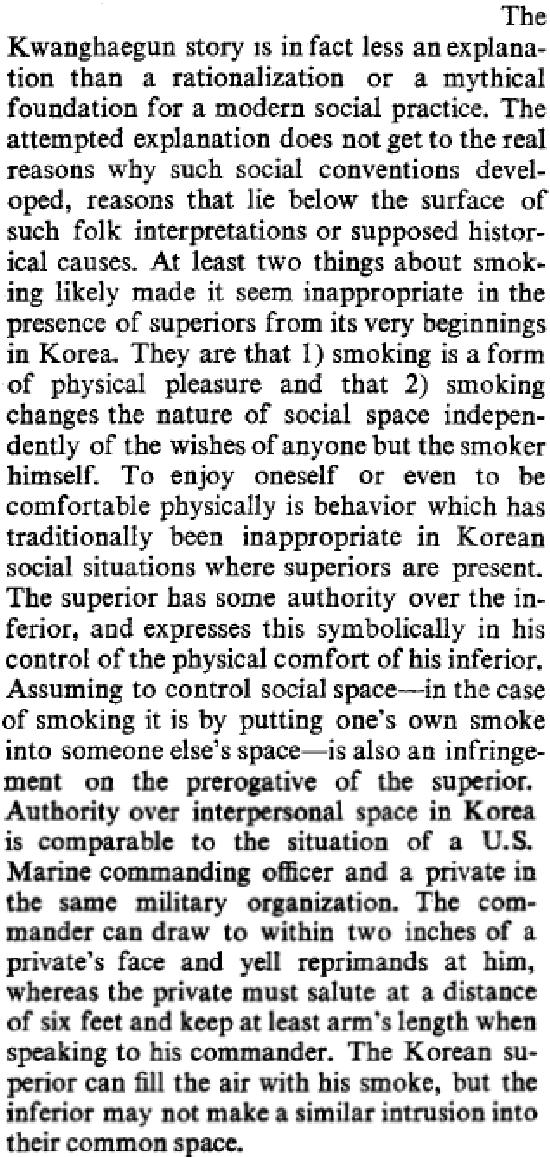
Well, consider the thoughts of C. Paul Dredge in “Smoking in Korea” published in the Korea Journal back in April 1980, (downloadable here), which are worth quoting at some length. From page 28:

With a clear logic rooted in Neo-confucianism, this explanation intuitively makes sense, and I feel confident that I speak for almost everyone when I say that if that excerpt was all of Dredge’s article that was still available, then we’d be more than satisfied with it.

You can imagine how I felt then, when I read on and learned that that was actually bullshit. From pages 28-29:

A good lesson to remember when trying to understand any society better, and indeed I’ve previously made a similar point in the context of how authority and/or hierarchical relationships are portrayed differently in Korean and Western advertisements, so I should have given it a little more thought myself.

With a newfound respect for Dredge then (does anyone know more about him?), I highly recommend reading his article for yourself to learn more (it’s only 11 pages long), in which he goes on to discuss how the above affected Korean women’s smoking habits (at least in 1980). Also analyzing how they differed in the context of the aforementioned divisions of age, class, and marital status however, then I’ll leave that discussion for Part 3 next week.

For now, I’d be more interested in hearing about your own experiences and opinions of smoking in Korea. Alas, although I’ve never lectured anyone about smoking, I confess that I’m an anti-smoking Nazi myself, and possibly for that reason I only have 2 very occasional smokers among my friends to ask. So I would really appreciate it!^^

Update 1: For those interested in smoking culture in North Korea also, see here.

Update 2: An interesting response to this post by a Korean blogger (in English) is available here.

(Other posts in the series: Part 2, Part 3, Newsflash, Part 4, Korea’s Hidden Smokers, Quick Hit: Living as a female smoker in Korea)

Dating in Korea: A Request

제시카 고메즈( Sources: left, right )

Well, the good news is that I’ve been asked to write an article on dating in Korea for a local magazine. But I need your help!

To be specific, I’m going to discuss blogs about dating in Korea, of which a great many seemed to have been formed in the past year or so, either devoted entirely to that topic or mentioning it frequently. And of these, the vast majority seem to be by women, which leads me to the following questions that I can’t answer by myself:

1. Do you also think that there has been a big increase in their numbers? How about those written by women in general? Of course I’ve noticed a definite increase personally, but then I’ve gone from reading perhaps 5 blogs a day in 2007 (when I starting blogging) to subscribing to perhaps 80 today just for keeping up with news related to my niches and new material, so it may just be because I’m noticing them for the first time.

2. If your answer to either question is “yes” however, then what do you think are the reasons for the increase(s)?

– Greater numbers of women coming to work in Korea?

– Greater numbers of women staying for longer periods in Korea? After all, as recently as 2008 I would have said that perhaps 6-7 out of 10 foreigners coming to Korea were male, rising to 8 or even 9 out of 10 among those who had been in Korea over, say, 5 years, but now I’m not so sure. But would you agree with those figures for back then? And what do you think they are now?

– Changes in attitudes among Korean men toward dating and marrying Western women?

– Changes in attitudes among Western women dating and marrying Korean men?

– Some other reason(s)?

3. Do you think double standards exist when talking about dating? In particular, do you think that in the wake of “EnglishSpectrumGate”, male bloggers now feel much more inhibited about discussing their practical experiences of dating Koreans then female bloggers do? (very new arrivals to the Korea blogosphere, see here, here, and here for a quick synopsis of that)

On a final note, naturally I do already follow most blogs about dating in Korea, and many more intelligent ones that discuss it in passing; but I’m sure that there’s many that I’m unaware of, so please feel free to plug yours here! (and female bloggers too, for I simply don’t have the time to go through all 69 of them mentioned on this post by Chris in South Korea I’m afraid) Also, being married with 2 kids, and not having dated in nearly 10 years, then practically speaking at least there’s a great deal about the subject that I simply no longer know and/or is outdated,  so thank you to everyone in advance for filling me in.

p.s. Please, no inane comments about the choice of pictures; as you might expect in a society where the fact that local women are sometimes interested in foreign men is considered newsworthy, then there weren’t exactly very many to choose from!

Update: See here for the final article!

Share

The Vagina Monologues in Busan: Sunday, April 25th

( Source )

Very surprised to hear that this will be not only be playing in Busan, but just 10 minutes away in my local drinking district of Kyungsung and Pukyong university, I’m glad to finally get a chance to see this. With all proceeds going to shelters that help victims of sex trafficking in Korea, check out the Facebook page for the details, including about the after party: am looking forward to meeting some readers there!

Update 1: Lest the poster above give you the wrong impression however, which is actually for a Korean performance in Bucheon, please note that the performance is in English, and you can hear an interview of the cast on Koreabridge here if you like.

Update 2: You need to be logged on to see the Facebook page, so alternatively you can see here for the details instead, and I’ve also added a map below.

Update 3: See here for an article in Busan Haps.

Share

Western Metrosexuals & Korean Kkotminam: Inevitable?

( Adapted from Mobile Life, by geishaboy500 )

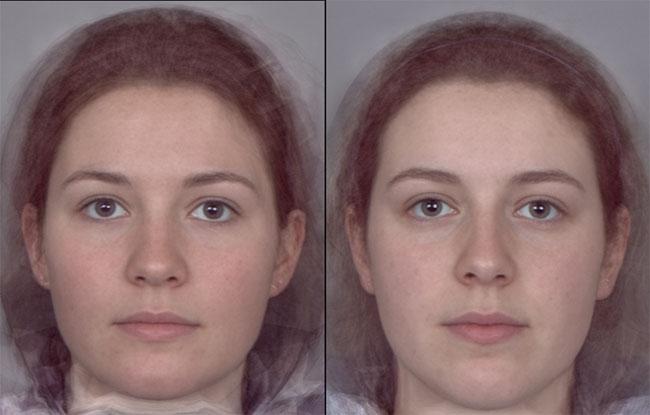
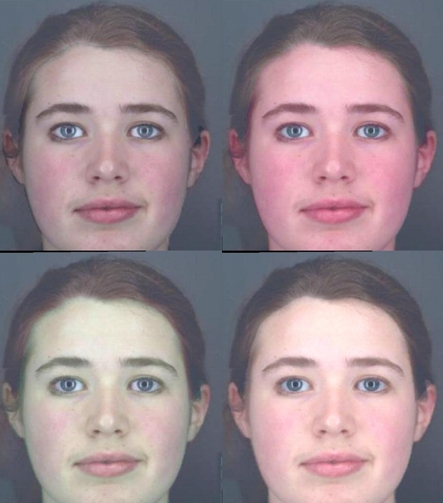
Alas, it’s no longer my planned thesis topic, but I’m still very interested in the origins of the kkotminam (꽃미남) phenomenon, and so naturally I”m intrigued by the notion that the physically healthier a society, the more women in it tend to prefer “feminine” men as mates. From The Economist:

A disease-free society helps effeminate men attract women

IT IS not just a sense of fairness that seems to be calibrated to social circumstances (see article). Mating preferences, too, vary with a society’s level of economic development. That, at least, is the conclusion of a study by Ben Jones and Lisa DeBruine [themselves a married couple] of Aberdeen University, in Scotland, published this week in the Proceedings of the Royal Society.

….In a man, the craggy physical characteristics associated with masculinity [James: because of testosterone] often indicate a strong immune system and thus a likelihood of his producing healthier offspring than his softer-featured confrères will. But such men are also more promiscuous and do not care as much about long-term relationships, leaving women to raise their kids alone.

Nowadays, sound parenting is often more important to the viability of a man’s offspring than Herculean strength. That, some researchers suspect, may be changing the physical traits that women look for in a mate, at least in some societies. A study carried out in 2004, for example, discovered that women in rural Jamaica found manly types more desirable than did women in Britain, which led to questions about whether those preferences were arbitrary or whether women in different parts of the world might be adapting to circumstances that place different emphasis on manliness in the competitive calculus.

Dr Jones and Dr DeBruine therefore looked to see if there is an inverse relationship between women’s preference for masculine features and national health. Sure enough, they found one…

With a nod towards copyright, see the article itself for the rest, and particularly for the methodology used, which did account for cultural and racial differences (image right: Hot Girl Remix by geishaboy500). Still, my first reaction was that this earlier study seemed to completely contradict those findings, as it demonstrated that for much of human history women had good reason to prefer skinny guys over muscled ones, the latter being less likely to survive in (frequent) times of scarcity, but that this no longer applied in the overabundance of modern times.

However, just like the kkotminam phenomenon itself forces many Westerners to reconsider their previously held notions of masculinity and femininity (not least myself), one should be very specific about what one means by those terms, and so note that this study was purely based on face shapes, which are heavily influenced by hormones. Accordingly,  it makes a great deal of sense that with good access to modern medicine, women would be more interested in other factors than simply passing on a good immune system to her children, as evidenced by a masculine jaw.

Hence, with the proviso that what makes “a great deal of sense” is very culturally and period specific however (evolutionary psychologists, for example, guilty of once thinking that all women in prehistoric tribes stayed in the camp to look after children and/or do some gathering while the men went off to hunt each day!), and that the specific timing of the popularity of the kkotminam and metrosexual phenomenons (and various permutations thereof) were/are/will be heavily dependent on a whole range of factors, not least the interests of the cosmetic industry, do you think that there’s a certain inevitability in them? Or are they merely passing fads? After all, given the above logic, then they’re here to stay.

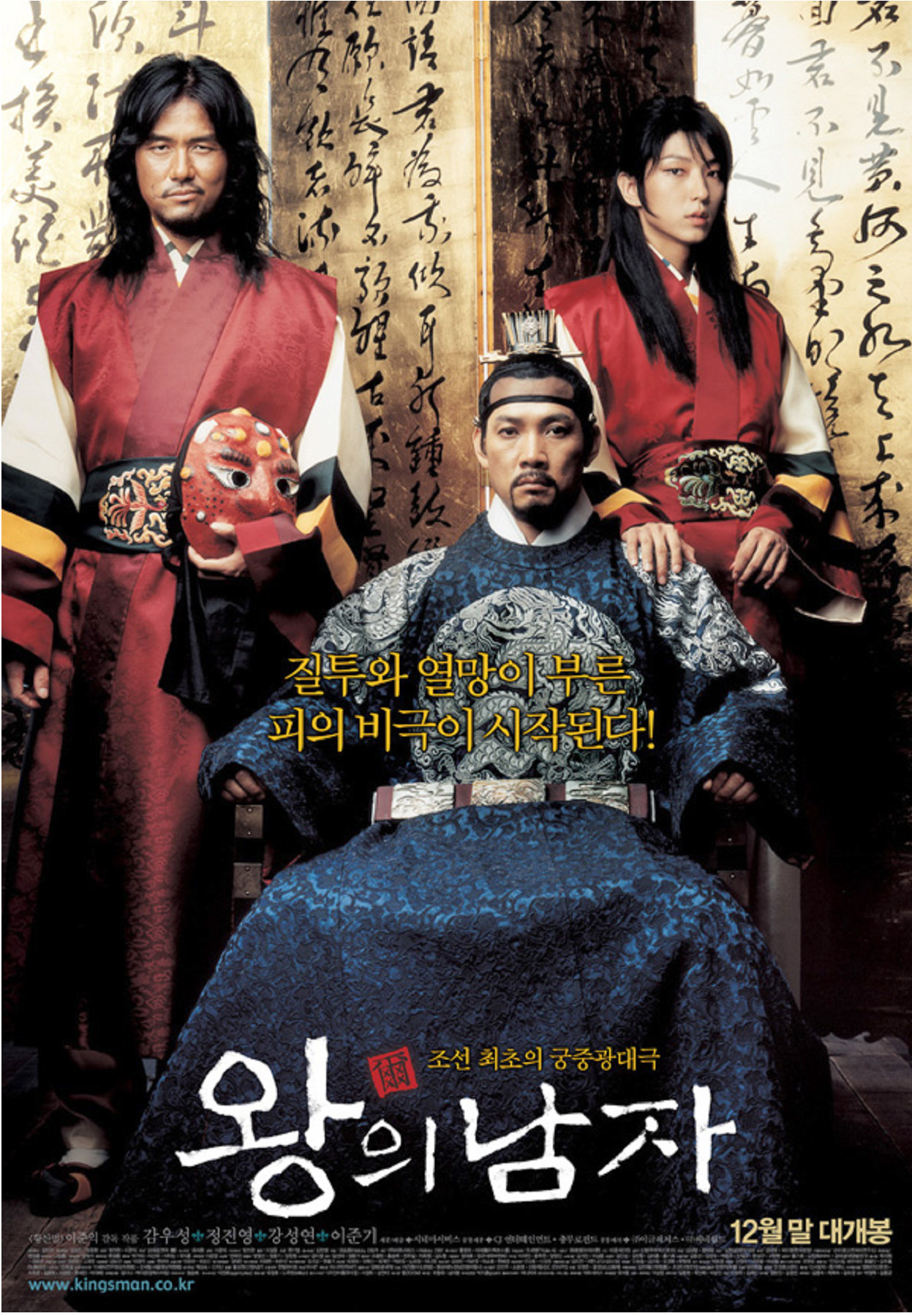
( The King and the Clown {2005}; source: unknown )

Regardless, if it were possible, it would be fascinating to see if women’s tastes in men in a various society varied over time according to the health of its members. Alas, isolating everything but preference in face shape is probably impossible, and while it’s fair to say that in all historical societies men’s (and women’s) clothing probably tended to become more flamboyant and colorful in times of prosperity, I can’t stress often enough that neither characteristic is “feminine” per se!

Share

Sex as Power in the South Korean Military

Source: anja_johnson

“All men are rapists,” I read on the back cover of Susan Brownmiller’s Against Our Will: Men, Women, and Rape in the student bookstore. Determined to impress women with my intellectual and feminist prowess by debunking that quote, I bought the book and doggedly read all 480 pages trying to find it. Twice.

Yes, I was rather naive about the whole dating game. Even worse, you can imagine how I felt years later, when I learned that she never actually said that. Rather, it was a big misinterpretation of her statement that rape “is nothing more or less than a conscious process of intimidation, by which all men keep all women in a state of fear” (p. 5), albeit an understandable one. Indeed, it’s probably what she’s become best known for, an enduring catch-phrase of pop-feminism that publishers would knowingly exploit to sell the book to me 2 decades later.

Which is a shame, because along with Menachem Amir, she was instrumental in overturning long-held conventions that rape was simply a spontaneous act of lust, instead demonstrating that it is more “a deliberate, hostile, violent act of degradation and possession on the part of a would-be conqueror, designed to intimidate and inspire fear…” (p. 439). Or in short, it’s due to her that surely all reading this are aware that sexual violence is all about power, and not surprised to hear this reaffirmed by the survey “Sexual Violence Among Men in the Military in South Korea” by Insook Kwon et. al., Journal of Interpersonal Violence, Vol. 22, No. 8, 1024-1042 (2007), the subject of today’s post.

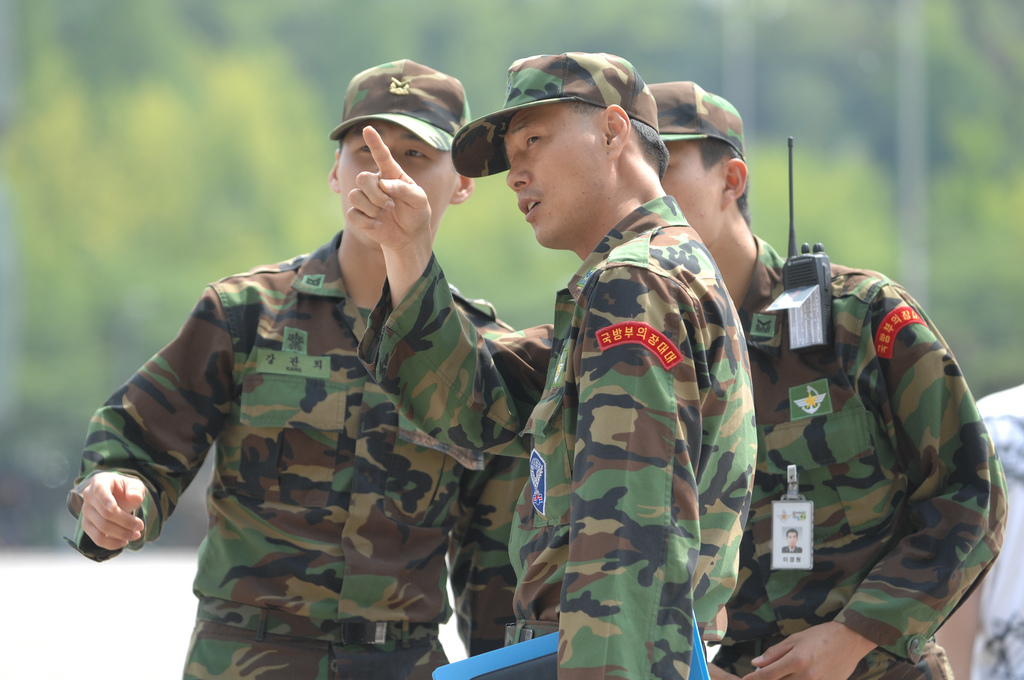
The first comprehensive survey of its kind, in English or Korean, it was prompted by the suicide of a Korean soldier in July 2003, which received tremendous attention in the media because sexual violence by his superiors seemed to have played a role; after all, with 250,000 men forcibly conscripted each year, any implication that it wasn’t an isolated incident meant that there were far more victims. And in point of fact, with the proviso that the authors’ (undefined) notion of “sexual violence” appears to be much broader than a layperson’s as I’ll explain, they did indeed find that 15.8% of respondents experienced it during their time in the military, either as perpetrators or victims.

But before discussing the implications of that however, and especially what it says about the role of the military in the socialization of Korean men, let first provide an overview of the survey so you can make your minds (with a nod to copyright, I won’t upload the survey itself here sorry, but please feel free to email me if you’d like your own copy). And so, without any further ado:

The survey was conducted from November 2003 to February 2004, with researchers meeting 2 groups: 362 postconscripts, then students, at 6 different colleges; and 409 current conscripts, 115 at bus and train stations while they were on leave, and 294 in visits to their barracks with the official cooperation of the Ministry of Defense. From each group, there were 266, 111, and 294 valid samples respectively, giving a total of 671 valid samples out of 771 soldiers surveyed (the bulk excluded being postconscripts, and because more than 3 years had passed since their military service). They also conducted in-depth interviews of 8 perpetrators in army prison, and 3 victims.

Highlights of the results include (all emphases mine):

Of 671 valid respondents who participated in this survey of victimization, perpetration, and observation, a total of 103 people (15.4%) answered that they were directly victimized, 48 people (7.2%) answered that they had direct experience as perpetrators, and 166 people (24.7%) answered that they witnessed sexual violence in the military.

Excluding eyewitnesses, a total of 106 soldiers (15.8%) directly experienced physical sexual violence, either as perpetrators or victims in the military. A very high number of soldiers also indicated they experienced sexual violence as perpetrators and as victims: 59 soldiers (55.7%) were victims only, 39 soldiers (36.8%) were victims and perpetrators, and only 8 soldiers (7.5%) were exclusively perpetrators. Among perpetrators, 83% had experienced sexual violence in the military when they had been lower ranked soldiers. This feature of high number of perpetrators having previously experienced victimization themselves could be seen as the most unique feature of sexual violence among men in the military. (p. 1028)

(Source: anja_johnson)

And:

Victims named higher ranking soldiers (71.1%), junior officers (7%), and officers (3.1%) as their perpetrators, totaling 81.2% of victims who responded that someone of a higher rank forcibly imposed sexual contact….

Also, the eight perpetrators and three victims who agreed to be interviewed, as well as six cases recorded by the Korean Sexual Violence Relief Center and reports by military judiciary officers, confirmed that victims of sexual abuse were in lower ranks than their perpetrators. All victims had been victimized by higher ranking soldiers, and eyewitnesses reported likewise. In sum, sexual violence among men in the military in South Korea was committed primarily by a higher ranking solider against a lower ranking soldier. (p. 1029)

The types of abuse, as reported by victims and witnesses (p. 1031; multiple answers permitted):

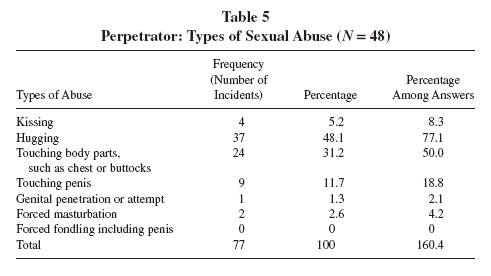
As reported by the perpetrators (p. 1033):

Also note that 22.1% of victims (but only 7% of perpetrators) reported that physical violence accompanied the sexual violence, and that 71.8% of victims and 90.7% of perpetrators responded that the acts of sexual violence when others were watching (I’ll return to the latter point shortly).  And in particular, eyewitnesses reported that 22.5% of the sexual violence they saw involved touching genitals, and 5.1% involving anal penetration (or the attempt), nearly 2 and 5 times higher than victims reported respectively.

Reflecting on the discrepancies, Kwon et al. found that:

…people tended to feel more comfortable talking about what might be considered part of a general sexual culture—such as kissing, hugging, and telling sexually explicit jokes—but answers were less forthcoming when concerning sexual violence of a more serious degree. (p. 1032)

Which for a long time I simply didn’t understand: how on Earth was that the “general sexual culture” of the military? Well, first consider that:

When asked, “In the military, have you ever been forced to talk about sexual experiences, even when you did not want to?” almost one third (32.7%) of the 667 respondents answered affirmatively. To the question, “Have you ever experienced negative consequences either because you did not have any sexual experiences or because you refused to discuss your sexual experiences?” a total of 218 soldiers (32.7%) answered that they had been forced to talk about sexual experience. (p. 1028)

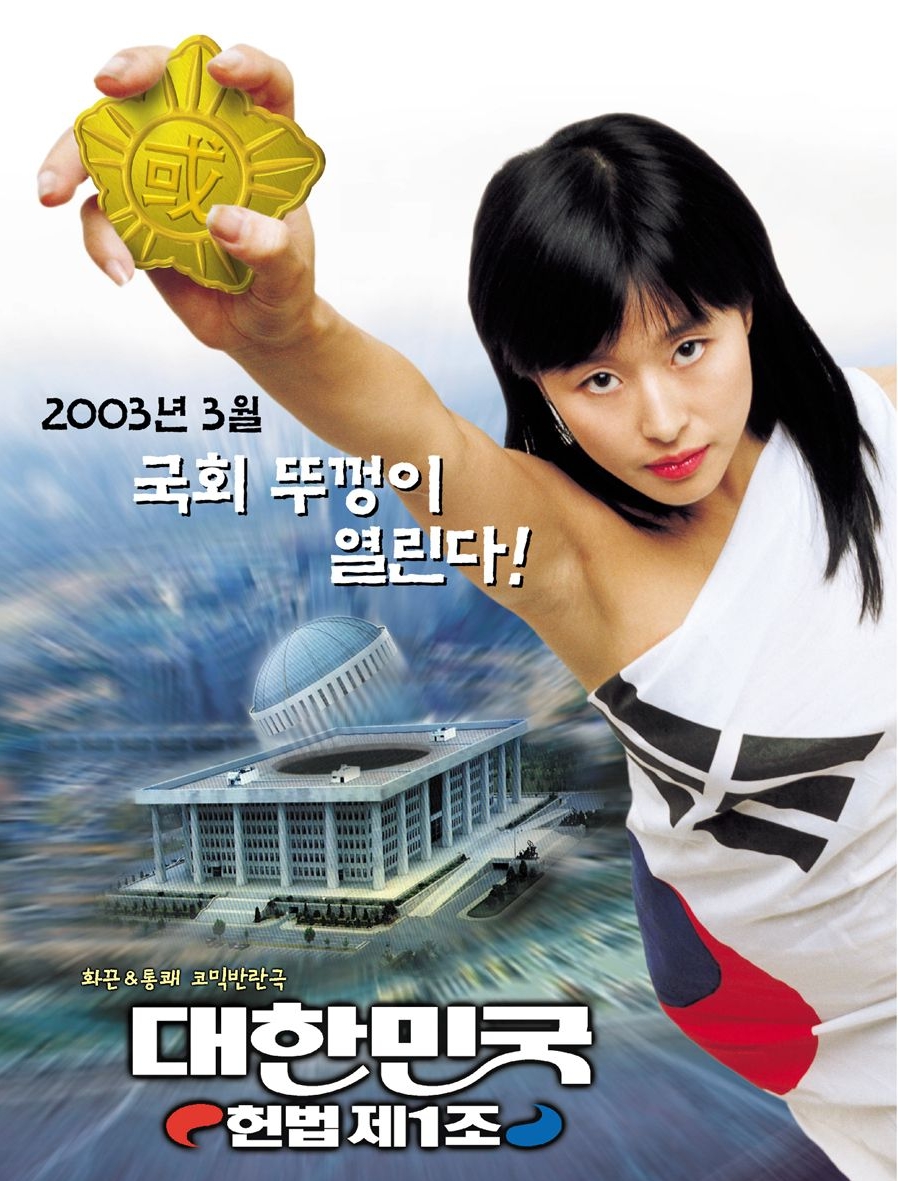
And that this mandatory disclosure of sexual experience has long been regarded as “an essential part of sexual culture in the military” is corroborated by numerous references in Korean movies to the practice of virgins visiting a prostitute before starting one’s military service, of which I highly recommend the satirical comedy The First Amendment of Korea below.

(Source)

Next, there is the fact that victims of sexual violence tended to interpret it as:

…intimacy or playfulness, because identification as a victim of sexual violence would imply one’s fragility and vulnerability. This tendency to minimize and trivialize injury was clear in cases where abuse continued for a long time, and in situations where a clear power dynamic between the perpetrator and the victim made resistance much more difficult for the victim. (p. 1033)

Moreover, perpetrators:

…did not force sexual contact on their peers with whom they had even closer relationships [than inferiors]. The intimacy in question was strictly an intimacy from the position of the higher ranking soldier.

Kwon et al. further discuss the natural difficulties victims had in refusing advances by a superior, and crucially, why the third most common form of sexual violence was touching a victim’s genitals. But why, particularly when only 5.4% of victims thought that their perpetrators were genuinely homosexual? Well, as one victim noted:

…unlike in the general society where one could not treat another person with complete disregard for age, educational level, or class, in the military, higher ranking soldiers could treat lower ranking soldiers as one pleased—including touching their genitals. (p. 1035)

And after a discussion of the right to control and abuse the body being a very useful method for militaries to reaffirm its hierarchical order, and of the role of the penis as a symbol of power and authority throughout history, they note that, hence:

…teasing or forceful contact with one’s penis becomes a way to prove the victim’s lack of power.

(Source: Journey to Perplexity)

Needless to say, the effects of this are amplified if done in public settings, and indeed 90.7% of perpetrators responded that people were watching when their sexual violence occurred, with the vast majority of witnesses either actively engaging in it in some way (23.7%), passively consenting by simply watching (57.9%), or pretending not to see (10.5%) rather than attempting to stop it: hence a “general sexual culture.”

But continuing with why:

…violence feminizes victims of sexual violence in two ways. The victim is reduced to a sexual object, like many women typically face in society, and as the powerless victim of violence, he is further feminized. Men who are victimized by sexual violence, then, become someone whose masculinity is lacking or damaged. Hierarchical order reasserts itself amid all this, and men collectively try to be on the offensive to affirm their aggressive masculinity. (pp. 1035-36)

And finally, the testimony of a perpetrator himself on why he did it, who said that he used sexual violence in lieu of physical violence sometimes, forcing sexual contact by “not hitting every time, and not joking around but harassing them”:

[Like harassing them…] Yes, I can’t hit them every time . . . and it’s not just joking around, but harassing them. . . . For instance, making them clean things repeatedly. Stuff like that. . . . If they were from wealthy families . . . or had a lot of education themselves . . . the superiors are ahead only because they came to the military before them . . . honestly . . . when you don’t have much to show for, and if they kiss ass to superiors who intimidate them . . . and if they think you’re not all that . . . well, you can’t beat them and so I kept thinking about ways to give them hell in the military, legal ways . . . and that’s how I ended up. (pp. 1036-37)

({2-365} Tick Tock by Dee’lite)

But what to make of all this?

At this point, it seems appropriate to point out my own complete lack of experience with the Korean military, as well as not even having any close relationships with any Korean men from whom I could learn about their military service, and so I would be very grateful to hear from those that have either. But then my own inexperience is essentially irrelevant here, as I’m largely passing on the results of renowned experts in the field (scroll down to note #32 here for more information on Kwon for instance); moreover, my own interest in on what is implied for Korean culture and sexuality as a whole, and so let me pass on the following description of military life provided by Ask a Korean, in his own excellent series on military service in Korea:

For some of today’s Korean young men, who have gone soft since the days of their fathers, military experience can be unbearable. Physical exercise is grueling, the superiors can be arbitrary and insulting, and your squad mates could shun you if you are responsible for putting the whole squad in trouble. Given that these guys, just like any other soldiers in Korea, can access guns and grenades, it should be no surprise that recently there has been a string of incidents in which a draftee shoots up his squad or toss a grenade in the squad room, killing many….

….[But there are definitely good life lessons to be learned from the experience, although it may be debatable whether learning those lessons is a good use of 2 to 3 years of young men in their prime. To put it bluntly, the military experience builds Korean men’s tolerance for all the life’s bullshit. As the Korean described so far, there is no shortage of bullshit – some of them perhaps the worst to be encountered in life – in the military. Exhausting physical training, insults and condescension from the superiors, and wasting time on arbitrary and trivial errands are all part of the experience. For young Korean men in the military, there is no choice but to simply grin and bear them. Once they finish bearing it, they know that most difficulties in life would be easier than what they already went through. The combination of such tolerance and insight, some may call it maturity – because, as anyone who has had a regular job can tell you, life as an adult has a lot of crap that we must simply grin and bear.

(Band of Brothers by The U.S. Army Photostream)

And in the next post in that series (my emphasis):

…one can argue that the military culture neatly coincides with traditional Korean culture – in both cultures, seniority automatically commands respect and loyalty. It is not surprising, then, that Korean workplaces are often run just like a squad in the military. You do what your boss tells you to do, and you are supposed to grin and bear it. Your time will come because Korea, like Japan, had automatic advancement by seniority at least until 1990s. Once you are the boss, you can order people around, much like the way you can order people around once you put in the time and became a sergeant.

I happened to work in such a place when I wrote the first post in my own series on gender and militarization in South Korea, and in which I noted that Korean corporate life often requires such a level of personal sacrifice for one’s superiors that, tellingly, even the Samsung Economic Research Institute acknowledges that “many workers…take it for granted that they have to tolerate anything in return for getting paid.” I should note however, that many readers thought my workplace was the exception rather than the rule, but be that as it may, the purpose of many of those things to be tolerated there boiled down to no more than the demonstration (and abuse) of superiors’ authority…and so too does sexual violence clearly emerge as one means – albeit, and I stress, only one, uncommon means – of doing so in the Korean military.

But I will further cover the effects on Korean gender relations and sexuality in great detail as I belatedly continue that series next month. In the meantime, let me leave you with the following passage from Shadows of Forgotten Ancestors: A Search For Who We Are (1993) by Carl Sagan and Ann Druyan to ponder, a book which had a great effect on my worldview and which frequently came to mind as I was writing this post (via Viraj’s Weblog):

(Source)

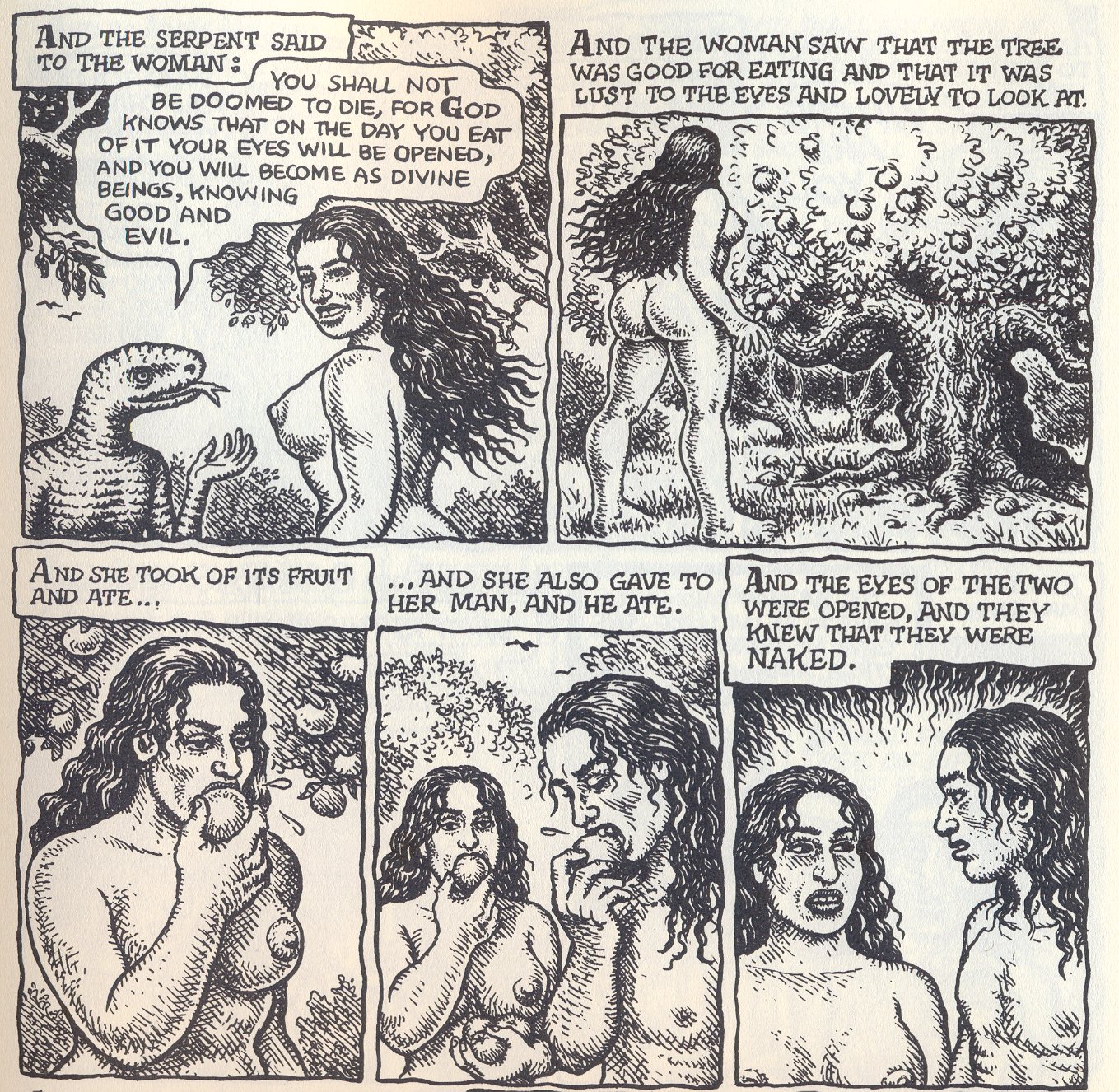
We go to great lengths to deny our animal heritage, and not just in scientific and philosophical discourse. You can glimpse the denial in the shaving of men’s faces; in clothing and other adornments; in the great lengths gone to in the preparation of meat to disguise the fact that an animal is being killed, flayed, and eaten. The common primate practice of pseudosexual mounting of males by males to express dominance is not widespread in humans, and some have taken comfort from this fact. But the most potent form of verbal abuse in English and many other languages is “Fuck you,” with the pronoun “I” implicit at the beginning. The speaker is vividly asserting his claim to higher status, and his contempt for those he considers subordinate. Characteristically, humans have converted a postural image into a linguistic one with barely a change in nuance. The phrase is uttered millions of times each day, all over the planet, with hardly anyone stopping to think what it means. Often, it escapes our lips unbidden. It is satisfying to say. It serves its purpose. It is a badge of the primate order, revealing something of our nature despite all our denials and pretensions.

Update 1, February 2013: See The Chosun Ilbo and ROK Drop for some more recent statistics on sexual assault in the Korean military.

Update 2, February 2013: See Sociological Images for more on sexualized insults.

Everybody Bubi!

( Source: KBites )

While “Bubi Bubi” (부비부비) doesn’t quite mean what it sounds like in English, these will still probably be the most surreal advertisements you’ll see in your entire life:

Featuring girl-group T-ara (티아라), whom I talked about recently here, and actor Yoon Shi-yoon (윤시윤), 2 of the advertisements at least seem to show that bubibubihada (부비부비하다) means to touch, or rub 2 things against each other. Curiously however, that’s proving quite difficult to confirm, as even though it appears to be rather old, with references here and here in The Marmot’s Hole going back to early-2008, and a query at Naver on the meaning from late-2006, there’s still no mention of the term in print or online dictionaries.

From a reading of the former though, and K-pop blogs today, “grind” appears to be a much better translation, and indeed there’s even a 2008(?) Banana Girl (바나나걸) song called Bubi Bubi on that theme:

But then “Grind Grind” is a rather crude and unlikely name for a phone, and especially for one that KTF itself claims is aimed at teenagers. Hence the most likely explanation is that KTF is exploiting a double-entendre, and which Korean advertisers as a whole have a surprising proclivity for, especially sexual ones. But it would be appreciated if anyone more familiar with the term could confirm that; alas, married in 2004, and with two children after that, then it’s been a while since I’ve done any grinding in Korean nightclubs myself, and am unlikely to begin again soon!

Share

Korean “Double In-Laws”… and Other Dramas!

(Wedding Day by summer park; CC BY 2.0)

An interesting question from Curtis, a reader with a slightly unusual family in which 2 brothers from one family married 2 sisters from another. As you will see, he was concerned about how this would be received by Koreans:

Dear James,

Lately I’ve been seriously confused and irritated by a seeming issue with relation to Korean marriages.  I can’t figure out why it is even a problem to begin with. I’ve never heard the term until recently, but apparently Koreans (I’m not sure if this is general or only among certain classes) seem to be against marriages that create “double in-laws,” meaning that, for example, member A of the Kim family marries member A of the Lee family. Then Member B of the Kim family marries the sister/brother of member A of the Lee family. The first marriage made them in-laws, but this second marriage creates what I’ve heard Koreans term “double in-laws” which seems to have some stigma.  As far as I am concerned as a westerner, the second marriage has little to no bearing on anything since it isn’t incest or intermarriage, therefore I see no problem. In fact, my father married my mother, and soon after that, my father’s brother married my mother’s sister. I guess that creates double in-laws in my family, but since it’s neither incest nor intermarriage, I haven’t once heard any issues being brought up about it. Could you explain if this “double in-laws” thing is really an issue, and if so, why? All I can think of is that the families are not being spread out far enough for maximum social networking and both sides of the family may end up being in one household, but since Korean family dynamics are changing, this doesn’t have to be the case.

I’ve also heard the English term “co-in-laws” to describe this, but again, I find no reports of issues with this arrangement other than in a few Korean instances.

And an update in a second email:

[I’ve done some more thinking]…, and I thought about the collective culture that Korea is.  I thought that perhaps when a family marries another family, the WHOLE family in that household become in-laws as such, whereas in western societies, the distinctions between in-laws is limited more so to the ones who married into the family.  I, personally, would consider the sister of my brother-in-law just that, the sister of my brother-in-law, not an in-law herself since she did not marry into the family.

(The Bride by Tetsumo; CC BY 2.0)

What do you think? Personally, while this is the first I’ve heard of any potential stigma, I suspected that there might be something to it when my wife instantly came up with the Korean term for people in such arrangements: gyeobsadon (겹사돈), or “a person doubly related by marriage.” Moreover, however illogical any stigma would be, there is certainly precedent too: until as late as 2005, Article 809 of the Korean Civil Code prohibited marriage between those of the same ancestral, regional clan (or local subgroup of Lees, Parks, or Kims and so on), of which the largest had over 4 million members. Or in short, somewhere between 8-15% of the Korean population were literally forbidden to marry each other, with even the children of any de-facto unions discriminated against also because their out-of-wedlock status prohibited them from receiving national health insurance, let alone complicating inheritance and property rights.

But as it turned out in this case at least, my wife knew the term not because of any stigma that she’s aware of…rather, because she remembered such arrangements from dramas!

Probably there is nothing to worry about then, but if anyone could confirm that then I’m sure Curtis will appreciate it, and I’d be interested in hearing any other unusual stories about marriage and Korean families also. If you’d rather read more yourself though, then consider this series on the uncertain role of Neo-Confucianism in the similarities between Japanese and Korean family forms, and especially how daughters-in-law are treated therein.

Update: Speaking of the importance of family names in Korea, today there was an interesting article in the New York Times about the trials and tribulations a Korean man (and subsequently his family) had due to his Japanese ancestry.

Korean Gender Reader: Abortion Republic No More?

Alice Park es Gogo by Tetsumo ; CC BY 2.0.

Yes, after a long hiatus, I’m starting up this series again, and this time hopefully for good!

For new readers unfamiliar with it, basically this means that for your convenience and interest, each Monday I’ll be providing summaries of the biggest Korean gender-related stories of the week before, with a few related and/or interesting ones from overseas also, especially Northeast Asia. But I may sometimes miss some though, so I’ll still always be grateful if you could pass any on that you come across, either just by writing a comment on any post, or via email, Twitter, or Facebook.

With dire long-term implications however, the first story required rather more than a simple summary:

1) Abortion Republic No More?

Starting late last year, but suddenly getting a lot of attention in the international media, the Lee Myung-bak administration has decided to start enforcing Korea’s abortion laws, basically for the first time since they were enacted in 1953. But while the news that the Korean government is actually enforcing its own laws might usually be cause for celebration, unfortunately its abortion laws are amongst the most restrictive in the world, only allowing it in the case of heredity diseases, incest, rape, and/or danger to the mother’s health.

( Source: Chicago Tribune )

For an excellent overview of the topic, with many links to various English-language stories, see Robert Neff’s post at The Marmot’s Hole; assuming that you’ve read that, here I’d like to highlight some of the few points not covered in it, starting with some statistics on whom exactly is getting abortions and why. From the Hankyoreh:

According to the data released by the Ministry of Health, Welfare and Family Affairs (MHWFA) yesterday, the reasons why married women, who make up 58 percent of the women who have undergone abortion procedures, chose to have abortions are because they do not want children (70 percent) and financial difficulties (17.5 percent). In the case of unmarried women, 93.7 percent said they underwent an abortion procedure because they were not married. They are saying that having children is difficult because of child-rearing and economic burdens in the case of married women, and because of social prejudice and financial difficulties in the case of unmarried women.

A second point is while that data came from the MHWFA on March 3, it actually lost its jurisdiction over family affairs on the 19th, which have returned to the Ministry of Gender Equality (now Ministry of Gender Equality and Family Affairs, or MOGEF). Coming with a big increase in staff and 4 times larger budget (albeit from a base of 0.03%(!) of the government total), and partially dealing with problems of overlapping responsibilities with other ministries, again ostensibly this is good news. But also strange; after all, according to The Korea Times:

As a candidate, President Lee Myung-bak promised to expand the Ministry of Gender Equality, but his transition committee ― led by a woman ― first attempted to abolish the ministry and, faced with fierce opposition from feminists, backed down to sharply downsizing it. Equally problematic was Lee’s choice for its top post, a food and nutrition expert who had no experience at all in the female rights movement, under the excuse of “globalizing Korean food.”

See here and here for more details. Why this is important is because almost every report I’ve read on this subject has directly or implicitly linked the “abortion crackdown” to Lee Myung-bak’s special taskforce of November 2009, charged with finding a means to improve Korea’s birthrate, one of the lowest in the world. And given the above history, and how disastrous his administration has been for Korean women as a whole, then in my opinion quite correctly too, although to be fair, this link has been denied by the government. From The Chicago Tribune:

“Our plan against illegal abortions is entirely separate from our low birthrate countermeasures,” said Rhee Won-hee, chief of the health ministry’s Family Support Division. “The comprehensive plan is to fight rampant disrespect for the sanctity of life.”

Nevertheless, as it was the MHWFA that was responsible for implementing the crackdown, even setting up a hotline to report on law-breaking doctors or pregnant women, and – as far as I am aware – it is these responsibilities that MOGEF has just taken on, then it remains to be seen what genuinely useful initiatives MOGEF will be implementing to help raise the birthrate other than clamping down on abortions. After all, recall that this is the same ministry that paid men not to have sex with prostitutes, and that will be continuing the MHWFA policy of letting them go home early every third Wednesday so that they might, well, fuck their wives, neither of which, to identify a recurring theme, really deal with the fundamentals of why Korean women are having so few children.

Unfortunately, this also proves to be the case for its “purple-job system” of encouraging flexitime for women and men: again ostensibly commendable, and sorely needed with a workplace culture that uselessly confines people to the office until late in the evening, but all essentially useless when a record number of Korean women have lost their jobs in the last year (see below), and they’re still fired for getting pregnant. Perhaps the money might be better spent in conjunction with the Ministry of Labor in ensuring that companies are prosecuted for doing so?

( Source: I Believe in Advertising; adapted from Grazia advertisement )

Third, there are the motivations of the various interest groups themselves, in particular those of the Korean Gynecological Physicians’ Association (GYNOB; 진오비), a new group of 600-700 obstetricians that has sought forgiveness from the public for performing abortions in the past, probably not coincidentally receiving a great deal of media attention at about the same time that Lee Myung-bak’s taskforce was formed. While the New York Times at least emphasizes the religious affiliations of the group, and points out that it doesn’t have the support of the 4000 member Korean Association of Obstetricians and Gynecologists (대한산부인과학회), I suspect that simple corporatist interests will soon increase its support among them, as according to The Korea Herald:

Obstetrical and gynecological clinics in Korea have long struggled from old issues such as low medical fees, ceaseless legal conflicts and a shortage of specialists.

Under the system, most private clinics have given up risk-bearing delivery services. But practicing cheaper gynecological treatment does not make a profit. As a result, a growing number of specialists do abortions or turn to other more favorable departments such as dermatology and plastic surgery.

And indeed the report then makes an explicit, corporatist link:

Young doctors started sensing that they could be the nation’s last generation of gynecologists, resulting in the establishment of GYNOB…

Presumably the idea being that gynecologists and obstetricians did not enter the field simply to perform abortions. Lest the argument that they’re simply looking out for their jobs sound cynical on my part however, consider how last year the Korean Medical Association (대한의사협회) started blatantly scaremongering about the contraceptive pill, despite the fact that already surprisingly low numbers of Korean women use the pill (in no small part due to previous scaremongering), and that it is widely acknowledged (outside of Japan at least) that Japanese gynecologists and obstetricians, for instance, deliberately blocked the introduction of the pill there for over 30 years in order to maintain their own extensive abortion industry. Granted, the KMA is not GYNOB, but it would be interesting to see who exactly in the KMA was responsible for that (needless to say, perhaps some are members of GYNOB?), and to hear alternative explanations for the KMA’s sudden concern.

Meanwhile, the corporatist interests of the Korean state are clear. As Sara Mendkedick at Change.org puts it:

Abortion shouldn’t be the only, desperate choice of women whose voices are silenced by their society, and it shouldn’t be used as a form of population control by the government. It should be one option for women who have the power, education, and awareness to make informed decisions. Unfortunately, it seems South Korea still sees abortion as one more issue for men to deal with, one more choice they make when and how they feel like it.

And for the best source on the history of Korea’s population control policies, almost as draconian as China’s “One Child Policy”, see Militarized Modernity and Gendered Citizenship in South Korea (2005) by Seungsook Moon (see here for a review; source right: Japan Focus), a good illustration of the zealousness of which is the fact that the Marine Corps was mobilized to perform IUD insertions and vasectomies on isolated islanders in the late-1970s (p.84). Moreover:

In the second half of the 1970s, female sterilization was introduced and aggressively applied to fertile women in the form of free one-shot surgical sterilization. Necessary postsurgical care was often ignored. The practice of female sterilization reached its peak in 1979 and then decreased. Perceiving this decrease as a crisis, the state accelerated its sterilization campaign in the 1980s, into what can only be described as sterilization mania. Between 1982 and 1983, 2 million women were sterilized, making up 58% of the total cases of sterilization during the past 25 years. Statistics in 1988 indicated that 48% of all fertile married women were sterilized. Sterilized women also made up 63% of all female contraceptive users. In addition, 83% of these women had been sterilized for free by the state’s agencies, operating primarily in the form of mobile services. The semiforced mass sterilization led to abrupt reductions in the fertility rate and the rate of population growth in the 1980s. According to official statistics, the average number of children an adult woman would bear during her lifetime dropped from 6.3 in the early-1960s to 1.6 in 1988. (pp. 84-85)

Needless to say, I find it appalling that the government of a now supposedly developed, democratic society is applying the mindset of a military dictatorship to population control, and personally this is the straw that broke that broke the camel’s back as far my opinion of the Lee Myung-bak Administration, albeit something I should have expected from someone that saw fit to offer Seoul to God. Seriously, are poor Korean women going to be forced to go overseas or use backstreet abortionists from now on? In 2010?

I’d welcome suggestions as to what us, presumably mostly non-Koreans, can do about this. At the very least, I’ll be following developments closely here, and it’s not all doom and gloom: women’s groups are protesting, albeit at the moment in surprisingly low numbers. Meanwhile, for those of you further interested in the pervasive militarization of daily life in Korea that this policy is a manifestation of, then please consider my Gender and Militarization series, and I also recommend this post by Korea Beat on avoiding compulsory military service, which he and I both think is an anachronism.

( Source: ROK SPOONFUL )

And now, in no particular order, the remainder of last week’s stories…but starting with some good news for a change:

2) Pregnant teenager allowed to graduate from high school

As the Joongang Ilbo reported:

The National Human Rights Commission said yesterday that any school that forces a student to drop out because she is pregnant is being discriminatory and infringing on her right to an education.

The announcement follows the case of Kim Su-hyeon, 19, a teenager who was forced to drop out during her senior year of high school last year because of a pregnancy.

Though many Western countries allow pregnant high school students to complete their educations, Kim’s case is the first of its kind in Korea to be decided by the commission.

Kim agreed to reveal her real name to the JoongAng Ilbo, commenting that she hoped her case would help other teenage mothers who have been forced to end their studies.

See Gusts of Popular Feeling for an overview and the wider context, and ROK Drop also has a brief comments thread in which comparisons to the US are made.

3) Korea to abolish adultery law

Self-explanatory (but good!), much more interesting is some additional information on the abortion issue that I’ve just noticed in the report from The Chosun Ilbo:

The committee is also reportedly discussing permitting abortions, which remain illegal in Korea. “We have not reached any conclusions since it is a very controversial issue,” a committee member said. “But discussions are under way allowing abortions if they are conducted before a certain period of pregnancy and clamping down on those that take place after that phase as seen in advanced countries.”

Hear hear!

4) New shows bring gay love to prime time

Long taboo on Korean television, this month not one but two dramas deal with homosexual relationships: Personal Taste (개인의 취향; also known as Personal Preference) and Life is Beautiful (인생은아름다워). See the JoongAng Daily for an overview, and Dramabeans at the above links for the details.

(Yes, I realize that that’s actually a man and woman on the right: as it turns out, Lee Min-ho (이민호) just pretends to be gay in order to room with Son Ye-jin (손예진) in Personal Preference)

5) G-Dragon Not Guilty

See SeoulBeats for the details, and here for the background.

6) Cambodian Government Temporarily Bans Marriage Between Cambodians and Koreans

Big news of course, but somewhat inevitable considering the treatment many Cambodian women receive in Korea, and hopefully this will prompt both countries to take a closer look at their mutual international marriage industry.

For an overview see The Marmot’s Hole and The Hub of Sparkle, and between them they link to an article at the Deutsche Press-Agentur and another at The Korea Herald that appears to have been written (but not published) just before the ban, which ironically claimed that most migrant women were happy with their marriages! To those I can now add this report from the JoongAng Daily, and an editorial from the (rather embarrassed?) Korea Herald.

7) Plastic surgery clinic accused of violating patients’ privacy

A woman in her 20s who lives in Gwangju has asked police to prosecute a plastic surgery clinic and its owner for placing on the Internet, without her consent, before-and-after photographs of her plastic surgery.

Read the rest at Korea Beat.

8) Sex offenders banned from entering country

And those already in the country will be immediately deported. Not that I’m necessarily against the ends, although using retroactive legislation as the means does seem problematic, as in the case of MOGEF working to make sex-offenders’ details available on the internet also.

Update: Robert Koehler and Brian in Jeollanam-do have more information on the former case here and here.

9) Korean 28 year-old jockey commits suicide

But perhaps a silver lining is provided by the light her death has shone on the harsh practices of the Korean racing industry, the second by a (rare) female jockey at Busan racecourse? See The Korea Times for details, and some additional analysis is provided by Roboseyo and Aaron Bruckhart (source right: Korea Times).

10) Crime

MOGEF’s plans in #8 are undoubtedly in response to the case of alleged rapist and murderer Kim Gil-tae (김길태), over whom there is a great deal of public anger directed towards the government because he was a convicted sex-offender but whose privacy is protected by current legislation. Further details that have emerged in that case since my last post on it are that he claims to have been too drunk to remember his crimes, and that some netizens opened a “cafe” in support of  him before that confession, albeit more in a “groupie” sense than in a genuine belief that he was innocent.

Meanwhile, singer and radio host Kim Beum-soo (김범수) is under fire for shock-jock comments about his stalking of women while he was a student, rather tasteless and alarming even without the above case, and the Hankyoreh accuses the ruling Grand National Party of exploiting the Kim Gil-tae to create a  “climate of fear” to “enact hardline measures”.

And in other crime news:

…two soccer players of Kyunggi University in Suwon, Gyeonggi Province, were arrested for rape, police said. The school is seriously considering disbanding its soccer team to take responsibility for the crime, a school spokesman said.

11) Economy

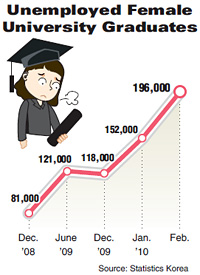
Not only has youth unemployment reached a 10-year high of 10% and is still rising, but the number of jobless female graduates has hit a record high, and the JoongAng Ilbo has a report on the structural and discriminatory practices responsible. Not that it gladdens me to be proved right, but this was somewhat predictable considering the fact that women were overwhelmingly targeted for recession in the financial crisis, as I reported in my very first Korean Gender Reader post in January 2009 (source right: Korea Times).

12) Breaking the myth of Korean homogeneity

While not a gender issue at first glace, actually it’s difficult to think of a gender issue, or rather sexuality issue, in which Korea’s “bloodlines”-based nationalism and its preservation doesn’t play a role, and for more on which I highly recommend Ethnic Nationalism in Korea: Genealogy, Politics, And Legacy (2006) by Gi-Wook Shin. Here, Halfie Trots the Globe translates and discusses the article Indian Ayodhia’s twin-fish motif as evidence of its marriage-based relationship with Gaya by Kim Byeongmo, a professor of Anthropology and Archaeology at Hanyang University, and which demonstrates India and Korea’s historical relationship and evidence of some intermarriage 2000 years ago.

13) Northeast Asia

– Taiwan launches million dollar baby-making slogan search

Alas, while Taiwan has much the same problems as Korea with its low birthrate, it isn’t that desperate, and the prize is for 1 million Taiwanese dollars, or US$30,000. My apologies, but I don’t know if English slogans are acceptable…

– Domestic violence cases souring in Japan

But this may actually be positive, reflecting greater awareness and reporting:

The number of domestic violence cases police recognized in 2009 soared 11.7% from the previous year to 28,158, the highest since an annual survey began in 2002, the National Police Agency said Thursday. An NPA official ascribed the rise to increased reports to police and consultations with them by citizens amid growing awareness of domestic violence in Japan.

See here for links a brief video offering some background, from April 2009. And actually, despite appearances, much the same revolution is occurring in Korea, primarily because of women’s greater willingness to report and prosecute abusers and a sea-change in the police’s attitudes towards it (see here for a long post providing some background also).

– Ex-Prada employee sues Japanese division for discrimination

To be precise, she was fired for refusing to fire staff because they were “ugly”. From New York Magazine:

An ex-retail manager for Prada’s Japanese division, Rina Bovrisse, has followed through on her pledge to file a discrimination lawsuit against the company. Bovrisse claims she was asked to fire store managers and retail staff members whom Prada Japan’s CEO found visually unappealing. After filing a complaint about this with the Tokyo District Court in December, she was fired from the company

– Tokyo municipal government plans to outlaw child-porn manga

According to The Economist:

The Tokyo municipal government plans to vote on March 30th to amend an ordinance against child pornography to include “non-existent minors”. Much Japanese porn comes in forms that escape rules covering photos and videos: manga; anime (cartoons); and video-games. Existing bans are meant to protect the child victims. “Virtual” porn—where there is no harm to a real person—is illegal in some countries to protect public morals and ensure a safe environment for children. Last month an American court sentenced a man to six months in prison for possession of Japanese manga child pornography.

With qualifications for the age of viewers and the context in which it is received, then personally I’m completely against the banning of simple drawings, no matter how morally objectionable the content. But regardless, see here for more on a (belated) crackdown on the photos and DVDs in 2008, and which of course I was completely in support of.

If you reside in South Korea, you can donate via wire transfer: Turnbull James Edward (Kookmin Bank/국민은행, 563401-01-214324)

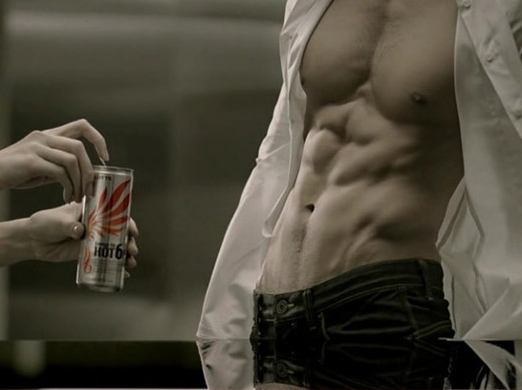
Korean Sociological Image #35: Ready for some Hot 6iX?

(Source)

For all the misreadings of the title that undoubtedly brought many of you to this post(!), “Hot 6iX” (핫식스) is just a simple energy drink really, albeit a deliberate attempt by Lotte Chilsung (롯데칠성음료) to produce a Korean equivalent of Red Bull for the domestic market. And ultimately to belatedly tap into the global market too, currently worth 1.4 billion dollars and growing 20% every year despite the recession.

An avid drinker of “V” back when I lived in New Zealand, I think it’s about time. Much more interesting than the drink itself though, are what the 4 advertisements produced so far tell us about how quickly the Korean media is changing, and especially how men and women are presented therein. With apologies for giving the game away somewhat with the opening image, here they are:

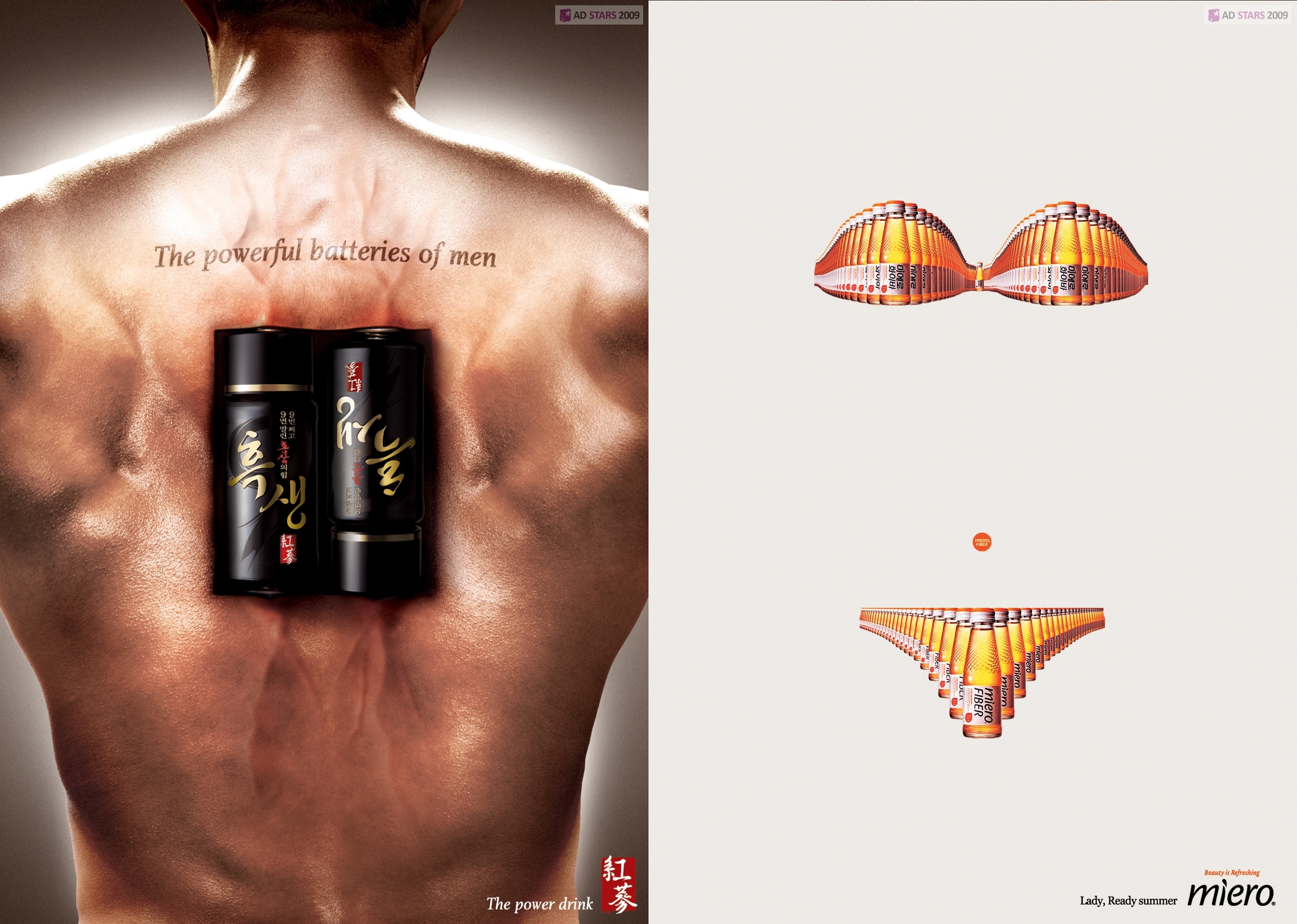
Although my wife and I laughed at the joke in the first one too, I confess that I was already well into writing this post after only seeing the two featuring women. For they confirmed a strong and enduring division in the marketing of health, energy, and/or sports drinks whereby those aimed at men tend to promote the idea that the drink will give them extra energy for work, exercise, or even sex, but those at women that it will simply help them to lose weight. A phenomenon by no means confined only to Korea, you can imagine my surprise then, when I learned of the 6iX ad aimed at female drinkers also.

(Sources: left, right)

And although it sounds rather awkward, my delight too. For with the proviso that the objectification of men can be just as problematic as that of women, and its occurrence in the media in numbers comparable to that of women a bizarre and somewhat unlikely “solution” for the latter, I’d like to throw open for discussion the notion that any objections any of you may have – or imagine that others may have – to those first 2 advertisements are somewhat mollified by having an advertisement featuring a man also.  Or alternatively is that just me, and/or are the advertisements with women not all that objectionable in the first place?

Meanwhile, expect to see many more advertisements like them in coming months: the 4 above all have random numbers assigned to them, much like what were ultimately 30 or so in this “Confessions of 20-somethings” (스무살의 고백) advertising series of Maxwell House (맥스웰하우스) that started last year (see #2 here). And on a final note, it’s difficult to believe that advertisements objectifying men like this only really started in earnest last year, yes?

Update, July 2012: Alas, my prediction was completely wrong. There were no new commercials for over 2 years, and the new ones released this month don’t objectify either sex at all (although they do still target both men and women). See here for all the 2012 and 2010 ones.

(For more posts in the Korean Sociological Images series, see here)

Korean Sociological Image #34: Child Sex Offender Kim Kil-tae Caught

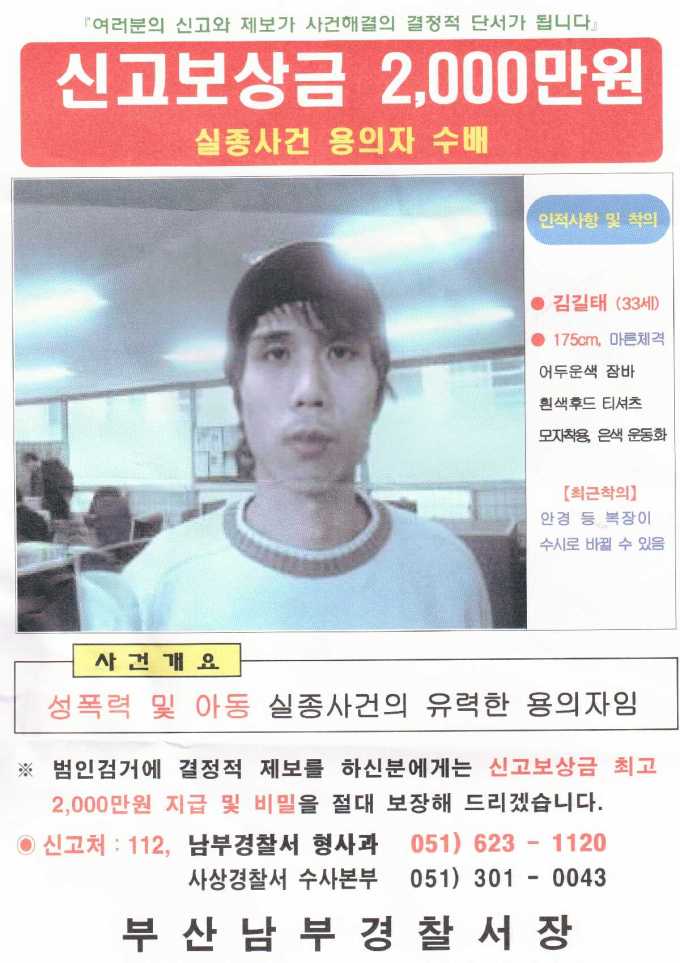
Whether in response to intense criticism of the government’s policies towards sex offenders or of their own accord, I was still very impressed with the police for sending this wanted notice for Kim Kil-tae (김길태) to all Busan households yesterday, the main suspect in the rape and murder of 13 year-old Lee Yu-ri (이유리) last month. The first time I’d ever received a wanted notice in the mail in 10 years in Korea, let alone for a crime that occurred last Saturday at the other side of a city of 3.6 million, I thought it was significant enough to warrant a post in its own right, but I’m happy to report that literally as I began typing that the news came through that he has been caught.

I’ll update this post as more information becomes available. The reward, by the way, was for 20,000,000 won, or roughly 17,700 US dollars.

Update 1 – I’ll let this news speak for itself:

Rival parties agreed Wednesday to convene a one-day parliamentary session this month to act on a series of bills calling for tougher punishment for sex crimes, an unusual bipartisan move reflecting nationwide outrage over the recent rape and murder of a teenage girl.

Read the rest here. On a more reflective note, see Extra! Korea for a brief discussion on the possible role of absentee parents in this and similar crimes.

Update 2 – The Korea Times has a report about his apprehension here.

Update 3 – The Hankyoreh’s take on it is here. Earlier, it used the original crime itself to criticize unrelated policies of the Lee Myung-bak administration in a cartoon, and while I’m generally sympathetic to the newspaper (it’s the only Korean newspaper which doesn’t caricature and/or deliberately misrepresent foreign English teachers for instance), it does seem to have a habit of that sort of thing.

Update 4 – Via ROK Drop, here are the latest developments in the case:

The police investigation of a recent rape and murder case of a teenage girl in Busan is facing difficulties due to lack of evidence.

The 33-year-old, Kim Gil-tae, caught Wednesday, has denied the charges and remained silent during interrogation, said officials.

He only admitted stealing money and keys in a nearby hair shop while he was hiding from police.

Investigators requested an arrest warrant on Thursday, based on genetic evidence such as Kim’s DNA found in the body of the 13-year-old victim, Lee Yu-ri.

The police, however, have so far failed to collect definitive evidence linking him to the murder.

Read the rest at the Korea Herald here. Personally, I’m a bit confused and surprised though, as how on Earth can the fact that his DNA was found inside the body not be the “definitive evidence” required?

Update 5: Initially denying it, the news has just come in that Kim Kil-tae has now confessed to the crime.

(For all posts in the Korean Sociological Images series, see here)

Share

Open Thread #7: Candy to my Ears

(Source: Nbbang)

Sorry, but it had to happen eventually: I’ve fallen in love with K-pop.

Well, with 3 more remixes from Greek trance DJ Areia to be precise. With apologies for dispensing with my normal analysis of the songs on this occasion, but I can’t remember the last time that I liked new music so much that I’ve lost sleep listening to it over the next few days.

Seriously, this music makes me feel like a smitten teenager, and hopefully it will some of you too.

The first track is My Ear’s Candy by Baek Ji-young, from her mini-album EGO that came out in August last year (the MV also features Ok Taec-yeon of 2PM). Curious about her music after recently writing about her soju ad, this is the gateway video got me hooked:

But not so much because of the cinematography and costumes, although I confess I have always loved that look with the white wig. More because Baek Ji-young looks like she’s genuinely enjoying herself, which makes a refreshing change from the forced smiles of Girls’ Generation in Oh! for instance, or alternatively the seeming disdain for the viewer that U.S./Barbadian singer Rihanna displays in Shut Up and Drive that SM Entertainment has been accused of plagiarizing.

Granted, Rihanna’s persona is appropriate for the title of the song, and I’m not so naive as to not be aware that Baek Ji-young’s may be just as carefully choreographed for this one also. But still, she does look like someone great to go clubbing with ;)

As for the remix, arguably it is very similar to the original (as is the next song too), so you may well be wondering what the point is. But there are differences, and which, as all trance aficionados are well aware, unfortunately you’re likely to be completely missing if you’re listening via your tinny computer speakers. Please try headphones instead, and you may be pleasantly surprised!

Next is Like the First Time,  by T-ara (say “tiara”). Put off by their simply atrocious Bo Peep Bo Peep (보핍보핍) last year though, and which even Areia’s remix could not save, then I’d never have suspected that this one would become my new favorite:

As happens to many viewers of K-pop these days, you might be very surprised to learn that one member of the group, Park Ji-yeon, is still only 16 (as is one girl in the next video too, but she looks her age). But that’s a long discussion I already had earlier this month; instead, consider this assessment of the of the the dancing and clothing in the video by Areia himself, as it partially inspired the topic of one of next week’s posts, and I’m very curious to hear your own opinions of it before I start writing:

The girls are supercute throughout the video and I find them very sexy at the scenes with the black dresses. The way they slowly move to the melody just kills my heartbeat every single time. To the untrained western eyes the video might just seem a bit cute or even silly. “It’s just some girls with short black dresses trying to look good, so what?” my overexposed-to-western-sexiness friends back home would say. But there is a huge difference here and this difference is very representative of the gap between the eastern and western stereotypes. It’s not okay to express too directly in Korea and that leaves you with only one acceptable weapon to tease your target: charm. And this is exactly what these girls are doing with their moves in this video – I’m not referring to the cute scenes. Whoever did the choreography and the dresses knew very well what they were doing. And the girls of course have done an excellent job at being charming. When I watch some sexy western video clip (let’s say Buttons from Pussycat Dolls) it hits my eyes. But this charm here hits me straight in my heart – I feel like wanting to hug the girls not…. Perhaps that’s the reason I’m into Asian pop in the first place.

Finally, here is Please Don’t Go by CL and Minzy (the 16 year-old) of 2NE1 (투애니원; say “to anyone” or, confusedly, “21”). No music video being made, then this one of a performance of theirs is unremarkable, but this remix at least is virtually unrecognizable from the original song, and in my opinion a vast improvement:

Update: For reasons explained here, unfortunately Areia had to delete that video, but the MP3 is still available for download.

Click on the titles of all the remixes for links to where you can download MP3s of them, and detailed explanations of what when into making them. I hope you’ve enjoyed them, but if not then thank you for bearing with me, and please remember that this is still *cough* an open thread, where you can raise anything on your mind.

Speaking of which, as of yesterday I am now officially in the job market again, and so would very much appreciate any readers help in getting jobs teaching adults in either Busan or Seoul, or of course anything not involving teaching at all. Unfortunately with having a family to support then I’ll need at least 3 million won a month before moving to Seoul especially, but hopefully that won’t prove too difficult?

Wish me luck!

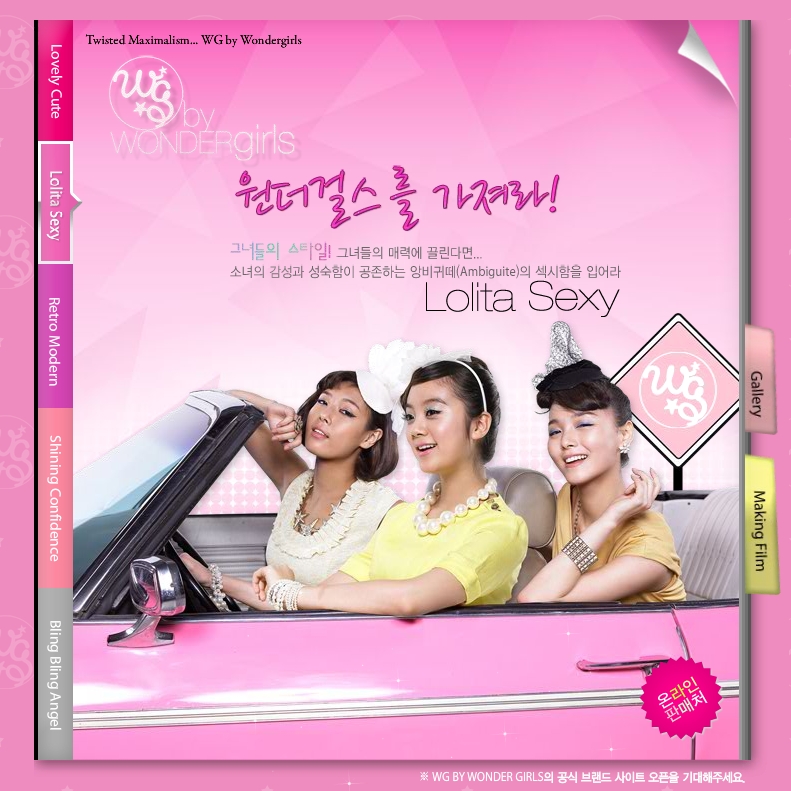
Korean Sociological Image #33: Take the Wondergirls, Lolita Sexy Style!

Source: Wgby

Well, that is literally what it says:

원더걸스를 가져라! 그녀들의 스타일! 그녀를의 매렬에 끌린다면…소녀의 감성과 성숙함이 공존하는 앙비귀때(Ambiguite) 섹시함을 입어라

Take the Wondergirls [with you]! Their style! If you are attracted to their charm…wear Ambiguity’s sexiness, which has both girls’ sense and maturity.

But lest I give the wrong impression, it’s just the name of one line of JYP Entertainment’s new Wondergirls-themed cosmetics brand. And given the essential randomness of the names of the others too, and the fact that English terms routinely get incororated into Korean almost completely devoid of their original meaning, then I doubt that much thought went into it. Certainly it’s difficult to argue for nefarious intent in this case at least.

Still, it’s inappropriate.

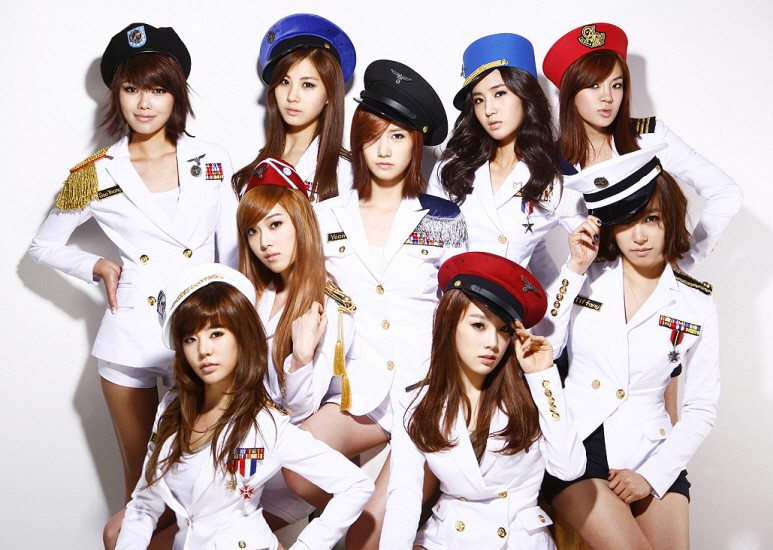
Debuting in early-2007 when 3 of the 5 members were only 14 years old, the Wondergirls have been routinely described as Lolitas by the Korean media ever since; as were Girls’ Generation, and presumably as all the teen members of the new girl groups following them will be too. Using that term while simultaneously denying the sexual connotations to it however, is an oxymoron, and part and parcel of the Korean public’s wider refusal to acknowledge the sexual ways in which they’re marketed.

Hence the name is problematic. But granted: this is a tired theme, so for a change, it was very encouraging to see music columnist Kim Bong-hyeon (김병현) challenging that myopia earlier this month. And now I’ve also learned of a famous essayist and surgeon named Park Kyung-chul (박경철) too, who asked probing questions to Girls’ Generation members themselves in an interview nearly 2 years ago. Thanks very much to “A Korean Student” for passing on a partial translation, which I’ve posted with their commentary below:

Source: AsianPopcorn

…[In an interview] ironically subtitled: THEY ALWAYS ASK IF WE REHEARSED OUR ANSWERS. WHY CAN’T YOU BELIEVE OUR WORDS?, Park deliberately asks “difficult” questions and gets guarded and somewhat obtuse/hostile answers in return. Park is an ajusshi but definitely not a fan of entertainment industry, and there was also a chaperon/manager present. Here’s a translated excerpt:

QUESTION: Let me ask you some questions that might be uncomfortable. Do you think the word ‘Girls’ Generation’ is really innocent as it sounds? Don’t you think there’s a disguised sexy code [sic] behind the mask of innocence?

ANSWER: Anyhow we are not the ones who created that code. We know there are people who see it that way. It hurts to read ogling comments about us on the internet sometimes. But presenting the innocent girls’ image as it is—that is what has made us [successful.] We’ve shown you an image of girls who are growing up, and we will continue to do so in the future. Of course when we get older, it will be different. But that time hasn’t come yet. If they choose to see us like that, that is not really our problem. Why do you/they want to do it anyway? We are still kids. Don’t you think the real problem lies not in the way we show ourselves as we are, but in the fact that you/they compulsively see what us kids don’t actually possess?

Source: Unknown

And here Park thinks to himself:

But the girls’ rather uniform make-up style, obvious traces (to my trained surgeon’s eyes, that is) of cosmetic surgeries, their miniskirts, and the way they sit and dress—-all this “processed” feel leads me to think of the unknowingly worn facade of ‘ladies,’ not ‘girls.’

Whew. Talking about double entendres. Frankly, the girls react like hard-bitten soldiers who live in barracks. (Like most teenage idol groups, they’ve actually lived together in a dorm-apartment for many years.) Park even likens them to slippery politicians. So I guess you can throw away the notion of naivete, at least in GG’s case. I’d say they are fully aware, perhaps more so than the others, of the contexts surrounding them. Not sure about the interviewer though. The guy’s kind of ambivalent, though not as unreflective as the music columnist.

Imagine that, next we’ll be hearing that they eat and fart too!

You are not too far off the mark, but probably not in the way you mean. LoL (end)

James: Thanks again for the translation, and very much a healthy reminder to myself of how much I may have missed before I started regularly using Korean-language sources on this blog!^^

(For all posts in the Korean Sociological Images series, see here)

If you reside in South Korea, you can donate via wire transfer: Turnbull James Edward (Kookmin Bank/국민은행, 563401-01-214324)

Ajosshis & Girls’ Generation: The Panic Interface of Korean Sexuality

Girls' Generation's Ajosshi Fans…Gender matters in the ways that it shapes social interaction. Identities, of course, are products of and sustained through interactions with others. Social interaction thus is an important setting in which gender emerges and is enacted. As Ridgeway (p. 219) observes: “It is striking that people are nearly incapable of interacting with one another when they cannot guess the other’s sex.” That the identification of someone as male or female facilitates social interaction testifies to this category’s power in social life. (Amy Wharton, The Sociology of Gender {2005}, p.10)

And throw in my age, ethnicity, and language difficulties into the mix too, then you’d think that discussing gender issues and sexuality with Korean women would be quite a trying experience sometimes (source, above).

Ironically though, I usually find them to be better informed and more willing to talk about them than men.

One reason might be because women the world over tend to be better language learners, and as my Korean speaking ability is much worse than my reading ability, then my conversations with Koreans on abstract subjects are confined to those with relatively good English.

But that doesn’t explain the relative disinterest of Korean men at the same level,¹ and so more much likely is that whatever their degree of interest originally, sooner or later all women are invariably forced to deal with at least the consequences of Korea’s systematic sexual discrimination, perhaps the first time being when they’re deliberately shunted into non-advancing career tracks as they enter the workforce, under the assumption that they’ll no longer work (or be fired) upon marriage or childbirth.

In contrast, such things usually impact men at a much later stage in their life cycles, if at all. Perhaps when trying to decide with his wife if they can afford to have a second child for instance, and/or if it’s worth her returning to work when she will likely only bring home 41% of the wages he does, the highest gender wage gap in the OECD. Indeed, if my wife — a 31 year-old mother of two — wasn’t lucky enough to be able to work from home as a recruiter, then we’re not entirely sure what she could do, and even that is hardly an advancing career.

That is not to say that Koreans are only ever interested in issues that directly concern them of course, or that there aren’t parallels in other countries. But there are still yet more factors working against Korean men being interested in gender issues. Most notably the profoundly patriarchal ideology of Neo-Confucianism that is all-pervasive here,² buttressed by the the socialization experience undergone during their mandatory military service.

(Source: unknown)

Admittedly these are generalizations, and to an extent they become self-fulfilling: as I’ve gotten older, I find it more and more difficult to find the effort to befriend Korean men, so different do I expect our work-family priorities and opinions on gender issues to be. This inhibits me from raising such issues in free-talking sessions with advanced students also, although in that case it’s more because I respect that their purpose in attending my classes is not for me to lecture to or argue with them.

But surely there must be some feminist Korean men out there? If you are one, or know of one, then by all means let me know! But unfortunately the differences are real, and a good illustration of the difficulties in finding common ground on gender and sexuality issues are our opinions on — you guessed it — teenage girl groups like Girls’ Generation (소녀시대) and the Wondergirls (원더걸스).

Why the focus on them specifically? It’s a reasonable question, as they’re not the first young girls groups in Korea. What distinguishes them though, is that they are the first groups explicitly created to appeal to men 20 years their senior, and as such they are very much at the forefront of the increasing sexualization of young girls in the Korean media in recent years, setting the tone for the wave of 15, 16 and 17 year-olds following them.

Where I and most 30 and 40-something Korean men — ajosshis — differ on them is that I don’t buy into the collective narrative that we all like these girl groups because we have a brotherly, paternal, or avuncular affection for their members. Instead, while I can’t imagine having any kind of sexual or romantic relationship with them in reality, I’d be lying if I said I didn’t want to bang them whenever I see them on stage…and so would those ajosshis. Try to get one to admit that though, even one you know well and in a bar just with other men like themselves, and you’ll soon realize that not for nothing do I use the term “panic” in the title of this post.

(Source)

I also use “interface,” because acknowledging things like why 15 year-old f(x) band member Sulli’s (최설리) shorts are so high above, for instance, or why she is pulling her dress up in the other pictures in that photoshoot, are very literally where commercialized teenage sexuality and conservative Korean social mores meet. And I seriously doubt that pressing issues of teenage prostitution and abysmal sex education can even begin to be rectified while the collective Korean establishment — read: ajosshis — can’t admit to something so blatantly obvious.

But this is on old, tired theme for regular readers, and not what this post is about. Rather, I’m belatedly concerned with the question of why it is the case.

One possible reason is Occidentalism, for as blogger Michael Hurt argues, this platonic rationalization:

…parallels the notion in idea that in Korea, people are all good, clean Confucians who don’t do dirty things (but just save it for the love motels and leave that “skeleton bone” there – hehe, yes, I meant for a double entendre to be read there!), while Americans apparently hump everybody, according to everybody not American.

And recall that Occidentalism doesn’t actually need a physical Occidental in the room in order to be operating: indeed, it’s better that there isn’t, for greater distance gives greater leeway to imagine an “other” with which to advance a domestic agenda. And that proves to be the crucial point here, for as the following translation of a Korean music columnist’s thoughts reveals, all of this is by no means merely a face-saving device employed to obscure unsavory aspects of Korean society from inquisitive foreigners.

I warn you: the translation is rather long, a little melodramatic in places (less so in the original Korean, my wife assures me), and doesn’t actually offer an answer as to why. But still, I’m glad to have made a start by removing the “wild card” of the foreign observer from the equation:

(Zhang Wei, 2006?)

“‘섹 시한소녀시대 좋아하는 죄 인가요?” (or 대한민국평균아저씨소길동 고백)

Is it a Sin to Like Girls’ Generation Because They’re Sexy? (or The Confession of an Average Korean Man)

Kim Bong-hyeon, 4th February 2010

이제 고등학교에 입학하는 조카가 있다. 조카는 ‘소녀시대’의 팬이다. 당연히 이번 달 단독 콘서트 예매도 이미 끝냈다. 조카는 특히 서현을 좋아한다. 한정판 소녀시대 카드 중에서 다른 멤버들 것은 줘도 서현의 것은 끝내 안 준다. 소신이 뚜렷한 녀석이다. 크게 될 놈이다.

내가 글쟁이인 것을 아는 조카는 며칠 전 이번 새 앨범 음악이 어떠냐고 물어왔다. 해줄 말 중에는 좋은 것도, 나쁜 것도 있었다. 어차피 나쁜 말하면 귀담아 듣지 않을 테니 대충 좋은 말만 하고 넘어갔다. 실은 내가 오히려 묻고 싶은 게 하나 있었다. 하지만 묻지 않았다. 이것이었다.

“네가 진짜로 소녀시대를 좋아하는 이유가 뭐야?”

At the moment, I have a nephew entering high school. He’s a fan of Girls’ Generation. Of course, he has already reserved a ticket for their concert this month. His favorite member is Seo-hyeon, and while he will happily exchange picture cards of other members with his classmates and friends, he won’t trade any of her. Clearly he is a man of his own ideas, and is destined for great things!

Knowing that I was a writer, my nephew asked what I thought of their new album. It has good and bad points, but guessing that he wouldn’t have listened to the latter, I just talked about the good things. But actually there was something I wanted to ask him (although I didn’t), which was:

What is the real reason that you like Girls’ Generation?

(Source)

이걸 묻고 싶었던 이유는 간단하다. 나 자신에게 물어봤는데, 나에게서 나온 대답이 정답인 것 같아서 다른 남자(!)에게도 확인해보고 싶었기 때문이다. 한마디로, 나는 소녀시대가 ‘섹시’해서 좋다. 물론 기본적으로 귀여운 매력이 크긴 한데 섹시한 매력도 나에게는 그 정도 크기는 된다.

이게 무슨 뚱딴지같은 소리냐고? 노파심에 말하자면 나는 변태도 아니고 과대망상증 환자도 아니다. 그리고 이제는 자신 있게 말할 수 있다. 소녀시대는 분명히 섹시하다. 정확히 말하자면, ‘섹시하지 않은 척 하면서 섹시’하다.

내가 소녀시대에게서 섹시함을 느낀 건 ‘Gee’ 이후였던 것 같다. 그전까지 소녀시대는 나에게 그저 귀여운 여동생에 불과했다. 그러나 소녀시대가 Gee로 컴백해 딱 달라붙는 배꼽티와 스키니진을 입고나오자 ‘소녀’는 ‘그녀’가 되었다. ‘소원을 말해봐’는 ‘Gee’의 심화판이었다. 핫팬츠와 하이힐, 제복을 입고 그녀들이 내게 ‘소원을 말해보라고’ 외쳤다. 신곡 ‘Oh!’는 한술 더 떠 치어리더 콘셉트다. 더 무슨 말이 필요하나.

The reason I wanted to ask this was simple. I knew why I liked them – and all men like them – but I wanted to confirm that he would give the same answer: that it’s because they’re sexy. Of course, they do also have a cute charm about them, but they’re at least as sexy.

What foolish talk is this you ask? But no, asking this does not mean I am a pervert, nor that I’m a mental patient having excessive sexual fantasies about Girls’ Generation. Rather let me say this: of course, Girls’ Generation are sexy. Or to be more accurate, they are sexy while pretending not to be.

It was with their song Gee that Girls’ Generation really started appearing sexy to me; before that, they were merely like little sisters. But then they started wearing tight, clinging croptops and jeans, and the girls had changed to women. This was even more so with their song Tell Me Your Wish, combining hotpants, high-heels, and uniforms while crying “tell me your wish…”. And with their new song Oh!, they continue that theme with a cheerleader concept. What more is there to say? (Source, below).

여기서 중요한 건 섹시 그 자체가 아니다. 소녀시대보다 섹시한 가수들은 얼마든지 있다. 포인트는 소녀들이 ‘더없이 순수한 눈망울’을 하고선 남성의 성적 판타지를 자극하려는 의도가 분명한 옷과 액세서리, 그리고 노랫말과 춤동작을 선보인다는 점이다. 나는 고민에 빠진다. 그 순수한 눈망울들이 나를 죄책감의 구렁텅이로 몰아넣는다. 내가 저 천사 같은 아이들을 두고 대체 무슨 상상을 한 걸까. 나는 변태인가. 난 누군가 또 여긴 어딘가.

분명히 맞는 것 같은데 증명할 방법이 없다. 섹시함을 주 무기로 삼으면서 겉으로는 그렇지 않은 척한다. 그런데 더 가관(?)인 건 그렇지 않은 척하니까 대놓고 그러는 것보다 더 섹시하다는 거다. 낮에는 현모양처, 밤에는 요부를 바라는 어쩔 수 없는 남성의 본능이다. 가히 최악의 상황이다.

이런 상황에서 ‘기획사 너희들! 일단 남성의 성적 판타지를 정확히 자극한 것에는 10점 만점에 10점을 주겠어. 대단히 유효한 전략이었지. 하지만 어린 여자애들 데리고 더 이상 교묘하게 섹스를 팔지 마! 이제 더 이상 당하지 않아!’, 이렇게 외친다면 (비록 속은 다를지라도) ‘아니, 어떻게 이렇게 귀여운 여동생을 보고 그런 천박한 생각을…’, 하며 경멸어린 시선으로 변태 취급당할 가능성이 다분하다.

The important point here is not how sexy they are: there are many female singers sexier than Girls’ Generation (James: I think he means more “sexual” than sexy). Rather, that despite their innocent expressions, Girls’ Generation’s clothes, accessories and lyrics are all designed to provoke men into having sexual fantasies about them. But this leaves me feeling a little perturbed and guilty: how can I think like that when I see those angelic faces? Am I a pervert? Who am I…where am I?

This is all true, but it is impossible to prove. While deliberately being sexy, Girls’ Generation pretend that they aren’t. Which proves to be even sexier than it they just admitted it, for every man’s instinct is to have a woman who is a wise mother and good, virtuous wife by day, but a shameless hussy at night.

This is a very bad situation.

About this, I say “To the people that work at the company! First, I give you 10 out of 10 points for knowing what stimulates men’s sexual fantasies so well. But please stop using these young girls to sell sex so skillfully! I won’t put up with it anymore!”. And I do so even though many people may scorn me and label me as a pervert, asking how I can think such things of such cute, innocent girls.

과연 나만 이런 생각을 하는 걸까? 나만 섹시함을 섹시함이라 말하지 못하는 ‘소길동’의 덫에 걸린 걸까? 아니라고 본다. 모르긴 몰라도 적지 않은 대한민국 성인 남성이 나와 비슷한 고민을 하지 않으려나?

여기서 두 가지 고민이 발생한다. 그리고 그 전에 하나 전제되어야할 것이 있다. 바로 ‘소녀시대의 기획사는 어린 소녀들을 통해 남성의 성적 판타지를 자극해 교묘히 섹스를 판매한다’는 합의다. 물론 이 같은 판단에 소녀시대의 팬이나 어린 학생들, 그리고 여성들은 동의하지 않을 수도 있다.

이유는 여러 가지다. 우선 소녀시대의 팬들에게 이 같은 지적은 소녀들에 대한 모욕일 수 있고, 어린 학생들이나 여성들의 경우에는 진심으로 이러한 부분을 체감하지 못했을 수 있다. 그러나 이것은 엄연히 현존하는 사실이다. 양해를 구한다. 그렇게 사실로 인정하고 넘어가도록 하자.

Well, am I the only person that thinks like that?Am I the only guy to have fallen into the trap of not recognizing sexiness when I see it? I don’t think so. In fact I think that all Korean adults suffer the same.

Based on the premise that Girls’ Generation’s company is skillfully encouraging men to have sexual fantasies about the group and basically selling sex then all this raises two problematic issues to worry about. But I don’t expect many fans, young students and women to agree with me, for many reasons: first, because to Girls’ Generations’ fans, this sort of opinion is considered insulting to the group; and in the case of young students and women, they can’t really understand these physical feelings of men. But while I seek their forgiveness, the facts remain. Let’s continue on that premise (source, left).

첫 번째 고민은, ‘욕망하는 것은 과연 나쁜가’이다. 더 정확히 말하면 ‘의도된 자극에 예상된 욕망으로 반응하는 것은 나쁜가’가 되겠다. 말이야 바른 말이지 은근슬쩍 성적 판타지를 자극해 오는데 모른 척하며 억지로 속으로 눌러야 하나? 오히려 그게 솔직하지 못하고 자신을 속이는 것 아닌가? 남에게 피해를 주지 않는 솔직함은 미덕이라고 배우지 않았나. 굳이 말을 하자면 자극받는 쪽보다 자극하는 쪽이 나쁘지 않느냐는 말이다. 하아, 나는 왜 불필요한 죄책감에 사로잡혀 있었을까. 문제는 개인이 아니라 구조이고 시스템인 것을.

두 번째 고민은, ‘어린 소녀들을 통해 섹스를 파는 행위는 과연 나쁜가’이다(‘미성년자’라는 법적 개념으로도 판단할 수 있겠지만 여기서 논하려는 건 그러한 차원은 아니다). 어떻게 보면 누이 좋고 매부 좋은 거래가 아닌가. 기획사는 돈을 벌고, 소녀들은 스타가 되고, 대중은 욕망을 충족한다. 소녀들이 특별히 공공질서를 저해하는 음란 행위를 하는 것도 아니고, 대중이 소녀들에게 위해를 가하거나 범죄를 저지르는 것도 아니다. 상부상조하는 좋은 거래다.

The first thing to worry about is the question of if desire is a bad thing. Or to be more precise, is getting sexually stimulated bad when that is the deliberate and expected reaction? Does the fact that it is done indirectly and stealthily mean that we have to pretend that we don’t feel aroused? Isn’t that being dishonest and deceiving yourself? We all know that as long as it doesn’t cause harm to others, honesty is a virtue. And surely it is worse to so insidiously arouse men than to feel aroused. Why on Earth was I feeling guilty about this? This is not a problem with myself, but more a systematic thing.

The second worry is that the act of using young girls to sell sex is bad (I don’t want to discuss the legality of using minors for this though). But if you look at it in a different way, it is can actually be a good thing. The company makes money, the girls become stars, and men’s sexual desire is satisfied. Nor are the girls committing indecent acts, or the public harming ordinary girls in any way or commit crimes against them. So in a sense, everybody helps each other.

그러나 이렇게 간단하게 정리하고 넘어갈 문제가 아니라는 게 바로 문제다. 기본적으로 나는 욕망하는 주체다. 그리고 욕망하는 나 자체는 건강하다. 그러나 내 욕망을 충족시켜주는 것들이 모두 옳은 건 아니다. 다시 말해 나는 내 욕망의 정곡을 찔러주는 소녀시대의 무대를 보면서 기획사의 의도대로 욕망을 느낀다.

하지만 그 반대편엔 욕망의 크기만큼이나 커다란 이성 역시 자리 잡고 있다. 나는 소녀시대가 내 성적 판타지를 충족시켜준다는 점을 인정하면서도 동시에 그들 기획사의 전략이 야기할 부정적인 단면들을 고민한다. 즉 나는 끊임없이 욕망하면서 동시에 그 욕망을 충족시켜주는 것의 올바름에 대해 끊임없이 의심한다.

그렇게 의심해본 결과, ‘섹시하지 않은 척 하면서 섹시한’ 소녀시대는 몇 가지 문제점을 내포하고 있다. 먼저, 이것은 기획사의 입장에서는 분명 대단히 효과적인 돈벌이 전략이지만 사회적으로는 성의 이중성을 더욱 공고히 할 뿐이다. 성적 판타지를 자극하도록 설계된 소녀들에게서 당연하게(?) 예정된 욕망을 느끼더라도 남성들은 그것을 제대로 표출할 수 없다. 욕망 표출의 해방감 대신 그들에게 부여되는 것은 일종의 죄책감이다. 욕망은 점점 안으로 파고 들어가고 겉과 속은 달라진다. 그렇게 섹시한 것을 섹시하다고 말하지 못하는 소길동이 되어간다.

Unfortunately, the problem isn’t as simple and easily resolved as that. Basically, because I have sexual desire. And that is healthy and good, not a sin. But not everything that arouses me is correct and proper (James: should be acted on?), and one of those is watching Girls’ Generation dancing on a stage.

On the other hand, while I do have sexual desire, I have just as much logic and rationality to me. So although I admit to at the fact that Girls’ Generation arouses me, at the same time I worry that I am just being manipulated by their company. Or in other words, while I am unceasingly aroused by them at the same time I think seriously about if both that and what the company is doing is correct and appropriate.

As a result, I realize there are many problems to Girls’ Generation being sexy while pretending not to. First, while it is undoubtedly a very effective strategy for the company to make money, to society it reaffirms that there is a public and private face to put on sex. For while the group is designed to stimulate men’s sexual fantasies, they can not admit to this. Rather than expressions of sexual liberation, they must instead have guilt about how differently they feel inside and what they must actually say. This is why you have men like me saying that sexiness is something else entirely.
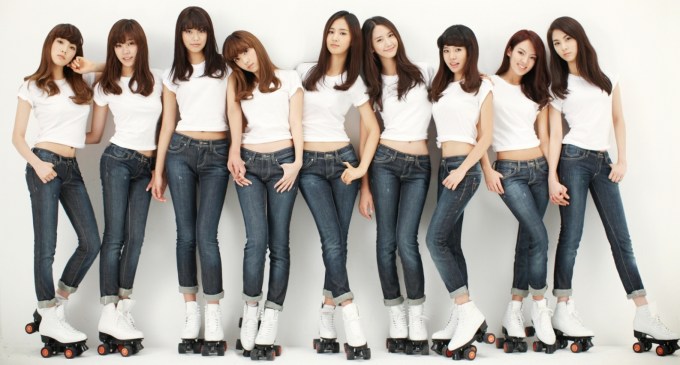
(Source: unknown)

또 하나. 다름 아닌 소녀들 걱정이다. 윤아 걱정, 유리 걱정, 무엇보다 우리 조카를 위해 서현 걱정이다. 어쩌면 이게 제일 중요한 문제일지도 모른다. 나는 소녀시대의 무대를 볼 때마다 매번 이런 생각이 든다. 쟤네들은 자기가 어떻게 소비되는지 과연 알고 있을까? 남성들의 시선과 속마음에 대해서는 얼마나 알까? 만약 알고 있다면 그게 쟤네들이 원하는 걸까? 혹시 기획사의 의도와 속내가 충돌해 괴롭지는 않을까?

이게 무슨 오지랖이냐고 웃을지도 모르겠다. 하지만 ‘소녀들도 이제 엄연한 법적 성인이니까 자기 일은 자기가 알아서 하겠지’라고 안일하게 생각하기에는 아직도 소녀들은 많이 어릴뿐더러 소녀들 개개인의 힘에 비해 시스템의 권력이 너무 크고 거대하다. 또한 ‘자본주의 사회에서 소녀시대 역시 하나의 상품이며 상품이 된 것 역시 소녀들의 선택’이라고 치부하기에는 머릿속에서 ‘인간의 존엄성’이라는 단어가 자꾸만 아른거린다.

서현. 가장 순수할 것 같고 실제로도 가장 어린 서현. 지금, 상처받지 않고 있을까? 그리고 앞으로도 상처받지 않을 수 있을까?

글을 마무리하면서 문득 지금의 내 메신저 대화명을 떠올렸다. ‘소시 앨범 득템! 화보 쩐다.’ 화보가 쩌는 건 사실이지만 아무래도 당장 다른 대화명으로 바꾸어야겠다. 갑자기 이 저열한 욕망의 바다에 물 한 방울 보태기도 싫어졌으니까.

(Source)

One more thing: I worry about the girls of Girls’ Generation themselves. I worry about Yuna, about Yuri, and most of all about my nephew’s favorite Seo-hyeon. This may be the most important issue of all, and whenever I see them on stage I think it: do they know how they are being consumed? Do they know how they are viewed and felt by men? If they do know, is that what they really want? By any chance, do they suffer from their own wishes and their company’s clashing?

People will ask why I worry about them. After all, they are legal adults. Despite that however, the system they operate in is far more powerful. And against the argument that they are in the music industry – just the product of a capitalist society – and that it’s their choice, I still frequently pause to think if it’s not an affront to human dignity.

Seo-hyeon: she looks the most innocent, and in reality she is the youngest too. To her I say are you getting hurt at all now? Or is there any way you can avoid it in the future?

As I was writing this article, I added some words next to my name in my messenger program: “I’ve bought Girls’ Generation new album! Their pictures are fantastic!”. While that is true though, I have to change it. I suddenly really don’t want to add one drop to this ocean of base, vulgar sexual desire. (end)

(Source)

As always, apologies for any errors with the translation (there’s bound to be with something of this length), and I’d really appreciate it if you could let me know if you spot any. And what do you make of Kim Byeong-hyeon’s “confession”?

Or, hell, my own? Not that I think that mine is any great surprise to long term readers of course(!), and I don’t mean to imply that I’m embarrassed at only having Korean female friends now. Indeed, most of my Western male friends here also had equal numbers of male and female Korean friends in their first few years here, only to lose the former for much the same reasons I mentioned earlier; or at least, those that like myself came in their early to mid-20s,and have stayed for 5-10 years since. And they’re by no means gender studies geeks either, although I confess that we do still talk mostly about women when we meet! ;)

What is your own experience? How are things similar or different for Western women here also?

Notes:

1) Rereading this in November 2013, nearly 4 years later, I cringe at the numerous generalizations I make based on only my own personal experience; I would be much more careful to avoid those and/or acknowledge my biases were I to write on the same subject today. On the other hand, unfortunately it’s also true that my personal experience remains largely the same.

2) I also try to avoid the “C word” these days. Although this is hardly the most egregious example, Confucianism is very overused as a catch-all, explain anything and everything device in English-language writing about Korea.

The Kafkaesque Korean Beauty Trends of 2009

(Source: Unknown)

Confused about all the new buzzwords used to describe Koreans’ bodies these days? Here’s my translation of an article that gives a quick guide.

The author implies that most of them arose organically from the public’s interest in certain actors in Korean dramas. Whereas in reality, it’s companies and the media that are overwhelmingly responsible, as they’re in a constant quest to create new consumer trends (read: new reasons for people to feel dissatisfied with themselves). Yet while most of these have no basis in reality, are essentially useless, and/or are so contrived as to be quickly forgotten or ignored, some do stick.

Of those that do though, if they have some English in them then it often makes them more interesting from a sociological standpoint. For whether by accident, mistranslation or design, they both reflect the way the term is already usually misused in Korean and further influence they way in which related English-language popular culture gets filtered into its Korean counterpart.

A good example from this article would be chongsoon-glaemor (청순글래머), or “innocent glamor,” which at first glance doesn’t seem all that strange: in her television commercials for instance, the ice-skater Kim Yuna (김연아) below manages to project an innocent image while having a seemingly glamorous lifestyle (I wonder if she’ll find the former stifling as she grows older however, like actress Moon Geun-young?). But it emerges that “sexy” would be a much better translation of the English word “glamor(ous),” and although I’m sure readers are well aware of the number of ways  in which women are presented as pure and innocent but somehow also lustful in Western popular culture, and effectively are in Korean, there are still problems with assuming that that is what the term means, as the word “sexy” isn’t construed quite the same way here. Instead, we seem to be left with an obscure term for Korean women that look more virginal than normal(?), but yet still do the mechanical “sexy dances” virtually required of them on Korean talk shows.

Anybody with more familiarity with the term and/or the actress Shin Se-kyung that supposedly spawned it, please feel free to correct me on my interpretation: after all, this is the first time I’ve looked at its origins, and just based on one article at that (Update — with thanks to Seamus Walsh for pointing it out, I did indeed make a mistake: “glamor” actually means “busty” in Korean). But with the proviso that the next means I may be cherry-picking the facts to suit my own views, it does still seem very consistent with the Korean media’s overall trend towards discouraging or outright banning of assertive displays of women’s sexuality, i.e. genuinely sexy behavior.

꿀벅지·미중년·꽃남…2009년 연예계 뷰티 트렌드는? 2009-12-31 by 두정아

올해 연예계 트렌드를 이끈 핫 키워드는 무엇일까. 꽃남과 미중년, 꿀벅지, 베이비페이스, 청순글래머 등 어느 해보다 개성있고 다양한 트렌드가 공존했던 한 해였다.

드라마 ‘꽃보다 남자’로 ‘꽃남’이라는 단어가 사람들 입에 오르내렸고, ‘내조의 여왕’의 윤상현은 ‘미중년’이라는 찬사를 받으며 남성들의 뷰티 열풍을 이끌었으며 그룹 에프터스쿨 멤버 유이의 매끈한 허벅지를 일컫는 ‘꿀벅지’와 배우 신세경의 ‘청순글래머’ 등은 여심을 자극하며 바디 열풍을 일으켰다. 여전한 ‘V라인’ 강세 속에 동안(童顔) 열풍 또한 이어져 ‘베이비페이스’라는 단어가 자주 회자됐다.

What were the hot keywords that led trends in the world of entertainment in 2009?

With kkotnam (flower man) and mijoongnam (beautiful middle-aged man), ggoolbokji (honey thighs), babyface and chongsoon-glaemor (innocent glamor) emerging, there were many very distinct trends compared to most years.

From the drama Boys Over Flowers the term “flower man” was on everyone’s lips; from Queen of Housewives the actor Yoon Sang-hyu received a lot of praise for his looks, spawning the word “beautiful middle-aged man” and a strong following among men wanting to emulate him; and women were similarly interested in the After School member UEE’s smooth and velvety thighs known as “honey thighs” and actress Shin Se-kyung’s “innocent glamor.” Finally, in addition to the eternal “V-line,” a strong interest in youthful faces has been shown by the new word “babyface” that is often talked about.

(Source: Unknown)

‘꽃남’·’미중년’, 남성 뷰티(美) 열풍

KBS 드라마 ‘꽃보다 남자’ 신드롬에 힘입어, MBC 드라마 ‘내조의 여왕’ 태봉이 (윤상현 분)가 일으킨 ‘미중년’ 열풍까지 남성들의 뷰티 열풍이 어느 해보다 뜨거웠다. 이를 계기로 남자도 외모 관리를 해야 한다는 인식이 공유되기도 했다.

거친 남성다움보다는 부드럽고 세련된 귀족적인 이미지를 선호하는 분위기로 바뀌며 성형외과나 피부과를 적극적으로 찾는 남성들도 크게 증가했다.

경제 성장을 이루던 90년대에 사회생활을 시작한 현재 30대 후반부터 40대 초반의 중년들은 전통적인 부모 세대와 달리 중년이 돼서도 문화와 여가를 즐기고 자신을 가꾸는 노력에 적극적이기 때문이라는 해석이다.

Combined, the flower man syndrome caused by the KBS Drama Boys Over Flowers and the beautiful middle-aged man craze caused by the character Tae Bong-ee in Queen of Housewives have led to men taking a great interest in their bodies. This is how the notion that men, like women, also have to take care of their bodies and appearance has become accepted wisdom.

In turn, as the preferred image of Korean masculinity has become softer and more polished, refined and noble, cosmetic surgery and skincare clinics are reporting a great upsurge in interest from men.

One additional reason for this is that even though men that grew up and entered the workforce in the 1990s are now in their late-30s and early-40s, they are very different to their parents’ generation, and choose to enjoy culture and their free time more, which includes taking a greater interest in themselves.

‘꿀벅지’ ‘소시지룩’ ‘청순글래머’ 바디 열풍 선도

올 한해 주목할 트렌드는 바디 열풍이다. 소녀시대의 지(GEE) 열풍과 함께 유행한 일명 ‘소·시·지(Gee)룩’. 몸매가 고스란히 드러나는 초절정 스키니진에 타이트한 티셔츠를 입은 여성들이 패션을 주도하면서 여성들의 S라인 욕구는 상승했다.

뒤이어 그룹 애프터스쿨 유이의 건강미 넘치는 탄탄한 허벅지가 주목을 받으면서 꿀이 발린 듯한 매력적인 허벅지라는 뜻의 ‘꿀벅지’라는 신조어까지 탄생했다.

또한 요즘 주가를 올리고 있는 단어는 ‘청순글래머’. MBC 시트콤 ‘지붕 뚫고 하이킥’ 출연하고 있는 신세경은 청순한 매력과 섹시한 관능미를 동시에 지니고 있어 ‘청순 글래머’의 대명사로 불린다. ‘포스트 김혜수’로 주목받으며 휴대전화, 화장품 광고 모델 자리를 꿰차는 등 그 인기를 입증하고 있다.

이에 대해 그랜드성형외과 유상욱 원장은 “과거 여자 톱스타들의 상징이 ‘화장품 모델’이었다면 2009년은 이효리, 신민아, 송혜교, 손담비 등 청바지 모델로 그 중심이 바뀌었다”며 “이 같은 변화는 요즘 대중들의 관심이 바디로 옮겨지고 있다는 증거”라고 설명했다.

2009 was a real year of body trends. First, there was the very popular so called “sausage look” of Girls’ Generation. Hiding nothing, the ensuing fashion of wearing extremely skinny jeans and tight t-shirts among women has sparked an intense interest by women in their S-lines.

(Update — “Sausage look” may be a mistake, as the “소시”, or “soshi”, in “소시지(Gee)룩” is also the Korean shorthand for Girls’ Generation, and the “지”, or “gee”, the name of one of their most iconic songs. So the term may mean “sausage look”, or it may mean, literally, “how Girls’ Generation looked in the Gee music video”, in which they happened to wear skinny jeans. Either way, it’s a good pun!)

Next, as a lot of interest in After School member UEE’s firm, smooth and very healthy-looking thighs emerged, the new word “honey thighs” was coined to describe thighs like them.

Another word that’s stock is rising is “Innocent Glamor.” This comes from the actress Shin Se-kyung that appeared in the MBC sitcom High Kick Through The Roof, described as the icon for women who combine a pure and innocent image with sex appeal. Considered a second Kim Hye-su also, because of her popularity she regularly appears in cellphone and cosmetics commercials.

According to “Grand Cosmetic Surgery Clinic” owner Yu Sang-ok, “in the past the symbol of top female stars was the cosmetic model, but in 2009 women like Lee Hyori, Shin Min-ah, Song Hye-gyo and Son Dam-bi have been mostly modeling jeans instead,” and “this is proof that the focus of people’s attention has moved to star’s bodies now.”

(Source: Naver)

‘V라인’ 강세, ‘베이비페이스’가 위협

올해도 ‘V라인’ 강세는 여전했다. 뭐니뭐니해도 ‘동안’, ‘V라인’, ‘작은 얼굴’은 사람들이 가장 선호하는 이미지이기 때문이다. 갸름하고 부드러운 V라인은 첫인상부터 편안하고 친근한 장점도 있다.

MBC 드라마 ‘선덕여왕’ 미실 역의 고현정은 소름끼치는 연기와 더불어 나이를 가늠할 수 없는 ‘베이비페이스’로 주목을 받았다. 투명한 피부는 물론, 볼륨감이 그대로 살아있는 생기있는 얼굴은 아기 피부 같다는 찬사를 받았다.

‘베이비페이스’는 ‘어려보이면서 입체적인 얼굴’을 말한다. 그 특징은 얼굴 옆이 아닌 앞쪽으로 볼륨감이 살아있는 얼굴로 콧등의 높이와 균형을 이루는 부드러운 곡선 모양의 탐스러운 이마 그리고 갸름하고 조금은 짧은 듯한 턱 선이 생명이다. 이러한 ‘베이비 페이스’의 열풍은 2010년에도 지속될 것으로 전망된다.

Last year, the emphasis on the V-line remained unchanged. After all, the preferred image is to have a dongan “youthful face [for one’s age],” V-line, or jakkun-olgool “small face.” And if you have a long, slender face with a V-line, people’s first impression of you will be softer and friendlier.

Hence the interest in the “Babyface” of actress Ko Hyeon-jeong, who played the character Lady Mishil in the MBC drama Queen Seon Duk, and whose acting was so good that she gave viewers goose pimples. With clear skin and glowing, firm cheeks, she has received a lot of praise for having a face as good as a baby’s.

But a babyface has been described as a “solid, 3D face.” In particular, it’s not just the volume of the cheeks on the side but also the balance with the bridge of the nose, the softness of the curves and the desirability of the forehead that make it look youthful. They look set to remain popular in 2010. (end)

(Source: Naver)

Like I said in an earlier post, I was embarrassed at not realizing how sexist the term honey thighs was when I first heard the term, but I doubt I would have if they’d been described like that instead. And continuing with the theme of  sexual discrimination, I was surprised not to see “chocolate abs” for men also; unlike the commercial that spawned it, perhaps the term itself is more 2010 vintage?

Regardless, please let me know if you can think of any others, and especially if you have alternative explanations for where any of the above ones came from!

Oh? Oh…!

( Source )

Call me old-fashioned, but although music videos can have a huge effect on my enjoyment of songs, I still try to judge them on their own merits.

By that criteria, all of Girls’ Generation’s hits have fallen flat for me, no matter how photogenic the girls are. But then I found a remix of their latest hit Oh! by the Greek trance DJ “Areia”, and I immediately fell in love with it.

Like he says on his blog, he put a lot of work into it. And it shows.

True, it’s actually the only one of his K-pop remixes that I like, that of Abracadabra (아브라카다브라) by the Brown Eyed Girls being particularly disappointing. But I’ve only listened to a handful so far, and his abilities are definitely improving over time. To any other Korea-based trance fans out there, frequently lamenting at how something so popular in Japan could be so completely absent from the cultural radar here, I’m sure you’ll be just as happy as I was to have found him!
For the lyrics (and a translation) to the song, see Yeeun2Grace here, and if you’re interested and haven’t seen it already, then this video (via Extra! Korea) makes a pretty compelling case that the song has been plagiarized from U.S./Barbadian singer Rihanna’s Shut Up and Drive. If you’re disappointed in my not providing my usual critical analysis on this occasion though, then I apologize(!), and by all means read precisely that at Appears.

But if you’d still like to watch the original video, albeit now with the trance remix, then I do understand:

Click on the video itself to be taken to Ariea’s YouTube page, which has a playlist of his other K-pop remixes.

Update: There’s been a lot of speculation in the comments as to why the video’s concept is of cheerleaders hoping to get the attention of American footballers, simply bizarre considering that the sport has virtually no following here. So I posed the question to my two classes earlier today, and the combination of their explanations proves to be quite compelling.

First, my morning class mentioned the success of the movie Bring it On in 2000, particularly the song Hey Mickey from the soundtrack, and this struck a chord with me because men who would have been in their late-teens and early-twenties back then were precisely the demographic that SM Entertainment created Girls’ Generation for (indeed, Girls’ Generation has performed the song many times). While that may just be coincidence though, they also said that high school footballers dating cheerleaders have been a staple of American movies and dramas they’ve watched ever since, and they were at a loss for an equivalent in Korean pop culture.

My afternoon class disagreed that Bring It On was popular however, and this is borne out by the box office figures for that year. Instead, they pointed out that all Korean cheerleaders are adults, and so although the youngest members of the group are in fact turning 20 this year, to have presented them as Korean cheerleaders pining after Korean baseball or basketball players would have clashed with their image of being precocious teenagers. Recall that the song itself is about unrequited love for an older male too, which the exaggerated youth of the women singing it would help to emphasize.

In short, cheerleaders for high school American footballers were the only possibility because there are no teenage cheerleaders in Korea.

But my two classes’ explanations are not mutually exclusive of course, nor with some of the alternative explanations posted in the comments section here either. While I would like to corroborate them though, unfortunately analysis like that is severely lacking on the Korean internet, so that might have to wait until I investigate next month’s music magazines.

Meanwhile, I’m quite convinced personally, but what do you think? Please let me know, and perhaps I can get a dialogue going with my students!

Update 2: Despite 1 billion won (US$860,000) being spent on Girls’ Generations stage costumes last year, apparently there was little money available for making some props for this music video, so some store-bought ones with the Iowa Hawkeyes logo were used instead. You can just imagine the reaction of Hawkeyes fans

Share

The Dire Need for Sex Education in South Korea

(Source)

As you probably suspected, only a very small percentage of Korean teenagers are having sex. The average age that they started though, was as young as 14, and that doesn’t just affect them academically.

Or at least, that’s the take-away message of the news article below, which I was pleasantly surprised to see on the front page of Yahoo! Korea last week. Unfortunately it is rather sloppily written, raises more questions than answers, seems to ignore teenage prostitution and – in a typical irony – required age verification to search for it again the next day, but I’m cautiously optimistic that the information will lead to more calls for improved sex education at Korean schools. After all, it can hardly get any worse.

이른 성관계가 아이들에게 미치는 영향 – The Effects of Having Sex at an Early Age

“어린나이에 갖는 성관계는 아이들에게 어떤 영향을 끼칠까?”

얼마 전 청소년들이 성관계를 시작하는 평균 연령이 14.2세며 피임율은 38%에 불과하다는 조사결과가 발표되면서 우리나라 청소년들의 성 노출 연령이 점차 낮아지고 있음이 드러나면서 청소년의 성 문제가 다시 한 번 대두되고 있다.

대한산부인과학회지에 실린 ‘한국 청소년들을 대상으로 한 성행태 조사’에 따르면 2006년 9월 13~18세 중·고등학생 7만1404명 (남 3만7420명, 여 3만4200명) 을 조사한 결과 청소년의 성관계 시작 연령은 중학교 2학년인 14.2세(남 14.0세, 여 14.5세)였다고 밝혔다.

이들의 성관계 경험률은 5.1% (남 6.7%, 여 3.4%) 였으며 성경험자의 피임률은 38%에 불과했다. 또한 성관계 경험 여학생의 14%는 임신 경험이 있었으며 이 중 85%가 임신중절수술 경험을 했다.

청소년의 생식기는 생물학적으로 완전히 성숙된 단계가 아니기 때문에 바이러스가 침투하면 대항할 힘이 부족해 이른 성경험은 자칫 자궁과 생식기의 건강을 위협할 수 있고 여자의 경우 자궁경부암의 발병확률이 급증 할 수 있음을 전문가들은 충고했다.

“What are the effects of having sex at an early age?”

The results of a survey on adolescent sexuality released some time ago shows that the average age that adolescents are exposed to sex is gradually lowering over time. Of adolescents that have already had sex, the average age that they lost their virginity was 14.2, and only 38% of them used contraception. This is making teenage sexuality become a pressing social issue again.

According to the “Survey of Korean Adolescents’ Sexual Activity” published in The Korean Gynecological Journal, of the 71,404 13~18 year-old middle and high school students surveyed in September 2006 (37, 420 boys and 34,200 girls), the average age that they lost their virginity was 14.2, which is the second year of middle school (boys at 14.0, and girls at 14.5).

Of those students surveyed, 5.1% had sexual experience (boys: 6.7%, girls 3.4%), but only 38% of them had used contraception. Also, 14.1% of those girls had gotten pregnant, 85% of whom had an abortion.

Having sex before the genitals are fully developed means that the body’s ability to fight off viruses and repair damage to them is insufficient, and in particular girls have a much greater chance of developing cervical cancer.

이른 나이에 성관계 갖은 아이들, 대학 못간다 – Adolescents That Have Sex Don’t Want to go to University

완벽하게 몸이 성장하지 못한 상태에서 갖는 성관계는 신체적인 악영향을 끼치기도 하지만 더 심각한 것은 심리적인 부작용이다.

영국 글래스고대학이 지난 6년 동안 5000명의 학생들을 대상으로 성관계와 학업성취도의 상관관계를 조사한 결과 남녀 청소년 모두 이른 성경험이 자신을 어른처럼 느끼게 만들어 학업 등에 소홀해지는 경향을 보였다는 연구결과를 사춘기저널(Journal of Adolescence)에 발표했다.

연구는 14~18세 사이의 청소년들에게 성관계를 가진 그룹과 그렇지 않은 그룹을 나누어 계속 학교를 다닐 의향과 장래희망의 변화여부 등에 대해 묻는 방식으로 진행됐다.

연구결과 16세 이전에 이미 섹스를 경험한 청소년 중 39%가 대학 진학 등 학업을 더 연장하고 싶은 생각이 없다고 대답했으며 성경험이 없는 학생들은 24%만이 학업연장에 대한 뜻이 없는 것으로 나타났다.

앨리슨 파크스는 “청소년기에 성경험을 가지게 되면 더욱 이성과 함께 있는 시간을 원하는 것으로 나타났다”며 “일찍 성을 경험한 남녀 모두 마치 자신이 선구자인 것처럼 행동하는 경향을 보였다”고 말했다.

(Source)

While having sex before one’s body is fully developed is bad physically, the mental side effects are far greater.

A study of the sexual experiences and academic accomplishments of 5000 adolescent boys and girls conducted for the last 6 years by the University of Glasgow, published in the Journal of Adolescence, shows a negative relationship between the two. In short, adolescents with sexual experience tended to feel that they were already adults, and so paid less attention to their studies.

The study’s method involved dividing 14~18 year-olds into two groups: those with sexual experiences and those without, and asking each about their plans for the future. Of the 16 year-olds that had already had sex, 39% said that they had had enough of schooling and did not plan to go on to university, but only 24% of virgins felt the same way. According to Alison Parkson, this was partially because “those adolescents that first had sex at an early age wanted to spend more and more time with members of the opposite sex,” and that they “felt that they were pioneers.”

성관계 그 후, 밀려오는 불안감 – Anxiety and Depression After Having Sex

충동 에 이끌려 성관계를 맺은 후 정신적으로 미성숙한 아이들에게는 그제 서야 불안감이 물밀 듯이 밀려온다.

우리나라에서 청소년 시절에 성관계는 물론 이성교제 역시 불건전하고 몰래해야한다는 인식이 사회전반에 깔려 있다.

즉 아이들에게 이성과의 관계는 일종의 ‘죄’라는 이미지가 강하기 때문에 이성교제나 성관계가 이뤄지는 것은 단연 어른들의 눈을 피한 탈선의 상황에서가 주를 이루게 된다.

게다가 신체적으로는 임신이 충분히 가능한 나이고 또 그것을 본인들도 인지하고 있기 때문에 심한 불안감을 겪게 되는 것이다.

상담21성건강연구소 유외숙 박사는 “아이들은 무방비하게 인터넷에 노출되다보니 실제적인 것이 어떤 느낌을 줄까 하는 호기심과 욕구에 사로잡히게 된다”며 “그러나 섹스를 하고 돌아서자 마자 ‘임신했을까, 만족을 못시켰을까, 부모님에게 알려질까’ 등의 불안감이 찾아오기 때문에 자기평가가 상당히 낮아지게 된다”고 설명했다.

유 박사는 이어 “게다가 이런 고민들을 해결 할 곳이 필요한데 실제 청소년들이 문제를 들고 찾아갈 만한 곳이 없어 혼자 앓게 되는 경우가 많다”며 “이런 불안감이 심해지면 대인기피증이 생기거나 정말 성관계가 필요한 시기가 됐을 때 제대로 된 성생활을 못하게 되는 경우도 있다”고 덧붙였다.

(Source)

Adolescents that act on their urges to have sex before they are mentally ready for it tend to have feelings of anxiety, uneasiness and depression afterward.

In Korean society, there is almost a universal taboo against adolescents dating, meaning that they have to do it secretly. Indeed, having sexual relationships or even dating the opposite sex is virtually considered a crime by adolescents here, and hence that that which does occur is in places far from the eyes of adults.

In addition, as the girls are aware that there is a chance that they might get pregnant, then they in particular suffer a great deal of anxiety and depression.

According to Dr. Yu Wae-sook at Consult 21 Sexual Health Research Institute, “adolescents are defenseless against what they see on the internet, and naturally get caught up in and want to physically experience those things for themselves,” but also that once they do, “they worry about such things as if they are pregnant, if they were good enough and if their parents will somehow find out. This causes them a great deal of anxiety, and lowers their self-worth and confidence.”

Moreover, “adolescents don’t really have anywhere or anyone to go to for answers, and so have to continue worrying about them alone” and “that these worries can become so serious that they become reclusive. This can have grave consequences for their future sex lives once they reach an age when they would normally be physically and emotionally mature enough to start one.” (end)

(Source: Unknown)

As always, please feel free to correct any mistakes above, which is by no means a literal translation.

For more information about the issues raised, see here for a related survey conducted in 2003 and my analysis, and Matt at Gusts of Popular Feeling here for his on similar surveys conducted in late 2008; you may also find this recent post of mine on the Korean age of consent interesting. Meanwhile, I will try to find out more information about the survey itself in the next few days, particularly the methodology used!

Sex and the Red-Blooded Woman

Remember these?

I first came across them back in 2008, the first time I really tried to understand Korean women’s penchant for skin-whitening. While it turns out that I originally misinterpreted what the images above were, from a 2005 study of the relationship between female attractiveness and hormones, one of its conclusions remains the same: the redder a women’s cheeks, the sexier.

In brief, the images are 2 composites made from 2 separate groups of 10 women each from the study (out of 59), all taken on the days they were ovulating, i.e. when they were most likely to get pregnant. On the left is that of the 10 women with the highest estrogen levels on that day in their menstrual cycles, and on the right of the 10 women with the lowest.

It sounds mean to the latter, but I’m sure there’d be little argument as to which women are the more attractive.

While I’ve touched in passing on the role of hormones in human sexual attractiveness many times before however, most notably the fact that women with (arguably) universally-attractive hourglass figures have much more estrogen than those with other body shapes, making them up to 3 times more likely to get pregnant, I don’t mean to imply that one’s preferences in the opposite sex are nothing but a reflection of their hormone levels.

Source: Pixabay @Pexels.

For example, all things being equal, then men with high testosterone are better mates for women, as that is a good indicator of physical health. But while a great many women might find men with “masculine” jaws like Harrison Ford irresistible however, that is not the same as saying that they would automatically choose to have children with them over more “feminine” men, as those same high hormone levels tend (and I stress, only tend) to make them poorer fathers relative to their more average rivals.

But ideally, women would get pregnant by the hunks, and trick other men who were better fathers into raising them, thinking they were their own. And one way in which men try to prevent this is by spending much more time with their female partners when they are ovulating, thereby ensuring that they don’t get a chance to have flings with those dashing Harrison Ford types just when they’re most tempted to. (Women in heterosexual relationships, take note of the extra attention right about the same time you feel like a night out with the girls!)

On the women’s side, one way to ensure that he doesn’t have flings when you’re having your period, thereby potentially having children with other women who will take some of his time and resources away from your own, is to trick him into thinking that you’re actually ovulating instead. And how best to do that?

Well, remember those red cheeks in the opening image?

I confess, I haven’t actually had many conversations with women about why they wear blusher, and invariably they’ve just said they do so out of habit, and/or that it makes them look prettier. And indeed it might, in the sense that if one associates red and pink with femininity (for whatever cultural and/or biological reasons), then wearing it would certainly make one appear more feminine. But in a new study by Ian Stephen and colleagues at the University of St. Andrews in Scotland, one more very good reason to wear it has been revealed. In short, as Jina Pincott at Love, Sex, Attraction…and Science explains, they:

…recruited volunteers of various races and asked them to digitally adjust the color tone on more than 50 faces [of both sexes] to make them look as healthy and attractive as possible. Volunteers consistently added more red coloring to the cheeks — whether the face was Caucasian, Asian, or Black. The redder the face, the more suggestive it is of oxygen-rich blood reaching the skin. The more oxygen-rich blood, the more suggestive it is of the person’s general health and youth. An old person, a sick person, a person with hypertension or bad circulation…will not get rosy-cheeked.

And crucially, the researchers also found that volunteers preferred women over men with rosy cheeks. Why?

One reason may be the sex hormones, which show up more obviously in flushed female faces. But it may also be due to the fact that men already have ruddier faces than women do — they have higher levels of hemoglobin and arterial oxygen content in their blood. As a result, the male blush is not as obvious a cue of good health and high sex hormones.

Corroborated by this study that I discussed back in May, which showed that people tend to judge the same androgynous face on left as female because it is much lighter than that on the right:

In my view then, and regardless of my opinions on its origins, skin-whitening is an enduring but fundamentally anti-instinctive cultural practice. Or is it?

Despite all the above, please bear in mind that interpretations and explanations of otherwise objective studies of human attractiveness can in practice be very culturally determined…not least my own. For example, as an impressionable 19 year-old I became a huge fan of evolutionary psychology after reading this article in Time magazine in 1995, and in turn the sociobiological explanations of human attractiveness that are its bread and butter. But just 4 years later, I was suitably chagrined by a second article in the same magazine that exposed the fact that, for one, evolutionary psychologists’ depictions of the work division in hunter-gatherer societies was remarkably like that of 1950s suburban nuclear families. More recently, Bad Science provides a scathing critique in much the same vein, including of some of the specific points I’ve mentioned in this post, and while I share many commenters’ concerns that author Ben Goldacre doesn’t seem to appreciate the differences between media reports on evolutionary psychology and the discipline itself, he does make some valid points.

So please feel free to question anything here yourself also! And I have a request: while writing this post, I realized that I’ve never actually asked any Korean men themselves if they prefer women with light skin, let alone why. With apologies for my lack of field research then, can anyone that has please let me know? I have a sneaking suspicion that it might pressure to do so might primarily come from other women rather than men, just like I recently read somewhere is the case with losing weight, so I’d be very interested in finding out.

If you reside in South Korea, you can donate via wire transfer: Turnbull James Edward (Kookmin Bank/국민은행, 563401-01-214324)

Sex, Marriage, and Sex Work in South Korea

Korean Wedding Sidelong Glance(Source: Matt Scott; CC BY 2.0)

With my considerable gratitude to its author for passing it on, I’ll let the following email speak for itself:

…As a foreign woman married to a Korean man, myself and my husband face a unique set of cultural obstacles in our marriage. It can be trying at times, but we are usually able to work out our differences through a serious commitment to communication. However, there is one aspect of being married to a Korean man that I continually struggle with. From what I have observed throughout my time in Korea (and please correct me if I’m wrong), it seems that frequenting prostitutes is an accepted part of life for Korean married men. In fact, it is often required of businessmen if they want to be successful and accepted among their coworkers. For example, I have a friend who was offered a highly coveted position with a certain large corporation. While working there, he was required to regularly go out drinking and visiting prostitutes with his team. Given the strong hierarchical nature of Korean society, he felt unable to say no to his superiors, yet his religious beliefs compelled him to reject this lifestyle. As a result, he had no other choice but to quit and try to find another line of work.

I am told by Korean friends that going out drinking and womanizing with coworkers is an integral part of business in Korea (and, I imagine, another way that female employees are excluded and held back in business). Although this was shocking to me at first, it wasn’t hard to believe once I became more familiar with the language and more observant of my surroundings. It’s impossible to go anywhere in this country without being faced with a constant barrage of prostitution venues. Of course, they often masquerade as something else- massage parlors, karaoke rooms, barber shops, tea shops, PC rooms, bars, rest houses, etc., but they all offer at least the possibility of sex. It’s not exactly comforting to walk around in the middle of the day and see middle-aged men in business suits going into cheap motels on their lunch breaks or after work before returning home to their families. Although I know my husband is a good man and he has assured me that he’ll never engage in that type of behavior, I find it hard to trust him completely when every man in his life, including his father, his friends, and his mentors, sets this kind of example.

When I ask my female friends how Korean women put up with this from their husbands, they tell me that it’s what the men must do if they are to be successful. One said that even though the husbands stay out all night with prostitutes, drink with them, touch their bodies, etc., it is their choice whether or not they go all Korean Tomato Couplethe way. I simply can’t wrap my head around this rationalization. Where I come from, if a spouse cheats, it is expected that the couple will either get divorced or go into some serious marriage counseling. It is not simply tolerated, or at least not by those who have any self-respect. As I love my husband deeply, my greatest fear is that he will give in to his peers and join them some time, resulting in the end of our marriage. I can’t conceive of how Korean men can not only hurt and disrespect their wives like this, but also spend all their time fraternizing with coworkers and women rather than spending it with their children. This aspect of Korean culture is toxic to families, and is one of the reasons I don’t believe I could raise a family in Korea. I am truly interested to hear how other married women – both Korean and foreigners – deal with this problem. Have they experienced the same fears that I have, or have their experiences been different? Do they tolerate their husbands going out with coworkers and meeting women, and if so, why? Finally, for those like me who are greatly disturbed by this aspect of the culture, how do they overcome these anxieties and learn to trust their husbands? (end)

Korean Businessman Playing Guitar(Source: Simon Helle Nielsen; source above: Shawn Perez. Both CC BY 2.0)

As I too would soon quit any job that required regularly drinking with colleagues, let alone visiting prostitutes, then I don’t have anything to add to the email I’m afraid. But I can point you towards my discussion of the effects on married couples’ sex lives, based around my review of Goodbye Madame Butterfly: Sex, Marriage and the Modern Japanese Woman by Sumie Kawakami (2007); as I explain there, the experiences and attitudes described there are very relevant to Korean couples, largely because both countries share the same salaryman working culture, with husbands (and indeed wives) working late most evenings.

Also, by coincidence Michael Hurt at the Scribblings of the Metropolitician has just written a post on Korean society’s denial of the pervasiveness, ubiquity, and above all systematic nature of prostitution that is highly relevant to the discussion here. A snippet:

…I posit that the resistance to what every outsider observes as KOREAN SOCIAL REALITY in terms of the commodification and subjugation of women in this society, especially as embodied in the rampant institutionalized prostitution that is as observable in terms of the sheer numbers and types of such places of business (room salons, business clubs, barber shops, massage parlors, handjob rooms, juicy bars, miin-chon, 단란주점, 도우미 노래방, which goes without even mentioning the vast numbers of red-light districts in every part of Seoul and every city in Korea) NARY REQUIRES statistics, either.

What I see as the frequent resistance of people to believe something that is OBVIOUS in observed reality if one simply COUNTS the number of houses of prostitution on a single city block in any part of this city — Kangnam Station to Shinchon to City Hall to Apkujeong to Chungdam to nearly any neighborhood after midnight, when the plastic balloons, mini-trucks, and neon signs come on that aren’t on during the day — is partially a denial of obvious reality, coupled with the urge to throw out the many statistics that bolster easy observation because they make one very uncomfortable.

But I’m a human being. I understand emotions. But what makes it so easy for me to recognize that the US brutally kidnapped, displaced, and murdered MILLIONS of human beings for the sake of material gain, which has resulted in creating some negative aspects to my culture, i.e. discrimination and institutionalized racism? But when I mention institutionalized prostitution as a legacy of compressed and authoritarian development in the Korean context, people instantly start equivocating and dismissing my argument, while holding it to such an abnormally high bar of scrutiny, one would be hard-pressed to assert ANYTHING particular about Korean society….(end)

Read the rest there.

Related Posts:

Korean Women Angry at Being Promoted Less Than Men

Gender Gap Angry Woman(Source: TheDailyEnglishShow.com,via studio tdes)

A snapshot of some of the different forms of sexual discrimination experienced at Korean workplaces, from the January 15 edition of Metro Busan:

Women Workers’ “Promotion Grief” is Big

71% Say “Compared to Men, Promotions Come Late and with Limits”…54% Say “We Feel Inhibited From Asking for Maternity Leave”

A survey of women workers has revealed that when it comes to promotion, they still feel that they suffer from sexual discrimination.

The results of a survey of 1623 women workers by job portal site JobKorea, released on the 14th, showed that 71.4% believed that the promotion systems at their companies placed women at a disadvantage.

Asked for more information about this discrimination, 40.4% [of the 1623 women] said that “compared to men that enter the company at the same time, women have to wait longer to get promoted,” and 38.3% added that “women are excluded from some higher positions.”

In addition, 35.9% mentioned that “if we take maternity leave or time off before and after giving birth, we get lower scores on our evaluations by the personnel department,” 29% that “even if we have the same ability and practical know-how as men, we get lower scores,” and 21.8% that women simply are excluded from certain kinds of jobs.

Also, 54.7% replied that they found it very difficult to ask their superiors or coworkers for time off for childbirth, 15.8% said that they felt pressure to quit their jobs after having a baby, and finally 8.6% were aware of cases where recent mothers were indeed forced to quit. (end)

With no information given about the methodology used, then all those results should be taken with a grain of salt unfortunately.

In particular, considering that it is still common practice to fire women upon marriage, then that last figure sounds rather low to me. Also, consider that before the current economic crisis, not only did Korea already have one of the lowest women’s workforce participation rates (and the highest wage gap) in the OECD, but that those few that did work formed a disproportionate number of irregular workers. This ensured that they would be laid-off en masse last year (see #15 here also), and they are unlikely to return to work soon given Korea’s jobless recovery.

(In stark contrast, the decline in the construction industry in the US, for instance, means that for the first time in history actually more women work than men there now.)

Meanwhile, the effects of all the above on Korea’s low birthrate have also been somewhat predictable, now the world’s lowest for the third year running. But never fear, for the Korean Broadcasting Advertising Corporation (KOBACO) is on the case:

(See here {Korean} for more on the making of the campaign)

In KOBACO’s defense, the first women featured does actually have a job. Is it churlish of me to point out that she still goes home early to cook while her husband burns the midnight oil…?

Update 1: Lest the commercial not succeed though, then the Ministry for Health, Welfare and Family Affairs (보건복지가족부), in charge of raising the country’s birthrate, is insisting that its employees go home at 7:30 pm on the third Wednesday of each month, all the better to have sex with their partners and have more babies.

No, unfortunately I’m not making that up.

Update 2: This satire of that is so good, it’s difficult not to believe that it’s the real thing!