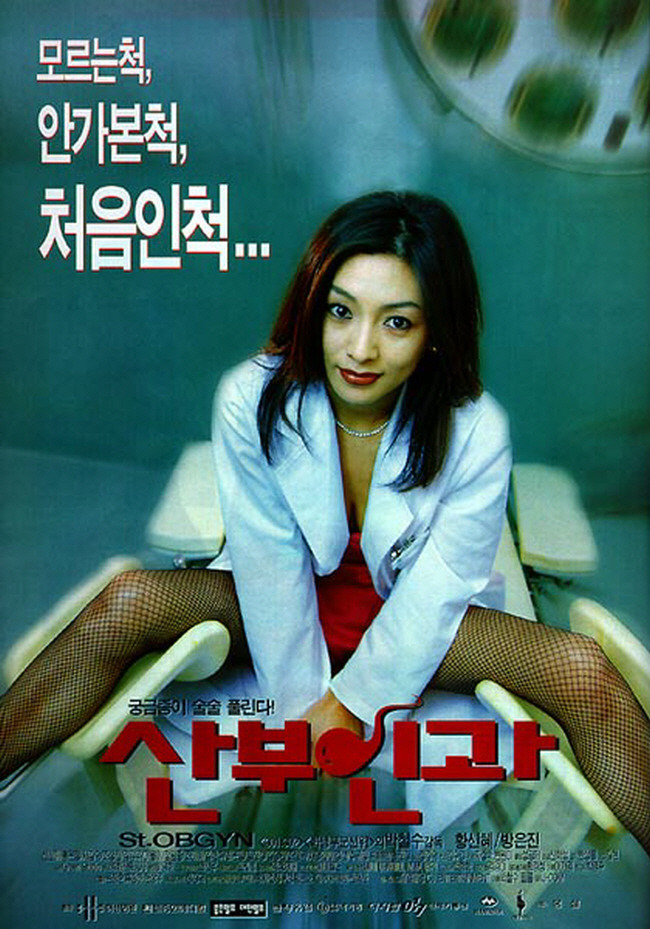
(“Pretend not to know”, “Pretend not to go”, “Pretend it’s the first time”. Push! Push! {1997}. Source)
This was the most read society news story on Naver last week, undoubtedly because of the recent announcement that the pill is to be made prescription only (a similar article was #5), which will naturally require more visits to OBGYNs. I have my own article about that coming out in Busan Haps next month (update: here it is!), but in the meantime see here, here and here for further details, as well as Korean Gender Reader posts from June.
Without discounting the genuine negative experiences outlined below, for the sake of balance let add that my wife has had no problems with those OBGYNs she’s dealt with since her first pregnancy, nor this 19 year-old student who wrote about her first visit to a clinic for her university newspaper (although it’s true she was given some strange and/or unnecessary tests). Also, it seems somewhat naive of patients to be surprised at questions about their sexual experience, and a little churlish of them to complain about them.
Update — in addition to many helpful, practical reader comments on this post below, and on the previous one about the student’s visit, let me recommend this one by a friend on Facebook:
…to be honest, I think most women expect a trip to the gyno to be awkward, that’s par for the course. However, many of the questions mentioned in the article were definitely way out of line. I’ve come across some less than sensitive (aka prejudiced and or judgmental) docs here.. I just assumed their overly-direct statements/questions were just a translation issue. Obviously not!
One disheartening aspect of women’s clinics is that you have to speak to a nurse (or sometimes just the receptionist) first, often in crowded reception area, to explain why you’re there. They often ask for all your symptoms, check your weight and blood pressure and when you had your last period in front of countless strangers. One clinic I went to had an LCD screen with the waiting patients listed in order of their turn.. including the reason why there were there… So much for privacy! It just adds another layer of humiliation to an already uncomfortable situation.
That being said- there are some amazing gynos here. I hope these problems can be properly addressed- no one should have to feel ashamed in front of their doctor. The danger here is that women will stop seeing doctors about their gynecological/sexual health out of fear of embarrassment and risk greater health problems.
“성경험 유무는 왜…? 굳이 그것까지” 굴욕의 진료, 산부인과
“Why do they ask about sexual experience? Is that really necessary?” Humiliating Treatment at OBGYN Clinics
여성이 불편한 산부인과 / Women find gynecology clinics uncomfortable
접수대부터 진료·시술까지 / From reception to treatment and surgery
의료진 노골적 발언에 민망 / OBGYNs make suggestive, embarrassing comments
사전피임약 처방전 필요한데… / The pill requires a prescription…
여성들 심리적 부담 커 고민 / Psychological pressure on women increases
환자 배려 의료지침 등 필요 / OBGYNs need guidance on bedside manners
지난 6월 정부는 사전피임약을 전문약으로 분류하는 약사법 개정안을 발표했다. 이 법안이 국회에서 통과되면 여성들이 산부인과를 찾을 일이 더 많아질 수 있다. 이를 두고 여성들은 산부인과에 가는 것 자체가 눈치 보이는 사회 분위기를 지적한 바 있다.
This June, the government announced that it was considering amending the Drugs, Cosmetics, and Medical Instruments Law to reclassify the pill as a prescription medicine. If passed by Congress, it will mean women will have to visit OBGYN clinics much more often. In light of this, women have been pointing out the [bad] atmosphere at them.
한국여성민 우회가 산부인과 진료 경험이 있는 여성 210명을 상대로 설문조사한 결과는 ‘외부의 시선’ 못지않게 산부인과 진료 자체에 대한 여성들의 두려움이 실제로 광범위하게 퍼져 있다는 사실을 확인해준다. 설문 특성상 응답자의 신상과 구체적인 피해 일시·장소 등을 밝히진 않았지만, 여성들은 산부인과에서 겪은 수치와 불편을 설문지에 빼곡히 적었다.
Korean Womenlink conducted a survey of 210 women who had received treatment at OBGYN clinics, and the results confirmed not just the endurance of public stereotypes that all women visiting OBGYN clinics had STDs, but also that women’s fears in visiting them were well-founded. The survey was anonymous, and respondents were asked to provide no details of the times or places in which they’d been made to feel embarrassed or humiliated, but many still felt compelled to write a great deal about their negative experiences.
신지은(가명·36)씨는 얼마 전 산부인과에서 느낀 굴욕감이 생생하다. 아이를 낳고 정기검진차 방문한 신씨에게 의사는 은근히 ‘수술’을 권했다.
Shin Ji-eun (not her real name), 36, vividly remembers visiting a clinic for a regular check-up after her child was born, where the doctor implied she should have surgery:
“출산을 한 뒤니 부부관계를 오래 유지하고 싶으면 이참에 수술을 하라”고 말했다. 그가 권한 것은 여성 성기를 성형하는 수술이었다. “배려인지 희롱인지 알 수 없는 제안”이었다고 신씨는 말했다.
“After having a baby, and seeing as you’re already here, you should have surgery on your genitals for the sake of your married life”, the doctor said [James – what kind of surgery isn’t specified]. “I didn’t know whether to take it as a joke or a serious suggestion” Ji-eun said.
실제로 설문조사에 응한 여성들은 진료가 시작되는 접수대에서부터 낙태경험 또는 성경험을 묻는 수치스런 질문을 받았다고 증언했다. 어느 여성은 “진료 접수 때 ‘냉이 많아져서 병원에 왔다’고 했더니, 접수대 간호사가 큰 소리로 ‘성병이네요’라고 말해 매우 불쾌했다”고 적었다.
Respondents to the survey reported being asked embarrassing questions about their sexual experience and having abortions even as soon as arriving at the reception desk. One woman said “I went to the OBGYN clinic because I was having a heavy vaginal discharge, and the nurse at the desk loudly said ‘Oh, you must have an STD!’, which mortified me.”
진료 시작 뒤에도 수치심을 주는 의료진의 발언이 이어졌다고 응답자들은 적었다. 특히 “성경험이 있느냐”고 묻는 의료진의 태도가 당혹스러웠다고 여성들은 밝혔다. 어느 여성은 “성경험이 없다”고 답했다가 “검사할 때 번거롭다. 솔직히 말하라”는 의사의 말을 들었다. “그 뒤로 가급적 산부인과에 가지 않는다”고 이 여성은 밝혔다.
The shaming experiences continue after treatment starts too, because of doctors’ comments. In particular, after being asked if she had sexual experience, and replying that she didn’t, one woman found her doctor’s reply – “Be honest. Otherwise the examination will be more complicated” – perplexing, and said she’d rather not visit an OBGYN again.
의료진이 성경험 여부를 묻는 것은 관련 진료에 필수적인 정보이기 때문이다. 그러나 성경험이 있든 없든 “왜 그런 정보가 필요한지 사전 설명 없이 다짜고짜 물어 불쾌했다”는 게 처음 산부인과를 방문한 여성들의 이구동성이다. 여성민우회 조사를 보면, 산부인과 방문 당시 성경험이 있었던 경우는 69.5%, 없었던 경우는 29.5%였다.
Before being treated, patients need an explanation of why being asked about their sexual experience was necessary. Without that, many women reported, they felt very embarrassed on their first visits to clinics.
Of the respondents, 69.5% had prior sexual experience, and 29.5% didn’t.
Top Left — Of 210 Respondents: 35.2% had no negative experiences, 64.3% did, and 0.5% didn’t reply.
Top Right — Of the 64.3% of women who reported negative experiences: 56.3% were related to fears and anxieties about their treatment; 30.4% to public perceptions [of OBGYN patients]; 3.7% to questions about STDs; 3.0% to costs of treatment; and 6.7% to other things.
Bottom — Age at first visit to an OBGYN
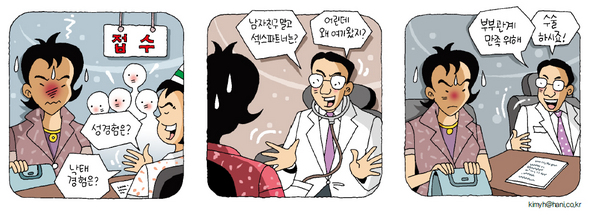
자궁경부암 검사를 받으러 갔던 어느 여성은 “결혼 안 했으면 처녀막이 상할 수 있으니 검사하지 말라”는 의사의 말을 들었다. 자신을 배려하는 듯하면서도 ‘처녀성’ 운운하는 발언에 수치심을 느꼈다고 응답자는 적었다. “몇번 경험해봤나”, “최근엔 언제였나”, “첫 경험이 언제인가”, “남자친구 말고 섹스 파트너가 있나” 등을 아무렇지 않게 묻는 일은 점잖은 축에 속했다. 이들이 기록한 의료진의 어떤 발언은 그대로 옮기기에 민망할 정도다.
One woman who visited in order to be examined for cervical cancer was asked if she was married, “because if you haven’t, then you shouldn’t receive an examination that will break your hymen”; while possibly the doctor was just being considerate about her virginity, the woman still felt ashamed and embarrassed. Other embarrassing questions, like “How many times have you had sex?”; “When was the last time you had sex?”; “When did you lose your virginity?”; and “Do you have another partner in addition to your boyfriend”, don’t even begin to compare to what some doctors asked patients, which they reported were too shameful to write down in their surveys (source, right).
“성기 모양이 참 예쁘다. 남편이 함부로 하지 않는가 보다.” “가슴이 작아서 사진이 찍히려나 모르겠네.” “어린데 왜 산부인과에 왔을까?” 심지어 체모가 많은 것을 보고 “남편이 좋아했겠다”는 이야기를 들은 경우도 있었다.
“Your vagina is very pretty. Your husband wasn’t as rough as most men”; “Your breasts are so small I’m not sure they will even show in the mammogram”; ” You’re so young, why are you visiting an OBGYN?” and even, after seeing that a patient had lots of pubic hair, commenting that “Your husband must like it” are among some of the stories about doctors that respondents did provide.
환자보다 의사 중심으로 꾸며진 진료 환경에 대한 여성들의 성토도 이어졌다.
In general, respondents felt that the treatment environment was designed with doctors rather than patients in mind.
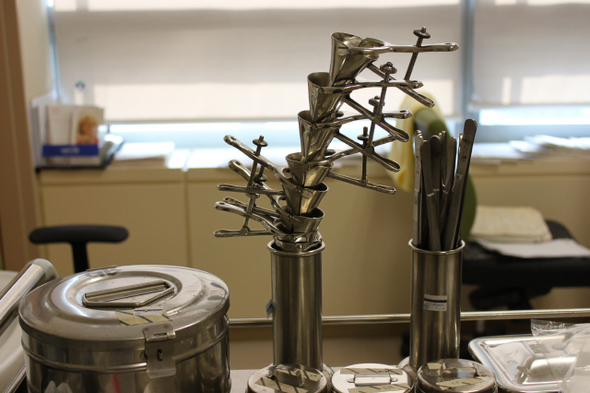
다리를 위로 향한 채 눕게 돼 있는 산부인과의 ‘진료의자’를 응답자들은 ‘굴욕의자’, ‘쩍벌의자’로 부르며 불쾌감을 표시했다. 한 여성은 “진찰대에 다리를 벌리고 올라가는 것 자체가 매우 불쾌해 다시 가고 싶지 않다”고 적었다.
Women showed how upset they were by describing the treatment chair, in which patients lie with their legs in stirrups, as the “Chair of Shame”, or the “Spreadeagle Chair”. One woman wrote “I never want to go in that chair again. Having to spread my legs like that is very upsetting.”
자궁암 검사를 위해 병원을 찾았던 여성은 “의사가 들어오기 전 속옷을 벗고 다리를 벌린 채 준비했고 뒤이어 들어온 의사는 아무 설명도 없이 진료도구를 질 내부에 집어넣어 검사했다”고 불쾌감을 드러냈다.
Another woman who went to a hospital to be checked for cervical cancer wrote “Before the doctor came, I took off my underwear and got up and spread my legs, and when he arrived he just quickly put an instrument inside me, without any warning or explanation.”
‘진정으로 산부인과를 걱정하는 의사들 모임’의 최안나 대변인은 “산부인과 진료는 특히 예민한 분야이므로 성경험 여부 등 구체 정보가 왜 필요한지, 진료 과정은 어떻게 진행될 것인지 상세히 설명하고 의견을 구하는 건 당연한 절차”라며 “산부인과의 진료 서비스가 많이 나아지고 있다고 해도 여전히 일부 환자 눈높이에 부족한 점이 있다”고 말했다.
Choi Ahn-na, a spokesperson for the Korean Gynecological Physicians’ Association (GYNOB) [James — a notoriously anti-abortion group of OBGYNs. See here for more information about them] explained that “Gynecology and Obstetrics are very sensitive branches of medicine, for which it is both normal and essential for OBGYNs to have detailed information about patients, as this determines both the treatment type and how it’s administered. However, while OBGYNs have improved their services a great deal, it is also true that remaining weak spots need to be dealt with, as well as how things looks from patients’ perspectives.”
여성민우회는 이달 중 1000여명에 대한 실태조사 최종 결과 분석이 끝나면 전문의·보건전문가 등과 간담회를 열어 환자를 배려하는 산부인과 의료 지침을 만들어 배포하는 등 ‘산부인과 바꾸기 프로젝트’를 이어갈 계획이다.
Continuing its “Transform OBGYN Clinics Project” [James — Yes, this is the first time it’s been mentioned in the article], this month Womenlink is following-up by surveying 1000 women. After analyzing the results with health specialists, it will produce and distribute a guide for OBGYNs for dealing with patients.
김인숙 한국여성민우회 공동대표는 “왜 여성들이 산부인과에 가는 데 부담감을 느끼는지 구체적으로 확인해 앞으로 더 나은 산부인과 진료 문화를 만들어 갈 것”이라고 밝혔다.
Kim In-sook, a co-spokesperson of Womenlink, said “We will determine exactly why women feel so stressed about going to clinics, with the aim of making a better and more welcoming environment for them there.”
<한겨레>는 ‘여성이 불편한 산부인과’를 ‘여성이 행복한 산부인과’로 바꾸기 위한 제보와 의견을 받아 관련 보도를 이어갈 예정이다.
(Editor): In order to make women feel comfortable with visiting OBGYN clinics, The Hankyoreh will continue to receive and report on women’s opinions and experiences of them.
A poster for the upcoming movie Plump Revolution, in which Lee So-jeong puts on weight for a man (Lee Hyeon-jin) whose ideal type is a plump woman. Hopefully, it will have more helpful social messages than 200 Pounds Beauty (2006) did!
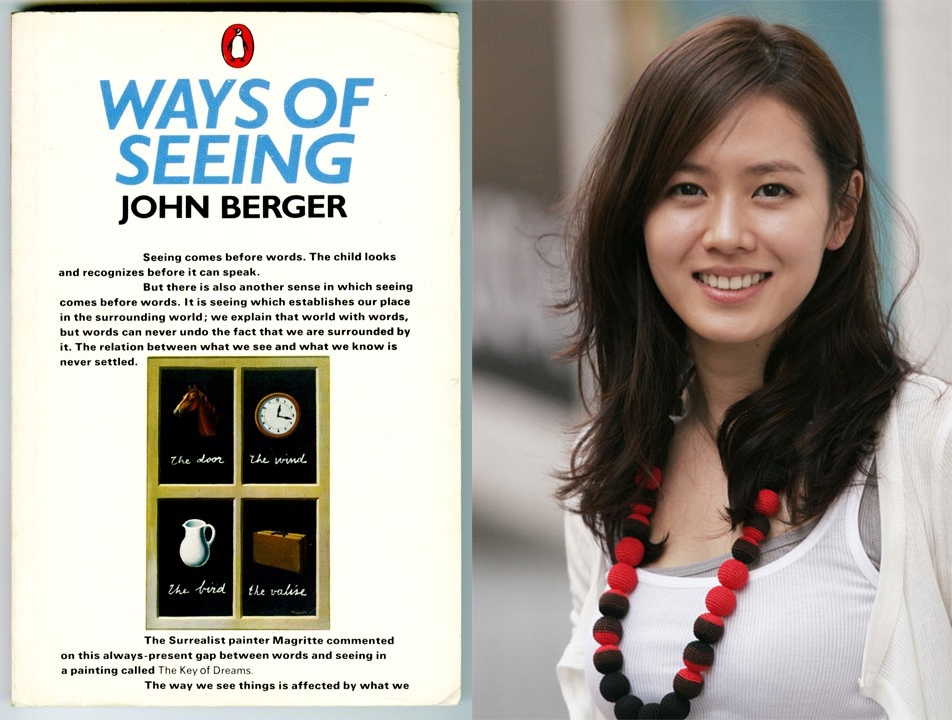
Another week, another group of perfectly healthy women fat-shamed on Korean television. Yes, even Son Ye-jin too, no matter how disarmingly attractive she looks above.
It was such a pleasant surprise then, to see the following denouncement from Entermedia reproduced in the entertainment and celebrity sections of Daum and Yahoo! Korea too. The first time I’ve ever comes across a lengthy critique about the male gaze and impossible body ideals alongside, well, numerous examples of exactly those, the optimist in me hopes that this represents some kind of turning-point. Or, at the very least, a consensus that the offending programs clearly overstepped a line, even by the Korean media’s standards!
손예진 몸매 논란, 무엇이 문제일까 / Controversy About Son Ye-jin’s body; What is the Problem?
by Bae Guk-nam, Entermedia, July 2 2012
– 손예진이 통통하면 이득보는 사람들 / There are people that profit from Son Ye-jin being fat
– 미디어, 이 땅의 여성들 말라깽이 강박증 환자로 내몰아 / The media encourages Korean women to be obsessed with thinness
처음 제 귀를 의심했습니다. 다음에는 설마 그럴까라는 생각을 했습니다. 그리고 파급 효과가 엄청나다는 인식에 이르렀습니다. 바로 여성 몸매를 제시한 세 개의 방송 프로그램을 보면서 느낀 제 반응과 생각입니다. 그리고 세 개의 프로그램을 보면서 여성 몸매에 대한 매스미디어와 일부 남성의 편견에 찬 시선의 현주소를 알 수 있었지요. 그러한 시선은 이 땅의 수많은 여성들로 하여금 몸에 대해 과도한 집착을 하게 할 뿐만 아니라 육체에 대한 불만과 취약성, 결핍을 끊임없이 느끼게 만들어 지극히 정상적인 자신의 몸에 대해 비정상으로 바라보게 만드는 병폐를 심화시키는 문제를 야기 시키고 있다는 것도 절감하게 됐습니다.
At first, I doubted what I was I really seeing. Then I thought “Really? OMG”, and realized how much of a controversy would be raised. That was my reaction when I saw three recent programs about women’s bodies.
While watching, I got to know the reality of the deep prejudice with which the mass media and some men viewed women’s bodies. I realized that through this, Korean women don’t just get excessively attached to their body image, but are also disempowered through continuously feeling frustrated with their bodies, and coming to feel that theirs are abnormal .
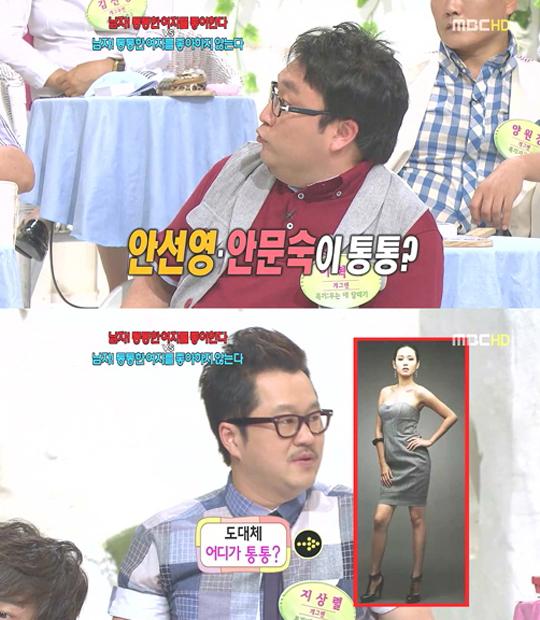
여성의 몸에 대한 미디어와 남성의 시선, 그리고 그 병폐를 적나라하게 노출시킨 방송이 바로 지난 6월23일 방송된 MBC < 세바퀴 > 입니다. 이날 방송에서’남자들이 통통한 여자를 좋아한다는 말이 사실인가?’라는 설문에 대한 이야기를 나누던 중 이혁재는”출연진 중에서는 안선영과 안문숙 정도가 통통한 것 같다. 이경애는 통통한 게 아니고 고도비만이다”라고 말해 충격을 주더니 지상렬은 통통의 기준이 되는 연예인이 “손예진이다”라고 답해 출연자 뿐만 아니라 시청자들을 경악하게 만들었습니다. 헬스 트레이너 숀리는 여기에서 더 나아가 “조여정, 송혜교를 통통하다고 하는데, 저는 예전부터 그런 몸을 좋아했다”라며 안방 시청자의 몸매에 대한 인식에 대한 생각을 다시 한번 하게 만들었지요.
The problems of this media and male gaze were very evident in the June 23rd episode of World-Changing Quiz Show, broadcast on MBC [James — see here and here for Part 1 and 2]. On that show, the discussion topic for the panel was “Is it true that men like fat women?”, and comedian Lee Hyeok-jae (male) not only remarked that two female members of the panel — comedians Ahn Sun-young and Ahn Moon-sook — were fat (literally, he said “Fat like them you mean?)” , but that a third— Lee Kyong-ae — was extremely so, shocking other panel members and the audience. Then comedian Ji Sang-ryul (male) opined that among women in the entertainment industry, Son Ye-jin was the standard [James – upper limit?], further adding to everyone’s astonishment. Finally, health trainer Sean Lee mentioned that people say that Jo Yeo-jung and Song Hye-gyo are fat, but that he has liked such body types for a long time, again making viewers at home dwell on the subject of fatness.
6월25일 방송된 KBS < 안녕하세요 > 에선 46Kg의 몸무게를 유지하라는 남편 때문에 고민이라는 한 여성이 출연했습니다. 남편이 연애시절부터 마른 여자를 좋아해 75Kg체중을 46Kg으로 만들어 결혼했다는 황은미씨는 “결혼한 지금도 46kg의 체중을 유지하라는 남편의 감시를 받고 있다. 매일 배가 어느 정도 나왔는지 남편에게 검사를 받는다”며 몸무게 대한 남편의 기준을 완화해 달라고 부탁을 했고 이에 황씨 남편은 “(애프터스쿨) 유이씨 정도면 좋겠다. 나이가 좀 있으니까 양보해서 48kg 유지해라”라고 답했습니다.
Then on the 25th, a woman called Hwang Un-mi appeared on Hello! on KBS, describing the suffering she’s endured because of her husband demanding she stay at a weight of 46kg. He’s liked thin women ever since they started dating, so she went from 75kg to 46kg before she they got married, and she said that “Since then, he still insists I stay at 46kg, and checks my belly thickness every day to make sure.” When she asked her husband on the show for some relaxing of his standards, he replied “I like a body like that of Uee’s from After School. But seeing as you’re older, I’ll let you go up to 48kg.”
6월19일 방송된 tvN’화성인 바이러스’에는 압박붕대로 얼굴에서 발끝까지 온몸을 감으면서 생활하는 일명 ‘미라녀’김유정씨가 출연했지요. 압박붕대로 체중 10kg 감량에 성공했다는 김유정씨는 “3~4년간 계속 압박붕대를 감다 보니까 요령을 터득하게 됐다. 살 많은 곳을 세게 감을수록 (다이어트)효과가 좋다”며 다이어트를 위해 몸에 사용하는 압박붕대는 복부 4개를 비롯해 23개에 달한다는 충격적인 설명을 태연스럽게 했습니다.
이 세 개의 프로그램은 여성의 몸에 대한 남성의 시각과 그리고 미디어의 행태, 그 결과의 양태를 단적으로 보여준 것입니다.
And earlier, on the 19th, “Human Mummy” Kim Yu-jeong appeared on Martian Virus on TvN [James — this show highlights strange and unusual people], who wraps herself in pressure bandages from head to toe in order to lose weight. She matter-of-factly explained “I’ve successfully lost 10kg this way, and have figured it out while I’ve been doing it over the last 3-4 years. It’s very effective if you have a lot of weight to lose,” and that she applied 4 pressure bandages to her abdomen each time, and 23 on her body overall.
These three programs clearly showed the male gaze on women’s bodies, and the media’s views on them too.
대상을 바라보는 방식은 우리가 알고 있는 그리고 우리가 인식하고 있는 것과 깊은 관련이 있습니다. 여성의 몸매에 대한 것도 마찬가지입니다. 안선영 안문숙 손예진 조여정 송혜교등이 통통하다고 바라보는 이혁재 지상렬 그리고 숀리의 언급은 상당수 남성들의 여성의 몸에 대해 바라보는 방식을 드러냈다고 봅니다. 이상적인 여성의 몸매마저 통통하다고 인식하는 이러한 남성들의 여성의 몸에 대한 문제 있는 시선은 방송, 신문, 인터넷 등 매스미디어를 통해 확대재생산되고 수많은 사람들에게 여성의 몸매를 바라보는 인식의 토대를 마련해줍니다.
The way we see things is deeply related to what we already know and what we recognize. And it’s same with women’s bodies.Through the mass media, the problematic viewpoints of these male entertainers, who believe even those women with ideal bodies are fat, has spread extensively. This has laid the groundwork for how many people view women’s bodies (source, above).
매스미디어와 상당수 남성들은 끊임없이 여자 연예인으로 대변되는 몸매의 이상형을 제시하며 수많은 여성들에게 몸매에 대한 채워지지 않는 욕망을 자극시키고 있습니다. 이혁재 지상렬로 대변되는 일부 남성들과 매스미디어는 현실에서 좀처럼 존재할 수 없는 완벽한 이상형의 여성 몸매 제시를 통해 여성의 정상적인 몸매 더 나아가 손예진 송혜교 등으로 대변되는 이상화된 몸매마저도 비정상으로 치부하고 있습니다. 이 때문에 수많은 여성들은 정도의 차이는 있지만 자신의 몸매에 대해 부족과 결핍을 느끼게 만듭니다.
Through female entertainers, the mass media and many men present women’s ideal body types, and this creates a lot of anxiety and anguish for women about their own bodies. Men like Lee Hyeok-jae and Ji Sang-ryul consider ideal women’s bodies like those of Son Ye-jin’s and Song Hye-gyo’s as abnormal, while at the same time presenting as ideals body types and shapes that are impossible in real life. And while some women will be closer to those ideals than others, all will still inadequate and lacking.
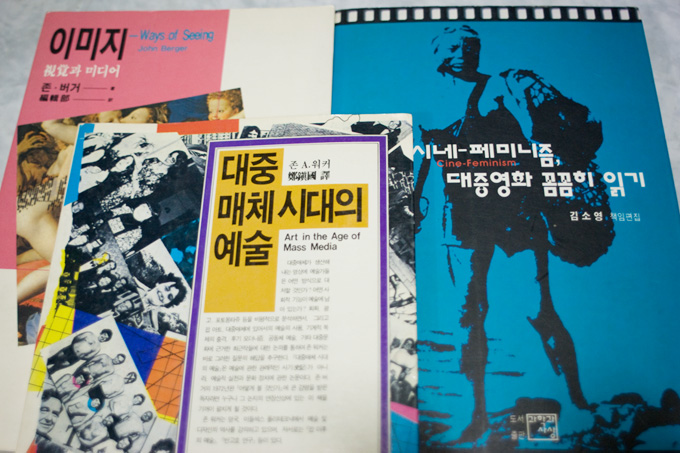
여성의 몸에 대한 상당수 남성들의 시선과 매스미디어의 응시 방식은 수많은 이땅의 여성들의 몸에 대한 인식에 크나 큰 영향을 줍니다.’여성은 그녀 자신의 모든 것을 관찰해야만하고 또 그녀가 무엇을 할 수 있는가를 생각해야만 한다. 왜냐하면 스스로가 다른 사람에게 궁극적으로는 남성에게 어떻게 비춰질 것인가 하는 문제가 여성의 삶의 성공 여부를 결정짓는 가장 중요한 관건이기 때문이다. 여성 자신의 스스로 존재에 대한 느낌은 다른 사람에 의해 내려지는 그녀에 대한 평가에 의해 보완되어져야만 하는 것이다’라고 존 버거가 ‘Ways of Seeing’ 에서 설파한 것처럼 여성의 몸에 대한 남성의 시선은 몸매에 대한 여성의 인식과 태도에 지대한 영향을 미칩니다.
The way most men look at women’s bodies, and the way the mass media presents them, has a big influences on the way women themselves view them. Like John Berger said in Ways of Seeing [James — on the second page of Chapter 3 {p. 46} in my 1972 Penguin edition]:
She has to survey everything she is and everything she does because how she appears to others, and ultimately how she appears to men, is of crucial importance for what is normally thought of as the success of her life. Her own sense of being in herself is supplanted by a sense of being appreciated as herself by another.
(James — Ways of Seeing was originally a documentary, which is now available online; see here and especially here for more information. It’s the second episode that is most relevant here)
매스미디어의 여성의 이상적 몸매의 강요에 가까운 현실는 남성의 여성에 대한 왜곡된 몸매의 시선을 강화시키고 그 결과 수많은 이 땅의 여성들을 자신의 육체와의 비정상적인 전쟁으로 내몰리고 있습니다. 물론 이 전쟁의 진정한(?) 승자는 여성도 남성도 아닌 여성의 몸에 대한 끊임없는 결핍의 이데올로기를 설파해 막대한 이윤을 창출하는 뷰티산업, 성형외과, 광고, 매스미디어 등이지요.
This reality of the mass media promoting [impossible] ideals of women’s body shapes distorts how men view women’s bodies, and in turn this encourages women to fight against their own bodies. The real winners in this war are not men, nor women, but rather the beauty, cosmetic surgery, advertising and mass media industries that make vast profits from propagating an ideology of an unceasing dissatisfaction with oneself.
여성 몸매의 이상형이라고 할수 있는 손예진 송혜교 마저 통통하다고 말하는 지상렬 등으로 대변되는 여성의 몸매에 대한 남성의 시선과 매스미디어의 응시 방식은 아내의 46Kg의 몸매 유지를 요구하고 애프터스쿨의 유이의 몸매를 이상적 몸매로 꼽아 아내마저 제2의 유이로 만들려는 남성들을 더욱 더 확대재생산합니다. 그리고 이 때문에 정상 체중인데도 아침엔 다이어트용 시리얼에 저지방우유, 점심엔 채소와 밥 반공기, 저녁엔 아무것도 먹지 않고 운동 2시간을 하는 주부들과 압박붕대 20여개로 감싼 기괴한 모습으로 다이어트를 하는 20대 여성들이 양산되고 있습니다.
[It is the callous environment in which entertainers can describe female celebrities like Son Ye-jin and Song Hye-gyo as fat that is at least partially responsible for the husband that demanded his wife have a body like Uee’s]. And it’s also because of that that both housewives and women in their 20s, all of healthy weights, will only diet cereal with low fat milk for breakfast, for lunch just vegetables and half a bowl of rice, and nothing for dinner, yet exercise for 2 hours. Some will even also go the extremes of wrapping themselves with 20 pressure bandages.
여성 몸매에 대한 남성의 문제 있는 시선과 여성들의 완벽한 몸매를 지속적으로 강요하는 방송 등 매스미디어의 행태는 이 땅의 수많은 여성들을 이상화된 몸에 대한 과도한 집착을 초래하고 자신의 몸에 대한 끊임없는 불만과 결핍을 불러옵니다. 그리고 급기야 정체성과 자기실현을 왜곡된 방향으로 유도하며 정신없는(mindless) 몸매(body)만을 만드는 육체와의 전쟁터로 내 몰고 있습니다. 이제 여성의 몸매에 대한 문제 있는 미디어의 행태와 남성의 시선은 교정돼야합니다.
손예진씨, 당신은 결코 통통하지 않습니다!
Men’s problematic gaze of women’s bodies, and the mass media’s encouragement of women to desire impossible perfect body types, only leads to unhealthy obsessions and unceasing dissatisfaction. Furthermore, they induce a distortion of women’s identity and self-realization, and creates a war in which women only fight to have a good body, not a good mind or spirit. This problematic men’s gaze and mass media’s attitude needs to be corrected.
This video is a parody of the ridiculous, offensive video “The Shocking Reality About Relationships With Foreigners” which aired on South Korea’s MBC TV network in May 2012. Click here to see the original video with English subtitles.
“…[I]n the worldwide retro trend, where is the Korean culture located? Most of the cases, instead of original Korean culture, foreign vintage culture and goods are imported. It is because of the ’70s and ’80s fever for the Westernization then it is hard to find original Korean retro. So you find that only unidentified mixture of retro cultures have mushroomed in Korea without its own color.”
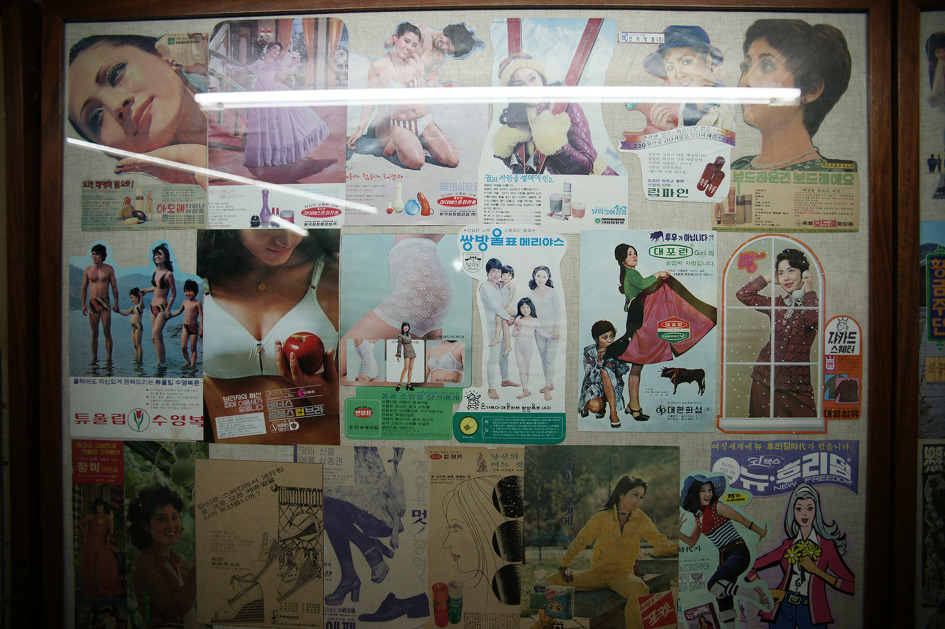
So lamented the Design Journal (디자인저널) back in November 2008. But as it turns out, a veritable treasure-trove of Korean retro has long been available in the Museum of Modern History of Korea (한국 근현대사 박물관) in Paju, just 30km north of Seoul. See here, here, here, and here for some high-definition photos of the exhibits, and here (a PDF) and here for information about the museum in English.
Combined with the Heyri Artist’s Village, and/or the Paju Book City, then you have the makings of a perfect day trip from Seoul, and a very educational and cultured one at that. Any takers?^^
With apologies for the short notice (my fault!), today is Korean Sex Workers’ Day, with a variety of cultural and informational activities planned, and a potluck dinner on Sunday. Please see Research Project Korea for further details.
(Source: Metro, Busan edition, May 31 2012, p. 11)
One of the great advantages of Erving Goffman’s Gender Advertisements, I tell students in my lectures on gender roles in Korean ads, is that it’s not language-based. Whether the ads are from Korea, Kenya, or Khazakstan, I rhapsodize, it’s all about the pictures, making cross-country and historical comparisons possible.
In reality though, culture and language are still important. The tendency towards positioning men higher than women in ads for instance, implying their superiority (just think of the purpose of thrones), can pale against a seated matriarch’s greater social status. Also, ads may allude to popular books, movies, or songs that a foreign observer is unaware of, and/or the text make a pun about the images that a non-native speaker would struggle to understand.
In short, Korean ads can be far more subtle than they may at first appear to someone like me, let alone less gender-stereotyping.
(Source: unknown)
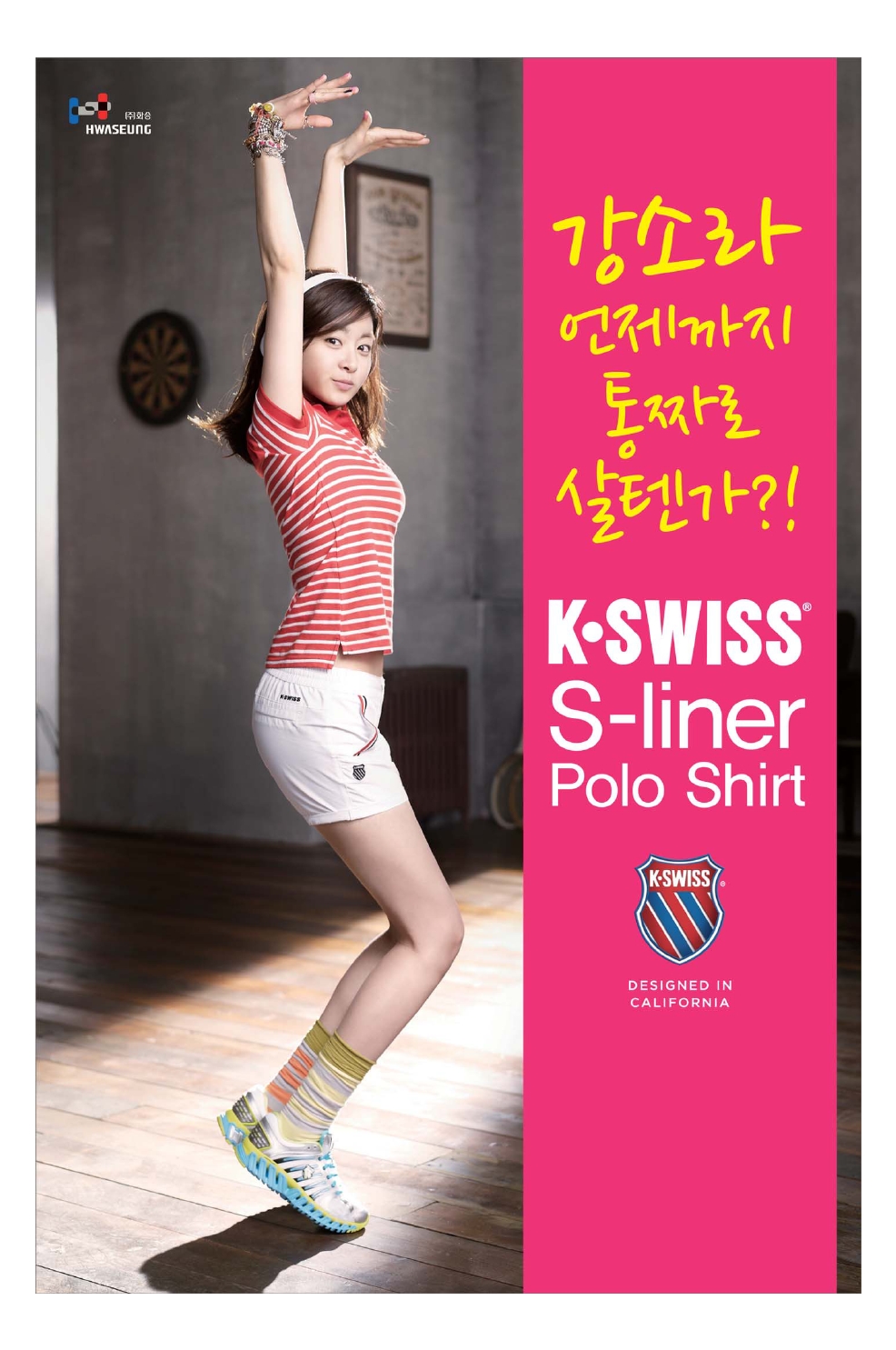
With that in mind, I decided to quickly re-examine K-Swiss’s “S-liner Polo Shirt” ad with Kang So-ra (강소라), that I’d previously dismissed as just yet another example of the ridiculous poses Korean advertisers put women in to show their S-lines off. After all, however unlikely, maybe she’s done a humorous Walk like an Egyptian dance at some point in her brief career (say, in the popular movie Sunny last year), and was parodying that? Or maybe there was something in the text to explain her pose?
Alas, no. Judging by the TV commercial above, the ridiculous pose and dance were definitely just for K-Swiss. And as for the text, that doesn’t redeem the ad either…although I’d have never guessed it would have taken me, my wife, and two of her friends nearly half an hour to figure that out!
It looked easy enough: “강소라” is Kang So-ra’s name, “언제까지” is “until when”, and “살텐가” is “will live”, as in the more formal form “살거예요”. But “통짜로”? Literally, it’s the adverb “wholly”, but that made no sense. So, with the logic that perhaps 22 year-old Kang So-ra formerly lacked feminine curves then, but now, as per the dictates of Korean consumerism and gender roles, she’s compelled to show them off at every available opportunity, we decided it meant “통” as in the Hanja character that means a (usually cylindrical) container (i.e. a body), “짜” which can often mean “thing” or “person” (see pages 263 and 374 of the Handbook of Korean Vocabulary respectively!), and “로”, which in this case would mean “as”, or “in the manner of”.
Putting aside what role such exhortations may or many not have in Koreans’ intense body dysphoria for a moment (uniquely in the developed world, Korean women aged between 20-39 are becoming more underweight than obese), we were pretty proud of ourselves for figuring that out. But then my wife’s second friend arrived, who pointed out that “통짜” is actually a sort-of adjective means “fat”, as in “통짜몸메가 있어”. Specifically, after a lot of time arguing about whether it actually more meant “curved” than fat per se (recall what “통” can mean above), it means a fat waist, regardless of how curved the rest of the body is (or not — it can be used to describe me men too).
So there you have it: literally, the appalling “Kang So-ra! Until when — fat person as — going to live?!”. But suddenly, as I type this, I have renewed doubts: was Kang So-ra considered fat previously? Even if so, surely she is indeed no longer living as a fat person, in the ad? And so on.
So by all means, I admit I may be completely mistaken, and would welcome any alternative translations and explanations of the text. But either way, I doubt it provides a very body-positive message.
Meanwhile, if it’s true that 통짜 bodies lack the shapely breasts and buttocks of an S-line, then perhaps there’s something to the photo of Uee (유이) above that show’s that there’s actually two concepts of the term? In the diagram, it says that men think it refers to the blue whereas women think it refers to the red, but the results seem pretty mixed at the original post on Facebook.
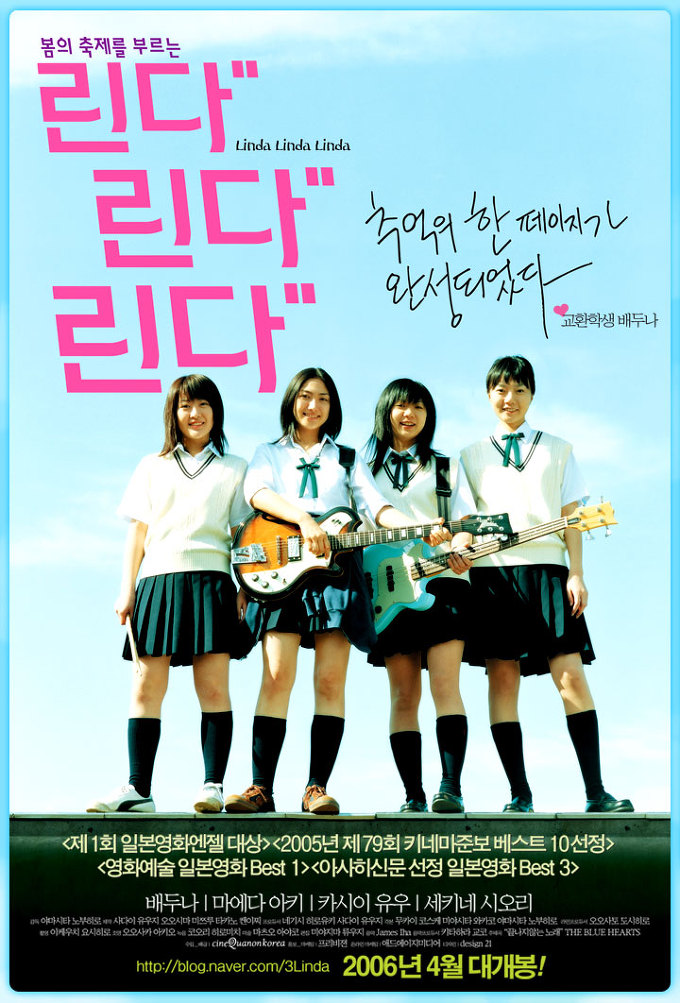
As a (very) fledgling film reviewer, I’d be lying if I didn’t admit to relying on other, more experienced reviewers for guidance sometimes. So, I’m really struggling with why they made so many glaring mistakes about Linda Linda Linda.
Add to that a number of pithy one-liners that there’s actually no evidence for, and especially the willful ignorance displayed in shoehorning coming-of-age narratives into the movie, then I’ll seriously be taking all “expert” movie reviews with a big grain of salt in the future.
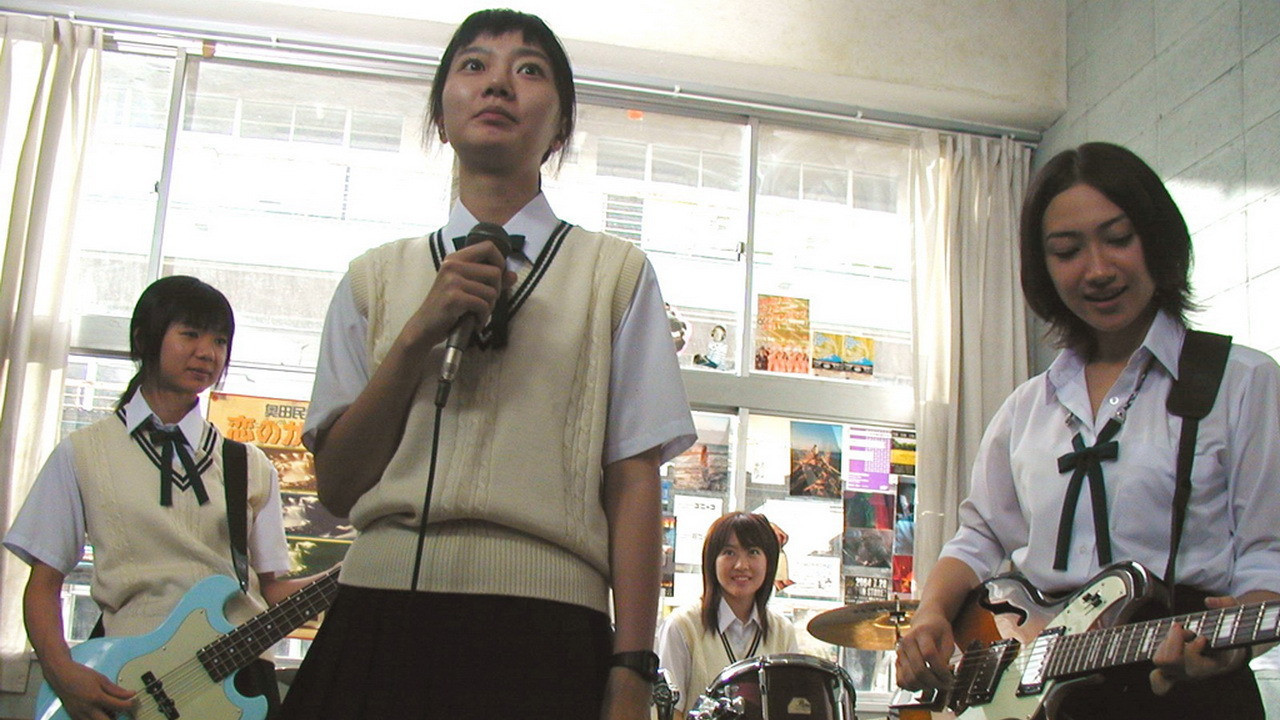
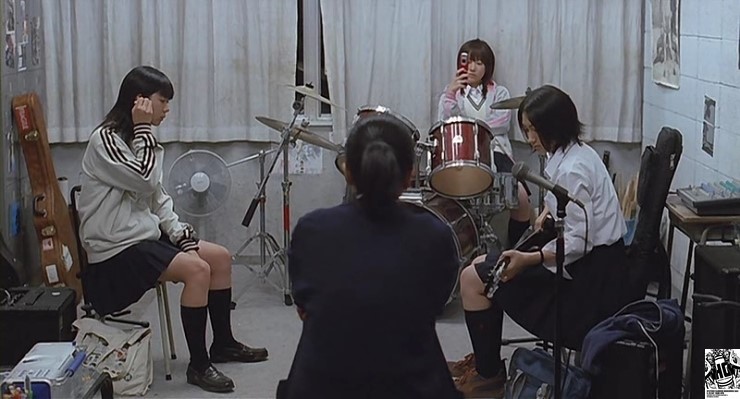
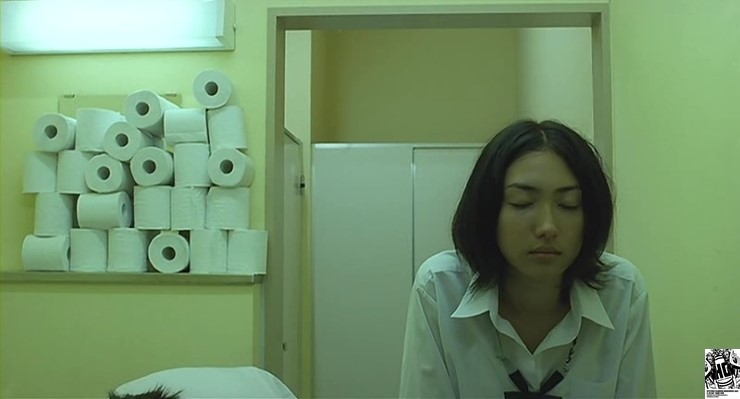
Despite what you may read elsewhere then, the movie is about a high school girl band that has just lost its guitarist (Moe) and lead singer (Rinko) to a hand injury and argument respectively, and opens with remaining members Nozomi, Kyoko, and Kei having to decide if they will still perform at the end of the high school festival week in just three days. As you’ve already guessed, they do, choosing to sing the iconic 1987 punk-rock hit Linda Linda (and 2 other songs) by The Blue Hearts.
But keeping Nozomi on bass, Kyoko on drums, and moving Kei from keyboard to guitar, still leaves them short of a vocalist. On a whim, they invite Korean exchange student Son to fill Rinko’s place, despite her occasional difficulties with Japanese.
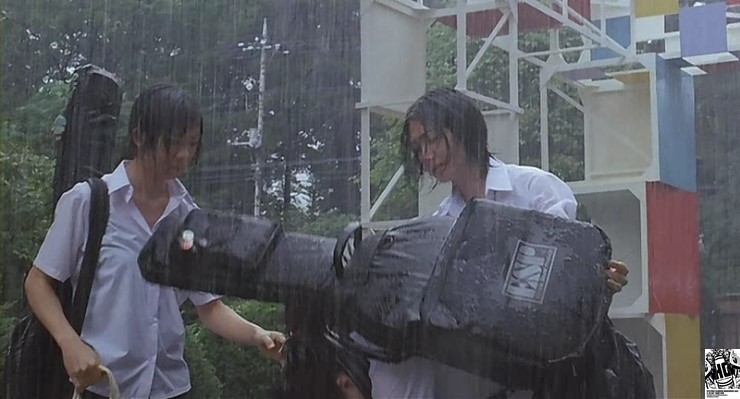
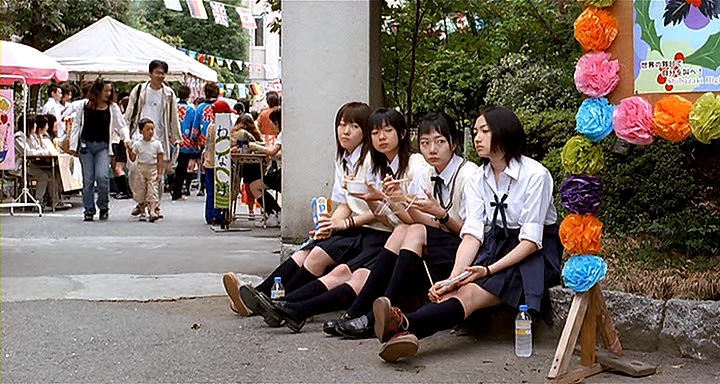
Son gets asked 21 minutes into the movie, and the remaining 94 are about the band practicing (spoilers begin) over the next two days and nights, culminating in them performing on the day as planned, albeit much later and wetter than expected. Yes, that’s it. It’s not an underdog story, there’s no hint of fame and success once the performance is over, no big romances, nor are there any jealous rivals. There aren’t even any major dramas or even mild arguments between the four major characters either (spoilers end). Indeed, it’s probably the most minimalist plot you’ll ever encounter, no matter how much of a movie buff you are.
While fans of director Nobuhiro Yamashita may appreciate this, his previous works likewise featuring “aimless youth with nothing better to do than walk or sit around”, it’s easy to appreciate why others might find it slow and ponderous. One reviewer understandably wrote it off as “incident-free pic [that] will induce sleep” for instance, while another quite plausibly claimed that there were points when he was watching the movie where he “would leave, prepare part of lunch, and return, to find that literally nothing had happened.”
What’s more, the English marketing for it was very misleading, Rob Humanick at Slantmentioning that the press notes for movie suggested “a foreign regurgitation of stale conventions from the American teenage flick,” and that it was “difficult to not expect something of a J-pop remake of Bring It On that substitute[d] an all-girl cover band for sexed-up cheerleaders.” Also, the US trailer suggested something much quicker and more comical than what audiences ultimately got:
In light of all that, I must concede that I’d probably be far less forgiving of the movie’s glacial pace if it was about high school boys rather than girls. But it takes much more than 18 year-old Japanese schoolgirls to get me to like a movie so much, and I’m sure other heterosexual male and lesbian reviewers likewise aren’t so shallow, let alone everyone else. Why, then, does the movie get almost universal praise?
One reason is Bae Doo-na. A long-time fan, I can’t be objective about her myself, so consider Tom Mes’s description of her performance at Midnight Eye instead, which is quite representative of the accolades she has received:
…[a] major factor to the film’s success is the casting of Korean actress Bae Du-Na in the role of Son. Several years older than her teenage co-stars [26 in 2005] and more accustomed to mature roles in the likes of Park Chan-Wook’s Sympathy for Mr. Vengeance and Hyeon Nam-Seob’s Saving My Hubby, Bae easily outshines the rest of the cast.
Not conventionally beautiful, with gamin-like features and a seemingly permanent mope, Bae is the Christina Ricci of South Korea, with a similar ability to inform a simple character with many layers, most notably in the Korean gem Take Care of my Cat. That makes her a perfect fit for the minimalist milieu of director Nobuhiro Yamashita…
I beg to differ on her not being “conventionally beautiful”: mirroring her acting abilities, a quick Google image search reveals she can be as feminine or as androgynous as her role requires, but let’s not go there. Rather, that “seemingly permanent mope” is a good way to describe Son’s social awkwardness as both an exchange student and — I suspect — a natural geek, and through conveying this so well she ironically makes a far more convincing teenager than her real-life teenage co-stars (although to be fair, their characters didn’t call for it).
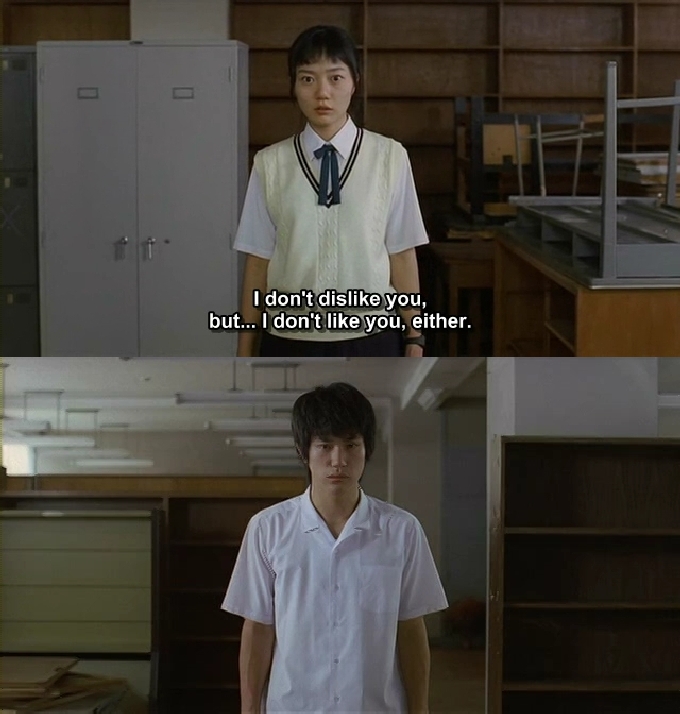
With such a focus on her though, it’s surprising that Johnson would write that “Son can barely speak a word of Japanese, let alone sing it”. This is simply not true: while she does sometimes struggle with her words, or needs people to repeat themselves, she never has any real difficulties communicating. Nevertheless, Johnson’s assertion is echoed by virtually every other reviewer, which leaves me wondering if there were some mistakes in translations, and/or if there are other versions out there? Humanick at Slant, for example, mentions that the funniest scene in the movie is when Son attempts “to overcome her language difficulties in a restaurant where only paying customers are allowed to use the restrooms”, something which is strangely lacking in the file I downloaded (which, as always, I’ve watched twice).
Another potential misunderstanding is that, unless you’re familiar with either Korean or Japanese, it’s not always clear which language Son is speaking (Korean was only indicated by brackets in the version I watched). This becomes relevant (spoilers begin, including image below) when she sings by herself in a karaoke room, revealing her to be much more confident in her native Korean, and especially in a later scene (see here for a video) when Son is approached by long-time secret admirer Yusaka (nickname Makki) to confess his love for her. When you realize that he does so in halting Korean (which even astute reviewers like Didion at Feminéma missed, and Johnson of the San Fransisco Chroniclemistook as poetry), then you can’t help but feel much sorrier for the guy when Son quickly rejects him, especially if you’ve ever had your weeks of unrequited love and wooing preparations dismissed in an instant yourself.
Because of that, I was much less sympathetic to the spin Alyx Veseyputs on Son’s reaction over at Feminist Music Geek:
The rest of the girls look through the window of an abandoned classroom, watching their lead singer choose the band, and her friends, over some guy who happens to like her but that she doesn’t know.
I don’t mean to single out Alyx, who otherwise writes an excellent review. It’s just that it points to the tendency of many other reviewers and commenters to overstress the female homosocial elements of this movie. In the New York Times for instance, Jeannette Catsoulis is so gushing about how “the film’s sweet, slow rhythms bind them together” that you can be forgiven for thinking that they don’t think about boys at all. Admittedly, Catsoulis is clearly pressed for space, but still: the reality is that not only is Son very inquisitive about Kei’s history with Yomoki, her ex, but Kyoko’s attention is just as much on her own crush Kazuya as on her band-mates. And indeed it’s precisely that which the four of them talk about — and bond over — during their last communal meal (spoilers end).
But don’t get me wrong: I am definitely not saying that the boys in the movie should be given more attention, that it’s in any way about them, or that the movie’s main focus isn’t indeed about high-school girls bonding. After all, that last is the second reason the movie has received such high praise, especially from, naturally enough, women.
This presents an interesting question however, which I’d like to pose to female readers: just how genuine are the situations and the dialogue? I ask because following Jane Austen’s example, who never has two male characters talking alone to each other in any of her novels, I’d be very hesitant to ever do the same with female ones (something to consider with — but not apologize for — male-written and/or directed movies that fail the Bechdel Test). If they ring true though, then male director Yamashita, and crucially also writer, somehow has really hit the spot.
A related question is raised by Burl Burlingame’s review at Honolulu Star Bulletin, which opens with:
I have a friend who used to play in an all-girls punk band. She said rehearsals took forever because they’d play one song, talk about their feelings for an hour, play one song, talk about their feelings for an hour … which pretty much describes Linda, Linda, Linda, Nobuhiro Yamashita’s slacker success story about girls who form a band for a high-school talent show.
Taken out of context, I would have condemned Burlingame for perpetuating gender stereotypes, but now I’m not so sure. What do any female musicians amongst you make of it?
Either way, I can understand all the one-liners on grrrl-power bonding then, but can’t overlook the blinders some of the reviewers seemed to have on. Humanick at Slant, for instance, describes the movie as “an emotionally attuned look at adolescent life amid the invisible social structures of high school with an underlying emphasis on gender and cultural barriers to boot, all surprisingly free of manipulation”, but I’m at a complete loss as to what those barriers are myself. Likewise, Catsoulis asserts in the New York Times (yes — she’s an easy target) that “the irritations and tedium of high school life are staged with refreshing simplicity”, whereas in reality these are glaring for their absence, the unregimented nature of their school life greatly puzzling me until I realized that the movie began already well into the school’s festival week.
(Update — I forgot to mention that one minor flaw in the movie is that it would have been unlikely for Son to have bonded so well the other band members in just over two days; starting the movie a couple of weeks earlier, giving a more realistic time-frame for this, would surely have required only minimal plot and technical changes)
It also puzzled Alyx at Feminist Music Geek, who wrote:
I’m also not entirely clear about the nature of Japanese schools. I came through an underfunded, less-than-superlative Texas public school system. Thus, Paran Maum’s school seems like a tony liberal arts magnate where teenagers are given considerable support and resources for their artistic inclinations, thus implying that the students come from respectable middle- to upper-middle-class families. But I’m not sure if this high school is exceptional in Japan….while I initially feel the need to mention the classed dimensions of privilege that allow the girls the fine arts education and leisure time to form a band (instead of, say, take jobs or quit school to support their families), I don’t want to suggest that what I see as an American viewer is in accord with Japan’s classed realities.
Whether this surprising freedom the girls have is the norm or just for the duration of festival week however, that they behave more like they’re in university than high school is crucial for the movie’s last major source of appeal: the ability to project coming-of-age narratives onto it (spoilers begin).
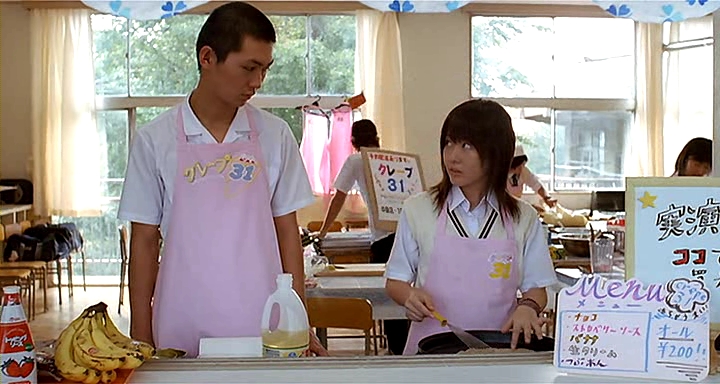
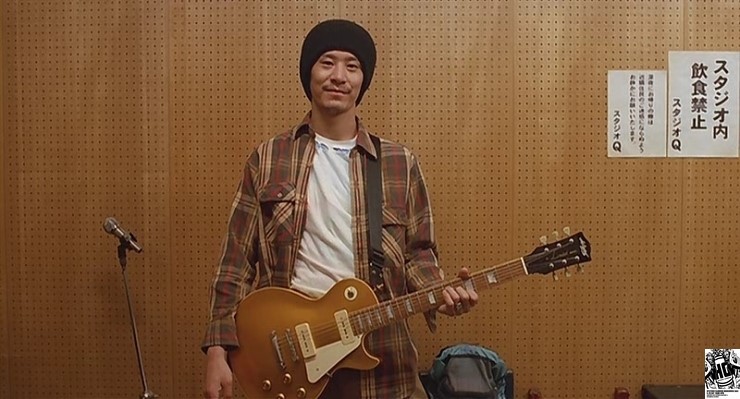
As I stated in the introduction, I actually think this is quite misguided: the girls (re)form a band, they practice, they perform, the end. Where’s the coming of age drama in that? But I can empathize (spoilers end). Given how free the girls are to do things under their own initiative, to set their own hours, and to come and go between activities as they please, things utterly denied to most Japanese (and Korean) teenagers, it’s difficult not to see them as near-adults. In particular, although Nozomi’s background is woefully underexplored (you know no more about her by the end of the movie than at the beginning), Kei above seems to to have had quite a history with — and lingering feelings for — much older ex Yomoki below, yet stoically accepts that he’ll be moving on to Tokyo (personally, it wasn’t until I was much older that I realized life was like that).
Combine that with being the de facto leader of the group, and things like getting the band, sans permission from parents or teachers, halfway across town to get some extra practice at Yokomi’s studio, then in short she seems much more capable and assured than your average 18 year-old.
Mention must also be made of ThrownMuse’s comment here (difficult to find on the site; look for the 6 June 2007 entry) that “the movie has a very subtle feminist and punk-rock aesthetic that I don’t think every viewer picks up on”. Which would include me, and, again, it’s annoying that it’s not elaborated on. But perhaps Alyx of Feminist Music Geekfills the gap:
I do find the girls’ fandom of The Blue Hearts, whose songs they cover, to be quite interesting. For one, girls identifying with a fast, hard-rocking all-male rock band, while at no time talking about how cute certain members are, seems to suggest a wider range of possibilities for who can influence a girl. The band even goes so far as to call themselves Paran Maum, which is “blue hearts” in Korean (an indication of Son’s importance to the band). There’s a lot of talk on this blog about the importance of women and girls influencing one another in popular music. However, we shouldn’t short shrift what it means for girls finding their sound and voice through boys and men or ignore the progressive and possibly queer potential in girls identifying with boys. Like Patti Smith, PJ Harvey, and Sleater-Kinney before them, these girls don’t plug in and rock out to be with the band — they are the band and want to thrash just as hard as the boys.
I find any queer potential here a little forced though, both because of the characters’ random choice of the band in the movie and the mundane reason Yamashita chose to use it, as he explained below in a Cinema Strikes Backinterview. But I’d be happy to be persuaded otherwise:
CSB: Was Linda Linda Linda always the main song or were there other possibilities you considered?
Nobuhiro Yamashita: Linda Linda Linda is such an iconic song done by the Blue Hearts. Everybody knows it. When you hear the Blue Hearts, it’s the song that first comes to peoples’ minds. It was always the first choice for the main song we were going to use. (With respect to) other songs (in the film), we did have many choices we had to go through.
Finally, no matter how cliched, I’d be lying if didn’t admit that the music didn’t immediately remind of me of some scenes from Kill Bill Volume 1, most notably the 5.6.7.8’s in “The House of Blue Leaves” nightclub:
Even if — ahem — it turns that they don’t actually sing any Japanese songs in the movie, I’m definitely more curious about Japanese rock now (it helps that I’m also heavily into retro-themed Japanese artwork like this too {source}, but which I could obviously never put up on a Korea-related blog). And perhaps you too, for nobody watching can’t help but sing along to Linda Linda by the end of the movie.
And on that note, this music video isn’t from the movie, so don’t worry about spoilers. Sing away!^^
A reminder that Busan’s first ever drag prom is happening tomorrow, with all proceeds going to charity. Please click on the image for the details, or here for the Facebook page. Hope to see you there!^^
Update: I’ve just been asked to also pass on the news that, on Sunday, celebrated author Krys Lee will be coming to the 10 Magazine Book Club meeting to discuss Drifting House, her internationally acclaimed debut collection of short stories (many of which deal with many issues prevalent in Korean society and recent Korean history). Held at 2pm in the Cafe Bene Book Cafe in Itaewon, see the Facebook page for the details.
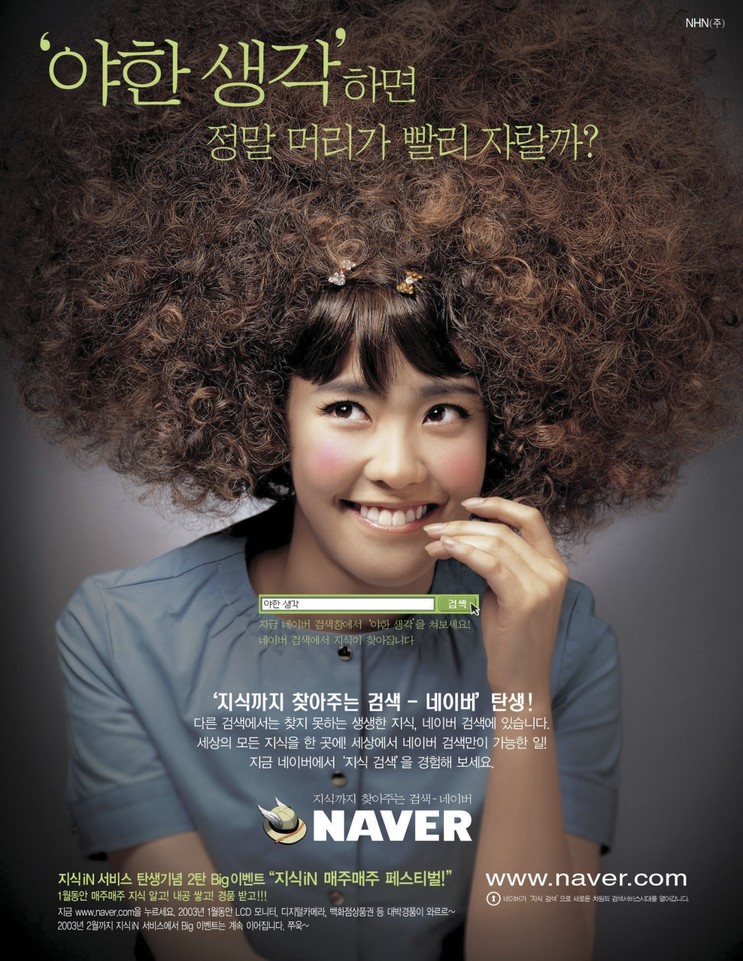
“Is it true that your hair grows if you have ‘dirty thoughts’?” (2002)
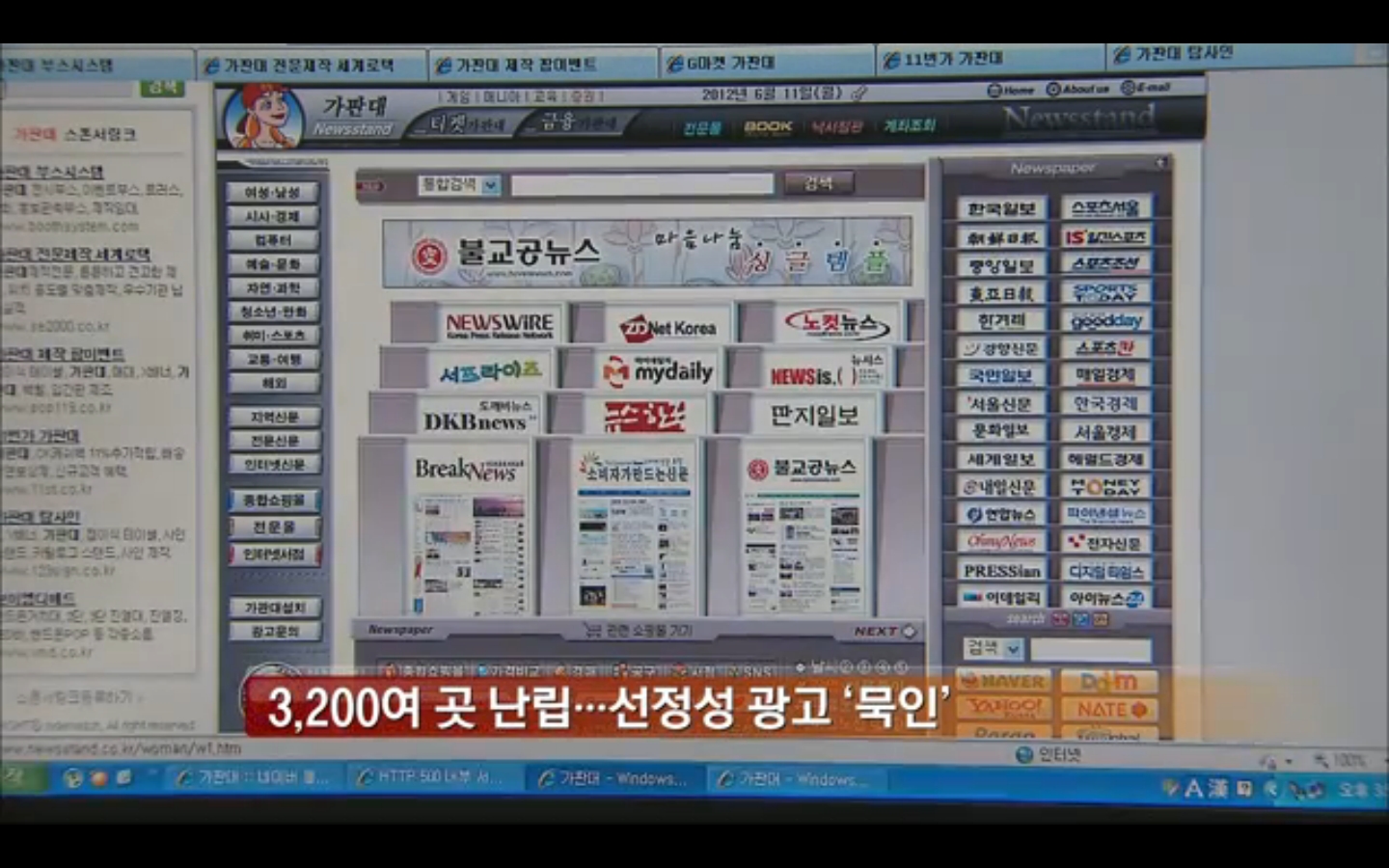
When so many websites struggle to open under the weight of smutty ads, it’s difficult not to think that the Korean internet used to be a much more innocent place.
At the very least, you’d assume exceptions would be made for articles specifically about such ads.
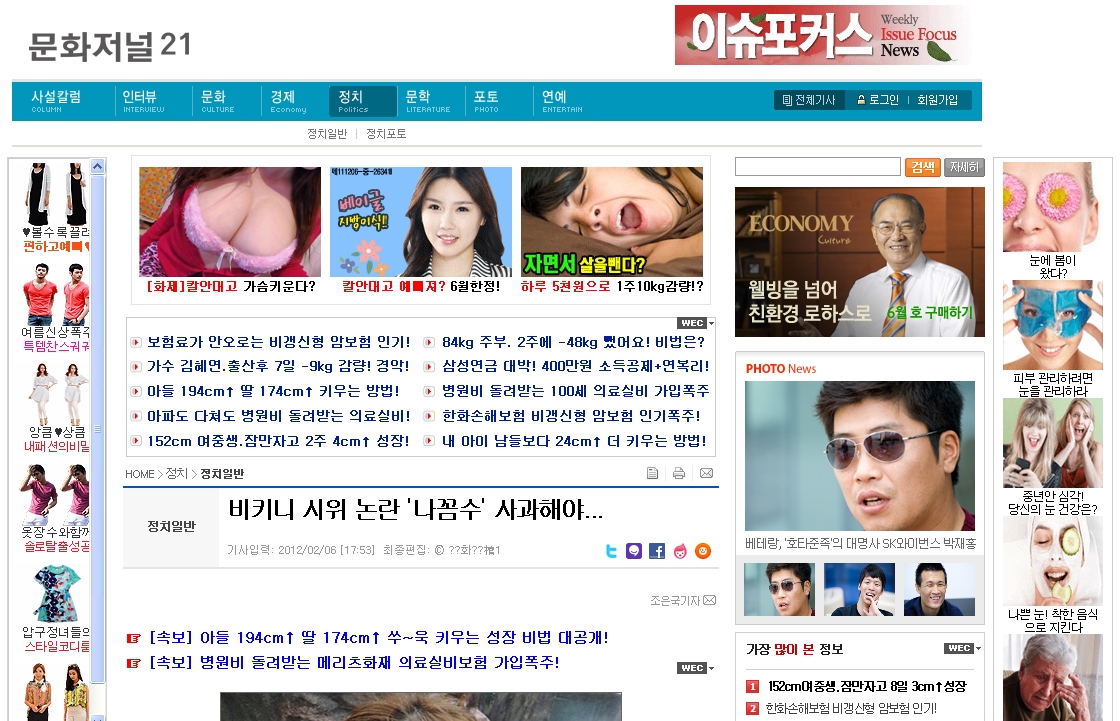
With no apparent sense of irony however, not only does thewebsite today’s article comes from feature camel toes, nude women, and couples in flagrante delicto, but some media companies will even censor photographs in news stories while keeping similar accompanying advertisements intact. Most recently and notoriously perhaps, some websites pixelated the breasts of “Bikini Girl” and her supporters for instance, but not the heaving bosoms used to advertise cosmetic surgery clinics:
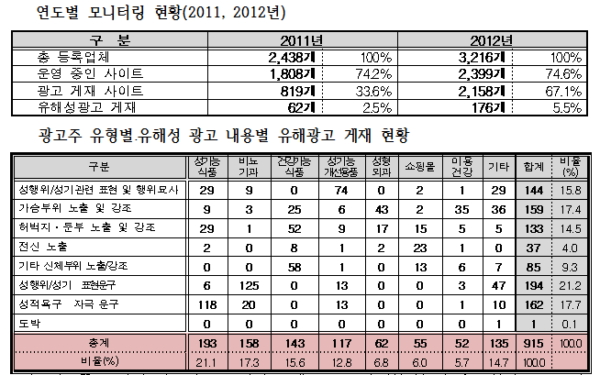
Given that, and given how difficult it was to find a news website that didn’t plaster today’s article with such ads, I was very surprised to find that the normally quite alarmist Ministry of Gender Equality and Family found that only 5.5% of registered media companies had them on their websites.
Partially, that low number is explained by the very narrow definitions used, as outlined in the article. But if you take a look at the top of the following table (not — as per usual — mentioned until the final paragraph), which lists total registered media companies, total active sites, total sites with advertisements, and total sites with harmful advertisements respectively, you soon realize that that 5.5% is derived from 176 of 3216 total registered media companies. As a proportion of the 2,158 sites with advertisements however, which is surely a more appropriate measure, it jumps to 8.2% (although that still sounds much too low to me).
Finally, of special interest is how MOGEF calls for (and has recently helped implement) self-regulation by internet companies rather than imposing its own regulation system, which may come as some surprise considering how actively it censors Korean music. But despite its reputation however, in reality MOGEF has very limited powers (and only 0.12% of the total government budget), which I think plays a big role in the zealousness with which it monitors K-pop.
여성가족부 ‘19금광고’ 언론사들고발검토 / Ministry of Gender Equality and Family Affairs Considering Prosecuting Media Companies for “18 and Over Advertisements”
‘유해 광고’ 올해들어 3배 늘어… “자율규제기구 설치 촉구, 광고주 심의 요청” / 3 times more ‘harmful advertisements’ compared to last year…”We strongly recommend advertisers consider establishing a self-regulatory system”
by 최훈길/Choi Hoon-gil
선정적인 내용이 담긴 언론사의 인터넷 광고가 작년에 비해 3배 가량 증가한 것으로 조사됐다. 여성가족부는 언론사의 자율 규제를 우선 촉구하되, 해당 언론사에 대한 고발도 검토하고 해당 광고주에 대한 심의 요청도 추진하기로 했다.
A survey has shown that media companies display 3 times more sexually suggestive internet advertisements compared to last year. The Ministry of Gender Equality and Family (MOGEF) recommends that media companies self-regulate themselves, and is considering prosecuting both offending media companies and advertisers themselves.
여성가족부가 11일 발표한 ‘인터넷 신문의 청소년 유해광고 유통 현황 모니터링 결과’에 따르면, 올해 유해성 광고는 176개(5.5%)로 작년 유해성 광고 62개(2.5%)보다 3배가량 늘었다. 한 인터넷 신문은 성인용품 사이트 등 청소년 유해 매체물 광고를 성인 인증 없이 게재해 정보통신망법을 위반했다. 유해성 광고는 네트워크 광고의 일종으로, 상당수가 의료쪽 광고이며 문구나 이미지가 선정적이어서 ‘혐오 광고’로도 불린다.
On the 11th of June, MOGEF announced the results of their survey “The present situation of the circulation of internet newspapers’ harmful advertisements among teenagers”, according to which there were 176 sites with harmful ads (5.5%) among those surveyed, roughly 3 times more than last years’ 62 (2.5%) [James — considering the different numbers of sites examined, proportionately there were really only 2.2 times as many]. Among other advertisements harmful to teenagers, one internet newspaper had an advertisement for a sex products site that could be accessed without age verification, which violated the Information and Communications Network Law. Harmful advertisements are a kind of internet advertisement called “disgusting advertisements” [James – called that by who?]; the majority have sexually-suggestive images and terms and/or refer to sexually-related medical procedures.
176개 인터넷 신문 중 20개 인터넷 신문이 전체 유해성 광고물(915건)의 50.3%(406건)을 노출하고 있었다. 여성 가족부는 해당 언론사 실명을 공개하지 않았다. 청소년매체환경과 관계자는 “인터넷 점유율이 높은 곳들이 유해성 광고가 많았고 스포츠, 연예 신문들이 많았다”며 “고발을 검토하는 인터넷 언론사는 종이 신문을 발행하지 않는 곳으로 잘 알려진 언론사는 아니다”라고 설명했다.
Out of the 176 internet newspapers that were found to have harmful advertisements, 20 had more than half of their total advertisements, 406 out of 915 (50.3%), taken up by them. MOGEF didn’t reveal the offending media companies’ names. An official in the Division of Youth Media Environment of MOGEF said: “The internet sites which had the highest number of harmful advertisements were sports and entertainment sites, and those with a lot of traffic,” and added that “the news sites which we are considering prosecuting are not well-known and don’t publish physical newspapers.”
해당 유해 광고의 내용은 성행위·성기표현 문구(21.2%)가 가장 많았고, 성적욕구 자극문구(17.7%), 가슴 부위 노출(17.4%), 성행위·성기 관련 묘사(15.8%), 허벅지·둔부 노출(14.5%) 순이었다. 해당 광고주는 성기능 식품(21.%) 관련 업체가 가장 많았고, 비뇨기과(17.3%), 건강보조식품(15.6%), 성기능 개선용품(12.8%), 성형외과(6.8%) 광고주 순이었다.
Of the harmful advertisements, 21.2% — the highest — had expressions related to sex acts or genitalia, 17.7% had expressions designed to arouse sexual desire [James — e.g. “할래/Do you want to do it?], 17.4% exposed the breasts, 15.8% had descriptions of sex acts or genitalia, and 14.5% exposed the thighs or buttocks. Of the advertisers themselves, 21% were selling sexual function products [James — like Viagra?], 17.3% urology services, 15.6% health assistance products, 12.8% products designed to improve sexual performance [James — how are those different to “sexual function products”?], and 6.8% cosmetic surgery procedures.
여성가족부는 작년과 비교해 유해 광고는 늘었지만 법 위반 언론사들이 대폭 감소한 것을 감안해, 언론사에는 우선 자율 규제를 촉구하겠다는 입장이다. 청소년매체환경과 관계자는 “작년에 34개 언론사가 법을 위반했는데 올해에는 다 시정됐다”며 “언론사들을 직접 규제하기 보다는 인터넷신문협회 등에 자율규제기구인 인터넷신문광고심의위원회의 설치를 촉구하겠다”고 밝혔다.
Although MOGEF points out that the numbers of harmful advertisements have increased since last year, the fact that there are actually less media companies breaking the law also needs to be taken into consideration, so first MOGEF is going ask media companies to regulate themselves. The official in the Division of Youth Media Environment continued: “The 34 media companies that broke the the Information and Communications Network Law last year have all since rectified their mistakes,” and so “a self-regulatory system is preferable to direct regulation, and we demand that the Korean Internet Newspaper Association and so on establish an internet newspaper advertisement consideration committee.”
이 관계자는 “이번에 법 위반으로 적발된 언론사에도 시정 조치를 우선 요구하고, 시정이 안 될 경우 형사고발을 할 것”이며 “유해성 광고를 의뢰하는 광고주 사이트에 대해서는 방송통신심의위원회에 유해성 심의 요청을 할 것”이라고 말했다. 언론사에 대한 형사 고발 검토와 광고주에 대한 심의 요청은 올해 처음으로 시행되는 조치다.
Also: “In this case, first we demand that measures are taken to rectify the mistakes of offending media companies, and if this is not done we will consider prosecuting them,” and forward their harmful advertisements to the Korean Communications Standards Commission for consideration. These steps are being enforced this year for the first time.”
한편, 이번 조사는 지난 3월7일부터 5월21일까지 문화체육관광부에 등록된 3216개 인터넷 신문(지난 2월말 기준)의 메인 페이지 및 10개 기사면을 점검한 것이다. 여성가족부는 작년에도 해당 조사를 했으며, 조사 이후 한국인터넷신문협회와 한국온라인신문협회는 ‘인터넷신문광고 자율규제 가이드라인’을 제정한 바 있다. 청소년매체환경과 관계자는 “낙인 효과를 고려해 이번에는 언론사 이름을 비공개로 했다”며 “올해 하반기나 내년에 또 조사를 할 것”이라고 말했다.
The survey, of 3216 sites registered with the Ministry of Culture, Sports, and Tourism (as of February) was conducted the 7th of March to the 21st of May this year, and examined the main pages and 10 [random?] posts of each. Last year’s survey was conducted by MOGEF, after which the “Internet Advertisements Self-regulation Guidelines” were established with the Korean Internet Newspaper Association and the Korean Online Newspaper Association [James — ironically, Firefox blocks the latter as a dangerous site!]. The official in the Division of Youth Media Environment of MOGEF explained that “because of the harm to their reputations that would come with naming the offending media companies, that information shall be kept private”, and that “a similar survey will be completed in the second half of this year.” (end)
For any readers who don’t already know, this Sunday the 17th there will be “International Couples and Friends Picnic” from 12pm to 6pm in Yeoido Park in Seoul. See here for the details and a press release, while here are some of the most recent blog posts about the original MBC story:
Meanwhile, on Sunday the 16th at 2pm, a recent North Korean defector will speak and take questions at Busan National University. See Busan Haps or the North Korea AwarenessFacebook page for further details.
Thank you very much to Maria, whose synopsis instantly sold me on this recent drama:
…I’ve seen a lot of Korean dramas and they almost always find a way to disappoint me in the way they portray women, sexuality or both. This little drama is quite refreshing. Unusual in that it’s only 8 episodes long, it openly talks about issues like teenage sex, puberty, the difficulty married couples have getting sex regularly, and even one episode about viagra. To be fair, I have taken the last nearly 9 months away from watching dramas, so maybe things have heated up out there when I wasn’t looking. But this is the first time I’ve seen sexually related issues being dealt with so frankly and humorously…
If you think it already sounds a lot like Modern Family, you’d be quite right — it’s explicitly modeled on it, albeit without a gay family. See here for a helpful family tree, starting with Lee Deok-hwa (이덕화) playing the father role that Ed O’Neill does in the US original, and DramaTic for some historical context on Korean sitcoms, which helps you better understand what makes this one so different. In particular:
…the word comedy [was removed] from the show’s promotion to avoid all the implications it brings to the table, at least in Korea – namely, the idea that sitcoms should all be about a relentless succession of mindless gags punctuated by the good old laugh track. It’s an intelligent expedient, which highlights this show’s priorities better than any trailer or presentation would. This, in other words, is a back-to-basics approach, while at the same time exploring different answers to the usual formula.
Perhaps it’s no surprise that it’s so easy to find with English subtitles then — I just watched episode 1 here, and although frankly I found it a little slow after all that build-up, it was still quite enjoyable. Also, crucially, it only had precisely one cringe-worthy moment for me, when Oh Yoon-ah (오윤아) behaves quite childishly in the police-station towards the end. Considering how routinely women behave that way in most Korean dramas, making me turn the TV off in disgust within 5 minutes of watching, it was very refreshing not to see it for a whole 40 minutes here.
Anybody else seen the show, and/or like a detailed episode by episode discussion (à la Dramabeans) over the next 8 weeks? Please let me know!
For anyone following the response to the MBC video, please note than an “International Couples and Friends Picnic” event is being held in Seoul on Sunday June 17th, which you can read more about here. It also has a handy list of the most recent links about the video.
Update: For those of you not on Facebook, here is a Microsoft Word file with the information in the link.
Next, as you can see above, Busan’s first drag prom will be on the Saturday after that, with all proceeds going to charity. For further details, please see the Facebook event page (you don’t need to be logged in).
Finally, here are this week’s stories. Probably the one that will impact the most readers is the news that the contraceptive pill will now require a prescription, while ironically the morning-after pill is to be made available over the counter (see the links in “Body Image/Health” below). I’ll write a more detailed post on it the week after next (next week is the last week of the semester sorry!), but in the meantime thanks to Alex for providing the rationale for the move over on the blog’s Facebook page:
My wife (Korean nurse) says it has to do with the doctors vs pharmacists lobby. Basically the doctors want a certain amount of drugs to require prescriptions so they can get their cut but the pharmacists want to give out the morning after pill so it’s easily accessible in times of need (ie when the doctors clinic isn’t open). So the government cut a deal to basically swap the situations of the pill and the morning after pill. Then the doctors ‘lobby’ decided to make some stuff up about how the pill should need a prescription even though they’ve been giving it out for years (decades?) without one. This news should be on the mouth of all sexually responsible women in Korea, but it hasn’t really blown up that big yet.
Has there ever been an actor you’ve really liked, but couldn’t put your finger on why?
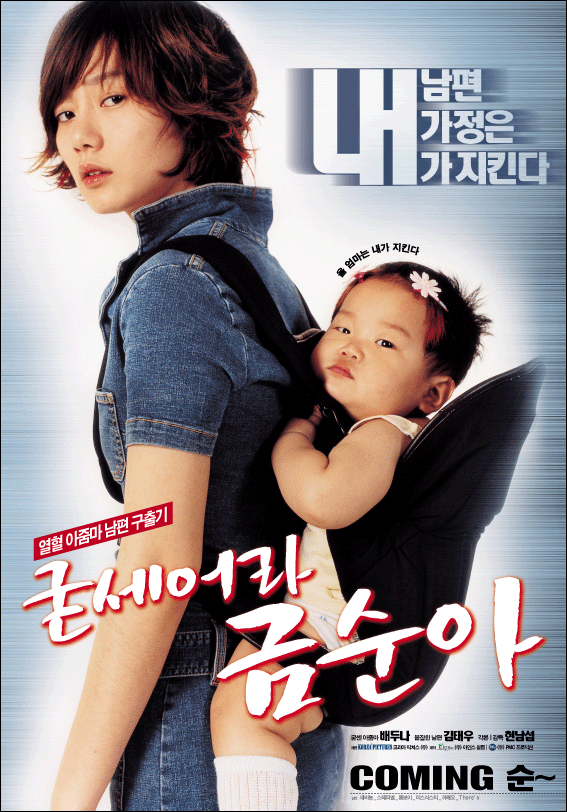
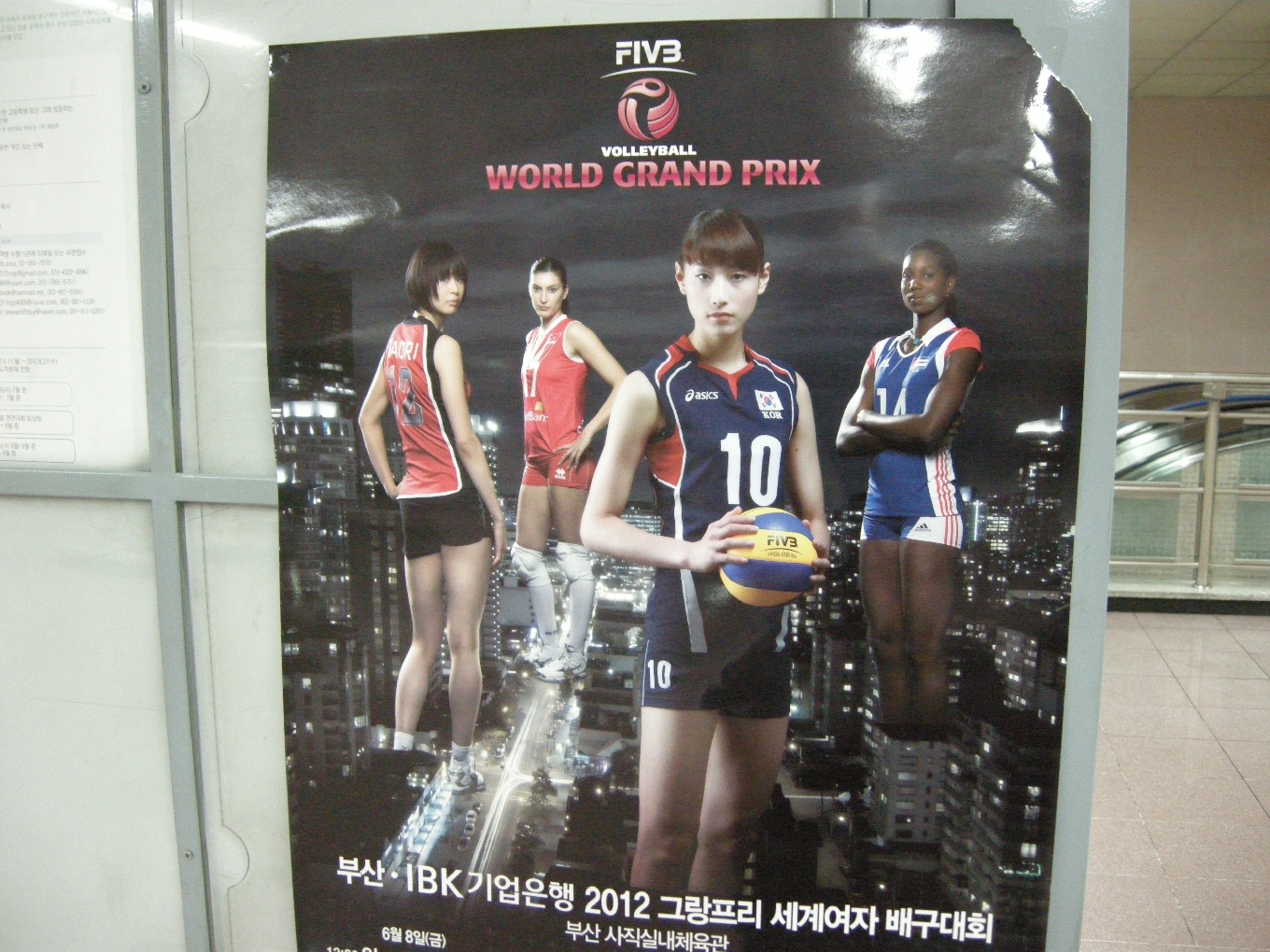
For me, that was Bae Doo-na (배두나), much on my mind since I heard she would be starring in Cloud Atlas. Later, I’d also stumble upon a…let’s say “eye-catching” movie poster of hers from 2003, which I remember constantly distracting me as I looked for jobs around my new home of Busan. And finally this week, when my family and I decided we’d go the 2012 FIVB Volleyball World Grand Prix on Saturday, I suddenly remembered that she’d played a former volleyball star in Saving my Hubby (굳세어라 금순아) too.
It was time to investigate. Just what was it about her that I found so compelling?
To my surprise, I soon realized I hadn’t actually watched many of her movies, including The Host (2006) and Sympathy for Mr. Vengeance (2002) for which she is best known. I had watched Take Care of my Cat (2001) of course, twice, but in hindsight I probably missed a great deal without subtitles, no matter how good my Korean used to be.
That just left the coming of age movie PlumBlossom (2000) then, probably best known for its numerous sex scenes — not quite the answer I expected or wanted. Still, it is a very affecting movie, with Bae Doo-na’s performance more much memorable for her character’s spunkiness than her frequent nudity. That’d be the image of her I’d bring with me to Saving my Hubby.
And who can blame me with a poster like the opening one above, or trailers like this?
As Wikipedia describes the plot (slightly edited by me):
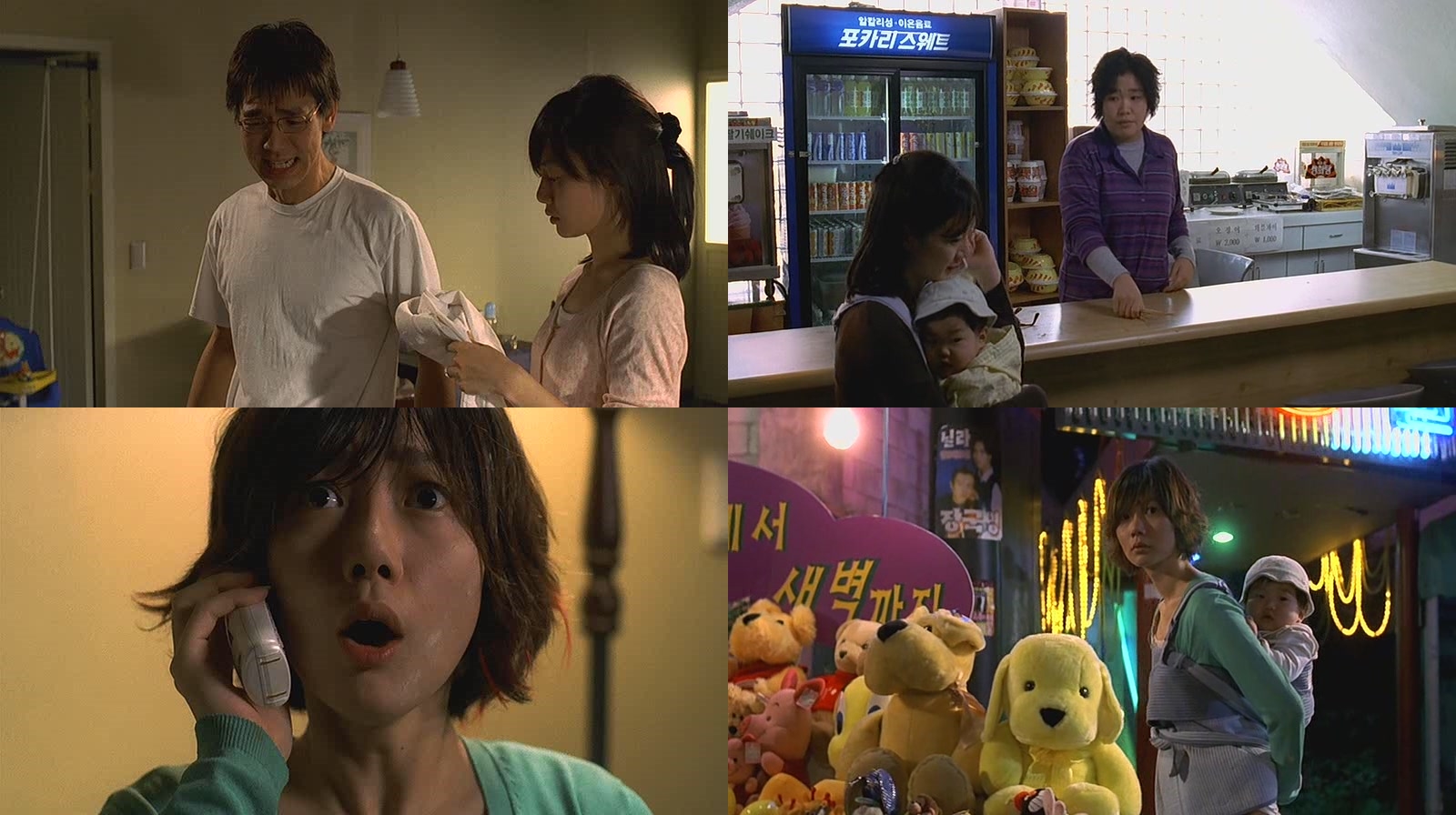
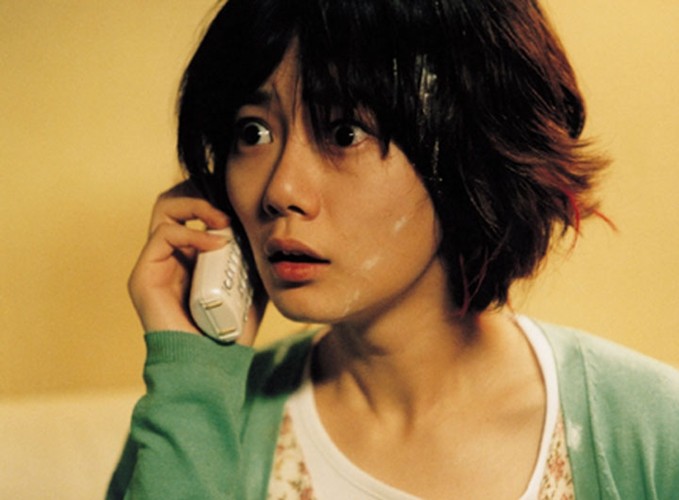
Former volleyball star Gum-soon (Bae Doo-na) is now a married housewife with a baby daughter. Her husband, Joon-tae (준태, played by Kim Tae-woo {김태우}),* is starting the first day of his new job, when Gum-soon receives word that her in-laws are going to visit the following morning. While she struggles to get their house ready, Joon-tae is taken out for a drink with his new colleagues. Later that evening, while preparing her home for a visit by her in-laws early the next morning, Gum-soon gets a phone call from a nightclub owner who is holding her husband hostage, claiming that he has run up a huge bill and doesn’t have the money to pay for it. Strapping her baby to her back, Gum-soon sets out to rescue her husband.
So you can imagine my surprise and disappointment when, just a couple of minutes into the movie, both Gum-soon and Joon-tae are having tantrums more befitting of preteens than young parents. But then they are young — Gum-soon the character and Bae Doo-na the actor are both clearly in their early-20s, only marrying because of her pregnancy, and this youth and unpreparedness for domestic life is a central theme of the movie (Joon-tae’s age is less clear, while Kim Tae-woo the actor is a youthful-looking 31). A parent at 30 myself, it took some effort not to project that more typical age onto the couple, and to judge them less harshly for their childishness. Especially as adult women constantly behaving like children is a pervasive, grating part of Korean popular culture.
Ironically though, it’s also precisely some of those childish domestic scenes, which dominate the first 20 minutes, that are among the most endearing parts of the movie. Viewers with Korean partners are likely to find much about the couple’s interactions that warmly resonate with their own relationships (mine is at 18:10 when — squeee!— Gum-soon says “정말?!”).
But don’t get me wrong: this is no romantic comedy. Nor, despite Gum-soon’s heroine role, can it remotely be described as a grrrl-power flick. Rather, once Gum-soon receives that phone-call, it’s all slapstick from there, complete with the mandatory inept gangsters, chasing her for accidentally getting their boss’s suit dirty. All of which you can see for yourself via this alternative trailer, which gives a much more accurate impression of the movie:
For the next half hour or so, the ensuing antics are amusing enough. The movie also really captures Korean nightlife well. In particular, when she can’t find the nightclub her husband is in, her lost wanderings readily evoked my first few months in Korea: when smartphones didn’t exist, and all the bars, clubs, norae-bangs, and 24-hour haejang-gook restaurants of downtown Jinju seemed to blend into one vast neon blur…even though they were just a few blocks in reality.
Indeed, ultimately it becomes too realistic, for about halfway through the movie the gags suddenly seem to dry up, and we’re left with Gum-soon literally running around in circles as she avoids the gangsters and looks for the nightclub — minus the gangsters, it’s like watching me trying to find my hotel in Insa-dong one drunken early morning last summer. When things do finally pick up again, unfortunately it’s so late in the movie that there’s no time to build up the momentum of laughs that would compensate for the long lull.
That said, it’s still worth seeing (you can watch it online here, with English subtitles) — it has its amusing moments, and others that will likely remind many readers of why they’re with their Korean partners, or at least of their Korean newbie days out on the town. But don’t be fooled by the promotional material into thinking that it’s anything more than that, and I’m certain that there’s much better movies with Bae Doo-na out there.
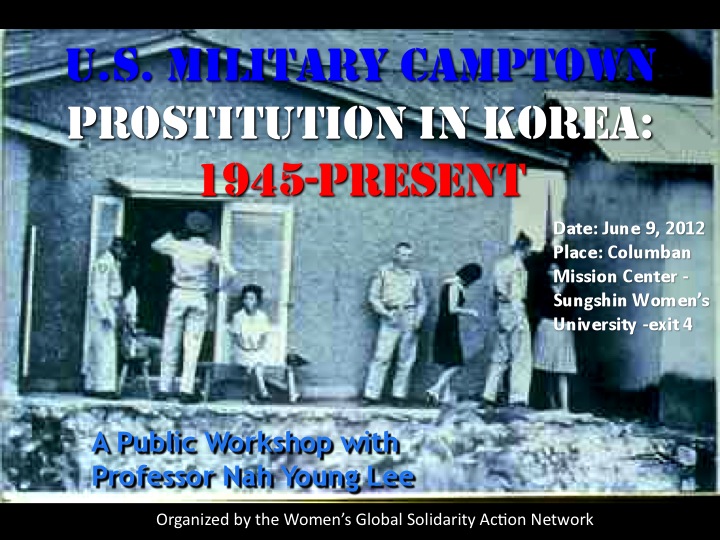
As you may or may not know, the House of Sharing International Outreach Team has recently regrouped under the name, Women’s Global Solidarty Action Network. Our new expanded goals include focusing on issues of sexual slavery, trafficking women and the “comfort women” issue. This Saturday (June 9th), we will be hosting a workshop under the title “U.S. Military Camptown Prostitution in Korea: 1945-Present”. The workshop will be given by Professor Nah Young Lee.
To get to the center, take line 4 to the Sungshin Women’s University Entrance (성신여자대학교입구) stop. Go out exit 4 and a building with a traditional Korean roof (hanok) will be in front of you. Go into the building and up to the second floor. Please note the center is very close to exit 4, and not on the University’s campus.
For more information, email womens.global.solidarity@gmail.com, visit the Facebook event page, or contact Shannon at 010-4534-1553.
As Hello Korea! aptly describes the above program, “after years spent learning to groom yourself into a living doll, you can then strive to be a Stepford wife.”
Meanwhile, for those very few readers unaware, MBC recently screened a blatantly sexist and racist report titled “The Shocking Reality of Relationships with Foreigners.” For more information and perspective on it, here are some of the longer blog posts about it I’ve been able to find, in chronological order:
Also, now there’s now an over 7000-strong Facebook group coordinating a response. And thanks very much to the reader who emailed me the following about how to make an official complaint:
I found the government office, where you can complain about the program officially. It is the Press Arbitration Commission (언론중재위원회). It don’t look like the English site has all the forms, unlike the Korean link, but there is a call number at the bottom of the website.
Update — Unfortunately, it turns out that the PAC can’t do anything, but the Korean Broadcast Commission can:
We had a friend in Korea try the PAC office and she said that the PAC can only take complaints from those who were filmed. PAC redirected her to the Korean Broadcast Commission (방송통신위환회) at 02-750-1114 …press 2 for English. They will take your complaint in English :-). She was told KBC takes & follows-up on all other complaints about broadcasts.
And now for the regular categories. To make things easier to find, I’ll be putting them in alphabetical order from now on:
A long time ago, a Korean friend told me that banks were like a microcosm of all Korean workplaces — almost all the tellers were women, and seemed to do most of the actual work, but made the least money. In contrast, their male supervisors seemed to just sit at the back, occasionally approving a form the tellers would bring to them. But they’d probably be paid twice as much.
I don’t know how fair that portrayal was, and indeed later I befriended a Korean bank teller who didn’t think much of it, who loved her work at an all-female branch. Nevertheless, as the following The Joongang Ilbo report makes clear, the banking industry still has the largest gender pay gap, with women making an average of only 57% of what men make.
Undoubtedly, that is primarily because most of the women in banking, well, are tellers, as one banker explains below. On the other hand, it’s also true there are some deeply sexist attitudes within the industry — e.g., women lack a “competitive edge” — that underlie that gender division. For more on that, see this post on the 2009 commercial by Shinhan Bank above, which has a clear message that men should do the thinking while women should merely look good.
Also, after reading this post, compare my “University Graduates: One Woman Hired for every Four Men” one from November, where many commenters pointed out that the companies examined were most heavy industries, for which such a gender division was to be expected. This report sheds more light on that, including the surprising news that it’s actually the Hyundai Motor Group that gives the highest average salaries to women.
성별임금따져보니 / Let’s find out the sex difference in salaries
대기업 여성 연봉 순위는 남성 랭킹과 확연히 달랐다. 1위는 평균 7100만원을 주는 현대자동차였다. 남성 평균(9000만원)의 79% 선이다. 이 회사 남성 직원 평균 근무 연수가 17.8년으로 여성(12.2년)보다 고참이 많다는 점을 감안하면 사실상 남녀 간에 임금격차가 없는 셈이다. 현대차 허정환 이사는 “자동차 산업의 특성상 힘든 생산라인에는 여성이 거의 없고 대부분 상대적으로 연봉이 높은 사무직에서 근무하다 보니 여성의 평균 임금이 높다”고 설명했다. 현대차에서 일하는 여직원은 모두 2442명으로 이 중 생산·정비직은 184명뿐이다.
The order of companies that pay the highest average salaries to men and women are completely different. For women, Hyundai Motor Group is number one, which pays 71 million won a year. This is only 79% of men’s average of 90 million won, but when their level of seniority is taken into account (women’s average number of years worked is 12.2, men’s 17.8) then they’re not significantly different. Asked about this, CEO Heo Jeong-hwan explained: ” The car industry is unique — women do not have the strength to work on the production line, so most do office work, where they make more money than the men on the floor. Out of 2442 women working at Hyundai, only 184 work on the production line or in maintenance.”
현대차뿐 아니라 현대차그룹 계열사들은 대부분 여성의 급여가 높았다. 기아자동차(6400만원)가 88개 대기업 중 3위, 현대모비스(5700만원)가 6위였다. 삼성전자는 여성이 평균 5350만원(11위), 남성은 8860만원을 받았다. 삼성전자는 여성들이 생산 라인에서 많이 일하고 있다. 이 업체는 생산직 여성 수를 사업보고서에 기재하지 않았다.
It’s not just Hyundai Motor Group, but also in companies affiliated with the Hyundai Group in which women’s average salaries are high. Kia Motors comes in at number 3 of 88 large companies with an average of 64 million won, and Hyundai Mobis number 6 with 57 million won. At Samsung Electronics, number 11, women receive 53.5 million won and men 88.6 million won. Many women work on the production line at Samsung Electronics, although The Joongang Ilbo is unaware of exact numbers.
전체 88개 기업의 여성 평균 연봉은 4270만원으로 남성 평균 7002만원의 61%였다. 평균 근무 연수는 남성이 12년, 여성이 7.7년이었다. 대기업 남녀 간 임금 격차에는 이런 근무 기간의 차이 때문에 생긴 부분도 있다.
All together, out of 88 large companies the average women’s wage was 42.7 million won, 61% of the average men’s wage of 70.02 million won. Most of this can be attributed to the difference in the average number of years worked, which is 7.7 years for women and 12 years for men.
성별에 따른 차이는 유통업체가 제일 심했다. 여성 평균 임금(2090만원)이 남성(3191만원)의 43%에 불과했다. 매장에서 상품 진열 같은 시급제 아르바이트를 하는 여성이 많다 보니 생긴 일이다. 최근 들어서는 특히 대형마트나 수퍼마켓에서 아르바이트를 하는 중·장년 여성들이 늘고 있다. 남편은 은퇴하고 자녀들은 청년 취업난에 좀체 일자리를 구하지 못하자 주부들이 생활비를 벌려고 나서는 것이다.
(James — There must be a typo in one of the above figures: 20.9 million won is not 43% of 31.91 million won, but 65%; and this is higher than the 61% mentioned in the last paragraph, even though this paragraph is about the lowest comparative figures. Given that, and the mention of a lot of women working part time, then I’m going to assume that it’s the average women’s salary that is the incorrect one, and that it should be 43% of 31.91 million won, or 13.72 million won)
The highest gender gap was in the sales and distribution industry, with women’s average salary of 13.72 million won being only 43% of men’s 31.91 million. The reason is that most of the women are middle-aged and late middle-aged part-time workers in sales, compelled to work in large supermarkets to make a living because their husbands are retired and their adult children find it difficult to get work.
고액 연봉 직종의 대명사인 금융 쪽도 여성과 남성의 차이가 컸다. 평균적으로 여성(4800만원)이 남성(8460만원)의 57%를 받는 데 그쳤다. 남성 연봉 1위인 하나대투증권의 경우 여성 평균 연봉은 6200만원으로 남성의 절반이 채 되지 않았다. 성별 연봉 격차는 8200만원에 달했다. 한국스탠다드차타드은행 또한 남성은 8900만원으로 전체 순위 7위였지만 여성은 그보다 5300만원 적은 3600만원으로 51위에 그쳤다. 외환은행(차이 4500만원)과 삼성화재(4200만원)도 남성과 여성 간에 급여 차이가 많았다. 금융회사들이 남녀 임금 격차 상위를 줄줄이 차지한 것이다.
The largest gender gap is in the finance industry, with women making an average of 57% (48 million won) of what men make (84.6 million won). In the number 1 company for men, Hana Daetoo Securities, women make an average of 62 million won but men make 144 million, more than half as much again [James – That’s 43% of the men; maybe that figure got moved to the wrong paragraph?]. At Standard Chartered Korea, 7th best for men, they make 89 million won, but the company is only 51st best for women, who make 53 million (a difference of 36 million). At Korea Exchange Bank, the gender gap is again high at 45 million won, as it is at Samsung Fire and Marine Insurance. Across the board, the gender gap is very high in this industry.
이에 대해 스탠다드차타드은행 홍보실 정한용 부장은 “고액 연봉을 받는 사무직이나 영업직은 주로 남성이고 여성은 대부분 계약직 창구 직원(텔러)이기 때문”이라며 “여성의 근속 연수도 남성보다 짧다는 점 역시 작용했다”고 말했다. 통신업종은 남성에 대한 여성 임금 비율이 72%로 가장 격차가 적었다.
김영민 기자
Standard Chartered Korea PR Head Jeong Han-young explained: “The reason for the difference is because in our company, it is mostly men that are involved in business and commercial operations whereas most of the women are irregular workers, working as tellers.” Also, “the male workers have been working for the company for much longer.”
The smallest gender gap was in the telecommunications industry, with women making on average 72% of the men.
Reporter: Kim Yong-Min
Update — Thank you to Sky Kauweloa, who pointed out on the blog’s Facebook page that The Korea Times produced a similar, short report. Alas, it doesn’t help resolving those typos above, but it does have information about some more companies, and also the nice graphic I’ve added on the right:
A maddeningly short article, and — as per usual — completely devoid of any mention of the survey’s methodology. But if the result about men’s and women’s sexual knowledge holds true (and I’ll do some further investigation next month to check), it puts a definite twist on Koreans’ belief that contraception shouldonly bemen’s responsibility!
남자 대학생 50% ‘성경험’… 여대생은? 50% of Male University Students Have Sexual Experience. As for Female University Students…?
우리나라 남자 대학생 2명 중 1명은 성관계 경험이 있지만 성에 대한 지식수준은 여학생들에 비해 낮은 것으로 나타났다. 이화여대 건강과학대학교 신경림 교수팀은 보건복지부 연구사업으로 지난해 5~11월 전국 대학생 6000명을 대상으로 ‘대학생의 성태도 실태조사에 관한 연구’를 한 결과 이와 같이 나타났다고 11일 밝혔다.
In Korea, 1 in 2 male university students have had sexual experience, but female university students are much more knowledgeable about sex. That’s one of the results of a nationwide survey of 6000 university students conducted between May and November last year by a team led by Professor Shin Gyeong-Rim of the Ehwa University Health Science College and the Ministry of Health and Welfare, which were announced on the 11th.
성경험이 있다고 응답한 대학생은 남학생이 50.8%로 여학생 19%보다 압도적으로 많았다. 연구팀은 이러한 차이는 남녀의 성에 대한 욕구, 태도, 가치의 차이와 더불어 군대 등의 이유로 남학생의 나이가 여학생에 비해 상대적으로 많고 군대의 성문화에 노출됐기 때문으로 보고 있다.
Many more men (50.8%) said that they had had sexual experience than the women (19%). The research team commented that the differences in [levels of?] sexual desire, attitudes to sex, and value placed on sex were due to the men’s greater ages and their exposure to sexual culture during their compulsory military service.
성지식은 ‘생식생리, 성심리, 임신, 피임·낙태, 성병, 성폭력’ 등 6개 영역 중 5개 영역에서 남학생에 비해 여학생의 점수가 높았다. 이는 남학생이 여학생보다 성지식이 더 많을 것이라는 고정관념을 깨는 결과로, 올바른 성지식 정도는 여학생이 더 높다는 것을 반영한다.
“Reproductive physiology, sexual psychology [James — a bit specialized surely?], pregnancy, contraception & abortion, STDs, and sexual violence” — in 5 out of these 6 areas examined, women scored higher than men [James — which one did the guys beat the girls on?]. This shatters the widely-held belief that men are more knowledgeable about sexual matters.
대학생의 성교육 관련 실태 및 요구도를 조사한 결과 초·중·고교 때는 대부분 성교육을 받은 경험이 있지만, 대학 때의 성교육 경험은 20.3%로 비교적 저조한 편이었다. 성관련 강좌 참여 희망도에 대해서는 33.6%의 대학생이 참여하겠다고 답했다.
Seeing how this reality is related to sex education, the survey found that while most survey participants had received [some form of] sex education in elementary, middle, and/or high school, only a relatively low 20.3% had at university. But if lectures on it were offered however, only 33.6% said that they would attend them (end).
For comparison’s sake, see here for a (much longer) survey of Yonsei University students in 2010.
(Thanks to Robert Koehler for passing on the link)

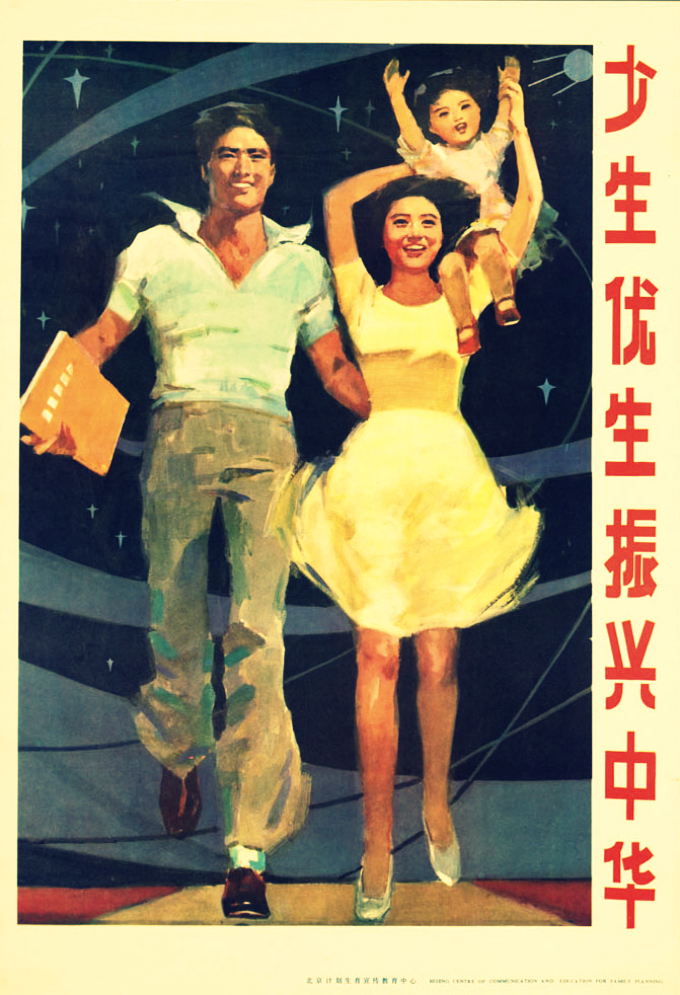 (“Less Births, Better Births” by IISG; edited)

























 The Grand Narrative