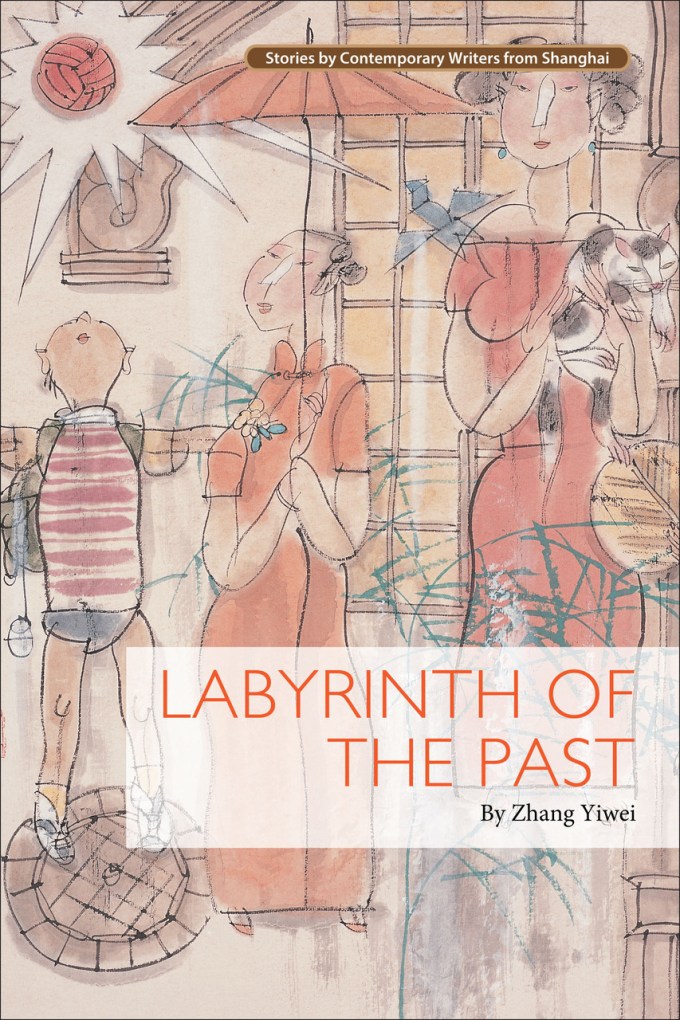
Book Giveaway: Labyrinth of the Past by Zhang Yiwei (2014)

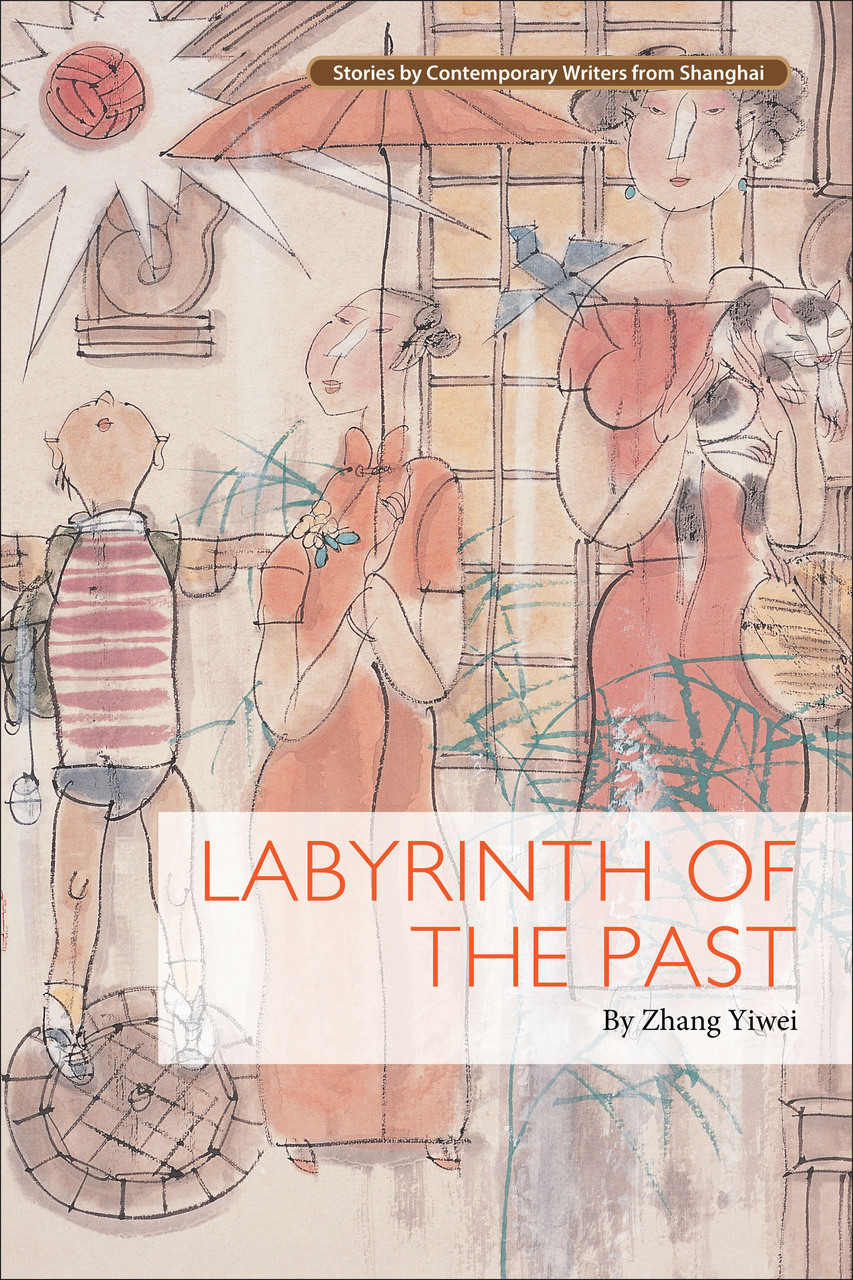
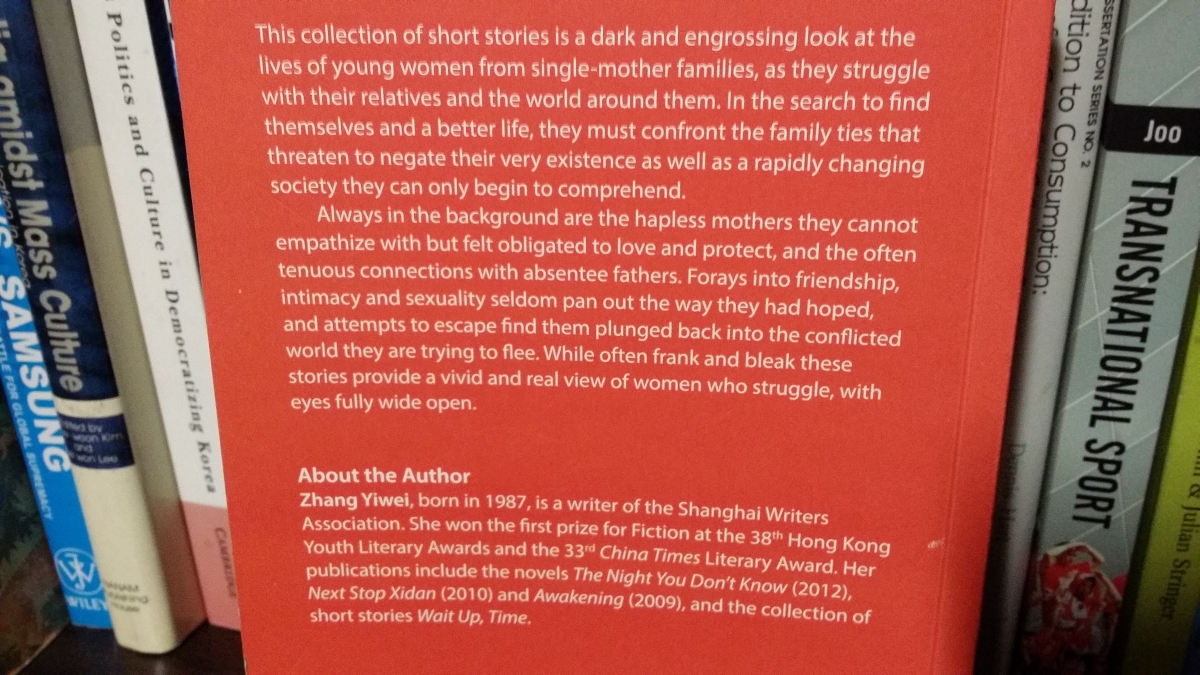
Labyrinth of the Past by Zhang Yiwei(Source: Tuttle)

Sorry that I haven’t posted for so long everyone. I was very busy with offline work for two weeks, then I caught a terrible cold which lasted another two weeks…which means now I’m busier than ever. But, I would like to get writing here again, and I can think of no better way to start than by offering a book giveaway!

For this first one, I’ve selected Labyrinth of the Past by Zhang Yiwei. It’s a good book, but frankly it was a frustrating read for me personally, because the publisher’s website gave me the wrong impression of what to expect. Know what it’s really about though, and you’ll enjoy it from the get-go.

Here’s the offending description, which has two big problems:

Labyrinth of the Past is a collection of short stories that explore the lives of young women raised by single mothers in China, a country that is unforgiving to unmarried women and their children.

A dark, yet engrossing look at the lives of these girls, each story examines their personal struggles with family and the greater world around them. Coping with the stigma of being the daughter of a single mother, most of these women can’t seem to form anything but dysfunctional relationships, from mothers to friends to lovers.

While often frank and terribly bleak, these stories provide a vivid and real view of the women who struggle against a history they can’t change, in a culture that has difficulty accepting them.

That stigma surrounding unwed mothers is very real in Korea, so I partially chose the book to gain some insights into what it was like living with it. You can imagine my surprise and disappointment then, when it never even came up. Primarily, because none of the mothers are “unmarried” in the sense of never having married, but are all divorcees or widows instead. Which, given China’s skyrocketing divorce rates since Deng’s reforms, probably doesn’t carry any stigma at all:

The number of divorces has risen steadily in the new millennium, with one in five marriages now ending in separation. In 2006, the divorce rate was about 1.4 per one thousand people—twice what it was in 1990, and more than three times what it was in 1982….The number of divorces in the first three months of 2011 increased 17.1% year-on-year….Beijing leads the country with nearly 40 per cent of marriages ending in divorce, followed closely by Shanghai.

Behind the Red Door: Sex in China, Richard Burger (2012), p. 59

I’m happy to be corrected by any readers raised by female divorcees or widows, and/or with more knowledge of China, who may be able to read between the lines and see the influence of a stigma on the characters where I can’t. But if so, it’s still a very peripheral theme at best, and should really be removed from the description on the website (fortunately, it’s not mentioned on the back cover, which I wish I’d read instead).
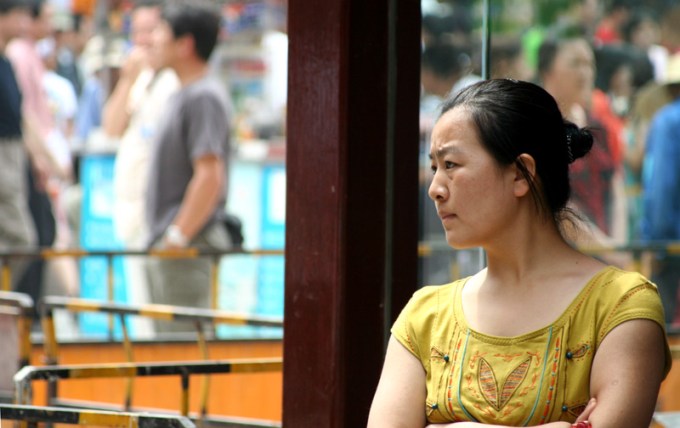
Chinese Woman in Shanghai(Source: Matthijs Koster. CC BY 2.0)

The second problem is that the book is about the lives of young women, yet two of the seven stories—”Scab Addiction” and “No Choosing Today”—are entirely about the characters’ childhoods. In particular, in the former the character-narrator is revealed to be still in high school, making it a terrible choice for an opening story. Had I picked up the book in a store, expecting it to delve straight into the lives of adult Chinese women, I would have rejected it on the spot.

Again, this is not a criticism of the book per se, and of course all the remaining stories are indeed from women’s perspectives, with “A Good Year”, “Love,” and “Summer Days” all covering dating, marriage, and/or sex. “I Really Don’t Want to Come” too, covering the narrator’s increasing disdain for kowtowing to ancestors as she grows older, and frustration with what the ceremony means for her split family, is something many Koreans (and their foreign partners) will surely relate to. (“Memory is the Slowest” though, I just found confusing—I’m still not really sure what it’s about). But it’s also a real pity, because, once I got over the disappointment of reading something very different to what I’d been sold, and was able to take a fresh look at the book, ironically I came to find Zhang Yiwei’s depictions of childhood to be one of its biggest strengths. Her ability to evoke its timelessness, the sense of children’s whole worlds confined to just a few streets and fields, and our fuzzy, malleable memories of that phase of our lives is really quite remarkable (frankly, it immediately reminded me of the magic realism of 100 Years of Solitude), and that should be highlighted in its marketing.

Another strong point is showing how profoundly the issue of housing impacts ordinary Chinese citizens’ lives. That may sound rather boring at first, but it looms large in a country with such breakneck development, huge internal migration, and consequent vast urban/rural and home-owning/renting divides, and accordingly it’s a constant concern for many of the characters in the book, some of whom are stuck in limbo because their property is in an absentee husband or father’s name. Indeed, as if to rub that in, recently the government manipulated the ownership laws in a bid to thwart the divorce rate, taking a great leap backward for women’s rights in the process:

…the Chinese government has expressed alarm at the soaring number of divorces and its threat to the traditional Chinese family. In 2011, China took controversial steps to discourage divorce, reinterpreting the marriage law so that residential property is no longer regarded as jointly owned and divided equally after a divorce. Instead, it will belong exclusively to the spouse who bought it or whose name is on the deed, which is usually the husband, even if the wife helped pay for the property. This means that upon divorce many women might find themselves homeless.

At a time of soaring property prices, real estate is often a couple’s most valuable possession, and the revised law has caused many women to consider more carefully whether they really want to get married. Chinese media reported that marriage registrants plummeted as much as 30 percent in some cities weeks after the revised law was announced in 2011.

Behind the Red Door: Sex in China, Richard Burger (2012), p. 61

Update, August 2015: For more details, I highly recommend listening to this Office Hours podcast interview of journalist Leta Hong Fincher, author of Leftover Women: The Resurgence of Gender Inequality in China (2014).

Chinese Housing(Source: Anita. CC BY 2.0)

The verdict? I can’t lie—despite its strengths, the cover price of $13.95 is a little steep for such a slim book (160 pages), especially with some of the stories being so frustratingly short. But it’s definitely worth the $10-ish or even cheaper on various websites it’s selling for at the moment, especially if you know what you’re in for.

But first, remember I have two free copies to give away! Please just leave a comment below, and a week from now I’ll pretend to select two of you at random to receive them (make sure your email address is correct!). Really though, if you’d like to get to the head of the queue, please do bribe me with interesting comments about single mothers and/or something China-related!

What are you waiting for? ;)

Sunday Fun: Bottoms!

Hidamari Sketch EscherGirlMy 8 year-old daughter Alice is really into comics these days, often hiding our home phone under her pillow to keep reading when she’s supposed to be asleep. To my chagrin, she couldn’t care less if the female characters have huge eyes though, and/or no noses. But yesterday, I noticed the above while she was watching the opening to the anime adaptation of Hidamari Sketch. It was a great opportunity to start teaching her about female characters’ typical poses too.

Cue 20 minutes of giggling at the bottoms in the Escher Girls blog, which ultimately had the whole family trying—and failing—to imitate some of the pictures (although I was pretty good myself actually). Naturally, we quickly skipped past some of the more inappropriate ones, and Alice still has no idea why female characters are so often drawn in a “boobs and butt” style. But at least she’s aware of the phenomenon now, and, with gentle prodding from me, will hopefully think more about it herself as she gets older.

For now though, she’s still very much a 8 year-old girl, and I can hardly fault her for that. Much of those 20 minutes were also spent by her and her 6 year-old sister Elizabeth saying “와! 예쁘다…” (Wow! They’re so pretty…), and today this post took a long time to write because she kept on stopping me to tell me all about the characters in Hidamari Sketch. Including Yoshinoya above, who’s supposedly a high school teacher (sigh)…

I Read a Book: Susan Blumberg-Kason’s Good Chinese Wife: A Love Affair with China Gone Wrong (2014)

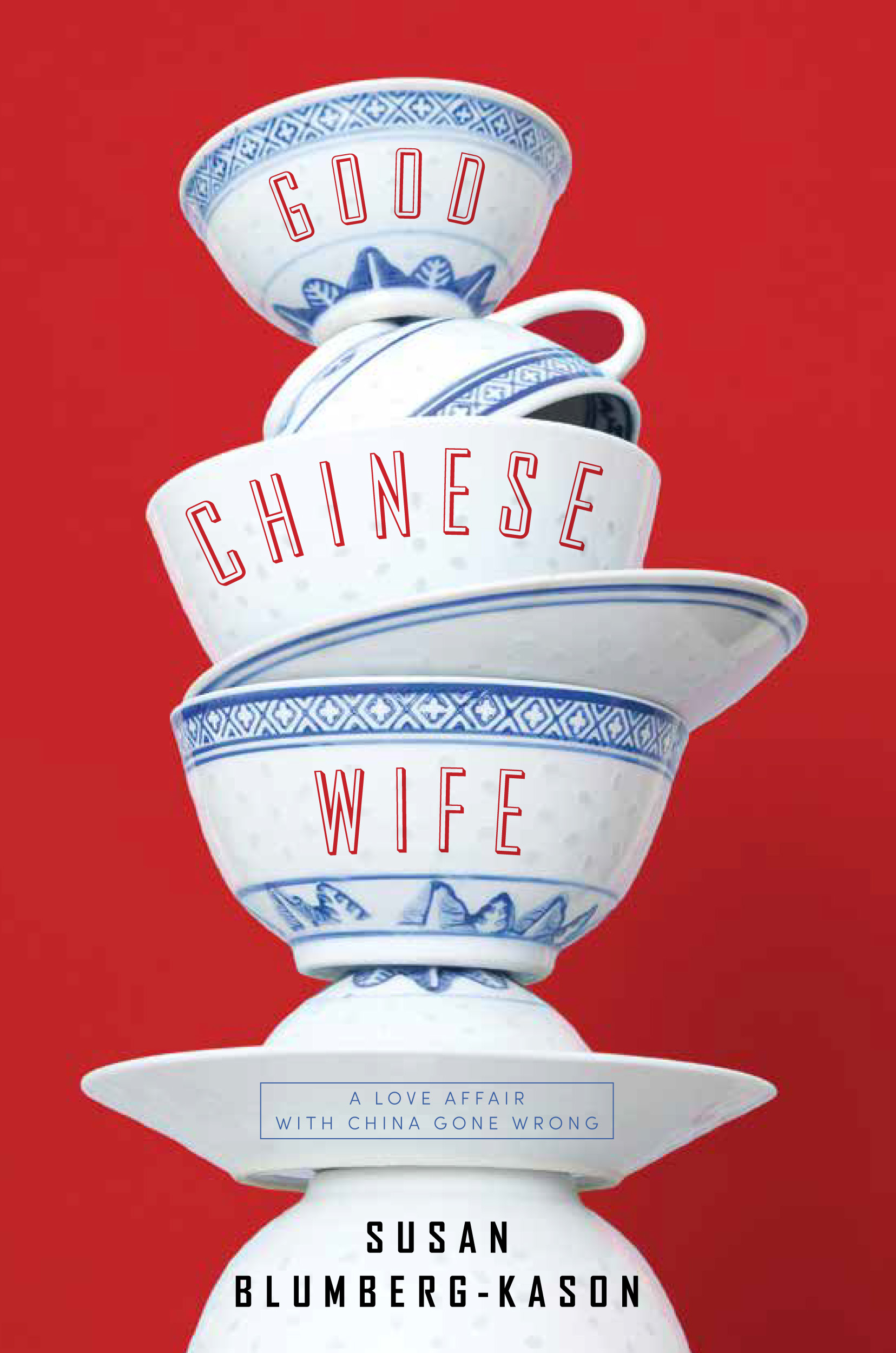
Good Chinese Wife CoverLet me be honest: Good Chinese Wife is not something I would normally read.

Susan’s ex-husband was Chinese; my wife is Korean. Susan’s relationship goes from friends to engaged in less than two minutes; we lived together for years, and had lots of wild sex before I proposed. Their marriage rapidly turned sour; we just celebrated our tenth anniversary. They married, had a child, and divorced way back in the 1990s; I’m really only interested in Chinese attitudes towards dating, sex, and marriage in the 2010s. And so on.

I’m still grateful for receiving a reviewer’s copy, organized by Jocelyn Eikenburg of the Speaking of China blog (see here for many more bloggers’ reviews). But first impressions? I expected it to be very outdated, and that it would have little to offer readers with Korean partners.

I was dead wrong, on both counts.

Good Chinese Wife begins in Hong Kong in the mid-1990s, where Susan is doing a graduate degree (she previously spent a year there as an exchange student in 1990). Then in her early-twenties, she soon becomes smitten with Cai, an older mainlander from Wuhan. She starts tutoring him English in her dorm room; unbeknownst to her, other students consider them already dating. This prompts him to open up and explain he’s already been married and has a child, revealing all as a prelude to showing he is now interested in dating Susan. Because in China, Cai explains, “couples traditionally only date if they plan to marry.”

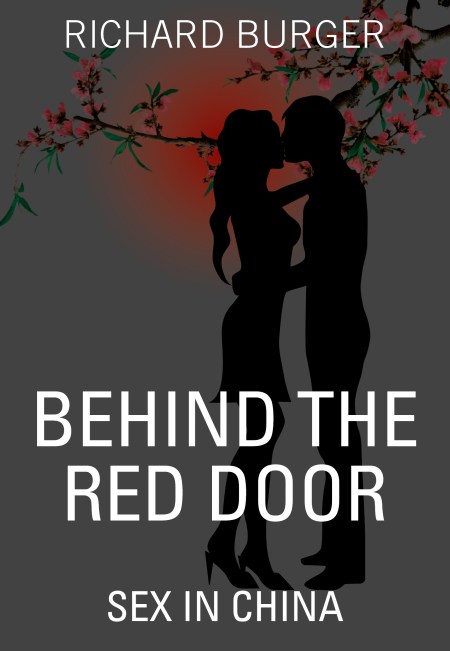
This sounded very antiquated. But as it turns out, dating in China is still not at all like in the West, nor even Korea. In Behind the Red Door: Sex in China (2012), Richard Burger explains that even in the big cities, “serial dating” is frowned upon as immoral or promiscuous. Instead, “most Chinese women still believe it is best to date only man and to marry him. Once the man invites her on a second or third date, he is indicating that he’s serious, that he is hoping for an exclusive Behind the Red Door Sex in Chinarelationship, and that marriage might be on the cards.” Whereas for women, inviting her to meet her parents “means she expects to marry him, and Chinese men understand this arrangement.” What’s more, the average age of marriage for Chinese men was only 24 in 2010; for women, 22 (in Korea, 31.8 and 28.9 respectively).
So, I understood Cai. And, being head-over-heels ever since they’d met, why Susan quickly accepted his proposal, before so much as a kiss—it sounded sweet. Her frankness about her feelings and mistakes is also a definite charm, especially for someone who likewise fell very easily in love at that age.

But that’s only 36 pages into the book. For the remaining 300, sympathy turns to constant frustration and exasperation with Susan’s rushing into marriage, then her frequent acquiescence towards her increasingly controlling and abusive husband. These feelings are only amplified by knowing that she’s doomed to fail.

In an interview, Susan says her problems were more because “He told me from the get-go that he had certain conditions for our marriage. Those are things I ignored or thought I could eventually get him to change. That should have been my red flag, not the [6 months] in which we became engaged and married.” (Likewise many happily-married Koreans, for whom such whirlwind courtships are also common, would surely bristle at the suggestion that they should have taken things slower.)

I disagree. From Cai’s belief that women are especially “dirty” in the summer, once all but physically forcing an exhausted Susan to bathe in a rat-infested bathroom, to his bizarre, surprisingly submissive relationship with eccentric professor friend ‘Japanese Father’ (“He thinks it’s not good [for us] to have sex relations more than once a week”), most of Susan’s later issues with Cai could have been discovered if they’d spent (much) more time together before the wedding day—and/or resolved if an expensive wedding wasn’t already looming over them.

Still, it does make for a good page turner. There is also merit in studying a bad relationship to learn what to avoid, and much about this one that will already be familiar to those with Korean, Japanese, and Taiwanese partners. New and expecting parents in Korea, for example, will sympathize with Susan’s expectations to conform to man yue, the belief that mothers shouldn’t bathe or go outdoors in their first month—it mirrors the Korean one of sanhoojori. Also, for those couples planning to move to a Western country, her discussion of Cai’s difficulties with adjusting to life in San Francisco will be very beneficial. Her avoidance of tiresome Orientalist stereotypes is especially welcome, with her ex-parents-in-law coming across as old-fashioned but lovely, and Chinese men portrayed no better or worse than Western ones.

That said, I am reminded of a book for couples I once flicked through, which encouraged them to discuss their expectations of marriage in great detail before committing. With checklists ranging from beliefs about circumcision and determining which cities were best for both partners’ careers, to dividing the housework and setting dating policies for potential teenage children, that approach would be much too calculating for most couples. Marriage, after all, is ultimately about making a scary but exciting leap of faith with someone. But when partners come from such wildly different backgrounds, and bring such different expectations into marriage? Susan’s experience teaches readers that for international couples in particular, perhaps they really should learn the answers to those questions sooner rather than later.

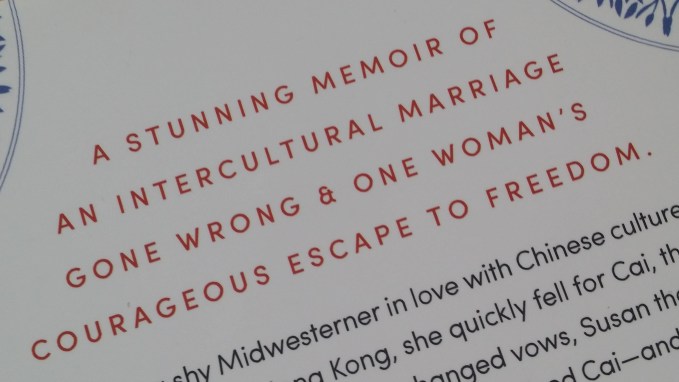
Good Chinese Wife back cover

One minor quibble was all the hyperbole. Not to diminish Susan’s genuine fears for herself and her son at times, but did it lead me to expect a story involving forged passports and bribed border guards(!). Also, I disliked the format of numerous short chapters, with so little happening in some that they felt like diary entries. But that is just a personal preference.

The verdict? Good Chinese Wife is well worth the US$14.99 cover price (16,410 won at What the Book), and a definite eye-opener about the value of reading more about relationships in this part of the world, especially with such limited options for reading about Korean ones specifically. Please do leave your suggestions (and reviewer copies!) for more like it, and/or for blogs.

Finding a place to call your own – My Place

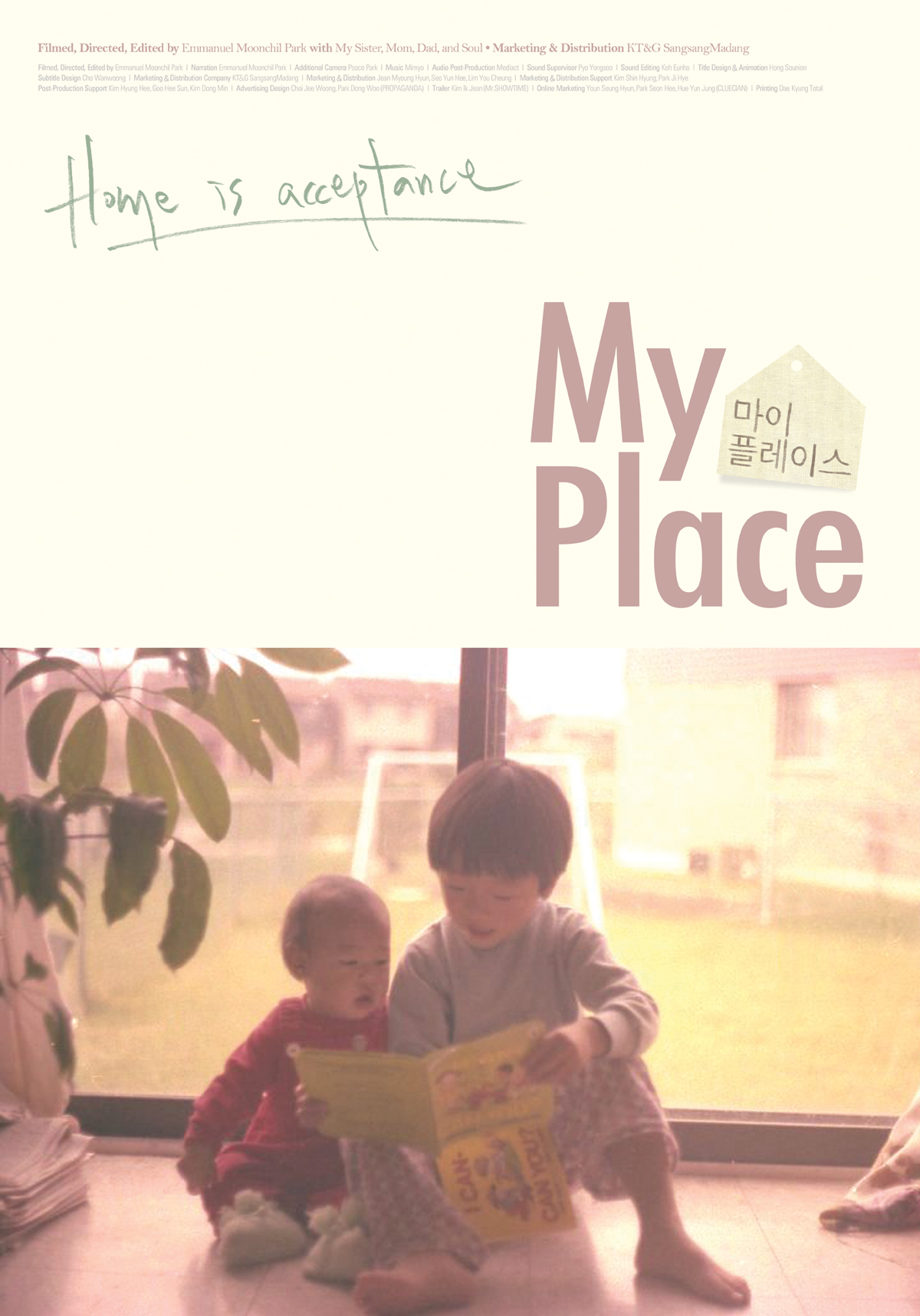
My Place Eng Poster

I’ve been asked to pass on the following:

[Press statement]

Finding a place to call your own – My Place

Foreigners in Korea often find themselves caught between cultures. Whether you are adjusting to your new English teaching job, working with Korean colleagues, in a relationship with a Korean partner, or even just travelling as a tourist, you are sometimes baffled, at times intrigued, and certainly trying to navigate through the differences you encounter. For people who find themselves in a transnational context, the documentary <My Place> will speak volumes.

The heart-felt film, <My Place>, depicts an intimate portrait of the director’s own family struggling to overcome past wounds of reverse migration from Canada to Korea. Family members, each in a different way, had to deal with the hurdles of societal norms, a repressive education system, and gender inequality dealt to them by the Korean society. This illuminating film explores clashes between Western and Eastern cultures, traditional values versus the contemporary, and broader themes of societal normalcy, identity, and belonging.

The film begins when the director’s little sister decides to become an unwed single mom. The little sister decides to raise the child in Canada as she never felt welcome in her parent’s homeland, South Korea. As the film progresses, the lives of parents, intertwined with Korea’s modern history is discovered, while family members try to come together to face the challenges of raising a new baby outside of the traditional family form. While following the trajectories of family members, constantly on the move in search of their own place, the film seemingly concludes that ‘My place’ isn’t so much a spot on the map, but a place that lies in the relationships that one holds close to their heart.

After touring the film festival circuit, while winning numerous awards on its way (among others, Jeonju International Film Festival – Audience Critics’ Prize, Seoul Independent Film Festival – Jury Prize) the film is now preparing for its theatrical release on January 30th. The film has also won the Audience Award, at last year’s Chewsock Film Festival – as the name implies, a film festival for expats bored during the Chuseok holiday in Korea – proving that the honesty of this deeply personal documentary and universal theme of yearning for a place in this world, transcends language barriers and cultural differences, while its subtle commentary on the differences between Eastern and Western cultures seem to speak to the experiences of expats in Korea.

To cater to the needs of foreigners, English subtitles will be provided for all screenings at the KT&G Sangsang Madang Theater in Hongdae district, and Indieplus near Sinsa Station. One other theater in Seoul ― IndieSpace near Gwanghwamun Station ― will also provide English subs for screenings from Jan. 29 to Feb. 1, during the Lunar New Year Holiday(Sulnal).

*KT&G SangsangMadang Cinema (Hongdae) : 02-330-6200 http://www.sangsangmadang.com/cinema/

*INDIEPLUS (Sinsa) : 02-3447-0650 http://www.indieplus.or.kr/jsp2/index.jsp

*INDIESPACE (Gwangwhamoon) : 02-738-0366 http://indiespace.tistory.com/1715

*For more info on Screenings with English subtitles : https://www.facebook.com/AllInKoreanWithEnglishSubsPlease

*More info on film:

https://www.facebook.com/DocumentaryMyPlace (Korean with some English)

https://www.facebook.com/ssmadangcinema (Korean)

https://twitter.com/sangsangfilm (Korean)

Reader Request: Looking for people to share stories about relationships in Korea

Couple ShoesI’ve been asked to pass on the following:

Looking for people to share stories about relationships in Korea

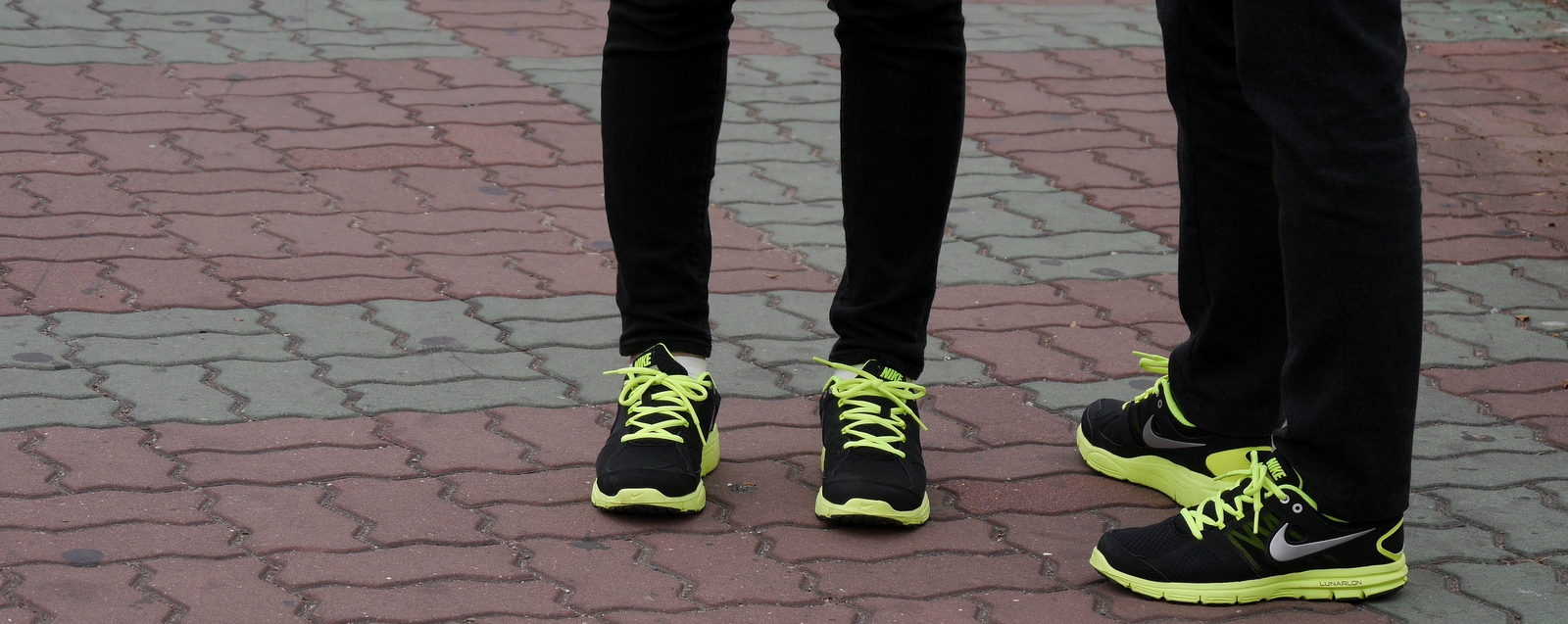
*********Have you fallen in love in South Korea? Battled cultural differences and other pressures to be with someone you never would have met anywhere else? Found the freedom to do things, meet people, or be someone you wouldn’t have dared to at home? Kept things going long-term and long-distance? Decided that dating in Korea is just too daunting and put that side of your life on hold while you’re here? Worn a couple shirt?

If you have a great story you’d like to share about dating, relationships and sex in Korea, I’d love to hear from you.

I’m making a documentary about how living in Korea can affect relationships, and I’d like to interview people with experiences that been delightful and difficult, wonderful and weird, sour and sweet.

It would be great to speak to partnered and single, cis- and trans-gender people, from a variety of backgrounds, and with a range of preferences and interests, including:

  • Korean people with experiences with other Korean people and people from other countries;
  • Non-Korean people with experiences with people from Korea and other countries;
  • People in monogamous and non-monogamous relationships with one or more partners;
  • People happy or unhappy not to be in a relationship;
  • People who have made their homes in Korea;
  • People who are in Korea on a temporary basis.

The film will be inclusive, non-judgemental and sex-positive, allowing the stories to act as an honest look at the unique experience of looking for, holding onto and losing companionship in Korea. To this end, and because I intend it for gallery screenings, the film probably won’t be a traditional talking-heads documentary. Instead, I’ll try to respond creatively to the themes of the stories people tell me, especially when the storytellers wish to remain anonymous. If you’re happy to appear on camera, that’s great, but if you’d like to share your story and would rather not have your face, voice or name be part of the film, I’ll find ways to accommodate those wishes.

I hope to collect stories in December and January, and am happy to travel anywhere in Korea to conduct interviews.

If you’d like to know more, or if you’re interested in taking part, please get in touch at relationshipsinkorea@gmail.com

Ben

Reader Request: Korean-Western Relationships and Gaining Acceptance from the Korean Parents

Korean-Western Relationships(Sources, edited: left, middle, right)

The following was originally posted as a short comment to Korean Sociological Image #78: Multicultural Families in Korean Textbooks; for the sake of giving it more exposure, and thereby hopefully more chances of finding a solution, I encouraged the author to expand it into this separate post. If anyone can give her advice, especially those who’ve been in similar situations (please post anonymously if you prefer), and/or can direct her to helpful websites, she would be very grateful:

*********My name is Jess.  My backstory is a depressing picture of humanity, so we’ll skip it.  I complete my schooling and earn my certification in 8 months.  My grandmother owns a massage therapy and alternative health shop, and I am set to join her in her practice.  I hope to expand the business and hopefully retire her (if I can convince her to) before continuing my formal education.  I have two beautiful, bright little girls.

H grew up in Southern California.  I don’t understand the “generation” terms very well, but his parents moved here from Korea.  He is a nurse (or a murse, he jokes), and works in the ICU of a hospital in the city he lives in.  For the sake of anonymity, I’ll skip a lot of his backstory as well.  I live midstate, he lives in the Northern part of the state.

We met in a bar.  It’s a very funny story, but I can’t seem to tell even a bit of it without writing six pages.  Basically, boy meets girl, boy hits on girl, girl tries to scare off boy with picture of her offspring and fails.  Miserably.  I spent the first half of our friendship trying to put him off.

The first time he ever called me, we talked for three hours.  And this set the precedent. We had regular, lengthy conversations about immediately relevant things:  who we are, what we do, how our minds work, etc.  I’ve never felt so picked over in my life.  I don’t think he expected to find a person like me in the stereotype I inhabited… just as I didn’t expect to find someone like him.  Neither of us expected it, and I think that’s why it happened.  We fell in love by accident and were fighting it all along for various reasons.  He seemed terribly conflicted all the time.  He would ask me repeatedly to date him—which I would decline—then turn around and insist that I not get attached to him.  It never made sense.

Long story short, 6 or 7 months ago, we started seeing each other more regularly.  The more I saw him, the more I found that I was falling for him.  I was careful.  I wanted to be sure that what I was feeling was real and not a byproduct of a past failure or the fact that he was a challenge.  When I was certain of what I was feeling, I began to try to understand what was going on in his head.  Eventually, I realized that his mixed signals weren’t purely because of him.  It wasn’t because I wasn’t good enough in his mind.  I realized that he wasn’t ALLOWED to have me.  That didn’t make sense.   The end result was the same, though, I wasn’t an option for him.  Shortly after this, he admitted that he didn’t like me seeing anyone else.  In short order, we were exclusive.  Not only was I seeing him more, but now we were only seeing each other.

Over the year that we had known each other, our relationship shot through so many levels unimpeded, I’ve never felt anything like it.  It was honest, right from the beginning because neither of us expected ANYTHING to evolve from it, let alone an exhilarating friendship or compatible romance.  I knew all along H couldn’t have a relationship with me, but it wasn’t until after I was good and head over heels that he hinted at the real reasons why we couldn’t be together.  When he did, our relationship started shifting.  We began mourning.  It got to be too much.  It wasn’t fair.  I tried breaking it off multiple times.  The first time, he didn’t call me for three weeks.  After nearly a year of talking to him regularly, it was a stark adjustment.  I resolved myself to letting it go and getting on with my life.  Then, I think it was the end of June.. he called me in the middle of the day.  He had a long drive ahead of him.  He was alarmed by how much he missed me.  I was alarmed how high my heart soared hearing his voice.  I didn’t even realize how badly I needed that.  He “accidentally” told me he loved me.  I gritted my teeth and brushed it off, just immensely soothed that he had no intentions of disappearing, still.  That was all it took, though.  One phone call and we were right back to seeing each other.

Over the next few months, we just had to admit to ourselves that we did love each other.  There wasn’t anything we could do to change it.  He finally told me in detail the reasons why his family wouldn’t approve of me.  I began making every attempt to understand it.  I never stopped.  We never stopped seeing each other, but we were always worried about the anvil of his family hanging over our heads.  Even if we found everything we needed in each other, when that anvil dropped the bond was doomed.

It unraveled when he went to his cousin’s wedding.  He noticed that his uncle was so proud and happy looking at his son and new daughter-in-law.  He remembered the way his father looked, at his brother’s wedding.  H realized that he wouldn’t have that if he stayed with me.  None of this was fair.  He was torn.  He felt he was wasting my time.  He broke it off with me.   I was shocked.  He had changed gears again.  He had gone from needing reassured that it wasn’t changing for me, to disappearing.  It lasted a day.  I was a mess; he called me hoping to help me out of it, and ended up worse himself.   In my attempts to cope, I had started writing a letter.  I knew my letter wasn’t going to change anyone’s mind, but I just wanted to know WHY it had to be this way… I didn’t tell him about the letter.  But his mind (as always) was in the same place mine was.  He asked me if I wanted to send one.  I’ll state for the record, that this was a stupid idea born of two distressed minds, but I did.  The letter was just as positively received as he imagined it would be.  His mother cried.  His father jumped to conclusions that were so far from possible that it let me know just how shocked and appalled they were.  This was extremely upsetting for them.  But… they did tell him that they couldn’t control him.  He decided to stick to his guns and call it over.  I was left coping.  I had a simple birthday gift I’d had waiting for the next time I would see him.  I almost didn’t go, but I took it to him, deciding that I was going to leave quickly.

I’m not sure which of us asked to talk, but we ended up curling up to talk about it.  In my attempts to not be emotionally manipulative or force my needs on him, I had not told him how much time I’d spent researching the issue.  I hadn’t told him that I’d looked up language lessons in the area, how far ahead I had thought and how prepared I was to sustain this effort for as long as it took, if he wanted me.  I’m not sure if I was right or wrong, but it meant that he was unaware.  He asked me to stay.  I took him to the place that I grew up.  I showed him key places from my childhood and teen years. He took me to a Korean restaurant.  His fortune cookie read, “Discover your companion’s world.  Two worlds are better than one.” Which is exactly what he had spent all day doing.  Mine said, “Time is precious, but truth is more precious than time.” Which is exactly what I had been trying to explain to him all weekend.  We had an uncomfortable laugh.   By the end of the weekend, his thoughts and emotions were scattered again.  He wanted to call his brother.  I didn’t know what that would solve.  I just wanted him to stop and think about what he was doing for once, because the whole time he had just been making it worse by getting ahead of himself and freaking out.  If he wanted it to work, he needed to be calm and sure.  If he didn’t want it to work, there was no need to alarm his family more.  I would just leave.  I made him stop and think about what he wanted to accomplish.  We pulled out our schedules to figure out when we both had a good chunk of time.  We made tentative plans for me to meet his brother (who lives out of state).  He told me not to get my hopes up.  To just calm down and be chill for a while.  I couldn’t agree more.  This has been taking up entirely too much energy.  It’s time to get back to bantering, laughing deviously, outwitting each other, and discussing things of no import until we have to worry again.

I’ve spent a long time pondering, reading, and learning, trying to find a way around the problem.  It’s not really about who I am as a person.  I feel no pain from the absoluteness of how they look at me.  It’s what I am.  I’m not Korean.  I have children.  I am not at all what they would want for their son, their family.  I can’t change what I am, but I know we are not the only people in this situation.   I haven’t found many articles about the problems in my particular situation.  Usually, racism is full of hatred and cold-hearted callousness.  I have found MANY instances of couples overcoming and succeeding despite situations like that… but I haven’t been able to find many stories about families like H’s–just enough to have hope; not enough for a thorough understanding.  Their disapproval isn’t like that.  They aren’t hateful.  They aren’t callous.  This causes them pain.  I have a lot to offer, but to say that I’m not what they expected… that’s an understatement of epic proportions.  The advice that I seek is how to bridge that kind of a gap.  I’m looking for anything that might help.  I’m looking for people who’ve been in a situation like this and found success, I want to know what they’ve DONE or avoided doing.  Even if not exactly (his parents are individuals, too, there’s no tried and true approach), each success story I can find could offer a pearl of wisdom to guide me through this. (END)

***

Again, any specific advice readers can provide would be appreciated, and/or links. For the latter, off the top of my head I would recommend Speaking of China, AMWF Love, and possibly Texan in Tokyo, the last found while searching for images to accompany this post (and failing — unfortunately, I don’t like to use “ordinary” couple’s pictures without their permission!). Also, there are of course a great many blogs by Western women with Korean or Asian partners out there, some of whom may have written about meeting his parents at some point — if anyone knows of any specific posts, again Jess would be very grateful. Thanks!

Update: Speaking of China has provided a round-up of links with dating advice for Chinese-Western couples here.

Korean Sociological Image #78: Multicultural Families in Korean Textbooks

Korean Mulitcultural Family Korean Ethics Textbook

Over at Korean Circle and Squares, Emanuel Pastreich has scanned some pages of the Korean ethics textbook currently used in Korean elementary schools. He comments that the very existence of such an old-fashioned class is remarkable (as part of the daily program no less), and was especially struck by the efforts to address multicultural issues and the children of “multicultural families.” For example, the page above-right:

…relates a diary entry by Jeonghyeon, an elementary school student whose mother is Vietnamese. Jeonghyeon says she has no memories of her Vietnamese grandmother and grandfather and seems not to actually live in that complex multicultural family. Nevertheless, it is a tremendous improvement to create this space in which multicultural kids can exist within the official textbooks.

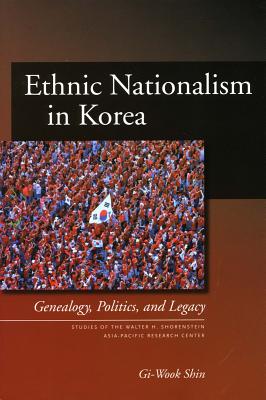
Ethnic Nationalism in KoreaClick on the image for more examples. Also remarkable about them is how, just 5 years ago, textbooks stressed how important it was that Korea remain ethnically homogenous instead. As described by Matt of Gusts of Popular Feeling in December 2008:

Korea’s ethics textbooks are to change, however — in part due to Hines Ward’s first visit to Korea after being named MVP in the Superbowl in 2006 — and North Korea, which has taken these ideas to frightening extremes, was not happy:

The words themselves take a knife to the feeling of our people, but even more serious is that this anti-national theory of “multiethnic, multiracial society” has already gone beyond the stage of discussion. Already, they’ve decided that from 2009, content related to “multiracial, multiethnic culture” would be included in elementary, middle and high school textbooks that have until now stressed that Koreans are the “descendents of Dangun,” “of one blood line” and “one race,” and to change the terms “families of international marriage” and “families of foreign laborers” to “multicultural families.” This is an outrage that makes it impossible to repress the rage of the people/race.

More recently, these issues again gained prominence with the election of Ms. Lee (born Jasmine Bacurnay in the Philippines) to South Korea’s National Assembly in April last year, the first naturalized citizen — and the first nonethnic Korean — to do so. As Choe Sang-hun wrote in The New York Times, public opinion is still is still far behind official policy:

And this year, for the first time, South Korea began accepting multiethnic Korean citizens into its armed forces. Before, the military had maintained that a different skin color would make them stand out and hurt unity.

But if government support has improved, Ms. Lee says, popular sentiment seems to have cooled. Korean men who sponsored foreign women as brides, only to find themselves abandoned by women who exploited them to immigrate to and work in South Korea, have organized against the government’s multicultural policy. Meanwhile, low-income Koreans accuse migrant workers of stealing their jobs.

The government itself stands accused of fostering xenophobia by requiring foreigners who come to South Korea to teach English to undergo H.I.V. tests, but not requiring the same of South Koreans in the same jobs. Last year, an Uzbek-born Korean made news when she was denied entry to a public bath whose proprietor cited fear of H.I.V. among foreigners.

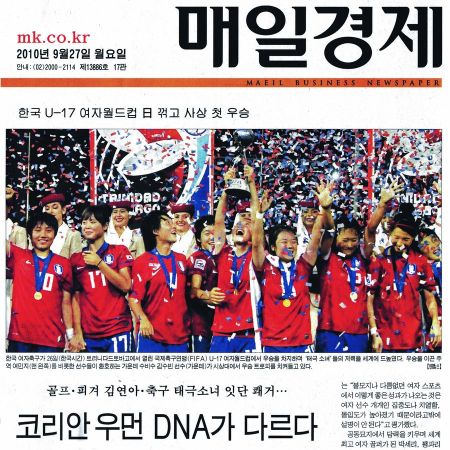
Korean Woman's DNA DifferentThe Korean media also has some way to go, Matt noticing (in 2010) the headline “Korean Women’s DNA is Different” for instance:

Well now, I guess that may explain why Roboseyo “personally was told “foreign blood and Korean blood together has problems” [by] one of the nurses at a blood clinic[.]” It all makes sense now – Koreans’ DNA is different. What a simple, obvious explanation.

Actually, while the article tells us that “Questions arise each time Korean female athletes accomplish great things on the world stage,” it (sadly) does not follow up on the promise of the headline, instead dwelling on more mundane cultural and social influences. Mind you, the fact that “Korean women’s DNA is different” was a headline on the front page of a newspaper should go to show that the idea of genes and bloodlines was dominating the writer (or editor)’s thinking, and that they figured others would agree.

Fortunately, my Korean wife and I have met very few Koreans (openly) expressing that idea of pure genes and bloodlines, and fewer still that harassed us for mixing them. Also, as one of those “muliticultural families,” we’ve benefited from our youngest daughter jumping ahead in the waiting list for a place in a state-run kindergarten (albeit something which “ordinary” Korean parents may justifiably resent), and both our daughters receive a great deal of friendly attention when we’re out with them (not so much when they’re just with me — you’d never guess they had a Korean mother). Part of that is likely because half-Korean celebrities were very much in vogue a few years ago, but this popularity may now be waning.

How about any readers in interracial relationships or multicultural families? What positive or negative experiences have you had specifically because of this bloodlines-based view of nationalism, and/or related government policies?

Update: If you’ve come this far, I recommend following-up with The Culture Muncher’sA Multicultural Korea: Inevitable or Impossible?” also.

Update 2: Thanks to @dacfrazer, who passed on the must-read “There is more to my son than the fact he’s a ‘half’” at The Japan Times.

(For more posts in the Korean Sociological Image series, see here)

Announcements: Two Very Worthy Causes to Support!

KUMFA

Today, some information about two very worthy causes.

First, on ongoing volunteer opportunities for the Korean Unwed Mothers’ Families Association in Daegu and the 3rd Single Moms’ Day Conference this May. Then, on a Kickstarter campaign for a full length documentary film seeking to help preserve and spread knowledge of the shamanistic practices and shrine religion of Jeju Island:

I. The Korean Unwed Mothers’ Families Association (KUMFA) is an organization that works to promote children’s human rights while addressing systemic discrimination. KUMFA advocates for the human rights of unwed pregnant women, unwed mothers and their children in Korea. KUMFA’s goal is to enable Korean women to have sufficient resources and support to keep their babies if they choose, and thrive in Korean society.

More information is available in the following interview and at the Single Moms’ Day event page:

Daegu KUMFA Volunteer Opportunities (ongoing):

The Daegu Branch of the Korean Unwed Mothers’ Families Association will hold meetings and provide classes for their members. KUMFA Daegu seeks volunteers to provide childcare during the classes. In the future other types of volunteer opportunities may arise. For additional details please visit the KUMFA Facebook Page or contact us directly at kumfa.volunteer@gmail dot com.

Seoul KUMFA Volunteer Opportunities (ongoing):

The Seoul Branch of Korean Unwed Mothers’ Families Association has ongoing volunteer and learning opportunities. Sign up by joining the Facebook group.

II. Seoul Conference (May 10-11, 2013): The 3rd Single Moms’ Day Conference:

SMD advocates for human rights in a number of important ways, in particularly by addressing systemic discrimination by “informing people inside and outside Korea about the factors that pressure unwed mothers to relinquish their children for adoption. Push factors include fathers’ child support obligations being unenforced; lack of adequate social welfare from the Korean government; social discrimination against unwed mothers and their children. Pull factors include the fact that more than half of unwed mothers in facilities are living in unwed mothers’ shelters that are owned and operated by adoption agencies; a money-driven international adoption system that does not conform to the UN CRC or the Hague Convention, i.e., it does not respect children’s humans rights.”

For more information or to make a donation, please visit the SMD event page. Here is some volunteer testimony:

“I have been involved with SMD and related projects for two years. I’ve learned a lot from this really inspiring collaboration of groups that fight for Korean children’s human rights, including: parents whose children were adopted by unethical means; unwed parents who are fighting workplace and social discrimination to raise their children; adult adoptees who campaign for ethical reforms to adoption laws; supporters and volunteers who work to bring policies into the framework of the United Nations Convention on the Rights of the Child.”

Next, on Jeju Documentarian Giuseppe Rositano’s Kickstarter campaign. Please do check the link for additional information, and on why your help is needed:

Jeju 1As a popular tourist destination in South Korea, Jeju Island has risen to fame predominantly for its natural wonders: hiking trails in abundance, scenic ocean views and South Korea’s highest mountain. It is possible to experience these in just a few short days, but staying on the island a bit longer or even making it a home provides the opportunities to get a deeper understanding and appreciation of some of the more interesting aspects of Jeju. Documentarian Giuseppe Rositano, Jeju Island resident of 7 years, explores some of these more interesting aspects of Jeju life, specifically the shamanistic beliefs and shrine religion of Jeju Island that is in danger due to the rapidly declining population of believers.

Jeju 2Spanning the course of 18 months and accumulating more than 500 hours of shamanistic ceremonies and traditional storytelling on film, Rositano captures the spiritual life of 5 villages through exploration of their native deities and traditional oral stories that have been passed down through generations. These stories, which describe the lives of Jeju’s extensive pantheon, are quickly disappearing. At Search is an attempt to preserve these unique indigenous beliefs.

Each village on Jeju Island has several shrines in which local deities specific to the island are ‘seated’. Each of these deities corresponds to a ‘bonpuli’ or oral myth. With an adventurous spirit, this documentary sets out to capture the retelling of these ‘bonpuli’ legends in the voice of what is likely the final generation of elders who received the stories from their parents and grandparents. Sadly, younger generations are seldom aware of these stories which serve as the cornerstones for their grandparents’ spiritual lives and cultural identity. With over 400 shrines on the island and a total of 18,000 gods on Jeju, that’s quite a loss to humanity’s cultural history!

Jeju 3Currently At Search for Spirits on the Island of Rocks, Wind and Women is in post-production. Rositano and team have launched a kickstarter campaign to raise funds to bring the project to completion and to get it out to film festivals around the world.

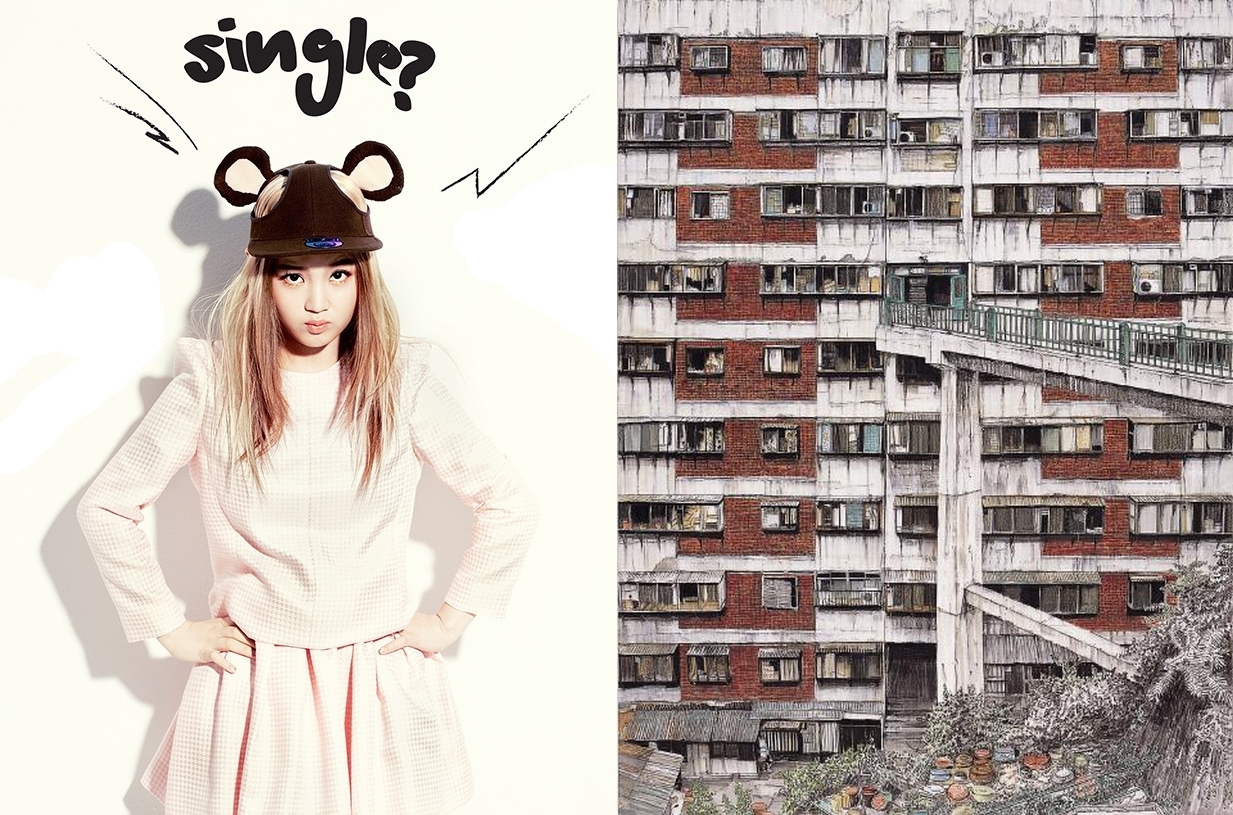
Going Solo in Korea

Korea Single Households(Sources, edited: left, right)

Family may be everything in Korea, but by last year more than 1 in 4 Koreans were living alone, beating rates in (supposedly) more individualistic societies like the US and Australia.

While this provides a lot of opportunities for companies, there’s also a dearth of suitable accommodation. And most of those singles are not carefree youth, but either middle-class 30 and 40-something men, or women in their 60s and above living in poverty. With rates set to become 1 in 3 by 2020, this is set to become a huge political, economic, social, and cultural issue in Korea’s near-future.

For a heads-up, see my latest article for Busan Haps, which includes entirely too much information on why I split up with my first Korean girlfriend…

Update: Also see Sorry, I was drunk for a deconstruction — and demolition — of the oft-cited claim that Korean society is more communal than Western societies.

New York Times Looking for People Currently Engaged or Married via the “Seon” (선) Arrangement

(Source)

I’ve been asked to pass on the following:

The New York Times is looking to interview Koreans and Korean Americans who are currently engaged or married according to the “seon” arrangement. We’re working on a story about arranged marriage versus love marriages and how some arranged couples are finding more meaning in the pre-arranged set-up as opposed to free-range style dating and marrying.

Would love to know how much the parents were involved in the date selection, what the criteria or “specs” were, and whether you are happy that you chose to go more traditional in finding a spouse. I also heard from some Korean guys that these seon arrangements makes settling down easier since it takes some of the pressure off from dating. Do any of you agree? Couples, men, women are all encouraged to respond. Opinions from parents are especially wanted. Would love to get as many differing opinions as possible. Please be aware that if we choose to profile your experiences, we would need to use your first/last name and age.

Please send your feedback to lifestylereporter@gmail.com.

For more on specs and arranged marriages, please see here and here (especially the comments to the latter). And please do email The New York Times: I’m already looking forward to reading the final story, and the more interviews in it the better!

Korean Sociological Image #73: The True Numbers of Korean Working Women

(Source; edited)

If recent BBC coverage is anything to go by, marriage in South Korea is like a business. It’s also becoming a bit of an explosive topic as social mobility slows down and the traditional image of the male breadwinner becomes eroded by the increasing participation of females in the labour market. Some of the most widely publicised scandals and controversies on the Korean internet seem to have been, in some way or another, due to this intensifying gender friction.

(KoreaBANG; my emphasis)

My apologies for singling out Justin at KoreaBANG, whose post is still excellent overall. And as you’ll soon see, I often make mistakes too.

But that comment I’ve highlighted? Frankly, it just infuriated me. Because even though it’s completely wrong, I seem to hear it all the time these days.

In reality, the Korean female workforce participation rate has stagnated at one of the lowest rates in the OECD ever since 1997-98, when women were overwhelmingly targeted for layoffs during the Asian Financial Crisis. Back then, the logic was that wives would be provided for by their husbands, and 20-something daughters by their fathers. And 10 years later, in the latest crisis, to a large extent this logic was reapplied, although on this occasion there was a clearer economic – not just patriarchal – logic in that women formed the bulk of irregular workers (see here, here, and here for much more information).

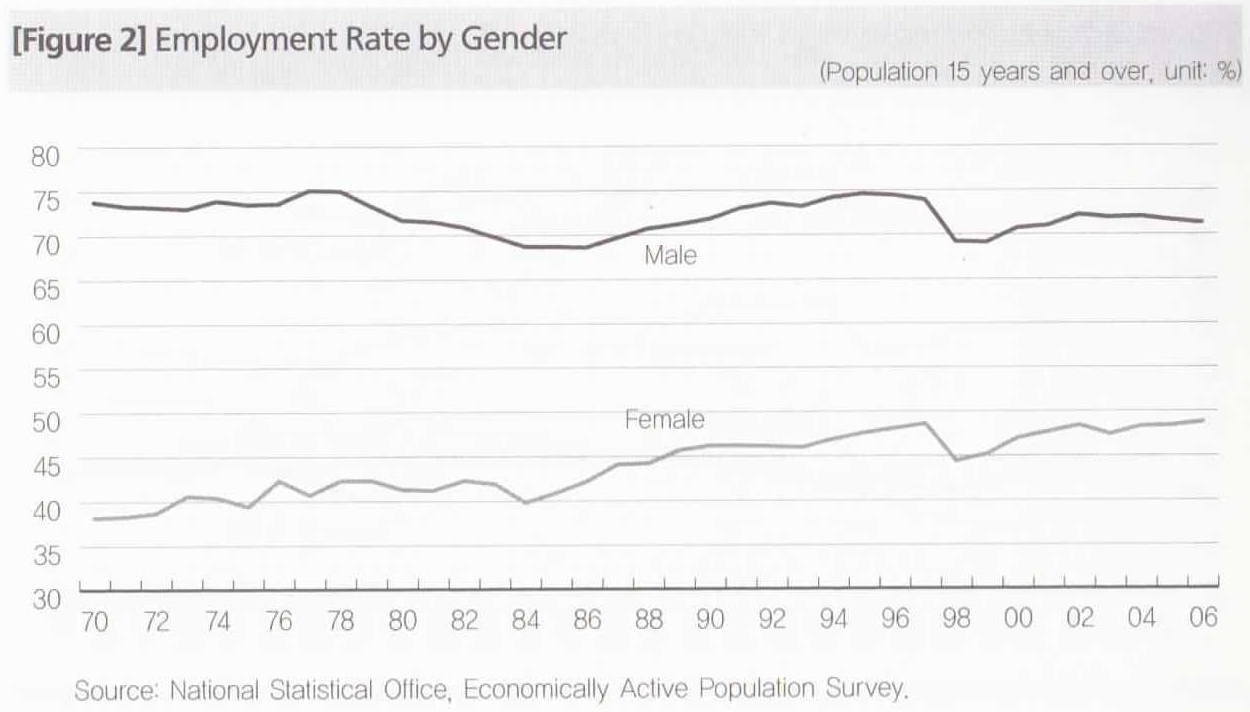
Or so I’ve often written. But naturally, it was difficult to find definitive statistics on that when I first reported on it three years ago. At that time, my most up to date source was my copy of Working Korea 2007, published by the Korea Labor & Society Institute. Here is my scan of page 19, which has a graph of the male and female workforce participation rate of 1970-2006:

In hindsight, although it does show a big drop in the female rate in 1997-98, it shows an equally large (even slightly larger?) drop in the male rate too. With my apologies, I’m very surprised I didn’t notice that earlier, and, although it does contradict most of the literature I’ve read about the Asian Financial Crisis, and is just from one source too, it still definitely bears further investigation.

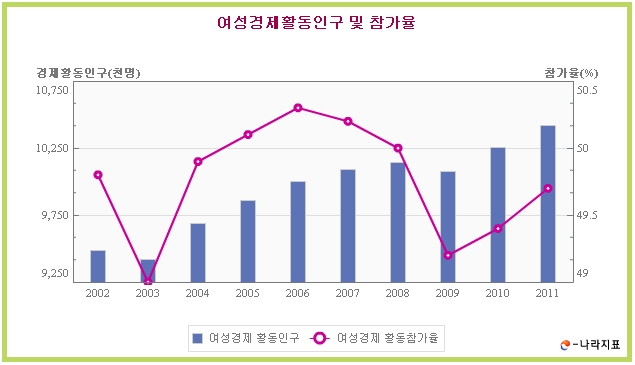
That aside, a year later I found a source going up to 2008 (it shows a fall of 50.3% to 50.0% in 2006-2008; see below also). And today, spurred by Justin’s comment, I tried looking again, and found the following at the National Statistics Office’s website:

(Source)

The blue bars represent the economically active female population, in thousands (i.e., the first figure is 10.75 million), the pink line the female workforce participation rate. Although the choice of right scale gives the false visual impression that the rate has changed a great deal, as you can see from the numbers it has remained within a narrow band of 49% to 50.5%, last year’s rate being just lower than that of 2002. Also, clearly a 0.9% drop between 2008 and 2009 isn’t quite as big as I’ve been making out, and again is something that bears further exploration.

But still, one thing is clear: the number — well, percentage — of Korean women working has little changed in the last 15 years, and remains very very low by the standards of other developed countries. So it can not be the cause of increasing gender friction.

The perception that Korean women are making significant inroads into the Korean economy though? That’s entirely possible, and indeed I highly recommend KoreaBANG for much more on that (indeed, especially the remainder of Justin’s post), as well as many posts by Gord Sellar too (source, right).

(For more posts in the Korean Sociological Image series, see here)

From the Archives: Bagel Girls, Banking, and Babies!

(Source)

…[the character of] Chi-Yong’s mother sees marriage as a way to achieve social advancement and material prosperity, as it was in the Victorian era. These ambitions have come to the forefront in Korea since the 1970s, due to rapid economic development and consequent aspirations to class mobility and consolidation during the last thirty years. This novel [Marriage/결혼 by Kim Su-hyeon, 1993] is a good illustration of how, given the pace of change of change in Korea, everybody has a different point of view on marriage, depending on their gender, class, and generation. The issue of communication across generations has become a serious matter. Generation is an important attribute of identity in Korea, like race in the United States. (My emphases.)

(So-hee Lee, “The Concept of Female Sexuality in Popular Culture” in Under Construction: The gendering of modernity, class, and consumption in the Republic of Korea, ed. by Laurel Kendell, 2002; page 146 of 141-164)

With apologies to So-hee Lee for variously attributing that quote to either her editor, to Hyun-Mee Kim, or to Nancy Abelmann over the years, it still very much applies 10 years later. It’s also why studying and living in Korean society can be so exciting sometimes.

For someone who’s been writing about the place for over 5 years though, it means that many of my posts need updating. Let alone mercifully deleted as reader feedback, further research, and greater use of Korean sources have exposed gaping holes in my knowledge and confident preconceptions. And from a practical standpoint too, links will die, embedded videos will get deleted, and my theme will always highlight recent posts at the expense of older ones, no matter how good they may be after going through my culling process.

With all that in mind, once a month I’ll be highlighting posts from the corresponding month in previous years. Not all of them of course (hey, I’ll still like some material to work with in September 2013 and 2014), and to some there’s no new news to add; I include them just to draw attention to for new and old readers, especially as they’ve since been slightly edited for this post with the benefit of several year’s of hindsight. Others though, I’m adding a great deal of new news and commentary below, as you’ll see.

Please let me know what you think!

2011

Alas, not really my own article, but about Grace Duggan’s for Bust Magazine. While I’d often criticized the body-labeling craze in South Korea previously, I didn’t realize just how offensive this particular term was until she pointed it out (source, right):

Sexualizing young women for having childlike features sets off all kinds of alarms, regardless of whether or not they are over 18. The “bagel girl” label does more than infantilize women. It compartmentalizes them by applying two irreconcilable ideals: looking like a baby and a full-grown woman at the same time.

Granted, that may make it sound no more harmful than any other “line.” But, as I explain in a later comment, in the context of how it’s actually used it ends up sounding almost pedophilic:

…there’s nothing wrong with looking young per se.

But consider who the label is applied to: not, say, women in their 30s and 40s and older, for whom – let’s be real – wanting to look younger than they are is understandable (hell, for a 35 year-old guy like me too), but rather it’s women barely on the threshold of adulthood that are being praised for looking like children. And, not to put too fine a point on it, what the FUCK is great about a 21 year-old looking younger than she is? And when her body is simultaneously praised for being developed? That is a seriously flawed ideal to aspire to, and, moreover – as I hint at in the post – it’s no coincidence that it occurs in an environment with strong expectations of childish behavior from women too. Indeed, the end result strongly reminds me of child and teenage female manga characters, with personalities appropriate for their age, but somehow the sex drives and physiological development to act on them of women 10-15 years older.

(Source)

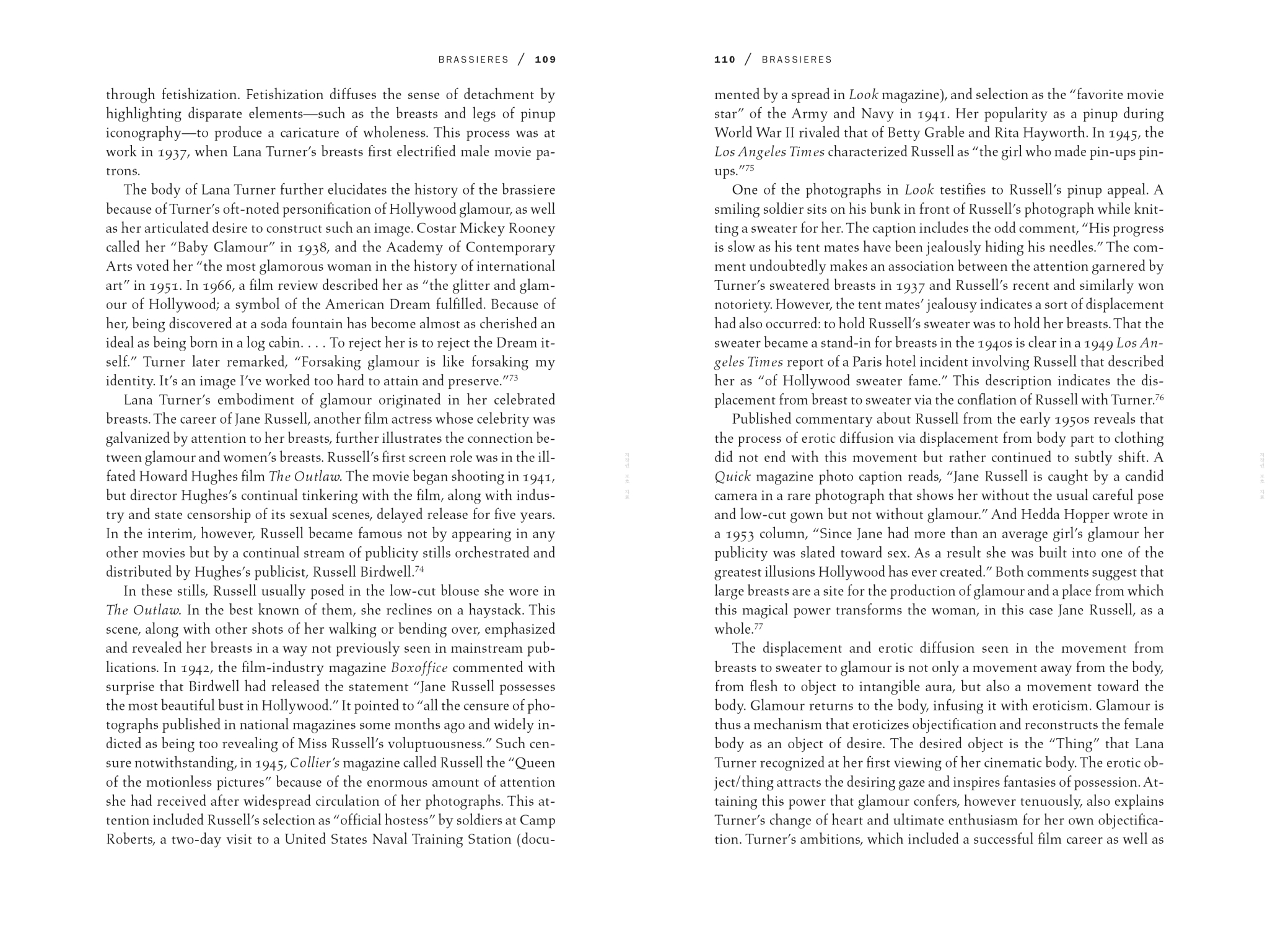
Meanwhile, by coincidence just yesterday I finished the excellent An Intimate Affair: Women, Lingerie, and Sexuality by Jill Fields (2007), which explains how the word “glamour” — where the “gul/글” in Bagel Girl comes from — came to be closely associated with large breasts by Hollywood in the 1930s to 1950s. Something I’d previously chalked up to a Japanese and then Korean mistranslation of the word, see the above pages for more on that, or all of Chapter 3 on brassieres at Google Books here.

If I do say so myself, I’m very proud of the way I describe my feelings when child singers do aegyo:

…cutesy aegyo is bad enough coming from a 21 year-old singer, but simply surreal when you see it done by a 14 year-old.

Yes, surreal, not merely awkward and inexperienced: essentially, you’re watching a child pretending to be an adult pretending to be a child.

Thank you very much.

Thanks again to the (necessarily anonymous) reader who wrote about her experiences, and I’ve had dozens of inquires about the Seoul clinic she used since. Please just email me if you ever need to know the details yourself.

(Source)

2010

Once someone points out the “head cant” to you, it just can’t be unseen. Usually inoffensive in itself though, and frequently done simply for photographic and stylistic reasons (which I’ve under-acknowledged in the past), it’s the fact that it’s overwhelmingly women it that makes it problematic. Just one of a number of typical poses for women in ads, ultimately it serves to reinforce gender stereotypes.

Probably, that’s why these recent Giordano ads stood out to me: in the example above for instance, Shin Min-a (신민아) is the one in control, staring at the viewer, while So Ji-sub (소지섭) is distracted (it’s usually the guys that are presented as more focused). And, desperately seeking examples of pro-feminist advertisements for a TED presentation I may be giving next month, in which I have to — grrr — conclude with a positive message rather than just criticize, this made me realize that feminists and advertisers don’t necessarily have to be at odds with each other. Just a sense of balance by the latter would be a huge step forward.

Really about “lewd” advertisements, 2 years later (this June) I translated another article about how their numbers had surged 3 times over the previous 12 months. With no apparent sense of irony, just about every news site that reported on that had so many examples themselves that the text was difficult to read.

One of my most popular posts, anybody (especially men) who thinks street harassment isn’t a problem should just reflect on the opening cartoon, let alone female readers’ comments about their own negative experiences.

(Source: unknown)

2009

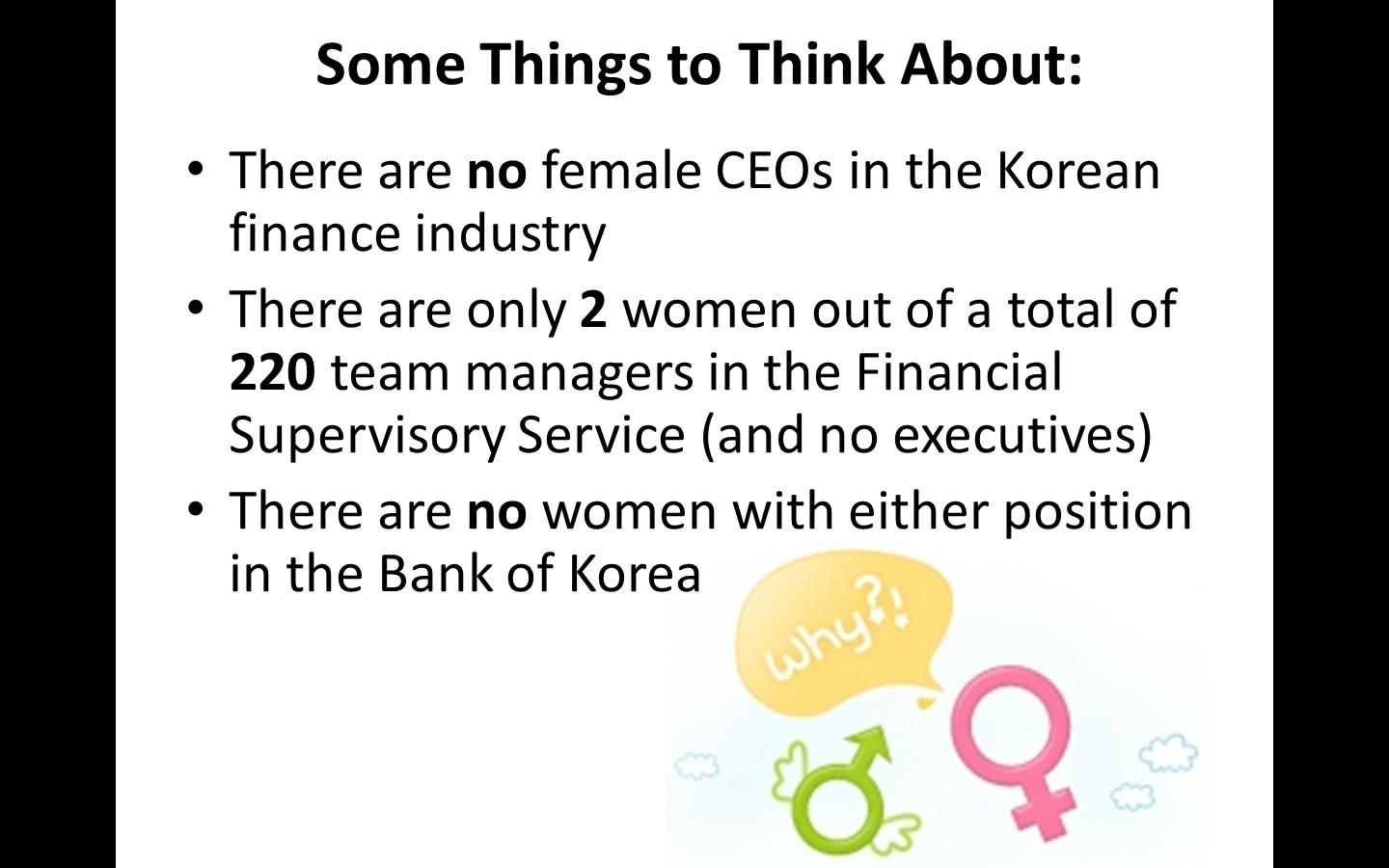
A short, harmless commercial for Shinhan Bank at first glance. But, once you take the time to analyze it, it has a clear message that men do the thinking at Shinhan while the women simply look good. Indeed, it’s such a classic example of gender stereotyping that I’m still using it in presentations today.

Here’s the slide I would present after providing that analysis:

But in the next presentation, I’ll be updating it with the recent news that the banking industry still has the largest gender pay gap in Korea, with women making an average of only 57% of what men make.

Not that I’m against skin by any means. But these remain very sweet ads!

Again one of my most popular posts, ironically soon after writing it trends in the Korean entertainment and music industries meant that Koreans would replace Caucasians in many of the modelling roles that sustained those Occidentalist stereotypes. Also, in my own (admittedly limited) experience, there’s far fewer Korean male – Western (invariably Caucasian) female pairings in popular culture now, after a spate of them in the years after Misuda first appeared. (There were never very many of the opposite.)

However, of course many of the stereotypes still do remain.

(Sources: left, right)

2008

When I read on Yahoo! Korea this week about pregnant Hollywood star’s “D-lines”, for a moment I did try to hold my tongue about seeing the label.

After all, this, for example, is just an advertisement for an event for expecting mothers (albeit one where likely body-shaping products are promoted); these D-line fashion shows were surely perfectly harmless; many of those Hollywood stars were indeed glowing, as was pregnant Moon So-ri (문소리) in Cosmopolitan last year; and finally, yes, I can see the humorous side — it is often applied to extremely obese men.

But although the Western media too promotes pampered celebrity mothers-to-be as ideals to follow, and I can certainly accept that pregnant women overseas may likewise feel under some indirect pressure to watch their weight, that post is about how pregnant Korean women were dieting as early as the late-1990s. One can only shudder at what things are probably like now.

Suddenly, talk of D-lines sounds a lot less funny.

One of my first attempts to grapple with the origins of the kkotminam phenomenon (꽃미남; lit. flower-beauty-man), which culminated in this piece by friend and ANU professor Roald Maliangkay 2 years later.

By coincidence, both of us will be quoted in a related news article to be published next week. Watch this space! (Update: and here it is!)

2007

And indeed there was. Unfortunately however, attitudes didn’t change with it, so fathers feel compelled by management to either ignore it entirely or to come back to work early, despite it only being 3 days (source right: unknown).

Note though, that the “paternity leave” in the original article I translated was a bit of a misnomer, it really meaning time off for a child’s birth. “Real,” paid paternity leave has been available since 2001 (or possibly 1995), but sources vary on specifics. Sung So-young in the Korean Joongang Daily, for instance, wrote in April 2011 that:

According to Korean law, all employees with a child under the age of 3 are eligible to take a year off to care for their children. Up to 1 million won ($919) in salary is provided monthly.”

But that is contradicted by a slightly later report in the Chosun Ilbo, which states that:

…those on leave can get up to 40 percent of their salary, or a minimum of W500,000 and a maximum of W1 million, and parents can take leave until the child is 6 years old.

And both in turn are contradicted by Lee Hyo-sik’s earlier report in the March 4 2011 Korea Times, which says:

Regardless of income levels, both male and female salaried workers are currently given 500,000 won per month during parental leave. This is expected to go up to one million won next year.

As for the maximum age of the children in order to be eligible, the same article states that it was 6 rather than 3. This is confirmed by an earlier February 2010 article by Kwon Mee-yoo, again in the Korea Times, which stated:

The Ministry of Labor passed a revision on Wednesday to the Act on Equal Employment and Support for Work-Family Reconciliation, or the Employment Equity Act for short, which will expand the range of workers eligible for parental leave. Now parents with preschoolers under six years old can benefit.

The leave allows employees to take a certain number of paid days off from work to care for their children. The parents can also take unpaid leave if they use up all of their paid days. This includes maternity, paternity and adoption leave. Currently, at private firms only workers with children 3 years old or less qualify for the leave.

Surprisingly, parents with adopted children weren’t eligible before this revision, and still, “only those who gave birth to or adopted children after Jan. 1, 2008 [were to be allowed] parental leave,” despite those (then) 2 to 6 year-olds obviously being of age. Which all sounds very tight-fisted, although logical during the worst of the financial crisis.

Kwon Mee-yoo also notes that it was in 2008 that the government increased the age restriction for (only) public servants, allowing them “to take time off for parental purposes if their children were under 6 years old.” I’ll assume that it previously only applied if their children were under 3 years old, like Kwon notes was the case for employees at private firms.

Finally, quibbles over details aside, Sung So-young’s and Lee Hyo-sik’s articles in particular remain excellent discussions of why Korean fathers are forced to avoid taking paternity leave, despite wanting to spend much more time with their kids. Against that though, just like in most other countries there’s still a pervasive attitude that childcare is primarily women’s work, with insidious manifestations in our daily lives.

And on that note, have a good weekend, and the Korean Gender Reader post will be up on Sunday!

What’s Wrong With Marrying First-born Sons?

(Source; edited)

As every Korean woman looking for a husband knows, hapless first-born sons are best avoided. After all, customarily moving in with — or very close to — his parents, she would just have too many responsibilities for their care, let alone arguments with his overbearing mother:

The old lady often follows her daughter-in-law around, criticizing every bit of housework. They compete for the attention of their son/husband. In addition, because the old lady went through the same process when younger, she feels entitled to make her daughter-in-law’s life miserable. (Here is an old post touching upon this subject.)

Of course, not all eldest sons’ households would be so bad, let alone that of Ask a Korean’s who wrote that. Or would they? In Japan at least, with very similar living arrangements to Korea, they’re so stressful that married Japanese women living with in-laws are three times more likely to suffer a heart attack than those just living with their husbands.

(Source; edited)

Perhaps it’s no wonder then, that “not a first-born son” was one of the common “specs” (스펙) for a husband in this recent list I translated?

But, despite everything I’ve written above, I’d always thought that their extra responsibilities were simply a cultural preference, and one rapidly eroding at that. So, it came as a real surprise to learn they were so formalized as to be enshrined in the government’s social welfare policy, as explained in passing in this recent Hankyoreh article about an elderly woman who committed suicide after losing her eligibility for benefits (my emphasis):

…According to the Ministry of Health and Welfare and Geoje City Hall in South Gyeongsang province, Lee was stripped of her National Basic Living Security assistance qualification because a confirmation study of recipients conducted in June revealed that her son-in-law’s income had increased.

This is to say, the “sustenance allowance” in accordance with support obligation standards (lineal blood relatives or spouse) had been exceeded [James – by a grand total of 7000 won (US$6.18)]. The recently increased income of her daughter and son-in-law, who work for a subcontractor of a major corporation, was about 8 million won a month.

The “mandatory sustenance allowance” is computed by taking the income of the lineal blood relative or spouse, removing a total equal to 130% of the minimum cost of living for a family obligated to support a relative, and multiplying that by 15% in the case of a daughter (30% in the case of a son)…

…When beneficiaries lose their qualification, they also lose their housing assistance, stipend and medical benefits. The standards determining family members who must provide support is tied to a contrived system that dumps the state’s responsibility onto the family.

(Source)

If any readers familiar with the Korean social welfare system could elaborate on this, or any other gendered aspects of it, I would be very grateful. Unfortunately, all I can further bring to the discussion is my copy of The Politics of Social Welfare Policy in South Korea: Growth and Citizenship by Myungsook Woo (2004), a very top-down and theoretical overview that lacks mention of anything at the grass-roots level, let alone of gender. But of course it does still have some insights though, which I’ll pass on in a later post!

Increasing Numbers of Single Households in Korea: Lessons from Eric Klinenberg’s “Going Solo”

(Source)

From Office Hours, a sociology podcast I regularly listen to:

This week we talk with Eric Klinenberg about his new book, Going Solo: The Extraordinary Rise and Surprising Appeal of Living Alone. Also be sure to check out Klinenberg’s New York Times article, One’s a Crowd.

Although Korea isn’t covered specifically, there’s a lot discussed that is very relevant to it, so I think readers will still find it very interesting. Personally, I really started paying attention after I heard the following 5 minutes in:

…but affluence, and prosperity, that’s not enough. We know that because there’s parts of the world where there’s lots of wealth, but very little living alone. So for instance, in Saudi Arabia, where almost no-one lives alone…and the reason for that is another big driver of living alone is women’s independence: women’s economic independence, and also their capacity to control their own lives, and control their own bodies. When women enter into the paid labor market, and gain sexual independence…personal independence…they are able to delay marriage (and now, people delay marriage longer than ever), they’re also able to get out of marriages that aren’t working. Through divorce, without worrying about sentencing themselves to a lifetime of poverty or having to move back in with their families. So, this is a BIG part of the story I tell…

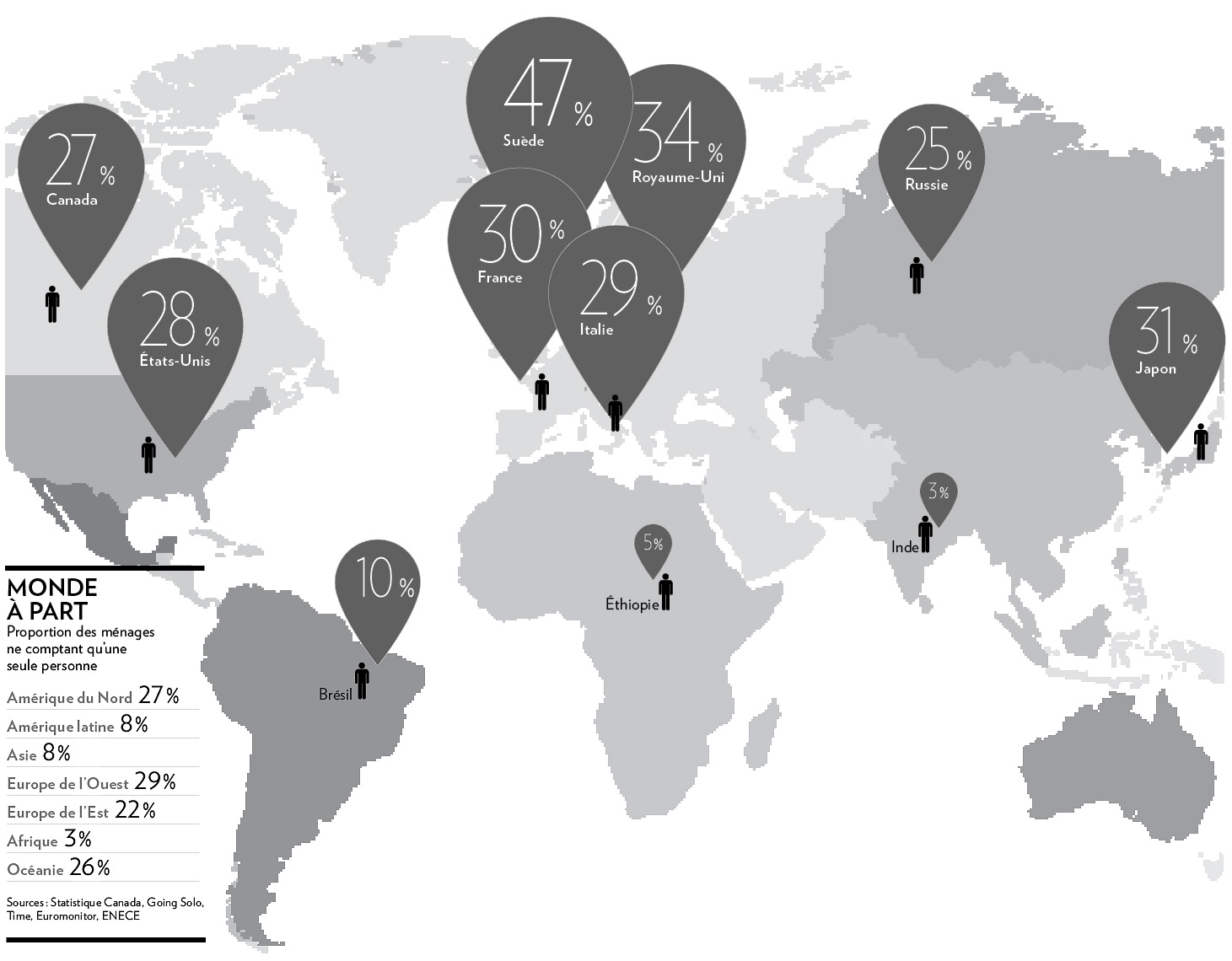
See here and here for some reviews of the book, and here’s a quick comparative map of national rates from La Presse:

Unfortunately, I’ve been unable to find a base national rate for South Korea, but in January 2009 the Seoul Development Institute did find that 20.4% of Seoul households involved people living alone, and which was expected to rise to 25% by 2030. For more information and discussion, see the Korea Herald here, or in passing in the following posts (the last is at the blog Asadal Thought):

Sex and the University, Part 3: University Students’ Cohabitation Culture

Why are Korean and Japanese Families so Similar? Part 2: Couples Living With Their Parents After Marriage

Why Do Young Koreans Live With Their Parents?

How Many Unmarried Koreans Live Away From Their Parents?

The Race of Single People

Horror Stories(?) About Korean OBGYN Clinics

(“Pretend not to know”, “Pretend not to go”, “Pretend it’s the first time”. Push! Push! {1997}. Source)

This was the most read society news story on Naver last week, undoubtedly because of the recent announcement that the pill is to be made prescription only (a similar article was #5), which will naturally require more visits to OBGYNs. I have my own article about that coming out in Busan Haps next month (update: here it is!), but in the meantime see here, here and here for further details, as well as Korean Gender Reader posts from June.

Without discounting the genuine negative experiences outlined below, for the sake of balance let add that my wife has had no problems with those OBGYNs she’s dealt with since her first pregnancy, nor this 19 year-old student who wrote about her first visit to a clinic for her university newspaper (although it’s true she was given some strange and/or unnecessary tests). Also, it seems somewhat naive of patients to be surprised at questions about their sexual experience, and a little churlish of them to complain about them.

Update — in addition to many helpful, practical reader comments on this post below, and on the previous one about the student’s visit, let me recommend this one by a friend on Facebook:

…to be honest, I think most women expect a trip to the gyno to be awkward, that’s par for the course. However, many of the questions mentioned in the article were definitely way out of line. I’ve come across some less than sensitive (aka prejudiced and or judgmental) docs here.. I just assumed their overly-direct statements/questions were just a translation issue. Obviously not!

One disheartening aspect of women’s clinics is that you have to speak to a nurse (or sometimes just the receptionist) first, often in crowded reception area, to explain why you’re there. They often ask for all your symptoms, check your weight and blood pressure and when you had your last period in front of countless strangers. One clinic I went to had an LCD screen with the waiting patients listed in order of their turn.. including the reason why there were there… So much for privacy! It just adds another layer of humiliation to an already uncomfortable situation.

That being said- there are some amazing gynos here. I hope these problems can be properly addressed- no one should have to feel ashamed in front of their doctor. The danger here is that women will stop seeing doctors about their gynecological/sexual health out of fear of embarrassment and risk greater health problems.

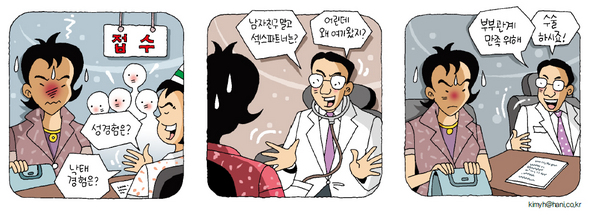
“성경험 유무는 왜…? 굳이 그것까지” 굴욕의 진료, 산부인과

“Why do they ask about sexual experience? Is that really necessary?” Humiliating Treatment at OBGYN Clinics

엄지원 / Uhm Ji-won, The Hankyoreh, 2 July 2012

여성이 불편한 산부인과 / Women find gynecology clinics uncomfortable
접수대부터 진료·시술까지 / From reception to treatment and surgery
의료진 노골적 발언에 민망 / OBGYNs make suggestive, embarrassing comments
사전피임약 처방전 필요한데… / The pill requires a prescription…
여성들 심리적 부담 커 고민 / Psychological pressure on women increases
환자 배려 의료지침 등 필요 / OBGYNs need guidance on bedside manners

지난 6월 정부는 사전피임약을 전문약으로 분류하는 약사법 개정안을 발표했다. 이 법안이 국회에서 통과되면 여성들이 산부인과를 찾을 일이 더 많아질 수 있다. 이를 두고 여성들은 산부인과에 가는 것 자체가 눈치 보이는 사회 분위기를 지적한 바 있다.

This June, the government announced that it was considering amending the Drugs, Cosmetics, and Medical Instruments Law to reclassify the pill as a prescription medicine. If passed by Congress, it will mean women will have to visit OBGYN clinics much more often. In light of this, women have been pointing out the [bad] atmosphere at them.

한국여성민 우회가 산부인과 진료 경험이 있는 여성 210명을 상대로 설문조사한 결과는 ‘외부의 시선’ 못지않게 산부인과 진료 자체에 대한 여성들의 두려움이 실제로 광범위하게 퍼져 있다는 사실을 확인해준다. 설문 특성상 응답자의 신상과 구체적인 피해 일시·장소 등을 밝히진 않았지만, 여성들은 산부인과에서 겪은 수치와 불편을 설문지에 빼곡히 적었다.

Korean Womenlink conducted a survey of 210 women who had received treatment at OBGYN clinics, and the results confirmed not just the endurance of public stereotypes that all women visiting OBGYN clinics had STDs, but also that women’s fears in visiting them were well-founded. The survey was anonymous, and respondents were asked to provide no details of the times or places in which they’d been made to feel embarrassed or humiliated, but many still felt compelled to write a great deal about their negative experiences.

(Source)

신지은(가명·36)씨는 얼마 전 산부인과에서 느낀 굴욕감이 생생하다. 아이를 낳고 정기검진차 방문한 신씨에게 의사는 은근히 ‘수술’을 권했다.

Shin Ji-eun (not her real name), 36, vividly remembers visiting a clinic for a regular check-up after her child was born, where the doctor implied she should have surgery:

“출산을 한 뒤니 부부관계를 오래 유지하고 싶으면 이참에 수술을 하라”고 말했다. 그가 권한 것은 여성 성기를 성형하는 수술이었다. “배려인지 희롱인지 알 수 없는 제안”이었다고 신씨는 말했다.

“After having a baby, and seeing as you’re already here, you should have surgery on your genitals for the sake of your married life”, the doctor said [James – what kind of surgery isn’t specified]. “I didn’t know whether to take it as a joke or a serious suggestion” Ji-eun said.

실제로 설문조사에 응한 여성들은 진료가 시작되는 접수대에서부터 낙태경험 또는 성경험을 묻는 수치스런 질문을 받았다고 증언했다. 어느 여성은 “진료 접수 때 ‘냉이 많아져서 병원에 왔다’고 했더니, 접수대 간호사가 큰 소리로 ‘성병이네요’라고 말해 매우 불쾌했다”고 적었다.

Respondents to the survey reported being asked embarrassing questions about their sexual experience and having abortions even as soon as arriving at the reception desk. One woman said “I went to the OBGYN clinic because I was having a heavy vaginal discharge, and the nurse at the desk loudly said ‘Oh, you must have an STD!’, which mortified me.”

진료 시작 뒤에도 수치심을 주는 의료진의 발언이 이어졌다고 응답자들은 적었다. 특히 “성경험이 있느냐”고 묻는 의료진의 태도가 당혹스러웠다고 여성들은 밝혔다. 어느 여성은 “성경험이 없다”고 답했다가 “검사할 때 번거롭다. 솔직히 말하라”는 의사의 말을 들었다. “그 뒤로 가급적 산부인과에 가지 않는다”고 이 여성은 밝혔다.

The shaming experiences continue after treatment starts too, because of doctors’ comments. In particular, after being asked if she had sexual experience, and replying that she didn’t, one woman found her doctor’s reply – “Be honest. Otherwise the examination will be more complicated” – perplexing, and said she’d rather not visit an OBGYN again.

(Source)

의료진이 성경험 여부를 묻는 것은 관련 진료에 필수적인 정보이기 때문이다. 그러나 성경험이 있든 없든 “왜 그런 정보가 필요한지 사전 설명 없이 다짜고짜 물어 불쾌했다”는 게 처음 산부인과를 방문한 여성들의 이구동성이다. 여성민우회 조사를 보면, 산부인과 방문 당시 성경험이 있었던 경우는 69.5%, 없었던 경우는 29.5%였다.

Before being treated, patients need an explanation of why being asked about their sexual experience was necessary. Without that, many women reported, they felt very embarrassed on their first visits to clinics.

Of the respondents, 69.5% had prior sexual experience, and 29.5% didn’t.

Top Left — Of 210 Respondents: 35.2% had no negative experiences, 64.3% did, and 0.5% didn’t reply.

Top Right — Of the 64.3% of women who reported negative experiences: 56.3% were related to fears and anxieties about their treatment; 30.4% to public perceptions [of OBGYN patients]; 3.7%  to questions about STDs; 3.0% to costs of treatment; and 6.7% to other things.

Bottom — Age at first visit to an OBGYN

자궁경부암 검사를 받으러 갔던 어느 여성은 “결혼 안 했으면 처녀막이 상할 수 있으니 검사하지 말라”는 의사의 말을 들었다. 자신을 배려하는 듯하면서도 ‘처녀성’ 운운하는 발언에 수치심을 느꼈다고 응답자는 적었다. “몇번 경험해봤나”, “최근엔 언제였나”, “첫 경험이 언제인가”, “남자친구 말고 섹스 파트너가 있나” 등을 아무렇지 않게 묻는 일은 점잖은 축에 속했다. 이들이 기록한 의료진의 어떤 발언은 그대로 옮기기에 민망할 정도다.

One woman who visited in order to be examined for cervical cancer was asked if she was married, “because if you haven’t, then you shouldn’t receive an examination that will break your hymen”; while possibly the doctor was just being considerate about her virginity, the woman still felt ashamed and embarrassed. Other embarrassing questions, like “How many times have you had sex?”; “When was the last time you had sex?”; “When did you lose your virginity?”; and “Do you have another partner in addition to your boyfriend”, don’t even begin to compare to what some doctors asked patients, which they reported were too shameful to write down in their surveys (source, right).

“성기 모양이 참 예쁘다. 남편이 함부로 하지 않는가 보다.” “가슴이 작아서 사진이 찍히려나 모르겠네.” “어린데 왜 산부인과에 왔을까?” 심지어 체모가 많은 것을 보고 “남편이 좋아했겠다”는 이야기를 들은 경우도 있었다.

“Your vagina is very pretty. Your husband wasn’t as rough as most men”; “Your breasts are so small I’m not sure they will even show in the mammogram”; ” You’re so young, why are you visiting an OBGYN?” and even, after seeing that a patient had lots of pubic hair, commenting that “Your husband must like it” are among some of the stories about doctors that respondents did provide.

환자보다 의사 중심으로 꾸며진 진료 환경에 대한 여성들의 성토도 이어졌다.

In general, respondents felt that the treatment environment was designed with doctors rather than patients in mind.

다리를 위로 향한 채 눕게 돼 있는 산부인과의 ‘진료의자’를 응답자들은 ‘굴욕의자’, ‘쩍벌의자’로 부르며 불쾌감을 표시했다. 한 여성은 “진찰대에 다리를 벌리고 올라가는 것 자체가 매우 불쾌해 다시 가고 싶지 않다”고 적었다.

(Source)

Women showed how upset they were by describing the treatment chair, in which patients lie with their legs in stirrups, as the “Chair of Shame”, or the “Spreadeagle Chair”. One woman wrote “I never want to go in that chair again. Having to spread my legs like that is very upsetting.”

자궁암 검사를 위해 병원을 찾았던 여성은 “의사가 들어오기 전 속옷을 벗고 다리를 벌린 채 준비했고 뒤이어 들어온 의사는 아무 설명도 없이 진료도구를 질 내부에 집어넣어 검사했다”고 불쾌감을 드러냈다.

Another woman who went to a hospital to be checked for cervical cancer wrote “Before the doctor came, I took off my underwear and got up and spread my legs, and when he arrived he just quickly put an instrument inside me, without any warning or explanation.”

‘진정으로 산부인과를 걱정하는 의사들 모임’의 최안나 대변인은 “산부인과 진료는 특히 예민한 분야이므로 성경험 여부 등 구체 정보가 왜 필요한지, 진료 과정은 어떻게 진행될 것인지 상세히 설명하고 의견을 구하는 건 당연한 절차”라며 “산부인과의 진료 서비스가 많이 나아지고 있다고 해도 여전히 일부 환자 눈높이에 부족한 점이 있다”고 말했다.

Choi Ahn-na, a spokesperson for the Korean Gynecological Physicians’ Association (GYNOB) [James — a notoriously anti-abortion group of OBGYNs. See here for more information about them] explained that “Gynecology and Obstetrics are very sensitive branches of medicine, for which it is both normal and essential for OBGYNs to have detailed information about patients, as this determines both the treatment type and how it’s administered. However, while OBGYNs have improved their services a great deal, it is also true that remaining weak spots need to be dealt with, as well as how things looks from patients’ perspectives.”

(Source)

여성민우회는 이달 중 1000여명에 대한 실태조사 최종 결과 분석이 끝나면 전문의·보건전문가 등과 간담회를 열어 환자를 배려하는 산부인과 의료 지침을 만들어 배포하는 등 ‘산부인과 바꾸기 프로젝트’를 이어갈 계획이다.

Continuing its “Transform OBGYN Clinics Project” [James — Yes, this is the first time it’s been mentioned in the article], this month Womenlink is following-up by surveying 1000 women. After analyzing the results with health specialists, it will produce and distribute a guide for OBGYNs for dealing with patients.

김인숙 한국여성민우회 공동대표는 “왜 여성들이 산부인과에 가는 데 부담감을 느끼는지 구체적으로 확인해 앞으로 더 나은 산부인과 진료 문화를 만들어 갈 것”이라고 밝혔다.

Kim In-sook, a co-spokesperson of Womenlink, said “We will determine exactly why women feel so stressed about going to clinics, with the aim of making a better and more welcoming environment for them there.”

<한겨레>는 ‘여성이 불편한 산부인과’를 ‘여성이 행복한 산부인과’로 바꾸기 위한 제보와 의견을 받아 관련 보도를 이어갈 예정이다.

(Editor): In order to make women feel comfortable with visiting OBGYN clinics, The Hankyoreh will continue to receive and report on women’s opinions and experiences of them.

Goodbye Madame Butterfly, Hello Sexless Marriage

See here for my latest Busan Haps article, a review of Sumie Kawakami’s Goodbye Madame Butterfly: Sex, Marriage and the Modern Japanese Woman. Any readers have similar horror stories about sexless Korean marriages to share?

Must See Korean TV: 21st Century Family (21세기가족)

(Source)

Thank you very much to Maria, whose synopsis instantly sold me on this recent drama:

…I’ve seen a lot of Korean dramas and they almost always find a way to disappoint me in the way they portray women, sexuality or both. This little drama is quite refreshing. Unusual in that it’s only 8 episodes long, it openly talks about issues like teenage sex, puberty, the difficulty married couples have getting sex regularly, and even one episode about viagra. To be fair, I have taken the last nearly 9 months away from watching dramas, so maybe things have heated up out there when I wasn’t looking. But this is the first time I’ve seen sexually related issues being dealt with so frankly and humorously…

If you think it already sounds a lot like Modern Family, you’d be quite right — it’s explicitly modeled on it, albeit without a gay family. See here for a helpful family tree, starting with Lee Deok-hwa (이덕화) playing the father role that Ed O’Neill does in the US original, and DramaTic for some historical context on Korean sitcoms, which helps you better understand what makes this one so different. In particular:

…the word comedy [was removed] from the show’s promotion to avoid all the implications it brings to the table, at least in Korea – namely, the idea that sitcoms should all be about a relentless succession of mindless gags punctuated by the good old laugh track. It’s an intelligent expedient, which highlights this show’s priorities better than any trailer or presentation would. This, in other words, is a back-to-basics approach, while at the same time exploring different answers to the usual formula.

(Source)

Perhaps it’s no surprise that it’s so easy to find with English subtitles then — I just watched episode 1 here, and although frankly I found it a little slow after all that build-up, it was still quite enjoyable. Also, crucially, it only had precisely one cringe-worthy moment for me, when Oh Yoon-ah (오윤아) behaves quite childishly in the police-station towards the end. Considering how routinely women behave that way in most Korean dramas, making me turn the TV off in disgust within 5 minutes of watching, it was very refreshing not to see it for a whole 40 minutes here.

Anybody else seen the show, and/or like a detailed episode by episode discussion (à la Dramabeans) over the next 8 weeks? Please let me know!

How Many Teenage Girls Are Smoking?

Estimated reading time: 3 minutes. Photo by Irina Iriser from Pexels.

If you’ve been following my The Gender Politics of Smoking in South Korea series (Part 1, Part 2, Part 3, Newsflash, Part 4, Korea’s Hidden Smokers), you’ll know that there’s a huge stigma against women smoking here. This leads to chronic under-reporting by female smokers, which in turn leads to the government and media regularly giving female smoking rates as low as 2-4%. In reality though, best estimates put the rate among young women at roughly 20%, pointing to a looming health crisis.

Even if the coming presidential election brings more enlightened officials to the Ministry of Health and Welfare (보건복지부) however, which has previously overwhelmingly focused on—and been accused of exaggerating—reductions in the male smoking rate, there’ll still remain the problem of finding out how many young Korean women actually smoke.

Or will there? With my thanks, let me pass on a reader’s partial solution:

My coworker, the assistant haksaengbu (학생부) at my high school, made a list of students caught smoking. This is at a small-town girls high school, with 330 students age 15-18 in western years. So far this year (since 2 March) 14% of the students have been caught smoking, with 9.5% of the academic (moongwha; 문과) students caught and 25% of the vocational (sanggwha; 상과) students caught.

I would think that 14% would be the absolute minimum possible average in Korea, considering that we’re in a fairly conservative area and teachers can still punish students (though it’s pretty inconsistent and haphazard). Considering that those are only the ones who’ve been caught and there’s almost nothing in the way of lunchtime and after-school supervision, I’d guess that the amount who smoke on a daily basis is 50% higher and the ones who’ve tried it on occasion is double that.

In any event, if you wanted some incontrovertible statistics about teenage girls smoking in rural Korea based on a sample size in the hundreds there you go!

Later, they added:

If you’d like the breakdown it was 21 out of 226 moonghwa students and 26 out of 106 sangwha students. I believe a couple of the sangwha students have dropped out/gone awol/transferred.

What do you think? How does this compare to readers’ own schools?

If you reside in South Korea, you can donate via wire transfer: Turnbull James Edward (Kookmin Bank/국민은행, 563401-01-214324)

Learning From Korean Family Planning Advertisements of the 1960s-1980s

…American military officers helped make abortion the population control tool of choice in those Asian countries where they wielded influence, first in Japan in the late 1940s and 1950s, then South Korea in the 1960s. USAID, America’s aid agency, provided Jeeps for mobile clinics which roamed South Korea performing abortions. At one point, a quarter of the country’s health budget was going on population control and the number of abortions hit an all-time record in Seoul, where, in 1977, there were 2.75 abortions for every live birth. “What would have happened if the government hadn’t allowed for such easy abortion?” asks one sociologist. “I don’t think sex-selective abortion would have become so popular.”

(Review of Mara Hvistendahl’s Unnatural Selection: Choosing Boys Over Girls, and the Consequences of a World Full of Men, @The Economist)

Apropos of the above quote, let me present some government advertisements of the period to give you a better impression of that amazing zeal for population control back then. Also, that whereas couples were encouraged to have two children in the 1970s, and not to favor boys over girls, that this would be reduced to only one child by the 1980s. Messages about the sex-ratio were invariably diluted.

Obviously, these would come to play a huge role in today’s world-low birthrate, the difficulty many Korean men are now having in finding wives (although fortunately the sex-ratio among newborns has since been normalized), and the ensuing massive influx of overseas brides. Less obviously, they defy stereotypes about Koreans’ squeamishness when it comes to sexual matters, as I’ll explain.

But first, some context. All 30 or so advertisements I’ve been able to find were produced by the Planned Parenthood Federation of Korea (대한가족계획협회; now known as the Planned Population Federation of Korea {PPFK; 인구보선복지협회}) and/or the now defunct Ministry of Health and Social Affairs (보건사회부), and can be found here, here, here, and here, as well as (best) on the PPFK’s website.

(Text, both calenders—”Did you know that the most effective, safest, and simplest device is the loop (IUD)? People who want one, please go to a welfare or family planning center.” Black headline, right calender—”Let’s have the proper number of babies, and raise them well!”)

Formed in April 1961 just before the coup, the PPFK would soon have the strong support of the military government. But according to Seungsook Moon in Militarized Modernity and Gendered Citizenship in South Korea (2005; pp. 81-2), its activities wouldn’t really take off until the 1970s, which possibly explains its rather uninspired efforts above (but note though, that the government itself was extremely active in population control well before then):

The modernizing state had to launch aggressive propaganda for family planning because the idea of contraception was foreign to most Koreans, who tended to believe that having many children meant good luck and that every child would bring his or her own food into the world….

….The state…worked closely with the PPFK to change the public perception of birth control, establishing a department of public relations in 1970 to make the idea and practice of contraception familiar to the populace. The PPFK increasingly relied on mass media (radio, television, newspapers, magazines and education texts of its own) to disseminate positive images and information about families with a small number of children. To encourage popular participation, the PPFK organized popular contests of various kinds, ranging from posters, songs, and slogans to stories of personal experiences by mothers and wives concerning contraception.

A fascinating book, it’s difficult not to quote much more here, as the next few pages make it clear that Korea’s population policies were just as systematic and draconian as China’s. In light of what is revealed in Hvistendahl’s more recent book though, it is strange that it doesn’t also discuss abortions, but it does mention that while IUDs insertions were offered freely in the 1960s (with the Marine Corps mobilized to provide them to isolated islanders), and considered the “patriotic” and “ideal” form of contraception (but with the pill also introduced in 1968 to alleviate their effects, in stark contrast to Japan), by the second half of the 1970s it would be female sterilization that was offered and aggressively applied, becoming “what can only be described as a sterilization mania” by the 1980s. Between 1982 and 1987, over 2 million Korean women would be sterilized, a “semiforced mass sterilization” that “led to abrupt reductions in the fertility rate and the rate of population growth in the 1980s” (p. 85).

(Left, umbrella—”The path to youth and beauty is family planning.” Both posters—”Don’t discriminate between boys and girls, have only two children and raise them well.” {This slogan can be seen on many 1970s posters}.)
(Left, headline—”Which method is good?”; cup—”Family planning consultations”; man, text —”I’ll do it”; text, bottom—”1975 is International Women’s Year.” Right, 19th Family Weekly Magazine May 5-12 1974—”The World has One Destiny”; “NCC=The National Council of Churches in Korea.”)

This poster on the left above is particularly interesting, and not just because that was the year that March 8—which *cough* happens to be my birthday—was made International Women’s Day (alas, I was born a year later). Rather, it’s because of the guy saying “I’ll do it”, which couldn’t help but remind me of young Koreans’ surprising attitude that contraception is exclusively men’s responsibility (as indeed the Japanese think too). However, women were overwhemingly the focus of population control drives back then (Moon notes that only 1 vasectomy was performed for every 10 IUD insertions, although I think the ratio to female sterilizations would have been more useful), and women’s organizations co-opted or specifically created by the state to carry them out, so it seems anachronistic to see a connection between young Koreans’ attitudes today and those of their parents at the same age.

Indeed, this one on the left below turns out not to be about family-planning at all, but rather women’s rights:

(Left, headline—”We are all [the same] human”; Man (clockwise from hat)—”Family registry rights, parental rights, inheritance, children, estate”; Text—”Women’s Family Law Change Committee”. Right, arrow—”The path to a Gross National Income of of $1000 in 1981″; Text, below—”[Previous 1970s’ slogan]”.)

Next, before moving on to posters from the 1980s, note that sterilization campaigns would come to be complimented by various economic incentives (p. 85):

In 1981, confronting negative economic growth for the first time since 1982, along with a decrease in the number of sterilization acceptors, the state issued “Countermeasures to Population Growth.” These measures were characterized by incentives to a family with one or two [James – ?] children; priority in getting housing loans and business loans, monetary support of low-income families, and free medical service for the first visit. During the 1980s, variations of these kinds of incentives were introduced almost every year.

(Left—”Two children is many too!”. Right—”Korea’s population has already exceeded 40 million”.)

And here are two posters with sons, and then two with daughters. But note that, confusedly, there were also some with two children like those in the 1970s though, and that clearly the government and PPFK were still very much concerned about the sex-ratio.

However, like I said that message was surely somewhat diluted by having some posters featuring and explicitly praising having a son, and it would be interesting to do a content analysis to determine the ratio of those that depicted sons to daughters, two children, or (preferably) a sex-neutral image like the eggs above:

(Left—”One family, full of love. One child, full of health”. Right, headline—”Because of one son”; Text—”Overpopulation is everybody’s responsibility”.)

(Top—”A blessing of one child, loved strongly”. Bottom—”Raise one daughter well, and you won’t envy [those who have] ten sons”.)
(Left, sign—”Korea’s current population: 40,524,837, Korea is overflowing”; Text in map—”Even if you only have one child, Korea is overflowing”. Right—”Korea is already overflowing”.)

Finally, please note that these posters are just a handful of those available on the PPFK website, and which in turn must be a small sample of all that were produced. But in combination with what I’ve learnt from Militarized Modernity, they’ve still lead me to an interesting conclusion. Which is that, bearing in mind Koreans’ reputation for procrastination, yet doing things with outstanding zeal and efficiency once they set their minds to them (albeit usually precisely because of putting them off for so long), sexual matters are no exception, despite Koreans’ conservative reputation. Moreover, and intriguingly, it appears that young Korean couples of the 1970s and 1980s were likely to have been much better educated and informed than their children are now.

Assuming it does exist, what on Earth happened in the 1990s and 2000s to account for this curious generation gap? And why, even though technically adults rather than children were the target of government campaigns in the 1970s and 1980s, is sex education in Korea today so appalling?

Quick Hit: Korea’s Hidden Smokers

I wrote an article for Busan Haps this month, about a topic which many of you will recognize from my The Gender Politics of Smoking in South Korea series (Part 1, Part 2, Part 3, Newsflash, Part 4; Living as a female smoker in Korea). Rather than have anyone sift through those thousands of words just to find sources for the statistics I mention in the article though, let me make it easier by providing them all here instead (in order of their appearance):

Here is the July 8 2010 Busan Metro article, with my translation.

• In that article, the OECD average male smoking rate of 28.4% (in 2007) was unsourced, but the same figure — albeit for 2008 — can be found at Asian Correspondent’s translation of this Yonhap News report.

• The 1980 figure of a 79% male smoking rate is from footnote 80 of “The strategic targeting of females by transnational tobacco companies in South Korea following trade liberalisation” by Kelley Lee et al., Globalization and Health 2009, 5:2. Unfortunately, I’ve been unable to find the Chosun Ilbo article referred to in that, but the same figure can be found in this January 2007 Arirang report instead.

Gallop Korea’s figure of “almost as many as 1 in 5” young Korean women smoking (technically 17%) comes from Gallop Korea: Investigating the Actual Condition of Smoking in South Korea, mentioned in footnote 28.

• That is also the source for the figure of 83.4% of Koreans disapproving of women smoking.

Mathias Specht was the Korea Times reader who witnessed an old man slapping women in the face for smoking in March 2010.

I’m No Picasso is an example of one expat female smoker who has changed her smoking habits because of the stigma against women smoking. More can be found in comments to the posts in my blog series.

• More on the “1989 National Health Promotion Law Enforcement Ordinance” can be found in the Globalization and Health article.

• C. Paul Dredge’s Smoking in Korea article, from the Vol. 20., No.4, April 1980 Korea Journal, can be downloaded as a PDF here (the March 1980 reference is a typo by me). For a change though, probably scrolling down Part 1 of my series is actually a much quicker way of finding the text I refer to.

• Finally, I’m indebted to I’m No Picasso for making the links between coffee shops and female smoking, which I expanded upon in Part 4.