These are pictures of classroom areas at the JangHeung Area Children’s Center, located in JangHeung Eup of JangHeung County, Jeollanamdo. Our Center serves 61 children from one of the 5 poorest counties in Korea. Currently we have 3 classrooms at our center. 2 are one-room classroom buildings. That is what you see above. One of the classroom buildings is 100% unusable, the 2nd classroom building is not good either.
Our Center operates on an educational budget of less than 1,200,000w per month, less than 20,000w per child. Our total budget is less than 80,000w per month for each child. This is less than 50% of the tuition for any one hagwon that I am familiar with.
All of the children in our program come to us through the local welfare office. As you might imagine finances are tight and we don’t have money for extra things. That includes replacing our 2 classroom buildings. To continue our mission of providing a quality education for the children in our program it is imperative that we acquire the necessary funds to meet this essential need and provide safe, usable classroom space for our children. We need your help to do that.
For More Information about us please visit our facebook group at JangHeung Area Children’s Center. Please join us today.
To make a donation of 20,000w, 30,000w, or 50,000w please send bank transfer to:
NongHyup Bank 657-01-074288 Fundraising Goal: 12,000,000w
Sorry I haven’t posted anything this week folks; I’ve gotten just a little too lost in my offline writing work and research this vacation. But with only 3 weeks left of the semester break though, I’m slowly returning to a more normal schedule, and will try to start posting more regularly from next week.
Until then, have a good 설날 everyone, and make sure not to miss Bittersweet Joke, a documentary about unwed mothers in Korea, playing on BBC World at 6:30pm, Saturday Feb 9. See Tales of Wonderlost for the details.
With her permission, here is a reader’s email I recently received. While I don’t usually post things that aren’t specifically Korea-related, I thought I’d make an exception this time!
Dear Mr. Turnbull,
I thought you might be interested in this video since your blog is about gender studies (Apologies for the long e-mail, but I want to explain myself thoroughly).
One of my subscriptions posted a video called “Cute lines for Cute Girls” with the description “Everyone dreams of using corny but sweet pickup lines on random unsuspecting women. My friend and I show you the reactions we got :)” (My emphasis added)
I watched it and instead of making me smile, it just made me cringe. The video consists of him and his friend approaching random women in the street and in buildings with corny pickup lines. What made me uneasy is that I couldn’t help but see that some of the women did not seem to enjoy it. Sure, the background music makes it seem light-hearted and fun, but mute it and look at their body language. Some did have fun with it and laughed, but to me most 1) couldn’t walk away fast enough, 2) gave an uncomfortable laugh and smile (that “what the hell just happened” smile).
I think most people can see that whistling and making lewd comments are wrong. What complicates things and divides opinions is that these are “nice guys.” They are not your typical catcallers lurking in a doorway, but “regular, non-threatening” guys on the street. But does this make it ok? I would say not.
Perhaps I was wrong about the video, but his replies really disturbed me. Even if you do not agree with me about the video, the conversation we had was really telling about attitudes about street harassment today.
I don’t know if he’ll remove my comments or not, so I’ll paste the conversation here (my emphases throughout):
Me: I don’t know about this. I mean, you’re going after women you have no interest in other than to make a video so people can laugh at them. Most of them just laugh uncomfortably and walk away. This is like one step above cat-calling.
Him: Hey waterlily6782001, this is an exercise in overcoming false constraints that many individuals place on themselves. Also, many of these girls played along when they heard these lines because they were cool and fun girls who knew how to banter back. If anything, this is a great profile on the decent quality of women at University of Pennsylvania.
(Almost feels like he’s saying I’m not cool or fun or of decent quality because I do not like his “exercise”)
Me: Yes, I understand and I do like your other videos, but this one… From your videos, I don’t think you’re a mean person and I don’t think you ever intend to hurt anyone, so I wasn’t too upset. Yes, some of them bantered back, but can’t you see that some were also clearly uncomfortable? It’s just that when you have to deal with totally insincere guys chatting you up all the time as a dare or just to get a reaction, it goes from flattering to tiring.
Him: They could’ve been having a bad day; school could’ve been stressing them out. Even if our lines caused the discomfort, my friend and I were simply giving them compliments. If they can’t take a compliment, then their frame of mind needs work. For example, I love your constructive criticism. But I could easily have said, “This person is a hater. I should delete the comment.” But if I did that, we wouldn’t be having a great discussion. Frame life positively. You’ll be much happier =)
Me: Please read this, it explains it better than I ever could ^_^
I think what we have here is just that you, as a man, will never experience life as a woman. So it’s difficult to grasp that what you see as “compliments” can mean different things to different women. There’s just no way for me to make you fully understand, but I appreciate your replies and wish you the best. ^_^ (end)
He implies that I’m 1) a hater 2) pessimistic and 3) unhappy because I do not like his video. I’ve read hater comments before and I thought my commentary was pretty tame. I’m also pretty sure haters don’t promote your videos on their blogs as I’ve done with his in the past (He did a student documentary on Asian male and white female relationships).
It was clear that I couldn’t make him understand, and he implies that he made no one uncomfortable (“Even if our lines caused the discomfort”). But you can’t tell me that the girl at 0:53 is not uncomfortable while she’s speeding past, head down, eyes averted, walking around him, and not even stopping. The girl at 2:10 is also clearly not amused even though you can’t see her face. Listen to her voice! I also wonder if the girl at 2:30 was really having fun having a guy 1) corner her at work and 2) continue to talk to her even after she emphasizes TWICE that she has a boyfriend.
This in particular really disturbed me: Even if our lines caused the discomfort, my friend and I were simply giving them compliments. If they can’t take a compliment, then their frame of mind needs work.
…which is probably the #1 argument guys have for when girls don’t like their advances. It’s a COMPLIMENT and if you’re uncomfortable YOU need to change. So if I don’t like a guy following me along the sidewalk giving me an insincere “compliment” I need to change my attitude.
Do I hate compliments? No. I appreciate heart-felt compliments.
Do I hate jokes? No. I make them all the time.
Do I hate corny pick-up lines? No. In fact, they can be cute and are good ice-breakers.
What I do hate is a stranger who has absolutely no genuine or honest interest in me, and:
1) cutting in front of me
2) following me
3) giving me a completely fake compliment just to see my reaction,
4) walking away,
5) laughing
6) recording the whole thing, and
7) posting it on the internet.
So what do you think? Do these guys get a free pass because they aren’t dirty old men hanging on the street corner?
Thanks for reading this long e-mail and have a good day!
James: What do readers think? I’m in complete agreement myself!
Update 1, Feb. 3: Just for everyone’s interest, here’s something I stumbled across in a review of a book on the history of online dating:
Of course, single people have always had means to boost their odds. You can move to a city, where the population of as-yet-unclaimed hearts will be larger. You can lower your standards to broaden the radius of your dating pool. You can also just toss out game 24-7 with utter indiscretion. One acquaintance likes to tell random women on the street that he thinks they’re beautiful. “Like 1 in 5 will slow their roll a little and give me a smile,” he says. “And like 1 in 5 of those stop and talk to me and let me hand them my business card. And like 1 in 5 of those actually call me.” I would assume that at least 2 in 5 women he approaches think him a frightening skeezball. And I think, for better or worse, he’s OK with that ratio.
Starring: Son Yae-jin (Joo In-Ah), Kim Ju-Hyeok (Noh Deok-Hoon), and Joo Sang-Wook (Han Jae-Kyeong). Written by Song Hye-Jin (original novel by Park Hyun-Wook) and directed by Jeong Yoon-soo.119 minutes.
Before the mid-1990s, very few Korean movies featured a wife leaving an unhappy marriage. Of those that did, either she would ultimately return to her husband, tail between her legs, or she would face an untimely death, so great was the inevitable spiral into destitution and despair.
So, when Kim Tae-kyun (김태균) directed The Adventures of Mrs. Park (박봉곤 가출사건; 1996), who not just successfully pursued her lifelong dreams of becoming a singer, but found new romance with a second husband too, he softened the subversive social message by making the movie into a romantic comedy. But even then, he would later confess to Cine 21 magazine, he was extremely concerned at how audiences might react to such “an unexpected ending”.
Fast forward to 2008, and My Wife Got Married, about a woman who demands 2 husbands, was one of the most popular movies of the year, and even won Son Ye-jin the Blue Dragon Film Award for best actress. Not quite a comedy, and sparking minimal complaint or controversy (although women were careful not to publicly identify too closely with her character), it’s difficult not to see it as a sign of how quickly and irrevocably Korean attitudes had changed in the preceding decade. I’ve projected feminist empowerment onto it ever since.
It’s somewhat ironic then, that it turns out that the movie is *ahem* actually told exclusively from the perspective of the main male character, Noh Deok-Hoon…
*Minor spoliers follow*
Opening in Spring 2002 with Deok-Hoon bumping into Joo In-Ah on the subway, next they’re at a coffee shop, where he reminisces about missing his chance to ask her out back when they worked together, and speculating with his male coworkers about whether she wore a bra or not (as one does). Discovering a shared love of football, specifically the rivals Real Madrid (him) and FC Barcelona (her; expect many ensuing football/relationship metaphors in the movie), soon they’re having drinks, then sex at her place.
In a surprisingly erotic scene, Deok-Hoon has the best sex of his life, and instantly makes such an emotional, almost spiritual connection to In-Ah that it’s easy to see how wounded he would be by what audiences already know will come. But, by no means does she merely humor him in response. So, even without that benefit of hindsight, it’s no surprise that they do genuinely fall in love.
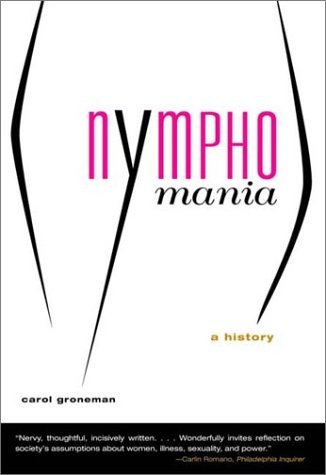
This is more important than it may sound. Because, before falling in love, first they are lovers (what an oxymoron!), with one scene in which she encourages him to very explicitly talk about his sexual fantasies — he struggles; she’s well aware of hers — hinting at her much greater sexual subjectivity, and willingness to act on it. Considering that just 13 minutes in, audiences were — à la Basic Instinct — reflexively craning their necks to get a better glimpse of her exposed(?) nipples, it would have been very natural and easy for writer Song Hye-Jin to have continued on that salacious, titillating basis, portraying In-Ah as a emotionally manipulative nymphomaniac that can’t be satisfied with just one man, with all the double standards that that implies.
Instead, as soon as we’re shown that they’re in love, In-Ah also says that despite that, she can’t guarantee that Deok-Hoon will be the only person she loves for her entire life. Her surprise at his umbrage with that seems both authentic and naive (a constant theme), as is her not realizing how he might feel at her continuing to drink and socialize until all hours as if she were still single.
Not that she can’t or shouldn’t mind you. Rather, it’s how secretive she is about it that is the problem, never answering her phone; it’s only when he eventually, desperately confronts her at her apartment after one such session that it seems to click. Only slightly drunk and still impeccably dressed, you sense maybe she is only testing him when she retorts that she was sleeping with someone. Either way, he leaves her.
After a month of moping around, he’s encouraged by a friend to forgive her, but also to ensure it doesn’t happen again by marrying her and then knocking her up. Surprised at his call, let alone his marriage proposal, she takes a lot of persuading, only finally acquiescing during a World Cup game.
Those that were here that magical summer, will surely understand.
Domestic bliss ensues, only briefly interrupted by her moving to a different city for 4 days a week for the sake of her job; after all, such arrangements are completelynormal for millions of Koreans. This movie being what is though, soon his world comes crashing down when she reveals that she’s not just fallen in love with a second man — Han Jae-Kyeong — there, but she would like him to also be her husband — not just boyfriend — just as Deok-Hoon is in Seoul. Angry, emotional, and this time also physical confrontations follow, with Deok-Hoon resolving not to let her to “win” by divorcing her.
Let’s pause for a moment here, as many viewers may well have needed to take a deep breath at this point in the movie. Because, victim or perpetrator, likely most would also been affected by cheating spouses, partners, or parents at least once in their lives. Equally likely, they resolved to never let it happen again, or to them. So, if Deok-Hoon returning to In-Ah the first time didn’t already, his acquiescing to this new arrangement surely brought many of those same feelings of rage, hurt, impotence, and frustration back to the surface.
Or perhaps I’m just projecting? Either way, frankly, if I wasn’t already committed to a review, I would have stopped watching at that point, for the same reasons I turn off most Korean dramas within 10 minutes: it’s difficult to be sympathetic to — or interested in — a character you constantly want to grab by the shoulders and just shake some damn sense into.
Yet, for a time, the trio — well, technically two duos — does seem to work, providing one takeaway message that polygamy (technically, polyandry) is neither as absurd nor as evil as it’s usually assumed to be. Moreover, in the process the movie pointedly questions many of Korean society’s double standards regarding marriage, especially how prostitutes and mistresses are tolerated for men while many wives languish at home, resigned to continuing their — by their own admission — loveless, sexless marriages out of financial dependence and fears they will lose custody of their children. Many reviewers erroneously claim these are shared by Deok-Hoon; however, but for sneaking glimpses of In-ah’s breasts at work, then complaining of her not wearing a bra in public (after sleeping together just one time!), he’s only guilty of firmly believing in monogamy. Indeed, he’s the one that repeatedly lashes out at his male friend’s hypocrisy, although it’s true that he could have done so with much greater gusto at his brother’s.
However, no matter how positively it portrays polyandry, the movie also demonstrates how unfeasible it is in a society where it’s both illegal and there’s strong social prejudices against it. And, coming from a movie which can be described as a romance only by default (to those reviewers that call it a comedy, I’m perplexed at what they laughed at), you’re left wondering what the point of the 2 hours was exactly.
Specifically, it’s the birth of a daughter that starkly demonstrates how the trio’s arrangement simply can’t be sustained in the face of family and official obligations. Questions of paternity aside (In-Ah wants him to love the child regardless of the who is the father, so never reveals that. Later, it’s Jae-Kyeong that reveals that they always used contraception when they were together), it soon becomes apparent that Deok-Hoon and Jae-Kyeong’s families are none the wiser.
This facade comes tumbling down when Deok-Hoon’s colleagues in Seoul see In-Ah, Jae-Kyeong, and daughter in a magazine article written by (unknowingly to them) the latter’s cousin, and assume that he’s secretly gotten a divorce. Fearing he’s slowly but surely losing both wife and daughter, and partially out of spite (really, he hasn’t felt in control of his life since the start of the movie), he responds by crashing the first birthday party Jae-Kyeong’s family has for “their” daughter.
In response, In-ah disappears with her daughter, and her two husbands — this is much more believable than it may sound — come to live together and even become friends; as they say, they have nowhere else to go. When a postcard from Spain arrives 5 months later, the movie ends with both of them joining her there to watch football games and live happily ever after, as if somehow questions of employment, visas, schooling, custody rights, and social prejudice didn’t also apply there.
*Spoilers End*
Was it too much to ask that the movie delved a little more into some of those questions? Do any movies know any Korean movies that do cover alternative living arrangements a little more realistically, but are still entertaining? Thanks!
Update, Feb. 3: By coincidence, today The Atlantic had an interesting article titled “When Taking Multiple Husbands Makes Sense,” with the byline “Historically, polyandry was much more common than we thought.”
Update, January 3 2014: And today, Salon one titled “My Two Husbands.”
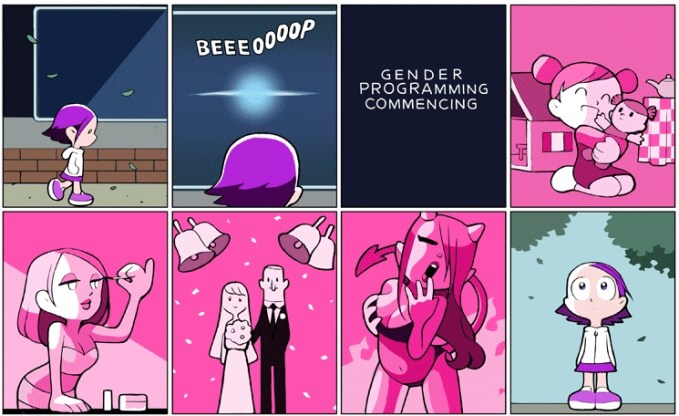
(“Gender Programming” by Sinfest. Click on the image for the full strip)
The new, lite version. Sorry if anyone relied on the categories in the previous version, but 1) they were always pretty loose and arbitrary anyway (many stories could go into several), and 2) they didn’t really seem appropriate with me deliberately going for a good mix of subjects now, rather than simply collecting every story I came across. Grouping them into five at a time does make for easy mental navigation though (i.e., see what’s available for one day, move on to the next), and if you’re impatient it only takes about a minute (yes — I’ve timed!) to read the titles of all the thirty-five links available.
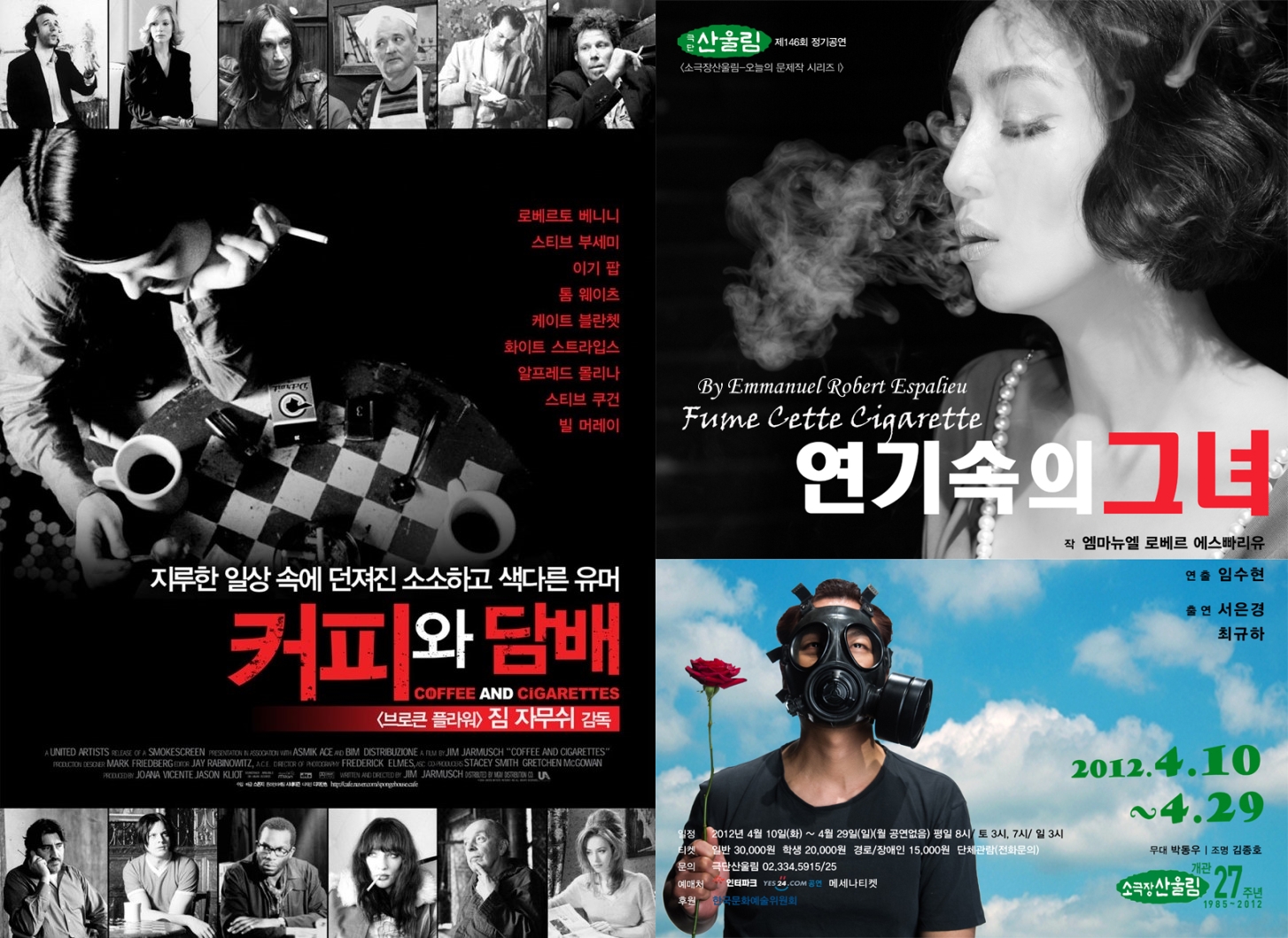
The other day Kim Young-hee (26) smoked in public instead of a cafe. She took out a cigarette impulsively while waiting for the bus home after a few drinks with her friends.
“I was a bit tipsy and felt like a puff. After I lit the cigarette, a random middle-aged man came up to me and started shouting as if I had done something very bad. He said, ‘I will slap your face if you don’t throw your cigarette away right now.’ He called me ‘dirty little woman.’”
She still thinks it was ridiculously unfair for him to reproach her because the man was also holding a cigarette…
See The Korea Times for more stories of similar incidents, and my The Gender Politics of Smoking in South Korea series (Part 1, Part 2, Part 3, Newsflash, Part 4, Korea’s Hidden Smokers) for more context. As explained in the latter (see the article in the last link for a summary of the series), the stigma against women smoking leads to massive under-reporting by them, resulting in official figures of roughly 2-5% of Korean women smoking, against best estimates of roughly 20% (see here for a handy international comparison). What’s more, the previous government was accused of deliberately downplaying the figures to stress its success in lowering the (admittedly more pressing) high male smoking rate, and while technically I haven’t seen the same accusations leveled at the outgoing Lee Myung-bak Administration, I haven’t found any official acknowledgement of how problematic its figures are either.
Meanwhile, since my last post in the series was published nearly a year ago, probably the biggest developments have been the Seoul City Council’s continuing efforts to implement its 2011 plans to increase the number of public areas being designated smoke-free to 1/5th of the city by 2014 (smoking on sidewalks was already banned in 2010); and also efforts by some companies, both public and private, that have gone so far as to make being a non-smoker a prerequisite for promotion. For more details on both of those, see “Getting Tough: Korean Smokers Passed Over for Job Promotions” by Bobby McGill at Busan Haps, who also notes that (source, right: sungjinism):
The central government is doing what it can while avoiding Korea’s third-rail of politics, the “sin tax”. Few things more quickly turn the public against you here than raising taxes on Korean’s beloved cigarettes and alcohol. And the evidence shows that aside of potentially costing elected officials their jobs, it does little to curb smoking anyway.
The last time the government raised taxes on cigarettes was in 2004 by 354 won (30 cents) when 52 percent of the male population was smoking. The rate dropped a paltry seven points to 45 percent by 2007, but then increased the three subsequent years hitting 48.3 percent in 2010 before leveling off back at the current 45 percent.
I’d agree that the government is avoiding the sin tax, but disagree that that 2004 tax hike constitutes evidence against its effectiveness: a raise of 354 won being moot when just last year, packs were still at “the very smoker-friendly price of 2,700 won each” (US$2.53 as I type this). Moreover, in November “The International Tobacco Control Policy Evaluation Project’s team of some 100 health experts from around 20 countries” said that “it is imperative for South Korea to raise taxes on tobacco products,” and also 50% of respondents in a December 2010 survey by The Ministry of Health and Welfare “said that they would seriously consider quitting if the price was at least 8,000 won per pack.”
What do you think, about any of the above? Especially those among you that smoke yourselves? Personally, when I hear of women getting threatened, even slapped in the face for smoking in 2013, I’m very skeptical about news of improvements. But I realize that that is likely much more a manifestation of general misogyny than being anti-smoking per se, with Nathan McMurray of Korea Law Today, for instance, being much more optimistic about changing attitudes:
Reducing smoking is a process that will require the collective willpower of the entire country, because it is a habit so deeply ingrained in the culture. However, positive strides have been made to reduce the number of male smokers. In fact, since I have been in this country, I have noticed that the perception/acceptance of smoking has morphed into something different than it used to be.
Either way, let me conclude by passing on some further reading I’ve come across in the past year. First, specifically gender and smoking-related, which show that — of course — it’s by no means just Korea where the number of female smokers is soaring (source, right: Jude Lee; CC BY 2.0):
Tomorrow at about 8:30am, there’ll be a brief interview of me in the “Morning Coffee” section of the 7-9am Morning Wave program on Busan e-FM. More about me than than anything Korean feminism, sexuality, or pop-culture related sorry(!), if you’re still interested you can listen in at 90.5 FM or online here, or catch it later in the archives.
As promised last time, here (yes, click the link) is this week’s new, improved Korean Gender Reader. But, frankly I’m disappointed with it. While using paper.li did save a lot of time, and the result does look much better than my regular posts, several stories I tweeted are missing; most stories you have to click the “more” links to see; their categories are completely meaningless; and the inability to choose my own descriptions to links means the headlines often give absolutely no indication of the contents (yes, I can hardly criticize given the headline to my own last post, but still!).
Without much more editorial control then, in hindsight paper.li only seems appropriate for daily collections of links really.
So, apologies for the failed experiment, and next week I’ll revert back to the old system. Suggestions for how to save time with it are still very welcome, but probably simplest and best is if I limit the number of links to the 5 most interesting stories I come across each day, coming to a total of 35 a week. Compared to the 70-100+ I normally post, that doesn’t sound too onerous, and of course all the extra stories not linked to in the KGR posts will be still available via the Facebook Page or my Twitter Feed.
Partially, that’s because many feminist criticisms of the discipline and its researchers — and vice-versa — are really just based on strawmen and stereotypes.
That said, it’s also true that evolutionary psychologists can indeed sometimes make outlandish, sexist claims based on little to no evidence.
Or at least, they can seem to. More often than not, it’s actually journalists that are doing that for them, who rarely have time for their caveats and qualifications. Also, journalists can sometimes simply make mistakes and/or misunderstand too, or evolutionary psychologists fail to clearly explain the purpose, methodology, and conclusions of their research.
These maxims are worth repeating, especially when you read a headline that brings an instant, smug satisfaction of being proven right. In this case, with “Why Dating Women With Slim Waists Lowers Men’s Risk for Erectile Dysfunction” by Christine Hsu in Medical Daily, which not only makes sense given everything else I’ve read about women with hourglass figures — that they’re significantlymore fertile than those with other body types, which likely plays a strong role in why that one is so popular amongst heterosexual men (to the extent that even congenitally blind men prefer them) — but, sharing that preference, also reminds me that I’ve got great taste in women too.
Just taking Hsu’s word for it though, would be nothing more than confirmation bias. So, starting with her introduction (my emphasis):
Possessing a ‘figure 8’ body has long been a trademark of feminine beauty, and now new research has revealed the reason why men tend to prefer women with a waspish waist.
The study also linked the middle proportion of a woman’s body to the likelihood of satisfaction and erectile dysfunction in her partner.
Researchers found that the slimmer a woman’s waist, the more satisfied her partner and the less likely he is to suffer impotence in the bedroom, according to the study published in the [December 2012 issue of the] journal Archives of Sexual Behavior.
That study is “Slimmer Women’s Waist is Associated with Better Erectile Function in Men Independent of Age” by Stuart Brody and Petr Weiss, and I’ve highlighted that last section because — admittedly in hindsight — it should already raise alarm bells: sexual satisfaction isn’t actually mentioned in the title of the article, nor the original study. That doesn’t necessarily mean that it’s not there, but the combination of the titles and the highlighted part does strongly imply that, somewhere within, the study will mention that female participants’ waists were measured and the sexual satisfaction and levels of impotence of their male partners.
At first glance, it appears to be done so in the abstract, (my emphasis; source, right):
….To assess the association of women’s waist size with a more tangible measure of perceived sexual attractiveness (as well as reward value for both sexes), we examined the association of women’s age and waist circumference with an index of men’s erectile function (IIEF-5 scores), frequency of penile-vaginal intercourse (PVI), and sexual satisfaction in a representative sample of Czechs (699 men and 715 women) aged 35–65 years. Multivariate analyses indicated that better erectile function scores were independently associated with younger age of self and partner and women’s slimmer waist. PVI frequency was independently associated with women’s younger age and women’s slimmer waist. Sexual satisfaction was independently associated with men’s younger age and slimmer waist for both sexes. Better erectile function, greater PVI frequency, and greater sexual satisfaction were associated with women’s slimmer waist, independently of both sexes’ ages….
But then I moved on to the methodology (the first 2 pages are available at the above link), which ends the section on how the participants were chosen with (my emphasis):
The rationale for using participants who were not both members of the same couple includes prioritizing a representative sample and decreasing risk of a couple comparing responses (Weiss & Brody, 2011). The 649 women who provided complete data had a mean (SD) age of 48.1 (8.6) years, and the 685men who provided complete data had a mean (SD) age of 49.6 (8.7) years.
Which begged the question of how on Earth, if data on the waist sizes and sexual satisfaction of both partners in a couple was not gathered (and erectile function of the male partner), it was determined that “the slimmer a woman’s waist, the more [sexually] satisfied her partner and the less likely he is to suffer impotence in the bedroom.” This in turn spawned an interesting all-day conversation on The Grand Narrative Facebook page, and ultimately led — thank you! — to my getting my hands on the full study itself.
As it’s only 8 pages long, I highly recommend that you read it for yourselves (please email me or let me know in the comments if you would like a copy) so let me just sum it up here. As it turns out, Hsu did indeed make some mistakes (source, right).
First, the methodology:
Page 3, paragraph 1, mentions that “The same wording for the IIEF-5” — the test of erectile function — “was used for both sexes with the added instruction that the woman should complete it on behalf of her partner.” Earlier, it also mentions that the test is very reliable, with men’s and their female partners’ assessment of the men’s erectile function being very similar (obviously, their female partners would know!).
Page 3, paragraph 2, mentions that only participants completed the survey on sexual satisfaction; and page 3, paragraph 3, that participants measured only their own waists. In short, it’s these points that already prove the error of Hsu’s link between male sexual satisfaction and female waist size that I highlighted in the introduction.
The younger the men and women, the less problems with erectile dysfunction the men (or the women’s male partners) had.
The slimmer the women’s waists, the less problems their male partners had with erectile dysfunction.
The slimmer the women’s waists, or the younger the women, the more often they had sexual intercourse.
The slimmer both sexes were, the more likely they were to have satisfying sex lives. The younger the men were (not the women) the more likely they were to have satisfying sex lives.
The more often men and women had sex, the less problems with erectile dysfunction they (or the women’s male partners) had; and the younger the men (not the women), the more likely they were to have satisfying sex lives.
Women with slimmer waists tended to have sex more often; their male partners had less problems with erectile dysfunction; and they (the women) were more likely to have satisfying sex lives.
And finally, crucially, “It was noteworthy that the association of women’s slimmer waist with all measures of sexual function was independent of both partners’ age” (from the end of page 6).
That’s a lot to take in, many points seem obvious and to follow naturally from each other, and there’s certainly the possibility that I’ve misunderstood and/or misrepresented some of them myself — if you think so, by all means please correct me. Also, I don’t mean to harshly criticize a reporter who undoubtedly had less time to spend on the study than the 3 days of my semester break(!) that I ultimately did. But, although it’s very very easy to take away the message that “the slimmer a woman’s waist, the more satisfied her partner” from it, with the conclusion stating —
The findings were generally in accord with evolutionary perspectives. Men’s erectile function scores were independently associated with younger age of self and partner, and women’s slimmer waist (all factors generally associated with greater reproductive fitness). Similarly, PVI frequency was independently associated with women’s younger age and women’s slimmer waist. Sexual satisfaction was independently associated with men’s younger age, and slimmer waist for both sexes. Better erectile function, greater PVI frequency, and greater sexual satisfaction were associated with women’s slimmer waist, independently of both sexes’ ages. Thus, capacity for potentially reproductive sexual behavior, frequency thereof, and a psychological response that might support pair-bonding were all linked to women’s slimmer waist.
— for instance, Hsu does appear to have misunderstood it, also mentioning that “researchers also recorded how often the 699 study participants — Czech men between the ages of 35 and 65 years old — had sexual intercourse,” whereas actually (page 2, paragraph 5) 699 men and 715 women were surveyed, and of those 685 men and 649 women provided complete data.
Either way, I can just imagine what many journalists and advertisers would — and probably will? — make of a study which seems to say that men with slimmer wives and partners have more satisfying sex lives!
I showed my (Korean) wife this thread. Her response:
“They think Koreans can’t talk about gay rights? How insulting. We’re more advanced than you think. Gay issues are talked about all the time on talk shows and in the media. [Those commenters] clearly do not understand Korean culture.”
I would have said more “ignorant” of Korean culture, but you get the idea. And, as if to prove her point, somehow the very next thing in my browser was the new Kim Soo-yong’s 19 [R18] Show, hosted by (obviously) comedian Kim Soo-Yong and announcer Kim Min-jin, and also starring psychologist Dr. Choi Chang-ho and comedian Yun Sok-ju.
Although this particular show may not have talked about LGBT issues (yet), it hit home because it provided a second healthy reminder that Koreans are frankly talking about sex at least, despite foreign stereotypes of their extreme sexual conservatism. Indeed, there’s actually been shows like this for many years now.
Out of feelings they share when they love each other, there’s some things they don’t understand, or they do understand but feel strange about, or they thought they understood but can be easily mistaken about.
From the first date, skinship, and sex to proposing and marriage, we need to something to clear the wish-washy, hidden, unspoken things between men and women.
For the hidden sex stories in your heart, to the secret urges of your partners whom you thought you knew well…
And fortunately for something that plays at 1:10am on weeknights, all of the 5 shows so far — and shorter segments of shows — are available on Youtube here. Here’s the full first episode to get you going:
Alas, language-wise, it’s not for the faint-hearted: the Korean subtitles are minimal, and there’s unlikely to ever be English ones available. Can anyone please recommend any similar shows that are more accessible for non-Korean speakers, and/or — seeing as they inspired this post — pass on any of those that have dealt specifically with LGBT issues? Thanks!
(Update: I should also mention the Talk on Sex podcast that I’ve been following on and off for years, but again that’s entirely in Korean).
The main change is that I’ll be completely redoing the format of the Korean Gender Reader posts. Because really, they’ve long been superseded by the blog’s Facebook page and Twitter feed where I first post the stories, and where they seem to generate much more discussion too. Also, although the posts may not look like much work, they actually involve 4-5 hours each week of tedious searching through RSS feeds, then copying and pasting them here. Frankly, I’ve long been tempted to simply stop writing them, but have kept at it for readers’ sakes.
I could also mention that I’d probably lose half of my readers if I stopped writing them too, but let’s not go there.
So, I’ve been looking at ways to automate the process somehow. Unfortunately, my options are very limited because this blog isn’t self-hosted, but one possibility is using paper.li instead, which produces “papers,” or digests of stories on a single webpage (which I could link to). Previously, I’d rejected it because those few examples I read always seemed to be very randomly-generated and unfocused, but I’ve since learned that it’s possible to be very selective with the stories you add, especially if — obvious, in hindsight — you choose your own Twitter feed as the only source.
After doing some experimenting, I’m quite happy with the results. It does have some minor issues, particularly with not being able to choose category names, or which stories go in which, but they’re still all easy to access. And, with excerpts and images thrown in to the mix too, it may well be an improvement.
I’ll roll it out next Friday Saturday, and will use the time saved to be a little more consistent in my production of longer, analytical pieces like this recent one, with translations thrown in here and there. And I have a lot more offline things I’m working on this year too, but I’ll let you know about those when they come up.
In short, my blogging plans for 2013 sound *ahem* suspiciously similar to those for 2012. But I’ll try really hard this time round!
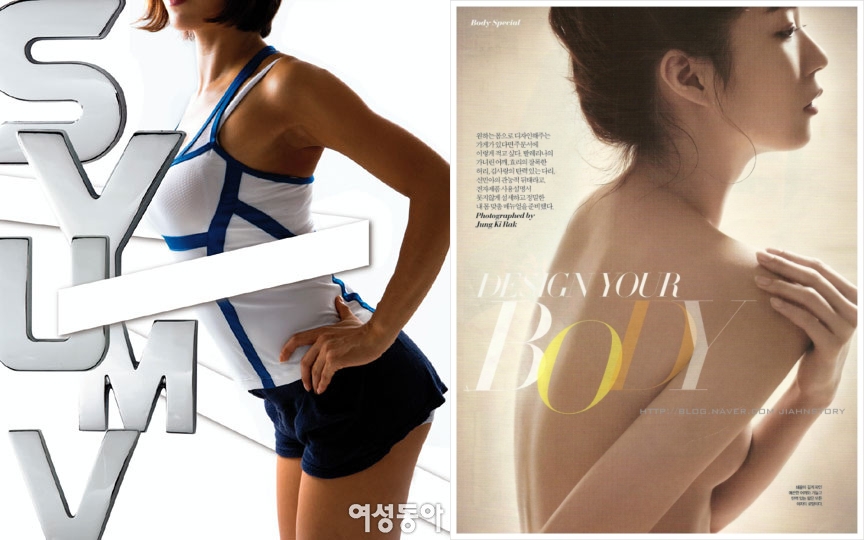
It plays with the idea that a woman’s body is a canvas; a thing that is often viewed or regarded as a tool, an asset, a means to an end. Still. There’s the acknowledgment that we can choose how to construct our own image. However much anxiety is involved in the process.
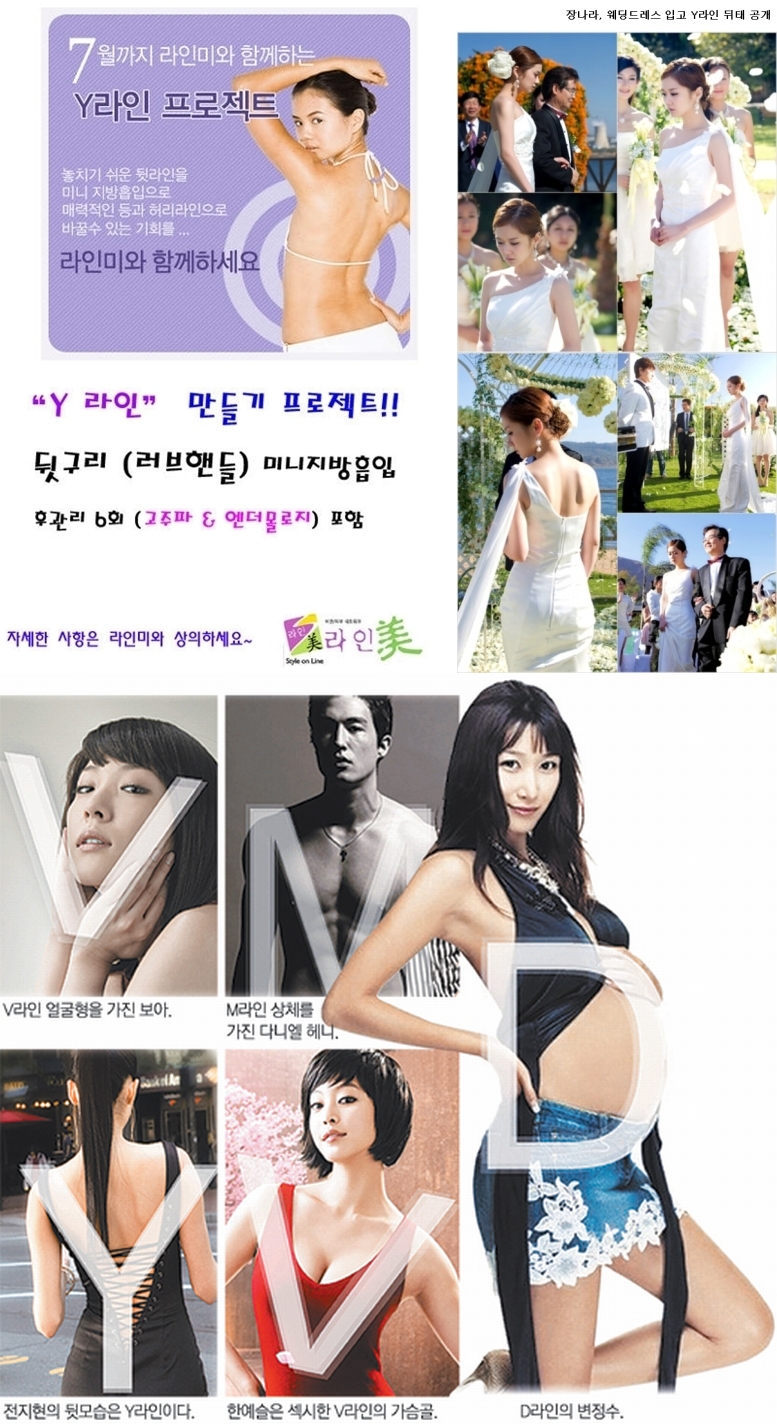
As often discussed on TGN, Korean beauty, dieting, and clothing companies are constantly promoting idealized body shapes for women to aspire to. And, although they’re just following the universal logic of creating new perceived wants and needs in the minds of consumers, their alacrity — and audacity — in doing so can still be nothing short of remarkable sometimes.
With new “lines” appearing almost as quickly as the girl-groups used to endorse the ensuing products or services though, it’s easy to lose sight of the utilitarian, utterly reductionist view of women that this alphabetization process relies on.
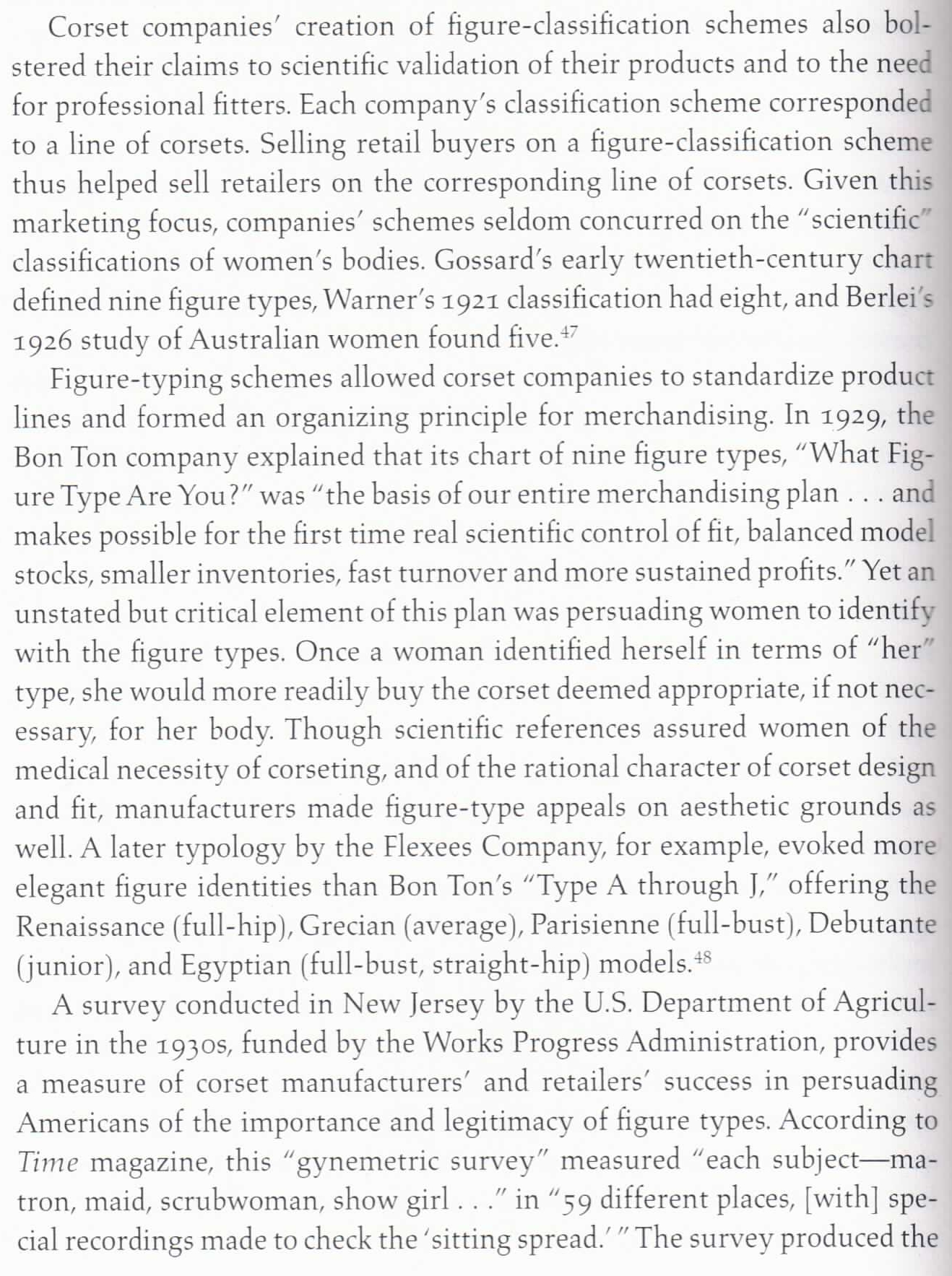
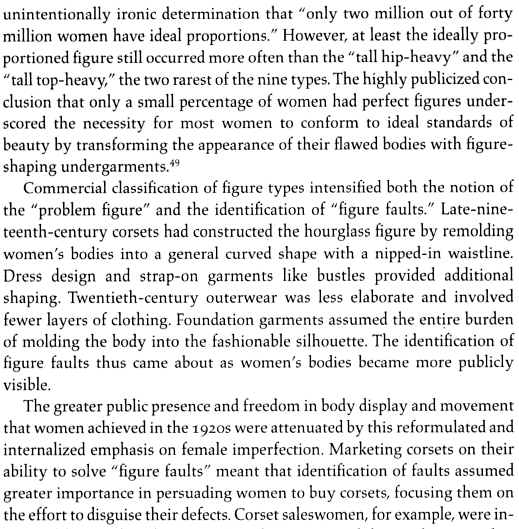
This post is about some recent stark reminders of both. Easy to dismiss as frivolous, or mere semantics, it’s also about what’s occurring in Korea today nevertheless has strong historical precedents in North America and Europe in the 1920s-1950s. Which, as Jill Fields explains in An Intimate Affair: Women, Lingerie, and Sexuality (2007, pp. 80-81), “not only affected women’s everyday experience of their bodies, but also transformed the construction of feminine identity,” sparking public discourses and expectations surrounding women’s bodies that endure to this day.
What’s more, not only is what’s best for women never the main concern —
There is ample feminist discussion about shifting cultural definitions of what the female form is supposed to look like in order to be the most appealing to a (predominately) male gaze….intimate apparel was often marketed as scientifically advantageous to women’s health, but the sexual function of breasts was always the bottom line. Binding them down, lifting them up, pushing them together – none of this had anything to do with encouraging the natural state of a woman’s breasts. No wonder women’s liberationists threw their bras in the trash can.
— but the Korean case also coincides with a rapid increase in (overwhelmingly female) objectification in popular culture; and highly visible, palpable resistance from men against (largely only perceived) increased economic competition from women. Bearing a striking resemblance to — à la The Beauty Myth (1991) — what occurred in North America and Europe in the 1980s, the combination proves as fascinating as it is alarming.
A Woman’s Body as a Canvas
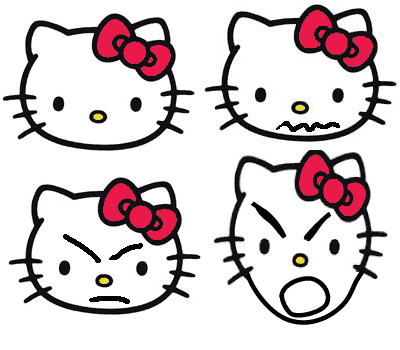
The first reminder comes from Rob Walkers’ discussion of what makes Hello Kitty so attractive to consumers, in his book Buying In: The secret dialogue between what we buy and who we are. Because however indirect, if you replace “Hello Kitty” with “women’s bodies,” and “consumers” with “advertisers,” an eerie — and disturbing — parallel emerges (2008 ed., p.18, emphases added; source, right):
A perceptive study of the Hello Kitty phenomenon by Tokyo-based cultural scholar Brian J.McVeigh suggests an interesting theory that is implied by his paper’s title: “How Hello Kitty Commodifies the Cute, Cool, and Camp.” While he notes factors like “accessibility” and consistency, the most compelling factor he isolates is “projectability.” Hello Kitty’s blank, “cryptic” simplicity, he argues, is among her great strengths; standing for nothing, she is “waiting to be interpreted,” and this is precisely how an “ambiguous”—and, let’s be frank: meaningless—symbol comes to stand for nostalgia to one person, fashionability to another, camp to a third, vague submissiveness to a fourth….Belson and Bremner return to this theme repeatedly in their book on he business of Hello Kitty. “What makes Hello Kitty so intriguing is that she projects entirely different meanings depending on the consumer,” they write. The cat is “an icon that allows viewers to assign whatever meaning to her that they want.”
If that parallel remains too indirect for some however, recall Dramabeans’ comment (#21 here) about the “Love Your W” event in 2008, “W” being one of the numerous letters used for women’s breasts. The similarities are obvious (emphases added):
…while this practice is seemingly frivolous on the surface, it actually belies much more pernicious trends in society at large, when you have celebrities vocally espousing their alphabet-lines and therefore actually objectifying themselves as a conglomeration of “perfect” body parts rather than as whole, genuine people. You wanna know why plastic surgery is such a big deal in Korea, why actresses don’t eat, why there’s an obsession with thin? It’s because we’re all just Latin letters waiting to be objectified as a beauty ideal rather than living, breathing people with flesh on our bones and brains in our heads.
Why, Oh Why, Does it Need to be Called a “Y-line”?
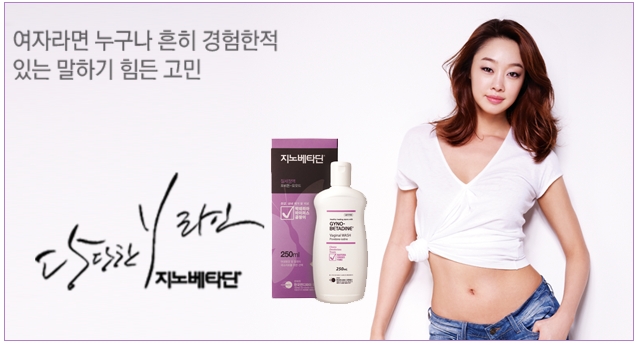
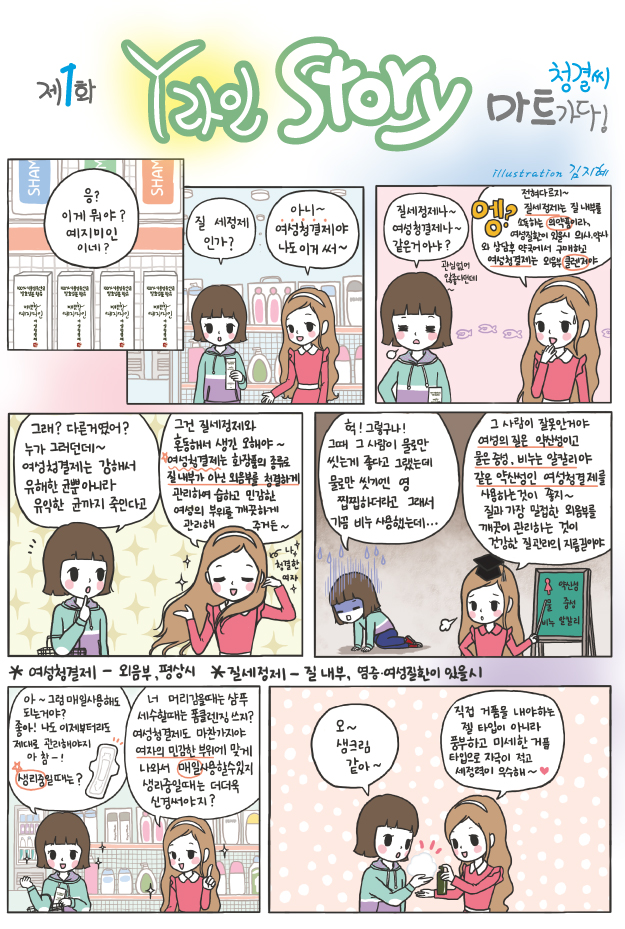
The next reminder (hat tip to @holterbarbour) was by learning of the simply absurd “Y-line,” via Mundipharma Korea’s ads for gynobetadine, a vaginal cleanser:
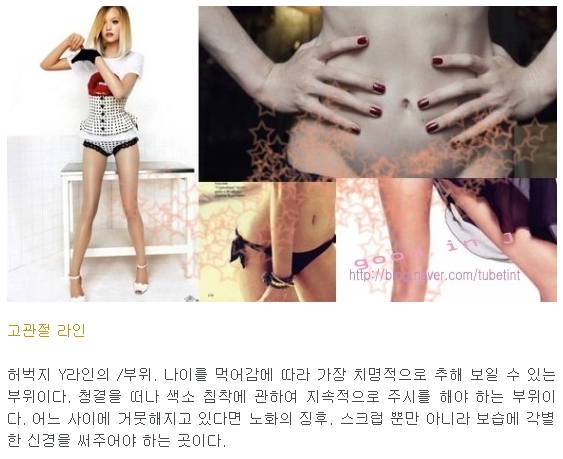
Mundipharma Korea are a little coy about what a Y-line is exactly, placing Choi Yeo-jin (최여진) in several Y-shaped poses, and with copy and advertorials speaking of bold, confident — “당당한” — Y-lines. But given the product, and that all those “Y”s center at her crotch, then it’s safe to say that, yes, the term does indeed refer to a vagina.
Which sounds like something from TheOnion.
But to play Devil’s advocate, is it merely a euphemism, rather than a line per se? The ad is, after all, just for a cleanser, not — thank God! — labiaplasty (NSFW) or anything like that. And if so, is it really all that different to similar terms and usage in, say, English-speaking countries? For, as recently explained in “The Myth of the Vajazzled Orgasm”at Nursing Clio (emphasis added):
The popular emphasis on the vagina is certainly on the rise. The explosive popularity of the Vagina Monologues, now regularly performed on college campuses, made many more comfortable with the V word. Social critic Naomi Wolf has recently argued for the existence of the “mind-vagina” connection. Commercials coyly refer to the letter V for various feminine products and sitcoms and singers laud their own embrace of the vajayjay as a way of indicating equal sexual footing with men. “Designer” vaginas are also part of this new emphasis. Cosmetogynecology is one of the fastest growing types of cosmetic surgery.
On top of that, the Y-line appears not to be an invention of Mundipharma Korea at all, as this cartoon (at least) predates its August ad campaign:
Yet while acknowledging those, you also have to acknowledge the context. Because whoever was ultimately responsible for the term, it’s safe to assume that they were influenced by the alphabetization trend. And it’s clearly in that commercially-driven, objectifying sense that the term is being used here.
Moreover, just like all the other lines, bear in mind that it’s just one version of the Y-line that has been co-opted by one company (and perhaps others) to sell its product, against which it must compete with other versions used by other companies to sell their own.
But which version — if any — will stick in consumers’ minds? And, like the “V-line,” will it ultimately become so normalized a part of popular culture, so accepted an expectation of women, that one day classrooms will be full of girls working on their own?
The contenders include, first, a Y-line lift promoted by a hospital specializing in the procedure (as either a compliment or alternative to the V-line — it’s a little confusing sorry):
Next, as breasts, from the line between them. I’d previously assumed that it was invented by the lingerie company Yes’, but it’s also used by others, as well as by cosmetic surgeons:
And finally(?) the buttocks.Now, forgive me if it sounds facetious, but I’ve examined many examples, and never once seen a “Y” in them. Again, you really have to wonder at the mindset of companies — and consumers — that do:
Did I say only two stark reminders of the absurdity and audacity of the Korean alphabetization trend? A third was discovering all those other ludicrous examples of Y-lines. Yet, however natural it may be to mentally assign something so absurd and asinine in another culture as distinctive to it, by no means is this trend only Korean, or even East Asian. Rather, as numerous examples from An Intimate Affair make clear, in fact they’re almost as old — and universal — as mass-production, mass-media, and marketing themselves.
While I can’t begin to do justice to those examples here, two are particularly illustrative, and will hopefully encourage you to purchase your own copy of the book(!). First, the figure classification schemes invented by corset manufacturers in the 1920s (a scan; click to enlarge it):
Fortunately, the next page is available at Google Books:
This strongly reminded of the following video on how “pear”-shaped women should dress to look like they actually have hourglass-figures, spawning 159 comments at Sociological Images (also see here on subtle Korean encouragements through hourglass-shaped drink bottles):
In turn, that video gave me the impression that Western beauty, dieting, and clothing companies are more concerned with extorting women to conform to a narrow range of preexisting, publicly accepted body types rather than creating their own, then encouraging women to gain those instead. Can any overseas-based readers confirm? And/or recommend books and websites, so that a male reader, 13 years based in Korea, can find out?
(Update 1: Although it’s not specifically about women, or fashion, a reader suggests Our Aesthetic Categories: Zany, Cute, Interesting by Sianne Ngai, released last October. Based on the tworeviews I’ve read, it sounds fascinating).
(Update 2: See Glamor Daze for an illustrated guide to “dressing for your body shape” from a Spencer Corsetry catalogue).
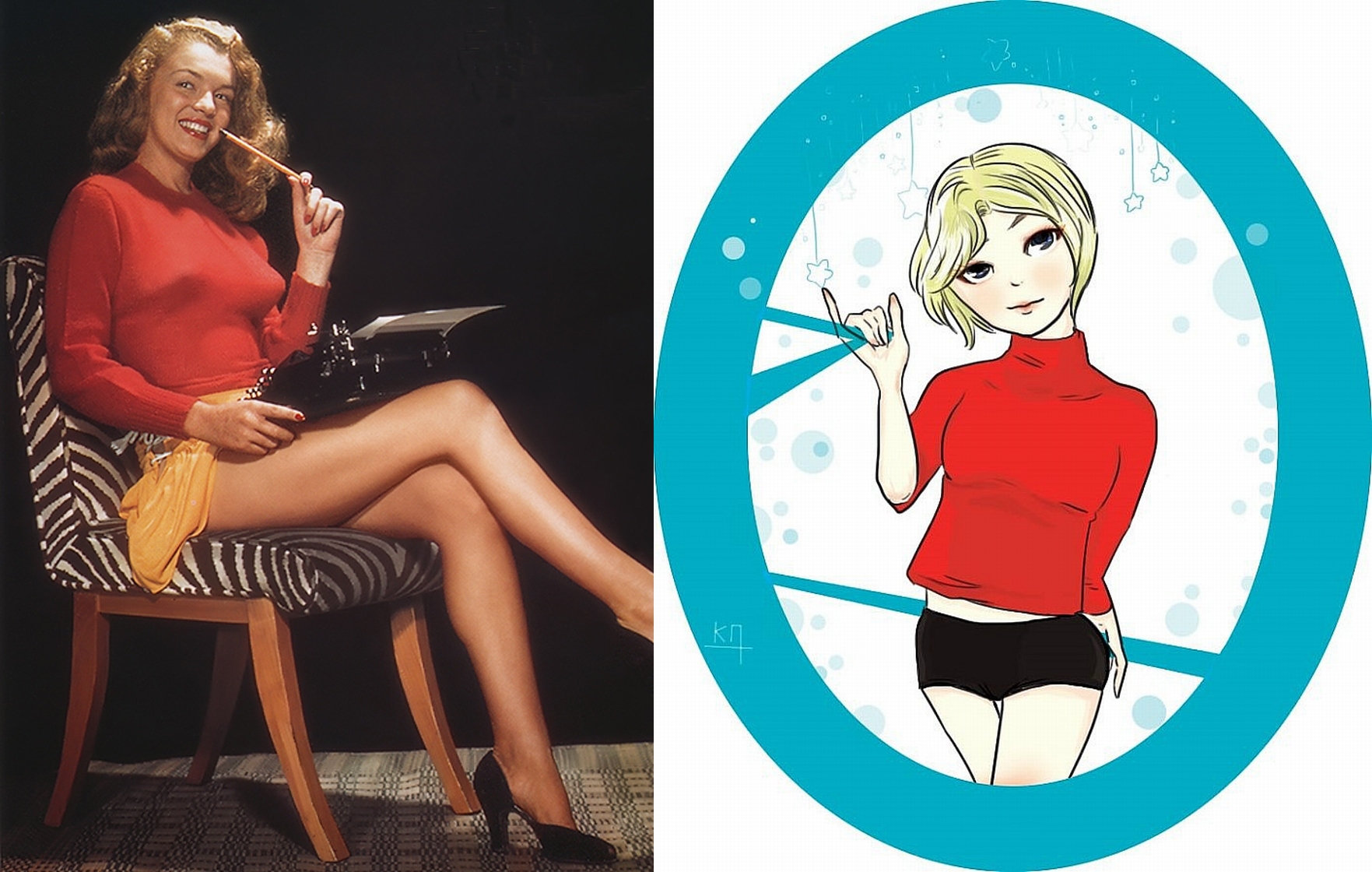
Despite that particular, potential difference however, from the 1930s to the 1950s Hollywood, the fashion industry, and — to a lesser extent — economically-threatened men would all influence the second example of “glamour” for their own ends, with the ensuing popular notions of the concept displaying a malleability and responsiveness remarkably similar to that of modern Korean lines. Indeed, although the English definition of the term has continued to considerably evolve since, ironically it’s (the main) one of those from that era — glamour as large breasts — that would enter the Korean lexicon as “글래머,” from which the appalling, infantilizing term “Bagel Girl/베이글녀” derives.
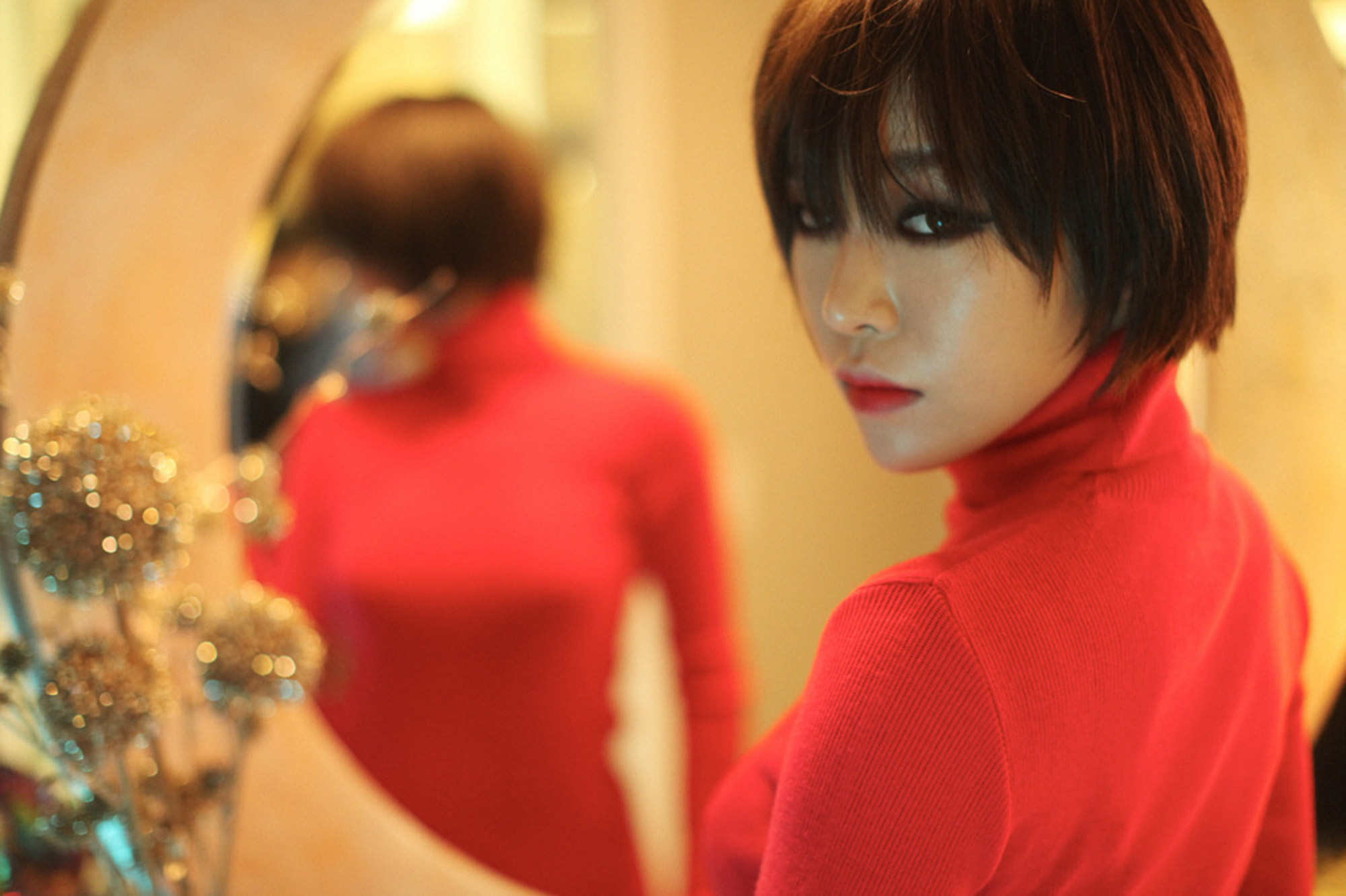
(Sources: left, right. Surely not a coincidence, does anybody know who chose Ga-in’s wardrobe for Bloom?)
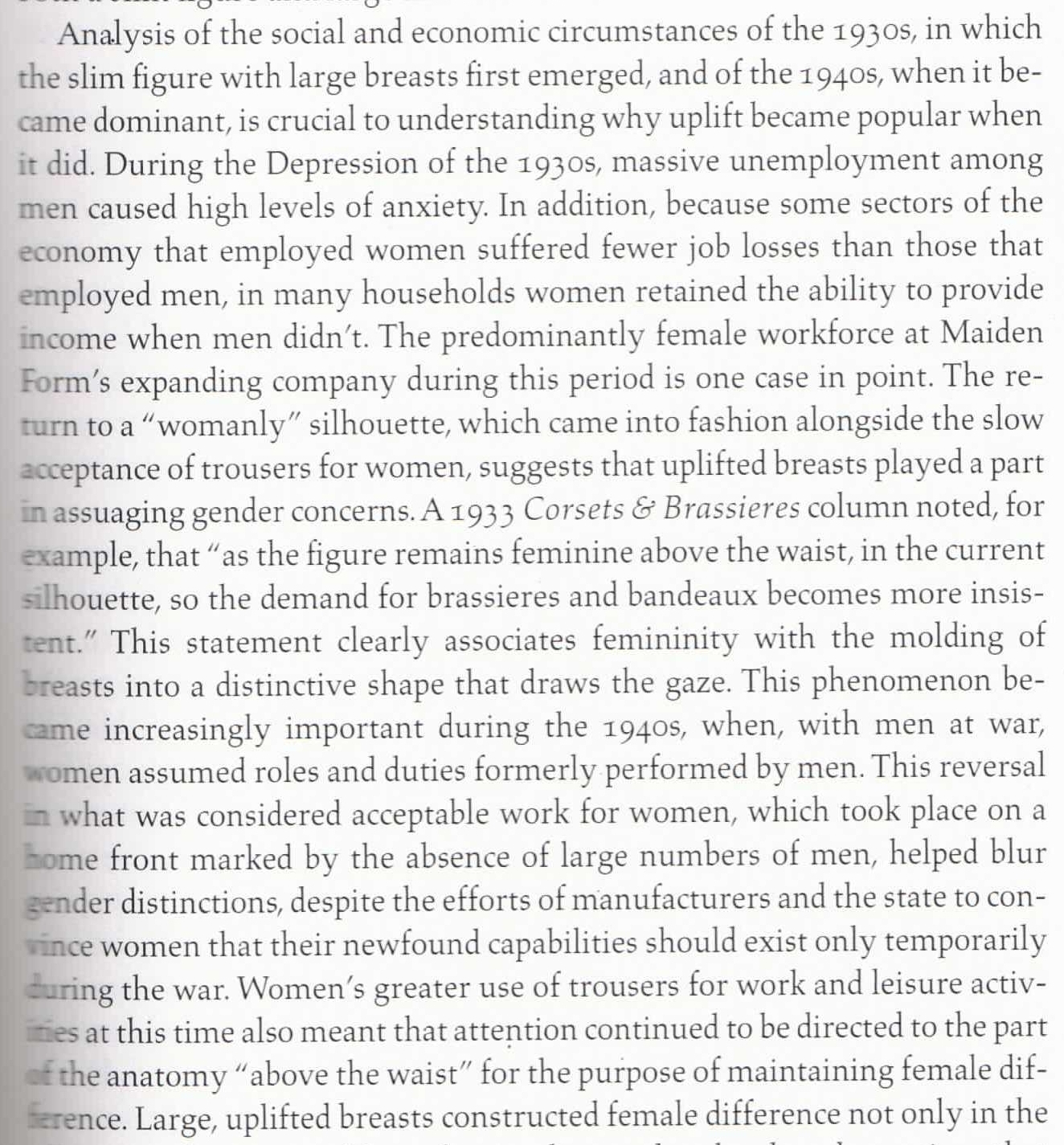
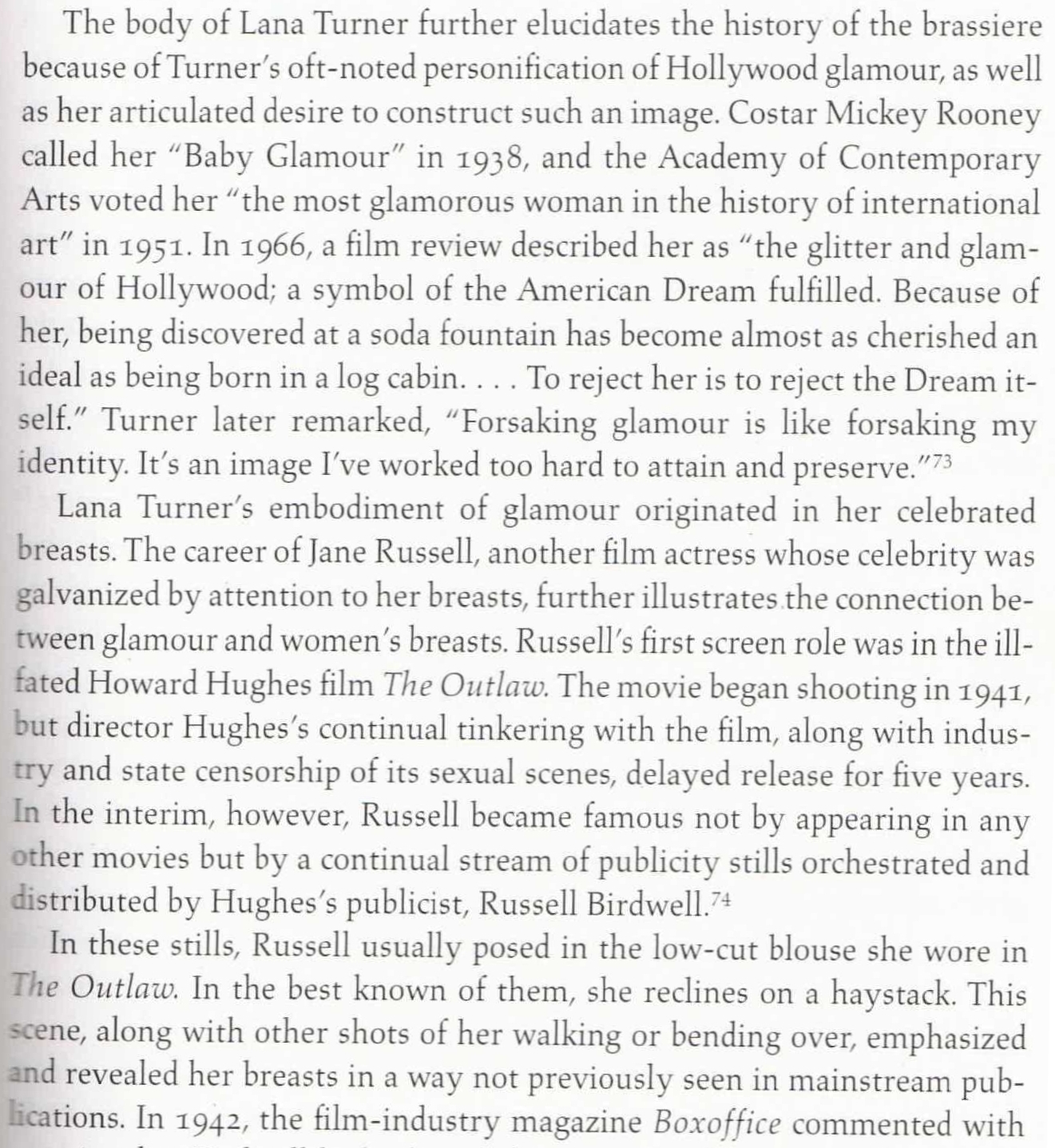
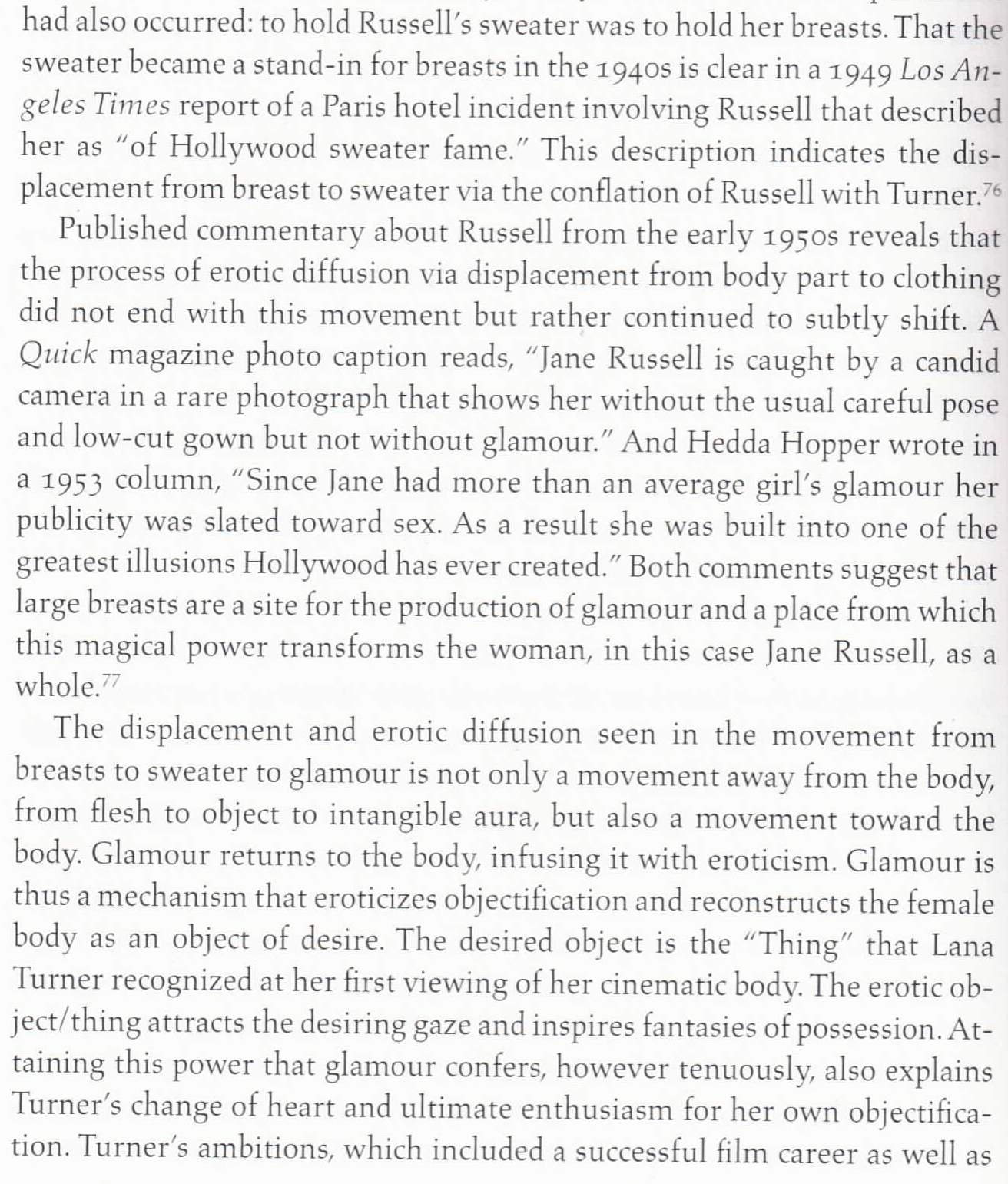
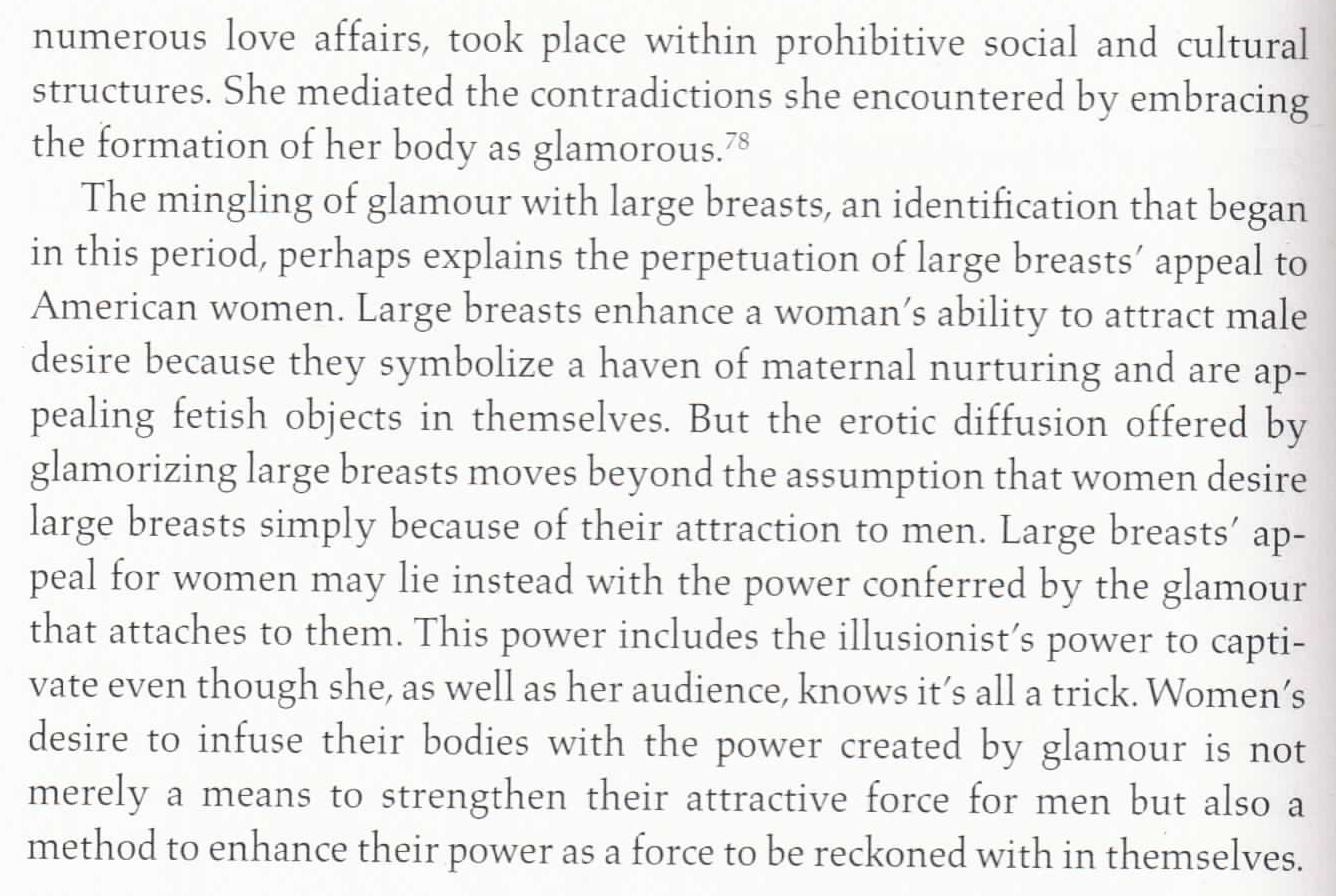
Again only snippets which can not do the book justice, but which probably already exceed what counts as fair use for a website nevertheless, here are some selected excerpts to give a hint of all that. First, from page 105, about the context of assuaging the fears of un(der)-employed men during the Depression, and then of soldiers during World War Two:Next, from page 109 on the quite literal embodiment of glamour in breasts (and why I mentioned Lana Turner in my recent Busan Haps article on Ga-in’s Bloom):
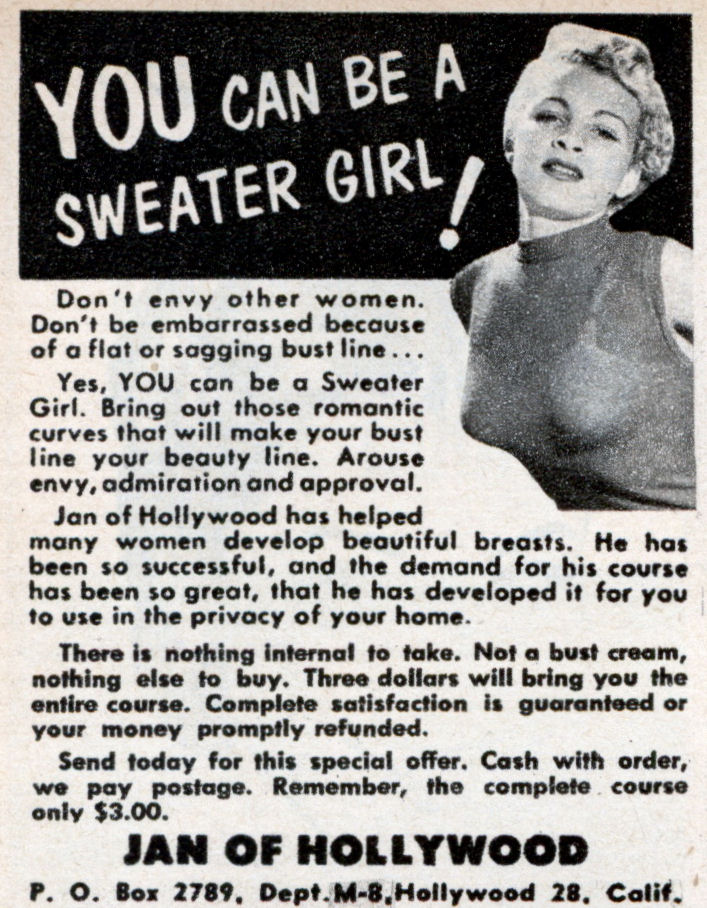
Next, although frankly I don’t fully understand the final paragraph here, hopefully page 110 gives you an impression of how glamour came to shift from body parts to inanimate items of clothing (hence “Sweater Girls“) and so on, as also revealed in the illustrations below:Update: Given my love for Maria Buszek’s Pin-up Grrrls (2006), it seemed a pity not to add the conclusion to the chapter on the next page (actually page 112) also:
An advertisement for a Sweater Girl course(!) from 1954:
With my new copy of The Beauty Myth arriving at my door literally as just before I type this, I should wisely reacquaint myself with it before proceeding further. But, of course, others have already made the same connection(s) that I have, including Tess Hellgren in her (oft-quoted by me) 2011 Exposé piece “Explaining Underweight BMI and Body Dissatisfaction among Young Korean Women” (pp. 7-8):
…recent gendered shifts in Korean society offer another potent explanation for the trend in female body image. In the past thirty years, Korean society has undergone significant political and economic transformations, democratizing and industrializing at an incredible pace — and offering an extreme expansion of societal opportunities for women.19 Specifically since the 1980s, Korean women have seen an important increase in university attendance; today, 72% of South Korean women attend college, the highest rate of any country. According to feminist theory, this recent upsurge in female societal empowerment may be associated with an oppressive backlash in media portrayals of gender ideals. As explained in the work of Jaehee Jung and Gordon Forbes, historical data suggest that societal shifts toward gender equality are often accompanied by increased media portrayal of unrealistic gender norms as a reactive “tool of oppression” by mainstream society. Jung and Forbes cite the examples of both Europe and the United States: In the 1870s, it was during Europe’s industrialization and nascent women’s movement that accounts of anorexia nervosa first appeared, and the thinnest women in American fashion magazines appeared at the same time as momentum built for women’s rights in the 1920s and the 1970s. According to these scholars, the case of Korea is particularly striking due to the restrictive patriarchal nature of the country’s traditional Confucian culture, in which women’s familial and societal subordination is rigidly emphasized. Linking media portrayals to South Korea’s recent expansion of overall female opportunities, this feminist argument offers another potential explanation for the rise in body dissatisfaction and low BMI among Korean women in recent years.
Is something along these lines the only way to account for the combination of both an increased alphabetization/objectification of and backlash against women in the 2000s? Or is it that simply imposing a convenient narrative where none really exists?
Please let me know what you think. And, as a reward to Seoul-based readers who have read this entire post, let me give you advance notice of a presentation I’ll be giving on this topic for the 10 Magazine Book Clubon Sunday March 10, the weekend following International Women’s Day. As I type this there’s only 22 more seats available, so please put your name down if you’re (fairly) certain you’ll attend, and I look forward to carrying on this conversation with some of you there! :)
Just a quick note to apologize for the slow posting everyone. Actually, I’m not taking a holiday (although Christmas was a little busy), it’s just that my next post is taking longer than expected. But rest assured that it’ll be up on Monday sometime next week (update: forgot that my kids were off next week sorry!).
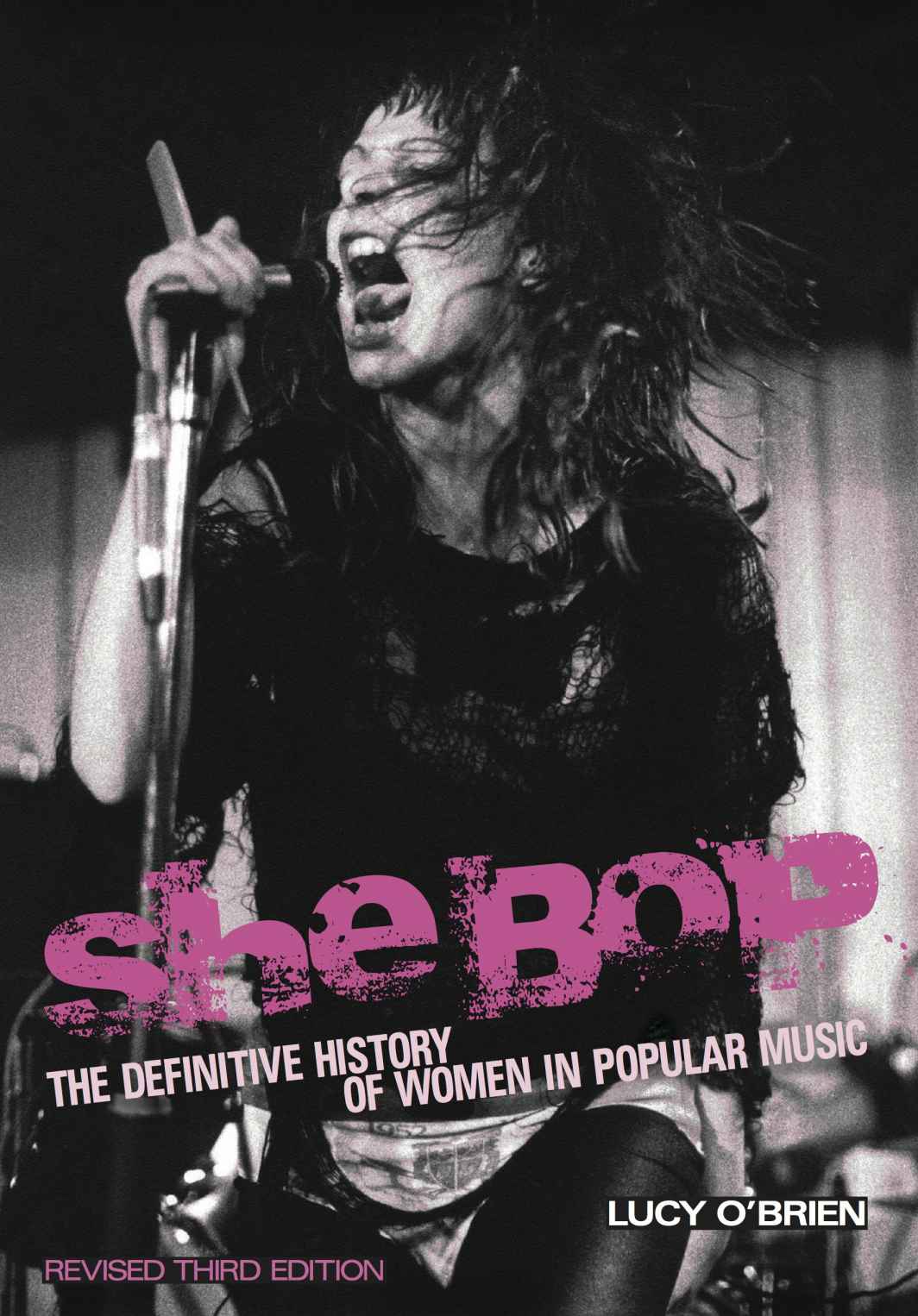
In the meantime, my latest article for Busan Haps, “K-girl Power: The emerging trend of empowerment and sexuality in K-pop,” is available here, a condensed version of this post. And, as a Christmas present to myself, I’ve just ordered — squeee! — the third edition of She Bop above, just released this month; The Beauty Myth, by Naomi Wolf (my other copy is in my mother’s spare room, and my friend’s gift of a PDF just isn’t cutting it!); Behind the Red Door: Sex in China, by Richard Burger; and finally, belatedly, Tune by Derek Kim.
If anyone’s read any of them, I’d love to hear your thoughts. And Happy New Year everybody!
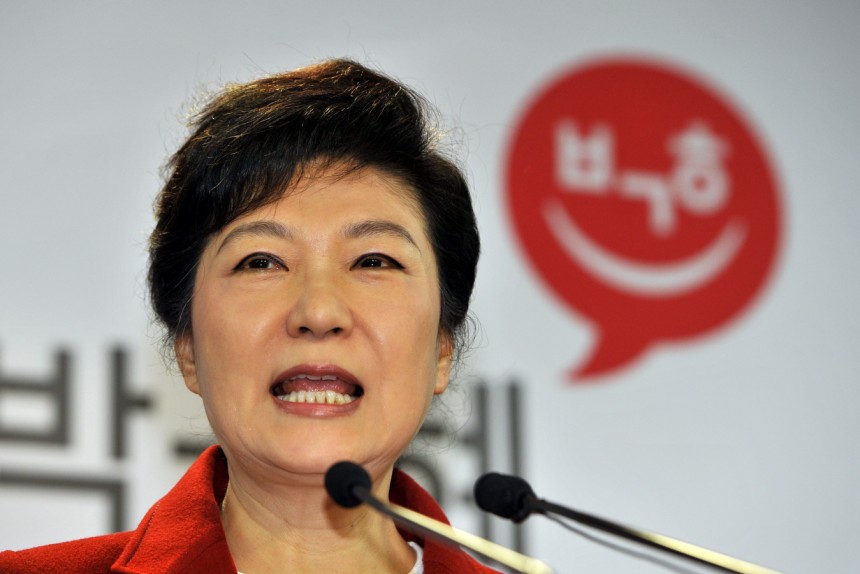
For anyone interested in my thoughts about the election result, Vishakha N. Desai at the Asia Society sums them up much better than I could:
The fact that so many Asian countries have accepted women as political leaders and heads of state long before Americans have managed to put a woman in the White House has led some observers to believe that it must mean Asian societies are ahead of the Western world in accepting women in leadership roles. The truth is far more complex than the simplistic observation that this automatically means women will benefit from such role models at the pinnacle of their power. In the case of Park, she may have earned the position on her own merits more than other female counterparts, but that doesn’t mean her leadership will bode well for women’s rights in South Korea or the region during her tenure.
See Tales of Wonderlosthere and here for short but telling summaries of exactly what Park Geun-hye has done for women’s rights so far; National Public Radio and Arirang for people’s expectations of her in this regard; and Bloomberg for more on the paradox of why Asia leads the globe in the number of years women have ruled, yet also leads the globe in gender discrimination (Hint: Many of those leaders come from political dynasties). Also, I think it says a lot about a candidate’s and his or her party’s democratic credentials when they refuse to extend voting hours to allow more people of working age to vote, effectively disenfranchising them.
Other interesting reporting on the election include what it says about Korea’s rapidlyagingpopulation and increasingly large generation gap; and Roboseyo’s suggestions that Park Geun-hye should (but probably won’t) cut the government’s extensive ties to mass media (the role of biased reporting in the elections was also mentioned at Global Voices), as well as radically reforming the National Security Law.
I make a brief appearance in the Korea Herald today, in an article by John Power on the recent government crackdown on pornography. With his permission, here are all of his original questions and my replies, with some links for further reading:
1. Do you foresee the Korean public becoming increasingly unhappy with the heavy censorship of pornography and other sexual content in the short term? Or do you think a largely conservative Korean public will remain happy with the status quo?
In all my 12 years in Korea, ordinary Koreans have loudly and consistently complained of being treated like children by censors. But the censorship of movies has been considerably relaxed in recent years (recall that the Korean Supreme Court overturned a ban on Shortbus for instance), and even the Ministry of Gender Equality and Family has beguntoacknowledge its own excesses with music videos. So this latest crackdown actually goes against recent trends, and I expect it to face a lot of opposition.
2. Often, censorship is justified to protect young people. Do you think there is a feasible way of protecting youth, while not controlling what adults wish to see?
Frankly I don’t, but this is a dilemma faced by every democracy. Most, however, don’t resort to the draconian restrictions imposed by the Korean government, yet somehow have equal or lower rates of sex crimes by and/or against minors nonetheless.
(“Because I’m a man / 남자기 때문에.” For English subtitles, click on “captions”)
3. A local site pornography site called Soranet had 600,000 subscribers before it was shut down in 2004, showing the widespread nature of its consumption. Do you think the government is fighting a losing battle in trying to ban such material?
If nothing else, banned sites will remain available via proxy servers, but I’m sure young, tech-savy Koreans won’t need to resort to using those. With the proviso that of course the government should continue to monitor the pornography industry as a whole, to prevent exploitation and the use of minors, you have to question the government’s zeal in attacking an otherwise victimless activity, and which there is clearly a huge demand for. Surely the time and resources could be better spent? Perhaps on more up-to-dateandeffective sex-education, so people could better judge the supposed harmful effects of pornography for themselves?
4. What do you think is the true motivation for censorship of adult content in Korea? Or, put another way, do you think there are sometimes hidden agendas at play?
As someone who notoriously devoted Seoul to God as mayor, and who believes that (re)criminalizingabortion is an effective method of raising the birth rate, clearly Lee Myung-bak’s conservative and religious beliefs are playing a big role here. That aside, blaming pornography for sex crimes, and censoring it on that basis, is also an easy way for the ruling party to appear to be doing something to address public concerns during its candidate’s presidential election campaign, yet without doing anything about their real causes whatsoever.
And, crucially, it doesn’t just poke fun at the obvious negatives, but also at the public discourses surrounding the industry. Namely, the hypocrisy of the men who loudly criticize women who get operations, yet shamelessly admire the results.
In addressing such a gendered contradiction, it strongly reminds of the messages in Miss A‘s (미쓰에이) Bad Girl, Good Girl (배드걸 굿걸). It also happens to be hilarious too, one of several skits by the Brown Eyed Girls (브라운아이드걸스) on the show last week.
In this one, the main character is Narsha (나르샤), joined by co-member JeA (제아) and Miryo (미료) (Ga-in /가인 is absent). None of the other actors are familiar, but I can find out who they are if anyone is interested:
Here’s my translation. Apologies in advance for any mistakes, but frankly there were some very new words that even my wife didn’t know (let alone be in my smartphone dictionary), and of course the swear words especially are open to interpretation!
Update: Naturally, a translation from earlier today popped up shortly after I finished this post. But which I couldn’t find at all when I decided to write it!
Swallowing my pride (and several hours’ worth of effort), I have to admit that it’s much better than mine (although—*sniff*—I still disagree with a few lines here and there):
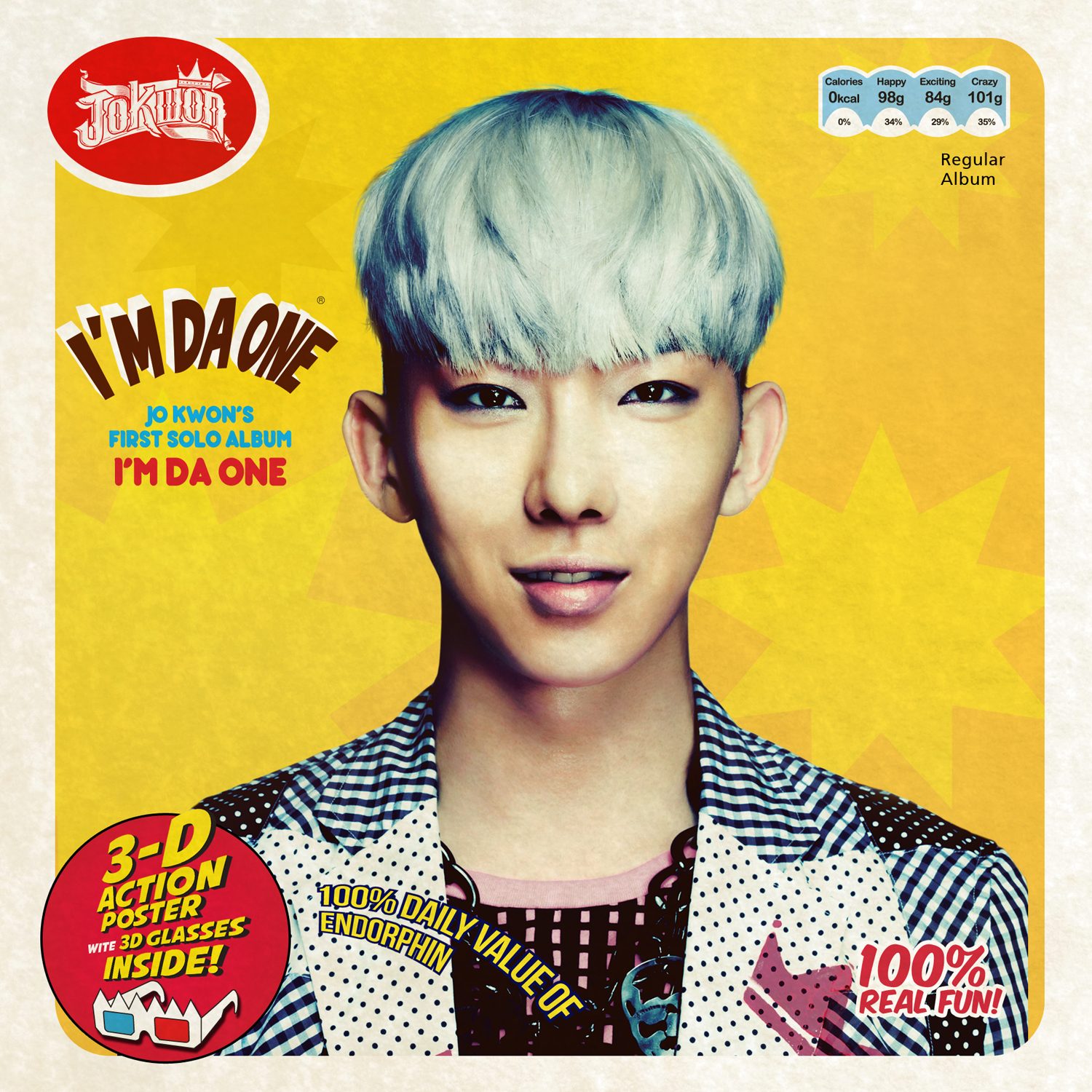
Not related to any of the stories sorry — I just love the colors, and the retro look. But see pop reviews now if you’d like to know more about his album.



 I’ve been asked to pass on the following: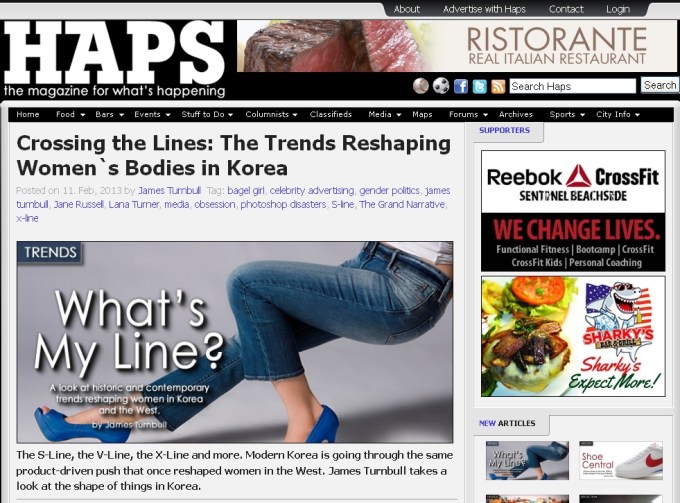



























 The Grand Narrative