Why are Korean and Japanese Families so Similar? Part 1: Neo-Confucianism

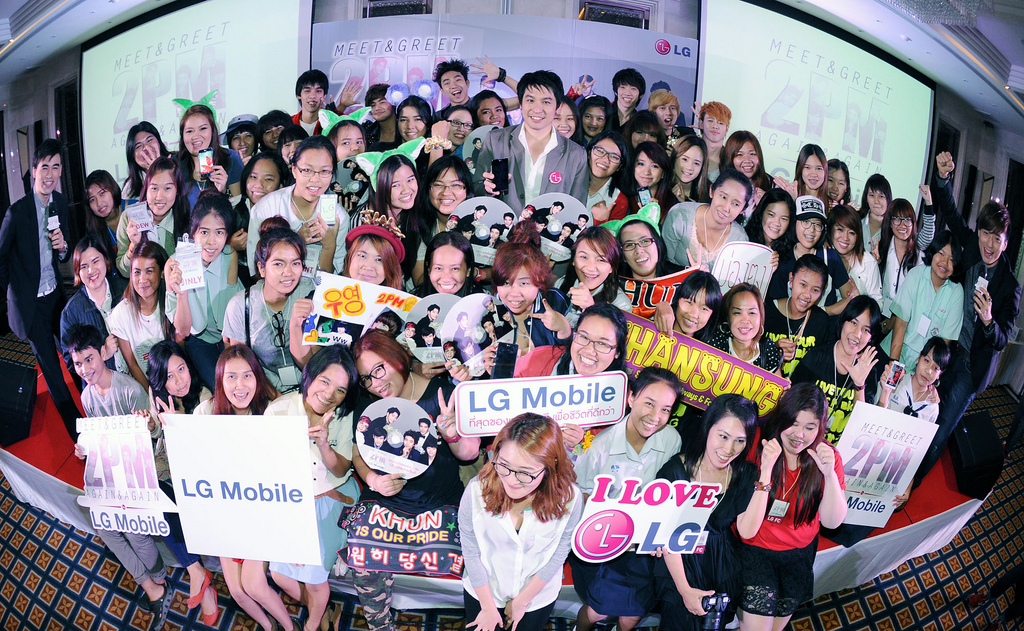
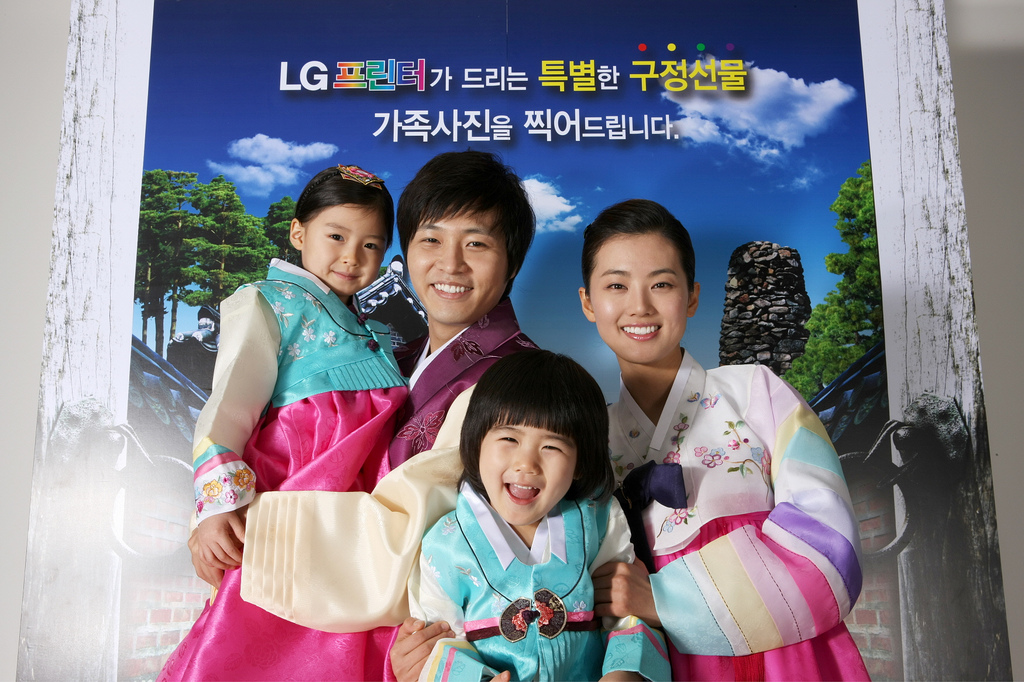
Korean Family LG Printer(Source: LG 전자; CC BY 2.0)

According to a recent study, Japanese women living with their parents-in-law are three times more likely to have a heart attack than those just living with their husbands. This, in a country famous for its very low rates of heart problems overall.

Which got me wondering about Korea. Korean family structures and gender roles are very similar to those of Japan, so it seems reasonable to suppose that the Japanese study has great relevance to Korea, and that a knowledge of Korean family life can reliably inform our interpretation of it.

Or does it? This is the question that has occupied me for past nine days, and, for readers by definition interested in Korean social issues, it is much less abstract and pedantic than perhaps it first sounds. Let me explain.

As a writer about Korean society, but often lacking in English-language material, frankly it is always a temptation to stress its similarities with Japan, just for the sake of having something to work with. But seriously, the huge Japanese role in the development of both the modern Korean state and economy has left profound and enduring legacies. Add that I’m a big proponent of the Marxian concept of base and superstructure—basically that much of a society’s oft-claimed timeless and enduring culture (one aspect of the superstructure) changes pretty damn quickly once economic structures or modes of production change (the base)—too, then it stands to reason that, with still broadly similar economic structures centered around horizontal and vertically-integrated conglomerates known as keiretsu and chaebol respectively, then much about daily life in both societies (workplace culture, working hours, drinking-culture, male-breadwinner based welfare systems, gender divisions between work and the home, and so on) would also be very similar. And it wouldn’t take much reading of just this blog alone to find that this indeed the case.

With that background and strong inclination however, there is always a danger of taking similarities as a given. And particularly in this case, where the authors of the study point out that:

One of the overwhelming things that stands out is that it doesn’t matter for Japanese men what the living arrangements are…they’re immune from stresses in the home (source, right: Urânia – José Galisi Filho).

And from which Samhita of the Feministing blog argues:

The article feigns surprise in finding out that men don’t have these same health problems, but fails to make the obvious conclusion that women get inordinate amounts of pressure from their in-laws to live up to certain expectations that increases stress in their lives. Many women are choosing not to get married or have as many children in Japan, but the culture of expectation around how women should act in the home seems resilient. I wonder if a similar correlation can be made with women that are living with their in-laws in the states?

Which is equally true of Korean brides, where those expectations include assuming the bulk of housework duties, and utter subservience to their mother-in-laws. Naturally, the ensuing potential for domestic tension and conflict make such living arrangements a staple of Korean dramas for decades, one such playing at the moment being You are My Destiny (너는 내 운명, but not to be confused with the 2005 movie with a similar name) starring the decidedly unhappy-looking bride Yuna below. Having said that, just like the traditional hanok houses that many of these dramas are inexplicably set in, one can’t help but assume that women’s disdain for eldest sons and the nuclearization of the Korean family mean that these living arrangements are increasingly rare in practice, which begs the question of why dramatizations of them remain so popular even today.

Writing a week ago, I thought it was because, in practice, living in separate homes has not diminished many parents’ intimate involvement in their childrens’ married lives, and hence the exaggerated situations of dramas still strike a chord amongst married couples and those of marriageable age. Indeed, the combination of Korea’s small size and improvement in Korea’s transport and communications infrastructure has made this even more possible and likely over time. Note that even as recently as the 1970s, a move to Seoul might entail not seeing parents and siblings in the countryside for many years, let alone friends who moved elsewhere in the country. (Source, above: HKGolden.)

But, to spare you the reflections on my preconceptions and academic baggage that took up much of an earlier version of this post, there comes a point where you need evidence. Much of those nine days were spent looking.

Fortunately, I was successful. But in the process, I discovered the question was much more difficult than I thought. Again, to spare readers from a frankly rather incoherent argument in a previous version of this post, in sum I learned that:

  • According to Yoshio Sugimoto’s brilliant An Introduction to Japanese Society (2003, pp. 175-176), Japanese dramas likewise dwell on intergenerational conflicts in households with extended families.
  • In fact, Japan has many of more such households than Korea (which will be discussed in Part 2).
  • But why? Crucially, Japanese society lacks the (Neo-)Confucianist ideology that underscores such family arrangement, and the ensuing conflicts.

Or so I thought. But, after a decade of constantly reading how Korea is the most Confucian country in the world, and “more Confucian than China,” I’d considerably underestimated Confucianism’s influence on the rest of East Asia.
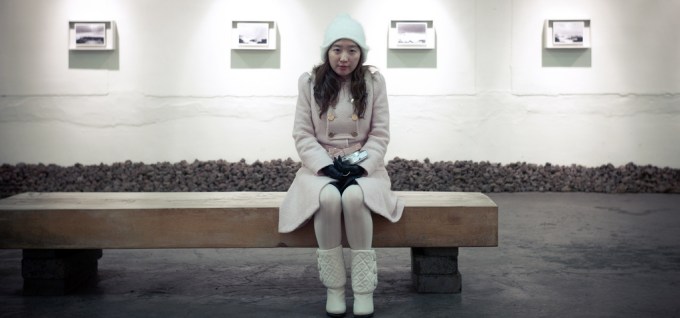
Korean Woman Bench Sitting Gallery(Source: thomas park; CC BY 2.0)

This was revealed to me by Robert Smith in his chapter “The Japanese (Confucian) Family: The Tradition from the Bottom Up” in Tu Wei-Ming (ed.), Confucian Traditions in East Asian Modernity: Moral Education and Economic Culture in Japan and the Four Mini-Dragons (1996), and who aims to show:

…that it is impossible to advance a plausible argument that the Japanese family today is Confucian in the strict sense. It is equally impossible to argue that it has been completely purged of the effects of attempts by the authorities to structure it in terms of selected Confucian principles. (p. 157)

Some selected excerpts to make up the remainder of this post then. Please forgive me if there’s rather a lot of them, and apologies to any Japan-based readers who already started saying “Well…Duh!” to the computer screens some time ago, but hopefully they’ll still be helpful for any readers like myself that aren’t/weren’t as familiar with Japanese social history as they thought they were.

First, on why I had that impression that I did:

I have asked a hopelessly unrepresentative sample of Japanese colleagues, acquaintances, and friends whether contemporary Japanese think of themselves or their families as Confucian. The spontaneous answer is a resounding no, often supplemented by a dismissive reference to the conservative, reactionary, or feudal (a favorite term of opprobrium in Japan) character of its teachings. The implication is that one’s grandfather or great-grandfather may have been taught Confucian ethics and might even have internalized them, but in 1945 the Japanese consigned Confucianism to the dustbin of history. (p. 157)

There is one obvious difference between the role of Confucianism in China and Japan, where is has always been only one of many competing ideologies, philosophies and ethical systems, and never, as in China, “a way of life encompassing the ultimate standards for Chinese social and political order.” (158)

And the Japanese tend to underplay the Confucian influence in their own society because:

Japanese Confucianism started as a cultural ideology serving the needs of the Tokugawa Bakufu (or Shōgun, or Army Commander)….Although for a time Confucianism had been discredited along with everything else associated with the shogunate, it gained currency again with the consolidation of conservative power in the late 1920s and 1930s. (p. 158-9).

The latter of which was the decade when:

…Japanese society was being reduced at the hands of fanatics to its most stifling condition of oppressive irrationalism [and] in which the ideals of the Japanese educational world were closer to those of its Togukawa past than at any time since 1870….Is it any wonder that today’s Japanese, if they have thought about it at all, are likely to view Confucianism in a negative light? (p. 159, my emphasis)

Now, why the influence of Confucianism on the Japanese and particularly the Japanese family remains pervasive nevertheless:

Were the Japanese ever Confucianists in, say, the same sense as the Koreans? No one claims that they were. Nevertheless, there are many ways in which the Confucianist concern with hierarchical relationships and its emphasis on harmonious families as the basis for harmonious states seems to have influenced Japanese society. Be that as it may, it is just as likely that the Japanese selectively utilized Confucian teachings to reaffirm and strengthen characteristics of their society, which was deeply rooted in the pre-Confucian past.

Presumably one of the domains in which Confucianism did not simply reinforce and justify older social practices is the treatment of women, for it is widely argued that they enjoyed a far more favorable position in Japanese society before the introducton of Confucianism. It may well be, however, that the decline of women’s status in Japan actually began with the popularization of Buddhism. (pp. 160-1, my emphasis)

Finally:

The question is not whether Confucianism is a religion. It is rather: Does Confucianism, broadly defined (or, perhaps better, undefined) have anything at all to do with religion in Japan?

The “rules” by which religions are tacitly expected to operate in Japan are, more than anything else, Confucian. As so often in Japan, Confucianism plays the role of a moral and ethical substratum that, its preconditions being met, allows a harmless surface diversity. Indeed, one could argue, as many have, that these principles go back beyond Confucian influences on early Japan to the values inherent in ancient clan structures and an agricultural society with their demands for loyalty and cooperative effort; Confucianism did not so much crate as articulate the values by which Japanese society works.

Virtually all religions that have endured in Japan have adapted external forms agreeable to the patriarchal family model and have made their peace with the state. (p. 171, my emphasis)

At this point, a more thorough blogger than myself would probably move onto those passages where Smith discusses that latent Confucianism within Japanese families (and the education system) more specifically, but I think that readers can reasonably extrapolate those from the big picture that I have already provided rather than requiring me to add those too. Ergo, Japanese families are indeed (Neo) Confucianist, and I’m especially glad that demonstrating that gave me a legitimate opportunity to get stuck into my recently purchased copy of Tu-Wei Ming’s book. But while 2500 words is a rather short post (for me), given the long time this one took and that Confucianism, Demographics and Biological Anthropology are much more discreet subjects than what I normally blog about, I’ll wisely end this post here!

Update

Although they’re not really related to the topic at hand, the questions of: a) to what extent the US could be described as a “Christian country” and b) whether Confucianism is a religion or not came up in the comments, and are interesting in their own rights. And while I’m usually reluctant—yes, really—to type out literally entire pages from books here, Robert Smith does answer both much better than I could:

To what extent has the Japanese family ever been Confucian, and to what extent is it today? Would that the question could be so easily answered. Even the most casual survey of the vicissitudes of Confucianism in Japan suggests the need for caution. Indeed, I was tempted to indicate just how cautious one must be by titling this essay either “Confucianism Is in the Eye of the Beholder” or “Confucian Is as Confucian Does.” That is to say, how Confucianism is described, the praises sung of it, the importance assigned to it, and the terms by which it is denounced are all very strongly colored by the historical period in which the assessments are made, the position in the social hierarchy of the person expressing the opinion, and – not least in recent times – the age and gender of those who views they are.

I hasten to add that in these respects Confucianism seems to me rather like all other philosophical, ethical, and/or religious systems of whatever time or place. An example, drawn from personal experience with one such system, involves one of the myriad subcategories of the southern United States brand of Protestantism. Fifty years ago its construction of Christianity was a finely crafted one that had no place for Catholics, who were thought of as idolaters, or for Quakers, of whom few had ever heard. Depending on the particular church and the position of its minister on the issue, it was not always entirely clear that Methodists and Presbyterians were Christian either.

Be that as it may, did my relatives and neighbors think that they themselves led Christian lives? Of course they did, or tried to. Were it to be pointed out that someone had committed some “unchristian” act, the usual explanations were that all are conceived and born in sin, that it all happened before the miscreant had found God – or perhaps it was because Christ had found him. It is all now too far in the past for me to recall the full inventory of shifting grounds on which our neighbors and relatives took their unshakable Christian stands. Would they have agreed – and do they still – that the United States is a “Christian country”? Of course. They have never doubted it….Yet I wager that in the course of conducting interviews on the subject, you could collect scores of definitions – some of them flatly contradictory – of just what the term “a Christian country” might mean. There is bound to be some overlap, to be sure, but no consensus. Are we then to conclude that the United States is not a Christian country? I think not. But I submit that consensus on the religious and ethical dimensions of Christianity is not much more likely to be achieved than agreement as to precisely what Confucianism might be and whether the Japanese family is a Confucian institution.

It is possible, of course, that I am looking in the wrong place for an authoritative definition, and would be better advised to seek it among the philosophers, the theologians, the ethicists, or the intellectual historians. My reading of the relevant sources, however, strongly suggests that consensus at the tip is even more difficult to achieve than at the bottom. In any event, my anthropological training predisposes me to start at ground level. (pp. 155-157)

Thoughts?

Backlash: The Role of the Asian Financial Crisis in the Feminization of Korean Ideals of Male Beauty

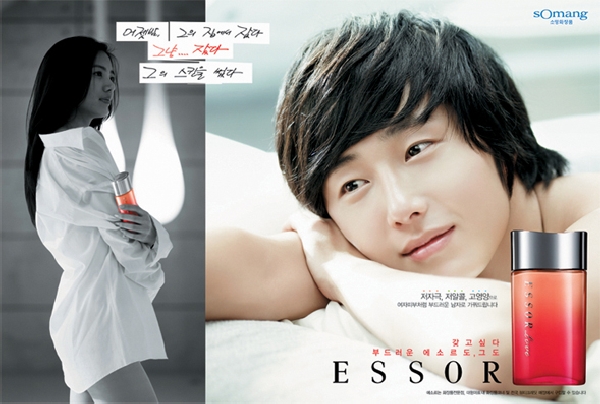
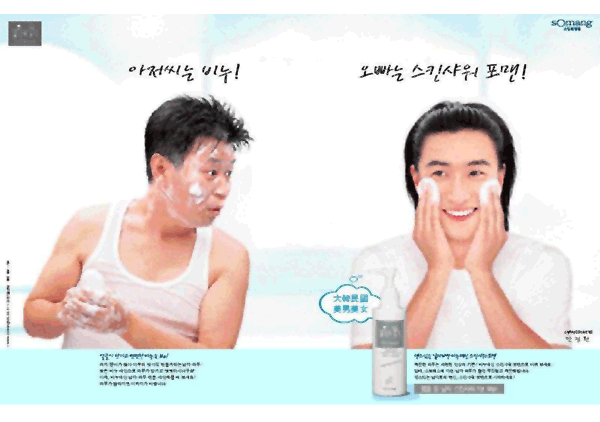
an-jung-hwan-two-korean-male-cosmetic-advertisement-2002(Source: Unknown)

Just some quick good news that my presentation proposal “Backlash: The Role of the Asian Financial Crisis in the Feminization of Korean Ideals of Male Beauty” has been accepted for the sixth International Convention of Asia Scholars (ICAS) conference at Chungnam National University in Daejeon in August next year. I understand if you won’t be penciling anything in your 2009 diary quite yet though, so I’ll make sure to post a reminder closer to the date—it would be nice to meet any readers while I’m there, and to receive feedback.

In the meantime, here’s the abstract, based on this (5100 word!) post from earlier in the year:

In the mid-1990s, the dominant images of men in Korean popular culture were of strong, masculine figures that protected and provided for women, mirroring the male breadwinner ethos that underlay Korea’s then prevalent salaryman system and which, by dint of being much larger and more integral to the Korean economy than the Japanese one with which it is most often associated, had a correspondingly larger hold on the Korean psyche. Despite this, in accounting for the complete switch of dominant images of men to effeminate, youthful “kkotminam” in just a few short years after the Asian Financial Crisis of 1997-98, what limited literature exists on evolving Korean sexuality and gender roles in the last decade seems to exhibit a curious blind spot as to possible economic and employment-related factors, instead attributing it to, variously, a rising general “pan-Asian soft masculinity”, the import of Western notions of metrosexuality, and particularly of Japanese ones of “bishōnen”.

In this paper, I begin by acknowledging the validity of these factors but argue that the dominance of Japan in East Asian cultural studies has led scholars to overemphasize the latter, in turn ascribing too much agency to Korean women in their late-teens and early-twenties that were the primary recipients of such Japanese cultural products as “yaoi” fan-fiction. This is anachronistic, as public displays and discussions of female sexuality and ideals of male beauty were in reality very much proscribed in Korea for unmarried women before the 2002 World Cup, the locus of which was primarily married women instead. Indeed, as I will next discuss, in the mid-1990s there was an sudden and intense public discourse on both generated by increasingly radical depictions of married women’s sex lives in books and films, partially reflecting the coming of the age of the first generation of Korean women to receive democratic notions of gender and family life through their schooling but then encountering the reality of Korean patriarchy in their marriages, and partially also the concomitant liberation represented by increased numbers of Korean women entering the workforce: small, but growing, and symbolically significant in that they vindicated decades of the relegation of feminist concerns to the wider aims of the democratization movement as a whole, with the understanding that they would be addressed upon its success.

It is in these contexts that the Asian Financial Crisis struck Korea, and married women in particular would be the first to be laid-off as part of restructuring efforts, with the explicit justification that they would be supported by their husbands. Rather than retaining and reaffirming breadwinner ideals of male beauty as encouraged however, in the final part of this paper I demonstrate how images of men in Korean popular culture were suddenly dominated by kkotminam and such indirect criticisms of salarymen as were permitted under prevailing public opinion. This was a natural reaction to circumstances, and I conclude that explanations for the shift that do not consequently take the role of the crisis as a catalyst into account are inadequate.

(Source: Somang)

In hindsight, my overall argument about the increasing popularity of feminine ideals of Korean male beauty—that it at least partially stemmed from a sense of backlash and anger by Korean married women at their mass lay-offs and so forth—could possibly have been made a little clearer in that last paragraph, but then I was only just shy of the 500 word limit, and I’m not sure that I could have fitted everything necessary in otherwise. But it did the job! :D

Why Korean Girls Don’t Say No: Contraception Commercials, Condom Use, and Double Standards in South Korea

(Updated, January 2014)

Western journalists don’t often write about sex in South Korea. But when they do, they just love to mention how “conservative” it is. As if sexuality wasn’t really the immense concept it is. And, as if Korea, just like the journalists’ own societies, couldn’t actually be progressive in some aspects of it despite being conservative in others.

It frankly annoys then, that the advertising of contraception here does fit the stereotypes. As does what it reveals about attitudes towards its users, especially if they’re women.

The first frustration is that contraceptive commercials were banned from television until as late as January 2006. What’s more, it wouldn’t be until July 2013 that condoms actually graced Korean screens. This was especially ironic considering exceptions had already been made for the sake of HIV/AIDS prevention campaigns that played in October 2004.

The delay is interesting, and deserves further investigation; possibly, some de-facto restrictions against condom commercials remained. Either way, contraceptive pill manufacturers at least soon took advantage of the lifting of the ban, starting with this commercial by Mercilon four months later, and now nobody bats an eye seeing the pill on television or at the cinema. (Opening image source: The Hankyoreh.)

Originally, the first half of this post was devoted to that commercial, as public statements by the actress, 22 year-old SNU student Kim So-mi (김소미), appeared to indicate a false ignorance of the pill, as well as making sure to distance herself from the sexually-active women the commercial was aimed at:

하지만 정작 김씨는 광고를 찍으면서 피임약에 대해 처음으로 알게 됐다고 털어놨다

However, Kim said that she only learned about the pill for the first time while shooting the commercial.

피임약 광고로 자신의 얼굴이 알려지더라도 이중적 시각으로 자신을 보지 말기를 당부하는 것도 잊지 않았다. 어디까지나 광고모델일 뿐이라는 것이다.

Even if her face was known from the pill ad, she did not forget to ask her not to see herself in a double perspective. It’s just an advertising model.

Being slut-shamed by from someone actually endorsing contraceptives will always feel bizarre. Yet it spoke to my own anecdotal experience that all too many Korean women feigned ignorance of contraception for the sake of their reputations, the corollary of which was not insisting on condom use and relying wholly on their male partners to “take care of things.” Which, to many readers of the original post, sounded even more bizarre and outrageous than Kim So-mi did, not least because they were hearing it from a non-Korean man rather than from a Korean woman. But later I would confirm those uncomfortable truths through numerous Korean sources.

korean-unmarried-couple-thinking-about-sexSource, all screenshots: 여자도 모르는 여자이야기

In hindsight however, her statements may be open to interpretation, and only came from one source. Add that the commercial itself is unfortunately no longer available (alas, I didn’t know how to save videos in 2008) then I didn’t need to think twice about removing that commentary, and consequently the comments (sorry). But the second half of the post was my summary of this survey on “condom-related behaviors and attitudes among Korean youths”, at the time one of the most rigorous and recent available (albeit based on data collected in 2003), and as the PDF is again no longer publicly available then I’m happy to keep that summary below for the benefit of readers.

Here goes (with only a little editing of the original post):

  • 27% of men 7.8% of women had sex before the age of 18
  • “Contrary to the reported Korean situation, there are no significant gender differences in the rate of premarital sex and age at first intercourse compared to that in many other liberal, developed societies.”
  • “Compared to other [developed] societies, although there are fewer sexually experienced youths under 18 in Korea, there has nevertheless been an increase in premarital sex and a substantial lowering of the age at first sexual intercourse….the rate for females has risen more rapidly than that for males.”

For an excellent discussion of public attitudes to teenage sexuality in the 1990s that provide a backdrop to those results, I highly recommend reading this post at Gusts of Popular Feeling, and it’s clear that little has changed over a decade later. Moreover, it’s just a thought, but in the almost complete absence of any information or adults talking to them about sex (although I admit there have been some improvements since this post was first written), then I invite readers to speculate about just whom exactly might be providing young Koreans with most of their sexual role models instead:

Source: Textcube
  • In December 2005, there had been 3,829 cumulative reported cases of HIV/AIDS, of which males accounted for 90.7%. Of the new HIV infections among Korean women in 2004, all were attributed to heterosexual contact.

By August this year, the total had risen to 5717, with almost exactly the same proportions of men to women. The survey notes that with such relatively low numbers, if women “were able to ensure that their partners use condoms consistently and properly, [then] HIV/AIDS would be prevented effectively.” They’re not, as we shall see, but on the positive side it should be noted that the majority of Koreans no longer see HIV/AIDS as a mere foreign, gay disease that doesn’t affect them.

  • According to previous research, mostly conducted in the five years before this survey, “the percentage of consistent condom use among young people as well as in the general population was relatively lower than in other countries. It was found that only 18.6% of never married, sexually active young people aged 18-29 used condoms consistently…[and]…the reported condom use at first sexual intercourse was 18.7% for men and 13.4% for women. The reported condom use of high school students was much lower at 10%.”

Personally, I’m surprised that that last figure was even as high as 10%, given that vending machines in public toilets and from older friends would be about the only place high school students would obtain them. But of greater note already, albeit not a hugely significant statistical difference in this particular case, is the I think counter-intuitive finding (to Westerners) that more men than women reported using condoms the first time they had sex. Indeed, this disparity continued afterwards:

  • “More men (17.3%) than women (13.6%) reported having consistent condom use with a steady partner…for other partner types, consistent condom use was less reported by women than by men. For experience with condoms, more men than women reported having used condoms.”

Why? Partially it is because Korean men are much more sexually active:

  • 50.4% of the single 19-30 year-old subjects reported having had sexual intercourse, but this disguises huge differences between men and women (67.3% and 30% respectively).
  • “Men reported a higher proportion of sexual experiences with two or more multiple partners during the previous 12 months than women did (57.2% vs 41.0%).”
  • “Single men were four times more likely to be [sexually] experienced than women.”
  • “According to a recent study, the median age at first sexual intercourse for Korean men (21.0 years) was three years lower than that for Korean women, even though men marry, on average, later than women do….This difference may be interpreted as an indication that young men have sex with prostitutes or older experienced women. About 13% of young men age 20-29 reported that their sexual partners were prostitutes.”

And this in turn led to them being much more confident and knowledgeable about using them than Korean women:

korean-unmarried-couple-having-sex
  • “Men were more likely to agree somewhat or completely that condoms protected against HIV and other STDs.”
  • “Compared with women…men reported a higher level of self-efficacy in condom use when they were drunken.”

But this is of course only half the story, and somewhat of a chicken (sperm?) before the egg one at that. For if you haven’t guessed already, the survey concludes that:

…these gender differences in sexual initiation and experience can be explained by strong, gender-based, double standards and values in the traditional culture. Single women in Korea are still expected to be passive and virgins at marriage. Although Korean women’s level of education and participation in the labor force has rapidly risen (albeit the latter still at the lowest levels in the OECD – James), the imposed attitudes on their expected social roles have not dramatically changed yet. Korean society still places emphasis on women’s virginity at marriage and women are supposed to be initiated into sex by their husbands.

And thus:

Premarital sex may be a more serious concern to women because of their vulnerability….young sexually experienced females reported that they had been pressured by their boyfriends or other men to have sex as a proof of their love and been forced not to use a condom at first intercourse.

durex-condoms-er-penetrate-the-korean-marketWhich makes Durex’s depiction on the right of its…er…penetration of the Korean market in August this year (source, right: The Korea Times) not a particularly accurate reflection of current Korean sexual mores, and unfortunately the women in it are less likely to be supposed role models as chosen simply because every public event in Korea requires scantily-clad females known as “narrator models.” More seriously though, the survey clears up a great deal of almost instinctive confusion I and I think many readers would have had recently over newspaper headlines such as “Women Inactive in Preventing Unwanted Pregnancy,” and “Korean Women Say Birth Control is Men’s Responsibility“, although I must confess that I never expected to be so, well…true, especially as my female Korean friends have all stated that they have to contend with Korean men often refusing to wear condoms, which unfortunately probably says much more about my choice of Korean female friends than it does of Korean men and women as a whole.

But I’m not merely covering all my bases when I say that it’s not all doom and gloom for Korean men and (especially) women, for I have seen teenage sex education centers, for instance, pop up around Busan since I first moved here, and, just like so many other Korean issues on which Koreans only appear to be unanimous and monolithic in their opinions to non-Korean speakers, the notion that contraception is solely a man’s responsibility is hardly a universally accepted and uncontested notion among young Koreans especially, as this blog post (for one) demonstrates (again, let me know if you’d like a translation). Moreover, and to put this post and myself to bed, while I may occasionally sound like a broken record when I point out this next (but someone has to), I think I’ve more than adequately demonstrated that increasingly sexual images of women in commercials  and advertisements in recent years can and are having an effect on these double-standards also. Combined with knowledge that the English-language media and books on Korea especially tend to have a considerable lag behind trends in Korea then, it’s going to be very interesting to see the results of any similar survey in the future. Watch this space.

korean-unmarried-couple-having-sexor-notKorean women taking responsibility for contraception…only in the movies?
Back to 2014 now, if you’re after more recent surveys, there are many more translated and discussed in the “contraception“, “sexual relationships“, and “teenage sexuality” categories here (all of which come under the voluminous “Korean sexuality” one), but probably the most recent is this one conducted in 2012. Unfortunately though, no mention is made of its methodology, so the results must be taken with a grain of salt. But if any readers would like to help me rectify that by going through the original 260- page Korean report with me, I’d be very grateful!

If you reside in South Korea, you can donate via wire transfer: Turnbull James Edward (Kookmin Bank/국민은행, 563401-01-214324)

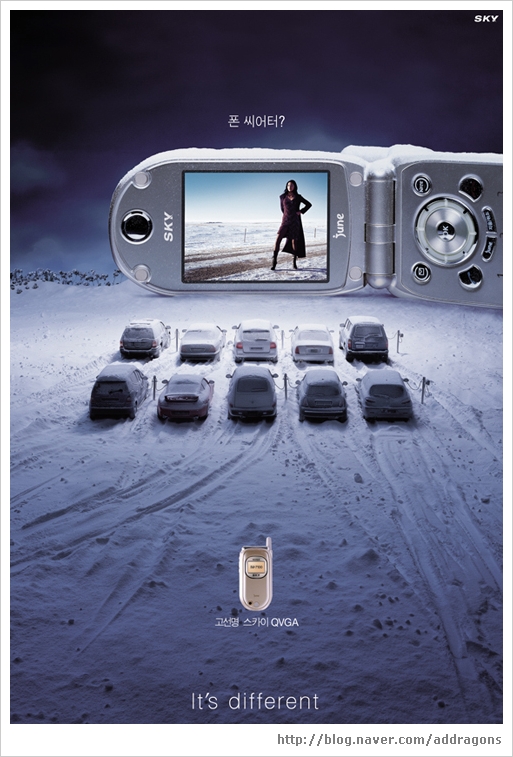
This wedding dress was cut for style…

(Source, all images: conan)

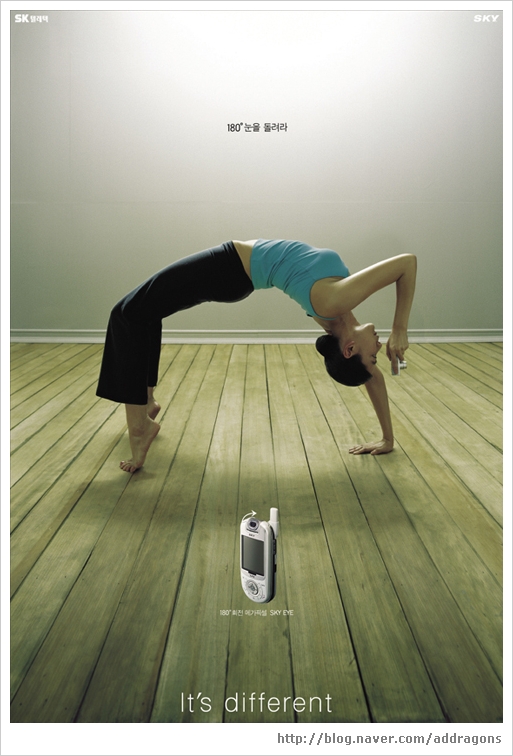
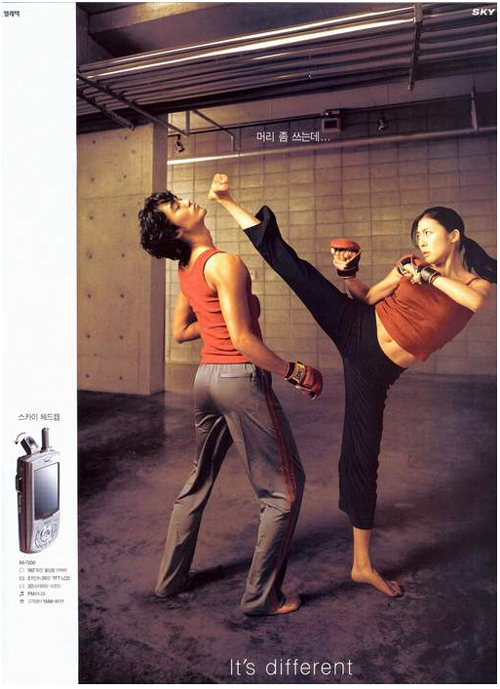
When I first saw this SKY (스카이) phone advertisement four years ago, naturally I noticed the extremely short wedding dress first, and wondered what on Earth the supposed connection to the phone was. Unfortunately though, I wasn’t sufficiently motivated to find out by getting (very) close to a poster in a phone store window and appearing — to all intents and purposes — to be minutely examining the model’s thighs, which is what reading the very small Korean text would have required of me. But soon, the poster was replaced with others, leaving me wondering ever since.

But now that I’ve just stumbled across it, I confess to being a little disappointed: the text next to the woman merely reads “스타일을 위해 잘랐다”, or “It was cut for the sake of style”, and then next to the phone “안테나를 잘랐다”, or “The antenna was cut”. Not exactly as creative, or indeed, “different” as I’d imagined.

Still, apologies if this next point is too prosaic, too crass, and/or even too much information on my part, but I think that there’s something to be said for more (clearly) physically fit Korean women in Korean advertising and real life. That aside, I enjoy the series as a whole too (all from this source), so let me finish this post by passing on more examples, for the sake of any readers who may also enjoy them:

Update: See here and here for some higher-definition versions of the final advertisement.

New Bodypainting Nudes by Kim Joon (김준)

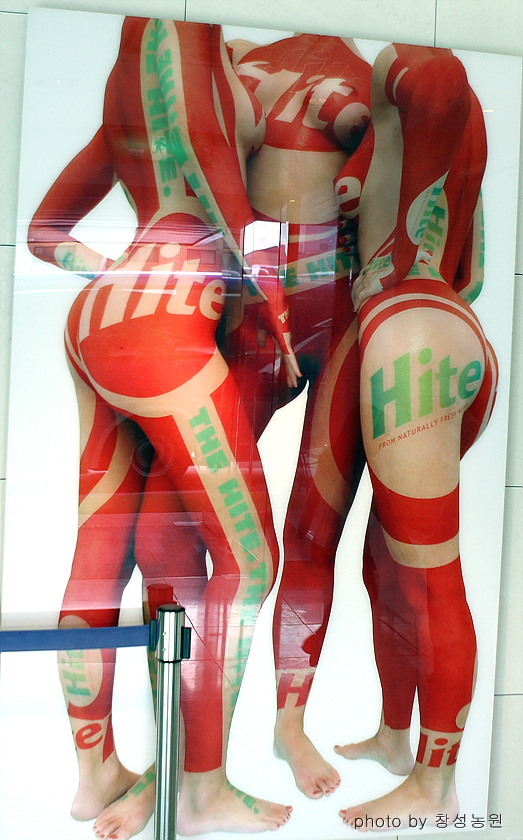
Having waxed lyrical about his work back in May, then it would be selfish of me not to share these new pictures of bodypainting artist Kim Joon’s (김준) that I happened to come across recently. Unfortunately though, they come from the lobby of the Jeonju Hite Beer factory (“전주에 있는 하이트 맥주 공장을 견학 하면서 바디 페인팅 광고가 눈에 들어와서”) rather than from a new exhibition, although on the bright side that opens the possibility that managers of Korean Starbucks branches might get similarly moved by the Starbucks version of his “branded” works.

I am still very interested in seeing an exhibition of his for myself though, but given that even Kim Joon’s own website doesn’t mention upcoming ones then it can be very hard to find any information about them in advance. And so I apologize, for after a little digging I learned that by complete coincidence a few new pieces of his work were actually being displayed in Daegu at about the time this photo was taken, as part of a wider exhibition entitled “From the Roots to the Being Now” (근원으로부터 현제까지), but unfortunately that finished two weeks ago.

By way of compensation then, let me direct you to the 2008 page of his website, where he does seem to have added several new images since I wrote that first post, and there are many more on the website of the Boxart Gallery in Verona, Italy, where there was an exhibition of his work in June and July. On top of that, here’s a 52 page PDF catalog of much of his work available as a zip file, here’s a description of the exhibition, below is yet one more recent work (source), and finally here’s a surreal 3D video of his from 2004 too, which I confess I don’t care for myself, but which will still probably be the strangest thing you and I will ever see while listening to what seems to be chanting from a Korean Buddhist temple.

Am I forgiven?^^ Seriously though, if any readers do ever hear about any upcoming exhibitions of his in Korea then please pass on the details, for considering how many there have been overseas just in the past year then his domestic appearances must be quite rare unfortunately.

Korea’s “Lonely Geese” Families: More of them than you may think

Back in July, I wrote a lengthy post* on the reasons behind and implications for Korean society of the high numbers of “weekend couples” (주말부부) and “lonely geese fathers” (외기러기) here, the latter generally referring to fathers who remain in Korea to work while their families live overseas for the sake of the children’s eduction. Back then, no statistics on the numbers of either seemed to be Shy Korean Boyavailable, so I speculated that the combination of both meant that a total of perhaps one in fifteen to one in ten Korean teenagers lived in a different city to their father most of the time (source, left: James Kim; CC BY-SA 2.0).

But it turns out that perhaps I underestimated that number: according to this recent survey of single women, effectively teenagers in this particular sense, for Koreans tend to live at home until marriage (although this is more for economic rather than the cultural reasons usually cited: see here and here), as many as one in eight Korean families have “at least one immediate family member living apart from the rest”. True, on the one hand that figure will include also university students living away from home, but then they are not common as I explain in those two posts linked to above, and on the other it wouldn’t contain the “international” lonely goose fathers I mention above either, so ultimately I’d wager that 90% or more of those one in eight immediate family members referred to would indeed be fathers working in different cities during the week.

There are some other interesting points made in that survey, but as it doesn’t mention the numbers and methodology (par for the course for most Korean newspapers unfortunately), then I’d take them with a grain of salt. But I think that the figures for geese families would be pretty consistent whatever the sample size.

*Since deleted sorry.

The Continuing Sexual Allure of the Caucasian Female

(Source: Naver)

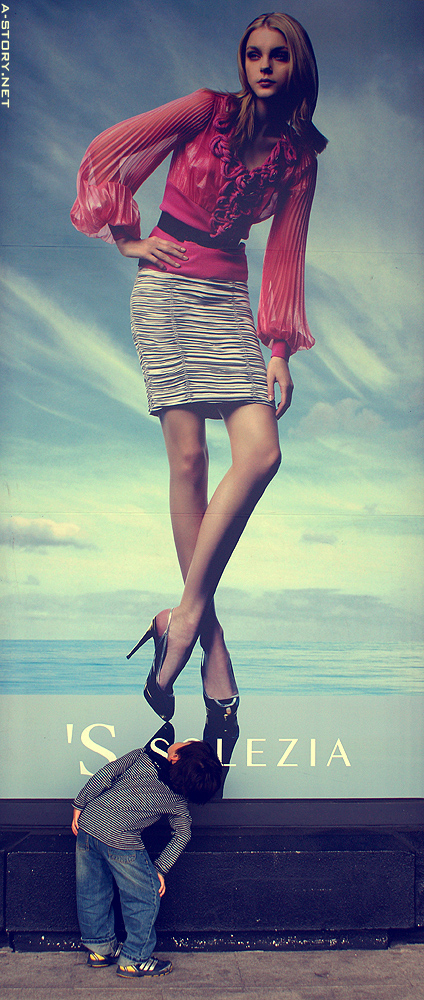
On Wednesday, apparently someone over at Naver listened to my recent request for pictures of interesting juxtapositions featuring observers of Korean advertisements, and chose this as the photo of the day. True, not exactly what I wanted, but it’s a good start.

If anyone wants me to translate the three(!) paragraphs accompanying the photo, just give me a buzz. Actually, I’m a little curious myself as to what the judge found to write about it, but unfortunately I have a screaming daughter and baby to deal with as I type this (story of my life these days). With the five minutes spare that I did have though, I learned that the model’s name is Jessica Stam (제시카 스탐), and that Solezia (쏠레지아) is a Korean company (I think). Here’s a larger version of the original advertisement too:

(Source: Naver Blog)

Of course, you could argue that Jessica Stam doesn’t quite look gaunt enough there, much more so than in real life, but fortunately Solezia knew where to draw the line on good taste and healthy body images of women.

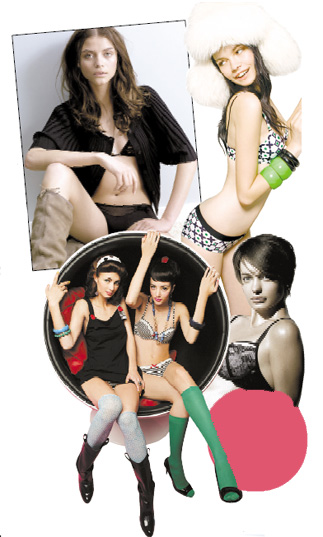
Korean Underwear Emerges from the Shadows?

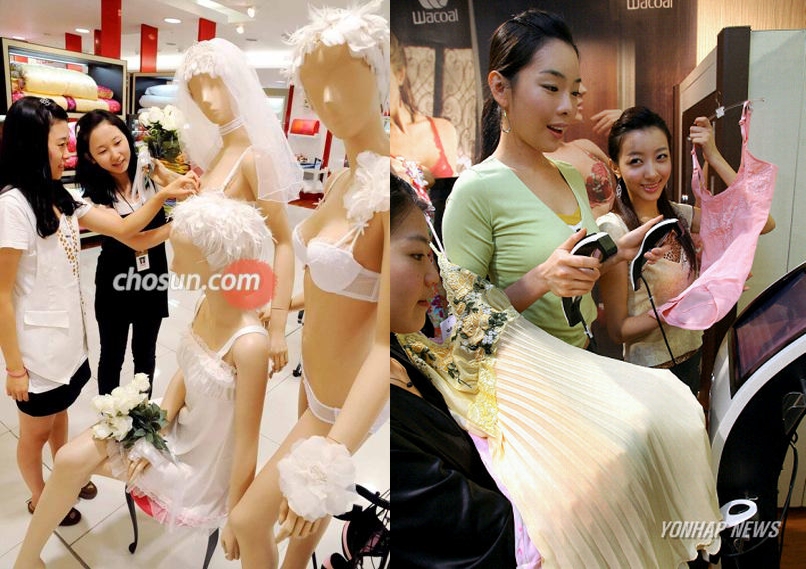
(Sources: Naver, Yonhap)

Update, March 2014: First, my translation of a 2006 Joongang Ilbo article on lingerie advertisements:

벗겨라, 팔리리라! Undress the Models and the Products Will Sell!”

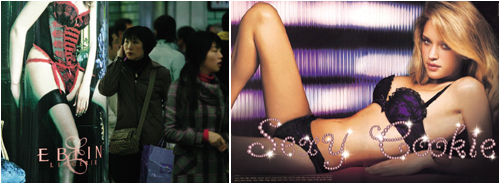
에로틱 광고, 잡지에서 거리로 나왔다…예술과 외설 사이 아슬아슬한 줄타기” 광고 속 에로스.  Borderline indecent advertisements formerly only found in magazines are now on the streets (16 December 2006).

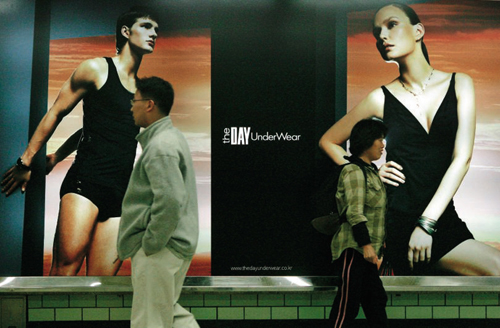
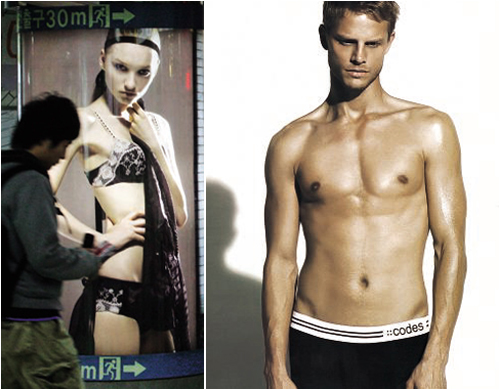
▶근육질의 남성과 섹시한 여성이 반라 차림으로 서로를 그윽하게 바라보는 속옷 광고 (서울 지하철 2호선 삼성역). A muscular, semi-nude man and sexy woman furtively looking at each other in this underwear advertisement (Samseong Station, Seoul Subway Line 2).

브래지어와 팬티 차림의 여성이 거리를 점령했다. 잘록한 허리에 배꼽을 드러내다 못해 엉덩이까지 절반쯤 나온 섹시한 여성의 눈빛이 버스 정류장에서 혹은 지하철 역사에서 남성들의 시선을 붙잡는다. 예술과 외설 사이를 아슬아슬하게 넘나드는 속옷 광고들이다.

Advertisements with women in just their bras and panties are to be found on streets everywhere these days, but presenting narrow, slender waists and navels are no longer enough for advertisers, and so many at bus stops and subways stations now reveal women’s buttocks too, which naturally gain the attention of more men than women. Many are not so much artistic, as bordering on the indecent.

과거 잡지 속에서나 볼 수 있었을 만한 아찔한 속옷 광고들이 당당히 거리로 나왔다. 속옷 광고뿐만이 아니다. 녹차 광고나 심지어 커피숍 광고도 일단 벗고 본다. 에로틱한 분위기의 광고는 제품과 관계없이 일단 사람들의 호기심을 불러 일으키는 법. 이것을 광고 제작자들이 놓칠 리 없다. 그러나 너무 많이 벗은 탓일까? 반라의 남녀가 넘쳐나는 거리를 행인들은 무심히 지나간다.

Such revealing advertisements used to be only found in magazines, but now you can find them on the street. It’s not just lingerie advertisements which have such revealing images either: even tea drink companies and coffee shops use them also, trying to attract the curiosity of passers-by with sexual images that have no actual relation to the products being sold. Other advertisers can’t help but notice this trend and be sucked in by it, but don’t you think it’s too much? Indeed, there are so many images of semi-nude men and women on our streets these days that in fact people may be taking less and not more notice of them.

▶위 : (주)좋은사람들이 지난해 8월 20대 후반 여성을 타깃으로 런칭한 속옷 브랜드 ‘섹시쿠키(Sexy Cookie)’의 지면 광고. 아래 : 국내 속옷시장에 패션 바람을 몰고 온 이랜드 계열의 속옷 브랜드 ‘에블린’의 광고판 (서울 지하철 2호선 삼성역). Left: An advertisement for a new kind of lingerie from “Eblin”, set to be quite a trend in the national lingerie fashion market. Right: An advertisement from August 2005 launching Korean company “Good People”‘s new lingerie brand “Sexy Cookie”, targeted at women in their late twenties (both advertisements from Samseong Station, Seoul Subway Line 2).

▶좌 : 반라차림의 여인을 전면에 내세운 속옷 광고판 앞을 한 남성이 무심히 지나가고 있다 (서울 지하철 4호선 명동역). 우 : 여성만 벗는 것이 아니다. 남성도 벗는다. 근육질의 남성 모델을 내세운 ‘코데스콤바인’의 지면 광고. Left: A man absentmindedly walks by a lingerie advertisement. Right: A muscular man in a Korean “Codes Combine” underwear advertisement (both advertisements from Myeong-dong Station, Seoul Subway Line 4).

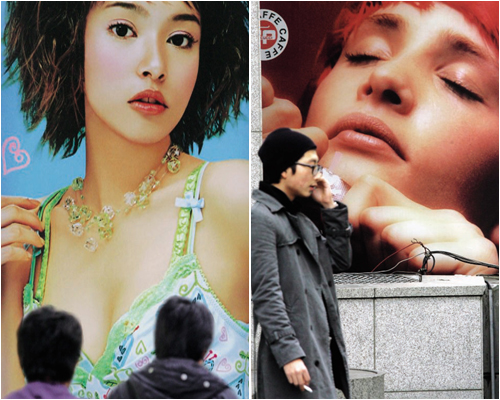
▶좌 : 반라의 여성모델을 내세우는 것은 속옷 광고만이 아니다. 전지현의 S라인을 전면에 내세운 ‘17차’의 광고판.(서울 지하철 2호선 강남역). 우 : 화장품 광고라고 해서 얼굴만 대문짝만 하게 찍는 것은 아니다. 살짝쿵 벗어 주는 센스를 보여준 ‘라네즈’의 거리 광고 (서울 홍대앞). Left: The semi-nude women in this advertisement is not advertising lingerie, but is actually the actress Jun Ji-hyun advertising a tea drink (Gangnam Station, Seoul Subway Line 2). Right: An advertisement for Laneige cosmetics in which the model’s face has been greatly enlarged, but with which we somehow get the impression of her being semi-nude (Hongdae University area, Seoul).

▶좌 : 홍대앞 속옷가게 앞에 걸린 광고판을 뚫어져라 바라보고 있는 두 남자. 우 : 벗는 것만이 에로스는 아니다. 살며시 눈을 감은 여인의 얼굴에서 살포시 읽히는 에로틱함으로 행인을 유혹하는 커피숍 광고 (서울 홍대앞). Left: Two men’s gazes penetrate a lingerie advertisement in the Hongdae University area. Right: This women’s softly closed eyes while reading a book give a slightly erotic and seductive impression to this coffee shop advertisement, persuading passers-by to come inside (Hongdae University area, Seoul).

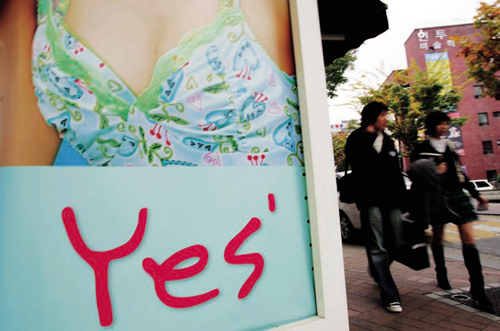
▶풍만한 여인의 가슴을 그대로 노출한 속옷 브랜드 ‘ Yes’의 거리 광고 (서울 홍대앞). A “Yes” lingerie advertisement exposing a woman’s voluptuous breasts (Hongdae University area, Seoul; End)

As a further example, contrast two recent bra commercials with Han Ye-seul (한예슬) for Venus (비너스) with I think a 2003 one with Go So-young (고소영). Whereas Han Ye-seul’s unabashedly presents herself — or rather, her breasts — as an object for the male gaze, Go So-young advertised the ‘Nudy Bra’ on the basis of bra-straps and lines not being visible, and therefore unlikely to attract any unwanted attention from men.

Finally, another article from the JoongAng Daily on the rapid change in fashions and attitudes:

Underwear emerges from the shadows

(September 04, 2007)

Underwear has been an integral part of the fashion industry for so long that saying “underwear is outerwear” now feels trite.

Ever since the 1990s, when Courtney Love sported a rag-doll look, wearing nothing but big red lips and a stark white slip, the boundary separating underwear from outerwear has become very thin. It now seems like the line will vanish altogether.

Looking through a rack of neon-colored swimsuits at the Galleria department store, Kim Ji-eun, 27, revealed her own summer fashion tip. “I’ve been wearing halter-style bikini tops in pretty colors under summer dresses. The little bow on the back [of the swimsuit, made when she ties the loose ends around the neck] makes a great accent and it does double duty as a bra.”

Kim, a fashion-hungry Seoul girl, went on to disclose more underwear secrets as she walked out of the department store. “Do you remember when Winona Ryder wore a bright red bra under a white tank top during an award show and the straps showed?” she said, with a smile. “To tell the truth, I’ve been copying that look all summer.”

Looking around the Apgujeong area recently, it seemed that Kim wasn’t the only one. Han Hye-seong, 25, was wearing a flowy peasant skirt with a loose top, under which her colorful bra straps were strategically placed to be noticed. “Five years ago, these [straps] would have been clear. But now, I hardly ever see clear straps being sold,” she said.

Until recently, Kim and Han did their underwear shopping at Internet sites which stock foreign underwear labels like Victoria’s Secret. “I couldn’t find underwear made by Korean labels which had any pretty patterns, bold colors or high-fashion elements,” said Kim.

It seems as though Korean companies are finally catching up. The triad of underwear brands – Try Brands, BYC and Taechang, have faltered, making room for new names.The triad’s standard white, black and beige selections with a small variety of designs couldn’t withstand the new wave of outer/inner wear. By 2005, Try Brands’ sales had fallen from 220 billion won ($24.2 million) in 2003 to 129 billion won. BYC’s sales also went down significantly, from 182.5 billion won in 2003 to 151 billion won in 2005. Taechang sold their underwear division to E-Land in 2005.

In their place, a new triad have emerged, including E-Land World (with brands like Roem, Who.A.U and Hunt), Yeshin Persons (including brands like Maru, Codes Combine and Noton) and Good People (with Bodyguard and James Dean). Yeshin Persons was in the forefront of this new group with Maru Underwear (a domestic sportswear brand) in 2004. “Maru Underwear features casual lingerie with a bit of a fashion edge and it targets women from 19 to 25,” said Lim Sae-un, a Maru media representative. Following the initial success of this brand, the company made another underwear line – Codes Combine – which also stems from one of their sportswear brands. This line, targeting people in their 20s and 30s, includes underwear with bohemian and vintage-inspired elements like fringes and neutral tones. The two underwear lines alone made the company 45 billion won in 2005.

E-Land World has been following a similar path. Besides Hunt Underwear and The Day Underwear, they launched Body Pop and Petite Lin, the former for teenagers and the latter for kids under 10. Both have been a great success. Good People launched underwear lines which target women in their late teens to 20s, including Sugar Free and Sexy Cookie.

One factor behind the success of these lines is their affordability. Along with the growing popularity of affordable cosmetics lines like Missha and The Face Shop, these underwear lines provide a sense of adventure at prices that do not involve the risk of a big investment. “Customers feel free to take risks and buy colorful items with patterns instead of your basic white or skin-colored underwear because these items are so affordable,” said an E-Land representative.

Along with domestic brands, underwear brands from other countries have also been selling well. Women’s Secret, an underwear brand from Spain, was introduced in late 2005, with its first shop in Apgujeong-dong. “Underwear is no longer hidden beneath clothes and consumers are now more daring and wear colorful, showy underwear. We decided to bring in this brand to meet these needs,” said Kim Hyun-hwa, the brand’s assistant marketing manager. “Customers are smarter as well. They don’t want cheap material or poor tailoring. Underwear nowadays has to be fashionable and practical with a reasonable price tag.”

Choi Young-jip, head of Princess TamTam Korea, an underwear brand based in France, agrees. “Customers not only look for good designs, but also for underwear that is a good fit for their body. So material and cut are very important.”

These factors have led to some adjustments in tailoring. “We have introduced a line of bras and panties just for the Asian market for this fall/winter season,” said Kim Hyeon-hwa at Women’s Secret. “The panties in this line support the hips, with more coverage, as opposed to thongs or Brazilian-style pieces which are popular in Europe.”

Adding to this boom are celebrities who have launched their own underwear lines through home shopping, the Internet or off-line stores.

Actress Park Jeong-su launched Sooanae last year, an underwear line targeting middle-aged women which offers stylish yet form-flattering foundation garments. Next was actress Hwang Shin-hae with Elypry, which was first offered through Hyundai home shopping but branched out to CJ home shopping this year. Actress Hyeon Yeong and actress/singer Um Jeong-hwa both used their sexy image to full advantage by launching underwear lines this year. “Finally, there are now lots of choices [for underwear] in Korea.” said Kim Ji-eun as she flipped her hair and continued to search for the perfect bikini/bras to match her new shoes.

Reporting by Lee Eun-joo

By Cho Jae-eun Staff Writer [jainnie@joongang.co.kr] (my emphases)

Giving the Consumer What She Wants? Korean Women’s Role in the Westernization of the Korean Media

Korean Consumers(Source: LG 전자; CC BY 2.0)

If you’ve followed a link here, please note that this post was deleted and completely rewritten in January 2012, but unfortunately I’m unable to do automatic redirects for single posts sorry. Instead, please click here for the new version.

Naver’s Photo of the Day

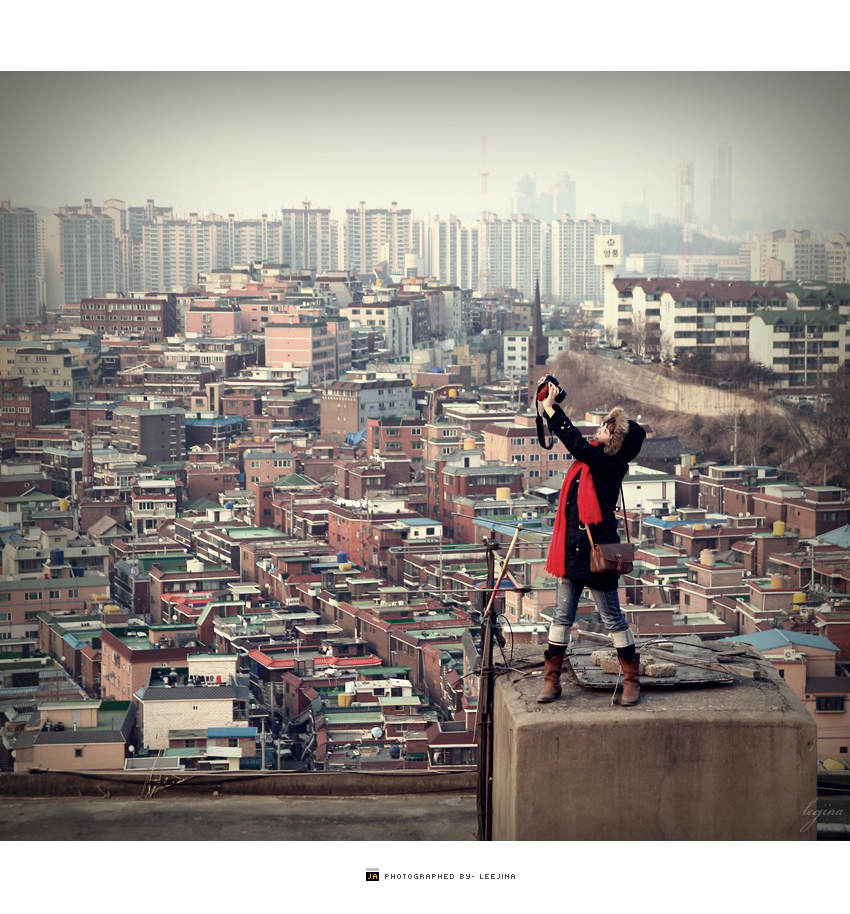
(“하늘위로훨훨 ~ 날아올라” / “Flying to the Sky”. Source: Naver)

I’m afraid that I’ve been pretty sleep deprived since my baby daughter came home from the hospital sorry, and it’s making my next post take much longer than expected. Having said that, I confess that I liked Naver’s photo of the day above so much that I just had to post it as soon as I saw it, and it’s a pity that the only slightly larger version you can see by clicking on it is the highest resolution available.

Here’s what photography judge Kim Yeong-su (김영수) had to say about it on Naver:

이 사진은 아름다운 여인을 보기 좋게 꾸며서 적당하게 어울리는 장소에서 촬영한 인물사진입니다. 상업적인 목적의 사진 분야에서는 이와 같은 종류의 사진은 패션사진 분야에서 많이 촬영됩니다. 전문적인 패션사진가 경우에는 프로 모델, 스타일리스트, 메이크업 담당자와 같이 전문가 그룹이 함께 움직입니다. 물론 유행에 앞서 가는 멋진 의상은 기본적으로 준비가 되겠지요.

“This picture is a very human one, and at a location well matched for the beautiful woman made up for the shot. It is of a kind often used in commercial and fashion photography, and in the case of the latter a fashion photographer will be working as part of a production team with the professional model(s), stylists, and make-up artists. And of course, trend-setting clothes are also available to them, aren’t they?”

비상업 적인 목적으로 이와 비슷한 사진을 전문가 집단의 도움 없이 촬영한다는 것은 상당히 힘든 작업입니다. 그럼에도 불구하고 이 작품은 좋은 모델과 의상, 포즈, 장소, 광원이 잘 맞아 떨어져서 사진을 감상하는 많은 사람들의 눈을 즐겁게 해 주고 있습니다.

“It is considerably harder for non-commercial photographers to take pictures with a similar pose and setting without the help of a production team. Despite that, the lighting and the model’s beauty, clothes, and pose came out very well in this photo, and many people have been enjoying it.” (End)

Sorry, but although Naver does give the photographer’s Naver ID and links to more examples of her work, it seems to neglect to mention the minor, trifling detail of what her name is. If anyone knows it or can see it on the site where I didn’t, please pass it on!

Let me leave you with another great shot of hers instead, which I really liked partially because I’m a real sucker for juxtapositions of Korean houses and futuristic-looking apartments (I recommend those by bophoto especially), but mostly because this shot also manages to capture the crisp atmosphere and the brown-red hues of Korean cities in the winter very well; my favorite time of year and place(s) in Korea, but difficult to convey in words. Still, I’d have to admit that the shot would probably have looked much better with more of the roof in the foreground cut off, and especially with a much wider view.

(“고것에서” / “From That”. Source: Naver)

By the way, does anybody recognize where the picture was taken from?

Resources on Evolving Korean Ideals of Male Beauty

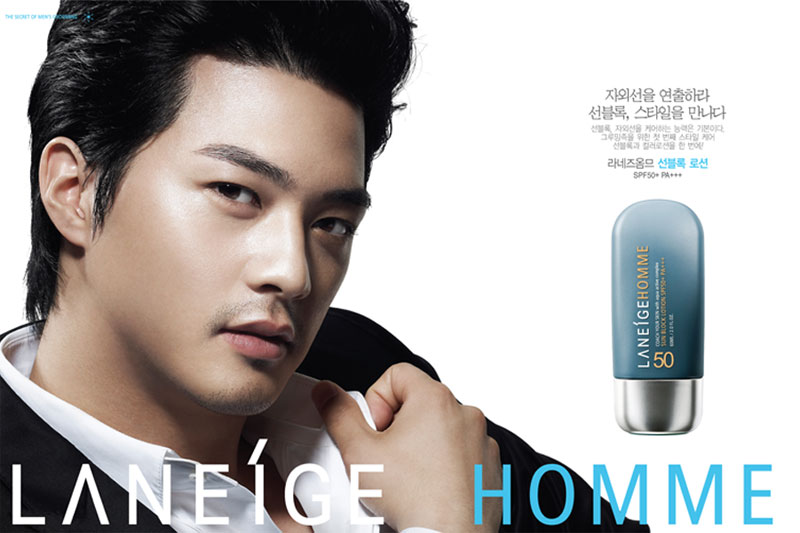
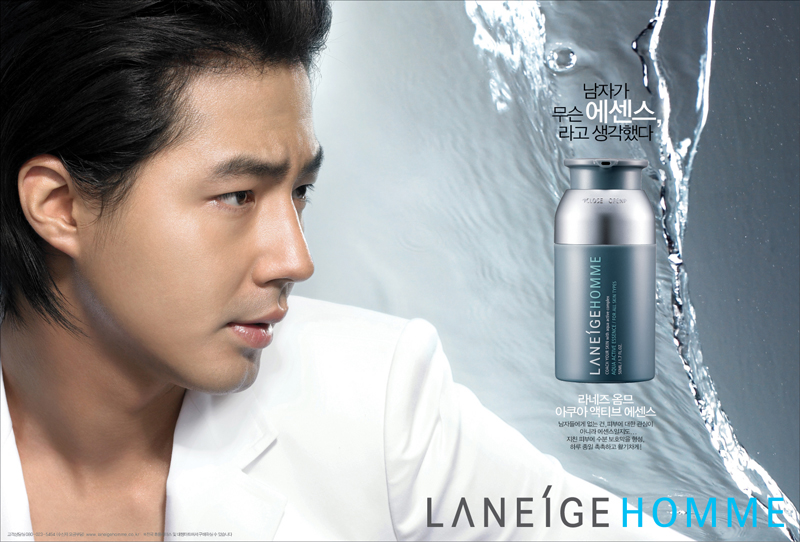
(Source: Laneíge)

As long-term readers will (hopefully) recall, in my last major post in this series I put forward the hypothesis that an increasingly feminized ideal of Korean male beauty was not a mere import of foreign notions of metrosexuality, as is often claimed, but more the result of a subconscious or deliberate act of defiance by Korean women, angered at being the first to lose their jobs during the economic crisis of the late-1990s. Given that these small inroads into Korean business had been only recently made too, Korean feminism very much taking a back-seat to the wider goals of the democratization movement previously, then it’s not unreasonable to suppose that Korean women would have angrily rejected their previous ideals of men as strong, masculine providers in response, particularly as the male-dominated government and media chose to urge them to support their hardworking fathers and husbands rather than air their complaints.

Unfortunately, there is not quite the same level of academic interest in evolving Korean ideals of men’s beauty as there is in women’s…*cough*…and in the case of English-language studies of Korean men especially I suspect that I’m entering into almost completely uncharted territory.

But in addition to some that I linked to that earlier post, one more English resource that I did find recently was a paper titled “Dual Dominating Strategies of the Korean Hegemonic Masculinity: Advertisements for Men’s Cosmetics” by Park Seung-min, downloadable here. If the title gives you misgivings however, then so it should, for unfortunately it badly needs a major rewrite by a native speaker, preferably one with some background in social sciences too; at the very least, simple terms should have been chosen over rather abstract academic ones which even specialists disagree on the precise meanings of. Otherwise you end up with ditties like this:

According to R. Barthes, creating any meaning of the advertising goes through two stages in the process of action in its meaning. The first stage is a process representing things with symbols, having the denotative meanings. Since the expression of one symbol only has the content of one symbol, the symbol merely has ‘monosemic meaning’ in the action of meaning at the first stage…

But the paper’s images of advertisements from 1970-2006 alone make it worth viewing, and despite everything it is still possible to follow, something which can’t be said of a great deal I’ve read on postmodernism that that passage is reminiscent of. Meanwhile, to add my own contribution, here is my translation of an article from the July edition of Korea Ad Times (코리아애드타임즈) about a recent commercial for men’s sunblock:

라네즈 옴므 ‘선블록 로션’ 편: 그루밍족을 위한 스타일리쉬 선블록

Laneíge Homme ‘Sunblock Lotion’: Stylish Sunblock for Men Concerned about Personal Grooming

‘자외선은 피부의 적’ 이라는 사실은 누구나 알고 있을 것이다. 자외선의 UVB파장은 진피층의 콜라겐과 엘라스틴 파괴시키고 색소 침착을 증가 시키기 때문.

Everybody knows that UV rays are the enemy of youthful-looking skin. This is because the UVB ray components of it destroy the collagen and the elastin in the dermis layer and increase the amount of pigment.

피부 노화의 주범이 자외선이라는 사실이 밝혀지면서 여름은 물론 사시사철 자외선 차단제의 중요성이 강조되고 있다. 하지만 남성들은 끈적이고 바르면 하얗게 뭉쳐 귀찮아서라는 이유는 선블록을 평소에는 바르지 않는다.

Ultraviolet rays are the main cause of aging of the skin, and people are beginning to realize the importance of using sunblock all year round. But men ordinarily don’t wear it, as they don’t like its sticky, greasy feeling or the fact that it tends to clump together in white lumps.

선블록은 단지 야외에서 운동할 때 여름 휴가 때 겨울의 스키장에서만 바르는 특수한 용도의 화장품이라고 여기고 있기 때문이다. 남성들의 이런 생각 때문에 남성 피부는 항상 자외선에 무비방 상태로 놓여있다.

Men tend to think of sunblock as something only to be used when exercising or traveling in the summer or skiing in winter, and so normally their skin has no protection at all against the sun.

하지만 이런 남성들 사이에도 변화의 바람이 불기 시작했다. 바로 ‘그루밍족’의 탄생이다. 이는 몸을 칭찬한다는 뜻의 ‘Groom’에서 나온 말로 패션과 미용에 아낌없이 투자하는 남성을 지칭한다. 이러한 그루밍족을 위해 탄생한 라네즈 옴므, 라네즈 옴므에서 제안하는 피부관리의 첫단계는 바로 ‘선블록’ 이다.

But men are changing their attitudes, and some are prepared to invest a lot of time and money in their appearance, becoming known as “Groomers” by advertisers. Laneíge Homme’s “Sunblock Lotion” is specifically designed for this new group, and advises men that sunblock is the essential first step in adequate skincare.

갈색으로 그을린 구릿빛 피부는 보기에는 멋지고 건강해 보이지만 실제로는 자외선에 의해 피부가 손상됐을 가능성이 높다. 이 CF는 이점에 착안, 스타일을 생각한다면 스킨과 로션 후, 손질를 마무리하는 단계에서 자외선을 차단하면서 피부톤까지 살려주는 라네즈 옴므 선블록 로션을 잊지 말아야 한다는 것을 강조한다.

Brown skin may look attractive and healthy, but it actually means that the possibility of it being damaged by the sun is very high. This commercial draws attention to this, and also emphasizes that you should not forget to apply the product after applying skin lotion and toner.

라네즈 옴므 선블록 로션TVCF는 ‘스타일리쉬’ 그 자체라고 할 수 있다. 심플하고 모던한 실내 세트장은 그 압도적인 규모뿐 아니라 브라운관들로 이루어진 천정이 눈길을 끈다. 모던한 세트장과 조화를 이루는 절제된 소품들은 고급스러움을 한층 더하고 있다.

Laneíge Homme’s new commercial is very stylish. The simple and modern room interior it was shot in is not just big, but viewers’ eyes are drawn to the ceiling, which has many TV monitors. The commercial has much finesse and many subtle points which combine to produce a high quality piece of work.

그루밍족을 위한 카리스마 강조, Emphasizing the Charisma of Groomers

무엇보다 ‘그루밍’ 의 워너비로 등장하는 배우 김지훈은 그만이 가진 세련된 실루엣과 카리스마로 남성뿐 아니라 여성들의 시선을 사조잡고 있다. 어두운 공간에 홀로 앉아 있는 멋진 남자와 천정에 설치된 작은 브라운관들에 남자의 다양한 표정들이 보여진다. 이 때 부라운관에서 자외선이 강렬하게 내리쬐며 남자를 비추고 강렬한 빛에도 당당한 모습을 잃지 않은 남자, 그의 손에는 라네즈 옴므 선블록 로션이 들려있다.

More than anything else, actor Kim Ji-hoon (김지훈) – Groomers’ ideal type – attracts the interest of both men and women with his charisma and stylishly-cut body shape. In the commercial, a man is sitting alone in a dark space and his various expressions are shown on the TV monitors. Then, on the TV monitors there’s a sudden strong flash of sunshine against him, but he still holds himself confident and strong against it, all the while holding a bottle of Laneíge Homme Sunblock Lotion.

내리쬐는 빛으로 점점 환해지는 실내, 자외선마저도 자유롭게 연출 할 수 있는 당당하고 스타일리쉬한 남자, 바로 모두가 꿈꾸는 진정한 ‘그루밍족’ 이 아닐까?

The sunshine gradually makes the room bright, but the stylish and confident man is unaffected by it and free to do as he wishes. He is the quintessential grooming man, the envy of consumers.

선블록 로션TVCF의 또 다른 매력은 바로BGM과 영상의 조화가 돋보인다는 점이다. 이번 광고를 위해 BGM이 특별히 제작했다. 젊은 남성 타겟의 취향을 고려하여 파워플하면서도 세련된 사운드가 돋보이는 Rock 스타일로 만들어진 것.

Another charm of this sunblock lotion commercial is that is in exceptional harmony with BGM’s background music. BGM produced the music especially for this commercial, and it has a powerful and sophisticated rock-style sound, in consideration of young men’s tastes.

이로써 TV CF의 하이라이트 부분과 BGM의 클라이막스가 완벽하게 맞아 떨어지면서 한층 임팩트 있는 광고가 됐다.

The climax of the music is in perfect synchronization with the climax of the commercial and combines to give a very powerful impact on viewers.

(A 2007 Laneíge Homme advertisement featuring Jo In-sung {조인성}, the first aimed at men.  Source: Laniege)

Perhaps not a great contribution sorry, and I really expected rather better from a 15,000 won specialist magazine; given how much my wife was laughing out loud at the original Korean version, then I’m not sure how I could have made it more natural-sounding in English either. On the other hand, at least I do now know about “Groomers”, whom I expect to hear much more about in Korean advertising literature in the future.

Koreans, Criticism, and the Korean Language

(Taking too close a look at the frogs in the well? Source: FARK)

For those of you that don’t already know, yours truly was briefly mentioned in an article on how Koreans handle criticism by foreigners by Bart Schaneman in The Korea Herald on Monday. It resulted in a lot of hits on the day, and even some offers of being paid to write from some other sources, so all in all pretty good for something that I originally declined to respond to. Citing his space restrictions, I thought that replies of mine to Bart’s email questions would be reduced to mere one-liners, but obviously I relented, and to his credit he did manage to get a lot of information into the article. You can see a full PDF of that here; in this post I’ll just clarify and expand upon some of the points in my own short contribution to it:

…We’re not that different

New Zealander James Turnbull runs The Grand Narrative. He calls it “An irreverent look at social issues.” Much of his work deals with Korean advertising and media as well as social commentary. In his eighth year in Korea, Turnbull teaches English in Busan.

“I find the notion that only Koreans are ‘permitted’ to speak about Korean problems simply absurd,” he said. “That isn’t to say that all foreigners’ opinions on them are equally valid, but if the roles were reversed then I’d be quite happy to hear the opinions of, say, a Korean person who had spent some time in New Zealand and who made an active effort to study and know New Zealand society and learn the language. In fact, probably more so than someone who was merely born there.

(I should really give credit to Gomushin Girl for at least the inspiration for that last point).

One thing I would add to that, albeit too egotistical sounding for me to have offered to Bart, is that I think that I’d probably be more likely to feel that way more than most New Zealanders themselves, or indeed the natives of any country. As a teenager I moved around a lot, at one point going to six different high schools in three countries in three years(!), and while it was a difficult and much resented experience at the time, it did at least mean that as an adult I’ve tended to be a bit more objective about a country’s good points and bad points than the natives. The flip side of that, though, is that to a greater or lesser extent I’ve always felt like an outsider in all of the four countries I’ve lived in, which goes some way towards explaining my newfound sympathies for the experiences and opinions of Koreans living there.

But neither that ability, nor the fact that I’ve been here for eight years automatically makes my opinions on things Korean more accurate or helpful than a newbie’s; actually, they’re just as likely to be simply more cynical and jaded instead. My point in the article then, admittedly not very subtle, is that the right to have one’s opinions about Korea to be taken seriously has to be earned, regardless of whether you’re a newbie, old-timer, or even Korean yourself. It’s true that that process takes a little more work in Korea than in many countries, but still, I wasn’t lying when I said the next:

“The majority of netizens aside, I’ve actually found a significant number of Koreans to feel much the same way about the opinions of non-Koreans.

The following though, really does suffer from lack of the example I gave to justify it, but once you read my expanded version of that below then you’ll understand why Bart left it out.

“Another advantage to using and considering Korean-language sources as much as possible is that it makes you realize how much you may stereotype and generalize Koreans yourself without being aware of it.

I wrote that because a few years ago, I realized that I was very guilty of both myself. Not despite me being a Korea studies geek; actually, probably precisely because of it.

The occasion was listening to the radio on the bus home one night in 2005. Frustrated with never getting any Korean listening or conversation practice, and being unable to find a Korean drama to watch that I didn’t find nauseating and/or wholly unrealistic, I spent my commuting time those days listening to the traffic channel on my small hand-held radio (94.9FM in Busan). Not an obvious first choice, no, but there was minimal music, and it did have a lot of interviews and talkback callers whose conservations I could usually at least get the gist of. That day, a woman from the Ministry of Health and Welfare was on, and she was explaining the numbers of HIV positive and AIDS cases in Korea and how they contracted the disease.

Naturally my ears pricked up at that, because, as we all know, not only do all Koreans think that both are “foreign diseases”, but they also believe that there are absolutely no Korean homosexuals. So how on Earth were she and the interviewer going to work around those?

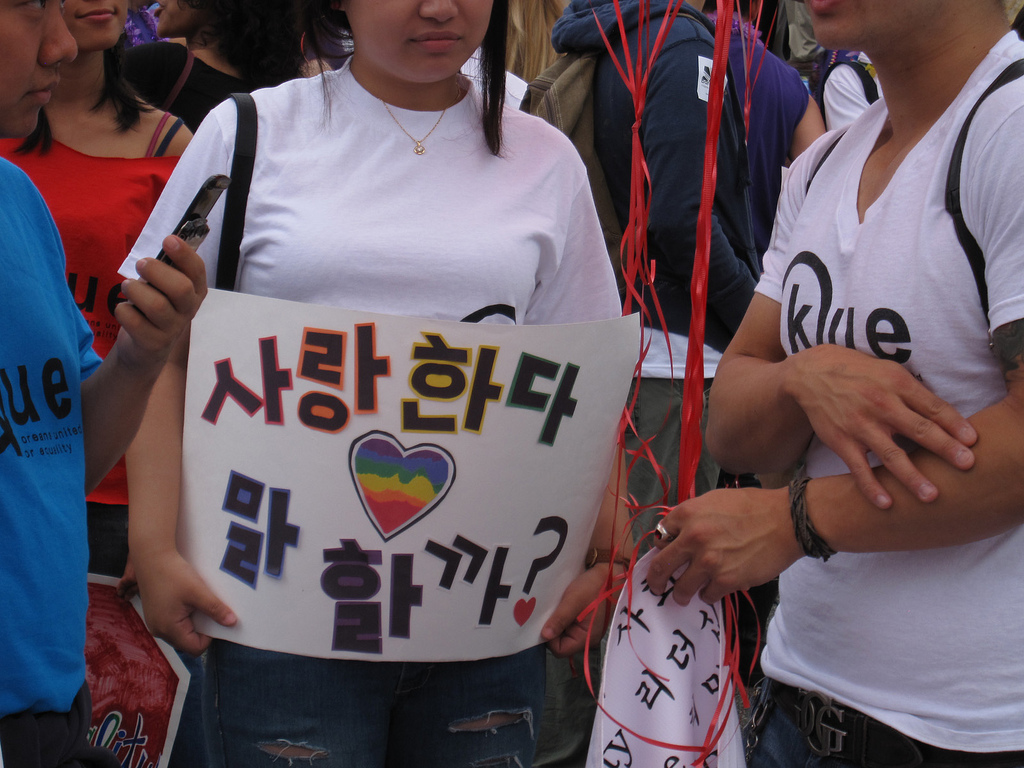
Korea LGBT(Source: InSapphoWeTrust; CC BY-SA 2.0)

In short, they didn’t. She calmly and patiently explained the number of cases contracted from drug users, mother to foetus transmission, homosexual partners, heterosexual partners, homosexual prostitutes….and so on, in a matter-of-fact manner that indicated that there was nothing exceptional or noteworthy about the subject. Neither did the interviewer nor later callers question the figures nor get into any racist hysterics about “foreign gay contamination of Korean blood” either. What the hell was going on? It was just as sedate as any similar discussion in any Western country.

And then I realized that in fact I’d only ever read that Koreans thought like that, and I’d never actually asked a single Korean about homosexual Koreans and/or AIDs myself. That may sound strange, but then I saw no reason not to believe the books, and I can think of more appropriate free-talking topics for conversation classes.

Why did the books say that then? Well, because undoubtedly a majority of Koreans once did once think like that once, and, as this recent case of teenage prostitution illustrates, some still do, but despite that clearly most Koreans had long since moved on from whatever book on that particular aspect of Korean society I’d read was published. Hence my next and final point, and kudos to Bart for also retaining my (indirect) criticism of the very paper the article was printed in:

“Without any Korean ability, foreigners are usually forced to rely on either the limited English language media or books for the bulk of their information, and both have problems: the former for often presenting a rose-tinted version of Korea to the world, and the latter for being quickly out of date in a country as rapidly changing as Korea.”

It sounds obvious, but it took me five years to realize that, like I said probably because I’m more of a Korea studies geek/bookworm than most. But I’m glad I did, and on the plus side – although my Western and Korean friends will scoff at this – it has made me a bit more humble and circumspect in my comments and criticisms about Koreans and Koreans ever since.

Update: Anyone further interested in the numbers of HIV and AIDS cases in South Korea, please see here and here

How Korean Girls Learn to be Insecure About Their Bodies

Seriously, it’s great that the makers of this video are trying to encourage children to eat healthy foods with fermented bean paste (된장) rather than candy. But do they really need to be told that it’s good for their “S-lines” and “V-lines” too? For those few of you that don’t know what either are, this next commercial in particular makes the former pretty clear:

(Source: ¡Hoy mejor que ayer, mañana mejor que hoy!. The text reads “The S-line you want to have.”)

Note that Go Ara, the actress in the commercial, is actually much younger (16) than she may appear above. Meanwhile, here are some commercials for a tea-drink which supposedly gives you a V-line chin, which at least have actual grown women (BoA, 22; Kim Tae-Hee, 28) endorsing the product:

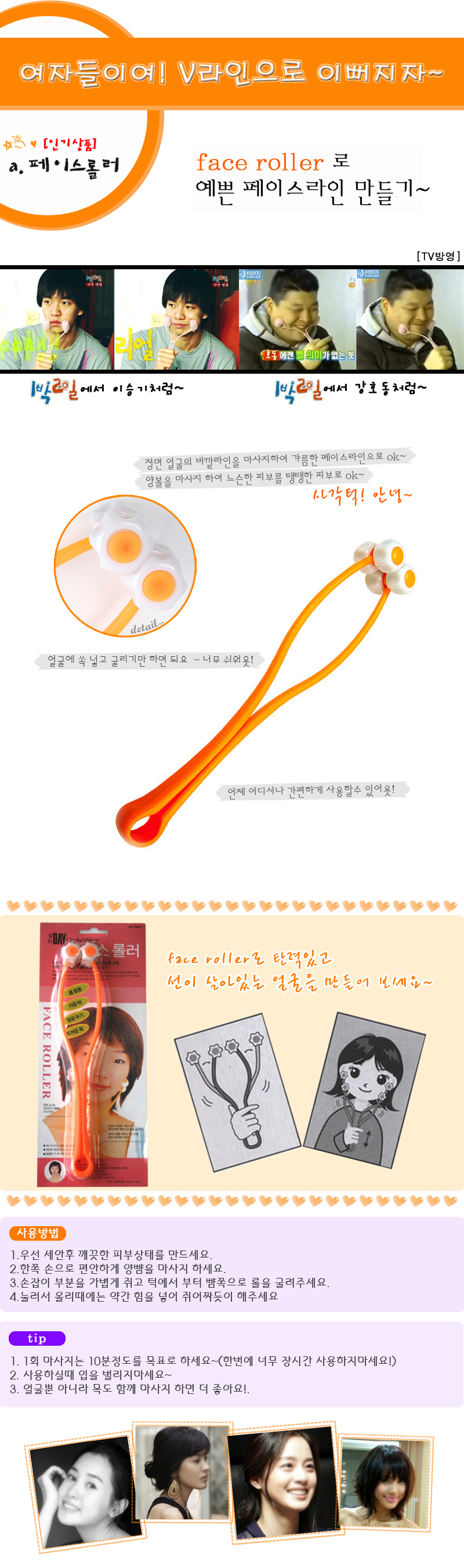
Not by coincidence, here are some “face rollers” which started to appear all over Korea not long after I first heard of V-lines. I’ve read that they’ve been used for many years in Japan and Taiwan too, so Korean women too may well have been using for a long time before they started worrying about their V-lines specifically. But then they weren’t popular enough for me to have noticed them at all until last year, and certainly sellers of them have been making explicit references to V-lines ever since the concept first appeared:

(Source: GMarket)

Alas, I’m not entirely certain why an ad explicitly for women opens with some not particularly flattering shots of men either (Lee Seung-gi and comedian Kang Ho-dong), but I guess I’m not the target market. That they do so humorously though, does help reinforce the notion that dieting (etc.) is only something for women to be serious about.

Or perhaps just girls, as I’ve never actually seen a woman using one. My 13 year-old students, however, use them every other break…(sigh).

Update: See here, here, here, and here for much more on the constant invention of new, often impossible body shapes and “lines” for Korean women to strive for, and for North American and European parallels.

Are Korean Women No Longer Afraid of the Sun?

(Source, all pictures: Paranzui)

Update, November 2013: My views on skin-whitening have changed considerably since this post was written five years ago, so I’ve removed my original commentary to this commercial, and consequently the comments also. But I’ll keep my translation up, just in case any readers still find this post useful (original article: page 52, July 2008 edition of the now-defunct Korea Ad Times / 코리아애드타임스):

더페이스샵 ‘내추럴 선블럭’ 편 / The Face Shop’s ‘Natural Sunblock’ Commercial

“해빛을 맘껏 즐겨봐” / “Enjoy the Sunshine to Your Heart’s Content”

더페이스샵의 광고가 전파를 타고 있다. 이번 광고는 햇빛을 차단해주는 기존 자외선 차단제의 수동적인 발상에서 벗어나 오히려 햇빛을 즐길 수 있게 만들어준다는 능동적인 역할로 선블록의 개념을 변화시키고 있다.

Currently on air, this commercial marks a move away from the traditional notion that one has to protect one’s skin from the sun passively by wearing sunblock and avoiding the sun, and encourages consumers to enjoy the sunshine.

자외선은 피부 노화를 앞당기는 주범으로 많은 여성들은 최대한 자외선으로부터 멀어지려 갖은 노력을 하고 있다. 특히 자외선 양이 급격히 증가하는 여름철에는 손으로 얼굴을 가리고 빠른 걸음으로 햇빛을 피해가는 여성들을 도시의 길거리에서 흔히 볼 수 있다. 심지어 휴양지에서도 긴팔옷과 모자 등으로 최대한 자외선에 노출을 막고 햇빛 아래로 나오지 않으려고 한다. 왜냐면 자외선은 피부를 위해 경계해야 할 대상 ‘제1호’ 이기 때문이다.

Because ultraviolet rays are the number one cause of aging skin, women in particular try very hard to stay out of the sun. As the amount of potential UV exposure rises dramatically in the summer, these days in cities you can see many women both shielding their faces with books or handbags and walking very quickly across the street to avoid having their skin damaged by it. Even at beach resorts women will often wear long sleeves and hats to avoid exposure, or even stay entirely indoors.

그렇기 때문에 지금껏 자외선 이번 자외선차단제 광고는 흔히 자외선을 가장 효과적으로 ‘방어(Block Sun)’ 해준다는 개념으로 접근해왔다. 하지만 이번 더페이스샵의 내추럴 선블록 광고는 이러한 자외선 차단체의 개념을 새롭게 정의해 주목받고 있다. 이유는 소비자들이 선블록을 바르는 이유는 햇빛을 피하고 싶어서가 아니라 햇빛 속에서도 오랫동안 즐기고 싶어서라는 인사이트(Insight)에 초점을 맞췄기 때문이다.

Because of this, up until now the makers of sunblocks have tended to emphasize how effective their products are at stopping UV rays in commercials. By introducing the new notion that consumers can use sunblock to enjoy the sun rather than avoid it instead, this commercial has gathered a lot of attention.

해빛을 즐기는 미남과 미녀

An Attractive Couple Enjoying the Sun

이번 광고는 태국 파타야 근방의 아름다운 무인도를 배경으로 제작됐다. 자연의 수수함이 살아있는 해변에서 눈부시게 쏟아지는 햇빛을 즐기는 두 남녀의 모습이 비쳐진다. 남자모델은 4년간 더페에스샵의 전속모델로 활동하고 있는권상우이고 여자모델은 이번 광고부터 더페이스샵의 얼굴로 새롭게 합류하게 된 배우 이보영이다. 권상우는 데뷔 이래 광고에서 최초로 상반신을 노출하는 파격읗 보여줬다. 그는 햇빛을 즐기는 모습을 담기에 꼭 필요한 노출이라 생각해 기꺼이 응해줬다는 후문이다. 권상우는 익히 알려진 ‘몸짱’ 스타답게 건강하고 멋진 몸매를 과시해 시청자들의 눈길을 단번에 사로잡고 있다. 광고가 전파를 타기 전부터 관광객이 찍은 것으로 보이는 촬영 한장 사진들이 인터넷상을 뜨겁게 달구기도 했다.

This commercial was shot on a beautiful deserted island in Pattaya, Thailand, a natural and pure setting in which to show an attractive couple enjoying the glistening sea. Kwon Sang Woo, the male model, has been modeling for The Face Shop for four years, but although this is the first time that he’s ever appeared half-naked in a commercial, it’s rumored that that he was happy to do it because he felt it was necessary to show how he was enjoying the sun while using the product. Of course, he is well known for his good body, and not only has this helped to attract viewers’ attentions, even before the commercial was aired it received a lot of publicity through Korean tourists taking pictures of it being produced and then uploading them onto the internet.

이보영은 그동안 여러 영화와 광고를 통해 깨끗하고 청순한 모습을 보여왔는데 이런 순수한 이미지가 더페이스샵과 잘 맞아떨어져 새롭게 광고모델로 발탁됐다. 이번 광고에서는 물에 젖은 머리칼을 휘날리며 기존의 순수한 모습 속에 섹시함이 묻어나는 모습으로 그녀의 색다른 모습을 만나볼 수 있다.

As for the actor Lee Bo Young, this is the first time that she has modeled for The Face Shop. As she already has a pure and innocent image from her previous movies and commercials, it was felt that she would be a perfect new face for the company. But with her wet hair fluttering in the breeze in this commercial, viewers get to see a sexy new side to her too.

The Science of Lotteria Commercials

Update, December 2013: My translation of an article from pages 108-9 of the July 2008 edition of IMAD (아이엠애드) magazine, which has since been discontinued. I’ve removed my original commentary (and readers’ comments), but am keeping the translation up in case someone finds it useful one day:

소비자의 추억을 자극하라 Stimulating Consumer’s Memories

롯데리아 아바카도 통새우버거 TV CF 제작 현장 The Making of the Lotteria Avocado Whole Shrimp Burger Television Commercial

어린 시절 누구나 가지고 있는 추억이 있다. 신나는 동요 소리에 달려나가면 골목  어귀에 서 있던 늠름한 만들. 100원 동전 하나로 리어카에 스프링으로 매달려 있는 말을 타고 멋지게 달렸던 기억.

Everybody has many memories from their childhood, and one many Koreans cherish is suddenly hearing a nursery rhyme playing in the alleyway outside, which meant they could run out excitedly and pay 100won to ride on a magnificent mechanical horse driven around the neighborhood.

웰빙 트렌드를 반영하면서 먹거리에서도 많은 변화가 일어나고 있다. 햄버거도 가공식품의 느낌이 아닌 원재료의 느낌을 그대로 살린 제품이 출시된다. 이번 TV CF도 그런 제품의 특징을 살리고 빠른 시간 내애 소비자의 인식 속에 롯데리아 아보카도 통새우버거를 자리잡도록 하는 것이 목표였다.

Reflecting the “Well-Being” trend, the food consumers eat is undergoing many changes. Hamburger makers too are trying to remove their product’s image of being unhealthy processed food, and to emphasize the taste of their original, healthy ingredients to consumers instead. Thus, the aim of this particular television commercial is both to grab viewers’ attentions within a short time and to convince them that this new burger is also a well-being food.

‘나는 새우’ 라는 동요를 듣고 카피라터가 찾아왔다. 몇 번을 반복해 듣던 중 머리에 스치는 건 어린 시절 동요를 들으며 타고 놀았던 리어카의 장난감 말이었다. “새우를 타보는 건 어떨까?” 이 한마디로 이지아가 새우를 타게 됐다. 제작에 들어가니 한두 군데 손이 가는 것이 아니었다. 우선 가장 큰일은 새우를 만드는 것이었다. 기본 디자인은 회전목마의 모습에서 따오기로 했다. 여신의 모습으로 커다란 통새우를 타고 치마를 휘날리는 이지아의 모습에 팝송이나 클래식이 어울리지 않을까라고 생각하지만, 기획의도부터 언밸런스를 유도하여 처음 보는 소비자도 금방 기억할 수 있는 CF를 만드는 것이 목표였다.

The “Flying Shrimp” song was copyrighted for this commercial. While listening to it many times, the producer realized that it reminded him of the nursery rhymes played by the owners of mechanical horses that visited his neighborhood when he was a child, and so somebody suggested that in the commercial the model Lee Ji-ah should ride a shrimp similar to those. However, there were many to things to do to bring that concept from the drawing board to actual production, and ultimately the basic design of the shrimp used was more similar to a horse from a merry-go-round. In the commercial Lee Ji-ah represents a female goddess, her skirt fluttering in the breeze as she rides a shrimp of equally god-like proportions. The producer originally felt that classical music or a pop song would have been most appropriate for that image, but to capture consumers’ attention quickly he felt that an “unbalancing” nursery rhyme would be more effective.

촬영장소로 선택한 곳은 제주 함덕 해수욕장. 얕은 수심과 에메랄드 빛 바다로 유명한 이것은 CF촬용장소로 많이 찾는 곳이기도 하다. 전날 육지에서 배로 옮긴 통새우를 바닷가에 설치하고 촬영이 시작되었다. 밀물과 썰물의 차 때문에 바다에서의 촬영은 초를 다툴 만큼 어려웠다. 2D에서 나무를 합성해도 되지만 느낌을 최대한 살리기 위해 바다 중간에 모래로 섬을 만들고 나무도 심었다.

Hamdok Beach in Jeju was chosen as the shooting area, well-known amongst producers of commercial because of its shallow water and emerald-like glittering sea. Time was saved by taking the model of the shrimp was taken by boat from the shore and setting it up the day before shooting, but still, because of the difference between high tide and low tide the production crew was literally fighting against the clock on the day itself. This was not helped by having to make a small island out of sand in the background and planting two trees on it, because it was thought that real trees would give of a more lifelike and vivid atmosphere than the 2D ones called for in the original plan.

통새우의 이미지는 물론, 소비자가 CF를 봤을 때 먹고 싶게 만드는 것도 중요하다. 보통 시즐 촐용은 모델 촬영이 끝난 후 남는 시간에 졸린 눈을 비벼가며 야간에 찍는 것이 보통이다. 하지만 이번 CF에서 중요한 건 통새우와 아보카도를 알리는 것이기 때문에 우리는 시즐 촬영에 이틀의 시가늘 쏟아부었다. 최상의 컨디션과 신선한 재료로 최고로 먹음직스러워 보이는 화면을 찍기에는 이 시간도 짧게만 느껴졌다.

While the image of the shrimp was important, of course the main purpose of the commercial is simply to make people want to eat. Usually, in commercials of this nature the “sizzle” shot is quickly done at night after the main shooting with a model during the day, often when the commercial crew is very tired, but in this case it was felt that convincing consumers of the healthiness of the new avocado and shrimp burger was so important that 2 entire days were spent on it. Because all ingredients had to be shot fresh and in the best condition, those two days also felt too short!

“My man likes something unexpected now and then…”

Not strictly related to Korea sorry, but I couldn’t resist. From 1960:

(Source: Boing Boing)

Korean Women and the 2002 World Cup: The REAL origins of the kkotminam craze

Korean Drama kkotminam(Source: KIYOUNG KIM; CC BY 2.0)

You can’t blame overseas reporters for just calling them metrosexuals: kkotminam (꽃미남), literally “flower beauty man,” sounds a little strange even in Korean, let alone English.

Done too often though, it’s easy to lose sight of the differences. Combined with scholarship that (over)emphasizes the trend’s roots in popular yaoi manga from Japan, one can easily be forgiven for thinking that Korean men are doing no more than imitating what they see overseas.

This needs rectifying. Not least, because when men suddenly adopt some new fashion en masse, it’s invariably with the specific purpose of getting laid. But what was so special about the 2002 World Cup that made Korean women demand hitherto “effeminate” clothing, personal-grooming, and behaviors from them, if they wanted any hope of doing so?

To answer, you need to consider what happened in the 5 years preceding it, which was a tumultuous period for Korean society. Especially for Korean women, something which tends to get ignored in most accounts of events.

(Source: 내가 만드는 인생극)

In brief, once democratization began in the late-1980s, women were finally rewarded with the drafting, implementation, and — yes — even enforcement of a wealth of sexual equality legislation, after years of having such concerns ignored or deferred by the military authorities and democracy movement respectively. Also, the female workforce participation rate slowly but surely increased, despite the predominance of the salaryman system and the attendant male-breadwinner ideology. In more ways than one, women could feel justified that their patience was being rewarded.

Then the Asian Financial Crisis of 1997-8 struck. Not only was “expensive” sexual equality legislation indefinitely postponed, but the government-business “solution” was to disproportionately lay off women, the logic being that young single ones, largely living with their parents, would be provided for by their fathers, whereas married women (and their children) would be provided for by their husbands. More advanced in their careers, and thus more expensive, the latter would be particularly targeted, to the extent that many would do their utmost to keep their marriages a secret from their employers, a theme subsequently explored in many dramas.

Lest anyone feel that this overview is a wild generalization, note that, tellingly, president Lee Myung-bak would repeat the same solution in the next financial crisis in 2008, although by that stage there was more of a pure financial logic: by having the most irregular workers in the OECD, which women would form the vast majority of. Back in 1998 though, and coming so soon after supposedly liberating and empowering democratization, which actually only really, qualitatively, began upon the administration of the first civilian president Kim Young-sam (김영삼) from 1993, then I’m going to take a wild guess that women were, in short, pissed off.

And with that prickly conclusion in mind is precisely how one should view the following music video by the Korean girl-group SES, made in 2002:

About which Matt at Gusts of Popular Feeling gives the following insightful commentary, starting with:

Taken at face value, the SES video seems to be about getting revenge on some boorish (white) men and humiliating them, but I think there are other ways to look at this video than just as a representation of Korean anti-Americanism. A very simple question would be: How many working women in Korea interact with foreign bosses, foreign colleagues, or foreign customers? I would imagine that the vast majority of working women never have to deal with foreigners in the workplace. So, for working Korean women…who would the sexist or rude bosses, colleagues, or customers really be?

And a little later:

…could this be seen as a “liberating” narrative of women standing up to boorish, disrespectful men in positions of power over them and humiliating them or otherwise getting revenge on them and asserting their power. In this case, the use of foreign actors to portray these men acts as the spoonful of sugar which makes the medicine go down because images of Korean men being humiliated would never be approved.

Whatever the answer, what’s clear is that, especially in 2002, on TV, Korean men could never have been treated like this, unless it was done with a lot of humor (and probably not even then). It needs to be asked, of course, why it would be acceptable to portray foreign men the way they are in this video, but not Korean men.

Lest you feel that Matt exaggerates the restrictions on how Korean men could be — and still can be — portrayed in popular culture, see here for a wealth of further examples. Yet, despite those, there were other ways women could express their anger. And a lot more besides.

miss-world-cup-korea-shim-mina(“Miss World Cup” Shim Min-ah. Source: Pride of Korea)

While I should always resist the temptation to generalize my own experiences to the rest of Korea, it is still remarkable just in its own right that, in one of my first ever classes here in 2000, some of my female students mentioned that they were regularly chastised by middle-aged women on the street for — wait for it — wearing short sleeves. For just 2 years later, it would be a point of patriotic pride for them to wear a crop-top made out of the previously sacred national flag during the 2002 World Cup, and very much encouraged by their elders. As Hyun-Mee Kim (see the footnotes) puts it:

Stripping the Korean national flag of its heavy solemnity and nationalism, [women] brought change with their white, red, blue, and black sports bras, scarves, tank tops, and skirts. And the young Korean women who had been the target of criticism by the media every summer for their “excessive spending” and “oversexed outfits” were praised as original and attractive fashion leaders at the soccer scenes (Hyun-mee Kim: 228-229)

To clarify, I am not (yet) making a connection between this and previous events: merely pointing out the speed of the change. But, how to explain that pace? What on earth did soccer — of all things — have to do with the way women chose to dress?

Perceptive readers may already be thinking that all the skin was publicly encouraged to show support of the Korean soccer players, not the first time women’s bodies and sexuality have quite literally been used in service of the South Korean state (see Sex Among Allies by Katharine Moon, or my own series on gender and militarism). And, indeed, the media did soon describe it as such.

But Hyun-mee Kim notes that Korean women were already on the streets wearing sexier and/or more comfortable clothing that summer, well before public perceptions caught up with and condoned the new standards of dress that they had created. Moreover, and crucially, they were also simultaneously publicly discussing, idolizing and objectifying the Korean players and their bodies in ways that would have been previously thought of as shocking. And, as one does not salivate over a guy’s pecs simply by government decree (please correct me if I’m wrong), then it’s difficult to deny that both were definitely initiated by and for women.

Also, that much more was going on than simply women showing more skin, questioning public standards of decency, or talking more about men that they found attractive. Indeed, the process had already begun in popular culture in the mid-1990s.

Writing in 2002, So-hee Lee mentions that in 1995, “the most popular topics among university students were sexuality, sexual identity, and other sexual subjects” but that in 2002 “there is still no broad popular social discourse on female sexuality outside of marriage”. Partially that was because the term barely existed in Korea then as explained, but primarily it was because – for all the stereotypes of married Korean women or ajumma (아주마) having gender but not sex – precisely they that were at the forefront of a veritable sexual revolution in Korea beginning in the mid-1990s. As she explains, many Korean women novelists confessed that it was in marriage that they had begun to recognize their repression as women for the very first time”, and this was because:

Looking at their mother’s lives, Korean women in their early thirties believed that their marriages would be different. Because the Korean standard of living and patterns of Korean life changed very quickly, they believed that Korean ways of thinking had been transformed with the same speed. This is where their tragedy begins. As [a character in a mid-1990s novel discussed] says, “mothers teach daughters to live differently from themselves but teach sons to live like their fathers”….During sixteen years of schooling, they had learned that equality is an important democratic value, but nowhere had they been taught that women experience the institution of marriage as a condition of inequality. Many married women of this generation have [thus] experienced a process of self-awakening…(Lee: 144)

Lee’s chapter is about a succession of novels, movies and TV dramas that suddenly appeared between 1993-1996 which, with their blunt depictions of Korean women’s sexual desires, sexual repression, sexual frustrations within marriage, direct challenges to sexual double standards and so forth, were direct challenges to those stereotypes and provoked intense discussions throughout Korea. Unfortunately, a detailed discussion of them will have to wait for another post (update: and here that is!), but it can be said here that Lee concludes from her study of them that:

Looking back at Korean culture with a certain detachment [in 2002], I can imagine that the years 1995 and 1996 will be remembered as a critical period for the emergence of social discourse on sexuality, especially female sexuality. The year 1995 was particularly remarkable in that housewives began, on their own initiative, to speak in public about wives’ subjective sexuality (Lee: 160).

And that, in a comparison with the US in the 1970s:

My reading of the concept of female sexuality in Korean popular culture might suggest that Korean society is now at a stage of development comparable to America in the 1970s, when every kind of women’s issue appeared in realistic novel form….If this parallel holds, then what kind of story is unfolding in twenty-first-century Korea? Is it not difficult to image that a viable revolution against sexual repression might take place? (158)

With even greater benefit of hindsight, I’m not all that sure that the mid-1990s are remembered quite like that in 2008, and Lee did acknowledge that her discussion possibly:

…gives the impression that Korean women now are marching to demand their sexual subjectivity, in reality, most Korean women are marching only as the passive consumers of the sorts of cultural products described previously, not as their active cultural producers (159).

But quite presciently, she continues:

When women are able to intervene in the process of cultural production as subjective consumers with a feminist point of view, the Korean concept of female sexuality can be transformed more rapidly than before (159, my emphasis).

And of course, just like the 2008 Olympics that are coming in up in 3 weeks time, the World Cup is no longer merely or even primarily a competition for victory between nations, but is a prominent global cultural product. Part of that cultural product is the bodies of the the players themselves, and Korean women in 2002 definitely fundamentally changed the ways in which they “consumed” those.

The Rise of Kkotminam: A backlash against salarymen?

Salarymen(Source: Azlan DuPree; CC BY 2.0)

The first change they made was in confirming the dominance of feminized ideals of male beauty that had first begun evolving in the mid-1990s. Consider this description of the previous ideals:

The streets of Seoul are now filled with girlish women. Some look fragile, as if calling for protection. Women of this generation say that want to be protected rather than to protect. Young girls who used to favor gentle “mama’s boys” now turn their backs on them. They are anxious to fall in love with “tough guys” who look strong and even violent, like Choi Min-su and Lee Cheong-jae, who played tough gangsters in the explosively popular 1995 television drama Sand Clock (모레시계). Besides having a “tough guy” as a boyfriend, the women of this emerging generation want a pet. A pretty and coquettish girl, with a tiny, cute dog, beside a tough guy is part of this emergent new image. (Cho Haejoang: 182)

Although the book that was from was published in 2002, by the reference to the television drama and by the focus of other chapters I get the impression she is really writing about the mid to late-1990s. Later in the chapter, she mentions how the country as a whole reverted to a justifying male breadwinner mentality under the banner of “Let’s protect the our fathers who have lost their vitality” or “Let’s restore the authority of the family head” as a result of the IMF Crisis as I’ve discussed, and presumably the natural result would have been that those “tough guy” preferences of Korean women would have been reinforced, or at least the protective elements of them. But in fact, quite the opposite occurred. For instance, by 2000 there was:

…a new type of male emerging albeit in a small number of music videos. It is a de-gendered image of men which is a contrast to the macho image. Male groups such as Y2K, H.O.T., ITYM, and Shinhwa, whose fans are mostly teenage girls, portray this image. They wear make-up and a lot of jewelry and ornaments – which are all considered feminine – and take of their shirts to show off their bodies. This indicates that the male body is also sexually objectified as the female body….The style of the video is similar to that used to show female [bodies] with extreme close-ups to fill the screen with a face, and medium range or full body shots for dances. Although there is a risk of overstating the phenomenon, this image could be interpreted as a signal indicating the possibility of breaking the binary boundaries of men and women that have been formed in a patriarchal culture (Hoon-soon Kim: 207)

And this is corroborated by the fact, as early as the mid-1990s, there were already distinctly feminine advertisements for cosmetics aimed at men. These following ones are all from the Somang Cosmetics website (update: they’ve since been taken down), but I can’t imagine that those of other cosmetics companies would have been significantly different.

1998, with Kim Sung-woo (김승우):

korean-male-cosmetic-advertisement-19981999, when soccer player Ahn Jung-hwan (안정한) must have signed a modeling contract with them:

an-jung-hwan-two-korean-male-cosmetic-advertisement-1999an-jung-hwan-three-korean-male-cosmetic-advertisement-19992000, with actress Kim Hye-su [김혜수] on the left:

an-jung-hwan-one-korean-male-cosmetic-advertisement-20002001:

an-jung-hwan-one-korean-male-cosmetic-advertisement-2001an-jung-hwan-two-korean-male-cosmetic-advertisement-2001And then of course the notorious television advertisement for “Color Lotion” from 2002, featuring Kim Jae-won (김재원) on the left:

an-jung-hwan-two-korean-male-cosmetic-advertisement-2002

Regardless of what women made of that particular homoerotic advertisement, the establishment of distinctly feminine ideals of male attractiveness were at least partially sealed by Ahn Jung-Hwan’s success in the World Cup, when Somang Cosmetics must have thought that all its Christmases had come at once:

an-jung-hwan-three-b-korean-male-cosmetic-advertisement-2002Although the Earth must surely have shifted as Korean women collectively put their hands to their chests and sighed as Ahn Jung-hwan kissed his wedding ring every time he scored a goal, I’m not for an instant placing the blame(!) for what came to be known as the “Flower Men” (꽃미남) phenomenon solely on his shoulders. Where does it come from then?

Of course there is some international basis for it. While Taiwan, for instance, both survived the IMF Crisis relatively unscathed and didn’t host the World Cup, much the same phenomenon still happened there:

Josephine Ho (2001: 63-86), a feminist from Taiwan, points out that most of the recent idols of teenage girls are no longer buff and tough men but rather “feminine men” who evoke a sense of sympathy, saying that there is a “clear contrast between teenage girls of enormous strength and their idols of somewhat weak image.” This illustrates that women in their teens are breaking away from the typical framework of heterosexual romance in which women long for me who will devote themselves to, and take care of them, and have started to express their sexuality in an active manner. The preference for men with the capability and personality of the breadwinner as the “most attractive” is being undermined. (Hyun-Mee Kim: 235)

I don’t know enough about modern Taiwanese society to judge the accuracy of that, but I have no reason to doubt that it’s true. But I have many problems with international comparisons.

Firstly, because they mean that the Western notion of “metrosexuality” invariably comes to dominate discussions, years of repetitive comparisons between An Jung-hwan and David Beckham in the Korean English-language media (and, by extension, by foreign observers too) ultimately seeming to absolve Korean women of any ability to determine their own tastes in men. And just like it does to be told personally that my liking any Korean women at all is mere “yellow fever”, it must surely rankle Korean women to be told that them liking say any Korean idol is no different to, say, a British teenage girl liking a member of Westlife.

On top of that, for all their new assertiveness, there were still definite limits on how far women’s new freedoms could go, and they did not extend to publicly praising and/or objectifying non-Korean men. Obviously that’s a crucial point, but as this post approaches (ahem) 4500 words I realize that a discussion of that would be better placed in Part Three; meanwhile, accounting for changes by a simple importation of foreign ideals of male attractiveness portrays Korean women as, well, mindless, uncritical, and passive consumers and again as Part Three will more fully reveal, this was anything but the case.

As the title suggests, I pose a more proactive explanation, and herein (finally) lies the revelation that has so preoccupied me for the past two weeks. First, consider this statement:

When gender discrimination in public areas such as the labor market and politics is still powerfully all pervasive, Korean women often feel helpless in thinking that change won’t come easily. Their sense of devastation leads to displays of resistance and subversiveness in “private areas such as sexuality. Sexuality and intimacy lend themselves to being viewed as the only arena where the women can affect a measure of change through their will or emotions. In this respect, Korean women’s rapid sexual subjectification demonstrates, on the one hand, the power to transform and, on the other, a collective sense of powerlessness (Hyun-Mee Kim: 240).

The first things that came to mind when I read that were the scene in either La Femme Nikita or Point of No Return (I can’t remember which) when, after receiving her training to become an assassin, the main character is placed in a sort of finishing school where her female tutor reveals the existence of “this power” that women have over men. After that was a line from some sex and/or relationship advice book that I read once, which said that women should not consider sex as something to be given to or withheld from partners as a form of reward and punishment.

Yes, considering the virtual gender apartheid that exists in Korea, then an alleged asexuality of ajummas as a form of resistance to patriarchy was one of the first things that came to mind too. But then the next thing was that, maybe, just maybe, flower men became their new ideal of male attractiveness as a act of at least subconscious resistance to the men that had denied them of the opportunity for children and careers that they’d (finally) come to expect? That still maintained that women didn’t even have sexual feelings, but at the same time taking advantage of one of the biggest prostitution industries in Asia? That had the gall, after doing all that, to expect Korean women to continue to hold breadwinners like them on a pedestal? Like I said, they were pissed off, andKorean men that came up with the aforementioned slogans were surely naive to think that things could have gone on simply as before.

Of course, I acknowledge that it will be much more complicated than that in reality. Like I said, I haven’t looked at the 1990s in any great detail here, but in addition to the sexually radical new books, movies and dramas that came out in 1993-96 that Cho Haejeong discusses, there’s a whole host of developments like the “Missy” phenomenon beginning in 1994 and the “Samonim” (사모님) one before that: in other words, things weren’t quite as simplistic as how I’ve depicted them. I haven’t paid enough attention to generational differences either, even though Hyun-mee Kim quite correctly claims that they are as strong markers of identity in Korea as race is in the US, so much so that most chapters in the books used here us them as their base units of analysis, and increasingly books on Korean politics are too.

As I type this, I realize that no description is complete without those, and so they’ll require an unplanned additional post before I talk about the 2002 World Cup proper in now Part Four (or Five)…which is not to imply that this post hasn’t considerably evolved and mutated itself since I first began writing on this, now somewhat amorphous subject.

Another thing I realize is that until recently I’ve been so enamored of my associations of Korea with futurism (see here and especially here for instance) that I’ve mistakenly disdained studying the 1990s previously, feeling that as I looked further and further back in time in Korea then the people become more conservative and unlikeable, the clothes and hairstyles more bizarre, the women less attractive, and the country as a whole much less modern…and so on. That’s not unreasonable given Korea’s breakneck speed of development, but considering that I arrived in Korea as long ago as 2000, and that I first went to university in 1994, then in hindsight my disinterest has been very strange. After all, to understand me, you’d have to understand New Zealand in my formative years as an adult, and indeed just on the bus home yesterday I listened to a Korea Society Podcast on president Lee Myung-bak’s first 100 days in office, in which one panelist argued that the experience of the IMF crisis defines Koreans of my generation. All obvious certainly, but I’ve got some catching up to do.

Regardless of all that though, I think my notion of flower men becoming popular because of a backlash is a definitely a valid one, and I think original too; certainly no-one that I’ve read recently makes a link like that. At the very least, it needs further exploring.

Only having just begun examining the 1990s myself then, I can’t confirm or disprove Gord Sellar’s suggestion that cross-fertilization from some elements of Japanese popular culture may also have played a role in the rising appeal of flower men, and while my gut instinct tells me that it was mostly home grown and that that would only have had a marginal role at best, I still highly recommend his post just for its discussion of the ways in which the phenomenon has evolved and be sustained since 2002 alone. Given that I end my discussion on them in 2002 (for now), then our two posts nicely compliment each other on that score.

Cho Haejoang, “Living with Conflicting Subjectivities: Mother, Motherly Wife, and Sexy Woman in the Transition From Colonial-Modern to Postmodern Korea”, in Under Construction: The Gendering of Modernity, Class, and Consumption in the Republic of Korea, edited by Laurel Kendall, pp. 165-195.

Ho, Josephine, “From ‘Spice Girls’ to ‘compensated dating’: sexualization of Taiwanese teenage girls,” Yonsei Women’s Journal, 7, (2001), pp. 63-86.

Hoon-Soon Kim, “Korean Music Videos, Postmodernism, and Gender Politics” in Feminist Cultural Politics in Korea, ed. by Jung-Hwa Oh, 2005, p. 207 pp. 195-227.

Hyun-Mee Kim, “Feminization of the 2002 World Cup and Women’s Fandom” in Feminist Cultural Politics in Korea, ed. by Jung-Hwa Oh, 2005, pp. 228-243.

So-hee Lee, “Female Sexuality in Popular Culture” in Under Construction: The Gendering of Modernity, Class, and Consumption in the Republic of Korea, edited by Laurel Kendall, pp. 141-164.

Korean Commercial Accused of Promoting Misandry and Overconsumption

Update, December 2013: A translation of this article, with my original commentary (and consequently readers’ comments) removed. Here are some quick translations for the captions below too:

  • “Be picky”
  • “Embrace your desires”
  • “Be lazy”
  • “Think differently”
  • “Look at them [men] humorously”
  • “Don’t wait”
  • “Don’t even look up [at him]”
  • “Shout”
  • “Dios Women Cheer Project” (the name of the ad campaign).
  • And finally “Women buying tomorrow. Dios”
(Source: Paranzui)

디오스 냉장고 광고, 역차별·된장녀 조장 2007/03/13 Dios Fridge Advertisement Encourages Women to Become Bean-paste Girls and to Discriminate Against Men

(For a definition of “Bean-paste Girl”, see here)

최근 TV를 통해 방영중인 LG 냉장고 ‘디오스 여자만세 프로젝트’ 광고가 네티즌들로부터 거센 비판을 받고 있다. 무엇보다 표현이 상식수준을 넘어 보기 민망할 정도로 지나치고 심지어 남녀 역차별을 조장하고 있다는 점을 들어 포털사이트 다음 아고라에서는 ‘디오스 여자만세 프로젝트’ 광고 중지를 요구하는 청원 서명까지 벌이고 있다.

Netizens have strongly criticized the “Dios Woman Cheer Project” advertisement that has recently been playing on Korean TV. On the Daum Agora discussion forum, they have complained that the things said in it defy common-sense standards of decency, even going so far as to promote discrimination against men, and so have set up an online petition calling for it to be taken off the air.

광고에는 ‘여자들이여 까다롭게 굴어라, 더 욕심 부려라, 게을러져라, 딴 생각해라, 우습게 보라, 기다리지 마라, 거들떠보지 마라, 큰소리 쳐라’ 등의 문구가 여성이 남성을 인형처럼 조정하는 자극적인 장면과 함께 등장한다.

In the advertisement, the voiceover and the text say: “Hey, women! Be picky! Embrace your desires! Be lazy! Think differently! Look at them (men) humorously! Don’t wait! Don’t even look up (at him)! Shout!”, and so forth. In one scene women are even encouraged to treat men like puppets.

서명을 주도하고 있는 네티즌 ‘꽃순이’는 “‘여성만세 프로젝트’라는 거창한 이름으로 좋지 않은 말들만 열거하고, 그 대상을 남자로 유도하고 있다”며 “방송에서 안볼 수 있게 해 달라”고 요청하고 나섰다. 또 다른 네티즌은 “만약 남녀 반대로 광고가 만들어졌다면, 사회적으로 큰 파장이 왔을 것”이라며 “남녀 역차별을 조장하고 있다”고 주장했다.

According to the netizen “Flower-Suni” that initiated the petition, “The grand-sounding ‘Woman Cheer Project’ advertisement merely lists and induces negative behavior towards men”, that “people don’t really want to see on their screens”, and demanded that it be taken off the air. Another netizen added that “if an advertisement portraying the same sentiments towards women had been made, then all sectors of society would have been quickly up in arms and insisted that “it promotes inequality”.

광고 내용이 눈에 거슬리기는 여성들도 마찬가지다. 여성이라고 밝힌 네티즌들 대부분 “저런 광고는 여성들에게도 달갑지 않다”, “괜히 여자 안티를 만드는 광고”, “광고가 무척 거슬렸다. 된장녀를 만드는 것인가”라고 비난했으며 “남녀평등이란 서로 만드는 것이다, 한쪽만 강조하는 평등은 또 다른 불평등을 가져온다” 고 지적했다.

By no means is it only men that feel that the contents of the ad were inappropriate. Of those female netizens who have made their gender public on discussion boards, most criticized it, saying things like “it is unacceptable to women just as much as men”; that “the advertisement will make people anti-women”; and that “the advertisement is very offensive, and encourages women to be Bean-paste Girls”. Finally one netizen pointed out that “men and women have to become equal together, and if you overemphasize only one aspect of that then it will actually only lead to further inequality.”

Jackie Lim and The Pimping of Korean Entertainers, 1995

(Source: ITH)

Update, December 2013: A very old post, which I’ve long since removed the original commentary to (and consequently the comments also). But hopefully someone may still find the translation useful!

해외동포 연예인 붐을 일으킨 재키림의 10년 전 사진 / Jackie Lim, The Creator of an Overseas Korean Entertainer Boom

삼성은 하이버네이션 기능 때문에 안정성에 문제가 많은 그린컴퓨터를 얼른 단종시키고 매직스테이션이라는 새로운 브랜드를 선보였는데, 매직스테이션은 꽤 오래 출시되면서 장수 브랜드로 자리 잡았다.

Because the “hibernation” function was causing many problems with stability, Samsung quickly stopped producing “Green computers” in 1995 and launched a new brand called “Magic Station” instead, which became a very successful brand over the next ten years.

매직스테이션III의 광고모델은 당시 새롭게 떠오르던 해외동포 연예인인 재키림이다. 몇 개 국어를 자유자재로 구사할 수 있었던 재키림은 재원이라고 칭찬받으며 화려하게 연예계에 데뷔했다. 재키림은 SBS ‘생방송 TV 가요 20’, KMTV ‘동방특급 비디오자키’ 등을 뛰면서 가수와 비디오자키로 활동했다. 재키림은 비디오자키의 열풍을 일으켰을 뿐만 아니라 오늘날의 해외동포 연예인 붐을 일으킨 불씨가 되었지만, 정작 본인은 한국 연예계에 적응하지 못하고 방황으로 얼룩진 비운의 운명을 걷게 된다.

Jackie Lim was a new and upcoming star when she appeared in the “Magic Station 3” advertisement in 1995. As she was fluent in many languages she received a lot of attention and praise when she made her original debut, both starring as a singer and working as “video jockey” on the SBS program “20 Songs On Air” and KMTV’s “High-Class Eastern Video Jockey”. Ultimately she proved so popular she provided the spark for a boom in interest in overseas Korean entertainers. But she soon found it difficult to adapt to the Korean entertainment industry, and became a bit lost for which direction to take herself and her career.

재키림은 마약을 비롯한 좋지 않은 사건에 휘말리는데, 그녀가 이런 사건에 빠진 이유는 ‘한국에서 실력으로 활동하려 했지만 자신을 성적대상으로만 보면서 높은 사람 자리에 불려나가야 하고, 동료연예인들로부터 왕따당하면서 외로워서 약을 하게 되었다.’고 밝혔다. 재원이라고 떠들었던 뒷편에는 여성 연예인에 대한 여전한 성차별과 고위권의 압력, 동료 연예인의 텃세가 있었던 것이다.

Later, she became disgusted and further disheartened by trying to succeed as a singer in Korea through her own abilities but while facing the virtual prostitution of female entertainers that goes on behind the scenes. Not only was she regularly pressured to entertain and provide sexual services for politicians and business leaders, who saw her merely as yet another trophy girlfriend to be used, but on top of that she was also ostracized by other entertainers too, angered by whom they saw as an uppity overseas Korean whom they intended to put in her place. In the end she became very lonely and depressed and got involved with drugs.

이미지: 1995년 삼성 매직스테이션3 광고에서 밝게 웃는 재키림. 하지만 이 웃음 뒤에는 잘못된 연예게 관행으로 인한 외로움과 고통이 숨어있다.

Photo caption: Jackie Lim smiling brightly in Samsung’s advertisement for the Magic Station 3. But hidden behind the smile there was a great deal of loneliness and pain caused by the Korean entertainment industry’s bad practices (source).

Where do Ajosshis Come From? Part 2: The Colonial Origins of the South Korean Military

East Asia Map 1930s(Source: DavidCC BY 2.0)

Update, February 2014: In case of any confusion, Part 1 on Korean workplace culture has since been deleted sorry!

Switching from the office politics of Korean workplaces to the Japanese colonization of East Asia may seem like quite a jump at first, especially to those whose primary interest is gender issues, but then to fully understand the present-day impact of conscription on Korean society it is obviously necessary to study the military as a whole first. Doing so invariably leads to colonial Korea, for the Korean military regimes of 1961 to 1987 had uniquely pervasive roles in and control of Korean society, and any accounting for those cannot avoid the fact that the bulk of their military officers and bureaucrats in the 1960s had served in the Japanese colonial state in some capacity. Once in power they had no hesitation in recreating a state model that had, in their experience, demonstrably delivered high growth under an authoritarian, top-down control of society, and both features tied in well with and were ultimately considered essential to the new state ideology of anti-communism. Indeed president Park Chung-hee had spent most of his impressionable twenties as an officer in the army of colonial Manchukuo, a vast social laboratory of state control that 1960s Korea increasingly began to resemble.

I’ve frequently mentioned the profound similarities between Japan and Korea in this blog, but in many senses the colonial origins of these are still like the elephant in the room here, their presence still keenly felt in economics, state-society relations and domestic politics, but something that Korean social-science scholars have only just begun acknowledging – let alone the Korean public – lest Korea’s post-colonial achievements be viewed as nothing more than the product of a much disliked and particularly brutal colonial rule. Hence while nobody in any country likes having foreigners explain their history to them, in this particular case Korea specialists outside of the country, with more job security, really do seem to have a much more balanced and objective view of the period than Koreans themselves.

With that note on being objective in mind, it is important to begin by putting all stereotypes and preconceptions of other military regimes out of one’s mind, especially for North Americans (the bulk of my readers) who may be very familiar with Latin American cases and tempted to equate those of South Korea with them. In those cases (with the important exception of the huge social and economic transformations begun under Pinochet in Chile), militaries generally merely took over state organs, either for the sake of preventing leftists coming to power, preventing the socialization of the economy, and/ or for the sake of their own enrichment, but overall they left state and elite structures largely intact. In contrast, a more accurate picture of the level of control and transformation wrought by South Korean military regimes would be of China under the Chinese Communist Party, and this is by no means a coincidence as I’ll explain later.

Ultimately, by outlining this historical context in this post and the next, I hope to demonstrate both why it’s so important to treat the Korean military as a special entity and why it’s reasonable to describe Korea as a “militarized” (if not technically military) regime even now, and having done so then hopefully readers will be more convinced of the truth of the seemingly outlandish assertions about the effects of conscription on Korean men that I’ll make in Parts Five and Six.

For the sake of space then I’m going to assume that readers know a little about the history of Japanese colonialism and how Japan had been trying to catch up economically and militarily with the West since at least 1868. If not then no problem, the Wikipedia articles linked to above are perfectly adequate, if basic introductions; this provides some additional information and links too. Instead, I’m going to start off here with some facts about the former that I’ll hazard that most readers probably don’t know, but which proved very influential on the ultimate development of its colonies and of Korea in particular. Ironically, considering the government’s largely empty rhetoric on the subject today, back then Korea was a very real hub for the movement of soldiers, immigrants and materials between Japan, its other colonies and then front-lines in China, and as such it was also a natural supplier of mineral resources, hydroelectricity and forced labour.

But first, a note on sources before I begin properly. I actually studied all this as an undergraduate, but as most of my notes are back in New Zealand then for now I relied on the book The Developmental State, edited by Meredith Woo-Cumings (1999) for the first half or so of this post, and used the chapters “Introduction: Chalmers Johnson and the Politics of Nationalism and Development” by Meredith Woo-Cumings and “Where do High-Growth Political Economies Come From? The Japanese Lineage of Korea’s Developmental State” by Atul Kohli in particular, and for the second last section I used the chapter “Colonizing Manchuria: The Making of an Imperial Myth” by Louise Young in Mirror of Modernity: Invented Traditions of Modern Japan, edited by Stephen Vlastos (1998) and especially the journal article “Imitating the Colonizers: The Legacy of the Disciplining State from Manchukuo to South Korea” by Suk-Jung Han in the July 2005 volume of Japan Focus (available online here).

Finally, for any readers also interested in Latin American studies and in particular what made the Pinochet regime so unique in the region, I strongly recommend reading the journal article “Reconceptualizing Latin American Authoritarianism in the 1970s: From Bureaucratic-Authoritarianism to Neoconservatism” by Hector E. Schamis in Comparative Politics, January 1991, pp. 201-220. I usually wouldn’t bother mentioning something so off-topic, but then it’s one of those articles that made three years of Latin American Studies suddenly all make sense in fifteen minutes of reading, and so it should be much more widely known (Part Three will be based on a similarly revelatory journal article for East Asian Studies). Speaking of which, the best comparative study remains Chapters Five and Six of Capitalist Development and Democracy by Dietrich Rueschemeyer, Elelyne Huber Stephens and John D. Stevens (1992), one of the first books I made sure to buy as soon as I received my first ever paycheck.

Japanese Colonization in Comparative Perspective
(Source: Wikipedia)

Again, please put aside all preconceptions. First, those of Japanese strength back then based on its position as an economic superpower today. While European powers were at the height of their technological, military and economic superiority to the rest of the world by the latter half of the Nineteenth Century, it’s important to remember that Japan, in contrast, barely avoided being colonized itself. The developmental passion that this provoked in the Japanese was very important, and combined with its victory in the Russo-Japanese War of 1904-5 and the benefit of hindsight then its ultimate rise appears somewhat inevitable. But in reality that victory was a very close-run thing, against the most backward of European powers, and in contrast to their then global empires this only granted Japan a very limited corner of the world to just begin to colonize. Even four decades later Japan was by no means fully developed, and the consensus of historians is that even if Japan had, say, won the Battle of Midway or even occupied Hawaii, an ultimate US victory in the Pacific (and Europe) was still somewhat inevitable, albeit one heavily army-based involving hopping from the Aleutian Islands, the Kamchatka Peninsula, and finally the Kuril Islands, involving a transfer of resources that may have stalled the development of atomic weapons and their attendant technologies.

(The Aleutian Islands. Source: Wikipedia)

Yes, I am a big fan of alternate history fiction and counterfactual history. Meanwhile, Japan’s quite weak position at the turn of the Nineteenth Century forced a uniquely intensified form of colonialism, which again any preconceptions based on European colonialism would give quite a false impression of. Japanese colonialism was different in several crucial ways:

1. It began much later, and was initiated, led and controlled by the Japanese state for the sake of Japanese development rather than by private companies and business interests in pursuit of profit.

While it’s true that all European powers were in a mad scramble for colonial possessions in the second half of the Nineteenth Century, this belies the fact that for centuries they generally only gained territories with the greatest reluctance, usually after becoming entangled in disputes between natives and trading companies and having to stay for the latter’s protection and continued free pursuit of trade. In contrast, in Kohli’s words, Japan stands out amongst colonizing nations “as nearly the only one with a successful record of deliberate, state-led political and economic transformation” (the other would be Germany, as it was also a late developer), and given their circumstances as described then the Japanese were forced to make “ruthless use of [this] state power to pry open and transform Korea in a relatively short period.”

2. It only occurred in those areas geographically closest to Japan, and, not unimportant, culturally and racially closest to Japan too.

This proximity both facilitated and encouraged many more Japanese to play a direct role in colonial rule than was ever the case in European colonies. To give some comparisons, there were 87,552 government officials in Korea in 1937, 52,270 of whom were Japanese, whereas the French state in Vietnam (relatively large itself compared to British colonies in Africa) only had 3000 French officials. In other words, for geographically-similar sized colonies the Japanese had fifteen officials for every French one. Also, there was a police force of 60,000 in 1941, just under half of whom were Japanese. Kohli gives no figures for Vietnam, largely as having a large colonial police force isn’t all that unique, but again this belies the unusually close personal supervision of it by the Japanese: in 1915-20, about one in ten police officers were sternly disciplined for transgression of police rules. In contrast, you virtually need the direct intervention of the president for that in Korea today.

This proximity also led to a great deal of movement of ordinary civilians from Japan. Grand state narratives of colonial settlement before the 1930s were more propaganda then reality, genuine examples only being confined to places like Okinawa and Hokkaido (much less historically “Japanese” than people think) in the 1870s and 1880s, and after that emigration was primarily to other places like Hawaii, California and Latin America (by coincidence, Brazil recently celebrated 100 years of Japanese immigration) until the racist natives increasingly restricted their numbers. After that the state certainly encouraged farmers to colonize the new overseas territories, but few actually did until the agrarian pressures and poverty engendered by the depression, combined with the newly acquired territory of Manchukuo, persuaded no less than 321,882 to settle there in a decade or so. Even more extraordinarily, roughly 720,000 Koreans settled there between 1932 and 1940 too.

My budget for books is large but not unlimited, so I don’t have any figures for the numbers of settlers from European nations to their colonies sorry, but I’d be surprised if those figures didn’t compare well to those for, say, Canada, Australia or New Zealand, which took much longer and lacked such large and/or vulnerable indigenous populations. Moreover, there is a clear agricultural and psychological ease in colonizing areas similar climatically to the mother country (obvious, but strangely rarely pointed out), and given their geographical proximity and racial and cultural affinities with the natives then the Japanese could realistically consider their rule to be permanent, leading eventually to a full integration of colonies into an expanded Japan. This, indeed, was the idea of the official ideology of the “Greater East Asia Co-Prosperity Sphere“, even if the racism of the officials charged with implementing it did seriously undermine this vision in practice.

(Source: Moeyyo. Good review available here.)

3. Given the above, then Japanese colonization ultimately involved the complete transformation and development of colonies’ economies and the establishment of modern bureaucratic states where none had existed before, and while all this was purely for the sake of Japan, this involved much more investment and establishment of infrastructure and industry than the extractive industries of European colonies ever did.

In Kohl’s words, its impact was “more intense, more brutal, and deeply architectonic: it also left Korea with three and a half decades of economic growth [at an average of 3%] and a relatively advanced level of industrialization (nearly 35% of Korea’s national production in 1940 originated in mining and manufacturing).” No, the word “architectonic” isn’t in my dictionary either, but you get the idea. One of the first and most important things I learned in my Southeast Asian history classes at university was that coloring, say, England, Malaysia and Burma red in an atlas didn’t imply that the latter in anyway resembled the former, but in very real senses Korea at least was indeed a mini-Japan by the 1940s.

It is natural and correct to point out that a great deal of this development was destroyed in the Korean War, but although the developmental mindset passed on was ultimately a much more influential colonial endowment as I’ll explain in Part Three, the remaining industry and infrastructure was by no means insignificant. In brief, this included:

– As the hub of the colonial empire, Korea’s roads and railways were among the finest that a developing country could inherit from its colonial past.

– Although technically “human capital”, the Japanese made significant investments in primary education, and the benefits of these would have largely been felt by North and South Korea rather than the colonial state itself.

– The exhaustive land survey of 1910-1918, which “mapped all plots of land, classified it according to type, graded its productivity and established ownership” both provided a reliable source of taxation and the information upon which Korea’s agricultural revolution was based, Korea going from a land of regular famines to the granary of the empire in two decades. Certainly this never meant that Koreans actually ate more themselves, and however important clearly delineated land ownership is to developing economies today it was obviously of little use in Korea after the Korea War. But still, the postcolonial state knew its subjects and resources intimately, whereas most governments of former colonies today still haven’t mapped their territories adequately.

– The geographical distribution of industries established did have impacts later. Most chemical, metal, and electricity-generating industries were in the North, and the remainder of those, combined with communist regimes’ strengths in producing industries but not consumer goods, in large measure accounts for the economic superiority of the North over the South until the late-1960s. But these were largely highly capital-intensive industries “that were not well integrated into the local economy…much more likely to evolve into white elephants, requiring continuous protection, rather than into nimble, labor-intensive exporters of consumer products”. In contrast, the South actually had 60% of total industrial production in 1938, and what’s more this was concentrated in such fields as food production, textiles, machines and tools, and tobacco-related industries, not coincidentally much better suited to export than anything produced in the North.

– And export they did. In 1938 Korea was exporting twice as much as other similar-sized economies, and what’s more almost half of its exports were in manufactured goods. And as anybody who studied history in school should know, the whole idea of most colonies was to extract raw materials from them, send them back to the mother country, make things from them, then sell them back to the colonies, a captive market. No wonder then, that South Korean military and bureaucratic elites in 1961, largely the same people that had previously occupied the lower rungs of the colonial state, relished the chance to restart a high-growth economic system for the sake of Korean rather than Japanese development and capital accumulation.

I’ll cover the colonial period in a little more detail in Part Three, but only on a macro-level so to speak, so anyone further interested in the Japanese colonial period and grassroots Korean history in general, I recommend the Korean section of Frog in a Well for many interesting posts, and Matt at Gusts of Popular Feeling has written a great deal on that period too (although without a category section his posts can take some time to find sorry). Meanwhile, as so many of those elites mentioned and especially Park Chung-hee had served in Manchukuo in some capacity, then an examination of that colony really does become almost as important as colonial Korea itself to understand Korean military regimes.

Part Three