A long time ago, a Korean friend told me that banks were like a microcosm of all Korean workplaces — almost all the tellers were women, and seemed to do most of the actual work, but made the least money. In contrast, their male supervisors seemed to just sit at the back, occasionally approving a form the tellers would bring to them. But they’d probably be paid twice as much.
I don’t know how fair that portrayal was, and indeed later I befriended a Korean bank teller who didn’t think much of it, who loved her work at an all-female branch. Nevertheless, as the following The Joongang Ilbo report makes clear, the banking industry still has the largest gender pay gap, with women making an average of only 57% of what men make.
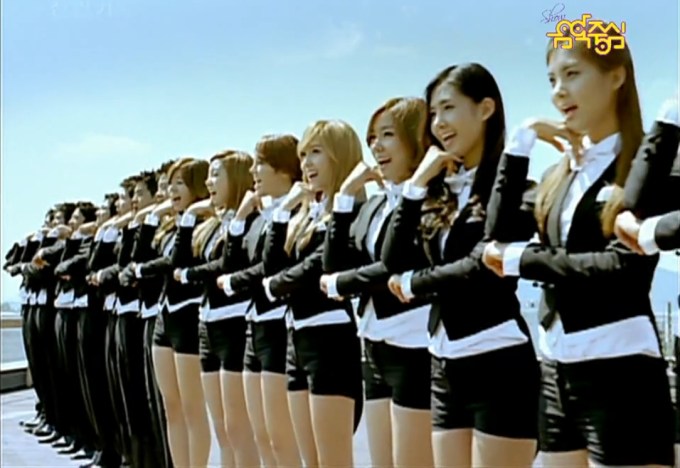
Undoubtedly, that is primarily because most of the women in banking, well, are tellers, as one banker explains below. On the other hand, it’s also true there are some deeply sexist attitudes within the industry — e.g., women lack a “competitive edge” — that underlie that gender division. For more on that, see this post on the 2009 commercial by Shinhan Bank above, which has a clear message that men should do the thinking while women should merely look good.
Also, after reading this post, compare my “University Graduates: One Woman Hired for every Four Men” one from November, where many commenters pointed out that the companies examined were most heavy industries, for which such a gender division was to be expected. This report sheds more light on that, including the surprising news that it’s actually the Hyundai Motor Group that gives the highest average salaries to women.
성별임금따져보니 / Let’s find out the sex difference in salaries
대기업 여성 연봉 순위는 남성 랭킹과 확연히 달랐다. 1위는 평균 7100만원을 주는 현대자동차였다. 남성 평균(9000만원)의 79% 선이다. 이 회사 남성 직원 평균 근무 연수가 17.8년으로 여성(12.2년)보다 고참이 많다는 점을 감안하면 사실상 남녀 간에 임금격차가 없는 셈이다. 현대차 허정환 이사는 “자동차 산업의 특성상 힘든 생산라인에는 여성이 거의 없고 대부분 상대적으로 연봉이 높은 사무직에서 근무하다 보니 여성의 평균 임금이 높다”고 설명했다. 현대차에서 일하는 여직원은 모두 2442명으로 이 중 생산·정비직은 184명뿐이다.
The order of companies that pay the highest average salaries to men and women are completely different. For women, Hyundai Motor Group is number one, which pays 71 million won a year. This is only 79% of men’s average of 90 million won, but when their level of seniority is taken into account (women’s average number of years worked is 12.2, men’s 17.8) then they’re not significantly different. Asked about this, CEO Heo Jeong-hwan explained: ” The car industry is unique — women do not have the strength to work on the production line, so most do office work, where they make more money than the men on the floor. Out of 2442 women working at Hyundai, only 184 work on the production line or in maintenance.”
현대차뿐 아니라 현대차그룹 계열사들은 대부분 여성의 급여가 높았다. 기아자동차(6400만원)가 88개 대기업 중 3위, 현대모비스(5700만원)가 6위였다. 삼성전자는 여성이 평균 5350만원(11위), 남성은 8860만원을 받았다. 삼성전자는 여성들이 생산 라인에서 많이 일하고 있다. 이 업체는 생산직 여성 수를 사업보고서에 기재하지 않았다.
It’s not just Hyundai Motor Group, but also in companies affiliated with the Hyundai Group in which women’s average salaries are high. Kia Motors comes in at number 3 of 88 large companies with an average of 64 million won, and Hyundai Mobis number 6 with 57 million won. At Samsung Electronics, number 11, women receive 53.5 million won and men 88.6 million won. Many women work on the production line at Samsung Electronics, although The Joongang Ilbo is unaware of exact numbers.
전체 88개 기업의 여성 평균 연봉은 4270만원으로 남성 평균 7002만원의 61%였다. 평균 근무 연수는 남성이 12년, 여성이 7.7년이었다. 대기업 남녀 간 임금 격차에는 이런 근무 기간의 차이 때문에 생긴 부분도 있다.
All together, out of 88 large companies the average women’s wage was 42.7 million won, 61% of the average men’s wage of 70.02 million won. Most of this can be attributed to the difference in the average number of years worked, which is 7.7 years for women and 12 years for men.
성별에 따른 차이는 유통업체가 제일 심했다. 여성 평균 임금(2090만원)이 남성(3191만원)의 43%에 불과했다. 매장에서 상품 진열 같은 시급제 아르바이트를 하는 여성이 많다 보니 생긴 일이다. 최근 들어서는 특히 대형마트나 수퍼마켓에서 아르바이트를 하는 중·장년 여성들이 늘고 있다. 남편은 은퇴하고 자녀들은 청년 취업난에 좀체 일자리를 구하지 못하자 주부들이 생활비를 벌려고 나서는 것이다.
(James — There must be a typo in one of the above figures: 20.9 million won is not 43% of 31.91 million won, but 65%; and this is higher than the 61% mentioned in the last paragraph, even though this paragraph is about the lowest comparative figures. Given that, and the mention of a lot of women working part time, then I’m going to assume that it’s the average women’s salary that is the incorrect one, and that it should be 43% of 31.91 million won, or 13.72 million won)
The highest gender gap was in the sales and distribution industry, with women’s average salary of 13.72 million won being only 43% of men’s 31.91 million. The reason is that most of the women are middle-aged and late middle-aged part-time workers in sales, compelled to work in large supermarkets to make a living because their husbands are retired and their adult children find it difficult to get work.
고액 연봉 직종의 대명사인 금융 쪽도 여성과 남성의 차이가 컸다. 평균적으로 여성(4800만원)이 남성(8460만원)의 57%를 받는 데 그쳤다. 남성 연봉 1위인 하나대투증권의 경우 여성 평균 연봉은 6200만원으로 남성의 절반이 채 되지 않았다. 성별 연봉 격차는 8200만원에 달했다. 한국스탠다드차타드은행 또한 남성은 8900만원으로 전체 순위 7위였지만 여성은 그보다 5300만원 적은 3600만원으로 51위에 그쳤다. 외환은행(차이 4500만원)과 삼성화재(4200만원)도 남성과 여성 간에 급여 차이가 많았다. 금융회사들이 남녀 임금 격차 상위를 줄줄이 차지한 것이다.
The largest gender gap is in the finance industry, with women making an average of 57% (48 million won) of what men make (84.6 million won). In the number 1 company for men, Hana Daetoo Securities, women make an average of 62 million won but men make 144 million, more than half as much again [James – That’s 43% of the men; maybe that figure got moved to the wrong paragraph?]. At Standard Chartered Korea, 7th best for men, they make 89 million won, but the company is only 51st best for women, who make 53 million (a difference of 36 million). At Korea Exchange Bank, the gender gap is again high at 45 million won, as it is at Samsung Fire and Marine Insurance. Across the board, the gender gap is very high in this industry.
이에 대해 스탠다드차타드은행 홍보실 정한용 부장은 “고액 연봉을 받는 사무직이나 영업직은 주로 남성이고 여성은 대부분 계약직 창구 직원(텔러)이기 때문”이라며 “여성의 근속 연수도 남성보다 짧다는 점 역시 작용했다”고 말했다. 통신업종은 남성에 대한 여성 임금 비율이 72%로 가장 격차가 적었다.
김영민 기자
Standard Chartered Korea PR Head Jeong Han-young explained: “The reason for the difference is because in our company, it is mostly men that are involved in business and commercial operations whereas most of the women are irregular workers, working as tellers.” Also, “the male workers have been working for the company for much longer.”
The smallest gender gap was in the telecommunications industry, with women making on average 72% of the men.
Reporter: Kim Yong-Min
Update — Thank you to Sky Kauweloa, who pointed out on the blog’s Facebook page that The Korea Times produced a similar, short report. Alas, it doesn’t help resolving those typos above, but it does have information about some more companies, and also the nice graphic I’ve added on the right:
A maddeningly short article, and — as per usual — completely devoid of any mention of the survey’s methodology. But if the result about men’s and women’s sexual knowledge holds true (and I’ll do some further investigation next month to check), it puts a definite twist on Koreans’ belief that contraception shouldonly bemen’s responsibility!
남자 대학생 50% ‘성경험’… 여대생은? 50% of Male University Students Have Sexual Experience. As for Female University Students…?
우리나라 남자 대학생 2명 중 1명은 성관계 경험이 있지만 성에 대한 지식수준은 여학생들에 비해 낮은 것으로 나타났다. 이화여대 건강과학대학교 신경림 교수팀은 보건복지부 연구사업으로 지난해 5~11월 전국 대학생 6000명을 대상으로 ‘대학생의 성태도 실태조사에 관한 연구’를 한 결과 이와 같이 나타났다고 11일 밝혔다.
In Korea, 1 in 2 male university students have had sexual experience, but female university students are much more knowledgeable about sex. That’s one of the results of a nationwide survey of 6000 university students conducted between May and November last year by a team led by Professor Shin Gyeong-Rim of the Ehwa University Health Science College and the Ministry of Health and Welfare, which were announced on the 11th.
성경험이 있다고 응답한 대학생은 남학생이 50.8%로 여학생 19%보다 압도적으로 많았다. 연구팀은 이러한 차이는 남녀의 성에 대한 욕구, 태도, 가치의 차이와 더불어 군대 등의 이유로 남학생의 나이가 여학생에 비해 상대적으로 많고 군대의 성문화에 노출됐기 때문으로 보고 있다.
Many more men (50.8%) said that they had had sexual experience than the women (19%). The research team commented that the differences in [levels of?] sexual desire, attitudes to sex, and value placed on sex were due to the men’s greater ages and their exposure to sexual culture during their compulsory military service.
성지식은 ‘생식생리, 성심리, 임신, 피임·낙태, 성병, 성폭력’ 등 6개 영역 중 5개 영역에서 남학생에 비해 여학생의 점수가 높았다. 이는 남학생이 여학생보다 성지식이 더 많을 것이라는 고정관념을 깨는 결과로, 올바른 성지식 정도는 여학생이 더 높다는 것을 반영한다.
“Reproductive physiology, sexual psychology [James — a bit specialized surely?], pregnancy, contraception & abortion, STDs, and sexual violence” — in 5 out of these 6 areas examined, women scored higher than men [James — which one did the guys beat the girls on?]. This shatters the widely-held belief that men are more knowledgeable about sexual matters.
대학생의 성교육 관련 실태 및 요구도를 조사한 결과 초·중·고교 때는 대부분 성교육을 받은 경험이 있지만, 대학 때의 성교육 경험은 20.3%로 비교적 저조한 편이었다. 성관련 강좌 참여 희망도에 대해서는 33.6%의 대학생이 참여하겠다고 답했다.
Seeing how this reality is related to sex education, the survey found that while most survey participants had received [some form of] sex education in elementary, middle, and/or high school, only a relatively low 20.3% had at university. But if lectures on it were offered however, only 33.6% said that they would attend them (end).
For comparison’s sake, see here for a (much longer) survey of Yonsei University students in 2010.
(Thanks to Robert Koehler for passing on the link)
Apologies for the irregular posting everyone — I’ve been really busy for the last month or so, and to top it all off I’m recovering from a bad flu as I type this too. But fortunately the end of the semester is close, and I’m eager to get stuck into the two blog series I plan to devote myself to this summer.
One is looking at the evidence for double-standards in Korean censorship, while this one is about examining the public and media’s policing of — and consequent narratives about — “appropriate” displays of nudity and sexual subjectivity, set against a recent potential backlash against changing gender relations. In hindsight just two different elements of the same investigation, the former focuses on K-pop in 2011 and this one on political protests in 2012.
As you’ll recall from Part 1 though, one problem with looking at anything explicitly political is that partisan reporting gets in the way, which means we need to consider as many sources as possible to be objective, and especially not just rely on English-language sources. So, let me start that by presenting my translation of a post by a blogger known as “비춤” (or on Twitter as @RainyDance01), which was originally posted on his or her blog Rainy Dance, then later reposted at Mediaus. About the photo on the right (source) of comedian turned model, singer, and actress Kwak Hyun-hwa (see Part 1 for the details), as you’ll see I think the blogger’s heart is in the right place, but unfortunately some of their reasoning dodgy at best, and evidence seemingly pulled out of thin air:
곽현화식투표독려? 누드가일상이되면식상하다 / Does Kwak Hyun-hwa’s Style Promote Voting? When Nudity Becomes Routine, it Becomes Boring
10 April 2012
국회의원 총선거를 코앞에 두고 투표율을 올리고자 수많은 유명인들이 투표 독려에 나서고 있습니다. 소설가 이외수씨는 투표율 70%가 넘으면 머리카락을 싹둑 자르겠다고 밝혔고, 안철수씨 또한 70%를 넘으면 미니스커트를 입고 율동에 노래를 부르겠다고 밝혔지요. 이렇듯 저마다 자신의 공약을 내세워 투표독려에 나서고 있습니다. 이들의 공약은 대중에게 소소한 재미와 더불어 투표참여의 의미를 되새겨주고 있는데요. 거창하진 않지만 자신만의 방식으로 사회적 메시지를 전달하는 유명인들의 모습은 새로운 문화가 되고 있는 느낌입니다.
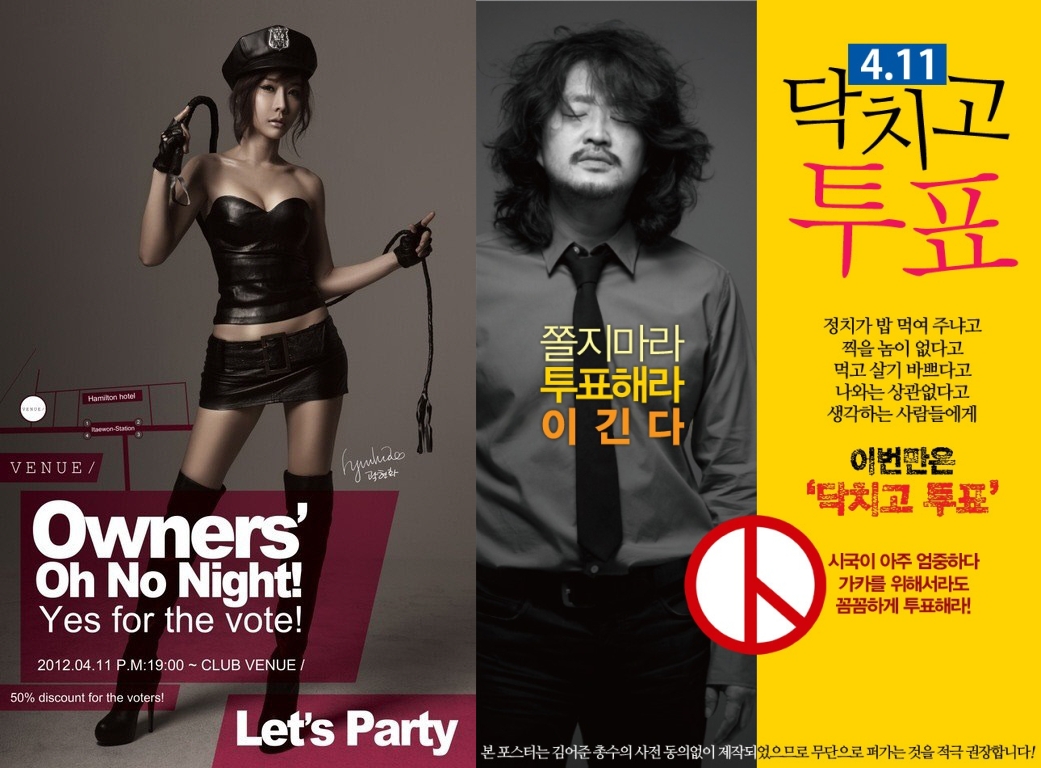
Just before the general elections, many famous people are doing various things to encourage more people to vote. For example, novelist Lee Wae-soo has pledged to cut his trademark long hair if the voting rate exceeds 70%, while Ahn Cheol-soo has promised to dance wearing a mini-skirt (see below). While these may sound just trivial and fun, they do remind voters about the meaning and importance of voting. Also, while their ultimate impact may not be all that great, they point to a new trend of famous people spreading social messages.
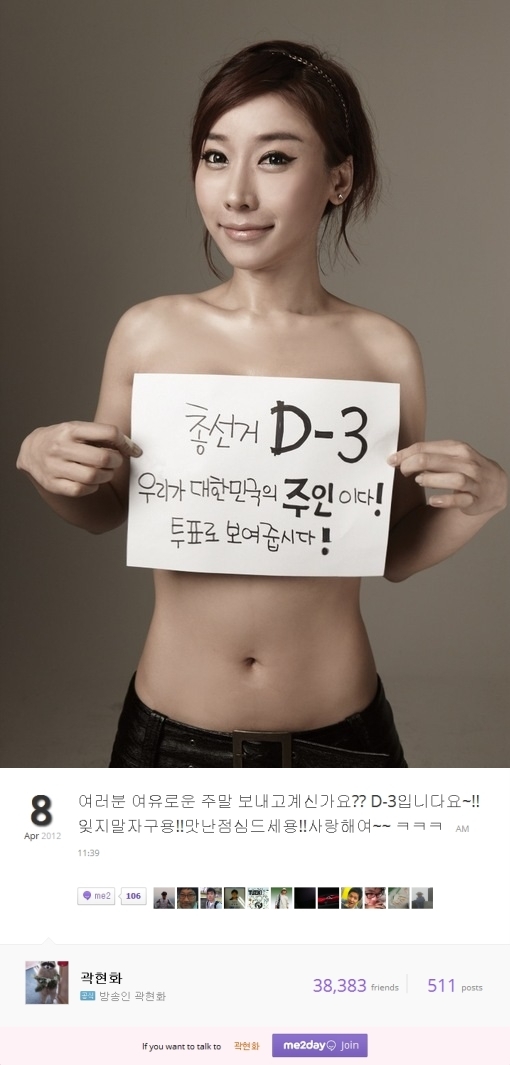
그런데 같은 목표를 지향하더라도 그 방법 탓에 오히려 대중의 반감이 우려되는 경우도 있는데요, 개그우면 곽현화의 경우가 그렇습니다. 곽현화는 투표독려를 위해 자신의 미투데이에 ‘총선거 D-3, 우리가 대한민국의 주인이다! 투표로 보여줍시다’라는 내용이 적힌 종이를 들고 있는 상반신 누드 사진을 올렸습니다. 그 의도야 건설적이지만 이면에는 새로울 것이 없는, 우리의 식상해진 문화 코드가 선명하지요.
However, while they all have the same target, some celebrities’ methods may actually make voters more apathetic. One such case is that of comedian Kwak Hyun-hwa. In her case, she uploaded a photo on her me2day blog in which she is holding a sign in front of her nude upper body. The sign said “It’s 3 days to go before the elections. We are the owners of Korea! Let’s show this by voting!”. But while the intention was constructive, on the other hand this method is hardly original, and shows the paucity of our culture.
자신의 의사를 표현하는 방법에 옳고 그름을 규정하기는 어렵습니다. 하지만 그녀가 지금까지 보여온 행보를 본다면 아름다운 취지보다는 이면의 가십거리가 더욱 부각될 수밖에 없겠지요. 폭소클럽 출연당시 가슴노출이 심한 드레스를 입고 출연해 노출논란의 불을 지핀 이래로, 그녀는 꾸준히 노출의 길을 걸어왔었지요. 섹시화보가 누출되어 세간에 화제가 되기도 했으며, 지나치게 선정적인 앨범 이미지컷으로 눈총을 받기도 했습니다.
It’s difficult to judge what the best or most “correct” way of expressing oneself is. But looking at Kwak Hyun-hwa’s past history up until now, it’s difficult not to conclude that this stunt of hers was more aimed at creating gossip and attention about herself than anything noble. When she was on the comedy Foxclub for example [James — she quit in 2009], she used to create a lot of controversy by wearing a lot of revealing dresses, and since then has continued on a similar path. For instance, she has done a very sexy photoshoot, and received criticism for her provocative and suggestive images for her album.
(James: I’m not judging — and/or defending — Kwak Hyun-hwa in any sense, but just for the record: while she’s certainly done sexy photoshoots, and you can judge her album pictures for yourselves, I think it’s unlikely that she regularly wore a lot of revealing dresses on Foxclub. If she had, then presumably there’d be far more “노출” videos and photos of her on that show available than just those from one short skit back in 2008)
올 초에는 개그맨 동료들과 선정적인 포즈로 찍은 사진이 이슈가 된 바 있는데요. 비난이 잇따르자 이에 대한 반감으로 자신의 미투데이에 바나나를 먹는 야릇한 표정의 사진을 올려 더 큰 역풍을 일으키기도 했지요. 하지만 그녀는 떳떳하게 말합니다. ‘’성적인 감정을 일으켰다고 해서 지탄하는 것은 마녀사냥이다. 의도를 떠나서 개그맨 전체를 싸잡아 욕하는 성급한 일반화의 오류를 범하지 말아 달라’
Earlier this year, some pictures of Kwak Hyun-hwa in pretend sexual poses with some her comedian colleagues became an issue [James — they can be seen here]. In response to the criticism that followed, on her blog she posted pictures of herself with a perverted expression on her face while eating a banana [James — was the author too embarrassed to be more specific?], which led to even more criticism. But in response to that, she boldly replied, “Just because something is arousing doesn’t mean it should be criticized — to do so is nothing but a witchhunt. And whatever the intention(s), don’t make the mistake of making rash generalizations about all comedians.”
과연 그녀를 바라보는 냉랭한 시선은 성급한 일반화의 오류일까요. 사실 벗는 것은 여자에만 국한된 것은 아닙니다. 남자도 벗습니다. 초콜릿복근이니 식스팩이니 하며 매력을 뽐내는 남성들도 얼마든지 있지요. 하지만 남성의 매력을 규정하는 잣대에서 ‘벗는 것’의 비중은 상대적으로 크지 않습니다. 지적인 남자, 자상한 남자와 같이 이 시대의 여성이 매력을 느끼는 아이콘은 상대적으로 많은 편이지요. 그래서 벗는 것으로 일관하는 남자는 오히려 역풍을 맞기도 합니다. 여담이지만 한때 1박2일에선 이수근이 숱한 노출을 보이며 빈축을 사기도 했습니다.
Well, is looking at her coldly and making a rash generalization really a mistake here? Of course, it’s not just women that take their clothes off — men do too. To show off their attractiveness, they expose their chocolate abs, their six packs [James – actually, those are the same thing], and so on. But relatively speaking, taking clothes off isn’t as important for men as it is for women; because in this day and age, there are many ways in which women can find their male icons attractive — they can be intellectual or kind. It would be bad if men only took their clothes off. When Lee Su-geun showed too much of his body on an episode of 2 Days & 1 Night for instance, people didn’t like it.
(James…)
반면 여성들에겐 유독 섹시미 혹은 백치미가 강조되지요. 5살 유아부터 70대 할머니까지 섹시하다는 말은 일상어처럼 사용되고 있습니다. 드라마에선 홀로 당당한 일어서는 여성의 이야기는 그다지 성공적이지 못합니다. 여전히 신데렐라의 환상이 더 잘 팔리는 시나리오지요
On the other hand, for women being sexy or being stupid but cute is emphasized. From when they are just girls of 5 to when they are grandmothers in their 70s, the word “sexy” is part of daily life for women. In dramas, the strong, confident woman that succeeds through her own efforts is never a popular story, whereas the Cinderella fantasy is a scenario that always sells well.
이 시대의 남성들은 여성의 매력을 이 한 가지로 국한하고 있는 걸까요, 혹은 여성이 자신 있게 내세울 수 있는 매력은 이 한 가지뿐일까요. 양성평등의 가장 큰 위협은 이렇듯 일방적으로 여성의 섹시함을 강요하는 작금의 문화가 아닐까 싶습니다.
Is this because men of this day and age set limits to women’s sexiness [as just showing off their bodies], or because this is the only sexiness which women can show off confidently? I think this culture of emphasizing just this one side to women’s sexiness is today’s biggest threat to sexual equality.
이 시대의 청년들에게 닮고 싶은 사람을 떠올려보라면, 남성 쪽에선 다양한 매력이 쏟아져 나올 수 있겠지요, 안철수, 안성기, 조국, 손석희, 유재석 등 다양한 분야의 사람을 떠올릴 수 있습니다. 헌데 닮고 싶은 여성상을 물었을 때 우리 사회의 한축을 담당하고 있는 여성을 얼마나 떠올릴 수 있을까요. 그 자리에 섹시아이콘만이 남아 있다면 우리사회가 얼마나 건강하지 못한지를 반증하는 것이겠지요.
These days, when teenagers are asked who are their role models, boys mention men who are attractive in many different ways and from many fields of life, such as Ahn Cheol-soo, Ahn Sung-ki, Kuk Cho, Son Seok-hee (above), Yoo Jae-Seok, and so on. In contrast, although there’s many women to choose from, girls just name sexy icons. I think this shows how unhealthy our society is.
(James: Other than their fathers, I don’t believe for a moment that teenage boys mention men in their 50s or older as their role-models, even when they want to impress whoever’s asking)
곽현화는 좋은 취지에서 누드시위를 했습니다. 하지만 그 이면에는 이 땅에서 쉽게 주목받고자 하는 여성의 식상한 방법론이 새삼스럽습니다. 우리 사회의 쓸쓸한 단면이겠지요.
Kwak Hyun-hwa [may have?] had good intentions, but her method was unoriginal and was just a way of getting noticed. This too is a sign of how unhealthy our society is (end).
What do you think? Again, I find the blogger’s logic — and especially notions of male and female desire — flawed, but at the very least I am now very interested in finding out more about Kwak Hyun-hwa. Not because I think she has any musical talent though (frankly, I hated Psycho above), nor because I naively think her “nude” photo was anything but completely self-serving. Rather, because:
• She deserves a lot of credit for reinventing herself as a model, singer, and actress after being best known as a slightly chubby (by Korean entertainment standards) comedian.
• Whatever her musical abilities, it was especially brave of her to even attempt to become a solo singer in her late-20s (old age by K-pop standards).
• She’s a maths graduate of Ehwa Women’s University, and has even published a textbook for middle-schoolers (see below), so she’s probably quite smart. And I’m not being facetious when I say that many men and women may not be able to see past her cleavage to realize that (related, make sure to read the classic With Great Cleavage Comes Great Responsibility).
• What solo celebrity’s public actions and statements aren’t motivated by self-interest? Which is not to say that they’re always cold and calculating of course, but still: it seems a strange criteria to dismiss someone as a person for (after all, heaven forbid that someone use their sex-appeal to advance their career), and is simply an ad-hominem method of devaluing that style of getting a political message across.
As for its effectiveness, for its stated purpose of encouraging people to vote that is? Well, determining things like that is what this whole series is about, but in the meantime let me pass on Tom Megginson’s take on a similar recent political campaign by Mexican politicians (my emphasis):
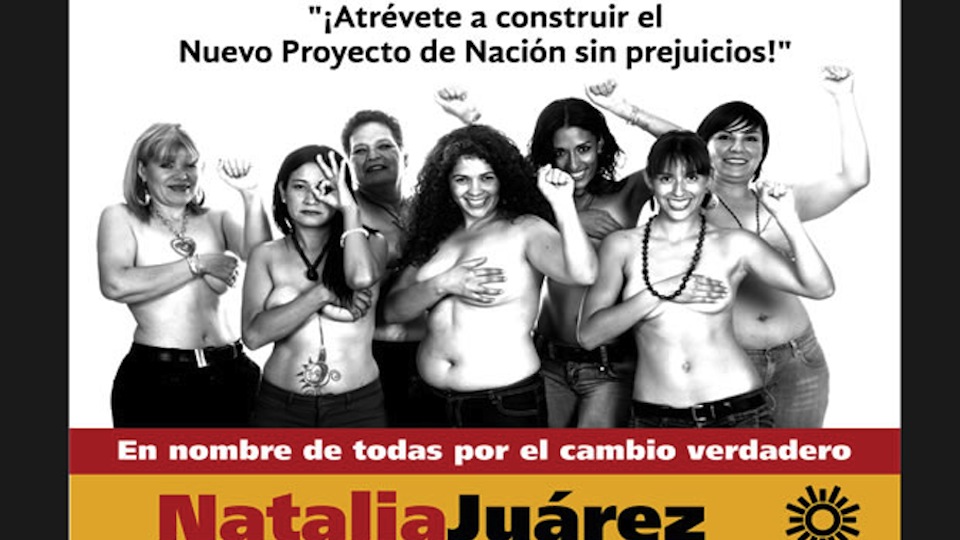
Jezebel’s Erin Gloria Ryan is a little cynical about the use of “boobies” to get attention, but I applaud any effort in which women take back ownership of their bodies by using our primal fascination to deliver messages of solidarity for social change.
• And finally, remember when Lee Hyori recently publicly admitted that she has sexual feelings and experience? Judging by the reactions of K-pop fans, that was quite exceptional, and indeed I joined in praising her for it in Part 1. But to take a more detached perspective, that this was news at all is really quite an indictment of the sex-only-for-display-nature of Korean entertainment. For remember that we’re not just talking about a 33 year-old woman here, but one who was also Korea’s number one sex-symbol for much of the 2000s. It simply beggars belief that she has ever had to be coy about her sexual subjectivity.
Why do I mention that? Because despite the attention given it, Lee Hyori’s admission pales in comparison to Kwak Hyun-hwa’s stunts with bananas and her comedian friends. And recall that by my own definition, I shouldn’t have to seek-out pin-up grrrls, but rather they should do their darnedest to make me aware of them. In which case, Kwak Hyun-hwa more than qualifies!
And on that definitive note, what is coming in Part 3? Well, frankly a little disappointed with the blog post I translated, next I’ll try make sure to do something more substantial, namely this newspaper report on reasons for the recent “ladygate” phenomenon; i.e., the emerging backlash I mentioned. Thanks to Robert Koehler for the link.
Next, an anonymous reader seeking some help and/or information:
I was wondering if you had any info on the Korean culture’s perception of mentally disabled and handicapped women. I have searched on my own, but have limitations as I am still a beginner learning the language. I am curious how they function in society. I ask because I am a Korean adoptee who recently found out my mother had an ‘intellectual disability,’ which is not totally reliable, but I am trying to research what her life in Korea may have been like.
Just thought I would reach out and say I enjoy your blog, and wondering if you knew anything that could help me contextualize my research. Thanks!
And finally an email from Jaehak Yu (slightly adapted by me):
…two of my friends and I are participating in what is called the Mongol Rally in 2013. It’s basically a 10,000-mile drive from London to Ulanbator, Mongolia. The main focus of the rally, however, is to raise money and aid for both the Mongolian people and a charity of our choice. Our charity is the Children’s Hospital of Orange County — a great nonprofit that is devoted to taking care of children in need.
Currently, we are in an “awareness” stage — trying to gather attention to our causes and our journey….Naturally, I’m sure readers would want to read more before they promise any sort of involvement. Our website should detail the specifics of our journey as should our Facebook page. If anyone has any other questions and/or is interested in a possible collaboration, I’d love to talk to you some more. My email is jaehak.yu93@gmail.com or I can be reached by cell at (949) 648-1519.
If you’ve been following my The Gender Politics of Smoking in South Korea series (Part 1, Part 2, Part 3, Newsflash, Part 4, Korea’s Hidden Smokers), you’ll know that there’s a huge stigma against women smoking here. This leads to chronic under-reporting by female smokers, which in turn leads to the government and media regularly giving female smoking rates as low as 2-4%. In reality though, best estimates put the rate among young women at roughly 20%, pointing to a looming health crisis.
Even if the coming presidential election brings more enlightened officials to the Ministry of Health and Welfare (보건복지부) however, which has previously overwhelmingly focused on—and been accused of exaggerating—reductions in the male smoking rate, there’ll still remain the problem of finding out how many young Korean women actually smoke.
Or will there? With my thanks, let me pass on a reader’s partial solution:
My coworker, the assistant haksaengbu (학생부) at my high school, made a list of students caught smoking. This is at a small-town girls high school, with 330 students age 15-18 in western years. So far this year (since 2 March) 14% of the students have been caught smoking, with 9.5% of the academic (moongwha; 문과) students caught and 25% of the vocational (sanggwha; 상과) students caught.
I would think that 14% would be the absolute minimum possible average in Korea, considering that we’re in a fairly conservative area and teachers can still punish students (though it’s pretty inconsistent and haphazard). Considering that those are only the ones who’ve been caught and there’s almost nothing in the way of lunchtime and after-school supervision, I’d guess that the amount who smoke on a daily basis is 50% higher and the ones who’ve tried it on occasion is double that.
In any event, if you wanted some incontrovertible statistics about teenage girls smoking in rural Korea based on a sample size in the hundreds there you go!
Later, they added:
If you’d like the breakdown it was 21 out of 226 moonghwa students and 26 out of 106 sangwha students. I believe a couple of the sangwha students have dropped out/gone awol/transferred.
What do you think? How does this compare to readers’ own schools?
If you reside in South Korea, you can donate via wire transfer: Turnbull James Edward (Kookmin Bank/국민은행, 563401-01-214324)
Via 10 Confessions, here is a short but quite rare “expo on the focus of the mass media and internet news sites on superficial looks of the entertainers in the industry, and how this trend needs to change.” Sorry that it’s all in Korean, but 10 Confessions provides a good (English) description of it, and it’s the least I can do to pass on the videos themselves (especially after spending half an hour looking for them!).
To see the segment, jump ahead to 2:30 in the first video. It lasts until 4:10 in the second.
Whenever I give lectures about Korean advertising, I always try to stress how quickly it’s changing. As both a reflection and driver of changes in Korean society itself, it’s one of the reasons why studying it is so interesting.
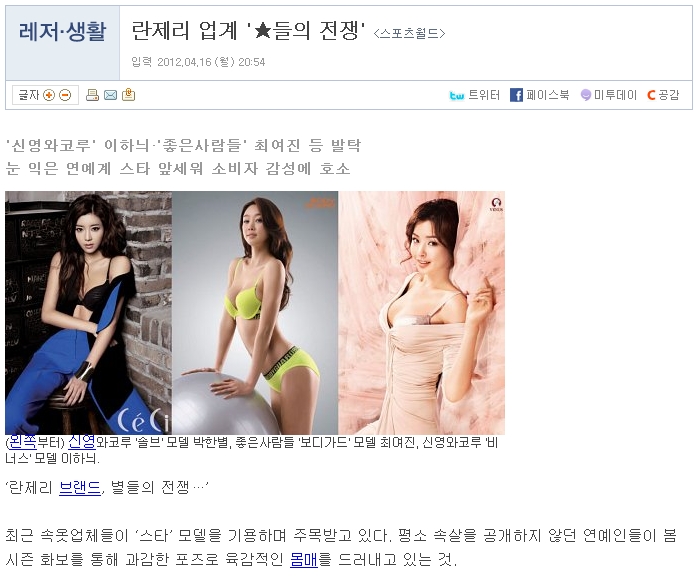
But this is a familiar topic to most readers, and I do apologize for the repetition. It’s just that, today, it was reported that Core Contents Media (CCM) had turned down a lucrative lingerie-modelling contract for soon to debut girl-group Gangkiz (갱키즈), as such advertisements “wouldn’t fit [their] musical color and image” (“제안은 감사하지만 갱키즈 음악적 색깔, 이미지와 맞지 않다고 판단한 결정이었다”). Ironically though, most of the reports were accompanied by pictures from a recent bedroom photoshoot of theirs, including one which has one member’s shirt nearly falling off, slightly exposing her bra; one with another member lying expectantly on a bed, her shirt only just held together by a single, strategically-chosen button; and then of course the opening picture with Lee Hae-in (이해인) above.
One seriously had to wonder what image CCM felt needed to be protected exactly.
On the other hand, while it’s certainly possible that CCM was just seeking attention for Gangliz, that attention could easily prove counterproductive once CCM’s hypocrisy was exposed. So perhaps they they did genuinely have concerns about the effects of “official” lingerie modelling on Gangkiz’s reputation.In which case, just what is the difference between that and exposing lingerie while modelling something else, and/or as part of a random photoshoot? Do Korean models and consumers really make such artificial distinctions?
I decided to refer back to the original article about pornography actors giving lingerie modelling a stigma to get a clearer picture. Partially because it’s been a couple of years since I last read it, and partially because, frankly, I had concerns that I misunderstood it the first time back in 2008, and have been misinforming readers ever since. In particular, there was the distinct possibility that the main reason there were so few Korean lingerie models was simply because it was just too “sexy” for them, and indeed that is still potentially — nay, probably — a very big influence here (they’re not mutually exclusive).
To my relief though, I hadn’t misunderstood anything, although it did turn out to be nude models rather than pornographic actors. But — with no offense to the translator, who probably normally makes far fewer mistakes than I do — I did notice a big mistranslation of the following paragraph (from this original Korean article):
홈쇼핑 속옷 모델의 원조는 누드 모델이었다. 90년대 말 S씨 등 스타 누드모델 10여명이 속옷 모델로 나와 방송을 타면서 화제를 모았다. 하지만 그녀들은 “얼굴을 가려달라”고 요구하는 등 몸을 사리는 일이 많았다. 그래서 점점 출연 횟수가 줄었고, 2000년 이후 케이블 TV에서는 국내 속옷 모델이 거의 자취를 감췄다.
Which was translated as:
Home shopping underwear models started as nude models. At the end of the 1990s [Miss] S and over 10 other star nude models caused a stir by moving into underwear modelling on home shopping programs. But they were able to get a lot of work when their attractive faces and bodies came into demand. So more and more of them started showing up, and after 2000 almost all underwear models on cable TV were Korean.
But unfortunately the last two sentences, were, well, completely wrong. Here’s my version:
…programs. However, they [not only] demanded that their faces be covered while were on the air, [but] they were also shy and reluctant to show off their bodies. So, gradually they started appearing less and less, until by 2000 there virtually no Korean women modelling home-shopping on cable TV.
In the translator’s defense, the original Korean article was badly written and confusing (e.g., were those 10 nude models the only Korean lingerie models?), and didn’t respond to the obvious question raised of why on Earth the nude models became shy about lingerie modelling, which I speculate was because of the controversy and fame their presence on TV created. Nor does it mention the fact that there have actually been plenty of Korean women on lingerie homeshopping shows since 2000, albeit fully-clothed and holding the lingerie on coat-hangers while their foreign counterparts alongside them wore it (which is really quite surreal to watch).
But still: hiding their faces? That does explain a lot about how, over a decade later, there are online lingerie stores on which not a single Korean model shows her face, or lingerie fashion shows in which the Korean women (but not the Korean men or foreign women) hide themselves under hats and sunglasses (see #3 here). In hindsight, it’s amazing that this still occurs as late as 2012, and especially that celebrity models haven’t had more of an impact on the industry yet, despite what I recently wrote about their surprisingly strong influence in Korea. I guess that the stigma is stronger than I expected then, and hence some of these women much braver than I gave them credit for.
For more on related issues raised by the ensuing disproportionate number of Caucasian models in Korea, see this recent post at Seoulbeats, which also discusses their growing numbers in K-pop music videos. As for me though, it’s back to updating my Powerpoint! :)
Apologies for the continued slow posting everyone, but I still have many good excuses, not least of which is my upstairs neighbor’s bathroom virtually exploding last night, suddenly sending torrents of water down the wall next to my computer as I typed on it (seriously, I was lucky I wasn’t electrocuted). On the plus side though, I’m happy to report that one of the guest lectures I’m doing is open to the public for a change, albeit at a terrible time, and that everyone is more than welcome. Please see above for the details, and here (click on “Visiting Us”) for a map of how to get to the building. It’ll last for about an hour, with fifteen minutes for questions.
See you there? I promise to buy you a coffee if you tell me in advance! :)
Whenever someone strips for the sake of drawing attention to some cause, usually my instant, gut reaction is to dismiss it as a crass stunt. Unless it’s for Slutwalk or FEMEN, then I’m just too suspicious of their real motives, especially if they’re not already famous.
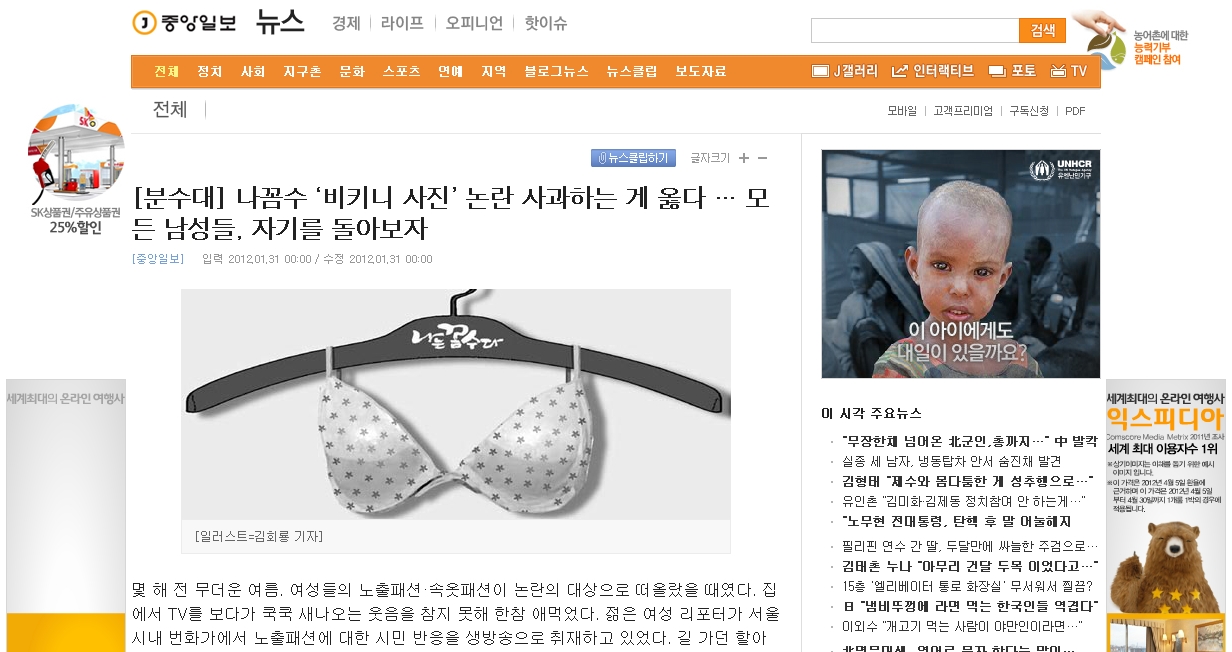
That’s why I didn’t cover this woman back in January, who wrote a message of support for jailed Naneum Ggomsuda (나는 꼼수다) podcaster Chung Bong-ju (정봉주) across her breasts; as while she was anonymous herself (ish), other men and women that followed her example certainly weren’t. Although, in hindsight, only a handful of pictures would actually be sent in, despite an audience of millions, and I overlooked that one of the men was already semi-famous as Chung Bong-ju’s photographer, at the time the podcasters’ call for more bikini shots just seemed like an invitation for a repeat of 2006 and 2010, when women vied with each other to become famous by wearing the most revealing Red Devil costumes.
But then NancyLang (낸시 랭) paraded aroundSeoulin a bikini two days before the April elections, which made me sit very uncomfortably in my seat. Because after lauding her as a “pin-up grrrl” back in November, I couldn’t be quite so dismissive this time, even though her street performance was surely just as crass, and its connection to its ostensible cause — encouraging people to vote — tenous at best. Yet other than a long history of doing similar such performances, how was she really any different from those Naneun Ggomsuda supporters that wrote messages on themselves back in January, and for whom she’d even expressed her support? How about all the other similarly-themed protests and/or pledges over the past few months too, including Kwak Hyun-hwa’s (곽현화) above?
So, wanting to learn more about the efficacy of such protests, and particularly how useful — or possiblycounterproductive — they are in a feminist sense, I realized that “Bikini Girl” deserved a second look. Or, more specifically, what her breasts ultimately raised. For as many of you will already be well aware, the reactions of the podcasters to them, and especially their encouragement of more such pictures, was soon critiqued by many on both the Left and the Right…which in turn led to counter-critiques of those critiques, then the Right chastising the Left for not critiquing the podcasters more, and so on — it was all very confusing. What was necessary was a chronology of events, which indeed I provide below.
But think about it: when breasts become not so much a mere body part as a titillating device for political parties and media allies to score points against each other, then to put it mildly you can’t trust just any one source’s interpretation and depiction of events, and especially not just rely on those that happen to be in English. Which is just common sense, but it deserves reiterating (and for another good illustration of partisan reporting, make sure to see the Korean media’sreaction to netizen attacks on newly-elected Philippine-born Jasmine Lee). So, the other posts in what must inevitably become this series will be translations of some Korean ones, starting with this, then this, this, this, this, and/or any more I can find (and/or readers recommend).
Still further complicating matters however, events have coincided with a potential emerging “~녀/girl” meme, in which a series of incidents involving (mostly) young women have left a host of misogynistic netizen reactions in their wake. In particular, for me personally it was this recent incident on a bus, in which a woman in her twenties — out of many angry passengers — was unfairly singled out for criticism, that signaled that something farmoreperniciousthan simple netizen ranting was afoot, and that thebacklash against changing gender-relations in Korea that led to the disparaging “beanpaste girl” (dwenjang nyeo; 된장녀) term in the mid-2000s was still very much around.
Even if, ultimately, there are no real connections, it would be strange to analyze bikini and nude protests — some of which arguably very much challenged prevailing conceptions of “appropriate” displays of sexuality and expressions of sexual subjectivity — without also considering that a potential backlash against changing gender-relations is also occurring. Hence expect moretranslations about the latter also.
On top of that, as if to taunt me, over the last 2 weeks Uniqlo Korea happened to have a “Women’s Freedom Event“, used to sell their “BraTop”. By this stage thoroughly sick of breasts (okay, not really; but I’m sure you can appreciate the sentiment), this choice of language instantly raised some alarm bells, as it reminded me of the following:
…some advertisers, aware of the objections of the feminist movement to traditional images of women in ads, have incorporated the criticism into their ads, many of which now present an alternative stereotype of the cool, professional, liberated women…Some agencies trying to accommodate new attitudes in their campaigns, often miss the point and equate ‘liberation’ with a type of aggressive sexuality and very unliberated coy sexiness (G. Dyer, Advertising as Communication, 1982, pp. 185-86; quoted in D. Strinati, An Introduction of Theories of Popular Culture, 1995, pp. 187-88)
Or indeed “freedom” rather than “liberation”. And, technically speaking, Uniqlo is simply appropriating the word in order to simply sell more clothes. But even if I have always had a fondness for the company, it did interview somegenuinelycoolwomen as part of its campaign, and, recalling the line of inquiry that started this 3-week(!) post, provides a healthy reminder to myself to: a) reconsider some of my prejudices and gut reactions to things; and b) not read too much into things.
And on that note, let me apologize for how convoluted and wooly some of my own understanding and explanations of pin-up grrrls have been in the past, and very briefly give some clarifications and further observations on those before presenting the chronology. Not because they’re the final word by any means, but more because, hopefully, they’re good things to bear in mind as you consider the events of the past few months:
• Being a sex object doesn’t necessarily preclude one from also being a sexual subject. They are not mutually exclusive.
• However, expressions of sexual subjectivity remain a big taboo in Korea. Or in other words, we can have a 25 year-old’s S-line quite literally highlighted for a heterosexual male gaze, but heaven forbid she admit to having sexual feelings and experience herself. Certainly, this does apply to male celebrities too, but I’d argue to a much lesser extent. In turn, while this double-standard is present in other countries, it’s not difficult to think of female celebrities that thrive on challenging such taboos, whereas admissions like Lee Hyori’s seem to be few and far between among their Korean counterparts (although I’d be very happy to be proven wrong).
• Nobody deserves criticism for financially benefiting from their sexual attractiveness. It is basichumannature, and applies equally whether one is a public or private figure. Moreover, while I can certainly respect those ballsy celebrities who are honest about doing so, nobody ever needs my approval for what they wear, and can give any reason they like — or indeed no reason — for their choices.
• Having said that, using self-sexualization to advance a cause is a double-edged sword, and can easily end up more distracting the intended audience than anything else. Which sounds facetious; but as we’ll see, Bikini Girl proves to be a good case in point.
• Nevertheless, it is hypocritical to criticize politically-motivated sexualization without also criticizing commercially-motivated sexualization, and betrays a political agenda. Indeed, given the pervasiveness of the latter, using skin to get attention is an obvious tool, so it’s strange that we don’t see people stripping for a cause more often in Korea.
Finally, the chronology. Sorry that the Bikini Girl protest is actually the only one that I cover in it, albeit interspersed with all the “~녀” incidents, but another purpose in all the coming translations is getting on top of all the (far less well-documented) other ones, and I’ll either update this chronology or produce a new separate one once I do:
“I’ve written a novel to call for heavier punishments for child molesters in the Republic of Korea, which is a world of male chauvinism. This is a country where those sexually assaulting a female schoolmate are released with suspended jail terms because they were drunk, the girl was insufficiently dressed, or she was deemed a slut. This is a country where 70 percent of men have bought sex, so it is natural that people’s perspective on women’s bodies is political,” she said.
— See the Korea Herald (here and here) and Modern Korean Literature in Translation for a discussion of this reaction. In the latter, author Charles Montgomery argues that “immediately [going] to ‘child molestation’ and ‘assault’ in her argument against what is essentially a bikini shot” is too much of a jump, and that with her blanket statement of opposition to them, “Gong is doing a different version of what the GNP has tried to do to her – shutting down a clever method of getting publicity.”
— “Nude Male Campaign Appears After Bikini Girl Protest Criticized” (Daum; translation viaKorea Bang):
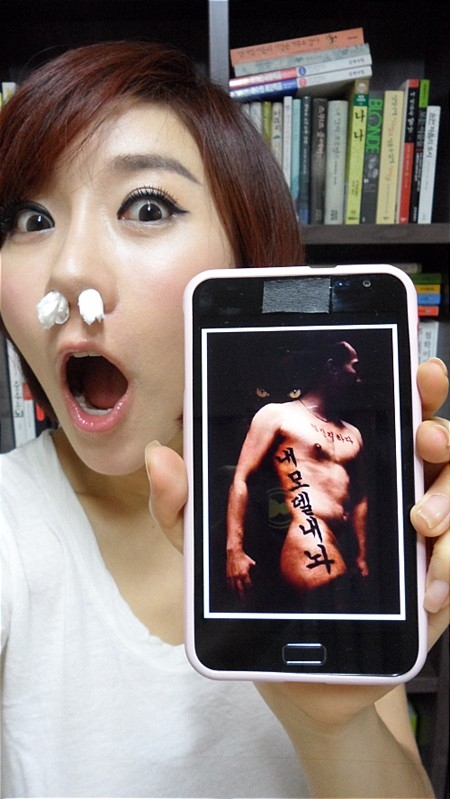
Nude male photos in support of the imprisoned ex-MP Jung Bong-ju from the campaigning group ‘Jung Bong-ju and Future Power’ appeared on the web today. This was in response to accusations against the bikini protest as female sexual harassment.
Choi Young-min, a professional photographer who worked closely with the ex-MP was equally famous among his followers.
Painting the message ‘I’m dead serious’ and ‘Give back my model’ on his body was to remind the viewer of his support for the ex-MP.
In his interview with Money Today, Choi argued that “the female bikini campaign to publicize Jung’s case was seen as trivializing the campaign by ‘using’ the female body. I wanted to counter those criticisms by using male nudity.”
February 5:
— Naneun Ggomsudua podcasters refuse to apologize, head host Kim Ou-joon (김어준) arguing “that their comments were not sexual harassment, nor were they intended to be” (Korea Times):
Kim said that in order for the comments to be sexually harassing, inequality of power must exist.
“The woman who uploaded the picture must feel like she would be disadvantaged if she said she was sexually humiliated. However, the woman did not feel that way and we don’t have the power to suppress her from saying it. Therefore, sexual harassment did not take place,” he said.
Kim made it clear that they would not retract or regret the comments. “The right to express a political opinion using one’s body should be recognized,” he said.
— But note that The Korea Joongang Daily provides a slightly different, more positive translation of the above (surprisingly, considering it is a conservative newspaper):
“We didn’t have any intention of sexual harassment and she [the female protestor in bikini] didn’t feel in that way,” Kim said. “She has the right to express political issues and her rights should be respected. No one can limit that right because he or she feels uncomfortable.
“It’s true that I was impressed by the biological perfection [of the woman] at first, but at the same time, I was also impressed as a political comrade by this new kind of protest,” Kim said.
— See Korea Law Today for an analysis, where author Nathan McMurray (quite presciently) noted:
I know the whole modus operandi of the creeps is to be irreverent and provocative. But irreverence is only useful when it furthers, rather than hinders, the show’s goals. I am curious if these recent events will have any impact on the upcoming presidential election, where the conservative candidate will likely be a woman (Park Kun-hye, the daughter of Park Chung-hee, who I briefly mentioned here). Plus, this stuff is just not funny. If you insist on “working blue,” please make me laugh.
— Indeed, with the benefit of hindsight, at best the controversy created distracted people from more important issues, whereas at worst it presaged deep divisions in the Left’s support for them, well before years-old misogynistic comments of one of them, Kim Yong-min (김용민) emerged in April.
— On the other hand, it’s important not to judge Kim Ou-joon’s above defense in light of those comments either, or the efficacy of Bikini Girl’s and other protests. That would just be an ad-hominem attack and guilt by association respectively.
February 6:
— Three “of the nation’s liberal online communities – Ssanghwa Tea Cocoa, Souldresser, and Hwajangbal – issued a joint statement on Monday evening that they were disappointed by the reckless remarks of the liberal hosts regarding women (Korea Joongang Daily; see the full [Korean] statement here):
“Their remark related to nosebleeds means they see women with typical male-centric views, considering women as mere tools for sexual entertainment to cheer up men’s political activities,” the joint statement said. “They also fueled controversies once again saying ‘impressed by biological perfection,’ implying that its natural to view women as sexual objects.”
“The show’s hosts should realize their show is no longer a B-level alternative broadcast and has grown into a political representative if they want to become real liberals,” the statement said.
The Web site for Chung’s fan club, called Chung Bong-ju and Future Powers, was filled with posts criticizing the joint statement…
March 1
— “Swearing Woman” slapping man on Seoul subway video goes viral (Korea Bang)
March 9:
— “Hot Soup Lady” proves not to be at fault (Korea Bang).
I’ve also noticed the trend of collective, public humiliation of Korean Girls Behaving Badly. That’s not to say that the women involved are innocent or that men are let off scot-free. But you definitely don’t see the same reaction when Korean men “act out of line.” There might be public criticism, to be sure, but nothing like the witch-hunts and publicity we’ve seen in the case of women….
March 21:
— New subway swearing “Cigarette Lady” video goes viral (Korea Bang)
March 27:
— “Beer Girl” smokes on subway, pours beer on pensioner (Korea Bang)
March 30:
— “Soju Girl” debuts, same girl as “Beer Girl”? (Korea Bang)
April 6:
— Kim Yong-min, by this stage a candidate for the main opposition Democratic United Party candidate in the northern Seoul constituency of Nowon-A, was revealed to have made vulgar and misogynistic comments when he appeared on an Internet broadcast in 2004 and 2005 (The Korea Herald):
Some of his recently revealed remarks include: “If all escalators and elevators at the City Hall metro station are dismantled, (conservative) old men and women will not be able to gather around the City Hall to hold demonstrations” and “If we take all U.S. soldiers in Korea hostage and run an armored vehicle over them one by one, Bush cannot help but step down”; and “Let’s release (serial killer) Yu Yeong-cheol and rape and kill (Condoleezza) Rice and kill Rumsfeld and Bush.
The ruling Saenuri Party, women’s rights groups and even liberal figures have piled pressure on the DUP leadership to withdraw his candidacy…
— As readers will be well aware, the DUP decided to keep him, and indeed his popularity before news of these comments emerged should not be underestimated. But with the benefit of hindsight however, this decision is widely considered to have cost the DUP the election (The Korea Herald; see this [small] poll at Korea Law Today also):
…The opposition party should have withdrawn his nomination for damage control, but it did not.
The failure to act decisively against the podcaster turned moderates and swing voters against the opposition party, undoubtedly making it possible for the ruling party to win in many closely contested districts.
If it had not been for the podcaster’s nomination, the main opposition party could have won a majority of electoral districts, if not alone, in alliance with the small United Progressive Party. Instead, the DUP won 127 seats in the 300-member National Assembly, and the United Progressive Party took 13. On the other hand, the ruling Saenuri won 152 under the leadership of Rep. Park Geun-hye.
April 9:
— “Girl in bikini uses pussy to encourage voters” (Korea Bang)
April 18:
— “Bus Girl” demands driver apologize on knees” (Korea Bang; also source, right):
As the photo went viral, other articles surfaced explaining the what presumably really happened. One such article stated that with passengers getting frustrated and the driver showing insincerity towards the situation, he was asked to get down on his knees. Another blog post claims that as the bus finally arrived at the bus terminal, the ground staff showed indifference to the passengers’ inconvenience, to which they suggested the staff get down on their knees. Refusing, the bus driver did instead. The latest “Ladygate” incident shows how just one photo can be subject to open interpretation, and how netizen opinions in Korea, no matter how far-fetched and ridiculous they may seem, are not taken lightly by news outlets – having the power to change entire news stories or even make new ones.
April 27:
— “Woman Crushes High School Girl Between Two Cars, Does Nothing” (Daum; translation via Korea Bang). The blog post translates (generally) disparaging comments from Daum of the stereotypical female driver described below, echoed by (English-speaking) commenters on the post itself:
Note: Mrs. Kim is a name frequently given to women drivers who hog the road and don’t know how to drive. perceived as a rich house wife who does nothing. Kind of like a trophy wife (but not necessarily pretty). The driver in the video is most likely NOT actually named Mrs. Kim.
The “poo-poo girl on the subway” incident, which created the latest online buzz, was later found that the woman was mentally unstable.
This case and several others showed Internet users are sometimes quick to harshly criticize and make comments about a situation without learning the exact details or hearing the full story….
Accordingly, the comments selected by the Korea Times do give the impression that the “~녀” meme may well be at an end. But if so, then I think something similar will soon take its place.
In the meantime, apologies for the long wait on this post, and expect the first of those translationsnext week soon (possibly with a Korean Gender Reader in between)!

 (Source: unknown)
 (Source)
 (Source)
 (Source)
 Standard Chartered Korea PR Head Jeong Han-young explained: “The reason for the difference is because in our company, it is mostly men that are involved in business and commercial operations whereas most of the women are irregular workers, working as tellers.” Also, “the male workers have been working for the company for much longer.”
 (Source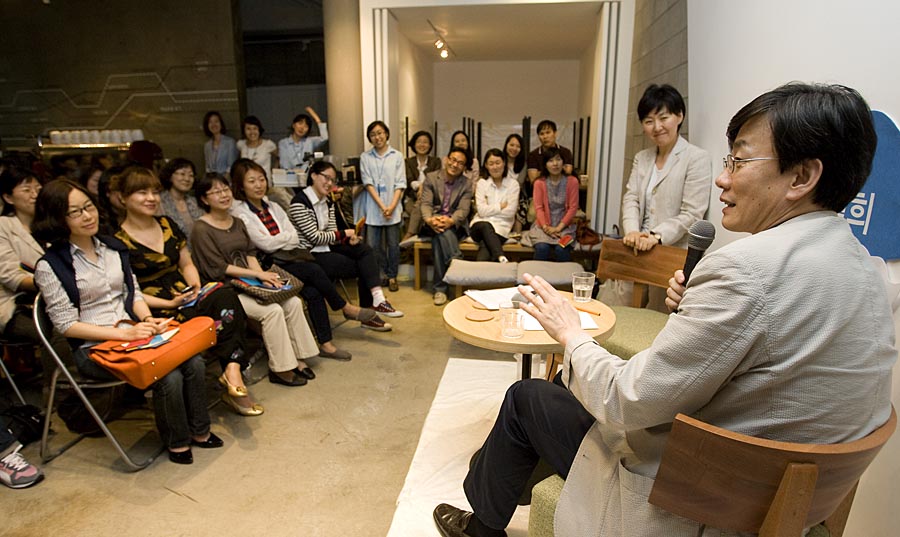














 The Grand Narrative