A reading list for Korean Feminism 101!

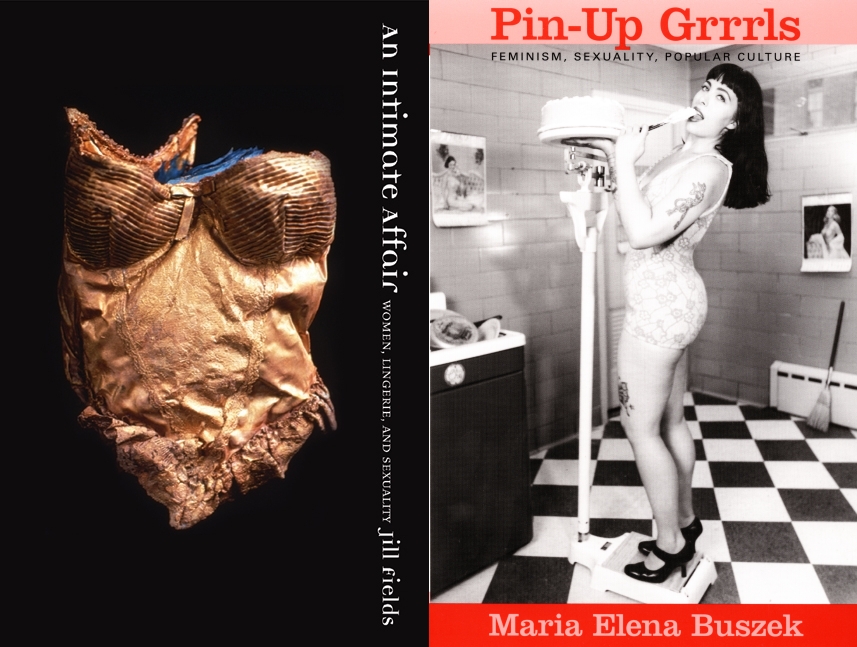
An Intimate Affair Pin-up Grrrls(Sources: left, right)

Thanks very much to the 10 Magazine Book Club for being such a great — and forgiving! — audience last weekend. As promised,* here are the books I mentioned in it, as well as some of the websites.

First, there was An Intimate Affair: Women, Lingerie, and Sexuality by Jill Fields (2007), then Pin-up Grrrls: Feminism, Sexuality, Popular Culture by Maria Buszek (2006, which I talk about in much greater depth in Parts 3 and 4 respectively of my Revealing the Korean Body Politic series (which, in turn, is an extended version of my presentation). Although at 375 and 444 pages each, they’re not for the faint-hearted, both are still very accessible, and definitely reward the effort put into studying them.

Of the two, Pin-up Grrrls was much the more eye-opening for me personally (note the ensuing tagline of my blog!), giving a unique perspective and context on US feminism in the 20th Century that deserves a lot more attention. For a taste, see here for a short essay cum summary of the book, and here, here, here, and here for my own Who are the Korean Pin-up Grrrls? series it inspired.

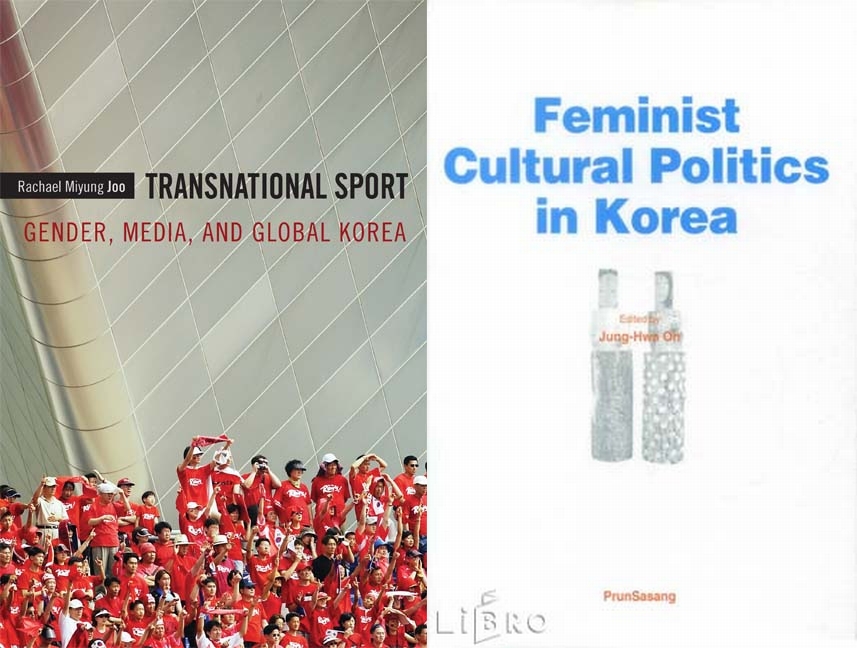
Transnational Sport Gender Meda and South Korea Feminist Cultural Politics in Korea(Sources: left, right)

Next, I highly recommended “Feminization of the 2002 World Cup and Women’s Fandom” by Hyun-Mee Kim in Feminist Cultural Politics in Korea, ed. by Jung-Hwa Oh, 2005, pp. 228-243, for an understanding of the radical role the 2002 World Cup played in changing prevailing Korean attitudes to objectification and women’s sexual subjectivity. In hindsight though, that and most of the chapters in the book are a little dated now, so a better choice is probably Transnational Sport: Gender, Media, and Global Korea by Rachael Miyung Joo (2012) instead. I haven’t read it myself yet, but you can see here and here for reviews.

In the presentation, I used Kim’s chapter to argue that the intensely objectifying, body-centric nature of the current Korean Wave represented a confluence of commercial and governmental interests in exploiting women’s bodies, a precedent for which was set by the — for want a better way to describe it — patriarchal accommodation with and co-option of that feminization of the 2002 World Cup. This in turn was preceded by a long history of girl-groups entertaining foreign and then Korean troops, and at one point the exhortation by the Korean government for women to prostitute themselves to the USFK for the sake of acquiring then much-needed foreign exchange. For more on the former see here, and on the latter see Sex Among Allies: Military Prositution in U.S.-Korea Relations by Katherine Moon (1997).

Unfortunately, I don’t have Moon’s book, but I do have — and was blown away by — Militarized Modernity and Gendered Citizenship in South Korea by Seungsook Moon (2005; yes, a different Moon!), which provides a lot of context. In particular, it’s essential to know about the military regimes’ population control policies, which were every bit as draconian as China’s one-child policy, in order to understand modern Koreans’ attitudes to abortion and contraception. And, once you do read it, you realize that the language I used above was by no means simply hyperbole for the sake of making a point!

Militarized Modernity Sex Among Allies(Sources: left, right)

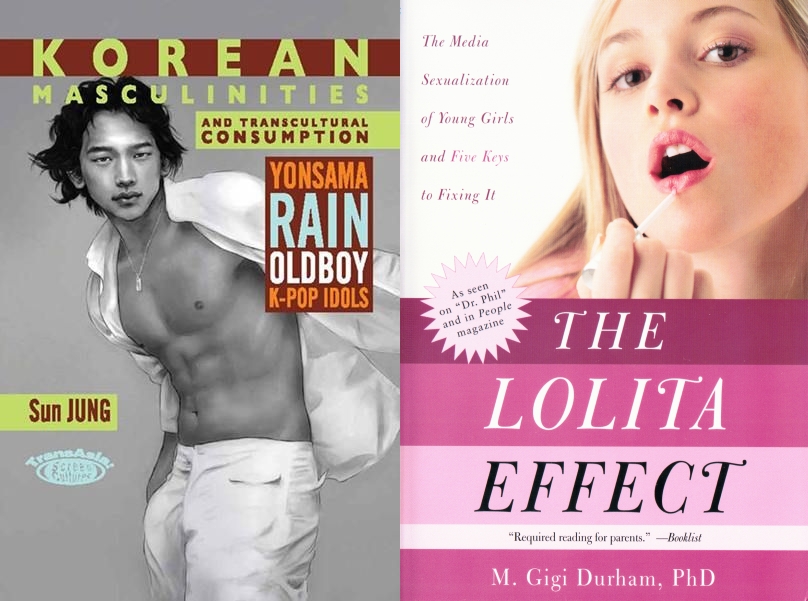
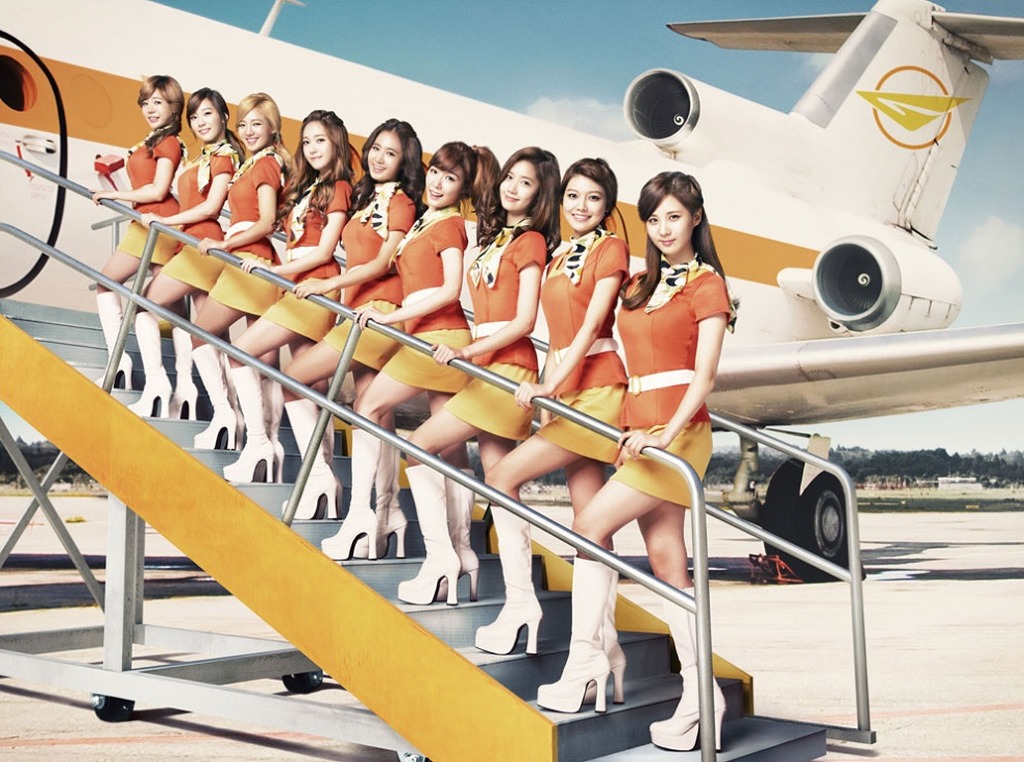
If you’re more interested in the surge in male objectification in the last decade though, see Korean Masculinities and Transnational Consumption by Sun Jung (2010), or for an online essay see Stephen Epstein’s and (again) Rachael Miyung Joo’s “Multiple Exposures: Korean Bodies and the Transnational Imagination” in The Asia-Pacific Journal last year. The latter also covers — no pun intended! — entertainment companies’ strategic exposure of girl-group members’ legs, and I discuss the role of that in the rise of ‘ajosshi fandom’ and ‘uncle fandom’ here.

Before moving on to women and girls again though, as one does, note that Sun Jung’s book is also essential for anyone further interested in the (very related) rise of kkotminam (꽃미남), which I did a lot of work on a few years ago here and here.

Korean Masculinities The Lolita Effect(Sources — left; right: author’s scan)

For more on the increasing objectification of teenage girls in Korea, I recommend first reading The Lolita Effect: The Media Sexualization of Young Girls and What We Can Do About It by M. Gigi Durham (2008) for some international context; then, especially if you’re a parent, Cinderella Ate My Daughter: Dispatches from the Front Lines of the New Girlie-Girl Culture by Peggy Orenstein (2011), which is much more related than it may sound; and finally, my (self-explanatory) Reading the Lolita Effect in Korea series, especially Part 2: The role of K-pop and the Korean media in sexual socialization and the formation of body image.

(Update: As mentioned in the presentation, also see Gusts of Popular Feeling here for more on the perceived spate of sex crimes against children that led the public to seriously question previously uncritical media narratives of ajosshi fandom.)

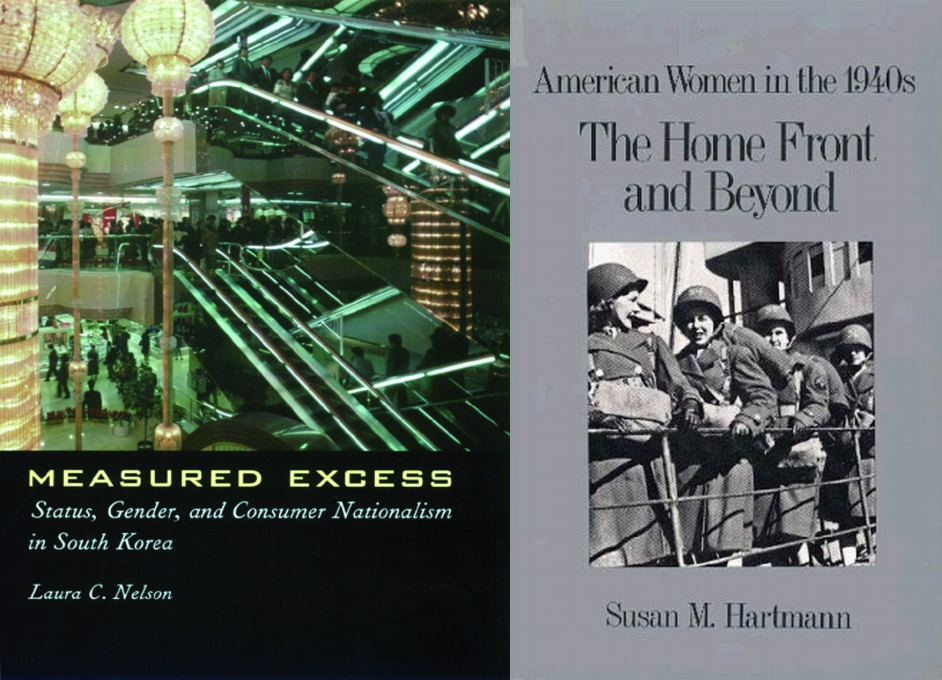
The next two books I mentioned were Measured Excess: Status, Gender, and Consumer Nationalism in South Korea by Laura Nelson (2000), then The Home Front & Beyond: American Women in the 1940s by Susan Hartmann (1983). The first is essential reading for anyone wanting to know more about the 1990s in Korea, and in particular the frequent government and media campaigns against over-consumption (in practice aimed almost exclusively at women, these were important precursors to the “beanpaste girl” stereotypes of the 2000s). Meanwhile, unfortunately Susan Hartmann’s book is difficult to get a hold of, but if you do you’ll find it’s a wonderful, very comprehensive introduction to the decade (I’d love to get those on the 1920s, ’30s, and ’50s also, albeit all by different authors). And, as I discuss here (and will expand upon in a later post), the minefield of contradictions presented to women as they were encouraged to remain “feminine” despite entering practical, “masculine” wartime industries in large numbers, yet also being criticized for being so wasteful, frivolous, and unpatriotic for beautifying themselves, is eerily reminiscent of the double-standards and backlash arising from women’s rapid entrance into the part-time workforce in the last decade in Korea also.

Measured Excess The Home Front and Beyond(Sources: left, right)

Finally, see the end of this post on male objectification for those scans of Stuart and Elizabeth Ewen’s prologue to their Channels of Desire: Mass Images and the Shaping of American Consciousness (1992), which should convince even the most die-hard skeptic of the genuine influence that advertising has on us, no matter how sophisticated and aware we like to all think we are.

If anyone would like more information and/or to discuss the books and websites mentioned above, and/or some specific part of the presentation, then please just let me know in the comments. Of course, they’re just a handful of what would be required for such a reading list really (4 of the 10 mentioned don’t even have anything to do with Korea!), so I’d be very happy — and grateful, frankly — if readers would rather recommend, seek information about, and/or discuss any Korea-related book instead really. After all, I’m sure it would useful to get new perspectives on those we’ve already read, and/or to get recommendations for good ones we haven’t! :)

*(Sorry for the long delay with this post, but unfortunately I have a very good — and somewhat graphic — excuse!)

Revealing the Korean Body Politic, Part 4: Girls are different from boys

Ha Ji-won Breast Size Korean AttitudesEstimated reading time: 16 minutes. Image sources: left, right.

“The JoongAng Ilbo reports that having a full rack is seen as a disadvantage for women in North Korea.

This is in marked contrast to the South, where a thin figure and big breasts have become symbols of beauty.

According to defectors, if a woman appears well-endowed in the North, people think she is intentionally and lewdly stressing her femininity, and she can easily come to be regarded as a slut. You have an atmosphere that doesn’t allow women to wear revealing clothing, and the North is still a male-dominated society.

One defector from Hoeryong said she had a work friend with large breasts who often ate chives because she’d heard they make your boobs smaller. She added that she was surprised upon learning that women in the South actually have operations to make their breasts bigger.”

The Marmot’s Hole

Alas, The Joongang Ilbo provides nothing to verify those claims. But, I see no reason why the defectors would lie, and negative stereotypes of large-breasted women are by no means confined to North Korea. Also, who would ever question that “a thin figure and big breasts have become symbols of beauty” in the South?
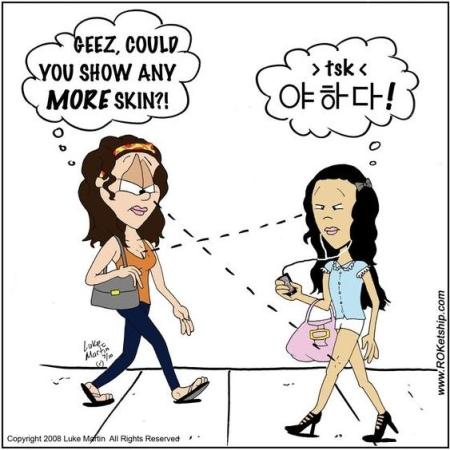
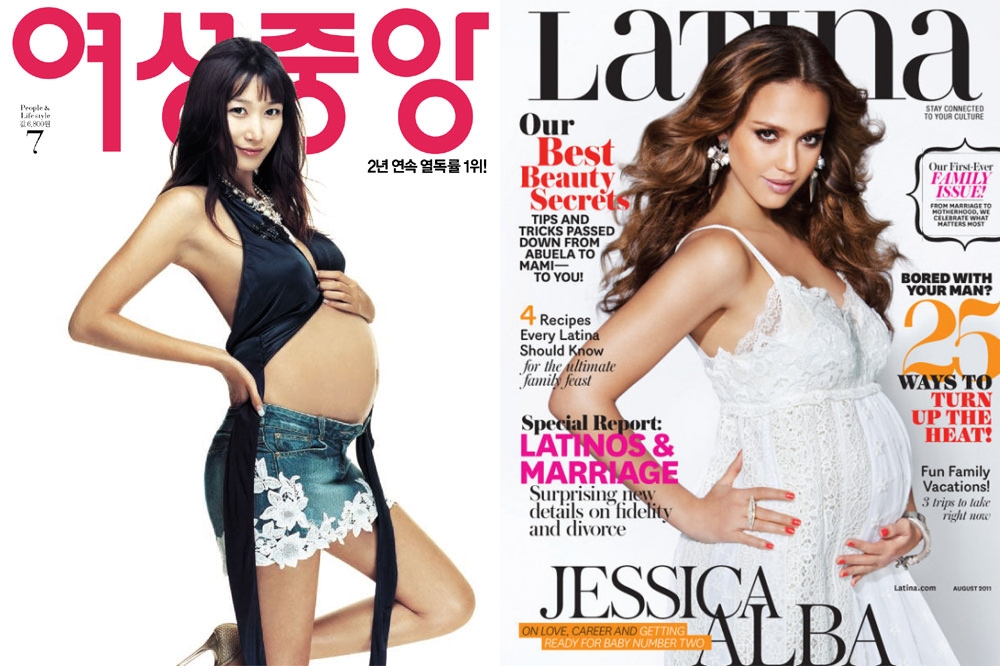
Korean Women Revealing Clothing AttitudesFortunately though, Liminality did, who in a must-read response shows that however much the Korean beauty industries and media promote such an ideal, and however much East Asian-women may have a genetic predisposition towards small breasts, cosmetic surgery patients at least hardly consider themselves lacking in that department. In fact, quite the opposite:

  • Per capita, far more breast surgery operations are performed in European and North and South American countries than in Korea (or Asia)
  • Despite having the highest per capita number of cosmetic surgery operations overall, Korea only came 22nd in the number of breast surgery operations performed per capita
  • Of those operations, Koreans had slightly less augmentation and lift operations than their counterparts in the US and Brazil, and slightly more reduction surgeries (source, above; reproduced with permission)

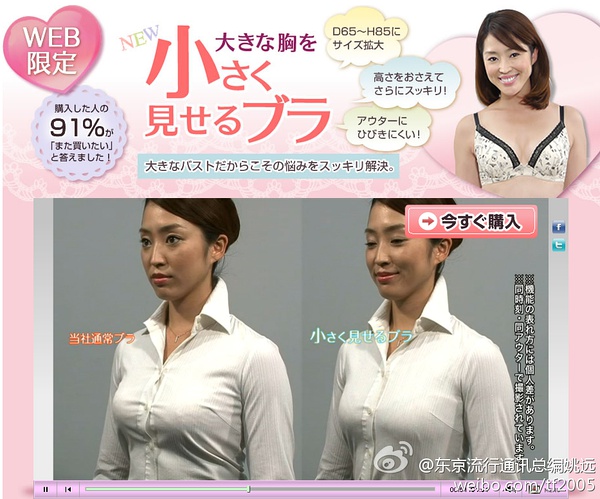
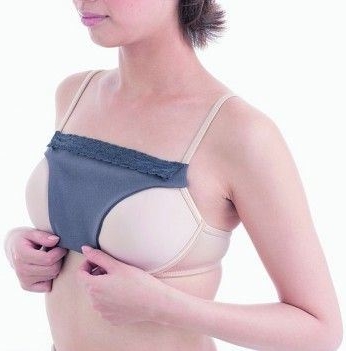
Similar attitudes may exist in Japan too, where even lingerie maker Wacoal was surprised by the number of women who told told them they wanted a bra that made their breasts look smaller, and then by the huge popularity of the—yes, really—’Bra That Makes Big Breasts Look Small’ design they developed in response. Also, Japanese mail order fashion magazine Bellemaison has developed a ‘Chest Line Cover’ (see second image below) that “promises to be a cool alternative to wearing a real camisole as Japan prepares for another hot summer made even hotter with another year of power rationing,” which I’m sure readers of both sexes can confirm would probably be just as big a hit in Korea.

Bra That Makes Big Breasts Look SmallSource: duoban

But readers don’t need me to tell them that showing cleavage is still a big taboo in Korea, or that there’s a big disconnect between ordinary Koreans’—and even models’—attitudes to fashion, body image, and sexuality and what you may see on Korean TV. And I can’t claim any special expertise on ordinary North Koreans’ attitudes either.
Chest Line CoverHowever, when I read that original post at The Marmot’s Hole, by coincidence I’d also just finished The Home Front and Beyond: American Women in the 1940s by Susan M. Hartmann (1983), in which she explains that the massive social dislocations of that decade—in particular, women suddenly entering the workforce in large numbers—were responsible for big changes in women’s fashion there, as well as preferred breast sizes. And, as it happens, North Korea is also going through a very turbulent period at the moment, with power relations between the sexes undergoing especially dramatic change:

Imagine going to work every day and not getting paid. Then, one day, you’re told there’s no work to do — so you must pay the company for the privilege of not working.

This is the daily reality facing Mrs. Kim, a petite 52-year-old North Korean. Her husband’s job in a state-run steel factory requires him to build roads. She can’t remember the last time he received a monthly salary. When there are no roads to build, he has to pay his company around 20 times his paltry monthly salary, she says.

“He had to pay not to work for about six months of last year,” Mrs. Kim told NPR, sighing. “You have to pay, even if you can’t afford to eat. It’s mandatory.”

So she is the one who must keep the family alive, as her husband wrestles with this state-sanctioned extortion.

Welcome to the Orwellian world of work in North Korea. In this reclusive country, profound social change is happening beyond the view of the outside world. The demands of politics have dramatically redrawn gender roles, forcing women to become the breadwinners.

National Public Radio, December 28; hat tip to Matt at Gusts of Popular Feeling.
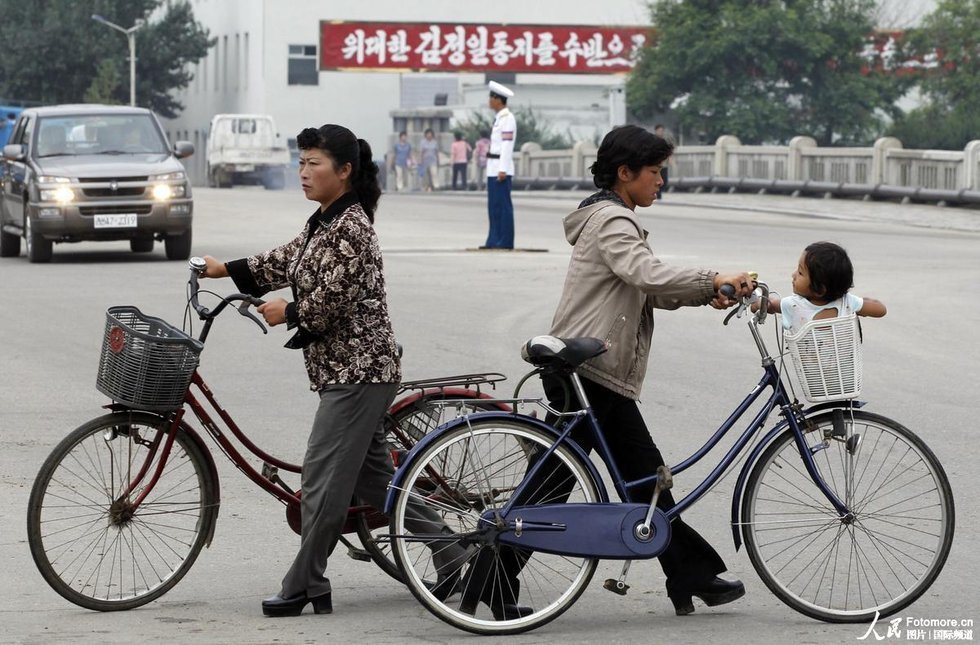
North Korean Women BikesSource: diandian

The NPR goes on to mention that one major consequence of that emasculation is skyrocketing domestic violence, against which speculating about ensuing changes in fashions can admittedly sound frivolous. But those have changed regardless—indeed, by government decree. First, in July last year:

Supreme leader Kim Jong-un appears to be loosening the government’s grip on how women dress by allowing them to wear pants, platform shoes and earrings, ABC News reported.

Previously, pants were only permitted as uniforms for females in the factories or the fields — and not for making a fashion statement.

“If caught, sometimes they would cut your pants right there in public to make it into a skirt,” Park Ye-Kyong, who defected to South Korea in 2004, told ABC News.

That doesn’t mean North Korean women don’t enjoy preening, Park added.

“Yes, we were hungry but desire to look beautiful lies in any woman,” she said.

North Korean Female IdealIn addition, the next month a 20 year-ban on women riding bicycles was lifted. Ostensibly imposed for women’s safety, numerous sources also mention its supposed incompatibility with juche, related educational television promoting “the idea of a woman wearing a skirt while riding a bicycle [being] contrary to socialist custom.” (See NK News {source, right} for more on North Korean ideals of women). Moreover, in 2009 Human Rights Watch also noted that:

…the ban on pants and bicycles for women is symptomatic of a range of other, often-overlooked, problems.

Across North Korea’s conservative, male-dominated society, there is discrimination against women, a knowing disregard for the consequences of such policies, and an opportunistic manipulation of power by police officers trying to make easy money by preying on an undervalued and underprivileged population.

In light of that, most likely the lifting of the bans was mainly simple populism on the part of a new leader, as well as — despite those state gender ideologies described above — a reluctant concession to the new realities of female breadwinners. Sure enough, in typical North Korean fashion (pun intended), just 5 months later the ban on women riding bicycles would actually be reinstated. Also, while technically they can still keep their pants on, in practice opportunities for women to beautify themselves remain limited, with both sexes punished for straying from officially-sanctioned hairstyles; sharp divisions in what is permissible for married and unmarried women; and a general lack of (beauty-related) resources overall, including such simple things as hairdryers.

Perhaps, things are not changing in North Korea as much as they first appear?

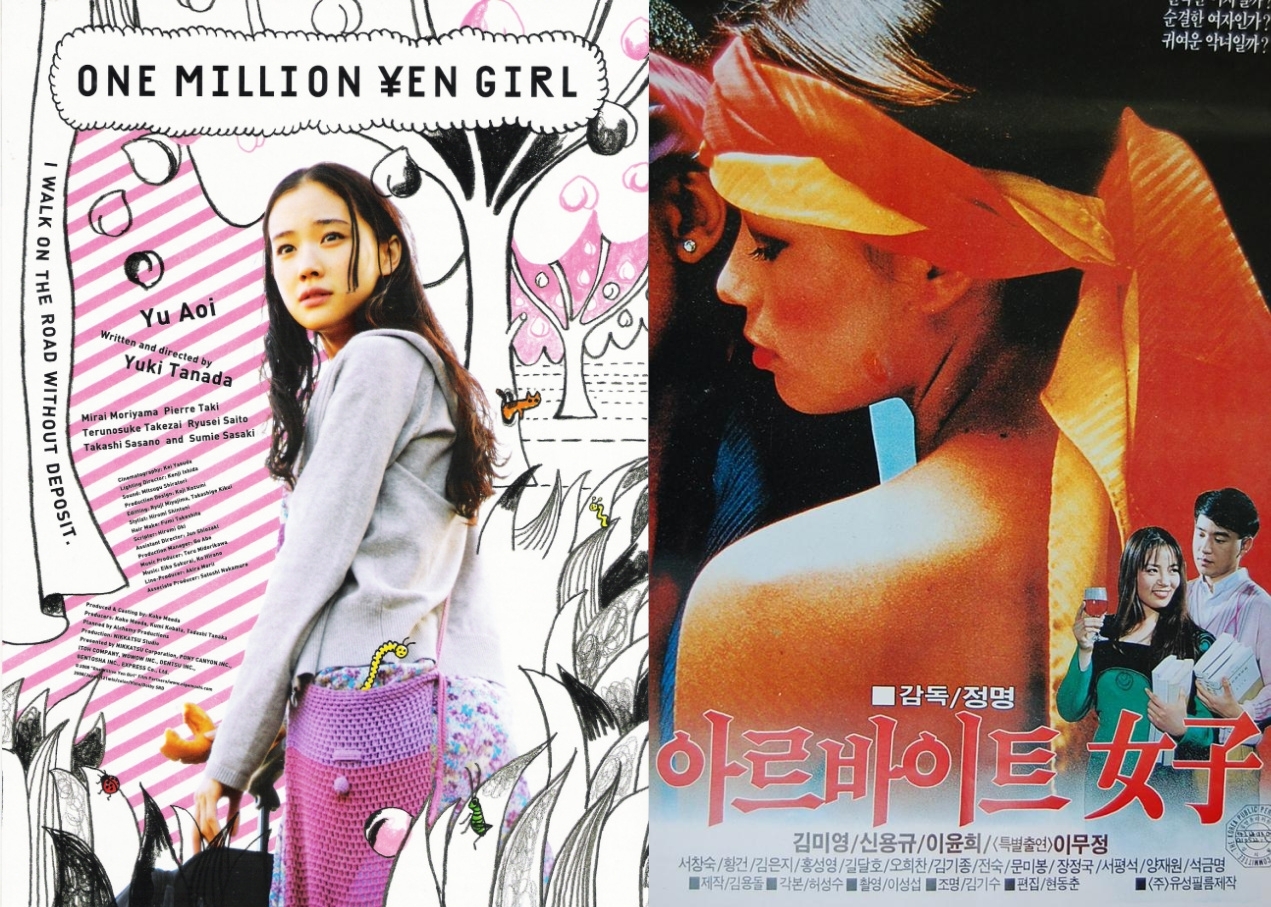
One Million Yen Girl Part Time WomanSources: left, right.

Yet in South Korea at least, it’s true that the last 15 years have seen a vast increase in the numbers of women competing with—and increasingly displacing—men for irregular and part-time work, despite the (extremely low) overall female workforce participation rate remaining unchanged. This has spawned quite a backlash, and—à la The Beauty Myth (1991)—a rapid increase in (overwhelmingly female) objectification in popular culture. So, while again I stress my ignorance and lack of knowledge with anything North-Korea related, it’s not unreasonable to suppose that, surely, the sudden large influx of women into the workforce may also be having some sort of impact there.
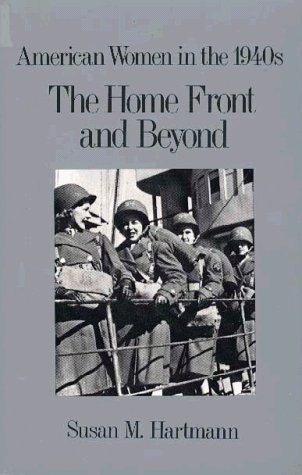
The Home Front and BeyondEither way, reading about similar experiences elsewhere can inform an understanding of what’s happening in both countries. So, with the obvious—but still necessary—caveat that of course both countries are very different to the US in the 1940s, for the remainder of this post let me try to pass on some of what I’ve learned about what happened there.

First, it’s important to get a sense of the numbers (pp. 77-8):

  • The female labor force grew by 6.5 million during the war
  • In 1944, 37% of all adult women were reported in the labor force, but nearly 50% of all women were actually employed at some time during that year
  • The greatest changes took place among married women
  • 1 in 10 married women entered the work force during the war, representing over 3 million of those 6.5 million new female workers (3.7 million, according to Marilyn Yalom in A History of the Wife {2002; p. 320})
  • 2.89 million were single, the rest widowed or divorced
  • So, for the first time in US history there were more married women than single women in the workforce.
  • Note however, that the war resulted in many more marriages than there would have been normally — approximately 1 million more, according to Yalom. Moreover, wives of absentee husbands were twice as likely to seek jobs, with half of all servicemen’s wives being in the labor force
  • The percentage of wives that worked grew from 13.9 in 1940 to 22.5 in 1944 (Yalom says 15 in 1940 to over 24 in 1945)
  • The percentage of women with children that worked grew from 7.8 in 1940 to 12.1 in 1944
  • By 1945, half of all working women were over 35; slightly more than 1 in 4 were 45 or older
  • The typical female worker had shifted from younger and single to older and married, a pattern which was maintained in the postwar years
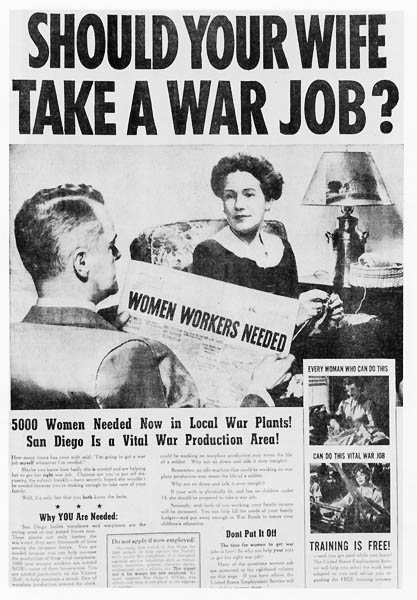
Should Your Wife Take a War JobAs Hartmann elaborates throughout her book, these figures represent an ensuing era of relative opportunity and freedom for many women (including sexual freedom; see Pin-Up Grrrls {2006} by Maria Busnek, pp. 213-224; see below also), even if it was usually simple economic necessity that compelled them to work in the first place (and usually at tedious, menial, and unfulfilling work at that). Accordingly, it definitely set the stage for second-wave feminism in the 1950s and ’60s, and deserves the place it’s gained in the Western historical imagination.

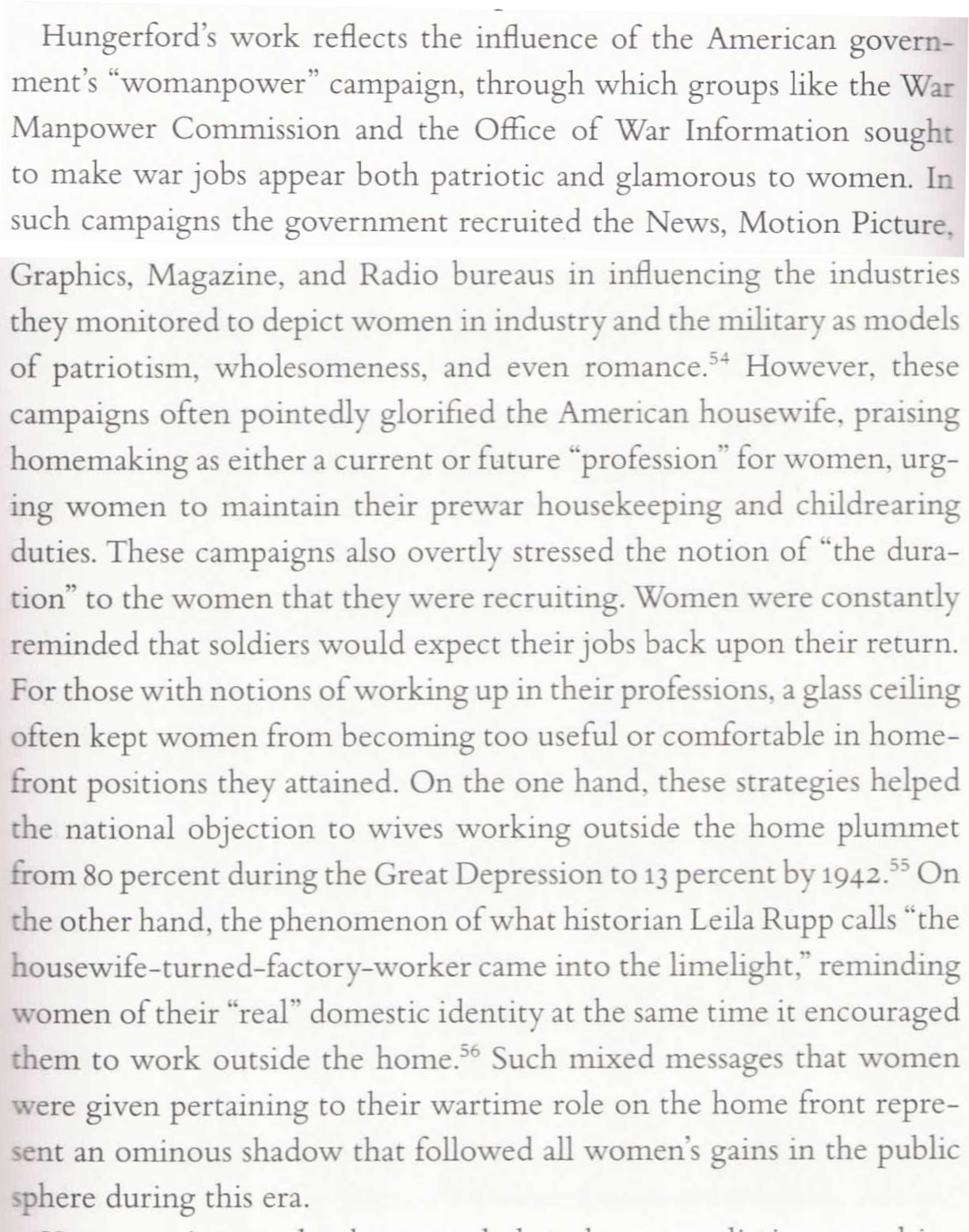
However, it’s also true that despite the huge public and private need for women to enter the workforce, that need was still considerably tempered by both sexes’ preexisting gender and racial ideologies, with both official propaganda and popular culture glamorizing women’s work and stressing its patriotic importance on the one hand, yet emphasizing its strictly temporary nature on the other. Not least, to nervous male workers and servicemen, who: lacked our knowledge that the war would lift the US out of the Depression (source, right); were very much judged by their ability to provide for their families, in an era where many simply couldn’t (note that one big difference between the Depression and the current financial crisis is that many people were literally starving during the former); and who sometimes had genuine difficulties with employment after demobilization, particularly in the shrinking war industries in which the women had been recruited (Hartmann, p. 63).

Buszek summarizes the contradictions of this era well (pp. 214-5):
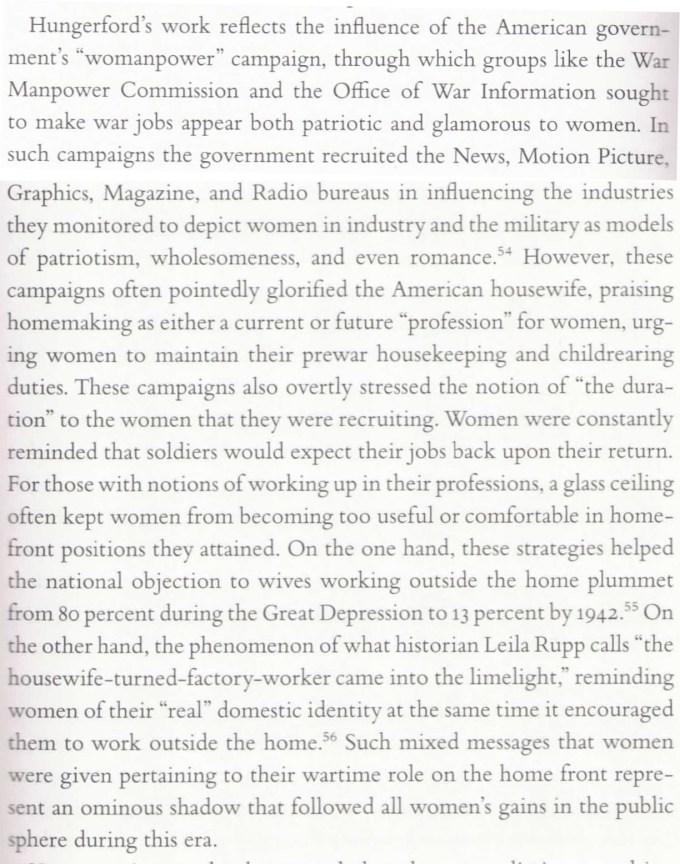
Pin-up Grrrls pp. 214-5And in particular:

  • Despite the huge demand for workers, and the ultimate, relative flexibility both employers and male employees would demonstrate in incorporating Caucasian women into their midst, African-American women remained largely unwelcome (e.g., 10 months after Pearl Harbor, there were fewer than 100 out of 3000 women in Detroit war industries). So, while the numbers of them working did increase from 1.5 million in 1940 to 2.1 million in 1944, their share of the female labor force actually dipped from 13.8 to 12.5. By 1950, their employment patterns were very similar to those of 10 years earlier, albeit partially because by then their husbands were making more money. (Hartmann, pp. 60, 78-9)
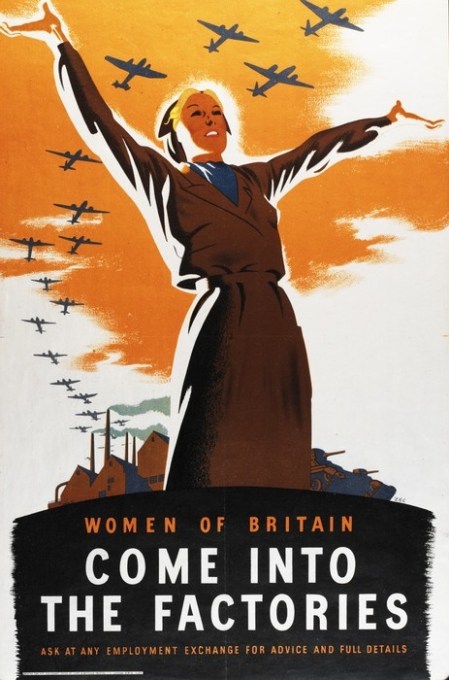
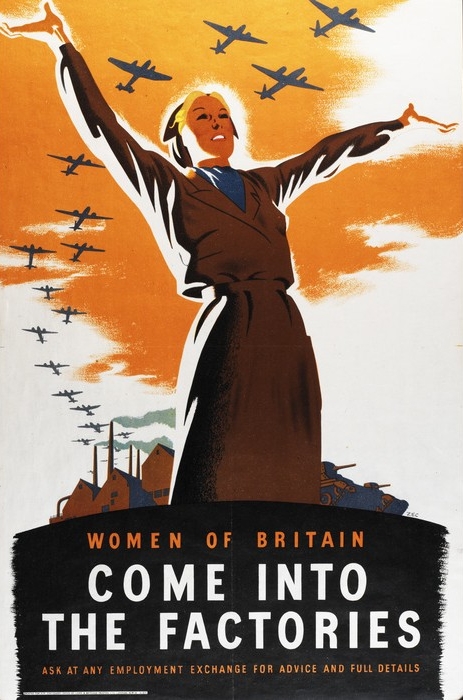
  • Women of Britain Come into the factoriesPartially, the huge numbers of wives that entered the workforce is because there were previously bans against them by many companies, let alone being against social convention; even schools discriminated against them. It’s amazing how quickly bans were dropped once the need for labor arose though, with some previously hostile managers coming to express a “preference for married women as more stable and conscientious than their single sisters” (pp. 59-60). And this provides encouraging news for Korea, which unfortunately still largely retains those conventions, and where as recently as 2009 I was working for a company that — yes, really — fired women upon marriage (source, right).
  • Nevertheless, there remained extreme public and private ambivalence about working mothers. Officially seen as more of a social problem than something to be encouraged, officials did recognize “that financial need compelled some mothers to work and that in localities with severe labor shortages production goals would requite the employment of mothers,” and urged employers not to discriminate against them (p.58). But on the other hand, the government would also constantly remind them that homestay mothers were essential for children’s development; popular culture was full of stories of child neglect; and daycare provision, while expanded, was ultimately completely inadequate, paling behind that which was provided in the UK, and prompting frustrated managers of some defense plants to set up their own (Yalom, pp. 324-6).
Ellen DeGeneres, Portia de Rossi Check Out Katy PerrySource: Celebuzz

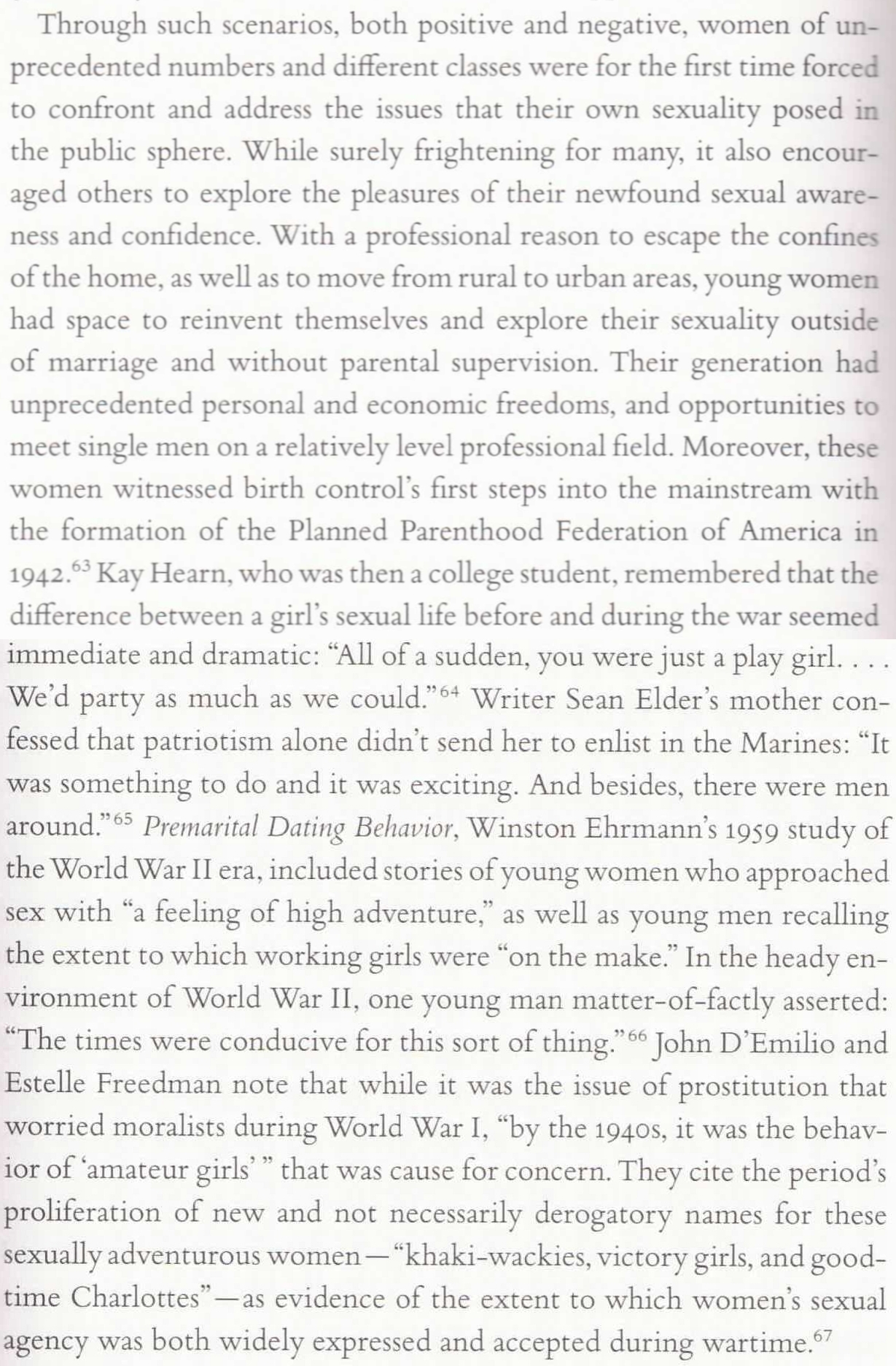
But, lest we forget, this post is about breasts. And changes in women’s fashions which came with the contradictions involved with entering the workforce, with women having to confront rampant sexual harassment on the one hand, and often being blamed for the “distraction” they posed, but on the other relishing their newfound freedoms (Buszek, pp. 216-7):
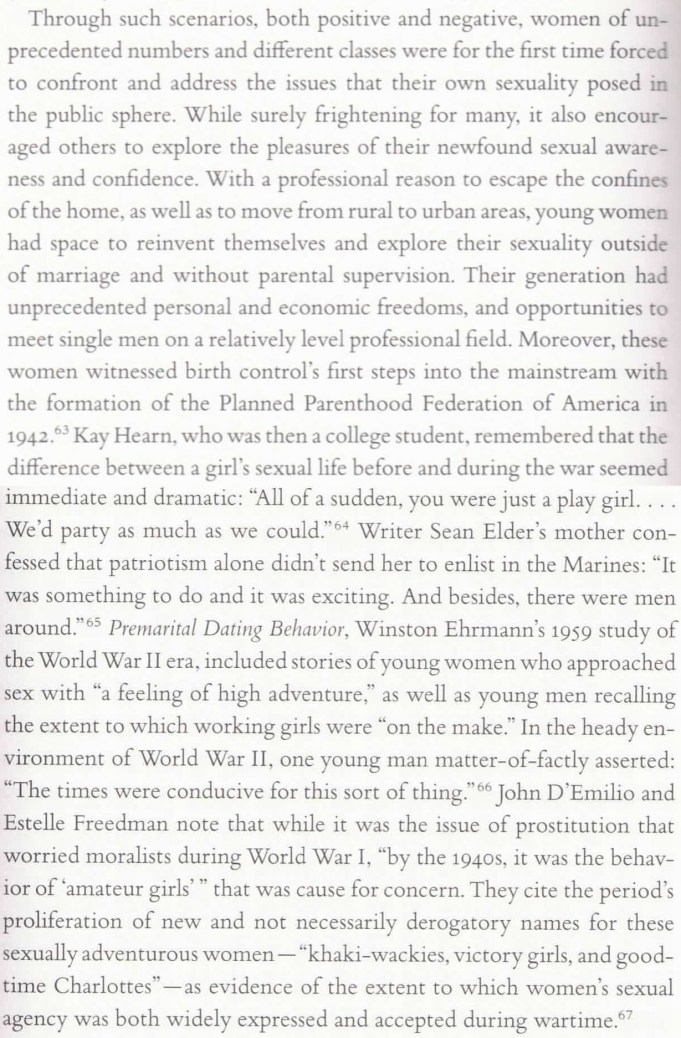
Pin-up Grrrls p216-7However, the combination of war-time shortages and women’s entrance into the workforce meant that people suddenly became used to women in functional, masculine clothing and with more practical hairstyles, and that women’s fashions became more simplified, comfortable, less overtly sexual, and changed less frequently than before. So, when you learn that popular culture stressed the exact opposite, for example…
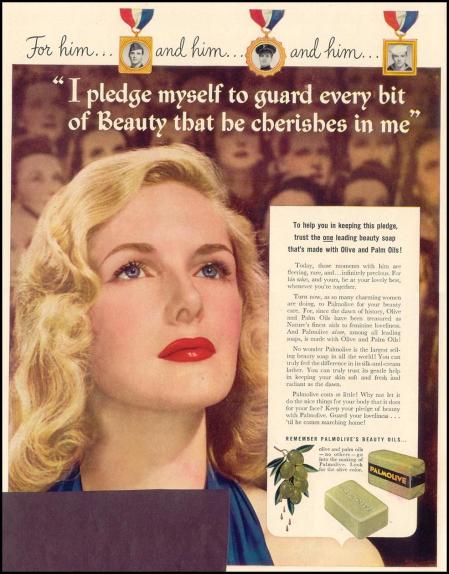
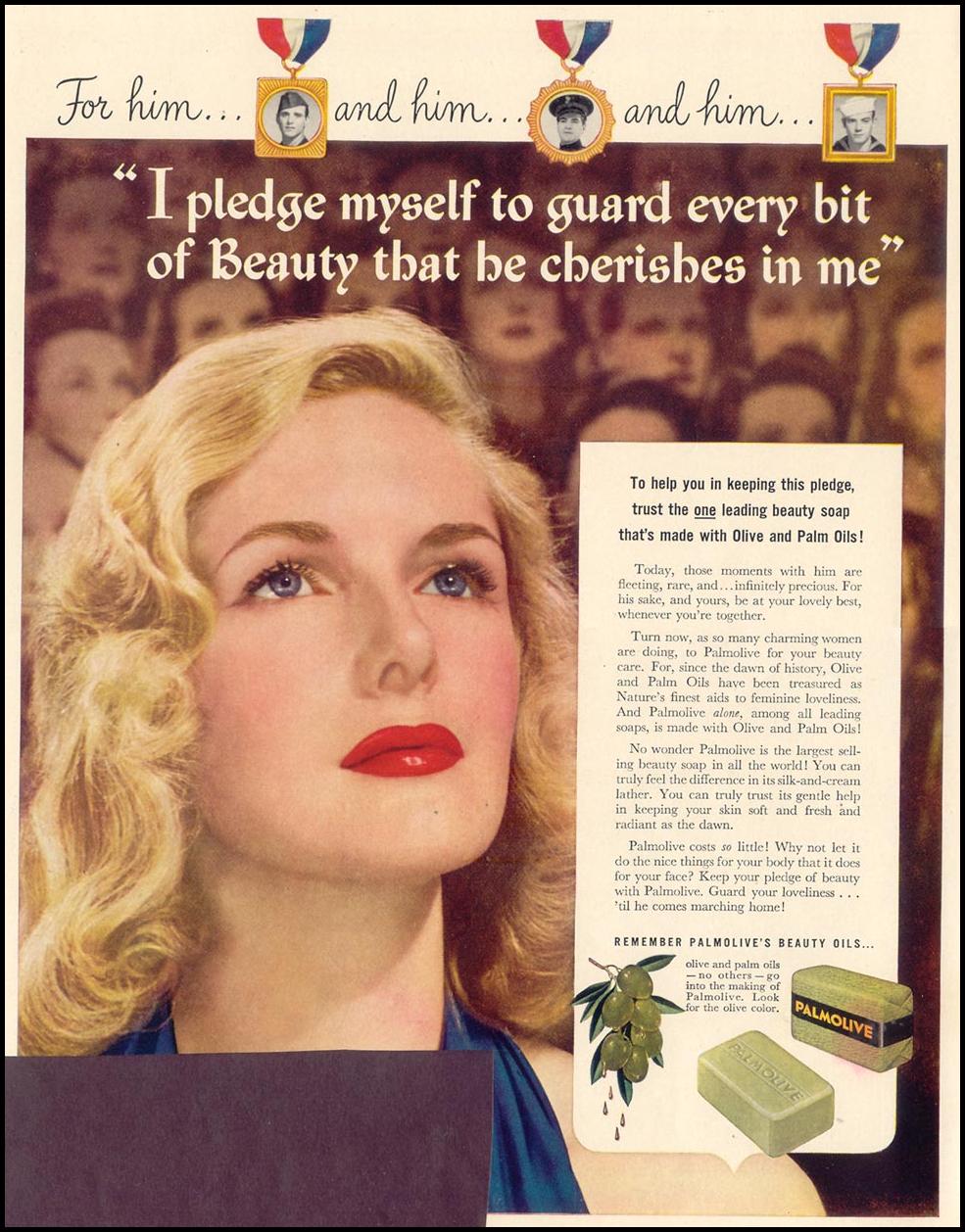
  • I pledge myself to guard every bit of beauty that he cherishes in meThat female workers were still “glamorous” and feminine despite their new roles (Hartmann, p. 199)
  • As were female sport stars, women’s sports enjoying a lot of popularity while their male counterparts were occupied (p. 194)
  • Lingerie manufacturers coped with wartime shortages and new demand by producing much practical bras, yet these coincided with pinup photographs that emphasized their subjects’ breasts (Jill Fields, An Intimate Affair: Women, Lingerie and Sexuality, 2007, p. 106). As explained in Part 3 of this series, this ultimately led to the fashion for large and uplifted breasts that remains to this day.

…then it is very easy and natural — indeed, this is my very strong impression from the books discussed here, although exact page references are suddenly proving maddeningly elusive(!) — to argue that this alternate ideal was imposed by, for want of a better word, the patriarchy, to encourage women to enter the workforce yet at the same time remind them that their place there was unnatural and temporary. And, to be clear, not for a moment am I arguing that this wasn’t very much the case (source, right).

However, as Hartmann explains on p. 198 below (echoed by the other sources), it’s also true that women themselves were just as passionate about preserving their femininity (indeed, they would understandably revel in impractical but much more feminine fashions once war rationing ended):
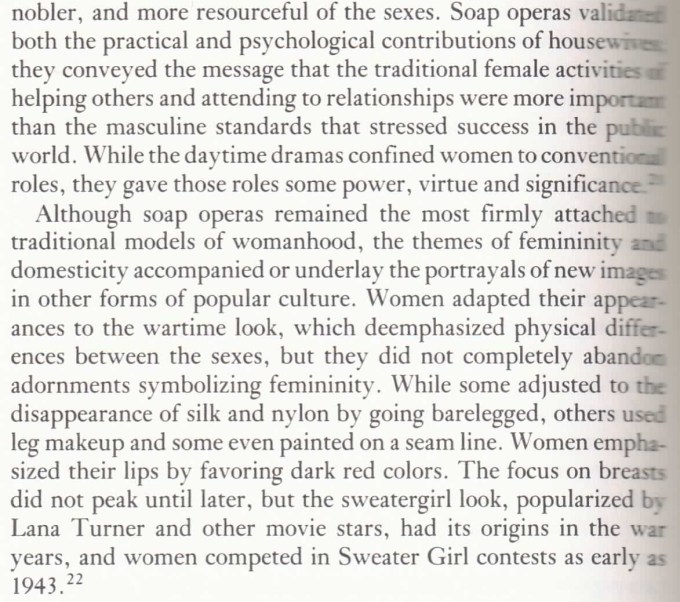
Hartmann, The Home Front, p.198In particular, and especially in light of the new opportunities open to them as mentioned, I think it’s both overly dogmatic and patronizing to dismiss choosing to use those feminine adornments as mere false consciousness and women’s own mindless incorporation of patriarchal values. Also, although it’s true that the period was rife with pop psychology theories (it was conveniently claimed that women like boring, monotonous work much more than men for instance) it’s very unlikely that men and women rationalized and articulated their choices and concerns in such patriarchal terms. Even if those did operate on a subconscious level, and patriarchy is still the only thread which can bring otherwise disparate developments in the period together, surely men did not think, for example, that if they saw more big-breasted women in popular culture, emphasizing the differences between the sexes as increased use of lipstick did in the workplace, that this would make them feel more secure in their jobs.

In addition, while changes in attitudes were certainly quick, they didn’t happen overnight, Jill Fields (p. 106) noting that “uplift” and “separation” trends in bras for instance, which accentuated the projection of the breast silhouette, had actually already started back in the 1930s. Finally, if you’re confused like I am, because I just noted above that bras actually became more practical during wartime, and am now stating that women could simultaneously be censured and praised for wearing distracting clothes, that’s because contradictory and competing trends coexisted simultaneously, the 1940s being just as messy, complicated, and contradictory as modern life.
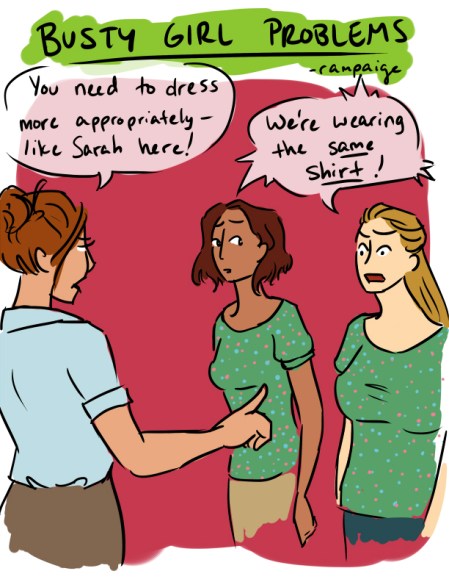
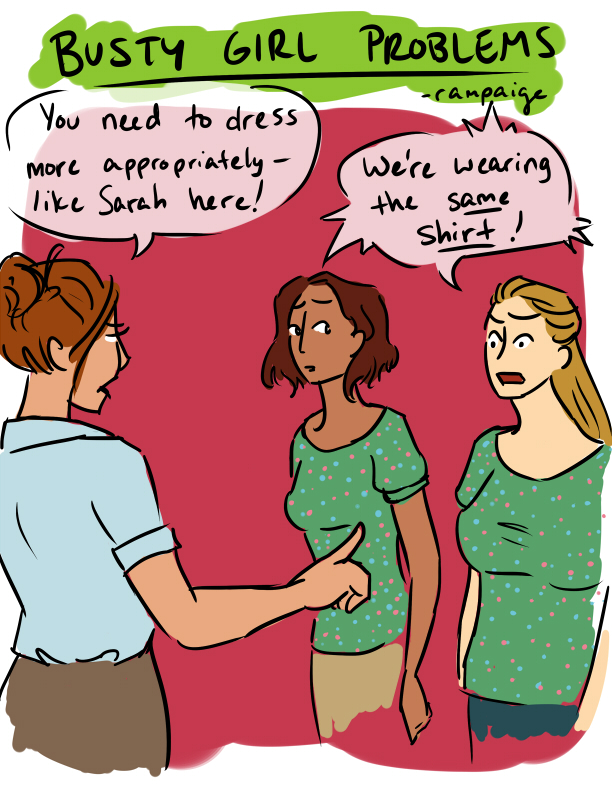
Busty Girl Comics Double StandardAnd on that note, thank you very much for bearing with me in this admittedly equally messy, complicated, and contradictory post, the result of me personally trying to understand what patriarchy means in practice as well as theory. And, with the proviso that my relief — and frankly joy — at discovering historic parallels (and especially English-language historiography!) to modern North and South Korean developments should make me wary of projecting too much, and not blind me to the significant differences, I’m very happy to have pointers towards further study, and very much welcome readers’ own suggestions! (source, right)

The Revealing the Korean Body Politic Series:

Update: See Fit, Feminist, and (almost) Fifty for “the medical condemnations of women’s cycling [which are] fascinating for what they tell us about what people thought (and maybe still think?) about women’s athletic capabilities and potential.”

Update 2: “Saudi daily al-Yawm cited an unnamed official as saying women can now ride bikes in parks and recreational areas. According to the official, the ruling stipulated that women must wear a full-body abaya, be accompanied by a male relative, and stay within certain areas. They are allowed to bike for recreational purposes only, not as a primary mode of transportation.” (Aljazeera)

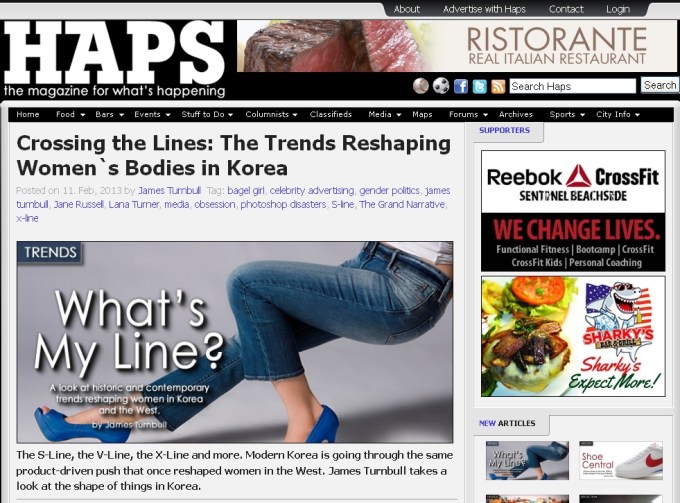
Crossing the Lines: The Trends Reshaping Women’s Bodies in Korea

James Turnbull Busan Haps What's My LineSee here for my latest article of that title at Busan Haps, and here for more details and context :)

Quick Hit: Living as a female smoker in Korea

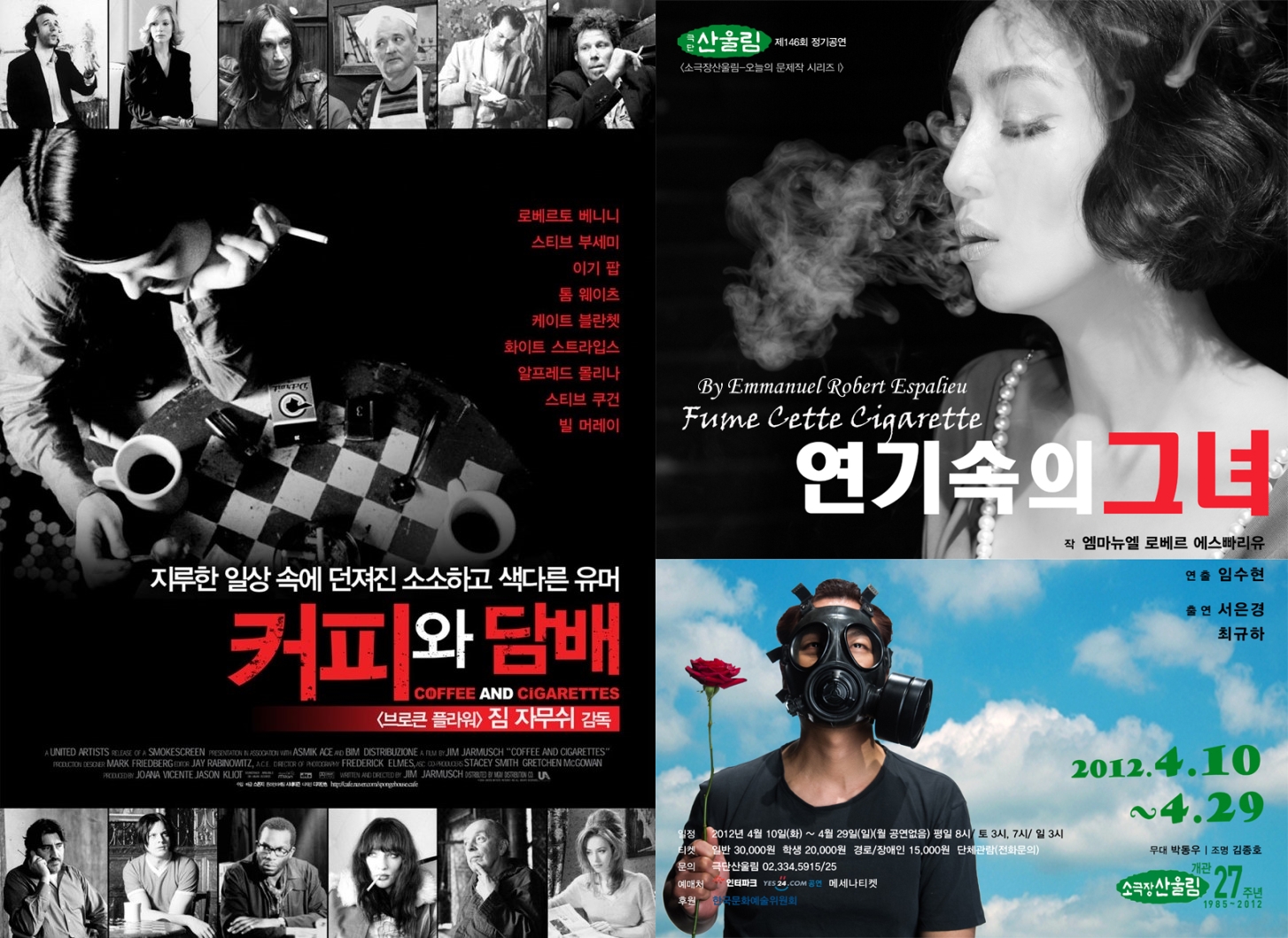
Coffee and Cigarettes 2003 Fume Cette Cigarette Korea(Sources: left, flygookee; right, Emmanuel Robert-Espalieu, auteur)

The other day Kim Young-hee (26) smoked in public instead of a cafe. She took out a cigarette impulsively while waiting for the bus home after a few drinks with her friends.

“I was a bit tipsy and felt like a puff. After I lit the cigarette, a random middle-aged man came up to me and started shouting as if I had done something very bad. He said, ‘I will slap your face if you don’t throw your cigarette away right now.’ He called me ‘dirty little woman.’”

She still thinks it was ridiculously unfair for him to reproach her because the man was also holding a cigarette…

See The Korea Times for more stories of similar incidents, and my The Gender Politics of Smoking in South Korea series (Part 1, Part 2, Part 3, Newsflash, Part 4, Korea’s Hidden Smokers) for more context. As explained in the latter (see the article in the last link for a summary of the series), the stigma against women smoking leads to massive under-reporting by them, resulting in official figures of roughly 2-5% of Korean women smoking, against best estimates of roughly 20% (see here for a handy international comparison). What’s more, the previous government was accused of deliberately downplaying the figures to stress its success in lowering the (admittedly more pressing) high male smoking rate, and while technically I haven’t seen the same accusations leveled at the outgoing Lee Myung-bak Administration, I haven’t found any official acknowledgement of how problematic its figures are either.

Korean Woman Smoking SmallMeanwhile, since my last post in the series was published nearly a year ago, probably the biggest developments have been the Seoul City Council’s continuing efforts to implement its 2011 plans to increase the number of public areas being designated smoke-free to 1/5th of the city by 2014 (smoking on sidewalks was already banned in 2010); and also efforts by some companies, both public and private, that have gone so far as to make being a non-smoker a prerequisite for promotion. For more details on both of those, see “Getting Tough: Korean Smokers Passed Over for Job Promotions” by Bobby McGill at Busan Haps, who also notes that (source, right: sungjinism):

The central government is doing what it can while avoiding Korea’s third-rail of politics, the “sin tax”. Few things more quickly turn the public against you here than raising taxes on Korean’s beloved cigarettes and alcohol. And the evidence shows that aside of potentially costing elected officials their jobs, it does little to curb smoking anyway.

The last time the government raised taxes on cigarettes was in 2004 by 354 won (30 cents) when 52 percent of the male population was smoking. The rate dropped a paltry seven points to 45 percent by 2007, but then increased the three subsequent years hitting 48.3 percent in 2010 before leveling off back at the current 45 percent.

I’d agree that the government is avoiding the sin tax, but disagree that that 2004 tax hike constitutes evidence against its effectiveness: a raise of 354 won being moot when just last year, packs were still at “the very smoker-friendly price of 2,700 won each” (US$2.53 as I type this). Moreover, in November “The International Tobacco Control Policy Evaluation Project’s team of some 100 health experts from around 20 countries” said that “it is imperative for South Korea to raise taxes on tobacco products,” and also 50% of respondents in a December 2010 survey by The Ministry of Health and Welfare “said that they would seriously consider quitting if the price was at least 8,000 won per pack.”

What do you think, about any of the above? Especially those among you that smoke yourselves? Personally, when I hear of women getting threatened, even slapped in the face for smoking in 2013, I’m very skeptical about news of improvements. But I realize that that is likely much more a manifestation of general misogyny than being anti-smoking per se, with Nathan McMurray of Korea Law Today, for instance, being much more optimistic about changing attitudes:

Reducing smoking is a process that will require the collective willpower of the entire country, because it is a habit so deeply ingrained in the culture. However, positive strides have been made to reduce the number of male smokers. In fact, since I have been in this country, I have noticed that the perception/acceptance of smoking has morphed into something different than it used to be.

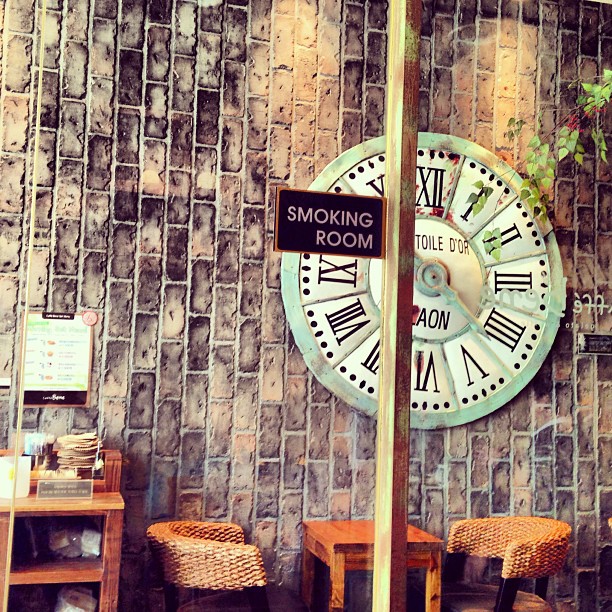
Either way, let me conclude by passing on some further reading I’ve come across in the past year. First, Smoking Roomspecifically gender and smoking-related, which show that — of course — it’s by no means just Korea where the number of female smokers is soaring (source, right: Jude Lee; CC BY 2.0):

Empowered women smoke more (New Scientist)

Torches of Freedom: Women and Smoking Propaganda (Sociological Images)

Female smoking death risk ‘has soared’ (BBC)

Women who quit smoking before 30 cut risk of tobacco-related death by 97% (The Guardian)

Lung cancer in women ‘to soar’ by 2040 (BBC)

And finally, on some methods for curbing smoking in general:

In an unsurprising development, smoke-free laws have lead to fewer hospitalizations (io9)

Look what they’ve done to my brands: Cigarette-makers will weather the spread of plain-packaging laws (The Economist)

Why cigarette packs matter (Bad Science)

Producing Bodies in Anti-Smoking Campaigns (Sociological Images)

Smoked out: Can a film of a smoker trigger the act? (The Economist)

You know my hips don’t lie. And I’m starting to feel it’s right. BUT…let’s check your IIEF-5 score and our PVI frequency baby. Oh yeah~

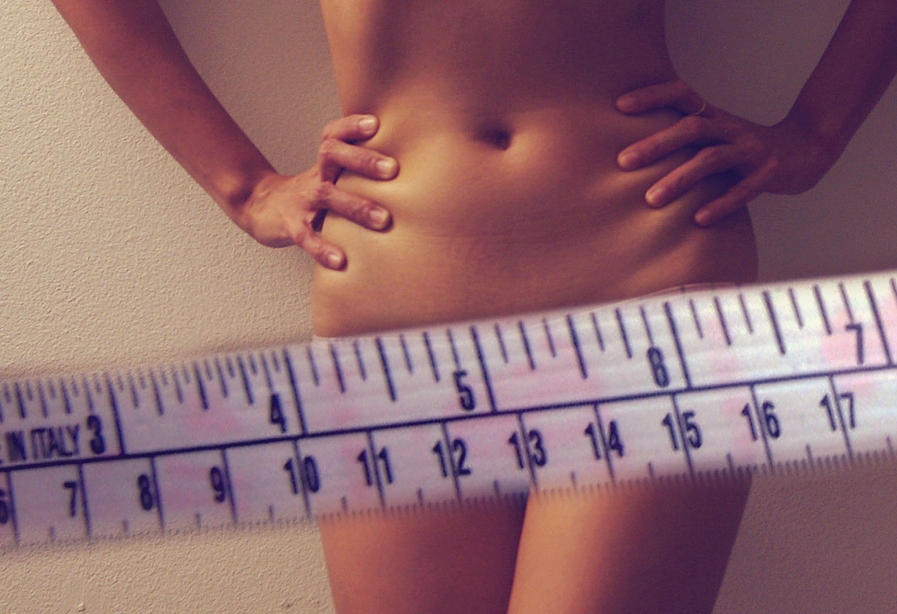
Woman's Waist Tape Measure(Source: by Janine, Flickr)

Kramare and Treichler (1996): “Feminism is the radical notion that women are people.”

Geher (2009): “Evolutionary psychology is the radical notion that human behavior is part of the natural world.”

There is no reason on earth to believe that these two “radical” notions are irreconcilable.

(Feminist Evolutionary Psychology Society)

Yet evolutionary psychology still has such a bad reputation among feminists.

Partially, that’s because many feminist criticisms of the discipline and its researchers — and vice-versa — are really just based on strawmen and stereotypes.

That said, it’s also true that evolutionary psychologists can indeed sometimes make outlandish, sexist claims based on little to no evidence.

Or at least, they can seem to. More often than not, it’s actually journalists that are doing that for them, who rarely have time for their caveats and qualifications. Also, journalists can sometimes simply make mistakes and/or misunderstand too, or evolutionary psychologists fail to clearly explain the purpose, methodology, and conclusions of their research.

evolutionary psychology bingo(Source)
These maxims are worth repeating, especially when you read a headline that brings an instant, smug satisfaction of being proven right. In this case, with “Why Dating Women With Slim Waists Lowers Men’s Risk for Erectile Dysfunction” by Christine Hsu in Medical Daily, which not only makes sense given everything else I’ve read about women with hourglass figures — that they’re significantly more fertile than those with other body types, which likely plays a strong role in why that one is so popular amongst heterosexual men (to the extent that even congenitally blind men prefer them) — but, sharing that preference, also reminds me that I’ve got great taste in women too.

Just taking Hsu’s word for it though, would be nothing more than confirmation bias. So, starting with her introduction (my emphasis):

Body Shapes Types Sketch(Source)

Possessing a ‘figure 8’ body has long been a trademark of feminine beauty, and now new research has revealed the reason why men tend to prefer women with a waspish waist.

The study also linked the middle proportion of a woman’s body to the likelihood of satisfaction and erectile dysfunction in her partner.

Researchers found that the slimmer a woman’s waist, the more satisfied her partner and the less likely he is to suffer impotence in the bedroom, according to the study published in the [December 2012 issue of the] journal Archives of Sexual Behavior.

That study is “Slimmer Women’s Waist is Associated with Better Erectile Function in Men Independent of Age” by Stuart Brody and Petr Weiss, and I’ve highlighted that last section because — admittedly in hindsight — it should already raise alarm bells: sexual satisfaction isn’t actually mentioned in the title of the article, nor the original study. That doesn’t necessarily mean that it’s not there, but the combination of the titles and the highlighted part does strongly imply that, somewhere within, the study will mention that female participants’ waists were measured and the sexual satisfaction and levels of impotence of their male partners.

At first glance, it appears to be done so in the abstract, (my emphasis; source, right):

Hourglass figure means more babies….To assess the association of women’s waist size with a more tangible measure of perceived sexual attractiveness (as well as reward value for both sexes), we examined the association of women’s age and waist circumference with an index of men’s erectile function (IIEF-5 scores), frequency of penile-vaginal intercourse (PVI), and sexual satisfaction in a representative sample of Czechs (699 men and 715 women) aged 35–65 years. Multivariate analyses indicated that better erectile function scores were independently associated with younger age of self and partner and women’s slimmer waist. PVI frequency was independently associated with women’s younger age and women’s slimmer waist. Sexual satisfaction was independently associated with men’s younger age and slimmer waist for both sexes. Better erectile function, greater PVI frequency, and greater sexual satisfaction were associated with women’s slimmer waist, independently of both sexes’ ages….

But then I moved on to the methodology (the first 2 pages are available at the above link), which ends the section on how the participants were chosen with (my emphasis):

The rationale for using participants who were not both members of the same couple includes prioritizing a representative sample and decreasing risk of a couple comparing responses (Weiss & Brody, 2011). The 649 women who provided complete data had a mean (SD) age of 48.1 (8.6) years, and the 685men who provided complete data had a mean (SD) age of 49.6 (8.7) years.

Christina Hendricks Marilyn MonroeWhich begged the question of how on Earth, if data on the waist sizes and sexual satisfaction of both partners in a couple was not gathered (and erectile function of the male partner), it was determined that “the slimmer a woman’s waist, the more [sexually] satisfied her partner and the less likely he is to suffer impotence in the bedroom.” This in turn spawned an interesting all-day conversation on The Grand Narrative Facebook page, and ultimately led — thank you! — to my getting my hands on the full study itself.

As it’s only 8 pages long, I highly recommend that you read it for yourselves (please email me or let me know in the comments if you would like a copy) so let me just sum it up here. As it turns out, Hsu did indeed make some mistakes (source, right).

First, the methodology:

  • Page 3, paragraph 1, mentions that “The same wording for the IIEF-5” — the test of erectile function — “was used for both sexes with the added instruction that the woman should complete it on behalf of her partner.” Earlier, it also mentions that the test is very reliable, with men’s and their female partners’ assessment of the men’s erectile function being very similar (obviously, their female partners would know!).
  • Page 3, paragraph 2, mentions that only participants completed the survey on sexual satisfaction;  and page 3, paragraph 3, that participants measured only their own waists. In short, it’s these points that already prove the error of Hsu’s link between male sexual satisfaction and female waist size that I highlighted in the introduction.

male waist sizesNext, the results (source, right):

  • The younger the men and women, the less problems with erectile dysfunction the men (or the women’s male partners) had.
  • The slimmer the women’s waists, the less problems their male partners had with erectile dysfunction.
  • The slimmer the women’s waists, or the younger the women, the more often they had sexual intercourse.
  • The slimmer both sexes were, the more likely they were to have satisfying sex lives. The younger the men were (not the women) the more likely they were to have satisfying sex lives.
  • The more often men and women had sex, the less problems with erectile dysfunction they (or the women’s male partners) had; and the younger the men (not the women), the more likely they were to have satisfying sex lives.
  • Women with slimmer waists tended to have sex more often; their male partners had less problems with erectile dysfunction; and they (the women) were more likely to have satisfying sex lives.
  • And finally, crucially, “It was noteworthy that the association of women’s slimmer waist with all measures of sexual function was independent of both partners’ age” (from the end of page 6).
No cute clothes for fatties(Source: ~PinkieNekoGirl)

That’s a lot to take in, many points seem obvious and to follow naturally from each other, and there’s certainly the possibility that I’ve misunderstood and/or misrepresented some of them myself — if you think so, by all means please correct me. Also, I don’t mean to harshly criticize a reporter who undoubtedly had less time to spend on the study than the 3 days of my semester break(!) that I ultimately did. But, although it’s very very easy to take away the message that “the slimmer a woman’s waist, the more satisfied her partner” from it, with the conclusion stating —

The findings were generally in accord with evolutionary perspectives. Men’s erectile function scores were independently associated with younger age of self and partner, and women’s slimmer waist (all factors generally associated with greater reproductive fitness). Similarly, PVI frequency was independently associated with women’s younger age and women’s slimmer waist. Sexual satisfaction was independently associated with men’s younger age, and slimmer waist for both sexes. Better erectile function, greater PVI frequency, and greater sexual satisfaction were associated with women’s slimmer waist, independently of both sexes’ ages. Thus, capacity for potentially reproductive sexual behavior, frequency thereof, and a psychological response that might support pair-bonding were all linked to women’s slimmer waist.

— for instance, Hsu does appear to have misunderstood it, also mentioning that “researchers also recorded how often the 699 study participants — Czech men between the ages of 35 and 65 years old — had sexual intercourse,” whereas actually (page 2, paragraph 5) 699 men and 715 women were surveyed, and of those 685 men and 649 women provided complete data.

Either way, I can just imagine what many journalists and advertisers would — and probably will? — make of a study which seems to say that men with slimmer wives and partners have more satisfying sex lives!

Curry Sex Life(Source)
Update — For those who *cough* don’t understand the title of the post:

Revealing the Korean Body Politic, Part 3: Historical precedents for Korea’s modern beauty myth

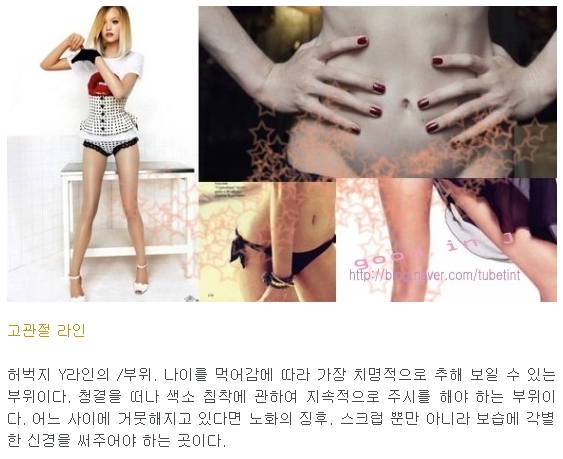
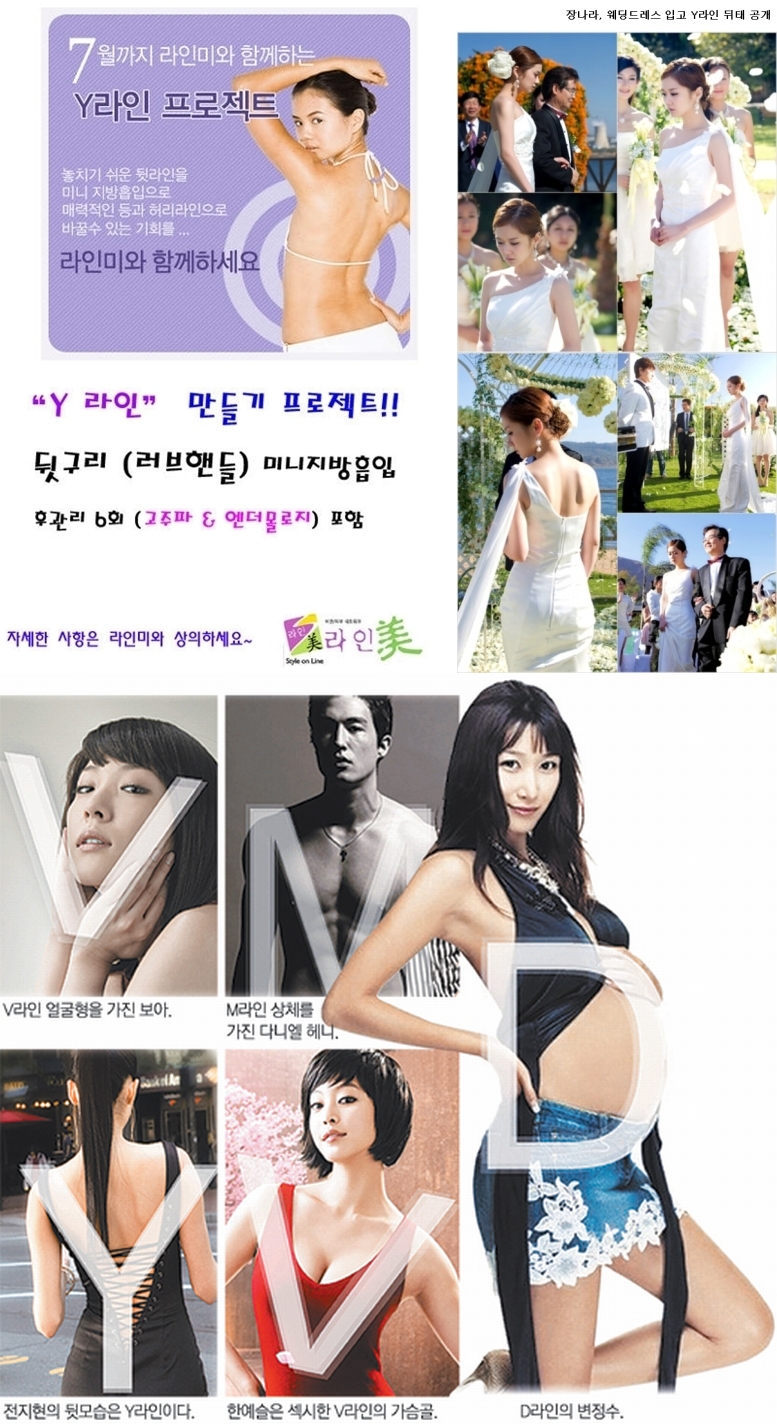
Y-line Choi Yeo-jin(Source)

“Building a Body” isn’t my favorite track off Marnie Stern’s third LP, but I think it’s one of the most important.

It plays with the idea that a woman’s body is a canvas; a thing that is often viewed or regarded as a tool, an asset, a means to an end. Still. There’s the acknowledgment that we can choose how to construct our own image. However much anxiety is involved in the process.

($30 Project)

As often discussed on TGN, Korean beauty, dieting, and clothing companies are constantly promoting idealized body shapes for women to aspire to. And, although they’re just following the universal logic of creating new perceived wants and needs in the minds of consumers, their alacrity — and audacity — in doing so can still be nothing short of remarkable sometimes.

With new “lines” appearing almost as quickly as the girl-groups used to endorse the ensuing products or services though, it’s easy to lose sight of the utilitarian, utterly reductionist view of women that this alphabetization process relies on.

This post is about some recent stark reminders of both. Easy to dismiss as frivolous, or mere semantics, it’s also about what’s occurring in Korea today nevertheless has strong historical precedents in North America and Europe in the 1920s-1950s. Which, as Jill Fields explains in An Intimate Affair: Women, Lingerie, and Sexuality (2007, pp. 80-81), “not only affected women’s everyday experience of their bodies, but also transformed the construction of feminine identity,” sparking public discourses and expectations surrounding women’s bodies that endure to this day.

S-line vs. Corsets(Sources: left, right)

What’s more, not only is what’s best for women never the main concern —

There is ample feminist discussion about shifting cultural definitions of what the female form is supposed to look like in order to be the most appealing to a (predominately) male gaze….intimate apparel was often marketed as scientifically advantageous to women’s health, but the sexual function of breasts was always the bottom line. Binding them down, lifting them up, pushing them together – none of this had anything to do with encouraging the natural state of a woman’s breasts. No wonder women’s liberationists threw their bras in the trash can.

(Nursing Clio)

— but the Korean case also coincides with a rapid increase in (overwhelmingly female) objectification in popular culture; and highly visible, palpable resistance from men against (largely only perceived) increased economic competition from women. Bearing a striking resemblance to — à la The Beauty Myth (1991) — what occurred in North America and Europe in the 1980s, the combination proves as fascinating as it is alarming.

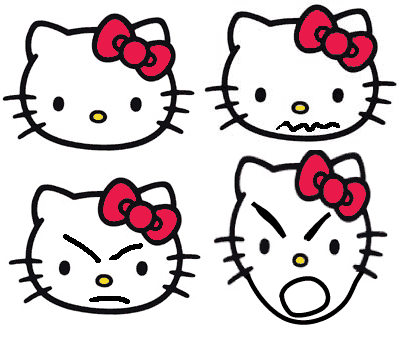
Angry Hello KittyA Woman’s Body as a Canvas

The first reminder comes from Rob Walkers’ discussion of what makes Hello Kitty so attractive to consumers, in his book Buying In: The secret dialogue between what we buy and who we are. Because however indirect, if you replace “Hello Kitty” with “women’s bodies,” and “consumers” with “advertisers,” an eerie — and disturbing — parallel emerges (2008 ed., p.18, emphases added; source, right):

A perceptive study of the Hello Kitty phenomenon by Tokyo-based cultural scholar Brian J.McVeigh suggests an interesting theory that is implied by his paper’s title: “How Hello Kitty Commodifies the Cute, Cool, and Camp.” While he notes factors like “accessibility” and consistency, the most compelling factor he isolates is “projectability.” Hello Kitty’s blank, “cryptic” simplicity, he argues, is among her great strengths; standing for nothing, she is “waiting to be interpreted,” and this is precisely how an “ambiguous”—and, let’s be frank: meaningless—symbol comes to stand for nostalgia to one person, fashionability to another, camp to a third, vague submissiveness to a fourth….Belson and Bremner return to this theme repeatedly in their book on he business of Hello Kitty. “What makes Hello Kitty so intriguing is that she projects entirely different meanings depending on the consumer,” they write. The cat is “an icon that allows viewers to assign whatever meaning to her that they want.”

If that parallel remains too indirect for some however, recall Dramabeans’ comment (#21 here) about the “Love Your W” event in 2008, “W” being one of the numerous letters used for women’s breasts. The similarities are obvious (emphases added):

…while this practice is seemingly frivolous on the surface, it actually belies much more pernicious trends in society at large, when you have celebrities vocally espousing their alphabet-lines and therefore actually objectifying themselves as a conglomeration of “perfect” body parts rather than as whole, genuine people. You wanna know why plastic surgery is such a big deal in Korea, why actresses don’t eat, why there’s an obsession with thin? It’s because we’re all just Latin letters waiting to be objectified as a beauty ideal rather than living, breathing people with flesh on our bones and brains in our heads.

Why, Oh Why, Does it Need to be Called a “Y-line”?

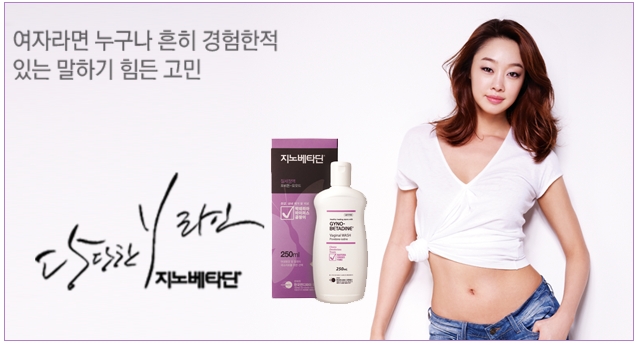
The next reminder (hat tip to @holterbarbour) was by learning of the simply absurd “Y-line,” via Mundipharma Korea’s ads for gynobetadine, a vaginal cleanser:

Mundipharma Korea are a little coy about what a Y-line is exactly, placing Choi Yeo-jin (최여진) in several Y-shaped poses, and with copy and advertorials speaking of bold, confident — “당당한” — Y-lines. But given the product, and that all those “Y”s center at her crotch, then it’s safe to say that, yes, the term does indeed refer to a vagina.

Choi Yeo-jin Y-lineWhich sounds like something from The Onion.

But to play Devil’s advocate, is it merely a euphemism, rather than a line per se? The ad is, after all, just for a cleanser, not — thank God! — labiaplasty (NSFW) or anything like that. And if so, is it really all that different to similar terms and usage in, say, English-speaking countries? For, as recently explained in “The Myth of the Vajazzled Orgasm”at Nursing Clio (emphasis added):

The popular emphasis on the vagina is certainly on the rise. The explosive popularity of the Vagina Monologues, now regularly performed on college campuses, made many more comfortable with the V word. Social critic Naomi Wolf has recently argued for the existence of the “mind-vagina” connection. Commercials coyly refer to the letter V for various feminine products and sitcoms and singers laud their own embrace of the vajayjay as a way of indicating equal sexual footing with men. “Designer” vaginas are also part of this new emphasis. Cosmetogynecology is one of the fastest growing types of cosmetic surgery.

On top of that, the Y-line appears not to be an invention of Mundipharma Korea at all, as this cartoon (at least) predates its August ad campaign:

Y-line Story(Source)
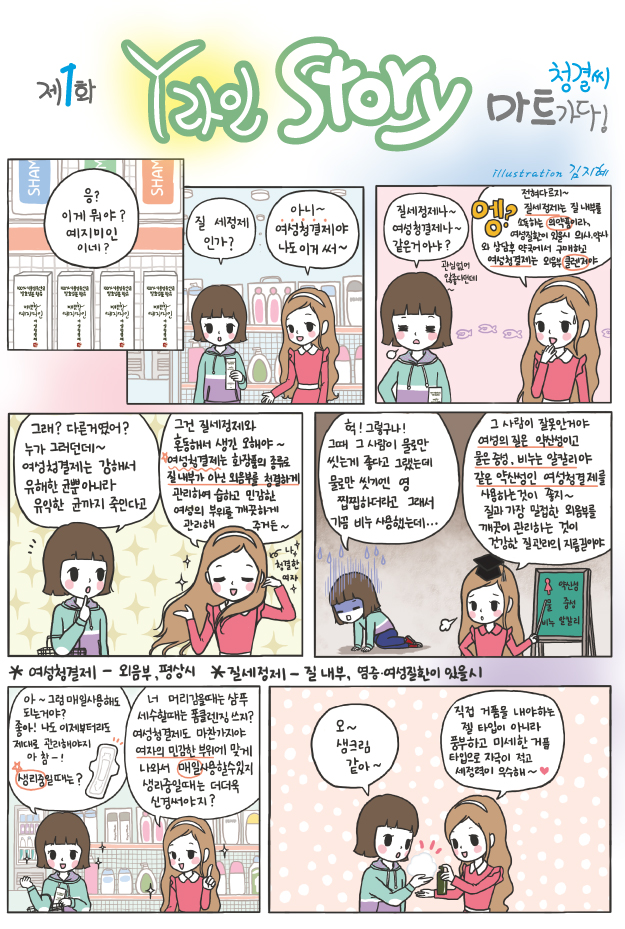
Yet while acknowledging those, you also have to acknowledge the context. Because whoever was ultimately responsible for the term, it’s safe to assume that they were influenced by the alphabetization trend. And it’s clearly in that commercially-driven, objectifying sense that the term is being used here.

Moreover, just like all the other lines, bear in mind that it’s just one version of the Y-line that has been co-opted by one company (and perhaps others) to sell its product, against which it must compete with other versions used by other companies to sell their own.

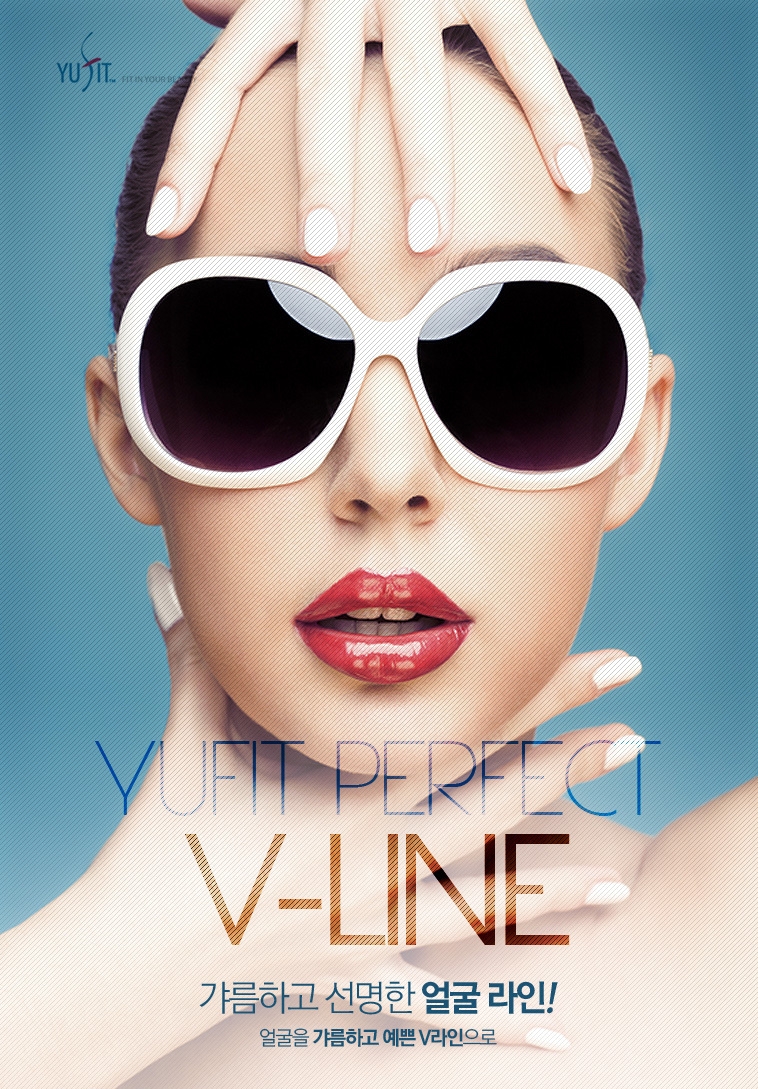
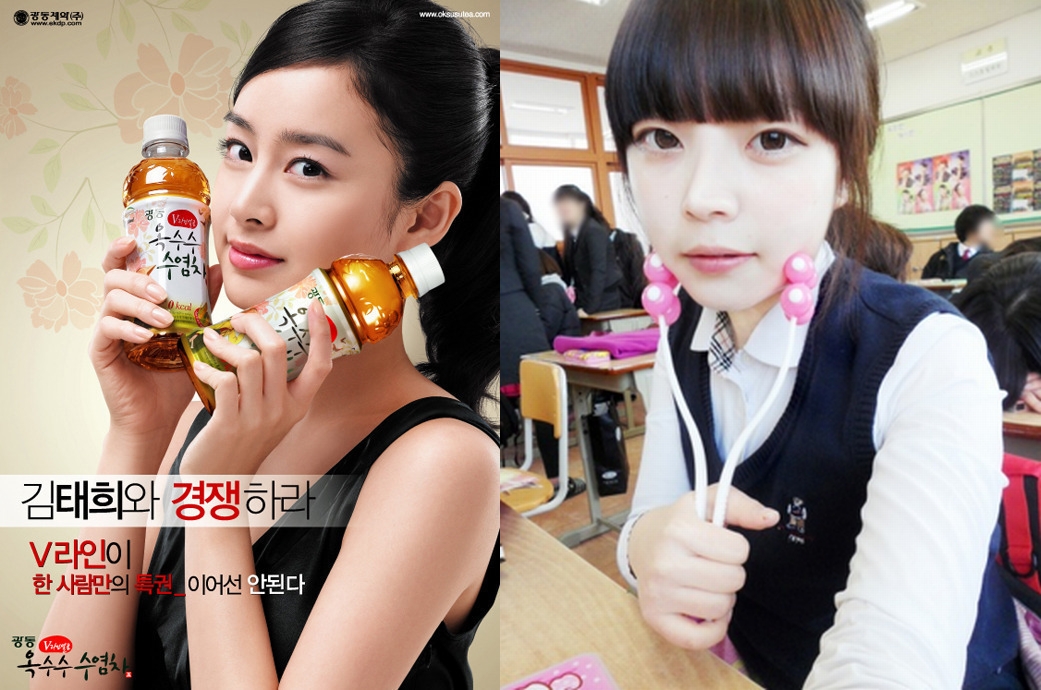
But which version — if any — will stick in consumers’ minds? And, like the “V-line,” will it ultimately become so normalized a part of popular culture, so accepted an expectation of women, that one day classrooms will be full of girls working on their own?

V-line Face Rollers Korean Schoolgirls(Sources:left, right)

The contenders include, first, a Y-line lift promoted by a hospital specializing in the procedure (as either a compliment or alternative to the V-line — it’s a little confusing sorry):

Y-line cosmetic surgery(Source)
Next, as breasts, from the line between them. I’d previously assumed that it was invented by the lingerie company Yes’, but it’s also used by others, as well as by cosmetic surgeons:

Y-line breasts(Sources: left; right unknown)

As the crotch:

Y-line crotch(Source)

As the back:

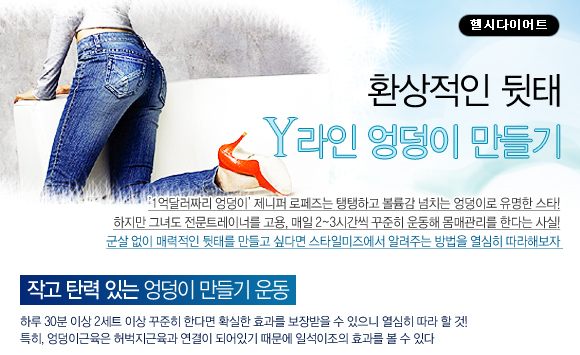
Y-line as the back(Sources: top-left, top-right; bottom unknown)

And finally(?) the buttocks.Now, forgive me if it sounds facetious, but I’ve examined many examples, and never once seen a “Y” in them. Again, you really have to wonder at the mindset of companies — and consumers — that do:

Y-line buttocks(Source)

And here’s part of a show episode devoted to nothing but, well, that Y-line butt:

Historical Precedents

Corset Figure Type Classification Korea(Sources: left, right)

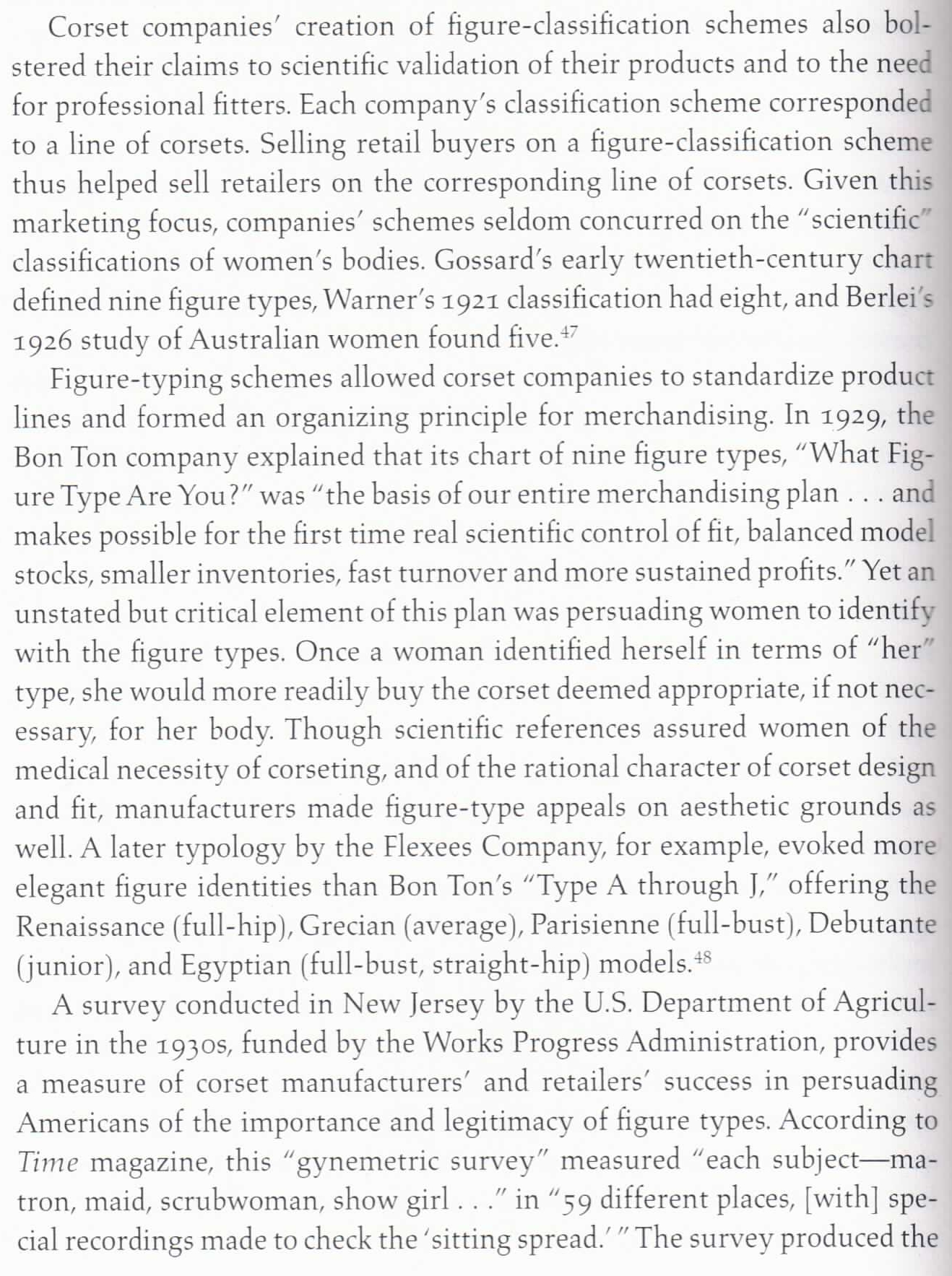
Did I say only two stark reminders of the absurdity and audacity of the Korean alphabetization trend? A third was discovering all those other ludicrous examples of Y-lines. Yet, however natural it may be to mentally assign something so absurd and asinine in another culture as distinctive to it, by no means is this trend only Korean, or even East Asian. Rather, as numerous examples from An Intimate Affair make clear, in fact they’re almost as old — and universal — as mass-production, mass-media, and marketing themselves.

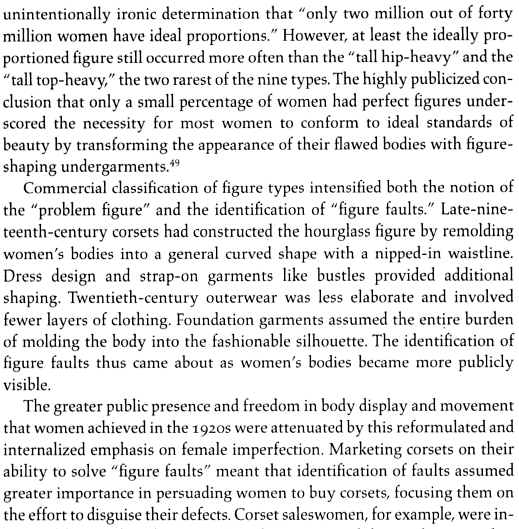
While I can’t begin to do justice to those examples here, two are particularly illustrative, and will hopefully encourage you to purchase your own copy of the book(!). First, the figure classification schemes invented by corset manufacturers in the 1920s (a scan; click to enlarge it):

Corset Figure-Classification Schemes p.66 An Intimate AffairFortunately, the next page is available at Google Books:

Corset Figure-Classification Schemes p.67 An Intimate Affair

This strongly reminded of the following video on how “pear”-shaped women should dress to look like they actually have hourglass-figures, spawning 159 comments at Sociological Images (also see here on subtle Korean encouragements through hourglass-shaped drink bottles):

In turn, that video gave me the impression that Western beauty, dieting, and clothing companies are more concerned with extorting women to conform to a narrow range of preexisting, publicly accepted body types rather than creating their own, then encouraging women to gain those instead. Can any overseas-based readers confirm? And/or recommend books and websites, so that a male reader, 13 years based in Korea, can find out?

(Update 1: Although it’s not specifically about women, or fashion, a reader suggests Our Aesthetic Categories: Zany, Cute, Interesting by Sianne Ngai, released last October. Based on the two reviews I’ve read, it sounds fascinating).

(Update 2: See Glamor Daze for an illustrated guide to “dressing for your body shape” from a Spencer Corsetry catalogue).

Despite that particular, potential difference however, from the 1930s to the 1950s Hollywood, the fashion industry, and — to a lesser extent — economically-threatened men would all influence the second example of “glamour” for their own ends, with the ensuing popular notions of the concept displaying a malleability and responsiveness remarkably similar to that of modern Korean lines. Indeed, although the English definition of the term has continued to considerably evolve since, ironically it’s (the main) one of those from that era — glamour as large breasts — that would enter the Korean lexicon as “글래머,” from which the appalling, infantilizing term “Bagel Girl/베이글녀” derives.

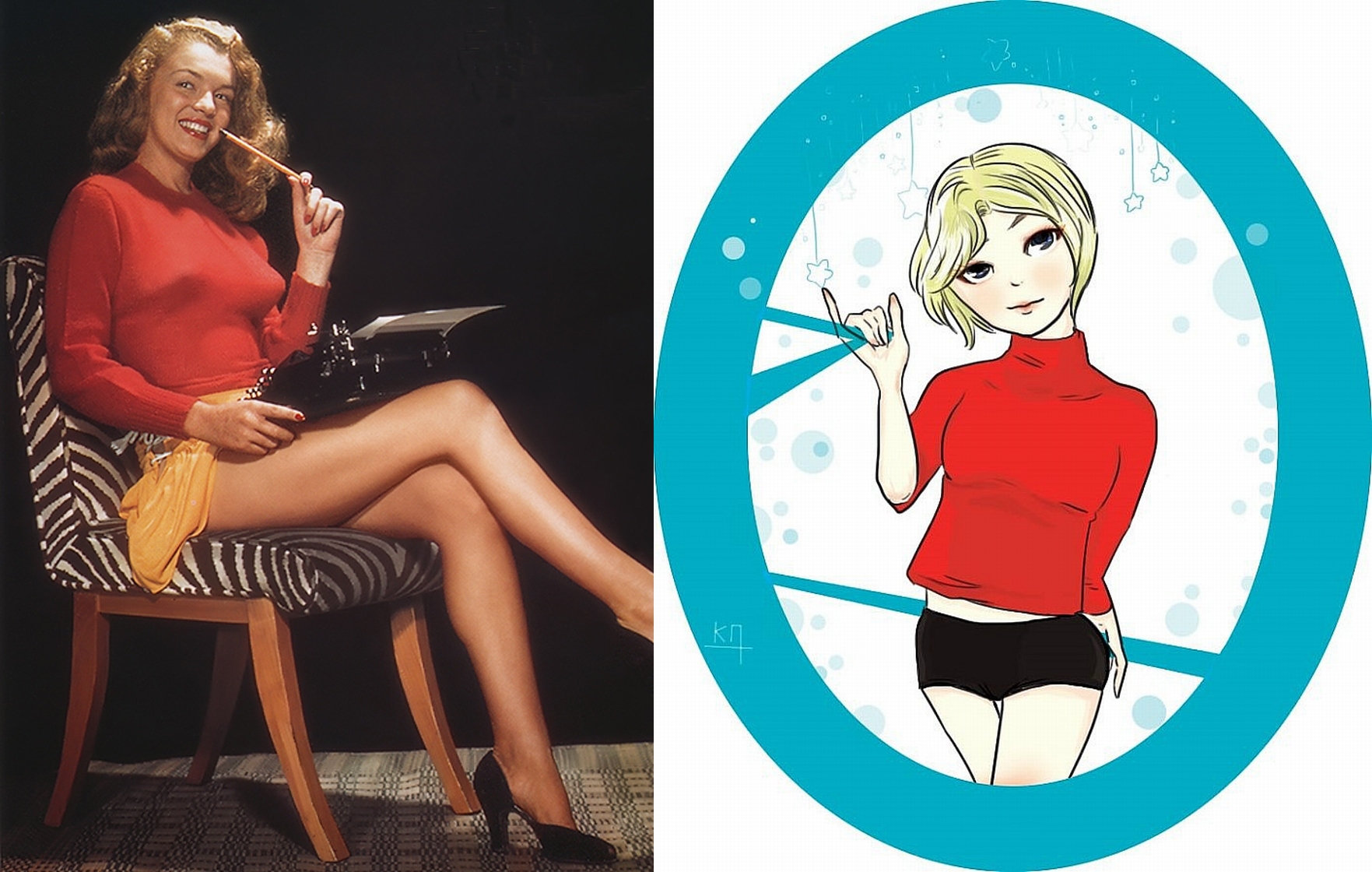
Marilyn Monroe Ga-in Sweater Girls(Sources: left, right. Surely not a coincidence, does anybody know who chose Ga-in’s wardrobe for Bloom?)

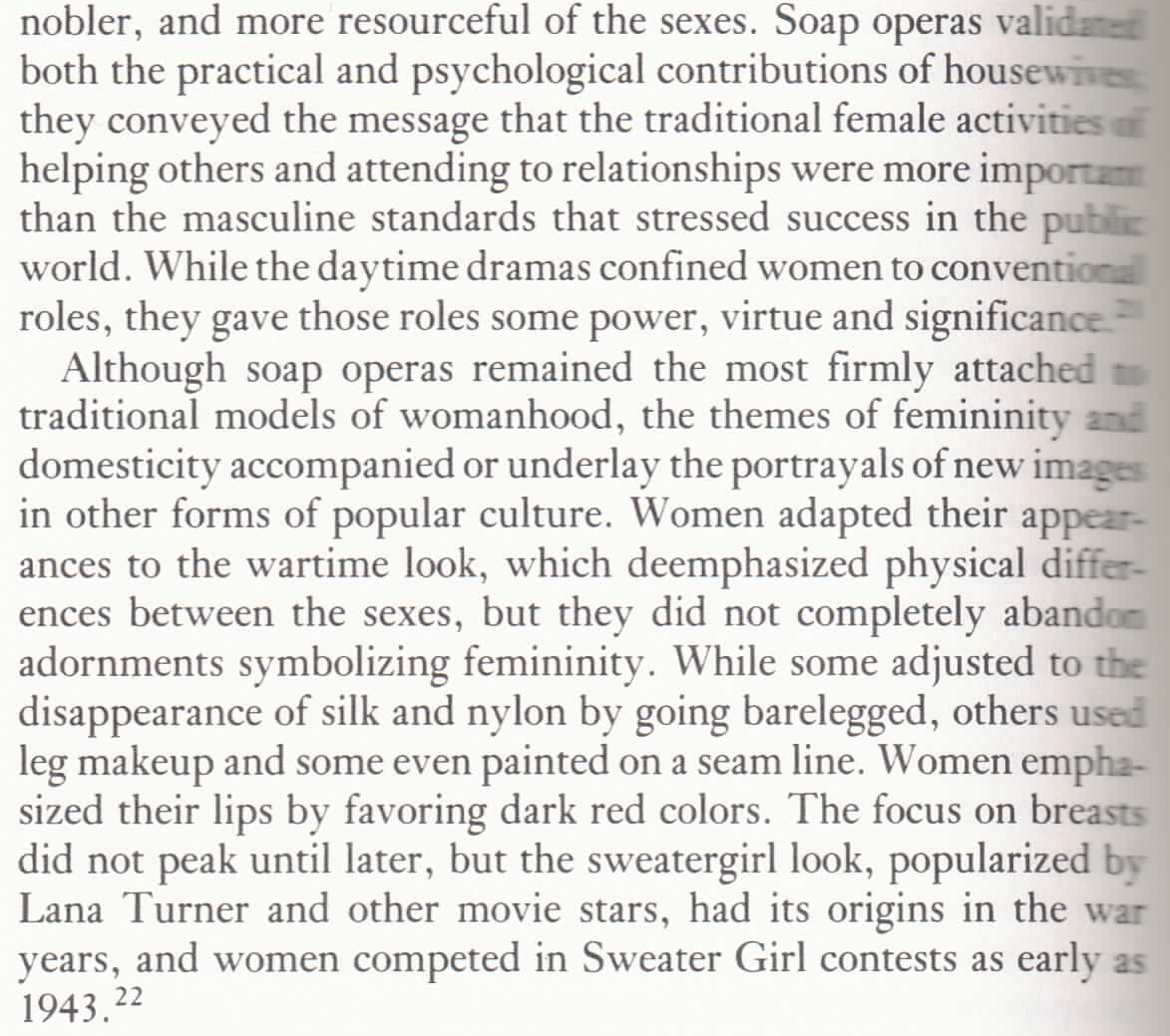
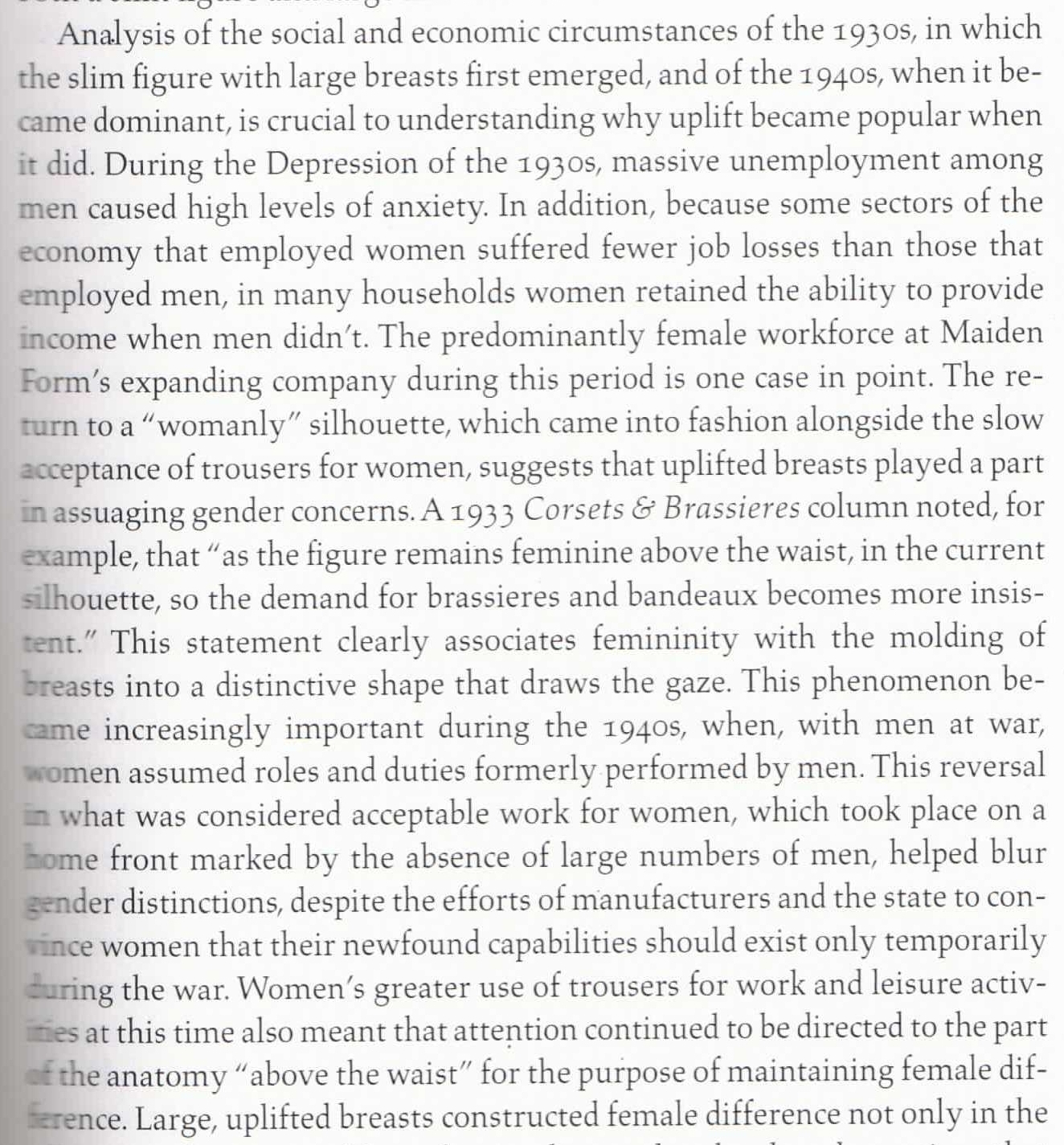
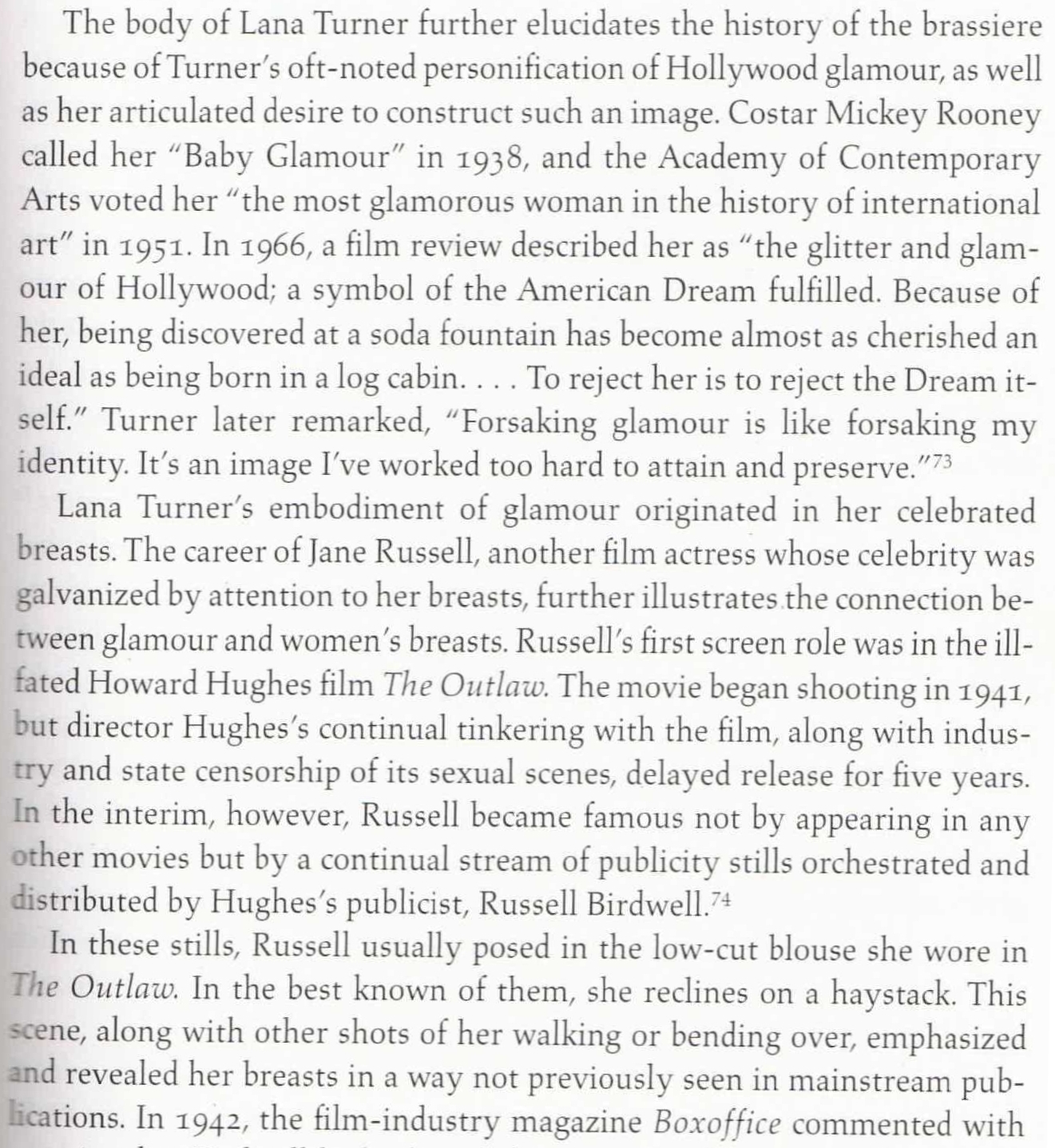
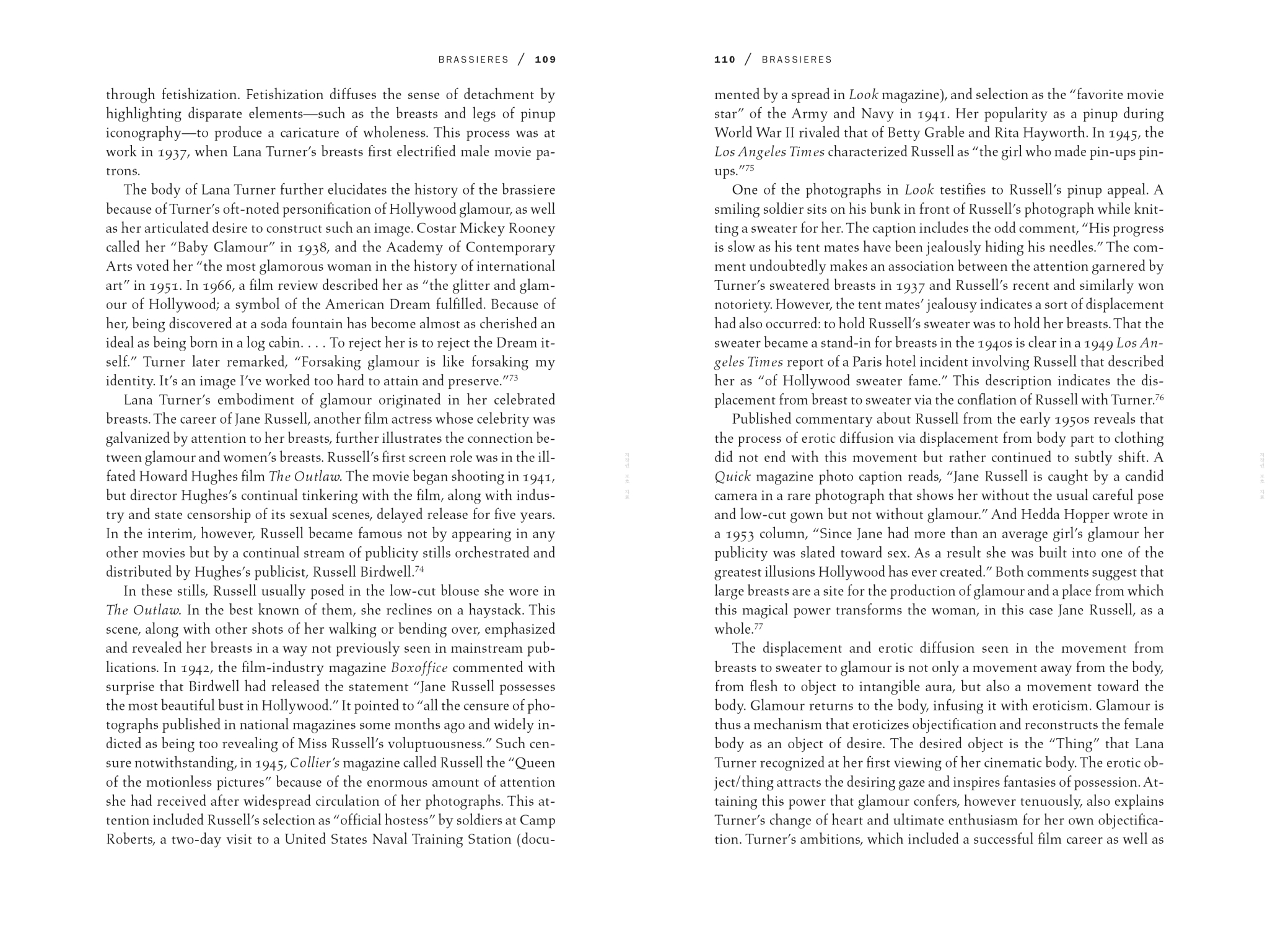
Again only snippets which can not do the book justice, but which probably already exceed what counts as fair use for a website nevertheless, here are some selected excerpts to give a hint of all that. First, from page 105, about the context of assuaging the fears of un(der)-employed men during the Depression, and then of soldiers during World War Two:An Intimate Affair, p. 105 excerptNext, from page 109 on the quite literal embodiment of glamour in breasts (and why I mentioned Lana Turner in my recent Busan Haps article on Ga-in’s Bloom):

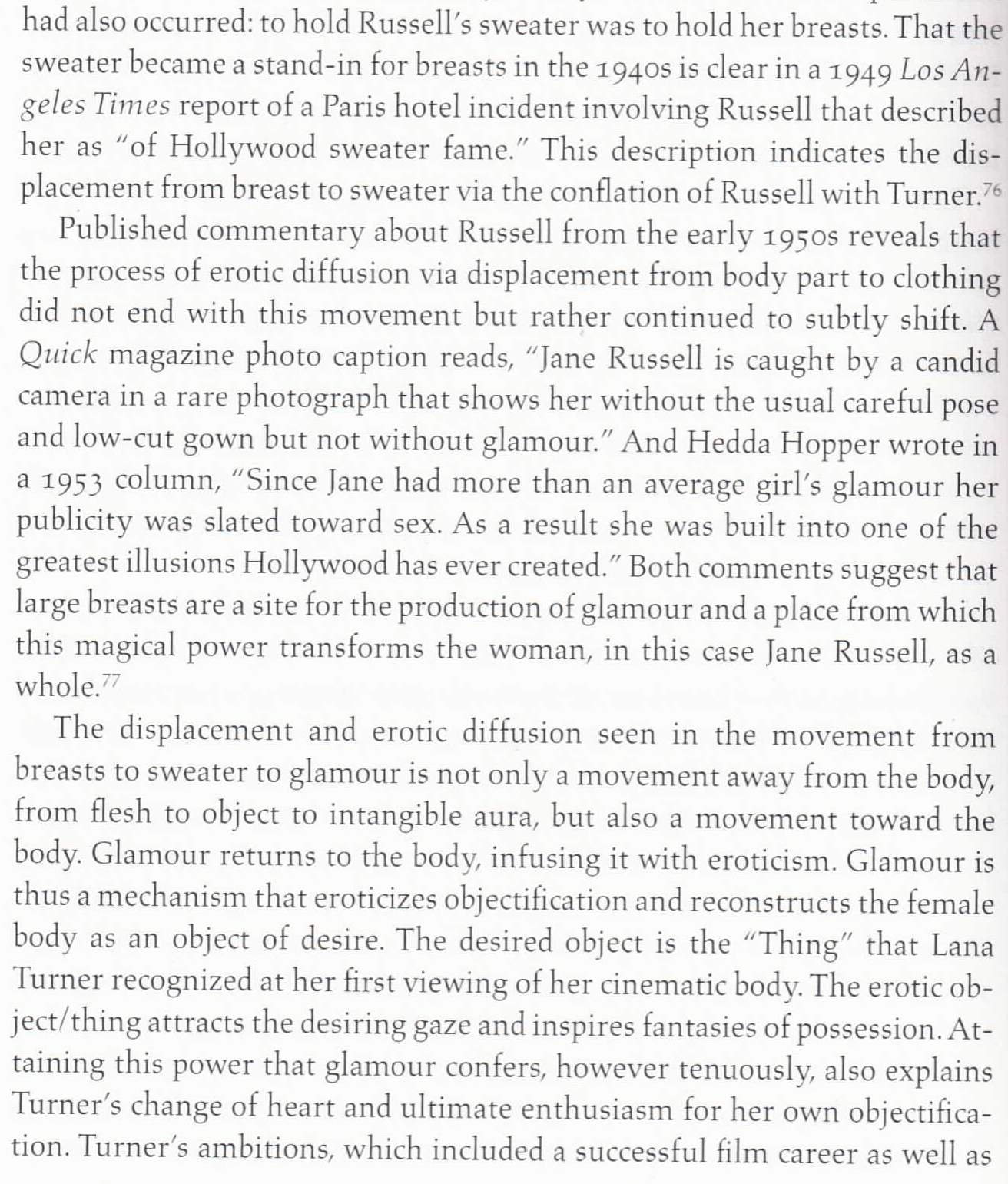
An Intimate Affair, p. 109 excerptNext, although frankly I don’t fully understand the final paragraph here, hopefully page 110 gives you an impression of how glamour came to shift from body parts to inanimate items of clothing (hence “Sweater Girls“) and so on, as also revealed in the illustrations below:An Intimate Affair, p. 110 excerptUpdate: Given my love for Maria Buszek’s Pin-up Grrrls (2006), it seemed a pity not to add the conclusion to the chapter on the next page (actually page 112) also:

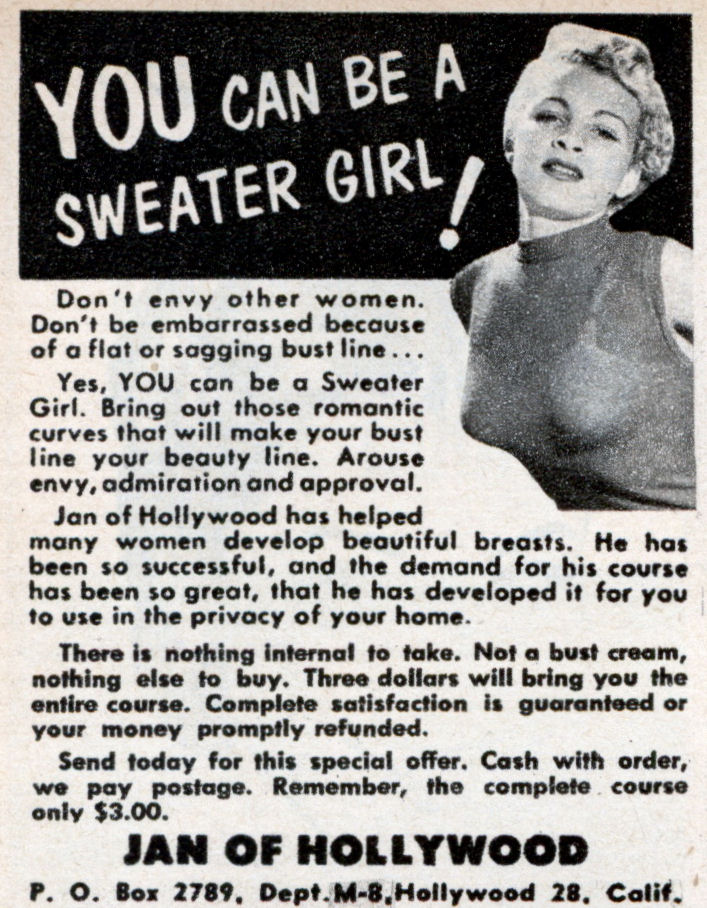
An Intimate Affair, p. 112 excerptAn advertisement for a Sweater Girl course(!) from 1954:

You can be a sweater girl(Source)

Glamorous glasses?

(Sources: left, right)

Conclusion: The Korean Beauty Myth?

With my new copy of The Beauty Myth arriving at my door literally as just before I type this, I should wisely reacquaint myself with it before proceeding further. But, of course, others have already made the same connection(s) that I have, including  Tess Hellgren in her (oft-quoted by me) 2011 Exposé piece “Explaining Underweight BMI and Body Dissatisfaction among Young Korean Women” (pp. 7-8):

…recent gendered shifts in Korean society offer another potent explanation for the trend in female body image. In the past thirty years, Korean society has undergone significant political and economic transformations, democratizing and industrializing at an incredible pace — and offering an extreme expansion of societal opportunities for women.19 Specifically since the 1980s, Korean women have seen an important increase in university attendance; today, 72% of South Korean women attend college, the highest rate of any country. According to feminist theory, this recent upsurge in female societal empowerment may be associated with an oppressive backlash in media portrayals of gender ideals. As explained in the work of Jaehee Jung and Gordon Forbes, historical data suggest that societal shifts toward gender equality are often accompanied by increased media portrayal of unrealistic gender norms as a reactive “tool of oppression” by mainstream society. Jung and Forbes cite the examples of both Europe and the United States: In the 1870s, it was during Europe’s industrialization and nascent women’s movement that accounts of anorexia nervosa first appeared, and the thinnest women in American fashion magazines appeared at the same time as momentum built for women’s rights in the 1920s and the 1970s. According to these scholars, the case of Korea is particularly striking due to the restrictive patriarchal nature of the country’s traditional Confucian culture, in which women’s familial and societal subordination is rigidly emphasized. Linking media portrayals to South Korea’s recent expansion of overall female opportunities, this feminist argument offers another potential explanation for the rise in body dissatisfaction and low BMI among Korean women in recent years.

Is something along these lines the only way to account for the combination of both an increased alphabetization/objectification of and backlash against women in the 2000s? Or is it that simply imposing a convenient narrative where none really exists?

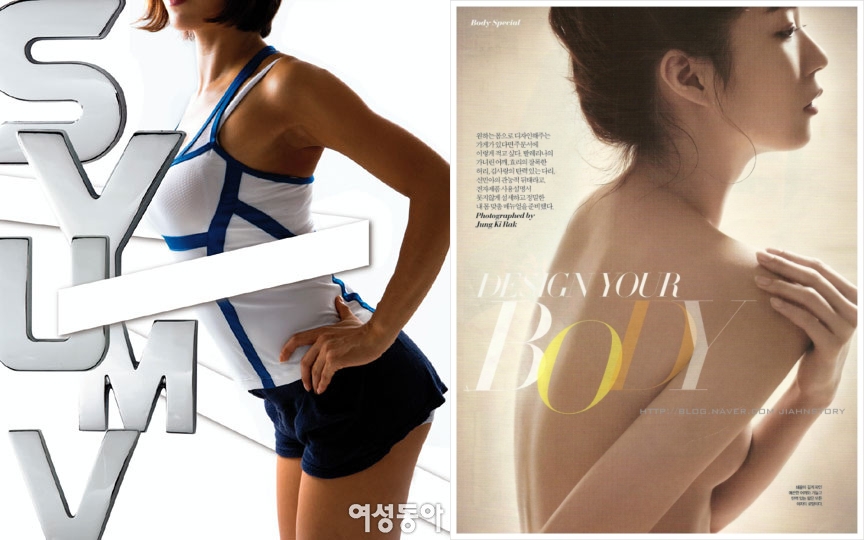
Design Your Body Line(Sources: left, right{NSFW})

Please let me know what you think. And, as a reward to Seoul-based readers who have read this entire post, let me give you advance notice of a presentation I’ll be giving on this topic for the 10 Magazine Book Club on Sunday March 10, the weekend following International Women’s Day. As I type this there’s only 22 more seats available, so please put your name down if you’re (fairly) certain you’ll attend, and I look forward to carrying on this conversation with some of you there! :)

The Revealing the Korean Body Politic Series:

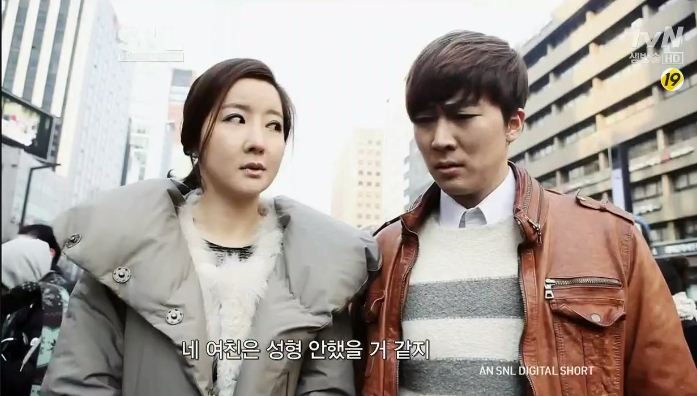
SNL 코리아 Satirizes Korea’s Cosmetic Surgery Craze (Translation)

SNL Korea Plastic Face 1(Source)

And, crucially, it doesn’t just poke fun at the obvious negatives, but also at the public discourses surrounding the industry. Namely, the hypocrisy of the men who loudly criticize women who get operations, yet shamelessly admire the results.

In addressing such a gendered contradiction, it strongly reminds of the messages in Miss A‘s (미쓰에이) Bad Girl, Good Girl (배드걸 굿걸). It also happens to be hilarious too, one of several skits by the Brown Eyed Girls (브라운아이드걸스) on the show last week.

In this one, the main character is Narsha (나르샤), joined by co-member JeA (제아) and Miryo (미료) (Ga-in /가인 is absent). None of the other actors are familiar, but I can find out who they are if anyone is interested:

Here’s my translation. Apologies in advance for any mistakes, but frankly there were some very new words that even my wife didn’t know (let alone be in my smartphone dictionary), and of course the swear words especially are open to interpretation!

너쌍꺼풀 수술했지?

너 코도 했지?

아니

난 자연 미인이 좋아

You got double-eyelid surgery, right?

A nose-job too, yes?

No…

I [only] like natural beauties.

SNL Korea Plastic Face 2(Source)

아무리 예뻐도 성형하면 싫어

웃겨 니들 사실 알아보지도 못해 (병X들)

니들이 좋아하는 얘네도 다 한 거야

X같은 것들이 항상 성괴라고 욕해

However pretty we become, you hate it when we get cosmetic surgery

That’s funny…you guys don’t actually recognize us (jerks!)

The girls you like, got everything done

Guys like that always swear at [criticize?] women who become “plastic surgery monsters”

SNL Korea Plastic Face 3(Source)

오오 오오오~

고경표 신동엽 강진도 헀을걸?

(그게)

눈했어 코 했어 그래 싹 다 바꿨어 턱했어

(압구정역 4번 출구)

맞았어 넣었어 그래 싹 다 갈았어 다헀어

(강남역 10번 출구)

프프프플라스틱 페이스 (x4)

Probably Go-gyeong Pyo, Shin Dong-yeob, and Gang-jin all got it done

(Really??)

[People] get their eyes done, their noses done…they change everything…they get their jaws done

(Apgujeong Station Exit #4)

That’s right, they put [botox? silicone?] in…Really, they change everything

(Gangnam Station, Exit #10)

Plastic Face (x4)

SNL Korea Plastic Face 4(Source)

네 여자친구 성형 안했을 거 같지

했어도 눈코 정도 했을 겉 같지 (x밥들)

들어 봤니 눈코 입돌려 깎기 양약

너 환장하는 그 가슴은 물방울 코젤

오오 오오오~

너보다 훨 알럽 의느님

You think your girlfriend didn’t get anything done?

And even if you think she did, you think she just got her eyes and nose done? (You fucking dickheads)

Have you heard of maxillofacial surgery, which involves breaking the upper and lower jaw?

The breasts you’re crazy about are just saline implants

Oh oh, oh oh oh ~

She will probably love her Doctor God more than you

SNL Korea Plastic Face 5(Source)

똑같아 똑깥아

니얼굴 내얼굴 다 똑같아

압구정동에서 했니

프프프플라스틱 페이스 (x4)

또또또 똑같아 모두다 같아

They’re the same, they’re the same

Their faces are all the same

Did they all get them done in Apgujeong?

Plastic Face (x4)

They’re all the same, they’re all the same

SNL Korea Plastic Face 6(Source)

우릴 욕할 때가 아냐 거울 좀봐

눈코 입은 요좀 헐값

명품가방 살돈으로

눈코 입을 달아

세트로 하면 디씨돼

친구랑 가면

더 디씨

부끄럽게 생각 마

자신감이 중요해

It’s not time to swear at us, look at yourself in the mirror

Nose, eye, and mouth-jobs are so cheap

With the money for a brand name bag

You can get a new face

If you get them all done as a set you can get a discount

If you get them done with your friends at the same time, you can get even more of a discount

Don’t be embarrassed

Confidence is important

SNL Korea Plastic Face 8(Sources: above, below)

당당해 당당해 우린 너무 당당해

만족해

(과거 사진 X까라해)

꺼내봐 꺼내봐

네 얼굴에 가려진 매력들

(넌시X 존X 매력있어)

프프프플라스틱 페이스 (x2)

다다다당당해

당당해 우린

프프프플라스틱 페이스 (x2)SNL Korea Plastic Face 7

Bold, Confident, We are all so bold and confident

We are satisfied

(Don’t you ever fucking show old photos)

Bring out those changes to your face that you hid

(You’re fucking hot now)

Plastic Face

Bold, Confident

Plastic Face

(Hat tip to dogdyedblack)

Update: Naturally, a translation from earlier today popped up shortly after I finished this post. But which I couldn’t find at all when I decided to write it!

Swallowing my pride (and several hours’ worth of effort), I have to admit that it’s much better than mine (although—*sniff*—I still disagree with a few lines here and there):

Lee Hyori: Korean Pin-up Grrrl #1?

Lee Hyori Pin-up Grrrl(Source)

Out of all this week’s stories, up tomorrow in the Korean Gender Reader, probably one of the most important — but also the most under-appreciated — is the news that Lee Hyori (이효리) will no longer be doing any commercials for products that conflict with her animal rights, environmental, and/or vegetarian beliefs.

This excludes her from working with so many companies, that her agency had to clarify that she hadn’t given up modelling or endorsements altogether.

Certainly, she’s already well known — and liked — for being so outspoken and sassy, which is very rare for female celebrities here. But this is still a significant step, because it’s difficult to think of any other Korean celebrity explicitly rejecting the endorsement culture upon which their agencies so heavily depend. Let alone someone who was once the country’s biggest sex-symbol.

Lee Hyori and Dog(Source)

Moreover, while she’s open to charges of hypocrisy, as it’s undoubtedly much easier to take an ethical stance on endorsements after years of making millions from them, she did at least acknowledge this contradiction in a recent interview, and at only 33 could have continued to do them for decades. Also, with “We can’t help but be subjected to the power of the companies when we sign a contract. Hara, please don’t forget my words,” her tweet of advice to Goo Ha-ra (구하라), one of her replacements as a soju model, she indirectly criticized companies’ excessive power over their endorsers — recall Ivy (아이비) being sued for an completely non-existent sex-tape for instance, or Choi Jin-sil (최진실) being sued for going public about being a victim of domestic abuse, and then being sued again after she committed suicide — and/or entertainment agencies’ willingness to enter into such arrangements regardless. And, albeit perhaps unfairly, has put the onus on much younger celebrities to be more discerning with their own choices (or, rather, to challenge their agencies’ choices).

Can anybody think of any other Korean celebrities that have made similar ethical stands and/or critiques of the media and entertainment industries? I admit I don’t have much time to follow Korean celebrity news, and would be happy to learn that Lee Hyori isn’t as exceptional as I thought!

(Update: Also, if anybody come across a Korean source that places Lee Hyori’s decision in that above context, that would also be appreciated. Unfortunately, apparently they’re just as rare!)

Related Posts:

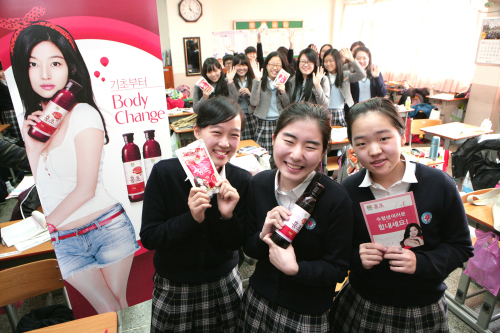
“Body Changing” Diet-Drink Generously Donated to High School Students

Estimated reading time: 4 minutes. (Source)

Young Korean women—not men—are the only demographic in the OECD that are getting more underweight than obese.

Call me making a mountain out of a molehill, but diet-drink companies being allowed to donate their product to teens, out of supposed concerns for their heath? And plastering their classrooms with ads of heavily photoshopped women in the process? Those may just have something to do with that:

청정원 홍초가 수험생 여러분을 응원합니다 / Chung Jung Won’s HongCho Cheers For Students Taking University Entrance Exams

by Kim Jong-hoon (김종훈), Asia Today, November 4 2012

대상은 자사의 브랜드인 ‘청정원’ 홍초가 수능시험을 앞둔 고3 수험생을 응원하기 위해 오는 7일까지 서울시내 20여개 학교를 찾아 다니며 홍초 2만여개를 무료로 나눠줄 계획이라고 4일 밝혔다.

On Sunday, Daesang’s brand Chung Jung Won [English website here] announced that to support 3rd year high school students about to take their university entrance exams, they would visit 20 high schools in Seoul before the 8th (the day of the exams) and donate 20,000 bottles of HongCho to students (source, right).

청정원측은 오랜 시험준비로 지친 수험생들이 좋은 컨디션으로 시험을 볼 수 있도록 응원하기 위한 마음으로 기획 된 행사라고 설명했다. 수능이 끝난 이후에도 홍초를 내세운 다양한 마케팅 활동으로 그간 고생이 많았던 수험생들을 지원할 계획이다.

Chung Jung Won explained that this is an event for tired students that have been preparing for the exams for such a long time, so that they can be in good condition on the exam day. Also, that even after the exams, the company plans to continue supporting those students that have suffered so much, through various HongCho marketing events.

한편, 홍초는 피로회복 등에 도움이 되는 기능성 원료인 콜라겐과 헛개나무 농축액, 그리고 식이섬유를 풍부하게 함유하고 있는 건강기능성 음용식초다.

HongCho is a healthy vinegar drink that includes collagen, liquids extracted from the Oriental Raisin Tree, and a lot of fiber, and is very helpful for recovering from tiredness. (end.)

For sure, HongCho does sound quite healthy. And, technically, do not match the definition of a diet-drink:

Diet drinks: Include calorie-free and low-calorie versions of sodas, fruit drinks, energy drinks, sports drinks, and carbonated water, consistent with definitions reported by the National Cancer Institute and U.S. Food and Drug Administration food labeling guidelines. Diet drinks do not include 100% fruit juice or unsweetened teas or coffees.

However, a quick perusal of the Chung Jung Won website demonstrates that it is explicitly being marketed as a “body-changing” drink, with—especially after photoshopping—exceptionally tall and skinny Jun Ji-hyun (전지현) endorsing it most recently (that’s Kim Hee-sun/김희선 from 2010 above). Also, the following website screenshot (from 2011) and commercial show that the body-changing theme is no mere Konglish accident:

(Source)

There also appears to be a sponsorship deal with the Diet War program:

(Source)

Meanwhile, girl-group Kara (카라) are promoting the drink in Japan, with much the same theme. Which is ironic, considering that these are the same women who admitted that they can’t even drink water on the (frequent) days that they’re required to wear revealing clothing:

What do you think? Have any Korea-based readers had similar promotions at their own schools? How about overseas? Are concerns and issues different there? I know that in the US for instance, it is more sodas that are considered a problem, and that if students drank HongCho instead that would probably be considered a blessing. From TIME back in March (my emphasis):

If some public-health advocates have their way, sodas could become the cigarettes of food. Doctors already dislike the sugary drinks for their teeth-dissolving properties and for the role they may play in childhood obesity. There’s a constant struggle to get soda vending machines out of public schools, with administrators often forced to choose between losing sponsorship money from big soda companies and dealing with overcaffeinated, less healthy kids. Given the sheer size of the American soda industry—9.4 billion cases of soft drinks were sold in the U.S. in 2009—it’s not a war that will end anytime soon. Especially if a certain C word starts getting thrown around.

Update: From the picture, I got the impression that is was only girls’ schools that were targeted, but technically the advertorial (I can’t bring myself to call it a news report) only mentions 20 unnamed schools, and is repeated verbatim across newspapers.

Update 2: It’s not really related to the original post, but if you read that TIME magazine article above, you may also be interested in the recent findings that one of the main reasons for US children’s obesity is that they’re eating away from home so often, and (of course) that they’re mostly eating junk food when they do.

Related Posts:

If you reside in South Korea, you can donate via wire transfer: Turnbull James Edward (Kookmin Bank/국민은행, 563401-01-214324)

Radio Interview on Korean Cosmetic Surgery Tonight, 7pm

(Source)

Tonight at 7pm I’ll be on Busan e-FM’s Let’s Talk Busan again, this time talking about Korean beauty standards and cosmetic surgery. You can listen on the radio at 90.5, or online here (please note that you’ll have to download Windows Media Player 10 first), and I’ll add a link to the archived version once it becomes available.

Sorry to those of you who tuned in 2 weeks ago, only to hear me speak for just a couple of minutes in total: 7 guests was far too many. But I’m happy to report that there’ll just be 3 of us this time!

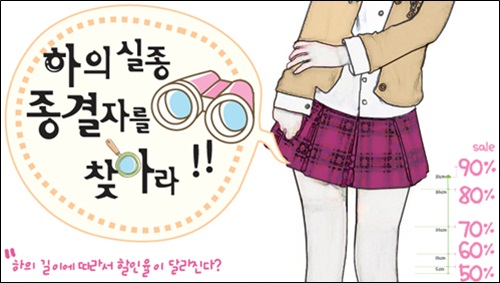
“The less you wear, the bigger the discount”

(Sources, edited: left, right)

“Want to talk third wave feminism, you could cite Ariel Levy and the idea that women have internalized male oppression. Going to spring break at Fort Lauderdale, getting drunk, and flashing your breasts isn’t an act of personal empowerment. It’s you, so fashioned and programmed by the construct of patriarchal society that you no longer know what’s best for yourself. A damsel too dumb to even know she’s in distress.”

Chuck Palahnuik, Snuff (2008)

Via Genderly Speaking, a typically provocative quote from Palahnuik to ponder. Not least, when you’ve just translated today’s article, about a clothes company offering discounts to customers for wearing mini-skirts and hot-pants.

Cancelled for being too lewd, I think the event should have gone ahead, and not just because I wasn’t all that impressed by Levy’s Female Chauvinist Pigs (2005) either. Rather, it’s mainly because I completely reject the notion of any woman— or man—as a mere unthinking pawn of the patriarchy. Also, heavily promoted by the media, there’s already a huge demand for such revealing clothes, so this event stood out only for being more explicit than most.

While there are legitimate issues of sexual objectification that can be raised in light of that, another problem is that the writer of the article (or the parties involved—it’s unclear) implies that it was the “sexual provocation” or “sexual suggestiveness” (선정성) that was the greatest concern. Whether she was talking about the clothes or the event as a whole though, is a little vague, but if the former then I imagine that many women would take offense at the implication that they should never wear revealing clothes? (Source, right)

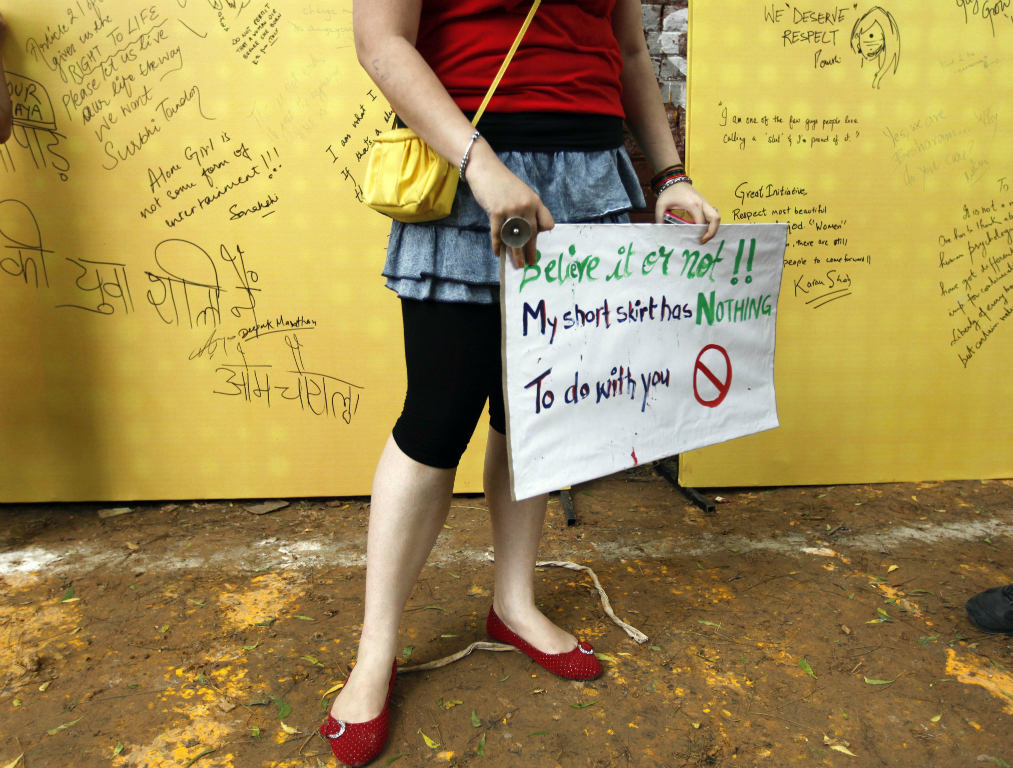
Had the event gone ahead as planned though, I do realize that it would have been just as empowering and tasteful as, say, a wet t-shirt competition. (Seriously, I’m wincing at the thought of lecherous cheering and the flash of cameras as customers are revealed to have over 30cm of skin showing above their knees.) Also, even if this did all happen a month before the first Slutwalk in Toronto, and 4 months before Korea’s own, it was still disappointing that the company representative only offered platitudes in defense of the event.

Is it hypocritical of me to intellectually support such an event, but — were they old enough to attend — hope that my own daughters would avoid it like the plague? Or merely honest? Or both?

Sigh. Like Peggy Orenstein explains in the first chapter of Cinderella Ate My Daughter (2011), sons sound so much easier to raise!

“벗는 만큼 세일” 의류업계 ‘막장’ / Just Typical For The Clothing Industry: “The less you wear, the bigger the discount”

코오롱인더스트리 이벤트 ‘성 상품화’ 논란…결국 행사 취소 / Kolon Industries event leads to sexual objectification controversy, is ultimately cancelled

Consumer Times, 9 March 2011, by Choi Min-hye (최미혜), choimh@consumertimes.net

코오롱인더스트리가 최근 치마길이에 따라 옷 값을 깎아주는 행사를 기획한 가운데 선정성 논란이 일자 다급히 취소하는 촌극을 벌여 소비자들의 눈살을 찌푸리게 하고 있다.

While planning an event in which customers would receive discounts depending on how high their mini-skirts were, Kolon Industries abruptly cancelled it in light of the controversy over its sexual provocation and the [anticipated] negative reaction from consumers.

참여자들의 과다 노출과 같은 부작용을 우려하는 목소리와 함께 ‘성상품화’라는 지적도 나와 행사를 예정대로 강행하기는 무리라는 업체 측의 판단이 작용했을 것이라는 분석이다.

As voices of worry were raised about the sexual objectification and such side effects as participants’ sexual objectification, the company judged that to go ahead with the event as planned would be unwise.

(Source)

◆ 할인권 걸고 ‘여성 노출’ 부추겨? / Encouraging Women to Expose Their Bodies via Discount Coupons

코오롱인더스트리는 오는 13일 자사 패션 브랜드 매장인 ‘조이코오롱’에서 길이가 짧은 하의를 입은 고객들에게 제품 할인권을 증정하는 ‘하의실종 종결자를 찾아라’ 이벤트를 진행키로 했다 돌연 취소했다.

Kolon Industries abruptly cancelled an event titled “Who has the shortest?” that was to be held on the 13th at one of their stores, in which customers would have been offered discounts on clothes like hot-pants or mini-skirts if they arrived already wearing really short ones.

연예계를 중심으로 유행처럼 번지고 있는, 하의 길이가 매우 짧은 이른바 ‘하의 실종’ 패션을 제품 할인이벤트에 접목시켰다 여론의 뭇매를 맞은 탓이다.

While the entertainment world has spread this so-called “Disappearing Lower Body” trend of wearing very short clothes, Kolon Industries was roundly criticized by the public for grafting a sales event onto it.

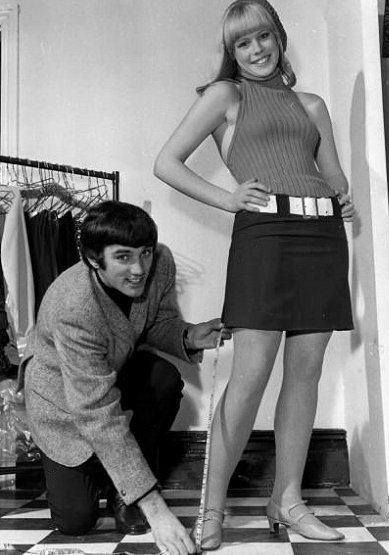
당초 이 업체는 행사에 참여한 고객의 무릎부터 하의까지의 길이를 재 5cm까지는 50%, 10cm까지는 60%, 20cm는 70%, 30cm가 넘으면 90% 할인 쿠폰을 제공하겠다는 계획이었다. 다리 노출을 많이 할수록 옷 값을 더욱 깎아준다는 얘기다.

The intention of the company was to offer customers a 50% discount on clothes if they arrived exposing 5cm of their legs (from their knees), 60% for 10cm, 70% for 20cm, and 90% for 30cm. Or in other words, the more they exposed their legs, the greater the discount.

행사에 참여키로 예정돼 있던 이 회사 의류 브랜드는 ‘헤드’, ‘쿠아’, ‘쿠론’ 등이다. 헤드는 스포츠브랜드지만 쿠아와 쿠론은 각각 여성복, 핸드백 등 액세서리 전문 브랜드다. 행사의 주요 타깃이 여성이라는 분석이 가능하다.

Clothing brands that planned to participate in the event were Head, QuaCouronne, and so on. While Head is a sports brand, Qua and Couronne sell women’s clothes and handbags and accessories respectively. Women were clearly the target of the event.

일각에서는 국내 대표 의류업체가 할인권을 내세워 여성의 노출을 부추긴다는 곱지 않은 시선이 쏟아져 나왔다.

(Source)

Some people are critical of the famous national company for planning an event that will encourage women to expose themselves.

코오롱인더스트리는 선정성 논란은 ‘기우’에 불과하다며 패션 트랜드를 반영한 행사라는 사실을 강조했다.

[But] Kolon Industries emphasized that to describe this event as sexual provocation is misguided, as it merely reflects current fashion trends.

이 회사 관계자는 “다른 업체에서 (하의실종 종결자 이벤트를) 하면 문제가 될 수 있겠지만 우리는 패션회사”라며 “패션업계에서 핫 이슈인 ‘하의 실종’ 패션을 깜짝 할인행사에 접목시킨 것”이라고 해명했다. 선정성 논란 등 행사의 부정적 효과는 이미 기획단계에서 내부적으로 논의됐다는 부연이다.

A company representative explained “If other [non-clothing] companies had hosted an event like this, it would have been a problem, but we are a fashion company.” Also, that “possible reactions like controversy about sexual provocation were anticipated and already taken into account before deciding to host the event.”

(Sources: left, right)

◆ “패션업계 ‘핫 이슈’ 행사에 접목 시킨 것”…결국 이벤트 취소 / In the end the event was cancelled

이어 이 관계자는 “평소 소비자들이 입고 다니는 반바지나 치마를 입어도 할인권을 받을 수 있다”며 “하의를 최대한 짧게 입고 오라는 취지는 아니다”라고 강조했다.

The representative added “Customers that wore normal-length shorts and skirts would also have been able to receive discounts, so the intention was not to encourage them to wear as short clothes as possible.”

“과열 경쟁 등으로 지나치게 노출이 심한 옷을 입은 참가자가 등장하면 문제가 되지 않겠냐”는 기자의 질문에는 “상황에 따라 대처하겠다”고 두루뭉술하게 답했다. 사진촬영도 막지 않겠다는 입장이어서 현장 단속이 사실상 전무한 것 아니냐는 추측이 나온다.

When asked by a reporter if people wearing too revealing clothing [in order to get a bigger discount] would be a problem, the representative replied “We don’t anticipate that, but will deal with any problems if and when they occur.” [However] it will be too difficult to police the event and prevent people from taking pictures.

이 관계자는 “기본적으로 신분증을 지참한 성인남녀만 참가할 수 있도록 했지만 행사 자체는 모두에게 공개된다”며 “(지나친 노출 등) 누가 봐도 문제가 될 상황이 발생하면 현장에서 해결할 것”이라고 말했다.

The representative also said that “the event will be open to the public, but only adults (we will check IDs) will be allowed to participate,” and again that “we will deal with any problems of excessive exposure if and when they occur.” (source, right)

업체 측의 해명에도 불구하고 ‘선정성 논란’은 수그러들지 않았다. 결국 이 업체는 문제의 행사를 열지 않기로 입장을 선회했다. 소비자들의 반응은 냉담했다.

Despite these explanations, the controversy about the sexual provocation didn’t die down. In the end, the company decided not to hold the event in question. But consumers’ feelings about it are still cool.

한 소비자는 “결국은 짧은 치마를 입고 와야 옷을 싸게 살 수 있다는 것 아니냐”며 “성 상품화에 대한 논란도 많은데 코오롱인더스트리가 꼭 이런 행사를 기획했어야 했는지 모르겠다”고 지적했다.

One consumer complained that “Why would we have to come to the store in high mini-skirts in order to receive the discount,” and wondered “why did Kolon Industries plan such event when sexual objectification is such a controversial issue?”

또 다른 소비자는 “의류업체에서 유행 아이템을 반영한 행사는 개최할 수 있다”면서도 “다만 행사 내용이 지나치게 선정적으로 비춰지면 소비자들이 거부감을 느끼지 않겠냐”고 말했다.

Another consumer said “A company can certainly hold an event that reflects current fashion trends,” but “if it is too sexually provocative, won’t people reject that?”

한편 코오롱그룹 모기업인 코오롱인더스트리는 ‘캠브리지멤버스’, ‘헤드’ 등의 브랜드로 유명한 패션 전문기업이다.

The Kolon Group, the parent company of Kolon Industries, is well known for fashion brands like Cambridge Members and Head (end).

Update — Via this blog, a video promoting the event:

Related Posts:

Sex and Gender Stereotypes in Korean Advertising

Thanks to the students at Dongseo and Pusan National University for being such great audiences last week, and here is the presentation as promised. Sorry that the animations don’t work in the online version, but there weren’t too many.

For regular readers, unfortunately the slides may make little sense in themselves, but I’m happy to elaborate on any of them if you’re interested. The purpose of the first few, for instance, is not so much to illustrate the numerous subliminal sexual messages found in advertisements (although I certainly could spend an hour talking about those!), but more to make the point that nothing in an advertisement is accidental, and that it’s very naive to think otherwise. In turn, the picture of all the Korean churches is to provide a parallel to Normal Lewis’s point here, which is that if, say, my mother comes to Korea and notices all the neon crosses around, does that somehow make her a fundamentalist Christian? Or simply that there’s a lot of churches here? Likewise with noticing sexual themes in ads, no matter how perverted some people think that is.

Much better than me explaining here though, is for me to give a presentation at your own university or institution instead. Just give me a buzz — I’m pretty cheap!

Interview for Radiowa Trójka

(Source)

For any Polish speakers amongst you, I was interviewed about K-pop, sexual objectification, and — of course — Gangnam Style by Radiowa Trójka the weekend before last. Check me out in translation in section 3 here, and let me say again how nice it was to meet reporters Katarzyna Borowiecka and Marcin Pospiech, who look like they’ve produced quite a comprehensive show! :)

No V-lines Required: Miss Korea in the 1960s

(Source: Munhwa Ilbo)

Alas, this brief article from today’s Munhwa Ilbo isn’t exactly a scathing critique of Korea’s body-labeling craze, and I don’t mean to imply that there aren’t much more substantial ones out there. But still, it’s good to be quickly reminded that perhaps “V-lines” aren’t as necessary as pop-culture icons would like us to think (e.g., see ZE:A in Brazil below), and I hope the photo makes it to the front page of major Korean portal sites.

See here or here for better quality versions, or here and here for pictures of the 1957 and various 1970s contestants respectively.

60년대 미스코리아는 ‘V라인 아닌 건강미’ / In the 1960s, Miss Korea Had a Healthy Beauty, not a V-line.

‘미인’의 기준은 문화와 관습에 따라 다르지만 시대에 따라서도 변합니다.

The criteria for a beautiful woman depend on time, culture, and customs.

사진을 보면 1960년 미스코리아 선발대회에 나온 여성들은 건강미가 넘쳤습니다. 당시에는 서구적인 마스크를 선호했다고 하죠. 1980년대 이후 한동안 도시형 미인이 인기를 끌었고, 요즘은 ‘V라인’의 작은 얼굴과 뚜렷한 이목구비가 대세라고 합니다. 성형미인도 많아졌고요.

If you look at this photo of the 1960 Miss Korea contest, you see women overflowing with healthy beauty, [even though] it is said that people preferred Western masks [looks?] then. [But] from the 1980s, for a while urban beauties were preferred, and these days having a V-line and distinct facial characteristics are huge trends. There are many cosmetic surgery beauties.

1957년 시작된 미스코리아 선발대회는 초창기 큰 인기를 모았습니다. 공중파 TV를 통해 전국에 생중계됐고, 수상자들은 카퍼레이드까지 하며 미를 뽐내기도 했었죠. 그러다 여성단체 등의 ‘성상품화 조장’ 반발로 2002년 이후 공중파에서는 중계를 하지 않고 있습니다.

(Source: Yufit)

Starting in 1957, from the beginning the Miss Korea contest was very popular. From being shown live on TV, to winners taking part in car parades, their beauty was shown off. However, later women’s groups denounced it as promoting sexual objectification, and from 2002 it was only allowed to be shown live on cable.

예전에는 미스코리아 선발대회를 통해 연예계로 진출하는 경우도 많았지만 요즘은 오디션 프로그램 등 연예계로 나설 방법이 다양하게 생겨났습니다. 그래서인지 대회의 인기가 예전만 못합니다.

In the past, there were many cases of Miss Korea contest participants entering into the entertainment industry through the competition, but these days there are a variety of audition programs that provide the same opportunity. Because of that, the contest can’t reach the level of popularity that it enjoyed in the past. (End.)

Update: Here’s a video of the 1981 to 2008 winners. As one of the commenters on YouTube put it, it’s interesting to see how much their faces seem to change from the late-1990s onwards.

For S. Korean men, makeup a foundation for success

(Source)

In The Associated Press today. Please see here if you would like a fuller explanation of my comments in it though — naturally, author Foster Klug had to miss out a great deal of what was discussed in our interview!

Update: By popular demand, here is the quintessential kkotminam commercial, from 2003:

The black-haired man is now retired soccer player Ahn Jung-hwan (안정환), the blonde actor Kim Jae-won (김재원).

The Chosun Ilbo: Hollister Models Liable for “Excessive Exposure”

(Source*)

Always interested in how objectification is portrayed by the Korean media, here’s my translation of a brief article about the opening of Hollister’s first Korea branch last month, written just before the news emerged of how reprehensibly some of its models acted during their stay here.

While short, I found it strange that the article would raise the absurd possibility that the half-naked models were guilty of any offense, which could be interpreted as implied criticism of the event. But on the other hand, the author may well have mentioned that just for the sake of creating a story; after all, keeping the company’s name anonymous throughout the article, but including it in a photo caption from another news service, isn’t exactly stellar journalism.

Anybody that finds a better source on the objectification angle in the story, please let me know!

Update: Apparently, Hollister has used this shirtless stud gimmick in Asia several times. And, as Nathan McMurray of Korea Law Today puts it, it “always seems to drum up some controversy. That is likely their objective.”

해외 브랜드 개점 이벤트… 모델 끌어안고 촬영까지 “낯 뜨겁다” vs “신선하다”

Foreign Brand Opening Event…From Hugging Models to Being Photographed with Them: Just Embarrassing, or a Fresh Marketing Method?

31일 낮 12시쯤 서울 여의도 복합쇼핑센터 IFC몰의 해외 의류 브랜드 H사 매장 앞에서 직원 안내에 따라 20∼30대 여성 20여명이 긴 줄을 섰다. 그들 앞에는 근육질 외국 모델 2명이 웃통을 벗은 채 서 있었다. 한 20대 여성은 반바지만 입은 두 모델 사이에서 한 손으로 모델의 허리를 감고 다른 한 손으로는 ‘V’자를 그리며 사진을 찍었다. 구경꾼 30여명은 매장 앞에서 그들을 에워싼 채 연방 휴대전화 카메라 셔터를 눌렀다.

At about midday on the 31st of August, about twenty women in their twenties and thirties were standing in a line in front of foreign clothing brand “H” company’s new store at the multi-shopping center International Finance Center Mall in Yeouido in Seoul. Two half-naked, muscular foreign models were standing there. One twenty-something woman stood between the two men, who were only wearing shorts, and had her picture taken while making a V-sign with one hand and wrapping the other around the waist of one of the models. Thirty other women surrounded them and took more pictures of the scene with their cellphone cameras.

이 ‘조각 미남’ 모델들은 H사 본사에서 마케팅을 위해 기용한 이른바 ‘판촉사원’이다. 지난 30일 IFC몰 개장과 동시에 국내에 처음 들어온 H사 매장은 입점 기념 이벤트로 매장 앞을 지나는 이들에게 반라(半裸)의 모델과 함께 사진 찍는 기회를 제공하고 있다.

Described as “sales promoters” by the company, these ‘beautiful male sculptures’ were employed by the head office to market the opening of the store, the company’s first in Korea. On the 30th, the day of the IFC mall itself opened, they stood outside to attract the attention of passers-by and give them an opportunity to be photographed with them.

Caption: 30일 오전 서울 영등포구 여의도동 서울국제금융센터(IFC 서울)에서 열린 IFC몰 오픈 행사에서 국내 첫 입점한 홀리스터의 모델들이 해양구조대 복장으로 점포를 찾은 고객과 사진을 찍는 이벤트를 진행하고 있다./뉴시스

Caption: On the morning of the 30th, at the opening of the Seoul International Finance Center in Yeouido, Yeongdeungpo-gu, Hollister models dressed in lifeguard style stand outside the Hollister store to mark the opening of the company’s first branch in Korea

이날 같은 층의 다른 매장과 달리 H사 매장 앞은 손님들로 붐볐다. 모델과 함께 사진 촬영을 한 대학생 김수영(24)씨는 “모델이 멋있어서 친구까지 데리고 왔는데, 신선하고 재미있었다”고 했다. 회사원 박미정(35)씨도 “점심시간에 짬을 내 쇼핑도 하고 사진도 찍으니 기분 전환이 된다”며 좋아했다.

Unlike different stores on the same floor, on that day the outside of H comany’s store was crowded with onlookers. University student Kim Su-yong (24), who came to have her picture taken with the models, said “Because the models were so cool I even brought my friends. It was fresh and fun,” while company worker Park Mi-jong (35), also explained that “I made time in my lunch break to so some shopping and have my picture taken, I feel great now!”

하지만 “공개된 장소에서 뭐 하는 짓이냐”며 문제를 제기하는 목소리도 많았다. 회사원 조모(39)씨는 “(여성들이) 팔짱을 끼는 것은 예사고, 아예 대놓고 모델을 끌어안기도 한다”며 “아무리 마케팅이라지만, 남성의 성을 이렇게 상품화해도 되는 거냐”고 했다.

But voices of complaint were raised over its appropriateness in a public place. Company worker “Mo” (39) [James’s wife: “Probably a man”] said “[Women] wanting to hold arms with the models is just trashy, as is shamelessly hugging them,” and added “It may well be a marketing stunt, but isn’t using male sexuality like that simply objectification?”

(Source)

일각에서는 이런 이벤트가 현행법 위반 아니냐는 지적도 나온다. 경범죄처벌법상 ‘몸을 지나치게 내보여 다른 사람에게 부끄러움이나 불쾌감을 준 경우’는 과다노출죄를 물어 10만원 이하의 벌금을 부과하거나 교도소 등에 최장 29일까지 수감할 수 있다. 또 형법에서는 ‘공공장소 등에서 음란한 행위를 해 다른 사람에게 수치감과 혐오감을 주는 경우’ 공연음란죄로 1년 이하 징역이나 500만원 이하 벌금 등에 처하도록 규정하고 있다. 서울남부지법 황승태 공보판사는 “이번 사례의 경우 두 법 모두 적용될 여지는 있는데, 정도를 따져볼 때 과다노출죄에 더 가깝다고 볼 수 있다”고 말했다.

From one perspective, this event breaks the law. According to the Misdemeanor Punishment Law, if someone “shows an excessive amount of their body to people, and causes them to feel embarrassed or upset as a result,” that person can be charged with excessive exposure and face a fine of up to 100,000 won and/or a jail term of up to twenty-nine days. Also, according to criminal law, if someone “commits a lewd act in a public place and causes feelings of shame or repulsion to others,” that person can be charged with public lewdness and face a fine of up to five million won and/or a jail term of up to one year. According to Seoul Southern District Court information officer Hwang Sung-tae, “In this case both laws apply, but based on the degree of the offense the Misdemeanor Punishment Law is the most applicable.”

모델을 매장 앞에 세우는 마케팅은 실제로 미국·일본 등 해외에서는 성행한다. H사 측은 2일까지만 이벤트를 계속한다는 계획이다.

This type of marketing which uses models in front of stores is common in the US, Japan, and other foreign countries. H company plans to continue this event until the 2nd of September. (End.)

*Apologies for the creative license, but the first image actually comes form the opening of Hollister’s Beijing store in May.

From the Archives: Bagel Girls, Banking, and Babies!

(Source)

…[the character of] Chi-Yong’s mother sees marriage as a way to achieve social advancement and material prosperity, as it was in the Victorian era. These ambitions have come to the forefront in Korea since the 1970s, due to rapid economic development and consequent aspirations to class mobility and consolidation during the last thirty years. This novel [Marriage/결혼 by Kim Su-hyeon, 1993] is a good illustration of how, given the pace of change of change in Korea, everybody has a different point of view on marriage, depending on their gender, class, and generation. The issue of communication across generations has become a serious matter. Generation is an important attribute of identity in Korea, like race in the United States. (My emphases.)

(So-hee Lee, “The Concept of Female Sexuality in Popular Culture” in Under Construction: The gendering of modernity, class, and consumption in the Republic of Korea, ed. by Laurel Kendell, 2002; page 146 of 141-164)

With apologies to So-hee Lee for variously attributing that quote to either her editor, to Hyun-Mee Kim, or to Nancy Abelmann over the years, it still very much applies 10 years later. It’s also why studying and living in Korean society can be so exciting sometimes.

For someone who’s been writing about the place for over 5 years though, it means that many of my posts need updating. Let alone mercifully deleted as reader feedback, further research, and greater use of Korean sources have exposed gaping holes in my knowledge and confident preconceptions. And from a practical standpoint too, links will die, embedded videos will get deleted, and my theme will always highlight recent posts at the expense of older ones, no matter how good they may be after going through my culling process.

With all that in mind, once a month I’ll be highlighting posts from the corresponding month in previous years. Not all of them of course (hey, I’ll still like some material to work with in September 2013 and 2014), and to some there’s no new news to add; I include them just to draw attention to for new and old readers, especially as they’ve since been slightly edited for this post with the benefit of several year’s of hindsight. Others though, I’m adding a great deal of new news and commentary below, as you’ll see.

Please let me know what you think!

2011

Alas, not really my own article, but about Grace Duggan’s for Bust Magazine. While I’d often criticized the body-labeling craze in South Korea previously, I didn’t realize just how offensive this particular term was until she pointed it out (source, right):

Sexualizing young women for having childlike features sets off all kinds of alarms, regardless of whether or not they are over 18. The “bagel girl” label does more than infantilize women. It compartmentalizes them by applying two irreconcilable ideals: looking like a baby and a full-grown woman at the same time.

Granted, that may make it sound no more harmful than any other “line.” But, as I explain in a later comment, in the context of how it’s actually used it ends up sounding almost pedophilic:

…there’s nothing wrong with looking young per se.

But consider who the label is applied to: not, say, women in their 30s and 40s and older, for whom – let’s be real – wanting to look younger than they are is understandable (hell, for a 35 year-old guy like me too), but rather it’s women barely on the threshold of adulthood that are being praised for looking like children. And, not to put too fine a point on it, what the FUCK is great about a 21 year-old looking younger than she is? And when her body is simultaneously praised for being developed? That is a seriously flawed ideal to aspire to, and, moreover – as I hint at in the post – it’s no coincidence that it occurs in an environment with strong expectations of childish behavior from women too. Indeed, the end result strongly reminds me of child and teenage female manga characters, with personalities appropriate for their age, but somehow the sex drives and physiological development to act on them of women 10-15 years older.

(Source)

Meanwhile, by coincidence just yesterday I finished the excellent An Intimate Affair: Women, Lingerie, and Sexuality by Jill Fields (2007), which explains how the word “glamour” — where the “gul/글” in Bagel Girl comes from — came to be closely associated with large breasts by Hollywood in the 1930s to 1950s. Something I’d previously chalked up to a Japanese and then Korean mistranslation of the word, see the above pages for more on that, or all of Chapter 3 on brassieres at Google Books here.

If I do say so myself, I’m very proud of the way I describe my feelings when child singers do aegyo:

…cutesy aegyo is bad enough coming from a 21 year-old singer, but simply surreal when you see it done by a 14 year-old.

Yes, surreal, not merely awkward and inexperienced: essentially, you’re watching a child pretending to be an adult pretending to be a child.

Thank you very much.

Thanks again to the (necessarily anonymous) reader who wrote about her experiences, and I’ve had dozens of inquires about the Seoul clinic she used since. Please just email me if you ever need to know the details yourself.

(Source)

2010

Once someone points out the “head cant” to you, it just can’t be unseen. Usually inoffensive in itself though, and frequently done simply for photographic and stylistic reasons (which I’ve under-acknowledged in the past), it’s the fact that it’s overwhelmingly women it that makes it problematic. Just one of a number of typical poses for women in ads, ultimately it serves to reinforce gender stereotypes.

Probably, that’s why these recent Giordano ads stood out to me: in the example above for instance, Shin Min-a (신민아) is the one in control, staring at the viewer, while So Ji-sub (소지섭) is distracted (it’s usually the guys that are presented as more focused). And, desperately seeking examples of pro-feminist advertisements for a TED presentation I may be giving next month, in which I have to — grrr — conclude with a positive message rather than just criticize, this made me realize that feminists and advertisers don’t necessarily have to be at odds with each other. Just a sense of balance by the latter would be a huge step forward.

Really about “lewd” advertisements, 2 years later (this June) I translated another article about how their numbers had surged 3 times over the previous 12 months. With no apparent sense of irony, just about every news site that reported on that had so many examples themselves that the text was difficult to read.

One of my most popular posts, anybody (especially men) who thinks street harassment isn’t a problem should just reflect on the opening cartoon, let alone female readers’ comments about their own negative experiences.

(Source: unknown)

2009

A short, harmless commercial for Shinhan Bank at first glance. But, once you take the time to analyze it, it has a clear message that men do the thinking at Shinhan while the women simply look good. Indeed, it’s such a classic example of gender stereotyping that I’m still using it in presentations today.

Here’s the slide I would present after providing that analysis:

But in the next presentation, I’ll be updating it with the recent news that the banking industry still has the largest gender pay gap in Korea, with women making an average of only 57% of what men make.

Not that I’m against skin by any means. But these remain very sweet ads!

Again one of my most popular posts, ironically soon after writing it trends in the Korean entertainment and music industries meant that Koreans would replace Caucasians in many of the modelling roles that sustained those Occidentalist stereotypes. Also, in my own (admittedly limited) experience, there’s far fewer Korean male – Western (invariably Caucasian) female pairings in popular culture now, after a spate of them in the years after Misuda first appeared. (There were never very many of the opposite.)

However, of course many of the stereotypes still do remain.

(Sources: left, right)

2008

When I read on Yahoo! Korea this week about pregnant Hollywood star’s “D-lines”, for a moment I did try to hold my tongue about seeing the label.

After all, this, for example, is just an advertisement for an event for expecting mothers (albeit one where likely body-shaping products are promoted); these D-line fashion shows were surely perfectly harmless; many of those Hollywood stars were indeed glowing, as was pregnant Moon So-ri (문소리) in Cosmopolitan last year; and finally, yes, I can see the humorous side — it is often applied to extremely obese men.

But although the Western media too promotes pampered celebrity mothers-to-be as ideals to follow, and I can certainly accept that pregnant women overseas may likewise feel under some indirect pressure to watch their weight, that post is about how pregnant Korean women were dieting as early as the late-1990s. One can only shudder at what things are probably like now.

Suddenly, talk of D-lines sounds a lot less funny.

One of my first attempts to grapple with the origins of the kkotminam phenomenon (꽃미남; lit. flower-beauty-man), which culminated in this piece by friend and ANU professor Roald Maliangkay 2 years later.

By coincidence, both of us will be quoted in a related news article to be published next week. Watch this space! (Update: and here it is!)

2007

And indeed there was. Unfortunately however, attitudes didn’t change with it, so fathers feel compelled by management to either ignore it entirely or to come back to work early, despite it only being 3 days (source right: unknown).

Note though, that the “paternity leave” in the original article I translated was a bit of a misnomer, it really meaning time off for a child’s birth. “Real,” paid paternity leave has been available since 2001 (or possibly 1995), but sources vary on specifics. Sung So-young in the Korean Joongang Daily, for instance, wrote in April 2011 that:

According to Korean law, all employees with a child under the age of 3 are eligible to take a year off to care for their children. Up to 1 million won ($919) in salary is provided monthly.”

But that is contradicted by a slightly later report in the Chosun Ilbo, which states that:

…those on leave can get up to 40 percent of their salary, or a minimum of W500,000 and a maximum of W1 million, and parents can take leave until the child is 6 years old.

And both in turn are contradicted by Lee Hyo-sik’s earlier report in the March 4 2011 Korea Times, which says:

Regardless of income levels, both male and female salaried workers are currently given 500,000 won per month during parental leave. This is expected to go up to one million won next year.

As for the maximum age of the children in order to be eligible, the same article states that it was 6 rather than 3. This is confirmed by an earlier February 2010 article by Kwon Mee-yoo, again in the Korea Times, which stated:

The Ministry of Labor passed a revision on Wednesday to the Act on Equal Employment and Support for Work-Family Reconciliation, or the Employment Equity Act for short, which will expand the range of workers eligible for parental leave. Now parents with preschoolers under six years old can benefit.

The leave allows employees to take a certain number of paid days off from work to care for their children. The parents can also take unpaid leave if they use up all of their paid days. This includes maternity, paternity and adoption leave. Currently, at private firms only workers with children 3 years old or less qualify for the leave.

Surprisingly, parents with adopted children weren’t eligible before this revision, and still, “only those who gave birth to or adopted children after Jan. 1, 2008 [were to be allowed] parental leave,” despite those (then) 2 to 6 year-olds obviously being of age. Which all sounds very tight-fisted, although logical during the worst of the financial crisis.

Kwon Mee-yoo also notes that it was in 2008 that the government increased the age restriction for (only) public servants, allowing them “to take time off for parental purposes if their children were under 6 years old.” I’ll assume that it previously only applied if their children were under 3 years old, like Kwon notes was the case for employees at private firms.

Finally, quibbles over details aside, Sung So-young’s and Lee Hyo-sik’s articles in particular remain excellent discussions of why Korean fathers are forced to avoid taking paternity leave, despite wanting to spend much more time with their kids. Against that though, just like in most other countries there’s still a pervasive attitude that childcare is primarily women’s work, with insidious manifestations in our daily lives.

And on that note, have a good weekend, and the Korean Gender Reader post will be up on Sunday!

The Pee Doesn’t Lie: 1 in 4 young Korean women smoke (The Gender Politics of Smoking in South Korea, Part 5)

(Source)

When crusty old Confucians will slap them in the face for smoking, then surely women will tend to smoke in private, and keep mum about it if anyone asks. That’s just common sense.

But, as discussed in previous posts in this series (Part 1, Part 2, Part 3, Newsflash, Part 4, Korea’s Hidden Smokers, How Many Teenage Girls Are Smoking?), that still seems to escape many journalists and researchers, who work under the assumption that very few Korean women smoke (officially, just 2.8% in 2010 for instance, against 42.6% of men). Whereas in reality, previous best estimates put the figure at 17% for young women, pointing to a looming health crisis.

So, how to convince the Korean government to take action? Especially when successive administrations have been accused of exaggerating their successes in reducing the male smoking rate, while ignoring the indirect evidence for rising female one?

(Source)

What’s needed is irrefutable proof. To get that, one reader suggested installing highly sensitive smoke detectors in the toilets of schools and universities, where many young women hide to smoke, while another, thinking of a rough minimum rate for teenage girls, to simply look at the number that were caught by their teachers (14% at his school). A third, probably most reliable option is to test for nicotine in their urine, via the medical tests given to every middle and high-school student, and, as explained in the recently-released article “Relationship Between BMI, Body Image, and Smoking in Korean Women as Determined by Urine Cotinine: Results of a Nationwide Survey” in the Asian Pacific Journal of Cancer Prevention (Volume 13, 2012; 1003-1010), a group of researchers from various universities have indeed focused on pee, albeit that of women aged 19 and over in the 2008-2009 Korea National Health and Nutrition Examination Survey instead.

Very readable at just 8 pages, half of which are tables or references, I highly recommend downloading the PDF (just email me for a copy if the link stops working). For readers without the time though, let me pass on the abstract here instead (click on it to make it bigger), then some highlights:

— Unfortunately, the sampling method, explained on page 1004, is very poorly explained, and I think has some crucial typos. But in sum, out of 4,600 households in the survey, 5,485 women above the age of 19 “were selected for further analysis because complete data concerning their socioeconomic and health factors and body-related variables were available.” How many 19+ women were in the original household survey though, and how and why extra information about these 5,485 of them was available (e.g., were they randomly selected for further tests?), is not provided.

— Urinary cotinine “is widely used as a biomarker for smoking because of its high sensitivity and specificity,” the level of 50 ng/mL used here being a widely accepted cut-off level for indicating active, rather than passive smokers.

— Here are the figures by age bracket, with their standard errors. Unfortunately, I lack the statistical background to understand the discrepancies between reported and “analyzed” rates sorry (for example, 158 out of 704 is actually 22.4%):

  • 19-29: 158 smokers out of 704 (23.1%, 2.0%)
  • 30-39: 178 smokers out of 1075 (17.3%, 1.3%)
  • 40-49: 134 smokers out of 1046 (13.5%, 1.2%)
  • 50-59: 97 smokers out of 1001 (9.3%, 1.0%)
  • 60-69: 70 smokers out of 919 (7.5%, 1.1%)
  • 70+: 87 smokers out of 740 (12.1%, 1.5%)

— Overall, 14.5% of the participants smoked, just under 1 in 7. Note that the article mentions that the reported rate in 2011 was 7.0%, which arguably more indicates how useless official figures are than a sudden dramatic jump from the 2.8% of 2010 (both figures are from the OECD).

— The article does an excellent job of breaking the figures down by age, income, occupation, and marital status, demonstrating that the notion of an “overall” or “average” female (or male) smoking rate is misguided and unhelpful anyway. Please see previous posts in the series for more discussion of that.

(Source)

— Finally, the focus of the article is on the relationship between smoking rates and the difference between subjects’ Body Mass Index (BMI) and Subjective Body Perception (SBP), and found that that was indeed:

…the most important factor determining female smoking behavior. Women with low BMI who perceived themselves as normal or fat were most likely to smoke; these results suggested that subjective body recognition plays as important a role as objective physical measures such as BMI in smoking behavior. Moreover, in women who were never married, divorced or widowed, underweight BMI was highly correlated with smoking. Thus, it is necessary to educate the public to have a correct self-body perception and a good understanding or the relationship between smoking and weight issues in order to reduce female smoking. In particular, women who were never married and had low BMI were especially susceptible to smoking and require special attention and preventative care (p. 1009).

Unfortunately, those educators will have their work cut out for them: Korea is the only developed country in the world where women in their 20s and 30s are getting thinner rather than more obese (and, accordingly, are the slimmest), yet a 2010 study would find that 2/3rds of female university students still overestimated their own weight (and, tellingly, all of those 2/3rds were actually either normal or underweight).

Update: Interestingly, the notion that cigarettes put off hunger was once used to sell cigarettes to men as well as women. I wonder when and why that stopped?

Essential Reading: “Multiple Exposures: Korean Bodies and the Transnational Imagination”

(Sources — left: unknown; right)

See The Asia-Pacific Journal for the article. Covering many of the themes discussed on the blog, and much more besides, expect to see me linking to it for many years to come!

Korean Sociological Image #70: “The Healthy Man-Meat Ham”

(Source)

Alas, the irony here is probably unintentional: Koreans actually say “the water is good” (물이 좋다) when there’s lots of hot bodies around, not that it’s a meat market. So, if you want a real satire on that theme, go see Kara’s wonderful effort for Cob Chicken instead, back when male objectification in Korean ads was really taking off.

Still this commercial does make me laugh. Especially when the meat in question is miniature hot-dog sausages:

The actor is Cheon Jeong-myeong, and the company is CJ Freshian. The text reads:

사람들은 더할수록 완성된다고 믿는다 People believe that the more you add to something, the more complete it will be

하지만 더 건강한 햄은 But as for the healthy ham

빼고, 빼고, 빼고 Remove, Remove, Remove

(無) 합성아질산나트륨, 무첨가 No added sodium nitrate

(Source)

“無”, or “moo/무”,  literally means “no, not, nothing”, but here it’s also a clever pun because the Chinese/Hanja character looks like a six-pack. The usual choice though, would be “王”, or “wang/왕” , or the Korean one ““chocolate abs” (choco-lat-bok-gun/초콜릿복근) that was made popular in early-2010.

Continuing, the voiceover says:

합성착향료, 합성보존료, 에리쏘르빈산나트륨, 전분 무첨가 No added flavorings, preservatives, sodium erythorbate (an antioxidant), or flour

필요없는 것을 빼고 Remove things that are not needed

맜있게, 더 건강하게, 프리시안 더건강한 햄 Deliciously, more healthily, Freshian the healthy ham

(Source)

For comparison, see the discussion at Korean Sociological Image #35, about Lotte Chilsung’s (롯데칠성음료) 2010 commercials for “Hot 6iX” (핫식스), which featured both men’s and women’s shirts bursting open:

(For more posts in the Korean Sociological Image series, see here)