 (Source)

No, not pin-up girls, but pin-up grrrls. Let me explain the difference.
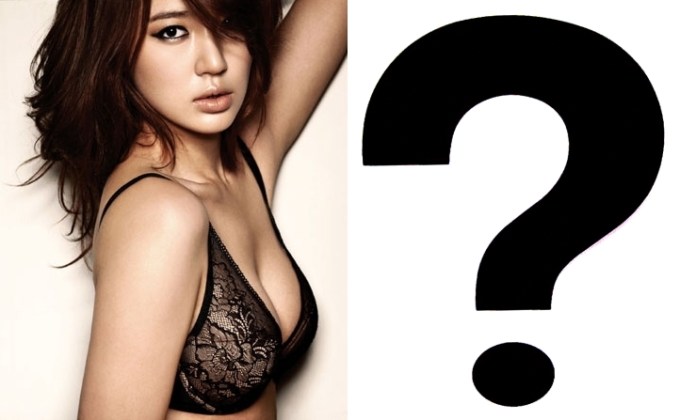
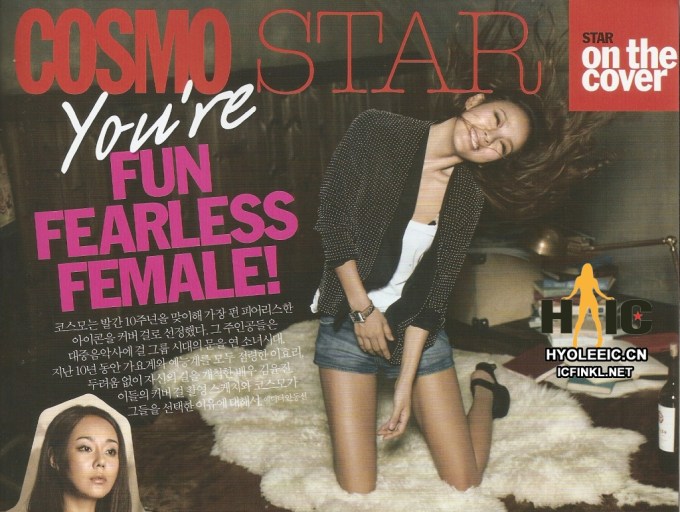
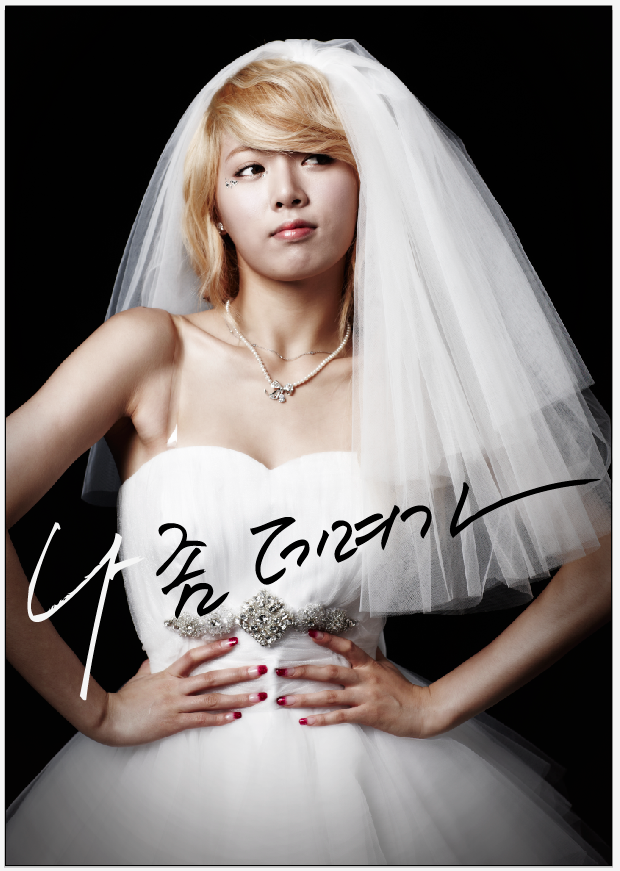
First, take another long hard look at Yoon Eun-hye’s (윤은혜) photoshoot for October’s Dazed and Confused, as one does. Because despite appearances, it was probably a tough sell. Would you invest 8000 won (US$7.24) in a magazine for just 7 revealing pictures of a celebrity, out of 255 pages? Even if there are no high-definition versions available on the internet?
Maybe. I did, but as you’ll see, I was looking for an interview of her. You can make jokes about my real motivations later.
I suspect then, that the photoshoot’s main purpose may not have been to sell more copies of that particular edition per se. Rather, it was looking to enhance Dazed and Confused’s brand through the ensuing publicity, thereby selling more magazines and being able to charge more for advertisements in the long-term. If so, then the massive attention the pictures have been getting in the media can be considered a success, in the process Eun-hye literally – if only fleetingly – embodying the Wikipedia definition of a pin-up girl as “a model whose mass-produced pictures see wide appeal as popular culture”. Even, in a hyperreal sense, in the absence of the physical pictures themselves.
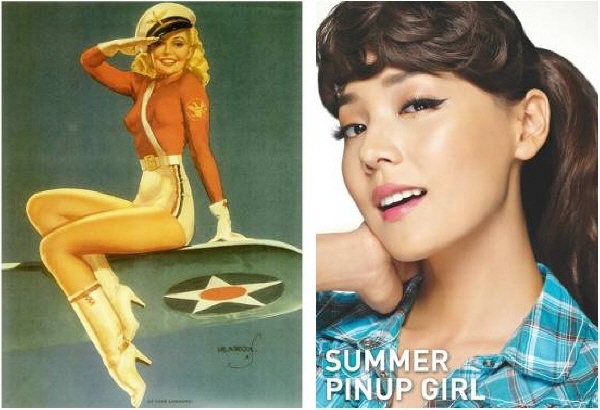
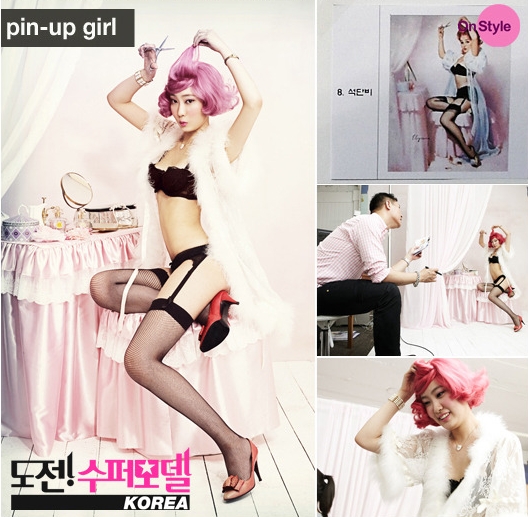 Next, consider them in the context of a retro fad that has been sweeping movies and K-pop (or at least the female half of it) since at least Lee Hyori’s (이효리) U Go Girl of 2008. Again, while strict censorship and sexual conservatism likely confined any physical Korean pin-ups to seedy bars until the 1990s (I’ll consider “soju girls” separately shortly), pin-up girl chic is certainly becoming a recognizable part of Korean popular culture. It was no great surprise to see models copying them (source, right) on Korean television last year for instance, and I refuse to believe that it’s a mere coincidence that now there’s even an online clothes store with the pin-up name.
Vivent les femmes?
Well, that’s certainly a possibility, which I’ve very much underplayed in the last five years I’ve been writing about Korean gender issues. And not that I wasn’t correct to do so: knowing that baring breasts in magazines was one notable form of resistance to censorship in Francoist Spain in the 1970s, naively I projected that onto what were increasingly risqué Korea soju ads starting from about 2006, likewise equating more T&A in them with, well, sexual and political liberation (see here for a modern Arab equivalent). Thankfully, many readers soon disabused me of that notion, and I’ve been at pains to point out that the latter doesn’t automatically signify the former ever since.
But then I read Maria Buszek’s Pin-Up Grrrls.
A brilliant book, alas it is also 444 pages long, but fortunately a roughly 20 times shorter version(!) is available online here, which I strongly encourage you to read in full. Here’s just a taste of why it was so eye-opening:
In the same way that women surely saw their own reflection in the illustrated recruitment pin-ups of WWII, it seems that many similarly saw the Varga Girl not as an unattainable fantasy of the heterosexual male imagination, but an ideal they could both associate with and aspire toward. Contrary to contemporary assumptions that the Varga Girl (and Esquire magazine) were enjoyed by an exclusively male audience, we find her presence in such contexts where she would not only have been highly visible to women, but there as the result of what one can assume was her already existing popularity with a female audience. By the start of the war, women were certainly familiar with her; in the very same issue as the first Varga Girl, an Esquire reader-poll appeared that indicated nearly three-quarters of the “gentlemen’s magazine” subscriptions were in fact read by women, for whom the magazine’s illustrations were the number one attraction…. In fact, if one reads the magazine’s letters section, “The Sound and the Fury,” throughout the ‘40s, women’s letters were frequently published–many written solely to remind the male editors and readers that the magazine had a broad audience that included women, whose presence they should consider in features, cartoons, and advertisements.
 (Source)
Next, consider the following from pages 169 and 170 of Whang Zheng’s chapter “Gender, employment, and women’s resistance” in Chinese Society: Change, Conflict, and Resistance (2nd Edition), 2003:
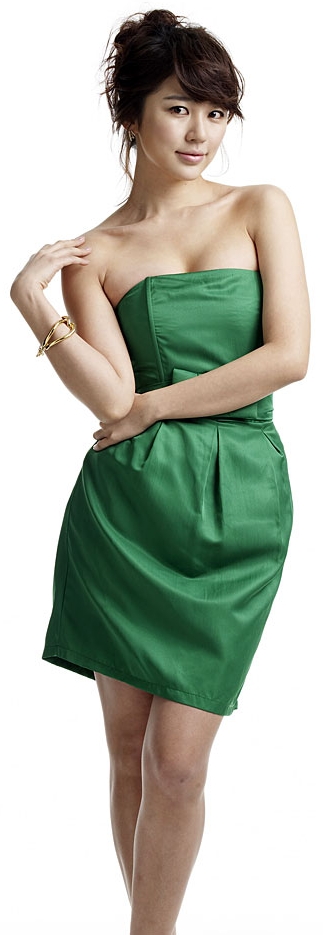
Replacing the “iron rice bowl” of job security in urban China in the 1990s is the craze of creating the “rice bowl of youth”. Everywhere attractive young women have been sought to represent the shining image of “modernity”. Booming service, commercial, and entertainment industries post numerous age-, gender-, and, often, height-specific advertisements seeking women under the age of 25 and above 165 centimeters in height. Stylish, elegant, or sexy, young “Misses” are displayed in remodeled or newly built “modern” hotels, restaurants, department stores, travel services, night clubs, dance halls, and so on. As older state industries lay off women workers over 35, these modern young Misses, many with no particular education or technical skills, are entering the rising industries (mostly in the private sector, some with foreign investment) where their youth and beauty provide a ticket to incomes several times higher than those of their older sisters.
 And in particular:
The creation of the rice bowl of youth is a “joint venture” of consumerism and capitalism that commodifies and objectifies women. Its contradictory aspects should not, however, be overlooked. Many a Miss Public Relations, Miss Shopping-guide and Miss Travel-guide is far from being a passively constructed “decorative” object for the fulfillment of her bosses’ utility needs and their male clients’ sexual fantasies. Rather, many are active players in the melodrama of modernity, who consciously manage their “profits” by a range of strategies, including frequent job changes to advance their position, and investing in various adult education programs to acquire new qualifications and skills [James – a surprising absence here is mention of cosmetic surgery]. Seizing the rice bowl of youth, many young women catapult themselves into lasting careers. The inherent modern values in this position, such as assertiveness and competitiveness, have been expressed prominently in young Misses’ pursuit of career development in a competitive job market. This gendered employment pattern with its inherent contradictions, in short, provides opportunities for young women’s social and economic advancement, even if it blocks employment access of older laid-off workers, and reinforces gender [James – and sexual] stereotypes.
For an alternative, much more critical view of that development in the Korean context, please read this post of Michael Hurt’s at Scribblings of the Metropolitician, and indeed I do think Whang slightly overstates her case. But the points have been made: dressing and posing sexily in commercial photographs isn’t necessarily exclusively for men, nor does a woman deserve scorn if she does so simply in order to advance her career. Also, that these are not mutually exclusive.
But as something to celebrate in a Feminist sense? That all sounds somewhat hollow, let alone just basic common-sense. Whereas last week I promised you a useful, refreshing perspective with this post.
Enter the pin-up grrrl, who exalts in her sex appeal to both men and women, whether as sexual object, subject, role model, or all three. And above all, she never strays out of character.
By these criteria, merely being featured in Korean pin-up girl chic isn’t quite enough. Just like www.pinupgirl.co.kr doesn’t actually sell anything even remotely pin-up girl themed, simply appropriating the risqué clothing, poses, and terminology of an earlier, quite literally foreign era is meaningless if the same women are infantilizing themselves in their next commercial, talkshow appearance, and/or photoshoot (update: or their Japanese promotions). Yet this is the norm in Korea, where so many female icons loudly touted as confident and independent are actually under the firm control of their management agencies (not even being able to use the internet or have cellphones, let alone go on dates), and where the fact that almost 3 out of 4 commercials feature celebrities means that the same women can be found endorsing just about anything (even competing brands).
Examples abound. At the same time that KARA (카라) were making waves for their “butt dance” (엉덩이 춤) choreography for Mister (미스터) below for instance (and which is a problematic song in itself, placing — for all its supposed female bravado — all romantic initiative in the hands of said “Mister”)…
…you were just as if not more likely to see them on Korean TV doing their childish commercials for Pepero (빼빼로):
More recently, Girls’ Generation’s (소녀시대) purported shift to a more mature, sexual, and empowering image with the release of their latest album The Boys is undermined by familiar narratives of passivity in the lyrics to the Korean version of the song (but which are tellingly absent from the English one). In particular, while one member (Sunny) did claim that (hat tip to askbask):
“The lyrics’ [meaning] are up to the interpretation [of the listeners’]. Rather than just the simple meaning of girls giving boys support, it can be interpreted in many ways. The girls could be telling the boys that we’ll take the lead, giving off a more tough image. It could also be interpreted as girls telling the boys to get their act together and cheer up. (laughs) The song also aims to give courage to people, whether they’re girls or guys, who are tired out [by life].”
 (Source)
Nevertheless, as someone not just contracted to SM Entertainment, but also the niece of its founder, she is hardly in a position (or have the inclination) to claim otherwise. Moreover, even if for the sake of argument I allow that the lyrics are indeed open to interpretation, most likely the very next thing I’ll see Girls’ Generation in will still be an advertisement for one of the numerous brands they’ve endorsed above, piling on the cutesy aegyo. And even if I further concede that that’s because surely many of those endorsement contracts precede the release of The Boys, and will continue to apply for some time after it, you’d a) assume that if that was a genuine concern, then SM Entertainment could have scheduled things better so as not to undermine Girls’ Generations’ new image, and b) be hard-pressed not to recall that actually they were already supposed to have become “bad girls” with Run Devil Run nearly two years ago.
Forgive me for being a little cynical.
 (Sources: left, right)
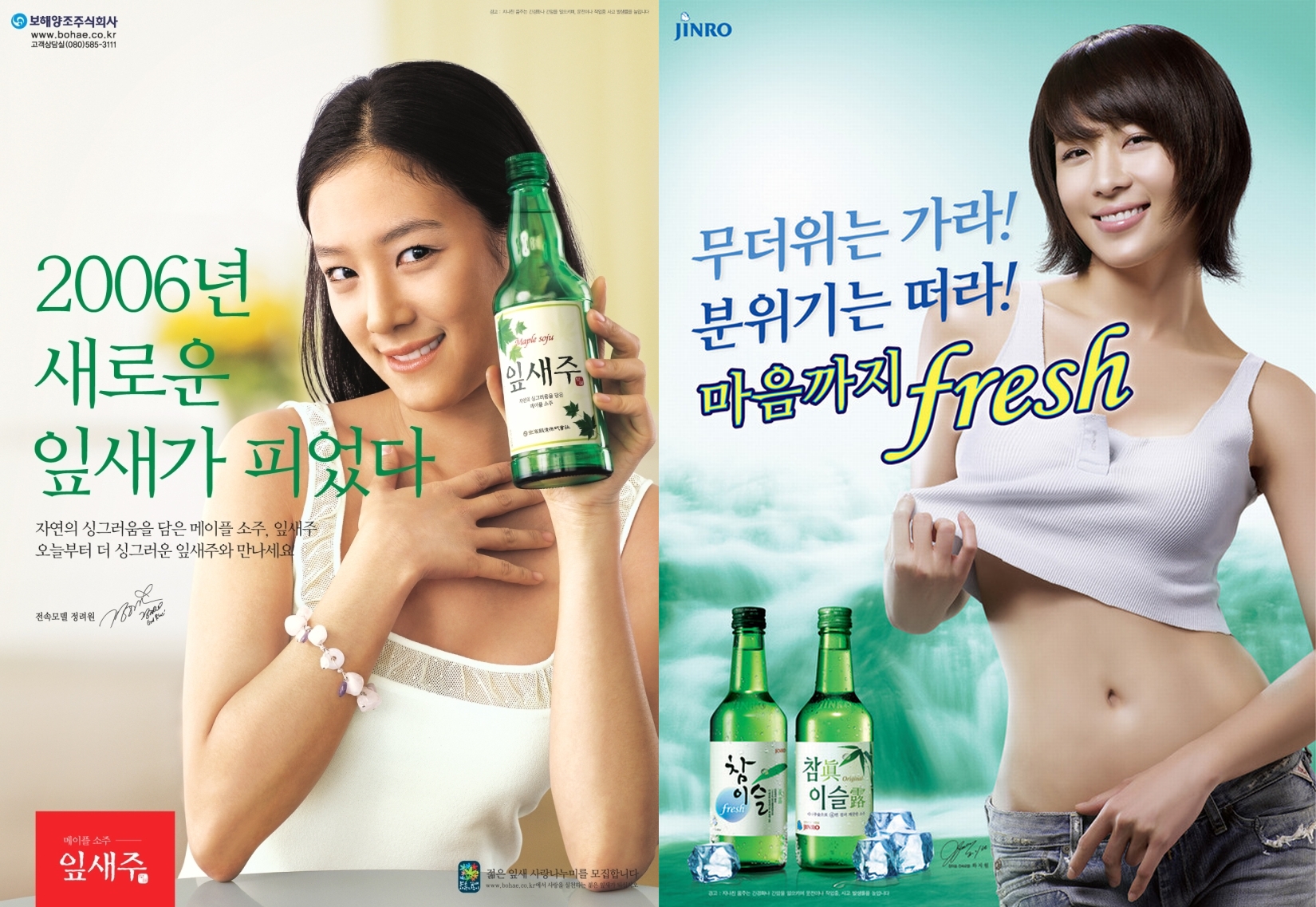
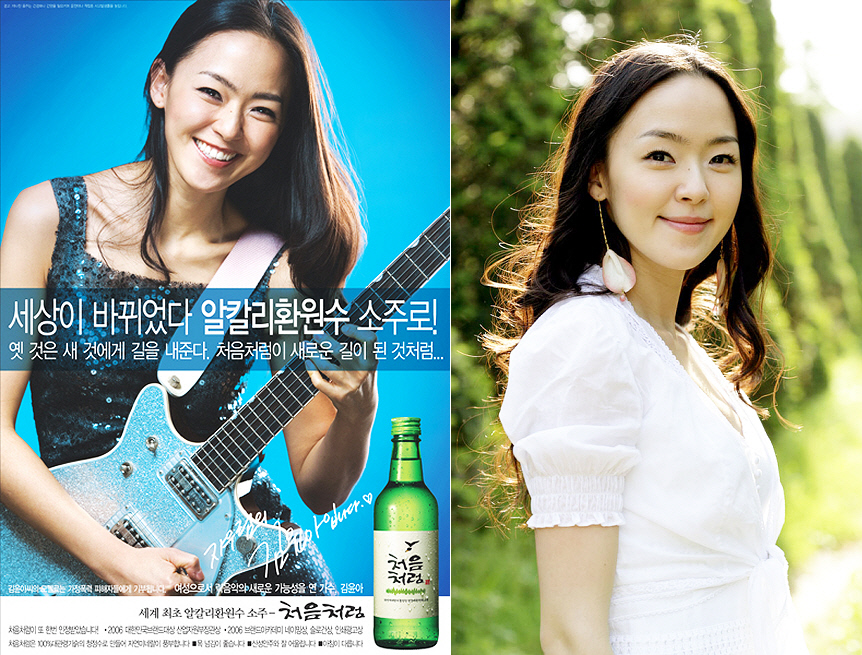
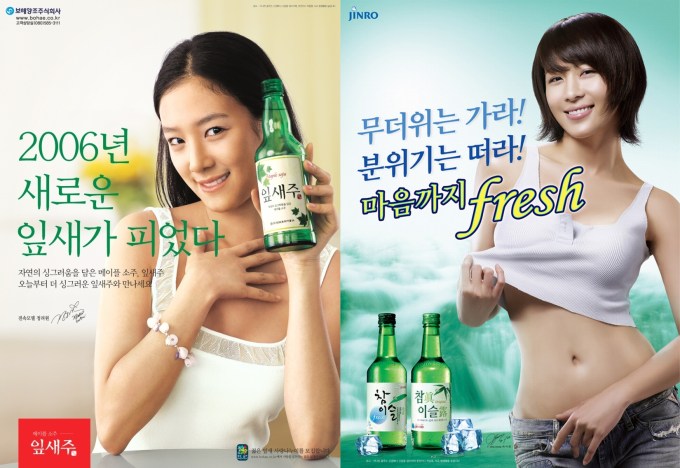
So again, it’s promoting and maintaining a pin-up grrrl image that is crucial. By which token we can also dismiss most soju girls too, even if they are indeed technically a kind of Korean pin-up. Because with very rare exceptions, such as Kim Yoon-ah’s (김윤아) example discussed here (the singer, not the skater), not only are soju ad formats usually extremely restrictive, but, for all their sexing-up in recent years, the models therein remain firmly ensconced within a virgin/vixen dichotomy, well illustrated by Jeong Ryeo-won (정려원) and Ha Ji-won (하지원) above (only three years apart btw; they changed really quickly!).
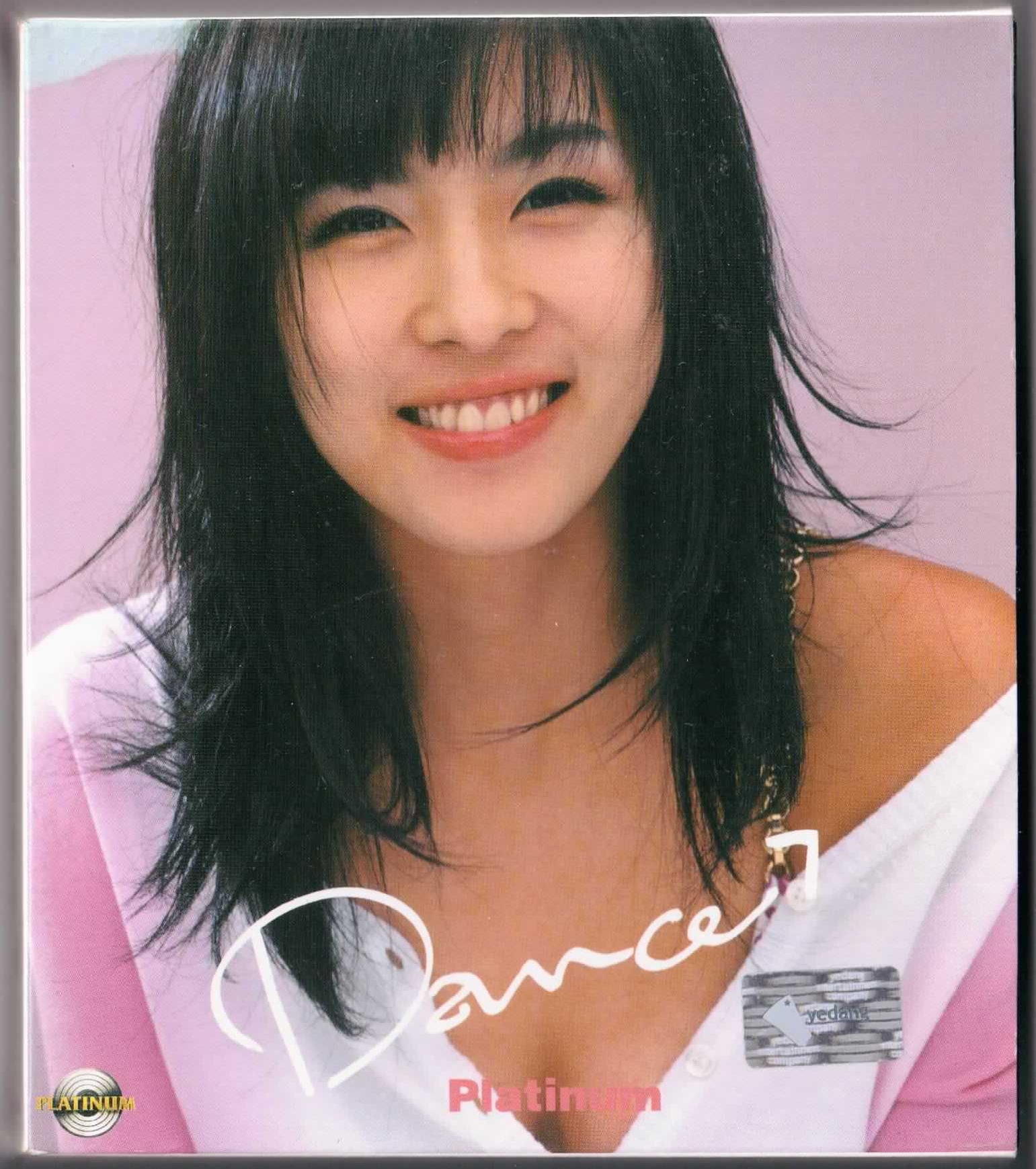
And yet again, despite the latter having – ahem – a special place in my heart because of: a) first learning of her through ads for the Platinum Dance 7 CDs that played on Korean TV for much of 2002, in which she simply stood there looking stunning; b) singing in Wax’s (왁스) music videos, my favorite Korean artist; c) later learning of her connection to my hometown; and d) literally being kick-ass in the drama Secret Garden (시크릿 가든) and more recently the movie Sector 7 (7광구)…she undermines all that by, amongst other things, looking decidedly pale, unnatural, and delicate in her advertisements for skin care products. And so on.
 Which brings me back to Eun-hye’s pictures, which surprised me because I remember that she endorsed the Korean lingerie brand Vivian (비비안) back in 2008, yet somehow without actually wearing the lingerie at all (as you could see earlier in the post {source}; see here and here for the politics of Korean lingerie modelling behind that). So, I bought the magazine itself assuming that they would include an interview of her, in which, however lame, unreliable, and/or perfunctory, she explained her reasons for the sudden change. Not only was there no interview inside though, but to my chagrin (no, really) I soon discovered that actually she’s been talking her clothes off in public for years now (“have you seen this” indeed!). Which possibly explains why I can’t find any mention of why she did the photoshoot on the internet whatsoever, despite the ubiquity of “news” articles about it as mentioned (source, right).
So, the jury’s still out on Eun-hye at least (although I admit that I’ve yet to look for interviews about her earlier photoshoots), and I acknowledge that my relative lack of knowledge about Korean female celebrities means I may be unfairly and/or prematurely dismissing them, something I’m sure has also gone through many readers’ minds.
So, as you can see below, I’ve been trying to rectify this, looking for reliable interview sources of interviews of Korean singers. But this is harder than you may think, as Korea seems to lack any definitive music magazines. AstaTV, for instance, is literally just 105 pictures of mostly boy-bands for 11,800 won (US$10.44), a magazine format I’ve very surprised to still see around in 2011, while Junior is, well, very much for juniors. Alternatively, the very cheap – but thick – weekly Movieweek and Cine21 magazines are good sources for singers that have also acted, but naturally I’m frustrated not to find something much more music focused.

So, I would very much appreciate recommendations from readers, or if in future you could pass on any decent interviews and articles available on the internet (whether of men or women), in which they elaborate on the themes discussed in this post (I’ve included my translation of one I did find at the end of this post). Indeed, probably in just five minutes some of you will find something about Eun-hye’s Dazed and Confused photoshoot in that I couldn’t in two weeks.But even if so, you’d think that someone earnestly looking would surely have a much easier time of it?
And with that thought, I suddenly realized that I’ve been going about this all the wrong way, and in fact had been quite hypocritical. Because the onus is not on me to find pin-up grrrls by sifting through what, by this stage, looks like an increasingly homogenized, clone-like mass of female celebrities, but rather to highlight those ones who are already doing their darnedest to stand out themselves.
Can any old-timers guess whom I’m thinking of?
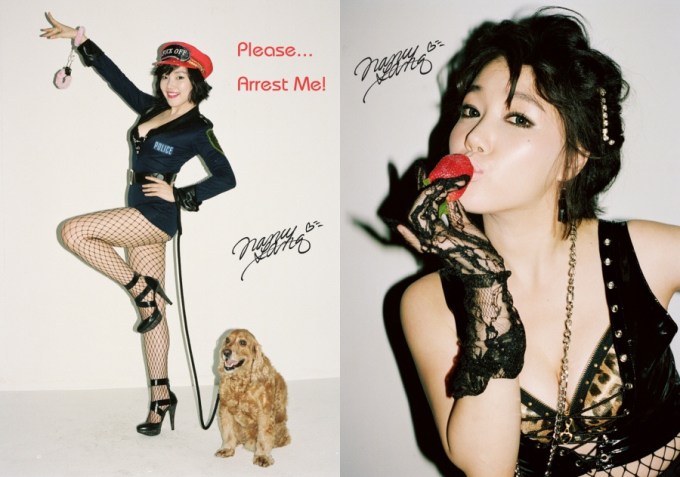 (Source)
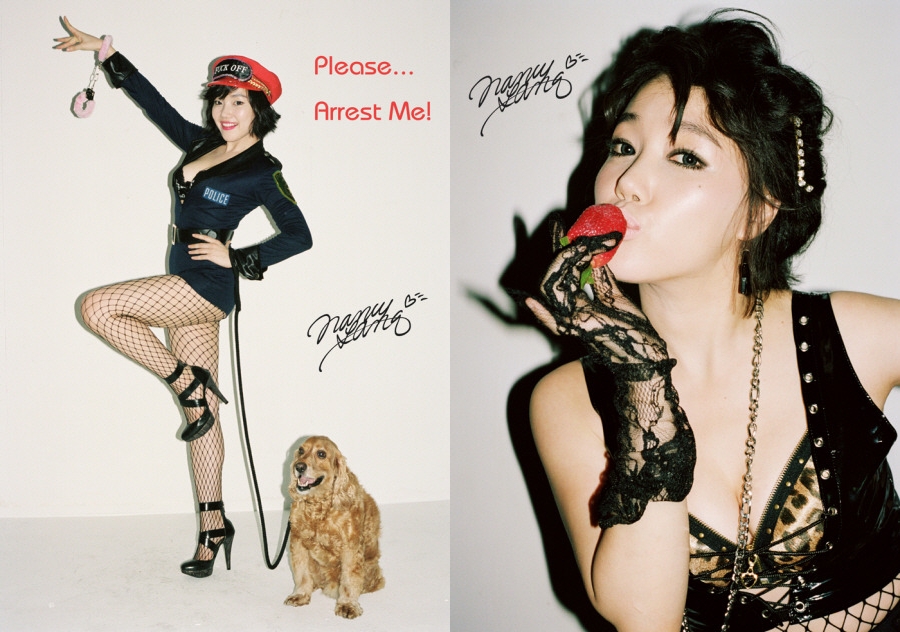
Who else but Nancy Lang (낸시 랭)?
Yes, her eccentricities have put me off in the past too. No, I haven’t heard anything about her in at least a year either. But, just like that picture in that last link demonstrates (well, just about any picture of her really), you’d be hard-pressed to think of a well-known Korean woman quite so brazen (Update – Oops: actually she’s Korean-American, in which case Margaret Cho also instantly comes to mind. But she’s not quite so well-known in Korea itself).
If you personally have never heard of her though, then here is a quick biography of her below. Normally I’d be reluctant to copy and paste an entire article like this, but unfortunately there is increasingly less information about her available in English, and so this (originally from KBS somewhere) needs to be preserved before it’s lost when the long since defunct Pretty Korean Girls blog disappears (hey, beggars can’t be choosers!):
Since her performance of ‘Lost Dream’ in her underwear at the 2003 Venice Biennale, Nancy Lang was introduced to Korea, and she quickly appeared in magazines, on TV and on the Internet. Her showbiz philosophy that she would make money with art shouting “Cutie! Sexy! Kitty!” and “I Love Dollars” has raised controversy among art circles as well as the public.
Unconventional performance
Lang played the violin in the middle of a street wearing Victoria Secret lingerie and red high heels with kabuki style makeup. Her childhood dream was to become a violinist. And she realized the dream through art. Once, at the San Marco Piazza in Venice, she was held by the police for four hours, after which she became popular. Her performances thereafter continued to stand out. The New York born ethnic Korean is a US citizen. She only attended an international high school in Manila but her mannerisms and accent bear the hallmarks of a third generation Korean-American. Her Korean name is Park Hye-ryeong. But eyeing the world as her stage, she strategically changed her last name through help from a lawyer. “Lang” was the final choice among several names as it visually looked nice in typographic terms. Born into a well-to-do family, Lang however went through difficult times when her father died during her college years and her mother fell sick. At times, she couldn’t pay her tuition. But through the trials, she developed a clear sense of life and living.
The evolving Taboo Yogini
Multi-talented Lang’s unconventional character and provocative performances have grabbed the attention of the art, fashion and entertainment circles alike. In her trademark series ‘Taboo Yogini,’ characters such as a woman with a huge courtesan wig or a figure with a body of a robot and a head of a girl, rooster or dog appear. And invariably held in their hand is a powerful gun or a Louis Vuitton bag. In the backdrop is a car, a Chanel lipstick and other luxury brand logos. “Yogini” means an angel or a devil in the dictionary. Taboo Yogini, representing both good and bad, is a ceaselessly resurrecting spiritual being due to its persistent power and life energy. It is the symbol of Lang herself, her dreams, her wounds and her fight. The self-proclaimed ‘walking pop art’ doesn’t hide her love for brand name and elite goods. Last year at the Seoul Arts Center, the bikini clad Lang asked audience members to put oil on her body before going on to sing ‘Purple Scent’ to the tune of a karaoke machine. She pulled off another eccentric performance “Nancy Lang’s autograph session” during which she autographed her posterior as the inaugural artist of the Gwangju Biennale. The Taboo Yogini series is expected to evolve even more. In pursuit of breaking apart and assembling robots, Lang has only yet gathered the parts, and during the process she can let go of past regrets. Her work these days in fact show glimpses of her severing chains with the past and moving toward a fantastic future, portrayed by a wounded yogini and a guardian angel robot. If yogini was Peter Pan to Lang, the robot would be her Tinker Bell. It may be that she is inviting someone she can rely on in the future into her world filled with luxury goods.
Dreaming of Korea’s Takashi Murakami
Her work and lifestyle and her brutally candid and daring speech and actions invite criticism at times. But she doesn’t care. She confidently argues that, like a racehorse, she only runs toward a clear goal. She has firmly established herself as an artist reaching out to the public. Few others see art as showbiz as much as she does. But approaching show business with new ideas and works is a whole different realm. Her role model is Takashi Murakami, who successfully turned his character creations into art based on the animation, comics and games culture. Most of her works sell well and her name once topped the top online search word list. She knows what she wants, “I will become a world renowned artist who can influence the general public, and based on that foundation, I want to gain wealth and fame.” We wonder what she will show us next, as she brings along issues and controversies wherever she goes with her art.
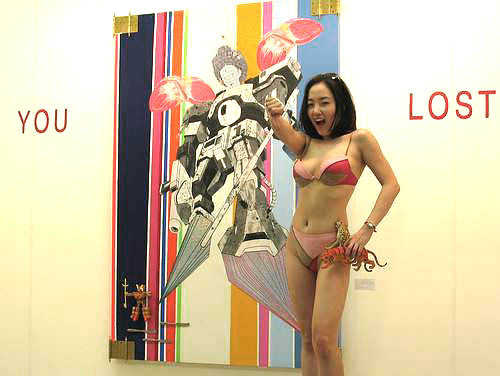
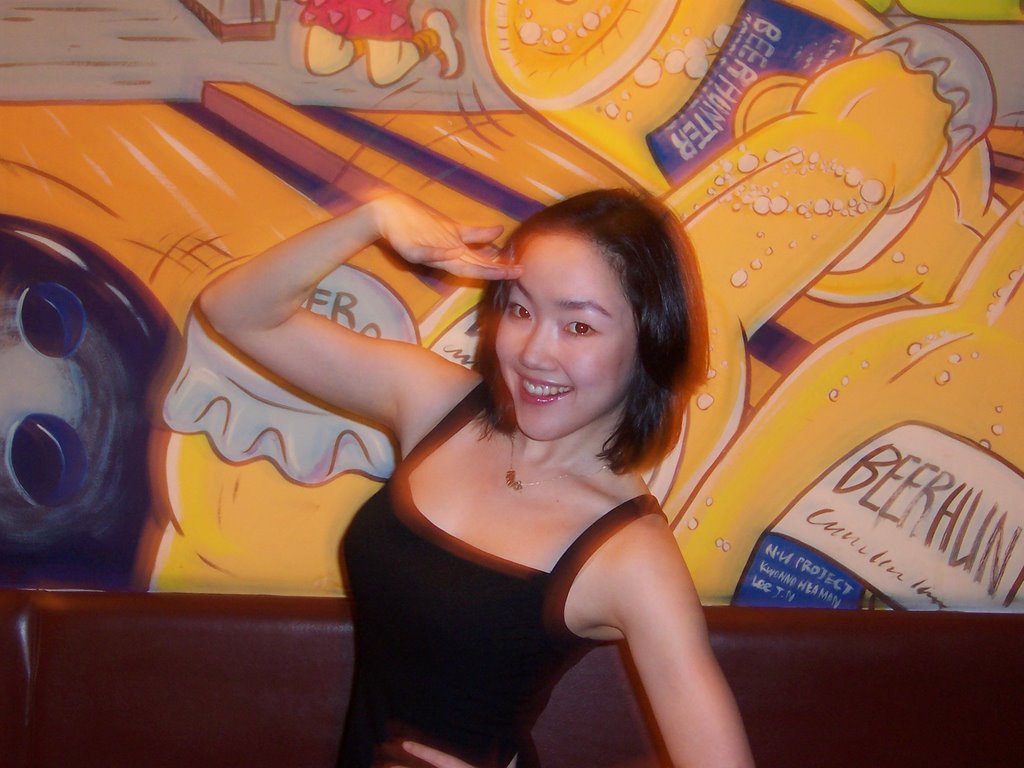
Next, in the unlikely event that you’re not already convinced of her worthiness of the title of pin-up grrrl, then surely Psychedelic Kimchi’s interview of her in 2006 will be sufficient, which I was very glad to still find five years after first reading it (and apologies for stealing that above image from it!). Especially as, unfortunately, that seems to be the sum total of the only substantive English sources remaining on her, although there is still her (pretty active) official Facebook page (albeit not accepting new Friend requests, or at least not mine; sniff), her (less active) Twitter account, and finally her personal website (but curiously blocked because of phishing attempts the day after I first found it!). And of course I would again be very grateful if readers could pass on anything else, as I would for any suggestions of any other candidates for Korean pin-up grrrls.
 (Source)

But one final thing before I do thank you though, is to draw attention to the origins of the term “grrrl” itself, lest people more familiar with it than I feel that I’m using it too liberally. In short, it comes from the Riot Grrrl underground Feminist Punk movement in the Pacific Northwest in the early-1990s, about which the New York Times wrote the following on the twentieth anniversary of its founding earlier this year:
Ms. Marcus, the author of “Girls to the Front,” agreed that it was part of a 20-year nostalgia cycle. But she added that “people are flocking to these reminiscences because there remains a tremendous hunger” for the kind of liberated, don’t give-a-damn femaleness “that was in full flower in the ’90s,” with nothing quite as potent since.
The fashion pendulum may have inevitably swung back to the ’90s, but riot grrrl, with its snarky cut-and-paste zines and carefully built micro-communities, prefigures a lot of youth culture today: targeted communication and social networking (although they did it with letters and flyers, not e-mails and Facebook messages); the lure of the handmade and the local — the craft marketplace Etsy could have been born in a riot grrrl meeting; and an attitude, evident in blogs like Jezebel and the Hairpin, that feminism can be fun.
 (Source)

And in particular, the original Riot Grrrl Manifesto included the following, in what was I’m sure a deliberate choice of double entendre:
BECAUSE we must take over the means of production in order to create our own moanings.
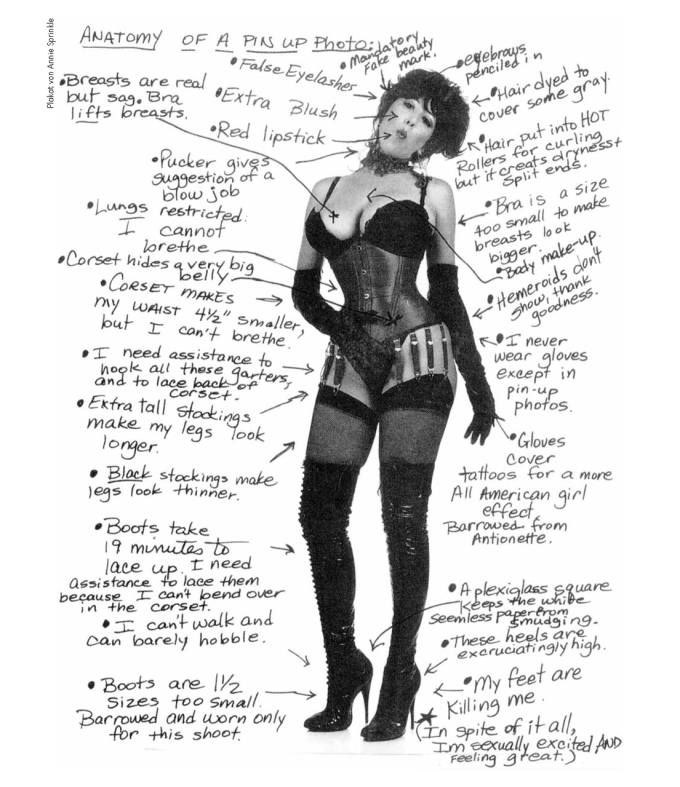
Why this is important is because of how in her book proper, Maria Buzek contrasts Andre Dworkin’s Beauty Hurts (1974; see it here) and Annie Sprinkle’s Anatomy of a Pin-up Photo (1991) above, then in her conclusion (pages 362-3) discusses Ann Magnuson’s Revenge of the Vargas Girl (1992) below, about which she says:

In “Revenge”, the artist poses in the guise of an elegant World War 2 Varga Girl but turns the artist’s airbrush gun – the medium through which Vargas created his fantasy women – back onto the world. Magnuson has associated her appropriation of the pin-up with the same bait-and-switch subversion as the riot grrrl movement, saying: “Women’s sexuality has been shunned; there’s no shame attached to being sexual. But then, why should frat boys be the only ones who get to appreciate a curvy figure? When the pin-up is allowed to speak (and has something to say), it changes the landscape”. But Mangnuson’s assertion that the tools of the pin-up’s male creator, in the hands of its dangerous spawn, can be easily turned against its creator’s or viewer’s potentially oppressive motives also serves as a metaphor for all of the Feminist pin-up imagery we’ve seen here. In this way, the pin-up’s ultimate “revenge” lies in the fact that, although it may have been created as a tantalizing but unreal object for the delectation of heterosexual men, the pin-up would also find ways to reject this role to reflect and encourage the erotic self-awareness and self-expression of real women.
I’ll leave it up to the reader to determine how and where Nancy Lang fits into that. Or, indeed, how Korean women who wear extremely revealing clothes on the red carpet do, as discussed in the following article from the Sports Chosun, found via Charles Tilly at the Marmot’s Hole. Normally, I’d reject such a tabloidish and vacuous source, but then you recall the difficulty of finding more “serious” sources, and besides which I’ve often pointed out how tabloidish even the mainstream Korean media is. Indeed, considering that such pictures are the newspaper’s unofficial focus, then it might actually be the best source on them(!), and to my surprise its choice of accompanying pictures is not only quite conservative (as Tilly also points out; in particular, it makes no mention of Kim So-yeon’s [김소연] notorious dress below, worn at the opening of the 2007 Busan International Film Festival), but to its credit it also extols the virtues of confident “older” women, usually at best considered completely asexual by most of the Korean media:
 (Source)

[WHY] 여배우들의 레드카펫 과다 노출, 왜 끊이지 않나 / Why is there no end to actresses’ excessive exposure on the red carpet?
김표향 기자 suzak@sportschosun.com / Reporter: Kim Pyo-hyang
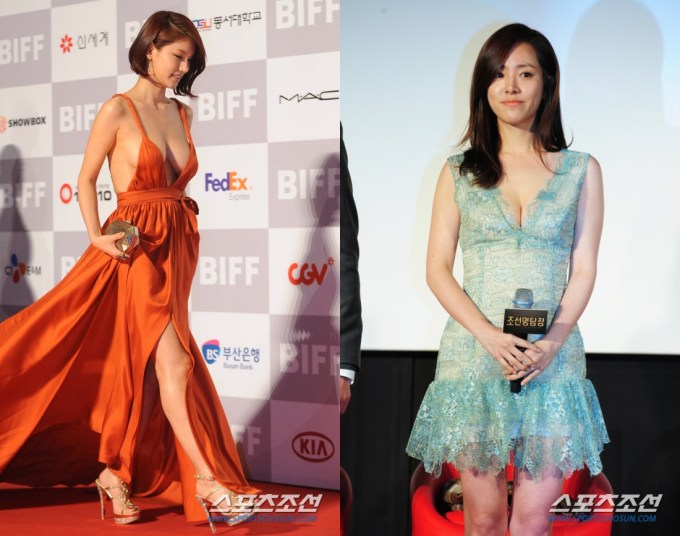
이처럼 수위가 높은 ‘파격 노출’은 지금껏 없었다. 뜨거운 ‘노출 논란’의 주인공은 바로 신인배우 오인혜. 6일 부산국제영화제 개막식 레드카펫에 그녀가 등장하자 사람들은 충격으로 벌어진 입을 다물지 못했다. 겨우 가슴의 일부만을 아슬아슬하게 가렸을 뿐, 상반신의 대부분은 훤하게 드러냈다. 곧바로 그녀의 이름 앞에는 ‘노출 종결자’ ‘노출 폭격’이라는 단어가 붙었고, 인터넷과 SNS는 관련 내용으로 도배됐다. 전세계인의 애도 물결 속에 하루종일 검색어 1위였던 스티브 잡스도 이번만큼은 자리를 내줄 수밖에 없었다.
Never has there been exposure like this. In this “exposure controversy”, the leading figure is new actress Oh In-hye. As soon as she stepped out on to the red carpet at the opening ceremony of the Busan International Film Festival (BIFF) on the 6th, everyone was so shocked they couldn’t close their mouths. With a dress that only barely covered just part of her breasts, she was displaying almost her entire upper body. Immediately, prefixes like “Exposure Terminator [Killer/Best]” and “Exposure Bombshell” were attached to her name, and social network services inundated with them. While all day previously the world was in a wave of grief over Steve Job’s death, [in Korea at least?] his position as the most searched item couldn’t help but be replaced by Oh In-hye.
 (Source)
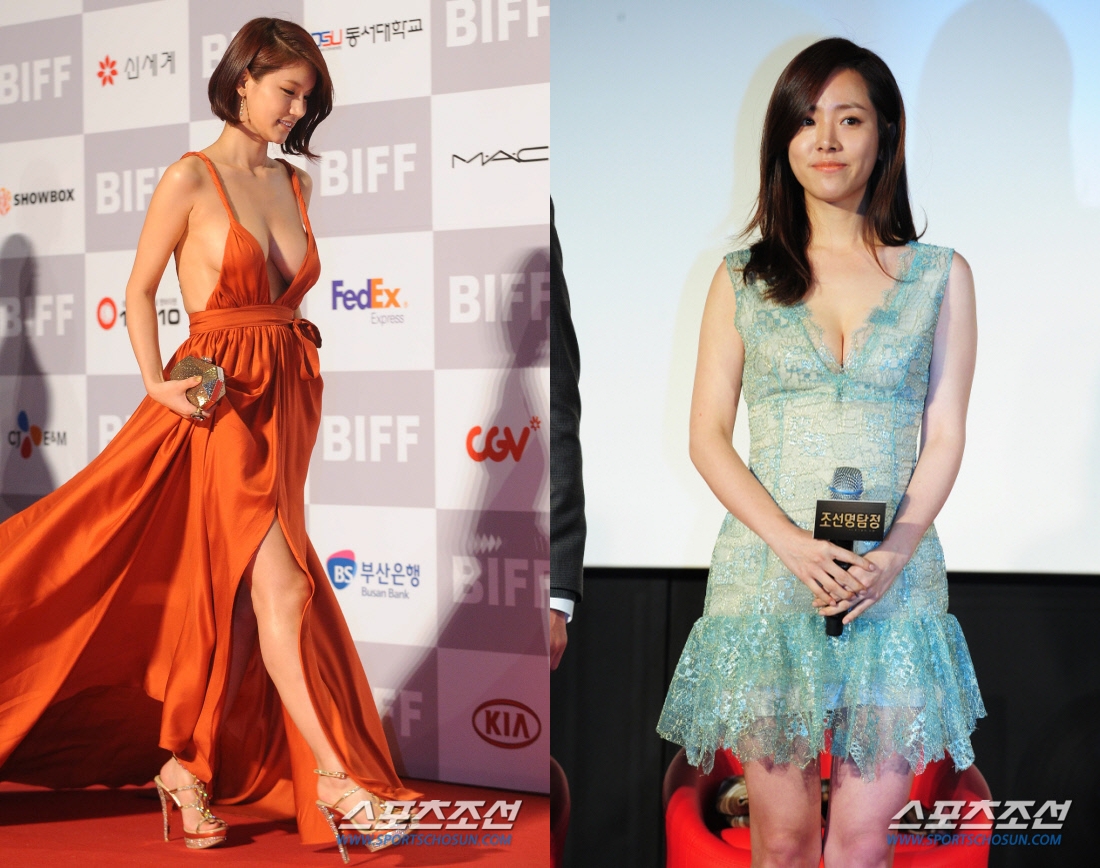
Image caption left – 제16회 부산국제영화제 개막식이 6일 부산 영화의전당에서 열렸다. 개막식에 앞서 거행된 레드카펫 행사에서 배우 오인혜가 등장하고 있다. 최문영 기자 deer@sportschosun.com / The opening ceremony of the 16th BIFF on the 6th at the [new] Busan Cinema Center. Actress Oh In-hye arriving at the red carpet event prior to the ceremony. Photographer: Choi Mun-yeong.
Image caption right – 조선명탐정: 각시투구꽃의 비밀’ 제작발표회에 나선 한지민. 스포츠조선DB / Han Ji-min at the Chosun Dynasty: Detective K production announcement (SportsChosunDB)
 (Sources: unknown)
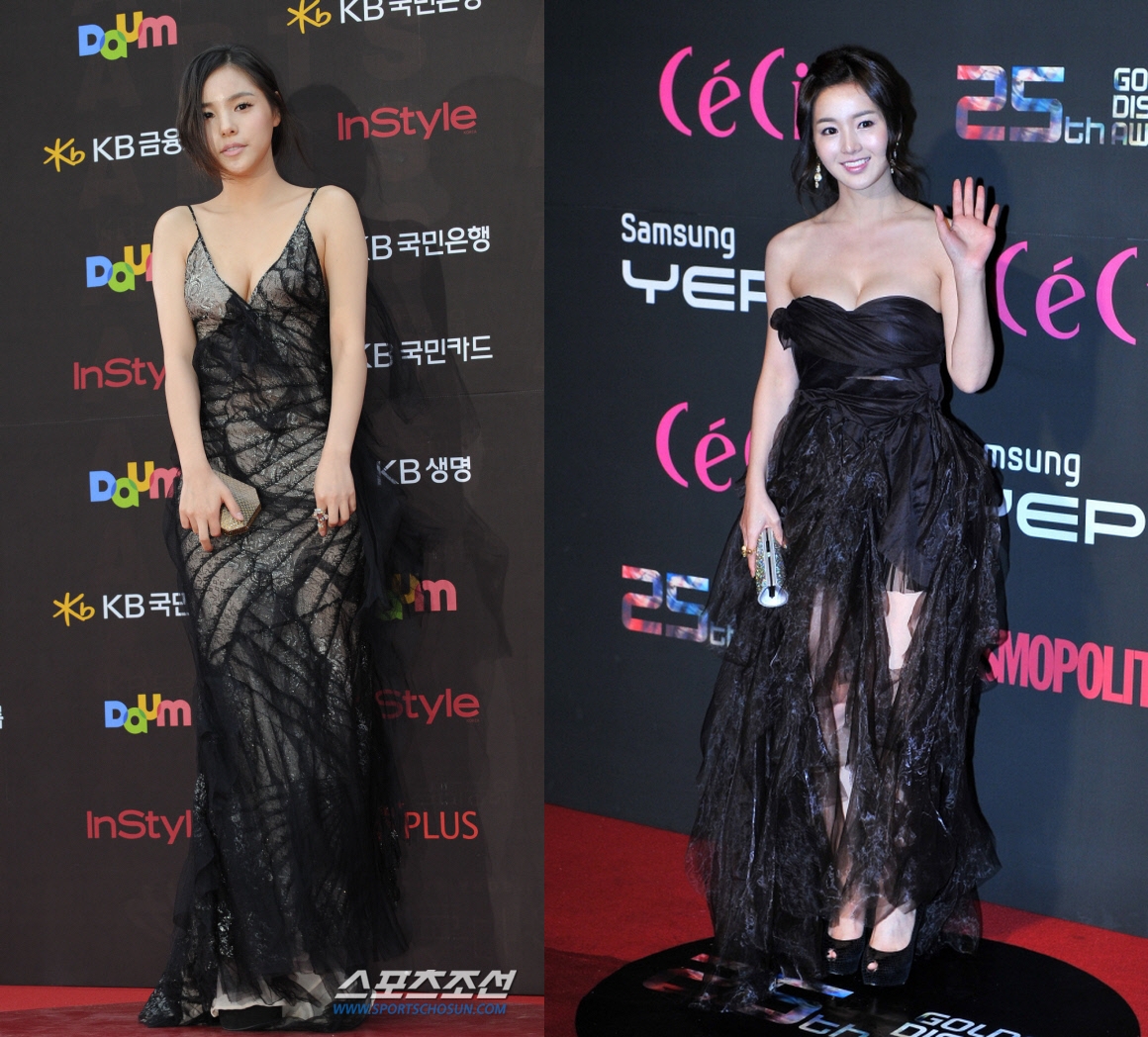
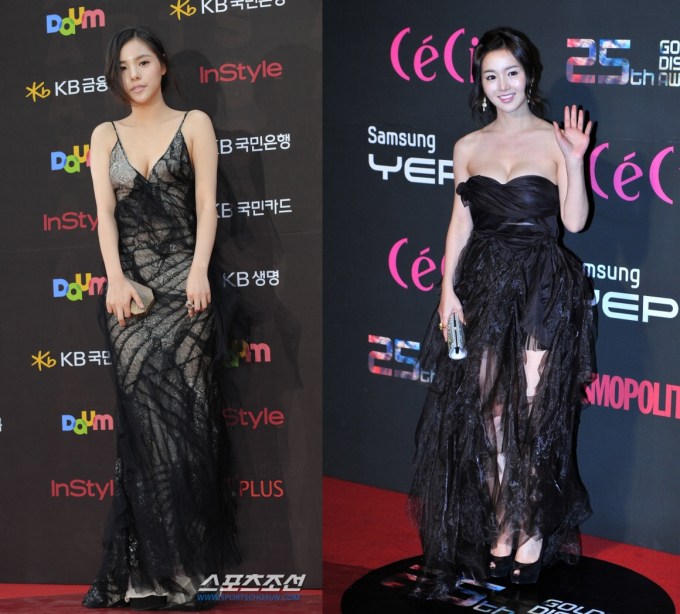
Image caption left – 백상예술대상 시상식을 찾은 민효린 (스포츠조선DB) / Min Hyo-rin at the Paeksang Arts Award Ceremony (SportsChosunDB)
Image caption right – 지난 해 열린 골든디스크 시상식을 찾은 남규리 (스포츠조선DB) / Nam Gyu-ri at the GoldenDisks Award Ceremony last year (SportsChosunDB)
여배우들의 파격 노출, 끊이지 않는 이유는? / What is the reason actresses keep exposing themselves so?
오인혜가 부산의 레드카펫을 휩쓸고 간 후, 개막식 자리에 참석했던 한 중견감독은 이런 말을 했다. “무명일수록 노출이 심하더라.” 여배우들이 레드카펫 노출을 선택하는 이유가 이 말 속에 들어 있다. 화제와 논란을 일으키며 사람들 입에 오르내리는 것. 그러면서 자연스럽게 인지도가 올라가기를 기대하는 것이다. 무명에 가까웠던 오인혜도 강렬한 첫 등장과 함께 사람들 머리에 그녀의 이름을 깊숙이 새겼다. 신인들에게 레드카펫 노출은 자신을 PR하는 가장 효과적인 전략인 셈이다.
After Oh In-hye overwhelmed the red carpet in Busan, an important producer attending the opening ceremony said the following: “The less famous, the more extreme the exposure”. Herein lies the reason so many actresses choose to wear such revealing costumes on the red carpet. As the controversy surrounding them grows, the more they will be on everyone’s lips. At the same time, you can naturally expect them to get a lot of name recognition. [Indeed] Oh In-hye was a virtual unknown, but with her intense first entrance has carved a deep impression on people’s minds. To new actresses, exposing themselves on the red carpet is definitely the most effective PR strategy.
반면에 신인이 아닌 배우들은 이미지 변신과 연기 활동을 위해 과감한 노출을 선택한다. 한지민과 민효린, 남규리는 공식석상에서 선보인 섹시한 드레스로 ‘첫사랑 소녀’ 같은 이미지에서 벗어날 수 있었다. ‘반전 몸매’ ‘베이글녀’라는 수식어와 함께 여성스럽고 고혹적인 매력이 보태졌고, 남성들은 물론 여성들에게도 호감도가 상승했다. 작품 선택의 폭이 넓어졌음은 물론이다.
On the other hand, for established actresses a bold, revealing dress statement can be used to change an image or [assist in some new] acting activity [like a comeback?]. By wearing sexy dresses, Han Ji-min, Min Hyo-rin, and Lam Gyu-ri could get rid of their “First Love” images. Now with the words “electrifying body” or “bagel girl” [James – I disagree: that latter is invariably a term applied by the media rather than deliberately sought, and indeed many women labelled with it actually reject it] they have a charming, feminine attractiveness added to their names, of course increasing their popularity among men and widening the acting roles available to them.
 (Source)

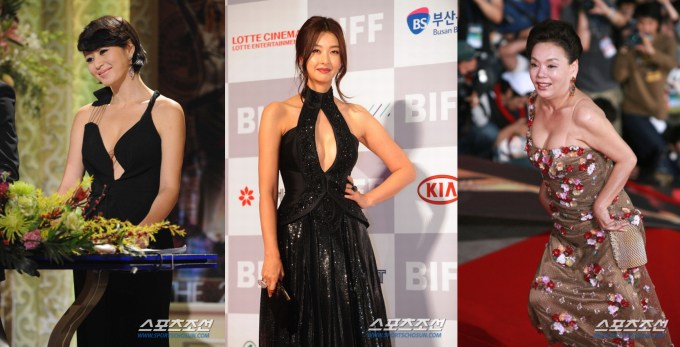
Image caption left – 2008년 청룡영화상 시상식의 김혜수 (스포츠조선DB) / Kim Hye-su at the 2008 Blue Dragon Awards (SportsChosunDB)
Image caption middle – 제16회 부산국제영화제 개막식이 6일 부산 영화의전당에서 열렸다. 개막식에 앞서 거행된 레드카펫 행사에서 배우 송선미가 등장하고 있다. 최문영 기자 deer@sportschosun.com / The opening ceremony of the 16th BIFF on the 6th at the [new] Busan Cinema Center. Actress Song Sun-mi arriving at the red carpet event prior to the ceremony. Photographer: Choi Mun-yeong
Image caption right – 2007년 대종상 시상식에 참석한 김수미 (스포츠조선DB) / Kim Su-mi at the 2007 Daejeong Film Awards (SportsChosunDB)
노출의 고수들은 뭐가 다른가? / What makes the experts different?
레 드카펫을 노리는 여배우들의 ‘워너비’는 단연 김혜수다. 관록과 여유, 고급스러움이 느껴지는 김혜수의 레드카펫 드레스는 여배우들에게 교과서나 다름 없다. ‘김혜수’ 하면 자연스럽게 파격적인 드레스가 떠오를 만큼 노출에 능하지만, 과감한 드레스를 입고 움츠러들거나 옷을 추스리느라 바쁜 여느 여배우들과 달리, 김혜수는 고개 숙여 인사할 때도 좀처럼 손으로 가슴을 가리지 않는다. 그 당당함과 자신감이 김혜수를 지난 10년간 ‘레드카펫의 여왕’으로 만들었다. 매번 베스트드레서로 뽑혀도 드레스 자체보다 김혜수가 더 빛나는 이유이기도 하다.
Of course, the model for red-carpet actresses is Kim Hye-su. She [not only] gives off an aura of dignity, composure, and refinement, [but in] the case of red-carpet outfits, is like a textbook for other actresses. She is very skilled in making her name synonymous with daring fashion statements, [for instance] unlike other actresses wearing revealing clothes, not only not shrugging, laughing, adjusting, and/or rearranging her clothes when she has to lean forward to greet someone [in order to not expose themselves further], but not even covering her chest up with her hand [James – as is the Korean custom]. [Indeed], it is not so much her outfits that have made her the “Red Carpet Queen” for the last 10 years, or why her dresses have been selected as the best at the award shows so many times, but rather it’s the way that she wears them.
올 해 부산국제영화제를 찾은 송선미도 지적인 이미지에 맞는 ‘지능적인’ 노출로 눈길을 끌었다. 가슴 부위가 세로로 깊게 파인 블랙 홀터넥 드레스로 우아함을 잃지 않으면서도 파격 노출에 성공했다. 세련된 포즈와 여유로운 표정도 단연 압도적이었다.
This year at the Busan International Film Festival, Song Sun-mi gave off an eye-catching “intellectual exposure” that suited her intellectual image. Over her breasts was a deep vertical cut in her black halterneck dress, which successfully showed off her body without detracting from her elegance. Of course, the combination of her sophisticated pose and composed expression was overwhelming.
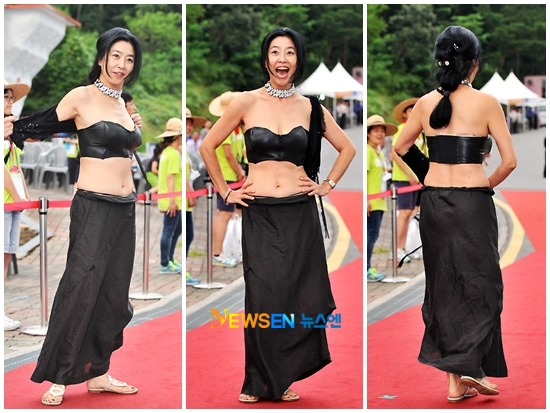 중견배우 김수미도 공식석상에서 노출을 즐겨온 대표적인 여배우다. 김수미는 글래머러 스한 몸매를 강조한 과감한 드레스를 종종 선보였다. 그리고 근래에는 드라마에서 호피무늬 비키니까지 소화했다. 올해 제천국제음악영화제를 찾은 김부선도 상반신과 하반신이 분리된 독특한 드레스로 화제의 중심에 올랐다. 다소 난해한 컨셉트였지만, 사람들을 의식하지 않고 축제의 열기와 팬들의 환호를 마음껏 즐기는 그녀의 모습은 당당하고 아름다웠다. 나이를 무색하게 만드는 두 사람의 노출은 여배우의 자존심이 무엇인지를 몸으로 증명했다.
Kim Su-mi is a middle-aged actress who also enjoys showing off her glamorous [James – busty] body, often wearing daring dresses that emphasize it. In a recent drama for instance, she even wore a tigerskin pattern bikini, and what’s more it fitted her well too.
Also, at this year’s Jecheon International Film and Music Festival , Kim Bu-seon wore a unique dress that separated her upper and lower body into two halves, and which was on everyone’s lips. While its concept was a little difficult to understand, she was unconcerned, and was beautiful and confident reveling in fans’ passion and cheering for her [James – see above; source].
Both actresses showing of their bodies like this is testament to the fact that age is just a number!
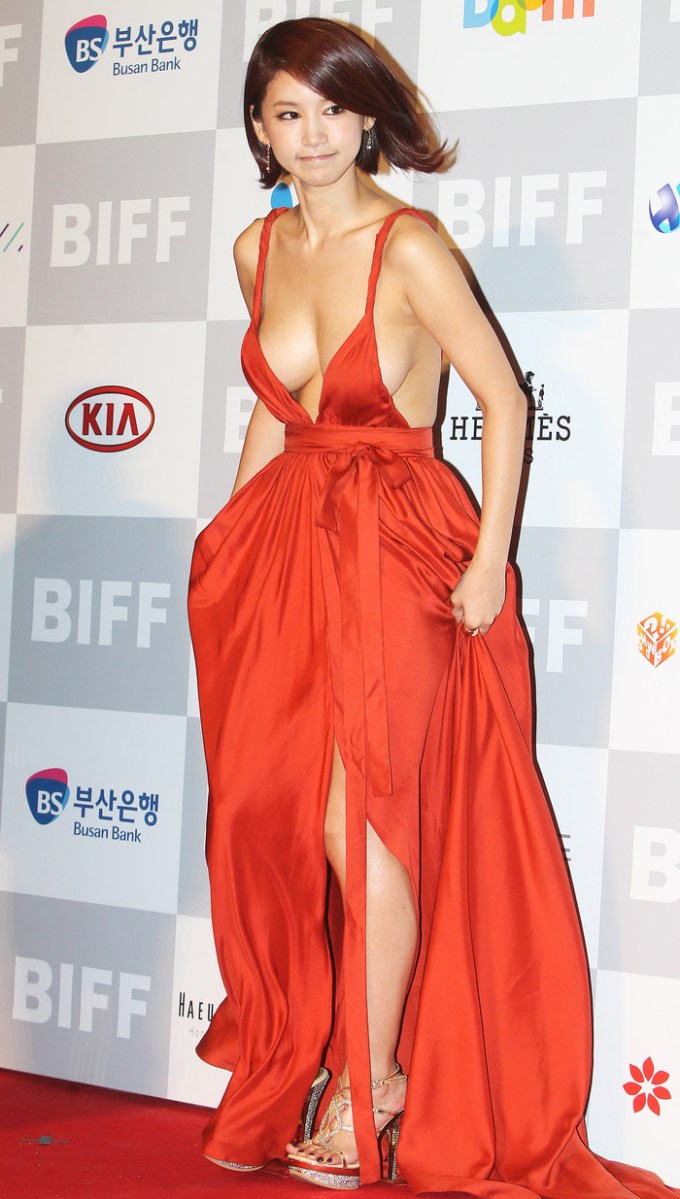 (Source. Call me indulgent, but that dress really does have to be seen to be believed!)

때론 노출이 발목을 잡기도 / But sometimes exposure backfires
‘노출’에는 반드시 치밀한 전략과 계산이 필요하다. 자칫 무리수를 둘 경우, 배우 생활에 치명타를 입을 수도 있기 때문이다. 오인혜가 등장하기 전까지 파격 노출의 대명사처럼 인식됐던 한 배우는 그 덕분에 인지도는 올라갔지만 작품 활동에 있어서 보이지 않는 제약이 생겼다. 매번 비슷한 역할만 제안이 들어오고, 노출에 가려져 상대적으로 연기력까지 저평가 받고 있다. 털털하고 액티브한 이미지로 호감도가 높았던 한 배우 또한 레드카펫에서 선보인 파격 드레스가 화제가 되면서 오히려 원래의 건강한 이미지를 잃어버리고 말았다.
“Exposure” requires elaborate strategy and calculation. Even if it just barely excessive, it can permanently affect an actress’s career. Before Oh In-hye appeared on the red carpet for instance, there was one actress who became well-known for her own exposure but found the roles available to her severely restricted from then on – indeed, not only was she offered the same kind of ones again and again, but her exposure detracted from people’s evaluation of her acting ability in them. And in another case, an actress was well-liked for her free and easy and active image, but she lost her original healthy image when she wore a revealing dress on the red carpet.
James – I’m surprised the author doesn’t mention who, as she is so ready to directly comment on everyone else (albeit positively). Also, I’m afraid I don’t know what “healthy” means in this context either!
신 인일 경우, 이같은 노출은 더욱 조심해야 한다. 이미지가 생명과도 같은 연예계에서 ‘노출 전문’이라는 꼬리표가 평생 따라다닐 수도 있기 때문이다. 한 영화 관계자는 “레드카펫은 여배우들을 위한 것이라 해도 과언이 아닐 만큼, 여배우의 아름다움과 숨겨진 매력을 최고치로 보여줄 수 있는 자리다. 그만큼 사람들의 시선도 더 강하게 끌어당기고 이미지를 선명하게 새길 수 있다. 하지만 그것 때문에 오히려 역효과가 날 수도 있다”며 “노출로 논란을 일으킨 배우의 경우, 그 이미지가 워낙 강해서 전혀 새로운 역할에 캐스팅하기는 현실적으로 쉽지 않다”고 조언했다.
Meanwhile, new actresses have to be much more careful about this type of exposure, as they may be labelled an “exposure expert” and be unable to shake it off later, which would be disastrous in an industry where image is everything. Like someone in says, ” the red carpet is mainly for female actresses, and it is the best chance for them to show off their beauty and hidden charm. It’s also a good chance to get people’s attention, and to emphasize their image. However, that can have side effects. If an actress arouses too much controversy because of her exposure, then the reality is that she will be typecast in that corresponding role from then on”. (end)
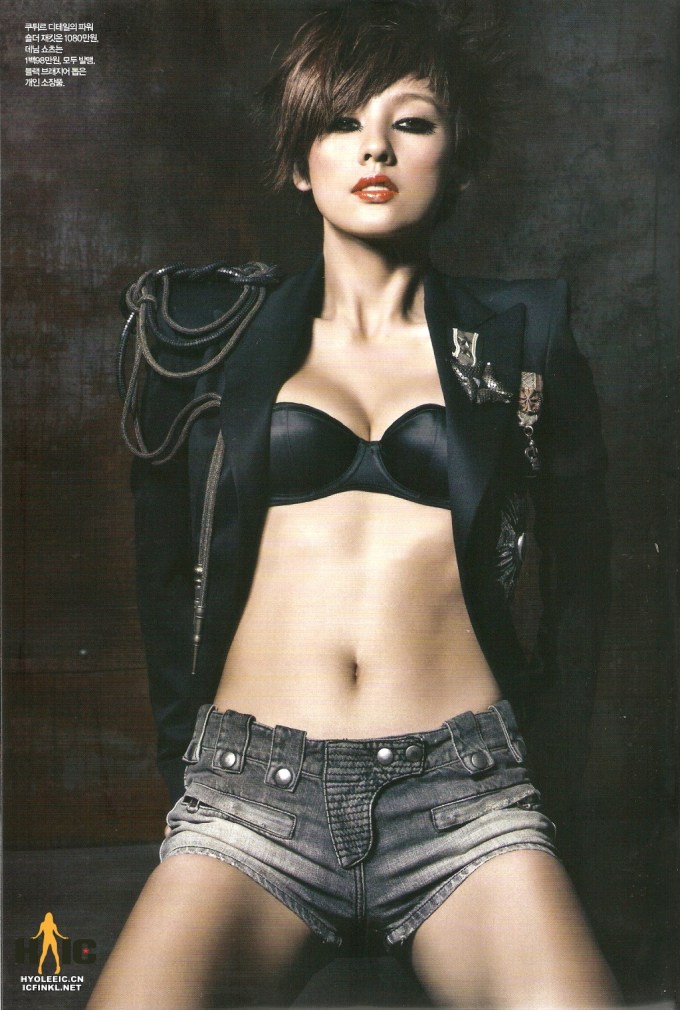 (Source)

A possible starting point for discussion: is Lee Hyori (이효리) also a pin-up grrrl, whom I’m sure many of you expected me to mention instead of Nancy Lang? That is, if any of you still have the energy to talk by this stage!^^
Update 1: Or how about the Brown Eyed Girls (브라운아이드걸스) instead? While I was pretty disappointed with them for endorsing “Juvis Diet” back in 2009 (see here and here for why), this recent post on them by Dana in Soko has definitely persuaded me to reconsider.
Update 2: The link to Dana in Soko has been fixed. Sorry!
Update 3: It’s not really worth translating, but for what it’s worth, Oh In-hye doesn’t regret her choice of dress! (Via: The Marmot’s Hole).


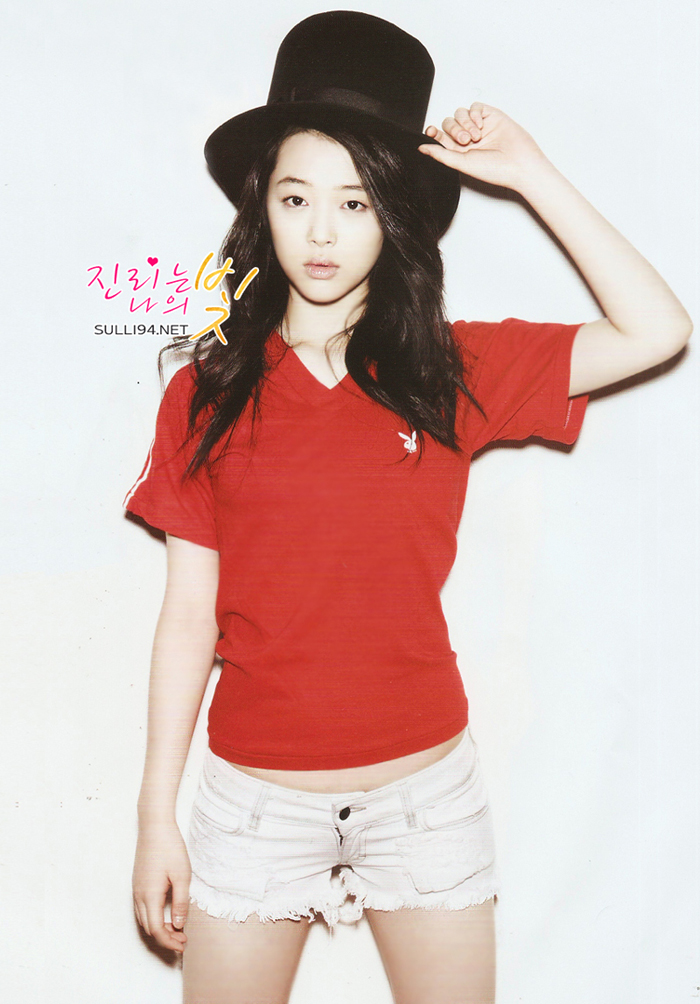


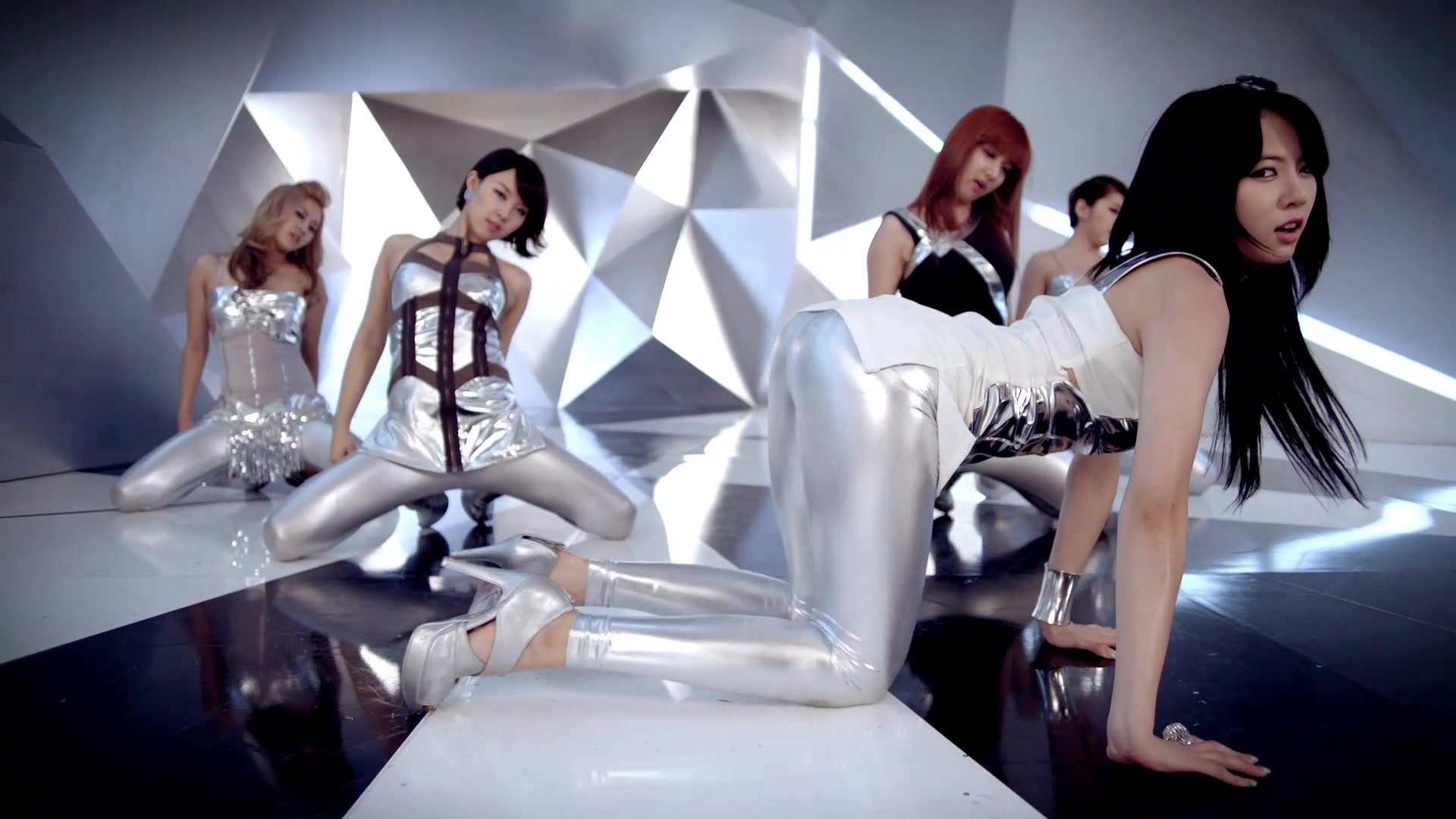



















 The Grand Narrative