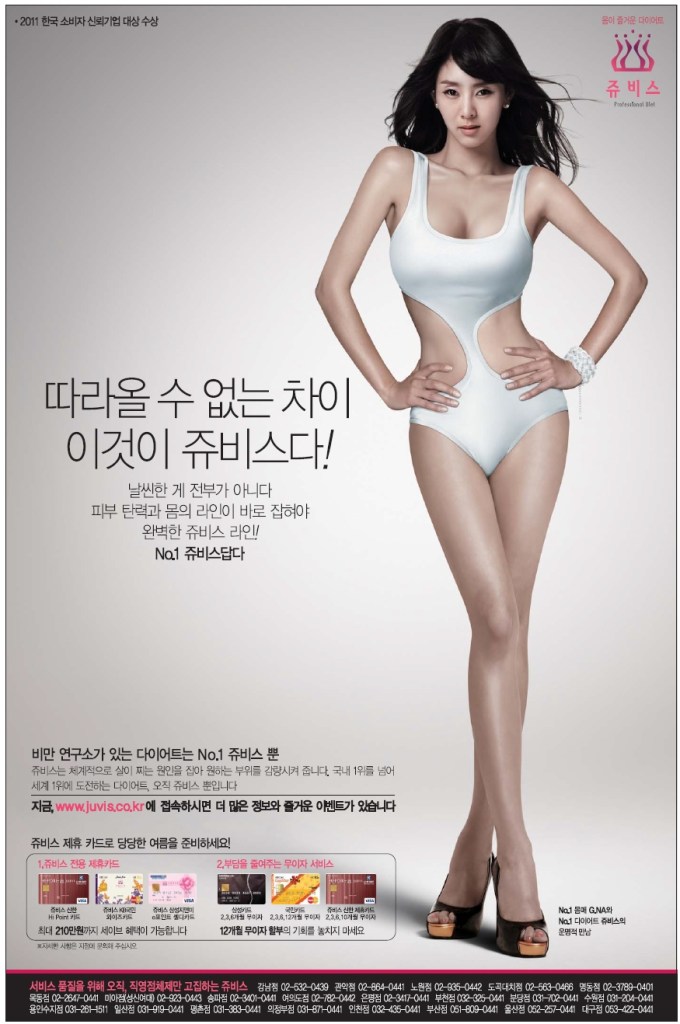
“Juvis Professional Diet” Does it Again…

Source: Busan Focus, 15 June 2011, page 17

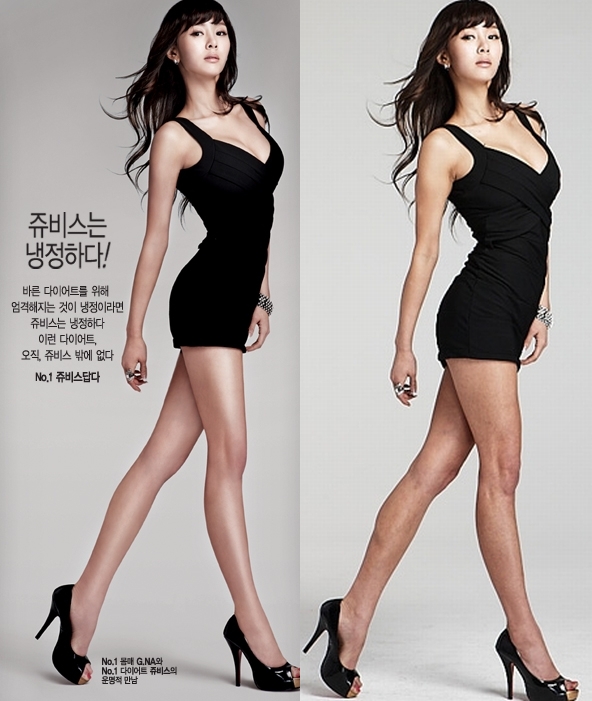
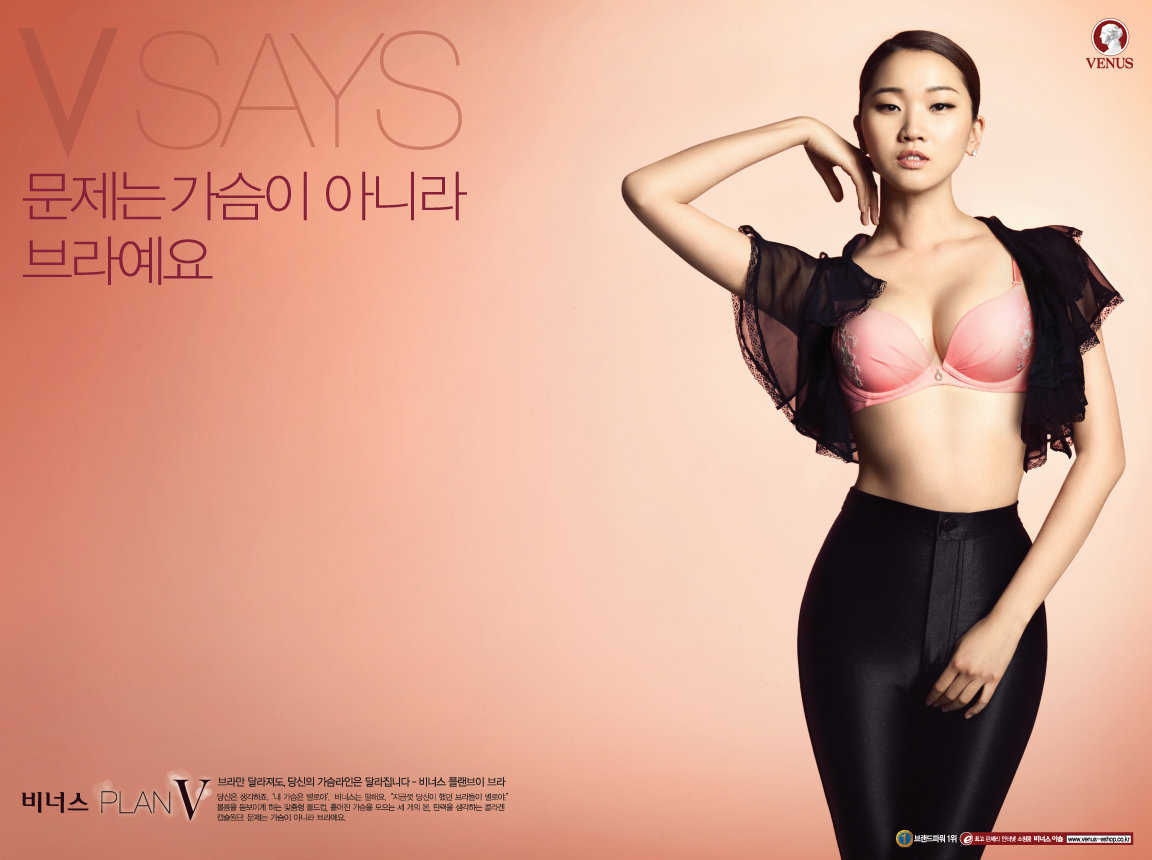
With apologies to the guinea pigs that were the first to receive it, but I’m constantly updating my public lecture on gender and Korean advertising as I get more practice with it—and indeed I’ve just realized I’ve been making a big oversight by not mentioning Koreans’ exceptionally tolerant attitudes towards photoshopping in it previously. Deciding to remedy that in the latest version then, naturally I decided to include one of the most notorious recent examples: singer G.Na‘s ubiquitous advertisements for “Juvis Professional Diet“, which I discussed here. Surely, I thought, there was no greater demonstration than making such an attractive woman look like a virtual alien (or at least her legs).

Then I opened today’s paper…

If you reside in South Korea, you can donate via wire transfer: Turnbull James Edward (Kookmin Bank/국민은행, 563401-01-214324)

Rough Weekend…

Once again, I’m very impressed with my daughter’s attention to detail!

Share

Korean Gender Reader

(Source)

1) Because one can never talk too much about Playboy…

Admittedly it’s only tangentially related to Korea, but then Playboy bunny ears were very popular with Korean women last summer, and then in January you also had American film critic Roger Ebert criticizing Korean groups for not really understanding all the Playboy references they were using. So, it was really interesting to hear just this podcast from the British sociology program Thinking Allowed (previously mentioned here), which in its own words says:

Carrie Pitzulo, the author of a new history of Playboy claims it has “a surprisingly strong record of support for women’s rights and the modernisation of sexual and gender roles”. Are Bunny Girls and Playmates of the Month really allies of the feminist cause? [Host] Laurie is joined by the author Carrie Pitzulo and the sociologist Angela McRobbie to discuss the secret and surprises of the bunny brand.

Continuing with the tangents, I’ve ironically become much more interested in Western pop-culture since presenting at the Korean Pop Culture Conference 2011 in LA last month, and so on Gord Sellar’s recommendation have just ordered Strange Days Indeed: The Golden Age of Paranoia by Francis Wheen, on “general culture across the Anglophone world in the 1970s”. To any 30-somethings like myself especially, who were too young to really know anything about that decade, it sounds like riveting reading (and it would be good to hear our parents’ takes on it too).

2) The pitfalls of being pregnant in Korea

Any other “Western” women with Korean husbands get stared at by old men? More so than before they were pregnant that is? Shotgun Korea is about to explode, in more ways than one!^^
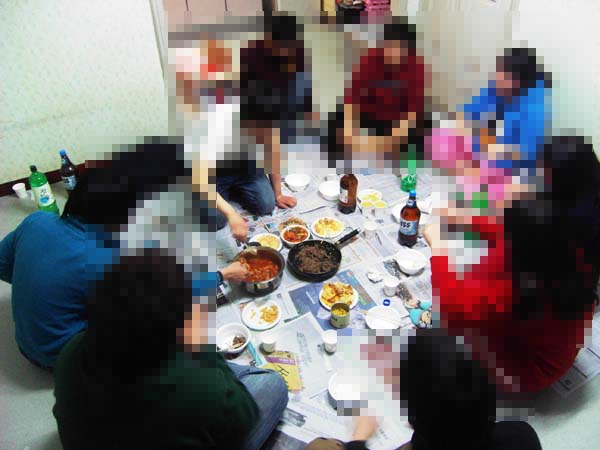
Update: Shotgun Korea also has a post on a strange virus that seems to be killing pregnant women in Korea.

(Source: Sinfest, one of my favorite comics. Hope that was okay!)

3) Funny or offensive? Sports show asks why Korean women are good at golf

Judge for yourself at CNNgo. Not being a golf fan, then normally I wouldn’t pay much attention to this sort of thing, but Rachael Miyung Joo of Middlebury College piqued my interest in them with her presentation Traveling Ladies: Korean Female Athletes and Global Korea at the Korean Popular Culture conference. A quick excerpt from the abstract:

…Within the context of U.S. nationalist discourses, Korean female athletes exist as a “yellow peril” threat to the elite white traditions of professional golf. The extraordinary growth of Korean and Korean Americans within the Ladies Professional Golf Association have produced racist responses to Korean golfers including an attempt to institute an English Only policy in the league. Nevertheless, the LPGA has grown due to the celebrity of Korean golfers, and their impact on the growth of the LPGA has translated into policies that work to get all female golfers to emphasize female charm for the pleasure of male fans. Furthermore, hypersexualized Korean female golfers work to assuage anxieties around lesbianism in professional women’s sport…

Read the rest here. Unfortunately there’s not much information about it, but I’m also looking forward to her book Transnational Sport: Gender, Athletes, and the Making of Global Korea that’s coming out sometime this year.

4) Reading the Lolita Effect in South Korea, Part 5

Or rather, the news that Girl’s Day (걸스데이) recently performed in costumes so high that their panties were exposed could easily have been the next post in that series (one member only turns 17 tomorrow). But I don’t really have anything to add to what Michael Hurt says at Yahae! about it except to say that, unfortunately, I feel somewhat vindicated by it(!):

…this is a bridge too far. The skirts have now come up above the panties. I mean, I know that competition from the many girl groups that now exist must force some serious marketing decisions such as the one to make underage girls truss around in skirts that don’t cover their jibblies, but you gotta draw a line somewhere!

See Part 2 for more on the issues raised by performers dancing and/or dressing in sexual ways when the age of consent is as low as 13.

(Source)

5) Discussing cosmetic surgery With Koreans

Is it also your experience that you just can’t win? See On Becoming a Good Korean (Feminist) Wife for a long and thoughtful post on the subject.

Related, see Sociological Images for the self-explanatory recent post “Race and the Problems of Measuring Beauty Objectively“, and you may also like the “Ethnic Comparisons” section of the Feminine Beauty site (NSFW).

6) Foreign children sexually and physically abused at Haeundae Beach

See Koreabridge for the details. Also, while I’m always prepared to give the police the benefit of the doubt considering how the Korean media will simply make up stories about their incompetence, they do indeed seem to have acted extremely unprofessionally in their handling of this case.

7) Corporate life in Korea

…is no picnic for women, who tend to be lower on the totem-pole, but it’s important to remember that it can be pretty bad for men too.  See these posts by I’m No Picasso and New Yorker in Seoul for some first-hand experiences.

8) I like big butts and I can not lie…

Usually I’m loathe to quote entire posts, but then everyone on Tumblr is doing it so I can too. Here then, are some very wise words from American actress Tina Fey (found via Hot Yellow Fellows):

But I think the first real change in women’s body image came when J.Lo turned it butt-style. That was the first time that having a large-scale situation in the back was part of mainstream American beauty. Girls wanted butts now. Men were free to admit that they had always enjoyed them. And then, what felt like moments later, boom—Beyoncé brought the leg meat. A back porch and thick muscular legs were now widely admired. And from that day forward, women embraced their diversity and realized that all shapes and sizes are beautiful. Ah ha ha. No. I’m totally messing with you. All Beyonce and J.Lo have done is add to the laundry list of attributes women must have to qualify as beautiful. Now every girl is expected to have Caucasian blue eyes, full Spanish lips, a classic button nose, hairless Asian skin with a California tan, a Jamaican dance hall ass, long Swedish legs, small Japanese feet, the abs of a lesbian gym owner, the hips of a nine-year-old boy, the arms of Michelle Obama, and doll tits.

Much the same can be said of Korean women of course, but with an important possible exception:  the doll-tits. Not because Korean women tend to be less busty than their Western counterparts though, but rather because there seems to be a genuine taboo against breast exposure which even the Korean media is wary of. Lest that sound simply absurd however, then consider the case of G.Na (지나), whose – to put it bluntly – most marketable assets seem strangely underplayed by the otherwise extremely exploitative and objectifying Korean music industry.

(Source)

9) “Secret (시크릿) will show off their innocent and cute selves with a sexy and powerful dance in Japan through Madonna

As it turns out, that was a mistranslation of the original Korean – “청순과 귀여움은 물론 섹시미와 파워풀한 댄스를 모두 겸비한 시크릿은 일본 시장에서도 충분히 통할 수 있다는 전망이다” – by Koreaboo, and something like “They’lll show off an innocent and cute image of course, but combine it with sexiness and powerful dancing” would be much more accurate. But the Korean media does indeed say such things all the time, which speaks volumes about how female sexuality is presented by Korean girl-groups, and of course the sentance still remains a bit of an oxymoron (but kudos to Koreaboo for at least providing a link to the original article to check, unlike – grrr – allkpop).

For more on that, see, well, just about all of this blog(!), but if you’re after something more specific then this and this recent post at SeoulBeats are good introductions (and for some background to the latter, see here).

10) Essential reading on Korean Feminism

Even if I’m No Picasso hadn’t *cough* praised this blog in it, I’d still describe this as one of the best posts I’ve ever read on the subject (or technically speaking, English discussions of the subject). And it behooves me to say that I have certainly been (and probably still occasionally am) guilty of discussing Korean women, feminism, and/or gender issues through an overly generalizing, patronizing, and – for want of a better word – Orientalist lens, and so this post of hers will seriously provide a checklist for me for maybe years to come! (And Roboseyo’s post on “Mansplaining” is very helpful too).

Share

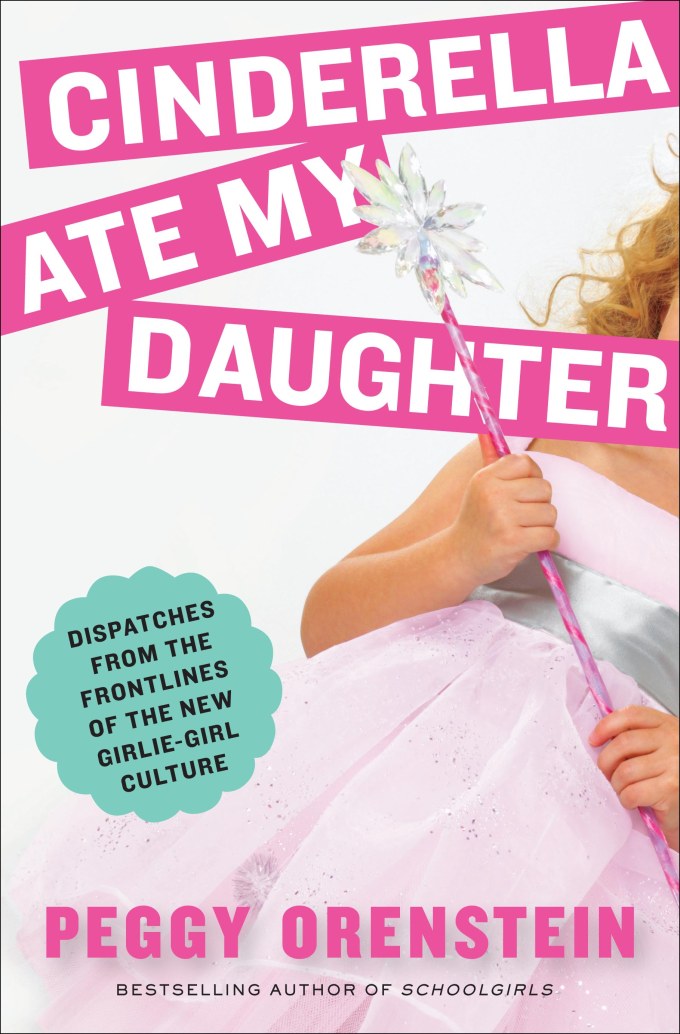
Cinderella Ate My Daughter (신데렐라가 내 딸을 먹었다)^^
(Source)

Apologies for the slow posting everyone: it’s been a very busy end to the semester, and then I caught a bad cold over the long weekend. Hopefully I should be writing again by tomorrow, but in the meantime I thought readers might be interested in a book I’ve just ordered: Cinderella Ate My Daughter, by Peggy Orenstein.

Like Reading the Lolita Effect by M. Gigi Durham, intellectually-speaking it’s going to very interesting applying it to the Korean context. But with my 5 year-old daughter expressing a desire to be a princess literally every day though, and having constant fights because she always wants to wear her most “princessy” clothes, then this time round I have much more practical and immediate concerns that I hope the book can help me with!

Anybody else read it, and/or have similar problems with their aspiring little princesses? So far, my wife and I have had the most success with persuading her to become a strong confident queen instead!

Share

With Great Legs Comes Great Responsibility? G.Na for “Juvis Diet”

(Source: Seoul Focus, May 17 2011, p. 13.)

Call me paranoid, but usually I quickly turn the page when I see newspaper ads like this on my commute. After all, as the only foreigner, I’ll already be the only guy on the subway carriage red-faced and sweating at this time of year. And I don’t want to fulfill stereotypes of oversexed Western males by blatantly staring at singer G.Na‘s legs either.

But, dammit, there’s something wrong with them here. Rather than hearing me harp on about unnecessary photoshopping though, it was with great relief that I found some rare critical Korean commentary on this ad. Or at least, so I thought before I began translating properly…

지나 신이내린 몸매, 포토샵을 거부한 아찔한 비주얼  G.Na’s God-given Body Doesn’t Need Photoshop

활발한 활동을 하고 있는 가수 지나가 하루가 다르게 예뻐지는 모습을 보이고 있습니다. 원조 베이글녀 이제니도 안 부러울 정도의 글래머스한 몸매를 가진 지나는 신세경에 이어 가장 매력적인 여성에 속하기도 한데요. 여기에 타고난 가창력은 더욱더 지나를 빛나게 하는 부분이 아닐까 합니다.

G.Na, a very active singer, is becoming prettier every day. Counted as one of the most attractive women [in Korea?] after Shin Se-kyung, with her glamorous body she has no need to be jealous of original Bagel Girl Jenny Lee. Add the singing ability she was born with too, and she shines all the more.

[James – for what a “Bagel Girl” is, see here. Also, bear in mind that “glamorous” actually means “voluptuous” in Korean. And say “Jeena”, not “Jee-en-ay” like I first did!]

현재는 인기를 끌었던 Black & White 활동을 마치고 자신의 가창력을 그대로 보여줄 수 있는 후속곡 ‘벌써 보고 싶어’로 활동 중인데요. 역시 댄스곡이나 발라드 곡 모두를 다 완벽히 소화해 내는 지나의 모습을 보면 정말 뛰어난 솔로 가스로서 능력을 타고난 가수가 아닐까 생각합니다. 그리고 이런 인기 덕분인지 지나는 프로농구 챔피언결정전 5차전에까지 초청받아 시구하는 등 나날이 달라지는 위상을 실감하고 있습니다.

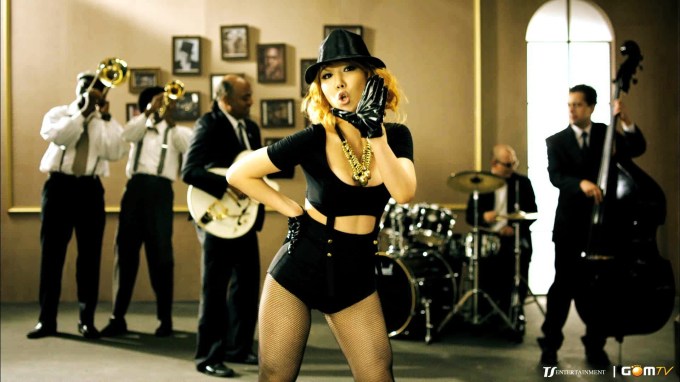
Having just finished the song Black and White [above], which is gathering a lot of popularity, G.Na is continuing to demonstrate her singing ability with her next song, I Already Miss You. Able to adopt [new] styles like dance and ballad music perfectly, if you see [hear?] her you will have no doubt that she was destined to become a brilliant solo singer. Indeed, because of her popularity she was even invited to make the ceremonial opening pitch at a pro-baseball championship game [below], and her image is soaring.

그런데 이런 지나가 최근에 가장 완벽한 몸매를 드러낸 모습이 있어 화제가 되었죠. 그것도 무보정 몸매로 있는 그대로의 환상적인 모습을 보여줘 감탄사를 연발하게 만들었습니다. 이 사진은 일명 직찍 사진으로 광고촬영 중에 지나의 모습을 그대로 담아 낸 사진인데요. 지나의 완벽한 몸매에 정말 감탄사가 절로 나올 정도로 아찔함을 주는 모습이라고 할 수 있습니다.

By the way, showing her most perfect body has become a bit of an issue, right? So perfect that it needs no corrections, seeing her fantasy-like body makes people exclaim in rapid succession. And indeed in this everyday, unaltered picture of her doing her advertisement photoshoot, we just see her appearance how it is. But her body is so perfect and mesmerizing that she makes people automatically exclaim.

(“Terminator Body” G.Na. Source)

하지만, 이런 지나의 무보정 사진과 과연 정식으로 광고에 사용된 사진이 얼마나 다를까 궁금해지는데요. 최근에 지나의 모습이 공개되었는데 역시나 별반 다를 것 없는 모습에 또 한 번 놀라게 되고 말았습니다. 정말 포토샵을 거부한 몸매라고 받게 할 수 없는데요. 워낙 타고난 몸매 종결자이다 보니 실제로 쓰인 광고 사진과 별반 다를 게 없더군요.

But I was curious as to how much the photos used in the advertisement differed from the untouched ones. And again I was surprised at how they’re not particularly different…surely this can be called a body that rejects photoshop? As she was born with this “terminator” body, the final picture actually used in the advertisement doesn’t really have any differences.

[James – “Terminator”, as in a person, is some new Korean slang. I think by itself it means someone is so good that he or she is the final, “terminating” word on the issue. Update: with thanks to Milton at The Marmot’s Hole, a much better explanation is that “In slang, a 종결자 is some who is the absolute best at something. You can affix it to other words besides 몸매, like 색시종결자 In this case, it means that G.Na has the absolute best body.”]

일단 왼쪽 사진은 포토샵을 하지 않은  지나의 몸매 그대로 모습이고 오른쪽이 최종 사진 보정을 해서 공개된 사진 컷입니다. 보여지는 표정의 각도가 조금은 다른 스타일이지만 무보정 상태의 지나와 보정 상태의 지나가 별반 다를 게 없는 것을 확연히 느낄 수 있는데요. 왜 지나의 몸매가 찬사를 받는지 알 수 있는 부분이 아닐까 합니다.

On the right is a untouched picture of G.Na, on the left is the final one that was released, with photoshop corrections. The angle and her expression are a little different, but otherwise I get a definite feeling that there was little photoshopping done. Now we see why G.Na receives such praise for her body.

(Source)

그러나 지나는 광고 촬영 외에는 주로 이런 스타일의 옷은 잘 입고 다니질 않죠. 몸매가 뛰어나지만, 사람들이 색안경을 끼고 몸으로만 승부한다는 비난을 하기 때문에 많은 상처를 받았기 때문인데요. 최근에 오락프로나 다른 방송에 나오는 지나의 모습을 보면 상체를 거의 노출한 적이 없을 정도입니다. 그래서 말이지만 지나가 글래머스한 몸매를 가지고 있다고 해서 왜 비난을 하는 일은 그만두었으면 하는데요. 이번 가창력도 어느 정도 인정받은 가수이기 때문에 이제는 실력으로 승부하는 지나의 모습으로 바라봐 주었으면 좋겠다는 생각입니다.

By the way, with the exception of this advertisement photoshoot, G.Na doesn’t really wear these kinds of clothes. Her body is amazing, but she has been hurt by many people having a prejudice about it, thinking that that is all she is good for. Because of this, whenever she appears on comedy shows or other programs, she always wears clothes that cover most of her upper body. So, I wish people would stop criticizing her for having a glamorous body, and think that as her singing abilities have been acknowledged, people should respect her as a singer (end).

(Source)

Writing ability aside, the author does have a point about the Korean media’s obsession with G.Na’s breasts. Indeed, it strongly reminds me of journalist Amanda Hess’s classic article With Great Cleavage Comes Great Responsibility, in which she argues that ultimately it’s not really busty women’s clothes that people have a problem with. Rather, it’s large breasts themselves that are somehow considered “indecent”.

On the other hand, I beg to differ on the relative lack of photoshopping by Juvis (see here for a close-up of the last image if you’re still not convinced yourself). It speaks volumes about Koreans’ attitudes to photoshop, I’m tempted to say, that someone would consider that to be a sign of an attractive body, rather than simply one that required no photoshopping at all. Fortunately for such (over)generalizations however, actually many Korean netizens agree with me, or at least on G.Na and this particular photoshoot.

Meanwhile, does anybody else recall this ad from Juvis that I wrote about 2 years ago?

To those that still maintain I’m reading too much into things, I now rest my case!

Update: As a commenter on blogger Michael Hurt’s Facebook pointed out, the ad above is actually about:

…a special treatment program to fix bowed legs. The girl who endorses [it] was famous for her bowed legs as much as her pretty face, but seems ok now due to the treament. Many Korean girls are interested in this kind of program thank to the ‘girl group’ phenomenon since few years ago.

Technically speaking then, the ad isn’t advocating excessively skinny legs. On the other hand though, it’s hardly discouraging them either, and Juvis has a strong track record of doing so in other ads too. (Like the one with G.Na.)

Girls’ Generation? Gender, (Dis)Empowerment and K-pop (Updated)

(Source)

Apologies for the slow posting and unanswered emails everyone, but as this post goes up I’ll be en route to the Korean Pop Culture Conference 2011 at the University of California, and preparing for the trip has taken a lot more work than I expected. But I’ll be back and blogging by Wednesday next week, and so until then I thought you might be interested in the abstract of co-author Stephen Epstein’s and my presentation topic, which – assuming no disasters – is likely to become a chapter in the forthcoming book The Korean Popular Culture Reader by Duke University Press:

Girls’ Generation? Gender, (Dis)Empowerment and K-pop

“The hottest phrase in Korea nowadays is undeniably ‘girl group.’ But girl group fever is more than just a trend: it’s symbolic of a cultural era that is embracing the expulsion of authoritarian ideology.” So reads the content blurb for a story on the rise of girl groups in the March 2010 issue of Korea, a public relations magazine published under the auspices of the Korean Culture and Information Service. Nonetheless, despite official, top-down promotion and cheerful assertions that this phenomenon is a liberating pop movement, a reading of the lyrics and visual codes of the music videos of popular contemporary Korea girl groups raises serious questions about the empowering nature of “Girl Group Fever.” In this paper, we will engage in a close analysis of the music and videos of groups such as the Wonder Girls, Girls’ Generation, KARA, T-ara and the discourse that has surrounded their rise to popularity in South Korea in order to deconstruct the notion that contemporary consumer society is making a radical break from more traditional, deeply embedded power structures.

(Source)

We will argue that a set of recurrent tropes in the studied media and marketing presentation of Korean girl groups undercuts claims to a progressive ethos. In particular, as we hope to demonstrate, girl group videos and lyrics often fall into one of three categories: first of all, while girl group singers can express desire in potentially empowering fashion, the viewer is generally constructed as male, and expression of desire is accompanied by a coyness and feigned innocence that returns power to men (Girls’ Generation’s “Gee” and “Oh”; T-ara’s “Like the First Time”; KARA’s “Mister”). A second set of songs and videos suggests exertion of female power, but influence is wielded through recourse to the overwhelming force of feminine sexuality that either embarrasses (After School’s “AH!”, which adds the tease of a forbidden relationship between teacher and student) or renders males helpless in its midst (The Wonder Girls “So Hot”) and thus projects the message that narcissistic desirability is the route to redress power imbalance. Finally, a number of songs have lyrical and video narratives that depict female solidarity in wreaking revenge on callous boyfriends or threatening men (2NE1’s “I Don’t Care”, The Wonder Girls’ “Irony and “Tell Me”, the latter of which has lyrics that are at odds with its visual narrative), but in doing so continue to foster the discourse of a battle between the sexes. As we will show, in noteworthy contrast to J-pop girl group videos from the dominant entertainment group Hello! Project, which emphasize the expression of youthful energy without reference to a validating or polarizing male presence, Korean popular music’s engagement with larger discursive structures has yet to break free of ideologies that pit male and female against one another (end).

(Source: Screen Capture, “Magic Station”, Asahi-TV, 15 October 2010)

Update: Very much the lens through which I’ve been writing about Korean music for the last few months, nevertheless I should really have stressed that the abstract was written almost a year ago, and indeed developments in K-pop and J-pop since then have rendered much of it out of date, let alone the opinions of my co-author and myself growing and changing as we deepened the extent of our research. Also, word limits for the paper precluded necessary related discussions of boy-bands and J-pop, with 8000 words unfortunately barely being enough to even begin to scratch the surface of the subject.

Unfortunately then, in hindsight the abstract isn’t actually a very good guide to our current opinions on the subject and/or what we’ll be presenting on Friday(!), so please understand why it’s necessary to close this post to further comments. Instead, for now at least please accept the abstract simply as something to hopefully get you thinking about possible common themes in K-pop and why they exist, and if it becomes possible then I will definitely (re)open the discussion at a later date.

Finally, my special apologies to those who already commented, and frankly I didn’t expect such a wealth of expertise to be brought to bear on the abstract so quickly!

Share

Female Flesh Under Consumer Capitalism: Meet the Meat?

(Source: Busan Focus, 16 May 2011, p. 13)

Hey, I get it, I really do: ads that make men want the girl, can make women want to be that girl.

Hence the memorable things Lee Hyori did with a hose for Vidal Sassoon back in 2007 for instance. Or indeed this ad, which, despite the English copy, actually says that “the lunch for amazing women has started”, and then proceeds to do no more to sell to said amazing women than simply plonking Kim Sa-rang (김사랑) with a smouldering gaze on it, flanked by Lee Tae-im (이태임) with textbook hair-preening and hand on hip.

Surely there’s no doubt in anyone’s mind that, although being aimed at women, it’s still squarely aimed at a male gaze?

But if that’s what so bugged me about it, then critically analyzing ads would only ever be an exercise in frustration. And I’m not even against gendered marketing per se either: despite the vast majority of it having no biological basis, and also serving to create and/or reinforcing existing gender stereotypes, admittedly it does sometimes have a genuine financial logic.

Rather, it’s the sheer laziness of this ad that gets me: was this really the best T.G.I. Friday’s could have come up with to get women to eat more steak?

Also, it’s amazing how unnatural the ad suddenly appears if you mentally replace the copy with “amazing men” instead (let alone considering how the ensuing male models would pose). When I did so myself, it really hit me just how much gendered marketing is actually aimed only at women, and how many normative advertising categorizations of female consumers (e.g. Alpha Girls, Omega Girls, Gold Misses etc.) completely lack any male equivalents.

Which is an unfortunate association I now have with T.G.I. Friday’s I guess. But then they’re the ones that came up with such a lame ad!

Korean Sociological Image #59: Childcare is (Still) Women’s Job!

(Source)

Do crosswalk lights with only male-shaped figures really discriminative against females? That’s a hard sell on any occasion, let alone when it would cost 21 million dollars to replace them all with both male and female ones instead, and so netizens have rightfully “responded with merciless mockery” to the Seoul Metropolitan Government’s plan. As has the cartoonist Ju Ho-min too, whose humorous extension of the city’s logic needs no translation!

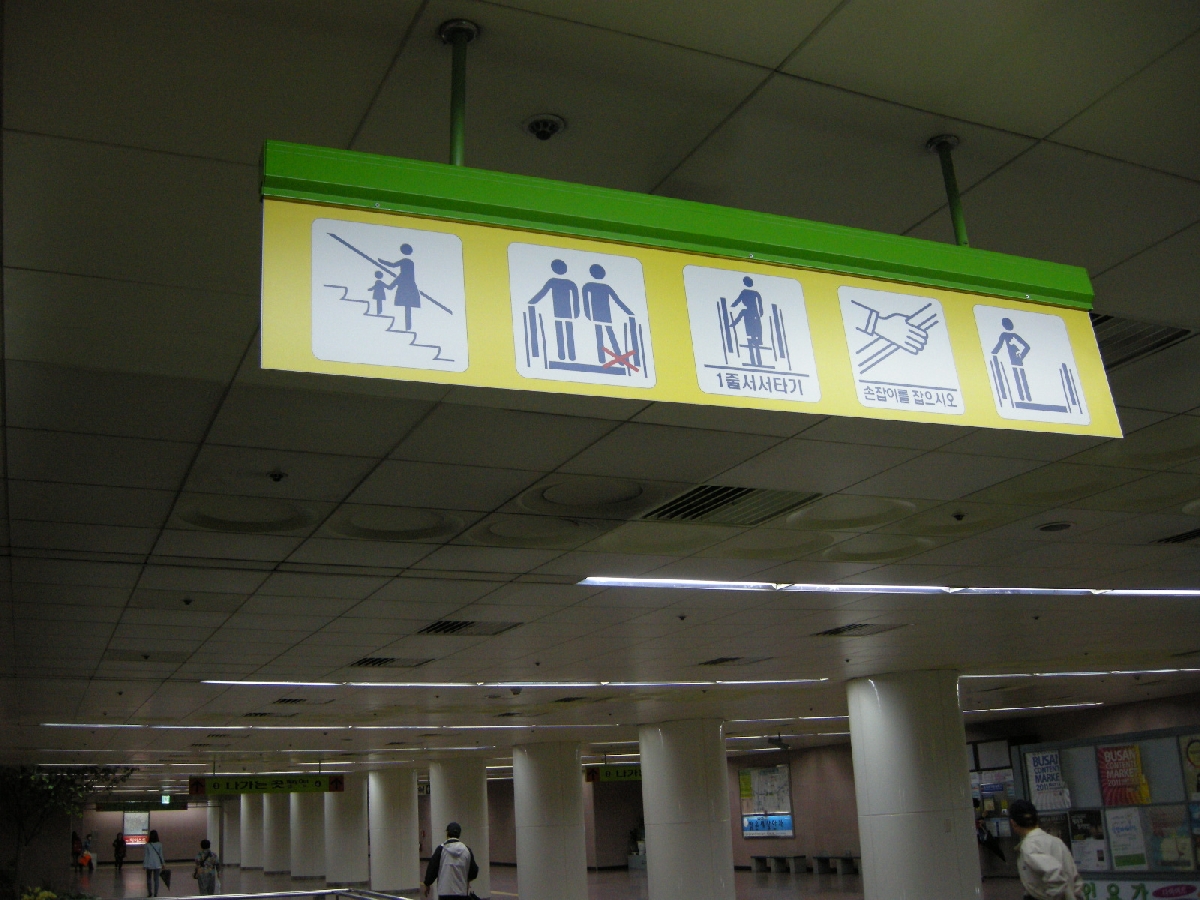
Instead, a much better candidate for signs to replace would be these ubiquitous reminders that it’s only women that should look after children:

Women do look after children of course, and so technically signs like these aren’t discriminatory in themselves. But as this photo and those below make clear, they’re not just not countered by equal numbers of signs showing men taking care of children, but in fact female figures are only used when a child is also involved:

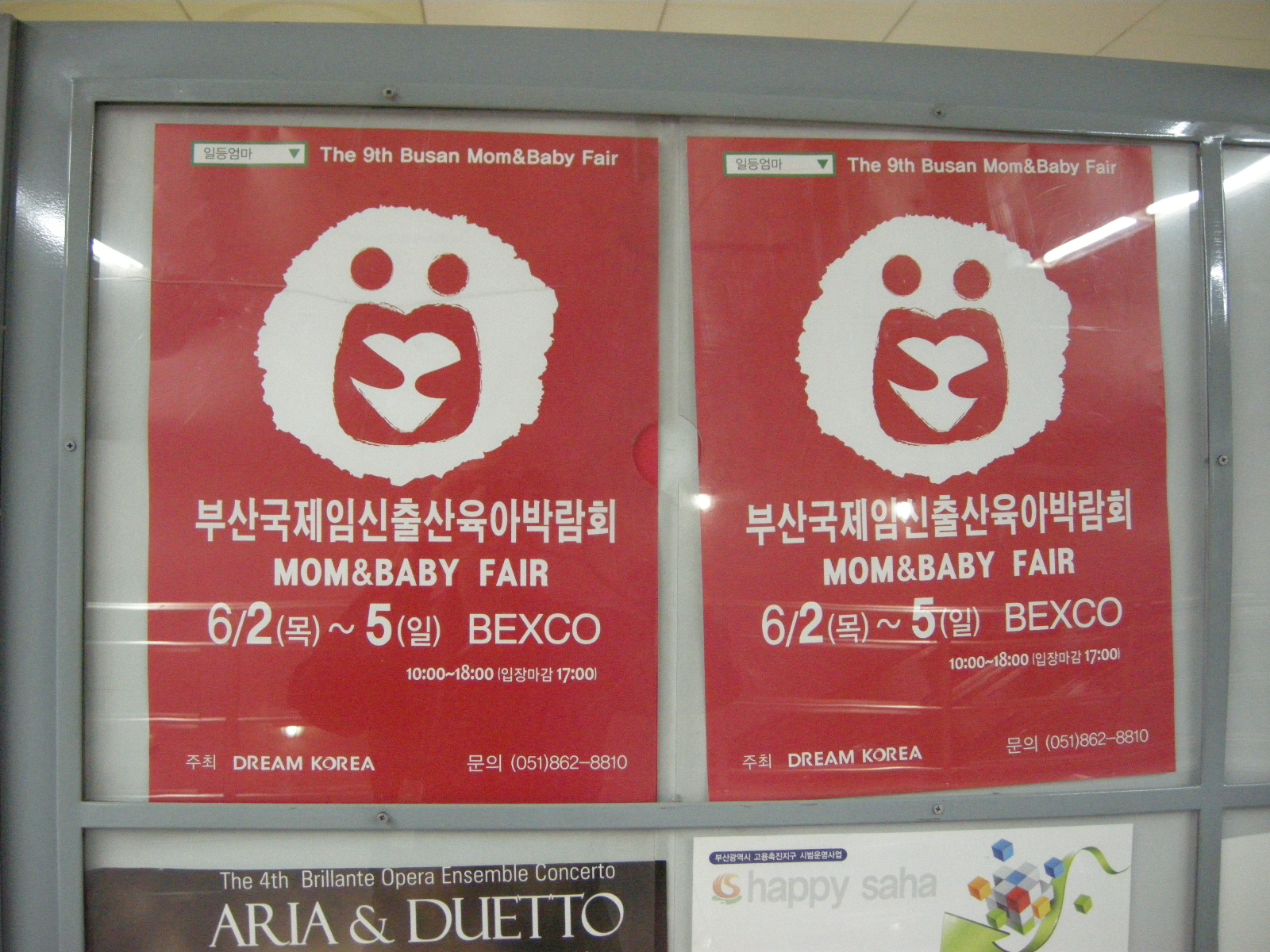
Lest I sound like I’m singling Korea out for criticism however, note that such images are almost universal, and indeed the above ones look almost exactly the same as those in Dublin airport. Moreover, once you move away from signs to language instead, then, possibly following overseas examples, actually discriminatory English slogans are sometimes chosen rather than making Korean ones, such as with airline Asiana’s “Happy Mom Services”. Or alternatively, consider the 부산국제임신출산육아박람회 that I learned about today, which would simply be “The Busan International Pregnancy, Childbirth, and Childcare Exposition” in English, but which somehow got translated as “The 9th Busan Mom & Baby Fair” instead:

As it’s not just for moms and babies if you can read the Korean though, then accordingly there are many fathers and would-be fathers featured on the website, and actually I was one of them myself back in either 2005 or 2006 before my first daughter was born. I don’t recommend going though, as I recall finding some of the services being promoted there – stillbirth insurance for example – just a little cold and off-putting!

Finally, for some Korean takes on subway signs that I managed to find, see here and here. Unfortunately, they’re a little old (2004 and 2006 respectively), which suggests that no-one’s really thought about them in a while. But on the plus side, the Seoul Metropolitan Government’s misguided plans have at least brought national attention to the issue of (potential) sexual discrimination in signs, so now may well be the best opportunity ever to suggest that something be done about them. Ideally, by using the money earmarked to change the crosswalk ones to change the subway ones instead.

If anybody knows how to go about contacting them, then that would be much appreciated!

Update: On Becoming a Good Feminist Wife has more commentary on the planned new crosswalk signs here.

(For all posts in the Korean Sociological Image series, see here)

Share

The Grand Narrative’s Facebook Page Launched!

For about a year now, I’ve been tweeting about all the interesting Korean gender issues, advertising, and pop-culture stuff (and much more) that I don’t get a chance to blog about, but a lot of readers have suggested that it’s high time I created a Facebook page also. With apologies for the wait then, here it finally is, and I definitely hope to make it a site in its own right, not just a glorified RSS feed for the website proper.

To that end, I’ll not just be providing cool stuff that you won’t see here, and taking advantage of the opportunity to interact more with readers, but I plan to let my hair down and be a little less intellectual on Facebook too.

For instance, as a dispassionate critical commentator on Korean girl groups K-pop, normally I would never ever reveal that there’s something about Love Alone (러브얼론) above by Miss A (미스에이) that has me smiling radiantly almost every time I listen to it. Indeed, although I was initially very disappointed that there wasn’t a proper music video produced for it, now just seeing the members being themselves in it has me smiling all the more!

(2:29)

Granted, all of them being attractive women certainly helps,  but I genuinely think that some unique combination of the music, voices, and lyrics makes this an incredibly warm song, especially for what can often be very tinny and artificial-sounding K-pop.

Any other fans?^^ Call me naive, but I’ll be investing 660won (US$0.61) in the MP3 as soon as I finish typing this!
Update: See here for some high quality screenshots of the video.

Share

Korean Gender Reader

(Source)

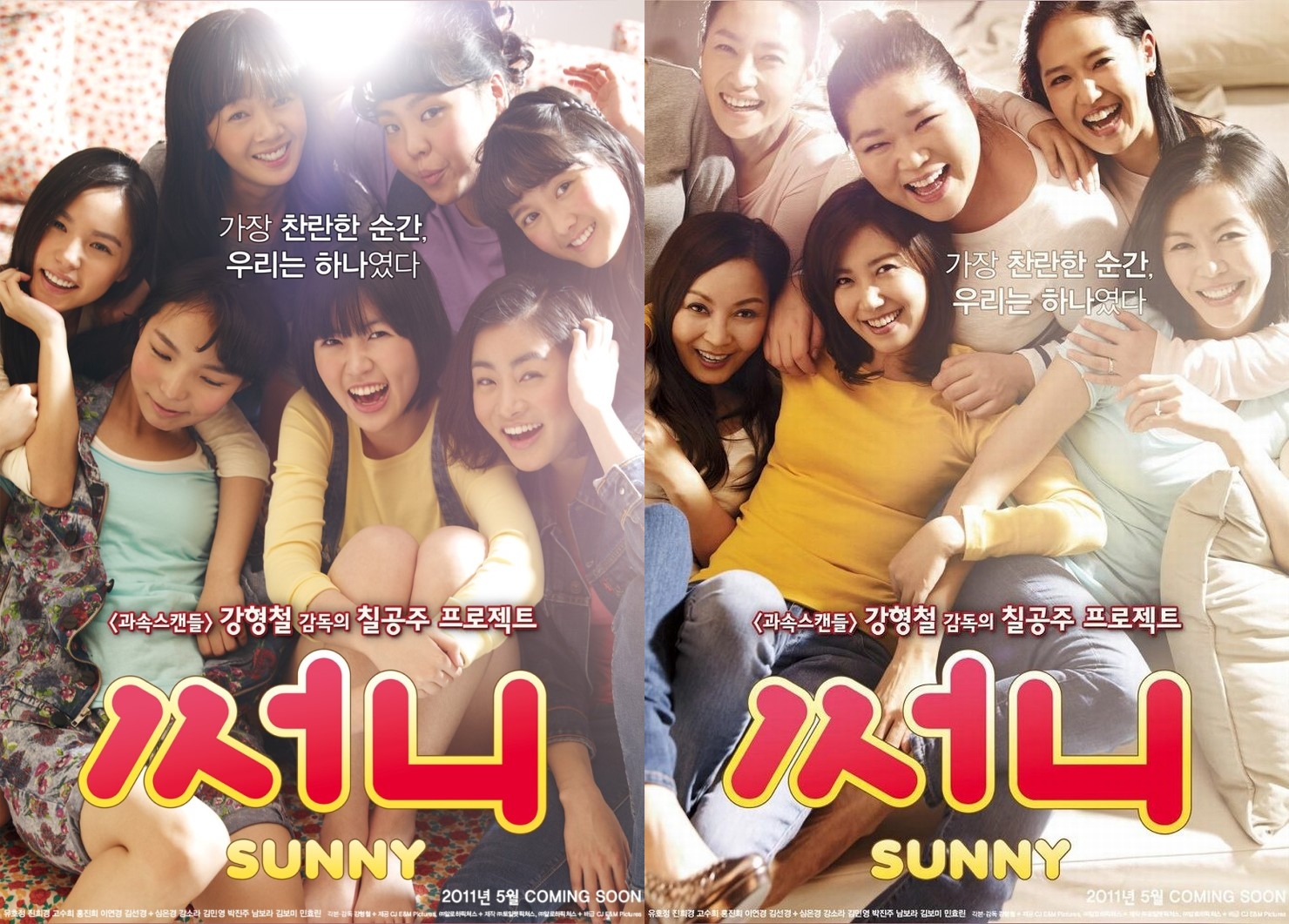
1) Sunny (써니) Now Playing in Theaters

And all about girl power, according to Dramabeans. Judging by the trailer, my first impression is of a comic version of the excellent Take Care of my Cat (2001; 고양이를 부탁해).

Meanwhile, does anybody know of any similar coming-of-age movies for guys? Other than the violent and overrated Friend (2001; 친구) or pornographic Plum Blossom (2000; 청춘) that is?

2) May 11th was 6th Annual Adoption Day in Korea

See Ask a Korean! for the details. Also, Korea Real Time has more on the controversy created by soon to be aired commercials encouraging more domestic adoption.

Update: Yesterday was also the first Korean Single Moms’ Day, Busan Haps had a good photo-essay on adoption last month, and the Korean Unwed Mothers Support Network has translated a December article on how unwed mothers are not necessarily poor, but society ultimately forces them to become so.

3) Only Foreign Staff Made to Attend Sexual Harassment Seminar at Korean University

After all, it was actually a Korean professor that was fired for having a sexual relationship with one of his students, so I’m sure you can see the logic. What’s more, the seminar was given by a completely unqualified speaker too, according to blogger Supplanter clearly both uncomfortable with and clueless about the subject he was presenting.

Ironically, the very next week after enduring that, Supplanter himself would be accused of sexual harassment at his local swimming pool.

4) A Normal Night Out in Seoul?

See Banana Milk to learn more about it. Call me sentimental and/or trying to (mentally) relive my twenties, but I subscribe to a lot of Seoul social, fashion, nightclubbing, and/or dance-music sites like it (in particular, M.S Photography always has *ahem* very interesting pictures), and am thoroughly jealous of people unencumbered by kids that get to actually enjoy it!

Speaking of which, tomorrow Paul Van Dyk will be performing in Seoul, only…sigh…10 years too late. See 10Magazine for the details.

Update:

5) Ending Bias Against White Male and Asian Female Couples

Like Shanghai Shiok! says:

Women with a preference for black men get a thumbs up. Women with a preference for Asian men get a thumbs up. Women with a preference for Middle Eastern men get a thumbs up. Women with a preference for white men get a thumbs down. Generally true?

Unfortunately, yes, and it took a lot of persuasion from her readers to get her to open the comments on that post!

6) “Prostitution Thrives on Twisted Entertainment Culture”

While I don’t mean to sound facetious, particularly not in light of seven bar hostesses committing suicide since last July, this is an unusually good article on the subject for the otherwise appalling Korea Times, and I look forward to reading more articles from author  Kim Tae-jong (see Extra! Korea also).

7) Korea: Sex Criminals Easily Become Taxi Drivers

Again I don’t mean to sound facetious, but, like Asian Correspondent explains, the fact that taxi-driving is one of the few occupations open to ex-convicts in Korea does explain a lot about their wild reputation.

(Source)

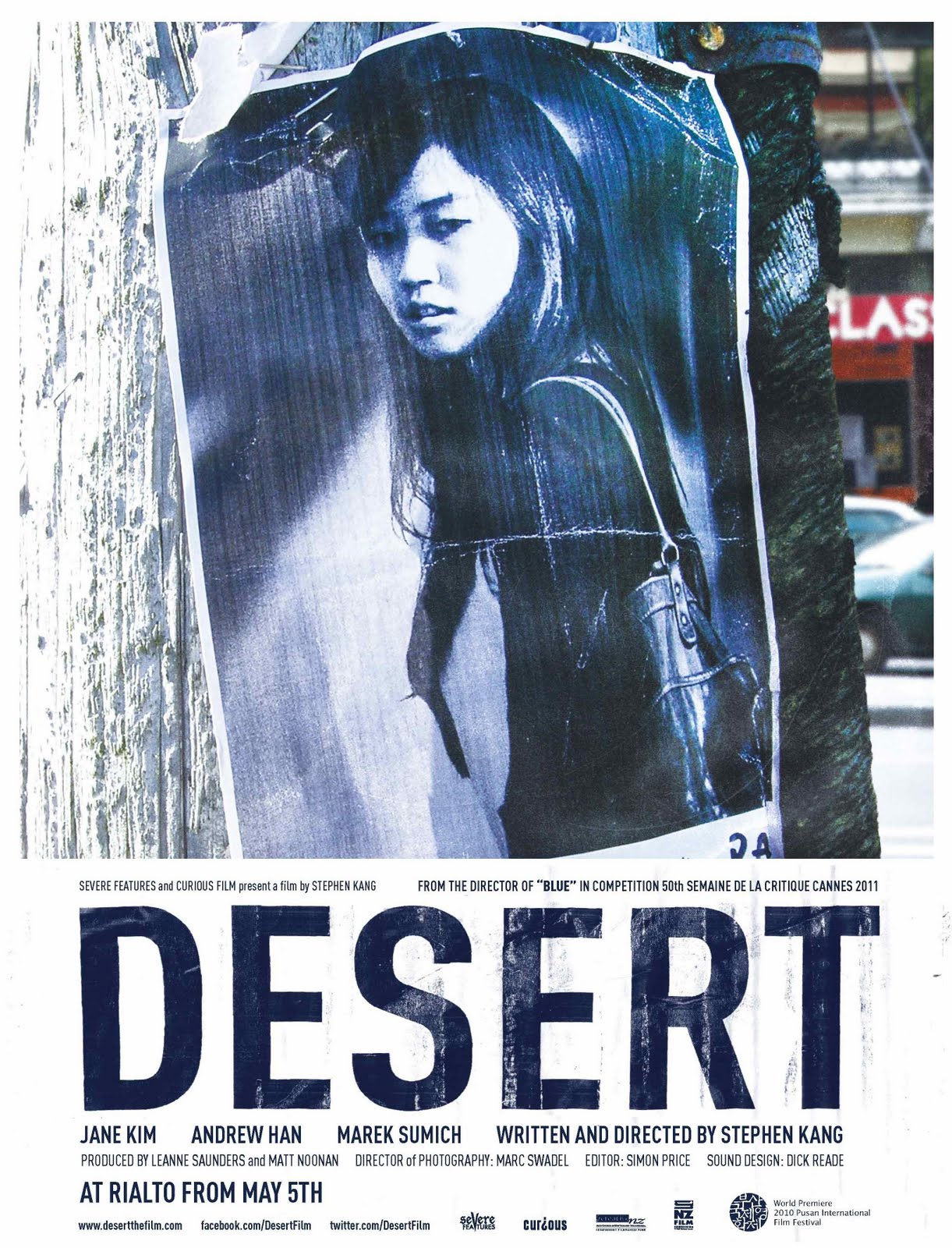
8) Desert: A Movie About Kiwi-Asian Marriages

If you’re living in Auckland, New Zealand, make sure to see Desert while you still can. First shown at PIFF last year, it:

…reveals the untold story behind many Kiwi-Asian marriages….Based on real life events, Desert follows the story of Jenny, a young pregnant Asian girl living in Auckland who is left to fend for herself; when she is abandoned by her Kiwi boyfriend just before they are about to get married. Jenny is rejected by her Asian community for getting pregnant to a westerner out of wed-lock and after unsuccessfully searching for her run away boyfriend; she is forced to look inside herself to find a positive solution for her and her unborn baby.

Jenny’s story is a reality for the growing number of Asian women in New Zealand. The Asia NZ Foundation recently recorded that there are 26 per cent more Asian women than Asian men, aged 25 to 49, living in New Zealand and nearly a quarter came to New Zealand to get married. [Director Stephen Kang’s] inspiration for the film came from observing the struggles facing many Asian women living in New Zealand and Desert is the first film of its kind to give a platform and voice to these common challenges and personal stories.

While I take exception to the title of the article that that’s from, the movie itself sounds really interesting, and you can see its Facebook page for more details, interviews, and a trailer. There’s also its webpage of course, but unfortunately the designers made a big mistake not providing a mute button(!),  and the trailer should really have been uploaded onto YouTube too.

9) The Changing Face of Cosmetic Surgery

As always, South Koreans have the highest rate of cosmetic surgeries per person in the world, but an increasing number of people receiving them are from China and Japan: 80,000 per year in fact, with many of the most famous clinics reporting 20% growth rates in their numbers of medical tourists.

As The Economist notes, Korea is a “nation that often struggles to attract foreign visitors, [so] it is hardly surprising that the authorities have begun actively encouraging this trade. It is now aiming at a target of 400,000 such visitors in 2015”.

The author BTW, also has a fine Korean blog of his own here.

10) Skirting the Issue

For those few of you that don’t know by now, a local education board in Gangwon-do is confronting the “issue” of female school students wearing shorter and shorter skirts by…spending $700,000 installing new desks with boards to stop teachers and male students being distracted by them.

For much more on this, see (in no particular order): Gusts of Popular Feeling; the BBC; Extra! Korea; and BusanHaps. But in particular, see Michael Hurt’s comments on Facebook here (roughly the 12th down), who notes the glaring absence of the opinions of the girls themselves in most discussions.

Share

Seniors Routinely Sexually Harass Juniors during “Membership Training”?

(Source)

When I first came to Korea in 2000, I soon got used to the notion that people should use nopimmal (높임말; respectful language) to their obvious “superiors”, such as their parents and bosses. But also to friends, even if they were just a year or two older? Call me a cultural imperialist, but I still balk at the notion that such people are genuine friends, and God knows what they’d make of the usually whiskey-fueled language my late friend and I, then twice my age, would use with each other (let alone what we usually talked about).

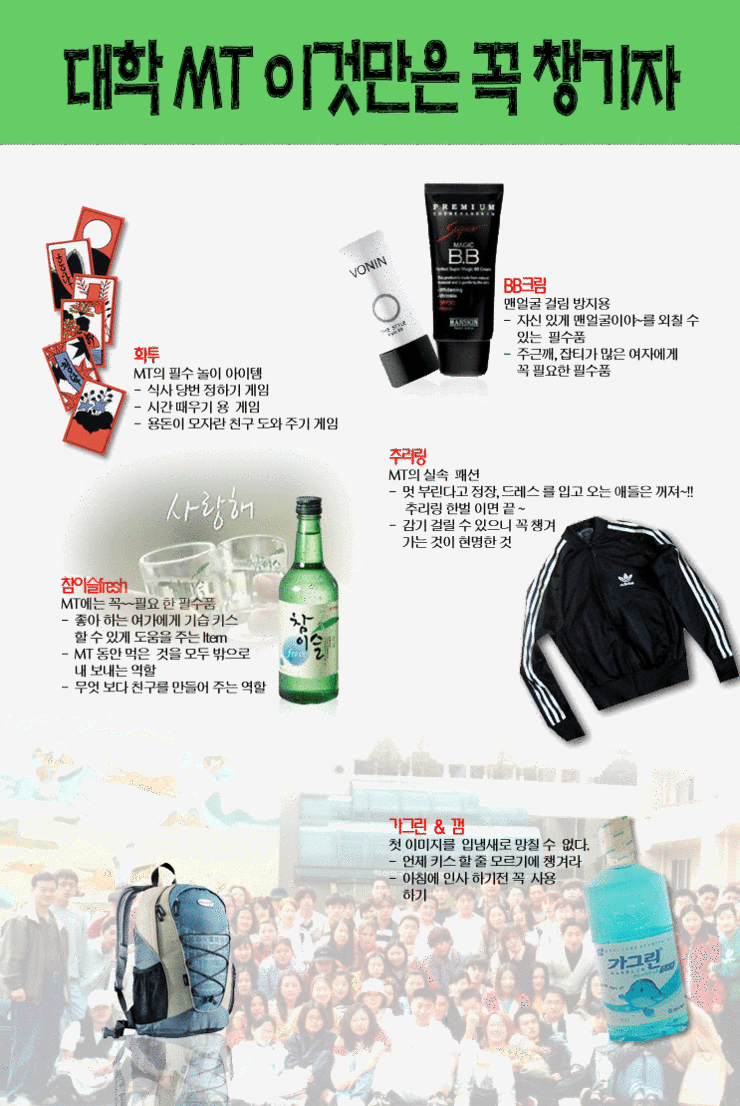
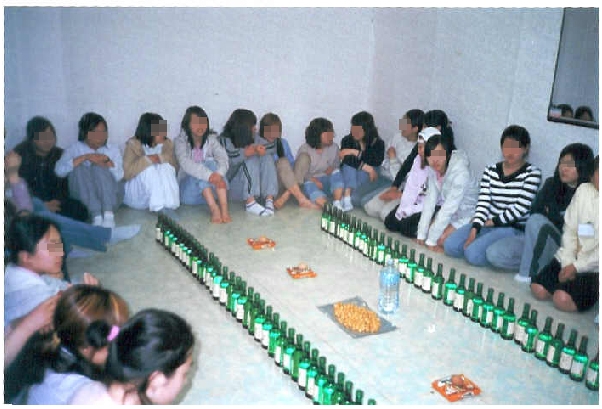
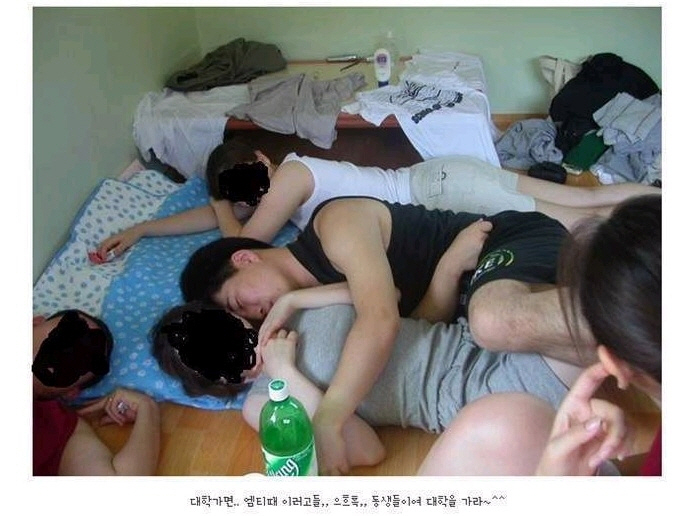
Still, it came as a real shock to hear students using it to some of their classmates at my university, even though the recipients were only just a few months older (I asked). In fairness, that didn’t happen at all at my wife’s university when she was a student, but suffice to say that I’m no longer particularly surprised when I hear of “seniors” taking advantage of “juniors” in various forms at Korean universities. And especially not on “Membership Training” (MT), which as you probably know involves a lot of drinking and various orientation and initiation rituals, as explained in the following report:

(As translator Marilyn notes, makjang means “extreme, in a negative way”, and is usually used to describe dramas where crazy things happen. Meanwhile, with thanks to SuzyinSeoul, the “OT” in the title means “Orientation Training”, one’s first MT)

(Sources: left, right)

막장 OT? ‘학내 성희롱’의 문제 보아야 / Makjang OT?  The problem of “school sexual harassment” must be considered

성희롱문제의 사각지대에 놓인 학생간 성희롱 / Sexual harassment among students is an unseen part of the problem of sexual harassment

얼마 전 인터넷 상에서는 서울 소재 모 대학의 신입생환영회가 논란이 되었다. 지난달 26일 인터넷 포털사이트 게시판에 “대학교 오리엔테이션, 이래도 되는 건가요?”라며 오른 글이 시작이었다.

Recently, the welcoming ceremony for new students at X University in Seoul has become a controversy on the Internet.  It was started by a post, titled “At a university orientation, is this really okay?” and put up on an Internet portal site’s message board on the 26th of last month [February].

성적 수치심 느끼게 하는게임시킨 선배들 / Seniors who make games that cause [juniors] to feel sexual shame

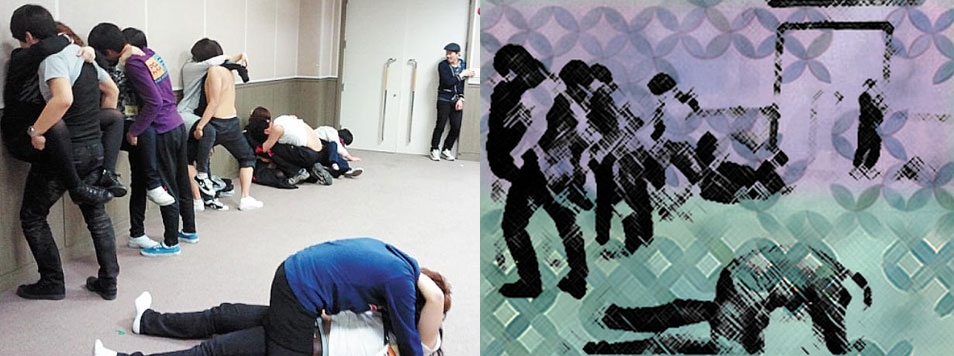
글 쓴이는 몇 장의 사진과 함께 “오리엔테이션에서 선배들이 후배들에게 성적으로 부담스럽거나, 수치심을 느낄 수 있는 행동들을 많이 시킨다”고 고발했다. 사진 속에는 남녀 신입생들이 몸을 밀착시키고 성행위를 연상시키는 동작을 취하는 모습들이 담겨 있었다. ‘게임’을 명목으로 강요된 것이었다. 글쓴이에 따르면, 술자리에서는 “정말 심한” 벌칙들도 많았다고 한다.

The writer of the post put up several pictures and charged, “At orientation, seniors force their juniors to do sexually embarrassing or shameful things.”  In the pictures, new male and female students press their bodies against each other and make sexually suggestive movements.   This was coerced under the pretext of a “game.”   According to the post’s writer there are also many “really severe” penalties at drinking parties.

(한 포털사이트에 성적 수치심을 느끼게 하는 ‘게임’을 강요하는 ‘신입생 오리엔테이션’ 문화를 고발한 글이 올라와 논란이 일었다.)

(Caption [to above image]: A post charging that a “new-student orientation” culture forces the playing of “games” that cause sexual shame was put up on a portal site and became a controversy.)

(Source)

문제의 사진들은 ‘막장 OT’라는 이름이 붙어 여러 게시판들로 퍼져나갔고, 몇몇 언론에서도 이 사건을 보도하면서 관련 학교와 학생들에게 비난이 가해졌다. 이후 사건은 해당 학교 총학생회가 사과문을 게시하는 선으로 마무리되었다.

The pictures were named “Makjang OT” and spread to several message boards, and as several media outlets reported on this story as well, the school and students involved were subjected to criticism.  After that, the student government at the university brought the incident to a close by posting a written apology.

이 사건은 인터넷 여론이 흔히 그렇듯 사건의 선정성에만 초점이 맞춰져, 관련 대학을 공격하거나 폄하하는 데에만 치중되었다는 인상을 준다. 그리고 논란의 열기는 금방 식었다.

As usual, public opinion on the Internet has focused on the sexual aspects of the story and so given the impression that it has only concentrated on attacking or disparaging the university in this area. Also, the heat of the controversy cooled down immediately.

이 사건이 문제인 것은 건전해야 할 대학 내 행사에서 선정적인 행위를 했기 때문이 아니다. 선배들의 권위를 내세워 신입생들에게 원하지 않는 성적인 행위를 강요했다는 점이 본질적인 문제다. 명백한 학내 성희롱이다.

The problem in this matter is not that there were sexual actions at university events that should be wholesome.  The essential problem is that seniors asserting their authority forced new students to do sexual actions they didn’t want to do.  This is unmistakable school sexual harassment.

(Source)

하늘같은선배 작아지는 신입생들 / New students that shrink in front of ‘god-like’ seniors

이제 막 대학을 들어온 신입생과 ‘선배’들 사이에는 막강한 권력관계가 작동한다. 대학생활에서 선배는 어떤 면에서 교수보다 더 어려운 존재다. 더구나 신입생 오리엔테이션은 이제 막 대학을 입학해 어리둥절하고 동기들과도 서먹할 때 치러지니 1학년들은 선배들 앞에서 심리적으로 위축되기 쉽다. 더구나 ‘전통’이라고 우기니 ‘참아야 되나’ 헷갈리기까지 할 것이다.

These days there is a strong power-imbalance operating between students who have just started university and their “seniors.”  In university life, relationships with seniors are more difficult than those with professors in every way.  Moreover, new-student orientations happen when students, having just started university, are dazed and still unfamiliar with their peers, so it is easy for first-year students to shrivel psychologically in front of their seniors.  Furthermore, seniors insist that it’s “tradition” so students become confused and think “Maybe I have to endure this?”

성희롱은 권력관계 안에서 일어난다. 이러한 속성 때문에 남학생이 많은 과, 권위주의적이고 위계질서가 강하게 잡혀 있는 과일 수록 신입생 환영회 때 이러한 ‘게임’을 즐기는 경향이 강해지고 ‘게임’의 강도도 높아질 것이라 추측할 수 있다.

(Source)

Sexual harassment arises inside power-imbalances.  Because of this attribute, it can be supposed that the more male students a department has and the more authoritarian and the stronger the hierarchical structure in the department, the stronger the tendency to enjoy this kind of “game” and the more intense the “games” are at new-student welcoming events.

시대가 변화한 부분이 있으니, 아마도 이러한 신입생 환영행사는 일반적으로 행해지는 수준의 것은 아닐 것이다. 그러나 아주 극단적인 예만도 아닌 것 같다. 관련 게시물들의 누리꾼 댓글에서도 비슷한 경험을 털어놓는 것을 심심치 않게 발견할 수 있다. 남성에게 구강성교를 해주는 여성의 모습을 연상시키는 동작을 하는 남학생들이 찍힌, 모 체육대학의 신입생 오리엔테이션 사진을 올린 이도 있었다.

Though there is the element of the changing times, this kind of new-student welcoming event probably isn’t common. However, it doesn’t seem to be an extreme example, either.  In the replies of the visitors to the message boards in question as well, it is not hard to find confessions of similar experiences.  There were also pictures from the new-student orientation at X Sport University [a university for athletes and coaches] which show male students making movements suggestive of women giving oral sex to men.

(Source)

대학사회, 성희롱 문제제기 여전히 어려워 / In university culture, making sexual harassment complaints difficult as ever

이번 사건을 문제제기한 학생은 학내 게시판이 아닌, 포털사이트를 이용해 글을 올렸다. 이는 문제의 ‘게임’이 ‘전통’으로 굳어질 수 있었던 배경과 관련된다.

The student who reported this incident used a non-university portal site to put up his/her post. This is related to the setting in which the “game” in question was allowed to become “tradition.”

지난 해 1월, 소위 ‘명문대생‘이 1학년 여학생들을 성추행한 사건이 논란을 일으켰다. 당시 한 피해자가 익명게시판을 통해 문제제기 하자 다른 피해자들이 나타나면서 피해자는 20여명까지 불어났다.

In January of last year, an incident in which so-called “students of a prestigious university” sexually molested first-year female students engendered controversy.  At that time, a victim made her complaint on an anonymous message board; other victims then came forward, until their number reached around 20 women.

왜 20여명에 달하는 피해자들은 성추행을 당하고도 입을 다물고 있을 수밖에 없었을까. 여전히 성희롱‧성폭력은 대학 사회 내에서도 쉽게 공론화하기 어려운 문제이기 때문이다.

Why is it that though the number of victims who were sexually molested reached about 20, they couldn’t do anything but keep quiet?  It is because even in university society, it is still difficult to publicly discuss sexual harassment and sexual violence.

(Source)

‘명문대생‘ 성추행 사건이 문제가 되었던 당시, 취업전문 포털사이트 ‘커리어’가 이틀간 대학생 768명을 대상으로 진행한 설문 조사에 따르면, 전체 여성 응답자 중 33.3%가 대학생활 중 ‘성희롱이나 성추행을 당했다’고 답했다.

When the “students of a prestigious university” incident became a problem, the job portal site “Career” surveyed 768 university students over the course of two days, and found that 33.3% of female respondents said they “have been sexually molested or harassed” during university life.

주된 가해자(복수응답)는 78.0%가 ‘선배’였다. 흔히 학내성희롱의 주된 가해자로 떠올리게 되는 ‘교수’를 지목한 대답은 33.3%였다. 대응방법을 묻는 질문에는 응답자의 66.5%가 ‘그냥 참고 넘겼다’고 답했다. 대응하지 않고 그냥 넘어간 이유는 ‘가해자와의 관계를 유지하기 위해서(66.9%)’가 가장 컸다.

The main perpetrators (more than one response possible) were “seniors,” at 78.0%.  “Professors”, who usually come to mind as the main perpetrators when one thinks of university sexual harassment, were pointed at by 33.3% of responses.  When asked how they dealt with it, 66.5% of respondents chose, “just bore it and moved past it.”  The biggest reason that they just let it go was, “To maintain a relationship with the perpetrator,” at 66.9%.

이렇듯 학생과 학생 사이에 발생되는 성희롱은 학내 성희롱 문제에 있어서 실질적으로 큰 비중을 차지하며 문제제기 하기도 어렵다. 그런데 교사와 교사, 교사와 학생 간 성희롱의 경우 성희롱 관련법의 규제의 대상이 되는 반면, 학생 간에 벌어지는 성희롱문제는 제외되고 있다. 따라서 학칙에 의존할 수밖에 없다.

Though this kind of student-on-student sexual harassment makes up a relatively large part of in-university sexual harassment, it is also hard to make a complaint.  Unlike in the case of sexual harassment between professors, or between professors and students, [public] regulations leave out sexual harassment that occurs between students.  Therefore, there is no choice but to rely on the school’s rules.

(Source)

그러나 성희롱을 ‘전통’으로 미화할 수 있는 대학사회에 이러한 미온적인 처치가 얼마나 큰 변화를 이끌어낼 수 있을까.

However, in a university culture that glamorizes sexual harassment as “tradition,” how big are the changes we can hope to effect to this kind of mediocre situation?

앞서 언급한 설문조사에서 전체 응답자 중 51.3%만이 성희롱 문제해결을 위한 대학 내 전담기관이나 담당자가 있다고 답했다. 대학사회에서 학생간의 성희롱이 사각지대에 놓여 있다는 사실을 이를 통해서도 유추해볼 수 있다. 관련 대책이 시급해 보인다.

In the survey mentioned above, only 51.3% of all respondents said that there was a special organization or officer for dealing with sexual harassment in their university.  Through this, as well, we can infer the fact that sexual harassment between students in university culture is not well-recognized.  Relevant measures appear to be urgently needed.

Writer: Park Hee-jeong (박희정), 3 March 2011.

(Source)

A disclaimer: I’ve never attended MT or even talked about it with students, so, students’ normal proclivities aside, I’m sure many or even most events are perfectly fine, and indeed Joe SeoulMan – ironically the source of one of the above images – has an account of a very nice, almost heartwarming one here. On the other hand, Extra! Korea argues that “it’s well-known among Koreans that sexual harassment is widespread at MTs”, and there’s certainly enough news stories in the Korean media to back that up.

What do you think? Have any readers attended MT themselves? Would you say that sexual harassment is indeed widespread at them, or is that just an impression created by the Korean media and *cough* bloggers, who tend to focus on the negatives?

(Thanks again to Marilyn for the translation)

Share

Reading The Lolita Effect in South Korea, Part 3: A Wave of Middle School Girls Wearing Make-up…Is it all Girl Groups’ Fault?

(Source)

It’s such a struggle being a feminist parent.

I have two daughters: Alice, born in June 2006, and Elizabeth, born in August 2008. Fortunately, Elizabeth at least is just fine in the girl-power department, and is “second-sex” to no-one. Rather, it’s my own sex-life that comes a far-distant second to catering to her demands 24/7, but let’s not go there.

Alice however, will regularly stroll down the toy aisle at the supermarket, and loudly proclaim that she doesn’t like the black and blue cars and trucks on one side because “they’re for boys”, to which I’ll have to gently remind her—yet again—that she actually has many she regularly plays with at home. She’s also started constantly posing and asking if she’s pretty, and it’s honestly starting to feel tiresome, almost pedantic to always reply “Yes, and strong and smart too!”.

This literally came to a head yesterday morning when she used those smarts to look for the clip-on earrings that her well-meaning but misguided kindergarten had given her for Children’s Day, eventually devising an elaborate system of stools and chairs to climb to the top of the chest of drawers and see if we’d hidden them there. Very proud of herself for finding them, she jumped on my face at 6:00am to wake me up and show them off (source, right).

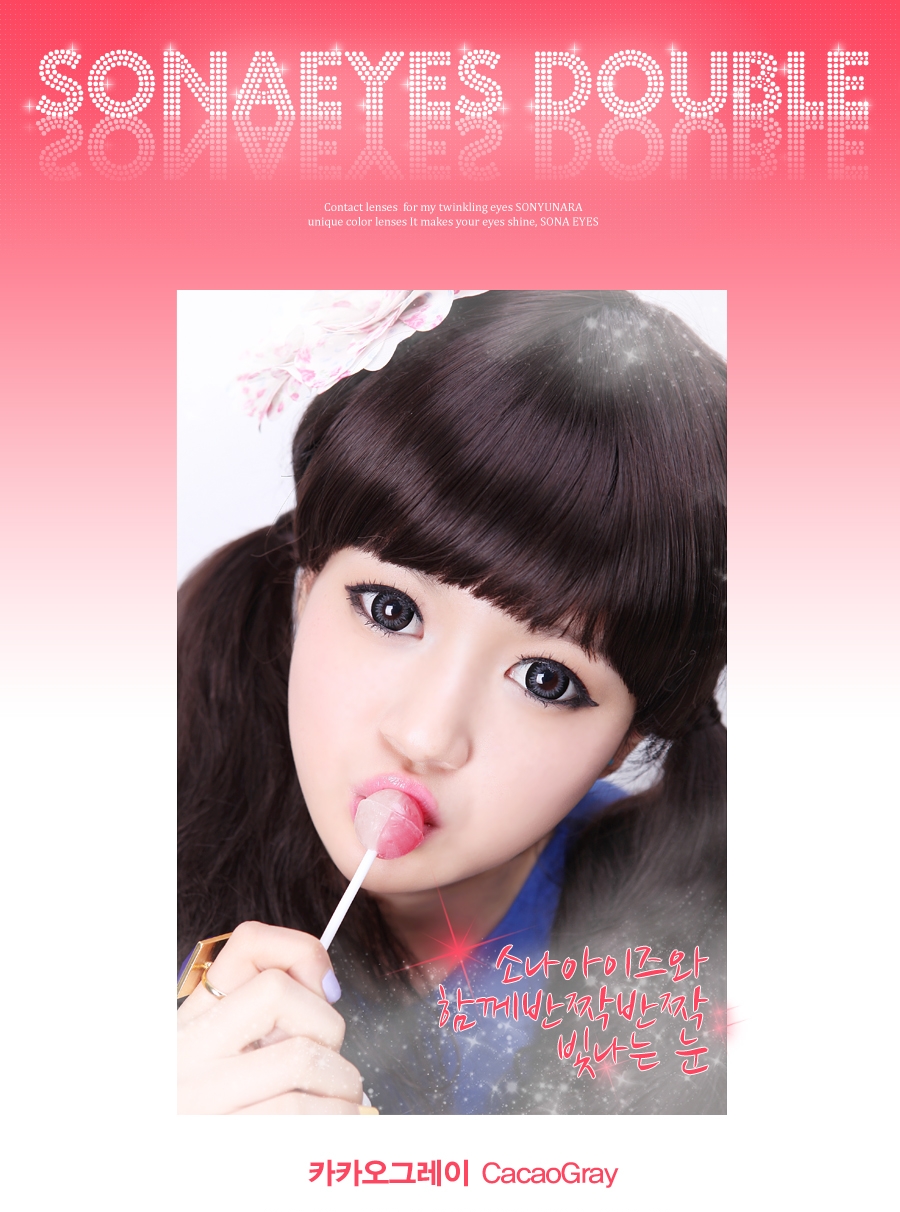
I didn’t scold her though (at least not for the earrings), as nothing could faze me after seeing what had been done to the poor girls that grace Sonyunara.com (소녀나라; “Maiden Country”), which I’d found the night before while researching this post. Seriously, just take a look for yourself.

But in just a few years, will Alice and then Elizabeth also be among the alleged wave of middle and even elementary school students spending 30 minutes a day applying makeup? Hell no. But will they want to? Probably. Is that a bad thing? That depends. And why are so many students doing it now in particular?

All questions to bear in mind as you read the following story from The Chosunilbo below.^^ Found via Asian Correspondent, it was the second most read “society story” on Naver last week:

[오늘의 세상] 초등생까지 화장 열풍… 학교, 두 손 들었다

[Today’s World] Even Elementary Schools Raise Hands in Surrender at Wave of Students Using Make-up…

지나친 ‘얼짱 신드롬’… ‘걸그룹’들이 큰 영향 줘… 등교시간에도 30분씩 화장 / Excessive “Best-Face Syndrome”…Girl groups’ big influence…Even at school, spending 30 minutes at a time applying cosmetics

학칙 있으나마나… 화장하는 아이들 워낙 많아… 쉬는 시간 화장실은 파우더룸 / Whether or not there’s school regulations…Children are putting far too much on…In break times, the toilets become powder rooms

식약청의 경고… “어린이들은 피부 약해 트러블 생길 위험 크다”/ The Korean FDA warns…”Children’s skin is weak, and there is a big danger of problems developing”

“그 틴트(입술에 색을 내는 화장품의 일종) 나도 발라 볼래” / “Let me put on that tint too (tint: a kind of cosmetic that gives color to lips)”
“와~오렌지색 되게 예쁘다” / “Wow~the orange is really pretty”

(Source. Discussed here)

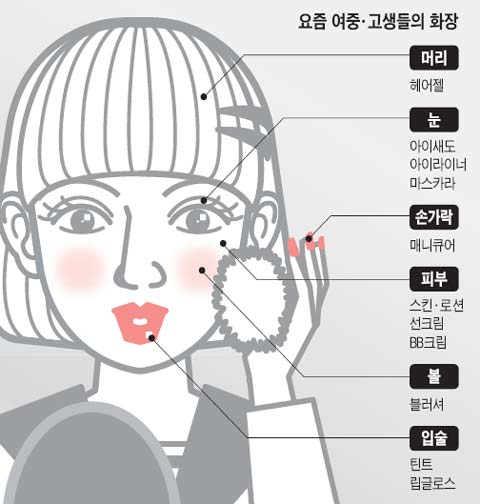
경 남지역 여자 중학교에 근무하는 국어교사 김모(34)씨는 며칠 전 교실에 들어서자마자 한숨이 나왔다. 학생들이 각자 화장품 파우치(작은 가방)를 꺼내놓고 ‘신제품 품평회’를 벌이고 있었다. 한 학생의 파우치 속엔 파우더, BB크림, 틴트, 아이라이너, 마스카라, 매니큐어 등이 가득 들어 있었다.

A few days ago, Kim Mo, a 34 year-old Korean teacher at a middle school in Gyeongsang Nam-do, walked into a classroom and saw something that took her breath away. In the classroom, there were children with a makeup pouch each (a small bag) and had taken everything out of them to have a “new makeup show”. In one student’s case, her pouch had been full of such things as powder, BB Cream, tint, eyeliner, mascara, and a manicure set.

화장한 학생들 얼굴도 제각각이었다. 어떤 학생은 파우더를 발라 얼굴이 뽀얗고, 어떤 학생은 액(液)을 발라 쌍꺼풀을 만들고 아이라인까지 그렸다. 틴트를 발라 입술이 빨간 학생들도 여러 명이었다.

Of the students who had put the makeup on, their faces were all different. Some had used powder to make their faces milky-white, while some had used a liquid to give themselves double-eyelids, even going so far as to use eyeliner. Several had also applied tint to their mouths and now had red lips.

쉬는 시간이면 이 학교 화장실은 ‘파우더룸’으로 변한다. 10여명의 학생들이 거울 앞에서 머리를 만지거나 화장을 한다. 서로 눈썹이나 아이라인을 그려주는 것도 흔한 모습이다.

If it’s break time, the toilets change into powder-rooms. Around 10 students will gather in front of the mirror and fix their hair or apply cosmetics. Drawing eyebrows on each other with eyeliner is a common scene.

(Source)

김 교사도 처음엔 화장이 학칙에 위배되기 때문에 화장한 학생들이 눈에 띌 때마다 “화장을 하지 마라”고 했다. 클렌징폼을 건네주며 “당장 세수하고 오라”고 하기도 했다. 소지품을 검사해 화장품을 압수하기도 여러 번. 그래도 나아질 기미가 보이지 않자 요즘엔 “어린 나이에 화장하면 피부에 안 좋다”며 달래고 설득한다.

At first, Kim would tell students using cosmetics that they were against school rules, that they shouldn’t use them, and would immediately give them cleansing foam to clean the cosmetics off. She also checked to see if students had any cosmetics and would confiscate them if they did. As there was no sign of improvement however, then these days instead she tries to persuade them that “if you put on cosmetics when you’re young, then your skin won’t be good”.

김 교사는 “화장하는 애들이 워낙 많아 쫓아다니면서 일일이 지적하기도 힘들 정도”라며 “전쟁도 이런 전쟁이 없다”고 말했다.

Kim says “Chasing after students that use too much cosmetics while pointing out everything [that’s bad about using cosmetics?] to them is so exhausting”, and that “it’s such a battle”.

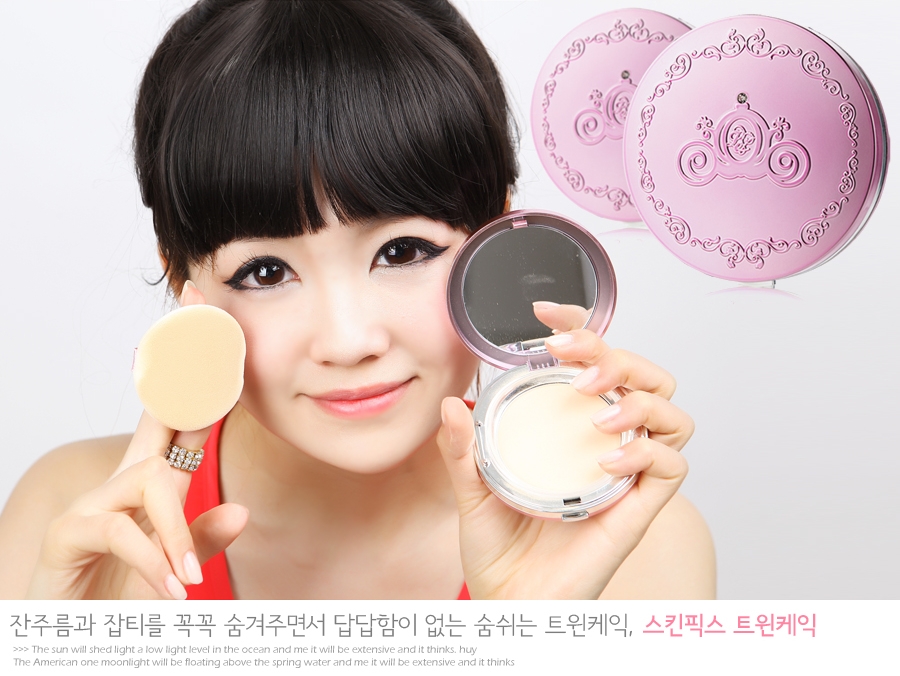
학생들은 백화점 화장품 코너에서도 주요 고객으로 떠올랐고, 화장품 회사들은 인기 캐릭터를 그린 상품을 쏟아내고 있다.

Students have risen to become the main customers at cosmetics corners at department stores, and cosmetics companies are having popular [manhwa?] characters on their products.

화장 붐에 교사들 / Teachers Raise Their Hands in Despair at Cosmetics Boom

교사들은 “화장하는 학생이 한 반에 몇 명이라고 세기 힘들 정도”라고 말한다.

Teachers say “there’s so many students using makeup in each class, it’s difficult to count them all”.

서울의 한 중학교 1학년 담임교사는 “학생들끼리 마스카라나 아이라이너를 생일 선물로 주고받을 정도로 화장에 대한 관심이 많다”며 “초등학생 때부터 화장을 시작해 피부가 어른처럼 엉망인 애들이 갈수록 많아진다”고 말했다.

One homeroom teacher for a first-grade middle-school class [for students roughly 13-14 years old] said “Students are interested enough in mascara and eyeliner to give them to each other for birthday presents”, and that “There are many students that, starting to wear makeup in elementary school, are ruining their skin like adults”.

학 부모들은 걱정이다. 중학교 2학년 자녀를 둔 김순옥씨는 작년부터 딸아이가 각종 화장품을 사 모으는 것을 보고 깜짝 놀랐다. 김씨의 딸은 바쁜 등교시간에도 30분씩 스킨·로션 등 기초 화장품부터 BB크림, 파우더까지 정성껏 바른다. 김씨가 야단을 치며 화장을 못하게 했더니 딸은 “화장을 안 하면 부끄러워서 학교에 못 가겠다”고 반항했다. 김씨는 “딸아이가 사춘기여서 그러려니 했지만 공부에 대한 집중력이 떨어지는 것 같아서 걱정”이라고 말했다.

Parents of students are worried. Kim Soon-ok, a mother of a 2nd grade middle school student [14 or 15 years old], has been very surprised at how her daughter has been buying and collecting all kinds of makeup since last year. Despite being busy, every school day she spends 30 minutes at a time applying everything from toner, lotion, and other basic cosmetics to BB cream and powder. Kim says that she scolded her daughter to make her stop using it, but her daughter resisted and replied that “If I don’t wear makeup, I’ll be embarrassed and won’t be able to go to school”. She added that “although this sort of thing is natural for a girl entering puberty, I worry that her ability to concentrate on her studies is decreasing”.

(Source)

이처럼 학생들의 화장 문제가 심각해지자 얼마 전 식약청은 교육청과 학교에 색조 화장품 등의 사용을 자제하게 해달라는 요청문을 보내기도 했다. 식약청 화장품정책과 양준호 사무관은 “어린이들은 어른보다 피부가 약해 립스틱이나 매니큐어 등 색조 화장품을 사용하면 피부 트러블이 생길 수 있어 조심해야 한다”고 말했다.

Accordingly, the FDA sent schools and the Ministry of Education a letter requesting that they restrict student’s use of color make-up, and so on. Yang Jun-ho, and official within in the FDA’s Cosmetics Policy Department, said “Children’s skin is weaker than that of adults, and so if they use lipstick, manicures, or color makeup they have a [greater?] chance of skin problems developing, and should be careful”.

과도한 ‘얼짱 신드롬’ / Excessive “Best-Face Syndrome”

성적이 상위권이거나 모범적인 아이들이 화장하는 경우도 늘고 있다. 이처럼 학생들 사이에 화장이 널리 유행하는 현상에 대해 전문가들은 ‘얼짱 신드롬’과 10대 멤버들이 많은 ‘걸그룹’이 큰 영향을 미치고 있다고 분석한다. 건국대 이동혁 사범대 교수는 “요즘 10대들은 과거 세대보다 자신을 잘 포장해서 당당하게 드러내려고 하는 성향이 강하다”며 “그런 학생들의 특성이 외모를 중시하는 사회적 분위기와 어우러져 나타나는 현상 같다”고 말했다. 한국청소년활동진흥원 김용대 부장은 “예뻐지고 싶어하는 것은 사춘기 여학생들의 자연스러운 특징이지만 화장을 통해 자기만족을 추구하려는 청소년의 집단적 현상은 심각한 문제가 아닐 수 없다”고 말했다.

Even model students with high grades and rankings are increasingly using makeup. An expert on this phenomenon attributes this “beauty-face syndrome” to the influence of girl groups with members in their teens. Professor Lee Dong-hyuk of the Education Department of Konkuk University says “compared to past generations, these days social trends mean that teenagers attach a lot of importance to their appearance and want to show them off.” And Kim Young-dae, head of the Korea Youth Work Agency, says “it is a natural trait of female students entering adolescence to want to look pretty, but this mass of girls trying to find satisfaction and fulfillment through make up is a serious problem”.

Writer: 김연주 / Kim Yeon-ju – carol@chosun.com

(Source)

While the headline clearly exaggerates a little by mentioning elementary school students, only then to talk about middle school ones, that’s probably one of the better articles I’ve read in the notoriously tabloid Korean media (update: apparently that same tabloid media has considerably lowered my standards!^^). Is the popularity of makeup among students as recent as the article suggests though? Let’s discuss that in a moment. First, let’s see what Meenakshi Durham has to say about cosmetics in The Lolita Effect itself, the book that inspired this ongoing series (p. 126):

Studies have suggested that little girls enjoy emulating fashion trends, using makeup, and attracting boy’s attention by wearing skimpy clothes. In social settings where girls are not going to be penalized or targeted for these behaviors, it’s easy to see how these things could be completely harmless, fun, or even empowering. Clothing and makeup aren’t problematic.

While I wasn’t joking earlier about what I saw on Sonyunara, reading that the night before was the real reason I didn’t (visibly) react negatively to seeing my daughter wearing earrings: children are always going to emulate what they see adults and/or other role models doing. Rather, it’s how we adults react to that that is the problem:

It’s the corollary assumption—that youth is sexy, that little girls are sexy, and that because of that they can be seen as having the same sexual awareness as adults—that’s of real concern. The problem is not with children, but with adults: with marketers who knowingly sell products and images with powerful sexual overtones to young girls, and with adults who then interpret girls’ bodies as sexually available. And there’s a larger, social problem, too, in that because of the increased sexualization of girlhood, children are engaging in sexual activity at younger and younger ages. This has fallout that is expensive both to the kids and to society as a whole.

(Source)

At first, that probably sounds much more relevant to the US and other Western countries than it does to “sexually conservative” Korea. But you may be surprised. Not so much that Korean children too are engaging in sexual activity at younger and younger ages of course, albeit not quite at the rates of their US counterparts, but rather that the Korean age of consent is 13 (see here then here), and that Korea has a huge teenageprostitution problem, known as wonjo gyojae (원조 교제).

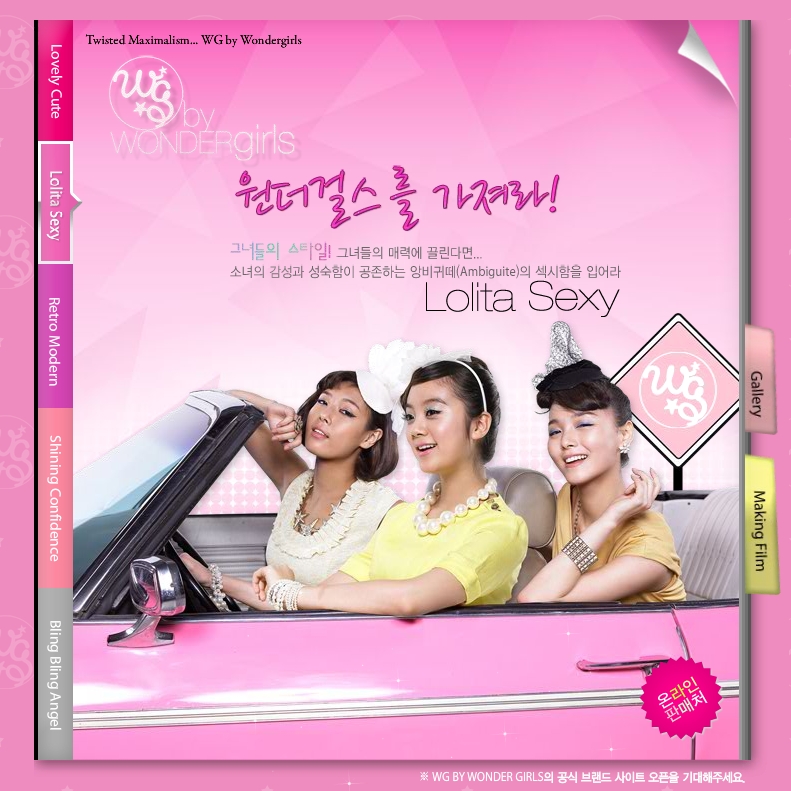
Moreover, not only is this exacerbated by the extremely low age of consent ensuring that many clients are not prosecuted, let alone teachers that have sexual relationships with their students, but until very recently, the Korean public – with important exceptions such as music columnist Kim Bong-hyeon and Professor Sooh-ah Kim at Seoul National University (see abstract below) –  was generally reluctant to acknowledge the increasing sexualization of particularly girl groups’ clothing and choreography in recent years, what effects that might have on teenagers, and, however indirectly and/or or marginally, on sustaining demand for the teenage-prostitution industry.

And if they were reluctant to discuss the music videos, then naturally there was a similar reluctance to discuss the same in ads featuring teenage members of girl groups:

(Source)

As discussed elsewhere, Korean entertainment companies have strong incentives to sexualize both girl and boy’s groups clothing and choreography in order to help them stand out from other groups, and they also have financial incentives for groups to endorse as many products as possible; in a symbiotic relationship, this naturally combines well and perpetuates the Korean advertising industry’s heavy reliance on the use of celebrities.  Consequently, not only does the number of ads featuring girl group members likely show a direct relationship to the proliferation of girl groups in recent years, but also they too are increasingly sexualized, and – crucially – naturally have messages that resonate with teenage girls. After all, this is the heart of the Lolita Effect: that especially cosmetic and fashion companies want younger and younger girls to embrace the notion that hypersexual body display and obtaining a narrowly defined physical ideal are at the core of – nay, the only things required for – social and romantic success, and that these can best be achieved through purchasing those companies’ products.

This logic, of course, is nothing new. But, if you can forgive my naivety, I’ll never cease to be amazed at the audacity at some of the ensuing advertisements. On the far left in the school uniform advertisement above for example (discussed in more detail here), Victoria of the group f(x) is praised for her height, thinness, and, well, large breasts and buttocks (all of which is contained in “쭉쭉빵빵”, the old term for “S-line“). Meanwhile, in another one further up the page (this one) fellow group member Sulli (17) says “Romance will start in a semester without pimples”, and in the video below that she proclaims the efficacy of using skincare products to get your man over other methods such as: getting cosmetic surgery to get double eyelids; working on getting shiny, billowing hair; or even getting an S-line.

Granted, correlation doesn’t mean causation, and one additional factor may be the considerable relaxing of many rules about school uniforms over the past decade (skirt lengths are 10-15cm shorter than in 2000 for example, which—sigh—the Korean Federation of Teachers Association says “can make students more vulnerable to crimes”). But…naah. Provided the report is accurate, then of course middle school girls are suddenly wearing make-up because all these girl groups are suddenly endorsing them. It would simply be a bizarre coincidence otherwise.

(Source: unknown)

What to do about it? Beyond educating children on the hows and whys of advertising and/or forcibly taking their cosmetics off them, I’m open to suggestions. One think I certainly don’t think will work though, is complaining to the companies themselves, which have a strong vested interest in making their products appeal to young girls as explained. Indeed, this was recently indirectly demonstrated by Iconix Entertainment, the producer of the very popular Korean cartoon Pororo the Little Penguin (뽀롱뽀롱 뽀로로) above, which, despite the pleas of Korean parents, besieged by their children demanding breads and cakes like those in the show, politely declined to depict the characters eating healthier meals (I believe the characters are also on all manner of junk foods). And God knows how they would have reacted to my own suggestion that pink Loopy above, the only female character in the first season, do something other than constantly make said breads and cakes for the boys.

For more on the trails and tribulations of being a feminist parent, then I recommend following Baby Gender Diary on Twitter here, in their own words “A Mother and Father. Tweeting about our 3 year old girl and 6 month old boy and how people treat them differently”, and/or purchasing Cinderalla Ate My Daughter by Peggy Orenstein, next in my own wishlist. Or, for more posts in the “Reading The Lolita Effect in Korea” series, please see below.

The “Reading the Lolita Effect in South Korea” series:

Mirror Mirror (거울아 거울아) by 4Minute (포미닛): Lyrics, Translation, and Explanation

(Source, all screenshots)

For many Korean girl groups, debuting a new song on a music program seems to follow a set script these days:

  • First, it will include some provocative lyrics, choreography, and/or outfits that deliberately push the envelope
  • Then, despite presumably knowing that well in advance, the producers of the program will still allow the song to be performed, only then to disassociate themselves from it and claim shock and surprise at the ensuing reaction
  • Next, those songs will be will be banned from future broadcasts unless changes to the offending parts are made
  • Equally absurdly, the performers themselves or their entertainment companies will claim shock and surprise that people find them sexually suggestive at all
  • Finally, despite those protestations, the groups will have modified versions of the song available to be used suspiciously quickly

It’s really quite a farcical process, and very patronizing to viewers.

Nevertheless, while nobody emerges unblemished from all that, it’s the entertainment companies that I’m most critical of. For rather than actually admitting to the sexuality in their groups’ performances, thereby placing the onus on the music program producers and public to explain just what is it that is so problematic about that exactly, instead they even force their own performers to be complicit in a longheld narrative of female virginity and innocence in K-pop.

Granted, they may lack the clout to challenge terrestrial broadcasters on that point, nor is there much evidence that they possess the feminist motivations to do so. However, even just for financial reasons one would expect more of a challenge to systematic double standards in the Korean music industry, as the various restrictions on girl group performances can often be quite costly.

(Source)

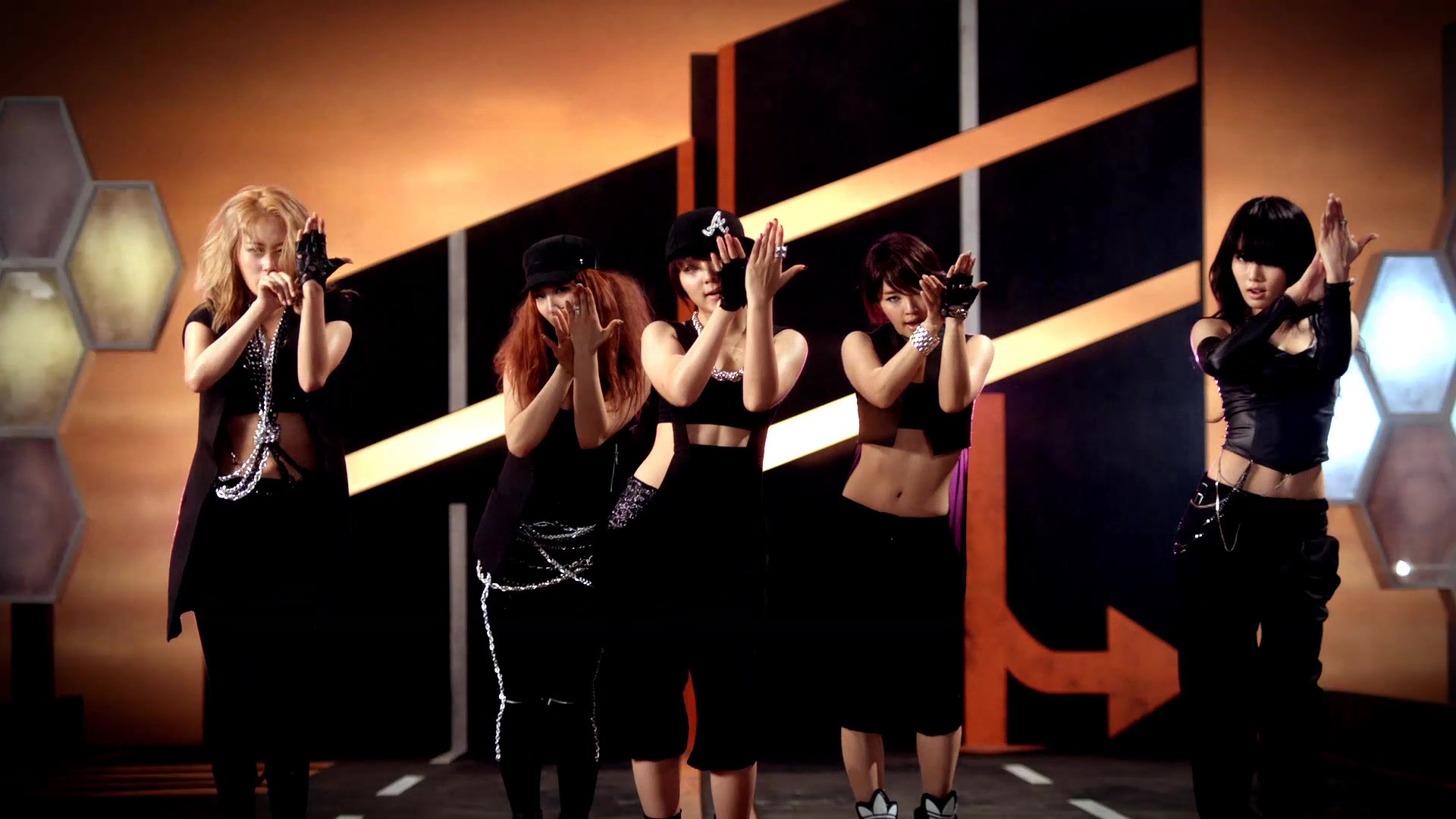
As for how that all recently played out with Mirror Mirror (거울아 거울아) by 4Minute (포미닛), see the links in the list above, while Mixtapes and Liner Notes has more on Rania’s (라니아) performance of Dr. Feel Good (닥터 필 굿) specifically. Two of the three controversial songs that debuted on Music Bank on April the 8th (the other was Do You Know/아나요 by the Brave Girls/브레이브 걸스), unfortunately Mirror Mirror is the only one of them I like enough to listen to – yes, sans eye-candy – on my MP3 player!

Yes, however crass, it does indeed sound like Hyuna is saying “4 minute slut” at the beginning. As for the translation, the vocabulary and grammar were relatively easy for a change, and the song mercifully short and repetitive too. But some unclear breaks between sentences and strange word orders definitely complicated things:

Let’s go

4minutes left 4minutes left Ah! Ah!

4minutes left 4minutes left Ah! Ah!

대체 왜 그땐 날 거들떠 보지 않고

매일 날 그대만 바라보게 만들고

오늘은 좀더 예쁘게 나 나 나 날 (오늘도)

보여줘 너무 멋진 너 너 너 너 너에게

거울아 거울아 이 세상에 누가 제일 예쁘니?

거울아 거울아 이 세상에 내가 제일 예쁘니?

오늘만은 내가 제일 예쁘다고 말해줘 봐

Let’s go

4minutes left 4minutes left Ah! Ah!

4minutes left 4minutes left Ah! Ah!

Why on Earth didn’t you notice me back then?

Everyday, you made me gaze only at you

Today, show me me me me a little more prettily  (today too)

To very cool you you you you

Hey Mirror, hey Mirror, who is the prettiest in the world?

Hey Mirror, hey Mirror, am I the prettiest in the world?

Just for today, please try saying I’m the prettiest

Here, “대체” is short for “도대체” (on Earth), and a new one for me was “거들떠보다” (not even notice/look). Otherwise:

  • the “바라보게 만들다” in line 4 is a long causative, which there’s a lot of in this song (see p. 368 of Korean Grammar for International Learners [KGIL] for more information)
  • See Seamus Walsh’s comment here for more on the “니” ending in lines 7 and 8
  • And of course the last line is some simple indirect speech. Although it’s awkward in English, I include a “try” in it (and similar sentences in later verses) because technically, “보다” added to a verb stem does indeed mean “try to do [the verb]”

All basic stuff by this, my twelfth song translation for the blog. But lines 3 and 4 were a bit of a stumbling block until my wife pointed out that actually a break falls between “오늘은 좀더 예쁘게 나 나 나 날 (오늘도) 보여줘” and “너무 멋진 너 너 너 너 너에게”.

너를 생각하면 더 거울에 비친 내 모습은 마치

너무 예쁜데 너는 자꾸 왜 다른 생각만 하는지

왜 날 보지 않는건데

내 거울아 (거울아 거울아 거울아 거울아)

거울아 (거울아 거울아 거울아 거울아)

내 거울아 (거울아 거울아 거울아 거울아)

거울아 (거울아 거울아 거울아 거울아)

It’s as if my reflection becomes prettier the more I think of you

Why do you frequently think differently?

Why do you not look at me?

My mirror (Hey Mirror Hey Mirror Hey Mirror Hey Mirror)

Hey Mirror (Hey Mirror Hey Mirror Hey Mirror Hey Mirror)

My mirror (Hey Mirror Hey Mirror Hey Mirror Hey Mirror)

Hey Mirror (Hey Mirror Hey Mirror Hey Mirror Hey Mirror)

Again, Lines 1 & 2 become much easier if you know there’s a break between “너를 생각하면 더 거울에 비친 내 모습은 마치 너무 예쁜데” and “너는 자꾸 왜 다른 생각만 하는지”, but this time the location of the “더” complicates things even further. Ideally, it should be placed before the “예쁜데” in line 2.

Update: With thanks to J.Goard for pointing out it, actually that pattern is perfectly acceptable in Korean, and quite common.

대체 왜 언제나 본 체 만 체만 하고

매일 밤 너는 날 가슴 뛰게 만들어

언제나 너무 멋진 너 너 너 너 너

내게로 다가오게 더 더 더 더 더 Ma boy

거울아 거울아 이 세상에 누가 제일 예쁘니?

거울아 거울아 이 세상에 내가 제일 예쁘니?

처음부터 마음에 들었다고 내게 말해줘 봐

Why on Earth do you always pretend not to see me, and

make my heart pound every night?

Always so cool you you you you you

Come more more more more and more closer to me Ma boy

Hey Mirror, hey Mirror, who is the prettiest in the world?

Hey Mirror, hey Mirror, am I the prettiest in the world?

Please try to say that from the beginning, I was the one for you

And here, again there’s a long causative in line 2 – “가슴 뛰게 만들어” – but the “날” before that (me [object]) is I think ungrammatical, and it should really say “내” (my) instead. Before that, the phrase “본 체 만 체” (pretend not to see; show indifference to; slight) was a new one on me, and it didn’t help that I forgot that “[verb] + (으)ㄴ/는 체하다” was the same as “[verb] + (으)ㄴ/는 척하다” (to pretend to [verb])”! (see p. 58 of KGIL)

Next, it’s just the chorus again.

너를 생각하면 더 거울에 비친 내 모습은 마치

너무 예쁜데 너는 자꾸 왜 다른 생각만 하는지

왜 날 보지 않는건데 예~

내 거울아 (거울아 거울아 거울아 거울아)

거울아 (거울아 거울아 거울아 거울아)

내 거울아 (거울아 거울아 거울아 거울아)

거울아 (거울아 거울아 거울아 거울아)

It’s as if my reflection becomes prettier the more I think of you

Why do you frequently think differently?

Why do you not look at me?

My mirror (Hey Mirror Hey Mirror Hey Mirror Hey Mirror)

Hey Mirror (Hey Mirror Hey Mirror Hey Mirror Hey Mirror)

My mirror (Hey Mirror Hey Mirror Hey Mirror Hey Mirror)

Hey Mirror (Hey Mirror Hey Mirror Hey Mirror Hey Mirror)

Oh mirror shine Let me fix my make up

Break it down Break it down

Baby I like that Baby baby just I like that

Baby I like that Baby baby just I like that

더 더 더 내게 빠져들어

Shine on my face 모두 놀라지 Oh

거울아 거울아 이 세상에서 누가 제일 예쁘니? It’s me

Oh mirror shine Let me fix my make up

Break it down Break it down

Baby I like that Baby baby just I like that

Baby I like that Baby baby just I like that

Become fallen into me more more more

Shine on my face everybody surprised Oh

Hey Mirror, hey Mirror, who is the prettiest in the world? It’s me

In line 5, I was confused by how “빠져들어” is different to “빠지다” (to fall into/for), and the best explanation my wife could provide was that it means “become fallen for”. Which is just fine with me, but it does sound a little awkward.  Can anybody do any better?

Update: With thanks again to J.Goard, see here for a much fuller description of how they’re different exactly.

And suddenly it’s already the last verse:

좀더 너에게 다가가서 난 1,2 step 1,2 step 1,2 step

Let’s live it up Let’s make it up

나를 보면 니 마음 흔들릴수 있게

내 거울아 (거울아 거울아 거울아 거울아)

거울아 (거울아 거울아 거울아 거울아)

내 거울아 (거울아 거울아 거울아 거울아)

거울아 (거울아 거울아 거울아 거울아)

거울아 거울아 거울아 거울아

I’ll come a little closer to you, I 1,2 step 1,2 step 1,2 step

Let’s live it up Let’s make it up

If you see me I can make your heart shake

My mirror (Hey Mirror Hey Mirror Hey Mirror Hey Mirror)

Hey Mirror (Hey Mirror Hey Mirror Hey Mirror Hey Mirror)

My mirror (Hey Mirror Hey Mirror Hey Mirror Hey Mirror)

Hey Mirror (Hey Mirror Hey Mirror Hey Mirror Hey Mirror)

And on that note, here is an alternate translation by Chris @4-minute.com, which you can use to follow-along with the video:

As you can see, fortunately our versions seem pretty much the same, although his(?) sounds rather better because he hasn’t been quite so literal with his choice of words!

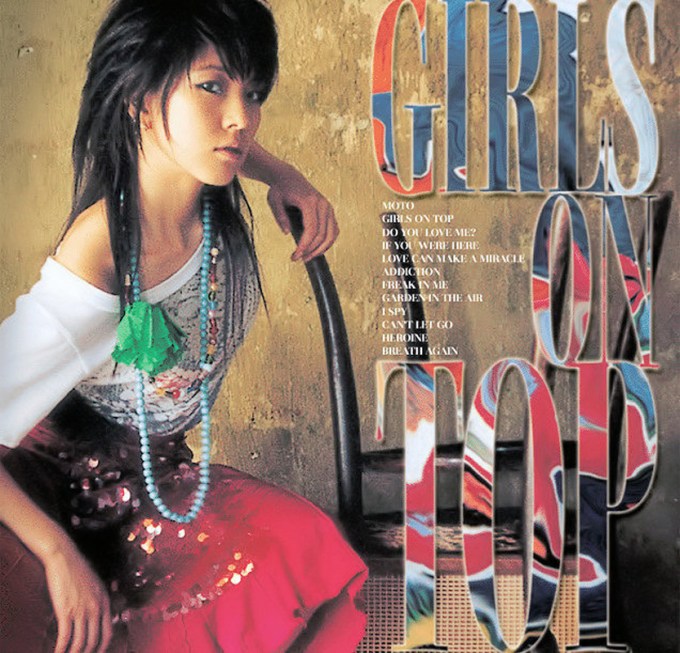
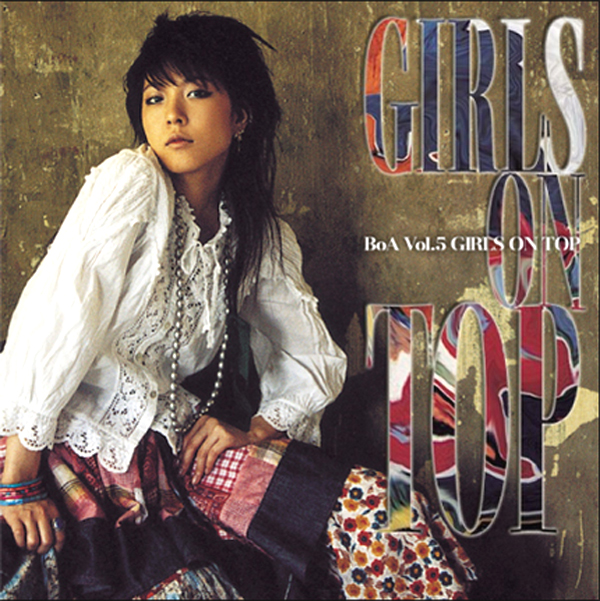
Meanwhile, apologies to any readers that may have been expecting a promised(?) translation of Can’t Nobody by 2NE1 (투애니원) instead today, but unfortunately my finally getting tired of that after listening to it for probably the 100th time(!) coincided with me getting heavily into this one, and besides which I wanted to do something more recent for a change. Having said that, next I’ll actually be doing the 2005 song Girls on Top by BoA (보아), because a reader sent me the following intriguing email:

…I have been following your girl group lyric translations but there’s one song I am really curious about, mostly because I’d like to know if it’s as overtly feminist as I suspect it is. The song would be Boa’s “Girls on Top”…

…It’s not only the gold lamé and skull ring that’s tough but the part at the end where she fake kicks her male dancers into submission in a Take Back the Night inspired bit of of pop choreography. I know you’re focusing mostly on girl groups, but I think this one’s interesting in the context of K-pop because it seems to fall outside the two ever present concepts of “sexy” and “cute.” I have tried to find the lyrics in English but most of them are poorly done. What I’ve gleaned so far is that she may be talking about the myriad conflicting expectations a modern girl must fulfill and might even be bemoaning the constant pressure to embody male views of sexiness (!). Or it could be a girl power-lite anthem conceived by greedy business men; but either way I’d like to hear your views.

Until then, I hope you a good weekend, and as always I’d appreciate any feedback on the translation and/or your thoughts on the song!^^

Update: I’ve just found these profiles of the group members on korean lovers photoblog, and thought they might be useful for future reference:

(For more Korean song translations, please see here)

Korean Sociological Image #58: Sexulizising Caucasian Women (again)

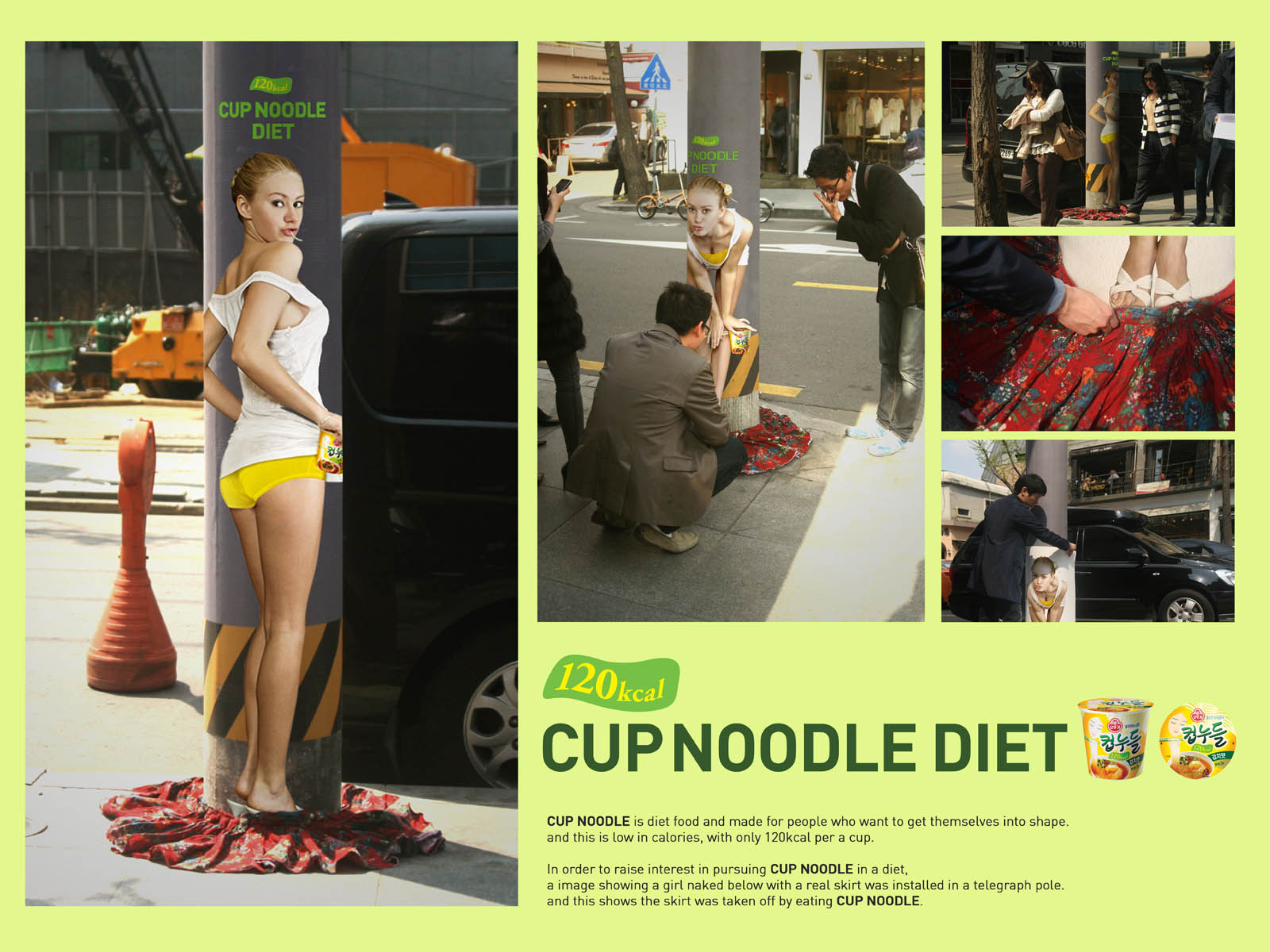
(Source: Ads of the World)

Sigh. I beg to differ on Cup Noodles being a “diet food” made for “people who want to get themselves into shape”, but it’s no great surprise that that’s how they’re being marketed in Korea.

Nor that it’s a Caucasian female model who loses her skirt either, rather than Korean model Jang Yun-ju (장윤주) who’s the one actually endorsing it:

(Source)

Both familiar themes of Korean advertising, for more on body image in Korea see especially Korean Sociological Image #57 and this follow-up, or #18, 27, and 52 for more the sexualization of Western (especially Caucasian) women in the Korean media, and here for some of the negative effects of that.

Meanwhile, of course I do realize that Korea is by no means the only country where noodles are sometimes marketed as a diet food. But the campaign is very different to what you would see in New Zealand for instance, where my sister – who found the ad here – tells me that, these days, instant noodles are increasingly being marketed to children instead. And as for the falling skirt advertisement, that “would immediately be set upon and torched by militant lesbians”!

Also, as it happens I’ve actually liked Jang Yun-ju ever since I read this, and so consider it both ironic and a pity that such an atypical Korean model agreed to be part of something that displays some of the worst habits of the Korean advertising industry. Moreover, she’s also one of the rare Korean models not ashamed of doing lingerie advertisements (although their numbers have been increasing recently), which again raises the question of what a Caucasian woman is doing, well, bending over on that lamppost instead of her.

(Source)

What do you think? Has anybody actually seen the ad themselves?

Update: I’m glad I’m not the only one that noticed that it’s male passersby that seemed to most appreciate the ad, whereas women can be seen walking by in embarrassment!

Update 2: I did miss the phallic object though…

(For all posts in the Korean Sociological Image series, see here)

Share

Korean Gender Reader

(Source)

1) How to find a good Korean man

Excellent dating advice from I’m No Picasso, although like she says, of course most of her advice would apply to any group of men!

Update: Is it harder for women to date in South Korea? From Noona with love answers a (frustratingly vague!) reader’s question.

2) 14% of Korean men subject to sexual abuse as children

To put it mildly, I’ll have to see a lot more detail about the methodology and definitions used before I accept that figure. But I do look forward to finding out more about this survey.

3) Condoms in hotels

In Chinese hotels to be precise. As Shanghai Shiok! explains:

Should hotels provide condoms in guest rooms, whether complimentary or for sale? It’s a question still debated in the hotel industry. In China, condoms in hotels are quite common (after Beijing ordered it), but some foreigners have averse reactions to the foil-wrapped rubbers in their rooms, like my dad who angrily declared the hotel condoms “an embarrassment!” before hiding them away from our eyes.

For me, whether condoms should be there or not just really… depends.

Depends on what? Find out here!

(Source)

4) Native speaker English teacher sexually assaulted in Anyang

See the details at Gusts of Popular Feeling here. Like a commenter there says, I’m amazed at the attitude of the proprietor of the yogwan (motel) where the assault occurred, who apparently didn’t so much as bat an eyelid when 3 male university students carried an unconscious woman to their room.

Update: Asian Correspondent has more details here.

5) Why so few fathers take paternity leave

An excellent, comprehensive report from The JoongAng Daily, in contrast to The Chosun Ilbo one that waxes lyrical about changing attitudes and the fact that a grand total of 819 men took it last year, an increase of 63% from last year.

Note that seeing as this particular paternity leave seems to have been available since at least 2001 however, then it can’t refer to the 3 day one made available in 2008, so at the very least some clarification about the original Korean terms is required. Unfortunately, I don’t have time to do any further investigating myself at the moment, but if anyone’s further interested then I recommend this, this, this, and this to get you started! (and if you clicked on any of those, then I think you’ll find this book fascinating too)

(Source)

6) Korean documentary on ajummas and ajoshis

No, really. As New Yorker in Seoul described it:

I watched this program with JS, my German-Korean friend, and she and I both had similar reactions. First, here’s how WE perceived what the program was doing:

1-First, it showed the bad perceptions of ajuma and ajoshi.
2-Then it explained how these figures are actually good members of society, thereby reaffirming these roles in society.

There was much to appreciate in the documentary–the interviews, the claymation snippets (from the Arari Show), the surveys. But the way the program was constructed entirely, at least for many Western viewers, seemed pretty cheesy. Or at least, heavy-handed in its delivering of the message of why society actually NEEDS the ajuma and ajoshi figures.

Granted, it was designed for a Korean audience. But I wonder: do any Korean viewers broach programs constructed in this way with at least a modicum of cynicism? Does such a program bear a whiff of sentimentality for Korean viewers?

7) A South Korean farm, a brother & sister, a forbidden love

Found via The Three Wise Monkeys, I confess I’m not quite sure what to make of this:

The video shoot took place on a small farm in Jeollabuk-do province, South Korea in February 2011. The storyline was conceived in response to the song lyrics which tell of an unrequited love or a longing that can’t be satisfied or consummated. We came up with the concept of a brother and sister who are twins who have grown up lived and worked together on their parents’ small farm. They are confused and disturbed by the fact that their closeness has developed into a kind of sexual longing that they know they must hide away deep inside.

8) Korean men do least housework in OECD

To play Devil’s advocate however, it’s somewhat natural considering that women do the least paid work in the OECD, as noted by The Korean Herald article.

See Sociological Images also for some more perspective, and handy graphs of how various countries compare.

9) Protecting Korean women from foreign devils, circa late-1940s

I believe that most resentment towards and/or stereotyping of foreign men in Korea stems naturally from having millions stuck in unemployment or low-paid and/irregular work, and it certainly doesn’t help that – as far as I know – boys born at the peak of Korea’s phase of aborting female fetuses in the early-1990s are now becoming adults (while long since resolved, soon there’s going to be something like 116 eighteen-year old men for every 100 women).

But as this post at Gusts of Popular Feelings reveals however, neither factor explains the harassment some Korean women received as early as the late-1940s, even just for working with American men.

(Source)

10) Amber returns to f(x)

Like Dora says at SeoulBeats, it’s good that she’s back:

…the moment I set eyes on Amber, I knew I was a goner. Pardon me, but it was during an era whereby K-pop was being flooded with Barbie dolls everywhere, all right? All the Korean girl group members were armed with the typical Bambi eyes, long swishing hair and legs half the width and twice the length of my own. I was desperate for a change; my self-esteem couldn’t take any more beatings. So once Amber popped into the scene, all the other girls who felt the same way as I did went crazy. With her androgynous hotness (oh gosh, the floppy fringe that can totally rival Justin Bieber’s!), Amber has confused poor females everywhere, and became the new obsession of fangirls.

(Source)

Share

Restrictions Imposed on 18+ Controversial “Wide Leg Spread Dance”

(Source)

Followers of K-pop blogs will already be well aware of this latest storm in a teacup of course, but it’s always interesting to see what ordinary Koreans themselves read about such things. Accordingly, here’s my (very literal) translation of an article from yesterday’s Metro newspaper, which millions would have read on their morning commute:

Restrictions Imposed on 18+ Controversial “Wide Leg Spread Dance”

Three groups with underage members all do suggestive dances as if they’d planned them together

Demands for a review of regulations on suggestive outfits and poses on music programs

While the three girl groups that are showing off their so called “wide leg spread dance” are being regulated by broadcasters, controversy has arisen about suggestive choreography.

Appearing on Music Bank on KBS2 on the 8th, 4Minute (making a comeback that night), RaNia, and the Brave Girls have become very controversial for the suggestiveness of their performances.

While performing their new song Mirror Mirror, 4Minute members get on the floor on their knees, spread their legs, and repeatedly open and close them:

With support from overseas producer Teddy Riley, new 7-member group RaNia debuted with Dr. Feel Good. Sporting a striking lingerie and garter belt look, one mesmerizing dance move involved only moving their legs and pelvises repeatedly. And Brave Brother-produced 5-member group Brave Girls gave off a similar sexual attractiveness with their debut song Do You Know:

(Update, August 2013: Unfortunately the Youtube videos have long since been deleted for copyright violations, but both the “Dr. Feel Good” and “Do You Know” performances can still be seen here and here respectively. In their place, above is RaNia’s original uncensored MV for the former)

Giving the same performances on 2 other broadcasters’ music programs last weekend, the controversy increased. In the end, Music Bank, SBS’s The Music Trend, and MBC’s Show! Music Core all demanded changes to the dances and outfits and imposed restrictions on them. The reason is that programs that a lot of teenagers watch can not have outfits which expose too much of the body, and/or dances that bring to mind sexual acts.

In particular, it is not just the nature of the outfits and the choreography that is the problem, but that many of the performers are underage. In 4Minute, Hyuna (18) and So-hyun (16); in RaNia, Di (19), Joy (20), T-ae (16), and Xia (16); and in Brave Girls, Yu-jin (?) and Hye-ran (?) are all underage.

(James: Most of the ages given in the article are wrong, whether using the Korean or the “international” system: instead, I’ve provided their international ages, with sources given in their links, although I’ve been unable to find any sources for the ages of the Brave Girls members. I remain confused about why some are described as “underage” though, because clearly many aren’t at all, even with the {incorrect} ages given in the original article)

The result of analysis reveals that this is the result of following the dance moves of sexy pop stars. Before there were national girl groups, it was Lady Gaga that garnered a lot of controversy for the wide spread leg dance and sexually suggestive choreography of her Born This Way music video:

About this, an [anonymous] person in the broadcasting industry said, “While people say that Lady Gaga’s dances and dance moves are unique and individual, they say that Korean singers aren’t like that” and that “it’s a pity that in this era of spreading K-pop to the world, we have such anachronistic rules” (end).

(Source)

Like me, you’re probably aghast at the Metro’s low writing standards and sloppy fact-checking. But that’s quite normal for Korean tabloid newspapers (and, alas, many of their mainstream counterparts too), so much more of interest personally was the author’s point that “before there were national girl groups, it was Lady Gaga that garnered a lot of controversy”, indirectly confirming my own (and many others’) observation that although of course there have always been Korean girl-groups previously, it’s only been in the last 4 years or so that there’s been such a glut of them. And also that, following the model set by The Wondergirls (원더걸스), they’re generally much much racier than their predecessors were.

Other than that, I’m a little tired of references to Lady Gaga whenever a girl group comes up with a suggestive dance move, but that’s hardly unique to the Korean media. Also, it’s curious that the anonymous person in the broadcasting industry felt that Korean girl groups must follow her example to “spread K-pop to the world,” because although this does play to Occidentalist stereotypes of hypersexual Western audiences somewhat, it also marks the culmination of a 180-degree turn against what used to make K-pop appealing to East-Asian audiences, and which presumably influenced music producers. As Rowan Pease explains in her chapter “Korean Pop Music in China: Nationalism, Authenticity, and Gender” in Cultural Studies and Cultural Industries in Northeast Asia: What a Difference a Region Makes (2010):

(Source: The Japan Foundation)

In 2003, the Korean National Tourism Office [a major investor in the Korean wave] conducted a Hanliu tourism survey in China, Taiwan, and Hong Kong exploring attitudes to Korean culture, publishing the results online…

….It compared the impact of Korean culture with that of four “competitor” countries (the U.S., Japan, Taiwan, and Hong Kong), and in the process revealed much about Korea’s own political and nationalist concerns, particularly in relation to Japan and America. Six of the eleven options for respondents to the category “reasons I like Korean culture” reflect this preoccupation: “less sexual than Japanese culture,” “less sexual than American culture,” “less violent than Japanese popular culture,” “less violent than American popular culture,” “decreased interest in American culture,” and “decreased interest in Japanese culture.” One other echoes Straubhaar’s notion of cultural proximity: “similar in culture.” Certainly, Korea’s own music media censorship laws (which even in 1997 prohibited the displaying of body piercings, navels, tattoos, “outfits which might harm the sound emotional development of youth,” and banned violent or political lyrics), meant that Chinese TV stations could buy in Korean music videos and music TV shows knowing that they were unlikely to upset local censors. However, these questions also reflected a perception that Korea acts as a defender against excessive Westernization and as a guardian of Confucian values within East Asia. (pp. 155-156)

Which long-term readers may remember from my translation of the lyrics to Bad Girl, Good Girl (배드걸 굿걸) by Miss A (미쓰에이), probably the most erotic Korean girl group music video I’d ever seen until these latest ones came out:

Alternatively, the above view of Chinese, Taiwanese, and Hong Kong tastes may well be outdated, and “the world” in the newspaper article shouldn’t automatically be taken to mean Western audiences: after all, 2 members of Miss A are Chinese, and the group was originally designed to be overwhelmingly aimed at the Chinese market.  What do you think?

Meanwhile, see here, here, here, and here for the latest developments in this “Wide Leg Spread Dance” controversy (yes, I love saying that too!). And today’s edition of the Metro newspaper also happens to have an interview of RaNia in which they discuss the dance, but I’m afraid I don’t have time to translate it at the moment sorry. Any takers?^^

(Source)

Update: Here’s an hilarious response to the banning from some netizens!

Update 2: See Mixtapes and Liner Notes for some more in-depth analysis of RaNia’s performance, its subsequent censorship, and the issues it’s raised.

Sexual Harrasment on Intercity Buses

(Source)

Of course, I’ve never been sexually harassed on an overnight bus myself. But then I’ve never seen it happen nor heard anyone ever complaining about it either, nor have any of my female friends (Korean or Western). Are things really as bad as this article makes out?

[Why] 불 꺼진 심야고속버스, 술 취한 손이 내 가슴을…An express night bus with the lights off, a drunken hand on my breast

性추행·만취 난동 끊이지 않는 ‘달리는 범죄 사각지대’로, 유일한 안전요원은 운전기사 / [Becoming] a ‘running blind spot of crime’ with constant sexual molestation, intoxicated disturbances, and the driver the sole security officer

지난 12일 자정 무렵 광주발(發) 서울행(行) 심야 우등 고속버스 안. 버스가 출발한 지 10분 만에 한 여성이 소리를 질렀다. 막 고속도로에 진입한 버스는 갓길에 멈춰 섰다. 비명을 지른 20대 여성은 운전기사에게 자리를 바꿔달라고 했다. 여성 승객은 얼굴만 붉힐 뿐 이유를 얘기하지 않았다. 버스에 빈자리가 없어 운전기사는 여성 승객의 요구를 들어줄 수 없었다.

Inside the premium express night bus from Gwangju to Seoul around midnight on the 12th. Just ten minutes after the bus departed, a woman screamed. The bus, which had just entered the expressway, came to a stop on the shoulder of the road. The twenty-something woman who had screamed asked the bus driver to change her seat. She would not say the reason why, and she was only blushing. There were no empty seats on the bus so the bus driver could not grant her request (source, right).

고속버스가 다시 출발한 지 10분 정도가 지나자 또다시 비명이 들렸다. 버스는 재차 갓길에 멈췄다. 이 여성은 운전기사에게 “옆자리에 앉은 남자가 가슴을 만졌다”고 말했다. 술에 취한 듯 보이는 남성은 잠든 척했다. 이후 남성의 성추행은 한 차례 더 이어졌고, 고속버스는 예정에 없이 고속도로 갓길과 휴게소에 3차례 정차한 후 목적지인 서울에 도착했다. 50대 남성은 도착 후 유유히 사라졌고, 20대 여성 승객은 얼굴을 가린 채 울면서 황급히 자리를 떴다.

The bus had been back on the road for about ten minutes when a scream was heard again. The bus stopped on the shoulder for the second time.  The [same] woman told the bus driver, “The man sitting next to me touched my breast.” The man, who looked drunk, pretended to be asleep. After this, the man’s sexual molestation happened once more, and after the bus had made three unplanned stops on the expressway shoulder and a rest stop, it reached its Seoul destination.  The fifty-something man calmly disappeared after arrival, and the young female passenger left her seat hurriedly, crying with her face covered.

(Source)

심야 고속버스에서 성추행·흡연·난동 등이 빈번히 일어나고 있다. 늦은 밤 편히 휴식을 취하며 빠른 시간에 목적지에 가려는 이들이 선호하는 심야 고속버스가 ‘달리는 범죄의 사각지대’가 된 셈이다. 문제는 술에 취해 조용한 버스 안에서 고성방가를 일삼고 성추행까지 저질러도 제지할 방법이 마땅치 않다는 것이다.

In the express night bus, sexual molestation, smoking, and other disturbances occur frequently. This bus, preferred by people who want to relax comfortably late at night while quickly getting to their destination, has become a‘running blind spot of crime.The problem is that though someone becomes intoxicated and sings loudly in the quiet bus, or even commits sexual molestation, there is no suitable method of restraining them.

심야 고속버스는 출발과 동시에 전등을 끈다. 승객들의 취침을 위해 소등하는 것이 운전기사들에게는 의무처럼 돼 있다. 버스 안이 어두워 성추행이나 도난을 당해도 주변에서는 범행을 목격하기가 힘들다. 동부익스프레스 관계자는 “회사 모든 버스에 블랙박스를 설치했지만, 버스 내부는 인권 침해 소지가 있어 촬영하지 않는다”고 했다. 설사 버스 내부를 촬영할 수 있다고 하더라도 버스의 출발과 동시에 소등을 해 범행 현장 촬영은 불가능하다.

The lights are turned off in an express night bus as soon as it departs. Putting out the lights so passengers can sleep has become like a duty for drivers.  Because the inside of the bus is dark, even if one is sexually molested or stolen from, those nearby have trouble seeing the criminal behavior.  A source from Dongbu Express said, “The company installed a black box in all the buses, but because it is a possible civil rights violation, we don’t film inside the bus.”  Even if he had said they could film inside the bus, the lights are turned off after departure so filming the crime would be impossible.

(Source)

심야 고속버스에서 범행이 일어날 경우 제지할 사람이 없다는 것도 문제로 지적된다. 운전기사가 유일한 안전요원이다. 버스 안에서 소란이 일어나거나 범죄가 발생하면 운전기사는 달리는 고속버스를 갓길이나 인근 휴게소에 세워야 한다. 한 버스 운전기사는 “취객이 버스 안에서 성추행을 일삼는 경우가 많다”며 “피해 여성이 항의하면 어쩔 수 없이 고속도로 순찰대에 연락해 조치를 한다”고 했다. 고속도로 치안을 담당하는 고속도로순찰대가 도착하기 전까지 정시에 목적지에 도착하기 위해 달려야 하는 고속버스는 갓길이나 인근 휴게소에서 멈춰야 한다. 고속도로순찰대 관계자는 “심야 고속버스에서 종종 신고가 들어와 톨게이트나 휴게소로 출동해 범인을 인근 지구대에 인계한다”며 “순찰대가 30㎞마다 하나 정도 있다”고 했다.

Another problem that has been noted is that there is no one to stop criminal behavior that arises on the express night bus. If a disturbance arises or a crime is committed inside the bus, the driver must stop the express bus on the side of the road or at a nearby rest stop.  One bus driver said, “There are many cases in which drunken passengers sexually molest others several times inside the bus,” adding, “if the female victims complain, we have no choice but to contact the highway patrol station and take action.”  Before highway patrol,which is responsible for public order on the highway, arrives, the express bus that should keep moving in order to reach its destination at a fixed time has to stop on the shoulder or at a nearby rest stop. A highway patrol source said, “We sometimes receive reports from express night buses so we go to a toll-gate or rest stop and then we hand the criminal over to a nearby small police station,” and noted, “There’s highway patrol station every 30 kilometers or so.”

고속버스 운전기사는 취객에 대한 승차 거부를 할 수 있다. 그러나 심야 고속버스에서 술에 취한 승객을 보는 것은 어렵지 않다. 복수의 고속버스 운전기사들은 “취객들에 대한 단속은 절실하지만 승객을 한명이라도 더 태워야 하는 회사의 입장이 우선시되면서 승차거부를 하는 경우는 거의 없다”고 했다.

Express night bus drivers can refuse service to passengers.  However, it is not difficult to find drunken passengers on these buses.  Several [Marilyn – not sure if “several” is right; two Korean friends said it seems the reporter made a writing mistake with the word he used] express bus drivers said, “[The need for] crackdowns on drunken passengers is desperate, but the company’s position that every passenger counts is a priority so there are almost no cases of refusing service.”

고속버스와 경쟁 관계인 KTX·새마을호 등 철도의 경우 국토해양부 소속 철도특별사법경찰대 대원들이 심야시간 등 취약시간에 직접 열차에 탑승한다. 이들에겐 수갑·포승·가스분사기 등의 용품과 함께 범인을 현장에서 체포할 수 있는 권한이 있다.

In the cases of the KTX, Saemaeul, and other railway companies that are the economic competitors of express buses, officers from the Railway Special Judicial Police, part of the Ministry of Land, Transport and Maritime Affairs, are on board late at night and at other vulnerable times.  They have the authority to arrest criminals on-the-spot with necessities like handcuffs, policeman’s rope, and tear gas guns. (end)

(Source)

With thanks again to Marilyn for translating it, that was the most read article on Naver a few weeks ago. Personally, I thought that stopping 3 times without alerting the authorities was unbelievably negligent of the first bus driver, and while fortunately it sounds like that’s not company policy, there’s no indication that he or she was punished for doing so either. Also, in one of the few other news stories on this subject I could find, it was actually the bus driver himself(!) that was accused of harassment in a separate incident in December 2010 (click on the picture above for a link to a Korean news video with a transcript), the video footage of which suggests that although Dongbu Express may well not film inside buses because of potential civil rights violations, curiously other companies don’t seem to have any such qualms.

Meanwhile, if anyone would like more information on sexual harassment in Korea, please see here for more on groping and general street harassment specifically, or here and here for more on sexual harassment in Korean workplaces.

Share

Growing up Adopted: Asian Premiere Production of “Between”

A one-woman show about adoption by Amy Mihyang, Between:

…encapsulates her experiences as a Korean American woman, a New Yorker, and most of all, a transracial adoptee. Bringing the audience with her on the plane en route from NYC to Korea, the author contrasts her journey with the echoes of other adoptees and those touched by the act of adoption.  Mihyang makes us ask ourselves, “Do we need to know where we came from in order to know where we’re going?”

And as The Korea Herald describes her performance:

Mihyang adeptly embraces her characters ― from a confused young girl, desperate to assimilate in America, to a distraught woman confronting a forbidden pregnancy in Korea ― with heart-felt conviction, shifting the audience from empathy-laden sadness to laughter with ease.

For more details, see the press release here, or click on the poster below:

Apologies to readers for not mentioning the show earlier, but fortunately there’s still many chances to see it later this week!^^

Share

Korean Gender Reader

(“Alice {The Devil’s Bride}” by Stephen Fabian; source)

1) Rape and “Blood Money”

In essential reading for all expats, Ask a Korean! clears up misunderstandings about how and why victims of crimes are often offered the choice of quick financial compensation from perpetrators, rather than the latter automatically being prosecuted by the state. With a lot of pros in practice, unfortunately there are also some big cons in relation to sex crimes specifically:

Probably the biggest flaw is that often, a victim of a crime cannot properly assess the extent of her loss through the crime. If a person is beat up, the person might suffer a lingering damage that does not flare up until the settlement amount was computed. Also, sometimes it is not the victim herself who enters into the settlement. This used to lead to an incredibly outrageous situation in case of child molestation. As noted above, rape is a private crime. Since a child does not have the legal decision-making authority, the parents would handle the private crime process. And often, a molested child would come from a broken home, in which the parent would rather take a lump sum of cash right away rather than ensuring that the child rapist would go to jail. (Fortunately, this situation was redressed in 2008 by a new law that made child molestation a public crime.) Also, the inclusion of rape as a private crime is roundly criticized by many legal scholars, as it puts a burden on the victim to pursue what is a very serious crime that significantly threatens the social order. (To be sure, rape with battery, i.e. a violent case of rape, is a public crime. But, for example, a date rape involving drugs is a private crime.)

2) Non-Asians in Korean Music Videos: A Response

(Source)

3) A Place of Refuge: The Sae Gil Shelter

A very welcome follow up to its February article on the Busan performance of the Vagina Monologues (videos below), BusanHaps tells us more about the  Sae Gil Shelter for victims of domestic violence, which the show managed to raise 3.4 million won for.

While the funds are desperately needed of course, fortunately great strides have been made in combating domestic violence in recent years, primarily due to a 2007 law change that requires police to forward all cases of domestic violence to a prosecutor (the previous 1998 law just left it up to their own discretion). For more details, see here.

(Via: Koreabridge)

4) South Korea Keeps Its Military Ban On Gay Sex

In a 5-4 decision last month, the Constitutional Court ruled that a 39 year-old military law criminally punishing homosexual soldiers for performing sexual acts in military barracks is constitutional. As the AFP reports:

“The legal code cannot be seen as discrimination against gays because such behavior, if left unchecked, might result in subordinates being harassed by superiors in military barracks,” it said in a statement. The law’s purpose was to ensure discipline within the whole military organization, the court said. The ruling came after an army military court filed a petition with the Constitutional Court. It asked whether the military criminal code, written in 1962, was discriminatory against gay soldiers and thus unconstitutional. Homosexuality is not illegal under the civil legal code.”

A somewhat hollow-sounding defense considering overwhelming evidence of systematic and widespread sexual harassment and abuse already occurring, as outlined here and here. Also, OnTop Magazine adds that “The Military Penal Code further punishes gay troops by lumping together consensual and non-consensual gay sex as sexual harassment”, and the The Korea Times that ‘offenders’ are also given a dishonorable discharge after leaving jail. This effectively punishes them for life in a society where military service is widely regarded as a de facto requirement for “real” citizenship.

Meanwhile, in other LGBT-related news, gay filmmaker Kim Jho Kwang-soo – only the second man in the entertainment industry to come out of the closet – has announced his marriage (alas, not legally recognized). And I’m No Picasso discusses the unfortunate consequences for one her students of Korean society denying and/or marginalizing homosexuality.

(Source: Barry Deutsch)

5) International Comparison of Gender and Unpaid Labor

For a pleasant change, Korea is only slightly worse than the OECD average for the extra unpaid labor women do compared to men.

Also, for a very interesting new book on the subject that I look forward to buying when it’s available at WhatTheBook? (hint hint), see Shattered: Modern Motherhood and the Illusion of Equality by Rebecca Asher.

6) The Female Writer in Korea

Charles at Korean Modern Literature in Translation on the first two chapters of Ideology, Culture, and Han by Younghee Lee, which are “a brief but quite interesting analysis of women writers in the Joseon and early Modern periods”.

7) Banned Music Video of the Week: Mirror Mirror (거울거울) by 4Minute (포미닛)

Or at least, the consensus is that one particular dance move in it soon will be. If the song itself is not to your liking, then skip ahead to 2:16.

8) Booking Clubs

Perspectives on Korean and Los Angeles Booking Clubs from Blog in a Tea Cup and Hyphen Magazine respectively.

9) The Jang Ja-yeon Tragedy: Making it all go away

Committing suicide 2 years ago because of forced prostitution by her managers, alleged letters by Jang Ja-yeon (장자연) detailing the string of VIPs, including directors, media executives and CEOs she was forced to have sex with have (naturally) been getting a lot of attention recently. See The Three Wise Monkeys for the definitive guide to all the latest developments in that case.

10) Cosmetic Surgery on the cheap

GeekinHeels discusses some sort of tape used for creating “V-lines” she was given as a gift, while Martina and Simon of EatYourKimchi are a little braver and try the ones for double-eyelids for themselves:

Share

Reading the Lolita Effect in South Korea, Part 2: Six Year-Old Does KARA’s “Butt Dance” (엉덩이 춤) on “Shabekuri 007″

(Source)

(Update: as YouTube flags me for copyright violations if I post the video there, then please see here or here instead)

Thank you to everyone who’s emailed me about Japanese child star Ashida Mana dancing to KARA’s Mister on a Japanese talk show. For anyone interested in some context, issues raised, and why I think it’s problematic, then please first read Part 2, all of which was written in response to my one of my own daughters doing something similar at her kindergarten. Frankly, it was eerie how much Ashia reminded me of her.

Meanwhile, here’s the “Butt Dance” (엉덩이 춤) being referred to, with handy English subtitles:

Next, assuming that you’re read that earlier post, then consider these additional observations from Meenakshi Durham’s The Lolita Effect, which seem particularly apt here:

…Increasingly, adult sexual motifs are overlapping with childhood — specifically girlhood, shaping an environment in which young girls are increasingly seen as valid participants in a public culture of sex.

In some ways, this is not a new idea: in the 1932 short film “Polly Tix in Washington”, a four year-old Shirley Temple played a pint-sized prostitute. Sashaying around in lacy lingerie and ropes of pearls, she announced “Boss Flint Eye sent me over to entertain you…but I’m expensive!”. Critics have commented on the overt lewdness of this and other films the toddler was case in as part of the “Baby Burlesks” series, which were designed for adult viewers and included frequent scenes of little girls in diapers aping the sexual behaviors and attitudes of much older women. In latter films too, Temple projected an “oddly precocious” sensuality, as the film historian Marianne Sinclair has observed — in fact, the acclaimed novelist Graham Greene was sued for commenting on it a film review. (pp. 115-116)

Indeed, Temple herself later described the series as a cynical exploitation of her childish innocence. Appearing from 3:16 below, you’ll soon see why:

But why is it deeply disturbing when 4 year-old Shirley Temple assumes sexual poses and all but blurts out that she’s interested in having sex with the “men”, whereas it’s supposedly as kawaii as hell for 6 year-old Ashida Mana to do, well, almost exactly the same thing? Granted, some actual kissing is involved in the former, but then I’d argue that the majority of viewers would still find the film at least a little concerning without it. In contrast, I’d wager most of us have much more mixed feelings about Ashida Mana, and I’m curious as to why.

With me, I think it’s through seeing my daughter Alice in Ashida, and knowing that she’s completely unaware of the implications of what she’s saying, instead simply having fun and/or fulfilling her natural urge to mimic the behavior of adults. But which is not quite the same as saying it would have been okay for her dance to the much more sexual Mister rather than Lupin at her kindergarten however, let alone for any child do it on national television simply for our titillation.

But other than that, I’ve pretty much said all I can myself in that earlier 3400(!) word post, so I’d really appreciate hearing your own thoughts!^^

The “Reading the Lolita Effect in South Korea” series: