What Did Depraved Oppas do to Girls’ Generation? Part 4

(Source)

This translation of part of this Korean article follows directly from Parts One, Two, and Three. If you haven’t already, please read those first, as the author didn’t intend for any section to be a stand-alone post:

아이돌: 꿈의 비정규직? Idols: the irregularity [instability] of the dream?

오디션은 누구에게나 열린 평등한 기회가 아니다. 가장 중요한 것은 육체다. 기획된 노출 용도에 적합한, ‘규격’에 맞는 몸을 가져야 한다. 기획사는 창의적 재능을 갖춘 사람을 원하지 않는다. 가장 이상적인 자질은 기획사가 정한 동작을 완벽히, 기계적으로 따라하는 ‘길들이기 쉬운’ 신체다.

Auditions are not an equal opportunity open to everyone.  The most important thing is [one’s] body.  One must have a body that is suitable for the planned purpose of exposure and meets “the standard.”  Agencies don’t want people who have creative abilities.  The most ideal qualification is an “easy to tame” body that perfectly, mechanically copies the moves that the agency determines.

아이돌 지망생들은 1000대 1 가까운 경쟁을 뚫고 오디션을 통과해야 겨우 연습생 자격을 얻는다. 물론 다수가 교습소에서 춤과 동작을 배우고, 다이어트와 성형을 거치는 등 ‘선행 훈련’을 쌓는다. 그리고 이렇게 선발된 연습생 가운데 2~3%만이 그룹으로 활동할 기회를 얻는다.

(Source)

Idol hopefuls have to beat nearly 1000-to-1 odds to pass the audition and just qualify as trainees.  Of course, the majority study dance and movement at a [training] school, and pile up “prior training” like going through diets and surgery.  Also, among trainees selected in this way, only 2-3% get the chance to be part of a [girl or boy] group.

연습생들이 고된 훈련과 불투명한 미래를 견디는 이유는 하나다. ‘내게도 기회가 올 수 있다’는 막연한 희망이 있기 때문이다. 그러나 이 ‘희망’은 대단히 잔인한 훈육 체계다. 연습생들에게 보상이 불확실한 노동을 지속하게 하고, 데뷔한 그룹에게는 ‘너를 대신할 사람은 널렸다’는 위협이 되기 때문이다. 아래 글은 이 점을 잘 지적하고 있다.

There is one reason that trainees endure intense training and an uncertain future.  It is the vague hope that “I too can get an opportunity.”  However, this “hope” brings with it a very cruel system of discipline.  This is because trainees are made to continue to do work for which reward is uncertain, and they become a threat to groups that have made their debut, [who are told] “There are many people who can do this instead of you.”   The excerpt below illustrates this.

“그룹을 꾸려 데뷔를 준비하는 것도 마음과 취향이 맞는 연습생끼리 어울려 이루는 것이 아니다. 소속사가 기획하는 그림에 따라 멤버가 추려지고, 그룹 안에서 맡아야 할 역할에 따라 지시된 이미지대로 움직여야 한다. 여기서 밉보이거나 엇나가면 이들을 자산으로 관리하는 기획사는 본보기로 멤버 가운데 하나를 탈락시킨다. 이런 으름장은 신인 연예인을 다스리는 효과적인 전략이다.” (이안, ‘원더걸스 선미 탈퇴로 비춰본 아이돌에 대한 허상’, <미디어오늘> 2010. 1. 26)

“The making and debut preparation of a group is also not something formed between like-minded trainees of similar tastes.  Members are selected according to the image that the record company is planning. They must behave according to the image assigned to them as the role each must play in the group.  If they anger [the agency] or go astray here, the agency that manages them like they are property can make an example of one of the members by eliminating him or her.  This kind of threat is an effective strategy for controlling new celebrities.”  (Lee Ahn, “Illusions about idols revealed by [Marilyn- in light of?] Wondergirls’ Sun-mi’s departure”, <Media Ohneul> 2010. 1. 26)

과거의 아이돌 그룹은 각 구성원이 뚜렷한 개성을 지니고 있었고, 서로 구분되는 역할을 했다. 그로 인해 한 명이라도 빠지게 되면 그룹 전체가 타격을 받곤 했다. 한 멤버의 탈퇴로 그룹이 해체되는 경우도 흔했다. 그러나 2000년대 후반에 나타난 아이돌 그룹은 비슷한 키에 비슷한 몸매를 갖고 있고, 그룹 내의 역할도 차별성을 갖지 않는다. 이제 구성원은 언제라도 대체될 수 있는 ‘규격부품’이 된 것이다.

In idol groups of the past, each member had a marked individuality and played a distinct role. As a result, if even one member left, the whole group was damaged.  Groups often also broke up because of the withdrawal of one member.  However, idol groups that appeared in the latter half of the 2000s have similar heights and figures, and their roles in the group are not distinct.  Now, a member is a “standard part” that can be replaced at any time.

원더걸스의 경우, 현아와 선미가 탈퇴한 자리는 곧 다른 멤버로 채워졌고 아무 문제 없이 그룹이 운영되고 있다. 걸스데이 기획사 역시 지선과 지인의 탈퇴 발표 후 나흘 만에 새 멤버를 영입했다. 남성 아이돌 그룹 유키스 또한 기범과 알렉산더가 남긴 빈자리를 신인으로 보충해서 활동을 계속하고 있다. 결국 아이돌 시스템은 노동을 손쉽게 대체하기 위한 ‘연예계의 노동유연화’ 또는 ‘비정규직화’인 셈이다.

In the Wondergirls’ case, the openings left by HyunA’s and Sunmi’s departures were soon filled by other [new] members, and the group is operating with no problems.  Girl’s Day’s agency also recruited new members within four days of the announcement of Ji Sun and Ji In’s departure.  Male idol group U-KISS also filled open seats left by Kibum and Alexander with new faces and is continuing to work.  Ultimately, the idol system is about “the flexibilization* of entertainment labor” or “irregularization” for the sake of easily replacing labor.

(Source)

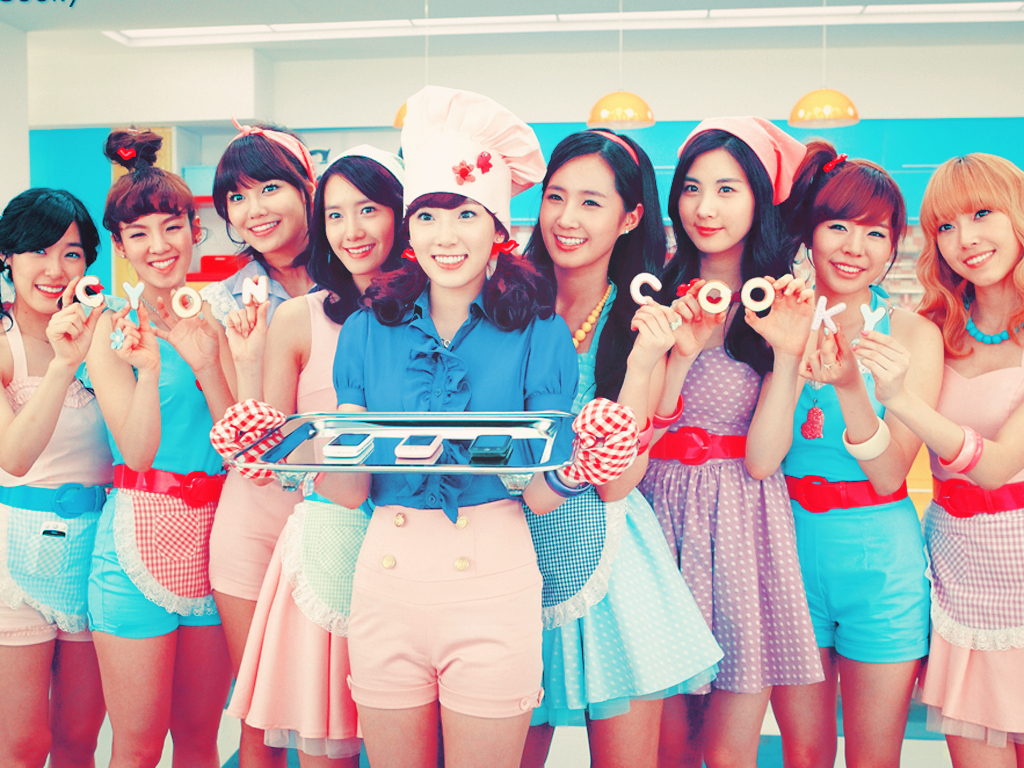
Caption: 아이돌 그룹의 특성은 몰개성과 획일화다. 표준화된 이미지와 역할분산은 멤버들을 ‘부품화’함으로써 언제라도 대체할 수 있게 만들어 준다. 원더걸스의 경우 다섯 명 가운데 두 명이 교체되었지만, 큰 타격 없이 활동을 계속하고 있다.

Caption: The standardization and lack of individuality of idol groups’ characteristics.  Through componentization [making each member into a “part” that is responsible for a small aspect of the whole], a standardized image and the division of roles make members replaceable at anytime.  In the Wondergirls’ case, two out of five members have been replaced, but the group is continuing to work without much damage. (end)

*Apologies for the long delay since Part Three, and thanks very much to Marilyn for helping me to catch up by translating this one. About some of the odd words in it, she adds that she:

…found a definition of “flexibilization” as leading to “a core group with unlimited full employment, and an increasingly larger group of short-term limited and or part-time employees who face severe employment risks, ultimately resulting in stress” and “componentization” is “not limited to software; through the use of subcontracting and outsourcing, it can also apply to business organizations and processes.”, but “irregularization” seems to not be a real word.

(See here for Part 5)

Looking for K-pop Remixes?

(Sources: left, right, top-right)

Blame Greek DJ Areia’s trance remixes for my falling in love with K-pop last year, and indeed I’m still a big fan of his. But I’ve noticed that while there seem to be plenty of other good remixers out there, it can be really difficult to find them if you don’t already know who they are. Add that now I know where the quality K-pop is too, then frankly I’ve given up looking.

Enter Christine of Pop88, who actually regularly showcases remixers’ work all together in one convenient short podcast. Make sure to check out her latest episode here, and also her deeper K-pop and sociological commentary at 8Asians!^^

Share

Concerns About Body Image? Light(en) Up!

(Source)

In fashion-crazy South Korea, so many young women refuse to trade their high heels for flip-flops at [Haeundae] beach that green Astroturf runways are installed so they won’t wobble and fall…

…[Kim Na-young, a 23-year-old fashionista in skyscraper spiked heels] “They’re a little uncomfortable,” she said. “But they make you look taller in your swimsuit.”

(Los Angeles Times, 14/08/2011)

Like most overseas news about Korea, that’s surely an exaggeration: I jog along nearby Gwangalli Beach several times a week, but rarely see any women wearing high-heels on the sand itself, let alone while in a swimsuit. But I guess at least Kim Na-young does, and I’m curious as to how she came to believe that she had to dress – and presumably diet – like a model 24/7 in order to be attractive.

“It’s all diet advertisements’ fault!” I’m sure you expect to me to say, and indeed I do think they play a huge role. But let’s not forget HyunA’s latest MV not all of them are created equal, with Post’s latest ones for Light up (라이트업) cereal being especially egregious. For not only do they promote the idea that being tall and ultra-skinny is the only attractive body shape for women, but also that having one is absolutely necessary for one’s career:

Most of that is self-explanatory, but let me add the dialogue for completeness’s sake (note that it’s normal to address someone by their position in Korean workplaces):

(Average) Kim Sa-rang: 과장님, 오늘 회의 몇  시 예요? Department head, what time is the meeting today?

(Presumably slim) Woman in background: 안녕하세요 과장님! Hello Department head!

Department head: 하…. Haaa…

(Average) Kim Sa-rang: 과장님? Department head?

Department head: 몰라! 하… (Dismissively) I don’t know! Haaa….

Voiceover: 방심했었다면, light up! 통쌀로 칼로리는…Light 다이어트는 up! If you’ve been inattentive about your body, light up! Made with unpeeled rice, light up has few calories…light diet up!

Department head: 하…뭘 드셨길래? Light up? Light up? Haaa…what did you eat? Light up? Light up?

(New slim) Kim Sa-rang: 자신감 up! Confidence up!

To play Devil’s advocate, being attractive is always going to help one’s career, but that’s just about the only defense that can be made of this ad. In particular, note the women it (and others in the series) present as unattractive:

(Source)

In the ad in the top left and bottom right, supposedly the unnamed model is much too fat to consider wearing a bikini, as is the woman in the background in the bottom left. And as for Kim Sa-rang, the entire ad concept relies on her being unattractive at the top right, but transformed after eating the cereal into what you see in the bottom-left, despite the inconvenient fact that she (presumably) had exactly the same body in both shots.

Other problems with the ad include the confusing insertion of a fox’s tail on the Department head (as far as I know, foxes have a female image in Korean culture), and how he’s portrayed as such a, well, complete dickhead. This is further stressed in a slightly longer version of the ad:

Department head (from where the original version ends):

여성여러분 다이어트는 뭘까요? Women, what’s a diet?

남친이 영화를 볼때 옆구리 살을 확 잡을때… When you’re watching a movie with your boyfriend and he grabs your waist…

하지마 너 하지마임마! 하지말라구! Don’t, you idiot! I said don’t! [James – in cutesy slang]

짜증나시죠? 릴랙스하세요… It’s annoying worrying about it, right? Please relax…

Light Up! 자신있게 권해 드립니다! I strongly recommend you Light up!

On a final note though, I should mention that of course is it not only the Korean media that promotes the notion that only tall and skinny is attractive. Indeed, in fact the very first thing the ad reminded me of was a New Zealand Listener review of the forgettable 1996 movie The Truth About Cats and Dogs, which pointed out that only in Hollywood would Janeane Garofalo ever be considered homely and unattractive (and which the whole movie was based on).

(Source)

For the (more predictable) second thing the ad reminded me of, please see here!

Share

10 Magazine’s New Website Campaign

For more information, go to the campaign website here. Pure donations are very welcome of course, but as an added incentive, free books, art exhibition tickets, and restaurant meals are available for specific donation amounts. I myself bought a 12-month subscription to the magazine for just $27, which I should have done years ago!

Share

Hatsune Miku: The Future of Manufactured Idols?

(Source)

What’s the first thing that goes through your mind, when you hear that over 3000 people at a time are attending concerts performed by a hologram?

If you’re a fellow science-fiction fan, then possibly this scene from chapter sixty-nine of Snow Crash (1992), Neal Stephenson’s cyperpunk classic (and where we get the word “avatar” from):

…[the light show] begins to simplify itself and narrow into a single bright column of light. By this point, it is the music that is carrying the show: a pounding bass beat and a deep threatening ostinato that tells everyone to keep watching, the best is yet to come. And everyone does watch. Religiously.

The column of light begins to flow up and down and resolve itself into a human form. Actually, it is four human forms, female nudes standing shoulder to shoulder, facing outward, like caryatids. Each of them is carrying a something long and slender in her hands: a pair of tubes.

A third of a million hackers stare at the women, towering above the stage, as they raise their arms above their heads and unroll the four scrolls, turning each one them into a flat television screen the size of a football field…

The reality however, is rather different. But Hatsune Miku (初音ミク) is no less impressive for all that:

Or rather, the technology behind “her” is. As the notes to that video put it:

Japan’s newest singing sensation is a… Hologram. No, that’s not a typo! It’s amazing where technology is headed these days! Over in Japan Cryton Future Media is actually starting projector concerts using a actual live band to compliment their virtual vocaloid idols like Hatsune Miku. Regardless of being a Hatsune Miku fan or not, just seeing what technology can accomplish is just amazing. While this technically isn’t a ‘true’ hologram (one where light actually takes up volumetric space rather than just a planar surface) like the one we’ve all seen of in Star Wars, it is still nevertheless quite impressive how real this appears!

Still, as author of this blog(!), it behooves me to ponder some of the negative social consequences as the technology improves, especially once the virtual idols become photo-realistic. Indeed, Hatsune Miku aside, it’s already entirely possible that when my daughters are in their late-teens or early-twenties, they’ll feel compelled to compare their bodies with – and be compared to – impossibly perfect computer-generated body shapes. But if those happen belong to the hottest (virtual) girl-groups in K-pop too?

But wait a minute…women being encouraged to aspire to body-shapes that it’s physically impossible for human females to achieve? Hell, that’s already happening!

Update 1 – Edurne mentions that the movie S1m0ne explored these themes way back in 2002:

Update 2 – As it turns out, a photo-realistic member of a (Japanese) girl-group was actually created back in June!

Share

Korean Gender Reader

(Source)

Some interesting pictures of G-Dragon, even by his standards (via: Noona Blog).

1) Cory at Banana Milk unimpressed with Project Obaeksang’s “Speed So-Getting Contest”

2) Curfews for 20-something Korean women

How common are they? And like YOUNique, does getting a job mean that parents no longer enforce it?

I had big problems with my first Korean girlfriend’s one 11 years ago, while dating my future wife later was made much easier by her living away from home. What have your own experiences been? Has anyone ever met a 20-something Korean man that had a curfew?

3) Babies!

Congratulations to A Good Korean (Feminist) Wife on her impending Dragon baby, and congratulations in advance to Shotgun Korea, whose baby is due any day now.

(Source)

4) Sex in Korean cinema vs. sex on Korean television:

YAM Magazine ponders the differences

– The Korean Film Archive is highlighting the theme “[A History of] Eroticism in Korean Movies” in August, with all(?) movies featured available for free viewing after signing up

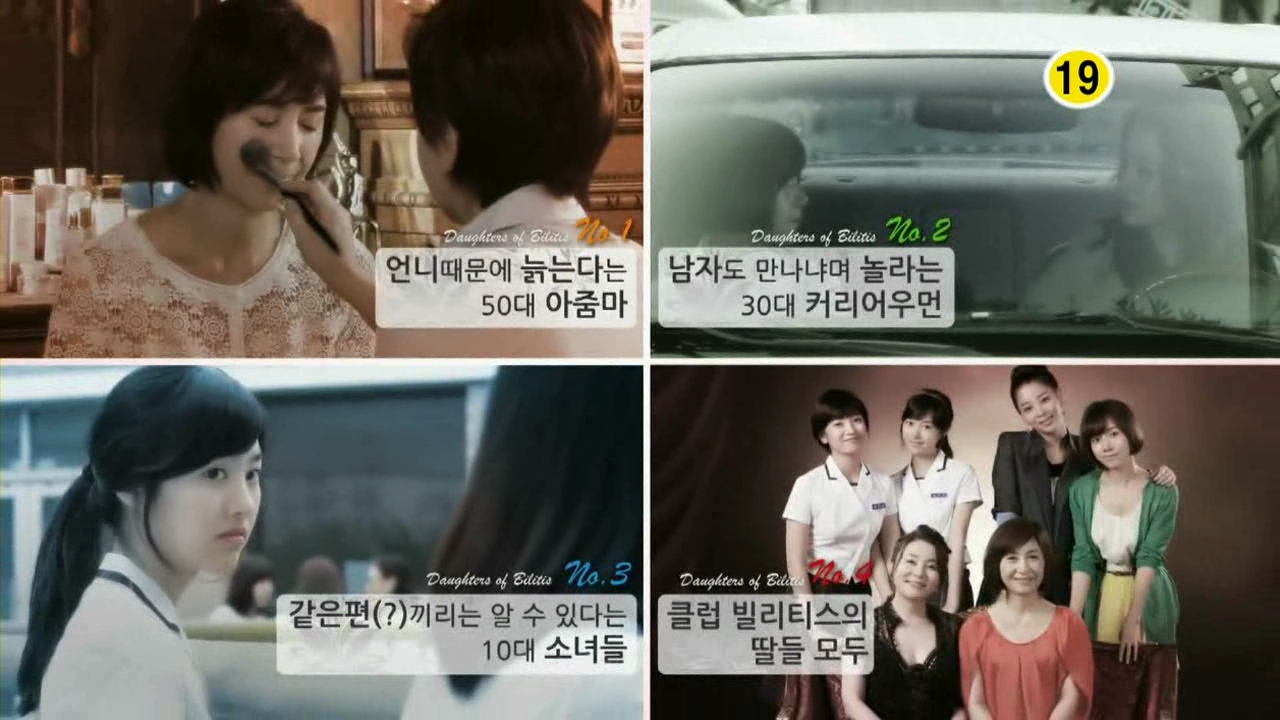
– KBS has come under fire for its screening of the single-episode lesbian drama “Daughters of Bilitis Club” (클럽 빌리티스의 딸들) . Thanks to all the people who passed that news on, and also see YAM Magazine for a potted history of how LGBT issues have been covered on Korean television.

– KBS’s “Dream Team 2” has also come under under fire for, well, showing women in bikinis, even though I could go and see the same 10 minutes walk away at Gwanganli Beach. For more information, see Angry KPop Fan, who – unlike 99% of commenters at Omona! They Didn’t! and Allkpop – actually watched the segment of the show in question, and points out that internet portal Nate basically lies in reporting that cameras gave repeated close-ups of the women’s breasts (which would have justified the complaints).

Having said that, the offending objects were still pretty difficult to avoid, as tends to happen in an inane show featuring women in bikinis having a race in a swimming pool. But what else did complainers expect from something titled “Dream Girls Summer Special“?

5) B2ST, G.NA, and 4Minute help teenagers prevent crimes

While lame, it’s no more so than public service announcements in other countries, and I particularly liked the part at roughly 2:18 in the first video that says “음란물에서의 성은 잘못된 성입니다”, or literally “Sex in pornography isn’t good sex”. Rather than expanding upon that point however, a trying to look stern – but ending up looking cute instead – HyunA and G.NA unhelpfully simply say “Absolutely stay far away from 18+ things”.

See Angry KpopFan for more commentary on the pornography segment.

6) HyunA revealed to weigh 39 kg during her “Bubble Pop!” promotions

A man well over twice that, I’m not very familiar with healthy weight ranges for 164cm tall women. But the consensus of women that are appears to be that that is much too low, and – given how she looks in the music video – that that figure is exaggerated by Cube Entertainment, if not an outright lie.

7 Westin Chosun hotel tries to inject some fun into stuffy Korean weddings

Starting at $140,000 however, then I don’ t think wedding halls will be put out of business anytime soon! (via: @hanbae and @a_ahmad)

8) The more you learn about China’s One-child policy, the uglier it gets

What’s more, while Chinese proponents claim that it has avoided 400 million extra mouths to feed, most likely China’s rising wealth means that they would never have been born anyway.

9) “Cute and lovely” Korean S&M movie gets warm reception in Montreal’s 2011 Fantasia Film Festival

10) Korean couple fighting

This may make for uncomfortable viewing, but I include it for the reasons I give here:

Share

Korean Kittens (코리언 키튼즈) – Can’t Buy Me Love (1964)

See London Korean Links and Angry Asian Man for more information about them. And thanks very much to Edward Povey for passing the video on!

Share

Gender, Consumerism, & Advertising: The Sociological Rabbit Hole

(Source)

Opening my “Gender Advertisements in the Korean Context” lecture these days by talking about erections, I’m loath to end it on something as deflating as domestic savings rates. But then so often am I asked questions afterwards like…

Why are there such sharp distinctions in the ways men and women are presented in ads?

Why are women portrayed passively, weakly, dependent, childishly, and in awkward, unnatural poses to a much greater extent than men?

Why, despite being written about North American advertisements in the 1970s, does Gender Advertisements have such resonance in Korean advertisements today?

…that in my latest version for the 4th Korea-America Student Conference at Pukyeong National University (a highly-recommended 4-week exchange program by the way!), I decided to address the last by providing the data to backup my argument that it was largely because of a shared experience of housewifization. In the actual event though, the students wisely decided that they’d much rather get lunch than ask any more questions, so let me give a brief overview of that argument here instead:

(Source)

In short, housewifization is the process of creating a labor division between male workers and female housewives that every advanced capitalist economy has experienced as it developed, essential and fundamental to which is the creation of a female underclass that acquiesces in this state of affairs, finding self-identity and empowerment in its consumer choices rather than in employment. Lest that sound like a gross and – for the purposes of my lecture – rather convenient generalization however, then let me refer you to someone who puts it much better than I could. From page 60-61 of this edition of The Feminine Mystique (my emphases):

(Source)

The suburban housewife – she was the dream image of the young American woman and the envy, it was said, of all woman all over the world. The American housewife – freed by science and labor-saving appliances from the drudgery, the dangers of childbirth and the illnesses of her grandmother. She was healthy, beautiful, educated, concerned only about her husband, her children, her home. She had found true feminine fulfillment. As a housewife and mother, she was respected as a full and equal partner to man in his world. She was free to choose automobiles, clothes, appliances, supermarkets; she had everything that women ever dreamed of.

In the fifteen years after World War 2, this mystique of feminine fulfillment became the cherished and self-perpetuating core of contemporary culture.

And then this from page 197 of the 1963 edition:

Why is it never said that the really crucial function…that women serve as housewives is to buy more things for the house… somehow, somewhere, someone must have figured out that women will buy more things if they are kept in the underused, nameless-yearning, energy-to-get-rid-of state of being housewives…it would take a pretty clever economist to figure out what would keep our affluent economy going if the housewife market began to fall off.

Ironically, by 2009 more women would actually be working in the US than men. But rather than the result of enlightened attitudes, this was primarily because layoffs were concentrated in largely male industries like construction, and I am unconvinced that the above dynamic no longer applies there.

In Korea however, the exact opposite happened. Moreover, while by no means are modern Korean notions of appropriate gender roles a carbon-copy of those in the United States in the 1960s and 1970s, even if Korean women themselves are saying that the parallels between Mad Men and Korean workplaces are uncanny(!), the fact remains that in a society where consumerism was once explicitly equated with national-security, there also happens to be the highest number of non-working women in the OECD. It would be strange if the gender ideologies that underscore this decades-old combination were not heavily reflected in – nay, propagated by – advertising.

(Source)

This is a simplification of course, one caveat amongst many being that the Korean advertising industry is actually heavily influenced by the Westernized global advertising industry (see this post on the impact of foreign women’s magazines in Korea for a good practical example of that). But, also raising the sociological issues of Convergence vs. Divergence, and the role of Base and Superstructure, the main purpose of my finishing my lecture with that explanation is to leave audiences with encouraging them to think for themselves, by giving them just a tantalizing hint of how deep the sociological rabbit hole goes.

Yes: it’s a cliche, but Gender Advertisements is very much a red pill. In particular, consider what greeted me at work just two days after giving the lecture:

I don’t know their names sorry (anyone?), but I was struck by the different impressions left by the man and the woman’s poses. Whereas he seems to be engaging the viewer’s gaze, the finger on his chin implying that he is actively thinking about him or her, in contrast the woman’s “bashful knee bend” and “head cant” make her appear to be merely the passive object of that gaze instead.

For more about those advertising poses, see here and here, especially on how they arguably make the person performing them subordinate in many senses, and – regardless of those arguments – the empirical evidence that women do them in advertisements much more than men. Indeed, while that advertisement was perfectly benign in itself of course, and you possibly nonplussed at my even mentioning it, just a little later that week I saw this similar image with Han Ye-seul (한예슬) and Song Seung-heon (송승헌) in a Caffe Bene advertisement, outside a branch opening close to my apartment:

A close-up:

Granted, the head cant helps frame the couple, and the ensuing contrast between the two models makes for a more interesting picture. But neither explains why it’s more often found on women than on men. Moreover, primed to look for more examples from then on, for the rest of July I saw plenty of advertisements featuring women by themselves doing a head-cant, and a few with men by themselves doing one. But when a man and woman were together?

Call it confirmation bias, but it became a slightly surreal experience constantly only ever seeing the woman doing it (it’s one thing to know about something like that in an abstract sense from academic papers, quite another to experience it for yourself). Here’s an example from a recent trip to Seoul:

A close-up:

Another with Lee Min-jeong (이민정) and Gong-yoo (공유) in Seomyeon subway in Busan:

One more with Wang Ji-won (왕지원) and Won-bin (원빈), commercials of which are playing on Korean TV screens at the moment:

(Source)

Finally, with Jeong Woo-seong (정우성) and Kim Tae-hee (김태희):

(Source: unknown)

Only after 4 weeks(!) of looking, did I finally find a possible example of the opposite in Gwanganli Beach last Saturday (with Song Seung-heon {송승헌} and “Special-K girl” Lee Soo-kyeong {이수경}):

Having told you about the difficulty I had in finding such an ad though, then Murphy’s law dictates that you’ll probably see one yourself very soon; if so, please take a picture send it on, and I’ll buy you a beer next time we’re both in the same city. But it wouldn’t surprise me if I don’t actually hear from anyone until September!

Update 1: Literally just as I typed that last, the headline that “Women till stereotyped in TV ads” appeared in my Google Reader. I should feel vindicated, but I actually find the study described quite superficial, the conclusions meaningless without reference to that fact that roughly 75% of Korean advertisements feature celebrities. Still, I’ll give the National Human Rights Commission the benefit of the doubt until I see Korean language sources.

Update 2: The Korea Herald also has an article on the study, but it’s virtually identical.

Share

Korean Sociological Image #62: Life as a Korean Teenager

From documentary maker Kelley Katzenmeyer:

In sixty short years, South Korea went from being one of the poorest countries in Asia to having the world’s 13th largest economy. Korean students have some of the highest test scores in the world, and a higher rate of acceptance into American Ivy Leagues than any other foreign country. But Korea also leads the world in two not quite so stunning ways- the highest rate of plastic surgery per capita, and a higher suicide rate than any other developed nation.

So. What’s life like for a Korean student? In one of the most competitive societies in the world, how does one find their place? What does it take to achieve your aspirations and goals? Our documentary will take a look at the lives of five Korean teenagers on the verge of either reaching- or losing- their dreams. The film will follow the students during the most stressful time of their lives- their last year of high school. After studying for roughly sixteen hours each day, their futures boil down to one last exam. On November 10th, 2011, thousands of high school seniors will take a nine hour test that for many, will determine their economic and social status for the rest of their lives.

For my own experiences with some of the issues raised in the video, please see here. And thanks very much to Gag Halfrunt for passing the video on.

Update 1: Also of interest is “Tackling Korean Education’s Faults” at Korea Real Time.

Update 2: The documentary also has a website and a Facebook page.

(For all posts in the Korean Sociological Image series, see here)

Share

Korean Gender Reader

(Source)

소녀시대야! 900칼로리만 먹고, 이것 할 수있겠니? ㅋㅋㅋ

1) Miss A members scoff at other girl-groups’ starvation diets, and reveal that they eat healthily and normally.

For why this is such wonderful news, see here. I hereby appoint them as honorary ambassadors for this blog!

2) Three reports of sex crimes at Korean schools.

3) Can a Feminist diet?

4) More Korean married couples living with the wife’s parents

5) Korean women: please, for goodness’ sake, develop a personality! And men: get more comfortable with yourselves!

Complete generalizations of course, as the author happily admits, but still: I really appreciated this post in a “from the mouths of babes newbies” sense (no offense).

How accurate do you think her descriptions of Korean dating couples are?

6) Piggy Dolls “piggy” no more?

Turns out, their weight loss was for a diet advertisement (see #10 here for some background).

7) Same sex couple-tees?

We’ve all seen couple-tees of course, perhaps even worn them. But clothes designed to be worn by you and your friend?

(Source)

8) Ministry of Gender Equality and Family Affairs urges teenagers not to use binge drinking as a study method.

After all, Korean teenagers are notorious for their alcohol problems, yes? Or was this supposed fad, of drinking baek-il ju (백일주) from 100 days (baek-il) before the university entrance exams, actually only highlighted by the Ministry in order to raise its profile and help justify its continued existence?

Not that I think the Ministry should be abolished by any means (despite its anti-abortion stance). But then it is notorious for some simply bizarre initiatives, and especially arbitrary, completely ineffective censorship in the name of protecting Korean youth. Neither of which I can see anything but corporatist reasons for.

9) Public protest scuppers plans for nudist forest.

Naturally however, the Korean media is still widely describing it as a nudist forest anyway.

Compare this similarly cancelled planned nudist beach on Jeju Island two years ago, which had been intended only to be open to non-Koreans.

10) New girl-group Chocolat set to debut on August 17. Has 3 bi-racial members (and 2 Koreans).

For which it’s been receiving a lot of attention, although it’s not the first to have bi-racial members (all 3 have American fathers and Korean mothers btw). Probably even more noteworthy and ominous though, is the fact that 2 members of the group are only 14 (the others are 17, 18, and {I think} 19).

See the following video for them introducing themselves. Note that the title says “Korean”, but it’s actually all in English:

Update: Ashley at SeoulBeats discusses them more here.

Share

Korean Sociological Image #61: Stereotypical Gender Roles in Pororo

Source

I know, I know: trust me to nitpick about something as universally popular and adorable as Pororo. However, just like the classic How to Read Donald Duck (1972) revealed a pervasive imperialist ideology then propagated by Disney in that universally popular and adorable cartoon, so too does Pororo begin reveal some issues once you’re prepared to look past the cuteness. In this case, because of the stereotypical gender roles contained therein.

Just ask any parent in Korea, one of whom *ahem* first noticed these problems with the show *cough* over two years ago. But, with thanks to Marilyn for translating this article at Ildaro Women’s Journal, it’s always good to have a reliable Korean source, especially when one critiques something that usually only attracts glowing reports about its success overseas:

Source

“뽀롱뽀롱 뽀로로”에서 루피의 역할은? 애니메이션 속 전형적인 남녀캐릭터 설정 아쉬워

Loopy’s role in “Pororo The Little Penguin”? The set-ups of typical male and female characters in the cartoon is a shame

모 방송사의 예능 프로그램에서 강호동씨가 미션으로 곰인형 100개의 눈을 붙이는 장면이 나왔다. 담당VJ는 그에게 집에서 아이들과 잘 놀아 주냐고 질문했다. “나보다 뽀통령을 더 좋아해. 뽀통령 있으면 아빠 아는 체도 안 해.” 강호동씨의 답변에서 알 수 있듯이 지금 아이들 사이에서는 뽀로로가 최고의 인기 캐릭터이다.

On X network’s entertainer program, there was a scene in which Kang Ho-dong had a mission to attach 100 bear dolls’ eyes.  The VJ asked if he was good about playing with his children at home.  “They like President Po more than me.  If President Po is there, they don’t even acknowledge Dad.”  What we can know from Kang Ho-dong’s answer is that Pororo is the most popular character among children now.

아이들 세계를 지배하는 뽀로로의 영향력 / The influence of Pororo, who rules the world of children

<뽀롱뽀롱 뽀로로>는 2003년 (주)아이코닉스 엔터테인먼트에서 탄생하여, 교육방송 EBS를 통해 아이들에게 알려지기 시작했다. 12개월부터 미취학 아동 대상으로 방영된다. 현재는 3탄까지 제작됐으며 앞으로 4탄이 방송을 탈 날을 기다리고 있다. 1탄부터 3탄까지 전 시리즈는 세계 82개국에 수출됐으며, 특히 프랑스에서는 시청률 57.2%라는 놀라운 기록을 세웠다고 한다.

“Pororo The Little Penguin” was born at Iconix Entertainment in 2003 and began to become known among children through the educational channel EBS.  It was broadcast to a target audience of preschoolers from the age of 12 months.  Currently, the third season has been produced [aired] and the day the fourth will be aired is awaited.  The first through third series have been exported to 82 countries around the world, and are said to have set a surprising record in France, especially, of 57.2% viewership.

Source

뽀로로 캐릭터 상품으로 연간 벌어들이는 수입은 추신수 선수의 3배, 박지성 선수의 2배에 달하며, 2010년까지 누적합계 8천3백억 원에 달하는 것으로 알려졌다. 현재 소녀시대를 누르고 음반판매율 1위를 지키고 있는 것도 뽀로로이다.

The yearly income of Pororo the character as a product is three times that of [baseball] player Choo Shin-soo and reaches twice that of Park Ji-Sung, and it has become known that his accumulated earnings as of 2010 come to 830 billion Won [about $790 mil.].  The one currently defeating Girls’ Generation to remain number one in album sales is also Pororo.

어린이가 다쳐서 울 때 뽀로로 밴드를 붙여주면 울음 끝, 치아 닦기 싫어하는 아이에겐 뽀로로 치약 한 번 올려주면 반짝반짝 이를 닦는다. 이렇게 유아들의 세계를 지배하는 뽀로로의 영향력은 대단하다.

If a child who is hurt and crying is given Pororo bandage, the crying stops, and if a child who hates brushing her teeth is given Pororo toothpaste, she will brush until her teeth sparkle.  The influence of Pororo, who rules the world of small children like this, is enormous.

성역할 고정관념 드러내는 등장인물들 / Characters who reveal gender-role stereotypes

하지만 <뽀롱뽀롱 뽀로로> 애니메이션 속에선 한 가지 아쉬운 점이 발견된다. 바로 만화에 등장하는 캐릭터의 특징이다.

However, there is one way in which the animated program “Pororo The Little Penguin” is discovered to be lacking.  It is the characteristics of the characters who appear in the cartoon.
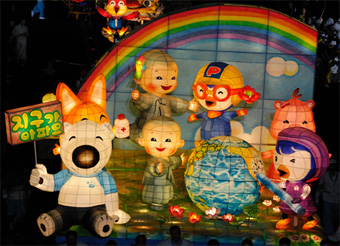
연등회에 등장한 뽀로로 캐릭터들. 뽀로로의 국민적 인기를 실감케 한다.

Caption, right: Pororo characters who appeared in the Lantern Festival.  One can feel the national popularity of Pororo.

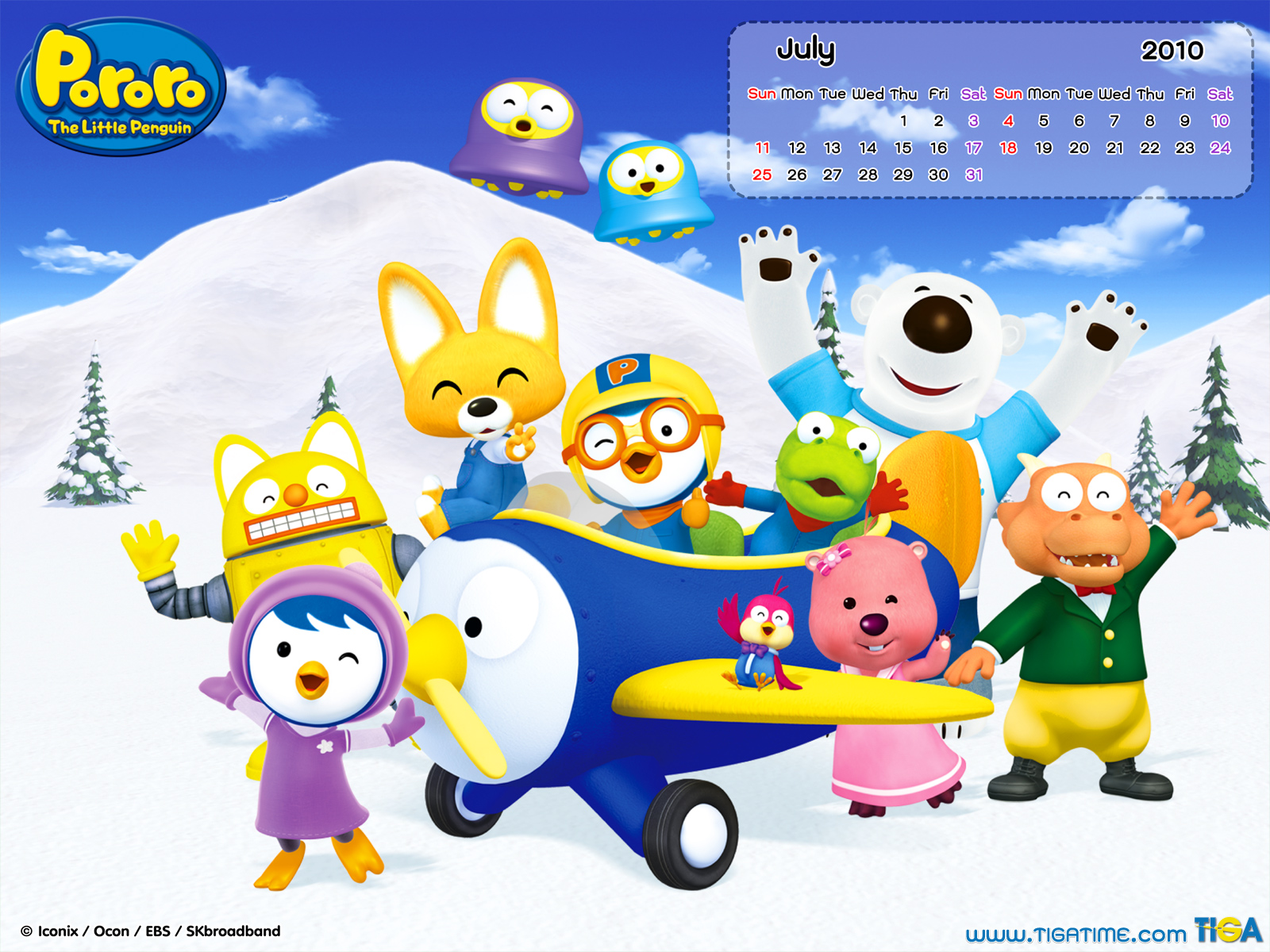
뽀로로, 에디, 포비, 크롱은 남성캐릭터이다. 루피와 패티는 여성캐릭터이다. 주인공 뽀로로는 궁금한 걸 못 참고, 도전과 모험에 앞장서는 호기심 많은 펭귄이다. 에디는 발명가를 꿈꾸는 꼬마여우이고, 포비는 마음 넓게 항상 다른 이를 도와주는 화가를 꿈꾸는 착한 곰이다. 패티는 명랑 활달하고 운동을 좋아하는 털털한 펭귄이며, 루피는 수줍은 많고 여성스럽고 요리 솜씨가 뛰어난 비버소녀이다.

Pororo, Eddy, Poby, and Crong are male characters.  Loopy and Petty are female characters.  The main character Pororo is a penguin who can’t stand not knowing something, who leads the way into challenges and adventures, and is very curious.  Eddy is a little boy fox who dreams of being an inventor, and Poby is a friendly bear who always generously helps others and dreams of being an artist.  Patty is an easy-going penguin who is bright, outgoing, and likes exercise, and Loopy is a very shy, feminine little beaver girl with excellent cooking skills.

<뽀롱뽀롱 뽀로로> 만화에 등장하는 남성캐릭터들은 ‘꿈꾸는 이상’이 있다. 모험가, 과학자, 화가를 꿈꾸며 노력하는 모습을 보인다. 타고 난 재능도 가지고 있다. 그러나 여성캐릭터인 루피와 패티는 앞치마를 두르고 맛있는 쿠키를 구워서 친구들에게 대접하는 꿈을 꾼다. 여성캐릭터를 꼭 ‘요리’와 연결시키는 이유는 무엇일까?

The male characters have “something more that they dream of.”  They present themselves as working hard [to achieve] their dreams of being adventurers, scientists, and artists.  They also have natural gifts.  However, the female characters Loopy and Patty dream of putting on aprons and making delicious cookies to serve to their friends.  Why must female characters be connected to “cooking”?

21세기의 여자아이들은 더 이상 부엌에서 요리하고, 다소곳이 앉아 바느질하는 것을 강요받는 사회에서 자라지 않는다. 남자아이와 동등한 자격으로 공부하고, 자신의 뜻을 펼칠 수 있다고 교육 받는다. 그러나 사회에서 요구하는 현실은 여전히 만화 속에 등장하는 전형적인 여성캐릭터인 것일까? 이런 애니메이션을 보고 자란 남자아이들은 당연히 여성이 요리를 해줄 거라고 기대할 것이고, 여자아이들은 그 모습에 자신의 모습을 비추어보며 살게 될 수도 있을 것이다.

Source

21st century girls no longer grow up in a society that forces them to cook in the kitchen or sit modestly and sew.  They study on equal terms with boys and are taught to speak their minds. But is the reality that is demanded by society still the one portrayed by the typical female characters in cartoons?  Boys who grow up watching this kind of animation will naturally expect females to cook for them, and girls might grow up to reflect that image.

이런 캐릭터 설정은 어린 시절부터 성역할 고정관념을 아이들에게 심어줄 수 있다. 특히 만화 속 패티와 루피는 서로에게 질투를 느끼거나 오해를 해서 감정싸움을 만들기도 한다. 물론 실제로 아이들이 그런 감정에 빠질 수도 있다. 그러나 어린이들이 보는 프로에서 꼭 여성캐릭터 간의 감정싸움을 부각시켜 보여주면서 어릴 때부터 성별에 관한 편견을 가지게 할 필요는 없지 않을까.

The settings [of characteristics] of this kind of character can indoctrinate children into gender role stereotypes from a young age.  In the cartoon, Patty and Loopy especially feel jealous of or misunderstand each other and so start emotional battles.  Of course, in reality children can have those feelings.  However, is there really a need for programs that children watch to make them have prejudices about gender from a young age by playing up and showing emotional battles between female characters?

미취학아동들은 그나마 사회시스템 속에서 길들여지는 고정관념으로부터 비교적 자유로운 시기이다. 그런데 만화에서 뽀로로는 항상 용감하게 도전하고, 에디는 우주선을 만들고 외계인을 만날 때, 루피는 예쁜 머리핀을 자랑하고 싶어 하고, 백설공주와 같이 되길 꿈꾸며 사과를 먹어야 할까?

Pre-schoolers are at least at an age that is relatively free from the taming stereotypes of the social system.  But in the cartoon, while Pororo is always bravely challenging and Eddy makes a spaceship and meets an alien, does Loopy have to want to boast about a pretty hairpin and dream of becoming like Snow White while eating an apple?

아이들이 TV 속 뽀로로에게 열광할 때 나는 한편으로 걱정이 된다. 내 딸에게서 “엄마, 난 뽀로로 같은 용기 있는 남자와 결혼해서 맛있는 쿠키를 구울 거야.” 라는 말을 듣게 될까봐.

Part of me is worried when I see kids going crazy over TV’s Pororo.  Worried that I may hear, “Mom, I’m going to marry a brave man like Pororo and make delicious cookies!” from my daughter. (end)

Source

After revealing in my introduction that there’s more to Pororo than meets the eye, it was extremely tempting at that point to go on to discuss how what is actually a multi-million dollar industry has some curious, if superficial, parallels to some elements of K-pop. Wisely I demurred, but if you’ll indulge me here instead for a moment, then, with it being exported to over 110 countries, it is arguably just as much a part of the “second Korean Wave” as say, KARA or Girls’ Generation. Moreover, just like those groups are redoing most of their songs into Japanese for the sake of better marketability, diluting what Koichi Iwabuchi deftly calls their products’ “cultural odor” in the process, so too does the creator of Pororo refuse to incorporate more Korean elements into the cartoon, lest foreign audiences be put off. On top of that, there are even glowing accounts of Pororo’s popularity amongst overseas Koreans too, which—correct me if I’m wrong—were often considered (or at least portrayed) as important precursors to and/or agents in K-pop’s subsequent popularity amongst non-ethnic Koreans.

And having raised all those tangents, then it behooves me to also mention Pororo’s North Korean connections for anyone interested, which you can read about here and here. Also, in the interests of full disclosure, I should point out that a friend’s friend’s wife provides the voice of Harry, the humming-bird sitting on the wing above. Apologies for the ensuing lack of objectivity in the post!

(For all posts in the Korean Sociological Image series, see here)

If you reside in South Korea, you can donate via wire transfer: Turnbull James Edward (Kookmin Bank/국민은행, 563401-01-214324)


Korean Sociological Image #60: “Beautiful” Female Athletes

Noticed playing on the televisions on the KTX train, on my trip to Seoul on Wednesday.

Granted, technically it’s only one female athlete being described as a “beaut(iful) bird” (미녀새) here. And arguably that – or rather, beautiful soaring bird – is indeed an apt metaphor for any pole vaulter. Let alone Yelena Isinbayeva, “widely considered the greatest female pole-vaulter of all time”.

But still, can you imagine it actually being applied to a male pole vaulter? Or a male athlete of any sport ever, first and foremost, being described as “handsome”?

Definitely a gender binary to keep an eye on as the Daegu 2011 IAAF World Championships approach!

Update 1: Here’s a similar recent example from the US Yahoo! Sports website.

Update 2: @TheSocyCinema and @landrist discuss another example from Adidas.

(For all posts in the Korean Sociological Image series, see here)

Share

Korean Gender Reader

(Sources: left, right)

On the left, a virile healthy reminder that men are also increasingly being objectified by the Korean media these days (via Kiss My Kimchi). On the right, that SM Entertainment were also clearly on drugs when they made those teaser images for Super Junior’s latest album…

Meanwhile, a minimalist Korean Gender Reader this time, which will have to be the norm from now on (I’m very busy this summer!). But on the plus side, they’ll also be much more frequent and up-to-date:

1) South Korea becomes the first Asian country to chemically castrate sex offenders

2) More Korean women are marrying younger men

3) Can bikini-clad foreign women at Cheonggyecheon be punished? Should they?

Update: See On Becoming a Good Korean (Feminist) Wife also

4) Do Asian women with white men suck?

Christine Han discusses reactions to her earlier post (see #5 here)

5) Korean HRC issues guidelines on sports and human rights

In reaction to scandals that emerged in 2008 regarding sexual assaults of student-athletes and professional athletes by their coaches

6) Dear K-pop: down with Playboy bunny ears! (See #1 here and #5 here also)

7) 3 Jeju teenagers arrested for prostitution

8) China’s most populous province launches a public criticism of the one-child policy

9) 2011: The Year of the Chinese Woman?

10) Piggy Dolls “piggy” no more? (See #10 here for some background)

(Source)

Share

FINALLY, a Way to Study Korean Through Dramas!

(Source)

If you’re a Western student of Korean, then probably you’ve experienced the same dilemma I have: you’d like to watch dramas to improve your listening ability and get a handle on everyday language, but are put off by their excessive melodrama, cliches, and often poor quality. Which is not to say that all of them are bad of course, but when you do find one you like, then you can struggle in vain to find Korean subtitles to them. For Korean torrent sites naturally don’t bother to provide them, and Koreans’ rampant illegal downloading means that it’s extremely difficult to find DVDs of Korean dramas (if they even exist).

So, either you have to watch dramas with distracting English subtitles, or struggle to understand the stories with none at all. If only there were some alternate way to study the dialogue in advance, or read it as you go along. Sure, Dramabeans’ detailed synopses of each episode of most dramas are very helpful for the gist, but I think I speak for most when I say we’re really after something more akin to transcripts…

Enter “드라마사진만화”, or “드라마영상만화”: a little like manhwa books, but with photo stills from the drama, rather than hand-drawn pictures. Please see Shanna’s post about them at Hangkukdrama and Korean here for more information, and which so impressed me that I immediately ordered some for Secret Garden. And you can just imagine how I felt when I read that she’s had some for over 3 years, when this is the first I’ve ever heard of them!

Does anybody else already used them? What did you think?

Sexual Assault on Subway Caught on Camera

Here’s my translation of a brief report from Sunday’s 8 News. Unfortunately, SBS is pretty strict about copyright, so I can’t risk uploading the video to Youtube. But it’s readily available at the original link:

애인인 취한 20 여인 옆에 앉아 성추행 /  Drunk man sits next to drunk 20-something, pretends to be lovers, sexually assaults her

Anchor:

지하철에서 옆자리에 잠든 20대 여성을 마치 자신의 여자친구인 양 쓰다듬으며 성추행하던 남성이 붙잡혔습니다. 카메라에 그 모습이 담겼는데요, 정경윤 기자가 보도합니다.

A man has been arrested [in Seoul] for sexually assaulting a 20-something woman sitting next to him on the subway, pretending she was his girlfriend. This scene was recorded on camera. Jeong Gyeong-yoon reports.

Jeong Gyeong-yoon:

지난 20일 새벽, 지하철 전동차에 50대 남자와 20대 여자가 나란히 앉아 있습니다. 여자는 잠들어 있고 옆에 앉은 남자는 마치 연인처럼 행동합니다 10여 분간 껴안고 쓰다듬는 등 신체 접촉을 계속합니다. 하지만 이 남자의 행동을 수상하게 여긴 한 시민에 의해 성추행은 발각됐습니다.

In the early hours of Wednesday the 2oth, a man in his 50s and a women in her 20s were sitting side by side on a subway train. While she was sleeping, the man acted as if they were lovers for about 10 minutes, embracing and caressing her, and continuously touching her body. But this looked a little suspicious to another passenger, through whom this sexual assault was exposed.

[라 모 씨/목격자 : 나이 차이가 많이 나 보이고 수상해서 계속 보는데, 여자를 깨워서 이 남자분 아시냐고 했더니 모른다는 거예요. 바로 남자 멱살을 잡고 끌고 나왔죠.]

(Anonymous) Recorder of video: Because the difference in their ages was so great, it looked a little suspicious to me, so I kept an eye on them.  When the woman woke up, I asked if she knew him, and when she replied that she didn’t, I immediately grabbed him by the throat and dragged him off the train.

남자는 현행범으로 경찰에 붙잡혔지만, 술에 취해 기억이 나지 않는다며 혐의를 부인했습니다.

지난 5월에는 심야에 20대 여성이 성추행을 당한 뒤 도망쳤지만 주변 도움을 받지 못해 또 다시 폭행당하는 사건도 있었습니다. 지하철 성범죄 가운데 심야 시간대 발생 비율은 4.1%. 하지만 취객이 많고 주위 도움을 받을 수 없는 경우가 많아 여성들이 느끼는 불안감은 더 큽니다.

The man was arrested by police, but because he was drunk he didn’t remember it, and denied doing it.

In May, there was also a case of a woman who also sexually assaulted [James – presumably on the subway] at about midnight, but when she escaped she was unable to get any help, and so got sexually assaulted again. And the reported cases of women being sexually assaulted on the subway in the late evening have increased 4.1% [James – compared to last year?]. With so many drunk people [men?], and so many cases of no help being available, then women are increasingly anxious.

[장소영/서울 천호동 : 술주정 하시는 분들도 많고, 그런 분들이 다른 여성들한테 해코지 하는 것도 많이 봐서…]

Jang So-yeong, Seoul (Cheon-ho dong) resident: There are many drunk people [men?] around, I’ve seen them treat women badly many times…

늦은 시각 지하철 성범죄가 잇따르자 서울시가 19년 만에 여성전용칸을 부활하겠다는 방침을 밝혔지만, 반응은 신통치 않습니다.

Because there was a succession of sexual crimes on the subway 19 years ago, then back then a special women-only carriage was provided. This idea is being revived, but public reaction has been negative.

[지하철 역무원 : 취약 시간대 별 효과 거두지 못할 것 같아요. 여성 전용칸만 보고 지키는 사람이 없잖아요.]

Subway Worker: I don’t think it will be effective at those late hours when women are most vulnerable. It’s not as if labeling a carriage women only will dissuade people who set out to assault women.

지하철 성범죄는 갈수록 늘고 있지만, 대책은 아직도 미흡합니다.

Day by day, sex crimes on the subway are increasing, but there’s still no satisfactory policy to deal with them.

(영상취재 : 홍종수, 영상편집 : 박선수) 정경윤 rousily@sbs.co.kr / Data Collection: Hong Jong-soo, Editing, Compilation: Park Seon-su. Written by Jeong Gyeong-yoon (end).

Unfortunately that report raises many more questions than answers, but still: kudos to the guy who didn’t just record the scene but actually did something about it as well. And thanks to reader Mallory for passing the report on.

For anyone further interested, see Global Voices here for much more on the Korean public reaction’s to the planned women-only subway cars (update: the Marmot’s Hole also has a post on it), or The Three Wise Monkeys here for some context on the recent increase in sexual crimes in Seoul specifically (including some mention of subways). Or, for more on sexual harassment and sexual assault in general, see my posts in that category, especially this one on groping.

(p.s. If anyone’s curious, some text on the screen said that the incident happened on Line 5)

Share

Newsflash: Korean Idol NOT Starving Herself!

It’s said that the fashion industry has favored skinnier and skinnier female models over the years because it’s dominated by gay men, right?

But since when are all, or even most gay men attracted to such androgynous figures? In reality, their tastes are just as diverse as heterosexuals’, and you don’t need my own experience of living with gay prostitutes to know that. Or that one’s sexuality doesn’t preclude an aesthetic appreciation of healthy curves either.

On the other hand, it’s also true that there’s a price to be paid for challenging the waiflike norms for models in the fashion industry, the corollary of which would be that it attracts people who share those norms. But how did those norms arise in the first place? And again: why the trend towards thin?

Taking for granted a symbiotic relationship between fashion and consumerism, then a better explanation for both is the constant financial imperative of related cosmetics, clothing, and dieting companies to create false needs in the minds of consumers, all the better to sell new products to them that (supposedly) help them fulfill those needs.

(Source)

I concede that that may sound simplistic, even conspiratorial. But take the classic Korean example of the “X-line” for instance: a body-shape completely impossible outside of Photoshop, but which creators Amore-Pacific will sell products to help you attain nevertheless, aided by articles like this from the Korea Times that cheerfully reported that the X-line was hugely popular among young Korean women.

Despite the only “evidence” for that coming from Amore-Pacific itself.

Also, the thinner models are, then all the more dieting products and services that are needed to reach their weights. Which is not to say that Korean consumers are any more or less likely to follow anonymous models’ examples than you or I are, but when 65-75 % of Korean advertisements feature celebrities, with a demonstrable influence on media narratives about body ideals, then the potential is certainly there.

(Sources: left, right)

Enter Girls’ Generation, who have 12001500 calorie a day diets despite one member being 9kg underweight, and probably Yuri on the left above too (Brave Girls‘ Seo Ah’s pictures on the right speak for themselves). Or T-ara’s Hyomin being anorexic and weak, yet repeatedly showing off her body to endorse a swimming resort. Or actor Jeong Ryeo-won endorsing Giordano while looking like this. And so on.

Are these women both personification and culmination of the trends mentioned above? It’s certainly tempting to think so (and just between you and me, I do). But it’s also true that while Girl’s Generation, for instance, have indeed endorsed beauty products, even going so far as to prominently display one in a music video, they’ve also endorsed pizzas and fried chicken. So if there is a relationship between those celebrities’ weights and consumerism, in Korea it’s clouded by management companies relying heavily on endorsements – any endorsements – to make profits.

In the meantime, Korean women are already the slimmest in the developed world, to the extent that 1 in 5 are undernourished, and fully half of teenage girls are too anemic and malnourished to donate blood. If you’ll forgive the pun, such exacting standards for women don’t magically appear out of thin air.

Nor are they often challenged, let alone by celebrities themselves.

Which is why it was so exceptional last week for Uee of After School to not only reveal that she was eating enough, but to also pass on the common-sense that:

Many people starve themselves when they are on a diet, but that doesn’t help. You have to eat well in order to lose weight more easily.

(Source)

Seriously, I’m at a loss to recall anyone else in K-pop making such a, well, revolutionary statement(!), so I’ll certainly forgive her complicity in the objectification of her body by the media (it does go with the job after all). Korean speakers, see roughly 4:30 of this Youtube video to hear her for yourself, or the Dailymotion video if you find that unavailable in Korea for copyright reasons (I’ve saved it for posterity).

And on that note, hopefully you can appreciate why I felt some context was necessary before passing on the news (UEE EATS FOOD! READ ALL ABOUT IT!). But is she indeed the first celebrity to speak out like that? Or can any readers think of any others? By all means, please prove me wrong!

Update 1 – While she’s not quite as well-known, I forgot about the example set by Koyote’s Shin-ji last year (see #7 here).

Update 2 – With thanks to xtristessa for passing it on, R&B singer Hwayobi recently confessed to having suffered from bulimia.

Update 3 – And to Seri, for mentioning Hwang Jung-eum. She’s not exactly my favorite celebrity, as she’s endorsed Sketcher’s completely useless  “Shape-ups”, but I suppose that’s no worse than UEE reveling in the attention given to her “honey thighs”.

Update 4 – YG Entertainment’s exclusive trainer, Hwang Sung Chan, briefly discusses Park Bom’s diet here. While it’s good that he mentions how the media often distorts information about celebrities’ diets, widely reporting that she only ate watermelon rather than a lot of watermelon for instance, unfortunately he doesn’t give any details about what she does eat.

Should the Sexualization of Teens in K-Pop be Banned?

(15 year-old f(x) band member Sulli {최설리} in February 2010 Oh! Boy Magazine; source)

In short, “yes, but…”(!), as I explain in this opinion piece I recently penned for the Korea Herald. It’s pretty faithful to the original, for which I’m grateful, but unfortunately two crucial sentences on boy-bands got edited out at the beginning of paragraph 4. It should read:

This is why this discussion is overwhelmingly about girls. However, owners of boy-bands too have been affected by the ensuing pressure to make them stand out from their competitors. Add in Korea’s notoriously high levels of illegal downloading, ensuring that profits in the Korean music industry are overwhelmingly from concerts and commercial endorsements (and which explains why 75% of Korean commercials feature celebrities), then courting controversy with ever more provocative performances is a no-brainer really.

Still, only 800 words long even with those inserted, at best the article only gives an introduction to some of the issues involved really. For any interested new readers and old readers that haven’t already then, please read my post Reading the Lolita Effect in Korea, Part 2: The role of K-pop and the Korean media in sexual socialization and the formation of body image for a much more comprehensive discussion of those, and for the many caveats I would have liked to have added to the generalizations in the article!^^

What did Depraved Oppas do to Girls’ Generation? Part 3

(Source)
This translation of part of this Korean article follows directly from Part 1 and Part 2. If you haven’t already, please read those first, as the author didn’t intend for any section to be a stand-alone post:

‘비정규직 세대’의 이중착취 / The Double-Exploitation of the “Irregular Generation”

아이돌 바람을 일으킨 기획사 대표들에게는 몇 가지 공통점이 있다. 스스로 연예계에서 활동하며 발을 넓힌, 중장년층의 남자들이라는 것이다. 이들은 경제위기 이전에 사회에 진출해 상당한 부를 축적한 기성세대면서도, ‘비정규직 세대’와 취향을 공유할 수 있을 만큼 젊은 경우가 대부분이다.

The representatives of management companies that gave rise to the idol boom have many points in common. First, they are middle-aged men who developed their careers within the entertainment world by themselves, before the Asian Financial Crisis. Also, while they are an old generation with accumulated wealth, most are still young enough to share the tastes of the “irregular generation”.

다시 말해, 아이돌 기획자들은 무력한 남성들의 욕망을 이해할 만큼 젊고 영악한 ‘동료 남자’들인 동시에, 이 수요를 가공해 상품으로 내놓을 수 있을 만한 돈과 연줄을 지닌 사람들이다. 반면에 대다수 젊은 세대가 지닌 건 욕망과 (아르바이트로 모았을) ‘미니앨범’을 겨우 살 주머니 푼돈뿐이다.

In other words, management company representatives are young and shrewd enough to understand powerless men’s tastes, and have the money and connections to produce manufactured goods (idols) on demand. On the other hand, the thing which most of the young generation have is desire, but only enough pocket money (or money gained from part-time jobs) to buy mini-albums.

한국의 현재 청소년들은 꿈을 꿀 수 없는 불우한 세대다. 유치원 시절부터 학교, 학원, 과외로 이어지는 가혹한 경쟁체제 속에서 고통 받지만, 이들에게 준비된 미래는 없다. 소수의 ‘좋은’ 대학을 갈 경쟁력은 돈으로 길러지고, 운 좋게 입학 기회를 얻는다 해도 돈 없이는 학교에 다닐 수도 없고, 살인적인 ‘스펙’ 경쟁도 불가능하다. 졸업생을 기다리고 있는 것은 차별, 실업, 비정규직으로 이어지는 잔인한 현실이다.

Korean teenagers now are an generation of misfortune, which can’t have dreams. From when they’re in kindergarten, to attending school, hagwons, and receiving private tutoring, they suffer greatly from the competitive system into which they’re placed, yet despite that have no future to prepare for. They can use money to increase their chances of getting into one of the very few “good” universities, but even if they [are indeed] lucky enough to gain a place to one they may be unable to afford the fees, and [besides which] it would still be impossible to get killer “specs” [James – a good background]. Graduating students now face a merciless reality in which they have nothing but discrimination, unemployment, and/or irregular, unstable work to look forward to.

(Source)
아이돌 그룹은 이 가엾은 세대에게 두 가지 의미의 ‘위안’을 준다. 하나는 암울한 현실을 잠시 잊을 수 있는 오락이고, 다른 하나는 ‘나도 아이돌이 될 수 있다’는 꿈이다. 하지만 이 ‘위안’은 기획사가 비정규직 세대를 피라미드형 착취구조로 이끄는 미끼에 지나지 않는다. 젊은 세대는 아이돌 음악을 사는 소비자인 동시에, 오디션에 참여해 ‘아이돌 예비군’인 연습생 자리를 채워주는 ‘인력풀’이다.

Idol groups give comfort to this hapless generation in two ways. One, is through giving some pleasure that allows them to forget their miserable reality for a moment, why the other is through fostering the belief that they too can become idols. But this “comfort” is nothing but bait for a pyramidal exploitation structure of them. [As] while the young generation purchase music as consumers, at the same time they also audition to become a labor pool of “idol reserves”.

이들은 기획사에 수익과 인력을 댈 뿐 아니라, 열광과 환호로 아이돌에게 매력적인 지위도 부여한다. 결국 ‘아이돌의 꿈’을 구성하는 부, 인기, 명성은 모두 비정규직 세대 자신들이 공급하는 것이다. 하지만 꿈의 주인공이 되는 것은 오직 기획사를 통해서만 가능하다.

While these idol reserves represent profit and a labor pool to the management companies however, to them themselves they are given an attractive position through widespread public adulation and passion for them. In the end, everything that an idols’ dreams are composed of – wealth, popularity, fame – are things that they provide for themselves. But although they are the central character in their dreams, these are still only possible through management companies.

(Source)
Caption:  걸그룹 기획사가 가장 중요하게 여기는 것은 의도된 노출에 적합하고 손쉽게 대체될 수 있는 획일화된 신체다.

Image Caption: [When it comes to idols], The most important thing for management companies to consider are standardized bodies suitable for skin exposure and easily replaced (end).

James – My apologies in advance for any mistakes in the translation, which I admit that I (and then my long-suffering wife) struggled with much more than I did the first two parts. Much of my confusion though, stemmed from – to my mind – Kang’s abrupt shift here from talking about the “irregular generation” in the first half of the article (i.e. the target audience of girl groups), to the “young generation” that the girl-group members belong(ed) to in the second half. However, it does serve as a good introduction to Part 4’s discussion of their exploitation with the Korean music industry, which you can find here.

Slutwalk Korea (잡년행진) This Saturday!

(Source)

Sorry for the short notice, but I’ve only just found out about it. Still, that might actually be a good thing(!), as like Gomushin Girl put it:

…I’m sure part of the reason lots of expats haven’t heard about it is because the Facebook page and most of the planning has been done by and for Koreans, which is freakin’ awesome.

Indeed. But I’m sure the organizers would still be more than happy for any spectator support and/or even participation by expats, so please contact them via their blog, Facebook page, or Twitter feed if you’re interested (and here’s the Wikipedia page for more about Slutwalk in general). And, with it starting at 4pm in Gwanghwamun, I’m happy to report that I’m actually going to be able to see it myself, as by a great coincidence I’d already just booked KTX tickets to see a friend in Seoul at the very same time and place!^^

(Hat tip to Dating in Korea)

Update 1: Here’s a Korea Times article on the event. More links coming soon!

Update 2: Impossible Black Tulip questions the wisdom of holding Slutwalks.

Update 3: Here’s Roboseyo’s excellent report on the event.

Share

What did Depraved Oppas do to Girls’ Generation? Part 2

(Source)

This translation of part of this Korean article follows directly from Part 1. If you haven’t already, please read that for the background:

An ‘Oppa Industry’ Founded on Powerless, Frustrated Men’s Desire / 무기력한 남자의 욕망에 기초한 ‘오빠 산업’

‘오빠’ 노래가 최근 처음 등장한 건 아니다. 하지만 여자 가수들이 약속이나 한 듯 동시에 ‘오빠’를 불러대는 모습은 과거에도 보기 드문 장면이었다. 대체 어떤 연유로 ‘오빠 강풍’이 불기 시작했을까?

This is not the first time that there have been Oppa songs. But, just as you’d expect, it was rare to find female singers [actually?] saying the word in past songs. [So] what on Earth was the origin of this Oppa Craze?

물론 ‘오빠’ 소리를 듣고 싶은 남자들이 많기 때문일 것이다. 걸그룹에 열광하는 남자팬들의 다수가 연애조차 하기 힘든 비정규직 세대라는 점을 기억할 필요가 있다. 이들이 걸그룹에 환호하는 이유는 소위 ‘초식남’이 만화주인공과 사랑에 빠지는 이유와 비슷하다. 그들에게 걸그룹은 ‘망가걸’의 실사판인 셈이다.

Of course, the reason is that there are many men that want to be called “Oppa”. We need to remember that the majority of enthusiastic male fans of girl-groups are a generation of men who work hard at irregular, [dead-end] jobs, and [so?] have difficulty even getting a date. The reason they cheer girl-groups is similar to the reason so-called “Herbivore Men” fall in love with the main characters in manhwa comic books: to them, girl groups members are like real-life versions of “Manga Girls”.

James: jumping ahead to a point I’ll make again in the conclusion, things like this mean we should be very wary of such sweeping statements about the demographics of K-pop fans, not least those made by myself. But I do find Kang’s arguments compelling overall.

한국 걸그룹이 외환위기 이후에 등장했다는 사실은 의미심장하다. 특히 한국 경제가 장기침체로 들어선 2000년대 후반 등장한 원더걸스나 소녀시대는 1990년대 후반의 에스이에스(S.E.S.)나 핑클 등의 ‘1세대 걸그룹’과 구별되는 특성을 보인다. 훨씬 어리고, 노출 정도가 크고, 몰개성적이며, ‘리드보컬’ 개념이 매우 약하거나 존재하지 않으며, 대규모 오디션과 ‘연습생’ 제도에 의존한다.

It is telling that Korean girl-groups first appeared after the Asian Financial Crisis of 1997-98. And [in turn] the Wondergirls and Girls’ Generation that appeared in the second half of the 2000s, after years of economic stagnation, can be distinguished from those “First Generation Girl-groups” such as S.E.S. and Fin.K.L. in several ways: they were way too young; they exposed their bodies a great deal more; they were de-indivualized, with the “lead vocal” concept not existing at all; and they depended on intensive audition-processes and practice and training-sessions.

(Source)

James: Matt at Gusts of Popular Feeling has two great posts on the differences between the two generations of girl-groups here and here, and Mellowyel at Mixtapes and Liner Notes has an equally interesting post here that deals with those and other differences, including less stress on vocals by later groups. But while I certainly agree with all those differences, and would be the first to admit that many girl-group members are essentially faceless and interchangeable to all but their most ardent fans, nevertheless I think saying that they’re “de-individualized” puts it a little too strongly, masking an important point. Specifically, consider what Philip Vannini and Scott Myers wrote about manufactured Western bands a decade ago (in “Crazy About You: Reflections on the Meanings of Contemporary Teen Pop Music”, Electronic Journal of Sociology, available online here):

Producers’ control extends from songwriting to image-packaging and personality development. Any boy-band act is put together to appeal to various personalities and life outlooks of fans as each band includes a member portrayed as cute and sweet, one funny, one good-looking and mysterious, one creative and goofy, one talented and motivated, one dark and tough, and such. Bands are created with the consumers’ demand in mind…

Then compare what allkpop wrote about Korean girl-groups last year (the first source I could find sorry!):

Osen recently pointed out that cute members of female groups tend to generate widespread interest and bump up a group’s popularity singlehandedly. Every member has their own individual role in the group, and every group has a member in charge of being the ‘cute’ one. In Korea, fans call this certain member “Kui-yo-mi (귀요미),” meaning “the girl with the cute image (귀여운 이미지를 가진 이).”  This member is in charge of garnering fanboy love with her cute/lovable/girly charm, which will result in a bigger fanbase for the group. In this report, Osen identified four girl group members that fit this role.

So sure, while many girl-groups are large, and some are getting larger all the time, who’s who in them does still have some relevance. (AKB48 they ain’t!)

Back to the article:

Caption: 한국 걸그룹은 ‘망가걸’의 실사판 이미지에 가깝다. 리본, 분홍, 천진한 표정이 드러내는 유아적 여성 이미지와 검은 눈썹에 금발을 한 인물의 탈국적성 등은 일본 만화캐릭터에서 보편적으로 발견되는 특성이다.

Caption: Korea girl-group members are close to being real-life Manga Girls. There’s the ribbon; the pink; and the naive, innocent expression, which combine to give an infantile image. Add black eyeliner and blond hair, and you’re left with an figure devoid of ethnicity, i.e. the universal Japanese manhwa character.

나머지는 ‘세대착취’ 부분에서 자세히 다루기로 하고, 우선 ‘어린 나이’와 ‘노출’에 대해 살펴보도록 하자. ‘롤리타 콤플렉스’라 불리는 소아성애는 약화된 남성성과 관련이 있다. 경제적 능력이 남성 권력의 토대인 가부장제 사회에서 경제력의 상실은 곧 남성성의 상실을 의미하게 된다.

I will talk more about the exploitation of this generation in detail later [in Parts 3-5]. First, let’s examine the issue of exposing the bodies of young people. [In short], there is a relationship between this pedophilia called the “Lolita Complex” and weakened male sexuality. And in a patriarchal society based on economic ability and male power, accordingly the loss of economic power equates with a weakening of male sexuality.

한국경제가 장기침체에 들어서며 어린 ‘2세대 걸그룹’이 등장했듯, 일본 역시 1980년대 경기침체를 겪으면서 ‘로리콘(ロリコン) 캐릭터’가 급부상했다. 한국 걸그룹과 일본의 ‘로리콘 캐릭터’의 속성은 동일하다. ‘어린 얼굴에 성인의 몸을 가진, 위협적이지 않은 성적 대상’이다. 약화된 남성들에게 성숙하고 당당한 여성은 감당할 수 없는 위협이기 때문이다.

(Source)

When the Korean economy entered a period of long-term stagnation, the second generation of girl groups-appeared. Likewise, Japan also went through a period of long-term economic stagnation in the 1980s, and “Lolicon” characters quickly appeared. Korean girl-group [members] share many characteristics of these Lolicon characters. With childlike faces with adult bodies, they are non-threatening sex-objects. Because to weakened men, mature and confident women are too threatening.

<게으름뱅이 정신분석>의 저자 기시다 슈도 비슷한 맥락에서 성범죄를 분석한다. 그에 따르면, 성범죄자는 남성성이 넘치는 사람들이 아니다. 이들은 정상적인 교류상황에서는 성능력을 발휘할 수 없는 ‘고자’ 혹은 ‘불능남’이기 때문에, 여성을 위협해 무기력한 상태로 만들거나 아예 저항 능력이 없는 연소자나 장애인을 택해 범죄를 벌인다는 것이다.

Syu Kishida, author of “A Psychoanalysis of Lazy Bastards”, made similar lines of connection with sex-criminals. According to him [her?], sexual criminals are not [exactly] men overflowing with male sexuality. [Rather], because they are “eunuchs” or impotent men who can’t develop sexual ability through normal [life and] interaction, they prefer to threaten or make women powerless, or choose to commit sexual crimes against the young or disabled because those groups are unable to reject them.

스티븐 엡스타인과 제임스 턴블이 잘 정리했듯, 한국 걸그룹은 ‘순진’, ‘애교’, ‘수줍음’, ‘수동성’, ‘도발’ 등의 특성을 갖는다. 얼핏 보면 ‘순진’, ‘수줍음,’ ‘수동성’은 ‘(성적) 도발’과 대치되는 듯 보이지만, 사실은 모두 ‘도발’을 위한 장치일 뿐이다. 무기력한 남성을 도발하기 위해서는 순진하고, 여리고, 수동적인 여성 이미지가 필요하기 때문이다.

Stephen Epstein and James Turnbull summarized this well. Korean girl-groups’ shared characteristics are naivety, aegyo, shyness, passivity and sexual provocation. While at a glance those first personality traits seem to contradict the last, in fact all are simply a device for sexual provocation. To powerless men, a naive, weak, and passive image of women is required for this.

한국에 등장한 ‘꽃미남’, ‘화장하는 남자’, ‘초식남’은 일본이 앞서 경험한 현상이다. 그렇다면 한국 걸그룹이 해외에서 얻는 인기는 경기침체로 인한 ‘롤리타 콤플렉스’ 및 일본 ‘로리콘 캐릭터’의 보편화와 떼어 생각하기 어렵다.

Trends for men that have emerged in Korea, like “Flower-Beautiful-Men” (Kkotminam), “Cosmetics-wearing Men”, and “Herbivore Men” are all things that Japan has also experienced. On that basis, it’s very difficult not to think that there’s something in common with the popularity Korean girl-groups are gaining overseas [Japan surely?] and the popularity of the Lolita Complex and Lolicon characters there that arose with long-term economic stagnation (end).

James: I think Kang’s central point about the economic and consequent cultural parallels between Japan and Korea is valid, and that it’s certainly true that some Japanese men’s liking of the Lolita Complex and Lolicon characters would predispose them to also liking Korean girl-groups. But with this final paragraph, I think he extrapolates a little too much, for two or three reasons (source, right):

1) There are huge differences between Japanese Herbivore men and Korean Kkotminam (I’ve never heard of “Cosmetics-Wearing Men”), the latter of which would by no means be considered powerless. But I concede that Kang may simply have been pointing out yet more similarities with Japan here, rather than making a connection to those particular groups of men and male fans of Lolicon and Korean girl-groups per se.

2) More to the point then, has any actual research been done to confirm these alleged tastes in Lolicon and so on of Japanese male fans of Korean girl-groups? (While it does makes sense, like I said we should be very wary of taking it as a given, particularly considering the next point)

3) And crucially, the vast majority of Japanese fans of Korean girl-groups are in fact girls and young women, as – ironically – Korean girl-groups reportedly provide a much more mature image than their Japanese counterparts. If so, then rather than embracing Korean girl groups, logic dictates that in fact powerless Japanese men would positively reject them.

Which again demonstrates the need for more research into the demographics of Japanese K-pop fandom. Or perhaps it has already been done, and readers can point me in its direction? (Hint hint)^^ Meanwhile, see Part 3 on The “Irregular Generation’s” Double-Exploitation / ‘비정규직 세대’의 이중착취 to continue the discussion!

(Source)

Caption: 일본 ‘로리콘’ 캐릭터. 1980년대 일본 경제침체가 심화되면서 ‘위협적이지 않은’ 어린 소녀를 성적 대상화하는 현상이 두드러졌다. ‘롤리타 콤플렉스’는 무기력한 남성의 정체성을 반영한다. 외환위기 이후 등장한 한국의 걸그룹 현상도 같은 맥락으로 볼 수 있다.

Caption: Japanese “Lolicon” characters. With the deepening economic stagnation in Japan in the 1980s [1990s?], the sexual objectification of unthreatening young girls became noticeable. This Lolita Complex reflected the identity of powerless men, as does the rise of Korean girl-groups.