Female Flesh Under Consumer Capitalism: Meet the Meat?

(Source: Busan Focus, 16 May 2011, p. 13)

Hey, I get it, I really do: ads that make men want the girl, can make women want to be that girl.

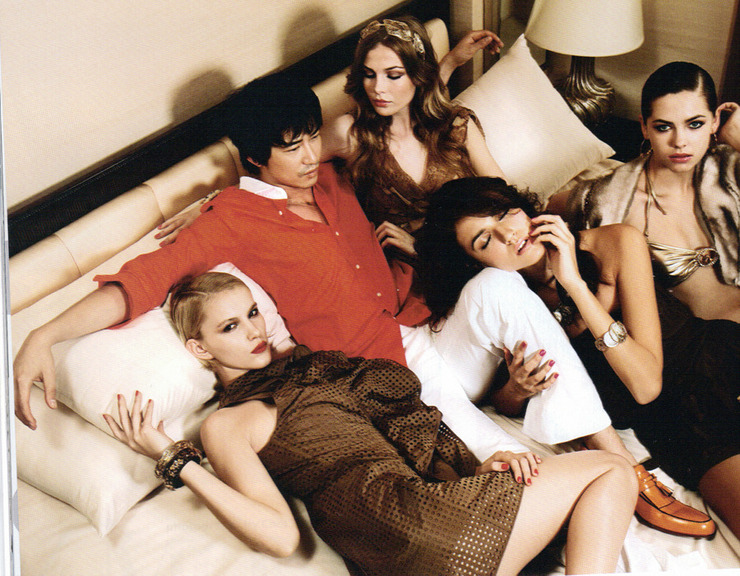
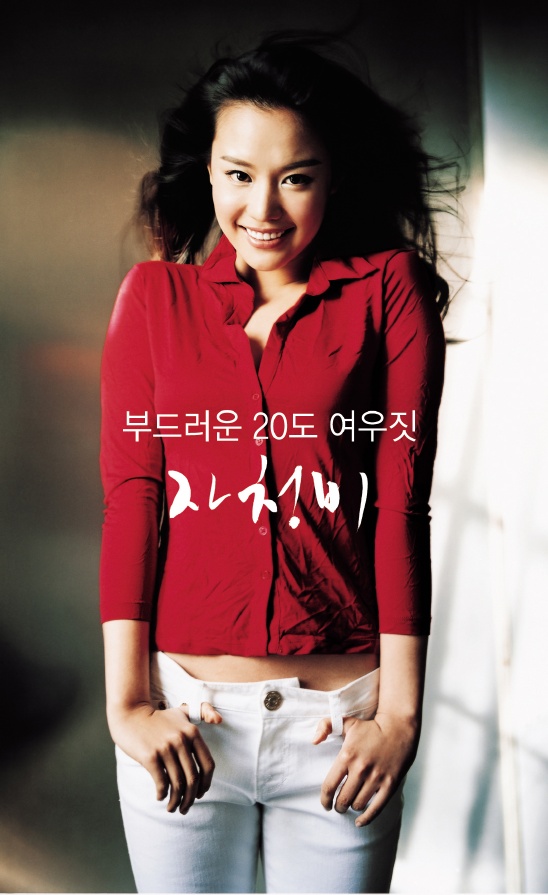
Hence the memorable things Lee Hyori did with a hose for Vidal Sassoon back in 2007 for instance. Or indeed this ad, which, despite the English copy, actually says that “the lunch for amazing women has started”, and then proceeds to do no more to sell to said amazing women than simply plonking Kim Sa-rang (김사랑) with a smouldering gaze on it, flanked by Lee Tae-im (이태임) with textbook hair-preening and hand on hip.

Surely there’s no doubt in anyone’s mind that, although being aimed at women, it’s still squarely aimed at a male gaze?

But if that’s what so bugged me about it, then critically analyzing ads would only ever be an exercise in frustration. And I’m not even against gendered marketing per se either: despite the vast majority of it having no biological basis, and also serving to create and/or reinforcing existing gender stereotypes, admittedly it does sometimes have a genuine financial logic.

Rather, it’s the sheer laziness of this ad that gets me: was this really the best T.G.I. Friday’s could have come up with to get women to eat more steak?

Also, it’s amazing how unnatural the ad suddenly appears if you mentally replace the copy with “amazing men” instead (let alone considering how the ensuing male models would pose). When I did so myself, it really hit me just how much gendered marketing is actually aimed only at women, and how many normative advertising categorizations of female consumers (e.g. Alpha Girls, Omega Girls, Gold Misses etc.) completely lack any male equivalents.

Which is an unfortunate association I now have with T.G.I. Friday’s I guess. But then they’re the ones that came up with such a lame ad!

Korean Sociological Image #59: Childcare is (Still) Women’s Job!

(Source)

Do crosswalk lights with only male-shaped figures really discriminative against females? That’s a hard sell on any occasion, let alone when it would cost 21 million dollars to replace them all with both male and female ones instead, and so netizens have rightfully “responded with merciless mockery” to the Seoul Metropolitan Government’s plan. As has the cartoonist Ju Ho-min too, whose humorous extension of the city’s logic needs no translation!

Instead, a much better candidate for signs to replace would be these ubiquitous reminders that it’s only women that should look after children:

Women do look after children of course, and so technically signs like these aren’t discriminatory in themselves. But as this photo and those below make clear, they’re not just not countered by equal numbers of signs showing men taking care of children, but in fact female figures are only used when a child is also involved:

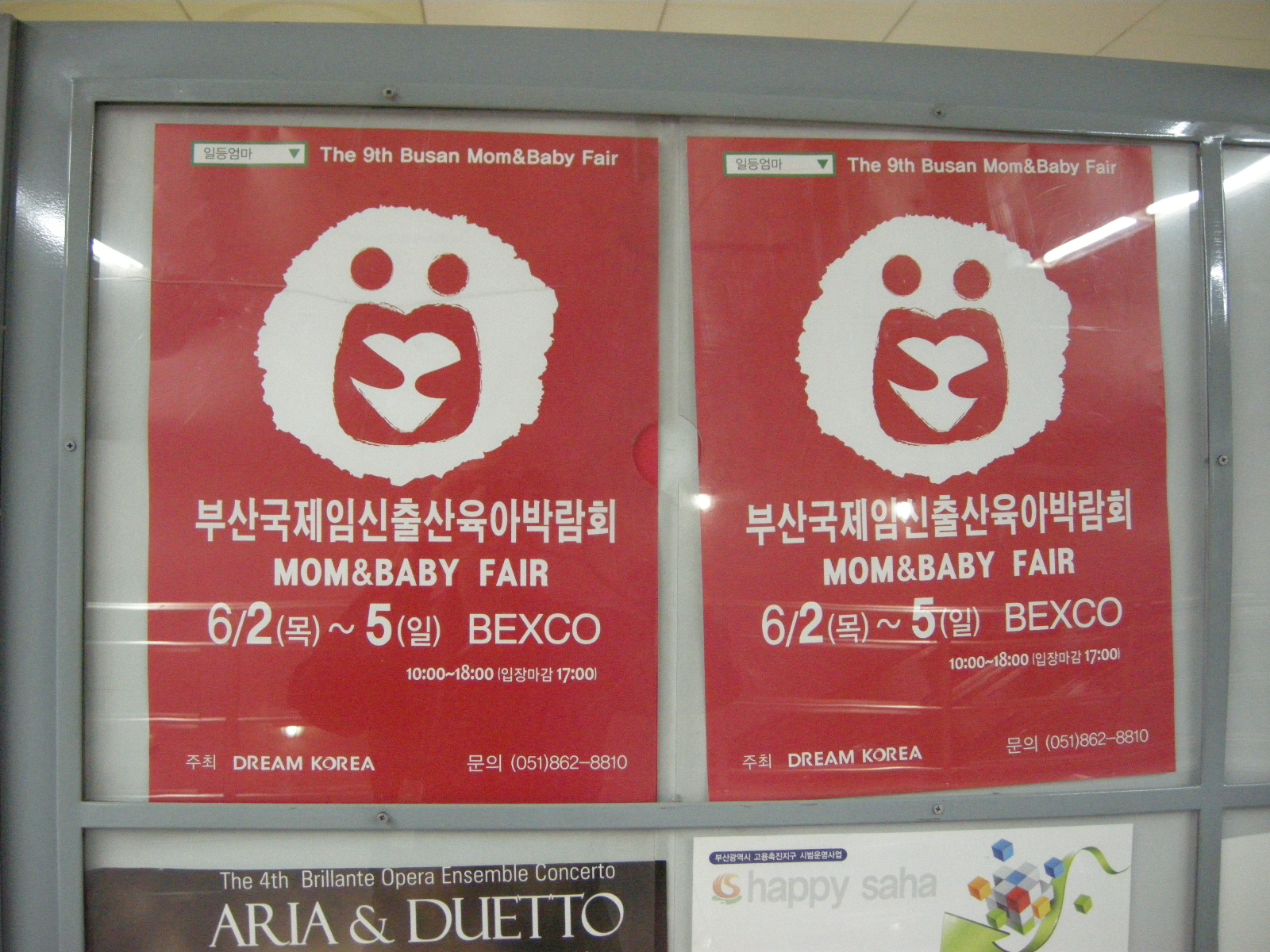
Lest I sound like I’m singling Korea out for criticism however, note that such images are almost universal, and indeed the above ones look almost exactly the same as those in Dublin airport. Moreover, once you move away from signs to language instead, then, possibly following overseas examples, actually discriminatory English slogans are sometimes chosen rather than making Korean ones, such as with airline Asiana’s “Happy Mom Services”. Or alternatively, consider the 부산국제임신출산육아박람회 that I learned about today, which would simply be “The Busan International Pregnancy, Childbirth, and Childcare Exposition” in English, but which somehow got translated as “The 9th Busan Mom & Baby Fair” instead:

As it’s not just for moms and babies if you can read the Korean though, then accordingly there are many fathers and would-be fathers featured on the website, and actually I was one of them myself back in either 2005 or 2006 before my first daughter was born. I don’t recommend going though, as I recall finding some of the services being promoted there – stillbirth insurance for example – just a little cold and off-putting!

Finally, for some Korean takes on subway signs that I managed to find, see here and here. Unfortunately, they’re a little old (2004 and 2006 respectively), which suggests that no-one’s really thought about them in a while. But on the plus side, the Seoul Metropolitan Government’s misguided plans have at least brought national attention to the issue of (potential) sexual discrimination in signs, so now may well be the best opportunity ever to suggest that something be done about them. Ideally, by using the money earmarked to change the crosswalk ones to change the subway ones instead.

If anybody knows how to go about contacting them, then that would be much appreciated!

Update: On Becoming a Good Feminist Wife has more commentary on the planned new crosswalk signs here.

(For all posts in the Korean Sociological Image series, see here)

Share

Korean Sociological Image #56: Start ‘Em Young! (Updated)

(Source)

Apologies for the continued slow posting folks, but I have several good excuses, one of which involves spending a lot of time in doctors’ waiting rooms. Unlike most normal people however, that’s actually something I look forward to(!), as it gives me the opportunity to peruse the hundreds of advertisements in the notoriously thick women’s magazines there.

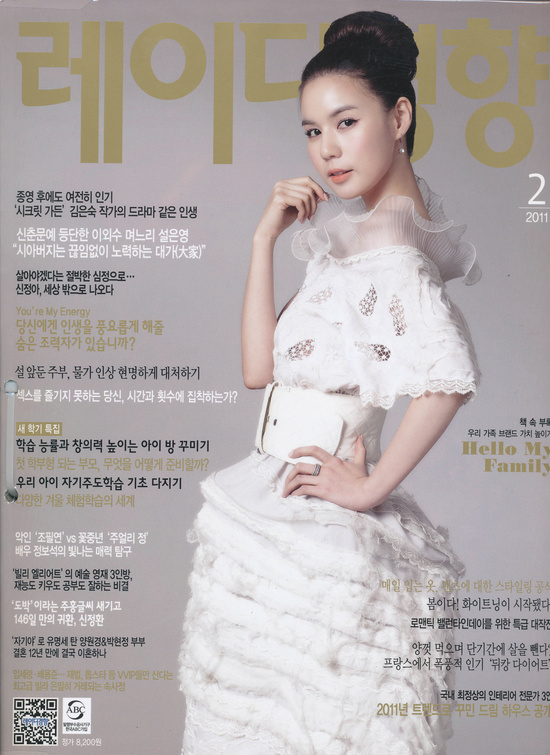
Like Laedygyeonghyang (레이디경향; Lady Trend) for instance, which at 8200 won (US$7.32) a pop, is normally much too expensive to buy just for the sake of a few pictures. But then I saw the February edition, and was hobbling to the nearest bookstore literally as soon as my bandages were changed (the nurses had to call me back inside for my injection).

(Source)

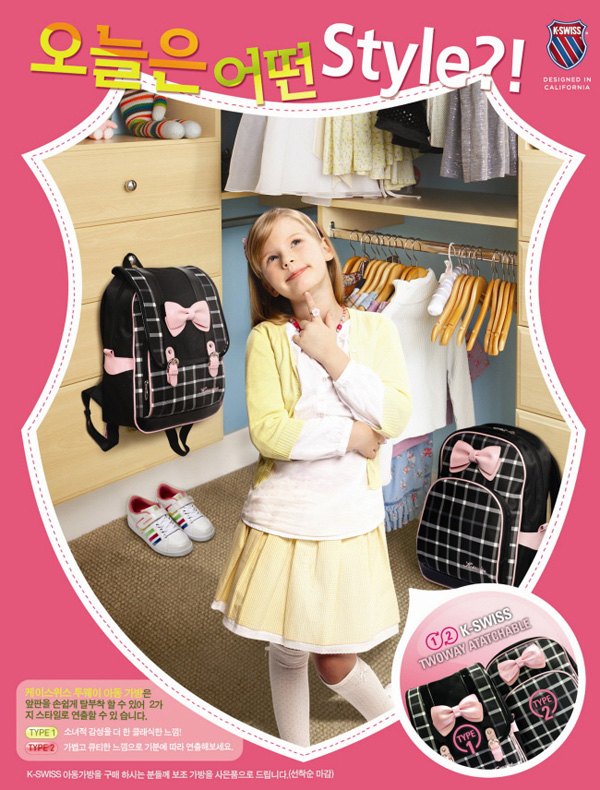
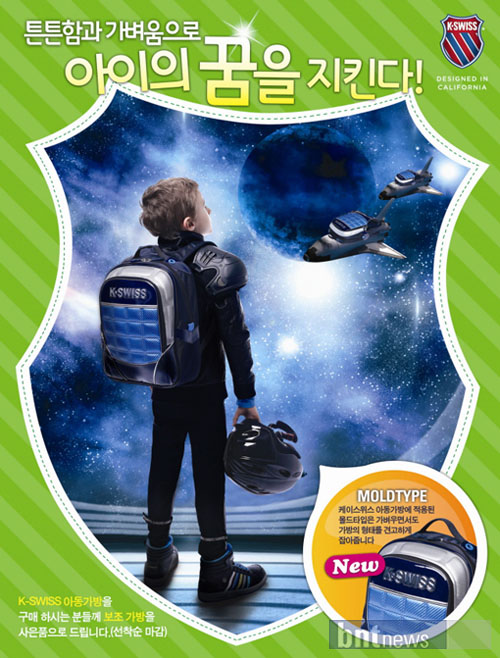
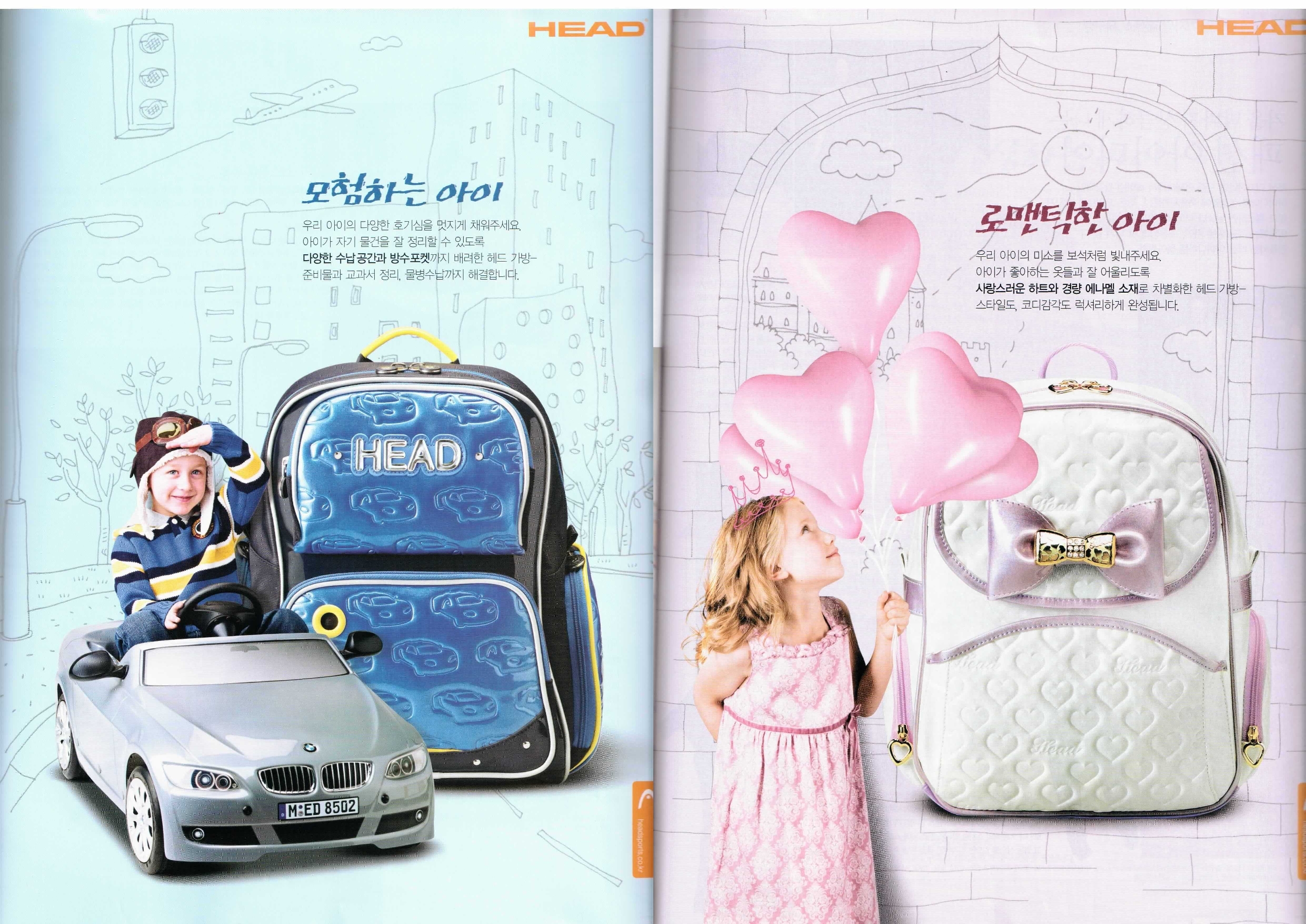
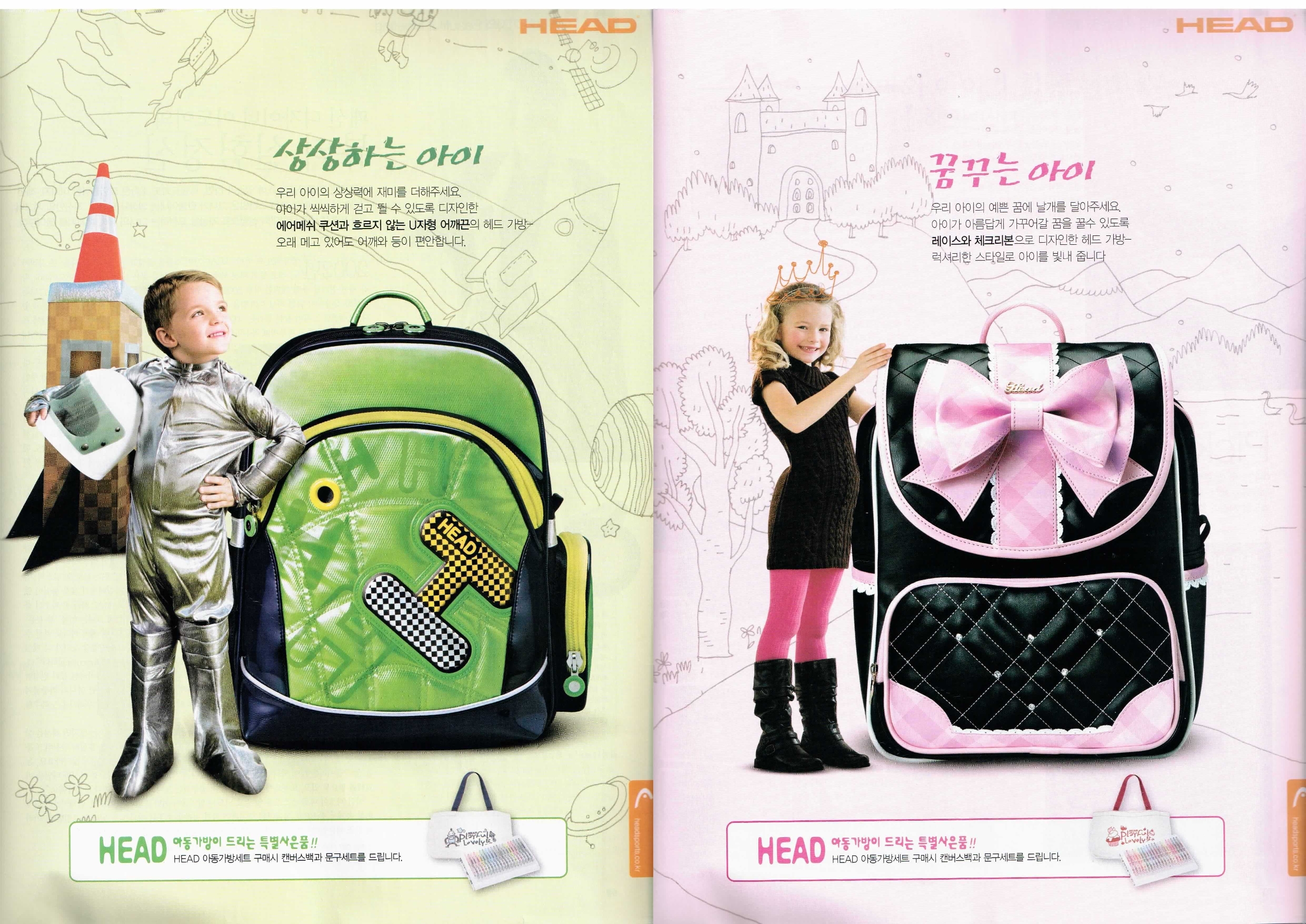
You see, February to March being the start of the school year in Korea, then the first 30 pages or so had 6 full page advertisements for children’s schoolbags. And all of those aimed at girls stressed how attractive or pretty they would make them look, whereas all of those aimed at boys stressed how they could help them achieve their dreams, their appropriateness for rough and tumble play, and so on. Perpetuating gender stereotypes in a manner much more reminiscent of the 1960s and ’70s than something you’d expect to see in 2011, this was really quite shocking, and an indictment of how – in terms of socializing children at least – advertising has definitely regressed in recent years.

Unfortunately, the magazine was no longer available, but as you can see above I did manage to find at least the 2 K-SWISS (케이스위스) ones online later (the other 4 were from HEAD {헤드}). Paraphrasing just a little, the Korean on the girl’s ad reads “What style shall I choose today?!”, while that on the boy’s reads “Through [this bag’s] strength/firmness and lightness, achieve children’s dreams!”. Sigh.

(Source)

Update 1 – Of course, those messages were pretty obvious from just the visuals. And given that, the fact that Caucasian models were used, and that K-SWISS is an American company, then I was curious as to if this was in fact an American ad that had been used in other markets, with just the text translated. A quick check of its main website though, shows that only the Asian branches had kids’ lines, but which still leaves the possibility that they’re generic ads for the East Asian region.

Have any readers based there seen their own local versions? Or – wherever you are – any other children’s ads like these?

Update 2 – With my thanks to the staff of Dr. Lee’s Orthopaedic Clinic, I was allowed to take the magazine home to scan. While my memory had been a little faulty – the advertisements for school bags were in the first 100 pages, not 30; there were also advertorials for them later; and there were 3 advertisements from other companies that were fine –  I’d made no mistake about the HEAD ones:

The title on the left reads “Adventurous Children”, and that on the right “Romantic Children”. In the next ones they (literally) say “Imagining Children” and “Dreaming Children”, which technically speaking is fine I suppose, but then just look at what each child is imagining…

(For more posts in the Korean Sociological Images series, see here. Or, for more on the Korean women’s magazine industry specifically, please see here)

Share

Gender Advertisements in the Korean Context: Public Lecture, Tuesday March 8th 7:30pm, Royal Asiatic Society, Seoul

(Sources: SeoulBeats & personal scan)

See here for the details. Alas, with just 1 hour available then there’ll be little opportunity to do more than summarize what I’ve already written in my “Gender Advertisements in the Korean Context” posts unfortunately (see the right sidebar), but hopefully my very visual presentation will be a much more fun introduction to the topic then reading those tens of thousands of words would be. And it’ll be great to finally meet Seoul-based readers, and to hear your own opinions face to face.

What’s more, it’ll also be my birthday next Tuesday. So you have to come!

Share

Korean Sociological Image #54: Sex & Drugs

(Source: Focus {Busan ed.}, 08.12.2010, p. 17)

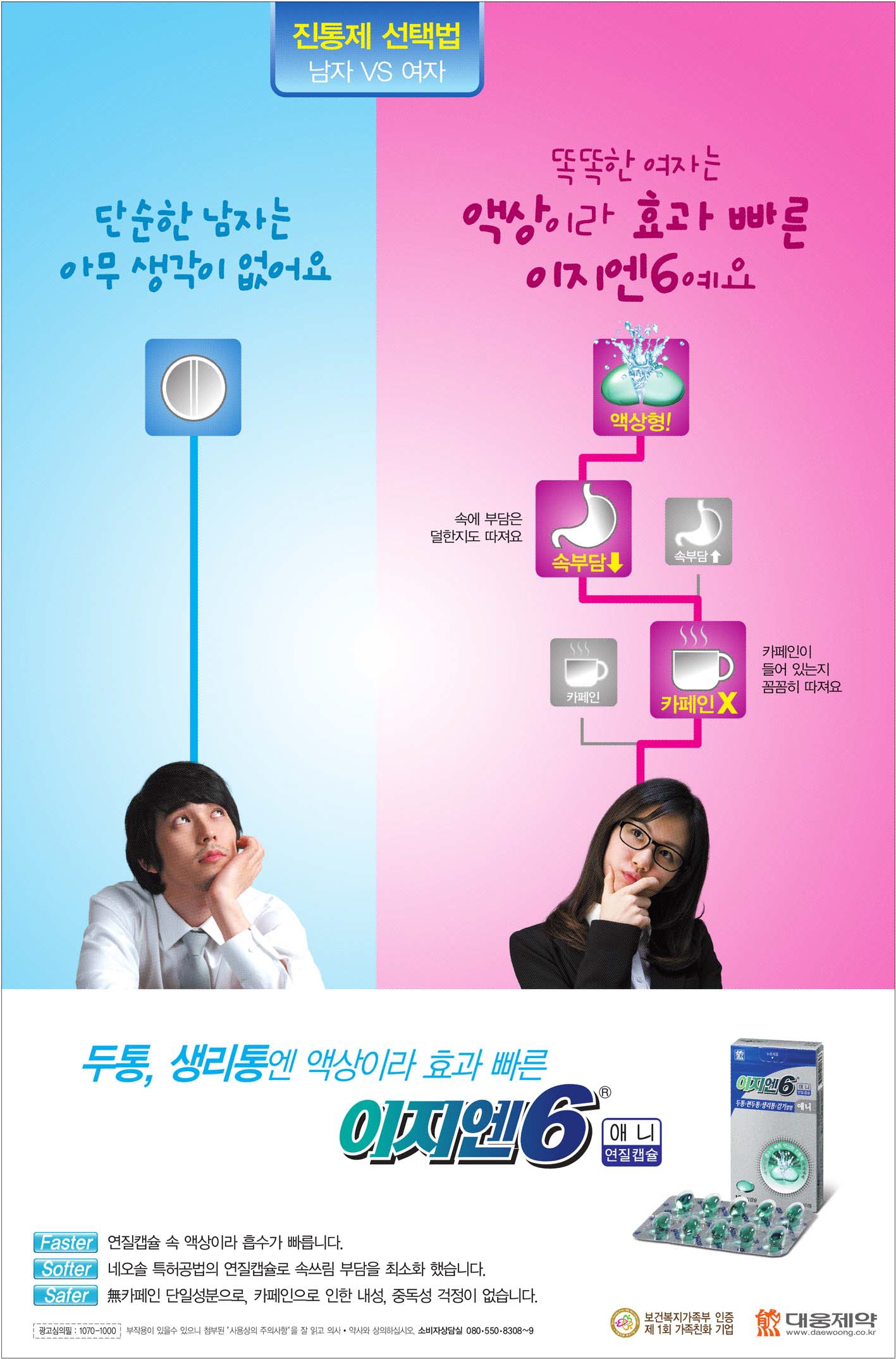
As we all know, if you’re a real man, then you couldn’t care less about what painkiller to use.

But to be precise, the ad actually says dansoonhan men (단순한남자). Which usually translates as “simple” in English, but probably best would be “straightforward” in this case.

Forgive me though, for still considering myself just as smart (dokdokhae;똑똑해) as the woman in the ad. After all, I too wear glasses sometimes.

How am I supposed to choose a painkiller then? Or – heaven forbid – straightforward women for that matter?

Alas, the ad gives no clue:

Methods of choosing a painkiller – Men vs. Women

Straightforward men [choose] without thinking.

As for smart women…because it’s a liquid, its effects are fast. This is EZN6.

Liquid Form…[They need to] think about if it will decrease the burden on the stomach or not

[They need to] carefully think about if it contains caffeine or not

And at the very least, it certainly doesn’t discourage the notion that looking after one’s body is really something only women should do. Unlike most products that are marketed very differently to each sex though (see here, here, here, here, and here for more Korean examples), the irony here is that there’s now a wealth of evidence to suggest that painkillers that work on one sex can be ineffective or even increase pain on the other. In the near-future, there may well be completely different painkillers developed for men and women.

And when they are, then yes: I’d wager that they’re going to be pink and blue too.

You’re in for a world of hurt Neo! (Source)

When that day arrives though, do you think Daewoong Pharmaceutical (대웅제약) will simply come up with 2 versions of the ad, each only featuring one sex? Or will ads for men continue to emphasize simplicity, but those for women stressing how they’d have even more things to consider?

My money’s on the latter…!

(For all posts in the Korean Sociological Images series, see here)

Share

Sexual Harassment in the Workplace & the 2001 Equal Employment Opportunity Law: What Still Needs to be Done

(Source)

With thanks very much to Marilyn for the translation of the following article from Ildaro (일다), I’ll quickly let it speak for itself:

고용불안 속, 직장내 성희롱 위협 커져

In the midst of employment instability, the threat of workplace sexual harassment increases

고용평등상담실 10년, 여성노동의 현실과 미래를 말한다(2)

10th year of the Equal Employment Counseling Office, discussing female employees’ present and future

[편집자 주] 2001년 남녀고용평등법 4차 개정으로 고용평등상담실 지원제도가 도입된 지 10년이 되었습니다. 민간단체들의 고용평등상담실은 그동안 여성노동자들의 실질적 보호장치로 기능해왔으며, 여성노동자들이 처한 현실을 사회에 고발하는 창구역할을 해왔습니다. 일다는 여성노동자회와 함께 고용평등상담실에 접수된 상담사례를 통해 IMF 경제 위기 이후 후퇴 일로를 걷고 있는 여성노동의 현실과 과제를 살펴보고자 합니다. 필자 황현숙님은 현재 서울여성노동자회 회장을 맡고 있습니다.

우 리 사회의 성폭력 문제는 온 국민이 알게 된 끔찍한 아동 성폭행, 유명 정치인의 성희롱 등으로 자주 언론에 오르내리는 이슈가 되었다. 직장내 성희롱으로 고용평등상담실의 문을 두드리는 여성들의 호소 또한 가벼운 성적 농담이나 접촉을 넘어서 심지어는 강간에 이르는 경우조차 발생되고 있다. 직장내 성희롱은 그 자체가 미치는 정신적․신체적 악영향, 노동환경의 악화뿐만 아니라 일자리 자체까지 위협받게 된다는 데에 그 심각성이 있다.

[Editor’s note] It’s been 10 years since the Equal Employment Counseling Office support system was introduced through the 4th Amendment to the 2001 Equal Employment Opportunity Law.  During that time, the Equal Employment Counseling Offices of private organizations have been functioning as female workers’ practical safeguards and have acted as liaisons that report to society the realities that female workers encounter. Through the case consultations received in the Equal Employment Counseling Office, Ilda and the Women Workers Association intend to look at the realities and problems of women workers, who are losing ground after the 1997 Asian Financial Crisis.   Author Hwang Hyun-sook  is the current head of the Seoul Women Workers Association.

Through incidents of horrible child molestation, a famous politician’s sexual harassment, and others of which the entire nation is aware, our society’s problem with sexual violence has become an issue that often comes up in the press.  According to the complaints of women workers who’ve knocked on the Equal Employment Counseling Office’s door because of sexual harassment, there are also cases occurring that surpass light sexual jokes or touching to go as far as rape.  Workplace sexual harassment itself not only has bad mental and physical effects and worsens work environments, but is even of such a magnitude that jobs themselves [of victims] may be threatened.

(Source)

일자리 위협으로 이어지는 직장내 성희롱

“과장이 ‘피곤하지?’라며 손, 팔을 주물러 너무 불쾌하여 늘 가슴을 조이며 지냈어요. 어느 날 허벅지를 만지기도 하여 우울증에 시달리다가 문제제기를 하였더니 그 후 재계약을 하지 않겠다는 통보를 받았어요. 성희롱으로 실직하게 된 것 같아 너무 억울해요.”(2009년 상담사례, 계약직)

“사 장님이 자꾸 만나자고 하면서 ‘옆에 오면 가슴이 떨린다. 만나면 안고 싶고 무릎을 베고 누워 얘기도 하고 싶고 즐기고 싶다. 나를 받아 줄 수 없냐.”고 하더라고요. 남자에 대해 관심이 없다고 거절했더니, 부장을 통해 퇴사하라는 통보를 받았는데……“(2009년 상담사례, 2개월 근무)

성희롱 가해자가 사업주, 상사 인 상담은 매년 75~85% 가량이다. 가해자가 인사권을 직접 가지고 있는 경우가 많아 성희롱을 거부하거나 문제제기했을 경우에는 직. 간접적인 괴롭힘으로 스스로 그만두게 하거나 권고사직, 심지어 다른 사유를 들어 해고하는 사례들도 나타난다. 그래서 성희롱이 발생해도 공론화하기 어렵고 이를 은폐하도록 가해자가 권력을 행사하기도 한다.

Workplace sexual harassment extending to job threats

“My manager would ask, ‘Are you tired?’ and massage my hands and feet; it was so uncomfortable and I always went around feeling anxious.  One day he even touched my thigh and so while suffering from depression, I made a complaint; because of that I received notice that my contract wouldn’t be renewed.  I became unemployed because of sexual harassment – it’s so unfair.” (2009 counseling case, contract worker)

“The president of the company often asked me out and said ‘When you come near me my heart pounds.  If we go out I want to hold you, put my head in your lap and talk, and have fun.  Can’t you accept me?’  I refused, telling him I wasn’t interested in men, and through the general manager I received notice that I was to resign…” (2009 case consultation, working for 2 months)

Every year, about 75-85% of the consultations are ones in which the perpetrator of sexual harassment is the business’ owner or victim’s boss.  There are many cases in which the perpetrator is directly in charge of the company’s human resources.  Because of this, when the victim has rejected the perpetrator’s advances or made an official complaint, there have been cases in which the perpetrator may cause her to quit though direct or indirect harassment, urge her to resign, or even find grounds to fire her.  Therefore, even though sexual harassment occurs, making it public is difficult and the perpetrator often exerts his authority to conceal it.

(Source: unknown)

성희롱의 온상, 회식자리 남성중심 문화

“입 사한지 1주일 만에 본사 간부급 직원들과 회식자리가 있었어요. 간부들이 버릇인양 손잡기, 어깨동무하기, 허리 감싸기, 끌어안기, 볼 부비기……. 마치 간부들을 위해 여직원들이 대접하는 자리 같았는데 어렵게 입사하여 그만둘 수도 없고 어찌해야 할지……” (2007년 상담사례, 정규직)

“회 식 2차로 노래방에 끌려가다시피 갔어요. 술 마신 남직원들이 안으려고 해서 피했는데, 갑자기 뒤에서 끌어안더니 들었다놓았다하는데 과장, 계장 모두 묵인하고, 계장은 블루스를 추자고 하더라고요. 그래서 울면서 집에 왔는데 동기들도 다른 구청이나 동사무소 근무하면서 회식자리 성희롱 때문에 너무 힘들어 해요. 블루스를 춘 여직원한테는 잘해주고, 안 추면 욕하고 못살게 군다고 하더라고요.” (2007년 상담사례, 공무원)

회 식문화가 변하는 곳도 생겨나고 있지만, 회식자리에서의 성희롱은 지금도 일상적으로 일어나고 있다. 회식자리는 직장내 위계적 관계의 연속으로 상사의 기호에 맞추어야 하고 그의 요구에 따라야 하는 업무의 연속처럼 진행된다. 우리 사회의 남성 중심적인 문화, 위계질서가 이어지는 회식 문화는 여성들의 고용환경을 악화시키는데 일조하고 있다.

The hotbed of sexual harassment, office dinner male-centric culture

“I was at an office dinner with head office management-level employees only a week after joining the company.  The executives had habits of holding my hand, putting their arms around my shoulders and waist, hugging me, pressing their cheeks against mine…   It was like a place for the female employees to serve executives; it was hard to get a job here so I can’t quit and [don’t know] what to do…”  (2007 case consultation, regular employee)

“I went to the second [drinking-heavy] part of our office dinner like I was being dragged.  Male employees who were drinking were trying to hug me so I avoided them; suddenly I was embraced from behind and picked up and put down.  The manager and section chief overlooked everything, and the section chief asked me to slow-dance with him.  So I came home crying; also my peers who work at other district offices or dong offices have a really hard time because of sexual harassment at office dinners.  They say the female employees who slow-danced are treated well, and if you don’t dance they curse and treat you badly.” (2007 case consultation, government employee)

There are places where office dinner culture is changing, but sexual harassment at office dinners happens regularly even now. Office dinners progress similar to the  business itself, in which one must adjust to the preferences of a superior ahead of one in the workplace’s hierarchical relationships, and follow his demands.  Our society’s male-centric culture and hierarchy-connected office dinner culture lead to the worsening of women’s working conditions.

(Source)

친밀한 관계가 질곡인 영세소규모사업장 성희롱

“5 명도 안 되는 회사에서 근무한지 2개월인데 사장이 아침부터 술을 먹자고 하고, 남자친구랑 몇 번 하냐고 묻고 ‘나랑 애인 같은 거 하자’는 소리를 자꾸 해요. ‘이런 소리 들으려고 일하는 거 아니다’라고 말하면 무릎 꿇고 안한다고 하면서도 술만 마시면 또 그러니 일자리가 아니라 고문받는 자리 같아요.”(2008년 상담사례)

“연 말에 사장이 송년회를 가자고 해서 부담스러웠지만 가게 되었어요. 결국 2차까지 가게 되었는데 노래방에서 강제로 키스를 하고 옷 속으로 손을 넣어 몸을 만졌어요. 거부하면서 강하게 밀쳤더니 “난 사장이고, 넌 경리야”, “너 내일부터 나오지 마.”라는데, 다시 직장을 알아보면서 화도 나고 얼굴 보는 것도 두렵고 생각할수록 화가 나고 억울해요.“(2008년 상담사례, 사업주와 2명 근무)

영세소규모사업장의 성희롱은 가해자가 사업주인 경우가 많아 실질적인 법적 조치가 어려운 점, 성희롱 예방교육 특례조항 적용 사업장이라 예방교육이 실시되지 않는다는 문제점이 있다.

업 무적으로 둘만이 접촉하는 경우가 많아 사업주의 부당한 성적 요구나 사적인 친밀감을 성적 언행으로 표시하는 경우도 잦다. 성희롱을 거부하면 바로 그만두라는 통보를 받는 노동권 위협의 문제도 크지만, 매일 가까운 곳에서 얼굴을 마주쳐야 하니 버티고 싶어도 버티기 어렵다는 어려움이 있다.

Sexual harassment in a small business bound by close relationships

“I’ve been working for 2 months at an office that doesn’t even have 5 people in it; from the morning on the president suggests drinking together, asks me how many times I do it with my boyfriend, and keeps saying ‘Let’s date or something’. When I say, ‘I don’t work in order to listen to this kind of noise’, even though he gets on his knees and says he won’t do it [anymore], when he drinks, he gets like that again, so it’s like a torture chamber, not a workplace.” (2008 case consultation)

“At the end of the year, the president wanted to have an end-of-the-year party, so I went though it was annoying.  I ended up going to the second part and at a karaoke room he forcibly kissed me and put his hands under my clothes and touched me.  I refused him and pushed him hard so he said ‘I’m the president and you’re the bookkeeper’ and ‘From tomorrow, don’t come in [to work] anymore.’  I’m looking for another job and I feel angry and afraid of seeing his face, and the more I think about it, the angrier I get and the more unfair it feels.”  (2008 case consultation, office with company president and two people)

There are many cases in which the perpetrator of sexual harassment in a small business workplace is the business owner, so real legal measures are a challenge, and they are workplaces to which the Sexual Harassment Prevention Education Exception Clause applies, so there is the problem of prevention education not being implemented.

There are many cases in business in which two people only have contact with each other, so cases in which the business’ owner expresses his unjustified sexual demands or personal feelings of intimacy through sexual speech and behavior also frequently occur.  If victims rebuff the sexual harassment, the labor rights-threatening problem of immediately receiving notice to quit is serious, but there is also the drawback that because they have to see the other person’s face nearby every day, even though they want to endure it [keep working], enduring it is difficult.

(Source)

늘어나는 서비스직, 늘어나는 고객에 의한 성희롱

“고객센터에서 근무하고 있는데 외주업체 소속 강사가 메신저로 ‘만나자, 남자친구와 몇 번 했냐는 등의 말과 스킨십을 하는데 법적으로 어떻게 처리할 수 있을까요?” (2009년 상담사례, 텔레마케터)

“노 인돌보미 일을 하고 있는데, 고객이 70세인데 전직 교장이래요. 첫날부터 자꾸 몸을 밀착해오고 ‘젊은 사람이 곁에 있으니 내가 다시 남성이 되는 느낌이다’, 어제는 노골적으로 ‘아랫도리가 되살아난다’며 치근대 괴로워요. 어떻게 해야 할지…….“(2009년 상담사례, 45세)

고 용형태와 업무 방식이 다양해지면서 업무상 맺는 관계의 폭도 다양하고 복잡해졌다. 협력업체나 거래처 직원, 대인서비스직의 성희롱도 다양하게 나타난다. 그리고 간병이나 노인돌봄 같은 사회서비스 일자리가 늘어남에 따라 재가 돌봄서비스에 종사하는 여성들의 성희롱 피해상담도 늘어나고 있다.

Increasing service-industry workers, increasing sexual harassment by customers

“I work in a customer service center.  A supervisor [actually she uses the word for “lecturer” but I think that’s a mistake] affiliated with our subcontractor says things on Messenger like ‘Let’s go out’, ‘How many times have you done it with a boyfriend?’ and so on, and does skinship [touching like they’re in a relationship].  How can I deal with this using the law?” (2009 case consultation, telemarketer)

“I work in elder care.  My patient is 70 years old and says he used to be a school principal. From the first day he has often pressed up against me and said ‘Because there’s a young person at my side I feel like I’m becoming a man again’ and yesterday, saying bluntly, ‘My lower body is coming back to life”, he made pass at me; I’m really upset.  [I don’t know] what to do…” (2009 case consultation, 45-year-old)

As types of employment and ways of conducting business are diversifying, the range of relationships formed through business is also diversifying and becoming complicated. Sexual harassment of employees of subcontractors or clients, and personal service workers also presents itself in various ways.  Also, in line with the increase in social service positions like nursing or elder care, sexual harassment victim counseling for women working in in-home care is also increasing.

(Source)

성희롱은 사적인 일?

“남자 동료가 수시로 농담을 하면서 뽀뽀하자, 너도 밤일 할 줄 아냐는 등 수치심을 갖도록 하여 회사에 제기하였는데, 개인의 일이라고 개인적으로 대응하라고만 하는데……”(2009년 상담사례)

직 장내 성희롱은 안전한 환경에서 일할 노동권과 직접 관련이 있다. 그래서 남녀고용평등법에서도 직장내 성희롱을 금지하고 있을 뿐만 아니라, 사업주의 의무로 △직장 내 성희롱의 예방을 위한 교육 실시△성희롱 행위자에 대하여 징계나 이에 준하는 조치를 취할 것△피해자에게 해고나 다른 불이익 조치를 하지 말 것을 규정하고 있다. 그런데도 성희롱이 발생하여 이를 사측에 문제제기하면 위의 상담사례처럼 개인적인 일로 치부해 버리는 문제들이 여전히 일어나고 있다.

Sexual harassment is personal business?

“A male coworker often makes jokes and says, ‘Let’s kiss’, ‘Do you too know how to do night work [sex]?’ and other things to humiliate me so I made a complaint to the company.  They said it was personal business and just told me to deal with it privately…” (2009 case consultation)

Workplace sexual harassment is directly related to the employee’s right to work in a safe environment.  Therefore, the Equal Employment Opportunity Law not only prohibits workplace sexual harassment, it also stipulates, as the business owner’s duty, 1) implementation of education for the prevention of sexual harassment in the workplace, 2) disciplinary action, or taking steps in accordance with disciplinary action, against the perpetrators of sexual harassment, 3) not firing or taking other disadvantageous action against victims.  However, when sexual harassment occurs and is reported to the management, problems with it just being regarded as personal business, as in the case consultation above, are still coming up.

(Source)

고용평등상담실 통해 가해자의 공식사과와 징계 등 확보하기도

“부 원장님이 간호사들에게 안마를 해달라고 하거나 성적인 얘기도 잦아 힘들었어요. 며칠 전에는 맨발로 제 다리를 쓰다듬었는데 징그럽고 수치스러운 느낌 때문에 정신과 상담까지 받았어요. 그런데 고용평등상담실에서 도와주셔서 부원장은 공개사과와 감봉처분에, 병원 전체에 성희롱예방교육까지 실시하게 되었답니다!”

“과장님 성희롱 때문에 괴로웠는데 상담실에서 도와주셔서 공개사과도 받고 가해자는 다른 근무지로 전출되어 얼굴보지 않고 근무할 수 있게 되었어요!”

직 장내 성희롱 자체가 노동환경을 악화시키고, 이를 문제제기하면 해고나 불이익이 따르기도 한다. 그러나 다른 여직원들을 위해서라도 그냥 있을 수 없다며 이에 맞서 문제를 제기하는 여성들 또한 늘어나고 있다. 이렇듯 권리를 확보하게 되는 사례도 많았지만, 일자리 자체의 불안정이 갈수록 커지면서 적극적인 대응을 주저하는 경우도 많은 안타까움이 있다.

Securing perpetrators’ public apology, disciplinary action, etc., through the Equal Employment Counseling Office

“The vice director frequently asked the nurses to give him massages or talked about sex, so it was difficult.  A few days ago he stroked my leg with his left foot; because of the nasty and shameful feeling, I even got psychiatric counseling.   But the Equal Employment Counseling Office helped me so the vice director’s public apology and pay docking measure, and even sexual harassment prevention education for the whole hospital were implemented!”

“I suffered because of my manager’s sexual harassment, but the Equal Employment Counseling Office helped me so I received a public apology and the perpetrator was transferred to a different workplace so I don’t see his face and I’ve become able to work!”

Workplace sexual harassment itself has a negative effect on a work environment, and if one reports it, dismissal or disadvantages often follow.  However, the number of women saying that, for the sake of other women workers, they can’t just [let it] be and accordingly, making complaints, is rising.  In this way there have been many cases that secured rights, but regrettably, as the instability of jobs themselves increases, there are many cases in which [victims] hesitate to take assertive action.

(Source)

직장내 성희롱 문화? 이젠 바뀌어야

직장내 성희롱을 겪으면 그만두라고 할까봐 참고 견디거나, 문제제기하면 결국 피해자가 그만두게 되는 상황이 더 이상 반복되지 않도록 해야 한다. 지난 해 여성노동자회 고용평등상담실에 접수된 성희롱 발생 사업장의 78%가 성희롱예방교육을 실시하지 않은 것으로 파악되었다. 그러므로 사업장에서는 형식적이지 않은 예방교육 실시해야 하고 사내에서 발생하는 성희롱에 대하여 조사와 조치, 재발방지 대책 등을 마련하여 실시해야 한다.

그 리고 정부는 이런 사항들이 실질적으로 이루어지도록 적극적인 행정지도·감독을 해야 한다. 또한 남성 중심적이 아닌 성인지적 관점의 성희롱 인정, 영세사업장장의 성희롱 예방교육 지원 확대, 돌봄서비스노동의 성희롱 실태조사와 예방교육 및 대책 등을 마련해야 한다. 이를 통해 우리 사회와 직장 전반의 남성 중심적인 문화가 변화될 때 직장내 성희롱에 대한 인식과 대책의 변화 또한 이끌어낼 수 있을 것이다.

Workplace sexual harassment culture?  Needs to change now

We need to make it so that situations in which, if one experiences workplace sexual harassment, they hold back and endure it because they’re afraid of being told to quit, or in which if they report it, they end up quitting, are no longer repeated. Last year, 78% of the workplaces reported to the Women Worker’s Association’s Equal Employment Counseling Center for sexual harassment were places where sexual harassment prevention education had not been implemented.  Therefore, in the workplace, prevention education that is not cursory needs to be implemented, and for sexual harassment that occurs in-house, research, action, recurrence prevention measures, etc., need to be arranged and implemented.

The government needs to use assertive administrative guidance and supervision to make these remedies become reality.  Also, recognition of sexual harassment from a gender-sensitive perspective that is not male-centric, securing support for sexual harassment prevention education for the owners of small businesses, research, prevention education, and measures regarding the sexual harassment of care-industry workers, etc., have to be arranged. When, through these, both our society’s and all workplaces’ male-centric culture changes, they will also be able to lead to changes in the understanding of and countermeasures for workplace sexual harassment.

Share

The Gender Politics of Smoking in South Korea: Part 4

Estimated reading time: 12 minutes. Source: cutilove.

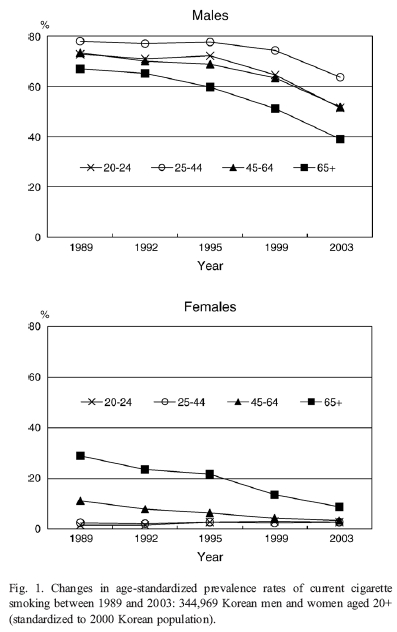
“Smoking Among Men Drops to Record Low” reads a recent headline in The Chosunilbo, with only 39.6% of Korean men over 19 now doing so: a drop of 3.5% from a year earlier, and of 17.1% from 2003. Which is something to be celebrated for sure, but, strangely, the even more amazing news that almost half of women smokers also quit last year barely gets a mention. Why not?

Of course, it may just be an oversight. But there is some context to consider: overemphasizing reductions in the male smoking rate is intrinsic to the Ministry of Health and Welfare’s (보건복지부) tobacco control policies for instance, and it also has a long track record of exaggerating its successes. Possibly then, the report just reflects the Ministry’s own emphases in its press release.

Alternatively, readers too may not have been interested in a paltry reduction of 4% to 2.2%. The rate has always been low, they may have said. And with a 2007 Gallup Korea study finding that 83.4% of Koreans thought that women shouldn’t smoke too, with some even slapping them in the street if they do, then apparently the consensus is that so it should be too.

But given that background, then as you’d expect there is chronic under-reporting of smoking by women, best estimates of their real numbers being closer to 20%. Add the absence of any dramatic social or economic changes to prompt women to give up the habit in droves in just the past year too, then it’s difficult not to conclude that these latest figures are essentially meaningless.

Was a line or two to that effect really too much to expect from a newspaper?

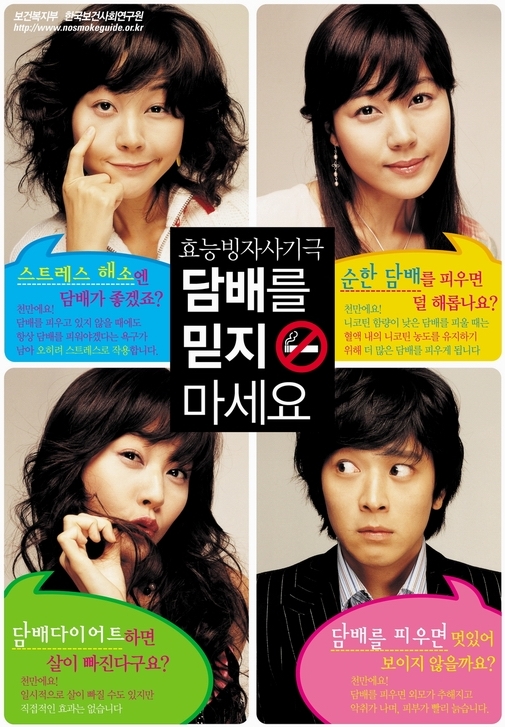
Source: Naver Movies.

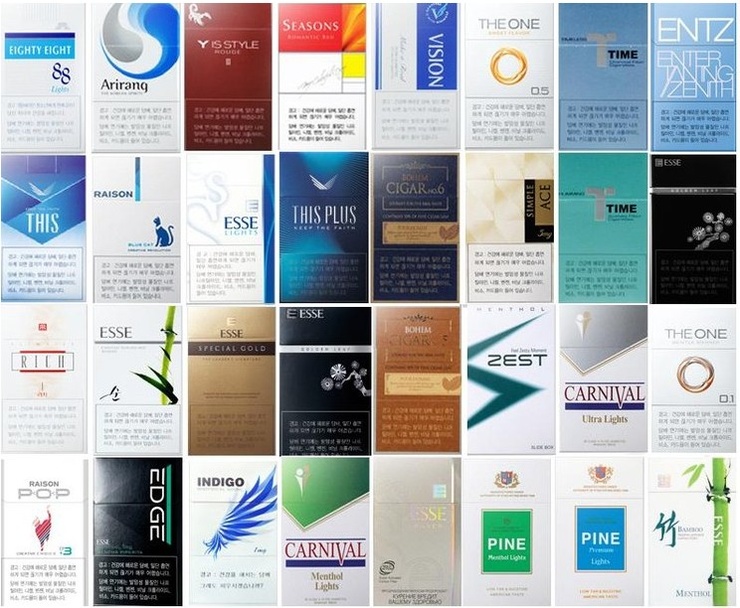
But I’ve already discussed both statistical issues and taboos against women smoking in great depth in Parts One, Two, and Three (and in a newsflash), and, with the benefit of *cough* 6 months’ hindsight (sorry), then there’s little more to add on those topics really. Instead, let me continue this series by looking at the ways in which transnational tobacco companies (TTCs) have successfully targeted Korean women ever since the cigarette market was liberalized in the late-1980s, despite legislation specifically designed to prevent that. Fortunately, the journal article I’ll be relying on – Kelley Lee, Carrie Carpenter, Chaitanya Challa, Sungkyu Lee, Gregory N Connolly, and Howard K Koh in “The strategic targeting of females by transnational tobacco companies in South Korea following trade liberalisation”, Globalization and Health 2009, Volume 5, Issue 2 – is freely available for online-viewing or as a PDF download, and is short and very readable, so I’ll just summarize the main points here.

First, some historical context: this is not the first time tobacco companies have encountered strong taboos against women smoking, with attitudes towards it in the U.S. in the 1920s sounding not unlike those of Korea today (in 1922, a woman was even arrested for smoking on the street). The solution was to get women to associate smoking with equality and female emancipation, as ably described in the following segment of The Century of the Self (2009):

If that gives you a taste for watching the full documentary, as I suspect it might, then see here for links to all episodes. If you’d rather just read an explanation though, then let me refer you to towards the end of this short interview of producer, writer, and director Adam Curtis. Or for something even shorter, then this alternative explanation also gives the gist:

Edward Bernays, the man who supposedly invented most modern PR techniques, in the 1920s convinced women to start smoking. Supposedly at the time smoking was considered gross and basically for men only so very few women smoked. The show claims he hired a bunch of women to march in the New York Thanksgiving Day Parade (a big yearly parade) and had them put a pack of cigarettes in their garters. On cue they were all to lift their dresses and light one up. He then told the press to come to the parade because there was going to be a protest for women’s equality. On cue the women light up, the press took photos and reported lighting up a cigarette as the symbol for women’s equality and like over night it was now seen as if you supported equality for women you should be smoking.

And internal TTC documents demonstrate that that same logic has also been applied to emerging markets across Asia since the early-1990s. Focusing more specifically on Korea here though, crucial is the 1989 National Health Promotion Law Enforcement Ordinance, which bans all tobacco advertising, marketing and sponsorship aimed at women and children (yes really, and for more on this enduring paternalistic attitude, see Part 1). This has been circumvented by TTCs in 4 main ways:

Source: Naver Movies

First, if not blatantly targeted at them, then advertising of each cigarette brand remains permitted up to 60 times a year in print media, and “tobacco companies are also allowed to sponsor social, cultural, music, and sporting events (other than events for women and children) using company names but not product names” (pp. 4-5). Consequently, sometimes TTCs have simply used ostensibly “gender-neutral” advertisements to target women, in the mid-1990s the former Brown & Williamson promoting the Finesse brand (sold as Capri outside of Korea) by using romantic imagery of couples for instance.

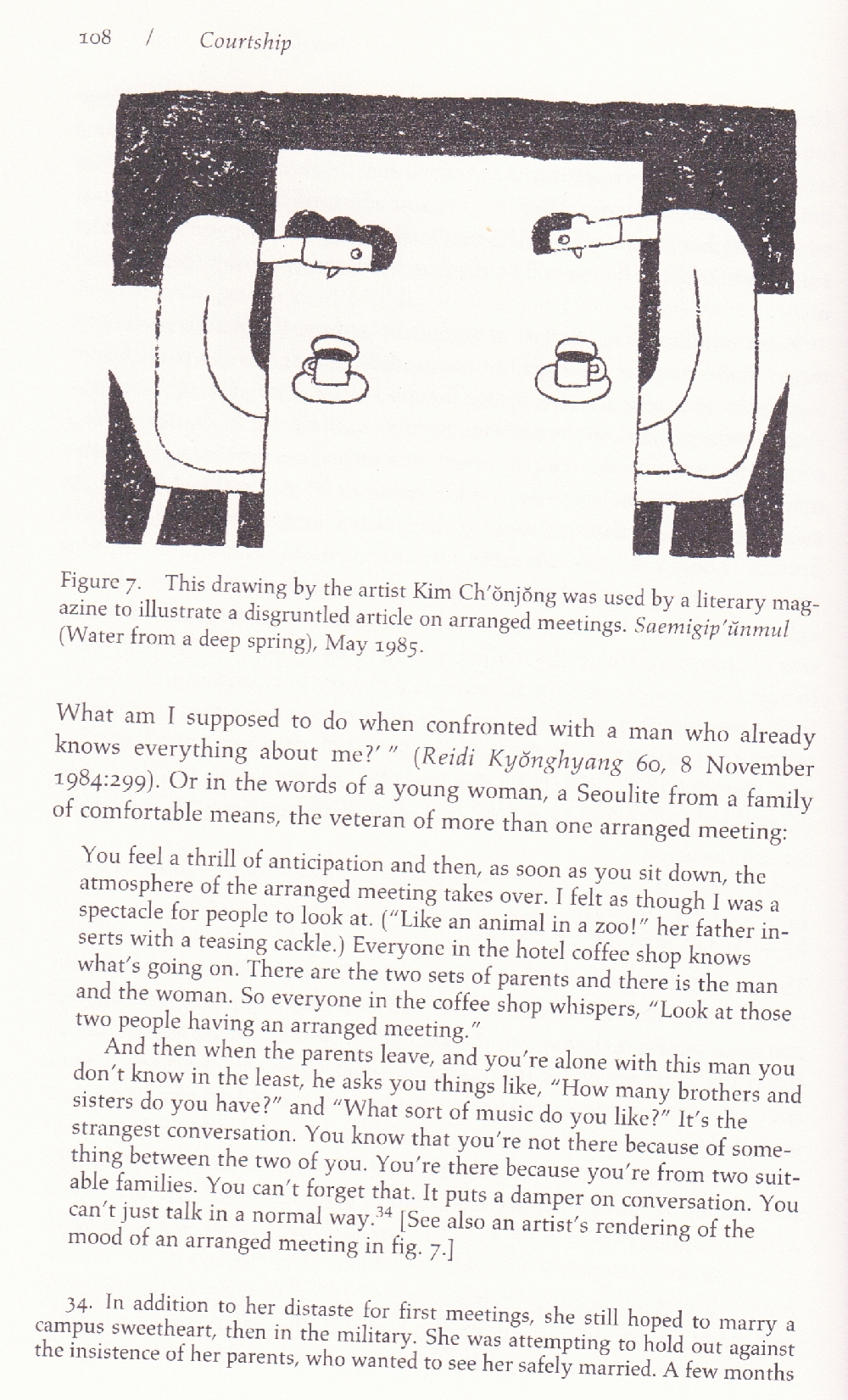
Next, in the 1990s at least there was a focus on retail distribution in venues which tended to be frequented by young women, such as coffee shops, restaurants, event lunches, bars, nightclubs, and so on. Especially the first, and which is worth expanding on here, as it might sound strange in an era of ubiquitous, smoke-free, multinational chain-stores. But then it wasn’t so long ago that they were the place to hang out for young people, a rare oasis from school, work, and/or extended families living under the one, cramped roof. As described in Yogong: Factory Girl for instance (published in 1988, but really about the 1970s):

Often [18 year-old Sun-hi] goes to the home of a friend from her work. Three or four girls, all from the same factory, may walk together, stopping in at a tea room (다방/dabang) for coffee or cola and to listen to music. Or, if they have less money, they may stop to buy a packaged ice cream confection at the local grocer’s. But whether on the street corner or at the tea room, where, for the price of a drink, one may sit without interruption, there is ample opportunity to see and be seen by boys of the same age. (p. 140)

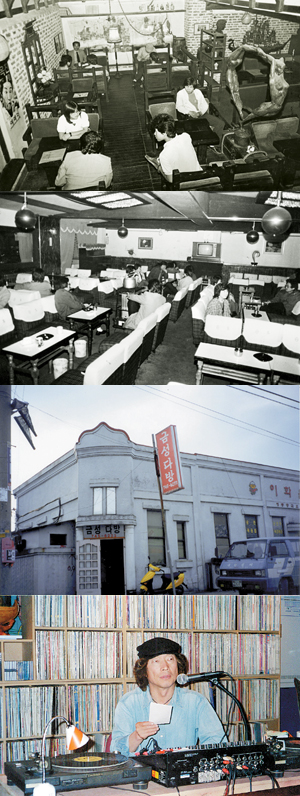
And in particular, in The Joongang Daily (image sourced from article)”

In the 1970s, cafes…became more commercialized, and owners sought to sell an image rather than a drink. “The dabang was a place for socializing. People didn’t care much about the taste of coffee ― and it tasted terrible,” said Mr. Lee.

The hugely popular “music dabangs” were associated with long hair, blue jeans and folk guitarists. Dabang deejays became the idols of teenage girls. When that trend faded, “ticket dabangs” emerged, where sexy hostesses would do more than just pour your coffee.

After half a century of popularity, dabangs started giving way to modern and chic cafes in the 1980s. Specialty cafes such as Jardin and Waltz House ― imitations of Japanese versions of European style cafes ― spread everywhere. This type of cafe, however, had its limits. Despite expensive interiors and espresso machines, the coffee quality was still poor. “Neither cafe owners nor coffee drinkers knew what a cup of good coffee tasted like,” said Mr. Lee.

But in the 1990s, the mantle of coolness suddenly passed away from dabangs:

During my first week in Korea back in 1990, I started going to a small coffeehouse Jardin, just down the street from the language institute where I taught. It was one of these upscale gourmet-type coffeehouses that, according to an article I had read in one of the English-language newspapers, had suddenly started springing up everywhere in the city….Now almost over night, people could choose a variety of coffee concoctions and flocked to these coffeehouses.

This was a big change in the early 90s in Korea. It might have seemed subtle to some people who just wanted to enjoy their coffee, but what was really happening was a break from tradition.

Young Koreans wanted something new and modern. They did not want to hang out in the dank, dark dabangs that were more often than not frequented by middle-aged Korean men and women. Likewise, the tea houses and cafés their parents had gone to in the 70s and 80s were not hip enough for the urban chic beginning to appear.

And as for what happened after 1999, when the first Starbucks opened, then I recommend this recent article in 10 Magazine. But then *cough* this post is actually about gender and smoking rather than coffee per se, so let me just highlight two aspects of that most recent development here.

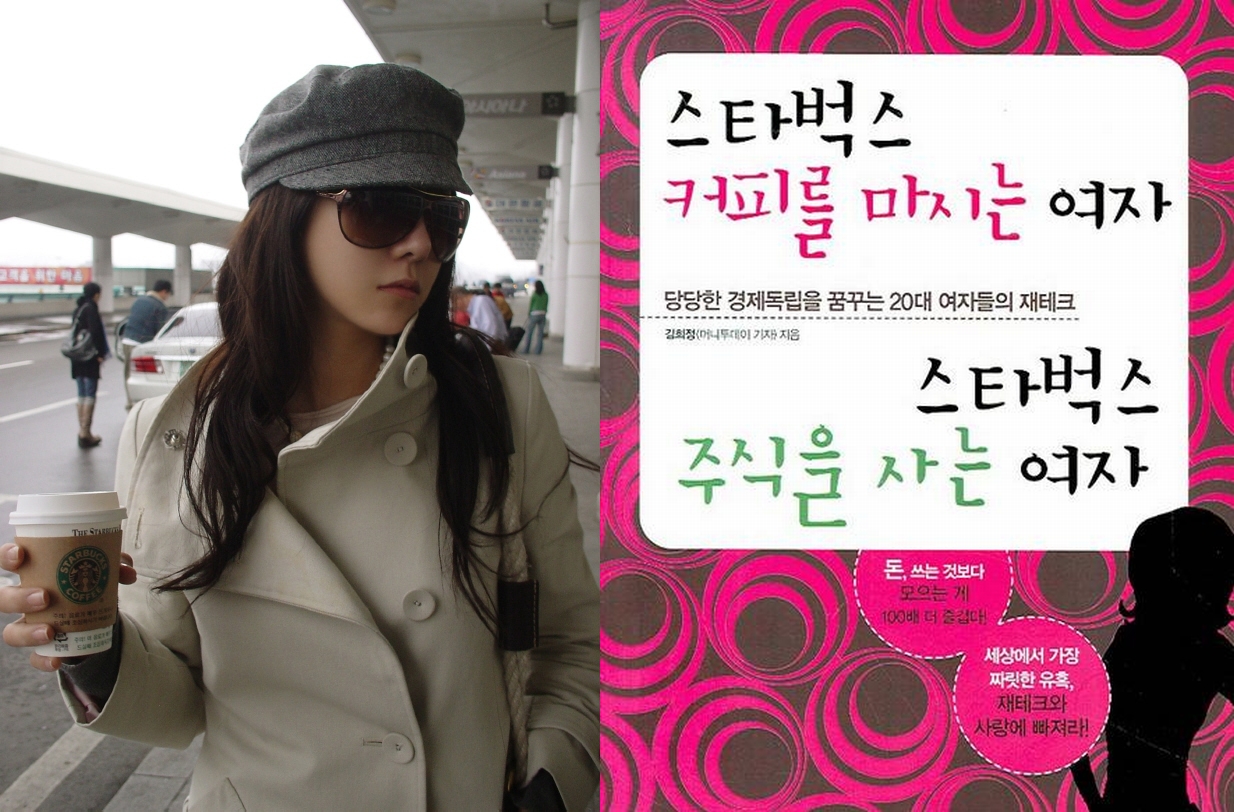
First, that these new, Western establishments have been more heavily patronized by women than men, as explained by Gord Sellar back in 2008 (and recently expanded upon by him here):

The interesting thing to look at is the emergent young women’s consumer society. I’ve been trawling about online, trying to piece together the story of the Soybean Paste Girl archetype (or, dwenjang nyeo{된장녀}, as she’s called in Korean), and what I’ve found is that almost all of the criticism of this young woman is focused on her female-consumerism. That is: when she buys a coffee from Starbucks for W4,000 (usually about $4, though the won is doing badly these days) coffee, she gets criticized, but when a young man of the same age consumes two bottles of eminently acceptable (read: Korean) soju, nobody thinks to criticize it. The soju, that’s normal, but the Starbucks… that’s all foreign, all “expensive,” and more disturbingly, it’s “girly.” Girls can go there and have fun without men. (Which is doubly threatening to young men who frustratedly already see such women as “out of their league.”) As in, you see women in Starbucks with women, you see women in Starbucks with men. You almost never see men in Starbucks with men. Starbucks, like Gucci and Prada and Luis Vuitton before it, and like Outback and other “Western” restaurants since, are distinctly of appeal to women.

Sources: left, right.

And second, that women are puffing away in droves in them, as I’m no Picasso explained in a comment on Part 3:

It would be interesting to look into the correlation between the development of coffee shop culture in Korean and that of the growth rate of female smokers. I’ve seen maybe five women smoking on the street in my nearly two years in Korea, and at least three of those were ducked into telephone booths or alleys. However. When I sit in the smoking rooms of cafes (which I do quite often), they are often (particularly in the afternoon, when the coffee shops are full almost exclusively of women, with no male audience around to balk) overflowing with groups of young women smoking. A commenter above mentioned the lack of public space available for such behavior. The coffee shop seems to have become a safe haven for women smoking openly in public. I would say the growth of the popularity of coffee shops have encouraged women to be seen, at least here, smoking in public. Which has probably had an influence on the acceptance of the behavior in general, which has no doubt increased its popularity.

Meanwhile, for cigarette advertising at nightclubs then I highly recommend the 2003 Tokyo Inc. article “The Night is Still Young” about a similar strategy in Japan, and which was quite a shock to someone who used to attend dance parties naively thinking they were more about peace, love, unity, and respect:

Liquor and cigarette companies initially started to push their products to Japan’s club generation about five years ago, when new legislation banned them from advertising to people under 20. Since you have to be over 20 to legally enter a club in Japan, clubs become the perfect forum for legitimate advertising to young people. (Advertisers know, of course, that many people under 20 are habitual clubbers who can easily get into the venues). Ishihara calls it a “closed world,” a guaranteed market of self-selected consumers. Indeed, the rapid rise of tobacco sponsorship in clubs and bars since the 1990s globally has been well documented. Corporate sponsorship started conspicuously in Japan in 1996, notes Ishihara, when Grammy award-winning producer and DJ Little Louis Vega received an unprecedented [yen] 3 million from Gordon’s Gin to spin his magic in a Tokyo club.

And, getting back on track now, then a third strategy to circumvent legislation by TTCs has been “trademark diversification”, also known as “brand stretching”. In short, it means to extend a well-known brand to things with which it isn’t traditionally associated, and the article notes that in 1996, Brown & Williamson took great interest in the fact that leading Korean tobacco company KT&G:

…had advertised its brand Simple in numerous magazines aimed at female readers. Strategies included the coupling of cigarettes with bottles of Chanel perfume, and the placement of advertisements in foreign language women’s magazines available in South Korea. (p. 5)

And which as I explain here, are much more popular among young women than Korean magazines. But finally, and semi-related to the last, TTCs also used—again—ostensibly gender-neutral sports sponsorship to discreetly target females, in 1991 British American Tobacco creating “a Kent Golf Sponsorship program targeted at higher-educated, male and females aged 25 years or older with above average incomes” for instance.

But that was 20 years ago. And indeed, one big criticism of this otherwise excellent journal article (and as far as I know, the only one of its kind), is that despite the authors’ searches of internal TTC document searches being conducted between May 2006 and March 2008, literally all the practical examples of TTC strategies to target Korean women they provide are from the 1990s. Why?

Granted, there may be legal reasons and/or questions of access to consider, but these are not mentioned. But regardless, as I type this I’m suddenly left wondering as to if and/or how much they still apply in 2011, and it seems inopportune to continue as intended with more prosaic matters, like, well, how TTCs determined the appropriate cigarette circumference size for the Korean female market.

Source: kkwang.

Instead then, let me reserve that for a new, final Part 5, and I’ll finish here by opening that above question to the floor: what evidence have you yourself noticed of any of the strategies being used by TTCs described here? Or are they a little passé in 2011? And if so, then what else explains why so many young Korean women and teenagers are taking up the habit these days, as explained in previous posts?

(Other posts in the series: Part 1, Part 2, Part 3, Newsflash, Korea’s Hidden Smokers; Living as a female smoker in Korea)

If you reside in South Korea, you can donate via wire transfer: Turnbull James Edward (Kookmin Bank/국민은행, 563401-01-214324)

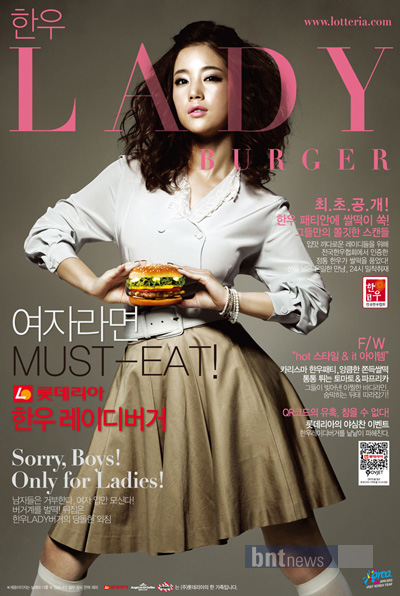
Korean Photoshop Disaster #8: The 100% Korean Lady Burger

A photoshop disaster, or a deliberate satire of the way models are typically presented on women’s magazine covers?

Alas, given how difficult it is to find this particular version, then unfortunately probably the former. But with that face held fast between the “A” and the “D”, as if prepped for cosmetic surgery? That X-line? And especially that emaciated look of her skin? Then for her at least, Lotteria’s Hanwoo Lady Burger is a “must eat” indeed.

But much more interesting than the bad photoshopping though, or what the ad says about women’s body images in the media, is the explicit gendered marketing contained therein. After all, you can’t call something a “Lady Burger” – and not even allow men to buy it – without explaining what it is exactly that supposedly makes it only appropriate for women.

Yet there are no physiological reasons why men and women can’t and don’t enjoy the same foods and drinks, so branding is the only real reason many are still marketed to only one sex nevertheless. Woe betide the company that actually admits that though, and hence Lotteria’s public rationale for Lady Burgers below comes across as rather artificial.

As indeed, do Lotteria’s products themselves, and not for nothing have I completely avoided the chain for the last 5 years (source, above):

롯데리아, 女心잡는 ‘한우레이디버거’ 출시 Lotteria Launches the ‘Lady Burger’ to Catch Women’s Hearts

한우레이디버거는 100% 한우 패티에 국내산 쌀 떡이 첨가된 떡갈비 형태의 프리미엄 버거로, 여성들이 선호하는 파프리카, 토마토, 양상추 등의 야채로 뒷맛이 상큼하고 깔끔한다는게 회사측 설명이다. 특히 쌀떡의 쫄깃함과 한우의 고소함의 조화도 느낄수 있다고. 가격은 단품 4500원, 세트 6000원.

As the company explains, the Hanwoo Lady Burger is a premium burger made from 100% Korean beef patty with ricecake made from Korean rice added, giving the form of ddokgalbi [ribs with ricecake added].  To that is added what women prefer: paprika, tomato, and lettuce, making the vegetable aftertaste both fresh and clean, and in particular, the ricecake’s chewiness and the Korean beef’s sesame taste harmonize well. The price for one is 4500 won, and for a set 6000 won.

특히, 전국한우협회가 인정하는 100% 한우만을 사용, 매월 1회 DNA 판정 검사를 실시해 인증을 받고 있다.

In particular, only beef that has been approved as 100% Korean beef by the Hanwoo Association is used, and every month its DNA is examined in order to receive that certification.

롯데리아 관계자는 “‘한우레이디버거’는 철저한 고객 세분화 전략으로 여성의 입맛을 고려한 제품”이라며, “기존의 한우불고기와는 제품에서부터 차별화시켜, 여성을 위한 햄버거로 자리잡을 예정이다”라고 설명했다.

According to a Lotteria spokesperson, “after formulating a strategy based on the segmentalization of the market, the Hanwoo Lady Burger was considered a product appropriate for women’s tastes”, and that “this is a means to distinguish the product from existing barbecued Korean beef dishes, and we expect it to dominate the market for burgers aimed towards women”.

롯데리아는 출시기념으로 세트 구매 고객에게는 치즈스틱과 알뜰 디저트 쿠폰을 무료로 증정하는 행사를 11월30일까지 진행한다. 알뜰 디저트 쿠폰은 콜라, 콘샐러드, 포테이토 등 디저트 3종을 1000원에 구입 가능한 것으로, 해당쿠폰은 12월 말까지 사용 가능하다.

To commemorate the launching of this product, until the end of November customers that buy it will receive a free cheesestick and a “Thrifty Desert” coupon, allowing them to buy desserts of either cola, corn salad, or potato for the price of 1000 won. These coupons will be valid until the end of December (James: yes, those don’t sound like “desserts” to me either).

한편, 롯데리아 한우제품은 한우레이디버거와 한우불고기버거 등 총 2가지로, 일반 버거 대비 1.5배 사이즈인 한우 불고기 버거는 폭넓은 남성 선호층을 확보하고 있다.

This is the second Korean beef product sold by Lotteria, the first being the Hanwoo Bulgogi Burger. In order to make sure to appeal to men’s preferences, that is 1.5 times larger than normal burgers. (end)

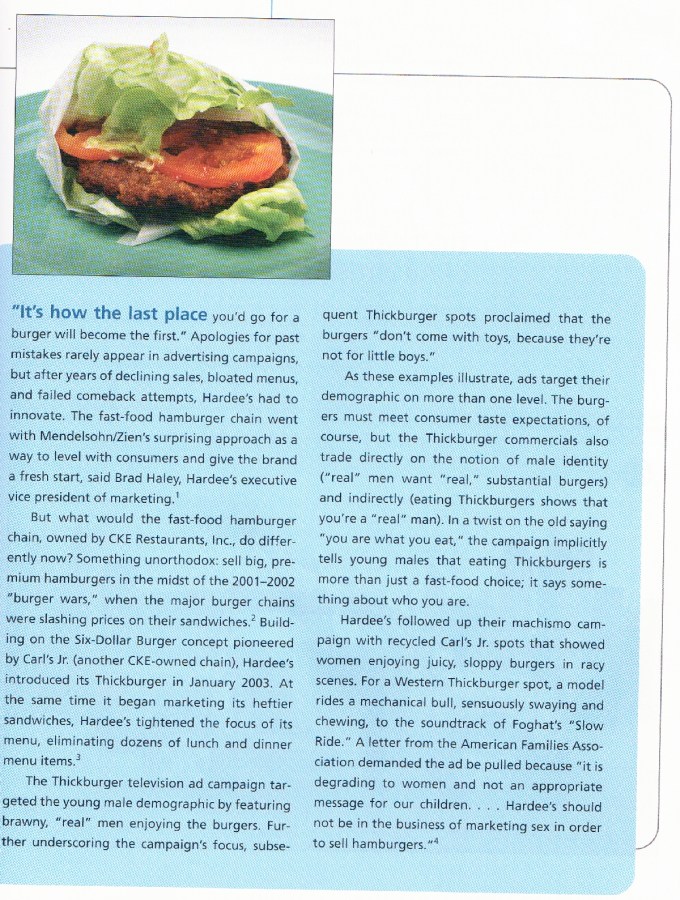
And with translating that last, I suddenly remembered this segment about the financial rationale to gendered burger marketing from page 91 of Essentials of Contemporary Advertising, by William Arens and David Schaefer (2007 edition):

Sorry for the poor quality: it was difficult to fit into the scanner. By way of compensation then, I’ve managed to find the 2003 ad with model Cameron Richardson referred to:

See here, here, here, and here for more examples of Korean gendered marketing, and here for more posts in the Korean Photoshop Disasters series. Meanwhile, have any readers actually tried one of those Thickburgers of Hardees’? Only 1,410 calories!

Update 1: See here for a much better version of the original Lady Burger ad, taken of a poster in a Lotteria window.

Update 2: The Bobster also has an interesting post on the Lady Burger.


The effeminacy of male beauty in Korea

( Attack on the Pin-Up Boys, 2007. Source )

With thanks to author Roald Maliangkay for the kind words about this blog in it, see here for his short and very readable article of that title in the latest International Institute for Asian Studies newsletter, which I also highly recommend taking 2 minutes to subscribe to. (Email me for a PDF if the link doesn’t work).

For the specific post of mine he refers to, and many more on the kkotminam (꽃미남) phenomenon in general (literally “flower-beautiful-man”), scroll down to the sidebar on the right until you come to the “My Constantly Evolving Thesis Topic” section.

(Update: that’s been removed after a change in theme. Please see here for a list of recommended posts instead)

True, he actually argues that the factors I cite are just some of many that were ultimately responsible for the emergence of that, but then my own views have considerably evolved since first writing about the subject over 2 years ago, and I think we’re in broad agreement really.

Alternatively, perhaps that just reflects how persuasive his own article is?^^ What do you think of it?

Vintage Gender Socialization?

What was the first thing that went through your mind when you saw the above advertisement?

Me? Why Nazi-occupied Colorado of course.

No, really. Specifically, the end of the following segment from Chapter 6 of Philip K. Dick’s classic alternative-history book, The Man in the High Castle (1962):

…Her shift at the judo parlor did not begin until noon; this was her free time, today. Seating herself on a stool at the counter she put down her shopping bags and began to go over the different magazines.

The new Life, she saw, had a big article called: TELEVISION IN EUROPE: GLIMPSE OF TOMORROW. Turning to it, interested, she saw a picture of a German family watching television in their living room. Already, the article said, there was four hours of image broadcast during the day from Berlin. Someday there would be television stations in all the major European cities. And, by 1970, one would be built in New York.

The article showed Reich electronic engineers at the New York site, helping the local personnel with their problems. It was easy to tell which were the Germans. They had that healthy, clean, energetic, assured look. The Americans, on the other hand — they just looked like people. They could have been anybody.

One of the German technicians could be seen pointing off somewhere, and the Americans were trying to make out what he was pointing at. I guess their eyesight is better than ours, she decided. Better diet over the last twenty years. As we’ve been told; they can see things no one else can. Vitamin A, perhaps? (source, right)

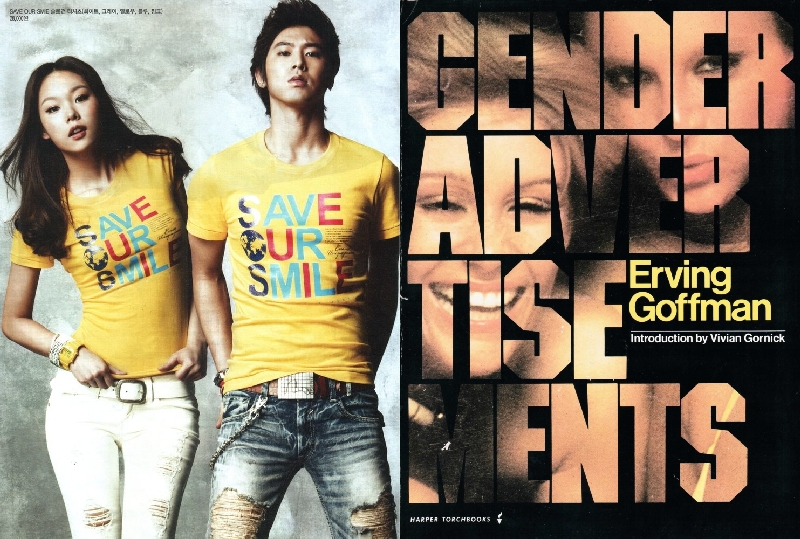
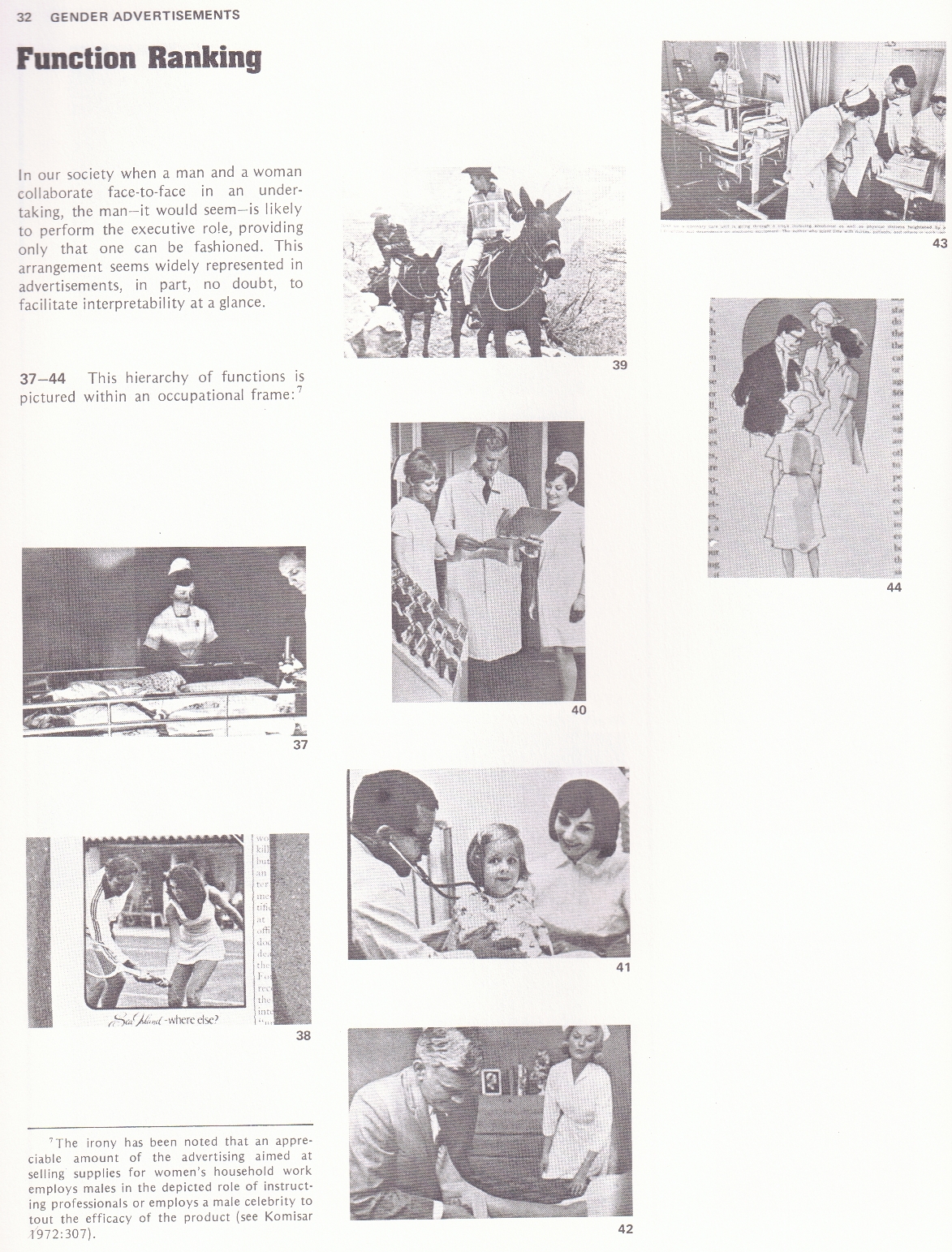
Of course, regardless of hierarchy and relationship, people do need to point things out in the distance to each other sometimes. But in advertisements featuring both sexes in Phil K. Dick’s time however, somehow it always seemed to be the men that were pointing things out to then women, as noted by sociologist Erving Goffman in Gender Advertisements in 1979:

On the positive side though, the second thing the advertisement reminded me of was a social studies textbook that I read in my final year of high school (back in 1993), which noted how rife such imagery was in earlier editions of a science textbook that I also happened to be using. But which had long since been removed, and indeed subsequent studies based on Goffman’s work – Belknap, P., & Leonard, W. M. (1991), “A conceptual replication and extension of Erving Goffman’s study of gender advertisements,” Sex Roles, 25(3/4), 103-118  for instance – confirmed that examples in advertisements were (by then) also so rare that it was not even worth looking for them. And much more recent studies of Korean advertisements (listed here) have come to much the same conclusions of them too.

But still, they do occur occasionally. Anybody remember this commercial I analyzed last September for instance, of which even just the visuals alone convey the message that only men are serious and thoughtful enough to be put in charge of your finances?

Vodpod videos no longer available.

To which now can be added the ad I saw on the subway this morning, which feels like it’s at least 30 years out of date. Or is that just me?

p.s. Yes, I’m aware that, technically speaking, Colorado isn’t occupied by Nazis in the book, but is rather in a buffer zone between the Japanese “Pacific States of America” and the Nazi “United States of America.” Alas, that wouldn’t have had quite the same impact as an opening line however!

Share

“I’m a Korean Girl”

Despite its title, this is simply a classic rendition of the way young women typically behave in Korean dramas.

The flip-side of the aegyo (애교) phenomenon, that behavior is precisely why I don’t watch them too, and have a real concern about the effects on my 2 daughters as they grow up seeing it every time they turn on the TV.

But don’t get me wrong: the video’s hilarious, and thanks very much to @Mentalpoo for passing it on!^^

Real & Presumed Causes of Racism Against Interracial Couples in Korea

(Sources – left: GR X Hermark; right)

Over at a recent post on Noona Blog: Seoul, an excellent blog written by a Swedish woman in a relationship with a Korean man, currently there’s several interesting comments about the sources of racism often directed against Korean female – Caucasian male (KF-CM) couples in Korea.

Many of which were written by Jake of Asian Male Revolutions, who has the admirable and very necessary goal of challenging the racist and emasculating images of Asian men in the US media through that website.

But in the process of – in my view – very much contriving to paint racism against KF-CM couples in Korea in those terms, as well as global racial power relations, I found he made many extremely sexist assumptions about Korean women, which I’d like to challenge. As technical issues prevent me from doing so at Noona Blog directly however,* then – assuming that you’ve already read his comments – I’ll post my original response here instead:

Dear Jake,

it’s difficult not to sound offensive when critiquing someone’s opinions so harshly. But still, however legitimate your concerns about representations of Asian men in the US media are, it’s incredibly naive of you to assume that that these would exist in the same form and degree in the Korean media, or indeed at all.

Argue that they still have a role in expressions of racism against KF-CM couples in Korea nevertheless though, and you end up simply sounding like an apologist.

Much more seriously however, in so doing you also rely heavily on some extremely patronizing and sexist assumptions about Korean women, let alone racist ones against Caucasian men. Let me explain.

I’ll start with your acknowledgment that “there’s no denying that simple male jealousy plays a role in the bellyaching white men…encounter as one part of an interracial couple in Korea.” Naturally I fully agree, and while I consider it a little harsh to dismiss treating that “as simple jealousy from a bunch of Korean/Asian losers” as a “pretty foolish assumption” – after all, you get jerks like that the world over – I also agree that it is wise “to consider the historical and political implications and undertones of various types and permutations of interracial dating” to understand that bellyaching more fully (source, bellyaching pun above).

But what is that historical and political context you identify?

The Western media has a much longer reach than Korean media; in fact all Asian media is to an extent influenced strongly by Euro-centric beauty standards. This has been well-documented by all the plastic surgery, and by the glorification of media figures (singers, actresses) who are selected first and foremost for their vaguely euro-Asian looks (as opposed to supposedly ‘ugly’ Korean features) and then groomed by a team of trainers and managers to become media superstars like Girls Generation, Son Dam-Bi, and all the ‘flavors du jour’ pop-tarts you see on Korean TV shows.

And again I largely agree, having written many posts saying pretty much the same thing myself. But crucially not the “The Western media has a much longer reach than Korean media” part; and as we’ll see in a moment, I feel you have an extremely inflated view of the Western media’s power in Korea.

So given the fact that an embedded system of euro/white-worship permeates South Korean pop-culture, white males have more elbow room to work with in the global dating scene. Many come to the shores of Korea and Asia and have relatively little trouble finding willing women who having seen and internalized images of white beauty standards, would like nothing more than to experience the thrill of dating the mythic “white boy”. And white men who come to Korea are only too happy to take advantage of this fact.

Okaaay…I’ll deal with your warped view of the interracial dating scene in Korea in a moment too (source above: Gusts of Popular Feeling). But first, let’s focus on your views of Korean women which it relies on, which you expand upon in your next comment:

Asian female/white male relationships cannot happen unless both parties are willing to participate in it.

This can only mean one thing – that Korean women, having internalized media messages glorifying white men, are also actively seeking them out to satisfy their own ‘white fetish’. Therefore, we cannot simply categorize white men as “predators” for Asian flesh: instead, a significant number of Asian women are willing collaborators.

Interesting choices of terms you’re using, especially that last. Continuing:

Or at the very least, they are passively open to it – that is, they might not go out of their way to seek white men, but if one does hit on them they are psychologically “primed” to be much more open to their sexual and romantic advances, as opposed to a black or even Korean man.

This is just more evidence of the pervasive white worship in Korean society, and it illustrates just how thoroughly and totally many Korean women internalize this message.

You’ve seen them in the bars and clubs and lounges of Seoul. To them, white boys on their arm are the ultimate accessory to their personal crusade to be the “coolest” chick on the block.

They’re commodifying race – and according to their rather twisted logic, being seen with a white guy the equivalent of having the latest handbag or shoes.

(Source)

They ought to stop and think about the implications of their choices. To them it’s a confirmation of their own belief that “being with a white man = COOL + URBANE + COSMOPOLITAN + TRENDY”… but it’s actually an expression of a colonial mindset – they are psychologically and mentally colonized, dominated, and enslaved.

They’re not setting the tone on what is cool – they’re doing the exact opposite: setting the tone on what is sick, twisted, and unwholesome.

Disclaimer: I am in no way claiming that ALL Korean women with white men are like this. But there is also no denying that a significant number of these women do exist. So please take my comments for what they are, and don’t take them out of context. Thanks.

Hey, no-one is denying that there are some Korean women who seek a White boyfriend for much the same reasons they would a Gucci handbag (or various types of Korean men either for that matter). But a “significant” number of Korean women with White men are like this you say? What percentage of them do you mean by that term roughly? 10? 25? And do you actually have any evidence whatsoever that they represent anything but the tiniest fraction of all KF-CM relationships?

Also, I’m rather confused: what percentage don’t want a White boyfriend as an accessory, but like you say just want to experience the thrill of dating one instead (which apparently is bad, even though we’re all attracted to the exotic)? What percentage are simply psychologically “primed” to spread their legs more readily for a White man “as opposed to a Black or even Korean” one? And finally, presuming you even allow for the possibility, what percentage of Korean women would you say aren’t passive, unthinking dupes of media messages of White male supremacy and are thus able to have genuine loving relationships with White men?

More to the point, have you asked so much as a single Korean woman of what she thinks of your characterization of them above?

I have asked one myself actually, my wife, and I’d wager that her reaction to you on the right is pretty representative. But I’ve asked many many more about interracial dating (including many who only speak Korean), and I think you’d be rather surprised at the far greater numbers of Korean women who have little interest, even a positive distaste at the possibility of dating White men.

Moreover, while global racial patterns of hegemony and privilege certainly ensure that more White guys end up in South Korea than, say, Indian guys, and that  stereotypes of both exist that encourage and discourage Korean women to form relationships with them respectively, it doesn’t automatically follow that Korean women assessing them as potential partners don’t do so by pretty much the same criteria that they do for any men, including Koreans.

Most South Asian men in Korea, for instance, are laborers, which obviously puts them at a big disadvantage to middle-class White teachers. Also, as one Korean female friend put it to me, while White guys tending to be taller has a great deal to do with their attraction to some Korean women (albeit a disparity that is rapidly disappearing), that still isn’t enough to overcome the anticipated language and/or cultural difficulties for most others. And another acknowledged that while White men in Korean tended to have more money (and freedom) than Korean guys in their early-20s, with the ESL industry in Korea being the joke that is, then, financially-speaking, in fact Koreans make much better partners by their late-20s and early-30s.

In short, while the specific mixture of the fish in the sea may well be determined by forces beyond their control, women are very much the arbiters of which ones they reel in so to speak.

To be fair, you do somewhat acknowledge this in your next comment, and which I admit I misinterpreted in the first draft of this post. But still, it is interesting how you force that into a narrative of Korean female submissiveness and White men’s sexual colonialism nevertheless. You say of the relationship between one commenter’s German father and Korean mother’s relationship, for instance:

…until Korean male/German female relationships become just as commonplace as what’s already out there (that is, WM/AF relationships), you can’t exactly hold that up as a ’shining example’ of “colorblindness”. It’s not — it’s more of an expression of racialized power structures and a neo-colonial history.

No, actually it can be colorblind, and both relationships and the people behind them are more then mere expressions of vast, impersonal forces. But if you’d like a more specific critique of your twisting facts to suit your narrative however:

(Source: Baby Black)

It’s the German man’s knowledge when he goes abroad that his country is wealthier and more powerful, compounded with the Korean woman’s knowledge that her’s is less wealthy (particularly back in those days), that makes the Western-male/Asian female (WM-AF) relationship so numerous.

And since women generally look to marry “up” while men look to marry “down” (socially and economically), you can see why the inequality between the white and Asian races makes the WM-AF relationship so easy to forge.

Put simply, I call bullshit on women marrying up and men marrying down: in virtually every society, both historically and today, the vast majority of men and women marry someone within the same socioeconomic group as themselves. Earning much more money than women however, then men are certainly freer to marry down, but that doesn’t at all mean that they aim to do so, or that they don’t aim to marry up any less than women.

But this critique pales in comparison to your reaction to the commenter after that, who wonders where the inconvenient reality of increasing number of Korean male – Caucasian female pairings like her own fits into your diatribe?

If you take some time to analyze our message instead of reacting emotionally, you’ll see just how out of line your thinking is, and how little time and effort you put into trying to understand something that is admittedly *highly, highly* complex. It’s a difficult concept for anyone to wrap his or her head around, so I guess I can’t blame you for taking the lazy way out with convenient and disjointed logic.

But then I said I’d talk about the Western media’s influence in Korea, and so I’ll do so now by contrasting the different impacts you feel it has on Korean men and women (my emphasis):

But the rub for Korean men (in general) is that men in places like Madison Avenue in New York City and Hollywood who control the images that go up on billboards and on TV and movie-screens are white – and they invariably make those images in their own image: White, Male, and BLOWN WAY OUT OF PROPORTION. In short: welcome to the world of Hollywood and the White Male Action Hero.

Keep in mind that while this is happening, Asian males are either completely excluded or used as a foil to make the white male look better in comparison. So Asian males in America or Korean males living in Korea internalize this subliminal message in the media and think that they can’t possibly step up to a blonde girl (or whatever white chick). They live their entire lives being psychologically castrated, in sharp contrast to a white male from where ever, who is emboldened or even arrogantly empowered by the jumbo-sized images made in his likeness, in the embrace of gorgeous white, black, latin, and of course Asian women in movie theatres all over the world.

(Source: Somang Cosmetics, 2003)

Hey, again I completely agree about the representations of Korean and Asian men in the US media. But I’m curious as to how you think this affects Korean males in Korea exactly, and what’s more upon whom you – very tellingly – imply that there is an equal effect as on Asian males in America. Pray, have you actually watched or read any Korean television, movies, magazines, or websites recently? It’s not like they’re lacking for strong, macho images of Korean men getting the Korean girl; or indeed, frequently getting the White girl these days, creating hypersexual stereotypes of them in the process.

Moreover, for a domestic media supposedly at the mercy of the global/Western media and its emasculating imagery of Korean men, it’s just bizarre how nevertheless it still has the ability to effectively censor all expressions of women’s sexual interest in foreign players during the 2002 World Cup; to not allow a single positive representation of KF-CM relationships in advertisements until July this year; to give a free voice to groups that, under the belief that Western men are all diseased sexual predatorswill literally stalk them with the aim of catching them doing illegal tutoring, thereby getting them deported; producing “documentaries” that show that Korean women will invariably get raped if they date White men; and so on.

Am I also “emotionally reacting” in pointing that out?

And simultaneously (being human and all) many white women are conditioned to shoot for white men as the “gold standard”, since all the glorified images of ‘male sex appeal’ feature only white males. Some even view Asian males with contempt or pity, and this of course spills over when white chicks go abroad – though to be fair, I’ve noticed this racist bias more in North American white females than European ones. So it is any wonder we see a “global sexual marketplace” that is DOMINATED by white males (figuratively) ‘raping’ and exploiting these loopholes to their sexual advantage?

Given the above dynamics of a GLOBAL system of media brainwashing that favors white males, is it any wonder that some people in Korea or elsewhere might secretly (or openly, in some cases) resent a white male for doing what he does? It’s not unreasonable, or completely out of the realm of possibility.

Ah. So while Korean women are mere passive dupes of the Western media, in contrast Korean men are savvy, knowledgeable consumers of it, and for whom calling a Korean woman walking down the street with Caucasian male a whore, say, is hence a justified response to their symbolic castrations and emasculation therein? As is the way the Korean media treats Western men?

(See Gusts of Popular Feeling for an explanation of the above video)

To put it mildly, that sounds rather apologist to me. But then considering what you write about White guys in Korea, then what would I know, right?

But here’s the funny thing: to him, he’s just ‘innocently’ going about his personal life – but of course he also doesn’t see (well, probably chooses not to see, that is, ignore) that the entire System is built for HIS personal advantage. It’s custom-built for his white male needs – and that is very racist, no doubt.

And on that note, I’ll put this response to rest. Regular readers may well wonder why I devoted so much time to it: after all, its flaws speak for themselves. But then I’m only human, and I reacted partially because it reminded me of how a commentator on this blog also conflated the 2 issues in an earlier post for instance, and whom I simply gave up reasoning with. Much more though, because it was annoying to spend 60 minutes on a comment only to have it disappear (see below), and finally especially because I was angered by comments on a similar post on Noona Blog not only gushing with enthusiasm for Jake’s comments but also implying that he had “a fact-based academic writing style”, when if anything it’s marked by their complete absence.

Combine that with being a White man married to a Korean woman blogging about gender issues in Korea too, who as a result has had trolls insulting the both of us incessantly for 3 years, or even being sent 3000 word emails patiently explaining that the vast majority of  White men in Korea (but always excluding myself of course) have yellow fever, and that I’m just being emotional in not acknowledging that…then hopefully you can see why I get very tired and angry at hearing that sort of thing sometimes!^^

Update: See I’m No Picasso and Roboseyo for two excellent posts written in response to this one.

Update 2: And now Gusts of Popular Feeling too.

You’ve seen them in the bars and clubs and lounges of Seoul. To them, white boys on their arm are the ultimate accessory to their personal crusade to be the “coolest” chick on the block.

They’re commodifying race – and according to their rather twisted logic, being seen with a white guy the equivalent of having the latest handbag or shoes.

They ought to stop and think about the implications of their choices. To them it’s a confirmation of their own belief that “being with a white man = COOL + URBANE + COSMOPOLITAN + TRENDY”… but it’s actually an expression of a colonial mindset – they are psychologically and mentally colonized, dominated, and enslaved.

They’re not setting the tone on what is cool – they’re doing the exact opposite: setting the tone on what is sick, twisted, and unwholesome.

Disclaimer: I am in no way claiming that ALL Korean women with white men are like this. But there is also no denying that a significant number of these women do exist. So please take my comments for what they are, and don’t take them out of context. Thanks.

*Actually, my original intention was just to leave a comment at Noona Blog, but as soon as I hit “submit reply” then it disappeared into the ether. As the same thing happened on a different post last week however (my first there), then wisely I’d saved it first. Of course, it’s annoying that I can’t seem to comment at all there then, but normally I’d just chalk that up to the idiosyncrasies of  the individual website. Yet then the same thing happened on Seoul Beats yesterday too (thanks for the link guys!), which I have successfully commented on before. Do any technically-minded readers have any possible explanations?  A plugin issue perhaps, or something to do with the most recent version of WordPress? (Switching from Firefox to I.E. didn’t help) Thanks in advance!

Pink Imperialism?

( Source )

Koreans have curious attitudes to pink.

On the one hand, it is by no means considered feminine on adults, nor has it ever been historically. Indeed, far from rejecting it, these days many young men positively embrace pink as a sign of rebellion against the gruff, dull rural roots of their parents. As The Joshing Gnome puts it:

Many young guys who grew up in this world find that it’s just not them.  What recourse do they have but to declare loudly and pinkly to the world ‘I am not what my parents are.’  They’re showing people they’re young, they’re modern, they’re not dissolute drunken bums (and how would one know if not for their outfits?) and they’re urbane.  If my two choices of apparel are white pants, a pink shirt, and ‘wax’ in my hair or slippers, track pants, a motorcycle and a case of the soju rosies, then I have to say I would be right there with these preening young men foppin’ it up.

And lest that sound like exaggeration, bear in mind that most Koreans lived in villages until the late-1970s. Hence I’ve also made a similar argument for their wearing of (usually pink or pastel) “couple clothes” myself, such a visible sign of affection possibly being a stark rejection of the model of their own parents’ often arranged marriages.

But I haven’t been married for so long though, that I don’t realize that it could just as easily be because men will simply do anything to get laid.

And if that requires caving in to their partners’ wishes to both look cute together and show off their status as a couple, then why not? After all, cuteness is already a strong cultural prerogative in Korea, much like the equivalent in many Western countries is to be ‘Xtreme’ and too cool for school.

( Source )

But for every 5 male university students I see wearing pink clothes, I might see 1 or 2 men in their 30s, 40s or even older also doing so. How then, could pink ever be considered intrinsically cute here?

Probably because, on the other hand, Koreans do maintain a pink/blue divide for children. And while this is by no means a phenomenon confined to Korea of course, that they do so despite all the above is a telling demonstration of the points made by Korean artist JeongMee Yoon (윤정미) through her Pink and Blue Projects like the above, which were:

…initiated by my five-year-old daughter, who loves the color pink so much that she wanted to wear only pink clothes and play with only pink toys and objects. I discovered that my daughter’s case was not unusual. In the United States, South Korea and elsewhere, most young girls love pink clothing, accessories and toys. This phenomenon is widespread among children of various ethnic groups regardless of their cultural backgrounds. Perhaps it is the influence of pervasive commercial advertisements aimed at little girls and their parents, such as the universally popular Barbie and Hello Kitty merchandise that has developed into a modern trend. Girls train subconsciously and unconsciously to wear the color pink in order to look feminine…

…Today, with the effects of advertising on consumer preferences, these color customs are a worldwide standard…The saccharine, confectionery pink objects that fill my images of little girls and their accessories reveal a pervasive and culturally manipulated expression of femininity” and a desire to be seen.

( Source )

Currently, her work is being exhibited at The Santa Barbara Museum of Art, which is hosting “the first major American showing by contemporary Korean artists living in Korea”: see the Los Angeles Times for more details (via KoreAm). Also, you can see her own website for more examples (and a fuller explanation) of her work.

But does the pink/blue divide largely come from overseas, as Yoon implies? And if so, how and why exactly?

Unfortunately, I don’t personally know enough about Korean fashion history to answer. My gut instinct though, is to reject the notion of cultural imperialism: in my post Giving the Consumer What She Wants? for instance, I demonstrate that far from the plucky Korean magazine industry being at the mercy of evil multinational companies, in fact Korean consumers were very active and willing agents in its Westernization.

But on the other hand, this wouldn’t be the first time Koreans have wholeheartedly – and rather unthinkingly – adopted some aspect of Western culture despite local tradition. Male circumcision for instance, was virtually unknown in Korea before the Korean War, but now it probably has the highest rate of it in the non-Muslim and non-Jewish world. And yet despite being world leaders, both doctors and the general public display a profound ignorance of the practice, most simply associating circumcision with industrialization and improved living standards.

What do you think is responsible?

Meanwhile, please see my post Sex and the Red Blooded Woman for the sake of comparison, in which I discuss how the general redness of most cosmetics at least do have definite biological bases, unlike our clearly heavily socialized ones for clothing!

Share

Korean Photoshop Disaster #6: I like it hot, strong, and black! (Updated)

( Source )

Do men pay more attention to men’s chests than women?

As a gym addict 10-15 years ago, I read somewhere in a newspaper that they do. And with my self-confidence back then wholly tied to how much I buffed up, it certainly matched my own experience.

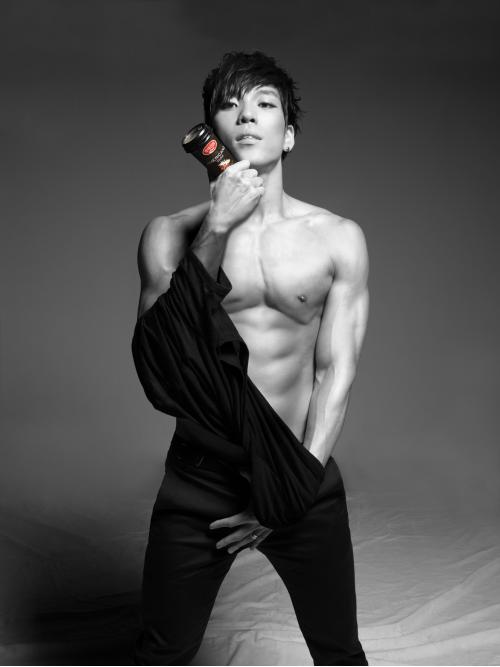
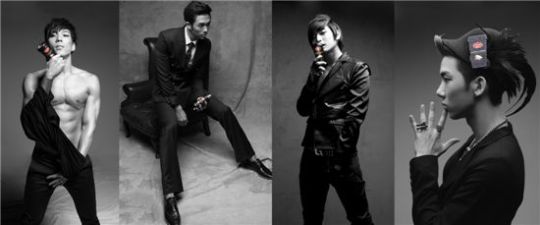
Unfortunately for the sake of objectivity though, it’s been difficult not to remember that every time I’ve seen a topless man ever since. One look at Changmim of 2AM half-naked and holding his crotch in a coffee ad then, and all I could think about was the large, firm package that used to be the weekend edition of the New Zealand Herald.

Naturally enough, most commenters at allkpop and Omona! They Didn’t focused on the one that Changmin was allegedly holding in his left hand instead, and I’m going to take a wild guess that most of those were heterosexual women. Perhaps that explains why so few noticed the appalling photoshop job on his chest?^^

Yet despite men’s greater interest in those in a competitive sense, in reality not only is bilateral symmetry a good indicator of genetic health for both sexes, and hence a heavily favored trait in mates, but even women’s own breasts become more symmetrical during the most fertile period of their menstrual cycle too. So it’s a strange oversight.

And of course for the photoshopper too, who presumably originally aimed to create some sort of languid, fluid-like effect, and I expect the mistake will be corrected before the full ad campaign for Maeil’s “Cafe Latte Americano Dutch” is launched on the 13th (source, above). But regardless, and on a more serious note now, it still has to be the first of the recent spate of Korean advertisements to objectify men that I’ve positively disliked, rather than be merely nonplussed or amused by.

For it is just as lame as it is provocative.

Putting aside how problematic the slogan “Find Your Black” is to English speakers, as described at allkpop the campaign’s basic concept is that various members of 2AM represent “Chic Black”, “Luxury Black”, “Tough Black”, and Changmin as “Sexy Black,” and the first major problem with the ad is also the most obvious: what does a topless idol grabbing his genitalia has to with coffee exactly?

Or indeed, with being “sexy”, and it that sense it also reduces to and perpetuates the notion that sexiness is only a matter of skin exposure, whether for men or for women. A problem which is hardly unique to the Korea media of course, but it is exaggerated here, and so unfortunately I’m wasn’t all that surprised that that was the best that the creative team could come up with.

And yet, would the same ad have actually been possible with a woman? Specifically, one with her hand placed on her crotch, a pretty blatant gesture of intent in anyone’s language?

( Source: unknown )

But why so specific? Well, if there’s one consistent theme to emerge out of writing about Korean advertisements for 3 years, that would be being witness to a long line of firsts: the first erect nipples; the first portrayal of Korean female – foreign male relationships; the first kiss; the first spoof of objectification within ads(!); the first soju ad to portray a woman as, well, really rather slutty, as opposed to decades of portraying them as virgins; and so on. And no matter how difficult it may be to believe for recent visitors to the country, in fact some of those emerged just within the last 3 weeks, let alone the last 3 years.

So, it’s natural to write as if I have almost a perverted fixation on things like crotches sometimes! And indeed, if there’s one thing to take away from Changmin’s ad, it’s the realization that however permissible grabbing one’s crotch is in passing in brief dances on talk shows and in music videos and so on in Korea, I don’t think I’ve ever seen it in a print advertisement. On women or on men, and hence netizens’ intense interest in Changmin’s ad.

But of course I may be wrong, and so as always, please pass on any earlier ads that you are aware of. But for various reasons, I really do think that an equivalent ad with a woman would have aroused far more controversy.

How about you? Let me finish by providing two related examples to help get you thinking.

First, the the above one with Kim Ah-joong (김아중) from 2006, which at first glance is sexually-assertive enough. But as commenter “huncamunca” pointed out to me 2 years ago (in a post I ironically deleted yesterday!), it is definitely not an example of the sexually aggressive “cowboy stance” that I first interpreted it as:

…I agree that the “cowboy” thumbs in the belt loops make the picture sexual, but other elements of the stance make it sexual AND DEMURE, not aggressive. Usually, in the cowboy stance, the shoulders are relaxed and legs are slightly apart, with weight more on one foot than the other (see for example the picture of the woman on page 240 of the Pease book) [on body language]. However, Kim Ah-jung’s shoulders are raised, as if she is shrugging slightly in a demure way. Her elbows are straight and held close to her body to take up as little space as possible, which is not typical of the relaxed cowboy stance. Her legs are also tightly closed to take up as little space as possible, and they don’t look like they are about to take her toward what she wants. Her head is tilted down so she can look up demurely at the viewer. The combination of raised shoulders and lowered head is similar to the “Head Duck” in the Pease book (p. 235), which shows submissiveness. Also the wind effect makes it look as though whatever she is looking at (presumably a male viewer) is powerful enough to nearly blow her away while she marvels at him and waits for his approach. She doesn’t look like she intends to act, but rather like she hopes to be acted upon–sexual but still submissive.

Not that Changmin looks all that sexually aggressive either of course: indeed, he appears to be protecting himself more than anything else, but either way the ambiguity again points to a lack of thought behind the campaign.

Finally, a female equivalent of gratuitous objectification and/or nudity in a coffee ad provided by Italian coffee company Lavazza, also in 2006:

( Source )

Notorious for ads involving sex and/or the excessive objectification of women since at least 2005, this one was ultimately judged as discriminating against women by the Swedish Trade Ethical Council against Sexism in Advertising (ERK), and presumably forced to be withdrawn:

Sweden’s Ethical Council has a lower tolerance for the use of scantily clad women to advertise products than comparable regulatory bodies in other countries…

…ERK judged “that the woman is used as an eye catcher without any connection to the advertised products, and that it is insulting towards women”.In its defence Lavazza wrote that the 2006 calendar from which the images were taken used humour and irony to recreate a 1950s feel. The company claimed that the images depicted glamour, style and a lust for life and were in no way discriminatory.

[ERK Secretary] Jan Fager disagrees. In his opinion it is not acceptable for an advertisement for coffee to be sexy in the same way as, for example, an underwear ad. He noted that while H&M has come in for much criticism from the general public the company’s Christmas campaigns have never been found in breach of ethical standards…

…In its written judgment the ERK maintained that Lavazza had not lived up to the principle “that advertising should be formed with due regard for social responsibility”

Good for ERK, and yes, I rather like that acronym too!^^ But one wonders what they would make of Changmin?

Update – Unfortunately my English copy is in New Zealand, but see below for more on the cowboy stance, and how intimately sexual and physical aggression can be linked. From pages 236 and 237 of the Korean edition of The Definitive Book of Body Language by Alan and Barbara Pease (2006), it’s easily one of the most helpful book purchases you’ll ever make, although I did much prefer the realistic line drawings in the 1989(?) edition to the cartoon-like ones and photos of famous people in the new one:

And for comparison’s sake, here’s a less disastrously photoshopped image of Changmin:

( Source )

(For more posts in the Korean Photoshop Disasters series, see here)

Share

Korean Sociological Image #48: The Male Gaze

( Source: L-C-R. Reproduced with permission )

Like photographer L-C-R says, this 2008 Gundam advertisement is a prime example of a woman being portrayed as a child and/or sex object, of which she saw entirely too much of while she was in Korea.

You may be very surprised then, when you learn whom it was actually aimed at.

But first, please consider what is it exactly that so demeans drama actress Min Seo-hyeon (민서현) in it? I identify 4 or 5 things myself, which I outline in descending order of importance below:

  1. her childlike expression, combined with putting her fingers in her mouth
  2. the canting of her head
  3. her surprisingly awkward stance
  4. her passivity as she awaits the masculine-looking robot to make the next move

And after discussing those, albeit briefly because I’ve already done so in great depth in this similar post about soju advertisements, I’ll finally look at the ad in the context of the campaign as a whole. But feel free to disagree with any of those and/or suggest others, and in that vein I highly recommend asking your Korean partners, colleagues or friends their own opinions also. As if the experience of asking my wife and her friends earlier is anything to go by, then they are very likely to disagree with the first. Or indeed, that she’s being portrayed childishly at all, and – jumping ahead – not even in the following commercials either:

I’d argue that the main reason for that is the Korean cultural practice of aegyo (애교), difficult to define in English but probably somewhere between “affected sweetness” and “affected childishness“, and at least partially rooted in the prolonged transition to adulthood of experienced 20-something Koreans that are the biggest practitioners of it. For not only does the Korean education system essentially defer the joys of adolescence (but not the negatives!) until graduating from high school, but economic circumstances force them to live at home until marriage and/or deliberately put off their university graduation, and men also have their 24-28 months of compulsory military service to boot.

But I realize that since I was a student myself in the mid-1990s, more and more 20-somethings in Western countries are also postponing leaving home, and indeed to note all the above is not to argue that all Korean 20-somethings in such circumstances are childish; actually, I have intelligent, mature, and thoroughly Westernized Korean friends that have resigned themselves to them, or alternatively feel so trapped that they are literally fleeing the country to escape. Yet one thing they certainly do not do however, is aegyo, and I put it to you that in fact that is neither required for women to successfully navigate a patriarchal society, nor particularly savvy and ultimately empowering of them to do so.

( Source )
( Source: L-C-R )

Yes, “women”. As while Korean men do also do aegyo, and so as you’d expect content analysis demonstrates that men are much more likely to be portrayed childishly in advertisements in Korean magazines than US ones, and Korean men more than Western ones in the former, it is still overwhelmingly Korean women that are done so, and to a much greater extent than women of any ethnicity are in US magazines.

( Source )

As for anyone still not seeing the childishness in Seo-hyeon’s expression however, or why it is problematic in any sense, consider what the images above tell us about just how “natural” such expressions really are on adults, and why women are more commonly portrayed with them nevertheless. And which are often accentuated of course, by putting their fingers in their mouths, and which could possibly be considered “self-touching” as defined by sociologist Erving Goffman in Gender Advertisements (1979) below:

As discussed in that earlier post on soju advertisements, both are often combined with the canting of the head, which is problematic for the reasons outlined there. I also discuss awkward stances there too, and to anyone believing that I’m about to read too much into Seo-hyeon’s, I suggest stopping here and trying it for yourself,  making sure to bend and spread your legs outward at the knees like she does in particular. For not only will you realize just how unnatural it really is, and that people only ever stand like that in advertisements (and overwhelmingly women at that), but you’ll also probably end up falling forward a little on your first attempt like I did, and will suddenly gain a very palpable sense of why exactly the advertisement does indeed present her as a sex object:

( Source: L-C-R )

In Goffman’s framework in Gender Advertisements, that “bashful knee bend” is something that women frequently, men very infrequently, are posed in a display of. And whatever else, it can be read as

…a foregoing of full effort to be prepared and on he ready in the current social situation, for the position adds a moment to any effort to fight or flee. Once again one finds a posture that seems to presuppose the goodwill of anyone in the surround who could offer harm. (p.45)

Hence passivity, as blind to whatever occurs behind her, nevertheless Seo-hyeon seems to be eagerly awaiting whatever the robot plans to do with her. And which judging by the fact that it also is standing slightly thrust forward, and has a big long gun resting behind Seo-hyeon’s buttocks, couldn’t really be any clearer. Hell, even the protrusion on its crotch is already bright red for good measure too.

( Source )

An advertising campaign clearly aimed at young men and adolescent boys then, whom I’ll safely assume are the vast majority of Gundam fans? If so, then the effort actually appears to have backfired, as the few commentators on it I’ve been able to find here, here, here, here, and here generally express both surprise and disdain at seeing Min Seo-hyun at all, the last of whom wrote the following about the advertisement above:

이 광고는 광고로서의 설득력이 전혀 없다. 그것이 염가 제작되었기 때문이 아니다. 반대로 제작비는 많이 들었을 것이다. 이름있는 사람들의 얼굴을 비추기 때문이다.(그림의 건프라 광고에 출연하는 사람이 유명한지는 잘 모르겠다.) 그러나 문제 역시 그러한 사고방식에 있다. 즉, 유명한 사람의 얼굴을 비추면 광고가 될 것이라는 사고방식에.

This advertisement has no persuasive power at all. But not because it was cheaply and poorly produced; actually, because of the famous faces in it, it looks like a lot of money was spent on it (well, actually I don’t know if they are famous or not). Rather, the problem is with using that advertising logic in the first place.

이것은 어느 정도 맞는 말이다. 유명한 사람이 어떤 상품을 소비하고 있으면 그것만으로도 상품의 질을 소비자들에게 안심시켜 줄 수 있다. 그러나 그것도 광고의 효용성 안에서 이루어져야 한다.

However you look at it, this is correct. While of course simply having famous faces in an advertisement is sufficient for most consumers, they should still be used in the ad as effectively as possible however.

이 광고의 전략은, 유명하거나 예쁜 사람과 건프라의 이미지를 교차시켜 건프라가 갖는 오타쿠 이미지의 쇄신일 것이다. 좋은 생각이다. 그러나 이러한 두 이미지가 교차점을 찾지 못하고 있다. 저 사람은 건프라를 만지작거리고 있지만 전혀 즐거워 보이지 않는다. 아마 저 사람은 자신이 들고 있는 건프라의 이름도 모를 것이다.

The advertisement’s strategy is to reform the image of a Gunpla Otaku [an obsessive fan of something – James] by combining with a famous or attractive person. This is a good idea. However, ultimately they don’t really mix. This person doesn’t look like she’s enjoying holding the model [really?] and probably doesn’t even know the name of it.

( Source )

방 또한 지나치게 깨끗하지 않은가? 건프라에 열중하면 당연히 방은 데칼 찌꺼기나 플라스틱 조각으로 너저분해져 있어야 하고, 책장에는 잡다한 건프라가 어지럽게 진열되어 있어야 한다. 채색하는 손은 알록달록 에나멜이 묻어 있어야 하고, 옷은 더러워져도 상관없는 펑퍼짐한 츄리닝이어야 하며, 얼굴은 지극히 진중한 표정을 짓고 있을 것이다. 오히려 이러한 당연한 이미지를 예쁘고, 성공적이고, 멋있는 사람들과 교차시켰으면 이 광고는 성공을 거두었을 것이다. 장동건이 한없이 고결한 태도로 NDS를 플레이했다면 NDS는 그만큼 팔리지 않았을 것이다. 오히려 소파에 퍼져 앉아 우리들이 하듯이 게임을 했기 때문에, 우리가 하는 것을 장동건도 한다는 안심을 소비자에게 줄 수 있었다.

Also, isn’t the room excessively clean? When you are absorbed in assembling a Gunpla model, of course the room should be messy with the remains of decals and leftover plastic, and various other models displayed on the bookcase. And while your hands would be stained with enamel paint and your casual clothes dirty and speckled, your face shows that you don’t care about that as you focus all your attention on assembling the model. Rather, prettier and more successful people were needed. And recall that very famous actor Jang Dong-gun didn’t similarly loftily play Nintendo DS Lite while he was advertising it in 2007; instead, he just played it normally on the sofa like the rest of us, and so it sold well.

게다가, 타겟을 통일했으면 더 설득력이 있었을 것이다. 지금 이 광고가 노리는 소비층은 누구인가? 아이? 청소년? 남자? 여자?

Hence I think the ad would have been more persuasive if it had been aimed at a wider variety of people. But to whom was it actually aimed at anyway? Children? Teenagers? Men? Women?

( Source: L-C-R. Reproduced with permission )

Sounds like a rather picky otaku to me, but he does at least finish with some good questions, which I’ll now attempt to answer by passing on what I’ve been able to find of the remainder of the campaign.

First up, the one above that was alongside the one with Min Seo-hyun. Featuring popular singer (now actor) Kim Kibum (김기범) of the boy band Super Junior (슈퍼주니어), at first glance it’s very similar. And yet:

  • the robot isn’t even facing towards him, let alone thrusting a phallic object towards his buttocks
  • Kibum’s stance is much more natural
  • rather than passively waiting for robot to initiate something, here he seems to be silently asking the observer what fun things he can do with the robot himself
  • accordingly, his expression is more mischievous than childish
( Source: L-C-R )

Crucially however, this dichotomy is not repeated in the rest of the campaign. See the following commercial which features both actors for instance (as an aside, it starts with the lines “Shall we do it? Okay”, a common innuendo in Korean advertising):

And in particular, the long version of the bedroom one, which reveals that the reason she become interested in Gundam in the first place was because boyfriend Kim Kibum bequeathed his collection to her while doing his military service, to which she now enthusiastically adds to with her own robot:

And the theme of both sexes enjoying assembling and enjoying Gundam models is corroborated by the following posters and website images:

( Source )
( Sources: left, right )

Taken as a whole, I’d argue that the only consistent theme of the campaign is that of Min Seo-hyeon becoming more and more involved in the hobby for various reasons, including by: being (sexually) tempted by the models themselves; encouraged to take it up by Kim Kibum giving her his own models; assembling models together at his suggestion; and finally becoming equally passionate and knowledgeable about it as he is. Nay, it’s not so much a theme as the exact narrative Gundam hoped would play out repeatedly in real life, and besides which the cute portrait poster of Kibum above to download from the Gundam website is sufficient evidence in itself that the campaign was aimed at teenage girls and women.

Why then, did the bedroom commercial and the opening advertisement simply suck so badly? Why on Earth did the advertising agency responsible think that having a 22 year-old woman acting like a 12 year-old would make either age group more interested in the product, let alone by suggesting that – not to put too fine a point on it – she also wanted to get fucked by it?

Of course, there could be any number of reasons. For instance, there is the cultural practice of aegyo as mentioned, which I may have underestimated, and perhaps I’m wrong in thinking that the majority of Korean women would be at least unimpressed, if not offended, by depictions of women as children. It could also be yet another demonstration of an advertising agency so used to selling products to men that it comes to regard their perceived desires and tastes as the norm, and so unwittingly applies them to women too:

( Tempted to drink soju with 16.8% alcohol now girls? )

But recall that photographer L-C-R mentioned that she saw advertisements like these everywhere in Korea, as probably you do too, which raises a third possibility: either the Korean advertising industry as a whole is dominated by men (which may in fact be true), or else it has so internalized those male norms that even women in the industry (let alone consumers) regard them as normal and appropriate for selling products to either sex.

A phenomenon by no means confined to Korea or the just the advertising industry, this is the essence of the “male gaze“, and which hopefully having provided some evidence for and/or at least piqued your interest in, I’ll wisely finish by pointing you in the direction of excellent introductions to the topic rather than going on further here. One is the examination of the ways women are portrayed in graphic novels provided by fantasy magazine, and another is the related Bechdel Test for movies:

And here’s a brief application of that to specifically Fantasy movies at Feminist SF also. But I most highly recommend the illuminating, even strangely moving 1972 documentary Ways of Seeing by then art historian John Berger, which I’ve just discovered via Sociological Images here and here. Obviously the second episode on the female nude is most pertinent here, but episode 1 is more likely to captivate you to the extent that you forget to leave your seat for the next half hour:

Here’s episode 2:

And I would include episodes 3 and 4, the latter of which is on advertising, but I haven’t watched them myself yet!^^

(For all posts in the Korean Sociological Images series, see here)

Share

Creative Korean Advertising #24: Will They? Won’t They?

Apologies for the slow posting folks: last week, I developed a “swellbow” from writing at my computer for too long, and it’s made sleeping a little difficult, let alone blogging. And I could mention the heatwave and my daughter’s kindergarten closing for 2 weeks too, but you get the idea!

Hence my original intention here just to pass on the deceptively innocent advertisement above, which had me burst out laughing at its crude sexual symbolism. But in hindsight it is also noteworthy both for having a woman initiating a relationship (possibly the first of its kind?), and for being part of a creative multimedia campaign featuring tantalizing hints of various episodes in various couples’ dating lives, which you’re then encouraged to find out more about by using the electronic tags on the bottles to download the “full stories” directly to your smart phone. Take a look for yourself:

Yes, my curiosity was especially piqued by the one involving kissing too, and it’s difficult to believe now that you only began seeing that in Korean advertisements just last year.  Regardless, fortunately the full stories are also available at the company website and now Youtube, and ironically that particular one ends up being more charming than anything else:

I hope you enjoyed them, and for anyone that missed the humor in the very first advertisement, then take a closer look at o:19 specifically. Lest you feel I’m reading too much into that however, then let me draw your attention to similar examples here, here, here, and here also!^^

(For more posts in the Creative Korean Advertising series, see here)

Share

Korean Sociological Image #45: Modernizing Traditional Korean Clothes

(Source)

For all my love of Korean culture, I’ve never really understood the appeal of modern hanbok (한복).

Primarily, because of their impracticality: after performing the ancestor worship rites known as cha-ryae (차례) in mine at my parents-in-laws’ house on various Korean holidays for instance, I find it very difficult to eat the traditional breakfasts that follow with such baggy sleeves getting in the way, especially at the low tables that most Koreans use. It also has no pockets, no zipper, and can get uncomfortably hot very easily, especially during Chuseok (추석) when the weather can still be quite warm. And my wife has similar problems with hers too, adding that women also seem to find their slightly more elaborate version more uncomfortable than men do theirs.

For those reasons, I fully expected the Wikipedia article on hanbok to mention that despite popular perceptions, only the small elite known as the yangban (양반) ever really wore them historically, who were notorious for being resolutely opposed to performing anything that smacked of physical labor. Was Koreans’ pride in their “national dress” a little misplaced then, and just another invented tradition like the kilt in Scotland?

Alas, it doesn’t say, although it does seem reasonable to suppose that practical considerations were undoubtedly more important for the bulk of the population. But what the article does demonstrate though, is that the hanbok has as rich and varied a history as, say, the Western suit (it was naive of me to be surprised at that), and the frequent changes in the various forms and usages of the garment over time indicate that its role as a signifier of class, status, and occupation was much more complicated than I first thought.

Still, I can’t think of a more unflattering garment for women.

No, I’m not so uncouth as to think that women can only be attractive in clothes that are form-fitting and/or show some skin. But then from the neck down, the hanbok is almost like a burqa in that it’s impossible to tell if there’s a man or woman under it, so I certainly can’t imagine anyone ever describing as a woman as sexy in it. Beautiful, yes. Pretty, cute, charming, handsome—sure, you name it. But sexy? Judge for yourselves at Flickr, or from the hanbok sections of recent Miss Korea pageants:

Of course, possibly I’m being too harsh, and by all means feel free to disagree with me: these two bloggers here and here certainly do for instance. (Update: in turn, I disagree with this blogger’s response that being “traditional” means that the clothes shouldn’t be sexy, and that only “a non-Korean male writer” would think they could be both. I’d also point out that they were once considered everyday clothes, with many different purposes. So why should how they now “honor [one’s] tradition and culture” be the only criteria we evaluate them on?). But regardless, hopefully now at least you can understand why I did a double-take when I saw the following new designs last week:

(Source)

Unfortunately, the only information about them are in clumsily-written advertorials from the company that makes them (see here, here, here, and here), but at least they do explain a little about the logic to the new designs. Here’s my rough translation of the first of them, which incidentally also has the best quality version of the image on the left(!):

아찔한 초미니 한복 / Giddy Ultra-miniskirt Hanbok 2010-07-07 12:09

한국의 아름다움을 오롯이 담고 있는 우리의 옷, 한복. 복을 부르고 화를 쫒는다는 뜻을 담고 있는 한복은, 인생의 중요한 순간마다 반드시 갖춰 입어야 하는 우리 생활의 일부이자 소중한 문화유산이다.

The hanbok is the item of clothing that completely and harmoniously shows Korea’s beauty. It has the meaning of bringing good luck and dispelling anger, and at every important event in your life you should wear this vital part of our cultural inheritance.

한복을 아름답게 입기 위해서는 속적삼과 속치마는 물론이고 긴 치마와 저고리까지 제대로 갖춰야 하지만, 시대가 변하고 젊은 층의 안목도 새로워지면서 한복은 어느새 고리타분하고 촌스러운 옷으로 전락하는 듯 했다. 그러나 명품 한복 브랜드들을 위시해 전통한복을 계승하고 퓨전한복과 한복 드레스를 내놓으며 젊은 층은 물론이고 나아가 세계인의 시선까지 사로잡는 상품을 개발함으로서, 한복은 다시금 아름다운 우리의 옷으로 발돋움하고 있다.

In order to beautifully wear the hanbok, of course you need to the undershirt, petticoat, long skirt, and top and to properly wear them, but as times change the hanbok is become old-fashioned and rustic in young people’s eyes.  However, the hanbok is currently taking a big step in becoming all Koreans’ beautiful clothing again by the entrance on the market of a new brand which has developed a fusion style of traditional hanbok and long skirts that will appeal to everyone from the young generation to globalized people.

(Source)

한복 알리기와 보급에 주력해 온 명품 브랜드 <안근배 한복 대여> 역시 초미니 한복 드레스와 퓨전 한복 등, 차별화된 디자인과 소재 개발로 고객들의 다양한 요구를 충족시키고 있다. 최근 2010/2011 신상품 70여개를 출시한 <안근배 한복 대여>는 높은 퀄리티의 전통 한복뿐만 아니라 파격적인 초미니 한복 드레스와 퓨전 한복등을 선보이며 화제를 모으는 한편, 우리 고유의 멋을 계승하며 신세대 고객들의 입맛까지 사로잡았다는 평가를 받고 있다. 특히 <안근배 한복 대여>는 전통 한복의 아름다움은 그대로 살리면서도, 더운 여름철에 쾌적하게 한복을 입고 싶어 하는 고객의 구미에 맞는 상품을 전략적으로 출시해 눈길을 끌었다.

Angunbae Hanbok Rentals (AHR) is a company that has concentrated on supplying and letting people know about this new style of hanbok, and in addition to having one fusion type with and ultra-short miniskirt, is differentiating its designs and materials in order to satisfy the varied demands and requirements of customers. Recently, AHR has launched 70 new designs for the 2010/2011 season, and these have been attracting lots of attention not just for their high quality traditional forms but also their fusion with unconventional ultra-short miniskirts, and have been gaining a lot of praise for their coolness that satisfies customers’ modern tastes. In particular, AHR has been noticed for strategically providing customers with hanbok that, while showing off the garments’ traditional beauty, are also a comfortable choice for their summer tastes.

<안근배 한복 대여>는 초미니 한복뿐만 아니라 전통 한복과 한복 드레스 등 다양한 상품으로 인기몰이중이며, 업계 1위의 브랜드답게 전문화된 콜센터 운영과 홈페이지 운영으로 고객들을 만족시키고 있다. 특히 공식홈페이지 http://www.hanbokrent.kr에서는 7월 한 달 간 진행되는 신랑 신부 커플 한복 20% 할인 행사 안내와 다양한 신상품들을 확인할 수 있다.

AHR doesn’t just provide hanbok with ultra-short mini-skirts, but is also popular for its traditional hanbok and hanbok dresses and so on, and provides a wide variety of products to rent; as the top brand in the business, it operates a call center staffed by experts and a homepage to make sure to fully satisfy customers’ needs. And please note: any couples about to get married, visit www.hanbokrent.kr to get a 20% discount on couple hanbok and/or a variety of new products.

(Sources: left, right)

Is 300,000 won reasonable to rent the first ones? Regardless, see many more examples at the “Fusion” section of AHR’s website, and I’m all for changes to any popular item of clothing that make it more comfortable, cooler to wear in the summer, and a little sexier and more elegant too.

But this post wasn’t intended to be only about hanbok. In fact, the humble podaegi (포대기), or traditional Korean baby sling, may ultimately be much more interesting:

(Source)

Quite simple to put on once you get the knack, it’s very easy to see why Korean mothers would use these while working in fields, or even just the kitchen (scroll down here a little for a picture). Hell, if I had to carry a baby for hours while doing manual labor, then I’d probably choose something that comfortable and tight too, and so I wasn’t surprised to hear from my father’s Nigerian colleagues that my wife’s was just like Nigerian ones, where, naturally enough, they’re called “wrappers,” and the act of wearing one “backing.” (Thanks to reader eccentricyoruba for the terms.)

Still, note that the shoulder straps are a recent adaptation carried over from Western baby harnesses, and there weren’t many versions with them available in 2006 when my first daughter was born; wearing a version like this without them then, my wife’s back got tired quickly, and she speculates that perhaps that would have been less of a problem had she been bending over in a field in it like her mother and grandmother did (she eventually got a Western-style baby harness). Also, as you can imagine they can get extremely hot in the summer, which is why these modern mesh types are now available (and I’m sure ones with shoulder-straps are available too):

(Source)
(Source)

Clearly then, podaegi manufacturers are also quite capable of adapting their products to modern tastes. But still, one big, possibly insurmountable problem with them remains.

Men usually refuse to wear them.

(Source: unknown)

At this point, I should probably mention that I don’t wear anything to carry either of my 2 daughters myself: when Alice was born in June 2006, I was working long hours and my wife became a housewife, so it was only natural that she carry her while I carried groceries and so on; when Elizabeth was born in August 2008, my wife carried her whereas I had Alice to either walk with me, chase after, and/or only briefly carry when crossing roads. Sometimes I wish I had used a Western style baby carrier though: both daughters refuse to sleep or be carried in my left arm, often crying until I put them in my right one, and I’m sure that I now have a slightly crooked spine as a result.

Still, of course I did wear my wife’s poedagi at home sometimes, especially when she was out and I had to put them to sleep in the way that they were used to. But in public? Never, for I think I’m safe in assuming that the vast majority of Koreans consider the podaegi as inappropriate on a men as a bra, and which is why you’ll only ever see pictures of them in podaegi if they’re posed in comical situations like the above.

Western-style harnesses however, you’ll see plenty of Korean men wearing them, which leads me to a question I’d like to throw open to readers: are podaegi then, in a sense an impediment to changing people’s beliefs that childcare is only a women’s job?

Yes, of course popular perceptions of clothes and senses of appropriate fashions are constantly changing, and of course there are also a myriad of reasons completely unrelated to clothing that explain why Korea has the highest number of housewives in the OECD. But recall that throughout our daily lives,  we are in fact constantly bombarded with subtle messages that reinforce the notion that parenting is women’s job, so it doesn’t seem unreasonable to suppose that this may also have an impact.

Alternatively, look at it this way: if you were a woman expecting a baby soon, which style would you buy if you wanted your male partner to take equal responsibility for carrying the baby after it arrived?^^

Update: See FeetManSeoul (or The Marmot’s Hole) for a post about upcoming fashion shows featuring Jung Jun Hong and Lee Young Hee, the latter of whom:

…is considered the greatest living hanbok designer. And her stuff is smoking, every season. It’s one of the classiest shows of the season, consistently. She really does hanboks like they should be done — who knew hanbok style was still evolving, and evolving quite stylishly? The former, designer Jung, has a more modern take on the hanboks and always has some of the most colorful shows out there.

ung Jun Hong and Lee Young Hee, the latter of whom is considered the greatest living hanbok designer. And her stuff is smoking, every season. It’s one of the classiest shows of the season, consistently. She really does hanboks like they should be done — who knew hanbok style was still evolving, and evolving quite stylishly? The former, designer Jung, has a more modern take on the hanboks and always has some of the most colorful shows out there.

Sex as Power in the South Korean Military: A Follow-up

( Source )

As I discussed back in March, the first ever survey on the issue of sexual violence in the Korean military discovered endemic levels of abuse, with roughly 15% of 250,000 conscripts each year experiencing it as either victims or perpetrators. A hugely important socialization experience for Korean men, this had grave implications for Korean society.

On a slight positive note however, I was happy to also read that much of the researchers’ data was obtained by interviews with soldiers in their barracks with the official cooperation of the Ministry of Defense. A sign of changing attitudes towards acknowledging and dealing with the problem?

Alas, I’ve just discovered that that was far too optimistic, as the military still remains one of the least transparent institutions in Korea:

When the Cheonan sank [in March], the initial reaction was shock and sadness, which quickly gave way to rage: with a government accused of dragging its feet, but also with a military that seemed unprepared for a North Korean attack.

But anger with the military runs deeper than over a single event. Mistrust of the institution is widespread because it has failed to open itself up, using the excuse of national security, while the rest of the country has embraced democracy.

South Korea’s military dictatorship may be a thing of the past, but the North’s constant saber rattling in the form of nuclear tests, missile launches, spy incidents and the occasional skirmish continue to give Korea’s men at arms an immediate relevance – and an excuse to conceal things from the public. That right to secrecy is enshrined in the National Security Law, which places restrictions even on regular citizens’ freedom of speech for the sake of preventing enemy subversion, but is even more of a cloak for the armed forces. It’s the legal manifestation of the bubble in which the military operates, isolating it from the massive changes the rest of Korean society has undergone. To date, for example, no civilian has ever been named defense minister.

Every year, a report is quietly released titled, “Military deaths caused by accidents.” In 2008, there were 134 names on that list, including 75 suicides. The suicides are usually explained by a “failure to adjust to military life.”

That explanation is unacceptable for Joo Jong-woo, whose son, Pvt. Joo Jung-wook, committed suicide in 2001 at age 22…

Read the rest at The JoongAng Ilbo, including about “its emphasis on tight ideological control of its conscripts” resulting in its banning of left-wing books like the works of Noam Chomsky, and the expulsion of military legal officers for “arguing that the military’s regulations are unconstitutional”. Meanwhile, the Korean military still refuses to recognize conscientious objectors and so imprisons them (see here also for a podcast on the development of the concept of conscientious objection in the West), the National Human Rights Commission is ineffective, and the maintenance of the conscription system as a whole is one reason why the Korean Military remains  “a 1970-vintage force structure, designed around a 1970-vintage threat, equipped with 1970-vintage weapons.”

( Source: anja_johnson )

As for the images of mascots, please note that I post them not to be facetious though(!), but rather to show how facile such attempts to soften the image of institutions like the police and military are in light of reports like this. But nothing against the mascots themselves of course, and see here, here, and here for more information about Podori (포도리) in the riot gear!^^

Update, October 2010: Unfortunately, this recent incident demonstrates that little progress has been made since this post was written.

Share

The Gender Politics of Smoking in South Korea: Newsflash

Estimated reading time: 3 minutes. Article source: Metro, Busan edition, 8 July 2010, p. 3.

A quick newspaper report on Korean smoking rates that caught my eye.

Of course, I was a little disappointed that it discussed “average” rates for men and women, as these are essentially useless pieces of information given the huge diversity within each gender in Korea, and doubly so for women because of chronic underreporting. But that is to be expected for a free daily, and at least it takes a step in the right direction by mentioning that female teenagers tend to start smoking much earlier than males, which will hopefully result in some much-needed attention being given to this burgeoning group:

People Would Consider Quitting if Cigarettes Cost 8500 won a Packet

At 42.6%, Korea has the highest adult male smoking rate in the OECD

Although the general social trend is for people to stop smoking, Korea retains its position as the country with the highest adult male smoking rate in the Organisation for Economic Co-operation and Development (OECD).

According to a survey of 3000 men and women over the age of 19 conducted by the Ministry of Health and Welfare last month, 42.6% of Korean men smoked in the first half of this year, a decrease of 0.5% from the second half of last year, and a break in continuous increases for the past 2 years from August 2008, when it was 40.4%. However, a large gap between this and the average OECD rate of 28.4% (2007) is apparent.

Of particular interest, the survey also revealed that compared to men, women are starting to smoke at earlier ages. Of those smokers under 29 surveyed, the average age both sexes started was 18.1, but the average age of women was 16.5 and that for men was 18.3, showing women started roughly 2 years earlier.

However, of non-smokers surveyed, 21.4% replied that they did once smoke, but 62% of those were successful in quitting on their first time, showing that it is becoming easier and the social norm to do so. Indeed, 59.4% of smokers replied that they intended to quit.

Accordingly, when asked what the most effective method of quitting would be, the most popular choice [James – among current smokers?] was “increasing the numbers of no-smoking zones” at 22.8%, followed by raising the price of cigarettes (18.7%), increasing penalties for smokers (18%), and launching public campaigns (16.3%). In particular, when asked “How much would the price of cigarettes have to be raised to be effective in making you quit?”, the average answer was 8510.8 won a packet, or 3-4 times higher than current prices.

Next week, after Part 4 is completed, I’ll translate this much longer Korean article that looks at female smoking more specifically.

(Links to other posts in the series as they appear: Part 1, Part 2, Part 3, Part 4; Korea’s Hidden Smokers; Living as a female smoker in Korea)

If you reside in South Korea, you can donate via wire transfer: Turnbull James Edward (Kookmin Bank/국민은행, 563401-01-214324)

The Gender Politics of Smoking in South Korea: Part 3

( Korea is 4th from right; source )

Apparently, Korea is pretty unique in its huge difference in smoking rates between the sexes: up to 10 times more Korean men smoke than women. Or do they?

In short, probably not: considering that a 2007 Gallup Korea study found that 83.4% of Koreans thought that women should not smoke, then the accuracy of almost all figures are undermined by chronic underreporting by women. Moreover, it is misguided to speak of male or female smoking rates in the first place when those within each gender differ so widely by age, socioeconomic position, and/or marital status. Even unhelpful too, as low perceived rates for women overall have encouraged Korean medical authorities to almost exclusively focus on reducing smoking rates among men instead, overlooking rapidly rising rates among young women especially.

But for all their flaws, it is only natural to want to have some numbers to work with. And so, when I wrote Part 1, my original intention here was to pass on all those provided by 3 recent journal articles on the subject, hopefully providing readers with enough information to get at least a rough idea of the true numbers in the process. Numerous failed drafts later however, I now realize that that approach was a mistake, and should have paid much more attention to the following points by Lee et .al. (2009):

…the limited data available on female smoking prevalence and behaviour in South Korea must be urgently addressed. Data from the Korean National Health and Nutrition Survey (Table 2) suggests female smoking rates have fluctuated significantly between 1980 and 2003, with variations within age groups by year that are difficult to explain. There are also inconsistencies across different data sources which prevent clear understanding of smoking behaviour within specific cohorts by age, location, socio-economic group and other variables.

Instead then, let me do my best to point out broad themes within the various data sources instead, starting with those revealed by the following graph provided by Young-Ho Khang and Hong-Jun Cho, “Socioeconomic inequality in cigarette smoking: Trends by gender, age, and socioeconomic position in South Korea, 1989-2003“, Preventive Medicine Volume 42, Issue 6, June 2006, Pages 415-422:

Based on a huge sample population from 5 Social Statistical Surveys from the Korea National Statistical Office, it does at least provide a good illustration of overall smoking trends for both sexes over the period covered. A quick summary:

Results show that for men, smoking rates decreased in all age groups…For women aged 45+, smoking rates decreased…while those for younger age groups either remained stable (25-44) or increased (20-24). In addition, the decreasing pattern of smoking among women aged 45+ was not the same as that of men. For women aged 45+… reductions began earlier than for men. (p. 418, paraphrased)

And they believe that the decreases were primarily due to legislation; in particular, the 1995 Health Promotion Act, which restricted smoking in public buildings and places. Unfortunately however, it was not very effective on young women, nor on the inverse relationship between educational level and rates of smoking, which was generally true in all age groups and both genders. They speculate that that was partially because:

…most policy efforts have been aimed at the dissemination of information about the hazardous health impacts of smoking while policy efforts on work site smoking cessation programs or economic measures (i.e., taxation) to discourage smoking were minimal. (p. 421)

( Source )

Khang and Cho do provide further details of how women’s smoking rates differ by their socioeconomic position, but to be frank I found that jargon-filled part of the article rather poorly written, and don’t understand it despite several rereadings. Whether that’s my fault or theirs, I’ll have to skip covering that topic here regardless, and instead will focus on the following point that you may already have noticed yourself:

Unlike many developed Western countries, this study showed greater smoking rates in older women compared to younger women. This is consistent with studies conducted in Asian countries such as China, Vietnam, and India….Age differences in power relations by gender and social pressure toward young women may explain the difference in female smoking prevalence between Western countries and less developed Asian countries. However, further studies are needed to elucidate the causes of the difference. (p. 420, my emphasis)

And probably not by coincidence, in Hong-Jun Cho, Young-Ho Khang, Hee-Jin Jun, and Ichiro Kawachi, “Marital status and smoking in Korea: The influence of gender and age“, Social Science & Medicine, Volume 66, Issue 3, February 2008, Pages 609-619, they provided exactly that, from which an intriguing finding was:

…that the difference in the effect of marital status on smoking rate varied according to gender….smoking rates for unmarried women compared with married women were generally much greater than comparable [rates] for men across all age groups, and were particularly high in younger women. This finding differs from many previous Western studies that reported either no gender difference in the influence of marriage on smoking, or greater difference between married versus unmarried rates in married men compared to married women. (pp. 613-14, my emphasis)

Some details:

The smoking rate for unmarried women was approximately 2-8 times higher than for married women depending upon the age group. In contrast, the smoking rate for unmarried men was not higher than the married men for the 25-34 and 65-74 year-old age groups…

…In the 35-54 year-old age range, the smoking rate in divorced women was more than twice that of the widowed women. This difference was smaller for men…

…the present study found that the smoking rate was higher in unmarried compared to married people. This finding is consistent with those of many Western studies of both men and women…(p. 613)

( Businesswoman by the_toe_stubber )

And crucially:

Women’s smoking can be underreported in societies where there is a strong social norm against young women adopting such behavior. Such a reporting bias may have affected the findings of this study. Nonetheless, it is not clear whether reporting bias would have produced the differential patterns of smoking rate according to marital status

…a definite casual relationship between marital status and smoking could not be established [in this study]. Selection is also possible. The divorce rate for smokers is twice that for non-smokers, and men who continue smoking have a lower probability of getting married. But, because the effect of marital status on smoking is stronger in men than women, this cannot explain the gender-related difference in the present study. (p. 616 & 617, my emphases)

And they identify many reasons why unmarried Korean women may smoke more than married ones, and particularly divorced or widowed ones. Some are positive:

…smoking by women, and especially married women, can be restricted by social pressure applied from both inside and outside the family. In such cases, becoming divorced or widowed may release women from the force of sanctions and expectations. (p. 611).

And see here and here for more on those social pressures married women face. Unfortunately however, newly-single women are much more likely to smoke from stress rather than a feeling of liberation:

Higher smoking rates in the unmarried may be a reflection of coping in response to stress brought on my marital disruption. Marital disruption can create two types of stress – that which is directly associated with the disruption, and that which is indirectly associated, such as role change, financial difficulties, and child caring responsibilities. Women suffer greater financial hardship following marital disruption compared to men, especially in societies where the gender age gap is high [James – and Korea’s is among the highest the world; see #10 here]….[in 2002], the income of a woman-headed single-parent family was 83% of a man-headed single-parent family.

Above: “A Woman Smoking” (여자가 담배피는게) by Im Su-bin (임수빈), which according to allkpop “tells of a sad story of how a woman resorts to smoking and drinking after being heartbroken and why there’s nothing wrong with that”.

On a final note however, it is also true that widowed or divorced women also tend to older than average, and in Korea particularly the effects of that are difficult to separate from their marital status because:

…older women may find it easier to smoke due to less social pressure on this age group stemming from the general respect shown for the elderly in Confucian traditions. (p. 611)

With a nod to copyright, if any readers interested in reading the articles for themselves, please email me if you like me to send copies (and thanks again to the reader who sent them to me in the first place!). Meanwhile, as those turned out to be much more closely linked than I first realized (indeed, they even use the same data), then I’ve decided to discuss the third article – Kelley Lee, Carrie Carpenter, Chaitanya Challa, Sungkyu Lee, Gregory N Connolly, and Howard K Koh, “The strategic targeting of females by transnational tobacco companies in South Korea following trade liberalisation”, Globalization and Health 2009, Volume 5, Issue 2) – in a separate post (Part 4) rather than carry on here. The final Part 5 though, will still be a “discussion on the ways in which tobacco companies have (largely successfully) targeted Korean girls and women over the last two decades” from that however!^^

Update 1 – For anyone interested, a recent survey found that Seoul residents endure 50 minutes of passive smoking a day.

Update 2 – A picture that I was reminded of by I’m no picasso’s comment on the connections between coffee-shop culture and female smoking. From Getting Married in Korea: Of Gender, Morality, and Modernity by Laurel Kendall (1996):

(Other posts in the series as they appear: Part 1, Part 2, Newsflash, Part 4, Korea’s Hidden Smokers; Living as a female smoker in Korea)