Korean Gender Reader

(Source)

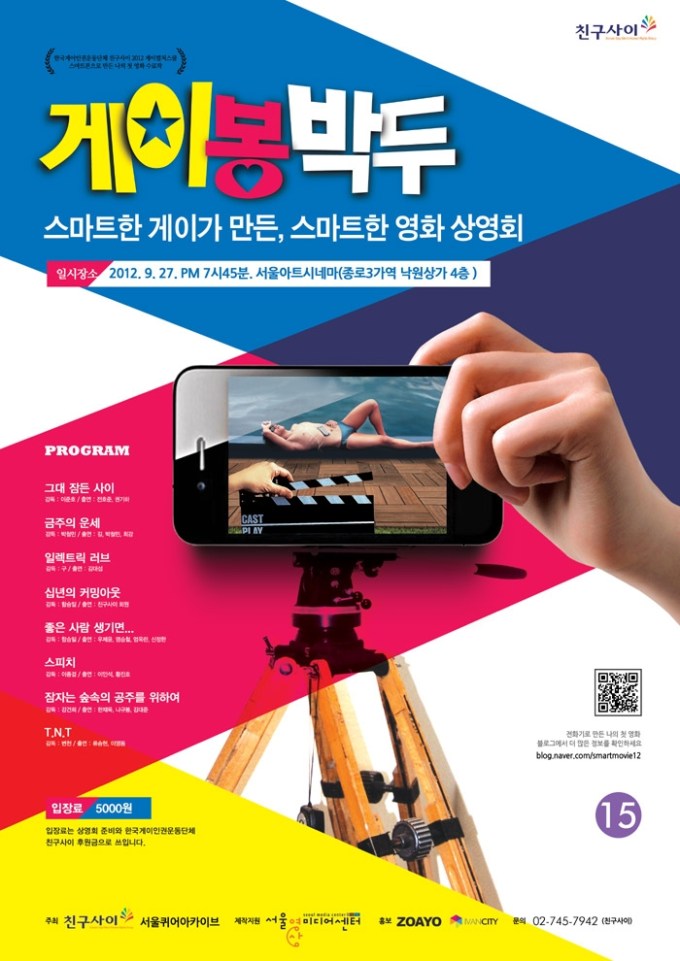
On the 27th of September, at 7:45 pm, there is a gay short-film festival taking place at the Seoul Art Cinema in Jongno, with all the films recorded on cell phones. See The Kimchi Queen for further details.

Meanwhile, I’ve rejigged the categories a little to make things easier to find, although of course there is still a lot of overlap: please let me know what you think. Also, with 1/3rd to 1/2 of the stories coming from outside of Korea, and with most not really being about “gender issues” per se (or maybe they are — it’s a very vague term really), I’ve been thinking of renaming these posts for a while now. If anyone has any suggestions for a new name, please let me know!

Update: Please let me know if you have any suggestions for Korean dating and relationship blogs to follow too. Not that Speaking of China isn’t a great site of course, but I would like to include some more Korean links here!

Body Image/Health/Socialization

Female Restaurant Workers Tell Customers ‘Don’t Call Us Ajumma’ (Korea BANG)

A Racist Little Outfit: Victoria’s Secret’s “Sexy Little Geisha” Lingerie (Bust)

Korean Movie: Beautiful/아름답다 (Journey Into the Well)

Thinking Pink: A History of Products “For Her” (Bitch)

Fat For an Asian: The pressure to be naturally perfect (Escher Girls)

Boys Throw Better Than Girls. Good Job? (XX Factor)

The Omniscient Breasts: The Male Gaze Through Female Eyes (SF Signal)

Censorship

Sex and Censorship During the Occupation of Japan (The Asia-Pacific Journal)

More on vice. Eminem, Lady Gaga, and more. (Korea Law Today)

S. Korea to beef up age-rating system for music videos (10Asia)

China/Taiwan

Feminism Around the World: Awesome Activists Protest in China (Bust)

Internal child trafficking in China (International Institute for Asian Studies)

Surge in demand for British milk from China (The Telegraph)

Crime

Street harassment in Incheon (I’m No Picasso II)

Only 1/3 of Child Sex Crime Victims File Charges (The Chosun Ilbo)

Government to toughen penalty for raping minors (The Korea Times)

Crackdown alone can’t solve child abuse issue (The Korea Times)

Amy was Threatened by an Attempted Rapist (ENewsWorld)

Does the ROK Army Have A Sexual Assault Problem? (ROK Drop)

Physical and Sexual Absuse in the ROK Military: A conscript’s perspective (Sorry, I was drunk)

SKorea: Govt moves to expand prosecution of sex offenses (Asian Correspondent)

How should Korea combat pedophilia? (The Korea Herald)

Child Rape Survivor Sends Stuffed Toy to Naju Rape Victim (Korea Bang)

Castration would reduce sex crimes: Saenuri reps (Korea Joongang Daily)

Dating/Relationships/Marriage

From the Archives: On Finding Courage in Love (Speaking of China)

Double Happiness: The Volunteer Who Went to China and Found Her True Love (Speaking of China)

Demographics/Multiculturalism

One-child Policy Encourages Trafficking of NK Women (Mercator Net)

10 myths of the UK’s far right (The Guardian)

Ignorance breeds racism (The Korea Times)

The Gender Politics of Moving Back Home (The F-word)

Grown Korean adoptees return to birth country to fill in the missing gap (Alleyways)

Education/Pregnancy/Childbirth/Parenting

No. of Elementary School Students Hits Record Low (KBS World)

South Korea will keep evolution in its high school textbooks! (io9)

Grandmother gives birth to her own grandchild (io9)

Why do fathers’ testosterone levels drop when sleeping near their children? (io9)

History

Namsan: Of vanished history and unfulfilled plans (Gusts of Popular Feeling)

LGBT/Sexuality

Sexually aroused women find everything less disgusting (io9)

Reading List: En-gendering re-gendered romance of multiple lives: reincarnation in Bungee Jumping of Their Own (The Kimchi Queen)

17 Euphemisms for Sex From the 1800s (Mental Floss)

Getting Tested for HIV/AIDS in Korea (The Kimchi Queen)

Study Reveals Teens’ Warped Perceptions of Sex (The Chosun Ilbo)

The problem with Naomi Wolf’s vagina (New Statesman)

Men Like Heavier Women…Especially When Stressed Out! (Psychology Today)

First Comes Love, Then Comes Marriage: A Night at the Drive-in (Nursing Clio)

Video: Gay in Korea (ROK On!)

MBLAQ’s Lee Joon reveals his mom gifted him with birth control for college entrance (Omona They Didn’t)

North Korea

Jennifer Lind on the DPRK government’s resilience (and women in IR) (Korean Kontext)

Professor Robert Kelly’s Trip to North Korea (Asian Security Blog; continued in part 2, part 3, part 4, and part 5)

Politics/Economics/Workplaces

For 40-something women, jobs scarce (Korea Joongang Daily)

Korean women buy large, imported cars to avoid being bullied by male drivers (The Star)

Pop Culture

Is It Too Soon for T-ara to Come Back? (Seoulbeats)

Hallyu Tsunami: The Unstoppable (and Terrifying) Rise of K-Pop Fandom (Grantland)

Roundtable: The Broken Fountain of Youth (Seoulbeats)

Parade’s End director says sexism is still rife in [UK] drama world (The Guardian)

Golden Time ponders extension — dude, you have one episode left (Dramabeans; see also “Golden Time confirms three-episode extension)

Tough Ladies Report to the Dance Floor (Seoulbeats)

Social Problems

South Korea’s Blight: Suicide Gets Worse (Korea Real Time)

Solbi speaks against suicide on World Suicide Prevention Day 2012 (AllKpop)

Celebrity Suicides: An Unfortunate Trend (Seoulbeats)

Suicides among Japanese students hit record level in 2011 (The Japan Times)

Killing Yourself To Make A Living: In Japan Financial Incentives Reward Suicide (Japanese Subculture Research Center)

89% of US Army Suicides Are By Soldiers Who Never Saw Combat (ROK Drop)

Living in a closet, tape a window to the wall (The Hankyoreh)

Everyday Sexism: It isn’t restricted to adults – even young girls in school uniform share their experiences (The Telegraph)

Ilyo Sisa denounces the barbarity of white men against Korean women (Gusts of Popular Feeling)

Chuseok and 차례 and sexist traditions (I’m no Picasso)

Korea’s new war on vice (Alleyways)

Seoul adopts rights ordinance (The Korea Times)

(Links don’t necessarily imply endorsements)

TGN Meetup in Seoul, Saturday September 22nd

(Source)

Yes — I’m happy to announce that next Saturday, I’ll be coming up to Seoul for an interview by Nele Hecht, a German documentary-maker based in the UK, when I’ll talk about things like S-lines and the appalling photoshopping in that poster. And, as I so rarely get the chance to come to Seoul (the last time was last summer, also for an interview), it would be great to make most of the opportunity and meet old and new TGN fans while I’m there too.

The plan is, we’ll all meet at Gyeongbokgung Station (경복궁; at the center of this map), exit 3, and take it from there (the time hasn’t been decided yet; probably 5 or 6 Update: it’s 6). If by any chance you miss us or want to join later, just email or tweet me. Hope to see you there!

Meanwhile, here is a short bio of Nele Hecht, who will hopefully also be joining us:

Nele Hecht is a German filmmaker working in the UK. She has made several short films, trailers for books and music videos. She is currently working on a documentary about gender identification.

The documentary will be following few individuals and investigate their struggle with the traditionally set norms of gender. Simultaneously it will feature different voices discussing the issue from various angles, particularly the role of feminism in regards to gender perception.

The aim is to stress and support the individual interpretation of gender, challenge traditional perceptions of male and female roles and portrait a picture of a diverse society outside those boundaries.

This documentary is independently funded. Seoul is the start of the filming progress, which will carry on in London and Berlin.

As it’s independently funded, that means I’ll be paying my own way (about 180,000 won all up), so let me again remind readers (for just the second — and final!— time this year) that any donations towards that, or running the blog in general, are much appreciated, no matter how small. Forgive me for asking, and of course I’ll still come regardless, but unfortunately the reality is that only one person (thank you!) has clicked on those donate buttons since I last asked in April!

(For the record, I’ve received about $190 in donations so far this year, minus Paypal commissions)

Korean Poster: ETIQUETTE FOR MEN AT NIGHT

(Source)

Via Tales of Wonderlost, who also passes on a translation by Opress-Crackatron3000:

Protesting sexual harassment and violence against women

ETIQUETTE FOR MEN AT NIGHT

1. Remember that your presence can be threatening to women walking alone at night

2. If a woman is walking in front of you alone at night, slow down. You walking quickly or speeding up can be and in most cases is threatening

3. If you’ve been drinking and are drunk, go straight home.

4. Do not pick a fight or aggravate women walking at night

5. Do not take off your clothes or publicly urinate

6. Be careful to make sure you do not touch or hit someone, even on accident.

7. If, late at night, you come to a situation in which you and a woman have to ride an elevator together, let her go up first and wait for the elevator to come back down.

8. If there’s a woman in a public restroom (There are Korean public restrooms with no gender or sex markings that are open to all people), wait for her to finish and come out first before using the restroom.

9. Report broken streetlights to the police

10. Tell other men about these rules and that they have a responsibility to not threaten women walking at night

Please share as much as possible!

Related Post: Groping in Korea: Just How Bad Is It?

The Chosun Ilbo: Hollister Models Liable for “Excessive Exposure”

(Source*)

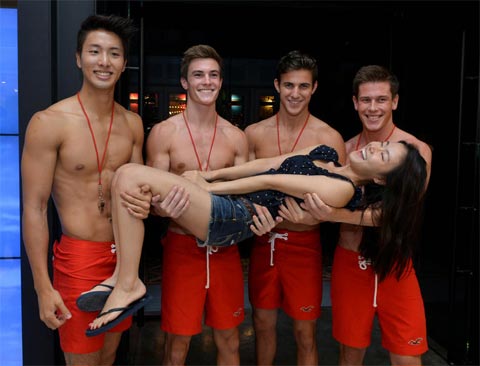
Always interested in how objectification is portrayed by the Korean media, here’s my translation of a brief article about the opening of Hollister’s first Korea branch last month, written just before the news emerged of how reprehensibly some of its models acted during their stay here.

While short, I found it strange that the article would raise the absurd possibility that the half-naked models were guilty of any offense, which could be interpreted as implied criticism of the event. But on the other hand, the author may well have mentioned that just for the sake of creating a story; after all, keeping the company’s name anonymous throughout the article, but including it in a photo caption from another news service, isn’t exactly stellar journalism.

Anybody that finds a better source on the objectification angle in the story, please let me know!

Update: Apparently, Hollister has used this shirtless stud gimmick in Asia several times. And, as Nathan McMurray of Korea Law Today puts it, it “always seems to drum up some controversy. That is likely their objective.”

해외 브랜드 개점 이벤트… 모델 끌어안고 촬영까지 “낯 뜨겁다” vs “신선하다”

Foreign Brand Opening Event…From Hugging Models to Being Photographed with Them: Just Embarrassing, or a Fresh Marketing Method?

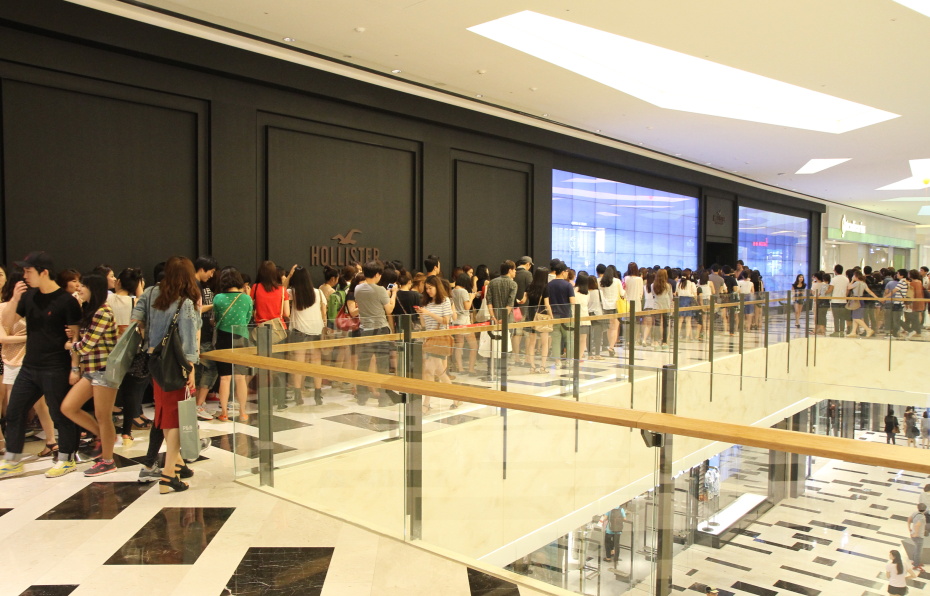
31일 낮 12시쯤 서울 여의도 복합쇼핑센터 IFC몰의 해외 의류 브랜드 H사 매장 앞에서 직원 안내에 따라 20∼30대 여성 20여명이 긴 줄을 섰다. 그들 앞에는 근육질 외국 모델 2명이 웃통을 벗은 채 서 있었다. 한 20대 여성은 반바지만 입은 두 모델 사이에서 한 손으로 모델의 허리를 감고 다른 한 손으로는 ‘V’자를 그리며 사진을 찍었다. 구경꾼 30여명은 매장 앞에서 그들을 에워싼 채 연방 휴대전화 카메라 셔터를 눌렀다.

At about midday on the 31st of August, about twenty women in their twenties and thirties were standing in a line in front of foreign clothing brand “H” company’s new store at the multi-shopping center International Finance Center Mall in Yeouido in Seoul. Two half-naked, muscular foreign models were standing there. One twenty-something woman stood between the two men, who were only wearing shorts, and had her picture taken while making a V-sign with one hand and wrapping the other around the waist of one of the models. Thirty other women surrounded them and took more pictures of the scene with their cellphone cameras.

이 ‘조각 미남’ 모델들은 H사 본사에서 마케팅을 위해 기용한 이른바 ‘판촉사원’이다. 지난 30일 IFC몰 개장과 동시에 국내에 처음 들어온 H사 매장은 입점 기념 이벤트로 매장 앞을 지나는 이들에게 반라(半裸)의 모델과 함께 사진 찍는 기회를 제공하고 있다.

Described as “sales promoters” by the company, these ‘beautiful male sculptures’ were employed by the head office to market the opening of the store, the company’s first in Korea. On the 30th, the day of the IFC mall itself opened, they stood outside to attract the attention of passers-by and give them an opportunity to be photographed with them.

Caption: 30일 오전 서울 영등포구 여의도동 서울국제금융센터(IFC 서울)에서 열린 IFC몰 오픈 행사에서 국내 첫 입점한 홀리스터의 모델들이 해양구조대 복장으로 점포를 찾은 고객과 사진을 찍는 이벤트를 진행하고 있다./뉴시스

Caption: On the morning of the 30th, at the opening of the Seoul International Finance Center in Yeouido, Yeongdeungpo-gu, Hollister models dressed in lifeguard style stand outside the Hollister store to mark the opening of the company’s first branch in Korea

이날 같은 층의 다른 매장과 달리 H사 매장 앞은 손님들로 붐볐다. 모델과 함께 사진 촬영을 한 대학생 김수영(24)씨는 “모델이 멋있어서 친구까지 데리고 왔는데, 신선하고 재미있었다”고 했다. 회사원 박미정(35)씨도 “점심시간에 짬을 내 쇼핑도 하고 사진도 찍으니 기분 전환이 된다”며 좋아했다.

Unlike different stores on the same floor, on that day the outside of H comany’s store was crowded with onlookers. University student Kim Su-yong (24), who came to have her picture taken with the models, said “Because the models were so cool I even brought my friends. It was fresh and fun,” while company worker Park Mi-jong (35), also explained that “I made time in my lunch break to so some shopping and have my picture taken, I feel great now!”

하지만 “공개된 장소에서 뭐 하는 짓이냐”며 문제를 제기하는 목소리도 많았다. 회사원 조모(39)씨는 “(여성들이) 팔짱을 끼는 것은 예사고, 아예 대놓고 모델을 끌어안기도 한다”며 “아무리 마케팅이라지만, 남성의 성을 이렇게 상품화해도 되는 거냐”고 했다.

But voices of complaint were raised over its appropriateness in a public place. Company worker “Mo” (39) [James’s wife: “Probably a man”] said “[Women] wanting to hold arms with the models is just trashy, as is shamelessly hugging them,” and added “It may well be a marketing stunt, but isn’t using male sexuality like that simply objectification?”

(Source)

일각에서는 이런 이벤트가 현행법 위반 아니냐는 지적도 나온다. 경범죄처벌법상 ‘몸을 지나치게 내보여 다른 사람에게 부끄러움이나 불쾌감을 준 경우’는 과다노출죄를 물어 10만원 이하의 벌금을 부과하거나 교도소 등에 최장 29일까지 수감할 수 있다. 또 형법에서는 ‘공공장소 등에서 음란한 행위를 해 다른 사람에게 수치감과 혐오감을 주는 경우’ 공연음란죄로 1년 이하 징역이나 500만원 이하 벌금 등에 처하도록 규정하고 있다. 서울남부지법 황승태 공보판사는 “이번 사례의 경우 두 법 모두 적용될 여지는 있는데, 정도를 따져볼 때 과다노출죄에 더 가깝다고 볼 수 있다”고 말했다.

From one perspective, this event breaks the law. According to the Misdemeanor Punishment Law, if someone “shows an excessive amount of their body to people, and causes them to feel embarrassed or upset as a result,” that person can be charged with excessive exposure and face a fine of up to 100,000 won and/or a jail term of up to twenty-nine days. Also, according to criminal law, if someone “commits a lewd act in a public place and causes feelings of shame or repulsion to others,” that person can be charged with public lewdness and face a fine of up to five million won and/or a jail term of up to one year. According to Seoul Southern District Court information officer Hwang Sung-tae, “In this case both laws apply, but based on the degree of the offense the Misdemeanor Punishment Law is the most applicable.”

모델을 매장 앞에 세우는 마케팅은 실제로 미국·일본 등 해외에서는 성행한다. H사 측은 2일까지만 이벤트를 계속한다는 계획이다.

This type of marketing which uses models in front of stores is common in the US, Japan, and other foreign countries. H company plans to continue this event until the 2nd of September. (End.)

*Apologies for the creative license, but the first image actually comes form the opening of Hollister’s Beijing store in May.

Korean Gender Reader

Not really related to Korea sorry, but Derek Kim and Les McClaine, two of my favorite cartoonists, do need to sell 8-10,000 physical copies of the first chapter of Tune to keep the excellent web-series going. Just $9.86 on Amazon, or — I’m very happy to report for Korea-based readers — 20, 390 won at What The Book, I’m just about to order a copy for myself and (hopefully) my daughters. See here for the details, and please: don’t click on page 1 of Chapter 1 unless you’ve got a few hours to spare!

Announcements

Video: Girls’ Generation? Gender, (Dis)Empowerment and K-pop by Dr. Stephen Epstein (Royal Asiatic Society)

Busan Biennale 2012, September 22 – November 24 (Busan Haps)

Body Image/Health:

Breast in show: the art of plastic surgeon Han Xiao (Want China Times)

Queer Corner: Gendered Beauty Standards (Korean Gender Cafe)

Plastic-Fantastic or Robotronic-Loverholic? (Seoulbeats)

How Savvy Chinese People Avoid Toxic Food, Goods Produced in China (Asia Society)

German magazine rethinking ‘no models’ policy (The Korea Herald)

Objectifying Cyclist Jenny Fletcher (Sociological Images)

Firms focus more on employees’ health (The Korea Times)

Breasts: A Natural and Unnatural History by Florence Williams (The Guardian)

The Daegu International Body Painting Festival 2012 in South Korea (The Telegraph)

Look at Me! I’m on a Diet! The Girls Generation Diet!! (The Unlikely Expat)

The Mosquito Truck (Ask a Korean!)

Censorship/Protest:

G-Dragon new MV ‘That beeeeep’ will be censored with lots of annoying beeeeeeeeeeeps (Omona They Didnt)

Protecting Sources & Risking Lives: The Ethical Dilemmas of Japanese Journalism (Japan Subculture Research Center)

Constitutional Court of Korea Declares Internet Real-Name Online Identification System Unconstitutional (The Korea Law Blog)

Military’s moral education has a political agenda (The Hankyoreh)

Protests, public space in Seoul, and cyberspace – Part 5 (Gusts of Popular Feeling)

Filming curtailed in ‘suicide forest’ (Visual Anthropology of Japan)

Crime:

Suspect in Naju’s child abduction-rape case admits to crime (Yonhap)

Drunk Man Kidnaps, Rapes and Leaves Girl with Internal Injuries (Korea Bang)

Police request arrest warrant against child rape suspect (The Korea Times)

Police revive stop and search to help fight violent crimes (The Korea Herald; The Korea Times)

Need systematic crackdown on child pornography; South Korea is world’s sixth largest distributor of child porn (The Hankyoreh)

Courts slammed for light sentences on sex offenders (The Korea Times)

The War on Crime (The Marmot’s Hole)

Crimes rekindle debate over capital punishment (The Korea Herald; The Korea Times; The Hankyoreh; Korea Real Time)

SKorean juries give sex offenders harsher punishments (Asian Correspondent)

Ex-doctor proposes surgical castration (The Korea Herald)

Government to recruit 1,250 more police, probation officers (The Korea Times)

Korea’s new war on vice (Korea Law Today)

Dating/Relationships/Marriage:

Ask the Yangxifu: Should I Wear a Qipao in My Chinese Wedding? (Speaking of China)

Korean Hugs vs American Hugs (Gyopo Keith)

Reply to “I’M AN ASIAN WOMAN AND I REFUSE TO EVER DATE AN ASIAN MAN” (AMWW Magazine)

A Story of Sexism, Chinese Men and Who Should Wash the Dishes (Speaking of China)

Does Waiting Six Months To Have Sex Improve Relationships? (XX Factor)

A love letter from the past (The Marmot’s Hole)

Yangxifu Pride: Pinterest Boards on Chinese Men and Western Women in Love (Speaking of China)

History:

The Anti-Rising Sun Flag:Are the ghosts of the past still haunting us? (The Marmot’s Hole)

LGBT/Sexuality:

Tokyo women weigh in on the possibility of participating in porn pictures (The Tokyo Reporter)

K-dramas and “Pseudo-Homosexuality”: What Gives? (Seoulbeats)

Gay groups up in arms over sexuality education textbook in Hangzhou (Shanghaiist)

Reading List- Remembered Branches: Towards a Future of Korean Homosexual Film (The Kimchi Queen)

K-Drama’s More Literal (And Laudable) Takes On Homosexuality (Seoulbeats)

Queer Corner: Violence in a Label – 마짜, 때짜, 올 (Korean Gender Cafe)

More to learn about LGBT travel trends from South Korea (Travel Daily News)

Gayspeak: 떼박/Orgy (The Kimchi Queen)

Gender-bendy hijinks from Oohlala Spouses (Dramabeans)

Miscellaneous:

A Culture of Copying (ZenKimchi)

In the Victorian Age, astronomy and nudity went hand in hand (io9; NSFW)

Paper Tigers: What happens to all the Asian-American overachievers when the test-taking ends? (New York Magazine)

Goodbye Reverend Moon (1920-2012). Let’s consider what happens next. (Korea Law Today)

Do men and women really (literally) see the world differently? (io9)

Naomi Wolf’s Vagina:

Ariel Levy on Naomi Wolf’s “Vagina” (Bitch)

Neuroscientists take aim at Naomi Wolf’s theory of the “conscious vagina” (io9)

Naomi Wolf: ‘Neural wiring explained vaginal v clitoral orgasms. Not culture. Not Freud’ (The Guardian)

Naomi Wolf’s book Vagina: self-help marketed as feminism (The Guardian)

Tunnel of Love (The Economist)

Politics/Economics/Workplaces:

For ‘losers’, Korean society is unforgiving (The Hankyoreh)

In Japan, Retirees Go On Working (Bloomberg Business Week)

How the 5-day workweek changed Korean employment (The Hankyoreh)

Cancer, Death and Samsung’s Semiconductor Factories (The Three Wise Monkeys)

Inside Korean Work Culture: Overworked and Underappreciated (The Three Wise Monkeys)

The Greying Radicals in Korea and How they May Harm Your Korean Business (The Korean Law Blog)

Female muscle: Now is not a good time to be a man (The Economist)

Pop Culture:

Unpopular Opinion: Psy Isn’t Doing K-pop Any Favors (Seoulbeats)

Gangnam Style: After 100 million downloads, maybe I should say something (Korea Law Today)

There is No Such Thing as ‘Gangnam Style’ (The Three Wise Monkeys)

What does Gangnam Style mean? (Cute in Korea)

Why do the opinions of netizens bear so much weight on the K-Pop industry? (Netizen Buzz)

Korean Culture Through K-pop 102: Will You Marry Me? (Seoulbeats)

Why It Makes Me Sorry That Hwayoung Is Sorry (Seoulbeats)

Netizens label YG Entertainment’s Jennie Kim a bullying bitch based on … uh … nothing (Asian Junkie)

G-Dragon, “One of a Kind”: a 3-and-a-half-minute ego trip (My First Love Story)

Is K-Pop Sustainable? Tom Coyner by IPG’s Senior Adviser (The Korean Law Blog)

Pregnancy/Abortion/Childbirth/Demographics/Parenting/Education/Multiculturalism:

For the Love of All That’s Holy: You Don’t Lose Your Identity When You Become a Parent, You Lose Your Minutes (Jezebel)

South Korea Struggles With Fewer Troops; U.S. Military With Fewer Dollars (Real Clear Politics)

Dinosaurs and indoor pools – the lighter side of childhood in China (Seeing Red in China)

Grown Korean adoptees return to birth country to fill in the missing gap (The Korea Times)

More Or Less: Why, as people get richer, do they have fewer children? (The Economist)

As education levels rise, fertility drops (Korea Joongang Daily)

Number of women giving birth over 40 doubles in a decade (The Korea Times)

Statistics on foreigners in Korea, and the ROK before the CERD (Gusts of Popular Feeling)

On Feeding (On Becoming a Good Korean (Feminist) Wife)

Multiracial families and military service (The Korea Times)

Korean scientists counter creationists on textbook controversy (The Hankyoreh)

(Links are not necessarily endorsements)

From the Archives: Bagel Girls, Banking, and Babies!

(Source)

…[the character of] Chi-Yong’s mother sees marriage as a way to achieve social advancement and material prosperity, as it was in the Victorian era. These ambitions have come to the forefront in Korea since the 1970s, due to rapid economic development and consequent aspirations to class mobility and consolidation during the last thirty years. This novel [Marriage/결혼 by Kim Su-hyeon, 1993] is a good illustration of how, given the pace of change of change in Korea, everybody has a different point of view on marriage, depending on their gender, class, and generation. The issue of communication across generations has become a serious matter. Generation is an important attribute of identity in Korea, like race in the United States. (My emphases.)

(So-hee Lee, “The Concept of Female Sexuality in Popular Culture” in Under Construction: The gendering of modernity, class, and consumption in the Republic of Korea, ed. by Laurel Kendell, 2002; page 146 of 141-164)

With apologies to So-hee Lee for variously attributing that quote to either her editor, to Hyun-Mee Kim, or to Nancy Abelmann over the years, it still very much applies 10 years later. It’s also why studying and living in Korean society can be so exciting sometimes.

For someone who’s been writing about the place for over 5 years though, it means that many of my posts need updating. Let alone mercifully deleted as reader feedback, further research, and greater use of Korean sources have exposed gaping holes in my knowledge and confident preconceptions. And from a practical standpoint too, links will die, embedded videos will get deleted, and my theme will always highlight recent posts at the expense of older ones, no matter how good they may be after going through my culling process.

With all that in mind, once a month I’ll be highlighting posts from the corresponding month in previous years. Not all of them of course (hey, I’ll still like some material to work with in September 2013 and 2014), and to some there’s no new news to add; I include them just to draw attention to for new and old readers, especially as they’ve since been slightly edited for this post with the benefit of several year’s of hindsight. Others though, I’m adding a great deal of new news and commentary below, as you’ll see.

Please let me know what you think!

2011

Alas, not really my own article, but about Grace Duggan’s for Bust Magazine. While I’d often criticized the body-labeling craze in South Korea previously, I didn’t realize just how offensive this particular term was until she pointed it out (source, right):

Sexualizing young women for having childlike features sets off all kinds of alarms, regardless of whether or not they are over 18. The “bagel girl” label does more than infantilize women. It compartmentalizes them by applying two irreconcilable ideals: looking like a baby and a full-grown woman at the same time.

Granted, that may make it sound no more harmful than any other “line.” But, as I explain in a later comment, in the context of how it’s actually used it ends up sounding almost pedophilic:

…there’s nothing wrong with looking young per se.

But consider who the label is applied to: not, say, women in their 30s and 40s and older, for whom – let’s be real – wanting to look younger than they are is understandable (hell, for a 35 year-old guy like me too), but rather it’s women barely on the threshold of adulthood that are being praised for looking like children. And, not to put too fine a point on it, what the FUCK is great about a 21 year-old looking younger than she is? And when her body is simultaneously praised for being developed? That is a seriously flawed ideal to aspire to, and, moreover – as I hint at in the post – it’s no coincidence that it occurs in an environment with strong expectations of childish behavior from women too. Indeed, the end result strongly reminds me of child and teenage female manga characters, with personalities appropriate for their age, but somehow the sex drives and physiological development to act on them of women 10-15 years older.

(Source)

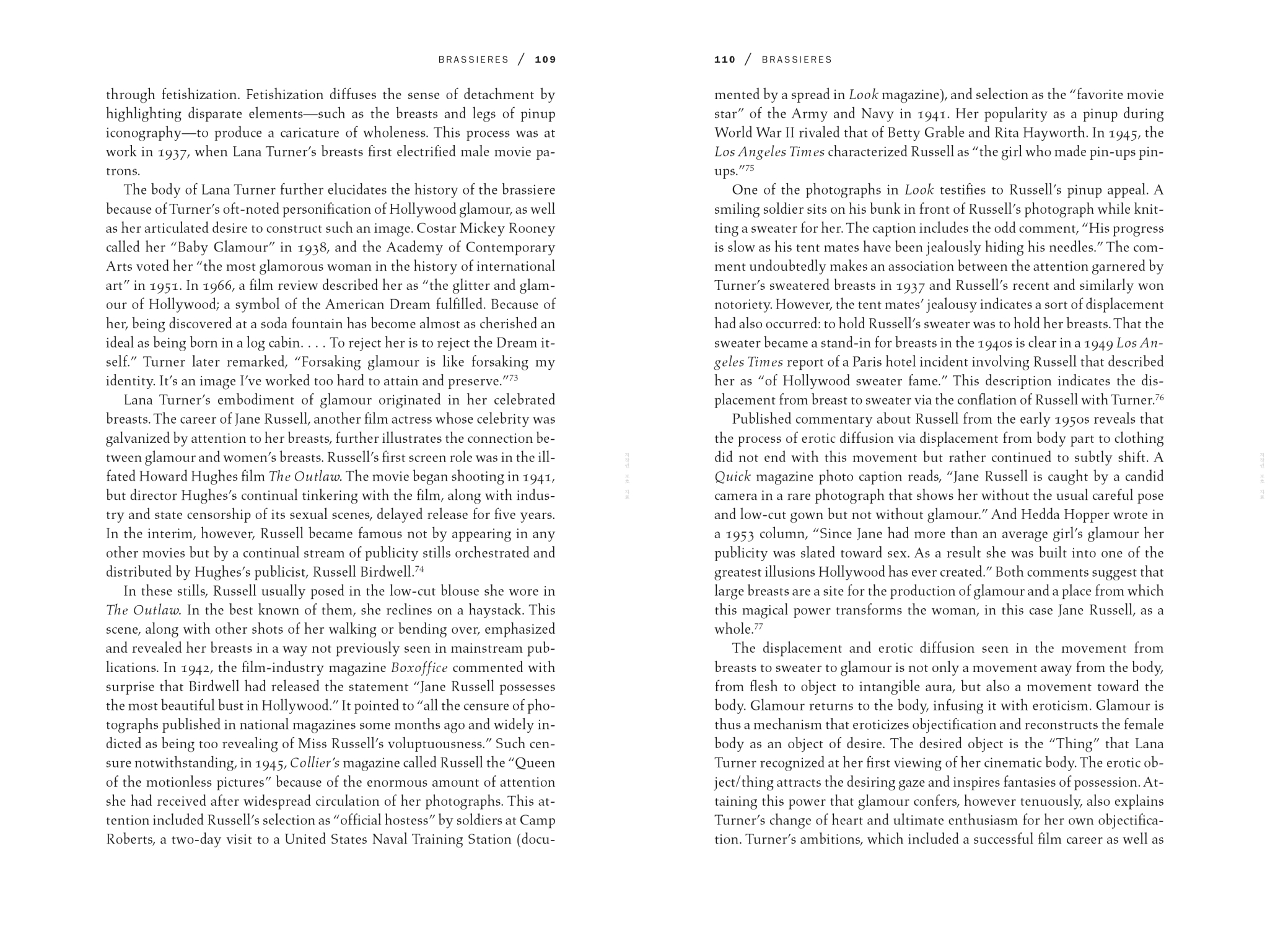
Meanwhile, by coincidence just yesterday I finished the excellent An Intimate Affair: Women, Lingerie, and Sexuality by Jill Fields (2007), which explains how the word “glamour” — where the “gul/글” in Bagel Girl comes from — came to be closely associated with large breasts by Hollywood in the 1930s to 1950s. Something I’d previously chalked up to a Japanese and then Korean mistranslation of the word, see the above pages for more on that, or all of Chapter 3 on brassieres at Google Books here.

If I do say so myself, I’m very proud of the way I describe my feelings when child singers do aegyo:

…cutesy aegyo is bad enough coming from a 21 year-old singer, but simply surreal when you see it done by a 14 year-old.

Yes, surreal, not merely awkward and inexperienced: essentially, you’re watching a child pretending to be an adult pretending to be a child.

Thank you very much.

Thanks again to the (necessarily anonymous) reader who wrote about her experiences, and I’ve had dozens of inquires about the Seoul clinic she used since. Please just email me if you ever need to know the details yourself.

(Source)

2010

Once someone points out the “head cant” to you, it just can’t be unseen. Usually inoffensive in itself though, and frequently done simply for photographic and stylistic reasons (which I’ve under-acknowledged in the past), it’s the fact that it’s overwhelmingly women it that makes it problematic. Just one of a number of typical poses for women in ads, ultimately it serves to reinforce gender stereotypes.

Probably, that’s why these recent Giordano ads stood out to me: in the example above for instance, Shin Min-a (신민아) is the one in control, staring at the viewer, while So Ji-sub (소지섭) is distracted (it’s usually the guys that are presented as more focused). And, desperately seeking examples of pro-feminist advertisements for a TED presentation I may be giving next month, in which I have to — grrr — conclude with a positive message rather than just criticize, this made me realize that feminists and advertisers don’t necessarily have to be at odds with each other. Just a sense of balance by the latter would be a huge step forward.

Really about “lewd” advertisements, 2 years later (this June) I translated another article about how their numbers had surged 3 times over the previous 12 months. With no apparent sense of irony, just about every news site that reported on that had so many examples themselves that the text was difficult to read.

One of my most popular posts, anybody (especially men) who thinks street harassment isn’t a problem should just reflect on the opening cartoon, let alone female readers’ comments about their own negative experiences.

(Source: unknown)

2009

A short, harmless commercial for Shinhan Bank at first glance. But, once you take the time to analyze it, it has a clear message that men do the thinking at Shinhan while the women simply look good. Indeed, it’s such a classic example of gender stereotyping that I’m still using it in presentations today.

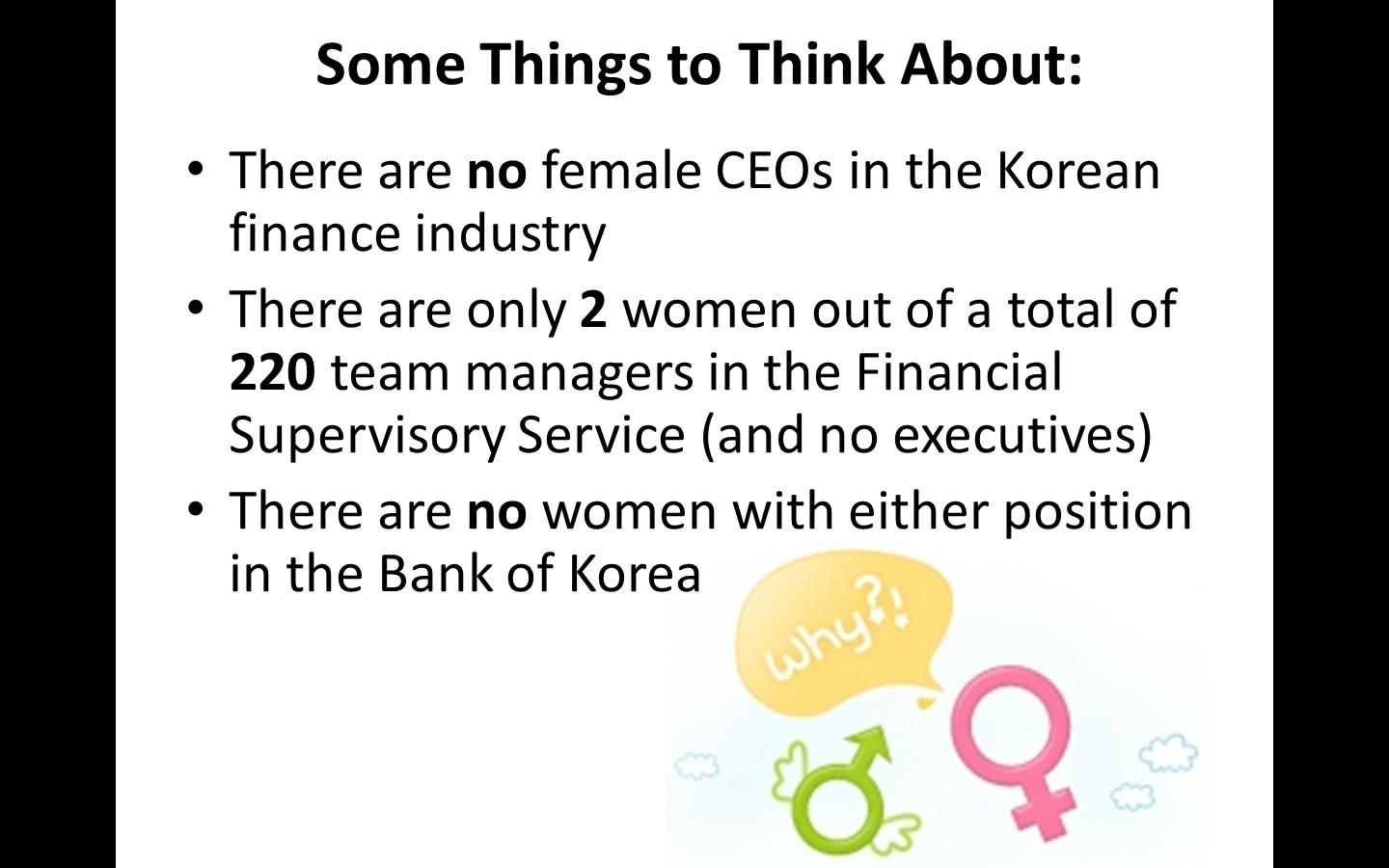
Here’s the slide I would present after providing that analysis:
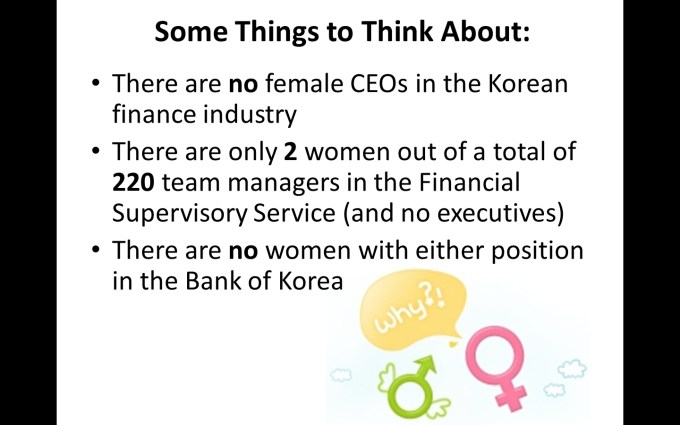
But in the next presentation, I’ll be updating it with the recent news that the banking industry still has the largest gender pay gap in Korea, with women making an average of only 57% of what men make.

Not that I’m against skin by any means. But these remain very sweet ads!

Again one of my most popular posts, ironically soon after writing it trends in the Korean entertainment and music industries meant that Koreans would replace Caucasians in many of the modelling roles that sustained those Occidentalist stereotypes. Also, in my own (admittedly limited) experience, there’s far fewer Korean male – Western (invariably Caucasian) female pairings in popular culture now, after a spate of them in the years after Misuda first appeared. (There were never very many of the opposite.)

However, of course many of the stereotypes still do remain.

(Sources: left, right)

2008

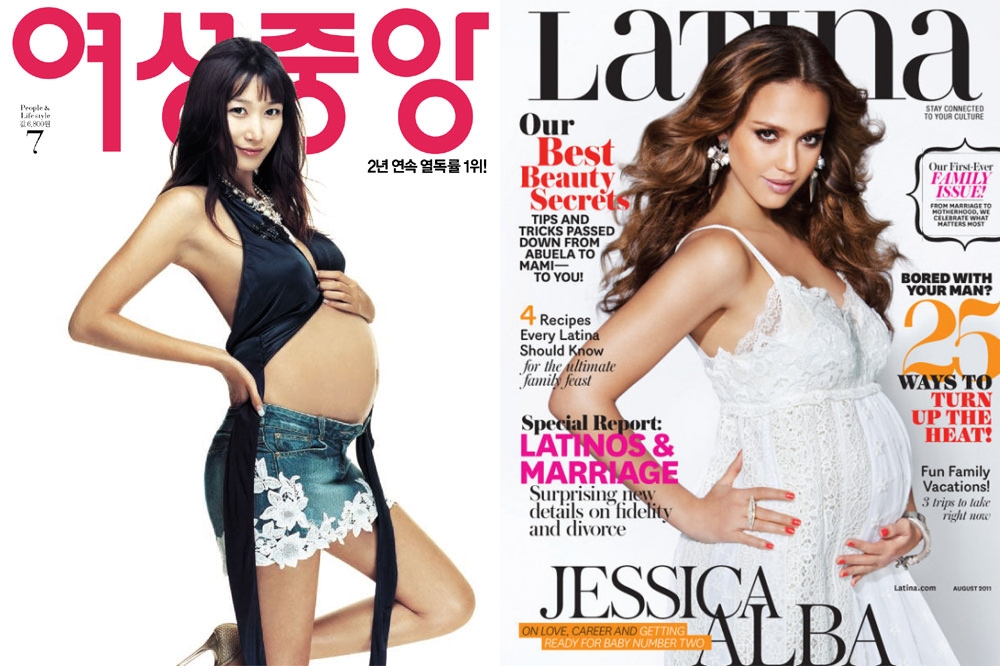
When I read on Yahoo! Korea this week about pregnant Hollywood star’s “D-lines”, for a moment I did try to hold my tongue about seeing the label.

After all, this, for example, is just an advertisement for an event for expecting mothers (albeit one where likely body-shaping products are promoted); these D-line fashion shows were surely perfectly harmless; many of those Hollywood stars were indeed glowing, as was pregnant Moon So-ri (문소리) in Cosmopolitan last year; and finally, yes, I can see the humorous side — it is often applied to extremely obese men.

But although the Western media too promotes pampered celebrity mothers-to-be as ideals to follow, and I can certainly accept that pregnant women overseas may likewise feel under some indirect pressure to watch their weight, that post is about how pregnant Korean women were dieting as early as the late-1990s. One can only shudder at what things are probably like now.

Suddenly, talk of D-lines sounds a lot less funny.

One of my first attempts to grapple with the origins of the kkotminam phenomenon (꽃미남; lit. flower-beauty-man), which culminated in this piece by friend and ANU professor Roald Maliangkay 2 years later.

By coincidence, both of us will be quoted in a related news article to be published next week. Watch this space! (Update: and here it is!)

2007

And indeed there was. Unfortunately however, attitudes didn’t change with it, so fathers feel compelled by management to either ignore it entirely or to come back to work early, despite it only being 3 days (source right: unknown).

Note though, that the “paternity leave” in the original article I translated was a bit of a misnomer, it really meaning time off for a child’s birth. “Real,” paid paternity leave has been available since 2001 (or possibly 1995), but sources vary on specifics. Sung So-young in the Korean Joongang Daily, for instance, wrote in April 2011 that:

According to Korean law, all employees with a child under the age of 3 are eligible to take a year off to care for their children. Up to 1 million won ($919) in salary is provided monthly.”

But that is contradicted by a slightly later report in the Chosun Ilbo, which states that:

…those on leave can get up to 40 percent of their salary, or a minimum of W500,000 and a maximum of W1 million, and parents can take leave until the child is 6 years old.

And both in turn are contradicted by Lee Hyo-sik’s earlier report in the March 4 2011 Korea Times, which says:

Regardless of income levels, both male and female salaried workers are currently given 500,000 won per month during parental leave. This is expected to go up to one million won next year.

As for the maximum age of the children in order to be eligible, the same article states that it was 6 rather than 3. This is confirmed by an earlier February 2010 article by Kwon Mee-yoo, again in the Korea Times, which stated:

The Ministry of Labor passed a revision on Wednesday to the Act on Equal Employment and Support for Work-Family Reconciliation, or the Employment Equity Act for short, which will expand the range of workers eligible for parental leave. Now parents with preschoolers under six years old can benefit.

The leave allows employees to take a certain number of paid days off from work to care for their children. The parents can also take unpaid leave if they use up all of their paid days. This includes maternity, paternity and adoption leave. Currently, at private firms only workers with children 3 years old or less qualify for the leave.

Surprisingly, parents with adopted children weren’t eligible before this revision, and still, “only those who gave birth to or adopted children after Jan. 1, 2008 [were to be allowed] parental leave,” despite those (then) 2 to 6 year-olds obviously being of age. Which all sounds very tight-fisted, although logical during the worst of the financial crisis.

Kwon Mee-yoo also notes that it was in 2008 that the government increased the age restriction for (only) public servants, allowing them “to take time off for parental purposes if their children were under 6 years old.” I’ll assume that it previously only applied if their children were under 3 years old, like Kwon notes was the case for employees at private firms.

Finally, quibbles over details aside, Sung So-young’s and Lee Hyo-sik’s articles in particular remain excellent discussions of why Korean fathers are forced to avoid taking paternity leave, despite wanting to spend much more time with their kids. Against that though, just like in most other countries there’s still a pervasive attitude that childcare is primarily women’s work, with insidious manifestations in our daily lives.

And on that note, have a good weekend, and the Korean Gender Reader post will be up on Sunday!

What’s Wrong With Marrying First-born Sons?

(Source; edited)

As every Korean woman looking for a husband knows, hapless first-born sons are best avoided. After all, customarily moving in with — or very close to — his parents, she would just have too many responsibilities for their care, let alone arguments with his overbearing mother:

The old lady often follows her daughter-in-law around, criticizing every bit of housework. They compete for the attention of their son/husband. In addition, because the old lady went through the same process when younger, she feels entitled to make her daughter-in-law’s life miserable. (Here is an old post touching upon this subject.)

Of course, not all eldest sons’ households would be so bad, let alone that of Ask a Korean’s who wrote that. Or would they? In Japan at least, with very similar living arrangements to Korea, they’re so stressful that married Japanese women living with in-laws are three times more likely to suffer a heart attack than those just living with their husbands.

(Source; edited)

Perhaps it’s no wonder then, that “not a first-born son” was one of the common “specs” (스펙) for a husband in this recent list I translated?

But, despite everything I’ve written above, I’d always thought that their extra responsibilities were simply a cultural preference, and one rapidly eroding at that. So, it came as a real surprise to learn they were so formalized as to be enshrined in the government’s social welfare policy, as explained in passing in this recent Hankyoreh article about an elderly woman who committed suicide after losing her eligibility for benefits (my emphasis):

…According to the Ministry of Health and Welfare and Geoje City Hall in South Gyeongsang province, Lee was stripped of her National Basic Living Security assistance qualification because a confirmation study of recipients conducted in June revealed that her son-in-law’s income had increased.

This is to say, the “sustenance allowance” in accordance with support obligation standards (lineal blood relatives or spouse) had been exceeded [James – by a grand total of 7000 won (US$6.18)]. The recently increased income of her daughter and son-in-law, who work for a subcontractor of a major corporation, was about 8 million won a month.

The “mandatory sustenance allowance” is computed by taking the income of the lineal blood relative or spouse, removing a total equal to 130% of the minimum cost of living for a family obligated to support a relative, and multiplying that by 15% in the case of a daughter (30% in the case of a son)…

…When beneficiaries lose their qualification, they also lose their housing assistance, stipend and medical benefits. The standards determining family members who must provide support is tied to a contrived system that dumps the state’s responsibility onto the family.

(Source)

If any readers familiar with the Korean social welfare system could elaborate on this, or any other gendered aspects of it, I would be very grateful. Unfortunately, all I can further bring to the discussion is my copy of The Politics of Social Welfare Policy in South Korea: Growth and Citizenship by Myungsook Woo (2004), a very top-down and theoretical overview that lacks mention of anything at the grass-roots level, let alone of gender. But of course it does still have some insights though, which I’ll pass on in a later post!

Korean Gender Reader

(Source)

Some good news and bad news: after announcing earlier this year that monthly birth-control and morning-after pills were to be reclassified as prescription-only and over-the-counter respectively (i.e., the opposite of the current situation), the KDFA has just postponed its decision for 3 years.

Officially, the reason is because “there has to be careful consideration when overturning a classification system that has been retained for decades,” and because the extra time will allow the KDFA to “carefully monitor” the (supposed) side effects of the morning-after pills and also (unnecessarily) better educate the public on the side-effects and correct usage of monthly birth-control ones. But the more likely explanation is that the government was unnerved by the opposition to the reclassification of the month birth-control pill in particular, especially just before the election. In contrast, the opposition to the morning-after pill is mainly by religious conservatives, who would be very unlikely to vote for a different party.

One interpretation of such a long postponement is, of course, that the proposal will be quietly shelved in 3 years, although a negative of that would be a continued lack of access to the morning-after pill. But the realist in me thinks otherwise: as I explain in this Busan Haps article, the curious proposed simultaneous restriction and liberation of access to contraception has nothing to do with any dangers or women’s own needs or concerns, and everything to do with financial pressures within and between the Korean medical and pharmaceutical industries as Korea’s demographic crunch begins to bite. Those are not going to go away any time soon, particularly if the present conservative administration is reelected under Park Geun-hye — recall that her predecessor’s biggest solution to the declining birth rate and women’s inability to combine careers and children was simply to (re)criminalize abortion.

The conservative media’s framing of the contraception debate supports this pessimistic view: this article in the Korean Joongang Daily, for instance, explains that if reelected the government will continue to stress the opposition of “government officials, doctors, experts, women’s rights activists, religious groups and other civic organizations” to making the morning-after pill OTC, while simultaneously downplaying the far greater support for the status quo with the monthly birth-control pill. (And, possibly, support for making the morning-after pill over-the-counter too; I am unsure how much that has sorry.)

In sum, the combination of the (re)criminalization of abortion and now the proposed restriction of the monthly contraceptive-pill points to a “War on Women” every bit as real as the GOP’s one in the US, and which deserves to be far more widely known outside of Korea. Although, admittedly, I don’t know Park Geun-hye’s own personal beliefs on women’s reproductive rights, I do have genuine concerns that the Korean election of 2012 will be a eerie parallel of that of my native UK in 1979, when, to paraphrase my mother, “Millions of women voted for her simply because she was a woman, who then proceeded to crap all over them.” Certainly, her mere nomination as presidential candidate is already being widely described in feminist, empowering, and riding the crest of a wave of “women rising to the top” type terms, whereas I say that remains to be seen.

(Source)

Meanwhile apologies for the lack of posts, but my first week of the new semester proved to be much busier than expected. Usually, I try to have at least 2 posts in between each Korean Gender Reader, but I decided I’d rather post (hopefully) much better quality ones next week than rush them this time!

Update: By coincidence, the birth control pill ad I used to open this post with is for the Mercilon brand, which is several readers’ favorite, and which they were stocking up on because it is unavailable in the US. But of course every woman is different, so if Mercilon is not for you then please see The Wanderlust Diary and/or Kimchiowner’s Blog for a list of available brands, and the process of buying them.

Announcements

Care to visit some of Korea’s grandest museums? Help me to get there, get it written, then get it to you! (Kickstarter Project)

The Meet Market: White Party, Saturday September 1 (The Kimchi Queen)

Gay Friends in Seoul Meetup, Sunday September 2: Movie Night & Potluck (The Kimchi Queen)

Body Image/Health:

“Fat for an Asian:” The Pressure to be Naturally Perfect (XoJane)

Fukuoka Girls: Don’t You Wish You Were Cute Like Me? (Japan Realtime)

Doojoon’s Reaction to an Overweight Fan and the Blame Game (Seoulbeats)

Doojoon’s Faux Pas: The result of trainees’ social isolation? (Seoulbeats)

The politics of veils, ‘polleras’ and mini-skirts (Aljazeera)

Female Boxers: From disgust to admiration (The F-word)

Is Korea’s drug policy working? (The Korea Herald)

Censorship:

Production Firm Charged Over R-Rated Eminem Gig (The Chosunilbo)

Ratings board says it was lied to about Eminem show (The Korea Herald)

The Constitutional Court rules on the “real name” law and a controversial abortion law (Korea Law Today)

Crime:

More sex offenders could be castrated; Critics say castration doesn’t address psychological origins of sexual violence (The Hankyoreh)

Push for chemical castration in wake of sexual offenses (Korea Joongang Daily)

Chemical castration to see wider use (The Korea Times)

Is chemical castration effective in preventing sex offenses? (The Korea Times)

Picture of the Day: Korean Self Defense Gadgets (ROK Drop)

Gov’t to toughen measures against potential sex criminals (The Korea Times)

Anklet-wearing murderer of housewife lived alone, having no friend (The Korea Times)

Stupid talk about rape: Not just an American thing (The Marmot’s Hole)

Breaking News: A second ‘Na-young Case’ in the making? (The Marmot’s Hole)

Dating/Relationships/Marriage:

A North Korean love story: Defectors to marry in group ceremony (The Star; Isn’t Moonies style!)

Stressed men drawn to heavy women (BBC)

Shall We Dance? Yes…But Not in Public (Speaking of China)

New Zealand experience suggests “marriage equality” will win where “gay marriage” or “same-sex marriage” will not (Kiwipolitico)

LGBT/Sexuality:

An Expat`s Guide to Going to the Gyno in Korea (Busan Haps)

The Flip-flop over Foreskin (Nursing Clio)

Gayspeak: 끼탑 and 땍마 (The Kimchi Queen)

Campaign aims to kick Korean prostitutes out of Australia (The Korea Times)

China AIDS patients topple gate of gov’t office (The Huffington Post)

Eight things you didn’t know you could do with human sperm (io9)

Film Review: Stateless Things/줄탁동시 (The Kimchi Queen)

Reply 1997 Shin Wonho PD: “The real reason for putting in homosexuality…” (Omona They Didn’t)

Read: Behind the Red Door — Sex in China, by Richard Burger (Shanghaiist)

Miscellaneous:

Can men be feminists? (New Statesmen)

Men Explain Things to Me: The origins of the term “mansplaining” (Guernica)

Politics/Economics/Workplaces:

Young South Koreans face jobless woes with ‘graduate glut’ (My Sinchew)

Joblessness ruining young people’s health (The Hankyoreh)

Japan’s Graduates Face Tough Job Market (Japan Realtime)

Japanese Police Women To Go Up To 10% Of Force….by 2023 (Japanesesubculture)

Pop Culture:

GD’s “One of A Kind”: Musings on Looking For Meaning Kpop (Idle Revelry)

Korean Culture Through K-pop 102: Pass the Soju (Seoulbeats)

Pronunciation Tips: Practicing the aegyo intonation (Hangukdrama and Korean)

Idols Striving for Perfection: It’s a Hard-Knock Life (Seoulbeats)

Pregnancy/Abortion/Childbirth/Demographics/Parenting/Education/Multiculturalism:

Girl Commits Suicide After Being Bullied in KakaoTalk Chatroom (Korea Bang)

One Chinese child too many – 27-year old woman forced to abort 7-month fetus (The East Asia Gazette)

Constitutional Court deems abortion a criminal offense (The Hankyoreh)

Deaths of only children present social challenge in China (Want China Times)

Out-of-wedlock babies on the rise (The Korea Herald)

Breastfeeding flash mob in the heart of Singapore (Channel News Asia)

Chinese Government defends college policy favoring boys (Global Times)

South Koreans Balk at Saturdays Without School (Bloomberg Businessweek)

Teachers’ rights to be better protected (The Korea Times)

(Links are not necessarily endorsements)

Korean Gender Reader

(Source)

Not really related to Korea sorry, but the book sounds interesting, and I was impressed by the writing style of the reviewer at io9:

There’s also some heavy intellectual lifting going on in the background. The book doesn’t shy away from things like the politicization of the pregnant body, though it’s done so non-didactically, I wonder if a teen reader would even notice that what seems to be a standoff in a doctor’s office is really about the way different individuals view pregnant bodies and place value on them.

Click on the links for more. Meanwhile, I’ll be adding an “announcements” section to each KGR from now on, so if you ever have any fundraisers, meet-ups, public lectures and screenings, surveys, requests for information about lost loves etc., please let me know and I’ll add them here!

Announcements:

— Busan, Saturday 25th: Public screening of Nefarious: Merchant of Souls, an award winning documentary about sex-trafficking. See Busan Haps for details.

The Noble Cause: Busan Salim Women`s Shelter (Busan Haps)

Bras for a Cause (Seoul), August 24-September 30 (Facebook Group)

UK Chinese Studies Student Seeks Chinese/Non-Chinese Couples for Dissertation Survey (Speaking of China)

Lost love at first sight (Noona Blog: Seoul)

Itaewon, Seoul: Auditions for The Rocky Horror Picture Show, September 1-2 (The Kimichi Queen)

Gay Friends in Seoul Meetup: Sunday 26th, Jongkak (The Kimchi Queen)

Volunteer Positions to Teach English to North Korean Defectors at Canadian Embassy (Gusts of Popular Feeling)

Body Image/Health:

About G.NA’s Malnutrition and Fans’ Hypocrisy (Seoulbeats)

How Alysia Montano reminds the boys that they are getting beat by a girl (Yahoo!, via 10Confessions)

Doctors Misuse and Abuse Sleep Inducers on Patients (Human Rights Monitor: South Korea)

“Girls Get Curves” – combining math and body positivism (Work That Matters)

Censorship:

Controversial Launch of Online Music Video Rating (Global Voices)

Korea Policing the Net. Twist? It’s South Korea (The New York Times)

Music video ratings strike an off note (Korea Joongang Daily)

KARA may need to adjust “Pandora” dance for KBS’s ‘Music Bank’ (Allkpop)

Ding dong, the online real name system is dead (The Marmot’s Hole)

Crime:

Admission officer system fails to sort out sexual offender (The Korea Times)

North Korea: Human Traffickers and the Chinese Market for Brides (The Daily Beast)

Victim of sexual violence tells her heartbreaking story (The Hankyoreh)

Ex-multiple rapist wearing electronic anklet nabbed for rape and murder (The Korea Times)

Dating/Relationships/Marriage:

Double Happiness: Chinese Wedding Stories from Four Western Women (Speaking of China)

One Introvert, Finding Refuge (And Love) in China (Speaking of China)

LGBT/Sexuality:

Trans-Roadmap: a space for the transgender people (Ilda)

Struggling for acceptance, gay Christians find their own place of worship (Yonhap)

Getting It On: The Covert History of the American Condom (Collectors Weekly)

Thinking “Out of Bounds”: Masculinity, Male-to-Male Affection, and Athletics (The Feminist Wire)

Are Women More Bisexual Than Men? (Femiblogged)

XX파일 : X?파일 1회) XY로 태어나 XX의 삶을 선택한 그녀들의 고백 (Insite TV; video)

Taiwan women in same-sex Buddhist wedding (Diva Asia)

Taiwan same-sex union points to Asia shift on gay rights (France 24)

How one sociologist sizes up China’s sex trade (Shanghaiist)

Gayspeak: 철수 and 영희 (The Kimchi Queen)

Shin Dong Yeop, Hong Seok Cheon Become MCs for Korea’s First Transgender Talk Show (E News World)

Some reading on Korean attitudes towards AIDS (Gusts of Popular Feeling)

Introducing Queer Corner 퀴어 코너 소개 with Guest Blogger Enzo Cho’Gath (Korean Gender Cafe)

공창제를 허하라, Should Korean government allow Licensed Prostitution? (Korean Gender Cafe)

Queer Corner: Five Questions / 게이생활: 동성애자의 첫인상 칠문 (Korean Gender Cafe)

Miscellaneous:

Preachers and Drunkards: Seoul Subway Users’ Worst Enemy (Korea Bang)

Women allowed on bicycles as N. Korea turns wheels of change (itv News)

Photos from a Day in Taipei: A Monument, a Climb, and a Japanese AV Actress (Shanghai Shiok)

NYC Comedian Gets Attacked For Harassing Asians in Audience (I’m No Picasso II)

Should South Korea do more to assist North Korean women? (Korean Gender Cafe)

Smart Girls at the Party: “a fun reminder that you don’t have to be famous to be interesting, to matter, or to make a difference” (Thick Dumpling Skin)

Politics/Economics/Workplaces:

More housewives become breadwinners (The Korea Times)

In Seoul, more women have become victims of the financial crisis than men (The Korea Times)

Call center workers suffer from sexual harassment, small pay (The Korea Times)

Pop Culture:

What exactly IS the message of PSY’s “Gangnam Style” and what does it say about gender or dating? (Korean Gender Cafe; a follow-up to a previous post)

“There’s another entire discussion to be had about why Psy’s ‘Have enough self-confidence, and your dorkiness will become awesome’ message doesn’t seem to apply to females, who still need to be smoking hawt.” (SNSD Free for all)

Being White in K-Pop: Chad Future’s “Hello” MV (Seoulbeats)

Ma Boy serves up gender-bender school romance… with a twist (Dramabeans)

Why Psy’s “Gangnam Style” style went “American-style” and is the “Apt Pupil” of K-Pop (Scribblings of the Metropolitican)

Gangnam Style, Dissected: The Subversive Message Within South Korea’s Music Video Sensation (The Atlantic)

Smokin’ Hot or Smokin’ Not: Idols on Their Not-so-Best Behavior (Seoulbeats)

KBS casts body-swapper drama Oohlala Spouses (Dramabeans)

Pregnancy/Abortion/Childbirth/Demographics/Parenting/Education/Multiculturalism:

Korea charged with racial discrimination regarding HIV testing (Gusts of Popular Feeling)

To Boldly Go … Where Foreign Faces Speak Mandarin (Asia Society)

Hollywood and the Helpless Husband: “…if you’re watching a film about men taking care of babies, you’re watching a comedy. That hasn’t changed since the dawn of American cinema.” (Women’s Voices for Change)

Just Wait Until Your Mother Gets Home: Dads are taking over as full-time parents (New York Times)

The Myth of Looming Female Dominance (Sociological Images; a critique of the NYT article)

What am I teaching my son (mostly about driving)? (Surprises Aplenty)

South Korea upholds abortion ban (The Guardian)

Why is Samsung poking fun at foreigners speaking Korean? (Travel Wire Asia)

Foreign instructor at a university in Daejeon to be fired for internet postings (Gusts of Popular Feeling)

— Study: The older the dad, the more mutations he’s likely to pass on (io9; The Economist; The Washington Post)

(Links are not necessarily endorsements)

The Economist on K-Pop’s Role in Celebrity Endorsements

(Source)

Well, I covered it in passing in an opinion piece in The Korea Herald over a year ago, and many times on the blog (and on Busan Haps) since, but hey: I admit that The Economist is probably a more authoritative-sounding source. See here then, for a discussion of how the dynamics of the Korean digital music industry are forcing labels to financially rely on celebrity endorsements, and which is a big factor behind why 2 out of 3 Korean advertisements feature them, one of the highest rates in the world.

While frustratingly brief, it does have some money quotes:

…SM Entertainment’s boss complains that even 1m downloads cannot cover the cost of making a music video….

….SM Entertainment and other purveyors of K-pop cover this shortfall at home by having their stars hawk the latest phone, or appear on television variety shows. The biggest labels have become adept at squeezing cash out of their pop stars’ names, rather than their music. But only a handful of musicians are famous enough to benefit.

South Korea’s old business model, perfected by its carmakers, was to use a captive home market as a launch-pad from which to invade foreign shores. The country’s pop musicians have turned this model upside down: they have to export their tunes to make up for meagre pickings at home.

(Source)

See bloop69’s comment also, who contends that things are not as dire as they seem (for a similar discussion between abcfsk and myself, see here):

A huge chunk of the money is made in “collectable” CDs and DVDs, which can run north of $150 per shot and are constantly churned out. It’s not a case of INVADING other shores you clueless dolt. It’s a case of using Youtube and videos as LOSS LEADERS to capture a small number (tens to hundreds of thousands) of hardcore fans who spend $100s US EACH to support their “fandom”

You don’t even begin to perceive it but in fact the Koreans are using a very progressive model… similar to League of Legends or FarmVille to give customers a free “taste” of the music. Like Kpop free to play MMOs also rely heavily on “whales” and heavily invested customers to carry the rest of the customer base. It has nothing to do with “invading” other shores. This is the strategy they have been using in Korea and are using around the world.

Finally, a quick request: please ask your Korean partners, friends, colleagues and so on if they know what “celebrity endorsement” is in Korean. If they struggle to answer, as my wife did, then I think that will be testament to just how pervasive they are here! (Eventually, she came up with “유명인 보증”).

The Pee Doesn’t Lie: 1 in 4 young Korean women smoke (The Gender Politics of Smoking in South Korea, Part 5)

(Source)
When crusty old Confucians will slap them in the face for smoking, then surely women will tend to smoke in private, and keep mum about it if anyone asks. That’s just common sense.

But, as discussed in previous posts in this series (Part 1, Part 2, Part 3, Newsflash, Part 4, Korea’s Hidden Smokers, How Many Teenage Girls Are Smoking?), that still seems to escape many journalists and researchers, who work under the assumption that very few Korean women smoke (officially, just 2.8% in 2010 for instance, against 42.6% of men). Whereas in reality, previous best estimates put the figure at 17% for young women, pointing to a looming health crisis.

So, how to convince the Korean government to take action? Especially when successive administrations have been accused of exaggerating their successes in reducing the male smoking rate, while ignoring the indirect evidence for rising female one?

(Source)

What’s needed is irrefutable proof. To get that, one reader suggested installing highly sensitive smoke detectors in the toilets of schools and universities, where many young women hide to smoke, while another, thinking of a rough minimum rate for teenage girls, to simply look at the number that were caught by their teachers (14% at his school). A third, probably most reliable option is to test for nicotine in their urine, via the medical tests given to every middle and high-school student, and, as explained in the recently-released article “Relationship Between BMI, Body Image, and Smoking in Korean Women as Determined by Urine Cotinine: Results of a Nationwide Survey” in the Asian Pacific Journal of Cancer Prevention (Volume 13, 2012; 1003-1010), a group of researchers from various universities have indeed focused on pee, albeit that of women aged 19 and over in the 2008-2009 Korea National Health and Nutrition Examination Survey instead.

Very readable at just 8 pages, half of which are tables or references, I highly recommend downloading the PDF (just email me for a copy if the link stops working). For readers without the time though, let me pass on the abstract here instead (click on it to make it bigger), then some highlights:

— Unfortunately, the sampling method, explained on page 1004, is very poorly explained, and I think has some crucial typos. But in sum, out of 4,600 households in the survey, 5,485 women above the age of 19 “were selected for further analysis because complete data concerning their socioeconomic and health factors and body-related variables were available.” How many 19+ women were in the original household survey though, and how and why extra information about these 5,485 of them was available (e.g., were they randomly selected for further tests?), is not provided.

— Urinary cotinine “is widely used as a biomarker for smoking because of its high sensitivity and specificity,” the level of 50 ng/mL used here being a widely accepted cut-off level for indicating active, rather than passive smokers.

— Here are the figures by age bracket, with their standard errors. Unfortunately, I lack the statistical background to understand the discrepancies between reported and “analyzed” rates sorry (for example, 158 out of 704 is actually 22.4%):

  • 19-29: 158 smokers out of 704 (23.1%, 2.0%)
  • 30-39: 178 smokers out of 1075 (17.3%, 1.3%)
  • 40-49: 134 smokers out of 1046 (13.5%, 1.2%)
  • 50-59: 97 smokers out of 1001 (9.3%, 1.0%)
  • 60-69: 70 smokers out of 919 (7.5%, 1.1%)
  • 70+: 87 smokers out of 740 (12.1%, 1.5%)

— Overall, 14.5% of the participants smoked, just under 1 in 7. Note that the article mentions that the reported rate in 2011 was 7.0%, which arguably more indicates how useless official figures are than a sudden dramatic jump from the 2.8% of 2010 (both figures are from the OECD).

— The article does an excellent job of breaking the figures down by age, income, occupation, and marital status, demonstrating that the notion of an “overall” or “average” female (or male) smoking rate is misguided and unhelpful anyway. Please see previous posts in the series for more discussion of that.

(Source)
— Finally, the focus of the article is on the relationship between smoking rates and the difference between subjects’ Body Mass Index (BMI) and Subjective Body Perception (SBP), and found that that was indeed:

…the most important factor determining female smoking behavior. Women with low BMI who perceived themselves as normal or fat were most likely to smoke; these results suggested that subjective body recognition plays as important a role as objective physical measures such as BMI in smoking behavior. Moreover, in women who were never married, divorced or widowed, underweight BMI was highly correlated with smoking. Thus, it is necessary to educate the public to have a correct self-body perception and a good understanding or the relationship between smoking and weight issues in order to reduce female smoking. In particular, women who were never married and had low BMI were especially susceptible to smoking and require special attention and preventative care (p. 1009).

Unfortunately, those educators will have their work cut out for them: Korea is the only developed country in the world where women in their 20s and 30s are getting thinner rather than more obese (and, accordingly, are the slimmest), yet a 2010 study would find that 2/3rds of female university students still overestimated their own weight (and, tellingly, all of those 2/3rds were actually either normal or underweight).

Update: Interestingly, the notion that cigarettes put off hunger was once used to sell cigarettes to men as well as women. I wonder when and why that stopped?

Essential Reading: “Multiple Exposures: Korean Bodies and the Transnational Imagination”

(Sources — left: unknown; right)

See The Asia-Pacific Journal for the article. Covering many of the themes discussed on the blog, and much more besides, expect to see me linking to it for many years to come!

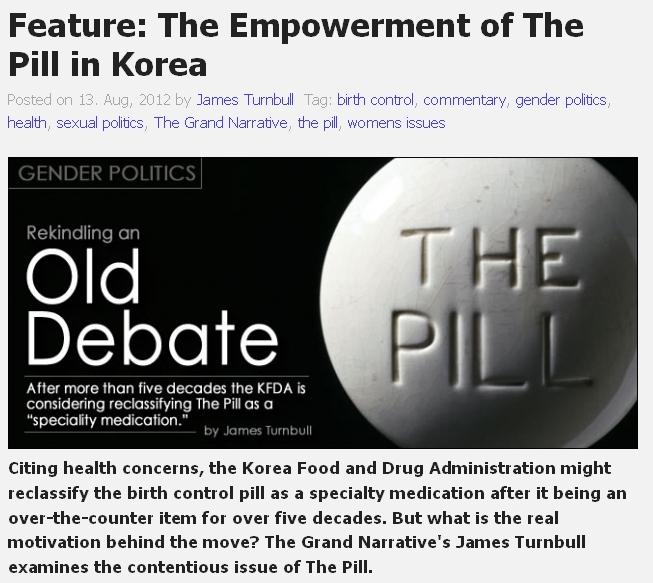
Quick Hit: “The Empowerment of the Pill in Korea”

Thanks very much for the comments on my earlier post on Korean OBGYN clinics, which I incorporated into a brief edit of my latest BusanHaps article. Just click on the picture to read.

Here’s hoping the KDFA makes the correct decision at the end of August!

Quick Break/Open Thread

Between my insomnia because of the heat, all my other writing projects, and running out of time to enjoy my summer break with my family (I haven’t even taken my daughters swimming yet!), I’ve decided I need a short break from blogging sorry. But just for about 2 weeks, and everyone’s more than welcome to raise and discuss anything Korean, feminist, sexuality, pop-culture etc. related here in the meantime — I’ll still be around to chat, and will be tweeting and posting links on the blog’s Facebook page as per normal.

So, have a good summer everyone, and please say hi if any of you are in Busan!^^

Update — Christal Phillips, a visiting professor at Yonsei University, has asked me to pass on the following:

I am writing a paper on biracial people in Korea and have created a brief survey for parents of biracial children in Korea as well as biracial Koreans. If this applies to you, please fill out the survey and pass it along to your friends and co-workers: https://www.surveymonkey.com/s/LZJNRJB Thank you for your assistance.”

I can confirm that it just takes 5-10 minutes, and participants will be entered into a draw for a $25 Starbucks gift card.

Korean Gender Reader

(Source)

Body Image/Health:

Sneaking in on Sarah in the shower (Matador)

Miss plastic fantastic? (The Korea Times)

Are tattoos still taboo in South Korea? (Angry K-pop Fan)

More Lookism: Koreans’ Nose Obsession (The Unlikely Expat)

Humanizing the Olympic Body (Nursing Clio)

Low-income women and high-income men show high obesity rate (The Korea Times)

The “underground rules” of China’s beauty pageant (Want China Times)

Street Harassment in Spain: What’s better? A culture where the objectification of women is in your face daily – but people acknowledge it exists? Or one where you know it’s there, but it hides malevolently? (Develled Dish)

After Bikini-Girl Ban, Cosplay in Spotlight (China Real Time Report)

Can women be in ads without someone yelling foul? (Adland.tv)

The Benefits(?) of Wearing a Short Skirt in China (You Offend Me You Offend My Family)

Crime:

New sex scandal at Korea University (Asian Correspondent)

Korean Supreme Court overturns molestation conviction of pants-dropper (Asian Correspondent)

Child pornography VERY poorly monitored (The Korea Times)

Man Scolds 16-year-old for Spitting, Gets Beaten-up and Dies (Korea Bang)

Is the Punishment for Rape & Sexual Assault Too Light In Korea? (ROK Drop)

Dating/Relationships/Marriage:

“Did you always want to marry an Asian guy?” (Speaking of China)

Korea to tighten rules on international marriage brokers (The Korea Herald)

Race as reflected in gender ratios within fictional bi-racial marriages (Hafu)

“The Reality and Twisted Values of Some White Men” Series at Gusts of Popular Feeling:

Part 9: The ‘Hidden camera sex video’ could spread… anxious police, idle university

LGBT/Sexuality:

Dinner, Movie, and a Dirty Sanchez (GQ)

PiFan 2012: Super Virgin (숫호구, Suthogoo) 2012 (Modern Korean Cinema)

Popular Korean Comic Book Depicts Exploitation, Abuse, & Murder of Prostitutes (With Conviction)

History:

The Torture Chambers of Seoul (And With Your Help, I’ll Get That Chicken)

Misc:

Blog Shoutout: Korean Gender Café 한국 젠더 카페

Newspaper Reports on Online Misogyny ‘Ladygate’ Trend in Korea (Korea Bang)

The truly inspiring story of the Chinese rubbish collector who saved and raised THIRTY babies abandoned at the roadside (The Daily Mail)

Actress Lee Shi Young wins amateur boxing championship, is actual baddest female in K-entertainment (Asian Junkie)

Getting a modeling job in Korea (Noona Blog: Seoul)

Politics/Economics/Workplaces:

Female work force boosted as child care burden eases (Korea Joongang Daily)

North Korean grassroots capitalism has a female face (The Korea Times)

One-third of Korean workers bullied at office (Asian Correspondent; also see Women Bullying Women)

Shadow of the Japanese housewife (The Japan Times)

Samsung’s Female Executives Shatter South Korea’s Glass Ceiling (The Daily Beast)

Pop Culture:

Trying to make sense of the T-Ara controversy (Angry K-pop Fan)

Guilty until proven innocent: The lynch mob against T-ara and who’s really to blame (The Prophet Blog)

Why Homoerotic Fanservice is Just Not Okay (Seoulbeats)

Verbal Jint reveals “You Deserve Better” was inspired by story of domestic violence (Allkpop)

Idols, Twitter and Online Harassment (Seoulbeats)

A Debut Novel Considers the Angry Asian (Scene Asia)

Pregnancy/Abortion/Childbirth/Demographics/Parenting/Education/Multiculturalism:

Sex Differences in Attitudes Toward Paternity Testing (Psychology Today)

Caesarean sections result in infections for one in ten patients, study finds (The Guardian; also see Pregnancy, Caesareans and Body Image in Korea)

Disney Princesses Circa 2012: I’m Too Sexy For My Gown? (Peggy Orenstein)

Introducing: Cinderella 2012 (Peggy Orenstein)

Deadbeat Dads and No Show Moms: 1 million orphans in Korea (Occidentalism)

Will the foreigners PLEASE stop molesting women at the beach, Part II (The Marmot’s Hole)

More support on way for interracial families (The Korea Times)

Generational warfare: Young and old have different ideas on how to rebuild tsunami-stricken communities (The Economist)

(Links are not necessarily endorsements)

Korean Sociological Image #72: Girl-group performances for the military

In the commercial above, a conscripted soldier is happy that his girlfriend is coming to visit him. What really gets him and his buddies running though, in a play on the faster downloading speeds of KT’s 4G LTE network, is the arrival of a girl-group on his army base.

With 300-350,000 new conscripts annually, one of the longest conscription periods in the world, and a grisly — but improving — record of bullying and abysmal living conditions, keeping the troops entertained can safely be assumed to have long been a big concern of the South Korean military. Accordingly, televised visits by girl-groups and entertainers have become a recognizable part of Korean popular culture (although they originally performed for US soldiers). Here’s an example with actress Shin Se-Kyung (신세경), performing on an army base as part of the very popular Infinity Challenge (무한도전) show last year (episode 269, aired October 1):

For those many more conscripts not lucky enough to have pretty female celebrities come to their own base though, the blog Sorry, I was drunk provides an interesting, *very frank* insider account of what they thought of girl-groups, as well as prostitution, cheating on partners, Caucasian girlfriends, and marriage. Here’s what the author wrote about the former:

…I knew Korean guys, especially sexually deprived conscripts, liked female celebrities (duh, right?), but I didn’t know how bad that affection was. I learned that Korean conscripts in general are obsessed with K-Pop girl groups, in particular Girls’ Generation. By obsessed, I mean really obsessed. A good example of this is rapper Psy’s description of his military service.

In this show, Psy says he was made to stand guard while watching the TV so he could alert senior conscripts that Girls’ Generation was on it. While it wasn’t that extreme in my unit, it was quite normal to see guys flock to the TV whenever GG or other good looking female celebrities were on air. Every Friday and Saturday, when the major networks have those “music” shows parading group after group, entire units would stay glued to the TV. Guys would watch the same music video or performance repeatedly so they could oggle at the girls. Their bare legs exposed, sexy dancing, and terrible music (not a secret among conscripts either), it was pretty obvious there was only one reason for these “musicians” to exist. These girls are glorified strippers, covered in the thin veil of “music” so it doesn’t seem as creepy and sad as going to a strip club. For conscripts, it’s usually the only form of sexual gratification they’re allowed while on base.

See also:

(For more posts in the Korean Sociological Image series, see here)

If you reside in South Korea, you can donate via wire transfer: Turnbull James Edward (Kookmin Bank/국민은행, 563401-01-214324)

Korean Sociological Image #71: “Specs” for the perfect Korean wife or husband

(Source: Slutwalk Korea)

When I lived abroad in Korea, I spent a lot of time doing work in cafes. Probably a 100 or more during my 2 years there. As such, I eavesdropped on thousands of conversations. And nearly every one of those conversations was about two topics: complaints re studying English and complaints re losing weight.

(Patricia Park, Korean Bodega, June 15)

Maybe I’m just nostalgic for my bachelor days, but it’s conversations about “specs” (스펙) that I’ve really noticed myself. A Korean term for the criteria used to evaluate a potential spouse on, it’s also my experience that it’s almost exclusively used by women, although that may just be because there’s usually more women than men at my local Starbucks.

Either way, in February Kim Da-ye at the Korea Times argued that looking at marriage this way is a relatively new phenomenon, and that it’s “matchmaking companies that rate spouse seekers by specs [that] have fueled [such] materialism.” And, as if to bolster that point, Donga-Reuters would report on exactly the same phenomenon emerging in China after I’d already begun writing this post.

But as discussed below, matchmakers have been encouraging such pragmatism for decades, so they can hardly be described as driving that change in outlook. Rather, it’s economic factors that are responsible, as Kim later acknowledges in her article:

…today’s buzzword “Sampo” generation (삼포세대) …indicates a 30-something who has given up dating, marrying and giving birth because of the lack of financial means…

Contrast the “880,000 won generation”, which generally refers to 20-somethings. Continuing:

….What’s interesting about such preferences for the partner’s economic qualification is that they don’t come from conservative parents or rigid social structure but independent, young individuals….

….The near obsession with fine lifestyle is a contrast to the attitude of the baby boomer generation, many of whom used to say that they can start from a small rented room….

When asked why the younger generation isn’t willing make such a humble start, Lee, a single woman in her mid-30s working at a media firm, said, “Back then, amid fast economic growth, people had hoped that they would be able to climb up the social ladder and afford a bigger place in the future. Nowadays, people feel that if they start in a small room, they will be stuck there for the rest of their lives.”

The high cost of getting married naturally leads to some couples to be heavily indebted after the honeymoon ends. In addition to the Sampo generation, another phrase linked to both the economy and marriage has emerged — “honeymoon poor.”

And Kim — whose article is still very informative overall — gives several examples of engaged couples’ fights over money, some of whom ultimately break up. Yet those would not be out of place in popular discourses of marriage in, for example, the 1980s, when women’s magazines were similarly promoting the virtues of arranged ones. Presumably, at the behest of their advertisers:

(Source: Google Books)

Passage Rites Made Easy [A 1982 Korean book by Ko Chonggi] describes marriage through an arranged meeting as more “rational” behavior than simply falling in love because the candidates for romance and matrimony have already been carefully scrutinized by parents and matchmakers. Korean women’s magazines also emphasize the value of prior screening in choosing a mate, suggesting by the frequency with which they address this topic that their youthful readership is by no means convinced of the merits of matchmade matrimony:

Today, with the trend towards frankness in sexual matters, talk of “arranged meetings” or “matchmade marriage” might sound excessively stale. Even so, in marriage the conditions of both sides enter into things. Matchmade marriage, where you can dispassionately investigate these considerations beforehand, has some advantages that cannot be ignored (“The Secrets of a Successful Arranged Meeting,” Yong Reidi, 3 March 1985: 347).

From pages 89-90 of Getting Married in Korea: Of Gender, Morality, and Modernity (1996), by Laurel Kendall, the next page sounds a little ironic 18 years later:

The evolution of Korean courtship practices provides one excellent example of how notions of progress, of an enlightened “now” versus a repressive “then”, mask the particular disadvantages for women in new forms of matrimonial negotiations, be they “matchmade” or “for love” — a mask which sometimes slips in angry conversation or social satire. Through courtship and through all of the talk about getting married, notions of ideal “man” and “woman”, “husband” and “wife”, “son-in-law” and “daughter-in-law” are constructed, reinforced, and resisted….

….In Korean popular discourse, the evils of old-fashioned matrimony, in which near-children were forced by the will of their elders to marry total strangers, have been replaced by more enlightened practices. The “old days” are still on the horizon of living memory, but are recalled as from an utterly vanished time. In confessing that he never saw his wife’s face until his wedding night, the writer Cho P’ungyon states [in 1983] with a touch of hyperbole that “Today’s young people would consider this laughable and the faint-hearted might swoon away, but in my day these procedures were considered natural.”

(Source: Korea Portal)

The difference being that in 2012, financially-strapped singles can no longer afford to be so dismissive (nor Japanese ones either). Moreover, while they’re not marrying complete strangers perhaps, many Koreans do marry people they’ve only known a few weeks, as discussed in an earlier post. Also, some mild social coercion can indeed be involved, as Gomushin Girl explained:

It’s important to differentiate between different kinds of matchmaking arrangements…lots of Koreans use services that are similar to eHarmony, It’s Just Dinner, and other similar paid and unpaid services. Just like in the US, there’s free and paid computer matching sites, and more expensive and comprehensive personalized dating services. These offer a great deal of flexibility, and allow you to reject partners at many stages of the process – the worst consequence being that the agent in charge of finding you matches will decide you’re too picky, and start sending you “lower quality” matches. You’re free to meet multiple people at once, and they’re basically meant to facilitate dating.

However, 선 (Seon) matches are pretty different. Most of the time the people proposing the arrangement are close family or friends (of your parents), and parties are expected to make up their minds pretty quickly. Delaying too long or changing your mind after the first few dates is strongly frowned upon, and may even cause major social riftts. This means that women especially are pressured to marry people before they’re comfortable with them, and even if they’re not really what they’re looking for. Seon is serious, and you’re expected to commit yourself pretty quickly.

It’s also expected to override existing social relationships. My Korean host mother once called me up to ask if I’d go down to Busan to meet a friend’s son, who was interested in a seon meeting with me. I told her I’d just started dating someone, and her response was essentially, “That’s wonderful! When can you come to Busan?”

(Source: Sinbustory)

And on that note, let me leave you with a translation of the image that prompted this post, a poster for last week’s Slutwalk in Seoul. The slogan reads, roughly, “Let’s stop these fantasy gender roles now. Let’s play at being ‘masculine’ and ‘feminine’, 2012 Slutwalk Korea.” Many of the specs it mentions would be shared by people the world over, but there are also some quintessentially Korean ones:

For the “man” (literally, it says “manliness”):

  • 키180이상 Over 180cm in height
  • 전문직 A professional
  • 대기업정규직 Regular worker at a big company
  • 인서울4년제 Went to a 4-year university in Seoul
  • 자차소유 Owns a car
  • 장남아닐것 Not a first-born son
  • 데이트비용 Pays for everything on a date
  • 신혼집구입 Buys a home after marriage
  • 사회생활잘함 Good social skills
  • 성격좋음 Good personality
  • 술잘마심 A good drinker
  • 정력왕 Good sexual stamina

For the woman (“womanliness”):

  • 키170미만 Under 170cm tall
  • 몸무게50미만 Under 50 kg
  • 가슴C컵이상 A C-cup or over
  • 30살이하 30 or under
  • 날신한몸매 Thin body
  • 작고하얀얼굴 Small and white face
  • 화장은기본 Always wears make-up
  • 제모는상식 Shaves legs and underarms
  • 명품백하나쯤 Have at least one brand-name handbag
  • 애교있는성격 Have aegyo
  • 시댁을부모처럼 Treats parents-in-law like her own parents
  • 섹스경험없음 Be a virgin

Are there any others readers would add? Especially Korean ones?

(For more posts in the Korean Sociological Image series, see here)

Korean Gender Reader: Slutwalk Tomorrow!

(Source)
Starting 4pm, from Tapgol Park in Seoul. Again, see here, here, and here for the organizers’ Facebook event page, Facebook group, and blog respectively, here for an English translation of  the “Slut Walk Korea Declaration 2012″, and finally here for R0boseyo’s excellent write-up of last year’s event.

Sorry that I can’t join you Seoulites this year, and please let us all know how it goes!^^

Body Image/Health:

Both men and women may be hardwired to objectify women’s bodies (io9)

Are Men Attracted to What They Think Other Men Approve Of? (Jezebel)

Miss Korea 2012 Dubbed ‘Miss Plastic’ by Netizens (Korea Bang)

A(nother) Problematic Experience in a Korean OBGYN Clinic (Agent 071)

S-line is default dynamic pose for female comic book characters (Escher Girls)

I’m Loving It? The Fast Food Health Epidemic in Singapore (Thick Dumpling Skin)

Why is plastic surgery considered bad? (Angry K-pop Fan)

The Skinny Fat Girl (Or: It’s not just the Korean media that fatshames skinny women) (Nursing Clio)

Singapore blogger undergoes major facial surgery in Korea (Yahoo! Entertainment Singapore)

Great legs but ridiculous poses on Min Hyo-rin (Omona)

An Ugly Reflection: Plastic Surgery In Korea (Follow Your Hart)

Cosmetic Surgery Patients Getting Younger (The Chosun Ilbo)

Objectification: Nothing As Easy As It Looks (Seoulbeats)

Crime:

Repeat offenders commit half of sex crimes (The Korea Times)

Korea’s kiddie porn enforcement lax (The Marmot’s Hole)

Sex offenders poorly monitored (The Korea Times)

Children and women remain unprotected against sex crimes (The Korea Times)

Sometimes you have to wonder about the world… (The Marmot’s Hole)

Missing girl found dead in Tongyeong (The Korea Herald)

Sex-Offender Website Swamped After Child Killing (The Chosun Ilbo)

South Korean Police Tire of Abuse by Drinkers (The New York Times)

Children from poor families more likely to be targets of sexual crimes (The Hankyoreh)

Dating/Relationships/Marriage:

Celebrating 10 Years Together With My Husband (Speaking of China)

PDA in South Korea (From Korea with Love)

“The Reality and Twisted Values of Some White Men” Series at Gusts of Popular Feeling:

Part 8: After the ‘hidden camera sex’ report… victim hurt again through ‘comment terror’

LGBT/Sexuality:

Women’s Gait and Dancing Attractiveness Across the Menstrual Cycle (Psychology Today)

Teen prostitution – the numbers have grown, the conditions are worse (Ilda)

Shoutout: Gay Friends in Seoul

What should schools teach about sex? (The Korea Herald)

Misc:

The male feminist: a contemporary player in the fight for women’s liberation (The F-Word)

A Glimpse into the Lives of the Women of the Coalition for North Korean Women’s Rights (Ministry of Unification)

Beware of sexy waitresses in North Korean restaurants – they may be spies? (Examiner.com)

Feminist Culture Clash (Us in Busan)

Now Confucian Culture Causes Nuclear Meltdowns Too? (The Unlikely Expat)

Politics/Economics/Workplaces:

How Eve Grew up in Korea (Seoulbeats)

Womenomics for growth (The Korea Times)

Concern for Young Temporary Workers’ Rights (Human Rights Monitor)

Retirees in South Korea find it’s no country for old men (Reuters)

Pop Culture:

Nice to see a Korean MV simply featuring black people as – well, people (Mixtapes and Liner Notes)

Can you recommend the Korean route to becoming an idol? (Angry K-pop Fan)

On (Bad) Driving in Korean Popular Culture (Seoulbeats)

The Weaknesses of SM, JYP, and YG Entertainment (Allkpop)

When fans forcibly pair up two males who are actually straight (Angry K-pop Fan)

Pregnancy/Abortion/Childbirth/Demographics/Parenting/Education/Multiculturalism:

Anti-English Spectrum vs. the Asiatic Exclusion League (Gord Sellar)

One brain, two minds: The surprising impact of speaking another language (Kim Yuri)

South Korea teenagers bullied to death (CNN)

Children with Smart Phones: Are We Being Smart About It? (Human Rights Monitor)

Japanese women fall behind Hong Kong in longevity (BBC)

Weekly Chosun on multiculturalism, xenophobia (The Marmot’s Hole)

Korean Sociological Image #70: “The Healthy Man-Meat Ham”

(Source)
Alas, the irony here is probably unintentional: Koreans actually say “the water is good” (물이 좋다) when there’s lots of hot bodies around, not that it’s a meat market. So, if you want a real satire on that theme, go see Kara’s wonderful effort for Cob Chicken instead, back when male objectification in Korean ads was really taking off.

Still this commercial does make me laugh. Especially when the meat in question is miniature hot-dog sausages:

The actor is Cheon Jeong-myeong, and the company is CJ Freshian. The text reads:

사람들은 더할수록 완성된다고 믿는다 People believe that the more you add to something, the more complete it will be

하지만 더 건강한 햄은 But as for the healthy ham

빼고, 빼고, 빼고 Remove, Remove, Remove

(無) 합성아질산나트륨, 무첨가 No added sodium nitrate

(Source)
“無”, or “moo/무”,  literally means “no, not, nothing”, but here it’s also a clever pun because the Chinese/Hanja character looks like a six-pack. The usual choice though, would be “王”, or “wang/왕” , or the Korean one ““chocolate abs” (choco-lat-bok-gun/초콜릿복근) that was made popular in early-2010.

Continuing, the voiceover says:

합성착향료, 합성보존료, 에리쏘르빈산나트륨, 전분 무첨가 No added flavorings, preservatives, sodium erythorbate (an antioxidant), or flour

필요없는 것을 빼고 Remove things that are not needed

맜있게, 더 건강하게, 프리시안 더건강한 햄 Deliciously, more healthily, Freshian the healthy ham

(Source)

For comparison, see the discussion at Korean Sociological Image #35, about Lotte Chilsung’s (롯데칠성음료) 2010 commercials for “Hot 6iX” (핫식스), which featured both men’s and women’s shirts bursting open:

(For more posts in the Korean Sociological Image series, see here)

Korean Sociological Image #69: Attitudes Towards Sexual Objectification, 2004 vs. 2012

Back in 2004, I would study Korean by translating articles about Lee Hyori’s breasts. Because that was much more interesting than reading about the joys of kimchi-making in Korean textbooks.

So, I hardly romanticize that era as more innocent and chaste than today’s. Nor, by highlighting just one complaint by one women’s group from then, do I mean to imply that the Korean public was necessarily more prudish back in 2004, or that it’s necessarily more permissive today. After all, my Google News Alert for “성상품화” (sexual objectification) still provides me with fresh critiques of the recent Miss Korea Pageant every day. And who can forget the role “Bikini Girl” played in April’s congressional elections?
Having said that, things definitely have changed in 8 years:

  • Starting about 2006, ubiquitous soju ads started featuring women in revealing clothing after decades of almost exclusively using demure, virginal-looking models.
  • A little later, dominant media narratives about girl-groups, depicting middle-aged male fandom as platonic rather than sexual, provided a window for their objectification to flourish.
  • Men have also been increasingly objectified, particularly after the “chocolate abs” label was coined in 2009.
  • The number of smutty online-ads has surged, especially in the last year.
  • And last but not least, it’s difficult to find an advertisement for water-parks (also ubiquitous) that doesn’t feature a scantily-clad girl-group, with one—Ocean World—even inventing a group specifically for that purpose. (Boy bands and male models are used also, most notably by Caribbean Bay below, but my strong impression is that there’s much less of them than women)

In short, it is via the increasing objectification of (especially) girl-groups that you can see a clear McDonalidization of Korean cultural industries in recent years (see here, here, herehere, and here for more on the hows and whys). And, because of that shift, it’s difficult to imagine a complaint like this being given much attention in 2012:

전남관광 책자 두고 ‘여성상품화’ 논란 일어 / Controversy over Sexual Objectification of Women in Jeollanam-do Tourist Brochure

Oh My News, June 15 2004. By Gang Seong-gwan.

지난 6월초 전남도가 여름 관광객을 겨냥해 제작배포한 관광 홍보책자 ‘남도스케치’에 사용된 비키니 차림의 여성사진이 논란이다. 광주여성민우회는 14일 성명을 통해 “남도스케치 배포를 즉각 중단하라”고 요구하고 나섰다.

Controversy has arisen over the use of women in bikinis in the June edition of tourist brochure Namdo Sketch, a widely-distributed brochure aimed at summer tourists . In an announcement on the 14th, the Gwangju branch of Womenlink demanded that it stopped being distributed immediately.

(Source: James Turnbull)

전 남도는 ‘남도스케치’를 제작하면서 책 표지, ‘전남이 추천하는 여름 여행지 BEST’ 중 완도 명사십리 해수욕장 등 7곳을 소개하면서 비키니를 입은 여성의 사진 10여장을 게재했다. 이 책자는 겉표지까지 총 85페이지로 구성됐으며 비키니 사진은 책자 앞 부분에 게재했다. 전남도는 제작된 책자 2만여부를 터미널 등 공공장소와 전남도내 기초단체 등지에 배포를 마친 상태이며 조만간 2쇄에 들어간다는 계획이다.

이에 대해 광주여성민우회는 “여성을 성 상품화했다”면서 전남도의 공개사과는 물론 책자 배포 중단을 요구하고 나섰다.

With a cover title of “Best Recommended Tourist Sightseeing Areas in Jeollanam-do” [James – I can’t see that title myself, but unfortunately that opening photo was very small], Namdo Sketch introduces 7 tourist sights, including Wando and Myeongsashibri Beach, and uses a total of 10 pictures of women in bikinis on the front cover and in the first part of the brochure, out of 85 pages. By the end of its first printing, the Jeollanam-do Provincial Government had distributed roughly 20,000 copies to transport terminals, public places, and civic groups, and planned to make a second printing.

Gwangju Womenlink said that the brochure sexually objectified women, and demanded a public apology as a matter of course, as well as a halt on further distribution.

“여성 성 상품화 한 것, 배포 중단”…”문제제기 이해하지만, 시원한 여름을…” / “This is the sexual objectification of women, distribution must stop”…”We understand, but hey: this is summer…”

광주여성민우회는 “전남 관광홍보는 여성의 비키니만이 유일한 대안인가”라며 “공공기관에서 나온 책자인가 할 정도로 낯뜨거운 장면이 많이 실려 있어 당혹스러움과 황당함을 느낀다”고 밝혔다.

Gwangju Womenlink argued that “Are women in bikinis the only option for a tourist brochure?”, and said “We are embarrassed and perplexed that a public institution would go so far as to use such crude [James – I think this is a better translation of “낯뜨겁다” than “obscene” or “rude”] images in a tourist brochure.” (source, right)

이어 “지역에 관광객을 유치하기 위해 명소를 소개하는 것은 좋지만 관광지역의 구체적인 정보와 특색 있는 프로그램의 홍보 대신 여성의 비키니 복장을 내세워 시선을 끌어보고자 하는 공무원의 얄팍한 속셈은 용납될 수 없는 행위”라고 비판했다.

Continuing: “It is good that tourists are being attracted to this area by having places of interest introduced to them. But instead of providing concrete information and unique tourist programs, the PR simply consists of pictures of women in bikinis, designed to attract one’s attention. This is both shallow and misguided of Jeollanam-do officials, and can’t be forgiven.”

또 여성민우회는 “지역의 명소를 알려내기 위한 기본 조건은 다른 지역과 차별되는 테마를 만들어 남도만의 색다른 맛을 느끼게 하는 것이다”면서 “노력해야 할 것은 따로 있는데 엉뚱한 것으로 메꾸려는 것은 직무유기”라고 주장했다.

여성민우회는 “여성의 성 상품화를 부추기는 공공기관의 홍보책자는 결코 용납될 수 없다”면서 ‘남도스케치’의 배포중지를 요구했다.

Also, Womenlink emphasized that “What should have been done to inform tourists about places of interest was showing them how different they were to other ares and what unusual tastes, experiences, and feelings Jeollanam-do has to offer. Instead of making an effort and doing their duty though, officials offered this rubbish.”

It added that “Promoting the sexual objectification of women is never acceptable”, and so demanded an immediate halt to the distribution of the brochure.

(Sources: left, right)

이에 대해 전남도청 한 공무원은 “문제제기는 이해한다”면서도 “여성의 사진을 표지에 넣는다고 해서 이 책자가 눈길을 끌고 있는 것은 아닌 것 같다”고 말했다.

그 러나 또 다른 공무원은 “여성의 비키니 사진을 두고 상품화까지 이야기하는 것은 지나친 것 아니냐”며 “오히려 여성단체들이 그렇게 주장하면서 폄하시킨 것은 아닌지 모르겠다. 물론 어느 정도는 이해할 수 있지만 이런 사진을 많이 사용한 것도 아니지 않느냐”고 주장했다.

In response, a Jeollanam-do official said ” We understand the concerns, but it’s not because of the women in bikinis on the cover that people are drawn to the brochure.” Another emphasized that “It’s a complete exaggeration to claim that just pictures of women in bikinis is objectification. Rather, it’s women’s groups that are degrading women by doing so. And it’s not like we used many in the brochure.”

관광책자 제작 담당부서인 전남도청 관광진흥과 이명흠 과장도 “여성단체의 지적사항에 대해서 전혀 모르는 바는 아니다”면서도 “행정관청에서 발행한 책자여서 그럴텐데 여름에 맞춰서 시원한 해수욕장과 수영복을 입은 모습의 여성을 모델로 했을 뿐이다”고 말했다.

이어 이 과장은 “행정기관이 발행했다는 느낌이 들면 잘 보지 않는다. (관광객들의) 눈길을 끌 수도 있다는 생각에서 진행한 공격적인 마케팅의 일환이다”며 “너무 한쪽으로만 생각하지 말고 발상을 바꿨으면 좋겠다”고 주장했다.

(Source: Metro Seoul, 31 May 2012, p.49)

Lee Myung-hum, the head of the Tourism Promotion Office of Jeollanam-do Provincial Government that produced the brochure, said “It’s not like I don’t understand women’s groups concerns. But only swimsuits are appropriate for female models promoting cool swimming areas in the summer.” He added that “No-one ever pays attention to anything produced by a council tourism promotion office. The images were simply part of an aggressive marketing technique designed to get the attention of tourists, and shouldn’t be overanalyzed.”

한편 ‘남도스케치’ 표지모델은 전남도청 여성 공무원 중 희망자들이 참여하기도 했으며, 지난해에도 전남도는 여름 관광홍보 책자를 제작하면서 표지 등에 비키니을 입은 여성 사진을 게재한 바 있다.

The models used in the brochure included Jeollnam-do female officials [James — it says only the cover, but there were only 2 women on that], and a similar brochure was produced the previous year (end).

James — While the Jeollanam-do officials didn’t sound too sympathetic in that June 2004 article, another from the next month points out that in the second printing the bikini models were removed from the cover and 2 more pages, although some did still remain. It’s from that article that the before and after covers came from.

(For more posts in the Korean Sociological Image series, see here)