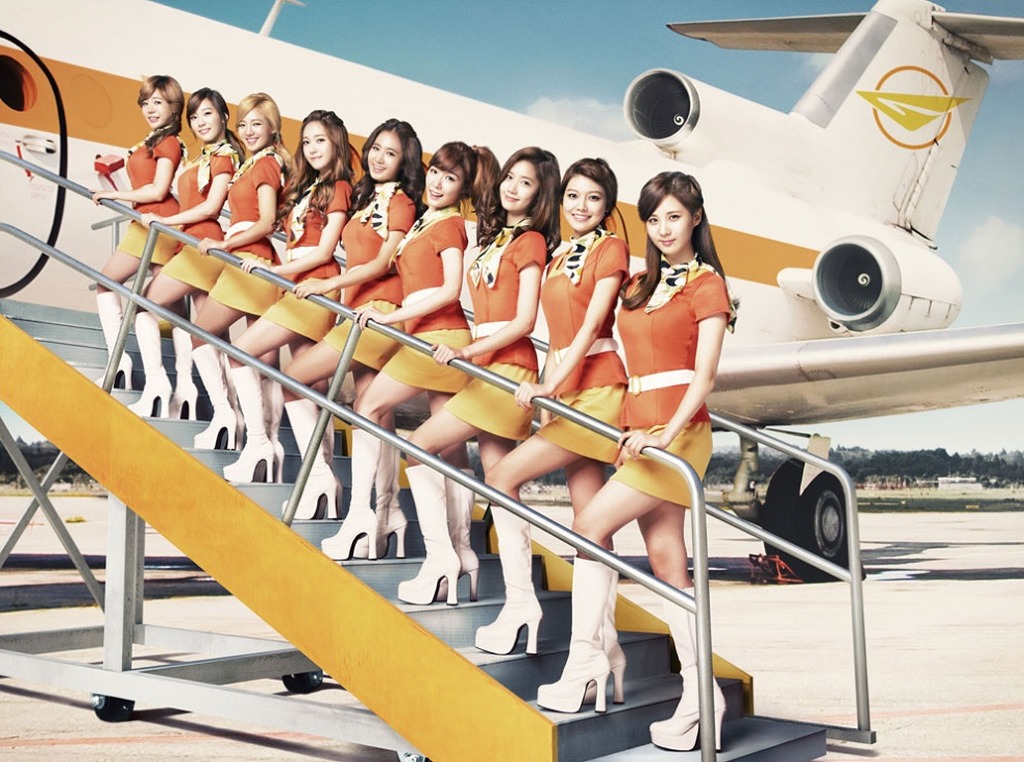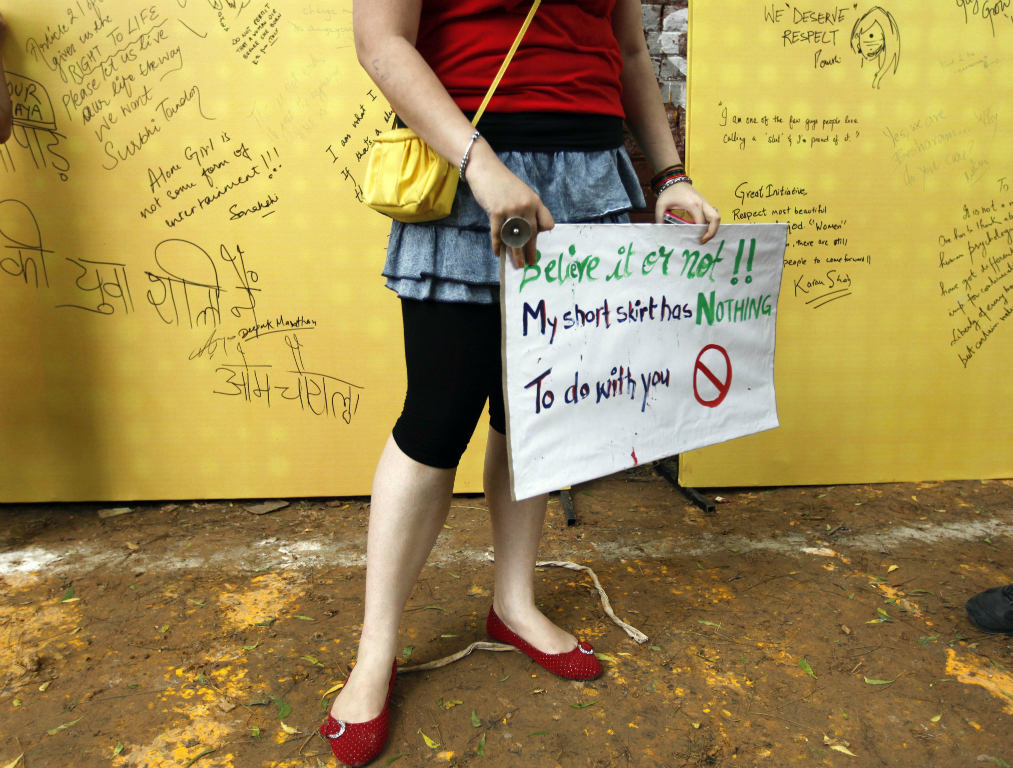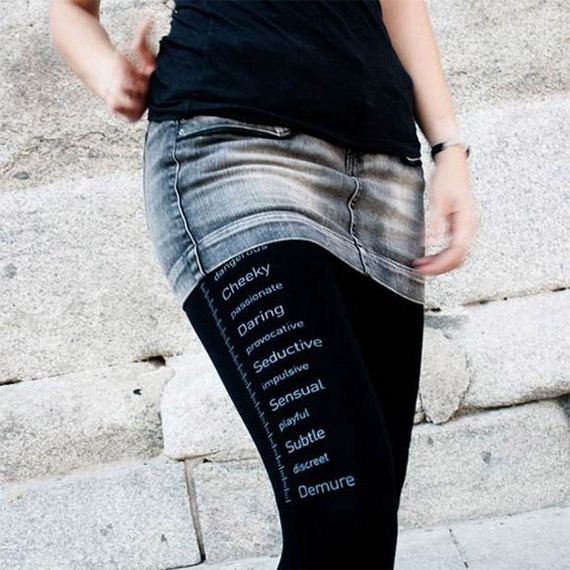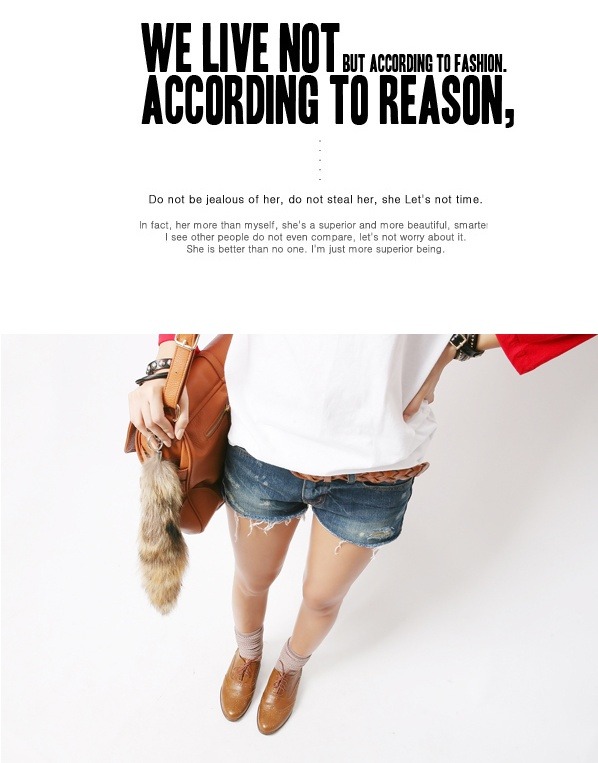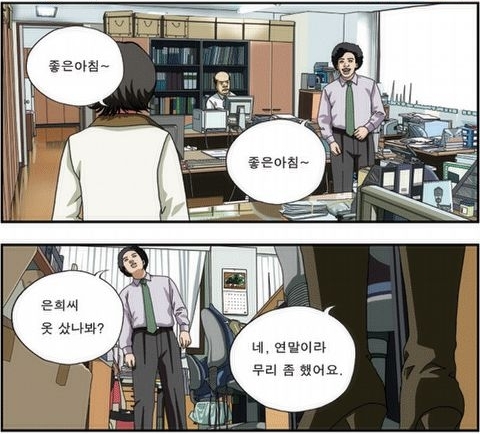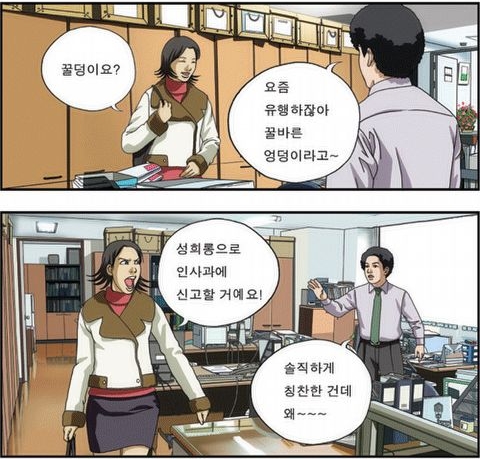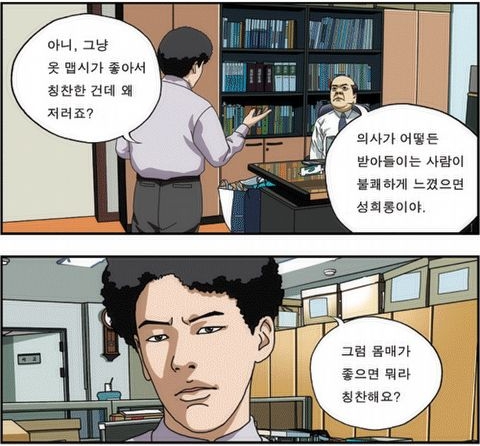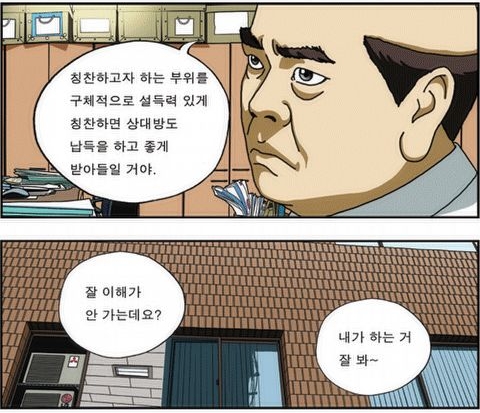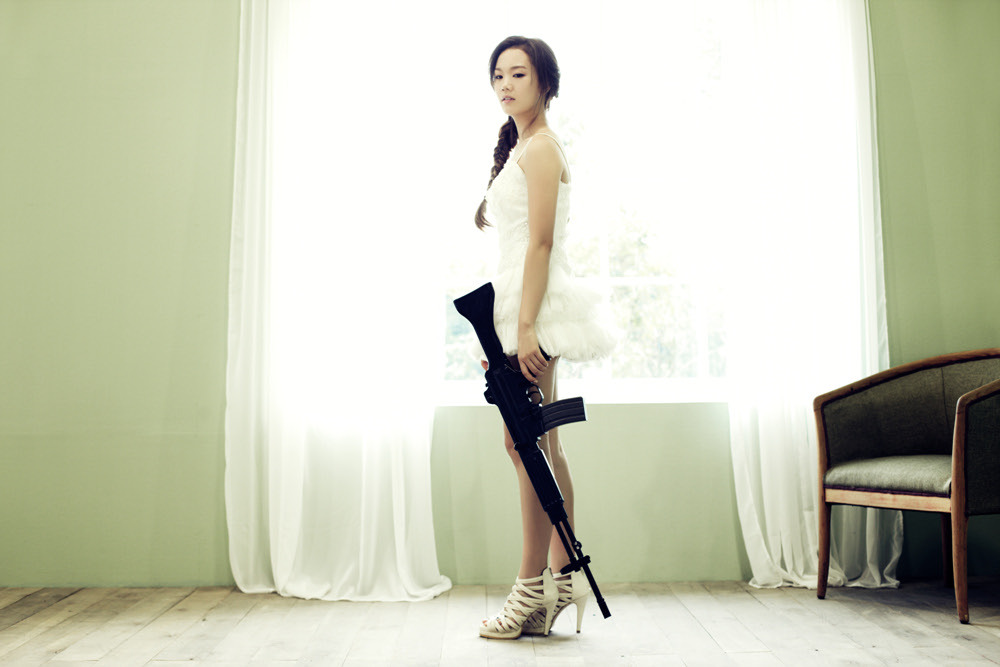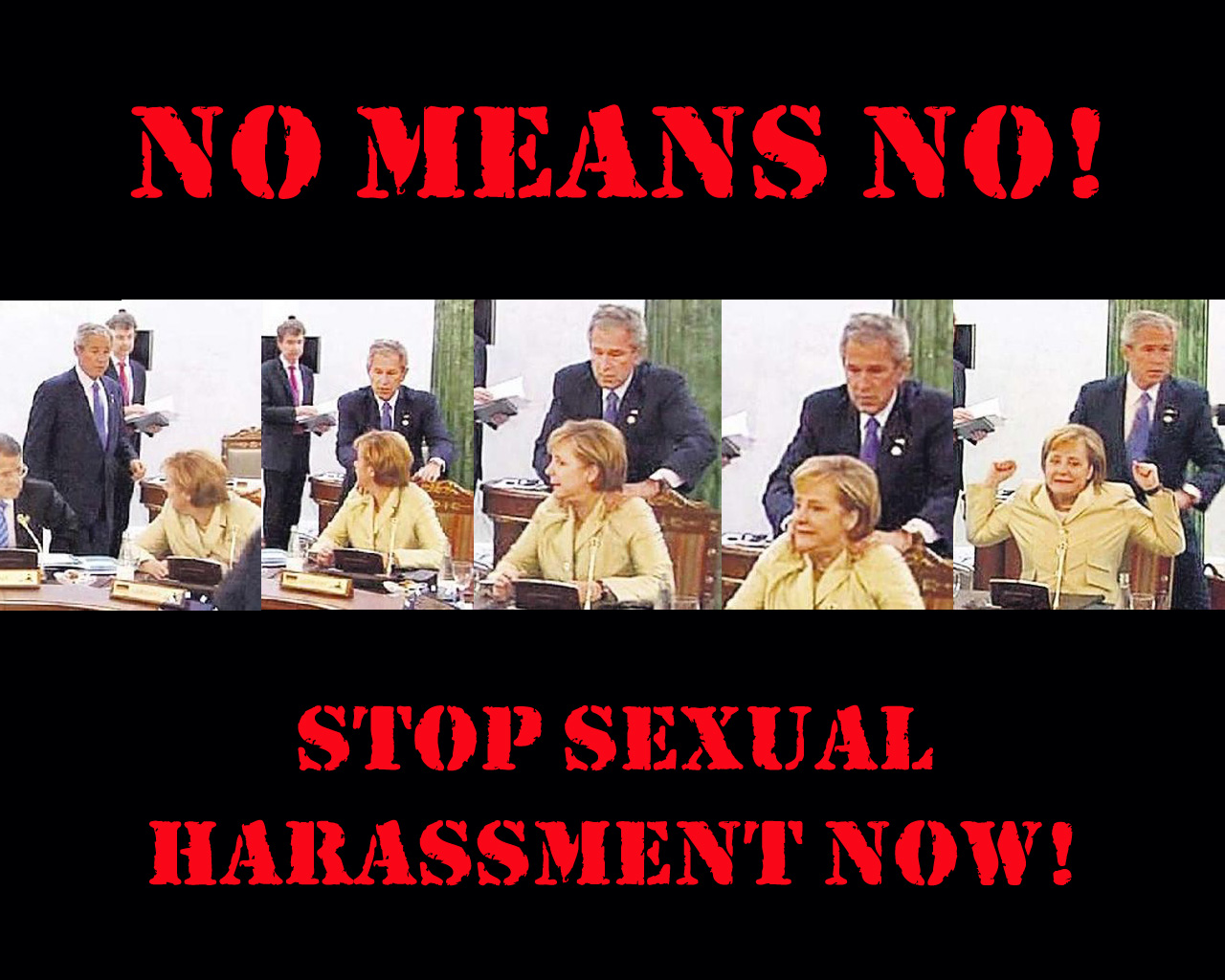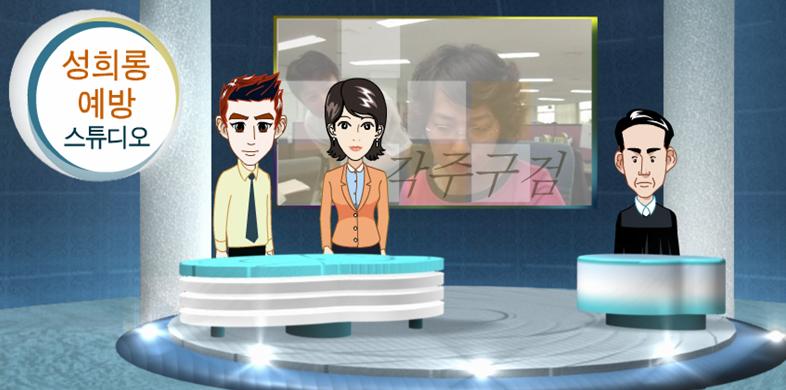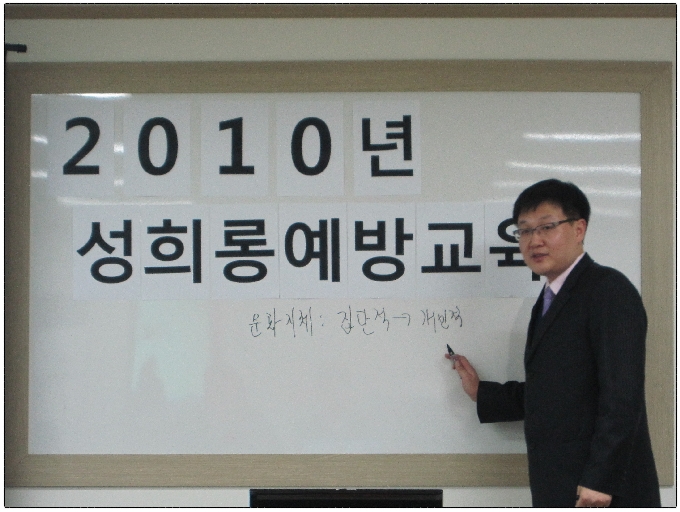
“The less you wear, the bigger the discount”

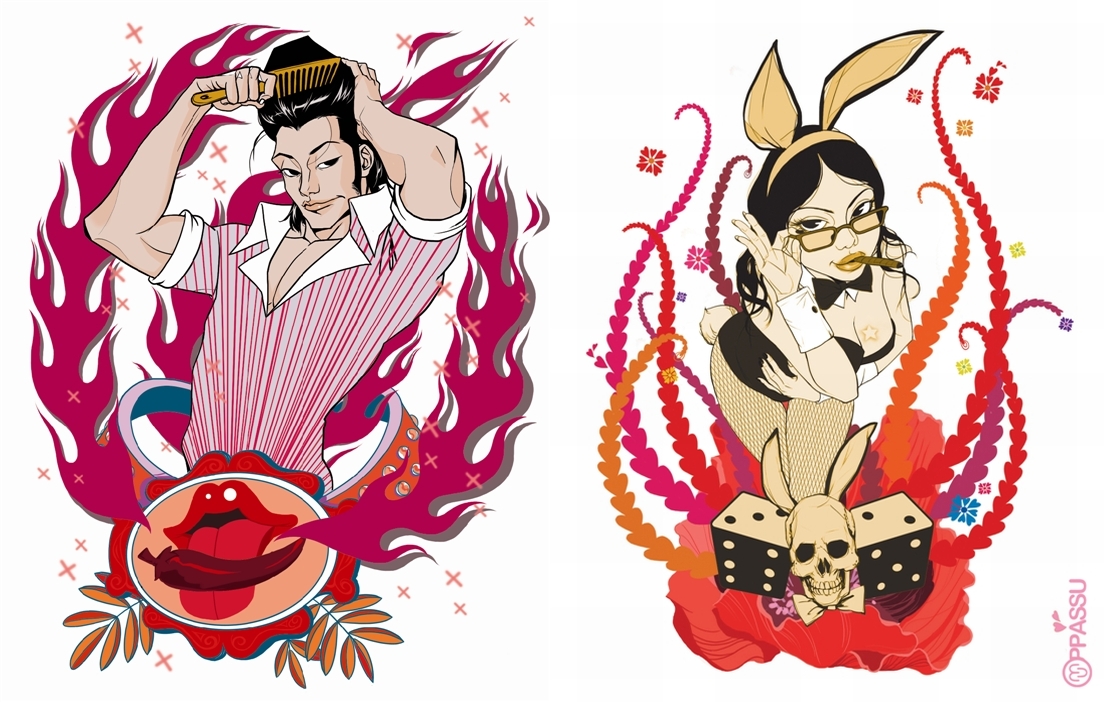
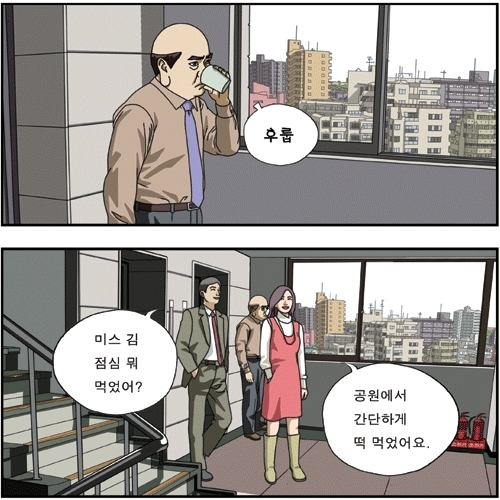
(Sources, edited: left, right)

“Want to talk third wave feminism, you could cite Ariel Levy and the idea that women have internalized male oppression. Going to spring break at Fort Lauderdale, getting drunk, and flashing your breasts isn’t an act of personal empowerment. It’s you, so fashioned and programmed by the construct of patriarchal society that you no longer know what’s best for yourself. A damsel too dumb to even know she’s in distress.”

Chuck Palahnuik, Snuff (2008)

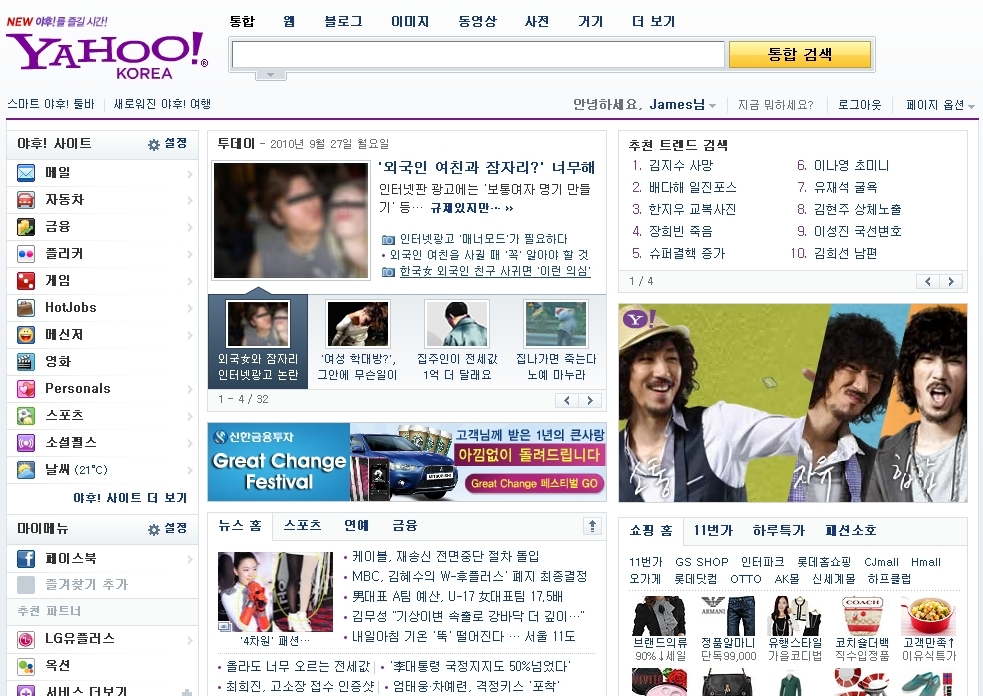
Via Genderly Speaking, a typically provocative quote from Palahnuik to ponder. Not least, when you’ve just translated today’s article, about a clothes company offering discounts to customers for wearing mini-skirts and hot-pants.

Cancelled for being too lewd, I think the event should have gone ahead, and not just because I wasn’t all that impressed by Levy’s Female Chauvinist Pigs (2005) either. Rather, it’s mainly because I completely reject the notion of any woman— or man—as a mere unthinking pawn of the patriarchy. Also, heavily promoted by the media, there’s already a huge demand for such revealing clothes, so this event stood out only for being more explicit than most.

While there are legitimate issues of sexual objectification that can be raised in light of that, another problem is that the writer of the article (or the parties involved—it’s unclear) implies that it was the “sexual provocation” or “sexual suggestiveness” (선정성) that was the greatest concern. Whether she was talking about the clothes or the event as a whole though, is a little vague, but if the former then I imagine that many women would take offense at the implication that they should never wear revealing clothes? (Source, right)

Had the event gone ahead as planned though, I do realize that it would have been just as empowering and tasteful as, say, a wet t-shirt competition. (Seriously, I’m wincing at the thought of lecherous cheering and the flash of cameras as customers are revealed to have over 30cm of skin showing above their knees.) Also, even if this did all happen a month before the first Slutwalk in Toronto, and 4 months before Korea’s own, it was still disappointing that the company representative only offered platitudes in defense of the event.

Is it hypocritical of me to intellectually support such an event, but — were they old enough to attend — hope that my own daughters would avoid it like the plague? Or merely honest? Or both?

Sigh. Like Peggy Orenstein explains in the first chapter of Cinderella Ate My Daughter (2011), sons sound so much easier to raise!
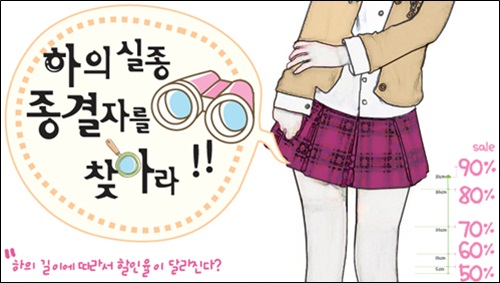
“벗는 만큼 세일” 의류업계 ‘막장’ / Just Typical For The Clothing Industry: “The less you wear, the bigger the discount”

코오롱인더스트리 이벤트 ‘성 상품화’ 논란…결국 행사 취소 / Kolon Industries event leads to sexual objectification controversy, is ultimately cancelled

Consumer Times, 9 March 2011, by Choi Min-hye (최미혜), choimh@consumertimes.net

코오롱인더스트리가 최근 치마길이에 따라 옷 값을 깎아주는 행사를 기획한 가운데 선정성 논란이 일자 다급히 취소하는 촌극을 벌여 소비자들의 눈살을 찌푸리게 하고 있다.

While planning an event in which customers would receive discounts depending on how high their mini-skirts were, Kolon Industries abruptly cancelled it in light of the controversy over its sexual provocation and the [anticipated] negative reaction from consumers.

참여자들의 과다 노출과 같은 부작용을 우려하는 목소리와 함께 ‘성상품화’라는 지적도 나와 행사를 예정대로 강행하기는 무리라는 업체 측의 판단이 작용했을 것이라는 분석이다.

As voices of worry were raised about the sexual objectification and such side effects as participants’ sexual objectification, the company judged that to go ahead with the event as planned would be unwise.
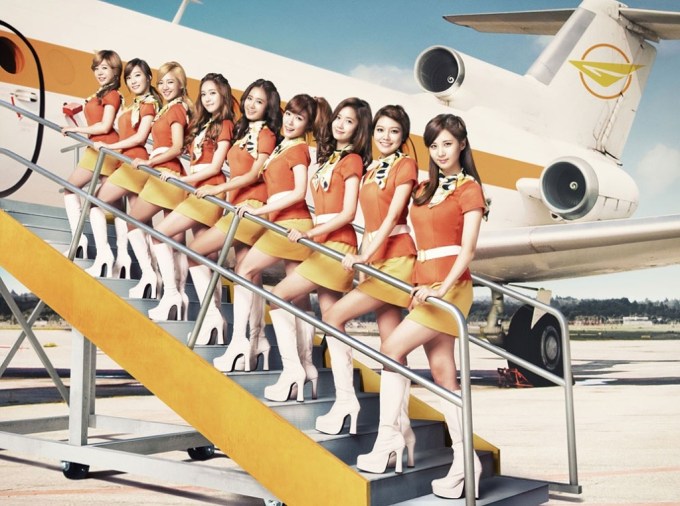
(Source)

◆ 할인권 걸고 ‘여성 노출’ 부추겨? / Encouraging Women to Expose Their Bodies via Discount Coupons

코오롱인더스트리는 오는 13일 자사 패션 브랜드 매장인 ‘조이코오롱’에서 길이가 짧은 하의를 입은 고객들에게 제품 할인권을 증정하는 ‘하의실종 종결자를 찾아라’ 이벤트를 진행키로 했다 돌연 취소했다.

Kolon Industries abruptly cancelled an event titled “Who has the shortest?” that was to be held on the 13th at one of their stores, in which customers would have been offered discounts on clothes like hot-pants or mini-skirts if they arrived already wearing really short ones.

연예계를 중심으로 유행처럼 번지고 있는, 하의 길이가 매우 짧은 이른바 ‘하의 실종’ 패션을 제품 할인이벤트에 접목시켰다 여론의 뭇매를 맞은 탓이다.

While the entertainment world has spread this so-called “Disappearing Lower Body” trend of wearing very short clothes, Kolon Industries was roundly criticized by the public for grafting a sales event onto it.

당초 이 업체는 행사에 참여한 고객의 무릎부터 하의까지의 길이를 재 5cm까지는 50%, 10cm까지는 60%, 20cm는 70%, 30cm가 넘으면 90% 할인 쿠폰을 제공하겠다는 계획이었다. 다리 노출을 많이 할수록 옷 값을 더욱 깎아준다는 얘기다.

The intention of the company was to offer customers a 50% discount on clothes if they arrived exposing 5cm of their legs (from their knees), 60% for 10cm, 70% for 20cm, and 90% for 30cm. Or in other words, the more they exposed their legs, the greater the discount.

행사에 참여키로 예정돼 있던 이 회사 의류 브랜드는 ‘헤드’, ‘쿠아’, ‘쿠론’ 등이다. 헤드는 스포츠브랜드지만 쿠아와 쿠론은 각각 여성복, 핸드백 등 액세서리 전문 브랜드다. 행사의 주요 타깃이 여성이라는 분석이 가능하다.

Clothing brands that planned to participate in the event were Head, QuaCouronne, and so on. While Head is a sports brand, Qua and Couronne sell women’s clothes and handbags and accessories respectively. Women were clearly the target of the event.

일각에서는 국내 대표 의류업체가 할인권을 내세워 여성의 노출을 부추긴다는 곱지 않은 시선이 쏟아져 나왔다.
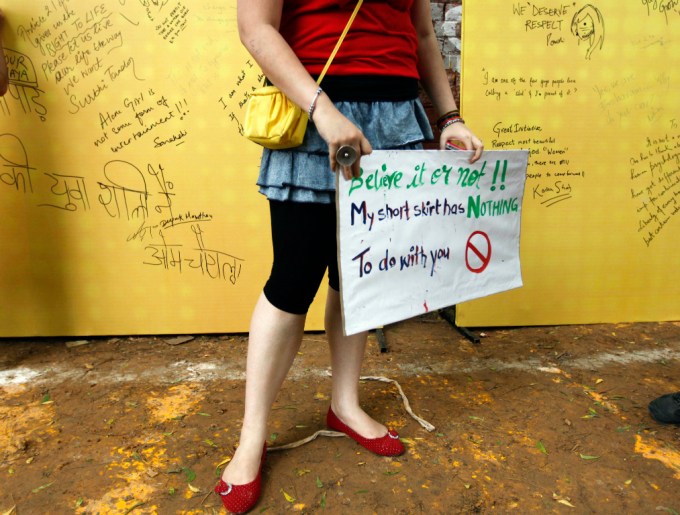
(Source)

Some people are critical of the famous national company for planning an event that will encourage women to expose themselves.

코오롱인더스트리는 선정성 논란은 ‘기우’에 불과하다며 패션 트랜드를 반영한 행사라는 사실을 강조했다.

[But] Kolon Industries emphasized that to describe this event as sexual provocation is misguided, as it merely reflects current fashion trends.

이 회사 관계자는 “다른 업체에서 (하의실종 종결자 이벤트를) 하면 문제가 될 수 있겠지만 우리는 패션회사”라며 “패션업계에서 핫 이슈인 ‘하의 실종’ 패션을 깜짝 할인행사에 접목시킨 것”이라고 해명했다. 선정성 논란 등 행사의 부정적 효과는 이미 기획단계에서 내부적으로 논의됐다는 부연이다.

A company representative explained “If other [non-clothing] companies had hosted an event like this, it would have been a problem, but we are a fashion company.” Also, that “possible reactions like controversy about sexual provocation were anticipated and already taken into account before deciding to host the event.”
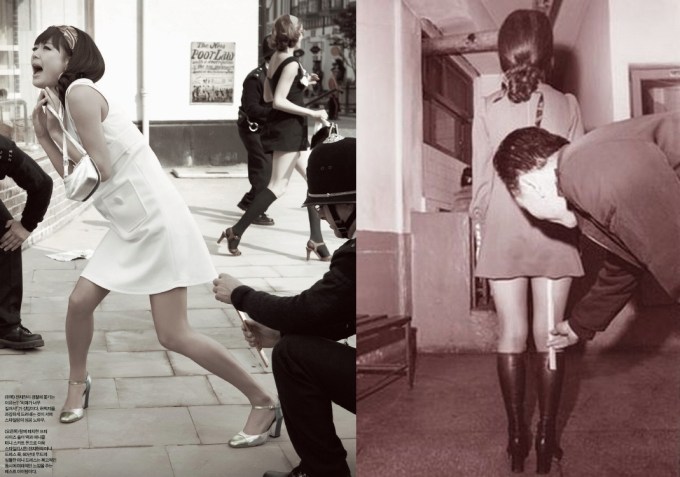
(Sources: left, right)

◆ “패션업계 ‘핫 이슈’ 행사에 접목 시킨 것”…결국 이벤트 취소 / In the end the event was cancelled

이어 이 관계자는 “평소 소비자들이 입고 다니는 반바지나 치마를 입어도 할인권을 받을 수 있다”며 “하의를 최대한 짧게 입고 오라는 취지는 아니다”라고 강조했다.

The representative added “Customers that wore normal-length shorts and skirts would also have been able to receive discounts, so the intention was not to encourage them to wear as short clothes as possible.”

“과열 경쟁 등으로 지나치게 노출이 심한 옷을 입은 참가자가 등장하면 문제가 되지 않겠냐”는 기자의 질문에는 “상황에 따라 대처하겠다”고 두루뭉술하게 답했다. 사진촬영도 막지 않겠다는 입장이어서 현장 단속이 사실상 전무한 것 아니냐는 추측이 나온다.

When asked by a reporter if people wearing too revealing clothing [in order to get a bigger discount] would be a problem, the representative replied “We don’t anticipate that, but will deal with any problems if and when they occur.” [However] it will be too difficult to police the event and prevent people from taking pictures.

이 관계자는 “기본적으로 신분증을 지참한 성인남녀만 참가할 수 있도록 했지만 행사 자체는 모두에게 공개된다”며 “(지나친 노출 등) 누가 봐도 문제가 될 상황이 발생하면 현장에서 해결할 것”이라고 말했다.
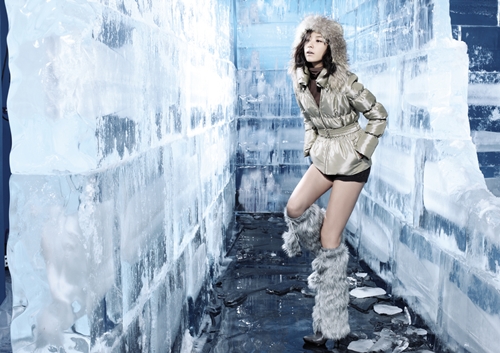
The representative also said that “the event will be open to the public, but only adults (we will check IDs) will be allowed to participate,” and again that “we will deal with any problems of excessive exposure if and when they occur.” (source, right)

업체 측의 해명에도 불구하고 ‘선정성 논란’은 수그러들지 않았다. 결국 이 업체는 문제의 행사를 열지 않기로 입장을 선회했다. 소비자들의 반응은 냉담했다.

Despite these explanations, the controversy about the sexual provocation didn’t die down. In the end, the company decided not to hold the event in question. But consumers’ feelings about it are still cool.

한 소비자는 “결국은 짧은 치마를 입고 와야 옷을 싸게 살 수 있다는 것 아니냐”며 “성 상품화에 대한 논란도 많은데 코오롱인더스트리가 꼭 이런 행사를 기획했어야 했는지 모르겠다”고 지적했다.

One consumer complained that “Why would we have to come to the store in high mini-skirts in order to receive the discount,” and wondered “why did Kolon Industries plan such event when sexual objectification is such a controversial issue?”

또 다른 소비자는 “의류업체에서 유행 아이템을 반영한 행사는 개최할 수 있다”면서도 “다만 행사 내용이 지나치게 선정적으로 비춰지면 소비자들이 거부감을 느끼지 않겠냐”고 말했다.

Another consumer said “A company can certainly hold an event that reflects current fashion trends,” but “if it is too sexually provocative, won’t people reject that?”

한편 코오롱그룹 모기업인 코오롱인더스트리는 ‘캠브리지멤버스’, ‘헤드’ 등의 브랜드로 유명한 패션 전문기업이다.

The Kolon Group, the parent company of Kolon Industries, is well known for fashion brands like Cambridge Members and Head (end).

Update — Via this blog, a video promoting the event:

Related Posts:

Korean Poster: ETIQUETTE FOR MEN AT NIGHT

(Source)

Via Tales of Wonderlost, who also passes on a translation by Opress-Crackatron3000:

Protesting sexual harassment and violence against women

ETIQUETTE FOR MEN AT NIGHT

1. Remember that your presence can be threatening to women walking alone at night

2. If a woman is walking in front of you alone at night, slow down. You walking quickly or speeding up can be and in most cases is threatening

3. If you’ve been drinking and are drunk, go straight home.

4. Do not pick a fight or aggravate women walking at night

5. Do not take off your clothes or publicly urinate

6. Be careful to make sure you do not touch or hit someone, even on accident.

7. If, late at night, you come to a situation in which you and a woman have to ride an elevator together, let her go up first and wait for the elevator to come back down.

8. If there’s a woman in a public restroom (There are Korean public restrooms with no gender or sex markings that are open to all people), wait for her to finish and come out first before using the restroom.

9. Report broken streetlights to the police

10. Tell other men about these rules and that they have a responsibility to not threaten women walking at night

Please share as much as possible!

Related Post: Groping in Korea: Just How Bad Is It?

Revealing the Korean Body Politic, Part 2: Kwak Hyun-hwa (곽현화), Pin-up Grrrls, and The Banality of Sex and Nudity in the Media

(Sources: left, right)

Apologies for the irregular posting everyone — I’ve been really busy for the last month or so, and to top it all off I’m recovering from a bad flu as I type this too. But fortunately the end of the semester is close, and I’m eager to get stuck into the two blog series I plan to devote myself to this summer.

One is looking at the evidence for double-standards in Korean censorship, while this one is about examining the public and media’s policing of — and consequent narratives about — “appropriate” displays of nudity and sexual subjectivity, set against a recent potential backlash against changing gender relations. In hindsight just two different elements of the same investigation, the former focuses on K-pop in 2011 and this one on political protests in 2012.

As you’ll recall from Part 1 though, one problem with looking at anything explicitly political is that partisan reporting gets in the way, which means we need to consider as many sources as possible to be objective, and especially not just rely on English-language sources. So, let me start that by presenting my translation of a post by a blogger known as “비춤” (or on Twitter as @RainyDance01), which was originally posted on his or her blog Rainy Dance, then later reposted at Mediaus. About the photo on the right (source) of comedian turned model, singer, and actress Kwak Hyun-hwa (see Part 1 for the details), as you’ll see I think the blogger’s heart is in the right place, but unfortunately some of their reasoning dodgy at best, and evidence seemingly pulled out of thin air:

곽현화식 투표독려? 누드가 일상이 되면 식상하다  / Does Kwak Hyun-hwa’s Style Promote Voting? When Nudity Becomes Routine, it Becomes Boring

10 April 2012

국회의원 총선거를 코앞에 두고 투표율을 올리고자 수많은 유명인들이 투표 독려에 나서고 있습니다. 소설가 이외수씨는 투표율 70%가 넘으면 머리카락을 싹둑 자르겠다고 밝혔고, 안철수씨 또한 70%를 넘으면 미니스커트를 입고 율동에 노래를 부르겠다고 밝혔지요. 이렇듯 저마다 자신의 공약을 내세워 투표독려에 나서고 있습니다. 이들의 공약은 대중에게 소소한 재미와 더불어 투표참여의 의미를 되새겨주고 있는데요. 거창하진 않지만 자신만의 방식으로 사회적 메시지를 전달하는 유명인들의 모습은 새로운 문화가 되고 있는 느낌입니다.

Just before the general elections, many famous people are doing various things to encourage more people to vote. For example, novelist Lee Wae-soo has pledged to cut his trademark long hair if the voting rate exceeds 70%, while Ahn Cheol-soo has promised to dance wearing a mini-skirt (see below). While these may sound just trivial and fun, they do remind voters about the meaning and importance of voting. Also, while their ultimate impact may not be all that great, they point to a new trend of famous people spreading social messages.

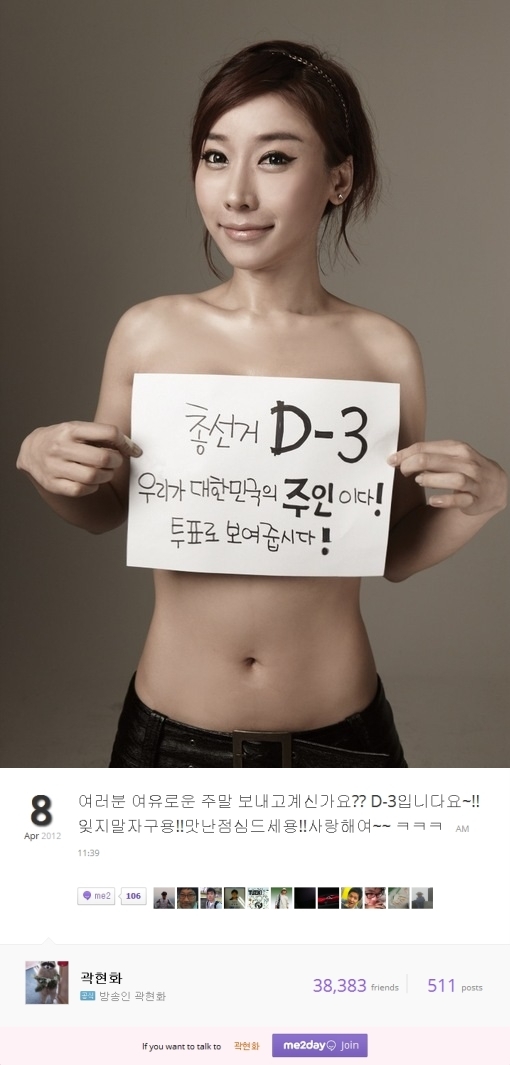
그런데 같은 목표를 지향하더라도 그 방법 탓에 오히려 대중의 반감이 우려되는 경우도 있는데요, 개그우면 곽현화의 경우가 그렇습니다. 곽현화는 투표독려를 위해 자신의 미투데이에 ‘총선거 D-3, 우리가 대한민국의 주인이다! 투표로 보여줍시다’라는 내용이 적힌 종이를 들고 있는 상반신 누드 사진을 올렸습니다. 그 의도야 건설적이지만 이면에는 새로울 것이 없는, 우리의 식상해진 문화 코드가 선명하지요.

However, while they all have the same target, some celebrities’ methods may actually make voters more apathetic. One such case is that of comedian Kwak Hyun-hwa. In her case, she uploaded a photo on her me2day blog in which she is holding a sign in front of her nude upper body. The sign said “It’s 3 days to go before the elections. We are the owners of Korea! Let’s show this by voting!”. But while the intention was constructive, on the other hand this method is hardly original, and shows the paucity of our culture.

자신의 의사를 표현하는 방법에 옳고 그름을 규정하기는 어렵습니다. 하지만 그녀가 지금까지 보여온 행보를 본다면 아름다운 취지보다는 이면의 가십거리가 더욱 부각될 수밖에 없겠지요.  폭소클럽 출연당시 가슴노출이 심한 드레스를 입고 출연해 노출논란의 불을 지핀 이래로, 그녀는 꾸준히 노출의 길을 걸어왔었지요. 섹시화보가 누출되어 세간에 화제가 되기도 했으며, 지나치게 선정적인 앨범 이미지컷으로 눈총을 받기도 했습니다.

It’s difficult to judge what the best or most “correct” way of expressing oneself is. But looking at Kwak Hyun-hwa’s past history up until now, it’s difficult not to conclude that this stunt of hers was more aimed at creating gossip and attention about herself than anything noble. When she was on the comedy Foxclub for example [James — she quit in 2009], she used to create a lot of controversy by wearing a lot of revealing dresses, and since then has continued on a similar path. For instance, she has done a very sexy photoshoot, and received criticism for her provocative and suggestive images for her album.

(James: I’m not judging — and/or defending — Kwak Hyun-hwa in any sense, but just for the record: while she’s certainly done sexy photoshoots, and you can judge her album pictures for yourselves, I think it’s unlikely that she regularly wore a lot of revealing dresses on Foxclub. If she had, then presumably there’d be far more “노출” videos and photos of her on that show available than just those from one short skit back in 2008)

올 초에는 개그맨 동료들과 선정적인 포즈로 찍은 사진이 이슈가 된 바 있는데요. 비난이 잇따르자 이에 대한 반감으로 자신의 미투데이에 바나나를 먹는 야릇한 표정의 사진을 올려 더 큰 역풍을 일으키기도 했지요. 하지만 그녀는 떳떳하게 말합니다. ‘’성적인 감정을 일으켰다고 해서 지탄하는 것은 마녀사냥이다. 의도를 떠나서 개그맨 전체를 싸잡아 욕하는 성급한 일반화의 오류를 범하지 말아 달라’

Earlier this year, some pictures of Kwak Hyun-hwa in pretend sexual poses with some her comedian colleagues became an issue [James — they can be seen here]. In response to the criticism that followed, on her blog she posted pictures of herself with a perverted expression on her face while eating a banana [James — was the author too embarrassed to be more specific?], which led to even more criticism. But in response to that, she boldly replied, “Just because something is arousing doesn’t mean it should be criticized — to do so is nothing but a witchhunt. And whatever the intention(s), don’t make the mistake of making rash generalizations about all comedians.”

(Source)

과연 그녀를 바라보는 냉랭한 시선은 성급한 일반화의 오류일까요. 사실 벗는 것은 여자에만 국한된 것은 아닙니다. 남자도 벗습니다. 초콜릿복근이니 식스팩이니 하며 매력을 뽐내는 남성들도 얼마든지 있지요. 하지만 남성의 매력을 규정하는 잣대에서 ‘벗는 것’의 비중은 상대적으로 크지 않습니다. 지적인 남자, 자상한 남자와 같이 이 시대의 여성이 매력을 느끼는 아이콘은 상대적으로 많은 편이지요. 그래서 벗는 것으로 일관하는 남자는 오히려 역풍을 맞기도 합니다. 여담이지만 한때 1박2일에선 이수근이 숱한 노출을 보이며 빈축을 사기도 했습니다.

Well, is looking at her coldly and making a rash generalization really a mistake here? Of course, it’s not just women that take their clothes off — men do too. To show off their attractiveness, they expose their chocolate abs, their six packs [James – actually, those are the same thing], and so on. But relatively speaking, taking clothes off isn’t as important for men as it is for women; because in this day and age, there are many ways in which women can find their male icons attractive — they can be intellectual or kind. It would be bad if men only took their clothes off. When Lee Su-geun showed too much of his body on an episode of 2 Days & 1 Night for instance, people didn’t like it.

(James…)

반면 여성들에겐 유독 섹시미 혹은 백치미가 강조되지요. 5살 유아부터 70대 할머니까지 섹시하다는 말은 일상어처럼 사용되고 있습니다. 드라마에선 홀로 당당한 일어서는 여성의 이야기는 그다지 성공적이지 못합니다. 여전히 신데렐라의 환상이 더 잘 팔리는 시나리오지요

On the other hand, for women being sexy or being stupid but cute is emphasized. From when they are just girls of 5 to when they are grandmothers in their 70s, the word “sexy” is part of daily life for women. In dramas, the strong, confident woman that succeeds through her own efforts is never a popular story, whereas the Cinderella fantasy is a scenario that always sells well.

이 시대의 남성들은 여성의 매력을 이 한 가지로 국한하고 있는 걸까요, 혹은 여성이 자신 있게 내세울 수 있는 매력은 이 한 가지뿐일까요. 양성평등의 가장 큰 위협은 이렇듯 일방적으로 여성의 섹시함을 강요하는 작금의 문화가 아닐까 싶습니다.

Is this because men of this day and age set limits to women’s sexiness [as just showing off their bodies], or because this is the only sexiness which women can show off confidently? I think this culture of emphasizing just this one side to women’s sexiness is today’s biggest threat to sexual equality.

이 시대의 청년들에게 닮고 싶은 사람을 떠올려보라면, 남성 쪽에선 다양한 매력이 쏟아져 나올 수 있겠지요, 안철수, 안성기, 조국, 손석희, 유재석 등 다양한 분야의 사람을 떠올릴 수 있습니다. 헌데 닮고 싶은 여성상을 물었을 때 우리 사회의 한축을 담당하고 있는 여성을 얼마나 떠올릴 수 있을까요. 그 자리에 섹시아이콘만이 남아 있다면 우리사회가 얼마나 건강하지 못한지를 반증하는 것이겠지요.

(Source)

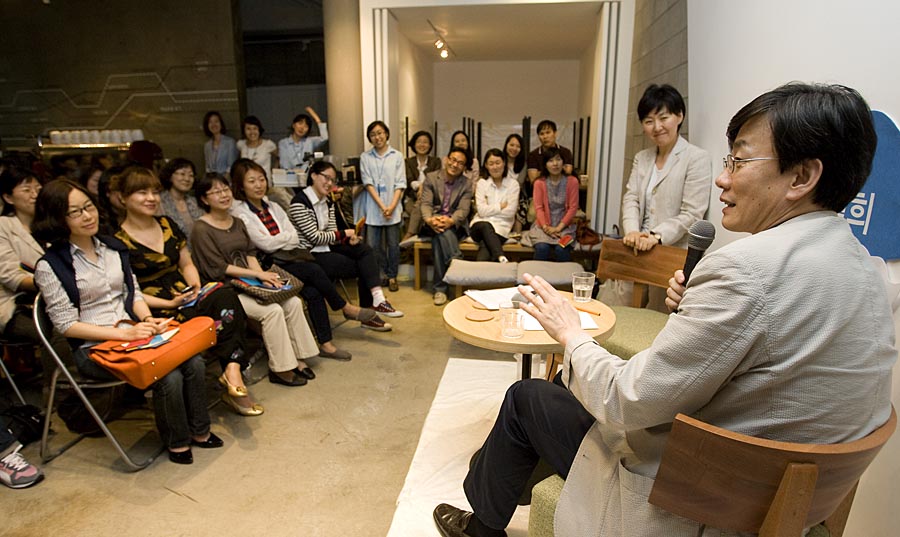
These days, when teenagers are asked who are their role models, boys mention men who are attractive in many different ways and from many fields of life, such as Ahn Cheol-soo, Ahn Sung-ki, Kuk Cho, Son Seok-hee (above), Yoo Jae-Seok, and so on. In contrast, although there’s many women to choose from, girls just name sexy icons. I think this shows how unhealthy our society is.

(James: Other than their fathers, I don’t believe for a moment that teenage boys mention men in their 50s or older as their role-models, even when they want to impress whoever’s asking)

곽현화는 좋은 취지에서 누드시위를 했습니다. 하지만 그 이면에는 이 땅에서 쉽게 주목받고자 하는 여성의 식상한 방법론이 새삼스럽습니다. 우리 사회의 쓸쓸한 단면이겠지요.

Kwak Hyun-hwa [may have?] had good intentions, but her method was unoriginal and was just a way of getting noticed. This too is a sign of how unhealthy our society is (end).

(Source)

What do you think? Again, I find the blogger’s logic — and especially notions of male and female desire — flawed, but at the very least I am now very interested in finding out more about Kwak Hyun-hwa. Not because I think she has any musical talent though (frankly, I hated Psycho above), nor because I naively think her “nude” photo was anything but completely self-serving. Rather, because:

She deserves a lot of credit for reinventing herself as a model, singer, and actress after being best known as a slightly chubby (by Korean entertainment standards) comedian.

Whatever her musical abilities, it was especially brave of her to even attempt to become a solo singer in her late-20s (old age by K-pop standards).

She’s a maths graduate of Ehwa Women’s University, and has even published a textbook for middle-schoolers (see below), so she’s probably quite smart. And I’m not being facetious when I say that many men and women may not be able to see past her cleavage to realize that (related, make sure to read the classic With Great Cleavage Comes Great Responsibility).

What solo celebrity’s public actions and statements aren’t motivated by self-interest? Which is not to say that they’re always cold and calculating of course, but still: it seems a strange criteria to dismiss someone as a person for (after all, heaven forbid that someone use their sex-appeal to advance their career), and is simply an ad-hominem method of devaluing that style of getting a political message across.

As for its effectiveness, for its stated purpose of encouraging people to vote that is? Well, determining things like that is what this whole series is about, but in the meantime let me pass on Tom Megginson’s take on a similar recent political campaign by Mexican politicians (my emphasis):

Jezebel’s Erin Gloria Ryan is a little cynical about the use of “boobies” to get attention, but I applaud any effort in which women take back ownership of their bodies by using our primal fascination to deliver messages of solidarity for social change.

(Source)

• And finally, remember when Lee Hyori recently publicly admitted that she has sexual feelings and experience? Judging by the reactions of K-pop fans, that was quite exceptional, and indeed I joined in praising her for it in Part 1. But to take a more detached perspective, that this was news at all is really quite an indictment of the sex-only-for-display-nature of Korean entertainment. For remember that we’re not just talking about a 33 year-old woman here, but one who was also Korea’s number one sex-symbol for much of the 2000s. It simply beggars belief that she has ever had to be coy about her sexual subjectivity.

Why do I mention that? Because despite the attention given it, Lee Hyori’s admission pales in comparison to Kwak Hyun-hwa’s stunts with bananas and her comedian friends. And recall that by my own definition, I shouldn’t have to seek-out pin-up grrrls, but rather they should do their darnedest to make me aware of them. In which case, Kwak Hyun-hwa more than qualifies!

And on that definitive note, what is coming in Part 3? Well, frankly a little disappointed with the blog post I translated, next I’ll try make sure to do something more substantial, namely this newspaper report on reasons for the recent “ladygate” phenomenon; i.e., the emerging backlash I mentioned. Thanks to Robert Koehler for the link.

The Revealing the Korean Body Politic Series:

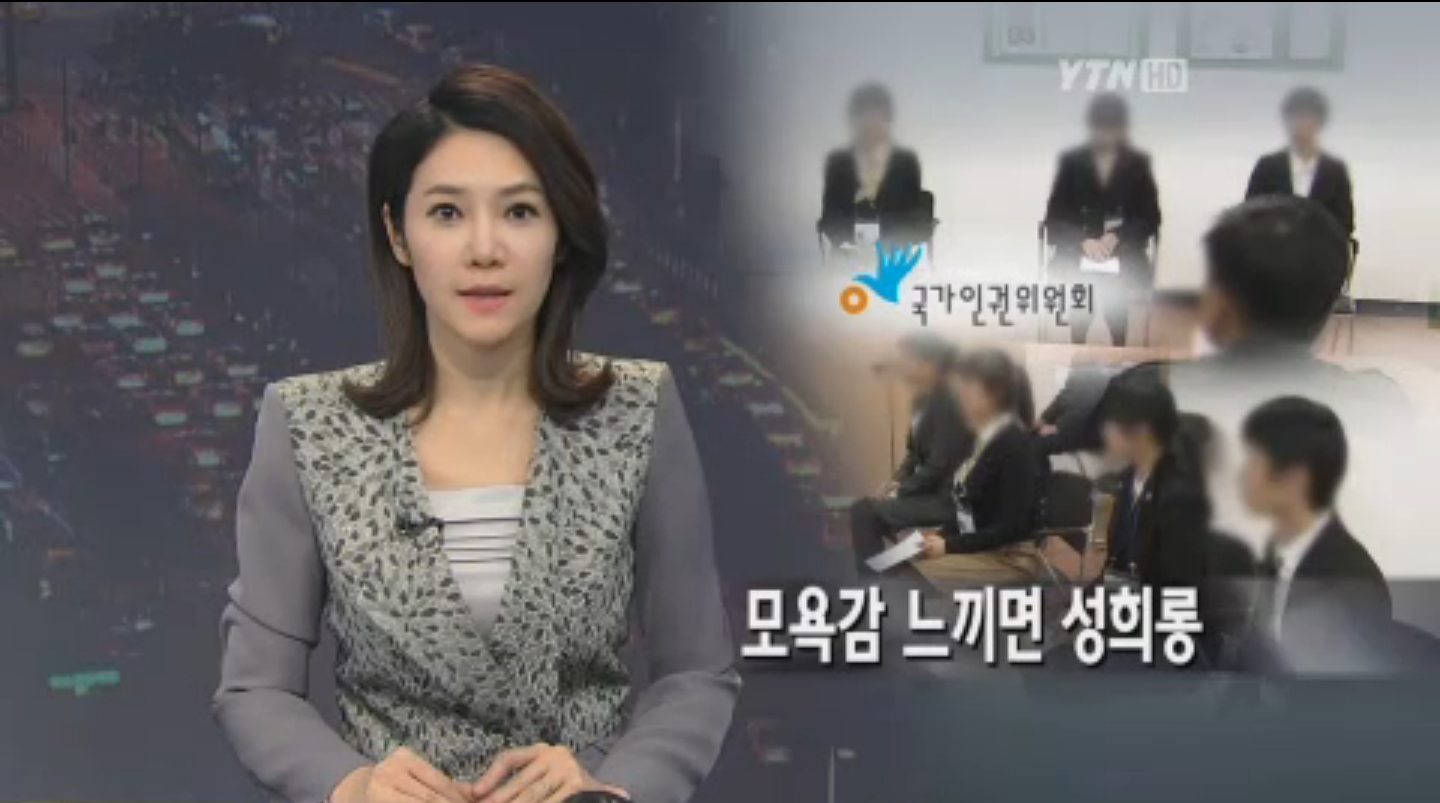
YTN: Sexual Questions and Jokes Common at Job Interviews

A brief report from YTN on Wednesday, which you can see the video of here (I can’t embed it sorry). Unfortunately, it provides no actual sources for its assertion that sexual harassment is common at interviews, but I’m inclined to believe it given how invasive and often needlessly humiliating the job interview process already is in Korea.

Indeed, when even Samsung admits that many Koreans “take it for granted that they have to tolerate anything in return for getting paid”, then it’s difficult not to see such an interview style as an integral and deliberate part of indoctrinating new workers.

Lest you scoff at the ensuing passivity and regular unpaid overtime however, and claim that you would never tolerate that crap from your boss, note that a 2011 OECD report found that “Korean workers [are the] most vulnerable to an economic crisis compared with their counterparts in other OECD countries, due to the country’s extraordinarily low levels of unemployment benefits” (i.e., lose your job in Korea, and you’re screwed). Also, that it’s very common to be interviewed in a group rather than individually, especially at larger companies, and that particularly stressful and demeaning interviews are so common as to have their own special name (abbak-myeonjob/압박면접, or ‘pressure interview’), mentioned at the end of the report.

면접 성적 모욕감 느꼈다면 성희롱” / “If you feel insulted from sexual jokes at a job interview, that’s sexual harassment”

Anchor Comment:

여성 구직자들이 입사 면접을 볼 때 면접관들이 성적인 농담을 던질 때가 종종 있습니다.

구직자가 이런 말을 듣고 모욕감을 느꼈다면 성희롱에 해당된다는 국가인권위원회의 판단이 나왔습니다.

조임정 기자가 보도합니다.

Female job seekers report frequently receiving jokes of a sexual nature from interviewers at job interviews. If they feel insulted as a result, that’s sexual harassment according to a judgment of the National Human Rights Commission (NHRC). Jo Im-jeong reports.

Reporter:

취업을 앞두고 면접에 다녀온 여성들은 종종 무력감에 빠지곤 합니다.

면접 때 던져지는 이상한 질문들 때문입니다.

Prior to getting a job, women feel powerless after having an interview. That’s because they receive such strange questions in them.

Interview — Miss Gomo, a student preparing to start working:

“성적인 수치심을 느끼는 질문을 한다면, 사실 면접자 입장에서는 어떻게 강하게 대응할 수 있는 부분이 아니고…”

“If an interviewee feels a sense of sexual shame [from the questions in an interview], they’re not in a strong position to do anything about that…”

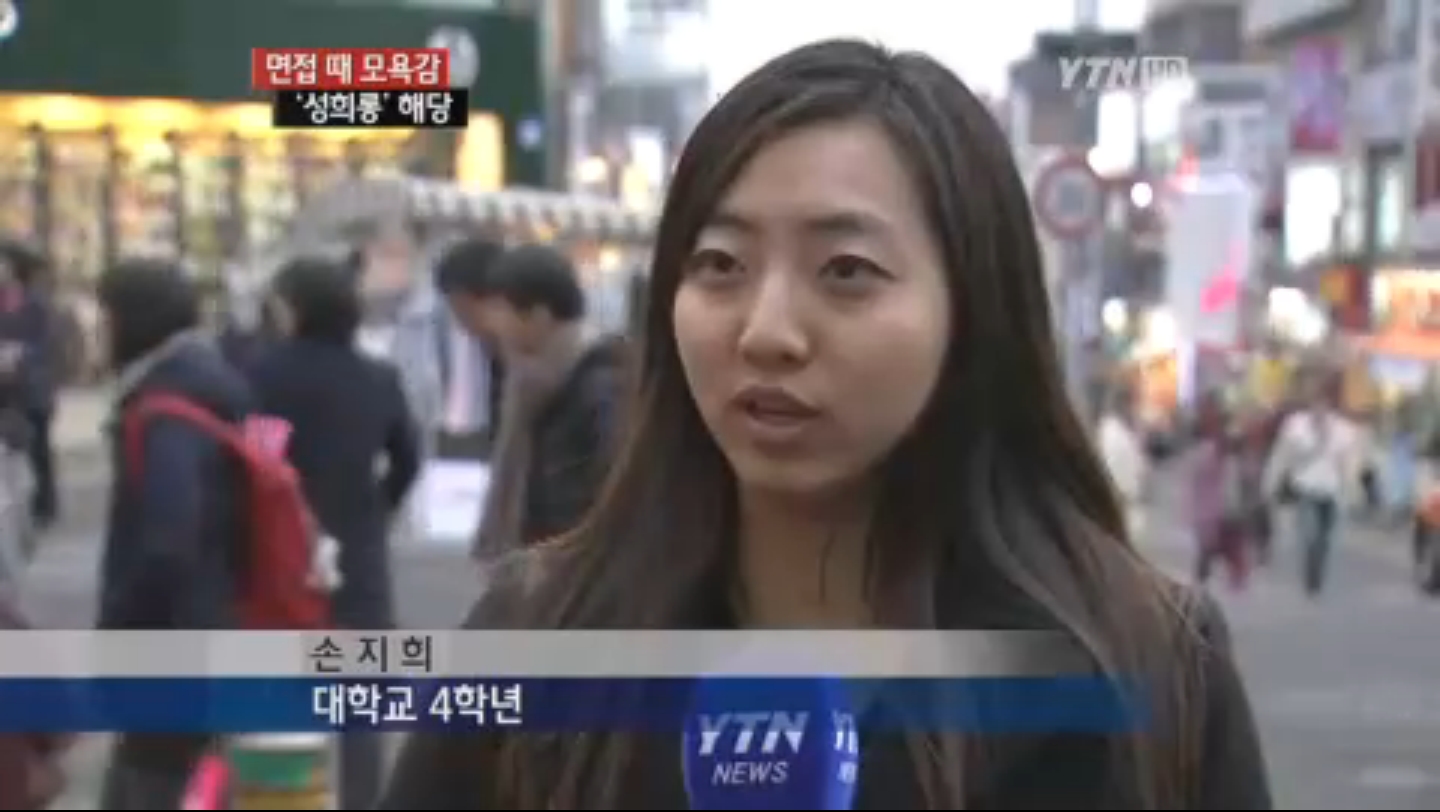
Interview — Son Ji-hee, 4th year university student:

“성품을 보기 위해서 그렇게 자극적으로 얘기하는 것에 대해서, 정말 실효성이 있는지는 두고봐야겠지만, 그렇게까지 상처를 받는 사람이 있다면, 자제될 필요는 있다고 생각합니다.”

“Saying provocative things like that in order to determine one’s personality…it has to be seen if that’s effective. And if it’s done to the extent that people are hurt by it, then it needs reconsidering.”

이처럼 면접을 비롯한 구직 과정에서 성적 굴욕감을 느꼈다는 진정이 잇따라 국가인권위원회에 접수되고 있습니다.

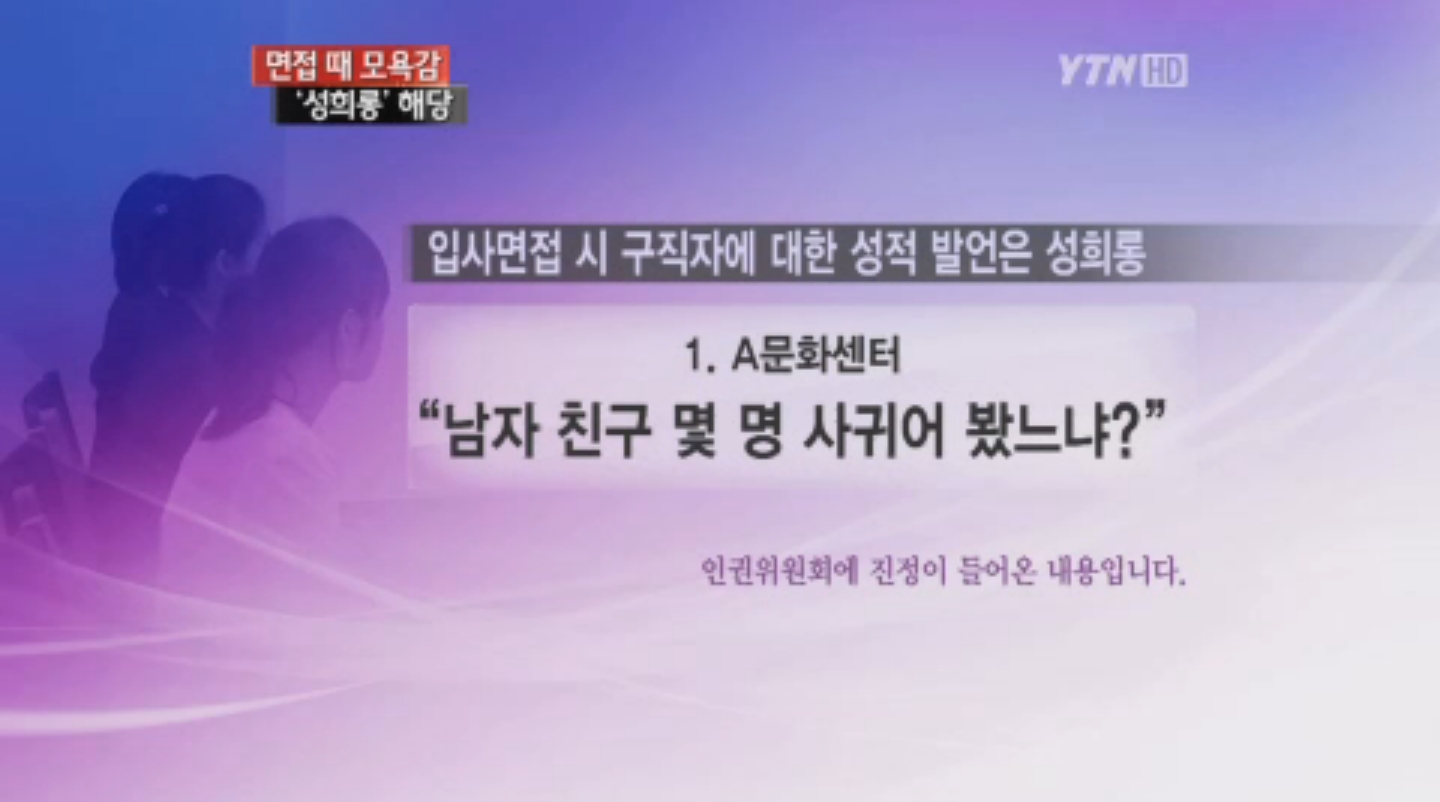
지원자에게 “남자친구 몇 명을 사귀어봤는지”처럼 업무와 관련 없는 질문을 던지거나, 심지어 회사 대표가 면접 과정에서 지원자의 특정 신체 부위를 만지는 경우도 있었고, 채용이 확정된 뒤 회식 자리에서 남자 직장 상사와 블루스를 출 것을 강요한 경우도 있었습니다.

인권위는 입사 면접 과정에서 면접관의 발언 때문에 구직자가 성적 굴욕감을 느꼈다면 성희롱에 해당한다고 판단했습니다.

문제는, 면접에서 결정적인 권한을 가진 회사 관계자가 성희롱을 해도 절대적 약자인 구직자가 제대로 대처하기 힘들다는 겁니다.

People who have felt humiliated like this in interviews have appealed to the NHRC.

Applicants report being asked questions like “How many boyfriends have you had?” that have no relationship to the job, and there have even been cases of company representatives touching certain body parts of theirs during the interview. Or, after they’re hired, of male superiors forcing them to dance the blues with them at company dinners.

Feeling sexual shame because of comments by interviewers has been judged sexual harassment by the NHRC.

The problem is that when the final decision about hiring is by the sexual harassers themselves, interviewees are in a weak position and find it difficult to cope with what has happened.

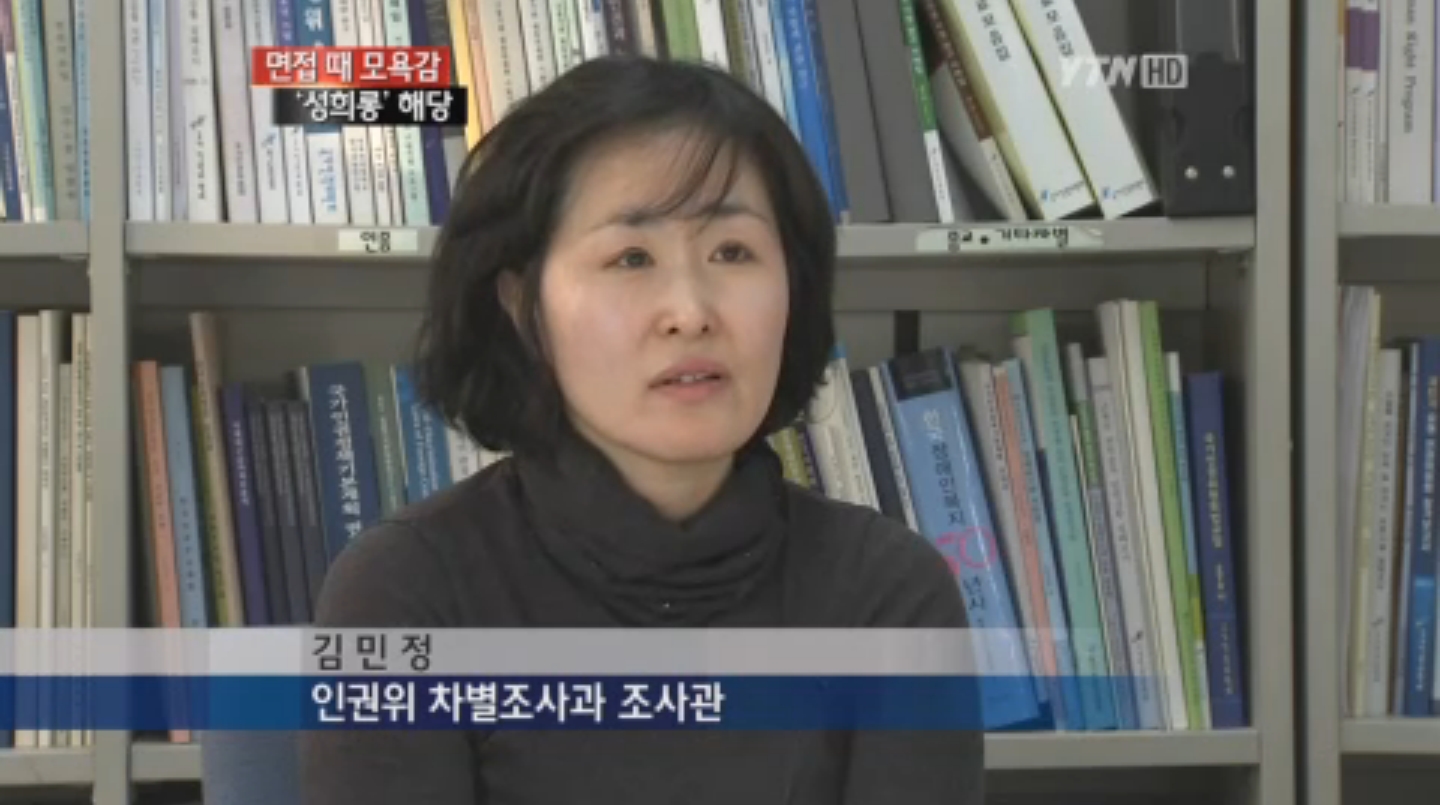
Interview — Kim Min-jeong, NHRC Discrimination Department Investigator

“압박면접을 시행하더라도 개인의 직무 능력이나 본인의 가치관 등을 알아볼 수 있는 질문을 하는 것이 훨씬 더 중요하다고 생각합니다.”

인권위원회는 해당 기업 관계자에게 인권위가 주최하는 특별 인권교육을 받고 피해자들에게 손해배상금을 지급하라고 권고했습니다.
YTN 조임정[ljcho@ytn.co.kr]입니다.

“Even if people are doing a ‘pressure interview’, we think questions about one’s work ability and the person’s value and so on are far far more important.”

The NHRC recommends that offending employees are given human rights education, while the victims should receive financial compensation.

YTN Reporter Jo Im-jeong reporting (end).

Korean Boys: “Wearing Hot Pants Says Something About You”

(Source)

A much more serious topic than it may sound, this article from Ilda Women’s Journal will definitely give you a renewed appreciation for the goals of the Slutwalk (잡년행진) movement.

Once it does though, unfortunately you’ll probably find yourself pretty frustrated with it too. For the author only really gives platitudes about the need for change, rather than provide any details about who those boys were, what they said exactly, and the sex-education program her and her colleagues were involved in.

But still, she’s right to be concerned about the messages children are receiving about sexuality when any elementary school boys both approve of and chastise attractive women for wearing revealing clothes. Let alone disallow “ugly” ones from wearing them:

(Source)

“못생긴 애들 핫팬츠 입지 말라”는 아이들 Children That Say “Ugly Girls Shouldn’t Wear Hot Pants”

여성의 노출’을 바라보는 십대들의 시선 Teenagers’ Views on Women Who Wear Revealing Clothes

So Yeong-mi, August 2010

(일다의 독자위원인 서영미님은 현재 십대들과 함께하는 성교육 프로그램을 진행하고 있습니다―Editor)

Editor: Ilda reader So Yeong-mi is currently involved in a sex-education program aimed at teenagers.

“선생님, 질문 있어요. 왜 여자애들은 그렇게 짧은 반바지를 입어요?”…“여자애들이 핫팬츠 좀 못 입게 해주셨으면 좋겠어요!”…“?????????”

“Teacher, I have a question. Why do women wear such short shorts?”…”If young women didn’t wear hot pants, that would be good.”

이게 도대체 무슨 문제란 말이지? 최근 들어 두 번이나 받은 질문이다. 고등학교 청소년 남자 아이들을 만났을 때 한번, 그리고 초등학교 남자아이들과 교육하면서 한번. 성장기 자신의 몸의 변화나 성관계, 임신/출산에 관련한 질문들이 대부분인 편이라 이 질문이 유독 기억에 남았다. 같은 반 여자아이들이 핫팬츠를 입지 말았으면 좋겠다니 이 무슨 말인가?

(Source, NSFW)

Why on earth are they saying and asking these things? This has happened to me twice recently. Once, from teenage boys at a high school, and the other from boys at an elementary school. Most of the questions I get are normal ones about their development, changes to their body, sexual relationships, pregnancy and childbirth and so on, but I especially remembered these. Why are boys saying that girls in their classes shouldn’t wear hot pants?

James – Because of the mention of female classmates, I’m assuming the boys were in mixed-schools then? But So Yeong-mi doesn’t mention how the girls reacted to such questions, an omission which hopefully means she taught the boys and girls separately.

뜬금없는 질문이 궁금해 스무고개 하듯 계속해서 질문을 주고받으며 질문한 의도를 파악하려 애썼다. 질문자는 한 명이었지만 반 아이들 모두가 동의하고 있었고 별로 웃기지도 않은 질문에 아이들은 자지러졌기 때문이다. 질문을 받은 내가 자신들 생각대로 웃어넘기지 않고 진지하게 계속 물으니, 나중엔 아이들도 제법 진지하게 맞받아쳤다. 그리하여 나온 결론은 같은 반 여자아이들은 핫팬츠를 입으면 안 된다는 것!

I was very curious why these questions came out of the blue, so I sort of played 20 Questions with the students to find out. Only 1 student [in each case?] asked, but all the other students thought it was hilarious, and they expected me to laugh along with them. I wanted to get to the bottom of that, and so later when they gave me feedback it emerged that they felt that girls in their classes shouldn’t wear hot pants.

(Source)

모자와 핫팬츠는 다르다? What’s the Difference Between Hot Pants and Hats?

“오크가 그런 걸 입는 게 말이나 돼요?” “Would Orcs Wear Hot Pants?”

판타지 소설이나 롤플레잉 게임에 주로 등장하는 괴물, ‘오크’족. 쭉쭉빵빵 몸매도 좋고 능력도 좋은 미녀캐릭터들에 비해 볼품이 없어 쉽게 무시당하고 힘만 센 캐릭터. 아이들의 설명에 의하면 이랬다. TV에서 연예인들이 입는 것과는 다르다는 것. 그건 당연히 ‘봐줄 만하다’는 것이다. 핫팬츠뿐만 아니라 미니스커트에도 역시 강한 불만을 표했는데, 이번에는 또 다른 이유를 제기했다.

As the students explained, in fantasy novels and role-playing games the monster that appears the most frequently is the orc. Unlike beautiful female characters, with great abilities and voluptuous bodies (and usually useless armor – James), orcs are essentially faceless characters that can easily be disregarded. What entertainers wear on TV is different though, and, of course, it’s worth watching.

But it’s not just hot pants that the boys had problems with girls wearing, but also miniskirts. They gave a second reason for that.

“옷이 그러면 그렇고 그런 거 아니에요? 위험할 수도 있잖아요.”

“Doesn’t wearing clothes like that say something about you? And it’s dangerous too!”

아이들은 여성인 내게 “선생님도 그런 옷을 입냐”며 “도대체 왜”냐고 야단이었다. 한 학생이 모자를 쓰고 있기에 “너는 왜 모자를 쓰고 있냐” 물으니 “그냥 좋아서”라고 가볍게 얘기했다. 그럼 “핫팬츠나 미니스커트를 선택해서 착용하는 것은 무엇이 다르냐” 물으니 “그건 당연히 다르다”고 소리친다. 적절한 대답이 없을 때 아이들은 대개 화를 낸다.

(Source)

The students asked me, a woman, “Do you wear clothes like that?”, and, in a critical tone, “Why on Earth do women wear those?”. So, to one student who was wearing a hat I asked “Why are you wearing that hat?”, to which he casually replied “Because I like it”. So then I asked “How is that different to choosing hot pants or a miniskirt”, and got the retort that “Of course it’s different!”, the student becoming angry that he didn’t really have a proper answer.

그날 종일은 아이들과 좀 더 많은 시간을 들여 ‘개인의 취향’에 대한 이야기를 나누었다. 서로의 취향을 존중하고 이해해야 하는 이유를 찾아보며 남/녀를 탈피한 다양한 관계 속에서 역할활동까지 해봤다. 그러나 그 날의 아이들에게는 이미 모자와 핫팬츠의 ‘선택’이 다르지 않다는 것을 이해시키는 것이 어려워 보였다. 너무나 견고한 그들만의 ‘패션철학’이 놀라울 따름이었다.

I spent all day with the students, and shared a story about personal tastes with them. Then we did roleplaying, breaking away from normal man/woman and girl/boy ones, in order to better understand and respect each other’s personal tastes. It was difficult to make them understand that wearing hot pants was a choice, no different to wearing a hat, and I was very surprised in how unwavering some of their attitudes to fashion were.

우연히 비슷한 시기에 만난 이 집단 아이들만의 문제였을까. 교육이 끝난 후 평가시간에 이 에피소드를 털어놓으니 유난히 남자아이들 교육을 진행할 때 그런 질문이 많이 나온다는 실무자들의 의견이 있었다. 예쁜 사람이 입으면 괜찮고, 아니면 안 괜찮고, 짧은 옷을 입으면 위험하고 야한 어떤 것이라는 10대 초반의 아이들의 논리. 고등학생 이상의 청소년 들을 만났을 때만 해도 성인과 비슷하게 생각해나가는 시기여서 그런가 생각했는데, 초등학생들에게서까지 강한 불만으로 표출되어 나오니 그냥 웃어넘길 일이 아니라는 생각이 들었다.

I wondered if this way of thinking was just confined to the groups of students I taught, so afterwards I asked other sex-ed teachers involved in the program, and they confirmed that they get similar questions and opinions from especially male students. The logic of boys in their early teens was that if pretty girls wear hot pants and so on it’s okay, but if they’re not pretty then it’s not, and that [in either case] such clothes are both too revealing and dangerous.

(Source)

Now, if I’d asked high school students and so on, who think like adults, then I wouldn’t have been surprised, but once I learned that even elementary school students are saying such things then I realized that this was no laughing matter.

고 민지점은 성인들이 갖고 있는 편견이나 고정관념들이 고스란히 아이들에게도 답습된다는 것이다. 또한 그 연령이 대폭 낮아졌다는 사실도 놀랄만한 일이다. 그 어린 학생들마저도 ‘여성’의 몸을 검열하고 있다는 사실에 주목하지 않을 수가 없는 것이다.

Children are picking up adults’ prejudices and biases, although it is surprising that they’re doing so at such a young age. And we can’t help but notice that even these children too think the female body is something to inspected and evaluated.

우리가 어떤 일을 할 수 있을까 What can do we do about this?

노출이 많은 옷을 입은 여성과 그렇지 않은 여성을 간단하게 이분화 시키고, 거기에 아름다움이라는 가치를 연결시킨 잣대로 평가하는 것은 아이들도 어른들과 크게 다르지 않았다. 다만 아이들의 용어로 표현하고 있을 뿐이었다. 이를 우스갯거리로 사용하는 아이들을 보고 있자니 솔직히 조금 화가 나기도 했다. 그리고 그와 동시에 우리 스스로 반성해야 될 때가 아닌가 생각해보게 됐다.

Children splitting women into simply those who wear very revealing clothes and those that don’t, and judging their value only in terms of their appearance, is little different from what adults do. But although the children just used these terms jokingly, to be honest I still got a little angry with them.

Yet at the same time, we really need to examine ourselves too.

대중매체에 대한 비판을 하려던 차에 최근 10대 청소년 연예인들을 상대로 60%가 신체 노출이나 과도한 성적 행위 장면을 강요했다는 기사들을 보게 되었다. 한 언론과의 인터뷰에서 가수 이은미는 음악성 보다 외적인 면에 더 관심을 갖는 사회 분위기를 우려하며, 성적인 면이 강조된 걸그룹의 노래, 의상, 춤에 환호하는 이 사회를 ‘몰상식의 극’이라고 표현했다. “초등학교를 졸업한지 몇 년 되지 않은 아이들을 벗겨놓고 대 놓고 섹시하다고 박수를 치거나, 꿀벅지, 꿀복근 같은 용어들을 사용하는 대중문화를 보면 소름이 끼친다.”는 것.

(Source: unknown)

I was about to blame the mass media, as recently I’ve read reports which say that 60% of female teenage entertainers have claimed to have sometimes been forced to wear revealing clothes and/or do sexual dances and so on. And in an interview of the singer Lee Eun-mi (James – Not one of those teenage entertainers; she was born in 1968), she said she was worried about a society that considered external appearance more important than musical quality for singers, where girl groups’ sexual dances, songs, and outfits where cheered…she used the term “thoughtless/careless”. She said “I freak out at the thought that just a few years after they graduate from elementary school, young male and female entertainers are being praised for taking off their clothes and being talked about in terms of their ‘honey thighs‘ or six-packs.

쏟 아지는 대중매체의 벗기기 논란은 새삼 어제오늘 일도 아니건만, 아무 손쓰지 않고 있었음에 반성하게 된다. 상품화되고 대상화되고 있는 여성들의 문제를 공공연히 문제 삼지 않았던 것이 일상생활에까지 주변 사람을 대상화하고 외모로써 평가하는 지금의 일을 만든 게 아닌가 하는 생각에서다.

But these trends in the media didn’t just appear overnight – they were allowed to flourish by the public’s inattention and lack of concern. This way, we have come to consider the commercialization and objectification of women as a normal part of our daily lives.

아 이들의 생각을 넓게 펼쳐주진 못할망정 오로지 외모로써 사람을 평가하는 우리 사회에서 우리가 어떤 일을 할 수 있을지 함께 고민해봤으면 좋겠다. 우리가 그동안 무심코 내뱉었던 말들이 아이들에게 어떤 영향을 미치게 될지 생각해보면서 말이다. 문제가 수면으로 드러난 지금이야말로 왜곡된 미와 과장된 외모 중심의 평가들로부터 벗어나 아이들에게 더 많은 관심을 가져야 할 때다. 아이들뿐만 아니라 사실은 우리 모두를 위해서 말이다.

It’s difficult to broaden children’s minds, but we do have to make an effort to stop judging each other on our appearances. We have to consider what has been the effect on our children of this focus, this excessive emphasis on appearance. Not just for them, but for society as a whole (end).

My post title aside, I don’t mean to generalize about all Korean boys, and given the author’s vagueness then what she says about them really needs to be taken with a grain of salt. So, to get a better overall picture, I’d really appreciate anything any teachers can tell me about what their own young students have ever said about such things (alas, it’s been a while since I’ve taught children or teenagers myself).

And to end on a positive note, was anyone else reminded of the above semi-response to such sentiments? Now I have a renewed sense of appreciation for that too!^^ (See here for a discussion of the song’s lyrics and meaning)

The Origins of “Ajosshi Fandom”?

Did you know that middle-aged sexual harassers often claim that they were just being affectionate, touching the victim simply as if they were their own daughters? Naively perhaps, I had no idea, so I didn’t give this commercial a second thought when it came out in 2005. But armed with that knowledge, I can certainly understand why it would have made so many women uncomfortable, as pointed out by Park Hee-jeong (박희정) in her article on the commercial that I’ve translated below, and which was echoed by numerous commenters.

Then it hit me. If all this was already well-known by the Korean public in 2005, then it takes no great leap of the imagination to see how middle-aged men’s sexual attraction to 15 and 16 year-old girl-group members could so quickly and readily be framed in the same terms just a couple of years later, albeit more as an avuncular (uncle) love rather than a paternal one for some reason.

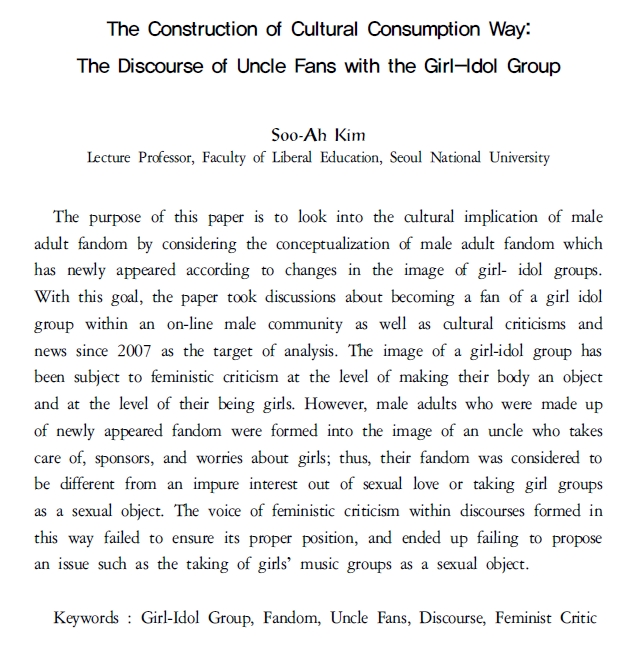
That would remain the case for the next few years, as you can read about in depth here, here, here, here, and especially in Soo-ah Kim’s article “The Construction of Cultural Consumption Way: The Discourse of Uncle Fans with the Girl-Idol Group” in Media, Gender & Culture, 15 (2010): 79-119 (“소녀 이미지의 볼거리화와 소비 방식의 구성: 소녀 그룹의 삼촌 팬 담론 구성”, 미디어, 젠더 & 문화), as she was one of the very few prominent academics challenging that consensus at the time. Only upon a perceived spate of sex crimes against children in July 2010 would the media begin (and I stress only begin) acknowledging the sexual element, and how that could be problematic.

Of course, that’s just scratching the surface of ajosshi (아저씨; middle-aged man) fandom, and I certainly don’t want to imply that middle-aged men’s interest in young girl-groups can’t be anything but sexual. Nor that when it is sexual though, that that’s fine for 20 and 30-somethings, but somehow wrong or “unnatural” when coming from older men. Either way, the crucial thing is that it’s acknowledged, and that the impact of —and consequent possible restrictions on—entertainment companies using underage performers to cater to this sexual interest are considered.

This “just like my daughter/niece” rationalization though, is a complete denial, and deserves further exploring: finding it in two different contexts can’t just be coincidence. In particular, I think that that it may—and I stress may—be much more common of Korean harassers than of those from other countries, and would appreciate it if readers could confirm or deny this.

Meanwhile, Park Hee-jeong’s article is more about the memories of such harassment the commercial evokes, and especially on the “beautiful flowering”-type gender socialization contained within the narration. I think she overstates the latter a little when she discusses how awkward the reality of puberty is for girls though, as it’s certainly no picnic for boys either, with other family members likewise invariably embarrassing them or making them feel uncomfortable as they develop. Also, when she implies that wet dreams are celebrated as a sign of manhood, then it’s clear that actually she knows very little about raising teenage boys. But still, it’s a very eye-opening short article, and thanks again to the reader that passed it on to me:

딸의 미소는 남성들의 판타지일 삼성생명 TV광고인생은 길다

A Daughter’s Smile is Only a Male Fantasy, Samsung Life Insurance ‘Life is Long’ Daughter Version

저녁 식사 자리, 등을 두드리는 아버지의 손길에 딸은 불편한 얼굴을 보인다. 알고 보니 처음 착용한 브래지어가 신경이 쓰였던 것이다. “장조림 많이 먹어라” 하며 다독이는 아버지의 말에 딸은 수줍게 미소를 짓는다.

As a father and daughter sit down to eat dinner, he gives her an affectionate pat on the back and says “Eat up!”. But we see that this makes her uncomfortable, as she is wearing her first bra, and later she gives an embarrassed smile to her father.

삼성생명의 TV광고 시리즈 ‘인생은 길다’ 중 딸 편의 내용이다. 화면이 진행되는 동안, 광고에서는 아버지의 목소리로 “딸의 인생은 깁니다. 어느새 여자가 될 것이고, 사랑을 하고, 결혼하고 엄마가 될 것입니다” 라는 나레이션이 흐른다.

In this commercial, part of the Samsung Life Insurance “Life is Long” series, the daughter is the focus. In the background, the father narrates “My daughter’s life will be long. Before I know it, she will be a woman. She will fall in love, she will get married, she will become a mother”.

(Source: Handsome in Pink)

훈훈한성장의 확인?

Affectionately noticing how his daughter is developing

이 광고는 딸의 성장을 깨닫는 아버지의 마음을 다루고 있다. 훈훈하고 감동적이어서 ‘눈물까지 흘렸다’는 아버지들의 이야기도 들리는 걸 보면, 많은 남성들이 이 광고의 정서에 공감하고 있는 듯하다.

In this commercial, the father notices that his daughter is growing up. Seeing as many men have been so moved by it as to be almost crying, it is indeed a warm commercial that plays on one’s heartstrings.

그러나 한 켠에서 불편한 감정을 호소하는 여성들의 목소리도 흘러나오고 있다. S씨(28)는 광고를 보며 느꼈던 불편함을 이렇게 말한다. “브래지어를 한 등을 만지는 모습이나 움찔거리는 딸의 모습이 싫었어요. 그 상황에서 느꼈을 기분 나쁜 감정이 떠올라서. 실제였다면 그 상황에서 결코 딸은 웃지 못하죠.”

On the other hand, women are expressing feelings of awkwardness with this commercial. Miss S (28), said it made her uncomfortable, and that “I hated it when the girl shivered after being touched on the back by the father. That feels nothing but bad. Daughters wouldn’t be able to just laugh about it, yes?”.

우리 사회에서 딸들에게 성장, 특히 ‘성적인 성장’은 훈훈한 경험이 되지 못한다. 광고 속 딸도 브래지어를 한 등에 아버지의 손이 닿자 깜짝 놀란다. 십대 여성들에게 성적 성장은 부끄럽고 감추고 싶은 일처럼 되어있다. 브래지어 자체도 몸의 건강과는 상관없이 가슴을 보정하고 감추기 위한 것이지 않은가. 그런 면에서 브래지어를 착용하고 긴장하거나 누가 만지기라도 할까봐 안절부절 못하는 딸의 모습은 훈훈하기 보다는 차라리 안타까운 모습에 가깝다.

In our society, growing up, especially sexual development, is by no means a warm and wonderful experience for girls. In this commercial, even the daughter is shocked and surprised by the father touching her on the back. After all, the bra itself is for hiding and adjusting one’s breasts, regardless of how healthy one’s body is [James – I think this means it is taboo for women not to wear a bra in Korea]. Moreover, worrying about having one’s bra touched [James – Or noticed and/or pointed out?] is a source of tension and stress for girls, making the scene more something to be lamented than as an example of fatherly affection.

같아서 만진다

“I touched her because she’s like my daughter”

여성들이 이 광고를 보면서 느끼는 불편함의 한 켠은 ‘몸을 만지는’ 행위에 있다. 우리 사회에서는 가족이라든가 친하다는 이유로 타인의 몸에 손을 대는 행위가 쉽게 용납이 되는 경향이 있다. 나이 지긋한 분이 성희롱 가해자로 지목되면 “딸 같아서 만진 건데 잘못이냐?”는 변명(?)이 나오는 것도 그런 이유다.

One reason women feel uncomfortable watching this ad is because of the act of the daughter’s body being touched. That is because our society approves of and/or grants permission to men touching them in a friendly manner, like they would their own family members. Indeed, when an older male is accused of sexual harassment, often he fastens on to the excuse that “Can’t I affectionately touch someone like my own daughter?”.

그러나 성장을 기뻐한다는 의도로 몸을 만지는 일들이 자식들의 입장에서는 기분 나쁜 일이 되기도 한다. P씨(30)는 초등학교 시절 가슴이 나오기 시작한 걸 흐뭇해하던 아버지가 맨 가슴을 만진 일에 상처를 받았다고 한다. “아버지야 나쁜 의도가 없으셨겠지만 기분이 나쁘고 싫었거든요. 기분 나빠하는 걸 귀엽게 여기는 게 더 싫고 화가 났지만, 별 수 없었죠.”

While one can touch children because you’re pleased with how they’re growing [James – I highly doubt this is meant in a pedophilic sense. But the next sentence definitely does sound strange though], from children’s perspective it can feel quite bad. Miss P (30) said that when she was in elementary school and her breasts had started appearing, her father touched them in a pleased way [James – as in, “Wow, my girl’s growing up!”] and that this [emotionally] hurt her. “My father didn’t mean anything bad by it, but I still felt bad and hated it. My father thought it was cute though, which just made me angry and hate it all the more, although I couldn’t do anything about it”.

“딸 같아서 만진다”는 말이 통용되는 사회에서 삼성생명의 광고는 많은 여성들에게 불편한 기억을 환기시킨다. 광고 속에서는 의도된 스킨십이 아니었지만, 불편해하는 딸의 모습을 아름답게 바라보는 시점 자체가 이미 여성들을 불편하게 만들고 있는 것이다.

“I just touched her like I would my daughter” is an excuse used so much in Korean society, that this Samsung Life Insurance commercial evokes many uncomfortable memories in women. In particular, having something that would in reality be so uncomfortable for the daughter, to be just cutely dismissed instead, already makes women feel uncomfortable. Even though the father’s intention was not skinship [James — i.e., not sexual. See #2 here for more on what “skinship” is].

(Source: Women and Career)

여자로서의 인생?

Life as a woman?

광고의 마지막에 수줍은 미소를 짓는 딸의 모습은 그래서 불편할 뿐만 아니라 현실적이지도 못하다. 성적인 변화를 부끄러워하고 수줍어하는 십대여성의 모습을 아름답게 여기는 것은 남성들의 판타지일 뿐이다.

The commercial’s final scene with the girl shyly smiling is not just uncomfortable and awkward, but unrealistic. The notion that a teenage girls’ sexual development is beautiful is just a male fantasy, whereas in reality it is embarrassing and often full of shame.

무엇보다 딸의 성장을 대표할만한 것이 어째서 브래지어가 되어야 하는가. ‘여자’ ‘사랑’ ‘결혼’, 딸의 인생을 한정 짓는 말의 진부함은 더 말할 필요도 없다.

More than anything else, why on Earth is a bra considered so representative of daughters’ development? And there’s no need to limit her future to simply the old-fashioned goals of becoming a woman, of falling in love, and getting married either (source, right: unknown).

바 꿔서 생각해보자. 이를테면 처음으로 수염이 나거나, 첫 몽정을 한 아들을 두고, “어느새 사랑을 하고, 결혼을 하고, 아빠가 될 것입니다” 라며 흐뭇함을 느끼는 어머니의 모습은 쉽게 연상되는 이미지는 아닐 것이다. ‘아들의 성장’이 가지는 이미지는 성적 성장, 가정을 이루는 것 등에 국한되지 않기 때문이다.

Let’s try changing the sexes. Instead of a son’s first shave or wet dream being a sign of manhood, let’s imagine a mother sitting in front of her son thinking “Before I know it, he’ll fall in love, get married, and become a father”. Unlike daughters, when you think of sons growing up, you don’t only think of their sexual development and of them becoming parents themselves.

삼성생명의 ‘인생은 길다’ 시리즈 광고를 두고, 흔히 접할 수 있는 보통 사람들의 모습을 담고 있는 ‘리얼리티’ 광고라 한다. 그러나 그 리얼리티 속에 실제 딸의 성장과 느낌은 박제되어 있다.

Samsung Life Insurance’s “Life is Long” series is widely seen as very touching and realistic. But [hidden] in that [fabricated] reality are daughters’ real feelings and development (end).

Korean Gender Reader

(Source)

Sorry for the slow posting and unanswered emails and comments everyone: I was busy with preparing for a guest lecture at Keimyung University held last weekend, and have been sick with stomach problems ever since (I’ll spare you the details)!

1) Photoshopped or Not? A Tool to Tell

Thanks to everyone who told me about this new software tool for detecting photoshopping. If this is the first you’ve heard of it though, probably the following paragraph from the Economist gives the best basic introduction:

Professor Hany Farid, a computer scientist at Dartmouth College in New Hampshire, and his PhD student Eric Kee, have been investigating photo retouching. They have developed a mathematical expression to quantify ballooning bosoms and winnowed waists. Their paper, published today in the Proceedings of the National Academy of Sciences, describes how they use mathematical models along with subjective human responses to produce a score of how radically a person’s image has been modified from an original photograph.

Even though there does seem to be an increasing backlash against excessive photoshopping in recent years, at least in Western countries, the exposure this paper has received in the media has still been (pleasantly) surprising, with articles on it published in the likes of the New York Times, the Guardian, Nature, and Wired. I think the reason is that several European governments have already been looking for ways to quantify how much a particular image has been manipulated, to be put as some sort of numerical rating next to it wherever it is displayed, and this new software provides exactly that. Indeed, I wouldn’t be surprised if such disclosures become required by EU law within the next 5 years, especially now that this software is available.

With excessive photoshopping not so much being critiqued as almost celebrated in Korea though (see here, here, here, and here), I’d hesitate to predict when or even if the Korean government will ever do the same. After all, one of the advertisements mentioned in the last link (posted again above; source) was plastered all over the Daegu subway on my trip there last week, despite making Lee Da-hae (이다해) look like an alien, and this week my wife’s and even children’s passport photos were automatically retouched by the photographer before we received them!

Update 1 – To play Devil’s Advocate, my wife says that our children’s photos were primarily retouched to ensure that their ears were visible, and that the background was completely white (their messy hair obscured both). I don’t seem to recall having problems when I was a kid with messy hair myself, but it’s certainly possibly that passport photo requirements have changed since, and by no means just in Korea. Can anybody shed some light on this?

Update 2– With thanks to Brian in Jeollnamdo for passing it on, here is a post doing just that!

(Source)

2) Boundaries, Consent, and “Skinship” (스킨십)

Reposted with permission from My Musings (thanks!):

i’ve been thinking about this for a while; and the thoughts i have around this topic is not yet fully fleshed out. but while i was watching this korean talk show called “sae ba qwe” that airs on MBC on saturdays, i was reminded of this topic that doesn’t sit well with me and i need to air it out some.

there’s this confusing and ignorantly dangerous message about personal boundaries within romantic relationships (actually, in all relationships, it seems) that went on blast, yet again, in the korean media.

they were talking about what women prefer more:

1. that men initiate “skinship” (aka physical affection through touch) without asking
2. that men ask permission before initiating “skinship” (source, right)

(alarmingly,) majority of the panel on the talk show picked option 1—that men do not need permission; that somehow, being in a relationship is an umbrella consent for skinship. thank God the panel was wrong—the group of women interviewed for this show this week supported option 2: they like being asked for permission.

it’s a slippery road; this assumption that agreeing to be in a relationship is somehow is equivalent to the green light to any and all kinds of skinship any time.

before i start harping on the patriarchal ideas that this seems to support and how backwards and misogynist my culture can be, i want to note something bigger than just gender issues at play here. this is a boundary thing that my korean culture (doesn’t) deal with that’s different from the western culture that i live in.

this seemingly alarming lack of regard for personal boundaries isn’t just about physical boundaries between a man and a woman within an intimate relationship. there’s lack of clear limit in emotional and social boundaries as well. it’s present in relationships between parent and children; teachers and students; even in boss and employee. consent and having to ask for one seems to mean something different in this cultural context than what i can make out through my western and very feminist lenses.

i haven’t fully figured it out what/how to make sense of it and where i stand on this lack of boundary thing for various reasons. i’m keeping my eye on it though, for sure.

Wikipedia, by the way, says the word “skinship” is derived from Japlish. It doesn’t mention though, that in Korea in at least its overwhelmingly used for couples, rather than for friends or parents and children (is this also true in Japan now?).

Update 1 – A pertinent observation from Noona Blog: Seoul:

It’s funny though, that regardless of how strong the female characters are, and regardless of how “feminist” they are supposed to seem, in a Korean drama there is always a  situation where a guy kisses her although she doesn’t want to, and then finally she gives in and kisses him back. Just a thought; is this really a good way to present relationships to a young audience? That it’s ok for a guy to kiss the girl even though she says no?

Update 2 – Please see here for My Musing’s response to the comments thread, and a clarification of her first post.

(The first interracial kiss on US television, November 1968)

3) Everything You Ever Wanted to Know about Interracial Relationships in Taiwan

And with the statistics to prove it. A must-read from My Kafkaesque Life, with many parallels to Korea.

4) South Korea Accepts Sexual Harassment as “Workplace Injury”

From Google News:

A South Korean woman who suffered repeated sexual harassment at work will be awarded compensation, the state workers’ welfare agency said in a landmark ruling which acknowledged her suffering amounted to a work-related injury.

Saturday’s judgment marked the first time that suffering caused by sexual harassment has been classed as a workplace injury, and many other victims are now likely to file similar appeals with the agency, the Yonhap news service reported.

Read the rest there. Also, you may be interested in this case from April last year, about the first woman to successfully sue Samsung for sexual harassment.

(Source)

5) First Korean Documentary about Homosexual Men Airs in Jeju

From the Jeju Weekly:

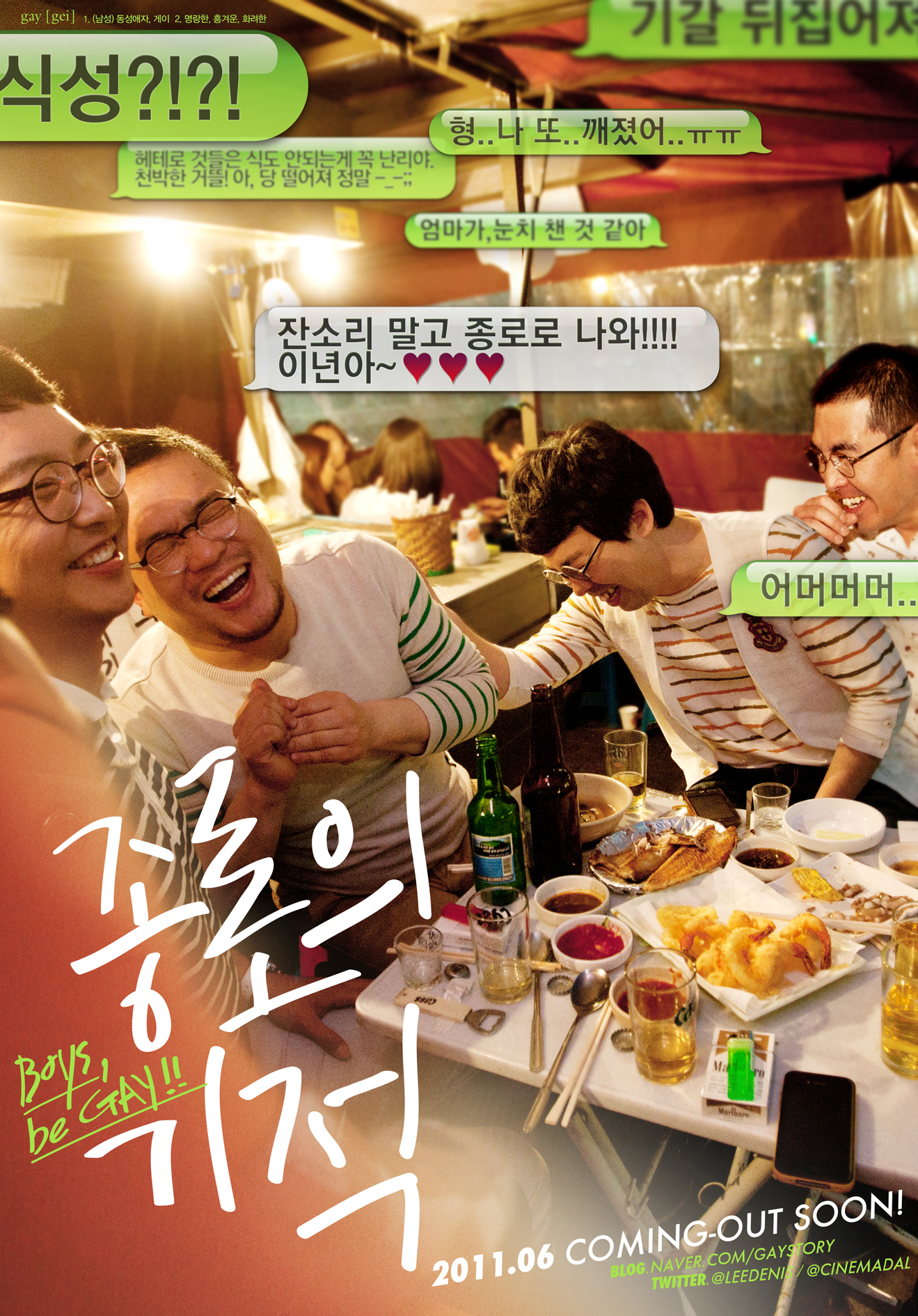
On Nov. 19 at Art Space C in Jeju City roughly 40 people, mainly Westerners, were on hand to watch “Miracle on Jongno Street,” (종로의 기적) the first Korean documentary about homosexual men. In his debut as director, Lee Hyuk-sang has created a film that shows the daily lives of four gay Korean men living in a society that has yet to accept them as equals.

Released nationwide at 20 theaters on June 2 of this year, the film follows Joon-Moon, film director; Byoung-gwon, a gay rights activist; Young-soo, a chef who moved to Seoul from the country; and Yol, an HIV/AIDS activist who wishes to live in a world that accepts his partnership with his HIV-positive lover. Connected around Jongno Street in Seoul, a “little paradise” for homosexual men according to the film’s synopsis, the documentary does much more than simply depict their lives as gay men, but attempts to break down walls of prejudice and show that their hopes, dreams, and goals are the same as those of heterosexuals.

Read the rest there. Has anybody seen it?

(The name, by the way, probably derives from that fact that Jongno is well-known for its LGBT [especially gay?] hotels and bars)

Free Women’s Self-defense Seminar in Busan, October 1st

See here and here for those 2 links on the poster, and also here for the Angels with Attitude website.

Anybody thinking of going? If so, please report back and let everyone know how it went!

Share

Sexual Assault on Subway Caught on Camera

Here’s my translation of a brief report from Sunday’s 8 News. Unfortunately, SBS is pretty strict about copyright, so I can’t risk uploading the video to Youtube. But it’s readily available at the original link:

애인인 취한 20 여인 옆에 앉아 성추행 /  Drunk man sits next to drunk 20-something, pretends to be lovers, sexually assaults her

Anchor:

지하철에서 옆자리에 잠든 20대 여성을 마치 자신의 여자친구인 양 쓰다듬으며 성추행하던 남성이 붙잡혔습니다. 카메라에 그 모습이 담겼는데요, 정경윤 기자가 보도합니다.

A man has been arrested [in Seoul] for sexually assaulting a 20-something woman sitting next to him on the subway, pretending she was his girlfriend. This scene was recorded on camera. Jeong Gyeong-yoon reports.

Jeong Gyeong-yoon:

지난 20일 새벽, 지하철 전동차에 50대 남자와 20대 여자가 나란히 앉아 있습니다. 여자는 잠들어 있고 옆에 앉은 남자는 마치 연인처럼 행동합니다 10여 분간 껴안고 쓰다듬는 등 신체 접촉을 계속합니다. 하지만 이 남자의 행동을 수상하게 여긴 한 시민에 의해 성추행은 발각됐습니다.

In the early hours of Wednesday the 2oth, a man in his 50s and a women in her 20s were sitting side by side on a subway train. While she was sleeping, the man acted as if they were lovers for about 10 minutes, embracing and caressing her, and continuously touching her body. But this looked a little suspicious to another passenger, through whom this sexual assault was exposed.

[라 모 씨/목격자 : 나이 차이가 많이 나 보이고 수상해서 계속 보는데, 여자를 깨워서 이 남자분 아시냐고 했더니 모른다는 거예요. 바로 남자 멱살을 잡고 끌고 나왔죠.]

(Anonymous) Recorder of video: Because the difference in their ages was so great, it looked a little suspicious to me, so I kept an eye on them.  When the woman woke up, I asked if she knew him, and when she replied that she didn’t, I immediately grabbed him by the throat and dragged him off the train.

남자는 현행범으로 경찰에 붙잡혔지만, 술에 취해 기억이 나지 않는다며 혐의를 부인했습니다.

지난 5월에는 심야에 20대 여성이 성추행을 당한 뒤 도망쳤지만 주변 도움을 받지 못해 또 다시 폭행당하는 사건도 있었습니다. 지하철 성범죄 가운데 심야 시간대 발생 비율은 4.1%. 하지만 취객이 많고 주위 도움을 받을 수 없는 경우가 많아 여성들이 느끼는 불안감은 더 큽니다.

The man was arrested by police, but because he was drunk he didn’t remember it, and denied doing it.

In May, there was also a case of a woman who also sexually assaulted [James – presumably on the subway] at about midnight, but when she escaped she was unable to get any help, and so got sexually assaulted again. And the reported cases of women being sexually assaulted on the subway in the late evening have increased 4.1% [James – compared to last year?]. With so many drunk people [men?], and so many cases of no help being available, then women are increasingly anxious.

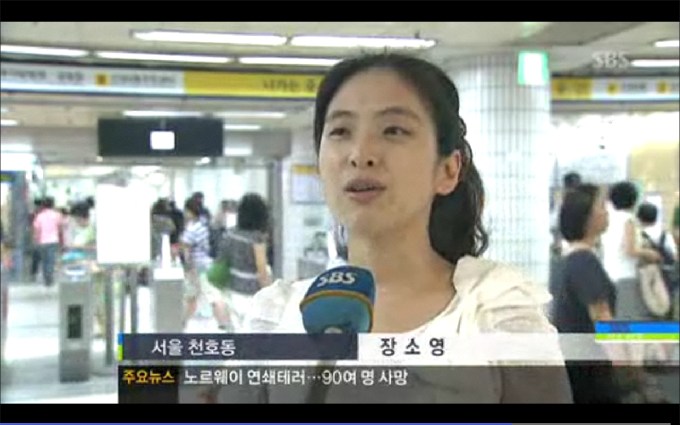
[장소영/서울 천호동 : 술주정 하시는 분들도 많고, 그런 분들이 다른 여성들한테 해코지 하는 것도 많이 봐서…]

Jang So-yeong, Seoul (Cheon-ho dong) resident: There are many drunk people [men?] around, I’ve seen them treat women badly many times…

늦은 시각 지하철 성범죄가 잇따르자 서울시가 19년 만에 여성전용칸을 부활하겠다는 방침을 밝혔지만, 반응은 신통치 않습니다.

Because there was a succession of sexual crimes on the subway 19 years ago, then back then a special women-only carriage was provided. This idea is being revived, but public reaction has been negative.

[지하철 역무원 : 취약 시간대 별 효과 거두지 못할 것 같아요. 여성 전용칸만 보고 지키는 사람이 없잖아요.]

Subway Worker: I don’t think it will be effective at those late hours when women are most vulnerable. It’s not as if labeling a carriage women only will dissuade people who set out to assault women.

지하철 성범죄는 갈수록 늘고 있지만, 대책은 아직도 미흡합니다.

Day by day, sex crimes on the subway are increasing, but there’s still no satisfactory policy to deal with them.

(영상취재 : 홍종수, 영상편집 : 박선수) 정경윤 rousily@sbs.co.kr / Data Collection: Hong Jong-soo, Editing, Compilation: Park Seon-su. Written by Jeong Gyeong-yoon (end).

Unfortunately that report raises many more questions than answers, but still: kudos to the guy who didn’t just record the scene but actually did something about it as well. And thanks to reader Mallory for passing the report on.

For anyone further interested, see Global Voices here for much more on the Korean public reaction’s to the planned women-only subway cars (update: the Marmot’s Hole also has a post on it), or The Three Wise Monkeys here for some context on the recent increase in sexual crimes in Seoul specifically (including some mention of subways). Or, for more on sexual harassment and sexual assault in general, see my posts in that category, especially this one on groping.

(p.s. If anyone’s curious, some text on the screen said that the incident happened on Line 5)

Share

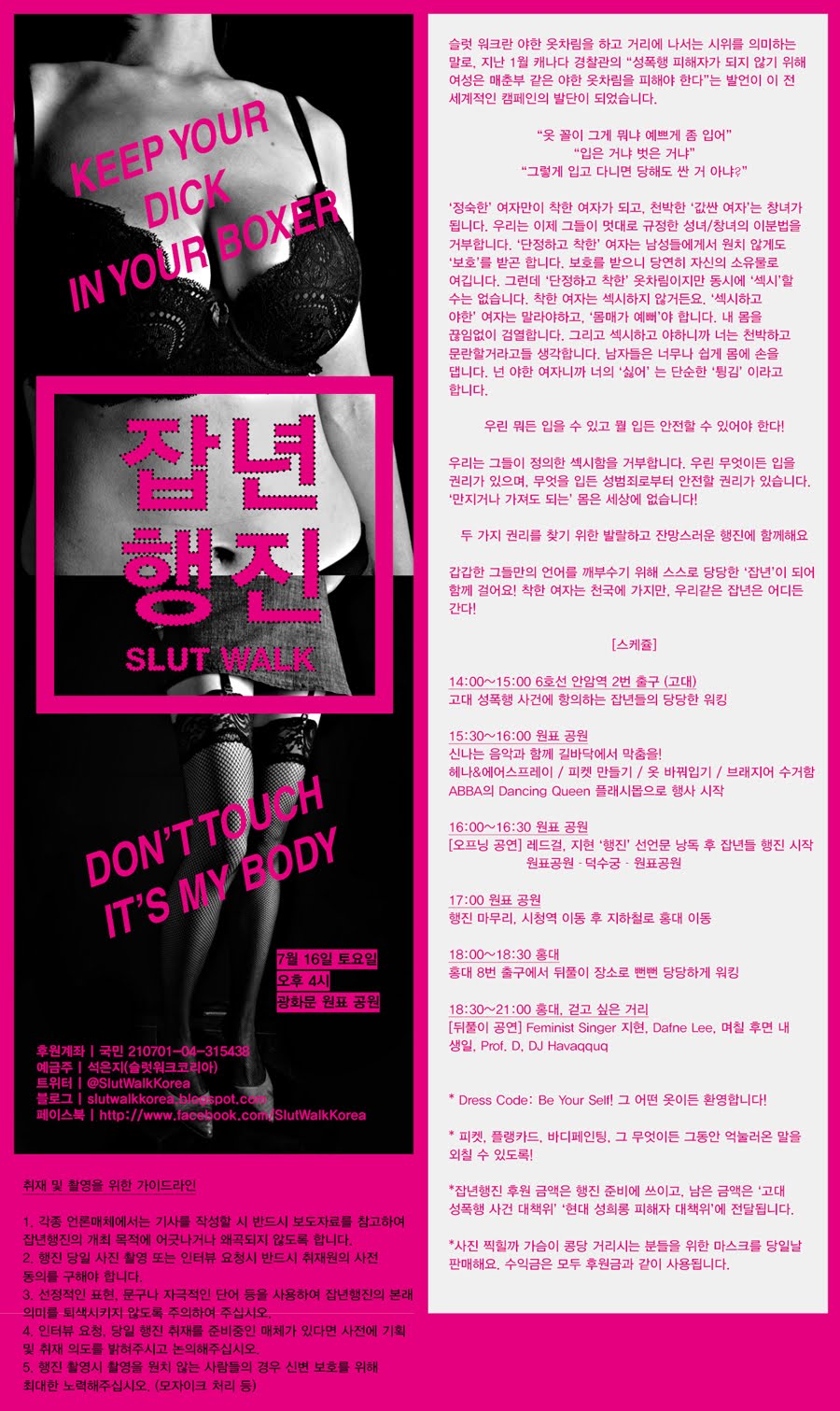
Slutwalk Korea (잡년행진) This Saturday!

(Source)

Sorry for the short notice, but I’ve only just found out about it. Still, that might actually be a good thing(!), as like Gomushin Girl put it:

…I’m sure part of the reason lots of expats haven’t heard about it is because the Facebook page and most of the planning has been done by and for Koreans, which is freakin’ awesome.

Indeed. But I’m sure the organizers would still be more than happy for any spectator support and/or even participation by expats, so please contact them via their blog, Facebook page, or Twitter feed if you’re interested (and here’s the Wikipedia page for more about Slutwalk in general). And, with it starting at 4pm in Gwanghwamun, I’m happy to report that I’m actually going to be able to see it myself, as by a great coincidence I’d already just booked KTX tickets to see a friend in Seoul at the very same time and place!^^

(Hat tip to Dating in Korea)

Update 1: Here’s a Korea Times article on the event. More links coming soon!

Update 2: Impossible Black Tulip questions the wisdom of holding Slutwalks.

Update 3: Here’s Roboseyo’s excellent report on the event.

Share

Seniors Routinely Sexually Harass Juniors during “Membership Training”?

(Source)

When I first came to Korea in 2000, I soon got used to the notion that people should use nopimmal (높임말; respectful language) to their obvious “superiors”, such as their parents and bosses. But also to friends, even if they were just a year or two older? Call me a cultural imperialist, but I still balk at the notion that such people are genuine friends, and God knows what they’d make of the usually whiskey-fueled language my late friend and I, then twice my age, would use with each other (let alone what we usually talked about).

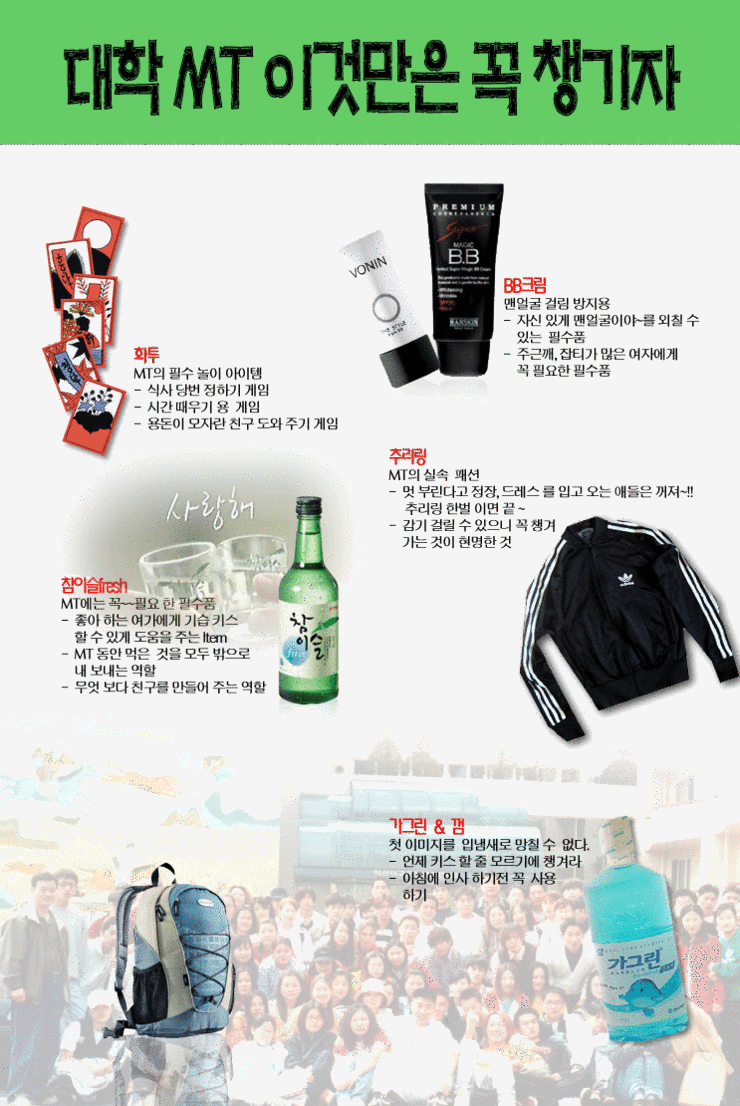
Still, it came as a real shock to hear students using it to some of their classmates at my university, even though the recipients were only just a few months older (I asked). In fairness, that didn’t happen at all at my wife’s university when she was a student, but suffice to say that I’m no longer particularly surprised when I hear of “seniors” taking advantage of “juniors” in various forms at Korean universities. And especially not on “Membership Training” (MT), which as you probably know involves a lot of drinking and various orientation and initiation rituals, as explained in the following report:

(As translator Marilyn notes, makjang means “extreme, in a negative way”, and is usually used to describe dramas where crazy things happen. Meanwhile, with thanks to SuzyinSeoul, the “OT” in the title means “Orientation Training”, one’s first MT)

(Sources: left, right)

막장 OT? ‘학내 성희롱’의 문제 보아야 / Makjang OT?  The problem of “school sexual harassment” must be considered

성희롱문제의 사각지대에 놓인 학생간 성희롱 / Sexual harassment among students is an unseen part of the problem of sexual harassment

얼마 전 인터넷 상에서는 서울 소재 모 대학의 신입생환영회가 논란이 되었다. 지난달 26일 인터넷 포털사이트 게시판에 “대학교 오리엔테이션, 이래도 되는 건가요?”라며 오른 글이 시작이었다.

Recently, the welcoming ceremony for new students at X University in Seoul has become a controversy on the Internet.  It was started by a post, titled “At a university orientation, is this really okay?” and put up on an Internet portal site’s message board on the 26th of last month [February].

성적 수치심 느끼게 하는게임시킨 선배들 / Seniors who make games that cause [juniors] to feel sexual shame

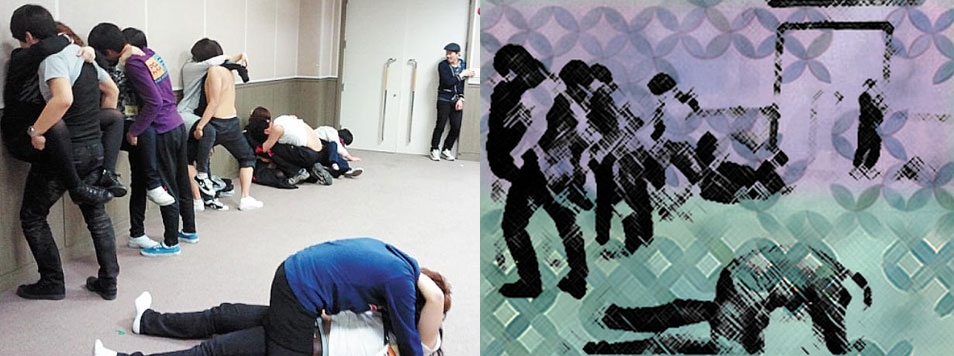
글 쓴이는 몇 장의 사진과 함께 “오리엔테이션에서 선배들이 후배들에게 성적으로 부담스럽거나, 수치심을 느낄 수 있는 행동들을 많이 시킨다”고 고발했다. 사진 속에는 남녀 신입생들이 몸을 밀착시키고 성행위를 연상시키는 동작을 취하는 모습들이 담겨 있었다. ‘게임’을 명목으로 강요된 것이었다. 글쓴이에 따르면, 술자리에서는 “정말 심한” 벌칙들도 많았다고 한다.

The writer of the post put up several pictures and charged, “At orientation, seniors force their juniors to do sexually embarrassing or shameful things.”  In the pictures, new male and female students press their bodies against each other and make sexually suggestive movements.   This was coerced under the pretext of a “game.”   According to the post’s writer there are also many “really severe” penalties at drinking parties.

(한 포털사이트에 성적 수치심을 느끼게 하는 ‘게임’을 강요하는 ‘신입생 오리엔테이션’ 문화를 고발한 글이 올라와 논란이 일었다.)

(Caption [to above image]: A post charging that a “new-student orientation” culture forces the playing of “games” that cause sexual shame was put up on a portal site and became a controversy.)

(Source)

문제의 사진들은 ‘막장 OT’라는 이름이 붙어 여러 게시판들로 퍼져나갔고, 몇몇 언론에서도 이 사건을 보도하면서 관련 학교와 학생들에게 비난이 가해졌다. 이후 사건은 해당 학교 총학생회가 사과문을 게시하는 선으로 마무리되었다.

The pictures were named “Makjang OT” and spread to several message boards, and as several media outlets reported on this story as well, the school and students involved were subjected to criticism.  After that, the student government at the university brought the incident to a close by posting a written apology.

이 사건은 인터넷 여론이 흔히 그렇듯 사건의 선정성에만 초점이 맞춰져, 관련 대학을 공격하거나 폄하하는 데에만 치중되었다는 인상을 준다. 그리고 논란의 열기는 금방 식었다.

As usual, public opinion on the Internet has focused on the sexual aspects of the story and so given the impression that it has only concentrated on attacking or disparaging the university in this area. Also, the heat of the controversy cooled down immediately.

이 사건이 문제인 것은 건전해야 할 대학 내 행사에서 선정적인 행위를 했기 때문이 아니다. 선배들의 권위를 내세워 신입생들에게 원하지 않는 성적인 행위를 강요했다는 점이 본질적인 문제다. 명백한 학내 성희롱이다.

The problem in this matter is not that there were sexual actions at university events that should be wholesome.  The essential problem is that seniors asserting their authority forced new students to do sexual actions they didn’t want to do.  This is unmistakable school sexual harassment.

(Source)

하늘같은선배 작아지는 신입생들 / New students that shrink in front of ‘god-like’ seniors

이제 막 대학을 들어온 신입생과 ‘선배’들 사이에는 막강한 권력관계가 작동한다. 대학생활에서 선배는 어떤 면에서 교수보다 더 어려운 존재다. 더구나 신입생 오리엔테이션은 이제 막 대학을 입학해 어리둥절하고 동기들과도 서먹할 때 치러지니 1학년들은 선배들 앞에서 심리적으로 위축되기 쉽다. 더구나 ‘전통’이라고 우기니 ‘참아야 되나’ 헷갈리기까지 할 것이다.

These days there is a strong power-imbalance operating between students who have just started university and their “seniors.”  In university life, relationships with seniors are more difficult than those with professors in every way.  Moreover, new-student orientations happen when students, having just started university, are dazed and still unfamiliar with their peers, so it is easy for first-year students to shrivel psychologically in front of their seniors.  Furthermore, seniors insist that it’s “tradition” so students become confused and think “Maybe I have to endure this?”

성희롱은 권력관계 안에서 일어난다. 이러한 속성 때문에 남학생이 많은 과, 권위주의적이고 위계질서가 강하게 잡혀 있는 과일 수록 신입생 환영회 때 이러한 ‘게임’을 즐기는 경향이 강해지고 ‘게임’의 강도도 높아질 것이라 추측할 수 있다.

(Source)

Sexual harassment arises inside power-imbalances.  Because of this attribute, it can be supposed that the more male students a department has and the more authoritarian and the stronger the hierarchical structure in the department, the stronger the tendency to enjoy this kind of “game” and the more intense the “games” are at new-student welcoming events.

시대가 변화한 부분이 있으니, 아마도 이러한 신입생 환영행사는 일반적으로 행해지는 수준의 것은 아닐 것이다. 그러나 아주 극단적인 예만도 아닌 것 같다. 관련 게시물들의 누리꾼 댓글에서도 비슷한 경험을 털어놓는 것을 심심치 않게 발견할 수 있다. 남성에게 구강성교를 해주는 여성의 모습을 연상시키는 동작을 하는 남학생들이 찍힌, 모 체육대학의 신입생 오리엔테이션 사진을 올린 이도 있었다.

Though there is the element of the changing times, this kind of new-student welcoming event probably isn’t common. However, it doesn’t seem to be an extreme example, either.  In the replies of the visitors to the message boards in question as well, it is not hard to find confessions of similar experiences.  There were also pictures from the new-student orientation at X Sport University [a university for athletes and coaches] which show male students making movements suggestive of women giving oral sex to men.

(Source)

대학사회, 성희롱 문제제기 여전히 어려워 / In university culture, making sexual harassment complaints difficult as ever

이번 사건을 문제제기한 학생은 학내 게시판이 아닌, 포털사이트를 이용해 글을 올렸다. 이는 문제의 ‘게임’이 ‘전통’으로 굳어질 수 있었던 배경과 관련된다.

The student who reported this incident used a non-university portal site to put up his/her post. This is related to the setting in which the “game” in question was allowed to become “tradition.”

지난 해 1월, 소위 ‘명문대생‘이 1학년 여학생들을 성추행한 사건이 논란을 일으켰다. 당시 한 피해자가 익명게시판을 통해 문제제기 하자 다른 피해자들이 나타나면서 피해자는 20여명까지 불어났다.

In January of last year, an incident in which so-called “students of a prestigious university” sexually molested first-year female students engendered controversy.  At that time, a victim made her complaint on an anonymous message board; other victims then came forward, until their number reached around 20 women.

왜 20여명에 달하는 피해자들은 성추행을 당하고도 입을 다물고 있을 수밖에 없었을까. 여전히 성희롱‧성폭력은 대학 사회 내에서도 쉽게 공론화하기 어려운 문제이기 때문이다.

Why is it that though the number of victims who were sexually molested reached about 20, they couldn’t do anything but keep quiet?  It is because even in university society, it is still difficult to publicly discuss sexual harassment and sexual violence.

(Source)

‘명문대생‘ 성추행 사건이 문제가 되었던 당시, 취업전문 포털사이트 ‘커리어’가 이틀간 대학생 768명을 대상으로 진행한 설문 조사에 따르면, 전체 여성 응답자 중 33.3%가 대학생활 중 ‘성희롱이나 성추행을 당했다’고 답했다.

When the “students of a prestigious university” incident became a problem, the job portal site “Career” surveyed 768 university students over the course of two days, and found that 33.3% of female respondents said they “have been sexually molested or harassed” during university life.

주된 가해자(복수응답)는 78.0%가 ‘선배’였다. 흔히 학내성희롱의 주된 가해자로 떠올리게 되는 ‘교수’를 지목한 대답은 33.3%였다. 대응방법을 묻는 질문에는 응답자의 66.5%가 ‘그냥 참고 넘겼다’고 답했다. 대응하지 않고 그냥 넘어간 이유는 ‘가해자와의 관계를 유지하기 위해서(66.9%)’가 가장 컸다.

The main perpetrators (more than one response possible) were “seniors,” at 78.0%.  “Professors”, who usually come to mind as the main perpetrators when one thinks of university sexual harassment, were pointed at by 33.3% of responses.  When asked how they dealt with it, 66.5% of respondents chose, “just bore it and moved past it.”  The biggest reason that they just let it go was, “To maintain a relationship with the perpetrator,” at 66.9%.

이렇듯 학생과 학생 사이에 발생되는 성희롱은 학내 성희롱 문제에 있어서 실질적으로 큰 비중을 차지하며 문제제기 하기도 어렵다. 그런데 교사와 교사, 교사와 학생 간 성희롱의 경우 성희롱 관련법의 규제의 대상이 되는 반면, 학생 간에 벌어지는 성희롱문제는 제외되고 있다. 따라서 학칙에 의존할 수밖에 없다.

Though this kind of student-on-student sexual harassment makes up a relatively large part of in-university sexual harassment, it is also hard to make a complaint.  Unlike in the case of sexual harassment between professors, or between professors and students, [public] regulations leave out sexual harassment that occurs between students.  Therefore, there is no choice but to rely on the school’s rules.

(Source)

그러나 성희롱을 ‘전통’으로 미화할 수 있는 대학사회에 이러한 미온적인 처치가 얼마나 큰 변화를 이끌어낼 수 있을까.

However, in a university culture that glamorizes sexual harassment as “tradition,” how big are the changes we can hope to effect to this kind of mediocre situation?

앞서 언급한 설문조사에서 전체 응답자 중 51.3%만이 성희롱 문제해결을 위한 대학 내 전담기관이나 담당자가 있다고 답했다. 대학사회에서 학생간의 성희롱이 사각지대에 놓여 있다는 사실을 이를 통해서도 유추해볼 수 있다. 관련 대책이 시급해 보인다.

In the survey mentioned above, only 51.3% of all respondents said that there was a special organization or officer for dealing with sexual harassment in their university.  Through this, as well, we can infer the fact that sexual harassment between students in university culture is not well-recognized.  Relevant measures appear to be urgently needed.

Writer: Park Hee-jeong (박희정), 3 March 2011.

(Source)

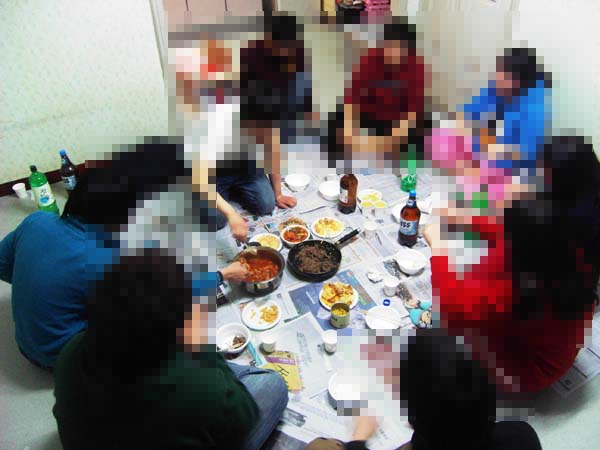
A disclaimer: I’ve never attended MT or even talked about it with students, so, students’ normal proclivities aside, I’m sure many or even most events are perfectly fine, and indeed Joe SeoulMan – ironically the source of one of the above images – has an account of a very nice, almost heartwarming one here. On the other hand, Extra! Korea argues that “it’s well-known among Koreans that sexual harassment is widespread at MTs”, and there’s certainly enough news stories in the Korean media to back that up.

What do you think? Have any readers attended MT themselves? Would you say that sexual harassment is indeed widespread at them, or is that just an impression created by the Korean media and *cough* bloggers, who tend to focus on the negatives?

(Thanks again to Marilyn for the translation)

Share

Sexual Harrasment on Intercity Buses

(Source)

Of course, I’ve never been sexually harassed on an overnight bus myself. But then I’ve never seen it happen nor heard anyone ever complaining about it either, nor have any of my female friends (Korean or Western). Are things really as bad as this article makes out?

[Why] 불 꺼진 심야고속버스, 술 취한 손이 내 가슴을…An express night bus with the lights off, a drunken hand on my breast

性추행·만취 난동 끊이지 않는 ‘달리는 범죄 사각지대’로, 유일한 안전요원은 운전기사 / [Becoming] a ‘running blind spot of crime’ with constant sexual molestation, intoxicated disturbances, and the driver the sole security officer

지난 12일 자정 무렵 광주발(發) 서울행(行) 심야 우등 고속버스 안. 버스가 출발한 지 10분 만에 한 여성이 소리를 질렀다. 막 고속도로에 진입한 버스는 갓길에 멈춰 섰다. 비명을 지른 20대 여성은 운전기사에게 자리를 바꿔달라고 했다. 여성 승객은 얼굴만 붉힐 뿐 이유를 얘기하지 않았다. 버스에 빈자리가 없어 운전기사는 여성 승객의 요구를 들어줄 수 없었다.

Inside the premium express night bus from Gwangju to Seoul around midnight on the 12th. Just ten minutes after the bus departed, a woman screamed. The bus, which had just entered the expressway, came to a stop on the shoulder of the road. The twenty-something woman who had screamed asked the bus driver to change her seat. She would not say the reason why, and she was only blushing. There were no empty seats on the bus so the bus driver could not grant her request (source, right).

고속버스가 다시 출발한 지 10분 정도가 지나자 또다시 비명이 들렸다. 버스는 재차 갓길에 멈췄다. 이 여성은 운전기사에게 “옆자리에 앉은 남자가 가슴을 만졌다”고 말했다. 술에 취한 듯 보이는 남성은 잠든 척했다. 이후 남성의 성추행은 한 차례 더 이어졌고, 고속버스는 예정에 없이 고속도로 갓길과 휴게소에 3차례 정차한 후 목적지인 서울에 도착했다. 50대 남성은 도착 후 유유히 사라졌고, 20대 여성 승객은 얼굴을 가린 채 울면서 황급히 자리를 떴다.

The bus had been back on the road for about ten minutes when a scream was heard again. The bus stopped on the shoulder for the second time.  The [same] woman told the bus driver, “The man sitting next to me touched my breast.” The man, who looked drunk, pretended to be asleep. After this, the man’s sexual molestation happened once more, and after the bus had made three unplanned stops on the expressway shoulder and a rest stop, it reached its Seoul destination.  The fifty-something man calmly disappeared after arrival, and the young female passenger left her seat hurriedly, crying with her face covered.

(Source)

심야 고속버스에서 성추행·흡연·난동 등이 빈번히 일어나고 있다. 늦은 밤 편히 휴식을 취하며 빠른 시간에 목적지에 가려는 이들이 선호하는 심야 고속버스가 ‘달리는 범죄의 사각지대’가 된 셈이다. 문제는 술에 취해 조용한 버스 안에서 고성방가를 일삼고 성추행까지 저질러도 제지할 방법이 마땅치 않다는 것이다.

In the express night bus, sexual molestation, smoking, and other disturbances occur frequently. This bus, preferred by people who want to relax comfortably late at night while quickly getting to their destination, has become a‘running blind spot of crime.The problem is that though someone becomes intoxicated and sings loudly in the quiet bus, or even commits sexual molestation, there is no suitable method of restraining them.

심야 고속버스는 출발과 동시에 전등을 끈다. 승객들의 취침을 위해 소등하는 것이 운전기사들에게는 의무처럼 돼 있다. 버스 안이 어두워 성추행이나 도난을 당해도 주변에서는 범행을 목격하기가 힘들다. 동부익스프레스 관계자는 “회사 모든 버스에 블랙박스를 설치했지만, 버스 내부는 인권 침해 소지가 있어 촬영하지 않는다”고 했다. 설사 버스 내부를 촬영할 수 있다고 하더라도 버스의 출발과 동시에 소등을 해 범행 현장 촬영은 불가능하다.

The lights are turned off in an express night bus as soon as it departs. Putting out the lights so passengers can sleep has become like a duty for drivers.  Because the inside of the bus is dark, even if one is sexually molested or stolen from, those nearby have trouble seeing the criminal behavior.  A source from Dongbu Express said, “The company installed a black box in all the buses, but because it is a possible civil rights violation, we don’t film inside the bus.”  Even if he had said they could film inside the bus, the lights are turned off after departure so filming the crime would be impossible.

(Source)

심야 고속버스에서 범행이 일어날 경우 제지할 사람이 없다는 것도 문제로 지적된다. 운전기사가 유일한 안전요원이다. 버스 안에서 소란이 일어나거나 범죄가 발생하면 운전기사는 달리는 고속버스를 갓길이나 인근 휴게소에 세워야 한다. 한 버스 운전기사는 “취객이 버스 안에서 성추행을 일삼는 경우가 많다”며 “피해 여성이 항의하면 어쩔 수 없이 고속도로 순찰대에 연락해 조치를 한다”고 했다. 고속도로 치안을 담당하는 고속도로순찰대가 도착하기 전까지 정시에 목적지에 도착하기 위해 달려야 하는 고속버스는 갓길이나 인근 휴게소에서 멈춰야 한다. 고속도로순찰대 관계자는 “심야 고속버스에서 종종 신고가 들어와 톨게이트나 휴게소로 출동해 범인을 인근 지구대에 인계한다”며 “순찰대가 30㎞마다 하나 정도 있다”고 했다.

Another problem that has been noted is that there is no one to stop criminal behavior that arises on the express night bus. If a disturbance arises or a crime is committed inside the bus, the driver must stop the express bus on the side of the road or at a nearby rest stop.  One bus driver said, “There are many cases in which drunken passengers sexually molest others several times inside the bus,” adding, “if the female victims complain, we have no choice but to contact the highway patrol station and take action.”  Before highway patrol,which is responsible for public order on the highway, arrives, the express bus that should keep moving in order to reach its destination at a fixed time has to stop on the shoulder or at a nearby rest stop. A highway patrol source said, “We sometimes receive reports from express night buses so we go to a toll-gate or rest stop and then we hand the criminal over to a nearby small police station,” and noted, “There’s highway patrol station every 30 kilometers or so.”

고속버스 운전기사는 취객에 대한 승차 거부를 할 수 있다. 그러나 심야 고속버스에서 술에 취한 승객을 보는 것은 어렵지 않다. 복수의 고속버스 운전기사들은 “취객들에 대한 단속은 절실하지만 승객을 한명이라도 더 태워야 하는 회사의 입장이 우선시되면서 승차거부를 하는 경우는 거의 없다”고 했다.

Express night bus drivers can refuse service to passengers.  However, it is not difficult to find drunken passengers on these buses.  Several [Marilyn – not sure if “several” is right; two Korean friends said it seems the reporter made a writing mistake with the word he used] express bus drivers said, “[The need for] crackdowns on drunken passengers is desperate, but the company’s position that every passenger counts is a priority so there are almost no cases of refusing service.”

고속버스와 경쟁 관계인 KTX·새마을호 등 철도의 경우 국토해양부 소속 철도특별사법경찰대 대원들이 심야시간 등 취약시간에 직접 열차에 탑승한다. 이들에겐 수갑·포승·가스분사기 등의 용품과 함께 범인을 현장에서 체포할 수 있는 권한이 있다.

In the cases of the KTX, Saemaeul, and other railway companies that are the economic competitors of express buses, officers from the Railway Special Judicial Police, part of the Ministry of Land, Transport and Maritime Affairs, are on board late at night and at other vulnerable times.  They have the authority to arrest criminals on-the-spot with necessities like handcuffs, policeman’s rope, and tear gas guns. (end)

(Source)

With thanks again to Marilyn for translating it, that was the most read article on Naver a few weeks ago. Personally, I thought that stopping 3 times without alerting the authorities was unbelievably negligent of the first bus driver, and while fortunately it sounds like that’s not company policy, there’s no indication that he or she was punished for doing so either. Also, in one of the few other news stories on this subject I could find, it was actually the bus driver himself(!) that was accused of harassment in a separate incident in December 2010 (click on the picture above for a link to a Korean news video with a transcript), the video footage of which suggests that although Dongbu Express may well not film inside buses because of potential civil rights violations, curiously other companies don’t seem to have any such qualms.

Meanwhile, if anyone would like more information on sexual harassment in Korea, please see here for more on groping and general street harassment specifically, or here and here for more on sexual harassment in Korean workplaces.

Share

Studying Korean Social Issues Can Be Fun…

(Sources: left, right)

And using manhwa (만화), or Korean cartoons, is a good place to start. Sadly, my favorite “grown-up” comic-book poptoon (팝툰) sold its last edition back in March, but there’s lot’s more where that came from.

One possibility is Department Head Dal-ma (Dalmagwajang; 달마과장), available in the free Focus newspaper. Although it’s often very basic, requiring no Korean ability to get the gist of, you could do much worse than quickly translating it on your morning commute.

Take these two strips for instance, which kept cropping up in Naver searches while I was preparing a recent post on sexual harassment in Korea. First, number 21:

Dal-ma: Gulp.

Man: Miss Kim, what did you have for lunch?

Miss Kim: I simply had ricecake at the park.

Even from just these first panels, already one thing of interest is that the man uses banmal (반말), or informal speech to speak to Miss Kim, and she replies in nopimmal (높임말), formal speech. No big deal there you might say: he’s probably her superior in the company. And as this recent incident on a subway demonstrated, using the appropriate level of speech to others is considered extremely important in Korea, with even many of my university students using nopimmal to friends just a few months older.

But then the same happens in the second cartoon too, even though the man addresses the woman with the semi-formal shi (씨) at the end of her name. And while a brief survey of other Dalmagwajang cartoons does occasionally show men and women each using nopimmal to each other, I didn’t see any cases of a woman speaking to a man in banmal and he answering in nopimmal. Which is not to say that they don’t exist necessarily, but if there are any then I’d wager there’d be very few.

If so, then is that just a reflection of reality? After all, women do tend to have junior and/or non-advancing positions in Korean workplaces, as even in 2011 it considered perfectly normal for them to resign and/or be fired upon marriage or becoming pregnant (only 50% of Korean women work, the lowest rate in the OECD).

(Source: unknown)

But on the other hand, recall that even subtitles for foreign films and programs have this gender-dichotomy grafted onto them too, despite being absent in the original English:

A women’s group has issued a report on the “sexist” dubbing of foreign films and dramas, reports women’s newspaper Ilda The group took a look at some 27 English-language dramas shown on terrestrial broadcasting in September and October.  It found that most of them employed sexist sexist practices when dubbed into Korean.  Namely, male characters spoke in banmal, or “low language,” while female characters used jondaenmal, or “high/respectful” language, even though the original English dialogue made no such distinctions.

This tendency was most often seen in dialogue between husbands and wives or lovers.  Besides dramas, foreign films showed the same tendency, with 12 of 15 films monitored by the group employing this dubbing practice.

Clearly then, for TV at least there is a compulsion to conform to it. Whether that’s just the industry convention, fear of negative public reaction, and/or the personal choices of the translators themselves, then that remains to be seen, but I’d be surprised if that didn’t apply to some extent to other forms of media. And either way, you’re left with a pretty pervasive socialization agent, and one easy to overlook for English speakers, and/or even easier to get used to for native Korean speakers.

Man: Ah, why didn’t you invite me? I pound ricecakes really well…No, well, I eat them well…

Miss Kim: (Laughing) What do you mean?

Dal-ma: Even acting like that, he won’t get accused of sexual harassment?

Next, despite its curious reputation for conservatism overseas, in fact the Korean media is simply full of sexual innuendo, and this cartoon read by millions every weekday is surely a classic case in point: “떡을 치다” is literally “pounding rice cake”, but is really slang for having sex. Which is why a year ago, a cartoonist was sued for sexual harassment by Girls’ Generation’s (소녀시대) management company SM Entertainment for this otherwise innocuous-looking cartoon:

(Source)

This might sound strange, but personally I find that slang quite endearing. For not only does it seem quintessentially Korean (here’s another example), but with most Koreans living in the countryside until as recently as 1979, then it reminds me of the country’s strong agricultural roots too (no pun intended).

Ahem. Continuing:

Dal-ma: Still, if something is judged sexual harassment or not all depends on your face (how attractive you look)

Woman left: He really said that?

Woman middle: (Laughing) Really?

Dal-ma: Wow! Look at her chest!

Dal-ma: Jeez, how can’t they feel ashamed to wear clothes that emphasize their breasts like that…

Eek, I forgot! Staring is also sexual harassment.

Dal-ma: (Worried) For no reason, because of a misunderstanding I’d be called a bald pervert.

Woman: Eek! It’s sexual harassment!

Having a shaved head myself, then I couldn’t help but chuckle at the unnecessary mention of his baldness here, as if that somehow makes his perversion all the worse. But with shaved heads being best known as a symbol of “prison, protest, or penance” in Korea, then unfortunately those negative connotations aren’t likely to go away any time soon.

Woman: Sexual harassment!

Dal-ma: No, it’s not that…

Women in background: Bald pervert!

Dal-ma’s daughter: What’s wrong with Dad?

Dal-ma’s wife: He’s like that because working at the office is tiring.

Next, number 57 (as I type this, the latest is number 327 by the way). Sorry for the poor image quality:

Woman (Eun-hee): Good morning!

Man: Good morning! Eun-hee, you bought new clothes?

Eun-hee: Yes, because it’s the end of the year I spent a lot on myself

Man: Wow, your back is a killer!

Eun-hee: Really?

Man: Yes, you’ve a perfect Honey-bottom!

Despite what the man says in a moment, that’s the first time I’ve heard the term ggooldongi, a combination of ggol (꿀; honey) and ongdongee (엉덩이; bottom). But I have heard (and written about) ggoolbokji (꿀벅지) that it comes from though, which, as Matt at Gusts of Popular Feeling explained:

…apparently means, according to this article and allkpop, ‘sweet-as-honey thighs’ or “alluring as-if they-were-coated-with-honey thighs”, though a more creative, if incorrect, translation would be ‘alluring thighs that spread like honey.’ Ahem.

And in particular:

…a ‘high school girl living in Cheonan’ posted a petition on the Ministry of Gender Equality’s website claiming that the word ‘honey thighs’ actually means ‘thighs that you want to smear honey all over and lick off’, and represented the sexual commodification of a female body part, was sexual harassment, “induced a feeling of sexual shame” and said its use should be banned. She was also irritated that such a ‘sexually derogatory word’ was used by the media and asked that it stop. According to allkpop, “Even Korean portal site Daum has requested people to refrain from using this controversial term…”

Hence Eun-hee’s justified reaction:

Eun-hee: Honey bottom?

Man: These days it’s popular. It means honey applied to a bottom…

Eun-hee: I’m going to the Human Resources Department to complain about your sexual harassment!

Man: Honestly, it was just a compliment, why…

Man: Well, I was just complimenting her on how well her clothes fit. Why’s she acting like that?

Dal-ma: It doesn’t matter what your intention is, it depends on how the other person receives it. If they feel uncomfortable, then it’s sexual harassment.

Man: In that case, if someone has a good body, how can we give them a compliment?

Dal-ma: If you intend to compliment a certain part of a person’s body, then do it precisely. Then, the other person will take it well.

Man: I don’t really understand.

Dal-ma: Watch me do it.

Dal-ma: Sung-mi, your pectoral muscles are amazing. And your Sternocostal joints and Sternocleidomastoid muscle are beautiful!

Sung-mi: Er…thank you.

Dal-ma: You see?

No, I didn’t find them funny either. What’s more, they give the impression that all it takes to deal with sexual harassment in Korean workplaces is a quick visit to the Human Resources Department, and consequently that male employees are very nervous about being accused of it. Unfortunately though, as this case at Samsung and these recent testimonies by victims demonstrate, the reality is anything but.

Why the discrepancy? That’s a good question, and it’s made me curious to see if its also found in other newspapers, and so on. Which is not bad for a couple of quick cartoons over a morning coffee, yes?^^

Sexual Harassment in the Workplace & the 2001 Equal Employment Opportunity Law: What Still Needs to be Done

(Source)

With thanks very much to Marilyn for the translation of the following article from Ildaro (일다), I’ll quickly let it speak for itself:

고용불안 속, 직장내 성희롱 위협 커져

In the midst of employment instability, the threat of workplace sexual harassment increases

고용평등상담실 10년, 여성노동의 현실과 미래를 말한다(2)

10th year of the Equal Employment Counseling Office, discussing female employees’ present and future

[편집자 주] 2001년 남녀고용평등법 4차 개정으로 고용평등상담실 지원제도가 도입된 지 10년이 되었습니다. 민간단체들의 고용평등상담실은 그동안 여성노동자들의 실질적 보호장치로 기능해왔으며, 여성노동자들이 처한 현실을 사회에 고발하는 창구역할을 해왔습니다. 일다는 여성노동자회와 함께 고용평등상담실에 접수된 상담사례를 통해 IMF 경제 위기 이후 후퇴 일로를 걷고 있는 여성노동의 현실과 과제를 살펴보고자 합니다. 필자 황현숙님은 현재 서울여성노동자회 회장을 맡고 있습니다.

우 리 사회의 성폭력 문제는 온 국민이 알게 된 끔찍한 아동 성폭행, 유명 정치인의 성희롱 등으로 자주 언론에 오르내리는 이슈가 되었다. 직장내 성희롱으로 고용평등상담실의 문을 두드리는 여성들의 호소 또한 가벼운 성적 농담이나 접촉을 넘어서 심지어는 강간에 이르는 경우조차 발생되고 있다. 직장내 성희롱은 그 자체가 미치는 정신적․신체적 악영향, 노동환경의 악화뿐만 아니라 일자리 자체까지 위협받게 된다는 데에 그 심각성이 있다.

[Editor’s note] It’s been 10 years since the Equal Employment Counseling Office support system was introduced through the 4th Amendment to the 2001 Equal Employment Opportunity Law.  During that time, the Equal Employment Counseling Offices of private organizations have been functioning as female workers’ practical safeguards and have acted as liaisons that report to society the realities that female workers encounter. Through the case consultations received in the Equal Employment Counseling Office, Ilda and the Women Workers Association intend to look at the realities and problems of women workers, who are losing ground after the 1997 Asian Financial Crisis.   Author Hwang Hyun-sook  is the current head of the Seoul Women Workers Association.

Through incidents of horrible child molestation, a famous politician’s sexual harassment, and others of which the entire nation is aware, our society’s problem with sexual violence has become an issue that often comes up in the press.  According to the complaints of women workers who’ve knocked on the Equal Employment Counseling Office’s door because of sexual harassment, there are also cases occurring that surpass light sexual jokes or touching to go as far as rape.  Workplace sexual harassment itself not only has bad mental and physical effects and worsens work environments, but is even of such a magnitude that jobs themselves [of victims] may be threatened.

(Source)

일자리 위협으로 이어지는 직장내 성희롱

“과장이 ‘피곤하지?’라며 손, 팔을 주물러 너무 불쾌하여 늘 가슴을 조이며 지냈어요. 어느 날 허벅지를 만지기도 하여 우울증에 시달리다가 문제제기를 하였더니 그 후 재계약을 하지 않겠다는 통보를 받았어요. 성희롱으로 실직하게 된 것 같아 너무 억울해요.”(2009년 상담사례, 계약직)

“사 장님이 자꾸 만나자고 하면서 ‘옆에 오면 가슴이 떨린다. 만나면 안고 싶고 무릎을 베고 누워 얘기도 하고 싶고 즐기고 싶다. 나를 받아 줄 수 없냐.”고 하더라고요. 남자에 대해 관심이 없다고 거절했더니, 부장을 통해 퇴사하라는 통보를 받았는데……“(2009년 상담사례, 2개월 근무)

성희롱 가해자가 사업주, 상사 인 상담은 매년 75~85% 가량이다. 가해자가 인사권을 직접 가지고 있는 경우가 많아 성희롱을 거부하거나 문제제기했을 경우에는 직. 간접적인 괴롭힘으로 스스로 그만두게 하거나 권고사직, 심지어 다른 사유를 들어 해고하는 사례들도 나타난다. 그래서 성희롱이 발생해도 공론화하기 어렵고 이를 은폐하도록 가해자가 권력을 행사하기도 한다.

Workplace sexual harassment extending to job threats

“My manager would ask, ‘Are you tired?’ and massage my hands and feet; it was so uncomfortable and I always went around feeling anxious.  One day he even touched my thigh and so while suffering from depression, I made a complaint; because of that I received notice that my contract wouldn’t be renewed.  I became unemployed because of sexual harassment – it’s so unfair.” (2009 counseling case, contract worker)

“The president of the company often asked me out and said ‘When you come near me my heart pounds.  If we go out I want to hold you, put my head in your lap and talk, and have fun.  Can’t you accept me?’  I refused, telling him I wasn’t interested in men, and through the general manager I received notice that I was to resign…” (2009 case consultation, working for 2 months)

Every year, about 75-85% of the consultations are ones in which the perpetrator of sexual harassment is the business’ owner or victim’s boss.  There are many cases in which the perpetrator is directly in charge of the company’s human resources.  Because of this, when the victim has rejected the perpetrator’s advances or made an official complaint, there have been cases in which the perpetrator may cause her to quit though direct or indirect harassment, urge her to resign, or even find grounds to fire her.  Therefore, even though sexual harassment occurs, making it public is difficult and the perpetrator often exerts his authority to conceal it.

(Source: unknown)

성희롱의 온상, 회식자리 남성중심 문화

“입 사한지 1주일 만에 본사 간부급 직원들과 회식자리가 있었어요. 간부들이 버릇인양 손잡기, 어깨동무하기, 허리 감싸기, 끌어안기, 볼 부비기……. 마치 간부들을 위해 여직원들이 대접하는 자리 같았는데 어렵게 입사하여 그만둘 수도 없고 어찌해야 할지……” (2007년 상담사례, 정규직)

“회 식 2차로 노래방에 끌려가다시피 갔어요. 술 마신 남직원들이 안으려고 해서 피했는데, 갑자기 뒤에서 끌어안더니 들었다놓았다하는데 과장, 계장 모두 묵인하고, 계장은 블루스를 추자고 하더라고요. 그래서 울면서 집에 왔는데 동기들도 다른 구청이나 동사무소 근무하면서 회식자리 성희롱 때문에 너무 힘들어 해요. 블루스를 춘 여직원한테는 잘해주고, 안 추면 욕하고 못살게 군다고 하더라고요.” (2007년 상담사례, 공무원)

회 식문화가 변하는 곳도 생겨나고 있지만, 회식자리에서의 성희롱은 지금도 일상적으로 일어나고 있다. 회식자리는 직장내 위계적 관계의 연속으로 상사의 기호에 맞추어야 하고 그의 요구에 따라야 하는 업무의 연속처럼 진행된다. 우리 사회의 남성 중심적인 문화, 위계질서가 이어지는 회식 문화는 여성들의 고용환경을 악화시키는데 일조하고 있다.

The hotbed of sexual harassment, office dinner male-centric culture

“I was at an office dinner with head office management-level employees only a week after joining the company.  The executives had habits of holding my hand, putting their arms around my shoulders and waist, hugging me, pressing their cheeks against mine…   It was like a place for the female employees to serve executives; it was hard to get a job here so I can’t quit and [don’t know] what to do…”  (2007 case consultation, regular employee)

“I went to the second [drinking-heavy] part of our office dinner like I was being dragged.  Male employees who were drinking were trying to hug me so I avoided them; suddenly I was embraced from behind and picked up and put down.  The manager and section chief overlooked everything, and the section chief asked me to slow-dance with him.  So I came home crying; also my peers who work at other district offices or dong offices have a really hard time because of sexual harassment at office dinners.  They say the female employees who slow-danced are treated well, and if you don’t dance they curse and treat you badly.” (2007 case consultation, government employee)

There are places where office dinner culture is changing, but sexual harassment at office dinners happens regularly even now. Office dinners progress similar to the  business itself, in which one must adjust to the preferences of a superior ahead of one in the workplace’s hierarchical relationships, and follow his demands.  Our society’s male-centric culture and hierarchy-connected office dinner culture lead to the worsening of women’s working conditions.

(Source)

친밀한 관계가 질곡인 영세소규모사업장 성희롱

“5 명도 안 되는 회사에서 근무한지 2개월인데 사장이 아침부터 술을 먹자고 하고, 남자친구랑 몇 번 하냐고 묻고 ‘나랑 애인 같은 거 하자’는 소리를 자꾸 해요. ‘이런 소리 들으려고 일하는 거 아니다’라고 말하면 무릎 꿇고 안한다고 하면서도 술만 마시면 또 그러니 일자리가 아니라 고문받는 자리 같아요.”(2008년 상담사례)

“연 말에 사장이 송년회를 가자고 해서 부담스러웠지만 가게 되었어요. 결국 2차까지 가게 되었는데 노래방에서 강제로 키스를 하고 옷 속으로 손을 넣어 몸을 만졌어요. 거부하면서 강하게 밀쳤더니 “난 사장이고, 넌 경리야”, “너 내일부터 나오지 마.”라는데, 다시 직장을 알아보면서 화도 나고 얼굴 보는 것도 두렵고 생각할수록 화가 나고 억울해요.“(2008년 상담사례, 사업주와 2명 근무)

영세소규모사업장의 성희롱은 가해자가 사업주인 경우가 많아 실질적인 법적 조치가 어려운 점, 성희롱 예방교육 특례조항 적용 사업장이라 예방교육이 실시되지 않는다는 문제점이 있다.

업 무적으로 둘만이 접촉하는 경우가 많아 사업주의 부당한 성적 요구나 사적인 친밀감을 성적 언행으로 표시하는 경우도 잦다. 성희롱을 거부하면 바로 그만두라는 통보를 받는 노동권 위협의 문제도 크지만, 매일 가까운 곳에서 얼굴을 마주쳐야 하니 버티고 싶어도 버티기 어렵다는 어려움이 있다.

Sexual harassment in a small business bound by close relationships

“I’ve been working for 2 months at an office that doesn’t even have 5 people in it; from the morning on the president suggests drinking together, asks me how many times I do it with my boyfriend, and keeps saying ‘Let’s date or something’. When I say, ‘I don’t work in order to listen to this kind of noise’, even though he gets on his knees and says he won’t do it [anymore], when he drinks, he gets like that again, so it’s like a torture chamber, not a workplace.” (2008 case consultation)

“At the end of the year, the president wanted to have an end-of-the-year party, so I went though it was annoying.  I ended up going to the second part and at a karaoke room he forcibly kissed me and put his hands under my clothes and touched me.  I refused him and pushed him hard so he said ‘I’m the president and you’re the bookkeeper’ and ‘From tomorrow, don’t come in [to work] anymore.’  I’m looking for another job and I feel angry and afraid of seeing his face, and the more I think about it, the angrier I get and the more unfair it feels.”  (2008 case consultation, office with company president and two people)

There are many cases in which the perpetrator of sexual harassment in a small business workplace is the business owner, so real legal measures are a challenge, and they are workplaces to which the Sexual Harassment Prevention Education Exception Clause applies, so there is the problem of prevention education not being implemented.

There are many cases in business in which two people only have contact with each other, so cases in which the business’ owner expresses his unjustified sexual demands or personal feelings of intimacy through sexual speech and behavior also frequently occur.  If victims rebuff the sexual harassment, the labor rights-threatening problem of immediately receiving notice to quit is serious, but there is also the drawback that because they have to see the other person’s face nearby every day, even though they want to endure it [keep working], enduring it is difficult.

(Source)

늘어나는 서비스직, 늘어나는 고객에 의한 성희롱

“고객센터에서 근무하고 있는데 외주업체 소속 강사가 메신저로 ‘만나자, 남자친구와 몇 번 했냐는 등의 말과 스킨십을 하는데 법적으로 어떻게 처리할 수 있을까요?” (2009년 상담사례, 텔레마케터)

“노 인돌보미 일을 하고 있는데, 고객이 70세인데 전직 교장이래요. 첫날부터 자꾸 몸을 밀착해오고 ‘젊은 사람이 곁에 있으니 내가 다시 남성이 되는 느낌이다’, 어제는 노골적으로 ‘아랫도리가 되살아난다’며 치근대 괴로워요. 어떻게 해야 할지…….“(2009년 상담사례, 45세)

고 용형태와 업무 방식이 다양해지면서 업무상 맺는 관계의 폭도 다양하고 복잡해졌다. 협력업체나 거래처 직원, 대인서비스직의 성희롱도 다양하게 나타난다. 그리고 간병이나 노인돌봄 같은 사회서비스 일자리가 늘어남에 따라 재가 돌봄서비스에 종사하는 여성들의 성희롱 피해상담도 늘어나고 있다.

Increasing service-industry workers, increasing sexual harassment by customers

“I work in a customer service center.  A supervisor [actually she uses the word for “lecturer” but I think that’s a mistake] affiliated with our subcontractor says things on Messenger like ‘Let’s go out’, ‘How many times have you done it with a boyfriend?’ and so on, and does skinship [touching like they’re in a relationship].  How can I deal with this using the law?” (2009 case consultation, telemarketer)

“I work in elder care.  My patient is 70 years old and says he used to be a school principal. From the first day he has often pressed up against me and said ‘Because there’s a young person at my side I feel like I’m becoming a man again’ and yesterday, saying bluntly, ‘My lower body is coming back to life”, he made pass at me; I’m really upset.  [I don’t know] what to do…” (2009 case consultation, 45-year-old)

As types of employment and ways of conducting business are diversifying, the range of relationships formed through business is also diversifying and becoming complicated. Sexual harassment of employees of subcontractors or clients, and personal service workers also presents itself in various ways.  Also, in line with the increase in social service positions like nursing or elder care, sexual harassment victim counseling for women working in in-home care is also increasing.

(Source)

성희롱은 사적인 일?

“남자 동료가 수시로 농담을 하면서 뽀뽀하자, 너도 밤일 할 줄 아냐는 등 수치심을 갖도록 하여 회사에 제기하였는데, 개인의 일이라고 개인적으로 대응하라고만 하는데……”(2009년 상담사례)

직 장내 성희롱은 안전한 환경에서 일할 노동권과 직접 관련이 있다. 그래서 남녀고용평등법에서도 직장내 성희롱을 금지하고 있을 뿐만 아니라, 사업주의 의무로 △직장 내 성희롱의 예방을 위한 교육 실시△성희롱 행위자에 대하여 징계나 이에 준하는 조치를 취할 것△피해자에게 해고나 다른 불이익 조치를 하지 말 것을 규정하고 있다. 그런데도 성희롱이 발생하여 이를 사측에 문제제기하면 위의 상담사례처럼 개인적인 일로 치부해 버리는 문제들이 여전히 일어나고 있다.

Sexual harassment is personal business?

“A male coworker often makes jokes and says, ‘Let’s kiss’, ‘Do you too know how to do night work [sex]?’ and other things to humiliate me so I made a complaint to the company.  They said it was personal business and just told me to deal with it privately…” (2009 case consultation)

Workplace sexual harassment is directly related to the employee’s right to work in a safe environment.  Therefore, the Equal Employment Opportunity Law not only prohibits workplace sexual harassment, it also stipulates, as the business owner’s duty, 1) implementation of education for the prevention of sexual harassment in the workplace, 2) disciplinary action, or taking steps in accordance with disciplinary action, against the perpetrators of sexual harassment, 3) not firing or taking other disadvantageous action against victims.  However, when sexual harassment occurs and is reported to the management, problems with it just being regarded as personal business, as in the case consultation above, are still coming up.

(Source)

고용평등상담실 통해 가해자의 공식사과와 징계 등 확보하기도

“부 원장님이 간호사들에게 안마를 해달라고 하거나 성적인 얘기도 잦아 힘들었어요. 며칠 전에는 맨발로 제 다리를 쓰다듬었는데 징그럽고 수치스러운 느낌 때문에 정신과 상담까지 받았어요. 그런데 고용평등상담실에서 도와주셔서 부원장은 공개사과와 감봉처분에, 병원 전체에 성희롱예방교육까지 실시하게 되었답니다!”

“과장님 성희롱 때문에 괴로웠는데 상담실에서 도와주셔서 공개사과도 받고 가해자는 다른 근무지로 전출되어 얼굴보지 않고 근무할 수 있게 되었어요!”

직 장내 성희롱 자체가 노동환경을 악화시키고, 이를 문제제기하면 해고나 불이익이 따르기도 한다. 그러나 다른 여직원들을 위해서라도 그냥 있을 수 없다며 이에 맞서 문제를 제기하는 여성들 또한 늘어나고 있다. 이렇듯 권리를 확보하게 되는 사례도 많았지만, 일자리 자체의 불안정이 갈수록 커지면서 적극적인 대응을 주저하는 경우도 많은 안타까움이 있다.

Securing perpetrators’ public apology, disciplinary action, etc., through the Equal Employment Counseling Office

“The vice director frequently asked the nurses to give him massages or talked about sex, so it was difficult.  A few days ago he stroked my leg with his left foot; because of the nasty and shameful feeling, I even got psychiatric counseling.   But the Equal Employment Counseling Office helped me so the vice director’s public apology and pay docking measure, and even sexual harassment prevention education for the whole hospital were implemented!”

“I suffered because of my manager’s sexual harassment, but the Equal Employment Counseling Office helped me so I received a public apology and the perpetrator was transferred to a different workplace so I don’t see his face and I’ve become able to work!”

Workplace sexual harassment itself has a negative effect on a work environment, and if one reports it, dismissal or disadvantages often follow.  However, the number of women saying that, for the sake of other women workers, they can’t just [let it] be and accordingly, making complaints, is rising.  In this way there have been many cases that secured rights, but regrettably, as the instability of jobs themselves increases, there are many cases in which [victims] hesitate to take assertive action.

(Source)

직장내 성희롱 문화? 이젠 바뀌어야

직장내 성희롱을 겪으면 그만두라고 할까봐 참고 견디거나, 문제제기하면 결국 피해자가 그만두게 되는 상황이 더 이상 반복되지 않도록 해야 한다. 지난 해 여성노동자회 고용평등상담실에 접수된 성희롱 발생 사업장의 78%가 성희롱예방교육을 실시하지 않은 것으로 파악되었다. 그러므로 사업장에서는 형식적이지 않은 예방교육 실시해야 하고 사내에서 발생하는 성희롱에 대하여 조사와 조치, 재발방지 대책 등을 마련하여 실시해야 한다.

그 리고 정부는 이런 사항들이 실질적으로 이루어지도록 적극적인 행정지도·감독을 해야 한다. 또한 남성 중심적이 아닌 성인지적 관점의 성희롱 인정, 영세사업장장의 성희롱 예방교육 지원 확대, 돌봄서비스노동의 성희롱 실태조사와 예방교육 및 대책 등을 마련해야 한다. 이를 통해 우리 사회와 직장 전반의 남성 중심적인 문화가 변화될 때 직장내 성희롱에 대한 인식과 대책의 변화 또한 이끌어낼 수 있을 것이다.

Workplace sexual harassment culture?  Needs to change now

We need to make it so that situations in which, if one experiences workplace sexual harassment, they hold back and endure it because they’re afraid of being told to quit, or in which if they report it, they end up quitting, are no longer repeated. Last year, 78% of the workplaces reported to the Women Worker’s Association’s Equal Employment Counseling Center for sexual harassment were places where sexual harassment prevention education had not been implemented.  Therefore, in the workplace, prevention education that is not cursory needs to be implemented, and for sexual harassment that occurs in-house, research, action, recurrence prevention measures, etc., need to be arranged and implemented.

The government needs to use assertive administrative guidance and supervision to make these remedies become reality.  Also, recognition of sexual harassment from a gender-sensitive perspective that is not male-centric, securing support for sexual harassment prevention education for the owners of small businesses, research, prevention education, and measures regarding the sexual harassment of care-industry workers, etc., have to be arranged. When, through these, both our society’s and all workplaces’ male-centric culture changes, they will also be able to lead to changes in the understanding of and countermeasures for workplace sexual harassment.

Share

Countering Sexual Violence in Korea (Updated)

Once again, Korea has gotten the lowest score of all high-income countries in a recent survey of gender-equality worldwide. And, at 104th out of 131 countries surveyed, it was bested by numerous much poorer countries at that.

Given that record, then it’s very easy to focus on Korea’s shortcomings when talking about gender issues. But that can mean that we can easily miss the positive developments that are occurring though, and sometimes right in front of our very noses.

Take what this humble-looking subway ad for instance, and what it ultimately represents. First, a translation:

부산 해바라기 여성 • 아동센터

Busan Sunflower Women & Children’s Center

여성 성폭력 피해자와 가정폭력 피해자, 학교폭력 피해자들을 돕고 있는 부산 원스톱 지원센터와 아동과 지적장애인 성폭력 피해자 전담센터인 부산 해바라기 아동센터가 2010년 1월 1일부터 부산 해바라기 여성 • 아동센터로 통합되었습니다.

From January 1, the Busan One-Stop Support Center, which helps female victims of sexual abuse, victims of family abuse, and victims of physical abuse at schools, and the Busan Sunflower Children’s Center, which helps children and mentally handicapped victims of sexual abuse, have joined together and become the Busan Sunflower Women & Children’s Center.

(Source)

여성부, 부산광역시, 부산지방경찰청에서 지원하고 동아대학교병원에서 수탁운영하는 여성 • 아동 폭력피해자 전담센터입니다.

With support from the Ministry of Gender Equality, the Busan Metropolitan City Council, and the Busan Metropolitan Police Agency, Dong-a University Hospital has been given the responsibility of operating the center, which provides consultations for female and child victims of abuse.

가족폭력, 성매매, 학교폭력, 성폭력 피해를 입은 여성과 아동을 보호하고 지원하고 치료합니다.

Women and children who are the victims of family violence, sex trafficking, school violence, and sexual abuse can receive protection and treatment at the center.

의사, 간호사, 임상심리사, 심리치료사, 성폭력 • 가정폭력 전문상담원, 여성 경찰관 등 각 분야 전문가들이 상주하고 있어 위기상황에서 가장 전문적이고 질 높은 상담, 의료, 심리치료, 수사, 법률 서비스를 무상으로 제공합니다.

Experts in many fields such as doctors, nurses, clinical psychologists, psychological therapists, family and sexual violence consultants, and female police officers and so on will be permanently stationed at the center, and when you are in a crisis you can receive the best professional and highest quality consultations, medical treatment, psychological counseling, legal advice, and assistance with launching criminal investigations. All these services are provided free of charge. (end)

(Source)

In my experience, usually the amalgamation of two government institutions in any country is in response to cost-cutting. Fortunately however, there’s a great deal of indirect evidence to suggest that that isn’t the case here.

First, note that the ad is actually quite dated, mentioning that the amalgamation was effective from January the 1st for instance (although the center didn’t officially open until February the 9th), and in particular that the Ministry of Gender Equality has a supporting role in it, whereas the Ministry actually reconverted back to the Ministry of Gender Equality and Family Affairs (여성가족부/MOGEF) back in March. Presumably then, the ad has already been posted on Busan subway trains once before, probably late last year or early this one.

Why suddenly post the same ones again in late September then? What has changed to prompt that?

As Matt at Gusts of Popular Feeling has well-documented, what has changed is the public perception that there has been a sudden and dramatic increase in the numbers of sex crimes against children, whereas in fact they have remained steady (but appallingly high) for years:

There is not a “recent series” of such sexual crimes – this is always happening. It’s just that the media has decided – as it does whenever a particular case angers people – to highlight these cases, which would usually either not be covered or covered by perhaps only one or two media outlets, and which are now linked together in articles in order to point to a great problem that exists. To be sure, there have been several laws passed since the murder of Lee Yu-ri in March (and the Yeongdeungpo case in June), and it’s great that the issue has finally gotten enough attention to get things moving (see here for a brief history of the slow pace of change since 2006). I’m not entirely sure that the solutions being offered are always the best ideas, however, and public fury (and worry) whipped up by this media coverage may be putting pressure on politicians to act first and think later.

And see past Korean Gender Reader posts for more details of those and other sexual crimes. By coincidence, one of the most notorious of those – the murder of Lee Yu-ri – also occurred in Busan, and several of my coworkers here have reported seeing rooms like that on the right pop up in Busan public schools they teach at in the months since, although unfortunately they have no information on the quality of their staffing or how often they are utilized. Have any readers also noticed them, in Busan or elsewhere?

(Note that the English translation on it may be a little misleading though: a better one would be “Consultation Room [for] Mental Anguish [caused by] Sexual Harassment or Sexual Violence”)

Regardless, the point is that given the current climate then it would be wise for the government to highlight all it is doing to prevent sexual violence, let alone to continue or even increase funding to women and children’s centers. And however cynical and reactionary the motives, this is to be applauded.

Granted, the amalgamation was decided and instituted well before the public outcry over the supposed recent spate of sexual crimes against children. But that doesn’t necessarily imply it was the result of a reduction of funding: although it may receive little if any funding from MOGEF for instance, I find it significant that the Ministry’s assumption of old responsibilities came with a big increase in staff and 4 times larger budget (albeit from a base of 0.03% of the government total), so when the plans for the change were announced late last year there was already a political climate conducive to more funding for feminist causes.  Signs of a change of heart from President Lee Myung-bak also perhaps, who originally promised to abolish it before his election, only to back down and merely considerably downsize it in response to protests afterwards?

Alas, quite the opposite: in fact, he is using MOGEF to raise the dire birth rate by – wait for it – criminalizing abortion, as I explain in detail here. But to play devils’ advocate however, perhaps this blinds us to some of the positives that it has achieved?

One is its survey of teenage entertainers in August, which – among other things – revealed that many were pressured by their managers to wear revealing costumes, and which ultimately resulted in the National Assembly’s setting up of a committee (albeit under a different ministry) to further investigate MOGEF’s findings. And which after hearing evidence from entertainment company CEOs has just laid down new regulations for the treatment of minors in the entertainment industry (see here and here also for more background).

And finally, take the recent video produced by MOGEF below, which encourages people to pay more attention to the needs of immigrant women. Granted, it’s just a video, and again it may be just be in response to the recent murder of a Vietnamese bride by her husband after only 8 days in the country (see #13 here), but then it’s not like such efforts started only recently. One thing that instantly comes to mind for instance, is the above survey that was sent to all foreign spouses in Korea in August last year (see #3 here), in an attempt to better find out their specific needs.

Vodpod videos no longer available.

Any other positives readers can think of, however minor, then please pass them on!^^

Update: As per request, here is what the voiceover in the video is saying (and I’ve put the additional text in brackets as it came up):

이주여성들을 힘들게 하는건 (부부갈등 상담 8, 452건)

The things that make it difficult for migrant women… (8, 452 consultations for married couples having difficulties)

어려운 한국어와 (가정폭력 상담 4205 건 [2009년 이주여성 긴급지원센터 상담통계)

…are difficult Korean… (4205 consultations over family violence/abuse [2009 Statistics from Migrant Urgent Help & Consultation Centers])

낯선 환경, 다른 문화

…the strange environment, the different culture…

그리고 우리의 무관심입니다. (국제결혼 이주여성 16만여명)

…and our indifference. (lit. international marriage migrant women 160,000 women [James: just in 2009?])

이주여성들에게 작은 관심은 큰 힘이 됩니다.

Just a little help and support helps migrant women a great deal (same in the text)

이주여성들의 힘이 되어주세요.

Please be strong and supportive to them.

이캠폐인은 여성가족부와 복권위원회가 함께 합니다. (이주여성긴급지원센터, 1577-1336)

This campaign is brought to you by MOGEF and The Lottery Commission. (Migrant Women’s Urgent Help & Consultation Centers: 1577-1366)

And by coincidence, something else positive that MOGEF has some role in: a seminar about women’s career development at my university tomorrow (stalkers, take note of which one). Things like this seem to go on there at least once a month or so.

Maybe this has something to do with that, which I only just noticed today:

Please let me know if anyone would like a translation of the first poster. Meanwhile, do any other Korea-based readers have anything similar at their own universities?

“Want to Sleep With a Foreign Girlfriend?”

A provocative article title from Yahoo! Korea yesterday, yes?

Alas, actually it’s only about one lawmaker’s concern over the growing number of “lewd” internet advertisements these days, among which presumably that’s a common slogan. But that does underlie some of the street harassment and groping that many foreign women experience here, so it’s interesting in its own right.

As is the irony and hypocrisy of Yahoo! Korea posting such an article in the first place too. For Korean portal sites are virtually like The Sun newspaper in their content, tone, and adherence to journalistic ethics, like I said of them last year:

Unlike their English-language counterparts, you have roughly a 50% chance of opening Naver, Daum, Nate, Yahoo!Korea, and kr.msn.com to be greeted with headlines and thumbnail pictures about sex scandals, accidental exposures (no-chool;노출) of female celebrities, and/or crazed nude Westerners.

And indeed, scroll to the bottom of Yahoo! Korea as I type this, and just today’s “image galleries” below include lingerie photoshoots and “beautiful Russian news anchors”, let alone the links on the rest of the site.

Not that I mind those in themselves of course. But if they’re the standard for Korean portal sites, then you can just imagine what it’s like for the rest of the Korean internet.

Take those of “serious” newspaper websites for instance, the main focus of the orginal article, and which are already notorious for posting pictures of women in bikinis or even middle-school girls in short skirts:

‘외국인 여친과 잠자리?’ “인터넷 음란광고 강제 퇴출해야”

‘Want to Sleep With a Foreign Woman?’ “Lewd Internet Advertisements Should be Forced to be Withdrawn”

[아시아경제 김성곤 기자]인터넷 광고시장이 급성장하고 있지만 법적 장치의 미비로 선정적인 내용의 음란광고로 홍수를 이루는 등 부작용이 심각한 것으로 나타났다.

While the internet advertising market is experiencing rapid growth, its legal oversight is imperfect, and there has been a flood of lewd advertisements with suggestive contents, with serious side effects.

김성동 한나라당 의원은 27일 방송통신심의위원회로부터 제출받은 자료를 분석한 결과, 인터넷 광고시장은 2004년 4800억원 규모에서, 2005년에는 6600억원, 2009년에는 1조2978억원 등으로 매년 크게 늘고 있지만 성적 호기심을 자극하는 광고가 난무하고 있다고 지적했다.

On the 27th, after analyzing data submitted by the Korean Communication Standards Commission, Kim Seong-dong, an assemblyman from the [ruling] Grand National Party, concluded that the Korean internet advertising market was worth [at today’s exchange rate] US$419 million in 2004, US$576 million in 2005, and US$1.132 billion in 2009, rapidly expanding every year. However, he pointed out that this is also true of advertisements stimulating sexual curiosity.

이 자료에 따르면 국내 종합 일간지의 인터넷판 광고에는 ▲ 외국인 여친과의 술자리에서 헉 ▲ 그녀가 원하는 건 크기·힘! ▲ 보통여자 명기 만들기 등 선정적 광고가 전체 광고의 11.8% 수준에 이르렀다. 특히 스포츠 연예지는 선정적 광고의 비율이 20.6%에 달해 전체광고 5개 중 1개는 음란 광고였다.

According to the data, if you look at all the internet advertisements of national newspapers, sexual advertisements with lines like “At a bar with a foreign girlfriend…Wow!”, “She wants size and power!”, “Make a normal woman a famous kisaeng (Korean geisha)”, and so on make up 11.8% of the total. In particular, the rate is 20.6% in sports newspapers, or 1 in 5.

문제는 이러한 인터넷 광고는 다른 광고에 비해 소비자 피해가 즉각적으로 발생하고, 피해 범위도 광범위하다는 것. 특히 피해가 발생해도 광고주의 이동과 은닉 등으로 피해구제가 어려운 것이 특징이다. 아울러 판별능력이 부족한 어린이, 청소년에 대한 무분별한 광고의 노출은 부작용이 심대하기 때문에 규제의 필요성이 절실한 형편이다.

The problem is that compared with other advertisements, consumers instantly suffer a wide range of damages from them. In particular, the producers of the ads can move and conceal themselves easily, making relief and help for the damages difficult (James – I think what these “damages” are exactly should have been made more specific). Accordingly, because the side effects of children and teenagers seeing sexual advertisements is serious, as their ability to understand them properly is lacking, then there is an urgent need for their regulation.

김 의원은 “이러한 현실이 인터넷 광고에 대한 내용 규제가 제도적 미비로 인해 제대로 작동하지 않은 것에서 기인하고 있다”며 “정부, 인터넷 사업자, 민간단체 등 모든 주체가 참여하는 공동자율규제 도입을 고려해야 할 때”라고 주장했다.

Assemblyman Kim claims that “This problem is caused by a lack of and/or poorly-functioning regulation of internet advertising at present,” and that “this issue of regulation needs to be considered by all participating and/or concerned parties, including the government, internet businesses, NGOs, and so on.”

한편, 현재 인터넷광고는 2007년 발족한 한국인터넷광고심의기구가 자율규제를 하고 있지만, 법적 구속력도 없고 비회원사의 참여를 강제할 수도 없는 구조적 모순 아래 놓여있는 형편이다.

There has actually been an organization to regulate Korean internet advertising since 2007, the Korean Internet Advertising Deliberation Organization, but its authority is insufficient as its decisions have no legal binding, nor can it force non-members to participate. This undermines its role as an advertising relief(?) organization. (end)

(Another wholesome ad from October last year)

Meanwhile, observant readers will have noticed two other links in the original screenshot: the first, a Korean blogger’s opinion piece saying that if you’re a Korean woman and want a foreign [male] friend, then you’ll have to get over everyone’s suspicions that you’re with them just for the sake of English and/or sex.

Which may well be true, but unfortunately my wife says it reads like it was written by a 16 year-old.

The second however, another blogger’s advice about getting a foreign girlfriend, actually looks rather interesting, but unfortunately is several thousand words long. I’d still consider translating it though, probably as a 9-part series, but only if readers are interested. If so, please let me know!

Groping in Korea: Just How Bad Is It?
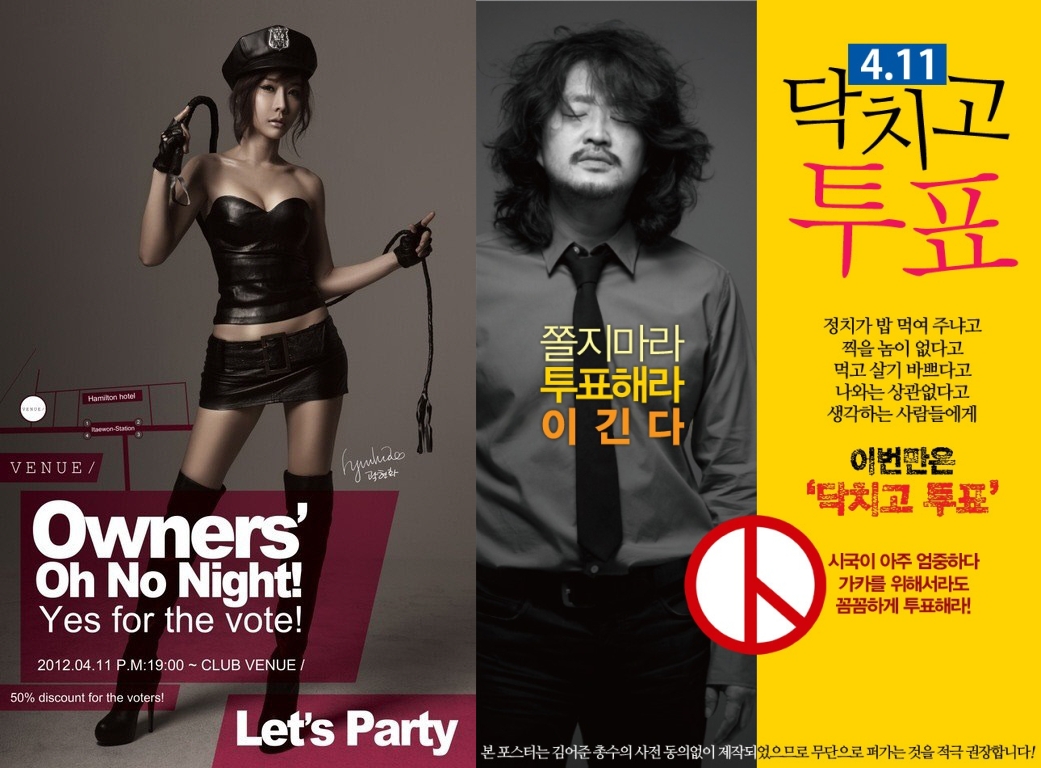
(Source: leftycartoons)

I never did think that women should consider street harassment as flattering of course. But still, this cartoon is eerily effective in getting that message across. It’s no wonder that’s it’s received nearly 300 comments over at Sociological Images.

Most of those dealing with the US though, now I’m curious as to how bad street harassment is in Korea in comparison. And in hindsight I realize that I’ve largely overlooked that in favor of covering workplace discrimination previously, most recently the landmark sexual harassment lawsuit against Samsung.

I did know about bbikkie (삐끼) though, or men that literally drag attractive women into nightclubs to encourage men to spend their money there (see here also); that Korean dating culture actually condones stalking; that this sometimes affects foreign women (see #12 here); and that Caucasian women especially are hypersexualized by the Korean media and/or often get confused for Russian prostitutes; and so on.

But groping? I’d never really thought about it, except in passing. After all, what guy does?

Hence my surprise and naivety at discovering that it’s not a problem confined to subways, and in fact was a pervasive problem among crowds during the World Cup, as the following report I’ve translated makes clear. And, even in broad daylight today too, as Krista of Salt City Girl wrote in her email to me that I’ve posted after that.

(Source: Sinfest)

“골인” 환호 순간에 웬 남자 손이…/ In the Moment of the “Goal in!” Cheer, Some Man’s Hand…

Kim Shi-hyeon, The Chosun Ilbo, June 26 2010

서울의 한 고교 2학년 최모(17)양은 지난 17일 강남구 삼성동 코엑스 앞 영동대로에 월드컵 길거리 응원을 나갔다가 봉변을 당했다. 아르헨티나 에 0 대 2로 뒤지던 전반 막판 이청용의 만회골이 터지자 시민들은 일제히 소리를 지르며 서로를 부둥켜 안았다. 최양도 친구와 손을 붙잡고 팔짝팔짝 뛰었다. 소리를 지르며 정신없이 뛰고 있던 중 갑자기 뒤에서 한 남자가 어깨동무를 하며 다른 손으로 가슴과 엉덩이를 더듬었다. 놀란 최양이 뒤를 돌아보자 20대로 보이는 남자 1명이 순식간에 군중 속으로 사라졌다. 최양은 “남자 얼굴을 제대로 보지 못했고 사람들 속으로 숨어 버려 경찰에 신고도 못했다”면서 “월드컵이라 부모님이 특별히 밤 외출을 허락했는데, 완전히 기분을 망쳤다. 앞으론 절대 길거리 응원은 안 나갈 것”이라고 했다.

Choi Mo-XXX, a 16 year-old (western age) second year high school student in Seoul, had a bad experience on the 17th after she arrived at Yeongdong Road in front of COEX in Samseong-dong, Gangnam-gu to cheer [the Korean team] during the World Cup.

Korea was losing 2-nil, but then at the end of the first half Lee Cheong-yong suddenly exploded back into the game with a goal, and everyone in the crowd cheered in unison and hugged each other, with Choi Mo-XXX too holding tight onto her friend’s hand and jumping up and down. But while she was doing this and not thinking about anything else, a man who was behind her placed one hand on her shoulders and with the other groped her breasts and buttocks.

She turned around, and saw a man who appeared to be in his 20s, who disappeared into the crowd in an instant. She said “I didn’t really see his face, and he disappeared into the crowd so quickly, that there’s really no point in telling the police,” and added that “because this was the World Cup, my parents gave me special permission to come out and cheer with everyone, but now my feelings have been completely ruined. From now on, I’m never going to attend any cheering events like this again.” (Source, right)

월드컵 기간 길거리 응원을 나가는 여성들에게 ‘성추행 경보’가 켜졌다. 남아공 월드컵은 시차 때문에 저녁 8시나 11시, 새벽 3시 30분 등 어두울 때 경기가 열려 성추행 범죄가 일어나기 쉬운 상황이다. 특히 위기대처 능력이 부족한 여자 중·고생들은 성추행을 당하고도 무서워서 가만히 있거나 수치심 때문에 주위에 도움을 청하지도 못하고 있다.

A big “Groping Alert” to women has been issued to women going to the streets to cheer during the World Cup period. Because of the time difference with South Africa, games are played at 8pm, 11pm, 3:30 in the morning, and so on, providing easy opportunities for gropers to strike. Especially women least able to deal with such a situation, such as middle or high school students, may be so scared as to quietly accept the groping and/or through a feeling of shame or disgrace be unable to ask for help.

인터넷 게시판에는 길거리 응원전에 나갔다가 성추행을 당했다는 제보가 끊이지 않고 있다. 네이버 한 카페에서 ID ‘바람’은 “사촌동생이 거리응원 나갔다가 성추행당했다고 그러더라. (이겨서) 너무 좋고 정신없어서 당시엔 잘 몰랐는데 가슴을 대놓고 만졌다고 했다”고 썼다. ID ‘단탈리안’도 “친구가 길거리 응원 나갔는데 계속 가슴에 어떤 남자의 손이 부딪혔다고 했다”는 글을 올렸다.

On internet cafes, there is an unceasing stream of information from women who have been groped during World Cup cheering events. On one Naver cafe, a commenter with the ID “Baram” wrote “My younger cousin said she was groped at a cheering event. Without her realizing at first, while she was concentrating on cheering her breasts were roughly grabbed, with no attempt by the groper to conceal what he was doing”. Another with the ID “Dantallian” posted the message that “When my friend went to a cheering event, a man kept feeling her breasts when she was crushed up against him.”

한 인터넷 커뮤니티에는 “거리응원 가서 생각지도 못하게 여자 가슴 만져서 레알(진짜) 기분좋음 ㅋㅋ” 등 성추행을 한 사실을 밝히는 글도 올라 있다.

(Source)

[But] On another internet community site, there have been messages like “At a cheering event I touched accidentally touched a women’s breasts. But it (really) felt good LOL”, clearly stating that the writers have groped women.

인터넷에는 16강 진출이 확정된 24일 아침 서울의 한 거리에서 남성 5~6명이 핫팬츠를 입은 여성을 자동차 보닛 위에 올려놓고 성추행을 하는 사진이 떠돌고 있다. 지난 21일 경기도 파주에서는 한국과 아르헨티나전 경기 응원 현장에서 여중생 김모(16)양을 성추행한 40대가 경찰에 입건되기도 했다.

And on the 24th, when it was confirmed that the Korea team had made it through to the first round, a picture of 5 or 6 men lifting a woman in hot pants onto the bonnet of car and groping her was posted around on the internet. Also, on the 21st, when Korea was playing against Argentina, a 40 year-old man was booked in the town of Paju for groping 15 year-old Kim Mo-XXX at a cheering event.

26일 열리는 우루과이 전 길거리 응원에서도 여성들의 각별한 주의가 필요하다. 경찰은 우루과이전에 서울광장 15만명, 영동대로에 12만명, 한강공원 반포지구에 12만명 등 전국에서 182만여명이 응원에 참가할 것이라고 예상했다. 서울경찰청 고평기 여성청소년계장은 “월드컵 길거리 응원을 나갈 때는 혼자 가지 말고 어른들이나 여러 일행과 함께 가는 게 좋다”며 “성추행을 당하면 큰 소리로 ‘싫다’고 소리치고 주변 응원객들에게 알려 붙잡도록 하는 것도 방법”이라고 조언했다.

Women need to take special care on the 26th, when Korea plays Uruguay. The police expect 150,000 people to participate in the cheering event at Seoul Plaza, 120,000 at Yeongdong Road, 120,000 at the Han River Banpo Baseball Stadium, and roughly 1.82 million people nationwide. Seoul City Police Women & Adolescent Crime Division Chief Go Pyeong-gi said that “it is better if you don’t go to the cheering events with older people or in groups rather than going alone,” and recommended that “if you get groped, the best method to deal with it is to scream “I hate this!” to the surrounding crowd to make sure they know what is going on and can help catch the groper.”

And now Krista’s experience, whom I’ll let speak for herself. And thanks again to her for giving me permission to print this part of her email (Source, right):

It seems to me that sex, sexuality, gender and race are somehow at more extremes in Korea.

I have never been as groped or inappropriately grabbed at in my life until coming to South Korea. Just a few days ago, I was assaulted by a man in the rainy streets of Chungju in the middle of the day in front of other men. He had no problem at all with putting his hand in my shirt and grabbing my breast. I have resorted to wearing high-necked tops at all times because of the experience. When I shared this experience with a Korean man, he seemed to suggest this was surprising and unlikely to happen because I am “foreign” but then went on to suggest I may be to blame for wearing a low-cut top. I cannot believe either of these instances happened. I did not make that man grab my breast and my low-cut shirt more than covered my breasts. And I certainly expected a more sympathetic ear. But the fact that anyone anywhere thinks it’s okay to grope anyone else is absurd. (I wish I could also explain how demeaning the blatant staring, pointing and discussing of any waygukin woman in the area is.) This hypersexualization of Caucasian women allows an attitude which makes it easier to discriminate against Caucasian women and the people who are willing to help them, work with them, talk to them or have anything to do with them. Obviously the objectification of women everywhere has lead to and continues to allow for misogyny, albeit often in a more subtle form in the US.

It would be a lie to say I haven’t been groped or otherwise harassed in America, but again, it does not compare to South Korea. The behavior is more extreme, bizarre and accepted.  Quite frankly I do not even begin to understand how Korean women tolerate it and I believe it goes a long way towards explaining why it is so rare to find a Caucasian woman who has been in Korea for more than five years. It is something that gives me pause when considering whether or not Korea is a place worth living.

I hope that gives you some insight into how at least one Caucasian woman sees hypersexualization in Korea.

Not to downplay Krista’s experiences in any way, but I had no idea that things were so bad here that many foreign women were persuaded to leave. Do readers agree that it is a big problem here, or has Krista merely been extremely unlucky?

Update: Read about a slightly bizarre 2-hour long case of groping on a train here and here.

Men Can’t Get Raped in Korea? (Updated)

( Source )
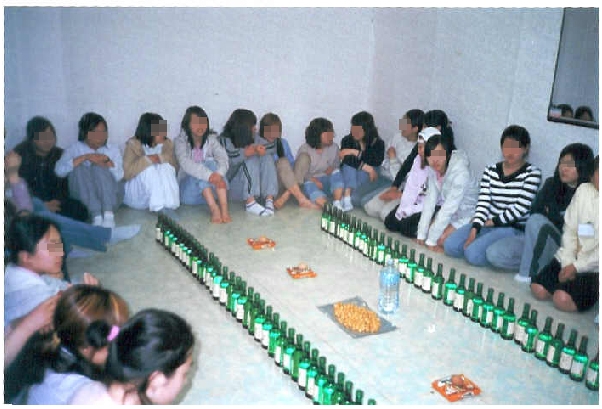
But in Korea at least, perhaps the most appropriate revenge would have been to inflict the same back on the rapists? For I’ve just been shocked to learn that legally speaking, men can’t actually be the victims of rape here.

In fairness however, Korea is by no means the only jurisdiction that strictly defines rape as non-consensual penile penetration of the vagina, so perhaps my reaction was quite naive. But still, recall that not only is spousal rape not a crime, and that the Korean Bar Association remains opposed to its criminalization, but that there is also endemic sexual violence within the military.  So it’s not like some decidedly archaic notions of sexual identity and rape don’t still exist both in theory and in practice in Korea.

Accordingly, the fact that males can’t be raped is not so much highlighted as taken for granted in the webtoon Judge Byeon Hak-do’s Puzzling Law Questions (알쏭달쏭 변학도 판사의 법률이야기) below, instead focusing on the question of if a rapist of a male to female transsexual would be charged with rape or indecent assault instead, concluding that as the victims are not considered women in Korean society then it would be the latter. And indeed as of 2006, only 25 transsexuals had been successful (and 26 denied) in their applications to change their legal gender, easily the most famous being entertainer Harisu (하리수) and model Choi Han-bit (최한빛) below:

( Sources: T-L, T-R, B-L, B-R )

That figure was taken from “Hallyoo, Ballyhoo, and Harisu: Marketing and Representing the Transgendered in South Korea” in Complicated Currents: Media Flows, Soft Power, and East Asia (2010), which I highly recommend for those of you more interested in the current state of transgender and transexual rights in Korea (full disclosure: this blog is mentioned in it!). As for the webtoon itself, unfortunately it raises more questions than answers, and the last 2 panels in particular make little sense, and I think are supposed to be a joke. But I’m not going to write it off because of the medium (quite the opposite), and unlike the pig-ignorant, racist, and anti-Semitic comic history books that some of you may recall from 2007, the webtoon series as a whole does at least seem to be written by someone who knows the subject, probably even by a judge himself.

Below, I’ve literally translated all of it (including all the sounds!), adding notes where necessary. But as always, I welcome and appreciate any corrections:

Comic #2. In the case of the rape of a man who has had a sex change operation to become a woman, does that [actually] carry the charge of rape?

Heo-poong, we are going to launch a product called “Eong-bbong”, and want you to come up with a marketing plan.

What’s an Eong-bbong?

Eong-bbong: a device to create an S-line by putting it under a skirt or pants.

How would wearing that feel?

“Eong-bbong” is actually quite a good name: it comes from a combination of the “eong” in eongdeongee (엉덩이), or bottom, and “bbong” (뽕), not unlike “boing” in English.

Meanwhile, when Heo-poong asks how wearing that would feel, he means literally or physically, not in the psychological sense of what it would be like to be a woman having her S-line ogled.

Okay then, let’s try becoming a woman!

Hee (Your guess is as good as mine)

Done/Changed!

Syoong! (a quick moving sound, in this case through a magic portal used in all the other stories)

Oh~Oh~~

Cheok! (a grabbing sound?)

What’s this?

Your bottom is so pretty…

Hweik! (used for something sudden and abrupt)

Jerk!

Yaaargh!

You bastard, you want to eat rice and beans (prison food) by raping someone?

Stop!

Beonjjok (Flash)

Go back to Judge Byeon Hag-do and try asking about what the crime of rape is!

GGudeok, ggdeok (Nod, Nod)

What? You say you almost got raped??

According to article 297 of the criminal code, a person who rapes a woman by violence or threat of violence gets a jail term of at least 3 years.

So in other words, the only people that can be raped are women?

Woman, then Syak! (quick swishing sound?)

If so, what are women?

Here in article 297, all females are referred to: adult women, teenagers and girls, married women, and unmarried women.

Who doesn’t know that?!! (lit. Where is someone that doesn’t know that?!!)

A man who dresses as a woman is only a woman on the surface. But for someone to be called [really be] a woman, they need to have the heart, mind, and body of a woman.

The Korean maum (마음) is often translated just as “mind” in English, but if you just ask Koreans where it is located then they’ll usually say the chest, let alone often use it in a “heart” sense. I don’t think there is any real distinction between them in Korean.

However, what about the case of a man who has had a sex change operation and thinks of himself as a woman?

Let’s have a look for any precedents.

Chwa-ra-rak~ (the sound of flicking through pages?)

If Miss “I am a woman” was a man and has a sex change operation…

When I go in I’m a man

When I come out I’m a woman

…through having her male “important parts” changed to a woman’s, she comes to think of herself as a woman.

Finally, I’ve found myself.

I’ve found where I belong!

And her personality is completely like a woman’s, and she also completely looks like a woman, and has lived as a woman…

A cockroach!

My master/mistress~

Then Mr. Evil rapes Miss “I am a woman”, all the while thinking she was born a woman, will he be charged with rape?

Sob sob sob~

You bastard! I will curse you forever!

“Mr Evil” may sound facetious, but actually boolhandang (불한당) is the usual term for a bad person, a little like the bogeyman in English (but more specifically a criminal of some sort). Meanwhile, jooinnim (주인님) is gender neutral, so I don’t know if the caterpillar(?) thinks of Heo-poong as a man or a woman sorry.

There is a precedent for this.

The sex chromosomes, internal physiology and external genitalia were all male…

(Before the operation)

He lived as normal man, but a time came when he wanted to have a sex change operation…

Feelings of confusion about if he was a man or woman.

A hard time doing his military service.

He met his true love, a man.

After the operation.

After the operation, she had no reproductive ability as a woman, so in the case of average people on the street’s assessments of and attitudes towards her…

They would decide that she couldn’t be called  a woman.

– Not a woman~

This way, even if you had had a sex change operation, someone who rapes you would not be charged with rape.

Of course, being a woman is not a prerequisite for charging the perpetrator with indecent assault under article 298 of the criminal code, yes?

According to article 298 of the criminal code (indecent assault), if someone assaults another through the threat of violence then he or she can go to jail for a maximum of 10 years or pay a maximum penalty of 15 million won.

In this case, “assault” means not just something which infringes on the victims’ sexual freedom and is in contradiction to normal sexual ethics, but also leaves them with a sense of sexual shame and disgust (Shim Hwae-gee, Official Law Studies (#359), 2004)

This was also established by the Supreme Court in their judgment on case 96.791 on June 11, 1996.

Your honor, do you think that Miss “I am a woman” is also included in the definition of woman for the charge of rape to apply?

What’s that got to do with anything? I just want to do whatever feels good~

Bbok (Bash?)

Master/Mistress, kill this bastard in self-defence!!

Sure!

Bbak! (Bash?)

That’s strange?? The contents of the Supreme Court’s judgment on case 96.791 on June 11, 1996 have been changed!!

Clearly, it was about rape, but here…

Gyaoodoong (??)

Now it’s about how far one is justified in inflicted violence in self-defense??

Save me~

Oodangtang (Thump! Stamp!)

Update: I completely forgot this article from The Korea Times, which I covered back in February last year (see#17 here):

A provincial court for the first time found a man in his 20s guilty of “raping” a transexual, Wednesday, challenging the current law that defines rape to when a man has forcible sex with a woman born a female. The victim’s legal gender still remains man.

The Busan District Court sentenced the man to three years in prison suspended for four years on charges of raping the 59-year-old transsexual. He was also ordered to participate in 120 hours of community service.

Judge Ko Jong-joo said in the ruling, “The victim has acted like woman since he was born. In 1974, when he turned 24, he underwent a gender reassignment program. He once also lived with a male partner for a decade. Given all of these, he can be seen as female.”

The judge added that although the victim was legally a man, but this did not take into account his sexual identity. “Thus, his sex in legal documents cannot be seen as his `ultimate’ gender,” he said.

The rapist invaded the victim’s home last August and raped her using a blunt weapon. The prosecution initially indicted the man on a “molestation” charge but changed it to “rape” later after considering the victim’s personal history. It sought a five-year prison term, Feb. 11.

Giving the unprecedented ruling, the judge set three criteria to define the precedent ― whether the victim had sex change surgery; how long he/she has lived with appearance of the opposite sex; and if he/she has no problems having sexual relations.

In a similar case in 1996, the Supreme Court did not acknowledge rape charge, citing the victim’s sexual chromosome identity as a male.

I wonder if that 1996 case is the one referred to in the cartoon?

judgment on case 96.791 on June 11, 1996.


Fighting Sexual Harassment at Samsung: Part 3

( Source )

This post, about Lee Eun-eui’s successful suit against Samsung Electronics for sexual harassment by her boss and then being punished for reporting it, follows directly from Part 1 and Part 2. If you haven’t already, please read those before continuing:

소송과정에서 가장 힘들었던 점은?

What has been the most difficult thing in the whole legal process for you?

회사에서는 내가 거짓말 한다고 했다. 인권위에서나 법원에서 회사의 주 변론이 ‘원하는 부서에 배치 받으려고 있지도 않은 성희롱을 했다고 주장한다’라는 거였다. 그럴 때마다 수치스러웠다. 주로 남자들이 있는 자리에서 내가 당했던 일을 말하는 게 쉬운 일도 아니었고.

처음 성희롱이 몸의 수치였다면, 사내에서 가해진 왕따는 영혼의 수치였고, 그 이후 회사의 반응들은 영혼과 몸을 다 부정당한 기분이었다. 내가 나의 성을 팔아야 할 만큼 부서배치나 승진이 대단한가? 매번 그런 사실을 법원에서 인권위에서 해명할 때마다 느꼈던 좌절감이 오늘의 나를 만들어 준 것 같다. 분노로 담금질 됐다. 회사는 나를 괴물같이 보겠지. 퇴사하지도 않고 심지어 (소송에서) 이기기까지 했으니. 그렇지만 나는 이런 ‘괴물’을 만든 건 회사라고 본다. 나는 원래 그런 존재가 아니었는데, 나를 자꾸 흔들어서 내가 살기 위해 움직이다 보니까 이 자리까지 온 거다.

잠시 숨을 고르던 이씨는 신입사원 시절, 연수원에서 배웠던 ‘도덕성ㆍ에티켓ㆍ인간미’를 이야기 했다. 그는 “유치하고 뻔 한 말이지만, 그 세 가지가 지켜졌다면 없었을 일이 황유미ㆍ박지연(삼성전자에서 일하던 중 백혈병으로 사망)씨였고 나였다”라고 말했다.

Samsung Electronics saying that I was lying. Their response to the Human Rights Commission and the Court was that I was simply accusing my boss of sexual harassment in order to get the position I wanted within the department. I felt really ashamed and humiliated whenever I heard that. And it was especially difficult to talk about it when there were men around (source, right).

At first, the sexual harassment made me feel ashamed and humiliated bodily, but then when I was ostracized within the company my spirit felt that way too, and because of the company’s reaction I felt such a sense of injustice and frustration both mentally and physically. Was being promoted within the company so important that I had to sell myself sexually? Whenever I had to explain the fact of what happened to the Human Rights Commission or in the Court, I felt such a sense of frustration and discouragement, and that’s made me what I’m like today. But my anger was sated, and the company will look at me as a monster from now on. However, I wasn’t originally like that, it’s what the company made me; because they kept pressing so hard, I had to hold my ground just to survive and get on with my life.

Reporter Jang Il-ho: Catching her breath, Lee talks about back when she was a new employee, and how at the training center she learned about ethics, etiquette, and humanity through stories. “They were childish, and I always knew what the endings were going to be, but if the company itself had just borne them in mind then cases like Hwang Yu-mi’s, Park Ji-yeon’s (who both allegedly died of Leukemia from working at Samsung Electronics assembly lines), and mine would never have happened” she said.

회사를 그만 두지 않은 이유는?

What is the reason you haven’t quit working for Samsung Electronics?

(그만둘까)많이 생각했다. 편하게 갈 수 있는 길도 있었고 후회와 고민도 있었다. 그렇지만 나는 회사가 이건희 회장이나 사장의 것이라고 생각하지 않는다. 직원과 주주 것이라고 생각한다. 내가 들어오고 싶었던 회사, 자랑스럽게 생각했던 회사, 꿈에 그리던 회사…열심히 다녔고… 결국 내 꿈에 대해 실망했었다.

그렇지만 이 회사는 나의 빛나던 20대와 뜨거웠던 30대가 녹아 있는 곳이다. 불이익을 당했을 때, 회사를 바르게 사랑하는 방식은 바로잡기 위한 노력을 하는 거라고 생각했고, 그걸 실천에 옮겼을 뿐이다. 사실 나는 황유미씨나 박지연씨만큼 중요한 사람은 아니다. 그런 의미에서 부채감도 있다. 그들은 생명권의 문제, 타협이 불가능한 문제다. 그러나 애초에 나는 타협도 조율도 가능했다. 그런데 그걸 해주는 사람이 회사 내에 아무도 없었기 때문에 싸워야 했다.

Quitting…I thought about it a lot. It would have been very easy, and in some ways I regret not doing so. But then I don’t think this company belongs to its chairman Lee Kun-hee, or the bosses of its many subsidiaries, but rather to its employees and stockholders. It’s a company I also wanted to work in, I was proud to work in, it was my dream to work in…I worked hard here…although in the end, my dream was crushed (source, left).

However, my shining (with potential) 20s and energetic, passionate 30s just melted into this company. I thought that whenever something was wrong, the way to show your love to the company was to do what was right to fix it, and indeed in reality that’s all I did. I’m not as important as Hwang Yu-mi or Park Ji-yeon, who had problems with their very lives, which were impossible to negotiate with. With me though, it was possible to do something about my problem from the outset, although because no-one within the company would help me I had no choice but to fight.

삼성은 노조가 없어도 노사협의회로 노동자의 권리를 보호해준다고 하는데, 도움이 됐나.

Samsung doesn’t have a union, but it does have a labor-management arbitration committee to help protect workers’ rights. Did they help?

단적으로 노조가 있었다면 소송할 때 변호사비도 들지 않았을 거고, 회사 내에서도 중재가 가능했을 것이다. 노사협의회에 도움을 요청했더니, 회사와 개인의 문제에 끼어들 수 없다고 하더라. 이 문제에서 노사 협의회는 전혀 도움이 안 됐다. 오죽하면 노사협의회에 근로자위원으로 입후보하려고 했는데, 우연의 일치인지 입후보 기간에 맞춰 출장을 보냈다. 이번 민사 판결이 의미 있는 이유 중 하나는 노조가 없는 회사에서 그동안 ‘회사와 싸우면 깨진다’라는 본보기를 깨트린 점이다.

Putting it simply, if there had been a union then they would have provided money for a lawyer and/or mediated with the company for me. In contrast, the labor-management arbitration committee told me that if was a personal issue between myself and the company and so they couldn’t get involved: they weren’t any help whatsoever. Indeed, I applied for a position on that committee, but by a [supposed] coincidence I was sent away on a business trip and was unable to. The judgment of the lawsuit means [though], that unlike what everyone thinks, you can win if you fight against a company which has no union.

(James – I’m a little confused by her application: she was immediately moved from her department after reporting being sexual harassed by her boss, she was then completely ostracized at work – indeed, later put on extended leave for 7 months – , but somehow still expected to get on to a committee that had already refused to help her? My wife suggests she may have been so desperate though, that she literally tried anything)

가족들의 반응은 어떤가.

What was the reaction of your family?

물정 모르고 자란 막내딸이 이런 소송에 휘말릴 것이라고 생각지도 않으셨다. 아직도 어머니가 매일 아침 머리를 말려 출근 시켜주신다. 그런 어머니에게 차마 말을 할 수 없었다. 알고 나서 무척 싫어하셨지. 그렇지만 나중에는 제대로 싸우라고 응원해줬다. 이왕 얼굴 내놓고 싸울 거면 예쁜 모습으로 싸워야 한다고, 옷 같은 것도 참견하시고(웃음). 종내 항상 힘을 보태주고 지지해주는 건 가족인 것 같다.

4시간 가까이 쉼 없이 말을 쏟아놓던 이은의씨에게 카메라를 들이댔다. 이씨는 “이왕이면 예쁘게 찍어 달라”라고 요구했다. 그는 “여자로서의 욕망이 아니라 ‘파이터’로서의 옵션이다”라고 덧붙였다. 불쌍하게 보이고 싶지 않다고 했다. 질 수 없었던 싸움, 희망의 언표가 되고 싶다는 이유였다. ‘언니를 지지할 수는 있지만, 언니처럼 될 수 없어서…’라며 성희롱 피해를 당하고도 싸우지 못하는 많은 여직원들을 보며 그는 ‘파이터’의 감수성을 키워왔다.

앞으로의 계획을 물었다. “지난 5년은 힘들면 맥주 한 잔 하고 풀 수 있는 평범한 일상이 사라진 시간들이었어요. 이제 그 시간들을 회복해가야죠”

My parents never imagined that their youngest child, who knows so little about life, could ever get involved in such an unsavory thing. But still, my mother dries my hair everyday as I prepare to go to work. At first, I couldn’t tell her anything about it. And once I did, she really really hated it. However, later she said that if I was going to fight then I had to do it properly, and that she would support me. And that because my face was already out there, I had to do it prettily, so (laughing) she was always telling me what to wear! And in the end, whenever my strength and resolve were lagging, my family always made up for it (source, above).

Reporter Jang Il-ho: After talking without a break for 4 hours, I started taking pictures of Lee. She said “please try to make me look nice I guess”, but added that she “didn’t want people to think of her as a desirable woman, but rather as a fighter”. And she doesn’t want people to take pity on her, but instead think of her as someone who couldn’t lose, who is a symbol of hope, as she heard from so many women who’d also suffered sexual harassment that they could help her, but they couldn’t be like her, so she developed a real sense of herself as a fighter.

I asked about her plans for the future.  She said that “For the last 5 years, I’ve had no opportunities for a normal life, even just having a simple glass of beer. Now, I have to recover, and make up for lost time”. (end)

( Source )

Personally, I was a little disappointed with that conclusion to the interview: there were many further questions raised about the incidents of sexual harassment, the reaction of the company, and the lawsuit and so on in Part 1 and Part 2 (and indeed even here too), but unfortunately we were given a rather repetitive look at the emotional side of the case rather than any real answers to those. Not that her own feelings are trivial or uninteresting of course, but I am left feeling a little frustrated.

Anyone else feel the same way? There are a few more Korean-language sources available, so if you have any further questions yourself about the case, then I’ll endeavor to find the answers myself if they’re available, albeit only translating the relevant sections of the articles this time!^^

Share

Fighting Sexual Harassment at Samsung: Part 2

(“What? Sexual Harassment at Samsung Electronics?? Heaven Forbid!”. Source.)

This post, about Lee Eun-eui’s successful suit against Samsung Electronics for sexual harassment by her boss and then being punished for reporting it, follows directly from Part 1. If you haven’t already, please read that before continuing:

블로그에 “1 레이싱이 얼추 막이 내렸다라고 썼더라. 1 레이싱을 뛰고 소감이 어떤가.

On your blog, you wrote that”The First Round is almost over”. How do feel about that?

아직 실감이 잘 안 난다. 꿈꾸는 것 같다. 회사가 항소를 할 건지 안 할 건지에 따라 바뀌겠지만, 지금은 해묵은 숙제를 끝내고 조금 쉴 수 있는 시간이다(삼성은 “내부적으로 법률적인 판단을 거친 뒤 항소 여부를 결정할 것이다”라고 밝혔다). 판결 뒤 며칠 편하게 잠을 잤다. 사건을 겪으면서 죽고 싶다는 생각도 많이 했다. 내가 일하는 건물(수원 삼성전기 본사)에서 죽을까, 삼성 본관이 있는 강남이나 태평로로 갈까…생각하면서. 그런데서 죽었으면 신문에 한 줄이라도 날까? 결국 살아서 싸우니까 좋은 결과를 본다고 판단했다. 삼성 사건 치고는 기사도 많이 나왔다(웃음).

It doesn’t feel like it’s real yet. It’s like a dream. Of course, Samsung may yet decide to file an appeal, but for now at least I am finally able to finish all my work related to the case and take a rest (Samsung stated that it will “decide whether or not to file an appeal after discussing the legal judgment within the company”), and I’ve slept soundly in the few days since the judgment was handed down. While the case was going on, I often thought of killing myself, but wondered whether to do it at my workplace (Suwon Samsung Electronics branch), at Samsung’s headquarters in Gangnam, or on Taepyeong Road [in front of Seoul City Hall – James]…but if I did, would it even get one line in a newspaper? So, I decided to carry on and fight, and in the end I was able to see a good result. And now (laughing) there are many articles about Samsung electronics in the news!
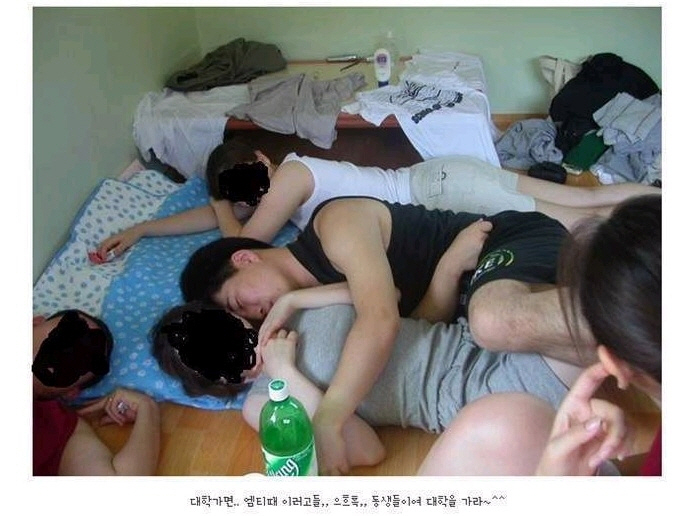
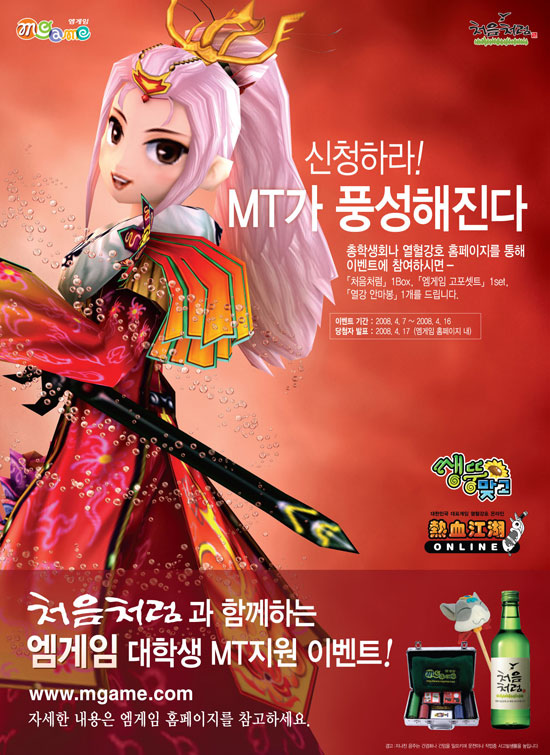
5억을 제기했었는데, 판결은 4천만 원을 배상하라고 나왔다.

You sued Samsung for 500 million won (US$422, 305), but were only awarded 40 (US$33,784)…?

따 지자면 5억을 받아도 성에 차지 않지만, 금액이 중요한 게 아니라 내용이 중요하다. 판사도 용기 있는 결단을 했다고 생각한다. 판결문 보고 엉엉 울었다. 판사에게 너무 고마웠다. 억울했던 것들에 대해서 인정을 받았으니까. 판사는 수많은 재판 중에 한 건이겠지만, 이건 굉장히 많은 여성 직장인들에게 큰 영향을 미칠 거라고 생각한다. ‘네가 이겨줘서 고맙다’ ‘뜨거운 마음으로 박수를 보낸다’ 등 연락도 많이 받았다. 회사에서 어려움을 겪는 분들, 특히 여직원들이 상담을 해오기도 한다. 아주 많은 숫자는 아니지만, 중요하다고 생각한다. 4천만 원을 배상하라는 것과는 비교할 수 없는 일이다. 회사가 항소하지 않으면 나도 안 할 생각이다. 이 판결을 그대로 유지하고 싶다.

이은의씨는 “미안한다는 말이 그렇게 어려웠을까”라고 기자에게 되물었다. 그녀는 가해자나 회사가 ‘미안하다’라며 사과를 했다면 소송까지도 가지 않았을 것이라고 했다.

Even if I’d received the full 500 million won, that wouldn’t have been enough to satisfy my anger, but then the amount isn’t the important thing anyway. I thought that the judge was very brave with his final decision, and I wept as it was read out, I was so thankful to him for showing everyone that what I’d said was true. And while to him this was surely just one case out of many, I think it will have a huge effect on women workers. I have received many messages like “Thank you for your victory” and “I applaud you with a warm heart” and so on, and have also been asked for advice from other women experiencing similar problems at their own companies. While their numbers aren’t great, I think that it is very important, and 40 million won can’t compare to that. And if Samsung doesn’t appeal, then I won’t either: I want this judgment to stick. (Source, above)

“Was it really so difficult for them to say sorry”? Lee Eun-eui asked. And she adds that if the offender or the company had simply apologized, then she probably wouldn’t have gone so far as to file a lawsuit against them.

2005 5 이후, 판결이 나기까지 5년이 걸렸다. 싸움이 쉽지 않았을 같다.

It has been 5 years since the first incident in May 2005 to the final judgment. It can’t have been easy.

사내에서 받아들여지지 않아 2007년 인권위에 진정했다. 인권위가 삼성전기에 재발방지 대책 수립 권고를 내렸지만, 회사는 권고를 취하해 달라며 행정소송을 제기했다. 그리고 2008년 내가 제기한 민사소송(손해배상)까지 내면서 ‘전문가’가 됐다. ‘삼성’이라고 하면 어느 곳도 싸워주겠다고 제대로 덤비는 곳이 없었다. 어렵게 도와주시는 변호사를 만났지만, 그런 과정을 거치다 보니 시간이 길어졌다.

회사가 ‘미안하다’라고만 했어도 일이 이렇게까지 안 됐을 거다. 사과는 커녕 ‘외부에 이런 사실을 알리면 민형사상 소송을 진행하겠다’라는 회사의 메일을 받을 때마다 처음엔 무서웠다. 인권위에 진정하기 전까지 2년 동안 병이 났다. 아버지가 갑자기 돌아가시고, 부서에서는 내쳐지고…배신감과 누적된 정신적 피로감이 폭발해서 실어증이 왔다. 당시에는 말만 시작하면 계속 울었다. 회사가 ‘성희롱 없었다’ ‘대기발령도 사실이 아니다’ ‘왕따도 없었다’라며 전면적으로 부정하는 데 정말 할 말을 잃었다. 결국 인권위에서 권고가 나왔고, 회사가 인권위에 제기한 행정소송에서도 인권위의 손을 들어줬다. 이번 민사소송도 승소했고. 주위에서는 ‘기적’이라고 한다.

As nothing was done within the company about my accusations, in 2007 I informed the Human Rights Commission, and they made an official recommendation to Samsung that the company needed to institute measures to prevent such sexual harassment from occurring again. Rather than following that recommendation however, Samsung sued the Human Rights Commission to have that recommendation withdrawn! Then in 2008 I filed my own civil suit against Samsung for personal damages, and in the process became quite the legal expert, as there were no lawyers prepared to take up my case and defy Samsung. In the end I did find a lawyer to help though, but that was just the start of a long and arduous legal process. (Source, above)

If only Samsung had said sorry, things would never have gone this far. But rather than apologize, instead they sent me emails saying they would sue me if I informed anyone outside the company of it, which was very scary at first. And in the 2 years before I informed the Human Rights Commission, I got very sick. My father suddenly passed away, I was completely cut out of the department I’d worked in…I felt such a sense of betrayal, and the mental stress and fatigue just kept accumulating and accumulating to the extent that I even developed aphasia. Whenever I started speaking, I would just keep crying. But the company completely lied and said that there was no sexual harassment, that I was not placed on extended leave, and that I was not ostracized at work, which just left me speechless anyway! In the end, once the Human Right Commission’s recommendation came, the company sued them but lost, and this time I won too. People around me say it’s a miracle.

(Source)

And, daughters permitting, Part 3 of the interview will be up on Monday!