Transnational Sex Workers in Yokohama, and Migrant Integration and Multiculturalism in Korea—Today’s Must-See Zoom Presentations!

Estimated reading time: 3 minutes. Image by ArtHouse Studio @Pexels.

Apologies that this post comes so last-minute. I only just discovered I was free, and my policy with Zoom lectures is only to announce those I can attend myself. If I didn’t, this blog would be overwhelmed, turning into a lighter version of the Korean Studies Events Database!

(You should totally sign up for the Korean Studies Events Database.)

The first lecture, from 3:30–5:00 pm (all Korean time), is:

“Doing Ethnography in the Wake of the Displacement of Transnational Sex Workers in Yokohama: Sensuous Remembering” by Ayaka Yoshimize, author of a book of the same title. From the event page:

(Zoom participation: Pre-registration is not required. Please login with the Zoom Meeting ID: 923 4787 3527 and Passcode: KUMMC.)

This presentation reflects on the politics, poetics, and ethics of remembering the lives of migrant sex workers in a diasporic city of Yokohama, Japan. Drawing on her performative sensory ethnography, Yoshimizu will focus on the transnational space of mizushobai (water trade) in Yokohama’s historically marginalized neighbourhoods along the Ōoka River, where sexual services were performed by racialized migrant women. Since 2005 the city has sought to rebrand one of these neighbourhoods, Koganecho, evicting transnational migrant sex workers who had been integral to postindustrial development and erasing their past presence. Yoshimizu examines Yokohama’s dominant memoryscapes in the aftermath of displacement, examining the built environment, official historical narratives, films, and photographic works that obscure racialized migrants’ participation in the city’s place-making. She then seeks to create an alternative memoryscape based on her own fieldwork experience of becoming entangled with the local social relations, unexpectedly coming to perform social roles legible in the field, and, ultimately, having her relationship with the city refashioned anew. Yoshimizu writes the alternative memoryscape through the imagery of water in ways that are informed by the local usage and imaginations—the ocean, flowing rivers, swamps, humidity, alcohol, the fluidity of relationships, and transient lives. This talk will end by introducing her current multi-sited research on transpacific memories of karayuki-san in Yokohama, Nagasaki, and Western Canada.

Then immediately after, starting at 5pm:

“Current status and policy response to migrant integration and multiculturalism in Korea” by Prof. In-Jin Yoon” (Korea University)

Also from the event page (but please note the pre-registration link there is wrong; instead, go to https://uni-due.zoom.us/meeting/register/u50qdeCgqToqHtePLf6_S_NppjpA9Wk6vica#/registration):

The current status of migrant integration in Korea seems to be far from ideal. The human rights violations against migrants remain common in the workplace and everyday life. The public’s perception and attitudes toward migrants have changed from paternalism to apathy, and is deteriorating to the level of hatred toward certain groups. Korean adults’ multicultural acceptance increased from 2010 to 2015, but has continued to decline since then. The level of social integration of migrant workers and married immigrant women, which are representative groups of migrants in Korea, is not high in both material and psychological aspects. Migrant workers have a high employment rate, but they work long hours in low-skilled, low-wage work, are exposed to non-payment or delayed payment of wages and physical and verbal violence, and their labor rights are greatly restricted. They cannot bring their families, and their opportunities to acquire permanent residency and nationality are greatly limited, so they are not subject to social integration. Marriage migrant women tend to have low employment rates, employment stability, and income due to their low age and education level, ability to understand Korean language and culture, the large age and cultural gap with their husbands, and the burden of childbirth and childcare. They are also dependent on their husbands because they need their consent when applying for permanent residency and nationality. The language and culture of their home country are not respected and they are under strong pressure to assimilate into Korean culture.

See you there!

If you reside in South Korea, you can donate via wire transfer: Turnbull James Edward (Kookmin Bank/국민은행, 563401-01-214324)

Single Korean Women are Being Scammed into Paying More to Feel Safe in Their Homes. You Don’t Have to be a ‘Feminist’ to Acknowledge That.

But if you do, there’s a real danger you might start thinking and acting like one…

Estimated reading time: 8 minutes. Photo (cropped) by Raka Miftah @Pexels.

So, I finally have the elevator pitch about what feminism is.

Pursuing equality of opportunity. For all sexes and sexual orientations.

It’s crude, but I think it’d do. In the moment, there’d probably be so little time to work with whoever might be asking, and so much hostility from some, that my priority would be getting them to acknowledge any inequality even exists at all.

First then, I’d broach that different sexes paying different prices for essentially the same product or service, or the same price for an inferior version of them, is obviously unfair.

(I wouldn’t waste any more time on anyone who couldn’t even concede that.)

I’d want to tread carefully next though. Maybe my inquirer wouldn’t know—or hadn’t deigned to know—that there are so many examples of this ‘pink tax’ out there, so named because it’s overwhelmingly women that suffer from them.

Here the old me, unsure about how to make that case in such a limited time, would probably jump the gun by explaining how just being angry about that discrimination, and wanting to do something about it, absolutely makes someone a feminist in his book.

The new me though, knows a case for that would need to actually be made first, and also how toxic that f-word is to so many people outside his circles—especially in Korea. So, he would confine himself to providing one or two quick examples, and consider that a solid achievement for two minutes. Surely it would be more effective to let his inquirer put two and two together themselves about them later, he’d reason, than beat them over the head with their obvious takeaways.

Photo by Andy Song on Unsplash.

Take these two handy recent Korean examples for instance, courtesy of an April 22, 2024 contribution to the “중앙로365” column in the Busan Ilbo by Byeon Jeong-hee, standing representative of the ‘Salim’ Women’s Human Rights Support Center (my emphasis). Both also happen to be about issues dear to my heart, for reasons I’ll explain in a moment:

얼마 전 부동산에도 ‘핑크택스(Pink Tax)’ 현상이 일어나고 있다는 기사를 읽었다. ‘여성 전용’ 원룸이나 ‘여성 안심 구역’에 위치한 부동산 매물의 월세나 보증금이 다른 매물에 비해 비싸게 책정되어 있다는 것이다. 부동산 정보 플랫폼에서 제공한 자료에 따르면 서울 주요 10개 대학 중 원룸 월세는 이화여자대학교가 월 71만 원으로 가장 비쌌는데, 대부분 여성 전용 원룸 밀집 지역이었다. 부산에서도 부산대 인근 여성 전용 원룸과 일반 원룸을 비교한 결과, 별도 보안 장치가 추가된 것이 아님에도 불구하고 여성 전용 원룸의 월세가 약 20만 원 비쌌다는 취재 결과가 있었다. 때문에 주로 여성들이 느끼는 범죄에 대한 두려움이나 안전에 대한 불안을 이용한 마케팅이자 핑크택스라는 지적이다.

“Not long ago, I read an article saying that the ‘Pink Tax’ phenomenon was occurring in real estate….The monthly rent or deposit for real estate properties located in ‘female-only’ studio apartments or ‘female-safe zones’ are set at a higher price compared to other properties. According to data provided by a real estate information platform, among the 10 major universities in Seoul, Ewha Womans University had the highest monthly rent at 710,000 won per month, and most of them were concentrated areas of studio apartments exclusively for women. In Busan, as a result of comparing women-only one-rooms and regular one-rooms near Pusan National University, the results showed that the monthly rent for women-only one-rooms was about 200,000 won more expensive even though there were no additional security devices. Therefore, it is pointed out that it is a marketing and pink tax that mainly exploits women’s fear of crime or anxiety about safety.”

This may come as a surprise. For a long time Korea has had a reputation as a safe country, and in many respects it still is—the homicide rate is extremely low by international standards. However, it has also long been one of the few places in the world where women are actually more likely to be murdered than men. And, since the 2016 murder of a woman in a public toilet in Gangnam especially, the perception that Korea is a safe country for women is, I suspect, one largely only felt by short-term visitors, relying on outdated, frequently sanitized (or naive) sources.

Instead, for women living in Korea in 2024: femicides by ex-boyfriends; dating violence; random attacks while hiking, while waiting for an elevator, or simply having short hair; and an increasing numbers of stalkers? All these contribute to a constant feeling of danger, that there is an epidemic of violence against women, and that “nowhere feels safe.”

Photo (cropped) by Matteo Catanese on Unsplash.

It’s no wonder then, that among all demographics, it’s women living alone who are most anxious about these developments, so are prepared to pay extra not to have to worry about them. Indeed, so anxious that their fears are now being exploited by landlords and realtors, as Byeon points out.

I do however, completely acknowledge that she is vague about her sources, and provides none of their data. Indeed, the ‘Salim’ Women’s Human Rights Support Center, which Byeon represents, is actually an anti-sex work organization, which makes me wary of potential hyperbole in her claims (this is my unfortunate experience with such organizations). So, I’ll endeavor to find those sources and data myself for a follow-up post.

Source: Remark Vill.

Mom, you’re bringing that up again?

I’m taking care of things myself now!

I can get lightbulbs changed if I need to, and the toilet unblocked too.

I don’t need to call Dad!

But I also acknowledge I don’t really have any doubts about their veracity, based on my deep dive into Remark Vill serviced apartments’ advertising campaign with then 32 year-old Im Se-mi in 2020 above. Because, although it first drew my attention through the cloying, traditional, initializing gender roles it portrayed (Could my interlocutor in the elevator seriously imagine a man being asked to say those things? Could anyone?), it also left me with a heavy sense of just how unsafe women felt even back then, the grim, more recent statistics in all those links above being just the tip of the iceberg of those I outlined in that earlier post.

Plus, in an equally deep follow-up the next year, I recounted what I learned from two must-read books about how adding safety features for women, real or otherwise, were often implemented entirely for financial reasons (giving the impression of gentrifying a neighborhood say), so frequently didn’t substantively improve women’s safety at all. Also, I learned how various Korean government policies often financially discriminate against single female households specifically.

No wonder Korean women are pissed.

But of course my new elevator friend and I would never get that far. And I’d want to save them the embarrassment too, of getting into knots arguing that Korea’s consistently terrible gender gap…is because of Korean women choosing to have babies. We’re only talking about how much money women may or may not have to spend on safety features compared to men, and why, I’d remind them, not how much money they may or may not have in the first place. And, instead of quibbling about either, we could surely agree that is very not cool that women have to pay extra for the privilege of safety men take for granted, let alone be scammed over it (I might want to avoid that scary ‘p-word’ though). We could then talk next about what men and women should do to remedy that. In other words, be feminists, although I wouldn’t want to say that word yet either—I wouldn’t want them to realize they’ve been tricked yet.

Or, we could just move onto the next example (my emphasis again):

우리나라에서는 2018년부터 이러한 핑크택스에 대한 문제 제기가 있었다. 한 유명 아웃도어 브랜드에서 여성용 패딩의 충전량이 남성용의 절반밖에 되지 않지만 같은 가격에 판매되고 있다거나, 유명 패션 온라인 스토어에서 뒷주머니와 밴딩 처리 등을 없앤 여성용 슬랙스가 남성용보다 비싸게 판매되어 논란이 일었다. 같은 가격의 옷임에도 여성용으로 출시된 옷은 주머니가 너무 작거나 옷의 마감 처리가 허술하게 되어 있다는 취재가 이어졌다. 미용실에서 머리 커트 가격이 성별에 따라 다르게 책정되어 있는 것도 꾸준히 지적되어 왔다. 한국소비자원 사이트에 따르면 서울 지역 여성 커트 1회 평균 가격은 2만 1308원으로 남성 1만 1692원에 비해 약 1.82배 비싼 것으로 나타났다.

“In Korea, issues regarding the pink tax have been raised since 2018. Controversy arose when a famous outdoor brand said that women’s padding had only half the amount of padding as men’s but was sold at the same price. And, at a famous fashion online store, women’s slacks with no back pockets or banding were sold more expensively than men’s. Even though the clothes were the same price, there were continued reports that the clothes released for women had too small pockets or poor finishing. It has also been consistently pointed out that haircut prices at beauty salons are set differently depending on gender. According to the Korea Consumer Agency website, the average price of one haircut for women in Seoul is 21,308 won, which is about 1.82 times more expensive than 11,692 won for men.”

Source: Newsis.

This last one is meaningful to me, because I recall hearing on the radio as a student in Auckland, New Zealand in the late-1990s, that hairdressers were complaining about having to charge the same prices for men and women. Which made complete sense to me then—women tended to have longer hair, and so took more time.

I’d stress this first. That this opinion was reasonable, based on the information I had available at the time. That it wasn’t stupid at all, and that I’m not about to judge someone for having an opinion that I once did.

(Only now, in my 40s, have I finally learnt it’s easier to persuade people by praising their intelligence and common sense first rather than by implying they have neither. Who’d have thought??)

Only then would I explain that when I actually asked women about haircuts much later though (another secret way to trick people into becoming feminists, I hear), did I realize how unfair differential pricing would be to them. Because have women ever really been completely “free” to get short hair cuts, and men long ones? How about right now then, after an attack on a woman in Jinju in November 2023, targeted because her short hairstyle made her look like a feminist to her attacker?

Perhaps that could lead to a discussion about everything else appearance-wise women are expected or required to spend their time and money on?

Perhaps. But the new me knows when to end when the going’s good ;)

Related Posts:

If you reside in South Korea, you can donate via wire transfer: Turnbull James Edward (Kookmin Bank/국민은행, 563401-01-214324)

Manufacturing Outrage Against Korean Feminists: Could it GET any more obvious?

“It was there for literally 0.1 seconds! And drawn by a guy! And…and…WHY THE HELL DO YOU FEEL SO THREATENED BY IT ANYWAY??”

Estimated reading time: 12 minutes. Photo by Timur Weber @Pexels.

It’s always heartwarming when a columnist literally calls bullshit on the Korean manosphere.

For that sass alone, in a moment I’ll gladly pass on to you my full translation of Hankyoreh Gender Team Leader Jang Su-gyeong’s accusation, written in December 2023 about the MapleStory controversy of the previous month.

But for all her flair, I think it was a little misdirected.

“I am very interested and concerned about hatred and discrimination, which hang as prevalent and thick in Korean society as air.”

Basically, she criticizes the controversy for being only the latest example of the ‘feminist check’ tactic the Korean manosphere engages in these days. Whereby they: go bananas over any alleged instance of a small penis finger gesture; dig deep to find evidence that those responsible have even the slightest of feminist leanings; then shrilly demand the company responsible fire them and remove the offending gesture.

This is more pernicious and impactful than it may sound to outside observers. Emboldened by the term “feminism/페미니즘/女性主義” more accurately meaning radical feminism in Korean, to most men and women alike, virtually anyone even only indirectly advocating for sexual equality can get tarred with that brush. And when that happens, say, for wearing t-shirts incels don’t like, companies are only too eager to throw those real or alleged “femis/페미” under the bus, all for the sake of appeasing the manosphere.

Source: John Marcotte.

So I share her ire, and don’t want to get too hung up on semantics. It’s just that, precisely because the manosphere can be so loud and proud about what they doing, why they’re doing it, and who they’re hurting, with absolutely no subterfuge necessary, perhaps “bullshitting” isn’t the best way to describe the process.

Or, perhaps I only say that with the benefit of hindsight.

Because as if to prove her point, an even more bullshit controversy, over nonexistent government plans to switch the genders of emergency exit signs, is emerging as I type this a month later.

As you’ll see after her column, it’s a much more blatant example of what she describes. Especially when you contrast it with a real example, which there was a clear need for, made nationwide to the caregiver figures in subway escalator signs in the late-2000s. And which, to the best of my knowledge, did not result in any harm to anyone’s sense of manhood—no matter how deeply the Korean manosphere seems to feel threatened if the same ‘concessions’ were made today.

Left: the offending gesture, which is visible for precisely 0.1 second. Full screenshot source: 원정상 @YouTube. (For the record, I just thought it was too good a screenshot not to steal—I don’t know the YouTuber’s stance on the controversy.)

너 페미니? Are You a Femi?

장수경/Jang Su-gyeong, 2023-12-17 (flying710@hani.co.kr/@jsggija)

“너는 페미니스트야?”

“Are you a feminist?”

몇달 전 대학 때 친하게 지낸 남자 동기를 만나 들은 질문이다. 질문을 받은 뒤 처음 느낀 감정은 당황스러움이었다. 그동안 받아본 적 없는 질문이었기 때문이다. 페미니스트냐 아니냐를 따지는 게 무의미할 정도로, 나는 스스로 페미니스트가 아니라는 생각을 해본 적이 없던 터였다.

This is a question I was asked a few months ago, when I met a male classmate with whom I was close to in university. My first reaction was embarrassment. Because it was a question I’d never been asked before. I’d never thought of myself as *not* a feminist, to the point where it was meaningless to consider whether I was one or not.

“나는 페미니스트지.”

“Yea, I am a feminist.”

“왜 너 자신을 그렇게 규정해? 네가 생각하는 페미니즘이 뭐야?”

“Why do you define yourself like that? What do you think feminism is?”

“여성과 남성은 동등하고, 성별에서 오는 각종 차별을 없애야 한다는 거지.”

“I think it means women and men are equal, and so all kinds of sexual discrimination must be eliminated.”

“그건 인권 차원에서 당연한 거 아니야?”

“Isn’t that only natural from just from a human rights perspective though [So a feminist one isn’t necessary]?”

친구는 페미니즘의 방향에는 동의하면서도 페미니스트에 대해서는 부정적 생각을 가진 듯했다. 친구는 내게 “너의 정체성을 어느 하나로 규정하지 않길 바란다” “역차별당하고 있다고 주장하는 2030 남성들의 이야기도 귀담아들어달라”는 말을 남겼다.

Although my friend agreed with the general direction of feminism, he seemed to harbor negative thoughts about feminists themselves. He continued, “I hope you don’t define your identity as just this one thing,” and “Please listen to the stories of men in their 20s and 30s who claim they are being reverse discriminated.”

최근 게임 업계에서 일하는 여성 작가들을 향해 잇따르고 있는 ‘페미니즘 사상 검증’ 사태를 지켜보면서 당시 대화를 떠올린 건, 페미니스트를 옥죄는 사회 분위기가 전방위적이라는 생각 때문이었다. 친구의 질문 의도가 ‘사상 검증’일 것이라곤 생각하지 않는다. 다만, 이런 질문이 나와 동등한 위치에 선 사람의 ‘순수한 궁금증’에서 비롯된 것이 아니라 누군가를 검열하고, 억누르고, 일자리를 겨냥하고 있다면 말은 달라진다.

While watching the recent ‘feminist check’ [lit., ‘verification of feminist ideology’] that has been taking place against female writers working in the game industry, I remembered the conversation at that time because I thought that the social atmosphere that oppresses feminists is omnipresent. I don’t think the intention of my friend’s question [was malicious], to confirm that I was a feminist [and then target me on that basis]. However, if these questions do not arise from a place of genuine curiosity [and willingness to engage in dialogue] expressed by a person standing on equal footing with me, but instead is a form of sealioning aimed at censoring, suppressing, or targeting someone’s job, the story is different.

지난달 말 남초 사이트와 게임 업체 넥슨이 한 행동은 전형적인 ‘사상 검증’이었다. 남초 커뮤니티는 넥슨의 게임 ‘메이플스토리’ 홍보 영상에 등장하는 캐릭터의 손가락 모양을 두고 ‘남성 혐오’라고 주장했다. 근거는 빈약했다. 해당 영상을 작업한 하청 업체의 한 여성 직원이 자신의 사회관계망서비스 계정에 올린 페미니즘 옹호 발언이 전부였다. 전형적인 확증 편향이었지만 넥슨은 별다른 사실관계 확인 없이 해당 영상을 비공개하고 업체 쪽에 법적 대응을 예고했다.

At the end of last month, the actions taken by the manosphere sites and forums, and then the game company Nexon’s responses, were a typical example of the feminist check process. The manosphere claimed that the shape of the finger of the character appearing in the promotional video for Nexon’s game *MapleStory* was ‘man-hating.’ But the evidence was actually quite weak. A female employee of the subcontractor who worked on the video uploaded it to her social networking service account, and all she said was her defense of feminism. It was a typical confirmation bias, but Nexon made the video private without verifying the facts and announced legal action against the subcontractor she worked for?

이후 해당 작업물을 그린 이는 40대 남성 애니메이터라는 사실이 보도됐다. 주장의 근거가 사라졌으니, 남초 커뮤니티가 사과했을까. 아니다. 애초 사실 여부는 중요하지 않다는 듯, ‘언론의 보도가 거짓’이라거나 ‘남페미는 문제가 아니냐’며 방향을 틀었다. 그사이 해당 여성 직원은 개인 신상 정보가 털리고 온갖 욕설을 듣는 등 사이버불링을 당했다.

However, it was later reported that the person who drew the work was actually a male animator in his 40s. Now that the basis for the claim has disappeared, did the manosphere apologize? Not at all. In the first place, it seemed as if it didn’t matter whether it was true or not. And then they changed direction by saying, “The media’s reports were false,” or “Aren’t male feminists the real problem here?” Meanwhile, the female employee suffered cyberbullying, including having her personal information stolen and receiving all kinds of abusive language.

퓰리처상을 받은 영국의 저널리스트 제임스 볼은 책 ‘개소리는 어떻게 세상을 정복했는가’에서 ‘진실이든 거짓이든 신경 쓰지 않는 사람들이 만들어내는 그럴싸한 허구의 담론’을 ‘개소리’(bullshit)라고 말했다. 개소리꾼의 개소리는 거짓말과 달리 자신이 원하는 결과를 얻기 위해 최소한의 진실조차 중요하지 않기에 거짓말보다 해롭고, 팩트로 대응해도 힘을 잃지 않는다고 했다.

In his book Post-Truth: How Bullshit Conquered the World (2021), Pulitzer Prize-winning British journalist James Ball said that ‘bullshit’ is “a specious fictional discourse created by people who do not care whether it is true or false.” He said that unlike lies, this, the most bullshit of bullshits, is more harmful than lies because even the minimum amount of truth is not important to achieve the results one wants, and it does not lose its power even if it is responded to with facts.

“업장에서 왜 사회운동을 하냐”(허은아 국민의힘 의원), “악질적인 점은 실수가 아니라 의도적이라는 데 있다”(이상헌 더불어민주당 의원), “의도를 가지고 넣었다면 조롱”(류호정 정의당 의원)이라는 정치인들의 반응은 ‘개소리’ 기세를 더 강화할 뿐이었다. 정치권의 메시지는 ‘사상 검증을 하지 말라’ ‘페미니스트가 뭐가 문제냐’여야 했다. 기업은 개소리꾼의 개소리를 수용할 것이 아니라 무시해야 했다. 언론은 ‘집게손 논란’이라는 제목으로 개소리를 앞다퉈 보도하지 말아야 했다.

The politicians’ responses—“Why are you engaging in social movements at your workplace?” (People Power Party Rep. Heo Eun-ah), “The malicious point is not that it was a mistake, but that it was intentional” (Democratic Party Rep. Lee Sang-heon), “If it was put in with intention, it would be ridiculed” (Justice Party Rep. Ryu Ho-jeong)—only added to the bullshit’s momentum. Instead, the message from the political world should have been, “Don’t engage in a feminist check,” and “What’s the problem with feminists anyway?” Companies should have ignored this bullshit of bullshits, not blindly accepted it, and the media should not have rushed to report it under the title ‘Claw Hand Controversy.’

‘페미니스트는 남성 혐오론자이기 때문에 그런 집게손가락 모양을 넣었을 것’이라는 ‘개소리 담론’에 기업, 정치인, 언론 등이 동조한 결과는 ‘일터를 잃는 노동자’다. 2016년 ‘소녀에게 왕자는 필요 없다’는 글이 쓰인 티셔츠를 입었다는 이유로 교체된 성우처럼, 과거 에스엔에스에 페미니즘 관련 글을 올렸다는 이유로 2023년에 계약 해지된 게임 ‘림버스 컴퍼니’의 그림작가처럼 말이다.

Source: Twitter/@KNKNOKU via BBC.

The result of companies, politicians, media, and so on agreeing with the bullshit discourse, that “feminists must have put that index finger symbol because they are male haters,” is workers losing their jobs. Just like the voice actor who was replaced in 2016 for wearing a T-shirt with the words “Girls do not need a prince” written on it, the illustrator of the game Limbus Company whose contract was terminated in 2023 for [retweeting tweets that used derogatory terms for men].

개소리를 하며 ‘사상 검증’을 정당화하는 이들에게 말해주자. 너희 주장은 개소리라고. 페미니즘이 뭐가 문제냐고. 너희들이 페미니즘을 알긴 아느냐고.

Let’s tell those who spew bullshit in the name of feminist checks: Your arguments are bullshit. What’s the problem with feminism anyway? Do you guys even know *anything* about feminism? (END)

(For more information, in chronological order over November to December, including the response of the Nexon Union, please see the Korea JoongAng Daily, this Reddit thread, Korea Bizwire, the Korea Times, and again the Korea JoongAng Daily.)

Now fast forward to mid-January 2024, when multiple media outlets reported that in the name of gender equality, the government was immediately replacing the ‘male’ pictogram in some of the emergency exit signs nationwide with more obviously ‘female’ ones. Some outlets added that it was at the behest of women’s groups.

I’m sure I don’t need to outline the absurdities of such a plan. Nor that (most of) the multiple, eminently justifiable criticisms, did not necessarily stem from misogyny.

But more often than not, feminists became the target anyway.

Because at best, the new design was actually just one of many possibilities considered for updating the signs, to replace the existing ones only as per needed (so, no extra cost at all). Whereas at worst—and it’s unclear which applies, frankly—it was a complete fabrication of the media.

As were the supposed women’s groups that were demanding it:

직장인 A씨(29)는 “새 픽토그램을 보니 긴 머리에 치마를 입고 가슴 부분이 튀어나와 있었다”며 “여성 중에 이런 기호를 원하는 사람이 실제로 얼마나 되겠냐. 오히려 여성을 희화화한 듯하다”라고 말했다. 한 누리꾼은 “누군가 일부러 논란을 만들었다고 생각될 정도”라고 했다.

한 여성단체 관계자는 “어떤 기사에선 ‘여성단체 등이 요구해왔기 때문’이란 식으로 설명했던데, 그런 요구를 한 단체가 어디에 있나. 괴담 수준의 터무니없는 얘기”라며 “오히려 성 고정관념을 고착화하는 그림이다”라고 비판했다. (Kyunghyang Shinmun)

Office worker A (29) said, “When I looked at the new pictogram, I saw her with long hair and a skirt and her breasts sticking out,” adding, “How many women actually want this symbol? “In fact, it seems like a caricature of women.” One netizen said, “It almost makes you think someone created controversy on purpose.”

An official from a women’s group said, “In some articles, it was explained as ‘because women’s groups have been making demands,’ but where is the group that made such demands?” “It is an absurd story at the level of a ghost story,” he criticized, adding, “Rather, it is a picture that perpetuates gender stereotypes.”

And from the Dailian:

…”이런 것도 성별 갈라치기 소재로 쓰냐” 라는 등 비판 의견이 쏟아졌다.

…[Netizens] said “Is this just another thing that can be used to divide the sexes?”

Image sources: 스포츠하국, Pixabay (edited).

Now, you could rightfully argue that the media was responsible in that case, not technically the manosphere.

Only, there’s a great deal of synergy between the two.

Crucial context is that the notoriously clickbaity Korean media is one of the least trusted in the (developed) world, and that it is heavily male-dominated. Add that Korea is a deeply patriarchal country, currently in the midst of a polarizing “gender war,” then a constant backlash of ‘journalists’ scapegoating feminists for all Korea’s ills is all too predictable.

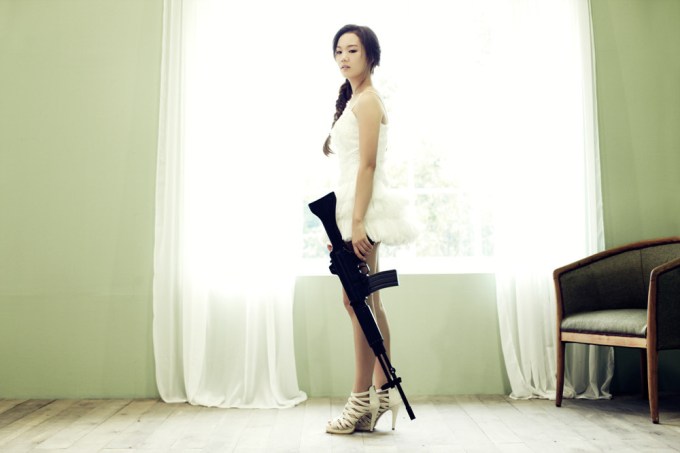
The deceit involved can be staggeringly blatant and obvious. I’ve even caught out with one bullshit story myself. When, after ‘reporting’ on a literally non-existent controversy over Berry Good member Johyun‘s cosplay above, then getting the sought-after inflamed response from the manosphere, the media added insult to injury by blaming the entire controversy on the reports of a single female reporter, who criticized Johyun for her overexposure despite praising male nudity in previous articles.

Only, her article on Johyun wasn’t published until several hours after news about about the controversy first appeared. (And ironically, her article wasn’t at all like it was described; in fact, they it was just as clickbaity as everyone else’s, and provided no basis to label her a feminist.)

Sources: MLBPark (1; since deleted); 2)

But still: these three cases alone are insufficient evidence of systematic misogyny by Korean journalists and the media. I do strongly suspect though, that a thorough investigation by academics, media-watchdogs, and/or feminist groups will undoubtedly reveal that such an agenda exists. Likely, many such investigations have already been conducted, so I’ll follow this post up with those at a later date.

In the meantime, Korean or otherwise, I will never, ever trust any news source that makes claims about unnamed women’s and feminist groups.

As part of my own 2024 agenda though, I try to highlight the positive where I can, and can’t end on that note.

So, with my apologies for the crappy quality of my digital camera back in the late-2000s, finally let me remind you of when, in a bid to challenge antiquated gender roles and encourage more equitable childcare between parents, subway-caregiver signs with a female figure were gradually replaced with an androgynous one. They were only replaced as per needed, so they didn’t cost extra money, leaving even the most vitriolic of incels struggling to oppose them without exposing their misogyny. Which is probably why I haven’t actually seen one with a female caregiver ever since.

Only, doing my due diligence, I’m sorry to report that today I learned my experience isn’t at all universal (let alone my nonexistent experience of female spaces). That the initiative stalled, and that as of 2019, many Seoul subway stations still have almost entirely female caregivers in their signs. Most ironically and symbolically perhaps, in Gangnam Station, where 100% of them are of women:

Source: Hankook Ilbo.

So, the fight continues, even over the little things. But it does continue.

Related Posts:

If you reside in South Korea, you can donate via wire transfer: Turnbull James Edward (Kookmin Bank/국민은행, 563401-01-214324)

Manufacturing Consent?: Socializing Migrant Brides to Korea into Becoming Docile, Obedient ‘Baby-Making Machines’

“Women in South Korea are on Strike Against Being ‘Baby-Making Machines’” headlines a must-read article by Hawon Jung in last week’s New York Times, a role migrant women are expected to perform most of all. Here are two insidious ways in which they are socialized into doing so.

Estimated reading time: 7 minutes. Image source: YouTube.

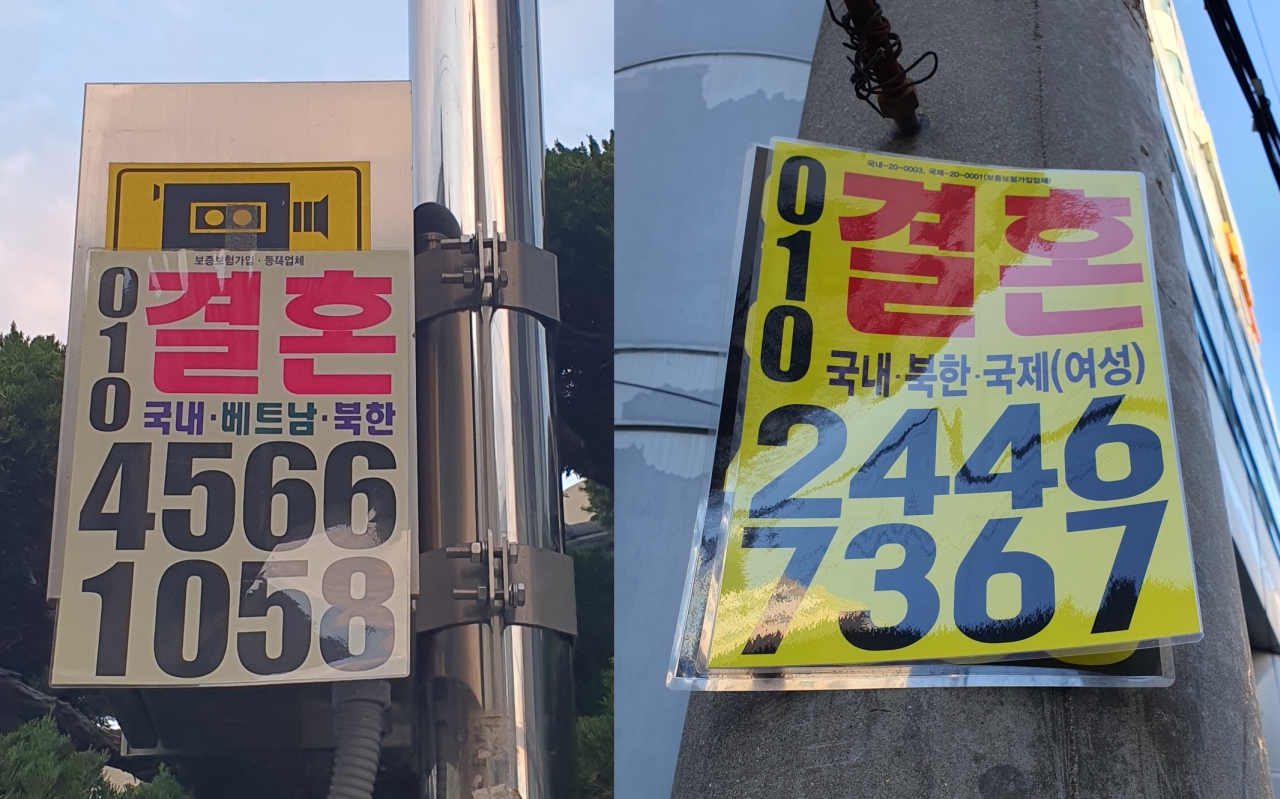
My neighborhood of Gwangalli Beach is one of the most popular and internationally famous tourist spots in Korea. It is also one of Busan’s busiest nightlife areas. It is not, in my general experience, positively teeming with middle-aged, male farmers, the main customers of international marriage brokers. So why do they bother posting their ads here?

I realize the placement has got nothing to do with Gwangalli really—the ads get spammed just about everywhere in Korea. It’s just that whenever I see them a few blocks behind its trendy bars and nightclubs, I can’t help but laugh at the incongruity with their surroundings. Then pause as I remember the frequent abuse of those overseas brides by either the brokers and/or their new spouses and families, and feel guilty. The metaphor for the harmless-sounding, but ultimately racist, sexist, and objectifying “gendered nationalism” and “gendered multiculturalism” that lurks just behind the glitz and glamour of the Korean Wave, almost suggests itself.

That’s not quite why I paused when I saw the ad on the left in October 2021 though. It was because it was the first I’d ever seen that mentioned “Domestic” (국내) and “North Korean (refugees)” (북한) options in addition to the usual “Vietnam(ese)” (베트남) ones. Possibly, I’d stumbled on an ad for a rare international marriage broker which had also arranged marriages between ethnic Koreans before the pandemic (note that over 70 percent of North Korean refugees are women). But it’s much more likely it was a recent development, forced by international travel restrictions.

Then I paused again a few days ago when I saw that new version on the right, for three reasons.

First, because of the “Women” (여성) that had been tacked on to the new, but also quite usual “International” (국제). Not because it was a surprise that international marriage brokers only supplied brides from overseas, but because of what the “Women” being omitted from “Domestic” and “North Korean” implied: that the same brokers were now also in the business of finding North Korean grooms. Which again implied desperation, considering how neglected they’d been up to that point: as of mid-2020, there were 20-30 agencies that specialized in supplying North Korean brides, against none that specialized in supplying their male counterparts.

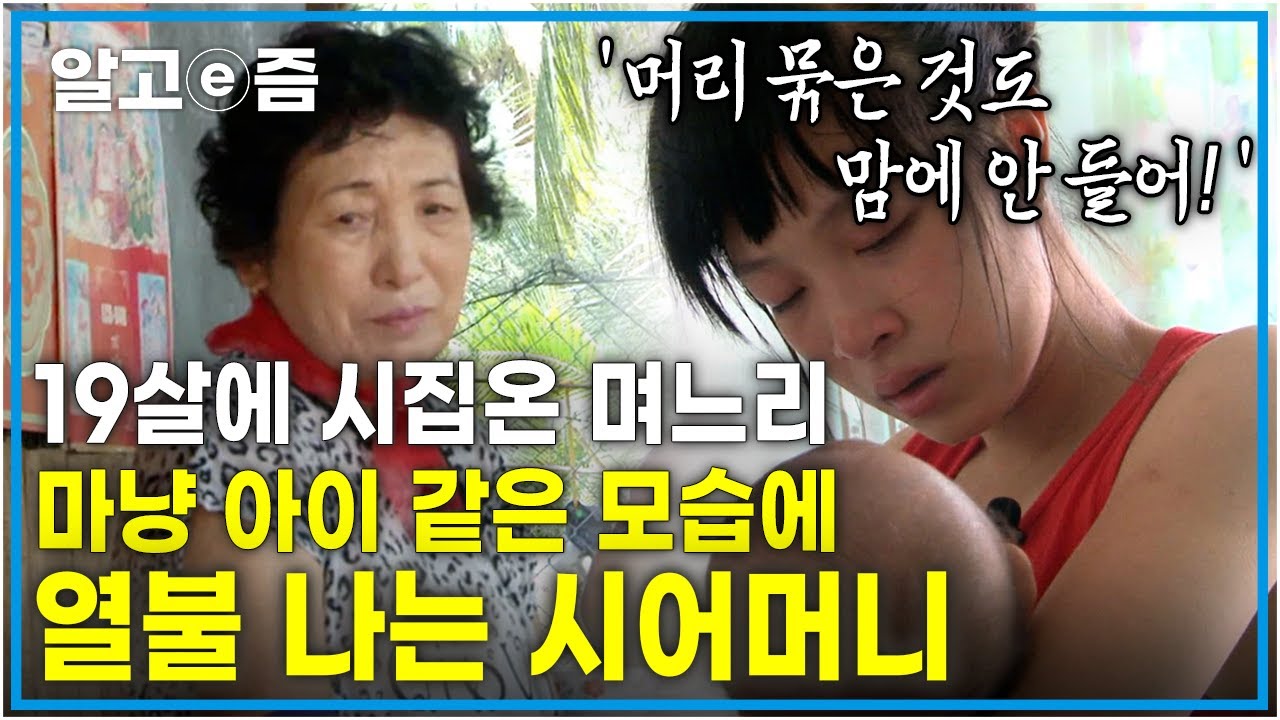
And I do mean “supply.” Because next, I’d actually already noticed an ad exactly like it back in May 2022. (With a different number; sorry that I don’t know how many brokers are behind these ads.) Only this time, I was seeing it again after just learning of a problematic episode of the documentary program Algorithm (알고e즘) that screened earlier in January, which featured a 34 year-old Korean husband’s (and parents’) relationship with his 21 year-old Vietnamese wife:

As Professor Michael Hurt of the Korea National University of Arts described it, it was “stealthily ideological.” Specifically (quoted with permission):

If this ain’t human trafficking, I don’t know what is. All the cutesy piano music and pizzacato plucking can’t shoehorn this episode into anything looking like a heartwarming narrative. The closer you look and the more questions are asked, the more this looks like outright human trafficking. Of course this “daughter-in-law“ who is 21 married to a man obviously [much older] isn’t adjusting well to life in a poor Korean household. And they keep trying to frame things as normal mom and daughter-in-law friction, but the real answer to every single conflict in the show—especially when they make a quite performative trip to Vietnam, with mom in tow—is the obvious fact that she looks like a human trafficking victim. Because that’s what she is.

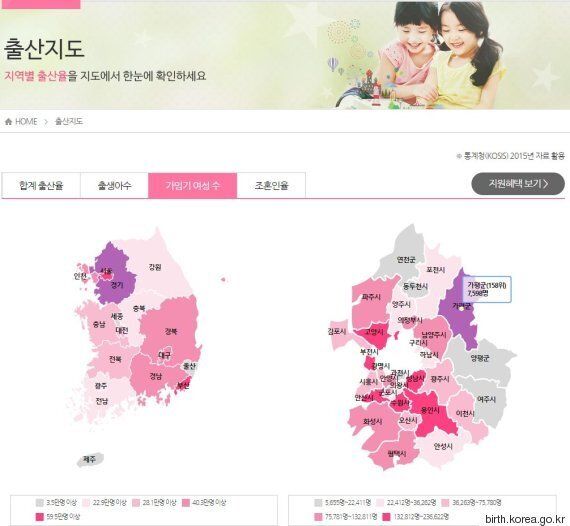
Going further, I’d argue that framing is also about putting migrant wives in their place—as docile, obedient ‘baby-making machines’ for the Korean state. Please hear me out. Combating Korea’s world-low birthrate, most acute in rural areas, is precisely why the international marriage agency was encouraged to develop in the first place. Next, recall that Korean women are already well aware that’s how the Korean state regards them themselves; with migrant brides from much poorer countries, there’s even less pussyfooting about their designated role. Indeed, this mentality even pervades government programs designed to help their integration. Consider as evidence the following abstracts to two academic articles on the topic, and their eerie similarity to what was occurring in the documentary (Right: “Women of Childbearing Age Map” briefly released on Korean government website in December 2016, before being withdrawn due to controversy):

This paper focuses on the role of Multicultural Family Support Centers (MFSCs) to explain the gender, race and cultural hierarchies inherent in South Korea’s system of multiculturalism. Since the 1990s the South Korean state has played an active role in facilitating marriage migration and influencing the reproductive and caregiving decisions of female marriage immigrants. This is reflected in immigration and welfare policies that incentivize migrant wives to have children and provide disproportionate power to Korean husbands. Over the past decade the Korean government has invested heavily in MFSCs. These centers cater exclusively to migrant wives with courses focused on the acquisition of the Korean language and culture. The teachers are generally older Korean women while students are migrant wives from developing countries. The version of Korean culture taught to migrant wives emphasizes traditional Confucian family roles and that a wives’ role is to focus on managing the home and supporting her husband and children. I present two case studies of cultural and cooking classes provided by a MFSC where I volunteered. The classes illustrate that multiculturalism in South Korea is focused on assimilation with limited expectation that Korean husbands and in-law families should adapt to migrant wives. Instead, migrant wives are expected to acquire a strong understanding of how to behave and understand their place in a traditional Korean family structure. I provide migrant wives’ perspectives on these classes and explain why they have limited opportunity to influence or respond to the expectations of the Korean state and in-law families.

“Multiculturalism in South Korea: putting migrant wives in their place” by Stella Jang in Social Identities, September 2022 (my emphases).

Next (for a summary article, see the Gender & Society blog):

In this article, I investigate how gendered nationalism is articulated through everyday practices in relation to immigrant integration policy and the intersectional production of inequality in South Korea. By using ethnographic data collected at community centers created to implement national “multicultural” policy, I examine the individual perspectives and experiences of Korean staff and targeted recipients (marriage migrants). To defend their own “native” privileges, the Korean staff stressed the gendered caretaking roles of marriage migrants and their contribution to the nation as justification for state support. The migrants, while critical of the familial responsibilities imposed on them in Korea, underscored their gendered value to the nation (as mothers to “Korean” children) to offset their subjugated position. The diverging perspectives of the two groups are informed by “everyday” nationalism, generated through constantly gendered terms and effects. Bringing together the literature on nationalism and migration through a focus on reproductive labor, I expose how national boundaries are drawn through quotidian practices of gendered nationalism, with significant implications for gender and ethnic hierarchies.

“Gendered Nationalism in Practice: An Intersectional Analysis of Migrant Integration Policy in South Korea” by Sojin Yu in Gender & Society, November 2020 (my emphasis).

Finally, while admittedly only indirectly related to socialization, an interesting third reason I paid attention to the ad was because the Algorithm documentary reminded me of an episode of Marriage Hell (결혼 지옥) on MBC the month before. In that, the show’s producers and hosts were widely criticized for including scenes of domestic abuse as well as the sexual harassment of a minor, and for failing to intervene in either. Their inaction also revealed a gap in legislation regarding the use of minors in the entertainment industry, as whereas child actors are covered by long-standing legislation regarding their mental and physical well-being, those same protections do not extend to non-(child) actors in their brief appearances on reality programs.

Source: MBC.

Frankly, as MBC is notoriously racist and trashy, at first I thought that just like Marriage Hell, Algorithm was also produced by that channel. Actually, it was produced by educational channel EBS, that turns out to not at all be as tied to the government as I first thought: according to Wikipedia, “though nominally a public broadcasting entity, it gets most of its yearly budget from advertisements and sales revenue”—which may explain the tone of that program. Either way, I wonder if a better quality documentary on migrant women’s experiences might have been produced by an actual public/national broadcaster like KBS? One in the which the documentary makers didn’t just sit back and deliberately highlight 21 year-old Jjeonti Huin’s (쩐티후인느) complete isolation, but actively helped her to overcome it?

What do you think?

Related Posts:

If you reside in South Korea, you can donate via wire transfer: Turnbull James Edward (Kookmin Bank/국민은행, 563401-01-214324)

“An epic battle between feminism and deep-seated misogyny is under way in South Korea”

(Revealing the Korean Body Politic, Part 10)
panorama-stad-amsterdam-1935-verhaal-ill-trampassagiers(Source: janwillemsen; CC BY-NC-SA 2.0)

Update: See @lookslikechloe’s blog for a Korean translation of the entire article.

Back in August, I was interviewed by reporter Isabella Steger for her article “An epic battle between feminism and deep-seated misogyny is under way in South Korea”, which came out at Quartz today. It’s a good introduction to current trends and conditions, as well as being a great read. So for this post, let me just add a few links and extra context to those segments attributed to me. Starting with:

In the late 1990s, the Asian financial crisis upended the stability of the Korean “salaryman.” Many men who lost their jobs started to compete with women for work. “A lot of the negative stereotypes about women, a lot of very gendered labels, started appearing in the early 2000s,” says James Turnbull, a long-time resident in the southern city of Busan who writes about feminism.

To be more precise, a large cohort of men lost their regular, full-time jobs between 2002-2004, and started having to compete for irregular work with women, who’d already lost their own regular, full-time jobs five years earlier in the wake of the Asian financial crisis (under the rationale that they would be provided for by their husbands or fathers). Then another point of friction came in 2013, when the percentage of women in their 20s that were working began to slightly surpass that of men.

Tellingly, the media portrayed achieving equality with men as a “tornado” of female power.

For the exact statistics, and my analysis of their implications, see part 6 of this series in the links below. As for those negative labels and gendered stereotypes, see Parts 3 and 4, or Part 7 for a summary.

Next:

While overall crime and homicide rates in Korea remain very low, more women in Korea are murdered than men, which is unusual in a developed country, says Turnbull. The United Nations singles out Japan, Hong Kong, and Korea as places with some of the lowest homicide rates in the world but where the share of male and female victims is near parity, with intimate partner violence also an acute problem in Japan (pdf, p.54-56).

In addition to the extra information on that provided in Isabella’s article, see this Facebook post by a friend of mine (which he generously made public) for a breakdown and analyses of the statistics involved, which was originally prompted by the blog post “Women Are More Likely To Be Murdered In South Korea Than The U.S.” by Matt Pressberg.

Reporter John Power also provides some things to think about:

https://twitter.com/jetpack/status/651567370247364608 https://twitter.com/jetpack/status/651572168346611712

Finally:

While women have gained some power and independence in Korea, a preference for male children in the 1970s and 1980s has resulted in an excess of men–and the disparity in numbers contributes to tensions. In 1990, thanks to the availability of selective abortion, Korea’s sex ratio at birth was 116.5, meaning 116.5 boys were born per 100 girls, a ratio that since has evened out (paywall). Many of those 1990 male babies are now grown men unable to find girlfriends and wives, says Turnbull. At the same time, more Korean women are choosing not to marry at all.

Again, see Part 6 for more detailed information on those statistics and their implications (also see the tweet below, which graphically shows the number of excess men by age group.) By a huge coincidence, the Korean media would only finally begin reporting on the potential consequences of this imbalance in April this year, just a month before the murder in Gangnam.

Thoughts?

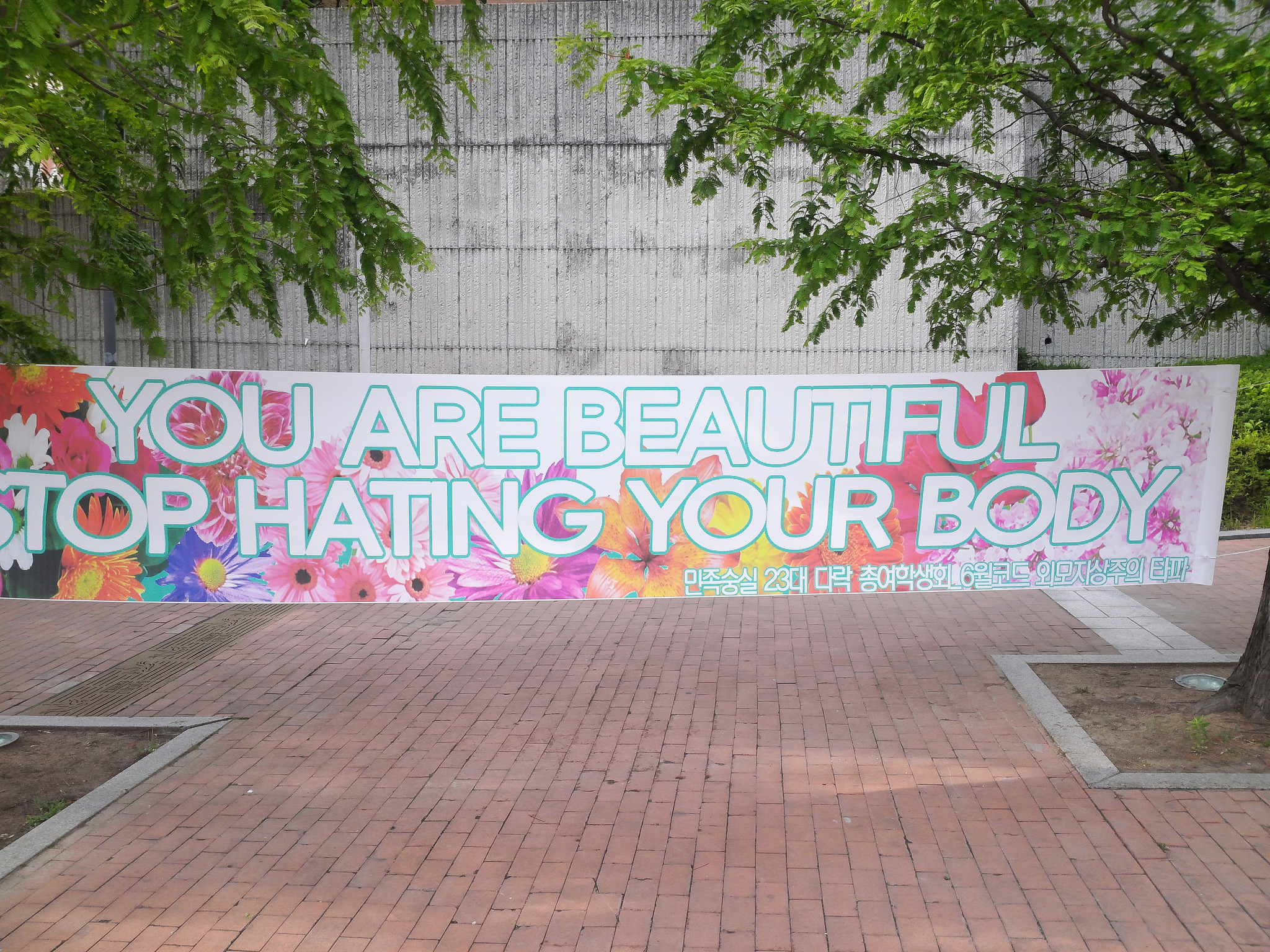
You are Beautiful, Stop Hating Your Body

You are beautiful, stop hating your body(Source: 숭실 총여학생회 다락 Facebook Page)

Oops, I haven’t written in a while. Time to find something about body-image, the media, or popular culture to complain about then.

Seriously(?) though, there’s only so many times you can mention that young Korean women are chronically underweight, and the likely reasons for that. Better to highlight groups actually doing something about it instead.

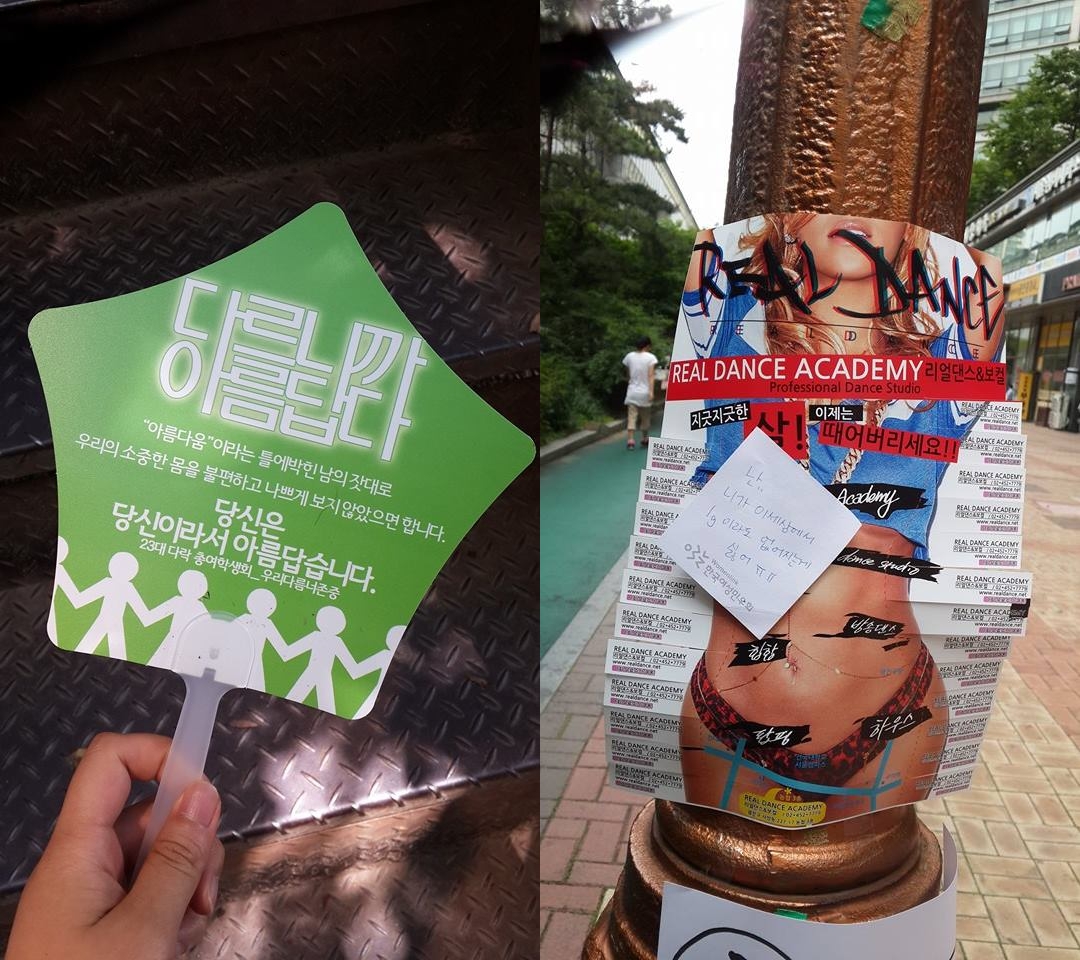
One group is the Soongsil University Female Students’ Association, which recently encouraged women to stop excessive dieting by offering them free snacks, and passing on stickers and fans with messages like the one on the left above. It reads, “You’re different because you’re beautiful. Don’t feel bad or uncomfortable about your precious body based on other people’s stereotypes. Because you are you, you are beautiful. The 23rd Soongsil University Female Students’ Association: we are different, and we respect you.”

Those small efforts may seem futile in the face of the barrage of body-shaming messages women receive every day, but with three in five 19-24 year-old Korean women regularly skipping breakfast (nearly one in five, lunch and/or dinner too), then surely the growls in their stomachs at least got some questioning whether it was really worth it. As for the messages, body-image activist Minji Kim pointed out they’re surprisingly effective, and are now used by a number of organizations working on body-image issues:

“These messages create solidarity among people whose issues may have seemed daunting, because they were struggling alone. But when people share their stories and start talking about them? Then immediately they feel less lonely and empowered by knowing that there are other people like them out there and that they do have a support system.”

More specifically, Minji was talking about post-its like the one on the right, which reads “I would hate for you to lose even one gram in this world.” I’m unsure if it was placed there by the Soongsil students, by Korea Womenlink (remember their cool subway posters?), or if it was part of a collaborative effort, but the effect is the same!

You are Beautiful(Source: lunacharsky; used with permission)

Hat tip to the The Rootless Metropolitician, who led me to the group via the above photo.

The Women’s Issue

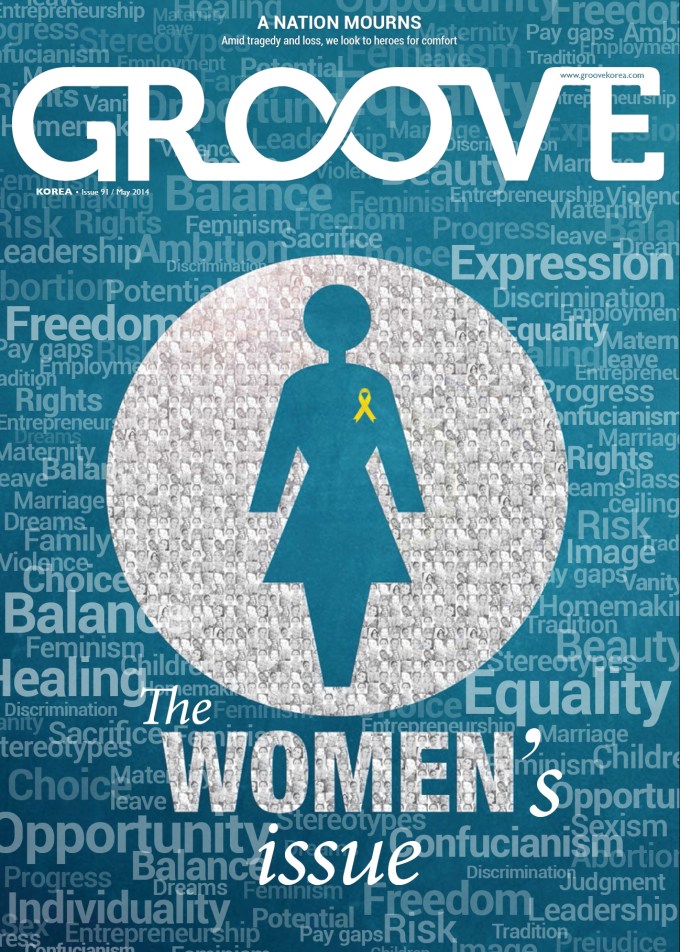
Groove May 2014Sorry for the slow posting everyone: I recently had food-poisoning, some editing deadlines and my students’ end of semester exams are looming, and on my days off I’ve been on a mini-whirlwind tour of Korean universities giving presentations about body-image. But I hope to be posting again soon, and, until then, the latest issue of Groove Magazine will easily provide more than enough insights and new information to whet your appetites!

If you can’t get a physical copy, please click on the image above to read it at Issuu (a quick registration is required), or to download a PDF (click on “share” to get the link).

Update: I forgot to mention that I was interviewed for Annie Narae Lee’s article on page 58, but it may not appear online unfortunately. Also, I’m still too busy to listen myself, but Groove’s recent podcast on abortion in Korea sounds useful and interesting.

Busan Slutwalk, Sat Aug 31, 6-7PM, hosted by Don’t Do That

Busan Slutwalk 2013 Flyer 1

Update: I’ve just been informed that Slutwalk Korea and Don’t Do That are very different organizations, and that the latter — the organizers of Saturday’s event — advocate wearing more conservative dress than in regular slutwalks, arguing that participants who wear racier costumes run the risk of being charged with indecent exposure, and that toning things down would be more appropriate for a first event in Busan. Nevertheless, they accept short miniskirts, hotpants, croptops, and whatever slogans participants wish to write on placards.

Apologies if I’ve inadvertently misrepresented either organization, and I’ll update readers if any new information becomes available. Alternatively, please also check Korean Gender Café or Don’t Do That’s (Korean) Twitter feed.

Update 2: The Korea Times discusses the disagreements between the two organizations here, saying Slutwalk Korea has accused Don’t Do That of slut-shaming itself in its emphasis on conservative dress. I don’t know enough about either organization to comment sorry, but wager that any such accusation will have been greatly exaggerated to better fit the snarky tone of the article.

Original Post:

Reblogged with permission from Korean Gender Café:

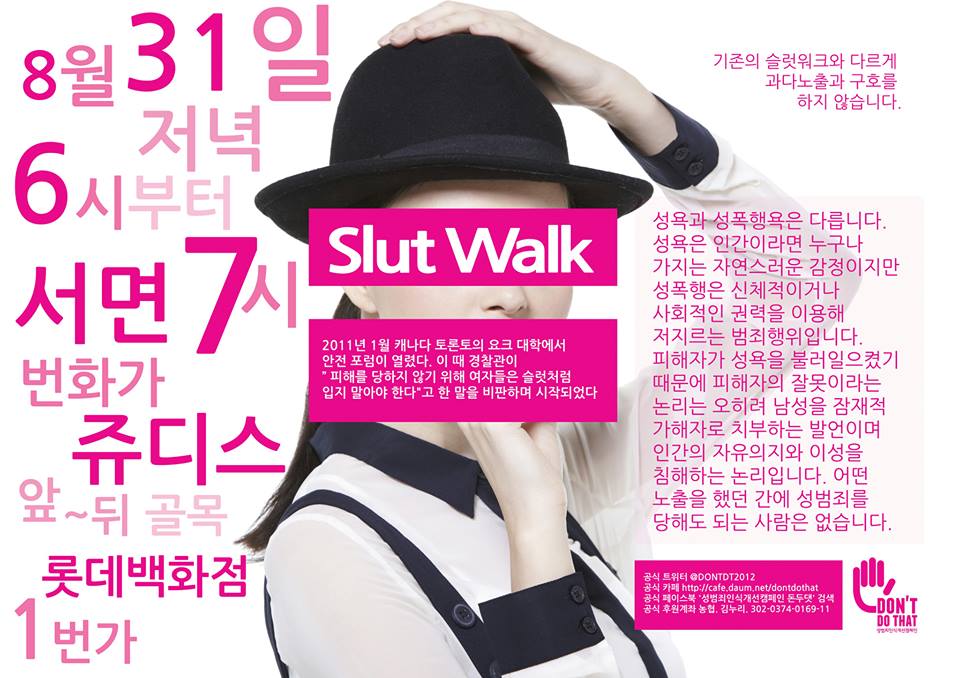
Don’t Do That Campaign welcomes you to participate in a slut walk

I had a great chat today with organizers of Don’t Do That (성범죄인식개선캠페인 돈두댓), a campaign to change mindsets about sex crimes. The group is organizing a slut walk campaign in Busan and Seoul. I translated the information below and hope that readers will share it widely.

Don’t Do That is a voluntary group that comes together to raise awareness about sex crimes. Their site offers a lot of information and is a great resource.

Event in Busan:

On Saturday, August 31, 2013, 6PM ~7PM there will be a slutwalk hosted by the Don’t Do That (성범죄인식개선캠페인 돈두댓) Busan Team.

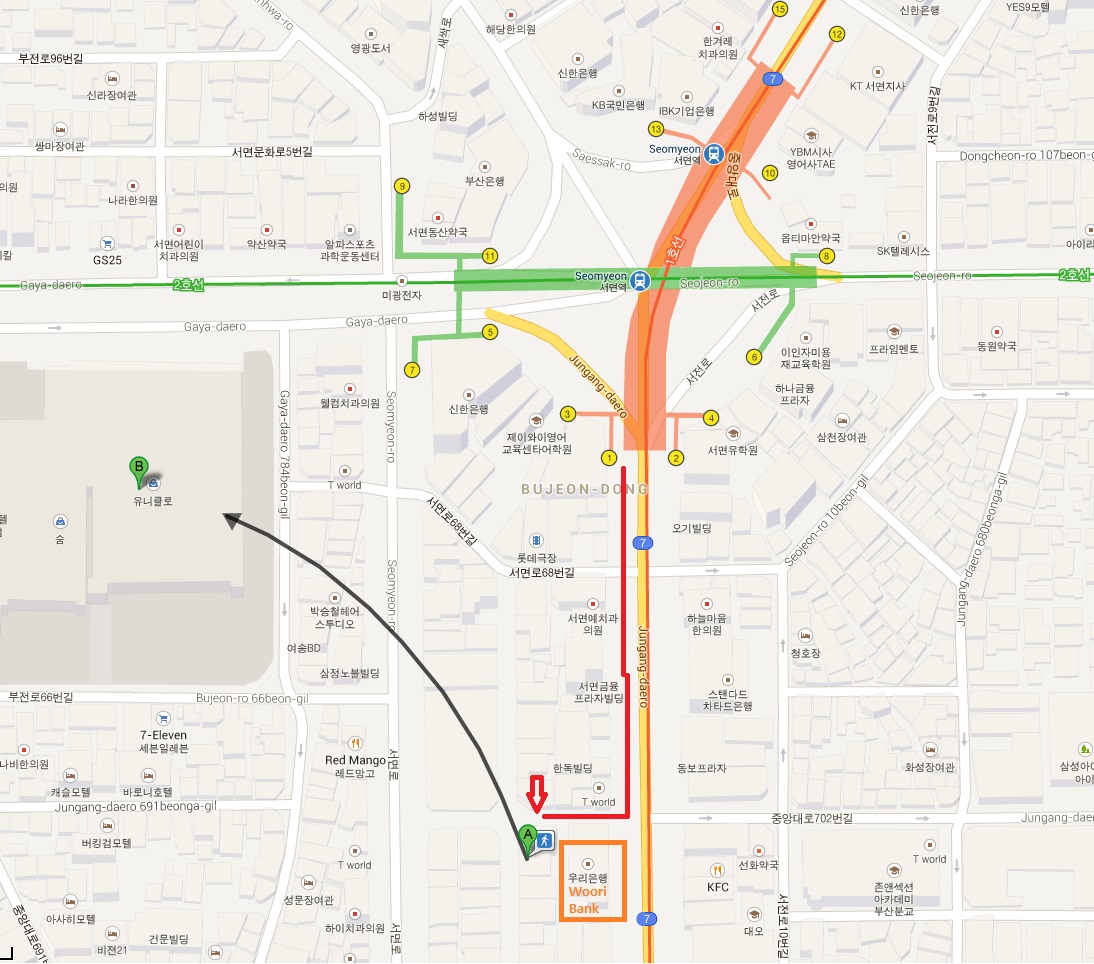
The walk will take place near Bujeon-dong, Seomyeon Subway Station (Line 1 & 2), Exit 1.

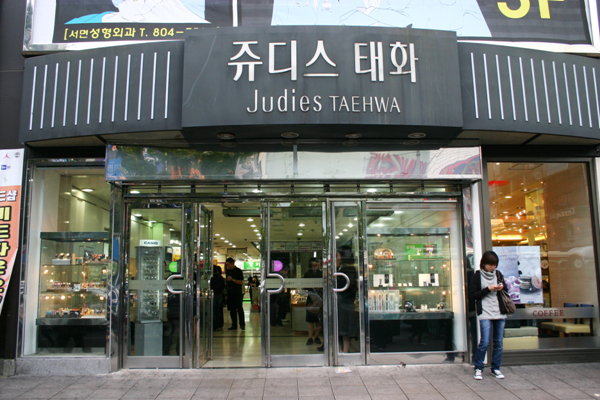
Participants will meet at the ally next to Judies Taehwa and march toward Lotte Department store. Please see the map below and spread the word~

For additional information about this event, please contact organizers via KakaoTalk ID jinamarna or via Facebook.

Here is a little map I made of the area in Busan where the slut walk will take place:

Busan Slutwalk 2013 MapThis is an image I found of Judies Taehwa storefront, participants will meet nearby at 6PM:

Judies Taehwa BusanFor more information about Don’t do that (성범죄인식개선캠페인 돈두댓) please check them out on Facebook, Twitter, and Daum Café.

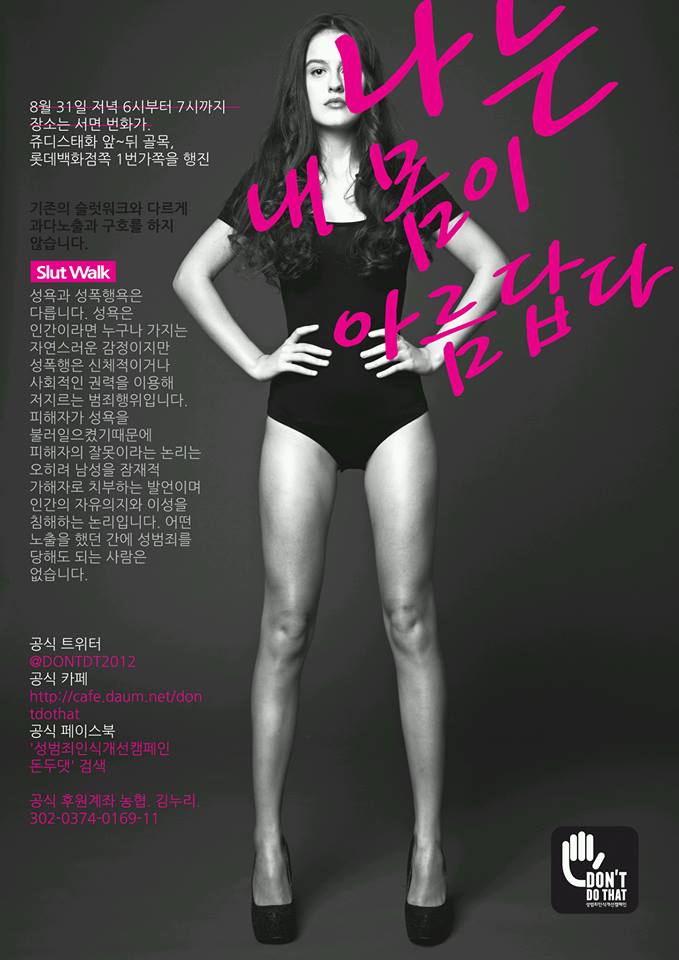
Please share the flyers below (James — I included one as the opening image):

Busan Slutwalk 2013 6PM Flyer 2

Busan readers, if you attend the event, I would really love to hear about it~ I wish I could make it out this time, but I can’t. Please share this event and support the cause.

Readers in Seoul, I will be sure to provide similar translation/map when I hear from the Don’t Do That Seoul Team.

Another group that may interest readers is Slutwalk Korea. Slutwalk Korea organized the first slutwalk movement in Asia in early 2011. They launched a number of events in global solidarity with the slutwalks that started in Toronto and all over the world that year. They have also hosted global solidarity events for Pussy Riot and on March 8, 2013 for International Women’s Day. They have a great Twitter feed and regularly post information related to sexual violence or slutwalk-type events in Korea ( I learned about Don’t Do That from a Slutwalk Korea Twitter post).

Posted by

(See here for a write-up of the 2011 Seoul event by Roboseyo, or the “잡년행진” tag and “Rape” and “Sexual Harassment” categories for related posts on this blog)

Update 3: Here’s a report of the event, written by one of the participants.

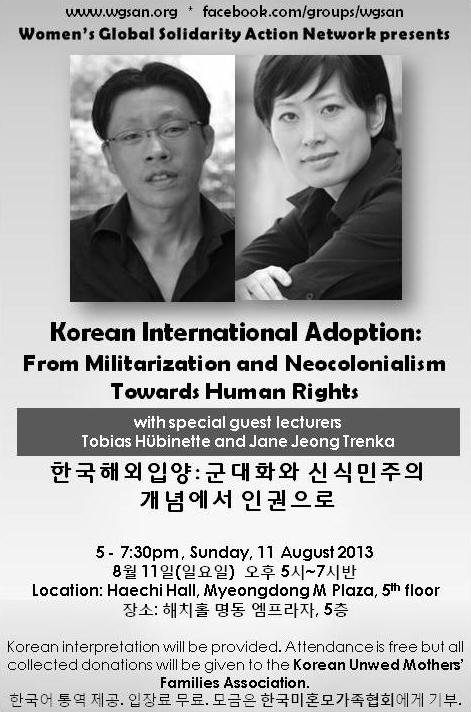
Lecture This Sunday — “Korean International Adoption: From Militarization and Neocolonialism Towards Human Rights”

Korean International Adoption From Militarization and Neocolonialism Towards Human RightsI’ve been asked to pass on the following:

“Korean International Adoption: From Militarization and Neocolonialism Towards Human Rights” with special guest lecturers Tobias Hübinette and Jane Jeong Trenka

August 11th (Sun), 5-7:30pm at Haechi Hall (Seoul Global Culture & Tourism Center, Myeongdong, M Plaza – 5th floor). Korean interpretation will be provided. Attendance is free but all collected donations will be given to the Korean Unwed Mothers’ Families Association.

“한국해외입양: 군대화와 신식민주의 개념에서 인권으로” 토비아스 휘비네트교수와 제인정트렌카 작가 특강

날짜: 8월 11일 (일) 5시부터 7시반까지, 장소: 해치홀 (서울글로벌 문화와 광관센터, 명동 엠프라자 5층). 한국어 통역 제공. 입장료 무료. 모금은 한국미혼모가족협회에게 기부.

FB event page here. come, come, come! (also all reblogs greatly appreciated!)

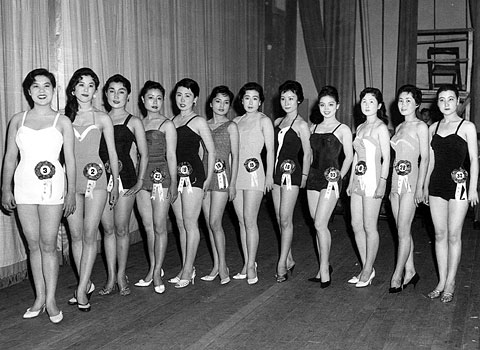
No V-lines Required: Miss Korea in the 1960s

(Source: Munhwa Ilbo)

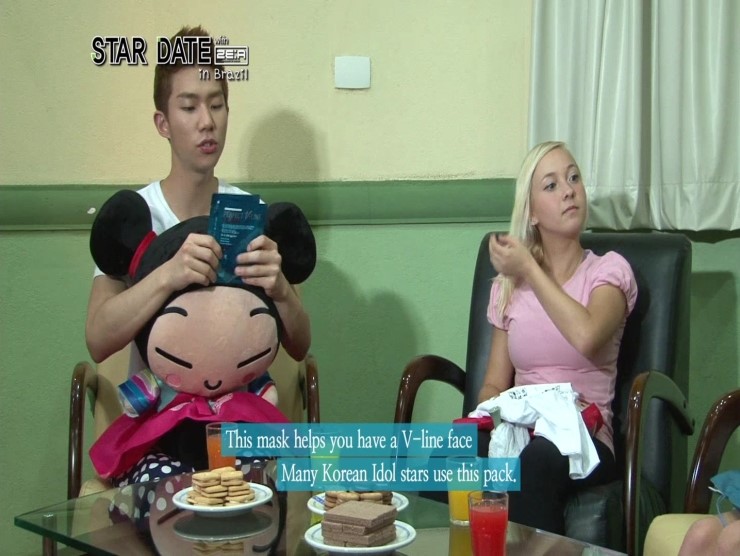
Alas, this brief article from today’s Munhwa Ilbo isn’t exactly a scathing critique of Korea’s body-labeling craze, and I don’t mean to imply that there aren’t much more substantial ones out there. But still, it’s good to be quickly reminded that perhaps “V-lines” aren’t as necessary as pop-culture icons would like us to think (e.g., see ZE:A in Brazil below), and I hope the photo makes it to the front page of major Korean portal sites.

See here or here for better quality versions, or here and here for pictures of the 1957 and various 1970s contestants respectively.

60년대 미스코리아는 ‘V라인 아닌 건강미’ / In the 1960s, Miss Korea Had a Healthy Beauty, not a V-line.

‘미인’의 기준은 문화와 관습에 따라 다르지만 시대에 따라서도 변합니다.

The criteria for a beautiful woman depend on time, culture, and customs.

사진을 보면 1960년 미스코리아 선발대회에 나온 여성들은 건강미가 넘쳤습니다. 당시에는 서구적인 마스크를 선호했다고 하죠. 1980년대 이후 한동안 도시형 미인이 인기를 끌었고, 요즘은 ‘V라인’의 작은 얼굴과 뚜렷한 이목구비가 대세라고 합니다. 성형미인도 많아졌고요.

If you look at this photo of the 1960 Miss Korea contest, you see women overflowing with healthy beauty, [even though] it is said that people preferred Western masks [looks?] then. [But] from the 1980s, for a while urban beauties were preferred, and these days having a V-line and distinct facial characteristics are huge trends. There are many cosmetic surgery beauties.

1957년 시작된 미스코리아 선발대회는 초창기 큰 인기를 모았습니다. 공중파 TV를 통해 전국에 생중계됐고, 수상자들은 카퍼레이드까지 하며 미를 뽐내기도 했었죠. 그러다 여성단체 등의 ‘성상품화 조장’ 반발로 2002년 이후 공중파에서는 중계를 하지 않고 있습니다.

(Source: Yufit)

Starting in 1957, from the beginning the Miss Korea contest was very popular. From being shown live on TV, to winners taking part in car parades, their beauty was shown off. However, later women’s groups denounced it as promoting sexual objectification, and from 2002 it was only allowed to be shown live on cable.

예전에는 미스코리아 선발대회를 통해 연예계로 진출하는 경우도 많았지만 요즘은 오디션 프로그램 등 연예계로 나설 방법이 다양하게 생겨났습니다. 그래서인지 대회의 인기가 예전만 못합니다.

In the past, there were many cases of Miss Korea contest participants entering into the entertainment industry through the competition, but these days there are a variety of audition programs that provide the same opportunity. Because of that, the contest can’t reach the level of popularity that it enjoyed in the past. (End.)

Update: Here’s a video of the 1981 to 2008 winners. As one of the commenters on YouTube put it, it’s interesting to see how much their faces seem to change from the late-1990s onwards.

Korean Sociological Image #69: Attitudes Towards Sexual Objectification, 2004 vs. 2012

Back in 2004, I would study Korean by translating articles about Lee Hyori’s breasts. Because that was much more interesting than reading about the joys of kimchi-making in Korean textbooks.

So, I hardly romanticize that era as more innocent and chaste than today’s. Nor, by highlighting just one complaint by one women’s group from then, do I mean to imply that the Korean public was necessarily more prudish back in 2004, or that it’s necessarily more permissive today. After all, my Google News Alert for “성상품화” (sexual objectification) still provides me with fresh critiques of the recent Miss Korea Pageant every day. And who can forget the role “Bikini Girl” played in April’s congressional elections?

Having said that, things definitely have changed in 8 years:

  • Starting about 2006, ubiquitous soju ads started featuring women in revealing clothing after decades of almost exclusively using demure, virginal-looking models.
  • A little later, dominant media narratives about girl-groups, depicting middle-aged male fandom as platonic rather than sexual, provided a window for their objectification to flourish.
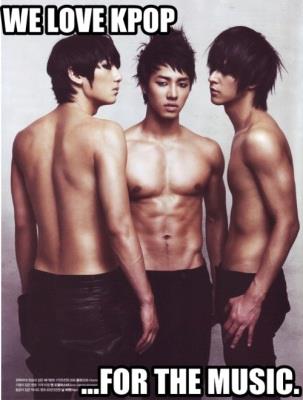
  • Men have also been increasingly objectified, particularly after the “chocolate abs” label was coined in 2009.
  • The number of smutty online-ads has surged, especially in the last year.
  • And last but not least, it’s difficult to find an advertisement for water-parks (also ubiquitous) that doesn’t feature a scantily-clad girl-group, with one—Ocean World—even inventing a group specifically for that purpose. (Boy bands and male models are used also, most notably by Caribbean Bay below, but my strong impression is that there’s much less of them than women)

In short, it is via the increasing objectification of (especially) girl-groups that you can see a clear McDonalidization of Korean cultural industries in recent years (see here, here, herehere, and here for more on the hows and whys). And, because of that shift, it’s difficult to imagine a complaint like this being given much attention in 2012:

전남관광 책자 두고 ‘여성상품화’ 논란 일어 / Controversy over Sexual Objectification of Women in Jeollanam-do Tourist Brochure

Oh My News, June 15 2004. By Gang Seong-gwan.

지난 6월초 전남도가 여름 관광객을 겨냥해 제작배포한 관광 홍보책자 ‘남도스케치’에 사용된 비키니 차림의 여성사진이 논란이다. 광주여성민우회는 14일 성명을 통해 “남도스케치 배포를 즉각 중단하라”고 요구하고 나섰다.

Controversy has arisen over the use of women in bikinis in the June edition of tourist brochure Namdo Sketch, a widely-distributed brochure aimed at summer tourists . In an announcement on the 14th, the Gwangju branch of Womenlink demanded that it stopped being distributed immediately.

(Source: James Turnbull)

전 남도는 ‘남도스케치’를 제작하면서 책 표지, ‘전남이 추천하는 여름 여행지 BEST’ 중 완도 명사십리 해수욕장 등 7곳을 소개하면서 비키니를 입은 여성의 사진 10여장을 게재했다. 이 책자는 겉표지까지 총 85페이지로 구성됐으며 비키니 사진은 책자 앞 부분에 게재했다. 전남도는 제작된 책자 2만여부를 터미널 등 공공장소와 전남도내 기초단체 등지에 배포를 마친 상태이며 조만간 2쇄에 들어간다는 계획이다.

이에 대해 광주여성민우회는 “여성을 성 상품화했다”면서 전남도의 공개사과는 물론 책자 배포 중단을 요구하고 나섰다.

With a cover title of “Best Recommended Tourist Sightseeing Areas in Jeollanam-do” [James – I can’t see that title myself, but unfortunately that opening photo was very small], Namdo Sketch introduces 7 tourist sights, including Wando and Myeongsashibri Beach, and uses a total of 10 pictures of women in bikinis on the front cover and in the first part of the brochure, out of 85 pages. By the end of its first printing, the Jeollanam-do Provincial Government had distributed roughly 20,000 copies to transport terminals, public places, and civic groups, and planned to make a second printing.

Gwangju Womenlink said that the brochure sexually objectified women, and demanded a public apology as a matter of course, as well as a halt on further distribution.

“여성 성 상품화 한 것, 배포 중단”…”문제제기 이해하지만, 시원한 여름을…” / “This is the sexual objectification of women, distribution must stop”…”We understand, but hey: this is summer…”

광주여성민우회는 “전남 관광홍보는 여성의 비키니만이 유일한 대안인가”라며 “공공기관에서 나온 책자인가 할 정도로 낯뜨거운 장면이 많이 실려 있어 당혹스러움과 황당함을 느낀다”고 밝혔다.

Gwangju Womenlink argued that “Are women in bikinis the only option for a tourist brochure?”, and said “We are embarrassed and perplexed that a public institution would go so far as to use such crude [James – I think this is a better translation of “낯뜨겁다” than “obscene” or “rude”] images in a tourist brochure.” (source, right)

이어 “지역에 관광객을 유치하기 위해 명소를 소개하는 것은 좋지만 관광지역의 구체적인 정보와 특색 있는 프로그램의 홍보 대신 여성의 비키니 복장을 내세워 시선을 끌어보고자 하는 공무원의 얄팍한 속셈은 용납될 수 없는 행위”라고 비판했다.

Continuing: “It is good that tourists are being attracted to this area by having places of interest introduced to them. But instead of providing concrete information and unique tourist programs, the PR simply consists of pictures of women in bikinis, designed to attract one’s attention. This is both shallow and misguided of Jeollanam-do officials, and can’t be forgiven.”

또 여성민우회는 “지역의 명소를 알려내기 위한 기본 조건은 다른 지역과 차별되는 테마를 만들어 남도만의 색다른 맛을 느끼게 하는 것이다”면서 “노력해야 할 것은 따로 있는데 엉뚱한 것으로 메꾸려는 것은 직무유기”라고 주장했다.

여성민우회는 “여성의 성 상품화를 부추기는 공공기관의 홍보책자는 결코 용납될 수 없다”면서 ‘남도스케치’의 배포중지를 요구했다.

Also, Womenlink emphasized that “What should have been done to inform tourists about places of interest was showing them how different they were to other ares and what unusual tastes, experiences, and feelings Jeollanam-do has to offer. Instead of making an effort and doing their duty though, officials offered this rubbish.”

It added that “Promoting the sexual objectification of women is never acceptable”, and so demanded an immediate halt to the distribution of the brochure.

(Sources: left, right)

이에 대해 전남도청 한 공무원은 “문제제기는 이해한다”면서도 “여성의 사진을 표지에 넣는다고 해서 이 책자가 눈길을 끌고 있는 것은 아닌 것 같다”고 말했다.

그 러나 또 다른 공무원은 “여성의 비키니 사진을 두고 상품화까지 이야기하는 것은 지나친 것 아니냐”며 “오히려 여성단체들이 그렇게 주장하면서 폄하시킨 것은 아닌지 모르겠다. 물론 어느 정도는 이해할 수 있지만 이런 사진을 많이 사용한 것도 아니지 않느냐”고 주장했다.

In response, a Jeollanam-do official said ” We understand the concerns, but it’s not because of the women in bikinis on the cover that people are drawn to the brochure.” Another emphasized that “It’s a complete exaggeration to claim that just pictures of women in bikinis is objectification. Rather, it’s women’s groups that are degrading women by doing so. And it’s not like we used many in the brochure.”

관광책자 제작 담당부서인 전남도청 관광진흥과 이명흠 과장도 “여성단체의 지적사항에 대해서 전혀 모르는 바는 아니다”면서도 “행정관청에서 발행한 책자여서 그럴텐데 여름에 맞춰서 시원한 해수욕장과 수영복을 입은 모습의 여성을 모델로 했을 뿐이다”고 말했다.

이어 이 과장은 “행정기관이 발행했다는 느낌이 들면 잘 보지 않는다. (관광객들의) 눈길을 끌 수도 있다는 생각에서 진행한 공격적인 마케팅의 일환이다”며 “너무 한쪽으로만 생각하지 말고 발상을 바꿨으면 좋겠다”고 주장했다.

(Source: Metro Seoul, 31 May 2012, p.49)

Lee Myung-hum, the head of the Tourism Promotion Office of Jeollanam-do Provincial Government that produced the brochure, said “It’s not like I don’t understand women’s groups concerns. But only swimsuits are appropriate for female models promoting cool swimming areas in the summer.” He added that “No-one ever pays attention to anything produced by a council tourism promotion office. The images were simply part of an aggressive marketing technique designed to get the attention of tourists, and shouldn’t be overanalyzed.”

한편 ‘남도스케치’ 표지모델은 전남도청 여성 공무원 중 희망자들이 참여하기도 했으며, 지난해에도 전남도는 여름 관광홍보 책자를 제작하면서 표지 등에 비키니을 입은 여성 사진을 게재한 바 있다.

The models used in the brochure included Jeollnam-do female officials [James — it says only the cover, but there were only 2 women on that], and a similar brochure was produced the previous year (end).

James — While the Jeollanam-do officials didn’t sound too sympathetic in that June 2004 article, another from the next month points out that in the second printing the bikini models were removed from the cover and 2 more pages, although some did still remain. It’s from that article that the before and after covers came from.

(For more posts in the Korean Sociological Image series, see here)

Revealing the Korean Body Politic, Part 2: Kwak Hyun-hwa (곽현화), Pin-up Grrrls, and The Banality of Sex and Nudity in the Media

(Sources: left, right)

Apologies for the irregular posting everyone — I’ve been really busy for the last month or so, and to top it all off I’m recovering from a bad flu as I type this too. But fortunately the end of the semester is close, and I’m eager to get stuck into the two blog series I plan to devote myself to this summer.

One is looking at the evidence for double-standards in Korean censorship, while this one is about examining the public and media’s policing of — and consequent narratives about — “appropriate” displays of nudity and sexual subjectivity, set against a recent potential backlash against changing gender relations. In hindsight just two different elements of the same investigation, the former focuses on K-pop in 2011 and this one on political protests in 2012.

As you’ll recall from Part 1 though, one problem with looking at anything explicitly political is that partisan reporting gets in the way, which means we need to consider as many sources as possible to be objective, and especially not just rely on English-language sources. So, let me start that by presenting my translation of a post by a blogger known as “비춤” (or on Twitter as @RainyDance01), which was originally posted on his or her blog Rainy Dance, then later reposted at Mediaus. About the photo on the right (source) of comedian turned model, singer, and actress Kwak Hyun-hwa (see Part 1 for the details), as you’ll see I think the blogger’s heart is in the right place, but unfortunately some of their reasoning dodgy at best, and evidence seemingly pulled out of thin air:

곽현화식 투표독려? 누드가 일상이 되면 식상하다  / Does Kwak Hyun-hwa’s Style Promote Voting? When Nudity Becomes Routine, it Becomes Boring

10 April 2012

국회의원 총선거를 코앞에 두고 투표율을 올리고자 수많은 유명인들이 투표 독려에 나서고 있습니다. 소설가 이외수씨는 투표율 70%가 넘으면 머리카락을 싹둑 자르겠다고 밝혔고, 안철수씨 또한 70%를 넘으면 미니스커트를 입고 율동에 노래를 부르겠다고 밝혔지요. 이렇듯 저마다 자신의 공약을 내세워 투표독려에 나서고 있습니다. 이들의 공약은 대중에게 소소한 재미와 더불어 투표참여의 의미를 되새겨주고 있는데요. 거창하진 않지만 자신만의 방식으로 사회적 메시지를 전달하는 유명인들의 모습은 새로운 문화가 되고 있는 느낌입니다.

Just before the general elections, many famous people are doing various things to encourage more people to vote. For example, novelist Lee Wae-soo has pledged to cut his trademark long hair if the voting rate exceeds 70%, while Ahn Cheol-soo has promised to dance wearing a mini-skirt (see below). While these may sound just trivial and fun, they do remind voters about the meaning and importance of voting. Also, while their ultimate impact may not be all that great, they point to a new trend of famous people spreading social messages.

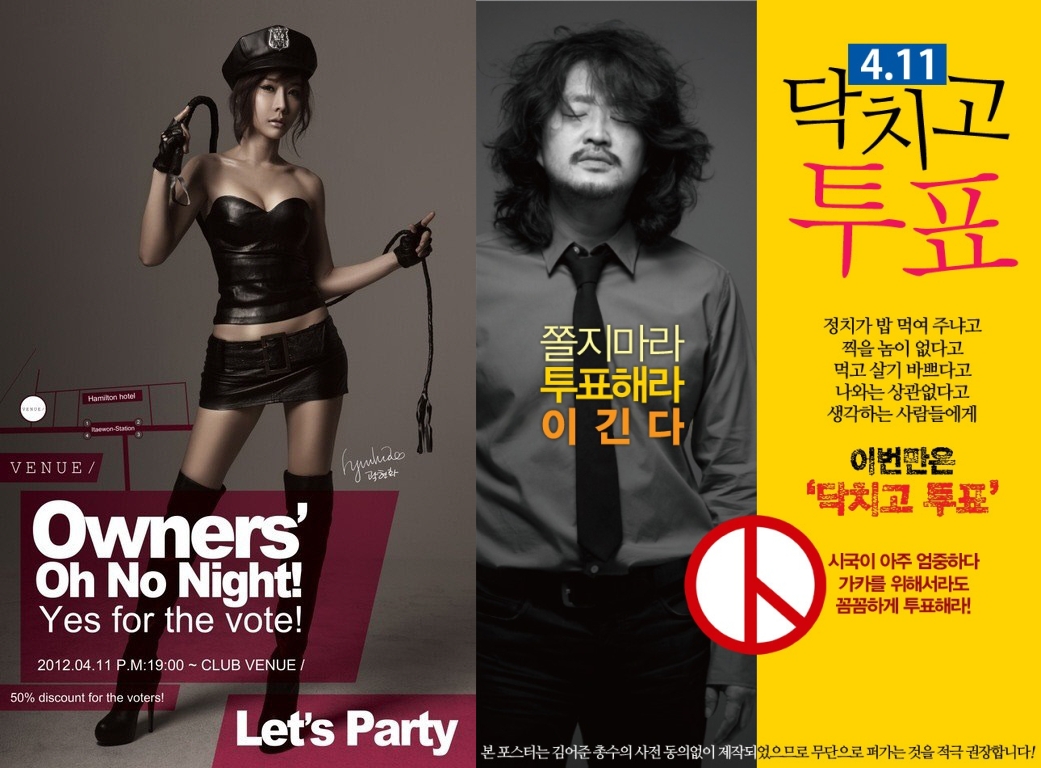
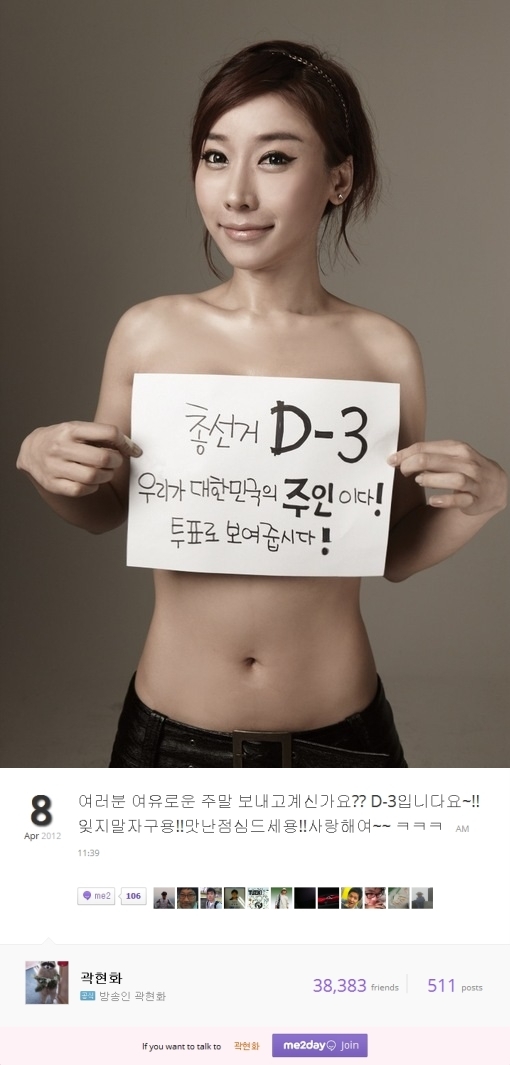
그런데 같은 목표를 지향하더라도 그 방법 탓에 오히려 대중의 반감이 우려되는 경우도 있는데요, 개그우면 곽현화의 경우가 그렇습니다. 곽현화는 투표독려를 위해 자신의 미투데이에 ‘총선거 D-3, 우리가 대한민국의 주인이다! 투표로 보여줍시다’라는 내용이 적힌 종이를 들고 있는 상반신 누드 사진을 올렸습니다. 그 의도야 건설적이지만 이면에는 새로울 것이 없는, 우리의 식상해진 문화 코드가 선명하지요.

However, while they all have the same target, some celebrities’ methods may actually make voters more apathetic. One such case is that of comedian Kwak Hyun-hwa. In her case, she uploaded a photo on her me2day blog in which she is holding a sign in front of her nude upper body. The sign said “It’s 3 days to go before the elections. We are the owners of Korea! Let’s show this by voting!”. But while the intention was constructive, on the other hand this method is hardly original, and shows the paucity of our culture.

자신의 의사를 표현하는 방법에 옳고 그름을 규정하기는 어렵습니다. 하지만 그녀가 지금까지 보여온 행보를 본다면 아름다운 취지보다는 이면의 가십거리가 더욱 부각될 수밖에 없겠지요.  폭소클럽 출연당시 가슴노출이 심한 드레스를 입고 출연해 노출논란의 불을 지핀 이래로, 그녀는 꾸준히 노출의 길을 걸어왔었지요. 섹시화보가 누출되어 세간에 화제가 되기도 했으며, 지나치게 선정적인 앨범 이미지컷으로 눈총을 받기도 했습니다.

It’s difficult to judge what the best or most “correct” way of expressing oneself is. But looking at Kwak Hyun-hwa’s past history up until now, it’s difficult not to conclude that this stunt of hers was more aimed at creating gossip and attention about herself than anything noble. When she was on the comedy Foxclub for example [James — she quit in 2009], she used to create a lot of controversy by wearing a lot of revealing dresses, and since then has continued on a similar path. For instance, she has done a very sexy photoshoot, and received criticism for her provocative and suggestive images for her album.

(James: I’m not judging — and/or defending — Kwak Hyun-hwa in any sense, but just for the record: while she’s certainly done sexy photoshoots, and you can judge her album pictures for yourselves, I think it’s unlikely that she regularly wore a lot of revealing dresses on Foxclub. If she had, then presumably there’d be far more “노출” videos and photos of her on that show available than just those from one short skit back in 2008)

올 초에는 개그맨 동료들과 선정적인 포즈로 찍은 사진이 이슈가 된 바 있는데요. 비난이 잇따르자 이에 대한 반감으로 자신의 미투데이에 바나나를 먹는 야릇한 표정의 사진을 올려 더 큰 역풍을 일으키기도 했지요. 하지만 그녀는 떳떳하게 말합니다. ‘’성적인 감정을 일으켰다고 해서 지탄하는 것은 마녀사냥이다. 의도를 떠나서 개그맨 전체를 싸잡아 욕하는 성급한 일반화의 오류를 범하지 말아 달라’

Earlier this year, some pictures of Kwak Hyun-hwa in pretend sexual poses with some her comedian colleagues became an issue [James — they can be seen here]. In response to the criticism that followed, on her blog she posted pictures of herself with a perverted expression on her face while eating a banana [James — was the author too embarrassed to be more specific?], which led to even more criticism. But in response to that, she boldly replied, “Just because something is arousing doesn’t mean it should be criticized — to do so is nothing but a witchhunt. And whatever the intention(s), don’t make the mistake of making rash generalizations about all comedians.”

(Source)

과연 그녀를 바라보는 냉랭한 시선은 성급한 일반화의 오류일까요. 사실 벗는 것은 여자에만 국한된 것은 아닙니다. 남자도 벗습니다. 초콜릿복근이니 식스팩이니 하며 매력을 뽐내는 남성들도 얼마든지 있지요. 하지만 남성의 매력을 규정하는 잣대에서 ‘벗는 것’의 비중은 상대적으로 크지 않습니다. 지적인 남자, 자상한 남자와 같이 이 시대의 여성이 매력을 느끼는 아이콘은 상대적으로 많은 편이지요. 그래서 벗는 것으로 일관하는 남자는 오히려 역풍을 맞기도 합니다. 여담이지만 한때 1박2일에선 이수근이 숱한 노출을 보이며 빈축을 사기도 했습니다.

Well, is looking at her coldly and making a rash generalization really a mistake here? Of course, it’s not just women that take their clothes off — men do too. To show off their attractiveness, they expose their chocolate abs, their six packs [James – actually, those are the same thing], and so on. But relatively speaking, taking clothes off isn’t as important for men as it is for women; because in this day and age, there are many ways in which women can find their male icons attractive — they can be intellectual or kind. It would be bad if men only took their clothes off. When Lee Su-geun showed too much of his body on an episode of 2 Days & 1 Night for instance, people didn’t like it.

(James…)

반면 여성들에겐 유독 섹시미 혹은 백치미가 강조되지요. 5살 유아부터 70대 할머니까지 섹시하다는 말은 일상어처럼 사용되고 있습니다. 드라마에선 홀로 당당한 일어서는 여성의 이야기는 그다지 성공적이지 못합니다. 여전히 신데렐라의 환상이 더 잘 팔리는 시나리오지요

On the other hand, for women being sexy or being stupid but cute is emphasized. From when they are just girls of 5 to when they are grandmothers in their 70s, the word “sexy” is part of daily life for women. In dramas, the strong, confident woman that succeeds through her own efforts is never a popular story, whereas the Cinderella fantasy is a scenario that always sells well.

이 시대의 남성들은 여성의 매력을 이 한 가지로 국한하고 있는 걸까요, 혹은 여성이 자신 있게 내세울 수 있는 매력은 이 한 가지뿐일까요. 양성평등의 가장 큰 위협은 이렇듯 일방적으로 여성의 섹시함을 강요하는 작금의 문화가 아닐까 싶습니다.

Is this because men of this day and age set limits to women’s sexiness [as just showing off their bodies], or because this is the only sexiness which women can show off confidently? I think this culture of emphasizing just this one side to women’s sexiness is today’s biggest threat to sexual equality.

이 시대의 청년들에게 닮고 싶은 사람을 떠올려보라면, 남성 쪽에선 다양한 매력이 쏟아져 나올 수 있겠지요, 안철수, 안성기, 조국, 손석희, 유재석 등 다양한 분야의 사람을 떠올릴 수 있습니다. 헌데 닮고 싶은 여성상을 물었을 때 우리 사회의 한축을 담당하고 있는 여성을 얼마나 떠올릴 수 있을까요. 그 자리에 섹시아이콘만이 남아 있다면 우리사회가 얼마나 건강하지 못한지를 반증하는 것이겠지요.

(Source)

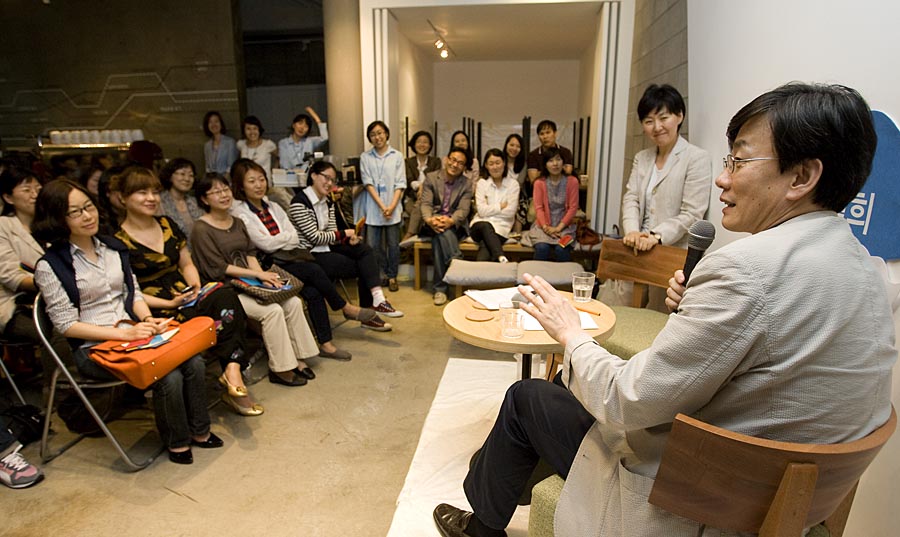
These days, when teenagers are asked who are their role models, boys mention men who are attractive in many different ways and from many fields of life, such as Ahn Cheol-soo, Ahn Sung-ki, Kuk Cho, Son Seok-hee (above), Yoo Jae-Seok, and so on. In contrast, although there’s many women to choose from, girls just name sexy icons. I think this shows how unhealthy our society is.

(James: Other than their fathers, I don’t believe for a moment that teenage boys mention men in their 50s or older as their role-models, even when they want to impress whoever’s asking)

곽현화는 좋은 취지에서 누드시위를 했습니다. 하지만 그 이면에는 이 땅에서 쉽게 주목받고자 하는 여성의 식상한 방법론이 새삼스럽습니다. 우리 사회의 쓸쓸한 단면이겠지요.

Kwak Hyun-hwa [may have?] had good intentions, but her method was unoriginal and was just a way of getting noticed. This too is a sign of how unhealthy our society is (end).

(Source)

What do you think? Again, I find the blogger’s logic — and especially notions of male and female desire — flawed, but at the very least I am now very interested in finding out more about Kwak Hyun-hwa. Not because I think she has any musical talent though (frankly, I hated Psycho above), nor because I naively think her “nude” photo was anything but completely self-serving. Rather, because:

She deserves a lot of credit for reinventing herself as a model, singer, and actress after being best known as a slightly chubby (by Korean entertainment standards) comedian.

Whatever her musical abilities, it was especially brave of her to even attempt to become a solo singer in her late-20s (old age by K-pop standards).

She’s a maths graduate of Ehwa Women’s University, and has even published a textbook for middle-schoolers (see below), so she’s probably quite smart. And I’m not being facetious when I say that many men and women may not be able to see past her cleavage to realize that (related, make sure to read the classic With Great Cleavage Comes Great Responsibility).

What solo celebrity’s public actions and statements aren’t motivated by self-interest? Which is not to say that they’re always cold and calculating of course, but still: it seems a strange criteria to dismiss someone as a person for (after all, heaven forbid that someone use their sex-appeal to advance their career), and is simply an ad-hominem method of devaluing that style of getting a political message across.

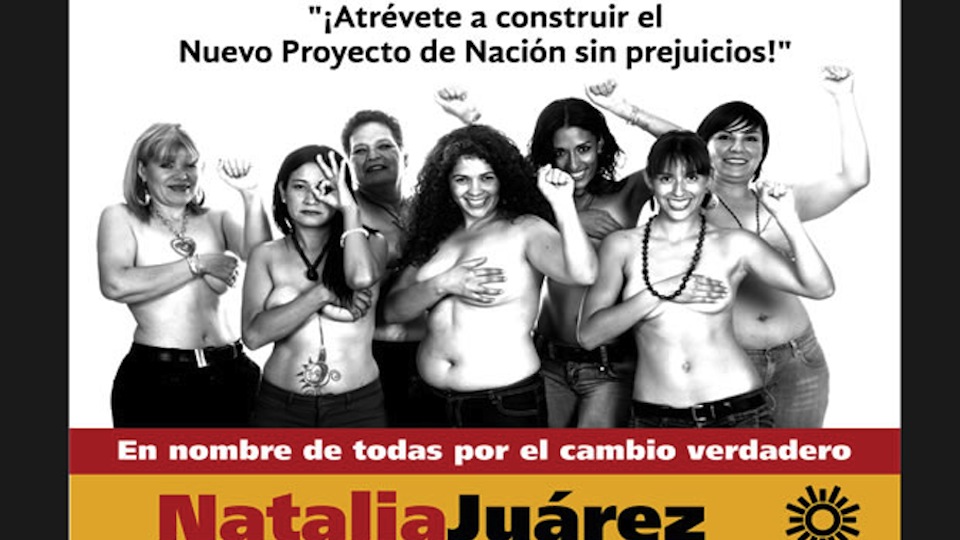
As for its effectiveness, for its stated purpose of encouraging people to vote that is? Well, determining things like that is what this whole series is about, but in the meantime let me pass on Tom Megginson’s take on a similar recent political campaign by Mexican politicians (my emphasis):

Jezebel’s Erin Gloria Ryan is a little cynical about the use of “boobies” to get attention, but I applaud any effort in which women take back ownership of their bodies by using our primal fascination to deliver messages of solidarity for social change.

(Source)

• And finally, remember when Lee Hyori recently publicly admitted that she has sexual feelings and experience? Judging by the reactions of K-pop fans, that was quite exceptional, and indeed I joined in praising her for it in Part 1. But to take a more detached perspective, that this was news at all is really quite an indictment of the sex-only-for-display-nature of Korean entertainment. For remember that we’re not just talking about a 33 year-old woman here, but one who was also Korea’s number one sex-symbol for much of the 2000s. It simply beggars belief that she has ever had to be coy about her sexual subjectivity.

Why do I mention that? Because despite the attention given it, Lee Hyori’s admission pales in comparison to Kwak Hyun-hwa’s stunts with bananas and her comedian friends. And recall that by my own definition, I shouldn’t have to seek-out pin-up grrrls, but rather they should do their darnedest to make me aware of them. In which case, Kwak Hyun-hwa more than qualifies!

And on that definitive note, what is coming in Part 3? Well, frankly a little disappointed with the blog post I translated, next I’ll try make sure to do something more substantial, namely this newspaper report on reasons for the recent “ladygate” phenomenon; i.e., the emerging backlash I mentioned. Thanks to Robert Koehler for the link.

The Revealing the Korean Body Politic Series:

Bikinis, Breasts, and Backlash: Revealing the Korean Body Politic in 2012

(Sources: left, right; edited from originals)

Whenever someone strips for the sake of drawing attention to some cause, usually my instant, gut reaction is to dismiss it as a crass stunt. Unless it’s for Slutwalk or FEMEN, then I’m just too suspicious of their real motives, especially if they’re not already famous.

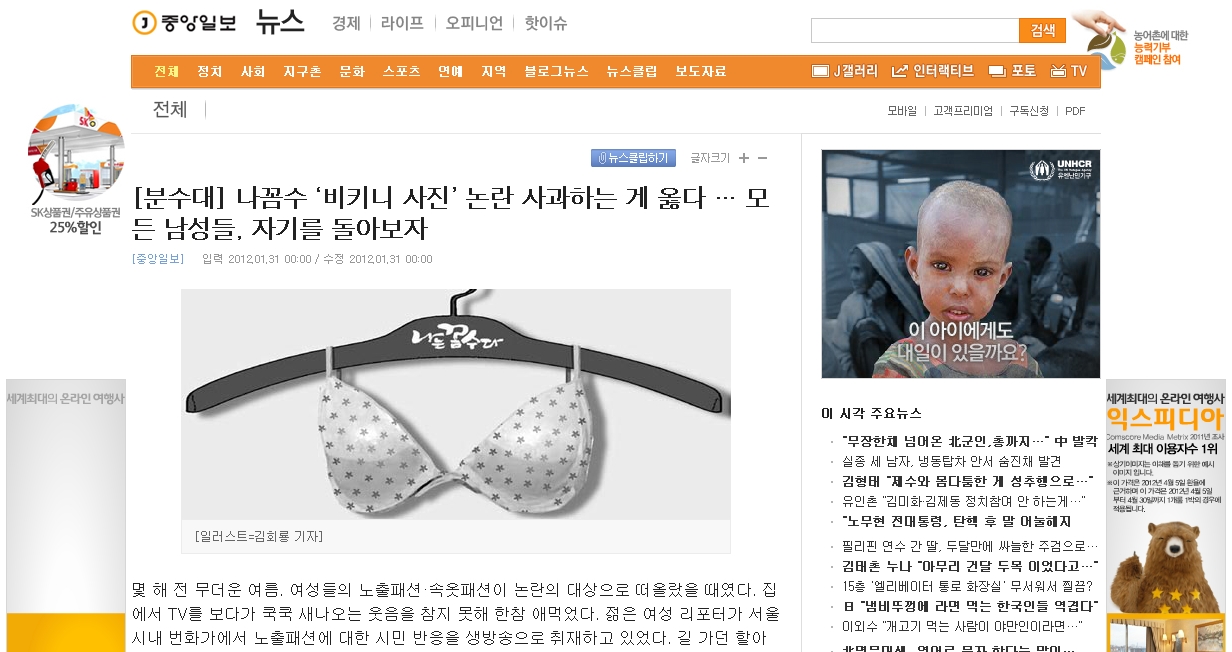
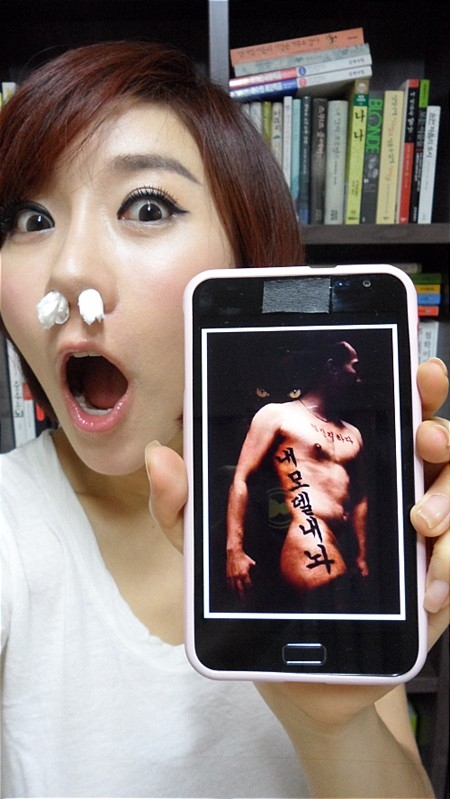
That’s why I didn’t cover this woman back in January, who wrote a message of support for jailed Naneum Ggomsuda (나는 꼼수다) podcaster Chung Bong-ju (정봉주) across her breasts; as while she was anonymous herself (ish), other men and women that followed her example certainly weren’t. Although, in hindsight, only a handful of pictures would actually be sent in, despite an audience of millions, and I overlooked that one of the men was already semi-famous as Chung Bong-ju’s photographer, at the time the podcasters’ call for more bikini shots just seemed like an invitation for a repeat of 2006 and 2010, when women vied with each other to become famous by wearing the most revealing Red Devil costumes.

But then Nancy Lang (낸시 랭) paraded around Seoul in a bikini two days before the April elections, which made me sit very uncomfortably in my seat. Because after lauding her as a “pin-up grrrl” back in November, I couldn’t be quite so dismissive this time, even though her street performance was surely just as crass, and its connection to its ostensible cause — encouraging people to vote — tenous at best. Yet other than a long history of doing similar such performances, how was she really any different from those Naneun Ggomsuda supporters that wrote messages on themselves back in January, and for whom she’d even expressed her support? How about all the other similarly-themed protests and/or pledges over the past few months too, including Kwak Hyun-hwa’s (곽현화) above?

(Sources: left, right)

So, wanting to learn more about the efficacy of such protests, and particularly how useful — or possibly counterproductive — they are in a feminist sense, I realized that “Bikini Girl” deserved a second look. Or, more specifically, what her breasts ultimately raised. For as many of you will already be well aware, the reactions of the podcasters to them, and especially their encouragement of more such pictures, was soon critiqued by many on both the Left and the Right…which in turn led to counter-critiques of those critiques, then the Right chastising the Left for not critiquing the podcasters more, and so on — it was all very confusing. What was necessary was a chronology of events, which indeed I provide below.

But think about it: when breasts become not so much a mere body part as a titillating device for political parties and media allies to score points against each other, then to put it mildly you can’t trust just any one source’s interpretation and depiction of events, and especially not just rely on those that happen to be in English. Which is just common sense, but it deserves reiterating (and for another good illustration of partisan reporting, make sure to see the Korean media’s reaction to netizen attacks on newly-elected Philippine-born Jasmine Lee). So, the other posts in what must inevitably become this series will be translations of some Korean ones, starting with this, then this, this, this, this, and/or any more I can find (and/or readers recommend).

(Source)

Still further complicating matters however, events have coincided with a potential emerging “~녀/girl” meme, in which a series of incidents involving (mostly) young women have left a host of misogynistic netizen reactions in their wake. In particular, for me personally it was this recent incident on a bus, in which a woman in her twenties — out of many angry passengers — was unfairly singled out for criticism, that signaled that something far more pernicious than simple netizen ranting was afoot, and that the backlash against changing gender-relations in Korea that led to the disparaging “beanpaste girl” (dwenjang nyeo; 된장녀) term in the mid-2000s was still very much around.

Even if, ultimately, there are no real connections, it would be strange to analyze bikini and nude protests — some of which arguably very much challenged prevailing conceptions of  “appropriate” displays of sexuality and expressions of sexual subjectivity — without also considering that a potential backlash against changing gender-relations is also occurring. Hence expect more translations about the latter also.

(Source)

On top of that, as if to taunt me, over the last 2 weeks Uniqlo Korea happened to have a “Women’s Freedom Event“, used to sell their “BraTop”. By this stage thoroughly sick of breasts (okay, not really; but I’m sure you can appreciate the sentiment), this choice of language instantly raised some alarm bells, as it reminded me of the following:

…some advertisers, aware of the objections of the feminist movement to traditional images of women in ads, have incorporated the criticism into their ads, many of which now present an alternative stereotype of the cool, professional, liberated women…Some agencies trying to accommodate new attitudes in their campaigns, often miss the point and equate ‘liberation’ with a type of aggressive sexuality and very unliberated coy sexiness (G. Dyer, Advertising as Communication, 1982, pp. 185-86; quoted in D. Strinati, An Introduction of Theories of Popular Culture, 1995, pp. 187-88)

Or indeed “freedom” rather than “liberation”. And, technically speaking, Uniqlo is simply appropriating the word in order to simply sell more clothes. But even if I have always had a fondness for the company, it did interview some genuinely cool women as part of its campaign, and, recalling the line of inquiry that started this 3-week(!) post, provides a healthy reminder to myself to: a) reconsider some of my prejudices and gut reactions to things; and b) not read too much into things.

And on that note, let me apologize for how convoluted and wooly some of my own understanding and explanations of pin-up grrrls have been in the past, and very briefly give some clarifications and further observations on those before presenting the chronology. Not because they’re the final word by any means, but more because, hopefully, they’re good things to bear in mind as you consider the events of the past few months:

(Source)

• Being a sex object doesn’t necessarily preclude one from also being a sexual subject. They are not mutually exclusive.

• However, expressions of sexual subjectivity remain a big taboo in Korea. Or in other words, we can have a 25 year-old’s S-line quite literally highlighted for a heterosexual male gaze, but heaven forbid she admit to having sexual feelings and experience herself. Certainly, this does apply to male celebrities too, but I’d argue to a much lesser extent. In turn, while this double-standard is present in other countries, it’s not difficult to think of female celebrities that thrive on challenging such taboos, whereas admissions like Lee Hyori’s seem to be few and far between among their Korean counterparts (although I’d be very happy to be proven wrong).

• While pictures (etc.) of sexually-attractive women are often framed as being exclusively for a heterosexual male gaze, there is overwhelming evidence (see Maria Buszek’s Pin-Up Grrrls, or this shorter essay) that heterosexual women can be just as if not more interested in them, finding the women — rightly or wrongly — to be confident, sexy role models. A good case in point is Girls’ Generation, who surprised many (including myself) with their huge female fan base in Japan, and who in hindsight may have many more female fans in Korea than is reported too. If that does turn out to be the case, then why the media stresses girl-groups’ “ajosshi” or “samcheon” fandom instead is an interesting topic for further investigation, and I’d speculate that it’s a side-effect of entertainment companies’ prerogative to frame that fandom as platonic (source, right).

• Nobody deserves criticism for financially benefiting from their sexual attractiveness. It is basic human nature, and applies equally whether one is a public or private figure. Moreover, while I can certainly respect those ballsy celebrities who are honest about doing so, nobody ever needs my approval for what they wear, and can give any reason they like — or indeed no reason — for their choices.

• Having said that, using self-sexualization to advance a cause is a double-edged sword, and can easily end up more distracting the intended audience than anything else. Which sounds facetious; but as we’ll see, Bikini Girl proves to be a good case in point.

• Nevertheless, it is hypocritical to criticize politically-motivated sexualization without also criticizing commercially-motivated sexualization, and betrays a political agenda. Indeed, given the pervasiveness of the latter, using skin to get attention is an obvious tool, so it’s strange that we don’t see people stripping for a cause more often in Korea.

Finally, the chronology. Sorry that the Bikini Girl protest is actually the only one that I cover in it, albeit interspersed with all the “~녀” incidents, but another purpose in all the coming translations is getting on top of all the (far less well-documented) other ones, and I’ll either update this chronology or produce a new separate one once I do:

December 26:

— Chung Bong-ju jailed (Korea Realtime)

January 20:

— “Bikini Girl” posts photo, which gains much wider public attention over the next week (DKBNews; translation via Korea Bang)

January 21, 27:

Naneun Ggomsudua podcasters Kim Young-min and Choo Chin-woo (주진우) encourage (and receive) more bikini photos (Korea Times)

January 28:

The Crucible/Dogani (도기나) author Gong Ji-young (공지영) demands apology and calls for the hosts to retract those statements (Korea Times):

“I’ve written a novel to call for heavier punishments for child molesters in the Republic of Korea, which is a world of male chauvinism. This is a country where those sexually assaulting a female schoolmate are released with suspended jail terms because they were drunk, the girl was insufficiently dressed, or she was deemed a slut. This is a country where 70 percent of men have bought sex, so it is natural that people’s perspective on women’s bodies is political,” she said.

— See the Korea Herald (here and here) and Modern Korean Literature in Translation for a discussion of this reaction. In the latter, author Charles Montgomery argues that “immediately [going] to ‘child molestation’ and ‘assault’ in her argument against what is essentially a bikini shot” is too much of a jump, and that with her blanket statement of opposition to them, “Gong is doing a different version of what the GNP has tried to do to her – shutting down a clever method of getting publicity.”

February 1 (source, right):

— “Nude Male Campaign Appears After Bikini Girl Protest Criticized” (Daum; translation via Korea Bang):

Nude male photos in support of the imprisoned ex-MP Jung Bong-ju from the campaigning group ‘Jung Bong-ju and Future Power’ appeared on the web today. This was in response to accusations against the bikini protest as female sexual harassment.

Choi Young-min, a professional photographer who worked closely with the ex-MP was equally famous among his followers.

Painting the message ‘I’m dead serious’ and ‘Give back my model’ on his body was to remind the viewer of his support for the ex-MP.

In his interview with Money Today, Choi argued that “the female bikini campaign to publicize Jung’s case was seen as trivializing the campaign by ‘using’ the female body. I wanted to counter those criticisms by using male nudity.”

February 5:

Naneun Ggomsudua podcasters refuse to apologize,  head host Kim Ou-joon (김어준) arguing “that their comments were not sexual harassment, nor were they intended to be” (Korea Times):

Kim said that in order for the comments to be sexually harassing, inequality of power must exist.

“The woman who uploaded the picture must feel like she would be disadvantaged if she said she was sexually humiliated. However, the woman did not feel that way and we don’t have the power to suppress her from saying it. Therefore, sexual harassment did not take place,” he said.

Kim made it clear that they would not retract or regret the comments. “The right to express a political opinion using one’s body should be recognized,” he said.

— But note that The Korea Joongang Daily provides a slightly different, more positive translation of the above (surprisingly, considering it is a conservative newspaper):

“We didn’t have any intention of sexual harassment and she [the female protestor in bikini] didn’t feel in that way,” Kim said. “She has the right to express political issues and her rights should be respected. No one can limit that right because he or she feels uncomfortable.

“It’s true that I was impressed by the biological perfection [of the woman] at first, but at the same time, I was also impressed as a political comrade by this new kind of protest,” Kim said.

— See Korea Law Today for an analysis, where author Nathan McMurray (quite presciently) noted:

I know the whole modus operandi of the creeps is to be irreverent and provocative. But irreverence is only useful when it furthers, rather than hinders, the show’s goals. I am curious if these recent events will have any impact on the upcoming presidential election, where the conservative candidate will likely be a woman (Park Kun-hye, the daughter of Park Chung-hee, who I briefly mentioned here). Plus, this stuff is just not funny. If you insist on “working blue,” please make me laugh.

— Indeed, with the benefit of hindsight, at best the controversy created distracted people from more important issues, whereas at worst it presaged deep divisions in the Left’s support for them, well before years-old misogynistic comments of one of them, Kim Yong-min (김용민) emerged in April.

(Source)

— On the other hand, it’s important not to judge Kim Ou-joon’s above defense in light of those comments either, or the efficacy of Bikini Girl’s and other protests. That would just be an ad-hominem attack and guilt by association respectively.

February 6:

— Three “of the nation’s liberal online communities – Ssanghwa Tea Cocoa, Souldresser, and Hwajangbal – issued a joint statement on Monday evening that they were disappointed by the reckless remarks of the liberal hosts regarding women (Korea Joongang Daily; see the full [Korean] statement here):

“Their remark related to nosebleeds means they see women with typical male-centric views, considering women as mere tools for sexual entertainment to cheer up men’s political activities,” the joint statement said. “They also fueled controversies once again saying ‘impressed by biological perfection,’ implying that its natural to view women as sexual objects.”

“The show’s hosts should realize their show is no longer a B-level alternative broadcast and has grown into a political representative if they want to become real liberals,” the statement said.

The Web site for Chung’s fan club, called Chung Bong-ju and Future Powers, was filled with posts criticizing the joint statement…

March 1

— “Swearing Woman” slapping man on Seoul subway video goes viral (Korea Bang)

March 9:

— “Hot Soup Lady” proves not to be at fault (Korea Bang).

March 19:

— “And then there was Bundang Line Smoking Girl” (The Marmot’s Hole). See especially this, this, and this commentary on that, linked to earlier, and especially this prescient one from 2010 made at Scribblings of the Metropolitician (via Gusts of Popular Feeling):

I’ve also noticed the trend of collective, public humiliation of Korean Girls Behaving Badly. That’s not to say that the women involved are innocent or that men are let off scot-free. But you definitely don’t see the same reaction when Korean men “act out of line.” There might be public criticism, to be sure, but nothing like the witch-hunts and publicity we’ve seen in the case of women….

March 21:

 — New subway swearing “Cigarette Lady” video goes viral (Korea Bang)

March 27:

— “Beer Girl” smokes on subway, pours beer on pensioner (Korea Bang)

March 30:

— “Soju Girl” debuts, same girl as “Beer Girl”? (Korea Bang)

April 6:

— Kim Yong-min, by this stage a candidate for the main opposition Democratic United Party candidate in the northern Seoul constituency of Nowon-A, was revealed to have made vulgar and misogynistic comments when he appeared on an Internet broadcast in 2004 and 2005 (The Korea Herald):

Some of his recently revealed remarks include: “If all escalators and elevators at the City Hall metro station are dismantled, (conservative) old men and women will not be able to gather around the City Hall to hold demonstrations” and “If we take all U.S. soldiers in Korea hostage and run an armored vehicle over them one by one, Bush cannot help but step down”; and “Let’s release (serial killer) Yu Yeong-cheol and rape and kill (Condoleezza) Rice and kill Rumsfeld and Bush.

The ruling Saenuri Party, women’s rights groups and even liberal figures have piled pressure on the DUP leadership to withdraw his candidacy…

— As readers will be well aware, the DUP decided to keep him, and indeed his popularity before news of these comments emerged should not be underestimated. But with the benefit of hindsight however, this decision is widely considered to have cost the DUP the election (The Korea Herald; see this [small] poll at Korea Law Today also):

…The opposition party should have withdrawn his nomination for damage control, but it did not.

The failure to act decisively against the podcaster turned moderates and swing voters against the opposition party, undoubtedly making it possible for the ruling party to win in many closely contested districts.

If it had not been for the podcaster’s nomination, the main opposition party could have won a majority of electoral districts, if not alone, in alliance with the small United Progressive Party. Instead, the DUP won 127 seats in the 300-member National Assembly, and the United Progressive Party took 13. On the other hand, the ruling Saenuri won 152 under the leadership of Rep. Park Geun-hye.

April 9:

— “Girl in bikini uses pussy to encourage voters” (Korea Bang)

April 18:

—  “Bus Girl” demands driver apologize on knees” (Korea Bang; also source, right):

As the photo went viral, other articles surfaced explaining the what presumably really happened. One such article stated that with passengers getting frustrated and the driver showing insincerity towards the situation, he was asked to get down on his knees. Another blog post claims that as the bus finally arrived at the bus terminal, the ground staff showed indifference to the passengers’ inconvenience, to which they suggested the staff get down on their knees. Refusing, the bus driver did instead. The latest “Ladygate” incident shows how just one photo can be subject to open interpretation, and how netizen opinions in Korea, no matter how far-fetched and ridiculous they may seem, are not taken lightly by news outlets – having the power to change entire news stories or even make new ones.

April 27:

— “Woman Crushes High School Girl Between Two Cars, Does Nothing” (Daum; translation via Korea Bang). The blog post translates (generally) disparaging comments from Daum of the stereotypical female driver described below, echoed by (English-speaking) commenters on the post itself:

Note: Mrs. Kim is a name frequently given to women drivers who hog the road and don’t know how to drive. perceived as a rich house wife who does nothing. Kind of like a trophy wife (but not necessarily pretty). The driver in the video is most likely NOT actually named Mrs. Kim.

— “Poo Girl” does poo on Seoul metro, netizens forgiving (Korea Bang). As The Korea Times explains:

The “poo-poo girl on the subway” incident, which created the latest online buzz, was later found that the woman was mentally unstable.

This case and several others showed Internet users are sometimes quick to harshly criticize and make comments about a situation without learning the exact details or hearing the full story….

Accordingly, the comments selected by the Korea Times do give the impression that the “~녀” meme may well be at an end. But if so, then I think something similar will soon take its place.

In the meantime, apologies for the long wait on this post, and expect the first of those translations next week soon (possibly with a Korean Gender Reader in between)!

The Revealing the Korean Body Politic Series:

Learning From Korean Family Planning Advertisements of the 1960s-1980s

…American military officers helped make abortion the population control tool of choice in those Asian countries where they wielded influence, first in Japan in the late 1940s and 1950s, then South Korea in the 1960s. USAID, America’s aid agency, provided Jeeps for mobile clinics which roamed South Korea performing abortions. At one point, a quarter of the country’s health budget was going on population control and the number of abortions hit an all-time record in Seoul, where, in 1977, there were 2.75 abortions for every live birth. “What would have happened if the government hadn’t allowed for such easy abortion?” asks one sociologist. “I don’t think sex-selective abortion would have become so popular.”

(Review of Mara Hvistendahl’s Unnatural Selection: Choosing Boys Over Girls, and the Consequences of a World Full of Men, @The Economist)

Apropos of the above quote, let me present some government advertisements of the period to give you a better impression of that amazing zeal for population control back then. Also, that whereas couples were encouraged to have two children in the 1970s, and not to favor boys over girls, that this would be reduced to only one child by the 1980s. Messages about the sex-ratio were invariably diluted.

Obviously, these would come to play a huge role in today’s world-low birthrate, the difficulty many Korean men are now having in finding wives (although fortunately the sex-ratio among newborns has since been normalized), and the ensuing massive influx of overseas brides. Less obviously, they defy stereotypes about Koreans’ squeamishness when it comes to sexual matters, as I’ll explain.

But first, some context. All 30 or so advertisements I’ve been able to find were produced by the Planned Parenthood Federation of Korea (대한가족계획협회; now known as the Planned Population Federation of Korea {PPFK; 인구보선복지협회}) and/or the now defunct Ministry of Health and Social Affairs (보건사회부), and can be found here, here, here, and here, as well as (best) on the PPFK’s website.

(Text, both calenders—”Did you know that the most effective, safest, and simplest device is the loop (IUD)? People who want one, please go to a welfare or family planning center.” Black headline, right calender—”Let’s have the proper number of babies, and raise them well!”)

Formed in April 1961 just before the coup, the PPFK would soon have the strong support of the military government. But according to Seungsook Moon in Militarized Modernity and Gendered Citizenship in South Korea (2005; pp. 81-2), its activities wouldn’t really take off until the 1970s, which possibly explains its rather uninspired efforts above (but note though, that the government itself was extremely active in population control well before then):

The modernizing state had to launch aggressive propaganda for family planning because the idea of contraception was foreign to most Koreans, who tended to believe that having many children meant good luck and that every child would bring his or her own food into the world….

….The state…worked closely with the PPFK to change the public perception of birth control, establishing a department of public relations in 1970 to make the idea and practice of contraception familiar to the populace. The PPFK increasingly relied on mass media (radio, television, newspapers, magazines and education texts of its own) to disseminate positive images and information about families with a small number of children. To encourage popular participation, the PPFK organized popular contests of various kinds, ranging from posters, songs, and slogans to stories of personal experiences by mothers and wives concerning contraception.

A fascinating book, it’s difficult not to quote much more here, as the next few pages make it clear that Korea’s population policies were just as systematic and draconian as China’s. In light of what is revealed in Hvistendahl’s more recent book though, it is strange that it doesn’t also discuss abortions, but it does mention that while IUDs insertions were offered freely in the 1960s (with the Marine Corps mobilized to provide them to isolated islanders), and considered the “patriotic” and “ideal” form of contraception (but with the pill also introduced in 1968 to alleviate their effects, in stark contrast to Japan), by the second half of the 1970s it would be female sterilization that was offered and aggressively applied, becoming “what can only be described as a sterilization mania” by the 1980s. Between 1982 and 1987, over 2 million Korean women would be sterilized, a “semiforced mass sterilization” that “led to abrupt reductions in the fertility rate and the rate of population growth in the 1980s” (p. 85).

(Left, umbrella—”The path to youth and beauty is family planning.” Both posters—”Don’t discriminate between boys and girls, have only two children and raise them well.” {This slogan can be seen on many 1970s posters}.)
(Left, headline—”Which method is good?”; cup—”Family planning consultations”; man, text —”I’ll do it”; text, bottom—”1975 is International Women’s Year.” Right, 19th Family Weekly Magazine May 5-12 1974—”The World has One Destiny”; “NCC=The National Council of Churches in Korea.”)

This poster on the left above is particularly interesting, and not just because that was the year that March 8—which *cough* happens to be my birthday—was made International Women’s Day (alas, I was born a year later). Rather, it’s because of the guy saying “I’ll do it”, which couldn’t help but remind me of young Koreans’ surprising attitude that contraception is exclusively men’s responsibility (as indeed the Japanese think too). However, women were overwhemingly the focus of population control drives back then (Moon notes that only 1 vasectomy was performed for every 10 IUD insertions, although I think the ratio to female sterilizations would have been more useful), and women’s organizations co-opted or specifically created by the state to carry them out, so it seems anachronistic to see a connection between young Koreans’ attitudes today and those of their parents at the same age.

Indeed, this one on the left below turns out not to be about family-planning at all, but rather women’s rights:

(Left, headline—”We are all [the same] human”; Man (clockwise from hat)—”Family registry rights, parental rights, inheritance, children, estate”; Text—”Women’s Family Law Change Committee”. Right, arrow—”The path to a Gross National Income of of $1000 in 1981″; Text, below—”[Previous 1970s’ slogan]”.)

Next, before moving on to posters from the 1980s, note that sterilization campaigns would come to be complimented by various economic incentives (p. 85):

In 1981, confronting negative economic growth for the first time since 1982, along with a decrease in the number of sterilization acceptors, the state issued “Countermeasures to Population Growth.” These measures were characterized by incentives to a family with one or two [James – ?] children; priority in getting housing loans and business loans, monetary support of low-income families, and free medical service for the first visit. During the 1980s, variations of these kinds of incentives were introduced almost every year.

(Left—”Two children is many too!”. Right—”Korea’s population has already exceeded 40 million”.)

And here are two posters with sons, and then two with daughters. But note that, confusedly, there were also some with two children like those in the 1970s though, and that clearly the government and PPFK were still very much concerned about the sex-ratio.

However, like I said that message was surely somewhat diluted by having some posters featuring and explicitly praising having a son, and it would be interesting to do a content analysis to determine the ratio of those that depicted sons to daughters, two children, or (preferably) a sex-neutral image like the eggs above:

(Left—”One family, full of love. One child, full of health”. Right, headline—”Because of one son”; Text—”Overpopulation is everybody’s responsibility”.)

(Top—”A blessing of one child, loved strongly”. Bottom—”Raise one daughter well, and you won’t envy [those who have] ten sons”.)
(Left, sign—”Korea’s current population: 40,524,837, Korea is overflowing”; Text in map—”Even if you only have one child, Korea is overflowing”. Right—”Korea is already overflowing”.)

Finally, please note that these posters are just a handful of those available on the PPFK website, and which in turn must be a small sample of all that were produced. But in combination with what I’ve learnt from Militarized Modernity, they’ve still lead me to an interesting conclusion. Which is that, bearing in mind Koreans’ reputation for procrastination, yet doing things with outstanding zeal and efficiency once they set their minds to them (albeit usually precisely because of putting them off for so long), sexual matters are no exception, despite Koreans’ conservative reputation. Moreover, and intriguingly, it appears that young Korean couples of the 1970s and 1980s were likely to have been much better educated and informed than their children are now.

Assuming it does exist, what on Earth happened in the 1990s and 2000s to account for this curious generation gap? And why, even though technically adults rather than children were the target of government campaigns in the 1970s and 1980s, is sex education in Korea today so appalling?

Question from a Reader — Help Sought for Pregnant Rape Victim

(Source: unknown)

For obvious reasons, the reader that submitted this email would like to remain anonymous. Unfortunately I’m unable to think of any organizations that can help myself (especially after the baffling responses from the ones the couple has tried), so he would greatly appreciate any help or information readers can give:

xxxxxMy wife (Korean) was recently raped and became pregnant. We had been trying to get pregnant for a few months, so due to the timing of the attack, she assumed it would be impossible for it to be the attacker’s baby and decided to keep it a secret until recently when she finally told me about what happened. It turns out that she was misguided and it is actually very possible, though not probable, that the rapist impregnated her.

Every avenue we have explored for getting support has been a non-starter. We have gone through the police, rape hotlines, and the Seoul Global Center. Everyone seems to have never heard of a situation like ours, does not have the answers to our questions, and is unwilling to help us find the answers to our questions (mostly they just seem like they’re uncomfortable and try to get us off the phone as soon as possible). We briefly thought we might qualify for free counseling services for my wife, but we were later told that she is not eligible because she didn’t make a report. The police won’t take a report because she cannot identify her attacker.

We are unable to undergo any genetic testing (via amniocentesis or CVS) to determine if the baby is mine. We have been told there was a recent change in Korean law because of Dr. Hwang Woo-Suk that made it illegal to perform any tests on fetuses in the womb. This sounds ridiculous considering the ease with which one is able to procure an abortion. This is critical information for us, as I am a Caucasian-American and the child is likely to face questions its whole life about why it looks totally Korean (depending on if we decide to continue with the pregnancy), not to mention the strange looks from family and friends. We will all have a lifetime of reliving this horrible experience. I’m also thinking about possible issues that might come up with trying to get the child American citizenship, and my wife her permanent residency.

We are currently looking at going overseas to undergo the testing that needs to be done, but the information on that seems sketchy as well. I’m hoping that you might be able to put us in contact with an organization (preferably non-governmental) that would be informative, non-judgmental and understanding. Suffice it to say, this has been an incredibly difficult time for us. All we want is to know what the actual odds are that the child is mine, and perhaps some assistance in finding the best overseas options for genetic testing. So far it has been a dead end, although I know it is possible.

It seems like this may be a tall order, but I greatly appreciate any information you might be able to send my way.

“Single Mothers are Ignorant Whores”: Update

(Source)

As you’ll recall from last month’s article, about the Ministry of Health and Welfare (보건복지부; MOHW) once defining single mothers as having “low levels of education [and] impulsive sexual drives”, I promised to find out how recently that had been posted on the Ministry’s website, speculating that it was sometime within, say, the last decade or so.

You can imagine my surprise then, when Seunghee Han of the Korean Unwed Mothers Support Network (한국미혼모지원네트워크; KUMSN) informed me that wasn’t removed until as recently as May 2010. This was in response to Executive Director Heejung Kwon posting the definition on the Missmammamia (미스맘마미아) website, which prompted many mothers to write directly to the Ministry to complain.

Unfortunately however, the definition that has replaced it is also a little problematic, implying that most Korean single mothers are in their teens. Whereas that is certainly true of most Western countries though, and – if the 2008 Drama Little Mom Scandal (리틀맘 스캔들) above is any guide – may also be the Korean public’s perception, the reality is that most are in their late-twenties or early-thirties, as the following post on the KUMSN website makes clear:

(For a good introductory article to the plight of single mothers in Korea, see the New York Times here)

건강길라잡이사이트문제있습니다 / A Problem with the Health Guide Website

건강길라잡이는 보건복지가족부와 건강증진사업지원단에서 운영 중인 국민 모두의 건강증진을 위한 건강증진사업 홈페이지입니다. 그런데 여기에 쓰인 미혼모의 정의는 이상합니다.

The “Health Guide” is a website jointly run by the MOHW and the Management Center for Health Promotion for the public health of all citizens. However, the definition of single mothers on it is strange.

합법적이고 정당한 결혼절차 없이 임신중이거나 출산한 여자를 미혼모라고 정의내리고 있는데 마치 미혼 임신, 출산을 하면 모두 불법을 저지르고 있는 범죄인으로 여기고 있는 것 같습니다.

According to the definition, single mothers are women who are pregnant or who have given birth who have not gone through the legal and proper marriage procedures. Put this way, it sounds like all unmarried pregnant women or mothers have committed some sort of crime!

그리고 기본적으로 미혼모를 대부분 10대라 여기고 있습니다. 그러나 2010년 조사한 바로는 한 지역사회에 있는 미혼모의 경우, 평균 나이는 20대 후반 30대초반이라는 결과도 있었습니다.

Also, it basically says that most single mothers are in their teens, whereas according to the results of a survey of single mothers in one local area [James – unnamed] in 2010, most were in their late-twenties or early-thirties.

국민들의 건강을 증진하기 위해 유익한 정보를 제공하는 사이트에서도 이런 잘못된 정보를 제공하기 때문에 미혼모들에 대한 사회적인 인식이 더디게 바뀌고 있습니다. 잘못된 정보는 정정되어야 합니다.

Because there is wrong information even in a guide aimed at promoting citizens’ health, the public perception of single mothers is slow to change. This wrong information needs to be corrected.

(Source)

And here is the section of the guide/website referred to:

10임신과미혼모 / Teen Pregnancy and Single Mothers

미혼모 : 합법적이고 정당한 결혼절차 없이 임신중이거나 출산한 여자.

Single Mother: A pregnant woman or mother who has not gone through the correct and proper marriage procedures.

산업화 도시화 과정, 성에 대한 가치관이나 태도의 변화, 이성교재의 범위가 늘어남에 따라 미혼모의 수가 계속적으로 증가. 미혼모 중 약 25%는 10대.

Because of industrialization and urbanization, people’s sense of values about and attitudes towards sex are changing, and more people [James – I think it means unmarried people] are having sexual relationships. Accordingly, the number of single mothers is rising, and roughly 25% of those are in their teens.

(James – Before you quite rightly point out that 25% isn’t “most” single mothers, the guide contradicts itself just two lines further down)

미혼모에 대한 정확한 통계는 없으나 전국 출산력 조사결과 18~34세 미만의 미혼여성들 중 3.4%가 임신의 경험이 있는 것으로 추정.

While it is difficult to get accurate statistics about single mothers, based on the results of a national birthrate survey [James – unnamed] it is estimated that 3.4% of single women aged between 18 and under 34 have had the experience of being pregnant (source, right).

미혼모는 대부분 10대 임신으로 교육적 경제적 정도가 낮아 충분한 건강관리를 받을 수 없으며 부모로서의 발달과업을 달성할 수 없다.

As most single mothers are teenagers, with inadequate access to healthcare and low levels of education and earning ability, then they can not really succeed as parents.

신체적인 미숙과 영양부족으로 유산, 조산, 저체중아 출산 등 고위험 임산부와 고위험 태아 및 신생아가 된다.

Teenagers that are not fully physically developed, and/or are malnourished, are at high risk of having miscarriages, premature births, underweight children, and/or complications during their pregnancy.

미혼인 여성이 임신을 하면 임신한 결과를 인공유산과 분만 중 어느 쪽을 선택할 것인지를 결정해야 하고 분만을 할 경우는 자신이 키울 것인지 입양을 시킬 것인지를 결정해야 한다.

If a single woman becomes pregnant, her two options are having an abortion or delivering the baby. If she chooses the latter, then she has to decide if she will raise it herself or offer it for adoption.

우리나라의 경우 84.8%가 인공유산, 분만은 15.2%(김승권, 1992)

In Korea, 84.8% of women in such a situation choose to have an abortion, and 15.2% choose to deliver it. (Kim Sung-gwon, 1992)

(Source)

Apologies for not being able to find the title of the book referred to for the last figure, but I’m afraid I’ll have to recover from the shock of seeing a 19 year-old source used before I start looking. Moreover, combine that with the sloppily-written, contradictory, and incorrect information provided earlier, then frankly – and ironically – it’s only as I type this that I realize how bad things must be for single mothers here.

Sure, call me melodramatic, and/or reading too much into what is most likely simply a hastily-written piece of work, but recall that it comes from an organization presumably charged with supporting single mothers, promoting their rights, and trying to overcome stereotypes. Yet if that’s the best that it can do, then I shudder to think of how other organizations and segments of society treat them, with the sterling exception of the KUMSN.

But to end on a lighter note: has anybody seen Little Mom Scandal, and/or know how sympathetic it was to single mothers? Please let me know!

(Thanks to Seunghee Han of the KUMSN for the information. And also to Marilyn for putting me in touch with her, and again for translating October’s much longer article!)

Sexual Harassment in the Workplace & the 2001 Equal Employment Opportunity Law: What Still Needs to be Done

(Source)

With thanks very much to Marilyn for the translation of the following article from Ildaro (일다), I’ll quickly let it speak for itself:

고용불안 속, 직장내 성희롱 위협 커져

In the midst of employment instability, the threat of workplace sexual harassment increases

고용평등상담실 10년, 여성노동의 현실과 미래를 말한다(2)

10th year of the Equal Employment Counseling Office, discussing female employees’ present and future

[편집자 주] 2001년 남녀고용평등법 4차 개정으로 고용평등상담실 지원제도가 도입된 지 10년이 되었습니다. 민간단체들의 고용평등상담실은 그동안 여성노동자들의 실질적 보호장치로 기능해왔으며, 여성노동자들이 처한 현실을 사회에 고발하는 창구역할을 해왔습니다. 일다는 여성노동자회와 함께 고용평등상담실에 접수된 상담사례를 통해 IMF 경제 위기 이후 후퇴 일로를 걷고 있는 여성노동의 현실과 과제를 살펴보고자 합니다. 필자 황현숙님은 현재 서울여성노동자회 회장을 맡고 있습니다.

우 리 사회의 성폭력 문제는 온 국민이 알게 된 끔찍한 아동 성폭행, 유명 정치인의 성희롱 등으로 자주 언론에 오르내리는 이슈가 되었다. 직장내 성희롱으로 고용평등상담실의 문을 두드리는 여성들의 호소 또한 가벼운 성적 농담이나 접촉을 넘어서 심지어는 강간에 이르는 경우조차 발생되고 있다. 직장내 성희롱은 그 자체가 미치는 정신적․신체적 악영향, 노동환경의 악화뿐만 아니라 일자리 자체까지 위협받게 된다는 데에 그 심각성이 있다.

[Editor’s note] It’s been 10 years since the Equal Employment Counseling Office support system was introduced through the 4th Amendment to the 2001 Equal Employment Opportunity Law.  During that time, the Equal Employment Counseling Offices of private organizations have been functioning as female workers’ practical safeguards and have acted as liaisons that report to society the realities that female workers encounter. Through the case consultations received in the Equal Employment Counseling Office, Ilda and the Women Workers Association intend to look at the realities and problems of women workers, who are losing ground after the 1997 Asian Financial Crisis.   Author Hwang Hyun-sook  is the current head of the Seoul Women Workers Association.

Through incidents of horrible child molestation, a famous politician’s sexual harassment, and others of which the entire nation is aware, our society’s problem with sexual violence has become an issue that often comes up in the press.  According to the complaints of women workers who’ve knocked on the Equal Employment Counseling Office’s door because of sexual harassment, there are also cases occurring that surpass light sexual jokes or touching to go as far as rape.  Workplace sexual harassment itself not only has bad mental and physical effects and worsens work environments, but is even of such a magnitude that jobs themselves [of victims] may be threatened.

(Source)

일자리 위협으로 이어지는 직장내 성희롱

“과장이 ‘피곤하지?’라며 손, 팔을 주물러 너무 불쾌하여 늘 가슴을 조이며 지냈어요. 어느 날 허벅지를 만지기도 하여 우울증에 시달리다가 문제제기를 하였더니 그 후 재계약을 하지 않겠다는 통보를 받았어요. 성희롱으로 실직하게 된 것 같아 너무 억울해요.”(2009년 상담사례, 계약직)

“사 장님이 자꾸 만나자고 하면서 ‘옆에 오면 가슴이 떨린다. 만나면 안고 싶고 무릎을 베고 누워 얘기도 하고 싶고 즐기고 싶다. 나를 받아 줄 수 없냐.”고 하더라고요. 남자에 대해 관심이 없다고 거절했더니, 부장을 통해 퇴사하라는 통보를 받았는데……“(2009년 상담사례, 2개월 근무)

성희롱 가해자가 사업주, 상사 인 상담은 매년 75~85% 가량이다. 가해자가 인사권을 직접 가지고 있는 경우가 많아 성희롱을 거부하거나 문제제기했을 경우에는 직. 간접적인 괴롭힘으로 스스로 그만두게 하거나 권고사직, 심지어 다른 사유를 들어 해고하는 사례들도 나타난다. 그래서 성희롱이 발생해도 공론화하기 어렵고 이를 은폐하도록 가해자가 권력을 행사하기도 한다.

Workplace sexual harassment extending to job threats

“My manager would ask, ‘Are you tired?’ and massage my hands and feet; it was so uncomfortable and I always went around feeling anxious.  One day he even touched my thigh and so while suffering from depression, I made a complaint; because of that I received notice that my contract wouldn’t be renewed.  I became unemployed because of sexual harassment – it’s so unfair.” (2009 counseling case, contract worker)

“The president of the company often asked me out and said ‘When you come near me my heart pounds.  If we go out I want to hold you, put my head in your lap and talk, and have fun.  Can’t you accept me?’  I refused, telling him I wasn’t interested in men, and through the general manager I received notice that I was to resign…” (2009 case consultation, working for 2 months)

Every year, about 75-85% of the consultations are ones in which the perpetrator of sexual harassment is the business’ owner or victim’s boss.  There are many cases in which the perpetrator is directly in charge of the company’s human resources.  Because of this, when the victim has rejected the perpetrator’s advances or made an official complaint, there have been cases in which the perpetrator may cause her to quit though direct or indirect harassment, urge her to resign, or even find grounds to fire her.  Therefore, even though sexual harassment occurs, making it public is difficult and the perpetrator often exerts his authority to conceal it.

(Source: unknown)

성희롱의 온상, 회식자리 남성중심 문화

“입 사한지 1주일 만에 본사 간부급 직원들과 회식자리가 있었어요. 간부들이 버릇인양 손잡기, 어깨동무하기, 허리 감싸기, 끌어안기, 볼 부비기……. 마치 간부들을 위해 여직원들이 대접하는 자리 같았는데 어렵게 입사하여 그만둘 수도 없고 어찌해야 할지……” (2007년 상담사례, 정규직)

“회 식 2차로 노래방에 끌려가다시피 갔어요. 술 마신 남직원들이 안으려고 해서 피했는데, 갑자기 뒤에서 끌어안더니 들었다놓았다하는데 과장, 계장 모두 묵인하고, 계장은 블루스를 추자고 하더라고요. 그래서 울면서 집에 왔는데 동기들도 다른 구청이나 동사무소 근무하면서 회식자리 성희롱 때문에 너무 힘들어 해요. 블루스를 춘 여직원한테는 잘해주고, 안 추면 욕하고 못살게 군다고 하더라고요.” (2007년 상담사례, 공무원)

회 식문화가 변하는 곳도 생겨나고 있지만, 회식자리에서의 성희롱은 지금도 일상적으로 일어나고 있다. 회식자리는 직장내 위계적 관계의 연속으로 상사의 기호에 맞추어야 하고 그의 요구에 따라야 하는 업무의 연속처럼 진행된다. 우리 사회의 남성 중심적인 문화, 위계질서가 이어지는 회식 문화는 여성들의 고용환경을 악화시키는데 일조하고 있다.

The hotbed of sexual harassment, office dinner male-centric culture

“I was at an office dinner with head office management-level employees only a week after joining the company.  The executives had habits of holding my hand, putting their arms around my shoulders and waist, hugging me, pressing their cheeks against mine…   It was like a place for the female employees to serve executives; it was hard to get a job here so I can’t quit and [don’t know] what to do…”  (2007 case consultation, regular employee)

“I went to the second [drinking-heavy] part of our office dinner like I was being dragged.  Male employees who were drinking were trying to hug me so I avoided them; suddenly I was embraced from behind and picked up and put down.  The manager and section chief overlooked everything, and the section chief asked me to slow-dance with him.  So I came home crying; also my peers who work at other district offices or dong offices have a really hard time because of sexual harassment at office dinners.  They say the female employees who slow-danced are treated well, and if you don’t dance they curse and treat you badly.” (2007 case consultation, government employee)

There are places where office dinner culture is changing, but sexual harassment at office dinners happens regularly even now. Office dinners progress similar to the  business itself, in which one must adjust to the preferences of a superior ahead of one in the workplace’s hierarchical relationships, and follow his demands.  Our society’s male-centric culture and hierarchy-connected office dinner culture lead to the worsening of women’s working conditions.

(Source)

친밀한 관계가 질곡인 영세소규모사업장 성희롱

“5 명도 안 되는 회사에서 근무한지 2개월인데 사장이 아침부터 술을 먹자고 하고, 남자친구랑 몇 번 하냐고 묻고 ‘나랑 애인 같은 거 하자’는 소리를 자꾸 해요. ‘이런 소리 들으려고 일하는 거 아니다’라고 말하면 무릎 꿇고 안한다고 하면서도 술만 마시면 또 그러니 일자리가 아니라 고문받는 자리 같아요.”(2008년 상담사례)

“연 말에 사장이 송년회를 가자고 해서 부담스러웠지만 가게 되었어요. 결국 2차까지 가게 되었는데 노래방에서 강제로 키스를 하고 옷 속으로 손을 넣어 몸을 만졌어요. 거부하면서 강하게 밀쳤더니 “난 사장이고, 넌 경리야”, “너 내일부터 나오지 마.”라는데, 다시 직장을 알아보면서 화도 나고 얼굴 보는 것도 두렵고 생각할수록 화가 나고 억울해요.“(2008년 상담사례, 사업주와 2명 근무)

영세소규모사업장의 성희롱은 가해자가 사업주인 경우가 많아 실질적인 법적 조치가 어려운 점, 성희롱 예방교육 특례조항 적용 사업장이라 예방교육이 실시되지 않는다는 문제점이 있다.

업 무적으로 둘만이 접촉하는 경우가 많아 사업주의 부당한 성적 요구나 사적인 친밀감을 성적 언행으로 표시하는 경우도 잦다. 성희롱을 거부하면 바로 그만두라는 통보를 받는 노동권 위협의 문제도 크지만, 매일 가까운 곳에서 얼굴을 마주쳐야 하니 버티고 싶어도 버티기 어렵다는 어려움이 있다.

Sexual harassment in a small business bound by close relationships

“I’ve been working for 2 months at an office that doesn’t even have 5 people in it; from the morning on the president suggests drinking together, asks me how many times I do it with my boyfriend, and keeps saying ‘Let’s date or something’. When I say, ‘I don’t work in order to listen to this kind of noise’, even though he gets on his knees and says he won’t do it [anymore], when he drinks, he gets like that again, so it’s like a torture chamber, not a workplace.” (2008 case consultation)

“At the end of the year, the president wanted to have an end-of-the-year party, so I went though it was annoying.  I ended up going to the second part and at a karaoke room he forcibly kissed me and put his hands under my clothes and touched me.  I refused him and pushed him hard so he said ‘I’m the president and you’re the bookkeeper’ and ‘From tomorrow, don’t come in [to work] anymore.’  I’m looking for another job and I feel angry and afraid of seeing his face, and the more I think about it, the angrier I get and the more unfair it feels.”  (2008 case consultation, office with company president and two people)

There are many cases in which the perpetrator of sexual harassment in a small business workplace is the business owner, so real legal measures are a challenge, and they are workplaces to which the Sexual Harassment Prevention Education Exception Clause applies, so there is the problem of prevention education not being implemented.

There are many cases in business in which two people only have contact with each other, so cases in which the business’ owner expresses his unjustified sexual demands or personal feelings of intimacy through sexual speech and behavior also frequently occur.  If victims rebuff the sexual harassment, the labor rights-threatening problem of immediately receiving notice to quit is serious, but there is also the drawback that because they have to see the other person’s face nearby every day, even though they want to endure it [keep working], enduring it is difficult.

(Source)

늘어나는 서비스직, 늘어나는 고객에 의한 성희롱

“고객센터에서 근무하고 있는데 외주업체 소속 강사가 메신저로 ‘만나자, 남자친구와 몇 번 했냐는 등의 말과 스킨십을 하는데 법적으로 어떻게 처리할 수 있을까요?” (2009년 상담사례, 텔레마케터)

“노 인돌보미 일을 하고 있는데, 고객이 70세인데 전직 교장이래요. 첫날부터 자꾸 몸을 밀착해오고 ‘젊은 사람이 곁에 있으니 내가 다시 남성이 되는 느낌이다’, 어제는 노골적으로 ‘아랫도리가 되살아난다’며 치근대 괴로워요. 어떻게 해야 할지…….“(2009년 상담사례, 45세)

고 용형태와 업무 방식이 다양해지면서 업무상 맺는 관계의 폭도 다양하고 복잡해졌다. 협력업체나 거래처 직원, 대인서비스직의 성희롱도 다양하게 나타난다. 그리고 간병이나 노인돌봄 같은 사회서비스 일자리가 늘어남에 따라 재가 돌봄서비스에 종사하는 여성들의 성희롱 피해상담도 늘어나고 있다.

Increasing service-industry workers, increasing sexual harassment by customers

“I work in a customer service center.  A supervisor [actually she uses the word for “lecturer” but I think that’s a mistake] affiliated with our subcontractor says things on Messenger like ‘Let’s go out’, ‘How many times have you done it with a boyfriend?’ and so on, and does skinship [touching like they’re in a relationship].  How can I deal with this using the law?” (2009 case consultation, telemarketer)

“I work in elder care.  My patient is 70 years old and says he used to be a school principal. From the first day he has often pressed up against me and said ‘Because there’s a young person at my side I feel like I’m becoming a man again’ and yesterday, saying bluntly, ‘My lower body is coming back to life”, he made pass at me; I’m really upset.  [I don’t know] what to do…” (2009 case consultation, 45-year-old)

As types of employment and ways of conducting business are diversifying, the range of relationships formed through business is also diversifying and becoming complicated. Sexual harassment of employees of subcontractors or clients, and personal service workers also presents itself in various ways.  Also, in line with the increase in social service positions like nursing or elder care, sexual harassment victim counseling for women working in in-home care is also increasing.

(Source)

성희롱은 사적인 일?

“남자 동료가 수시로 농담을 하면서 뽀뽀하자, 너도 밤일 할 줄 아냐는 등 수치심을 갖도록 하여 회사에 제기하였는데, 개인의 일이라고 개인적으로 대응하라고만 하는데……”(2009년 상담사례)

직 장내 성희롱은 안전한 환경에서 일할 노동권과 직접 관련이 있다. 그래서 남녀고용평등법에서도 직장내 성희롱을 금지하고 있을 뿐만 아니라, 사업주의 의무로 △직장 내 성희롱의 예방을 위한 교육 실시△성희롱 행위자에 대하여 징계나 이에 준하는 조치를 취할 것△피해자에게 해고나 다른 불이익 조치를 하지 말 것을 규정하고 있다. 그런데도 성희롱이 발생하여 이를 사측에 문제제기하면 위의 상담사례처럼 개인적인 일로 치부해 버리는 문제들이 여전히 일어나고 있다.

Sexual harassment is personal business?

“A male coworker often makes jokes and says, ‘Let’s kiss’, ‘Do you too know how to do night work [sex]?’ and other things to humiliate me so I made a complaint to the company.  They said it was personal business and just told me to deal with it privately…” (2009 case consultation)

Workplace sexual harassment is directly related to the employee’s right to work in a safe environment.  Therefore, the Equal Employment Opportunity Law not only prohibits workplace sexual harassment, it also stipulates, as the business owner’s duty, 1) implementation of education for the prevention of sexual harassment in the workplace, 2) disciplinary action, or taking steps in accordance with disciplinary action, against the perpetrators of sexual harassment, 3) not firing or taking other disadvantageous action against victims.  However, when sexual harassment occurs and is reported to the management, problems with it just being regarded as personal business, as in the case consultation above, are still coming up.

(Source)

고용평등상담실 통해 가해자의 공식사과와 징계 등 확보하기도

“부 원장님이 간호사들에게 안마를 해달라고 하거나 성적인 얘기도 잦아 힘들었어요. 며칠 전에는 맨발로 제 다리를 쓰다듬었는데 징그럽고 수치스러운 느낌 때문에 정신과 상담까지 받았어요. 그런데 고용평등상담실에서 도와주셔서 부원장은 공개사과와 감봉처분에, 병원 전체에 성희롱예방교육까지 실시하게 되었답니다!”

“과장님 성희롱 때문에 괴로웠는데 상담실에서 도와주셔서 공개사과도 받고 가해자는 다른 근무지로 전출되어 얼굴보지 않고 근무할 수 있게 되었어요!”

직 장내 성희롱 자체가 노동환경을 악화시키고, 이를 문제제기하면 해고나 불이익이 따르기도 한다. 그러나 다른 여직원들을 위해서라도 그냥 있을 수 없다며 이에 맞서 문제를 제기하는 여성들 또한 늘어나고 있다. 이렇듯 권리를 확보하게 되는 사례도 많았지만, 일자리 자체의 불안정이 갈수록 커지면서 적극적인 대응을 주저하는 경우도 많은 안타까움이 있다.

Securing perpetrators’ public apology, disciplinary action, etc., through the Equal Employment Counseling Office

“The vice director frequently asked the nurses to give him massages or talked about sex, so it was difficult.  A few days ago he stroked my leg with his left foot; because of the nasty and shameful feeling, I even got psychiatric counseling.   But the Equal Employment Counseling Office helped me so the vice director’s public apology and pay docking measure, and even sexual harassment prevention education for the whole hospital were implemented!”

“I suffered because of my manager’s sexual harassment, but the Equal Employment Counseling Office helped me so I received a public apology and the perpetrator was transferred to a different workplace so I don’t see his face and I’ve become able to work!”

Workplace sexual harassment itself has a negative effect on a work environment, and if one reports it, dismissal or disadvantages often follow.  However, the number of women saying that, for the sake of other women workers, they can’t just [let it] be and accordingly, making complaints, is rising.  In this way there have been many cases that secured rights, but regrettably, as the instability of jobs themselves increases, there are many cases in which [victims] hesitate to take assertive action.

(Source)

직장내 성희롱 문화? 이젠 바뀌어야

직장내 성희롱을 겪으면 그만두라고 할까봐 참고 견디거나, 문제제기하면 결국 피해자가 그만두게 되는 상황이 더 이상 반복되지 않도록 해야 한다. 지난 해 여성노동자회 고용평등상담실에 접수된 성희롱 발생 사업장의 78%가 성희롱예방교육을 실시하지 않은 것으로 파악되었다. 그러므로 사업장에서는 형식적이지 않은 예방교육 실시해야 하고 사내에서 발생하는 성희롱에 대하여 조사와 조치, 재발방지 대책 등을 마련하여 실시해야 한다.

그 리고 정부는 이런 사항들이 실질적으로 이루어지도록 적극적인 행정지도·감독을 해야 한다. 또한 남성 중심적이 아닌 성인지적 관점의 성희롱 인정, 영세사업장장의 성희롱 예방교육 지원 확대, 돌봄서비스노동의 성희롱 실태조사와 예방교육 및 대책 등을 마련해야 한다. 이를 통해 우리 사회와 직장 전반의 남성 중심적인 문화가 변화될 때 직장내 성희롱에 대한 인식과 대책의 변화 또한 이끌어낼 수 있을 것이다.

Workplace sexual harassment culture?  Needs to change now

We need to make it so that situations in which, if one experiences workplace sexual harassment, they hold back and endure it because they’re afraid of being told to quit, or in which if they report it, they end up quitting, are no longer repeated. Last year, 78% of the workplaces reported to the Women Worker’s Association’s Equal Employment Counseling Center for sexual harassment were places where sexual harassment prevention education had not been implemented.  Therefore, in the workplace, prevention education that is not cursory needs to be implemented, and for sexual harassment that occurs in-house, research, action, recurrence prevention measures, etc., need to be arranged and implemented.

The government needs to use assertive administrative guidance and supervision to make these remedies become reality.  Also, recognition of sexual harassment from a gender-sensitive perspective that is not male-centric, securing support for sexual harassment prevention education for the owners of small businesses, research, prevention education, and measures regarding the sexual harassment of care-industry workers, etc., have to be arranged. When, through these, both our society’s and all workplaces’ male-centric culture changes, they will also be able to lead to changes in the understanding of and countermeasures for workplace sexual harassment.

Share

Resisting the Criminalization of Abortion in South Korea

(Source: ImpAwards)

Lee Myung-bak may be able to avoid the issue of abortion in the remaining years of his presidency, but this successor certainly won’t. Like Lindsay Lohan says, some stories do indeed keep on growing.

Not so much because Koreans feel strongly about abortion itself though. Rather, because this is the same president that immediately tried to abolish the (then) Ministry of Gender Equality for instance, despite campaign promises not to. And also, because a year later, he encouraged targeting women for mass layoffs as a solution to the financial crisis. Criminalizing abortion simply in order to increase the birthrate rate then, is really part and parcel of a wider mentality that is fundamentally failing to get to grips with women’s entrenched inequality here. And perhaps could come be the symbol and/or catalyst for later volatile protests about any number of related issues, much like those in 2008 were never really simply about imported beef.
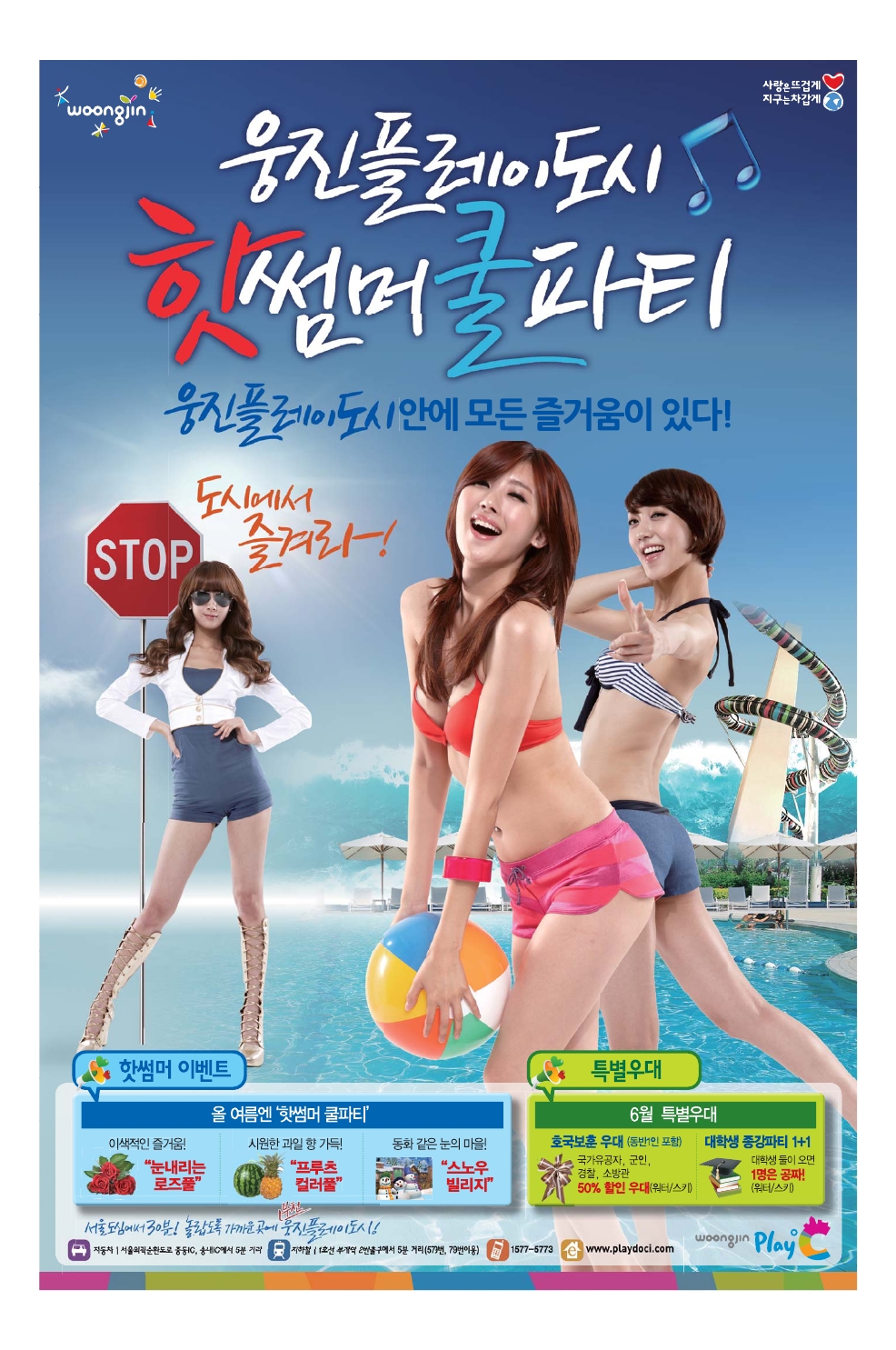
Until then, following on from this earlier post about a video that alerted me to the fact that doctors were getting (suspended) sentences for performing abortions, I’ve translated the following article to give you more information about those. And in the process, I’ve confirmed commenter Matt of Gusts of Popular Feeling’s point about it that no doctor mentioned actually had to spend any time in jail.

However, as you’ll see, the article does not appear to say that the manager of the gynecology clinic in Suwon also got a suspended sentence, which would presumably mean that in fact he or she at least did go to jail. Which seems just a little unfair and confusing, so if anyone with better Korean skills can please clarify, then that would be much appreciated!^^ (source, right)

잇따른낙태죄실형선고 부당해” “Continued Sentences for ‘Abortion Crimes’ are Unjust”

<임신․출산 결정권을 위한 네트워크>규탄성명 발표 / A Public Denouncement by The Network for Pregnancy & Birth Decision Rights (NPBDR)

최근 들어 인공임신중절을 시술한 의사에게 실형이 선고되는 사례가 잇따르자 이에 대한 비판의 목소리가 커지고 있다. 이례적인 처벌 강화가 인공임신중절 시술의 위축을 가져와 여성들의 안전과 건강을 위협할 것이라는 우려에서다.

Recently, criticism has been growing of the numbers of doctors receiving sentences for performing abortions. There is a great deal of worry and anxiety that singling out abortion laws for enforcement will reduce the number of abortions and be dangerous for women’s safety and health.

‘임신중절’ 시술 의사에게 실형판결 잇따라 / Doctors are continually being sentenced for performing abortions

지난 9월 3일 울산지방법원은 인공임신중절을 시술한 의사에게 1심에서 징역 6월에 집행유예 1년, 자격정지 1년을 선고했다. 이에 앞서 지난 8월 수원지방법원은 역시 인공임신중절 시술 혐의로 고발된 산부인과 의사와 사무장에게 각각 징역 1년에 집행유예 2년, 징역 2년 6월의 실형을 선고했다.

On the 3rd of September, in the first session of a case at Ulsan District Court, a doctor who performed an abortion was given a 6-month jail sentence suspended for 1 year (i.e. no jail), and was stripped of their doctor’s license for 1 year. And in August at Suwon District Court, a gynecologist who was suspected of performing an abortion and the gynecology clinic manager were given a 1 year sentence suspended for 2 years and a 2 year, 6 month jail sentence respectively.

이는 그동안 인공임신중절에 대한 기소 건수 자체가 적었고, 기소되더라도 선고유예에 그치는 경우가 대부분이었던 것과 비교해 이례적이라는 평가다. (source, right)

Even though the number of cases of doctors that have received sentences for performing abortions is small, and most have received suspended sentences, compared with those the above cases are quite exceptional.

올해 2월 프로라이프의사회가 인공임신중절 시술을 한 의료기관 3곳을 고발했을 때에도 사무장이 구속 기소된 한 곳을 제외하고 각각 벌금 200만원에 약식기소, 무혐의 처리를 받았을 뿐이다.

In February, a pro-life doctor’s association filed suits against 3 clinics where abortions were being performed, but in all but one the managers simply to had to pay fines of 2 million won each in out of court settlements.

또 한 지난 5월에는 부산지방법원에서 임신 7주의 여성에게 인공임신중절을 시술한 혐의로 기소된 의사에 대해서도 선고유예판결을 내렸다. 당시 재판관은 “낙태에 대한 처벌과 관련해 공권력의 처벌의지가 상대적으로 미약했던”사실에 비춰 “의사에 대한 처벌은 형평성에 어긋난다”고 선고유예의 이유를 밝혔다.

In May, at Busan District Court, a doctor who was suspected of performing an abortion on a woman who was 7 weeks pregnant received a suspended sentence. In that case, the judge said in his or her judgment that “the government’s will for punishing abortion-related crimes is relatively weak”, and that the reason for the suspended sentence in that case was that “the [prescribed] punishment ran counter to notions of social equity”.

의사에게 징역형을 선고한 울산지방법원의 김정민 재판관이 “태아의 생명은 사람의 생명과 마찬가지로 형법이 보호하고자 하는 매우 중요한 법익”이라며 “형법의 비추에 피고인의 범행은 그 죄질이 가볍다고 볼 수 없”다고 선고 이유를 밝힌 것과 대조적이다.

In complete contrast, Kim Jeong-min, the judge who gave the jail sentence to the manager in Ulsan, said the reason was that “a fetus’s life is exactly the same a person’s life, and deserves the full benefit and protection of the law”, and hence “the defendant’s crime could not be punished lightly”.

(Source: 착선의 독서실)

“징역형 선고, 중절수술 위축시킬 것” “With Sentences, the Number of Abortions Will Go Down”

특히 9월 울산지방법원의 판결은 임신 10주의 ‘초기낙태’와 ‘10대여성의 낙태’에 대해 징역형을 선고한 것이어서 판결이 던진 파장이 심상치 않다. ‘의학적으로 시술이 안전한’ 12주 미만의 인공임신중절은 이미 많은 국가에서 합법화되어 있으며, 10대 임신의 경우에도 현실적으로 양육의 어려움이 있어 사실상 임신중절 허용사유로 용인되어 왔기 때문이다.

In particular, the September case in Ulsan has generated a lot of controversy because the doctor’s sentence was for an abortion performed on a teenage girl who was 10 weeks pregnant. After all, not only is abortion in the first trimester completely safe and legal in many countries, but the general consensus is that such young girls have special difficulties in raising a child.

이 판결에 대해 <임신․출산 결정권을 위한 네트워크>는 29일 “여성의 결정권을 원천적으로 부정하는” 판결이라며 규탄성명을 내고, 항소심에 적극 대응할 것을 천명하고 나섰다. 임신․출산 결정권을 위한 네트워크는 인공임신중절을 범죄화하는 움직임에 대응하기 위해 결성된 단체로서, 여성·노동·진보 단체들과 진보신당, 민주노동당이 함께 참여하고 있다.

< 임신․출산 결정권을 위한 네트워크>는 잇따른 “징역형 선고가 선례가 돼 올해 2~3월처럼 낙태 수술이 위축돼 낙태 수술비가 치솟고, 낙태를 필요로 하는 여성들이 심각한 어려움에 처하게 될 것”이라고 심각한 우려를 표했다.

On the 29th of September, the NPBDR denounced that judgment as “fundamentally denying women’s rights” and that the group would actively appeal it. The NPBDR is an organization that was established to fight against the criminalization of abortion in conjunction with women’s groups, worker’s groups, progressive groups and the New Progressive and Democratic Labor Party. In addition, the NPBDR expressed serious worry about the “continuing cases of sentencing for abortions, which like those cases in February and March set precedents, and were accompanied by decreases in the numbers of abortions and a sudden rise in their expenses, which became a serious concern for women seeking abortions.”

(Source)

실제로 올해 2월 프로라이프 의사회의 산부인과 고발 후, 산부인과의 임신중절 시술 기피로 인해 고통을 호소하는 상담전화가 여성단체에 빗발쳤다. 시술비용이 치솟았고, 비싼 수술비와 처벌에 대한 두려움 때문에 ‘원정낙태’를 알아보는 여성들까지 나타났었다.

After a pro-life doctor’s group filed suit against gynecologists in February, the reality was that they started avoiding providing abortion services, leading to a torrent of pleads for help from women to women’s groups’ hotlines. Because of the sudden increase in their expenses, and the fear of being punished, many women are now considering getting abortions overseas.

‘임신중절 허용’ 법 개정 움직임에 역행 Such Judgments Work Against Abortion Law Reform

< 임신․출산 결정권을 위한 네트워크>는 특히 “여성운동이 여성의 요청에 의한 낙태를 허용하라는 목소리를 높이고 있고, 한나라당 홍일표 의원, 산부인과의사회, 법무부 형사법개정특별심의위원회 등도 제한적이나마 낙태를 허용하는 방향의 법 개정을 주장”하고 있는 상황에서 이런 판결이 나온 것에 대해 깊은 유감을 나타냈다.

The NPBDR, deeply saddened by the above cases, says “women’s movements and women in general are raising their voices high in their demands for legalizing abortion, and have the support of National Assemblyman Hong Il-pyeo of the ruling Grand National Party, gynecologists’ groups, and the Special Committee for the Reform of Criminal Law under the Ministry of Justice, and so on, that, although they only have limited political power, are also insisting on the legalization of abortion.”

“낙태가 불법화된 나라들이 합법화된 나라들보다 낙태율이 오히려 더 높”은 것에서도 드러나듯, “처벌이 결코 낙태를 줄일 수 없다”는 사실에 대해 이미 국제사회뿐만 아니라 우리나라에서도 공감대가 확산되고 있는 시점에서 시대착오적인 판결이라는 것이다. 현재 국제사회에서는 유엔 여성차별철폐협약(CEDAW)에 근거해 인공임신중절한 여성을 처벌하는 ‘낙태죄’ 폐지를 각국에 권고하고 있다.

Also, “compared to countries where abortion is legal, in fact abortion rates are higher in countries that have criminalized it,” and this means that “criminalizing abortions can never bring abortion rates down,” a fact that at this point in time not just international society, but Koreans also agree on, and so find the above judgments an anachronism. Presently, on the basis of the Convention on the U.N. Elimination of All Forms of Discrimination Against Women (CEDAW), international society is recommending each country to abolish laws defining abortion as a crime and not punishing women who have abortions. (source, right)

< 임신․출산 결정권을 위한 네트워크>는 “출산은 여성의 삶 전체에 지대한 영향”을 미치고 “출산에 뒤따르는 책임을 감당할 당사자도 여성”이라는 점을 환기시키며 “자신의 삶에 대해 신중하게 고민하고 낙태를 결정한 여성을 범죄자 취급해서는 안 된다”고 못 박았다. 또한 앞으로 있을 항소심에 대한 구체적 대응을 준비 중에 있다고 덧붙였다.

Finally, the NPBDR wants to remind everyone that “giving birth is the single most influential thing in a woman’s whole life,” and is accompanied by a great deal of anxiety about how and if she will be able to cope with her new role as a mother. The group firmly insisted that “accordingly women who have agonized over this and come to the final decision to have an abortion should not be treated like criminals,” and added that they were making strenuous efforts to prepare to fight for their appeal against the Suwon judgment (end).

And on that note, apologies for not finding any information about the woman fined for simply planning an abortion, as mentioned in the earlier post, and I’ll keep looking. But in the meantime, I was very happy to read about the palpable resistance to Lee Myung-bak’s anti-abortion drive that is already emerging!

How about you?

Countering Sexual Violence in Korea (Updated)

Once again, Korea has gotten the lowest score of all high-income countries in a recent survey of gender-equality worldwide. And, at 104th out of 131 countries surveyed, it was bested by numerous much poorer countries at that.

Given that record, then it’s very easy to focus on Korea’s shortcomings when talking about gender issues. But that can mean that we can easily miss the positive developments that are occurring though, and sometimes right in front of our very noses.

Take what this humble-looking subway ad for instance, and what it ultimately represents. First, a translation:

부산 해바라기 여성 • 아동센터

Busan Sunflower Women & Children’s Center

여성 성폭력 피해자와 가정폭력 피해자, 학교폭력 피해자들을 돕고 있는 부산 원스톱 지원센터와 아동과 지적장애인 성폭력 피해자 전담센터인 부산 해바라기 아동센터가 2010년 1월 1일부터 부산 해바라기 여성 • 아동센터로 통합되었습니다.

From January 1, the Busan One-Stop Support Center, which helps female victims of sexual abuse, victims of family abuse, and victims of physical abuse at schools, and the Busan Sunflower Children’s Center, which helps children and mentally handicapped victims of sexual abuse, have joined together and become the Busan Sunflower Women & Children’s Center.

(Source)

여성부, 부산광역시, 부산지방경찰청에서 지원하고 동아대학교병원에서 수탁운영하는 여성 • 아동 폭력피해자 전담센터입니다.

With support from the Ministry of Gender Equality, the Busan Metropolitan City Council, and the Busan Metropolitan Police Agency, Dong-a University Hospital has been given the responsibility of operating the center, which provides consultations for female and child victims of abuse.

가족폭력, 성매매, 학교폭력, 성폭력 피해를 입은 여성과 아동을 보호하고 지원하고 치료합니다.

Women and children who are the victims of family violence, sex trafficking, school violence, and sexual abuse can receive protection and treatment at the center.

의사, 간호사, 임상심리사, 심리치료사, 성폭력 • 가정폭력 전문상담원, 여성 경찰관 등 각 분야 전문가들이 상주하고 있어 위기상황에서 가장 전문적이고 질 높은 상담, 의료, 심리치료, 수사, 법률 서비스를 무상으로 제공합니다.

Experts in many fields such as doctors, nurses, clinical psychologists, psychological therapists, family and sexual violence consultants, and female police officers and so on will be permanently stationed at the center, and when you are in a crisis you can receive the best professional and highest quality consultations, medical treatment, psychological counseling, legal advice, and assistance with launching criminal investigations. All these services are provided free of charge. (end)

(Source)

In my experience, usually the amalgamation of two government institutions in any country is in response to cost-cutting. Fortunately however, there’s a great deal of indirect evidence to suggest that that isn’t the case here.

First, note that the ad is actually quite dated, mentioning that the amalgamation was effective from January the 1st for instance (although the center didn’t officially open until February the 9th), and in particular that the Ministry of Gender Equality has a supporting role in it, whereas the Ministry actually reconverted back to the Ministry of Gender Equality and Family Affairs (여성가족부/MOGEF) back in March. Presumably then, the ad has already been posted on Busan subway trains once before, probably late last year or early this one.

Why suddenly post the same ones again in late September then? What has changed to prompt that?

As Matt at Gusts of Popular Feeling has well-documented, what has changed is the public perception that there has been a sudden and dramatic increase in the numbers of sex crimes against children, whereas in fact they have remained steady (but appallingly high) for years:

There is not a “recent series” of such sexual crimes – this is always happening. It’s just that the media has decided – as it does whenever a particular case angers people – to highlight these cases, which would usually either not be covered or covered by perhaps only one or two media outlets, and which are now linked together in articles in order to point to a great problem that exists. To be sure, there have been several laws passed since the murder of Lee Yu-ri in March (and the Yeongdeungpo case in June), and it’s great that the issue has finally gotten enough attention to get things moving (see here for a brief history of the slow pace of change since 2006). I’m not entirely sure that the solutions being offered are always the best ideas, however, and public fury (and worry) whipped up by this media coverage may be putting pressure on politicians to act first and think later.

And see past Korean Gender Reader posts for more details of those and other sexual crimes. By coincidence, one of the most notorious of those – the murder of Lee Yu-ri – also occurred in Busan, and several of my coworkers here have reported seeing rooms like that on the right pop up in Busan public schools they teach at in the months since, although unfortunately they have no information on the quality of their staffing or how often they are utilized. Have any readers also noticed them, in Busan or elsewhere?

(Note that the English translation on it may be a little misleading though: a better one would be “Consultation Room [for] Mental Anguish [caused by] Sexual Harassment or Sexual Violence”)

Regardless, the point is that given the current climate then it would be wise for the government to highlight all it is doing to prevent sexual violence, let alone to continue or even increase funding to women and children’s centers. And however cynical and reactionary the motives, this is to be applauded.

Granted, the amalgamation was decided and instituted well before the public outcry over the supposed recent spate of sexual crimes against children. But that doesn’t necessarily imply it was the result of a reduction of funding: although it may receive little if any funding from MOGEF for instance, I find it significant that the Ministry’s assumption of old responsibilities came with a big increase in staff and 4 times larger budget (albeit from a base of 0.03% of the government total), so when the plans for the change were announced late last year there was already a political climate conducive to more funding for feminist causes.  Signs of a change of heart from President Lee Myung-bak also perhaps, who originally promised to abolish it before his election, only to back down and merely considerably downsize it in response to protests afterwards?

Alas, quite the opposite: in fact, he is using MOGEF to raise the dire birth rate by – wait for it – criminalizing abortion, as I explain in detail here. But to play devils’ advocate however, perhaps this blinds us to some of the positives that it has achieved?

One is its survey of teenage entertainers in August, which – among other things – revealed that many were pressured by their managers to wear revealing costumes, and which ultimately resulted in the National Assembly’s setting up of a committee (albeit under a different ministry) to further investigate MOGEF’s findings. And which after hearing evidence from entertainment company CEOs has just laid down new regulations for the treatment of minors in the entertainment industry (see here and here also for more background).

And finally, take the recent video produced by MOGEF below, which encourages people to pay more attention to the needs of immigrant women. Granted, it’s just a video, and again it may be just be in response to the recent murder of a Vietnamese bride by her husband after only 8 days in the country (see #13 here), but then it’s not like such efforts started only recently. One thing that instantly comes to mind for instance, is the above survey that was sent to all foreign spouses in Korea in August last year (see #3 here), in an attempt to better find out their specific needs.

Vodpod videos no longer available.

Any other positives readers can think of, however minor, then please pass them on!^^

Update: As per request, here is what the voiceover in the video is saying (and I’ve put the additional text in brackets as it came up):

이주여성들을 힘들게 하는건 (부부갈등 상담 8, 452건)

The things that make it difficult for migrant women… (8, 452 consultations for married couples having difficulties)

어려운 한국어와 (가정폭력 상담 4205 건 [2009년 이주여성 긴급지원센터 상담통계)

…are difficult Korean… (4205 consultations over family violence/abuse [2009 Statistics from Migrant Urgent Help & Consultation Centers])

낯선 환경, 다른 문화

…the strange environment, the different culture…

그리고 우리의 무관심입니다. (국제결혼 이주여성 16만여명)

…and our indifference. (lit. international marriage migrant women 160,000 women [James: just in 2009?])

이주여성들에게 작은 관심은 큰 힘이 됩니다.

Just a little help and support helps migrant women a great deal (same in the text)

이주여성들의 힘이 되어주세요.

Please be strong and supportive to them.

이캠폐인은 여성가족부와 복권위원회가 함께 합니다. (이주여성긴급지원센터, 1577-1336)

This campaign is brought to you by MOGEF and The Lottery Commission. (Migrant Women’s Urgent Help & Consultation Centers: 1577-1366)

And by coincidence, something else positive that MOGEF has some role in: a seminar about women’s career development at my university tomorrow (stalkers, take note of which one). Things like this seem to go on there at least once a month or so.

Maybe this has something to do with that, which I only just noticed today:

Please let me know if anyone would like a translation of the first poster. Meanwhile, do any other Korea-based readers have anything similar at their own universities?

Choi Jin-sil Sued For Being Beaten by Her Husband: Update

Choi Jin-sil holding back tearsWhen hearing last week about something as appalling as an actress being sued for daring to show her bruises and black eyes to the media, it’s only human nature to assume the worst of Korean society.

But while Korea certainly does have a great deal of work to do in combating domestic violence—and criminalizing spousal rape would be an essential first step (see #2 here)—it’s also true that police and legal attitudes towards it have considerably hardened in recent years, both cause and effect of a law change in 2007 that requires police to forward all cases of domestic violence to a prosecutor (the previous 1998 law just left it up to their own discretion). In addition, Korean women are now more likely than ever to divorce on the basis of verbal or physical abuse, rather than suffering silently as in past decades.

Indeed, what stands out more than anything else about the court decision is how much it goes against the grain of trends within Korean society, and certainly does not reflect the will of all Koreans. Some quick excerpts from today’s Korea Times for instance:

Women’s groups are angry over the top court’s ruling that ordered the late actress Choi Jin-sil (최진실) to compensate a builder for failing to maintain “dignity” as a model representing its products.

They censured the Supreme Court for not realizing the suffering of domestic violence victims, which included Choi.
Korean Womenlink, the Korea Women’s Hot Line, and the Korea Women’s Association United issued a joint statement Wednesday lambasting the ruling.

On June 4, the court reversed a high court ruling that decided in favor of Choi in a compensation suit filed by Shinhan Engineering and Construction in 2004 against the actress, who was the model for its apartments.

The advertiser claims she did not keep her contractual obligation to “maintain dignity,” because she disclosed to the public her bruised and swollen face which was caused by the violence of her then husband, former baseball player Cho Sung-min. They divorced soon afterward.

For the rest, see here. Also, see here for my original post on this issue and information about similar cases in the past, and here for a quick primer on the numerical rates of domestic violence in Korea (albeit in 2004), with many graphs and tables.

(By the way, although it was already common knowledge, it’s good that the Korean media is now naming the company. But I wonder if it was originally kept anonymous by a court order, or just by convention?)