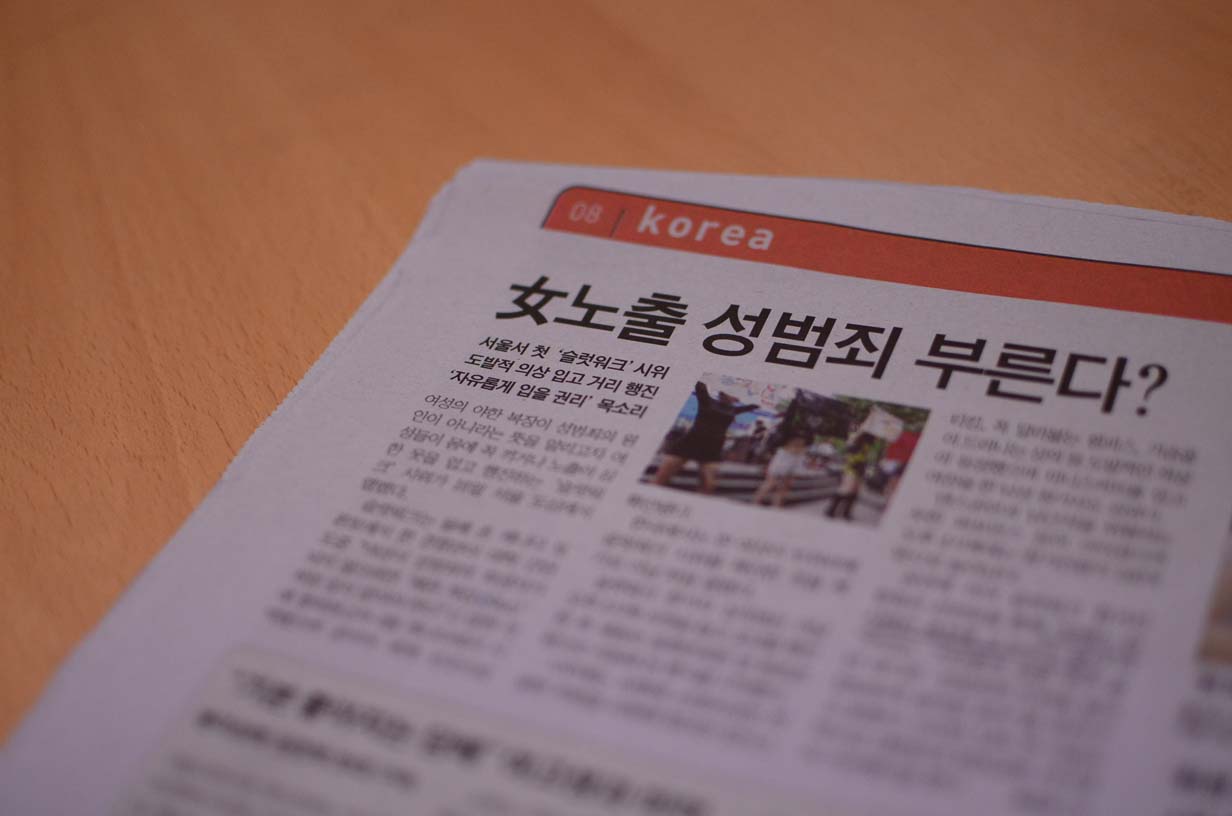
Quick Hit: Korean police blaming sex crimes on scantily clad women

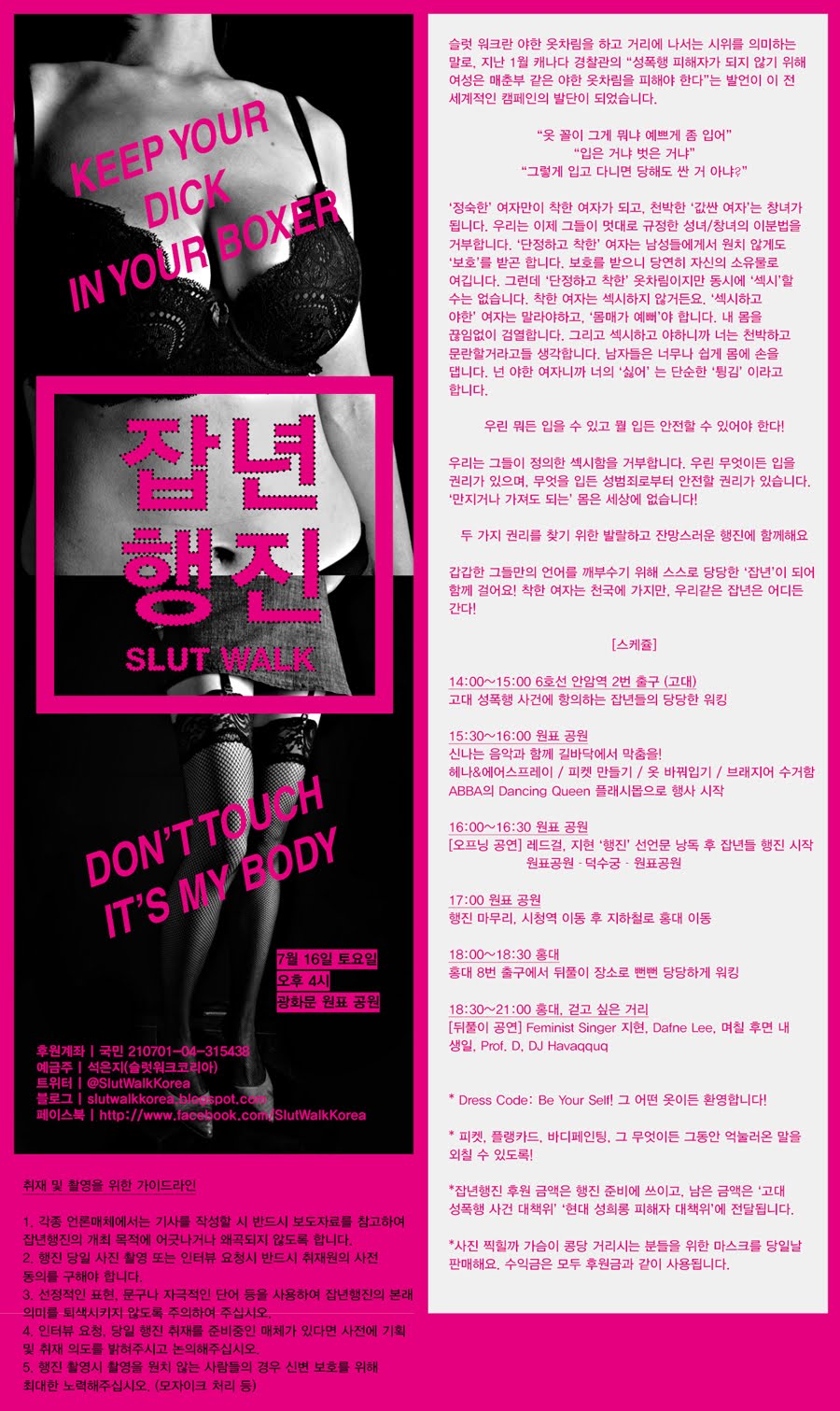
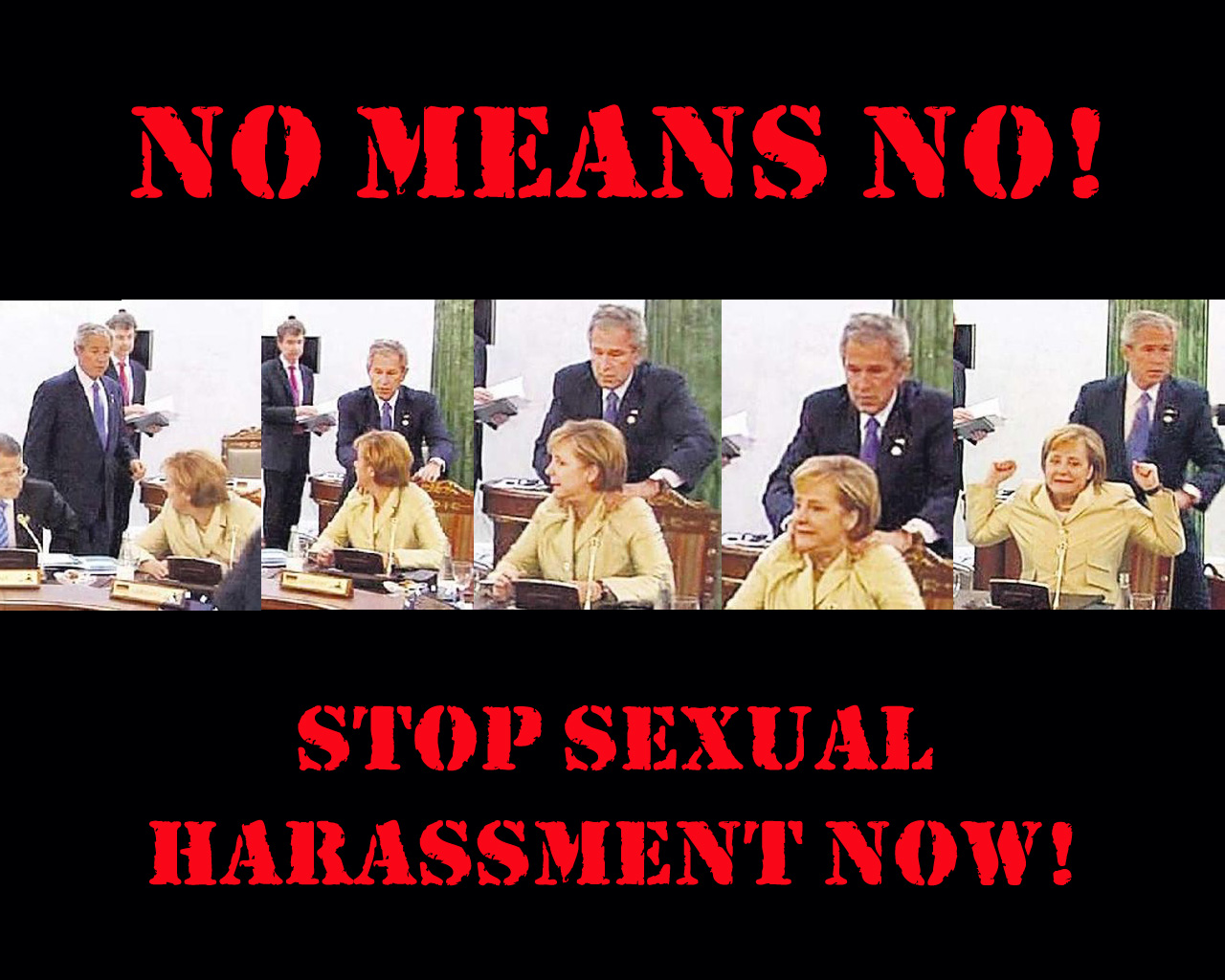
Slutwalk Korea(Sources: left, right)

From the Korea Times:

The government is vowing stronger punishment on sex offenses. As a start, the Justice Ministry has rewritten the law to allow law enforcement authorities to investigate and prosecute sex criminals without a complaint filed from the victim.

But were loose laws ever much of a problem because the majority of our obtuse police officers are regressive enough to claim that some female victims simply had it coming?

The Korea Women’s Development Institute recently quizzed some 200 police officers in South Gyeongsang Province cities over their thoughts on sex crimes against women and the results were disturbing.

About 54 percent of the respondents supported the view that women who wear revealing clothing are somehow culpable in any attacks on them. Around 37 percent of them felt the same about women who drink and 21 percent about women walking alone at night. And 24 percent said they found it difficult to believe a victim when they don’t report the incident right away.

Read the rest at the link. Meanwhile, I’ll try to find the original KWDI report on the survey and/or related news article, and translate it for you by sometime next week.

Also, for anyone interested in the Korean Slutwalk (잡년행진), see here for information about the last two years’ events. I’ve been unable to find any information about this year’s, but do hope that one will go ahead. After all, as the police officers’ attitudes above indicate, unfortunately it’s needed more than ever…

Update: I’m No Picasso has a must-read response to the article.

“Cute Lines for Cute Girls”: Street Harassment Framed as Fun (Continued)

I’ve been asked by Jerry Liu, the maker of the “Cute Lines for Cute Girls” video featured 2 weeks ago, to ask what readers’ reactions are to the above video.

As explained by the makers of this one (Simple Pickup), “all the faces, we interacted with, which aren’t blurred were given consent forms because their reactions were too funny.”

What do you think?

Related Posts:

“Cute Lines for Cute Girls”: Street Harassment Framed as Fun

With her permission, here is a reader’s email I recently received. While I don’t usually post things that aren’t specifically Korea-related, I thought I’d make an exception this time!

Dear Mr. Turnbull,

I thought you might be interested in this video since your blog is about gender studies (Apologies for the long e-mail, but I want to explain myself thoroughly).

I was just curious about your and others’ thoughts on it. I remember watching the Korean street harassment video with the bikkis (nightclub workers?) and thought this was an interesting contrast. It’s not often that you can see a compilation quite like this.

One of my subscriptions posted a video called “Cute lines for Cute Girls” with the description “Everyone dreams of using corny but sweet pickup lines on random unsuspecting women. My friend and I show you the reactions we got :)” (My emphasis added)

I watched it and instead of making me smile, it just made me cringe. The video consists of him and his friend approaching random women in the street and in buildings with corny pickup lines. What made me uneasy is that I couldn’t help but see that some of the women did not seem to enjoy it. Sure, the background music makes it seem light-hearted and fun, but mute it and look at their body language. Some did have fun with it and laughed, but to me most 1) couldn’t walk away fast enough, 2) gave an uncomfortable laugh and smile (that “what the hell just happened” smile).

Korea Slutwalk(Source)

I think most people can see that whistling and making lewd comments are wrong. What complicates things and divides opinions is that these are “nice guys.” They are not your typical catcallers lurking in a doorway, but “regular, non-threatening” guys on the street. But does this make it ok? I would say not.

Perhaps I was wrong about the video, but his replies really disturbed me. Even if you do not agree with me about the video, the conversation we had was really telling about attitudes about street harassment today.

I don’t know if he’ll remove my comments or not, so I’ll paste the conversation here (my emphases throughout):

NSAM08 17x11_txt rep_v2.inddMe: I don’t know about this. I mean, you’re going after women you have no interest in other than to make a video so people can laugh at them. Most of them just laugh uncomfortably and walk away. This is like one step above cat-calling.

Him: Hey waterlily6782001, this is an exercise in overcoming false constraints that many individuals place on themselves. Also, many of these girls played along when they heard these lines because they were cool and fun girls who knew how to banter back. If anything, this is a great profile on the decent quality of women at University of Pennsylvania.

(Almost feels like he’s saying I’m not cool or fun or of decent quality because I do not like his “exercise”)

Me: Yes, I understand and I do like your other videos, but this one… From your videos, I don’t think you’re a mean person and I don’t think you ever intend to hurt anyone, so I wasn’t too upset. Yes, some of them bantered back, but can’t you see that some were also clearly uncomfortable? It’s just that when you have to deal with totally insincere guys chatting you up all the time as a dare or just to get a reaction, it goes from flattering to tiring.

Him: They could’ve been having a bad day; school could’ve been stressing them out. Even if our lines caused the discomfort, my friend and I were simply giving them compliments. If they can’t take a compliment, then their frame of mind needs work. For example, I love your constructive criticism. But I could easily have said, “This person is a hater. I should delete the comment.” But if I did that, we wouldn’t be having a great discussion. Frame life positively. You’ll be much happier =)

Me: Please read this, it explains it better than I ever could ^_^

I think what we have here is just that you, as a man, will never experience life as a woman. So it’s difficult to grasp that what you see as “compliments” can mean different things to different women. There’s just no way for me to make you fully understand, but I appreciate your replies and wish you the best. ^_^ (end)

Street Harassment Korea(Source: leftycartoons)

He implies that I’m 1) a hater 2) pessimistic and 3) unhappy because I do not like his video. I’ve read hater comments before and I thought my commentary was pretty tame. I’m also pretty sure haters don’t promote your videos on their blogs as I’ve done with his in the past (He did a student documentary on Asian male and white female relationships).

It was clear that I couldn’t make him understand, and he implies that he made no one uncomfortable (“Even if our lines caused the discomfort”). But you can’t tell me that the girl at 0:53 is not uncomfortable while she’s speeding past, head down, eyes averted, walking around him, and not even stopping. The girl at 2:10 is also clearly not amused even though you can’t see her face. Listen to her voice! I also wonder if the girl at 2:30 was really having fun having a guy 1) corner her at work and 2) continue to talk to her even after she emphasizes TWICE that she has a boyfriend.

This in particular really disturbed me: Even if our lines caused the discomfort, my friend and I were simply giving them compliments. If they can’t take a compliment, then their frame of mind needs work.

…which is probably the #1 argument guys have for when girls don’t like their advances. It’s a COMPLIMENT and if you’re uncomfortable YOU need to change. So if I don’t like a guy following me along the sidewalk giving me an insincere “compliment” I need to change my attitude.

Korea Slutwalk Newspaper(Source)

Do I hate compliments? No. I appreciate heart-felt compliments.

Do I hate jokes? No. I make them all the time.

Do I hate corny pick-up lines? No. In fact, they can be cute and are good ice-breakers.

What I do hate is a stranger who has absolutely no genuine or honest interest in me, and:

  • 1) cutting in front of me
  • 2) following me
  • 3) giving me a completely fake compliment just to see my reaction,
  • 4) walking away,
  • 5) laughing
  • 6) recording the whole thing, and
  • 7) posting it on the internet.

So what do you think? Do these guys get a free pass because they aren’t dirty old men hanging on the street corner?

Thanks for reading this long e-mail and have a good day!

James: What do readers think? I’m in complete agreement myself!

Update 1, Feb. 3: Just for everyone’s interest, here’s something I stumbled across in a review of a book on the history of online dating:

Of course, single people have always had means to boost their odds. You can move to a city, where the population of as-yet-unclaimed hearts will be larger. You can lower your standards to broaden the radius of your dating pool. You can also just toss out game 24-7 with utter indiscretion. One acquaintance likes to tell random women on the street that he thinks they’re beautiful. “Like 1 in 5 will slow their roll a little and give me a smile,” he says. “And like 1 in 5 of those stop and talk to me and let me hand them my business card. And like 1 in 5 of those actually call me.” I would assume that at least 2 in 5 women he approaches think him a frightening skeezball. And I think, for better or worse, he’s OK with that ratio.

Update 2, Feb. 5: See some related reading in “Korean Girls Be Scared of Me (And Every Other Dude)” at Gyopo Keith.

Update 3, Feb. 7: And some more in “How to Talk to a Woman Without Being a Creep” at Jezebel.

Update 4, Feb 14: Jerry Liu, the maker of the video, has asked me to ask what readers’ reactions to this one by “Simple Pickup” are.

Related Posts:

Victim Blaming: Why “she should have just moved” isn’t a solution to harassment on public transport

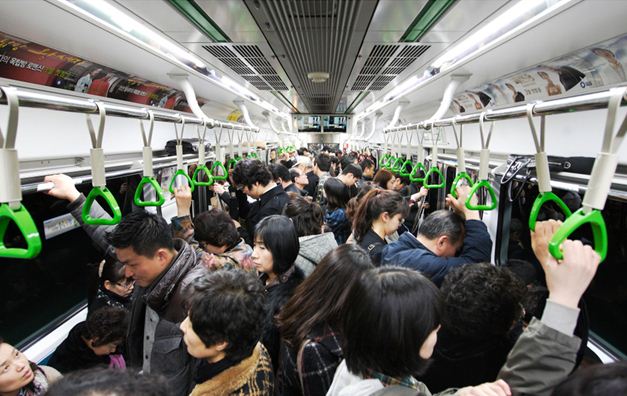
Crowded Korean Subway(Source)

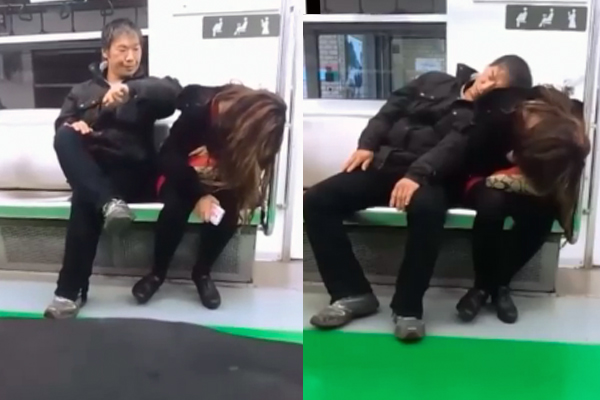
First, please read “Man Tries to Take Advantage of Drunk Girl on Seoul Subway” at koreaBANG. Then, with permission, my friend’s response to it:

Line 2 [in Seoul] really disturbs me, I try to avoid it because I have too many weird experiences. I have also made interventions like the one in this video, to ask someone if they know another passenger or if they need help.

In one of the comments, 니애미종범 basically writes “she should have moved” which seems like a simple thing, but I can speak from my own personal experience. On three different occasions a stranger has sat uncomfortably close to me and I moved, and they FOLLOWED me. Two of those times I moved again and they left me alone. I was lucky that there were other passengers around because I just said to them to (politely) leave me alone. But in one of those cases, the guy CONTINUED to sit next to me and talk about my appearance, ask me questions, even though I kept politely declining conversation and then said directly that I do not like to talk to someone I do not know. At that point, I decided to get off the train with a larger group of people… I pretended to go toward the stairs but when out of view I dashed onto another car and walked through the train 3 more cars… I called my boyfriend and asked him to hurry and meet me at the station and described the guy to him and told him I needed him to meet me… I debated whether to try to call the police and how to describe the situation or ask if there was a security box at the station where I would exit… All this time, I thought I had been out of sight… but then he appeared at my side AGAIN… he had seen me and followed me further. At that point, there were no people standing to get off the train and I was really afraid to get off onto an empty train platform again, so I stood up in the middle of the car and just walked around and made light conversation with random people so that people would notice me… and he finally stopped, but when I exited the train I was looking behind my back.

This is besides the frequent (monthly?) ‘accidental’ butt groping on a crowded bus or subway that does not seem so ‘accidental.’ I have taken to wearing my backpack even though it would be more ‘convenient’ to other passengers if I stored it on the top shelf, because wearing my backpack creates a buffer between me and other people and creates a little bit of space so that it is not so easy to discreetly grope and pretend it is ‘by accident.’ Even so, I still have to often tell someone not to touch me.

There are also a number of posts that criticize the person who intervened. I think it is important to be supportive to other people in our community. I try hard to avoid sending a friend home alone, or drunk, but sometimes you can’t control that. So, I take photos of taxis or other things. If my friend has been drinking, I tell the taxi driver directly where she/he is supposed to go, that someone is waiting, and photograph the name plate in the front seat of their taxi that says their name and taxi ID, etc. as well as the plate #. I ask about how long it will take and how much it will be and verbally confirm to the passenger so taxi driver avoids arguing the bill, etc. I do this because I think it “discourages” the idea that my friend is vulnerable, but it isn’t enough because there are still predatory people, complex situations and laws, and we need to support each other in navigating these scenarios.

drunk-man-fondles-girl-on-seoul-metro(Source)

While she’d like to remain anonymous, she adds for the sake of context that she is a (Caucasian) foreigner, with intermediate Korean skills. Also, another issue is the perception that police will not help and that self-defense might be dangerous to legal liability and visa status, which unfortunately happened with two of her friends that were assaulted

As a non-Seoulite, I was aware that Line 1 was dangerous, but had no idea about Line 2 (although to a certain extent, traveling on any line can be an unpleasant experience for non-Koreans and non-Caucasians). But as my friend tells me, apparently it’s a magnet for sexual harassers because “it connects a number of universities with stops like Gangnam, Sillim, Sadang and others that are very crowded.”

What are readers’ own experiences? How do you recommend dealing with harassers on the subway?

Related Posts:

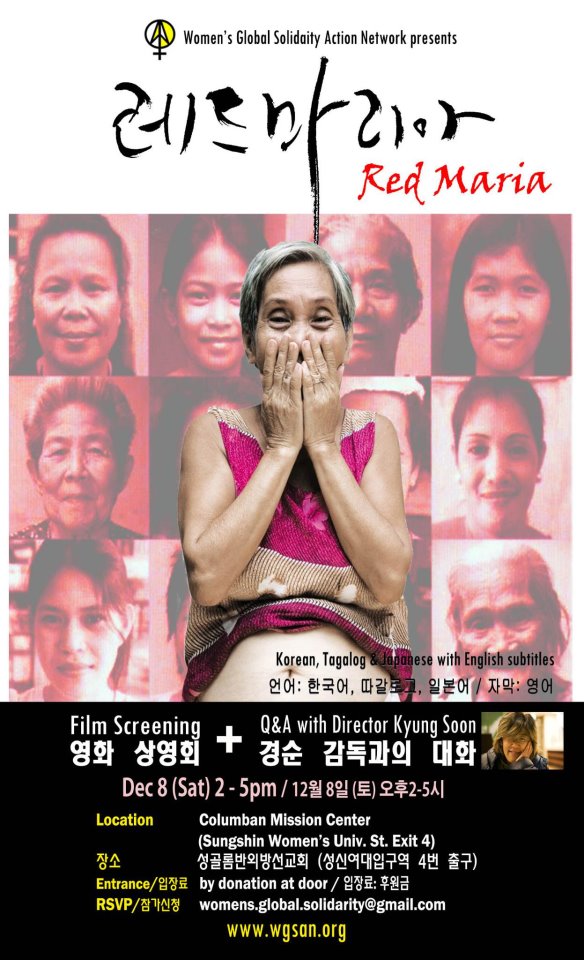
Announcement: Red Maria (레드마리아) Screening Saturday, December 8

I’ve been asked to pass on the following:

★ YOU MUST RSVP via Email: womens.global.solidarity@gmail.com ★

In Korea, Japan and The Philippines, there are many women with diverse jobs and her stories. Among them, this film focuses on women who are called housewives, sex workers, dispatched workers, migrant workers, comfort women, homeless and so on. The camera tracks them as they go about their everyday lives. These women have never met one another, and their lives look quite different from one another. However, their lives are connected across national borders by the one thing they have in common. That’s their bodies and labor. How can such different forms of labor be linked to the women’s bodies in such a similar way? As we search for answers to this question, we are forced to confront another question: ‘the meaning of labor’ as an ideology that is reproduced in society.

* Entrance Fee: by donation at the door

* Languages: Korean, Japanese, Tagalog and English with English subtitles

* Naver map: http://me2.do/GDOEbSP

Facebook: https://www.facebook.com/events/370272919729052/

The screening will be held at the Colombian Mission Center.
Please note the center is very close to exit 4, and not on the University’s campus.

To get to the center:
1) Take line 4 to the Sungshin Women’s University Entrance 성신여자대학교입구) stop.
2) Go out exit 4 and a building with a traditional Korean roof (hanok) will be in front of you.
3) Go into the building and up to the second floor.

★ Due to a limited number of seats, you must RSVP to womens.global.solidarity@gmail.com and you will receive confirmation when your seat has been reserved.

Korean Sociological Image #74: Child Sex Offender Notices

Korean Sex Offender Website(Source)

Update: With thanks to reader Lily for pointing it out, the notice I received says not to post it on the internet, so I’ve replaced it with a screenshot of the Korean sex offender registry website, www.sexoffender.go.kr. Sorry that that makes the post and comments now difficult to follow.

Received in my letter box this morning. And, presumably, every other one in the neighborhood.

I don’t have time to translate the entire thing sorry, let alone the advice and information provided on the back. But here is the information about his crime:

In October 2011, in Haeundae-gu, XX-dong, this person attempted to rape a teenage girl, but failed. On May 17 2012, he was convicted according to the “Protection of Children and Juveniles from Sexual Abuse Act,” imprisoned for 2 years and 6 months, with 4 years’ probation, given 40 hours of sex violence treatment lectures, and required to have his personal information be made available to the public for 3 years.

Apologies for the confusion — has he just been released? If not, why is this notice being provided now? — and would appreciate it if anyone could clarify.

Meanwhile, regardless of the country, how would you react if you received something similar? Has it happened to any readers before?

Also, you may be interested in comparing this wanted notice sent to all Busan households in March 2010, after the rape and murder of a 13 year-old girl.

(For more posts in the Korean Sociological Image series, see here)

Korean Poster: ETIQUETTE FOR MEN AT NIGHT

(Source)

Via Tales of Wonderlost, who also passes on a translation by Opress-Crackatron3000:

Protesting sexual harassment and violence against women

ETIQUETTE FOR MEN AT NIGHT

1. Remember that your presence can be threatening to women walking alone at night

2. If a woman is walking in front of you alone at night, slow down. You walking quickly or speeding up can be and in most cases is threatening

3. If you’ve been drinking and are drunk, go straight home.

4. Do not pick a fight or aggravate women walking at night

5. Do not take off your clothes or publicly urinate

6. Be careful to make sure you do not touch or hit someone, even on accident.

7. If, late at night, you come to a situation in which you and a woman have to ride an elevator together, let her go up first and wait for the elevator to come back down.

8. If there’s a woman in a public restroom (There are Korean public restrooms with no gender or sex markings that are open to all people), wait for her to finish and come out first before using the restroom.

9. Report broken streetlights to the police

10. Tell other men about these rules and that they have a responsibility to not threaten women walking at night

Please share as much as possible!

Related Post: Groping in Korea: Just How Bad Is It?

“Good women need our help, bad women need to be punished” — Learning about Sex Workers’ Rights in South Korea

Caption: South Korean women working in the sex industry stand on a stage during a rally in central Seoul on September 22, 2011 in protest at frequent crackdowns by authorities. About 1,500 women wearing masks to conceal their identities chanted slogans such as ‘Sex work is not a crime, but labour!’ and called for the abolition of a special law enacted in 2004 to curb prostitution. [Photo: Jung Yeon-Je — AFP/Getty Images]

[James] — Since September 2011, German-born researcher Matthias Lehmann has been conducting an independent research project to investigate the impact of South Korea’s Anti-Sex Trade Laws on sex workers’ human rights and livelihood. In this guest post for The Grand Narrative, he outlines key events that led to the adoption of the problematic law and the motivation for his research:

Korea’s Anti-Sex Trade Laws

In September 2000, the notorious Gunsan Brothel Fire killed five women who had been held captive. Their tragic deaths exposed the conditions in Korea’s sex industry and triggered a campaign by women’s rights activists to reform the country’s prostitution laws. Their proposals became the blueprint for the Special Laws on Sex Trade (성매매특별법, Seongmaemae Tteukbyeolbeob), enacted in 2004, which include a Prevention Act and a Punishment Act. By passing these new laws, the government vowed to eliminate prostitution and protect victims of exploitation and violence in the sex industry.

The laws drew inspiration from the Swedish Violence Against Women Act (the Kvinnofrid law) from 1999, which criminalises the purchase of sexual services but aims to protect women working in the sex industry. The success of the Swedish model remains heavily contested. In 2010, the government issued an evaluation report that found that the law had achieved its objectives, to which government member Camilla Lindberg and opposition member Marianne Berg responded by publishing a bi-partisan article stating that the law had not only failed to protect women but instead hurt them, and thus had to be repealed.

In Korea, the Special Laws on Sex Trade remain a subject of debate. The Ministry of Gender Equality celebrated the legislation as a milestone achievement that would “vigorously strengthen the protection of the human rights of women in prostitution”. However, others criticise the legislation’s discriminatory attitude towards sex workers, who remain criminalised unless they claim to be victims. This “distinction between victims and those who [voluntarily] sell sex is actually one between protection and punishment” and categorises women into “good women who are worthy of help” and “bad ones who need to be punished”, thus continuing the stigmatisation of women who sell sex.

The Criminalisation of Prostitution Has Failed

Surveys have shown time and again, that despite being illegal, prostitution remains widespread in South Korea. Most recently, a state-funded survey found that 53 per cent of Korea’s sexually active senior citizens bought sex at brothels. A 2005 study found that “only 6 per cent of crimes occurred through the intermediary of a brothel, compared to 34 per cent via the internet, 26 per cent in massage parlours and barber shops.” The same study stated that the Anti-Sex Trade Laws had simply forced prostitutes further underground and overseas, as well as resulted in an increase in Korean sex tourists, a development very similar to that in Sweden.

According to the recent Report of the UNAIDS Advisory Group on HIV and Sex Work, “the approach of criminalising the client has been shown to backfire on sex workers. In Sweden, sex workers who were unable to work indoors were left on the street with the most dangerous clients and little choice but to accept them. … [Criminal laws] create an environment of fear and marginalisation for sex workers, who often have to work in remote and unsafe locations to avoid arrest of themselves or their clients. These laws can undermine sex workers’ ability to work together to identify potentially violent clients and their capacity to demand condom use of clients.”

Caption: Screenshot from a short film by Istvan Gabor Takacs, Hungarian Civil Liberties Union and the Sex Workers’ Rights Advocacy Network

Research Project Korea

Conducting research into the human rights situation of Korean sex workers is of particular importance because, while Korean sex workers have some links to the global sex workers’ rights movement, too little is known about their everyday experiences.

Since 2004, Korean sex workers have repeatedly staged organised protests against the Anti-Sex Trade Laws and police harassment, most famously in May 2011, when pictures of sex workers dousing themselves in flammable liquid made global headlines.

Caption: South Korean prostitutes in underwear and covered in body and face paint, douse themselves in flammable liquid in an apparent attempt to burn themselves after a rally in Seoul, South Korea, Tuesday, May 17, 2011. Hundreds of prostitutes and pimps rallied Tuesday near a red-light district in Seoul to protest a police crackdown on brothels, with some unsuccessfully attempting to set themselves on fire. [AP Photo/Lee Jin-man]

But despite an even bigger protest last September, the human rights situation of sex workers remains grim. While I cannot yet estimate the frequency of such occurrences, it is evident that verbal and physical abuses against sex workers are common features of police raids in the Korean sex industry, as is corruption.

Human Rights become Collateral Damage

Through my previous research and work in the field of human trafficking prevention, I have gained a deeper insight into the negative side effects of anti-trafficking policies. Research by the Global Alliance Against Traffic in Women found that some of them are undesired or unexpected, while others result from problems related to the implementation of new legislation, such as the lack of knowledge, training or aptitude of law enforcement officials.

But there are also desired side effects, resulting from policies that are intentionally worded vaguely and do little more than to satisfy what international human rights standards require. As a result, human rights quickly become the collateral damage of urban redevelopment projects, such as in Seoul’s Yeongdeungpo district, or efforts to curb unofficial migration and undocumented labour.

The conflation of anti-trafficking measures with campaigns to eradicate the sex industry has resulted in uneven policies that do not help the majority of trafficking victims, but instead drive the sex industry further underground, cutting off sex workers from their usual support networks.

Improving sex work-related legislation is a hotly contested issue that deserves to be discussed on the basis of sound knowledge, which I like to contribute to through my research. However, my project is not just meant to add to academic or legal discourses.

Graphic Novel about Sex Work

Sex workers often rightly criticise researchers, politicians or the media for distorting the reality of the sex industry. We are therefore developing a graphic novel entirely based on experiences shared with us by sex workers in Korea. It will be made available in both English and Korean, with the publication planned for the second half of this year.

Many Koreans have a keen interest in supporting humanitarian causes abroad. Yet, I have found that they are often quite surprised to learn that the hardships that sex workers endure in Korea can be quite different from their expectations.

Through the graphic novel, we would like to help making the situation of Korean sex workers known to a wider audience, both in Korea and abroad, in order for people to better understand that sex workers are part of their communities and deserve the same rights just as everyone else.

Research Project Korea + You!

Research Project Korea is an independent research project, unaffiliated to any university or organisation and exclusively funded by private donations. We publish regular updates on the project’s website, where you can also learn more about my team, and you can follow us via Facebook and Twitter. A Korean language section will be added to the website shortly.

Please visit our website to learn how you can support us and how our funds are spent.

WordPress: http://researchprojectkorea.wordpress.com/
Facebook: http://www.facebook.com/Research.Project.Korea
Twitter: http://twitter.com/#!/photogroffee

Further information and highly recommended viewing/reading

[VIDEO] “We want to save you. And if you don’t appreciate it, we will punish you!”
Swedish sexworker Pye Jacobsson on the criminalization of clients
http://swannet.org/node/1512

[ARTICLE] Wendy Lyon “UNAIDS Advisory Group condemns Swedish sex purchase ban”
http://feministire.wordpress.com/2012/01/29/unaids-advisory-group-condemns-swedish-sex-purchase-ban/

[VIDEO] South Korean sex workers rally | Reuters News Agency
http://www.reuters.com/video/2011/09/22/south-korean-sex-workers-rally?videoId=221848792

[IMAGES] South Korean Prostitutes Protest Closing of Brothels
http://www.time.com/time/photogallery/0,29307,2072487,00.html

[ORGANISATION] Giant Girls – Korean Sex Workers Union
http://www.ggSexworker.org

[ORGANISATION] Hanteo – National Sex Workers Union
http://www.han-teo.co.kr

Help Sought for Pregnant Rape Victim — Update

(Source: unknown)

Last month, a reader emailed asking for help and information about in-vitro paternity testing, after his wife was raped and became pregnant while they were already trying to have a baby. With his permission, I’m very happy to pass on the following update:

…We got the test results back today and the baby is ours. We are naturally overjoyed.

If, god forbid, you get a similar question from a reader in the future, I can report that Paternity Testing Corporation (PTC), recommended by commenter Maria, came through for us. I would insist that a third party be a go-between between the victim and the company though (or at least the Japan branch) because they don’t seem to be used to dealing directly with victims, and can come across as insensitive. Also they’re not a travel agent, and people should make sure they know what clinic they’re going to and how to get there. We almost missed our chance to get the test done because we didn’t realize the clinic was actually in a neighboring province that took two hours to get to from Tokyo.

The strange thing is, the company says they are opening a branch soon in Seoul, after we were told several times that in-vitro paternity testing is completely forbidden in Korea. So I wonder if the roadblocks we were running into in Korea were more about the people not really knowing the answers to our questions and trying to save face.

Or maybe PTC will be focusing on paternity testing of young children and not doing any in-vitro testing. Who knows…

James — and later in his email, he again thanks Maria especially for directing his wife and him to PTC, and to all the other commenters for their help and support!

Question from a Reader — Help Sought for Pregnant Rape Victim

(Source: unknown)

For obvious reasons, the reader that submitted this email would like to remain anonymous. Unfortunately I’m unable to think of any organizations that can help myself (especially after the baffling responses from the ones the couple has tried), so he would greatly appreciate any help or information readers can give:

xxxxxMy wife (Korean) was recently raped and became pregnant. We had been trying to get pregnant for a few months, so due to the timing of the attack, she assumed it would be impossible for it to be the attacker’s baby and decided to keep it a secret until recently when she finally told me about what happened. It turns out that she was misguided and it is actually very possible, though not probable, that the rapist impregnated her.

Every avenue we have explored for getting support has been a non-starter. We have gone through the police, rape hotlines, and the Seoul Global Center. Everyone seems to have never heard of a situation like ours, does not have the answers to our questions, and is unwilling to help us find the answers to our questions (mostly they just seem like they’re uncomfortable and try to get us off the phone as soon as possible). We briefly thought we might qualify for free counseling services for my wife, but we were later told that she is not eligible because she didn’t make a report. The police won’t take a report because she cannot identify her attacker.

We are unable to undergo any genetic testing (via amniocentesis or CVS) to determine if the baby is mine. We have been told there was a recent change in Korean law because of Dr. Hwang Woo-Suk that made it illegal to perform any tests on fetuses in the womb. This sounds ridiculous considering the ease with which one is able to procure an abortion. This is critical information for us, as I am a Caucasian-American and the child is likely to face questions its whole life about why it looks totally Korean (depending on if we decide to continue with the pregnancy), not to mention the strange looks from family and friends. We will all have a lifetime of reliving this horrible experience. I’m also thinking about possible issues that might come up with trying to get the child American citizenship, and my wife her permanent residency.

We are currently looking at going overseas to undergo the testing that needs to be done, but the information on that seems sketchy as well. I’m hoping that you might be able to put us in contact with an organization (preferably non-governmental) that would be informative, non-judgmental and understanding. Suffice it to say, this has been an incredibly difficult time for us. All we want is to know what the actual odds are that the child is mine, and perhaps some assistance in finding the best overseas options for genetic testing. So far it has been a dead end, although I know it is possible.

It seems like this may be a tall order, but I greatly appreciate any information you might be able to send my way.

Korean Gender Reader

(Source)

Sorry for the slow posting everyone: alas, I’m so busy with all my offline projects these days that my planned posting schedule for 2012 is already proving unsustainable. But in the meantime, the news stories just keep coming!

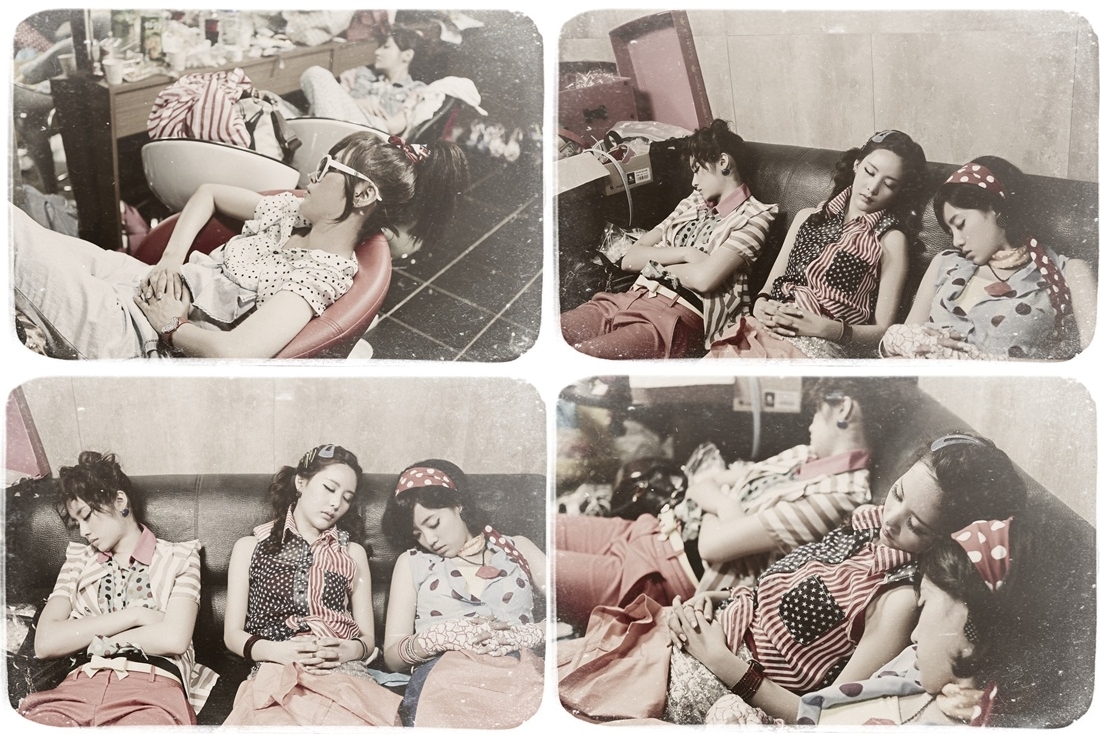
T-ara members sleep for 2 hours a day (Frank Kogan; see Seoulbeats also)

Convicted rapist successfully uses the ‘crooked dick’ defense (The Marmot’s Hole; update)

Korea divorce checklist for negotiation of a marital separation agreement in Korea (The Korea Law Blog)

Parents tremble at ‘pleasure parties’ thrown by foreign instructors (Gusts of Popular Feeling)

Travel in Korea still lacks women’s bathrooms (Travelwire Asia)

쓰레기 같은 학생, or, Why you might need pepperspray (Gord Sellar)

Hair freedom for Seoul students (Hankyoreh)

Internet hot over ‘bikini protest’ (Korea Times) vs. Gong Ji-young (“The Crucible”) Bikinis, Breasts and Weasels (Korean Modern Literature in Translation)

Fat tax elicits mixed reactions from S. Korean public (Xinhuanet)

Survey finds lots of sexual harassment at South Korean workplaces (Asian Correspondent)

Korean women and western/white men: a complicated and troubled relationship (The Unlikely Expat)

Women leading Korea (The Peninsula) vs. Lone Star and the women of Korea (The Wall Street Journal: Business Asia)

Jeju Island, known for wind, women, and water…now has more men than women (The Wall Street Journal: Korea Realtime)

My final post on Asian/white interracial relationships (Shanghai Shiok!)

Brides-to-be being ripped off ahead of their big day (Hankyoreh)

“[Is] dating a 28 year-old guy in Korea like dating a 15 year-old in the US?” Deconstructing inane and offensive reader questions (I’m No Picasso)

• An update to the above story – the question wasn’t as bad as it first looked!

Ministry strives for women’s rights (The Korea Herald)

South Korea’s racism debate – What debate? (Gord Sellar)

• Headline of the week: “Hard competition coming for erectile dysfunction remedies” (Hankyoreh)

Entertainment agency representatives voice opinions on idol dating, marriages, and age-limits on usefulness (Allkpop)

More elderly people sue their children for support (The Chosunilbo)

(Links are not necessarily endorsements)

Ali Meets Father of 8 year-old Rape Victim “Na-young”

Estimated reading time: 6 minutes. Source: maniadb

If you’ve never heard of Ali, Na-young (a pseudonym), or their connection, please see Seoulbeats for some background. Assuming that you have, I’d like to add just two things in this introduction to today’s translation.

First, that back in December 2008, the combination of the particularly horrific nature of the crime, and the light sentencing of the rapist, simply incensed the Korean public. So perhaps one can understand the severity of netizens’ reactions to Ali using Na-young’s name in a song title.

Next, that that public outrage in 2008 ultimately led to many changes to the Korean pop-culture industries, which we’re still seeing the effects of today. For, triggered by Na-young’s case, public anger about sex crimes against minors came to a head by the following summer, leading to increased scrutiny and concern about those working in the music industry especially.

Combine that with the sex-crime revelations that followed suicide of actress Jang Ja-yeon, and we came to have the widespread restrictions on and/or censorship of song subjects, lyrics, clothing, dance moves, and so on that we see today (albeit not just on minors). Working around those—or deliberately breaking them to create publicity—has now become an integral part of the production of K-pop.

(Translation begins)

Source: 우리다시여기에

[오늘의 세상] 아픔을 사랑으로 감싸다나영이 아버지, 알리 만나 주며 위로 / Enveloping pain with love . . . Na-young’s father meets Ali, gives flowers and consolation

Chosun, December 19, 2011,  by 정지섭/Jeong Ji-seob

아버지와 같이 온 나영이, 부끄럼 많아 차에서 기다려 / Na-young, who came with her father, was too shy and waited in the car

나영이 아버지:”그런 고통 있는 줄 몰랐네요 많이 힘들었죠… 울지마요, 네티즌들 진정했으면 좋겠다” / Na-young’s father: “We didn’t know you had that kind of pain.  It was very hard, wasn’t it.  Don’t cry, I hope the netizens calm down.”

편지 5장에 마음 담은 알리 “나영이에 용기주려 했는데 미리 말씀 못드려 죄송해요… 언니가 정말 미안해” 눈물 / Ali’s heartfelt 5-page letter: “I intended to give Na-young courage, and I am apologize for not informing you in advance. I am really sorry,” tears

“제가 작사·작곡자인데 미리 말씀드리지 않은 것 죄송합니다. 힘든 일 겪어도 언니처럼 이겨낼 수 있다고 용기를 주고 싶었어요.” (가수 알리)

“I am the lyricist and composer, and I am sorry for not informing you in advance.  I wanted to give you courage by saying that though you went through a difficulty, you can overcome it like I did.” (Singer Ali)

“앞으로 할 일이 많은 아가씨가 이렇게 힘 빼서 되겠어요? 울지 마요.” (나영이 아버지)

“Is it okay for a young woman who has so much ahead of her to lose strength like this?  Don’t cry.” (Na-young’s father)

17 일 오후 서울 강남의 한 연예기획사 사무실. 자신의 또는 가족의 ‘성폭행 피해’라는, 어쩌면 인생의 가장 무겁고 감추고 싶은 짐을 진 두 사람이 마주 앉았다. 한쪽은 검은 정장을 입은 여가수 알리(27). 다른 한쪽은 2008년 벌어진 조두순 성폭행 사건의 피해 어린이 나영이(가명)의 아버지.

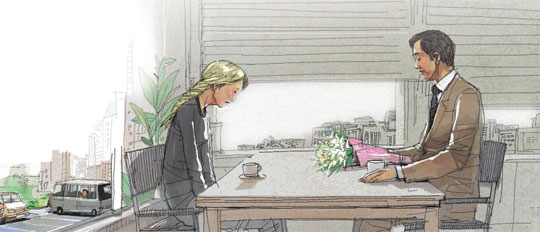
The afternoon of December 17th in the office of a Gangnam entertainment management agency. Two people, who personally or whose family bear the burden of the damage of sexual assault, maybe the heaviest and the one they would most wish to conceal of their lives, sat opposite each other. On one side, the singer Ali (27), wearing a black suit.  On the other side, the father of Na-young (false name), the child victim in the 2008 Cho Doo-soon sexual assault case (illustrator, right: 이철원/Lee Cheol-won).

모든 일은 14일 알리가 조두순 사건을 다룬 자작곡 ‘나영이’를 새 앨범에 담아 발표하면서 비롯됐다. 일부 네티즌은 ‘청춘을 버린 채 몸 팔아 영 팔아…’ 등의 가사를 문제 삼으며 알리를 무차별 공격했고, 알리는 그날 밤 나영이에 대한 사과문을 낸 뒤 앨범을 전량 수거·폐기했다.

The whole matter began on the 14th with the release of Ali’s new album, which includes a song she wrote, called “Na-young-ee,” about the Cho Doo-soon incident.  Some netizens questioned the use of lyrics like, “You threw away your youth, selling your body, selling your soul,” and attacked Ali indiscriminately; that night, after releasing an apology for “Na-young-ee,” Ali collected and discarded all copies of the album.

그래도 일부 네티즌의 악플이 멈추질 않자 알리는 16일 아버지와 함께 기자회견을 열어”3년 전 나도 성폭행을 당했다”고 고백하며 거듭 용서를 구했다. 알리 측은 14일 문제가 발생하자마자 나영이 가족에게 “찾아가 사죄하고 싶다”는 뜻을 전했고, 안산에 사는 나영이 아버지가 알리 측의 기자회견을 본 뒤 “내가 나영이와 함께 찾아가겠다”고 해 만남이 성사됐다.

However, some netizens’ negative comments didn’t stop, so Ali held a press conference on the 16th with her father and confessed, “3 years ago, I was also sexually assaulted,” and asked once more for forgiveness.  On the 14th, as soon as the problem appeared, Ali conveyed her wish to “go and apologize” to Na-young’s family, and Na-young’s father, after watching Ali’s press conference, said, “I’ll go with Na-young to visit her,” and the meeting was arranged (caption, left: 알리가 17일 나영이 아버지를 통해 나영이에게 준 사죄의 편지 / The apology letter Ali gave to Na-young through her father on the 17th).

이날 나영이 아버지는 알리가 눈물을 흘리며 사죄하자 갖고 온 백합과 안개꽃 다발을 내려놓고 거듭 알리를 달랬다. “나도 어제 기자회견한 내용을 들었어요. 그렇게 큰 고통이 있는 줄 몰랐네요. 얼마나 힘들고 어려웠을지 충분히 짐작돼요. 사전에 우리에게 알리지도 않고 노래를 만들었단 얘길 듣곤 화가 나 음반 판매 금지 가처분까지 생각했는데 노래를 폐기하겠다고 해서 마음이 좀 누그러졌어요. 그런데 그런 사정(성폭행)까지 있었다니, 내가 다독여줘야겠다는 생각이 들었죠.”

On this day, Ali apologized with tears streaming, and Na-young’s father put down the bouquet of lilies and baby’s breath he had brought and comforted her repeatedly.  “I heard what you said at the press conference.  I didn’t know that you had such great pain.  I can guess how difficult and hard that must have been.  When we heard that you’d made the song without letting us know beforehand, we were angry and even thought of an injunction banning sales of the album, but you said you would discard the song so our feelings softened.  But you had that kind of situation (sexual assault), so I felt I should console you.”

나영이 아버지가 “참 많이 힘들었죠?” 하자 알리가 울먹이며 입을 열었다. “(나영이와) 같은 해에 저도 당했어요. 그래서 (나영이) 기사가 나오면 스크랩해서 주변 사람들에게 보여주고 (나영이 돕기 모금 기관에) 익명의 기부도 했어요. 남의 일이 아닌 것 같아 더 적극적으로 돕고 싶었지만 그러면 주변에서 ‘혹시 너 뭐 있니’ 할 것 같아서 공개적으로는 못 했죠.”

When Na-young’s father said, “It was very hard, wasn’t it?” Ali was on the verge of tears as she spoke.  “I was assaulted in the same year (as Na-young).  So when the articles (about Na-young) came out, I saved them and showed them to the people around me, and donated anonymously (to the fund-raising organization for helping Na-young).  It didn’t feel like someone else’s problem, so I wanted to help more actively, but it seemed like if I did that, the people around me might ask, ‘Did something happen to you?’ so I couldn’t do it openly.”

나영이 아버지는 알리에게 “힘들겠지만 위축되지 말고 당당하게 정면 돌파해라. 그게 이기는 길”이라고 했다. “우리 사회 풍토가 슬프지만 ‘목소리 안 내는 사람이 바보’라고들 생각하잖아요. (성폭행 피해자들이) 자기 목소리를 당당하게 낼 수 있는 기회가 만들어져야 해요.” 그는 “이번 (나영이 노래) 일 때문에 네티즌이 많이 화가 난 것 같은데, 오해도 많이 풀린 만큼 진정됐으면 좋겠다”고 했다.

Na-young’s father said to Ali, “It must be hard, but instead of cowering, face things confidently head-on. That’s the way to win.  Our social climate is sorrowful, but as people say, ‘The person who doesn’t speak out is a fool.’  Opportunities need to be created for (victims of sexual assault) to speak out confidently.”  He continued, “Because of this matter (the song “Na-young-ee”), netizens seem to have gotten very angry, and I hope this misunderstanding gets cleared up so they will calm down.” (caption, right: 가수 알리가 (본명 조용진) 16일 오후 서울 종로구 홍지동 상명아트센터 콘서트홀에서 열린 알리의 정규 1집에 수록된 ‘나영이’곡 논란과 관련한 공식 기자회견장에서 2008년 성폭행당한 사실을 밝히며 눈물을 흘리고 있다 / Singer Ali {real name Jo Yong-jin}, at an official press conference at the Sangmyeong Art Center in Hongji-dong, Gongro-gu, Seoul, regarding controversy caused by her song, 나영이, in her 1st regular album, crying while announcing that she was raped herself in 2008)

나영이 아버지가 1시간여 동안 얘기를 나눈 뒤 “바쁜 사람 시간 잡아먹으면 안 된다”며 일어나자 알리는 다이어리와 연필, 꽃 장식이 달린 머리띠가 든 종이 가방을 전달했다.

After talking for an hour, Na-young’s father said, “I shouldn’t take up a busy person’s time,” and stood up.  Ali gave him a paper bag containing a diary, pencil, and flower-decorated headband.

알리는 나영이에게 사죄와 격려의 메시지를 보내는 내용의 다섯 장의 편지도 초록 봉투에 담아 함께 전달했다. “내가 부족해 너에게 상처를 또 주게 돼 정말 미안해. (중략) 만약 괜찮다면 너의 얘기도 들려줘. 친구가 되었으면 좋겠어.”

Ali also gave Na-young a five-page message of apology and encouragement, contained in a green envelope.  “I’m very sorry that my mistake caused you to be hurt again.  (…) If it’s okay, tell me your story in return.  I’d like us to be friends.”

나영이 아버지가 집으로 출발하려는 차 안에는 나영이가 타고 있었다. 나영이 아버지는 “나영이가 차를 오래 타고 와 피곤했던 데다 부끄러움을 많이 타 밖에 있고 싶다고 했다”고 했다. 알리는 안이 잘 보이지 않는 창밖에서 “언니가 정말 미안해”라고 몇 번이고 말했다.

Na-young was in the car that her father took to go home. Her father said, “Na-young is tired from riding in the car for a long time, and also she is very shy, so she said she would like to stay outside.” Outside of a window into which one couldn’t really see, Ali said several times, “I am really sorry.” (end)

(Thanks to Marilyn for the translation)

If you reside in South Korea, you can donate via wire transfer: Turnbull James Edward (Kookmin Bank/국민은행, 563401-01-214324)

Korean Boys: “Wearing Hot Pants Says Something About You”

(Source)

A much more serious topic than it may sound, this article from Ilda Women’s Journal will definitely give you a renewed appreciation for the goals of the Slutwalk (잡년행진) movement.

Once it does though, unfortunately you’ll probably find yourself pretty frustrated with it too. For the author only really gives platitudes about the need for change, rather than provide any details about who those boys were, what they said exactly, and the sex-education program her and her colleagues were involved in.

But still, she’s right to be concerned about the messages children are receiving about sexuality when any elementary school boys both approve of and chastise attractive women for wearing revealing clothes. Let alone disallow “ugly” ones from wearing them:

(Source)

“못생긴 애들 핫팬츠 입지 말라”는 아이들 Children That Say “Ugly Girls Shouldn’t Wear Hot Pants”

여성의 노출’을 바라보는 십대들의 시선 Teenagers’ Views on Women Who Wear Revealing Clothes

So Yeong-mi, August 2010

(일다의 독자위원인 서영미님은 현재 십대들과 함께하는 성교육 프로그램을 진행하고 있습니다―Editor)

Editor: Ilda reader So Yeong-mi is currently involved in a sex-education program aimed at teenagers.

“선생님, 질문 있어요. 왜 여자애들은 그렇게 짧은 반바지를 입어요?”…“여자애들이 핫팬츠 좀 못 입게 해주셨으면 좋겠어요!”…“?????????”

“Teacher, I have a question. Why do women wear such short shorts?”…”If young women didn’t wear hot pants, that would be good.”

이게 도대체 무슨 문제란 말이지? 최근 들어 두 번이나 받은 질문이다. 고등학교 청소년 남자 아이들을 만났을 때 한번, 그리고 초등학교 남자아이들과 교육하면서 한번. 성장기 자신의 몸의 변화나 성관계, 임신/출산에 관련한 질문들이 대부분인 편이라 이 질문이 유독 기억에 남았다. 같은 반 여자아이들이 핫팬츠를 입지 말았으면 좋겠다니 이 무슨 말인가?

(Source, NSFW)

Why on earth are they saying and asking these things? This has happened to me twice recently. Once, from teenage boys at a high school, and the other from boys at an elementary school. Most of the questions I get are normal ones about their development, changes to their body, sexual relationships, pregnancy and childbirth and so on, but I especially remembered these. Why are boys saying that girls in their classes shouldn’t wear hot pants?

James – Because of the mention of female classmates, I’m assuming the boys were in mixed-schools then? But So Yeong-mi doesn’t mention how the girls reacted to such questions, an omission which hopefully means she taught the boys and girls separately.

뜬금없는 질문이 궁금해 스무고개 하듯 계속해서 질문을 주고받으며 질문한 의도를 파악하려 애썼다. 질문자는 한 명이었지만 반 아이들 모두가 동의하고 있었고 별로 웃기지도 않은 질문에 아이들은 자지러졌기 때문이다. 질문을 받은 내가 자신들 생각대로 웃어넘기지 않고 진지하게 계속 물으니, 나중엔 아이들도 제법 진지하게 맞받아쳤다. 그리하여 나온 결론은 같은 반 여자아이들은 핫팬츠를 입으면 안 된다는 것!

I was very curious why these questions came out of the blue, so I sort of played 20 Questions with the students to find out. Only 1 student [in each case?] asked, but all the other students thought it was hilarious, and they expected me to laugh along with them. I wanted to get to the bottom of that, and so later when they gave me feedback it emerged that they felt that girls in their classes shouldn’t wear hot pants.

(Source)

모자와 핫팬츠는 다르다? What’s the Difference Between Hot Pants and Hats?

“오크가 그런 걸 입는 게 말이나 돼요?” “Would Orcs Wear Hot Pants?”

판타지 소설이나 롤플레잉 게임에 주로 등장하는 괴물, ‘오크’족. 쭉쭉빵빵 몸매도 좋고 능력도 좋은 미녀캐릭터들에 비해 볼품이 없어 쉽게 무시당하고 힘만 센 캐릭터. 아이들의 설명에 의하면 이랬다. TV에서 연예인들이 입는 것과는 다르다는 것. 그건 당연히 ‘봐줄 만하다’는 것이다. 핫팬츠뿐만 아니라 미니스커트에도 역시 강한 불만을 표했는데, 이번에는 또 다른 이유를 제기했다.

As the students explained, in fantasy novels and role-playing games the monster that appears the most frequently is the orc. Unlike beautiful female characters, with great abilities and voluptuous bodies (and usually useless armor – James), orcs are essentially faceless characters that can easily be disregarded. What entertainers wear on TV is different though, and, of course, it’s worth watching.

But it’s not just hot pants that the boys had problems with girls wearing, but also miniskirts. They gave a second reason for that.

“옷이 그러면 그렇고 그런 거 아니에요? 위험할 수도 있잖아요.”

“Doesn’t wearing clothes like that say something about you? And it’s dangerous too!”

아이들은 여성인 내게 “선생님도 그런 옷을 입냐”며 “도대체 왜”냐고 야단이었다. 한 학생이 모자를 쓰고 있기에 “너는 왜 모자를 쓰고 있냐” 물으니 “그냥 좋아서”라고 가볍게 얘기했다. 그럼 “핫팬츠나 미니스커트를 선택해서 착용하는 것은 무엇이 다르냐” 물으니 “그건 당연히 다르다”고 소리친다. 적절한 대답이 없을 때 아이들은 대개 화를 낸다.

(Source)

The students asked me, a woman, “Do you wear clothes like that?”, and, in a critical tone, “Why on Earth do women wear those?”. So, to one student who was wearing a hat I asked “Why are you wearing that hat?”, to which he casually replied “Because I like it”. So then I asked “How is that different to choosing hot pants or a miniskirt”, and got the retort that “Of course it’s different!”, the student becoming angry that he didn’t really have a proper answer.

그날 종일은 아이들과 좀 더 많은 시간을 들여 ‘개인의 취향’에 대한 이야기를 나누었다. 서로의 취향을 존중하고 이해해야 하는 이유를 찾아보며 남/녀를 탈피한 다양한 관계 속에서 역할활동까지 해봤다. 그러나 그 날의 아이들에게는 이미 모자와 핫팬츠의 ‘선택’이 다르지 않다는 것을 이해시키는 것이 어려워 보였다. 너무나 견고한 그들만의 ‘패션철학’이 놀라울 따름이었다.

I spent all day with the students, and shared a story about personal tastes with them. Then we did roleplaying, breaking away from normal man/woman and girl/boy ones, in order to better understand and respect each other’s personal tastes. It was difficult to make them understand that wearing hot pants was a choice, no different to wearing a hat, and I was very surprised in how unwavering some of their attitudes to fashion were.

우연히 비슷한 시기에 만난 이 집단 아이들만의 문제였을까. 교육이 끝난 후 평가시간에 이 에피소드를 털어놓으니 유난히 남자아이들 교육을 진행할 때 그런 질문이 많이 나온다는 실무자들의 의견이 있었다. 예쁜 사람이 입으면 괜찮고, 아니면 안 괜찮고, 짧은 옷을 입으면 위험하고 야한 어떤 것이라는 10대 초반의 아이들의 논리. 고등학생 이상의 청소년 들을 만났을 때만 해도 성인과 비슷하게 생각해나가는 시기여서 그런가 생각했는데, 초등학생들에게서까지 강한 불만으로 표출되어 나오니 그냥 웃어넘길 일이 아니라는 생각이 들었다.

I wondered if this way of thinking was just confined to the groups of students I taught, so afterwards I asked other sex-ed teachers involved in the program, and they confirmed that they get similar questions and opinions from especially male students. The logic of boys in their early teens was that if pretty girls wear hot pants and so on it’s okay, but if they’re not pretty then it’s not, and that [in either case] such clothes are both too revealing and dangerous.

(Source)

Now, if I’d asked high school students and so on, who think like adults, then I wouldn’t have been surprised, but once I learned that even elementary school students are saying such things then I realized that this was no laughing matter.

고 민지점은 성인들이 갖고 있는 편견이나 고정관념들이 고스란히 아이들에게도 답습된다는 것이다. 또한 그 연령이 대폭 낮아졌다는 사실도 놀랄만한 일이다. 그 어린 학생들마저도 ‘여성’의 몸을 검열하고 있다는 사실에 주목하지 않을 수가 없는 것이다.

Children are picking up adults’ prejudices and biases, although it is surprising that they’re doing so at such a young age. And we can’t help but notice that even these children too think the female body is something to inspected and evaluated.

우리가 어떤 일을 할 수 있을까 What can do we do about this?

노출이 많은 옷을 입은 여성과 그렇지 않은 여성을 간단하게 이분화 시키고, 거기에 아름다움이라는 가치를 연결시킨 잣대로 평가하는 것은 아이들도 어른들과 크게 다르지 않았다. 다만 아이들의 용어로 표현하고 있을 뿐이었다. 이를 우스갯거리로 사용하는 아이들을 보고 있자니 솔직히 조금 화가 나기도 했다. 그리고 그와 동시에 우리 스스로 반성해야 될 때가 아닌가 생각해보게 됐다.

Children splitting women into simply those who wear very revealing clothes and those that don’t, and judging their value only in terms of their appearance, is little different from what adults do. But although the children just used these terms jokingly, to be honest I still got a little angry with them.

Yet at the same time, we really need to examine ourselves too.

대중매체에 대한 비판을 하려던 차에 최근 10대 청소년 연예인들을 상대로 60%가 신체 노출이나 과도한 성적 행위 장면을 강요했다는 기사들을 보게 되었다. 한 언론과의 인터뷰에서 가수 이은미는 음악성 보다 외적인 면에 더 관심을 갖는 사회 분위기를 우려하며, 성적인 면이 강조된 걸그룹의 노래, 의상, 춤에 환호하는 이 사회를 ‘몰상식의 극’이라고 표현했다. “초등학교를 졸업한지 몇 년 되지 않은 아이들을 벗겨놓고 대 놓고 섹시하다고 박수를 치거나, 꿀벅지, 꿀복근 같은 용어들을 사용하는 대중문화를 보면 소름이 끼친다.”는 것.

(Source: unknown)

I was about to blame the mass media, as recently I’ve read reports which say that 60% of female teenage entertainers have claimed to have sometimes been forced to wear revealing clothes and/or do sexual dances and so on. And in an interview of the singer Lee Eun-mi (James – Not one of those teenage entertainers; she was born in 1968), she said she was worried about a society that considered external appearance more important than musical quality for singers, where girl groups’ sexual dances, songs, and outfits where cheered…she used the term “thoughtless/careless”. She said “I freak out at the thought that just a few years after they graduate from elementary school, young male and female entertainers are being praised for taking off their clothes and being talked about in terms of their ‘honey thighs‘ or six-packs.

쏟 아지는 대중매체의 벗기기 논란은 새삼 어제오늘 일도 아니건만, 아무 손쓰지 않고 있었음에 반성하게 된다. 상품화되고 대상화되고 있는 여성들의 문제를 공공연히 문제 삼지 않았던 것이 일상생활에까지 주변 사람을 대상화하고 외모로써 평가하는 지금의 일을 만든 게 아닌가 하는 생각에서다.

But these trends in the media didn’t just appear overnight – they were allowed to flourish by the public’s inattention and lack of concern. This way, we have come to consider the commercialization and objectification of women as a normal part of our daily lives.

아 이들의 생각을 넓게 펼쳐주진 못할망정 오로지 외모로써 사람을 평가하는 우리 사회에서 우리가 어떤 일을 할 수 있을지 함께 고민해봤으면 좋겠다. 우리가 그동안 무심코 내뱉었던 말들이 아이들에게 어떤 영향을 미치게 될지 생각해보면서 말이다. 문제가 수면으로 드러난 지금이야말로 왜곡된 미와 과장된 외모 중심의 평가들로부터 벗어나 아이들에게 더 많은 관심을 가져야 할 때다. 아이들뿐만 아니라 사실은 우리 모두를 위해서 말이다.

It’s difficult to broaden children’s minds, but we do have to make an effort to stop judging each other on our appearances. We have to consider what has been the effect on our children of this focus, this excessive emphasis on appearance. Not just for them, but for society as a whole (end).

My post title aside, I don’t mean to generalize about all Korean boys, and given the author’s vagueness then what she says about them really needs to be taken with a grain of salt. So, to get a better overall picture, I’d really appreciate anything any teachers can tell me about what their own young students have ever said about such things (alas, it’s been a while since I’ve taught children or teenagers myself).

And to end on a positive note, was anyone else reminded of the above semi-response to such sentiments? Now I have a renewed sense of appreciation for that too!^^ (See here for a discussion of the song’s lyrics and meaning)

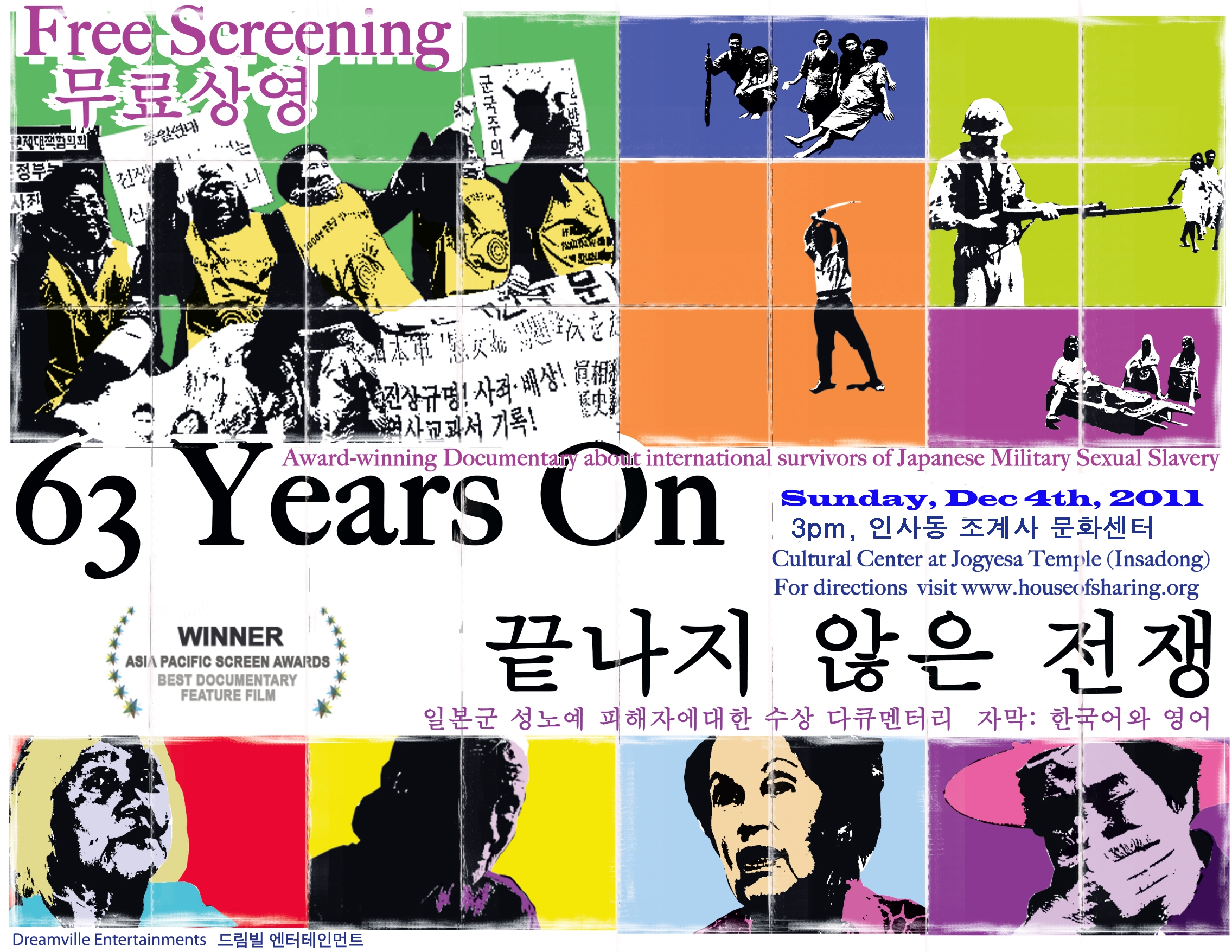
63 Years On: Free Screening in Seoul this Sunday

With thanks to Shannon Heit for letting me know, this Sunday at Jogyesa Temple in Seoul there will be a free screening of 63 Years On, an award-winning documentary about the Comfort Women (with English subtitles). If you’re interested in attending, please see the press release (an MS Word file) for further details, and note that it actually starts at 2pm, not 3pm as stated in the poster (which I’ve confirmed is a mistake).

Free Women’s Self-defense Seminar in Busan, October 1st

See here and here for those 2 links on the poster, and also here for the Angels with Attitude website.

Anybody thinking of going? If so, please report back and let everyone know how it went!

Share

Sexual Assault on Subway Caught on Camera

Here’s my translation of a brief report from Sunday’s 8 News. Unfortunately, SBS is pretty strict about copyright, so I can’t risk uploading the video to Youtube. But it’s readily available at the original link:

애인인 취한 20 여인 옆에 앉아 성추행 /  Drunk man sits next to drunk 20-something, pretends to be lovers, sexually assaults her

Anchor:

지하철에서 옆자리에 잠든 20대 여성을 마치 자신의 여자친구인 양 쓰다듬으며 성추행하던 남성이 붙잡혔습니다. 카메라에 그 모습이 담겼는데요, 정경윤 기자가 보도합니다.

A man has been arrested [in Seoul] for sexually assaulting a 20-something woman sitting next to him on the subway, pretending she was his girlfriend. This scene was recorded on camera. Jeong Gyeong-yoon reports.

Jeong Gyeong-yoon:

지난 20일 새벽, 지하철 전동차에 50대 남자와 20대 여자가 나란히 앉아 있습니다. 여자는 잠들어 있고 옆에 앉은 남자는 마치 연인처럼 행동합니다 10여 분간 껴안고 쓰다듬는 등 신체 접촉을 계속합니다. 하지만 이 남자의 행동을 수상하게 여긴 한 시민에 의해 성추행은 발각됐습니다.

In the early hours of Wednesday the 2oth, a man in his 50s and a women in her 20s were sitting side by side on a subway train. While she was sleeping, the man acted as if they were lovers for about 10 minutes, embracing and caressing her, and continuously touching her body. But this looked a little suspicious to another passenger, through whom this sexual assault was exposed.

[라 모 씨/목격자 : 나이 차이가 많이 나 보이고 수상해서 계속 보는데, 여자를 깨워서 이 남자분 아시냐고 했더니 모른다는 거예요. 바로 남자 멱살을 잡고 끌고 나왔죠.]

(Anonymous) Recorder of video: Because the difference in their ages was so great, it looked a little suspicious to me, so I kept an eye on them.  When the woman woke up, I asked if she knew him, and when she replied that she didn’t, I immediately grabbed him by the throat and dragged him off the train.

남자는 현행범으로 경찰에 붙잡혔지만, 술에 취해 기억이 나지 않는다며 혐의를 부인했습니다.

지난 5월에는 심야에 20대 여성이 성추행을 당한 뒤 도망쳤지만 주변 도움을 받지 못해 또 다시 폭행당하는 사건도 있었습니다. 지하철 성범죄 가운데 심야 시간대 발생 비율은 4.1%. 하지만 취객이 많고 주위 도움을 받을 수 없는 경우가 많아 여성들이 느끼는 불안감은 더 큽니다.

The man was arrested by police, but because he was drunk he didn’t remember it, and denied doing it.

In May, there was also a case of a woman who also sexually assaulted [James – presumably on the subway] at about midnight, but when she escaped she was unable to get any help, and so got sexually assaulted again. And the reported cases of women being sexually assaulted on the subway in the late evening have increased 4.1% [James – compared to last year?]. With so many drunk people [men?], and so many cases of no help being available, then women are increasingly anxious.

[장소영/서울 천호동 : 술주정 하시는 분들도 많고, 그런 분들이 다른 여성들한테 해코지 하는 것도 많이 봐서…]

Jang So-yeong, Seoul (Cheon-ho dong) resident: There are many drunk people [men?] around, I’ve seen them treat women badly many times…

늦은 시각 지하철 성범죄가 잇따르자 서울시가 19년 만에 여성전용칸을 부활하겠다는 방침을 밝혔지만, 반응은 신통치 않습니다.

Because there was a succession of sexual crimes on the subway 19 years ago, then back then a special women-only carriage was provided. This idea is being revived, but public reaction has been negative.

[지하철 역무원 : 취약 시간대 별 효과 거두지 못할 것 같아요. 여성 전용칸만 보고 지키는 사람이 없잖아요.]

Subway Worker: I don’t think it will be effective at those late hours when women are most vulnerable. It’s not as if labeling a carriage women only will dissuade people who set out to assault women.

지하철 성범죄는 갈수록 늘고 있지만, 대책은 아직도 미흡합니다.

Day by day, sex crimes on the subway are increasing, but there’s still no satisfactory policy to deal with them.

(영상취재 : 홍종수, 영상편집 : 박선수) 정경윤 rousily@sbs.co.kr / Data Collection: Hong Jong-soo, Editing, Compilation: Park Seon-su. Written by Jeong Gyeong-yoon (end).

Unfortunately that report raises many more questions than answers, but still: kudos to the guy who didn’t just record the scene but actually did something about it as well. And thanks to reader Mallory for passing the report on.

For anyone further interested, see Global Voices here for much more on the Korean public reaction’s to the planned women-only subway cars (update: the Marmot’s Hole also has a post on it), or The Three Wise Monkeys here for some context on the recent increase in sexual crimes in Seoul specifically (including some mention of subways). Or, for more on sexual harassment and sexual assault in general, see my posts in that category, especially this one on groping.

(p.s. If anyone’s curious, some text on the screen said that the incident happened on Line 5)

Share

Slutwalk Korea (잡년행진) This Saturday!

(Source)

Sorry for the short notice, but I’ve only just found out about it. Still, that might actually be a good thing(!), as like Gomushin Girl put it:

…I’m sure part of the reason lots of expats haven’t heard about it is because the Facebook page and most of the planning has been done by and for Koreans, which is freakin’ awesome.

Indeed. But I’m sure the organizers would still be more than happy for any spectator support and/or even participation by expats, so please contact them via their blog, Facebook page, or Twitter feed if you’re interested (and here’s the Wikipedia page for more about Slutwalk in general). And, with it starting at 4pm in Gwanghwamun, I’m happy to report that I’m actually going to be able to see it myself, as by a great coincidence I’d already just booked KTX tickets to see a friend in Seoul at the very same time and place!^^

(Hat tip to Dating in Korea)

Update 1: Here’s a Korea Times article on the event. More links coming soon!

Update 2: Impossible Black Tulip questions the wisdom of holding Slutwalks.

Update 3: Here’s Roboseyo’s excellent report on the event.

Share

Seniors Routinely Sexually Harass Juniors during “Membership Training”?

(Source)

When I first came to Korea in 2000, I soon got used to the notion that people should use nopimmal (높임말; respectful language) to their obvious “superiors”, such as their parents and bosses. But also to friends, even if they were just a year or two older? Call me a cultural imperialist, but I still balk at the notion that such people are genuine friends, and God knows what they’d make of the usually whiskey-fueled language my late friend and I, then twice my age, would use with each other (let alone what we usually talked about).

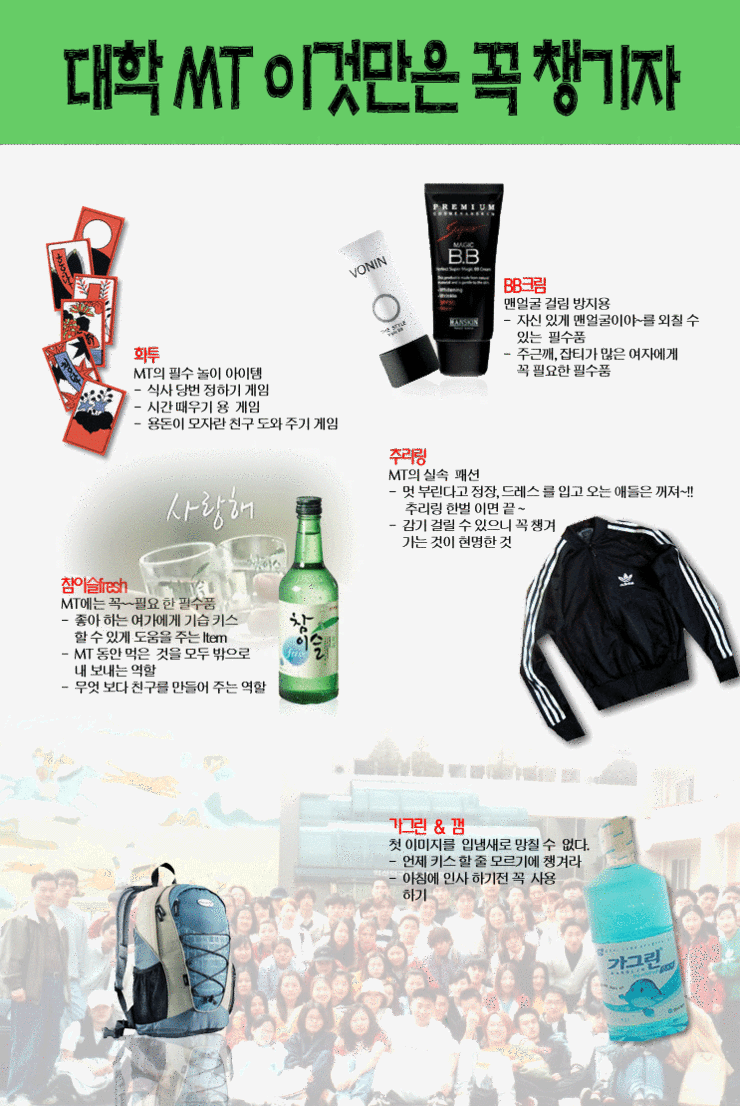
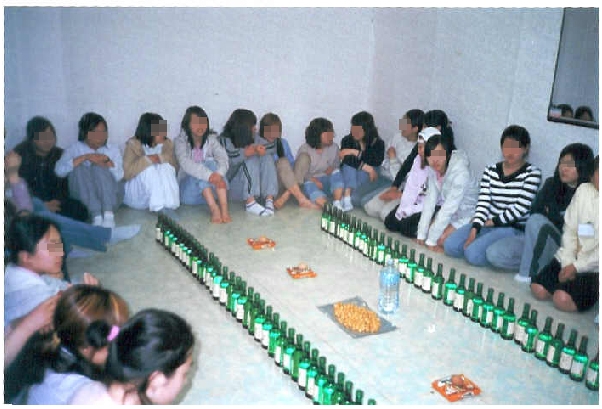
Still, it came as a real shock to hear students using it to some of their classmates at my university, even though the recipients were only just a few months older (I asked). In fairness, that didn’t happen at all at my wife’s university when she was a student, but suffice to say that I’m no longer particularly surprised when I hear of “seniors” taking advantage of “juniors” in various forms at Korean universities. And especially not on “Membership Training” (MT), which as you probably know involves a lot of drinking and various orientation and initiation rituals, as explained in the following report:

(As translator Marilyn notes, makjang means “extreme, in a negative way”, and is usually used to describe dramas where crazy things happen. Meanwhile, with thanks to SuzyinSeoul, the “OT” in the title means “Orientation Training”, one’s first MT)

(Sources: left, right)

막장 OT? ‘학내 성희롱’의 문제 보아야 / Makjang OT?  The problem of “school sexual harassment” must be considered

성희롱문제의 사각지대에 놓인 학생간 성희롱 / Sexual harassment among students is an unseen part of the problem of sexual harassment

얼마 전 인터넷 상에서는 서울 소재 모 대학의 신입생환영회가 논란이 되었다. 지난달 26일 인터넷 포털사이트 게시판에 “대학교 오리엔테이션, 이래도 되는 건가요?”라며 오른 글이 시작이었다.

Recently, the welcoming ceremony for new students at X University in Seoul has become a controversy on the Internet.  It was started by a post, titled “At a university orientation, is this really okay?” and put up on an Internet portal site’s message board on the 26th of last month [February].

성적 수치심 느끼게 하는게임시킨 선배들 / Seniors who make games that cause [juniors] to feel sexual shame

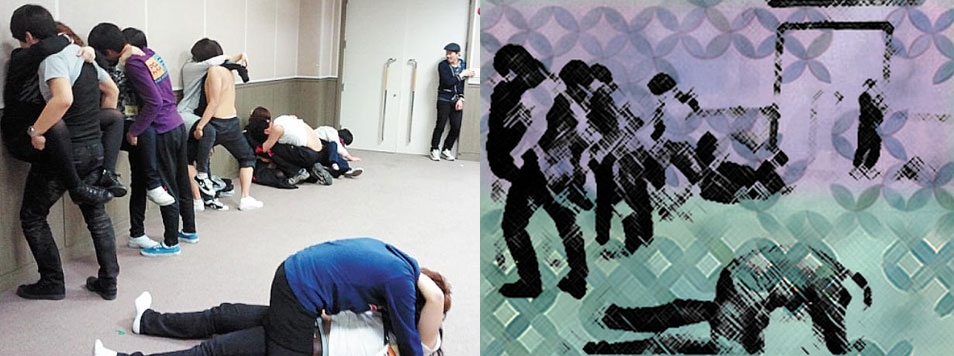
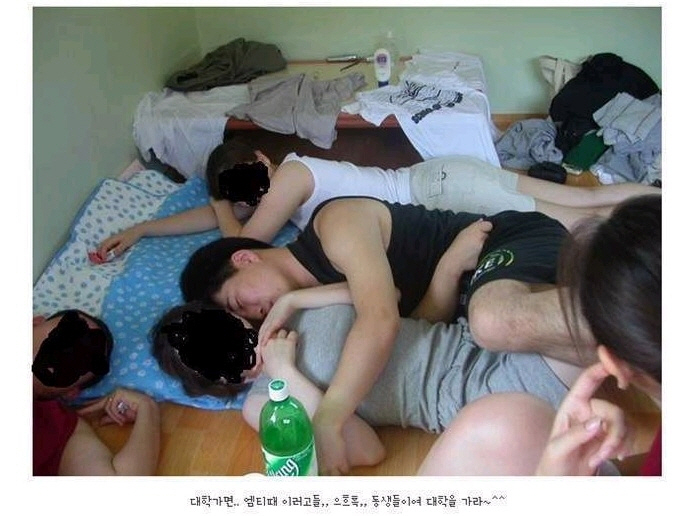
글 쓴이는 몇 장의 사진과 함께 “오리엔테이션에서 선배들이 후배들에게 성적으로 부담스럽거나, 수치심을 느낄 수 있는 행동들을 많이 시킨다”고 고발했다. 사진 속에는 남녀 신입생들이 몸을 밀착시키고 성행위를 연상시키는 동작을 취하는 모습들이 담겨 있었다. ‘게임’을 명목으로 강요된 것이었다. 글쓴이에 따르면, 술자리에서는 “정말 심한” 벌칙들도 많았다고 한다.

The writer of the post put up several pictures and charged, “At orientation, seniors force their juniors to do sexually embarrassing or shameful things.”  In the pictures, new male and female students press their bodies against each other and make sexually suggestive movements.   This was coerced under the pretext of a “game.”   According to the post’s writer there are also many “really severe” penalties at drinking parties.

(한 포털사이트에 성적 수치심을 느끼게 하는 ‘게임’을 강요하는 ‘신입생 오리엔테이션’ 문화를 고발한 글이 올라와 논란이 일었다.)

(Caption [to above image]: A post charging that a “new-student orientation” culture forces the playing of “games” that cause sexual shame was put up on a portal site and became a controversy.)

(Source)

문제의 사진들은 ‘막장 OT’라는 이름이 붙어 여러 게시판들로 퍼져나갔고, 몇몇 언론에서도 이 사건을 보도하면서 관련 학교와 학생들에게 비난이 가해졌다. 이후 사건은 해당 학교 총학생회가 사과문을 게시하는 선으로 마무리되었다.

The pictures were named “Makjang OT” and spread to several message boards, and as several media outlets reported on this story as well, the school and students involved were subjected to criticism.  After that, the student government at the university brought the incident to a close by posting a written apology.

이 사건은 인터넷 여론이 흔히 그렇듯 사건의 선정성에만 초점이 맞춰져, 관련 대학을 공격하거나 폄하하는 데에만 치중되었다는 인상을 준다. 그리고 논란의 열기는 금방 식었다.

As usual, public opinion on the Internet has focused on the sexual aspects of the story and so given the impression that it has only concentrated on attacking or disparaging the university in this area. Also, the heat of the controversy cooled down immediately.

이 사건이 문제인 것은 건전해야 할 대학 내 행사에서 선정적인 행위를 했기 때문이 아니다. 선배들의 권위를 내세워 신입생들에게 원하지 않는 성적인 행위를 강요했다는 점이 본질적인 문제다. 명백한 학내 성희롱이다.

The problem in this matter is not that there were sexual actions at university events that should be wholesome.  The essential problem is that seniors asserting their authority forced new students to do sexual actions they didn’t want to do.  This is unmistakable school sexual harassment.

(Source)

하늘같은선배 작아지는 신입생들 / New students that shrink in front of ‘god-like’ seniors

이제 막 대학을 들어온 신입생과 ‘선배’들 사이에는 막강한 권력관계가 작동한다. 대학생활에서 선배는 어떤 면에서 교수보다 더 어려운 존재다. 더구나 신입생 오리엔테이션은 이제 막 대학을 입학해 어리둥절하고 동기들과도 서먹할 때 치러지니 1학년들은 선배들 앞에서 심리적으로 위축되기 쉽다. 더구나 ‘전통’이라고 우기니 ‘참아야 되나’ 헷갈리기까지 할 것이다.

These days there is a strong power-imbalance operating between students who have just started university and their “seniors.”  In university life, relationships with seniors are more difficult than those with professors in every way.  Moreover, new-student orientations happen when students, having just started university, are dazed and still unfamiliar with their peers, so it is easy for first-year students to shrivel psychologically in front of their seniors.  Furthermore, seniors insist that it’s “tradition” so students become confused and think “Maybe I have to endure this?”

성희롱은 권력관계 안에서 일어난다. 이러한 속성 때문에 남학생이 많은 과, 권위주의적이고 위계질서가 강하게 잡혀 있는 과일 수록 신입생 환영회 때 이러한 ‘게임’을 즐기는 경향이 강해지고 ‘게임’의 강도도 높아질 것이라 추측할 수 있다.

(Source)

Sexual harassment arises inside power-imbalances.  Because of this attribute, it can be supposed that the more male students a department has and the more authoritarian and the stronger the hierarchical structure in the department, the stronger the tendency to enjoy this kind of “game” and the more intense the “games” are at new-student welcoming events.

시대가 변화한 부분이 있으니, 아마도 이러한 신입생 환영행사는 일반적으로 행해지는 수준의 것은 아닐 것이다. 그러나 아주 극단적인 예만도 아닌 것 같다. 관련 게시물들의 누리꾼 댓글에서도 비슷한 경험을 털어놓는 것을 심심치 않게 발견할 수 있다. 남성에게 구강성교를 해주는 여성의 모습을 연상시키는 동작을 하는 남학생들이 찍힌, 모 체육대학의 신입생 오리엔테이션 사진을 올린 이도 있었다.

Though there is the element of the changing times, this kind of new-student welcoming event probably isn’t common. However, it doesn’t seem to be an extreme example, either.  In the replies of the visitors to the message boards in question as well, it is not hard to find confessions of similar experiences.  There were also pictures from the new-student orientation at X Sport University [a university for athletes and coaches] which show male students making movements suggestive of women giving oral sex to men.

(Source)

대학사회, 성희롱 문제제기 여전히 어려워 / In university culture, making sexual harassment complaints difficult as ever

이번 사건을 문제제기한 학생은 학내 게시판이 아닌, 포털사이트를 이용해 글을 올렸다. 이는 문제의 ‘게임’이 ‘전통’으로 굳어질 수 있었던 배경과 관련된다.

The student who reported this incident used a non-university portal site to put up his/her post. This is related to the setting in which the “game” in question was allowed to become “tradition.”

지난 해 1월, 소위 ‘명문대생‘이 1학년 여학생들을 성추행한 사건이 논란을 일으켰다. 당시 한 피해자가 익명게시판을 통해 문제제기 하자 다른 피해자들이 나타나면서 피해자는 20여명까지 불어났다.

In January of last year, an incident in which so-called “students of a prestigious university” sexually molested first-year female students engendered controversy.  At that time, a victim made her complaint on an anonymous message board; other victims then came forward, until their number reached around 20 women.

왜 20여명에 달하는 피해자들은 성추행을 당하고도 입을 다물고 있을 수밖에 없었을까. 여전히 성희롱‧성폭력은 대학 사회 내에서도 쉽게 공론화하기 어려운 문제이기 때문이다.

Why is it that though the number of victims who were sexually molested reached about 20, they couldn’t do anything but keep quiet?  It is because even in university society, it is still difficult to publicly discuss sexual harassment and sexual violence.

(Source)

‘명문대생‘ 성추행 사건이 문제가 되었던 당시, 취업전문 포털사이트 ‘커리어’가 이틀간 대학생 768명을 대상으로 진행한 설문 조사에 따르면, 전체 여성 응답자 중 33.3%가 대학생활 중 ‘성희롱이나 성추행을 당했다’고 답했다.

When the “students of a prestigious university” incident became a problem, the job portal site “Career” surveyed 768 university students over the course of two days, and found that 33.3% of female respondents said they “have been sexually molested or harassed” during university life.

주된 가해자(복수응답)는 78.0%가 ‘선배’였다. 흔히 학내성희롱의 주된 가해자로 떠올리게 되는 ‘교수’를 지목한 대답은 33.3%였다. 대응방법을 묻는 질문에는 응답자의 66.5%가 ‘그냥 참고 넘겼다’고 답했다. 대응하지 않고 그냥 넘어간 이유는 ‘가해자와의 관계를 유지하기 위해서(66.9%)’가 가장 컸다.

The main perpetrators (more than one response possible) were “seniors,” at 78.0%.  “Professors”, who usually come to mind as the main perpetrators when one thinks of university sexual harassment, were pointed at by 33.3% of responses.  When asked how they dealt with it, 66.5% of respondents chose, “just bore it and moved past it.”  The biggest reason that they just let it go was, “To maintain a relationship with the perpetrator,” at 66.9%.

이렇듯 학생과 학생 사이에 발생되는 성희롱은 학내 성희롱 문제에 있어서 실질적으로 큰 비중을 차지하며 문제제기 하기도 어렵다. 그런데 교사와 교사, 교사와 학생 간 성희롱의 경우 성희롱 관련법의 규제의 대상이 되는 반면, 학생 간에 벌어지는 성희롱문제는 제외되고 있다. 따라서 학칙에 의존할 수밖에 없다.

Though this kind of student-on-student sexual harassment makes up a relatively large part of in-university sexual harassment, it is also hard to make a complaint.  Unlike in the case of sexual harassment between professors, or between professors and students, [public] regulations leave out sexual harassment that occurs between students.  Therefore, there is no choice but to rely on the school’s rules.

(Source)

그러나 성희롱을 ‘전통’으로 미화할 수 있는 대학사회에 이러한 미온적인 처치가 얼마나 큰 변화를 이끌어낼 수 있을까.

However, in a university culture that glamorizes sexual harassment as “tradition,” how big are the changes we can hope to effect to this kind of mediocre situation?

앞서 언급한 설문조사에서 전체 응답자 중 51.3%만이 성희롱 문제해결을 위한 대학 내 전담기관이나 담당자가 있다고 답했다. 대학사회에서 학생간의 성희롱이 사각지대에 놓여 있다는 사실을 이를 통해서도 유추해볼 수 있다. 관련 대책이 시급해 보인다.

In the survey mentioned above, only 51.3% of all respondents said that there was a special organization or officer for dealing with sexual harassment in their university.  Through this, as well, we can infer the fact that sexual harassment between students in university culture is not well-recognized.  Relevant measures appear to be urgently needed.

Writer: Park Hee-jeong (박희정), 3 March 2011.

(Source)

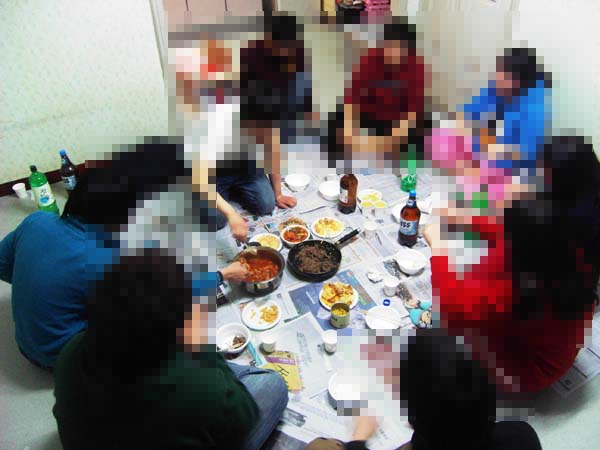
A disclaimer: I’ve never attended MT or even talked about it with students, so, students’ normal proclivities aside, I’m sure many or even most events are perfectly fine, and indeed Joe SeoulMan – ironically the source of one of the above images – has an account of a very nice, almost heartwarming one here. On the other hand, Extra! Korea argues that “it’s well-known among Koreans that sexual harassment is widespread at MTs”, and there’s certainly enough news stories in the Korean media to back that up.

What do you think? Have any readers attended MT themselves? Would you say that sexual harassment is indeed widespread at them, or is that just an impression created by the Korean media and *cough* bloggers, who tend to focus on the negatives?

(Thanks again to Marilyn for the translation)

Share

Sexual Harrasment on Intercity Buses

(Source)

Of course, I’ve never been sexually harassed on an overnight bus myself. But then I’ve never seen it happen nor heard anyone ever complaining about it either, nor have any of my female friends (Korean or Western). Are things really as bad as this article makes out?

[Why] 불 꺼진 심야고속버스, 술 취한 손이 내 가슴을…An express night bus with the lights off, a drunken hand on my breast

性추행·만취 난동 끊이지 않는 ‘달리는 범죄 사각지대’로, 유일한 안전요원은 운전기사 / [Becoming] a ‘running blind spot of crime’ with constant sexual molestation, intoxicated disturbances, and the driver the sole security officer

지난 12일 자정 무렵 광주발(發) 서울행(行) 심야 우등 고속버스 안. 버스가 출발한 지 10분 만에 한 여성이 소리를 질렀다. 막 고속도로에 진입한 버스는 갓길에 멈춰 섰다. 비명을 지른 20대 여성은 운전기사에게 자리를 바꿔달라고 했다. 여성 승객은 얼굴만 붉힐 뿐 이유를 얘기하지 않았다. 버스에 빈자리가 없어 운전기사는 여성 승객의 요구를 들어줄 수 없었다.

Inside the premium express night bus from Gwangju to Seoul around midnight on the 12th. Just ten minutes after the bus departed, a woman screamed. The bus, which had just entered the expressway, came to a stop on the shoulder of the road. The twenty-something woman who had screamed asked the bus driver to change her seat. She would not say the reason why, and she was only blushing. There were no empty seats on the bus so the bus driver could not grant her request (source, right).

고속버스가 다시 출발한 지 10분 정도가 지나자 또다시 비명이 들렸다. 버스는 재차 갓길에 멈췄다. 이 여성은 운전기사에게 “옆자리에 앉은 남자가 가슴을 만졌다”고 말했다. 술에 취한 듯 보이는 남성은 잠든 척했다. 이후 남성의 성추행은 한 차례 더 이어졌고, 고속버스는 예정에 없이 고속도로 갓길과 휴게소에 3차례 정차한 후 목적지인 서울에 도착했다. 50대 남성은 도착 후 유유히 사라졌고, 20대 여성 승객은 얼굴을 가린 채 울면서 황급히 자리를 떴다.

The bus had been back on the road for about ten minutes when a scream was heard again. The bus stopped on the shoulder for the second time.  The [same] woman told the bus driver, “The man sitting next to me touched my breast.” The man, who looked drunk, pretended to be asleep. After this, the man’s sexual molestation happened once more, and after the bus had made three unplanned stops on the expressway shoulder and a rest stop, it reached its Seoul destination.  The fifty-something man calmly disappeared after arrival, and the young female passenger left her seat hurriedly, crying with her face covered.

(Source)

심야 고속버스에서 성추행·흡연·난동 등이 빈번히 일어나고 있다. 늦은 밤 편히 휴식을 취하며 빠른 시간에 목적지에 가려는 이들이 선호하는 심야 고속버스가 ‘달리는 범죄의 사각지대’가 된 셈이다. 문제는 술에 취해 조용한 버스 안에서 고성방가를 일삼고 성추행까지 저질러도 제지할 방법이 마땅치 않다는 것이다.

In the express night bus, sexual molestation, smoking, and other disturbances occur frequently. This bus, preferred by people who want to relax comfortably late at night while quickly getting to their destination, has become a‘running blind spot of crime.The problem is that though someone becomes intoxicated and sings loudly in the quiet bus, or even commits sexual molestation, there is no suitable method of restraining them.

심야 고속버스는 출발과 동시에 전등을 끈다. 승객들의 취침을 위해 소등하는 것이 운전기사들에게는 의무처럼 돼 있다. 버스 안이 어두워 성추행이나 도난을 당해도 주변에서는 범행을 목격하기가 힘들다. 동부익스프레스 관계자는 “회사 모든 버스에 블랙박스를 설치했지만, 버스 내부는 인권 침해 소지가 있어 촬영하지 않는다”고 했다. 설사 버스 내부를 촬영할 수 있다고 하더라도 버스의 출발과 동시에 소등을 해 범행 현장 촬영은 불가능하다.

The lights are turned off in an express night bus as soon as it departs. Putting out the lights so passengers can sleep has become like a duty for drivers.  Because the inside of the bus is dark, even if one is sexually molested or stolen from, those nearby have trouble seeing the criminal behavior.  A source from Dongbu Express said, “The company installed a black box in all the buses, but because it is a possible civil rights violation, we don’t film inside the bus.”  Even if he had said they could film inside the bus, the lights are turned off after departure so filming the crime would be impossible.

(Source)

심야 고속버스에서 범행이 일어날 경우 제지할 사람이 없다는 것도 문제로 지적된다. 운전기사가 유일한 안전요원이다. 버스 안에서 소란이 일어나거나 범죄가 발생하면 운전기사는 달리는 고속버스를 갓길이나 인근 휴게소에 세워야 한다. 한 버스 운전기사는 “취객이 버스 안에서 성추행을 일삼는 경우가 많다”며 “피해 여성이 항의하면 어쩔 수 없이 고속도로 순찰대에 연락해 조치를 한다”고 했다. 고속도로 치안을 담당하는 고속도로순찰대가 도착하기 전까지 정시에 목적지에 도착하기 위해 달려야 하는 고속버스는 갓길이나 인근 휴게소에서 멈춰야 한다. 고속도로순찰대 관계자는 “심야 고속버스에서 종종 신고가 들어와 톨게이트나 휴게소로 출동해 범인을 인근 지구대에 인계한다”며 “순찰대가 30㎞마다 하나 정도 있다”고 했다.

Another problem that has been noted is that there is no one to stop criminal behavior that arises on the express night bus. If a disturbance arises or a crime is committed inside the bus, the driver must stop the express bus on the side of the road or at a nearby rest stop.  One bus driver said, “There are many cases in which drunken passengers sexually molest others several times inside the bus,” adding, “if the female victims complain, we have no choice but to contact the highway patrol station and take action.”  Before highway patrol,which is responsible for public order on the highway, arrives, the express bus that should keep moving in order to reach its destination at a fixed time has to stop on the shoulder or at a nearby rest stop. A highway patrol source said, “We sometimes receive reports from express night buses so we go to a toll-gate or rest stop and then we hand the criminal over to a nearby small police station,” and noted, “There’s highway patrol station every 30 kilometers or so.”

고속버스 운전기사는 취객에 대한 승차 거부를 할 수 있다. 그러나 심야 고속버스에서 술에 취한 승객을 보는 것은 어렵지 않다. 복수의 고속버스 운전기사들은 “취객들에 대한 단속은 절실하지만 승객을 한명이라도 더 태워야 하는 회사의 입장이 우선시되면서 승차거부를 하는 경우는 거의 없다”고 했다.

Express night bus drivers can refuse service to passengers.  However, it is not difficult to find drunken passengers on these buses.  Several [Marilyn – not sure if “several” is right; two Korean friends said it seems the reporter made a writing mistake with the word he used] express bus drivers said, “[The need for] crackdowns on drunken passengers is desperate, but the company’s position that every passenger counts is a priority so there are almost no cases of refusing service.”

고속버스와 경쟁 관계인 KTX·새마을호 등 철도의 경우 국토해양부 소속 철도특별사법경찰대 대원들이 심야시간 등 취약시간에 직접 열차에 탑승한다. 이들에겐 수갑·포승·가스분사기 등의 용품과 함께 범인을 현장에서 체포할 수 있는 권한이 있다.

In the cases of the KTX, Saemaeul, and other railway companies that are the economic competitors of express buses, officers from the Railway Special Judicial Police, part of the Ministry of Land, Transport and Maritime Affairs, are on board late at night and at other vulnerable times.  They have the authority to arrest criminals on-the-spot with necessities like handcuffs, policeman’s rope, and tear gas guns. (end)

(Source)

With thanks again to Marilyn for translating it, that was the most read article on Naver a few weeks ago. Personally, I thought that stopping 3 times without alerting the authorities was unbelievably negligent of the first bus driver, and while fortunately it sounds like that’s not company policy, there’s no indication that he or she was punished for doing so either. Also, in one of the few other news stories on this subject I could find, it was actually the bus driver himself(!) that was accused of harassment in a separate incident in December 2010 (click on the picture above for a link to a Korean news video with a transcript), the video footage of which suggests that although Dongbu Express may well not film inside buses because of potential civil rights violations, curiously other companies don’t seem to have any such qualms.

Meanwhile, if anyone would like more information on sexual harassment in Korea, please see here for more on groping and general street harassment specifically, or here and here for more on sexual harassment in Korean workplaces.

Share

Sexual Harassment in the Workplace & the 2001 Equal Employment Opportunity Law: What Still Needs to be Done

(Source)

With thanks very much to Marilyn for the translation of the following article from Ildaro (일다), I’ll quickly let it speak for itself:

고용불안 속, 직장내 성희롱 위협 커져

In the midst of employment instability, the threat of workplace sexual harassment increases

고용평등상담실 10년, 여성노동의 현실과 미래를 말한다(2)

10th year of the Equal Employment Counseling Office, discussing female employees’ present and future

[편집자 주] 2001년 남녀고용평등법 4차 개정으로 고용평등상담실 지원제도가 도입된 지 10년이 되었습니다. 민간단체들의 고용평등상담실은 그동안 여성노동자들의 실질적 보호장치로 기능해왔으며, 여성노동자들이 처한 현실을 사회에 고발하는 창구역할을 해왔습니다. 일다는 여성노동자회와 함께 고용평등상담실에 접수된 상담사례를 통해 IMF 경제 위기 이후 후퇴 일로를 걷고 있는 여성노동의 현실과 과제를 살펴보고자 합니다. 필자 황현숙님은 현재 서울여성노동자회 회장을 맡고 있습니다.

우 리 사회의 성폭력 문제는 온 국민이 알게 된 끔찍한 아동 성폭행, 유명 정치인의 성희롱 등으로 자주 언론에 오르내리는 이슈가 되었다. 직장내 성희롱으로 고용평등상담실의 문을 두드리는 여성들의 호소 또한 가벼운 성적 농담이나 접촉을 넘어서 심지어는 강간에 이르는 경우조차 발생되고 있다. 직장내 성희롱은 그 자체가 미치는 정신적․신체적 악영향, 노동환경의 악화뿐만 아니라 일자리 자체까지 위협받게 된다는 데에 그 심각성이 있다.

[Editor’s note] It’s been 10 years since the Equal Employment Counseling Office support system was introduced through the 4th Amendment to the 2001 Equal Employment Opportunity Law.  During that time, the Equal Employment Counseling Offices of private organizations have been functioning as female workers’ practical safeguards and have acted as liaisons that report to society the realities that female workers encounter. Through the case consultations received in the Equal Employment Counseling Office, Ilda and the Women Workers Association intend to look at the realities and problems of women workers, who are losing ground after the 1997 Asian Financial Crisis.   Author Hwang Hyun-sook  is the current head of the Seoul Women Workers Association.

Through incidents of horrible child molestation, a famous politician’s sexual harassment, and others of which the entire nation is aware, our society’s problem with sexual violence has become an issue that often comes up in the press.  According to the complaints of women workers who’ve knocked on the Equal Employment Counseling Office’s door because of sexual harassment, there are also cases occurring that surpass light sexual jokes or touching to go as far as rape.  Workplace sexual harassment itself not only has bad mental and physical effects and worsens work environments, but is even of such a magnitude that jobs themselves [of victims] may be threatened.

(Source)

일자리 위협으로 이어지는 직장내 성희롱

“과장이 ‘피곤하지?’라며 손, 팔을 주물러 너무 불쾌하여 늘 가슴을 조이며 지냈어요. 어느 날 허벅지를 만지기도 하여 우울증에 시달리다가 문제제기를 하였더니 그 후 재계약을 하지 않겠다는 통보를 받았어요. 성희롱으로 실직하게 된 것 같아 너무 억울해요.”(2009년 상담사례, 계약직)

“사 장님이 자꾸 만나자고 하면서 ‘옆에 오면 가슴이 떨린다. 만나면 안고 싶고 무릎을 베고 누워 얘기도 하고 싶고 즐기고 싶다. 나를 받아 줄 수 없냐.”고 하더라고요. 남자에 대해 관심이 없다고 거절했더니, 부장을 통해 퇴사하라는 통보를 받았는데……“(2009년 상담사례, 2개월 근무)

성희롱 가해자가 사업주, 상사 인 상담은 매년 75~85% 가량이다. 가해자가 인사권을 직접 가지고 있는 경우가 많아 성희롱을 거부하거나 문제제기했을 경우에는 직. 간접적인 괴롭힘으로 스스로 그만두게 하거나 권고사직, 심지어 다른 사유를 들어 해고하는 사례들도 나타난다. 그래서 성희롱이 발생해도 공론화하기 어렵고 이를 은폐하도록 가해자가 권력을 행사하기도 한다.

Workplace sexual harassment extending to job threats

“My manager would ask, ‘Are you tired?’ and massage my hands and feet; it was so uncomfortable and I always went around feeling anxious.  One day he even touched my thigh and so while suffering from depression, I made a complaint; because of that I received notice that my contract wouldn’t be renewed.  I became unemployed because of sexual harassment – it’s so unfair.” (2009 counseling case, contract worker)

“The president of the company often asked me out and said ‘When you come near me my heart pounds.  If we go out I want to hold you, put my head in your lap and talk, and have fun.  Can’t you accept me?’  I refused, telling him I wasn’t interested in men, and through the general manager I received notice that I was to resign…” (2009 case consultation, working for 2 months)

Every year, about 75-85% of the consultations are ones in which the perpetrator of sexual harassment is the business’ owner or victim’s boss.  There are many cases in which the perpetrator is directly in charge of the company’s human resources.  Because of this, when the victim has rejected the perpetrator’s advances or made an official complaint, there have been cases in which the perpetrator may cause her to quit though direct or indirect harassment, urge her to resign, or even find grounds to fire her.  Therefore, even though sexual harassment occurs, making it public is difficult and the perpetrator often exerts his authority to conceal it.

(Source: unknown)

성희롱의 온상, 회식자리 남성중심 문화

“입 사한지 1주일 만에 본사 간부급 직원들과 회식자리가 있었어요. 간부들이 버릇인양 손잡기, 어깨동무하기, 허리 감싸기, 끌어안기, 볼 부비기……. 마치 간부들을 위해 여직원들이 대접하는 자리 같았는데 어렵게 입사하여 그만둘 수도 없고 어찌해야 할지……” (2007년 상담사례, 정규직)

“회 식 2차로 노래방에 끌려가다시피 갔어요. 술 마신 남직원들이 안으려고 해서 피했는데, 갑자기 뒤에서 끌어안더니 들었다놓았다하는데 과장, 계장 모두 묵인하고, 계장은 블루스를 추자고 하더라고요. 그래서 울면서 집에 왔는데 동기들도 다른 구청이나 동사무소 근무하면서 회식자리 성희롱 때문에 너무 힘들어 해요. 블루스를 춘 여직원한테는 잘해주고, 안 추면 욕하고 못살게 군다고 하더라고요.” (2007년 상담사례, 공무원)

회 식문화가 변하는 곳도 생겨나고 있지만, 회식자리에서의 성희롱은 지금도 일상적으로 일어나고 있다. 회식자리는 직장내 위계적 관계의 연속으로 상사의 기호에 맞추어야 하고 그의 요구에 따라야 하는 업무의 연속처럼 진행된다. 우리 사회의 남성 중심적인 문화, 위계질서가 이어지는 회식 문화는 여성들의 고용환경을 악화시키는데 일조하고 있다.

The hotbed of sexual harassment, office dinner male-centric culture

“I was at an office dinner with head office management-level employees only a week after joining the company.  The executives had habits of holding my hand, putting their arms around my shoulders and waist, hugging me, pressing their cheeks against mine…   It was like a place for the female employees to serve executives; it was hard to get a job here so I can’t quit and [don’t know] what to do…”  (2007 case consultation, regular employee)

“I went to the second [drinking-heavy] part of our office dinner like I was being dragged.  Male employees who were drinking were trying to hug me so I avoided them; suddenly I was embraced from behind and picked up and put down.  The manager and section chief overlooked everything, and the section chief asked me to slow-dance with him.  So I came home crying; also my peers who work at other district offices or dong offices have a really hard time because of sexual harassment at office dinners.  They say the female employees who slow-danced are treated well, and if you don’t dance they curse and treat you badly.” (2007 case consultation, government employee)

There are places where office dinner culture is changing, but sexual harassment at office dinners happens regularly even now. Office dinners progress similar to the  business itself, in which one must adjust to the preferences of a superior ahead of one in the workplace’s hierarchical relationships, and follow his demands.  Our society’s male-centric culture and hierarchy-connected office dinner culture lead to the worsening of women’s working conditions.

(Source)

친밀한 관계가 질곡인 영세소규모사업장 성희롱

“5 명도 안 되는 회사에서 근무한지 2개월인데 사장이 아침부터 술을 먹자고 하고, 남자친구랑 몇 번 하냐고 묻고 ‘나랑 애인 같은 거 하자’는 소리를 자꾸 해요. ‘이런 소리 들으려고 일하는 거 아니다’라고 말하면 무릎 꿇고 안한다고 하면서도 술만 마시면 또 그러니 일자리가 아니라 고문받는 자리 같아요.”(2008년 상담사례)

“연 말에 사장이 송년회를 가자고 해서 부담스러웠지만 가게 되었어요. 결국 2차까지 가게 되었는데 노래방에서 강제로 키스를 하고 옷 속으로 손을 넣어 몸을 만졌어요. 거부하면서 강하게 밀쳤더니 “난 사장이고, 넌 경리야”, “너 내일부터 나오지 마.”라는데, 다시 직장을 알아보면서 화도 나고 얼굴 보는 것도 두렵고 생각할수록 화가 나고 억울해요.“(2008년 상담사례, 사업주와 2명 근무)

영세소규모사업장의 성희롱은 가해자가 사업주인 경우가 많아 실질적인 법적 조치가 어려운 점, 성희롱 예방교육 특례조항 적용 사업장이라 예방교육이 실시되지 않는다는 문제점이 있다.

업 무적으로 둘만이 접촉하는 경우가 많아 사업주의 부당한 성적 요구나 사적인 친밀감을 성적 언행으로 표시하는 경우도 잦다. 성희롱을 거부하면 바로 그만두라는 통보를 받는 노동권 위협의 문제도 크지만, 매일 가까운 곳에서 얼굴을 마주쳐야 하니 버티고 싶어도 버티기 어렵다는 어려움이 있다.

Sexual harassment in a small business bound by close relationships

“I’ve been working for 2 months at an office that doesn’t even have 5 people in it; from the morning on the president suggests drinking together, asks me how many times I do it with my boyfriend, and keeps saying ‘Let’s date or something’. When I say, ‘I don’t work in order to listen to this kind of noise’, even though he gets on his knees and says he won’t do it [anymore], when he drinks, he gets like that again, so it’s like a torture chamber, not a workplace.” (2008 case consultation)

“At the end of the year, the president wanted to have an end-of-the-year party, so I went though it was annoying.  I ended up going to the second part and at a karaoke room he forcibly kissed me and put his hands under my clothes and touched me.  I refused him and pushed him hard so he said ‘I’m the president and you’re the bookkeeper’ and ‘From tomorrow, don’t come in [to work] anymore.’  I’m looking for another job and I feel angry and afraid of seeing his face, and the more I think about it, the angrier I get and the more unfair it feels.”  (2008 case consultation, office with company president and two people)

There are many cases in which the perpetrator of sexual harassment in a small business workplace is the business owner, so real legal measures are a challenge, and they are workplaces to which the Sexual Harassment Prevention Education Exception Clause applies, so there is the problem of prevention education not being implemented.

There are many cases in business in which two people only have contact with each other, so cases in which the business’ owner expresses his unjustified sexual demands or personal feelings of intimacy through sexual speech and behavior also frequently occur.  If victims rebuff the sexual harassment, the labor rights-threatening problem of immediately receiving notice to quit is serious, but there is also the drawback that because they have to see the other person’s face nearby every day, even though they want to endure it [keep working], enduring it is difficult.

(Source)

늘어나는 서비스직, 늘어나는 고객에 의한 성희롱

“고객센터에서 근무하고 있는데 외주업체 소속 강사가 메신저로 ‘만나자, 남자친구와 몇 번 했냐는 등의 말과 스킨십을 하는데 법적으로 어떻게 처리할 수 있을까요?” (2009년 상담사례, 텔레마케터)

“노 인돌보미 일을 하고 있는데, 고객이 70세인데 전직 교장이래요. 첫날부터 자꾸 몸을 밀착해오고 ‘젊은 사람이 곁에 있으니 내가 다시 남성이 되는 느낌이다’, 어제는 노골적으로 ‘아랫도리가 되살아난다’며 치근대 괴로워요. 어떻게 해야 할지…….“(2009년 상담사례, 45세)

고 용형태와 업무 방식이 다양해지면서 업무상 맺는 관계의 폭도 다양하고 복잡해졌다. 협력업체나 거래처 직원, 대인서비스직의 성희롱도 다양하게 나타난다. 그리고 간병이나 노인돌봄 같은 사회서비스 일자리가 늘어남에 따라 재가 돌봄서비스에 종사하는 여성들의 성희롱 피해상담도 늘어나고 있다.

Increasing service-industry workers, increasing sexual harassment by customers

“I work in a customer service center.  A supervisor [actually she uses the word for “lecturer” but I think that’s a mistake] affiliated with our subcontractor says things on Messenger like ‘Let’s go out’, ‘How many times have you done it with a boyfriend?’ and so on, and does skinship [touching like they’re in a relationship].  How can I deal with this using the law?” (2009 case consultation, telemarketer)

“I work in elder care.  My patient is 70 years old and says he used to be a school principal. From the first day he has often pressed up against me and said ‘Because there’s a young person at my side I feel like I’m becoming a man again’ and yesterday, saying bluntly, ‘My lower body is coming back to life”, he made pass at me; I’m really upset.  [I don’t know] what to do…” (2009 case consultation, 45-year-old)

As types of employment and ways of conducting business are diversifying, the range of relationships formed through business is also diversifying and becoming complicated. Sexual harassment of employees of subcontractors or clients, and personal service workers also presents itself in various ways.  Also, in line with the increase in social service positions like nursing or elder care, sexual harassment victim counseling for women working in in-home care is also increasing.

(Source)

성희롱은 사적인 일?

“남자 동료가 수시로 농담을 하면서 뽀뽀하자, 너도 밤일 할 줄 아냐는 등 수치심을 갖도록 하여 회사에 제기하였는데, 개인의 일이라고 개인적으로 대응하라고만 하는데……”(2009년 상담사례)

직 장내 성희롱은 안전한 환경에서 일할 노동권과 직접 관련이 있다. 그래서 남녀고용평등법에서도 직장내 성희롱을 금지하고 있을 뿐만 아니라, 사업주의 의무로 △직장 내 성희롱의 예방을 위한 교육 실시△성희롱 행위자에 대하여 징계나 이에 준하는 조치를 취할 것△피해자에게 해고나 다른 불이익 조치를 하지 말 것을 규정하고 있다. 그런데도 성희롱이 발생하여 이를 사측에 문제제기하면 위의 상담사례처럼 개인적인 일로 치부해 버리는 문제들이 여전히 일어나고 있다.

Sexual harassment is personal business?

“A male coworker often makes jokes and says, ‘Let’s kiss’, ‘Do you too know how to do night work [sex]?’ and other things to humiliate me so I made a complaint to the company.  They said it was personal business and just told me to deal with it privately…” (2009 case consultation)

Workplace sexual harassment is directly related to the employee’s right to work in a safe environment.  Therefore, the Equal Employment Opportunity Law not only prohibits workplace sexual harassment, it also stipulates, as the business owner’s duty, 1) implementation of education for the prevention of sexual harassment in the workplace, 2) disciplinary action, or taking steps in accordance with disciplinary action, against the perpetrators of sexual harassment, 3) not firing or taking other disadvantageous action against victims.  However, when sexual harassment occurs and is reported to the management, problems with it just being regarded as personal business, as in the case consultation above, are still coming up.

(Source)

고용평등상담실 통해 가해자의 공식사과와 징계 등 확보하기도

“부 원장님이 간호사들에게 안마를 해달라고 하거나 성적인 얘기도 잦아 힘들었어요. 며칠 전에는 맨발로 제 다리를 쓰다듬었는데 징그럽고 수치스러운 느낌 때문에 정신과 상담까지 받았어요. 그런데 고용평등상담실에서 도와주셔서 부원장은 공개사과와 감봉처분에, 병원 전체에 성희롱예방교육까지 실시하게 되었답니다!”

“과장님 성희롱 때문에 괴로웠는데 상담실에서 도와주셔서 공개사과도 받고 가해자는 다른 근무지로 전출되어 얼굴보지 않고 근무할 수 있게 되었어요!”

직 장내 성희롱 자체가 노동환경을 악화시키고, 이를 문제제기하면 해고나 불이익이 따르기도 한다. 그러나 다른 여직원들을 위해서라도 그냥 있을 수 없다며 이에 맞서 문제를 제기하는 여성들 또한 늘어나고 있다. 이렇듯 권리를 확보하게 되는 사례도 많았지만, 일자리 자체의 불안정이 갈수록 커지면서 적극적인 대응을 주저하는 경우도 많은 안타까움이 있다.

Securing perpetrators’ public apology, disciplinary action, etc., through the Equal Employment Counseling Office

“The vice director frequently asked the nurses to give him massages or talked about sex, so it was difficult.  A few days ago he stroked my leg with his left foot; because of the nasty and shameful feeling, I even got psychiatric counseling.   But the Equal Employment Counseling Office helped me so the vice director’s public apology and pay docking measure, and even sexual harassment prevention education for the whole hospital were implemented!”

“I suffered because of my manager’s sexual harassment, but the Equal Employment Counseling Office helped me so I received a public apology and the perpetrator was transferred to a different workplace so I don’t see his face and I’ve become able to work!”

Workplace sexual harassment itself has a negative effect on a work environment, and if one reports it, dismissal or disadvantages often follow.  However, the number of women saying that, for the sake of other women workers, they can’t just [let it] be and accordingly, making complaints, is rising.  In this way there have been many cases that secured rights, but regrettably, as the instability of jobs themselves increases, there are many cases in which [victims] hesitate to take assertive action.

(Source)

직장내 성희롱 문화? 이젠 바뀌어야

직장내 성희롱을 겪으면 그만두라고 할까봐 참고 견디거나, 문제제기하면 결국 피해자가 그만두게 되는 상황이 더 이상 반복되지 않도록 해야 한다. 지난 해 여성노동자회 고용평등상담실에 접수된 성희롱 발생 사업장의 78%가 성희롱예방교육을 실시하지 않은 것으로 파악되었다. 그러므로 사업장에서는 형식적이지 않은 예방교육 실시해야 하고 사내에서 발생하는 성희롱에 대하여 조사와 조치, 재발방지 대책 등을 마련하여 실시해야 한다.

그 리고 정부는 이런 사항들이 실질적으로 이루어지도록 적극적인 행정지도·감독을 해야 한다. 또한 남성 중심적이 아닌 성인지적 관점의 성희롱 인정, 영세사업장장의 성희롱 예방교육 지원 확대, 돌봄서비스노동의 성희롱 실태조사와 예방교육 및 대책 등을 마련해야 한다. 이를 통해 우리 사회와 직장 전반의 남성 중심적인 문화가 변화될 때 직장내 성희롱에 대한 인식과 대책의 변화 또한 이끌어낼 수 있을 것이다.

Workplace sexual harassment culture?  Needs to change now

We need to make it so that situations in which, if one experiences workplace sexual harassment, they hold back and endure it because they’re afraid of being told to quit, or in which if they report it, they end up quitting, are no longer repeated. Last year, 78% of the workplaces reported to the Women Worker’s Association’s Equal Employment Counseling Center for sexual harassment were places where sexual harassment prevention education had not been implemented.  Therefore, in the workplace, prevention education that is not cursory needs to be implemented, and for sexual harassment that occurs in-house, research, action, recurrence prevention measures, etc., need to be arranged and implemented.

The government needs to use assertive administrative guidance and supervision to make these remedies become reality.  Also, recognition of sexual harassment from a gender-sensitive perspective that is not male-centric, securing support for sexual harassment prevention education for the owners of small businesses, research, prevention education, and measures regarding the sexual harassment of care-industry workers, etc., have to be arranged. When, through these, both our society’s and all workplaces’ male-centric culture changes, they will also be able to lead to changes in the understanding of and countermeasures for workplace sexual harassment.

Share