Korean Sociological Image #71: “Specs” for the perfect Korean wife or husband

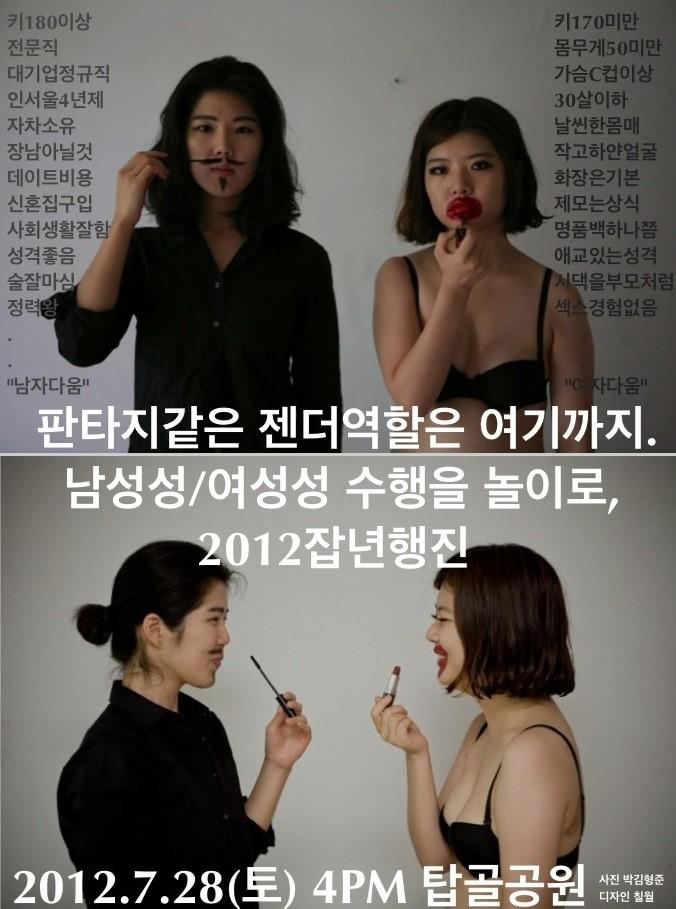
(Source: Slutwalk Korea)

When I lived abroad in Korea, I spent a lot of time doing work in cafes. Probably a 100 or more during my 2 years there. As such, I eavesdropped on thousands of conversations. And nearly every one of those conversations was about two topics: complaints re studying English and complaints re losing weight.

(Patricia Park, Korean Bodega, June 15)

Maybe I’m just nostalgic for my bachelor days, but it’s conversations about “specs” (스펙) that I’ve really noticed myself. A Korean term for the criteria used to evaluate a potential spouse on, it’s also my experience that it’s almost exclusively used by women, although that may just be because there’s usually more women than men at my local Starbucks.

Either way, in February Kim Da-ye at the Korea Times argued that looking at marriage this way is a relatively new phenomenon, and that it’s “matchmaking companies that rate spouse seekers by specs [that] have fueled [such] materialism.” And, as if to bolster that point, Donga-Reuters would report on exactly the same phenomenon emerging in China after I’d already begun writing this post.

But as discussed below, matchmakers have been encouraging such pragmatism for decades, so they can hardly be described as driving that change in outlook. Rather, it’s economic factors that are responsible, as Kim later acknowledges in her article:

…today’s buzzword “Sampo” generation (삼포세대) …indicates a 30-something who has given up dating, marrying and giving birth because of the lack of financial means…

Contrast the “880,000 won generation”, which generally refers to 20-somethings. Continuing:

….What’s interesting about such preferences for the partner’s economic qualification is that they don’t come from conservative parents or rigid social structure but independent, young individuals….

….The near obsession with fine lifestyle is a contrast to the attitude of the baby boomer generation, many of whom used to say that they can start from a small rented room….

When asked why the younger generation isn’t willing make such a humble start, Lee, a single woman in her mid-30s working at a media firm, said, “Back then, amid fast economic growth, people had hoped that they would be able to climb up the social ladder and afford a bigger place in the future. Nowadays, people feel that if they start in a small room, they will be stuck there for the rest of their lives.”

The high cost of getting married naturally leads to some couples to be heavily indebted after the honeymoon ends. In addition to the Sampo generation, another phrase linked to both the economy and marriage has emerged — “honeymoon poor.”

And Kim — whose article is still very informative overall — gives several examples of engaged couples’ fights over money, some of whom ultimately break up. Yet those would not be out of place in popular discourses of marriage in, for example, the 1980s, when women’s magazines were similarly promoting the virtues of arranged ones. Presumably, at the behest of their advertisers:
(Source: Google Books)

Passage Rites Made Easy [A 1982 Korean book by Ko Chonggi] describes marriage through an arranged meeting as more “rational” behavior than simply falling in love because the candidates for romance and matrimony have already been carefully scrutinized by parents and matchmakers. Korean women’s magazines also emphasize the value of prior screening in choosing a mate, suggesting by the frequency with which they address this topic that their youthful readership is by no means convinced of the merits of matchmade matrimony:

Today, with the trend towards frankness in sexual matters, talk of “arranged meetings” or “matchmade marriage” might sound excessively stale. Even so, in marriage the conditions of both sides enter into things. Matchmade marriage, where you can dispassionately investigate these considerations beforehand, has some advantages that cannot be ignored (“The Secrets of a Successful Arranged Meeting,” Yong Reidi, 3 March 1985: 347).

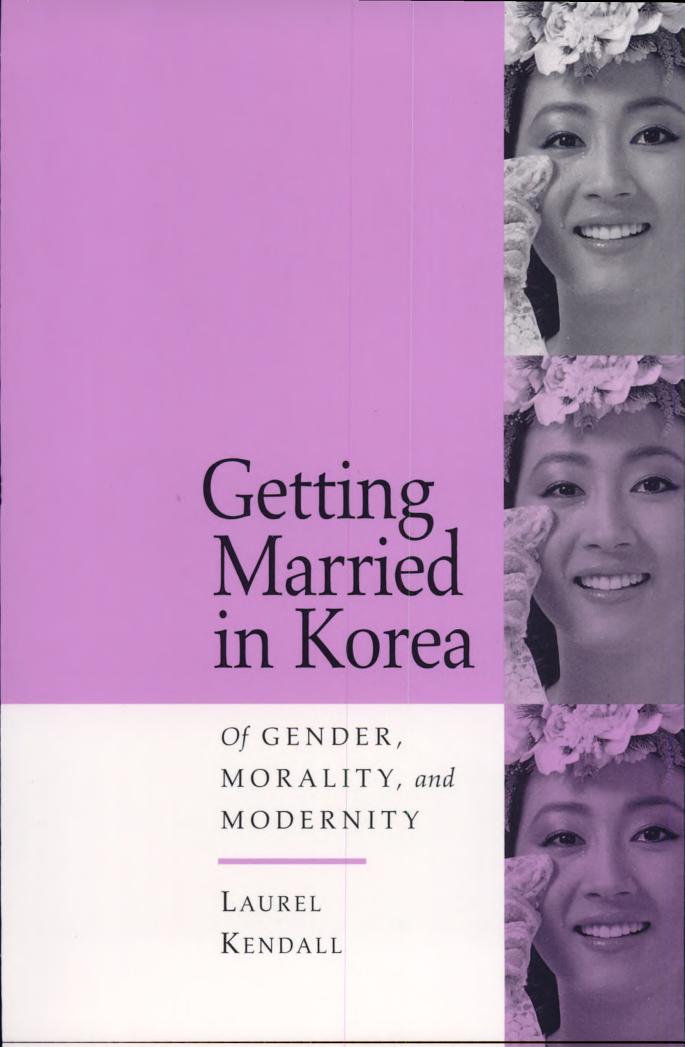
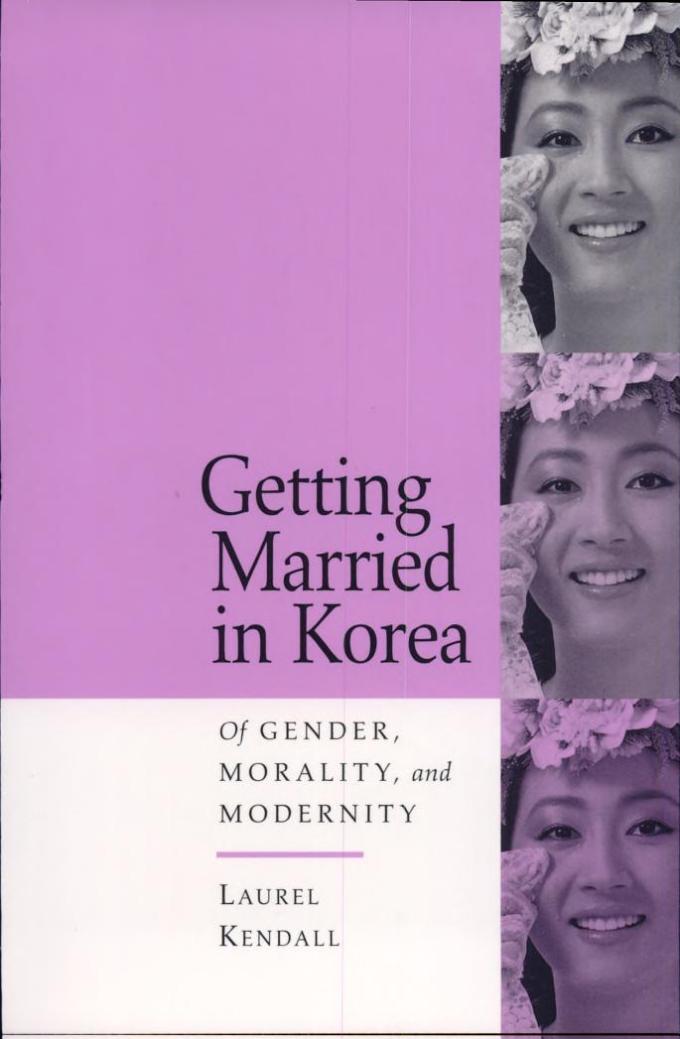
From pages 89-90 of Getting Married in Korea: Of Gender, Morality, and Modernity (1996), by Laurel Kendall, the next page sounds a little ironic 18 years later:

The evolution of Korean courtship practices provides one excellent example of how notions of progress, of an enlightened “now” versus a repressive “then”, mask the particular disadvantages for women in new forms of matrimonial negotiations, be they “matchmade” or “for love” — a mask which sometimes slips in angry conversation or social satire. Through courtship and through all of the talk about getting married, notions of ideal “man” and “woman”, “husband” and “wife”, “son-in-law” and “daughter-in-law” are constructed, reinforced, and resisted….

….In Korean popular discourse, the evils of old-fashioned matrimony, in which near-children were forced by the will of their elders to marry total strangers, have been replaced by more enlightened practices. The “old days” are still on the horizon of living memory, but are recalled as from an utterly vanished time. In confessing that he never saw his wife’s face until his wedding night, the writer Cho P’ungyon states [in 1983] with a touch of hyperbole that “Today’s young people would consider this laughable and the faint-hearted might swoon away, but in my day these procedures were considered natural.”
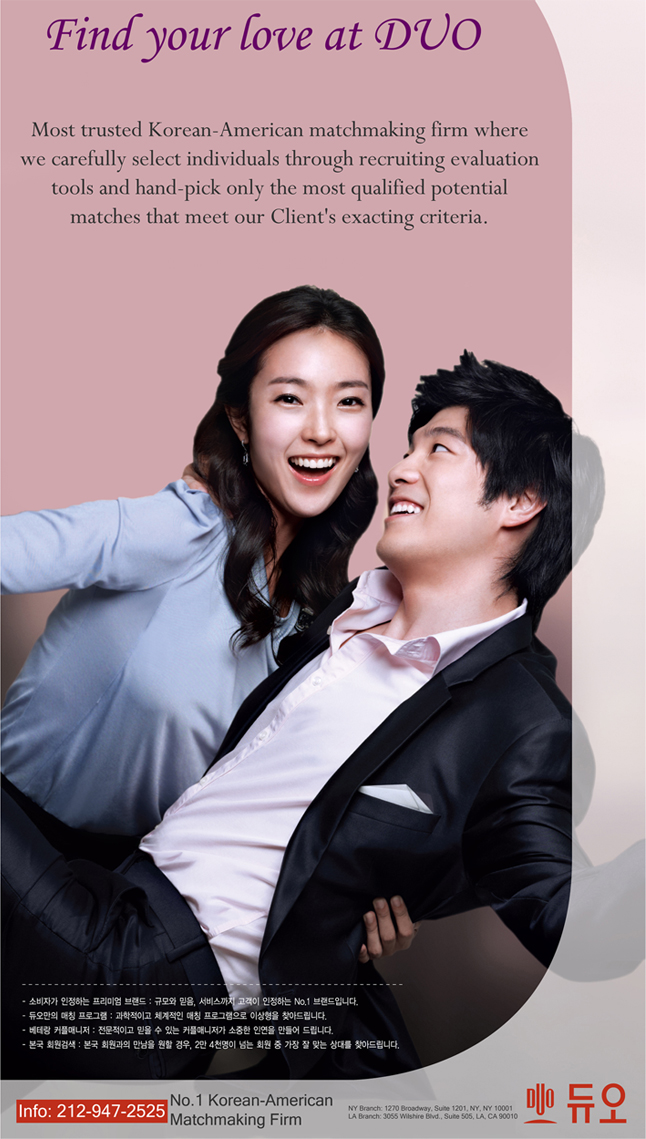
(Source: Korea Portal)

The difference being that in 2012, financially-strapped singles can no longer afford to be so dismissive (nor Japanese ones either). Moreover, while they’re not marrying complete strangers perhaps, many Koreans do marry people they’ve only known a few weeks, as discussed in an earlier post. Also, some mild social coercion can indeed be involved, as Gomushin Girl explained:

It’s important to differentiate between different kinds of matchmaking arrangements…lots of Koreans use services that are similar to eHarmony, It’s Just Dinner, and other similar paid and unpaid services. Just like in the US, there’s free and paid computer matching sites, and more expensive and comprehensive personalized dating services. These offer a great deal of flexibility, and allow you to reject partners at many stages of the process – the worst consequence being that the agent in charge of finding you matches will decide you’re too picky, and start sending you “lower quality” matches. You’re free to meet multiple people at once, and they’re basically meant to facilitate dating.

However, 선 (Seon) matches are pretty different. Most of the time the people proposing the arrangement are close family or friends (of your parents), and parties are expected to make up their minds pretty quickly. Delaying too long or changing your mind after the first few dates is strongly frowned upon, and may even cause major social riftts. This means that women especially are pressured to marry people before they’re comfortable with them, and even if they’re not really what they’re looking for. Seon is serious, and you’re expected to commit yourself pretty quickly.

It’s also expected to override existing social relationships. My Korean host mother once called me up to ask if I’d go down to Busan to meet a friend’s son, who was interested in a seon meeting with me. I told her I’d just started dating someone, and her response was essentially, “That’s wonderful! When can you come to Busan?”
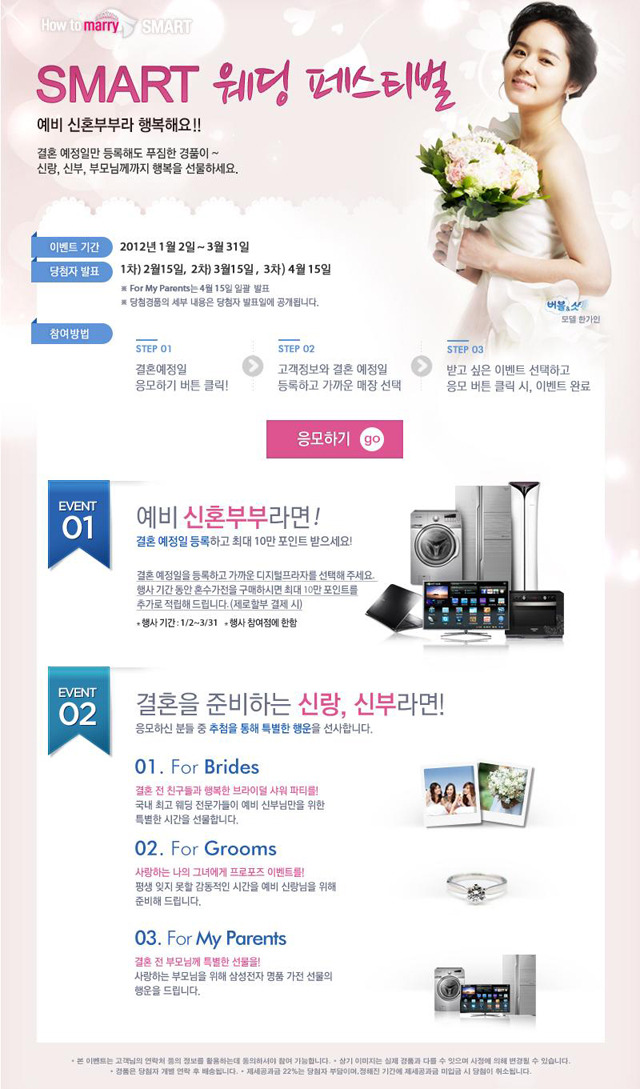
(Source: Sinbustory)

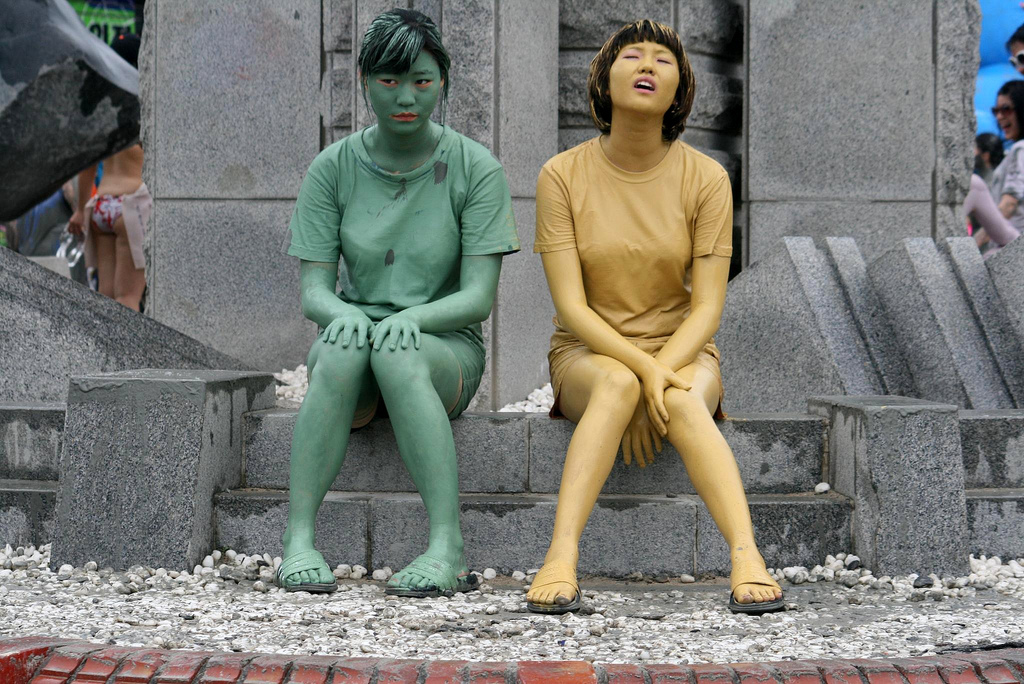
And on that note, let me leave you with a translation of the image that prompted this post, a poster for last week’s Slutwalk in Seoul. The slogan reads, roughly, “Let’s stop these fantasy gender roles now. Let’s play at being ‘masculine’ and ‘feminine’, 2012 Slutwalk Korea.” Many of the specs it mentions would be shared by people the world over, but there are also some quintessentially Korean ones:

For the “man” (literally, it says “manliness”):

  • 키180이상 Over 180cm in height
  • 전문직 A professional
  • 대기업정규직 Regular worker at a big company
  • 인서울4년제 Went to a 4-year university in Seoul
  • 자차소유 Owns a car
  • 장남아닐것 Not a first-born son
  • 데이트비용 Pays for everything on a date
  • 신혼집구입 Buys a home after marriage
  • 사회생활잘함 Good social skills
  • 성격좋음 Good personality
  • 술잘마심 A good drinker
  • 정력왕 Good sexual stamina

For the woman (“womanliness”):

  • 키170미만 Under 170cm tall
  • 몸무게50미만 Under 50 kg
  • 가슴C컵이상 A C-cup or over
  • 30살이하 30 or under
  • 날신한몸매 Thin body
  • 작고하얀얼굴 Small and white face
  • 화장은기본 Always wears make-up
  • 제모는상식 Shaves legs and underarms
  • 명품백하나쯤 Have at least one brand-name handbag
  • 애교있는성격 Have aegyo
  • 시댁을부모처럼 Treats parents-in-law like her own parents
  • 섹스경험없음 Be a virgin

Are there any others readers would add? Especially Korean ones?

(For more posts in the Korean Sociological Image series, see here)

Increasing Numbers of Single Households in Korea: Lessons from Eric Klinenberg’s “Going Solo”

(Source)

From Office Hours, a sociology podcast I regularly listen to:

This week we talk with Eric Klinenberg about his new book, Going Solo: The Extraordinary Rise and Surprising Appeal of Living Alone. Also be sure to check out Klinenberg’s New York Times article, One’s a Crowd.

Although Korea isn’t covered specifically, there’s a lot discussed that is very relevant to it, so I think readers will still find it very interesting. Personally, I really started paying attention after I heard the following 5 minutes in:

…but affluence, and prosperity, that’s not enough. We know that because there’s parts of the world where there’s lots of wealth, but very little living alone. So for instance, in Saudi Arabia, where almost no-one lives alone…and the reason for that is another big driver of living alone is women’s independence: women’s economic independence, and also their capacity to control their own lives, and control their own bodies. When women enter into the paid labor market, and gain sexual independence…personal independence…they are able to delay marriage (and now, people delay marriage longer than ever), they’re also able to get out of marriages that aren’t working. Through divorce, without worrying about sentencing themselves to a lifetime of poverty or having to move back in with their families. So, this is a BIG part of the story I tell…

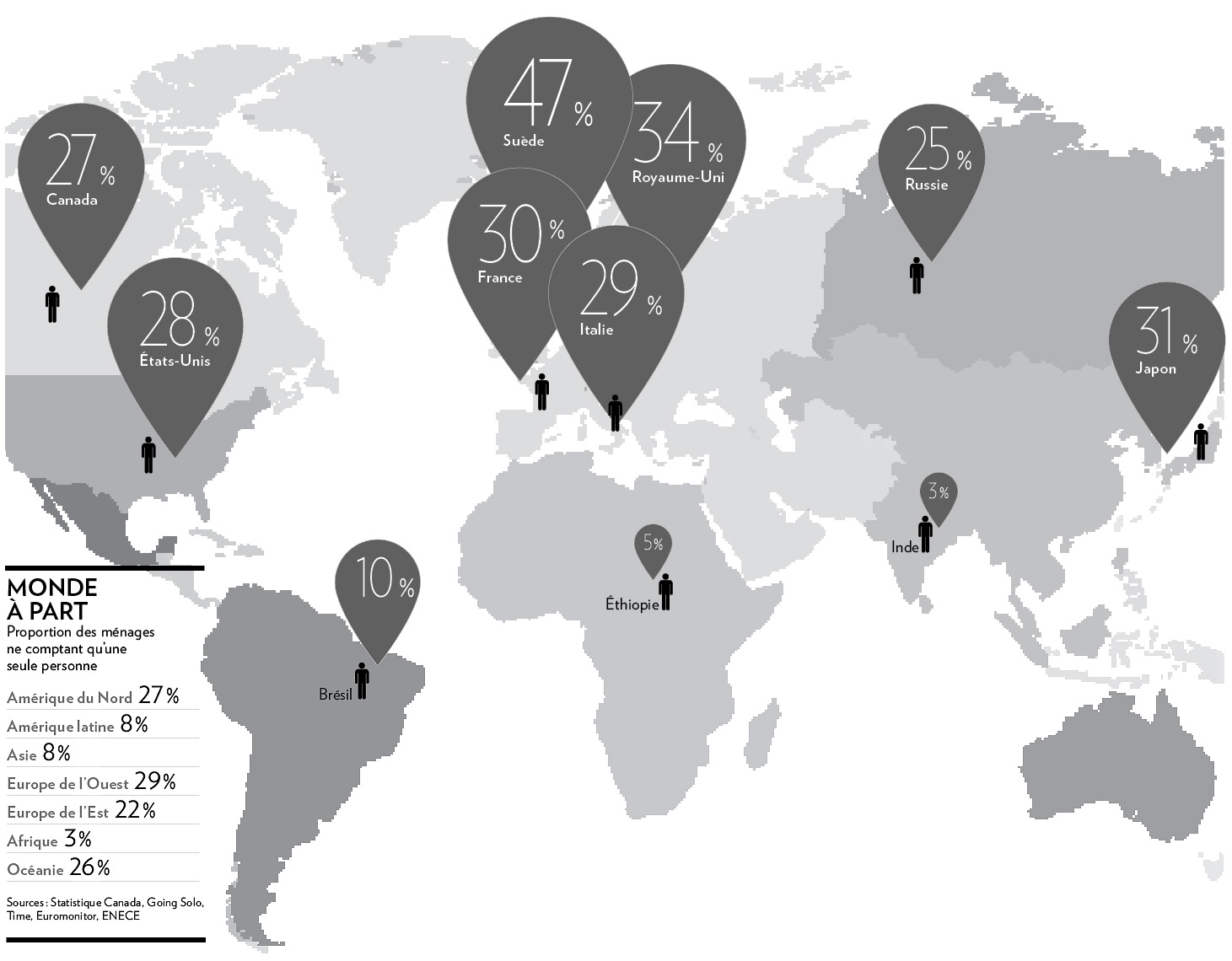
See here and here for some reviews of the book, and here’s a quick comparative map of national rates from La Presse:

Unfortunately, I’ve been unable to find a base national rate for South Korea, but in January 2009 the Seoul Development Institute did find that 20.4% of Seoul households involved people living alone, and which was expected to rise to 25% by 2030. For more information and discussion, see the Korea Herald here, or in passing in the following posts (the last is at the blog Asadal Thought):

Sex and the University, Part 3: University Students’ Cohabitation Culture

Why are Korean and Japanese Families so Similar? Part 2: Couples Living With Their Parents After Marriage

Why Do Young Koreans Live With Their Parents?

How Many Unmarried Koreans Live Away From Their Parents?

The Race of Single People

Learning From Korean Family Planning Advertisements of the 1960s-1980s

…American military officers helped make abortion the population control tool of choice in those Asian countries where they wielded influence, first in Japan in the late 1940s and 1950s, then South Korea in the 1960s. USAID, America’s aid agency, provided Jeeps for mobile clinics which roamed South Korea performing abortions. At one point, a quarter of the country’s health budget was going on population control and the number of abortions hit an all-time record in Seoul, where, in 1977, there were 2.75 abortions for every live birth. “What would have happened if the government hadn’t allowed for such easy abortion?” asks one sociologist. “I don’t think sex-selective abortion would have become so popular.”

(Review of Mara Hvistendahl’s Unnatural Selection: Choosing Boys Over Girls, and the Consequences of a World Full of Men, @The Economist)

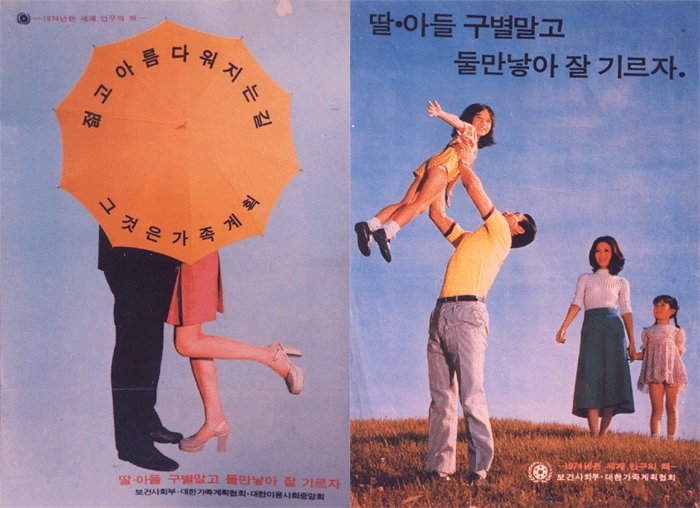
Apropos of the above quote, let me present some government advertisements of the period to give you a better impression of that amazing zeal for population control back then. Also, that whereas couples were encouraged to have two children in the 1970s, and not to favor boys over girls, that this would be reduced to only one child by the 1980s. Messages about the sex-ratio were invariably diluted.

Obviously, these would come to play a huge role in today’s world-low birthrate, the difficulty many Korean men are now having in finding wives (although fortunately the sex-ratio among newborns has since been normalized), and the ensuing massive influx of overseas brides. Less obviously, they defy stereotypes about Koreans’ squeamishness when it comes to sexual matters, as I’ll explain.

But first, some context. All 30 or so advertisements I’ve been able to find were produced by the Planned Parenthood Federation of Korea (대한가족계획협회; now known as the Planned Population Federation of Korea {PPFK; 인구보선복지협회}) and/or the now defunct Ministry of Health and Social Affairs (보건사회부), and can be found here, here, here, and here, as well as (best) on the PPFK’s website.

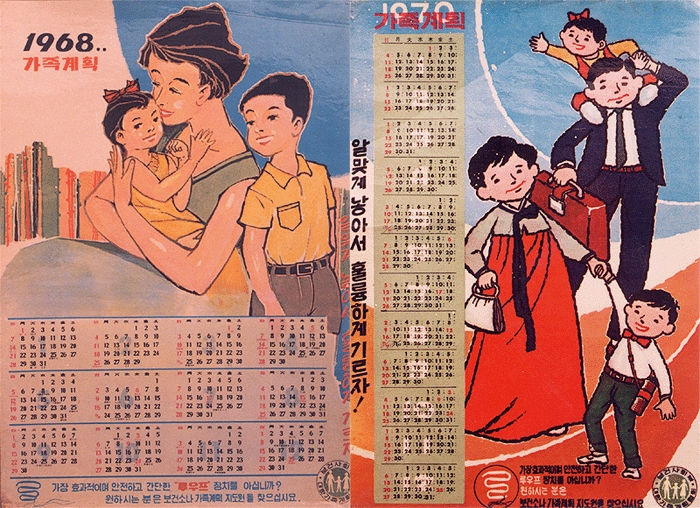
(Text, both calenders—”Did you know that the most effective, safest, and simplest device is the loop (IUD)? People who want one, please go to a welfare or family planning center.” Black headline, right calender—”Let’s have the proper number of babies, and raise them well!”)

Formed in April 1961 just before the coup, the PPFK would soon have the strong support of the military government. But according to Seungsook Moon in Militarized Modernity and Gendered Citizenship in South Korea (2005; pp. 81-2), its activities wouldn’t really take off until the 1970s, which possibly explains its rather uninspired efforts above (but note though, that the government itself was extremely active in population control well before then):

The modernizing state had to launch aggressive propaganda for family planning because the idea of contraception was foreign to most Koreans, who tended to believe that having many children meant good luck and that every child would bring his or her own food into the world….

….The state…worked closely with the PPFK to change the public perception of birth control, establishing a department of public relations in 1970 to make the idea and practice of contraception familiar to the populace. The PPFK increasingly relied on mass media (radio, television, newspapers, magazines and education texts of its own) to disseminate positive images and information about families with a small number of children. To encourage popular participation, the PPFK organized popular contests of various kinds, ranging from posters, songs, and slogans to stories of personal experiences by mothers and wives concerning contraception.

A fascinating book, it’s difficult not to quote much more here, as the next few pages make it clear that Korea’s population policies were just as systematic and draconian as China’s. In light of what is revealed in Hvistendahl’s more recent book though, it is strange that it doesn’t also discuss abortions, but it does mention that while IUDs insertions were offered freely in the 1960s (with the Marine Corps mobilized to provide them to isolated islanders), and considered the “patriotic” and “ideal” form of contraception (but with the pill also introduced in 1968 to alleviate their effects, in stark contrast to Japan), by the second half of the 1970s it would be female sterilization that was offered and aggressively applied, becoming “what can only be described as a sterilization mania” by the 1980s. Between 1982 and 1987, over 2 million Korean women would be sterilized, a “semiforced mass sterilization” that “led to abrupt reductions in the fertility rate and the rate of population growth in the 1980s” (p. 85).

(Left, umbrella—”The path to youth and beauty is family planning.” Both posters—”Don’t discriminate between boys and girls, have only two children and raise them well.” {This slogan can be seen on many 1970s posters}.)
(Left, headline—”Which method is good?”; cup—”Family planning consultations”; man, text —”I’ll do it”; text, bottom—”1975 is International Women’s Year.” Right, 19th Family Weekly Magazine May 5-12 1974—”The World has One Destiny”; “NCC=The National Council of Churches in Korea.”)

This poster on the left above is particularly interesting, and not just because that was the year that March 8—which *cough* happens to be my birthday—was made International Women’s Day (alas, I was born a year later). Rather, it’s because of the guy saying “I’ll do it”, which couldn’t help but remind me of young Koreans’ surprising attitude that contraception is exclusively men’s responsibility (as indeed the Japanese think too). However, women were overwhemingly the focus of population control drives back then (Moon notes that only 1 vasectomy was performed for every 10 IUD insertions, although I think the ratio to female sterilizations would have been more useful), and women’s organizations co-opted or specifically created by the state to carry them out, so it seems anachronistic to see a connection between young Koreans’ attitudes today and those of their parents at the same age.

Indeed, this one on the left below turns out not to be about family-planning at all, but rather women’s rights:

(Left, headline—”We are all [the same] human”; Man (clockwise from hat)—”Family registry rights, parental rights, inheritance, children, estate”; Text—”Women’s Family Law Change Committee”. Right, arrow—”The path to a Gross National Income of of $1000 in 1981″; Text, below—”[Previous 1970s’ slogan]”.)

Next, before moving on to posters from the 1980s, note that sterilization campaigns would come to be complimented by various economic incentives (p. 85):

In 1981, confronting negative economic growth for the first time since 1982, along with a decrease in the number of sterilization acceptors, the state issued “Countermeasures to Population Growth.” These measures were characterized by incentives to a family with one or two [James – ?] children; priority in getting housing loans and business loans, monetary support of low-income families, and free medical service for the first visit. During the 1980s, variations of these kinds of incentives were introduced almost every year.

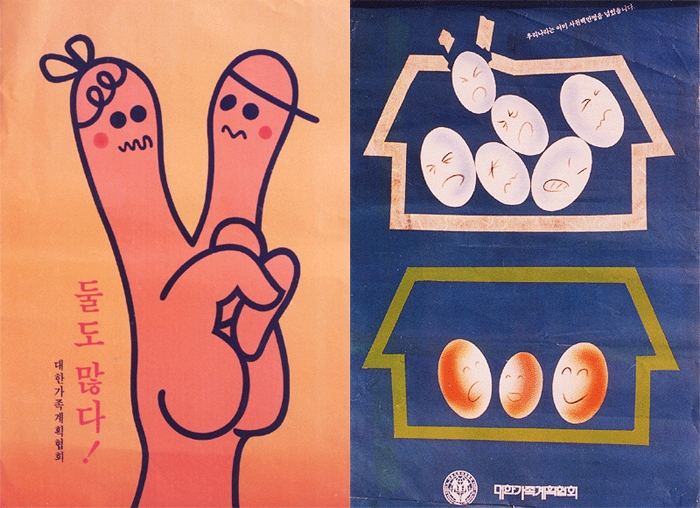
(Left—”Two children is many too!”. Right—”Korea’s population has already exceeded 40 million”.)

And here are two posters with sons, and then two with daughters. But note that, confusedly, there were also some with two children like those in the 1970s though, and that clearly the government and PPFK were still very much concerned about the sex-ratio.

However, like I said that message was surely somewhat diluted by having some posters featuring and explicitly praising having a son, and it would be interesting to do a content analysis to determine the ratio of those that depicted sons to daughters, two children, or (preferably) a sex-neutral image like the eggs above:

(Left—”One family, full of love. One child, full of health”. Right, headline—”Because of one son”; Text—”Overpopulation is everybody’s responsibility”.)

(Top—”A blessing of one child, loved strongly”. Bottom—”Raise one daughter well, and you won’t envy [those who have] ten sons”.)
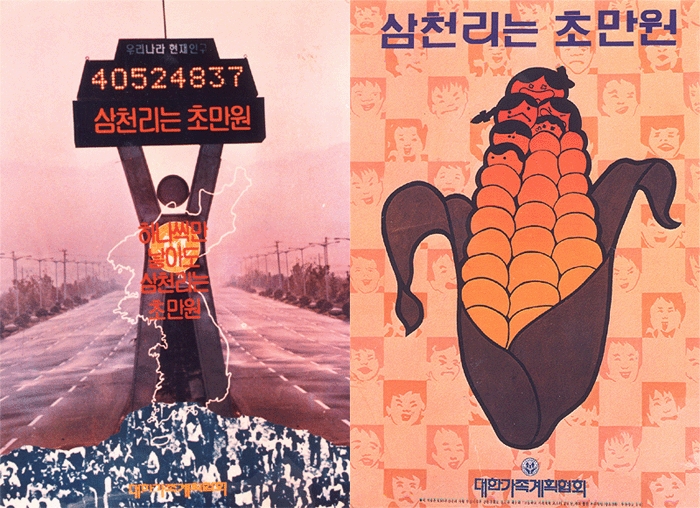
(Left, sign—”Korea’s current population: 40,524,837, Korea is overflowing”; Text in map—”Even if you only have one child, Korea is overflowing”. Right—”Korea is already overflowing”.)

Finally, please note that these posters are just a handful of those available on the PPFK website, and which in turn must be a small sample of all that were produced. But in combination with what I’ve learnt from Militarized Modernity, they’ve still lead me to an interesting conclusion. Which is that, bearing in mind Koreans’ reputation for procrastination, yet doing things with outstanding zeal and efficiency once they set their minds to them (albeit usually precisely because of putting them off for so long), sexual matters are no exception, despite Koreans’ conservative reputation. Moreover, and intriguingly, it appears that young Korean couples of the 1970s and 1980s were likely to have been much better educated and informed than their children are now.

Assuming it does exist, what on Earth happened in the 1990s and 2000s to account for this curious generation gap? And why, even though technically adults rather than children were the target of government campaigns in the 1970s and 1980s, is sex education in Korea today so appalling?

Korean Sociological Image #65: First Commercial to Positively Feature a Korean Woman with a Non-Korean Man? (2006)

(Source: Paranzui)

Turn on a Korean TV, and you won’t be waiting long before you see a commercial with a Korean man in a relationship with a non-Korean woman. But for a long time, I was only aware of one ever produced with the opposite pairing, which I discussed back when it came out in July last year.

Since then, there has also been at least one music video produced that positively features a Korean woman with non-Korean men (not just the one man in this case!), which you read more about at Mixtapes and Liner Notes and Fanboy vs Fangirl here, here, and here. But again, there’s many many more with the opposite pairing (see here, here, and here for examples). And as far as I know, no more commercials with Korean women hitting on non-Korean men.

It turns out though, that Lee Hyori (이효리) did so back in 2006 in a commercial for Anycall, a mobile phone brand. I must have seen it a hundred times on TV that year, but only ever the fifteen second version, in which the ethnicity of the lucky gentleman at the end was unclear. I would automatically have assumed he was Korean then, but he’s actually Caucasian (with a hint of Latino?), as you can see at 0:27 in the thirty second version above.

As always, I’d be happy to be proven wrong — again(!) — with any further examples of similar pairings. But I doubt I’ll ever receive enough to challenge this clear discrepancy in the Korean media’s representations of different genders and races, which is why I raise it here.

For any readers further interested in why that discrepancy exists, please read last year’s post for more background and many more links.

Update 1) As soon as I’d packed away my netbook and was walking home, I remembered that there was indeed one more example from last year, a promotional video for the 2010 G-20 Seoul Summit. It features a Korean woman and Caucasian man having a traditional Korean wedding, just like I had (the kiss is just for show though—traditional Korean weddings are really quite sombre affairs!):

Update 2) With thanks to Dan for passing it on, here’s a recent commercial for a smartphone, apparently with screen quality so good you’ll be able to see your foreign boyfriend’s bit on the side reflected in his sunglasses:

Until I saw that, I was wondering if the “positively” in the title was a little redundant. But now it seems more apt than ever!

(For more posts in the Korean Sociological Images series, see here)

Korean Sociological Image #63: Childcare No Longer Only Women’s Job!

As any father can confirm, parenting is a grueling business. So much so, that it makes our testosterone levels drop like a stone for instance, a rather ironic outcome for the ultimate proof of ones’ virility. Also, not only do we gain weight by being too tired to exercise or eat properly after the birth, as you’d expect, but actually we gain weight even before it too, all the better to prepare for the rigors of carrying our offspring on our backs for the next few years.

Granted, that latter research actually comes from a few monkey species, rather than men per se. And reported weight gain in men may be due to a change of lifestyle rather than expectant fathers being biologically wired for it. But still, with serious concerns about future back problems from having to carrying my daughters in my right arm so much over the last few years (they cried if I put them in the left), then my money’s on it applying to humans too.

Why then, are our daily lives still saturated with images of only women caring after children while traveling on public transport and in public spaces?

In hindsight, this is just bizarre. Surely I’m not just projecting when I say that, as the stronger, taller, and faster parent, it usually makes much more sense for me to keep an eye on my hyperactive kids as they try to run literally everywhere, while my wife watches over our bags? And whereas I’m increasingly struggling to carry them as they get older, she’s already just about reached her limits with our five year-old (in more ways then one!).

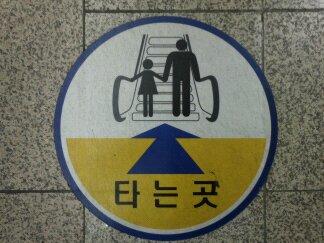
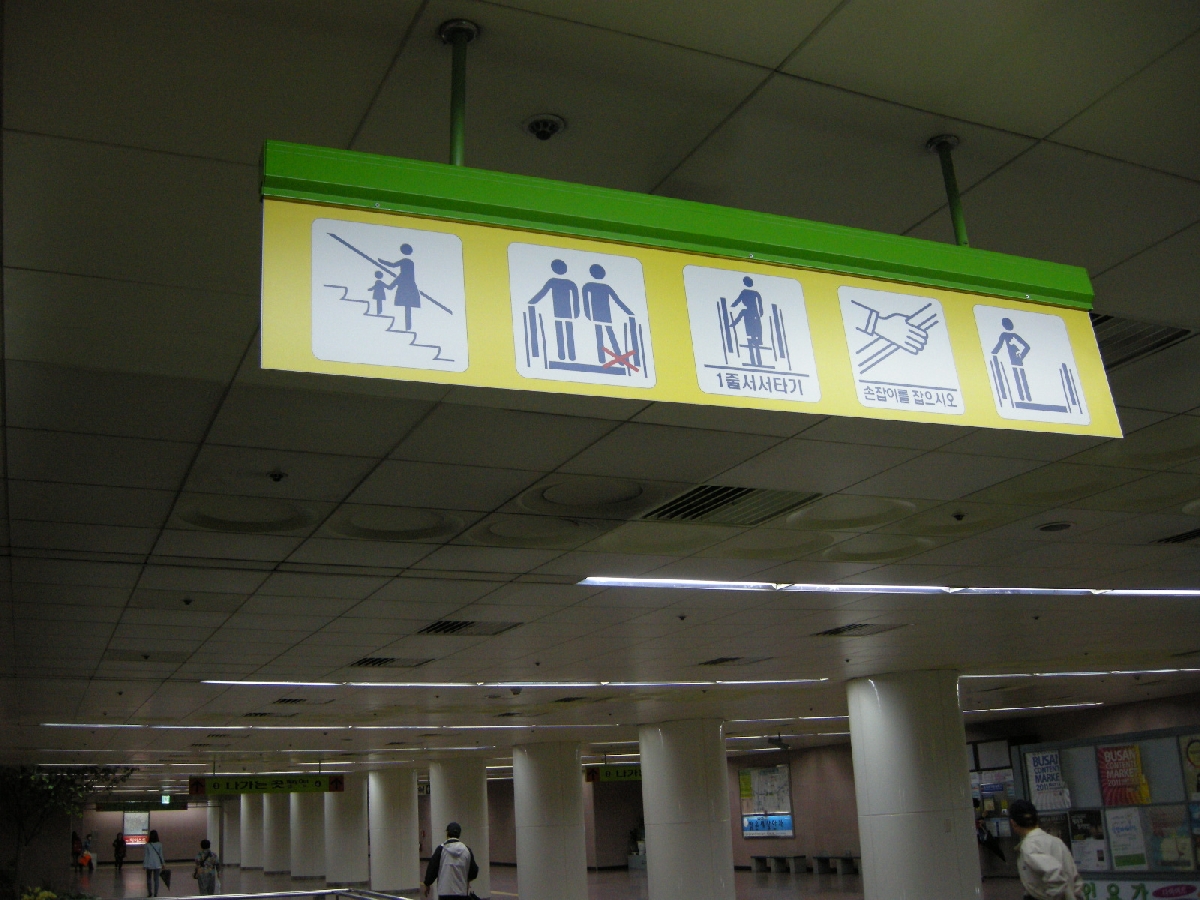
Which makes these humble pictures such a breath of fresh air. They may not look like much, especially at their low resolution here (my wife is still figuring out her new smartphone – sorry), but they are actually the first example of an image of a male rather than a female caregiver that I’ve ever seen in a subway – well, anywhere –  in Korea. Taken in Daegu on my recent trip there, based on my impromptu survey over 2 weekends then I’d say a good 30-40% of signs for escalators had men rather than women (and in malls etc. also).

Can any Daegu-based readers confirm my estimate? Have any other readers seen any more with elsewhere in Korea? Either way, kudos to the Daegu Council and/or subway company for making an effort to ensure a mix of genders, and – to any readers not yet convinced – please see here for more on why this is genuinely such a big deal.

(For more posts in the Korean Sociological Images Series, see here)

Korean Sociological Image #59: Childcare is (Still) Women’s Job!

(Source)

Do crosswalk lights with only male-shaped figures really discriminative against females? That’s a hard sell on any occasion, let alone when it would cost 21 million dollars to replace them all with both male and female ones instead, and so netizens have rightfully “responded with merciless mockery” to the Seoul Metropolitan Government’s plan. As has the cartoonist Ju Ho-min too, whose humorous extension of the city’s logic needs no translation!

Instead, a much better candidate for signs to replace would be these ubiquitous reminders that it’s only women that should look after children:

Women do look after children of course, and so technically signs like these aren’t discriminatory in themselves. But as this photo and those below make clear, they’re not just not countered by equal numbers of signs showing men taking care of children, but in fact female figures are only used when a child is also involved:

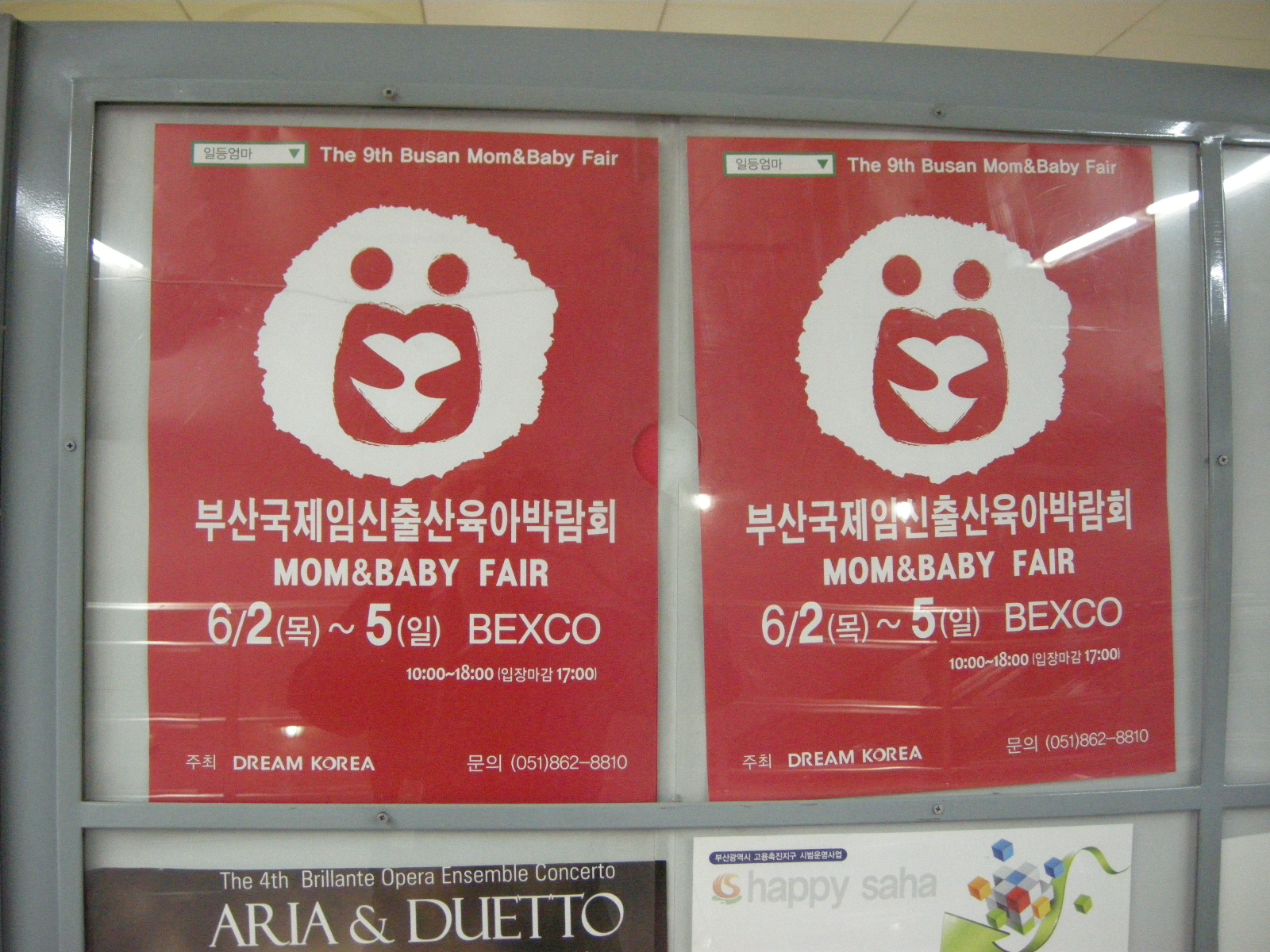
Lest I sound like I’m singling Korea out for criticism however, note that such images are almost universal, and indeed the above ones look almost exactly the same as those in Dublin airport. Moreover, once you move away from signs to language instead, then, possibly following overseas examples, actually discriminatory English slogans are sometimes chosen rather than making Korean ones, such as with airline Asiana’s “Happy Mom Services”. Or alternatively, consider the 부산국제임신출산육아박람회 that I learned about today, which would simply be “The Busan International Pregnancy, Childbirth, and Childcare Exposition” in English, but which somehow got translated as “The 9th Busan Mom & Baby Fair” instead:

As it’s not just for moms and babies if you can read the Korean though, then accordingly there are many fathers and would-be fathers featured on the website, and actually I was one of them myself back in either 2005 or 2006 before my first daughter was born. I don’t recommend going though, as I recall finding some of the services being promoted there – stillbirth insurance for example – just a little cold and off-putting!

Finally, for some Korean takes on subway signs that I managed to find, see here and here. Unfortunately, they’re a little old (2004 and 2006 respectively), which suggests that no-one’s really thought about them in a while. But on the plus side, the Seoul Metropolitan Government’s misguided plans have at least brought national attention to the issue of (potential) sexual discrimination in signs, so now may well be the best opportunity ever to suggest that something be done about them. Ideally, by using the money earmarked to change the crosswalk ones to change the subway ones instead.

If anybody knows how to go about contacting them, then that would be much appreciated!

Update: On Becoming a Good Feminist Wife has more commentary on the planned new crosswalk signs here.

(For all posts in the Korean Sociological Image series, see here)
Share

Is Divorce in Korea Finally Socially Acceptable?

(Source)

Sorry for the lack of posts recently, and the very short notice with this one, but in an hour from now (7:45pm Korean time) I’ll briefly be on 101.3 TBS eFM’s evening show, talking about the title topic. For the details, see here, and note that unfortunately you can only listen live on Internet Explorer sorry.

Update – Well, that was a little embarrassing: because of a miscommunication, technical problem, and/or a last minute editorial decision, I didn’t actually get called in the end!

But for anyone still interested in the subject though, then I was going to mention that while on the one hand the stigma surrounding divorce is certainly disappearing over time, with 1 in 4 marriages now involving a divorcee and in particular both the numbers of women remarrying and their rate of increase outstripping those of men, on the other hand the profoundly gendered effects of the recent economic crisis here have left Korean women more financially reliant on their husbands than ever, as explained at #2 here, here, and #15 here.

Meanwhile, see here for more information on both the high rates and the practicalities of getting a divorce in Korea, and here for more on the hoju or family-registry system (호주), which had a huge role in drawing attention to people’s marital status (or parents’ status) and consequently being able to discriminate against them on that basis. Moreover, although that has recently been abolished, one final point I was going to make was that unfortunately that’s just one of many superfluous things corporations take into account in their hiring practices, as demonstrated here, at #8 here, here, here, and here, and so it’s probably going to take a while before Korean business culture catches up with the social reality.

Share

Sex and the University, Part 3: University Students’ Cohabitation Culture

(Live Together, 2007. Source)

Much to my regret later, I never properly met any Koreans in New Zealand before I first came here.

But by coincidence, a Korean woman replaced me in my last flat after I left. And as my ex-flatmates soon gleefully reported, she was the perfect flatmate, paying her share of the rent without ever actually spending so much as a single night there.

Glee rapidly turned to genuine concern though, as she completely disappeared a week after moving her stuff in, not answering her cell-phone at all for 2 weeks.

Alas, once she was back from her trip home(!), she explained she was actually living with her Korean boyfriend at his place. But, lest she be caught with him by her parents back in Korea somehow, she needed a separate address and home phone number, and a pretend bedroom just in case they made a surprise visit.

And once they were in the loop, then naturally that was fine with her flatmates, and she would end up spending less than, say, 4-5 hours a week there for the next 6 months.

(Source)

Of course, I’m sure she had good reasons for what she did. And even 10 years later, openly cohabiting is a big taboo in Korea, testament to which is the fact Korean portal sites like Naver require age verification for you to search for anything related to donggeo, “동거”, the Korean word for cohabitation, placing it on a par with pornography and so on.

Granted, along with pregnancy, couples are generally forgiven if they have already made arrangements to marry, or at least do so shortly after being discovered.  But as a Seoul-based friend who wrote his MA thesis on them frequently lamented, that means it can be near impossible just to find cohabiting couples, let alone ones willing to talk about their experiences with a researcher.

Still, that’s not to say that they don’t exist, and fortunately amorous Yonsei University couples at least don’t seem to need to go to quite such extremes to hide their living arrangements, as the third of four articles on the “Sex and the University” theme from the Yonsei Chunchu (연세춘추) campus newspaper explains. Not really giving any background on the subject though, if you haven’t already then I recommend reading this short introductory article I wrote for the Korea Times before starting here, and it also has a list of links to many other related posts for anyone further interested.

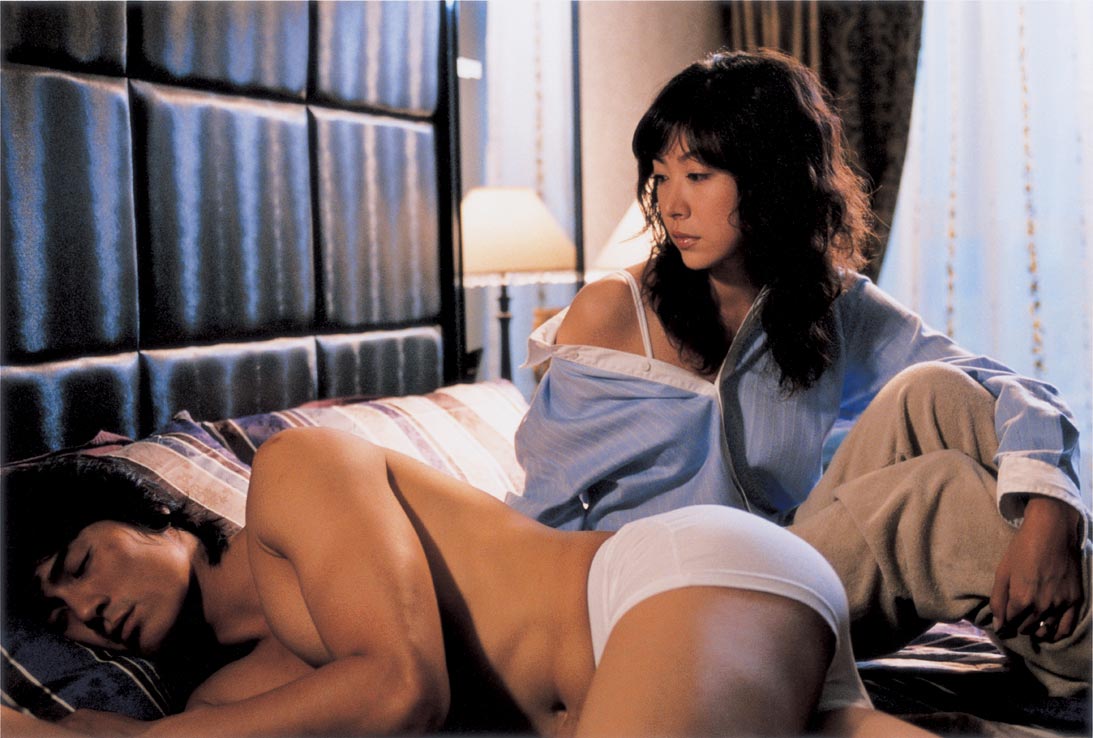
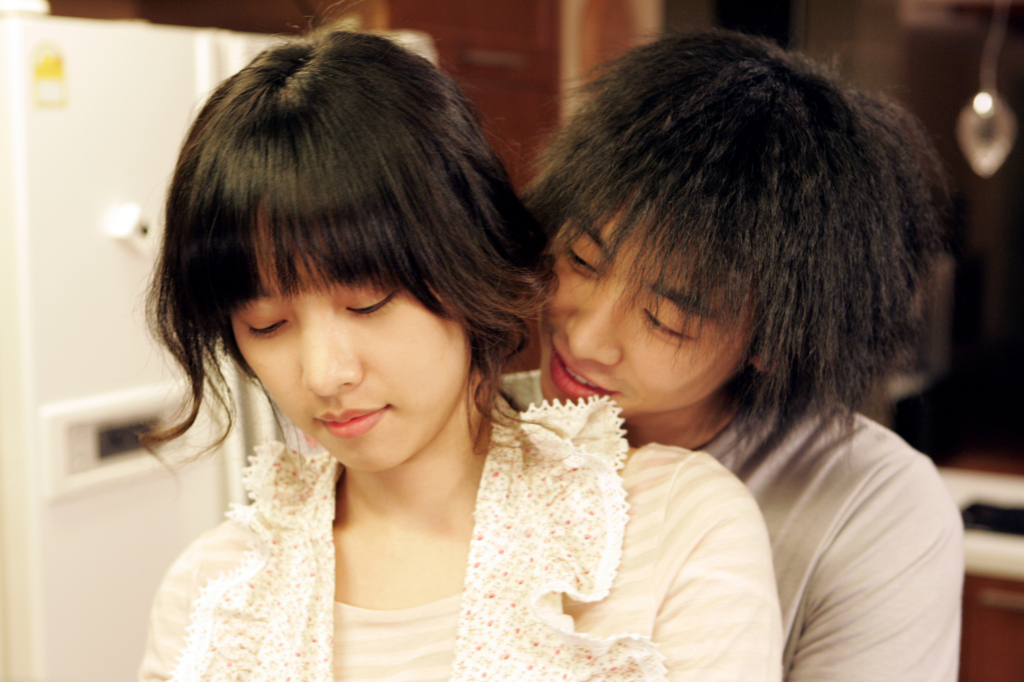
Update: Strangely, the internet searches work fine if you add an extra term, and hence there’s unrestricted access to info about the 2007 movieLive Together (donggeo-donglak; 동거동락) in the opening image for instance, which sounds great to watch in bed with your partner interesting. Anybody seen it already? It’s also known as Happy Together, and yes, that is indeed a dildo mosaiced out at 0:42.

And without any further ado, thanks again to Marilyn for translating the article:

지금 사랑하는 사람과 살고 있나요? Are you living with the person you love?

원주캠, 신촌캠, 신림동 고시촌…요즘 젊은 세대들의 동거문화를 엿보다

Wonju campus, Shinchon campus, Sillim-dong gosichon [area where there are many people studying for Civil Service or other exams] – a look at the young generation’s cohabitation culture

『개인의 취향』, 『풀하우스』, 『옥탑방 고양이』….

모두 미혼남녀의 동거를 소재로 한 드라마들이다. 이런 드라마들은 동거생활의 알콩달콩한 면면을 보여주며 화제를 불러일으켰다. 미디어의 영향일까. 동거를 바라보는 대학생들의 시선은 관대한 편이다. 실제로 성의식 설문에 응답한 우리대학교 학생 중 43.6%가 “동거를 할 의향이 있는가”를 묻는 문항에 “그렇다”고 답했다. 그러나 동거에 대해 긍정적으로 생각한다는 것과 진짜 동거를 하는 것은 다른 법. 직접 학생들을 만나 실제 대학생들의 동거생활과 이에 대한 인식을 들어봤다.

Personal Preference, Full House, Attic Cat – all dramas about unmarried men and women cohabiting.  These dramas have caused a stir by portraying the cute side of cohabitation.  Does the media have influence [on us]?  University students’ views on cohabiting are on the tolerant side.  When asked, “Are you interested in cohabiting with a partner?”,  43.6% of students at our university who participated in a survey about attitudes toward sexuality said “yes.”  However, there is a difference between having positive views of cohabitation and actually cohabiting.  We met students and heard about real students’ experiences and perception of cohabitation.

(Source)

매지리 동거족, 말하지 않아도 알아요

Cohabitation in Maejiri, known about even though they don’t talk about it

우리대학교 원주캠퍼스의 경우 학생 대부분이 타지방생이다. 그래서 통학생은 거의 없고 대부분 기숙사에 살거나 인근 지역인 ‘매지리’에서 자취한다. 상황이 이렇다보니 매지리에는 동거에 관해 다소 관대한 분위기가 형성돼 있다. 동거 사실을 공공연히 밝힐 정도는 아니지만 동거족이 많은 것은 알 사람들은 아는 사실이다. 실제로 매지리의 한 아파트에서 남자친구와 살고 있는 전아무개(23)씨는 친구들에게는 굳이 동거 사실을 숨기지 않는다고 말했다. 매지리에서 동거는 크게 문제시되는 사안이 아니기 때문이다. 그녀가 살고 있는 아파트에서 만난 김아무개(24) 커플은 완전한 동거 형태는 아니었지만 ‘거의’ 함께 살고 있다. 김씨는 기숙사생이지만 남자친구의 방에서 지내며 기숙사에는 거의 들어가지 않는다. 매지학사의 경우 기숙사비가 비싸지 않은 데다 집으로부터 의심을 피할 수 있기 때문에 들어가 살지 않더라도  일단 신청해두는 것이다. 김씨는 “이런 원주캠퍼스의 특징이 비교적 자유로운 동거 생활이 가능한 분위기를 조성하는 것 같다”고 말했다.

Most of the students at our university’s Wonju campus are from other areas. There are almost no students who commute from home, and most live in a dormitory or live independently in ’Maejiri’, a neighboring area. Because of that, an atmosphere of tolerance toward cohabitation has developed in Maejiri.  It’s not to the point where people publicly reveal their cohabitation, but it is an open secret that many people are doing it.  One Ms. Jeon (23), who actually lives in an apartment complex in Maejiri with her boyfriend, says that she doesn’t feel the need to hide the truth from her friends.  She says it’s because in Maejiri living together is not a very problematic issue.  In the same apartment complex, a Ms. Kim (24) and her partner are not quite in a cohabitation situation but are “almost” living together. Ms. Kim lives in a dormitory, but stays at her boyfriend’s place and hardly ever goes to the dorm.  In the case of the Maeji school,  a place where the dormitory fee is not expensive, students enter the dorm to avoid suspicion from home, so even though they don’t live there, it’s important to apply. Ms. Kim said, “One special feature of the Wonju campus is that it seems to create an atmosphere in which comparatively free cohabitation is possible.”

(Source)

존재하지만 눈치 보이는 신촌

Sinchon, where it occurs but they care about others’ opinions

그렇다면 신촌캠퍼스의 상황은 어떠할까. 우리대학교 뿐 아니라 인근에 여러 대학이 밀집해있는 신촌의 경우 대학생들의 수 자체가 클 뿐 아니라 대학 간 커플도 종종 보인다. 그러나 동거를 대하는 학생들의 태도는 앞서 살펴본 매지리와는 사뭇 다르다. 신촌의 동거 커플들은 동거를 한다는 사실에 대해서는 크게 심각하게 받아들이지 않았다. 그러나 상대적으로 매지리에 비해 타인의 시선을 의식하고 있었다. 이아무개(22)씨는 여자친구와의 동거를 진지하게 고민해봤다고 했다. 그러나 그는 동거를 좋지 않게 보는 사람들의 시선이 신경 쓰여 망설이다 결국 단념했다. 지방에서 올라온 김아무개씨(21)는 그와는 조금 다른 경우로, 현재 신촌에서 여자친구와 함께 살고 있다. 김씨는 “처음엔 혼자 살았는데 어느 때부터 여자친구가 놀러오는 빈도가 잦아졌고 얼마 안가 동거를 제안하게 됐다”고 말했다. 그러나 둘 다 집에는 전혀 알리지 않았고 그것이 반드시 필요한 절차라고는 생각지 않는다고 했다.

So then how is it done in Sinchon?  In Sinchon, where not only our university but several others are clustered, not only is there a large number of students, but also couples who go to university are often visible.  However, the students’ attitude towards cohabitation is quite different than that seen in Maejiri above.  Sinchon’s cohabitating couples don’t take living together very seriously.  Compared to Maejiri, though, they were more conscious of others’ views.  One Mr. Lee (22) has seriously considered cohabiting with his girlfriend.  But because some of the people whose views he cares about think that cohabitation is not good, the plans fell apart and he finally gave up.  A Mr. Kim (21), who came from outside of Seoul, was in a slightly different situation; he is currently living with his girlfriend in Sinchon.  He said, “At first I lived alone but at some point my girlfriend started coming over a lot and not much later I asked her to move in with me.”  However, he said the two have certainly not told their families, and he doesn’t think that it’s absolutely necessary to do so.

(Source)

장래 약속한 동거커플 많은 신림동

Sillim-dong, where there are many cohabitating couples who’ve made promises for the future [about marriage]

신림동 고시촌은 함께 살며 고시를 준비하는 동거족들이 많은 지역이다. 이진아(25)씨는 자신의 고시촌 입주 당시를 회상하며 “큰 문화적 충격에 휩싸였었다”고 말했다. 동거하고 있는 커플들이 생각보다 너무 많았기 때문이었다. 주위 몇 집만 둘러봐도 동거 중인 커플들을 쉽게 볼 수 있다는 것이다. 이씨는 “공부에 전념하느라 연애할 여력이 없을 것 같은데 의외의 현상이었다”고 말했다. 또 다른 고시촌 거주 고시생인 김지영(28)씨도  비슷한 얘기를 전했다. 김씨는 “결혼을 약속한 남자친구와 함께 살며 공부하는 친구가 있다”며 “고시공부로 인한 외로움을 달래고 경제적인 부담도 줄이려는 것”이라 말했다. 김씨는 “같이 고시를 준비하는 고시촌 동거 커플들은 특히 장래를 약속한 사이가 많은 것 같다”고 덧붙였다.

The Sillim-dong gosichon is an area where there are many people cohabiting while preparing for major exams.   While recalling moving into the gosichon, Lee Jin Ah (25) said, “It was a big cultural shock.”  It was because there were many more cohabiting couples than she had thought.  It’s that looking around at just a few of the nearby houses, she can find many cohabiting couples.  Ms. Lee said, “It seemed like they would be too busy studying to have energy for romantic relationships so it was an unexpected situation.”  At another gosichon residence, Kim Ji Young (28), who is preparing for an exam, also had a similar story.  She said, “I have friends who are studying while living with boyfriends they have promised to marry,” and “It soothes the loneliness caused by studying for a major exam, and lessens the financial burden too.”  She added, “It seems that many of the couples cohabiting in the gosichon and preparing for a major exam together have made special promises about the future to each other [are engaged].”

(Source)

(Part 1, Part 2, Part 4)

Countering Sexual Violence in Korea (Updated)

Once again, Korea has gotten the lowest score of all high-income countries in a recent survey of gender-equality worldwide. And, at 104th out of 131 countries surveyed, it was bested by numerous much poorer countries at that.

Given that record, then it’s very easy to focus on Korea’s shortcomings when talking about gender issues. But that can mean that we can easily miss the positive developments that are occurring though, and sometimes right in front of our very noses.

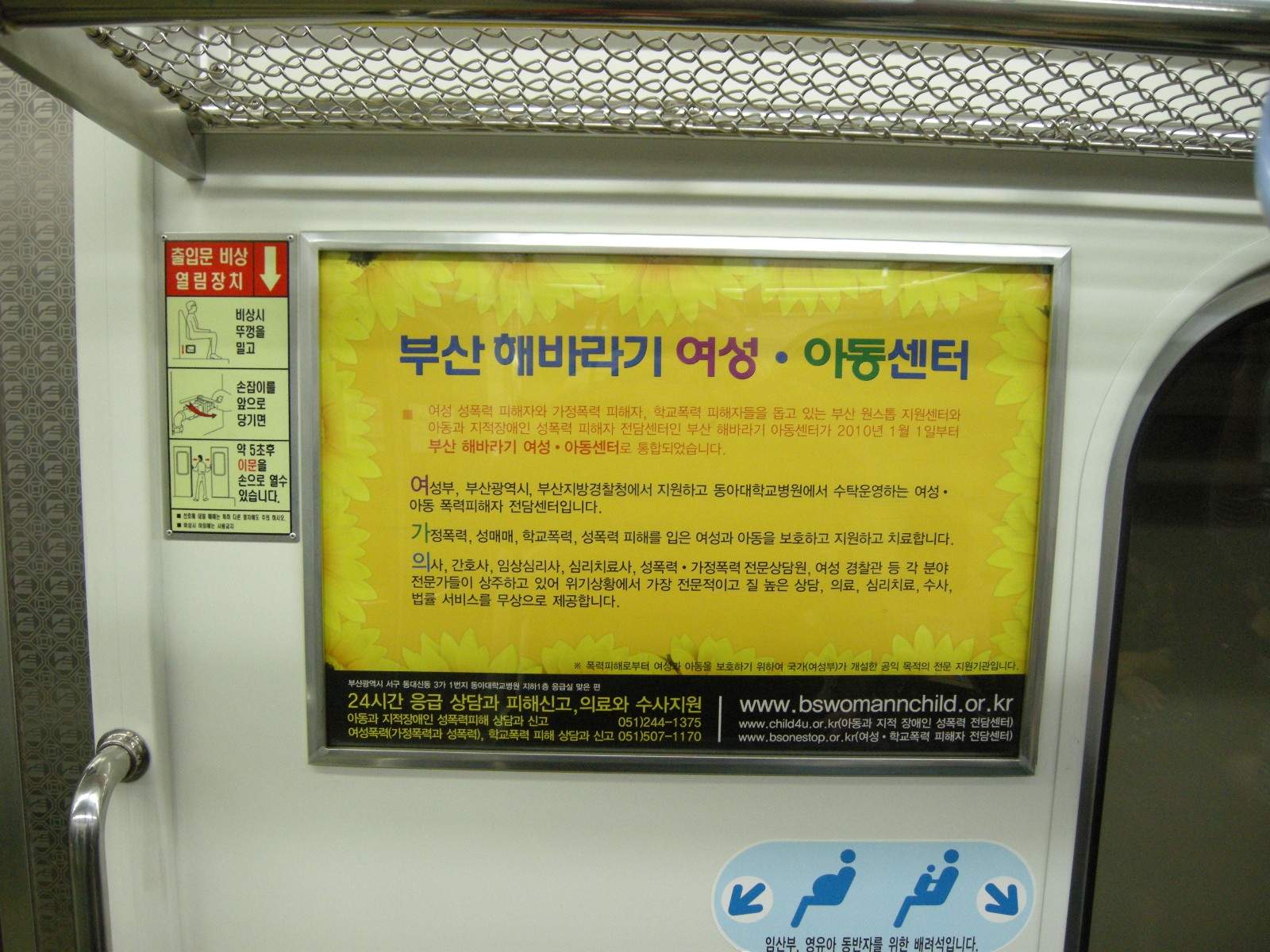
Take what this humble-looking subway ad for instance, and what it ultimately represents. First, a translation:

부산 해바라기 여성 • 아동센터

Busan Sunflower Women & Children’s Center

여성 성폭력 피해자와 가정폭력 피해자, 학교폭력 피해자들을 돕고 있는 부산 원스톱 지원센터와 아동과 지적장애인 성폭력 피해자 전담센터인 부산 해바라기 아동센터가 2010년 1월 1일부터 부산 해바라기 여성 • 아동센터로 통합되었습니다.

From January 1, the Busan One-Stop Support Center, which helps female victims of sexual abuse, victims of family abuse, and victims of physical abuse at schools, and the Busan Sunflower Children’s Center, which helps children and mentally handicapped victims of sexual abuse, have joined together and become the Busan Sunflower Women & Children’s Center.

(Source)

여성부, 부산광역시, 부산지방경찰청에서 지원하고 동아대학교병원에서 수탁운영하는 여성 • 아동 폭력피해자 전담센터입니다.

With support from the Ministry of Gender Equality, the Busan Metropolitan City Council, and the Busan Metropolitan Police Agency, Dong-a University Hospital has been given the responsibility of operating the center, which provides consultations for female and child victims of abuse.

가족폭력, 성매매, 학교폭력, 성폭력 피해를 입은 여성과 아동을 보호하고 지원하고 치료합니다.

Women and children who are the victims of family violence, sex trafficking, school violence, and sexual abuse can receive protection and treatment at the center.

의사, 간호사, 임상심리사, 심리치료사, 성폭력 • 가정폭력 전문상담원, 여성 경찰관 등 각 분야 전문가들이 상주하고 있어 위기상황에서 가장 전문적이고 질 높은 상담, 의료, 심리치료, 수사, 법률 서비스를 무상으로 제공합니다.

Experts in many fields such as doctors, nurses, clinical psychologists, psychological therapists, family and sexual violence consultants, and female police officers and so on will be permanently stationed at the center, and when you are in a crisis you can receive the best professional and highest quality consultations, medical treatment, psychological counseling, legal advice, and assistance with launching criminal investigations. All these services are provided free of charge. (end)

(Source)

In my experience, usually the amalgamation of two government institutions in any country is in response to cost-cutting. Fortunately however, there’s a great deal of indirect evidence to suggest that that isn’t the case here.

First, note that the ad is actually quite dated, mentioning that the amalgamation was effective from January the 1st for instance (although the center didn’t officially open until February the 9th), and in particular that the Ministry of Gender Equality has a supporting role in it, whereas the Ministry actually reconverted back to the Ministry of Gender Equality and Family Affairs (여성가족부/MOGEF) back in March. Presumably then, the ad has already been posted on Busan subway trains once before, probably late last year or early this one.

Why suddenly post the same ones again in late September then? What has changed to prompt that?

As Matt at Gusts of Popular Feeling has well-documented, what has changed is the public perception that there has been a sudden and dramatic increase in the numbers of sex crimes against children, whereas in fact they have remained steady (but appallingly high) for years:

There is not a “recent series” of such sexual crimes – this is always happening. It’s just that the media has decided – as it does whenever a particular case angers people – to highlight these cases, which would usually either not be covered or covered by perhaps only one or two media outlets, and which are now linked together in articles in order to point to a great problem that exists. To be sure, there have been several laws passed since the murder of Lee Yu-ri in March (and the Yeongdeungpo case in June), and it’s great that the issue has finally gotten enough attention to get things moving (see here for a brief history of the slow pace of change since 2006). I’m not entirely sure that the solutions being offered are always the best ideas, however, and public fury (and worry) whipped up by this media coverage may be putting pressure on politicians to act first and think later.

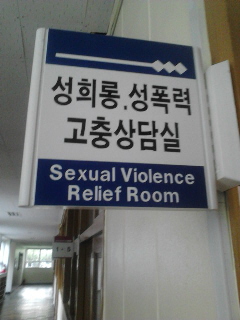
And see past Korean Gender Reader posts for more details of those and other sexual crimes. By coincidence, one of the most notorious of those – the murder of Lee Yu-ri – also occurred in Busan, and several of my coworkers here have reported seeing rooms like that on the right pop up in Busan public schools they teach at in the months since, although unfortunately they have no information on the quality of their staffing or how often they are utilized. Have any readers also noticed them, in Busan or elsewhere?

(Note that the English translation on it may be a little misleading though: a better one would be “Consultation Room [for] Mental Anguish [caused by] Sexual Harassment or Sexual Violence”)

Regardless, the point is that given the current climate then it would be wise for the government to highlight all it is doing to prevent sexual violence, let alone to continue or even increase funding to women and children’s centers. And however cynical and reactionary the motives, this is to be applauded.

Granted, the amalgamation was decided and instituted well before the public outcry over the supposed recent spate of sexual crimes against children. But that doesn’t necessarily imply it was the result of a reduction of funding: although it may receive little if any funding from MOGEF for instance, I find it significant that the Ministry’s assumption of old responsibilities came with a big increase in staff and 4 times larger budget (albeit from a base of 0.03% of the government total), so when the plans for the change were announced late last year there was already a political climate conducive to more funding for feminist causes.  Signs of a change of heart from President Lee Myung-bak also perhaps, who originally promised to abolish it before his election, only to back down and merely considerably downsize it in response to protests afterwards?

Alas, quite the opposite: in fact, he is using MOGEF to raise the dire birth rate by – wait for it – criminalizing abortion, as I explain in detail here. But to play devils’ advocate however, perhaps this blinds us to some of the positives that it has achieved?

One is its survey of teenage entertainers in August, which – among other things – revealed that many were pressured by their managers to wear revealing costumes, and which ultimately resulted in the National Assembly’s setting up of a committee (albeit under a different ministry) to further investigate MOGEF’s findings. And which after hearing evidence from entertainment company CEOs has just laid down new regulations for the treatment of minors in the entertainment industry (see here and here also for more background).

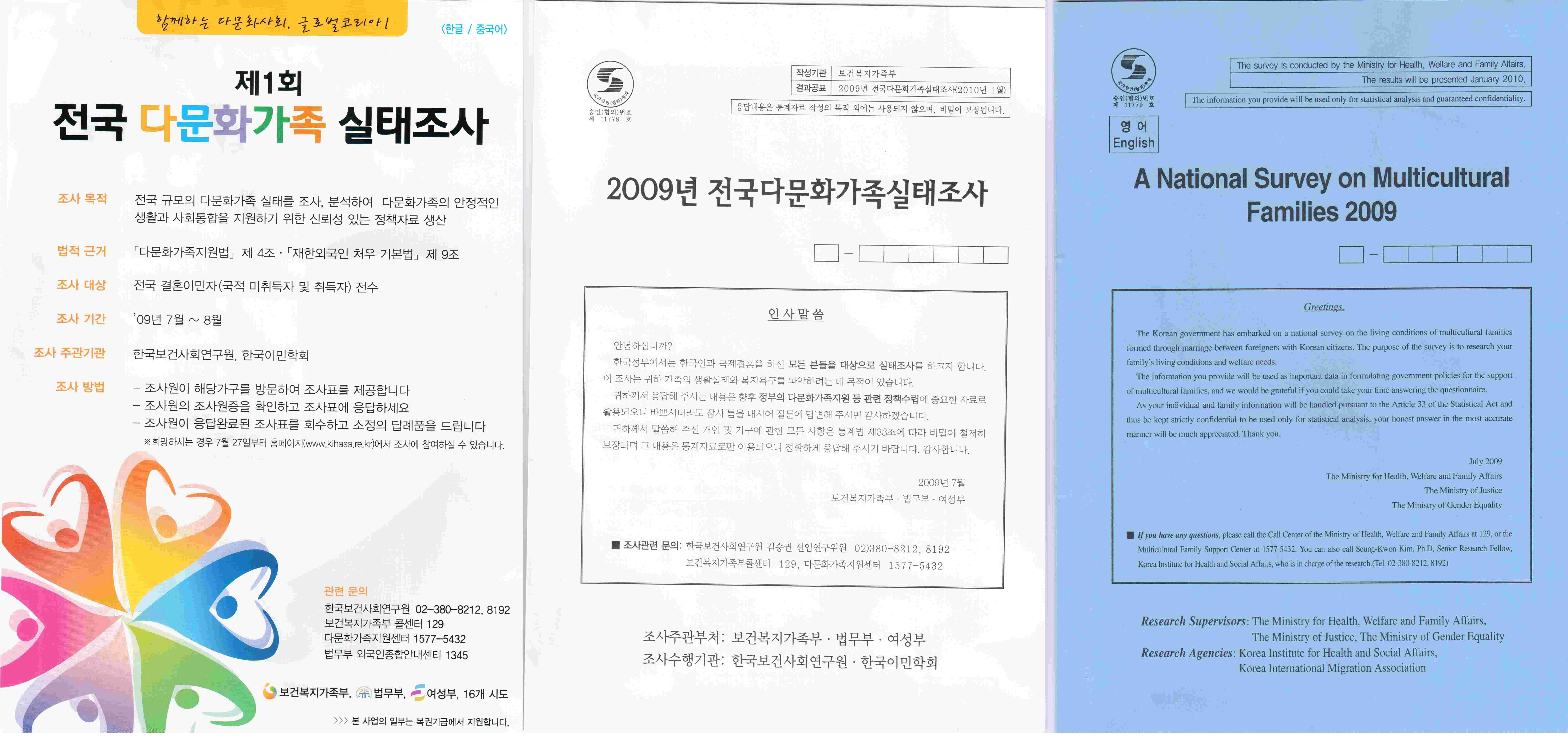
And finally, take the recent video produced by MOGEF below, which encourages people to pay more attention to the needs of immigrant women. Granted, it’s just a video, and again it may be just be in response to the recent murder of a Vietnamese bride by her husband after only 8 days in the country (see #13 here), but then it’s not like such efforts started only recently. One thing that instantly comes to mind for instance, is the above survey that was sent to all foreign spouses in Korea in August last year (see #3 here), in an attempt to better find out their specific needs.

Vodpod videos no longer available.

Any other positives readers can think of, however minor, then please pass them on!^^

Update: As per request, here is what the voiceover in the video is saying (and I’ve put the additional text in brackets as it came up):

이주여성들을 힘들게 하는건 (부부갈등 상담 8, 452건)

The things that make it difficult for migrant women… (8, 452 consultations for married couples having difficulties)

어려운 한국어와 (가정폭력 상담 4205 건 [2009년 이주여성 긴급지원센터 상담통계)

…are difficult Korean… (4205 consultations over family violence/abuse [2009 Statistics from Migrant Urgent Help & Consultation Centers])

낯선 환경, 다른 문화

…the strange environment, the different culture…

그리고 우리의 무관심입니다. (국제결혼 이주여성 16만여명)

…and our indifference. (lit. international marriage migrant women 160,000 women [James: just in 2009?])

이주여성들에게 작은 관심은 큰 힘이 됩니다.

Just a little help and support helps migrant women a great deal (same in the text)

이주여성들의 힘이 되어주세요.

Please be strong and supportive to them.

이캠폐인은 여성가족부와 복권위원회가 함께 합니다. (이주여성긴급지원센터, 1577-1336)

This campaign is brought to you by MOGEF and The Lottery Commission. (Migrant Women’s Urgent Help & Consultation Centers: 1577-1366)

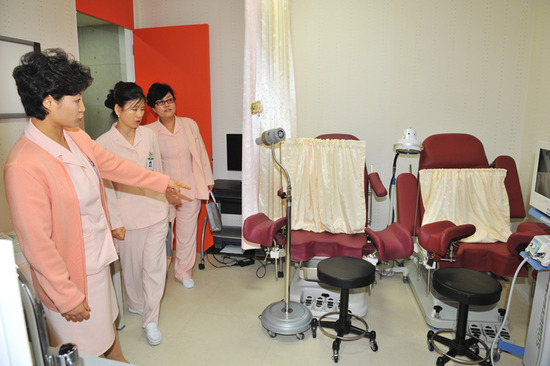
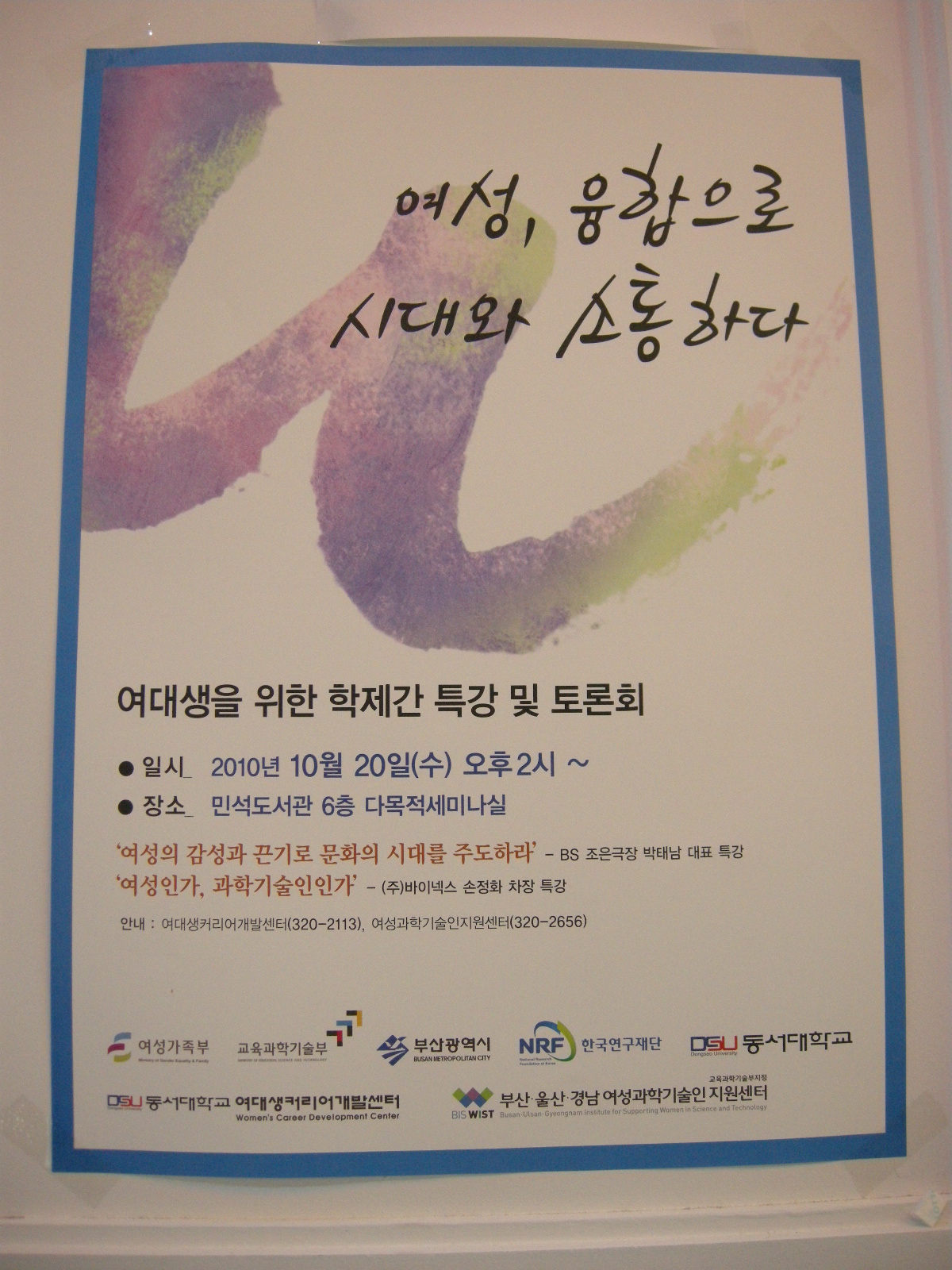
And by coincidence, something else positive that MOGEF has some role in: a seminar about women’s career development at my university tomorrow (stalkers, take note of which one). Things like this seem to go on there at least once a month or so.

Maybe this has something to do with that, which I only just noticed today:

Please let me know if anyone would like a translation of the first poster. Meanwhile, do any other Korea-based readers have anything similar at their own universities?

Yes, Old Korean People Have Sex Too…

( Source )

But perhaps as you’d expect, they’re generally not using protection. A quick report from The Daily Focus on Wednesday:

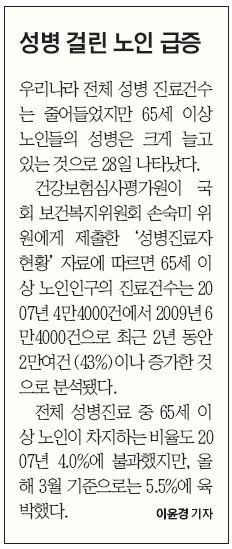
Number of STD Cases Among Old People Rising

While the national total number of STD cases has dropped overall, the numbers of people aged 65 and over contracting STDs has risen sharply, it emerged on the 28th.

The Health Insurance Review and Assessment Service presented its “Current Situation Regarded STD Treatment Recipients” report to Assemblywoman Son Sook-mee of the National Assembly Health Welfare Committee, according to the data of which the number of cases of people aged 65 and older receiving treatment for STDs was 44,000 in 2007 and 64,000 in 2009, a rise of 43% in just 2 years.

In 2007, people 65 years and older accounted for 4.0% of all cases of people treated for STDs, but this has risen to 5.5% as of March this year.

Little information to go on unfortunately, but Seoul residents may be interested in placing that into the context of the prostitution culture around Jongmyo Park in Jongno, which caters to the thousands of male retirees that spend their days there. From story #13 in a “Korean Gender Reader” post from March last year:

Prostitution Answers Sexual Needs of Senior Citizens?

The first time I visited in Jongmyo Park in Seoul in 2000, naturally I remarked on the hundreds of mostly male retirees there to my friend visiting from Japan, who rightly pointed out that they “didn’t particularly have much to do nor anywhere in particular to do it,” so why not play Korean chess all day there? In hindsight though, many would much rather be doing something else, and it’s almost surprising that it took so long for prostitutes to encroach on this captive and – let’s call a spade a spade – somewhat desperate market.

Here, the Korea Times reports on the ensuing problems of unsafe sex, the sale of fake Viagra and “men’s stamina” products, and the general increasing seediness of the area. You can also read discussions about it at ROK Drop and The Marmot’s Hole.

One surprising omission in the Korea Times article though, was the fact that the area between Jongmyo and Tapgol Park is also “packed full with gay bars and hotels catering to gay clients”, as noted by regular commenter Gomushin Girl.  Still it does end with the pertinent point that:

…the social atmosphere of viewing senior citizen’s sexual desire as a nasty matter has worsened the situation. “Sexual desire is a desire not only shared among young people but also old people. But our society is sill stuck in the obsolete Confucian-based perception that labels desire as an undesirable state, playing a major hurdle in setting a sound sexual culture for the aged,” said Prof. Lim Choon-sik at Hannam University’s social welfare department.

( Source )

And accordingly, probably the most notable if not the only “recent” Korean film to depict the sexuality of the aged – Too Young to Die (죽어도 좋아; 2002) – was heavily censored. As noted at KoreanFilm.org:

The filmic career of this independent digital feature about an elderly couple in love has followed an unusual arc. It began at the pinnacle of respectability, being selected to screen in the Critics’ Week section at the 2002 Cannes International Film Festival. After receiving a number of very positive reviews, it went on to be selected for the Toronto International Film Festival’s showcase of Korean cinema, and then received a special grant from the government-supported Korean Film Commission to help finance the film’s transfer to 35mm film for a release in Korea. Then, alas, the film was submitted to the nation’s Media Ratings Board, where it was judged unfit for public viewing and banned from release in ordinary theaters.

Too Young To Die is based on the true story of Park Chi-gyu and Lee Soon-ye, a man and woman in their early seventies who met, fell in love, and then rediscovered sex. The couple, who play themselves in the movie, seem little different from a couple in their twenties. They tease each other, fret about their hair, take snapshots of themselves, argue over trifles, and leap into bed with unabashed frequency. Indeed, watching them forces you to rethink all your stereotypes of what it is to be old.

In particular, as Gomushin Girl mentioned in the context of the excessive censorship of women’s sexuality in general:

…the key scene of fellatio was darkened and shortened significantly before it could be released. I would suggest that it was not just the fact that the couple was elderly that made the sex scenes so controversial, but the gusto and relish that the woman took in the acts.

Which raises the question of if there have been any other depictions of aged sexuality in Korean popular culture in the past 8 years (positive or otherwise), as perhaps that experience put directors off? If you know of any, then please let know, but regardless I’d wager that we’re likely to see more soon; after all, with Korea rapidly becoming the most aged society in the world, then audiences (and rating boards) can only become more sympathetic to the subject over time.

In the meantime, can anyone think of any areas in other Korean cities where retirees and prostitutes regularly meet?

Share

Korean Sociological Image #47: East End Girls, meet West End Boys

Yes, it had to happen eventually! A big round of applause to Nextour, for quite possibly the very first positive representation of a Korean female – Western male relationship in a Korean commercial.

New readers shaking your heads in disbelief however, please consider reading other posts in the “interracial relationships” category, especially here, here, here, here, here, and here. And please also ponder the following quote from Hyun-Mee Kim in her chapter “Feminization of the 2002 World Cup and Women’s Fandom” in Feminist Cultural Politics in Korea, ed. by Jung-Hwa Oh, 2005, pp. 228-243 below on the then unprecedented public attention by Korean women on the bodies of the Korean players, and which gives a big clue as to why such an essentially innocuous commercial didn’t emerge back then:

…if Korean women’s enthusiasm had mostly been directed at handsome Western soccer players, such as England’s Beckham or Owen, Portugal’s Figu, Italy’s Toti or Spain’s Morientes, the situation would have been drastically different. That they zealously applauded Hiddinck, a Dutch male and the director of the Korean team, seemingly too much of a “father” for them to desire sexual union with, and the familiar handsome guys of Ahn Jeong-hwan, Kim Nam-il, and Song Jong-Guk, must have been the chief reason for positive response the Korean women fans got from the rest of the society.

In particular:

The attitude of the Korean media that looks down on Japanese women for expressing their love for Beckham and treats them as “ppansun-i”s [빤순이, or condescending slang for crazed girl fans – James], clearly shows what line the Korean women should dare not cross. This World Cup, which ended up as a worshiping of the 23 [Korean players], delineates the limitations as Korean women rose up as the subjects of their own sexual desires. This is a society in which there is still a strong belief in the sexual union of the full bloods: for the women to collectively root for Ronaldo or Morientes, there is too much at stake. It is so much easier to shout out that they want the “yellow bodies” of our own race rather than “white and black bodies”. Hence, the happy union of women’s sexual desires and new patriotism in the 2002 World Cup. (p. 239)

Naturally one commercial doesn’t mean a sexual and racial revolution of course (note that only Caucasian men were featured), but it is a start, and certainly provides a welcome contrast to the general persecution of foreign males in the Korea media in recent years, as most recently demonstrated by the fact that Anti English Spectrum’s Lee Eun-ung was uncritically allowed to present his repulsive, unsubstantiated views on foreign males on a national radio show for instance. Indeed, the lack of netizen reaction to the commercial so far hopefully demonstrates that things may have actually improved a little since 2002, and provides a healthy reminder that, just like in other countries, the Korean media is probably not a very accurate guide to public opinion in the first place.

Meanwhile, see here for the male version, albeit a slightly seedy one (caressing a ‘sandwoman’ anyone?), and young readers see here also if you didn’t understand the “East End Girls” reference!^^

Update, November 2011) Alas, it wasn’t actually the first! See here for an example from 2006 (and one more from later in 2010).

(For all posts in the Korean Sociological Images series, see here)

Korean Sociological Image #46: The Language of Exclusion (Updated)

(Source: Mental Poo; reproduced with permission)

A receipt from a recent visit by blogger My Jihae to an upscale restaurant in Seoul, about which she wrote:

I’m not sure how many restaurants do this, and why this restaurant bothers to do this in the first place, but on the top of the receipt they blatantly keep track of whether the guests are locals or foreigners. They pegged me right away, I guess it’s that obvious.

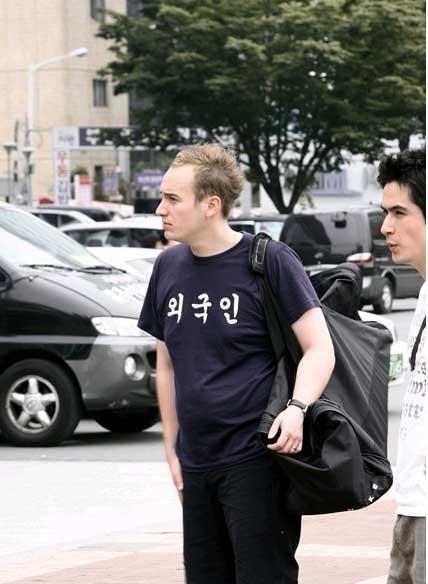
For those of you that can’t read Korean, for now let’s say that waegookin (외국인) on the right generally means a foreigner, and naegookin (내국인) on the left a Korean person. And that does indeed describe My Jihae and her dining partner respectively, although she is actually Korean-American. But why bother to note the distinction between two ethnically-identical customers at the same table?

Some commenters to her post speculate that it may have been done for taxation purposes, which I wrote would be something good to know if true, as otherwise:

…many expats (myself included) may simply chalk things like this up to Koreans typically and completely unnecessarily pointing out our foreignness, when in fact they may be nothing of the sort.

And see Occidentalism here and here for a similar case in Japan. Unfortunately however, not all perceived Korean tendencies towards exclusion are simply misunderstandings on the part of non-Koreans.

Take the “Waegookin Shock Meltdown” for instance, which describes the situation:

…where when speaking in Korean, Koreans freeze up because they have some silly preconceptions that foreigners simply ‘can’t’ speak Korean or that they just ‘shouldn’t’ speak to us in Korean – the latter which comes without the help of the government and medias insistence in the last 10 years or so that ‘globalization’ means that Koreans should all have to speak English whenever they encounter big-nosed white people.

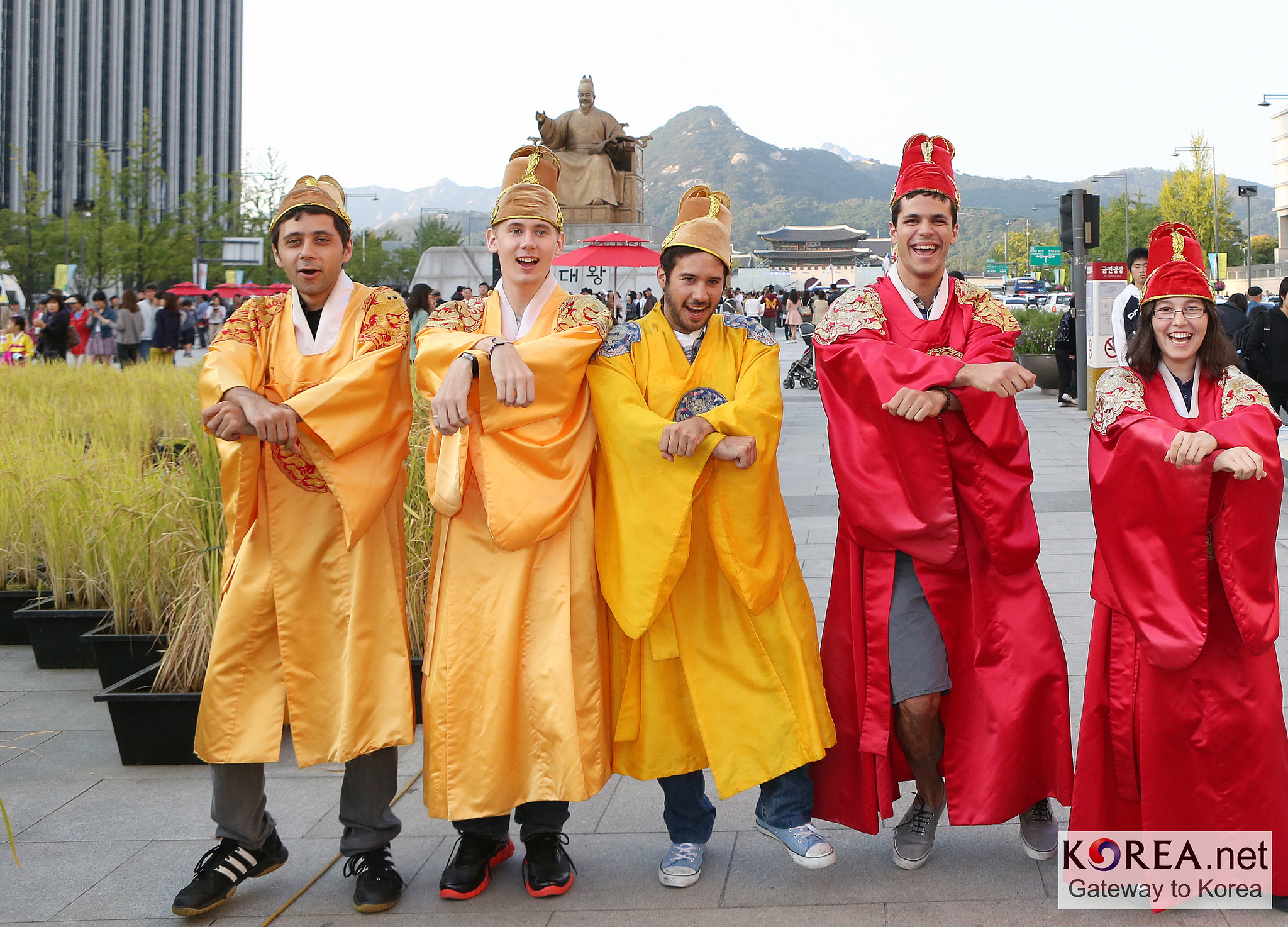
Foreigners Gangnam Style(Source: Republic of Korea; CC BY-SA 2.0)

And which personally used to get me extremely frustrated and angry while learning Korean a few years ago, although now I believe that that reaction from Koreans more often stems from simple inexperience and/or nervousness in dealing with non-Koreans. Still, whatever combination of factors are responsible in any given case, all have clear solutions, something which can not be so easily said of the ways in which Korean notions of nationalism, citizenship, and even the Korean language itself arguably inherently exclude others. Focusing on the latter in this post, I identify 2 main ways in which it does so:

First, because Koreans might take a vacation to New Zealand, say, and describe New Zealanders as waegookin while they’re there, so clearly “foreigner” doesn’t quite cut it as a translation. Perhaps “non-ethnic Korean” would be more suitable? But then what about about My Jihae back in the restaurant?

Given such confusion, then as you might expect the question of the most appropriate English term has already attracted a great deal of attention from many generations of expats, and so if you can forgive my heemanggomoon (희망고문; literally “hope-torture” or “stringing someone along”, and one of my favorite Korean words), I’ve decided that it would be unhelpful to repeat any of that here. Instead, let me refer you to this excellent post by regular commenter Seamus Walsh for the most recent and comprehensive discussion of this aspect of the language issue (but this and this post by others are also helpful), only passing on myself what I wrote in my own post on it 2 years ago:

It may not sound like much, but like I said in this forum, Korea’s (and Japan’s) bloodline-based notions of nationalism and citizenship emphasize and exaggerate the differences between natives and non-natives to an extent rarely found elsewhere in the world, and the constant reminders of these quickly become wearisome to anyone who’s spent even just a few months living here, let alone 8 years. And ironically, constantly hearing the term waegookin in our daily lives probably means that we come to adopt some of the same notions of division and distance ourselves too, and the effect snowballs.

Naturally, Seamus also covers the the second reason in that post, the fact that Koreans never say “my home”, “my wife”, “my language”, or “my country” for instance, but say “our” (우리) instead. And that I can add something useful to here, as by coincidence there was recently a lively discussion on that very topic on the email-based Korean Studies Internet Discussion List, prompted by the following question by William Pore of Pusan National University (source, right: Asadal Thought):

Dear List:

For any comparative Asian linguists, Ural Altaic linguists (?), or, maybe even Korean linguists on the list, I would like to inquire if a pronoun similar to the Korean we (i.e. ‘uri’) occurs with the same frequency/prominence in any related languages to the same degree that it does in Korean. Should we accept the assertion that I nearly always have had that the prominence of that pronoun in Korean is due to a particular Korean mindset alone?

And rather than have you scroll through the full June archive yourself, my contribution is in presenting a truncated and much(!) more readable version of the most pertinent comments instead. Starting with JMF’s reply then:

Perhaps this is not directly related, but I witnessed some very interesting aspects of “uri” while raising my daughter in Korea. Not only my daugher but all of her “pure Korean” friends as well naturally used the words “I/my” almost exclusively. I saw and heard all of them say in Korean “my house,” my school,” “my Mommy/Daddy,” etc. Of course, they were quickly corrected/reprimanded by parents and teachers until they capitulated and began to use “we/our” almost exclusively where they had once felt that “I/my” was more natural. In a word, “uri” is not somehow “organic” to Korean-ness or Korean language but rather externally injected and enforced.

Frank Rudiger, University of Vienna:

And here comes something even less directly related, yet not completely unrelated: In Russian, there is a similar way of saying “we” when actually meaning “I”, for example “me and my mother” would literally be “us with mom” (my s mamoj). In other words, this is not necessarily a purely Korean phenomenon. I guess Russian is not the only example. What about “we won” (wir haben gewonnen) meaning “our team has won” in German (at least)?

(Source: Stinkie Pinkie; CC BY 2.0)

Dr. Balazs Szalontai, Mongolia International University:

In Mongolian language, which has some interesting grammatical similarities with Korean, this practice is carried even further. One would often hear a lady utter the term “manaa nuhur” (our husband), rather than “minii nuhur” (my husband), though she supposedly does not intend to share the said individual with any additional ladies.:)

Alison Tokita, Tokyo Institute of Technology:

I know Japanese much better than I know Korean, but clearly the Korean uri has its equivalent in Japanese language and usage. The Japanese equivalent of uri has indeed been very frequent in recent decades as an aspect of Nihonjinron (theories or discourse of Japanese uniqueness), but is probably declining in the younger generation. The Japanese equivalent actually uses archaic forms of the pronoun. Some examples:

Japan is expressed as not only Nihon, but as waga kuni (our country; cf the softer watashitachi no kuni). The Japanese are not only Nihonjin, but wareware Nihonjin (we Japanese). My or our house can be wagaya (cf watashitachi no uchi).

Then there is the use of koku (country, nation): Japanese literature is koku bungaku (recently the use of Nihon bungaku is starting to replace this); Japanese history is kokushi (now changing to Nihonshi); Japanese (national) language is kokugo: what is taught to Japanese in schools is kokugo and what is taught to non-Japanese is Nihongo.

The use of our and national instead of the country name conveys a somewhat closed country, nationalistic mentality, and as Japan is becoming more internationalized this seems to be going out of favour. These are only my impressions, but others may know of research on this linguistic phenomenon.

Dr. Edward D. Rockstein:

Of course, the usage of koku [a Sino-Japanese loan word] you describe has antecedents in Chinese usages such as  guoyu national language, guoshi national history, guowen national writing system or national literature, ddeung ddeung, nado nado, deng deng.

(Source: Unknown)

And by Owen Miller, with a similar example from England that I was very surprised and happy to see as a former Geordie myself(!), and with most of my extended family still in the region:

I wouldn’t like to step to far into the territory of the linguists on this list but I really wonder whether the case can be made empirically that the pronoun we is more frequent in Korean than in other languages. While I’m sure that John Frankl is right about its enforced use (as a result of ideological norms of national and familial collectivity that probably have relatively recent *historical roots), this doesn’t mean that it isn’t used **frequently** in similar ways in other languages. *

The use of the ‘national we’ is not uncommon in the UK, although perhaps uncommon enough that it makes me wince when I hear it. For example, teaching the First Opium War last year I found myself feeling strangely uncomfortable when the students spontaneously started discussing how terrible it was that ‘we’ had done this bad thing to China.

In certain British English dialects ‘we’ is also very commonly used in the way that Ross King describes above (exclusive first-person plural pronoun) in non-national contexts. For example, the Geordie English pronoun ‘wor’, as in ‘wor lass <http://en.wiktionary.org/wiki/wor_lass>’.

It strikes me that the Korean discourse on the use of ‘uri’ is probably something of a self-reinforcing feedback loop: Encourage the use of a word in official discourse so as to strengthen national collectivity –> discover that word is used frequently –> find that this is evidence of strong national collectivity –> further encourage use of word etc etc.

Finally Jonathan:

Is there evidence of widespread vernacular use of uri prior to the twentieth century? I ask because I wonder if its use was prompted by the Japanese use of ware as in wareware Nihonjin?

And after all that, a clear message that this lingusitic feature of Korean is by no means as unique to Korean as many of us probably thought!

Thoughts?

Update 1: As several people have suggested in the comments, and Sara confirmed, the reason that upscale restaurants keep track of non-Koreans is so that they can determine which dishes are the most popular among them, and adjust their menus accordingly. Which is certainly nothing to get upset about, but then wouldn’t actually be all that helpful either, and it would make much more sense to note customers’ nationalities instead (provided staff had the ability to politely ask them).

Regardless however, certainly Koreans in the service industry do frequently unnecessarily keep track of customers which are non-Koreans. As I originally thought Brian in Jeollanam-do‘s receipt on the right was a prime example of for instance, but after reading his explanation:

In my case, I was at a Lotteria (shut up, it’s pretty good) in a Kim’s Club next to my apartment, and the “foreigner” was to help identify who the take-out order went to. Just to preempt any commenters from James’ post, no, I’m not terribly offended and it’s not the worst thing to ever happen to me. It’s just an odd default term considering the people working the counter usually just announce the order to the crowed in order to connect people with food. There’s no reason not to just announce “Bulgogi Burger set,” or whatever, unless the person assumed I wouldn’t understand the announcement. A good posibility, in spite of me having ordered in Korean.

…then I realize that it would indeed make sense to identify a foreign customer if the person taking his or her order felt that they’d be unlikely to understand their announcement. But I disagree with Brian’s first last line though (why assume that someone who can order in Korean couldn’t also understand that it’s arrived?), and which is just the sort of thing which so aggravates me about speaking Korean in this country like I explained. Hence the “외국인” was actually unnecessary then, but rather more because of the Lotteria worker’s preconceptions of non-Asian foreigners’ Korean ability (they would never do the same to a Japanese person) than anything inherent to the Korean language.

Either way, it’s good to remember that whenever one is highlighted like this, then it could be for any number of reasons, and 99% of the time the people responsible do not mean to and are probably completely unaware that they may be causing offense. Moreover, as Brian’s discussions here and here of decades-old journal articles on this subject attest to (see this one at Gypsy Scholar also), this is something one just has to get used to.

Update 2: See The View From Taiwan for a similar issue with terms there.

(For all posts in the Korean Sociological Images series, see here)

Korean “Double In-Laws”… and Other Dramas!

(Wedding Day by summer park; CC BY 2.0)

An interesting question from Curtis, a reader with a slightly unusual family in which 2 brothers from one family married 2 sisters from another. As you will see, he was concerned about how this would be received by Koreans:

Dear James,

Lately I’ve been seriously confused and irritated by a seeming issue with relation to Korean marriages.  I can’t figure out why it is even a problem to begin with. I’ve never heard the term until recently, but apparently Koreans (I’m not sure if this is general or only among certain classes) seem to be against marriages that create “double in-laws,” meaning that, for example, member A of the Kim family marries member A of the Lee family. Then Member B of the Kim family marries the sister/brother of member A of the Lee family. The first marriage made them in-laws, but this second marriage creates what I’ve heard Koreans term “double in-laws” which seems to have some stigma.  As far as I am concerned as a westerner, the second marriage has little to no bearing on anything since it isn’t incest or intermarriage, therefore I see no problem. In fact, my father married my mother, and soon after that, my father’s brother married my mother’s sister. I guess that creates double in-laws in my family, but since it’s neither incest nor intermarriage, I haven’t once heard any issues being brought up about it. Could you explain if this “double in-laws” thing is really an issue, and if so, why? All I can think of is that the families are not being spread out far enough for maximum social networking and both sides of the family may end up being in one household, but since Korean family dynamics are changing, this doesn’t have to be the case.

I’ve also heard the English term “co-in-laws” to describe this, but again, I find no reports of issues with this arrangement other than in a few Korean instances.

And an update in a second email:

[I’ve done some more thinking]…, and I thought about the collective culture that Korea is.  I thought that perhaps when a family marries another family, the WHOLE family in that household become in-laws as such, whereas in western societies, the distinctions between in-laws is limited more so to the ones who married into the family.  I, personally, would consider the sister of my brother-in-law just that, the sister of my brother-in-law, not an in-law herself since she did not marry into the family.

(The Bride by Tetsumo; CC BY 2.0)

What do you think? Personally, while this is the first I’ve heard of any potential stigma, I suspected that there might be something to it when my wife instantly came up with the Korean term for people in such arrangements: gyeobsadon (겹사돈), or “a person doubly related by marriage.” Moreover, however illogical any stigma would be, there is certainly precedent too: until as late as 2005, Article 809 of the Korean Civil Code prohibited marriage between those of the same ancestral, regional clan (or local subgroup of Lees, Parks, or Kims and so on), of which the largest had over 4 million members. Or in short, somewhere between 8-15% of the Korean population were literally forbidden to marry each other, with even the children of any de-facto unions discriminated against also because their out-of-wedlock status prohibited them from receiving national health insurance, let alone complicating inheritance and property rights.

But as it turned out in this case at least, my wife knew the term not because of any stigma that she’s aware of…rather, because she remembered such arrangements from dramas!

Probably there is nothing to worry about then, but if anyone could confirm that then I’m sure Curtis will appreciate it, and I’d be interested in hearing any other unusual stories about marriage and Korean families also. If you’d rather read more yourself though, then consider this series on the uncertain role of Neo-Confucianism in the similarities between Japanese and Korean family forms, and especially how daughters-in-law are treated therein.

Update: Speaking of the importance of family names in Korea, today there was an interesting article in the New York Times about the trials and tribulations a Korean man (and subsequently his family) had due to his Japanese ancestry.

The Grand Narrative in The Washington Post

Photo by Dương Nhân from Pexels

While the background will be very familiar to regular readers, I confess I was still intrigued when Washington Post reporter Blaine Harden emailed me about this last month:

With pressures high, South Korean women put off marriage and childbirth

SEOUL — In a full-page newspaper advertisement headlined “I Am a Bad Woman,” Hwang Myoung-eun (황명은) explained the trauma of being a working mom in South Korea.

“I may be a good employee, but to my family I am a failure,” wrote Hwang, a marketing executive and mother of a 6-year-old son. “In their eyes, I am a bad daughter-in-law, bad wife and bad mother.”

The highly unusual ad gave voice to the resentment and repressed anger that are common to working women across South Korea…

With thanks to Blaine Harden for asking for my input, see here for the full report, and further details are included in this similar report from the JoongAng Daily last week also.

New readers further interested in any of the issues mentioned in either, please see: #2 here for more on Korea’s extremely low score in the UNDP’s “Gender Empowerment Measure” on which I based my email statement “….despite Korean women having good health and excellent education, they still have a much greater chance of becoming a politician or even a middle manager or computer programmer in countries like Kyrgyzstan, the Dominican Republic, Botswana or Nicaragua” that Blaine Harden quoted, and here for a recent survey on the discrimination expectant mothers face in Korean workplaces, which mentions that nearly 25% of them either got fired or were forced to quit once their pregnancies were revealed. For all others, please see the list of links I provided when I was involved in a report on a very similar topic for TIME Magazine last year, and another in a more recent post on childcare and socialization.

Unfortunately, judging by the handful of news articles available on the internet, then this story seemed to get little attention in the Korean-language media, although as I type this the Washington Post article itself has prompted a couple more. But see here for the original text of the advertisements, and here, here and here for some of the original reports from October and November last year, and I’d be very grateful to hear from anybody who saw her television interviews!

If you reside in South Korea, you can donate via wire transfer: Turnbull James Edward (Kookmin Bank/국민은행, 563401-01-214324)

Korean Women Angry at Being Promoted Less Than Men

Gender Gap Angry Woman(Source: TheDailyEnglishShow.com,via studio tdes)

A snapshot of some of the different forms of sexual discrimination experienced at Korean workplaces, from the January 15 edition of Metro Busan:

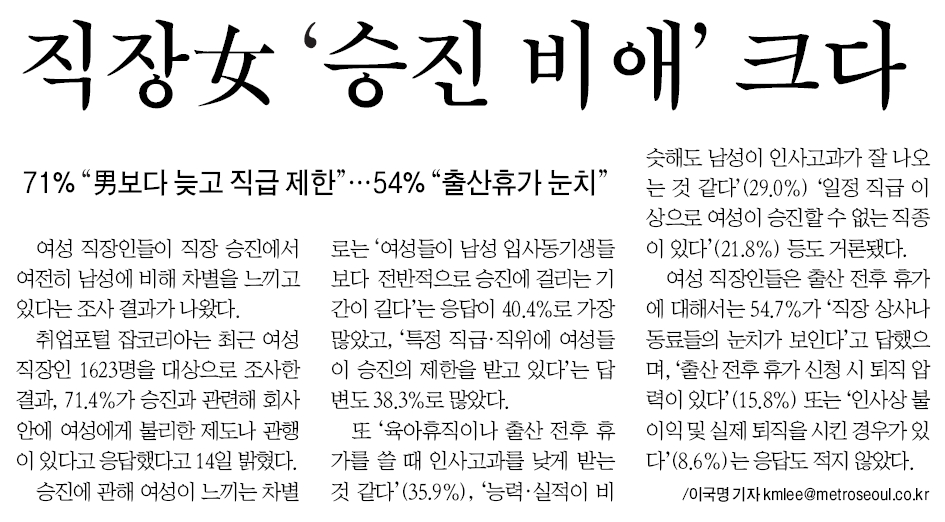
Women Workers’ “Promotion Grief” is Big

71% Say “Compared to Men, Promotions Come Late and with Limits”…54% Say “We Feel Inhibited From Asking for Maternity Leave”

A survey of women workers has revealed that when it comes to promotion, they still feel that they suffer from sexual discrimination.

The results of a survey of 1623 women workers by job portal site JobKorea, released on the 14th, showed that 71.4% believed that the promotion systems at their companies placed women at a disadvantage.

Asked for more information about this discrimination, 40.4% [of the 1623 women] said that “compared to men that enter the company at the same time, women have to wait longer to get promoted,” and 38.3% added that “women are excluded from some higher positions.”

In addition, 35.9% mentioned that “if we take maternity leave or time off before and after giving birth, we get lower scores on our evaluations by the personnel department,” 29% that “even if we have the same ability and practical know-how as men, we get lower scores,” and 21.8% that women simply are excluded from certain kinds of jobs.

Also, 54.7% replied that they found it very difficult to ask their superiors or coworkers for time off for childbirth, 15.8% said that they felt pressure to quit their jobs after having a baby, and finally 8.6% were aware of cases where recent mothers were indeed forced to quit. (end)

With no information given about the methodology used, then all those results should be taken with a grain of salt unfortunately.

In particular, considering that it is still common practice to fire women upon marriage, then that last figure sounds rather low to me. Also, consider that before the current economic crisis, not only did Korea already have one of the lowest women’s workforce participation rates (and the highest wage gap) in the OECD, but that those few that did work formed a disproportionate number of irregular workers. This ensured that they would be laid-off en masse last year (see #15 here also), and they are unlikely to return to work soon given Korea’s jobless recovery.

(In stark contrast, the decline in the construction industry in the US, for instance, means that for the first time in history actually more women work than men there now.)

Meanwhile, the effects of all the above on Korea’s low birthrate have also been somewhat predictable, now the world’s lowest for the third year running. But never fear, for the Korean Broadcasting Advertising Corporation (KOBACO) is on the case:

(See here {Korean} for more on the making of the campaign)

In KOBACO’s defense, the first women featured does actually have a job. Is it churlish of me to point out that she still goes home early to cook while her husband burns the midnight oil…?

Update 1: Lest the commercial not succeed though, then the Ministry for Health, Welfare and Family Affairs (보건복지가족부), in charge of raising the country’s birthrate, is insisting that its employees go home at 7:30 pm on the third Wednesday of each month, all the better to have sex with their partners and have more babies.

No, unfortunately I’m not making that up.

Update 2: This satire of that is so good, it’s difficult not to believe that it’s the real thing!

Lusting After Teenagers…or the Maturing of Women’s Fan Culture?

Update, September 2013: My original commentary on this article became outdated, so I’ve since removed it. Instead, please see here, here, here, and here for more on the controversial “uncle” or “ajosshi” fandom of teen girl-group members, and here for more on why middle-aged women came to dominate soccer fandom back in 2002 — an important precursor to their fandom of pop stars and actors described here.

Middle-aged People are Head Over Heels about Young Idols

Fan Culture is Changing

#1. Mr. Kim (46), a department manager of a medium-sized business, knows the names and personalities of all 9 members of Girls’ Generation. He thinks that the Wondergirls and 2NE1 do not even come close in terms of purity and class. He dismisses accusations of having a Lolita complex, and says that watching the girls of Girls’ Generation, who are about the same age as his daughter, give him a feeling of life and vitality.

#2. Film company CEO Mrs. Kim (39), suffered severe depression after her movie did extremely badly 2 years ago. But she was able to recover because of her interest in male idol groups, and when she analyzes the charms of members of 2PM, or discusses the potential for the new group MBLAQ, she is indistinguishable from an expert in the music industry. Her dream is to make a movie like Attack on the Pin-up Boys (2007) that Super Junior starred in.

Middle-aged People Are Actively Participating in Fan Clubs

As the name implies, “older brother” fan club members used to be mainly teenagers, but this is no longer the case. But as active consumers of culture, middle-aged women passionate about flower men‘ and middle-aged men heavily into girl groups are actively changing fan culture.

For instance, on flower man Lee Min-ho’s fan club “Dave,” there is an “older sister” section for 30-50 year old women to exchange information about their star, and when there are fan meetings with him they make up over 80% of the audience. And whenever SS501 [James: if you don’t want to show your age, say “double-ess” rather than “ess-ess”!)] have a concert in Korea or attend some event in their region, their middle-aged female fans prepare packed lunches with healthy foods such as red ginseng for them.

(Source)

And whenever there is an event featuring Rain, his middle-aged female fans call the media and request favorable coverage. Before the release of his first Hollywood movie Ninja Assassin (2009), they even delivered rice-cakes to them, a symbol of good luck for a new venture.

Indeed, it has become quite normal for there to be fan clubs that only allow those older than the flower men themselves to join. And this is true for male-only fan clubs for female idols too. In the Girls’ Generation’s “Girls’ Generation’s Party” and the Wondergirls’ “Wonderful” fan clubs for instance, middle-aged men have regular virtual meetings where they exchange opinions about how the groups can progress and thoroughly how they can celebrate group anniversaries and birthdays and so on.

A New Fan Culture is Actively Forming

Many people have dim views of middle-aged men and women who don’t act their age, dismissing them as merely chasing after their lost youth. But an alternate view is that this demographic shift in membership is an inevitable change.

Professor Tak Hyeon-min, on sabbatical in the Cultural Contents Department of Hanyang University, said “People of the 386 Generation, who have finally established their own unique culture, are used to actively absorbing new things,” and that “from their 20s until now, they have demonstrated that they are the biggest consumers and purchasers of cultural products.”

Also, “members of this generation are stuck with heavy family, home, and/or social responsibilities, so as a means of escapism and renewing themselves, they have created a middle-aged fandom in a sense, fundamentally changing Korean fan-club culture in the process.” (end)

Korean Sociological Image #24: Childcare is Women’s Job

Oma(Source: 제동환 via Photo and Share CC)

For traveling parents, this is a godsend:

Asiana’s mother-friendly services have been gaining enthusiastic reviews from those who have been through the ordeals of traveling with infants.

Through the recent launch of “Happy Mom Services,” the airline has been providing exclusive check-in counters for mothers at the airport, breastfeeding covers and baby slings free of charge for travelers with babies.

It gets even better:

In response to the enthusiastic reception, Asiana will extend the “Happy Mom Services” to 66 airports internationally. Also, they will lengthen the age limit from 24 months to 36 months old…

….Passengers with infants will also receive a “Priority Tag” on their checked baggage. Arriving passengers with infants will now be able to quickly retrieve their baggage without the hassle of caring for their infant while waiting at baggage claim…

…For larger infants traveling on children tickets, Asiana is providing free installation of baby safety seats upon reservation. Asiana hopes the service will negate the need for passengers to bring along their own baby seats.

And considering the discriminatory hiring practices of its main rival Korean Air, which refuses to hire men for its cabin crew (see #2 here), then it seems somewhat picky, almost churlish to find any fault with Asiana’s initiative.

But still, “Happy Mom Services”?

(Source: Travel Story)

Yes, easy to overlook, unfortunately we are already barraged with signals that encourage and/or reinforce the notion that childcare is primarily women’s responsibility. For instance, wherever you are in the world, note the warning signs the next time you step on an escalator: only very rarely will you see child stick figures being protected by a male or gender-neutral one rather than a female one. Or, closer to home, consider Seoul Mayor Oh Se Hoon’s recent “Happy Women, Happy Seoul” plan involving the provision of such things as more women’s toilets and the now notorious pink parking spaces: as I point out here, providing larger spaces for those with children and pushchairs to unload is all well and good…but not if fathers are not allowed to use them. And I could go on with many similar examples.

Granted, probably none are confined only to Korea. But in the country with:

…then one suspects that greater attention should be paid to the grass-roots origins of those issues, which unfortunately Asiana’s choice of name only adds to.

Having said that, they’ll still easily be my first choice for traveling with my two young daughters from now on. And if it would be effective, I’d consider writing letters to both English and Korean-language newspapers to draw Asiana’s attention to the problem, hopefully persuading them to change the name to “Happy Parents’ Service.” What do you think?

(For more posts in the Korean Sociological Images Series, see here)

The Grand Narrative in TIME Magazine

Going Down David Smeaton(Going Down by David Smeaton; used with permission)

For the article in full, on Seoul Mayor Oh Se-hoon’s “Happy Women, Happy Seoul” plan involving more women’s toilets and the notorious pink parking spaces, see here. Meanwhile, for readers coming from there, see #2 here for the specific quote of Lee Myung-bak’s for which the blog was mentioned, and #2 here for more information on Korea’s disproportionately low Gender Empowerment Measure.

I would also add—with no offense to reporter Veronica Zaragovia, who necessarily had to omit most of what was said in our interview—that the argument that “the plan may end up reasserting South Korean women’s secondary status more than boosting it” is also one that I made in our phone conversation. I based it on the knowledge that the pink parking spaces were made wider in order to better accommodate loading and unloading pushchairs and so on (see #3 here), which had reminded me of this post from Sociological Images about the images in our daily lives that serve to subtly reaffirm the notion that childcare is primarily women’s responsibility. In that vein, while the extra space may well be appreciated by mothers, consider that if I were to park in one of those spaces myself, with just as pressing a need for the space to deal with my two young daughters in the back as my wife would have, then as a man I would be likely either be fined or shooed away.

I grant you, it sounds innocuous. But place that into the context of Korean women having the lowest workforce participation rate in the OECD, the result of a combination of a lack of childcare facilities and an enduring male-breadwinner mentality that forces a stark choice between motherhood or a career, then the underlying sexist logic becomes apparent. Moreover, with Korea in turn having the lowest birthrate in the world, the economic effects of which will be felt soon, then one might reasonably ask if the money could have been better spent.

p.s. Apologies in advance for some light blogging this week; I have a conference presentation to give this weekend.

Update, January 19 2010: See The JoongAng Daily here for all the ways in which programs like this have been considerably expanded since this post was written, now including pink spaces for women at bus stops, on buses, in parking lots and special pink taxis under the rubric of improving women’s safety (via: The Marmot’s Hole).

Women Bullying Women at Work

In today’s Korea Times, with links and and a little extra information that couldn’t be squeezed into the 800 word limit:

No Room for Sisterhood in Today’s Workplaces?

In U.S. workplaces, women are primarily bullied by other women rather than by men, the New York Times reported last week, and the news quickly went viral as it busted some long and deeply-held stereotypes about the women’s movement.

In total, 60 percent of bullies in U.S. workplaces are men, according to the Workplace Bullying Institute (WBI), a national advocacy group. But whereas they tend to target both sexes equally, their female counterparts choose other women as their targets over 70% of the time (source, right: A Muchness of Me).

These figures were surprising because they arrived in an environment where the glass ceiling remains quite strong: a 2008 census by the nonprofit research group Catalyst, for instance, found that only 15.7 percent of Fortune 500 officers and 15.2 percent of directors were women. On that basis, it had been natural to assume that many women workers identify themselves as members of a repressed group, and consequently are more supportive and nurturing of each other in their working lives than men are.

Yet in reality, as numerous examples provided by the WBI attest to, there is little sense of feminist solidarity in the workplace. Why?

One reason is the record number of working women in the U.S., who are now more numerous than working men for the first time in history, primarily because the recession has hit male-dominated industries. Yet reaching this point has long been predicted, and as women also make up more than 50 percent of management, professional, and related occupations, then the surge in their numbers isn’t the result of them taking low paid and/or irregular work to make ends meet during the recession either.

But ironically this may actually increase pressures on women, as with so many now going after top jobs, yet a variety of discriminatory practices still preventing most from acquiring them, then it is logical for women to perceive female coworkers as competitors rather than as possible allies. Add the stereotype shared by both sexes that women are less tough and less likely to complain about bullying than men also, and it’s a wonder that this gender dimension to bullying in the workplace wasn’t noticed much earlier.

Women bullying women(Source: fav.or.it)

If anything, this competition is likely to be more cut-throat in Korea, where it is primarily women that are losing their jobs. As this newspaper reported in March for instance, of the 166,000 of Korean 30-somethings had lost their jobs the previous month, only 9000 were men.

That was not necessarily due to discrimination in itself: in a recession, all companies fire their irregular and temporary workers first. But in Korea, a disproportionate number of these are 30-something women, largely due to this group being singled out for firing during the Asian Financial Crisis of 1997-98.

That was explicitly for discriminatory reasons, the logic being that fathers and husbands would provide for their families or wives respectively. Unfortunately, government and business sentiments have little changed since.

Lee Myung-bak cartoonIn January, President Lee Myung-bak was quoted as saying that “the most urgent issue on our hands is to create jobs for the heads of households” (see #2 here), and as reported in Wednesday’s Hankyoreh newspaper, many Korean companies are encouraging pregnant women to resign, or are making their working lives intolerable if they don’t.

Consequently, compared to other OECD member countries Korea comes dead last on many indicators of women’s position in economic life, and it was without exaggeration that a 2007 OECD report described the country as the worst to work in for women. For example, in addition to extremely long working hours, the wage gap between men and women, which showed slow but steady improvement in the two decades before the Asian Financial Crisis, has stagnated at women earning roughly 64% of what men do ever since (source, right: unknown).

In these circumstances, it is to be expected that Korea also has one of the lowest women’s workforce participation rates also: according to the Korea Labor and Society Institute, 41.9 percent of all women aged 25-54 were working in 2006, little changed from an average rate of 41.5 percent for 1995-99, or, indeed, of 38.2 percent in 1980. The corollary of this is one of the lowest birth rates in the world, for Korean women are naturally choosing to have one child or none at all in order to work. But at least two are required to maintain a population.

There is perhaps no greater indictment of a society than the unwillingness of its members to raise children in it. But with wages being cut, hours being raised, and stress levels rising for everybody during this recession, Korean women are even less likely to want to do so with having to compete so vigorously with other women just to keep their jobs, let alone break the glass ceiling.

Update) A brief but interesting discussion of the origins of the term “glass ceiling” and the reasons for its persistence is available at the Economist here.
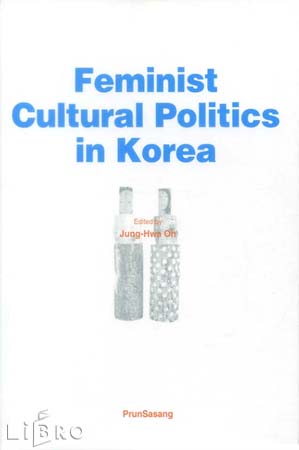
Angry Asian Men

frustrated-chinese-man( Source left: unknown; Source right: GR × HERMARK, CC BY-NC-SA 2.0)
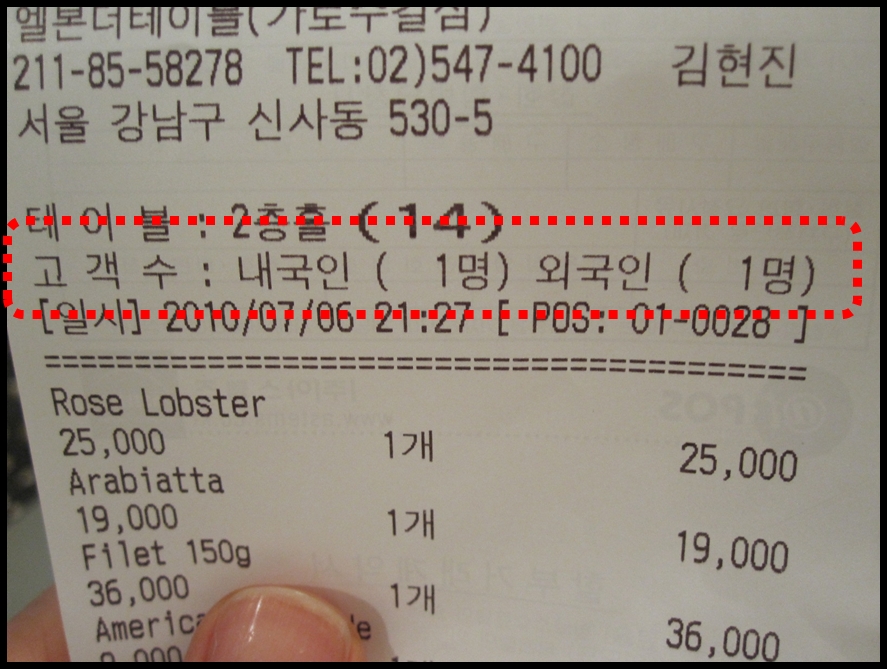
Well, angry Chinese men to be precise, for in 2005 there were 32 million more Chinese boys under the age of 20 than girls, some of the oldest of which will already have been having problems finding sexual partners. And the the gap is set to get worse over the next twenty years as the demographic “wave” of China’s skewed sex ratio arrives.

That figure comes from this study released last week, according to the New York Times actually the first ever to provide hard data on the scale of the problems coming as a result of China’s “One Child Policy“, so it’s well worth a quick read (it’s only seven pages long).

Certainly the notion of hordes of sexually frustrated young men haunting Shanghai bars may sound facetious at first (aren’t they there already?), but the reality is that throughout history they’ve invariably proved very bad for social stability and security: much better to send them off fighting wars, so they don’t cause trouble back at home. Which, needless to say, is ultimately very ominous-sounding considering the ugly nationalist streak China has been displaying in recent years, particularly by its young people. For more on that, see this excellent article by Michael Ledeen (with thanks to Tom Coyner’s “Korean Economic Reader” mailing list), who argues partially on that basis that it is quite misleading and outdated to think of China as a communist regime, and that it is actually more a fascist one now. He’s very convincing.

garfield-minus-garfield-what-if-we-could-see-into-the-futureMeanwhile, see here for my take on Korea’s own sex-ratio problems, which – despite what you may read elsewhere – were actually acknowledged and largely taken care of back in the mid-1990s. Unfortunately however, that minor detail tends to get overlooked by the overseas media somehow (source, right: Garfield Minus Garfield).

Finally, not that it really has anything to do with this post, but I confess that it inspired the title: if you haven’t heard of the Angry Asian Man blog then be sure to check it out, as it offers an unorthodox (and much needed) perspective on American culture and politics.