If recent BBC coverage is anything to go by, marriage in South Korea is like a business. It’s also becoming a bit of an explosive topic as social mobility slows down and the traditional image of the male breadwinner becomes eroded by the increasing participation of females in the labour market. Some of the most widely publicised scandals and controversies on the Korean internet seem to have been, in some way or another, due to this intensifying gender friction.
My apologies for singling out Justin at KoreaBANG, whose post is still excellent overall. And as you’ll soon see, I often make mistakes too.
But that comment I’ve highlighted? Frankly, it just infuriated me. Because even though it’s completely wrong, I seem to hear it all the time these days.
In reality, the Korean female workforce participation rate has stagnated at one of the lowest rates in the OECD ever since 1997-98, when women were overwhelmingly targeted for layoffs during the Asian Financial Crisis. Back then, the logic was that wives would be provided for by their husbands, and 20-something daughters by their fathers. And 10 years later, in the latest crisis, to a large extent this logic was reapplied, although on this occasion there was a clearer economic – not just patriarchal – logic in that women formed the bulk of irregular workers (see here, here, and here for much more information).
Or so I’ve often written. But naturally, it was difficult to find definitive statistics on that when I first reported on it three years ago. At that time, my most up to date source was my copy of Working Korea 2007, published by the Korea Labor & Society Institute. Here is my scan of page 19, which has a graph of the male and female workforce participation rate of 1970-2006:
In hindsight, although it does show a big drop in the female rate in 1997-98, it shows an equally large (even slightly larger?) drop in the male rate too. With my apologies, I’m very surprised I didn’t notice that earlier, and, although it does contradict most of the literature I’ve read about the Asian Financial Crisis, and is just from one source too, it still definitely bears further investigation.
That aside, a year later I found a source going up to 2008 (it shows a fall of 50.3% to 50.0% in 2006-2008; see below also). And today, spurred by Justin’s comment, I tried looking again, and found the following at the National Statistics Office’s website:
The blue bars represent the economically active female population, in thousands (i.e., the first figure is 10.75 million), the pink line the female workforce participation rate. Although the choice of right scale gives the false visual impression that the rate has changed a great deal, as you can see from the numbers it has remained within a narrow band of 49% to 50.5%, last year’s rate being just lower than that of 2002. Also, clearly a 0.9% drop between 2008 and 2009 isn’t quite as big as I’ve been making out, and again is something that bears further exploration.
But still, one thing is clear: the number — well, percentage — of Korean women working has little changed in the last 15 years, and remains very very low by the standards of other developed countries. So it can not be the cause of increasing gender friction.
The perception that Korean women are making significant inroads into the Korean economy though? That’s entirely possible, and indeed I highlyrecommendKoreaBANG for much more on that (indeed, especially the remainder of Justin’s post), as well as manypostsby Gord Sellar too (source, right).
(For more posts in the Korean Sociological Image series, see here)
…[the character of] Chi-Yong’s mother sees marriage as a way to achieve social advancement and material prosperity, as it was in the Victorian era. These ambitions have come to the forefront in Korea since the 1970s, due to rapid economic development and consequent aspirations to class mobility and consolidation during the last thirty years. This novel [Marriage/결혼 by Kim Su-hyeon, 1993] is a good illustration of how, given the pace of change of change in Korea, everybody has a different point of view on marriage, depending on their gender, class, and generation. The issue of communication across generations has become a serious matter. Generation is an important attribute of identity in Korea, like race in the United States. (My emphases.)
(So-hee Lee, “The Concept of Female Sexuality in Popular Culture” in Under Construction: The gendering of modernity, class, and consumption in the Republic of Korea, ed. by Laurel Kendell, 2002; page 146 of 141-164)
With apologies to So-hee Lee for variously attributing that quote to either her editor, to Hyun-Mee Kim, or to Nancy Abelmann over the years, it still very much applies 10 years later. It’s also why studying and living in Korean society can be so exciting sometimes.
For someone who’s been writing about the place for over 5 years though, it means that many of my posts need updating. Let alone mercifully deleted as reader feedback, further research, and greater use of Korean sources have exposed gaping holes in my knowledge and confident preconceptions. And from a practical standpoint too, links will die, embedded videos will get deleted, and my theme will always highlight recent posts at the expense of older ones, no matter how good they may be after going through my culling process.
With all that in mind, once a month I’ll be highlighting posts from the corresponding month in previous years. Not all of them of course (hey, I’ll still like some material to work with in September 2013 and 2014), and to some there’s no new news to add; I include them just to draw attention to for new and old readers, especially as they’ve since been slightly edited for this post with the benefit of several year’s of hindsight. Others though, I’m adding a great deal of new news and commentary below, as you’ll see.
Alas, not really my own article, but about Grace Duggan’s for Bust Magazine. While I’d often criticized the body-labeling craze in South Korea previously, I didn’t realize just how offensive this particular term was until she pointed it out (source, right):
Sexualizing young women for having childlike features sets off all kinds of alarms, regardless of whether or not they are over 18. The “bagel girl” label does more than infantilize women. It compartmentalizes them by applying two irreconcilable ideals: looking like a baby and a full-grown woman at the same time.
Granted, that may make it sound no more harmful than any other “line.” But, as I explain in a later comment, in the context of how it’s actually used it ends up sounding almost pedophilic:
…there’s nothing wrong with looking young per se.
But consider who the label is applied to: not, say, women in their 30s and 40s and older, for whom – let’s be real – wanting to look younger than they are is understandable (hell, for a 35 year-old guy like me too), but rather it’s women barely on the threshold of adulthood that are being praised for looking like children. And, not to put too fine a point on it, what the FUCK is great about a 21 year-old looking younger than she is? And when her body is simultaneously praised for being developed? That is a seriously flawed ideal to aspire to, and, moreover – as I hint at in the post – it’s no coincidence that it occurs in an environment with strong expectations of childish behavior from women too. Indeed, the end result strongly reminds me of child and teenage female manga characters, with personalities appropriate for their age, but somehow the sex drives and physiological development to act on them of women 10-15 years older.
Meanwhile, by coincidence just yesterday I finished the excellent An Intimate Affair: Women, Lingerie, and Sexuality by Jill Fields (2007), which explains how the word “glamour” — where the “gul/글” in Bagel Girl comes from — came to be closely associated with large breasts by Hollywood in the 1930s to 1950s. Something I’d previously chalked up to a Japanese and then Korean mistranslation of the word, see the above pages for more on that, or all of Chapter 3 on brassieres at Google Books here.
Thanks again to the (necessarily anonymous) reader who wrote about her experiences, and I’ve had dozens of inquires about the Seoul clinic she used since. Please just email me if you ever need to know the details yourself.
Once someone points out the “head cant” to you, it just can’t be unseen. Usually inoffensive in itself though, and frequently done simply for photographic and stylistic reasons (which I’ve under-acknowledged in the past), it’s the fact that it’s overwhelmingly women it that makes it problematic. Just one of a number of typical poses for women in ads, ultimately it serves to reinforce gender stereotypes.
Probably, that’s why these recent Giordano ads stood out to me: in the example above for instance, Shin Min-a (신민아) is the one in control, staring at the viewer, while So Ji-sub (소지섭) is distracted (it’s usually the guys that are presented as more focused). And, desperately seeking examples of pro-feminist advertisements for a TED presentation I may be giving next month, in which I have to — grrr — conclude with a positive message rather than just criticize, this made me realize that feminists and advertisers don’t necessarily have to be at odds with each other. Just a sense of balance by the latter would be a huge step forward.
Really about “lewd” advertisements, 2 years later (this June) I translated another article about how their numbers had surged 3 times over the previous 12 months. With no apparent sense of irony, just about every news site that reported on that had so many examples themselves that the text was difficult to read.
One of my most popular posts, anybody (especially men) who thinks street harassment isn’t a problem should just reflect on the opening cartoon, let alone female readers’ comments about their own negative experiences.
A short, harmless commercial for Shinhan Bank at first glance. But, once you take the time to analyze it, it has a clear message that men do the thinking at Shinhan while the women simply look good. Indeed, it’s such a classic example of gender stereotyping that I’m still using it in presentations today.
Here’s the slide I would present after providing that analysis:
But in the next presentation, I’ll be updating it with the recent news that the banking industry still has the largest gender pay gap in Korea, with women making an average of only 57% of what men make.
Again one of my most popular posts, ironically soon after writing it trends in the Korean entertainment and music industries meant that Koreans would replace Caucasians in many of the modelling roles that sustained those Occidentalist stereotypes. Also, in my own (admittedly limited) experience, there’s far fewer Korean male – Western (invariably Caucasian) female pairings in popular culture now, after a spate of them in the years after Misuda first appeared. (There were never very many of the opposite.)
When I read on Yahoo! Koreathis week about pregnant Hollywood star’s “D-lines”, for a moment I did try to hold my tongue about seeing the label.
After all, this, for example, is just an advertisement for an event for expecting mothers (albeit one where likely body-shaping products are promoted); these D-line fashion shows were surely perfectly harmless; many of those Hollywood stars were indeed glowing, as was pregnant Moon So-ri (문소리) in Cosmopolitan last year; and finally, yes, I can see the humorous side — it is often applied to extremely obese men.
But although the Western media too promotes pampered celebrity mothers-to-be as ideals to follow, and I can certainly accept that pregnant women overseas may likewise feel under some indirect pressure to watch their weight, that post is about how pregnant Korean women were dieting as early as the late-1990s. One can only shudder at what things are probably like now.
Suddenly, talk of D-lines sounds a lot less funny.
One of my first attempts to grapple with the origins of the kkotminam phenomenon (꽃미남; lit. flower-beauty-man), which culminated in this piece by friend and ANU professor Roald Maliangkay 2 years later.
By coincidence, both of us will be quoted in a related news article to be published next week. Watch this space! (Update: and here it is!)
And indeed there was. Unfortunately however, attitudes didn’t change with it, so fathers feel compelled by management to either ignore it entirely or to come back to work early, despite it only being 3 days (source right: unknown).
Note though, that the “paternity leave” in the original article I translated was a bit of a misnomer, it really meaning time off for a child’s birth. “Real,” paid paternity leave has been available since 2001 (or possibly 1995), but sources vary on specifics. Sung So-young in the Korean Joongang Daily, for instance, wrote in April 2011 that:
According to Korean law, all employees with a child under the age of 3 are eligible to take a year off to care for their children. Up to 1 million won ($919) in salary is provided monthly.”
But that is contradicted by a slightly later report in the Chosun Ilbo, which states that:
…those on leave can get up to 40 percent of their salary, or a minimum of W500,000 and a maximum of W1 million, and parents can take leave until the child is 6 years old.
And both in turn are contradicted by Lee Hyo-sik’s earlier report in the March 4 2011 Korea Times, which says:
Regardless of income levels, both male and female salaried workers are currently given 500,000 won per month during parental leave. This is expected to go up to one million won next year.
As for the maximum age of the children in order to be eligible, the same article states that it was 6 rather than 3. This is confirmed by an earlier February 2010 article by Kwon Mee-yoo, again in the Korea Times, which stated:
The Ministry of Labor passed a revision on Wednesday to the Act on Equal Employment and Support for Work-Family Reconciliation, or the Employment Equity Act for short, which will expand the range of workers eligible for parental leave. Now parents with preschoolers under six years old can benefit.
The leave allows employees to take a certain number of paid days off from work to care for their children. The parents can also take unpaid leave if they use up all of their paid days. This includes maternity, paternity and adoption leave. Currently, at private firms only workers with children 3 years old or less qualify for the leave.
Surprisingly, parents with adopted children weren’t eligible before this revision, and still, “only those who gave birth to or adopted children after Jan. 1, 2008 [were to be allowed] parental leave,” despite those (then) 2 to 6 year-olds obviously being of age. Which all sounds very tight-fisted, although logical during the worst of the financial crisis.
Kwon Mee-yoo also notes that it was in 2008 that the government increased the age restriction for (only) public servants, allowing them “to take time off for parental purposes if their children were under 6 years old.” I’ll assume that it previously only applied if their children were under 3 years old, like Kwon notes was the case for employees at private firms.
Finally, quibbles over details aside, Sung So-young’s and Lee Hyo-sik’s articles in particular remain excellent discussions of why Korean fathers are forced to avoid taking paternity leave, despite wanting to spend much more time with their kids. Against that though, just like in most other countries there’s still a pervasive attitude that childcare is primarily women’s work, with insidious manifestations in our daily lives.
And on that note, have a good weekend, and the Korean Gender Reader post will be up on Sunday!
See The Asia-Pacific Journal for the article. Covering many of the themes discussed on the blog, and much more besides, expect to see me linking to it for many years to come!
When I lived abroad in Korea, I spent a lot of time doing work in cafes. Probably a 100 or more during my 2 years there. As such, I eavesdropped on thousands of conversations. And nearly every one of those conversations was about two topics: complaints re studying English and complaints re losing weight.
Maybe I’m just nostalgic for my bachelor days, but it’s conversations about “specs” (스펙) that I’ve really noticed myself. A Korean term for the criteria used to evaluate a potential spouse on, it’s also my experience that it’s almost exclusively used by women, although that may just be because there’s usually more women than men at my local Starbucks.
Either way, in February Kim Da-ye at the Korea Times argued that looking at marriage this way is a relatively new phenomenon, and that it’s “matchmaking companies that rate spouse seekers by specs [that] have fueled [such] materialism.” And, as if to bolster that point, Donga-Reuters would report on exactly the same phenomenon emerging in China after I’d already begun writing this post.
But as discussed below, matchmakers have been encouraging such pragmatism for decades, so they can hardly be described as driving that change in outlook. Rather, it’s economic factors that are responsible, as Kim later acknowledges in her article:
…today’s buzzword “Sampo” generation (삼포세대) …indicates a 30-something who has given up dating, marrying and giving birth because of the lack of financial means…
….What’s interesting about such preferences for the partner’s economic qualification is that they don’t come from conservative parents or rigid social structure but independent, young individuals….
….The near obsession with fine lifestyle is a contrast to the attitude of the baby boomer generation, many of whom used to say that they can start from a small rented room….
When asked why the younger generation isn’t willing make such a humble start, Lee, a single woman in her mid-30s working at a media firm, said, “Back then, amid fast economic growth, people had hoped that they would be able to climb up the social ladder and afford a bigger place in the future. Nowadays, people feel that if they start in a small room, they will be stuck there for the rest of their lives.”
The high cost of getting married naturally leads to some couples to be heavily indebted after the honeymoon ends. In addition to the Sampo generation, another phrase linked to both the economy and marriage has emerged — “honeymoon poor.”
And Kim — whose article is still very informative overall — gives several examples of engaged couples’ fights over money, some of whom ultimately break up. Yet those would not be out of place in popular discourses of marriage in, for example, the 1980s, when women’s magazines were similarly promoting the virtues of arranged ones. Presumably, at the behest of their advertisers:
Passage Rites Made Easy [A 1982 Korean book by Ko Chonggi] describes marriage through an arranged meeting as more “rational” behavior than simply falling in love because the candidates for romance and matrimony have already been carefully scrutinized by parents and matchmakers. Korean women’s magazines also emphasize the value of prior screening in choosing a mate, suggesting by the frequency with which they address this topic that their youthful readership is by no means convinced of the merits of matchmade matrimony:
Today, with the trend towards frankness in sexual matters, talk of “arranged meetings” or “matchmade marriage” might sound excessively stale. Even so, in marriage the conditions of both sides enter into things. Matchmade marriage, where you can dispassionately investigate these considerations beforehand, has some advantages that cannot be ignored (“The Secrets of a Successful Arranged Meeting,” Yong Reidi, 3 March 1985: 347).
The evolution of Korean courtship practices provides one excellent example of how notions of progress, of an enlightened “now” versus a repressive “then”, mask the particular disadvantages for women in new forms of matrimonial negotiations, be they “matchmade” or “for love” — a mask which sometimes slips in angry conversation or social satire. Through courtship and through all of the talk about getting married, notions of ideal “man” and “woman”, “husband” and “wife”, “son-in-law” and “daughter-in-law” are constructed, reinforced, and resisted….
….In Korean popular discourse, the evils of old-fashioned matrimony, in which near-children were forced by the will of their elders to marry total strangers, have been replaced by more enlightened practices. The “old days” are still on the horizon of living memory, but are recalled as from an utterly vanished time. In confessing that he never saw his wife’s face until his wedding night, the writer Cho P’ungyon states [in 1983] with a touch of hyperbole that “Today’s young people would consider this laughable and the faint-hearted might swoon away, but in my day these procedures were considered natural.”
The difference being that in 2012, financially-strapped singles can no longer afford to be so dismissive (nor Japanese ones either). Moreover, while they’re not marrying complete strangers perhaps, many Koreans do marry people they’ve only known a few weeks, as discussed in an earlier post. Also, some mild social coercion can indeed be involved, as Gomushin Girl explained:
It’s important to differentiate between different kinds of matchmaking arrangements…lots of Koreans use services that are similar to eHarmony, It’s Just Dinner, and other similar paid and unpaid services. Just like in the US, there’s free and paid computer matching sites, and more expensive and comprehensive personalized dating services. These offer a great deal of flexibility, and allow you to reject partners at many stages of the process – the worst consequence being that the agent in charge of finding you matches will decide you’re too picky, and start sending you “lower quality” matches. You’re free to meet multiple people at once, and they’re basically meant to facilitate dating.
However, 선 (Seon) matches are pretty different. Most of the time the people proposing the arrangement are close family or friends (of your parents), and parties are expected to make up their minds pretty quickly. Delaying too long or changing your mind after the first few dates is strongly frowned upon, and may even cause major social riftts. This means that women especially are pressured to marry people before they’re comfortable with them, and even if they’re not really what they’re looking for. Seon is serious, and you’re expected to commit yourself pretty quickly.
It’s also expected to override existing social relationships. My Korean host mother once called me up to ask if I’d go down to Busan to meet a friend’s son, who was interested in a seon meeting with me. I told her I’d just started dating someone, and her response was essentially, “That’s wonderful! When can you come to Busan?”
And on that note, let me leave you with a translation of the image that prompted this post, a poster for last week’s Slutwalk in Seoul. The slogan reads, roughly, “Let’s stop these fantasy gender roles now. Let’s play at being ‘masculine’ and ‘feminine’, 2012 Slutwalk Korea.” Many of the specs it mentions would be shared by people the world over, but there are also some quintessentially Korean ones:
For the “man” (literally, it says “manliness”):
키180이상 Over 180cm in height
전문직 A professional
대기업정규직 Regular worker at a big company
인서울4년제 Went to a 4-year university in Seoul
자차소유 Owns a car
장남아닐것 Not a first-born son
데이트비용 Pays for everything on a date
신혼집구입 Buys a home after marriage
사회생활잘함 Good social skills
성격좋음 Good personality
술잘마심 A good drinker
정력왕 Good sexual stamina
For the woman (“womanliness”):
키170미만 Under 170cm tall
몸무게50미만 Under 50 kg
가슴C컵이상 A C-cup or over
30살이하 30 or under
날신한몸매 Thin body
작고하얀얼굴 Small and white face
화장은기본 Always wears make-up
제모는상식 Shaves legs and underarms
명품백하나쯤 Have at least one brand-name handbag
애교있는성격 Have aegyo
시댁을부모처럼 Treats parents-in-law like her own parents
섹스경험없음 Be a virgin
Are there any others readers would add? Especially Korean ones?
(For more posts in the Korean Sociological Image series, see here)
(Source: Metro, Busan edition, May 31 2012, p. 11)
One of the great advantages of Erving Goffman’s Gender Advertisements, I tell students in my lectures on gender roles in Korean ads, is that it’s not language-based. Whether the ads are from Korea, Kenya, or Khazakstan, I rhapsodize, it’s all about the pictures, making cross-country and historical comparisons possible.
In reality though, culture and language are still important. The tendency towards positioning men higher than women in ads for instance, implying their superiority (just think of the purpose of thrones), can pale against a seated matriarch’s greater social status. Also, ads may allude to popular books, movies, or songs that a foreign observer is unaware of, and/or the text make a pun about the images that a non-native speaker would struggle to understand.
In short, Korean ads can be far more subtle than they may at first appear to someone like me, let alone less gender-stereotyping.
(Source: unknown)
With that in mind, I decided to quickly re-examine K-Swiss’s “S-liner Polo Shirt” ad with Kang So-ra (강소라), that I’d previously dismissed as just yet another example of the ridiculous poses Korean advertisers put women in to show their S-lines off. After all, however unlikely, maybe she’s done a humorous Walk like an Egyptian dance at some point in her brief career (say, in the popular movie Sunny last year), and was parodying that? Or maybe there was something in the text to explain her pose?
Alas, no. Judging by the TV commercial above, the ridiculous pose and dance were definitely just for K-Swiss. And as for the text, that doesn’t redeem the ad either…although I’d have never guessed it would have taken me, my wife, and two of her friends nearly half an hour to figure that out!
It looked easy enough: “강소라” is Kang So-ra’s name, “언제까지” is “until when”, and “살텐가” is “will live”, as in the more formal form “살거예요”. But “통짜로”? Literally, it’s the adverb “wholly”, but that made no sense. So, with the logic that perhaps 22 year-old Kang So-ra formerly lacked feminine curves then, but now, as per the dictates of Korean consumerism and gender roles, she’s compelled to show them off at every available opportunity, we decided it meant “통” as in the Hanja character that means a (usually cylindrical) container (i.e. a body), “짜” which can often mean “thing” or “person” (see pages 263 and 374 of the Handbook of Korean Vocabulary respectively!), and “로”, which in this case would mean “as”, or “in the manner of”.
Putting aside what role such exhortations may or many not have in Koreans’ intense body dysphoria for a moment (uniquely in the developed world, Korean women aged between 20-39 are becoming more underweight than obese), we were pretty proud of ourselves for figuring that out. But then my wife’s second friend arrived, who pointed out that “통짜” is actually a sort-of adjective means “fat”, as in “통짜몸메가 있어”. Specifically, after a lot of time arguing about whether it actually more meant “curved” than fat per se (recall what “통” can mean above), it means a fat waist, regardless of how curved the rest of the body is (or not — it can be used to describe me men too).
So there you have it: literally, the appalling “Kang So-ra! Until when — fat person as — going to live?!”. But suddenly, as I type this, I have renewed doubts: was Kang So-ra considered fat previously? Even if so, surely she is indeed no longer living as a fat person, in the ad? And so on.
So by all means, I admit I may be completely mistaken, and would welcome any alternative translations and explanations of the text. But either way, I doubt it provides a very body-positive message.
Meanwhile, if it’s true that 통짜 bodies lack the shapely breasts and buttocks of an S-line, then perhaps there’s something to the photo of Uee (유이) above that show’s that there’s actually two concepts of the term? In the diagram, it says that men think it refers to the blue whereas women think it refers to the red, but the results seem pretty mixed at the original post on Facebook.
A long time ago, a Korean friend told me that banks were like a microcosm of all Korean workplaces — almost all the tellers were women, and seemed to do most of the actual work, but made the least money. In contrast, their male supervisors seemed to just sit at the back, occasionally approving a form the tellers would bring to them. But they’d probably be paid twice as much.
I don’t know how fair that portrayal was, and indeed later I befriended a Korean bank teller who didn’t think much of it, who loved her work at an all-female branch. Nevertheless, as the following The Joongang Ilbo report makes clear, the banking industry still has the largest gender pay gap, with women making an average of only 57% of what men make.
Undoubtedly, that is primarily because most of the women in banking, well, are tellers, as one banker explains below. On the other hand, it’s also true there are some deeply sexist attitudes within the industry — e.g., women lack a “competitive edge” — that underlie that gender division. For more on that, see this post on the 2009 commercial by Shinhan Bank above, which has a clear message that men should do the thinking while women should merely look good.
Also, after reading this post, compare my “University Graduates: One Woman Hired for every Four Men” one from November, where many commenters pointed out that the companies examined were most heavy industries, for which such a gender division was to be expected. This report sheds more light on that, including the surprising news that it’s actually the Hyundai Motor Group that gives the highest average salaries to women.
성별임금따져보니 / Let’s find out the sex difference in salaries
대기업 여성 연봉 순위는 남성 랭킹과 확연히 달랐다. 1위는 평균 7100만원을 주는 현대자동차였다. 남성 평균(9000만원)의 79% 선이다. 이 회사 남성 직원 평균 근무 연수가 17.8년으로 여성(12.2년)보다 고참이 많다는 점을 감안하면 사실상 남녀 간에 임금격차가 없는 셈이다. 현대차 허정환 이사는 “자동차 산업의 특성상 힘든 생산라인에는 여성이 거의 없고 대부분 상대적으로 연봉이 높은 사무직에서 근무하다 보니 여성의 평균 임금이 높다”고 설명했다. 현대차에서 일하는 여직원은 모두 2442명으로 이 중 생산·정비직은 184명뿐이다.
The order of companies that pay the highest average salaries to men and women are completely different. For women, Hyundai Motor Group is number one, which pays 71 million won a year. This is only 79% of men’s average of 90 million won, but when their level of seniority is taken into account (women’s average number of years worked is 12.2, men’s 17.8) then they’re not significantly different. Asked about this, CEO Heo Jeong-hwan explained: ” The car industry is unique — women do not have the strength to work on the production line, so most do office work, where they make more money than the men on the floor. Out of 2442 women working at Hyundai, only 184 work on the production line or in maintenance.”
현대차뿐 아니라 현대차그룹 계열사들은 대부분 여성의 급여가 높았다. 기아자동차(6400만원)가 88개 대기업 중 3위, 현대모비스(5700만원)가 6위였다. 삼성전자는 여성이 평균 5350만원(11위), 남성은 8860만원을 받았다. 삼성전자는 여성들이 생산 라인에서 많이 일하고 있다. 이 업체는 생산직 여성 수를 사업보고서에 기재하지 않았다.
It’s not just Hyundai Motor Group, but also in companies affiliated with the Hyundai Group in which women’s average salaries are high. Kia Motors comes in at number 3 of 88 large companies with an average of 64 million won, and Hyundai Mobis number 6 with 57 million won. At Samsung Electronics, number 11, women receive 53.5 million won and men 88.6 million won. Many women work on the production line at Samsung Electronics, although The Joongang Ilbo is unaware of exact numbers.
전체 88개 기업의 여성 평균 연봉은 4270만원으로 남성 평균 7002만원의 61%였다. 평균 근무 연수는 남성이 12년, 여성이 7.7년이었다. 대기업 남녀 간 임금 격차에는 이런 근무 기간의 차이 때문에 생긴 부분도 있다.
All together, out of 88 large companies the average women’s wage was 42.7 million won, 61% of the average men’s wage of 70.02 million won. Most of this can be attributed to the difference in the average number of years worked, which is 7.7 years for women and 12 years for men.
성별에 따른 차이는 유통업체가 제일 심했다. 여성 평균 임금(2090만원)이 남성(3191만원)의 43%에 불과했다. 매장에서 상품 진열 같은 시급제 아르바이트를 하는 여성이 많다 보니 생긴 일이다. 최근 들어서는 특히 대형마트나 수퍼마켓에서 아르바이트를 하는 중·장년 여성들이 늘고 있다. 남편은 은퇴하고 자녀들은 청년 취업난에 좀체 일자리를 구하지 못하자 주부들이 생활비를 벌려고 나서는 것이다.
(James — There must be a typo in one of the above figures: 20.9 million won is not 43% of 31.91 million won, but 65%; and this is higher than the 61% mentioned in the last paragraph, even though this paragraph is about the lowest comparative figures. Given that, and the mention of a lot of women working part time, then I’m going to assume that it’s the average women’s salary that is the incorrect one, and that it should be 43% of 31.91 million won, or 13.72 million won)
The highest gender gap was in the sales and distribution industry, with women’s average salary of 13.72 million won being only 43% of men’s 31.91 million. The reason is that most of the women are middle-aged and late middle-aged part-time workers in sales, compelled to work in large supermarkets to make a living because their husbands are retired and their adult children find it difficult to get work.
고액 연봉 직종의 대명사인 금융 쪽도 여성과 남성의 차이가 컸다. 평균적으로 여성(4800만원)이 남성(8460만원)의 57%를 받는 데 그쳤다. 남성 연봉 1위인 하나대투증권의 경우 여성 평균 연봉은 6200만원으로 남성의 절반이 채 되지 않았다. 성별 연봉 격차는 8200만원에 달했다. 한국스탠다드차타드은행 또한 남성은 8900만원으로 전체 순위 7위였지만 여성은 그보다 5300만원 적은 3600만원으로 51위에 그쳤다. 외환은행(차이 4500만원)과 삼성화재(4200만원)도 남성과 여성 간에 급여 차이가 많았다. 금융회사들이 남녀 임금 격차 상위를 줄줄이 차지한 것이다.
The largest gender gap is in the finance industry, with women making an average of 57% (48 million won) of what men make (84.6 million won). In the number 1 company for men, Hana Daetoo Securities, women make an average of 62 million won but men make 144 million, more than half as much again [James – That’s 43% of the men; maybe that figure got moved to the wrong paragraph?]. At Standard Chartered Korea, 7th best for men, they make 89 million won, but the company is only 51st best for women, who make 53 million (a difference of 36 million). At Korea Exchange Bank, the gender gap is again high at 45 million won, as it is at Samsung Fire and Marine Insurance. Across the board, the gender gap is very high in this industry.
이에 대해 스탠다드차타드은행 홍보실 정한용 부장은 “고액 연봉을 받는 사무직이나 영업직은 주로 남성이고 여성은 대부분 계약직 창구 직원(텔러)이기 때문”이라며 “여성의 근속 연수도 남성보다 짧다는 점 역시 작용했다”고 말했다. 통신업종은 남성에 대한 여성 임금 비율이 72%로 가장 격차가 적었다.
김영민 기자
Standard Chartered Korea PR Head Jeong Han-young explained: “The reason for the difference is because in our company, it is mostly men that are involved in business and commercial operations whereas most of the women are irregular workers, working as tellers.” Also, “the male workers have been working for the company for much longer.”
The smallest gender gap was in the telecommunications industry, with women making on average 72% of the men.
Reporter: Kim Yong-Min
Update — Thank you to Sky Kauweloa, who pointed out on the blog’s Facebook page that The Korea Times produced a similar, short report. Alas, it doesn’t help resolving those typos above, but it does have information about some more companies, and also the nice graphic I’ve added on the right:
Apologies for the irregular posting everyone — I’ve been really busy for the last month or so, and to top it all off I’m recovering from a bad flu as I type this too. But fortunately the end of the semester is close, and I’m eager to get stuck into the two blog series I plan to devote myself to this summer.
One is looking at the evidence for double-standards in Korean censorship, while this one is about examining the public and media’s policing of — and consequent narratives about — “appropriate” displays of nudity and sexual subjectivity, set against a recent potential backlash against changing gender relations. In hindsight just two different elements of the same investigation, the former focuses on K-pop in 2011 and this one on political protests in 2012.
As you’ll recall from Part 1 though, one problem with looking at anything explicitly political is that partisan reporting gets in the way, which means we need to consider as many sources as possible to be objective, and especially not just rely on English-language sources. So, let me start that by presenting my translation of a post by a blogger known as “비춤” (or on Twitter as @RainyDance01), which was originally posted on his or her blog Rainy Dance, then later reposted at Mediaus. About the photo on the right (source) of comedian turned model, singer, and actress Kwak Hyun-hwa (see Part 1 for the details), as you’ll see I think the blogger’s heart is in the right place, but unfortunately some of their reasoning dodgy at best, and evidence seemingly pulled out of thin air:
곽현화식투표독려? 누드가일상이되면식상하다 / Does Kwak Hyun-hwa’s Style Promote Voting? When Nudity Becomes Routine, it Becomes Boring
10 April 2012
국회의원 총선거를 코앞에 두고 투표율을 올리고자 수많은 유명인들이 투표 독려에 나서고 있습니다. 소설가 이외수씨는 투표율 70%가 넘으면 머리카락을 싹둑 자르겠다고 밝혔고, 안철수씨 또한 70%를 넘으면 미니스커트를 입고 율동에 노래를 부르겠다고 밝혔지요. 이렇듯 저마다 자신의 공약을 내세워 투표독려에 나서고 있습니다. 이들의 공약은 대중에게 소소한 재미와 더불어 투표참여의 의미를 되새겨주고 있는데요. 거창하진 않지만 자신만의 방식으로 사회적 메시지를 전달하는 유명인들의 모습은 새로운 문화가 되고 있는 느낌입니다.
Just before the general elections, many famous people are doing various things to encourage more people to vote. For example, novelist Lee Wae-soo has pledged to cut his trademark long hair if the voting rate exceeds 70%, while Ahn Cheol-soo has promised to dance wearing a mini-skirt (see below). While these may sound just trivial and fun, they do remind voters about the meaning and importance of voting. Also, while their ultimate impact may not be all that great, they point to a new trend of famous people spreading social messages.
그런데 같은 목표를 지향하더라도 그 방법 탓에 오히려 대중의 반감이 우려되는 경우도 있는데요, 개그우면 곽현화의 경우가 그렇습니다. 곽현화는 투표독려를 위해 자신의 미투데이에 ‘총선거 D-3, 우리가 대한민국의 주인이다! 투표로 보여줍시다’라는 내용이 적힌 종이를 들고 있는 상반신 누드 사진을 올렸습니다. 그 의도야 건설적이지만 이면에는 새로울 것이 없는, 우리의 식상해진 문화 코드가 선명하지요.
However, while they all have the same target, some celebrities’ methods may actually make voters more apathetic. One such case is that of comedian Kwak Hyun-hwa. In her case, she uploaded a photo on her me2day blog in which she is holding a sign in front of her nude upper body. The sign said “It’s 3 days to go before the elections. We are the owners of Korea! Let’s show this by voting!”. But while the intention was constructive, on the other hand this method is hardly original, and shows the paucity of our culture.
자신의 의사를 표현하는 방법에 옳고 그름을 규정하기는 어렵습니다. 하지만 그녀가 지금까지 보여온 행보를 본다면 아름다운 취지보다는 이면의 가십거리가 더욱 부각될 수밖에 없겠지요. 폭소클럽 출연당시 가슴노출이 심한 드레스를 입고 출연해 노출논란의 불을 지핀 이래로, 그녀는 꾸준히 노출의 길을 걸어왔었지요. 섹시화보가 누출되어 세간에 화제가 되기도 했으며, 지나치게 선정적인 앨범 이미지컷으로 눈총을 받기도 했습니다.
It’s difficult to judge what the best or most “correct” way of expressing oneself is. But looking at Kwak Hyun-hwa’s past history up until now, it’s difficult not to conclude that this stunt of hers was more aimed at creating gossip and attention about herself than anything noble. When she was on the comedy Foxclub for example [James — she quit in 2009], she used to create a lot of controversy by wearing a lot of revealing dresses, and since then has continued on a similar path. For instance, she has done a very sexy photoshoot, and received criticism for her provocative and suggestive images for her album.
(James: I’m not judging — and/or defending — Kwak Hyun-hwa in any sense, but just for the record: while she’s certainly done sexy photoshoots, and you can judge her album pictures for yourselves, I think it’s unlikely that she regularly wore a lot of revealing dresses on Foxclub. If she had, then presumably there’d be far more “노출” videos and photos of her on that show available than just those from one short skit back in 2008)
올 초에는 개그맨 동료들과 선정적인 포즈로 찍은 사진이 이슈가 된 바 있는데요. 비난이 잇따르자 이에 대한 반감으로 자신의 미투데이에 바나나를 먹는 야릇한 표정의 사진을 올려 더 큰 역풍을 일으키기도 했지요. 하지만 그녀는 떳떳하게 말합니다. ‘’성적인 감정을 일으켰다고 해서 지탄하는 것은 마녀사냥이다. 의도를 떠나서 개그맨 전체를 싸잡아 욕하는 성급한 일반화의 오류를 범하지 말아 달라’
Earlier this year, some pictures of Kwak Hyun-hwa in pretend sexual poses with some her comedian colleagues became an issue [James — they can be seen here]. In response to the criticism that followed, on her blog she posted pictures of herself with a perverted expression on her face while eating a banana [James — was the author too embarrassed to be more specific?], which led to even more criticism. But in response to that, she boldly replied, “Just because something is arousing doesn’t mean it should be criticized — to do so is nothing but a witchhunt. And whatever the intention(s), don’t make the mistake of making rash generalizations about all comedians.”
과연 그녀를 바라보는 냉랭한 시선은 성급한 일반화의 오류일까요. 사실 벗는 것은 여자에만 국한된 것은 아닙니다. 남자도 벗습니다. 초콜릿복근이니 식스팩이니 하며 매력을 뽐내는 남성들도 얼마든지 있지요. 하지만 남성의 매력을 규정하는 잣대에서 ‘벗는 것’의 비중은 상대적으로 크지 않습니다. 지적인 남자, 자상한 남자와 같이 이 시대의 여성이 매력을 느끼는 아이콘은 상대적으로 많은 편이지요. 그래서 벗는 것으로 일관하는 남자는 오히려 역풍을 맞기도 합니다. 여담이지만 한때 1박2일에선 이수근이 숱한 노출을 보이며 빈축을 사기도 했습니다.
Well, is looking at her coldly and making a rash generalization really a mistake here? Of course, it’s not just women that take their clothes off — men do too. To show off their attractiveness, they expose their chocolate abs, their six packs [James – actually, those are the same thing], and so on. But relatively speaking, taking clothes off isn’t as important for men as it is for women; because in this day and age, there are many ways in which women can find their male icons attractive — they can be intellectual or kind. It would be bad if men only took their clothes off. When Lee Su-geun showed too much of his body on an episode of 2 Days & 1 Night for instance, people didn’t like it.
(James…)
반면 여성들에겐 유독 섹시미 혹은 백치미가 강조되지요. 5살 유아부터 70대 할머니까지 섹시하다는 말은 일상어처럼 사용되고 있습니다. 드라마에선 홀로 당당한 일어서는 여성의 이야기는 그다지 성공적이지 못합니다. 여전히 신데렐라의 환상이 더 잘 팔리는 시나리오지요
On the other hand, for women being sexy or being stupid but cute is emphasized. From when they are just girls of 5 to when they are grandmothers in their 70s, the word “sexy” is part of daily life for women. In dramas, the strong, confident woman that succeeds through her own efforts is never a popular story, whereas the Cinderella fantasy is a scenario that always sells well.
이 시대의 남성들은 여성의 매력을 이 한 가지로 국한하고 있는 걸까요, 혹은 여성이 자신 있게 내세울 수 있는 매력은 이 한 가지뿐일까요. 양성평등의 가장 큰 위협은 이렇듯 일방적으로 여성의 섹시함을 강요하는 작금의 문화가 아닐까 싶습니다.
Is this because men of this day and age set limits to women’s sexiness [as just showing off their bodies], or because this is the only sexiness which women can show off confidently? I think this culture of emphasizing just this one side to women’s sexiness is today’s biggest threat to sexual equality.
이 시대의 청년들에게 닮고 싶은 사람을 떠올려보라면, 남성 쪽에선 다양한 매력이 쏟아져 나올 수 있겠지요, 안철수, 안성기, 조국, 손석희, 유재석 등 다양한 분야의 사람을 떠올릴 수 있습니다. 헌데 닮고 싶은 여성상을 물었을 때 우리 사회의 한축을 담당하고 있는 여성을 얼마나 떠올릴 수 있을까요. 그 자리에 섹시아이콘만이 남아 있다면 우리사회가 얼마나 건강하지 못한지를 반증하는 것이겠지요.
These days, when teenagers are asked who are their role models, boys mention men who are attractive in many different ways and from many fields of life, such as Ahn Cheol-soo, Ahn Sung-ki, Kuk Cho, Son Seok-hee (above), Yoo Jae-Seok, and so on. In contrast, although there’s many women to choose from, girls just name sexy icons. I think this shows how unhealthy our society is.
(James: Other than their fathers, I don’t believe for a moment that teenage boys mention men in their 50s or older as their role-models, even when they want to impress whoever’s asking)
곽현화는 좋은 취지에서 누드시위를 했습니다. 하지만 그 이면에는 이 땅에서 쉽게 주목받고자 하는 여성의 식상한 방법론이 새삼스럽습니다. 우리 사회의 쓸쓸한 단면이겠지요.
Kwak Hyun-hwa [may have?] had good intentions, but her method was unoriginal and was just a way of getting noticed. This too is a sign of how unhealthy our society is (end).
What do you think? Again, I find the blogger’s logic — and especially notions of male and female desire — flawed, but at the very least I am now very interested in finding out more about Kwak Hyun-hwa. Not because I think she has any musical talent though (frankly, I hated Psycho above), nor because I naively think her “nude” photo was anything but completely self-serving. Rather, because:
• She deserves a lot of credit for reinventing herself as a model, singer, and actress after being best known as a slightly chubby (by Korean entertainment standards) comedian.
• Whatever her musical abilities, it was especially brave of her to even attempt to become a solo singer in her late-20s (old age by K-pop standards).
• She’s a maths graduate of Ehwa Women’s University, and has even published a textbook for middle-schoolers (see below), so she’s probably quite smart. And I’m not being facetious when I say that many men and women may not be able to see past her cleavage to realize that (related, make sure to read the classic With Great Cleavage Comes Great Responsibility).
• What solo celebrity’s public actions and statements aren’t motivated by self-interest? Which is not to say that they’re always cold and calculating of course, but still: it seems a strange criteria to dismiss someone as a person for (after all, heaven forbid that someone use their sex-appeal to advance their career), and is simply an ad-hominem method of devaluing that style of getting a political message across.
As for its effectiveness, for its stated purpose of encouraging people to vote that is? Well, determining things like that is what this whole series is about, but in the meantime let me pass on Tom Megginson’s take on a similar recent political campaign by Mexican politicians (my emphasis):
Jezebel’s Erin Gloria Ryan is a little cynical about the use of “boobies” to get attention, but I applaud any effort in which women take back ownership of their bodies by using our primal fascination to deliver messages of solidarity for social change.
• And finally, remember when Lee Hyori recently publicly admitted that she has sexual feelings and experience? Judging by the reactions of K-pop fans, that was quite exceptional, and indeed I joined in praising her for it in Part 1. But to take a more detached perspective, that this was news at all is really quite an indictment of the sex-only-for-display-nature of Korean entertainment. For remember that we’re not just talking about a 33 year-old woman here, but one who was also Korea’s number one sex-symbol for much of the 2000s. It simply beggars belief that she has ever had to be coy about her sexual subjectivity.
Why do I mention that? Because despite the attention given it, Lee Hyori’s admission pales in comparison to Kwak Hyun-hwa’s stunts with bananas and her comedian friends. And recall that by my own definition, I shouldn’t have to seek-out pin-up grrrls, but rather they should do their darnedest to make me aware of them. In which case, Kwak Hyun-hwa more than qualifies!
And on that definitive note, what is coming in Part 3? Well, frankly a little disappointed with the blog post I translated, next I’ll try make sure to do something more substantial, namely this newspaper report on reasons for the recent “ladygate” phenomenon; i.e., the emerging backlash I mentioned. Thanks to Robert Koehler for the link.
If you’ve been following my The Gender Politics of Smoking in South Korea series (Part 1, Part 2, Part 3, Newsflash, Part 4, Korea’s Hidden Smokers), you’ll know that there’s a huge stigma against women smoking here. This leads to chronic under-reporting by female smokers, which in turn leads to the government and media regularly giving female smoking rates as low as 2-4%. In reality though, best estimates put the rate among young women at roughly 20%, pointing to a looming health crisis.
Even if the coming presidential election brings more enlightened officials to the Ministry of Health and Welfare (보건복지부) however, which has previously overwhelmingly focused on—and been accused of exaggerating—reductions in the male smoking rate, there’ll still remain the problem of finding out how many young Korean women actually smoke.
Or will there? With my thanks, let me pass on a reader’s partial solution:
My coworker, the assistant haksaengbu (학생부) at my high school, made a list of students caught smoking. This is at a small-town girls high school, with 330 students age 15-18 in western years. So far this year (since 2 March) 14% of the students have been caught smoking, with 9.5% of the academic (moongwha; 문과) students caught and 25% of the vocational (sanggwha; 상과) students caught.
I would think that 14% would be the absolute minimum possible average in Korea, considering that we’re in a fairly conservative area and teachers can still punish students (though it’s pretty inconsistent and haphazard). Considering that those are only the ones who’ve been caught and there’s almost nothing in the way of lunchtime and after-school supervision, I’d guess that the amount who smoke on a daily basis is 50% higher and the ones who’ve tried it on occasion is double that.
In any event, if you wanted some incontrovertible statistics about teenage girls smoking in rural Korea based on a sample size in the hundreds there you go!
Later, they added:
If you’d like the breakdown it was 21 out of 226 moonghwa students and 26 out of 106 sangwha students. I believe a couple of the sangwha students have dropped out/gone awol/transferred.
What do you think? How does this compare to readers’ own schools?
If you reside in South Korea, you can donate via wire transfer: Turnbull James Edward (Kookmin Bank/국민은행, 563401-01-214324)
Whenever someone strips for the sake of drawing attention to some cause, usually my instant, gut reaction is to dismiss it as a crass stunt. Unless it’s for Slutwalk or FEMEN, then I’m just too suspicious of their real motives, especially if they’re not already famous.
That’s why I didn’t cover this woman back in January, who wrote a message of support for jailed Naneum Ggomsuda (나는 꼼수다) podcaster Chung Bong-ju (정봉주) across her breasts; as while she was anonymous herself (ish), other men and women that followed her example certainly weren’t. Although, in hindsight, only a handful of pictures would actually be sent in, despite an audience of millions, and I overlooked that one of the men was already semi-famous as Chung Bong-ju’s photographer, at the time the podcasters’ call for more bikini shots just seemed like an invitation for a repeat of 2006 and 2010, when women vied with each other to become famous by wearing the most revealing Red Devil costumes.
But then NancyLang (낸시 랭) paraded aroundSeoulin a bikini two days before the April elections, which made me sit very uncomfortably in my seat. Because after lauding her as a “pin-up grrrl” back in November, I couldn’t be quite so dismissive this time, even though her street performance was surely just as crass, and its connection to its ostensible cause — encouraging people to vote — tenous at best. Yet other than a long history of doing similar such performances, how was she really any different from those Naneun Ggomsuda supporters that wrote messages on themselves back in January, and for whom she’d even expressed her support? How about all the other similarly-themed protests and/or pledges over the past few months too, including Kwak Hyun-hwa’s (곽현화) above?
So, wanting to learn more about the efficacy of such protests, and particularly how useful — or possiblycounterproductive — they are in a feminist sense, I realized that “Bikini Girl” deserved a second look. Or, more specifically, what her breasts ultimately raised. For as many of you will already be well aware, the reactions of the podcasters to them, and especially their encouragement of more such pictures, was soon critiqued by many on both the Left and the Right…which in turn led to counter-critiques of those critiques, then the Right chastising the Left for not critiquing the podcasters more, and so on — it was all very confusing. What was necessary was a chronology of events, which indeed I provide below.
But think about it: when breasts become not so much a mere body part as a titillating device for political parties and media allies to score points against each other, then to put it mildly you can’t trust just any one source’s interpretation and depiction of events, and especially not just rely on those that happen to be in English. Which is just common sense, but it deserves reiterating (and for another good illustration of partisan reporting, make sure to see the Korean media’sreaction to netizen attacks on newly-elected Philippine-born Jasmine Lee). So, the other posts in what must inevitably become this series will be translations of some Korean ones, starting with this, then this, this, this, this, and/or any more I can find (and/or readers recommend).
Still further complicating matters however, events have coincided with a potential emerging “~녀/girl” meme, in which a series of incidents involving (mostly) young women have left a host of misogynistic netizen reactions in their wake. In particular, for me personally it was this recent incident on a bus, in which a woman in her twenties — out of many angry passengers — was unfairly singled out for criticism, that signaled that something farmoreperniciousthan simple netizen ranting was afoot, and that thebacklash against changing gender-relations in Korea that led to the disparaging “beanpaste girl” (dwenjang nyeo; 된장녀) term in the mid-2000s was still very much around.
Even if, ultimately, there are no real connections, it would be strange to analyze bikini and nude protests — some of which arguably very much challenged prevailing conceptions of “appropriate” displays of sexuality and expressions of sexual subjectivity — without also considering that a potential backlash against changing gender-relations is also occurring. Hence expect moretranslations about the latter also.
On top of that, as if to taunt me, over the last 2 weeks Uniqlo Korea happened to have a “Women’s Freedom Event“, used to sell their “BraTop”. By this stage thoroughly sick of breasts (okay, not really; but I’m sure you can appreciate the sentiment), this choice of language instantly raised some alarm bells, as it reminded me of the following:
…some advertisers, aware of the objections of the feminist movement to traditional images of women in ads, have incorporated the criticism into their ads, many of which now present an alternative stereotype of the cool, professional, liberated women…Some agencies trying to accommodate new attitudes in their campaigns, often miss the point and equate ‘liberation’ with a type of aggressive sexuality and very unliberated coy sexiness (G. Dyer, Advertising as Communication, 1982, pp. 185-86; quoted in D. Strinati, An Introduction of Theories of Popular Culture, 1995, pp. 187-88)
Or indeed “freedom” rather than “liberation”. And, technically speaking, Uniqlo is simply appropriating the word in order to simply sell more clothes. But even if I have always had a fondness for the company, it did interview somegenuinelycoolwomen as part of its campaign, and, recalling the line of inquiry that started this 3-week(!) post, provides a healthy reminder to myself to: a) reconsider some of my prejudices and gut reactions to things; and b) not read too much into things.
And on that note, let me apologize for how convoluted and wooly some of my own understanding and explanations of pin-up grrrls have been in the past, and very briefly give some clarifications and further observations on those before presenting the chronology. Not because they’re the final word by any means, but more because, hopefully, they’re good things to bear in mind as you consider the events of the past few months:
• Being a sex object doesn’t necessarily preclude one from also being a sexual subject. They are not mutually exclusive.
• However, expressions of sexual subjectivity remain a big taboo in Korea. Or in other words, we can have a 25 year-old’s S-line quite literally highlighted for a heterosexual male gaze, but heaven forbid she admit to having sexual feelings and experience herself. Certainly, this does apply to male celebrities too, but I’d argue to a much lesser extent. In turn, while this double-standard is present in other countries, it’s not difficult to think of female celebrities that thrive on challenging such taboos, whereas admissions like Lee Hyori’s seem to be few and far between among their Korean counterparts (although I’d be very happy to be proven wrong).
• Nobody deserves criticism for financially benefiting from their sexual attractiveness. It is basichumannature, and applies equally whether one is a public or private figure. Moreover, while I can certainly respect those ballsy celebrities who are honest about doing so, nobody ever needs my approval for what they wear, and can give any reason they like — or indeed no reason — for their choices.
• Having said that, using self-sexualization to advance a cause is a double-edged sword, and can easily end up more distracting the intended audience than anything else. Which sounds facetious; but as we’ll see, Bikini Girl proves to be a good case in point.
• Nevertheless, it is hypocritical to criticize politically-motivated sexualization without also criticizing commercially-motivated sexualization, and betrays a political agenda. Indeed, given the pervasiveness of the latter, using skin to get attention is an obvious tool, so it’s strange that we don’t see people stripping for a cause more often in Korea.
Finally, the chronology. Sorry that the Bikini Girl protest is actually the only one that I cover in it, albeit interspersed with all the “~녀” incidents, but another purpose in all the coming translations is getting on top of all the (far less well-documented) other ones, and I’ll either update this chronology or produce a new separate one once I do:
“I’ve written a novel to call for heavier punishments for child molesters in the Republic of Korea, which is a world of male chauvinism. This is a country where those sexually assaulting a female schoolmate are released with suspended jail terms because they were drunk, the girl was insufficiently dressed, or she was deemed a slut. This is a country where 70 percent of men have bought sex, so it is natural that people’s perspective on women’s bodies is political,” she said.
— See the Korea Herald (here and here) and Modern Korean Literature in Translation for a discussion of this reaction. In the latter, author Charles Montgomery argues that “immediately [going] to ‘child molestation’ and ‘assault’ in her argument against what is essentially a bikini shot” is too much of a jump, and that with her blanket statement of opposition to them, “Gong is doing a different version of what the GNP has tried to do to her – shutting down a clever method of getting publicity.”
— “Nude Male Campaign Appears After Bikini Girl Protest Criticized” (Daum; translation viaKorea Bang):
Nude male photos in support of the imprisoned ex-MP Jung Bong-ju from the campaigning group ‘Jung Bong-ju and Future Power’ appeared on the web today. This was in response to accusations against the bikini protest as female sexual harassment.
Choi Young-min, a professional photographer who worked closely with the ex-MP was equally famous among his followers.
Painting the message ‘I’m dead serious’ and ‘Give back my model’ on his body was to remind the viewer of his support for the ex-MP.
In his interview with Money Today, Choi argued that “the female bikini campaign to publicize Jung’s case was seen as trivializing the campaign by ‘using’ the female body. I wanted to counter those criticisms by using male nudity.”
February 5:
— Naneun Ggomsudua podcasters refuse to apologize, head host Kim Ou-joon (김어준) arguing “that their comments were not sexual harassment, nor were they intended to be” (Korea Times):
Kim said that in order for the comments to be sexually harassing, inequality of power must exist.
“The woman who uploaded the picture must feel like she would be disadvantaged if she said she was sexually humiliated. However, the woman did not feel that way and we don’t have the power to suppress her from saying it. Therefore, sexual harassment did not take place,” he said.
Kim made it clear that they would not retract or regret the comments. “The right to express a political opinion using one’s body should be recognized,” he said.
— But note that The Korea Joongang Daily provides a slightly different, more positive translation of the above (surprisingly, considering it is a conservative newspaper):
“We didn’t have any intention of sexual harassment and she [the female protestor in bikini] didn’t feel in that way,” Kim said. “She has the right to express political issues and her rights should be respected. No one can limit that right because he or she feels uncomfortable.
“It’s true that I was impressed by the biological perfection [of the woman] at first, but at the same time, I was also impressed as a political comrade by this new kind of protest,” Kim said.
— See Korea Law Today for an analysis, where author Nathan McMurray (quite presciently) noted:
I know the whole modus operandi of the creeps is to be irreverent and provocative. But irreverence is only useful when it furthers, rather than hinders, the show’s goals. I am curious if these recent events will have any impact on the upcoming presidential election, where the conservative candidate will likely be a woman (Park Kun-hye, the daughter of Park Chung-hee, who I briefly mentioned here). Plus, this stuff is just not funny. If you insist on “working blue,” please make me laugh.
— Indeed, with the benefit of hindsight, at best the controversy created distracted people from more important issues, whereas at worst it presaged deep divisions in the Left’s support for them, well before years-old misogynistic comments of one of them, Kim Yong-min (김용민) emerged in April.
— On the other hand, it’s important not to judge Kim Ou-joon’s above defense in light of those comments either, or the efficacy of Bikini Girl’s and other protests. That would just be an ad-hominem attack and guilt by association respectively.
February 6:
— Three “of the nation’s liberal online communities – Ssanghwa Tea Cocoa, Souldresser, and Hwajangbal – issued a joint statement on Monday evening that they were disappointed by the reckless remarks of the liberal hosts regarding women (Korea Joongang Daily; see the full [Korean] statement here):
“Their remark related to nosebleeds means they see women with typical male-centric views, considering women as mere tools for sexual entertainment to cheer up men’s political activities,” the joint statement said. “They also fueled controversies once again saying ‘impressed by biological perfection,’ implying that its natural to view women as sexual objects.”
“The show’s hosts should realize their show is no longer a B-level alternative broadcast and has grown into a political representative if they want to become real liberals,” the statement said.
The Web site for Chung’s fan club, called Chung Bong-ju and Future Powers, was filled with posts criticizing the joint statement…
March 1
— “Swearing Woman” slapping man on Seoul subway video goes viral (Korea Bang)
March 9:
— “Hot Soup Lady” proves not to be at fault (Korea Bang).
I’ve also noticed the trend of collective, public humiliation of Korean Girls Behaving Badly. That’s not to say that the women involved are innocent or that men are let off scot-free. But you definitely don’t see the same reaction when Korean men “act out of line.” There might be public criticism, to be sure, but nothing like the witch-hunts and publicity we’ve seen in the case of women….
March 21:
— New subway swearing “Cigarette Lady” video goes viral (Korea Bang)
March 27:
— “Beer Girl” smokes on subway, pours beer on pensioner (Korea Bang)
March 30:
— “Soju Girl” debuts, same girl as “Beer Girl”? (Korea Bang)
April 6:
— Kim Yong-min, by this stage a candidate for the main opposition Democratic United Party candidate in the northern Seoul constituency of Nowon-A, was revealed to have made vulgar and misogynistic comments when he appeared on an Internet broadcast in 2004 and 2005 (The Korea Herald):
Some of his recently revealed remarks include: “If all escalators and elevators at the City Hall metro station are dismantled, (conservative) old men and women will not be able to gather around the City Hall to hold demonstrations” and “If we take all U.S. soldiers in Korea hostage and run an armored vehicle over them one by one, Bush cannot help but step down”; and “Let’s release (serial killer) Yu Yeong-cheol and rape and kill (Condoleezza) Rice and kill Rumsfeld and Bush.
The ruling Saenuri Party, women’s rights groups and even liberal figures have piled pressure on the DUP leadership to withdraw his candidacy…
— As readers will be well aware, the DUP decided to keep him, and indeed his popularity before news of these comments emerged should not be underestimated. But with the benefit of hindsight however, this decision is widely considered to have cost the DUP the election (The Korea Herald; see this [small] poll at Korea Law Today also):
…The opposition party should have withdrawn his nomination for damage control, but it did not.
The failure to act decisively against the podcaster turned moderates and swing voters against the opposition party, undoubtedly making it possible for the ruling party to win in many closely contested districts.
If it had not been for the podcaster’s nomination, the main opposition party could have won a majority of electoral districts, if not alone, in alliance with the small United Progressive Party. Instead, the DUP won 127 seats in the 300-member National Assembly, and the United Progressive Party took 13. On the other hand, the ruling Saenuri won 152 under the leadership of Rep. Park Geun-hye.
April 9:
— “Girl in bikini uses pussy to encourage voters” (Korea Bang)
April 18:
— “Bus Girl” demands driver apologize on knees” (Korea Bang; also source, right):
As the photo went viral, other articles surfaced explaining the what presumably really happened. One such article stated that with passengers getting frustrated and the driver showing insincerity towards the situation, he was asked to get down on his knees. Another blog post claims that as the bus finally arrived at the bus terminal, the ground staff showed indifference to the passengers’ inconvenience, to which they suggested the staff get down on their knees. Refusing, the bus driver did instead. The latest “Ladygate” incident shows how just one photo can be subject to open interpretation, and how netizen opinions in Korea, no matter how far-fetched and ridiculous they may seem, are not taken lightly by news outlets – having the power to change entire news stories or even make new ones.
April 27:
— “Woman Crushes High School Girl Between Two Cars, Does Nothing” (Daum; translation via Korea Bang). The blog post translates (generally) disparaging comments from Daum of the stereotypical female driver described below, echoed by (English-speaking) commenters on the post itself:
Note: Mrs. Kim is a name frequently given to women drivers who hog the road and don’t know how to drive. perceived as a rich house wife who does nothing. Kind of like a trophy wife (but not necessarily pretty). The driver in the video is most likely NOT actually named Mrs. Kim.
The “poo-poo girl on the subway” incident, which created the latest online buzz, was later found that the woman was mentally unstable.
This case and several others showed Internet users are sometimes quick to harshly criticize and make comments about a situation without learning the exact details or hearing the full story….
Accordingly, the comments selected by the Korea Times do give the impression that the “~녀” meme may well be at an end. But if so, then I think something similar will soon take its place.
In the meantime, apologies for the long wait on this post, and expect the first of those translationsnext week soon (possibly with a Korean Gender Reader in between)!
See Busan Haps for the full article. It was prompted by Yoo In-na (유인나) and then Kim Sa-rang (김사랑; left) endorsing Gillette razors last year, when suddenly a lot of celebrities seemed to be endorsing products not normally associated with their sex.
Granted, women have been used to sell things to men for as long as advertisements have existed. And as for using Hyun Bin (현빈; right) to advertise a tea-drink that supposedly gives you a “V-line”, that’s just common sense: not only will he appeal to women, but so too might some men be encouraged to think about their own, hitherto exclusively feminine V-lines, thereby creating a whole new market.
But still: I’d wager that there has indeed been a great deal of gender-bending in the Korean advertising industry in the last couple of years. For instance, I’ve definitely never heard of a guy advertising bras before, no matter how dishy I’m assured this one (So Ji-sub; 소지섭) happens to be:
Was he chosen just because he’s a pretty face? Or was the reasoning much more subtle than that? I can’t say in this case. But I do know that celebrities have a much greater effect on our consumption choices than we all like to think. Please read the article for more on how and why…
For some hints, here is the interview with Fame Junkies author Jake Halpern that I refer to in it. If for some reason that the video below doesn’t immediately take you to it though (it’s at 34:30), then please click here instead:
Finally, if you’ve read this far, then I heartily recommend watching Starsuckers in its entirety. For me, it was especially what the narrator says at 45:45 that sold me on it, and which I encourage you all to refer to the next time someone accuses you of reading too much into anything you see in the media:
p.s. Sorry for sounding so mercenary, but please let me remind everyone that any donations for my writing, however small, are very much appreciated. Unfortunately though, I haven’t actually received any since January 21(!), and I don’t get paid for my Busan Haps articles!^^
Do Korean censors disproportionately target female singers?
No, not just those shameless hussies that sing about what they’d actually like to do with their love-interests I mean, and/or dance and show some skin to that effect. Because despite someobviousexceptions, I’d wager that Korean censors are generally equal-opportunity prudes.
Rather, I also mean those female singers that promote such harmful ideas as, say, that romance involves more than just sitting around looking pretty, waiting for a guy to notice you. Or that when you’re angry with your partner, you should say so. As whatever the actual rationales given for the banning of their work, be they indirect advertising, mention of alcohol, not wearing seatbelts while driving, or alleged double entendres in completely innocuous English phrases, somehow it seems to happen to women’s songs much more than it does to guys’.
Or maybe I just get that impression because I only ever pay attention to the women’s songs.
So, starting today, and hopefully finishing over the summer break, I’m going to painstakingly go over every banned song and music video from January 1 2011, noting the whos, hows, and whys, then moving on to the next…all the way until December 31. As I finish each month, I’ll write up the results and my analysis here.
I guess the next songs I’ll be looking at will be G-Dragon (지-드래곤) and T.O.P.’s (탑) Knockout and Don’t Go Home then, banned on the 4th and 5th of January respectively (with the latter banned a second time on the 12th!). But before I do, let’s jump ahead to July, when the Youth Protection Commission (청소년보호위원회) of the Ministry of Gender Equality and Family (MOGEF; 여성가족부) banned After School’s (애프터수쿨) Funky Man (펑키맨) for its “sexually suggestive” lyrics.
Not just because I’m a big After School fan, or because the recent news that it’s been unbanned is what finally inspired me to do this little project. But also because the muddled way the banned lyrics are being reported on Soompi (and just about everywhere else) clouds the slight girl-power theme of the song as a whole, and in turn possible — but I stress, only possible — alternate reasons for its banning.
Originally, I copied and pasted the lyrics from Naverhere, which still requires ID despite the unbanning. Realizing I was struggling with the translation because of the essentially arbitrary choice of line breaks made in that though, I decided to reformat them all, to better fit how they’re actually sung. And once I did, then in particular the question of who wants to have whom in line 8 — 갖고 싶다면 — suddenly made sense: if he wants to have her, the singer, then he has to ring ring ring her bell.
Also, if that “ring ring ring my bell” is just not the random, unrelated Konglish that it first appears, but actually an integral part of the song, then that opens the possibility that some of the other Konglish may be important too. Bearing that in mind, then the “slogan” in the last line for instance, isn’t so much lame as a handy rhyming device for the “건/geon” at the end of the line that precedes it.
But in that case, what exactly does the the “try to seduce me, keep it as you want so that I will fall for you” of line 4 mean? Does it mean that, very very literally, being shamelessly dominated is what is going to ring ring ring her bell, my surprising ultimate reading of the first verse?
You can imagine that it was with some trepidation then, that I turned my attention to the chorus…
Great — that was the very opposite message in fact, and one which is continued in the the rest of the song too. But first, consider the way the banned lyrics are being described on Soompi:
The controversy was caused over the following lyrics from “Funky Man”:
“Oooh Ooh, a little deeper / shake me around / try and seduce me / for my chest that is pumping / OK make me tingle like that oh oh oh”
What do you think? Are the lyrics explicit?
Now that we’ve covered all of those particular lyrics, then you can see that they’re actually cobbled together from verse 1 and the chorus, whereas Soompi makes them look like a direct quotation of just two lines*. Why this difference is important, is because already they’re clearly not the only “sexually suggestive” lyrics throughout the song, which raises the question of why only those ones above were singled out by MOGEF. Let alone why this song was banned when others with equally or even more explicit lyrics weren’t.
Could the censors at MOGEF, perchance, have had different, unspoken motivations? Were they, in fact, just annoyed at how “You are just a dancing puppet for me” belittled men, and so banned it using the sexually suggestive lyrics as an excuse? Or alternatively, were they perhaps a little unsettled by what turns out to be a song not about a woman who wants to be dominated, but rather one very much on top?
Alas, all that is mere speculation at this stage, and arguably reading far too much into it — indeed, there’s been at least one occasion when MOGEF was actually quite explicit about banning a song for belittling men. Also, how much of an alpha girl does the woman in this song really come across as? Not just because of that first verse, but also because, whatever the song, being assertive and confident doesn’t necessarily mean that the woman demands that the guy come to her. Rather, shouldn’t she really be going after him herself?
*I translated “OK 짜릿짜릿하게” as “Ok, thrillingly”, rather than “OK make me tingle like that”, as quoted at Soompi. But I can’t tell if it’s an adverb or a causative, so either is possible.
Finally, there’s the chorus, the first two lines of the first verse, the third verse, then the first two lines of the first verse again. To make it easier to follow along, I’ll put them all together:
commin oh ma funkyman uh woo 좀더 깊숙히
fallin I I I I I can break U down!
…
가슴 뛰는 나를 향해
O.K 짜릿짜릿하게
그렇게 오오오 (오오오) 내게 다가와 DON`T STOP
지금 내가 원하는건
O.K 아찔아찔한 Game (어떻게)
오오오 (오오오) 어서 달려와, 소리쳐봐
난난나 Crack Crack Funky Man! 오 baby baby baby shout
난난나 Rock Rock on Funky Man! 오 내게 내게 미쳐봐
오늘밤 너와 단둘이, 너무나 달콤한 story
나만을 위해 춤추는 puppet
말해봐 boy
모든걸 보여줘
서둘러 boy
이밤이 끝나기전에
매일 꿈같은 이야기
해주고픈 이맘 Crazy
오 가져봐
오 느껴봐
commin oh ma funkyman uh woo 좀더 깊숙히
fallin I I I I I can break U down!
Commin, oh ma funky man, uh woo deeper
Fallin, I I I I I can break u down!
…
My heart is thumping, come to me
OK thrillingly
Like that oh oh oh (oh oh oh), come to me DON’T STOP
What I do take away from the song though, is a lack of substance and logic to the official reasons for its banning, which at least opens the possibility that the official reasons are not the real ones. And while mere possibilities are not evidence of course, if the biggest gaps between official denunciations of songs and their reality consistently occur in those about assertive females (sexually or otherwise), then, well, maybe that’s something.
Yes, I realize that that’s a little subjective, so I welcome alternative suggestions for judging this sort of thing. But either way, there’ll be far too many songs to cover to do much analysis. Instead, my aim is that all of the evidence I’ll present over the next few months will enable you to decide for yourselves.
Honestly though, as I type this I’m no longer so sure that the double-standards are quite as big as many people assume, not least myself. What do you think?
The rationale, according to the official that thought of it, was that “the revealing outfits worn by the performers and their provocative dances could have a considerable impact on North Korean soldiers.”
Alas, nothing came of the idea. But the irony was palpable: in the 1970s, such revealing outfits were deemed subversive by the military government, with ruler-bearing policemen stopping women on the street to measure the length of their skirts (they would also cut men’s hair if it was too long).
This difference is humorously illustrated in Samsung’s 2007 commercial for the Anycall Miniskirt (애니콜 미니스커트), with Jun Ji-hyun (전지현):
It’s disappointing that it was set in the UK though, which never had such ‘fashion-police.’ Why not pick from the wealth of Korean video and imagery from that period? (Just look under “미니스커트 다속” for instance, literally “miniskirt control/supervision/clampdown.”)
My first thought was because the ad is already doing some subtle fashion-policing, through informing the Korean public of the new de facto rules. That would be much less subtle with authentic Korean examples though, and the ensuing social message, however refreshing, would be at odds with the cheerful tone of this one.
On the other hand, we can make allowances for creative license; perhaps the advertisers just wanted a swinging ’60s vibe. Also, it’s not like Koreans themselves aren’t afraid to poke fun at their old, ridiculous laws on miniskirt length (not least because they weren’t removed from the books until as recently as 2006), nor critique modern fashion and body-image ideals.
On the left, the black text reads “If it’s only the shape/appearance of LTE, then it isn’t available everywhere,” while on the right the pink reads “If it’s really LTE, then it’s available in every city.” The headline in the middle reads “But it’s different,” and finally the text at the bottom reads “The one and only LTE, in touch in every city nationwide. Automatic roaming in 220 countries worldwide.”
Personally, I think the execution is flawed—if the woman on the left is supposed to only have the shape and/or appearance of the real LTE (confusedly, “모양” means both), then shouldn’t both women actually look and be clothed exactly the same, with some indication that they’re different for some other reason (say, by having the women on the left scowling)?
Either way, the advertisement’s other message is that the woman on the right, with high-heels, a V-line face, impossibly-long (and uneven!) photoshopped legs, and a dress that only just covers her underwear, is quite literally the modern standard that all agasshis (young women) should adhere to. Jun Ji-hyun’s bobbies would be proud.
(For more posts in the “Korean Sociological Image” series, see here)
I wrote an article for Busan Haps this month, about a topic which many of you will recognize from my The Gender Politics of Smoking in South Korea series (Part 1, Part 2, Part 3, Newsflash, Part 4;Living as a female smoker in Korea). Rather than have anyone sift through those thousands of words just to find sources for the statistics I mention in the article though, let me make it easier by providing them all here instead (in order of their appearance):
• Here is the July 8 2010 Busan Metro article, with my translation.
• In that article, the OECD average male smoking rate of 28.4% (in 2007) was unsourced, but the same figure — albeit for 2008 — can be found at Asian Correspondent’stranslation of thisYonhap News report.
• Gallop Korea’s figure of “almost as many as 1 in 5” young Korean women smoking (technically 17%) comes from Gallop Korea: Investigating the Actual Condition of Smoking in South Korea, mentioned in footnote 28.
• That is also the source for the figure of 83.4% of Koreans disapproving of women smoking.
• Mathias Specht was the Korea Times reader who witnessed an old man slapping women in the face for smoking in March 2010.
• I’m No Picasso is an example of one expat female smoker who has changed her smoking habits because of the stigma against women smoking. More can be found in comments to the posts in my blog series.
• More on the “1989 National Health Promotion Law Enforcement Ordinance” can be found in the Globalization and Health article.
• C. Paul Dredge’s Smoking in Korea article, from the Vol. 20., No.4, April 1980 Korea Journal, can be downloaded as a PDF here (the March 1980 reference is a typo by me). For a change though, probably scrolling down Part 1 of my series is actually a much quicker way of finding the text I refer to.
Did you know that middle-aged sexual harassers often claim that they were just being affectionate, touching the victim simply as if they were their own daughters? Naively perhaps, I had no idea, so I didn’t give this commercial a second thought when it came out in 2005. But armed with that knowledge, I can certainly understand why it would have made so many women uncomfortable, as pointed out by Park Hee-jeong (박희정) in her article on the commercial that I’ve translated below, and which was echoed by numerous commenters.
Then it hit me. If all this was already well-known by the Korean public in 2005, then it takes no great leap of the imagination to see how middle-aged men’s sexual attraction to 15 and 16 year-old girl-group members could so quickly and readily be framed in the same terms just a couple of years later, albeit more as an avuncular (uncle) love rather than a paternal one for some reason.
Of course, that’s just scratching the surface of ajosshi (아저씨; middle-aged man) fandom, and I certainly don’t want to imply that middle-aged men’s interest in young girl-groups can’t be anything but sexual. Nor that when it is sexual though, that that’s fine for 20 and 30-somethings, but somehow wrong or “unnatural” when coming from older men. Either way, the crucial thing is that it’s acknowledged, and that the impact of —and consequent possible restrictions on—entertainment companies using underage performers to cater to this sexual interest are considered.
This “just like my daughter/niece” rationalization though, is a complete denial, and deserves further exploring: finding it in two different contexts can’t just be coincidence. In particular, I think that that it may—and I stress may—be much more common of Korean harassers than of those from other countries, and would appreciate it if readers could confirm or deny this.
Meanwhile, Park Hee-jeong’s article is more about the memories of such harassment the commercial evokes, and especially on the “beautiful flowering”-type gender socialization contained within the narration. I think she overstates the latter a little when she discusses how awkward the reality of puberty is for girls though, as it’s certainly no picnic for boys either, with other family members likewise invariably embarrassing them or making them feel uncomfortable as they develop. Also, when she implies that wet dreams are celebrated as a sign of manhood, then it’s clear that actually she knows very little about raising teenage boys. But still, it’s a very eye-opening short article, and thanks again to the reader that passed it on to me:
딸의미소는남성들의판타지일뿐삼성생명 TV광고 ‘인생은길다’ 딸편
A Daughter’s Smile is Only a Male Fantasy, Samsung Life Insurance ‘Life is Long’ Daughter Version
저녁 식사 자리, 등을 두드리는 아버지의 손길에 딸은 불편한 얼굴을 보인다. 알고 보니 처음 착용한 브래지어가 신경이 쓰였던 것이다. “장조림 많이 먹어라” 하며 다독이는 아버지의 말에 딸은 수줍게 미소를 짓는다.
As a father and daughter sit down to eat dinner, he gives her an affectionate pat on the back and says “Eat up!”. But we see that this makes her uncomfortable, as she is wearing her first bra, and later she gives an embarrassed smile to her father.
삼성생명의 TV광고 시리즈 ‘인생은 길다’ 중 딸 편의 내용이다. 화면이 진행되는 동안, 광고에서는 아버지의 목소리로 “딸의 인생은 깁니다. 어느새 여자가 될 것이고, 사랑을 하고, 결혼하고 엄마가 될 것입니다” 라는 나레이션이 흐른다.
In this commercial, part of the Samsung Life Insurance “Life is Long” series, the daughter is the focus. In the background, the father narrates “My daughter’s life will be long. Before I know it, she will be a woman. She will fall in love, she will get married, she will become a mother”.
Affectionately noticing how his daughter is developing
이 광고는 딸의 성장을 깨닫는 아버지의 마음을 다루고 있다. 훈훈하고 감동적이어서 ‘눈물까지 흘렸다’는 아버지들의 이야기도 들리는 걸 보면, 많은 남성들이 이 광고의 정서에 공감하고 있는 듯하다.
In this commercial, the father notices that his daughter is growing up. Seeing as many men have been so moved by it as to be almost crying, it is indeed a warm commercial that plays on one’s heartstrings.
그러나 한 켠에서 불편한 감정을 호소하는 여성들의 목소리도 흘러나오고 있다. S씨(28)는 광고를 보며 느꼈던 불편함을 이렇게 말한다. “브래지어를 한 등을 만지는 모습이나 움찔거리는 딸의 모습이 싫었어요. 그 상황에서 느꼈을 기분 나쁜 감정이 떠올라서. 실제였다면 그 상황에서 결코 딸은 웃지 못하죠.”
On the other hand, women are expressing feelings of awkwardness with this commercial. Miss S (28), said it made her uncomfortable, and that “I hated it when the girl shivered after being touched on the back by the father. That feels nothing but bad. Daughters wouldn’t be able to just laugh about it, yes?”.
우리 사회에서 딸들에게 성장, 특히 ‘성적인 성장’은 훈훈한 경험이 되지 못한다. 광고 속 딸도 브래지어를 한 등에 아버지의 손이 닿자 깜짝 놀란다. 십대 여성들에게 성적 성장은 부끄럽고 감추고 싶은 일처럼 되어있다. 브래지어 자체도 몸의 건강과는 상관없이 가슴을 보정하고 감추기 위한 것이지 않은가. 그런 면에서 브래지어를 착용하고 긴장하거나 누가 만지기라도 할까봐 안절부절 못하는 딸의 모습은 훈훈하기 보다는 차라리 안타까운 모습에 가깝다.
In our society, growing up, especially sexual development, is by no means a warm and wonderful experience for girls. In this commercial, even the daughter is shocked and surprised by the father touching her on the back. After all, the bra itself is for hiding and adjusting one’s breasts, regardless of how healthy one’s body is [James – I think this means it is taboo for women not to wear a bra in Korea]. Moreover, worrying about having one’s bra touched [James – Or noticed and/or pointed out?] is a source of tension and stress for girls, making the scene more something to be lamented than as an example of fatherly affection.
“딸같아서만진다”
“I touched her because she’s like my daughter”
여성들이 이 광고를 보면서 느끼는 불편함의 한 켠은 ‘몸을 만지는’ 행위에 있다. 우리 사회에서는 가족이라든가 친하다는 이유로 타인의 몸에 손을 대는 행위가 쉽게 용납이 되는 경향이 있다. 나이 지긋한 분이 성희롱 가해자로 지목되면 “딸 같아서 만진 건데 잘못이냐?”는 변명(?)이 나오는 것도 그런 이유다.
One reason women feel uncomfortable watching this ad is because of the act of the daughter’s body being touched. That is because our society approves of and/or grants permission to men touching them in a friendly manner, like they would their own family members. Indeed, when an older male is accused of sexual harassment, often he fastens on to the excuse that “Can’t I affectionately touch someone like my own daughter?”.
그러나 성장을 기뻐한다는 의도로 몸을 만지는 일들이 자식들의 입장에서는 기분 나쁜 일이 되기도 한다. P씨(30)는 초등학교 시절 가슴이 나오기 시작한 걸 흐뭇해하던 아버지가 맨 가슴을 만진 일에 상처를 받았다고 한다. “아버지야 나쁜 의도가 없으셨겠지만 기분이 나쁘고 싫었거든요. 기분 나빠하는 걸 귀엽게 여기는 게 더 싫고 화가 났지만, 별 수 없었죠.”
While one can touch children because you’re pleased with how they’re growing [James – I highly doubt this is meant in a pedophilic sense. But the next sentence definitely does sound strange though], from children’s perspective it can feel quite bad. Miss P (30) said that when she was in elementary school and her breasts had started appearing, her father touched them in a pleased way [James – as in, “Wow, my girl’s growing up!”] and that this [emotionally] hurt her. “My father didn’t mean anything bad by it, but I still felt bad and hated it. My father thought it was cute though, which just made me angry and hate it all the more, although I couldn’t do anything about it”.
“딸 같아서 만진다”는 말이 통용되는 사회에서 삼성생명의 광고는 많은 여성들에게 불편한 기억을 환기시킨다. 광고 속에서는 의도된 스킨십이 아니었지만, 불편해하는 딸의 모습을 아름답게 바라보는 시점 자체가 이미 여성들을 불편하게 만들고 있는 것이다.
“I just touched her like I would my daughter” is an excuse used so much in Korean society, that this Samsung Life Insurance commercial evokes many uncomfortable memories in women. In particular, having something that would in reality be so uncomfortable for the daughter, to be just cutely dismissed instead, already makes women feel uncomfortable. Even though the father’s intention was not skinship [James — i.e., not sexual. See #2 here for more on what “skinship” is].
광고의 마지막에 수줍은 미소를 짓는 딸의 모습은 그래서 불편할 뿐만 아니라 현실적이지도 못하다. 성적인 변화를 부끄러워하고 수줍어하는 십대여성의 모습을 아름답게 여기는 것은 남성들의 판타지일 뿐이다.
The commercial’s final scene with the girl shyly smiling is not just uncomfortable and awkward, but unrealistic. The notion that a teenage girls’ sexual development is beautiful is just a male fantasy, whereas in reality it is embarrassing and often full of shame.
무엇보다 딸의 성장을 대표할만한 것이 어째서 브래지어가 되어야 하는가. ‘여자’ ‘사랑’ ‘결혼’, 딸의 인생을 한정 짓는 말의 진부함은 더 말할 필요도 없다.
More than anything else, why on Earth is a bra considered so representative of daughters’ development? And there’s no need to limit her future to simply the old-fashioned goals of becoming a woman, of falling in love, and getting married either (source, right: unknown).
바 꿔서 생각해보자. 이를테면 처음으로 수염이 나거나, 첫 몽정을 한 아들을 두고, “어느새 사랑을 하고, 결혼을 하고, 아빠가 될 것입니다” 라며 흐뭇함을 느끼는 어머니의 모습은 쉽게 연상되는 이미지는 아닐 것이다. ‘아들의 성장’이 가지는 이미지는 성적 성장, 가정을 이루는 것 등에 국한되지 않기 때문이다.
Let’s try changing the sexes. Instead of a son’s first shave or wet dream being a sign of manhood, let’s imagine a mother sitting in front of her son thinking “Before I know it, he’ll fall in love, get married, and become a father”. Unlike daughters, when you think of sons growing up, you don’t only think of their sexual development and of them becoming parents themselves.
삼성생명의 ‘인생은 길다’ 시리즈 광고를 두고, 흔히 접할 수 있는 보통 사람들의 모습을 담고 있는 ‘리얼리티’ 광고라 한다. 그러나 그 리얼리티 속에 실제 딸의 성장과 느낌은 박제되어 있다.
Samsung Life Insurance’s “Life is Long” series is widely seen as very touching and realistic. But [hidden] in that [fabricated] reality are daughters’ real feelings and development (end).
Women – not men – were fired in droves at the start of the 2008 financial crisis. But was that as outrageously sexist as it sounds?
After all, they were the bulk of irregular workers back then, when Korea had a greater percentage of them than any other OECD country. Insecurity was a given, which is why the status and rights of irregular workers was a big political issue years before the crisis.
In such strained circumstances, it sounds almost churlish of women to complain about that arrangement.
But women were also the first to be fired during the the 1997 Asian Financial Crisis, back when Korea had the smallest number of irregular workers in the OECD. Indeed, it was generally only this newly emerging irregular work that was made available to women – especially mothers – once the Korean economy began to recover, and accordingly the Korean female workforce participation rate has stagnated at the lowest or near-lowest rate in the OECD ever since, and Korea has by far and away the largest gender wage gap.
Considering this, mere economic rationales of why women have again been treated so differently – badly – by employers in the latest financial crisis should be treated with a great deal of suspicion. In particular, they can’t explain why Korean companies are currently hiring roughly only one female graduate for every four male ones, as the following MK article makes clear:
“취업성차별” 여대생들의눈물 / “Sexual discrimination in hiring” [causes] female university students’ tears
31 October 2011
서울 소재 중상위권 대학 졸업반인 이 모씨(25ㆍ여)는 금융권 취업이 목표다. 그는 지난 7월부터 2개월간 한 증권회사 지점에서 인턴사원으로 일하며 우수한 평가를 받아 정규직 전환 1순위로 꼽혔다. 하지만 결과는 실패였다.
The goal of one Ms. Lee (25), member of the graduating class of an upper-mid-level Seoul university, is to get a job in finance. Starting last July, she did a two-month internship at a branch of a securities company, where her superb evaluations caused her to be considered the top choice to be given a permanent position. However, she was unsuccessful.
며 칠 후 이씨는 상사에게서 충격적인 말까지 들었다. “미안하지만 본부에서 남자만 뽑으라는 지시가 내려와 어쩔 수 없었다”는 것. 이씨는 “각 지점에서 매긴 인턴 성적은 여성이 훨씬 높았는데도 당시 정규직으로 입사한 여성은 단 한 명도 없었다”며 “다른 이유도 아니고 ‘여자’라서 꿈이 무너졌다고 생각하니 억울하다”고 토로했다.
A few days later, Ms. Lee even heard these shocking words from her superior: “I’m sorry, but we got instructions from headquarters to only hire men, so there’s nothing I could do.” Ms. Lee revealed, “Though at each branch, the ranked interns’ marks were much higher for women, at that time there was not a single woman among those hired as permanent employees. I think my dream was crushed for no other reason than that I’m a woman, and it’s not fair.” (source, right)
극심한 취업난 속에서 여대생들이 취업 문턱에서 좌절하며 눈물 짓고 있다. 여성 고학력화로 곳곳에서 여풍(女風)이 불고 있지만 채용시장에선 남성 지원자를 선호하는 성(性) 차별이 심각한 것으로 확인됐다.
Amid severe unemployment, female university students at the threshold of getting jobs are being frustrated and shedding tears. Through women’s increased high levels of education, “female wind” is blowing [female influence is making an impact] everywhere, but it has been confirmed that, in the job market, sexual discrimination in favor of male applicants is serious.
지 난달 31일 매일경제신문이 국내 10대 기업을 대상으로 지난해 대졸 신입 공채 합격자 남녀 비율을 조사한 결과 여성은 신입사원 10명 중 1~2명꼴로 나타났다. 여성 신입사원 비율을 평균 내보니 18.5%로 20%를 채 넘지 않았다.
On Oct. 31, the results of an investigation by the Maeil Kyungjae newspaper into the gender ratios of new university graduates hired by 10 major domestic companies last year found that women made up 1 or 2 of every 10 hires. They averaged the percentages of new female employees and found it was 18.5%, not even 20%.
기업별로 보면 롯데그룹이 27.5%로 가장 높았고, LG와 SK는 20%, GS는 18%, 한화는 17.1%였다. 현대ㆍ기아차는 10% 후반대로 나타났으며 현대중공업이 9.7%로 대졸 여성 신입직원 비율이 낮았다.
Broken down by company, Lotte Group was the highest at 27.5%, LG and SK were at 20%, GS was at 18%, and Hanhwa was at 17.1%. Hyundai Kia Motors was in the high teens, and Hyundai Heavy Industries had the lowest percentage of women among the recent university graduates they hired, at 9.7%.
최 근 대학생들 사이에 큰 인기를 끌고 있는 두산그룹 기업 이미지 광고 ‘사람이 미래다’에는 취업을 준비하는 여대생이 자주 등장하지만 해당 기업에 여자 신입사원 비중은 18.8%로 매우 낮은 것으로 알려졌다. 두산 관계자는 “업무 특성상 남자 비율이 압도적으로 높아 여성 신입사원 비중이 낮은 편”이라고 말했다. 한진은 대한항공 등 일부 계열사로 공개 범위를 제한했고, 삼성은 공개 자체를 거부했다.
Female college students looking for employment often appear in the corporate image advertisements of Doosan Group, which is gaining popularity among current university students, but it has become known that the ratio of female new employees at this company, at 18.8%, is very low. A Doosan official said, “The nature of this business is [requires] an overwhelmingly high percentage of men and so a pretty low ratio of women.” Hanjin limited the range [of information] made public to some subsidiaries like Korean Air, and Samsung refused to release any information.
통계청에 따르면 지난해 여성 대졸자는 27만1773명으로 남성 대졸자(26만8223명)를 10년 만에 처음 앞질렀다. 하지만 대졸 여성 실업자 수는 14만2000명으로 관련 통계 조사를 시작한 후 사상 최고치를 기록했다.
According to the National Statistical Office, the number of female university graduates last year, at 271,773, outstripped that of male graduates (268,223) for the first time in 10 years. However, the number of female graduates who were unemployed was 142,000, the highest on record.
결국 기업들이 여성 인재를 적극 채용할 수 있는 제도적 기반 마련에 미흡하다는 지적이 나오고 있다. 전문가들은 섬세함과 부드러움, 배려심, 소통 능력 등 여성만이 가진 강점에 주목해 기업이 경영전략 차원에서 인식을 바꿔야 한다고 강조했다. 김왕배 연세대 사회학과 교수는 “후기 산업사회로 넘어오면서 남성성을 상징하는 ‘하드웨어 소사이어티’보다 섬세함으로 대변되는 ‘소프트웨어 소사이어티’가 부각되고 있다”며 “소비자 욕구를 잘 잡아내는 기업이 살아남기 때문에 여성 인력 장점을 극대화할 필요가 있다”고 설명했다.
In the end, it is being noted that there is a lack of arrangements for institutional groundwork from which businesses can actively hire talented women. Experts have emphasized that businesses need to take notice of strengths that only women possess, like delicacy, softness, thoughtfulness, and communicative ability and so change their perceptions at the level of corporate strategy. Kim Wang-bae, a sociology professor at Yonsei University, explained, “As we become a post-industrial society, ‘software society,’ which represents delicacy, is becoming emphasized over ‘hardware society,’ which symbolizes masculinity. Because businesses that excel at capturing consumer demands survive, it is necessary to maximize the strengths of female personnel.” (end)
As always, news like this strongly challenges narratives of a glorious future of Korean grrrl power that pervade the English language media about Korea (see here for a discussion of the above video for instance). But I confess that I was still shocked at the figures above, although perhaps I shouldn’t have been when even an implicit advocate of women’s rights like Professor Kim Wang-bae above subscribes to the same delicate women / tough men worldview that Doosan Group does!
No, not pin-up girls, but pin-up grrrls. Let me explain the difference.
First, take another long hard look at Yoon Eun-hye’s (윤은혜) photoshoot for October’s Dazed and Confused, as one does. Because despite appearances, it was probably a tough sell. Would you invest 8000 won (US$7.24) in a magazine for just 7 revealing pictures of a celebrity, out of 255 pages? Even if there are no high-definition versions available on the internet?
Maybe. I did, but as you’ll see, I was looking for an interview of her. You can make jokes about my real motivations later.
I suspect then, that the photoshoot’s main purpose may not have been to sell more copies of that particular edition per se. Rather, it was looking to enhance Dazed and Confused’s brand through the ensuing publicity, thereby selling more magazines and being able to charge more for advertisements in the long-term. If so, then the massive attention the pictures have been getting in the media can be considered a success, in the process Eun-hye literally – if only fleetingly – embodying the Wikipedia definition of a pin-up girl as “a model whose mass-produced pictures see wide appeal as popular culture”. Even, in a hyperreal sense, in the absence of the physical pictures themselves.
Next, consider them in the context of a retrofad that has been sweeping movies and K-pop (or at least the female half of it) since at least Lee Hyori’s (이효리) U Go Girl of 2008. Again, while strict censorship and sexual conservatism likely confined any physical Korean pin-ups to seedy bars until the 1990s (I’ll consider “soju girls” separately shortly), pin-up girl chic is certainly becoming a recognizable part of Korean popular culture. It was no great surprise to see models copying them (source, right) on Korean television last year for instance, and I refuse to believe that it’s a mere coincidence that now there’s even an online clothes store with the pin-up name.
Vivent les femmes?
Well, that’s certainly a possibility, which I’ve very much underplayed in the last five years I’ve been writing about Korean gender issues. And not that I wasn’t correct to do so: knowing that baring breasts in magazines was one notable form of resistance to censorship in Francoist Spain in the 1970s, naively I projected that onto what were increasingly risqué Korea soju ads starting from about 2006, likewise equating more T&A in them with, well, sexual and political liberation (see here for a modern Arab equivalent). Thankfully, many readers soon disabused me of that notion, and I’ve been at pains to point out that the latter doesn’t automatically signify the former ever since.
A brilliant book, alas it is also 444 pages long, but fortunately a roughly 20 times shorter version(!) is available online here, which I strongly encourage you to read in full. Here’s just a taste of why it was so eye-opening:
In the same way that women surely saw their own reflection in the illustrated recruitment pin-ups of WWII, it seems that many similarly saw the Varga Girl not as an unattainable fantasy of the heterosexual male imagination, but an ideal they could both associate with and aspire toward. Contrary to contemporary assumptions that the Varga Girl (and Esquire magazine) were enjoyed by an exclusively male audience, we find her presence in such contexts where she would not only have been highly visible to women, but there as the result of what one can assume was her already existing popularity with a female audience. By the start of the war, women were certainly familiar with her; in the very same issue as the first Varga Girl, an Esquire reader-poll appeared that indicated nearly three-quarters of the “gentlemen’s magazine” subscriptions were in fact read by women, for whom the magazine’s illustrations were the number one attraction…. In fact, if one reads the magazine’s letters section, “The Sound and the Fury,” throughout the ‘40s, women’s letters were frequently published–many written solely to remind the male editors and readers that the magazine had a broad audience that included women, whose presence they should consider in features, cartoons, and advertisements.
Replacing the “iron rice bowl” of job security in urban China in the 1990s is the craze of creating the “rice bowl of youth”. Everywhere attractive young women have been sought to represent the shining image of “modernity”. Booming service, commercial, and entertainment industries post numerous age-, gender-, and, often, height-specific advertisements seeking women under the age of 25 and above 165 centimeters in height. Stylish, elegant, or sexy, young “Misses” are displayed in remodeled or newly built “modern” hotels, restaurants, department stores, travel services, night clubs, dance halls, and so on. As older state industries lay off women workers over 35, these modern young Misses, many with no particular education or technical skills, are entering the rising industries (mostly in the private sector, some with foreign investment) where their youth and beauty provide a ticket to incomes several times higher than those of their older sisters.
And in particular:
The creation of the rice bowl of youth is a “joint venture” of consumerism and capitalism that commodifies and objectifies women. Its contradictory aspects should not, however, be overlooked. Many a Miss Public Relations, Miss Shopping-guide and Miss Travel-guide is far from being a passively constructed “decorative” object for the fulfillment of her bosses’ utility needs and their male clients’ sexual fantasies. Rather, many are active players in the melodrama of modernity, who consciously manage their “profits” by a range of strategies, including frequent job changes to advance their position, and investing in various adult education programs to acquire new qualifications and skills [James – a surprising absence here is mention of cosmetic surgery]. Seizing the rice bowl of youth, many young women catapult themselves into lasting careers. The inherent modern values in this position, such as assertiveness and competitiveness, have been expressed prominently in young Misses’ pursuit of career development in a competitive job market. This gendered employment pattern with its inherent contradictions, in short, provides opportunities for young women’s social and economic advancement, even if it blocks employment access of older laid-off workers, and reinforces gender [James – and sexual] stereotypes.
For an alternative, much more critical view of that development in the Korean context, please read this post of Michael Hurt’s at Scribblings of the Metropolitician, and indeed I do think Whang slightly overstates her case. But the points have been made: dressing and posing sexily in commercial photographs isn’t necessarily exclusively for men, nor does a woman deserve scorn if she does so simply in order to advance her career. Also, that these are not mutually exclusive.
But as something to celebrate in a Feminist sense? That all sounds somewhat hollow, let alone just basic common-sense. Whereas last week I promised you a useful, refreshing perspective with this post.
Enter the pin-up grrrl, who exalts in her sex appeal to both men and women, whether as sexual object, subject, role model, or all three. And above all, she never strays out of character.
By these criteria, merely being featured in Korean pin-up girl chic isn’t quite enough. Just like www.pinupgirl.co.kr doesn’t actually sell anything even remotely pin-up girl themed, simply appropriating the risqué clothing, poses, and terminology of an earlier, quite literally foreign era is meaningless if the same women are infantilizing themselves in their next commercial, talkshow appearance, and/or photoshoot (update: or their Japanese promotions). Yet this is the norm in Korea, where so many female icons loudly touted as confident and independent are actually under the firm control of their management agencies (not even being able to use the internet or have cellphones, let alone go on dates), and where the fact that almost 3 out of 4 commercials feature celebrities means that the same women can be found endorsing just about anything (even competing brands).
Examples abound. At the same time that KARA (카라) were making waves for their “butt dance” (엉덩이 춤) choreography for Mister (미스터) below for instance (and which is a problematic song in itself, placing — for all its supposed female bravado — all romantic initiative in the hands of said “Mister”)…
…you were just as if not more likely to see them on Korean TV doing their childish commercials for Pepero (빼빼로):
More recently, Girls’ Generation’s (소녀시대) purported shift to a more mature, sexual, and empowering image with the release of their latest album The Boys is undermined by familiarnarratives of passivity in the lyrics to the Korean version of the song (but which are tellingly absent from the English one). In particular, while one member (Sunny) did claim that (hat tip to askbask):
“The lyrics’ [meaning] are up to the interpretation [of the listeners’]. Rather than just the simple meaning of girls giving boys support, it can be interpreted in many ways. The girls could be telling the boys that we’ll take the lead, giving off a more tough image. It could also be interpreted as girls telling the boys to get their act together and cheer up. (laughs) The song also aims to give courage to people, whether they’re girls or guys, who are tired out [by life].”
Nevertheless, as someone not just contracted to SM Entertainment, but also the niece of its founder, she is hardly in a position (or have the inclination) to claim otherwise. Moreover, even if for the sake of argument I allow that the lyrics are indeed open to interpretation, most likely the very next thing I’ll see Girls’ Generation in will still be an advertisement for one of the numerous brands they’ve endorsed above, piling on the cutesy aegyo. And even if I further concede that that’s because surely many of those endorsement contracts precede the release of The Boys, and will continue to apply for some time after it, you’d a) assume that if that was a genuine concern, then SM Entertainment could have scheduled things better so as not to undermine Girls’ Generations’ new image, and b) be hard-pressed not to recall that actually they were already supposed to have become “bad girls” with Run Devil Run nearly two years ago.
So again, it’s promoting and maintaining a pin-up grrrl image that is crucial. By which token we can also dismiss most soju girls too, even if they are indeed technically a kind of Korean pin-up. Because with very rare exceptions, such as Kim Yoon-ah’s (김윤아) example discussed here (the singer, not the skater), not only are soju ad formats usually extremely restrictive, but, for all their sexing-up in recent years, the models therein remain firmly ensconced within a virgin/vixen dichotomy, well illustrated by Jeong Ryeo-won (정려원) and Ha Ji-won (하지원) above (only three years apart btw; they changed really quickly!).
Which brings me back to Eun-hye’s pictures, which surprised me because I remember that she endorsed the Korean lingerie brand Vivian (비비안) back in 2008, yet somehow without actually wearing the lingerie at all (as you could see earlier in the post {source}; see here and here for the politics of Korean lingerie modelling behind that). So, I bought the magazine itself assuming that they would include an interview of her, in which, however lame, unreliable, and/or perfunctory, she explained her reasons for the sudden change. Not only was there no interview inside though, but to my chagrin (no, really) I soon discovered that actually she’s been talking her clothes off in public for years now (“have you seen this” indeed!). Which possibly explains why I can’t find any mention of why she did the photoshoot on the internet whatsoever, despite the ubiquity of “news” articles about it as mentioned (source, right).
So, the jury’s still out on Eun-hye at least (although I admit that I’ve yet to look for interviews about her earlier photoshoots), and I acknowledge that my relative lack of knowledge about Korean female celebrities means I may be unfairly and/or prematurely dismissing them, something I’m sure has also gone through many readers’ minds.
So, as you can see below, I’ve been trying to rectify this, looking for reliable interview sources of interviews of Korean singers. But this is harder than you may think, as Korea seems to lack any definitive music magazines. AstaTV, for instance, is literally just 105 pictures of mostly boy-bands for 11,800 won (US$10.44), a magazine format I’ve very surprised to still see around in 2011, while Junior is, well, very much for juniors. Alternatively, the very cheap – but thick – weekly Movieweek and Cine21 magazines are good sources for singers that have also acted, but naturally I’m frustrated not to find something much more music focused.
So, I would very much appreciate recommendations from readers, or if in future you could pass on any decent interviews and articles available on the internet (whether of men or women), in which they elaborate on the themes discussed in this post (I’ve included my translation of one I did find at the end of this post). Indeed, probably in just five minutes some of you will find something about Eun-hye’s Dazed and Confused photoshoot in that I couldn’t in two weeks.But even if so, you’d think that someone earnestly looking would surely have a much easier time of it?
And with that thought, I suddenly realized that I’ve been going about this all the wrong way, and in fact had been quite hypocritical. Because the onus is not on me to find pin-up grrrls by sifting through what, by this stage, looks like an increasingly homogenized, clone-like mass of female celebrities, but rather to highlight those ones who are already doing their darnedest to stand out themselves.
Yes, hereccentricities have put me off in the past too. No, I haven’t heard anything about her in at least a year either. But, just like that picture in that last link demonstrates (well, just about any picture of her really), you’d be hard-pressed to think of a well-known Korean woman quite so brazen (Update – Oops: actually she’s Korean-American, in which case Margaret Cho also instantly comes to mind. But she’s not quite so well-known in Korea itself).
If you personally have never heard of her though, then here is a quick biography of her below. Normally I’d be reluctant to copy and paste an entire article like this, but unfortunately there is increasingly less information about her available in English, and so this (originally from KBS somewhere) needs to be preserved before it’s lost when the long since defunct Pretty Korean Girls blog disappears (hey, beggars can’t be choosers!):
Since her performance of ‘Lost Dream’ in her underwear at the 2003 Venice Biennale, Nancy Lang was introduced to Korea, and she quickly appeared in magazines, on TV and on the Internet. Her showbiz philosophy that she would make money with art shouting “Cutie! Sexy! Kitty!” and “I Love Dollars” has raised controversy among art circles as well as the public.
Unconventional performance
Lang played the violin in the middle of a street wearing Victoria Secret lingerie and red high heels with kabuki style makeup. Her childhood dream was to become a violinist. And she realized the dream through art. Once, at the San Marco Piazza in Venice, she was held by the police for four hours, after which she became popular. Her performances thereafter continued to stand out. The New York born ethnic Korean is a US citizen. She only attended an international high school in Manila but her mannerisms and accent bear the hallmarks of a third generation Korean-American. Her Korean name is Park Hye-ryeong. But eyeing the world as her stage, she strategically changed her last name through help from a lawyer. “Lang” was the final choice among several names as it visually looked nice in typographic terms. Born into a well-to-do family, Lang however went through difficult times when her father died during her college years and her mother fell sick. At times, she couldn’t pay her tuition. But through the trials, she developed a clear sense of life and living.
The evolving Taboo Yogini
Multi-talented Lang’s unconventional character and provocative performances have grabbed the attention of the art, fashion and entertainment circles alike. In her trademark series ‘Taboo Yogini,’ characters such as a woman with a huge courtesan wig or a figure with a body of a robot and a head of a girl, rooster or dog appear. And invariably held in their hand is a powerful gun or a Louis Vuitton bag. In the backdrop is a car, a Chanel lipstick and other luxury brand logos. “Yogini” means an angel or a devil in the dictionary. Taboo Yogini, representing both good and bad, is a ceaselessly resurrecting spiritual being due to its persistent power and life energy. It is the symbol of Lang herself, her dreams, her wounds and her fight. The self-proclaimed ‘walking pop art’ doesn’t hide her love for brand name and elite goods. Last year at the Seoul Arts Center, the bikini clad Lang asked audience members to put oil on her body before going on to sing ‘Purple Scent’ to the tune of a karaoke machine. She pulled off another eccentric performance “Nancy Lang’s autograph session” during which she autographed her posterior as the inaugural artist of the Gwangju Biennale. The Taboo Yogini series is expected to evolve even more. In pursuit of breaking apart and assembling robots, Lang has only yet gathered the parts, and during the process she can let go of past regrets. Her work these days in fact show glimpses of her severing chains with the past and moving toward a fantastic future, portrayed by a wounded yogini and a guardian angel robot. If yogini was Peter Pan to Lang, the robot would be her Tinker Bell. It may be that she is inviting someone she can rely on in the future into her world filled with luxury goods.
Dreaming of Korea’s Takashi Murakami
Her work and lifestyle and her brutally candid and daring speech and actions invite criticism at times. But she doesn’t care. She confidently argues that, like a racehorse, she only runs toward a clear goal. She has firmly established herself as an artist reaching out to the public. Few others see art as showbiz as much as she does. But approaching show business with new ideas and works is a whole different realm. Her role model is Takashi Murakami, who successfully turned his character creations into art based on the animation, comics and games culture. Most of her works sell well and her name once topped the top online search word list. She knows what she wants, “I will become a world renowned artist who can influence the general public, and based on that foundation, I want to gain wealth and fame.” We wonder what she will show us next, as she brings along issues and controversies wherever she goes with her art.
Next, in the unlikely event that you’re not already convinced of her worthiness of the title of pin-up grrrl, then surely Psychedelic Kimchi’sinterview of her in 2006 will be sufficient, which I was very glad to still find five years after first reading it (and apologies for stealing that above image from it!). Especially as, unfortunately, that seems to be the sum total of the only substantive English sources remaining on her, although there is still her (pretty active) official Facebook page (albeit not accepting new Friend requests, or at least not mine; sniff), her (less active) Twitter account, and finally her personal website (but curiously blocked because of phishing attempts the day after I first found it!). And of course I would again be very grateful if readers could pass on anything else, as I would for any suggestions of any other candidates for Korean pin-up grrrls.
But one final thing before I do thank you though, is to draw attention to the origins of the term “grrrl” itself, lest people more familiar with it than I feel that I’m using it too liberally. In short, it comes from the Riot Grrrl underground Feminist Punk movement in the Pacific Northwest in the early-1990s, about which the New York Times wrote the following on the twentieth anniversary of its founding earlier this year:
Ms. Marcus, the author of “Girls to the Front,” agreed that it was part of a 20-year nostalgia cycle. But she added that “people are flocking to these reminiscences because there remains a tremendous hunger” for the kind of liberated, don’t give-a-damn femaleness “that was in full flower in the ’90s,” with nothing quite as potent since.
The fashion pendulum may have inevitably swung back to the ’90s, but riot grrrl, with its snarky cut-and-paste zines and carefully built micro-communities, prefigures a lot of youth culture today: targeted communication and social networking (although they did it with letters and flyers, not e-mails and Facebook messages); the lure of the handmade and the local — the craft marketplace Etsy could have been born in a riot grrrl meeting; and an attitude, evident in blogs like Jezebel and the Hairpin, that feminism can be fun.
And in particular, the original Riot Grrrl Manifesto included the following, in what was I’m sure a deliberate choice of double entendre:
BECAUSE we must take over the means of production in order to create our own moanings.
Why this is important is because of how in her book proper, Maria Buzek contrasts Andre Dworkin’s Beauty Hurts (1974; see it here) and Annie Sprinkle’s Anatomy of a Pin-up Photo (1991) above, then in her conclusion (pages 362-3) discusses Ann Magnuson’s Revenge of the Vargas Girl (1992) below, about which she says:
In “Revenge”, the artist poses in the guise of an elegant World War 2 Varga Girl but turns the artist’s airbrush gun – the medium through which Vargas created his fantasy women – back onto the world. Magnuson has associated her appropriation of the pin-up with the same bait-and-switch subversion as the riot grrrl movement, saying: “Women’s sexuality has been shunned; there’s no shame attached to being sexual. But then, why should frat boys be the only ones who get to appreciate a curvy figure? When the pin-up is allowed to speak (and has something to say), it changes the landscape”. But Mangnuson’s assertion that the tools of the pin-up’s male creator, in the hands of its dangerous spawn, can be easily turned against its creator’s or viewer’s potentially oppressive motives also serves as a metaphor for all of the Feminist pin-up imagery we’ve seen here. In this way, the pin-up’s ultimate “revenge” lies in the fact that, although it may have been created as a tantalizing but unreal object for the delectation of heterosexual men, the pin-up would also find ways to reject this role to reflect and encourage the erotic self-awareness and self-expression of real women.
I’ll leave it up to the reader to determine how and where Nancy Lang fits into that. Or, indeed, how Korean women who wear extremely revealing clothes on the red carpet do, as discussed in the following article from the Sports Chosun, found via Charles Tilly at the Marmot’s Hole. Normally, I’d reject such a tabloidish and vacuous source, but then you recall the difficulty of finding more “serious” sources, and besides which I’ve often pointed out how tabloidish even the mainstream Korean media is. Indeed, considering that such pictures are the newspaper’s unofficial focus, then it might actually be the best source on them(!), and to my surprise its choice of accompanying pictures is not only quite conservative (as Tilly also points out; in particular, it makes no mention of Kim So-yeon’s [김소연] notorious dress below, worn at the opening of the 2007 Busan International Film Festival), but to its credit it also extols the virtues of confident “older” women, usually at best considered completely asexual by most of the Korean media:
[WHY] 여배우들의 레드카펫 과다 노출, 왜 끊이지 않나 / Why is there no end to actresses’ excessive exposure on the red carpet?
김표향 기자 suzak@sportschosun.com / Reporter: Kim Pyo-hyang
이처럼 수위가 높은 ‘파격 노출’은 지금껏 없었다. 뜨거운 ‘노출 논란’의 주인공은 바로 신인배우 오인혜. 6일 부산국제영화제 개막식 레드카펫에 그녀가 등장하자 사람들은 충격으로 벌어진 입을 다물지 못했다. 겨우 가슴의 일부만을 아슬아슬하게 가렸을 뿐, 상반신의 대부분은 훤하게 드러냈다. 곧바로 그녀의 이름 앞에는 ‘노출 종결자’ ‘노출 폭격’이라는 단어가 붙었고, 인터넷과 SNS는 관련 내용으로 도배됐다. 전세계인의 애도 물결 속에 하루종일 검색어 1위였던 스티브 잡스도 이번만큼은 자리를 내줄 수밖에 없었다.
Never has there been exposure like this. In this “exposure controversy”, the leading figure is new actress Oh In-hye. As soon as she stepped out on to the red carpet at the opening ceremony of the Busan International Film Festival (BIFF) on the 6th, everyone was so shocked they couldn’t close their mouths. With a dress that only barely covered just part of her breasts, she was displaying almost her entire upper body. Immediately, prefixes like “Exposure Terminator [Killer/Best]” and “Exposure Bombshell” were attached to her name, and social network services inundated with them. While all day previously the world was in a wave of grief over Steve Job’s death, [in Korea at least?] his position as the most searched item couldn’t help but be replaced by Oh In-hye.
Image caption left – 제16회 부산국제영화제 개막식이 6일 부산 영화의전당에서 열렸다. 개막식에 앞서 거행된 레드카펫 행사에서 배우 오인혜가 등장하고 있다. 최문영 기자 deer@sportschosun.com / The opening ceremony of the 16th BIFF on the 6th at the [new] Busan Cinema Center. Actress Oh In-hye arriving at the red carpet event prior to the ceremony. Photographer: Choi Mun-yeong.
Image caption right – 조선명탐정: 각시투구꽃의 비밀’ 제작발표회에 나선 한지민. 스포츠조선DB / Han Ji-min at the Chosun Dynasty: Detective K production announcement (SportsChosunDB)
(Sources: unknown)
Image caption left – 백상예술대상 시상식을 찾은 민효린 (스포츠조선DB) / Min Hyo-rin at the Paeksang Arts Award Ceremony (SportsChosunDB)
Image caption right – 지난 해 열린 골든디스크 시상식을 찾은 남규리 (스포츠조선DB) / Nam Gyu-ri at the GoldenDisks Award Ceremony last year (SportsChosunDB)
여배우들의 파격 노출, 끊이지 않는 이유는? / What is the reason actresses keep exposing themselves so?
오인혜가 부산의 레드카펫을 휩쓸고 간 후, 개막식 자리에 참석했던 한 중견감독은 이런 말을 했다. “무명일수록 노출이 심하더라.” 여배우들이 레드카펫 노출을 선택하는 이유가 이 말 속에 들어 있다. 화제와 논란을 일으키며 사람들 입에 오르내리는 것. 그러면서 자연스럽게 인지도가 올라가기를 기대하는 것이다. 무명에 가까웠던 오인혜도 강렬한 첫 등장과 함께 사람들 머리에 그녀의 이름을 깊숙이 새겼다. 신인들에게 레드카펫 노출은 자신을 PR하는 가장 효과적인 전략인 셈이다.
After Oh In-hye overwhelmed the red carpet in Busan, an important producer attending the opening ceremony said the following: “The less famous, the more extreme the exposure”. Herein lies the reason so many actresses choose to wear such revealing costumes on the red carpet. As the controversy surrounding them grows, the more they will be on everyone’s lips. At the same time, you can naturally expect them to get a lot of name recognition. [Indeed] Oh In-hye was a virtual unknown, but with her intense first entrance has carved a deep impression on people’s minds. To new actresses, exposing themselves on the red carpet is definitely the most effective PR strategy.
반면에 신인이 아닌 배우들은 이미지 변신과 연기 활동을 위해 과감한 노출을 선택한다. 한지민과 민효린, 남규리는 공식석상에서 선보인 섹시한 드레스로 ‘첫사랑 소녀’ 같은 이미지에서 벗어날 수 있었다. ‘반전 몸매’ ‘베이글녀’라는 수식어와 함께 여성스럽고 고혹적인 매력이 보태졌고, 남성들은 물론 여성들에게도 호감도가 상승했다. 작품 선택의 폭이 넓어졌음은 물론이다.
On the other hand, for established actresses a bold, revealing dress statement can be used to change an image or [assist in some new] acting activity [like a comeback?]. By wearing sexy dresses, Han Ji-min, Min Hyo-rin, and Lam Gyu-ri could get rid of their “First Love” images. Now with the words “electrifying body” or “bagel girl” [James – I disagree: that latter is invariably a term applied by the media rather than deliberately sought, and indeed many women labelled with it actually reject it] they have a charming, feminine attractiveness added to their names, of course increasing their popularity among men and widening the acting roles available to them.
Image caption left – 2008년 청룡영화상 시상식의 김혜수 (스포츠조선DB) / Kim Hye-su at the 2008 Blue Dragon Awards (SportsChosunDB)
Image caption middle – 제16회 부산국제영화제 개막식이 6일 부산 영화의전당에서 열렸다. 개막식에 앞서 거행된 레드카펫 행사에서 배우 송선미가 등장하고 있다. 최문영 기자 deer@sportschosun.com / The opening ceremony of the 16th BIFF on the 6th at the [new] Busan Cinema Center. Actress Song Sun-mi arriving at the red carpet event prior to the ceremony. Photographer: Choi Mun-yeong
Image caption right – 2007년 대종상 시상식에 참석한 김수미 (스포츠조선DB) / Kim Su-mi at the 2007 Daejeong Film Awards (SportsChosunDB)
노출의 고수들은 뭐가 다른가? / What makes the experts different?
레 드카펫을 노리는 여배우들의 ‘워너비’는 단연 김혜수다. 관록과 여유, 고급스러움이 느껴지는 김혜수의 레드카펫 드레스는 여배우들에게 교과서나 다름 없다. ‘김혜수’ 하면 자연스럽게 파격적인 드레스가 떠오를 만큼 노출에 능하지만, 과감한 드레스를 입고 움츠러들거나 옷을 추스리느라 바쁜 여느 여배우들과 달리, 김혜수는 고개 숙여 인사할 때도 좀처럼 손으로 가슴을 가리지 않는다. 그 당당함과 자신감이 김혜수를 지난 10년간 ‘레드카펫의 여왕’으로 만들었다. 매번 베스트드레서로 뽑혀도 드레스 자체보다 김혜수가 더 빛나는 이유이기도 하다.
Of course, the model for red-carpet actresses is Kim Hye-su. She [not only] gives off an aura of dignity, composure, and refinement, [but in] the case of red-carpet outfits, is like a textbook for other actresses. She is very skilled in making her name synonymous with daring fashion statements, [for instance] unlike other actresses wearing revealing clothes, not only not shrugging, laughing, adjusting, and/or rearranging her clothes when she has to lean forward to greet someone [in order to not expose themselves further], but not even covering her chest up with her hand [James – as is the Korean custom]. [Indeed], it is not so much her outfits that have made her the “Red Carpet Queen” for the last 10 years, or why her dresses have been selected as the best at the award shows so many times, but rather it’s the way that she wears them.
올 해 부산국제영화제를 찾은 송선미도 지적인 이미지에 맞는 ‘지능적인’ 노출로 눈길을 끌었다. 가슴 부위가 세로로 깊게 파인 블랙 홀터넥 드레스로 우아함을 잃지 않으면서도 파격 노출에 성공했다. 세련된 포즈와 여유로운 표정도 단연 압도적이었다.
This year at the Busan International Film Festival, Song Sun-mi gave off an eye-catching “intellectual exposure” that suited her intellectual image. Over her breasts was a deep vertical cut in her black halterneck dress, which successfully showed off her body without detracting from her elegance. Of course, the combination of her sophisticated pose and composed expression was overwhelming.
중견배우 김수미도 공식석상에서 노출을 즐겨온 대표적인 여배우다. 김수미는 글래머러 스한 몸매를 강조한 과감한 드레스를 종종 선보였다. 그리고 근래에는 드라마에서 호피무늬 비키니까지 소화했다. 올해 제천국제음악영화제를 찾은 김부선도 상반신과 하반신이 분리된 독특한 드레스로 화제의 중심에 올랐다. 다소 난해한 컨셉트였지만, 사람들을 의식하지 않고 축제의 열기와 팬들의 환호를 마음껏 즐기는 그녀의 모습은 당당하고 아름다웠다. 나이를 무색하게 만드는 두 사람의 노출은 여배우의 자존심이 무엇인지를 몸으로 증명했다.
Kim Su-mi is a middle-aged actress who also enjoys showing off her glamorous [James – busty] body, often wearing daring dresses that emphasize it. In a recent drama for instance, she even wore a tigerskin pattern bikini, and what’s more it fitted her well too.
Also, at this year’s Jecheon International Film and Music Festival , Kim Bu-seon wore a unique dress that separated her upper and lower body into two halves, and which was on everyone’s lips. While its concept was a little difficult to understand, she was unconcerned, and was beautiful and confident reveling in fans’ passion and cheering for her [James – see above; source].
Both actresses showing of their bodies like this is testament to the fact that age is just a number!
(Source. Call me indulgent, but that dress really does have to be seen to be believed!)
때론 노출이 발목을 잡기도 / But sometimes exposure backfires
‘노출’에는 반드시 치밀한 전략과 계산이 필요하다. 자칫 무리수를 둘 경우, 배우 생활에 치명타를 입을 수도 있기 때문이다. 오인혜가 등장하기 전까지 파격 노출의 대명사처럼 인식됐던 한 배우는 그 덕분에 인지도는 올라갔지만 작품 활동에 있어서 보이지 않는 제약이 생겼다. 매번 비슷한 역할만 제안이 들어오고, 노출에 가려져 상대적으로 연기력까지 저평가 받고 있다. 털털하고 액티브한 이미지로 호감도가 높았던 한 배우 또한 레드카펫에서 선보인 파격 드레스가 화제가 되면서 오히려 원래의 건강한 이미지를 잃어버리고 말았다.
“Exposure” requires elaborate strategy and calculation. Even if it just barely excessive, it can permanently affect an actress’s career. Before Oh In-hye appeared on the red carpet for instance, there was one actress who became well-known for her own exposure but found the roles available to her severely restricted from then on – indeed, not only was she offered the same kind of ones again and again, but her exposure detracted from people’s evaluation of her acting ability in them. And in another case, an actress was well-liked for her free and easy and active image, but she lost her original healthy image when she wore a revealing dress on the red carpet.
James – I’m surprised the author doesn’t mention who, as she is so ready to directly comment on everyone else (albeit positively). Also, I’m afraid I don’t know what “healthy” means in this context either!
신 인일 경우, 이같은 노출은 더욱 조심해야 한다. 이미지가 생명과도 같은 연예계에서 ‘노출 전문’이라는 꼬리표가 평생 따라다닐 수도 있기 때문이다. 한 영화 관계자는 “레드카펫은 여배우들을 위한 것이라 해도 과언이 아닐 만큼, 여배우의 아름다움과 숨겨진 매력을 최고치로 보여줄 수 있는 자리다. 그만큼 사람들의 시선도 더 강하게 끌어당기고 이미지를 선명하게 새길 수 있다. 하지만 그것 때문에 오히려 역효과가 날 수도 있다”며 “노출로 논란을 일으킨 배우의 경우, 그 이미지가 워낙 강해서 전혀 새로운 역할에 캐스팅하기는 현실적으로 쉽지 않다”고 조언했다.
Meanwhile, new actresses have to be much more careful about this type of exposure, as they may be labelled an “exposure expert” and be unable to shake it off later, which would be disastrous in an industry where image is everything. Like someone in says, ” the red carpet is mainly for female actresses, and it is the best chance for them to show off their beauty and hidden charm. It’s also a good chance to get people’s attention, and to emphasize their image. However, that can have side effects. If an actress arouses too much controversy because of her exposure, then the reality is that she will be typecast in that corresponding role from then on”. (end)
A possible starting point for discussion: is Lee Hyori (이효리) also a pin-up grrrl, whom I’m sure many of you expected me to mention instead of Nancy Lang? That is, if any of you still have the energy to talk by this stage!^^
Update 1: Or how about the Brown Eyed Girls (브라운아이드걸스) instead? While I was pretty disappointed with them for endorsing “Juvis Diet” back in 2009 (see here and here for why), this recent post on them by Dana in Soko has definitely persuaded me to reconsider.
Update 2: The link to Dana in Soko has been fixed. Sorry!
Update 3: It’s not really worth translating, but for what it’s worth, Oh In-hye doesn’t regret her choice of dress! (Via: The Marmot’s Hole).
See here for the details. Alas, it’s not being given by me, but by Dr. Stephen Epstein, my far more capable and entertaining co-author (of this book chapter of the same name).
Unfortunately, work commitments mean I’ll be unable to attend personally. But if you’re in Seoul and free on Tuesday night yourself, then make sure you do!
Update: See here for a follow-up post at Gusts of Popular Feeling.
For readers’ sakes, wisely I’ve tended to avoid discussing my tastes in women’s body types on this blog. And don’t worry: I’m not going to start now.
But probably I’m deluding myself in thinking that they’re not already obvious from the images I use. Also, surely my occasional posts about hourglass figures are a dead giveaway. After all, why else would I argue that they’re universally-attractive, if not to feel smug about my own preferences?
Seriously though, while I do think there is solid evidence for that universal attraction, I’m always open to debating it, and would be the first to admit that such evidence is often misrepresented in the media. In turn, when it lacks any caveats and qualifications, at the very least it doesn’t challenge the public’s preexisting beliefs about body types. Say, those held by people in the fashion and clothing industries particularly, whose usual fashion advice for women with different body types is:
…”almost always aimed at getting women’s bodies, whatever shape they might be, to conform with the [ideal (skinny) hourglass figure]. The advice video below, sent in by Tara C. and aimed at women with “pear-shaped” bodies, does exactly this:
See Sociological Images for excerpts and commentary. And indeed, one additional way in which women are subtly(?) reminded that the hourglass figure is an ideal to be conformed to, is by altering the shape of the bottles of drinks aimed at them:
You’d think I would have noticed years ago, but then I’m afraid I don’t buy them. As for not noticing it in their advertisements however, I confess that possibly I was simply too fixated on the accompanying models’ navels to ever pay attention.
Apologies if that makes me sound crass. But unlike with Shin-se kyung (신세경) above, for some reason it genuinely took the less exposed example of f(x)’s Victoria (빅토리아) below for me to see the hourglass packaging for the first time:
Yet once I did, then suddenly I realized that you saw it on a lot of drinks aimed at women, whether explicitly “diet” ones or otherwise. In addition to the “G2” and the grape juice for instance, to the right of Victoria there’s the “Black Bean Thera Tea” endorsed by Lee Hyori (이효리) in the opening image (discussed in detail here). Then below those: “Matcho”, “I’m Bori”, and finally “Today’s Tea”, discussed way back in Korean Sociological Image #2.
And I could certainly go on. But on the other hand, I don’t want to exaggerate the extent of the trend either.
For starters, by no means are all or even most drinks aimed at women hourglass-shaped, and indeed in this image of the drinks section of what looks like a small supermarket, actually only those aimed at children have anything that even remotely resembles an hourglass shape. Also, there is possibly just as strong or even stronger a trend to make women’s drink bottles skinny rather than any specific shape, as explained here. Finally, making bottles more masculine-shaped may make them quite impractical to hold,* whereas hourglass shapes lend themselves to it.
Given the context of how deeply gendered drink marketing is though, then I’m not entirely convinced that practical considerations provide sufficient explanation for the gender imbalance in those drinks that do have “body shaped” bottles. It seems entirely possible, for instance, to add the contours of a six-pack to drink bottles aimed at men. Yet even in the unlikely event that readers have actually come across that(?), or something like it, it would still be the exception that proves the rule.
But whatever the reasons, and whether it’s a skinny or hourglass bottle (or, indeed, a skinny hourglass bottle!), it’s definitely yet another way in which advertisers try to subtly influence our body type ideals.
Something to bear in mind next time you find yourself in the drinks section!
*It’s only tangentially related, but you may find it interesting. Back when I was doing freshman calculus (yes, I was an astronomy major before I switched to East Asian Studies), once we looked at the the problem of what shape of Coke can would use the least amount of aluminum for the greatest volume of Coke contained, which – if I remember correctly – turned out to be a can the same diameter as its height. As the lecturer explained though, cans the shape of toilet rolls don’t exactly look cool, let alone fit in the hand well!
Update: Gotta love this alternative design by Chinese designer Le Jin!
As any father can confirm, parenting is a grueling business. So much so, that it makes our testosterone levelsdrop like a stone for instance, a rather ironic outcome for the ultimate proof of ones’ virility. Also, not only do we gain weight by being too tired to exercise or eat properly after the birth, as you’d expect, but actually we gain weight even before it too, all the better to prepare for the rigors of carrying our offspring on our backs for the next few years.
Granted, that latter research actually comes from a few monkey species, rather than men per se. And reported weight gain in men may be due to a change of lifestyle rather than expectant fathers being biologically wired for it. But still, with serious concerns about future back problems from having to carrying my daughters in my right arm so much over the last few years (they cried if I put them in the left), then my money’s on it applying to humans too.
Why then, are our daily lives still saturated with images of onlywomen caring after children while traveling on public transport and in public spaces?
In hindsight, this is just bizarre. Surely I’m not just projecting when I say that, as the stronger, taller, and faster parent, it usually makes much more sense for me to keep an eye on my hyperactive kids as they try to run literally everywhere, while my wife watches over our bags? And whereas I’m increasingly struggling to carry them as they get older, she’s already just about reached her limits with our five year-old (in more ways then one!).
Which makes these humble pictures such a breath of fresh air. They may not look like much, especially at their low resolution here (my wife is still figuring out her new smartphone – sorry), but they are actually the first example of an image of a male rather than a female caregiver that I’ve ever seen in a subway – well, anywhere – in Korea. Taken in Daegu on my recent trip there, based on my impromptu survey over 2 weekends then I’d say a good 30-40% of signs for escalators had men rather than women (and in malls etc. also).
Can any Daegu-based readers confirm my estimate? Have any other readers seen any more with elsewhere in Korea? Either way, kudos to the Daegu Council and/or subway company for making an effort to ensure a mix of genders, and – to any readers not yet convinced – please see here for more on why this is genuinely such a big deal.
(For more posts in the Korean Sociological Images Series, see here)
Opening my “Gender Advertisements in the Korean Context” lecture these days by talking about erections, I’m loath to end it on something as deflating as domestic savings rates. But then so often am I asked questions afterwards like…
Why are there such sharp distinctions in the ways men and women are presented in ads?
Why are women portrayed passively, weakly, dependent, childishly, and in awkward, unnatural poses to a much greater extent than men?
Why, despite being written about North American advertisements in the 1970s, does Gender Advertisements have such resonance in Korean advertisements today?
…that in my latest version for the 4th Korea-America Student Conference at Pukyeong National University (a highly-recommended 4-week exchange program by the way!), I decided to address the last by providing the data to backup my argument that it was largely because of a shared experience of housewifization. In the actual event though, the students wisely decided that they’d much rather get lunch than ask any more questions, so let me give a brief overview of that argument here instead:
In short, housewifization is the process of creating a labor division between male workers and female housewives that every advanced capitalist economy has experienced as it developed, essential and fundamental to which is the creation of a female underclass that acquiesces in this state of affairs, finding self-identity and empowerment in its consumer choices rather than in employment. Lest that sound like a gross and – for the purposes of my lecture – rather convenient generalization however, then let me refer you to someone who puts it much better than I could. From page 60-61 of this edition of The Feminine Mystique (my emphases):
The suburban housewife – she was the dream image of the young American woman and the envy, it was said, of all woman all over the world. The American housewife – freed by science and labor-saving appliances from the drudgery, the dangers of childbirth and the illnesses of her grandmother. She was healthy, beautiful, educated, concerned only about her husband, her children, her home. She had found true feminine fulfillment. As a housewife and mother, she was respected as a full and equal partner to man in his world. She was free to choose automobiles, clothes, appliances, supermarkets; she had everything that women ever dreamed of.
In the fifteen years after World War 2, this mystique of feminine fulfillment became the cherished and self-perpetuating core of contemporary culture.
And then this from page 197 of the 1963 edition:
Why is it never said that the really crucial function…that women serve as housewives is to buy more things for the house… somehow, somewhere, someone must have figured out that women will buy more things if they are kept in the underused, nameless-yearning, energy-to-get-rid-of state of being housewives…it would take a pretty clever economist to figure out what would keep our affluent economy going if the housewife market began to fall off.
Ironically, by 2009 more women would actually be working in the US than men. But rather than the result of enlightened attitudes, this was primarily because layoffs were concentrated in largely male industries like construction, and I am unconvinced that the above dynamic no longer applies there.
In Korea however, the exact opposite happened. Moreover, while by no means are modern Korean notions of appropriate gender roles a carbon-copy of those in the United States in the 1960s and 1970s, even if Korean womenthemselves are saying that the parallels between Mad Men and Korean workplaces are uncanny(!), the fact remains that in a society where consumerism was once explicitly equated with national-security, there also happens to be the highest number of non-working women in the OECD. It would be strange if the gender ideologies that underscore this decades-old combination were not heavily reflected in – nay, propagated by – advertising.
This is a simplification of course, one caveat amongst many being that the Korean advertising industry is actually heavily influenced by the Westernized global advertising industry (see this post on the impact of foreign women’s magazines in Korea for a good practical example of that). But, also raising the sociological issues of Convergence vs. Divergence, and the role of Base and Superstructure, the main purpose of my finishing my lecture with that explanation is to leave audiences with encouraging them to think for themselves, by giving them just a tantalizing hint of how deep the sociological rabbit hole goes.
Yes: it’s a cliche, but Gender Advertisements is very much a red pill. In particular, consider what greeted me at work just two days after giving the lecture:
I don’t know their names sorry (anyone?), but I was struck by the different impressions left by the man and the woman’s poses. Whereas he seems to be engaging the viewer’s gaze, the finger on his chin implying that he is actively thinking about him or her, in contrast the woman’s “bashful knee bend” and “head cant” make her appear to be merely the passive object of that gaze instead.
For more about those advertising poses, see here and here, especially on how they arguably make the person performing them subordinate in many senses, and – regardless of those arguments – the empirical evidence that women do them in advertisements much more than men. Indeed, while that advertisement was perfectly benign in itself of course, and you possibly nonplussed at my even mentioning it, just a little later that week I saw this similar image with Han Ye-seul (한예슬) and Song Seung-heon (송승헌) in a Caffe Bene advertisement, outside a branch opening close to my apartment:
A close-up:
Granted, the head cant helps frame the couple, and the ensuing contrast between the two models makes for a more interesting picture. But neither explains why it’s more often found on women than on men. Moreover, primed to look for more examples from then on, for the rest of July I saw plenty of advertisements featuring women by themselves doing a head-cant, and a few with men by themselves doing one. But when a man and woman were together?
Call it confirmation bias, but it became a slightly surreal experience constantly only ever seeing the woman doing it (it’s one thing to know about something like that in an abstract sense from academic papers, quite another to experience it for yourself). Here’s an example from a recent trip to Seoul:
A close-up:
Another with Lee Min-jeong (이민정) and Gong-yoo (공유) in Seomyeon subway in Busan:
One more with Wang Ji-won (왕지원) and Won-bin (원빈), commercials of which are playing on Korean TV screens at the moment:
Finally, with Jeong Woo-seong (정우성) and Kim Tae-hee (김태희):
(Source: unknown)
Only after 4 weeks(!) of looking, did I finally find a possible example of the opposite in Gwanganli Beach last Saturday (with Song Seung-heon {송승헌} and “Special-K girl” Lee Soo-kyeong {이수경}):
Having told you about the difficulty I had in finding such an ad though, then Murphy’s law dictates that you’ll probably see one yourself very soon; if so, please take a picture send it on, and I’ll buy you a beer next time we’re both in the same city. But it wouldn’t surprise me if I don’t actually hear from anyone until September!
Update 1: Literally just as I typed that last, the headline that “Women till stereotyped in TV ads” appeared in my Google Reader. I should feel vindicated, but I actually find the study described quite superficial, the conclusions meaningless without reference to that fact that roughly 75% of Korean advertisements feature celebrities. Still, I’ll give the National Human Rights Commission the benefit of the doubt until I see Korean language sources.
Update 2: The Korea Herald also has an article on the study, but it’s virtually identical.

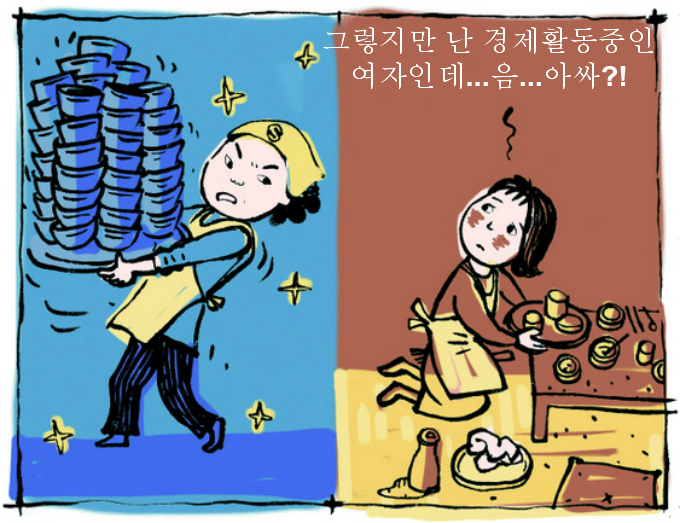 (Source; edited)
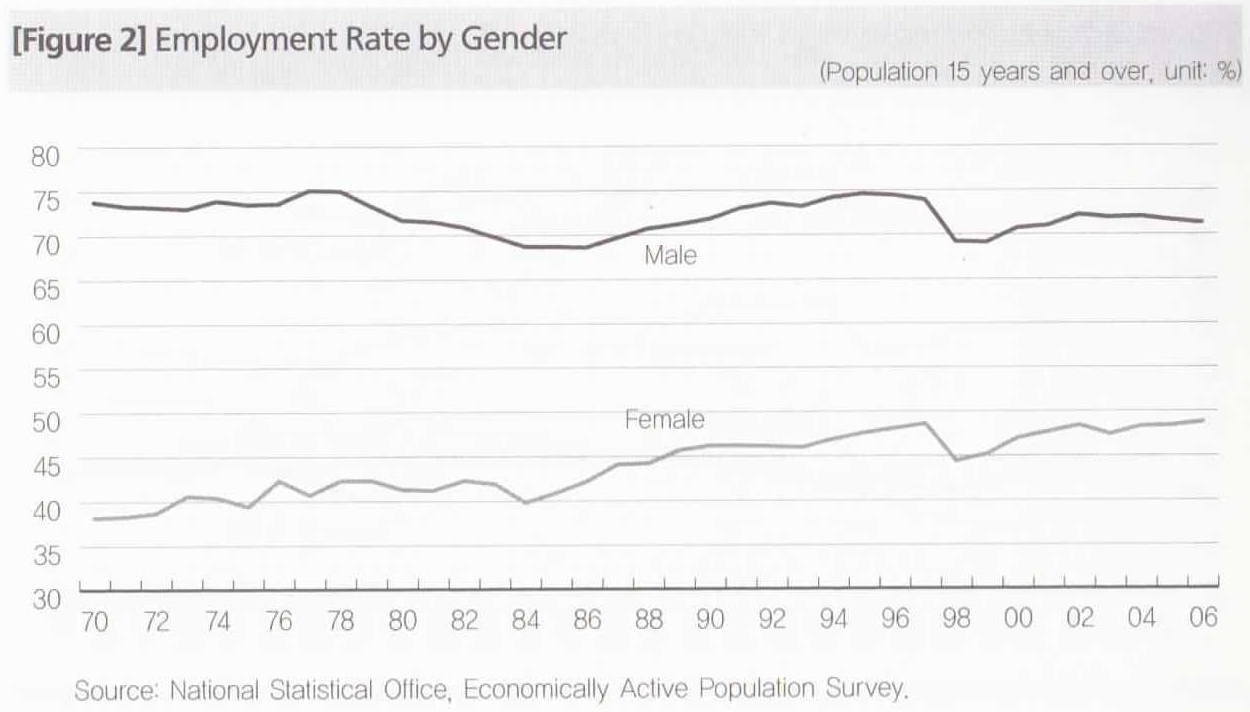
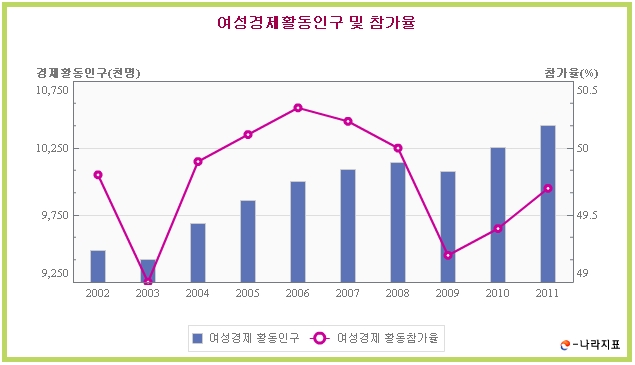 (Source)
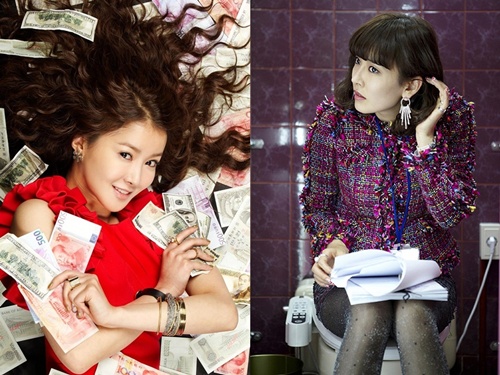 But still, one thing is clear: the number — well, percentage — of Korean women working has little changed in the last 15 years, and remains very very low by the standards of other developed countries. So it can not be the cause of increasing gender friction.


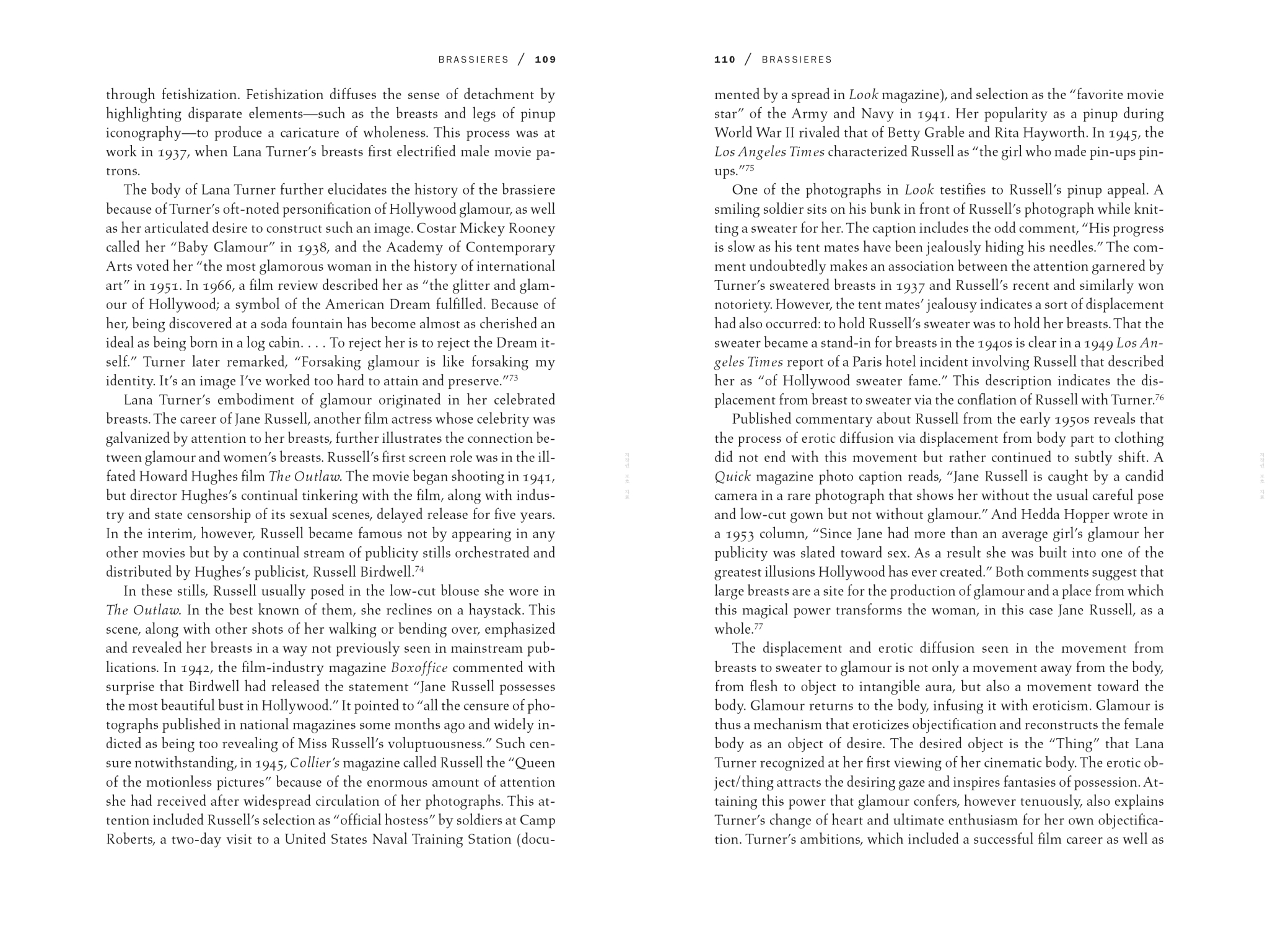


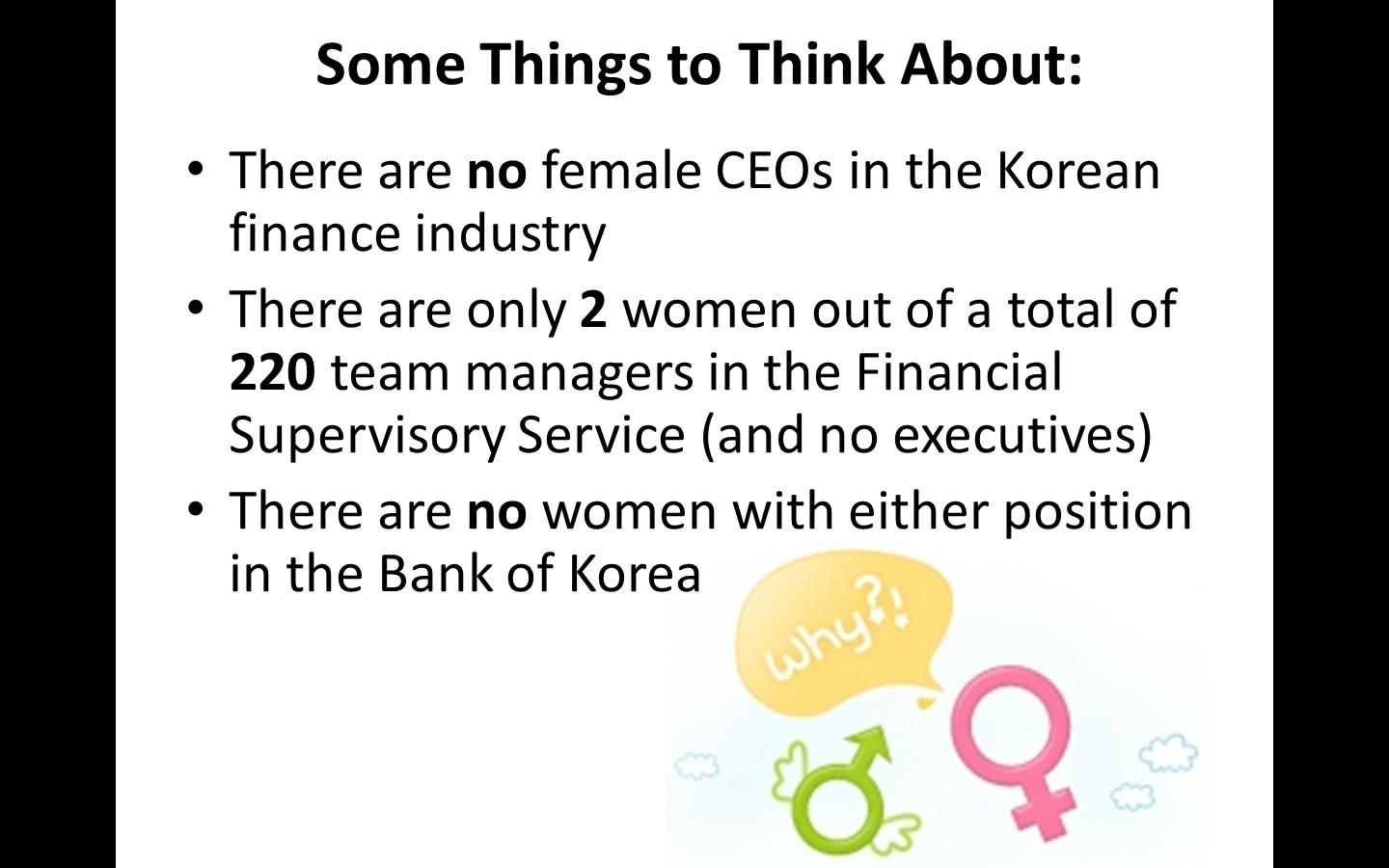
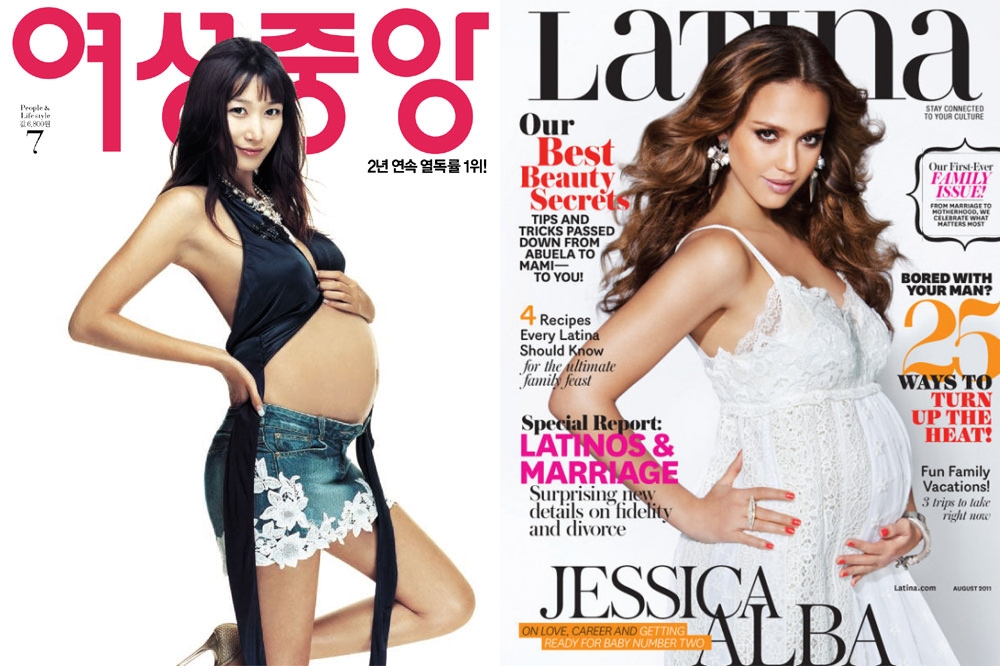

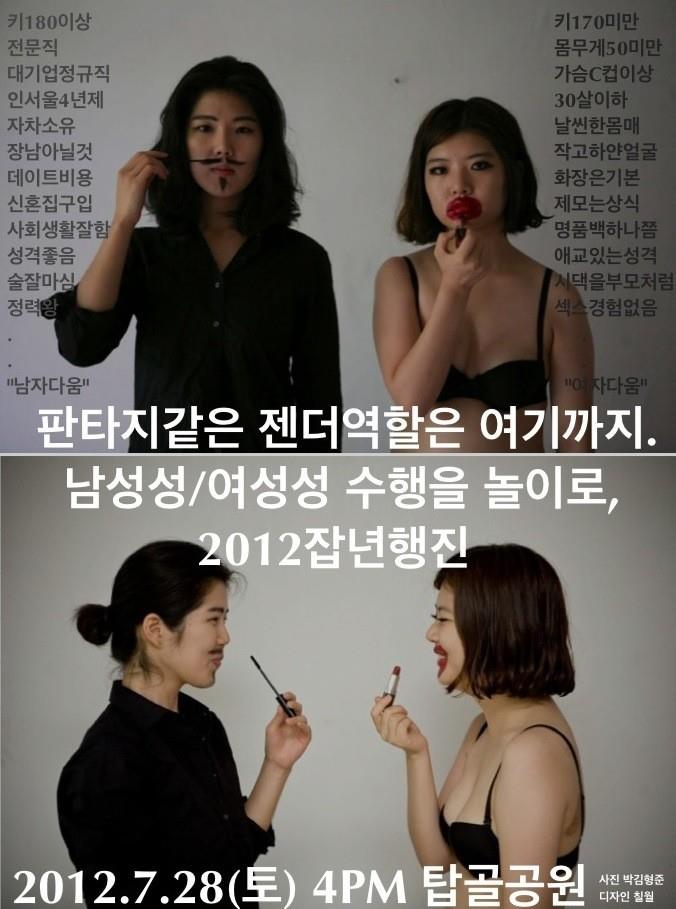
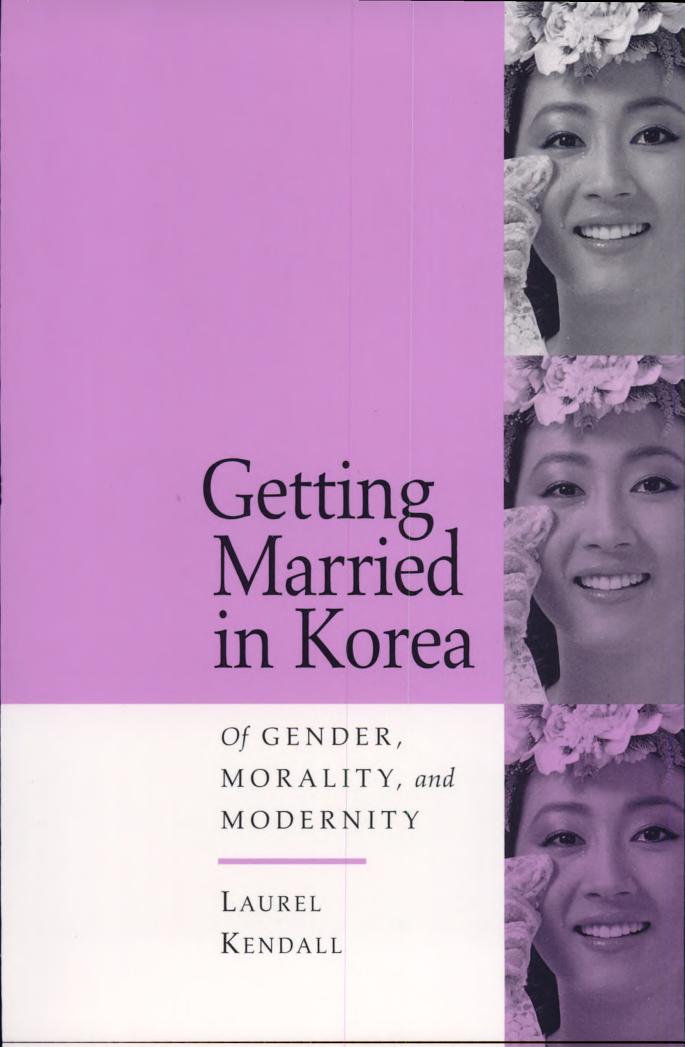

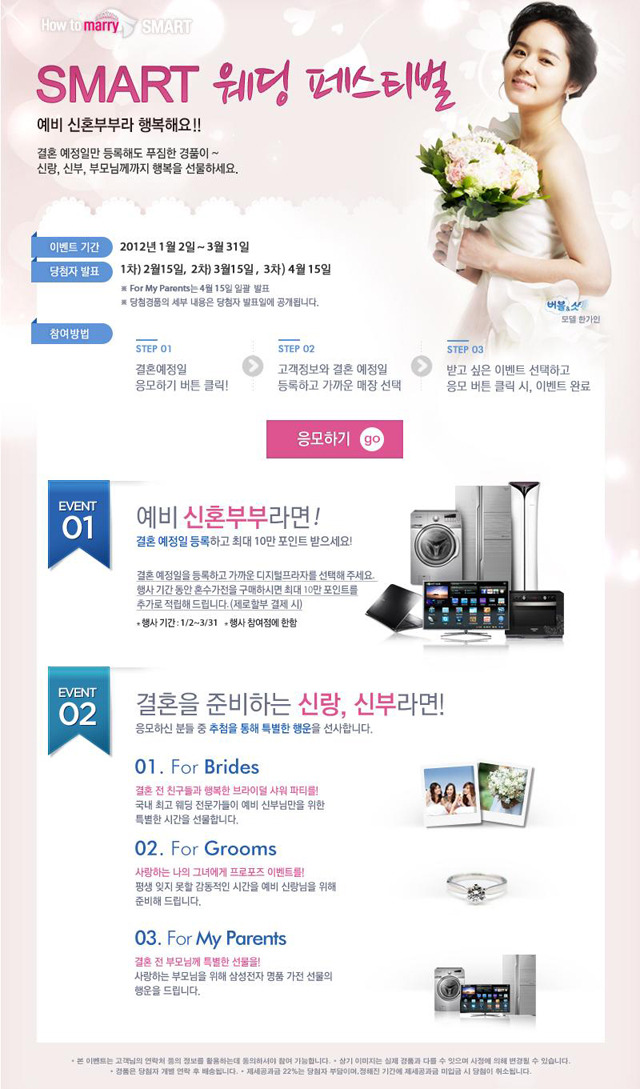
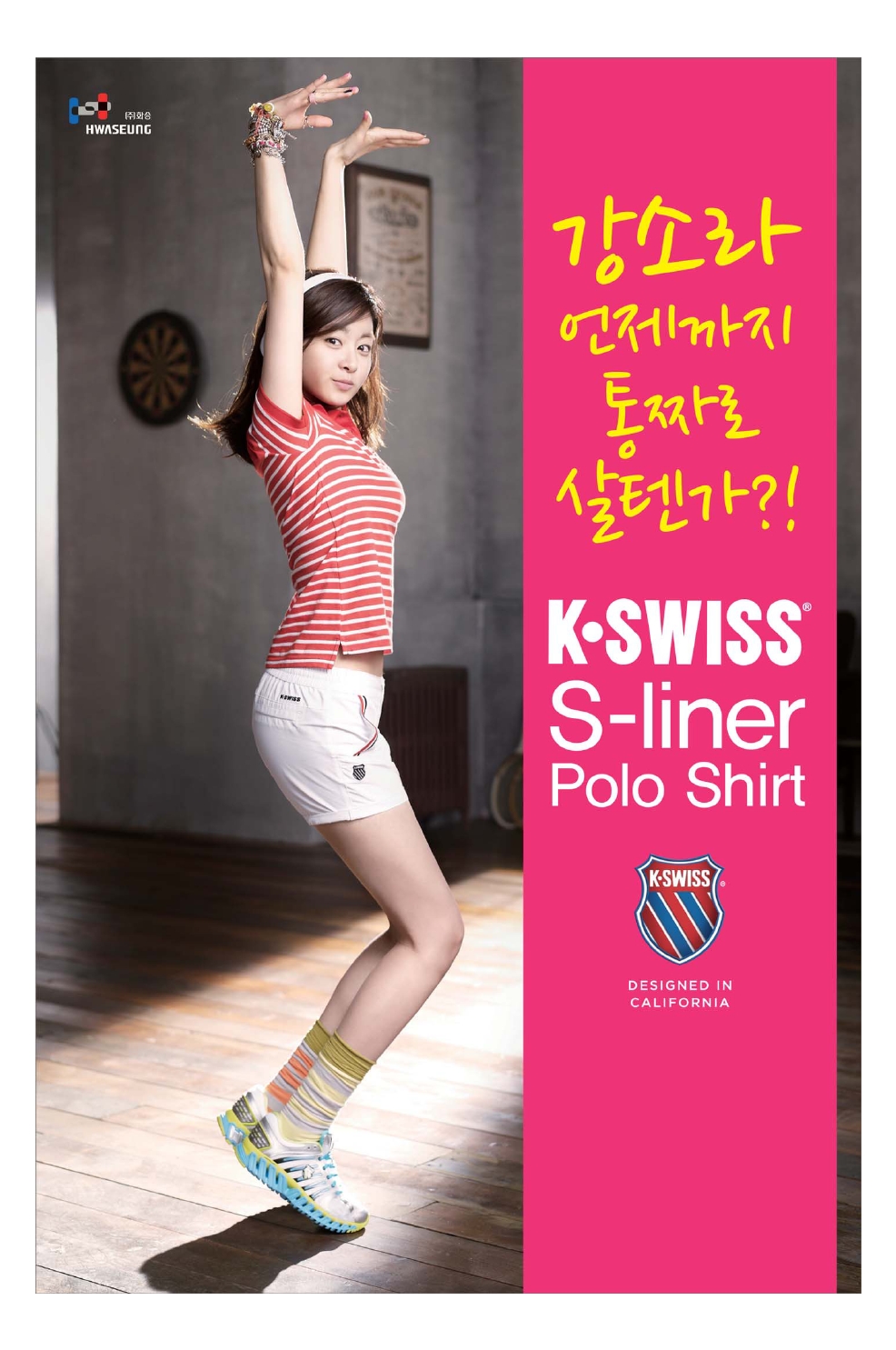



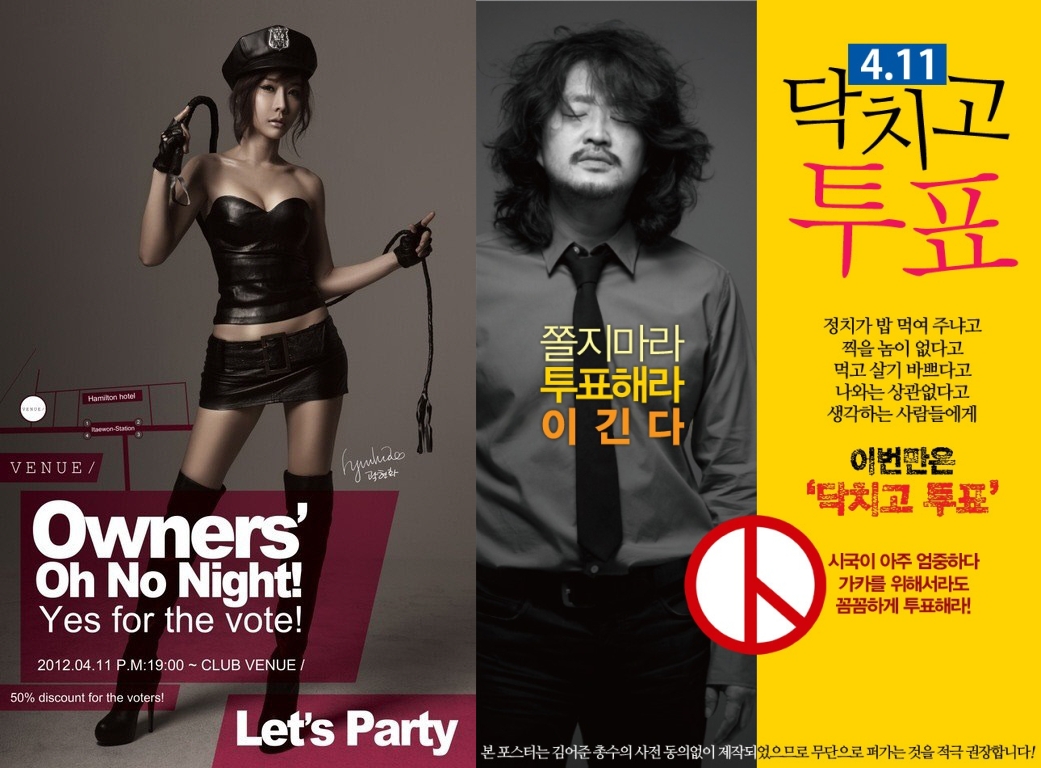
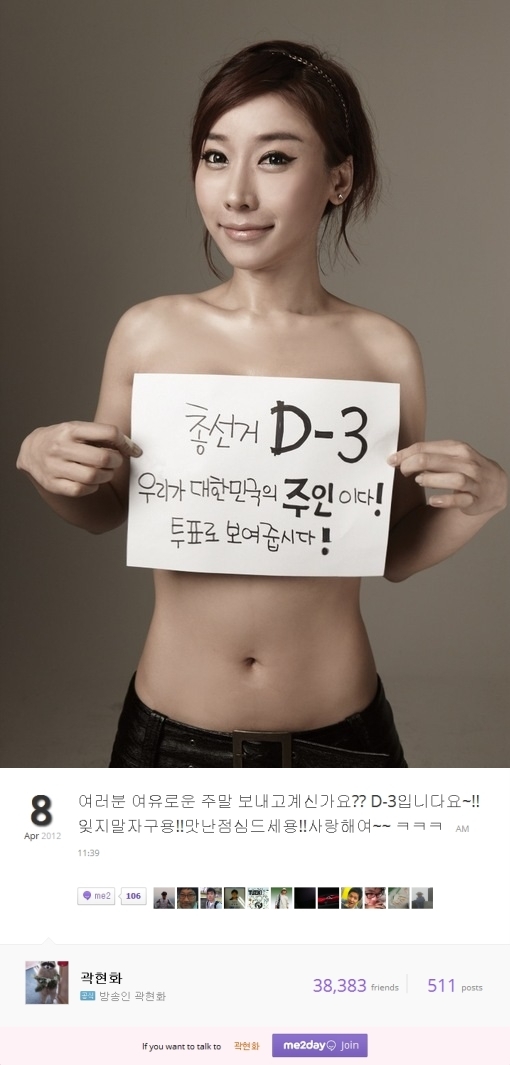
 (Source

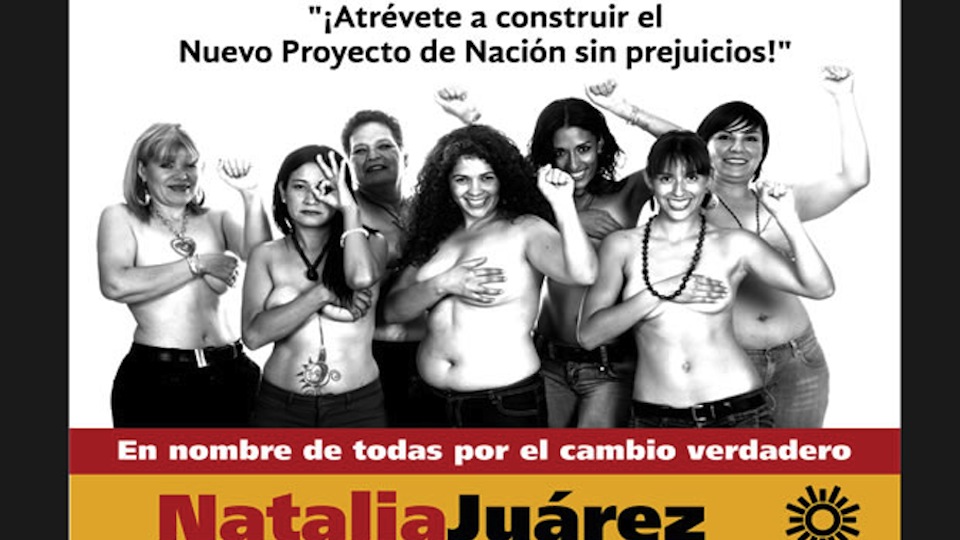



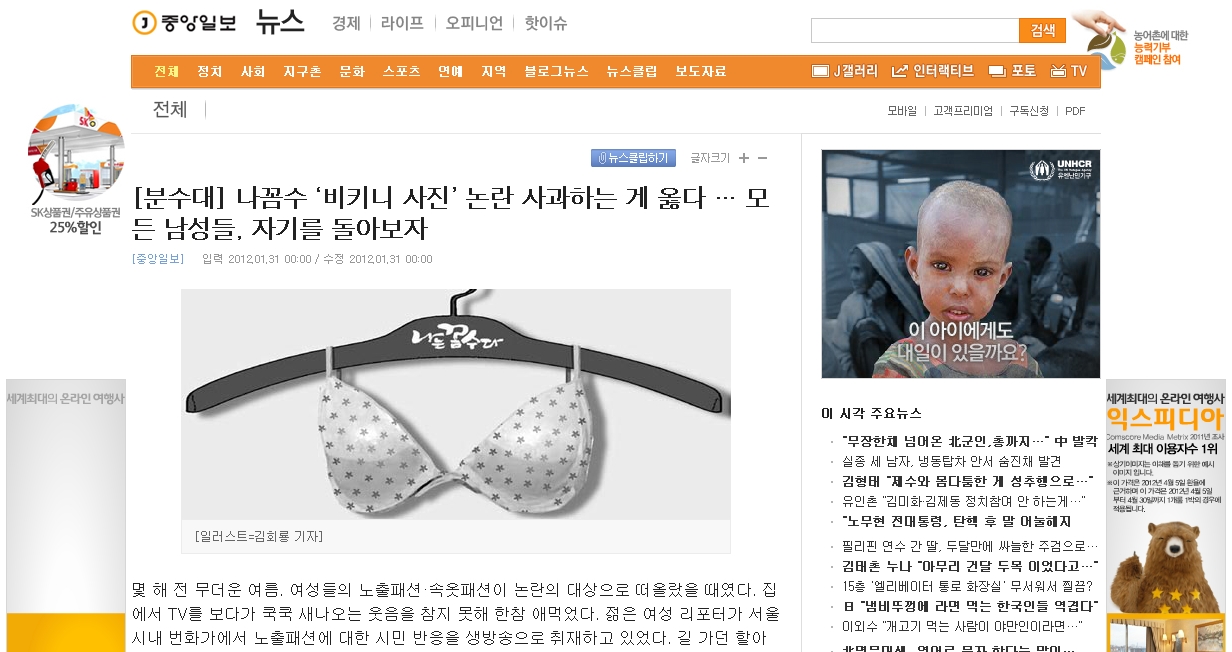




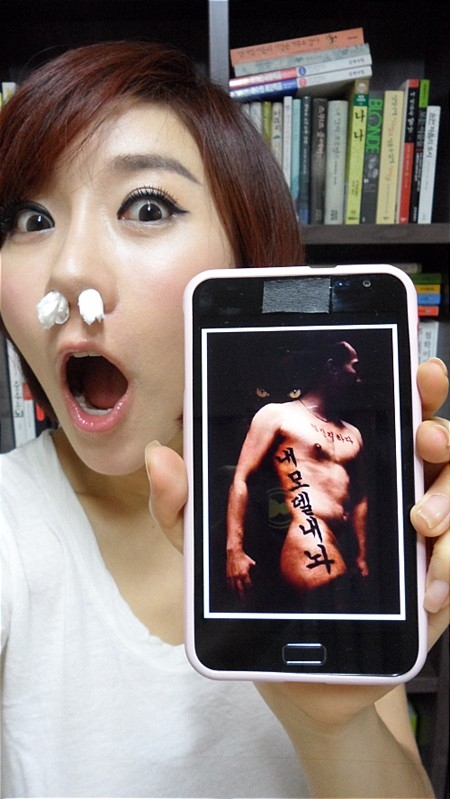




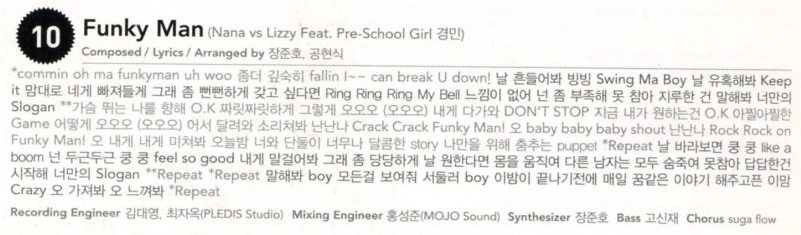

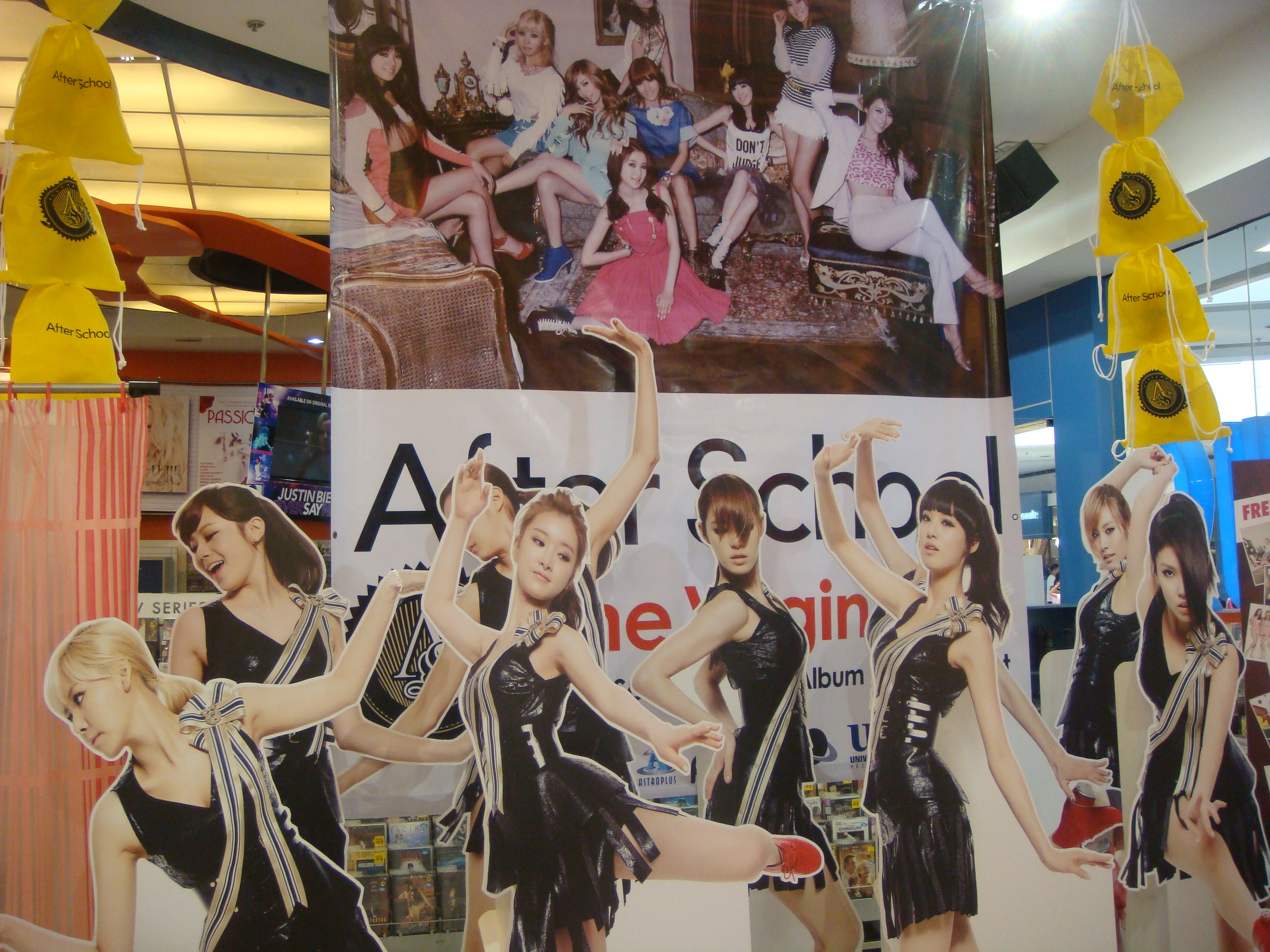





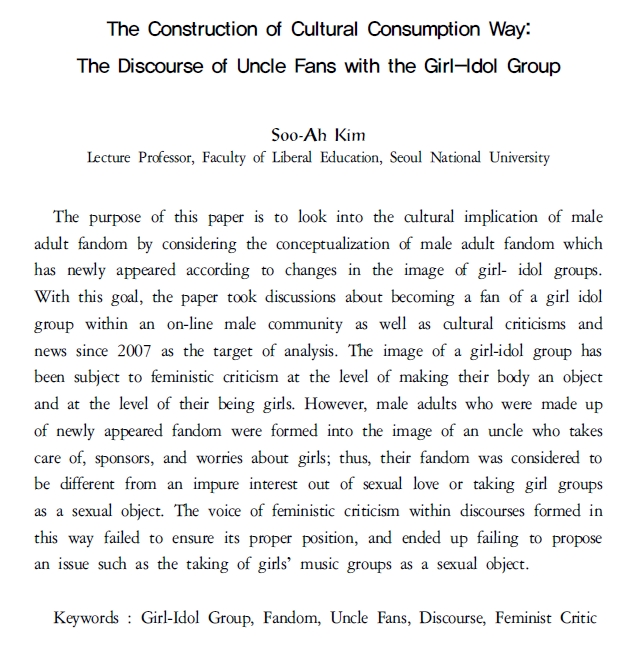


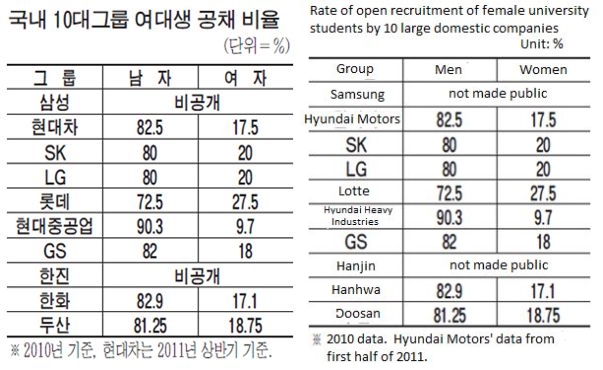


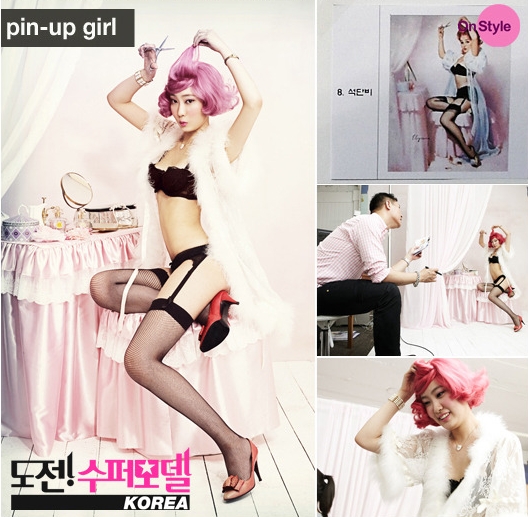
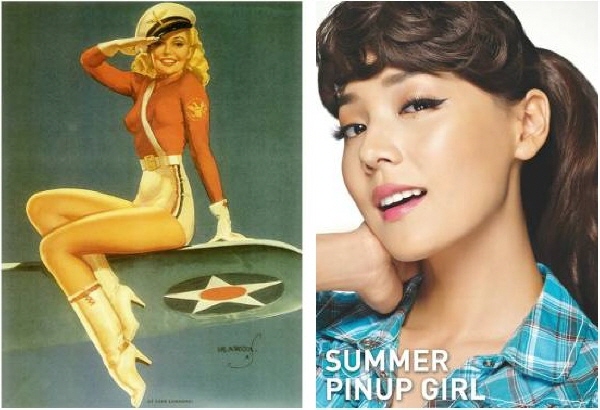
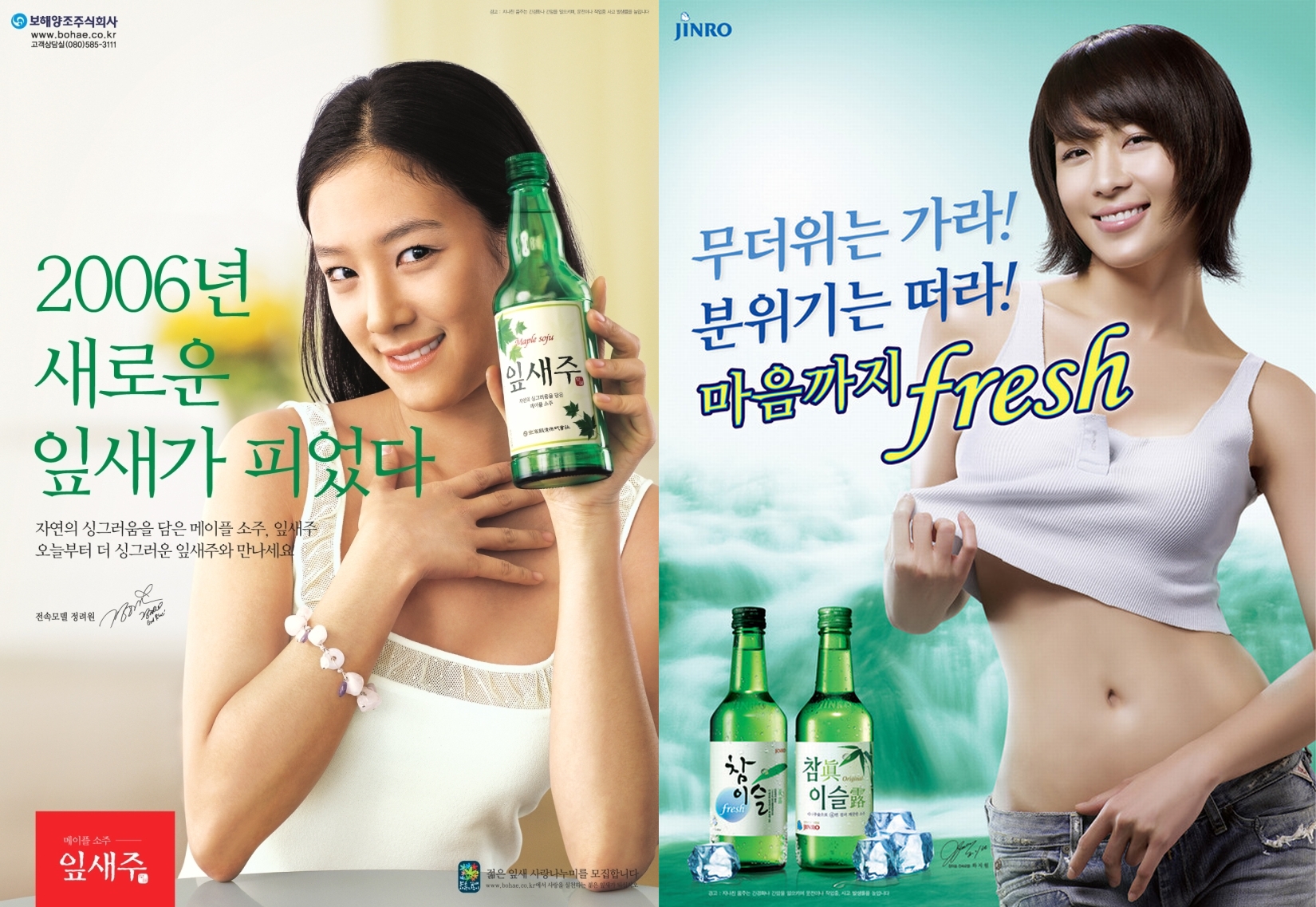


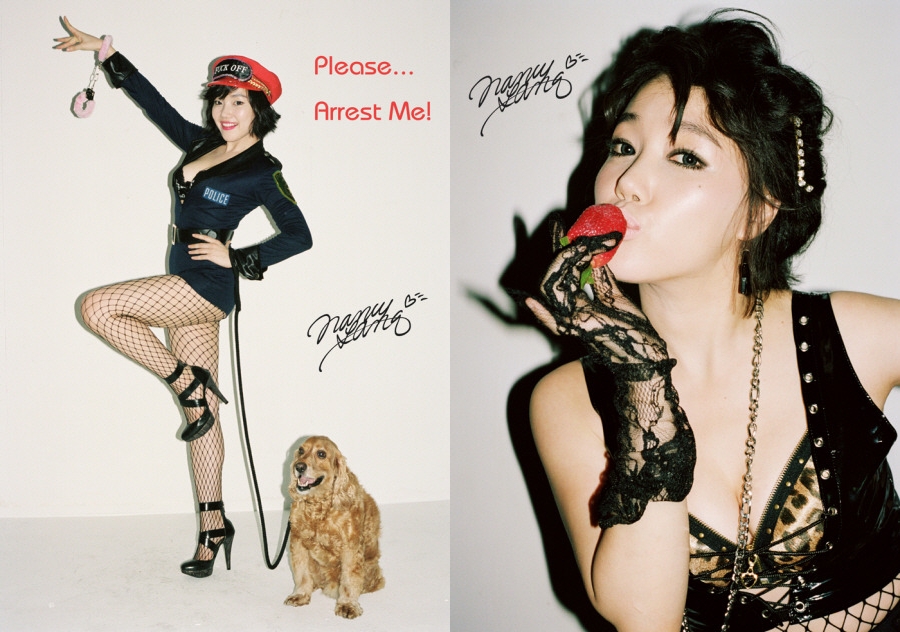
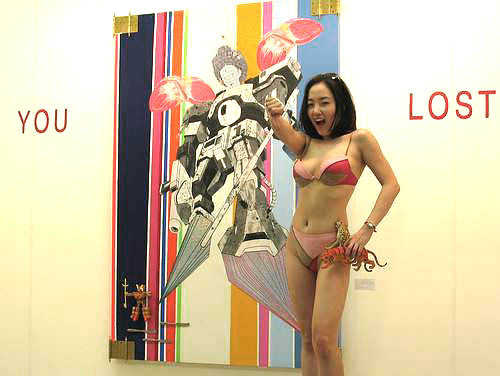



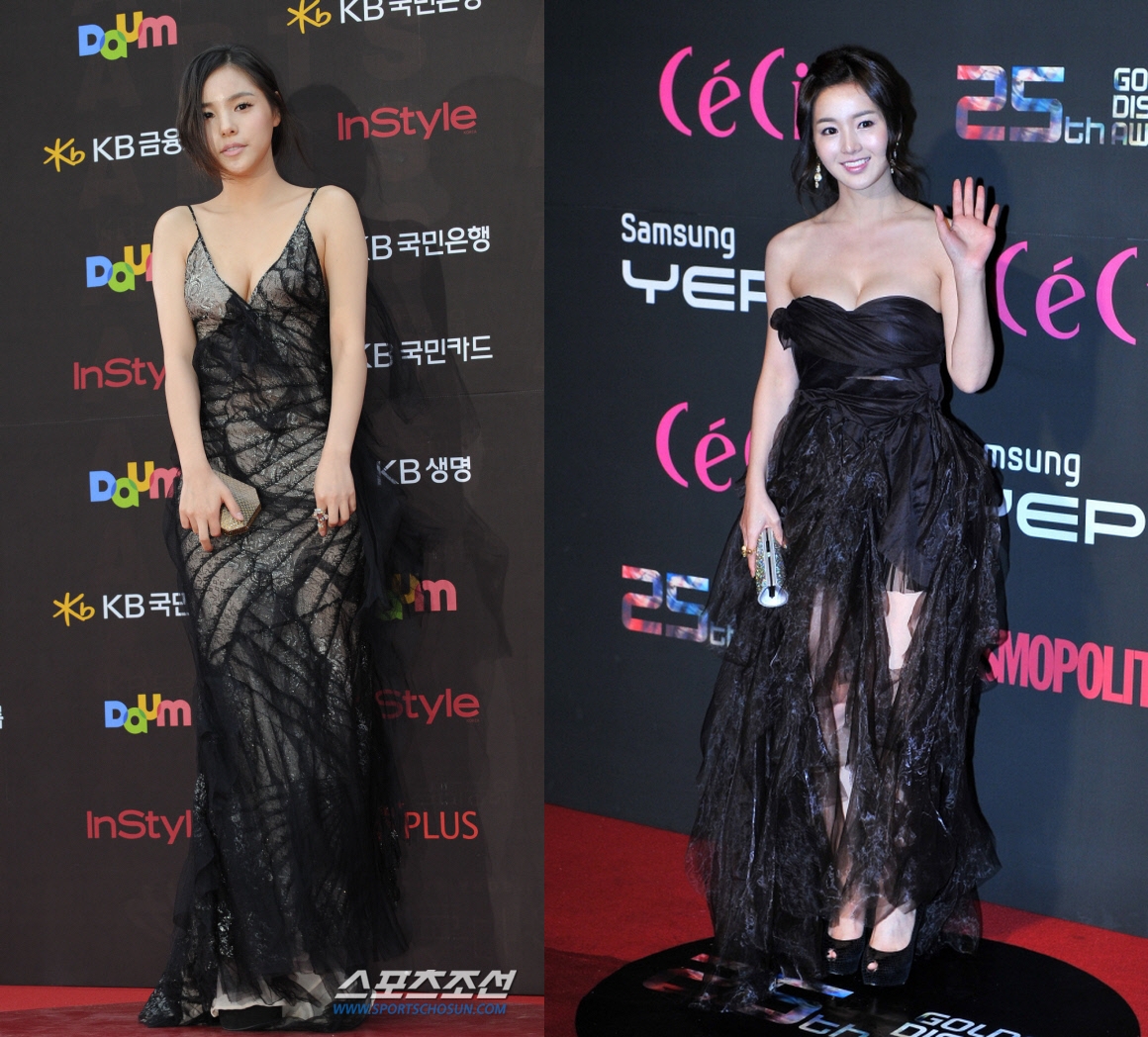

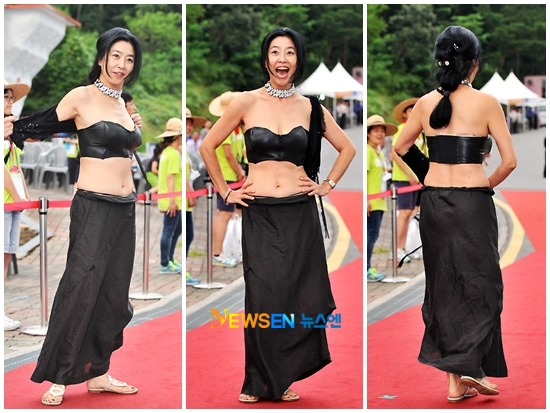


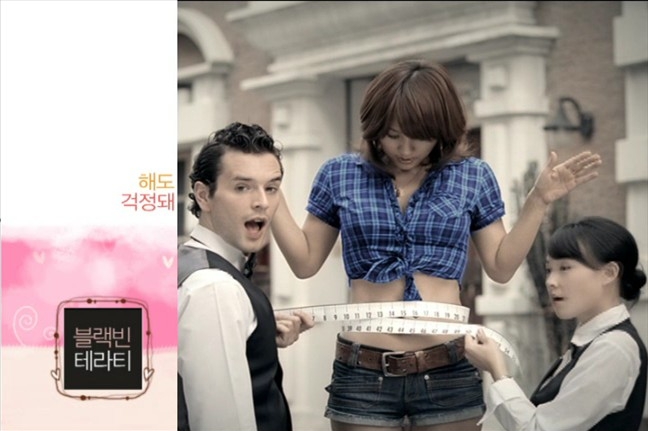


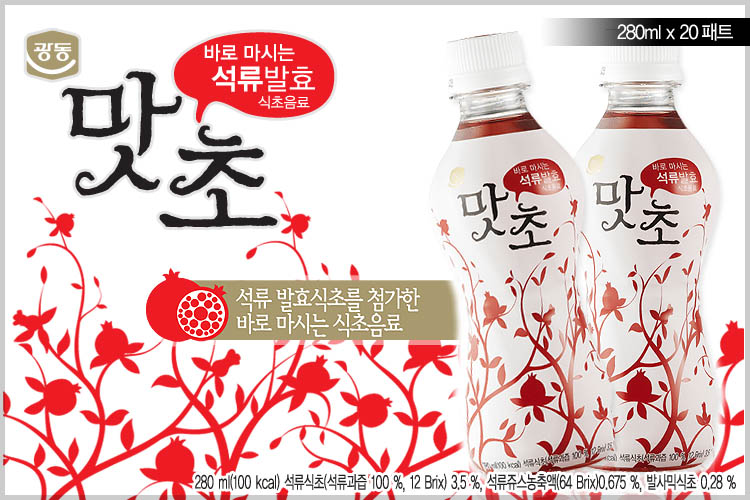




 The Grand Narrative