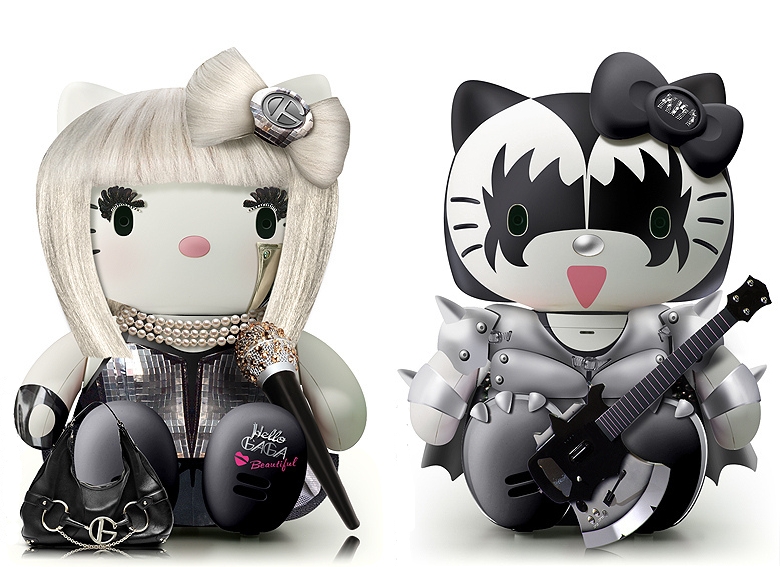
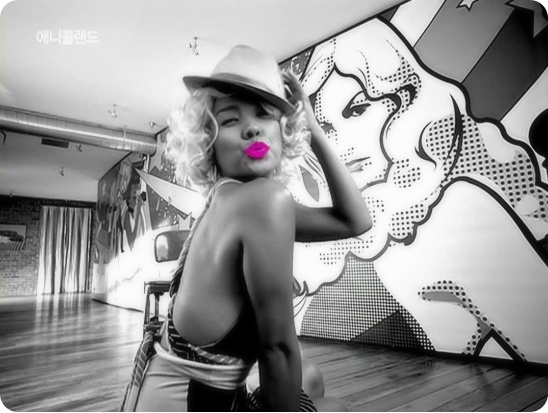
Quick Hit: T-Ara’s Stereotyping of Native-Americans in YaYaYa

(Source)

Shocked and confused by the video for YaYaYa (야야야)? If so, I give a very quick introduction to K-pop and media representations of other races in Korea over at Sociological Images, to help readers unfamiliar with either place it in some context.

If you’re one of those, I hope it does, and I especially recommend one of the links I give in the post – Who is Korean? Migration, Immigration, and the Challenge of Multiculturalism in Homogeneous Societies, by Timothy Lim – for anyone further interested in race-relations in Korea.

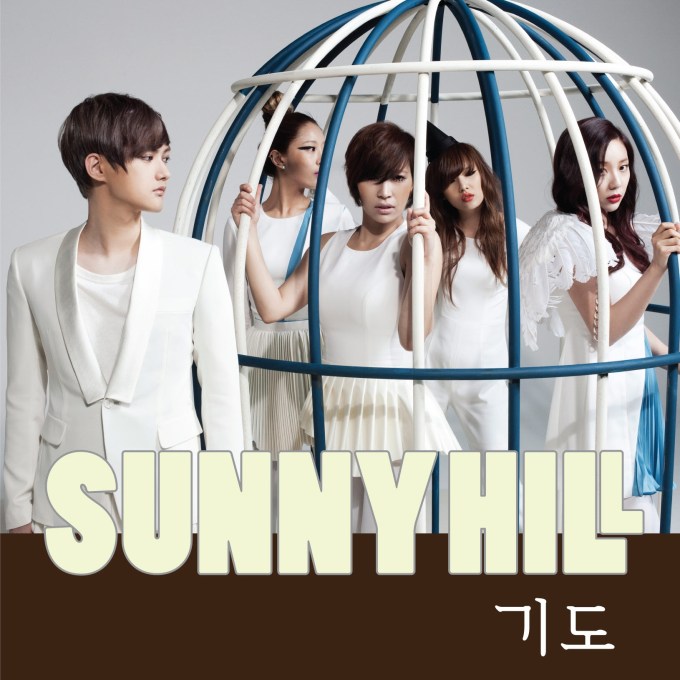
Meanwhile, I was tempted to translate the lyrics too, but they’re too inane already adequately covered at Allkpop. Instead, this Friday I’ll be covering Pray (기도) by Sunny Hill (써니힐) .

Until then, Happy Chinese New Year’s everybody!

Ali Meets Father of 8 year-old Rape Victim “Na-young”

Estimated reading time: 6 minutes. Source: maniadb

If you’ve never heard of Ali, Na-young (a pseudonym), or their connection, please see Seoulbeats for some background. Assuming that you have, I’d like to add just two things in this introduction to today’s translation.

First, that back in December 2008, the combination of the particularly horrific nature of the crime, and the light sentencing of the rapist, simply incensed the Korean public. So perhaps one can understand the severity of netizens’ reactions to Ali using Na-young’s name in a song title.

Next, that that public outrage in 2008 ultimately led to many changes to the Korean pop-culture industries, which we’re still seeing the effects of today. For, triggered by Na-young’s case, public anger about sex crimes against minors came to a head by the following summer, leading to increased scrutiny and concern about those working in the music industry especially.

Combine that with the sex-crime revelations that followed suicide of actress Jang Ja-yeon, and we came to have the widespread restrictions on and/or censorship of song subjects, lyrics, clothing, dance moves, and so on that we see today (albeit not just on minors). Working around those—or deliberately breaking them to create publicity—has now become an integral part of the production of K-pop.

(Translation begins)

Source: 우리다시여기에

[오늘의 세상] 아픔을 사랑으로 감싸다나영이 아버지, 알리 만나 주며 위로 / Enveloping pain with love . . . Na-young’s father meets Ali, gives flowers and consolation

Chosun, December 19, 2011,  by 정지섭/Jeong Ji-seob

아버지와 같이 온 나영이, 부끄럼 많아 차에서 기다려 / Na-young, who came with her father, was too shy and waited in the car

나영이 아버지:”그런 고통 있는 줄 몰랐네요 많이 힘들었죠… 울지마요, 네티즌들 진정했으면 좋겠다” / Na-young’s father: “We didn’t know you had that kind of pain.  It was very hard, wasn’t it.  Don’t cry, I hope the netizens calm down.”

편지 5장에 마음 담은 알리 “나영이에 용기주려 했는데 미리 말씀 못드려 죄송해요… 언니가 정말 미안해” 눈물 / Ali’s heartfelt 5-page letter: “I intended to give Na-young courage, and I am apologize for not informing you in advance. I am really sorry,” tears

“제가 작사·작곡자인데 미리 말씀드리지 않은 것 죄송합니다. 힘든 일 겪어도 언니처럼 이겨낼 수 있다고 용기를 주고 싶었어요.” (가수 알리)

“I am the lyricist and composer, and I am sorry for not informing you in advance.  I wanted to give you courage by saying that though you went through a difficulty, you can overcome it like I did.” (Singer Ali)

“앞으로 할 일이 많은 아가씨가 이렇게 힘 빼서 되겠어요? 울지 마요.” (나영이 아버지)

“Is it okay for a young woman who has so much ahead of her to lose strength like this?  Don’t cry.” (Na-young’s father)

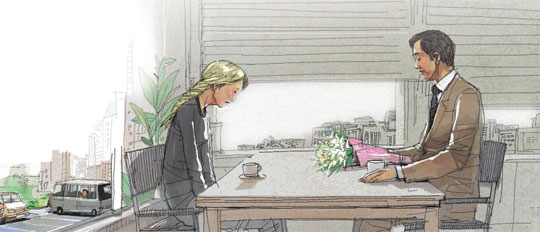
17 일 오후 서울 강남의 한 연예기획사 사무실. 자신의 또는 가족의 ‘성폭행 피해’라는, 어쩌면 인생의 가장 무겁고 감추고 싶은 짐을 진 두 사람이 마주 앉았다. 한쪽은 검은 정장을 입은 여가수 알리(27). 다른 한쪽은 2008년 벌어진 조두순 성폭행 사건의 피해 어린이 나영이(가명)의 아버지.

The afternoon of December 17th in the office of a Gangnam entertainment management agency. Two people, who personally or whose family bear the burden of the damage of sexual assault, maybe the heaviest and the one they would most wish to conceal of their lives, sat opposite each other. On one side, the singer Ali (27), wearing a black suit.  On the other side, the father of Na-young (false name), the child victim in the 2008 Cho Doo-soon sexual assault case (illustrator, right: 이철원/Lee Cheol-won).

모든 일은 14일 알리가 조두순 사건을 다룬 자작곡 ‘나영이’를 새 앨범에 담아 발표하면서 비롯됐다. 일부 네티즌은 ‘청춘을 버린 채 몸 팔아 영 팔아…’ 등의 가사를 문제 삼으며 알리를 무차별 공격했고, 알리는 그날 밤 나영이에 대한 사과문을 낸 뒤 앨범을 전량 수거·폐기했다.

The whole matter began on the 14th with the release of Ali’s new album, which includes a song she wrote, called “Na-young-ee,” about the Cho Doo-soon incident.  Some netizens questioned the use of lyrics like, “You threw away your youth, selling your body, selling your soul,” and attacked Ali indiscriminately; that night, after releasing an apology for “Na-young-ee,” Ali collected and discarded all copies of the album.

그래도 일부 네티즌의 악플이 멈추질 않자 알리는 16일 아버지와 함께 기자회견을 열어”3년 전 나도 성폭행을 당했다”고 고백하며 거듭 용서를 구했다. 알리 측은 14일 문제가 발생하자마자 나영이 가족에게 “찾아가 사죄하고 싶다”는 뜻을 전했고, 안산에 사는 나영이 아버지가 알리 측의 기자회견을 본 뒤 “내가 나영이와 함께 찾아가겠다”고 해 만남이 성사됐다.

However, some netizens’ negative comments didn’t stop, so Ali held a press conference on the 16th with her father and confessed, “3 years ago, I was also sexually assaulted,” and asked once more for forgiveness.  On the 14th, as soon as the problem appeared, Ali conveyed her wish to “go and apologize” to Na-young’s family, and Na-young’s father, after watching Ali’s press conference, said, “I’ll go with Na-young to visit her,” and the meeting was arranged (caption, left: 알리가 17일 나영이 아버지를 통해 나영이에게 준 사죄의 편지 / The apology letter Ali gave to Na-young through her father on the 17th).

이날 나영이 아버지는 알리가 눈물을 흘리며 사죄하자 갖고 온 백합과 안개꽃 다발을 내려놓고 거듭 알리를 달랬다. “나도 어제 기자회견한 내용을 들었어요. 그렇게 큰 고통이 있는 줄 몰랐네요. 얼마나 힘들고 어려웠을지 충분히 짐작돼요. 사전에 우리에게 알리지도 않고 노래를 만들었단 얘길 듣곤 화가 나 음반 판매 금지 가처분까지 생각했는데 노래를 폐기하겠다고 해서 마음이 좀 누그러졌어요. 그런데 그런 사정(성폭행)까지 있었다니, 내가 다독여줘야겠다는 생각이 들었죠.”

On this day, Ali apologized with tears streaming, and Na-young’s father put down the bouquet of lilies and baby’s breath he had brought and comforted her repeatedly.  “I heard what you said at the press conference.  I didn’t know that you had such great pain.  I can guess how difficult and hard that must have been.  When we heard that you’d made the song without letting us know beforehand, we were angry and even thought of an injunction banning sales of the album, but you said you would discard the song so our feelings softened.  But you had that kind of situation (sexual assault), so I felt I should console you.”

나영이 아버지가 “참 많이 힘들었죠?” 하자 알리가 울먹이며 입을 열었다. “(나영이와) 같은 해에 저도 당했어요. 그래서 (나영이) 기사가 나오면 스크랩해서 주변 사람들에게 보여주고 (나영이 돕기 모금 기관에) 익명의 기부도 했어요. 남의 일이 아닌 것 같아 더 적극적으로 돕고 싶었지만 그러면 주변에서 ‘혹시 너 뭐 있니’ 할 것 같아서 공개적으로는 못 했죠.”

When Na-young’s father said, “It was very hard, wasn’t it?” Ali was on the verge of tears as she spoke.  “I was assaulted in the same year (as Na-young).  So when the articles (about Na-young) came out, I saved them and showed them to the people around me, and donated anonymously (to the fund-raising organization for helping Na-young).  It didn’t feel like someone else’s problem, so I wanted to help more actively, but it seemed like if I did that, the people around me might ask, ‘Did something happen to you?’ so I couldn’t do it openly.”

나영이 아버지는 알리에게 “힘들겠지만 위축되지 말고 당당하게 정면 돌파해라. 그게 이기는 길”이라고 했다. “우리 사회 풍토가 슬프지만 ‘목소리 안 내는 사람이 바보’라고들 생각하잖아요. (성폭행 피해자들이) 자기 목소리를 당당하게 낼 수 있는 기회가 만들어져야 해요.” 그는 “이번 (나영이 노래) 일 때문에 네티즌이 많이 화가 난 것 같은데, 오해도 많이 풀린 만큼 진정됐으면 좋겠다”고 했다.

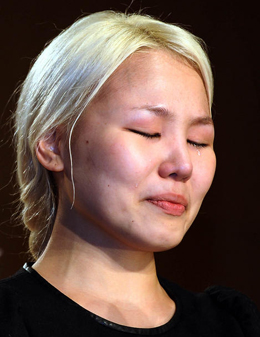
Na-young’s father said to Ali, “It must be hard, but instead of cowering, face things confidently head-on. That’s the way to win.  Our social climate is sorrowful, but as people say, ‘The person who doesn’t speak out is a fool.’  Opportunities need to be created for (victims of sexual assault) to speak out confidently.”  He continued, “Because of this matter (the song “Na-young-ee”), netizens seem to have gotten very angry, and I hope this misunderstanding gets cleared up so they will calm down.” (caption, right: 가수 알리가 (본명 조용진) 16일 오후 서울 종로구 홍지동 상명아트센터 콘서트홀에서 열린 알리의 정규 1집에 수록된 ‘나영이’곡 논란과 관련한 공식 기자회견장에서 2008년 성폭행당한 사실을 밝히며 눈물을 흘리고 있다 / Singer Ali {real name Jo Yong-jin}, at an official press conference at the Sangmyeong Art Center in Hongji-dong, Gongro-gu, Seoul, regarding controversy caused by her song, 나영이, in her 1st regular album, crying while announcing that she was raped herself in 2008)

나영이 아버지가 1시간여 동안 얘기를 나눈 뒤 “바쁜 사람 시간 잡아먹으면 안 된다”며 일어나자 알리는 다이어리와 연필, 꽃 장식이 달린 머리띠가 든 종이 가방을 전달했다.

After talking for an hour, Na-young’s father said, “I shouldn’t take up a busy person’s time,” and stood up.  Ali gave him a paper bag containing a diary, pencil, and flower-decorated headband.

알리는 나영이에게 사죄와 격려의 메시지를 보내는 내용의 다섯 장의 편지도 초록 봉투에 담아 함께 전달했다. “내가 부족해 너에게 상처를 또 주게 돼 정말 미안해. (중략) 만약 괜찮다면 너의 얘기도 들려줘. 친구가 되었으면 좋겠어.”

Ali also gave Na-young a five-page message of apology and encouragement, contained in a green envelope.  “I’m very sorry that my mistake caused you to be hurt again.  (…) If it’s okay, tell me your story in return.  I’d like us to be friends.”

나영이 아버지가 집으로 출발하려는 차 안에는 나영이가 타고 있었다. 나영이 아버지는 “나영이가 차를 오래 타고 와 피곤했던 데다 부끄러움을 많이 타 밖에 있고 싶다고 했다”고 했다. 알리는 안이 잘 보이지 않는 창밖에서 “언니가 정말 미안해”라고 몇 번이고 말했다.

Na-young was in the car that her father took to go home. Her father said, “Na-young is tired from riding in the car for a long time, and also she is very shy, so she said she would like to stay outside.” Outside of a window into which one couldn’t really see, Ali said several times, “I am really sorry.” (end)

(Thanks to Marilyn for the translation)

If you reside in South Korea, you can donate via wire transfer: Turnbull James Edward (Kookmin Bank/국민은행, 563401-01-214324)

Korean Gender Reader

(Source: Joseph Senior, via Visual News)

Just some quick links this week sorry, I’m very busy working on what feels like a dozen blog posts and offline articles at the moment!

Recent controversial events in K-pop (My First Love Story)

WTF Moment: Teen Top’s C.A.P and his jokes about domestic violence (Seoulbeats; see Feminoonas for updates)

Iron Butterfly: memoir of a female Kuk Sool Won master (BBC News)

Gay in Korea: foreign female perspective and foreign male perspective (Expatkerri)

Sejong move splits families, hits female civil servants’ marriage prospects (Korea Joongang Daily)

Portion of unmarried 30-something men growing, becoming social problem (Hankyoreh)

Number of elementary school students in Seoul falls 30% in 10 years (Korea Times, via Gusts of Popular Feeling; see The Marmot’s Hole also for more on Korean demographics)

Unemployed middle-aged men ostracized by their families (Chosunilbo)

• “In 2010, only 8.7% of working mothers in South Korea took maternity leave” (Hankyoreh)

The importance of women for the future of Korea (Korea: Circles and Squares. And after reading that, make sure to check out this revealing photo too!)

(Links are not necessarily endorsements)

International Magazines in Korea: A Cultural Invasion? (Part 1)

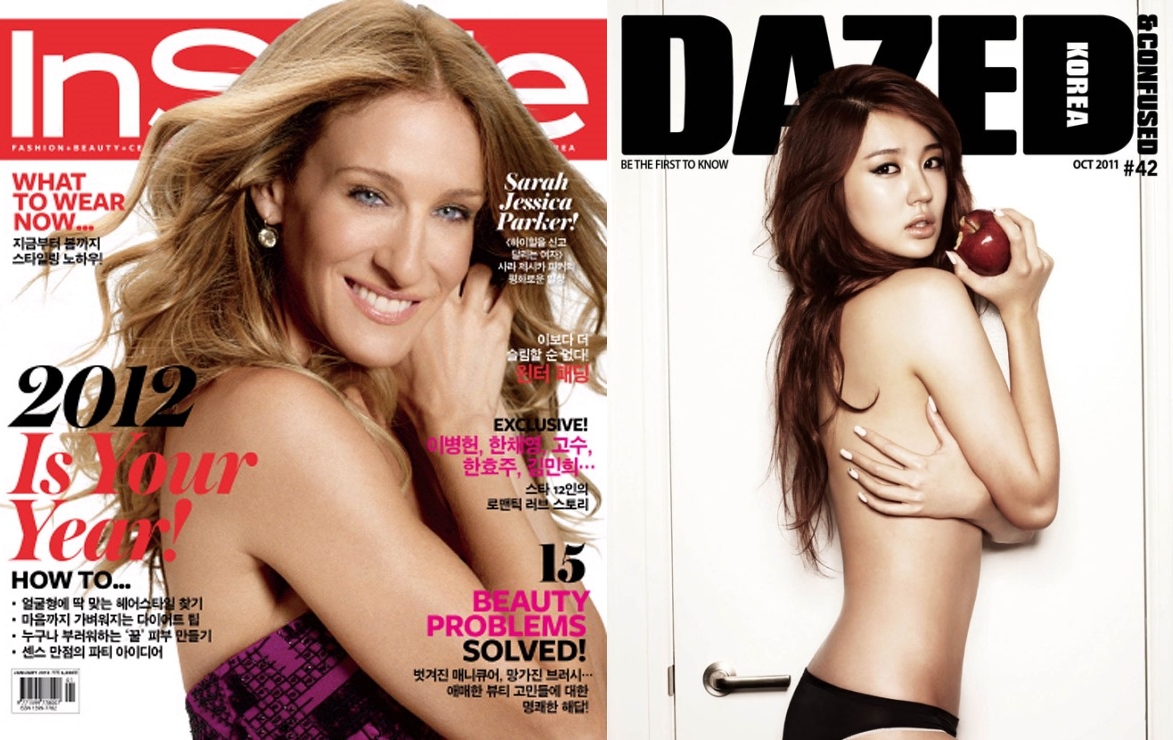
(Sources: left, right)

With covers like these, it’s easy to overestimate the “Westernizing” effects international magazines have on modest Korean readers. Especially by those who resent such changes.

Say, those who have ever called someone a “beanpaste girl” (dwengjangnyeo; 된장녀) for instance, a derogatory term for young women that supposedly spend beyond their means in pursuit of a Sex and the City lifestyle. But which in practice they can be called for doing no more than simply buying Starbucks coffee, nice clothes, or foreign food.

When such decadent women want to do some reading while sipping their frappuccinos though, until recently they were much more likely to be seen behind an international women’s magazine than a purely Korean one. That wasn’t just confirmation bias by their accusers.

Why are they so popular? And why, despite that, are they still not quite as big an influence as they may appear? Let’s answer the first question in this post and Part 2, and the second in Part 3 after that.

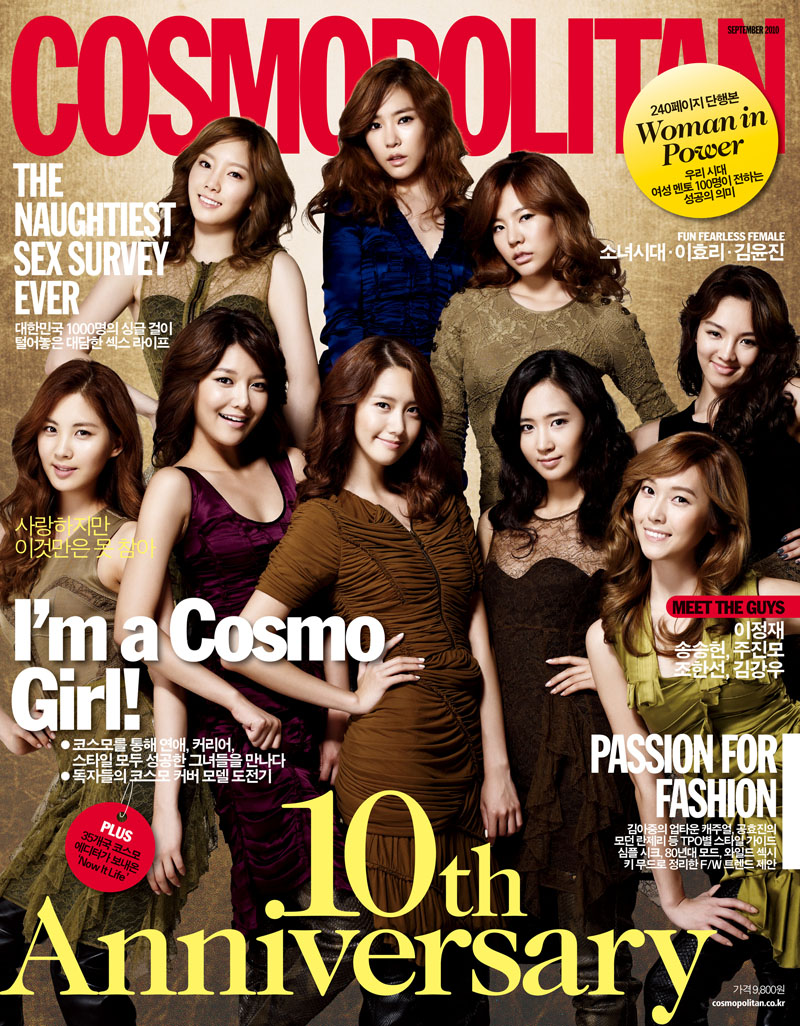
(Sources: left, right)

There are three reasons they are so popular. First, a practical one. Consider why they were once able to justify more expensive ad rates than Korean competitors, despite having much lower circulations (Sook & Firth, 2006; see the end of the post for references):

According to an interview with a media expert in an ad agency (June, 2004), international magazines justify [them] by claiming that they use modern printing techniques, higher quality paper, glossy covers, and more sophisticated advertising techniques…

I doubt that this difference in quality still applies in 2012. But when it did, it would have quite literally added some gloss to their preexisting exotic appeal. So much so, that the combination meant that international magazines:

…[could] deliver the ‘right target’ to advertisers. Instead of housewives, the major target audience of international magazines is single women. They are a segment who is interested in fashion and beauty and who possess disposable income.

Having different targets meant different content, which is the third and the most important source of their greater popularity, to be covered in Part 2. Indeed, jumping ahead, the greatest impact of international magazines has been that: a) most domestic competitors have likewise sexed-up their own content in order to better appeal to spendthrift single women; and b) a slew of wholly Korean magazines exclusively aimed at them have also appeared (e.g. Singles/싱글즈, not quite the symbol of Western depravity it may at first appear). And in light of that, it behooves me to point out that this series of posts is based on 5 and 6 year-old sources using 8 year-old data, and to reiterate that international magazines may actually no longer be the preferred choice of single Korean women.

But still: regardless of which are the more popular now, and well before consumers can get to grips with content like “His First Sex”, first they have to be persuaded to open a magazine at all. And ever since the first Korean edition of Elle appeared in the Korean market 20 years ago, international magazines’ combination of exoticism and content aimed at young, hip Korean women (rather than fuddy-duddy ajummas) has been a powerful and enduring source of appeal.

Possibly, the sophisticated consumer in you balks at that at something so simplistic-sounding, especially if you’re one of those young, hip Korean women yourself. But then no matter how impervious to suggestion we all like to think we are, on occasion we’ve all bought magazines primarily for things as frivolous as: the feel of the glossy paper; the “edgy” photography; ego-boosting headlines (“2012 Is Your Year!); the rebellious frisson of purchasing something with a nude person on the cover in a crowded bookstore; and so on. Maybe, if we’re honest, as something to be seen with too, and/or because we feel it’s what our imagined selves ought to buy. For its possession can signify aspiration towards or membership in a social class or group (in sociological terms, a form of “objectified” and/or “institutionalized” cultural capital), even if only to ourselves.

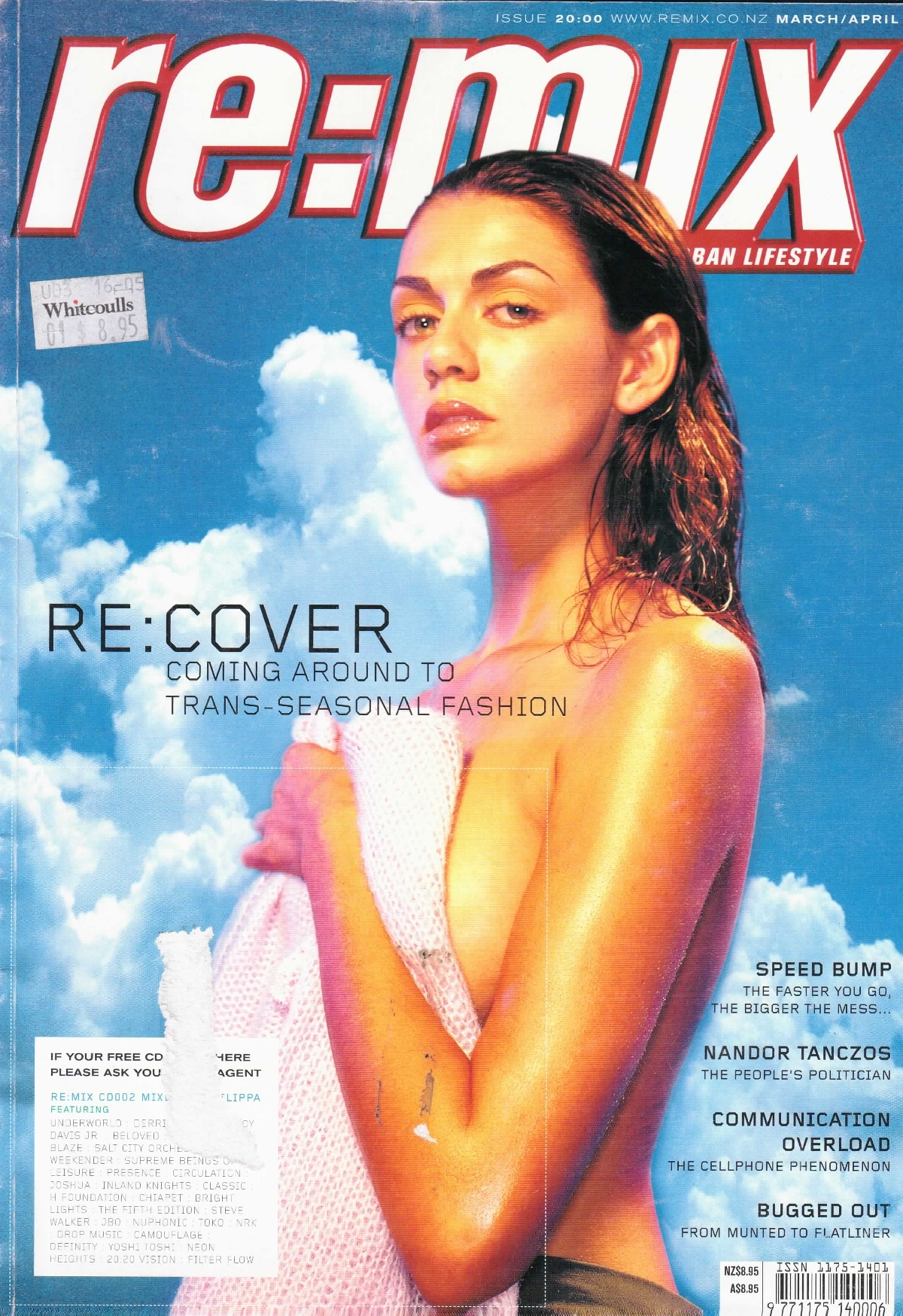
Say, like my April 2000 copy of the New Zealand music and lifestyle magazine re:mix for instance:
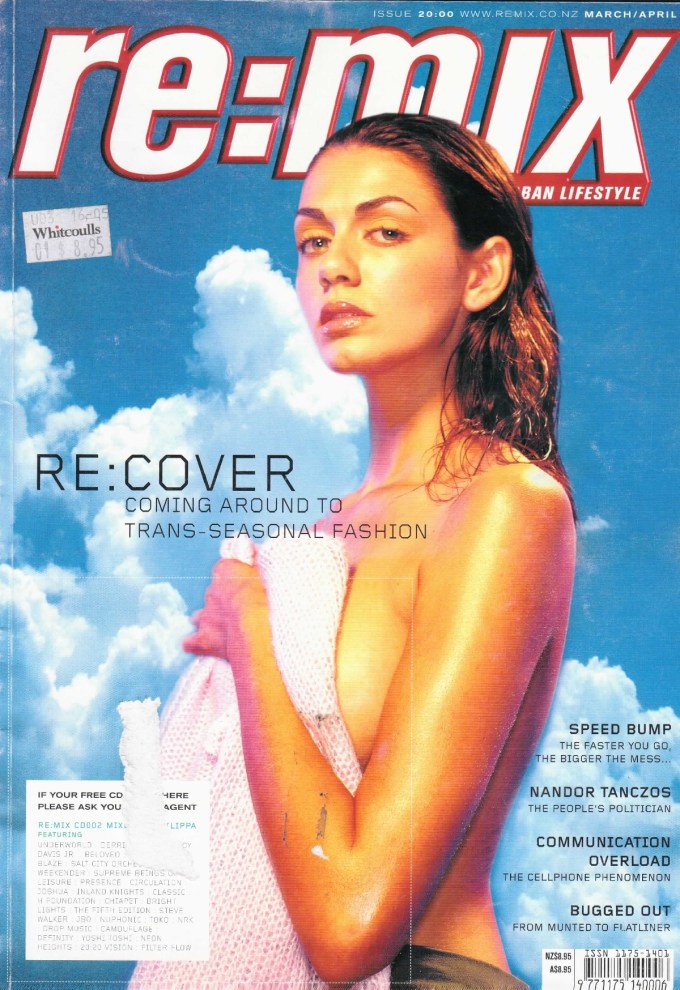
Partially, I present that here to demonstrate that I’m not trying to distance myself from people who buy magazines for “shallow” reasons, a common failing of commentators on pop-culture. But primarily, I do so to admit my own intellectual baggage, and the possibility that I’m simply projecting. By all means, please call me out on that if you think so, and of course just because re:mix happened to trigger various cyberpunk-millennial fantasies in me at 24 – and, ahem, still does at 36 – doesn’t mean that all 24 or 36 year-old Korean women likewise buy international magazines simply to indulge in their own Occidentalist fantasies.

But then, surely some do. And whereas I knowingly made particularly strong associations between a magazine and a life I aspired to, the possibility of consumers making any associations at all is precisely what magazine editors are aiming towards, influencing all aspects of its production. As this marketer explains:

Consumers have gathered from the beginning of consumption. Auto enthusiasts, quilting bees, and Tupperware parties are early examples of the impulse. Many consumer groups share an affiliation that is based upon enthusiasm and knowledge of a specific consumption activity.

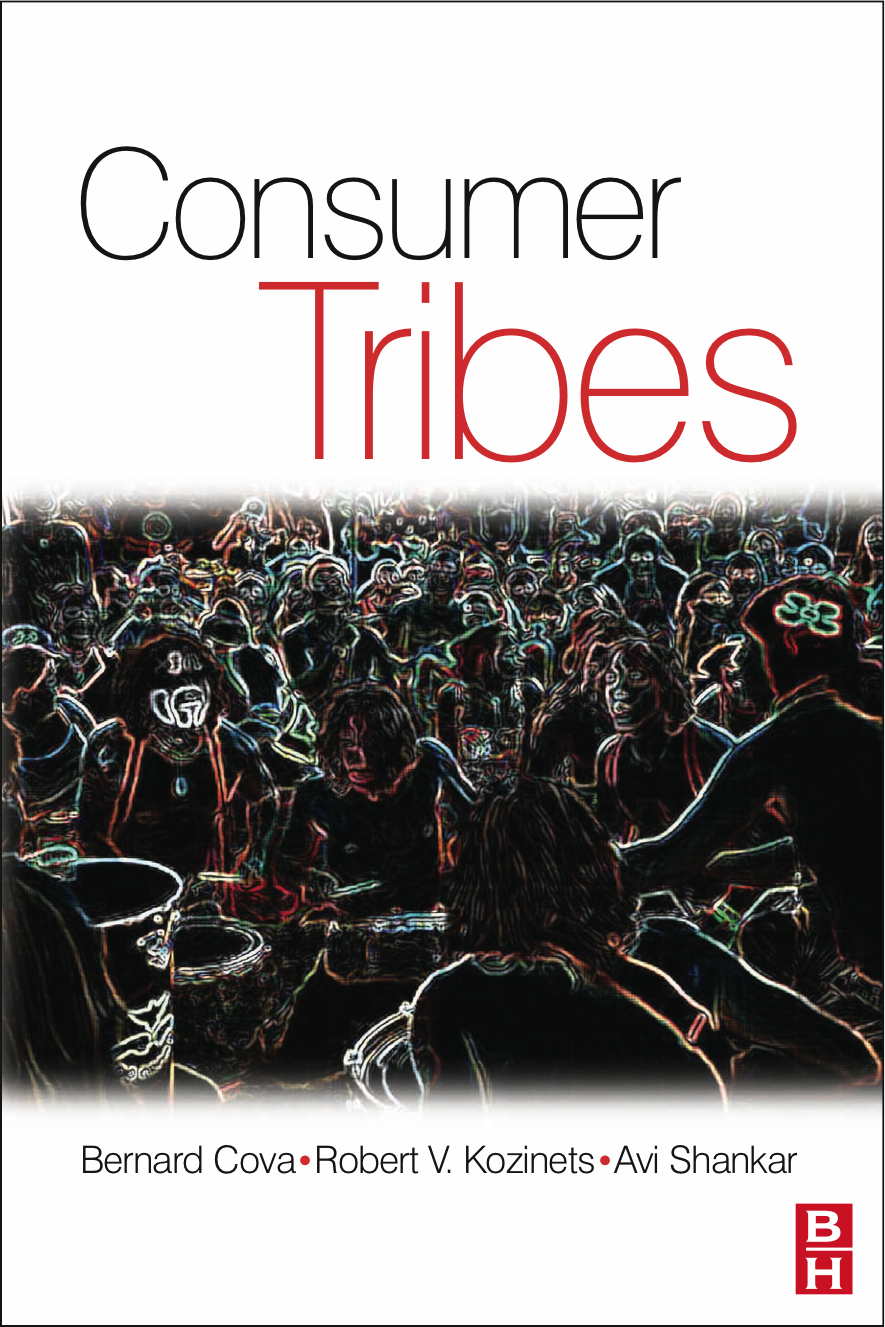
In fact, academics and consultants have recognized these groups and dubbed them “consumer tribes” – a term borrowed from anthropology, describing groups of people who are brought together not around something rational, such as a job, but around deeper, more profound needs, such as kinship, passion, and identity.

Moreover, just like advertisers are constantly inventing new role models for consumers to aspire to, all the better to sell them products that (supposedly) help them achieve that goal, it’s especially helpful for companies if those creations are centered around their brands (think of the stereotypical Apple or Harley Davidson consumer for instance). This is especially true for foreign companies entering a new overseas market for the first time, as (source, right):

…they seek a sense of familiarity and want control over their brands. In order to meet their demands, advertising agencies focus on “developing what are deemed to be more cost-effective global campaigns that circumvent national borders by creating more expensive global consumer tribes linked by lifestyle values or preferences rather than spatial location.” (source, quoted in Sook & Firth 2006; my emphasis)

Logic which certainly applied to magazine producers (quite explicitly so by Cosmo below!), and accordingly it’s via advertising that international magazines can be said to have had the greatest Westernizing effect on the Korean media, as will be discussed next week.

But before I do, let me leave you with a parallel from the real world, lest you’re still unconvinced about the importance of branding by magazines.

(Source)

To be precise, a parallel from an unidentified brand name shoe store in North England. Sociologist Steven Miles worked there for 10 weeks in the mid-1990s, posing as “an especially enthusiastic member of staff who was showing particular interest in customers and their purchases”, asking them numerous questions in order to (Miles, 1998):

…address the significance of consumption in their lives, most particularly in relation to the training shoes (sneakers) they were considering purchasing. The meanings with which these shoes were endowed, the role that these meanings played in the construction of personal identities, and the cultural context in which such meanings operated, were therefore the issues addressed….

The priority…was for the customer to discuss the role that training shoes (and often, as the conversation developed, other types of consumer goods) had in their lives, and what factors they believed influenced that role.

Sneakers may sound like a strange topic here, but recall that they were once considered so important by young people that they were prepared to mug and even kill for them, and Miles is very positive about the important, pro-active role one’s consumption choices can play in one’s identity, whether of sneakers of anything else.

However, it’s especially the next that has echoes in the purchase of magazines, by any age group (source, right):

…consider the atmosphere that the management actively seeks to promote in its stores. All branches of the sports store concerned are dominated by a large TV monitor overlooking the shop floor. This acts as a magnet for passing customers. British branches of the store often broadcast MTV…as far as the head office is concerned, this helps to create a relatively straightforward means of perpetuating a superficial feeling, on the part of the customer, of personal familiarity with what it is to experience this particular store.

And in particular (my emphasis):

What is also of interest in that paradoxically, measures are taken by the company to actively disguise the impersonal nature of the experience of shopping [there]….Though on the one hand the company’s training literature is entirely open about the importance of giving the consumer a common experience on entering the store in whatever country, on the other, any hint that efforts are being made to control such an experience are hidden from the customer’s actual perception of the shopping environment.

In the case of international magazines, these can be things as trivial as the choice of font and line-spacing, all designed to replicate the appearance and style of the overseas editions on which they’re based. Which may sound trivial, but next week I explain that, these days, Korean editions of international magazines have on average only 30% of “lift” material taken from those (down from 60% a decade ago), much of which has no more resemblance to the original articles and so on than the rough subject and the look. Or in other words, that “international” magazines sold here certainly have a foreign veneer, but are really a lot more Korean than they may seem.

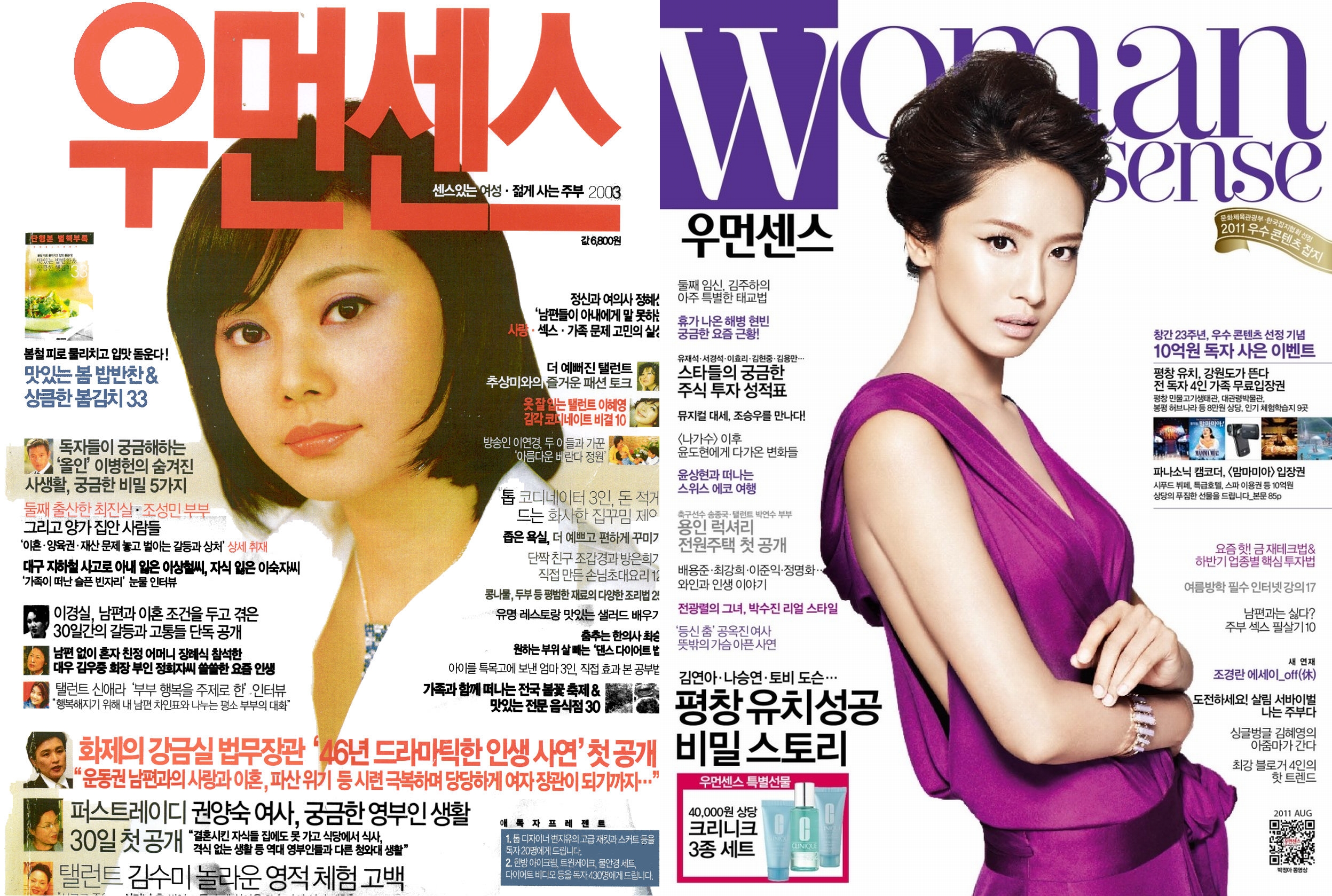
Yet a veneer considered so enticing to consumers, that the Korean magazine Woman Sense/우먼센스, for instance, would change its cover title to English in 2009:

(Sources: left, right)

But all that will be discussed in Part 2 and 3. And on that note, apologies for the day’s delay with this post, the best I could do after having to get my modem changed 3 nights in a row last week(!) and thanks to all readers who tried to find copies of Sook’s and Firth’s papers below for me, and/or passed on other interesting related papers instead. As it turns out, while their download links on their citation pages here and here still aren’t working, if you do a search on the main allacademic page for, say, abstracts with the terms “Korea” and “magazines” in them, then you’ll get a list of search results with links that do work, and so you can click here and here for PDFs of them (or just ask me to send them).

Sources:

– Oh, Hyun Sook. and Frith, Katherine. “International Women’s Magazines and Transnational Advertising in South Korea” Paper presented at the annual meeting of the International Communication Association, Dresden International Congress Centre, Dresden, Germany, Jun 16, 2006

– Oh, Hyun Sook. and Frith, Katherine. “Globalization and Localization in the Production Process of International Women’s Magazines in Korea” Paper presented at the annual meeting of the International Communication Association, TBA, San Francisco, CA, May 23, 2007

– Miles, Steven, “McDonaldization and the global sports store: constructing consumer meanings in a rationalized society” in Mark Alfino, John Caputo, and Robin Wynyard, ed.s, McDonaldization Revisited: critical essays on consumer culture, Praeger Westport, 1998, pp. 53-65.

Update, October 2013: Alas, I never did get around to writing Parts 2 and 3, feeling that they would require too much regurgitation of the source material. Instead, I wrote a single, much shorter article for the Autumn edition of Busan Haps.

Korean Boys: “Wearing Hot Pants Says Something About You”

(Source)

A much more serious topic than it may sound, this article from Ilda Women’s Journal will definitely give you a renewed appreciation for the goals of the Slutwalk (잡년행진) movement.

Once it does though, unfortunately you’ll probably find yourself pretty frustrated with it too. For the author only really gives platitudes about the need for change, rather than provide any details about who those boys were, what they said exactly, and the sex-education program her and her colleagues were involved in.

But still, she’s right to be concerned about the messages children are receiving about sexuality when any elementary school boys both approve of and chastise attractive women for wearing revealing clothes. Let alone disallow “ugly” ones from wearing them:

(Source)
“못생긴 애들 핫팬츠 입지 말라”는 아이들 Children That Say “Ugly Girls Shouldn’t Wear Hot Pants”

여성의 노출’을 바라보는 십대들의 시선 Teenagers’ Views on Women Who Wear Revealing Clothes

So Yeong-mi, August 2010

(일다의 독자위원인 서영미님은 현재 십대들과 함께하는 성교육 프로그램을 진행하고 있습니다―Editor)

Editor: Ilda reader So Yeong-mi is currently involved in a sex-education program aimed at teenagers.

“선생님, 질문 있어요. 왜 여자애들은 그렇게 짧은 반바지를 입어요?”…“여자애들이 핫팬츠 좀 못 입게 해주셨으면 좋겠어요!”…“?????????”

“Teacher, I have a question. Why do women wear such short shorts?”…”If young women didn’t wear hot pants, that would be good.”

이게 도대체 무슨 문제란 말이지? 최근 들어 두 번이나 받은 질문이다. 고등학교 청소년 남자 아이들을 만났을 때 한번, 그리고 초등학교 남자아이들과 교육하면서 한번. 성장기 자신의 몸의 변화나 성관계, 임신/출산에 관련한 질문들이 대부분인 편이라 이 질문이 유독 기억에 남았다. 같은 반 여자아이들이 핫팬츠를 입지 말았으면 좋겠다니 이 무슨 말인가?

(Source, NSFW)

Why on earth are they saying and asking these things? This has happened to me twice recently. Once, from teenage boys at a high school, and the other from boys at an elementary school. Most of the questions I get are normal ones about their development, changes to their body, sexual relationships, pregnancy and childbirth and so on, but I especially remembered these. Why are boys saying that girls in their classes shouldn’t wear hot pants?

James – Because of the mention of female classmates, I’m assuming the boys were in mixed-schools then? But So Yeong-mi doesn’t mention how the girls reacted to such questions, an omission which hopefully means she taught the boys and girls separately.

뜬금없는 질문이 궁금해 스무고개 하듯 계속해서 질문을 주고받으며 질문한 의도를 파악하려 애썼다. 질문자는 한 명이었지만 반 아이들 모두가 동의하고 있었고 별로 웃기지도 않은 질문에 아이들은 자지러졌기 때문이다. 질문을 받은 내가 자신들 생각대로 웃어넘기지 않고 진지하게 계속 물으니, 나중엔 아이들도 제법 진지하게 맞받아쳤다. 그리하여 나온 결론은 같은 반 여자아이들은 핫팬츠를 입으면 안 된다는 것!

I was very curious why these questions came out of the blue, so I sort of played 20 Questions with the students to find out. Only 1 student [in each case?] asked, but all the other students thought it was hilarious, and they expected me to laugh along with them. I wanted to get to the bottom of that, and so later when they gave me feedback it emerged that they felt that girls in their classes shouldn’t wear hot pants.

(Source)

모자와 핫팬츠는 다르다? What’s the Difference Between Hot Pants and Hats?

“오크가 그런 걸 입는 게 말이나 돼요?” “Would Orcs Wear Hot Pants?”

판타지 소설이나 롤플레잉 게임에 주로 등장하는 괴물, ‘오크’족. 쭉쭉빵빵 몸매도 좋고 능력도 좋은 미녀캐릭터들에 비해 볼품이 없어 쉽게 무시당하고 힘만 센 캐릭터. 아이들의 설명에 의하면 이랬다. TV에서 연예인들이 입는 것과는 다르다는 것. 그건 당연히 ‘봐줄 만하다’는 것이다. 핫팬츠뿐만 아니라 미니스커트에도 역시 강한 불만을 표했는데, 이번에는 또 다른 이유를 제기했다.

As the students explained, in fantasy novels and role-playing games the monster that appears the most frequently is the orc. Unlike beautiful female characters, with great abilities and voluptuous bodies (and usually useless armor – James), orcs are essentially faceless characters that can easily be disregarded. What entertainers wear on TV is different though, and, of course, it’s worth watching.

But it’s not just hot pants that the boys had problems with girls wearing, but also miniskirts. They gave a second reason for that.

“옷이 그러면 그렇고 그런 거 아니에요? 위험할 수도 있잖아요.”

“Doesn’t wearing clothes like that say something about you? And it’s dangerous too!”

아이들은 여성인 내게 “선생님도 그런 옷을 입냐”며 “도대체 왜”냐고 야단이었다. 한 학생이 모자를 쓰고 있기에 “너는 왜 모자를 쓰고 있냐” 물으니 “그냥 좋아서”라고 가볍게 얘기했다. 그럼 “핫팬츠나 미니스커트를 선택해서 착용하는 것은 무엇이 다르냐” 물으니 “그건 당연히 다르다”고 소리친다. 적절한 대답이 없을 때 아이들은 대개 화를 낸다.

(Source)
The students asked me, a woman, “Do you wear clothes like that?”, and, in a critical tone, “Why on Earth do women wear those?”. So, to one student who was wearing a hat I asked “Why are you wearing that hat?”, to which he casually replied “Because I like it”. So then I asked “How is that different to choosing hot pants or a miniskirt”, and got the retort that “Of course it’s different!”, the student becoming angry that he didn’t really have a proper answer.

그날 종일은 아이들과 좀 더 많은 시간을 들여 ‘개인의 취향’에 대한 이야기를 나누었다. 서로의 취향을 존중하고 이해해야 하는 이유를 찾아보며 남/녀를 탈피한 다양한 관계 속에서 역할활동까지 해봤다. 그러나 그 날의 아이들에게는 이미 모자와 핫팬츠의 ‘선택’이 다르지 않다는 것을 이해시키는 것이 어려워 보였다. 너무나 견고한 그들만의 ‘패션철학’이 놀라울 따름이었다.

I spent all day with the students, and shared a story about personal tastes with them. Then we did roleplaying, breaking away from normal man/woman and girl/boy ones, in order to better understand and respect each other’s personal tastes. It was difficult to make them understand that wearing hot pants was a choice, no different to wearing a hat, and I was very surprised in how unwavering some of their attitudes to fashion were.

우연히 비슷한 시기에 만난 이 집단 아이들만의 문제였을까. 교육이 끝난 후 평가시간에 이 에피소드를 털어놓으니 유난히 남자아이들 교육을 진행할 때 그런 질문이 많이 나온다는 실무자들의 의견이 있었다. 예쁜 사람이 입으면 괜찮고, 아니면 안 괜찮고, 짧은 옷을 입으면 위험하고 야한 어떤 것이라는 10대 초반의 아이들의 논리. 고등학생 이상의 청소년 들을 만났을 때만 해도 성인과 비슷하게 생각해나가는 시기여서 그런가 생각했는데, 초등학생들에게서까지 강한 불만으로 표출되어 나오니 그냥 웃어넘길 일이 아니라는 생각이 들었다.

I wondered if this way of thinking was just confined to the groups of students I taught, so afterwards I asked other sex-ed teachers involved in the program, and they confirmed that they get similar questions and opinions from especially male students. The logic of boys in their early teens was that if pretty girls wear hot pants and so on it’s okay, but if they’re not pretty then it’s not, and that [in either case] such clothes are both too revealing and dangerous.

(Source)
Now, if I’d asked high school students and so on, who think like adults, then I wouldn’t have been surprised, but once I learned that even elementary school students are saying such things then I realized that this was no laughing matter.

고 민지점은 성인들이 갖고 있는 편견이나 고정관념들이 고스란히 아이들에게도 답습된다는 것이다. 또한 그 연령이 대폭 낮아졌다는 사실도 놀랄만한 일이다. 그 어린 학생들마저도 ‘여성’의 몸을 검열하고 있다는 사실에 주목하지 않을 수가 없는 것이다.

Children are picking up adults’ prejudices and biases, although it is surprising that they’re doing so at such a young age. And we can’t help but notice that even these children too think the female body is something to inspected and evaluated.

우리가 어떤 일을 할 수 있을까 What can do we do about this?

노출이 많은 옷을 입은 여성과 그렇지 않은 여성을 간단하게 이분화 시키고, 거기에 아름다움이라는 가치를 연결시킨 잣대로 평가하는 것은 아이들도 어른들과 크게 다르지 않았다. 다만 아이들의 용어로 표현하고 있을 뿐이었다. 이를 우스갯거리로 사용하는 아이들을 보고 있자니 솔직히 조금 화가 나기도 했다. 그리고 그와 동시에 우리 스스로 반성해야 될 때가 아닌가 생각해보게 됐다.

Children splitting women into simply those who wear very revealing clothes and those that don’t, and judging their value only in terms of their appearance, is little different from what adults do. But although the children just used these terms jokingly, to be honest I still got a little angry with them.

Yet at the same time, we really need to examine ourselves too.

대중매체에 대한 비판을 하려던 차에 최근 10대 청소년 연예인들을 상대로 60%가 신체 노출이나 과도한 성적 행위 장면을 강요했다는 기사들을 보게 되었다. 한 언론과의 인터뷰에서 가수 이은미는 음악성 보다 외적인 면에 더 관심을 갖는 사회 분위기를 우려하며, 성적인 면이 강조된 걸그룹의 노래, 의상, 춤에 환호하는 이 사회를 ‘몰상식의 극’이라고 표현했다. “초등학교를 졸업한지 몇 년 되지 않은 아이들을 벗겨놓고 대 놓고 섹시하다고 박수를 치거나, 꿀벅지, 꿀복근 같은 용어들을 사용하는 대중문화를 보면 소름이 끼친다.”는 것.

(Source: unknown)

I was about to blame the mass media, as recently I’ve read reports which say that 60% of female teenage entertainers have claimed to have sometimes been forced to wear revealing clothes and/or do sexual dances and so on. And in an interview of the singer Lee Eun-mi (James – Not one of those teenage entertainers; she was born in 1968), she said she was worried about a society that considered external appearance more important than musical quality for singers, where girl groups’ sexual dances, songs, and outfits where cheered…she used the term “thoughtless/careless”. She said “I freak out at the thought that just a few years after they graduate from elementary school, young male and female entertainers are being praised for taking off their clothes and being talked about in terms of their ‘honey thighs‘ or six-packs.

쏟 아지는 대중매체의 벗기기 논란은 새삼 어제오늘 일도 아니건만, 아무 손쓰지 않고 있었음에 반성하게 된다. 상품화되고 대상화되고 있는 여성들의 문제를 공공연히 문제 삼지 않았던 것이 일상생활에까지 주변 사람을 대상화하고 외모로써 평가하는 지금의 일을 만든 게 아닌가 하는 생각에서다.

But these trends in the media didn’t just appear overnight – they were allowed to flourish by the public’s inattention and lack of concern. This way, we have come to consider the commercialization and objectification of women as a normal part of our daily lives.

아 이들의 생각을 넓게 펼쳐주진 못할망정 오로지 외모로써 사람을 평가하는 우리 사회에서 우리가 어떤 일을 할 수 있을지 함께 고민해봤으면 좋겠다. 우리가 그동안 무심코 내뱉었던 말들이 아이들에게 어떤 영향을 미치게 될지 생각해보면서 말이다. 문제가 수면으로 드러난 지금이야말로 왜곡된 미와 과장된 외모 중심의 평가들로부터 벗어나 아이들에게 더 많은 관심을 가져야 할 때다. 아이들뿐만 아니라 사실은 우리 모두를 위해서 말이다.

It’s difficult to broaden children’s minds, but we do have to make an effort to stop judging each other on our appearances. We have to consider what has been the effect on our children of this focus, this excessive emphasis on appearance. Not just for them, but for society as a whole (end).

My post title aside, I don’t mean to generalize about all Korean boys, and given the author’s vagueness then what she says about them really needs to be taken with a grain of salt. So, to get a better overall picture, I’d really appreciate anything any teachers can tell me about what their own young students have ever said about such things (alas, it’s been a while since I’ve taught children or teenagers myself).

And to end on a positive note, was anyone else reminded of the above semi-response to such sentiments? Now I have a renewed sense of appreciation for that too!^^ (See here for a discussion of the song’s lyrics and meaning)

Korean Gender Reader

(Source)
1) “Skinny Baby Hot Hot?” Not Really

Sometimes, people think I’m just being paranoid when I see pop-culture deliberately encouraging body dsyphoria among younger and younger fans. And to be sure, usually I do have to dig pretty deep to find such underlying message(s), only to be left with the nagging doubt that I’m just simply projecting really.

Frankly, the whole thing can be quite a chore.

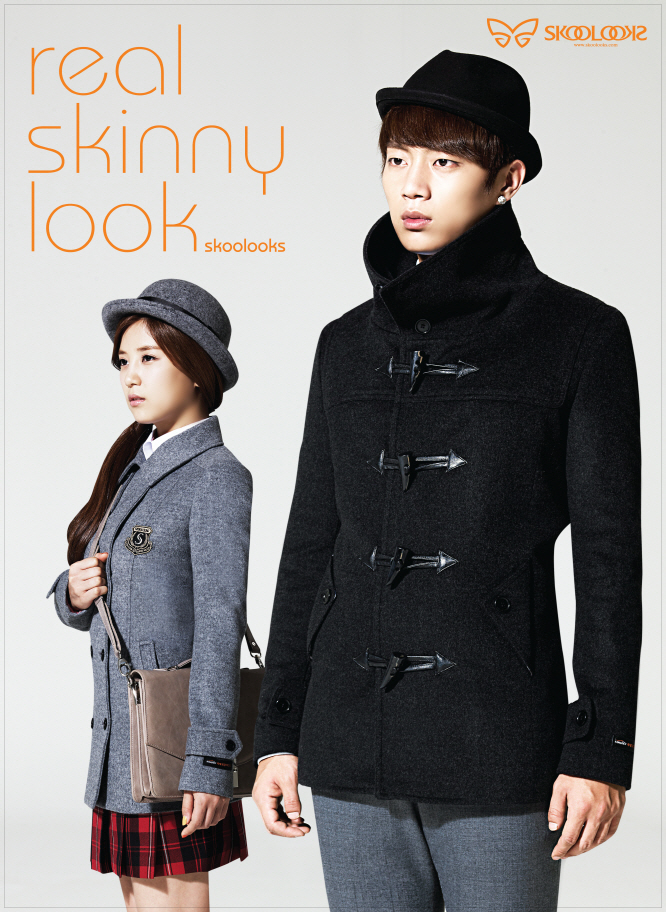
But then something like BEAST (비스트) and A Pink’s (에이핑크) Skinny Baby (스키니 베이비) comes along. As Angry K-pop Fan explains:

Just by looking at this song’s title alone…it should be enough to understand why some fans are quite upset with this new release…

… [let’s] focus on the most disturbing issue at hand: the implicit, or even subliminal message this sends to not only BEAST and A Pink fans, but the general consumer audience of Skoolooks, the brand that this video serves as a promotion for.

Asides being the name of the song, “Skinny Baby” is also the newest collection of school uniforms released by Skoolooks…

However blatant though, Korean school uniform manufacturers have long used young celebrities to encourage girls especially to obsess over their body shapes, so Skinny Baby is exceptional only in its format really. But having said that, fans of either group at least are much more likely to be influenced by something more akin to a music video than a traditional advertisement, as Kpop Reality Check helped me realize (emphases in original):

Skinny Baby…has lyrical content that reinforces messages about what body types are attractive and superior. It is not subtle but instead is very blunt with messages such as “Skinny Skinny Boy Boy, Skinny Skinny Girl Girl, Skinny Baby Hot Hot.”

Now this easily forms an in group consisting of people who ARE SKINNY. They are not only reinforced with this song that they’re hot but they feel as if they can identify and a sense of belonging. They watch the music video and see the girls from A Pink and the boys from BEAST who are all skinny and feel abit closer to the idols.

Now this forms a direct out group. The out group is basically everybody who isn’t skinny. Those who have different body types or who feel offended watching the video. Those who aren’t skinny are discriminated against and aren’t allowed in the in group. Everyone in the out group is made to feel insecure, anxious and lost.

This is where the body image and self esteem issues come in. Everyone in the out group continues to watch and absorb the MV as it becomes something they aspire to become. They’re being fed this message that they too can be cool and hot like A PINK and BEAST only if they’re skinny and… surprise surprise purchase Skool Looks clothing.

2) Michael Stipe Produces Gay Korean Film

Update – Electric Banana has just informed me that they made a mistake. Stipe is actually the co-executive producer of Fourplay: Tampa, not Dol.

From Pink News:

Former REM frontman Michael Stipe is the executive producer behind a new short film of a gay Korean man who yearns for a family, which the director used to come out to his own parents.

The short, entitled Dol, will be shown at the Sundance Film Festival this year, Indie music news site Electric Banana reports.

Writer and director Andrew Ahn says he used the film to come out to his own parents, who agreed to feature in it as actors without knowing their son was gay.

As it happens, Michael Stipe quite literally represents my closest brush with fame, as I managed to get only about 2 meters away from him at a concert in Auckland in 1995. And come to think of it, the next time I was so close to a celebrity was the (now deceased) Andre Kim in Insa-dong in Seoul roughly 10 years later. Perhaps it’s no coincidence that I now find myself writing about sexuality and gender issues?^^

Seriously though, in further LGBT news Charles Montgomery of Korean Modern Literature in Translation continues his Q&A series with Gabriel Sylvian, the founder of The Korea Gay Literature Project, and Gil at Seoulbeats has a controversial post on Super Junior (슈퍼주니어) member Choi Siwon’s (최시원) homophobia.

(Source)
3) Korea’s First Lady of Space

Imagine you are runner-up in a contest to be the first person in your country to go into space. A month before launch, the finalist is disqualified by the hosting Russian Federal Space Agency due to security breaches and all eyes fall on you. You carry not only the nation’s pride, but also the reported $25 million your government paid to get you there. Yi So-yeon (이소연) was that woman. Nearly four years later, she talks about her life on earth and in space.

Read the rest of the interview at Busan Haps. I also highly recommend these video interviews of her by Michael Hurt (a friend of hers) at Scribblings of the Metropolitician, and especially these posts on the surprisingly negative way the Korean media handled what should have been one of Korea’s greatest achievements, which he makes a strong case for being entirely due to her sex.

(Source)
4) Korea’s Nationalistic Adoption Quota Hurting Children
As reported by Sean Hayes on the Korean Law Blog last November:

Korea has one of the highest populations of orphans in the OECD because of an unwillingness, in large numbers, of the local Korean population to adopt non-blood related children and a new policy that limits the number of overseas adoptions. The majority of local adoptions are the adoption of the children of family members.

The good news is the government may be changing its policy because of its plan to join the Convention on the Protection of Children and Cooperation in Respect of Intercountry Adoption (Hague Adoption Convention) and realization that its present policy is harming the psychological health of children.

In 2005 over 2100 overseas adoptions were granted in Korea, while in 2010 a little over 1000 adoptions were granted. The reason for the decrease was the decrease in the overseas adoption quota in favor of a policy of supporting domestic adoptions. The policy failed to the detriment of needy children.

And now photographer Romin Lee has written a moving photo-essay at Groove Korea on the very real effects of that on Korean children and the overseas couples that want to adopt them, a story which you can continue to follow at Our Happily Ever Afters.

Meanwhile, Hello Korea!, my favorite blog on Korean overseas adoptee-related issues, passes on the following video by Korean Unwed Mothers & Families Association worker Jennifer Kwon Dobbs, with “powerful images and rational arguments by an adoptee/scholar/poet on re-humanizing the women who gave birth to us [adoptees]”:

See also this Groove Korea article on those regular adoption scapegoats, single moms, whom the Ministry of Health and Welfare described as “ignorant whores” until as recently as May 2010. Also note that the photo above is from Korea’s nearly decade-long “Letters From Angels” (천사들의 편지) campaign to encourage domestic adoption (but which of course is not bad in itself).

5) Quick Links

– Anti-sex buying campaign causes stir

From the Korea Times:

“You will get 410,000 won if you promise not to buy sex during year-end drinking sessions.”

This is a campaign a male rights group is promoting in a bid to criticize the Ministry of Gender Equality and Family’s anti-prostitution policies.

But the campaign is causing a stir, as the prize money is fake and the ministry’s policies which the group stated have been non-existent.

To play Devil’s advocate however, the Ministry has indeed had similar campaigns in the past, as the article points out.

(Source)

– “Women Only” in Korean Swimming Pools

At NateOn’s local pool, frequently only women are allowed. Against which he argues:

In Egypt, I got the separate gender stuff a little bit.  The religion in many contexts called for it, and the men there are idiots.  It’s the Middle East, and gender and sexual  issues are rampant.  But this is Korea.  It’s the 21st century.  Why do we need two hours of open swim that are women only?  And why is that in the middle of the day?  Oh, yeah, because women aren’t supposed to work.  And are home at the day.

In an update, he clarifies that his problem is not with women’s only swimming in itself, but that 2 hours of women only for every 3 hours of mixed sessions seems a little excessive. And why aren’t there any men-only ones?

– Saturday Night Live Korea does Blackface

Not strictly-related to gender issues sorry, but for those that are unaware, the December 31 show had a skit with Blackface, which has generated a lot of negative publicity overseas (at least on Korean fan sites and so on):

It’s also a real pity, especially after the first show seemed so progressive. But Angry K-pop Fan at least thinks some of the accusations are unwarranted.

Meanwhile, see My First Love Story for a list of recent problematic and/or offensive Korean music videos, which includes those that have used Blackface.

Quick Hit: The Grand Narrative in 2012

(Source)

Sorry for the slow posting everyone, but my daughters are off this week, and indeed one’s even sitting on my shoulders as I type this (“Whee! Happy woman Daddy! Why’s she smile?”). I’ll start writing again once they return to kindergarten next week.

When I do, every week from then to the end of the year I’ll be posting longer analytical pieces on Mondays, the Korean Gender Reader on Wednesdays, and translations on Fridays, either of K-pop songs or (more likely) gender issues-related news that would otherwise never see the light of day in English. I realize I have a terrible track-record of posting when I say I will, but hey – it is a new year after all, and for a variety of personal and professional reasons I’d really like to stick to my commitment this time.

If anyone would like to help me with that, I’d very much appreciate any donations via the “donate” button at the end of every post, no matter how small. Don’t worry, I won’t be making a habit of asking, and in fact will make the request just two more times this year: when my $17 domain renewal comes up in March, and my $30 no-advertisements renewal does in August. But it’d be really nice if I could break even with those at least! :)

Quick Hit: Disney Princesses as Cover Girls

(Source)

As explained at Visual News:

Many girls dream of being princesses and many also imagine a fairy tale of their face gracing the cover of popular fashion magazines. Young artist, Tumblr user, and admitted Disney fan, Mary (Petite Tiaras) gives us a mashup of the best of both worlds by designing covers for popular fashion magazines, such as Vogue, Vanity Fair, and Elle, with Disney princesses as cover girls.

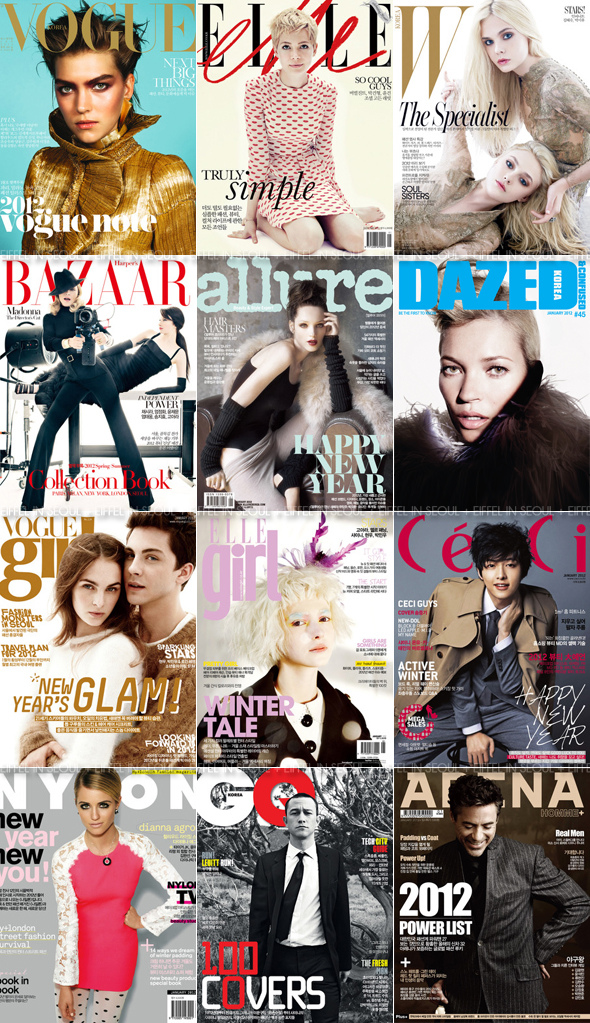
See there for more examples. A big fan of Peggy Orenstein’s Cinderella Ate my Daughter, I loved the uncannily accurate satire, and couldn’t help but compare some real Korean magazine covers, compiled together each month by Eiffel in Seoul:

(Source)

Probably the biggest thing of note though, is the lack of Korean celebrities on any covers except Céci, which is a little disappointing. Lest the editors be accused of cultural imperialism though, Korean consumers actually tend to prefer Western models and celebrities, at least in women’s magazines.

Also, I was hoping that seasoned pop-culture commentator Alice Jeong Turnbull (5), would be more scared than drawn to them (especially that “edgy” allure cover), but instead she told me that they were “nice”. Still, I suppose that’s an improvement over the usual “pretty”!

Happy New Year’s everybody!

Korean Gender Reader

(Source)

For anyone interested, auditions for the 3rd annual Busan performance of the Vagina Monologues will be held on the weekend of January the 7th and 8th at the HQ bar in Kyungsung (the performance itself will be at the end of April). See Busan Haps for the details.

1) Single Korean Female, 30. Not Seeking Marriage.

Over at Seoulist, Stephanie Kim has written a great article on the pressures Korean women her age come under to get married. An excerpt:

Much like writer Kate Bolic, I also left a long-term relationship at the age of 28. It is never an easy explanation as to why a relationship doesn’t work out, but more disconcerting than my ambiguous story are the perplexed looks on the faces of my more conservative friends, especially those who believe that certain things must happen at certain times in one’s life….

…My Korean friends tell me that there is a very bad stereotype for a man who dates and then leaves a woman in the twilight of her twenties, letting her waste away into what my Chinese friends call a Leftover Woman. This was hardly my case. My ex-boyfriend was, and still is, a wonderful man. Smart. Caring. Supportive. The easiest answer I can give as to why the relationship fell apart is that things did not “feel right,” and that I was not ready for the next level of commitment, the marriage-minded track. It’s a scary feeling we all experience: everyday you feel one step closer to fulfilling a perfectly planned life, and it’s damn comfortable, but deep in your gut something tells you that that’s not what you truly want. I simply had the courage to act on that feeling. Though I don’t regret my decision, the stereotypes I face every day remind me that I took a non-traditional path.

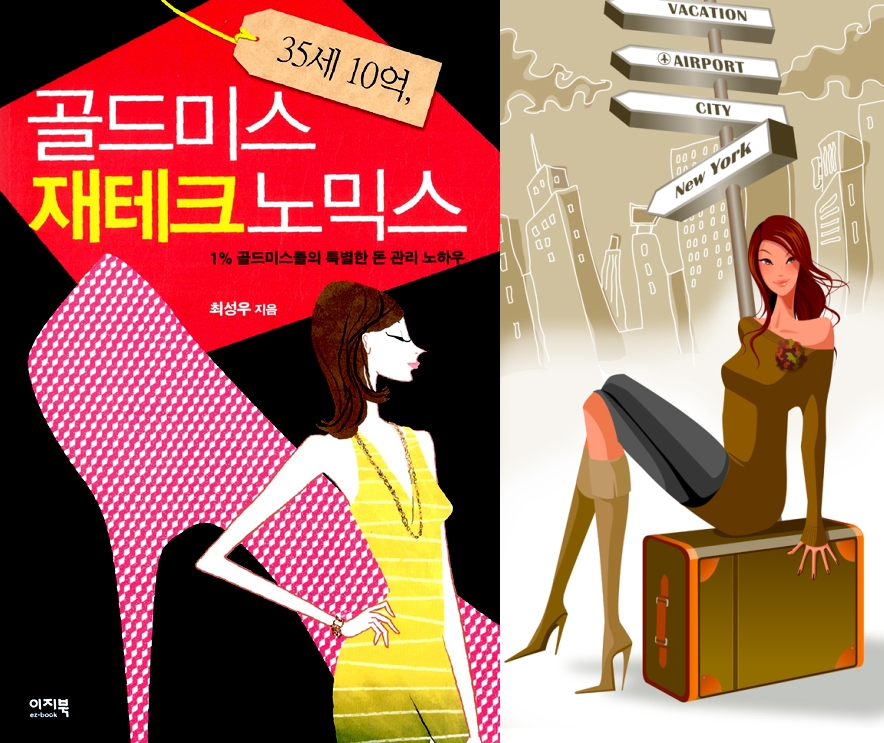
Read the rest there. Note though, that unfortunately her message is a little confused by her referring to herself as a “Gold Miss” (골드미스), which she mistakenly thinks refers to an unmarried woman in her thirties or above. As regular Grand Narrative commenter Gomushin Girl points out however, actually it refers to women also highly successful in theirs career and/or financially well-off (the Joongang Daily says an income of 40 million won or above is required), which you can read about in depth in this discussion of the Japanese origins of the term at Ampontan: Japan from the inside out.

(Sources: left, right)

Not that I endorse the use of the term in any way: as even the Joongang Daily indirectly concedes in that above link, Gold Misses have little in common besides their salary and marital status, and one wonders at all the media attention on them a few years ago considering there were only 27,000 of them in 2006 (2 years before the article was published).

The explanation is that a Gold Miss is simply an invented role model for 30-something unmarried women to aspire to, all the better to sell them products that (supposedly) help them achieve that goal; or in other words, it’s normative rather than descriptive. This financial motivation becomes obvious when you realize that Japan-based Ampontan overlooks that the term is actually suspiciously similar to the “Missy” (미씨) term first used in 1994, about which So He-lee explains in her chapter “Female Sexuality in Popular Culture” in Under Construction: The Gendering of Modernity, Class, and Consumption in the Republic of Korea (ed. by Laurel Kendall, 2002; my emphasis):

As soon as it came out [in a Seoul department store advertisement], it was adopted widely to indicate a particular kind of housewife, a married woman who still looks like a single woman. Even the copywriter was surprised at the speed with which this term took on social meaning and evoked specific images of women and femininity. “Missy” rapidly permeated the Korean language once the advertising industry recognized the consumerist implications of this target age groups’ flamboyant desires.

The essential condition of being a Missy is a preoccupation with being looked at….Another fundamental condition of membership in the Missy club is her professional job.

You could argue that that this was simply luck by the copywriter rather than being part of a grand conspiracy between advertisers and the media, but then both are constantly inventing new terms in order to find one that’s likewise happily adopted by the public, as the never-ending creation of new “bodylines” makes clear. Tellingly, the terms also tend to be quite broad and vague, conveniently leaving others free to further define them as they see fit: say, when they want to blame all Korea’s modern social ills on working women for instance, in an appalling Korea Herald report on “Alpha Girls” that I eviscerate here. So I think So He-lee is a little misguided in assuming that Missys’ “flamboyant desires” came before rather than after that 1994 ad.

2) Questions on Korean LGBT Literature

As explained by Charles at Korean Modern Literature in Translation:

Chasing down a question from long-time commenter Charles (not me^^) and some interesting information about Yi Kwang-su, I came across some interesting work by Gabriel Sylvian at The Three Wise Monkeys, .

I emailed him some questions and the answers were interesting (and lengthy!) enough that I decided to run them individually, with some comments they evoke from me.

Gabriel, a grad student in Korean Literature at Seoul National University, founded The Korea Gay Literature Project  in 2004, and you can read more about him here. In any case, my first question was for background:

Read those questions and answers there, continued in Parts 2 and 3 here and here.

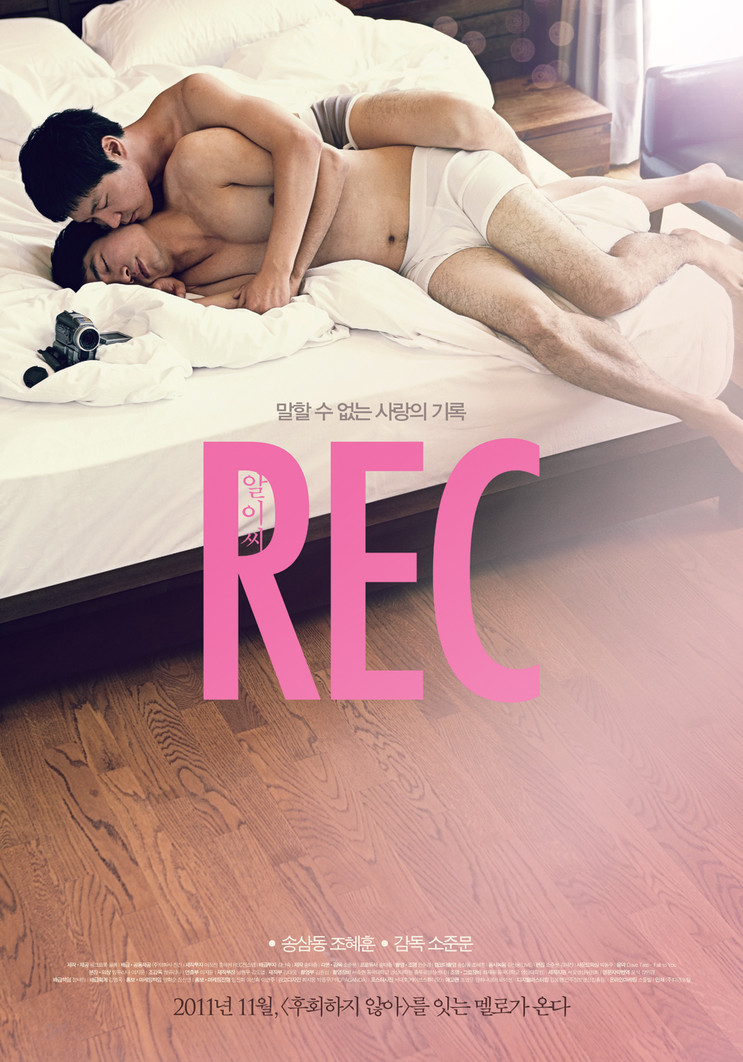
In other Korean LGBT-related news, a gay Korean man recently received refugee status in Canada because of the abuse and discrimination he would be expected to receive during his mandatory 2-year military service (see here also for more on sexual abuse in the military in general); anti-gay art caused a stir at a recent Seoul National University exhibition; and – sorry for not noticing earlier – the Korean gay movie 알이씨REC below came out last month, which you can find many links about here.

(Source)

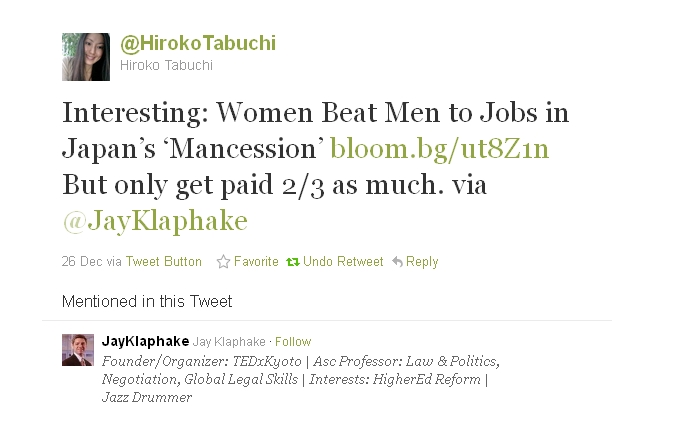
3) Japan’s ‘Mancession

As Tokyo-based New York Times reporter Hiroko Tabuchi put it:

Very interesting in its own right of course, that Bloomberg article referred to is also particularly useful in contrasting the Korean government and businesses’ decision to fire women in droves in response to the financial crisis, as in the US and – now Japan – it was actually men that suffered more. Indeed, in the former working women came to outnumber working men for the first time in its history (see story #5 below also).

4) Another Reason to Hate Naesoong and Aegyo

Via Tumblr Kitty Kitty Korea (but actually written by Party in the R.O.K.):

I can’t count all the times I’ve said “I’m going home” and attempted to leave wherever I was, and the Korean guy would be like “Oh, no you don’t!” and grab my wrists or shoulders or take my phone or hold me against a wall so I was physically unable to get out. No, man, I’m not just saying I want to go to be cute; I want to go. It’s not until I start thrashing around and yelling at them that they let go, and then they just act really confused. (I’m guessing that it’s a thing for Korean girls to pretend they want to leave a man so they can watch him beg for them to stay. Korean couples go on all sorts of weird power trips I just don’t get coming from the relatively sane world of American dating.)

Read there for her discussion of what lay behind that confusion. Also, I don’t mean to cause and/or perpetuate negative stereotypes about Korean men, and should be(!) the very last person to ask for dating advice, so please let me know how that does or doesn’t match your own dating experiences.

Update – By a wonderful coincidence, 5 minutes after I published this post this one appeared at Seoulbeats, about how seemingly every Korean drama features the male lead grabbing the female lead by the wrist and literally dragging her away with him like she was his property and/or child, despite her screams and protests. Sound familiar?

(Source)

5) What do Women’s Groups Think of the Ministry of Gender Equality and Family (MOGEF)?

Not much, according to the Hankyoreh, citing:

…its passive approach in the cases of the comfort women who had been coerced to serve as sex slaves for the Japanese military during World War II and a sexual harassment victim who was dismissed from a Hyundai Motor subcontractor. In the latter case, the occurrence of sexual harassment was acknowledged in January by the National Human Rights Commission of Korea, and the victim held a nearly 200-day sit-in protest in front of the MOGEF building when she was not reinstated. The ministry made almost no efforts to offer support, merely reiterating that it was “not within our legal authority to help victims.”

And also that:

In addition to its failure to do its job, the ministry has also added fuel to existing conflicts in the most bewildering of places. A case in point was its embarrassment after indiscriminately handing out “19 and older” ratings to songs with references to alcohol in their lyrics. Meanwhile, a late-night Internet shutdown system for those aged 16 and under has stirred up a controversy over violations of freedom.

Hey, I’m no fan of the Lee Myung-bak administration, and indeed I think its mixed performance in other areas of governance pale in comparison to its appalling record on women’s rights, which will be one of its most enduring legacies. Having said that, it’s a real struggle to find a Hankyoreh article that doesn’t criticize the present government in some form or another, whereas MOGEF does have a point about its relative powerlessness (it has only 0.12% of the total government budget for instance), the editor’s assertion that “if its authority is limited, then it can only survive by constantly raising issues and making its voice heard” proving my own point that this is the very impetus behind its constant censorship of K-pop (but not that I’m for that either!). Also, when Lee Myung-bak himself encouraged the firing of women in 2008 (see #3 above), then it deserves at least some praise for its recent efforts at job creation (source, right):

On December 23, MOGEF presented its plans to provide individually tailored job assistance programs for 130,000 people in 2012 before the Korean Youth Counseling Institute with President Lee Myung-bak in attendance.

The plan stipulates expanding the number of job training centers for women to 111 by next year and developing more in-depth programs for those with less access to employment opportunities, such as migrant women and women with disabilities. Furthermore, the Women Friendly City program, which currently counts 30 cities among its members and has received growing interest from regional administrations, will expand to 40 cities. MOGEF will also perform assessments, differentiating for gender, to measure the effects of such programs.

Read the rest at Korea.net. It does have to be acknowledged though, that still much much more is needed to boost female employment in Korea, as today’s final link – this comprehensive report from the Korea Herald – makes clear.

Oh In-hye: “I don’t regret wearing that revealing dress”

Source: Freeutil

My translation of her interview in Busan Focus, December 6 2011, p. 23, by Jang Byeong-ho:

“I Don’t Regret Wearing That Revealing Dress”

Issue-maker Oh In-hye, main star of Red Vacance, Black Wedding, Dreams of becoming a “humanist actress”

“There have been big changes since the Busan International Film Festival (BIFF). At the time things were just crazy, but now I’m quite relaxed. Things have returned to what they were like before BIFF”.

On the 5th, I met Oh In-hye at a coffee-shop in Seoul, the actress who has been in the spotlight for wearing such a striking dress at BIFF earlier in the year. I couldn’t help but be curious at how she felt about being at the center of such controversy.

“Before I went to the film festival, I thought my visiting it would just be reported as “An actress called Oh In-hye attended”, she said, but to her it was her first time, and an amazing experience. Also, while she was very hurt by malicious news reports and what netizens wrote about her, she confidently said to herself to “have no regrets”, and that “If I am to go again to the opening ceremony of a film festival, I’ll wear a revealing dress again. But perhaps revealing just a little less though!” (laughs).

Also, Oh In-hye is thinking about using the interest in her as an opportunity, “It’s all water under the bridge. Instead, now I have a goal of changing my revealing image. And if I have a goal, I should work on it, right?” she openly and honestly revealed, a complete contrast to the sexy demeanor she possessed when she was wearing the revealing dress. But she also said that she was worried that her revealing image would distort the message of her coming movie Red Vacance, Black Wedding, coming out on the 8th of December.

Oh In-hye has yearned to be an entertainer since she was very young, but didn’t set on an acting path until the relatively late age of 22 [She is 27 now]. From 2 to 3 years ago, she has worked without an agency, and firmly said that she “has no plans to join one. I want to be a humanist actress, not just an entertainer who makes issues.”

Finally, she admitted that the director Lars von Trier and the actress Penelope Cruz, Oh In-hye revealed that “increasing my acting ability by studying a lot of acting is my biggest homework!”, leaving this reporter curious about her honest and forthcoming persona (End).

Source: Adman

Korean Police Can Now Give Restraining Orders on the Spot

(Source)

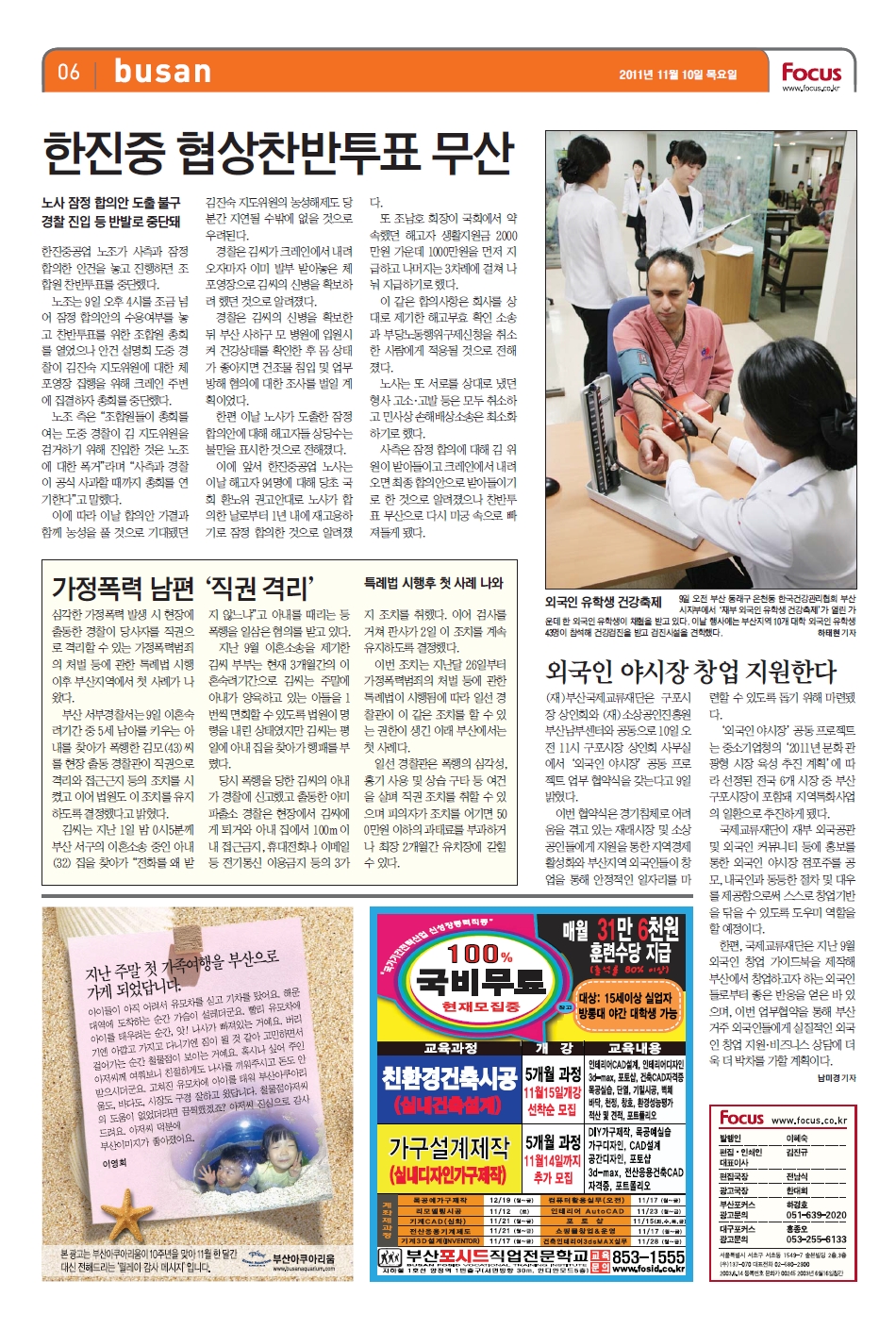
It’s just a short article, tucked away on page 6 of the Busan edition of the November 10th Focus (below). But still, it’s always nice to hear that a new domestic violence law is actually being enforced:

Abusive husband ‘officially isolated’

First incident since implementation of special exemption law

After the implementation of a special exemption law which includes domestic abuse punishment that allows police at the scene to officially isolate the persons concerned in the event of serious domestic abuse, the first case in the Busan area has emerged.

Busan Seobu Police Station revealed on November 9th that a police officer dispatched to the scene used his authority to order isolation and a restraining order for a  Mr. Kim (43), currently in the waiting period [lit. “careful consideration period”] for a divorce, who had gone to his wife, who is raising their 5-year-old son, and assaulted her; a court later decided to keep those measures in place.

Mr. Kim is under suspicion of going to the house of his wife (32), with whom he is in a divorce suit, in Busan’s Seogu on November 1st at 12:05AM, asking, “Why didn’t you answer the phone?” and committing violence that included hitting her, which he did habitually.

The couple filed for divorce in September, and a court ordered that Mr. Kim be allowed to visit his son, of whom his wife has custody, once a week on the weekend during their 3-month waiting period, but Mr. Kim went to his wife’s house on weekdays and became violent.

His wife, while being assaulted, notified the police, and the officer dispatched from the Ami Precinct Station ordered Mr. Kim to leave the house, not to come within 100 meters of his wife’s home, and not to use electronic communication like a cell phone or email to contact her.  After a review, a judge decided on November 2nd to keep the measures in place.

The measures represent the first case in Busan since a special exemption law for domestic abuse punishment that gives front-line police officers the authority to take such measures came into effect on October 26th.

Front-line officers can appraise conditions like the seriousness of the violence, the use of a deadly weapon, or habitual beating, and then take official action, and if the suspect violates those orders, the officer can impose fines of up to five million won or imprison him or her for a maximum of two months (end).

(Thanks to Marilyn for the translation)

Korean Gender Reader

(Source)

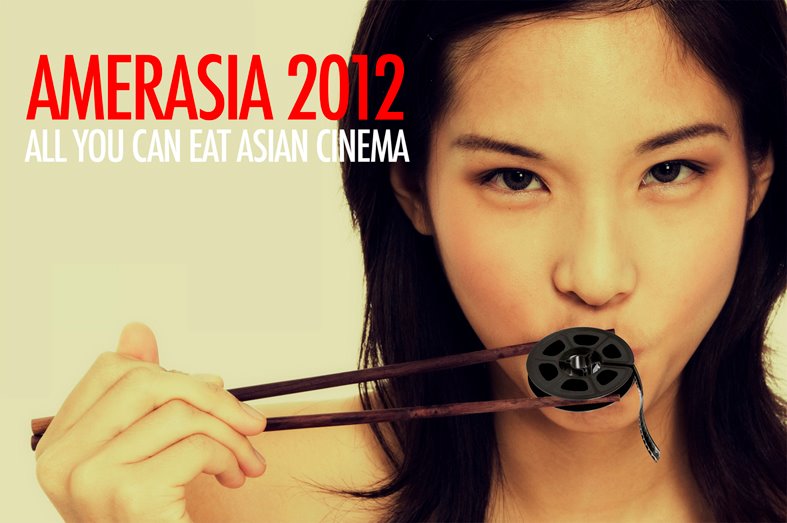
Not only is this poster simply cool, but the 3rd Montreal AmérAsia Film Festival it advertises will playing during my birthday too. So why does it bug me so?

I think, because I’m so used to seeing women in such mildly Orientalist imagery, that for the life of me I can’t imagine an East-Asian guy with the same expression and pose. Or is that just me?

Either way, see the end of this post for some Occidentalist imagery to compare (and of course, I wish nothing but the best for the festival!). Meanwhile, here are this week’s links, and one long discussion:

1) The Photoshop issue

Paula, a professional model, responds to last week’s post on excessive and unnecessary photoshopping in Korea at Noona Blog: Seoul. Like she says, photoshopping is the photographer’s or client’s prerogative, but still: what’s usually done to her pictures can hardly be considered an improvement!

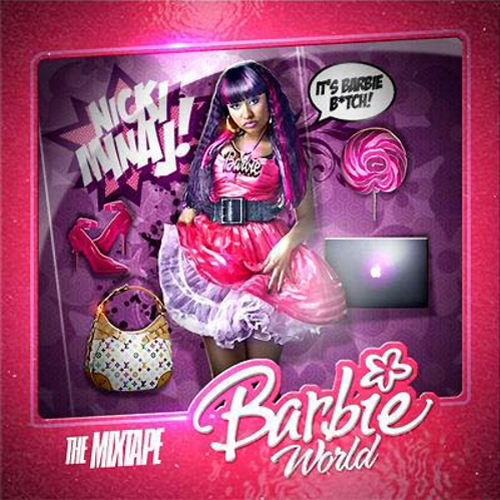
2) How Nicki Minaj kicked open the door for 2NE1

I confess, I never heard of Nicki Minaj before reading this post of Latoya Paterson’s at Racialicous. But now that I have, then I’m not going to forget anytime soon. I’m also convinced that there’s a genuine opportunity for 2NE1 (투애니원) to succeed in the US market where so many other K-pop acts have failed. As she explains (source, right):

After watching good artists try and fail to make it in the US market, I began trying to find a pattern. Why was this happening? The reasons vary – particularly because artists often use their entry to the US as a kind of reinvention, which can be risky – but a big component is that American marketers/listeners had no idea what to do with them.

But, luckily for 2NE1, they have a secret weapon: Nicki Minaj.

It may seem strange to look at Nicki Minaj as the the person who put a crack in the Billboard ceiling big enough for 2NE1 to break through to the top spot, but it is her inherent strangeness and genrelessness that is opening the door for other women artists to bend the rules.

And a little later:

Both Minaj and 2NE1 are also combatting societal scripts about what women of color can be. While Minaj occupies a space defined by feminist contradictions, she still actively defies the proper “place” for a black woman in the broader pop music space. Considering the limited spaces where black women are allowed to appear, it’s remarkable how Minaj has carved out a space for herself in both urban markets and the fashion industry. 2NE1 is facing off against stereotypes around Asian American women – particularly the submissive stereotypes that would push them out of the more aggressive sides of the pop and hip-hop scenes.

Read the rest there. Also, for anyone further interested in why BoA (보아) and Rain (Bi; 비) failed in the US, email me for a copy of “Playing the Race and Sexuality Cards in the Transnational Pop Game: Korean Music Videos for the US Market” by Eun-Young Jung in Journal of Popular Music Studies Volume 22, Issue 2, pages 219–236, June 2010, which covers both in some detail. Or, for something less academic, you may like this recent post on Girls’ Generation (소녀시대) by Natalie at Seoulbeats, which gave me a renewed appreciation of how different 2NE1 really are compared to most Korean girl-groups.

(Source)

3) There really is no difference between men’s and women’s maths abilities

For those of you that didn’t already know, the notion that there was any innate biological differences in maths ability between the sexes has long since been thoroughly debunked. But, as io9 explains:

Until now, there was [still] maybe a sliver of statistical data to support the existence of this gender gap — nothing remotely convincing, mind you, but just enough that the idea couldn’t be entirely dismissed out of hand. While most who studied the issue pointed for cultural or social reasons why girls might lag behind boys in math performance, there was still room for biological theories to be proposed.

Now though, a new study has debunked even that data too, as you can read about here.

Related, also consider this post of mine from 2008 about how gender differences in maths ability show a direct relationship with a countries level of sexual equality (i.e. the more egalitarian the less – if any – difference there is), and #4 here on a recent, albeit very limited survey that suggests that men’s greater spatial ability similarly decreases the more power women have in a society.

(Source)

4) Obligatory post about that sex survey (or, sexuality and parenthood in Korea)

For those of you that have been living in a cave for the last week:

South Koreans are the least sexually active among people in 13 countries surveyed in an international online poll, a global pharmaceutical company said Monday.

Eli Lilly and Co.’s Seoul office said Korean couples over 34 have sex an average of 1.04 times a week, citing the survey based on data collected from 12,063 people worldwide including 1,005 South Koreans.

Read the rest at the Korea Herald, and some discussion of it at the Marmot’s Hole. Personally though, I’m extremely wary of surveys like these, especially if I know nothing about their methodology. What’s more, when just a 5 minute search of my books – let alone Google – reveals dozens of figures ranging between 1 and 2-3 times a week for US married couples, then “news” articles like this, poring over differences of national differences of less than 0.1% a week, is clearly only good for headlines.

Another problem is that the term “married couples” doesn’t take their ages into account, whereas – however politically incorrect it sounds – it’s well known that women’s libidos generally decline in their 30s, whereas men’s stay the same.  Also, it doesn’t take into account whether the couple has had children or not, which is a huge deal in Korea.

Why? Well, with the proviso that I haven’t studied sexuality in specifically Korean marriages as much as I should have by now, and that of course the Koreans I’ve spoken to about it aren’t a representative sample, I and especially my wife have spoken candidly about it with many (she’s worked from home for 5 years, and has known many couples in the 3 apartment buildings we’ve lived in), and I don’t think it’s just confirmation bias on our part when they consistently speak of having sex more like once per month or even year, and consider that perfectly normal.

But to be sure, it’s difficult for any married couple to get back into the swing of things after having a child. As explained on p. 362 of Our Sexuality (2002), by Robert Crooks and Karla Baur for instance (source, right):

In the first three months after delivery, over 80% of new mothers experienced one or more sexual problems, and at six months 64% were still having difficulty. The most common concerns were decreased sexual interest, vaginal dryness, and painful intercourse. An author of a book about pregnancy warns women to be prepared for their sex lives to be “downright crummy” for up to a year. “Mother Nature” is using her entire arsenal of tricks, from hormones to humility, to keep you focused on your baby and not on getting pregnant again”.

Things like breastfeeding can be a bit of a turn-off too, as Jenny at Geek in Heels is finding:

I also now have tremendous difficulty seeing my breasts as sexual objects. Yes, I know that women’s breasts are designed to feed and nourish the young, and any sexual uses should be considered secondary functions. But the sudden transition from years and years — from the moment I donned my first bra — of their being sexual objects to asexual tools that spend hours each day dangling from the mouth of a babe (or from the ends of a breast pump) is pretty brutal. Whenever my husband looks at them with *that look*, all I can think is, “These floppy things? Can we lay off of them because you’re only reminding me of the kids and that does little to turn me on.”

Yes, the boobies will be expelled from all sexual acts — by my request — until I can start disassociating them from my children.

Just as, and maybe even more important are the lifestyle changes, especially the lack of sleep. Factor in Korean men working such long hours too, to the extent that the Ministry of Health and Welfare notoriously told them to go home at 7pm on Wednesdays to, well, fuck their wives, and the fact that there’s a huge prostitution industry in Korea (see here for the ensuing effect on marriages), then it’s easy to appreciate why Korean marriages in particular might be relatively sexless after the birth of a child.

(Source)

Having said that, Korean marriages shouldn’t invariably be doomed to sexlessness though. Consider the following from p. 361 of Our Sexuality (my emphasis):

Couples are commonly advised that intercourse can resume after the flow of the reddish uterine discharge, called lochia, has stopped and after episiotomy incisions or vaginal tears have healed, usually about three to four weeks. However, most couples wait to resume intercourse after six to eight weeks following birth.

Also:

Typically, women and men with more positive attitudes about sex in general show more sexual interest and earlier resumption of intercourse than do others with more negative attitudes about sexuality.

In other words, US couples at least generally expect to and want to resume regularly having sex again after the birth of a child, whereas Korean couples expect to have it much less often, if at all. In saying that, I hate to perpetuate a “US/West = Good, Korea = Bad” dichotomy beloved of expat blogs, but when very similar lifestyles and attitudes produce the same result even in “sex-crazed” Japan too, then it’s time to call a spade a spade:

While Japan has an enormous sex-related industry, married couples don’t seem to do it that often (According to a Durex Survey, Japan ranks last internationally in terms of sexual activity.) And this would be the case in many modern societies as well. So for the last two years, author Sumie Kawakami gathered interviews of various Japanese women to depict this one aspect of society: Her latest book, Goodbye Madame Butterfly: Sex, Marriage and the Modern Japanese Woman by the superb Chin Music Press portrays eleven sex lives in painstaking detail.

(Source)

Moreover, even the physiological difficulties may not be as great as they may appear. As commenter Jo recently mentioned on another post for instance, and which is confirmed by similar anecdotes in my books:

I remember watching a documentary about breast feeding, an interview was shown with a wet nurse, she said that she gains great pleasure from breast feeding, even breast feeding other people’s babies. She was asked if the pleasure was at all sexual, and she replied that it was a mildly sexual experience for her. – touch, sexual feelings, pleasure are extremely complicated, the feeling toward a family member and a sexual feeling are not necessarily dichotomous, this may be a construction, there may be some, very un-sinister, overlap, in this case allowing for ‘uncle fans’ to deny the sexual element of their affection, and for touch between father and daughter to be slightly confusing. Maybe we should try not to separate ‘sexual feelings’ from all other feelings.

Also, I can’t find the source sorry, but distinctly remember reading somewhere that many mothers and fathers actually get incredibly turned on at the fact, which is quite logical when you think about it. But don’t get me wrong: I absolutely don’t intend for the above quote to be an indirect critique or comment on Jenny’s experience and feelings about breastfeeding. Rather, just again to stress that nothing is set sexuality-wise, and how crucial societal and personal attitudes are.

And on that note, again I can’t stress enough that of course there will be many exceptions to all the above, and that it’s overwhelmingly based on just what my wife and I have personally heard from Korean couples. So, please let me know how that matches – or doesn’t match! – your own experiences and/or what you’ve heard, and, now that my winter vacation has started (메롱~), I promise not to be so reticent in the comments if you do!

(Source: unknown)

5) White female academics suggest minority women with white men are sluts and gold-diggers

From Shanghai Shiok:

A reader, frustrated with how I constantly deny that my white male/Asian female relationship follows certain “societal streams,” pointed me to an article which he believed would enlighten me on the nature of my relationship and others like mine.

The article summarizes a new study which is flat out absurd, insensitive, bigoted, and racist — but since it’s conducted under the dignified umbrella of academic research, it’s perfectly acceptable to put these ideas out there.

Two privileged white female academics get together and make powerful statements about women who they deem unprivileged. These nuggets of wisdom include the suggestion that unprivileged women exchange their bodies for the material benefits and social status associated with the privileged white men whom these academics feel are most suited to their own caste. At a minimum, their study “proves” that privileged white women (like themselves) wouldn’t jump into those white guys’ beds as quickly as those coloured hussies. After all, they have statistics to prove it.

Read the rest there, and you may also find my “Real & Presumed Causes of Racism Against Interracial Couples in Korea” post interesting.

Finally, I can understand wanting to make a university more “international”-looking, but this Korean homepage probably overdoes it:

In contrast, the English and Chinese websites both feature the same 10 Caucasian guys, and 1 Southeast-Asian(?) one!

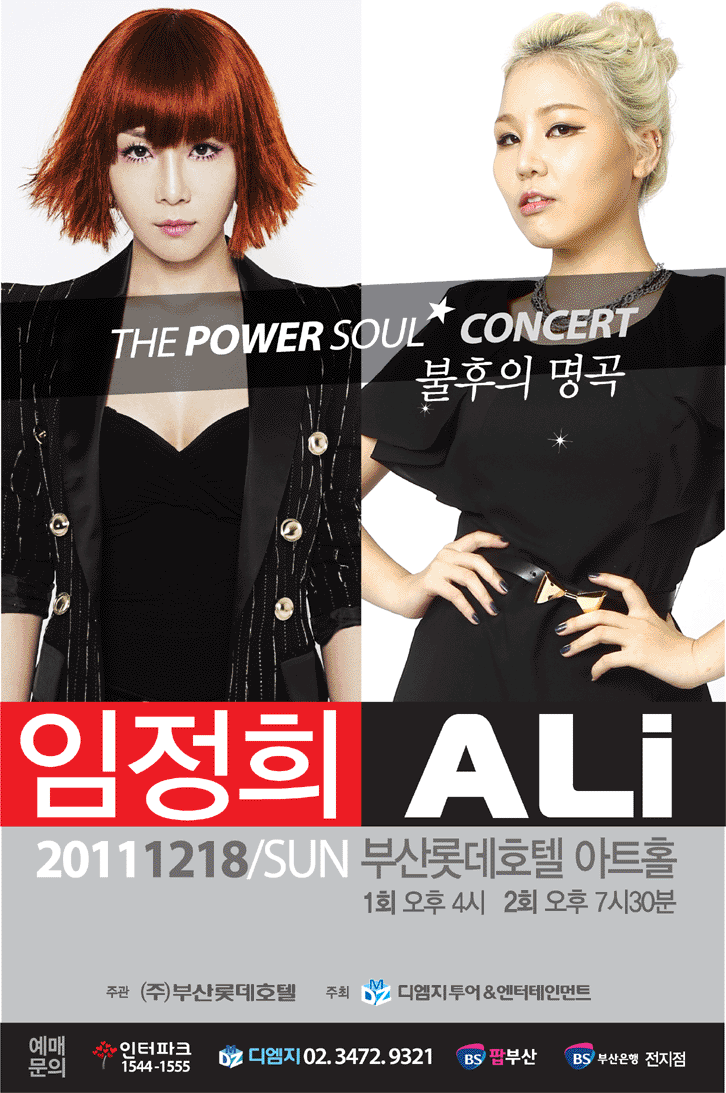
Guess Who’s Going to a Lim Jeong-hee Concert? ㅋㅋㅋ

(Source)

Apologies for the rare personal post, but an hour ago I hadn’t even heard of the concert, so I’m feeling pretty pleased with myself right now!

Unfortunately for any readers that are also fans though, it looks like there’s only about a dozen tickets left, but you may be able to get one of them tonight if you and a Korean-speaking friend are prepared to navigate the appalling website (on Internet Explorer). Tickets cost 41,000 won.

But if you’ve never actually heard of Lim Jeong-hee (임정희), then see here for my translation of one of her songs, and thanks again to commenters there for recommendations for more of her music to listen to. As for Ali (알리), by a complete coincidence I heard of her for the first time today(!), albeit in a negative way because of the poorly-chosen name of her latest single. I’ll certainly still give her and her music the benefit of the doubt though, and again would really appreciate any suggestions for music of hers to listen to.

And on that note, let me post this without any further ado, just in case there really any more fans out there. If so, then let’s meet up afterwards! :)

Update 1: I forgot to mention that there’s actually two concerts, one at 4 and one at 7:30. There’s probably more tickets available for the 4pm one.

Update 2: Ali has recently revealed that she is a rape victim.

The Origins of “Ajosshi Fandom”?

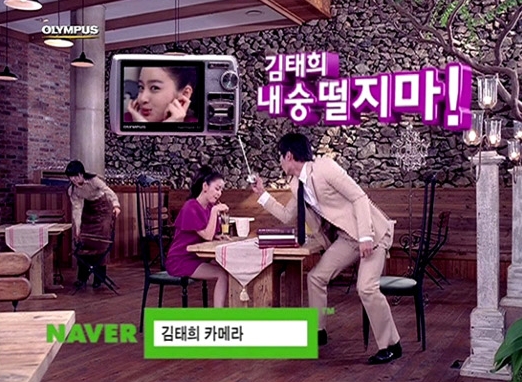
Did you know that middle-aged sexual harassers often claim that they were just being affectionate, touching the victim simply as if they were their own daughters? Naively perhaps, I had no idea, so I didn’t give this commercial a second thought when it came out in 2005. But armed with that knowledge, I can certainly understand why it would have made so many women uncomfortable, as pointed out by Park Hee-jeong (박희정) in her article on the commercial that I’ve translated below, and which was echoed by numerous commenters.

Then it hit me. If all this was already well-known by the Korean public in 2005, then it takes no great leap of the imagination to see how middle-aged men’s sexual attraction to 15 and 16 year-old girl-group members could so quickly and readily be framed in the same terms just a couple of years later, albeit more as an avuncular (uncle) love rather than a paternal one for some reason.

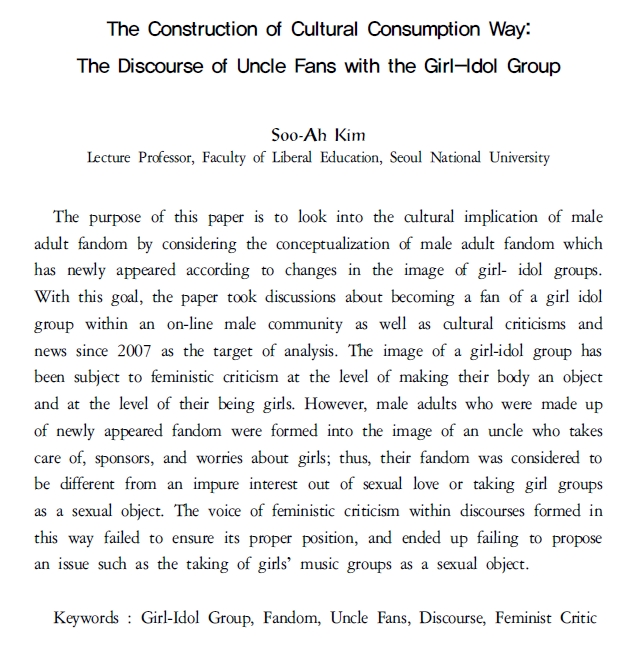
That would remain the case for the next few years, as you can read about in depth here, here, here, here, and especially in Soo-ah Kim’s article “The Construction of Cultural Consumption Way: The Discourse of Uncle Fans with the Girl-Idol Group” in Media, Gender & Culture, 15 (2010): 79-119 (“소녀 이미지의 볼거리화와 소비 방식의 구성: 소녀 그룹의 삼촌 팬 담론 구성”, 미디어, 젠더 & 문화), as she was one of the very few prominent academics challenging that consensus at the time. Only upon a perceived spate of sex crimes against children in July 2010 would the media begin (and I stress only begin) acknowledging the sexual element, and how that could be problematic.

Of course, that’s just scratching the surface of ajosshi (아저씨; middle-aged man) fandom, and I certainly don’t want to imply that middle-aged men’s interest in young girl-groups can’t be anything but sexual. Nor that when it is sexual though, that that’s fine for 20 and 30-somethings, but somehow wrong or “unnatural” when coming from older men. Either way, the crucial thing is that it’s acknowledged, and that the impact of —and consequent possible restrictions on—entertainment companies using underage performers to cater to this sexual interest are considered.

This “just like my daughter/niece” rationalization though, is a complete denial, and deserves further exploring: finding it in two different contexts can’t just be coincidence. In particular, I think that that it may—and I stress may—be much more common of Korean harassers than of those from other countries, and would appreciate it if readers could confirm or deny this.

Meanwhile, Park Hee-jeong’s article is more about the memories of such harassment the commercial evokes, and especially on the “beautiful flowering”-type gender socialization contained within the narration. I think she overstates the latter a little when she discusses how awkward the reality of puberty is for girls though, as it’s certainly no picnic for boys either, with other family members likewise invariably embarrassing them or making them feel uncomfortable as they develop. Also, when she implies that wet dreams are celebrated as a sign of manhood, then it’s clear that actually she knows very little about raising teenage boys. But still, it’s a very eye-opening short article, and thanks again to the reader that passed it on to me:

딸의 미소는 남성들의 판타지일 삼성생명 TV광고인생은 길다

A Daughter’s Smile is Only a Male Fantasy, Samsung Life Insurance ‘Life is Long’ Daughter Version

저녁 식사 자리, 등을 두드리는 아버지의 손길에 딸은 불편한 얼굴을 보인다. 알고 보니 처음 착용한 브래지어가 신경이 쓰였던 것이다. “장조림 많이 먹어라” 하며 다독이는 아버지의 말에 딸은 수줍게 미소를 짓는다.

As a father and daughter sit down to eat dinner, he gives her an affectionate pat on the back and says “Eat up!”. But we see that this makes her uncomfortable, as she is wearing her first bra, and later she gives an embarrassed smile to her father.

삼성생명의 TV광고 시리즈 ‘인생은 길다’ 중 딸 편의 내용이다. 화면이 진행되는 동안, 광고에서는 아버지의 목소리로 “딸의 인생은 깁니다. 어느새 여자가 될 것이고, 사랑을 하고, 결혼하고 엄마가 될 것입니다” 라는 나레이션이 흐른다.

In this commercial, part of the Samsung Life Insurance “Life is Long” series, the daughter is the focus. In the background, the father narrates “My daughter’s life will be long. Before I know it, she will be a woman. She will fall in love, she will get married, she will become a mother”.

(Source: Handsome in Pink)

훈훈한성장의 확인?

Affectionately noticing how his daughter is developing

이 광고는 딸의 성장을 깨닫는 아버지의 마음을 다루고 있다. 훈훈하고 감동적이어서 ‘눈물까지 흘렸다’는 아버지들의 이야기도 들리는 걸 보면, 많은 남성들이 이 광고의 정서에 공감하고 있는 듯하다.

In this commercial, the father notices that his daughter is growing up. Seeing as many men have been so moved by it as to be almost crying, it is indeed a warm commercial that plays on one’s heartstrings.

그러나 한 켠에서 불편한 감정을 호소하는 여성들의 목소리도 흘러나오고 있다. S씨(28)는 광고를 보며 느꼈던 불편함을 이렇게 말한다. “브래지어를 한 등을 만지는 모습이나 움찔거리는 딸의 모습이 싫었어요. 그 상황에서 느꼈을 기분 나쁜 감정이 떠올라서. 실제였다면 그 상황에서 결코 딸은 웃지 못하죠.”

On the other hand, women are expressing feelings of awkwardness with this commercial. Miss S (28), said it made her uncomfortable, and that “I hated it when the girl shivered after being touched on the back by the father. That feels nothing but bad. Daughters wouldn’t be able to just laugh about it, yes?”.

우리 사회에서 딸들에게 성장, 특히 ‘성적인 성장’은 훈훈한 경험이 되지 못한다. 광고 속 딸도 브래지어를 한 등에 아버지의 손이 닿자 깜짝 놀란다. 십대 여성들에게 성적 성장은 부끄럽고 감추고 싶은 일처럼 되어있다. 브래지어 자체도 몸의 건강과는 상관없이 가슴을 보정하고 감추기 위한 것이지 않은가. 그런 면에서 브래지어를 착용하고 긴장하거나 누가 만지기라도 할까봐 안절부절 못하는 딸의 모습은 훈훈하기 보다는 차라리 안타까운 모습에 가깝다.

In our society, growing up, especially sexual development, is by no means a warm and wonderful experience for girls. In this commercial, even the daughter is shocked and surprised by the father touching her on the back. After all, the bra itself is for hiding and adjusting one’s breasts, regardless of how healthy one’s body is [James – I think this means it is taboo for women not to wear a bra in Korea]. Moreover, worrying about having one’s bra touched [James – Or noticed and/or pointed out?] is a source of tension and stress for girls, making the scene more something to be lamented than as an example of fatherly affection.

같아서 만진다

“I touched her because she’s like my daughter”

여성들이 이 광고를 보면서 느끼는 불편함의 한 켠은 ‘몸을 만지는’ 행위에 있다. 우리 사회에서는 가족이라든가 친하다는 이유로 타인의 몸에 손을 대는 행위가 쉽게 용납이 되는 경향이 있다. 나이 지긋한 분이 성희롱 가해자로 지목되면 “딸 같아서 만진 건데 잘못이냐?”는 변명(?)이 나오는 것도 그런 이유다.

One reason women feel uncomfortable watching this ad is because of the act of the daughter’s body being touched. That is because our society approves of and/or grants permission to men touching them in a friendly manner, like they would their own family members. Indeed, when an older male is accused of sexual harassment, often he fastens on to the excuse that “Can’t I affectionately touch someone like my own daughter?”.

그러나 성장을 기뻐한다는 의도로 몸을 만지는 일들이 자식들의 입장에서는 기분 나쁜 일이 되기도 한다. P씨(30)는 초등학교 시절 가슴이 나오기 시작한 걸 흐뭇해하던 아버지가 맨 가슴을 만진 일에 상처를 받았다고 한다. “아버지야 나쁜 의도가 없으셨겠지만 기분이 나쁘고 싫었거든요. 기분 나빠하는 걸 귀엽게 여기는 게 더 싫고 화가 났지만, 별 수 없었죠.”

While one can touch children because you’re pleased with how they’re growing [James – I highly doubt this is meant in a pedophilic sense. But the next sentence definitely does sound strange though], from children’s perspective it can feel quite bad. Miss P (30) said that when she was in elementary school and her breasts had started appearing, her father touched them in a pleased way [James – as in, “Wow, my girl’s growing up!”] and that this [emotionally] hurt her. “My father didn’t mean anything bad by it, but I still felt bad and hated it. My father thought it was cute though, which just made me angry and hate it all the more, although I couldn’t do anything about it”.

“딸 같아서 만진다”는 말이 통용되는 사회에서 삼성생명의 광고는 많은 여성들에게 불편한 기억을 환기시킨다. 광고 속에서는 의도된 스킨십이 아니었지만, 불편해하는 딸의 모습을 아름답게 바라보는 시점 자체가 이미 여성들을 불편하게 만들고 있는 것이다.

“I just touched her like I would my daughter” is an excuse used so much in Korean society, that this Samsung Life Insurance commercial evokes many uncomfortable memories in women. In particular, having something that would in reality be so uncomfortable for the daughter, to be just cutely dismissed instead, already makes women feel uncomfortable. Even though the father’s intention was not skinship [James — i.e., not sexual. See #2 here for more on what “skinship” is].

(Source: Women and Career)

여자로서의 인생?

Life as a woman?

광고의 마지막에 수줍은 미소를 짓는 딸의 모습은 그래서 불편할 뿐만 아니라 현실적이지도 못하다. 성적인 변화를 부끄러워하고 수줍어하는 십대여성의 모습을 아름답게 여기는 것은 남성들의 판타지일 뿐이다.

The commercial’s final scene with the girl shyly smiling is not just uncomfortable and awkward, but unrealistic. The notion that a teenage girls’ sexual development is beautiful is just a male fantasy, whereas in reality it is embarrassing and often full of shame.

무엇보다 딸의 성장을 대표할만한 것이 어째서 브래지어가 되어야 하는가. ‘여자’ ‘사랑’ ‘결혼’, 딸의 인생을 한정 짓는 말의 진부함은 더 말할 필요도 없다.

More than anything else, why on Earth is a bra considered so representative of daughters’ development? And there’s no need to limit her future to simply the old-fashioned goals of becoming a woman, of falling in love, and getting married either (source, right: unknown).

바 꿔서 생각해보자. 이를테면 처음으로 수염이 나거나, 첫 몽정을 한 아들을 두고, “어느새 사랑을 하고, 결혼을 하고, 아빠가 될 것입니다” 라며 흐뭇함을 느끼는 어머니의 모습은 쉽게 연상되는 이미지는 아닐 것이다. ‘아들의 성장’이 가지는 이미지는 성적 성장, 가정을 이루는 것 등에 국한되지 않기 때문이다.

Let’s try changing the sexes. Instead of a son’s first shave or wet dream being a sign of manhood, let’s imagine a mother sitting in front of her son thinking “Before I know it, he’ll fall in love, get married, and become a father”. Unlike daughters, when you think of sons growing up, you don’t only think of their sexual development and of them becoming parents themselves.

삼성생명의 ‘인생은 길다’ 시리즈 광고를 두고, 흔히 접할 수 있는 보통 사람들의 모습을 담고 있는 ‘리얼리티’ 광고라 한다. 그러나 그 리얼리티 속에 실제 딸의 성장과 느낌은 박제되어 있다.

Samsung Life Insurance’s “Life is Long” series is widely seen as very touching and realistic. But [hidden] in that [fabricated] reality are daughters’ real feelings and development (end).

Liberating Herstories: Art Exhibition in Seoul Starting Tomorrow

But please note that it’s much more than just an exhibition(!):

From December 10 through December 16, 2011, the House of Sharing’s International Outreach Team will host a week-long art exhibition called Liberating Herstories: Art Celebration of Survivors on the issues of sexual slavery, trafficking and violence against women at Cafe Anthracite, Hapjeong-dong, Mapo-gu, Seoul (near Sangsu Station). Over the course of the week we will be displaying art submitted from around the world and hosting educational workshops, film screenings and musical performances on these topics. While entry to the exhibition and all events is free, we will accept donations throughout the week as will be auctioning off donated art works. All proceeds will be evenly divided and donated to the House of Sharing, The Korean Council for the Women Drafted for Military Sexual Slavery by Japan and Durebang.

See here for a press release, schedule, and map (all as one MS Word file), and here for the Facebook event page. Or just click on the image above!

“A Korean Nip and Tuck to Look Like a Film Star”

A recent short BBC video about Korean medical tourism, focusing on East Asians coming to Korea to look like their favorite Hallyu stars.

Fellow old-timers may be reminded of this similar story from 2004, about Korean women asking cosmetic surgeons to give them Lee Hyori’s butt, and so on.

Korean Gender Reader

(Source)

Sorry for the slow posting and unanswered emails and comments everyone: I was busy with preparing for a guest lecture at Keimyung University held last weekend, and have been sick with stomach problems ever since (I’ll spare you the details)!

1) Photoshopped or Not? A Tool to Tell

Thanks to everyone who told me about this new software tool for detecting photoshopping. If this is the first you’ve heard of it though, probably the following paragraph from the Economist gives the best basic introduction:

Professor Hany Farid, a computer scientist at Dartmouth College in New Hampshire, and his PhD student Eric Kee, have been investigating photo retouching. They have developed a mathematical expression to quantify ballooning bosoms and winnowed waists. Their paper, published today in the Proceedings of the National Academy of Sciences, describes how they use mathematical models along with subjective human responses to produce a score of how radically a person’s image has been modified from an original photograph.

Even though there does seem to be an increasing backlash against excessive photoshopping in recent years, at least in Western countries, the exposure this paper has received in the media has still been (pleasantly) surprising, with articles on it published in the likes of the New York Times, the Guardian, Nature, and Wired. I think the reason is that several European governments have already been looking for ways to quantify how much a particular image has been manipulated, to be put as some sort of numerical rating next to it wherever it is displayed, and this new software provides exactly that. Indeed, I wouldn’t be surprised if such disclosures become required by EU law within the next 5 years, especially now that this software is available.

With excessive photoshopping not so much being critiqued as almost celebrated in Korea though (see here, here, here, and here), I’d hesitate to predict when or even if the Korean government will ever do the same. After all, one of the advertisements mentioned in the last link (posted again above; source) was plastered all over the Daegu subway on my trip there last week, despite making Lee Da-hae (이다해) look like an alien, and this week my wife’s and even children’s passport photos were automatically retouched by the photographer before we received them!

Update 1 – To play Devil’s Advocate, my wife says that our children’s photos were primarily retouched to ensure that their ears were visible, and that the background was completely white (their messy hair obscured both). I don’t seem to recall having problems when I was a kid with messy hair myself, but it’s certainly possibly that passport photo requirements have changed since, and by no means just in Korea. Can anybody shed some light on this?

Update 2– With thanks to Brian in Jeollnamdo for passing it on, here is a post doing just that!

(Source)

2) Boundaries, Consent, and “Skinship” (스킨십)

Reposted with permission from My Musings (thanks!):

i’ve been thinking about this for a while; and the thoughts i have around this topic is not yet fully fleshed out. but while i was watching this korean talk show called “sae ba qwe” that airs on MBC on saturdays, i was reminded of this topic that doesn’t sit well with me and i need to air it out some.

there’s this confusing and ignorantly dangerous message about personal boundaries within romantic relationships (actually, in all relationships, it seems) that went on blast, yet again, in the korean media.

they were talking about what women prefer more:

1. that men initiate “skinship” (aka physical affection through touch) without asking
2. that men ask permission before initiating “skinship” (source, right)

(alarmingly,) majority of the panel on the talk show picked option 1—that men do not need permission; that somehow, being in a relationship is an umbrella consent for skinship. thank God the panel was wrong—the group of women interviewed for this show this week supported option 2: they like being asked for permission.

it’s a slippery road; this assumption that agreeing to be in a relationship is somehow is equivalent to the green light to any and all kinds of skinship any time.

before i start harping on the patriarchal ideas that this seems to support and how backwards and misogynist my culture can be, i want to note something bigger than just gender issues at play here. this is a boundary thing that my korean culture (doesn’t) deal with that’s different from the western culture that i live in.

this seemingly alarming lack of regard for personal boundaries isn’t just about physical boundaries between a man and a woman within an intimate relationship. there’s lack of clear limit in emotional and social boundaries as well. it’s present in relationships between parent and children; teachers and students; even in boss and employee. consent and having to ask for one seems to mean something different in this cultural context than what i can make out through my western and very feminist lenses.

i haven’t fully figured it out what/how to make sense of it and where i stand on this lack of boundary thing for various reasons. i’m keeping my eye on it though, for sure.

Wikipedia, by the way, says the word “skinship” is derived from Japlish. It doesn’t mention though, that in Korea in at least its overwhelmingly used for couples, rather than for friends or parents and children (is this also true in Japan now?).

Update 1 – A pertinent observation from Noona Blog: Seoul:

It’s funny though, that regardless of how strong the female characters are, and regardless of how “feminist” they are supposed to seem, in a Korean drama there is always a  situation where a guy kisses her although she doesn’t want to, and then finally she gives in and kisses him back. Just a thought; is this really a good way to present relationships to a young audience? That it’s ok for a guy to kiss the girl even though she says no?

Update 2 – Please see here for My Musing’s response to the comments thread, and a clarification of her first post.

(The first interracial kiss on US television, November 1968)

3) Everything You Ever Wanted to Know about Interracial Relationships in Taiwan

And with the statistics to prove it. A must-read from My Kafkaesque Life, with many parallels to Korea.

4) South Korea Accepts Sexual Harassment as “Workplace Injury”

From Google News:

A South Korean woman who suffered repeated sexual harassment at work will be awarded compensation, the state workers’ welfare agency said in a landmark ruling which acknowledged her suffering amounted to a work-related injury.

Saturday’s judgment marked the first time that suffering caused by sexual harassment has been classed as a workplace injury, and many other victims are now likely to file similar appeals with the agency, the Yonhap news service reported.

Read the rest there. Also, you may be interested in this case from April last year, about the first woman to successfully sue Samsung for sexual harassment.

(Source)

5) First Korean Documentary about Homosexual Men Airs in Jeju

From the Jeju Weekly:

On Nov. 19 at Art Space C in Jeju City roughly 40 people, mainly Westerners, were on hand to watch “Miracle on Jongno Street,” (종로의 기적) the first Korean documentary about homosexual men. In his debut as director, Lee Hyuk-sang has created a film that shows the daily lives of four gay Korean men living in a society that has yet to accept them as equals.

Released nationwide at 20 theaters on June 2 of this year, the film follows Joon-Moon, film director; Byoung-gwon, a gay rights activist; Young-soo, a chef who moved to Seoul from the country; and Yol, an HIV/AIDS activist who wishes to live in a world that accepts his partnership with his HIV-positive lover. Connected around Jongno Street in Seoul, a “little paradise” for homosexual men according to the film’s synopsis, the documentary does much more than simply depict their lives as gay men, but attempts to break down walls of prejudice and show that their hopes, dreams, and goals are the same as those of heterosexuals.

Read the rest there. Has anybody seen it?

(The name, by the way, probably derives from that fact that Jongno is well-known for its LGBT [especially gay?] hotels and bars)

Korean Sociological Image #65: First Commercial to Positively Feature a Korean Woman with a Non-Korean Man? (2006)

(Source: Paranzui)

Turn on a Korean TV, and you won’t be waiting long before you see a commercial with a Korean man in a relationship with a non-Korean woman. But for a long time, I was only aware of one ever produced with the opposite pairing, which I discussed back when it came out in July last year.

Since then, there has also been at least one music video produced that positively features a Korean woman with non-Korean men (not just the one man in this case!), which you read more about at Mixtapes and Liner Notes and Fanboy vs Fangirl here, here, and here. But again, there’s many many more with the opposite pairing (see here, here, and here for examples). And as far as I know, no more commercials with Korean women hitting on non-Korean men.

It turns out though, that Lee Hyori (이효리) did so back in 2006 in a commercial for Anycall, a mobile phone brand. I must have seen it a hundred times on TV that year, but only ever the fifteen second version, in which the ethnicity of the lucky gentleman at the end was unclear. I would automatically have assumed he was Korean then, but he’s actually Caucasian (with a hint of Latino?), as you can see at 0:27 in the thirty second version above.

As always, I’d be happy to be proven wrong — again(!) — with any further examples of similar pairings. But I doubt I’ll ever receive enough to challenge this clear discrepancy in the Korean media’s representations of different genders and races, which is why I raise it here.

For any readers further interested in why that discrepancy exists, please read last year’s post for more background and many more links.

Update 1) As soon as I’d packed away my netbook and was walking home, I remembered that there was indeed one more example from last year, a promotional video for the 2010 G-20 Seoul Summit. It features a Korean woman and Caucasian man having a traditional Korean wedding, just like I had (the kiss is just for show though—traditional Korean weddings are really quite sombre affairs!):

Update 2) With thanks to Dan for passing it on, here’s a recent commercial for a smartphone, apparently with screen quality so good you’ll be able to see your foreign boyfriend’s bit on the side reflected in his sunglasses:

Until I saw that, I was wondering if the “positively” in the title was a little redundant. But now it seems more apt than ever!

(For more posts in the Korean Sociological Images series, see here)

63 Years On: Free Screening in Seoul this Sunday

With thanks to Shannon Heit for letting me know, this Sunday at Jogyesa Temple in Seoul there will be a free screening of 63 Years On, an award-winning documentary about the Comfort Women (with English subtitles). If you’re interested in attending, please see the press release (an MS Word file) for further details, and note that it actually starts at 2pm, not 3pm as stated in the poster (which I’ve confirmed is a mistake).

(K)Pop Art는?

(Sources: left, right)

What comes to mind when you hear that Korean(?) cosmetic brand Clio (클리오) hosts a biennial Clio Cosmetic Art exhibition? That it sounds more like a brand tie-in than a genuine attempt to encourage original and thought-provoking art? The purist in me couldn’t agree more, especially when you consider that some works in the 4th (2009) and 5th (2011) exhibitions were not just inspired by, but use the very same photos as Clio’s own advertisements, prominently featuring brand endorsers Kim Ha Neul (김하늘) and Lee Hyori (이효리) respectively.

When its at the behest of the advertiser itself, arguably the ensuing pop-art loses its edginess.

But art doesn’t have to be radical to look good. What’s more, when you combine the images with the women themselves, then the juxtapositions are like an intellectual wet dream, the afterglow of which has had me buzzing for the last week.

For which are the more real? The flesh-and-blood women in the Insa Art Center (인사아트센터) in Seoul’s Insa-dong district? Or Ha Neul and Hyori the mass-produced visual commodities, with which we are much more familiar?

Groovy

(Sources: left, right)

But although the pictures did indeed persuade me to take down my handful of books on hyperreality and postmodernism, yet again I rejected them as unnecessarily abstruse, even for a geek like me. Also, Lee Hyori in particular (I’m less familiar with Ha Neul) is actually so down-to-earth and accessible that arguments that she’s merely a media creation can’t be sustained, one positive of Korean celebrity culture that I’ll be discussing in a lengthy post next week soon.

Until then, let me just pass on the art itself here, hoping to inspire more aficionados amongst you.

First, see here for a brief English introduction to the 5th exhibition, then the following graphic about it for a quick snapshot. If there’s anything on it you particularly like, click on the graphic itself to go to the Clio website, then on the specific artwork on the graphic there to get a quick (Korean) bio of the artist.

To any K-pop fans, see if you guess where you’ve seen Mari Kim’s work before:

(Source)

For many more large and/or high-definition pictures of the art and exhibition hall itself, see here, here, here, or here (beware the automatic music in the last one). My favorite work is easily The Magic (also known as Masic) by Park Dae Cho (박대조) below (the one using the same photo as a Clio advertisement), which you can see a zoomable version of here:

(Source)

Note though, that it’s actually a color-changing transparency in a light box rather than a static image, like most of Park Dae Cho’s works (which you can see more of on his blog):

That video doesn’t really do justice to it though, as it must really have been quite mesmerizing when viewed close-up. For the best equivalent, click on the following image:

(Source)

As for those of you that share my love of juxtapositions, alas, there seems to be a conspiracy of exhibition-goers to avoid taking decent pictures of Lee Hyori standing next to this particular artwork in particular, this one always cutting it in half for example, or this one being so much more interested in the contents of Lee Hyori’s dress that he ruined the contrast. But decent, albeit smaller and/or watermarked versions can be seen here, here, or on Park Dae Cho’s blog itself.

Meanwhile, if you haven’t guessed already, Mari Kim (blog; Facebook; Twitter), not to confused with (the also – quite literally – cool) Miru Kim, is the artist behind 2NE1’s (투애니원) I am the Best (내가 제일 잘 나가) album cover, and the Hate You music video:

(Source)

Finally, unfortunately there was much less interest in the 4th exhibition with Kim Ha Nuel, but Dramabeans does have a good English introduction to it,  and again Clio has a snapshot image, although without links to the artists this time:

(Source)

See here, and here for more pictures of the exhibition, and here and here for more shots of juxtapositions.

What do you think? Please let me know, and I’d very much appreciate it if readers could pass on any more examples of interesting juxtapositions and/or celebrity-related Korean pop-art. I’d be especially interested in anything featuring men, as I’m curious if I’m only interested in the Clio exhibitions because they’re centered around two attractive women. I’m sure that’s not the only reason I like them (what do female readers think of them?), but probably it’s much more important than I’d like to admit!

Update – Sorry for forgetting to mention it in case you wanted to go, but unfortunately the 5th exhibition ended back in May. But see you at the 6th one in 2013! :D