So many of you recently responded to hearing about Erica Vogel’s amazing open-access book, which taught me so much about a community that frankly I didn’t know existed, as well as a great deal about Korean immigration and religion in the process, that I couldn’t not tell you about her upcoming talk about her book (registration link):
TALK SUMMARY
Peruvian migrant workers began arriving in South Korea in large numbers in the mid-1990s, eventually becoming one of the largest groups of non-Asians in the country. Migrant Conversions shows how despite facing unstable income and legal exclusion, migrants have come to see Korea as an ideal destination, sometimes even as part of their divine destiny. Faced with a forced end to their residence in Korea, Peruvians have developed strategies to transform themselves from economic migrants into heads of successful transnational families, influential church leaders, and cosmopolitan travelers. Set against the backdrop of the 2008 global financial crisis, Migrant Conversions explores the intersections of three types of conversions—monetary, religious, and cosmopolitan—to argue that migrants use conversions to negotiate the meaning of their lives in a constantly changing transnational context. As Peruvians carve out social spaces, they create complex and uneven connections between Peru and Korea that challenge a global hierarchy of nations and migrants. Exploring how migrants, churches, and nations change through processes of conversion reveals how globalization continues to impact people’s lives and ideas about their futures and pasts long after they have stopped moving or after a particular global moment has come to an end.
SPEAKER BIO
Erica Vogel is Associate Professor of Anthropology at Saddleback College in Mission Viejo, California. She is a cultural anthropologist who conducts fieldwork in South Korea, Peru, and Mexico looking at issues of globalization, migration, religious conversion, and transnational flows between Asia and Latin America. She is the author of Migrant Conversions: Transforming Connections Between Peru and South Korea (UC Press 2020). Her current project is funded by a grant from Mellon/ACLS and is called “K-Pop in Mexico: Creating and Consuming Globalization through La Ola Coreana.”
As personal testament to the book’s quality, this is actually the second talk of hers I’ll happily attend, despite them probably being almost identical. Hope to see you there! :)
If you reside in South Korea, you can donate via wire transfer: Turnbull James Edward (Kookmin Bank/국민은행, 563401-01-214324)
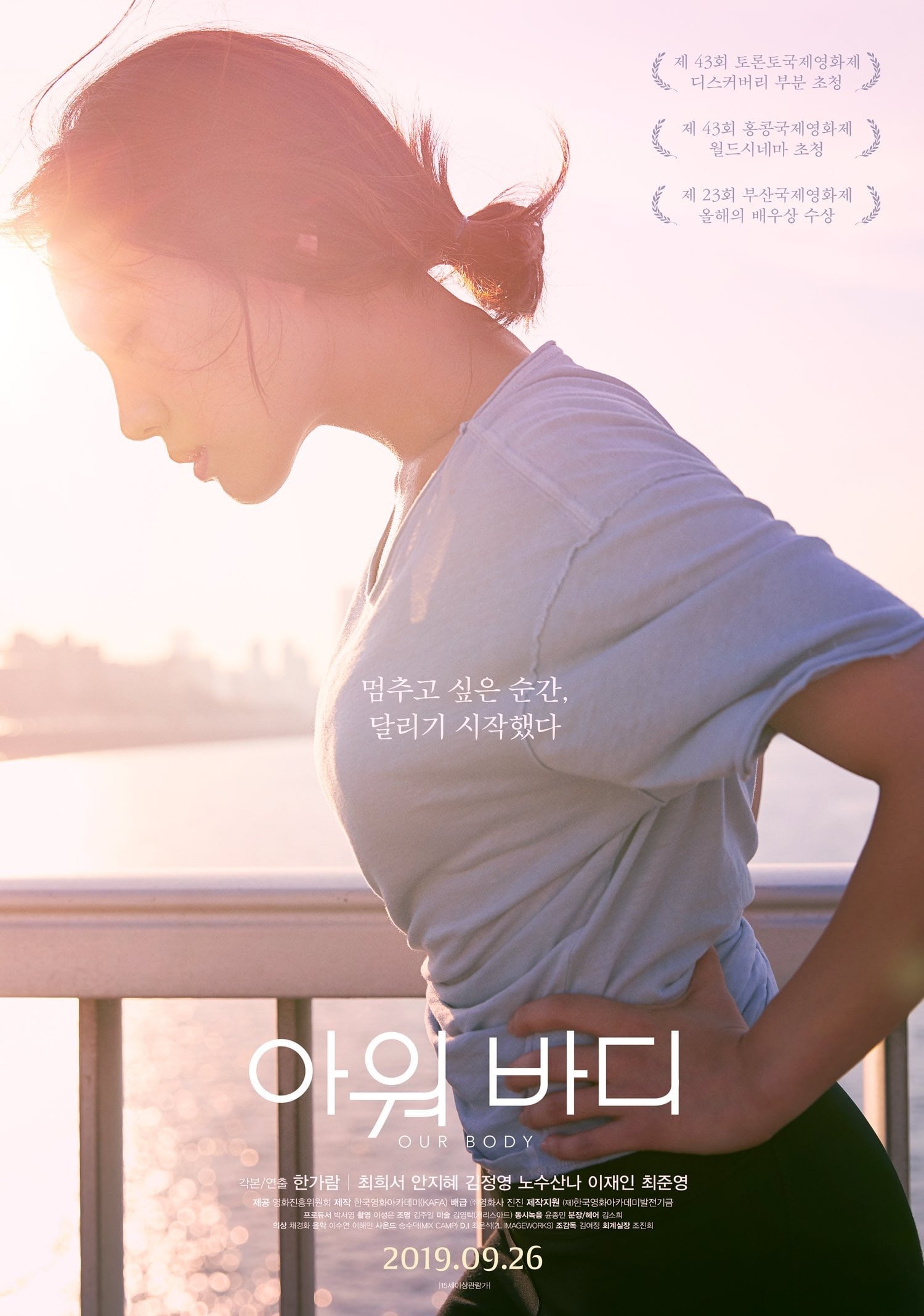
What’s it like to meet someone who embodies a purpose? How do you cope when that person moves on?
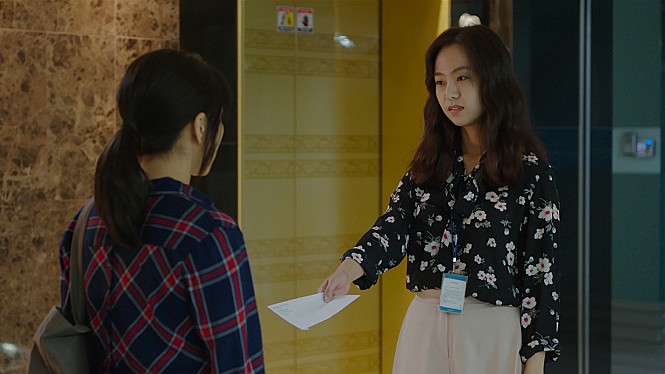
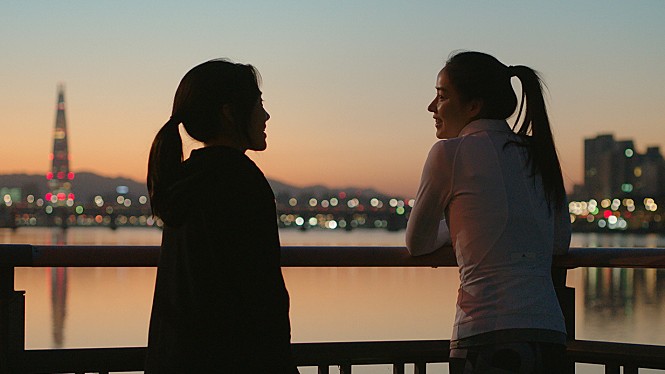
“The moment I wanted to stop, is the moment I started running.” Estimated reading time: 5 minutes. Spoilers for first half of film. Source, all images: Naver Movies.
What main character Yun Ja-yeong (Choi Hee-seo) does stop at the beginning of this film is studying for years alone in her small, dingy apartment for the civil service examinations, the path to securing a rare stable job in Korea. Her goal was—is—depressingly normal, shared by as many as half a million young Koreans at a time.
What makes Ja-yeong different to them is that she’s done nothing else since graduating. That she chose this path despite having attended a prestigious university, which would have made her a shoo-in for most other jobs. But now she’s too old for those at 31, which also means she kept at her goal long after most would have wisely given up. Her inexplicable failure is further compounded by her briefly-seen boyfriend pointing out that she has no life or ambitions outside of studying and passing. (After some unenthusiastic sex, he leaves her for precisely this reason. She seems surprised—already we’re not.) Even her fateful decision not to take the latest round of exams is taken more out of apathy and resignation than resolve about what to do next.
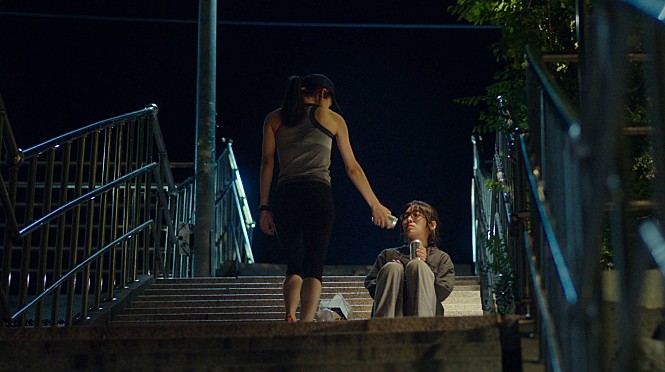
But when the enormity of having wasted her entire adult life does hit her, it hits hard. She collapses in tears in a local park, the cheap convenience store food she lives off tumbling down the steps.
Then as if in a vision, the figure of jogger Gang Hyeon-ju (Ahn Ji-hye) suddenly materializes to hand her dropped items back to her, before vanishing out of her life again just as quickly. Looking poised, confident, athletic, and driven in her expensive athleisure wear, she is everything Ja-yeong is not.
Drawn like a moth to the flame, over the next few weeks Ja-yeong watches YouTube videos about jogging and struggles to put them into practice, shuffling and wheezing around a school track in old sneakers and clothes, all for the sake of a chance to meet Hyeon-ju again. She must also get a job—it’s implied that her mother (a much too young for the role Kim Jeong-yeong) has been paying all her rent and living expenses all this time, but, bitterly disappointed with Ja-yeong’s decision, may not do so indefinitely.
Finding the job search difficult because of Korea’s blatant ageism however, middle-school friend Min-ji (Noh Susanna) takes pity on Ja-yeong and manages to get her a basic, entry-level admin job in the company she works at. Yet she’s awkward there, unable to relate to her much younger coworkers, nor sharing their ambition. You sense that her time there will be short.
Then she does find Hyeon-ju. Soon, Hyeon-ju’s brought her into her large jogging club, then later lets her go on group runs with her and two other male members once she’s improved. Yet for all the viewer’s anticipation of their meeting again, the development of their relationship is glossed over, the focus going on Ja-yeong’s ensuing physical and mental transformation instead. Suffice to say, she becomes every bit as confident of herself and proud of her body as Hyeon-ju. This reflects in her job too, where she realizes the opportunities that are open to her, and even plans on a career.
Yet still her mentor remains frustratingly private. Only after running together for months does Ja-yeong even learn that she works in the publishing industry, and is a fledgling author.
That admission does presage a greater level of intimacy to follow, with more sudden phone calls from Hyeon-ju for personal midnight and sunrise runs together, and invites to drink at her place. In the first, after pointedly asking Ja-yeong what her sexual fantasies are, a very drunk Hyeon-ju strips to her underwear due to the heat. It sounds cliched, and is, but despite yourself you also yearn for them to begin a sexual relationship then—not only because of the camera’s focus on their bodies throughout this deeply sensual film, which makes it feel somewhat inevitable, but also simply for the opportunity to learn anything about Hyeon-ju at all. What makes her tick? What is she getting out of their relationship? What made her take Ja-yeong under her wing, a seeming basket-case who chased after her literally bawling her eyes out the second time she saw her, a complete stranger?
It doesn’t happen. Nor in the next visit, when Ja-young, concerned she’s missing their group runs and not answering her phone, waits outside her door until Hyeon-ju stumbles home drunk. Ja-young knows the reason is because her novel was rejected by a publisher, but doesn’t reveal this. Then after more drinks together inside, Hyeon-ju, in a rare moment of vulnerability, asks if she wants to read it—but Ja-yeong has already passed out.
Two minutes later of screentime later, Hyeon-ju’s dead, hit offscreen by a car during their next run together. It’s strongly implied she stepped in front of it deliberately.
Believe me, I debated over whether to reveal that spoiler.
I plead that after her death, exactly halfway in, Our Body feels like a different film entirely, impossible to discuss further without mentioning the circumstances that precipitated the change. For in that second half, the focus moves to her job, where Ja-young must deal with the conflicting demands of her grief, office politics, and her mother’s and friend’s expectations. Suddenly, she is every young Korean woman, chafing at her assigned place in a deeply hierarchical, status-obsessed, and sexist society.
Watch the film primarily for that last element, and you’ll be rewarded; I’ll wrap up my brief review here for so as not to spoil it.
But do not necessarily expect to be able to answer the question many other reviewers raise, of if Ja-young wants to be Hyeon-ju, be with Hyeon-ju, or both.
If forced, I’d argue the former. Primarily, because despite her growing confidence, Ja-yeong never initiates contact beyond that desperate chase at the beginning. Indeed, perhaps because Hyeon-ju comes across as somewhat of a ghostlike figure throughout, aloof and distant to the end, never giving Ja-young much to grasp on to with which to develop any potential platonic or romantic desire. Yet being the intense focus of the main character for all that, for this reason the underdevelopment of Hyeon-ju’s own story is my main frustration with this otherwise softly subtle, thoughtful film. So too that of Ja-yeong’s middle-school sister Hwa-yeong (Lee Jae-in), whom you suspect by the film’s end is the only other character who has any real sense of how Ja-yeong has changed and what she’s going through—but those conversations Ja-yeong needs with her never happen.
One of my favorite Korean YouTubers starts a new series
Estimated reading time: 3 minutes. Photo by @thiszun from Pexels
“What is he, man or mouse? Is he interested in nothing more than tea and the wider issues of life? Has he no spirit? Has he no passion? Does he not, to put it in a nutshell, fuck?”
Those who wish to know should read on. Others may wish to skip on to the last chapter which is a good bit and has Marvin in it.
Douglas Adams, So Long, and Thanks for All the Fish, Chapter 25.
With that, Douglas Adams finally addresses readers’ burning questions about Arthur Dent, the main character of his classic Hitchhiker’s Guide to the Galaxy series. Reach the same point in the fourth book, and you’d be asking too. Why indeed, describe a cishet man meeting women he was interested in, some of whom felt a mutual attraction for him, only to tell us nothing whatsoever about what happened next? For three whole books?
Those 1980s readers’ frustrations mirror my own with Korean pop culture today. Dramas in particular often fall flat for me because the adult characters seem to have relationships but never sex.
No, I don’t need to see them in bed necessarily. Nor does sex have to be the plot’s focus. Just have them acknowledge it’s a thing. Talk about its associated problems and pleasures sometimes. Admit experience and desire. Make bawdy jokes. You know, like normal adults do, including asexuals.
Don’t, and I just can’t relate to the characters at all.
I could continue with my feelings about other elements of Korean pop culture, such as being unable to find much interest in or desire for K-pop idols presented for our sexual objectification who are not allowed to actually have sex themselves. But you get the idea. You may also find my very limited experience quite unlike your own, and actually know plenty of Korean dramas, say, in which the characters don’t shy away from talking about about one-night stands, contraception, consent, and so on. If so, then do please let me know.
Which brings me to why I’m so excited about YouTuber Daisy’s latest video below. Many years ago, I finally found the relatable, adult stories I was seeking not in dramas, but in the monthly manhwa compendium PopToon instead—only then for it to cease publication just a few months later. Heartbroken, I refused to make the transition to webtoons. But, she’s finally persuaded me to take the plunge, and I hope you’ll find something of interest in her video too, and/or in later ones in the series (note she includes fluent English CC subtitles):
Ironically, I didn’t actually like any of her suggestions here, mostly because I’m not a fan of the sharp, angular drawing style in most of them. But I am looking, so please send me your own recommendations!
If you reside in South Korea, you can donate via wire transfer: Turnbull James Edward (Kookmin Bank/국민은행, 563401-01-214324)
Ten years since I first wrote about it, I’m still astounded that K-pop stars can endorse school uniforms. Surely, much of the blame for Korea’s notorious issues with female body image can be laid squarely on K-pop and school uniform companies’ shoulders? Those same companies that tell 12-year-old girls entering middle school that their new uniforms will help them show off their tits and ass to boys?
Left: Victoria Song of f(x) showing off her ‘S-line’ in 2009 (Source unknown). Right: Eun-ha of GFriend in 2016; middle caption says “The ‘Tulip Line’ skirt that will immediately capture men’s hearts” (Source: MLBPARK).
But things may not be so one-sided as they may seem. At the end of her must-read March 2017 post “Time to Stop Skirting the Issue: Sexualization of School Uniforms in South Korea,” Haeryun Kang noted in Korea Exposé that:
Tighter uniforms have been popular among boys and girls for years. A recent survey of over 9,000 teenagers showed that students from elementary to high school generally preferred uniforms that were slightly tighter and shorter. In the debate surrounding the sexualization of teen uniforms, the voices of teenagers themselves is conspicuously absent.
In my own post “How Slut-Shaming and Victim-Blaming Begin in Korean Schools” too, published on the same day (hey, great minds think alike), I noted that being able to wear more fashionable clothes had also been directly tied to the liberalization of students’rights. Plus, students the world over have generally always wanted to improve upon their drab uniforms. Once the sexualization of their uniforms began in earnest here a decade ago then, there would undoubtedly have been many girls who genuinely wanted to wear the tight, figure-hugging styles promoted by K-pop stars, and probably often despite the objections of their parents and teachers too. To assume they were simply dupes of the uniform companies instead would be incredibly naive and misguided, let alone patronizing.
Alas, the survey mentioned by Kang is likely unreliable, as it was conducted by a school uniform company itself. But her conclusion still stands: listen to teenagers themselves. Don’t assume.
When you do, you discover what girls are saying these days is that they can’t breathe in their uniforms. That they hate them. That wearing them is having serious effects on their learning, well-being, and physical health. That they’re angry. That rather than being a reflection of their wishes, having such limited clothing choices imposed on them is actually an infringement of their rights.
In other words, generally the complete opposite of what the schools and the uniform companies would like them to. Wow—teens don’t like being told what to do. Who’d have thought?
Let’s hear from some of those teens, starting with those interviewed in the following June 2018 MBC News Today report. Appropriately enough, it’s opened by everyone’s favorite news anchor Lim Hyeon-ju, who also didn’t like being told what to do—in March that year she’d become the first Korean female news anchor to wear glasses on the job, and later would go on to be the first to appear without a bra:
My translation of the transcript:
숨도못쉬는여학생교복…”인권침해수준” Uniforms Girls Can’t Breathe in…”An Infringement on my Human Rights.”
Anchor
여자는 치마에 블라우스, 남자는 바지에 셔츠. 중·고등학교 교복에 적용되는 흔한 규정인데요. 그런데 요즘 여학생들 사이에서는 치마 대신 바지를, 블라우스 대신 편한 셔츠를 입게 해달라는 요구가 끊이지 않고 있습니다. 그 속사정을 서유정 기자가 취재했습니다.
Girls wear a skirt and a blouse, boys wear pants and a shirt. This is a common rule regarding middle and high school uniforms. Nowadays however, there are constant calls from girls to likewise be able to wear more comfortable shirts and pants. Reporter Seo Yoo-jeong covers the story.
Reporter
단추도 채워지지 않는 블라우스, 숨 쉬는 게 힘겨울 정도로 꽉 조여진 허리라인. 20대 여성들이 카메라 앞에서 중·고등학교 교복을 입고 힘겨워합니다.
Blouses so tight that all the buttons can’t be done up, waistlines that make it difficult to breathe. In front of the camera, women in their 20s are struggling to wear middle and high school uniforms.
[김서윤] “숨을 못 쉬겠어요. 단추를 하나만 더 풀게요.”
[Kim Seo-yoon] “I can’t breathe. I’ll just undo one more button.”
[정겨운] “이런 걸 입고 하루에 12시간 이상을 산단 말이에요? 이건 진짜 인권 침해인데.”
[Jeong Gyeo-woon] “You mean you have to live wearing these things for more than 12 hours a day? This is a real human rights violation!”
요즘 여학생들의 교복 블라우스가 얼마나 작고 불편한지를 눈으로 보여준 이 영상은 조회수 20만 건을 넘기며 인터넷을 뜨겁게 달궜습니다.
This video, which shows how small and uncomfortable girls’ school uniform blouses are these days, has already received more than 200,000 views. [James—Its contents will be covered in more detail later below.]
요즘처럼 날이 더워질수록 교복에 대한 여학생들의 불만은 더해갑니다.
As the days get hotter with the summer, girls’ complaints about their school uniforms will only increase.
기자가 입어보니, 기성복으로 나온 교복을 줄이지 않고 입었는데도 블라우스는 치마 허리선을 아슬아슬하게 덮을 정도로 짧습니다. 손을 들면 맨살이 그대로 드러날 정도입니다. 통은 더 좁게, 길이는 더 짧게.
This reporter tried on an off-the-shelf uniform. Yet even though it was not shortened, the blouse only barely covered the waistline of the skirt. When I raised my hand, the bare skin of my waist was exposed. [Compared to the uniforms I wore as a girl], the waist is narrower and the length is shorter.
학교에서 정한 대로 교복업체는 디자인을 맞춰줄 뿐이라고 합니다. [◇◇교복 업체 관계자] “학교의 원래 원칙은 짧아서 이게(허리선이) 보여야 했어요. 그걸 저희가 이번에 길게 뺀 거예요.”
It is said that school uniform manufacturers [generally] only produce designs as determined by the schools. [Anonymous school uniform manufacturer] “Even though your midriff got exposed when you raised your hand, in fact the original school’s design for this blouse was even shorter. We lengthened it.” [James—Consider the implications for sexuality equality in classroom interactions and discussions when the girls’ clothes alone ensure they’re too embarrassed to even raise their hands!]
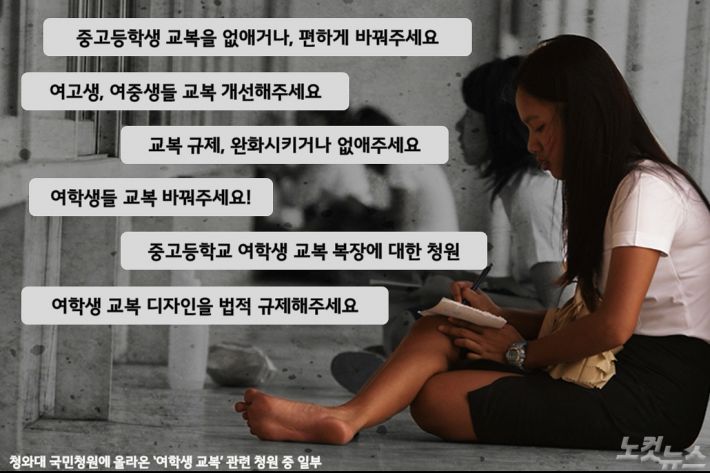
“이런 불만은 ‘교복을 없애달라’, ‘여학생들도 바지나 남자 셔츠를 입게 해달라’는 국민청원으로까지 이어지고 있는 상황. 이런 요구를 받아들여 남녀구분 없이 ‘편한 교복’을 입게 하는 학교들도 조금씩 생겨나고 있습니다.
The ensuing dissatisfaction is leading to national petitions calling for girls to be able to wear boy’s uniforms, or to do away with school uniforms entirely. Schools that accept these demands and have allowed boys and girls to wear ‘comfortable uniforms’ are also slowly emerging.
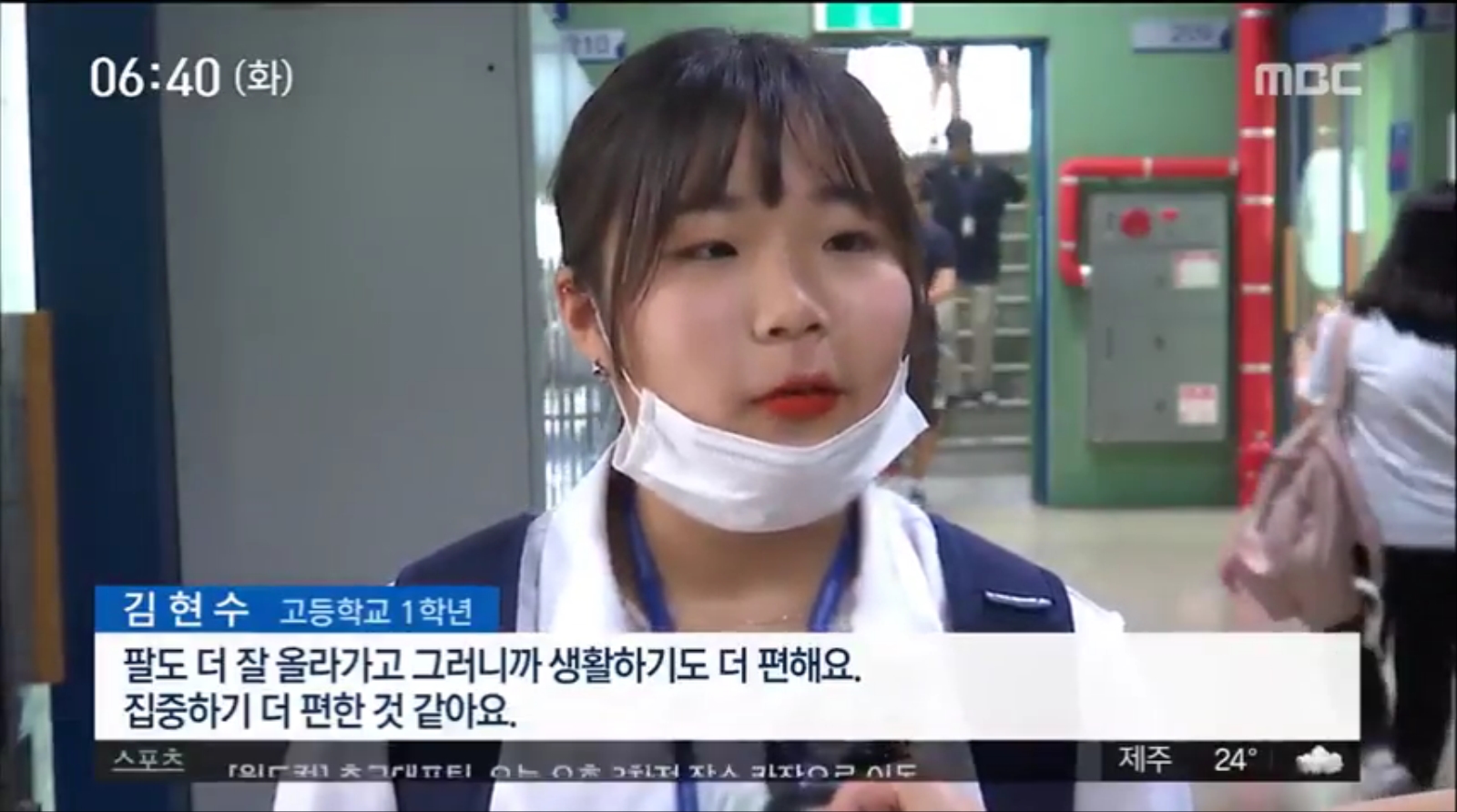
서울의 한 고등학교는 봄 가을엔 헐렁한 후드 티를, 더운 여름엔 반바지와 면 티셔츠를 교복으로 입습니다. [김현수/고등학교 1학년] “팔도 더 잘 올라가고 그러니까 생활하기도 더 편해요. 집중하기 더 편한 것 같아요.”
[Kim Hyeon-su, first year student at this high school] “I can raise and move my arms much more easily, so I have a better quality of life. I think it’s easier to for me to concentrate too.” One high school in Seoul allows baggy hoodies to be worn in the spring and autumn, and shorts and cotton t-shirts in the hot summer.
옷값을 줄이고, 공동체 의식을 갖게 하는 교복의 긍정적인 기능은 살리되, 성별에 따라 복장을 규정하고 움직임에 불편을 주는 폐단은 버리자는 취지입니다/
With these comfortable uniforms, the school’s goal is to retain the good points of school uniforms such as the reduction in the cost of clothes and the fostering of a sense of school community, while also doing away with defining uniforms by sex and removing any features that make it difficult to move freely. (End)
Next, adding to the point about exposed waists especially, here are some segments from a March 2018 CBS No Cut News report by Gwon Hee-eun:
“슬림핏교복두려워요” 여학생들교복공포증 “I’m afraid of slim fit school uniforms”: Girls’ School Uniform Fears
…여학생들이 입는 하복 셔츠는 짧은 기장 탓에 책상에 엎드리면 셔츠가 훤히 올라가 맨살이 드러나는 것은 물론, 가만히 있어도 속옷이 비칠 정도로 얇다.
…Because of the short length of the summer blouses, they rise up and reveal girls’ skin when they bend forward while sitting at their desks. They are also thin enough to reveal the outlines of underwear even while the girls are sitting still.
이때문에 보통 하복 셔츠 안에 민소매나 반팔 티셔츠를 덧대어 입는 것이 일반적이다. 어떤 학교에서는 이를 ‘교칙’으로 지정해두기도 할 정도다. 더 단정해 보인다는 이유에서다.
For this reason, it is common to wear a sleeveless or short-sleeved T-shirt underneath a summer blouse. Some schools have even incorporated this into their uniform codes, believing it looks neater. [James—Assuming this rule only applies to girls, this means they would swelter under blouses, bras, and t-shirts in summer classrooms, compared to boys enjoying just one layer. See my earlier post to learn more about many more discriminatory rules like this.]
여학생들의 교복이 과하게 짧고 작아 불편을 초래한다는 사실은 여러 차례 지적돼 왔다. 그러나 교복업체들은 여전히 날씬해보이는 ‘슬림핏’을 마케팅 포인트로 내세운다.
It has often been pointed out that girls’ uniforms are uncomfortable and inconvenient because of their small size and short length. However, promoting this ‘slim fit’ is at the heart of school uniform companies’ marketing strategies.
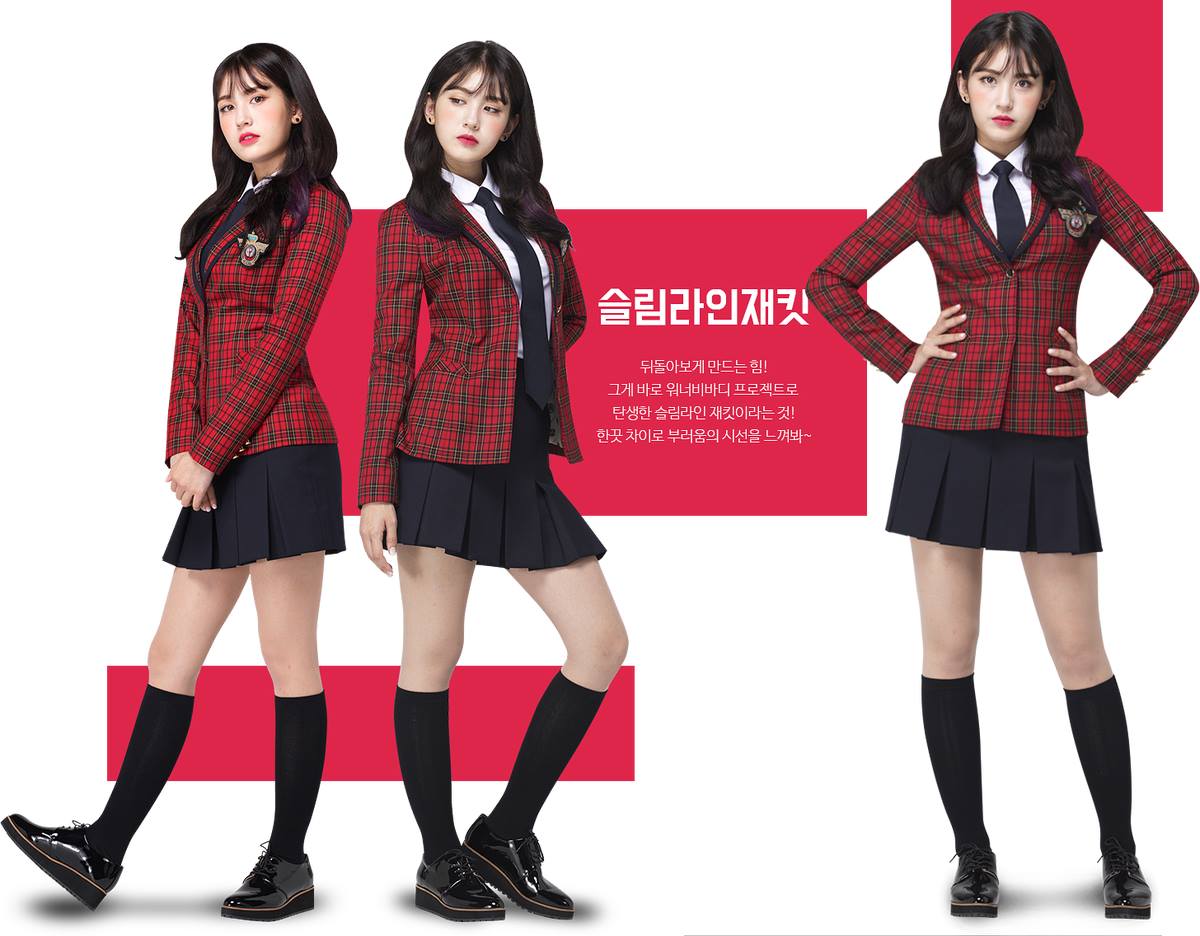
교복 광고 속 날씬한 여자 아이돌들은 타이트한 자켓과 짧은 치마를 완벽하게 소화해낸다. 하루에 열시간 넘게 교복을 입는 학생들에게는 그런 완벽한 ‘슬림핏’이 불편하다.
In school uniform advertisements, slim female K-pop idols perfectly fit into their tight jackets and short skirts. However, they are uncomfortable for [real-life] students [with a much wider range of body types] who have to wear them for more than 10 hours a day.
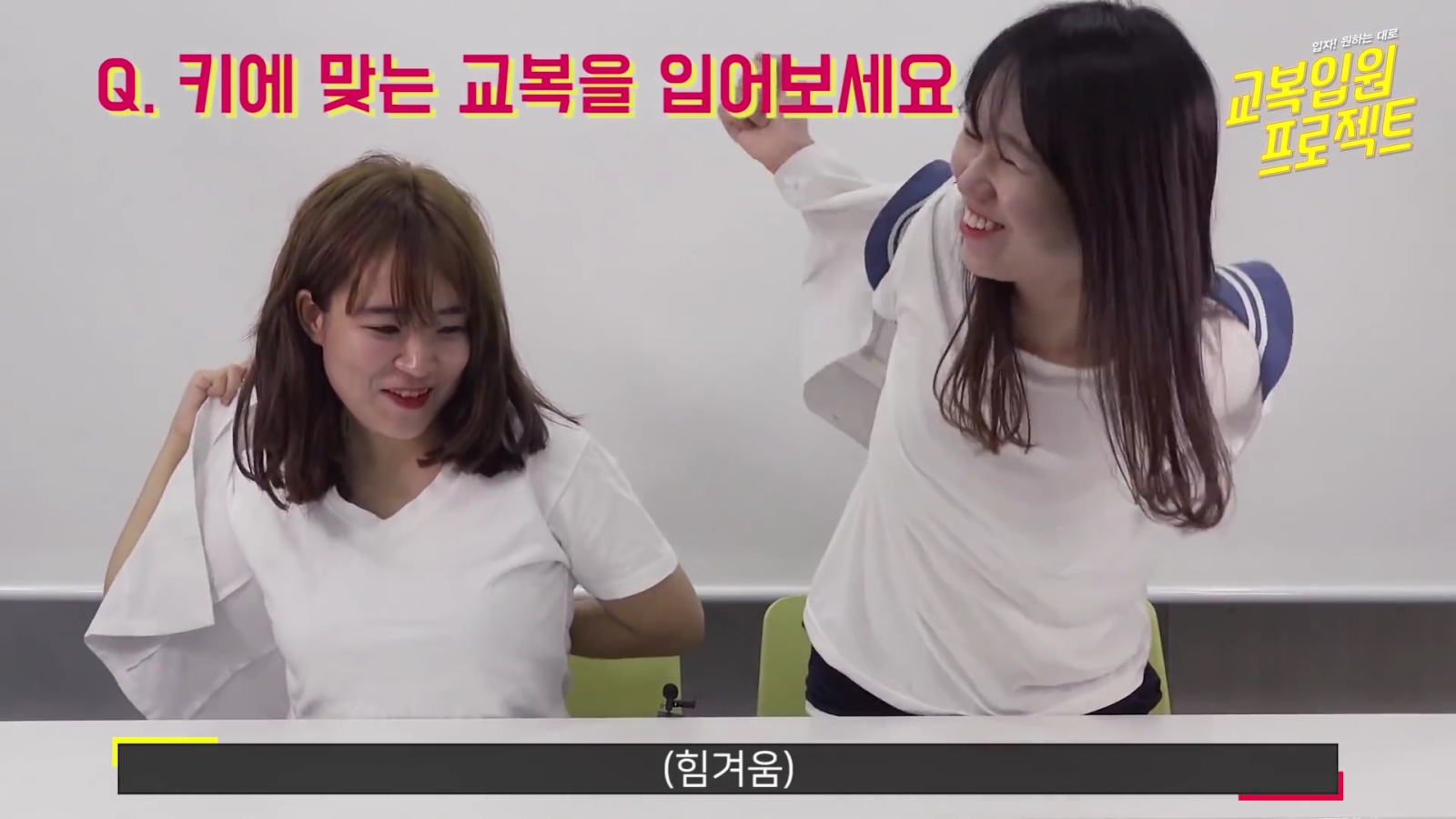
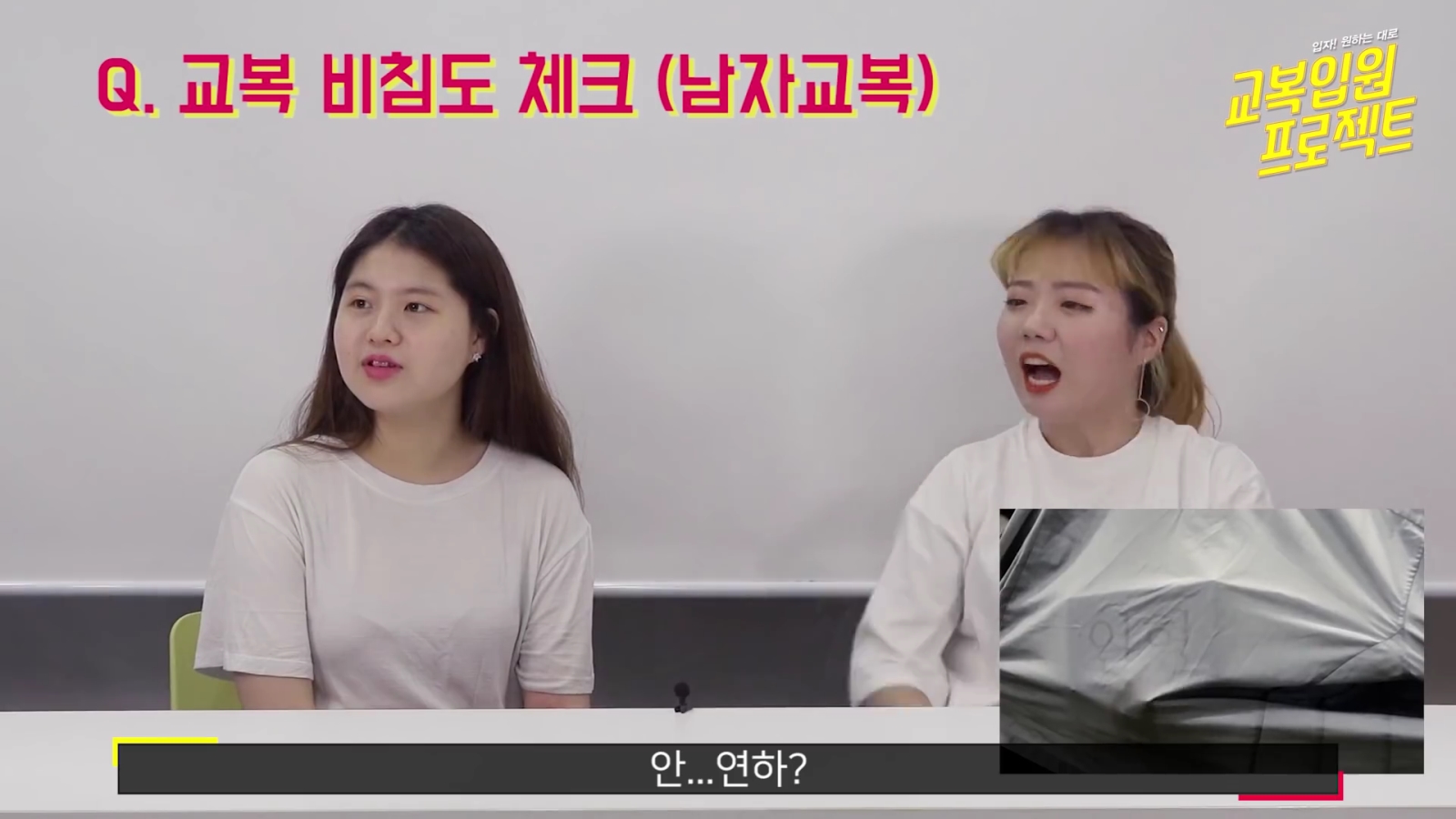
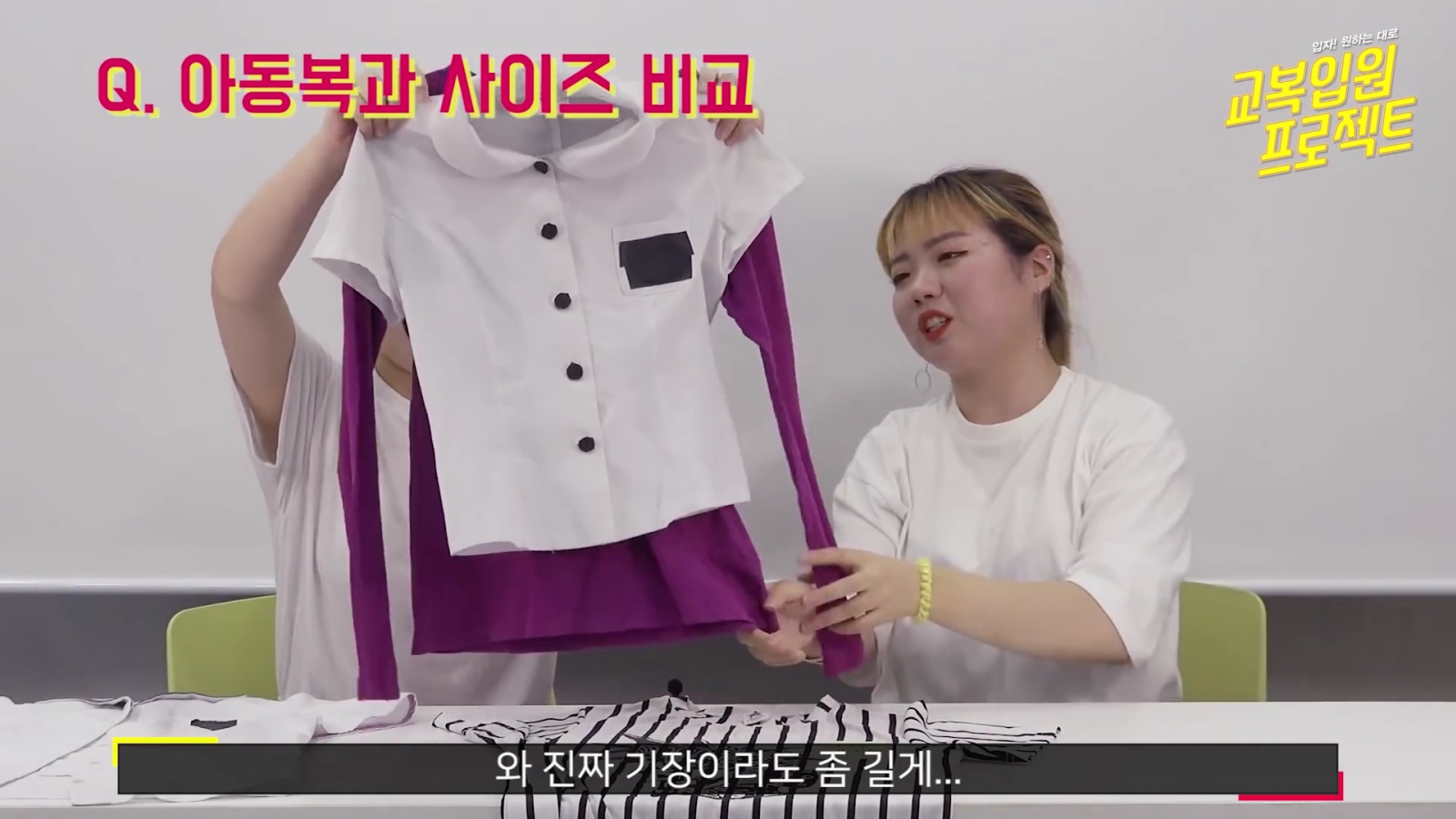
최근 유튜브에서 눈길을 끈 ‘교복입원프로젝트’ 영상을 보면 이런 문제는 더 적나라하게 드러난다.
The extent of the problem becomes readily apparent when you see the following video from the ‘School Uniform Hospitalization Project,’ which has recently attracted attention on YouTube [as seen in the first report].
(Not by FemiAction, but this later video by RealCafe of boys trying on girls’ uniforms is also interesting and amusing)
‘불꽃페미액션’이 제작한 이 영상에는 여섯명의 여성이 등장해 실제 여학생 교복 상의와 아동복 사이즈를 비교하고, 직접 착용해보기도 한다.
In this video, produced by Fireworks FemiAction, six women appear, compare the sizes of actual school uniform tops and children’s clothes, and try them on.
여학생용 교복셔츠와 남학생용 교복셔츠를 비교해봤더니, 여학생용 교복셔츠가 훨씬 비침이 심했다. 여학생용은 글씨 위에 셔츠를 겹쳐도 글씨를 바로 알아볼 수 있는 반면, 남학생용은 다소 시간이 걸렸다.
When the boys’ shirts were compared with the girls’ blouses, the uniform shirts for girls were much more see-through. For girls’ blouses, things with writing on them hidden underneath were immediately able to be made out. Whereas with boys’ shirts, it took some time.
키 170cm, 가슴둘레 94cm 기준인 여학생 교복 셔츠와 7~8세용 15호 아동복 사이즈를 비교해보니 가로 폭은 별 차이가 없었고, 기장은 아동복보다 훨씬 짧았다.
When comparing the size of a school uniform blouse for girls with a height of 170cm and a chest circumference of 94cm to a casual size 15 t-shirt intended for girls between 7-8 years old, there was no difference in width, and the length was much shorter than that of the t-shirt.
활동성이 전혀 고려되지 않은 사이즈로 만들어졌다 보니, 머리를 묶거나 팔을 뻗는 등의 동작도 하기 어렵다.
Blouses of this size don’t take any activity or movement into account, so it’s difficult to tie your hair or stretch your arms.
이렇듯 많은 학생들이 아동복보다 작은 교복으로 불편함을 겪고 있지만, 학교 내에서 체육복 등 편한 옷으로 갈아입고 있는 것도 허용되지 않는다.
…[The article continues by saying that students would prefer changing into their more comfortable gym uniforms, but this is generally only allowed in exceptional circumstances such when their regular uniform is torn or has food spilt on it.]…
(Update: As reported by The Korea Bizwire in June 2020, an ironic side-benefit of the Covid-19 Pandemic has been that schools have become more relaxed about this, allowing students to wear their gym uniforms on days they have physical education classes at school. The logic is that allowing them to wear them for the entire day reduces physical contact with other students while changing.)
실생활에서 불편함을 느끼는 학생들이 꾸준히 문제제기를 하고 있지만, 교복 판매업체의 정책과 각 학교의 교칙 등 여러 가지가 얽혀있는 사안이라 명확한 해결책이 나오지 않고 있다.
Students who feel uncomfortable in real life are constantly raising problems, but there are no clear solutions due to issues that are intertwined with the policies of school uniform vendors and school rules of each school. (End)
Finally, some segments of a July 2017 report by Son Ho-yeong for The Chosun Ilbo:
여고생에 ‘8세 사이즈’ 입어라… 숨쉬기 힘든 S라인 교복 Uniforms for High School Girls are Smaller than Clothes for 8 Year-Olds…S-line Uniforms that Make Breathing Difficult
서울 양천구의 한 여고에선 교복 블라우스를 ‘배꼽티’라고 부른다.… 이 학교 정모(17)양은 “교복에 몸이 갇힌 느낌”이라고 했다.
In one girls’ high school in Yangcheon-gu, Seoul, school uniform blouses are called ‘crop tops’….One 17-year-old student there said, “I feel trapped in my school uniform.”
…상당수 학교가 맵시를 강조하면서 허리선을 잘록하게, 길이는 짧게 디자인한 교복을 채택하고 있다. 보통 몸매인 학생들도 조금만 움직이면 속옷과 맨살이 훤히 드러나 제대로 활동하기 어렵다. 체형이 통통한 학생은 꽉 끼는 교복 때문에 수치심을 느끼는 경우도 있다. “교복 때문에 학생들의 인권이 침해받는다”는 소리가 나올 정도다.
…Many schools have adopted school uniforms designed to be short and with narrow waistlines, while emphasizing style. Yet their tightness means that students with average bodies find it difficult to study properly because their underwear and bare skin are exposed if they move a little, with larger than average students feeling even more anxious. [Indeed], you could go so far as to say school uniforms are violating their human rights.
예전 교복은 활동성을 고려해 펑퍼짐한 스타일이 많았다. 학생 일부가 멋을 내느라 치마 길이를 줄이고, 허리선을 강조하는 식으로 수선했다. 요즘은 처음부터 교복이 몸에 달라붙게 나온다. 늘이기는 어려운 디자인이다. 자신의 실제 몸 치수보다 큰 것을 사도 사정은 다르지 않다. 서울 종로구의 한 여고생은 “겨울 교복보다 두 치수나 큰 여름 교복을 샀는데도 허리의 ‘S라인’이 지나치게 들어가 밥을 먹고 나면 옷이 끼어 거북하다”고 했다.
With older school uniforms, there were many styles that were both flattering and didn’t hamper movement. [Naturally however,] some girls would shorten their skirts and emphasize their waistlines to look more attractive. Yet these days, school uniforms cling to the body from the beginning, and are difficult to stretch. Compensating by buying larger sizes may not even help either. One high school girl in Jongno-gu, Seoul said, “I bought a summer school uniform that is two sizes larger than my winter school uniform. But the ‘S-line’ on the waist is too overdone, and after I eat my clothes still start clinging to my body.”
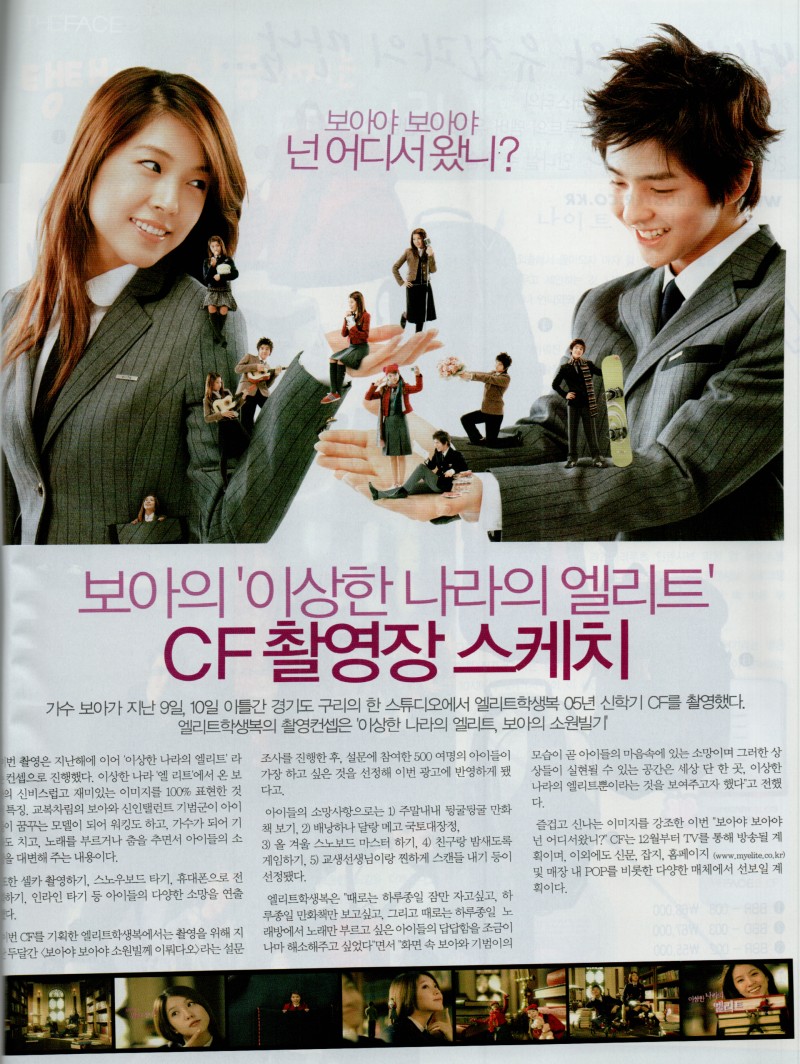
A 2003-2005 school uniform advertisement featuring BoA; I’m unsure who the boy/man is sorry. See many more examples from then here.
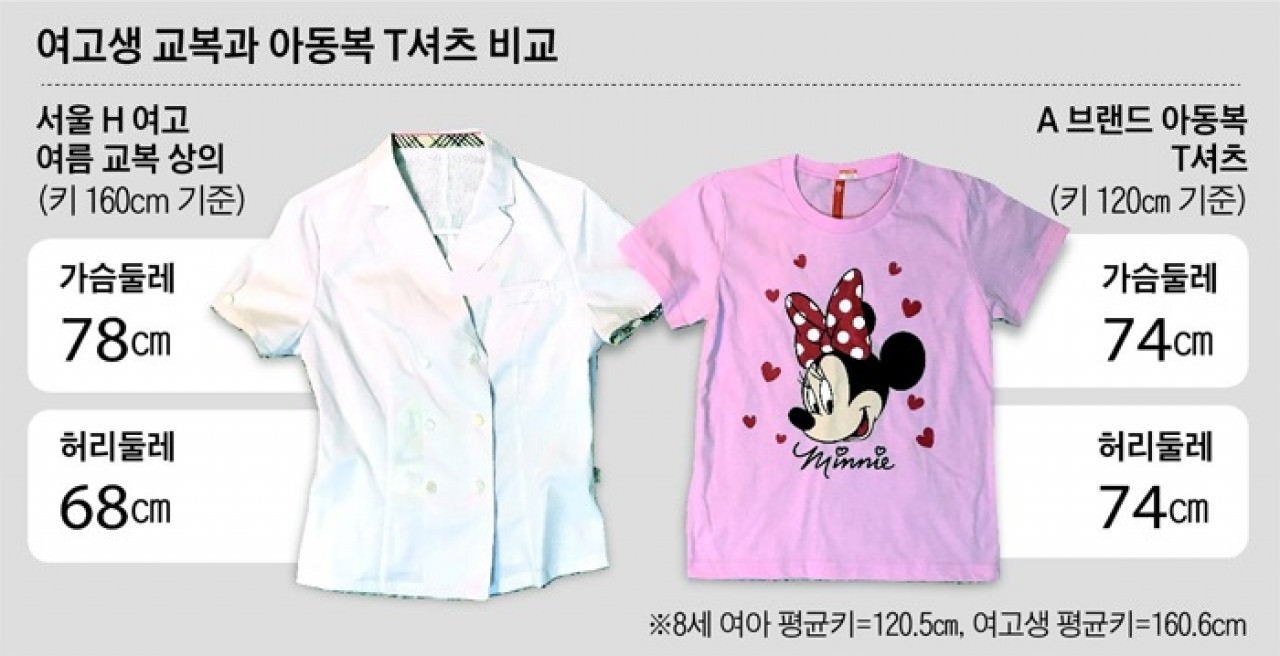
날씬한 맵시만 강조하다 보니 여고생 교복 치수가 8세 아동복 수준이 되기도 한다. 서울 강북구의 한 인문계 여고 교복 상의(키 160㎝·88 사이즈)와 시중에 판매 중인 7~8세 여아용 티셔츠(130 사이즈)를 비교했더니 크기 차이가 거의 없었다.
As they emphasize only slim fit styles, the size of school uniforms for high school girls is the same as casual clothes for 8-year-olds. There was little difference in size when comparing a school uniform top (160cm tall, size 88) for girls in a school in Gangbuk-gu, Seoul and a t-shirt for girls aged 7-8 years old (size 130) sold at the local market.
2016년 기준 우리나라 여고생의 평균 키는 160.6㎝, 8세인 초등학교 1학년 여아 평균 키는 120.5㎝이다.
As of 2016, the average height of high school girls in Korea was 160.6 cm, and the average height of a 8-year-old girl entering elementary school was 120.5 cm.
교복은 기성복과도 차이가 있다. 한국산업표준(KS)에 따르면 키 160㎝인 여성 청소년의 ‘보통 체형’용 기성복 상의(블라우스 기준)는 가슴둘레 88㎝, 허리둘레 72.8㎝이다. 본지가 구한 여고 교복 상의의 가슴둘레는 78㎝, 허리둘레는 68㎝였다. 교복이 기성복 가이드라인보다 가슴둘레 10㎝, 허리둘레는 5㎝가량 작다.
School uniforms are also different from ready-made clothes. According to the Korean Industrial Standard, a 160cm tall female adolescent’s non-uniform, off the shelf, blouse-like top for a ‘normal’ body type has an 88cm chest and 72.8cm waist. Yet the waist circumference of a girls’ high school uniform blouse obtained for this report had an 78 cm and a 68cm waist, meaning that school uniforms are about 10 cm shorter in chest circumference and 5 cm in waist than required by the standards for off the shelf clothes.
일부 여학생은 교사의 단속을 피해 남학생용 교복을 사서 입기도 한다. 대전 서구의 한 남녀공학 고교에 다니는 이모(16)양은 “남학생용 교복은 라인이 없어 편하다. 학생주임 선생님이 남자 교복을 입지 못하게 수시로 단속하지만 몰래 입는 친구가 많다”고 했다.
For the sake of comfort and to avoid unfair school rules regarding girls’ uniforms, some wear boys’ school uniforms instead. One 16-year-old girl who attends a coeducational high school in Seo-gu, Daejeon, said, “The school uniform for boys is comfortable because there is no figure-hugging ‘line’ built into them. Although our teachers regularly crack down on this, many of my female classmates secretly wear them.”
교복 브랜드의 ‘슬림 라인’ 전쟁은 2000년대 초부터 시작됐다. 멋을 위해 교복을 줄이는 학생들이 늘면서 교복 제조업체들이 허리가 쏙 들어가고 길이가 짧은 디자인의 교복을 내놓기 시작했다. ‘재킷으로 조여라, 코르셋 재킷’ 같은 광고 문구를 내세웠다.
The ‘Slim Line’ war of school uniform brands began in the 2000s. As more and more students want more fashionable uniforms, manufacturers have responded by offering short designs with tight waists. In their advertising, they use phrases such as ‘Tighten with a jacket, corset jacket.’
…교복 업체가 사람마다 다른 체형을 고려하지 않는 것도 문제다. 한 업체는 체형 데이터를 바탕으로 청소년 ‘대표 체형’을 뽑아내 이를 기준으로 교복을 만든다고 광고한다. 하지만 이는 ‘보기 좋은 체형’일 뿐 해마다 몸이 변하는 청소년들에게 일률적으로 제시하는 것은 무리다.
Another problem is that school uniform companies do not cater to different body types. One company advertises that it makes a school uniform based on the ‘representative body type’ based on data collected about young people’s physiques. However, this supposedly representative type is really only a stereotypical ‘good looking body type’ [like that of the K-pop stars in the ads], nor does a single type take into account the fact that adolescents’ bodies are constantly changing. (End)
Thoughts? Still not enough? If so, I recommend also watching Dr. Kyunghee Pyun’s (Fashion Institute of Technology, State University of New York) presentation for the UBC Centre for Korean Research on “Impression Management of School Uniform Culture in Korea,” which I was able to attend on Zoom a few days ago. While it’s only loosely related, and covers much earlier time periods, it does provide some useful context:
Also, and finally, for a more recent and in-depth look, here is an 8-minute, November 2020 report by my local Busan MBC, ironically at one point filmed where I took this related, well-discussed picture. Unfortunately, producing a transcript and translation would be a bit prohibitive sorry, but the English CC seems to provide the gist. Enjoy!
If you reside in South Korea, you can donate via wire transfer: Turnbull James Edward (Kookmin Bank/국민은행, 563401-01-214324)
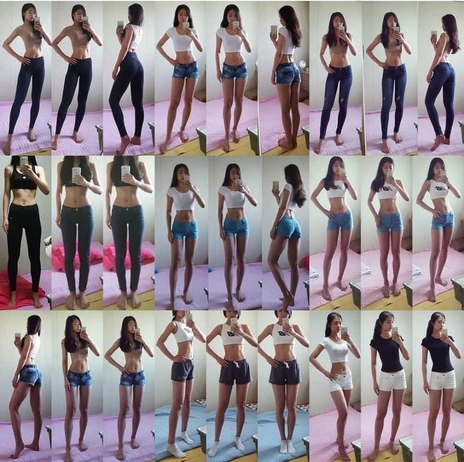
My students teach me to reevaluate Korea’s latest dieting trend. Is motivation dependent on selfies necessarily a bad thing, when 20-somethings already feel constantly overexposed?
Estimated reading time: 9 minutes. Photo by @thiszun from Pexels
Before the pandemic, I’d routinely request to take photos of my students in the second class of the semester. No, that wasn’t creepy at all.
It was the only way to learn the names and keep track of the progress of all 120 of them, whom I’d only meet for one class a week. Originally, when I started teaching at my university in 2010, I’d ask them for passport photos, which they’d supply without a second thought. Due to the requirement for resumes and job applications, which still exist today, Korean 20-somethings especially were used to providing passport photos for all sorts of documents, and typically had many stored at home.
Gluing all those photos onto name cards however, was a thankless task. Once in possession of my first smartphone then, I’d eagerly explain that it would be much more convenient to just quickly go around the class with it, taking shots of each group at their desks. Most instantly saw the logic, and seemed to appreciate my making the effort.
Occasionally, the odd female student—never male—would initially be a little nervous. Yet once I made it absolutely clear that they would only be for my own use, and how unethical and unprofessional it would be for me to upload them to social media, they soon relaxed. Generally, taking the pictures would turn into a brief ice-breaking activity, with most students happily posing or just goofing around with their classmates for the camera. The next class, they’d all have a good laugh at my printouts of the photos while attaching their names to them, and that would be that.
But by 2019, it was no longer a laughing matter. Increasing numbers of female students would be covering their faces as I took their shots, literally wailing. Many would be on the verge of tears, so daunting and so overwhelming was the prospect of an unedited, unfiltered image of them getting out there, no matter how remote.
I am not exaggerating.
So to their great relief, I starting asking everyone to just send me picture files instead. Again, a much more laborious and time-consuming process from my perspective, with many of the ensuing photos being so altered as to render the students unrecognizable. But I’d learned my lesson. When offline classes resume, I will never be asking to take pictures of my students again.
I’m not judging them. I’m not a woman, and I didn’t reach adulthood in the midst of a massivespycamepidemic. I don’t have to bring “specs” like my filtered, digital appearance to play in a desperate competition for jobs with other 20-somethings either. Nor do I mean to imply that young Koreans are any more sensitive on this issue than zoomers in other countries.
Merely, this is the context I bring to the “EyeBody” trend (눈바디/noonbadi) I recently learned of. Here’s a definition from the Naver blog Styler Life:
눈바디란 눈(Eyes)와 인바디(Inbody)의 합성어. 체중계의 숫자보다 ‘눈으로 보이는 몸의 라인이나 근력 상태가 더 의미 있는 변화다’라는 취지에서 나온 단어다. 즉 체중에 연연해하지 말아야 더 건강한 몸을 만들 수 있다는 의미. 눈바디를 이용한 다이어트 방법은 매우 간단하다. 매일매일 자신의 전신 사진을 찍어 기록하는 것. 많은 헬스타그래머가 이 방법을 이용하고 있으며 후기에는 효과를 보았다는 내용이 대다수를 이룬다.
The term “EyeBody” is a compound word of “Eyes” and “InBody.”* It means that a visible change to your body form or muscle strength is a much more meaningful sign of health and fitness than a number on the scales. In other words, it means that you can make a healthier body if you don’t get too attached to your weight alone.
The EyeBody method is very simple. Take a full body picture of yourself every day and record it. Many health-focused Instagrammers use this method, and the majority say that it has been effective in later periods of their training [after big fat losses have already been achieved—James].
*(Initially a sophisticated test of one’s body conditions pioneered by the company BioSpace, the term became so well-known and generic that the company changed its name to it.)
Again, but for the name, the trend is hardly confined to Korea, and you can probably anticipate potential problems. For example, Seoul Economic Daily explains:
체성분이 좋은 방향으로 변화하고 체중이 줄었어도, 거울에 비친 다이어트한 모습에 불만족할 때는 다이어트나 운동의 효과가 없다고 여길 정도로 눈바디의 기준이 절대적이다. 불특정 다수에게 자신의 다이어트 과정을 노출해 동기부여 장치로 활용하면서 생긴 현상이지만 보여주기만 신경 쓰다 보면 자신의 건강을 오히려 해치는 결과를 낳을 수 있다.
Even if one’s body composition changes in a healthy direction and weight is reduced, following the EyeBody practice places exacting standards on you. When you feel that despite your efforts, no changes are visible in the mirror, yet at the same time you rely heavily on displaying changes to a wider audience to gain the motivation you need, you may end up harming your own health in order to seek those changes required.
Yet I was a gym junkie myself once, and constantly wore tank-tops to make sure everyone knew it; it’s difficult to criticize something I would undoubtedly do myself if I were in my early-20s again. Plus, I have several Facebook friends who seem to post nothing but updates on their runs, crossfit routines, healthy meals, and/or selfies of their glorious bodies. Clearly with much healthier habits than myself, their feeds don’t strike me as raising too many issues, provided their goals continue to center around healthy body weights.
Moreover, this exhibitionist approach may in fact be one of the most effective methods, as the Chosun Ilbo explains:
…정씨는 “주로 아침 공복 상태에서 휴대폰으로 사진을 찍어 인스타그램(Instagram) 개인 계정에 기록하고 있다”며 “운동 시작 전 신체와 이후의 신체 변화를 기록하는 게 다이어트에 도움이 될 거라고 생각했고 무엇보다 남들과 비교하는 것보다 내가 남긴 사진들을 보며 더 자극이 됐다”고 말했다.
[Jeong Ah-yeong (30), an office worker from Gyeonggi-do] said, “Mainly, I take pictures with my mobile phone in the morning on an empty stomach, and record them in my personal Instagram. Really, it’s much more stimulating to see those pictures that I left myself than to compare my body with other people’s.”
서울 여의도에서 일하는 직장인 장주은(31·가명)씨도 인스타그램 개인 계정에 식단과 운동 습관을 기록하며 다이어트에 열을 올리고 있다. 장씨는 20대 때부터 ‘1일 1식’, ‘삼시 세끼 닭가슴살만 먹기’ 등 다소 극단적인 다이어트를 시도해왔다. 하지만 체중이 빠졌다 금세 돌아오는 요요 현상(yo-yo effect)을 겪었다.
Jang Joo-eun (31, pseudonym), an office worker in Yeouido, Seoul, is also heating up her approach to her diet by recording her daily habits in her personal Instagram account. In her 20s, she said, she tried rather extreme diets, such as the “one meal a day” one or the “three o’clock, three meals of chicken breasts.” However, while she did lose weight with these, it always quickly returned due to the yo-yo effect.
…장씨는 “연예인들이 한다고 알려진 다이어트는 직장인이 시도하기엔 비현실적인 방법”이라며 “행동과 습관을 바꾸는 다이어트를 시작하면서 변화는 느린듯 하지만 매일 기록하면서 보람을 느끼고 있다”고 말했다.
이들은 걸그룹 아이돌의 극단적인 식단과 같은 무리한 다이어트가 아닌 꾸준히 실천하는 을 택한 셈이다.
…Jang said, “The diets promoted by celebrities are unrealistic for office workers.” Rather, she prefers a straightforward method to the excessive, extreme ones of girl-group idols. “Although the changes are slow with my current diet, which focuses on changing behavior and habits, I feel rewarded as I record my small improvements every day.”
Of course I do still maintain some reservations. In her Instagram photos featured in the article, Jeong looks unhealthily thin, but I concede may naturally be skinny. Also, Jo Min-yeong, quoted next, heads a dieting and liposuction clinic notorious for its comical fat and body-shaming commercials. And yet her explanation of the rationale behind the EyeBody method, while vague, may make some sense:
요즘 유행처럼 번지는 SNS에 자신의 식단과 운동 사진을 올리는 것 역시 다이어트 비법 중 하나다. 이는 실제 의학적으로는 ‘행동수정요법’으로 분류된다. 식습관, 운동량, 활동량 등 평소 행동 중 비만의 원인이 되는 요소가 있는지 살펴보고 이를 건강한 행동, 즉 다이어트를 위한 행동으로 고치는 방식이다.
‘매일 거울 보기’, ‘다이어트 자극용 사진 보기’ 등도 시각적인 자극을 통해 다이어트 동기를 부여하는 행동수정요법에 해당한다.
One of the secrets to successfully dieting is to upload photos of your dieting and exercising on social media. Known as “behavioral modification therapy,” it is a way to identify and correct what aspects of your life might be causing obesity, such as your eating habits, amount of exercise, and amount of activity. ‘Daily mirror viewing’ and ‘Viewing pictures for diet motivation’ are also considered behavior modification therapy that motivates you to diet through visual stimulation. (Right: “Picture of Dream Body as Smartphone Wallpaper Helps Weight Loss.”)
조민영 비만클리닉 365mc 천호점 대표원장은 “행동수정요법은 체중 감량을 위해 먹고 싶은 것을 참고 억지로 운동하는 것을 말하는 것이 아니라 생활습관을 바꿔 스스로 건강한 음식을 찾고 운동을 즐길 수 있도록 돕는 것”이라고 설명했다.
Cho Min-yeong, CEO of Obesity Clinic 365mc explained, “Behavioral modification therapy is not so much about forcing yourself to eat and exercise to the weight level you desire, but more about encouraging yourself to change your lifestyle and help yourself find healthy food and enjoy exercise.”
조 원장은 “시각적인 자극은 빈도가 높아질수록 더욱 강해지는데 매일 거울을 본다면 자극을 주는 횟수가 늘어나 다이어트 동기 부여가 배가 된다”며 “닮고 싶은 몸매 사진을 자주 보는 것도 비슷한 효과를 낸다”고 말했다.
Cho continued, “The more frequent the visual stimulation, the stronger the motivation. So, if you look at the mirror every day, the number of stimulations increases.” Also, “Seeing pictures of the body you want to resemble often has a similar effect.”
So why “gilded cage”?
Consider where I first heard of EyeBody, which was in a short fan-engagement video by Korean lingerie company Qmomo, as one does. The subject was all the tricks you can use to achieve that perfect EyeBody selfie:
Blink and you’ll miss them though, I recommend watching this longer video by 이지은 다이어트/Jiny diet. The English CC, which I think she writes herself, provide a good translation:
I agree, those are all excellent selfie tips. Assuming that is, you share the body ideals of the YouTubers, which I don’t—I find the model more attractive in the “before” photos in the first video, and have never understood the Korean obsession with small heads expressed in the second.
But that’s not the point.
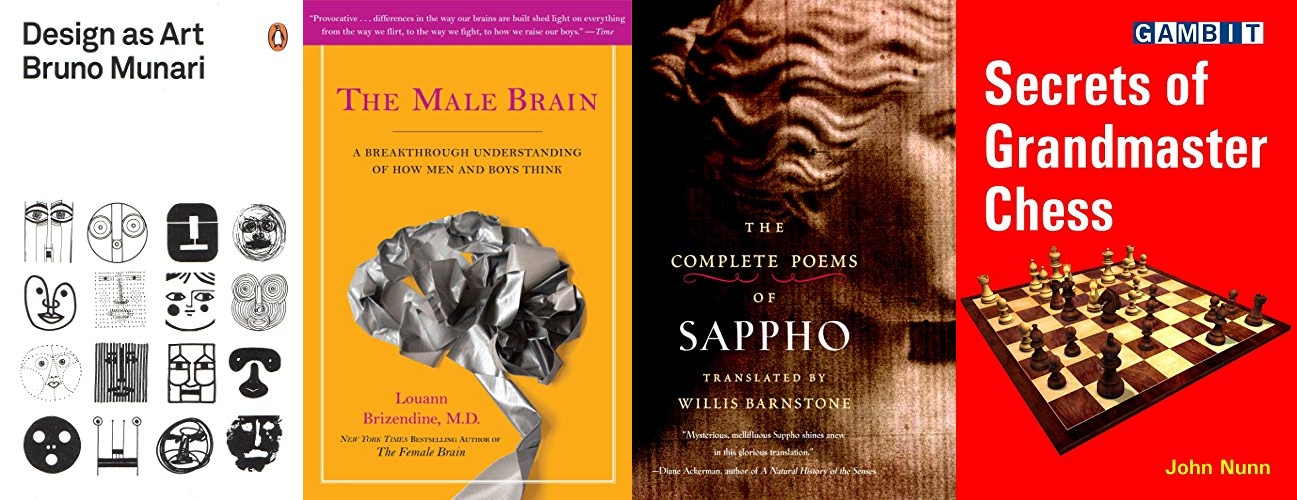
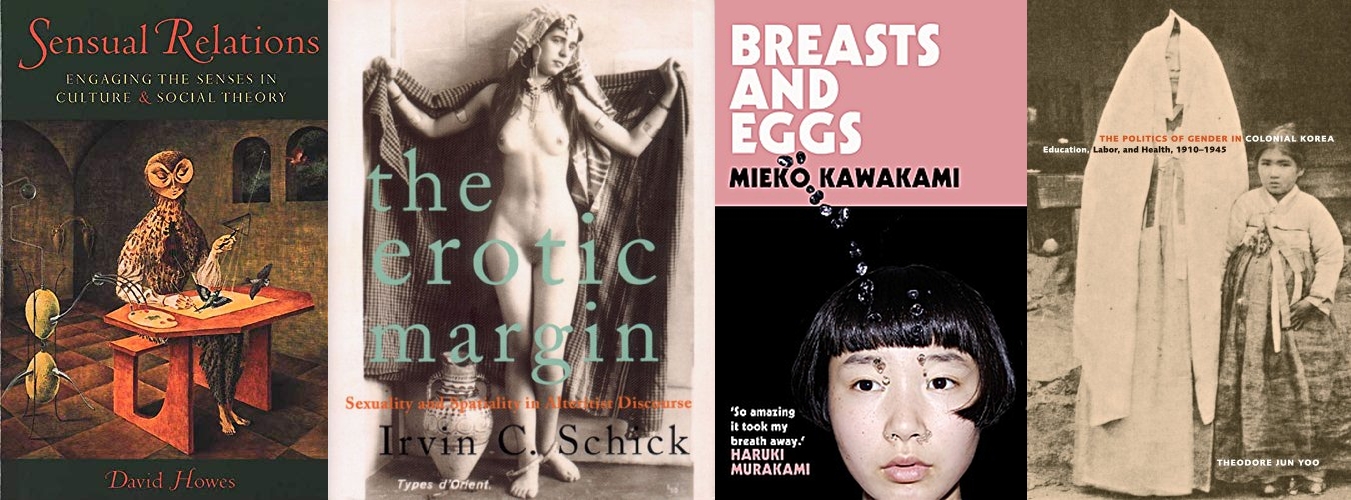
Normally, I would be very dismissive of a trend like EyeBody. But a book I recently read about sexuality in Japan challenged long-held preconceptions on that subject, which I didn’t realize I had. Still in the same contemplative frame of mind while putting pen to paper for this post, I recalled the dramatic changes to my students’ attitudes to body image and digital media over the last 11 years. So, I looked at EyeBody practitioners in a new light. I saw the agency, confidence, and potential they saw in their bodies, which mirrored my own once. I read too, about why men especially might be drawn to posting muscular selfies in a time of austerity. Maybe, in an environment in which 20-somethings already feel constantly overexposed, why not take control of that for your own advantage? May EyeBody—dare I say it—actually work?
(My own commitment to writing here every Monday in 2021, after all, has already necessitated a radical transformation to my own habits—but, crucially, only because I made it public.)
But those videos. I get it—selfies, in themselves, can be a source of empowerment too. But EyeBody feels a little deeper. Selfies and likes as the method, not the goal per se. Why diminish it? Or, in reality, do its practitioners easily fall prey to the temptations of selfie tricks? Thereby fatally undermining the authenticity that distinguishes EyeBody from other dieting trends?
Estimated reading time: 5 minutes. All screenshots: MV via Visualazn.
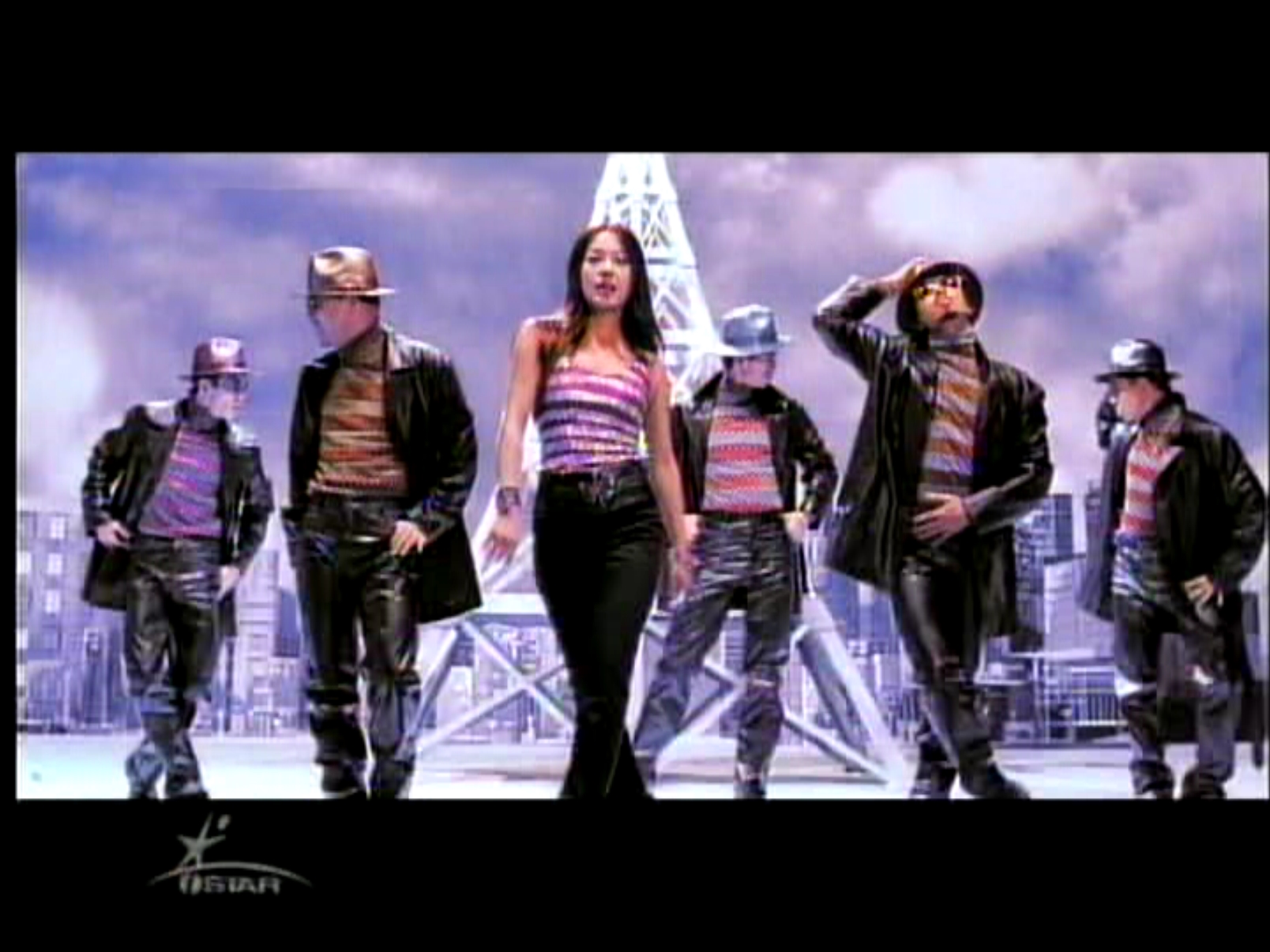
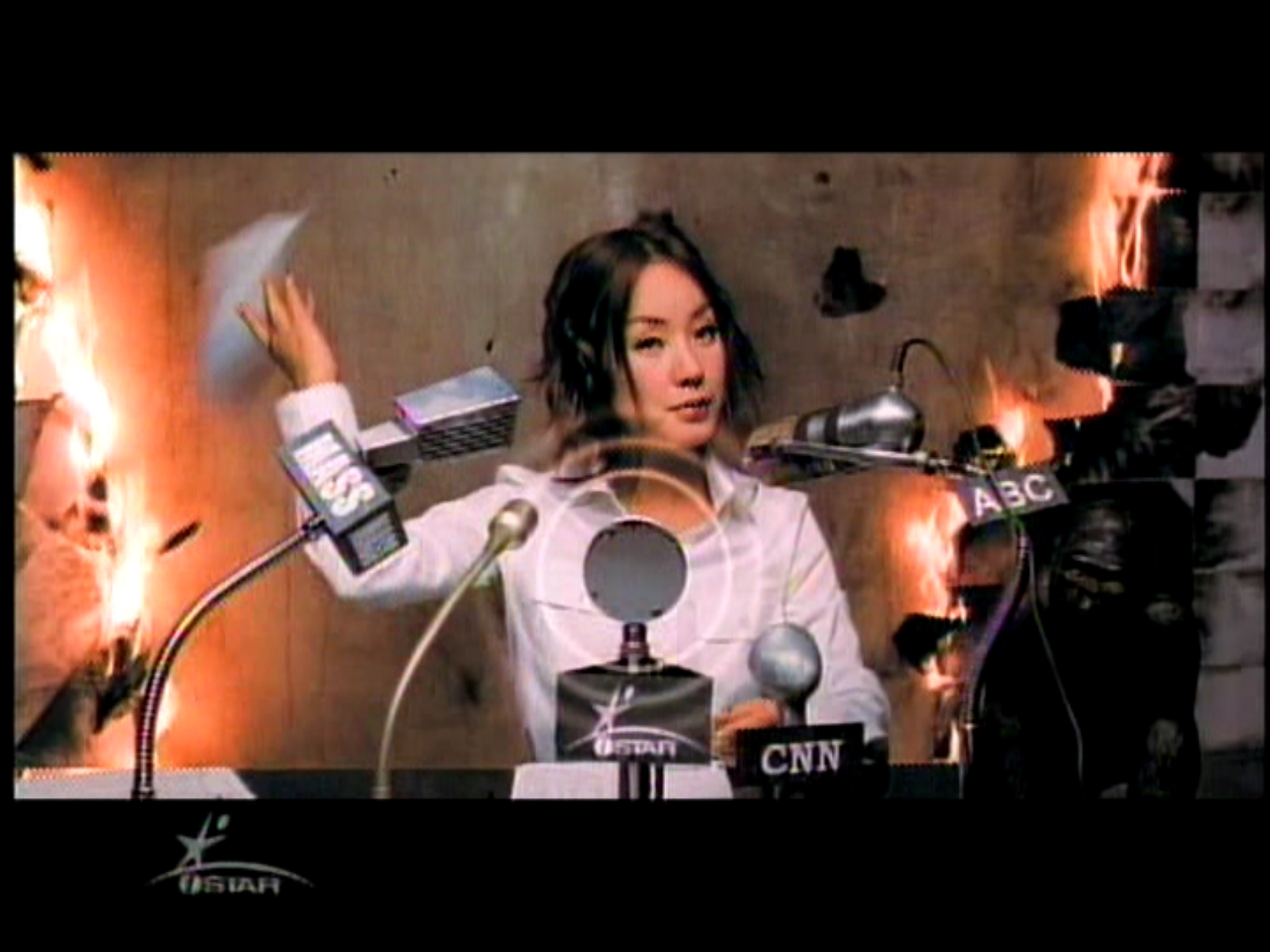
The “Queen of Charisma” deserves so much better than an 18MB, 240p MV for Tum, one of her classic hits:
To remedy that, go to Visualazn for a 428MB, 720p version to download posthaste. (I’d upload it myself, weren’t YouTube to instantly ban the copyright violation.) Watch that once, then come back here.
(If you’re pressed for time, this 1080p MBC Music Camp performance will have to suffice, which has some clips from the MV. But if it’s your first time especially, I really do recommend experiencing it through the high quality MV.)
I’m only so demanding, because to understand how people really feel about their pop culture, you need to appreciate the circumstances in which they consume it. Especially of when they first encountered it, and the technology that was used.
With Tum (a.k.a. Teum, Crack, Gap), for me it was late-2000, in the small southern city of Jinju. I had no cable or satellite TV, so I was reliant on free-to-air channels. It would still be a year before I had internet on my home computer for the first time, and five more before YouTube even existed. Trance music, my first love, was literally unheard of outside of far distant Seoul. I didn’t even have a radio, feeling there’d be no point given Korea’s surprisingly few genre-specific stations. So, in terms of discovering any new music at all, it felt like I was a child in the U.K. again, frustrated at the long, weekly waits for Thursday night’s Top of the Pops.
Then one night while casually surfing those few channels, out of nowhere Uhm Jung-hwa dancing to her riff starting at 1:53/1:05 appeared, and my terrible, sleepless first year in Korea was instantly transformed into the stuff of fantasy again.
Of course the showcasing of Uhm Jung-hwa’s voluptuous body was integral to that. That’s why the CD I quickly purchased just didn’t cut it. It wasn’t like today, when you’re always just a click away from replaying your own favorite combination of amazing music sung and performed by incredibly attractive people. Back then, even with cable, a second viewing would have involved many tedious hours of watching music channels for those few precious minutes; without it, it was next to impossible. Instead, I had to content myself with the song alone, and accept that once the it left the charts and the music shows on the free-to-air channels, I’d likely never see the MV again.
That’s simply how it was with much of popular culture before the internet, no matter how meaningful it may have been to you. You just had to learn to live with it.*
Yet I don’t mean to elevate or privilege my outdated, distance-makes-the-heart-grow-fonder perspective. It’s neither superior, nor somehow more authentic than that of anyone encountering it for the first time today. It’s just mine, and part of my motivation for writing.
Indeed, the fresh perspective YouTube offers only motivated me further.
This was unexpected. Typically, the replay button is cruel to our most cherished pop-culture memories, and I didn’t expect scrutiny of Tum to be any kinder. Take the above scene from 3:51-3:54 (2:28-2:31 in the performance video) for instance. For the last 20 years, that moment of Uhm Jung-hwa looking glamorous as fuck while being mistress of all she surveys, has been indelibly burned into my brain. Only now though, can I take the time to notice all the hair in her face, which would have obscured her vision. The spell of my willing disbelief has been irrevocably broken—let alone totally ruining my long sought after screenshot.
Yet, truthfully, I’m genuinely stumped at locating any other similar oversights in the MV. It’s not perfect—the pauses are unnecessary and long, and the King Kong theme is only loosely tied to the lyrics—but there are many other objectively charismatic moments of Uhm Jung-hwa moments remaining to latch on to. If anything, being able to see it in such detail now has only further convinced me of how it much holds up after 20 years, and it’s this renewed appreciation that compels me to write. For it deserves far greater recognition as the classic it is, many more dance remixes than the single, terrible one I refuse to link to, and, again, at the very least, a decent quality video on YouTube.
Alas, that last I can’t provide. But I did put several days into finding that download for you. And I can give what is, as far as I know, the world’s very first English translation of the lyrics:
Uhm Jung-hwa—Tum
Track 2, Queen of Charisma, released November 2000.
I waited for you like you thought I would, I only had eyes for you
Don’t leave me alone for a long time for just no reason, I can’t take it anymore
Didn’t you have any feelings for me as I was changing?
Even if there were a lot of different reasons for doing what you did, it is so frustrating to think about you
Chorus:
제발 이젠 내게 말해줘 너의 힘없는 얼굴이 내 생각엔
아무런 느낌 없는 너처럼 그저 희미해질 뿐이야 난 이제
더 이상 기다리지 않아 나를 언제나 바라본 널 이렇게
아무런 감동 없는 나처럼 매일 같은 날 일 뿐이야 오 제발
Please tell me now; your powerless face, I think,
is fading away, as if you have no feelings for me
I’m not waiting anymore, as you have always looked at me like this
Every day is just the same, emotionless like me, oh please
그렇게 말도 없이 나만을 쳐다보면 너무나 힘이 들어 이렇게 우린
오래도록 지쳐있긴 하지만 언젠가 끝낼 수 있는 날 있잖아
이젠 모든 걸 버리고 우리만의 기억을 생각해봐
너와 나의 사인 아주 가까웠지만 언제부터 이렇게 멀어졌니?
Gazing at me without saying a word leaves me feeling so tired, we’ve
been so frustrated for a long time— there are so many times when I want to just end things
Please put everything aside and focus only on our shared memories
You and I were once very close, when did you drift away?
(Chorus repeats and end)
I appreciate any corrections—while these lyrics were quite simple, you’ll notice I didn’t provide literal translations, as I felt that would diminish from their intended meaning. Please also do tell me your own rants or raves about Tum, or about any other of Uhm Jung-hwa’s songs (Festival is another favorite of mine!), whenever or however you first encountered them :)
*VCRs were a possibility of course, but their bulk and expense meant few 20-somethings had them.
If you reside in South Korea, you can donate via wire transfer: Turnbull James Edward (Kookmin Bank/국민은행, 563401-01-214324)
The word “sensual” has always been a favorite of mine, once I learnt it was brimming with sex. Even just to say it can feel like a carnal act, if you let it. Close your eyes, linger on the syllables as you would on the face of a lover, and the tip of your tongue teases you with memories of all the places it’s been—and hints at the pleasures still left to explore.
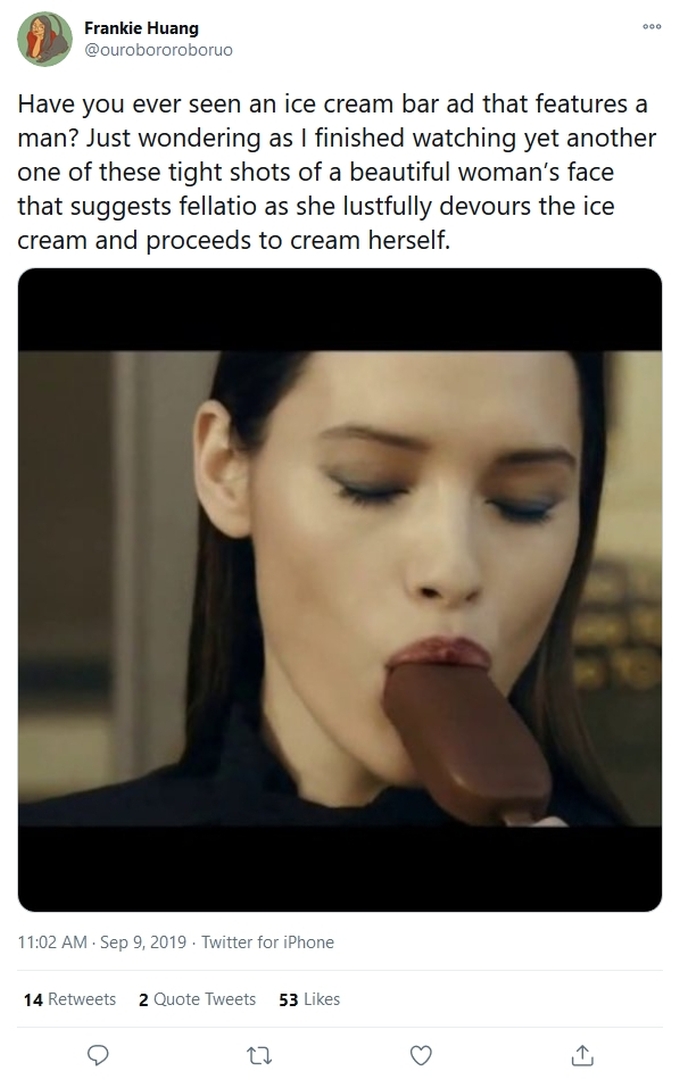
Foods that can similarly be luxuriated over then, lend themselves to sensual advertising. Take ice-cream. I don’t eat it like you see in the ads, and neither do you. But I get them. Being allergic to dairy, so not eating my first ice cream until I was seventeen, I really do relish the soy variety when it makes one of its rare appearances in supermarkets here.* I even have a bottle of Kahlua saved specially for just such occasions.
Not unlike Kahlua or even sex itself though, too much of the same thing can easily become boring and routine. That you and I can both roll our eyes at the notion of orgasming over ice cream, only points to how advertisers sexing it up is so routine as to be mindless cliché. Just so routine in fact, that by 2019 Baskin Robbins Korea seemed to have forgotten they were doing it at all, and were forced to withdrawandapologize for an ad where they’d replaced the usual woman with an 11-year-old girl wearing cosmetics.
[There is a] powerful, symbiotic relationship between women and carnality, as indicated by the preponderance of erotic narratives in advertising addressing women. This is particularly overt in the advertising of products that are depicted as being endowed with the power to enable women to experience intense quasi-sexual pleasure from their consumption. Examples of such product categories includechocolate, luxury ice cream, biscuits, and shampoo. This is a world that reflects a perception of women as ‘consummate consumers’ who are ruled by their bodies and, as such, are less able than men to resist the lure of carnal pleasures (Belk 1998; Belk and Costa 1998).
Source: Pauline Maclaran and Lorna Stevens (2004),”Special Session: Gender and the Erotics of Consumption”, in GCB – Gender and Consumer Behavior Volume 7, eds. Linda Scott and Craig Thompson, Madison, WI: Association for Consumer Research, Pages: 1 to 14. (Download)
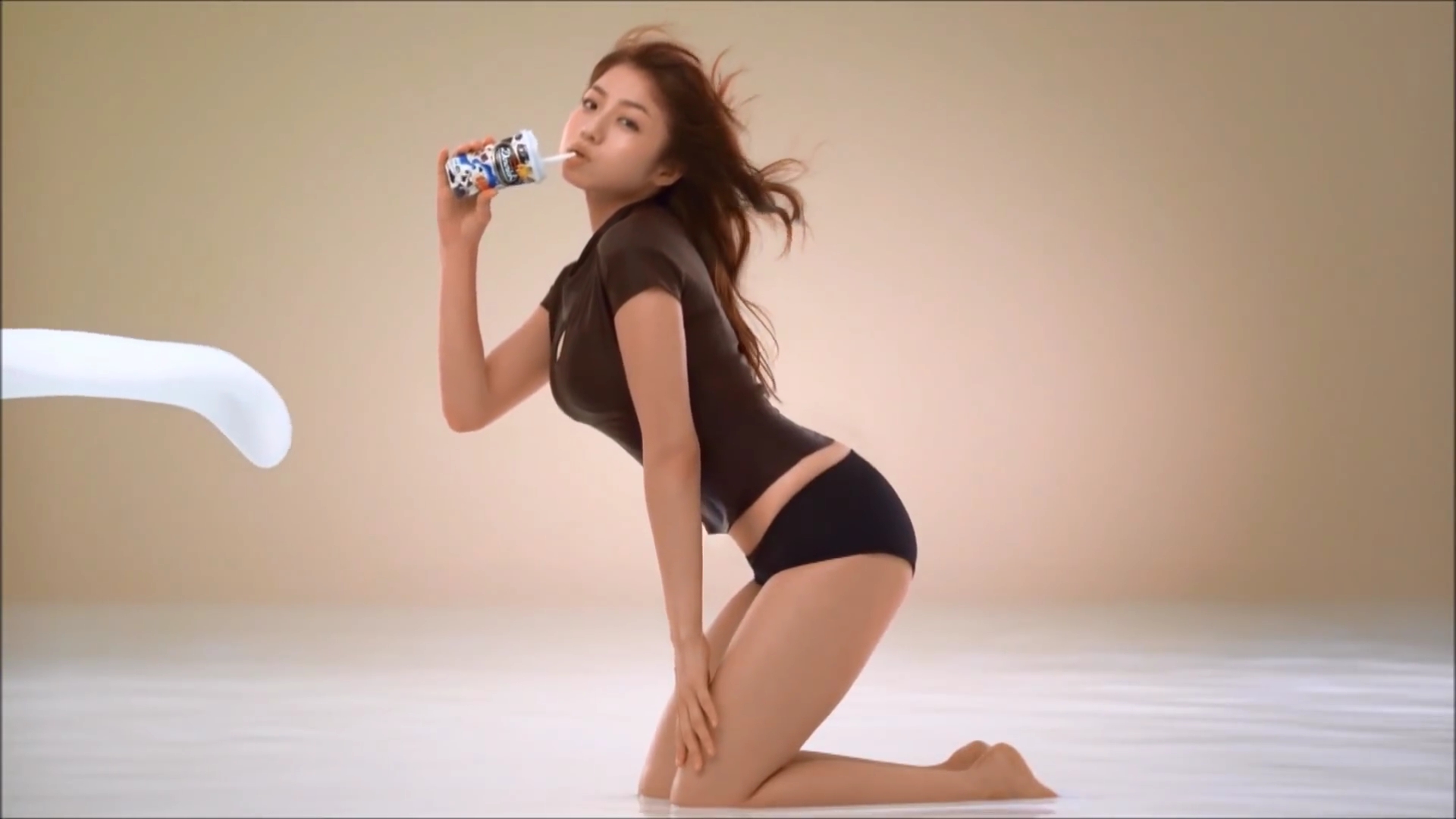
But I sense EXID fans are getting a little frustrated by this point. Posting an infamous, bawdy, 2012 Japanese commercial for Gligo’s Dororich Creamy Cafe Jelly in a moment is hardly going to help either.
There is a method behind my madness. First, I needed to take advantage of my recent purchase of a book on Sappho to establish some cultural capital, in the hope I’d have at least a shred of credibility remaining by the end of this post. For what male feminist/feminist ally would ever admit to being utterly transfixed by this?
I hear and share your numerous objections. Accept it not so much as an ad though, but for the sort porn it is, complete with five gravure idols (NSFW), addictive Benny Hill-like music, and blatant masturbation and ejaculation symbolism, and it’s so over the top that I can’t help but revel in its hilarity.
The Korean media couldn’t make that concession however. Take one of the first reporters to cover it:
“CF 영상 자체가 에로틱하다는 것이 그 이유다. 밝은 조명에 우유와 젤리가 섞이는 장면, 청순한 외모의 여성들 뿐이지만 남성들의 마음을 자극하는 요소는 다분하다.” (Herald Economy)
The reason the CF [is gaining tremendous popularity among Japanese men] is because it’s erotic. The scene in which milk and jelly are mixed in bright light, and only women with pure and fresh appearance, all these are enough to stimulate men’s hearts.
Contradicting themselves, even more stimulating elements were listed; alas, those did not include the symbolism of the spurting cream. Later reporters (or their cautious editors), if they mentioned the cream at all, only caused themselves more embarrassment in their Kakfaesque refusal to acknowledge the completely obvious:
“게다가 우유를 상징하는 하얀 액체가 이 소녀들에게 날아들어 묘한 상상을 자극하게 하고 있어 일각에서는 비난이 쏟아지고 있다.” (The Chosunilbo)
“In addition, it is criticized because the scene in which white liquid that symbolizes milk is being poured over the girls is triggering strange imaginations.”
““And white liquid that seems to be milk is continuously being sprayed.”
I realize there may be official or unofficial rules in the Korean news media regarding acknowledging explicit content, even symbolism. Absence of evidence is not evidence of absence either, and it would remain a blessing to find an official news source that, in reporting on this commercial, hadn’t patronized its readers over something so trivial.
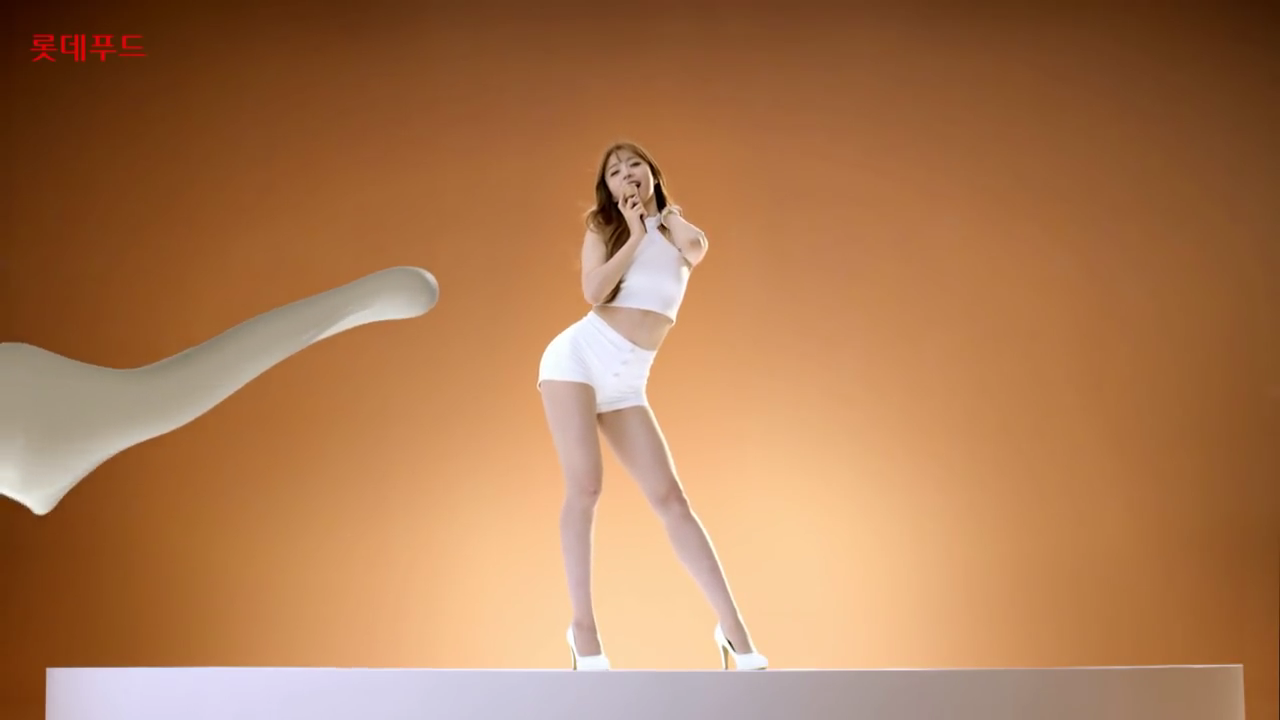
Be that as it may, the next reason, and finally, is because now you know exactly what went through my mind when I saw EXID’s commercial for Lotte’s Goo Goo ice-cream a few years later:
I only didn’t write about it at the time, because I expected the media and fans to immediately be all over it. Gligo’s Dororich Creamy Cafe Jelly commercial, after all, made quite the splash in social media when it came out. It took balls, I thought, for Lotte to be so brazen about the origins of its own very literal money shot.
But, crickets. Whereas some reporters did point out the new, sexualized direction for Goo Goo’s advertising, most merely gushed about the endorsement choices intheirtypicaladvertorials. Social media too, or at least in respect to this commercial, seemed surprisingly reticent on the subject of ejaculation, and to have completely forgotten about the Creamy Cafe Jelly. By the time I realized people just weren’t talking about it, the moment for laying a world exclusive claim to this cosmic connection had passed.
I was loathe to end without a conclusion too. Perhaps on such an indecorous subject though, in which the innuendos came thick and fast as I typed (believe me, it’s harder to avoid them easier to just go with the flowget them off your chest roll with them), there wasn’t one to be made?
Still, the sexy ads and commercials will continue regardless, symbols of orgasming will always be an indelible part of that, and sex and K-pop are synonymous. Indeed, after the 2012 Japanese inspiration, then EXID’s 2015 sequel, 2018 saw JooE of Momoland step up in her commercial for Baker 7. Or rather, her “mother” and gardener:
I invite readers to offer any more examples, and to come to their own conclusions about them. To prepare for the 2021 follow-up, what do you think needs to be said about sexualization in ads, and about the gender imbalance in those selling chocolate, ice cream, biscuits, and shampoo? Is it necessarily bad if they depict orgasms? Please let me know in the comments!
*If you too are desperate for soy milk ice-cream in Korea, try specialist cafes and CU convenience stores. Supermarkets in my area have sometimes stocked it over the years, but always discontinued it after just a few months.
If you reside in South Korea, you can donate via wire transfer: Turnbull James Edward (Kookmin Bank/국민은행, 563401-01-214324)
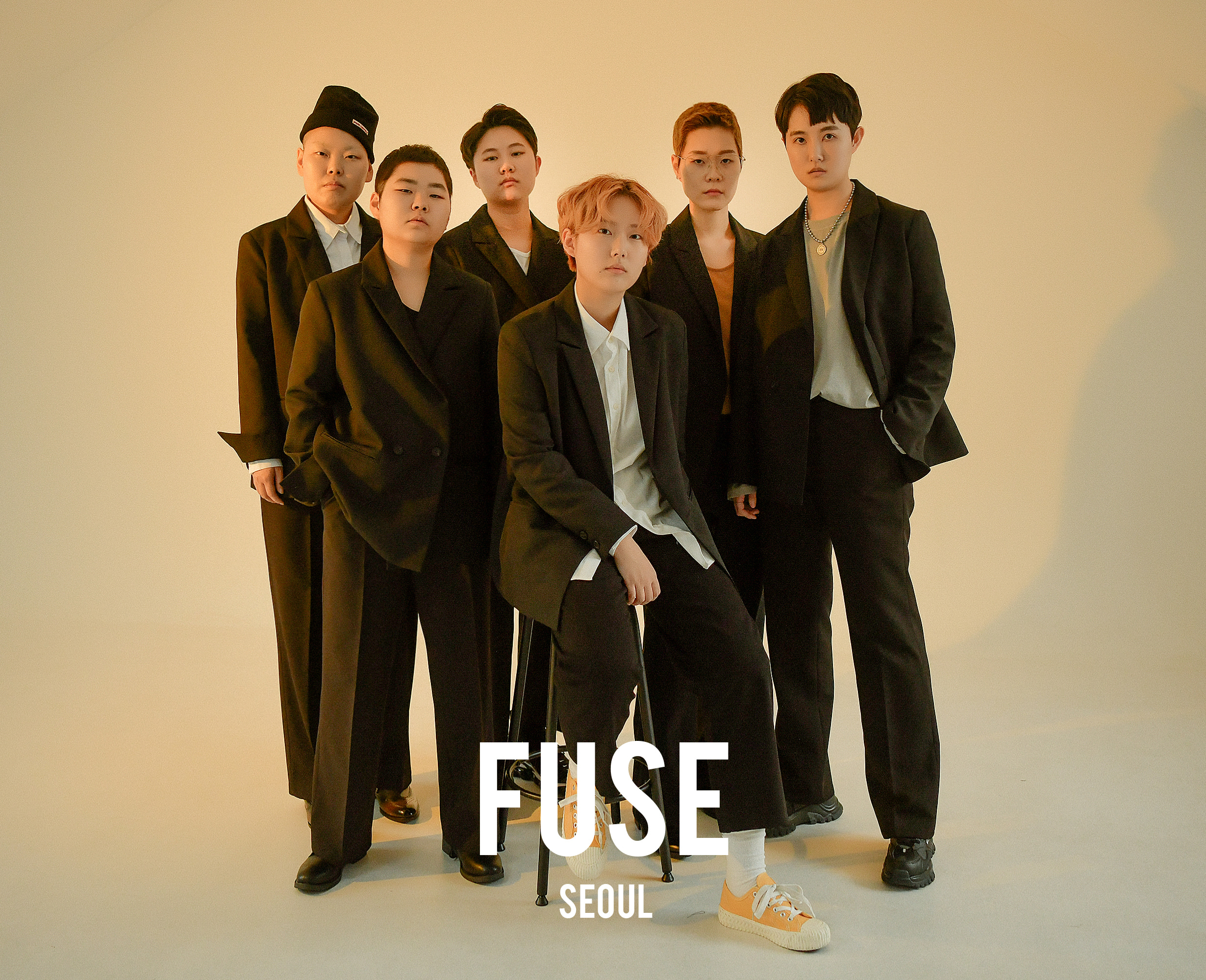
There’s just something about the Fuse Seoul underwear featured in this ad. Why do so many women want to get their hands on it?
One big reason is that despite appearances, the underwear is actually for women, produced by a company not shy about picking and choosing from features standard for menswear to offer women more comfortable options. As CEO Kim Su-jeong explained shortly after the company’s founding in October 2018:
“앞으로도 다양한 체형의 모델을 기용하고, 그동안 남성들만 누리던 ‘의복혜택’을 여성복에도 적극 도입할 것”이라고 설명했다.
“We will continue to use models of various body types and actively introduce the ‘clothing benefits’ that only men have enjoyed so far.”
…퓨즈서울은 단순히 스타일을 넘어서 그동안 남성복에게만 적용되어왔던 자켓 안주머니, 히든 스트레치밴딩, 넉넉한 바지주머니와 밑위길이를 여성사이즈에 맞게 제작하여 품절대란을 일으키기도 한 바 있다고 업체 측은 전했다.
…the company goes beyond just a style, reporting that they’ve been unable to meet the demand for their clothes with jacket inner pockets, hidden stretch banding, generous trouser pockets, and rise lengths appropriate for the wearer’s size, all features which are usually only found in menswear.
Further elaborating on her motivations in an interview in July 2020 (source, right):
“점점 여성복 사이즈가 줄어들고 있어요. 지난 5년간 눈에 띄게 보이는 현상입니다. 예전에는 27인치가 M사이즈였는데, 지금은 27인치가 L사이즈가 됐습니다. 브랜드마다 사이즈도 다릅니다. 왜 여성복은 규격이 일정하지 않은지, 여성복 디자이너로서 그 이유를 알고 싶었어요.
“The size of womenswear has definitely been decreasing over the past five years. Previously, 27 inches was considered a medium size, but now 27 inches is considered a large. Different brands have different sizes too. As a womenswear designer, I wanted to know how and why the standards were constantly changing.
어느날 남동생 옷을 입었는데 정말 편했습니다. 남자 형제가 있는 사람들은 대부분 남성복이 얼마나 편한지 알 겁니다. 그 때부터 남성복을 연구하기 시작했습니다. 남성복은 여성복에 비해 사이즈 혼란도 변동도 거의 없습니다. 브랜드가 달라도 규격은 거의 같아 편하게 구매할 수 있습니다.”
One day, I was wearing my brother’s clothes, and they were really comfortable. Most people with brothers will know how comfortable menswear is. From then on, I began to study menswear. Compared to womenswear, menswear shows little confusion or change in size. Even with different brands, the sizes and specifications are almost the same, so you can easily purchase what you need.”
Another reason is because they’re tired of the tropes surrounding the advertising of women’s underwear, which this ad completely upended:
Source: @Harang_0601, in response to a since deleted tweet that featured the images below:
Translation: “I can’t even think of the model as a woman, I thought this was an advertisement for men’s underwear…That just goes to show how much usual women’s underwear advertisements are shot for a male gaze, and how women are so used to that… Only tears remain.”
Translation: This the difference between gazing and being the subject of the gaze… One the left is a harmless and passive pose for the male-gaze, whereas the right model has a strong stare back at the viewer. What to make of the exposure of women’s bodies also varies greatly depending how the picture was taken and viewers’ points of view.
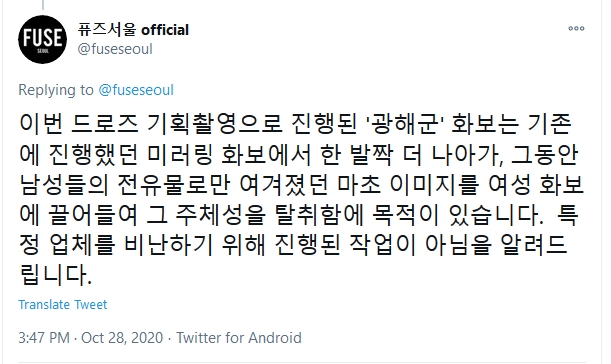
On their own Twitter account, Fuse Seoul themselves stressed their deliberate attempt at machismo:
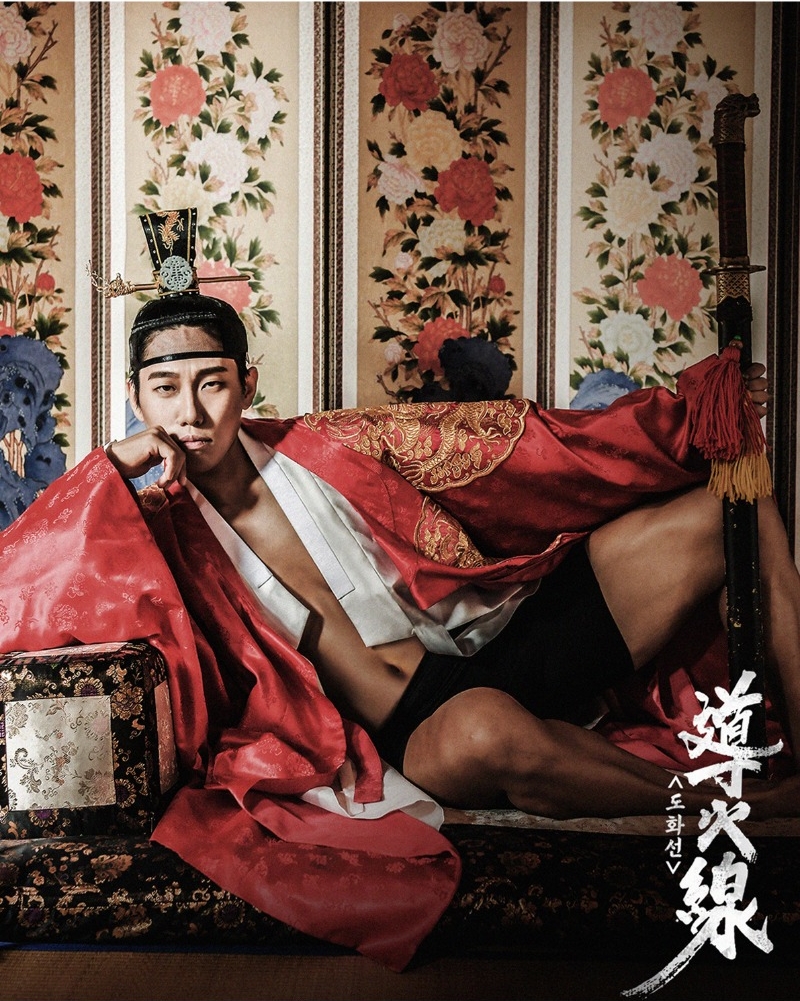
Translation: The aim with thisPrince Gwanghae–themed pictorial was to go beyond simple mirroring by using a macho image, formerly considered exclusively for men, in a female photoshoot. But please note this wasn’t intended to be a critique of any specific vendor.
Translation: I think that when a woman becomes a king, she can not only become a more effective politician, but can also become a more vicious king.
In hindsight, it should have been obvious that another reason for the attention was that the model, dressed as male royalty and posed with all the confidence and machismo of a typical men’s underwear ad, is a woman herself, a crossfit trainer known as Shark Coach, a.k.a. Shark Lee and Lee Yun-ju (Instagram, Twitter, YouTube). Here’s a video of her preparing for the photoshoot:
Yet throughout much of the research and writing of this piece, frankly I was completely mistaken about Shark Coach’s sex.
One reason is because Korean male celebrities were featured in ads for bras as long ago as the early-2010s. Albeit not so much wearing them, as promoting the idea that if women purchase a brand and style he endorses, “it might even be him who one day helps them take it off.” Another is that Korean men’s clothing company Uncoated, for one, uses a female model to model its underwear. So it wouldn’t be too much of a leap for a progressive women’s clothing company like Fuse Seoul to likewise reverse the sexes in its own ads.
That being said, more relevant are two biases behind my mistake. First, a benign one: due to underwear reviews by YouTuber Daisy, a late-20s Korean woman I’ve long subscribed to who covers everything from cosmetics to sex toys on her channel (In Korean, but she writes her own English and Japanese CC translations), I’ve become very persuaded that the distinctions between men’s and women’s underwear aren’t quite as distinct as those I grew up with. So, again, I wasn’t at all fazed to see a man model “women’s” underwear:
(But because it would be strange to include those reviews but nothing about the Fuse Seoul underwear, here is one I’ve been able to find.)
(And here’s Kim Su-jeong on why this underwear is such a big deal.)
I can’t in good conscience not also mention and highly-recommend “natural-size” model and YouTuber Cheedo a.k.a. Park Lee-sul too, who I’ve also long been a subscriber to (but who provides no English subtitles unfortunately). Despite rarely discussing underwear specifically, she has a lot to say about the escape the corset corset and no-bramovement, further convincing me of the changes to women’s fashions underway. Actually, you may recognize her from a BBC video about that:
But the main reason for my mistake, of course, is because I thought Shark Coach looked like a man.
I don’t doubt for a minute that many of you did too, and I don’t feel embarrassed about it. But on the other hand, just a few days ago Shark Coach herself complained on Youtube about being constantly misgendered. And it’s precisely such gender stereotyping and rushes to judgement that Fuse Seoul is encouraging people to avoid.
But what do you think of the ad? Will you buy the underwear, or any of their other gender-neutral clothes? How to address the many remainingdouble–standards (NSFW) in just the advertising of underwear alone?
3D facial photography is a promising new approach for researching beauty ideals, but studies based on beauty pageant contestants alone should not be presumed to speak for entire populations.
Last week saw a textbook case of how not to report about beauty ideals.
The catalyst was a press release by the Catholic University of Korea (CUK). Widely copied and pasted across the Korean media, the title of the sole English translation was “S. Koreans Prefer Women with ‘Oval Face, Wide Forehead, and Small Lips’.”
The problem is, they don’t, necessarily.
Rather, what should have been reported was that a joint Saudi, US, Paraguayan, and Korean Dentistry and Orthodontics research team, including one professor from CUK, had announced they’d discovered commonalities in the facial differences between Miss Korea 2012 and Miss Paraguay 2013 contestants.
Then, when the announcement went straight to the researchers’ conclusions, as in this article from Yonhap…
연구팀은 미스코리아 54명과 미스파라과이 34명을 대상으로 3D 카메라로 얼굴 정면과 측면을 특수 촬영해 길이 및 각도를 측정했다. 측정값을 기준으로 인종에 따른 심미성 차이를 평가하고, 두 결과를 서양인의 대표적인 황금비(golden ratio)와 비교했다.
The research team measured various lengths and angles of the faces of 54 Miss Korea and 34 Miss Paraguay contestants by using special photographs of the fronts and sides of their faces using a 3D camera. The differences in racial beauty standards were determined based on the differences in the measured values between the two groups, and each groups’ results were also compared with the golden ratio, [a representative ideal of facial beauty for Westerners].
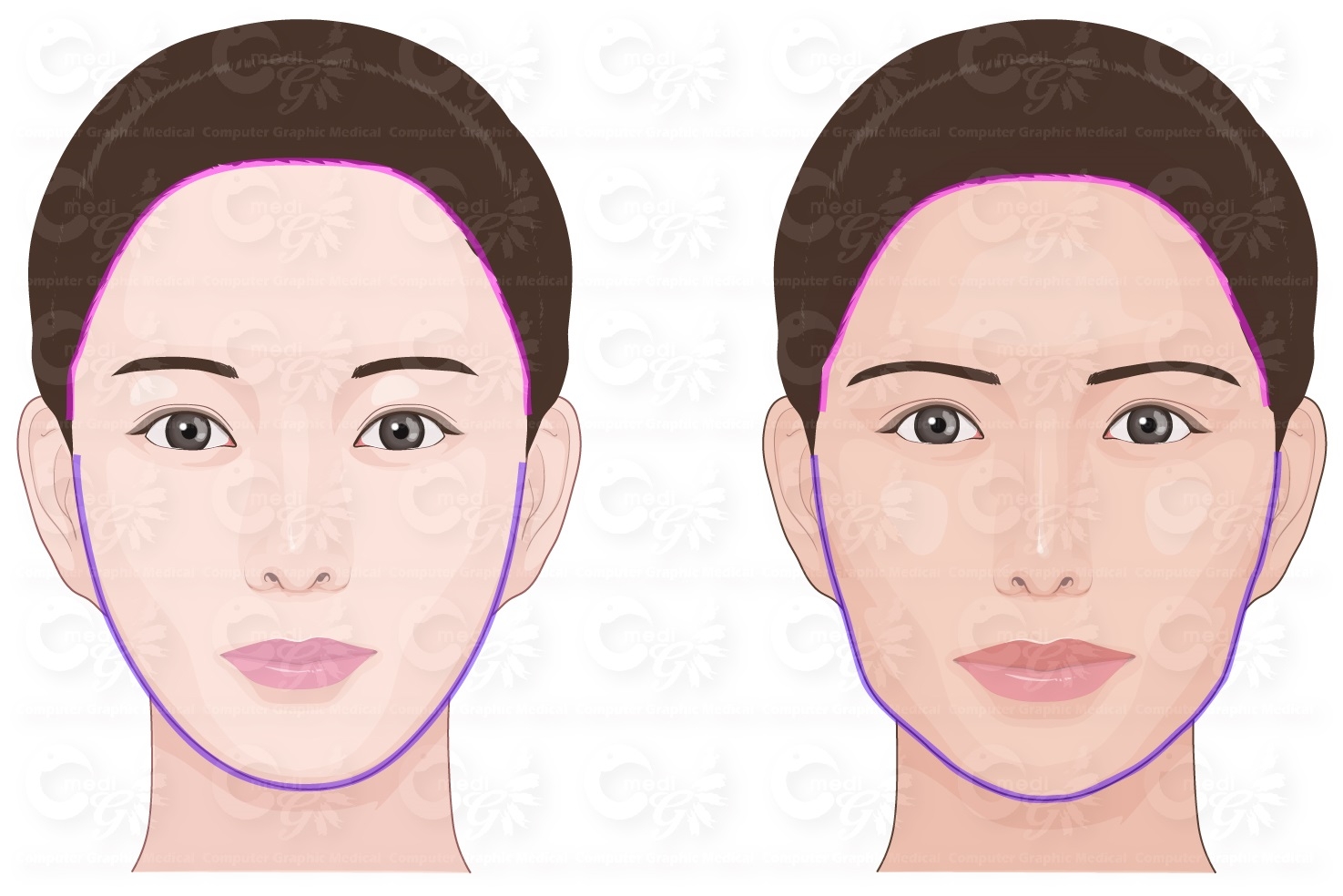
그 결과 한국인은 전반적으로 갸름한 얼굴형과 넓은 이마, 작은 입술을 선호했지만 파라과이인은 약간 각진 얼굴에 큰 입술을 선호하는 것으로 나타났다. 두 국가가 선호하는 얼굴은 서양에서 이상적인 비율로 판단되는 황금비와도 차이가 있었다.
As a result, it was found that Koreans generally preferred a slim face shape, wide forehead, and small lips [left], but Paraguayans preferred large lips with slightly angular faces [right]. The faces preferred by the two countries were also different from the golden ratio.
…Reporters should have inquired on what grounds researchers made wide, sweeping pronouncements about the entire Korean and Paraguayan populations’ beauty ideals, considering their study was just on a handful of beauty pageant contestants. Either by simply asking, or by reading the study for themselves.
I realize to have expected either was incredibly naive. Quick content and clickbait titles are key, both of which are all the more effective if they confirm readers’ stereotypes. Plus, in fairness, the academic English of the study would have been beyond most Korean reporters.
They could at least have linked to it though. Yet not only did no reporters offer even this bare minimum, many failed to provide any identifying details about the study whatsoever.
That study was “Comparison of facial esthetic standards between Latin American and Asian populations using 3D stereophotogrammetric analysis” in the Journal of the World Federation of Orthodontists, Volume 9, Issue 3, 2020, Pages 129-136, by Mohamed Bayome, Jae Hyun Park, Ahmed M. Shoaib, Nam-ki Lee, Victor Boettner, and Yoon-Ah Kook (please contact me if you can’t get access to any of the studies I mention here). Further adding to the likelihood that no reporters actually read it, last week’s articles included either a picture of CUK Department of Orthodontics Professor Yoon-Ah Kook and/or the earlier graphic supplied by the university (note the watermark), neither of which were in the study.
In short, the researchers make—justify—their mental leap on their argument that beauty pageant judges are objective and representative (p. 130):
“These beauty contestants reached the final stages of the contests based on selections made by the competition panels consisting of media figures, artists and producers, famous plastic surgeons and orthodontists, as well as other community influencers. This means that their opinion plays a principal role in forming the general public opinion.”
Indeed, writing in the Korea Times about the 2019 Korea pageant, Lee Han-na mentions that the “judging panel consisted of experts in the areas of fashion, music and entertainment, joined by actresses and former Miss Koreas.” Which I don’t deny sounds diverse, nor that, say, cosmetic surgeons in particular play a huge role in shaping general public opinion in Korea.
That such groups may be bringing their own subjective preconceptions, worldviews, and agendas to any discussion of beauty however—let alone the six Dentistry and Orthodontics professors involved in this study—seems not to have occurred to them.
Moreover, in the Korean case in particular, beauty pageant judges’ role as gatekeepers is further undermined by the public’s utter disinterest in the event, as well as by ironically choosing a 2018 winner who was far too “fat” for many Korean netizens’ standards. Also, to counter charges of objectification and lookism, contestants’ academic backgrounds, personalities, and performing abilities have been given much more prominence in judging since the early-2000s.
I’ve only been able to find one reporter, Go Jae-won at Donga Science, who suggests that the researchers’ conclusions shouldn’t be taken for granted. To say that journalists were not doing their job here is an understatement:
이번 연구는 미스코리아는 2012년 참가자들의 얼굴을 대상으로 미스파라과이는 2013년도 참가자들을 대상으로 분석이 진행됐다는 점에서 최근 참가자들의 트렌드를 반영하고 있지는 않다는 한계가 있다. 또 미스코리아 참가자들이 한국인들의 평균적인 미적 기준을 반영하고 있다는 근거도 부족하다는 지적도 있다.
By analyzing 2012 Miss Korea and 2013 Miss Paraguay participants, the study has limitations in reflecting recent trends. In addition, some point out that there is a lack of evidence that Miss Korea participants reflect the average aesthetic standards of Koreans.
Another issue was the researchers’ liberal use of overgeneralizing terms such as “Westerners,” which are particularly useless and misleading when talking about beauty preferences and racial differences. So too, was perpetuating the myth that the “golden ratio” is a signifier of beauty, for which there is actually inconclusiveevidence at best that it plays any role in attractiveness whatsoever. To be sure, technically they acknowledged that lack, which their study further confirmed, but—jumping ahead—they and/or CUK should have anticipated the ensuing “Westerners just loooove the golden ratio in their women” style of reporting.
But given that the other, explicit aim of the study was “to compare the facial esthetic standards between Paraguayan and Korean beauty pageant contestants,” that was clearly too much to ask. For they were no less careful to restrict their conclusions to only beauty pageant contestants than any tabloid news reporter. For instance, consider the loose generalizations from the introduction (p. 129-130, my emphases):
Attractive Asians are characterized by longer faces than the general population and with less height of lower lip and chin and smaller volumes of chin and cheek. On the other hand, attractive Latin Americans are distinguished by less nasal prominence, large nasolabial angle, less protrusive lips, and less prominence of the chin.
And from the conclusion (p. 136, my emphases):
“From our results, it may be claimed that most Latin American individuals, in general, prefer rectangular faces with wide mouths and large lips, especially the lower lips, whereas in general, most Asian individuals prefer long tapered faces with small mouths and lips [see below]. Even though it might be well-known that the Misses are not selected solely based on their faces, as these contests include various measures, it is quite unlikely to have a qualified finalist who did not have a beautiful face.”
In between those six pages, many various nationalities and racial groups are mentioned, but none are defined. Are Paraguayans included among the Westerners they mention? The Caucasians? It’s all very confusing, and particularly irresponsible for an academic journal article.
This is a shame, for I believe 3D facial photography is very much a promising new approach into researching beauty ideals, and have no reason nor inclination to dispute the results of this study. Indeed, I’m now overwhelmed by all the intriguing “related articles” to pursue. But the researchers’ conclusions in this one? Peruse the sources used, and conspicuous for their absence are any from sociology, gender, or media studies. Had there been some input from those fields, perhaps the researchers would have been more rigorous with their definitions. In turn, they may have been more restrained in their beliefs that beauty pageant judges were objective and representative, upon which their conclusions rest. And more circumspect in going to the media with them.
These flaws are also evident in a similar study by different researchers published just a few months earlier in The Journal of Cranofacial Surgery (Volume 31, Number 3, May/June 2020. (Which, because of reporters’ unprofessionalism/laziness/crushing deadlines, for a long time I thought was the one actuallybeing referred to.) In that study of 44 Miss Korea and 22 Miss Paraguay contestants (competition years not given), the researchers were ironically much more forthright about the difficulties of determining racial beauty ideals. Yet ultimately, they ended up even more convinced that the beauty pageant contestants possessed objectively-determined, universal-shared racial beauty ideals, a conclusion perhaps facilitated by the cheat of simply referring to Koreans and Paraguayans as “Asian” and “Western” throughout.
Yet it was three of the same researchers behind the first study who already demonstrated the potential of 3D facial photography in an article published in the March 2017 Korean Journal of Orthodontics (47(2):87-99). Specifically, the faces of 52 Miss Korea 2012 contestants and 41 young adult female students of a nursing school at Wonkwang Health Science University were compared, and no overarching conclusions extending to entire Korean population were made.
What they did say? Again, please let me know if you can’t get access, and we could discuss the differences between the groups in the comments, or make them the subjects of another post. Either way, let me be forthright with my own biases from the beginning. Isn’t it uncanny how page 95’s “proportional diagram of the average face from the Miss Korea group (A) and another from the general population group (B)” instantly reminds you a young and middle-aged Jang Yoon-ju? Or is it just me?
With apologies in advance for the unflattering picture, please let me know in the comments!
Only the titles and links, alas, as my university’s jam-packed December had me receiving frantic phone calls from students as late as Christmas and Boxing Day. But now that I’m free, I’d love an excuse to talk about any of the books you’ve read or are interested in. Please do give me a buzz if so, either in the comments here or on Facebook or Twitter.
Also, I’m itching to atone for my many unfulfilled writing promises this year. To cut to the chase, by posting every Monday from now on, starting with this warm-up.
How? Why? What’s different?
The old me would be answering those questions now, instead of working on coming posts. Whereas the new me doesn’t have anyone’s time to waste, and has already deleted their social media apps on their phone to help them focus ;)
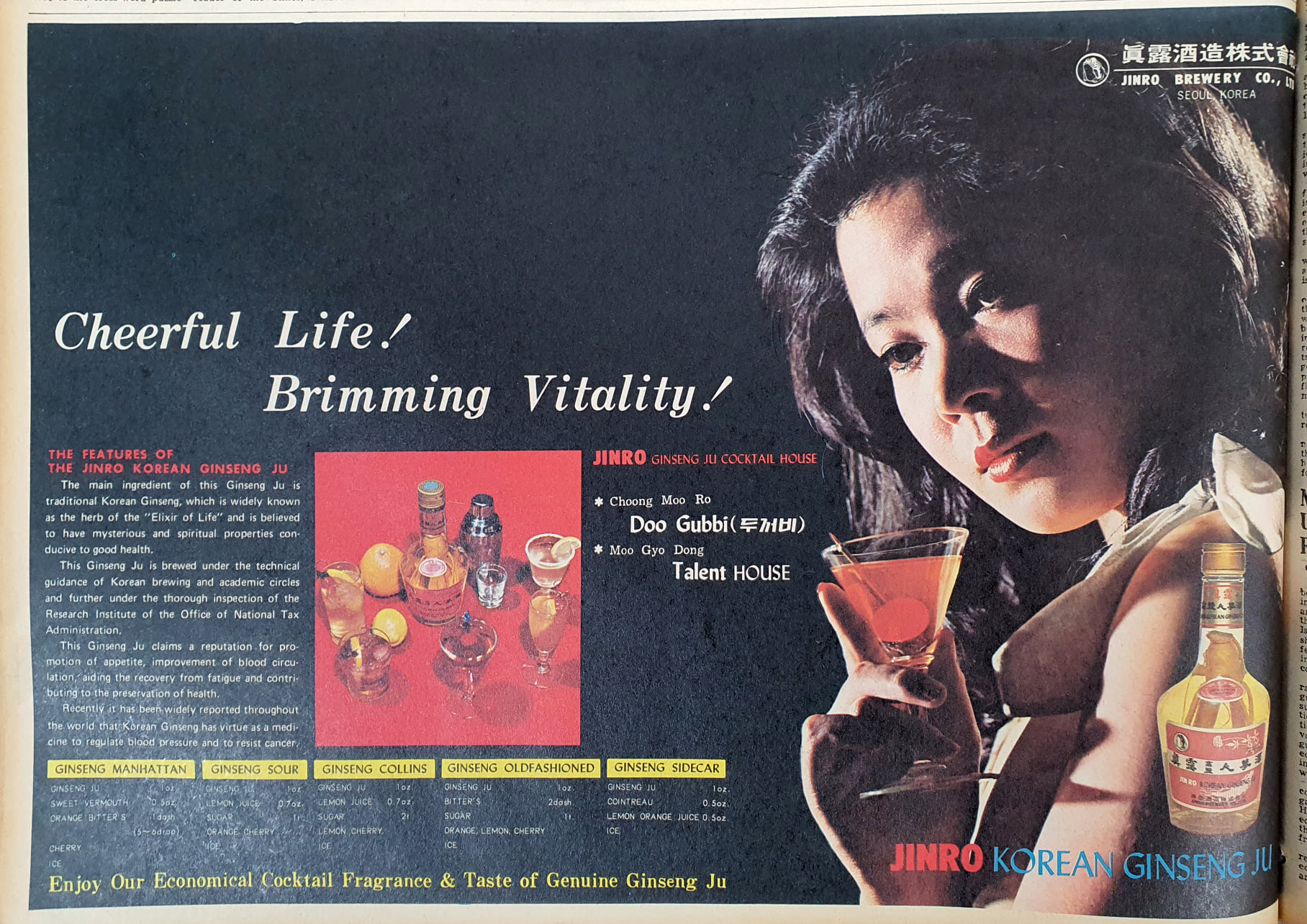
Rare, 1970s English-language alcohol commercial for overseas audiences is a cringeworthy example of gendered self-Orientalism*
Estimated reading time: 7 minutes.
Featuring actors Yu Ji-in and Shin Yeong-il, it’s her timidity that strikes me most about this 1975 commercial for Jinro ginseng wine. For in that era of draconian but well-publicized birthrate-reduction policies, monthly pill commercials were widely seen in cinemas alongside those for alcohol. And they weren’t exactly known for their blushing brides:
Probably, the explanation is that the wine commercial was never actually seen by domestic audiences. It’s also unlikely there’s anything deeper to its sexual exotification of Korea, and its presenting of ginseng wine as the means to help relax nervous virginal women on their wedding nights, other than an unimaginative creative team stuck with trying to advertise an obscure drink to foreign audiences.
But which foreign audience exactly? Why, despite the contents of the voiceover, show the bride as being the most in need of relaxing? Why have Korean advertisers been so reluctant for the last 50 years to run their English copy and concepts by native speakers first, especially for ads exclusively aimed at them?
Alas, the answers will have to remain a mystery. Nonetheless, the commercial remains an interesting, albeit slightly distasteful footnote in Korea’s history of portraying itself to outsiders, particularly considering the government was actively promoting sex tourism to Japanese trade officials and businessmen at the same time. So, for readers’ interest, and to ensure the information is not lost, I’ve also included my translation of a 1974 article I have been able to find about Jinro’s attempts to sell the drink overseas, and would be grateful if any readers could add any further links or background (meanwhile, the Jinro website itself notes that the company’s first export was a shipment of soju to Korean soldiers in Vietnam in 1968):
진로 인삼주 본격개발 Jinro Begins Full-scale Development of Ginseng Wine
올수출목표 1백만불낙관 Optimistic Export Target Set at 1 Million Dollars
소주메이커인 진로주조(대표 장학엽)는 일본산토린과 기술제휴를 맺은데이어「런던드라이진」과도 가계약을맺는등 본격적인 인삼주개발에 박차를가하고 주류수출에 밝은전망을 보여주고 있다.
Soju maker Jinro Brewery (CEO: Jang Hak-yeob) has signed a contract for an alcohol-technology sharing alliance with Santorin, Japan, and a provisional contact with a UK maker of ‘London Dry Gin.’ This is expected to spur the development of ginseng wine and brighten prospects for the exporting of alcoholic beverages.
11일 동사에의하면 지난해 인삼주30만달러를 수출한데이어 올해엔 1백만달러를 목표로 세워놓고 이를위해 재래식 인삼주외에도 새로운 신제품을개발,생산키로 했다.
On the 11th, the company reported that it had exported 300,000 dollars of ginseng wine last year, and had set a goal of exporting 1 million dollars this year. To this end, it decided to develop and produce new products in addition to conventional ginseng wines.
이에따라 진로주조는 작년12월 일본의 산토린과 기술제휴를 맺었고 오는2월안으로 위스키베이스 인삼주12만달러를 수출할 예정이고 연내 40만달러를계획하고 있다.
Accordingly, Jinro Brewery made an alcohol-technology sharing agreement with Santorin of Japan in December of last year, and plans to have exported $120,000 of whiskey-based ginseng wine by February and $400,000 by the end of this year.
In addition, a provisional contract was signed with “London Dry Gin” to produce Gin-based ginseng wine from April, and to export 100,000 dollars worth to European and Southeast Asian markets.
In addition, it was decided that a low-strength ginseng wine (15%) aimed at women would go on sale as soon as its testing phase was over. Meanwhile, exports of conventional ginseng liquor, which hit $300,000 last year, are on course for $500,000 this year.
그런데 진로는 현재 남아연방,「브라질」,「네덜런드」등 18개국과 거래하고있어 올수출목표1백만달러달성은 어렵지않을것으로내다보고 있다.
Jinro is currently trading with 18 countries, including South Africa, Brazil, and the Netherlands, and expects that it will not be difficult to achieve this export target of $1 million. (End.)
“Jinro ad, published in The Korea Times, Nov. 1, 1974.” Source: Korea Times Archives (used with permission).
*UPDATE: In a thread in the Critical Korean Studies Facebook group, I was asked what I meant by “self-Orientalism.” Here’s my (slightly edited) reply:
…[I just used the term] to indicate that men and women tend to get orientalized in very different ways, whether by themselves or others, and that this is an example of that.
First, “self-Orientalism” refers to how in this case it’s Koreans orientalizing themselves—”…the exotic East”, “…profound love and mystery unique to Korea” etc.—rather than Westerners doing it to them. The term only occurred to me while writing, but I quickly confirmed that it’s a concept that’s already been well covered by scholars, and that that’s the term they use for it. (Here’s one article about a recent Japanese example you may find interesting).
As for “gendered,” I admit that’s much vaguer….Specifically, I chose it because I was reminded of Scott Burgeson’s “Gendered Multiculturalism,” by which I took to mean a gender lens was absolutely necessary to understand Korean multiculturalism, because men and women were treated and considered so differently by it (marriages to “foreign brides” warmly encouraged, but relationships with foreign men discouraged etc.). Similarly, although I admit this isn’t a very strong example of it, the woman(‘s body) is explicitly described as a “mystery” in the commercial, and it’s difficult not to further associate that with the exoticism and mystery of Korea mentioned in the same breath. In that vein, mysterious and exotic women—and the promise of their sexual availability—have indeed been a strong component of the advertising of Korea to non-Koreans since at least the 1920s, by Koreans and non-Koreans alike. In contrast, selling the possibility of sex with Korean men probably didn’t really begin in earnest until the first Korean Wave with the BaeYong-joonmania, and hence gender (or technically, biological sex) is an important thing to bear in mind when studying it.
I hope that clears things up! :)
If you reside in South Korea, you can donate via wire transfer: Turnbull James Edward (Kookmin Bank/국민은행, 563401-01-214324)
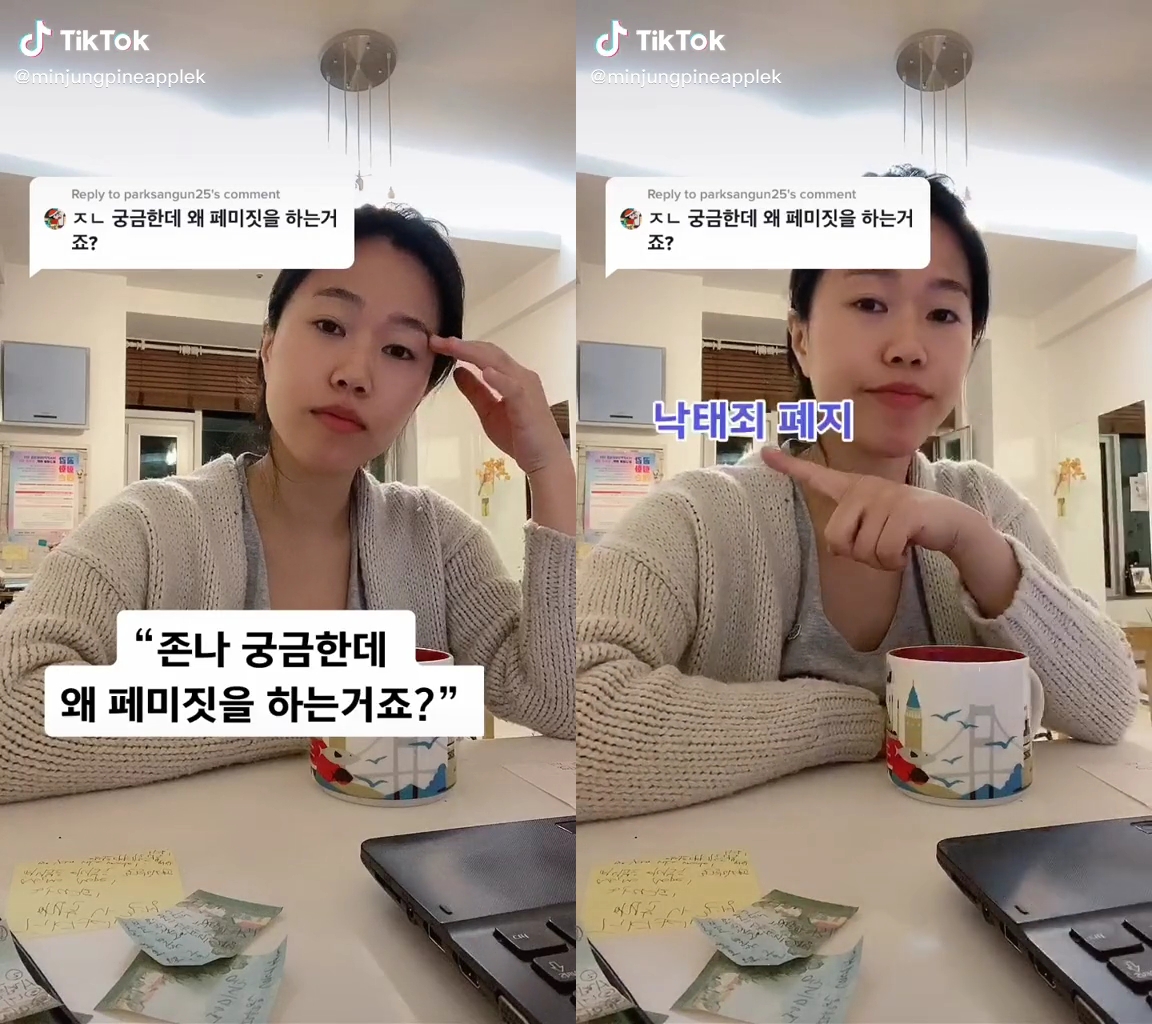
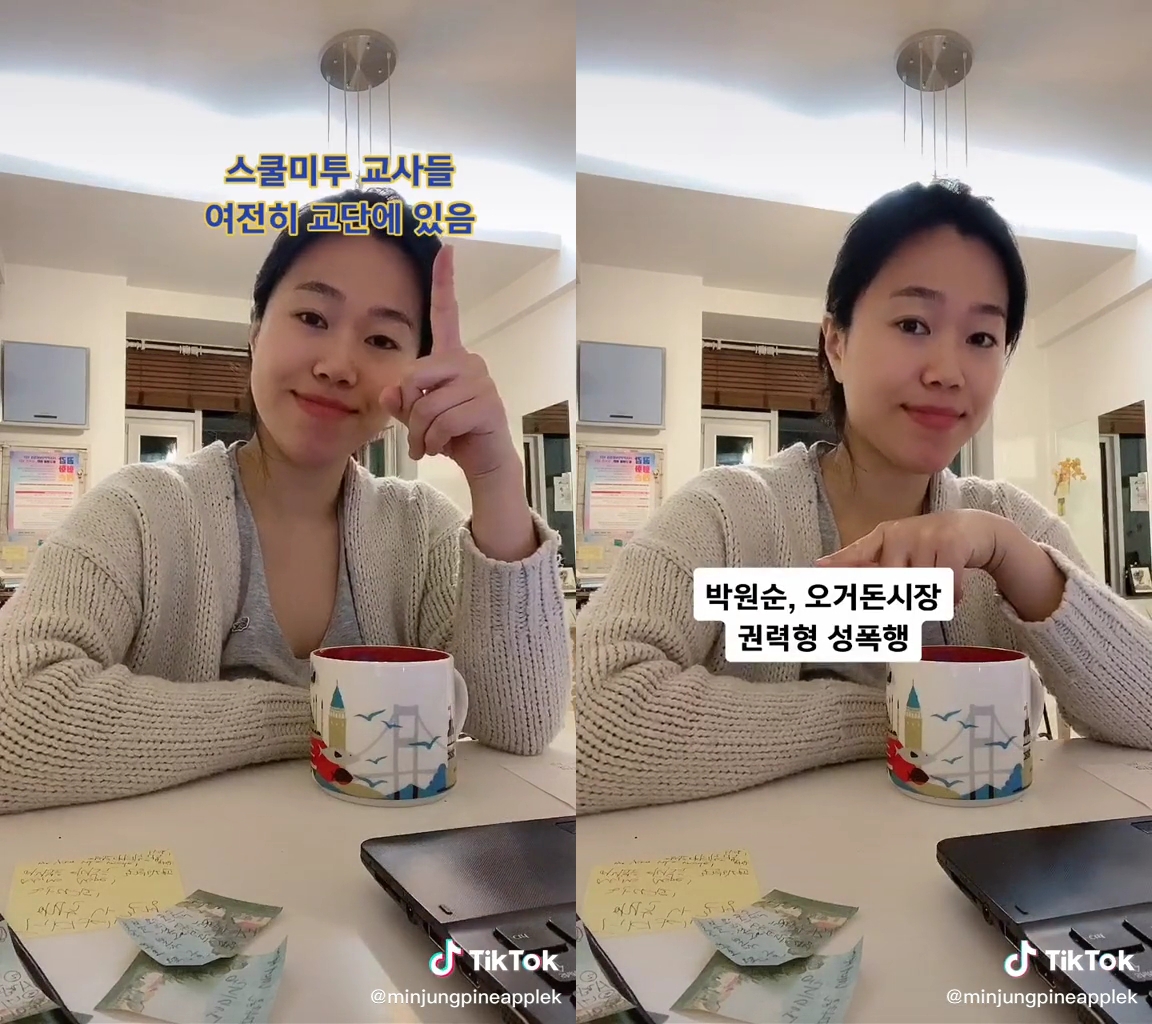
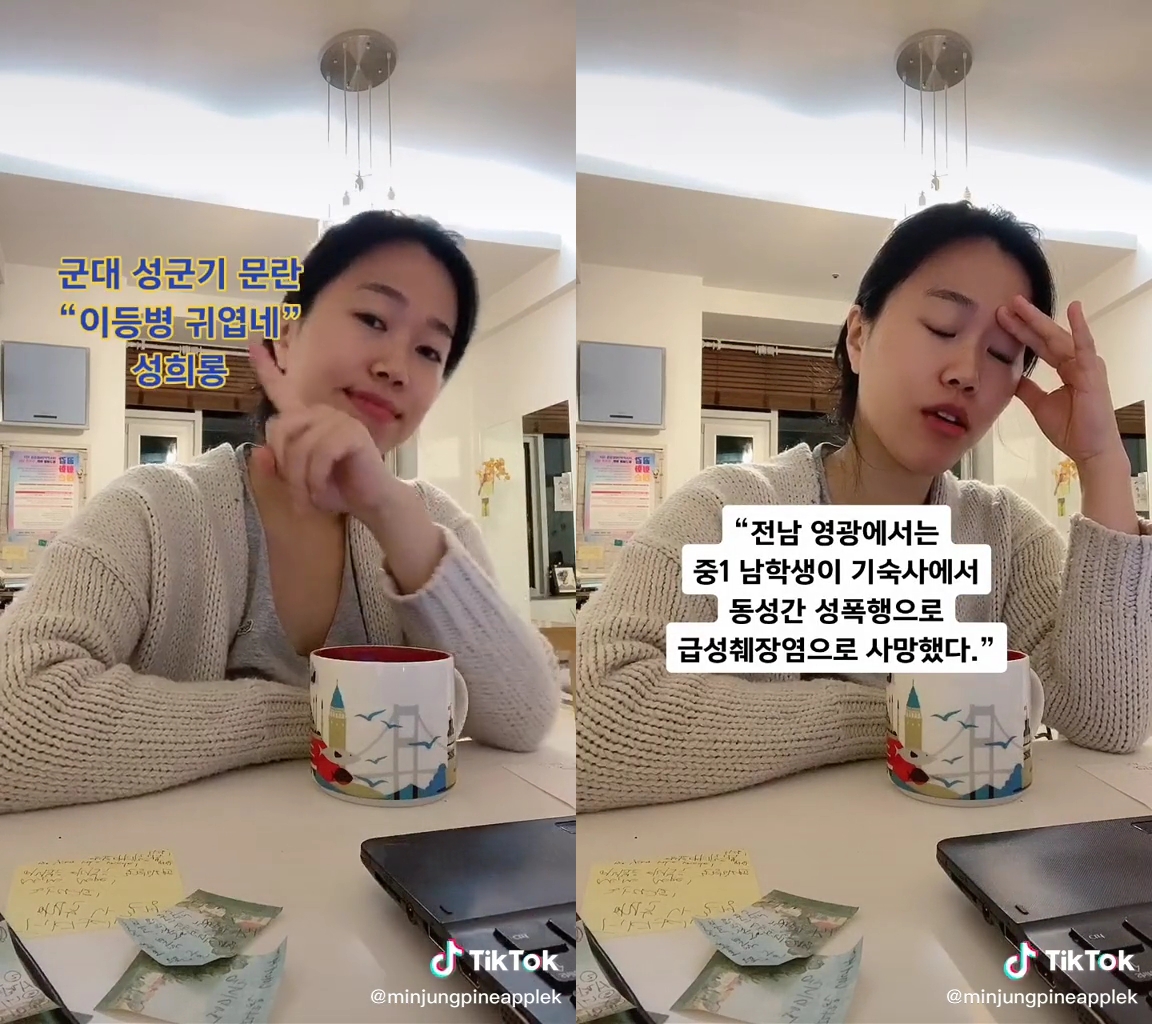
A handy riposte to anyone who claims that feminism is unnecessary in Korea, by Ibagua Kihanovief. Make sure to check out her Twitter, her Instagram, and especially her TikTok for many more Korean feminism-related videos like it.
The least I could do is translate it [with added links and a little extra context by myself!]:
“I’m very curious, why are you doing feminist stuff?”
“Seoul Mayor Park Won-soon and Busan Mayor Oh Keo-don took advantage of their power to commit sexual assault.” [James—I hate to split hairs, but technically both were only accused of sexual harassment.]
“[A culture of] excessive sexual harassment [and abuse] in the military. ‘Oh, you’re very cute Private!'”
“In Yeonggwang County in Jeollanam-do, a male student in the first grade of middle school died of acute pancreatitis after being [repeatedly] sexually assaulted by four other teens in their shared dormitory.”
“In Daejeon in 2017, a female high school student took her own life after being ostracized for coming out as a lesbian.”
Estimated reading time: 4 minutes. Images, L-R: a “Gangnam beauty”; the original “Mi-in-do/Portrait of a Beauty” by Sin Yun-bok; and a poster of the 2008 movie of the same name. Sources: Awesome Pick, 기냥 보는 재미…원미동통신, and 연예계 뒷담화.
Or so I thought, until I learned that controversy was actually about the “Gosan (고산) Portrait of a Beauty,” which looks very similar and often has the “Gosan” omitted from its title (sigh).
Either way, Google perused my complicated browsing history, put two and two together, and alerted me to this news video about a week-long exhibition of it going on at the National Museum of Korea at the moment:
Apologies that I’m only just finding out about it now, and that this provincial Busanite has no information about how to book tickets to Seoul museums. But for the determined, hopefully there’s still some spaces available for the remaining three days of the exhibition.
다시 문 연 박물관…’미인도’ 내일부터 연장 전시 Museum Reopens Its Doors, “Portrait of a Beauty” Extended Exhibition Begins Tomorrow
Saturday October 3
[앵커] 한국의 모나리자로 불리는 ‘미인도’가 내일(5일)부터 국립중앙박물관에서 다시 관람객들을 맞이합니다.
Anchor: Called the Korean Mona Lisa, “Portrait of a Beauty” welcomes visitors again at the National Museum of Korea from Monday the 5th. [James—Not technically “tomorrow”; YTN got its dates wrong!]
코로나19 여파로 닫혔던 박물관이 다시 문을 열면서 특별전시회 기간도 조금 연장했습니다.
As the original exhibition ended prematurely when the museum was closed in the summer due to the Corona-19 pandemic, this special exhibition was slightly extended.
김혜은 기자가 보도합니다.
Reporter Kim Hye-eun reports.
[기자] 구름 같은 가체 머리에 둥글고 앳된 얼굴, 살포시 아래를 향한 얇고 긴 눈매.
Reporter Kim: A cloud-like gachae [traditional Korean wig] with a round and youthful face, and thin, long eyes looking gently downwards.
웃는 듯 아닌 듯 속내를 알 수 없는 표정이 백미입니다.
The viewer not being able to tell is she is smiling or not, her impenetrable expression is one of the highlights of the painting.
목 뒤의 잔머리나 붉은 삼작노리개를 매만지는 섬세한 손 등 세밀한 묘사가 돋보입니다.
The extraordinary detail of the depiction stands out, such as in the fine hair at the back of the neck, and in the delicacy of the hand with which she’s tying the red three-piece norigae [a traditional ornament worn by women].
조선 후기 고관대작들의 초상화에나 사용했던 세밀화 기법이 여인의 초상화에 등장한 겁니다.
In the late Joseon Dynasty, this technique of incorporating small details was used in portraits of high-ranking women.
[강경남 / 국립중앙박물관 학예사: 머리털 한 올 한 올, 한복의 깃까지 굉장히 아름다운 색을 쓰고 세필로 정성스럽게 그려 넣은 것을 알 수 있습니다.]
Gang Gyeong-nam, National Museum of Korea Curator: “You can see that each hair and the collar of the hanbok were carefully drawn, and painted in beautiful colors. Great attention was paid to the fine writing too.”
The woman in the picture is presumed to be a gisaeng, but no information has ever emerged about her.
간송문화재단에서 보관하던 ‘미인도’는 지난 8월 국립중앙박물관에 3주 일정으로 특별 전시됐지만, 코로나19 탓에 나흘 만에 볼 수 없었습니다.
“Portrait of a Beauty,” which was kept by the Kansong Art and Culture Foundation, was to be specially exhibited at the National Museum of Korea last August for three weeks, but the exhibition had to close after just four days due to the Corona-19 pandemic.
지난주부터 박물관이 다시 문을 열면서 ‘미인도’는 11일까지 1주일 동안 다시 전시됩니다.
With the museum reopening last week, “Portrait of a Beauty” will be exhibited again for a week until Sunday the 11th.
박물관 측은 국보와 보물 83건을 볼 수 있는 큰 전시인 만큼 특별전 기간을 오는 11일까지로 연장해놓았습니다.
The museum has extended the exhibition due to its large size, with 83 national treasures on display.
긴장감이 감도는 투전판, 옷섶을 풀어헤친 채 장기 두는 승려를 그린 김득신의 풍속화와, 지금의 청운동인 인왕산 기슭 청풍계를 담은 정선의 작품도 만날 수 있습니다.
Somewhat late to the party, I learned there’s actually a wealthofinformation about Lee Kuan Yew’s eugenicist streak out there. Which just goes to show it’s also been 20+ years since I studied Singapore in any great depth.
But I wonder now too, if Korean policymakers ever had similar motivations?
I don’t have the answers, and I’m not saying a concern with Korean brides’ education was necessarily a thing. But it’s going to be interesting finding out ;)
If you reside in South Korea, you can donate via wire transfer: Turnbull James Edward (Kookmin Bank/국민은행, 563401-01-214324)
Imagine for a moment, there’s a bona fide reason to open a post about Korea’s female sea divers, known as haenyeo, with this image of iconic K-pop group Girls’ Generation promoting Gangnam.
Many of you will immediately recognize its age: Jessica, in the center, left the group in September 2014, two and half years after they were appointed as honorary publicity ambassadors for the district. Yet still their aura of stylishness, cosmopolitanism, and confidence remains so vivid, and district officials’ desire to link that aura to Gangnam so powerful, that this eight year-old advertisement can still be seen in airports even today.
Now imagine if, at the same time it was produced, it was an open secret that the Seoul Metropolitan Government had begun collaborating with a foreign government to set up brothels in Gangnam. Not necessarily K-pop themed, but brothels nonetheless. That by the time Covid-19 struck, the majority of overseas visitors to the district would not be the starry-eyed hallyu fans you’d expect from the sub-heading on the ad, nor medical tourists. Rather, they’d be stressed businessmen from that foreign country, encouraged by both their government and their companies to let off steam by going on sex tours to Gangnam. For some of the more high-ranking among them, their liaisons with Korean sex workers would even be arranged by Seoul government officials themselves, to better facilitate trade and investment deals.
That sexing-up of Gangnam’s image with Girls’ Generation? One hell of a coincidence. Whatever your feelings about sex work, you could ask serious questions about what choices the members had in their image being used to promote it. So too, if they ever made any profit from doing so, rather than all of it going to SM Entertainment.
There, according to Dr. Caroline Norma of RMIT University, prominent Japanese businessmen, private companies, and even the Japanese Ministry of Infrastructure, Transport, and Industry were directly involved in the setting up of tourist facilities and infrastructure in the 1970s—all for the explicit purpose of gambling and sex tourism for Japanese businessmen, and all with the full support of Korean president Park Chung-hee who wanted to develop the island as a tourist resort. Certainly, there was opposition in both countries. Yet by 1986, over 1000 women would be working in the 4 ‘kisaeng houses’ established, and the industry would come to be so integral to the island’s economy that the Jeju prefectural government would ask to be exempted from the anti-prostitution law of 2004—and saddled with swathes of abandoned buildings when that request was refused.
You can also guess that Jeju’s tourist brochures from the 1970s would be replete with glamorous photos of youthful models posing as Jeju’s haenyeo. For example, this one below, which at least features realistic outfits for the time (as I’ll explain in detail later):
Source left, cropped: hansoo7007; the highest quality image I’ve been able to find. Source right: National Folk Museum of Korea via Google Arts and Culture. Unfortunately, the only definitive dating of this image I’ve found is from a 1974 postcard, but it probably dates to at least several years earlier.
But forget about the burgeoning sex tourism industry behind the scenes for a moment. So too, the affected poses. Besides those, what is “off” about about these photos exactly? Which isn’t off about this one below, of genuine haenyeo from the early-1960s?
It’s true the word can have many meanings, including—ironically for our titular subject—“busty” in Korean. But in this particular case, the first two photos are glamorous because their emphasis is on the models as women, not as haenyeo. It’s on their femininity. That’s why they still look like models, despite the authentic outfits and the equipment. Whereas in the last picture, all but one of the haenyeo are too busy to care less about the photographer, which is a good indicator they’re the real deal. If there’s any emphasis in the photograph at all, it’s on the profession.
If stressing femininity was the purpose in the former photos however, this raises the question of why it was necessary to use a haenyeo theme. Even on the added justification that the haenyeo symbolized Jeju, whereas, say, generic bikini models wouldn’t, there were significant numbers of haenyeo on mainland coasts who would have begged to differ.
Source: Dolga Dolga@YouTube. This statue of a Busan haenyeo is located in a popular drinking spot in the summer, and gets a lot of attention (and damage) from drunks.
The answer is that the decision was merely the continuation of a long, preexisting history of marginalization, exploitation, othering, and sexualization of Jeju haenyeo, as I’ll discuss later. But it was indeed from the 1970s when this stress on their femininity began in earnest.
Writing in 2013, Shin-Ock Chang from the Department of Sociology at Sungkyunkwan University described the result of four decades of that:
…femaleness is the most mobilized and utilized aspect of women divers in order to please visitors to the island. Women divers’ femaleness has taken the forefront in the island’s tourism development. The femaleness is pervasive in tourism related materials including magazines, posters, basalt sculptures, FRP (Fiberglass Reinforced Plastics) materialized caricature sculptures, and souvenir items. Indeed, the feminine character of women divers is what one comes across most in traveling on the island, and is particularly pervasive in places where tourists are expected to pass through such as hotels, restaurants, museums, shopping centers, coastline car driving roads, and beaches.
Left: K-pop singer Ivy in 2017, via enews24. Source right (cropped): leesangtaek.
Lest this sound like what some would disqualify as typical feminist overreaction over, say, taking harmless funny pictures in front of a couple of statues (a Jeju vacation ritual), consider that “pervasive” means precisely that. For instance, as of 2010, there were 33 haenyeo statues along the coastal roads of Jeju. Thirty-one of these, Chang notes, were the A to C types in Figure 4 below which emphasize and exaggerate the haenyeo’s “female body lines such as breast, hip, and legs.” Also striking was that 19 were of the A type, which she notes bears a strong resemblance to the 1972 photo of a model in a rather inauthentic and impractical bikini in Figure 5 (but still, as indicated through the picture title and equipment, an ostensible haenyeo):
Source: Chang, p. 24.
Moreover, with ubiquity comes familiarity and normalization, and the Korean public, mainland tourists, and foreign visitors alike tending to regard such objectifying as only natural. For example, also consider that last year, the Jeju Women and Family Research Institute released its 2019 Gender Impact Assessment of Jeju Tourism ContentsReport (2019년 제주특별자치도 관광 콘텐츠에 대한 특정성별영향평가) in which it identified problematic gender and sexual stereotypes in those contents, and made recommendations on how to correct them. Among the many mentions of haenyeo, one example given was the unnecessary use of those sexualized statues of them used in the background of a video for children shown in the Jeju Dialect section of the Jeju Education Museum (pp. 55-56):
시청각 영상물에서 해녀의 이미지 가성적으로 표현됨. 유두, Y존, 섹슈얼한 포즈 등 지나치게 여성의 신체 일부를 드러냄으로써, 해녀의 신체 에대해 성적인 이미지를 강조하고 있음. 아울러 단어와 문장에 맞지않 은이미지를 사용하고 있음. 해녀에 대한 섹슈얼한 이미지 활용에 대한 문제제기는 이미 많이 진행되어 왔고 개선되고 있는 상황임. 이러한 변화에 맞추어 개선 필요. 특히 어린이/청소년 대상 전시물의 경우 미래 세대에 미치는 영향에 대한 고민 필요
☞ 특정성, 특히 여성에 대한 외모를 강조하는 이미지 활용은 지양. 이미지 개선 필요.
My translation:
The video includes likenesses of haenyeo. But those likenesses are in sexual poses and show off female body parts such as nipples and crotches, stressing an overly physical and sexual image of the haenyeo. Moreover, they are completely unrelated to the words and phrases of the Jeju dialect that are the video’s focus.
There have been many improvements made in the use of overly sexual imagery of haenyeo, and [this museum] needs to improve in line with these changes. In particular, in the case of exhibitions aimed at children and teenagers, it is advisable to consider the impact of such imagery on future generations.
☞ Special attention needs to be given to the rejection of imagery that emphasizes women’s bodies. Improvements to this imagery are necessary.
Yes, that is indeed unfortunate shading on the second statue, but it’s no fault of the video. It’s hardly prudish to wonder why the sculptor(s) were instructed to take that particular creative direction with it either, when everyone would balk at them doing the same for other professions.
But in addition to their shared stress on haenyeo’s femininity, there are two more common themes to be aware of.
Let me explain them by posing you a question. Do you think a 30-something haenyeo should have been chosen as the face of a tourism competition last year to win round-trips to Korea? When 9 out of 10 haenyeo are now over 60 years old?
There were good reasons. The Korean Tourism Organization promoted the competition through painfully scripted videos of young influencers in Korea waxing lyrical about literally everything, which automatically excluded all those too old to care less. Also, essentially the same role was envisioned for the eventual winners: a miserly 2 days and 3 nights of hotel accommodation were only provided if they chose to meet with the 1 of 30 Korean “friends” available they’d selected upon entering, of whom Go Ryeo-jin above was one. Realistically, very few young hallyu fans would have opted to spend such a limited time with a more representative haenyeo their grandmother’s age. In fact, in that sense, claiming in her own video that Go was the youngest haenyeo of all may only have further added to her appeal. It’s not like any hopeful competition entrant would have quibbled that it wasn’t actually true.
In fairness, the competition did offer the opportunity to meet elderly “friends” in other professions. But this (mis)representation of haenyeo is all too common. For example, when Go played a similar role the year before:
Source: The Traveller. The Korean subheading at bottom literally says “Jeju Naturalism Travel,” but probably “Travels Among Jeju’s Nature” is closer to the intended meaning. Note the anachronistic rubber flippers.
Hey, no-one’s blaming Go for her side-hustles. But Traveller‘s glamorous representation of haenyeo in particular is problematic. Not because feminists are natural spoilsports, but because, in addition to her relative youth, Go’s wearing one of the much flimsier traditional diving outfits like you saw in those glamorous photos earlier. Which were taken precisely when haenyeo stopped wearing such outfits in favor of wetsuits.
Yes, no working haenyeo has actually worn those for nearly 50 years.
So, unless explicitly set before the 1970s, any modern representation of haenyeo that doesn’t convey the reality that 9 out of 10 of them are elderly women in wetsuits, is misinformed at best and a deliberate misrepresentation at worst. And, again, begs the question of the agendas—or at least stereotypes and cultural baggage—of those choosing the representation.
Left: Her Kyungsuk, Hamo Jeju, 2014. Right: Lee Okyong, Gosan Jeju, 2013. Photos by Hyung S. Kim via BuzzFeed.
The logical outcome of the stress on haeneyo’s femininity is then, a stress on their youth. And the flimsy traditional outfits are best at highlighting both themes, which is why we encounter them far more often than wetsuits.
For example, in this fashion show as part of a haenyeo festival in October 2008, which—make of it what you will—I first found pictures of on the misogynistic, alt-right site Ilbe, where members usually post pictures of women only to ridicule or ogle them:
I would have loved to have continued with more examples here. In particular, of all the instances of haenyeo in Korean pop culture from the last 70 years that I’ve collected these past two months, as all those were surely both strongly influenced by and strong influences on this sexualized positioning of haenyeo. Through their sheer weight of numbers alone, I felt, it would have been obvious to anyone that this combination of femininity, youth, and overabundance of traditional outfits in them has always been a thing.
But that long list would have rapidly snowballed. Better then, to provide you with the tools to judge such representations of haenyeo for yourselves, wherever you may find them.
That’s our cue to discuss the traditional outfit in detail.
Joo-Young Lee and Hyo Hyun Lee, both from the Department of Textiles at Seoul National University, offer a refreshingly simple guide to the traditional outfit in their 2014 examination of the loss of haenyeo’s physiological adaptions to the cold due to adopting wetsuits (p.4.):
Jeju haenyeo wore a bathing suit made of cotton-broadcloth in white or black (100% cotton with 30 counts, about 0.5 mm thick, and 8.5% water absorption at a dry condition) until wetsuits were supplied. Before the broad cotton cloth was imported from Japan [a 99.6 percent monopoly by 1919—James], the bathing suit was originally made of muslin (thin cotton cloth). Haenyeo preferred the broad cotton to the muslin bathing suit because the broad cotton was relatively thicker and stronger in salty water than the muslin cloth.
I’d add that according to the Jeju Weekly, the difference between the white and black outfits is that the former were made from muslin, woven from traditional looms, while the latter were made from broad cotton cloth that was machine-woven, then dyed black. I doubt this difference in material and method of manufacture continued until the 1970s however.
Source: Lee and Lee, p. 4.
From bitter experience, different romanizations can lead to considerable confusion. So, please take note of the original Korean:
The “juck-sam” referred to is “적삼.”
The “so-jung-ee” is “소중이.”
And the “mul-su-gun” is “물수건.”
However, although Lee and Lee only use “mul” in that last name, it simply means water, and every other source I’ve encountered attaches it to the other two names also—i.e., mul-juck-sam/물적삼 and mul-so-jung-ee/물소중이. So I will too.
Also, for your interest, su-gun also means towel, which is what it closely resembles.
Many sources (example) refer to the entire traditional outfit as “murot” or “mul-ot,” but this—”물옷”—simply means “water clothes.”
I’ve only ever seen white muljucksam, but am happy to be shown black ones existed.
And finally so-jung-ee, literally “valuable thing,” is often a euphemism for genitals, and probably no coincidence here.
Next, here’s a more detailed breakdown of the mulsojungee from a (Korean) 2013 article by Kim Hyun-mi and Jang Ae-ran of the Department of Beauty & Art at Cheju Halla University and the Department of Clothing and Textiles at Jeju National University, respectively:
Very confusingly, Kim and Jang mention a jjokiheori/조끼허리 at the top rather than a muljucksam. But that length of it above, indicated by the dotted line extending into the mulsojungee, seems to be mistaken. A jjokiheori is a waistcoat-like covering that is so short it almost looks like a bra (see right), and is most commonly used with hanbok. However, much more commonly used on top of both men’s and women’s hanbok are jeogori (저고리), of which the women’s is usually as short as a jjokiheori, but has large loose sleeves that the jjokiheori lacks; indeed, the muljucksam has been described as a kind of jeogori, albeit with much narrower sleeves to prevent them dragging in the water. As I’ve only been able to find a single additional reference of jjokiheori being used by haenyeo then, and no pictures, there’s no reason to consider it further.
Besides which, it’s the maechin/매친 shoulder strap that’s crucial. This ensured that only the upper chest—but not the breasts—would be exposed if the muljucksam wasn’t also being worn. That, plus the fact that the mulsojungee seems to have come in black just as often as white, sharply distinguishes haenyeo from Japanese ama (海女):
Fixating on breast exposure may seem very childish. Not least, because as you can probably tell from the examples below (and as many readers with breasts will already have been well aware), it is obvious that the thin material would have hidden little, and that the functional side-slits for easy adjusting and removal, plus the practicalities of the job (including infant childcare), would in practice have meant frequent breast exposure. It’s also true that the haenyeo would have been working well away from the prying eyes of most men. And even if men did see them—such as fishermen in passing, handlers of the haeyneo’s boats, or men on their shore unloading the haenyeo’s catches—breast exposure was still routine outside of cities in Korea, even as late as the 1950s.
Caption: “Haenyeo warming themselves up in groups after just leaving the water/공동물질을 마친 해녀들이 삼삼오오 짝을 지어 불을 지펴 언몸을 녹이고 있다 (1968년).” Source: I Love Jeju Magazine.
And yet the mulsojungee would rarely have naturally ridden down below the bust, nor the thick maechin shoulder strap come off, without the wearer quickly fixing them when able. Let alone a haenyeo forgoing wearing a mulsojungee entirely.
In other words, there’s a world of difference between photos like these, taken in passing while the haenyeo were too busy working to care less about the photographers, with photos of haenyeo openly revealing their breasts to them.
Rest assured there are multiple alleged examples from English and Korean google searches to be found of the latter. Armed with this knowledge of the outfits though, now you can instantly tell that a good, say, 95 percent of the nude images are actually of ama, whatever their captions may claim. And it is highly likely that those 5 percent that are indeed of haenyeo were staged.
Knowing this last to be a fact is a good basis on which to investigate why.
When doing so, there’s three potential factors to consider.
The first is the influence of sexualized representations of ama. Frankly, I am unfamiliar with their traditional outfits, and can not speak to how realistic Yoshiyuki’s Iwase’s (influential) depictions of them topless were—while most are clearly glamorized and staged, many others seem to be little different from those we saw of haenyeo working, albeit with much less clothing.
Regardless, given Japan’s much more liberal media environment in the postwar era, ama were much more intensively and rapidly sexualized than their counterparts in Korea. For instance, their fetishization in film goes back at least as far Michiko Maeda’s Revenge of the Pearl Queen (1956), which tellingly also contained Japanese cinema’s first nude scene. By the 1970s, there were numerous soft-porn films centered around ama.
This is important, as it’s plausible to argue that the glamorized depictions of haenyeo from the early 1970s were simply due to timing.
Which is ultimately quite mistaken. But still plausible.
In particular, and somewhat inconveniently for branding Jeju as a cishet man’s sexual paradise, that period saw the beginning of the most authoritarian phase of Korea’s military regime. This included a harsh crackdown on burgeoning youth culture, including on its attendant challenges to conservative standards of dress and restrictions on nudity in art and the media. If that likewise affected advertising, then using models in genuinely skimpy haenyeo outfits would have served the same glamorizing purpose as bikinis. Being authentic, they would have helped deflect potential criticism and charges of hypocrisy that using models in bikinis might have incurred.
Military regimes are not well-known for suffering public opinion however. It’s also unlikely women’s movements would have raised such trifling matters when so many of their members were routinely being brutally beaten by factory-owners and police.
Alternatively, many older readers may recall the very successful James Bond movie You Only Live Twice had been released just a few years earlier. While it was set in Japan, and only featured ama characters, the similarities in tone with the glamorized depictions of haenyeo we saw are obvious, particularly the 1972 example of a model in a white bikini (but the existence of which slightly contradicts the military crackdown rationale). Indeed, at least one former Peace Corps Volunteer admits the movie was very, very much on his mind upon his arrival on the island in 1973.
Mie Hama as Kissy Suzuki in You Only Live Twice (1967). Source, cropped: ScreenMusings. Source above-right: Anastasia Ashman.
But information about the movie’s (unlikely) popularity in Japan itself is hard to find, and regardless, Japanese businessmen traveling to Jeju for sex would undoubtedly have been much more influenced by ama characters in homegrown soft-pornography films. It’s also reasonable to assume that despite the outlawing of pornography in Korea, and despite official restrictions on direct cultural imports from Japan specifically, Japanese sex tourists’ stereotypes and objectification of ama would still have filtered across to the Korean public through various means, and influenced their preexisting notions of haenyeo.
This would have been especially true after Korean films and photos featuring semi-nudity became widely available in Korea, most notably after President Chun Doo-hwan’s “Sex, Screen, Sports” policy began in 1980. These haenyeo-themed examples from the Kyunghyang Shinmun newspaper for instance, which have a very similar feel to Japanese examples from 10 or even 20 years earlier:
Source, left(1987), right(1979; cropped): Moreska@Flickr, used with permission. The red box on the right very helpfully explains that that model is “Film actor Kim Min-jeong symbolizing the haenyeo style. A woman with the sea and sky, radiating a pure warmth”
Meanwhile, Japanese pornography itself had become much more explicit by that stage. I’ll leave interested readers to find ama-themed examples themselves however, confining myself here to passing on the trailer of the (comparatively mild and amusing) Nympho Diver: G-String Festival (1981) instead. Partially, because of its conspicuous Korean subtitles, which title it as Lustful Haenyeo, and partially because it’s quite typical of the sort of adult movies I’d find playing on very late-night Korean television in the 2000s.
Lest I have come across as too critical and prudish in this post, for the record I’m actually a strong supporter of ethical pornography produced in safe environments, by and for consenting adults, and which focuses on women’s pleasure just as much as men’s. Yet I’m hardly ignorant and naive either, and am well aware that most pornography presents women as all too eager to have sex with just about any cishet man who bestows his gaze upon them. So I’m not surprised then, that the aforementioned Jeju Women and Family Research Institute’s 2019 report on tourism materials found numerous cases of voyeurism being normalized as both completely natural for men and just clean harmless fun, which I’m astonished haven’t been torn down yet in the wake of angry protests against Korea’s spycam epidemic. One of these examples (p. 58), from Jeju Loveland, depicts a haenyeo in all but name:
Incongruous Caucasian man in Victorian-era clothing aside (a wholeothertopic), I’ll leave readers to connect the dots to earlier, pre-internet examples.
The next factor to consider is that the 1970s weren’t the first time haenyeo had been used to sex-up the island for the tourism industry. One prior attempt comes from the 1950s:
Source, top-right: KRpia. Source, all others: 유자향내를 따라서.
Clearly, these photos are part of a series, of which more are available at the single source. Frustratingly however, no extra information about them is provided (my bad for not contacting the owner yet). Also, while the one at the top-right is available elsewhere, most notably in the KRPia Database, I lack the institutional access required to see if any additional information is provided there. (I’ll return to this practical issue later.)
An additional source of frustration is that although some of the outfits appear inauthentic, eagle-eyed readers will have noticed that in an earlier picture of genuine working haenyeo from the 1960s I provided, some of them too wore outfits with two shoulder straps.
After spending so much time researching and familiarizing myself with the traditional outfit, I frankly throw my hands up in despair at that observation. (And so miss that they could simply be a kind of tank-top?) Yet the fact remains that those 1950s photos above were obviously completely staged and glamorized, particularly of the bare-breasted woman. But why?
A tantalizing hint can be found through the following photograph in a June 2012 article in the Jemin Ilbo. Not only because it’s very similar to the above (albeit still very uncertain if it’s related at all), but because the caption there claims it was for a tourism shot:
Again frustratingly, that’s the entirety of the information about it. But if true?
Likewise, what to make of the following photo, which is also very staged, but with authentic outfits? Curiously, an authoritative source dates its production to exactly July 21, 1958, but doesn’t say on what that date is based. Nor indeed, any other information about it:
I apologize that the pictures raise more questions than answers. But I’m on much firmer ground with the final factor to consider, to be considered when viewing images 20-30 years earlier from the colonial period: that generally, Japanese colonial representations of Korean women were used to dangle the possibility of sex with locals, to present them as primitive and in need of civilizing, or both.
Alas I can not possibly do justice to the extensive literature on the development of the sexindustryin colonial Korea driving that, let alone dare to publicly take a stance in the politically-charged debate on its links to wartime comfort women. So, I will confine myself to making two points about its scale, as this was a big factor in why postcards and posters of Korean women were so prolific.
First, among colonial empires, the Japanese one stood out for the number of men from the home country working in its colonies. To give a specific example: according to politics and international affairs Professor Atul Kohli of Princeton University, “there were 87,552 government officials in Korea in 1937, 52,270 of whom were Japanese, whereas the French state in Vietnam (relatively large itself compared to British colonies in Africa) only had 3000 French officials. In other words, for geographically-similar sized colonies the Japanese had fifteen officials for every French one.”
I don’t mean to imply that Japanese officials were the bulk of the clients, which wasn’t the case at all. But those numbers do suggest that, per capita, the sex industry catering to such a colonial presence would have been comparatively large. Also, secondly, why regularly visiting sex workers was considered completely normal and unremarkable.
Yet for Japanese living in the Home Islands, why travel to Korea for that?
“The most famous gisaeng during Japanese colonialism, Jang Yeon-hong.” Source: zixundingzhi. Note the accompanying prominent placing of the Japanese General Government Building, completed in 1926.
One reason was the relative ease, both because of the geographical proximity and because a huge industry for Japanese tourists was developed in the interwar years. Another was the persuasiveness of the ensuing extensive advertising. Also, as Hyung Il Pai of the University of California explains (p. 73), there were “millions of train schedules, pamphlets, and guidebooks estimated to have been distributed at major piers, train stations, and department stores throughout the empire.” Unfortunately, being designed to be disposable, very few of those have survived. But it’s unlikely their contents would have differed much from the sturdier pocket-size guidebooks and attractive postcards that do remain, and these had consistent themes. As Okpyo Moon from the Department of Anthropology at the Academy Of Korean Studies explains (p. 151):
While actual places visited by Japanese travelers concentrated on urban centres and newly constructed modern colonial facilities, many of the postcards printed and circulated during the Japanese colonial period emphasized images of pre-modern exoticism. For instance, most of the tourist postcards of the time depicted Korea with images of rural rather than urban, female rather than male, elderly people or children rather than lively young men, passive and static rather than active and moving, traditional and past-oriented rather than progressive and modern. The continuous reproduction and wide distribution of these images helped Japanese travelers to perceive colonial Korea as something to be conquered, enlightened, modernized, desired, and consumed.
In the last two decades, a big online market for these postcards has developed, driving up costs and making access more difficult. Also, most of the universities and museums with digital archives of the postcards, and, presumably, as much verifiable information about them as is available, either require institutional access or visits in person—and most are in the US. Add that such painful, emasculating depictions of Korea may not be a favorite subject of Korean historians, so the vast majority of scholarship on the postcards appears to be Japanese (which I don’t speak), then unfortunately it feels extremely difficult, here in Busan, to pursue the subject in as much depth as I’d like.
The January 1927 cover of Chang Han (長恨 Enduring Bitterness), a veryrare examination of the colonial sex industry written by the sex workers themselves. Source: Adan Mun’go.
An informal survey of what material is publicly available however, demonstrates that the overwhelming majority of glamorous pictures of Korean women in them are of kisaeng. It would be very hypocritical and misleading to perpetuate their own stereotype that they were largely sex workers; however, the colonial (male) tourist gaze didn’t discern their internal distinctions and artistry, stressing their alleged sexual skills and availability instead. This context should be borne in mind when you see examples like thosetwo a moment ago, and Moon (pp. 153-4) notes their obvious similarities with later tourism materials:
An apparent continuity can be observed between the pre-war and the post-war Japanese perception of Korea and in the ways in which tourism was later promoted in Korea. The tourist posters printed and distributed by the Korean government in the 1970s, for instance, invariably depicted women in Korean traditional dress either dancing or playing musical instruments such as [12-stringed Korean harps]. The continuity with kisaeng images in the postcards of the colonial period cannot be missed.
This depiction of Korean women in traditional outfits, accompanied by the tools of their trade, but in which it’s ultimately their femininity that is being highlighted, does sound somewhat familiar.
Meanwhile, of the other colonial postcards featuring women, many of the others were like that of the somewhat wizened-looking rural woman with exposed breasts. In an era when the adoption of Western dress was rendering breast exposure increasingly taboo in the cities, and covering them a signifier of (Japanese-led) modernization and civilizing, then the intention of the photographer was clearly to shame. Forthis reason, many Korean historians and the public have—not unreasonably—refused to accept that breast exposure was nonetheless still routine in the countryside then.
But because of what we know about the traditional outfit, we know that it was indeed for shaming purposes that the haenyeo below was told to pull down her mulsojungee to expose her breasts, in this, the single verifiable postcard featuring a haenyeo I’ve been able to find:
My source, to whom I’m eternally grateful, gave a little more information about its origins in their message to me:
[This] is part of a set of eight postcards which I bought from a Chinese dealer some 15 years ago. As you will know, postcards produced by Japanese businessmen in Korea for sale mainly to Japanese tourists and collectors are an important—and very often the only—source of photographic material of the colonial period. They often came in sets of several cards held together by a colourful printed envelope. The Cheju-do set also includes an explanation sheet (in Japanese, of course). These are the only Cheju-do postcards in my collection, so it seems Cheju-do was not popular with Japanese tourists at that time.
Actual tourists aside, it has been argued that glamorized posters and postcards of young, nude Jeju haenyeo were also produced, but I have yet to find any actual examples. Also, for readers’ interest, another similar, shaming depiction of topless Jeju haenyeo can be found in a Japanese newspaper from 1934 (p.24).
◊
(Update) And then the following appeared. Alas, not from a Japanese postcard, but intriguing nonetheless:
With my considerable thanks to historian JiHoon Suk for passing it on, this topless, alleged Jeju haenyeo comes from the cover of the June 1928 edition of the Korean literary-intellectual magazine Donggwang (동광), with the caption:
“濟州道 海女들이 감(柿)를 드린 바지를 입고 潛水질하는 거슬 海邊에서 볼ᄯᅢ에는 꼭 南洋에 간 感이 잇다. 女子들은 어찌나 健康한지 젖가삼이 쑥쑥 나오고 血氣잇게 다니는 그 女子들은 陸地의 男子보다 몃배의 힘이 잇을 것이다. 市長에는 女子뿐이고 巨里에 낭구(木) 팔러 오는 사람도 女子이고 심할 것은 牛馬의 力으로 回轉시킬 돌방아까지 女子 3, 4人의 힘으로 도는 것을 보앗다. 陸地의 女子들이 濟州島 女子들의 하는 活動을 볼 때에는 참 놀랠것이 만흘 것이다. (寫眞은 濟州에서)”
Suk explains that, basically, “the intention here is to emphasize how strong and healthy the women of Jeju (including haenyeos) are compared to (even) men of the ‘mainland’,” and that specifically “when the caption mentions ‘젖가슴이 쑥쑥 나오고’ (Their breasts are well-built and protruding),” he is “quite positive that this is alluding to the common complaint that the Korean (mostly male but some females as well) intellectuals were talking at that time that Korean women lacked healthy postures and development and [were] thus inferior to more healthy (i.e. ‘Western’) bodies.”
Indeed, this was a common complaint at the time in China, Taiwan, and Japan, too, and I’m looking forward to covering the topic in more detail in the next post in my series on that.
I stress only alleged haenyeo though, as she’s clearly not wearing the traditional haenyeo outfit, and her bottoms closely resemble those of the ama featured in Iwase Yoshiyuki’s photographs taken 30 years later. We also only have the caption writer’s say-so that the woman was a haenyeo (there was no related article), and the editors were probably not all too concerned about accuracy when they were conjuring up a rationale for putting a nude woman on the cover. So, I’d wager that she was indeed an ama—or a least a haenyeo working elsewhere in the Japanese empire, of which there were many. Alternatively, the adoption of the ‘traditional’ outfit in the 1920s may have been much more piecemeal and gradual than I suggested. Either way, it just goes to show haenyeo’s long history of being sexualized, and my thanks again to Suk for passing it on.
◊
But frankly, it’s high time to move on from (over)analyzing tantalizing, but ultimately very frustrating single examples the further back in time we go. Let’s conclude instead, by addressing four elephants (whales?) in the room.
The first is that simple geographical isolation meant that Jeju residents were inevitably marginalized and othered throughout Korean history. And Jeju haenyeo in particular, about whom most mainland Koreans would have known very little beyond that they dived and wore skimpy outfits, would have been very easy to conjure exotic, sexualized narratives about. An internal Orientalism, if you will.
The isolation driving this was significant until surprisingly recently. As the island is just a quick, cheap flight away today, it can be difficult to appreciate how difficult it has been to get to for most of its history, and that what later became the standard practice—flying to Jeju for honeymoons—only really began in the mid-1980s. In stark contrast, when the glamorized pictures of haenyeo were being produced in the early-1970s, the Seoul-Busan highway had only just been completed. Only 1 in 100 Koreans had cars then. Also, consider Koreans’ abject poverty at the time: still less than 1 in 10 had washing machines, refrigerators, phones, or televisions. Not for nothing would the Minister of Education in 1973, in a rare moment of candor, publicly praise sex workers for bringing in so much foreign exchange “with their cunts.” (Which is not to imply the sex workers weren’t still treated appallingly by the government, and aren’t still awaiting compensation even today.)
Next is the stereotype of Jeju women as feminist Amazonians, which does not jibe well with much of what you’ve read so far. By all means, gender relations on Jeju have long been much more complicated and interesting than on the mainland, and today at least Jeju women do indeed generally have more equitable gender relations compared to their mainland counterparts. But I also invite you to read this journal article from 1976 for an academic perspective on those from the time, in which the author Soon Young-yoon bluntly concludes “Jeju martriarchy does not exist.” This assessment has not changed over time, Dr. Norma also noting that Jeju women were not particularly empowered in the 1970s (p. 417):
Even with [the income from tourism]…the island was still significantly poorer than the rest of South Korea. Women living on Jeju were, therefore, even more vulnerable to the demands of the Japanese men who traveled there in large numbers in the early-1970s.
Nor were haenyeo in any more of a position to challenge the sexualized narratives being written about them by the Korean and Japanese governments. Consider that even while celebrating haenyeo history and culture for instance, this short 2016 Arirang video also features the now elderly women themselves describing the realities of their dirty, difficult, and dangerous job. In particular, they point out that it was not at all their choice to do the work, and that they were always looked down upon for doing it:
“Life was so hard that we couldn’t live without harvesting underwater” (2:12), “There was no other way to make a living” (2:20), “It’s hard work, but what can we do…I sent my children to college on the mainland with the money I made doing this” (2:32), “Diving in the sea is such a harsh, low-esteem job” (5:14).
I highly recommend Joey Rositano’s blog about haenyeo for many more in-depth interviews in that vein, and his recently released book Jeju Island’s Haenyeo, A User’s Manual. (And if you’ve just read 6000 words on haenyeo, how can you not buy it?). Full disclosure: I am especially grateful for his giving me time for an interview, and regret that so little of what we talked about made it into this post. But one thing we did talk about, and which was also mentioned to me by my other friends living on Jeju, leads me to my third point: that the image of haenyeo held by most actual Jeju residents is much more folksy than sexualized. Moreover, that haenyeo are far more concerned about increasingly severe pollution and other existential threats to their livelihoods caused by Jeju’s tourism industry, than about nipples on a few statues.
I am happy to defer to his and others’ experience of Jeju, let alone of the voices of haenyeo themselves, and look forward to hearing readers’ own impressions and stories as visitors or residents. I also acknowledge that most of the sources used here are somewhat old, and that there have been important developments in the last decade or so in the preservation of haenyeo history and the amplification of their voices.
And yet, while their modern image may indeed be moving well beyond the sexual stereotypes discussed here, their lack of control and profit from it sounds depressingly familiar. As a young haenyeo explained in an interview on Rositano’s blog in 2017 (my emphases):
Q) Nowadays there are a lot of touristic items such as jewelry, statuettes and other items featuring the women divers’ image. You’ve become a symbol of the island.
A) I think that it is good and realize that it is also due to the push for Unesco designation. It is good that we are recognized and I guess the outside world has the image in their mind that we are tough because we are divers. But we don’t seem to benefit from these touristic items. The people who make them are the ones who benefit. The ama…are more well-known in the world than we are, and in their villages the divers receive money for the touristic items they sell. This is not the case on Jeju Island. They (the local government) could make a certain item particular to each village and give us a cut of their revenue, but they aren’t doing this.
Q) How about when you are photographed?
A) That, too, doesn’t benefit us. It benefits the photographer….
Source: The Jeju Weekly. Caption: “Tamna Sullyeokdo,” painted in the early 1700s by artist Kim Nam-gil at the order of County Magistrate-cum-Navy Deputy Commander Lee Hyeong-sang, depicts haenyeo wearing white clothes as they dive near Yongduam Rock in Jeju-si. Inside the white circle, you can see the haenyeo working under water. (Photo: Korean Maritime Museum Webzine)
Two months ago, I was inspired to start writing this post by readingthatin fact, the haenyeo had been topless over a century ago, our final elephant in the room. Frankly, my choice of title is a little misleading (sorry), but I was just too attached to the double-entendre to give it up.
A century is a long time though, and realizing why the image of topless divers endured nonethless, and who it was for, I couldn’t help but recall Seungsook Moon’s must-read below. For it was from her that I first really grasped how the Korean government, military, and industry has long used, and literally even broken women’s bodies for nationalist and developmentalist ends. All too often, with little to no input or agency from women themselves, and over their desperate opposition.
It’s very difficult now, not to place the sexualization of haenyeo on the same continuum.
Right: From 207, then 17-Year-Old K-pop star Tzuyu being indirectly presented as “A Special Gift for [those] Korean Men” who have completed their military service.
With that, I am absolutely not saying every young, attractive woman in a traditional haenyeo outfit you’ll see will have been placed there with ulterior motives. But the next time you do encounter one in a tourist brochure, webtoon, talkshow, television series, or movie, I urge you to consider who chose to represent haenyeo that way, and ask why exactly.
Or indeed, to always ask who and why about any cultural text. Especially when you’re not entirely sure the people in them are the ones calling the shots.
No offense Kim Sa-rang, but why would W-Angle hire a professional golfer to model its men’s clothes, but an actor for its women’s?
Just kidding—I know it’s because most Korean female golfers just don’t have the “right” bodies to appeal to the Korean public. This, despite Korea producing far more elite female golfers than male ones, and the South Korean women’s tour drawing many more spectators than the men’s equivalent.
Apropos of that only one woman’s body-size and shape will do attitude, which has driven manyfemale golfers overseas in search of sponsorship, even W-Angle’s advertorial in GolfBiz (I refuse to call it an article) is not shy about stressing that its new, ‘W-Ice’ women’s clothes are all about showing off the wearer’s body, whereas the men’s will help with their game (my emphases):
광고 속 김사랑이 착용한 ‘여성 W-Angle 긴 소매 블록 티셔츠’는 여성미를 강조하는 과감한 절개선과 배색으로 볼륨감 있으면서도 날씬한 몸매 연출을 도와준다. 냉감 기능성 소재를 사용하고 땀이 많은 등 부분에는 통풍이 잘 되도록 펀칭 소재를 적용해 쾌적하게 착용할 수 있다. 긴팔 디자인으로 자외선으로부터 상반신 전체를 보호할 수 있다. 블루와 마젠타(심홍색) 두 가지 컬러로 출시됐다.
The ‘Women’s W-Angle Long Sleeve Block T-Shirt’ worn by Kim Sa-rang in the commercial helps to show off a slim, voluptuous look with bold cut lines and colors that emphasize feminine beauty. Made of a functional, ‘punching’ material that removes sweat from the back through ventilation, it produces a cooling, comfortable feeling for the wearer, while the long-sleeved design protects the entire upper body from ultraviolet rays. It has been released in two colors, blue and magenta (crimson).
홍순상이 착용한 ‘남성 HSS 버티컬라인 냉감 긴팔 티셔츠’는 실제 홍순상 프로의 착용 피드백을 반영해 필드 위 최상의 플레이를 제공하는 ‘홍순상 프로 라인’ 제품이다. 고기능성 냉감 소재를 사용해 땀의 흡수와 건조가 빠르며, 팔 부분에 신축성이 뛰어난 냉감 나일론 소재를 적용해 부드러운 스윙이 가능하다. 홍순상 프로 라인의 시그니처 로고를 활용한 세련된 디자인도 특징이다. 색상은 네이비와 화이트로 출시됐다.
The ‘Men’s HSS Vertical Line Cool Long Sleeve T-Shirt’ worn by Hong Soon-sang is a ‘Hong Soon-sang Pro Line’ item that was developed with feedback from the athlete himself in order to create a product that enables the best play on the field for wearers. It [too] cools through use of a high-performance material that absorbs sweat and dries quickly, and a soft-feeling nylon material with excellent elasticity is applied to the arms to enable a smooth swing. It also features a stylish design that utilizes Hong Soon-sang’s signature logo. The colors are available in navy and white.
Apropos of those “men act and women appear” attitudes, the first half of W-Angle’s latest commercial presents a smorgasbord of gender stereotypical poses. With the advertiser’s determination to cram them all in to just eight seconds however, the result is almost like a satire of sociologist Erving Goffman’s Gender Advertisements, the go-to guide for how women are are subtly diminished vis-à-vis men in ads:
Blink and you’ll miss them though, so let me break those poses down.
First, Sa-rang shows off her profile to the viewer. Nothing wrong with that of course. But if you haven’t noticed it before, the contrast between her demeanor and Soon-sang’s is bizarre. It’s almost like he’s the dominant male gorilla, keeping a wary eye on possible competitors for her affections in the distance.
Having gained the attention of the viewer, she turns towards them and shows her romantic interest.
Yes, I’m getting a definite male gaze vibe too.
Finally, Soon-sang notes a rival mate for Sa-rang is close at hand.
At the same time, Sa-rang signifies both ownership of and protection by Soon-sang by placing a hand on and standing behind him respectively. As in, she’s interested, but you’ll have to prove your worth by going through Soon-sang first. And he makes sure you know it.
I realize a nature documentary seems a lot to read into just four seconds. But how else to describe the blatant cockblocking above, which—once you notice it—is astonishingly common in ads:
As I’ve discussed in more depth in earlier posts, Erving Goffman places this shielding in his—no pun intended—’Licensed Withdrawal’ category, meaning it’s a method by which women are subtly moved into a passive role and/or the background, compared to the men often literally standing guard over them. It’s further emphasized by the women using the safety and security they provide to express curiosity or even romantic interest in the viewer, giving even greater reason for her male partner to be wary:
Ironically, the effect is immediately ruined in W-Angle’s commercial by Soon-sang suddenly warming to his homie in the next shot, begging the question of what purpose the pose served:
But note Sa-rang’s feet:
Again, such a cross-legged pose is ubiquitous in advertisements and commercials. But this and many others like it are much more awkward than the models make them look (hence Sa-rang’s need for Soon-sang’s support here), and are far more commonly found on women than on men too. For instance, in the “Don’t Worry Mom!” ads and commercials for Remark Vill serviced apartments I recently discussed, which—notice a certain conception of women emerging?—also sell themselves on the notion that their incoming 30-something female residents are so impractical and girly that they haven’t learnt how to adult yet:
32 year-old actor Im Se-mi: “Mom, you’re bringing that up again?” / “I’m taking care of things myself now!” / “I can get lightbulbs changed if I need to, and the toilet unblocked too.” / “I don’t need to call Dad!” Source: YouTube.
Erving Goffman places such poses in his ‘Ritualization of Subordination’ category. By which he means that whereas Gong Yoo on the right below, for example, is posed naturally and ready to spring into action, Lee Min-jung on the left will be having trouble just keeping her balance. She is, quite literally, one step removed from being in control of the situation, and is thereby subordinate to Gong Yoo.
Admittedly this is much more subtle than most. But it’s there, and it’s reasonable to ask why it’s far more common for women than men to be posed in stances that would have them falling over in real life, and what the effects of constantly seeing such ads might have on our notions of gender roles.
Finally, as if to further remind the viewer who’s the subordinate partner in W-Angle’s commercial, Sa-rang cants her head onto Soon-sang’s shoulder:
Yes, it probably is more aesthetically pleasing than having both simply standing straight. And yes, she is 10cm shorter in real life. But she just wouldn’t have been hired had she been taller. Moreover, Goffman notes that simply being shorter frequently isn’t good enough—women are subordinated further still by the tendency for female models to be posed to make their bodies as diminutive as possible relative to their male counterparts. Usually, by sitting or lying down while the men stand or sit respectively, or by canting their head like Sa-rang:
On top of that, even though men and women appear much less often together than when Goffman wrote Gender Advertisements in 1979, still the drive to quite literally put women in their place remains. Hence the uncomfortable-looking example by Gong Hyo-jin below for example, despite there being no man in Uniqlo’s ad campaign that she needed to elevate:
That example was from 2010; in all the time I’ve spent researching ads since, it’s been my overwhelming experience that ads that diminish women in some way—especially the minor ones like those showcased in this post—are more due to advertisers’ simple laziness and following of convention than any deliberate sexism.
Yet it’s also true that Korean internet ads are notoriously unregulated, with even advertisers themselves calling for more regulation of sexual content. That women are almost 60 times more likely than men to be wearing revealing clothing in Korean TV commercials. And that the Korea media industry as a whole and upper echelons of ad agencies are dominated by men.
So, change is needed. And this example of digging a little deeper into W-Angle’s commercial hopefully provides some ammunition for that. Shielding, awkward crossed feet, and a female model resting her head on a male model’s are not ‘sexist’ per se, but a knowledge of those cliched poses can help translate gut feelings of distaste into legitimate questions to pose to advertisers. Also, a reminder that where there’s smoke there’s usually fire, and that in 2020 it’s often very possible to find evidence that the people behind problematic ads do really do harbor less than helpful gender stereotypes. Like an advertorial, say, that explicitlysays the clothes being advertised are for men to act and women to appear in.
Probably, many of the people behind this commercial would be just fine with that. But I like to think that many others, unable to dismiss criticisms of the clichéd, “feminine” posing and forced to acknowledge their sexism, would be embarrassed enough to try a little harder with their next effort.
If you reside in South Korea, you can donate via wire transfer: Turnbull James Edward (Kookmin Bank/국민은행, 563401-01-214324)
Twenty years ago today when I arrived in Korea, the very first ajeossi I encountered was one of the most awesome men I’d ever met. But the next one happened to be my boss, who would later break into the house I shared with my coworker, and steal all her underwear.
Estimated reading time: 6 minutes
Thursday, May 11 2000, was Buddha’s Birthday—a national holiday. An ironic blessing, in hindsight. If I’d arrived any other weekday afternoon, it’s likely my new boss would have demanded I teach the evening shift. As it was, he had to be content with driving me straight to his hagwon from the airport, then lecturing me on minutiae about the textbooks—despite knowing full well I’d just spent the last 18 hours traveling, and had a terrible flu to boot. After putting up with about half an hour of this, even falling asleep at one point, it finally dawned on me that this was no simple cultural misunderstanding. He really was being that thoughtless, and had no intention of letting me shower and sleep in the apartment I’d be sharing with my coworkers first. So, I had to insist. That was when I found out I’d be teaching at 6:30AM the next day, every M-F, rather than 8:30AM as I’d been told by my recruiter, and would only be getting six hours sleep a night for the next year.
My boss thought he was being reasonable. Maybe, in a way, he was. Due to my recruiter’s incompetence, I’d arrived two weeks late. And it was my recruiter who’d lied to me about the horrendous split schedule, he insisted, not him.
So, when my boss broke into my apartment a few months later, and stole all of my female coworker’s underwear, he had a perfectly reasonable explanation for that too.
You see, a few days earlier a new male coworker, who’d arrived in Korea drunk, had wisely fled back to Utah upon receiving his first paycheck. (He still owes me 50,000 won, so let’s call him Alan.) Really, he was no great loss. But you could have tried telling that to our boss. Over the previous month, so thrilled at having the first American to ever teach at our hagwon, he’d lavished Alan with so many gifts, dinners, and assistance that my Canadian coworker and I had been left speechless. (Think of the Durselys’ treatment of their son Dudley compared to Harry Potter.) So, when Alan suddenly left, unceremoniously ending their budding “friendship,” as well as my boss’s dreams of a soon to be all-American hagwon, you could almost feel sorry for how utterly betrayed he felt.
Almost sorry enough even, to forgive him for the 5:50AM walks to class in the snow that Alan and I had endured the previous week, which were the final trigger for his leaving. Almost.
You could almost say it was only natural then, that my boss’s petty reaction would be to use his key to our apartment to sneak in while my female coworker, her male fiance, and I were sleeping, go into Alan’s old bedroom, take all his belongings, then ransom them when Alan inevitably called from Salt Lake City to demand my boss send them over.
That Alan would have taken everything of value, and would not be all that heartbroken over the few tourist maps of Jinju, some odd socks left under the bed, and dirty ashtrays that remained, just never seemed to have occurred to him. Nor, that all the bras and panties hanging up to dry probably didn’t belong to Alan either, but rather to my female coworker taking advantage of the newly-vacated bedroom.
With great reluctance, the next morning my coworker’s fiance and I had to physically restrain her from punching our boss at work, and her underwear was rapidly returned to her. Genuinely confused as to why she couldn’t just laugh it off as a simple misunderstanding though, let alone why she’d scream at him in front of the entire staff and students that she’d beat the shit out of him if he ever pulled anything like that again, the only remorse he could offer was in the form of a gift of a whole can of Pocari Sweat a few days later. Then, by asking her to teach Alan’s classes for free.
I’m surprised I lasted the whole year there, considering.*
Fortunately though, my boss wasn’t the first Korean person I’d met on my travels. That would be the very friendly ajeossi sitting next me on the plane. Who, correctly perceiving that I was completely freaking out over my first solo trip and move overseas, proceeded to warmly welcome me to Korea, told me how delighted he was I’d chosen to teach in his country, and then gave me several warm, affectionate, lingering pats on my inner thigh to make sure I knew it. The first time I’d been touched there by a man, I quickly realized, since my father had dressed me as a child.
Did I mention the plane hadn’t even taken off yet?
Again fortunately though, I’d already read that Korean men were much more physically affectionate than New Zealand men. I’d also just happened to have spent the last 18 months living with stereotypically, flamboyantly gay sex workers, who’d all been convinced I was also gay really, and who constantly vied with each other to prove it (let’s just say this wasn’t the first time I’d woken up to find underwear had gone missing). So, I didn’t need to think twice about giving him the benefit of the doubt. Really. And sure enough, over the next 12+ hours, he gave no other indication that it was meant as anything other than genuine friendliness. Later, at Gimpo airport (no Incheon back then), instead of going straight home to his family in Seoul, he spent well over an hour of his time making sure my zombie-like self got on my connecting flight to Jinju first.
I really regret now not holding on to his business card.
But it would be an exaggeration to say that my experience of meeting him would inevitably lead to this blog 8 years later. I already well knew there were healthier alternatives to New Zealand’s (then?) homophobic, toxic masculinity—that was precisely why I was leaving. Still, it’s a nice story I like to pretend that did, which always gets laughs from students as I use it to break the ice at the beginning of the semester.
The one about my hagwon boss though, which is just too surreal to be made up? I wisely reserve that one until we’ve all gotten to know each other a little better.
Maybe one day, those same students will then feel comfortable enough with me to suggest that my current university photo above, taken for my recruiter in April 2000, is a little out of date? ;)
*Update: Perhaps I should add that it’s only so easy to laugh now, because the break-in was only the latest and most egregious in a series of equally bizarre displays of behavior by my boss. Also, because his shortness and waif-like physique meant that, despite everything, it was still very difficult for any of us find him physically threatening (in particular, while I’m 183cm/6 ft. my female coworker was actually much taller and stronger than me).
But of course, people coming into your home while you’re sleeping is no joke, no matter how familiar they are. And unfortunately, even if the same thing happened to a young teacher today, the particulars of Korea’s teaching visa, which ties you to your employer, mean there’d still be very little they could realistically do about it. Specifically, if we’d quit our jobs back then, even with the required month’s notice, then our visas would have been instantly revoked and we would have been forced to leave the country, not being able to work in Korea again until at least the period of our original contract had expired. And perhaps not even then, considering how often such “uncooperative” teachers got flagged by immigration.
So, we all stayed. But actually things improved a great deal from then on, because we’d well and truly burned our bridges with our boss through everything said and done that morning. But that’s a story for the comments section!
If you reside in South Korea, you can donate via wire transfer: Turnbull James Edward (Kookmin Bank/국민은행, 563401-01-214324)
If queer women say they love the MV to Anda’s Touch, this cishet man is going to listen. Not to self-appointed gatekeepers who insist women are only about the feels.
Estimated reading time: 20 minutes. Source, all screenshots: YouTube
Face-sitting. A woman’s point-of-view shot as Anda kneels in front of her crotch. Women making out in the background. Anda admiring another woman’s vagina, beaming at the viewer in anticipation. The complete absence of any men. Anda lying in bed as another woman appears on top of her. Spinning the bottle. Anda loving all of it, as the MV to Touch relentlessly serves-up its women to its sensual, strikingly objectifying queer female gaze.*
Yet as any lesbian perusing heterosexual porn can attest, simply replacing the sex of an objectifier does not necessarily a queer female anthem make. To many seekers of queer content, authenticity is more important, and in this respect the MV seems lacking. The lyrics are gender-neutral. Live performances lacked any sapphic elements. Before it came out, none of Anda’s other songs or MVs had any queer themes, nor have any since. If she is queer, then she’s yet to come out publicly, nor given any other indication of that beyond this MV.
In short, it may have been nothing more than a gimmick, aimed at drawing attention to a catchy but otherwise lackluster song.
I can appreciate that desire for authenticity. In spite of that, Touch is still for queer women’s gazes.
Why? Because queer women said so.
Touch would be no hit. But the reaction from queer women, of which the above represents just the tip of the iceberg, was overwhelmingly positive. Whereas any haters were remarkably silent for the internet.
That doesn’t mean queer women seeing it for the first time have to like it. It’s sweaty, it’s crude, it’s bush league compared to guaranteed queer female film classics like Carol and A Portrait of a Lady on Fire. But as a cishet man, I don’t need to think twice about prioritizing the feelings and reactions of the queer women who have actually opined on it. So, no matter however shallow it may be, it is still on the same spectrum as those. It’s there.
I wasn’t content with simply relying on fan reactions to determine if any future queer-looking media text spoke to the queer female gaze or not though. I wanted some sort of framework anyone could apply, or a list of questions to ask. So, I googled.
I wasn’t completely naive when I did that. I did expect there to be much less out there than for the heterosexual male gaze (henceforth, “male gaze”).
I definitely didn’t expect that discussions about the heterosexual female gaze (henceforth, “female gaze”) had only really taken off in the lastfew years though, not that on the queer female gaze (or lesbian gaze) still barely at all. That over forty years after Laura Mulvey got the ball rolling with the men, that writer and director Jill Solowaycould plausibly claim that “[M]edia that operates from the nexus of a woman’s desire is still so rare. We’re essentially inventing the female gaze right now” (my emphasis). And especially not that, during that process of invention, Soloway and just about every other commentator on the female gazes would be so concerned about stressing that women are all about the feels, that they would forget that women do also like looking too, whether at men or at women. Let alone that men who look at women can also have feelings too.
If only I was exaggerating. Ultimately, I had to come up with those questions myself. (Skip to the end if you’d like to read them now.)
*Update: It’s been pointed out to me that my notion of the term ‘queer female gaze’ perhaps has some issues. To clarify then, my specific meaning by it is “the gaze of all people who identify as women, who are (not necessarily exclusively) sexually attracted to people who also identify as women.” I hope that clears up those issues, but am happy to be educated as to if any remain, or if my clarification has inadvertently raised new ones.
Extraordinary claims require extraordinary evidence, and I’ll provide truckloads throughout this series. But what am I claiming exactly? So that there’s no confusion, let me devote this opening post to outlining the gist of my arguments, and provide some definitions.
In so doing, I repeatedly accuse commentators on the female gazes for making sweeping generalizations…only to lay myself wide open to the charge that I’m doing exactly the same about them. So, I will provide some examples here as I go along, which may mean some some repetition in later posts. But that’s no biggie: I encourage readers to take absolutely nothing of what I say at face value, and I am happy to provide dozens of links in the comments now for anyone who doesn’t want to wait for them until later posts.
First, it can be a surprise to learn that commentators on the female gazes often devote a lot of time to the male gaze first. But it makes sense: the male gaze is much better known, and it helps in forming a contrast. Unfortunately, that also means there’s already a natural tendency to stress differences rather than similarities.
Next, it turns out there’s actually two male gazes evident in many of those discussions.
First, there’s the literal male gaze, which refers to how cishet men look sexually at women, and the perspective which is prioritized to the exclusion of almost all others in the media. In my experience, this is what the overwhelming majority of people think of as the male gaze, unless they’re educators or writers, and is the definition of male gaze I’ll overwhelmingly be using too.
Next, there’s the abstract, academic male gaze (henceforth, “Male Gaze”). To explain what it means, consider the source: Mulvey’s book chapter “Visual Pleasure and Narrative Cinema” in 1975, which I’m sure you’re all of aware of and many of you may even have read too.
But, if you are one of those who’ve read it, then I’ll wager…only once or twice perhaps? As a freshman, many years ago?
Because even if I’m really only just projecting, please do check out it again now, and admit it—it’s dense. Despite what it’s best known for, it’s mostly devoted to extremely esoteric, psychological topics like ‘phallocentricism’ and ‘fetishistic scopophilia.’ Colleagues of mine, who’ve assigned it as tutorial readings at the beginnings of their careers, have learned the hard way from their student evaluations to avoid it later.
Frankly, most of it is entirely above my head, as is much of the voluminous scholarship it’s given rise to.
That is not necessarily a criticism, or even a problem—we all use many concepts to understand the world without understanding all their nuts and bolts. As Lindsay Ellis diplomatically puts it below (2:44), the chapter really shouldn’t be considered “so much as a holy text as a jumping-off point.”
However, it does mean there’s a very abstract, academic Male Gaze of all that scholarship out there. And in my experience, one that’s frequently used interchangeably with the literal male gaze by non-academic writers. This leads to a lot of confusion, and, given the authority with which the Male Gaze comes, can easily come to dominate our understanding of the former.
Or, in other words, something about the abstract concept that may sound—and indeed be—perfectly reasonable in a Film or Gender Studies journal, but absurd if it was spoken of in a non-academic context about living, breathing, flesh and blood cishet men, nonetheless easily can and often does get done so anyway.
Take queer feminist critic Rowan Ellis‘s very first line on the subject in Bitch Flicks for instance, that it means “(t)he sexual objectification of passive female characters.” She doesn’t follow my m/M convention, so which gaze was she referring to? If her comment is about the Male Gaze, then that sounds very plausible—it sounds very much like something a Gender Studies scholar would say, and which I’m not knowledgeable enough to critique. But was that the type of gaze Ellis was referring to? Only by specifically asking ourselves that question and looking can we determine, indirectly through her saying the concept under discussion “can be seen literally as a gaze,” can we resolve that she was indeed referring to the Male Gaze—and realize just how easy it would be to take away from her original comment that men’s literal sexual gaze is inherently objectifying.
Or take the panel above from M.Slade‘s cartoon in Everyday Feminism entitled “Am I a Queer Woman Looking Through the Male Gaze?”. Again, I think it’s the Male Gaze, but it’s much more unclear this time.
Either way, it’s true that perhaps most readers wouldn’t need reminding of Suzannah Weiss‘s rare caveat, also in Everyday Feminism, that the Male Gaze “is not necessarily the perspective of most men, but rather, society’s notion of a ‘normal’ man’s perspective” (my emphases), and it’s patronizing of me to imply they would. I hope so. Given my professed ignorance, I’m not going to claim that Ellis or Slade are necessarily wrong about the Male Gaze either, or that a hell of a lot of men do indeed negatively objectify women. And yet somehow, a hell of a lot of commentators on the female gazes genuinely do seem to believe that cishet male desire is nothing but that overwhelming urge to objectify. The Male Gaze is the male gaze as it were. And again, because as I’ll demonstrate, I’m only confident in making that accusation because they literally say so. And/or, indirectly by outright denying that women can objectify too.
Perhaps they arrive at that position because, as Alina Cohen explains in The Nation, much like ‘white privilege’ and ‘heteronormative,’ the term ‘male gaze’ is “utilized mostly by those who seek to destroy the phenomenon it identifies.” I’d put it even stronger: absolutely no-one reading this has ever used it in a positive or even neutral sense until now, myself included. Indeed, it comes across as so utterly tainted in my readings, that I completely understand why commentators would feel compelled to distance female desire from it—and to ignore, dismiss, or vilify those women who exhibit the “male” traits they associate with it, as I’ll give an example of a little later below.
Absolutely Everything a Woman Creates is the Female Gaze
À la The Onion’sclassic article about “empowerment,” further adding to all the confusion is that the female gaze has recently become somewhat of a catch-all buzzword. As Cohen puts it, the term “simply functions according to its users’ needs,” to the extent “when women direct films, take photographs, make sculpture, and even write books or articles, they’re often said to be harnessing [it].”
Just about every link in this post leads to many examples of the many fruits of all the discussions now being had about what difference the sex of the person behind the lens makes. Important and overdue questions are being raised about what it means to be a male artist of the female nude in the #MeToo era too. But all these conversations are diminished by numerous touteddefinitive female gazephoto collections sharing no more commonality than having been taken by women, and with few obvious differences with how men would have approached their subjects either.
Even photo collections by men have been exhibited as examples of the female gaze too. Which actually isn’t as absurd as it sounds—another topic to be raised in this series is to what extent men, with sufficient input from women, can create content for the female gaze, as well as cishet people for queer content—but it does go to show how the term can mean just about anything.
On top of that, in the last two years especially, it seems that every other commentator on the female gazes—and almost every reviewer of Lady on Fire(!)—uses the terms not just in a literal sense, but also to describe the movement to challenge the aforementioned erasure of women in general, WOC, queer women, and so on in popular culture, and especially their under-representation in its production. (The “Female Gaze,” I’ll call it.) I’m 100 percent on board with that, but it doesn’t help when that meaning is used interchangeably with its literal one.
To better understand why commentators on the female gazes (and hence male gaze) make the calls they do, I’ve really tried hard to place myself in their shoes. I’ve noticed over 99 out of 100 of them identify as women (prove me wrong). That they’re justifiably outraged about the under-representation of women, their stories, and their ways of seeing the world in popular culture. That they’re sick and tired of the camera encouraging both men and women to look at the latter through an objectifying, domineering, leering lens.
But now, they have a chance to do something about that by writing or talking about the female gazes, or even by making their own media texts themselves.
Sources left and below: unknown. Source right: @maryneelahaye.
They have very limited time or space to do so though. People will surely understand if they make some necessary generalizations about men in the process, who are not even their focus.
Unfortunately, sometimes those generalizations really do go too far. Time and time again, confident, matter-of-fact declarations about all cishet men and male desire get provided that are often no more than caricatures.
To complain about that may seem like I’m just making a typical, unhelpful “not all men” retort. But I’m really not. Its not deflecting the conversation, because the women themselves are already talking about men. Also, it’s not missing the point, because like them, I only talk about men with the aim of better understanding the female gazes. For if those are defined largely in opposition to stereotypes of men, then those of women are surely going to be just as crude and useless, utterly failing to account for the likes of awkward, lascivious Touch fans.
It’s time to start pointing fingers.
The Burden of Proof
Re-enter Soloway, whose keynote address on the female gaze at the 2016 Toronto International Film Festival occupied the top spot in google searches until articles about Lady on Fire recently displaced it. Soloway, who “now identifies as a gender non-conforming queer person,” and is the award-winning creator of the immensely popular Transparent TV series, which has been “a major force in bringing discussions of trans rights to the mainstream,” was clearly a well-liked, very motivating speaker at the festival. This, despite shitting on so many women so quickly into her address (5:15-6:55):
The opposite of the male gaze, if taken literally, would mean visual arts and literature depicting the world and men from a feminine point of view, presenting men as objects of female pleasure.
So, okay, I guess in it’s most simple that would be like, Magic Mike if it were written, directed and produced by a woman.
I remember when they tried to sell us that, thirty years ago culture was all WOMEN! HERE’S PLAYGIRL AND CHIPPENDALES!!!???
And so many women were so happy to have anything, something, that they dutifully bought Playgirl—hairy man laying across the centerfold, soft penis, ooooooh.
Groups of women, going to Chippendales, screaming, laughing hooting….
Anyway okay that’s one version of the female gaze that we have been offered:
“Hey ladies! Here’s your fuckin’ fireman calendar!” But it’s kinda –- naaaahhh. Pass. We don’t want that. NOT BUYING IT.
Unfortunately for Soloway’s breezy narrative, at one point 2 million women were buying Playgirl every month, and readership only dropped in the wake of the conservatism of the 1980s (as did that of men’s adult magazines). If she was so quick to just write them all off as desperate, as well as fans of Magic Mike and the Chippendales, I don’t need to ask what she would make of Touch fans.
Was she unaware? Unlikely, given her expertise. Why then, would she make such insulting claims? Why did no-one in the Q&A call her out on them?
K-pop can be pretty bawdy sometimes, and that’s precisely why some fans like it. But ogling isn’t mutually exclusive with enjoying it for more ‘noble’ reasons, nor does it preclude other fans genuinely only liking it for the music. Source: lalalalyssaa
As a sometime guest lecturer myself (invite me to your campus!), I’m painfully aware of how presentations encourage overgeneralizations and hyperbole that speakers may regret later. Also, with the benefit of hindsight, her talk—much of which actually consists of the reading of a poem—is very much an example of the call to arms-type Female Gaze. So, I can completely understand the emotional reaction of the audience, and normally I’d very much give her the benefit of the doubt.
Not Soloway. Again, there’s her prominence to consider, and her ensuing position as the very first person many people listen to about the subject. There’s her own invitation to scrutinize her, by virtue of how earlier in that keynote address, she wasn’t shy about her hope that it would anchor her name to the female gazes, like Laura Mulvey’s is to the men’s. There’s the stream of consciousness-like feel to her talk that emerges from such scrutiny, so replete is it with bizarre, dubious claims, including such sophistry as “I mean, what is gang rape? It is men wanting to have sex in the same room as one another, but using [a slut] so they don’t have to name and own their own desire for each other.” But most of all, and ultimately the only reason I’m so focused on her instead of ignoring her entirely, there’s the fact that most other commentators on the female gazes generally agree with her that women don’t ogle or objectify—and share the utter bullshit she spouts about men’s gazes and sexuality that’s required to take that position.
I realize that’s quite a statement to leave you hanging on. My apologies. Those commentators will be covered in later posts. For now, I invite you to watch Soloway’s talk for yourself (or even better and quicker, the stark transcript), and ask you what actual evidence she presents for her many confident comments about “chismales.” Or, what proof Ellis provides for this one:
As a queer woman it might seem to any men who are attracted to women, that I would love images of half naked oiled up women, because they do. But while they may just see the object of their desire, I have to also see myself. So when I see sexualized women on screen who are given no agency, plot or power, I don’t get anything positive from that. It feels unbelievably naive and worrying that someone who is for all intents and purposes a pliant sexual object could be genuinely and maturely desirable.
Er…I don’t love images of half-naked oiled-up women. I didn’t when I was still a virgin. Alas, since then I’ve actually never encountered any half-naked, oiled-up women to help change my mind. (Sigh.) But my experience has taught me that a good grip is needed for most positions. That lotions, cosmetics, perfumes, and (within reason!) even showers can be a turn-off too, because they stop women feeling and smelling like women (yes, perish the thought—smell and touch can be important to men too). So, I’m going to take a wild guess that oiling women up wouldn’t help with either.
Image: ‘Effy in Beijing (for American Apparel),’ 2014, by Monika Mogi. Another example of the female gaze from Girl on Girl, but which inexplicably aligns exactly with my own tastes. Source: Maiden Noir.
Nor do I get anything positive from sexualized women on screen who are given no agency, plot, or power—my fetish is for the exact opposite. For sure, if I was single, and encountered a nubile and willing “pliant sexual object,” then I probably wouldn’t kick her out of bed. But I’d much prefer an assertive and confident woman who took some initiative—which is why I married one.
Do all cishet men share my tastes? Absolutely not. But I’d venture I know a hell of lot more about their desires than Ellis does. Because I’m a cishet man? Yes, of course, but absolutely not only. Rather, because I’ve actually asked other men about their tastes too. A lot. Whereas Ellis gives no indication of having asked so much as one.
Can you imagine what social media would do to me if I said something so crude and stereotypical? That fat wallets say, turned absolutely all women on—and without having asked even a single one of them?
I may have said a lot of controversial stuff so far, but nothing remotely as absurd or disingenuous. All I’ve said about women’s tastes specifically is that they like looking too, and even that—which shouldn’t even be controversial—has been based only on what women have said themselves. I’ve been very careful about that.
Why do Ellis and her colleagues not realize their own hypocrisy? Where does their confidence and certainly about what men want come from? Where, for that matter, does yours?
To make the revolutionary claim that women do ogle men and/or each other however, doesn’t necessarily mean they do so in the same ways as cishet men, or to the same degrees. For example, in 2015 Esther Yu, Editor in Chief of the feminist site Arco Collective, wrote in one of the rare more nuanced takes on the female gazes out there, that:
“…there are no ‘tits or ass’ for hetero women—no single feature on the male body that concentrates desire with as much intensity and density as the woman’s breast does for the hetero man. There are, of course, lots of sexually charged zones on men’s bodies, but it’s nearly impossible to point to a part of the anatomy that both excites desire and stands in as a marker of that desire as efficiently as the breast. Its presence means sex, even if any given instance of its image does not itself incite desire. It is culturally iconic—an icon of sex and of male sexual pleasure.
What women find sexy about men’s bodies is more diffuse. The hands, the naked back and chest, the eyes, and the forearm are all usual suspects. But men’s bodies don’t seem to be accessible for female desire in the same way. Even the penis doesn’t signify properly as a locus for female desire because it is at least as iconic of men’s sexual aggression as it is of the possibility for female pleasure.”
Indeed, in this series I’ll also discuss transmen’s and transwomen’s experiences of changing libidos, sexualities, and desires in their new bodies, which strongly suggest that these differences are fundamental. Still, let me say it again for those in the back—that there are differences between women and men, possibly big differences, that still doesn’t mean that women don’t ogle, a lot. Or wouldn’t ogle, were they not socially sanctioned for doing do.
Questions to Ask if Something Qualifies for the Female Gaze(s)
For understanding the female gazes, all these issues raised would seem to present quite the conundrum. They don’t, really. Queer fans of Touch, or other MVs like it, aren’t going to stop loving them simply because gatekeepers think they can’t or shouldn’t. That said, this series is about finding the female gazes. It’s about being proactive, not simply waiting around to hear whatever Twitter has to say about any given media text. Specifically, it’s about formulating a series of questions with which to judge if something is aimed at cishet women, queer women, or neither. By all means, if anyone who is neither a cishet woman or a queer woman makes a determination based on those questions, but members of those groups overwhelmingly decide otherwise, then that person should do a major rethink. But the point remains that anyone can ask those questions.
If that accessibility sounds like the height of cishet male privilege, then, again, I feel that’s more than a little hypocritical: over 99 percent of commenters on something being male-gazey identify as women, and no-one seems to have a problem with that. No, I’m not being defensive, you’re being defensive. And yes, there’s a lot more uncomfortable truths like that to come in this series. All for the sake of challenging what you and I thought we knew about male and female desire.
Did I say “finding” the female gazes though? I lie. I think I’ve already found the necessary questions, which really aren’t that complicated:
Does the text present (wo)men in a sexualized manner?
Does it present an authentic, believable (queer) relationship between characters, and/or “humanize” them?
Is it produced by and/or explicitly for (queer) women?
I know—many of you may be already be ROTFL at the first. So let me clarify:
The brackets are for the queer female gaze; without them they’re for the female gaze.
The questions are in order of importance.
The first question is a necessary condition to qualify for the female gazes. Certainly, as discussed, some commentators argue that the terms can just refer to sorely underrepresented, female ways of seeing the world in general (the Female Gaze) not just of other men or women in a sexual sense, and I greatly respect that. But consider that most people familiar with the term “male gaze” consider it to be nothing but sexual. So, not to also include a sexual component in the equivalent female concepts would be unnecessarily confusing and hypocritical. (And again, it is very telling about their notions of male and female sexuality that so many commentators are just fine with that.)
“Sexualization” is a broad, amorphous term, and its manifestations are hardly confined to tight clothes, sexual poses, shirtless guys, and gratuitous skin. Any situation, body part, or object can be sexualized. This glance at 0:21 is. The reading of this note in Atonement was too. The smell of my wife. (You get the idea.) Touch, meanwhile, is sexualized in a “traditional” sense. But the infamous armpit scene in Lady on Fire is hardly subtle either, no matter how deep and meaningful is the relationship of the characters involved.
But to claim sexualization is a necessary component of the gaze is not to claim that all those texts are equally queer. Nor that—let me nip this asinine notion in the bud immediately—pornography aimed at heterosexual men say, is somehow queer simply by virtue of sexualizing women. (Which is not to say that some lesbians can’t or don’t like some male-gazey heterosexual pornography.)
These questions are only a guide!!
This series is about justifying those questions, exploring their implications, and finally applying them to Touch and other texts in the future. Part Two, which will hopefully up next week (but probably not frankly, considering this one took me two years!), will be about those many more claims that men are all about looks and women are all about feels, and why they’re wrong.
Until then, if I’m wrong about anything above, which is entirely possible for a cishet man writing about these subjects, then please do let me know!
If you reside in South Korea, you can donate via wire transfer: Turnbull James Edward (Kookmin Bank/국민은행, 563401-01-214324)

It’s a dirty job, publicly shaming yourself into finally writing about a subject that you’re passionate about and have been working on for years. But someone has to do it!
The MV for Touch by Anda, released in 2015, is as queer and objectifying as they come. Naturally, I fell in love at first sight, and just had to review it.
I’m not a woman though—neither a lesbian, a heterosexual, nor any other on the glorious spectrum. So, before I got started, I needed to hit the books. But no sweat, I reasoned. The concept of the male gaze has been around since 1975. It’s well-known enough that no-one who’s already woke has to explain it to another. Surely over forty years later, I thought, there would be just as extensive a literature on what women want? With helpful lists of clear criteria to guide even the most hapless of cishet male reviewers?
You can already guess the answers. But, absorbing what was out there proved addictive. And, as some of you may recall, I did eventually feel that I had enough of a handle on it to write a review.
Only to delete it in consternation as I realized the queer female gaze was a much broader, much more contentious subject than I’d first imagined. In fact, one requiring an epic series to do it justice. Humbled, I resolved to keep researching and gathering all the information that would be necessary, not putting pen to paper again until I was absolutely certain I’d covered all my bases. I duly created a second “Anda + Queer Female Gaze” folder on my Firefox toolbar, and set to work.
That was over two years ago.
That folder now has three hundred bookmarks in it, with thirty more bookmarks added today in the wake of the recent release of Portrait of a Lady on Fire.
All of a sudden, adding to that morass finally made me realize what a fool I’ve been. All this time, the effortless collecting and reading of articles has been an albatross around my neck, providing an easy out from the harder work of actually writing.
And, if I wasn’t going to start just as soon as I had that epiphany, then when? And if making such a public commitment wasn’t motivation enough to actually see it through too, then what would be?
I admit, a strange post. But if it gets the job done. I also felt it would be more helpful to explain than just ghosting you until the 27th, chosen for when I’ll hopefully no longer be teaching from home.
Thank you very much for indulging me then, and I’ll be back here soon. And please stay safe!
(p.s. If you can’t wait, you can still catch me on Twitter or Facebook!)

Update 1, Monday, April 27: All completed, but it needs some ruthless editing after a good night’s sleep, so I’ve postponed publication until Wednesday. Sorry for the slight delay!
Update 2, Wednesday, April 29: Arrrgh! Sorry *again*, but real life has intervened in the form of sudden urgent editing projects from my boss, and my post still needs a *lot* more work than I thought it did on Monday.
TBH, I think it’s going to be controversial—I really want to challenge people’s assumptions about the male & female gazes—so I really want to make sure I get it right. Let me just call it for *next* Mon then, with my promise to do my best to make it worth the wait. Thanks!
If you reside in South Korea, you can donate via wire transfer: Turnbull James Edward (Kookmin Bank/국민은행, 563401-01-214324)