Korean Sociological Image #77: Sexualized Girl-Group Performances at Schools

Back in August, I wrote the following about girl-group performances for the Korean military:

With 300-350,000 new conscripts annually, one of the longest conscription periods in the world, and a grisly — but improving — record of bullying and abysmal living conditions, keeping the troops entertained can safely be assumed to have long been a big concern of the South Korean military. Accordingly, televised visits by girl-groups and entertainers have become a recognizable part of Korean popular culture, although note that it was originally US solidiers that they would perform for, as explained in the highly recommended read Koreans Performing for Foreign Troops: The Occidentalism of the C.P.C. and K.P.K. by Roald Maliangkay.

Given that context, then it’s natural that girl-groups — and boy-bands — would also come to regularly perform for schools too, albeit more obviously as a means of self-promotion than as a patriotic service. However, as a performance the next month by dance group Waveya (웨이브야) demonstrated, and today’s commentary on it at BuzzFeed highlights, perhaps they don’t always tone down their choreography for their teenage audiences.

Here’s a just taste of what middle and high-school students (aged 13-18) at the September 2012 Gonggam (Sympathy) Concert witnessed, hosted by the Gangwon Provincial Office of Education:
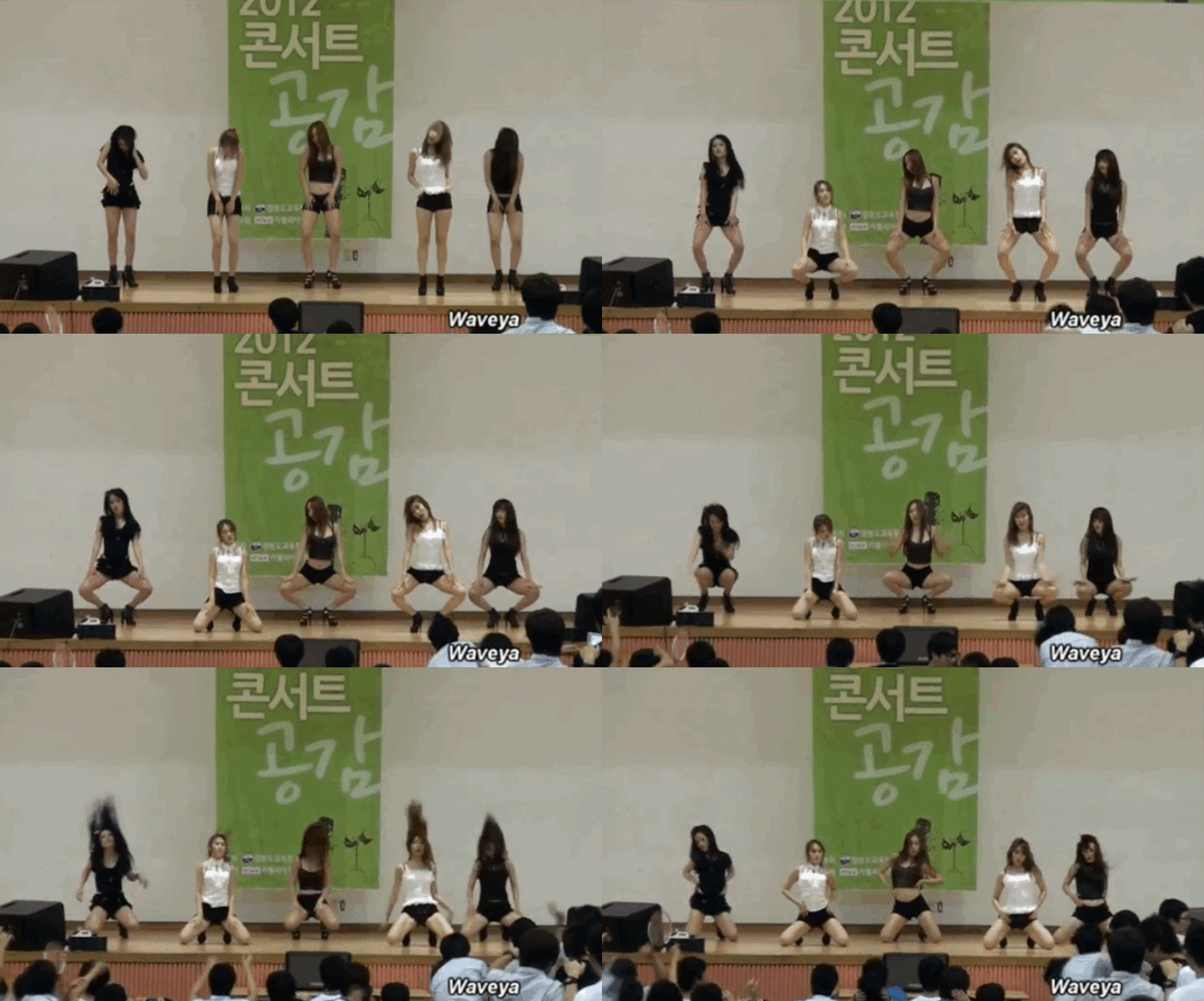
Waveya Boys' School

Naturally, I don’t have anything against Waveya themselves, and of course sexualized performances are just fine with adult audiences. Also, what boy-band or girl-group hasn’t overstepped the line on occasion, whether by accident or as a deliberate promotion tool?

Nevertheless, this particular performance seems not so much an imitation of some of the more risqué K-pop songs, as a deliberate mash-up of their most provocative choreography. Add that Waveya are a self-styled “sexy dance group,” and include pictures of themselves in skimpy schoolgirl outfits on their homepage, then it’s strange — and very telling — that they so regularly get invited to perform for children:

Should there be restrictions on explicit school performances? Whatever the girl-group or boy-band?

One argument against that is that teenagers can readily — and do — see music videos’ original sexualized choreography on their smartphones (let alone pornography), in which case toning things down would be both naive and pointless. And perhaps there’s some merit to that.

On the other hand, we are talking about adult women spreading their legs just 3 meters in front of teenage boys’ faces, a much more visceral experience than images or video can provide (sure enough, there were some complaints about the September performance). Also, regardless of whether you feel Waveya are being sexually objectified or not, or if that’s even a negative, if performances like this prove to be routine at Korean schools then they’d surely be a powerful socialization agent. Especially for what’s been described as the saturation of costumed, frequently scantily-clad female ‘narrator models‘ and ‘doumi‘ in daily life here.

That’s no exaggeration. But it’s also something very difficult to appreciate until you’ve seen it for yourself. To remedy both, please go directly to the source, a 2005 piece from Scribblings of the Metropolitician (my emphasis):
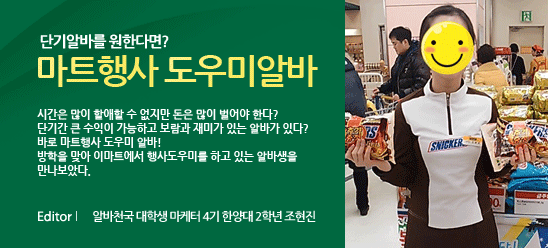
Doumi Helper Korea….Some parts of this topic have been covered in previous posts about the social status of women the commodification of their bodies, but I just wanted to point out a few things here visually. When I talk about the 도우미 (doumi – “assistants” who can be found in everything from grocery stores to ones singing rooms), people often ask me why they bother me so much. To reiterate a point I made in a previous post, it’s the saturation of the doumi into the realm of the everyday and mundane that is so insulting – to both the customers and the workers themselves (source, above).

Of course, I am making a value judgement and perhaps seem like I am engaging in a condescending discourse about these women. But I am not irritated because I “feel sorry” for them or I am fighting for some notion of their human rights; I simply think that the simple equation of baring flesh for the sake of selling toothpaste and razor blades just cheapens the whole enterprise for everyone. When I say this, I acknowledge that “sex sells” and that hot models are the standard eye candy of choice for trade, car, and electronics shows the world over. Still, hiring a model who is a larger-than-life figure showcasing a larger-than-life product or prototype somehow seems appropriate, whereas watching dozens of women who look like my cousin or niece hawking the most everyday and mundane of objects just seems ineffective and demeaning….
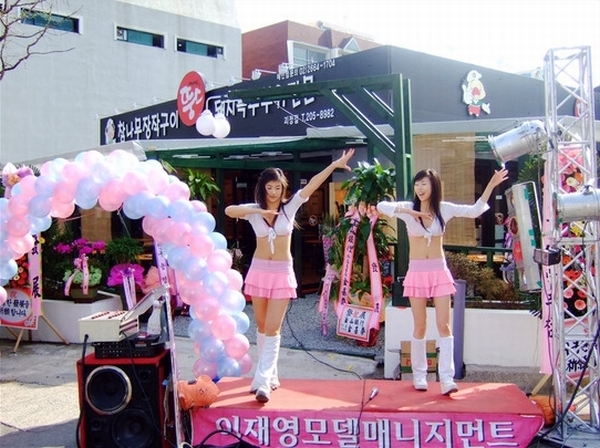
Narrator Models(Source)

What do you think? About anything mentioned in today’s post?

But whatever your opinion, please note that the boys in the audience don’t deserve the mockery they’ve been receiving on BuzzFeed and YouTube (remember: we were all teenagers once!), so please don’t repeat it. Also, because it is just a handful of performances by a dance group being discussed here, we should be wary of overgeneralizing to more mainstream music groups based only on their example. So, I’d really appreciate it if readers — especially public school teachers — could confirm how common or exceptional such full-on performances really are.

Update: Based on all your comments, both below (thanks!) and in the wider blogosphere, such sexualized performances are actually quite common in Korean schools (although Waveya’s is still more explicit than most). Here’s some representative commentary, by Party in the R.O.K:

…in every school I’ve worked at, sexy dance moves are totally acceptable in the school environment. Teachers have let the kids watch music videos before or after class that have made me blush, but no one else seems affected by the raunchiness. Also, when I taught at middle school, they would have joint assemblies with the high school girls and often do dance performances. My middle school girls would wear high heels and short skirts (nothing out of normal but still a little risque for school) but one time the high school girls did an After School-inspired dance that involved wearing almost invisible short shorts and high heels and straddling flags and getting low and practically twerking onstage… in front of an audience of parents and siblings and other teachers… while lots of male parents and teachers took videos with their phones… no one acted like it was weird at all. I felt like I was breaking a law just watching it! That is one thing about teaching in Korea that I will never be used to.

See my Reading the Lolita Effect in Korea series below also (especially Part 2), which discusses those issues in greater depth:

(For more posts in the Korean Sociological Image series, see here)

A reading list for Korean Feminism 101!

An Intimate Affair Pin-up Grrrls(Sources: left, right)

Thanks very much to the 10 Magazine Book Club for being such a great — and forgiving! — audience last weekend. As promised,* here are the books I mentioned in it, as well as some of the websites.

First, there was An Intimate Affair: Women, Lingerie, and Sexuality by Jill Fields (2007), then Pin-up Grrrls: Feminism, Sexuality, Popular Culture by Maria Buszek (2006, which I talk about in much greater depth in Parts 3 and 4 respectively of my Revealing the Korean Body Politic series (which, in turn, is an extended version of my presentation). Although at 375 and 444 pages each, they’re not for the faint-hearted, both are still very accessible, and definitely reward the effort put into studying them.

Of the two, Pin-up Grrrls was much the more eye-opening for me personally (note the ensuing tagline of my blog!), giving a unique perspective and context on US feminism in the 20th Century that deserves a lot more attention. For a taste, see here for a short essay cum summary of the book, and here, here, here, and here for my own Who are the Korean Pin-up Grrrls? series it inspired.

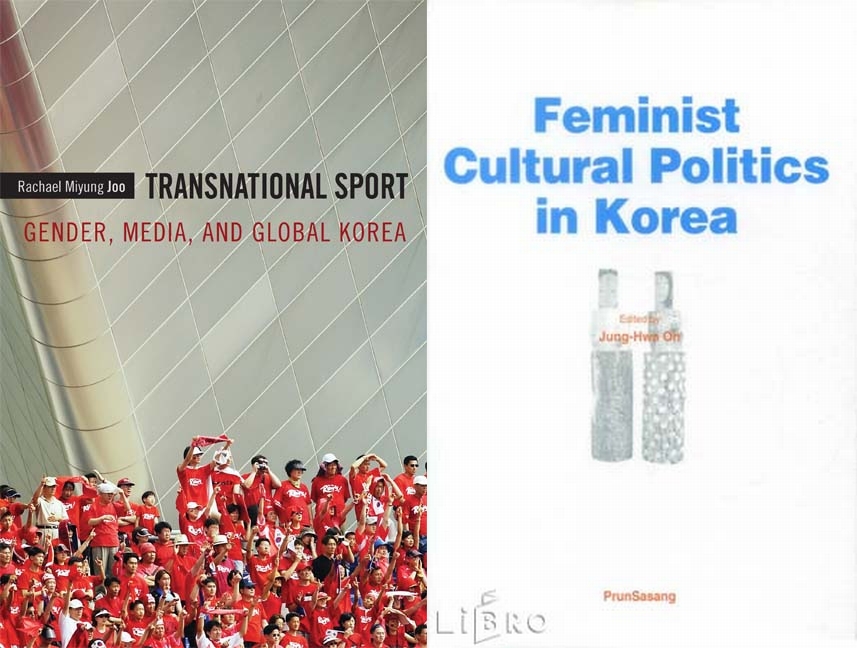
Transnational Sport Gender Meda and South Korea Feminist Cultural Politics in Korea(Sources: left, right)

Next, I highly recommended “Feminization of the 2002 World Cup and Women’s Fandom” by Hyun-Mee Kim in Feminist Cultural Politics in Korea, ed. by Jung-Hwa Oh, 2005, pp. 228-243, for an understanding of the radical role the 2002 World Cup played in changing prevailing Korean attitudes to objectification and women’s sexual subjectivity. In hindsight though, that and most of the chapters in the book are a little dated now, so a better choice is probably Transnational Sport: Gender, Media, and Global Korea by Rachael Miyung Joo (2012) instead. I haven’t read it myself yet, but you can see here and here for reviews.

In the presentation, I used Kim’s chapter to argue that the intensely objectifying, body-centric nature of the current Korean Wave represented a confluence of commercial and governmental interests in exploiting women’s bodies, a precedent for which was set by the — for want a better way to describe it — patriarchal accommodation with and co-option of that feminization of the 2002 World Cup. This in turn was preceded by a long history of girl-groups entertaining foreign and then Korean troops, and at one point the exhortation by the Korean government for women to prostitute themselves to the USFK for the sake of acquiring then much-needed foreign exchange. For more on the former see here, and on the latter see Sex Among Allies: Military Prositution in U.S.-Korea Relations by Katherine Moon (1997).

Unfortunately, I don’t have Moon’s book, but I do have — and was blown away by — Militarized Modernity and Gendered Citizenship in South Korea by Seungsook Moon (2005; yes, a different Moon!), which provides a lot of context. In particular, it’s essential to know about the military regimes’ population control policies, which were every bit as draconian as China’s one-child policy, in order to understand modern Koreans’ attitudes to abortion and contraception. And, once you do read it, you realize that the language I used above was by no means simply hyperbole for the sake of making a point!

Militarized Modernity Sex Among Allies(Sources: left, right)

If you’re more interested in the surge in male objectification in the last decade though, see Korean Masculinities and Transnational Consumption by Sun Jung (2010), or for an online essay see Stephen Epstein’s and (again) Rachael Miyung Joo’s “Multiple Exposures: Korean Bodies and the Transnational Imagination” in The Asia-Pacific Journal last year. The latter also covers — no pun intended! — entertainment companies’ strategic exposure of girl-group members’ legs, and I discuss the role of that in the rise of ‘ajosshi fandom’ and ‘uncle fandom’ here.

Before moving on to women and girls again though, as one does, note that Sun Jung’s book is also essential for anyone further interested in the (very related) rise of kkotminam (꽃미남), which I did a lot of work on a few years ago here and here.

Korean Masculinities The Lolita Effect(Sources — left; right: author’s scan)

For more on the increasing objectification of teenage girls in Korea, I recommend first reading The Lolita Effect: The Media Sexualization of Young Girls and What We Can Do About It by M. Gigi Durham (2008) for some international context; then, especially if you’re a parent, Cinderella Ate My Daughter: Dispatches from the Front Lines of the New Girlie-Girl Culture by Peggy Orenstein (2011), which is much more related than it may sound; and finally, my (self-explanatory) Reading the Lolita Effect in Korea series, especially Part 2: The role of K-pop and the Korean media in sexual socialization and the formation of body image.

(Update: As mentioned in the presentation, also see Gusts of Popular Feeling here for more on the perceived spate of sex crimes against children that led the public to seriously question previously uncritical media narratives of ajosshi fandom.)

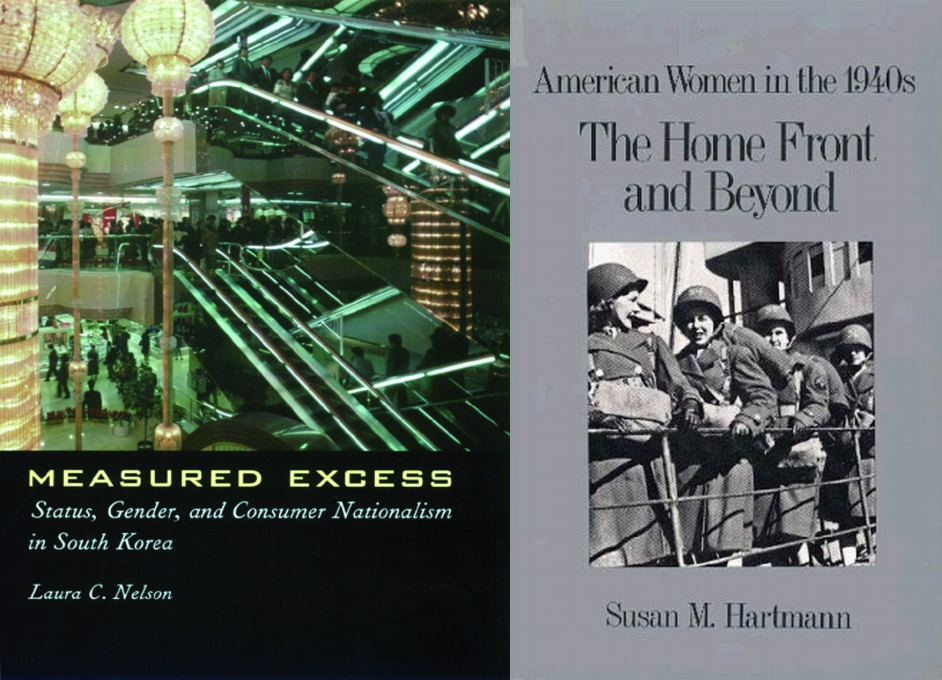
The next two books I mentioned were Measured Excess: Status, Gender, and Consumer Nationalism in South Korea by Laura Nelson (2000), then The Home Front & Beyond: American Women in the 1940s by Susan Hartmann (1983). The first is essential reading for anyone wanting to know more about the 1990s in Korea, and in particular the frequent government and media campaigns against over-consumption (in practice aimed almost exclusively at women, these were important precursors to the “beanpaste girl” stereotypes of the 2000s). Meanwhile, unfortunately Susan Hartmann’s book is difficult to get a hold of, but if you do you’ll find it’s a wonderful, very comprehensive introduction to the decade (I’d love to get those on the 1920s, ’30s, and ’50s also, albeit all by different authors). And, as I discuss here (and will expand upon in a later post), the minefield of contradictions presented to women as they were encouraged to remain “feminine” despite entering practical, “masculine” wartime industries in large numbers, yet also being criticized for being so wasteful, frivolous, and unpatriotic for beautifying themselves, is eerily reminiscent of the double-standards and backlash arising from women’s rapid entrance into the part-time workforce in the last decade in Korea also.

Measured Excess The Home Front and Beyond(Sources: left, right)

Finally, see the end of this post on male objectification for those scans of Stuart and Elizabeth Ewen’s prologue to their Channels of Desire: Mass Images and the Shaping of American Consciousness (1992), which should convince even the most die-hard skeptic of the genuine influence that advertising has on us, no matter how sophisticated and aware we like to all think we are.

If anyone would like more information and/or to discuss the books and websites mentioned above, and/or some specific part of the presentation, then please just let me know in the comments. Of course, they’re just a handful of what would be required for such a reading list really (4 of the 10 mentioned don’t even have anything to do with Korea!), so I’d be very happy — and grateful, frankly — if readers would rather recommend, seek information about, and/or discuss any Korea-related book instead really. After all, I’m sure it would useful to get new perspectives on those we’ve already read, and/or to get recommendations for good ones we haven’t! :)

*(Sorry for the long delay with this post, but unfortunately I have a very good — and somewhat graphic — excuse!)

JangHeung Area Children’s Center Needs New Classrooms

123I’ve been asked to pass on the following:

What are these?

These are pictures of classroom areas at the JangHeung Area Children’s Center, located in JangHeung Eup of JangHeung County, Jeollanamdo. Our Center serves 61 children from one of the 5 poorest counties in Korea. Currently we have 3 classrooms at our center. 2 are one-room classroom buildings. That is what you see above. One of the classroom buildings is 100% unusable, the 2nd classroom building is not good either.

Our Center operates on an educational budget of less than 1,200,000w per month, less than 20,000w per child. Our total budget is less than 80,000w per month for each child. This is less than 50% of the tuition for any one hagwon that I am familiar with.

All of the children in our program come to us through the local welfare office. As you might imagine finances are tight and we don’t have money for extra things. That includes replacing our 2 classroom buildings. To continue our mission of providing a quality education for the children in our program it is imperative that we acquire the necessary funds to meet this essential need and provide safe, usable classroom space for our children. We need your help to do that.

For More Information about us please visit our facebook group at JangHeung Area Children’s Center. Please join us today.

To make a donation of 20,000w, 30,000w, or 50,000w please send bank transfer to:

NongHyup Bank 657-01-074288      Fundraising Goal: 12,000,000w

Korean Sociological Image #74: Child Sex Offender Notices

Korean Sex Offender Website(Source)

Update: With thanks to reader Lily for pointing it out, the notice I received says not to post it on the internet, so I’ve replaced it with a screenshot of the Korean sex offender registry website, www.sexoffender.go.kr. Sorry that that makes the post and comments now difficult to follow.

Received in my letter box this morning. And, presumably, every other one in the neighborhood.

I don’t have time to translate the entire thing sorry, let alone the advice and information provided on the back. But here is the information about his crime:

In October 2011, in Haeundae-gu, XX-dong, this person attempted to rape a teenage girl, but failed. On May 17 2012, he was convicted according to the “Protection of Children and Juveniles from Sexual Abuse Act,” imprisoned for 2 years and 6 months, with 4 years’ probation, given 40 hours of sex violence treatment lectures, and required to have his personal information be made available to the public for 3 years.

Apologies for the confusion — has he just been released? If not, why is this notice being provided now? — and would appreciate it if anyone could clarify.

Meanwhile, regardless of the country, how would you react if you received something similar? Has it happened to any readers before?

Also, you may be interested in comparing this wanted notice sent to all Busan households in March 2010, after the rape and murder of a 13 year-old girl.

(For more posts in the Korean Sociological Image series, see here)

“Body Changing” Diet-Drink Generously Donated to High School Students

Estimated reading time: 4 minutes. (Source)

Young Korean women—not men—are the only demographic in the OECD that are getting more underweight than obese.

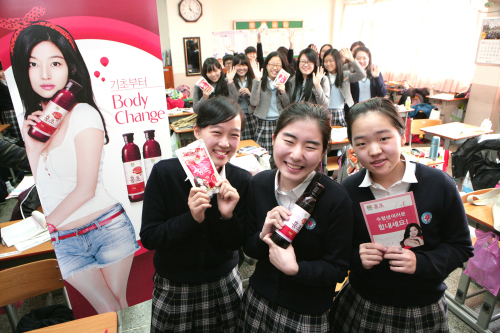
Call me making a mountain out of a molehill, but diet-drink companies being allowed to donate their product to teens, out of supposed concerns for their heath? And plastering their classrooms with ads of heavily photoshopped women in the process? Those may just have something to do with that:

청정원 홍초가 수험생 여러분을 응원합니다 / Chung Jung Won’s HongCho Cheers For Students Taking University Entrance Exams

by Kim Jong-hoon (김종훈), Asia Today, November 4 2012

대상은 자사의 브랜드인 ‘청정원’ 홍초가 수능시험을 앞둔 고3 수험생을 응원하기 위해 오는 7일까지 서울시내 20여개 학교를 찾아 다니며 홍초 2만여개를 무료로 나눠줄 계획이라고 4일 밝혔다.

On Sunday, Daesang’s brand Chung Jung Won [English website here] announced that to support 3rd year high school students about to take their university entrance exams, they would visit 20 high schools in Seoul before the 8th (the day of the exams) and donate 20,000 bottles of HongCho to students (source, right).

청정원측은 오랜 시험준비로 지친 수험생들이 좋은 컨디션으로 시험을 볼 수 있도록 응원하기 위한 마음으로 기획 된 행사라고 설명했다. 수능이 끝난 이후에도 홍초를 내세운 다양한 마케팅 활동으로 그간 고생이 많았던 수험생들을 지원할 계획이다.

Chung Jung Won explained that this is an event for tired students that have been preparing for the exams for such a long time, so that they can be in good condition on the exam day. Also, that even after the exams, the company plans to continue supporting those students that have suffered so much, through various HongCho marketing events.

한편, 홍초는 피로회복 등에 도움이 되는 기능성 원료인 콜라겐과 헛개나무 농축액, 그리고 식이섬유를 풍부하게 함유하고 있는 건강기능성 음용식초다.

HongCho is a healthy vinegar drink that includes collagen, liquids extracted from the Oriental Raisin Tree, and a lot of fiber, and is very helpful for recovering from tiredness. (end.)

For sure, HongCho does sound quite healthy. And, technically, do not match the definition of a diet-drink:

Diet drinks: Include calorie-free and low-calorie versions of sodas, fruit drinks, energy drinks, sports drinks, and carbonated water, consistent with definitions reported by the National Cancer Institute and U.S. Food and Drug Administration food labeling guidelines. Diet drinks do not include 100% fruit juice or unsweetened teas or coffees.

However, a quick perusal of the Chung Jung Won website demonstrates that it is explicitly being marketed as a “body-changing” drink, with—especially after photoshopping—exceptionally tall and skinny Jun Ji-hyun (전지현) endorsing it most recently (that’s Kim Hee-sun/김희선 from 2010 above). Also, the following website screenshot (from 2011) and commercial show that the body-changing theme is no mere Konglish accident:

(Source)

There also appears to be a sponsorship deal with the Diet War program:

(Source)

Meanwhile, girl-group Kara (카라) are promoting the drink in Japan, with much the same theme. Which is ironic, considering that these are the same women who admitted that they can’t even drink water on the (frequent) days that they’re required to wear revealing clothing:

What do you think? Have any Korea-based readers had similar promotions at their own schools? How about overseas? Are concerns and issues different there? I know that in the US for instance, it is more sodas that are considered a problem, and that if students drank HongCho instead that would probably be considered a blessing. From TIME back in March (my emphasis):

If some public-health advocates have their way, sodas could become the cigarettes of food. Doctors already dislike the sugary drinks for their teeth-dissolving properties and for the role they may play in childhood obesity. There’s a constant struggle to get soda vending machines out of public schools, with administrators often forced to choose between losing sponsorship money from big soda companies and dealing with overcaffeinated, less healthy kids. Given the sheer size of the American soda industry—9.4 billion cases of soft drinks were sold in the U.S. in 2009—it’s not a war that will end anytime soon. Especially if a certain C word starts getting thrown around.

Update: From the picture, I got the impression that is was only girls’ schools that were targeted, but technically the advertorial (I can’t bring myself to call it a news report) only mentions 20 unnamed schools, and is repeated verbatim across newspapers.

Update 2: It’s not really related to the original post, but if you read that TIME magazine article above, you may also be interested in the recent findings that one of the main reasons for US children’s obesity is that they’re eating away from home so often, and (of course) that they’re mostly eating junk food when they do.

Related Posts:

If you reside in South Korea, you can donate via wire transfer: Turnbull James Edward (Kookmin Bank/국민은행, 563401-01-214324)

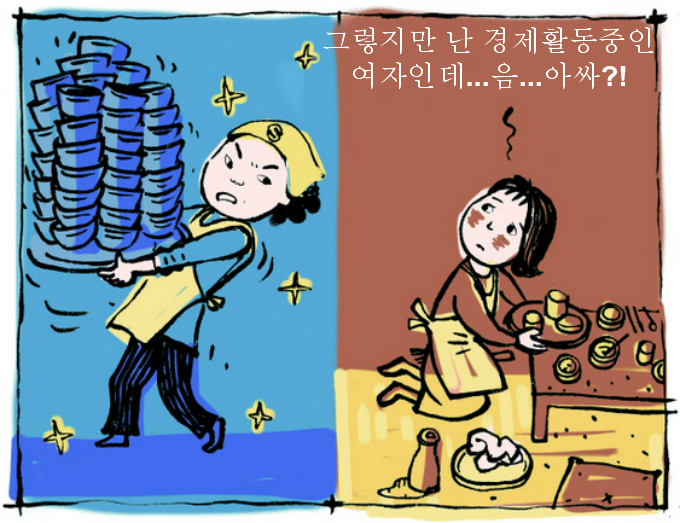
Korean Sociological Image #73: The True Numbers of Korean Working Women

(Source; edited)

If recent BBC coverage is anything to go by, marriage in South Korea is like a business. It’s also becoming a bit of an explosive topic as social mobility slows down and the traditional image of the male breadwinner becomes eroded by the increasing participation of females in the labour market. Some of the most widely publicised scandals and controversies on the Korean internet seem to have been, in some way or another, due to this intensifying gender friction.

(KoreaBANG; my emphasis)

My apologies for singling out Justin at KoreaBANG, whose post is still excellent overall. And as you’ll soon see, I often make mistakes too.

But that comment I’ve highlighted? Frankly, it just infuriated me. Because even though it’s completely wrong, I seem to hear it all the time these days.

In reality, the Korean female workforce participation rate has stagnated at one of the lowest rates in the OECD ever since 1997-98, when women were overwhelmingly targeted for layoffs during the Asian Financial Crisis. Back then, the logic was that wives would be provided for by their husbands, and 20-something daughters by their fathers. And 10 years later, in the latest crisis, to a large extent this logic was reapplied, although on this occasion there was a clearer economic – not just patriarchal – logic in that women formed the bulk of irregular workers (see here, here, and here for much more information).

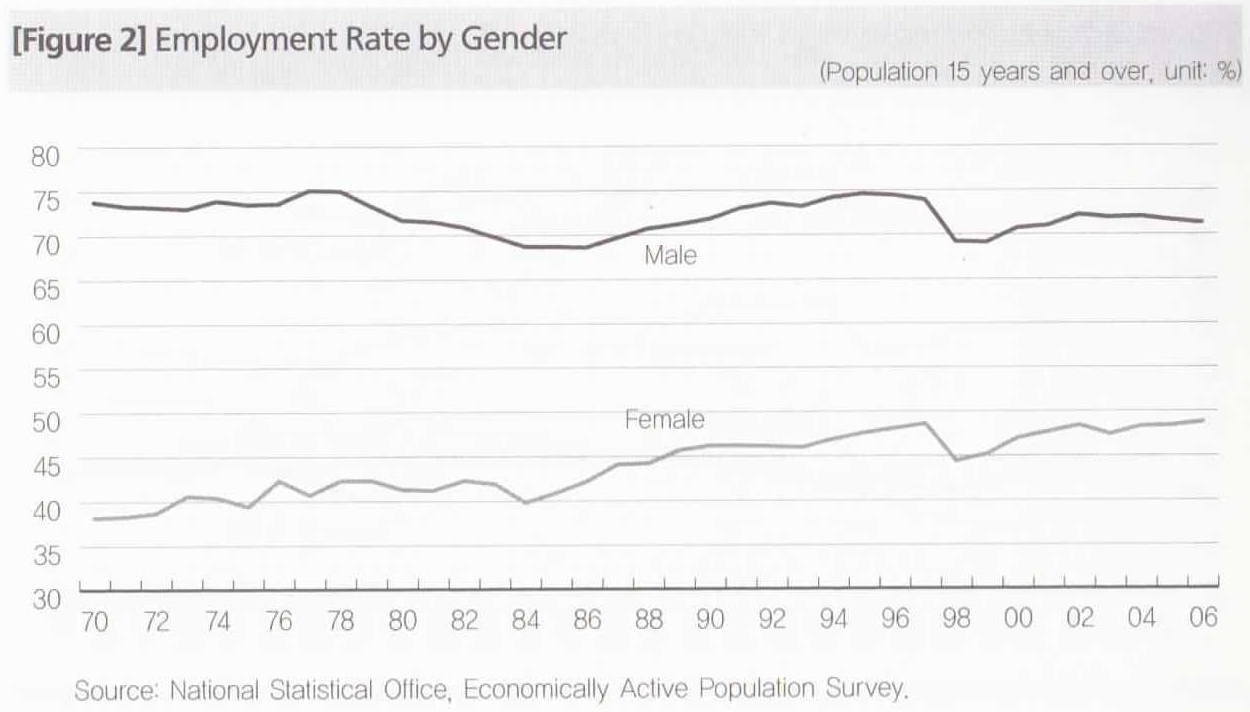
Or so I’ve often written. But naturally, it was difficult to find definitive statistics on that when I first reported on it three years ago. At that time, my most up to date source was my copy of Working Korea 2007, published by the Korea Labor & Society Institute. Here is my scan of page 19, which has a graph of the male and female workforce participation rate of 1970-2006:

In hindsight, although it does show a big drop in the female rate in 1997-98, it shows an equally large (even slightly larger?) drop in the male rate too. With my apologies, I’m very surprised I didn’t notice that earlier, and, although it does contradict most of the literature I’ve read about the Asian Financial Crisis, and is just from one source too, it still definitely bears further investigation.

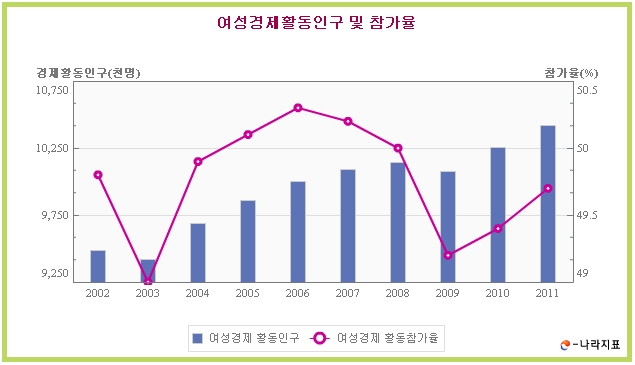
That aside, a year later I found a source going up to 2008 (it shows a fall of 50.3% to 50.0% in 2006-2008; see below also). And today, spurred by Justin’s comment, I tried looking again, and found the following at the National Statistics Office’s website:

(Source)

The blue bars represent the economically active female population, in thousands (i.e., the first figure is 10.75 million), the pink line the female workforce participation rate. Although the choice of right scale gives the false visual impression that the rate has changed a great deal, as you can see from the numbers it has remained within a narrow band of 49% to 50.5%, last year’s rate being just lower than that of 2002. Also, clearly a 0.9% drop between 2008 and 2009 isn’t quite as big as I’ve been making out, and again is something that bears further exploration.

But still, one thing is clear: the number — well, percentage — of Korean women working has little changed in the last 15 years, and remains very very low by the standards of other developed countries. So it can not be the cause of increasing gender friction.

The perception that Korean women are making significant inroads into the Korean economy though? That’s entirely possible, and indeed I highly recommend KoreaBANG for much more on that (indeed, especially the remainder of Justin’s post), as well as many posts by Gord Sellar too (source, right).

(For more posts in the Korean Sociological Image series, see here)
From the Archives: Bagel Girls, Banking, and Babies!

(Source)

…[the character of] Chi-Yong’s mother sees marriage as a way to achieve social advancement and material prosperity, as it was in the Victorian era. These ambitions have come to the forefront in Korea since the 1970s, due to rapid economic development and consequent aspirations to class mobility and consolidation during the last thirty years. This novel [Marriage/결혼 by Kim Su-hyeon, 1993] is a good illustration of how, given the pace of change of change in Korea, everybody has a different point of view on marriage, depending on their gender, class, and generation. The issue of communication across generations has become a serious matter. Generation is an important attribute of identity in Korea, like race in the United States. (My emphases.)

(So-hee Lee, “The Concept of Female Sexuality in Popular Culture” in Under Construction: The gendering of modernity, class, and consumption in the Republic of Korea, ed. by Laurel Kendell, 2002; page 146 of 141-164)

With apologies to So-hee Lee for variously attributing that quote to either her editor, to Hyun-Mee Kim, or to Nancy Abelmann over the years, it still very much applies 10 years later. It’s also why studying and living in Korean society can be so exciting sometimes.

For someone who’s been writing about the place for over 5 years though, it means that many of my posts need updating. Let alone mercifully deleted as reader feedback, further research, and greater use of Korean sources have exposed gaping holes in my knowledge and confident preconceptions. And from a practical standpoint too, links will die, embedded videos will get deleted, and my theme will always highlight recent posts at the expense of older ones, no matter how good they may be after going through my culling process.

With all that in mind, once a month I’ll be highlighting posts from the corresponding month in previous years. Not all of them of course (hey, I’ll still like some material to work with in September 2013 and 2014), and to some there’s no new news to add; I include them just to draw attention to for new and old readers, especially as they’ve since been slightly edited for this post with the benefit of several year’s of hindsight. Others though, I’m adding a great deal of new news and commentary below, as you’ll see.

Please let me know what you think!

2011

Alas, not really my own article, but about Grace Duggan’s for Bust Magazine. While I’d often criticized the body-labeling craze in South Korea previously, I didn’t realize just how offensive this particular term was until she pointed it out (source, right):

Sexualizing young women for having childlike features sets off all kinds of alarms, regardless of whether or not they are over 18. The “bagel girl” label does more than infantilize women. It compartmentalizes them by applying two irreconcilable ideals: looking like a baby and a full-grown woman at the same time.

Granted, that may make it sound no more harmful than any other “line.” But, as I explain in a later comment, in the context of how it’s actually used it ends up sounding almost pedophilic:

…there’s nothing wrong with looking young per se.

But consider who the label is applied to: not, say, women in their 30s and 40s and older, for whom – let’s be real – wanting to look younger than they are is understandable (hell, for a 35 year-old guy like me too), but rather it’s women barely on the threshold of adulthood that are being praised for looking like children. And, not to put too fine a point on it, what the FUCK is great about a 21 year-old looking younger than she is? And when her body is simultaneously praised for being developed? That is a seriously flawed ideal to aspire to, and, moreover – as I hint at in the post – it’s no coincidence that it occurs in an environment with strong expectations of childish behavior from women too. Indeed, the end result strongly reminds me of child and teenage female manga characters, with personalities appropriate for their age, but somehow the sex drives and physiological development to act on them of women 10-15 years older.

(Source)

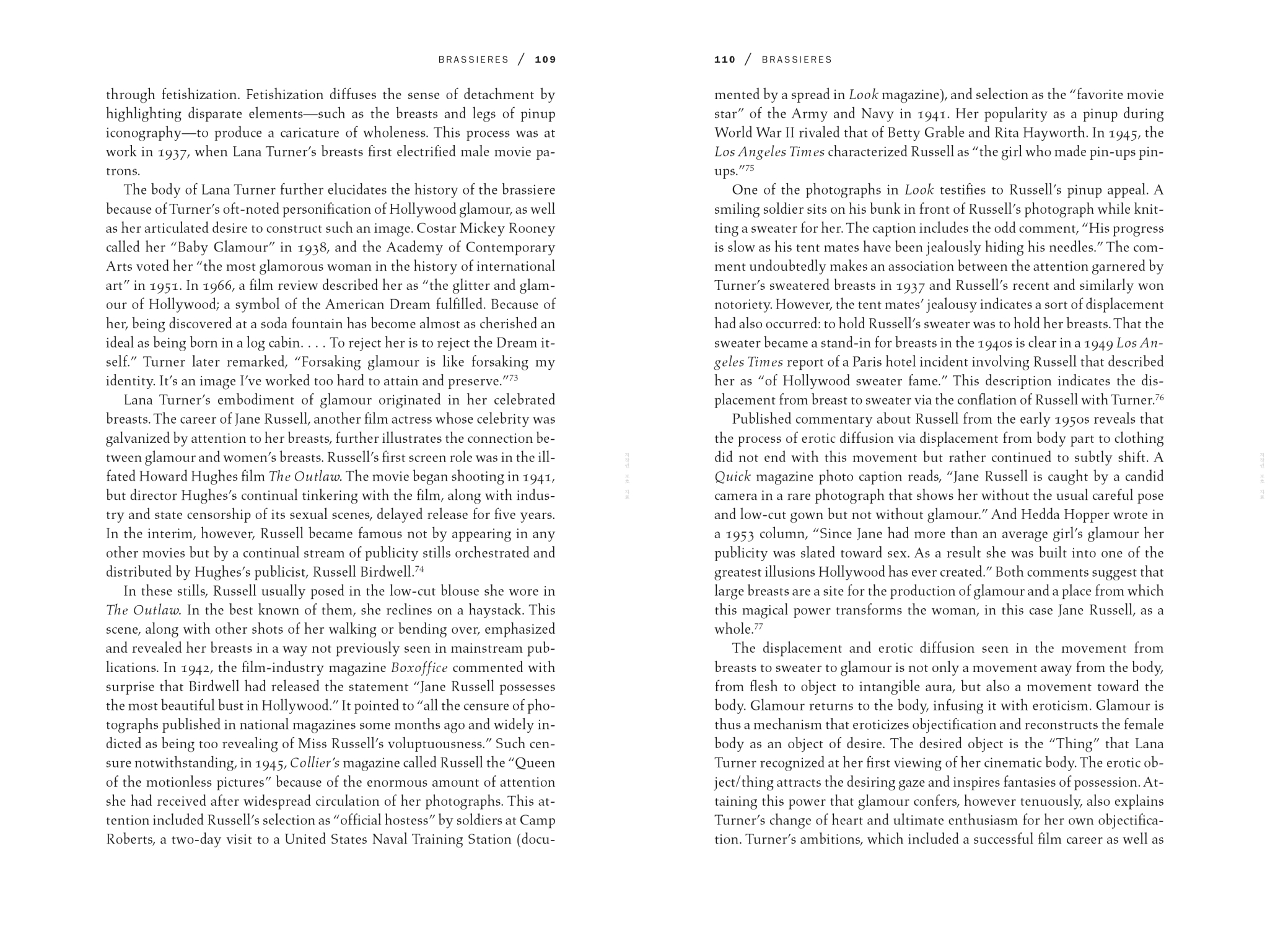
Meanwhile, by coincidence just yesterday I finished the excellent An Intimate Affair: Women, Lingerie, and Sexuality by Jill Fields (2007), which explains how the word “glamour” — where the “gul/글” in Bagel Girl comes from — came to be closely associated with large breasts by Hollywood in the 1930s to 1950s. Something I’d previously chalked up to a Japanese and then Korean mistranslation of the word, see the above pages for more on that, or all of Chapter 3 on brassieres at Google Books here.

If I do say so myself, I’m very proud of the way I describe my feelings when child singers do aegyo:

…cutesy aegyo is bad enough coming from a 21 year-old singer, but simply surreal when you see it done by a 14 year-old.

Yes, surreal, not merely awkward and inexperienced: essentially, you’re watching a child pretending to be an adult pretending to be a child.

Thank you very much.

Thanks again to the (necessarily anonymous) reader who wrote about her experiences, and I’ve had dozens of inquires about the Seoul clinic she used since. Please just email me if you ever need to know the details yourself.

(Source)

2010

Once someone points out the “head cant” to you, it just can’t be unseen. Usually inoffensive in itself though, and frequently done simply for photographic and stylistic reasons (which I’ve under-acknowledged in the past), it’s the fact that it’s overwhelmingly women it that makes it problematic. Just one of a number of typical poses for women in ads, ultimately it serves to reinforce gender stereotypes.

Probably, that’s why these recent Giordano ads stood out to me: in the example above for instance, Shin Min-a (신민아) is the one in control, staring at the viewer, while So Ji-sub (소지섭) is distracted (it’s usually the guys that are presented as more focused). And, desperately seeking examples of pro-feminist advertisements for a TED presentation I may be giving next month, in which I have to — grrr — conclude with a positive message rather than just criticize, this made me realize that feminists and advertisers don’t necessarily have to be at odds with each other. Just a sense of balance by the latter would be a huge step forward.

Really about “lewd” advertisements, 2 years later (this June) I translated another article about how their numbers had surged 3 times over the previous 12 months. With no apparent sense of irony, just about every news site that reported on that had so many examples themselves that the text was difficult to read.

One of my most popular posts, anybody (especially men) who thinks street harassment isn’t a problem should just reflect on the opening cartoon, let alone female readers’ comments about their own negative experiences.

(Source: unknown)

2009

A short, harmless commercial for Shinhan Bank at first glance. But, once you take the time to analyze it, it has a clear message that men do the thinking at Shinhan while the women simply look good. Indeed, it’s such a classic example of gender stereotyping that I’m still using it in presentations today.

Here’s the slide I would present after providing that analysis:

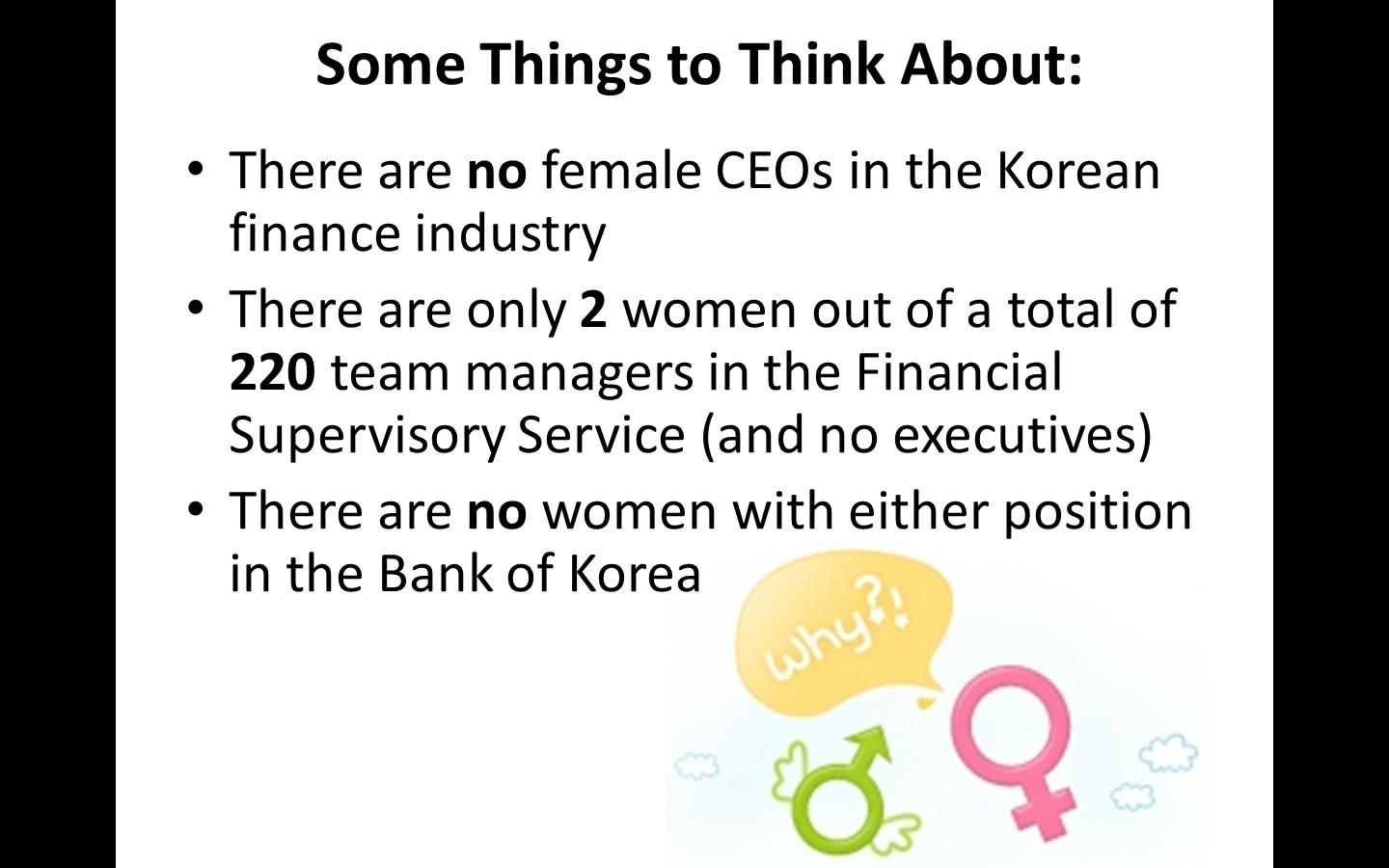
But in the next presentation, I’ll be updating it with the recent news that the banking industry still has the largest gender pay gap in Korea, with women making an average of only 57% of what men make.

Not that I’m against skin by any means. But these remain very sweet ads!

Again one of my most popular posts, ironically soon after writing it trends in the Korean entertainment and music industries meant that Koreans would replace Caucasians in many of the modelling roles that sustained those Occidentalist stereotypes. Also, in my own (admittedly limited) experience, there’s far fewer Korean male – Western (invariably Caucasian) female pairings in popular culture now, after a spate of them in the years after Misuda first appeared. (There were never very many of the opposite.)

However, of course many of the stereotypes still do remain.

(Sources: left, right)

2008

When I read on Yahoo! Korea this week about pregnant Hollywood star’s “D-lines”, for a moment I did try to hold my tongue about seeing the label.

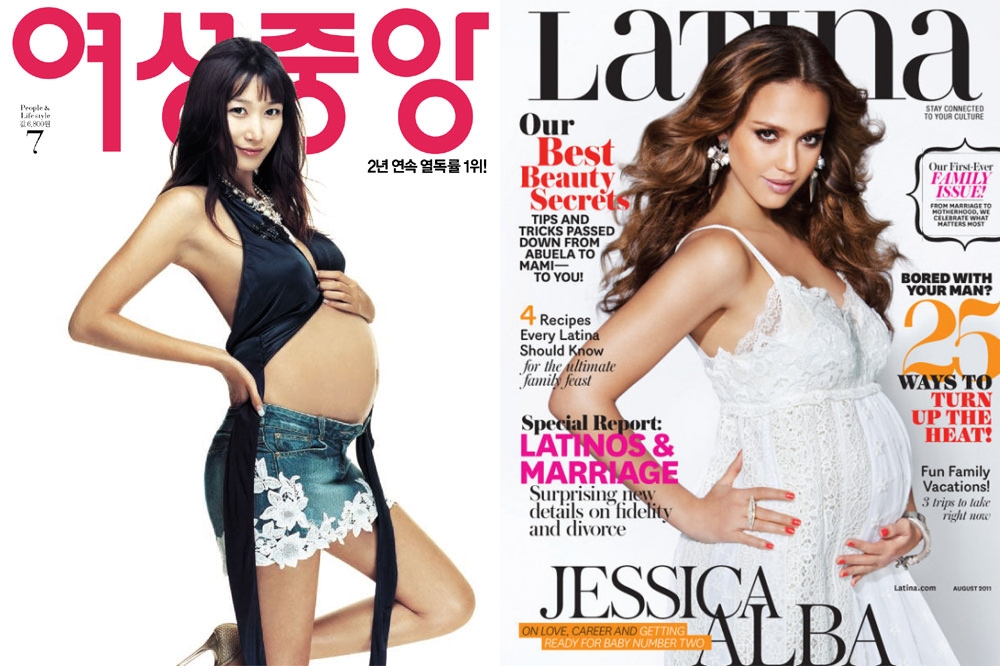
After all, this, for example, is just an advertisement for an event for expecting mothers (albeit one where likely body-shaping products are promoted); these D-line fashion shows were surely perfectly harmless; many of those Hollywood stars were indeed glowing, as was pregnant Moon So-ri (문소리) in Cosmopolitan last year; and finally, yes, I can see the humorous side — it is often applied to extremely obese men.

But although the Western media too promotes pampered celebrity mothers-to-be as ideals to follow, and I can certainly accept that pregnant women overseas may likewise feel under some indirect pressure to watch their weight, that post is about how pregnant Korean women were dieting as early as the late-1990s. One can only shudder at what things are probably like now.

Suddenly, talk of D-lines sounds a lot less funny.

One of my first attempts to grapple with the origins of the kkotminam phenomenon (꽃미남; lit. flower-beauty-man), which culminated in this piece by friend and ANU professor Roald Maliangkay 2 years later.

By coincidence, both of us will be quoted in a related news article to be published next week. Watch this space! (Update: and here it is!)

2007

And indeed there was. Unfortunately however, attitudes didn’t change with it, so fathers feel compelled by management to either ignore it entirely or to come back to work early, despite it only being 3 days (source right: unknown).

Note though, that the “paternity leave” in the original article I translated was a bit of a misnomer, it really meaning time off for a child’s birth. “Real,” paid paternity leave has been available since 2001 (or possibly 1995), but sources vary on specifics. Sung So-young in the Korean Joongang Daily, for instance, wrote in April 2011 that:

According to Korean law, all employees with a child under the age of 3 are eligible to take a year off to care for their children. Up to 1 million won ($919) in salary is provided monthly.”

But that is contradicted by a slightly later report in the Chosun Ilbo, which states that:

…those on leave can get up to 40 percent of their salary, or a minimum of W500,000 and a maximum of W1 million, and parents can take leave until the child is 6 years old.

And both in turn are contradicted by Lee Hyo-sik’s earlier report in the March 4 2011 Korea Times, which says:

Regardless of income levels, both male and female salaried workers are currently given 500,000 won per month during parental leave. This is expected to go up to one million won next year.

As for the maximum age of the children in order to be eligible, the same article states that it was 6 rather than 3. This is confirmed by an earlier February 2010 article by Kwon Mee-yoo, again in the Korea Times, which stated:

The Ministry of Labor passed a revision on Wednesday to the Act on Equal Employment and Support for Work-Family Reconciliation, or the Employment Equity Act for short, which will expand the range of workers eligible for parental leave. Now parents with preschoolers under six years old can benefit.

The leave allows employees to take a certain number of paid days off from work to care for their children. The parents can also take unpaid leave if they use up all of their paid days. This includes maternity, paternity and adoption leave. Currently, at private firms only workers with children 3 years old or less qualify for the leave.

Surprisingly, parents with adopted children weren’t eligible before this revision, and still, “only those who gave birth to or adopted children after Jan. 1, 2008 [were to be allowed] parental leave,” despite those (then) 2 to 6 year-olds obviously being of age. Which all sounds very tight-fisted, although logical during the worst of the financial crisis.

Kwon Mee-yoo also notes that it was in 2008 that the government increased the age restriction for (only) public servants, allowing them “to take time off for parental purposes if their children were under 6 years old.” I’ll assume that it previously only applied if their children were under 3 years old, like Kwon notes was the case for employees at private firms.

Finally, quibbles over details aside, Sung So-young’s and Lee Hyo-sik’s articles in particular remain excellent discussions of why Korean fathers are forced to avoid taking paternity leave, despite wanting to spend much more time with their kids. Against that though, just like in most other countries there’s still a pervasive attitude that childcare is primarily women’s work, with insidious manifestations in our daily lives.

And on that note, have a good weekend, and the Korean Gender Reader post will be up on Sunday!

The Pee Doesn’t Lie: 1 in 4 young Korean women smoke (The Gender Politics of Smoking in South Korea, Part 5)

(Source)

When crusty old Confucians will slap them in the face for smoking, then surely women will tend to smoke in private, and keep mum about it if anyone asks. That’s just common sense.

But, as discussed in previous posts in this series (Part 1, Part 2, Part 3, Newsflash, Part 4, Korea’s Hidden Smokers, How Many Teenage Girls Are Smoking?), that still seems to escape many journalists and researchers, who work under the assumption that very few Korean women smoke (officially, just 2.8% in 2010 for instance, against 42.6% of men). Whereas in reality, previous best estimates put the figure at 17% for young women, pointing to a looming health crisis.

So, how to convince the Korean government to take action? Especially when successive administrations have been accused of exaggerating their successes in reducing the male smoking rate, while ignoring the indirect evidence for rising female one?

(Source)

What’s needed is irrefutable proof. To get that, one reader suggested installing highly sensitive smoke detectors in the toilets of schools and universities, where many young women hide to smoke, while another, thinking of a rough minimum rate for teenage girls, to simply look at the number that were caught by their teachers (14% at his school). A third, probably most reliable option is to test for nicotine in their urine, via the medical tests given to every middle and high-school student, and, as explained in the recently-released article “Relationship Between BMI, Body Image, and Smoking in Korean Women as Determined by Urine Cotinine: Results of a Nationwide Survey” in the Asian Pacific Journal of Cancer Prevention (Volume 13, 2012; 1003-1010), a group of researchers from various universities have indeed focused on pee, albeit that of women aged 19 and over in the 2008-2009 Korea National Health and Nutrition Examination Survey instead.

Very readable at just 8 pages, half of which are tables or references, I highly recommend downloading the PDF (just email me for a copy if the link stops working). For readers without the time though, let me pass on the abstract here instead (click on it to make it bigger), then some highlights:

— Unfortunately, the sampling method, explained on page 1004, is very poorly explained, and I think has some crucial typos. But in sum, out of 4,600 households in the survey, 5,485 women above the age of 19 “were selected for further analysis because complete data concerning their socioeconomic and health factors and body-related variables were available.” How many 19+ women were in the original household survey though, and how and why extra information about these 5,485 of them was available (e.g., were they randomly selected for further tests?), is not provided.

— Urinary cotinine “is widely used as a biomarker for smoking because of its high sensitivity and specificity,” the level of 50 ng/mL used here being a widely accepted cut-off level for indicating active, rather than passive smokers.

— Here are the figures by age bracket, with their standard errors. Unfortunately, I lack the statistical background to understand the discrepancies between reported and “analyzed” rates sorry (for example, 158 out of 704 is actually 22.4%):

  • 19-29: 158 smokers out of 704 (23.1%, 2.0%)
  • 30-39: 178 smokers out of 1075 (17.3%, 1.3%)
  • 40-49: 134 smokers out of 1046 (13.5%, 1.2%)
  • 50-59: 97 smokers out of 1001 (9.3%, 1.0%)
  • 60-69: 70 smokers out of 919 (7.5%, 1.1%)
  • 70+: 87 smokers out of 740 (12.1%, 1.5%)

— Overall, 14.5% of the participants smoked, just under 1 in 7. Note that the article mentions that the reported rate in 2011 was 7.0%, which arguably more indicates how useless official figures are than a sudden dramatic jump from the 2.8% of 2010 (both figures are from the OECD).

— The article does an excellent job of breaking the figures down by age, income, occupation, and marital status, demonstrating that the notion of an “overall” or “average” female (or male) smoking rate is misguided and unhelpful anyway. Please see previous posts in the series for more discussion of that.

(Source)

— Finally, the focus of the article is on the relationship between smoking rates and the difference between subjects’ Body Mass Index (BMI) and Subjective Body Perception (SBP), and found that that was indeed:

…the most important factor determining female smoking behavior. Women with low BMI who perceived themselves as normal or fat were most likely to smoke; these results suggested that subjective body recognition plays as important a role as objective physical measures such as BMI in smoking behavior. Moreover, in women who were never married, divorced or widowed, underweight BMI was highly correlated with smoking. Thus, it is necessary to educate the public to have a correct self-body perception and a good understanding or the relationship between smoking and weight issues in order to reduce female smoking. In particular, women who were never married and had low BMI were especially susceptible to smoking and require special attention and preventative care (p. 1009).

Unfortunately, those educators will have their work cut out for them: Korea is the only developed country in the world where women in their 20s and 30s are getting thinner rather than more obese (and, accordingly, are the slimmest), yet a 2010 study would find that 2/3rds of female university students still overestimated their own weight (and, tellingly, all of those 2/3rds were actually either normal or underweight).

Update: Interestingly, the notion that cigarettes put off hunger was once used to sell cigarettes to men as well as women. I wonder when and why that stopped?

Quick Hit: Cheongju Sex-Education Camp for Teens

(Source)

Sex-education is still so severely neglected in the Korean education system, and still so stuck in the 1980s, that it’s easy to think that things will never change. Especially with an administration so opposed to women’s reproductive rights.

But it’s not all doom and gloom though, and a quick internet search reveals what seems to many camps like this across Korea each summer:

청주시, 속리산 유스타운에서 청소년 성교육 캠프 실시 / Teenage Sex-Education Camp Held at Sokrisan Youthtown, Cheongju

Newswire, 18 July 2012

청주시(한범덕 시장)는 7월 18일부터 19일까지 청주시 소재 중학교 남녀학생 62명과 함께 속리산 유스타운에서 1박 2일간 청소년기에 알아야 할 올바른 성가치관의 정립과 성행동에 대한 책임의식 고취, 청소년들의 건강한 성문화 정착을 위해 청소년 성교육 캠프를 마련했다.

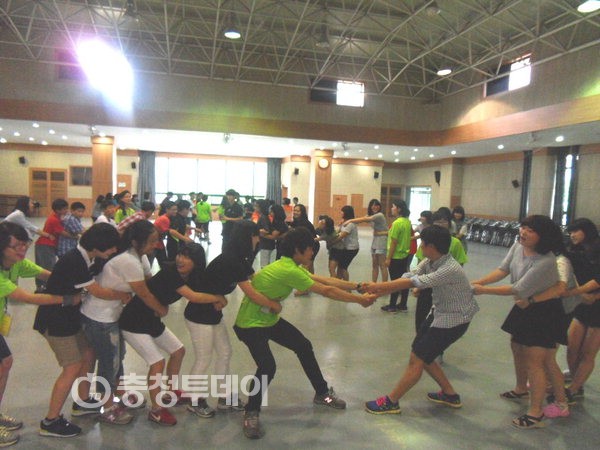
From 18th to the 19th of July, 62 boys and girls from a middle school in Cheongju will attend a two day, one night sex-education camp at Sokrisan Youthtown. Its purpose is to promote healthy sex-culture among teens by instilling correct sexual values and a sense of responsibility about sexual acts.

이번 사업은 청주시여성발전기금 6백만원을 지원하여 인구보건복지협회 충북지회부설 청주성폭력상담소(소장 엄정옥) 주관 하에 청주시내에 소재한 중학교 남녀 학생 62명을 대상으로 청소년들이 직접 참여하여 눈으로 보고 체험할 수 있는 프로그램으로 운영하게 된다.

This event is organized by the Cheongju Women’s Helpline Consultation Center (Manager: Ohm Jeong-ok), part of the Cheongju branch of the Planned Population Federation of Korea, and was provided with 6 million won by the Cheongju Women’s Development Center. It will give 62 Cheongju male and female middle-school students a chance to experience things directly and see them with their own eyes.

전체 62명을 6개조 모둠으로 구성하여 지도교사(성교육전문가)의 진행 하에 모둠별 집단 프로그램, 신체관련 모형 만들기, 눈으로 보는 성교육(임신·출산·낙태·피임방법·성병)과 청소년 성폭력 예방 동영상을 시청하고 서바이벌게임과 황톳길체험, 별빛 성축제를 통하여 또래 간 친화와 화합의 시간을 갖는다.

The 62 students will be in split into 6 groups, each under the control of a teacher specializing in sex-education. They will progress through various programs, including: making body shapes [James – possibly that’s what they’re doing in the picture below, taken later]; receiving visual education [James – ?] related to pregnancy, childbirth, abortion, contraception, and STDs; watching teenage sexual violence prevention videos; doing survival games; going hiking; and making friendships through a “Starlight Sex Festival”.

(Source)

또 성개방화·성상품화로 인해 다양한 청소년 성문제가 사회문제로 확산되고 있고 급속한 산업화로 인한 잘못된 정보의 홍수 속에서 자칫 일탈의 길로 접어 들기 쉬운 청소년기에 이들의 눈높이에 맞는 성교육 캠프활동을 통하여 올바른 성가치관을 심어주고 성행동에 대한 책임의식을 함양하여 문제를 스스로 예방하고 대처할 수 있는 성적 의사결정 능력을 키우기 위한 일환으로 마련됐다.

Because of greater sexual liberalization [James — meant in a negative sense, i.e. greater exposure to sex in the media and earlier and more frequent sexual experience], teenagers have various sexual problems, which are becoming society’s problems. But because of industrialization [James – the rise of the internet?] there is a lot of incorrect information about sex out there, and it is very easy for teens to take the wrong path. Through an age-appropriate program, this event is designed to instill correct sexual values, to promote sexual responsibility, and to help students themselves prevent sexual problems and make decisions.

청주시 관계자는 “청소년 성문제는 개인의 문제가 아니라 우리사회 전체의 책임이므로 이번 행사가 청소년들에게 올바른 성 가치관을 정립할 수 있는 좋은 기회가 되길 바란다”고 밝혔다.

A Cheongju city official said: “Teenage sexual problems are not just person problems, but all society’s responsibility. I hope this event gives teenagers a good opportunity to gain correct sexual values.”

“Harmful” Advertisements Surge 3-fold in Online Korean News Media

(Source)

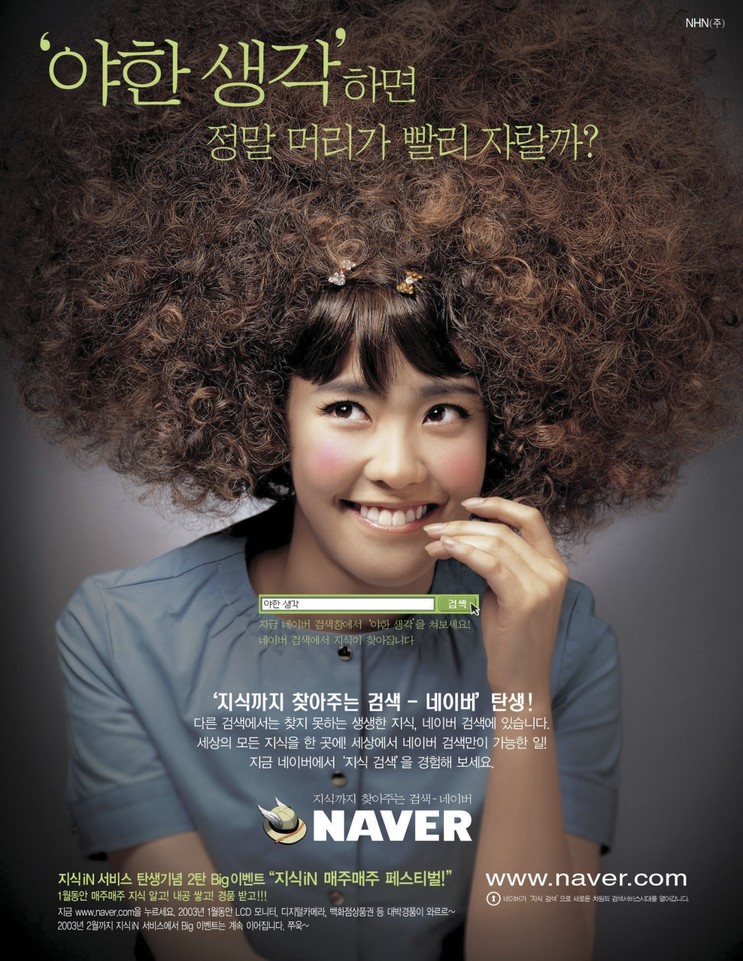
“Is it true that your hair grows if you have ‘dirty thoughts’?” (2002)

When so many websites struggle to open under the weight of smutty ads, it’s difficult not to think that the Korean internet used to be a much more innocent place.

At the very least, you’d assume exceptions would be made for articles specifically about such ads.

With no apparent sense of irony however, not only does the website today’s article comes from feature camel toes, nude women, and couples in flagrante delicto, but some media companies will even censor photographs in news stories while keeping similar accompanying advertisements intact. Most recently and notoriously perhaps, some websites pixelated the breasts of “Bikini Girl” and her supporters for instance, but not the heaving bosoms used to advertise cosmetic surgery clinics:

Given that, and given how difficult it was to find a news website that didn’t plaster today’s article with such ads, I was very surprised to find that the normally quite alarmist Ministry of Gender Equality and Family found that only 5.5% of registered media companies had them on their websites.

Partially, that low number is explained by the very narrow definitions used, as outlined in the article. But if you take a look at the top of the following table (not — as per usual — mentioned until the final paragraph), which lists total registered media companies, total active sites, total sites with advertisements, and total sites with harmful advertisements respectively, you soon realize that that 5.5% is derived from 176 of 3216 total registered media companies. As a proportion of the 2,158 sites with advertisements however, which is surely a more appropriate measure, it jumps to 8.2% (although that still sounds much too low to me).

Finally, of special interest is how MOGEF calls for (and has recently helped implement) self-regulation by internet companies rather than imposing its own regulation system, which may come as some surprise considering how actively it censors Korean music. But despite its reputation however, in reality MOGEF has very limited powers (and only 0.12% of the total government budget), which I think plays a big role in the zealousness with which it monitors K-pop.

여성가족부 ‘19 광고’ 언론사들 고발 검토 / Ministry of Gender Equality and Family Affairs  Considering Prosecuting Media Companies for “18 and Over Advertisements”

‘유해 광고’ 올해들어 3배 늘어… “자율규제기구 설치 촉구, 광고주 심의 요청” / 3 times more ‘harmful advertisements’ compared to last year…”We strongly recommend advertisers consider establishing a self-regulatory system”

by 최훈길/Choi Hoon-gil

선정적인 내용이 담긴 언론사의 인터넷 광고가 작년에 비해 3배 가량 증가한 것으로 조사됐다. 여성가족부는 언론사의 자율 규제를 우선 촉구하되, 해당 언론사에 대한 고발도 검토하고 해당 광고주에 대한 심의 요청도 추진하기로 했다.

A survey has shown that media companies display 3 times more sexually suggestive internet advertisements compared to last year. The Ministry of Gender Equality and Family (MOGEF) recommends that media companies self-regulate themselves, and is considering prosecuting both offending media companies and advertisers themselves.

(Source)

여성가족부가 11일 발표한 ‘인터넷 신문의 청소년 유해광고 유통 현황 모니터링 결과’에 따르면, 올해 유해성 광고는 176개(5.5%)로 작년 유해성 광고 62개(2.5%)보다 3배가량 늘었다. 한 인터넷 신문은 성인용품 사이트 등 청소년 유해 매체물 광고를 성인 인증 없이 게재해 정보통신망법을 위반했다. 유해성 광고는 네트워크 광고의 일종으로, 상당수가 의료쪽 광고이며 문구나 이미지가 선정적이어서 ‘혐오 광고’로도 불린다.

On the 11th of June, MOGEF announced the results of their survey “The present situation of the circulation of internet newspapers’ harmful advertisements among teenagers”, according to which there were 176 sites with harmful ads (5.5%) among those surveyed, roughly 3 times more than last years’ 62 (2.5%) [James — considering the different numbers of sites examined, proportionately there were really only 2.2 times as many]. Among other advertisements harmful to teenagers, one internet newspaper had an advertisement for a sex products site that could be accessed without age verification, which violated the Information and Communications Network Law. Harmful advertisements are a kind of internet advertisement called “disgusting advertisements” [James – called that by who?]; the majority have sexually-suggestive images and terms and/or refer to sexually-related medical procedures.

176개 인터넷 신문 중 20개 인터넷 신문이 전체 유해성 광고물(915건)의 50.3%(406건)을 노출하고 있었다. 여성 가족부는 해당 언론사 실명을 공개하지 않았다. 청소년매체환경과 관계자는 “인터넷 점유율이 높은 곳들이 유해성 광고가 많았고 스포츠, 연예 신문들이 많았다”며 “고발을 검토하는 인터넷 언론사는 종이 신문을 발행하지 않는 곳으로 잘 알려진 언론사는 아니다”라고 설명했다.

Out of the 176 internet newspapers that were found to have harmful advertisements, 20 had more than half of their total advertisements, 406 out of 915 (50.3%), taken up by them. MOGEF didn’t reveal the offending media companies’ names. An official in the Division of Youth Media Environment of MOGEF said: “The internet sites which had the highest number of harmful advertisements were sports and entertainment sites, and those with a lot of traffic,” and added that “the news sites which we are considering prosecuting are not well-known and don’t publish physical newspapers.”

(Source)

해당 유해 광고의 내용은 성행위·성기표현 문구(21.2%)가 가장 많았고, 성적욕구 자극문구(17.7%), 가슴 부위 노출(17.4%), 성행위·성기 관련 묘사(15.8%), 허벅지·둔부 노출(14.5%) 순이었다. 해당 광고주는 성기능 식품(21.%) 관련 업체가 가장 많았고, 비뇨기과(17.3%), 건강보조식품(15.6%), 성기능 개선용품(12.8%), 성형외과(6.8%) 광고주 순이었다.

Of the harmful advertisements, 21.2% — the highest — had expressions related to sex acts or genitalia, 17.7% had expressions designed to arouse sexual desire [James — e.g. “할래/Do you want to do it?], 17.4% exposed the breasts, 15.8% had descriptions of sex acts or genitalia, and 14.5% exposed the thighs or buttocks. Of the advertisers themselves, 21% were selling sexual function products [James — like Viagra?], 17.3% urology services, 15.6% health assistance products, 12.8% products designed to improve sexual performance [James —  how are those different to “sexual function products”?], and 6.8% cosmetic surgery procedures.

여성가족부는 작년과 비교해 유해 광고는 늘었지만 법 위반 언론사들이 대폭 감소한 것을 감안해, 언론사에는 우선 자율 규제를 촉구하겠다는 입장이다. 청소년매체환경과 관계자는 “작년에 34개 언론사가 법을 위반했는데 올해에는 다 시정됐다”며 “언론사들을 직접 규제하기 보다는 인터넷신문협회 등에 자율규제기구인 인터넷신문광고심의위원회의 설치를 촉구하겠다”고 밝혔다.

Although MOGEF points out that the numbers of harmful advertisements have increased since last year, the fact that there are actually less media companies breaking the law also needs to be taken into consideration, so first MOGEF is going ask media companies to regulate themselves. The official in the Division of Youth Media Environment continued: “The 34 media companies that broke the the Information and Communications Network Law last year have all since rectified their mistakes,” and so “a self-regulatory system is preferable to direct regulation, and we demand that the Korean Internet Newspaper Association and so on establish an internet newspaper advertisement consideration committee.”

(Source)

이 관계자는 “이번에 법 위반으로 적발된 언론사에도 시정 조치를 우선 요구하고, 시정이 안 될 경우 형사고발을 할 것”이며 “유해성 광고를 의뢰하는 광고주 사이트에 대해서는 방송통신심의위원회에 유해성 심의 요청을 할 것”이라고 말했다. 언론사에 대한 형사 고발 검토와 광고주에 대한 심의 요청은 올해 처음으로 시행되는 조치다.

Also: “In this case, first we demand that measures are taken to rectify the mistakes of offending media companies, and if this is not done we will consider prosecuting them,” and forward their harmful advertisements to the Korean Communications Standards Commission for consideration. These steps are being enforced this year for the first time.”

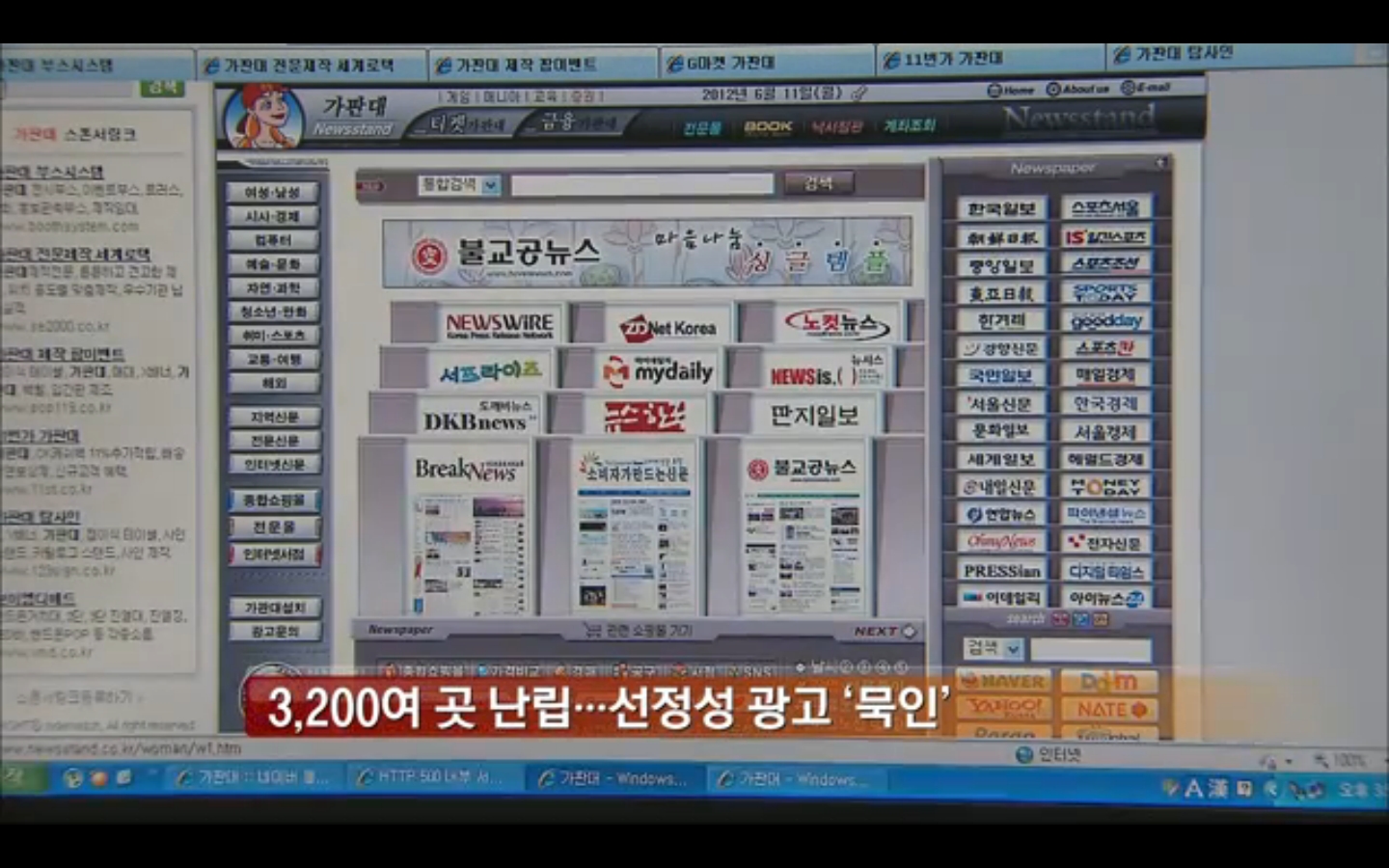
한편, 이번 조사는 지난 3월7일부터 5월21일까지 문화체육관광부에 등록된 3216개 인터넷 신문(지난 2월말 기준)의 메인 페이지 및 10개 기사면을 점검한 것이다. 여성가족부는 작년에도 해당 조사를 했으며, 조사 이후 한국인터넷신문협회와 한국온라인신문협회는 ‘인터넷신문광고 자율규제 가이드라인’을 제정한 바 있다. 청소년매체환경과 관계자는 “낙인 효과를 고려해 이번에는 언론사 이름을 비공개로 했다”며 “올해 하반기나 내년에 또 조사를 할 것”이라고 말했다.

The survey, of 3216 sites registered with the Ministry of Culture, Sports, and Tourism (as of February) was conducted the 7th of March to the 21st of May this year, and examined the main pages and 10 [random?] posts of each. Last year’s survey was conducted by MOGEF, after which the “Internet Advertisements Self-regulation Guidelines” were established with the Korean Internet Newspaper Association and the Korean Online Newspaper Association [James — ironically, Firefox blocks the latter as a dangerous site!]. The official in the Division of Youth Media Environment of MOGEF explained that “because of the harm to their reputations that would come with naming the offending media companies, that information shall be kept private”, and that “a similar survey will be completed in the second half of this year.” (end)

How Many Teenage Girls Are Smoking?

Estimated reading time: 3 minutes. Photo by Irina Iriser from Pexels.

If you’ve been following my The Gender Politics of Smoking in South Korea series (Part 1, Part 2, Part 3, Newsflash, Part 4, Korea’s Hidden Smokers), you’ll know that there’s a huge stigma against women smoking here. This leads to chronic under-reporting by female smokers, which in turn leads to the government and media regularly giving female smoking rates as low as 2-4%. In reality though, best estimates put the rate among young women at roughly 20%, pointing to a looming health crisis.

Even if the coming presidential election brings more enlightened officials to the Ministry of Health and Welfare (보건복지부) however, which has previously overwhelmingly focused on—and been accused of exaggerating—reductions in the male smoking rate, there’ll still remain the problem of finding out how many young Korean women actually smoke.

Or will there? With my thanks, let me pass on a reader’s partial solution:

My coworker, the assistant haksaengbu (학생부) at my high school, made a list of students caught smoking. This is at a small-town girls high school, with 330 students age 15-18 in western years. So far this year (since 2 March) 14% of the students have been caught smoking, with 9.5% of the academic (moongwha; 문과) students caught and 25% of the vocational (sanggwha; 상과) students caught.

I would think that 14% would be the absolute minimum possible average in Korea, considering that we’re in a fairly conservative area and teachers can still punish students (though it’s pretty inconsistent and haphazard). Considering that those are only the ones who’ve been caught and there’s almost nothing in the way of lunchtime and after-school supervision, I’d guess that the amount who smoke on a daily basis is 50% higher and the ones who’ve tried it on occasion is double that.

In any event, if you wanted some incontrovertible statistics about teenage girls smoking in rural Korea based on a sample size in the hundreds there you go!

Later, they added:

If you’d like the breakdown it was 21 out of 226 moonghwa students and 26 out of 106 sangwha students. I believe a couple of the sangwha students have dropped out/gone awol/transferred.

What do you think? How does this compare to readers’ own schools?

If you reside in South Korea, you can donate via wire transfer: Turnbull James Edward (Kookmin Bank/국민은행, 563401-01-214324)

Photos of Elementary-School Girls Smoking Go Viral

Estimated reading time: 4 minutes. Image source: Naver News.

When I see pictures of Korean girls smoking, my heart gets racing.

No, it’s not a fetish of mine, although I’ll admit that some image searches for this post did indeed produce some interesting results. Rather, it’s because ever since I wrote my The Gender Politics of Smoking in South Korea series, best summed up in my Busan Haps article here, I’ve been keeping a sharp eye out for any mention of the increasing female smoking rate in the media. Especially of any news that the government has finally acknowledged the problem, instead of simply ignoring anything that would overshadow its successes with the male smoking rate.

Alas, once I actually translated this March 5 Financial News report, I realized that it has neither, although it does end with getting the news out there that the teenage smoking rate is increasing at least (although it’s actually quite misguided not to break rates down by sex and age). Also, the story only mentions pictures of two girls, but pictures of the above girls with two more companions are also readily available on the internet (in fairness, this may not have been true when the article was written). As most of those pictures are either poorly pixelated or not at all though, making all their identities obvious, I’ve chosen not to post or link to them here.

“담배 피는 ‘요즘 초등생’ 도를 넘었다” / “Even Elementary-School Students Are Smoking These days? That’s Too Much!”

성인 흡연은 매년 줄고 있는 데 비해 청소년 흡연은 매년 증가하는 가운데 한 흡연카페에서 최근 초등학생이 흡연하는 사진이 인터넷에 올려져 충격을 주고 있다. 이 사진을 본 네티즌과 학부모들은 “학생들의 흡연이 도를 넘었다”며 당국에서 나서야 한다고 주장하고 있다.

While the adult smoking rate is decreasing each year, the teenage smoking rate is increasing. And in the midst of this, pictures of elementary school students smoking at a cafe uploaded to the internet have proven shocking. Netizens and parents that have seen these pictures say that “the fact that students are smoking is just too much,” and that the government should do something about it.

5일 유명 포털사이트와 개인 홈페이지, 학부모 등에 따르면 지난달 24일 초등학생으로 보이는 어린이 2명이 인천의 한 흡연카페에서 담배를 피우는 장면이 촬영돼 인터넷을 통해 유포되고 있다.

On the 5th of March, a February 24 picture of what appear to be two elementary school girls smoking at a cafe in Incheon rapidly began spreading on famous portal sites, personal homepages, and among parents.

‘요즘 초등생’이라는 제목으로 유포되고 있는 이 사진은 지난 3일까지 8000여명이 홈페이지 하단의 ‘공감’란에 클릭했지만 그후 이날 오전 현재까지 클릭 수가 2만6000명을 넘어서는 등 문제점을 지적하는 네티즌이 급속히 늘고 있다.

With the title “Elementary School Students These Days”, by the 3rd of March roughly 8000 netizens had seen the picture on the [original?] homepage and clicked on the “I agree/empathize” button, but this had quickly increased to 26,000 by this morning, many of whom were also leaving comment discussing the problems [of students smoking].

(James—I don’t know if this means 26,000 people had visited the one site, or if they’d shared the original post and/or image(s) on their own homepages à la Tumblr)

학부모 오모씨(49)는 “청소년(학생)의 흡연은 어제오늘 문제가 아니지만 초등학생으로 보이는 어린 여학생들이 버젓이 담배를 피우고 있는 모습을 실제 사진을 통해 확인하니 어이가 없다”며 “담배를 구입하는 과정에서 하급생이나 동급생을 괴롭힐 것이고, 이로 인해 상당수 학생이 피해를 보고 있다고 생각하니 답답하기만 하다”고 말했다.

O-mo (49), a parent, said “Teenagers smoking isn’t just suddenly a problem that arose yesterday and today. But still: I was really taken aback by the pictures of elementary school students so brazenly smoking like that”, and that “they probably bully and harass their peers or younger students in other classes to buy the cigarettes for them. I feel frustrated thinking about how those bullied students must be suffering.”

다른 학부모 최모씨(43.여)는 “사진 배경을 보니 집이 아닌 듯하다. 어린 학생들이 담배를 피우고 있으면 가게 주인이 제재해야 하는데 영업을 위해 이를 방관하고 있는 것 같다”며 “철없는 아이들의 일탈을 장사를 위해 방관하는 어른들의 무관심이 더 나쁘다”고 주장했다. 최씨는 “과연 자신의 어린 자녀가 담배를 피우고 있어도 수수방관하겠냐”고 반문했다.

Choi-mo, a mother (43) said “You can see from the background of the picture that it wasn’t taken in someone’s home. It was in a cafe, which meant that the owner, an adult, didn’t stop the students and instead just looked on in order to make money.  That’s much worse than what the students themselves were doing”, and that “would he or she sit by and nothing if it was their own children that were going off the rails like that?”.

이들뿐 아니라 상당수 청소년과 어린이가 흡연카페 등지에서 흡연하고 있으며 편의점 등 앞에서 성인들에게 돈을 구걸(앵벌)하고 남의 주민등록증으로 자동판매기에서 담배를 구입하는 사례도 비일비재하다는 것이다. 또 일부 청소년은 500~1000원의 웃돈을 받고 흡연 학생들에게 담배를 재판매하고 있으며 선배들의 심부름에 담배를 구입하지 못한 후배들은 폭행까지 당하는 것으로 알려졌다.

This is not an isolated case, but a frequent occurrence. Also, teenagers will hang out outside convenience stores begging for money from adults going in or out [James—don’t they also ask adults to buy cigarettes for them?], or using other people’s national ID numbers to buy them from vending machines. Also, it is common for some students to sell cigarettes at a mark-up of 500-1000 won to other students, or for seniors to force juniors to obtain cigarettes for them, physically abusing them if they don’t.

와 관련, 한국금연연구소 관계자는 “흡연은 발암 및 위해 물질이 몸속으로 침투하기 때문에 세포나 유전자에 악영향을 줘 성장기 청소년의 성장.행동발달 장애 등의 원인이 된다”며 “성인 흡연보다 오히려 청소년 흡연을 근절하기 위한 정부의 특별한 노력이 요구된다”고 전했다.

Regarding this, a spokesperson for the Korean Anti-Smoking Laboratory [James—A Daum internet “cafe,” not an official organization] said “Smoking allows carcinogenic substances to invade the body. These have a negative effect on cells and genes, and when this happens during teens’ crucial growing period it can harm their growth and lead to behavioral problems,” and that “it is not adult smoking but teenage smoking that the government needs to take stronger measures to eradicate.”

한편 질병관리본부가 지난해 실시한 ‘청소년 건강행태 온라인 조사’ 결과에 따르면 지난해 청소년 흡연율은 12.1%에 달했다. 다른 기관이 실시한 조사에서는 2008년 기준 청소년 흡연율이 1992년에 비해 3배 이상 늘어난 것으로 조사되는 등 청소년 및 어린이 흡연이 갈수록 늘고 있다.

Last year, the Korea Center for Disease Control and Prevention conducted an “Teenager Health Situation Online Survey”, which found that 12.1% of teenagers smoked. In 2008, a different organization found that the teenage rate was over 3 times the 1992 rate. As time goes on, the teenage smoking rate just gets higher and higher.

(Reporter: Park In-ok/박인옥)

If you reside in South Korea, you can donate via wire transfer: Turnbull James Edward (Kookmin Bank/국민은행, 563401-01-214324)

Quick Hit: Korea’s Hidden Smokers

I wrote an article for Busan Haps this month, about a topic which many of you will recognize from my The Gender Politics of Smoking in South Korea series (Part 1, Part 2, Part 3, Newsflash, Part 4; Living as a female smoker in Korea). Rather than have anyone sift through those thousands of words just to find sources for the statistics I mention in the article though, let me make it easier by providing them all here instead (in order of their appearance):

Here is the July 8 2010 Busan Metro article, with my translation.

• In that article, the OECD average male smoking rate of 28.4% (in 2007) was unsourced, but the same figure — albeit for 2008 — can be found at Asian Correspondent’s translation of this Yonhap News report.

• The 1980 figure of a 79% male smoking rate is from footnote 80 of “The strategic targeting of females by transnational tobacco companies in South Korea following trade liberalisation” by Kelley Lee et al., Globalization and Health 2009, 5:2. Unfortunately, I’ve been unable to find the Chosun Ilbo article referred to in that, but the same figure can be found in this January 2007 Arirang report instead.

Gallop Korea’s figure of “almost as many as 1 in 5” young Korean women smoking (technically 17%) comes from Gallop Korea: Investigating the Actual Condition of Smoking in South Korea, mentioned in footnote 28.

• That is also the source for the figure of 83.4% of Koreans disapproving of women smoking.

Mathias Specht was the Korea Times reader who witnessed an old man slapping women in the face for smoking in March 2010.

I’m No Picasso is an example of one expat female smoker who has changed her smoking habits because of the stigma against women smoking. More can be found in comments to the posts in my blog series.

• More on the “1989 National Health Promotion Law Enforcement Ordinance” can be found in the Globalization and Health article.

• C. Paul Dredge’s Smoking in Korea article, from the Vol. 20., No.4, April 1980 Korea Journal, can be downloaded as a PDF here (the March 1980 reference is a typo by me). For a change though, probably scrolling down Part 1 of my series is actually a much quicker way of finding the text I refer to.

• Finally, I’m indebted to I’m No Picasso for making the links between coffee shops and female smoking, which I expanded upon in Part 4.

Korean Gender Reader

(Source)

Sorry for the slow posting everyone: alas, I’m so busy with all my offline projects these days that my planned posting schedule for 2012 is already proving unsustainable. But in the meantime, the news stories just keep coming!

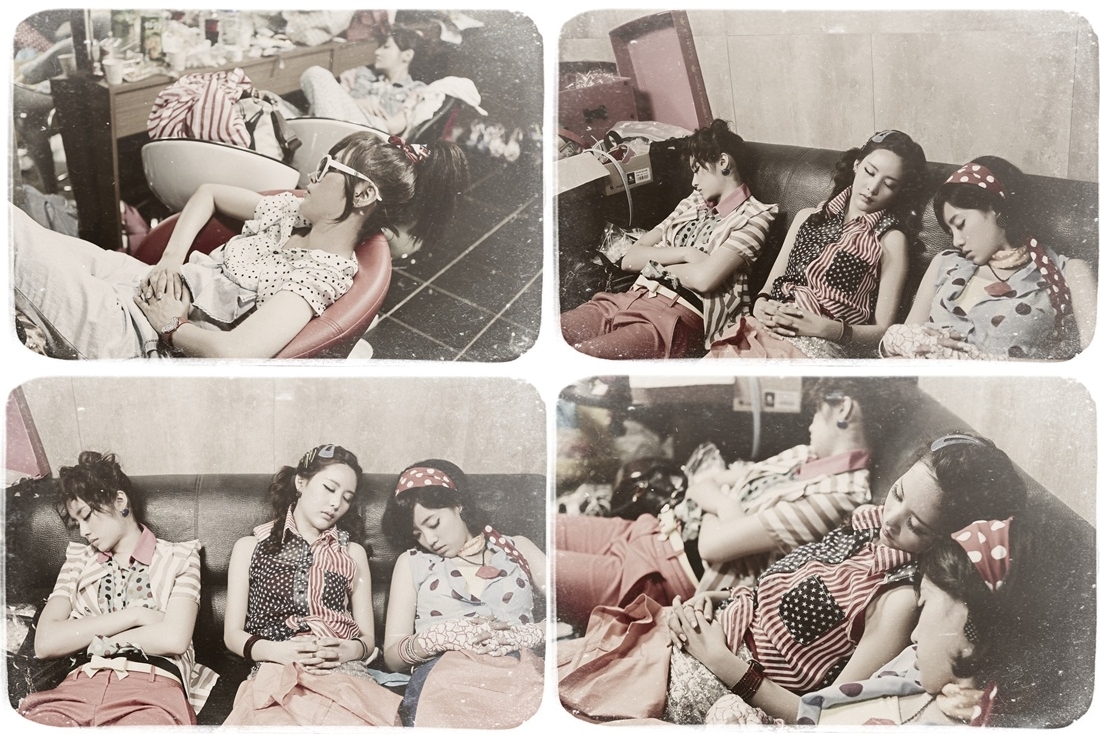
T-ara members sleep for 2 hours a day (Frank Kogan; see Seoulbeats also)

Convicted rapist successfully uses the ‘crooked dick’ defense (The Marmot’s Hole; update)

Korea divorce checklist for negotiation of a marital separation agreement in Korea (The Korea Law Blog)

Parents tremble at ‘pleasure parties’ thrown by foreign instructors (Gusts of Popular Feeling)

Travel in Korea still lacks women’s bathrooms (Travelwire Asia)

쓰레기 같은 학생, or, Why you might need pepperspray (Gord Sellar)

Hair freedom for Seoul students (Hankyoreh)

Internet hot over ‘bikini protest’ (Korea Times) vs. Gong Ji-young (“The Crucible”) Bikinis, Breasts and Weasels (Korean Modern Literature in Translation)

Fat tax elicits mixed reactions from S. Korean public (Xinhuanet)

Survey finds lots of sexual harassment at South Korean workplaces (Asian Correspondent)

Korean women and western/white men: a complicated and troubled relationship (The Unlikely Expat)

Women leading Korea (The Peninsula) vs. Lone Star and the women of Korea (The Wall Street Journal: Business Asia)

Jeju Island, known for wind, women, and water…now has more men than women (The Wall Street Journal: Korea Realtime)

My final post on Asian/white interracial relationships (Shanghai Shiok!)

Brides-to-be being ripped off ahead of their big day (Hankyoreh)

“[Is] dating a 28 year-old guy in Korea like dating a 15 year-old in the US?” Deconstructing inane and offensive reader questions (I’m No Picasso)

• An update to the above story – the question wasn’t as bad as it first looked!

Ministry strives for women’s rights (The Korea Herald)

South Korea’s racism debate – What debate? (Gord Sellar)

• Headline of the week: “Hard competition coming for erectile dysfunction remedies” (Hankyoreh)

Entertainment agency representatives voice opinions on idol dating, marriages, and age-limits on usefulness (Allkpop)

More elderly people sue their children for support (The Chosunilbo)

(Links are not necessarily endorsements)

Korean Gender Reader

(Source)

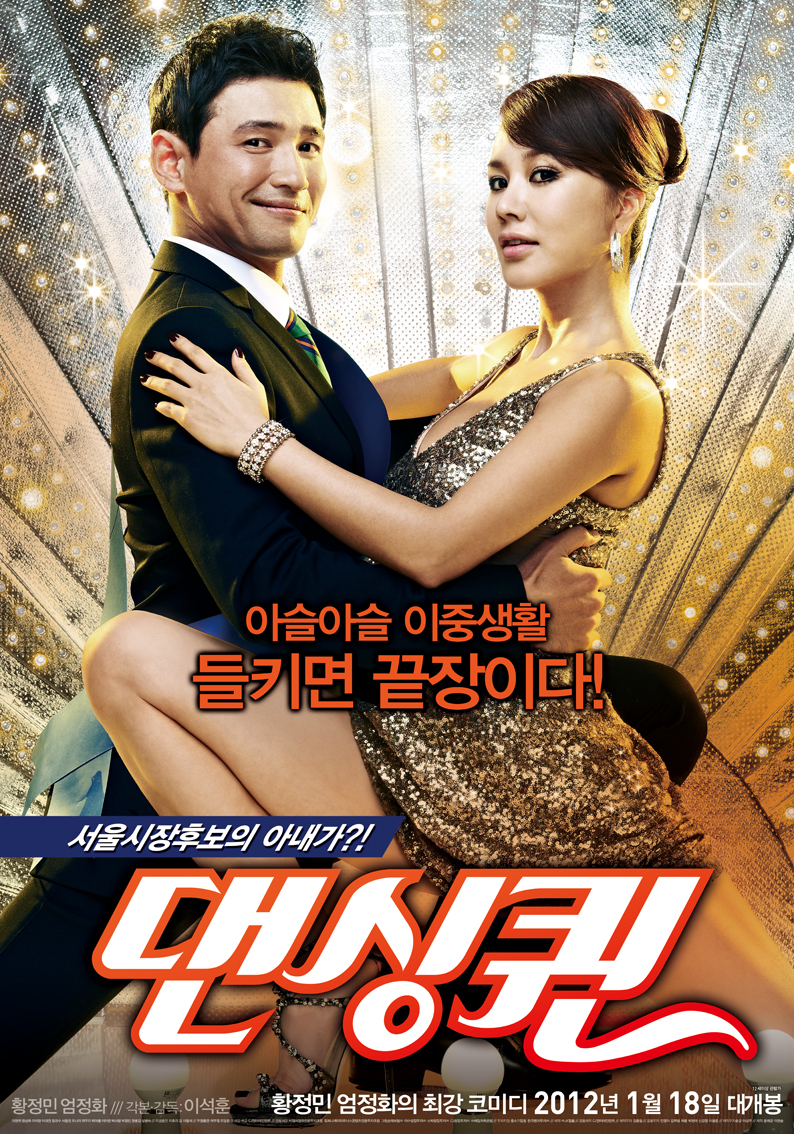
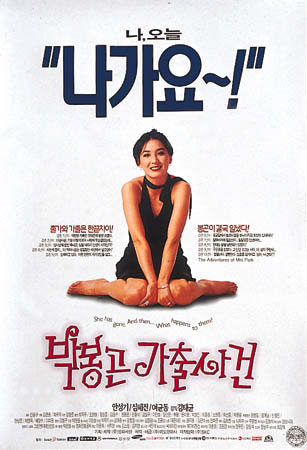
If you’ll please indulge an old Korean Studies geek for a moment, Girlfriday’s review of Dancing Queen (댄싱퀸) at Dramabeans this week instantly reminded me of The Adventures of Mrs. Park (박봉곤 가출사건), from way back in 1996. After all, both are about wives who blatantly defy their husbands to follow their dreams of becoming singers, both are comedies, and – I’ll take a wild guess about Dancing Queen – both wives are ultimately successful.

One likely difference though, is that Mrs. Park runs away from her husband. And in fact, The Adventures of Mrs. Park was the first Korean movie to ever show a wife getting away with such insubordination.

That may sound difficult to believe today, but director Kim Tae-kyun (김태균) would later confess to Cine 21 magazine that he was extremely concerned at how audiences might react to such “an unexpected ending”. As even comedies back then would invariably close with continued happy marriages, while more realistic movies would show a miserable and destitute wife returning home with her tail between her legs.

In contrast, I doubt director Lee Seok-hoon (이석훈) has any such qualms in 2012. And it’s always quite sobering, realizing how much Korea has changed in the time I’ve been here.

So, while I doubt I’ll ever make the effort to track down and watch The Adventures of Miss Park for myself (all of the above is based on this book chapter), I will watch Dancing Queen. For not only is Hwang Jung-min (황정민) my favorite actor ever (see here for my review of A Good Lawyer’s Wife {바람난 가족; 2003}, the first movie I saw him in), but I’ve always had a soft spot for Uhm Jung-hwa (엄정화) too, as she was very much the queen of K-pop when I came to Korea back in 2000. Here’s my favorite song of hers from back then (just give me the word, and I’ll translate it in a flash!^^):

And after all that reminiscing(!), finally here are this week’s links, in no particular order:

What K-pop can teach us about the ROK military (Seoulbeats)

Foreigners organize flash mob against prostitution (The Marmot’s Hole)

‘Dream High 2′ cast express the need for laws protecting minors in the industry (Allkpop)

Sexual harassment widespread in workplaces (Hankyoreh)

Did the Piggy Dolls ruin their credibility? (Mixtapes and Liner Notes)

Essential information for understanding divorce in Japan: there is no such thing as joint custody of children (Economist)

How Korean fashion is seen from an international perspective; opposed to how Koreans think it’s seen (Noona Blog: Seoul)

K-pop’s first lesbian love story? (Seoulbeats)

Congratulations on the Dragon baby! (On Becoming a Good Korean {Feminist} Wife)

290,000won bags for elementary kids – competition at the extreme? (Hangukdrama and Korean; also see my post on how pink and princessey the schoolbag ads for girls are, but sporty and full of space-shuttles and racing-cars for boys)

[Debate] Leave ancestral rites where they belong- in the past (Hankyoreh)

[Debate] Cultural rites provide key to understanding ourselves (Hankyoreh)

• “Holiday stress for an average married Korean woman is as bad as the pain of losing a close friend” (Arirang)

Statistics on social trends in Korea – a great resource (Korean Journal of Sociology; scroll down to the “research guide”s)

Roundtable: our friend, MOGEF (Seoulbeats)

Harsher punishment urged for pedophiles (Korea Times)

Monfemme: gender, feminist, and medical anthropology in the steppes and deserts of Mongolia (Blog recommendation)

Ali Meets Father of 8 year-old Rape Victim “Na-young”

Estimated reading time: 6 minutes. Source: maniadb

If you’ve never heard of Ali, Na-young (a pseudonym), or their connection, please see Seoulbeats for some background. Assuming that you have, I’d like to add just two things in this introduction to today’s translation.

First, that back in December 2008, the combination of the particularly horrific nature of the crime, and the light sentencing of the rapist, simply incensed the Korean public. So perhaps one can understand the severity of netizens’ reactions to Ali using Na-young’s name in a song title.

Next, that that public outrage in 2008 ultimately led to many changes to the Korean pop-culture industries, which we’re still seeing the effects of today. For, triggered by Na-young’s case, public anger about sex crimes against minors came to a head by the following summer, leading to increased scrutiny and concern about those working in the music industry especially.

Combine that with the sex-crime revelations that followed suicide of actress Jang Ja-yeon, and we came to have the widespread restrictions on and/or censorship of song subjects, lyrics, clothing, dance moves, and so on that we see today (albeit not just on minors). Working around those—or deliberately breaking them to create publicity—has now become an integral part of the production of K-pop.

(Translation begins)

Source: 우리다시여기에

[오늘의 세상] 아픔을 사랑으로 감싸다나영이 아버지, 알리 만나 주며 위로 / Enveloping pain with love . . . Na-young’s father meets Ali, gives flowers and consolation

Chosun, December 19, 2011,  by 정지섭/Jeong Ji-seob

아버지와 같이 온 나영이, 부끄럼 많아 차에서 기다려 / Na-young, who came with her father, was too shy and waited in the car

나영이 아버지:”그런 고통 있는 줄 몰랐네요 많이 힘들었죠… 울지마요, 네티즌들 진정했으면 좋겠다” / Na-young’s father: “We didn’t know you had that kind of pain.  It was very hard, wasn’t it.  Don’t cry, I hope the netizens calm down.”

편지 5장에 마음 담은 알리 “나영이에 용기주려 했는데 미리 말씀 못드려 죄송해요… 언니가 정말 미안해” 눈물 / Ali’s heartfelt 5-page letter: “I intended to give Na-young courage, and I am apologize for not informing you in advance. I am really sorry,” tears

“제가 작사·작곡자인데 미리 말씀드리지 않은 것 죄송합니다. 힘든 일 겪어도 언니처럼 이겨낼 수 있다고 용기를 주고 싶었어요.” (가수 알리)

“I am the lyricist and composer, and I am sorry for not informing you in advance.  I wanted to give you courage by saying that though you went through a difficulty, you can overcome it like I did.” (Singer Ali)

“앞으로 할 일이 많은 아가씨가 이렇게 힘 빼서 되겠어요? 울지 마요.” (나영이 아버지)

“Is it okay for a young woman who has so much ahead of her to lose strength like this?  Don’t cry.” (Na-young’s father)

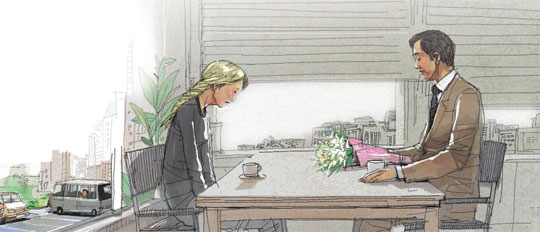
17 일 오후 서울 강남의 한 연예기획사 사무실. 자신의 또는 가족의 ‘성폭행 피해’라는, 어쩌면 인생의 가장 무겁고 감추고 싶은 짐을 진 두 사람이 마주 앉았다. 한쪽은 검은 정장을 입은 여가수 알리(27). 다른 한쪽은 2008년 벌어진 조두순 성폭행 사건의 피해 어린이 나영이(가명)의 아버지.

The afternoon of December 17th in the office of a Gangnam entertainment management agency. Two people, who personally or whose family bear the burden of the damage of sexual assault, maybe the heaviest and the one they would most wish to conceal of their lives, sat opposite each other. On one side, the singer Ali (27), wearing a black suit.  On the other side, the father of Na-young (false name), the child victim in the 2008 Cho Doo-soon sexual assault case (illustrator, right: 이철원/Lee Cheol-won).

모든 일은 14일 알리가 조두순 사건을 다룬 자작곡 ‘나영이’를 새 앨범에 담아 발표하면서 비롯됐다. 일부 네티즌은 ‘청춘을 버린 채 몸 팔아 영 팔아…’ 등의 가사를 문제 삼으며 알리를 무차별 공격했고, 알리는 그날 밤 나영이에 대한 사과문을 낸 뒤 앨범을 전량 수거·폐기했다.

The whole matter began on the 14th with the release of Ali’s new album, which includes a song she wrote, called “Na-young-ee,” about the Cho Doo-soon incident.  Some netizens questioned the use of lyrics like, “You threw away your youth, selling your body, selling your soul,” and attacked Ali indiscriminately; that night, after releasing an apology for “Na-young-ee,” Ali collected and discarded all copies of the album.

그래도 일부 네티즌의 악플이 멈추질 않자 알리는 16일 아버지와 함께 기자회견을 열어”3년 전 나도 성폭행을 당했다”고 고백하며 거듭 용서를 구했다. 알리 측은 14일 문제가 발생하자마자 나영이 가족에게 “찾아가 사죄하고 싶다”는 뜻을 전했고, 안산에 사는 나영이 아버지가 알리 측의 기자회견을 본 뒤 “내가 나영이와 함께 찾아가겠다”고 해 만남이 성사됐다.

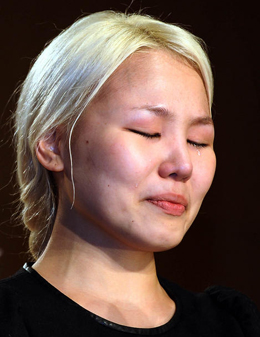
However, some netizens’ negative comments didn’t stop, so Ali held a press conference on the 16th with her father and confessed, “3 years ago, I was also sexually assaulted,” and asked once more for forgiveness.  On the 14th, as soon as the problem appeared, Ali conveyed her wish to “go and apologize” to Na-young’s family, and Na-young’s father, after watching Ali’s press conference, said, “I’ll go with Na-young to visit her,” and the meeting was arranged (caption, left: 알리가 17일 나영이 아버지를 통해 나영이에게 준 사죄의 편지 / The apology letter Ali gave to Na-young through her father on the 17th).

이날 나영이 아버지는 알리가 눈물을 흘리며 사죄하자 갖고 온 백합과 안개꽃 다발을 내려놓고 거듭 알리를 달랬다. “나도 어제 기자회견한 내용을 들었어요. 그렇게 큰 고통이 있는 줄 몰랐네요. 얼마나 힘들고 어려웠을지 충분히 짐작돼요. 사전에 우리에게 알리지도 않고 노래를 만들었단 얘길 듣곤 화가 나 음반 판매 금지 가처분까지 생각했는데 노래를 폐기하겠다고 해서 마음이 좀 누그러졌어요. 그런데 그런 사정(성폭행)까지 있었다니, 내가 다독여줘야겠다는 생각이 들었죠.”

On this day, Ali apologized with tears streaming, and Na-young’s father put down the bouquet of lilies and baby’s breath he had brought and comforted her repeatedly.  “I heard what you said at the press conference.  I didn’t know that you had such great pain.  I can guess how difficult and hard that must have been.  When we heard that you’d made the song without letting us know beforehand, we were angry and even thought of an injunction banning sales of the album, but you said you would discard the song so our feelings softened.  But you had that kind of situation (sexual assault), so I felt I should console you.”

나영이 아버지가 “참 많이 힘들었죠?” 하자 알리가 울먹이며 입을 열었다. “(나영이와) 같은 해에 저도 당했어요. 그래서 (나영이) 기사가 나오면 스크랩해서 주변 사람들에게 보여주고 (나영이 돕기 모금 기관에) 익명의 기부도 했어요. 남의 일이 아닌 것 같아 더 적극적으로 돕고 싶었지만 그러면 주변에서 ‘혹시 너 뭐 있니’ 할 것 같아서 공개적으로는 못 했죠.”

When Na-young’s father said, “It was very hard, wasn’t it?” Ali was on the verge of tears as she spoke.  “I was assaulted in the same year (as Na-young).  So when the articles (about Na-young) came out, I saved them and showed them to the people around me, and donated anonymously (to the fund-raising organization for helping Na-young).  It didn’t feel like someone else’s problem, so I wanted to help more actively, but it seemed like if I did that, the people around me might ask, ‘Did something happen to you?’ so I couldn’t do it openly.”

나영이 아버지는 알리에게 “힘들겠지만 위축되지 말고 당당하게 정면 돌파해라. 그게 이기는 길”이라고 했다. “우리 사회 풍토가 슬프지만 ‘목소리 안 내는 사람이 바보’라고들 생각하잖아요. (성폭행 피해자들이) 자기 목소리를 당당하게 낼 수 있는 기회가 만들어져야 해요.” 그는 “이번 (나영이 노래) 일 때문에 네티즌이 많이 화가 난 것 같은데, 오해도 많이 풀린 만큼 진정됐으면 좋겠다”고 했다.

Na-young’s father said to Ali, “It must be hard, but instead of cowering, face things confidently head-on. That’s the way to win.  Our social climate is sorrowful, but as people say, ‘The person who doesn’t speak out is a fool.’  Opportunities need to be created for (victims of sexual assault) to speak out confidently.”  He continued, “Because of this matter (the song “Na-young-ee”), netizens seem to have gotten very angry, and I hope this misunderstanding gets cleared up so they will calm down.” (caption, right: 가수 알리가 (본명 조용진) 16일 오후 서울 종로구 홍지동 상명아트센터 콘서트홀에서 열린 알리의 정규 1집에 수록된 ‘나영이’곡 논란과 관련한 공식 기자회견장에서 2008년 성폭행당한 사실을 밝히며 눈물을 흘리고 있다 / Singer Ali {real name Jo Yong-jin}, at an official press conference at the Sangmyeong Art Center in Hongji-dong, Gongro-gu, Seoul, regarding controversy caused by her song, 나영이, in her 1st regular album, crying while announcing that she was raped herself in 2008)

나영이 아버지가 1시간여 동안 얘기를 나눈 뒤 “바쁜 사람 시간 잡아먹으면 안 된다”며 일어나자 알리는 다이어리와 연필, 꽃 장식이 달린 머리띠가 든 종이 가방을 전달했다.

After talking for an hour, Na-young’s father said, “I shouldn’t take up a busy person’s time,” and stood up.  Ali gave him a paper bag containing a diary, pencil, and flower-decorated headband.

알리는 나영이에게 사죄와 격려의 메시지를 보내는 내용의 다섯 장의 편지도 초록 봉투에 담아 함께 전달했다. “내가 부족해 너에게 상처를 또 주게 돼 정말 미안해. (중략) 만약 괜찮다면 너의 얘기도 들려줘. 친구가 되었으면 좋겠어.”

Ali also gave Na-young a five-page message of apology and encouragement, contained in a green envelope.  “I’m very sorry that my mistake caused you to be hurt again.  (…) If it’s okay, tell me your story in return.  I’d like us to be friends.”

나영이 아버지가 집으로 출발하려는 차 안에는 나영이가 타고 있었다. 나영이 아버지는 “나영이가 차를 오래 타고 와 피곤했던 데다 부끄러움을 많이 타 밖에 있고 싶다고 했다”고 했다. 알리는 안이 잘 보이지 않는 창밖에서 “언니가 정말 미안해”라고 몇 번이고 말했다.

Na-young was in the car that her father took to go home. Her father said, “Na-young is tired from riding in the car for a long time, and also she is very shy, so she said she would like to stay outside.” Outside of a window into which one couldn’t really see, Ali said several times, “I am really sorry.” (end)

(Thanks to Marilyn for the translation)

If you reside in South Korea, you can donate via wire transfer: Turnbull James Edward (Kookmin Bank/국민은행, 563401-01-214324)

Korean Boys: “Wearing Hot Pants Says Something About You”

(Source)

A much more serious topic than it may sound, this article from Ilda Women’s Journal will definitely give you a renewed appreciation for the goals of the Slutwalk (잡년행진) movement.

Once it does though, unfortunately you’ll probably find yourself pretty frustrated with it too. For the author only really gives platitudes about the need for change, rather than provide any details about who those boys were, what they said exactly, and the sex-education program her and her colleagues were involved in.

But still, she’s right to be concerned about the messages children are receiving about sexuality when any elementary school boys both approve of and chastise attractive women for wearing revealing clothes. Let alone disallow “ugly” ones from wearing them:

(Source)

“못생긴 애들 핫팬츠 입지 말라”는 아이들 Children That Say “Ugly Girls Shouldn’t Wear Hot Pants”

여성의 노출’을 바라보는 십대들의 시선 Teenagers’ Views on Women Who Wear Revealing Clothes

So Yeong-mi, August 2010

(일다의 독자위원인 서영미님은 현재 십대들과 함께하는 성교육 프로그램을 진행하고 있습니다―Editor)

Editor: Ilda reader So Yeong-mi is currently involved in a sex-education program aimed at teenagers.

“선생님, 질문 있어요. 왜 여자애들은 그렇게 짧은 반바지를 입어요?”…“여자애들이 핫팬츠 좀 못 입게 해주셨으면 좋겠어요!”…“?????????”

“Teacher, I have a question. Why do women wear such short shorts?”…”If young women didn’t wear hot pants, that would be good.”

이게 도대체 무슨 문제란 말이지? 최근 들어 두 번이나 받은 질문이다. 고등학교 청소년 남자 아이들을 만났을 때 한번, 그리고 초등학교 남자아이들과 교육하면서 한번. 성장기 자신의 몸의 변화나 성관계, 임신/출산에 관련한 질문들이 대부분인 편이라 이 질문이 유독 기억에 남았다. 같은 반 여자아이들이 핫팬츠를 입지 말았으면 좋겠다니 이 무슨 말인가?

(Source, NSFW)

Why on earth are they saying and asking these things? This has happened to me twice recently. Once, from teenage boys at a high school, and the other from boys at an elementary school. Most of the questions I get are normal ones about their development, changes to their body, sexual relationships, pregnancy and childbirth and so on, but I especially remembered these. Why are boys saying that girls in their classes shouldn’t wear hot pants?

James – Because of the mention of female classmates, I’m assuming the boys were in mixed-schools then? But So Yeong-mi doesn’t mention how the girls reacted to such questions, an omission which hopefully means she taught the boys and girls separately.

뜬금없는 질문이 궁금해 스무고개 하듯 계속해서 질문을 주고받으며 질문한 의도를 파악하려 애썼다. 질문자는 한 명이었지만 반 아이들 모두가 동의하고 있었고 별로 웃기지도 않은 질문에 아이들은 자지러졌기 때문이다. 질문을 받은 내가 자신들 생각대로 웃어넘기지 않고 진지하게 계속 물으니, 나중엔 아이들도 제법 진지하게 맞받아쳤다. 그리하여 나온 결론은 같은 반 여자아이들은 핫팬츠를 입으면 안 된다는 것!

I was very curious why these questions came out of the blue, so I sort of played 20 Questions with the students to find out. Only 1 student [in each case?] asked, but all the other students thought it was hilarious, and they expected me to laugh along with them. I wanted to get to the bottom of that, and so later when they gave me feedback it emerged that they felt that girls in their classes shouldn’t wear hot pants.

(Source)

모자와 핫팬츠는 다르다? What’s the Difference Between Hot Pants and Hats?

“오크가 그런 걸 입는 게 말이나 돼요?” “Would Orcs Wear Hot Pants?”

판타지 소설이나 롤플레잉 게임에 주로 등장하는 괴물, ‘오크’족. 쭉쭉빵빵 몸매도 좋고 능력도 좋은 미녀캐릭터들에 비해 볼품이 없어 쉽게 무시당하고 힘만 센 캐릭터. 아이들의 설명에 의하면 이랬다. TV에서 연예인들이 입는 것과는 다르다는 것. 그건 당연히 ‘봐줄 만하다’는 것이다. 핫팬츠뿐만 아니라 미니스커트에도 역시 강한 불만을 표했는데, 이번에는 또 다른 이유를 제기했다.

As the students explained, in fantasy novels and role-playing games the monster that appears the most frequently is the orc. Unlike beautiful female characters, with great abilities and voluptuous bodies (and usually useless armor – James), orcs are essentially faceless characters that can easily be disregarded. What entertainers wear on TV is different though, and, of course, it’s worth watching.

But it’s not just hot pants that the boys had problems with girls wearing, but also miniskirts. They gave a second reason for that.

“옷이 그러면 그렇고 그런 거 아니에요? 위험할 수도 있잖아요.”

“Doesn’t wearing clothes like that say something about you? And it’s dangerous too!”

아이들은 여성인 내게 “선생님도 그런 옷을 입냐”며 “도대체 왜”냐고 야단이었다. 한 학생이 모자를 쓰고 있기에 “너는 왜 모자를 쓰고 있냐” 물으니 “그냥 좋아서”라고 가볍게 얘기했다. 그럼 “핫팬츠나 미니스커트를 선택해서 착용하는 것은 무엇이 다르냐” 물으니 “그건 당연히 다르다”고 소리친다. 적절한 대답이 없을 때 아이들은 대개 화를 낸다.

(Source)

The students asked me, a woman, “Do you wear clothes like that?”, and, in a critical tone, “Why on Earth do women wear those?”. So, to one student who was wearing a hat I asked “Why are you wearing that hat?”, to which he casually replied “Because I like it”. So then I asked “How is that different to choosing hot pants or a miniskirt”, and got the retort that “Of course it’s different!”, the student becoming angry that he didn’t really have a proper answer.

그날 종일은 아이들과 좀 더 많은 시간을 들여 ‘개인의 취향’에 대한 이야기를 나누었다. 서로의 취향을 존중하고 이해해야 하는 이유를 찾아보며 남/녀를 탈피한 다양한 관계 속에서 역할활동까지 해봤다. 그러나 그 날의 아이들에게는 이미 모자와 핫팬츠의 ‘선택’이 다르지 않다는 것을 이해시키는 것이 어려워 보였다. 너무나 견고한 그들만의 ‘패션철학’이 놀라울 따름이었다.

I spent all day with the students, and shared a story about personal tastes with them. Then we did roleplaying, breaking away from normal man/woman and girl/boy ones, in order to better understand and respect each other’s personal tastes. It was difficult to make them understand that wearing hot pants was a choice, no different to wearing a hat, and I was very surprised in how unwavering some of their attitudes to fashion were.

우연히 비슷한 시기에 만난 이 집단 아이들만의 문제였을까. 교육이 끝난 후 평가시간에 이 에피소드를 털어놓으니 유난히 남자아이들 교육을 진행할 때 그런 질문이 많이 나온다는 실무자들의 의견이 있었다. 예쁜 사람이 입으면 괜찮고, 아니면 안 괜찮고, 짧은 옷을 입으면 위험하고 야한 어떤 것이라는 10대 초반의 아이들의 논리. 고등학생 이상의 청소년 들을 만났을 때만 해도 성인과 비슷하게 생각해나가는 시기여서 그런가 생각했는데, 초등학생들에게서까지 강한 불만으로 표출되어 나오니 그냥 웃어넘길 일이 아니라는 생각이 들었다.

I wondered if this way of thinking was just confined to the groups of students I taught, so afterwards I asked other sex-ed teachers involved in the program, and they confirmed that they get similar questions and opinions from especially male students. The logic of boys in their early teens was that if pretty girls wear hot pants and so on it’s okay, but if they’re not pretty then it’s not, and that [in either case] such clothes are both too revealing and dangerous.

(Source)

Now, if I’d asked high school students and so on, who think like adults, then I wouldn’t have been surprised, but once I learned that even elementary school students are saying such things then I realized that this was no laughing matter.

고 민지점은 성인들이 갖고 있는 편견이나 고정관념들이 고스란히 아이들에게도 답습된다는 것이다. 또한 그 연령이 대폭 낮아졌다는 사실도 놀랄만한 일이다. 그 어린 학생들마저도 ‘여성’의 몸을 검열하고 있다는 사실에 주목하지 않을 수가 없는 것이다.

Children are picking up adults’ prejudices and biases, although it is surprising that they’re doing so at such a young age. And we can’t help but notice that even these children too think the female body is something to inspected and evaluated.

우리가 어떤 일을 할 수 있을까 What can do we do about this?

노출이 많은 옷을 입은 여성과 그렇지 않은 여성을 간단하게 이분화 시키고, 거기에 아름다움이라는 가치를 연결시킨 잣대로 평가하는 것은 아이들도 어른들과 크게 다르지 않았다. 다만 아이들의 용어로 표현하고 있을 뿐이었다. 이를 우스갯거리로 사용하는 아이들을 보고 있자니 솔직히 조금 화가 나기도 했다. 그리고 그와 동시에 우리 스스로 반성해야 될 때가 아닌가 생각해보게 됐다.

Children splitting women into simply those who wear very revealing clothes and those that don’t, and judging their value only in terms of their appearance, is little different from what adults do. But although the children just used these terms jokingly, to be honest I still got a little angry with them.

Yet at the same time, we really need to examine ourselves too.

대중매체에 대한 비판을 하려던 차에 최근 10대 청소년 연예인들을 상대로 60%가 신체 노출이나 과도한 성적 행위 장면을 강요했다는 기사들을 보게 되었다. 한 언론과의 인터뷰에서 가수 이은미는 음악성 보다 외적인 면에 더 관심을 갖는 사회 분위기를 우려하며, 성적인 면이 강조된 걸그룹의 노래, 의상, 춤에 환호하는 이 사회를 ‘몰상식의 극’이라고 표현했다. “초등학교를 졸업한지 몇 년 되지 않은 아이들을 벗겨놓고 대 놓고 섹시하다고 박수를 치거나, 꿀벅지, 꿀복근 같은 용어들을 사용하는 대중문화를 보면 소름이 끼친다.”는 것.

(Source: unknown)

I was about to blame the mass media, as recently I’ve read reports which say that 60% of female teenage entertainers have claimed to have sometimes been forced to wear revealing clothes and/or do sexual dances and so on. And in an interview of the singer Lee Eun-mi (James – Not one of those teenage entertainers; she was born in 1968), she said she was worried about a society that considered external appearance more important than musical quality for singers, where girl groups’ sexual dances, songs, and outfits where cheered…she used the term “thoughtless/careless”. She said “I freak out at the thought that just a few years after they graduate from elementary school, young male and female entertainers are being praised for taking off their clothes and being talked about in terms of their ‘honey thighs‘ or six-packs.

쏟 아지는 대중매체의 벗기기 논란은 새삼 어제오늘 일도 아니건만, 아무 손쓰지 않고 있었음에 반성하게 된다. 상품화되고 대상화되고 있는 여성들의 문제를 공공연히 문제 삼지 않았던 것이 일상생활에까지 주변 사람을 대상화하고 외모로써 평가하는 지금의 일을 만든 게 아닌가 하는 생각에서다.

But these trends in the media didn’t just appear overnight – they were allowed to flourish by the public’s inattention and lack of concern. This way, we have come to consider the commercialization and objectification of women as a normal part of our daily lives.

아 이들의 생각을 넓게 펼쳐주진 못할망정 오로지 외모로써 사람을 평가하는 우리 사회에서 우리가 어떤 일을 할 수 있을지 함께 고민해봤으면 좋겠다. 우리가 그동안 무심코 내뱉었던 말들이 아이들에게 어떤 영향을 미치게 될지 생각해보면서 말이다. 문제가 수면으로 드러난 지금이야말로 왜곡된 미와 과장된 외모 중심의 평가들로부터 벗어나 아이들에게 더 많은 관심을 가져야 할 때다. 아이들뿐만 아니라 사실은 우리 모두를 위해서 말이다.

It’s difficult to broaden children’s minds, but we do have to make an effort to stop judging each other on our appearances. We have to consider what has been the effect on our children of this focus, this excessive emphasis on appearance. Not just for them, but for society as a whole (end).

My post title aside, I don’t mean to generalize about all Korean boys, and given the author’s vagueness then what she says about them really needs to be taken with a grain of salt. So, to get a better overall picture, I’d really appreciate anything any teachers can tell me about what their own young students have ever said about such things (alas, it’s been a while since I’ve taught children or teenagers myself).

And to end on a positive note, was anyone else reminded of the above semi-response to such sentiments? Now I have a renewed sense of appreciation for that too!^^ (See here for a discussion of the song’s lyrics and meaning)

Korean Police Can Now Give Restraining Orders on the Spot

(Source)

It’s just a short article, tucked away on page 6 of the Busan edition of the November 10th Focus (below). But still, it’s always nice to hear that a new domestic violence law is actually being enforced:

Abusive husband ‘officially isolated’

First incident since implementation of special exemption law

After the implementation of a special exemption law which includes domestic abuse punishment that allows police at the scene to officially isolate the persons concerned in the event of serious domestic abuse, the first case in the Busan area has emerged.

Busan Seobu Police Station revealed on November 9th that a police officer dispatched to the scene used his authority to order isolation and a restraining order for a  Mr. Kim (43), currently in the waiting period [lit. “careful consideration period”] for a divorce, who had gone to his wife, who is raising their 5-year-old son, and assaulted her; a court later decided to keep those measures in place.

Mr. Kim is under suspicion of going to the house of his wife (32), with whom he is in a divorce suit, in Busan’s Seogu on November 1st at 12:05AM, asking, “Why didn’t you answer the phone?” and committing violence that included hitting her, which he did habitually.

The couple filed for divorce in September, and a court ordered that Mr. Kim be allowed to visit his son, of whom his wife has custody, once a week on the weekend during their 3-month waiting period, but Mr. Kim went to his wife’s house on weekdays and became violent.

His wife, while being assaulted, notified the police, and the officer dispatched from the Ami Precinct Station ordered Mr. Kim to leave the house, not to come within 100 meters of his wife’s home, and not to use electronic communication like a cell phone or email to contact her.  After a review, a judge decided on November 2nd to keep the measures in place.

The measures represent the first case in Busan since a special exemption law for domestic abuse punishment that gives front-line police officers the authority to take such measures came into effect on October 26th.

Front-line officers can appraise conditions like the seriousness of the violence, the use of a deadly weapon, or habitual beating, and then take official action, and if the suspect violates those orders, the officer can impose fines of up to five million won or imprison him or her for a maximum of two months (end).

(Thanks to Marilyn for the translation)

The Origins of “Ajosshi Fandom”?

Did you know that middle-aged sexual harassers often claim that they were just being affectionate, touching the victim simply as if they were their own daughters? Naively perhaps, I had no idea, so I didn’t give this commercial a second thought when it came out in 2005. But armed with that knowledge, I can certainly understand why it would have made so many women uncomfortable, as pointed out by Park Hee-jeong (박희정) in her article on the commercial that I’ve translated below, and which was echoed by numerous commenters.

Then it hit me. If all this was already well-known by the Korean public in 2005, then it takes no great leap of the imagination to see how middle-aged men’s sexual attraction to 15 and 16 year-old girl-group members could so quickly and readily be framed in the same terms just a couple of years later, albeit more as an avuncular (uncle) love rather than a paternal one for some reason.

That would remain the case for the next few years, as you can read about in depth here, here, here, here, and especially in Soo-ah Kim’s article “The Construction of Cultural Consumption Way: The Discourse of Uncle Fans with the Girl-Idol Group” in Media, Gender & Culture, 15 (2010): 79-119 (“소녀 이미지의 볼거리화와 소비 방식의 구성: 소녀 그룹의 삼촌 팬 담론 구성”, 미디어, 젠더 & 문화), as she was one of the very few prominent academics challenging that consensus at the time. Only upon a perceived spate of sex crimes against children in July 2010 would the media begin (and I stress only begin) acknowledging the sexual element, and how that could be problematic.

Of course, that’s just scratching the surface of ajosshi (아저씨; middle-aged man) fandom, and I certainly don’t want to imply that middle-aged men’s interest in young girl-groups can’t be anything but sexual. Nor that when it is sexual though, that that’s fine for 20 and 30-somethings, but somehow wrong or “unnatural” when coming from older men. Either way, the crucial thing is that it’s acknowledged, and that the impact of —and consequent possible restrictions on—entertainment companies using underage performers to cater to this sexual interest are considered.

This “just like my daughter/niece” rationalization though, is a complete denial, and deserves further exploring: finding it in two different contexts can’t just be coincidence. In particular, I think that that it may—and I stress may—be much more common of Korean harassers than of those from other countries, and would appreciate it if readers could confirm or deny this.

Meanwhile, Park Hee-jeong’s article is more about the memories of such harassment the commercial evokes, and especially on the “beautiful flowering”-type gender socialization contained within the narration. I think she overstates the latter a little when she discusses how awkward the reality of puberty is for girls though, as it’s certainly no picnic for boys either, with other family members likewise invariably embarrassing them or making them feel uncomfortable as they develop. Also, when she implies that wet dreams are celebrated as a sign of manhood, then it’s clear that actually she knows very little about raising teenage boys. But still, it’s a very eye-opening short article, and thanks again to the reader that passed it on to me:

딸의 미소는 남성들의 판타지일 삼성생명 TV광고인생은 길다

A Daughter’s Smile is Only a Male Fantasy, Samsung Life Insurance ‘Life is Long’ Daughter Version

저녁 식사 자리, 등을 두드리는 아버지의 손길에 딸은 불편한 얼굴을 보인다. 알고 보니 처음 착용한 브래지어가 신경이 쓰였던 것이다. “장조림 많이 먹어라” 하며 다독이는 아버지의 말에 딸은 수줍게 미소를 짓는다.

As a father and daughter sit down to eat dinner, he gives her an affectionate pat on the back and says “Eat up!”. But we see that this makes her uncomfortable, as she is wearing her first bra, and later she gives an embarrassed smile to her father.

삼성생명의 TV광고 시리즈 ‘인생은 길다’ 중 딸 편의 내용이다. 화면이 진행되는 동안, 광고에서는 아버지의 목소리로 “딸의 인생은 깁니다. 어느새 여자가 될 것이고, 사랑을 하고, 결혼하고 엄마가 될 것입니다” 라는 나레이션이 흐른다.

In this commercial, part of the Samsung Life Insurance “Life is Long” series, the daughter is the focus. In the background, the father narrates “My daughter’s life will be long. Before I know it, she will be a woman. She will fall in love, she will get married, she will become a mother”.

(Source: Handsome in Pink)

훈훈한성장의 확인?

Affectionately noticing how his daughter is developing

이 광고는 딸의 성장을 깨닫는 아버지의 마음을 다루고 있다. 훈훈하고 감동적이어서 ‘눈물까지 흘렸다’는 아버지들의 이야기도 들리는 걸 보면, 많은 남성들이 이 광고의 정서에 공감하고 있는 듯하다.

In this commercial, the father notices that his daughter is growing up. Seeing as many men have been so moved by it as to be almost crying, it is indeed a warm commercial that plays on one’s heartstrings.

그러나 한 켠에서 불편한 감정을 호소하는 여성들의 목소리도 흘러나오고 있다. S씨(28)는 광고를 보며 느꼈던 불편함을 이렇게 말한다. “브래지어를 한 등을 만지는 모습이나 움찔거리는 딸의 모습이 싫었어요. 그 상황에서 느꼈을 기분 나쁜 감정이 떠올라서. 실제였다면 그 상황에서 결코 딸은 웃지 못하죠.”

On the other hand, women are expressing feelings of awkwardness with this commercial. Miss S (28), said it made her uncomfortable, and that “I hated it when the girl shivered after being touched on the back by the father. That feels nothing but bad. Daughters wouldn’t be able to just laugh about it, yes?”.

우리 사회에서 딸들에게 성장, 특히 ‘성적인 성장’은 훈훈한 경험이 되지 못한다. 광고 속 딸도 브래지어를 한 등에 아버지의 손이 닿자 깜짝 놀란다. 십대 여성들에게 성적 성장은 부끄럽고 감추고 싶은 일처럼 되어있다. 브래지어 자체도 몸의 건강과는 상관없이 가슴을 보정하고 감추기 위한 것이지 않은가. 그런 면에서 브래지어를 착용하고 긴장하거나 누가 만지기라도 할까봐 안절부절 못하는 딸의 모습은 훈훈하기 보다는 차라리 안타까운 모습에 가깝다.

In our society, growing up, especially sexual development, is by no means a warm and wonderful experience for girls. In this commercial, even the daughter is shocked and surprised by the father touching her on the back. After all, the bra itself is for hiding and adjusting one’s breasts, regardless of how healthy one’s body is [James – I think this means it is taboo for women not to wear a bra in Korea]. Moreover, worrying about having one’s bra touched [James – Or noticed and/or pointed out?] is a source of tension and stress for girls, making the scene more something to be lamented than as an example of fatherly affection.

같아서 만진다

“I touched her because she’s like my daughter”

여성들이 이 광고를 보면서 느끼는 불편함의 한 켠은 ‘몸을 만지는’ 행위에 있다. 우리 사회에서는 가족이라든가 친하다는 이유로 타인의 몸에 손을 대는 행위가 쉽게 용납이 되는 경향이 있다. 나이 지긋한 분이 성희롱 가해자로 지목되면 “딸 같아서 만진 건데 잘못이냐?”는 변명(?)이 나오는 것도 그런 이유다.

One reason women feel uncomfortable watching this ad is because of the act of the daughter’s body being touched. That is because our society approves of and/or grants permission to men touching them in a friendly manner, like they would their own family members. Indeed, when an older male is accused of sexual harassment, often he fastens on to the excuse that “Can’t I affectionately touch someone like my own daughter?”.

그러나 성장을 기뻐한다는 의도로 몸을 만지는 일들이 자식들의 입장에서는 기분 나쁜 일이 되기도 한다. P씨(30)는 초등학교 시절 가슴이 나오기 시작한 걸 흐뭇해하던 아버지가 맨 가슴을 만진 일에 상처를 받았다고 한다. “아버지야 나쁜 의도가 없으셨겠지만 기분이 나쁘고 싫었거든요. 기분 나빠하는 걸 귀엽게 여기는 게 더 싫고 화가 났지만, 별 수 없었죠.”

While one can touch children because you’re pleased with how they’re growing [James – I highly doubt this is meant in a pedophilic sense. But the next sentence definitely does sound strange though], from children’s perspective it can feel quite bad. Miss P (30) said that when she was in elementary school and her breasts had started appearing, her father touched them in a pleased way [James – as in, “Wow, my girl’s growing up!”] and that this [emotionally] hurt her. “My father didn’t mean anything bad by it, but I still felt bad and hated it. My father thought it was cute though, which just made me angry and hate it all the more, although I couldn’t do anything about it”.

“딸 같아서 만진다”는 말이 통용되는 사회에서 삼성생명의 광고는 많은 여성들에게 불편한 기억을 환기시킨다. 광고 속에서는 의도된 스킨십이 아니었지만, 불편해하는 딸의 모습을 아름답게 바라보는 시점 자체가 이미 여성들을 불편하게 만들고 있는 것이다.

“I just touched her like I would my daughter” is an excuse used so much in Korean society, that this Samsung Life Insurance commercial evokes many uncomfortable memories in women. In particular, having something that would in reality be so uncomfortable for the daughter, to be just cutely dismissed instead, already makes women feel uncomfortable. Even though the father’s intention was not skinship [James — i.e., not sexual. See #2 here for more on what “skinship” is].

(Source: Women and Career)

여자로서의 인생?

Life as a woman?

광고의 마지막에 수줍은 미소를 짓는 딸의 모습은 그래서 불편할 뿐만 아니라 현실적이지도 못하다. 성적인 변화를 부끄러워하고 수줍어하는 십대여성의 모습을 아름답게 여기는 것은 남성들의 판타지일 뿐이다.

The commercial’s final scene with the girl shyly smiling is not just uncomfortable and awkward, but unrealistic. The notion that a teenage girls’ sexual development is beautiful is just a male fantasy, whereas in reality it is embarrassing and often full of shame.

무엇보다 딸의 성장을 대표할만한 것이 어째서 브래지어가 되어야 하는가. ‘여자’ ‘사랑’ ‘결혼’, 딸의 인생을 한정 짓는 말의 진부함은 더 말할 필요도 없다.

More than anything else, why on Earth is a bra considered so representative of daughters’ development? And there’s no need to limit her future to simply the old-fashioned goals of becoming a woman, of falling in love, and getting married either (source, right: unknown).

바 꿔서 생각해보자. 이를테면 처음으로 수염이 나거나, 첫 몽정을 한 아들을 두고, “어느새 사랑을 하고, 결혼을 하고, 아빠가 될 것입니다” 라며 흐뭇함을 느끼는 어머니의 모습은 쉽게 연상되는 이미지는 아닐 것이다. ‘아들의 성장’이 가지는 이미지는 성적 성장, 가정을 이루는 것 등에 국한되지 않기 때문이다.

Let’s try changing the sexes. Instead of a son’s first shave or wet dream being a sign of manhood, let’s imagine a mother sitting in front of her son thinking “Before I know it, he’ll fall in love, get married, and become a father”. Unlike daughters, when you think of sons growing up, you don’t only think of their sexual development and of them becoming parents themselves.

삼성생명의 ‘인생은 길다’ 시리즈 광고를 두고, 흔히 접할 수 있는 보통 사람들의 모습을 담고 있는 ‘리얼리티’ 광고라 한다. 그러나 그 리얼리티 속에 실제 딸의 성장과 느낌은 박제되어 있다.

Samsung Life Insurance’s “Life is Long” series is widely seen as very touching and realistic. But [hidden] in that [fabricated] reality are daughters’ real feelings and development (end).

“Single Mothers are Ignorant Whores”: Update

(Source)

As you’ll recall from last month’s article, about the Ministry of Health and Welfare (보건복지부; MOHW) once defining single mothers as having “low levels of education [and] impulsive sexual drives”, I promised to find out how recently that had been posted on the Ministry’s website, speculating that it was sometime within, say, the last decade or so.

You can imagine my surprise then, when Seunghee Han of the Korean Unwed Mothers Support Network (한국미혼모지원네트워크; KUMSN) informed me that wasn’t removed until as recently as May 2010. This was in response to Executive Director Heejung Kwon posting the definition on the Missmammamia (미스맘마미아) website, which prompted many mothers to write directly to the Ministry to complain.

Unfortunately however, the definition that has replaced it is also a little problematic, implying that most Korean single mothers are in their teens. Whereas that is certainly true of most Western countries though, and – if the 2008 Drama Little Mom Scandal (리틀맘 스캔들) above is any guide – may also be the Korean public’s perception, the reality is that most are in their late-twenties or early-thirties, as the following post on the KUMSN website makes clear:

(For a good introductory article to the plight of single mothers in Korea, see the New York Times here)
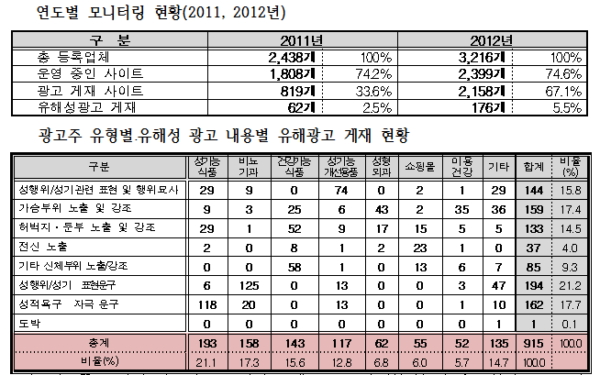
건강길라잡이사이트문제있습니다 / A Problem with the Health Guide Website

건강길라잡이는 보건복지가족부와 건강증진사업지원단에서 운영 중인 국민 모두의 건강증진을 위한 건강증진사업 홈페이지입니다. 그런데 여기에 쓰인 미혼모의 정의는 이상합니다.

The “Health Guide” is a website jointly run by the MOHW and the Management Center for Health Promotion for the public health of all citizens. However, the definition of single mothers on it is strange.

합법적이고 정당한 결혼절차 없이 임신중이거나 출산한 여자를 미혼모라고 정의내리고 있는데 마치 미혼 임신, 출산을 하면 모두 불법을 저지르고 있는 범죄인으로 여기고 있는 것 같습니다.

According to the definition, single mothers are women who are pregnant or who have given birth who have not gone through the legal and proper marriage procedures. Put this way, it sounds like all unmarried pregnant women or mothers have committed some sort of crime!

그리고 기본적으로 미혼모를 대부분 10대라 여기고 있습니다. 그러나 2010년 조사한 바로는 한 지역사회에 있는 미혼모의 경우, 평균 나이는 20대 후반 30대초반이라는 결과도 있었습니다.

Also, it basically says that most single mothers are in their teens, whereas according to the results of a survey of single mothers in one local area [James – unnamed] in 2010, most were in their late-twenties or early-thirties.

국민들의 건강을 증진하기 위해 유익한 정보를 제공하는 사이트에서도 이런 잘못된 정보를 제공하기 때문에 미혼모들에 대한 사회적인 인식이 더디게 바뀌고 있습니다. 잘못된 정보는 정정되어야 합니다.

Because there is wrong information even in a guide aimed at promoting citizens’ health, the public perception of single mothers is slow to change. This wrong information needs to be corrected.

(Source)
And here is the section of the guide/website referred to:

10임신과미혼모 / Teen Pregnancy and Single Mothers

미혼모 : 합법적이고 정당한 결혼절차 없이 임신중이거나 출산한 여자.

Single Mother: A pregnant woman or mother who has not gone through the correct and proper marriage procedures.

산업화 도시화 과정, 성에 대한 가치관이나 태도의 변화, 이성교재의 범위가 늘어남에 따라 미혼모의 수가 계속적으로 증가. 미혼모 중 약 25%는 10대.

Because of industrialization and urbanization, people’s sense of values about and attitudes towards sex are changing, and more people [James – I think it means unmarried people] are having sexual relationships. Accordingly, the number of single mothers is rising, and roughly 25% of those are in their teens.

(James – Before you quite rightly point out that 25% isn’t “most” single mothers, the guide contradicts itself just two lines further down)
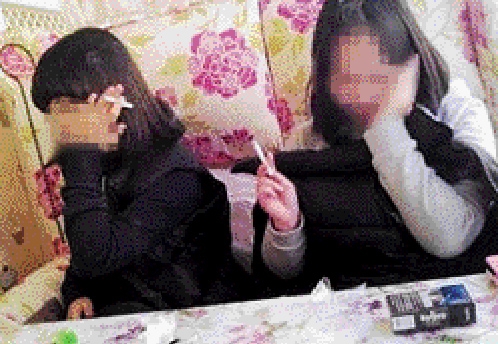
미혼모에 대한 정확한 통계는 없으나 전국 출산력 조사결과 18~34세 미만의 미혼여성들 중 3.4%가 임신의 경험이 있는 것으로 추정.

While it is difficult to get accurate statistics about single mothers, based on the results of a national birthrate survey [James – unnamed] it is estimated that 3.4% of single women aged between 18 and under 34 have had the experience of being pregnant (source, right).

미혼모는 대부분 10대 임신으로 교육적 경제적 정도가 낮아 충분한 건강관리를 받을 수 없으며 부모로서의 발달과업을 달성할 수 없다.

As most single mothers are teenagers, with inadequate access to healthcare and low levels of education and earning ability, then they can not really succeed as parents.

신체적인 미숙과 영양부족으로 유산, 조산, 저체중아 출산 등 고위험 임산부와 고위험 태아 및 신생아가 된다.

Teenagers that are not fully physically developed, and/or are malnourished, are at high risk of having miscarriages, premature births, underweight children, and/or complications during their pregnancy.

미혼인 여성이 임신을 하면 임신한 결과를 인공유산과 분만 중 어느 쪽을 선택할 것인지를 결정해야 하고 분만을 할 경우는 자신이 키울 것인지 입양을 시킬 것인지를 결정해야 한다.

If a single woman becomes pregnant, her two options are having an abortion or delivering the baby. If she chooses the latter, then she has to decide if she will raise it herself or offer it for adoption.

우리나라의 경우 84.8%가 인공유산, 분만은 15.2%(김승권, 1992)

In Korea, 84.8% of women in such a situation choose to have an abortion, and 15.2% choose to deliver it. (Kim Sung-gwon, 1992)

(Source)

Apologies for not being able to find the title of the book referred to for the last figure, but I’m afraid I’ll have to recover from the shock of seeing a 19 year-old source used before I start looking. Moreover, combine that with the sloppily-written, contradictory, and incorrect information provided earlier, then frankly – and ironically – it’s only as I type this that I realize how bad things must be for single mothers here.

Sure, call me melodramatic, and/or reading too much into what is most likely simply a hastily-written piece of work, but recall that it comes from an organization presumably charged with supporting single mothers, promoting their rights, and trying to overcome stereotypes. Yet if that’s the best that it can do, then I shudder to think of how other organizations and segments of society treat them, with the sterling exception of the KUMSN.

But to end on a lighter note: has anybody seen Little Mom Scandal, and/or know how sympathetic it was to single mothers? Please let me know!

(Thanks to Seunghee Han of the KUMSN for the information. And also to Marilyn for putting me in touch with her, and again for translating October’s much longer article!)