Event Announcement: #FEMALEPLEASURE Screening, Hankuk University of Foreign Studies, 1pm Saturday June 1

Sorry for the long break everyone, which was because of reasons. But I’m happy to say I do have an epic post in the works. And, while you’re waiting for that, I’m delighted to help a former student publicize this event in Seoul this weekend (하단으 보세요):

#FEMALEPLEASURE

– 5 cultures, 5 women, 1 story

A documentary about female sexuality and autonomy in the 21st century – film screening and discussion

An event organized through: Lecturing Program of the Robert Bosch Foundation in Asia (German Foundation)

(Sign up here)

#FEMALEPLEASURE portrays five courageous and smart women, breaking the silence imposed by their archaic-patriarch societies and religious communities. With incredible strength and positive energy, Deborah Feldman, Leyla Hussein, Rokudenashiko, Doris Wagner, and Vithika Yadav are fighting for sexual liberation and autonomy for women, beyond religious rules and cultural barriers.

#FEMALEPLEASURE shows the universal mechanisms at work that determine the position of women until today, spanning cultures, religions and continents: from Japan and India and the Somali muslim diaspora to the Hasidic community in New York and the Catholic clergy in Europe.

What can we learn from them? What do we have to talk about in Korea? How can men and women establish fruitful understanding and mutual respect?

On this day we will gather to see the movie and share a safe space to talk about important questions and feelings related to the topic in Korea. Everyone interested is welcome! 😊

When? Saturday, 1st June, 1pm – 4.30pm

Where? Hankuk University of Foreign Studies, Main Building, Room 329

Language: Korean & English

Contribution: 3000WON – we organize Pizza & Drinks 😊

UPDATE: A Facebook event page has just been created!

본 이벤트는 Robert Bosch Foundation in Asia(독일 재단)의 교육프로그램을 기반으로 제작되었습니다.

21세기 여성의 성적 자기결정권에 관한 다큐멘터리 영화를 감상한 후 토의의 시간이 마련되어 있습니다. (5개의 각기 다른 문화에서 자란 여성들이 하나의 이야기를 하는 내용입니다.)

(여기서 등록하세요)

#FEMALEPLEASURE는 구시대적인 가부장 사회와 종교 커뮤니티들에 의해 강요되는 침묵을 깨뜨린 용감하고 똑똑한 다섯 명의 여성을 보여줍니다: Deborah Feldman, Leyla Hussein, Rokudenashiko, Doris Wagner, and Vithika Yadav. 이들은 놀라울 만큼 강인한 모습과 긍정적인 에너지를 통해 종교 율법이나 문화 장벽을 뛰어넘어 여성의 성적 자율성을 위해 싸우는 중입니다.

#FEMALEPLEASURE는 또한 일본, 인도, 소말리아 이슬람 디아스포라 에서 뉴욕의 하시디즘 커뮤니티와 유럽의 카톨릭 성직자들에 이르기까지 문화, 종교, 대륙 전반에 걸쳐 여성의 지위를 결정해 온 보편적인 메커니즘이 무엇인지 보여줍니다.

우리는 이들에게서 무엇을 배울 수 있을까요? 한국과 관련해서는 어떤 이야기들을 해야 할까요? 또 남성과 여성은 어떻게 해야 유익한 이해관계를 확립하고 서로를 존중할 수 있을까요?

함께 모여 영화를 감상한 후에 이 주제와 관련된 한국의 중요한 이슈, 궁금증 혹은 감정을 편하게 공유하는 시간을 가질 예정입니다. 관심 있는 사람은 모두 환영입니다! 😊

언제? 6월 1일 토요일, 1:00 – 4:30 (오후)

어디서? 한국외국어대학교 본관 329호

language: 한국어 & 영어

참가비: 3000원 – 피자와 음료 제공에 사용됩니다 😊

If you reside in South Korea, you can donate via wire transfer: Turnbull James Edward (Kookmin Bank/국민은행, 563401-01-214324)
Today I Read About an Awesome Feminist Japanese Painter and Was Reminded Of My Favorite Soju Poster

Estimated reading time: 6 minutes. Sources: Reiodori, LotteLiquor.

In the spirit of today’s title, let me direct you straight towards the moment I learned why Uemura Shōen was so amazing:

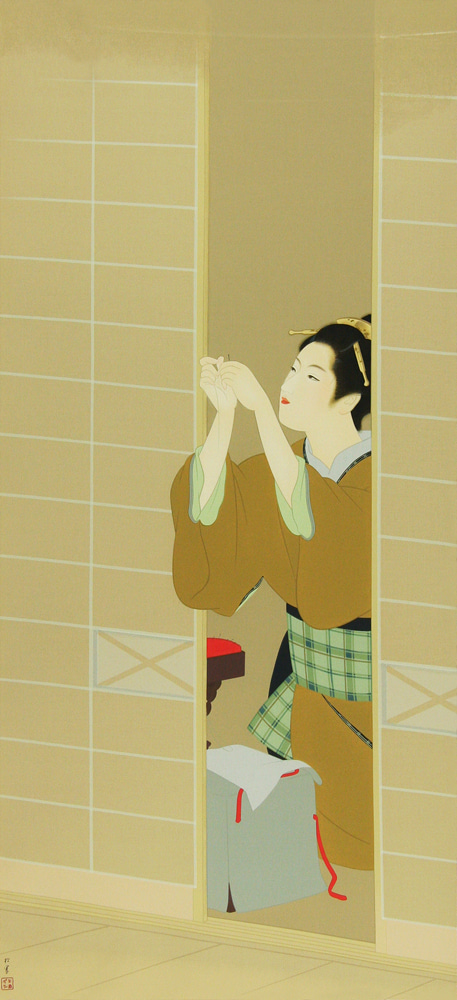
Shōen successfully turned her passion to creating a life worth living through her paintings. The themes and main subjects in all her paintings are women. Moreover, the women depicted in her paintings of this period are decisively different from those that appear in paintings done by men in the tradition of the Kyoto school of Bijinga, whose tradition dates back several hundred years. The major characteristic of women in the paintings before Shōen was that they were treated as the object of men’s sexual interest. Shōen painted working women for the first time in the history of Japanese painting. One of the masterpieces along that line is Yugure (Dusk). Here a middle-aged woman opens the paper-covered sliding door of her room to get enough light to thread a needle. Her plain kimono, the needlework, and the weak sunlight of the dusk impressively create an atmosphere of daily life. Japanese painting portrayed the reality of working women for the first time through Shōen’s works. They are as significant as the works of Millet, who painted working women instead of bourgeois women. In the late 1930s Uemura painted another middle-aged woman shown repapering a door to prepare for the coming winter in Banshu (Late Autumn). In another painting in a series titled Yuki no naka (In the Snow), she described women walking in the severe cold with heavy snow on their umbrellas. The clean, sharp, uncompromising lines of her drawing supported by her accurate drawing ability and the use of just a few colors clearly show the painter’s integrity of mind. It took Shōen a long time to reach this heightened state. Shōen received a great many awards for her noble and innovative art.

Page 71, “Three Women Artists of the Meiji Period (1868-1912): Reconsidering Their Significance from a Feminist Perspective” by Midori Wakakuwa (trans. by Naoko Aoki) in Japanese Women: New Feminist Perspectives on the Past, Present and Future ed. by Kumiko Fujimura-Fanselow and Atsuko Kameda (1995); my emphases.

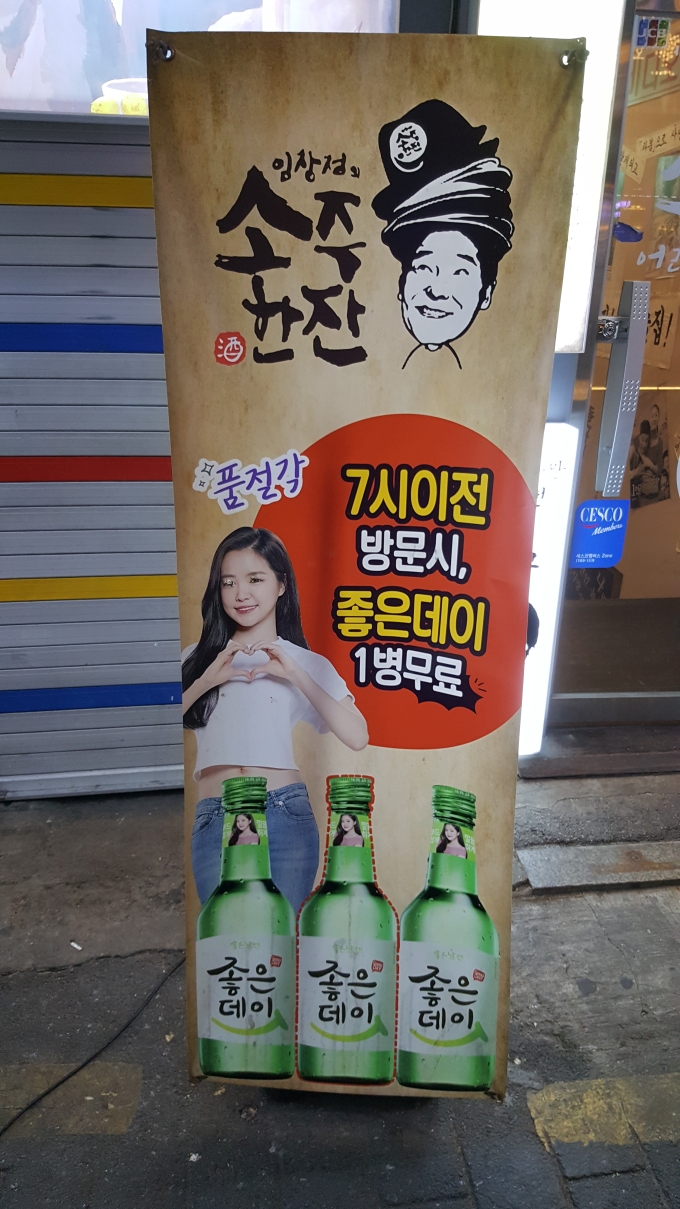
Which really did immediately remind me of modern rock singer Kim Yoon-ah‘s 2006 unique poster for Cheoeum-Cheoreom soju above. Like I wrote in 2010, and sadly still remains the case today, it’s “the only one I’ve seen in which the woman depicted is actually doing something of her own accord and enjoying herself, rather than waiting to be seduced by a man.” Which is not to say that sultry and seductive is bad in itself, but just a small sampling of soju posters over the years reveals how monotonous that theme can be, and how truly exceptional this soju poster is. Made more even more so, by the text in white at the bottom that I missed nine years ago (apologies for the poor quality):

It reads: “김윤아씨의 모델료는 가정폭력 피해자들에게 기부됩니다. 여성으로서 락음악의 새로운 가능성을 연 가수, 김윤아”/ “Kim Yun-Ah’s model fee is donated to domestic violence victims. Singer Kim Yoon-ah, who paved the way for new possibilities of rock music as a woman.”

Turning back to Uemura Shōen’s own depictions of women actually doing something, here are the paintings (and one from the In the Snow series) mentioned above by Wakakuwa:

At Dusk. Source: Japanese Painting Gallery
Late Autumn. Source: Fine Art America.
Feathered Snow. Source: Japonica.

I include the difficult to find full images, rather than the much more numerous, higher-quality close-ups of the women’s faces available, because of what I read about the importance of the paintings’ empty spaces at Japan Objects:

One of the most distinctive characteristics of Japanese painting when contrasted with its European counterpart is the use of empty space. And of course, this distinction was carried into the twentieth century….In Shōen Uemura’s Feathered Snow, the great blankness of the paper successful conveys the sensation of inclement weather, where the horizon reduces to edge of your umbrella as you try to shelter from the cold.

Inspiration aside though, I do wonder if the distinction between Shōen and her predecessors was as sharp as Wakakuwa suggests? In hindsight, her passage sounds a little hyperbolic. And my frustration with locating the full images among all those close-ups was a foreshadowing of what I’d read about Shōen online later, which tended to place her work very much on a continuum with other Bijinga (literally, “paintings of beautiful women”). That said, Jeff Hammond in The Japan Times notes her subjects weren’t the courtesans from the pleasure districts usually found in the genre. Also, in a must-read account in Japanonica of a 2017 exhibition of her work, historian and curator Roisin Inglesby finds subtle but important differences to works by her male contemporaries, despite her indeed very much sharing their emphasis on beauty:

 …[Shōen’s] “outsider” status as a woman enabled her to acquire a deeper understanding of her female models and employ different approaches from male artists—a quality which, the curators argue, elevates her paintings by portraying women not just as objects created through the lens of the male gaze, but as thinking, feeling subjects who invite us to admire their inner beauty as well as their outward attractiveness.

In her efforts to show female beauty in what she believed to be its purest form, Shōen’s paintings are characterized by both a lightness of touch and a depth of feeling. [The tour guide] invited us to take time to look closely at the works and consider the emotional complexity beneath the peaceful expressions of Shōen’s subjects.

I wince at the crude characterization of the male gaze—admiration of outward attraction is not mutually exclusive with that of inner beauty—but that’s a subject for another post. Continuing later:

One of the most interesting aspects of [the] tour was [the] explanation of how Shōen gives agency to her subjects through a variety of techniques. In many paintings, she used a splash of red pigment on the women’s earlobes and fingertips to animate their otherwise placid demeanor. This small, yet visually enlivening, detail signals activity: these women hear; they touch. Often beautiful women are painted as objects of desire and admiration, yet through the composition of her work it seemed to me that Shōen invites her viewers to question their interior thoughts as well as appreciate their external beauty. The sparse background of Feathered Snow (1944) not only gives the impression of a punishing winter wind which beats its subjects back to one side of the painting, but encouraged my eyes to follow the movement of the composition and rest on their faces. What are they thinking as they trudge through the snow?

I recommend reading the article in full, and to watch this slideshow for many more examples of her work. Please feel free to add to (or correct) anything above also—including on Bijinga’s influence on Korean art, which I’m now about to look for more information about in my modest library, rather than preparing crucial PowerPoints for tomorrow’s classes. Damn you, Uemura! ;)

Related Posts:

If you reside in South Korea, you can donate via wire transfer: Turnbull James Edward (Kookmin Bank/국민은행, 563401-01-214324)

Why Does Korea Have so Many of Those Damn Smutty Ads?

Government inaction on Korea’s ubiquitous, sexually-explicit internet advertising undermines claims that its citizens need protecting from pornography, and has helped shape the Korean #Metoo movement.

Estimated reading time: 17 minutes. Photo by rawpixel.com from Pexels. One NSFW image later.

When even the ad industry itself is calling for greater government regulation of sexual imagery in ads, you know Korea’s got a problem.

The main issue is that there’s just no escaping them. In the most recent survey of 155 major web portals, social media services, and online news sites conducted by the Korea Internet Advertising Foundation (KIAF) in 2016, 94.5 percent of the middle and high school students surveyed were found to have been exposed to sexualized ads. Frustratingly, the 69-page report (PDF, Korean) doesn’t also mention what proportion those ads were of the total ads examined. But, maybe the authors simply felt that was unnecessary, as everyone already knows that their numbers are just insane:

See the thread for many more examples. Or like Raphael says, almost any Korean news website. Even alongside the cutesy, assumed safe webtoons my preteen daughters read too, I recently learned, sometimes there’s invitations to meet horny divorcees in our area.

But Korea’s smutty ads problem goes much deeper than just their scale, or their astonishing inappropriateness. For the KIAF surveyors also found that one in four of the offending ads promoted sex work, and/or even showed sex acts. Which is heinous not because either are unethical, but because such ads exist so openly in a society where sex work and pornography are both illegal, and which would never see the light of day if they were placed in traditional media.

Which begs the question: just how did Korea’s internet ad problem get so bad?

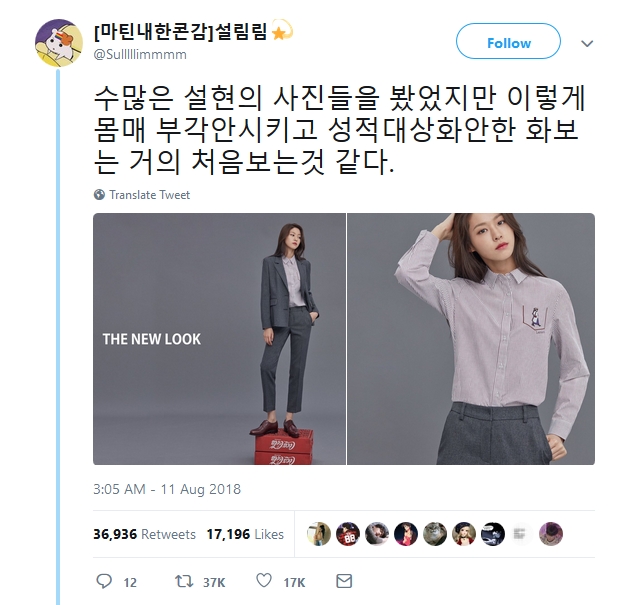
In the first instance, it’s simply down to advertisers’ algorithms, combined with the inattention and unconcern of site owners. This was ironically and hilariously revealed by the reporting of a similar survey by the Ministry of Gender Equality and Family (MOGEF) in June 2012, when many news sites displaying precisely the kinds of ads the Ministry was railing against alongside the articles about the survey. Even more spectacularly, a few weeks previously many news site editors curiously chose to pixelate the bikini tops and bras of women who had written political messages across their breasts (as in only their clothing, not the messages or exposed skin), while those in the accompanying ads were left untouched:Fast forward to April 2018, when representatives from major Korean shopping portal sites were queried by The PR News reporter An Seon-hye as to why their Facebook ads for products such as headphones and men’s shoes tended to show women with exposed cleavage and/or in their underwear first. They simply blamed the algorithms, implying that somehow those absolved their companies of any responsibility:

페이스북에서 남성 이용자들에게 노출된 쿠팡 광고 이미지 “Coupang advertisement aimed at male users of Facebook.” Image source: The PR News.
티몬(왼쪽) 및 gs샵이 sns에서 남성들에게 집행한 광고 이미지. “Images of Timon(L) and GS Shop advertisements aimed at men.” The woman on the right is Ai Shinozaki, a Japanese gravure model. Image source: The PR News.

…하지만 해당 업체들은 결코 고의성이 없다는 점을 강조했다. 티몬 관계자는 “저희 같은 경우 19금 용품 광고는 아예 노출이 안 되도록 막는 등 선정성 측면에서 신경을 쓰고 있다”며 “자동 로직으로 광고 집행이 이뤄지기에 임의로 자극적 이미지를 사용한 게 아니다”고 해명했다.

“…However, industry representatives stressed that, in the end, there is never any deliberate intention to use sexualized imagery. A representative from Timon said, ‘In our case, from the outset we do work to ensure that no adults-only products are selected to be advertised [on Facebook],’ and that ‘the provocative images that do appear are not random, but are chosen automatically by the algorithm.'”

기본적으로 특정 시간대에 특정 연령 타깃군이 어떤 상품을 많이 봤다는 데이터가 쌓이면 이를 해당 타깃에게 동일하게 추천하는 방식으로 로직이 짜여 있다는 설명이다. 이번 노출도 이같은 설정 때문에 벌어진 현상일 수는 있지만, 의도한 건 아니라는 설명이다.

“Basically, when collected data on a site suggests that a certain time is the most heavily frequented by a targeted demographic, the algorithm automatically recommends products that demographic is likely to be interested in. The same logic applies to the revealing images accompanying them, but has never been the deliberate intention [of our company.]”

쿠팡 관계자 역시 “쿠팡이 고의적으로 선정적인 광고를 남성에게 보이도록 조작하지는 않았다”며 “활용되는 이미지 역시 판매자가 올린 것을 활용한 것”이라고 밝혔다.

“A representative from Coupang also claimed that their company ‘did not deliberately manipulate ads to target men with sexualized imagery,’ explaining that ‘the images of products [available from our site] are simply taken from available sellers.’ (end)

By all means, gratuitous T&A does sometimes work, especially when those objects belong to popular K-pop girl-group members. Yet it infuriates me when some, more radical feminists—especially anti-pornography activists—start from the position that such narrow portrayals of women are an accurate reflection of most—or even a significant minority of—cishet men’s tastes; examples like these demonstrate just how disingenuous and utterly unfair that assumption is. It’s also very patronizing for companies to advertise this way, says Sejong University Professor Kim Ji-heon elsewhere in the above article, and has the potential to put men off offending brands. Accordingly, evidence of sexualization’s effectiveness on Korean consumers is mixed, one 2017 study by Yonsei University researchers (PDF, Korean) for example, discovering that young Korean men actually preferred cute to sexy female models in game advertisements (which may be problematic for other reasons, but that’s a story for another post). Also, lest we forget, not all consumers are young men, with another study from 2012 (PDF, Korean) by Sungkyunkwan University researchers demonstrating that despite soju companies specifically targeting female consumers at the time, somehow women just weren’t responding to the ensuing “sexy” advertisements.

I can’t imagine why:

Screenshots from this summer 2009 commercial for ‘Cool Soju 168’; the logic was that “168” referred to a low 16.8% alcohol content, which supposedly helped women maintain their figure vis-a-vis stronger brands. One NSFW image follows shortly.

Nevertheless, Coupang’s algorithms at least, have hardly been tweaked since The PR News report came out, as any male Facebook user in Korea can confirm. Take this advertisement I was blessed with on the subway a few weeks ago for instance:

Facebook has given me 24 hour bans for far less.

Of course, in reality, no algorithms are value-neutral, so can’t be used as an excuse. Yet, to reluctantly play Devil’s Advocate for a moment, perhaps one reason Korea’s algorithms have the settings they do is that advertisers generally lean more heavily on sex-sells tropes during recessions, and one indication of how bad Korea’s is at the moment would be its highest youth unemployment rate in two decades. Another explanation of why they tend to be sooo eye-catching is that Hangul, the writing system, lacks capitals. This, which has factored into Korean webdesign from the get-go, is why Korean websites tend to be so GIF-heavy and cluttered to Western eyes, but is familiar to and preferred by Koreans. (Japanese websites are very similar, due to similar issues with kanji and kana.) Ingrained media culture and consumer habits go some way toward explaining why Japanese and Korean advertisers over-rely on celebrities to get your attention too.

But all of these contributing factors are decades old. I first noted the alleged link to the economy ten years ago, and the numbers of smutty ads have only increased since. Korean websites have overwhelmed me with GIFs since I first started having to navigate them in internet cafes here nineteen years ago. And the over-reliance on celebrities dates back to the early-1980s, when fifteen seconds became the standard length for TV commercials.

If so many features of Korean advertising are products of ingrained culture and long-term habit then, surely this over-reliance on sexualization could be as well? So too, that it just so happens to be a very stereotypically male-gazey version of it at that?

Noteworthy in this regard is men’s domination of multiple sectors of the Korean media:

However, the Korean advertising industry is absent from that Twitter thread, and I’m personally unaware of its male-female make-up as I type this (sorry). So, let me defer to someone with inside experience: Seoul National University Associate Professor Olga Fedorenko, who conducted fieldwork in winter 2009-2010 at the agency responsible for the delightful Cool Soju 168 commercial from summer 2009 above. And in fact, in that agency at least, women made up roughly half of the employees. But it was indeed male-dominated, as no women there were above level five of the eight ranks within its internal hierarchy, “with truly managerial responsibilities [only] beginning at level six.” Also, the ensuing work-culture there could certainly be described as male-dominated too:

To assert that “sex sells”—the axiom that no one doubts in advertising and perhaps few do in society at large—was the usual way to deflect my criticisms of sexualized portrayals of women in much of Korean advertising, and women repeated that adage as eagerly as men.

Still, despite their professional embrace of the “sex code,” women showed a certain distance towards its centrality to advertising. They occasionally mocked male managers who favored sex-appeal strategies by default, “just because they like to look at pretty women,” as Chin’a put it, as she vented about wasting an afternoon the day before because her team’s Creative Director asked her to accompany him to help pick a female model for a commercial. “He said he wanted a woman’s opinion but in reality he just picked the model who he personally liked and who was flirty with him,” she said rolling her eyes in front of me and four other women as we were having lunch. Chin’a thought that the selected model was not the best choice, but the Creative Director never asked Chin’a’s opinion and even went as far as to re-schedule the shoot around the model, without consulting the convenience of other team members. Chin’a wished she had spent that afternoon working on their team’s other accounts.

Technically however, Fedorenko does not state if the same agency was responsible for the Cool soju commercial I criticized; I should have only said it “probably” was, because it was responsible for a new campaign for same product during Fedorenko’s time there a few months later. Ironically, a largely women-created and targeted, sexually-progressive, feminist, and therefore controversial one:

Which would seem to contradict the points made about work culture above. So too, that they’re from a snapshot of just one agency, and a decade old.

However, it’s also telling that there’s been almost nothing quite like that campaign in Korean advertising since, by any agency. Despite my fetish for Korean ads showing actual grown women with sexual desire and experience, I’m only aware of less than a handful produced in the last decade. Meanwhile, compared to men, women are almost 60 times more likely to be wearing revealing clothing in Korean TV commercials, a figure that is over twice as high and nearly ten times as high as their Japanese and Hong Kong counterparts respectively.

And yet, despite everything, I’m reluctant to attribute all that simply to the likely dominance of men in the industry.

Yes, we can all bet good money that the coders behind offensive internet algorithms are indeed sexist pricks. Or their bosses. Or at best, that they’re unoriginal and conservative.

But to claim that Korean ads are the way they are because men dominate the industry, is to make the assumption that most of the men within are also sexist pricks.

Hey, I’m not dismissing the possibility. In fact, I’d bet good money on that too. Given what we know about Korean ads, and that Korea has the biggest gender gap in the OECD, and comes 121st out of 193 countries in the ratio of female legislators to males, then there’s absolutely no reason to suppose that Korea’s toxic, patriarchal work culture hasn’t also infected the Korean ad industry.

But where does that accusation get us? If we want to persuade industry insiders to embrace change, what good would simply calling them sexist pricks actually achieve?

And cishet men’s sexuality, I can’t stress often enough, is so much richer and broader than its blokey, infantile stereotypes suggest. There are men of other sexualities in the ad industry too, not to mention (probably) equal numbers of women. I refuse to believe that all the admen, by definition among the most creative and artistic men in Korean society, all chose their careers based on no more than a shared dream of putting more boobs on phone screens, and that every man and woman who doesn’t share that grand vision is simply forced to acquiesce.

The issues raised in this post may even be well-recognized problems within the industry already too, but are intractable due to the influence of Korea’s patriarchal work culture as alluded to earlier, one big influence being the rigid hierarchy and visions of women and male-female relations learned before entering the industry from that vast socialization experience known as universal male conscription.

Or not: my apologies again, for lacking the money and time to translate dense Korean advertising tomes to find out. But either way, suggesting practical, actionable steps that the industry may already be receptive to does sound much more helpful than simply rolling our eyes at THE MENZ.

I think this is where we came in.

Recall that we started with the industry itself calling for more regulation. Specifically, the KIAF, responsible for the 2016 survey:

“Although there are guidelines for the level of sexuality permitted in online advertising, they lack effectiveness since they tend to be too generic and ambiguous,” said the KIAF official. “Regulations that manage such advertisements are scattered across government departments, and they need to be revamped.

A state of affairs which sounds suspiciously similar to the messy censorship of K-pop in the early-2010s:

The recent guidelines by the Fair Trade Commission are demonstrably inadequate, and laws are required instead. But considering that any limits on such a vague concept as sexualization are by definition arbitrary, then it is crucial that 1) the ensuing legislation process is transparent; 2) that implementation of the laws is consistent; and 3) that only one, preferably independent, organization has the power of censorship. Currently, that last is divided between a plethora of competing media and government organizations, and the ensuing unpredictable and often bizarre decisions ― including banning a music video for the singers driving without wearing seat belts, or allowing exposed navels on men but not on women ― have thoroughly undermined the credibility of attempts to curb the sexualization of teens in K-pop. A fresh start is urgently needed.

“Restrictions Imposed on 18+ Controversial ‘Wide Leg Spread Dance’”, April 2011. Source.

This segue into K-pop is no mere confirmation bias from a trusted source: for the body with the most responsibility for censoring K-pop then was MOGEF, which it did with a relish. As Lee Yoo-eun at Global Voices explained in 2014 (links added by me):

The censors of the ministry are notorious for accusing several thousand songs of being “hazardous” whenever they notice references to liquor, cigarettes or sex in the lyrics. Once a song is labeled as “inappropriate for youth under the age 19″ it can only be broadcast after 10:00 PM, and children are forbidden from buying it as well as from listening on the internet. Many young people get around this by using the IDs of their parents to login to Korean portal websites or watch on YouTube.

Music industry people…say it is troubling that the censorship is applied only to some randomly selected albums after they have hit the market, and not universally to every album. Many people see this as part of a new reality where the South Korean government is tightening control over citizens and free speech.

And this zealousness was in stark contrast to the complete inaction by MOGEF over smutty advertisements, despite raising the alarm in 2012 about their surging numbers as discussed. Indeed, it wanted the industry to do its own work for it instead:

여성가족부는 작년과 비교해 유해 광고는 늘었지만 법 위반 언론사들이 대폭 감소한 것을 감안해, 언론사에는 우선 자율 규제를 촉구하겠다는 입장이다. 청소년매체환경과 관계자는 “작년에 34개 언론사가 법을 위반했는데 올해에는 다 시정됐다”며 “언론사들을 직접 규제하기 보다는 인터넷신문협회 등에 자율규제기구인 인터넷신문광고심의위원회의 설치를 촉구하겠다”고 밝혔다.

“Although MOGEF points out that the numbers of harmful advertisements have increased since last year, the fact that there are actually less media companies breaking the law also needs to be taken into consideration, so first MOGEF is going ask media companies to regulate themselves. The official in the Division of Youth Media Environment continued: ‘The 34 media companies that broke the the Information and Communications Network Law last year have all since rectified their mistakes,’ and so ‘a self-regulatory system is preferable to direct regulation, and we demand that the Korean Internet Newspaper Association and so on establish an internet newspaper advertisement consideration committee.'” (end)

Further inaction still is evident from how, in the 2010-2016 period, MOGEF’s Korean Institute for Gender Equality Promotion and Education (KIGEPE) was given the task of monitoring mass media for cases of sexual discrimination, sexual prejudice, and sexual insults, but was given extremely limited resources to do so, and didn’t even cover the internet; ultimately only four cases were ever acted upon in those entire seven years. A subsequent study in 2016 found an undisclosed number of issues, of which the KIGEPE said “the results from their monitoring [had] resulted in 19 cases of corrective action [as of March 2017], insisting more education and appropriate measures need to be provided for TV show makers to achieve gender equality in the TV industry.” (More recently, this January the Korea Communications Standards Commission {KOSC} noted problems remained in variety shows specifically, without suggesting any measures to combat them.)

Yet that’s just MOGEF, which—without absolving it for its inaction—admittedly had very low resources and was in a precarious political position under previous conservative governments. If we look at the Korean media and its various overseers as a whole however, inaction over misogyny and problematic content is endemic, Korean dramas in particular being notorious for depicting dating violence as romance, but which the KOSC has washed their hands of. And don’t get me started on the media’s constant framing of the sexualization of minors in K-pop as good, clean, harmless family fun.

Source: Netizenbuzz.

In that wider context, inaction on smutty ads emerges as less the exception than the rule in the Korean media, and underpins a pervasive culture of indifference and desensitization towards degrading images and videos of (overwhemingly) women. That culture is evident in the decade-long foot-dragging in the shutting-down of Soranet, a hugely popular pornography site notorious for the sharing of hidden camera videos, as well as in the Korean #MeToo movement’s unique emphasis on punishing the purveyors of such videos, a central component in the current Burning Sun scandal. I can’t help but ultimately see links to the culture of indifference and desensitization towards sexual abuse by teachers in Korean schools too, with over 40 percent of perpetrators in the January 2013 to September 2018 period still teaching, and again only, finally, being aggressively challenged due to the Korean #MeToo movement.

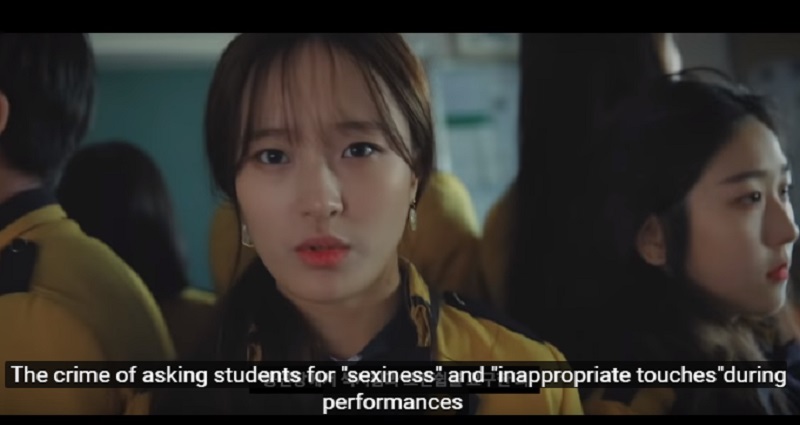
Nextshark: “The School of Performing Arts Seoul, the alma mater of numerous well-known K-drama and K-pop stars, is facing co‌ntrov‌ers‌y after its former students a‌‌c‌‌cu‌‌s‌e‌‌‌d the school of c‌o‌rrup‌tio‌n and se‌x‌u‌al ‌ex‌‌pl‌oita‌‌tion of minors [through a music video].”

But perhaps it’s a too much of leap from boobs on my smartphone to tolerating “asking students for ‘sexiness’ and ‘inappropriate touches’ during school performances”?

Or not. Either way, if the government started to enforce the same standards for internet ads as it does for all other forms of pop culture, that would surely be the perfect way to find out.

Related Posts:

If you reside in South Korea, you can donate via wire transfer: Turnbull James Edward (Kookmin Bank/국민은행, 563401-01-214324)

Hyundai Fit-Shaming Korean Girls

“In the 18th century, it was often assumed…that women were incapable of rational or abstract thought. Women, it was believed, were too susceptible to sensibility and too fragile to be able to think clearly.”

Estimated reading time: 3 minutes

The more things change, the more they stay the same.

These days, I’m generally loathe to lead with quotes. Especially when I’m forced to admit I haven’t read A Vindication of the Rights of Woman since university, and had to rely for that line on its Wikipedia article instead.

But the video below deserves the hyperbole. Because ten years ago, I wrote a post about the widespread practice of calf-reduction surgery in Korea. It really got to me, learning about the literal slicing away of muscle and nerves to make legs slimmer and more “feminine” and “attractive.”

Afterwards, the women literally have to learn how to walk again. Why, oh why, is this still a thing?

For sure, technically Hyundai isn’t promoting operations. But it is contributing to their normalization by reminding everyone that muscular calves are “ugly,” thereby discouraging schoolgirls from exercising.

Like my 12 year-old daughter, who starts middle-school in two weeks. Thanks, Hyundai.

Part of a series (#1, #2, #3, #4) for cars fitted with Hyundai’s “SmartSense” system, the voiceover for the segment with the schoolgirl says:

우리 산중턱여고 나왔잖아

3년내내 아침마다 등산한 것 기억나?

이제 다왔다 올려다보면 고지가 저~기야.

그러다 문든 내 종아리를 봤는데,

헉 다리가 이게 뭐냐?!!

Our girls’ high school was on a mountainside.

Do you remember climbing it every morning for three years?

I’ve arrived, but if I look up I’m still not at the top.

Then at the gates I happened to look at my leg…

OMG, what’s this on it?!!

Are Korean girls and women still shamed for muscular legs though? Please let me know your own thoughts and experiences in the comments. It’s been ten years, so I would just love to learn that it’s actually a very outdated stereotype, and that Hyundai is just being lazy by relying on it.

Related Posts:

If you reside in South Korea, you can donate via wire transfer: Turnbull James Edward (Kookmin Bank/국민은행, 563401-01-214324)

South Korean men lead the world’s male beauty market. Will the West ever follow suit?

Estimated reading time: 7 minutes. Photo by mentatdgt from Pexels

My email contribution to Jessica Rapp’s piece for CNN. Who told her that if you ask me about one of my pet topics, I’ll happily type away for hours, even if only a few lines will make it into the final article? Confess!

  1. What has South Korean beauty done in terms of redefining masculinity and how has that space changed?

I would argue that the South Korean beauty industry has generally been much more reactive than a driver of trends and redefinitions. In particular, while the kkotminam (lit. “flower beautiful man”) phenomenon of the mid-2000s has now become so mainstreamed as a male beauty ideal that the term has fallen into disuse, it only appears to have been an invention of the beauty industry. In fact, it was overwhelmingly the result of changing women’s tastes, who were already very much changing the public conversation about sexual norms and beauty ideals from the mid-1990s, and who were heavily influenced themselves by the influx of (surprisingly popular) homoerotic yaoi manga from Japan after a ban on their import was lifted in 1998. Also, many of the first male celebrities to be branded with the kkotminam label in fact generally rejected it, and even those that did take advantage of it still made sure to buff up and show off their bodies regularly, lest the label raise questions about their masculinity and heterosexuality.

In that vein, it is actually Korea’s prolonged economic slump, especially its jobless-driven recovery from the 2008 financial crisis, that is primarily driving male beauty trends today. Specifically, Korea now has the highest youth unemployment rate since the catastrophic Asian Financial Crisis of the late-1990s, and has always had too many graduates (Korea has one of the highest numbers of university entrance rates in the world) chasing after ever-diminishing numbers of jobs at conglomerates like Samsung and LG. In this cut-throat environment, 20 and 30-somethings are all about improving their “specs” with extra degrees, courses, internships, English-language qualifications, and so on, and the beauty industry has been quick to address the need to get a step up on the competition through improving one’s looks too. Lest this sound like exaggeration, bear in mind that Korea and Japan are the only countries in the OECD where it is routine to require photographs on resumes, and accordingly the Korean internet is full of forums where people can upload their pictures and receive constructive criticism on their appearance and photoshopping suggestions before they submit their job applications.

A selection of resume forms, seen in an Osaka Daiso last August.
  1. What role does K Pop play into the male beauty culture?

Given all the overseas media attention focused on the Korean Wave, and especially recently on the phenomenal success of the boy-band BTS, it is very easy to overlook the fact that K-pop isn’t actually all that popular in Korea itself, by any metric. Also, there are huge generational and regional differences in male beauty culture, with generally only young Seoulites embracing the new beauty trends that get all the media attention. (Overseas K-pop fans that visit Korea are often surprised and disappointed that most Korean men look nothing like their idols!).

Much more influential then, are the aforementioned job-hunting pressures, as well as men’s almost universally-shared experience of military conscription. Facing two years in the harsh wind and sun along the DMZ, these days conscripts quickly learn to become avid users of sunscreen especially. A gateway drug, if you will, to more involved and varied skin routines once they leave the military.

That said, K-pop has been a thing for over a decade now, so all Korean 20-somethings have grown-up under its influence. It is also true that Korea has a uniquely celebrity-obsessed media culture, to an extent that is difficult to appreciate without living in the country. Over 60% of television commercials feature celebrities for instance (compared to 10-20% in countries like the US and UK), and they appear on TV shows far more often than their Western counterparts. Moreover, most of the men you see when you flick the channels are indeed young K-pop stars, as their entertainment agencies have strong incentives to accept offers of endorsement deals for them, which are far more lucrative than music sales. Naturally, many of these deals are for selling male beauty products. But they are no less influential if they are in ads aimed at women instead (they have increasingly appeared even in lingerie ads for instance), as if Korean women increasingly come to demand the beauty standards and routines of male idols in their romantic partners, then ordinary Korean men will only be too eager to attempt to provide.

Given K-pop stars’ pervasive, ubiquitous presence in Korean daily life then, it is very difficult to imagine the beauty ideals they represent and advocate don’t have some influence on the Korean public, regardless of their personal music tastes!

  1. When we think of male “beauty” in Korea, are we thinking of it in the traditional way that women wear a full face of makeup? Or is the mainstream more about skin care?

The emphasis is overwhelmingly on skincare, based on their previously-mentioned, formative experiences in the military. Unfortunately though, unrepresentative Korean men that do spend lots of money and time on cosmetics are often featured in clickbaity foreign media reports about male beauty in Korea, thereby perpetuating “crazy Asian” Orientalist stereotypes.

Please note that I said spending money on “cosmetics” however. Spending significant amounts of one’s income on minor cosmetic surgery like a double-eyelid operation is very normal and mainstream for Korean men now, and is arguably considered no more or less unusual of an necessary investment in a valuable spec than in, say, the English lessons required for a high TOEFL score.

This was not always the case for Korean men though, so it’s by no means impossible that male cosmetics use will likewise become increasingly mainstreamed in the future too. My personal feeling is that most Korean men will balk at the huge amount of time, effort, and money that Korean women routinely have to spend on cosmetics, but who knows? Korea is a rapidly changing place, and Koreans love to defy foreigners’ convenient stereotypes of them.

Related Posts:

If you reside in South Korea, you can donate via wire transfer: Turnbull James Edward (Kookmin Bank/국민은행, 563401-01-214324)

Hey Women! There’s Cheese Here!

Estimated reading time: 2 minutes.

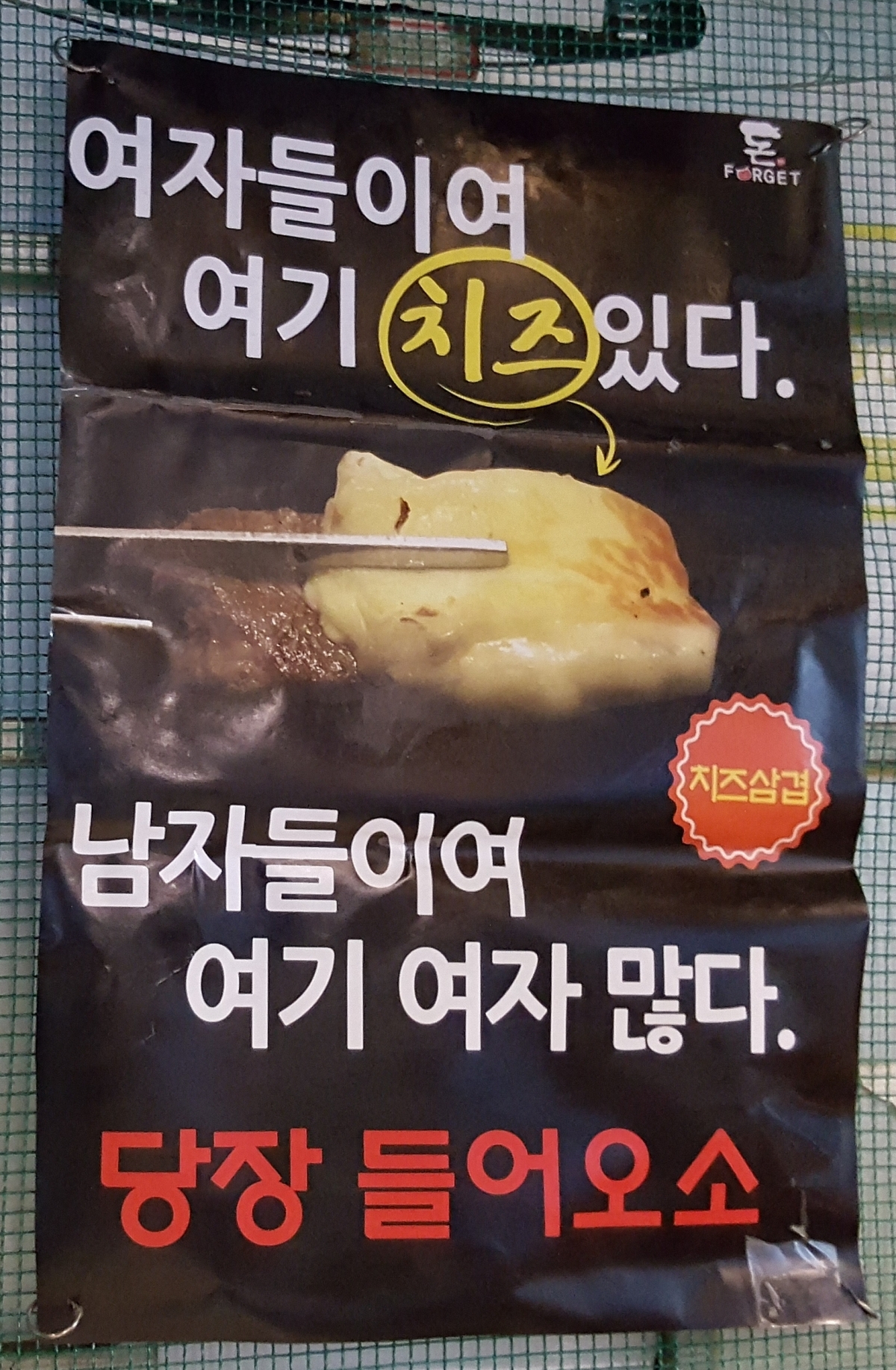
Seen in a samgyeopsal restaurant one day. It reads:

Hey women! There’s cheese here!

Hey men! There’s lots of women here!

Come in right away!

Is gendered cheese a thing in Korea though? For dieting purposes certainly, but in main meals? With rice even?

I don’t like the combination myself. So, if I see students chomping away at cheesy versions of bibimbap, kimbap, and ramyeon as I enter the university cafeterias, that tells me I’m going to have to cajole the staff into making mine without. And, after many quick head counts over the years, I’ve seen little difference in the numbers of men and women eating them.

What do you think? Was the copywriter onto something? Or would their talents and ingenuity be better served elsewhere? ;)

Related posts:

If you reside in South Korea, you can donate via wire transfer: Turnbull James Edward (Kookmin Bank/국민은행, 563401-01-214324)

Korean Billiards Federation Orders Female Referees to Wear Skirts

Because nothing brings more viewers to your sport than the chance to watch women struggling to do their jobs in clothes they hate.

Estimated reading and viewing time: 4 minutes.

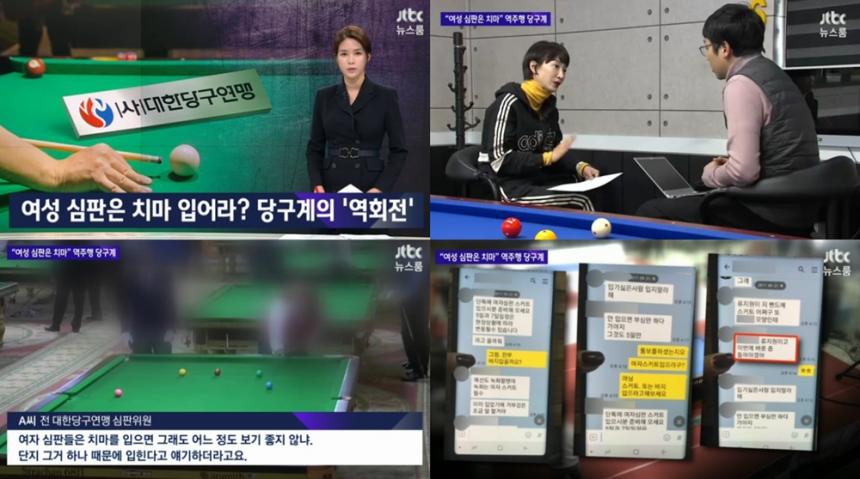
My translation of the transcript for this KBS news report:

학교뿐 아니라 스포츠계의 성 문제도 참 끝이 없습니다.

대한당구연맹이 여성 심판들에게 치마를 입으라고 지시했습니다.

왜 그런 지시를 했냐고 물었더니 치마를 입으면 반응이 좋았다는 황당한 답변을 했다고 합니다.

방준원 기자입니다.

It’s not just in schools, but also in the world of sports where there’s no end to problems of sexual discrimination and harassment.

The Korean Billiards Federation has ordered its female referees to wear skirts.

When asked why, the ridiculous response was that this gets a favorable reaction [from audiences].

Bang Jun-won reports.

[리포트] 국제 당구대회 여성심판, 당구공의 이물질을 닦고, 공 위치를 확인하는 등 당구대에 바짝 붙어야는 경우가 많습니다.

치마가 불편할 수밖에 없습니다.

Reporter Bang: In international billiard competitions, it is often necessary for referees to clean the balls of any foreign substances and to check their positions, requiring them to always stand close to the table. This is uncomfortable and inconvenient to do in a skirt.

[류지원/당구연맹 심판 : “공 튀어가면 가서 잡고, 닦아서 포인트 있는 부분에 재배치를 해야 해요. 그러면 치마를 입으면 엎드렸을 때 뒤가 어떻게 될까요?”]

Referee Ryu Ji-won: “When a ball comes off the table, we have to grab it [from the floor], wipe it, and put it back in the correct position on the table, [which often requires lying over it to reach]. How are we expected to do all this in a skirt?”

보통 바지를 입던 여성 심판들이 치마를 입기 시작한 건 2017년부터입니다.

당구연맹의 복장 규정은 변한 게 없는데, 이유는 심판위원장 때문이었습니다.

2017년 취임한 심판위원장 권 모 씨가 여성 심판들은 치마를 입으라고 지시한 겁니다.

Normally, female referees wore pants, but this changed from 2017. Not because of any changes in the federation’s rules regarding attire, but because of a demand by newly-appointed referee chairperson Kwon (probably a man, but this is not indicated—James).

Source: Topstarnews

권 씨가 보낸 SNS 메시지입니다.

‘여자심판은 스커트를 준비하라’ ‘녹화방송에 여자 스커트는 필수’라고 합니다.

스커트를 안 입으면 주심 대신 부심만 할 거라고 강조하기도 했습니다.

현직 심판 류지원 씨는 치마 입기를 거부했습니다.

그 뒤 주요 경기에서 배제됐고, 전국대회 15회 참가 정지 제재도 받았습니다.

The demand was announced via social networking services. “Female referees prepare skirts; they will now be required for all games that are broadcast” it said. It went on to stress that “Female referees that do not comply will be demoted to assistant referees.”

Ryu Ji-won refused. For this she was punished during the 15th National Championships.

[류지원/당구연맹 심판 : “(16강 경기부터)딱 1경기 주심으로 배치가 되고, 나머지는 다 부심이었고, 그나마 결승 준결승 경기에는 아예 포함도 안 됐어요.”]

Referee Ryu Ji-won: During the quarter finals, I was only allowed to be referee for one game, being demoted to assistant referee in the others. I was also completely excluded from the semi-finals and finals.

심판위원장에게 치마 복장을 지시한 이유를 물었습니다.

[권○○/당구연맹 심판위원장/음성변조 : “처음 (치마) 착용하고 난 이후에 주변 반응이 너무 좋았기 때문에, 착용했던 심판들이 따로 요청한 것도 있고.”]

권 위원장은 당구 심판이 치마를 입었던 사례가 있어 제의했던 것뿐이라고 추가로 해명했습니다. 류 씨는 권 위원장을 협박 혐의로 고소했습니다.

Chairperson Kwon was asked the reason for the new dress requirement. They replied: “The first time we tried this, the reaction was very positive. Because of that, the female referees themselves made the recommendation,” further explaining that “that was the only reason for this new requirement.”

Ryu is now suing Kwon for intimidation. (End)

Hat tip: 젠더 뉴스 읽기@readinggendernews

Related posts:

If you reside in South Korea, you can donate via wire transfer: Turnbull James Edward (Kookmin Bank/국민은행, 563401-01-214324)

Looking For Recommendations: Potential Interviewees for Topic of “Sexualized Bullying Among Men in the Military in South Korea”

Estimated reading time: 2 minutes. Photo by Sebastiaan Stam from Pexels.

I’ve been asked to pass on the following, prompted by my post “Sex as Power in the South Korean Military” and its update. Unfortunately, I haven’t worked on the topic in many years, making me an unhelpful interviewee myself, so the least I could do for Shao Yuan was to help him in his search. Please get in touch with him if you know something about the subject, and/or pass this post on to someone else who might! Thanks!

I am Shao Yuan, an undergraduate student completing my Bachelor of Arts (Double Major in History and Psychology) currently looking into conducting my Honours research on the topic of “Male-to-Male Sexualized Bullying in Conscript Armies in East Asia”. One of the key countries that will be explored in this research will be South Korea, hence this post today.

As part of the Honours requirement, students in the History department have to complete the prerequisite course HIST492 History, Theory and Methods course that intends to train students up with the research skills required for completing an Honours project based on their planned Honours topic. Under the supervision of Dr. Jessica Stites Mor, one of the assignments we are expected to complete would be a podcast interview with an expert regarding our research topic. With that, I hope to ask for recommendations on potential experts to interview on the abovementioned research topic.

Should you agree to participate in my interview, I’d be happy to send you a list of prepared questions which I’d be asking you through the interview. These would be basic questions in relation to the trend of sexual violence taking place in South Korea’s military back then and even up until today, to some of the developments that have taken place since the suicide of the soldier, Kim, that had taken place in 2003. As the interview will be conducted through either an online call or a video conference call, it’ll also be great to hear from you on some of your available dates in the coming week, should you be willing to take on the interview.

Please do feel free to contact me at shaoyuan.chong@ubc.ca should you have any queries on my research, assignment or recommendations. Should you feel comfortable to speak about this topic, please do feel free to reach out to me.

Otherwise, thank you so much for taking the time to read through this post, and have a wonderful day ahead!

If you reside in South Korea, you can donate via wire transfer: Turnbull James Edward (Kookmin Bank/국민은행, 563401-01-214324)

#MeToo to meat: no more soju calendars with nearly nude women in South Korea

Estimated reading time: 6 minutes. Photo by Tan Danh from Pexels.

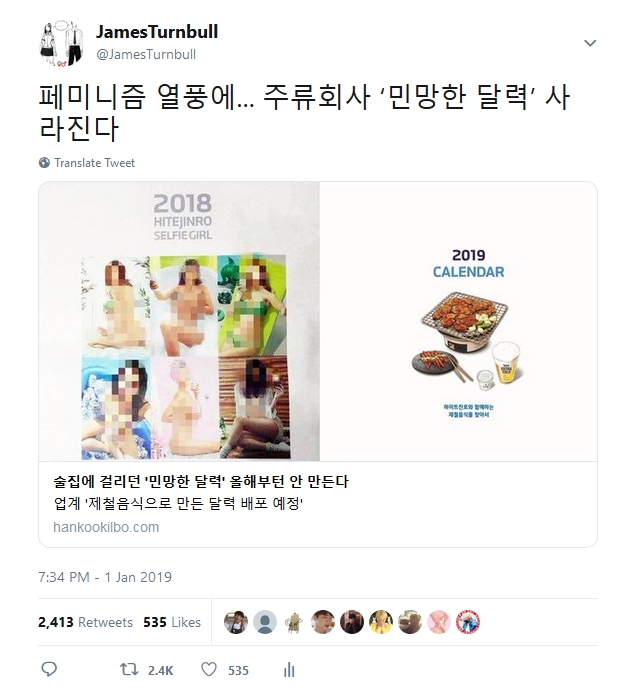
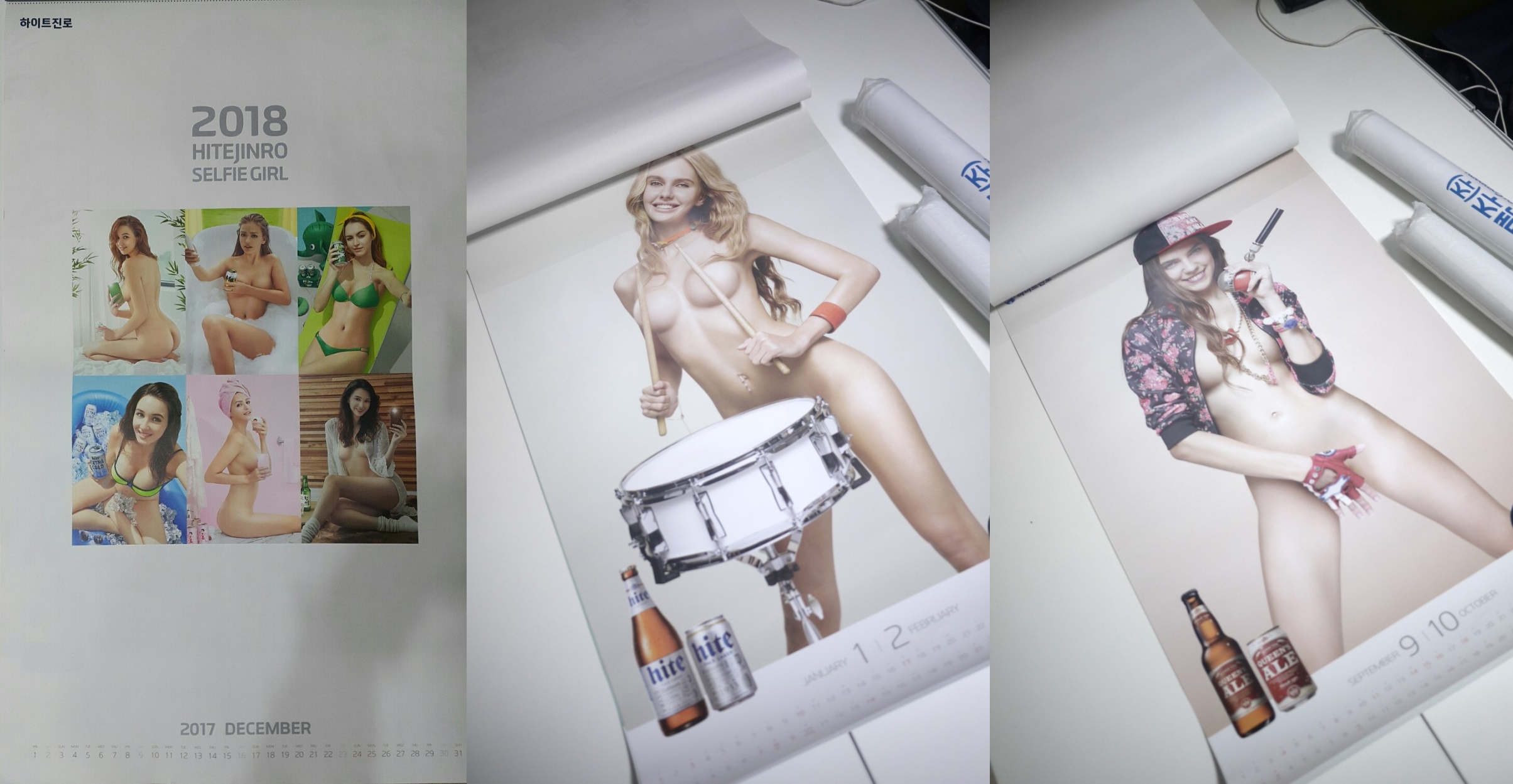
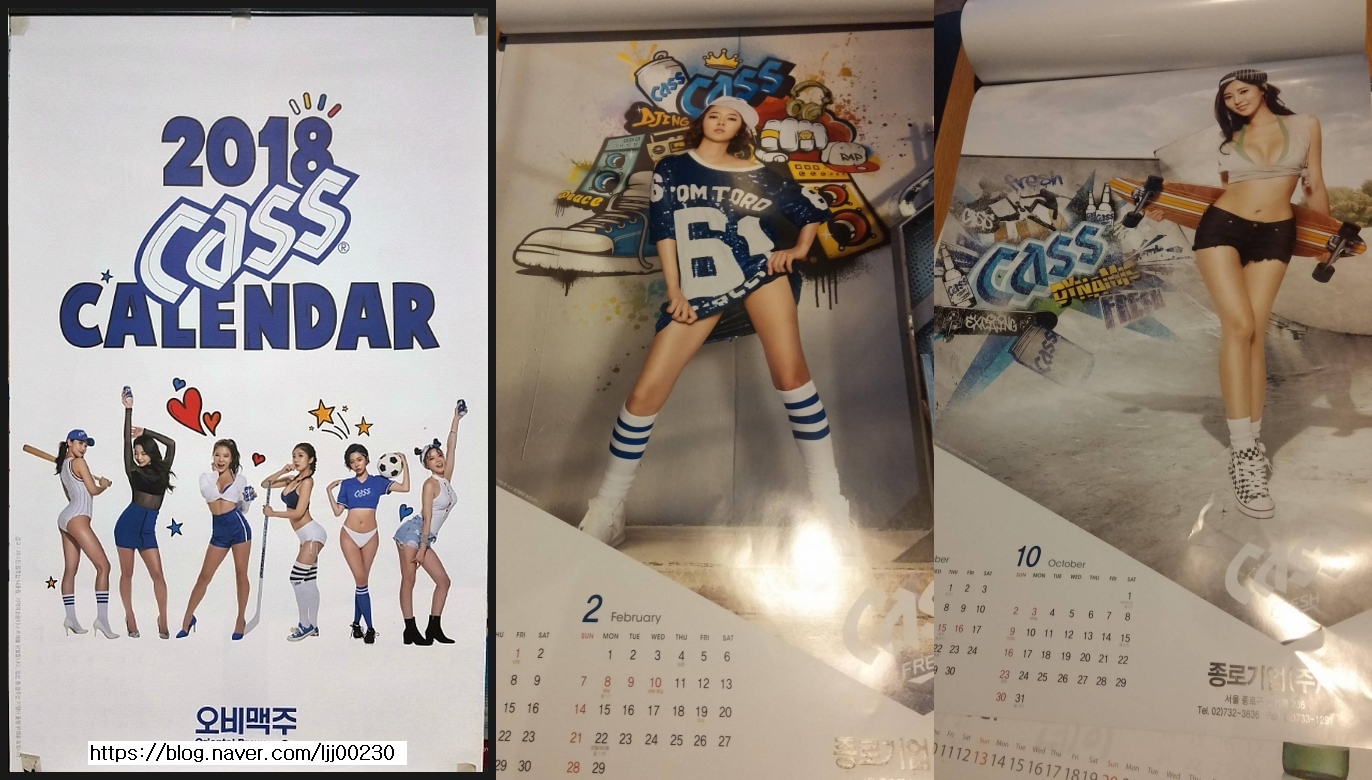
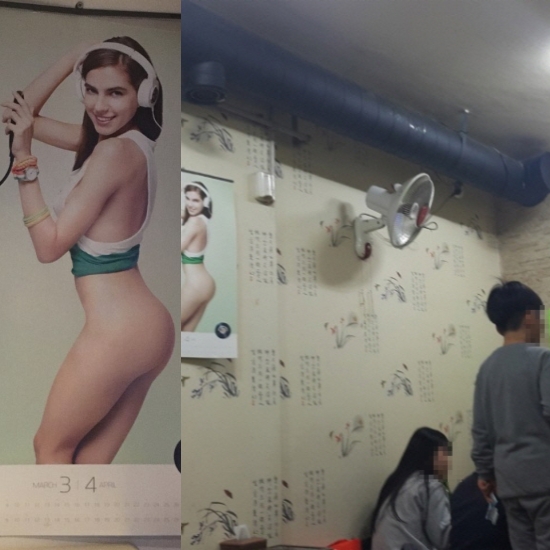
No, not normal soju posters and calendars, but these ones (NSFW) and these ones by Hite-Jinro and Oriental Brewing respectively. I’m not surprised seeing them in restaurants (NSFW) made so many people uncomfortable (seriously, where would you look?), and wasn’t exaggerating when I was quoted in Crystal Tai’s article that “assuming that pictures of nude women [is] all that is required to [get people to change soju brands] is just patronising and insulting.” Perhaps that’s why my tweet about them below, a simple link to a news article, gained such traction:

Please read Crystal’s article for more information on what all the fuss is about. And, for even more information, here are some of my original email interview questions and answers:

Q) When did you first notice soju posters of women and such calendars around you? Do you remember the first time you saw one?

I noticed them immediately after I arrived in Korea in 2000, because they were ubiquitous; the level of alcohol advertising in New Zealand couldn’t begin to compare. I didn’t pay them much attention until about six years later however, because all of a sudden many soju companies started depicting women in revealing clothing and more sexualized poses in their posters, which was a big shift from the virginal depictions of the previous two decades. Soon after, this trend was further accelerated by the liberal use of K-pop stars as endorsement models, as gaining notoriety through revealing campaigns was and remains a win-win for both their entertainment companies and the soju companies.

That said, soju posters are just another means to “consume” a celebrity by fans, who generally must assume the same persona whether they’re in a talkshow, MV, or a soju commercial.* So, despite the trend, by no means are all soju models sexualized today: “innocent” IU, Son Na-eun of Apink, and especially Suzy (of the former Miss A) all tend to be depicted virginally in their own campaigns, the latter despite her having been in several high-profile relationships.

(*Hat-tip to to friend and SNU Associate Professor Olga Fedorenko, whose book chapter I was channeling just a little too directly there!)

Q) What do you think such images mean to Korean men? Why do you think they are often surrounded by such images at bars, pubs, gogijibs (meat restaurants) etc?

It’s unlikely they hold any special meaning that they wouldn’t hold for men of any other nationality. As for their being surrounded by such images however, this is likely because Korea is in many ways a very homosocial society, with many unspoken but strongly-defined separate spaces for men and women. Note that most middle and high-schools were single-sex two decades ago, that almost all Korean men do approximately two years of military service, and that Korean women still struggle to retain their jobs after childbirth, those that succeed often having to leave mandatory after-work drinking gatherings early to look after their children while their male colleagues continue drinking elsewhere. Consequently, while coffee shops are strongly associated with women, and feature in many complaints and negative stereotypes about them, the atmosphere in bars and restaurants that sell a lot of soju can sometimes feel very off-putting for anyone that isn’t a middle-aged Korean man.

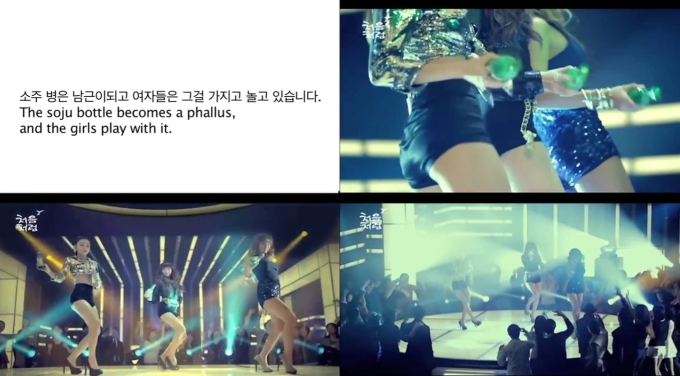
(Image: This interpretation in this video analysis is maybe too much. Yet I can never pass Na-eun’s poster below without thinking about that bottleneck on the left!)

Do you think that the Me-too movement and recent feminist movements really play a big role in Hite-Jinro’s decision to discontinue such calendars?

Given the recent news that “racequeens” are going to be phased out of the racing industry,* as well as calls to do the same with cheerleaders at sporting events, then the timing can hardly be a coincidence. But it may also be a convenient excuse for decisions already made. Unless revealing soju posters are also part of a creative and memorable campaign—which these calendars definitely are not—then it’s extremely debatable whether they ever have any real influence on Korean men’s consumption choices. In my own experience, their tastes in soju tend to be very regional, and they tend to stick to the same brands throughout their lives. Assuming that pictures of nude women are all that is required to change their minds is just patronizing and insulting, so I’m both glad and not particularly surprised that alternative strategies are now being attempted.

(*My mistake: they’re being phased out in Formula 1, but I don’t know enough about the industry to judge what—if any—impact that will have on racing events in Korea. See here for an article about the impact in Japan.)

Do you think other alcohol companies will follow suit as well? And do you think this means the provocative celebrity posters and campaigns will change as well?

No. The calendars by Hite-Jinro were the only ones to feature nudity, and the “sporty” ones by Oriental Brewery were also much more revealing than average. But most soju posters aren’t particularly any more sexually-objectifying of women than Korean advertising in general, because that is already pervasive in the industry as a whole. To wit: in a 2015 study, women were 5.9 times more likely than men to not be fully dressed in Hong Kong television ads, 22.89 times more likely in Japanese ads, and 56.83 times more likely in South Korean ads. By no means, can soju ads be the only culprit in the Korean case!

And if that’s still not enough, here’s a small sample of related posts I’ve written over the years:

Meanwhile, I hope everyone had a happy new year, and sorry my posting has been so erratic. But I have big writing plans for 2019!

If you reside in South Korea, you can donate via wire transfer: Turnbull James Edward (Kookmin Bank/국민은행, 563401-01-214324)
“W코리아가 여성을 화보에 담아내는 방식이 마음에 든다. 자기다운 모습으로 카메라를 응시하는 여성 모델들.”

Estimated reading time: 2 minutes. Image sources: @pompomiya

“I like the way W Korea portrays women. Look at the models here all staring back at the camera in their own ways.”

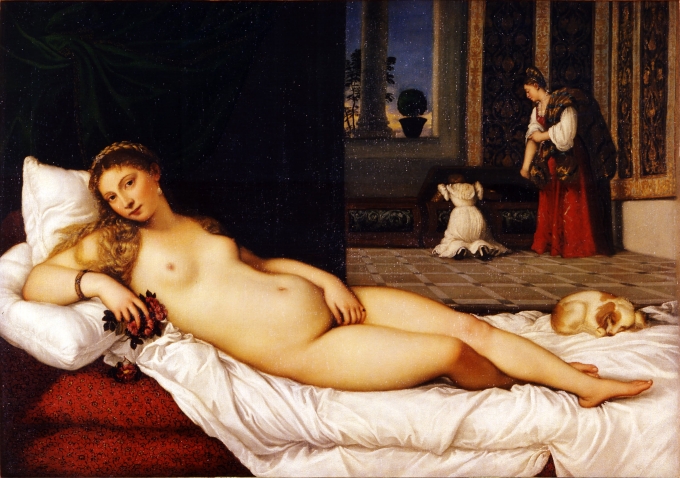
If I die tomorrow, my biggest regret will be never completing my epic series on the queer female gaze in K-pop. No, really. So, while I’m up to my eyeballs with that then, please allow me a quick break today by indulging myself in @pompomiya’s tweet about W Korea‘s July issue. Their point about controlling the viewer’s gaze really resonates with those made about Titian’s Venus of Urbino in my Boobs, Butts, and Biceps post, and is a helpful reminder of what exactly makes that painting so captivating. So too, of why these photos have 6,600 retweets so far.

Three of the models in them are instantly recognizable as K-pop star Amber Liu, volleyball player Kim Yeon-gyeong, and actor Han Ye-seul, but the woman in blue was a mystery. Her name is DJ Seesea (@uuuuman), and the most information about her online seems to be available at W Korea itself, either in their (Korean) article or video interview.

This is the longest performance of hers I was able to find:

Frankly, most of those tracks aren’t to my taste. But the MIXMIX TV channel itself has many more male and female DJs to choose from, and can be good background music to work to when you need a change from Chillhop Music, lofi hip hop radio, and 24/7 lofi hip hop radio. Also, DJ Seesea mentions in her interview that she used to belong to an all female-DJ line-up called Bichinda (Facebook, Twitter), sadly now dismantled but with interesting things to say about the changes more female DJs bring to clubs and the attitudes of audiences, so I’m glad W Korea gave DJ Seesea the chance to give that topic a little more exposure this summer.

Please hit me up if you know anything more about DJ Seesea or Bichinda, or about any other interesting female Korean DJs. Also, make sure to check out 6 Alternative Female Musicians For Fans Of K-Pop at Nylon, many of whom I do like and am eagerly looking for a track or MV to highlight here. Please let me know if you have any suggestions!

Update: Here’s DJ Seesea’s Soundcloud playlist.

If you reside in South Korea, you can donate via wire transfer: Turnbull James Edward (Kookmin Bank/국민은행, 563401-01-214324)

An Englishman Who Writes a Feminist Blog in South Korea: Sex, Gender, and the Elephants in the Room

Estimated reading time: 1 minute. Image source: Pixabay.

Which I think is the correct translation of “一个在韩国写女权主义博客的英国人:性、性别和房间里的大象”, a long interview of me by Yiyi Zhang of Q Daily. Unfortunately for non-Chinese speakers, a lot is lost in the translation, but the gist is still there, and I’m happy that the comments generally seem to be positive. Please hit me up in the comments here if you’d like any clarification about anything in the translation, and/or if you just have any of your own questions about life, love, elephants, and what it’s been like blogging about Korean feminism for the last 11 years!

If you reside in South Korea, you can donate via wire transfer: Turnbull James Edward (Kookmin Bank/국민은행, 563401-01-214324)

Boobs, Butts, and Biceps are Beautiful. Don’t Let Knights Tell You Any Different!

Smiling faces, and the consent implied therein, are crucial for determining a person’s beauty. But that doesn’t mean body parts can’t still be beautiful in their absence.

Estimated reading time: 14 Minutes. Photo by PixaBay on Unsplash. NSFW art nudes following.

Can body parts, in isolation, be beautiful?

Feminist bugbear Camille Paglia would say so. In a speech at MIT in 1991, she rejected having to apologize for reveling in beauty, as well as the notion that ordinary-looking women only ever lamented their own appearance in reaction to attractive people. In her words, she wanted to bring back to feminism the right to say what they were really thinking: “What a beautiful person, what a beautiful man, what a beautiful woman, what beautiful hair, what beautiful boobs!”

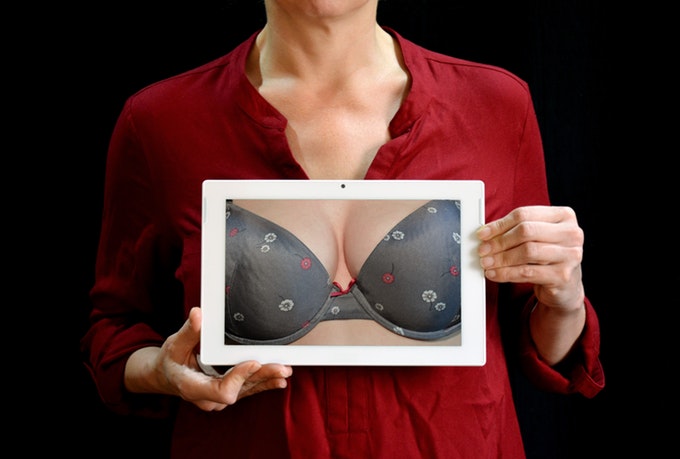
My own answer too, is such an immediate, adamant yes, that it seems absurd to ask. Yet to openly revel in, say, beautiful boobs? Newly-woke male feminists quickly learn to restrain such temptations. Not only because it would simply be boring for most women, but also because it feels disingenuous considering women’s daily, pervasive objectification and body-shaming. Complicit even, when so many are suffering from Korea’s spycam epidemic, and when even male artists are abandoning female nudes in the wake of #MeToo.

Yet whatever our sex or sexuality, we’re all casting admiring glances on our commutes nonetheless—even asexuals. Complimenting their owners may always be a bit much, let alone leering and catcalls. But we don’t have to put up with being shamed for our internal monologues too.

So, when I was going through Sir Roger Scruton’s Beauty: A Very Short Introduction (2011), and read that body parts are “obscene” when they’re considered in isolation?

Recall the queasy feeling that ensues, when—for whatever reason—you suddenly see a body part where, until that moment, an embodied person had been standing. It is as though the body has, in that instant, become opaque. The free being has disappeared behind his own flesh, which is no longer the person himself but an object, an instrument. When this eclipse of the person by his body is deliberately produced, we talk of obscenity. The obscene gesture is one that puts the body on display as pure body, so destroying the experience of embodiment. We are disgusted by obscenity for the same reason that Plato was disgusted by physical lust: it involves, so to speak, the eclipse of the soul by the body. (pp. 40-41.)

I snapped. Already sick and tired of being belittled and patronized most times I read about my male gaze, Scruton seemed to go one further in implying my liking of boobs was immoral as well.

But outrage and exasperation do not an objective response make. Nor does quoting authors without sufficient context, when it’s not so much their arguments as the assumptions they’re based on that are unsound.

So first: note that only two of the book’s nine chapters are about human beauty. Really, it’s more of an introduction to aesthetics, with beauty only as a framing device, and reads like light philosophy. I’m ill-disposed towards and ill-equipped to deal with books like that, frankly, so that’s why I focus on only those two chapters here instead of giving a full review. Much more important than my unlearned personal tastes though, is that this philosophical approach grounds Scruton’s contrarian approach to beauty too. Because whereas in my experience, most commenters take the approach that beauty can be quantified and measured in terms of how closely one’s body parts, features, lengths, and ratios reach various ideals, Scruton believes such an approach is fundamentally flawed (p. 41):

Those [above] thoughts suggest something important about physical beauty. The distinctive beauty of the human body derives from its nature as an embodiment. Its beauty is not the beauty of a doll, and is something more than a matter of shape and proportion. When we find human beauty represented in a statue, such as the Apollo Belvedere or the Daphne of Bernini, what is represented is the beauty of a person—flesh animated by the individual soul, and expressing individuality in all its parts.

This has enormous significance, as I shall later show, in the discussion of erotic art [in the second chapter on human beauty, “Art and erōs”]. But it already points us towards an important observation. Whether it attracts contemplation or prompts desire, human beauty is seen in personal terms. It resides especially in those features—the face, the eyes, the lips, the hands—which attract our gaze in the course of personal relations, and through which we relate to each other I to I. Although there may be fashions in human beauty, and although different cultures may embellish the body in different ways, the eyes, mouth and hands have a universal appeal. For they are the features from which the soul of another shines on us, and makes itself known.

For all my (over)concern with what he says about people’s other bits in his book however, actually I heartily agree with the relative importance he attaches to faces here. The comparison he makes with his descriptions of the following paintings later, for instance, really brings to life the profundity of the differences the models’ gazes make between them—and the crucial distinction that consent makes.

First, of Titian’s Venus of Urbino (p. 125):

Source: Wikipedia.

“As pointed out, in [Kenneth Clark’s] celebrated study of the nude, the reclining Venus marks a break with antiquity, when the goddess was never shown in a horizontal position. The reclining nude shows the body not as a statue to be worshipped but as a woman to be loved. Even in the Venus of Urbino—the most provocative of Titian’s female nudes—the lady draws our eyes to her face, which tells us that this body is on offer only in the way that the woman herself is on offer, to the lover who can honestly meet her gaze. To all others the body is out of bounds, being the intimate property of the gaze that looks out from it. The face individualizes the body, possesses it in the name of freedom, and condemns all covetous glances as a violation. The Titian nude neither provokes nor excites, but retains a detached serenity—the serenity of a person, whose thoughts and desires are not ours but hers.”

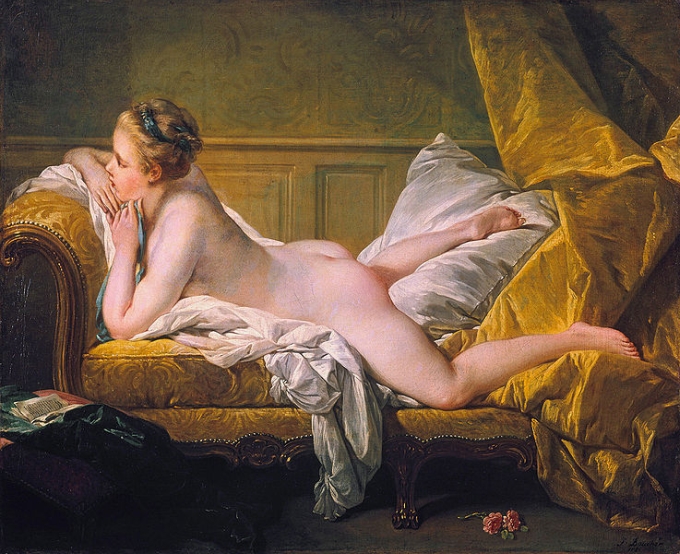
Next, contrast the issues Scruton raises with the model in François Boucher’s The Blonde Odalisque, all of which ring true for anyone who’s ever been dissatisfied with most pornography (i.e., everyone) because of the unrealistic, wholly impractical, often painful-looking, yet somehow supposedly “sexy” positions women are usually presented in. Indeed, Marie-Louise O’Murphy seems so divorced from proceedings here, and so divorced from her own body, that she looks like she’s much more interested in watching Netflix than in whatever the viewer is about to do with her round the back. Or, rather, to her (pp. 134-135):

Does it make any difference that this painting was (possibly) intended only for Louis XV? Or that Marie-Louise, one of his “lesser mistresses,” was only 13 at the time? Source: Wikipedia.

“Turn now to Boucher’s Odalisque, and you will see how very different is the artistic intention. This woman has adopted a pose that she could never adopt when dressed. It is a pose which has little or no place in ordinary life outside the sexual act, and it draws attention to itself, since the woman is looking vacantly away and seems to have no other interest. But there is another way in which Boucher’s painting touches against the bounds of decency, and this is in the complete absence of any reason for the Odalisque’s pose within the picture. She is alone in the picture, looking at nothing in particular, engaged in no other act than the one we see. The place of the lover is absent and waiting to be filled: and you are invited to fill it.”

Yet for all their eloquence, he’s preaching to the converted with those particular passages. They may even buy the book on their basis alone, having secluded themselves in a quiet corner of the bookstore and skipped ahead to those pictures.

The problem is that well before a genuine reader gets to that stage of the book, Scruton’s mere say-so on numerous issues is less than persuasive. By the time you reach its end, you’re not so much unconvinced as infuriated that he wouldn’t make more effort with its readers.

Examples of his arrogant certainty abound. For starters, his opening descriptions of our supposed differences with animals, the science of human desire, and evolutionary-psychology, are trite and shaky at best, and often just plain wrong. There is absolutely no basis to his argument that “Perhaps no sexual experience differentiates human beings from animals more clearly than the experience of jealously,” for instance (p.44). Nor, to his assertion that “Human beings are alone among the animals in revealing their individuality in their faces” (p. 124), which is easily proven false with just 5 minutes of googling. While to his credit, that he discusses science at all is because he acknowledges “it is surely reasonable to believe that there is some connection between beauty and sex” (pp. 32-33), his blithe, continual assertions presented as facts here soon start collapsing under their own weight.

In particular, take his description of kissing (p. 40):

To kiss [the mouth of another person] is not to place one body part against another, but to touch the other person in his very self. Hence the kiss is compromising—it is a move from one self towards another, and a summoning of the other into the surface of his being.

Or, indeed, of sex itself (p. 38):

In the sexual act, there is no single goal that is being sought and achieved, and no satisfaction that completes the process: all goals are provisional, temporary, and leave things fundamentally unchanged. And lovers are always struck by the mismatch between the desire and its fulfilment, which is not a fulfilment at all, but a brief lull in an ever-renewable process.

Both of which, miffed at his disdain at my daily rejoicing at the existence of boobs, originally I looked forward to presenting as eye-rolling demonstrations of his academic, ivory tower absurdness. Which for sure, is a turn-off with Scruton. His overuse of “he” and “his” throughout too, isn’t merely an out of date convention either, but are characteristic of the chapters on “human” beauty that are so overwhelmingly—almost exclusively—focused on female beauty that they read like they’re exclusively, deliberately aimed at cishet men. (The Beautiful Boy this ain’t.)

On a sober second reading though, I had to concede that both passages are fully consistent in the context of the arguments that preceded it, and that they can sound almost sweet too. However reluctantly, I was loath to misrepresent him.

And yet, they bear sooo little resemblance to any of my own experiences, that the very first thing they reminded me of was of this virginal android’s idealized notion of sex (from 1:30):

Hey, I may be a parent in a small apartment who literally has to schedule these things, but it’s not that I can’t appreciate such sentiments, nor that I haven’t even felt them keenly myself on occasion. Scruton’s descriptions do not represent the totality of my kissing and sexual experiences however, nor—and I’d wager good money on this—would they represent Scruton’s either. For him to pretend otherwise is simply disingenuous, and can’t be explained away as a stylistic choice due to space restraints. Rather, he chose to do so because it is his firm belief that beauty is akin to a transcendental, Platonic ideal, and, that if beauty is related to sexual attraction as previously noted, then sex has to be elevated into some transcendental, Platonic ideal too. Hence the absurd descriptions of—lest we forget—fucking, and the setting himself up for the completely unconvincing distinctions between beauty and body parts that got me started on this rant.

Did I mention that he never actually defines “obscenity”?

It was a surprise to learn after finishing the book then, that Scruton’s earlier book on the philosophy of sex, Sexual Desire: A Philosophical Investigation (1986), is actually well-respected, and considered by many a classic in the field. Because in that too, I read, he maintains his duplicitous insistence on eloquent theory trumping sweaty, sticky, lustful practice. And, because in Beauty: A Very Short Introduction, it’s that wilful dogmatism that ineviably, inexorably leads him to shaming anyone associated with pornography and sex work.

Let me confine myself to just one final example, which follows directly on from the quote about Boucher’s Odalisque, and in my view utterly taints it (p. 135, emphasis mine):

Of course there are differences between the Odalisque and the tits and bums on page three of The Sun….The second difference is connected, namely, that we need know nothing of Boucher’s Odalisque in order to appreciate its intended effect, save what the picture tells us. There was a model who posed for this canvas; but we understand the canvas neither as a portrait of her nor as a painting about her. The bum on page three has a name and address. Very often the accompanying text tells you a lot about the girl herself, helps you forward with the fantasy of sexual contact. For many people, with reason I think, this makes a decisive moral difference between the page three image and a painting like Boucher’s. The woman on page three is being packaged in her sexual attributes, and placed in the fantasies of a thousand strangers. She may not mind this—presumably she doesn’t. But in not minding she shows how much she has already lost. No-one is degraded by Boucher’s painting, since no-one real occurs in it. This woman—even though the model who sat for her has a name and address (she was Louise O’Murphy, kept for the King’s pleasure at the Parc aux Cerfs)—is presented as a figment, in no sense identical with any real human being, despite being painted from life.

I wonder too, to close this post with the question that prompted it, what exactly Scruton thinks you have lost when you admire the body parts of other commuters. Whether your focus happens to rest on breasts, butts, biceps, legs, broad shoulders, luscious long hair, or whatever.

Indeed, if you’re on the same crowded subway line as I am, you know that sometimes they’re literally the only part of the owners you can see.

I refuse to believe that those body parts can’t be simply magnificent though, and that I’m immoral for thinking so, merely because their owners may get off my carriage and transfer to another line before I ever get to see their faces.

Nor does—heaven forbid—deliberately seeking out erotic art and pornography, rather than accidentally stumbling upon objects of your affection on your commute, somehow mean the same standards don’t apply to the people in those too. Because whether seen on a Busan subway, or in a video shot in a moodily-lit San Fernando studio? Somehow, inexplicably, I never seem to lose my respect for the owners of those simply magnificent body parts either, nor does admiring their objects mean I ever think or treat them as objects.

I don’t think it’s just me. In fact, I assume the same of everyone else until proven otherwise.

If you do think lesser of them though, and my assumption is proven naive, then please let let me know. Or, if you think many others negatively objectify people, despite you and I respecting them? Then pray, please tell who those “others” are exactly, and please give myself and other readers some actual evidence that they’re really so different. Especially that which comes from actually talking to them, instead of only from what other people with agendas, like Scruton, have written about that heinous group.

No, I didn’t say those others were most cishet men—you thought it! Something to think deeply about on tomorrow’s commute perhaps, if you don’t want to let your eyes wander? ;)

If you reside in South Korea, you can donate via wire transfer: Turnbull James Edward (Kookmin Bank/국민은행, 563401-01-214324)

Related Posts:

On K-pop Stars Dating

Precious few songwriters and MV directors present female K-pop stars as grown women with sexual experience, agency, and desire. But these assigned gender roles can quickly crumble under revelations that they’re actually in relationships, as can as the business models that depend on them.

Estimated combined reading time: 8 minutes. Photo by Zun Zun from Pexels.

Recently, I was email-interviewed by James Griffiths at CNN about Cube Entertainment firing HyunA and E’Dawn for dating. My contribution to the final article is necessarily brief though, so here’s my original longer response to his question about just why K-pop labels are so sensitive about their stars’ love lives:

That some fans feel they have a strong personal bond with their idols, and then feel betrayed when those idols are revealed to be in a relationship, is a problem hardly confined to K-pop fandom. But it is amplified by three characteristic features of Korean popular culture.

First, there is the overexposure of its celebrities. Flick through the channels, and it is entirely possible to see the same K-pop star in an MV, a talkshow, a commercial, and a drama. And for each, they’ll generally be expected to maintain the persona for which they’re best known.

Next, as a broad rule, virginal personas are overwhelmingly preferred for unmarried female K-pop stars. Precious few songwriters and MV directors are prepared to present them as grown women with sexual experience, agency, and desire, as a decade’s experience with censors has taught that their work will generally get banned if they do.

Consequently, in K-pop, most women are presented as scantily-clad, passive objects for the male gaze, regardless of the actual make-up of a girl-group’s fandom. Again, this centralizing of supposed cishet male tastes as the norm isn’t unique to Korea. But the third and final feature is that the Korean media has tended to downplay their criticisms of this, so asamong other reasonsnot to jeopardize the success of the Korean Wave overseas. This deliberate myopia however, has contributed to such phenomena as the rise of middle-ageuncle fans,” who are defined by supposedly only possessing a harmless avuncular love for teenage girl-groups in hot pants—and a lot of money to spend on them.

Clearly, revelations of K-pop stars dating challenge all these tenets of Korean pop-culture, and their fundamentally gendered nature explains why the negative reactions have overwhelmingly been directed at the women in those relationships, who simultaneously get slut-shamed by both their entitled male fans and the female fans of their partners.

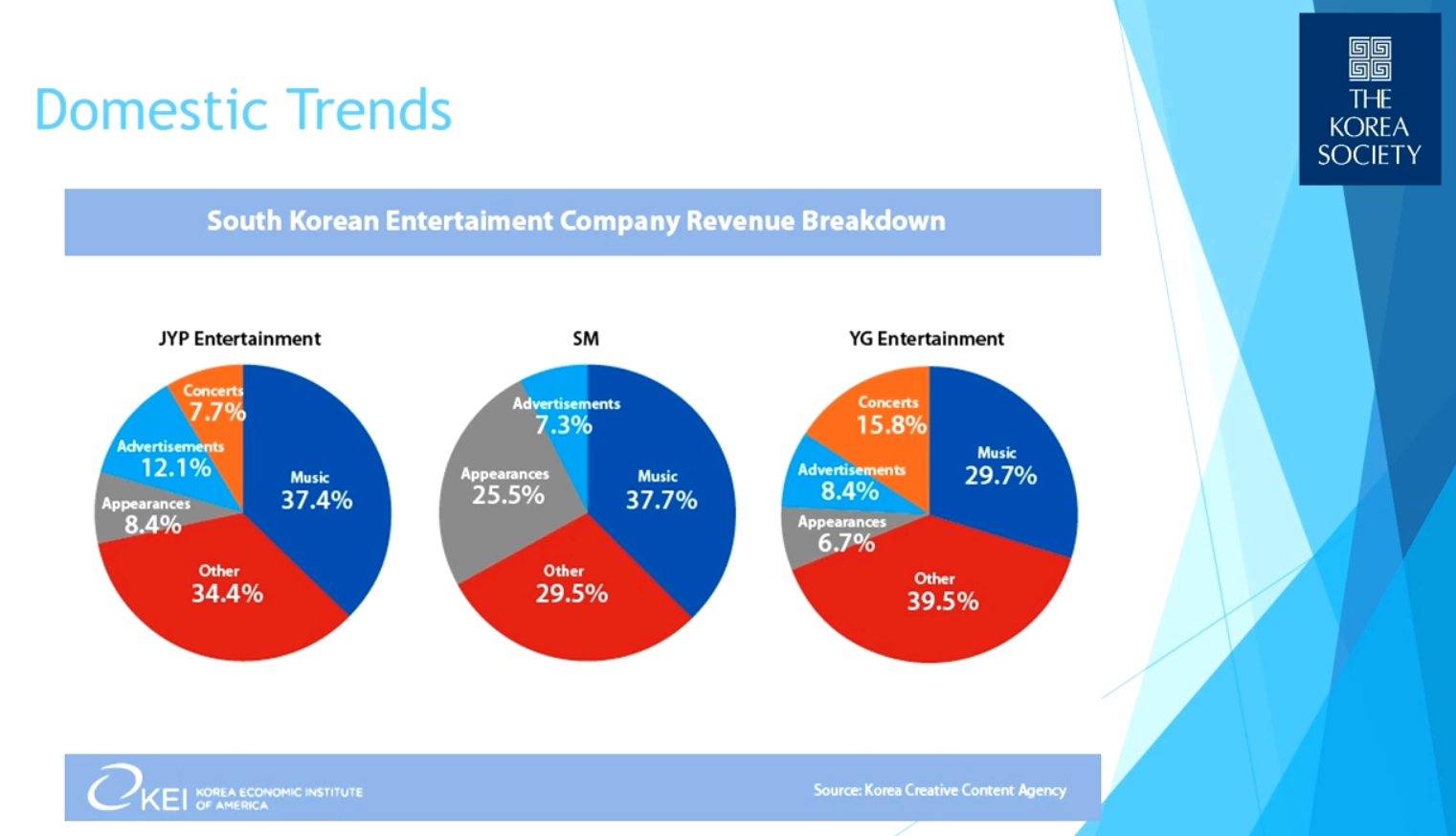
Those last two paragraphs link up to my answer to another question of James’s, about to what extent it’s fans or labels that are driving these attitudes to stars dating. And you can guess which way I went in light of this recent breakdown of the top 3 labels’ revenues:

Source: Jenna Gibson, Korea Economic Institute and The Korea Society @YouTube (3:50).

But I’ll cover the significance of those numbers in a forthcoming post. In the meantime, there are many huge generalizations in my answer to James’s first question of course, and it’s also entirely possible that I still look at K-pop through the prism of when I got into it back in 2010, and have had terrible confirmation bias ever since. If so, and you feel the gist of any of my generalizations are outdated, then please do let me know. I would just love the excuse to crack open some new K-pop books and journal articles I’ve been hoarding, and to get back into writing more about the subject here.

No really—please rip my email to shreds! I beg you! ;)

If you reside in South Korea, you can donate via wire transfer: Turnbull James Edward (Kookmin Bank/국민은행, 563401-01-214324)

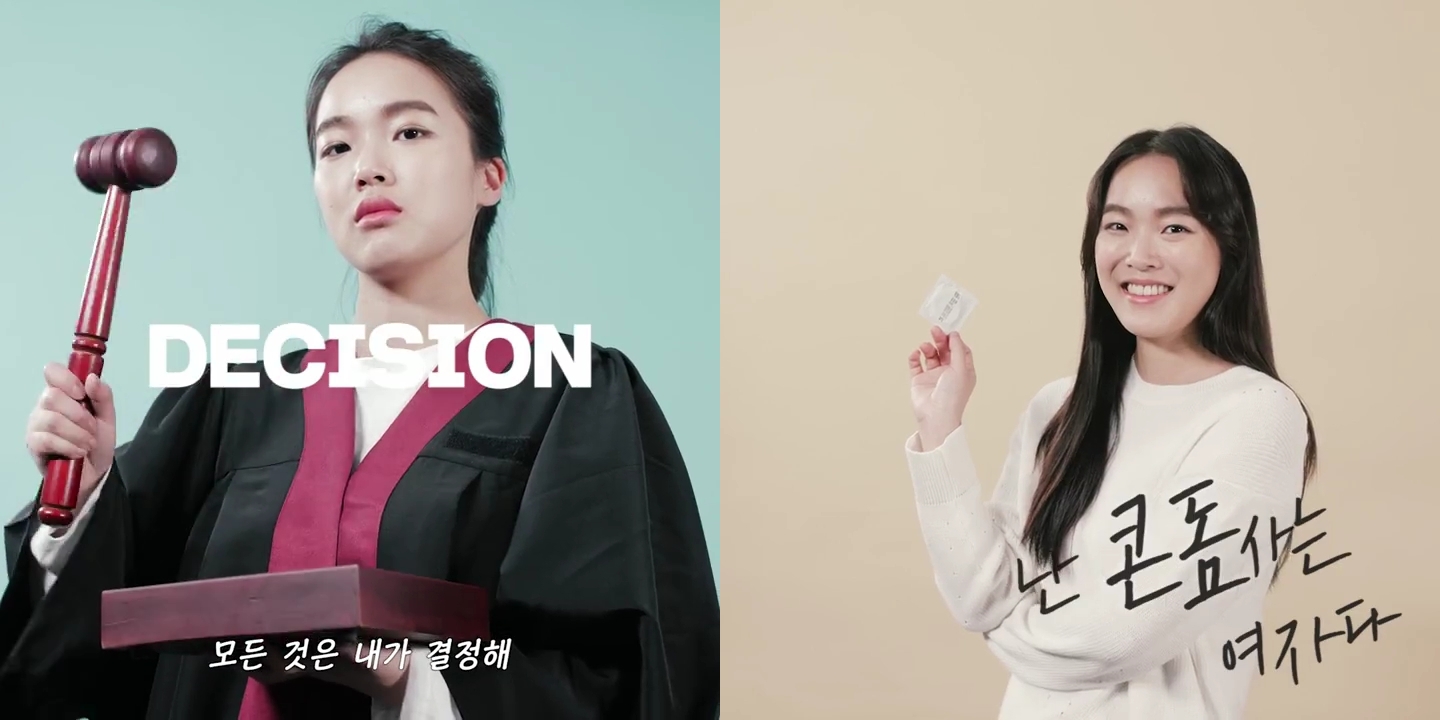
“I am a Woman Who Buys Condoms.”

The reaction to having a woman in a condom ad is exactly why we need women in condom ads.

Estimated reading time: 5 minutes. All screenshots via YouTube.

Korea has only ever had three condom commercials on TV since a ban was lifted in 2006, and none at all for the last five years. Korean women generally rely on men to purchase and use condoms too. I wish these realities weren’t true, and am always looking for evidence to show attitudes are changing. Yet they stubbornly persist.

That’s what makes commercials like this one for Common Day condoms so important. Produced for social media in April but only going viral this week, it’s surprisingly sweet, with messages that are simple but powerful. So why is it so disliked?

Here’s my translation of the captions:

난 콘돔사는 여자다.

여자가 콘돔을 어떻게 사냐고?

약국, 편의점, 인터넷, 성인샵에서

‘그냥, 사면 된다.’

I’m a woman who buys condoms.

How can a woman buy condoms you ask?

At pharmacies, convenience stores, over the internet, and at sex shops.

“Just buy them.”

물론 처음엔 쉽지 않았지

내가 콘돔을 사기 전까지

‘여자답지 못하네’

‘여자가 밝히네’

‘그건 남자가 사야지’

Of course, it wasn’t easy at first.

Up until the moment I finally bought them myself, I thought [people would say]:

“That’s not ladylike.”

“Wow, is she oversexed or what.”

“That’s something only men should buy.”

이런 말들과 싸워왔거든

나만 겪어본 건 아닐거야

근데, 지금은 21세기

‘그냥, 사면 된다’

Actually, I struggled with those thoughts too.

I’m sure I’m not the only who felt like this.

And hey, isn’t it the 21st Century now?

“Just buy them.”

현재의 우린 ‘자기결정권’ 이란 게 있어

생각과 말,

몸과 욕망을 스스로 결정할 권리

누가 준 것도 아니고

빼앗을 수도 없는 거야

내가 원래 가지고 태어나는 거거든!

We in the modern age, have the right to decide what’s best for ourselves

That includes rights about our bodies and our desires

This is something that wasn’t given to me, and so can’t be taken away from me.

This is something that we were born with.

예를 들면,

내가 원할 때 섹스하고

원할 때 임신하는 것

뭐 그런 거 말야

남자가 콘돔이 없을까 불안하다고?

그래서 내가 ‘그냥, 사면 된다’

For example,

I can have sex when I want,

and I can get pregnant when I want—

you know, things like that.

So you get concerned and worried when men say they don’t have a condom?

That’s why you should just buy them yourself!

난 19세기 여자가 아니거든!

난 힘이 있고,

욕망이 있으며,

모든 것은 내가 결정해

난 콘돔사는 여자다.

I’m not a woman of the 19th Century!

I am powerful,

and I have desire,

I decide everything for myself,

And I am a woman who buys condoms. (End)

Awesome, right? Yet it has 8 to 1 dislikes to likes on YouTube. Probably, because of trolls like this one below, who replied to the tweet I first found the commercial on. I don’t mean to feed him, but will translate a couple of tweets from his long screed to show what Korean women, condom manufacturers, and sexual-health advocates are up against (I welcome alternate translations; being such a typical troll, he’s not very coherent sorry):

(Source.)

Jeez, this is just such typical BS from a “21st Century woman.” What is it with “women hav[ing] the right to decide what’s best for themselves,” and carrying condoms in case men don’t have them, and choosing for themselves when they want to get pregnant? This isn’t something women should even buy! Men are supposed to buy them! Can’t you make a condom commercial for men instead?

And later, after discovering that the CEO of the promotion company behind the campaign is—wait for it—a man himself:

(Source.)

Ah, now I get it. Your company often provides junk information in its twitter promotions, like you did while selling diet supplements once. In this case, you just make a commercial with commonly-used feminist words thrown in, as you know women will automatically buy anything that says “feminist.”

Sigh. Please head over to YouTube and like the video right now, to encourage more feminist commercials like it. And please share this post and the video too! :)

If you reside in South Korea, you can donate via wire transfer: Turnbull James Edward (Kookmin Bank/국민은행, 563401-01-214324)
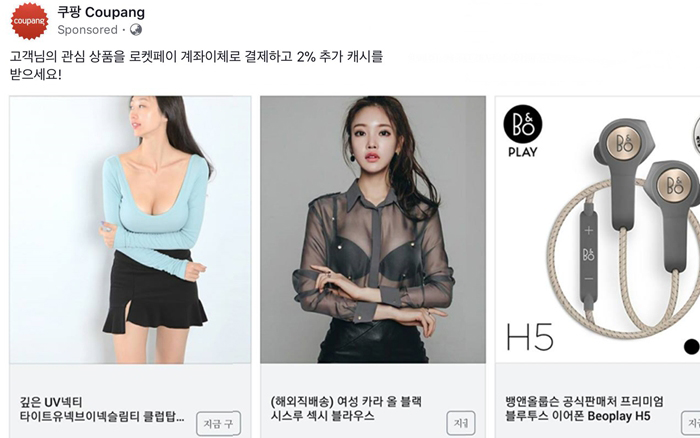
“The Secret to a Perfect Vacation? The Oral Contraceptive Pill!”

A rare Korean government campaign promoting contraception use has many positives. But its motivations are anything but progressive.

Estimated reading time: 8 minutes. Image, via @smartlovekorea (Facebook): “Fun Waterplay! Sweet Couple Travel! The Secret to the Perfect Vacation · The Oral Contraceptive Pill ·”

Korea stands out for its over-the-counter access to the monthly contraceptive pill, and that’s awesome. Not just because sexual independence is a good thing in general, but because it’s essential when so many obstacles stand in the way of gaining that independence here, especially for unmarried women.

Despite that, only 2.5 percent of Korean women actually use the pill. Probably, due to a combination of not being educated about contraception at all in school or university, aggressive sterilization programs in the 1970s and ’80s, a knock-on tendency to leave contraception in men’s hands, and because of scaremongering by the Korean Medical Association. More recently, desperate efforts to raise Korea’s birthrate have dissuaded from government efforts at promoting contraception use in general, and played a big role in the (re)criminalization of abortion in 2010.

But that last was implemented by disgraced, former governments. So far, while the current Moon Jae-in administration has been no radical reformer of sexual rights, it is left of center, and operates in a shifted political climate of Me-too and the Gangnam murder. It is legally required to respond to a recent popular petition to legalize abortion, and this week was further pressured by the Korean College of Ob & Gyn’s announcement that its members would no longer perform abortions while its members faced punishments for doing so. Also, governments are never monoliths, as different ministries can oppose each other as they jockey for funding and jurisdiction. In particular, the Ministry of Gender Equality and Family (MOGEF) has officially supported legalization since as of this May, a 180 degree shift from its position under Moon Jae-in’s predecessors, and at odds with the Ministry of Defense that is concerned about its shrinking pool of conscripts. And there have always been excellent initiatives by various sex-education teachers, women’s rights groups, feminists, and NGOs operating in the background.

Which of those actors was behind this poster, encouraging hetero couples to use the pill? What were their motivations? Trick question—eagle-eyed readers will have already noticed the Ministry of Health and Welfare’s (MOHW) logo. Which makes it all the more remarkable.

Yes, remarkable. Sexual themes may well pervade the Korean media, but recall that even condom commercials are considered too risque for Korean consumers, only two ever making it to television screens in the 12 years since they were legalized. That’s indicative of how there are still such limits to discussing sexual relationships in Korea, which is why I’m so drawn to the rare, no-BS conversations about them favored by Korean feminist groups. And why I was so surprised to discover a government ministry acknowledging that, sometimes, people have sex just for fun.

Yet however refreshing, it seemed odd to focus on the pill, which doesn’t protect against STDs. For the sake of Koreans’ sex-lives, empowerment, and general well-being, shouldn’t the MOHW encourage the use of contraception in general? Including of those ever so vulgar French letters?

Fortunately, it does. Perusing the source, it emerges that many alternatives have indeed been promoted in the Ministry’s “Loveplan Campaign.” The “combined method” of the pill and the condom for instance, which I learned all the cool kids are now referring to as the “Double Dutch” method:

Source: Ministry of Health and Welfare Facebook page

And shortly after I saw the poster promoting the pill, there was a new post about using condoms, with good advice about using a fresh one if there is a tear, to not use oil-based lubricants, and so on:

Source: Ministry of Health and Welfare Facebook page

There are many more examples like it, which is just awesome. Any government should promote greater contraception use, and help spread awareness of all the different types available, as well as how to use them properly.

But I also learned the campaign was launched 3 years ago. And it got odd all over again.

Because that was during the Park Geun-hye administration, which was notorious for its hardline on abortion, and for using the aforementioned crucial access to the pill as a bargaining chip in a dispute between doctors’ and pharmacists’ associations—as well as making numerous other backward steps in Koreans’ sexual health and rights. In particular, the MOGEF, ironically, had been at the forefront of many these developments. So, if the MOHW had actually been its liberal, sex-positive counterweight during all that time, you can bet I would have noticed.

I hadn’t, because it wasn’t. As explained in The JoongAng Ilbo at the campaign’s launch, sadly it was never about sexual empowerment per se. Rather, it was entirely aimed at reducing the number of (illegal) abortions:

‘성’을 주제로 한 방송프로그램이 인기를 끌고, 숙박업소 광고도 안방에서 쉽게 접할 수 있을 정도로 ‘성문화’는 빠르게 개방되고 있다. 더불어 일명 ‘가출팸’ 사건과 같은 청소년 성범죄 비율도 10대 강력범죄의 70%를 차지할 만큼 빠르게 증가하는 등 그 문제점도 속출하고 있어 다양한 접근의 해결책이 요구되고 있다.

Through the popularity of television programs with sexual themes, and the increasing ease of finding love hotel advertisements, a “sex culture” is rapidly opening up. In addition, as the proportion of teenagers’ sex crimes such as “Runaway Family” incidents* account for 70% of all teenagers’ major crimes and is also rapidly increasing, various measures should be addressed in order to tackle these problems.

*(“Runaway Families” refers to runaway teens living together for support; implicit is that many must turn to sex work to do so.)

특히, 개방된 성문화로 인한 무분별한 인공임신중절 시술의 문제점으로 95%정도가 불법시술인 것으로 나타났으며, 이로 인해 청소년은 물론 성인들의 신체적, 정신적 건강을 위협하고 목숨까지 앗아가는 등 심각한 사회문제로 대두되고 있다.

In particular, this opening sex culture is responsible for 95% of casual, illegal abortions, and this is causing serious social problems due to the damage caused to teenagers’ and adults’ physical and mental health, even leading to suicide.

이와 같이 나날이 증가하고 있는 무분별한 인공임신중절 사례, 만연하게 퍼진 생명경시풍조 등과 같은 현 사회적 세태에서 보건복지부가 진행하고 있는 「2015 인공임신중절 예방 캠페인: 러브플랜」은 생명존중 문화와 올바른 성문화를 조성하고자 하는 점에서 중요한 의의가 있다…

Consequently, the MOHW is launching a “Loveplan, 2015 Abortion Prevention Campaign” to create a culture of respect for the sanctity of life and encourage a healthy and responsible sex culture…

…보건복지부는 청소년에게는 생명존중의식과 미래의 건강한 부모가 되기 위한 책임 있는 선택을, 미혼남녀에게는 양성평등에 입각한 책임 있는 사랑과 계획을, 가임부부에게는 건강한 아이를 출산하기 위한 계획 임신 등 상황에 따른 메시지를 전파하고 있다. 이는 인공임신중절 예방을 위한 실질적인 실천으로 이끄는 견인차 역할을 하고 있다.

…The MOHW is committed to spreading the message of the importance of respecting the sanctity of life, and to promoting sexual responsibility and planning based on gender equality for unmarried men and women, in order that they will become responsible parents in the future and raise healthy children. These goals drive its emphasis on promoting practical contraceptive methods for the prevention of abortion.

The article goes on to talk about its various promotion methods, which include(d) working with “LifeLove Supporter” university groups. For example, with Pyeongtaek University students, Hongik University students, and these students from an unspecified Busan university in 2016 (photo above); with Daegu University and Yonsei University students in 2017; and with these students from an unspecified Jeonju university this July. In fact, these groups predate the Loveplan campaign, which itself seems heavily based on an earlier “Lovekeeperscampaign.”

It’s difficult to feel any anger towards such friendly-looking, probably genuinely helpful and concerned young students. And even among pro-choice activists, who wouldn’t want the abortion rate to go down? The students are also mainly just educating people about contraception, and promoting men and women’s equal involvement in their use. So, all power to them, right?

Wrong. Because it doesn’t matter where you are in the world, when someone comes towards you with a big sign that that says something about loving or respecting “life” on it, 99 times out of 100 you know it’s not your lovelife that they’re advocating for.

And with this campaign’s stress that abortions are illegal and to be avoided, implicit is that they are morally wrong.

But abortions are not a necessary evil, the last, distasteful resort of irresponsible couples. Contraception doesn’t always work. People can change their minds as they realize they’re not ready for a child. Couples can break up. Raising a child isn’t easy, and societies shun single mothers (especially Korean society). People can lose their jobs, and realize they can no longer afford to have a child. And so on. And hell, irresponsible couples have just as much of a right to abortion as anyone else too.

In other words, people will always need abortions, and will always have abortions, whether they’re legal or not. The only difference their legality makes is whether they can have safe ones, or whether many will die from the procedure.

Ergo, abortion is a GOOD thing.

In the past, friends of mine have been amused when I’ve accidentally said I’m “pro-abortion” rather than “pro-choice”, but that’s no longer a mistake on my part.

Here’s hoping for a positive, very overdue response by Moon Jae-in to the petition for the legalization of abortion then. And with it, a refocusing of this campaign.

Related posts:

If you reside in South Korea, you can donate via wire transfer: Turnbull James Edward (Kookmin Bank/국민은행, 563401-01-214324)
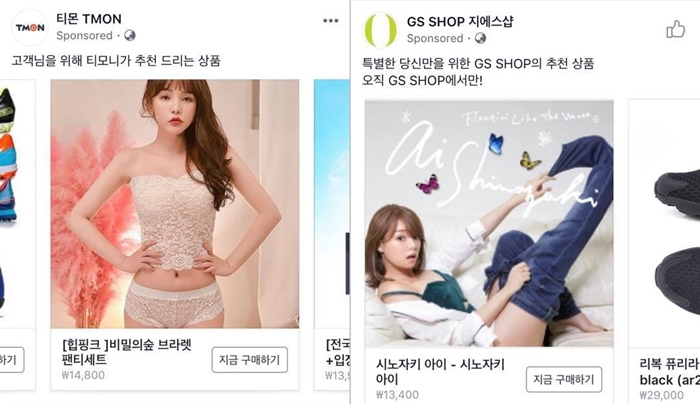
One for the Korean Sexuality Geeks!

Estimated reading & viewing time: 9 minutes.

Last week, I caught Sean Pablo’s interview of Nara Kong about dating culture and the sex education she received—or rather didn’t receive—in North Korea. Short and interesting in its own right, I recommend watching the entire video, and subscribing to both Youtubers. But it was the section from 1:30 that will really bring out your Korean sexuality geekgasm:

For those of you also completely turned on right now, but frustrated because you can’t put your finger on exactly why, let me lend a helping hand: it’s because you once read that things were very similar in South Korea in the 1980s. Specifically, from the opening to So-hee Lee’s “The Concept of Female Sexuality in Korean Popular Culture” (pp. 141-164) in Under Construction: The Gendering of Modernity, Class and Consumption in the Republic of Korea (ed. by Laruel Kendell, 2002), recalling her embarrassment and confusion when she attended some English literature lectures at Cambridge University in the mid-1980s (pp. 141-2):

My topic was “Women Characters in Victorian Novels”. During the lectures and seminars, I was acutely embarrassed by what I heard. Why was everyone talking about sexuality, masculinity, and femininity? What was the relationship between those terms and feminist literary criticism?

In those days, Koreans did not have exact counterpart terms for “sex”, “sexuality”, “sexual intercourse”, and “gender”. I was very confused as I struggled to determine the appropriate meanings. In Korean, one very general term “seong” (성) could be used for these four concepts, its particular meaning dependent on the speaking and listening context.

(It’s actually a little more complicated than that, the specific Chinese character she’s referring to—there are many different ones rendered as “성” in Korean—also meaning “nature” and “life” as well as “sex.” But that just adds to her point.)

Korean society in the mid-1980s did not find it necessary to make sharp distinctions between these concepts. At the annual Korean Women’s Studies Association Conference in 1989, the issue of sex language was raised and discussed. More recently, the Korean counterpart of the term “sexual intercourse” (성교) has gained wide usage, accompanied by the frequent use of the a Korean counterpart for the term “sexual violence” (성폭행)….Sexual violence has now become a recognized issue in need of a discourse.

Korean concepts of sexuality have changed profoundly since the Democratic Revolution of 1987….In 1995, the most popular topics among university students were sexuality, sexual identity, and other sexual subjects. There are many reasons for this…

One of those reasons being all the (female sexuality) taboo-shattering movies and books that came out in the mid-1990s, the focus of her chapter. For more on those, see my post “Women Getting on Top: Korean Sexuality in Flux in the 1990s“, then “Korean Women and the 2002 World Cup: The REAL origins of the kkotminam craze” for even more taboo-breaking in the 2000s.

But wait, there’s still more!

As an added bonus to those who have read this far, who can consider themselves the true Korean sexuality geeks, let me also pass on Jo Kwon and Lia Kim’s dance to Lemon by NERD & Rihanna, my gateway video—thanks Asian Junkie!—to becoming a complete fanboy* of both:

A song with a lot of seong that. What more could you ask for on a Monday? ;)

If you reside in South Korea, you can donate via wire transfer: Turnbull James Edward (Kookmin Bank/국민은행, 563401-01-214324)
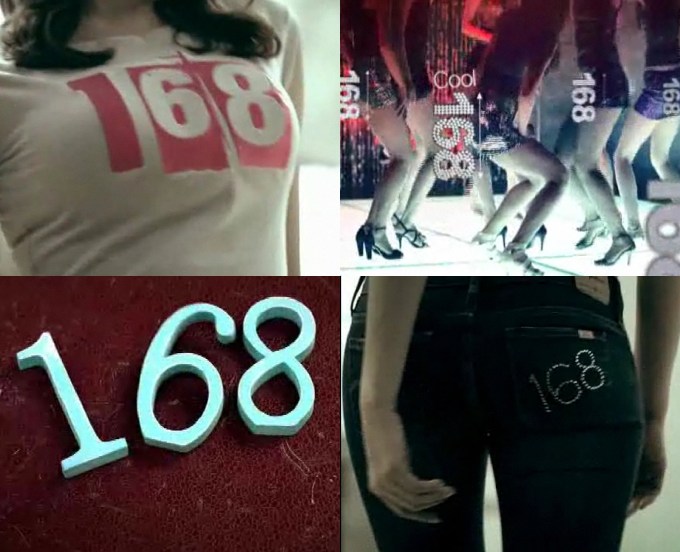
(*I’m really, really wincing at the high-heels in this one though. And Lia really shouldn’t have had a pre-teen dancing alongside her to Starships by Niki Minaj in her latest video either. But I only criticize out of love!)

“Girl-groups in Hot Pants” Isn’t a Concept That Always Sells a Product. Except When it Does. Damn.

Compared to men, women are almost 60 times more likely to be wearing revealing clothing in Korean advertisements.

Estimated Reading Time: 5 minutes. Source: @Sulllllimmmm

“I’ve seen many pictures of Seol-hyun, but I think these are the first ones I’ve ever seen that haven’t sexualized her or shown off her body.”

Me too.* Which is not to say I’m against either, of any consenting adult. Sometimes, a famous figure in tight-clothes is just what is needed to grab your attention, whatever your sex or sexuality. Especially in a commercial’s all too brief 15-second window:

But that one by Hani for Yanolja, a motel-finding app, was only successful—10 million downloads, in a population of 51 million—because it combined its celebrity face and sexual frisson with such a catchy jingle and distinctive dance. Imitated and parodied by Korean fans all summer (especially my daughters), who demanded Hani perform it on the street, in hindsight it was an obvious winner.

Or was it? Compare this 2013 commercial by Sistar for Ottogi set rice meals, which I used in a recent lecture I gave to The 11th Korea-America Student Conference. Mostly, because the incongruity of all the flesh with the actual, rather mundane product is just so jarring: were all those legs really needed, and those belonging to an expensive girl-group in particular? Also, because I couldn’t find a single news article about it from 5 years ago, in contrast to all the attention Hani’s commercial is getting today:

Sources: *cough* Ilbe

But after the presentation, thinking again about the commercial got me hot and bothered, and not in a good way. I realized my making the point with the screenshots had overshadowed the commercial itself, which I hadn’t actually seen in many years. Once I did, I realized it did have its own jingle and dance, and a sort-of chorus-girl concept which the hot pants weren’t necessarily out of place in:

Sure, neither the jingle nor dance are quite as distinctive as Hani’s, but they’re there. So, without that hindsight, who’s to say that this commercial would flop, whereas Hani’s would be a guaranteed success?

Especially as it didn’t flop, damnit. As a renewed search revealed:

또 주요 소비자층인 20~30대 남성이 선호하는 걸 그룹 ‘씨스타’를 활용한 프로모션을 전개하면서 지난해 세트밥 매출을 2012년 대비 95% 늘렸다.

“Compared to 2012, Otoggi’s promotion with the girl-group ‘Sistar’ in 2013 led to an increase of 95% in sales among the major consumer group of men in their 20s and 30s.”

The Korea Economic Daily, 5 March 2014

Well duh, although I like to think more men need more than just legs to be sold on a meal (thinking we would be is still kinda patronizing, TBH). And my next reaction was that what worked for young men in this case didn’t necessarily speak for other demographics, Korea’s brutal M-curve meaning it’s housewives that do the food shopping for most households. But with Korea’s rapidly-rising single household rate, that’s probably not the case for these convenience meals in particular. Hence:

오뚜기는 편의점 유통 물량을 늘리는 한편 자사 페이스북에서 다양한 이벤트를 진행해 소비자와의 소통을 강화했다. 이런 노력에 힘입어 오뚜기밥 전체 매출은 전년 대비 50% 이상 증가했다.

“Ottogi’s strategy of increasing sales volumes at convenience stores and strengthening its communication with consumers, such as by hosting events on Facebook, has led to its rice sales increasing over 50% compared to the previous year.”

So, my path for future lectures was now clear: to seek out new commercials and new girl-groups in hot pants, to boldly question if they really do work, where no one has questioned before. And to seek out successful Korean femvertising, or just simply those successful commercials by women wearing actual clothes. Because in the revised version of my lecture, the final slide will continue to feature the following troubling fact about Korean life, which has my daughters increasingly running for the scales rather than happily dancing being kids. I wish I was joking:

Source: News Tomato

“Females were 5.9 times more likely than males to not be fully dressed (vs. fully dressed) in Hong Kong advertisements, whereas females were 22.89 times more likely than males to not be fully dressed in Japanese ads and 56.83 times more likely than males to not be fully dressed in South Korean ads.”

Prieler, M., Ivanov, A. & Hagiwara, S. (2015). Gender representations in East Asian advertising: Hong Kong, Japan and South Korea. Communication & Society 28(1), 27-41, p. 34.

Please let me know of any examples in the comments, of either the good or the bad, and your thoughts of any of the above :)

*On the theme of shattering convenient narratives, I noticed an ad featuring a fully-clothed Seol-hyun on the same day I noticed the tweet:

Fortunately for my paranoia about conspiracies to undermine my lectures though, Seol-hyun’s ads for Dashing Diva nails do follow a predictable pattern. Er…Yay?

(0:14)

Related Posts:

If you reside in South Korea, you can donate via wire transfer: Turnbull James Edward (Kookmin Bank/국민은행, 563401-01-214324)

How does military conscription affect Korean gender relations and attitudes to women?

The vision of male-female relations that conscription engenders—that men’s role is to do important work for the nation, while women’s is to remain on the sidelines offering their support through youthful looks and sexual availability—is pervasive in Korean daily life.

Estimated Reading Time: 5 minutes. Photo (modified) by Berwin Coroza on Unsplash.

Last week, came the monumental news that Korean men were going to be offered alternatives to mandatory military service. So, CNN reporter James Griffiths asked me for some input into the Korean military’s background, specifically conscription’s effects on Korean gender relations. Little of my email could make it to his final article though, so here’s my full response for some context and further reading:

1) How does the military conscription issue affect gender relations and attitudes to women?

It’s difficult to overemphasize the role of the military as a socialization agent. Consider their ages: most Korean men choose to do their military service after their first year of university, barely out of high school, and Korea’s education hell means most would have had very little time for dating previously. Ironically though, new recruits can face being ostracized if they don’t have sexual experience, so many Korean men’s first sexual experience is with a sex worker just before enlistment. Visiting sex workers during their service is also considered normal. This is not wrong, but it is combined with frequent sexualized K-pop girl-group performances on bases, their ubiquitous messages of support for the troops in the media, and their being prominently featured on the military intranet (there are even military K-pop charts). This vision of women and male-female relations that the combination engenders—that men’s role is to do important work for the nation, while women’s is to remain on the sidelines offering their support, especially through their youthful looks and sexual availability—is pervasive in Korean daily life.

Military Manpower Association (MMA) endorsement models Apink saying “Thank you for choosing to enter the military. You are Korea’s REAL men!” (MMA Facebook page).

That may sound like hyperbole, but it is telling that Korea is the only country in East Asia where it is customary to use superiority-based titles in place of names in the workplace, and that even the Samsung Economic Research Institute once said that mistreatment by superiors in Korean companies is so pervasive that “many workers…take it for granted that they have to tolerate anything in return for getting paid.” In other words, when hierarchical military culture has had such a profound effect on the Korean workplace, and indeed much else about Korean daily life, then it is not unreasonable to see its role in shaping Korean gender relations too.

2) As regards the anti-feminist backlash from men’s rights groups, how driven is this by perceived unfairness of military service?

It is overwhelmingly driven by this perceived unfairness. But the media has done much to fan the flames, especially by encouraging the scapegoating of young women by exaggerating their economic successes in relation to men, and by perpetuating many negative stereotypes of them. In particular, that of the kimchi-nyeo (kimchi bitch), which refers to an economically successful woman who exploits her female privilege in not having to do military service, but who still expects men to pay on dates, who (always successfully) cries sexism when a man is promoted over her, and so on. Korea’s grossly skewed sex ratio among 20-somethings has a huge role to play in this backlash too, consequence of Korea’s sex selective abortions in the 1990s.

That Korea has the highest gender gap in the OECD however, is conveniently ignored by men’s rights groups. One can argue that it exists simply because women lose experience and rank after taking time off to have children, which is indeed crucial in what are such hierarchical, seniority-based companies as explained. But the gap also very much exists because doing military service comes with a host of indirect benefits, including taking advantage of their old boys networks created during their service, and of the widespread attitudes that men are more deserving of jobs (explicitly enshrined in government policy during the 1997 and 2008 financial crises), and that women, if no longer youthful and and sexually-available, should again step aside and support men from the sidelines by quitting their jobs by staying home to raise the children.

Related Posts:

If you reside in South Korea, you can donate via wire transfer: Turnbull James Edward (Kookmin Bank/국민은행, 563401-01-214324)

Being Able to Wear Glasses Was a Crucial Step for Korea’s Anchorwomen. Now, Let’s Give Them a Chance to SPEAK as Much as Anchormen Too.

Korean entertainment programs are notorious for perpetuating traditional gender roles, let alone for normalizing body-shaming and sexual violence. But news programs can be just as big offenders.

Estimated reading time: 5 minutes. Image source: YouTube.

Back in April, MBC anchorwoman Lim Hyeon-ju caused a sensation by being the first Korean female news anchor to wear glasses on the job, sparking a national conversation about double standards in dress codes. Shortly thereafter, the results of two studies on gender biases in the Korean media were released.

That you clicked on this post means you’re probably already aware of the Korean media’s widespread sexism. The romanticized depictions of dating violence in dramas for instance. The pervasive body-shaming. Subtitles for other languages usually depicting women talking to men in deferential speech, regardless of what was actually used by the speakers. And so on.

Yet the raw figures can still make for some alarming reading.

The first study, conducted in March by the Korean Institute for Gender Equality Promotion and Education (KIGEPE), focused on entertainment programs, the results of which can be read in The Korea Bizwire and The Korea Herald. The second, conducted in 2015 and 2017 by the National Human Rights Commission of Korea (NHRCK), covered both entertainment and news programs. About the former, it found similar results to the KIGEPE’s study. As for news programs, men and women’s roles on them were revealed to be dramatically different. I haven’t been able to find any news about the study in English however, so here’s a quick breakdown from an article at Youth Daily (청년일보):

…국가인권위원회는 한국방송학회에 의뢰해 지난해 지상파와 종합편성채널에서 방영된 드라마·뉴스·생활교양·시사토크·오락 프로그램을 대상으로 미디어 성차별 실태를 모니터링한 결과를 1일 발표했다.

…The NHRCK has released the results of its study of gender discrimination in dramas, news programs, lifestyle programs, current affairs shows, and other entertainment programs shown on public broadcast channels and cable channels last year. The study was commissioned by the Korea Broadcasting Commission.

먼저 뉴스 프로그램 앵커의 경우 오프닝 멘트와 그 날 가장 중요한 기사인 첫 다섯 꼭지를 남성 앵커가 소화하는 비율은 2015년과 2017년 모두 60%를 넘었다.

First, in the case of news program anchors, the rate in the number of occasions in which the male anchor made the opening remarks and announced all of the first five news segments exceeded 60% in 2015 and 2017 [see chart, right].

주요 아이템 소개는 남성 앵커가 맡고, 중반 이후의 아이템 소개는 여성 앵커가 맡는 경우가 많았다.

Indeed, most of the biggest, major news items of each program were introduced by male anchors, while female anchors predominated with lesser news items introduced after half-way into the programs.

앵커가 소개하는 기사의 내용도 성별에 따라 달랐다. 정치·국방·북한 관련 등 딱딱한 ‘경성’ 뉴스는 남성 앵커가 소개하고, 경제·사회·생활정보·해외뉴스·날씨 관련 등 부드러운 ‘연성’ 뉴스는 여성 앵커가 소개하는 비율이 높았다.

The contents of anchors’ articles also tended to be differentiated by sex. While male anchors would introduce news items in “hard” areas such as politics, defense, and North Korea, female anchors tended to introduce those in “soft” areas such the economy, society-related topics, day-to-day information, overseas news, and the weather.

취재기자의 경우 전체 뉴스 아이템의 64%를 남성이 보도하고, 여성은 31%만 보도한 것으로 나타났다. 기자도 앵커처럼 남성 기자가 경성 뉴스를, 여성 기자는 연성 뉴스를 보도하는 경향이 강했다.

There was a discrepancy in the sexes of news reporters also, 64 percent of all news items being reported by men, and only 31 percent by women [I don’t know why these don’t add up to 100—James]. Hard news stories introduced by male anchors were also more likely to feature male reporters, and vice-versa with soft news stories and female anchors and reporters.

인터뷰 대상자 역시 남성이 73%였고 여성은 26%에 그쳤다. 전체 대상자 중에서 남성 전문직은 20.8%였던 반면 여성 전문직은 5.8%에 불과했다.

There were big differences in the sexes of interviewees also, 73 percent being men and 26 percent being women [again, no explanation for why they don’t add up to 100 sorry—James]. In addition, 20.8 percent of the male interviewees were considered experts in their various fields, but only 5.8 percent of the female ones were.

The lack of any mention of methodology is frustrating, so please hit me up in me up in the comments section if you’d like me to dig deeper, or about anything else raised. Personally, my first impression was that however sexist the contents, fortunately the impact of traditional news is increasingly limited. Even in the US for instance, where people still watch an astonishing 7 hours and 50 minutes of TV a day, only 50% of adults regularly get news from television, most of them in older demographics. Surely in wired Korea, that figure would be far lower?
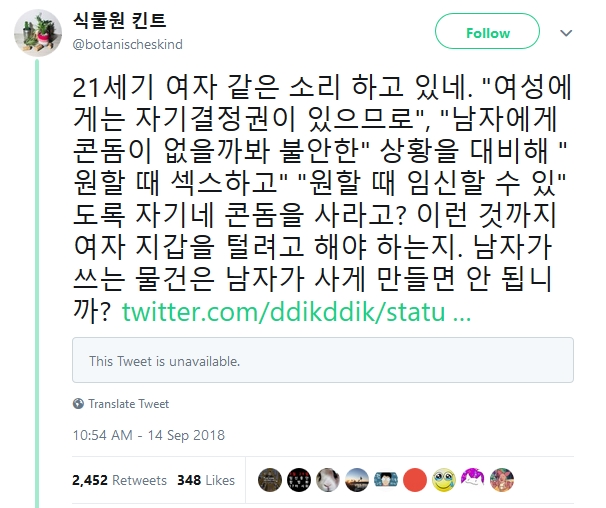
But that would be missing the point. Just because a news video is more likely watched on Facebook on a smartphone than on the 6 o’clock news on TV, doesn’t mean a traditional news organization wasn’t the most likely producer. Ergo, the differences revealed by this study still have real impacts and still need fixing, as evidenced by the scale and enthusiasm of the reaction to Lim Hyeon-ju donning her glasses.

If you reside in South Korea, you can donate via wire transfer: Turnbull James Edward (Kookmin Bank/국민은행, 563401-01-214324)

In the News: Korean Celebrity, Ethnic Nationalism, and Beauty Ideals

Kim Yuna may well be the “Ad Queen” in South Korea, but the reality is that precious few female athletes have the face and body-type necessary to get noticed by Korean advertisers. Whereas for male athletes, they just have to be good at their sports.

Estimated reading time: 12 minutes. Image source: YouTube via Humoruniv.

My writing is pretty erratic these days, because reasons. Sorry about that. One of those reasons is worth mentioning though: I’ve been fielding lots of inquiries from journalists instead. Here are some of the results:
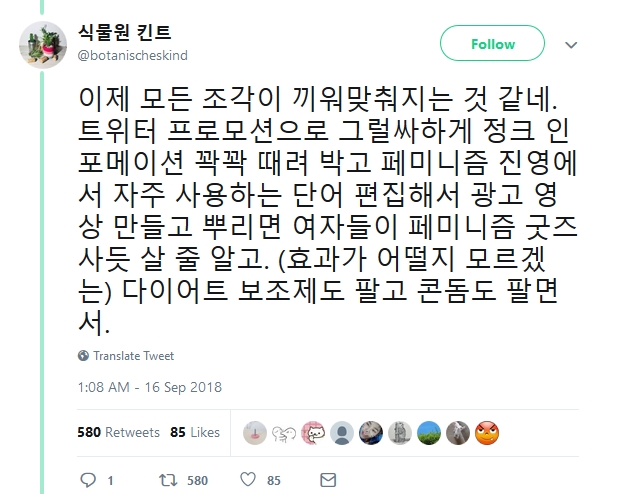
First up, from “In Pyeongchang, a surprise visit from Queen Yuna” by Nathan VanderKlippe in The Globe and Mail:

For “Korean advertisers, all their Christmases came at once when Kim Yuna became popular,” said James Turnbull, a South Korea-based author who writes about Korean feminism, sexuality and pop-culture.

By at least one measure, celebrity matters more in South Korea than elsewhere. Roughly 60 per cent of the country’s advertisements feature endorsements, some six times higher as those in the United States. Former South Korean advertising executive Bruce Haines once called the country’s advertising “beautiful people holding a bottle.”

Mr. Turnbull is critical of the unfair standards this imposes. South Korean Ahn Sun-ju was among the best golfers in the world, but South Korean advertisers said she needed plastic surgery if she wanted to appear in commercials.

Ms. Kim, however, “was tailor-made for Korean advertisements,” Mr. Turnbull said. She is “young, attractive, photogenic, a figure skater – thin, tall – whose body is the type they want.”

“The question isn’t so much why she retired so early as why she retired so late,” he added. “Because really, did she enjoy what she was doing?”

There’s lots to unpack in that short segment. Starting with giving credit to Roboseyo for the point about advertisers’ love of Kim Yu-na, who wrote that in 2009:

Kim Yu-na…is a teen-aged figure skating phenomenon out of Seoul. She’s only eighteen years old now, and she’s been kicking the crap out of the ladies’ singles category for a few years already. She’s telegenic and cute: she appears in TV commercials here in Korea and sells, better than most of Korea’s other “Best in the world/Korea at X” stars, for example Park Ji-sung (family name Park), the Soccer (that’s Football to the rest of the world) star who is holding his own impressively on Manchester United, but who’s so ugly, and un-charismatic in front of the camera, that they can only make commercials like this [long since deleted example—sorry]: keep the camera at a distance, and show him kicking stuff, because that’s the only time he looks impressive. (Notice at the end of the ad, when the close-up is as short as they can make it and still have him be recognizable, as if the camera’s afraid to get close to his face).

Catch me on a bad hair day, and I’m hardly charismatic in front of a camera myself. I’m all about widening the media’s narrow range of beauty ideals too. But it’s objectively true: even at his physical peak, Park Ji-sung’s face would never have launched a thousand ships. As a male celebrity however, his phenomenal popularity for his sporting prowess meant that advertisers still flocked to him nonetheless, especially after it became apparent he was responsible for one million new Manchester United-branded Shinhan Mastercard accounts. Add various other factors responsible for that world-high celebrity endorsement rate of 60 percent of TV commercials (see my journal article), plus—in this case—Koreans’ (in)famous toleration of blatant photoshopping, then you can hardly blame Gillette for joining his bandwagon in 2009:

Sources: Hidomin (2006), Betanews (2009).

Like Park Ji-sung, golfer Ahn Sun-ju was one of the best at her sport in Korea. Unlike Park Ji-sung, she was cursed with being a woman, which meant advertisers were very concerned about her appearance—and her body type didn’t fit their narrow requirements. Frustrated with her ensuing lack of corporate sponsorship, she ultimately chose to compete in Japan instead, where—to my shock and pleasant surprise—advertisers were more interested in her sporting achievements. As The Korea Times explains:

…[Ahn] said that when she competed in Korea, her ability as a golfer was never enough.

“Some (potential Korean) sponsors even demanded I get a plastic surgery,” she said. “Companies did not consider me as a golf athlete, only that I was a woman. It mattered most to them was whether my appearance was marketable. I was deeply hurt by that.”

Ahn her made pro debut with the KLPGA in 2006 and won six tournaments before jumping to the JPLGA. But despite her stellar play, she struggled to find a corporate sponsor in Korea.

“As you can see, I do not have a pretty face, I am not thin, I am not what you would call sexy,” Ahn said. “But does that mean I shouldn’t be playing golf?

“Japanese companies, on the other hand, focused on my ability as a golfer. They are more concerned about my performance and how I treat my fans. I am being sponsored by six Japanese companies, including a clothing brand.”

Writing in Kore in response to that article, Ethel Navales speculates that we can’t “say for certain that Ahn’s decision to move to JLPGA was due to Korea’s inability to accept her physical appearance”, and that she may have just been reacting to one negative experience, so “we certainly shouldn’t assume that the KLPGA puts those expectations on [all] their players.” But personally, I see no reason to challenge Ahn’s stated motivations for leaving. As for the KLGPA, I turned to Transnational Sport: Gender, Media, and Global Korea (2012) by Rachel Miyung Joo to learn more about its attitudes towards its female players, but unfortunately she doesn’t mention Ahn at all, focusing largely on Korean women in the (US)LGPA instead. So, while her descriptions of their Orientalist and sexualized depictions therein are fascinating, and her description of its 2002-2007 “Five Points of Celebrity” marketing drive (a.k.a. “Anti-butch Campaign”), “understood to place a large emphasis and personalities of the players rather than on their performance as athletes” (p. 153), sounds particularly relevant here, indeed we still can’t automatically assume the same of the KLPGA. But she does note that “[i]n the current media climate in South Korea, female golfers are often sexualized through sports tabloids, fansites, and advertisements” (p. 156; see Le Coq Sportif example below). Also, her description of what happened to the Korean image of predecessor Pak Se-ri, “probably the most popular athlete in South Korea at the end of the twentieth century”, is quite telling. Because after Pak left for the LGPA in 1998:

Sources: Kaikaihanno (Pak Se-ri, 1998), Yonhap (Ahn Sun-ju, 2014)

…there [was] a considerable shift in ideas of public sexuality in [South Korea]. This shift can be read in the changes to the public appearance of Pak Se-ri. She was transformed from a dowdy twenty-something golfer at her debut to the tidy player of today through a national makeover. The masculinity of Pak—her broad shoulders, strong legs, dark tan, baggy shorts, and flat short hair covered with ill-fitting baseball caps—did not detract from her initial national fame….[But] [o]ver the years, her public image has been transformed through a wardrobe redo and the use of heavy makeup. She is often featured in women’s magazines in tailored designer sportswear with highly stylized hair and makeup. In the photos, she strikes poses that emphasize her “feminine side”—taking a stroll in the wood, relaxing on a couch, playing with her dogs, or cooking in her kitchen. The transformation of a tomboyish national icon to the womanly figure of today demonstrates that, although femininity was not a requisite for her national importance, she was normalized into public femininity through the transnational circuit of images of professional golf.

“In the current media climate in South Korea, female golfers are often sexualized through sports tabloids, fansites, and advertisements.” One of many long, lingering shots of conventionally-attractive, (now) JLPGA player Lee Bo-mee in a 2016 Le Coq Sportif commercial. Source: YouTube.

In contrast, Kim Yuna shares the body type and looks of K-pop girl-group members, who are specifically chosen for their ensuing, very narrowly-defined suitability for advertising. So it comes as no surprise that, like them, the vast majority of her numerous endorsements appear to be for beauty and dieting-related products.

To note that isn’t to diminish her considerable achievements and hard work. But it’s entirely possible she would never have become such a national icon if her body didn’t fit the part. As was the case with Yi So-yeon, Korea’s first astronaut, whose treatment by netizens and the media was really quite shocking in comparison.

Finally, just for the record, the point about her retirement was actually made by Nathan, but I agreed. Also, it’ll be interesting to see to what extent the Garlic Girls’ endorsements will challenge all these body-standards for female athletes. But it’s time to move onto the (much shorter) second article.

Update, July 2018: While preparing for my interview with Nathan, I remembered that a Korean journalist had made similar comments about a female golfer in 2016, and was consciously echoing him TBH, but I couldn’t find his article at the time. Now that I’ve just relocated it though, I was surprised to learn that he was actually talking about Park In-bee, who by coincidence very closely resembles Ahn. Unlike with Ahn however, one additional factor behind advertisers’ disinterest in her may be that her family moved to the US when she was 12 (she’s now 29), and that she only competed in Korea for the first time in May this year.

Next, again for Nathan, a few days later I was quoted in “Behind Olympic death threats, a South Korean fan culture that takes speed skating seriously“,

It doesn’t help that the South Korean sense of nationalism also “stresses Koreanness through having Korean ‘blood,'” said James Turnbull, a writer and speaker on Korean culture. “This means many Koreans react the way they do because they feel like a member of their ‘family’ has been cheated.”

Admittedly, that last possibly sounds a little patronizing coming from a foreign observer. So I would have preferred Nathan had noted that it was actually my Korean friend Ji-eun that said that, attempting to explain things after I expressed my mystification at the Korean (over)reaction to the Apolo Ohno controversy in the 2002 Winter Olympic Games—which included passers-by harassing my coworkers on the streets of (normally very pleasant and friendly) Jinju. But no matter: whoever points it out, bloodlines-based nationalism is very much a thing in Korea (and Japan), and has led to such oddities as numerous apologies for and a national sense of guilt and shame over the actions of Virginia Tech shooter Seung-hui Cho in 2007, despite his having left South Korea at the age of 8 and absolutely no-one in the US considering him “Korean.”

Left: highly-recommended further reading (source: Stanford University Press). Right: “A BBC poll from 2016 of various countries, asking what the most important factor in self identity was. South Korea has the highest proportion given for ‘race or culture – 25%” (source: BBC via Wikipedia).

Next up, a week later, I was quoted by Diane Jean in “En Corée du Sud, les femmes n’ont pas d’autre choix que d’être belles” (“In South Korea, women have no choice but to be beautiful”) for ChEEK Magazine. As you can see it’s all in French, so here’s a bad translation of my contribution:

“Of course these pressures are not unique to Korea, they are found elsewhere,” says James Turnbull, a specialist in feminism and pop culture in Korea. But without having lived here, where, on a daily basis, your beautician, your teachers, your parents, your colleagues, your bosses constantly repeat to you that you have to go on a diet […], we can not realize how these pressures are particularly harsh for Korean women. “

That Korean women face body image issues will come as a surprise to nobody. But it can be difficult to convey their intensity, especially to overseas observers who are constantly bombarded with negative body image messages themselves. Probably most effective then, is to hear from the victims in person, especially overseas Koreans who frequently express their shock at the level of body-shaming they experience here compared to in their home countries. Listen to Korean-American Ji Eun-gyeong for instance, writing for Ilda South Korean Feminist Journal:

In contrast to the casual attire and revealing clothing of some of the Korean American women in the student program, Korean female students were uniformly slim, wore formal clothing to school, and always had perfectly groomed hair and makeup. I remember gawking at the female students wearing formal suits and heels at nearby Ewha University, something that was unheard of at schools in the US, where it was perfectly acceptable to go to school wearing pyjamas and looking like you rolled out of bed.

In comparison to these women, I was fatter, did not know how to put on makeup “properly,” and was relatively not well-groomed. The physical standards for Korean women were a palpable social pressure on me and the Korean American women, and despite our best efforts to “fit in,” we always fell short. We did not have the skills, energy, or time to put on full makeup, to dress formally for school everyday, nor did we have the slim body types that almost everyone around us seemed to have. Most importantly, we were not “well-behaved” women.

As Korean American women, we were unused to having so many restrictions on our movement and our bodies. One student in my exchange program was slapped for smoking in public, and another was yelled out for having lightly dyed hair. Others were reprimanded for wearing revealing or messy clothing, such as shorts with “holes” in them (shredded shorts). We talked too loudly and laughed too hard. Because of these and the daily judgments about our physical appearance that left us lacking, most of the women in our program felt a demoralized and degraded while we were in Korea. The policing of our bodies was limited to Korean Americans, because we were being compared to Korean women, while the foreign women were help up to different standards.

In contrast, the Korean American men in our program had less restrictions on their dress or their physical appearance. While they were subject to some pressures – ie, having clean-cut haircuts and not being able to wearing shorts – they were subject to less judgment about their bodies than the foreign women.

Admittedly she was writing about 1994, but you don’t need me to tell you that very, very little has changed for the next generation. That is also indicated by the following damning statistics, collected in these slides for my lecture on body image for my “Gender in South Korea” course at Hankuk University of Foreign Studies last summer:

Statistic from “Explaining Underweight BMI and Body Dissatisfaction among Young Korean Women” by Tess Hellgren (2012). Screenshot: “Street Interview – Are you fat? (Asking Korean girls)당신은 뚱뚱한가요? Nicki Minaj VS Yoona” by Joo Won.Statistic from: “18% of Young Women Found to Be Underweight“, anonymous, The Chosun Ilbo (2014).
(Link to Georgia Hanias’s 2012 Marie Claire article in the slide, plus another one to an interesting critique.)

Finally, there was one more interview after that, but I was completely edited out of the article when it was finally published last week. I’ll wisely spare you my rant though, only mentioning it as a final excuse for the delay in posting. So too, that I also did a long podcast interview in March, which will hopefully be coming out in the next couple of months.

Any thoughts? About any of the articles? :)

Related Posts:

If you reside in South Korea, you can donate via wire transfer: Turnbull James Edward (Kookmin Bank/국민은행, 563401-01-214324)